



Illicit guns fuel crime, threaten Caribbean stability – Guyana’s UN rep
“He swerved to save 2 pedestrians” – eyewitness on Corentyne accident

Fire that ravaged Demerara Shipping workshop deliberately set – GFS
Fisherman dies after falling, hitting head while repairing boat at Unity foreshore
“He promised me he was coming home” – mother of man killed in Berbice crash

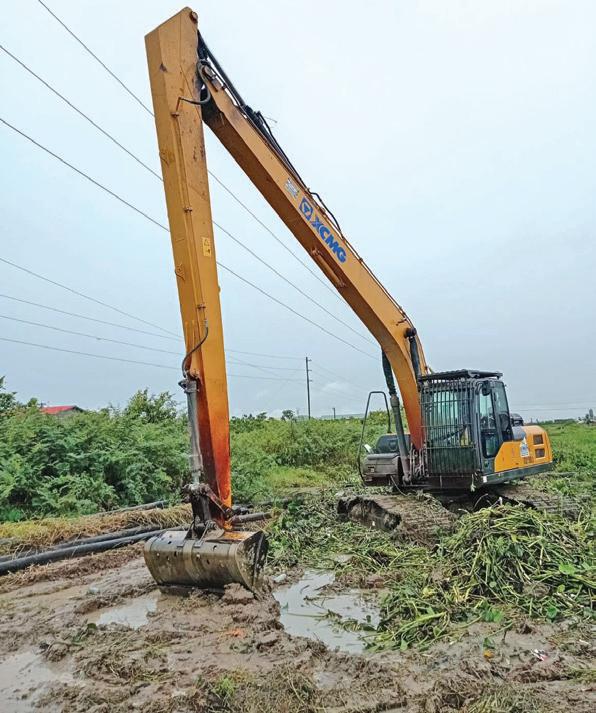
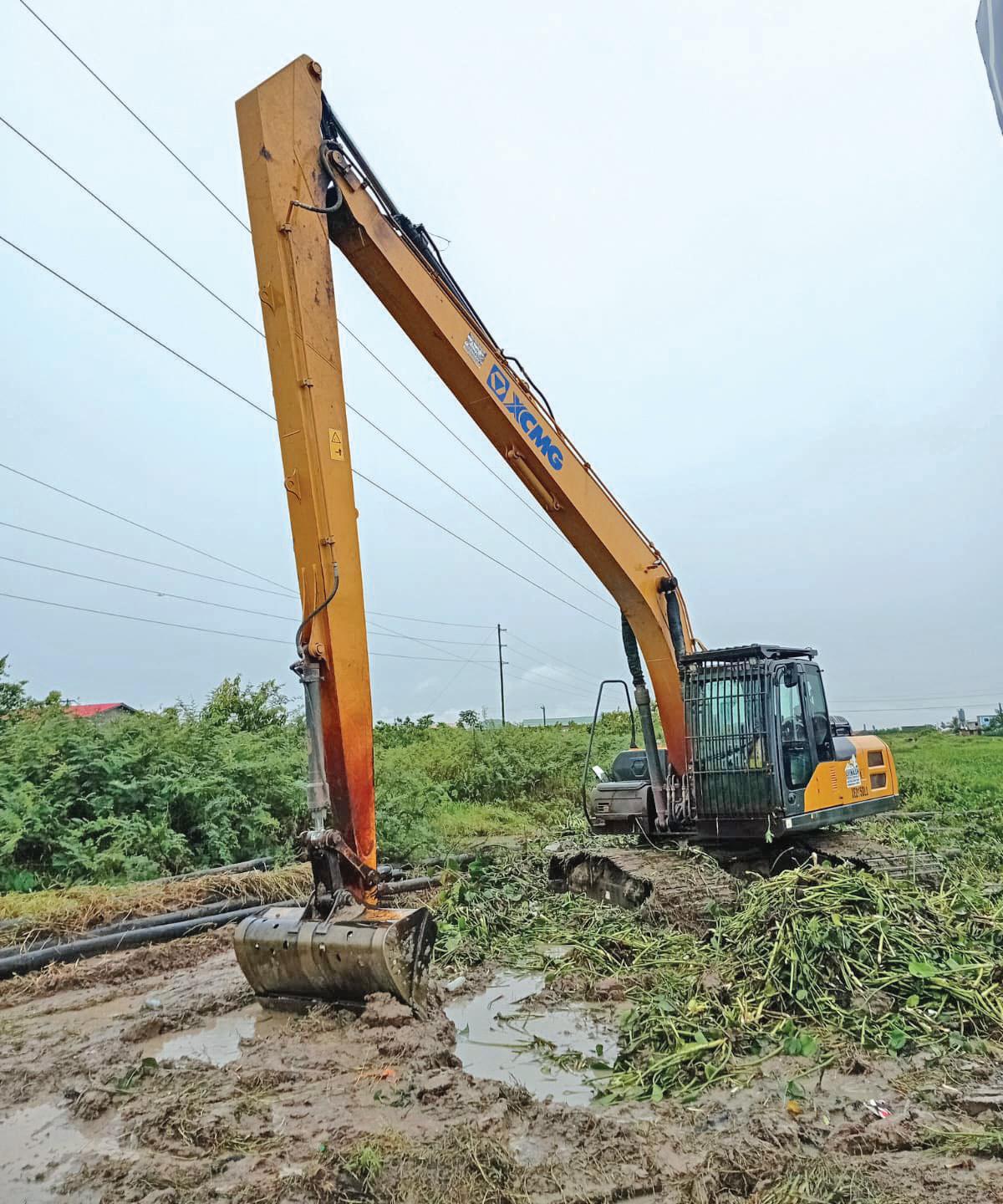
The Guyana Power and Light Inc (GPL) will be moving to recoup costs for repair works done a key transmission infrastructure that was damaged by an excavator on Monday and resulted in disruptions in electricity supply in the Demerara County. According to GPL, the incident occurred at approximately 10:11h when an excavator, being operated by Raju Singh of Avinash Contracting and Scrap Metal Inc, came into contact with the power company’s L4 Transmission Line, which interconnects the Golden Grove and Sophia Substations. The incident resulted in damages to the critical transmission infrastructure and caused a service interruption that affected a number of customers across sections of Demerara. GPL’s technical teams responded and immediately commenced efforts to assess the damage and restore electricity supply to affected customers as quickly and safely as possible. “GPL has since commenced an investigation into the inci-
dent and wishes to make it clear that the company will be pursuing legal action against both the contractor and the operator to recover the costs associated with the damages caused to its infrastructure,” the power company stated. It further used the opportunity to reminds contractors, heavy-duty equipment operators and members of the public that any excavation, construction or operations near the company’s transmission and distribution infrastructure must be coordinated with GPL to ensure safety and prevent damage to critical national assets. GPL went onto warn that unauthorised or unsafe activities near its network can result in widespread service disruptions as well as pose serious public safety risks. Monday’s incident comes two days after GPL’s distribution network lines and a utility pole were damaged by a truck “recklessly” reversing out of a yard at Third Avenue in Diamond, East Bank Demerara (EBD). It was reported that the impact resulted in destruc-
tion to the pole and the dislodgement of associated hardware, causing electrical arcing and also damages to a nearby customer’s vehicle. GPL has been working with the Guyana Police Force (GPF) to locate the truck driver, who drove away from the scene. Efforts by this newspaper on Monday to ascertain whether the driver was found, were futile. Only earlier this month, GPL sought to recover some $8 million from a contractor following a transmission line damage during works at Grove New Housing Scheme (Backlands) on the East Bank. In a May 19 statement, the power company disclosed that a heavy-duty machinery operated by S. Joseph Transportation & Machinery Rental came into direct contact with the L1 Transmission Line, linking the Garden of Eden and Grove Substations, resulting in a significant disruption of electricity supply to tens of thousands of customers across multiple communities the previous day. GPL has since issued
a strongly worded letter to the construction company and is seeking to recover a total of $8,059,361 for operational losses incurred as a result of the incident.
S. Joseph Transportation & Machinery Rental was given 14 days to settle the full amount, failing which GPL will pursue legal action. This followed a similar incident back in April, when an engineer for a road construction project at Dennis Street, Sophia in Georgetown, was arrested by police after a heavy-duty machinery damaged a key transmission line and caused a near-10 power outage across the Demerara County.
Days later, GPL informed the construction company – China Railway First Group (Guyana) Incorporated, that it would have 14 days settle some $30.6 million in repair costs for the damages caused. These actions come as GPL intensifies efforts to hold persons accountable for damaging its infrastructure. In recent years, there have been mounting concerns about the repeat-
ed damage to utility infrastructure especially by road construction works as well as by vehicular accidents.
During a hearing before the Public Utilities Commission (PUC) back in March, PUC Chairman Dr Nanda Gopaul had called for those persons responsible to be held financially accountable for the damages they caused. In response, GPL’s Team Leader, Kesh
Nandlall, had explained that the power company has been working with the Police Force to ensure those offenders face legal action. “There was a lot of charges being meted out to these contractors… we have a team of guys that are working very closely with the police. So, when we have these incidents, we act immediately,” Nandlall had told the Commission earlier this year.


JUNE 2, 2026






The Berbice Bridge will be closed to vehicular traffic on: Tuesday, June 2 –05:00h–06:30h and Wednesday, June 3 – 05:40h–07:10h.
Parika and Supenaam departure times – 05:00h, 10:00h-12:00h, 16:00h, 18:30h daily.
Thundery to light showers are expected during the day and at night. Temperatures are expected to range between 23 degrees Celsius and 28 degrees Celsius.
Winds: East-North-Easterly to Easterly between 2.68 metres and 4.09 metres.
High Tide: 17:44h reaching a maximum height of 2.40 metres.
Low Tide: 11:18h and 23:27h reaching minimum heights of 0.66 metre and 0.84 metre.










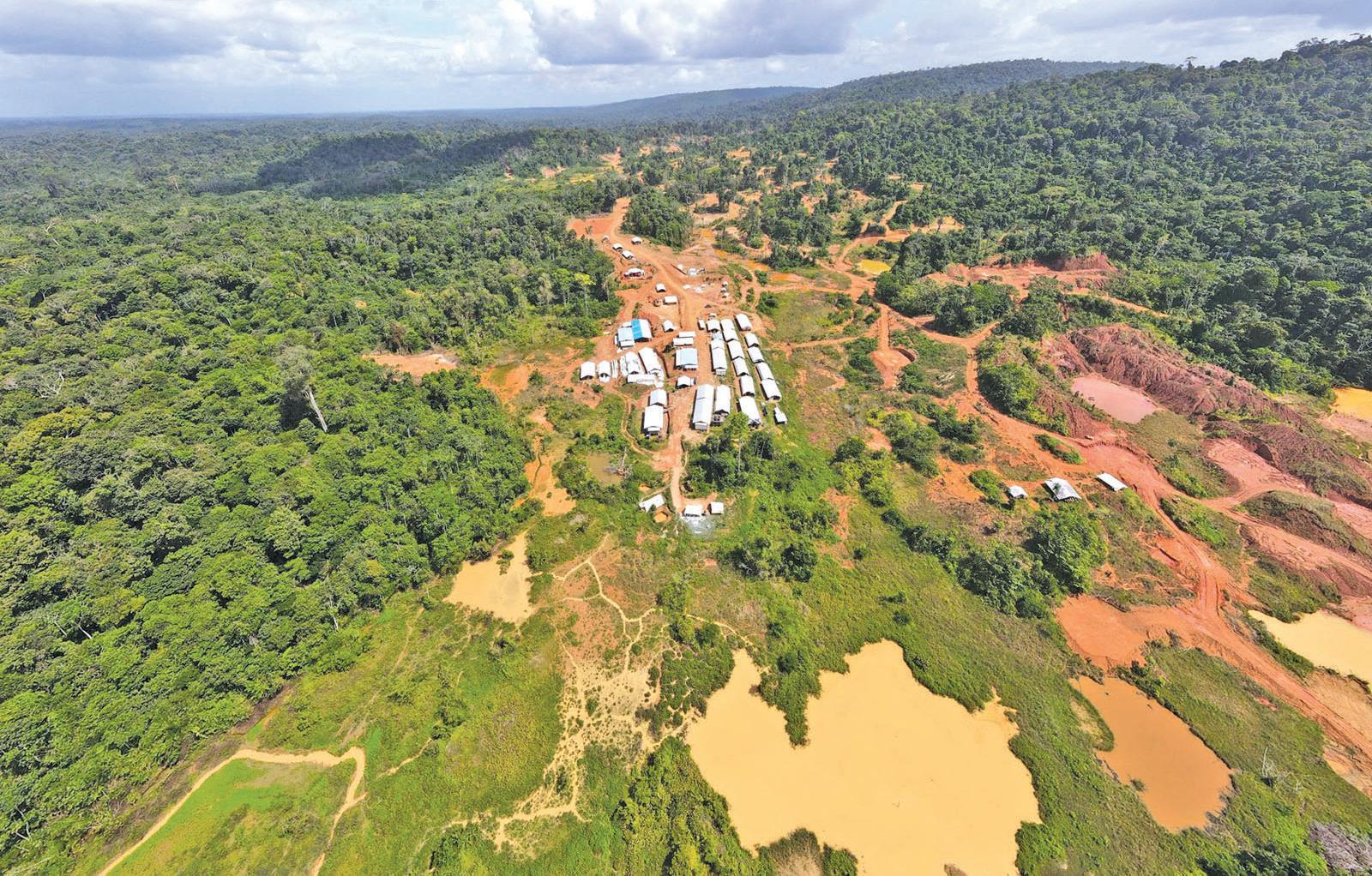
Guyanese have taken up majority of the job opportunities the Oko West Gold Project in Region Seven (CuyuniMazaruni), which is being operated by a Canadianbased gold mining company, G Mining Ventures (GMIN). The Oko West Gold Project is currently in its construction phase, with the company aiming to complete these works by the third quarter of 2027 before transitioning into full-scale operations. However already, there are over 900 Guyanese on the thousand-plus workforce and according to President Dr Irfaan Ali during an outreach at Bartica on Monday, this figure is likely to increase by the end of this year. “Currently, the workforce stands at 1,193 employees of which 946 are Guyanese. This is projected to increase to 2,100 by December 2026… and most of those jobs will be taken up by Guyanese, mostly from your region,” the Head of State told residents.
In fact, during his address to the residents, President Ali expressed his dissatisfaction with the pace at which the residents are taking up jobs and other opportunities available within the region. “We want to work with you now, drive you harder and faster in taking up the opportunities,” he asserted. Based on reports, GMIN plans to hire up to 2500 workers for its 100 per cent-owned Oko West Gold Project in the Cuyuni-Mazaruni region.
In fact, the company held a job fair back in April at the New Amsterdam Technical Institute (NATI) in Berbice, where it began engaging prospective employees as part of a nationwide recruitment drive ahead of the project’s 2027 startup. As the project advances, the company is seeking to fill a wide range of positions spanning construction, mining and hospitality. At the time vacancies existed for general labourers, electricians, carpenters, masons, heavy-duty equipment operators and truck drivers, as well as cooks, kitchen helpers, housekeepers and camp attendants, among other roles, reflecting the scale and diversity of the operation. Talent acquisition lead at the company, Kobe Cort, had explained to this newspaper that while the event was hosted in Region Six (East BerbiceCorentyne), the initiative is targeting skilled and semi-skilled workers from across the country. Cort had encouraged interested persons across Guyana to take advantage of the opportunities, describing G Mining Ventures as an equal-opportunity employ-
er committed to fair and transparent hiring practices. According to him, the company places strong emphasis on employee development and growth, positioning itself as a preferred choice for individuals seeking to build long-term careers in the country’s expanding mining sector.
Infrastructure advancements
Nevertheless, President Ali on Monday further highlighted the advancements of other aspects of GMIN operations that are advancing in Region Seven. As part of the initial phase of infrastructure development, the Oko wharf located in the Kartabo/Batavia area Region Seven is slated to become operational sometime this month with loading and offloading activities expected to commence by August. In ad-
dition, the camp facility, offices, welcome centre and sports field are to be completed by September 2026.
In the meantime, mining drilling, sampling and exploration activities continue across the concession area. The Canadian gold mining company is targeting a production of 350,000 ounces of gold annually when the project comes on stream next year.
Back in December 2025, GMIN officially secured a 20-year mining licence from the Guyana Geology and Mines Commission (GGMC) for the Oko West project, which is estimated to contain a staggering 5.4 million ounces of gold.
Only in April, G Mining Ventures successfully completed a $3 billion acquisition of the G2 Goldfields–a move that has catapulted the Canadian company
with one of the highest current gold profiles. Based on international reports, the deal will see both the Canadian companies combine their two adjacent projects in Guyana, G2’s Oko-Ghanie Project and GMIN’s Oko West Project, into a large-scale, low-cost mining hub. The combined Tier-1 Oko project is expected to yield over 500,000 ounces of gold per year. In Region Seven, there are currently some 2,524 active mining properties. In 2025, small and medium sized miners declared approximately 94,000 ounces of gold. This is in addition to the 165,000 ounces declaration made by Guyana’s lone large-scale gold operator, Zijin Mining, which acquired the Aurora Gold Mine (AGM) Inc. in Region Seven.



Editor: Tusika Martin
News Hotline: 231-8063 Editorial: 231-0544, 223-7230, 223-7231, 225-7761
Marketing: 231-8064 Accounts: 225-6707
Mailing address: Queens Atlantic Industrial Estate Industrial Site, Ruimveldt, Georgetown
Email: news@guyanatimesgy.com, marketing@guyanatimesgy.com
The persistent issue of fare overcharging within the public transportation system continues to expose critical gaps in compliance, enforcement, and commuter protection. Despite clear regulatory provisions governing approved fare structures for minibuses and other public conveyance services, instances of passengers being charged above stipulated rates remain a recurring concern. The absence of displayed fare charts in some vehicles further compounds the problem, creating an environment where passengers are often placed at a disadvantage in asserting their rights.
Recent guidance from law enforcement authorities underscores both the legal remedies available to commuters and the responsibilities of operators. Passengers are being actively encouraged to report incidents of overcharging or non-display of fare structures to the nearest police station, without the need to travel to central locations. This decentralised reporting mechanism represents a practical step towards improving access to justice and strengthening regulatory oversight at the community level.
At the core of the matter is a clear legal framework, it is an offence for public transportation operators to fail to display approved fare schedules, just as it is an offence to demand or accept payment above those approved rates. The dual obligation places responsibility on both service providers and users to adhere to established standards. However, enforcement effectiveness depends largely on awareness, willingness to report breaches, and the responsiveness of enforcement institutions.
A significant barrier historically has been the inconvenience associated with lodging formal complaints. By reaffirming that any police station can receive such reports, authorities are effectively lowering the threshold for public participation in enforcement. This approach recognises the geographic and economic realities faced by commuters, many of whom rely on minibuses as their primary mode of transport and cannot afford additional time or travel costs to pursue complaints at centralised locations.
The reporting process itself has been clarified: complainants are expected to provide essential identifying information, including bus numbers and route details, followed by a formal statement. This procedural requirement is critical in ensuring that complaints are actionable and can be properly investigated. It also reinforces the importance of accountability in public transport operations, where vehicles and routes are identifiable and regulated.
Notwithstanding these measures, the success of enforcement ultimately depends on consistent application and visible consequences for violations. Regulatory deterrence weakens when infractions are perceived to go unpunished or when monitoring is sporadic. Therefore, Police and relevant authorities must ensure that reported cases are followed through with appropriate investigative action and, where warranted, sanctions.
The issue of fare disputes has gained renewed attention in the context of recent agitation by sections of the minibus sector calling for increased fares. While such concerns reflect operational realities faced by transport providers, including fuel costs and maintenance expenses, the current official position remains unchanged: no increase in fares has been approved across public transportation modes. These include minibuses, hire cars, speedboats, and airport taxis. As such, existing fare structures remain binding and enforceable.
In this environment, adherence to approved rates becomes even more significant. Any unilateral adjustment of fares by operators undermines regulatory authority and places undue burden on commuters, many of whom depend heavily on these services for daily mobility. The tension between operator demands and regulatory compliance highlights the need for structured dialogue mechanisms, but also reinforces that until formal approvals are granted, existing rates must be observed without deviation.
Consumer protection within public transportation cannot be viewed in isolation from broader governance and service delivery standards. Fare transparency, display of rates, and adherence to approved charges are fundamental components of a fair and functional transport system. When these elements are compromised, public confidence in the system is eroded, and disputes between operators and passengers become more frequent.
Many commuters remain uncertain of their rights when confronted with overcharging or non-display of fare information. Strengthening public education on reporting mechanisms and legal protections is essential to ensuring that enforcement measures are fully utilised. Without informed participation from commuters, regulatory frameworks risk underperformance despite formal existence.
Passengers must be empowered and encouraged to report violations without fear or inconvenience.
The reaffirmation of accessible reporting channels to any police station is a step towards more responsive governance in the transport sector. However, sustained improvement will depend on the credibility of follow-through actions and the establishment of a transport environment where adherence to approved fares is the norm rather than the exception.
Cancer is now a story of the good, the bad and the ugly – but also hope
By Prof Devi SriDhar
Cancer causes nearly one in six deaths worldwide every year, some 10 million all told. That is a stunning number, but it also masks the reality that some cancers are more deadly than others. We have become remarkably good at detecting and treating melanoma and prostate cancer, for example, and today five-year survival rates for those cancers are well over 90 per cent in most rich countries. Others, such as pancreatic cancer, are more difficult. In the United Kingdom, just over one in 20 people with pancreatic cancer are still alive five years after diagnosis.
That is why a new drug for pancreatic cancer, called daraxonrasib and announced at the American Society of Clinical Oncology’s (Asco) annual meeting in Chicago at the weekend, has been met with such jubilation. The drug –taken as a pill once a day – doubled the survival time of those enrolled in a 500-person trial, with fewer side effects compared to traditional chemotherapy. The drug works by shutting down a protein, Kras, that causes cancer cells to grow and divide. One longtime cancer researcher reported that she cried reading the results. With so few effective treatments for this cancer available, the drug is likely to be a real game-changer.
But as with any news from cancer research, it can be hard to make sense of all of this for those wondering if we’re making progress, and what it all means for their loved ones and themselves. Sometimes we hear overly optimistic talk about a potential “cure” or eradication. Other times that we will never have a successful “moonshot” for cancer. I’m going to try to unpick where we’re at – and give you the good, the bad and the ugly.
First, cancer is not one disease: it describes a broad group of conditions that have a similar basis – namely uncontrolled cell growth and the ability of these kinds of malignant cells to attack tissues and spread throughout the body. There are more than 200 different cancer types, each with distinct biological mechanisms, risk factors, symptoms and treatment options. Even taking one type of cancer – such as breast cancer – reveals that there are dozens of molecular subtypes, which are simplified into four groups for treatment decisions.
What this means is that we’re unlikely to have a singular “cure” for cancer –rather, we have to develop advances for specific cancers in terms of better prevention, diagnosis, treatment and survival.
But there is a lot of good news: we’re getting better at improving survival for most cancer types, both in the drugs being offered and in who gets offered them. Beyond the daraxonrasib advance, this weekend also saw news of a new vaccine (amivantamab) for head and neck cancer, which is the sixth-most-common cancer. It shrank the tumours of more than a third of patients enrolled in a 102-person trial. It works by activating the immune system to attack the tumour, and blocks two proteins that help tumours grow. An advance in treating one cancer doesn’t necessarily mean it will apply to all cancers, but sometimes that is the case. Both of these therapies are now being trialled for other cancer types.
We’re also getting better at precision medicine – that is, targeting certain drugs towards those most likely to respond. In a World Economic Forum meeting many years back, I was surprised to learn that blockbuster drugs –those seen as game-changers for treatment – often only work in a relatively small percentage of the population, depending on their genetics. Yet doctors often prescribe the same medications to all patients, not knowing who will respond or not. A new international study found that a DNA test can distinguish between patients likely to benefit from certain chemotherapy drugs for breast cancer, and those who wouldn’t – therefore sparing this group the side effects and stress of taking an unhelpful (and painful) treatment.
But there’s also bad news in almost every country: 100,000 people are diagnosed each day with cancer, and not enough medical staff are there to treat them. New research estimates that there will be a global shortfall of 100 million cancer care workers by 2050, including in nursing (65 million) and diagnostic staff (16 million). This is the same challenge for the NHS: there are simply not enough lab technicians, cancer specialists and nursing and support staff across the country.
Early diagnosis and rapid treatment, which depend on staff availability, are at the root of higher survival: currently one in three cancer cases are undiagnosed worldwide, and while much of this burden lies in Africa and poorer parts of the world, it’s also a challenge in G7 countries such as the UK, where about 50 per cent of cancers are diagnosed at a late stage. Even after diagnosis, almost every hospital trust in England failed to meet the key NHS target of treatment within 62 days. In England, only 69 per cent of patients started treatment within
62 days of urgent referral, with comparable figures of 71 per cent for Scotland, 61 per cent for Wales and 33 per cent for Northern Ireland.
These delays matter for survival: in general, every four-week delay reduces patient survival by 10 per cent – and this could be higher or lower, depending on cancer type. I was acutely aware of this myself when lab results from a smear to detect potential cervical cancer took months to come back and were positive (I was treated by the NHS and am now all clear). And now to the ugly. Unfortunately, we are seeing a rise in cancer in people under 50. It’s no longer just a disease linked to ageing. As I’ve written previously, cancer rates increased by 22 per cent in the age group 25-29 in industrialised countries between 1990 and 2019. Researchers from Harvard University have argued that each cohort of people born at a later time, such as a decade, have a higher risk of developing cancer later in life.
The data indicates that you’re more likely to develop cancer at a younger age than your parents and grandparents, and your children/nephews/nieces are ultimately more likely to develop cancer than you are. This is the opposite of progress. Why? There’s no single explanation, but evidence increasingly suggests that a changing environment, such as the food we eat (including ultra processed foods), rising obesity and weight gain, alcohol, stress and increased insomnia, are all having an impact.
But don’t give up hope. In 2001, a month after I turned 17, my dad, an oncologist and lung cancer researcher, died of leukaemia and lymphoma at the age of 49. In the 25 years since his death, survival rates have increased dramatically, with a shift away from broad-spectrum chemotherapy to precise immunotherapy and targeted medications for his specific subtype of cancer.
In 2026, his survival chances would have been much higher due to the consistent and continued investment in scientific advances and health care, and the research teams behind them. While we may not be close to a singular “cure”, that’s something to be optimistic about and a trend that looks likely to continue in the months and years to come.
So, if good, bad and ugly are the thoughts arising as we think about cancer now, hold on to the thought that there is more good than bad. (The Guardian) (Prof Devi Sridhar is chair of global public health at the University of Edinburgh, and the author of How Not to Die (Too Soon))
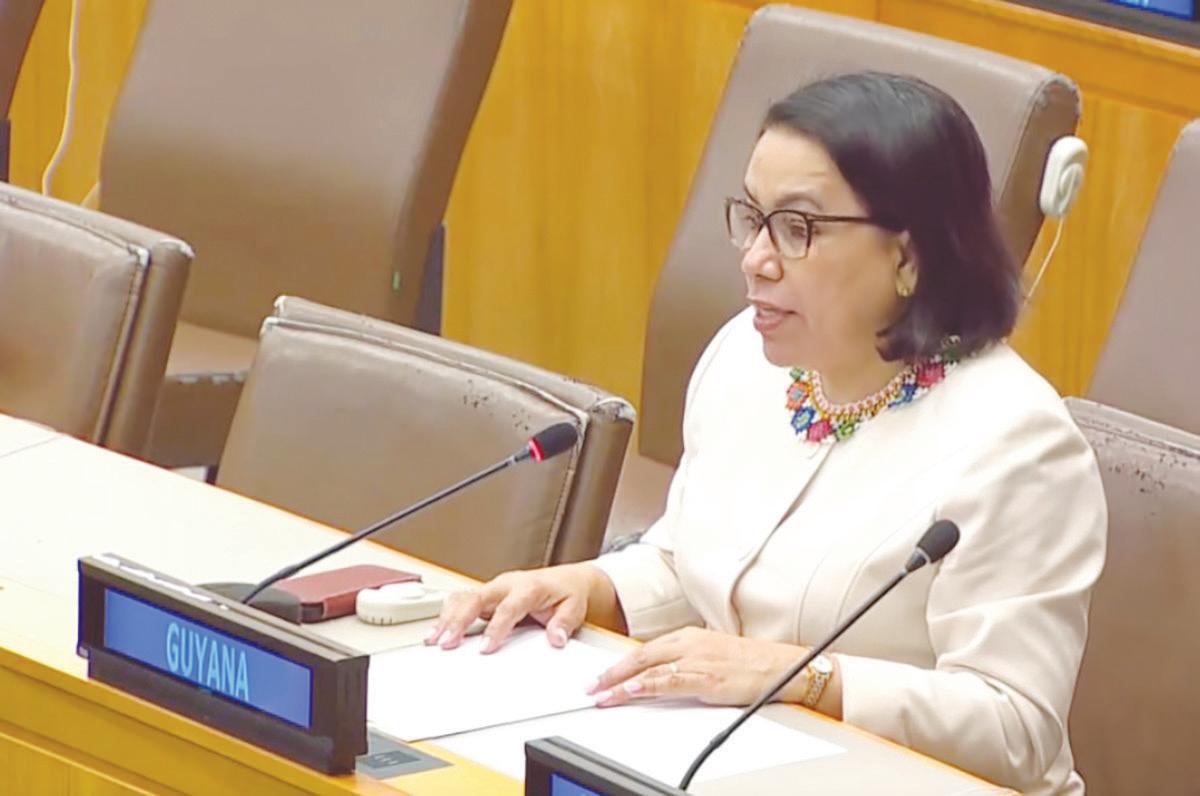
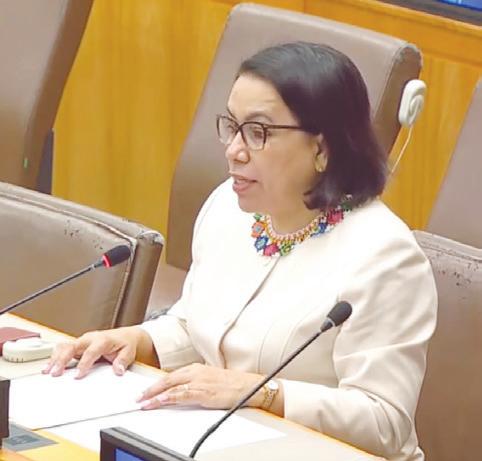
Permanent Representative of Guyana to the United Nations (UN), Carolyn RodriguesBirkett, who is also the Chair of the Caricom Caucus of Permanent Representatives, has called for strengthened controls over firearm marking, record-keeping and tracing in full accordance with the International Tracing Instrument (ITI), emphasising that effective tracing remains an essential tool in disrupting illicit supply chains and increasing transparency in global arms flows.
She made these remarks during the Biennial Meeting of States to Consider the Implementation of the Programme of Action to Prevent, Combat and Eradicate the Illicit Trade in Small Arms and Light Weapons (SALW) in All Its Aspects.
The statement was delivered by RodriguesBirkett in her capacity as Chair of the Caricom Caucus of Permanent Representatives for May and June 2026 under Agenda Item Seven: Consideration of Implementation of the UN Programme of Action and
the International Tracing Instrument to Enable States to Identify and Trace, in a Timely and Reliable Manner, Illicit Small Arms and Light Weapons, Including the Prevention and Detection of Diversion of SALW to Unauthorised Recipients and Illicit Markets.
According to RodriguesBirkett, Guyana remains particularly concerned about the persistent flow of illicit firearms into the Caribbean, which she noted is often facilitated through diversion from legal markets, weak stockpile management and increasingly sophisticated trafficking methods. She explained that Caricom continues to stress the need to address these challenges through strengthened international cooperation, shared responsibility and enhanced accountability among states. “The Caribbean Community also underscores the importance of preventing and detecting diversion at every stage of the life cycle of small arms and light weapons. In this regard, we call for strengthened controls over marking, record-keeping, and tracing, in full accordance with the ITI. Effective tracing re-

mains an essential tool in disrupting illicit supply chains and bringing greater transparency to global arms flows.” RodriguesBirkett further posited that Caricom remains unwavering in its commitment to the full and effective implementation of the Programme of Action on SALW and the ITI. In her view, the Caribbean region continues to face significant challenges as the proliferation of small arms and light weapons remains a serious threat to peace, security and sustainable development.
“The illicit trade in small arms and light weapons continues to fuel violent crime, enable gangs and transnational organised criminal networks, undermine the rule of law, impede socio-economic progress and threaten the stability of our small and vulnerable states.”
Addressing technological developments, she acknowledged that while advancements offer opportunities for improved implementation, significant challenges remain.
“We also note the growing impact of technologi-
cal developments for the implementation of the Programme of Action and the International Tracing Instrument. While innovations such as digital record systems and improved marking technologies can significantly enhance implementation, emerging risks such as easy access to 3D printing, challenges posed by modular weapons, the increasing use of polymer components, obliterated serial numbers, conversion devices, and new manufacturing techniques present serious challenges for regulation, tracing, law enforcement and community safety and require urgent attention.”
Capacity constraints
Meanwhile, she highlighted that capacity constraints continue to pose major challenges for many Caricom member states.
“We therefore stress the importance of sustained, predictable and targeted international assistance, including technical support, training and resource mobilisation, to strengthen national control systems, law enforcement capabilities, and border security.

Enhancing regional cooperation mechanisms is equally vital, including through information sharing and coordinated operations.” Rodrigues-Birkett added that Caricom supports continued dialogue on how technology can be responsibly leveraged while addressing its potential misuse in facilitating illicit trafficking and diversion. At the regional level, she noted that Caricom continues to translate global commitments into practical action through initiatives aimed at addressing firearm-related challenges.
She explained that the Caribbean Firearms Roadmap, supported by Caricom Implementation Agency for Crime and Security (IMPACS) and other partners, provides a structured regional framework designed to strengthen regulatory systems, reduce illicit firearm flows, enhance law enforcement capacity and minimise the risk of diversion from both Government and non-Government arsenals. She further highlighted that through regional cooperation, member states are advancing initiatives fo-
cused on firearm marking, record-keeping, tracing, ballistic cooperation, crime-gun intelligence, physical security and stockpile management, weapons and ammunition management and the safe, secure, and sustainable disposal of firearms and ammunition. She added that these efforts demonstrate the importance of regional and subregional cooperation mechanisms as force multipliers for small states. Amidst this, Rodrigues-Birkett reaffirmed Caricom’s steadfast commitment to strengthening implementation of both the Programme of Action and the International Tracing Instrument.
“In closing, Caricom reaffirms its steadfast commitment to strengthening the implementation of the Programme of Action and the International Tracing Instrument. We remain ready to work in close partnership with all stakeholders to prevent, combat, and eradicate the illicit trade in small arms and light weapons, and to advance safer and more secure societies for our peoples.”

TUESDAY, JUNE 2, 2026

When you multiply whole numbers, start by lining up the numbers correctly. It is easy to line the numbers up if you are multiplying by a 1-digit number.
Example:
Line up 125 x 4 this way

Multiply the 5 in the first line by the 4 in the second line. 5 x 4 = 20. You cannot write 20 in the ones place, so you do just what you did when adding. You write the 0 and save the 2 for the tens place. Keep that 2 in mind. Go back to the first line, and move one digit to the left to multiply 2 x 4, which is equal to 8. Then you are ready to add that 2. You get 8 + 2 = 10. Write the 0 in the tens place and set the 1 aside. Now go back to the first line again, and move one more digit to the left. Multiply 1 x 4 = 4. But remember the 1 you set aside. So 1 + 4 = 5. The product, or answer to this multiplication problem, is 500.
Remember:
Always multiply the entire top number by just one bottom digit at a time. Use a different line for the product of each bottom digit.
When you are multiplying a number by a 2-digit or 3-digit number, you have to be careful to line up the place values correctly. Exercises
Microorganisms are all around us, with an amazing diversity of adaptations. They were the first life on Earth, and their relatively recent discovery in extreme environments – like hot springs, ocean vents, and polar ice – illustrates how tenaciously they've evolved and survived. Microbiology gives us insights into evolution, disease, and even the mechanisms of our own cells.
In this science project, you will try to grow microscopic life that could have survived some of the harsh conditions of early Earth!
Objective
In this science project, you will determine whether there are microorganisms in a water source (eg, pond, lake, river, ocean, or aquarium) that could survive some of the different pH conditions of the early Earth’s oceans that may have given rise to life.
Introduction
What conditions are needed for a planet to give rise to life?
Since we have not yet found life outside of Earth, it is hard to answer this question. Life could look very different on other planets, or exoplanets. One way that scientists who study astrobiology, or the field that investigates what life beyond Earth may look like, try to answer this question is by learning about what early Earth may have looked like. This is because some conditions on early Earth may have given rise to life; the natural process by which this occurs is called abiogenesis.
Based on what we know of early Earth conditions, scientists have developed ways to measure planetary habitability. For example, for a planet to be habitable, it is thought that it must have both an energy source and liquid water. In our own solar system, while we have not yet been able to detect life, it is thought that some of the moons of


Jupiter and Saturn may have liquid water as well as other habitable conditions.
One location where abiogenesis may have taken place on early Earth is at hydrothermal vents. Hydrothermal vents are like hot springs or geysers, but are cracks in the ocean floor where hot water and energy-rich chemicals flow out and upward. Hydrothermal vents today can be home to many different types of microscopic life as well as animals, including fish, giant worms, lobsters, clams, and crabs.
While today ponds and rivers typically have a neutral pH (pH 7) and oceans have a slightly basic (alkaline) pH (approximately pH 8), early Earth’s oceans were thought to have an acidic pH (with pH values of 6 or lower) because there were higher levels of carbon dioxide (CO2) in the Earth’s surrounding atmosphere. At the same time, hydrothermal vents where abiogenesis may have taken place are thought to have been very basic (with pH values of at least 9). Taken together, there were thought to have been complex and extreme conditions throughout the waters of Earth’s early oceans. Some of these extreme conditions may have been home to different, early extremophiles, or organisms (usually microorganisms, or microbes) that live in certain extreme conditions. Ready to see if you can find microbes that could survive the different pH conditions of the early Earth’s oceans?
Questions
What is abiogenesis and where might it have occurred on early Earth?
Why do astrobiologists study early Earth?
How are the oceans today thought to be different from how they were on early Earth?
Why is it important for astrobiologists to study extremophiles?
(Adapted from Teisha Rowland, PhD, Science Buddies)
By Dayna Patterson
dearest wondrous water bear o mighty moss piglet you are my favorite micro-animal there should be a holiday in your honor and why not today we could call it tardigrade appreciation day and celebrate with tardigrade T-shirts and tardigrade earrings and moss conservation yesterday when I saw the jiggle of my ass in the mirror I thought of your body rolls on rolls like a fat baby how you waste zero seconds on body shame spend your days swimming in a bead of water held aloft by a tuft of sphagnum moss your snout-like mouthpart sucking up any delicious morsel your adorable spidery toes wafting you forward in your aqueous world darling kleiner Wasserbär Macrobiotus sapiens I adore the whole half millimeter of your extremophile existence how you can make a home anywhere Antarctica deep sea vents mud volcanoes sand dunes
TO BE CONTINUED

Write a poem from the point of view of a tardigrade.

In keeping with a manifesto promise made during the 2025 elections campaign, the People’s Progressive Party/Civic (PPP/C) Government will soon be introducing a 25 per cent reduction in electricity tariffs for the mining town of Bartica in Region Seven (Cuyuni-Mazaruni). This announcement was made by President Dr Irfaan Ali, who on Monday led a twoday Cabinet Outreach to the Cuyuni-Mazaruni region.
“As a result of our commitment to making people’s lives better, I am pleased to announce that our first tranche of electricity supply in Region Seven, here in Bartica, will be reduced by 25 per cent. So, our electricity rate will be reduced by 25 per cent in our first tranche as we move up to the 50 per cent across the country,” the Head of State declared at a public engagement in Bartica on Monday. This reduction in electricity rates will benefit over 5,000 consumers in Bartica and according to President Ali, it is made possible from the investments his administration has made in enhancing the off-grid electricity system in the township. Back in April 2023, the Guyana Government commissioned the country’s first 1.5 megawatt (MW) solar photovoltaic (PV) farm at Bartica. Located at Daag Point, the $703 million solar farm is connected to the national grid and generates up to 1,988 MWh annually – a project which the President noted did not only drastically reduce diesel consumption but also lower carbon emissions. “This investment has resulted in a savings of 6,148 drums of diesel and of course, we measure the emission that it eliminates. We eliminated 3,000 tonnes of carbon dioxide,” he indicated. Meanwhile, Monday’s engagement also saw President Ali outlining a series of initiatives that would enhance livelihoods and economic activities in the township, as well as the wider region. One such area he dealt with was the increased air travel costs, especially to take goods in the villages across Region Seven. Recognising that the issue lies with the middlemen who are buying the plane seats and capacity from the airlines but then inflate the prices for citizens, the Head of State
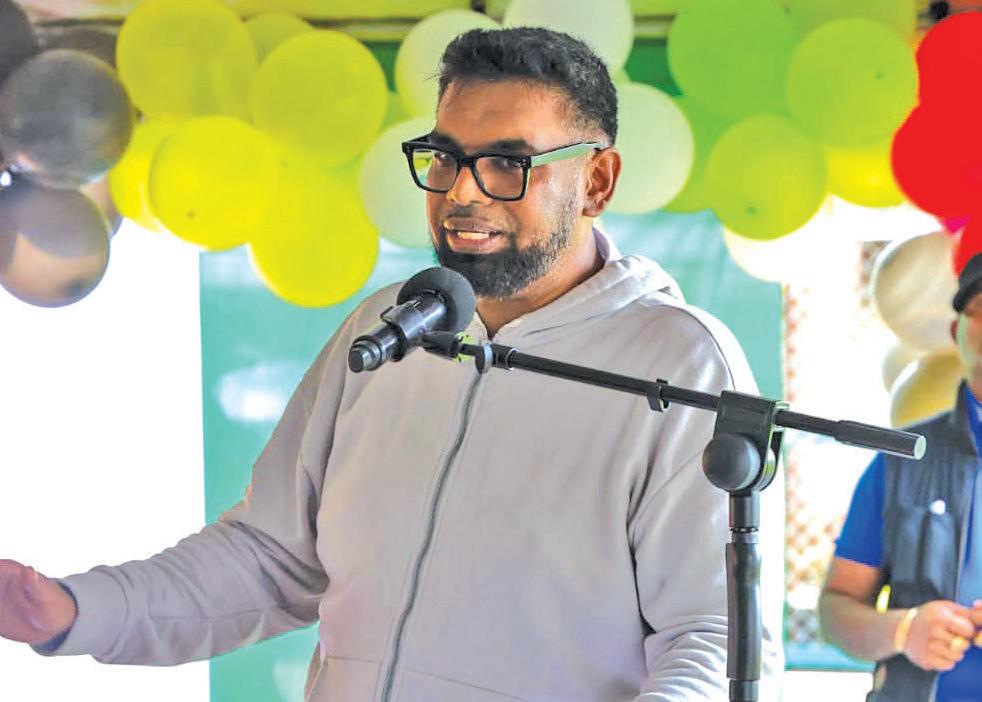
noted that there will be a series of consultations, led by the Ministry of Aviation, to find ways reducing the high air transport costs for communities. “One of the suggestions by some of the villages was to let the villages and the region buy the seats and space themselves, and then to put a decent markup. But all of these suggestions that we took from the villages will be looked at and we will come up with a strategy on this matter, where the private sector is involved, the owners are involved, the residents and communities are involved, all the stakeholders must be involved,” he assured.
US$6M Puruni Bridge
Another key project the Head of State highlighted is the construction of a new major bridge across the Puruni River to the tune of US$6 million. Works on the bridge is expected to commence in August and construction will last for eight months. Moreover, the Guyanese leader also outlined plans to equip the township with the necessary machinery to conduct maintenance work. “We are taking a decision that we will invest in critical pieces of equipment including grader, roller, excavators and trucks to create a maintenance programme here. And we are working on putting together a management group for that maintenance programme that will include the private sector, the town council, the REO and other religious groups. You are now empowered. We are investing in you and giving you the equipment to maintain this programme,” he told the residents. In fact, President Ali expressed his dissatisfaction with the rate at which Bartica residents are taking up opportunities including jobs that are available in a number of sectors including agriculture, which will the Government plants to
inject another $2 billion in the next four years across Region Seven. “We are not satisfied with the pace at which the residents are taking up jobs. We want to work with you now, drive you harder and faster in taking up the opportunity for food security and food production. That is the surest way to bring down the cost for food and have a sustainable supply of food for all of Region Seven,” he asserted. The Head of State went onto note the Guyana Development Bank (GDB), which is slated to come onstream soon following the impending passage of the relevant legislations, will not only provide capital for persons but also business support to go after these opportunities.
Contract termination
But even as billions of dollars are being invested in Bartica and surrounding communities, the Head of State lamented the delays of ongoing projects across the region, announcing some stern decisions after meeting with the different project heads. “After the assessment by the supervisors of the supervisory firm, taking into consideration time delay as a result of airstrips, weather, but we take all of that [and] those that are still behind schedule for four months, those projects will be terminated and contractors will be assigned to complete those projects. So, we have at least three projects in the region that will be terminated for contractors not to move on. So, we have to get this right and get these projects done,” the Guyanese Leader noted. He further pointed out that the technical officers in the Regional Administration were also warned that if they do not deliver, then their services too will be terminated. “So, we are setting the deadline and a monitoring mechanism in the region, where the pri -
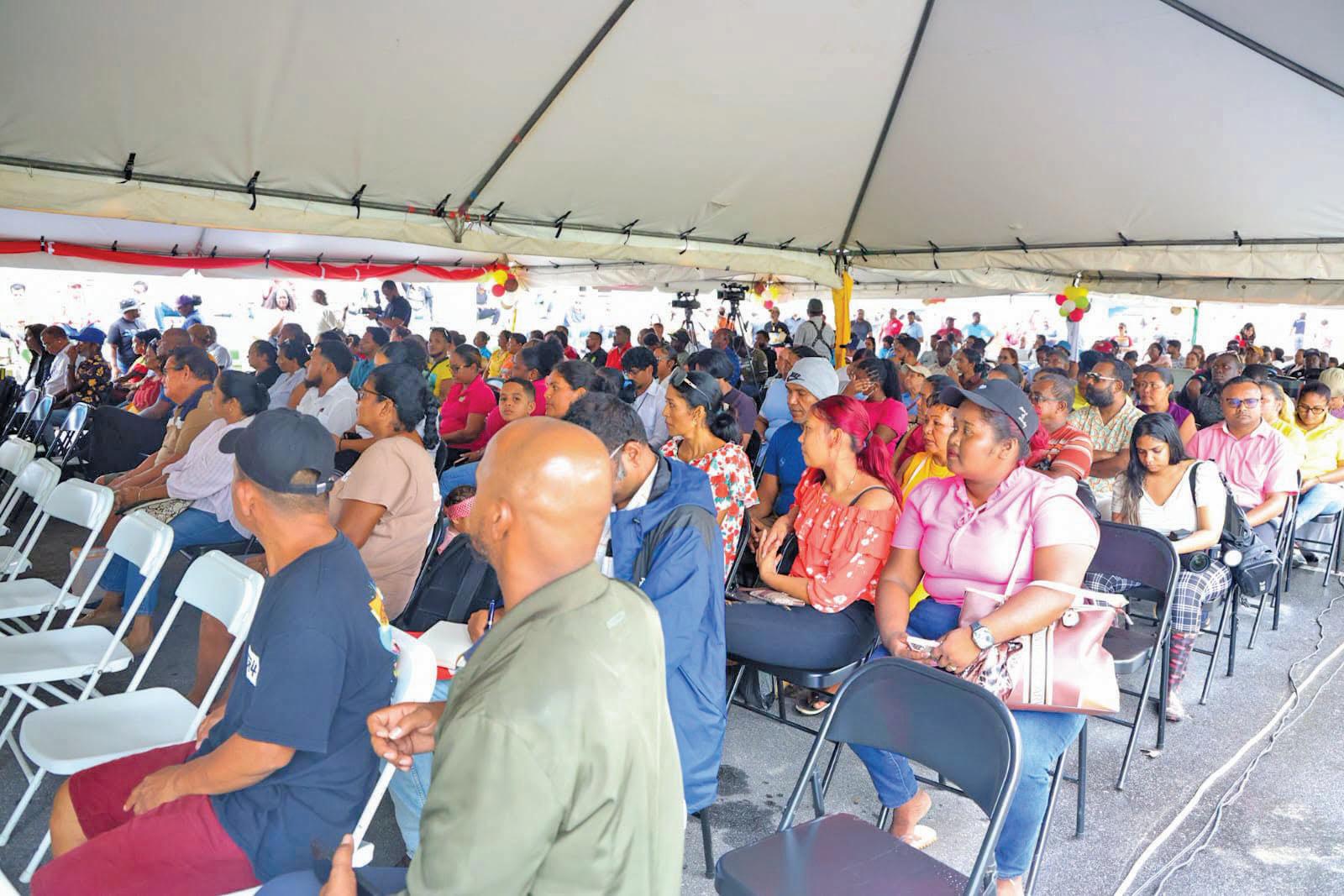
vate sector, the church, the mosque, the temple, the town council and the REO (Regional Executive Officer), the Ministry of Housing, GWI (Guyana Water Incorporated) and GPL (Guyana Power and Light Inc), all will be involved, because we want everyone to take responsibility for the building out
and upliftment of this region.” Meanwhile, before the outreach in Bartica, President Ali and his team were in Batavia on Monday morning. While there, he announced two kilometres (km) of road will be constructed as well as the expansion of the water system, the building of the sea defense, the con -
struction of a landing at the waterfront, among other things. President Ali and his Cabinet Ministers on Monday wrapped up the Cabinet Outreach across Region Seven, where they have been fanned out over the past two days and held approximately 29 engagements, covering some 44 villages.

In an effort to make driving tests more accessible to all Guyanese, the Guyana Police Force (GPF) conducted a Learner Driver’s Theoretical Examination in Katoka Village, Central Rupununi, Region Nine (Upper Takutu-Upper Essequibo), on Saturday. The examination is normally conducted in Lethem. However, the GPF said the test was held in the community to provide a convenient opportunity for aspiring drivers to access essential services. The test was administered to new applicants and rescheduled candidates who were previously
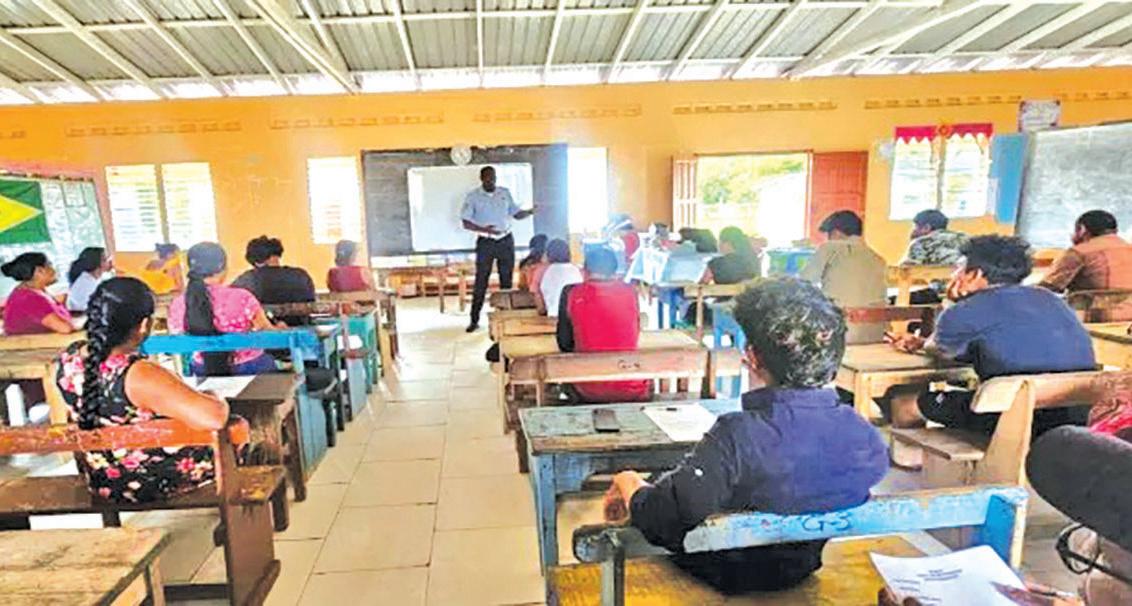
unable to travel to Lethem to sit the examination.
According to a Department of Public Information (DPI) report, this opportunity has enabled residents to operate motor vehicles legally, allowing individuals to commute to work, run errands, and access essential services more easily.
Village Councillor Nimrud Parks also lauded the GPF for bringing the service to the village and commended the ranks for their continuous efforts and said he looks forward to similar initiatives and services in the future.

A28-year-old construction worker from High Dam, Angoy’s Avenue, New Amsterdam, Berbice, was taken into custody following the discovery
of a quantity of ammunition at his home on Monday. Based on reports received, police acting on information obtained went to the home of the construction

worker, where a search was conducted in his presence.
During the exercise, a black haversack containing one 9mm round and nine .223 rounds of ammunition
was found. He was arrested and taken to the Central Police Station, where he remains in custody pending further investigations and charges.
ALance Corporal at-
tached to the Guyana Police Force (GPF) is now injured following a two-vehicle collision on Monday along the Kumaka Public Road, Moruca,
Region One (BarimaWaini). The incident reportedly involved a motorcycle, CR 3340, which was being driven by the cop from La Parfaite Harmonie, West Bank Demerara (WBD) and
a motor car bearing registration number PPP 9918, driven by a Councillor of Haimaruni Village, Moruca.
Preliminary investigations revealed that the police officer was proceeding


ne of the challenges to governance that we in Guyana don’t appreciate enough is how humungous and variegated our land mass is – in comparison to our population!! With a government bureaucracy that gotta be scaled for a population of less than a million people – but spread over an area of over 83,000 square miles that’s larger than England and Scotland!! –- how does the government deliver services from Point Playa to Crabwood Creek and Parika to the Pakaraimas and the Rupununi??!!
Even our Coastlands – at best 1000 square miles –presents a challenge since it stretches like a snake for two hundred miles that’s at best five miles deep! The PNC had initiated a decentralisation plan – along with their new constitution back in 1980 – that was supposed to tackle this problem!! Each of the ten regions was gonna take care of certain services like health and education independently – under the broad auspices of the appropriate central government ministries!!
But like most of Burnham’s bright ideas, this became bogged down due to his compulsion to rule like an absolute monarch of yore – and putting “square pegs in round holes”, loyal party hacks in charge of the regional institutions!! Well, the PPP inherited that system – with all its built-in inadequacies!! In a world where money talks and bullshit walks, none of the local government arms could really deliver much with the symbolic subventions that came their way!!
Of recent, the PPP has taken a welcome step in creating decentralised one-stop facilities that deliver some critical functions like Guyana Revenue Authority (GRA) services, National Identification cards, National Insurance Scheme (NIS), licensing, and birth certificates etc!! All of these were centred in Georgetown and folks from our far-flung villages had to laboriously schlep there for those services –sometimes meaning an overnight stay and always meaning an expensive proposition!! They started with three on the Coast – and last week another three in the hinterland. Your Eyewitness expects these to be multiplied exponentially in the coming years. The revolution in communications has played a critical role in making this innovation a reality!!
along the Kumaka Public Road when the motorcar reportedly turned right into the path of the motorcycle, thus causing the motorcycle to collide with the front right side of the motor car. As a result of the collision, the policeman fell onto the roadway and sustained injuries to his body.
He was picked up by public-spirited citizens in a conscious condition and taken to the Kumaka District Hospital, where he was treated and admitted as a patient.
A breathalyser test conducted on the driver of the motor car showed no traces of alcohol in his system. The Councillor was taken into custody as investigations continue. This comes one day after a traffic rank attached to Regional Police Division No. 3 was struck off his motorcycle by a turning motorcar along the Hague Public Road, West Coast Demerara (WCD).
It was reported that a motorcar was parked on the northern side of the roadway but suddenly attempted to make a U-turn and instead collided with the motorcycle that was proceeding east along the public road.
As a result of the collision, the traffic rank was flung over the motorcar and fell onto the road surface, where he sustained injuries to his body. He remains hospitalised.
But your Eyewitness believes that as their massive developmental programme continues to be unfurled, the Government must intensify the implementation of what Burnham refused to do: empower the regional and local bodies – especially with funding and training – to actually provide their own services to locals!! The PPP’s proven its democratic credentials at the national level politically and economically by providing real choices to our citizenry!! The final step will be realised when each citizen gets power in their hands to deal with the responsibilities of citizenship –without depending on “the government” as a crutch!!
Each person will finally experience the challenge of governance!!
…on Devious Delcy
We’ve had time to digest what went down in the Cuyuni last week. Have we called in the Venezuelan ambassador and demanded an explanation?? We know they’ll repeat their usual platitudes about “looking into the matter”! And of course, take the opportunity to get in their licks on their claim to our Essequibo!! But while we should always have the willingness to engage in the diplomatic niceties, in matters like this attack on our troops, we gotta act definitively to defend our national interest!!
Let’s not pussy-foot around the issue – this was nothing more than Devious Delcy’s continuation of the war Mad Maduro declared on us over a decade ago. We don’t need no flambeau to see in bright daylight. By now so many others have confirmed what your Eyewitness pointed out immediately after previous sneaky ambushes: the Sindicatos ain’t your garden-variety brigands. They’re an arm of the Venezuelan State in its wild outer fringes – especially on the borders of Colombia and Guyana.
Nail Devious Delcy’s arrogance!!
…Aubrey down
Poor Aubrey…when it rains it pours like a monsoon!!
Rejected by those middle-class types who felt he ain’t “leadership material”, he’s now been made irrelevant by a sanctioned dilettante who stole the lumpen element he used to rally!!

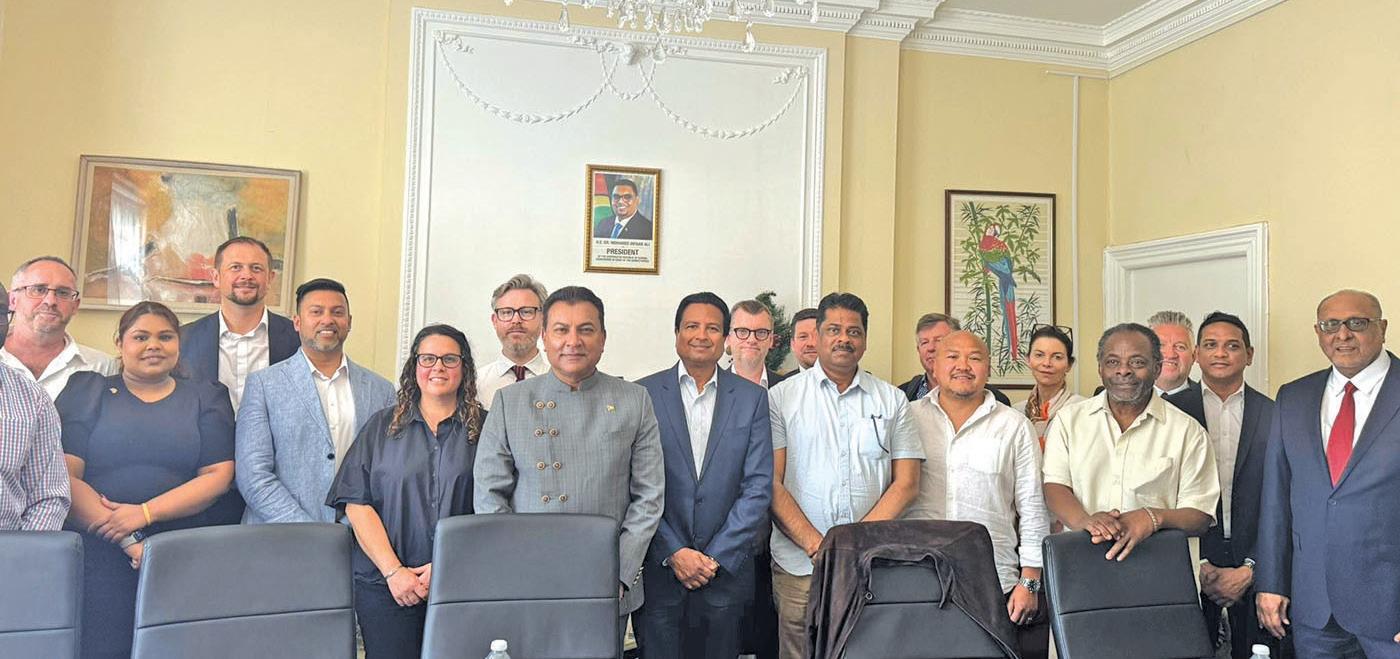
The Guyana Office for Investment (GOInvest) recently hosted a strategic Investment Roundtable in the United Kingdom (UK), bringing together senior representatives from a diverse group of British companies that are actively exploring investment opportunities in Guyana, as well as firms al-
ready operating in the country and seeking to expand their footprint.
The event, which was organised in collaboration with the British Chamber of Commerce Guyana (BritCham), was held at the High Commission of the Cooperative Republic of Guyana in London.
Unlike traditional invest-
ment presentations, GOInvest explained in a statement on Monday that the roundtable was structured as an open and interactive dialogue, allowing companies to engage directly with government representatives on specific business opportunities, expansion plans, public procurement opportunities, regulatory matters,
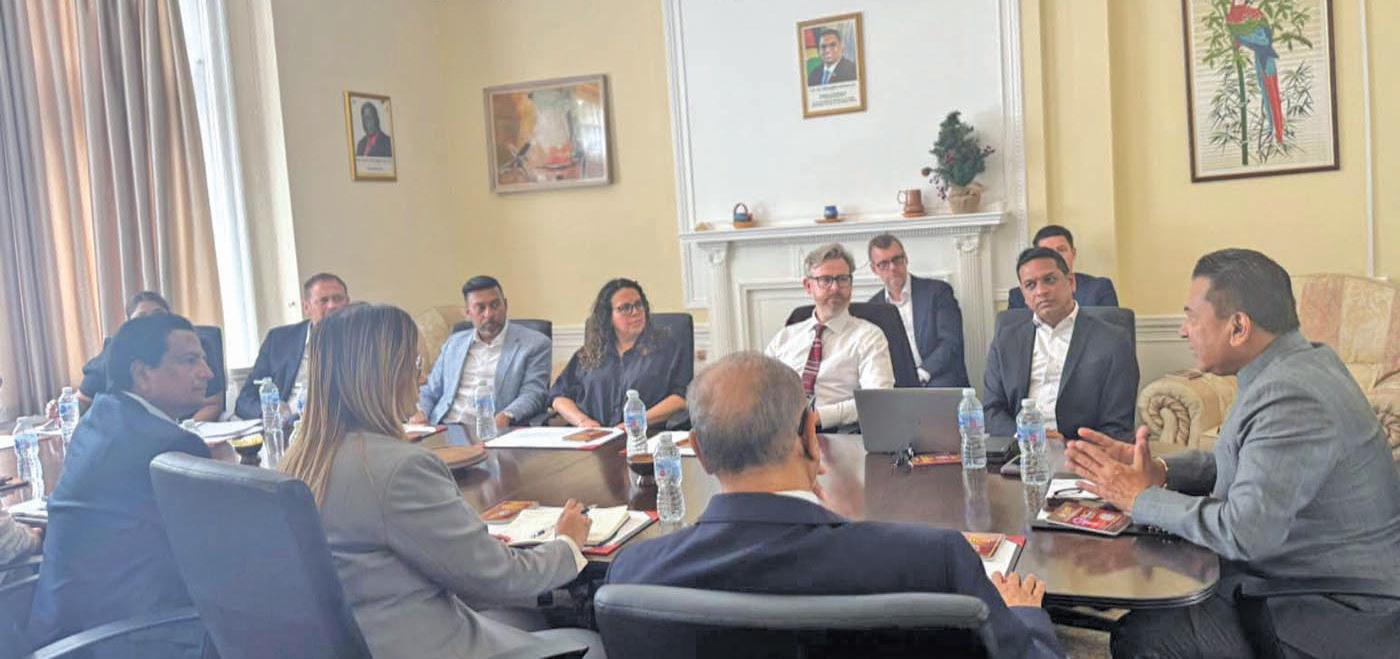
local partnerships, and investment facilitation within Guyana’s rapidly growing economy.
Leading the discussions, Guyana’s Chief Investment Officer, Peter Ramsaroop, provided participants with a comprehensive overview of Guyana’s economic transformation while outlining the Government’s long-term de-
velopment agenda and the opportunities being created across key sectors including infrastructure, energy, logistics, manufacturing, agriculture, tourism, healthcare, education, technology, and professional services.
It was noted that a significant portion of the discussions focused on how British companies can participate
more actively in Guyana’s development through strategic investments, partnerships with local businesses, supplier development initiatives, and participation in the country’s expanding infrastructure and development programmes.
TO PAGE 15
The Iwokrama International Centre for Rain Forest Conservation and Development (Iwokrama) has signed a multi-year conservation pact with Beharry Holdings Inc (BHI) to support biodiversity conservation activities at the Centre. Originally announced at the 30th Anniversary celebration of the Iwokrama Act on May 18, 2026, the grant agreement was formally signed on Monday. The grant will be made annually and in the first instance will support the Centre’s monitoring programme. Thereafter, the Centre and BHI will jointly discuss areas of support for future years including education and awareness, research and science and community relations amongst others. Chief Executive Officer (CEO) of Iwokrama Dane
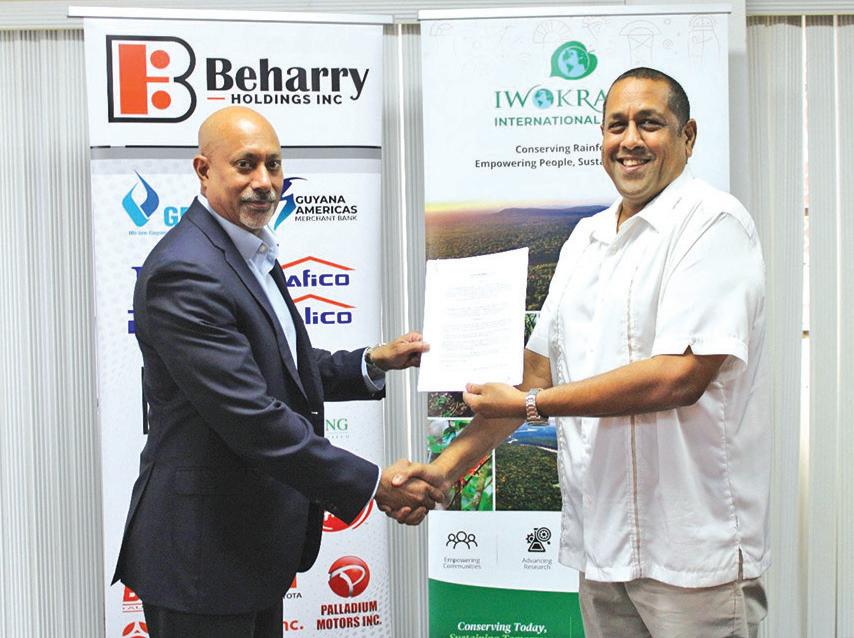
Gobin noted, “The Centre is grateful for the support of Beharry Holdings Inc. which is the largest local private sector contribution in the Centre’s history. I am happy that the Beharry group recognises the importance of biodiversity conservation as they embark on an impressive expansion strategy in Guyana and abroad”. The Chief Executive Officer (CEO) continued “I hope that other local private sector businesses emulate the Beharry Group in support of the Centre which has been tasked by H.E. President Dr Mohammed Irfaan Ali to play a significant role in his Global Biodiversity Alliance initiative”.
This announcement comes weeks after the Centre was recognised as one of the top 50 eco-tourism destinations globally. Chairman of Beharry
Holdings Inc. Suresh Beharry, commented, “For nearly nine decades, the Beharry Group has grown alongside Guyana, and we recognise that our country’s future prosperity must be balanced with the protection of the natural assets that make Guyana unique. Iwokrama is a globally respected model of conservation, sustainable development, and scientific research and we are proud to support its important work through this multiyear partnership. The Centre remains grateful to the Government of Guyana for their valuable ongoing support to the Centre. Special thanks are extended to the Centre’s staff and its local community partners, the North Rupununi District Development Board (NRDDB), for their continued support.


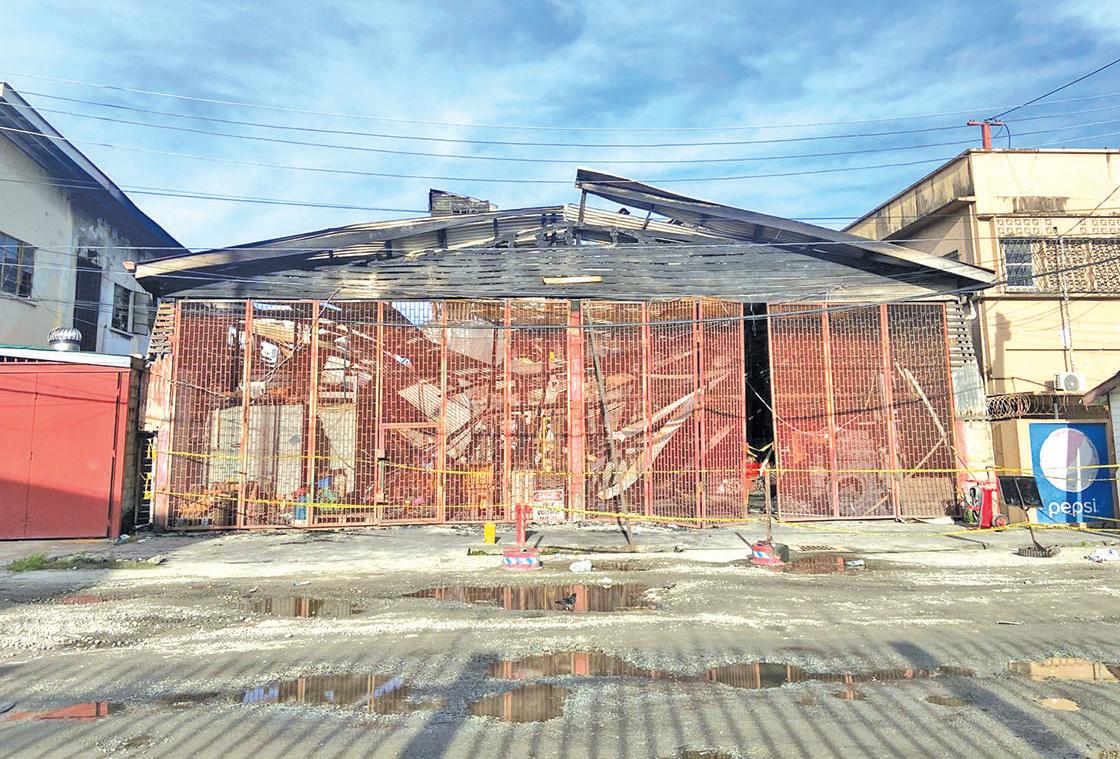
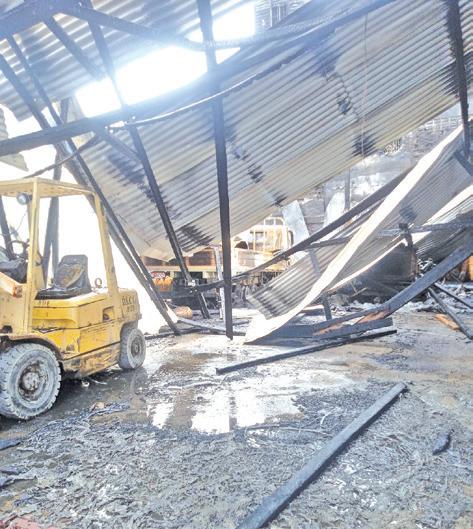
The fire that destroyed a workshop belonging to Demerara Shipping Company Limited and caused massive damage to other busi -
nesses along Water and Lombard Streets was deliberately set.

One day after a couple went missing during an outing at Unity Beach, East Coast Demerara (ECD), tragedy struck once again when a fisherman reportedly died after hitting his head after falling into his boat. Based on reports received, the dead man was identified as ‘Cannon’ of Coconut Walk, Unity Village. The Guyana Times understands that the man was doing some repairs on his boat when he slipped and hit his head. He reportedly died at the scene. An investigation is underway.
Meanwhile, the search
continues for 20-year-old Lyodisa “Loyda” Waldron, a sales representative, and her fiancé, 33-year-old Andri Francis, a Special Constable, both from Victoria Village, ECD. It was reported that at about 14: 00 on Sunday, Waldron and Francis were swimming at Unity Beach when Waldron reportedly began drifting deeper into the Atlantic Ocean and called out for assistance.
Hearing her screams, the father of two reportedly went to assist her, during which both of them were pulled under due to the strong current and dis-
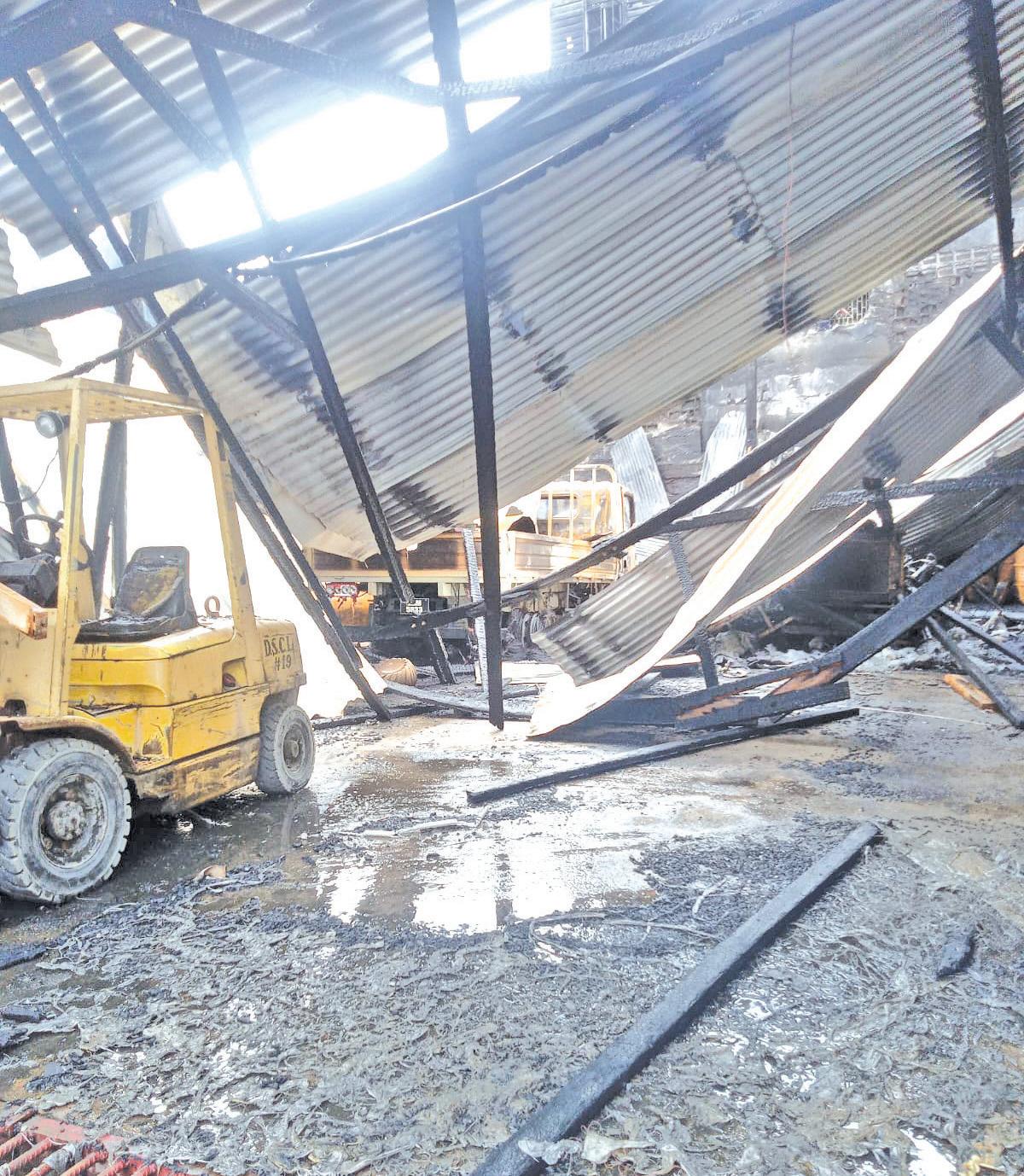
This was confirmed by the Guyana Fire Service one day after the blaze started in the workshop operated by Demerara Shipping Company Limited.
was completely engulfed. However, due to the intensity of the fire, an adjacent building, which housed a tailor shop once owned by the late Hermon Bholaisingh and several other businesses, caught fire.
The top flat of Hermon Bholaisingh’s property was completely destroyed, leaving at least seven persons making alternative living arrangements.
appeared. An alarm was raised, and checks were made for the couple, but to no avail.
Up to late Friday, a joint search and rescue mission comprising ranks from the Mahaica Police Station and the Guyana Defence Force (GDF) Coast Guard was established to look for the missing persons, but they were not located.
Two years ago, two friends - 20-year-old Navin Seenauth and 17-year-old Daniel Boodram, both residents of Unity Village, drowned at the same beach where they went for a swim with a group of friends.
According to information received, the fire was purposely set to a low-bed truck parked inside the workshop by unidentified persons.
Nevertheless, the fire tenders and firefighters from the central fire station were deployed to the area and sprang into action. Their swift response contained the blaze, stopping it from spreading to other buildings. Two other buildings-J’s Machining and Hardware and the DSL Office and Bond-also sustained damage due to the intense heat from the fire.
It was reported that the fire started at about 3:00h, and within minutes, the workshop, which is also used as a spare parts bond,
In addition to the lowbed hauler, one canter, two forklifts, and a quantity of spare parts were also destroyed. Investigations are ongoing.


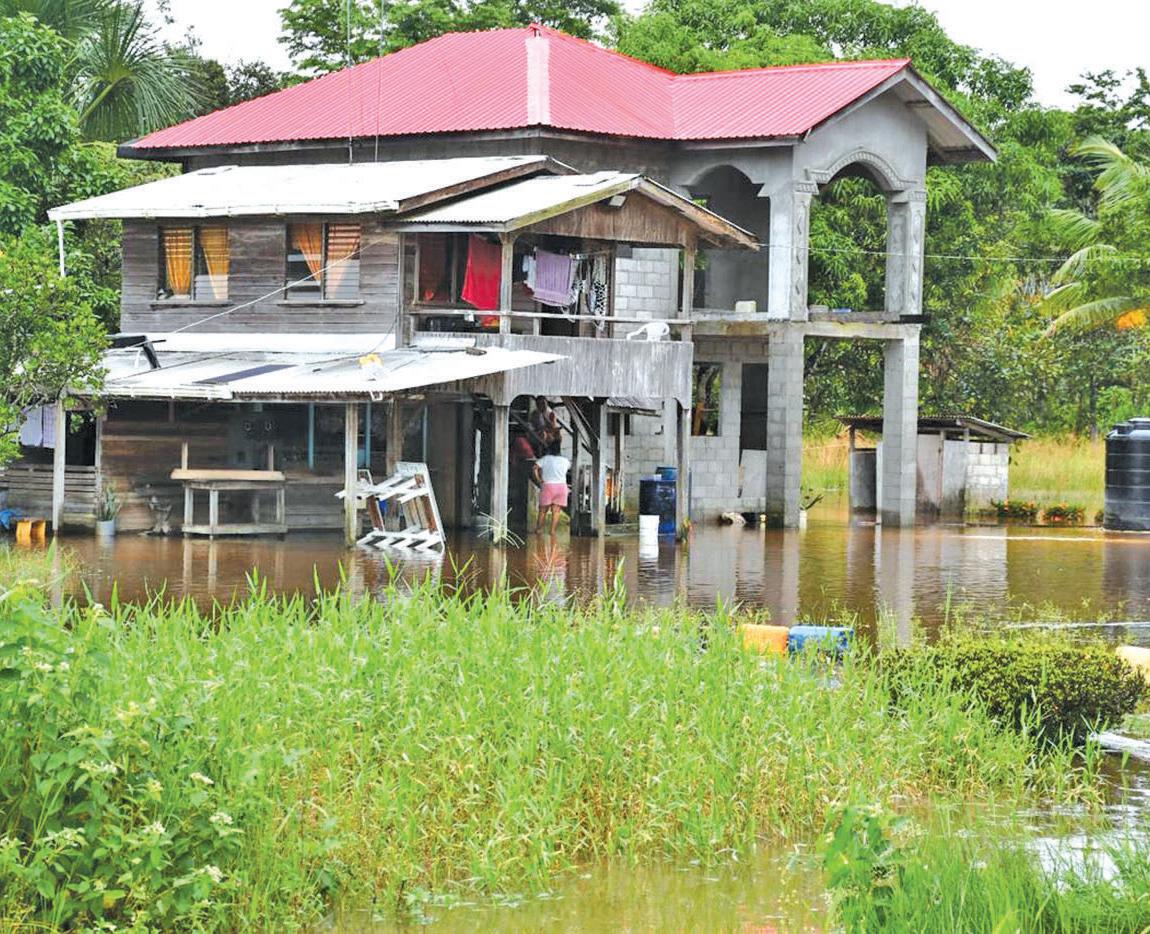
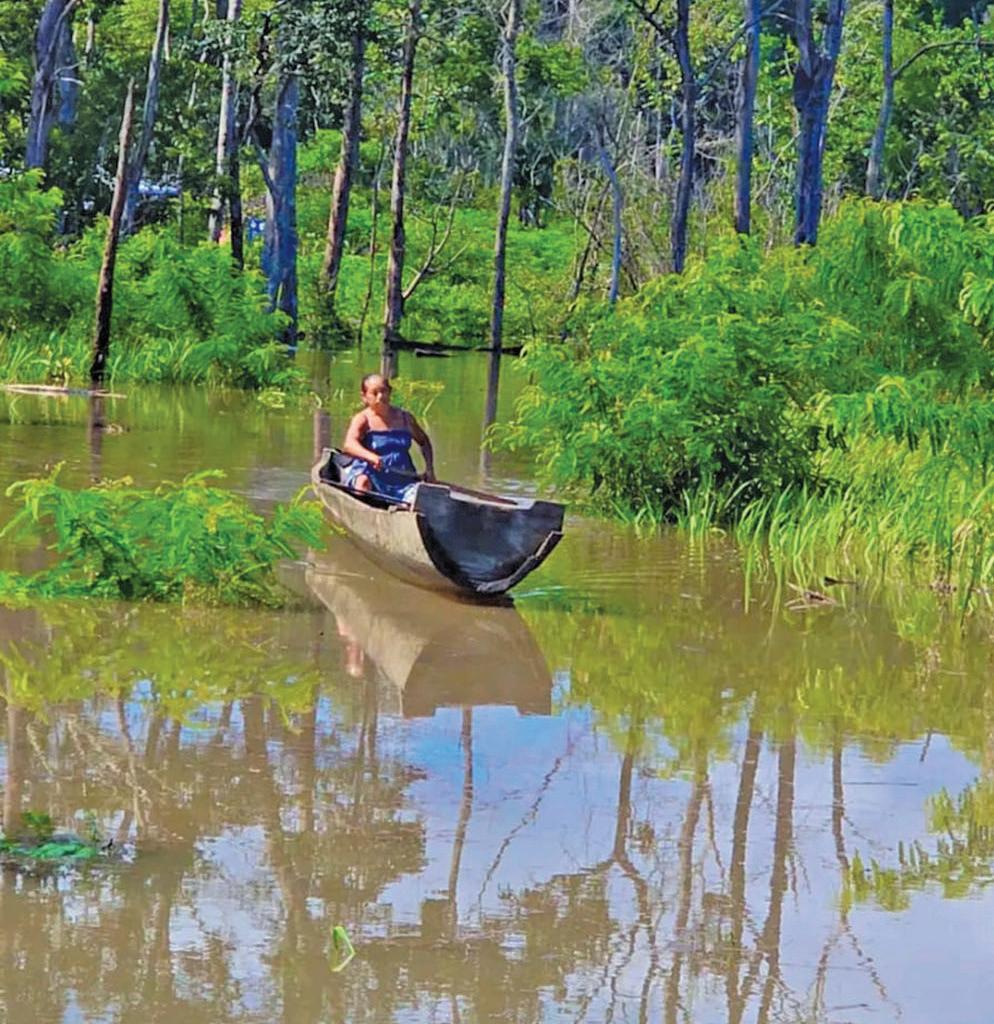
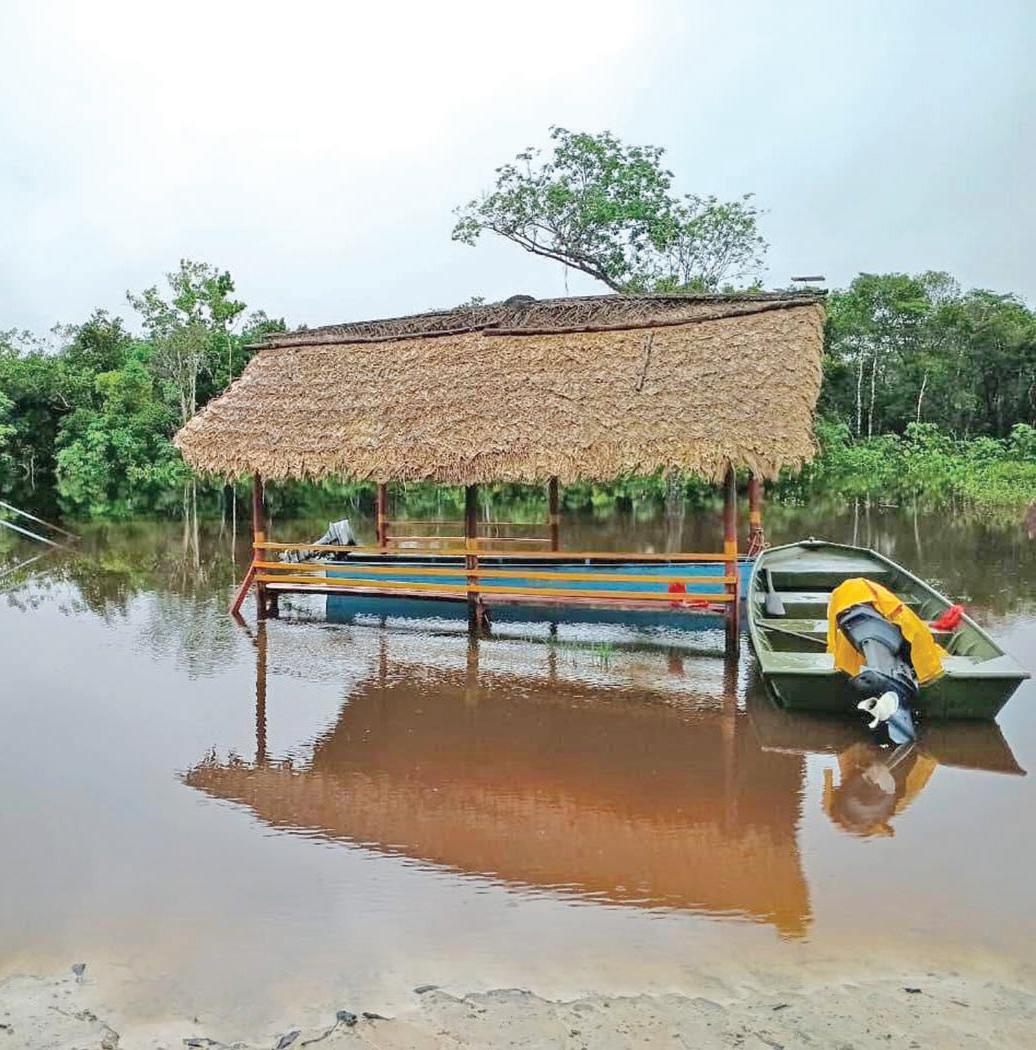
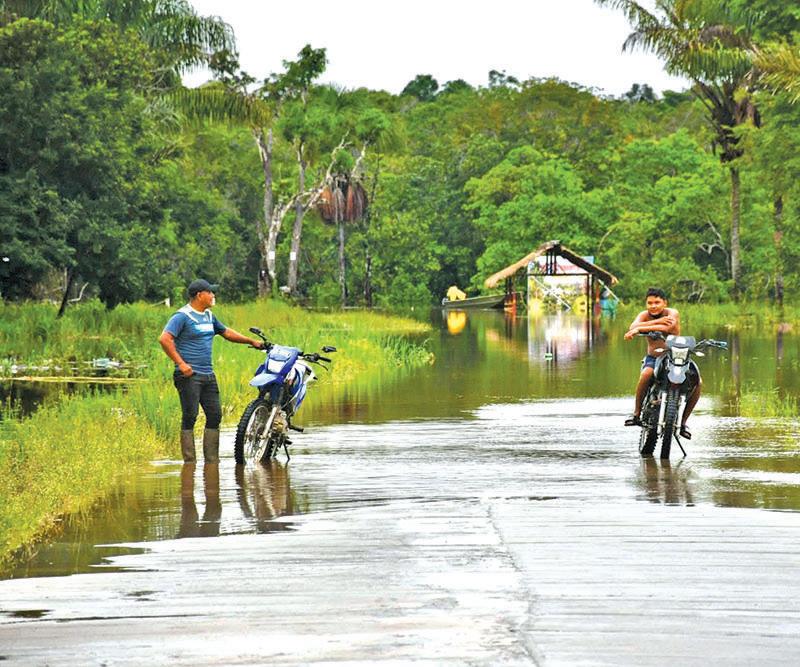
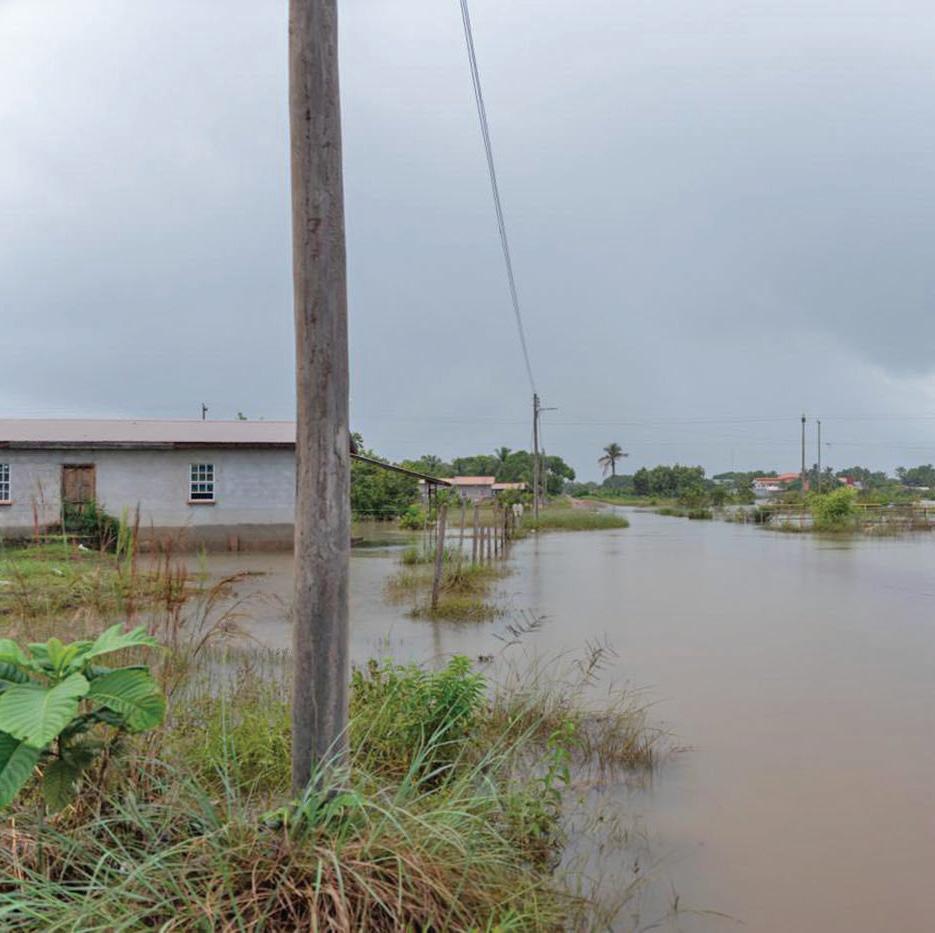
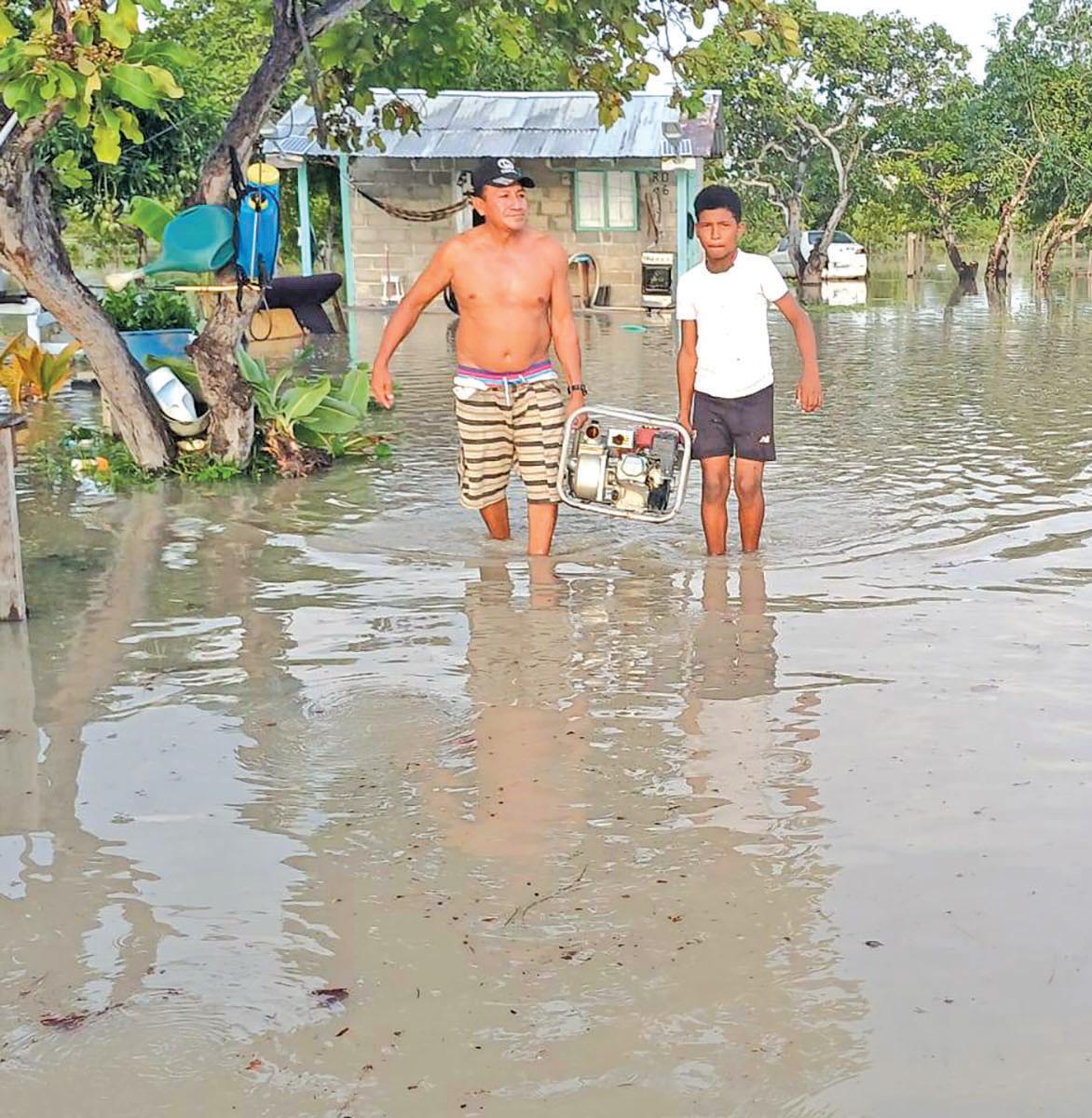
Flooding across several regions of Guyana has forced the closure of schools and disrupted daily life as communities remain inundated following days of persistent rainfall, leaving residents grappling with rising waters, damaged infrastructure and transportation challenges. Several reports have emerged from various regions across Guyana detailing the aftermath of widespread flooding, leaving numerous communities underwater. On Sunday, education officers visited more than 75 per cent of schools across the country to assess conditions and ensure that learning environments remain safe and accessible. Following these assessments, it has been confirmed that only seven schools have temporarily closed due to weather-related challenges. The Ministry said that is working closely with affected institutions to provide support and ensure that learning continues through alternative arrangements where necessary. It also commended the dedication of education officers and expressed gratitude to parents, teachers and communities for their cooperation. “We remain committed to safeguarding the welfare of students and staff and will continue to provide timely updates as the situation evolves,” the Ministry stated. Meanwhile,
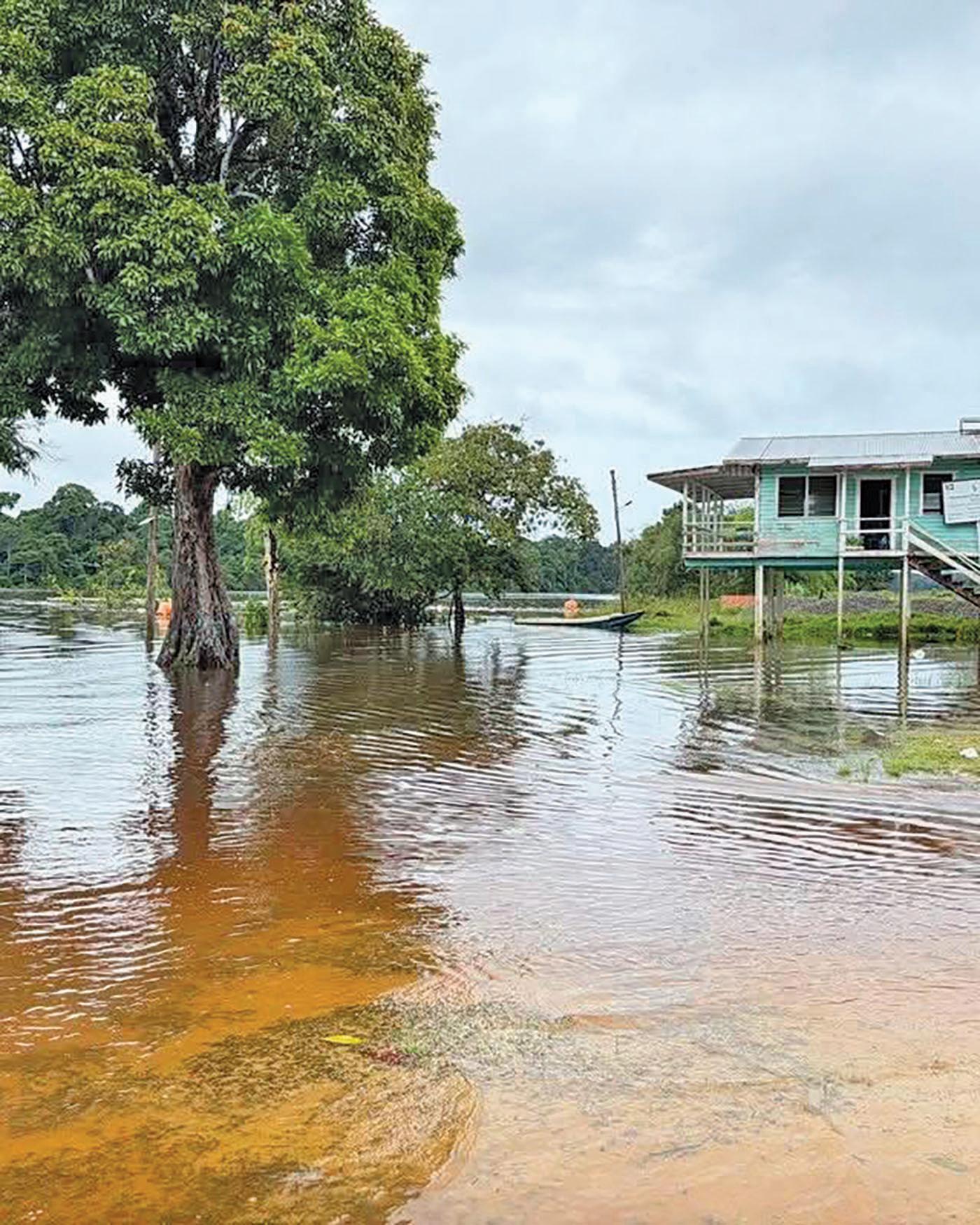
due to persistent downpours in Region Four (Demerara-Mahaica), St Cuthbert’s Mission continues to experience severe flooding. Toshao Alvaro Simon told Guyana Times that scores of houses located along the riverfront within the community have been flooded. “The rain is still falling, so we expect water levels to continue rising. Along the river edge, I would estimate that approximately 60 houses have been affected or flooded.” Simon also noted that the community has suffered agricultural losses, with scores of poultry dying as floodwaters continue to rise. “We have experienced losses, especially in poultry. A lot of ducks have died and, as we know, the river edge is where much of our farming takes place. Our farms and cassava plants are underwater. We are still conducting assessments through our agriculture officers to determine the extent of the damage.” In terms of transportation, Simon explained that most vehicles remain along the main roadway, limiting the number of vehicles affected by flooding. Conditions along the Soesdyke-Linden Highway are also deteriorating, with rising waters inundating sections of the carriageway and prompting drivers to exercise extreme caution. In Region Nine (Upper Takutu-Upper
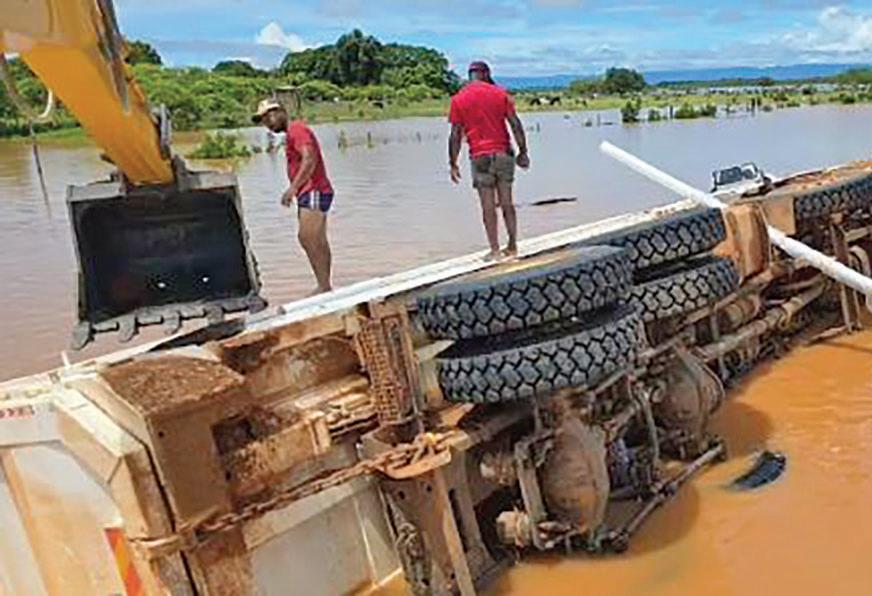
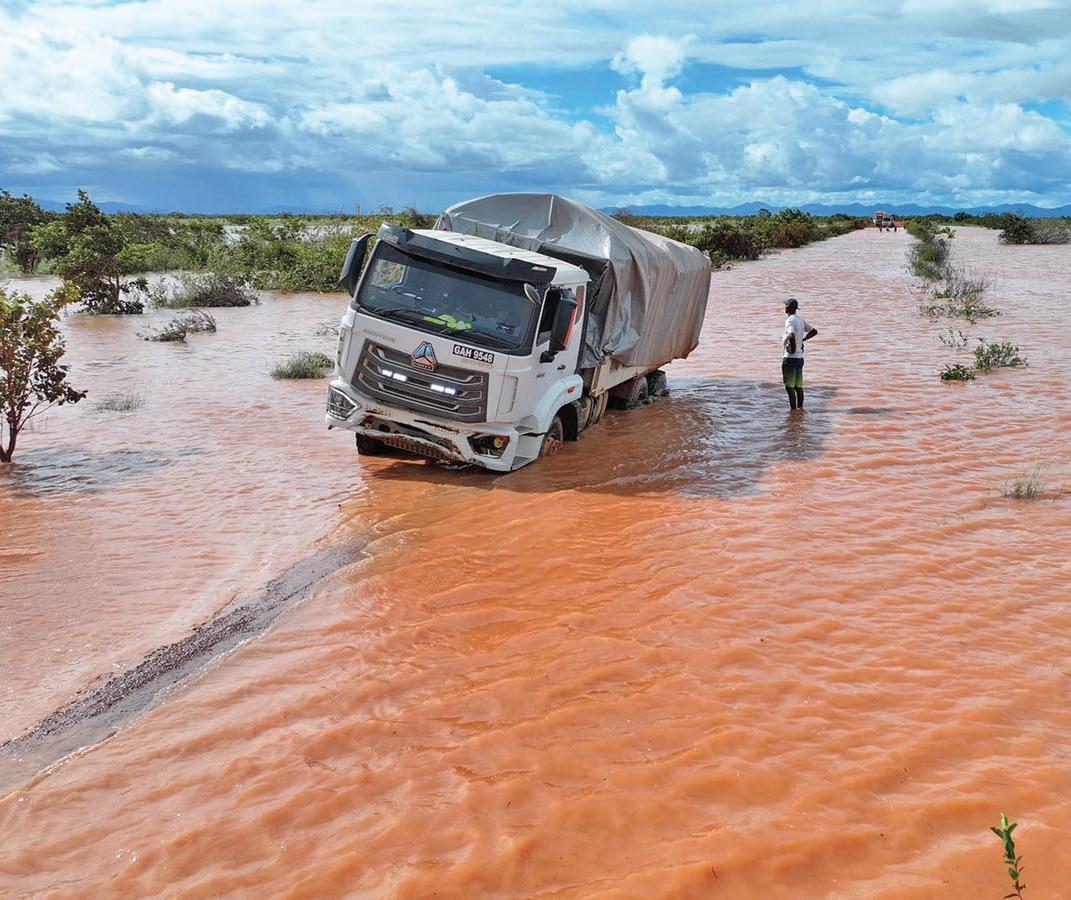
Essequibo), while some vehicles are cautiously making their way across the Pirara Bridge, several trucks have reportedly overturned and remain stranded on the Lethem side of the crossing.
This publication also spoke with wildlife conservationist, Neal Miller from Region Nine, who explained that while flooding has affected parts of the region, seasonal flooding remains a natural phenomenon. “Yes, Region Nine has experienced significant rainfall over the last few weeks, causing flooding in some areas. However, flooding is not unusual for the region and is actually necessary for wildlife and biodiversity. Without flooding, watersheds such as the Takutu and Essequibo systems would not connect, which would negatively affect wildlife populations. The flooding has also not been as extreme as in previous years.” Additional vehicles continue to traverse the Huntoil Stretch; however, drivers are being urged to remain vigilant and proceed cautiously due to ongoing weather conditions and deteriorating road surfaces. To compound the situation, the Huntoil Stretch along the Lethem Road continues to create major delays for commuters, with significant portions of the approximately sixteen-mile road-
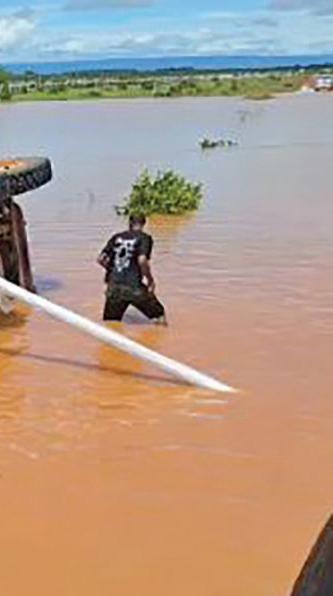
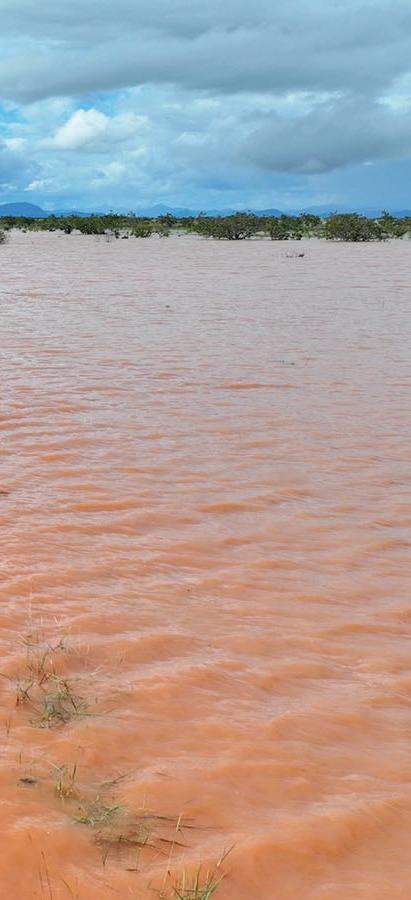
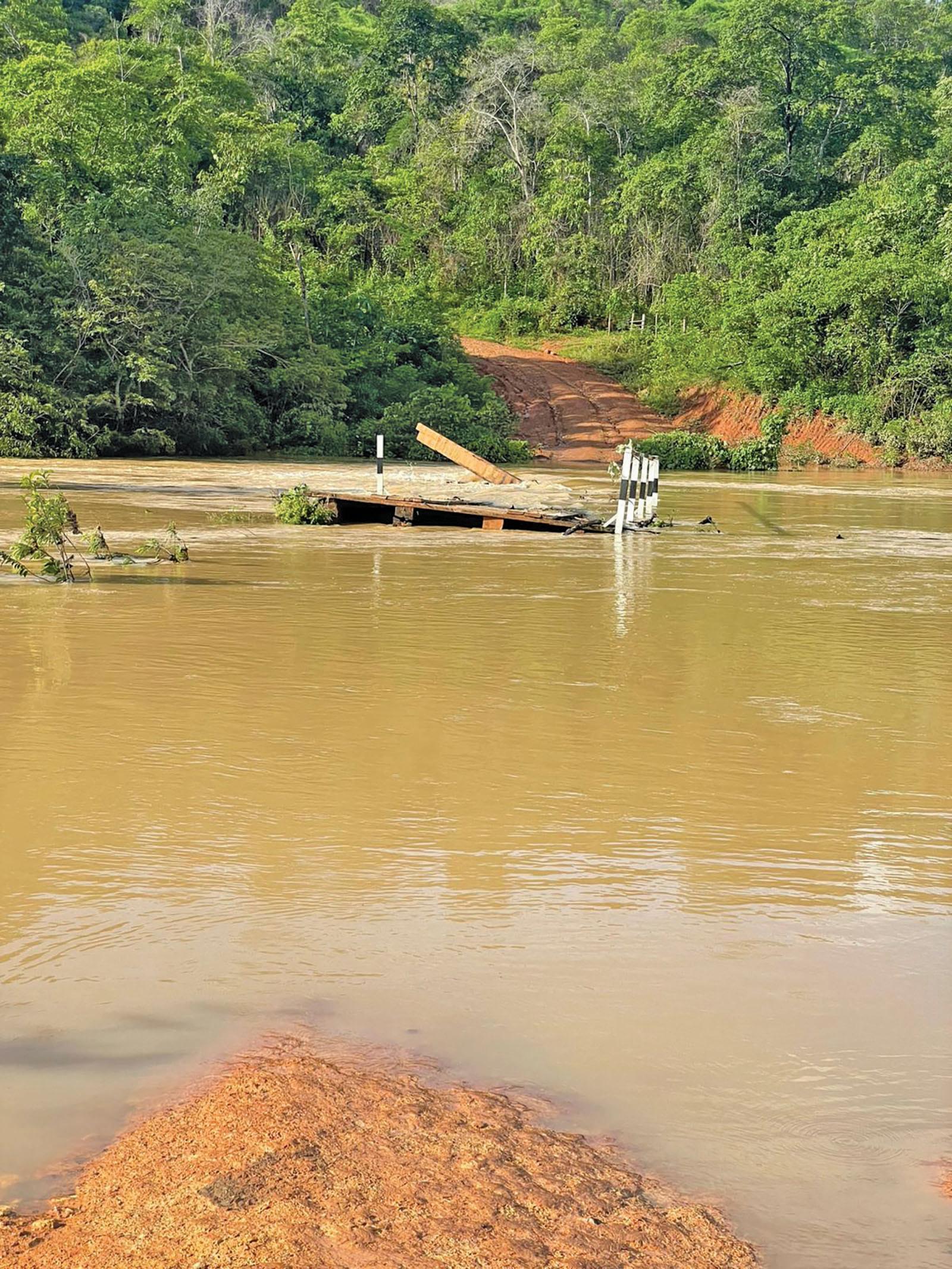
way submerged under as much as four feet of water in some areas. In light of continuous downpours across Guyana, residents of the Indigenous village of Moraikobai in Region Five (Mahaica-Berbice) are also bracing for worsening conditions as water levels continue rising along the Mahaicony River. On Sunday, water inundated sections of the community’s access bridge and surrounding communal areas, while rising river levels have also affected neighbouring communities. Several houses in Sewe Village, Section Three, have been flooded following days of persistent rainfall. Over the weekend, Government officials were dispatched to assess conditions in several affected areas, including Regions Three, Five, and Six, where multiple communities experienced flooding. However, for residents living along the Mahaicony River, concerns extend beyond flooded yards and access routes to include farms, transportation links and other aspects of daily life. Meanwhile, Region Five
Chairman Ricardo Phillips told the evening news that the Regional Democratic Council (RDC) has activated its emergency response plan and continues to monitor communities along the Mahaicony River as water levels continue to rise.
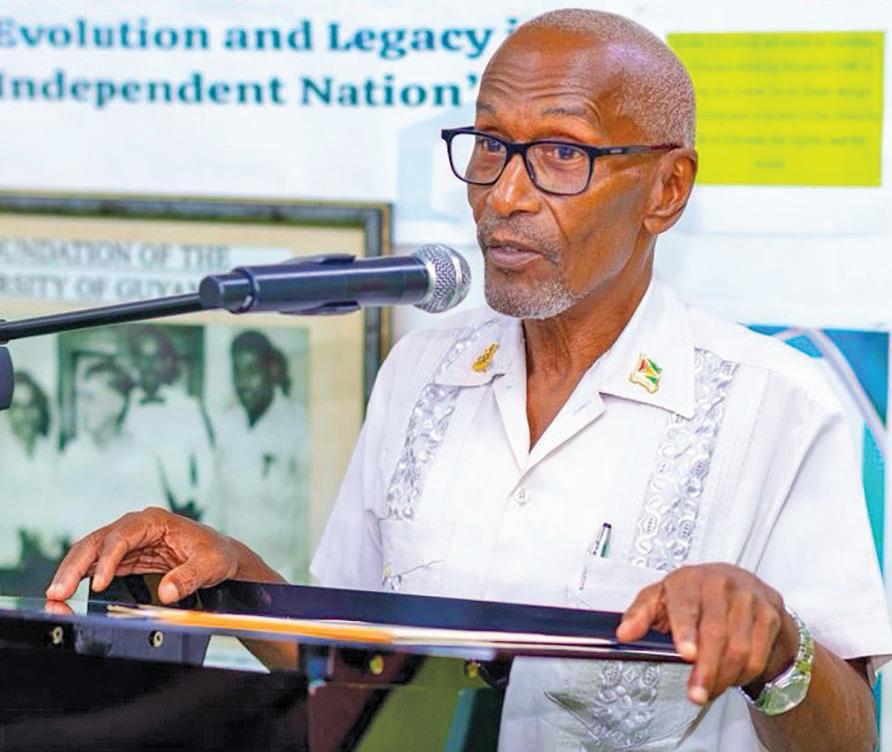
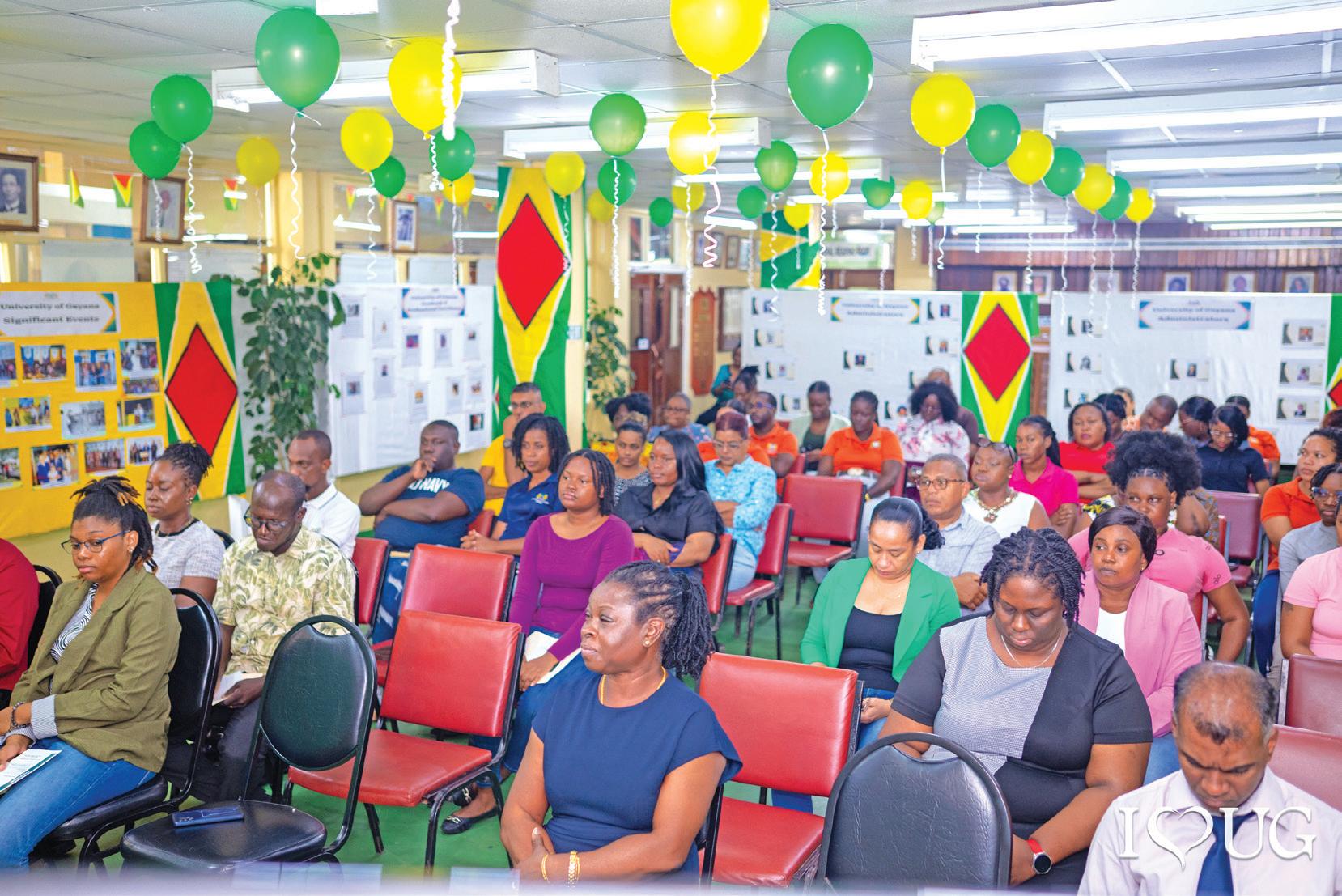
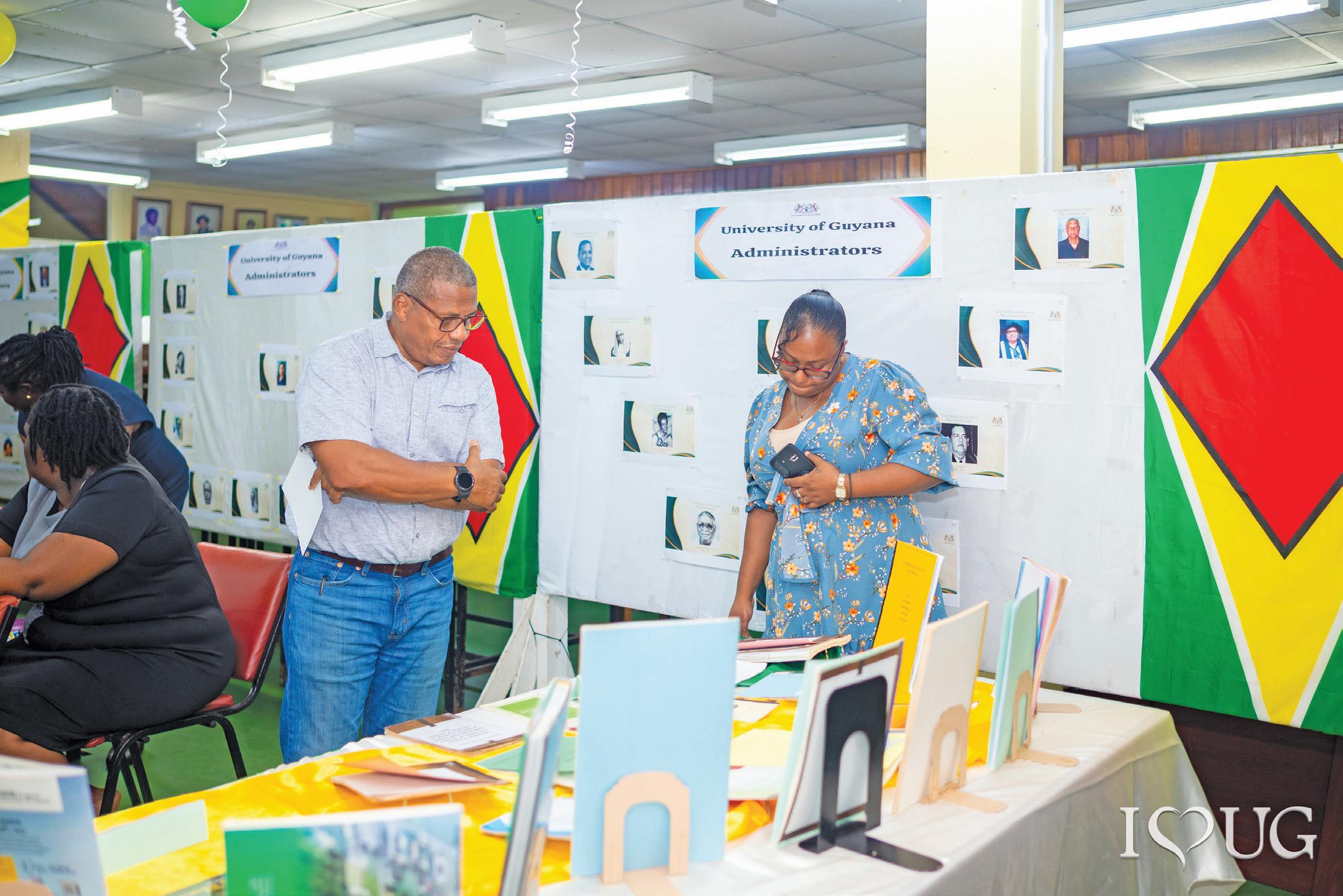
As Guyana celebrates its 60th Independence Anniversary, the University of Guyana Library on Friday launched its 60th Independence Anniversary pictorial exhibition highlighting the institution’s enduring contributions to national development, education, research and leadership since the institution was established over six decades ago.
The week-long exhibition which will run until Friday, 5 June 2026, is being held in the University of Guyana (UG) Library Foyer at the Turkeyen Campus under the theme, “UG – The Soul of the Nation: Our Journey, Evolution and Legacy in Shaping an Independent Nation.”
It showcases the
stones and events throughout the institution’s history, and profiles of administra-
sciences, research, innovation, and community development. Delivering the

University’s evolution alongside Guyana’s growth as an independent nation. Among the displays are exhibits on the University’s academic and professional excellence, the evolution of its administration, significant mile-
tors and leaders who helped shape the University over the years.
The exhibition also features literary displays documenting the institution’s expansion in medicine, engineering, environmental
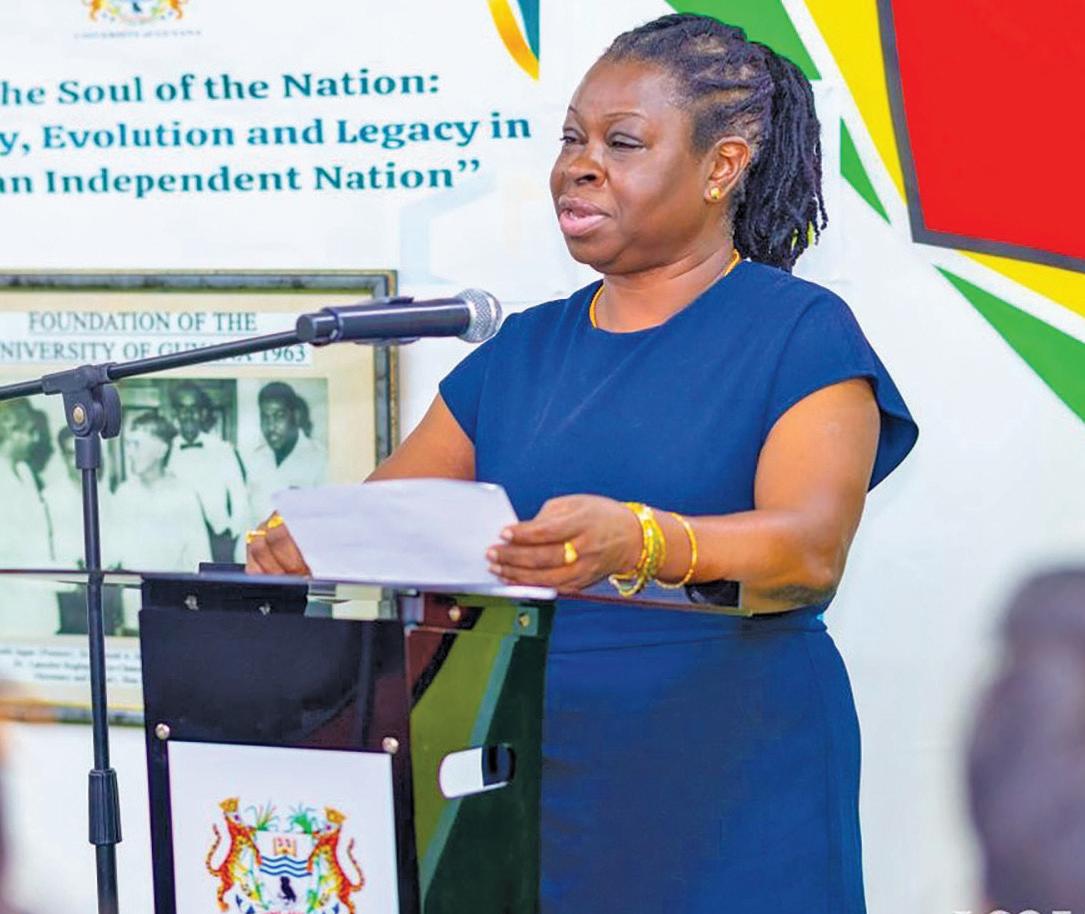
featured remarks at the opening ceremony, ViceChancellor (VC) of UG, Prof. Paloma Mohamed-Martin, highlighted the connection between the University and Guyana’s progress. “The University is not divorced
from the nation. In fact, it is the integral, as we like to call it, heartbeat and strategic centre of the nation,” Professor Mohamed Martin said.
She noted that since its establishment in 1963, the University has remained closely tied to Guyana’s aspirations and development agenda. “One could argue that at any point in the nation’s history, the University has inextricably been linked to the fortunes of the country, both in terms of our ability to support the national agenda and also for the national purse to support the University’s aspirations and mandate,” she said. Prof. Mohamed-Martin explained that the exhibition was conceptualised to encourage reflection on the institution’s own journey and the important role it has played in shaping modern Guyana. While referencing the writings of some of UG’s ear-
was the principal architect behind the establishment of UG, and Professor Winston McGowan, Prof. Mohamed Martin said the institution was always envisioned as a critical pillar of national development and self-deter-
tual heritage while inspiring future generations. She further noted that the library remains central to preserving the University’s history and documenting the nation’s academic and cultural development. Dr Bernard
ly visionaries, including Dr Harold Drayton, a Guyanese academic and biologist who
mination. She further shed light on the University’s Blueprint 2040, which aims to expand access to higher education and produce graduates equipped to contribute meaningfully to society. In addition, UG’s Librarian (ag) Dr Simone Bernard in her remarks; the exhibition was designed not only to celebrate Guyana’s Independence Anniversary but also to allow patrons and visitors to reflect on the University’s contribution to nation-building and intellectual development. She described the University as an institution that has consistently advanced learning, research, and national growth since Guyana attained Independence. “This exhibition celebrates the enduring legacy of scholarship and the transformative power of learning that have shaped generations of students, faculty, and researchers,” she said. Dr Bernard noted that the exhibition also highlights UG’s critical role in preserving and advancing Guyana’s intellec-
added that the exhibition demonstrates the importance of safeguarding historical records and connecting present and future generations to the country’s journey. Meanwhile, Registrar of UG Dr Nigel Gravesande, who chaired the ceremony, described the exhibition as a fitting tribute during Guyana’s Diamond Jubilee celebrations. “During these six decades of Guyana’s independence, the University of Guyana, often referred to as the soul of the nation, has been a home for knowledge, discovery and innovation,” Dr Gravesande said. He noted that the exhibition highlights “the enduring legacy of scholarship and the transformative power of learning that have shaped generations of students, faculty, and researchers.” The exhibition is a collaboration between the University’s Library and the Department of Events, Conferences and Communication and is open to the general public free of charge from 9:00h to 16:00h daily.
Family and residents of the 22-year-old man who died in a crash on Sunday have called for removal of a derelict vehicle that had been parked along the Crabwood Creek roadway for more than 20 years. The grieving mother of Vinode Jeetendra Deo is calling for local authorities to remove derelict vehicles from public roadways after her son was killed on Sunday evening when the motorcycle he was riding crashed into an abandoned Tapir truck parked along the Crabwood Creek roadway. The Public Works Ministry have over the past months been calling on persons who have parked vehicles, vending stalls and derelict on road shoulders to remove them. In several instances the Ministry was forced to remove the vehicles themselves as a result of non-compliance by owners. Deo, 22, a construction worker of Crabwood Creek, Corentyne died on Sunday and a Post-Mortem Examination conducted on Monday by Government Pathologist Dr Vivakanand Brijmohan determined that he died as a result of a fractured skull. Speaking with this publication, the young man’s mother, Shavnie
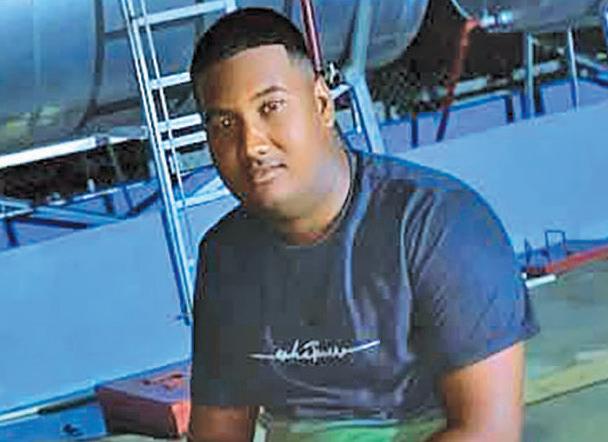
Motiram, recalled the last conversation she had with her son just hours before the fatal accident. “In the afternoon we came from work and called him on the phone. We told him to come home and he said yes, he would come home. He was right around the village area,” she related. Motiram said that conversation took place at about 15:30h. The mother said she later received a phone call informing her that her son had been involved in an accident. “He promised me he was going to come home. While he was coming back, I got a phone call that there was an accident on the roadside,” she said. Initially given incorrect directions, Motiram
said she went straight to the hospital where she eventually saw her injured son. “I see his foot bent up, but I didn’t get to see his face,” she recalled.
The grieving mother said she was later informed by doctors that her son had succumbed to his injuries. According to information she received, Deo’s motorcycle collided with an old Tapir truck that had been parked on the roadside for years.
“I understand he was going over the road and then he crashed into the old Tapir on the road,” she said.
“They should remove them vehicles, because it’s a public road. Clear it up,” she urged. She expressed con-

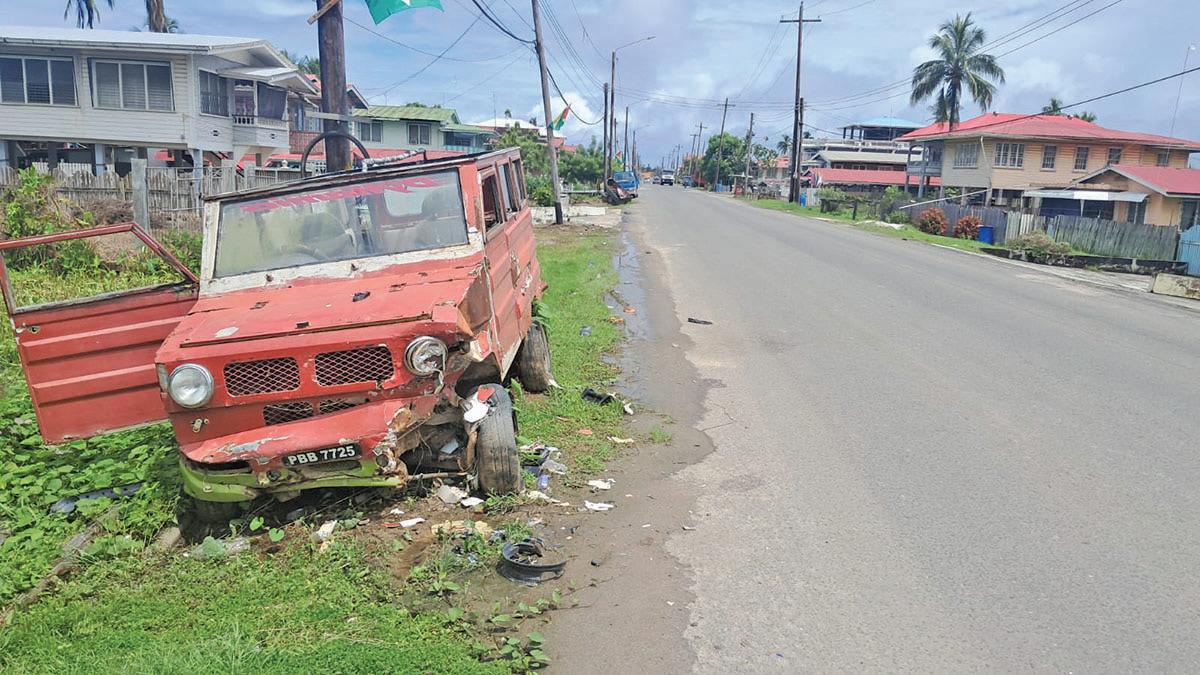
cern that similar tragedies could occur if abandoned vehicles continue to occupy public roadways. According to the mother, the vehicle had been sitting at the location for decades. “Over 20 years the Tapir is there,” she said. Describing her son, Motiram said he was hardworking, friendly and always willing to assist others. “He works construction with his father. He does all kinds of work. He’s a friendly person and very helpful. Everybody in this area knows him.”
Derelict vehicles
Meanwhile, residents of the area echoed her concerns and called for action to be taken against derelict vehicles abandoned along public roads. Anushka Ramjass described the abandoned truck as a hazard. “It is a piece of junk. It doesn’t need to be there. If somebody swerves and runs into the drain, they may get injured but still survive. Something like this shouldn’t happen,” she said. Another resident, Anika Deen, said the accident was not the first involving a parked vehicle. “It is not the first time an accident happened with a parked vehicle on the road. If a vehicle is not working, it should be placed in a yard or sent to a junkyard somewhere else,” she said. The mangled Tapir truck remained at the roadside on Monday, its front section heavily damaged from the collision.
Police are continuing investigations.
Ramsaroop noted that one of the most encouraging aspects of the engagement was the level of interest from companies already operating in Guyana and seeking to deepen their investments, while others explored opportunities to establish a presence in the market.
“What was particularly encouraging about this engagement was the level of interest from companies already operating in Guyana and looking to expand their presence. The discussion focused on practical opportunities, investment facilitation, procurement processes, partnerships with local businesses, and how companies can align with Guyana’s long-term development agenda. Investors want clarity, access, and confidence, and those are areas where Guyana continues to make significant progress,” he posited.
Meanwhile, during the engagement, participants received updates on major government projects, industrial development initiatives, logistics improvements, energy expansion, digital transformation, and the ongoing modernization of systems that support business operations and investment facilitation.
The discussion also explored opportunities for British expertise and technology to support Guyana’s ambitions in renewable energy, advanced manufacturing, engineering ser-
vices, healthcare delivery, education, digital transformation, sustainable infrastructure, and emerging industries. Particular interest was expressed in how UK companies can contribute to Guyana’s longterm development priorities while benefiting from the country’s strong economic growth and expanding investment landscape.
Speaking on the value of the partnership with BritCham, Ramsaroop emphasised the importance of strong international relationships in connecting investors with opportunities and fostering long-term business collaboration.
“We are proud to work alongside BritCham in strengthening the commercial relationship between Guyana and the United Kingdom. Their ability to bring together businesses that are serious about investing, expanding, and building long-term partnerships creates tremendous value for both countries. As Guyana continues its transformation, these engagements help ensure that investors are not simply observing our growth story but actively participating in it,” the Chief Investment Officer noted.
The roundtable forms part of GO-Invest’s ongoing international outreach programme aimed at strengthening investor confidence, supporting existing investors, attracting new capital, and creating meaning-
ful connections between global businesses and opportunities within Guyana.
The engagement was attended by High Commissioner of Guyana to the UK, Dr Rajendra Singh, whose presence, according to GO-Invest, underscored the growing strength of the Guyana–United Kingdom economic partnership and the importance of fostering deeper commercial ties between the two nations.
“As Guyana continues its rapid economic transformation under the leadership of His Excellency President Dr. Mohamed Irfaan Ali, partnerships with organizations such as BritCham and the High Commission of Guyana in London remain essential in facilitating dialogue, building relationships, and connecting international investors with opportunities that advance sustainable development, economic diversification, and shared prosperity,” GO-Invest stated in Monday’s missive.
Meanwhile, it was noted the recent engagement concluded with a strong commitment from participants to continue exploring investment opportunities in Guyana and to strengthen commercial ties between Guyana and the United Kingdom, further reinforcing Guyana’s position as one of the most dynamic and attractive investment destinations in the world. FROM PAGE 9
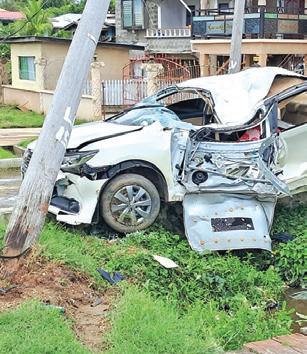
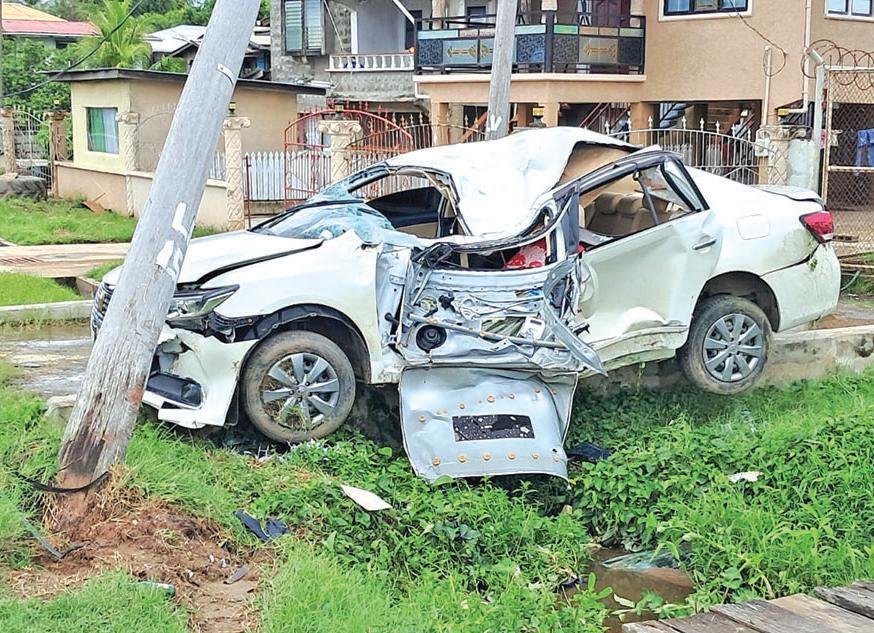
A28-year-old security guard lost his life on Sunday evening after the car which he was driving veered off the Corentyne highway and crashed into a utility pole at Epsom Village, Corentyne, Region Six (East Berbice-Corentyne).
Dead is Samuel Campbell of Liverpool Village, Corentyne. The fatal crash occurred along a section of the highway near the Evernham Bridge, where Campbell’s vehicle left the roadway before slamming into a utility pole and com
ing to rest in a drain beside the road. Eyewitness Randy Hope, who said he was performing watchman duties in the area at the time, recalled seeing the entire incident unfold. According to Hope, Campbell was travelling along the highway when two pedestrians suddenly entered his path after attempting to avoid an alli -
gator that was near the bridge. He explained that the driver appeared to take
evasive action in an effort to avoid striking the pedestrians. “The driver of the car tried to
save the two girls. They swerved from an alligator by the bridge, and after they swerved from the

alligator, they came into his lane. He hit the vehicle and lost control, and ended up here,” the eyewitness stated. Hope said the car began skidding after the driver attempted to avoid the pedestrians. “The vehicle started to skid from in front by the bridge there and he skated down there and came to this pole from the side.
From the side, he hit the pole, and he spun around,” he recounted. Residents and passersby rushed to the scene and pulled Campbell from the wreckage. However, Hope said the injured driver showed little sign of life. “The guys that were around here took him out,” the witness said. Meanwhile, the two pedestrians did not receive any injuries but seemed visibly shaken. The impact, nevertheless, ripped away sections of the driver’s side, crushed the roof and shattered windows. The father of two had reportedly left his mother’s home in Liverpool earlier in the day, and was allegedly imbibing with friends before deciding to go to his girlfriend’s home at Number 51 Village. It is believed that Campbell was heading there but crashed 12 villages away. Police have launched an investigation.
Prime Minister (PM)
Brigadier (Ret’d) Mark Phillips, on Monday engaged residents of Itaballi vil-
lage during the Government’s ongoing outreach in Region Seven (Cuyuni-Mazaruni). According to a post on the PM’s social me-
dia page, the engagement provided residents with an opportunity to raise matters affecting their community and to discuss areas

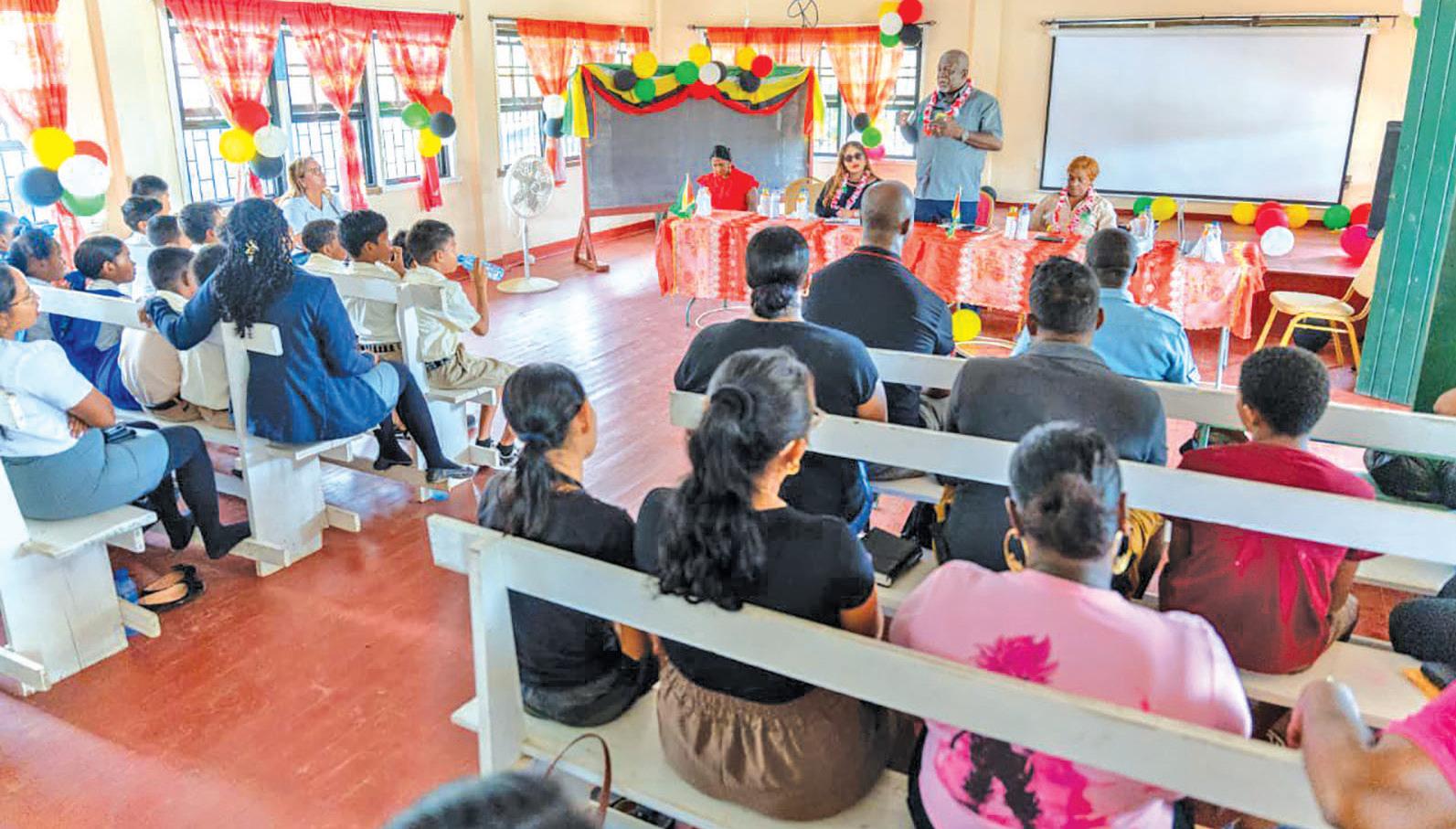
for continued Government support, improved service delivery and community development. PM Phillips was joined by Adviser to
the Government of Guyana, Geeta Chandan-Edmond, and Member of Parliament (MP), Dr Jennifer Westford.

Aleading regional economist, who once led the Central Bank of Trinidad and Tobago, is warning that the Caribbean is in a debt-climate trap that it needs to break out of using structural reforms.
Jwala Rambarran, who is now a senior policy advisor with the Barbadosbased Caribbean Policy Development Centre (CPDC), is offering some solutions.
He is proposing that Barbados and other countries use the CPDC’s updated Caribbean Emancipation 2030 Framework, which “proposes an integrated reform agenda that links systemic debt justice, vulnerability-based climate finance, and a just economic transformation. Emancipation in the 21st century must entail fiscal sovereignty, climate justice, and structural resilience”.
Specific suggestions include that Caricom “should establish a regional debt-climate negotiation platform to coordinate talks with the International Monetary Fund, the World Bank, private creditors, and [United Nations climate conference] processes”.
The economist is also advising internation-

al financial institutions to “formally integrate the Multidimensional Vulnerability Index into concessional eligibility criteria”.
Rambarran made the recommendations in an analysis titled Caribbean Emancipation 2030: Breaking The Debt-Climate Trap In Caribbean SIDS, which is included in a new policy brief published by the Faculty of Social Sciences, University of the West Indies, Cave Hill Campus.
His other recommendations were: Creditors should embed automatic climate-shock clauses that suspend debt service across all Caribbean debt instru-
ments.
High-Income countries should fully capitalise the Fund for Responding to Loss and Damage with grants based on their historical share of emissions.
Caribbean Governments should legislate fiscal transparency rules that direct debt relief savings towards building climate resilience.
His key points included that Caribbean SIDS are trapped in a reinforcing debt-climate cycle – climate shocks drive borrowing, rising debt limits resilience, and limited resilience magnifies future losses.
(Excerpt from Nation News)
The United Nations Monday said that armed attacks in the department of Artibonite, Haiti have triggered new displacements and put additional pressure on already very vulnerable communities in the French-speaking Caribbean Community (Caricom) country.
UN spokesman Stéphane Dujarric told the daily news briefing at the Office for the Coordination of Humanitarian Affairs (OCHA) of the armed attacks, while the International Organisation for Migration (IOM) said that more than 1100 persons were displaced following violence on May 26 in the commune of Petite Rivière de Bayonnais.
“Those who fled have
sought refuge with host families within the city of Gonaïves, further straining threadbare resources available in these communities,” said Dujarric.
He said that many of those who fled the violence last week have been displaced repeatedly.
“As we can imagine, or just try to imagine, they need shelter, food and water, but they also need health care, they need psychosocial support and protection services, including for survivors of gender-based violence. And we have told you repeatedly the horrific situation regarding that in Haiti,” Dujarric told the reporters.
“While we and our humanitarian partners continue to respond under challenging conditions, the pace
and the scale of needs are rising rapidly,” he added.
Meanwhile, the REZILYANS AYITI consortium has launched a multi-sectoral emergency humanitarian response in the West, Central, and Artibonite departments to assist more than 400,000 persons affected by the escalating armed violence and population displacement.
The consortium of five organisations, including Plan International, the Centre for Rural Development and Community Action (CAPAC), Mercy Corps, the Norwegian Refugee Council (NRC), and Save the Children, is funded by the Regional Humanitarian Fund for Latin America and the Caribbean. (Excerpt from CMC)
Public schools and doctors’ offices in Honduras remained closed on Monday as teachers and medics launched a nationwide strike, demanding long-promised pay adjustments and better working conditions.
Teachers’ unions said the walkout was triggered by the Government’s failure
to implement a previously-agreed salary increase, which they say has not been reflected in payroll despite official commitments.
Medical workers, meanwhile, have been protesting for weeks over unpaid wages, job instability and shortages of supplies in public hospitals, with doctors warning that the health sys-
Three Surinamese nationals have been charged with multiple cocaine-related offences following a narcotics operation by the Barbados Police Service.
Farino Revelino Bergmans, 33; Celita Saskia Aloewanai, 41 and Kylie Bretni Banga, 21, were each charged by the Narcotics Unit with possession, intent to supply, trafficking and importa -
tion of cocaine in connection with offences allegedly committed on May 23, 2026.
Police say Bergmans was found with approximately 1.2 kilograms of suspected cocaine, with an estimated street value of Bds$60,000. He appeared before Magistrate Alison Burke in the District ‘A’ Traffic Court on Saturday, where he was not allowed to plead to the charges.
He was remanded to the Barbados Prison Service at Dodds and is scheduled to reappear on June 4. Aloewanai is alleged to have been in possession of about 1.1 kilograms of cocaine, valued at approximately Bds$55,000, while Banga is accused of having 1 kilogram, with an estimated value of Bds$50,000.
(Excerpt from Barbados Today)
Approximately 5000 maxi taxi operators –the lifeblood of the nation’s public transport system –were scheduled to come to a planned halt Monday in protest of long-standing grievances.
With these maxi taxis off the roads for the next three days, thousands of commuters will have to look for alternative transport options such as Public Transport Service Corporation (PTSC) buses, taxis and PH cars to get to and from their destinations.
This move can lead to a dip in productivity for businesses, slow down the economy and affect the turnout at schools.
The planned action has already triggered concern and worry from commuters who rely on the essential service.
Maxi taxi drivers provide transport services to 14 zones across the country through their red, green, yellow, brown
and black band maxi taxis.
Roughly 3500 of these maxi taxis operate daily from Chaguanas to San Fernando and along the East-West corridor.
Association of Maxi Taxi Trinidad and Tobago (AMTTT) Secretary Vickash Kissoondath told Guardian Media Sunday that staging this boycott was the last thing the operators wanted to do.
“We didn’t want to reach
this stage. But things have come to a breaking point.” He admitted that thousands of commuters, in particular the working class, are likely to be affected.
At Chaguanas and City Gate Sunday, many commuters admitted they were not aware of the planned strike. Others felt the impending boycott was unwarranted. (Excerpt from Trinidad Guardian)
PM Browne says Antigua and Barbuda will only accept 10 refugees annually
The Antigua and Barbuda Government says it will accept 10 third-country nationals, including refugees from the United States annually, but maintains that Washington must provide assurances that proper background checks are conducted and that all persons have valid travel documents..
tem is struggling to function.
The joint strike reflects broader discontent in the education and health sectors, where unions say chronic underfunding, delayed payments and unmet Government promises have worsened conditions for workers and disrupted basic public services. (Reuters)
“One criminal element coming into our country can make a difference. We also said to them too that these persons must have travel documents, because what happens sometimes is some of these immigrants who they detain as soon as they get to the United States they tear up the travel documents and we can’t have them come here as stateless individuals,” Prime Minister Gaston Browne said on his weekly radio programme there.
“So we have said to them that look, they have their issues and we want to help, we want to be a cooperative state, but cannot let’s say participate or agree to anything that is to
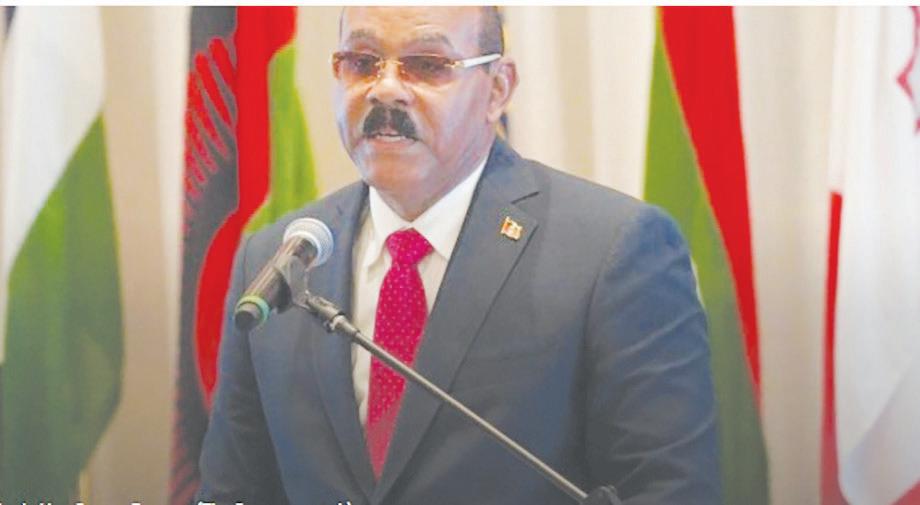
our detriment,” he added.
In January, the Antigua and Barbuda Government said it had not entered into any binding agreement with the United States to accept deportees or refugees. It said what exists is a non-binding Memorandum of Understanding (MoU) proposed by the United States, as part of its global efforts to share responsibility for refugees already present in its territory.
“Antigua and Barbuda was approached by the United
States, along with more than 100 Governments worldwide, including several within the Caribbean Community (Caricom), to consider this non-binding arrangement,” the Government said in its statement.
Last month, the St Kitts and Nevis Government said that it had accepted the first group of US-transferred third-country deportees under a bilateral arrangement with Washington.
(Excerpt from CMC)


Oil prices jump after US-Iran talks reportedly collapse, erasing recent declines
The price of oil rose sharply Monday after Iranian Governmentaligned media reported that the country was cutting off talks with the United States to end the war.
Conflicting comments from President Donald Trump hours later did little to dent oil’s jump, although prices ended the day somewhat lower than the highs of the morning.
US crude oil closed higher by 5.5 per cent at US$92.16 per barrel. International benchmark Brent crude closed higher by 4.5 per cent at US$94.98 per barrel.
Heating oil, a proxy for jet fuel, also rose four per cent, while wholesale gas prices rose two per cent.
As a result of the most recent decline in oil prices, the cost of retail gasoline was down 24 cents on Monday from this year’s peak. Still, gas prices remain higher by 44 per cent on average than they were before the war.
Government bond yields, which heavily influence consumer borrowing rates, also rose slightly alongside energy prices.
The 10- and 30-year Treasury yields rose to the highs of the day after the report out of Iran, but later fell to near earlier levels. Yields on shorterterm bonds such as the two- and five-year Treasuries, however, held on to most of their gains through the afternoon.
Monday’s market moves essentially put oil prices back to levels from mid-May, before they saw two weeks of declines as Administration officials continued to suggest that some kind of deal with Iran to end the war was within reach.
Now, as the war enters its fourth month, Tehran is reportedly suspending talks and “the exchange of texts through mediators” to protest Israel’s expanding offensive in Lebanon.
Iran also said it was “determined to consider the complete closure of the Strait of Hormuz and the activation of other fronts including the Bab el Mandeb Strait”, a critical commercial waterway off the coast of Yemen.
In response, Trump told NBC News that the US will keep its blockade on Iranian ports. “If they don’t want to talk, that’s OK with me,” he said.
In a separate comment to CNBC, Trump said he was not concerned about oil prices that continue to rise. “I think the oil will be dropping like a rock in the very near, you know, the very near distance,” he said.
Shortly after giving both of those interviews, Trump posted on social media, “Talks are continuing, at a rapid pace, with the Islamic Republic of Iran.”
NBC News has not independently confirmed the Iranian report or Trump’s claim Monday afternoon that talks were proceeding.
Investors on edge
“The (largely) closed Strait of Hormuz remains the focus for commodity market observers,” HSBC strategists said in a note Monday morning.
“Commodity markets have, so far, absorbed the shock better than some of the worst-case scenarios, reflecting high inventories before the conflict and rapid shifts to redirect commodity trade,” they added.
“However, the longer the Strait of Hormuz remains closed, the more stocks will be run down and at some point they may reach critical functional lows, which could see sharper (non-linear) price rises and genuine shortages,” they said.
For most of May, daily ship traffic through the Strait of Hormuz remained in the single digits, according to data from S&P Global Market Intelligence.
US stocks also fell initially after the latest headlines about the Iran war, but declines reversed in the afternoon following Trump’s comments. Indexes were also buoyed by renewed momentum in AI stocks, following a series of product announcements from Nvidia overnight.
The Russell 2000 index, which tracks smaller companies and whose largest constituent is worth only US$70 billion, struggled to turn positive throughout the day.
The disparity between more mainstream indexes, such as the S&P 500 and Nasdaq composite, and the Russell 2000 illustrates the bifurcation in markets between the indexes that are buoyed by large, AIfuelled companies and those that are not.
Internationally, stocks saw more widespread selling Monday, with benchmark indexes in Germany, France, the United Kingdom and Italy closing lower by around 0.5 per cent. The pan-European Stoxx 600 fell 0.8 per cent. (NBC News)
Three new vaccines are being developed to tackle the rare species of Ebola that has already killed nearly 250 persons.
The International Aids Vaccine Initiative (IAVI), which is working on one vaccine, said the outbreak was threatening to be the worst ever.
The University of Oxford and the pharma company Moderna are also researching vaccines against the Bundibugyo species.
The Coalition for Epidemic Preparedness Innovations (Cepi), which is providing funding to each group, said “every day counts”.
There are now more than 1000 suspected cases in the
Democratic Republic Congo with nine confirmed cases in neighbouring Uganda.
There is growing concern this outbreak – which was detected only after it had spread in a conflict zone with limited healthcare resources – could reach the size of the largest-ever Ebola outbreak in West Africa in 2014-16. Then, nearly 29,000 persons were infected and more than 11,000 died.
It echoes concerns from the medical charity Médecins Sans Frontières (MSF) which said the situation was “deeply alarming” and never before had “so many cases” been recorded so soon. (Excerpt from BBC News)
Iranian officials have warned that Israel’s escalating attacks on Lebanon and ongoing hostilities in Gaza threaten to derail the ongoing ceasefire negotiations with the United States which continue to drag on.
Foreign Minister Abbas Araghchi suggested on Monday that the mounting Israeli invasion of Lebanon and its strikes on the country, alongside the continued US siege of Iranian ports, constitutes a violation of the ceasefire.
“The ceasefire between Iran and the US is unequivocally a ceasefire on all fronts, including in Lebanon,” Araghchi said in a social media post. “Its violation on one front is a violation of the ceasefire on all fronts. The US and Israel are responsible for the consequences of any violation.”

Iran’s chief negotiator and Parliament Speaker Mohammad Bagher Ghalibaf made the same point.
“The naval blockade and escalation of war crimes in Lebanon by the genocidal Zionist regime are clear evidence of US noncompliance with the ceasefire,” he wrote on social media.
“Every choice has a price, and the bill comes due. It will all fall into place,” he added.
Their comments came as Israel deepens its invasion of south Lebanon and threatens to resume large-scale attacks in Beirut.
Not long after the comments emerged, the Israeli military issued a forced displacement order for residents of the southern Beirut suburbs of Dahiye and strikes were ordered. The previous day Israeli ground forces
reached their deepest point in Lebanon in 26 years.
But US President Donald Trump suggested he had intervened to de-escalate the tension, posting on Monday afternoon that he had received assurances that Israeli troops would not be continuing their advance.
“I had a very productive call with Prime Minister Bibi Netanyahu, of Israel, and there will be no Troops going to Beirut, and any Troops that are on their way, have already been turned back,” Trump wrote.
“Likewise, through highly placed Representatives, I had a very good call with Hezbollah, and they agreed that all shooting will stop — That Israel will not attack them, and they will not attack Israel.” (Excerpt from Al Jazeera)
Trump’s ‘weaponisation’ fund put on hold after fierce opposition from Congress
US President Donald Trump’s nearly US$1.8 billion fund to compensate victims of alleged Government “weaponisation” has been put on hold after the White House faced fierce opposition from Republicans in Congress, three sources familiar with the plan said on Monday.
The rare rebuke of Trump demonstrated some Republicans’ increased willingness to flex their political power against the President, par-
ticularly after his endorsement of Texas Attorney General Ken Paxton over incumbent Senator John Cornyn ahead of a crucial midterm election.
The proposal was dropped as Senators returned to Washington after their Memorial Day break and faced an impasse with the President over a US$72 billion bill to fund immigration and Border Patrol operations. Speaking to reporters, Senate Majority Leader John Thune said he made clear to the White House the fund
needed to be killed.
“They gave us an ultimatum,” a White House source said, describing how Republican lawmakers negotiated with the White House over the fund. The White House’s goal is to speed passage of the funding package, said the source, who like other sources spoke on the condition of anonymity to discuss internal deliberations.
The Republican rebellion was an extraordinary act of defiance given Trump’s insis-
tence on loyalty and his threats to back primary candidates against those who do not toe the line.
The fund emerged from a legal settlement between Trump and the Justice Department to resolve an unprecedented US$10 billion lawsuit against the IRS over the alleged mishandling of his tax records. The US$1.776 billion was meant to pay people who said they had been the subject of Government abuse. (Excerpt from Reuters)
Florida sued OpenAI and its Chief Executive Officer (CEO), Sam Altman, on Monday, accusing the company of misrepresenting the safety of its ChatGPT platform, which the lawsuit said has harmed children by providing information to school shooters, offering guidance on self-harm and addicting young users.
Marking the first state to take legal action against the company, Florida Attorney General James Uthmeier, a Republican, filed the lawsuit
in Florida state court. It cited a shooting at a Tallahassee university last year and a number of events in other states where ChatGPT allegedly provided information to people who went on to commit violence.
At a press conference, Uthmeier said the state named Altman personally because he had been “very central” to pushing some of the features on ChatGPT that Uthmeier said had been the most harmful.
“People are getting hurt, parents are getting deceived,
and they need to pay for it,” Uthmeier told reporters.
The lawsuit seeks damages up to billions of dollars, Uthmeier said, plus a court order directing the company to change how it interacts with young users.
A spokesperson for OpenAI did not immediately respond to a request for comment.
OpenAI has said it trains its models to refuse requests that could “meaningfully enable violence” and notifies law enforcement when conversations sug-
gest “an imminent and credible risk of harm to others”, with mental health experts helping assess borderline cases.
In April, family members of victims of one of Canada’s deadliest mass shootings filed a group of lawsuits against OpenAI and Altman, alleging the company knew eight months before the attack that the shooter was planning it on ChatGPT but did not warn police.
(Excerpt from Reuters)
Armenian Prime Minister Nikol Pashinyan has rejected a call from Moscow to hold an immediate referendum on leaving the Russian-led Eurasian Economic Union (EAEU) to join the European Union. The refusal from Pashinyan came on Monday as Russian President Vladimir Putin called, ostensibly to wish him a happy birthday. The “unreasonable” demand, as the Armenian leader termed
it, came amid a rapid escalation of economic and diplomatic pressure from the Kremlin as its traditional ally increasingly looks to the West.
Tensions boiled over at the EAEU summit in Kazakhstan on May 29, as Putin and fellow bloc members Belarus, Kazakhstan and Kyrgyzstan issued a joint statement urging Armenia to hold a referendum on joining the EU “as soon as possible”.
Membership of both the
EU and EAEU is impossible, the Russian leader insists.
Putin also appeared to make a barely-veiled threat, warning Armenia against pursuing its Western ambitions, and noting that the “Ukrainian scenario” had begun with Kyiv’s EU aspirations.
In a video address broadcast on social media, Pashinyan stated that the Government in the capital Yerevan would continue work-
ing within the EAEU until a choice between the two blocs “becomes unavoidable”, noting that any referendum before Armenia formally applies for EU candidate status remains purely theoretical.
“Putting a theoretical choice to a referendum is, of course, neither very sensible nor justified,” Pashinyan said, describing ties with Russia as being in a “transformation phase”. (Excerpt from Al Jazeera)










21-April 19)

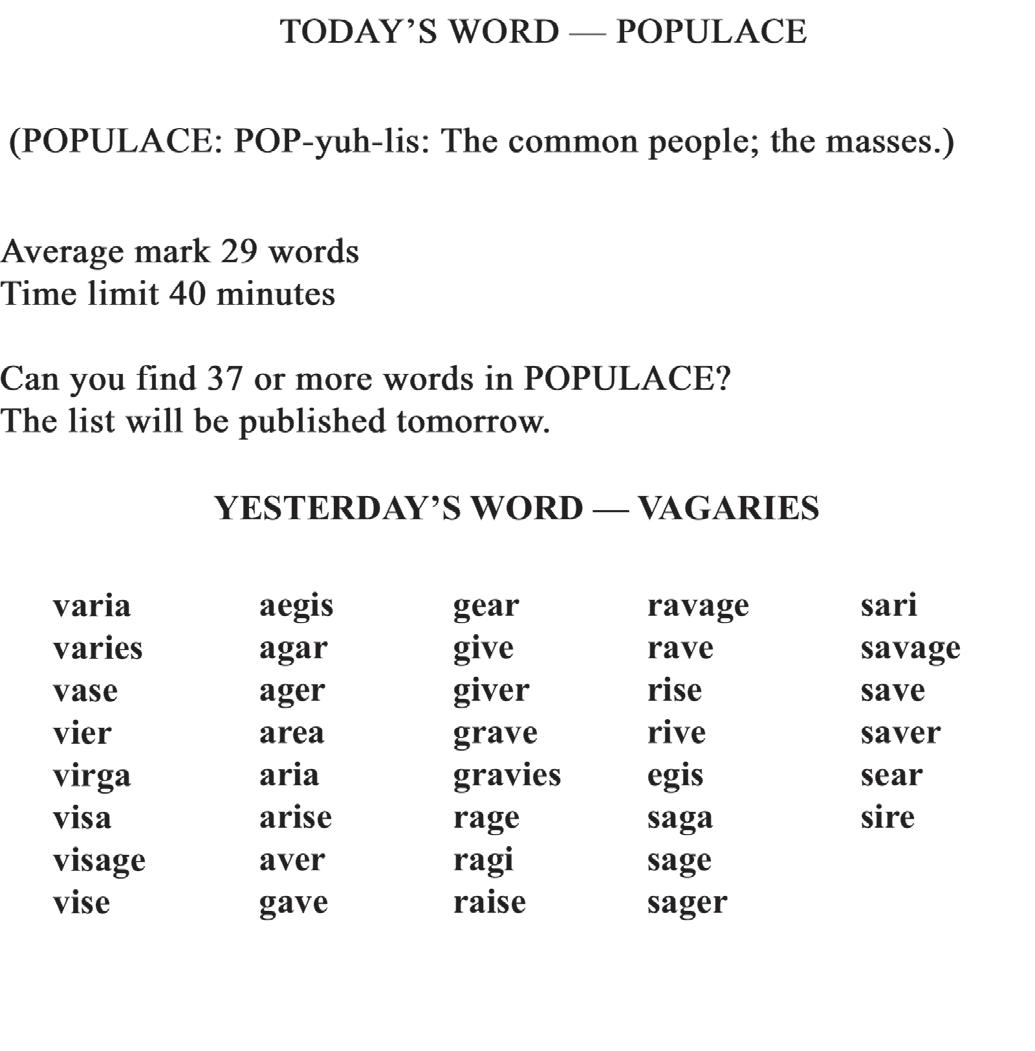


Observation is necessary. Refuse to let sensitive situations push you toward an argument. Expect situations and conversations to offer an exaggerated perspective.

20-May 20)

A chance to learn something new while making a difference in your community or an organization that interests you will have an impact on your lifestyle. Verify information before you act on it.


21-June 20)


21-July 22)


23-Aug. 22)






24-Nov. 22)
A change will motivate you to explore new possibilities. Participate in events that make you feel good. Be cognizant of someone using compliments or pressure tactics to push you in a questionable direction.
Speak up, do your thing and live in the moment. It’s up to you to make things happen and to push yourself to participate in events that allow you to use your skills and attributes to your advantage.
Be careful sharing personal information. Dealing with institutions and government agencies will lead to problems. Concentrate on lifestyle changes and reclaiming your dreams.
Being detailed, having precision and remembering discipline will be important. Refuse to let what others choose to do tempt you. Pay more attention to whatever makes you feel good.
You’ll be stepping back in time if you don’t leave the past behind you. Stop holding yourself back when letting go offers you the freedom to find your niche and power yourself forward.
Whether work or personal, the encounters you experience will have an impact on what you choose to do next. Getting a new adventure underway will boost your ego and motivate you to explore new possibilities.


23-Dec. 21)
Pay attention to legal, financial and medical issues. Look for opportunities to mix and mingle with people who can offer inside information or help you gather your thoughts as to how to best take care of your concerns or needs.





Trust your instincts over the information you receive. Fact-check and prepare to branch out in directions that are better suited to what you want to achieve. Run the show instead of sitting on the sidelines.
Take time to think matters through before acting. Refuse to let anger get the best of you, disrupting your day or your relationship with someone. Make domestic changes that ease tension.

Don’t let the changes happening around you stifle your plans. Use what’s unfolding to your advantage, and you’ll find a path that leads to greater confidence and getting things done on time.




A16-member West Indies Academy squad has departed the Region for a reciprocal tour of Sri Lanka from June 3-June 27, 2026, where the team will face the Sri Lanka Emerging Players in a multi-format series designed to further strengthen the Region’s player development pathway.
It follows the visit by the Sri Lanka Emerging Team to Antigua in 2025, where the sides competed in two fourday matches, which ended one game apiece, and three One-Day matches, with the Academy coming out on top 2 to 1.
Once again consisting of two four-day and three 50Over matches, this tour represents another significant investment in the development of the next generation of West Indies cricketers, offer-
ing players the opportunity to gain valuable overseas experience and adapt to challenging subcontinental conditions against quality opposition.
The squad features a strong blend of emerging regional talent, with 13 members being regular participants in the Academy programme, including Johann Layne, Jediah Blades and Zishan Motara, each having already represented the Region at the senior level.
With Ackeem Auguste being selected for the West Indies senior team and Carlon Bowen-Tuckett being unavailable for selection (personal reasons), emerging players Kevlon Anderson, Shaqkere Parris and Johann Jeremiah have been afforded the international developmental experience opportunity.
Guyana Harpy Eagles
Head Coach Ryan Hercules will join the Academy coaching staff as an Assistant Coach for the tour, adding further experience and support to the management unit.
Academy Head Coach
Ramesh Subasinghe spoke about the objectives for the tour, stating, “Our Academy objective is simple, to develop players into the next level of their careers, and tours like this play a key part in that journey. Sri Lanka has historically been one of the toughest places for West Indian teams. This tour represents the perfect platform to immerse our brightest emerging talent in conditions that will truly test and shape them.
“Last year we hosted a highly-competitive home series against Sri Lanka in Antigua, and four players
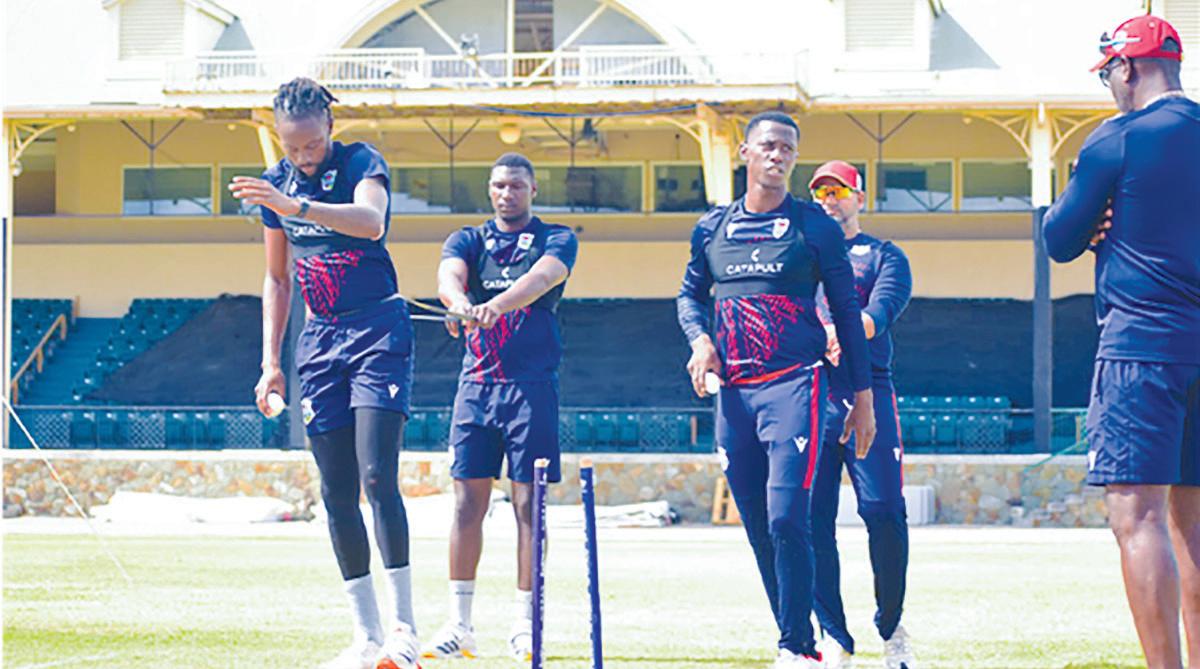
Twelve of the Region’s fast-bowling talents
will take part in a HighPerformance Fast Bowling Assessment Camp from June 1-11, 2026 at the Coolidge Cricket Ground in Antigua as part of Cricket West Indies’ commitment to strengthening capacity and supporting player development across the Caribbean.
The primary objective of the programme is to identify and assess the Region’s pool of resources across both redball and white-ball disciplines through structured challenges and measurable evaluation of speed, technique, skill execution, physical robustness, and problem-solving ability.
The camp will be led by former West Indies fast bowler and world-renowned bowling coach Ottis Gibson, who was recently appointed to the role of Fast Bowling Consultant. Supporting him will be former West Indies fast bowler Jerome Taylor, one of the Region’s emerging coaching talents who continues to contribute to play-
er development initiatives within the CWI system.
Gibson spoke on what he is seeking to achieve over the 10day period.
“I’m excited and honoured to be working with this developing generation of fast bowlers across the Region. The main objective is to enhance and maximise the potential of the players we have, which will ultimately benefit West Indies cricket in the long run.
“I’ve been very impressed with the talent and resources I’ve seen so far during my time here. There are several promising players who stand out in terms of their physicality, height and strength. What they now need is the capacity, determination, and desire to consistently bowl fast,” he added.
CWI High Performance Manager Dwain Gill said the camp represents an important step in strengthening the Region’s bowling depth and future succession planning.
“This camp is a strategic component of our wider high-performance strategy to
strengthen the regional fast bowling pipeline and ensure we continue building depth across all formats of the game,” Gill said.
“We want to identify bowlers who demonstrate the technical skill, physical capabilities, tactical awareness and mindset required to compete at the international level, while also providing targeted support to accelerate their development within the CWI system.”
The High-Performance Fast Bowling Assessment Camp underscores CWI’s ongoing investment in developing a sustainable pipeline of elite fast bowlers capable of succeeding across all formats at the international level.
High-Performance Fast Bowling Assessment Camp participants
1. Khari Campbell –Jamaica Scorpions
2. Joshua Cepal – Saint Lucia High Performance Centre
3. McKenny Clarke –Windward Volcanoes
4. Joshua James – Trinidad & Tobago Red Force
5. Anderson Phillip –Trinidad & Tobago Red Force
6. Jakeem Pollard – West Indies Academy
7. Ojay Shields – Jamaica Scorpions
8. Ramon Simmons –Barbados Pride
9. Nial Smith – Guyana Harpy Eagles
10. Javier Spencer –Leeward Islands Hurricanes
11. Oshane Thomas –Leeward Islands Hurricanes
12. Gilon Tyson –Windward Volcanoes

from that squad have since gone on to rep - resent the West Indies senior men’s team, with many others earning regional franchise and CPL [Caribbean Premier League] opportunities,” he added.


Mavendra Dindyal
Cricket West Indies’ HighPerformance Manager Dwain Gill highlighted the significance of the tour as part of the organisation’s wider player development strategy.
“This tour is an extremely important component of our long-term development pathway programme as we continue to invest in the future of West Indies cricket. Opportunities like these allow our emerging players to experience competitive international environments, adapt to unfamiliar conditions and further develop the technical, tactical and mental skills required at the highest level of the game,” said Gill.
The squad will travel to
Hambantota for the fourday series before moving to Colombo for the white-ball leg of the tour, with all matches being played under standard International Cricket Council (ICC) playing conditions.
West Indies Academy
Team Management Unit
Don Ramesh Subasinghe – Head Coach
Rohan Nurse – Assistant Coach
Ryan Hercules – Assistant Coach
Shanique Peters – Physiotherapist
Hance Richards – Strength & Conditioning Coach Clint St Hill – Manager
Match Schedule
June 8-11: 4-Day #1 @ Mahindra Rajapaksa International Cricket Stadium
June 15-18: 4-Day #2 @ Mahindra Rajapaksa International Cricket Stadium
June 22: 50-Over #1 @ Sinhalese Cricket Club
June 24: 50-Over #2 @ Sinhalese Cricket Club
June 26: 50-Over #3 @ Nondescripts Cricket Club
The Tourism Guyana (TG) Titans Cricket Team are gearing up for a bilateral series against several cricketing counterparts in the twin-island republic.
According to a recent missive, the cricket tour to Tobago from June 3-8, 2026, will see the team will contest three matches against top opposition.
During the tour, the Titans will play two matches against Club Crusoe Cuzins, comprising one 40-over match and one T20 encounter, while also facing Tobago Legends in an additional T20 fixture.
The tour forms part of the team’s ongoing efforts to provide players with regional exposure and strengthen cricketing ties within the Caribbean.
Club Crusoe Cuzins, reformed in 2010 after an extended hiatus, had a short period of inactivity for a few seasons, but is back with new management and sponsorship. Former Captain Jason Persaud, through his Cuzins franchise and newly-acquired sponsorship support, is leading the team’s return ahead of the upcoming 2027 season.
Persaud, during a conversation with Tourism Guyana representatives, explained that the club’s renewed direction is heavily focused on youth development and long-term sustainability.
“The team lacked the vision of youths for the future, and that is my main focus going for-
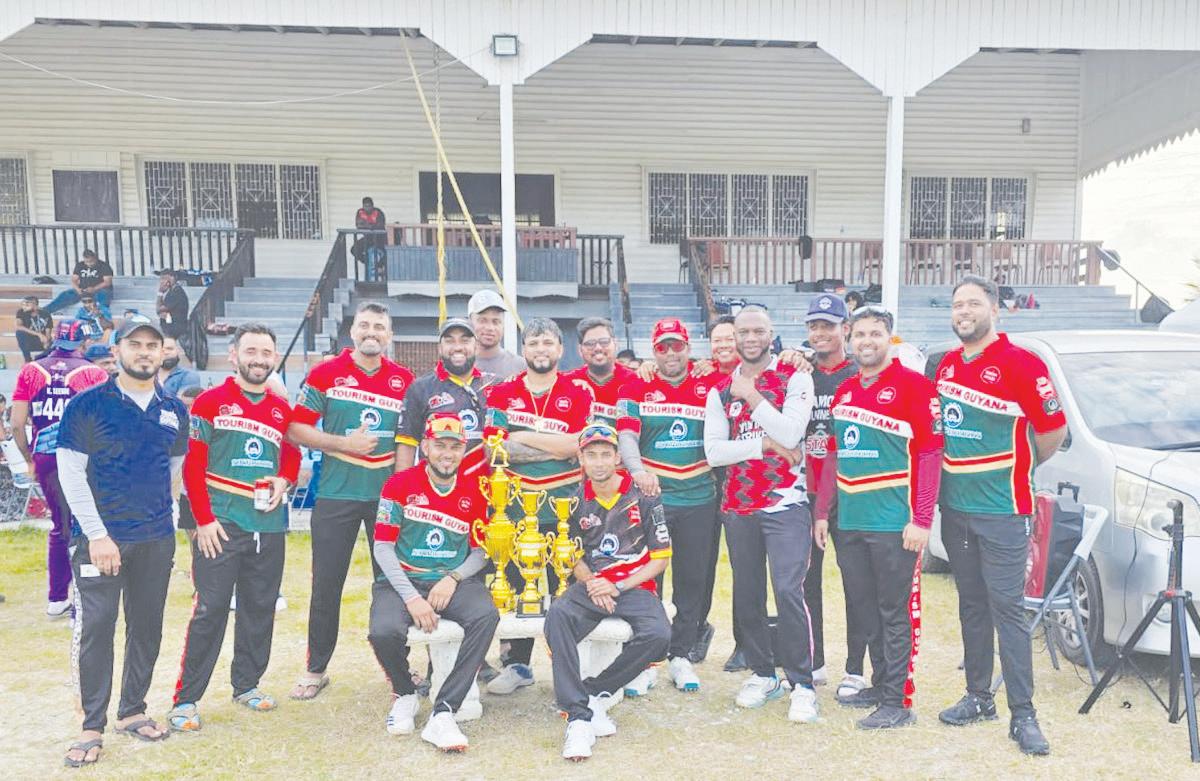
ward,” Persaud stated.
He also expressed appreciation to Tourism Guyana and acknowledged the friendships built with several Tobago-based players, which helped make the tour possible.
Team management has also extended sincere gratitude to the sponsors and partners whose support has made the trip a reality. The team acknowledged the contributions of Sonrize Engineering; Beepats; Igloo; Jaigobin Hotel; Papa John’s; Autopit Signs; Dave’s Guyanese Cuisine and the Ministry of Culture, Youth and Sport for investing in sports and youth development.
Meanwhile, the TG Titans, established in 2024 as a tapeball playing team, elevated their status to the hardball arena last year through several ex-
hibition games and round-robin tournaments.
The highlight of their brief but fruitful foray into the hardball arena came with the winning of the Ogle Cricket Club One-Day cricket extravaganza. According to team officials, the tour presents an excellent opportunity for players to gain valuable experience while showcasing their abilities against competitive regional teams.
“The support from our sponsors has been tremendous and has allowed the team to embark on this important tour. We are excited for the opportunity to compete in Tobago and proudly represent Guyana,” team representatives noted. The team are scheduled to depart Guyana on June 3 and return on June 8, 2026.
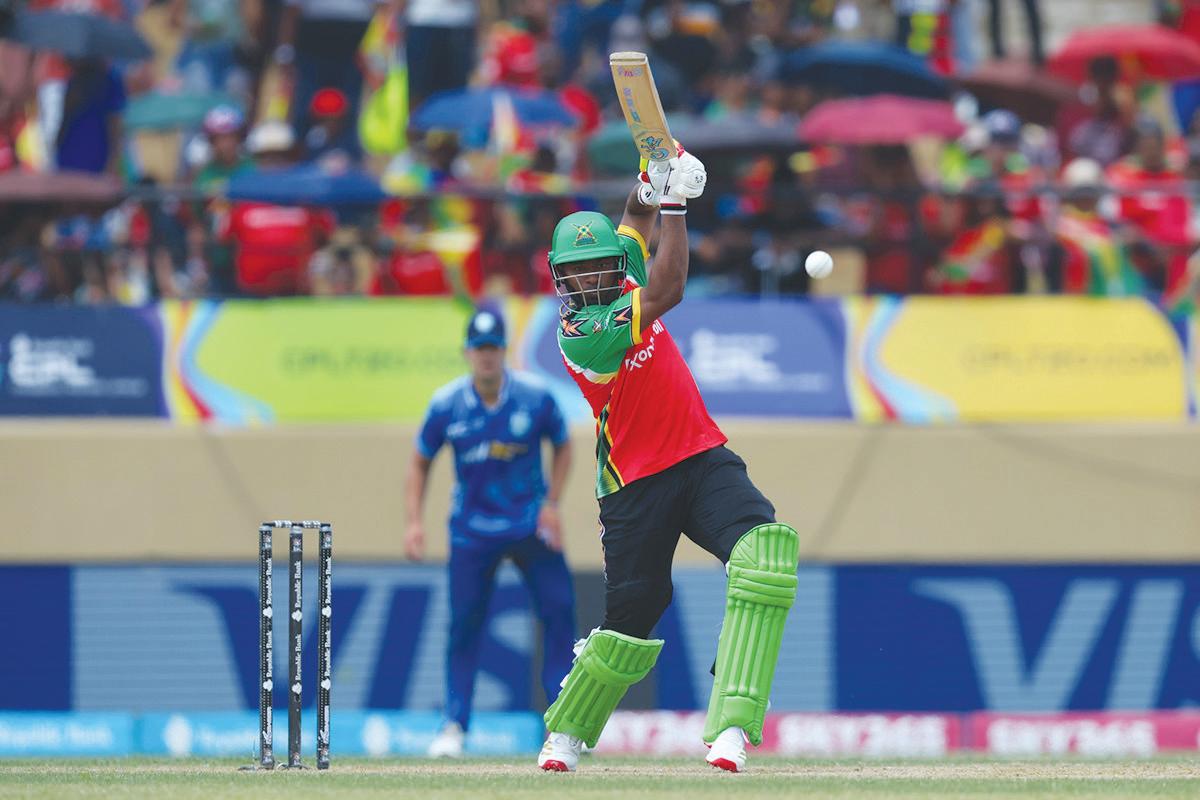
Guyana Amazon Warriors (GAW) breakout star Quentin Sampson has continued from where he left off in Trinidad and Tobago last week.
Sampson powered his way to a breathtaking 76 and picked up 2-33 for his team, Hamilton Parish Hurricanes in the Bermuda Smash Invitational T20 at the weekend. The Guyanese all-rounder, who will suit up for the
Guyana Amazon Warriors in the summer, said his success comes from the same recipe.
“I like to see the ball and hit the ball. I enjoy when the ball come on to the bat. At first, it was new for me, the conditions was challenging. I knew it will take a few balls and then I know what I had to do,” Sampson said.
“I like to bat under pressure, I know if I stick there, runs will come,” Sampson added.
Sampson recently fin-
ished the Trinidad and Tobago Cricket Board (TTCB) Premiership T20 Festival with 200 runs at an average of 67. He had a strike rate of 244, facing only 82 balls. Sampson had scores of 72, 50, 47, and 32.
Sampson was retained by the Amazon Warriors for Caribbean Premier League (CPL) 2026. The man from Essequibo is also expected to feature at the upcoming ExxonMobil Guyana Global Super League.
Having served in the capacity of Secretary and more recently Second Vice President, Guyana-born Shiv Persaud has been elevated to the presidency of Cricket Ontario.
Persaud, who also serves as President of Scarborough Cricket Association (SCA) and the Ontario Softball Cricket League (OSCL), replaces long-standing cricket official Mohammed Shaikh.
In an invited comment, Persaud, who relishes challenges, pointed out that his aim was to bring stability and programmes that would be sustainable long term and beneficial for all.
According to Persaud, the various area boards/associations could look forward to “raising the awareness of Cricket Ontario and the pathways that exist, attract more sponsors, and improve the standards at every level, including coaching and officiating”.
Persaud pointed out to opportunities to work together to promote and grow

cricket in their area whereby creating a platform for league to provincial to national support at the grassroots level.
Questioned on the recent setbacks facing the beleaguered Cricket Canada, Persaud felt that the body is doing its best at its level. “Our focus will be putting the best effort forward to bring trust and transparency in Ontario, reassuring all of our players, officials, sponsors, and stakeholders.
“Completing our cricket calendar for the summer for our youths, women, girls and seniors in preparation for national tournaments are our key priorities. We will be working diligently as a board and with our committees.”
Since taking over the role of President of the SCA, the body has come a long way
with over 120 teams competing in 50, 40, 30 and 20 overs cricket. As its President, Persaud has also brought about noticeable changes in SCA, like introducing multiple formats of the game; emphasising the importance of youth, grassroots development and rejuvenating the youth programme, which includes U19 girls currently on the National U19W Squad.
Apart from Persaud, the others elected at the recent Special Meeting were: First Vice President Farhan Khan, Second Vice President Gurpreet Hothi, Secretary Manish Tomer and Treasurer Safiullah Jalali. The Directors at Large are Ranjit Chaudhri, Zakir Patel, Giridhar Bannaravuri, and Adeel Ahmed.
Corporate backing for the One Guyana T10 Tapeball Blast has continued, with Avinash Contracting & Scrap Metal Inc officially recommitting its long-standing support to the fourth season.
The high-octane tournament is scheduled to bowl off on August 8 in Berbice.
The partnership highlights a shared vision between the corporate sector and tournament organisers to foster community development and unearth talent across the country through the fast-growing tapeball format.
Speaking on the alignment, Kavita Lakeram, Health, Safety, Social & Environmental (HSSE) Lead at Avinash Contracting, emphasised that supporting the tournament aligned perfectly with the company’s core values of community advancement.
“At Avinash Contracting, we believe that sports play a pivotal role in building safe, vibrant, and cohesive communities,” Lakeram stated.
“The One Guyana T10 Tapeball Blast has grown into a powerful platform that bridges communities and provides young athletes with a stage to showcase their skills. We are incredibly proud to continue our partnership with FL Sport, and we look forward to an electrifying tournament that brings people together across all regions.”

Tournament Director and FL Sport representative John Ramsingh expressed immense gratitude for the company’s sustained patronage, noting that corporate trust is the bedrock of the tournament’s rapid expansion.
“Avinash Contracting has been with us on this journey, and their renewed commitment is a massive boost for the tournament’s sustainability,” Ramsingh said.
“When corporate leaders invest in grassroots sports, they are directly investing in the people. This partnership allows us to elevate the player experience and increase the rewards, ensuring that
tapeball cricket gets the professional platform it truly deserves.”
With the tournament boundary lines expanding, organisers have reported an unprecedented surge in interest.
Team slots across various administrative zones are filling up rapidly as regional squads rush to secure their participation.
Ramsingh expressed immense confidence in the trajectory of this year’s tournament, noting the overwhelming response from the cricket community.
With the stakes higher than ever, organisers are
urging teams to act quickly rather than delaying their entry while finalising their rosters.
Ramsingh emphasised the urgency of the first-come, first-serve system, recognising that the fierce nature of the competition often causes captains to deliberate over their line-ups.
The Berbice, East Bank/West Demerara, and Essequibo zones will have a maximum cap of 16 teams each, while the East Coast Demerara/Georgetown zone will accommodate 32 teams.
To secure a spot immediately, captains can pay the $35,000 entry fee and finalise
their ultimate 15-man talent pools closer to their respective zonal start dates.
Registration forms are currently available through the tournament’s official social media channels or via direct WhatsApp contact at +592 635-2235.
The action-packed tournament is set to bowl off with the Berbice zone on August 8-9, featuring 16 teams battling across four premier venues: the Port Mourant Community Centre Ground, No 69 Ground, Welfare Ground (Canje), and the Albion Sports Complex, which is slated to host the zonal finals on Sunday, August 9.
Following the opening leg in Berbice, the tournament moves to East Bank/West Demerara on August 15-16, followed by the Essequibo leg on August 22-23.
In a strategic move to maximise fan engagement and support local cricket festivities, the competition will pause during the Caribbean Premier League (CPL) window, ensuring fans can fully immerse themselves in the professional franchise season.
Action will resume postCPL with the highly-competitive Georgetown/East Coast Demerara leg, spanning September 26-27 and October 3-4.
This all leads towards the historic national grand finale on October 11, 2026, which will be hosted for the
first time at the Anna Regina National Stadium in Region Two, taking top-tier tapeball action to the Essequibo coast. Financial incentives for the 2026 season have reached an all-time high, with the introduction of guaranteed cash prizes for every single team that reach the quarter-final stage of their respective zone.
Rewards begin at $25,000 for losing zonal quarter-finalists and scale up significantly, culminating in a $500,000 purse pocketed by the zonal winners before they advance to the National Finals. The stakes at the national level are even higher, as teams will compete for a massive $2,000,000 grand prize, while the runners-up take home $1,000,000.
In addition to the substantial cash prizes, the four national finalists will earn the prestigious right to represent Guyana at the upcoming International T10 Tapeball Tournament this October. Individual brilliance will also be handsomely rewarded throughout the tournament. The eventual tournament Most Valuable Player (MVP) is set to walk away with $150,000 and a brandnew motorbike.
Specialised awards for the leading run-scorer and top wicket-taker include $100,000 and a new television each, ensuring that personal milestones are celebrated alongside team success.

West Indies
Women saw their unbeaten run in the 2026 Ireland Women’s Tri-Nation Series come to an end on Monday after a heartbreaking one-run defeat to Ireland Women via the Duckworth-LewisStern (DLS) method at Clontarf Cricket Club.
Having opened the tournament with two impressive victories, the Caribbean side entered their third match looking to maintain momentum. However, despite posting a competitive 141 for 8 from
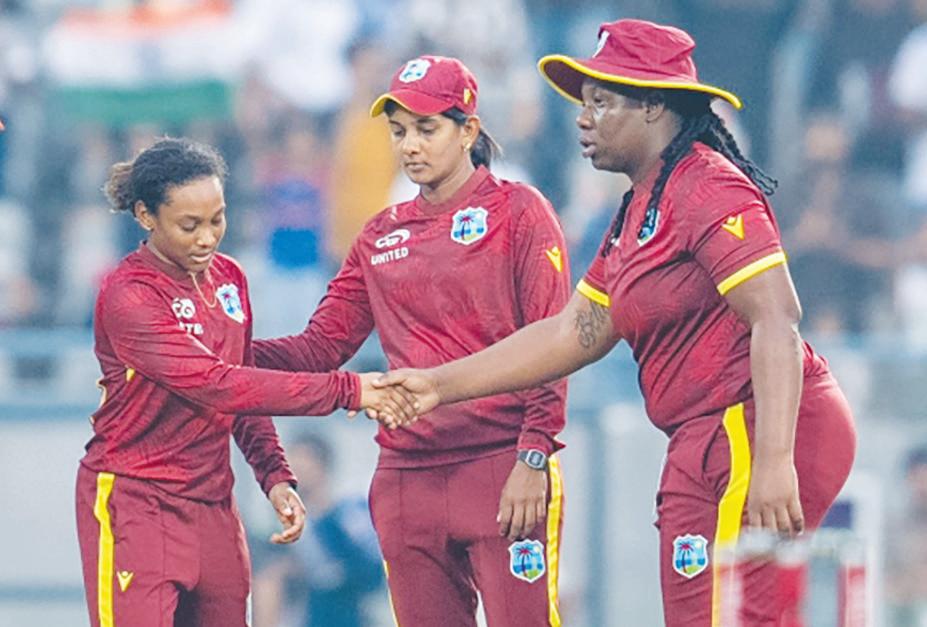
their 20 overs, they were edged out in a rain-affected contest that kept fans on the edge of their seats. Batting first after winning the toss, West Indies Women were guided by a determined 36 from 26 balls by Jannillea Glasgow. Shemaine Campbelle provided valuable support with 21 off 21 deliveries, while Deandra Dottin chipped in with a brisk 16. Ireland’s bowling attack kept the scoring in check, with Ava Canning
claiming 2 for 11 and Orla Prendergast taking 2 for 26.
In reply, Ireland were well placed at 99 for 5 after 14.1 overs when weather interruptions brought an early end to the chase. Under the DLS calculations, Ireland finished one run ahead of the revised target, sealing a dramatic victory.
Prendergast starred for the hosts with an unbeaten 71 from 46 balls, anchoring the innings un -
der pressure. West Indies bowlers fought hard, with Shawnisha Hector returning figures of 2 for 21 and Qiana Joseph taking 1 for 17, but the visitors were left to rue missed opportunities in a match decided by the narrowest of margins.
The defeat leaves West Indies Women with two wins and one loss from their opening three matches, keeping them firmly in contention but ending their perfect start to the

aaa
West Indies Women (20 ovs maximum)
Deandra Dottin c Paul b Dalzell 16
Hayley Matthews (c) c Dalzell
b Canning 1
Qiana Joseph c †Coulter Reilly
b Canning 12
Stafanie Taylor retired hurt 9
Jahzara Claxton run out (McBride/†Coulter Reilly) 11
Shemaine Campbelle †c Kelly
b McBride 21
Jannillea Glasgow run out (Prendergast/†Coulter Reilly) 36
Aaliyah Alleyne c Tector
b Prendergast6
Zaida James c †Coulter Reilly
b Prendergast 14
Shawnisha Hector not out 7
Karishma Ramharack not out 1
Extras (lb 1, w 6) 7
Total 20 Ov (RR: 7.05) 141/8
Fall of wickets: 1-13 (Hayley Matthews, 2.1 ov), 2-21 (Deandra Dottin, 3.4 ov), 3-33 (Qiana Joseph, 4.3 ov), 4-49 (Jahzara Claxton, 8.6 ov), 4-53 (Stafanie Taylor, retired not out), 5-97 (Shemaine Campbelle, 15.3 ov), 6-115 (Aaliyah Alleyne, 17.1 ov), 7-126 (Jannillea Glasgow, 18.4 ov), 8-139 (Zaida James, 19.4 ov)
Ireland Women (T: 99 runs from 14.1 ovs)
Arlene Kelly c Glasgow b Hector 1 Alana Dalzell c sub (M Mangru) b Hector 0
Rebecca Stokell c †Campbelle b Joseph 12 Orla Prendergast (c) not out
71
Leah Paul c †Campbelle b Matthews 1 Alice Tector run out (Claxton/†Campbelle)
3 Louise Little not out 9
Extras (lb 1,

The Rupununi Football Association (RFA) successfully launched its Guyana Football Federation (GFF) Youth Ensemble Under-13 League over the
weekend, although persistent rainfall severely affected the opening round, forcing the cancellation of all scheduled matches except one.
The lone fixture to be completed saw Moco Moco FC defeat Saints FC 4-2 at Culvert City to claim the first three points of the competition.

against Legends United at 11:30h and Strikers FC taking on Three Hills FC from 14:30h. Elsewhere, Flash FC will meet Kanuku Warriors FC at Yupukari from 10:00h, while Gladiators FC are set to face Moco Moco FC at 10:00h. Potari FC and Saints FC are also scheduled to clash from 11:30h, with the venue to be confirmed.

Moco Moco’s victory was built on goals from Chad Massiah and Elon Francis, while Delroy Williams produced a brace to lead his side to the six-goal contest win. Saints FC fought hard, but could only respond through
Rolston Clarke and Marcus Parks, who each scored once. Action in the competition is scheduled to continue on Saturday, June 6. At Annai, Challengers United will face Paiwomak FC at 10:00h, followed by All Stars Blazers
ive & Louder
LEvents, part of the group of businesses behind the Republic Bank Caribbean Premier League (CPL), is set to deliver a spectacular world-class concert at the National Botanical Gardens in Barbados on Saturday, September 19, 2026, the night before the highly-anticipated CPL Final.
The Live & Louder Mega Concert forms part of a wider programme of cultural celebrations being brought to Barbados as CPL marks finals week with an unforgettable mix of cricket, music, and entertainment. Fans can expect an electrifying atmosphere with performances from massive global artists guaranteed to excite music lovers across the island and the wider Caribbean.

According to the CPL, details on the headline acts and full artist line-up
will be announced in the coming days.
CPL Chief Executive Officer (CEO) Pete Russell said, “CPL has always been about more than just cricket. Finals week in Barbados will be a celebration of Caribbean culture, entertainment and community, and the Live & Louder Mega Concert is going to be a huge part of that. We are bringing together world-class talent in an iconic venue to create an unforgettable experience for fans from Barbados and across the Region. We can’t wait to reveal the incredible artists who will be performing.”
On the other hand, Barbados Tourism Marketing Inc CEO Andrea Franklin remarked, “Barbados is
proud to host CPL Finals Week and the incredible events that come with it. This Mega Concert will showcase the very best music while giving visitors and locals alike another unforgettable reason to experience Barbados. Sport and entertainment are a powerful combination, and this event will further highlight Barbados as a premier destination for world-class experiences.”
The Mega Concert at the National Botanical Gardens is expected to attract fans from across the Caribbean and beyond, further cementing Barbados’ reputation as a premier destination for sport and entertainment. Further details, including ticket information and artist announcements, will be released soon.
Shemar Britton and Samara Sukhai emerged as the standout performers when the Guyana Table Tennis Association (GTTA) Independence Tournament concluded on Sunday at the National Gymnasium, with both players capturing the premier men’s and women’s singles titles respectively.
Britton secured the
men’s singles crown after a series of impressive victories, culminating in a hard-fought 4-1 win over Jonathan Van Lange in the final. On the women’s side, Sukhai edged Nevaeh Clarkston 3-2 in a closely-contested championship match to secure the women’s singles title.
Britton advanced through a competitive draw, defeating Kayden
Meusa in the quarter-finals and Elishaba Johnson in the semi-finals before overcoming Van Lange. Van Lange had booked his place in the final by defeating Niran Bissu in a seven-game semi-final encounter.
Sukhai enjoyed a strong run in the women’s singles competition, overcoming Angel Robinson in the semi-finals before prevail -

The Ravens basketball team pulled off a stellar, unbeaten run on Sunday to be crowned champions of the Guyana Basketball Federation’s 3x3 60th Independence tournament at the Cliff Anderson Sports Hall (CASH), Homestretch Avenue.
The Ravens, comprising Nikkoloi Smith, Jude Corlette, Dominic Vincente and Alroy Nurse, started their campaign with a 14-8
victory over Berbice in the preliminary round. Other preliminary victories saw them getting the better of Raiders 21-5, Victory Valley Royals 11-9, and Jets 9-8.
In the semi-finals, the Ravens enjoyed a comprehensive 21-12 win against Block 22 Flames.
Their final opponents, the Eagles, featuring Denzel Ross, Gevon Ross, Hullman Bovell and Michael Turner, scripted a similar unbeaten
run towards the final showdown. In the preliminaries, Eagles outlasted Pacesetters 15-6, SYG Squad 10-8, and Flames 7-4. In the semi-finals, the Eagles came out on top of the Victory Valley Royals in a nail-biting 21-19 overtime encounter.
In the final, Ravens made light work of their opponents, sealing the $300,000 grand prize with a 21-14 victory.
While the Eagles settled for the $200,000 second-place prize, the Victory Valley Royals were on the receiving end of a $100,000 reward for being the tournament’s third-place finisher.
In addition, Nikkoloi Smith, who was also the tournament’s highest individual scorer, was named the tournament’s Most Valuable Player (MVP).
The GBF’s 3x3 Independence competition formed part of a massive sports festival, powered by the Ministry of Culture, Youth and Sport (MCYS) in observance of Guyana’s Independence Diamond Jubilee celebrations.
ing against Clarkston in the title match. Clarkston reached the final with a straight-games victory over Fabianna John.
Several junior players also produced notable performances throughout the tournament.
Kayden Meusa claimed the Under-15 boys’ singles championship after defeating Abraao Ferreira DeOliveira in the final. Meusa had earlier gotten the better of Vivek Bassoo in the semi-finals.
The open categories also featured several competitive contests. Colin Wong captured the B-Class Open Singles title following a dramatic five-game

final victory over Malachi Moore. In the C-Class Open Singles division, Yeudistir Persaud defeated
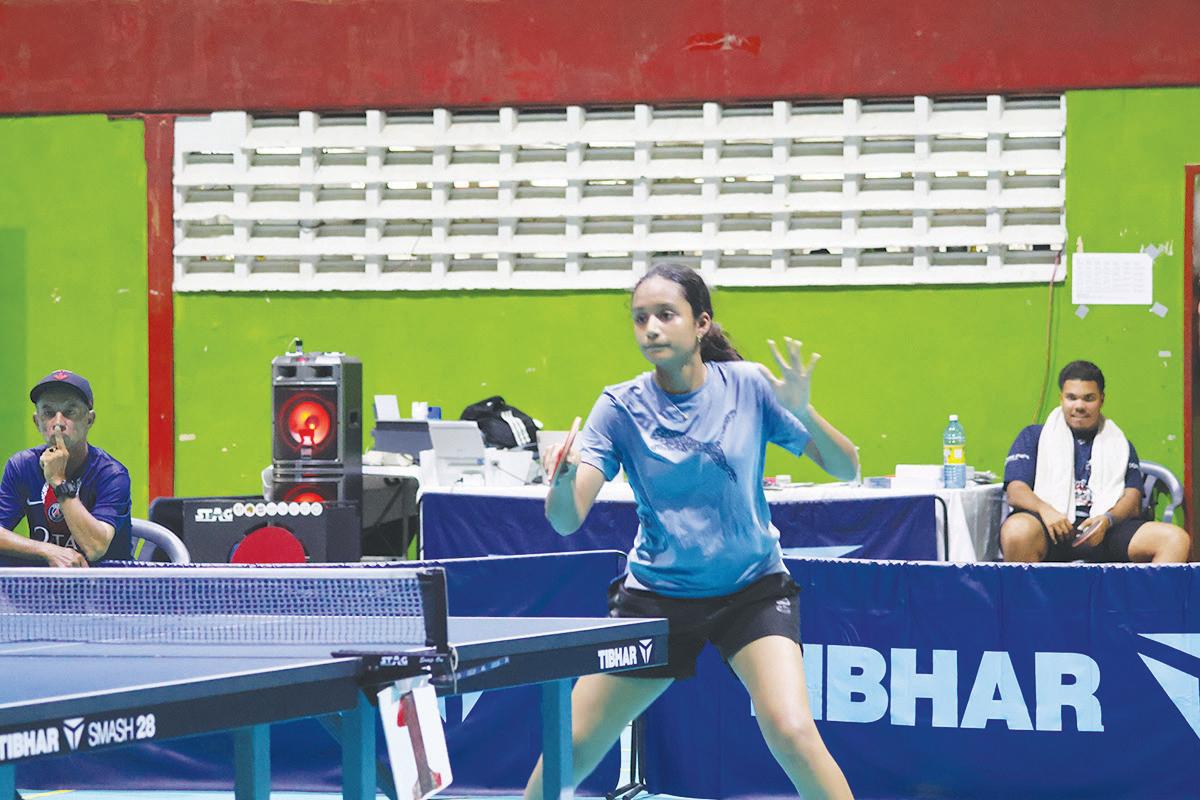
Men’s Singles
Champion: Shemar Britton
Runner-up: Jonathan Van Lange
Women’s Singles Champion: Samara Sukhai
Runner-up: Nevaeh Clarkston
B-Class Open Singles Champion: Colin Wong Runner-up: Malachi Moore
C-Class Open Singles Champion: Yeudistir Persaud Runner-up: Shurwain Sahadeo
Shurwain Sahadeo to lift the championship trophy. The doubles competitions produced a mix of experienced and emerging talent. Sukhai teamed up with S Damon to win the women’s doubles title, while Colin France and Clarkston combined to secure the mixed doubles championship.
The tournament formed part of Guyana’s Independence celebrations and attracted players from various clubs and age groups, providing a platform for both established competitors and developing talents to showcase their abilities.
Under-15 Boys’ Singles
Champion: Kayden Meusa
Runner-up: Abraao Ferreira DeOliveira
Women’s Doubles
Champions: Samara Sukhai/S Damon
Runners-up: Angel Robinson/S Barker
Mixed Doubles
Champions: Colin France/Nevaeh Clarkston
Runners-up: Malachi Moore/ Samara Sukhai