




Judiciary’s role will never be underestimated by govt –President Ramotar
Food and Drug Department warns against fake margarine

Rural constable critical after minibus accident






Weather: Light rain showers are expected during the day with clear skies in the evening over coastal regions and near inland locations. Temperatures are expected to range between 25 degrees and 27 degrees Celsius.
Wind: East north-easterly between 3.61 metres and 3.88 metres per second.
High Tide: 06:17h and 18:32h reaching maximum heights of 2.58 metres and 2.65 metres respectively.
Low Tide: 12:07h reaching a minimum height of 0.63 metre.







BY BHISHAM MOHAMED
ACanadian pilot, Blake Slater, is feared dead along with another Guyanese man after a Trans Guyana Airways (TGA) aircraft went down on Saturday morning in the vicinity of Olive Creek; a densely forested area in the Middle Mazaruni, while shuttling cargo from Olive Creek and Imbaimadai.
Civil aviation authorities have since kicked into gear an expansive search and rescue mission involving six aircraft, including two helicopters and four Cessna Caravans. Nine Special Forces officers and nine crew members are involved in the search mission.
The missing aircraft, a single engine, 13-seater Cessna Caravan with registration number 8R-GHS disappeared out of the sky at about 10:56h without a trace. The last contact with the pilot of the aircraft was “Mayday” (emergency call) which was transmitted to another aircraft within the area at the time.
The aircraft departed Olive Creek for Imbaimadai at about 10:54h with one other person on board. The aircraft spent overnight at Olive Creek and commenced the shuttle operation on Saturday morning. It is suspected that the plane might have crashed some 1014 miles off Olive Creek, based on the coordinates that were received.
Press conference
At an emergency press conference at the control tower of the Cheddi Jagan International Airport (CJIA), Director of the Guyana Civil Aviation Authority (GCAA) Zulfikar Mohammed explained that at about 10:56h, air traffic control at CJIA received a report from another aircraft that one of the Trans Guyana Cessna Caravans reported going down after taking off from Olive Creek.
He added that several calls were immediately made by other aircraft, but were all unsuccessful, hence the GCAA Rescue Coordination Centre (RCC) was immediately activated by the Air Traffic Control Centre.
Touching more on the issues was Rickford Samaroo, a senior air traffic controller who confirmed that the tower had received information about the shuttle operation.
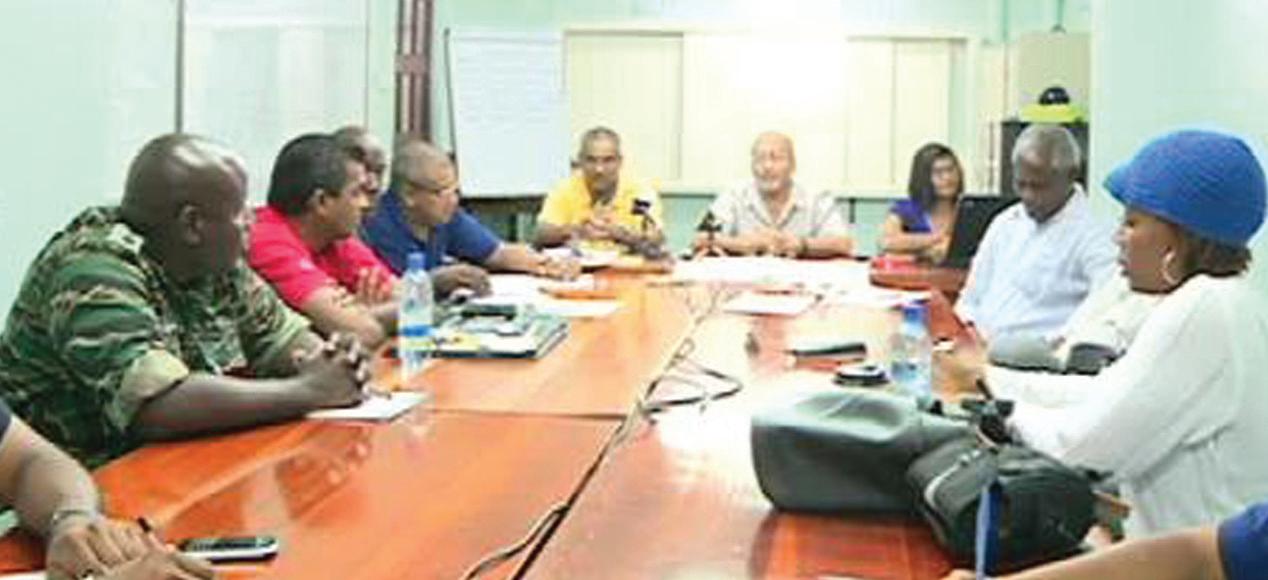
will resume this morning at 06:30h.
“A check with the U.S. Mission Control Centre (USMCC) from which information concerning aircraft ELT signals is transmitted, has informed that they have not received any signal from the aircraft’s beacon,” the release added.
In addition, an aircraft will be deployed to overfly the area of interest tonight to look for any signs of the missing aircraft.
During the exercise, another airplane heard from the pilot via radio contact that he was having difficulties and was going down.
“The pilot tried to get the position from where the airplane was going down and managed to hear the coordinates for the airplane which we recorded and used to plot the position based on the assumption that the aircraft was flying directly between Olive Creek and Imbaimadai,” he explained.
Time lapse
In addition, Samaroo said that they used the time lapse between the two messages –one from when the airplane departed and the second from the pilot who called “Mayday” – to plot the possible position of the aircraft. He added that RCC dispatched the Guyana Defence Force (GDF) Special Forces with search and rescue units – one Cessna Caravan from Trans Guyana Airways two helicopters from GDF and Air Services Limited.
In addition, he revealed that a Trans Guyana Cessna Caravan departed at 13:10h with three crew members and eight Special Forces officers along with equipment and survival kits. The helicopters also departed around the same time. They arrived at Olive Creek at 14:15h and 14:52h respectively.
He added that two other
aircraft that were in the area commenced reconnaissance immediately over the area and soon after, another aircraft from Air Services Limited joined the search mission.
The GCAA director also said that the team on the ground at Olive Creek are interviewing persons who might have seen the aircraft go down or might have heard the sound as it went down, while at the same time explaining that the area is mountainous and heavily forested.
No signs
He said that up to 16:00h on Saturday, there were no signs of breakages or smoke in the area, but said that once the aircraft is sighted, the ground response team will be activated.
“It will be difficult to search the area by air in the night so once we do not get any position response from the teams, we will have no choice but to abort the mission and continue when the sun comes out," he said.
In a release issued by the GCAA, the company stated that “at the end of the day, following ground and air search based on information received; there has been no sighting of 8R-GHS Trans Guyana Cessna Caravan”.
It added that the air search for the aircraft has been terminated for the day at 18:00h due to the poor lighting, but

Previous accident
On November 2, 2008, the Beech King Air N87V, chartered from Dynamic Aviation Group Inc by Terraques Limited, disappeared while conducting geographical surveys in the Mazaruni area. After 17 days of search and rescue operations, the plane was never found.
Missing and presumed dead were U.S. pilot James Barker, First Officer Chris Paris, also from the U.S., and Canadian technician Patrick Murphy.
The aircraft, with fuel for five and a half hours, was scheduled to operate in the Chi Chi-Imbaimadai area for approximately four and a half hours before returning to the Cheddi Jagan International Airport.
The aircraft was plotting potential mineral deposits at the time of the crash. It was reportedly near the escarpment in the Middle Mazaruni.





Sunday Times Editor: Tajeram Mohabir
Tel: 225-5128, 231-0397, 226-9921, 226-2102, 223-7230 or 223-7231. Fax: 225-5134
Mailing address:
238 Camp & Quamina Streets, Georgetown
Email: news@guyanatimesgy.com, sales@guyanatimesgy.com
The recent allegations of a horrific act of abuse on a civilian by a member of the Guyana Police Force (GPF) has, in our estimation, rightfully elicited demands that the inquiry by the Office of Professional Responsibility (OPR) launched by Commissioner of Police Leroy Brumell be quickly consummated. Some have called for a more “independent” inquiry, and others have amazingly demanded that there be not even an inquiry but that compensation and punishment be meted out immediately.
The latter may betray some skittishness of independent inquiries, since the last one placed some of the “demanders” on the firing line. But we believe such calls are precipitate and betray a proclivity among some citizens to bypass mechanisms in place to deal with institutional breakdowns and seek “quick fixes”. This latter view is reinforced by the fact that the government has an ongoing initiative to deal with the shortcomings in the GPF in a holistic manner rather than the ad hoc approach of holding “inquiries” into alleged “excesses”.
We refer, of course, to the Strategic Management Department (SMD), which was established to work towards the professionalisation of the Guyana Police Force in May, 2013. The strategic plan had been prepared by the UKbased Capita Symonds Consultancy in 2010, while the implementation plan was drawn up by the U.S.-based Julian Laite Consultancy in February 2012.
The home affairs minister had announced the plan towards the end of 2012 and early in 2013, and after public advertisements, 10 civilian professionals to oversee the implementation of the force’s Strategic Plan were selected. In terms of the GPF’s orientation towards the citizens of the country, the administration had candidly accepted that there was need for a complete u-turn in mores and manners of the entire force.
Towards this end, and signalling the direction in which the administration was willing to take it submitted the “Police (Change of Name) Bill 2013, in June of 2013. This sought to change the name of the “Guyana Police Force” to the “Guyana Police Service”. This was very significant, since from its inception, the police had been defined by the “force” it was supposed to deploy to maintain “order”.
The meaning of the new designation “service” was not only to reinforce the motto of the police to “serve and protect” but to remind all and sundry that a new dispensation was being unfurled. In fact, Minister Rohee pointed out that the name change was being introduced in tandem with a slew of institutional changes including civilian oversight, which were specifically intended to improve the professionalism of the body.
Sadly, however, both the A Partnership for National Unity (APNU) and the Alliance for Change (AFC), which control the majority of the votes in the National Assembly used their wafer-thin majority of one-seat to defeat the motion for the second reading of the bill. As a consequence, the bill will have to await a new Parliament, subsequent to new elections.
What was very disappointing in view of the opposition’s present cries was that they did not even deign to debate the merits or demerits of the proposed measures to professionalise the police force. They refused to participate in a process that would have seen the revamping of the entire police force just because, in their opinion, the home affairs minister was “ineffective”.
It would appear their action was entirely designed to ensure that the minister was seen as ineffective, since his hands would be tied if he attempted to change any objectionable action of members of the force.
As we indicated at the beginning of this editorial, it is foolhardy to believe that the disciplining of one or a few “rogue” policemen will result in the changes in the GPF most Guyanese have long demanded. We must all join in the effort to create a new Guyana Police Service.
Dear Editor, 2014 promises to be a particularly interesting year as the size of the anticipated indiscriminate budget cuts are likely to provoke new elections by year end. This will indeed be a year of reckoning!
One of my favourite alltime quotes is by the 16th president of the United States Abraham Lincoln, who said, “It is better to remain silent and be thought a fool, than to speak out and remove all doubt.” Alliance For Change (AFC) Parliamentarian Moses Nagamootoo and the AFC leader, Khemraj Ramjattan should be cognisant of this.
In a recent letter written by Nagamootoo, the wantto-be next leader of the AFC predicts, “This post-2011 Parliament will go down in history as the most robust in holding the feet of government to the fire of accountability and transparency.”
In a recent article, A Partnership for National Unity Leader (APNU) Leader David Granger tried to justify his party’s obstructionist position to government’s major development projects by saying, “The action we took actually prevented a governmental disaster.”
And without any knowledge of what the 2014 National Budget will be like, Ramjattan has already decided that “massive cuts will be inflicted on the 2014 National Budget when it is presented to the National Assembly”.
Nagamootoo’s assertion can be seen in the context of a desperate man positioning himself to take over the leadership of the AFC, who would shamelessly misrepresent the facts to make his party and himself look good.
In fact, the opposition parties that make up the 10th Parliament, to which he refers, will be infamously remembered as the most destructive, unproductive, irresponsible and disrespectful bunch of lawmakers since Independence.
This must surely be
an embarrassing and disappointing experience for Speaker Raphael Trotman, who, in my opinion, must be commended for trying his best to be fair and impartial in the execution of his duties, despite being one of their own.
Granger’s claim that his party’s actions in Parliament “prevented a governmental disaster” is equally ludicrous.
In an article in a local newspaper on January 14, the opposition leader openly joins with the AFC leader to signal his intent to butcher the budget again by adding:
“During 2013, Ramjattan and I were given a commitment from since early in July to have discussions on the 2014 Budget. There had been some exchange between shadow finance minister Carl Greenidge and the Finance Minister, Dr Ashni Singh, but those were not consultations.
“Now the budget is far ahead in work. We were not adequately consulted so our contribution to the budget is not as we would have expected.... If certain things in the 2014 budget are not in the public’s interest, then we will cut where necessary.”
Not adequately consulted? Is this a joke? For what other reason was Greenidge in consultation with Dr Singh? Does Granger believe they were discussing the garbage crisis in Georgetown?
To better explain APNU’s defiant position in Parliament, a columnist hit the nail on the head on January 14: “Right now the relationship between APNU and the government is extremely strained and therefore it is inevitable for mistrust to be present whenever APNU makes a proposal to the government….
“In Parliament, APNU combined with the AFC to reconfigure the composition of the various committees. The manner in which this was done led the government to conclude that what was afoot was an attempt to adminis-
ter the affairs of the country from the opposition benches when the Constitution is quite explicit as to who exercises Executive power....
“Further mistrust was engendered by the brutal manner in which APNU and the AFC went about cutting the 2012 (and the 2013) Budget.
Eventually there were productive negotiations between APNU and the government on this question. The two sides were on the brink of a historic development that would have set the stage for improved relations.
“But APNU then withdrew leading to escalation of tensions. The government made available to the opposition parties all the major agreements that it had signed. It went as far also in having special briefings for the opposition parties on the Amaila Falls Hydro Electric Project. Instead of using the opportunity of those briefings and meetings to vent its concerns, APNU instead withdrew its support for the project.
“The government was outraged and accused APNU of acting in bad faith by not raising its concerns. The same thing happened over the Anti-Money Laundering and the Countering of Terrorism Bill which the government felt should have been supported.... However, the opposition parties seem bent on using their one-seat majority to introduce legislation which only adds to the suspicions by the government that the opposition parties are attempting to administer the Executive from the benches of Parliament.”
The preparation of the national budget is a function of the Executive branch of government. By cutting the budget, the one-seat opposition in the National Assembly has acted beyond its powers and in breach of the Guyana Constitution. They have usurped the functions of the Executive and have violated the doctrine of separation of powers, upon which our
Constitution is constructed. Although Granger’s comments can be seen to be more measured, Ramjattan’s declared intentions to cut the budget, are nothing less than reckless and irresponsible. In his quest to outdo APNU on the issues, this man continues to squander the hopes of so many young Guyanese who were led to believe that the AFC would have been more politically mature to responsibly manage the balance of power in the National Assembly.
Guyanese want their elected representatives to act responsibly in the national interest at all times. The opposition must not use their one-seat majority in Parliament to carry out personal vendettas or acts of vindictiveness.
The three bills that were recently voted on and passed unanimously: The Firearms (Amendment) Bill; The Evidence (Amendment) Bill; and The Summary Jurisdiction (Procedure) (Amendment) Bill, only gained the support of the joint opposition because they were not tabled this time around by Home Affairs Minister, Clement Rohee.
On merit, these bills should have been passed into law months ago, but Granger and Ramjattan were too obsessed and focused on getting rid of Rohee. By preventing Rohee from speaking in the National Assembly in an effort to censure him, they foolishly endangered the security of the nation and all Guyanese and failed to achieve their objective.
The passing of these bills has hopefully restored some sanity to the most disruptive and unproductive Parliament I’ve ever seen. It is the hope of all Guyanese that common sense prevails this year in Parliament, and our lawmakers put country first before party and ethnicity.
Sincerely,
Harry Gill
Dear Editor,
This month marks the 64th year of the People’s Progressive Party (PPP), the first as well as the largest multi-racial and progressive mass movement that awakened the political consciousness of Guyanese in particular and Caribbean nationals in general.
To this day, the PPP still remains the oldest, bestloved, and most cohesive political party in this country. Demonstrating effective leadership ever since it was founded in January 1950, it has the distinction of winning every free and fair elections held since 1953 under both electoral systems – first-past-thepost (1953-1961) and proportional representation (1992-2011). The party’s 1953 main aim was a commitment to a redistributive economic programme intended to reduce poverty –which has remained a key
pillar ever since.
The PPP won three consecutive general elections under the first-past-thepost electoral system in 1953, 1957, and 1961 and won the majority of votes at the 1964 general election under the newly-introduced proportional representation system, but this constitutional coup prevented it from forming the government.
When the party was removed from office, its 19571964 programme brought the country to the second wealthiest in the Englishspeaking Caribbean after Trinidad and Tobago, with its own university, good healthcare and education system, and sound industrial and agricultural programme. It was categorised with the more developed countries (MDCs) in the Caribbean with Barbados, Jamaica, and Trinidad. Since then and after al-
most 30 years since 1964, the party triumphed (with the help of a “Civic” component, hence PPP/C) at winning an outright majority at the first ever free and fair elections held in 1992.
At the time of the 1992 change, Guyana’s per capital income at US$410 was the lowest in the 13 Caribbean Community (Caricom) states and the country ranked as one of the three poorest nations in Latin America and the Caribbean, the others being Bolivia and Haiti.
However, the PPP/C government slowly brought the country back and has won every general election since. Today, with the per capita at well over US$8000 and with eight consecutive years of positive economic growth at over five per cent annually, Guyana is indeed the envy of the other Caricom states, despite political setbacks.
How did this happen? In a word – leadership. An anatomy of the party’s philosophy, programme, and history shows that one key reason for such ongoing success essentially lies with its leadership principle.
True leaders are those who, through their deeds, lead by serving others. They must walk the talk. Party leaders have demonstrated true leadership over the years through influencing and followership.
Dr Laurence J Peter, developer of the Peter Principle, maintains that: “Many are called leaders by virtue of their being ahead of the pack or at the top of the pyramid, and that is one definition of the word leader. But being out front or on top denotes only position and not the qualities of leadership. There is a significant difference between being in charge and being a leader.”
Eschewing violence and firmly believing in democratic principles, the PPP/C has an ultimate purpose of seeing all Guyanese prosper, progress, and live in peace and harmony. The creation and embodiment of this effective purpose has differentiated the party from all others. Against this backdrop, the party’s earlier slogans of “Peace, Progress and Prosperity” and “For Honest and Progressive Government” hold true to this day.
The late great PPP/C founder-leader Dr Cheddi Jagan was one political leader whose life story – up from modest beginnings to holding the highest office in Guyana through honest means – provided an effective backdrop for admiration and the sound economic, social, and governmental changes he advocated and implemented during his tenure in the short-lived
1953 government and the 1957-64 and 1992-97 years. Even the British and Americans acknowledged at the height of the 196264 turmoil that he was the ablest leader in Guyana. As noted earlier, the PPP/C won every election since Dr Jagan’s death in March 1997 without him at the helm for the first time since the 1953 general election. Such performance represents superior leadership qualities and is aptly described by Walter Lippman (1889-1974), a U.S. liberal political commentator, when he said: The final test of a leader is that he leaves behind him in other men the conviction and the will to carry on.
Sincerely, Lal Balkaran, MBA, FCMA, FCGA, CGMA Internal Audit, Risk and Corporate Governance Consultant
Dear Editor,
The Competition and Consumer Affairs Commission (CCAC) takes this opportunity to respond to the letter published in the Guyana Times with the headline, “Flouting the return and refund of goods policy.” We thank the writer for the interest shown in highlighting the plight of many consumers, who (not being satisfied with a product) would have encountered difficulties in trying to obtain a refund or exchange from a store.
In an attempt to further highlight the three circumstances to which a consumer can return a good, as provided for in the Consumer Affairs Act of 2011 (CAA), the commission would like to make consumers and businesses aware of the sections below:
Firstly, according to section 21(2) of the CAA, consumers have the right to return a good if the purpose for which the good was bought or its intended use changed or ceased to exist. This must be done immediately after the good has been bought. More specifically:
“21 (3)… the goods shall
(a) be returned not later than seven days from date of purchase;
(b) not have been used, tampered with or treated in a manner to cause damage; and
(c) be returned in its original package
(4) The consumer may elect to make a purchase of other goods of same value in lieu of a refund.
(5) The supplier may charge a restocking fee not exceeding 10 per cent of the purchase price of the returned goods.
(6) Goods so returned shall be deemed to be new and fit for resale at the original value.”
Secondly, according to section 22 (1) of the CAA, a consumer has the right to return a good if it is defective, thus if the good fails to provide the benefit and uninterrupted enjoyment for which it was intended and the consumer returns the good, the supplier must take the following steps:
“22 (2)… the supplier shall
(a) at no cost to the consumer-
(i) replace the good within 14 days of the good being returned to the supplier; or
(ii) repair the goods;
(b) return the receipted payment for the good
(3) Where the supplier chooses to repair the goods the supplier shall-
(a) return the goods to the consumer in a fully repaired and functional state within 14 days of the goods being returned to the supplier;
(b) if it is not returned to the consumer within that period provide the consumer with a temporary substitute of comparable value for the consumer’s uninterrupted use and enjoyment until the consumer’s goods are either replaced or repaired and returned.”
Thirdly, according to section 23 (1) where the
consumer is encouraged to acquire goods by the supplier’s declaration and description of the goods and the consumer subsequently discovers that the goods acquired are different in a material from those declared, the consumer and supplier have two options:
“23 (1) (a) the consumer may return the goods acquired to the supplier; and (b) the supplier shall immediately give to the consumer in exchange for the returned goods, a refund of the purchase price.”
A supplier who contravenes any of the above sections commits an offence.
According to section 102 (1) of the CAA of 2011:
“102 (1) A person who commits an offence under this act is liable on summary conviction to a fine of not less than twenty thousand dollars nor more than one million dollars and to imprisonment for one year”
The commission is empowered under section 6 (a) of the Consumer Affairs Act of 2011 to investigate any complaint by a consumer where there is a breach of the above sections. It should be noted that in invoking the sections above there may be certain exemptions. For further clarifications on the CAA consumers and suppliers are encouraged to contact the commission on telephone 219-4411, ext 114.
The commission remains committed to protecting consumer interest and enforcing the CAA against any business who fails to adhere. The com-
mission has started an intensive campaign to notify businesses across Guyana on violations of the CAA. During last year, the com-
mission visited stores at central commercial locations and plans this year, to visit other communities around Guyana.
Alicia Primo Managing/ Legal Officer CCAC




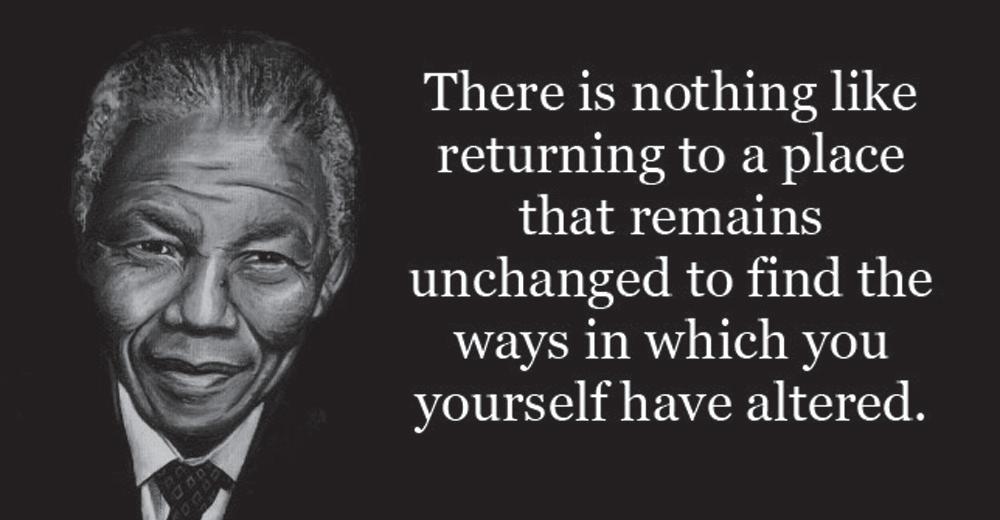
Now don’t get me wrong after you read the quote above. It’s not as if I spent the last 27 years on Robbins Island. Or even that I was locked away for the four months I was away in Trinidad – with armed guards patrolling the perimeter of the UWI Medical School! But I’ll tell you what: like prisons, medical schools (and all schools for that matter) are also institutions that seek to impart a new way of looking at the world on its inmates. And they have more than a few things in common.
There are no guards clanking on bars to wake you up (I’ve seen this in prison movies, in case you’re wondering!) in medical school but those early classes that are mandatory pretty much have the same effect on you. And if you detect a note of chagrin in that sentence, it’s quite heartfelt – coming from a person who enjoys a late morning snooze. So you end up, after four months waking up early. I’ve also heard
about the prison “slop” –and seen it in the aforementioned movies – and I’ll tell you something. The people who run cafeterias in medical schools probably graduated from the same culinary institutions as their compatriots in the correction facilities. So, I’ve ended up pretty

tive West Coast Demerara) that’s so oriented towards tourism makes one much more aware of the amenities demanded.
much doing my own cooking. Not that I have anything against cooking – in fact, I happen to actually like the experience. I can let my creativity pour forth in the kitchen.
But when you return home to your dorm room and have to whip up your vittles, it does take the sheen off even the old favourites. So I’ve resorted to cooking pounds of puttanesca and gallons of dhall and sequestered them in my fridge. And you appreciate like you’ve

never done before the effort your mother made to whip up all those concoctions (effortlessly, you’d thought!!!) to deal with your finicky eating habits. So yes, I can emphasise with Mr Mandela when he conceded that you are inevitably altered by institutional rules and regulations.
So how was it to return to a place that was unchanged? Well I’ll tell you... it wasn’t that unchanged. The four lane exit from the airport’s coming on nicely and there was a new hotel near the stadium. I thought they should’ve put up a facade around the roof, though – the present one makes the place look too ordinary from the outside. See...I told you I’ve changed. Moving around Trinidad (which could fit into half of my na-
But I’ll tell you what hasn’t changed – the garbage situation. I’ve written before about my school bus manoeuvring through the flotsam and jetsam from floods that’ve receded; and almost retching on my way to Queen's.
But this time, in my newfound freedom where I could go shopping, the old revulsion was intensified from seeing gorgeous new malls rising from the same garbage. But this time, I was much more outraged – at the Mayor and City Council, at the people dropping their garbage so nonchalantly and at all the political gamesmanship.
But one thing that was unchanged was the love from my family, friends and old nexuses. I dropped in to the birthday of an old school friend and was able to re-connect to most of the old gang. Like me, they’ve moved on...but the old bonds are still there.
So unlike what Tom Wolfe said, you CAN go back home.

Your spine is one part of the skeleton that’s easy to check out: Reach around to the centre of your back and you’ll feel its bumps under your fin gers.
The spine lets you twist and bend, and it holds your body upright. It also protects the spinal cord, a large bundle of nerves that sends infor mation from your brain to the rest of your body.
The spine is spebecause it isn’t made of one or even two bones: It’s made of 26 bones in all! These bones are called ver tebrae and each one is shaped like a ring.

There are different types of vertebrae in the spine and each does a different kind of job:
* The first seven vertebrae at the top are called the cervical vertebrae. These bones are in the back of your neck, just below your brain, and they support your head and neck. Your head is pretty heavy, so it’s lucky to have help from the cervical vertebrae!
* Below the cervical vertebrae are the thoracic vertebrae, and there are 12 in all. These guys anchor your ribs in place. Below the thoracic vertebrae are five lumbar vertebrae. Beneath the lumbar vertebrae is the sacrum, which is made up of five vertebrae that are fused together to form one single bone.
* Finally, all the way
at the bottom of the spine is the coccyx, which is one bone, made of four fused vertebrae. The bottom sections of the spine are important when it comes to bearing weight and giving you a good centre of gravity. So when you pick up a heavy backpack, the lumbar vertebrae, sacrum, and cocgive you the power. When you dance, skip, and even walk, these parts help keep you bal-
In between each vertebra (the name for just one of the vertebrae) are small disks made of cartilage. These disks keep the vertebrae from rubbing against one another, and they also act as your spine’s natural shock absorbers. When you jump in the air, or twist while slamming a dunk, the disks give your vertebrae the cushioning they need.
Your ribs
Your heart, lungs, and liver are all very important, and luckily you’ve got ribs to keep them safe. Ribs act like a cage of bones around your chest. It’s easy to feel the bottom of this cage by running your fingers along the sides and front of your body, a few inches below your heart. If you breathe in deeply, you can easily feel your ribs right in the front of your body, too. Some thin children can even see a few of their ribs right through their skin.
Your ribs come in pairs, and the left and right sides of each pair are exactly the same. Most people have 12 pairs of ribs, but some people are born with one or more extra ribs, and some people might have one pair less. (Kids Health)
(Part two) TO BE CONTINUED

CGX Energy Inc has announced that its wholly-owned subsidiary, CGX Resources Inc, has obtained an injunction order from Guyana’s Commercial Court restraining Repsol Exploracion from proceeding with the 30 per cent farm-out of the Kanuku Petroleum Prospecting Licence to RWE Dea AG, pending the determination of arbitration proceedings filed late last year.
On December 23, CGX Energy announced the commencement of arbitration proceedings under the rules of the London Court of International Arbitration against Repsol in connection with the expiry of the Petroleum Prospecting Licence (PPL) covering the Georgetown Block.
CGX Energy Chief Executive Officer Dewi Jones said the company was pleased with the decision of the commercial court and will continue to work towards protecting the interests of its shareholders by pursuing this claim against Repsol.
CGX and Repsol were part of a consortium that owned the Georgetown Block PPL, which was operated by the latter company.
CGX publicly announced on December 23 that it was proceeding with arbitration against Repsol with respect to the Kanuku licence offshore Guyana.
CGX Energy Cochairman, Dr Suresh Narine noted that when the Georgetown Block partners decided to cease drilling and plug the Jaguar 1 well due to safety considerations, CGX Energy immediately indicated its intention to continue exploring the Georgetown Block.
“This is because we strongly believe in its prospectivity, as we indeed strongly believe in the prospectivity of the GuyanaSuriname basin,” he said. “This latest step with the courts in Guyana seeks to further protect our shareholders’ rights with regards to the results uncovered by the Jaguar 1 well.”
CGX expressed its interest in continuing in the licence with or without Repsol in accordance with the terms of the Joint Operating Agreement (JOA). Repsol, in turn, unilaterally decided not to pursue renewal of the licence and then seek a new licence on its own.
Dr Narine had said then that Repsol allowed the jointly held Georgetown licence to lapse contrary to its obligations as operator of the block, and then in bad faith immediately applied for sole ownership of the Kanuku licence covering essentially the same area as the Georgetown licence, thereby excluding CGX’s shareholders from their rightful stake in the licence.
Law and order
Dr Narine said CGX Energy has a long history of operating in and supporting law and order in the basin, and this injunction is a significant endorsement of those who want to ensure an orderly functioning of the petroleum industry in Guyana as more players enter the basin.
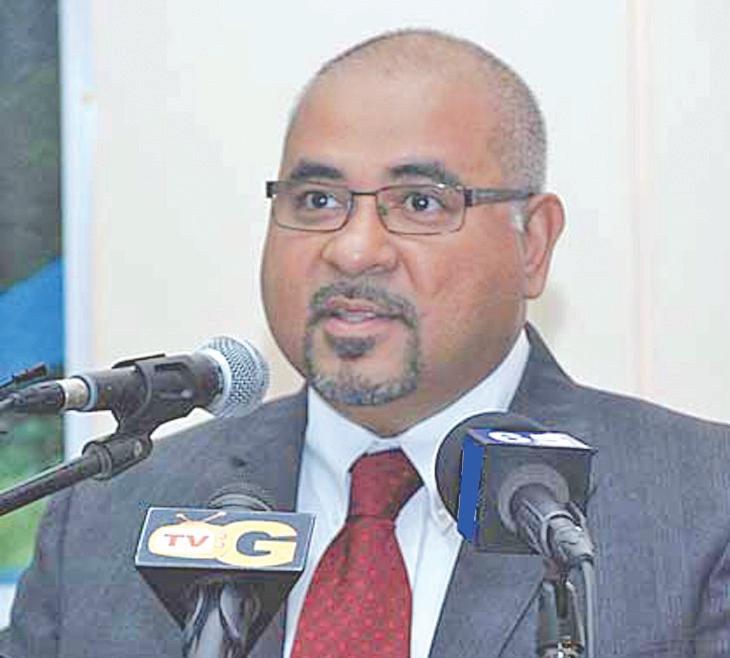
CGX Energy Attorney Michael Galego said the company is still very much committed to exploring the Guyana-Suriname Basin, adding that it hopes that this dispute with Repsol can be resolved and drilling on the next well can move for-
ward.
Dr Narine said since the summer of 2013, CGX has tried to engage Repsol constructively to resolve the dispute. However, he said Repsol would not engage in any discussions with CGX.
On December 30, 2013, Repsol announced that it had reached agreement to farm out 30 per cent of the Kanuku licence to RWE Dea, despite CGX’s legal challenge. However, regulatory approval from the Guyana Geology and Mines Commission (GGMC) had not yet been procured.
In view of Repsol’s announcement of an intended farm-out, CGX sought injunctive relief in Guyana to prevent Repsol from farming out the licence until the court of arbitration had ruled on the matter.
On Friday, Justice Rishi Persaud, sitting in the Commercial Court in Guyana, granted an injunction order upon CGX’s ex parte application, restraining Repsol from proceeding with its announced farm-
out pending the hearing and determination of the arbitration proceedings.
“This is an important decision as it not only ensures that no moves can be made by Repsol before the matter is resolved and therefore, prevents the situation from becoming complicated, but also it sends a strong message internationally that the legal landscape in Guyana is one which is in accordance with international law and that all companies can rely on a robust legal system to protect their operations and investment,” said Dr Narine.
Dr Narine said CGX is highly motivated to speedily resolve the issue so that it and its partners can expeditiously continue to activities designed to realise the goals of its shareholders and the government and people of Guyana, namely, to find commercial quantities of petroleum in the basin.
“It is, therefore, open to Repsol to negotiate a satisfactory and speedy conclusion to this issue,” added Dr Narine.

AU.S.-bound passenger was on Friday night intercepted at the Cheddi Jagan International Airport (CJIA) with 15 kilograms of cocaine in several Kerrygold milk powder packets.
Twenty-eight-yearold Jermaine Lowe of Beterverwagting, East Coast Demerara, was about to board a Caribbean Airlines flight destined for John F Kennedy Airport, New York about 23:30h on Friday when he was taken into the custody of drug enforcement officers.
According to information received, the bust was made by ranks of the Customs Anti-Narcotics Unit (CANU) during a routine scan at the main port of entry. CANU head James Singh via telephone confirmed that Lowe has been interrogated and has provided the name of his accomplice who took him to the airport.
The man has since been identified as Mark Sauers, 24, of Kwakwani Village, Berbice and also of Beterverwagting and Mon Repos, East Coast Demerara. Based on reports, Sauers was under CANU surveillance for a while.
CANU has since issued a
wanted bulletin for the man and are calling on the public who might have information that will lead to his arrest to contact them on 225-3507. All information will be kept confidential.
Grilled Guyana Times understands that the milk was replaced with the cocaine. Shipping out Kerrygold milk was peculiar, thus CANU ranks decided to search one of the packets in the presence of the passenger.
Lowe denied having any knowledge of the contents of the packets since he was under the impression that it was milk powder. He was taken to the CANU headquarters where he was further grilled. He is expected to make his first court appearance on Monday.
Earlier on the same day, a Toronto-bound Guyanese was intercepted at the CJIA with 4.09kg of cocaine stashed in the false walls of his suitcase in well-taped black bags.
The 36-year-old man was arrested at the checkin counter about 16:00h by ranks of the Police Narcotics Branch. He was scheduled to board a Caribbean Airlines flight to Toronto, Canada. He is also expected to make his court appearance on Monday.
Commenting on the recent bust, the CANU head stated that it is a testimony that there has been excellent collective work done by the major stakeholders, including the Guyana Police Force and the security at the airport.
He added that drug enforcement units will continue to put a dent in the drug trade, making trafficking more difficult for the drug mules.

The huge amount of financial resources spent over the years to improve the judiciary, along with its supporting infrastructure, reflects the importance that government attaches to the legal system, and the ongoing programme to rehabilitate several of the courts, is not only about providing better facilities for those who dispense justice and use the services of the legal system, but to ensure that all have a better quality of life.
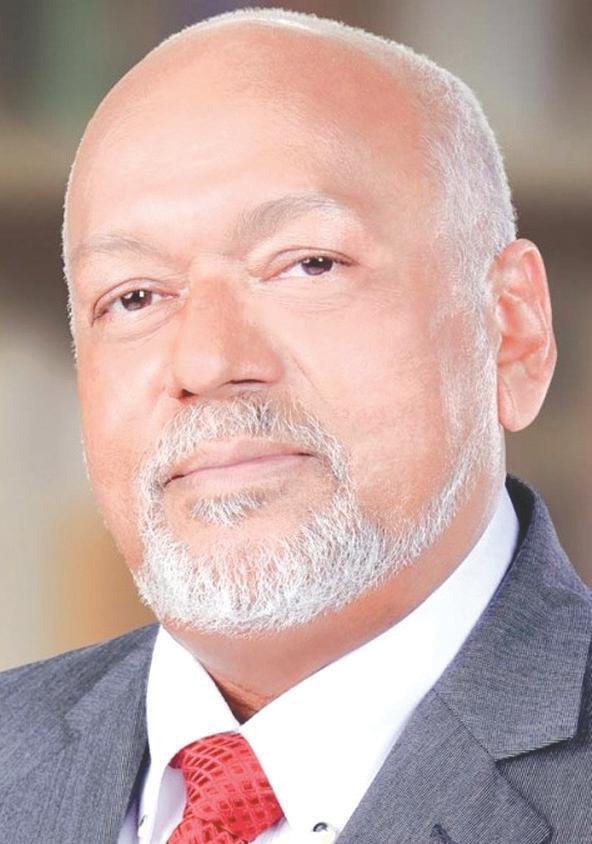
This was underscored by President Donald Ramotar, during an address at the recommissioning of the Leonora Magistrate’s Court on the West Coast of Demerara, on Friday.
President Ramotar noted that the facility will ease the inconvenience of persons having to travel long distances to attend court. He pointed out that in many societies, those who are rich or well connected cannot only afford the best lawyers, but can also afford to travel long distances, unlike those who are less fortunate.
Facilities
“That is why we invest in these facilities so that we can try as far as possible to increase equal access for everyone to the services of the court and moreover, we have been spending millions of dollars in legal aid so that people should not be at a disadvantage because of their economic circumstances, and they can have an equal opportunity in having justice dispensed to them,” he said.
The head of state reminded those in attendance that the Judiciary stands as a bulwark, to protect the constitutional rights of others, and ensure
that officials act within their powers and the law, and not trample on the rights of others.
“Therefore, this government will never underestimate the importance of the judiciary and magistracy to the welfare of the state and welfare of the people,” the Government Information Agency (GINA) quoted the president as saying.
There is a connection between economic and social development and a competent, independent and efficiently functioning judiciary, said the president.
“In fact no investor will be encouraged to invest commercially in any country where the justice sector cannot properly protect his or her investment. Indeed people would not want to even live, or more so, spend money where there is no justice or law and order,” said the president.
The timely dispensation of justice is a sore issue that must be addressed, the president said, and highlighted cases where persons were eventual-
ly found innocent after years of incarceration due to their cases taking far too long to be heard. The Judicial Commission, he said, has been mandated to take steps to speed up, and enforce the need for more timely dispensation of justice.
The doctrine of separation of powers and the need for institutional independence will always be respected by government, the president vowed, but government does reserve the right to make fair, constructive criticisms whenever they see it necessary.
Criticisms
“I ask that those criticisms not be construed as an attempt to instigate or influence the judiciary in one way or the other or bring it into disrepute”.
The failure to deliver timely judgments can lead to devastating effects particularly with regards for the development, the president said. Some persons even use the courts as “an instrument to slow things up” and this is unacceptable, he added.
Chairing the ceremony was Chief Magistrate Priya Sewnarine-Beharry, who expressed gratitude on behalf of those in the legal fraternity for government’s decision to rehabilitate not only the Leonora Magistrate’s Court, but also others such as the recently commissioned Mibicuri Magistrates' Court and the Georgetown Magistrates Courts which will be re-opened on Monday, January 20.
Delivering the vote of thanks, Magistrate Clive Nurse thanked government for the support to the sector, and said that the facility will serve those in need far more effectively and efficiently.


...unaddressed
It doesn’t seem much has changed in Berbice from a decade ago when residents and their chambers of commerce had to march up and down their public road to demand police action against bandits and burglars. At that time these hard-working, generally agriculturally employed folks – canecutters and farmers – had to trudge home from their backbreaking about and then stay up as “vigilantes” during the night.
Not surprisingly, their nerves snapped after a while, and in one instance, besieged the Albion Police Station, to demand relief. After a policeman from inside the station shot and killed one of the “squatters” outside – their rage exploded and soon there was an attempt to torch the station. One magistrate’s car ended up in a trench.
We’re regurgitating all of this because pretty soon we might see a replay in the Ancient County. After all the transfers and reorganisations and “listening” to the Berbicians, we’re back at square one. Another crime wave is undulating up and down the villages in Central Berbice and the residents have been forced once again to stay up nights to “keep watch”.
This sort of response is forced when citizens have no confidence in the local police. And from the comments of Berbicians that’s exactly the case. The same old story of police phones not being picked up, picked up but “no vehicles are available”, late response with vehicles, no follow up after the crimes have been committed, and worse of all, harassment of the victims.
Something is definitely wrong in Berbice. And it needs to be fixed. Not the “no-fix” of a press conference with promises. Not a “quick fix” of an infusion of a few cops from Georgetown as happened the last time. What we think is that the SWAT team concept must be given life right away.
David Granger, who was sent to numerous courses – but probably focused on nuclear warfare or some such esoterica – opined that we don’t
need a SWAT nowadays.
Well, if the regular police in Berbice can’t get a handle on the armed bandits that’re holding them at ransom – even when the calls come in real time – what’s better than a quick-reaction squad? The arrival of the trainers from the U.S. company hired to train the SWAT team should be expedited and Berbice be made the training ground.
The knowledge of all that firepower in their vicinity should at least deter those criminals who’ve shown total contempt for the Guyana Police Force in Berbice. ...papered over?
U.S. President Barack Obama announced he’s addressed the outrage from across the globe – including some of his closest allies – of the electronic snooping into their affairs by his National Security Agency (NSA). But it’s sure to fall very flat as “too little too late”. Right off the bat, the “ban” on snooping is only for “close friends and allies”. And of course, it’ll be his call as to who qualifies for the exemption.
But to cover what we all know will be a decision that’ll be honoured in the breach, if at all, there’s the loophole for future spying on all and sundry – if “there is a compelling national security purpose”. And guess who decides what’s “a compelling national security purpose”? Point of it all is that the U.S. is acting the way all hegemonic powers acted in the past or will act in the future.
It’s just that the U.S. gets tangled up by its high-fault in rhetoric about acting in everyone’s best interest and the realities of its “realist” view of international relations. The bottom line of the latter is that fear and power trumps everything when it comes to their interest.
...punctured?
After the reports by sections of the media of the police’s alleged horrendous violation of a citizen, doctors are asserting that it might’ve never happened. We await the official finding, a bit less outraged.

The blackout-plagued electricity sector is expected to get a boost with the completion of the US$30 million power plant under construction at Vreed-enHoop, West Bank Demerara.
It is expected to increase power capacity Demerara from a current 87 megawatts to 106 megawatts, the Government Information Agency (GINA) said.
Prime Minister Samuel Hinds, along with Guyana Power and Light (GPL) Chief Executive Officer, Bharat Dindyal, Chairman Winston Brassington, Project Coordinator Lennox McGregor and Divisional Director Narvon Persaud inspected works ongoing at the power station on Friday.
During the visit, Prime Minister Hinds expressed satisfaction with the progress that has been made despite the challenges the contractor encountered.
Commercial operations
The Region Three plant is expected to begin commercial operations by July, and will be connected to nearby power stations. Persons residing as far as Berbice are expected to benefit.
Prime Minister Hinds said the needed equipment is on site and buildings are going up. He added that there is a lot of work still to be done, but

generally works are improving.
Chief Executive Officer of the power company Bharat Dindyal disclosed that technically, 98 per cent of the materials needed for the construction are on site, but due to challenges with storage, the rest of the materials are being stored at the John Fernandes Wharf.
Dindyal pointed out that thus far, 20 per cent of the plant is complete. “There is still a bit of work to be done. On the western side, we are still working on the founda-
tion for two large bulk storage tanks which will have the capacity of 2000 cubic metres each,” he explained.
A new port is also being constructed at the northern side of the plant to receive fuel and part of that contract was awarded to BK International.
Behind schedule
This project is behind schedule due to challenges in terms of the foundation being laid. The CEO explained that the soil at the construction site is very poor and almost 900 piles, the longest GPL has
The Guyana Analyst Food and Drug Department wishes to inform the public of the counterfeit 10kg bucket of margarine that has been circulating in markets in Regions Five and Six.
Persons can identify the fake product by the missing word “MARGARINE” on the label, the colour of the label is also a deeper blue, the words “free of transfat” are omitted and the International Standards Organisation (ISO) 9001-2008 printed in green under the list of ingredients is also missing.
In a release, the department stated that it is working in close collaboration with local manufacturer Sterling Products Limited and has since contacted members of the National Food Safety and Control Committee in Regions Five and Six to seize the counterfeit product and to pinpoint the source so that further action can be taken.


ever used, had to be driven under the foundation, and these were difficult to acquire.
“When the contractor came here, as soon as the equipment came off the dam, it started to sink and they started to dump sand and the sand would be disappearing overnight… eventually they had to bring in geotextile materials to allow for some con-
solidation,” Dindyal added.
Rain and high tides have also stalled works. The chief executive said a revetment wall will be constructed around the perimeter of the site and two pumps will also be installed to drain water.
There were also some delays with the Golden Grove and North Ruimveldt sub-stations which are currently un-
der construction, and the expansion at the Onverwagt power plant.
Dindyal added that there were some issues with the contractors who made some claims for additional payments, which are in excess of US$3 million. These claims are currently being processed and these works are expected to be completed by March.

In honour of a student body that hails from 35 countries, Texila American University (TAU) recently hosted a celebration of undergraduates’ diversity and the opportunities it has created for students, faculty, and staff.
The annual cultural evening, held at the National Cultural Centre on December 22, 2013, showcased a wide range of cultural performances including classical and traditional


dances, music, skits, mime, and the Miss and Mr Texila American University pageant.
The cultural extravaganza received much applause from the audience of students, their parents and guests, and members of the public. “Welcoming to all and hostile to none” is the philosophy the university aspires to live.
University of Guyana Pro-Chancellor, Dr Prem Misir delivered the feature address and was among the distinguished dignitaries who distributed the prizes for the best performers in academics, sport and cultural events.
Highlighting African American achievement at TAU, the university said educating students to achieve

excellence requires consistent focus on recruiting and retaining a diverse student body, faculty, and staff. Creating a welcoming environment where people are open to learning from one another lays the foundation.
“We grow through conversations and experiences with people who have different beliefs and come from other places, cultures, and backgrounds.
"But diversity means more than race and ethnicity; it’s about moving beyond just tolerance to a place of understanding. Approaching differences in political views, religion, gender identity, values, age, abilities, and sexual orientation with an open mind helps get us there.
"By showing respect and finding common ground, we set the stage for the free exchange of ideas and the pursuit of knowledge and intellectual curiosity,” the university said.

Satiricus was very happy. Satiricus was one of those chaps who connects to the people he covers on his newspaper beat. He’d been very worried about NoGel Huge. For years the man had been defending criminals right, left and centre. Satiricus was impressed by this. NoGel was part of a law firm that made big bucks from just pushing and shuffling papers.
NoGel could’ve easily pushed paper and raked in the dough (remember Naga Man pocketing a cool $7 million for filling out forms for NICIL?), but he upped and started defending criminals. Not that defending criminals wasn’t delivering the loot. Far from it. With criminals, it’s “easy come, easy go” when it came to their ill gotten gains. And so, most of the cash ended up in the pockets of lawyers like NoGel.
Satiricus was impressed therefore, when NoGel decided to enter politics – and chose to enter the KFC party. If Satiricus had to guess, from all the things he knew (and as an old newshound, Satiricus knew where a hell of a lot of skeletons were buried). NoGel’s navel string was buried in the PNC. It was only when mouth open and story jump out and NoGel had to confess that he was the legal officer of the company the KFC wanted out of Guyana, that Satiricus understood, the game. NoGel was placed inside the KFC as a mole. This raised Satiricus’ opinion of NoGel even higher. Satiricus liked this cloak-and-dagger stuff. He’s seen all the James Bond movies. So imagine NoGel being planted in the KFC to wait for just the right moment to arrive, when he would serve the interests of his masters. Wow!
But all the same, Satiricus was sad that NoGel had to go. Even since he started playing a double role, and becoming a big shot in the KFC, he’d started making his criminal career more exciting. He’d become a risk taker, just like old 007. Imagine taking such a chance to tamper with the jury just to get a client off!
But then he’d gone underground after the revelation of his double role. Nobody could see head or hair of the fella. Some people said he was “shame” to come out of his house. But that couldn’t be. People like NoGel had no shame. They believe they can do anything and get away with it. Satiricus figured he must’ve been counting all the money he’s collected for his double role. It takes a long time to count millions of U.S. converted to Guyana dollars.
But now, NoGel was back! There were these allegations about police brutality to a fella. Maybe they were true, maybe they were not. But here came NoGel and demanded $100 million. This was vintage NoGel. Why wait for an investigation and such things? They were just humbug. NoGel knows better!
NoGel was back and Satiricus was happy. He knew Rum Jhaat would be pulling his hair out because he thought the coast was clear for him to be the KFC presidential candidate.
Oh well....

Professor Daizal Samad
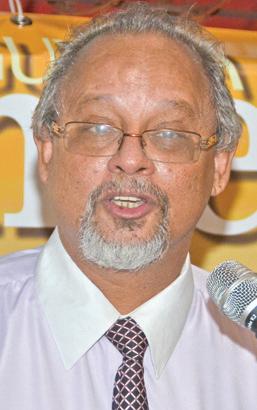
According to one of our dailies, there was a meeting of regional minds with a view of [should be “to”] “improving the performances [should be performance] of students in the areas of mathematics and English at the CXC”.
Mistakes in English in the simple reporting of a thing –in the first 14 words! Why “in the areas of mathematics and English” and not “in mathematics and English”. I do not know. Now we know we have problems.
The short news report is littered with comma splices, run-on sentences, mis-placed modifiers, dangling modifiers, redundancies, past/present mistakes, and errors in diction.
Just in case you are all wondering, I am not nit-picking. If we can have major mistakes in just two short lines on the very subject on which we are writing, then we need to look again and see
the gravity of the problem.
The meeting, I read, was held at the Guyana International Conference Centre (GICC). The CXC Council “has proposed a regional strategy for performance improvement” in mathematics and English.
It is reported that the who’s who of regional and national education were there, many of whom flew in to the Republic of Guyana: the “examining body” or “top brass” of CXC; “scores of principals of schools across the country”; education officers; “senior educators”, and so on. I was not there, of course. But this gathering was a great idea! Good stuff! I have confidence that our experts from the University of Guyana (UG) and from Cyril Potter College of Education (CPCE) were in attendance. After all, dem people does teach abee fuh taak English and write am. And dem ah people dat does teach abeedeez fuh teach tuh!
This may be unfair, but I would venture that this stuff lasted hours, but deserved one brief report in one of our dailies. So apologies for any offence, fellahs.One hopes that there were many pene-
The son of popular businessman, Nigel Johnson, proprietor of Nigel’s Supermarket was in the wee hours of Saturday morning shot and injured in the vicinity of Main Street, Georgetown.
Joseph Johnson, 17, of Queen Street, Kitty, Georgetown, is presently nursing a gunshot wound to his jaw at a private medical facility and his condition is being described as serious.
Details of the shooting incident remain sketchy but reports reaching this publication suggest that the teenager and another man had an argument over a female.
Argument
During the argument, persons close by reported that the young man boasted about money and power which might have aggravated the suspect into pulling the trigger. The suspect is reportedly a popular entertainer and promoter.
Johnson was reportedly shot to his jaw and was picked up and taken to the medical facility by one of his brothers who was with him at the time of the incident.
Contrary to the reports by persons at the scene, police in a release stated that at about 04:30h, a patron at a city night spot on Main Street, observed a man at-
tempting to break into his motor vehicle and as such he discharged a round from his firearm in the direction of the suspect.
He missed and the bullet accidently struck Johnson to his face. “He has been admitted a patient at a private hospital,” the police added.
Brother
When contacts were made with the teen’s eldest brother, Jermaine Johnson, he told Guyana Times that he too was made to understand that his brother was shot and injured.
He was reluctant to speak and claimed that he was not aware of the circumstances surrounding the shooting.
He even stated that he did not know what part of the body his brother was shot. He went on to say “the last news I got is that he is coming around”.
The suspect was, however, identified to the police, but Guyana Times could not confirm if he was arrested.
Additional information reaching this publication revealed that Johnson was at one night club but left with the intention of continuing to party at another one nearby.
Police are continuing to investigate matter.
trative insights, revolutionary changes, and concrete outcomes coming from this poor performance in English and math.
According to the brief report, this is what we have: the pro-registrar noted that “our recommendation is that we need to take a holistic approach to this problem”. And that “we need to take an integrated approach and address these things...”. I understand the words since I have heard them millions of times since the 1980s.
I am being unfair here, but all I have to go on is something written in the press – and if you’re people like me, you cannot afford to buy all the dailies every day. But we do wid wat we gat, nah truh?
We know from all the officials and all the figures that Guyana and the Caribbean are not up to par in mathematics and English. We know that there was a big get-together with all the movers and shakers. We know who and when and what.
What we do not know is what concrete actions will be taken, when these actions will be taken, who are the real experts that will be
brought on board, how much it will cost, and how sustainable it will all be.
We can only hope that our headmasters and headmistresses have come away with something more than folk like me got out of this news report.
How will any of this benefit our children? I would love to have had our children asking questions, but that may be unpractical.
My own simple opinion is that our poor performance in English is tied into our use of the language we use every day. Creole or Creolese, if you want. I shall not talk about mathematics. I do
not know much about it, although I was a really good poker player (all about math and psychology, you know).
Our people who teach teachers who teach our children are locked into this dreadful didacticism. That this is right and this is wrong!
Rubbish! Language is never right or wrong; it is appropriate or not appropriate. There is nothing like “standard English”; it is formal or informal. We need to teach our children how to distinguish between one and the other.
I have found that in “teaching” English, we squeeze every ounce of joy out of it. We teach rules and destroy beauty and creativity.
There has been a great amount of work done on this English/Creolese thing. Did we think to invite the chaps that did the work: Professor John Rickford; Professor Walter Edwards; Dr Joyce Jonas; Dr Ian Robertson? They taught me and the late Dr Maud Bullen-Makenzie, the late Dr Desrey Fox, and several others. When they taught me English or literature; it was exciting, fun. They are Guyanese and Caribbean, and the first two are full professors, deserving of that title.


The deplorable con-
dition of the main access roads in Stewartville, West Coast Demerara is causing discomfort to residents who on Friday complained bitterly, calling on the relevant authorities to look into their plight.
They are also contending that the internal roads have not been rehabilitated for more than 15 years.
Speaking with Guyana Times, an elderly resident, who has been living in the village for the past 60 years, pointed to the huge potholes that line the main access road, utilised by approxi-
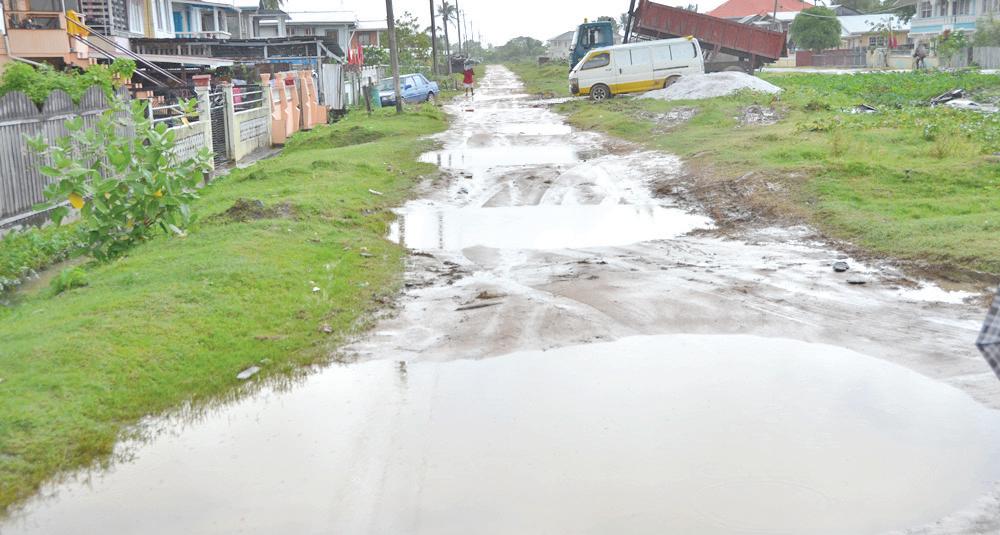
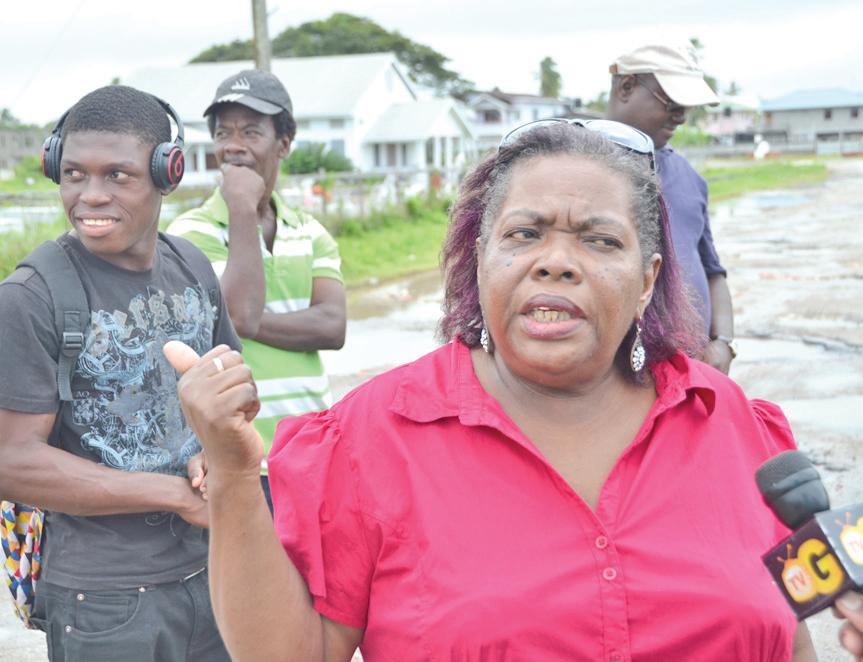
mately 4000 residents.
She told this newspaper that the road leads to the nursery, primary and secondary schools. With the road rapidly deteriorating, children are often prevented from attending school due to its poor state.
“The other road is the sideline dam... it get some holes in that dam, if I go in, nobody would see me,” the resident lamented.
“Stewartville is a forgotten community. The village on the eastern side of Stewartville, all the roads well done, well tarred, the roads on the western side...
well that was a dam but if you see it now, well done,” she pointed out.
Complaints
Another resident, Nadia Holland said numerous complaints were lodged at the Neighbourhood Democratic Council (NDC) and the Regional Democratic Council (RDC) but to no avail.
Holland told Guyana Times that complaints were also made to government, but the residents of Stewartville are still awaiting a response.
Holland, the owner of
a day care centre, said:
“Every day, parents come they have to complain about the road. At nights you have to pay double.”
Coupled with the appalling roads, Holland said there is no proper drainage system in place; hence the community is often flooded during the rainy season. “We are fed-up,” she cried.
Robin Austin, a taxi driver, said damage incurred to his vehicle is as a result of the huge potholes that line the length of the road. “We just want some assistance, that’s all, and maybe the government should tell me if that’s too much to ask for.”
Neglect
An elderly male resident said the owner of a sawmill within the community would often patch the main access road, but government should play its role in the development of Stewartville.
Owen Simons, another resident, said the community is being neglected. He too complained that roads are being paved within neighbouring communities while the residents of Stewartville are forced to contend with impassable roads.


Fire of unknown origin late Saturday night broke out at Fullworks Auto Spares located near Regent and Oronoque streets, Georgetown.
Quick action by the Guyana Fire Service contained the blaze to the Fullworks building.
“The two access roads to get to the northern side of Stewartville, both are not accessible because of the potholes…if the rain fall or if it don’t fall is the same thing… and now we are locked between Leonora and Uitvlugt and you visit those two communities, you would wonder if you are in two cities,” another resident said.
The residents are calling on the NDC, RDC, and ministries of local government and regional development and public works to address their concerns.
Failure to remedy the situation, residents said, means they will be forced to take protest actions.
Up to press time, fire-fighters were still battling to extinguish the blaze. This is the third time a Fullworks company has been the victim of fire. In October 2009, the Fullworks Variety Store went up in flames, along with four other businesses. The store had earlier been destroyed by fire in October 1992.
The driver of HC 3960, the taxi involved in the Land of Plenty accident on the Essequibo Coast remains in custody.
Police said a thorough investigation into the accident is ongoing and the driver will be charged as soon as Monday. The driver is likely to be charged with dangerous driving, which resulted in the death of Muntaaz and Rafmat Baksh.
The accident occurred on Friday, January 17, while
Muntaz Baksh, 77, and his son, 44-year-old-son Rafmat Baksh, of Land of Plenty, Essequibo Coast, were walking along the Land of Plenty main road, when it is alleged that they strayed into the path of a motor car that was proceeding in the same direction and were struck down. They both received injuries and were taken to the Suddie Public Hospital where they were pronounced dead on arrival.
Guyana will be the host of the largest Islamic conference as it partners with the Islamic Organisation for Latin and the Caribbean (OIPALC) and the Islamic Education, Scientific, and Cultural Organisation (ISESCO).
OIPALC and ISESCO have agreed to partner with the Central Islamic Organisation of Guyana (CIOG) for the staging of the Islamic Conference here in Guyana on February 9.
Under the theme “Promote the initiative of the custodian of the Two Holy Mosques in dialogue between different faiths and cultures of Latin America and the Caribbean”, Islamic leaders will strive to present Islamic culture and its role of improving the correct understanding of Islam. Additionally, they will open dialogue between other cultures and religions for peaceful co-existence.
The conference is expected to attract more than 35 leaders from Latin Caribbean Islamic organisations, in addition to officials from the Islamic Development Bank and the Kuwaiti Islamic Affairs Ministry.
ISESCO Director General Dr Abdulaziz Othman Altwaijri will be in attendance,
as well as Under Secretary of the Islamic Affairs Minstry of Kuwait Dr Adel AlFalah.
President Donald Ramotar, Prime Minister Samuel Hinds, ministers of government, members of the Diplomatic corps and leaders of local Islamic organisations are also expected to be in attendance during the grand opening ceremony.
OIPALC is an arm of ISESCO in Rabat, Morocco. Additionally, ISESCO is also an arm of the Organisation of the Islamic Conference. OIPALC is made of 35 countries within Latin America and the Caribbean. The last conference was held in Chile in February 2013.
ISESCO was founded by the OIC in May 1979. ISESCO is one of the largest international Islamic organisations and specialises in the fields of education, science and culture.
It aims to promote and consolidate cooperation among member states of OIC in the fields of education, science, culture and communication. Additionally it develops applied science and the use of advanced technology within the framework of Islamic values and ideals.

Michael Khan, chief executive officer of the Guyana Public Hospital Corporation (GPHC) said that he is unaware that ranks of the Guyana Prison Service (GPS) assaulted alleged baton-raped victim Colwyn Harding during a visit to the hospital.
He made these comments to Guyana Times while responding to unconfirmed reports that Harding was mistreated by prison officers and his cellphone seized.
According to the unconfirmed reports, four prison officers assaulted Harding Thursday evening while he was a patient at the Georgetown Public Hospital.
It was alleged that the prison officers were in the process of paying a visit to Harding.
Harding has claims that he was sexually brutalised while in custody at the Timehri Police Station in November, 2013 over a period of three days before finally being taken for medical attention.
But Health Minister, Dr Bheri Ramsaran has since told the National Assembly that Harding was suffering from an “incarcerated hernia”
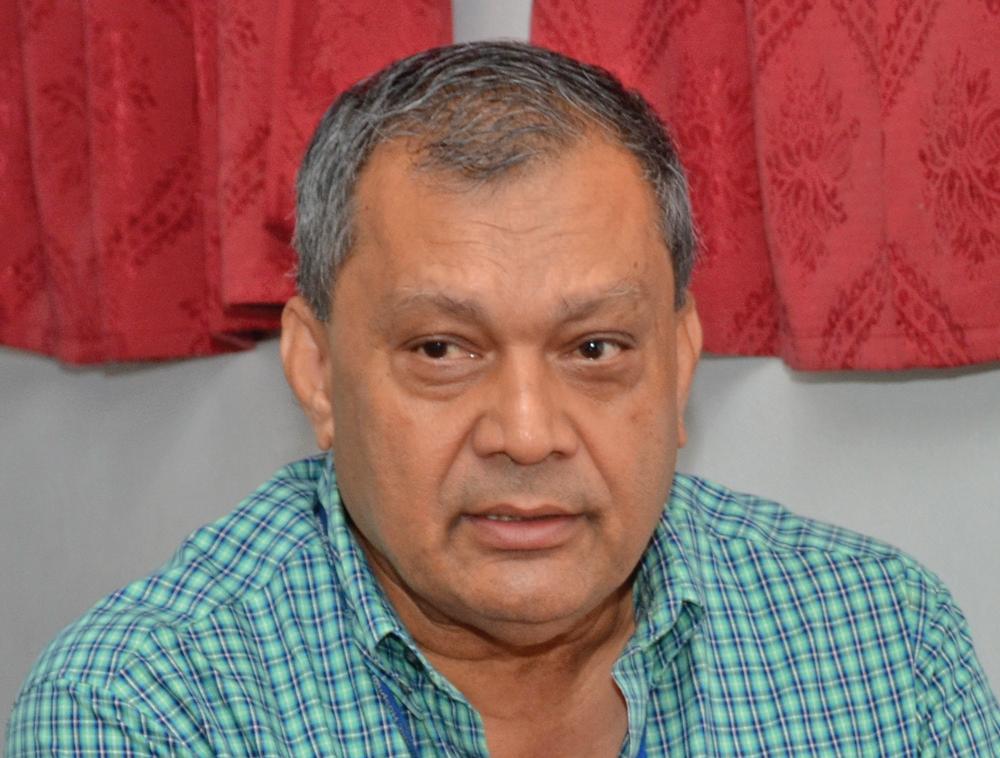
and the man was not raped with a baton.
Leader of the Opposition David Granger has since challenged what he calls an "incredible” statement by the health minister.
"We do not accept the allegation that it was incarcerated hernia. We feel that there has been mischief and we intend to explore every possible legal means to determine who is responsible and to bring that person to justice,” he said.
Harding’s lawyer Nigel Hughes has since filed a lawsuit on behalf of his client against the state for $100 mil-
lion. Hughes said he has a witness to the alleged rape.
According to Hughes, a 17-year-old witness was held at the Timehri Police Station the same time as Harding and is currently being held in the Camp Street Prison.
Since then, another witness has come forward saying that he was also incarcerated at the Timehri Police Station simultaneously with Harding.
The man claims that he still has his blood stained clothing from the incident, but is yet to produce them as evidence.
Arural constable attached to the Anna Regina Police Station is in a critical condition after his motorcycle collided with a minibus early Saturday morning at the car park.
Seriously injured is Berchnell Spellen from Anna Regina, on the Essequibo Coast.
Spellen sustained serious head and hand injuries after he was allegedly hit by a minibus at the Anna Regina car park. Spellen was picked up in a conscious state and was rushed to the Suddie Public Hospital.
According to reports, the rural constable was on his way to the Anna

The body of a Bush Lot man was retrieved from a trench on Saturday morning at Anna Regina, Essequibo Coast.
The man went missing since Old Year’s Day.
The decomposed body was identified by family mem -
The anti-corruption Mechanism of the Organisation of American States (OAS) will hold on-site visits in April to Belize, Grenada, Haiti, Jamaica, St Vincent and the Grenadines, and Suriname, in the framework of the fourth round of review of the mechanism.
The process of on-site visits to the six Caribbean countries, which are carried out with their consent, began last December, when the governments of these nations sent their replies to the questionnaire sent by Mechanism for FollowUp on the Implementation of Inter-American Convention against Corruption (MESICIC) delegates as a prior step to the visit of the delegations.
Each subgroup is composed of representatives of two member countries, with the support of officials from the OAS Department of Legal Cooperation.
Upon completion of these visits, the MESICIC will have carried out onsite reviews in 25 countries. A further five visits will take place for the following countries sometime between September 22, 2013 and October 17, 2014: Antigua and Barbuda, The Bahamas, St Kitts and Nevis, the United States and Venezuela.
Preliminary reports
In addition, OAS Department of Legal Cooperation, as technical secretariat of the MESICIC, has prepared the

draft preliminary reports for Canada, The Dominican Republic, Ecuador, Guyana and Nicaragua, which are to be considered this March by anti-corruption experts of the 31 countries that participate in the mechanism. The semi-annual MESICIC meeting will be held at OAS headquarters in Washington, DC, from March 17-21.
The MESICIC is a cooperation mechanism between states, with the participation of civil society organisations, established within the framework of the OAS, in which the legal/institutional framework of each country is reviewed for suitability
with the Inter-American Convention against Corruption as well as the objective results achieved therein.
The incorporation of onsite visits as a stage and integral part of the MESICIC represents an innovative and pioneering initiative of the OAS, which, with the support of the technical secretariat, has further strengthened this review process.
The MESICIC is composed of 31 OAS member states, and each round of assessments includes visits to all countries participating in the mechanism. The fourth round will conclude on March 2015.

bers as Arnude Persaud aka “Jaglall” of Bush Lot.
The discovery was made after an excavator operator, who was cleaning a trench opposite the Republic Bank building noticed a man hanging from the excavator’s bucket. The police was summoned to the scene where the man was identified.
The missing man was described as an alcoholic and was last seen roaming around Old Year’s night. An autopsy is expected this week.

Several close associates of former Haitian president, Jean-Bertrand Aristide, have been accused of the murder of journalist Jean Dominique, one of the country’s most notorious political assassinations.
Although the judge’s investigation, released on Friday, said Aristide ordered Dominque’s silence, the ex-president was not indicted. The judge instead accused nine people of having a hand in the death of
Dominique and a security guard in an attack at the offices of Radio Haiti Inter in Port-au-Prince in 2000.
A former senator, Mirlande Liberus from Aristide’s political party, was indicted as the organis-

er of the double murder, according to a summary of the judge’s report made public by an Appeals Court panel on Friday.
Liberus was given the mission by Aristide to silence the popular journalist, the report said, citing witnesses who gave evidence before Judge Yvikel Dabresil.
The judge did not indict Aristide as part of the conspiracy. “The investigation is finished. We have officially submitted our report,” said Dabresil.
“Former president Aristide is not indicted,” he added, but confirmed that at least nine people, including former senator Liberus and Harold Severe, the former deputy mayor of Portau-Prince.
The judge’s full report is due to be published in the coming weeks, after it has been formally accepted by the Appeals Court, according to Guyler Delva, who heads a local committee of investigating the cases of murdered journalists. (Excerpt
Jazeera)
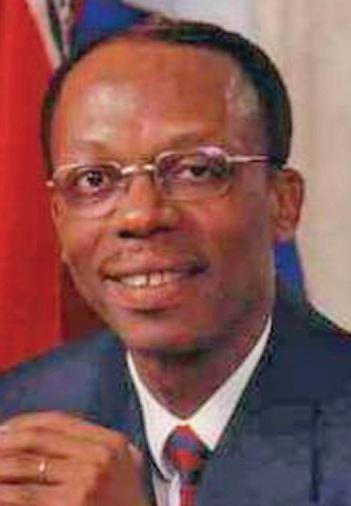
Director of Immigration
William Pratt said on Thursday the detainment of a banking executive in an immigration road block in The Bahamas will not cause the Department of Immigration to alter its practices in future road blocks and spot checks. He said the officers were simply following the Immigration Act.
“The immigration officers were just doing their jobs,” Pratt said. “It’s unfortunate that the gentle-
man did not have his work permit on him. As soon as I was made aware of it I telephoned them on the street and asked to have him released.”
Executive director of UBS (The Bahamas) Emmanuel Fiaux was detained on Tuesday during the immigration enforcement exercise.
Drivers were stopped and questioned about their status during the roadblocks. They were asked to produce evidence to confirm they are in The Bahamas
legally. Fiaux was taken to a detention centre temporarily after he was unable to produce right-to-work documentation on the spot. Representatives of the offshore banking sector held an emergency meeting with Prime Minister Perry Christie on Wednesday to address the detention and have called on the government to take a “more sensitive approach” to enforcing the country’s laws so as to avoid harming the industry. (Excerpt from Caribbean News Now)
United States authorities have seized an estimated US$100 million (approximately TT$644 million) worth of cocaine concealed in cans of juice shipped from Trinidad to Norfolk, Virginia.
Although the shipment was seized on December 20, 2013, the haul was only reported in U.S. media on Thursday after officials held a media briefing and issued a press release. The find was described as the largest seizure in the port of Norfolk’s history.
The drugs were concealed in 700 cans that appear to be manufactured by the Citrus Growers Association, a subsidiary of SM Jaleel, and were being shipped in a container destined for New York.
The cans contained a total of 732 pounds of cocaine. The cans containing the drugs also contained some liquid. Conflicting reports surfaced on whether the drugs were found following a tip-off or through a random search.
In a story carried in a
Virginia paper, the Daily Press, U.S. Customs and Border Protection (CBP) area port director Mark Laria said officers used advanced technology to do an initial inspection of the 20foot container, but after anomalies were discovered, they did a more extensive search, during which time the narcotics were found. The report said they discovered the drugs by a “cold hit,” meaning officials received no specific intelligence about its presence.
Alightning strike has damaged a thumb of Rio de Janeiro’s famous Christ the Redeemer statue. The thumb on the right hand of the 38 metres (125 feet) statue was hit during a storm on Thursday night, officials said.
Officials from the Archdiocese of Rio, which manages the statue, told Brazilian media that repairs will be made to the statue soon.
It is visited by nearly two million people ever year and in 2010 underwent a US$4 million (£2.7 million) restoration. Thursday’s storm had one of the highest numbers of lightning strikes recorded in Brazil since the country began monitoring storms in 1999. The National

Syria’s main political opposition group, the Syrian National Coalition (SNC), has agreed to attend next week’s socalled Geneva II peace talks, to be held in Montreux.
Its representatives took the decision at a meeting in the Turkish city, Istanbul.
The aim of the talks is to start the process of setting up a transitional government to end the war in Syria. The three-year conflict has claimed the lives of more than 100,000 people.
An estimated two million people have fled the country and some 6.5 million have been internally displaced. Of the delegates who voted, 58 were in favour, 14 were against, while one abstained.
The BBC’s Jim Muir in Beirut says Western powers will be relieved at the vote, although it is less than the display of unanimity the
advocates of the talks had hoped for.
Syrian opposition figures had earlier expressed reluctance to go to Switzerland unless Syrian President Bashar al-Assad was excluded from any future transitional government. Syria says there can-
The wife of Indian minister Shashi Tharoor, found dead in a Delhi hotel room on Friday, died a “sudden and unnatural death”, an autopsy has found.
Doctors said there were “injury marks” on Sunanda Pushkar’s body, but did not say if they were linked to her death. Tharoor, who was earlier admitted to hospital with chest pains, took his wife’s body away for cremation.
The couple became embroiled in a row on Wednesday after Twitter messages suggested he was having an affair. Dr Sudhir Kumar Gupta, one of the
three medical staff who carried out the post-mortem examination, said full results would be released in the next two days.
“There were certain injury marks on the body of Sunanda Pushkar, but the nature of these cannot be revealed,” he said. Dr Gupta added that initial results showed no sign of poison in her body, but more tests would be carried out.
Tharoor’s aide, Abhinav Kumar, had earlier told reporters that Pushkar had appeared to be asleep.
“There were no signs of any foul play or any struggle. She had no sign of poisoning or anything,” he said. (Excerpt from BBC News)
UK storms are divine retribution for gay marriage laws, says Ukip councillor
AUK Independence party (Ukip) councillor has claimed that Britain’s recent storms and floods are “divine retribution for the government’s decision to legalise gay marriage. David Silvester, who defected from the Tories in protest at David Cameron’s support for same-sex unions, claimed he had warned the prime minister that the legislation would result in “disasters”.
The Henley-on-Thames councillor said that the country had been “beset by storms” since the passage of the new law on gay marriage because Cameron had acted “arrogantly against the Gospel”. In a letter to the Henley Standard he wrote: “The scriptures make it abundantly clear that a
Christian nation that abandons its faith and acts contrary to the Gospel (and in naked breach of a coronation oath) will be beset by natural disasters such as storms, disease, pestilence and war.
“I wrote to David Cameron in April 2012 to warn him that disasters would accompany the passage of his same-sex marriage bill.
“But he went ahead despite a 600,000 signature petition by concerned Christians and more than half of his own parliamentary party saying that he should not do so.” Blaming the prime minister for the bad weather, he added: “It is his fault that large swaths of the nation have been afflicted by storms and floods. (Excerpt from The Guardian)
Anti-government protesters have beefed up barricades in Ukrainian capital Kiev ahead of a new mass rally, defying President Viktor Yanukovych after he approved strict curbs on rallies in a move that provoked an outcry in the West.
Sergey Kaplin, a lawmaker from opposition UDAR party, said on Saturday the opposition has begun preparing for a nationwide strike for today. Yanukovych, who has been wrestling with nearly two months of opposition pro-
tests, signed off on Friday on tough new laws introducing jail time and corrective labour for those occupying public buildings or disseminating slander on the Internet.
But the curbs are expected to reinvigorate the pro-EU opposition movement. “We are returning to Stalinism. When these laws are enforced the situation in Ukraine will be worse than in Russia or Belarus,” Leonid Tertichny from the central Cherkasy region said at the protest camp.
“But these laws have
not intimidated us, they mobilised people. The protests will continue.” Olena Oshchepovska, a protester, said the new laws showed the government was afraid of its own people.
Several dozen pro-government demonstrators on Saturday attempted to hold a rally near the protest camp but were chased away. The opposition accused the government supporters of trying to provoke fresh scuffles.
(RT
Anot be any pre-conditions.
Last week, Syria’s National Reconciliation Minister Ali Haidar said no-one should expect a breakthrough at the talks, adding: “The solution has begun and will continue through the military triumph of the state.” (Excerpt from BBC News)
group of passengers who were aboard an Asiana Airlines flight that crash-landed last summer has sued aircraft manufacturer Boeing, according to a lawsuit filed in an Illinois court.
“We are asking for damages to be paid to the passengers and asking the court to hold Boeing partially liable,” Monica Kelly, an attorney for Chicago-based Ribbeck Law Chartered, told CNN on Saturday. The personal injury lawsuit was
filed Friday in Cook County Circuit Court.
Asiana Airlines Flight 214 crashed in San Francisco on July 6, 2013. The Boeing 777 operated by Asiana fell short of its approach and crashed on the runway at San Francisco International Airport. Three people were killed and more than 180 others hurt.
The lawsuit alleges that some equipment on the plane was improperly installed or defective, resulting in inadequate warnings for the pilots about low airspeed. “Boeing
was aware that its low airspeed warning system was inadequate,” the suit states. More than 80 of the plane’s 291 passengers are named as plaintiffs in the lawsuit.
“As a result of the crash, each of the plaintiffs sustained injuries, including but not limited to, bodily injury and resulting pain and suffering, disability, mental anguish, loss of capacity for the enjoyment of life, medical treatment, loss of income, and medical expenses,” the suit states. (Excerpt from CNN)


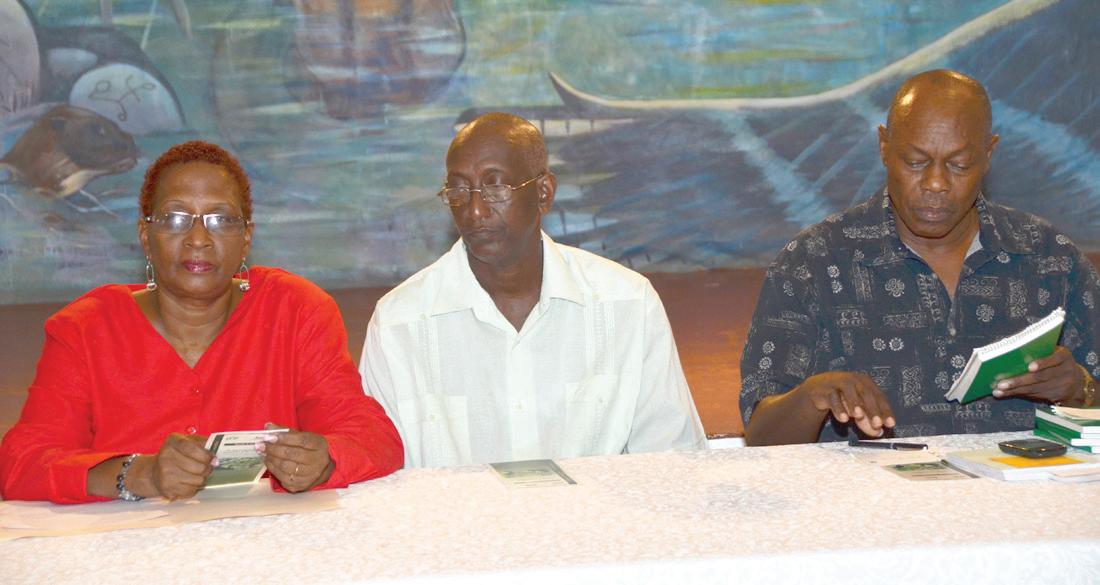
University of Guyana: Perspectives on the Early History, a book compiled by former Vice Chancellors Harold A Drayton, Alan Earp and Dennis Irvine was launched on Thursday at the Umana Yana, Georgetown, as celebrations of the institution’s 50th anniversary continue.
Speaking at the launch was Dr Paloma Mohamed, head of the Centre for Communications Studies and chairperson of the UG Central Planning Committee for the 50th anniversary. She said the university’s jubilee was a remarkable milestone, particularly for those who have worked tirelessly over the years to see the tertiary organisation flourish. Dr Mohamed said past and present students of the uni-
versity should be proud. She stressed that without the significant contributions of the past chancellors, vice-chancellors and lecturers, the university, which was established in 1963, would not be what it is today, noting that much more improvements are in the pipeline.
History
Also speaking at the book launch was acting ViceChancellor Phillip Da Silva, who officially declared the book launched. In lauding the book, he said reading the stories written, “it’s like reliving a part of history”. Da Silva noted that the book , published by the University of Guyana Guild of Graduates, Ontario, Canada, contains a wide range of information on the
University of Guyana that one can learn and share with others. He urged the gathering to vicariously get a firsthand experience of the university and to take a deeper look from the inside rather than just the outside of the structures “and making assumptions”.
With only 75 copies of the historical text available, persons were urged to visit the university’s library to get their copies at a cost of $4000.
The event was attended by staff and students of the university, and members of the diplomatic corps, among others. The book launch is among many activities planned for UG’s 50th anniversary. Celebrations will last one year, from October 2013 to October 2014.

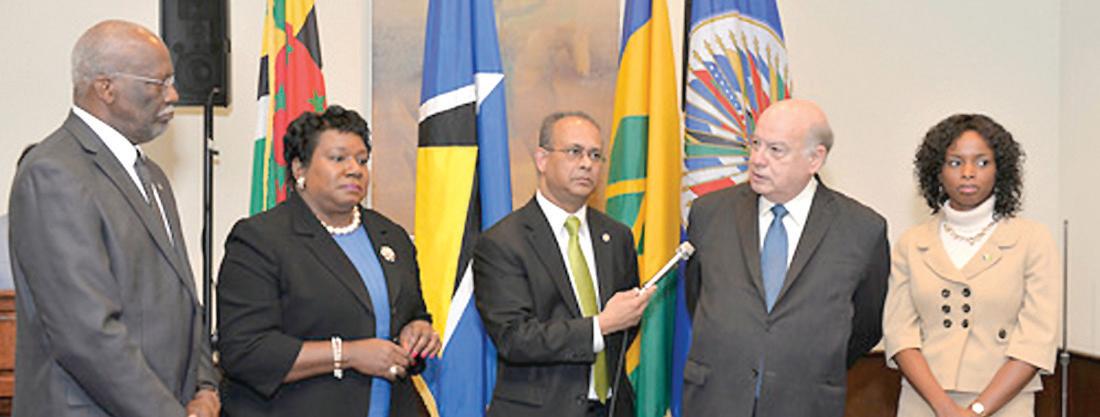
The Organisation of American States (OAS), through the InterAmerican Emergency Aid Fund (FONDEM), on Friday made a contribution to Saint Vincent and the Grenadines, Saint Lucia, and Dominica to help in the efforts to recover from the effects of the torrential rains and flooding on Christmas Day.
During the ceremony held to announce the contributions, the Secretary General of the OAS, José Miguel Insulza, expressed his hope that “this contribution will help alleviate as much as possible the situation... We encourage others as well as our friends in the Inter-American system to provide economic support for the affected countries. We hope that our symbolic contribution can help promote those efforts.” The secretary general made the symbolic contribution together with the Assistant Secretary General, Albert Ramdin.
Gratitude
The permanent representative of Dominica to the OAS, Hubert Charles, expressed his gratitude for the contribution, and added that “we are not surprised that the OAS is among the first to step up and provide financial assistance.”
“I want to highlight the importance of continued OAS engagement in building capacity and in moving forward our development agenda,” emphasised Ambassador Charles, who concluded that “the more developed we are, the better positioned we are to respond to disasters like this one.”
The ambassador from Saint Lucia, Sonia Johnny, thanked the OAS for its “generous support” as well as its help in taking the first steps in the search for assistance after the storm. “We needed assistance immediately and the [Pan-American Development Foundation] PADF and the OAS responded immediately,” said Ambassador Johnny.
For her part, the representative of Saint Vincent and the Grenadines, La Celia Prince, said “we have been very fortunate to have the support of the OAS on this journey.”
“For me, the OAS were the first responders since this disaster.” “I received calls from the office of the secretary general immediately after the disaster and we have been in communication ever since,” said the diplomat from Saint Vincent and the Grenadines, who added that “this is a good example of brilliant Inter-
American cooperation and we are very grateful.”
The affected countries detailed the damages caused by the storm and their need for international assistance during a press conference held today at the headquarters of the OAS in Washington, DC.
The permanent representatives of Saint Vincent and the Grenadines, Saint Lucia and Dominica to the Organisation of American States (OAS) described in dramatic details the damages that resulted from the intense torrential rains that fell over Christmas on the Eastern Caribbean nations, and made a call for international aid to help in the process of recovery, during a press conference offered at the headquarters of the Organisation in Washington, DC on Friday.
Rebuild
The permanent representative of Saint Vincent and the Grenadines, La Celia Prince, recalled that her country accumulated 12.5 inches of rain in just five hours between Christmas Eve and Christmas Day, which she called “something not seen in 100 years.”
The rains and resulting flooding took the lives of nine people in the country, and several remain missing, said Ambassador Prince, who added that “14 per cent of the population is still reeling from the impact.”
“I want to thank those in the international community that have come to our aid and to make an appeal for more assistance as we try to rebuild the devastated regions of our country. People still have a dire need and we are on a long road to recovery,” emphasised Ambassador Prince.
Meanwhile, the permanent representative of Saint Lucia to the OAS, Sonia Johnny, said “we have been quite surprised at the magnitude of the damage and while initially we thought we would be able to respond with local resources and regional neighbours, we have been proven wrong.”
Ambassador Johnny reported that six people died in her country as a result of the storm, and indicated that the costs of reconstruction would likely reach several hundred million dollars. “So we will be seeking support in technical assistance and expertise not just to recover from this tragic episode, but also to improve upon our early warning system,” she said.
Ambassador Hubert Charles, of Dominica, said the initial cleanup work in his
country has been completed, but that “extra-budgetary contributions are required to fund the programme for repair and reconstruction of damaged civil infrastructures, shoring up embankments, and providing support for the families and small businesses impacted by the storm.” Ambassador Charles highlighted that the rains were unusual in that they took place after the end of hurricane season, and said the disaster “provides us with an opportunity to highlight the importance of support for the medium and long term development plans of the Caribbean region.”
Assistant Secretary General Albert Ramdin said “the OAS is committed to support, in any form we can, the relief efforts, with a focus not only on the immediate needs but also on long term restructuring and rebuilding.” Ambassador Ramdin added that therefore the organisation has made a contribution to the affected countries and “will meet with its Inter-American partners Tuesday in the InterAmerican Committee on Natural Disaster Reduction.” Ramdin applauded the work of the Pan-American Development Foundation (PADF) and the Pan-American Health Organisation (PAHO) to support the affected countries and emphasised that “the focus in terms of rebuilding should not only be on financial aspects; there are other issues which should be taken into account such as physical and urban planning, the issues of enforcement of law, where to build and where not to build, and involving the private sector.”
Secretary General José Miguel Insulza, was present at the press conference, as were the permanent representatives of many member countries. On the night of December 24, 2013 and during the day on December 25, a low-level, high impact trough system passed through the Eastern Caribbean region, dumping enormous quantities of rain over parts of the Commonwealth of Dominica, Saint Lucia and Saint Vincent and the Grenadines, taking lives, livelihoods, homes and vital infrastructure.
The damages are particularly serious for the affected countries, in that the Eastern Caribbean is frequently impacted during hurricane season, which on this occasion had officially concluded.
BY VISHNU BISRAM
There has been much criticism in the media over the government’s handling of contracts and sale of assets asserting corruption. The opposition calls the government’s action “crony capitalism”. I have travelled worldwide and studied development of numerous societies and found that virtually none of them is free of cronyism.
Crony capitalism describes an economy in which there is favouritism in the distribution of legal permits, grants, concessions, contracts and tax breaks, among other things, to businesses whose owners have some kind of close relationship with government officials and or business perquisites are obtained on the basis of bribes. Such favouritism allows for these businesses to generate huge amounts of wealth in a very short time.
Special privileges
It is noted that officials in government become corrupted, granting special privileges to those who grease the palm. In my studies and travels, I find there is hardly an economy that does not have crony capitalism. Every prosperous society, including the UK and U.S., has been built on cronyism.
Raymond Vernon, specialist in economics and international affairs, said cronyism has existed in Britain since the time of the industrial revolution.
He said corrupt British governments favoured a set of business owners who have had close ties to the government over others. The government bestowed privileges on those companies that grease government officials – standard practice in every society, including the U.S., Germany, Canada and India.
Which country does not have corruption? The U.S. has both crony capitalism as well corporate welfare in which it favours certain big companies, granting them tax breaks and other subsidies at the expense of the poor. Every industry in America was built on cronyism.
Fannie Mae and Freddie Mac and are well known examples of crony capitalism in America. Government backing let Fannie and Freddie dominate mortgage underwriting. These giants return some of the huge profits to the politicians – in the form of campaign funds or lecture fees. The British and American governments grant special concessions and billion-dollar contracts to their cam-
paign donors and friends.
Governments in Germany, Canada, Italy, Japan, Australia and New Zealand all do the same. The big companies in Japan like the Keiretsu; the Chaebol of South Korea; the Tata and Birla of India, as well as Mahendra, billionaires in India (recent sale of telecom rights); powerful families in Latin America; the wealthy class in Vietnam, Taiwan, Thailand and the Philippines; and newly created millionaires or billionaires in China were all beneficiaries of cronyism. Without cronyism, there will be no economic expansion, growth or job creation. Without it, an economy will be stagnant and standard of living may decline. Cronyism also has its negative effects like stifling initiative and discouraging non-favourites from working hard and it could corrupt the entire system.
Not new Crony capitalism is not new in Guyana. The People’s National Congress (PNC) practised aspects of cronyism right after Guyana became an independent state – friends and families of PNC officials benefited from government’s awarding of contracts, tax concessions and distribution of grants. Private companies received all kinds of concessions to invest so as to keep the People’s Progressive Party (PPP) out of office.
As academics, Robert Manley and Jay Mandle wrote, after the PNC nationalised businesses and acquired control over imports and exports during the 1970s, beneficiaries of the distribution and sale of supplies (co-ops) were allies and friends of PNC officials – in which a small bunch of individuals became extremely wealthy under the PNC state capitalist system.
Professor Clive Thomas also exposed cronyism under PNC rule. And when state corporations were privatised after the implementation of the Economy Recovery Programme
(ERP) in 1988, friends and families of the PNC were the primary beneficiaries. It was well known that palms were greased, who were the recipients of large amounts of bribes as well as who got state property at dirt cheap prices, and who funded the PNC election campaign in October 1992 – all of those who acquired state property funded the campaign.
I notice critics are mum about crony capitalism during the PNC apartheid regime and about the brutality that the opposition experienced – the extent of which may never be fully known. At least, during the crony capitalism of recent years, the country has progressed – jobs created and growth experienced and opponents have not been brutalised or denied jobs.
PNC dictatorship

they came into office.
The daughter of the Angolan president is Africa’s wealthiest person, worth billions. All African countries practise crony capitalism in which friends and family members of government officials are super wealthy. Foreign companies (from the West) who offer bribes make big bucks in Africa. All of our
During the cronyism of the dictatorship, Guyana was blessed with abundant natural resources and a perfect climate to become a developed country like Singapore. Instead, Guyana became like Haiti whereas today, the World Bank says standard of living is growing and Guyana is poised to take off.
Every country that has been in transition from socialism to capitalism over the last 20 years practices aspects of crony capitalism. Billionaires have been born out of the process. All the billionaires from Russia (including Mikhail Khodoravsky), Ukraine and India were beneficiaries of special business deals.
Post apartheid South Africa has the worst excesses of cronyism, and this when Nelson Mandela was alive – he could not stop it. Reports describe Vice President Cyril Ramaphosa’s net value at US$600 million acquired in less than 20 years of democratic rule. Which Guyanese politician or capitalist in our own post apartheid Guyana has acquired such a large amount of wealth since Dr Cheddi Jagan’s death?
And Ramaphosa is not the only multi-millionaire in South Africa. Almost Every African National Congress (ANC) biggie (Thabo Mbeki and Jacob Zuma, for example) is super wealthy from crony capitalist deals. The families of rulers in Mozambique, Kenya, Nigeria and the Ivory Coast, among others, have acquired huge amounts of wealth since
Caribbean Community (Caricom) friends practise some form of cronyism.
I am not excusing crony capitalism. I am simply pointing out it has existed throughout history and in all societies and readers should not be naïve to think it exists only in Guyana or that it will go away. All the big companies in America emerged out of some form
of cronyism. And so did the big companies in Guyana before the restoration of democracy in 1992.
Concessions
It is noted that several companies that got crony concessions have not made a successful transition into giant companies. If the owners squander their handouts and inheritance, they should not blame others and become jealous of those who become successful from hard work.
Instead of targeting and criticising those who succeed, critics and detractors should find more productive avenues to direct their energies – like how to create wealth. To limit the effects of cronyism on the poor, what Guyana and other countries need are better and strong agencies to regulate industries and brave judges to render tough decisions against the corrupt.







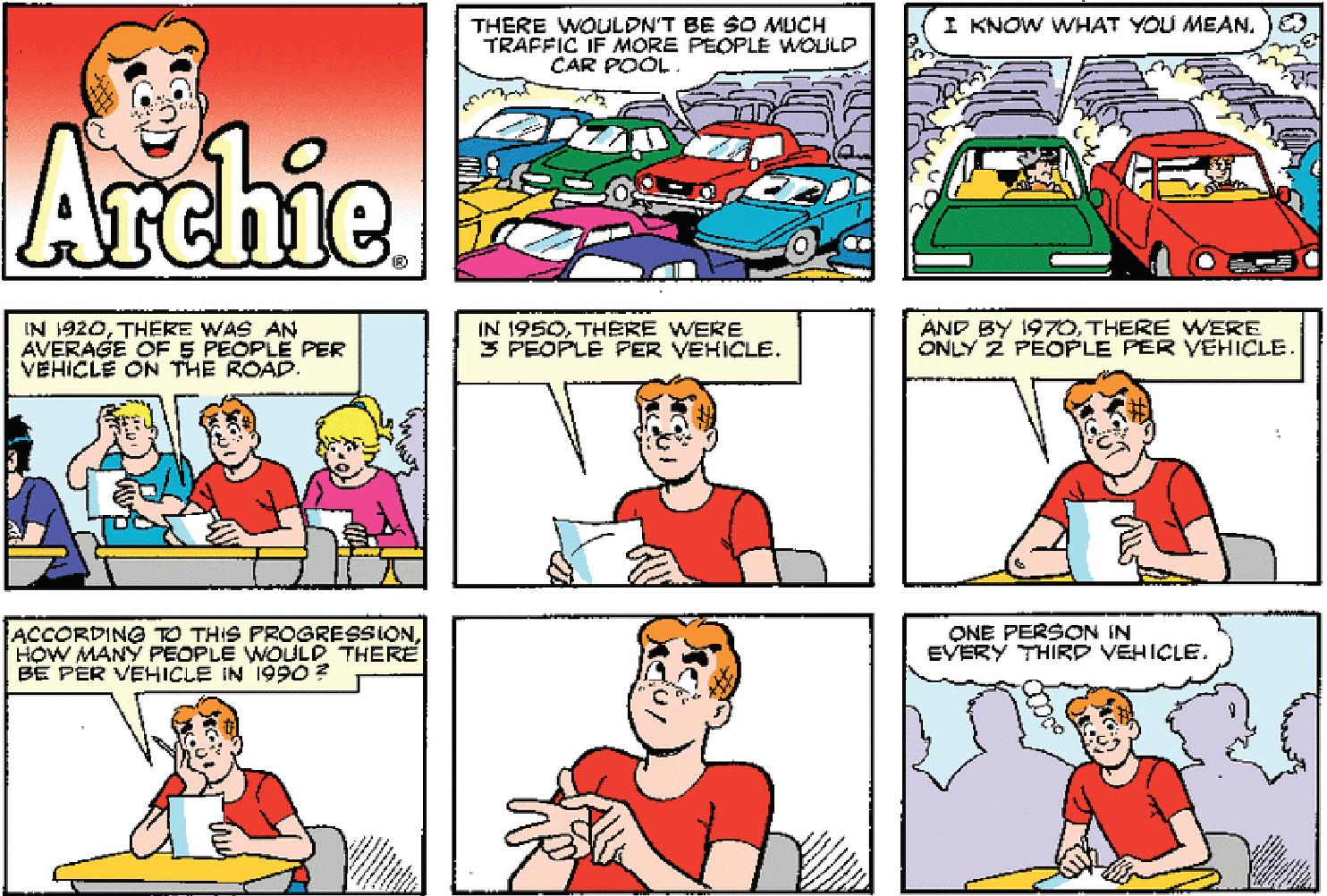



CAPRICORN
(Dec. 22Jan. 19)
Live and learn. Letting someone from your past get away with something you should have anticipated will be hard to swallow. Protect your heart and your possessions.

(Jan. 20Feb. 19)
Put your finances in order. A chance to make extra cash or receive a gift or reward will help you make a positive change to your current direction.

(Feb.20March 20)
Take hold of whatever situation you encounter. There is money to be made, deals to be signed and improvements to enact that will bolster your personal life.

(March 21-April 19)
What you do will make a difference to your community, be it spiritual, moral or physical. An impulsive move may cost you, but the price will be worth your while.

(April 20May 20)
Expand your friendships today. Mix the old with the new to achieve freedom and peace of mind. A trip or reunion will lead to an interesting turn of events.

(May 21June 20)
Keep everyone guessing. Your changing attitude and innovative mind will capture interest and result in the chance to try your hand at something new and exciting. Speak up and enjoy the attention.
By Bernice Bede Osol

(June 21July 22)
Travel to destinations that offer something different. Romance is on the rise, and it could turn a dull day into an exciting encounter. You’ll also have the chance to establish a better relationship.

(July 23Aug. 22)
Don’t take anything or anyone for granted. Live up to what’s expected of you so that you can move ahead without feeling guilty. Aggressive action will be required to excel.

(Aug. 23Sept. 22)
You need to socialise, offer favours and take on tasks that will boost your reputation and help you gain respect. Love and romance are in the stars, and a promise should be made.

(Sept. 23Oct. 23)
Ask questions and be prepared to protect your personal position and your future. Not everyone will be as accommodating as you. Prepare to counter whatever adversity you face.

(Oct. 24Nov. 22)

Home, family and friends should take top priority today. Do something unique or different that you can share with the ones you love. Changes at home should add to your comfort and entertainment. A chance to fulfil a dream may come at a cost. Not everyone will want you to go in the direction you choose. Weigh the pros and cons, but do what your heart craves. The others will understand eventually.
(Nov. 23Dec. 21)
sunday, january 19, 2014


Dentures provided in 72 hours from as low as $4500. Contact Dr B Stuart, 209B Charlotte St, Lacytown. Tel: 225-5034

Music is fun! Register now and learn to play the Keyboard, Guitar, Drums and do Voice Training. Call Foundation 7 on 225-1151/617-4200.


Professional Key Shop, 125 Carmichael Street, Georgetown. Phone: 225-3923, mobile: 6213249. We cut any type of key, service and repair all types of locks. Get your extra key today.

Available: Fresh long-stemmed roses, fresh dried and silk floral arrangements, gift items, bridal boutiques and wreaths. Nesha’s Flowerland. 78 Church Street (opposite St George’s Cathedral). Tel: 227-3553/225-3315

Chicken Hatchery
28,000 eggs capacity fully ready, $ 5.5 million or CREDIT available Tel: 227-3939 621-4000
Diesel Generator, 3 cylinder Lister pitter (England) key start, 15,000 watts $595,000 cash Tel: 2273939, 621-4000
Generac Generator 15,000 watts , portable, $475,000 cash Tel :2273939, 621-4000
CLARKE forklifts 3 pcs - 2000, 3000, 4000 Lb, lifting capacity $350,000 AND UP Tel :227-3939, 621-4000
DIESEL Generator silent 28,000 watts SDMO John Deere engine, missing Fuel Pump, Panel, Avr $850,000 cash Tel :227-3939, 6214000
TV SALE 40” TO 73” SOME WORKING AND OTHERS NEEDS
CHECKING ALL, SOLD AS IS Tel : 621-4000, 227-3939
Exercise equipment, complete gym, heaters, ab machine, and more Tel: 621-4000, 227-3939
Pool table imported complete with Ques, balls racks $80,000, also kids pools table $75,000 Tel: 621-4000, 227-3939
60FT Antenna (Mass) for Radio, TV, Cellular, with cables, brackets, sky light $400,000 Tel : 227-3939, 6214000

Are you suffering from abnormal behaviors, addictions, stresses, or psychosomatic sickness? Feeling suicidal, low self-esteem, loneliness, unloved, anger, conflicts and relationship problems? For appointments call 592-621-0552 from12:00-18:00h Email: healthworldhc@gmail.com



Immigration & Visa Services We handle all Canadian, USA and UK immigration and visa matters. Self sponsorships, holiday/visitor’s visas, work permits, students visas, family, class, immigration forms, embassy enquiries, appeals for refused cases, US green card lottery, business class waivers, pardons, etc. Get your visa approved. High success rate. Balwant Persaud & Associates. Certified Immigration Consultants, 68 Sixth Street, Alberttown, Georgetown (Between Cummings & Lights Sts) Tel: 225-1540, 622-8308, 655-3105. Email: balwantpersaud@yahoo.ca
lAND FOR SAlE
Land for sale ½ Acre residential at Yarrowkabra EBD Call 611-1018. Asking price $2M.

Da Silva’s Optical. For Your Eyes Only, Look Better See Better. Phillip A Da Silva OD, Shannon L Da Silva OD, Natalie Da Silva OD. 248 South Road, Bourda. Phone: 227-3529, Linden: 444-6376, Corriverton: 3393536, Meten-Meer-Zorg: 275-0322, Grand Cayman Islands: (345) 9431515 for the perfect trendy touch.

Two storey wooden building. Bayroot. Phone: 687-5653
Versailles, WBD: almost brand new five-bedroom house for sale, master room & all rooms self-contained with A/Cs & fans, open concept kitchen/dining/living room, large pantry, office/library room and powder room. Beautiful landscape and wrap around patio. Priced to sell$75M. Phone: 592-624-8704, 592684-9203, 592-220-7809.

Shalom Driving School Lot 2 Croal Street. Call: 227-3835, 227-3869, 622-8162 and enjoy 20% discount

Get your home or business spiritually clean to enhance good luck and prosperity. Telephone: 687-5653
Suriname Astrology Palmist and Djuka Healing, the most powerful spiritualist in the world, are you suffering from the following problems (any religion) love, marriage, family, health business, husband and wife relationship, property, court, children, promotion, visa, pregnancy, education, depression, job, sexual, jealousy, enemy, money, drinking ? Also you can have all evil forces destroyed such as black magic, witchcraft, voodoo, obeyah etc and give powerful protection. We also do upliftment for clearing of land, dredging operations strictly in the interior. For private and confidential service call 674-2112.
Dutch Spiritual work. Unite lovers, get rid of evil, enhance prosperity, good luck baths and charm bowu guards, etc. Phone: 220-0708, 6126417, 687-5653
Cleansing of spiritual problems of all kinds. Powerful Ifá protection against evil. Get help to overcome problems with love, relationships, legal, sexual, pregnancy, business, sickness, jobs, enemies, work, money. Call 592-690-1824 from 10:0016:00h Email:anew-life@live.com




One Toyota Raum PNN Series in good condition. $1.5M negotiable. Phone: 696-4695
Toyota Hilux 4x4 Extra cab pickup. Excellent condition, $3M. Phone: 649-0707 or 264-2682
LEROY TRIDENT car 250 CC, 4 doors, power window, keyless entry
$495,000 cash or credit Tel: 2273939, 621-4000
HILUX SURF 4 DOORS, minor parts needed, sold as is $695,000 cash Tel: 227-3939, 621-4000
Nissan Maxima, fully powered needs repairs sold as is $295,000 cash Tel: 227-3939, 621-4000
Stretch limousine, Lincoln Town car, fully powered $6.5 million or credit available Tel: 227-3939, 621-4000
7 PCS - Trikes, Can-Am style Motorcycles, 200cc new, unregistered $350,000 neg or credit, Wholesale. Tel: 227-3939, 621-4000
5 pcs Harley Davidson Motorcycles gas model 50cc key or pull start all - $295,000 or 1pc $70,000. Tel:6214000, 227-3939
Mercedes benz S-300 bullet proof, automatic fully powered, 19” rims full leather seats, $2.3 million cash Tel:621-4000

Dominican-born retired archbishop of the archdiocese of Castries, Kelvin Felix, will be formally installed as a cardinal of the Roman Catholic Church on February 22.
On Sunday, January 12, the Apostolic Nuncio to the Antilles Episcopal Conference (AEC), Archbishop Nicola Girasoli made the following announcement to the bishops, clergy and faithful of the Caribbean: “With great joy, I have the honour to convey the joyful and historic news for our region, that our beloved Holy Father, Pope Francis has at noon today (Rome time), Feast of the Baptism of Our Lord, announced that during the Public Consistory to be held on February 22, His Grace, Archbishop Emeritus of Castries, Monsignor Kelvin Edward Felix will be created a cardinal of the Roman Catholic Church.”
Archbishop Girasoli pointed out that this will be the first time that a member of the Episcopate of the AEC region will be elevated to cardinal, and went on to congratulate Archbishop Felix on his appointment.
In making the announcement, the pope had said the new cardinals “represent the deep ecclesiastical relationship between the Church of Rome and the other Churches throughout the world.”
Felix is among 19 Catholic prelates from around the world who were elevated to the office by the pope. Usually called “princes of the church,” cardinals are senior officials who make up the College of Cardinals, whose prima-

ry responsibility is to elect a new pope at the appropriate time.
Since he is over 80, Felix will be among three of the named cardinals who will not be eligible to vote for a new pope.
Great joy
The Archdiocese of Castries received this news with great joy. In a release, it said Felix is one of the senior prelates of the AEC, and his appointment is an acknowledgement of his long and dedicated service to the Holy See and to the Church. It added that it was “a sign that the church in our region has reached a level of maturity and growth and has received the appropriate recognition.
The doors are now open to the future appointments of cardinals in our region. It is all God’s work!”
At the Public Consistory, the newly-appointed cardinal will receive the “Red Hat” from Pope Francis at St Peter’s Basilica in Rome.
The church and people of St Lucia and the Caribbean
are invited to pray for the new Cardinal and for all the bishops of the region. Felix was born in Dominica on February 15, 1933. He was ordained a priest on April 8, 1956 at the age of 23. On July 17, 1981, he was appointed archbishop of Castries and ordained archbishop on April 5, 1981. As archbishop, he oversaw the dioceses of Castries in St Lucia, St George’s in Grenada, Roseau in Dominica, and St John’sBasseterre in Antigua and St Kitts.
He has also served on various Vatican committees, including the Pontifical Council for Family Life, the Pontifical Council for Inter-religious Dialogue, and the Synodal Council for America. He retired on February 15, 2008. Since his retirement, Archbishop Felix has resided in Dominica, where he continues in pastoral ministry as a parish priest, dedicating himself to the care of his people and to the promotion of vocations to the priesthood.
Hindus have applauded the appointment of Anthea Winn as the captain of Royal Ascot Golf Club in Ascot, Berkshire County, United Kingdom (UK) – first-ever woman captain of a royal golf club in British history.
It was a step in the right direction, Hindu leader Rajan Zed stated in Nevada, U.S.A. There are reportedly 34 royal golf clubs in UK – clubs which have received patronage from the royal family.
Zed, who is president of Universal Society of Hinduism, noted that women leadership in royal golf clubs was long overdue. He urged other royal golf clubs also to appoint women captains, thus bringing an end to gender discrimination existing for a long time.
Quoting scriptures, Rajan Zed explained that ancient Manusmriti said: “Where women are revered, the the gods are pleased; where they are not, no right will yield any fruit.”
Meanwhile, Zed has also asked Scotland’s Muirfield,
the honourable company of Edinburgh Golfers, to open membership to women also.
The men-only 269-yearold membership policy of Muirfield was highly inappropriate and archaic, Zed added.
Traditions
He pointed out that instead of being proud of its traditions, intransigent Muirfield should be ashamed and embarrassed of its exclusionist policy of barring women members. Male-only membership policy of Muirfield needs to go and right now. Clubs like Muirfield, who refuse to treat women as equals, should not be in the business in 21st century Scotland and the world.
Zed further said that golf’s governing body R&A, which organised the Open Championship, golf’s oldest major, should not stage tournaments at Muirfield in the future, unless it changes its membership policy.
Zed indicated that the Church of Scotland and its Moderator Right Reverend
Lorna Hood should also come out openly advocating treating women with equality and respect they deserve, and persuading Muirfield to allow women to become members. Women should not have to face such a struggle to gain acceptance at Muirfield, which seems to have refused to progress with the society.
Royal Ascot, dating back to 1887, is the oldest golf club in the area. His Royal Highness, Prince Andrew, The Duke of York, is its patron.
Its famous members include Barry Lane, Anthony Wall, Michelle Scobling and Guy Woodman. It does not permit T-shirts and jeans “under any circumstances”. David Boyce is the general manager. Ascot is an affluent village, famous for being the location of Ascot Racecourse, home of the world famous Royal Ascot race meeting attended by the royal family and dating back to 1711. John Lennon and Ringo Starr of rock band The Beatles lived there.


Ahmed Shehzad was defensive for most of the first two sessions, but accelerated after his maiden Test hundred
Ahmed Shehzad scored his maiden Test hundred but Pakistan’s progress on the third day in Sharjah, despite a century opening partnership and 122 runs in the final session, was not swift enough to weaken Sri Lanka’s grip on their 1-0 lead in the series. At their current pace the best Pakistan can hope for is to draw a Test they need to win, but with their middle order falling away alarmingly, they were far from certain of avoiding a first-innings deficit.
Pakistan’s approach was curious. The surface, despite its crumbling appearance, had little seam, swing or spin for the bowlers but the batsmen did not attempt to force the pace for most of the day.
Pakistan lost no wickets in the first session but their openers added only 66 runs in 29 overs. They then lost two in the second while scoring only 84 in 29 overs. Shehzad led the acceleration after tea, forcing Angelo Mathews on the defensive, but he was one of four wickets to fall in the session, which meant it was Sri Lanka who won the day.
The go-slow had begun after Pakistan got to 30-0 after nine overs; they scored only 12 runs off the next 13. The lack of pace off the pitch and the slow outfield hindered shot making and most of the early boundaries came via glances from Shehzad when the fast bowlers strayed on to the pads.
To try and make something happen for Sri Lanka, Shaminda Eranga bowled cross seam to rough up one side of the ball, and a few deliveries did tail in to the right-hand batsmen through the day. Herath operated from over the wicket, pitching outside leg stump, a line of attack he used for most of the day. Towards the end of the first session, Mathews placed six fielders on the leg side and Suranga Lakmal bowled very straight, making the batsmen play, often across the line.
Manzoor and Shehzad picked up the pace shortly before lunch but slowed down again after the break, when they played four maidens in the first five overs. Mathews
brought himself on and conceded his first run only off the last delivery of his fourth over.
Things began to happen in the 42nd over, with Manzoor and Shehzad sweeping Herath for a three and a four, and Shehzad being dropped on 43 by Dimuth Karunaratne at midwicket. That over of excitement, however, was not a sign of things to come. Pakistan’s century opening stand came up in 43.3 overs, and Shehzad got to his fifty off 150 balls, and Manzoor reached his off 120. Eranga’s reintroduction 12 overs into the second session brought Sri Lanka the breakthrough. He began to reverse-swing deliveries into the right-hander and Manzoor edged one that strayed down leg side to the keeper. He reviewed the umpire’s decision in vain and the opening stand ended on 114. Pakistan have made some horrible reviews in this series but none was worse than Azhar Ali’s decision to challenge his edge to slip. It merely delayed the confirmation of Dilruwan Perera’s maiden Test wicket, after the offspinner had to wait 42 overs on the second day to get a bowl. (Cricinfo)
Sri Lanka 1st innings 428-9 declared Pakistan 1st innings Khurram Manzoor c †HAPW Jayawardene b Eranga 52 Ahmed Shehzad b Herath 147 Azhar Ali c Mathews b Perera 8 Younis Khan c †HAPW Jayawardene b Herath 17 Misbah-ul-Haq* not out 36 Asad Shafiq lbw b Eranga 18 Sarfraz Ahmed† c †HAPW Jayawardene b Herath 5
Extras: (b-1, lb-6, nb-1) 8 Total: (6 wickets; 95.3 overs) 291 Fall of wickets: 1-114 (Khurram Manzoor, 48.3 ov), 2-149 (Azhar Ali, 57.6 ov), 3-189 (Younis Khan, 69.6 ov), 4-245 (Ahmed Shehzad, 81.6 ov), 5-274 (Asad Shafiq, 92.1 ov), 6-291 (Sarfraz Ahmed, 95.3 ov) Bowling: HMRKB Herath
31.3-8-88-3, RAS Lakmal 214-57-0, MDK Perera 17-1-711, RMS Eranga 19-5-53-2 (1nb), AD Mathews 7-3-15-0
The Berbice Cricket Board’s (BCB) Special Events Committee (SEC), since its formation in March 2008, had completed over 600 programmes/activities up to June 2013 when it became dormant after the resignation of its chairman Hilbert Foster due to illness.
The BCB since then was unable to complete any special event, but with the SEC being resuscitated in December last several programmes/activities have already started.
Foster, who was recently re-appointed chairman, disclosed that 2014 would be an exciting one for Berbice cricket as the work of the SEC would be unmatched by any other in the entire Caribbean.
The SEC has committed itself to raising funds for 17 cricket tournaments for the Ancient County at the Under-15, Under-17, Under-19, female, school, second division, intermediate and first division levels. These include Interzone tournaments at all the junior levels while special efforts would be made to obtain sponsorship for a three-day first division tournament in an effort to get the young cricketers to play the longer version of the game. The Berbice Under-21 cricket team would also be playing several cricket matches across the country.
Coaching
Special emphasis would be placed on coaching with the unveiling of a massive coaching programme to be sponsored by Elizabeth Styles. Different clinics would be organised for batsmen, fast bowlers, spinners and wicket-keepers and these would be conducted by the most experienced coaches in Berbice.
Cricket clinics would also be arranged in each of the four zone areas, while educational posters and booklets would be printed and distributed. The annual Bank of Nova Scotia cricket academy would be held in July/August, while the highly successful Junior and Elite training programmes would once again be held.
Former West Indies Vice-captain and coach Roger Harper would also be approached to work along with several Berbice players, including leg-spinner Devendra Bishoo and fast bowler Brendon Bess, while a refresher course would also be organised for all cricket coaches in Berbice. The BCB would also be hosting a month-
ly television programme in an effort to inform the general public of its activities. Clubs in Berbice would also received donation of coaching kits to assist them in their coaching development programme.
Numerous programmes
Off the cricket field, the BCB would be involved in numerous programmes/ projects in its continuing efforts to develop cricket in the Ancient County while making sure that every hero is recognised and honoured. Among the numerous programmes that would be organised are the BCB educational awards scheme, first aid seminar, annual awards ceremony on March 15, tribute to heroes, tribute to coaches, tribute to retired cricketers, tribute to managers, annual review magazine, senior players charity programme, social skills seminars for youth cricketers and assistance to youth cricketers. A billboard featuring West Indies female players would also be unveiled.
As part of its mandate as a Non-Governmental Organisation, the BCB would also be involved in several charity and social programmes, including donations to children orphanages, senior citizens homes and less fortunate families.
Seven established cricket clubs would also received books to establish mini-libraries for their members under the “Yes to reading programme.”
Over 30 clubs would also receive items to the cost of $1 million to assist their less fortunate members, while 100 young cricketers drawn from clubs across the county would also receive school bags and educational kits to assist them to stay in school and obtain an educational background.
Outstanding cricketers who performed well at the Grade Six Assessment Examinations and CSEC would also be honoured. Seven cricket clubs have also been earmarked to receive items like water pitchers, dust bins, water mugs and buckets to assist them to function properly, while 15 clubs would receive score books and notice boards in the BCB’s continuing efforts to assist functioning clubs.
75th anniversary activities
Chairman of the SEC, Hilbert Foster, would also head the BCB’s 75th anniversary committee. The BCB, during 2014, would be celebrating its Diamond Jubilee after
its formation in 1939 to administer the game in Berbice.
The SEC and the 75th anniversary committee include Carl Moore, Anil Beharry, Angela Haniff, Leslie Solomon, Winston Smith, Moonish Singh, Gregory Rambarran and Rabindranauth Saywack. The anniversary would be celebrated through -
out the year, but several major events would be organised during the month of September when the BCB hopes to host several former Test players and administrators.
The month of special events would be launched on September 7 with an inter-faith service and an anti-drugs/HIV march and rally involving all
the junior cricket teams in Berbice. A cocktail reception and a live panel discussion on the history of Berbice cricket would be held on September 13 at the New Amsterdam Town Hall.
Other events planned for the anniversary in September are a music festival, open air exhibition featuring achievements over the 75 years, primary schools cricket coaching sessions, essay competition, donation of a television set to an orphanage, launching of the hall of fame for administrators, publication of the Diamond Jubilee official magazine, special 20/20 cricket match between Berbice and Georgetown and the distribution of 75 food hampers to senior citizens. A portrait of the greatest
cricketer ever produced by Berbice would also be unveiled, while souvenirs like caps, tee-shirts and anniversary mugs would be available for special guests.
Foster issued a challenge to every club and their officials to work along with the SEC and 75th anniversary committee to make sure that all their plans are fulfilled.
According to Foster, the SEC, as it has done in the past, would work hard to bring success to Berbice cricket, but would need the cooperation of every stakeholder. The veteran cricket administrator is also urging businesses based in the Ancient County to assist the BCB as cricket is the most popular pastime for Berbicians.

St John’s, Antigua – The West Indies Cricket Board on Saturday announced the 15-member squad for the ICC Under-19 Cricket World Cup in the United Arab Emirates. The team, which includes three Guyanese, will be led Jamaican offspinning all-rounder Ramaal Lewis. The vice-captain is Nicholas Pooran, the left-handed wicket-keeper/ batsman from Trinidad and Tobago. The Head Coach is Roddy Estwick.
Opener Tagenarine Chanderpaul, attacking middle-order batsman Shimron Hetmeyer and left-arm spinner Gudakesh Motie are the Guyanese in the squad. This year’s tournament will feature 16 teams in four groups.
The Windies have been drawn alongside South Africa, Zimbabwe and Canada in Group C. Their opening preliminary match is against the Proteas on Friday, February 14 at the Dubai International Stadium.
The second match is on Sunday, February 16 against Zimbabwe at the Sheikh Zayed Stadium in Abu Dhabi, while the third games is two days later against the Canadians at the Sheikh Zayed Stadium Nursery Ground One.
The Windies will assemble in Barbados next

Tuesday for a one-week camp at the Sagicor High Performance Centre before they depart for Dubai.
The squad reads: Ramaal Lewis (Jamaica; captain), Nicholas Pooran (T&T; vice-captain),
Fabian Allen (Jamaica), Tagenarine Chanderpaul (Guyana), Bryan Charles (T&T), Tristan Coleman (Jamaica), Jonathan Drakes (Barbados), Shimron Hetmeyer (Guyana), Jerome Jones (Barbados),
Ray Jordan (Windward Islands), Brandon King (Jamaica), Preston McSween (Windward Islands), Marquino Mindley (Jamaica), Gudakesh Motie (Guyana) and Jeremy Solozano (T&T). (WICB Media)
Bridgetown, BarbadosThe West Indies Cricket Board (WICB) and Banks Holdings Ltd. announced a new agreement for the upcoming six-match series between West Indies and England.
The partnership, which was unveiled during an official media conference at the President’s Suite at the Kensington Oval, will see Banks Beer as the “Official Beer Partner of West Indies vs England 2014.”
Michael Muirhead, Chief Executive Officer of the WICB, welcomed Banks Holdings on board. Also in attendance were Nelecia Yeates, Commercial Manager of the WICB; Ray Chee-A-Tow, Chief Commercial Officer of Banks Holdings Ltd; and Bernard Frost, Marketing Manager of Banks Holdings Ltd.
“We want to say thanks to Banks for being part of the West Indies cricket family. I welcome Banks Holdings Ltd. as truly a partner with the WICB,” Muirhead said.
“It is a pleasure to be unveiling, with Banks Holdings Ltd, this deal which we think will help to
support cricket in the West Indies- and I say cricket in the West Indies- even more so than West Indies cricket. We have brought many sponsors on board as we look to develop the game and with Banks joining we expect that much more will happen in the future.”
Muirhead added: “What we will be doing is channeling resources in areas which will make a difference towards the positive development of cricket in the West Indies. We have had a relationship with Banks before, it is one that has been nurtured over the years,
and now they are coming on board in a more wholesome manner.”
Chee-A-Tow also said Banks Holdings Ltd. was delighted with the new partnership. He noted their eagerness to be part of the cricket landscape in the Caribbean.
“It gives us great pleasure to partner with the WICB. We have a longstanding relationship with the WICB and even longer partnership with the Barbados Cricket Association. Anything that has sports, the Banks Holdings Group and by extension Banks
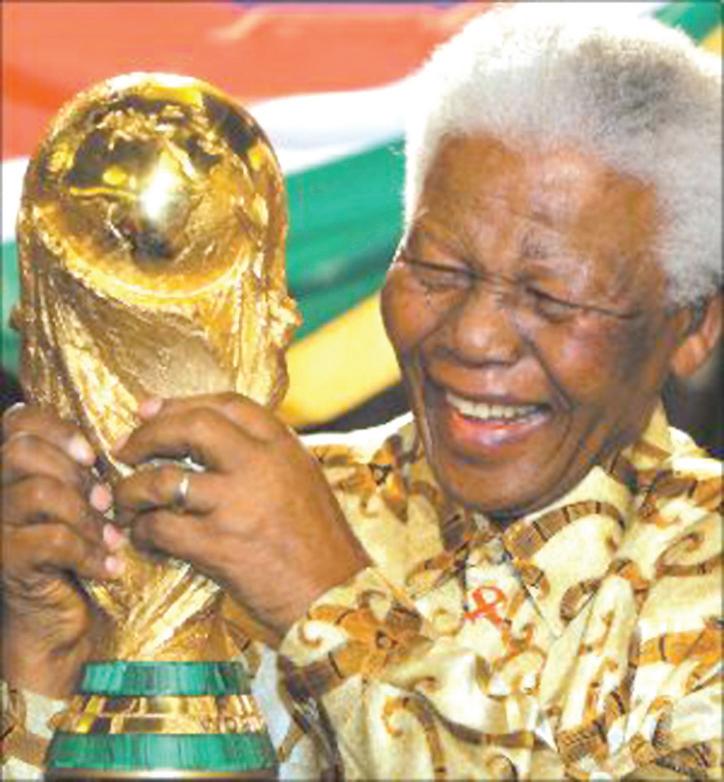
Director of Sport Neil Kumar in the first sitting of Parliament since its resumption was in full support of the Mandela motion, noting Nelson Mandela’s ties to sport and his role in making South Africa the nation that it is today.
The Mandela motion, according to Prime Minister Samuel Hinds, calls on the National Assembly and the people of Guyana to offer condolences to the people and government of South Africa along with Mandela’s family which will be forwarded through the Ministry of Foreign Affairs.
Meanwhile, Kumar believes that Mandela’s struggle and love for sport played a major part in revolutionising South Africa.
to sport that made a difference as he quoted Mandela as saying, “In the year 2000 Mandela said, “Sport has the power to change the world. It has the power to inspire, it has the power to unite people in a way that little else does.”
Beer has been involved,” he said.
“We believe that what the WICB rolled out with the “We vs Them” campaign for the West Indies vs England series fits like a glove with what we have in mind and what we have planned for the upcoming matches in Antigua and Barbados.”
The upcoming series will be feature three OneDay Internationals at the Sir Vivian Richards ground in Antigua (February 28, March 2 and 5) and three T20 Internationals at Kensington Oval in Barbados (March 9, 11, 13). (WICB Media)
“Nelson Mandela was indeed the father of the powerful nation [South Africa]. He was a revolutionary who was born and grew up in poor and humble background [and] became one of the greatest sons of the soil. Sport was a persistent theme in South Africa’s journey from apartheid to emancipation. First, sport was a lightning rod for the mobilisation of the global anti-apartheid movement. However, Mandela, who did not have any hatred for his enemies, but he who had his strong belief in reconciliation, used sport as a means of healing the deep division that plagued South Africa,” Kumar stated in his address.
Further, Kumar recounted many occasions that sport changed in South Africa such as Mandela supporting a predominantly white rugby team in 1995, the exclusion of South Africa from the Olympics that caused African and Asian countries to form a united front, just to name a few.
However, Kumar noted that Mandela’s release from prison caused the antiapartheid movement to end and it was his contribution
Meanwhile, Kumar also noted the work of the Progressive Youth Organisation (PYO) around that time which drew strength from the struggles of Mandela as they too used sport to bind the population together.
“The Progressive Youth Organisation (PYO) organised countrywide lectures and seminars that sensitised and brought apartheid awareness in Guyana. In the 1980’s the PYO organised a big lecture at Friendship House on aparthied. The speakers were the late Chief Justice Mr. Rudolph Harper, Dr. James Rose and Dr. Cheddi Jagan. Sport, which was used as a tool in the struggle against apartheid, became a symbol of change when Mandela was released.”
Moreover, Kumar also noted the greatest good that will forever link Mandela’s struggles to his own legacy.
“Many things matter more than sport as South Africa comes to terms with life after Mr. Mandela, but when black and white play together they can take comfort that the simple act of Nelson Mandela is part of his great legacy,” Kumar ended.
By Rajiv Bisnauth
Guyana’s senior team coach Esaun Crandon says he’s impressed with his squad’s fitness level and is pleased with the general condition of the players as they prepare for the upcoming West Indies Cricket Board (WICB) NAGICO Super50 competition.
During an interview on Saturday at the team’s indoor session held at the Chetram Singh Centre of Excellence at La Bonne Intention, East Coast Demerara, Crandon said several players are now in much better shape than they were when the camp started.
“I am proud to say that the fitness level of the players is at A-1 level at the moment and we are very pleased with that, especially when we look back at the level some of them were when they came into camp,” Crandon observed.
He added, “We secured the services of Guyana Defence Force fitness trainers Patrick King and Carl Stephenson and we have put in some extra training in terms of fitness where some players have definitely improved their fitness from when we started, which is very encouraging.”
He further stated that some players “still have a little way to go but some of them are at a level where they just need to maintain it.”
Meanwhile, the former national medium-pacer was delighted with his team’s preparations to date.
“We hit the ground running from day one of our encampment. Our preparations have been spot on so far.
We focussed immensely on our strength and conditioning and I think it is safe to say that this is the fittest Guyana team in a long time,” Crandon said.
“We’ve had three practice matches and our bowling and fielding are good. Our batting has been going really well, and hopefully we can carry that form through to the tournament.”
Given all the positives over the last few weeks, Crandon remains confident about the team’s chances in the tournament.
“We have a good batting unit, as well as some excellent bowlers and once we play as a unit and play the type of cricket we normally play and work to our game plan there is doubt that we
can’t come out successful. The team is ready and excited,” Crandon concluded.
The NAGICO Super50 competition will be held from January 30 to February 15 in Trinidad and Tobago, featuring Guyana, Barbados, Trinidad and Tobago, Jamaica, the Windward Islands, the Leeward Islands, the Combined Campuses and Colleges and ICC affiliate side Ireland.
The Christopher Barnwell-led Guyana team will open its quest for honours against Ireland in a Zone A match on January 31.
The other two teams in Zone A are Jamaica and defending champions the Windward Islands. The Guyanese will then play Jamaica on February 4, be-
Rafael Nadal, Roger Federer and Victoria Azarenka all won in straight sets, but Maria Sharapova had to work much harder to reach the fourth round at the Australian Open.
Federer beat Teymuraz Gabashvili while top seed Nadal saw off Gael Monfils on a cooler day in Melbourne.
Defending champion Victoria Azarenka brushed aside Yvonne Meusburger but Sharapova survived a scrappy second set to beat France’s Alize Cornet 6-1 7-6.
Spain’s Garbine Muguruza knocked out 10th seed Caroline Wozniacki.
Meanwhile, Dom Inglot is the only remaining Briton in
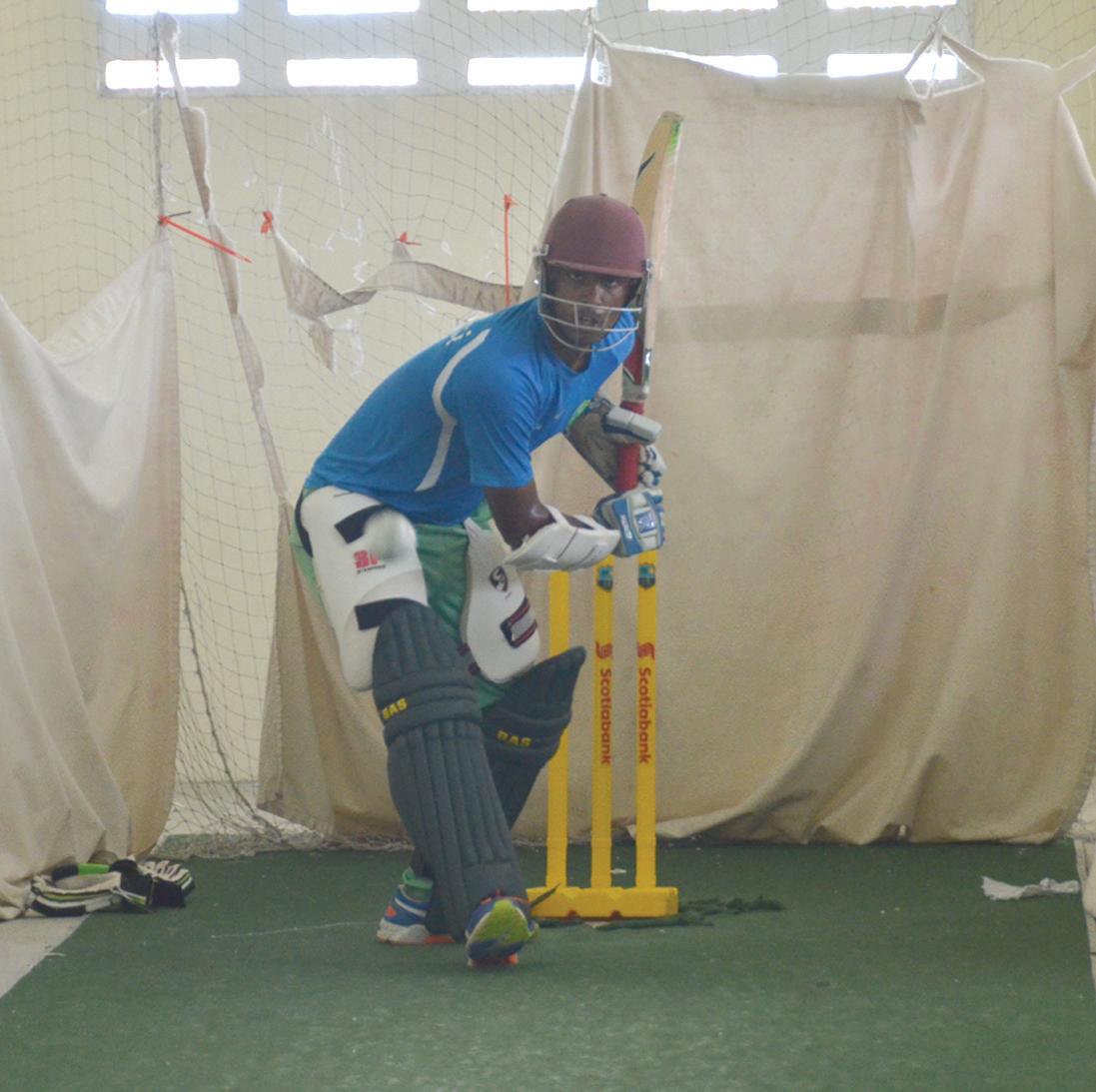
fore taking on the defending champions on February 8.
When the action bowls off month-end, the Guyanese will be aiming for a 10th regional 50-over title, the
last of which was achieved in 2005 when they defeated Barbados in near darkness in the final of the KFC Cup at the GCC ground, Bourda. Prior to that, Guyana reigned supreme in 1980,
1983, 1985, 1993, 1995, 1998, 2001 and 2003.
Guyana’s 14-man squad reads: Robin Bacchus, Trevon Griffith, Leon Johnson, Shivnarine Chanderpaul (vice-captain), Narsingh Deonarine,
the men’s doubles after Colin Fleming, Ross Hutchins and Jamie Murray all went out in round two.
And Andy Murray gave evidence that he could yet be a contender for the title with an impressive third-round win over 26th seed Feliciano Lopez at the Australian Open.
The Briton, playing only his second tournament since having a back operation, won 7-6 (7-2) 6-4 6-2 on Hisense Arena to reach the last 16.
There he will face France’s Stephane Robert, the first man ever to make the fourth round after losing in qualifying only to get a “lucky loser” place when another player withdrew. (BBC Sport)




– Barnwell, Permaul in 30-man training squad
St John’s, Antigua


The Guyana Boxing Association (GBA) has revealed that Jamaica is the only county that has so far confirmed participation at the upcoming International Goodwill boxing championship, organised by the GBA in collaboration with the Guyana Olympic Association (GOA).
Billed for February 1416 at the Cliff Anderson Sports Hall, the threeday event is slated to attract boxers from Guyana, Jamaica, Trinidad and Tobago and St Lucia.
However, according to GBA president Steve Ninvalle, only Jamaica and Guyana have confirmed their participation, while officials here are awaiting word from their counterparts in Trinidad and Tobago and St Lucia. Ninvalle stated that
boxers from Barbados were also invited to compete at the event, but they opted out since two competitions are billed around the same time on that island.
The GBA boss indicated that each country was invited to produce a team of seven boxers, inclusive of
one female to compete at the event.
Ninvalle further divulged that the GBA will be using the event as preparation for the country’s boxers who would be competing at the South American championship, which is slated for March in Chile.
“Right now the Guyanese boxers are in training and they are expected to be encamped shortly,” Ninvalle said. “We want to thank the GOA and its president K.A. Juman Yassin for partnering with us on this event.”
The Jamaican team, which is expected to arrive in Guyana on February 13, comprises head coach Carl Grant, coach Godfrey Collins, lightweight Patrick Sahadeo, light welterweight Anthony Clarke, welterweight Kestna Davis and middleweight Michael Gardner.
The West Indies Cricket Board on Saturday announced the provisional 30-member squad for the ICC World T20 tournament in March and April. West Indies are the defending world champions in this format. They won the title with victory over Sri Lanka in the final at the R Premadasa Stadium back in October, 2012.
The ICC World T20 will be played in Bangladesh from March 16 to April 6.
The Windies will play all their preliminary round matches at the Sher-eBangla Stadium in Mirpur. They open against India on March 23 and two days later take on one of the ICC Qualifiers.
The third match will be against Australia on March 28 followed by a clash against Pakistan on April
1. The semi-finals are slated for April 3 and 4, with the grand final on April 6. Hard-hitting all-rounder Christopher Barnwell and left-arm spinner Veerasammy Permaul are the only two Guyanese in the 30-man squad. The squad reads: Christopher Barnwell, Sulieman Benn, Tino Best, Samuel Badree, Darren Bravo, Dwayne Bravo, Johnson Charles, Kevon Cooper, Sheldon Cottrell, Fidel Edwards, Rayad Emrit, Andre Fletcher, Chris Gayle, Jason Holder, Delorn Johnson, Nikita Miller, Sunil Narine, Ashley Nurse, Veerasammy Permaul, Kieron Pollard, Denesh Ramdin, Ravi Rampaul, Kemar Roach, Andre Russell, Darren Sammy, Marlon Samuels, Krishmar Santokie, Lendl Simmons, Dwayne Smith and Chadwick Walton.
(WICB Media)