Guyana’s UN Rep pledges stronger push for peace if elected UN Secretary General
vows to “get the needle moving” on resolving global conflicts
Caricom eyes stronger electoral oversight through training, capacity building – SG Barnett ...urges leaders to accelerate CSME, climate & food security goals
Works progressing on US$32M sugar refinery, fertiliser plant
...operations likely to commence in 2027
Corentyne villages under water following heavy downpours
4 Venezuelans homeless after violent attack ends with house set on fire
GDF reaffirms commitment to regional security, unity
Intersections of Heroes Highway to be fitted with traffic lights
Reform Commission invites public proposals for changes to Guyana’s Constitution
BRIDGE
OPENING
The Berbice Bridge will be closed to vehicular traffic on: Tuesday, July 7 –09:05h–10:35h and Wednesday, July 8 – 10:05h–11:35h
Guyana’s UN Rep pledges stronger push for peace if elected UN Secretary General
– vows to “get the needle moving” on resolving global conflicts
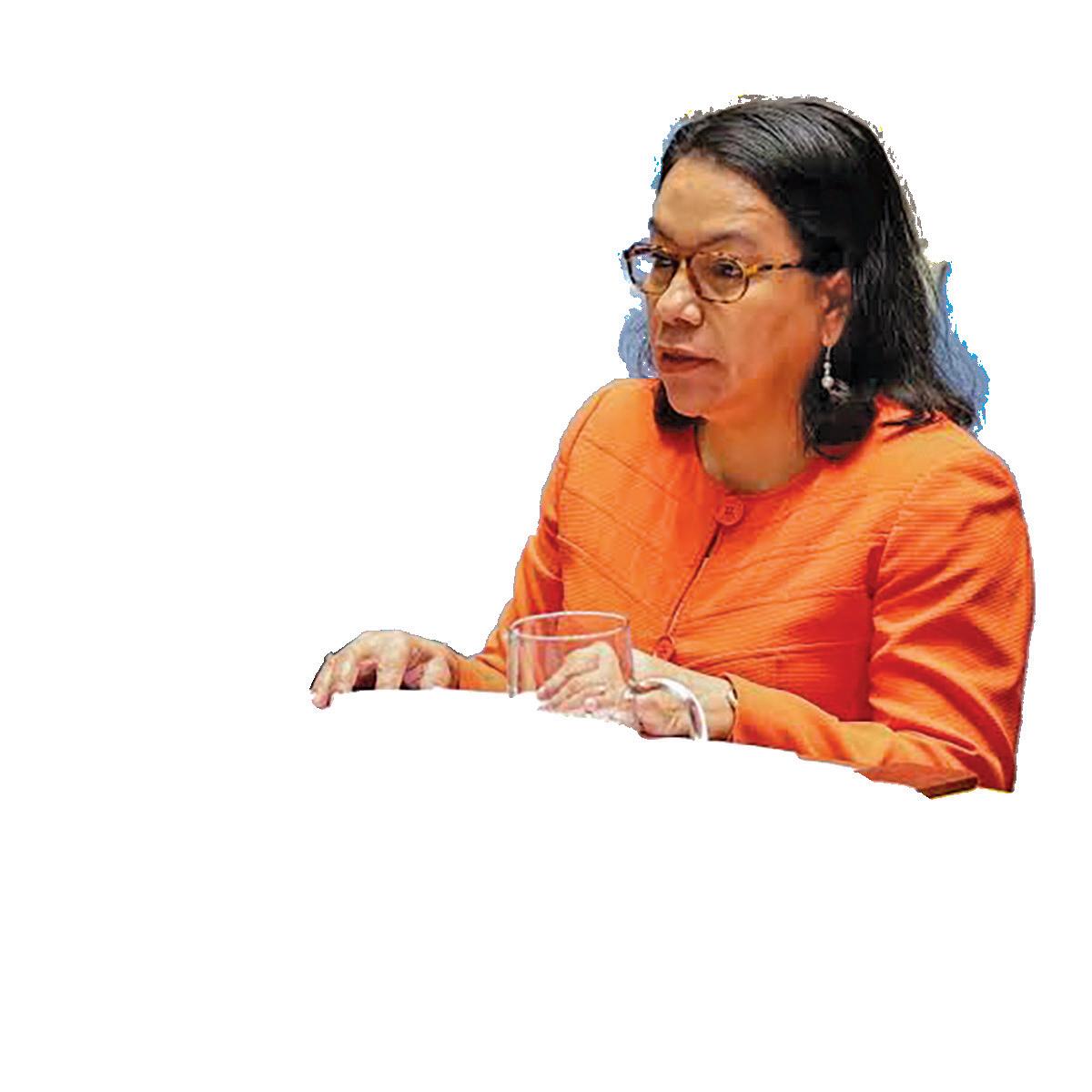
While acknowledging the complex geopolitical realities underpinning conflicts around the world, Ambassador Carolyn Rodrigues-Birkett says she is committed to advancing efforts toward peaceful resolutions if she is successful in her bid to become the next Secretary-General (SG) of the United Nations (UN). The Guyanese diplomat, who is seeking the prestigious post after being nominated by the Government of Guyana, made the remarks during a recent interview with the News Room. Responding to questions about changing the image of the UN when it comes to addressing conflicts, Ambassador RodriguesBirkett reminded us that “the UN is all member states. The UN is us. “ She further highlighted that “we cannot underestimate the geopolitical realities as well. And it might not be the case that the UN is not trying, but there are other factors in this as well.”
Nevertheless, she explained that the SG can put forward proposals on how “we can move the needle a bit” with some of the ongoing conflicts. “I do believe, and this is why I put myself forward, that we can do more; that the Secretary-General can put forward proposals on how we can move the needle a bit with some of the conflicts that we face right now. Some of them are extremely difficult, but I think that when you decide to run for SecretaryGeneral, you are preparing for the difficult,” she outlined. “And I have seen in my time on the Security Council, where you have, for example, peacekeeping missions for decades and decades, and the political solution has not moved. And I think we need to work on those. And I believe we can work on those and use the moments, use the moments that are presented to us. The Secretary-General has at his or her disposal several tools, including the good offices process, mediation and a number of tools. One of the things I have said is I would be prepared to make those suggestions, even if they ‘ re rejected, because we know the structure that we’re also operating in,” she added. According to RodriguesBirkett, her approach to “thorny issues” has always been to encourage dialogue. “Some things that can’t happen in decades sometimes can happen in a very short space of time if you make an effort. And the UN is endowed with a lot of brilliant people, I believe too, on the ground. If you have the right team around you, giving you the right information, the right advice, and working, of course, with the Security Council, with the Member States concerned, and with regional organisations that might be involved, I think you can move the needle,” she
noted. “We have to be positive about this. War is not sustainable. Conflict is not sustainable. Peace is,” she affirmed. Beyond peace and security matters, Ambassador Rodrigues-Birkett reminded us that the UN is much more. “The UN, I believe, has meant stability for this world. And as I’ve said in the interactive dialogue and in several places before, you cannot put a price on prevention. While there is conflict in many parts of the world, there’s also peace in many parts of the world. We are not able to see what it would have been like without the UN. The UN is not just about peace and security; it’s about development as well. You will hear countries speak about how the UN helped them to get to where they are at the mo-
ment, from conflict to peace to development. In our own country, Guyana, the UN was at our side since the early 1960s when we had the issue that still continues today with our neighbour. The good offices process, I believe, was a form of prevention. I believe in the UN. I really do believe in the UN. My work with FAO, my work as Minister of American Affairs, and my work in Foreign Affairs have shown me the benefit of the UN,” she highlighted. “In fact, many people probably are not aware that one of the things we did when we were revising the Amerindian Act was to ask the UN to help us with best practices from across the world. They were able to bring that to us. So, I would say the UN is a force for good,” she added. “You
might not think that when you are flying in an airplane the UN is involved, but the safety of our skies is dealt with by the ICAO (International Civil Aviation Organisation), which is a UN organisation. The food standards that we all agree to also live by, set by FAO (Food and Agriculture Organisation) and WHO (World Health Organisation), are also UN standards. Again, UNICEF (United Nations Children’s Fund) for children, it’s the UN. UNDP (United Nations Development Programme) on development is the UN. The UN is much more than just the Security Council that we tend to feel is not doing enough,” she further outlined.
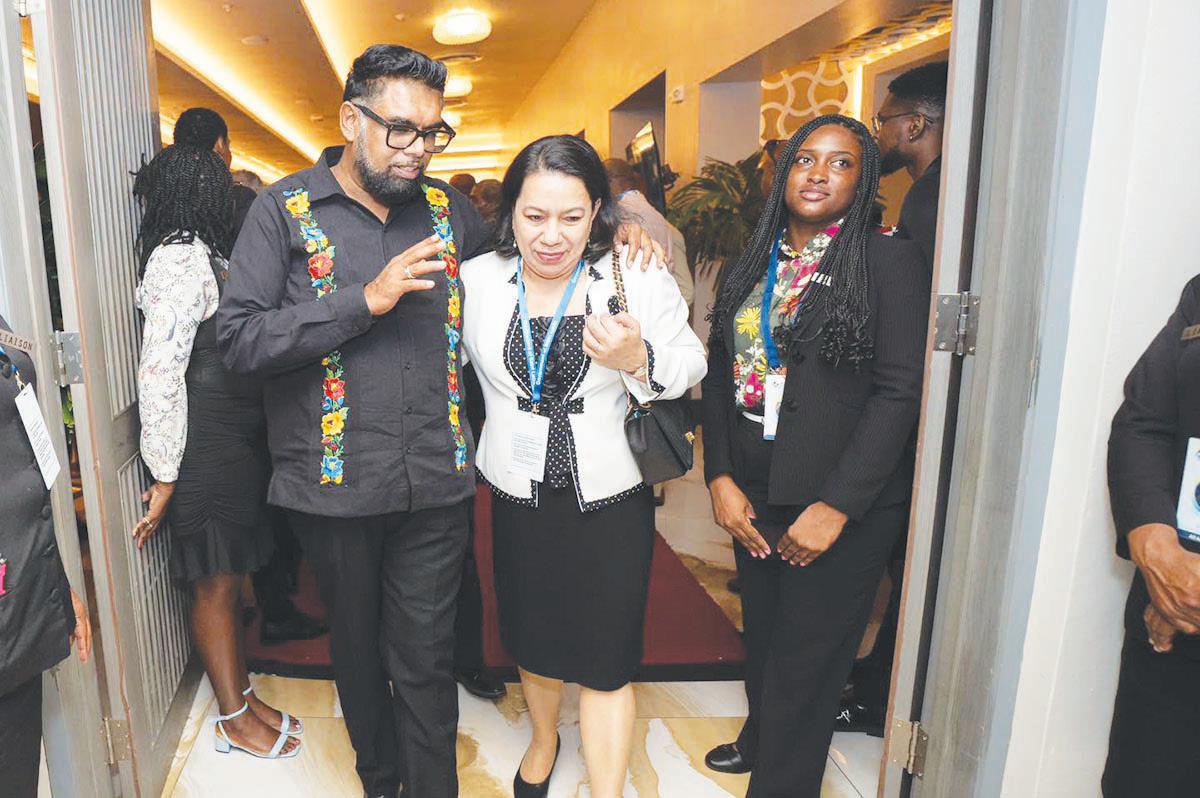
Guyana’s Permanent Rep to the UN, Ambassador Carolyn Rodrigues-Birkett and President Dr Irfaan Ali in St Lucia
President Dr Irfaan Ali’s call for more men to undergo prostate screening is among the most important public health messages delivered in recent months. It addresses an issue that has long been overshadowed by fear, stigma and misinformation despite the devastating toll prostate cancer continues to take on Guyanese families.
The President’s message was direct, “Men, there is nothing to fear about having a prostate examination. It will save your life.” Those words should become the foundation of a national conversation about men’s health and the responsibility every individual has to seek preventative care.
Too often, men avoid routine medical examinations until symptoms become severe. This reluctance is rooted in a culture that frequently equates masculinity with toughness and silence. Many men would rather endure discomfort than visit a doctor, while others avoid prostate examinations because of embarrassment or misconceptions surrounding the procedure. Unfortunately, these attitudes can come at a tremendous cost.
Prostate cancer remains one of the most common cancers affecting men and as President Ali noted, it is the leading cancer among men in Guyana. Yet it is also among the most treatable forms of cancer when detected early. That reality cannot be ignored. Early diagnosis dramatically improves treatment outcomes, reduces the need for more aggressive interventions and, most importantly, saves lives.
This is precisely why the President’s frustration over the low uptake of screening services in Region Two is justified. The fact that only 335 men have undergone screening despite the service being available is not a failure of infrastructure but perhaps a failure of awareness, engagement and perhaps personal responsibility. Building hospitals and providing equipment are essential first steps, but those investments only achieve their intended purpose when citizens utilise the services that are available to them.
President Ali’s directive for the Regional Health Officer to increase the number of men screened to at least 3000 before the end of the year is ambitious, but ambition is exactly what is required if Guyana is to change the trajectory of cancer outcomes. Meeting that target will require more than advertising campaigns. Health workers must visit communities, workplaces, religious organisations and social groups to educate men, answer difficult questions and dismantle the myths that continue to discourage screening.
Equally commendable is the Government’s parallel emphasis on women’s health. The introduction of mammography services in Region Two is another significant step towards expanding access to preventative health care. For many women, a mammogram costing approximately $40,000 would simply be beyond financial reach. Offering the service free of charge removes a major barrier and reinforces the principle that quality health care should not depend on one’s income or location.
Here again, however, availability alone is not enough. The President’s target of increasing mammograms from just over 435 to at least 3000 by year end shows an understanding that healthcare investments must translate into measurable improvements in public health. Screening programmes only fulfil their purpose when people participate.
These initiatives also highlight a transformation taking place within Guyana’s healthcare system.
Yet the greatest challenge facing modern health care is often not the construction of facilities or the procurement of sophisticated equipment. It is persuading people to make use of them before illness reaches an advanced stage.
Preventative medicine remains one of the most cost-effective and humane approaches to health care. Every cancer detected early spares families emotional anguish, reduces the financial burden of prolonged treatment and increases the likelihood that patients will continue leading productive lives.
President Ali’s appeal to men, therefore, should not be viewed as a Government initiative or another public awareness campaign. It is a call to confront outdated attitudes that have prevented too many men from taking charge of their health. Courage is not demonstrated by avoiding a medical examination. Courage is demonstrated by recognising that protecting one’s health also protects one’s family.
A prostate examination may last only a few minutes, but it could add many more years to a man’s life. That is a message every Guyanese should take seriously.
Venezuela under Rodríguez under heavy scrutiny from US
Dear Editor, The United States captured or kidnapped, it doesn’t matter what you call it, Nicolás Maduro and his wife, the former head of the Venezuelan regime, in dramatic fashion, literally invading Venezuela long enough and with military precision to grab him, transport him to America, and put him in prison. What difference, if any, does it make to the determination of Venezuela’s claim to Essequibo?
Should we now be relieved that the threat of a military invasion from Venezuela has disappeared? The Venezuelan Government under acting President Delcy Rodríguez, apparently now under US control, will simply give up a claim that every Venezuelan, from cradle to grave, has been taught to believe in. If any Guyanese believes that, then they are sadly mistaken.
The former British High Commissioner to Guyana, Greg Quinn, who remains, to his credit, very much interested in the welfare of our country, writing in Stabroek News (26th February 2026), knows better: “Venezuela has not changed. The folks who supported Maduro when he was President are still in chargeand they have not changed their opinions.” He asks the question, “ Why should anyone believe, that Venezuela would change its position because its brutal dictator was replaced by the woman who was his right-hand?”
Just ten days ago, Quinn pointed out that Venezuela’s Foreign Minister, Yvan Gil, had this to say: “ The peoples of Guyana and Venezuela are certain we will find a solution, a definition of this controversy through a mechanism by this agreement of direct con-
sultation, as mandated by this agreement.” He refers to the Geneva Agreement, which Venezuela continues to misinterpret.
The Geneva Agreement between the United Kingdom and Venezuela in February 1966, and joined by Guyana when we became independent three months later, allowed for a period of diplomatic negotiations between Venezuela and Guyana as the first means of resolving the controversy. If that didn’t settle the validity of the 1899 Arbitral Award , which fixed the boundaries between Guyana and Venezuela as now exists, and which it didn’t, it further allowed for the matter to be referred back to the Secretary-General of the United Nations to propose further means of settlement, who then proposed a “Good Offices Process” under his supervision, prolonging the matter for another twenty years without progress.
The Secretary-General then, in accordance with the provisions enshrined in the Geneva Agreement, informed Guyana and Venezuela on 30th January 2018 that he had decided that the means of settlement would be judicial settlement by the International Court of Justice (ICJ), where the matter is still being pursued - a decision which is final and which both Guyana and Venezuela are bound to accept.
Choosing to ignore the decision of the Secretary-General and refusing to acknowledge the authority of the Court, the Venezuelan Government persists with its attempt to return the matter to bilateral negotiations, but, as Greg Quinn correctly points out, “there is nothing to negotiate” and... “There is nothing to suggest there are grounds for re-
negotiations.... the border was settled in 1899, and the 1966 Geneva Agreement does nothing to suggest that the border was invalid or wrong.”
The fact now is that the Trump administration, having removed Maduro, has left in control of Venezuela not only Rodríguez, but the Minister of Interior, Diosdado Cabello, and Defence Minister, Vladimir Padrino, who controls the army -all of whom were Maduro’s loyalists.
The real danger in all of this is referred to by Dr Bertrand Ramcharan when writing in the Stabroek News (21st January 2026) that while, “as a policy proposition, the USA may remain disposed to protect Guyana’s sovereignty. It cannot be excluded, however, that it might wish to promote a negotiated settlement between Guyana and Venezuela-even if it supports the continuance of the proceedings at the International Court of Justice.”
The US has now reestablished its Embassy in Caracas, seeking to replace the presence and influence of Iran, China, and Russia with American control in place.
It is reasonable to ask, in the circumstances, why has the US left exactly the same Venezuelan Government officials in charge, other than Maduro, and to what extent does the US Government have control over Venezuela? The answer for the time being seems obvious. Once Delcy Rodríguez exercises control over Cabello and Padrino, she exercises control over the Venezuelan military and control over the Venezuelan oil and gas industry and seems willing to hand it over, lock, stock, and barrel to the US oil companies to restore, manage, and market.
The American President is on record that US relationships with Venezuela are “very good, “ and, in fact, he plans to visit Venezuela soon. A Reuters release in February 2026 quoted Trump as saying, “we have a very good relationship with the President of Venezuela” and that the US is “working together very closely” with Rodríguez on access to oil. Interestingly, however, Reuters reports that the “Trump administration officials in recent weeks made clear that the US did not recognise Rodríguez ‘s interim Government as legitimate.”
In turn, Rodríguez, playing both sides against the middle, told NBC News that she recognises Maduro as still “the legitimate President” of Venezuela.
Donald Trump, however, is clearly not leaving anything to chance with Rodríguez in charge of Venezuela. A Reuters report, which the US Justice Department denies, reveals that Rodríguez is under threat of being charged by a US Court for criminal behaviour. It is a safe bet that if Rodríguez does not do what she is told to do, she will suffer the same fate, or worse, as Maduro.
While all of this is going on, one thing seems to be absolutely certain: the present Government in Venezuela under Rodríguez, even if under heavy scrutiny from the US Government, has not and will not abandon its claim on the Essequibo, and all in Guyana must know that, understand the possible, if not probable, consequences, and that we must never let our guard down in protecting our nation’s sovereignty.
Yours sincerely, Kit Nascimento
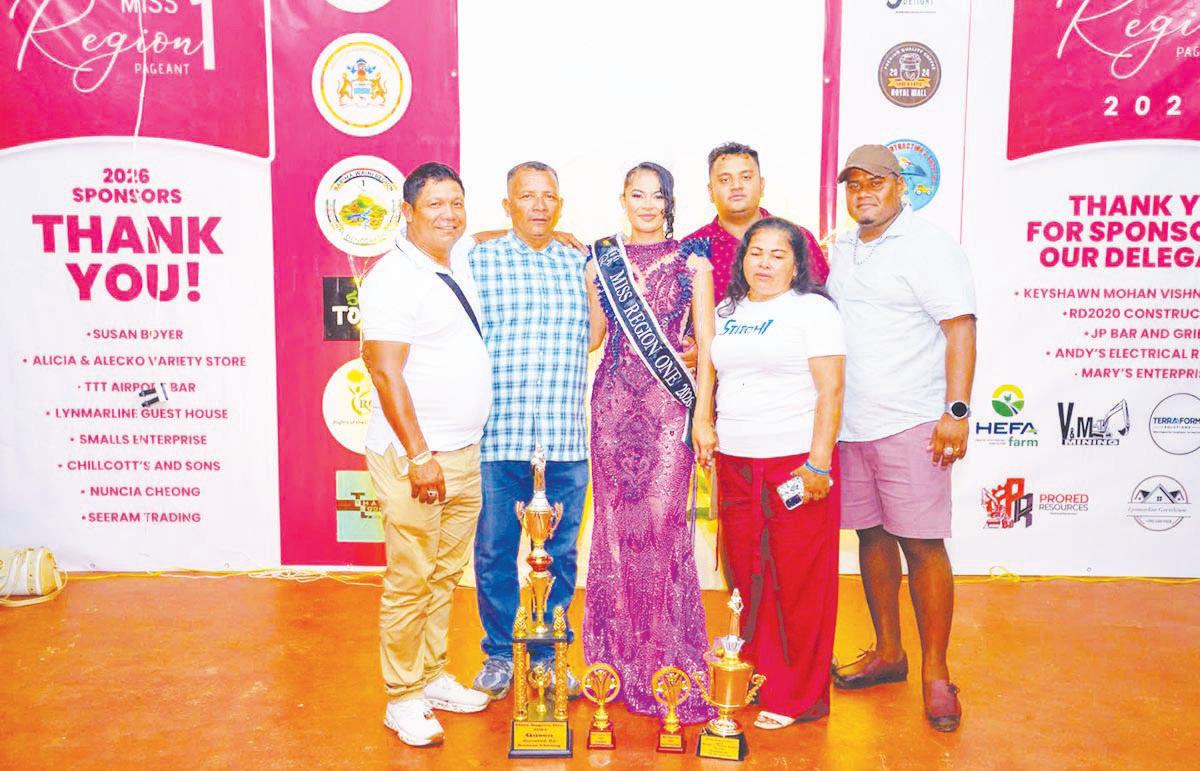
Miss Matarkai Omirah George outshone her competitors over the weekend to cop the Miss Region One title. She was sponsored by TORE “The Off-Road Experience”, V&M Mining, Miquel’s Sports Bar & Grill, Kiarah’s Variety, and Mr Earl Gildary. In this photo, the newly-crowned queen is flanked by relatives
Who protects consumers from horrible telecommunications service in Guyana?
Dear Editor,
I am writing to express my deep frustration about the quality of telecommunications services being provided to consumers in Guyana by One Communications and to ask whether the rights guaranteed under our consumer protection laws are being adequately upheld.
As a customer of One Communications for almost two decades, I am disheartened by the terrible service I’m literally being forced to subscribe to.
I upgraded to a Business Postpaid plan with the expectation of receiving improved service.
Instead, I have experienced more frequent internet outages, unreliable mobile connectivity, and numerous occasions where people attempting to call me have been unable to reach me. As a business owner, I have missed important business calls and opportunities locally, regionally, and internationally because of these persistent service failures.
The problems do not end there. My home internet service has also been unreliable, and the Pushto-Talk devices I use for business operations have performed poorly. I stopped paying that bill but am still being charged for it. I have reported these issues to One Communications on numerous occasions, yet the problems continue. Despite this, I am expected to pay my monthly bills in full for a service that repeatedly falls below a reasonable standard.
The Consumer Affairs Act 2011 was enacted to protect consumers and promote fair treatment in the provision of goods and services. Consumers have a right to expect that the services they pay for are delivered with reasonable quality and reliability. When those expectations are not met, companies should be held accountable and should work promptly to resolve legitimate complaints.
I therefore call on One Communications to take
these complaints seriously and improve the quality and reliability of its services. I also urge the Competition and Consumer Affairs Commission and the Public Utilities Commission to investigate recurring complaints about telecommunications services.
Telecommunications are no longer a luxury; they are essential for businesses, education, healthcare, emergency communication, and everyday life. Consumers deserve de-
pendable service, transparency and accountability. It is time for customers’ voices to be heard and for meaningful action to be taken. In saying that, I believe I will have no other option than to take One Communications to court because I’m fed up with complaining to them and still receiving the same distasteful service.
Sincerely, Quincy Anderson
Guyana recognised for its environmental stewardship
Dear Editor,
What an achievement!
I speak here of Guyana’s election to the Extractive Industries Transparency Initiative (EITI) board, thereby showing its prominence and global influence in the extractive-sector transparency milieu.
As Dr Prem Misir, Adviser for Government Agency Engagement on EITI Affairs at the Ministry of Natural Resources, pointed out, this “… marks a significant milestone for the country and highlights its growing influence in promoting transparency and accountability in the management of natural resources.”
A touch of history, easily accessible too, is in order here, as I recall that the EITI was formally launched at a conference in Lancaster House, London in June 2003, where some140 delegates adopted the 12 core EITI Principles. This was a progression emanating from former UK Prime Minister Tony Blair, one year earlier, at the 2002 World Summit in Johannesburg.
Very important to note was that the initiative was created to address the “resource curse” in developing nations, where wealth from oil, gas, and minerals often leads to increased poverty, conflict, and corruption. It thus provides a global standard for openness and ac-
countability, by requiring member countries and companies to disclose revenues and payments. To this august body, Guyana officially became a candidate member in October 25, 2017, by virtue of its ‘pledged’ commitment to improving transparency and accountability in its growing natural resource, oil, and mining sectors.
Now look where Guyana is?
As per the news, Minister of Natural Resources, Vickram Bharrat, was recently elected as a Principal Member of the Implementing Country Constituency on the EITI Board. He was elected to represent Latin America and the Caribbean for the 2026–2029 term, placing Guyana among the ‘decision-makers’ responsible for guiding the direction of the global transparency initiative.
And why not? Look at it. Guyana made history as the first nation to receive private sector validation for jurisdictional carbon credits, securing landmark agreements (such as a $750 million deal) to ensure standing forests remain economically valuable. Guyana, in fact, is an authentic global environmental leader in this domain, acting as a net carbon sink, while maintaining 85 per cent of its original rainfor-
est cover.
So indeed, as Dr Misir extolled, the appointment firmly positions Guyana on the international stage as a major EITI member country. Guyana has a voice with a with global audience, as there are some 55 countries that are part of this EITI network.
Pity it is that up to this point “… many Guyanese are (still) unfamiliar with the work of the EITI, despite the country’s growing oil and gas sector and increasing participation in the organisation.” As
was clearly iterated by Dr Misir, “… the EITI is a global standard, established to promote good governance in the oil, gas and mining industries throughout the entire extractive value chain … it is a global standard created to achieve good governance of oil, gas, and mineral resources across these industries’ value chain. This global standard makes certain that the natural resources benefit the country’s citizens.”
I add, ‘so far so good,’ as Guyanese truly have reasons to be proud, see-
ing that country maintains over 87 per cent forest cover with among the lowest deforestation rates on Earth, as it sustainably balances economic growth with pristine rainforest conservation, acting as a massive global carbon sink.
Editor, there is no need for more elaboration, as the evidence precludes any criticism regarding what is happening and how the accountability and transparency are being monitored. Suffice to say that Guyana, as a participating country, is periodical-
ly being assessed through a validation process, which measures whether or not they are meeting the EITI’s global standards. This kind of work globally is well supported by the UN, G8, G20, the World Bank, and the IMF. I heap kudos on the People’s Progressive Party/ Civic Government overall, and I specifically ‘hail’ the work being effected by the relevant Ministries and enforcers.
Yours truly, Hargesh B Singh
TUESDAY, JULY 7, 2026
Page Foundation
Customary Units of Weight
The customary units of weight (that is the units commonly used) are ounces (oz); pounds (lb) and tons.
1 pound = 16 oz
1 ton = 2204.6 lb
You can compare these units to each other.
To complicate matters further, a ton may relate to two different weights. In the United States, they measure by the US Ton or short Ton, while the British Ton, known as an Imperial Ton or long Ton is heavier.
A short Ton, the US customary version, is equal to 2000 pounds
A long Ton, the mostly outdated Imperial Ton, is equal to 2240 pounds
A tonne, also known as a metric Ton, is equal to 1000kg, (or 2204.6 pounds)
Example:
How many ounces are in two pounds?
Step 1: You know that there are 16 oz in one pound. So multiply the number of ounces in one pound by two.
Step 2: 16 x 2 = 32 ounces in two pounds
The standard units of measurement that should be used in Guyana are the metric measurements. It is necessary to know customary units of weight to convert them to metric units.
Exercises: Convert
1) 10 pounds to ounces
2) 81 tonnes to pounds
3) 18 ounces to pounds
4) 150 pounds to tonnes
5)2.5 tonnes to pounds
Grape Bubble Printing
Create a vibrant bunch of grapes artwork using a fun bubble painting technique! Start by using purple paint mixed with a little soapy water to create bubbly paint. Place watercolour paper over the bubbles to print soft, textured circles that form the grapes. Layer and build up the shapes to create a full, colourful bunch, then add details like stems and leaves to finish your fruity masterpiece!
What you'll need
Watercolour paper
Cardboard (white)
Red, pink & purple acrylic paints
Scissors
Ruler
Washing up liquid
Cardboard tube
How to make
Step 1: In a small container, mix purple paint with a squirt of washing-up liquid and a little water.
Step 2: Dip the end of a tube into the mix, making sure a bubble forms over the opening.
Step 3: Gently press it onto your paper to print grape shapes, then leave to dry.
Step 4: Cut out some leaves out of cardboard.
Step 5: Stick the leaf onto your finished grape bunch.
(Adapted from bakerross.co.uk)
By Hussein Al-DAHir
Translated By Dalal Isaac
Translated from the Arabic
Each morning, I reassemble my face—
I find my eye in the ashtray, weeping silently for the homeland. I lift it out, brush off the soot, and nestle it back into its hollow. My ear, as always, sits before the television, waiting to embrace a rogue word of peace. I pinch it cruelly by its edge, then fasten it to my skull.
My mouth lurks by the window, cursing passersby. My nose meddles in poetry, and catches the flu.
(Source: Poetry [July/August 2026])
Constitution Reform Commission invites public proposals for changes to Guyana’s Constitution
…written submissions accepted until Dec 31
The Constitution Reform Commission (CRC) has launched a public call for written submissions as it begins the process of reviewing Guyana’s Constitution, inviting citizens and organisations to propose changes they believe should be considered.
Notices published in the Sunday, July 5, 2026 edition of Guyana Times state that members of the public have until December 31, 2026 to submit written proposals for constitutional reform. According to the Commission, the review will examine a broad range of issues identified in the CRC Act 2022, while remaining open to additional proposals from the public. Among the areas identified for review are the protection of the fundamental rights and freedoms of all Guyanese; the rights of Indigenous peoples and children; the elimination of discrimination; improving race relations and promoting ethnic security and equal opportunity; and ensuring that minority views are adequately considered in decision-making and governance.
The Commission will also consider proposals relating to electoral reform, including the composition of the Guyana Elections Commission (GECOM), the method of appointing its chairman and members, and its jurisdiction over national registration and the electoral process. Other areas of focus include measures to strengthen economic, social and cultural rights; preserve the independence of the Judiciary; safeguard public funds and promote integrity in public life; improve the effectiveness of the National Assembly; and enhance the capacity and functioning of the local Government system. The CRC has instructed that all submissions be clearly labelled “Written Proposal on Constitution Reform.” Submissions must include the contributor’s full name, address, email address and other contact information, along with a scanned copy of a valid photo identification. Proposals may be delivered by hand or mailed to the Office of the Secretariat on the fifth floor
of the Constitution Reform Commission building at 211 Camp and Lamaha Streets, Georgetown, or submitted via email.
The Commission noted that individuals whose submissions require further discussion may be invited to participate in face-to-face consultations.
Two-tiered consultation process
In a separate notice, the CRC explained that it was established under the Constitution Reform Commission Act 2022 and is mandated to review the Constitution to ensure it addresses the current and future rights, liabilities and obligations of the people of Guyana. Following the consultation process, the Commission will compile the submissions and prepare recommendations for the Parliamentary Standing Committee for Constitutional Reform, which will then transmit the report to the National Assembly. The Commission said the legislation requires it to consult with the wid-
est possible cross-section of Guyanese, including communities across all regions, religious and cultural organisations, political parties, youth groups, students, women’s organisations, the private sector, professional bodies and the media. To achieve this, the Commission said it will adopt a two-tiered consultation process consisting of written submissions and public engagements throughout Guyana’s 10 administrative regions, as well as consultations with members of the Guyanese diaspora. CRC Secretary Javed Shadick said the public’s participation will provide the foundation for the Commission’s recommendations on constitutional reform. The public call for submissions comes days after Attorney General (AG) Anil Nandlall urged Guyanese to participate in the constitutional reform process, describing it as a matter of national importance.
Speaking during his Issues in the News programme on June 30, Nandlall said the Constitution would be re-
viewed in its entirety but that the exercise had been organised into thematic areas for ease of public consultation. He encouraged individuals, groups, communities, organisations and institutions to make submissions, noting that public input would influence the constitutional amendments ultimately proposed. Nandlall had also explained that while the Commission identified several priority areas for review, including electoral reforms, judicial independence, protection of fundamental rights, and measures to safeguard public funds, stakeholders were not limited to those topics and could make submissions on any constitutional issue they considered important.
He further indicated that submissions would be accepted both electronically and in person and that the Commission would conduct consultations across the country to facilitate oral presentations from stakeholders. The current 21-member CRC, chaired by former Acting Chancellor of the Judiciary Justice Carl
Singh (Ret’d), was sworn in by President Dr Irfaan Ali in 2024 after the Constitution Reform Commission Act was passed in the National Assembly in 2022. However, following the September 2025 General and Regional Elections, changes in the composition of Parliament created the need for amendments to the Constitution Reform Commission Act, which currently provides for five Government representatives and five representatives from the Parliamentary Opposition, including four from the main opposition party and one from the former joinder parties. The current Parliament comprises the People’s Progressive Party/ Civic (PPP/C) Government, with 36 seats; the We Invest in Nationhood (WIN) party, with 16 seats, as the main opposition; A Partnership for National Unity (APNU), with 12 seats; and the Forward Guyana Movement (FGM), with one seat. Former Alliance For Change (AFC) representative Nigel Hughes has since resigned from the Commission.
Guyana’s UN Rep pledges stronger push...
Moreover, in response to commentary that the UN is just a talk shop, she emphasised that “talking saves lives; talking prevents war; talking is what diplomacy is about. I think we need to talk more, in fact.” Another key approach, if selected to serve as UNSG, Ambassador Rodrigues-Birkett said, is to get more young people involved. “We already have young people involved in the UN, but I think we need to have them more involved, not just as people to consult with, but as people to shape policies as well,” she noted.
Demanding Job
During the interview, Ambassador RodriguesBirkett recalled the moments leading up to her nomination for the job. “This call for me to put myself forward came many, many months before. Many colleagues were asking me, ‘ Are you going to run? Are you going to run?’ I think it came from different perspectives. One, Guyana was very active here at the UN, even before we went on the Security Council. I was involved in co-facilitating three UN processes -that’s basically the negotiations by member states. And so, people get to know you a bit closer there. Then, once we were on the Security Council, representing Guyana, Guyana’s identity, diplomatic identity, and foreign policy identity became very clear to the world. So, I think this is where it came from. Colleagues were just asking, ‘ When will you do this?’ It took a long time for
me to decide... because it’s a demanding job, but it’s also one that requires quite a lot of you personally,” she outlined. “And so, I thought, though, that I always encourage people to put their best foot forward. I should be an example in doing that myself and not just giving advice on it.” According to the diplomat, she believes she has what it takes for the top position. “I’ve learned that in these years, both as a Foreign Minister and here at the UN, to try to be calm. I think for a job like this, you need to be calm and collected because there are so many things happening all across the world that require your attention. You need to be focused. I have practiced that quite a bit over the years,” she explained. Ambassador Rodrigues-Birkett also recognised what the position would mean not just for Guyana but for indigenous peoples. In fact, she was aware of her influence as a role model since her ascension to public life. “Since I took on the role as Minister of Indigenous Peoples Affairs, or, as we say in Guyana, Minister of Amerindian Affairs, I was well aware that this was not just about me, but that I was carrying the aspirations and the challenges of an entire people on my shoulders. At the age of 27, I was conscious of that. My mother reminded me about thatmake sure you carry yourself in a particular way because all eyes are going to be on you. When you’re judged, it’s your entire group of indigenous peoples that would be judged,” she recalled.
But she noted that this new journey is more than just about one group of people. “I would like to see this represent Guyana as a whole. I think our country is doing very well on the diplomatic scene right now, on the economic scene and on the social scene. All eyes are on us, just as they were when we were on the Security Council. But I also want this for women across the world and for people like me who come from a rural area where there was no electricity. Up to the time I left Moruca, there was no electricity and no piped water, but you could still dream. We don’t know what is going to happen with this process, but just being nominated is a real honour and a privilege. So, I thank President Ali for doing this and the Government of Guyana,” she expressed. While there was no defining moment in her childhood that set the stage for her life now, Ambassador RodriguesBirkett recalled the support from her parents and one particular teacher who helped guide her path to success.
“ Looking back now, I can see that I wanted to be someone who could speak on behalf of people. I used to be called upon in school quite a bit to do the ‘welcome’ whenever a President visited. I had to do a welcome address to President Hoyte and when Ministers were visiting. I had to practice a lot. I wasn’t very good on stage. But I had a teacher, Bridget Daniels, who would say to me, ‘ Look over the heads of the audience, and then
you will gain confidence. ‘ I practiced that for a long time. She said, ‘ One day you’ll be able to look into the eyes of people and speak. ‘ I think I’m at that stage now. Maybe, in some way, my early days with my teachers prepared me for this. But also, my father and mother always encouraged all of us to do our best.” Five official candidates are running to succeed António Guterres as the next UNSG, whose five-year term begins on January 1, 2027. According to the UN, the SG is appointed by the 193-member General Assembly on the recommendation of the
Security Council. While the 15-member Council, particularly its five permanent members who may veto any candidate, plays a decisive role in shaping the recommendation, the appointment is ultimately made by the Assembly. In the 80 years since the founding of the UN, there have been nine SGs, but a woman has never held the post. If successful, Rodrigues-Birkett would make history as the first woman ever elected to serve as SG of the UN since the organisation was established in 1945. She would also be the first Caribbean national to hold the position. Rodrigues-Birkett has served as Guyana’s Permanent Representative to the UN since 2020. In that capacity, she led Guyana’s participation during its Security Council tenure and played a key role in advancing the country’s positions on issues relating to international peace and security. Prior to her current post, Rodrigues-Birkett served as director of FAO Liaison Office in Geneva from 2017 to 2020. She previously served as Guyana’s Minister of Foreign Affairs from 2008 to 2015 and as Minister of Amerindian Affairs from 2001 to 2008.
GDF reaffirms commitment to regional security, unity
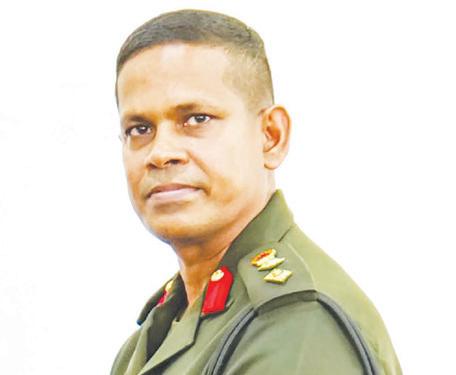
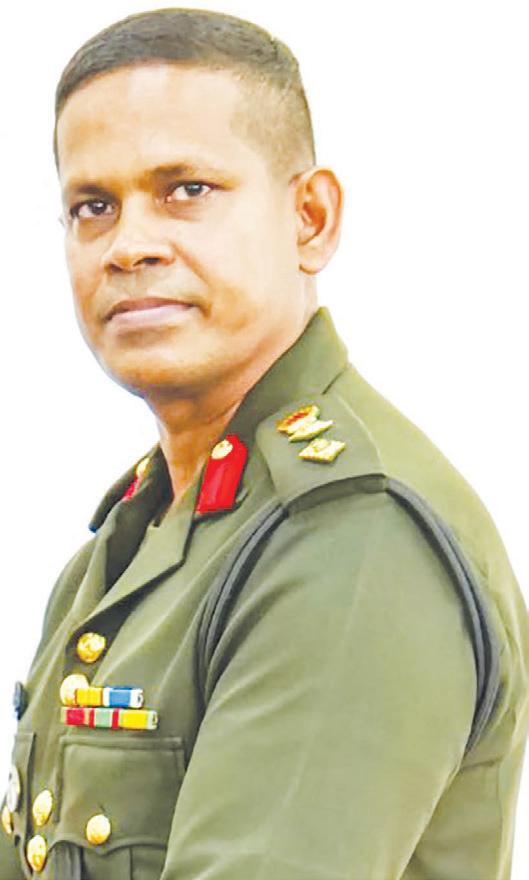
The Guyana Defence Force (GDF) has reaffirmed its commitment to strengthening regional cooperation and security as the Caribbean Community (CARICOM) marked CARICOM Day. In a statement on behalf of the Joint Services Coordinating Council, Chief of Defence Staff, Brigadier Omar Khan, said the observance provides an opportunity to celebrate the shared values, enduring partnerships and collective aspirations that unite the peoples of CARICOM. He noted that the occasion
also highlights the importance of regional cooperation in advancing security, development and prosperity across the Caribbean. Brigadier Khan said the GDF remains committed to supporting these objectives through continued collaboration and mutual assistance with its regional counterparts. “The Guyana Defence Force remains proud to contribute to these efforts through collaboration and mutual support with our Caribbean partners,” he stated.
According to the Chief of Defence Staff, strength-
ening regional solidarity remains essential to building a safer and more secure future for the people of the Caribbean. He extended best wishes to citizens across the region, saying, “Happy CARICOM Day.” CARICOM Day is observed annually by member states to commemorate the establishment of the Caribbean Community and to reflect on the importance of regional integration and cooperation in addressing shared challenges and promoting sustainable development.
Country…
… (side) vibes
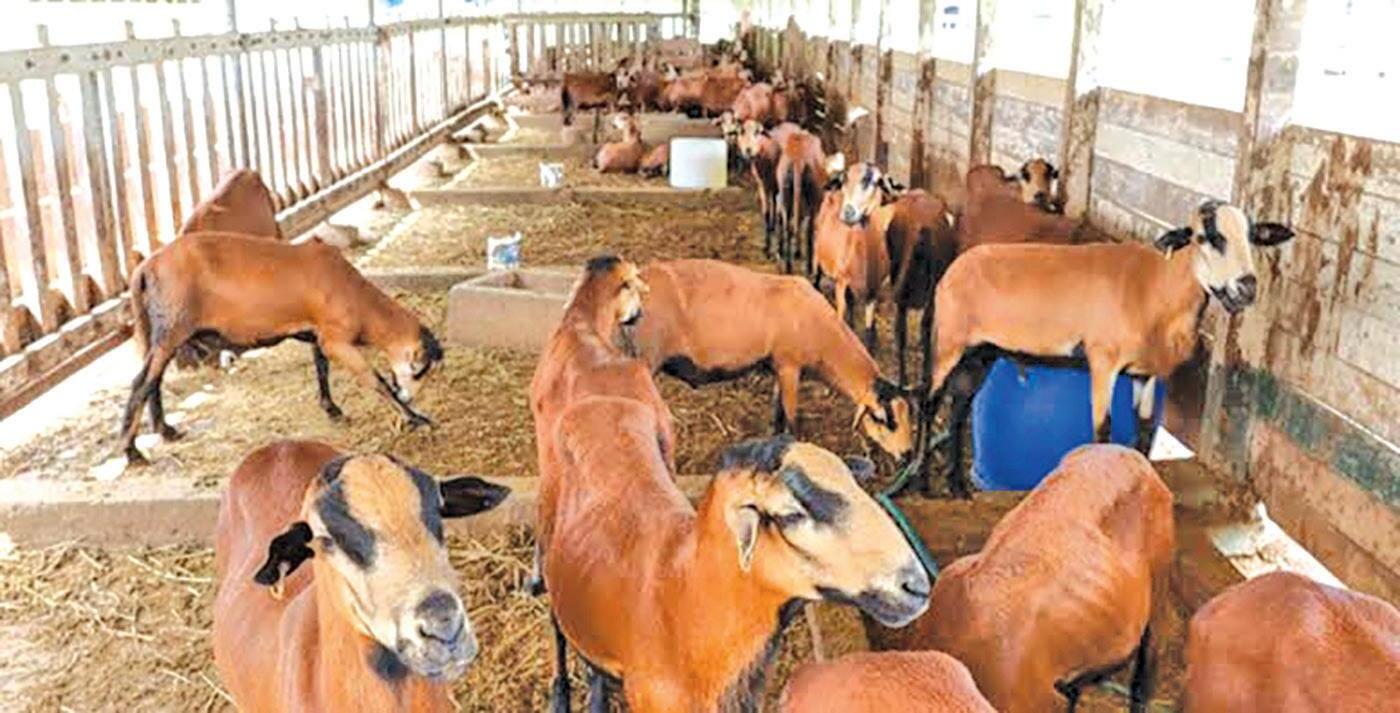
Pressie just proved the adage – if it ever needed to be proven! – that “you can take the boy out of the country, but you can’t take the country out of the boy”!! Your Eyewitness is referring, of course, to Sanction Man’s “revelation” of Pressie’s ownership of a farm off the Linden Highway!! So, what’s wrong about Pressie owning a farm?? Didn’t we all grow up knowing that “Old Macdonald had a farm” – and on the farm were all sorts of farm animals like cows that went “moo moo” and ducks that went “quack quack”, etc??!! And has Pressie ever failed to boast about his mother’s origins in Leguan –where farming was the main activity and where he spent countless boyhood hours??
But, of course, Sanction Man wasn’t interested in Pressie’s interest in going back to his rural roots – unlike him who never mentioned visiting his Sanctioned Daady’s Essequibo Coast village!! THAT didn’t go with his carefullycurated designer outfits and GRA-underdeclared Lambos and Rolls that were meant to boost his slack ego!! We’ve all heard about what owning big cars are supposed to be compensating for, haven’t we??!! Naah…Sanction Man claims that Pressie’s acquisition of the 150-acre plot of virgin land along the Linden Highway – and raising cattle, sheep, goats, chickens, ducks, along with high-tech hydroponic farming, etc – was somehow part of some illgotten gains scheme. Sorta like he and his Daady’s gold smuggling scheme that resulted in the US OFAC sanctions!!
What can you say?? Sanction Man clearly can’t believe that someone in Pressie’s position would invest in something so mundane and risky like farming!! Everything on a farm takes time to create a return – which ain’t guaranteed since so many things like foot-and-mouth disease, etc, can wreak havoc with the investment!! And more to the point to paint Pressie’s bamsie with doodoo from his own, he claimed Pressie got everything by abusing his presidential position!!
Within hours, however, Pressie revealed he’s acquired the land loooong before he became President – and developed it through loans!! And furthermore, that he’d declared the farm and its operations to the Integrity Commission – as required by law of Public Officials!! Pressie also revealed the rationale for the hullabaloo –he’d received texts from Sanction Man’s Daady demanding he call off the ongoing extradition proceedings – or else they’d reveal the info on the farm!!
Well, with Pressie’s response, your Eyewitness is quite interested as to what’s gonna be the next increasingly desperate measures Sanction Man and his Daady gonna resort to – so’s not to be fitted for orange jump-suits in Miami!!
Maybe they can become State witnesses against Mad Maduro – as head of the Cartel de los Solos – on trading blood gold smuggled from Venezuela!!
…at war
It’s over four years since Russia launched its Special Military Operation – now a “war” they insisted! – against Ukraine!! Your Eyewitness must confess he’d thought it was gonna be a walkover – with the Ruskies rolling over the Ukrainians!! But in politics, you gotta be careful about making very precise predictions. After all, we can NEVER know all the variables where human beings are concerned, can we?!!
The main variable was we never gave enough credence that the Russian goal was to secure strategic depth – lost by surrounding former provinces joining NATO!! They didn’t want to kill too many civilians in eastern Ukraine – which they wanted to integrate into Greater Russia!! But most importantly, their traditional mode of fighting – throwing overwhelming force against the enemy on all fronts and grind them down!! – didn’t count on the Ukrainians focusing on drone warfare!! Over 500,000 Ruskies have died to at most 210,000 Ukrainians!!
Your Eyewitness don’t see how Russia won’t prevail –but wouldn’t it be a Pyrrhic victory??
…in identity crisis
Your Eyewitness is saddened by Brazil’s World Cup exit against Norway. They showed they were more a brand than a team. They reminded him of his beloved West Indies cricket team – they both didn’t invest enough in rebuilding!!
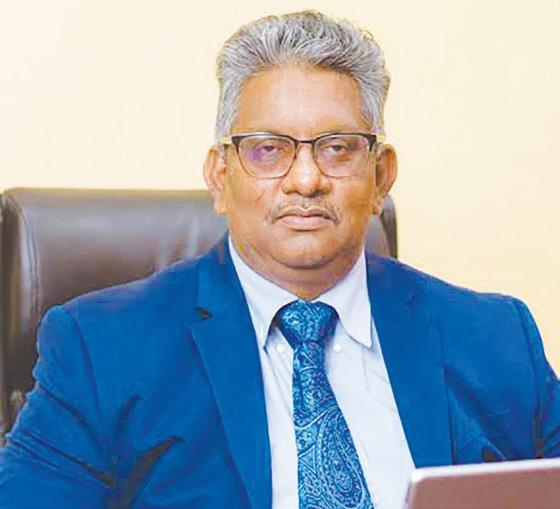
Chief of Defence Staff, Brigadier Omar Khan
Works progressing on US$32M sugar refinery, fertiliser plant
...operations likely to commence in 2027
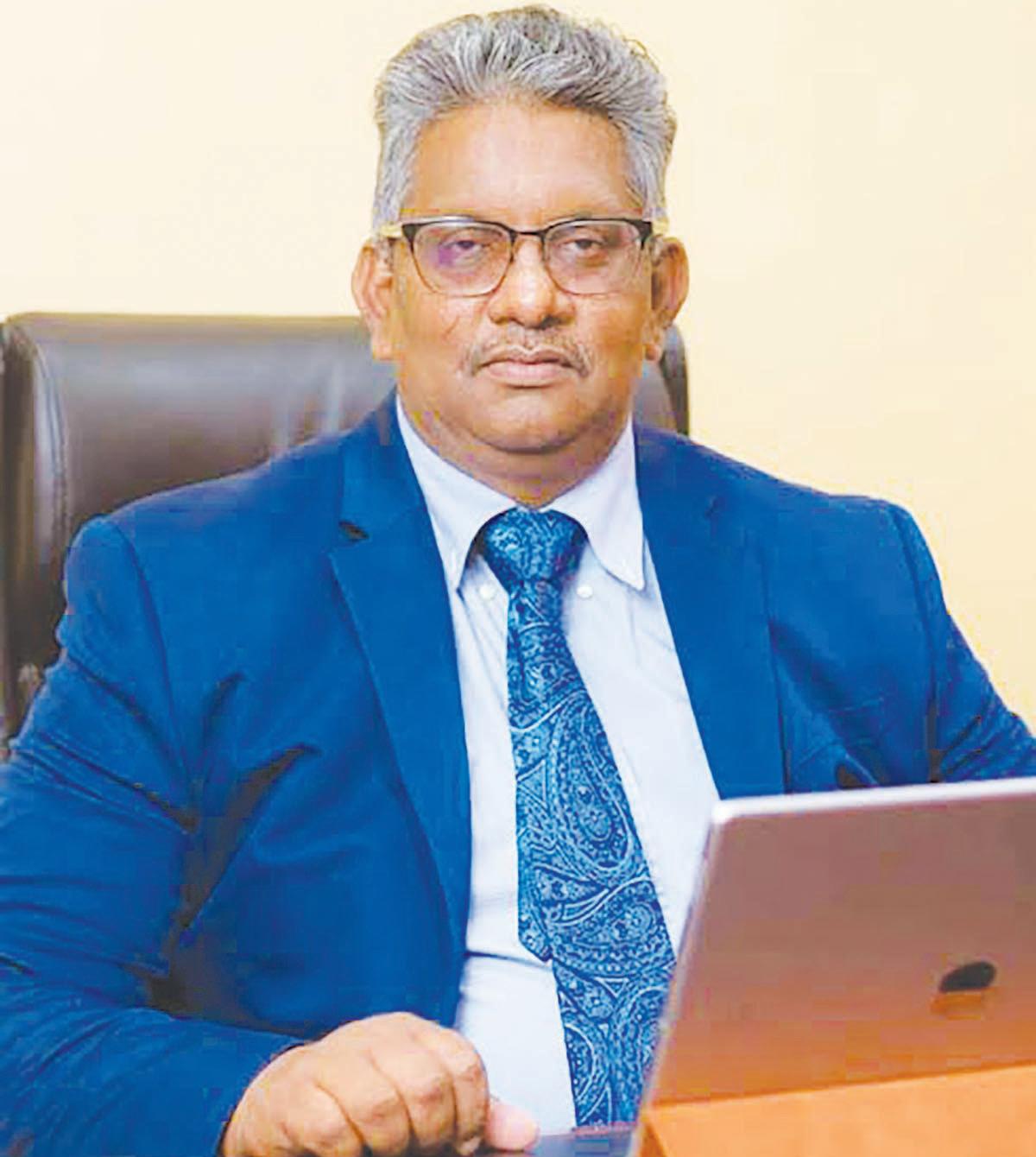
Work is progressing steadily on two major private investment projects in Region Three (Essequibo IslandsWest Demerara): a white sugar refinery and a fertiliser blending plant. Both projects are being developed by local businessman Komal Singh through joint ventures with regional and international partners.
The fertiliser blending plant is being developed by Singh's company GAICO in collaboration with FERSAN of the Dominican Republic to the tune of US$12 million, under the joint venture brand 'Guyfer'. Located on the West Bank of Demerara (WBD), the plant will produce fertilisers for local and regional farms.
Providing an update on this initiative during a recent episode of The Guyana Dialogue programme, Singh noted that the plant is already in the country and a sod-turning ceremony to mark the commencement of civil works on the project should take place this month. The project is likely
to be completed and operational by the first quarter of next year, he added. Singh's company has also partnered with the United States (US)based Sucro Limited to build the country's first white sugar refinery at Wales, WBD, Region Three. The project will be developed at the old sugar estate at a cost of approximately US$20 million.
The project, officially known as Demerara Sugar Refinery Inc, will transform raw sugar into value-added refined sugar. Expected to process 100,000 tonnes annually, the facility aims to replace imported white sugar and supply the wider Caribbean market. According to Singh, work is also progressing well on this project.
"We're currently in the process of decommissioning the old sugar estate that was closed down. That plant is currently being torn down and we're going to replace it right in that same position with a brand-new white sugar refinery... so the groundwork is currently in process," he outlined, adding
that the initiative will likely be completed by the first half of next year. The businessman, who currently serves as head of the Guyana Shipping Association and previously served as Chairman of the Private Sector Commission (PSC), noted that both projects will significantly contribute to the development of the local agriculture sector.
"When both projects are completed, they will significantly help the agriculture sector in Guyana," he remarked. Guyana's agriculture sector is undergoing a massive transformation, driven by billions in Government investment aimed at crop diversification, the implementation of advanced technology, the involvement of youth and women, the building out of modern supporting infrastructure and the addition of value to the industry through agro-processing. In fact, the Government's investment in agriculture went from $84.9 billion in 2025 to $113.2 billion in 2026. Over the next five years, 100,000 acres of new arable land will be developed, with incentives of-
4 Venezuelans homeless after violent attack ends with house set on fire
Ffered to small, medium, and large-scale farmers. The Government also intends to invest in mega food parks, agri-tech, agro-industrial complexes, modern port infrastructure with cold storage, a regional food hub, permanent farmers' markets, and much more.
In addition, farmers will benefit from extension services, plant protection and quarantine, as well as the implementation of the Agriculture Information System (AIS). The AIS will ensure timely information to farmers through digital media. Moreover, large farms at Tacama and Kimbia, along with the use of climate-friendly technologies such as shade houses, tunnel houses, and hydroponics, have improved productivity and land use. Additionally, a new tissue culture and mi-
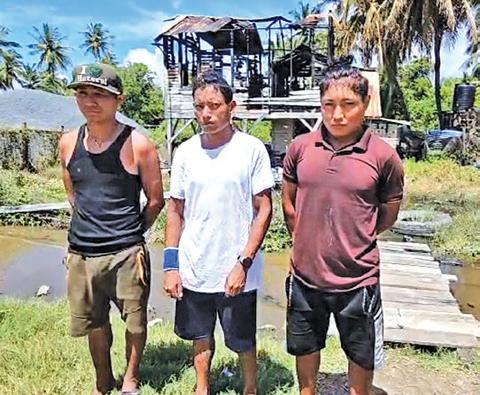
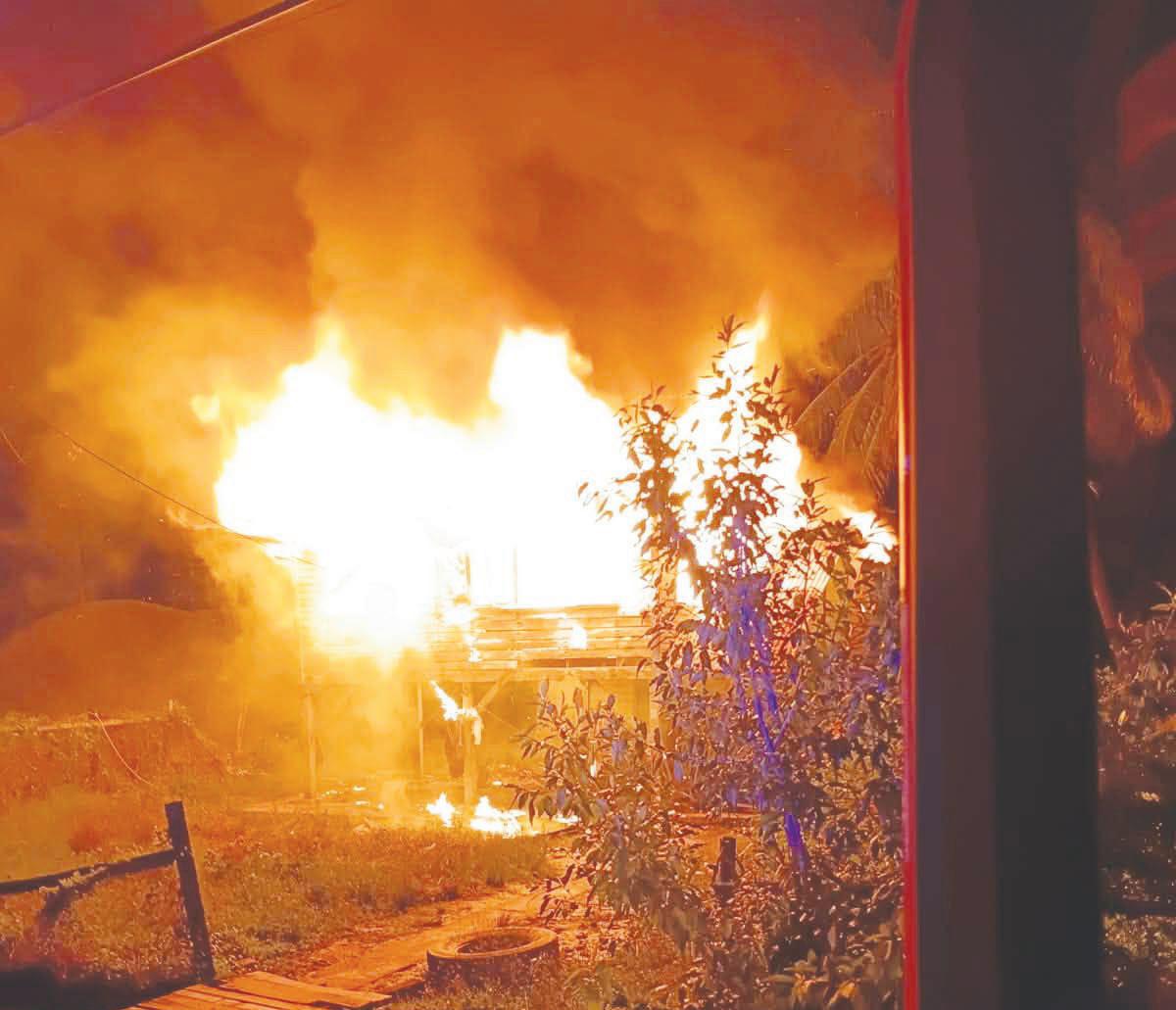
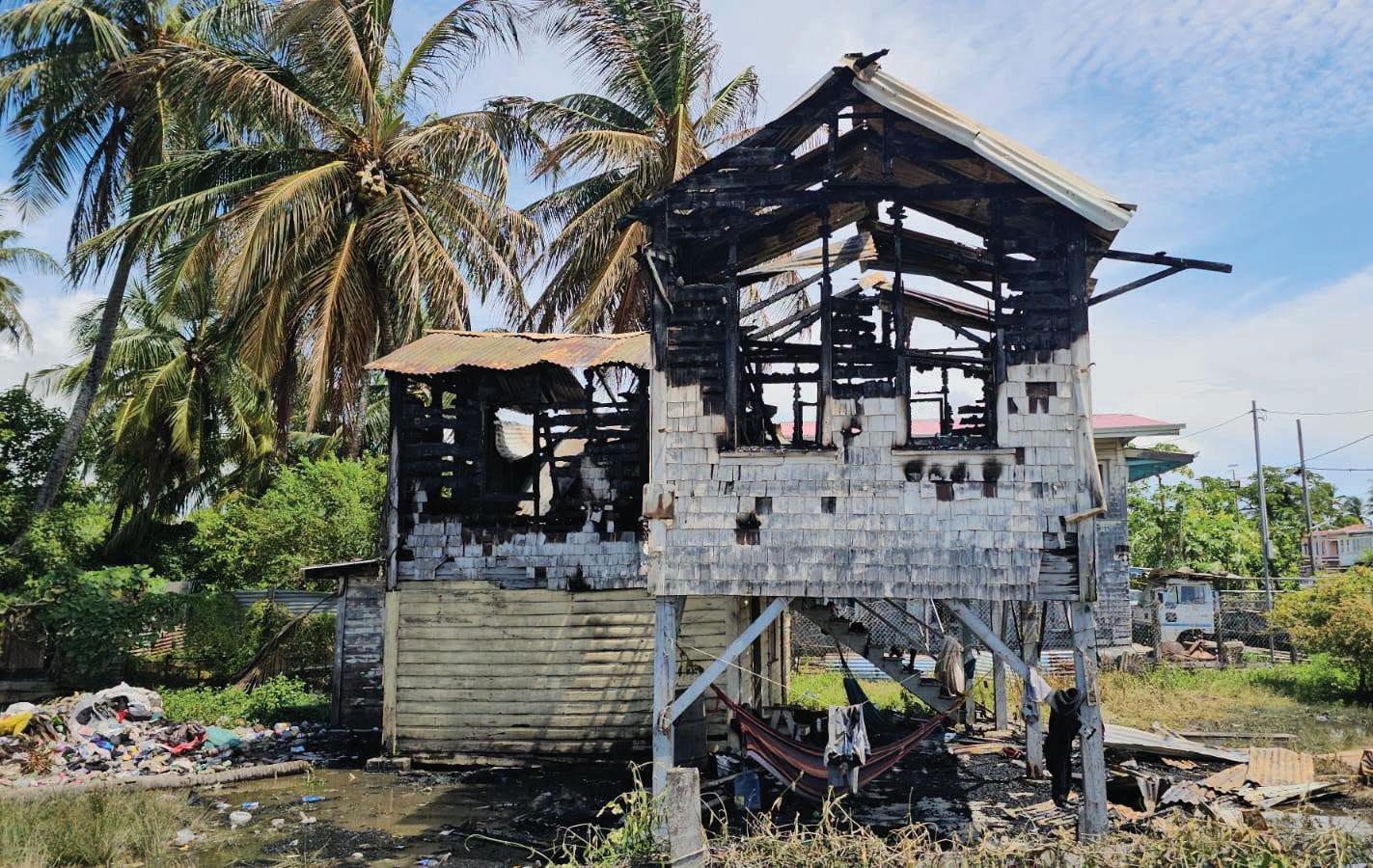
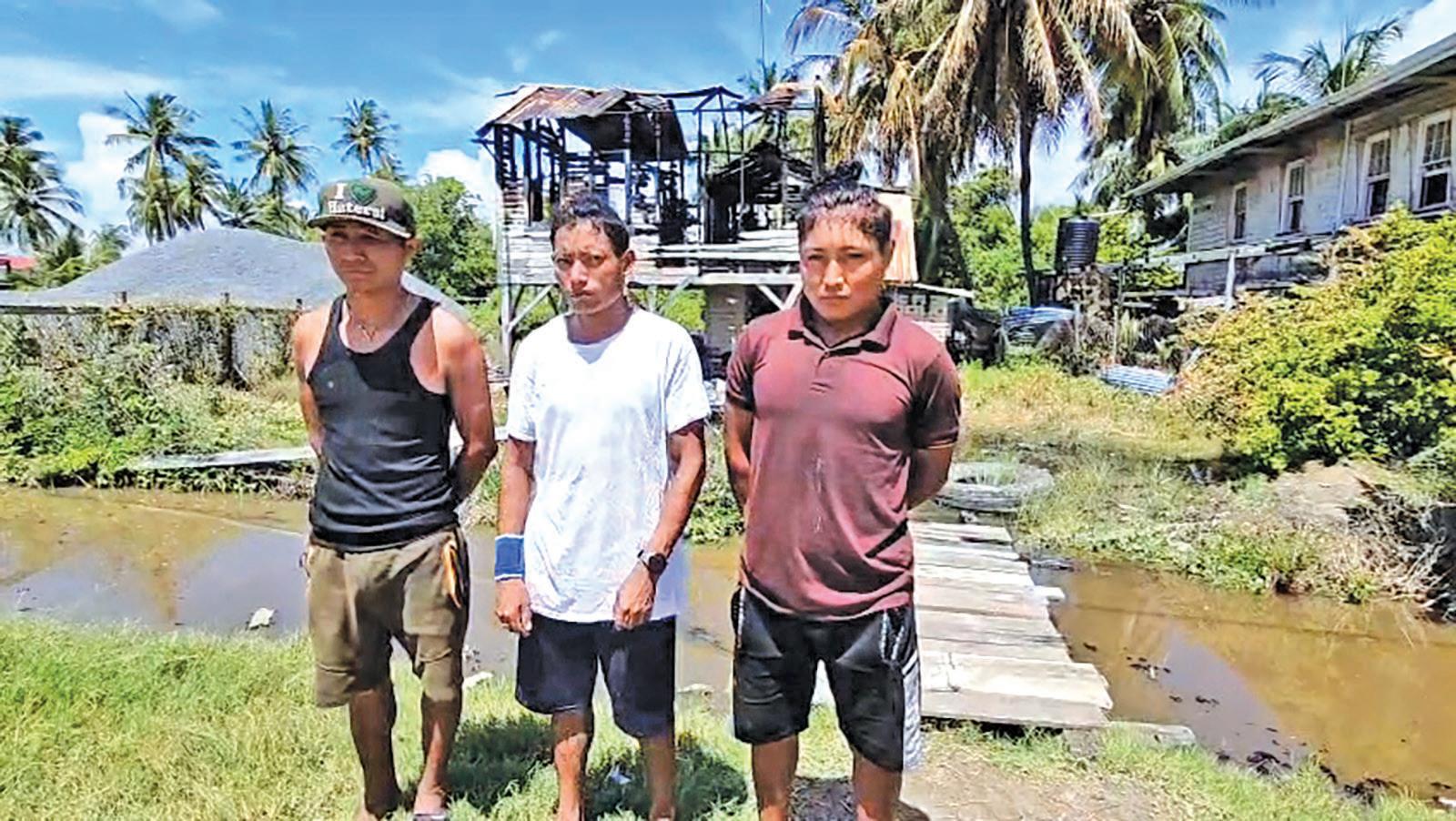
our Venezuelan migrant workers have been left homeless after the two-storey wooden house they occupied along King Street, Hampshire Village, Corentyne, Region Six (East BerbiceCorentyne), was destroyed by fire following a violent confrontation during which one of the occupants was allegedly chopped with a cutlass. The blaze, which erupted shortly before midday on Monday, completely destroyed the elevated wooden building, leaving only its charred frame standing. Firefighters managed to contain the flames before they spread to neighbouring properties, but the occupants lost all of their clothing, household items and personal belongings. The house, a two-storey wooden structure with corrugated metal roofing, was occupied by four Venezuelan nationals who had been living and working in the area. By the time firefighters arrived, the building was already engulfed in flames, and despite their efforts, it was reduced to a burnt shell.
Investigators are probing the circumstances surrounding the fire, which is believed to have been deliberately set. The incident occurred hours after one of the occupants was attacked
with a cutlass during a confrontation involving a man from the community. One of the occupants, 24-year-old Cheto Johnathan Heberto, said the ordeal began when a man arrived at the house during the night and confronted the men who were staying there. “The man come at the house there. Four men, we does sleep there. The night he come he talk, talk too much. He go home and come back, bring cutlass. One of the boy sleep at the lower flat. The man come over and chop him, to kill him,” Heberto recounted. He said the men had travelled to Guyana to work and had been living peacefully at the Hampshire property.
cropropagation plant with the capacity to produce over one million plantlets has been commissioned.
The wooden house on fire
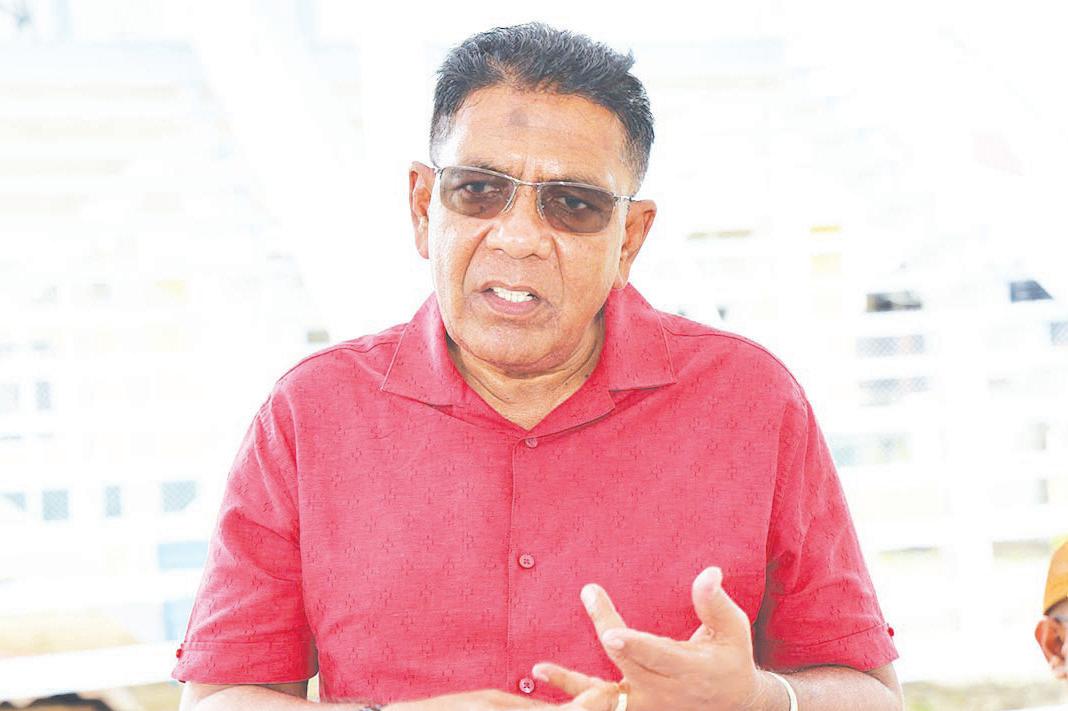
Local businessman Komal Singh
“False, malicious” – Agri Minister to US-sanctioned Mohamed’s Black Belly Sheep Project claims
Agriculture Minister Zulfikar Mustapha has dismissed allegations made by United States (US) sanctioned and indicted Azruddin Mohamed, who is also the leader of the Opposition, regarding the Black Belly Sheep Project, describing the claims as “false, malicious and entirely without merit.” In a statement issued on Monday, Mustapha said Mohamed’s latest accusations is part of what he described as a continuing campaign of misinformation and personal attacks directed at him, members of his family and others. According to the Agriculture Minister, the allegations contain no evidence of wrongdoing and instead rely on “speculation and insinuation” to create public suspicion. “Let me state unequivocally that the allegations against me are false, malicious and entirely without merit. They identify no act of wrongdoing on my part because none exists,” Mustapha said.
He argued that Mohamed has increasingly turned to social media and public accusations in an effort to pressure and intimidate others while promoting what Mustapha described as a narrative of political persecution. The Minister said the public should recognise the allegations as part of a pattern, noting
that Mohamed entered politics after legal proceedings and investigations involving him in the US had already begun. Mustapha further claimed that Mohamed’s public statements are intended to reinforce claims of political victimisation while targeting individuals whom he believes have distanced themselves from him. The Minister also addressed references made to his son, saying he is an independent adult who has never been involved in politics. Mustapha described his son as a businessman, gold miner and qualified medical doctor, adding that he became the subject of repeated public attacks after deciding to end his association with Mohamed. He maintained that no individual should face public attacks because of personal decisions regarding their associations.
No evidence
Turning to the allegations surrounding the Black Belly Sheep Project, Mustapha reiterated that no evidence had been presented to support claims of misconduct on his part. He said he would not be distracted by what he characterised as politically and legally motivated attacks and stressed that his priority remains serving the people of Guyana. “The people of Guyana deserve a political culture built on facts, accountability and respect for the truth,” the Minister stated.
Mustapha said public debate should be guided by evidence rather than misinformation or speculation and reaffirmed his commitment to carrying out his duties with integrity and accountability.
Children awaiting heart surgery to get treatment within 2 months – Pres Ali
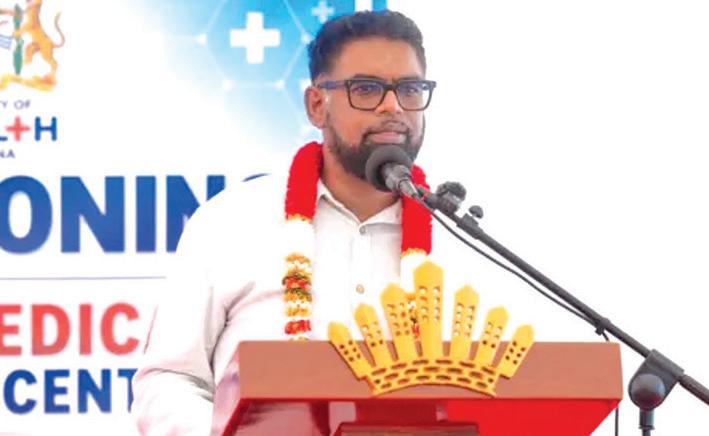
For families anxiously waiting for their children to receive life-saving heart surgery, relief is on the horizon as the Government prepares to offer the specialised procedures right here in Guyana within the next two months. President Dr Mohamed Irfaan Ali announced that the Ministry of Health has been given a two-month deadline to prepare for paediatric cardiac surgeries using the country’s newly acquired robotic surgical technology, ensuring children no longer have to travel overseas for treatment. Addressing a large gathering at the
commissioning of the new Ministry of Health drug bond in Region Two Friday last, President Ali said the Ministry has been instructed to compile the names of all children who are medically ready for surgery so that treatment can begin as quickly as possible.
“We have invested in the latest robotic technology, and I said to the Minister that every child that requires cardiac surgery and is ready for that surgery…that list must be compiled, each case must be filed, and that we must be prepared in two months to have those surgeries done here in Guyana,”
President Ali stated. The initiative is expected to significantly ease the financial and emotional burden on families, as the surgeries, which can cost as much as US$150,000 overseas, will be provided free of charge through Government funding. President Ali said the Government will also bring in specialised cardiac teams to work alongside local medical professionals as efforts intensify to eliminate the backlog of children awaiting surgery, particularly babies and infants. The announcement marks another milestone in the Government’s drive to transform Guyana’s healthcare system by expanding access to advanced, world-class medical services locally. It also advances plans announced in 2024 to provide cardiac surgeries for more than 150 children. During the landmark procedure, renowned cardiac surgeon Dr Sudhir Srivastava remotely performed surgery on a patient in India using the SSI Mantra 3 robotic surgical system while operating from Guyana.
Agriculture Minister Zulfikar Mustapha
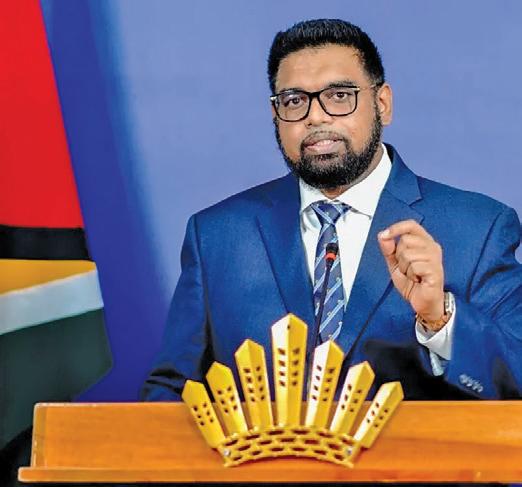
President Dr Irfaan Ali
Caricom eyes stronger electoral oversight through training, capacity building – SG Barnett
...urges leaders to accelerate CSME, climate & food security goals
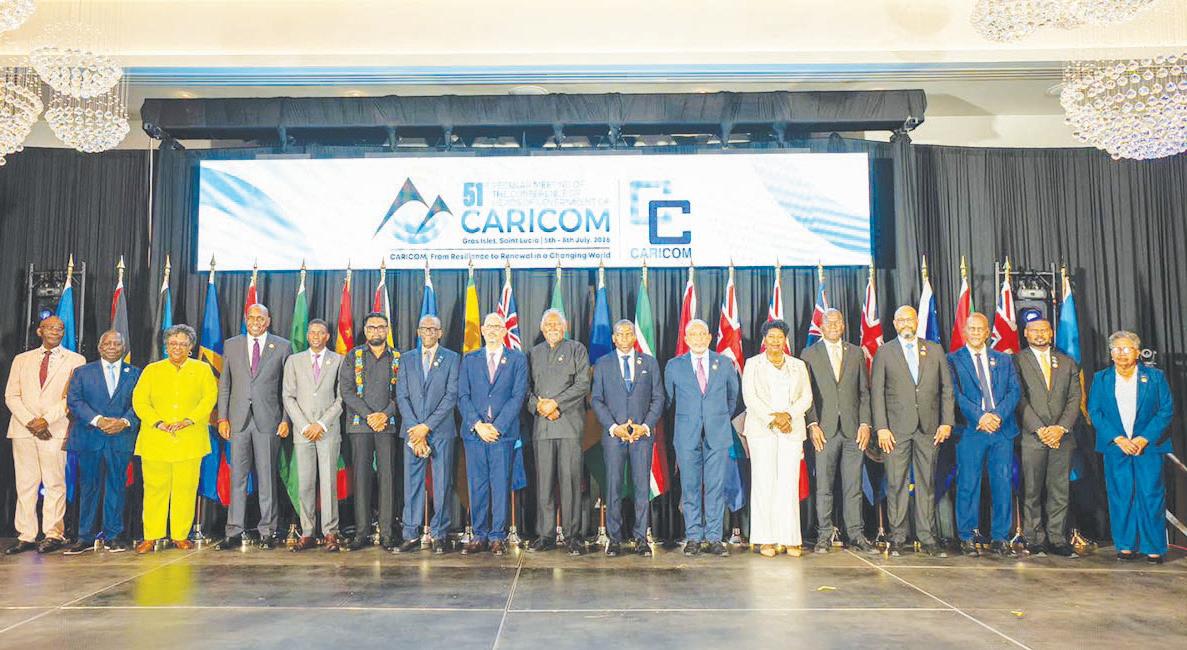
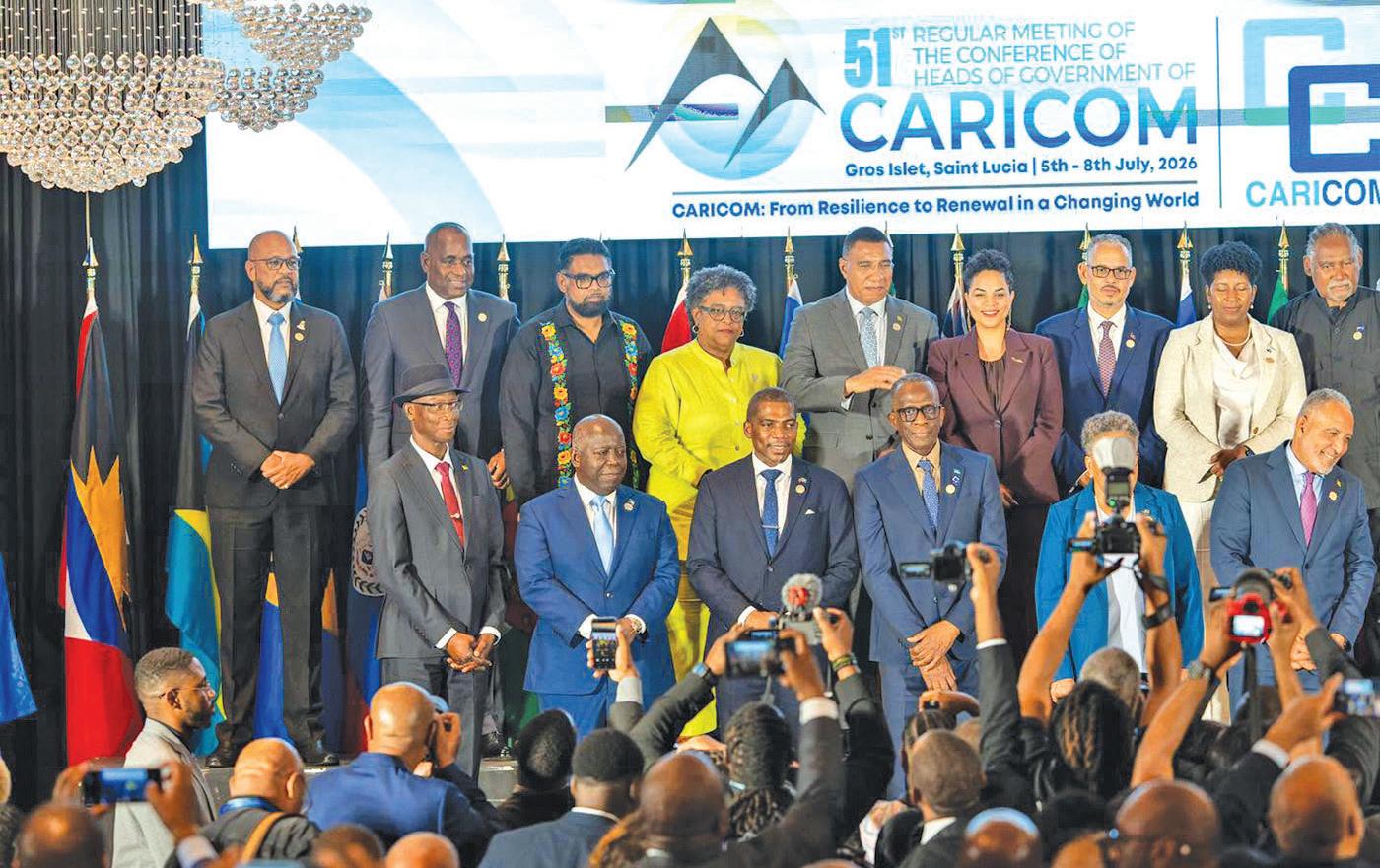
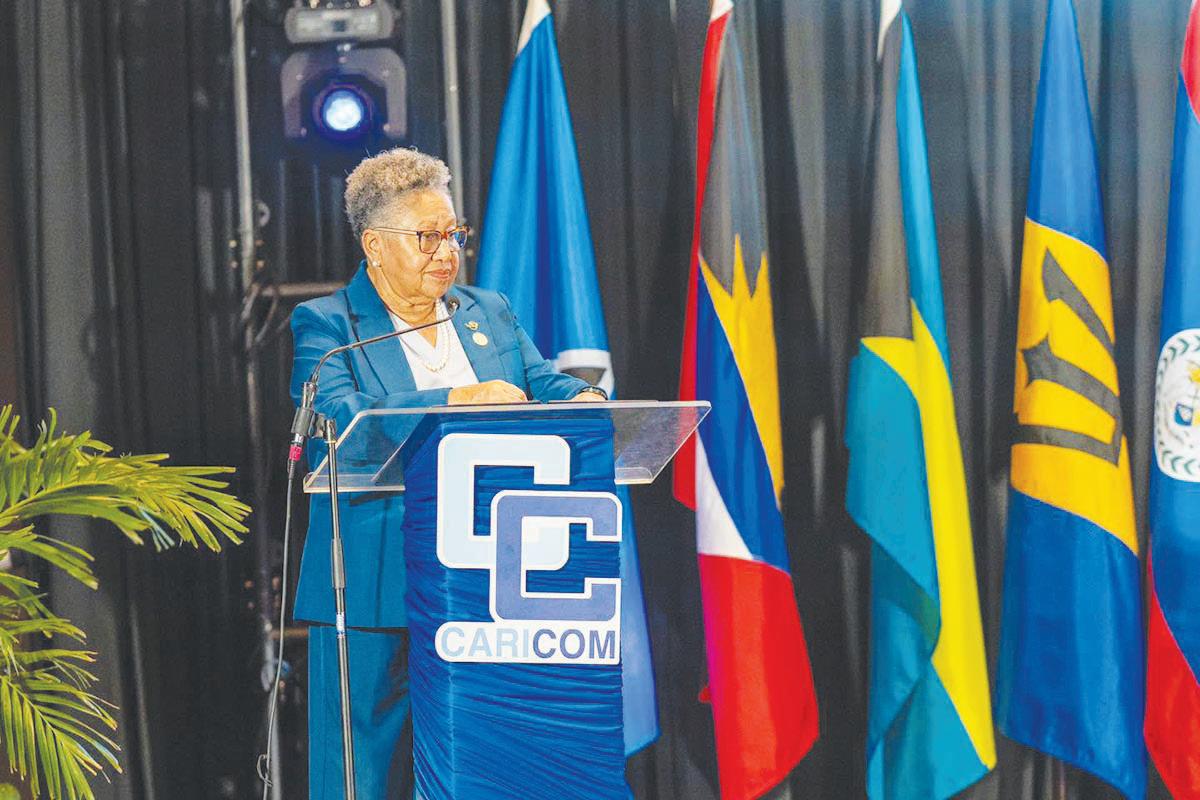
Secretary-General (SG) of the Caribbean Community (Caricom) Dr Carla Barnett has revealed the organisation will invest in training and capacity building for its electoral observer missions, strengthening a key mechanism that supports democratic processes across the region. She made the remarks on Sunday during the opening of the Fifty-First Regular Meeting of the Conference of Heads of Government of Caricom underway in St Lucia under the theme "Caricom: from resilience to renewal in a changing world. " "Over the past two years, we have organised a relatively large number of Caricom Electoral Observer Missions, the most recent being two in Antigua and Barbuda and The Bahamas this year. We are also engaged in activities to strengthen our Elections Observation Missions through training and capacity building, including observers who are from election bodies in Member States," she said. Caricom Electoral Observation Missions (CEOMs) are independent, impartial assessment teams deployed by the Secretariat at the formal invitation of a Member State. Their primary goal is to observe national elections and ensure they align with the democratic traditions and accepted standards of the region. Each CEOM is led by a Chief of Mission, supported by a Deputy Chief of Mission (in the case of a large Mission) and consists of members drawn main-
ly from the electoral bodies of Caricom Member States. The Chief of Mission is the head of the observation team and is selected by the Caricom SG based on seniority, level of experience, leadership ability and history of sound judgment. Funding and administrative support are provided by the Caricom Secretariat.
Caricom mounted its first Election Observer Mission in 2000 at the invitation of Haiti and Suriname for parliamentary elections in these countries. The Secretariat was then mandated by the Conference to mount the Missions as requested.
Caricom has mounted Election Observation Missions in Guyana over the past two decades, with the most notable being in 2020. In fact, the CEOM played a vital and dual role in the tumultuous March 2, 2020, General and Regional Elections, serving as both initial polling day observers and the primary auditors for the national recount. The team observed a grueling national recount process in all 10 administrative regions and, in June 2020, submitted their final Caricom Recount Report, which declared that the recount results provided an acceptable, credible basis to declare a winner. This paved the way for the ultimate declaration of the final results in August 2020. Meanwhile, Dr Barnett noted that as another Caricom Heads of Government meeting gets underway, leaders must focus on critical
issues and decisions that must be taken to strengthen the regional integration process. This, she said, will be set against the backdrop of the things that have been achieved and the challenges of the past several years in order to guide the way ahead.
CSME
On strengthening the operations of the Caricom Single Market and Economy (CSME), Dr Barnett noted that while notable achievements were made, more can be done. She acknowledged that strides were made through improved implementation of the Revised Rules of Origin, expansion of the categories of skilled workers under the movement of skills regime, and the commencement in October 2025 of full free movement among four Member States as agreed a year ago, using the Protocol on Enhanced Cooperation of 2022.
"But while we can acknowledge positively the work we do together as a Region, the challenges we face call us to redouble our efforts. We have to do what is necessary to implement key outstanding aspects of the CSME, such as capital market institutions, payments and settlement systems and expanding the movement of persons," she stressed. "This requires greater focus and action, not only at the regional level in the Ministerial Councils of the Community but also at the national level to ensure necessary consultations,
parliamentary approvals, and any other actions necessary to ensure national implementation of regional decisions," she added.
Agriculture
On the issue of agriculture, the Caricom SG expressed satisfaction with the increased production in the region, driven by the 25 by 2025 strategy, which has now been extended to reducing the food import bill by 2030. "This strategy, which has the objective of reducing food imports and strengthening food security, has seen increased investment in and technical support for agriculture across the Community. It has focused attention on including young people to ensure the development of the next generation of farmers and facilitating the application of new technologies to the operation of agricultural enterprises. Advances such as these will be showcased at the Annual Caribbean Week of Agriculture to be staged in Jamaica later this year," she outlined.
Climate change
Dr Barnett also reflected on the challenges of climate change and how it impacts sustainable development, noting that "we have helped to guide the implementation by Member States of critical international treaties on biodiversity and areas beyond national jurisdiction.
" Caricom, she noted, also works closely with our regional institutions to pre-
pare for ongoing climate negotiations, "even as we face the reality of the impact of climate change: that is, shifting weather patterns, more hurricanes and floods, etc, which are increasing the need to finance disaster relief and reconstruction at a much faster rate than financing is becoming available." In fact, she noted that "when we see agriculture production being decimated by hurricanes in successive years, as happened in Jamaica with Beryl in 2024 and Melissa in 2025, the climate challenges we face are even more stark."
Haiti
On Haiti, she said Caricom continues to work to address the ongoing challenges of governance and security within the country. She noted that the Caricom Eminent Persons Group continues to work with stakeholders to facilitate dialogue and participation of political and civil society representatives of the people of Haiti, with a view to promoting broad consensus on the pathway and mechanisms to achieving peace and security and holding credible elections as agreed. She added that Caricom supports the implementation process of the United Nations Security Council (UNSC) Resolution which established the Gang Suppression Force, and two of its Member States - The Bahamas and Jamaicahave been closely involved in the initiative.
Partnerships
Moreover, the SG lauded efforts to expand Caricom's associate membership to include Curaçao, Martinique and French Guiana. She stressed that Caricom must continue to strengthen relations with existing partners while also building new ones.
"In the area of international relations and partnerships, even as we sought to reinforce traditional partnerships, the past several years has seen us building stronger relations with Africa, including the African Union, Saudi Arabia, and the United Arab Emirates (UAE) and enhancing cooperation with the European Union (EU), Japan, Korea, Singapore, India, Brazil and Colombia," she expressed.
In fact, she highlighted that with the support of international partners, Caricom has put in place improved frameworks for cooperation in health and education, as well as a framework on crime and violence as a public health issue, with attention to related juridical processes. Meanwhile, Dr Barnett also emphasised the importance of wider consultations in regional decision-making, noting that "the voices of a wider range of people in the Community, including civil society organisations, must be more meaningfully incorporated in regional discussions."
"Greater public participation will foster a deeper understanding of how decisions shape everyday experiences," she added.
Secretary General of the Caribbean Community (Caricom), Dr Carla Barnett, extreme right, with leaders of Caricom member states
Secretary General Barnett of the Caribbean Community (Caricom) addressing the opening of the Fifty-First Regular Meeting of the Conference of Heads of Government of Caricom
Japanese cultural heritage takes centre stage at Fumacon 2026
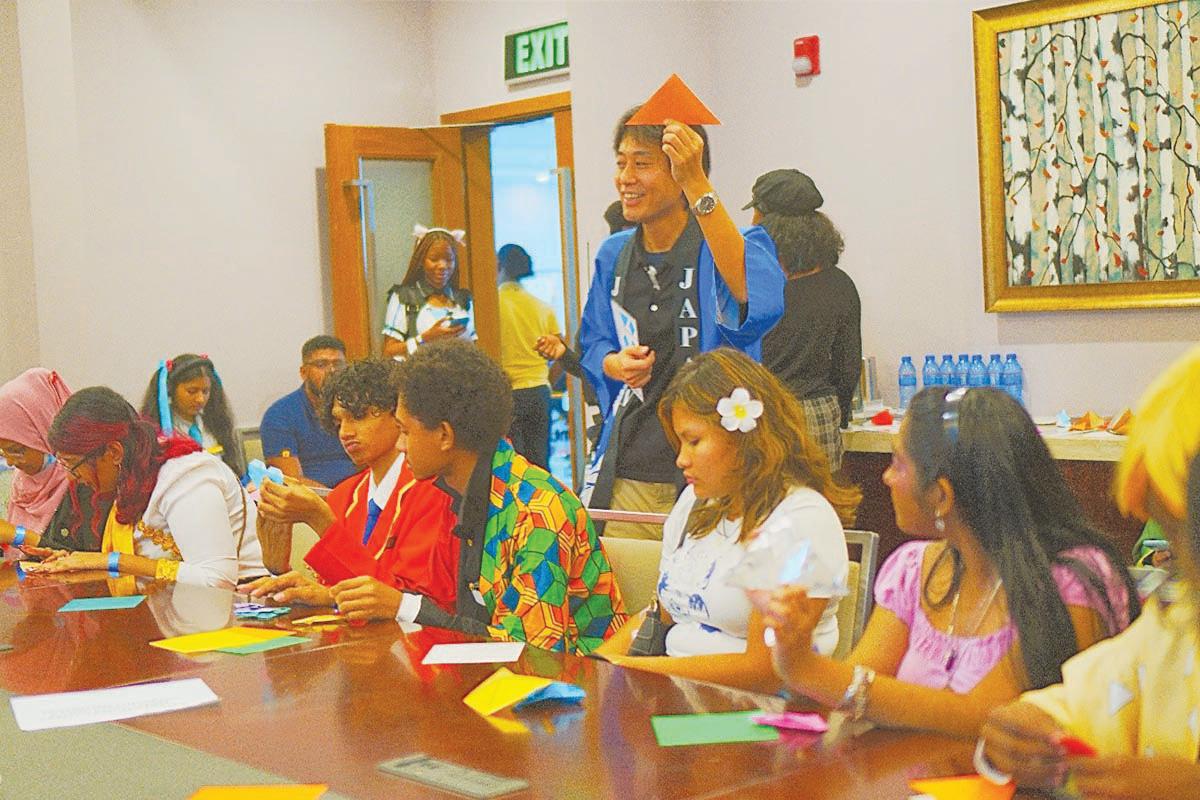
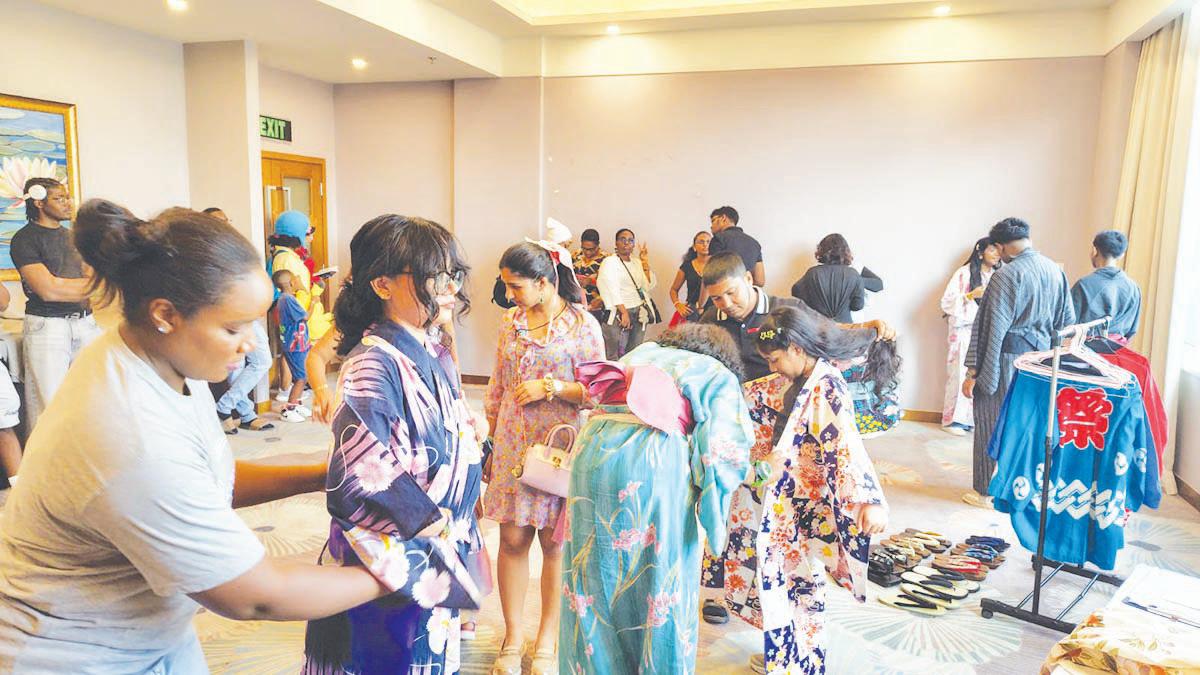
The Embassy of Japan in collaboration with Hachidori Kai (Japanese Ladies Association of Trinidad and Tobago) over the weekend hosted a series of Japanese cultural workshops and demonstrations during Guyana’s Fumacon 2026, at the Guyana Marriott Hotel, Georgetown. The two-day workshops welcomed approximately 400 attendees, who were invited to experience traditional Japanese culture through interactive workshops and demonstrations featuring
Japanese Tea Ceremony Origami, Calligraphy and Yukata Dressing. Many expressed great enthusiasms, enjoying hands-on experiences and gaining a deeper appreciation for Japanese traditions. The Embassy of Japan extends its sincere appreciation to Hachidori Kai for their invaluable support and expertise in facilitating the cultural workshops and demonstrations, and to Seishonen Guyana for the opportunity to participate in Fumacon 2026. The Embassy also ex-
presses its heartfelt gratitude to the dedicated volunteers of Seishonen Guyana, whose enthusiasm and assistance throughout the two-day event contributed significantly to the smooth execution and overall success of the cultural activities. The Embassy of Japan remains committed to promoting mutual understanding and friendship through cultural exchange and, together with its partners, looks forward to celebrating the 50th anniversary of diplomatic relations between Japan and
Origami
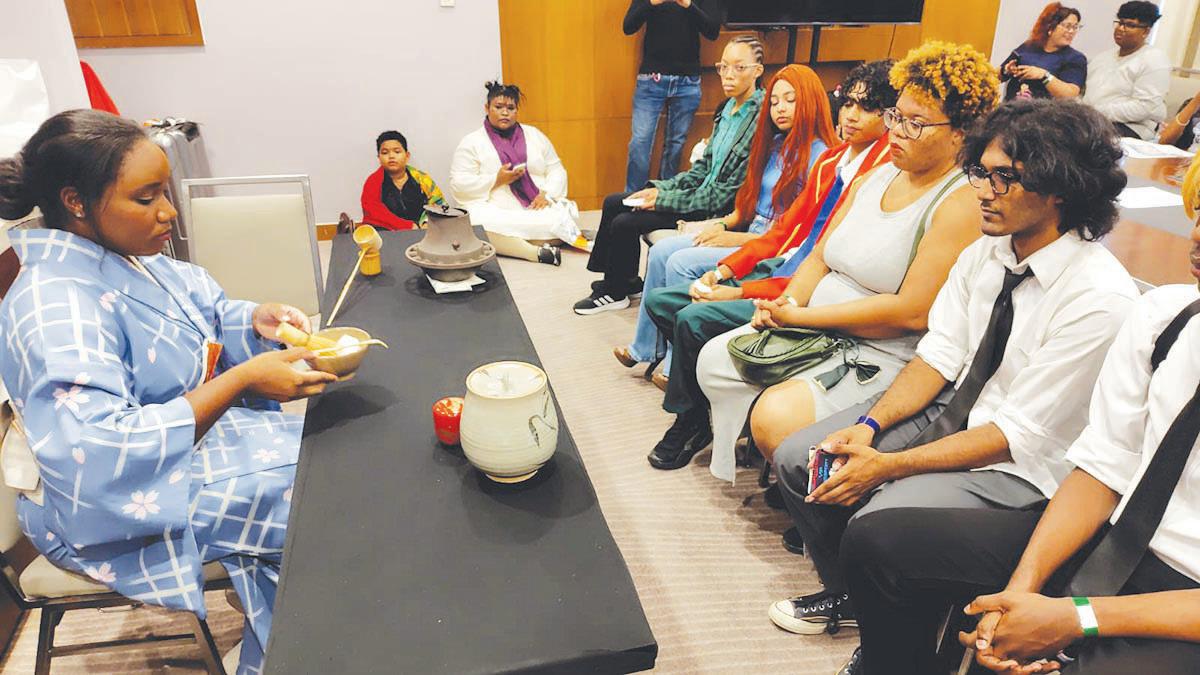
Tea Ceremony
Japanese tea ceremony is a traditional cultural practice that emphasises harmony, respect, purity and tranquility. Attendees experienced a demonstration of this centuries-old tradition while learning about the customs and etiquette surrounding the preparation and serving of
Origami, the traditional Japanese art of paper folding, was a highlight of the event. Attendees had the opportunity to learn how to create simple origami designs and proudly took home their handmade creations.
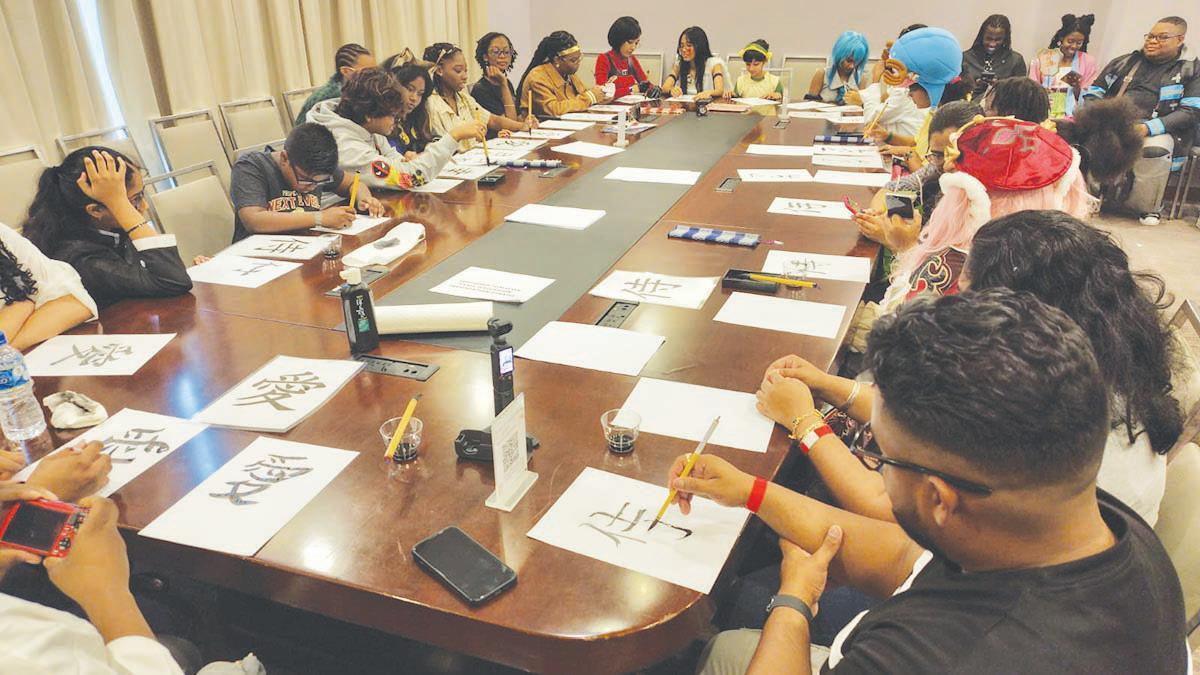
Calligraphy
Japanese calligraphy is a form of calligra-
phy, or artistic writing, of the Japanese language. Attendees enjoyed being able to write words or their names using traditional brushes.
Yukata Dressing A yukata is an unlined cotton summer kimono, worn in casual settings such as summer festivals. Attendees enjoyed the opportunity to try on the yukata and modeled at the event.
4 Venezuelans homeless after violent attack ends...
“We come here to work and live. We living right here, sleep. That man clothes, me clothes, the other man clothes, everybody clothes burn up.”
Residents in the community said the confrontation escalated after the suspect allegedly entered the area late Sunday night and assaulted another resident while demanding to know the whereabouts of two of the Venezuelan men. According to residents, the suspect later returned to his home, armed himself with a cutlass and allegedly went to another nearby house, where he chopped at a door before crossing the street to the building occupied by the Venezuelan workers.
It was there, residents alleged, that one of the occupants was attacked and injured with the cutlass
before the suspect fled the scene. A neighbour rushed the injured man to hospital, where he remains a patient
receiving medical treatment. While attention was focused on getting the injured man to hospital, an-
other resident claimed she saw the suspect preparing what appeared to be bottles containing a flammable liquid. According to the resident, the bottles were thrown at the house occupied by the Venezuelan nationals shortly before it became engulfed in flames.
She further alleged that bottles were also thrown into her yard, igniting her cherry tree and causing minor damage to sections of her property before the fire spread.
Residents said they were unable to determine what triggered the confrontation but claimed the suspect had been smoking marijuana before the incident and appeared to become increasingly aggressive. The fire
destroyed the entire upper flat of the building, leaving only blackened timber posts and sections of the corrugated roofing standing. The lower flat also sustained extensive fire and water damage, while debris from the collapsed structure was scattered around the property. Neighbours watched helplessly as firefighters battled the blaze, preventing it from spreading to nearby homes despite the intensity of the flames.
The four Venezuelan nationals are now homeless and are left with only the clothes they were wearing, having lost all of their possessions in the fire.
Investigations into both the fire and the violent attack are continuing.
Guyana in 2027 through future outreach activities and collaborative events.
matcha green tea.
Participants at the tea ceremony
Attendees participate in the Origami Workshop
Persons being trained in artistic writing
The participants in the yukata dressing workshop
Three of the four Venezuelans workers after the fire
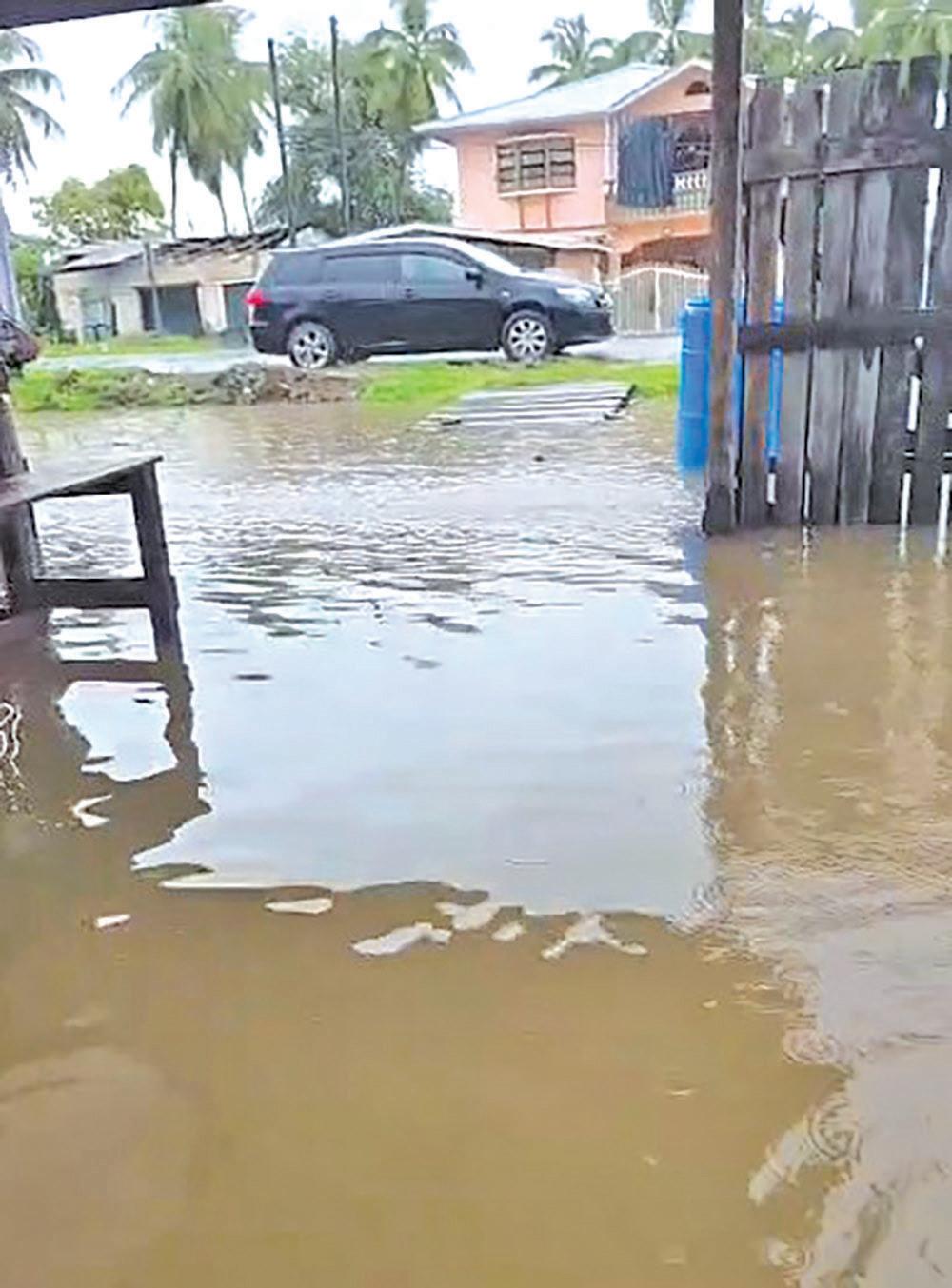
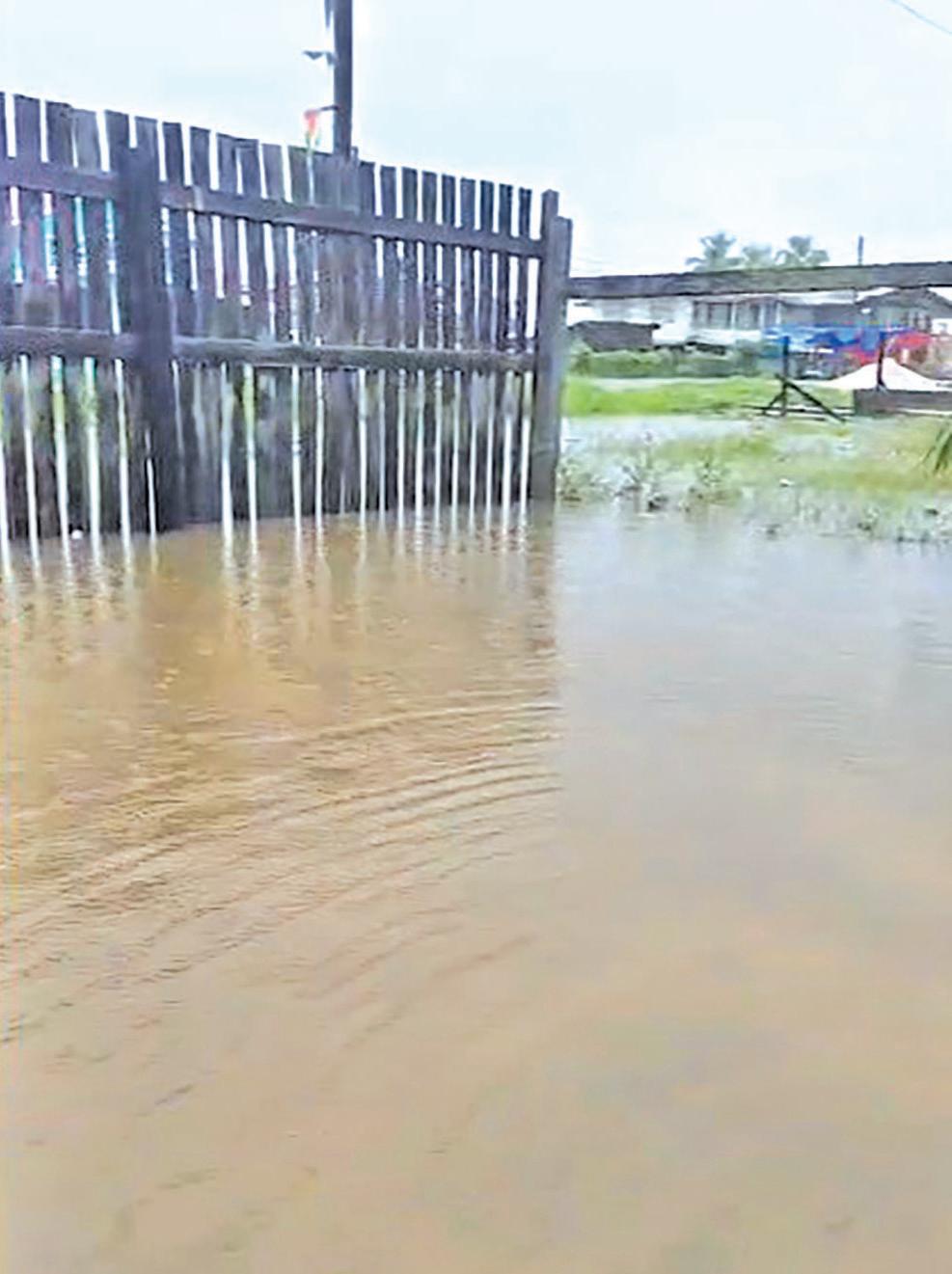
Corentyne villages under water following heavy downpours
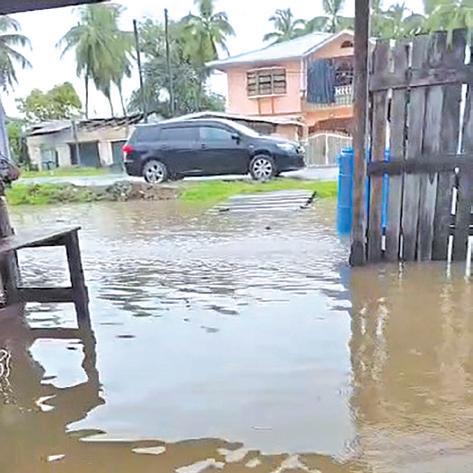
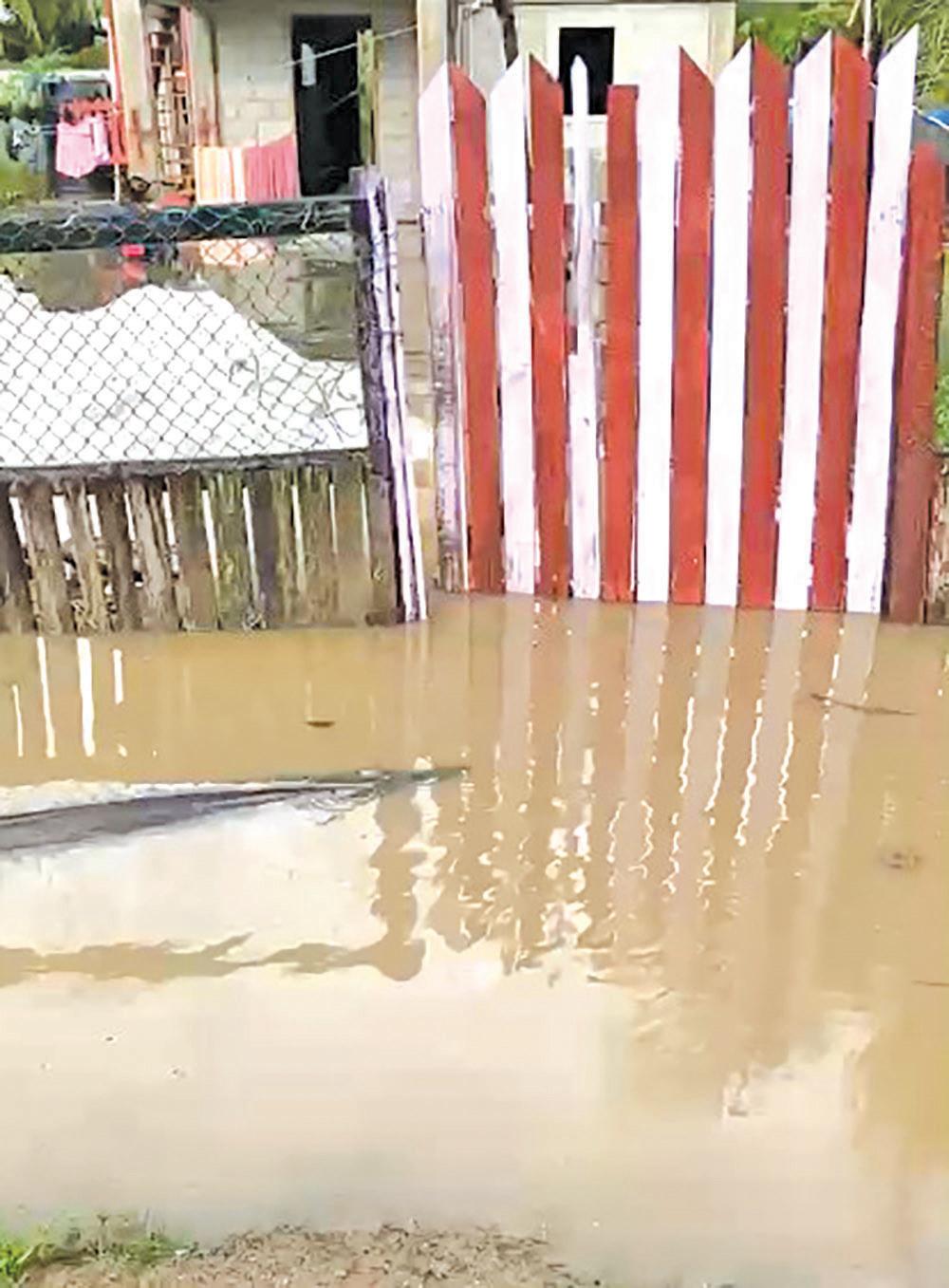
Continuous overnight rainfall has left several communities across the Corentyne Coast, Region Six inundated on Monday with some yards and access roads completely inaccessible. Among the hardest-hit communities highlighted in public posts was Bloomfield, where floodwa-
ters surrounded homes and residents reported losses as water entered their properties. Local news reports also indicated that several villages across the Corentyne experienced significant water accumulation following hours of persistent rainfall. Residents said the downpour began shortly before midnight
and continued into Monday morning, leaving drainage systems struggling to cope in several low-lying communities. Images circulating throughout the day showed standing water across residential areas, while farmers and householders voiced concern that continued rainfall could further affect crops,
livestock and access to their properties. Although the full extent of the damage has not been officially assessed up to press time, reports from several communities suggested the flooding was widespread across sections of the lower Corentyne. Regional officials said emergency drainage measures were
activated as the rainfall intensified. Regional Chairman, Junior Basant said the Borlam Pump remained fully operational and that the National Drainage and Irrigation Authority (NDIA), together with regional officials, was continuously monitoring water levels and operating drainage infra-
structure to remove excess water from affected communities. Government officials also reported that the Guyana Sugar Corporation (GuySuCo) pump at Albion was functioning as part of the wider drainage response. Meanwhile, the Guyana Hydrometeorological Service warned that Region Six remains vulnerable because soils are already saturated. The agency forecasted additional showers and thunderstorms over the coming days and cautioned that low-lying and poorly drained areas could experience further flooding if the wet weather persists.
The flooding follows hours of continuous overnight rainfall that overwhelmed drainage in parts of the Corentyne. While authorities say key drainage pumps are operating and emergency response measures remain in place, residents in several communities continue to contend with standing water as forecasts indicate more rainfall, raising concerns that conditions could worsen before they improve.
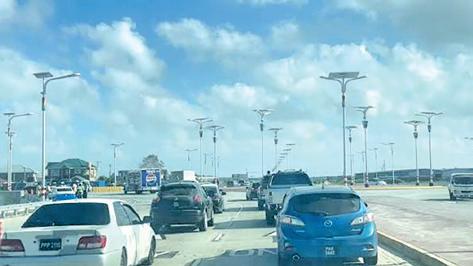
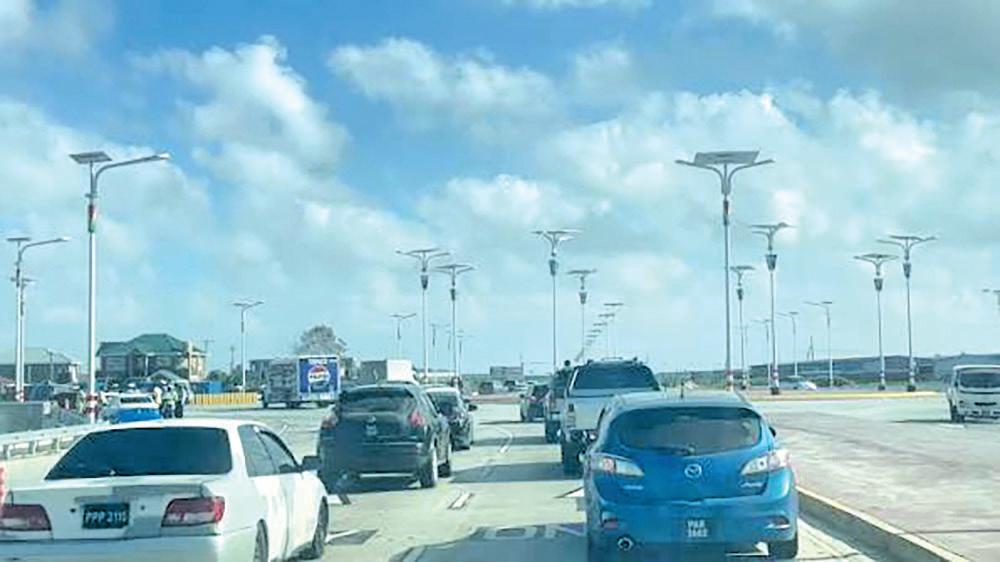
Intersections of Heroes Highway to be fitted with traffic lights
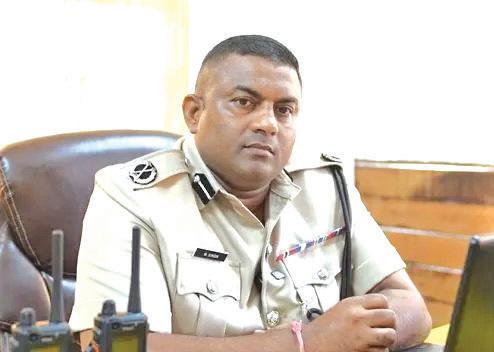
Motorists travelling along the Heroes Highway will soon benefit from improved traffic management with the installation of traffic lights at several major intersections, including the MochaHerstelling junction. The highway, which has traditionally been managed by traffic ranks during periods of heavy congestion, is being outfitted with traffic signal infrastructure as part of efforts to regulate the flow of vehicles and enhance road safety. Traffic Chief Assistant
Commissioner, Mahendra Singh told the Guyana Times on Monday that the traffic lights are intended to improve traffic management along the roadway. He explained that, like any major roadway, the highway requires traffic signals, road markings and signs to guide motorists safely through intersections. According to the Traffic Chief, the traffic light system will assign priority to road users travelling in different directions, allowing them to proceed with greater order while exercising
due care and caution. He explained that the installation of the traffic signals forms part of broader infrastructure improvements aimed at enhancing traffic management and the overall efficiency of the roadway. “So, the installation by at this time is in keeping with ensuring that each road space is outfitted with the appropriate signals and in this case the traffic light signal.” He also added, “In keeping with what is unique to our country maybe in that where volumes exist, we do disregard the light from time to time. What you will see happen is that where like Greenfield Road and the Heroes Highway, police will not be there anymore. The lights will assist the progress and where the burden exists or the demand for our presence, we will be there redeployment of us to assist in that area.” In November of 2025, the Government had introduced the smart traffic light system across the country with the aim of further reducing congestion on the roadways. Meanwhile,
Back in May last, President Dr Irfaan Ali stated that sensor- enabled lights will be installed in the city as part of a broader intelligent traffic system being developed ahead of 2030. He told reporters that the sensors will factor in the direction of traffic flow at any given time, whether vehicles are heading into or out of the city and adjust accordingly. The sensor-enabled traffic lights form part of a wider intelligent traffic system,
and the Government intends to integrate them with its existing CCTV and Safe Country camera network.
President Ali said the country has already seen results from smart traffic cameras already deployed, noting a significant reduction in speeding and accidents in areas where those cameras are active. He added that the system has advanced further, with artificial intelligence (AI)
now capable of generating instant reports on repeat traffic offenders, information that can be fed directly into the judicial system for action. A mobile traffic enforcement unit has also been piloted, with the President noting that during a recent test run along the East Coast, the system identified more than 250 vehicles with outstanding traffic tickets with no room for human interference.
Regional leaders to chart shared vision for responsible AI in Caribbean
As artificial intelligence (AI) rapidly reshapes economies and societies worldwide, the Caribbean Telecommunications Union (CTU), in partnership with the University of the West Indies (UWI), St Augustine and the AI Innovation Centre, will host the inaugural Caribbean AI Forum 2026 (CAIF 2026) from July 23-24 2026 under the theme, “AI for Caribbean Transformation: Governance, Innovation and Resilience for a Shared Digital Future.”
The Forum will be held at the University Inn Conference Centre, The
75%
UWI, St Augustine and Trinidad and Tobago. For the Caribbean, AI presents significant opportunities to improve public services, strengthen disaster resilience, drive inno-
vation, build digital skills and enhance regional competitiveness. However, achieving these benefits requires coordinated policies, strong governance and regional collaboration.
However, CAIF 2026 will bring together Ministers, policymakers, information and communications technology (ICT) regulators, development partners, private sector leaders, academia, civil society and youth to advance a coordinated regional approach to AI and its role in accelerating the Caribbean’s digital transformation. In July 2025, the CTU established the Caribbean AI Task Force (CAITF) to guide the development of ethical, inclusive and responsible AI across the region. At CAIF 2026, the CTU will officially launch the CAITF Final Report, providing a strategic roadmap for har-
monised AI governance, regional cooperation and practical implementation across the Caribbean. The Forum aims to: launch the CAITF Final Report and its regional recommendations; promote harmonised AI governance and implementation partnerships; facilitate multi-stakeholder dialogue and showcase Caribbean AI innovation; and establish the Caribbean AI Forum as a recurring regional platform for collaboration and knowledge exchange. The two-day programme will feature keynote addresses, ministerial discussions, expert panels and innovation showcases focused on
AI governance, digital infrastructure, responsible AI, capacity building and emerging technologies. The CTU envisions CAIF as a platform that will strengthen regional cooperation and position the Caribbean as a proactive, responsible and collaborative participant in the global AI ecosystem. Governments, regulators, technology companies, entrepreneurs, development partners, researchers, civil society organisations and youth are invited to participate and contribute to shaping a responsible, inclusive and Caribbeancentred AI future.
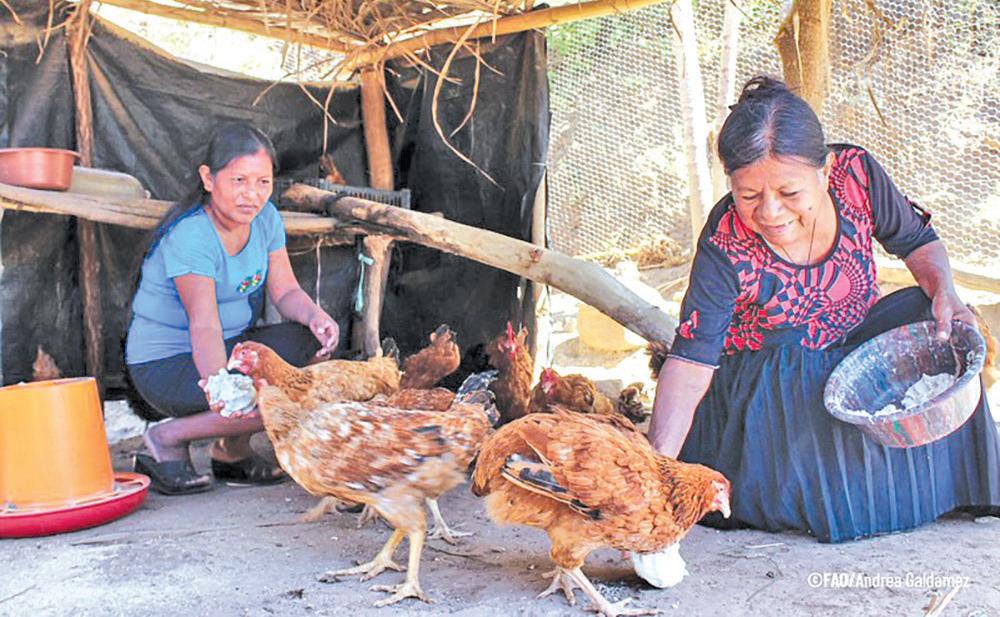
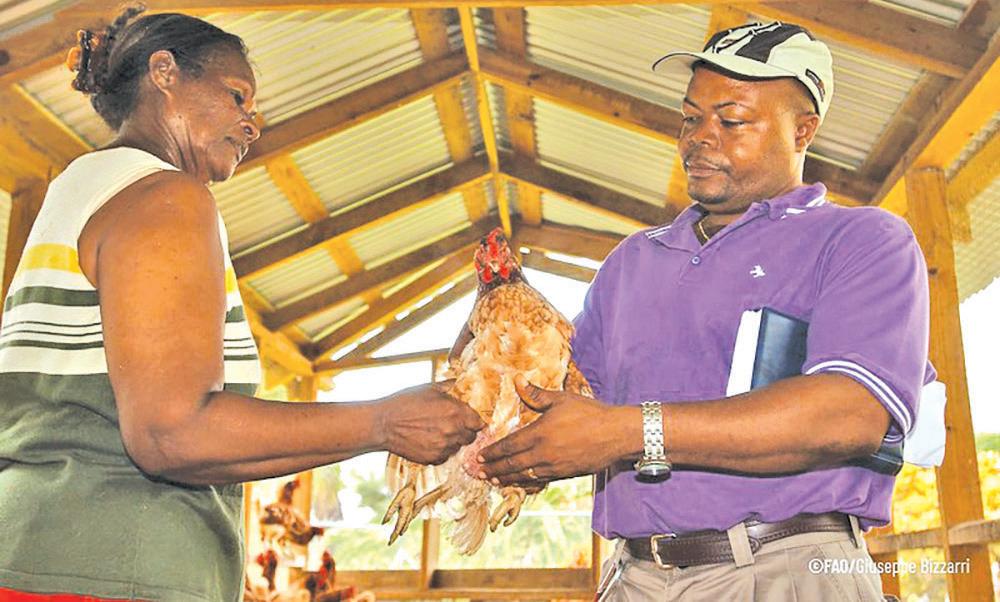
of emerging infectious diseases in humans
originate from domestic, wild animals
– FAO
On July 6, every year, the international community marks World Zoonoses Day, raising awareness of the risks posed by diseases transmitted between animals and humans while promoting practices to prevent them. This observance is particularly relevant given that an estimated 60 per cent of all known human infectious diseases are zoonotic, while nearly 75 per cent of emerging infectious diseases in humans originate from domestic or wild animals. These figures underscore the need for an integrated, cross-sectoral approach to addressing zoonotic diseases and other health threats by bringing together human health, animal health and environmental conservation. Against this backdrop, the Quadripartite Alliance— comprising the Food and Agriculture Organisation of the United Nations (FAO), the World Organisation for Animal Health (WOAH), the Pan American Health Organisation/World Health Organisation (PAHO/WHO) and the United Nations Environment Programme
(UNEP)—together with regional partners including the Inter-American Institute for Cooperation on Agriculture (IICA) and the Regional International Organisation for Plant and Animal Health (OIRSA), today announced the signing of a Joint Declaration to strengthen regional coordination under the One Health approach in the Americas, marking the first regional agreement of its kind. The Declaration calls for coordinated action to address health threats such as zoonotic diseases, food safety risks, and the impacts of climate change, biodiversity loss, environmental pollution, ecosystem degradation and antimicrobial resistance (AMR). According to WHO, AMR is estimated to cause 1.27 million direct deaths each year worldwide and is associated with nearly 5 million indirect deaths. Foodborne diseases cause an estimated 1.5 million deaths annually, including 78,000 in the Americas. “The health challenges faced by the region in recent years have highlighted the importance of stra-
tegic partnerships and coordinated action to achieve sustainable results. This is reflected in our ongoing efforts to address avian influenza and the New World screwworm outbreak across the region, helping protect the livelihoods of thousands of farming families. By signing this declaration, we are taking another important step towards strengthening regional cooperation and coordinated action to advance the implementation of the One Health approach,” said René Orellana Halkyer, FAO Assistant Director-General and Regional Representative for Latin America and the Caribbean (LAC). “Animal health systems are a critical first line of defence against disease outbreaks, particularly those with pandemic potential. However, WOAH’s latest State of the World’s Animal Health report shows that these systems remain underfunded. The One Health approach will only reach its full potential if animal health is fully integrated into public planning and investment. Across the Americas,
WOAH has promoted this integrated approach for many years, advocating for greater recognition of the role of animal health. This declaration marks a milestone for the region by reaffirming our commitment to addressing shared challenges more effectively,” said Dr Francisco D’Alessio, WOAH Regional Representative for the Americas. The Declaration recognises the Americas’ long-standing tradition of intersectoral cooperation in public health, animal health, agriculture and the environment. At the same time, it acknowledges the need to further strengthen coordination among international organisations, Governments, academia, civil society and the private sector to respond effectively to current and future challenges. “For PAHO, the One Health approach is a strategic priority and an essential component of public health in the Americas, enabling an integrated response to current and emerging health threats. For decades, this approach has guided PAHO’s technical cooperation through
programmes on communicable diseases at the human-animal interface, food safety, antimicrobial resistance and environmental public health, particularly through the work of our Regional Centre for Veterinary Public Health (PANAFTOSA) and the implementation of PAHO’s One Health Policy, which this year marks its fifth anniversary,” said Dr Jarbas Barbosa, Director of PAHO. For his part, Juan Bello, UNEP Regional Director and Representative for Latin America and the Caribbean, stated:
“For UNEP, the One Health approach is essential to addressing environmental and health challenges in Latin America and the Caribbean in an integrated manner by recognising the close interconnection between human, animal and environmental health. In the face of planetary threats such as climate change, biodiversity loss and pollution, One Health strengthens the resilience of natural systems by prioritising preventive rather than reactive action from an environ-
mental perspective. It also reinforces regional cooperation to address the environmental dimensions of antimicrobial resistance while reducing the risk of zoonotic diseases with pandemic potential, in line with the 2030 Agenda for Sustainable Development.” The Joint Declaration calls on organisations, networks and stakeholders across the region to strengthen information-sharing and regional collaboration in support of Member States’ efforts to prioritise and implement One Health activities. This includes enhanced coordination, intersectoral collaboration and public-private partnerships in the areas of governance, legislation, institutional development, capacity building, and the exchange of data, evidence and knowledge. Through this Declaration, the participating organisations reaffirm their commitment to promoting coordinated responses to health threats that transcend sectors and borders, contributing to the protection of the health of people, animals and ecosystems across the Americas.
Holness writes Caricom expressing concerns over reappointment of Secretary General
rime Minister
PAndrew Holness says while Jamaica is not seeking to overturn the decision of regional leaders to reappoint Dr Cala Barnett as the Secretary General of the Caribbean Community (Caricom), it, however, remains “concerned that the approach taken “has neither resolved the matter nor promoted the spirit and goals of the Revised Treaty of Chaguaramas”.
In a July 5, 2026 letter sent to the Caricom Chairman and St Lucia’s Prime Minister Philip J Pierre, Holness wrote that the “length of time devoted to this agenda item attests to the gravity and potential ramifications of the issue at hand”.
He said Kingston’s position reiterates one taken on May 8 and that this newsletter “will expand on the concerns expressed regarding certain procedural matters.
“I reaffirm, at the outset, that Jamaica is not by this letter seeking to overturn the decision taken in February 2026 to reappoint Dr Carla Barnett as Secretary General of Caricom. However, I remain concerned that the approach taken has neither resolved the matter nor promoted the spirit and goals of the Revised Treaty of Chaguaramas,” he added.
Holness said that as a matter of principle, the fact that one Caricom Member State “has formally and consistently expressed opposition to a matter, on procedural and other grounds, and the fact that the issue has since become one of public controversy, should be of grave concern to us and should not be disregarded.
“It has become clear that we were not all on the
Cuba begins
same page. Therefore, it is important that any concerns be addressed in a meaningful manner to restore cohesion, if not unity, which is indispensable to the effective functioning of Caricom,” Holness wrote.
Trinidad and Tobago has publicly criticised the manner in which Barnett, the first woman ever to be appointed as Caricom Secretary General, was reappointed by leaders during their retreat in St Kitts and Nevis in February.
Prime Minister Kamla Persad Bissessar has said that she will not recognise the Belizean economist when her current term ends in August and has since submitted a 22-page letter to Caricom urging that the regional leaders seek an opinion from the Trinidadbased Caribbean Court of Justice (CCJ) on the issue.
She also wants Barnett be engaged on a “monthto-month basis” until there is a determination by the CCJ.
“Such an interim extension should be expressly stated to be without prejudice to the legal rights or positions of any Member State, and should not be construed as affirming the validity of the impugned reappointment process.
“Pending the determi-
to
nation of the advisory proceedings: (a) the incumbent Secretary General shall fully recuse herself from the exercise of any authority whatsoever or take any decision directly or indirectly, regarding the said advisory proceedings.
Responsibility for such action shall be vested entirely in the Deputy Secretary General or some other independent person/ body,” and that the Caricom General Counsel “shall recuse herself from the matter of the advisory opinion in light of her primary role as an advisor to the Secretary General, who is subject to the proposed advisory opinion”.
The contents of the two letters from Trinidad and Tobago and Jamaica form a major talking point for the leaders who have gone into retreat on the first working day of their four-day summit.
In his letter, a copy of which had been obtained by the Caribbean Media Corporation (CMC), Holness said he is of the belief that the “explanations provided thus far regarding the process leading to the reappointment have neither advanced procedural certainty nor reassured all Member States. (Excerpt from Jamaica Observer)
restore power to Havana following nationwide blackout
Cuba began to slowly restore power on Monday after the country’s national electric grid collapsed earlier in the day, the latest blow to an island already suffering from severe energy, fuel, and medicine shortages.
Grid operator UNE said it was providing electricity to some vital services, including hospitals and food production centres, but by late afternoon was able to serve only one per cent of the capital Havana’s demand.
Officials have not yet
said what caused the grid to collapse.
Cuba has for months suffered from hours-long and, more recently, dayslong power outages linked in part to a decrepit grid and a US-imposed oil blockade that has cut off the island’s fuel supply.
The nationwide outage and slow recovery are more bad news for Cubans already exhausted from rolling blackouts that make it impossible for many to work or sleep in the Caribbean summer heat.
Death toll from Venezuela quakes rises to 3535 as thousands remain displaced
The death toll from Venezuela’s twin earthquakes has risen to 3535, authorities said on Monday, while nearly 18,000 persons remain homeless more than a week after the disaster struck the capital and nearby coastal areas.
Top lawmaker Jorge Rodriguez said the latest official tally showed 16,740 persons injured and 17,854 left without housing after the June 24 quakes, which measured magnitudes 7.2 and 7.5 and struck within seconds of each other.
The new figures underscore the scale of the disaster in and around Caracas and La Guaira, the coastal area hit hardest, as criticism mounts over the Government’s re-
sponse.
Venezuela’s social vice presidency said at least 12,800 persons were staying in 80 shelters across Caracas and La Guaira.
Dr Mauricio Cerpa Calderon, an adviser to the Emergency Operations Center of the Pan American Health Organisation (PAHO) in Washington, warned of the health risks mounting in these temporary sites.
“An event associated with or following an earthquake is the setting up of temporary shelters or camps,” Cerpa told Reuters. “These health risks are related to overcrowding, limited ventilation, interrupted access to safe drinking water, water and sanitation issues, and inadequate han-
dling of food and waste.” Cerpa said immediate priorities include addressing “respiratory infections, diarrhea, skin diseases, wound infections, dengue, and vaccine-preventable diseases such as tetanus, measles, rubella, diphtheria, pertussis and polio.”
Acting President Delcy Rodriguez has defended the Government’s handling of the disaster amid growing frustration from Venezuelans who have described the response as late and inadequate. Global humanitarian organisations including the International Rescue Committee have also criticised the Government’s response.
(Excerpt from Reuters)
Flavio Bolsonaro asks Trump to delay tariffs on Brazil until after election
Brazilian presidential hopeful Flavio Bolsonaro, the son of former President Jair Bolsonaro, is asking the Trump Administration to delay proposed tariffs on Brazilian goods until after October’s election, as he tries to counter allegations from President Luiz Inácio Lula da Silva that his family helped bring them about.
The Trump Administration proposed the 25 per cent tariffs in June, citing alleged trade violations, including illegal deforestation and what it called unfair electronic payment practices, catching Brazil’s Government by surprise. Lula had said relations were improving after a White House meeting with Trump in May.
The announcement came shortly after Bolsonaro met senior US officials in Washington, prompting accusations back home that he had invited US pressure on
More
Brazil, with Lula accusing the right-wing Senator of lobbying Washington to impose the tariffs.
He has since doubled down on those accusations, saying in a social media post last week, “the origin of all this was motivated by the Bolsonaro family itself” and that Bolsonaro’s request to delay the tariffs until after the election was “yet another act of treason against the Fatherland”.
Bolsonaro rejects the allegation, arguing instead that it was Lula who would gain a political advantage if the tariffs were imposed. “New US tariffs on Brazilian products would hand the current Brazilian Government precisely the political victory it has been engineering,” Bolsonaro wrote in a submission to the Office of the US Trade Representative. (Excerpt from Al Jazeera)
than 1000 arrested as part of global human trafficking crackdown
M“Look at my face, it says it all,” said Ariel Sotelo, a bleary-eyed 57-year-old Havana resident who had been without electricity since the day before. “We just have to grin and bear it, but it’s not easy.”
Nearly two-thirds of the country was already without power when the grid collapsed on Monday, so many of the island’s residents, largely without communications and accustomed to the lack of electricity, hardly registered the difference.
(Excerpt from Reuters)
ore than 1000 persons have been arrested as part of a global crackdown on human trafficking spanning 59 countries.
Coordinated by Interpol, Operation Global Chain saw officers target trafficking for sexual exploitation, forced labour and criminality, and coerced begging.
A network that was trafficking victims into online scamming in Cambodia, and a network forcing underage girls recruited via social media into sex work in Europe were dismantled as part of the operation, authorities said.
It found an emerging
trend of Latin American victims being trafficked for forced labour in Europe, with about 10 per cent of identified victims being minors from the Americas who were subjected to sexual exploitation.
As part of the operation, authorities in Colombia launched an airport prevention campaign to raise awareness about the risks of fraudulent job offers abroad.
Interpol said Brazil’s Federal Police had identified 406 victims – 83 Brazilians and 323 foreign nationals – of a transnational network trafficking victims to Cambodia where they were forced into online scamming.
In total, 2070 victims or potential victims were identified, the vast majority of whom authorities said were women. Of the arrests, 334 were for human trafficking and 690 for associated crimes.
Interpol, which coordinated the effort alongside the EU’s agency for law enforcement cooperation Europol and European border agency Frontex, said the operation’s findings had exposed evolving trafficking routes and methods.
Interpol notices have been issued targeting wanted suspects and persons of interest.
(Excerpt from BBC News)
Jamaican Prime Minister Andrew Holness
Senator Flavio Bolsonaro, son of former Brazilian President Jair Bolsonaro, leaves Federal Police headquarters in Brasilia, November 25, 2025 [AFP file photo]
Around the World
OIL NEWS
Oil advances as strike against tanker in Hormuz highlights risks
Oil gained following reports of attacks on vessels in the Strait of Hormuz, highlighting continued risks to traffic in the waterway.
Brent rose above US$72 a barrel, while West Texas Intermediate (WTI) crude was near US$69. A tanker travelling south reported being hit by a projectile on the port side about eight nautical miles east of Limah, Oman, early this morning causing a fire, UK Maritime Trade Operations said. No casualties were reported.
The incident occurred near one of the world’s most important energy shipping routes, despite a ceasefire between the United States and Iran and ongoing efforts to secure a lasting peace agreement.
“A tanker has reported being hit by an unknown projectile on the port side causing a fire, whilst travelling southbound,” UKMTO said in a post on X. (Excerpts from Bloomberg and channelnewsasia.com)
India’s Modi to meet Indonesia’s Prabowo for talks on defence, food security
India’s Prime Minister Narendra Modi is scheduled to meet Indonesia’s President Prabowo Subianto today, as the leaders of two of the world’s most populous countries seek to finalise deals ranging from defence to food security.
Modi on his first trip to Indonesia since 2023 will visit the capital Jakarta and Yogyakarta today and Wednesday, before heading to Australia and New Zealand.
Modi will discuss with Prabowo Memorandums of Understanding (MoUs) on health, space, pharmaceuticals and food security, Sandeep Chakravorty, India’s Ambassador to Indonesia, told reporters last week.
Russia hammered Kyiv and the surrounding region with missiles and drones early on Monday, killing at least 28 persons and exposing Ukraine’s critical shortage of US-made air-defence interceptors, officials said.
Rescuers were digging bodies from the rubble of a Kyiv high-rise ripped open in the overnight bombardment. The latest attack came on the eve of a NATO summit where US President Donald Trump is due to hold talks with Ukraine’s President Volodymyr Zelenskyy in a renewed push for peace.
Ukraine’s military was unable to down any of the 23 ballistic missiles fired by Russia, according to air force data, reflecting its increasing vulnerability to Moscow’s strikes as stocks
of its prized Patriot missiles run out.
Zelenskiy has pleaded for interceptors — the only weapon in Ukraine’s arsenal that can shoot down ballistic projectiles, whose high velocity and steep
flight path make them difficult to stop.
Speaking in his nightly video address, Zelenskiy said it was “simply absurd that, in the modern world, production has still not been scaled up to the level
actually required to protect people from ballistic terror”. He said that Ukraine had the know-how to produce the weapons and if it received US licences to manufacture US Patriot systems “our production would be sufficient not only to defend Ukraine but also to assist partners who need them”.
Earlier, the President called for “strong decisions” at the NATO summit in Turkey, which begins today, to ensure Ukraine can defend itself. Ukrainian air force data shows air defences shot down just four of 49 ballistic missiles in July.
Ukraine intercepted 37 other missiles and more than 90 per cent of the 351 drones used during Monday’s attack, the air force said. (Excerpt from Reuters)
As Khamenei mourners fill Iran’s streets,
Iran’s theocratic rulers are mobilising mass crowds of the revolutionary faithful on the streets of Tehran, but behind the display of unity it is far from clear they have resolved gaping internal fractures over the economy and state repression.
Vast numbers are attending a week of funeral events for Supreme Leader Ayatollah Ali Khamenei, killed in US-Israeli
discontent still simmers
strikes at the start of the war, in mourning ceremonies, marches and demonstrations across Iran.
The size of the rallies, aided by discounted transport, food and lodging, is intended as a referendum on the Islamic Republic, a top cleric said last week, and authorities are proclaiming the crowds as a message of defiance and power to foreign foes and internal critics alike.
While Tehran was filled with mourners on Monday, however, analysts – and even senior Iranian officials – caution that the crowd size cannot be equated to a popular endorsement of continued theocratic rule.
“If anyone’s thinking this is a litmus test for the popularity of the Islamic Republic, history tells us otherwise. It’s a funeral,
and Iranians do funerals very well,” said Ali Ansari, professor of modern history at St Andrews University in Scotland. Reuters spoke to people attending the rallies who said they were only there as spectators or were motivated by a sense of religious duty in a country of strong Shi’ite Muslim tradition, rather than to display political allegiance. (Excerpt from Reuters)
Over 5500 children displaced by fighting in Sudan’s el-Obeid, charity says
Mtime, some may get delayed, but there will still be outcomes related to the visit,” he said.
Prabowo met Modi in New Delhi last year, where they signed a wide range of agreements.
The two countries hope to conclude certain agreements on BrahMos, an India-Russia joint venture missile manufacturer, Chakravorty said. Defence talks would also cover maritime awareness and piracy, he added. In 2023, BrahMos said it was in advanced discussions with Indonesia on a deal worth between US$200 million and US$350 million for its missile systems. It has already signed deals with neighbours Vietnam and the Philippines. (Excerpt from Reuters)
ore than 5500 children have been newly displaced by fighting over the strategic Sudanese city of el-Obeid, and thousands more are at risk, Save the Children has warned.
“As families arrive in displacement sites and into local communities, they face increasingly difficult living conditions,” the international charity said in a statement. “Many are struggling to access adequate shelter, clean water, healthcare and education services, while overcrowding is placing additional pressure on already
limited resources.”
El-Obeid is home to more than half a million people and served as a key humanitarian lifeline for northwestern Sudan.
It has become the latest focus of the civil war between the Sudanese army and the Rapid Support Forces (RSF) paramilitary group that controls the Darfur region.
The city, where the Government’s 5th Infantry Division is based, has been besieged by the RSF for months, and targeted by intensifying drone attacks that have killed civilians and destroyed civilian in-
frastructure, resulting in severe fuel and water shortages.
“Throughout June, the situation… was extremely challenging – drones rained heavily in and around the city,” Emad, a civilian living in el-Obeid with his family, told Save the Children. “About 11 fuel stations were hit, along with fuel tankers… Additionally, tankers sitting idle inside the city were also hit, including water tankers.”
Siege-like conditions and overcrowding from internal displacement have also exacerbated a seasonal chol-
era outbreak, with 300 cases confirmed by Sudan’s State Ministry of Health, the charity said.
“Save the Children is particularly concerned about the growing psychological toll on children, many of whom have witnessed violence, lost loved ones, or been forced to flee multiple times in the past three years,” it said.
The charity said that across Sudan, children under 18 make up about 55 per cent of the country’s displaced population. (Excerpt from Al Jazeera)
China test fires missile into Pacific, alarming regional powers
China’s military testfired a missile from a nuclear-powered submarine into the Pacific on Monday, State media reported, drawing criticism and concern from the United States, Japan, Australia, New Zealand and Taiwan.
A People’s Liberation Army (PLA) Navy submarine launched the missile,
carrying a dummy warhead, toward international waters in the Pacific at 12:01h (0401 GMT), the official Xinhua news agency said.
Xinhua described the launch as a “routine arrangement” of China’s annual military training and not directed against any specific country or target.
Chinese Foreign Ministry
spokesperson Mao Ning said the launch was conducted “safely, in a standardised and professional manner throughout”.
“We hope relevant countries will not over-interpret the matter,” she said at a briefing in Beijing.
The US monitored China’s test launch from a submarine of an unarmed
intercontinental-range ballistic missile that landed in the southern Pacific Ocean, State Department spokesman Tommy Pigott said in a statement.
“We continue to urge China to engage in meaningful arms control discussions,” Pigott said.
(Excerpt from Reuters)
Indonesian President Prabowo Subianto and India’s Prime Minister Narendra Modi arrive for a photo opportunity ahead of their meeting at the Hyderabad House in New Delhi, India, January 25, 2025 (Reuters/Altaf Hussain file photo)
Firefighters works at the site of residential apartment buildings, which were heavily damaged during Russian missile and drone strikes, amid Russia’s attack on Ukraine, in Kyiv, Ukraine, July 6, 2026 (Reuters/Valentyn Ogirenko photo)
Look for ways to expand, and explore new outlets for your skills. Staying updated and accepting new means and methods for your talents will keep you in the running when faced with competitive situations.
Get your facts straight, and stick to the bare minimum. Too much of anything will cost you mentally, physically or financially. Take an innovative approach to decluttering.
Explore, live, learn and discover what excites you most. A change of scenery will spark your imagination and encourage you to explore new possibilities, but don’t take a chance that can cost you.
Whether you are dealing with money, joint ventures or health issues, knowing what’s possible and what isn’t before you make decisions will help you dodge letting someone take advantage of you.
Keep discussions going. You have more opportunities than you realize, and engaging in activities that can help you visualize the outcome and turn it into something realistic is encouraged.
A positive attitude will help you acquire information that’s geared toward better health, finances and negotiations. Dissect what you hear, and rework the information to suit your schedule and needs.
Refrain from offering personal information. Someone will use what you say against you. Concentrate more on what you can do to improve your life, prospects and financial situation. Lower your overhead.
Set a budget, draw the line and be realistic about what you want and what you need. Refuse to let anyone pressure you into something that isn’t necessary. Do your research.
Spend more time nurturing meaningful relationships and fixing up your space to offer a convenient and comfortable place to excel. Don’t hesitate to do things differently if it enriches your life.
Do a double take if someone surprises or pressures you to do something that makes you uncomfortable. Being upfront will lead to the least amount of tension.
Changes at home that add to your comfort and convenience will also bring you peace of mind and help you open doors that have been off limits. Don’t let love cost you.
Simplify your life and question anything that sounds too good to be true. Put more thought into what you enjoy doing and how you can implement what brings you pleasure into your everyday routine.
ARCHIE
Blue Water Shipping U15…
Annai Secondary’s Girls successfully defended their Blue Water Shipping Girls Under-15 National Championship title on Sunday, defeating Marian Academy 2-1 in an exciting final at the National Training Centre (NTC), Providence, East Bank Demerara (EBD) to once again be crowned national champions.
The Region Nine champions capped another outstanding campaign by retaining the title they won in 2025, reaffirming their status as the country’s leading girls’ U15 secondary school football team.
Annai entered the National Final Eight after successfully emerging from the Region Nine qualifiers, edging rivals St Ignatius Secondary on goal difference to secure their return to the national stage.
Marian Academy, representing Georgetown North, produced another impressive tournament run to book a second consecutive appearance in the national final against Annai. The Georgetown side displayed quality and consistency throughout the championship ,but ultimately fell just short yet again against a disciplined Annai outfit.
The third-place play-off saw Waramuri Secondary overcome President’s College in a penalty shootout following a closely-contested encounter to secure the bronze medal.
In the remaining placement matches, The New Central High School claimed
fifth place ahead of first-time national finalists Mahdia Secondary, whose participation was sponsored by the Rights of the Child Commission, while Wauna Primary defeated Abram Zuil Secondary to finish seventh overall.
Marian Academy’s Kaleigh Todd was determined to be the tournament’s Most Valuable Player (MVP) while her teammate, Skylar DeNobrega, was the highest goalscorer with 13 goals across the tournament. On the other hand, Annai Secondary’s Kesia Edward was the competition’s best goalkeeper.
Addressing the players during the presentation ceremony, Senior Vice President of Sales & Development at Blue Water Shipping, Richard DeNobrega, commended the standard of football displayed throughout the tournament while encouraging the young athletes to continue pursuing
the sport.
“The future is indeed bright, and the future is in every one of you young ladies that participated in this tournament. While there will always be a winner and a loser, today we have 1600 winners who are champions of football for Guyana. You are witnessing members of the Guyana National Team, who will be a part of future World Cups,” DeNobrega shared.
Guyana Football Federation (GFF) President Wayne Forde highlighted the continued growth of the competition and its impact on the development of girls’ football across the country.
Forde expressed, “The long-term goal is to have all secondary schools from every corner of Guyana participate in this exciting competition. With the steady growth we are witnessing, I am confident that we will achieve this in the very near future. The objec-
Annai edge Marian to secure back-to-back titles
tives of this competition are to create access, increase participation, promote development and discover talent – and we have achieved these objectives. We are making meaningful progress in the development of female football, and with two dedicated girls’ academies on the horizon, I am confident that our female national teams will continue to produce strong results on the regional and international stage.
“Congratulations to Annai Secondary for winning this year’s competition, and congratulations to every young player who competed with passion, discipline, and pure joy. You created many memorable moments that served as a source of encouragement for the hardworking team that made this championship possible. I wish you all the very best on your football journey.”
Meanwhile, Guyana Women’s Football Association President Andre Johnson also
commended the players and participating schools while reaffirming the Federation’s commitment to expanding opportunities for young female footballers across Guyana.
“We have witnessed not just games, but a display of passion, determination, teamwork and sportsmanship. Each match has brought its own excitement and challenges, and every player has shown immense growth and spirit. The Guyana Football Federation is committed to the continued development of women’s football, with a number of programmes set to be unveiled shortly at the secondary school level.”
The 2026 Blue Water Shipping Girls U15 National Championship marked another milestone in the competition’s continued growth. Over seven weeks, a record 80 schools participated, an increase from 68 schools in 2025, with each school registering
teams of up to 20 players, resulting in approximately 1600 girls taking part in this year’s championship.
A total of 111 matches were contested, producing 205 goals across more than 13 communities throughout Guyana. For the first time, regional qualifying matches were hosted in Kabakaburi, Tapakuma, Aishalton, Katoka, and Nappi, further extending the competition’s reach into communities across the country.
The National Final Eight brought together the top-performing schools from across Guyana following regional qualifying tournaments staged nationwide. Over two days of competition, the country’s most promising young female footballers showcased their technical ability, tactical awareness, determination, and sportsmanship while competing for national honours.
This year’s championship featured schools representing Regions Two, Three, Four, Six, Seven, Eight, Nine and Ten, highlighting the continued expansion, competitiveness and growing reach of girls’ football across Guyana.
The GFF extended its sincere congratulations to all participating schools, players, coaches, teachers, match officials, volunteers, parents, medical personnel and supporters, whose commitment and dedication contributed to another successful edition of the Blue Water Shipping Girls’ U15 National Championship.
Spain beat Portugal as Ronaldo’s World Cup career comes to end
Mikel Merino scored a late goal to send Spain past Portugal in the round of 16 on Monday and into a FIFA World Cup quarterfinal for the first time since they won it all in 2010. With the game looking like it was headed to extra time in Arlington, Texas, a Ferran Torres through-ball sprang Merino in the penalty area and he slotted home past Diogo Costa to give Spain the breakthrough goal in the 1-0 win over their neighbours on the Iberian Peninsula.
Merino had just been knocked down, and a foul was called. While a Portugal player argued, Merino played the ball back in, ran towards the goal, and put a shot past goalkeeper Costa after taking a pass from Torres.
There were some nervy moments down the stretch for Luis de la Fuente’s side as Portugal twice came close to levelling the score, but the 2024 European Champions clung to their lead in a
game that could be the last for Cristiano Ronaldo in a Portugal shirt.
“Mikel Merino never lets you down. He’s a sure thing. He won us the Euros,” Spain Manager de la Fuente said after the game. “He’s a huge player one of the best in the world in his position. We’re lucky to have players on the bench who would be starters in any other national team. The important thing is the attitude when they come on, and in the day today.
“All I ask is for people to be fair in their recognition. Mikel Merino is a player with exceptional performance, he’s a player who is always where he needs to be.”
Spain now face Belgium, who won their match against the United States on Monday, in the quarterfinals at SoFi Stadium in Inglewood, California.
“You remember everything, all the good, all the bad, what you’ve got back at home,” Merino said after the
game. “There’ve been very difficult moments for me this year, but good ones as well. With the injury, all this time that I haven’t been able to see my little one [newborn baby] grow up.
“I use it to get the best of myself.”
Ronaldo, who was visibly upset after the final whistle blew, was trying to get Portugal to the quarterfinals in a second consecutive tournament for the first time after reaching that stage at the 2024 European Championship.
Instead, the legendary striker’s career on soccer’s biggest stage is over for the alltime leader in international goals, who said ahead of the Spain game that 2026 would be his last World Cup.
Portugal Manager Roberto Martinez, who had already planned to step down at the end of Portugal’s World Cup run, said the team could be proud of its showing this summer.
“We can be very proud.
The players gave their heart and soul,” Martinez said. “I think it was our best match of the World Cup.
“We faced a favourite and stood our ground. We just lacked a bit of luck in the final third to capitalise on our chances.”
It was the sixth consecutive clean sheet for Spain at the World Cup a tournament record and goalkeeper Unai Sim n extended his record shutout streak to 609 minutes.
Spain broke a tie with Italy (1990) and Switzerland (2006-10) for the most consecutive World Cup matches not allowing a goal. Spain’s streak began with a 0-0 draw in the round of 16 in 2022, when Morocco advanced after a penalty shootout.
There was also a surprising scoreless draw against Cape Verde to open group play in this tournament followed by four consecutive shutout victories to advance to the quarterfinals.
Sim n surpassed the previous record of 517 consecutive scoreless minutes during a 3-0 blanking of Austria to open the knockout round Thursday. Famed Italy goalkeeper Walter Zenga set the standard in 1990 with five consecutive clean sheets in his home World Cup.
Sim n’s shutout streak started in 2022 in Qatar during a 2-1 loss to Japan to wrap up group play. He came into the Portugal game having made only four saves in this World Cup Austria had no shots on target and on Monday, Sim n had to make two saves in the first half against Portugal, both on shots by Ronaldo. The second of those saves was an impressive diving stop, when he was still in mid-air after reaching back to grab the ball with both hands. Ronaldo took that shot after teammate Jos S ‘s header went off the shoulder of the 29-year-old Athletic Bilbao keeper. (ESPN)
Cristiano Ronaldo reacts at the end of Portugal’s loss to Spain in the round of 16 at the World Cup
Annai Secondary celebrate their back-to-back Blue Water Girls’ Championship
Marian Academy’s Kaleigh Todd was adjudged the tournament’s MVP
Pitamber, Joshi stay perfect in National Junior Chess Qualifiers
Candidate Master (CM) Sachin Pitamber and Woman Candidate Master (WCM) Aditi Joshi remained unbeaten after three rounds of the National Junior Championships Qualifiers 2026, strengthening their positions in Group A at Olympic House, Liliendaal, Greater Georgetown.
Both players moved to three points from three games on Monday, with Pitamber defeating Nicholas Zhang and Joshi beating Alek UbaldoSingh in key third-round clashes. Matthew Singh also stayed perfect after defeating Kataleya Sam, leaving three players on maximum points at the top of the standings.
Joshi heads the Group A standings on tie-breaks after three rounds, followed by Singh and Pitamber.
Alexander Zhang and Abel Fernandez Ciria are close behind on 2.5 points.
The tournament, which is part of the national junior championship cycle
where Kyle Couchman is the defending national junior champion, is being played as a seven-round Swiss-System event. The competition runs up to
July 8, with John Lee serving as Chief Arbiter.
Pitamber, the highest-rated player in Group A, continued his strong run by taking the full
Buxton All Stars U13 make positive impact in League, community
Buxton All Stars Football Club’s Under-13 team are making a positive impact both on and off the field as they continue their campaign in the Guyana Football Federation (GFF)/ East Demerara Football Association (EDFA) Under-13 Youth Ensemble League.
After three matches, the young Buxton outfit has recorded one victory and two draws, remaining unbeaten in the competition. Their performances have highlighted the team’s discipline, determination, and growing confidence as they compete against some of the country’s promising young footballers.
While striving for success on the pitch, the team have
also demonstrated the true meaning of sportsmanship and community service. The players recently made a heartfelt donation to Coach Herbert McPherson, popularly known as “Coach Dan”, who is currently recovering from illness. The donation was received by his brother on his behalf.
In a message of encouragement, the club extended its best wishes to the respected coach, saying, “We at Buxton All Stars wish you a speedy recovery. Our prayers are with you. God is still on the throne, and He hears our prayers.
The gesture reflects the values being instilled within the Buxton All Stars programme, where character,
point against Nicholas Zhang, who had also entered the round with two wins from two games. Joshi also made the most of her third-round test, de-
feating Ubaldo-Singh to remain among the leaders. Singh kept pace with the two titled players by defeating Sam, while Fernandez Ciria and
Aquilani Swaminadha shared the point. Alexander Zhang moved to 2.5 points with a win over Javier Davenand, while Arysh Raghunauth and Jaden Todd played to a draw.
Other third-round winners included Darrel Abrams, Aiden Tinnie, Parnita Kishun, Vir Narine, Dominic David Sam, Kaija Clement, Jeremy Cole, Ciel Clement, Arush Ramnarine, Jacob McDonald and Ethen Pompey. Amaya Sharma and Varsha Pooran drew their encounter.
After three rounds, Swaminadha, UbaldoSingh, Nicholas Zhang, Sam, Abrams, Cole, Clement, Tinnie, Narine, Raghunauth, Kishun and Dominic Sam are all on two points, keeping them within reach of the leading group heading into the remaining rounds. The qualifiers will continue at Olympic House, Liliendaal, with the race for the top places still open.
Dave’s West Indian Florist backs WI Over-60s World Cup
Dave’s West Indian Florist & Groceries has come on board as a kit sponsor for the West Indies Over-60s cricket team ahead of the International Masters Cricket (IMC) Over-60s Cricket World Cup, which will be held in Canada from August 9 to August 23, 2026.
The sponsorship was announced by the Cricket West Indies (CWI) Masters Association, which said the support will assist the team as they prepare to represent the region on the international masters cricket stage.
compassion, and unity are considered just as important as football development.
The club’s thoughtful act has been warmly received by members of the football community, who have praised the young players for their kindness and maturity. With their unbeaten start and growing confidence, Buxton All Stars U13 will be aiming to build on their solid record as the GFF/EDFA Under-13 Youth Ensemble League continues. The team remain focused on improving with every match while proudly representing the Buxton community, both through their performances and their commitment to helping others.
CWIMA said the contribution is another strong show of backing from the West Indian business community, especially for senior cricketers who continue to represent the Caribbean with pride and commitment.
Dave’s West Indian Florist & Groceries is owned by Dave Narine and is based at 114-07 Liberty Avenue, South Richmond Hill, New York. The business is known in the community for fresh floral arrangements, gifts, and West Indian products. It has also been recognised for its continued support of community initiatives and sport.
CWIMA Secretary
Roy Singh welcomed the sponsorship and said it would be important to the team’s preparation.
“This support means a great deal to the players and the organisation,” Singh said. “Masters cricket continues to grow internationally, and sponsorships like this help ensure that our players are properly supported as they prepare to compete against the best Over-60s teams in the world.”
The West Indies squad will be captained by Zamin Amin. The other players named are Narine Bidhesi, Anthony Boyle, Rajendrasammy
Chetana, Deonarine Deyal, Rajendra Dilraj, Harry Narain Heeralaa, Fareed Hosein, Steve Linton, Ken Mayers, Hafiz Mohamed, Victor Patrick, Keith Seale, Shivnath Seeram, Anthony “Tony” Small, and Balwant Roy Singh. The team will be managed by Raj Singh, while Alexio Daley will serve as physical therapist.
CWIMA said it is looking forward to a strong showing in Canada and expressed thanks to all sponsors, supporters, families, and cricket fans who continue to support West Indies masters cricket.
CM Sachin Pitamber in deep concentration
WCM Aditi Joshi leads the standings after three rounds
The Buxton Stars U13 team handing over their donation
Dave’s West Indian Florist & Groceries has come on board as a kit sponsor for the West Indies Over-60s cricket team ahead of the IMC Over-60s Cricket World Cup
Sri Lanka try to make a play after Greaves’ 180, Hope’s 112
Sri Lanka rolled the momentum they had built in the latter half of the second session to roll over the
Justin Greaves at first slip. Two balls later, he produced a more convincing boundary through extra cover, and then
boundaries, two came via edges, though an uppercut six off Alzarri signalled his intent as well to push the
was essentially the Hope and ters taking on whatever the Sri Lankans threw at them with consummate ease. The only areas of concern were some increasingly frequent deliveries keeping low off a sistent enough to cause any undue concern – at least not
The pair moved along in lockstep, like they had done for most of the previous day.
ered about the scoring rate,
10-499 (Justin Greaves, 165.5 ov) Bowling O-M-R-W Asitha Fernando 40-7-130-5 Isitha Wijesundara 29-2-108-0 Milan Rathnayaka 31-5-74-1 Prabath Jayasuriya 55.5-8-131-3 Dhananjaya de Silva 2-1-3-0 Sonal Dinusha 8-0-29-1
Sri Lanka 2nd Innings
Nishan Fernando c Campbell b AS Joseph 20 Lahiru Udara lbw b S Joseph 0 Dinesh Chandimal not out 40 Kamindu Mendis not out 30 Extras (lb 1, nb 1) 2 Total 22 Ov (RR: 4.18) 92/2
Yet to bat: Kusal Mendis †, Dhananjaya de Silva (c), Sonal Dinusha, Milan Rathnayaka, Isitha Wijesundara, Prabath Jayasuriya, Asitha Fernando Fall of wickets: 1-2 (Lahiru Udara, 1.4 ov), 2-32 (Nishan Fernando, 10.1 ov)
Bowling O-M-R-W
Jayden Seales 7-0-26-0
Shamar Joseph 7-1-27-1
Alzarri Joseph 4-0-17-1
Anderson Phillip 4-1-21-0
significant milestones as well, with this Hope’s fifth Test century but the first in the Caribbean, and for Greaves it was his second ton at the Sir Vivian Richards Stadium and third overall in Tests. It also showcased his growing ability to convert his starts, with his Test centuries now outnumbering his Test fifties three to one.
However, with less than 15 minutes to lunch, Hope fell in an unusual manner as he sort of padded away an innocuous leg-stump delivery from Sonal Dinusha. As the ball passed and went through to
and Shamar Joseph, the latter giving Fernando his third Test five-wicket haul. In between Milan Rathnayake dismissed Alzarri – also with a short ball, as he looked to take on the man at fine leg – but the prize scalp of Greaves was reserved for Prabath Jayasuriya, as the tall all-rounder finally faltered 325 deliveries into his innings – getting a leading edge to point off one that spun out of the rough. (ESPNcricinfo)
Dinesh Chandimal raced to 40* before stumps
Shai Hope hit his first Test century on Caribbean soil
Asitha Fernando claimed a five-for
Parkinson, Harvey bag silver at Caricom 10K
The Gros Islet in Saint Lucia set the perfect backdrop for a scenic and competitive staging of the 19th Caricom 10K Road Run/Walk on Sunday, as two young Guyanese athletes claimed spots on the podium.
Jamaica dominated the top position in the Overall Male category (Elite 10K Male) with Garfield Gordon winning the Caricom Chairman’s Trophy, while Guyana’s Odida Parkinson and Kamar Thomas of Antigua and Barbuda captured the second and thirdplace prizes, respectively.
On the distaff side, Barbados’s Carlie Robinson claimed the Caricom Secretary-General’s Trophy – Female and first prize in the Overall Female category (Elite 10K Female), while Guyana’s Attoya Harvey and Alexia John of Trinidad and Tobago stopped the clock for silver and bronze, respectively.
More than 250 profes-
sional athletes, amateur competitors, and recreational runners represent-
ing 15 countries and territories took part in the event.
GBF names squad for FIBA Women’s
AmeriCup 2027 Centrobasket Qualifiers
Fresh off a historic silver-medal finish at the Caribbean Women’s Basketball Championship, the Guyana Basketball Federation (GBF) has unveiled a balanced 12-player squad that will represent the Golden Arrowhead at the FIBA Women’s AmeriCup 2027 Centrobasket Qualifiers in Managua, Nicaragua.
The tournament is scheduled for July 12-18 at the Polideportivo Alexis Argüello, where eight of the region’s top national teams will compete for three coveted spots at the FIBA Women’s AmeriCup 2027.
Guyana enter the competition riding a wave of confidence after producing a second-place performance at the women’s Caribbean Championship that earned the team a place on the continental stage.
The squad will open its Group B campaign on July 12 against El Salvador before taking on regional heavyweights Puerto Rico and the United States Virgin Islands.
Headlining the roster are the talented Ramlall sisters – Amisha, Arshia and Ashna – whose contributions were instrumental in Guyana’s remarkable silver-medal run.
Their combination of scoring ability, defensive intensity, and versatility has become a cornerstone of the national programme, and they are expected to once again play a leading role as Guyana seek to make history.
The experienced core is further strengthened by Captain Joy Brown, whose leadership
Minister for Education, Youth Development, Sports and Digital Transformation, Kenson Casimir, delivered remarks on behalf of PM Pierre. He emphasised the significance of the Road Run/ Walk to Caricom unity.
The Road Run/Walk forms part of the preevent activities of the 51st Regular Meeting of the Conference of Heads of Government of Caricom, scheduled for July 5-8 in Gros Islet, Saint Lucia under the chairmanship of Philip J Pierre, Prime Minister of Saint Lucia and Caricom Chair.
“This run/walk is more than a race. It is a celebration of health, discipline, unity, community spirit, and Caribbean friendship. It reminds us that Caricom is not only about the meetings of Heads of Government, the policy discussions, and regional decisions. Caricom is about people. It’s also about athletes, our families, and young people. It’s about our communities and the shared Caribbean identity that connects us across borders. Today, every participant has contributed to that spirit. You are part of something meaningful. You have helped demonstrate the strength, energy, and togetherness of our Caribbean Community,” the Minister shared.
expressed confidence in the team’s ability to build on their recent achievements.
“We are incredibly proud of this group of women who have
Ahead of the award presentation, Saint Lucia’s
Ram to lead 14-member National U19 squad
TThe Road Run/Walk, according to Caricom Secretary General Dr Carla Barnett, reflects Caricom’s commitment to tackling the rise in non-communicable diseases (NCDs) by advocating for active lifestyles and healthy nutrition. Barnett expressed, “Across our Community, we have a very high incidence of non-communicable diseases, and we know that healthier lifestyles make it easier for us to manage these conditions and to prevent them. Our numbers are on the high side in terms of the incidence of hypertension, diabetes, and heart disease. I encourage everyone in the Community to continue to be active, to exercise and to live active lifestyles.”
Minister Casimir presented the Caricom Chairman’s Trophy and other top prizes while Dr Barnett presented the Secretary General’s trophy. Also present at Sunday’s event were Caricom’s Deputy Secretary General, Dr Armstrong Alexis; Assistant Secretary General (Human and Social Development) Alison Drayton; Assistant Secretary General (Foreign and Community Relations) Elizabeth Solomon; Assistant Secretary General (Economic Integration, Innovation and Development) Dr Wendell Samuel, and other Caricom and Government officials.
match, and give ourselves the best opportunity to be successful.”
Assistant Coach Adams echoed those sentiments, commending the players’ attitude and eagerness to improve throughout the preparation period.
“The response from the players has been excellent. They’ve embraced the work, supported each other and shown a real desire to learn. As a coaching staff, we’re excited about what this group can achieve, and we have every confidence they’ll give a good account of themselves at the regional championship,” Adams shared.
The GCB has extended its best wishes to the players and management, expressing confidence that the team will proudly represent Guyana throughout the tournament in Antigua and Barbuda.
CARICOM Secretary General, Dr Carla Barnett (second row, ninth from right); Deputy Secretary General Dr Armstrong Alexis (front row, far left), and Saint Lucia’s Minister for Education, Youth Development, Sports and Digital Transformation, Kenson Casimir (second row, eighth from right), pictured with winners alongside Caricom and Government officials
Guyana’s women’s basketball team
he Guyana Cricket Kush Seegobin; Joshua
Parmeshwar Ram will lead the national U19 team into the CWI Rising Stars tournament
Guyana’s Captain, Joy Brown
Shamar Apple will bring his explosive batting to the CWI Rising Stars tournament once again
Perth Scorchers name explosive squad
The Perth Scorchers have named a 14-member squad, packed with international talent for the 2026 ExxonMobil Guyana Global Super League.
The 2026 edition of the GSL, which runs from July 23 to August 1 in Guyana, will mark the first time Perth has contested the tournament.
Three-time Big Bash League (BBL) title-winning Captain Ashton Turner will lead the squad, which will compete as the Perth Scorchers XI.
Brody Couch, Aaron Hardie and Jhye Richardson are the other members in the squad that were part of Perth’s team that defeated Sydney Sixers in the BBL|15 Final at Optus Stadium earlier this year.
Ashton Agar, Joel Curtis, and Sam Fanning also feature in the squad, having all played for the KFC BBL|15 champions during that campaign.
Fresh from helping Western Australia’s Men’s Aboriginal team win the National Indigenous Cricket Championship title, D’Arcy Short is also set to don the orange for the first time, having represented Adelaide and Hobart in the BBL over the past decade.
The remainder of the Perth Scorchers XI squad will be made up by players from New Zealand, South Africa, Pakistan and West Indies.
Star New Zealand batter Mark
Chapman will add further depth to the side’s batting stocks, having played 32 One-Day Internationals (ODIs) and 113 T20 Internationals (T20Is) over a career spanning more than a decade.
He was at his breathtaking best when belting 48 off 26 balls against South Africa earlier in the tournament.
Perth will also call upon the local knowledge of West Indies top-order batter Ackeem Auguste, who made his international debut in both white-ball formats last year.
Auguste’s West Indies teammate Akeal Hosein joins him in the squad, with the left-arm orthodox spinner boasting an impressive 94 wickets from 99 T20I appearances.
Hosein was a consistent performer for his side during the T20 World Cup earlier in the year, taking seven wickets at 23.28.
After making his T20I debut for South Africa against New Zealand earlier this year, powerful middle-order batter Dian Forrester is set to add further firepower to Scorchers XI line-up.
Forrester made important contributions with the bat in all three of South Africa’s wins in the five-match series against New Zealand.
Pakistan wicketkeeper-batter Usman Khan and wrist spinner Sufyan Moqim round out the squad, with both players
boasting valuable white-ball international experience.
Khan has become a regular fixture in Pakistan’s T20 side, playing 38 matches since his debut in 2024.
The 31-year-old made a half-century in one of Pakistan’s three wins over Australia in the T20 series earlier this year.
Moqim has notched 19 T20I appearances for Pakistan, which has yielded 27 wickets at a tidy 14.74, including a stunning 5-3 against Zimbabwe in 2024.
All GSL matches will be played at Providence, home of the Guyana Amazon Warriors, over a 10-day period, with Perth Scorchers XI to take on Lahore Qalanders
in the tournament opener on July 23. BBL|03 title-winning captain and Scorchers great Simon Katich will assume the role of stand-in Head Coach, with Adam Voges unavailable due to commitments with Trent Rockets in The Hundred. Perth Scorchers XI squad for the 2026 ExxonMobil Guyana Global Super League: Ashton Turner (Captain); Ashton Agar; Ackeem Auguste (West Indies); Mark Chapman (New Zealand); Brody Couch, Joel Curtis, Sam Fanning, Dian Forrester (South Africa); Aaron Hardie; Akeal Hosein (West Indies); Usman Khan (Pakistan); Sufiyan Moqim (Pakistan); Jhye Richardson and D’Arcy Short.
US run at FIFA World Cup ends with 4-1 loss to Belgium
The US men’s national team came into this FIFA World Cup with a line-up full of players with key roles in Europe’s top leagues. They had the name-brand coach — Mauricio Pochettino, of Tottenham, PSG, and Chelsea fame. And they had homefield advantage, with every game on US soil for the first time in three decades.
For weeks, the hype seemed like it might be real: The team’s three wins over Paraguay, Australia, and Bosnia-Herzegovina were the most ever by a US men’s squad in a World Cup. A new generation of American fans filled stadiums by the tens of thousands and tuned in on TV by the tens of millions.
But in the end, the Americans’ exit was the same as it ever was: Eliminated yet again in the Round of 16 at the hands of a European team — this time, Belgium, by a score of 4-1.
From the moment they stepped onto the Seattle field, the US were outclassed by their opponent, number nine-ranked Belgium. Countless turnovers and defensive lapses were seized on by the Belgians, who needed only nine minutes to take a 1-0 lead.
Then, once the Americans equalised on a free kick by midfielder Malik Tillman, Belgium
scored yet again in barely a minute of play.
Belgian forward Charles De Ketelaere scored both his team’s first-half goals.
After halftime, came an embarrassing nail in the coffin that silenced the Seattle sellout crowd for good — a 57th minute roll-in by Hans
Vanaken after a slip-up by goalkeeper Matt Freese outside of the penalty area left the goal unguarded. Belgian forward Romelu Lukaku added a stoppage-time goal to seal the final score at 4-1.
The US had entered Monday’s game under a cloud of controversy around their striker Folarin Balogun, who was shown a red card in last week’s Round of 32 match against Bosnia-Herzegovina. An automatic one-game suspension was set to sideline Balogun, the Americans’ leading scorer at the World Cup, for Monday’s game.
Then, the day before the game, a FIFA disciplinary panel took the highly-unusual step of delaying Balogun’s suspension by a year to allow him to participate. Then, news broke that President Donald Trump had personally called FIFA President Gianni Infantino to encourage him to review the red card.
The Royal Belgian Football Association said it would protest Balogun’s inclusion in the lineup. But even at full strength, the US were never real contenders in Monday’s game.
Belgium will advance to the quarter-finals for the third time in the past four World Cups, where they will face Spain on Friday in Los Angeles.
(NPR SPORT)
The Perth Scorchers have named a strong 14-member team for the ExxonMobil Guyana GSL T20
BBL-winning Captain Ashton Turner will lead the Perth Scorchers squad
Charles De Ketelaere, #17 of Belgium celebrates after scoring his team’s second goal during the World Cup Round of 16 match against the United States on Monday in Seattle (Alex Grimm/Getty Images)