The Berbice Bridge will be closed to vehicular traffic on:
Sunday, February 22 – 07:00h–08:30h, and Monday, February 23 – 07:45h–09:15h.
BRIDGE OPENINGS FERRY SCHEDULE
Parika and Supenaam departure times – 05:00h, 10:00h-12:00h, 16:00h, 18:30h daily
WEATHER TODAY
Sunny skies are expected during the day, followed by clear skies at night. Temperatures are expected to range between 23 degrees Celsius and 29 degrees Celsius.
Winds: North-Easterly to East North-Easterly between 4.02 metres and 6.25 metres.
High Tide: 07:40h and 20:09h reaching maximums height of 2.69 metres and 2.55 metres.
Low Tide: 13:40h reaching minimum height of 0.53 metres.
Govt sets eyes on halting water imports within 12 months
…to also explore using waterways to harness energy
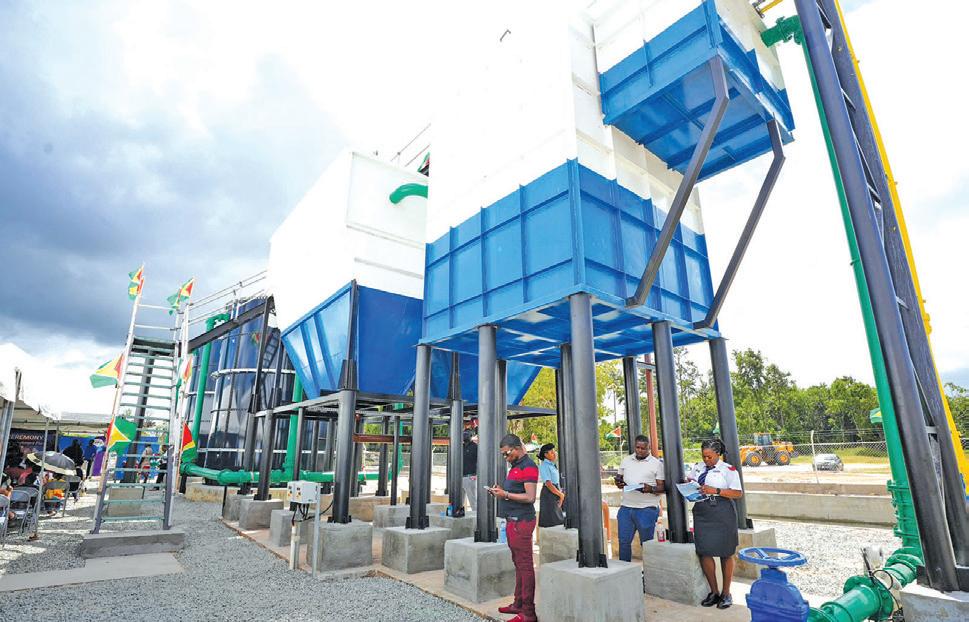
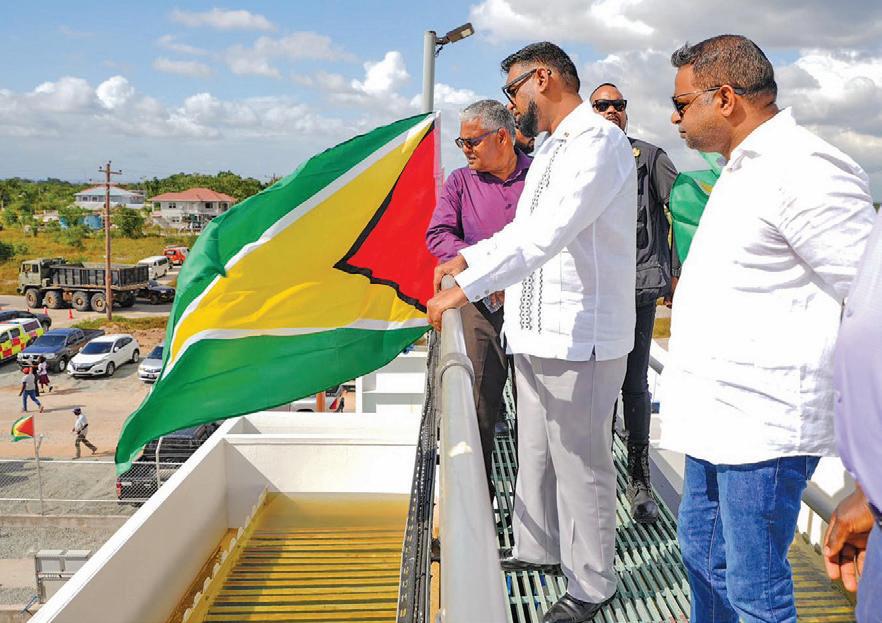
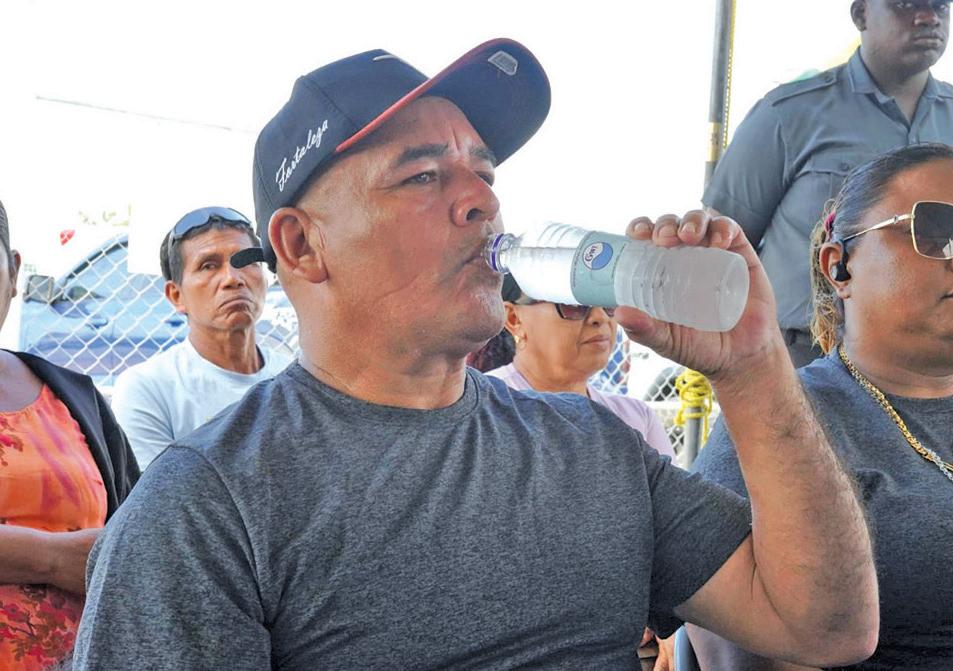
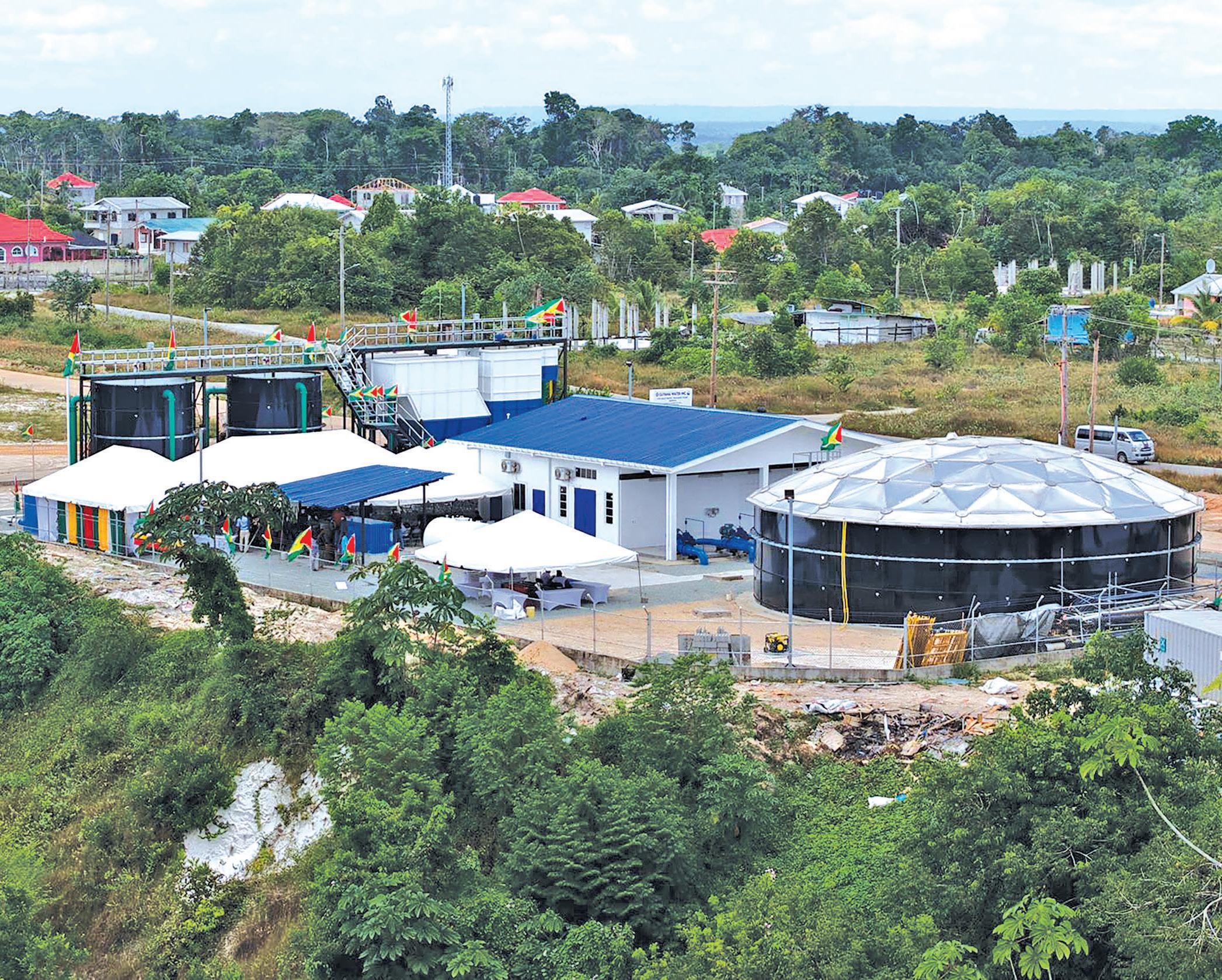
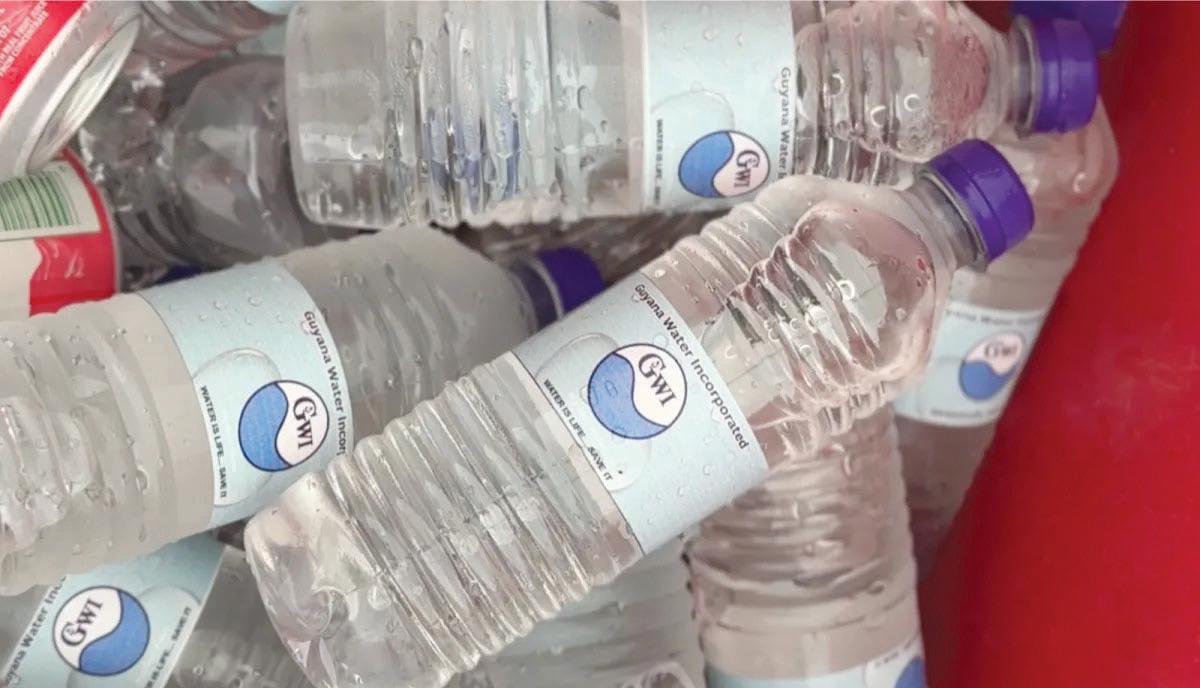
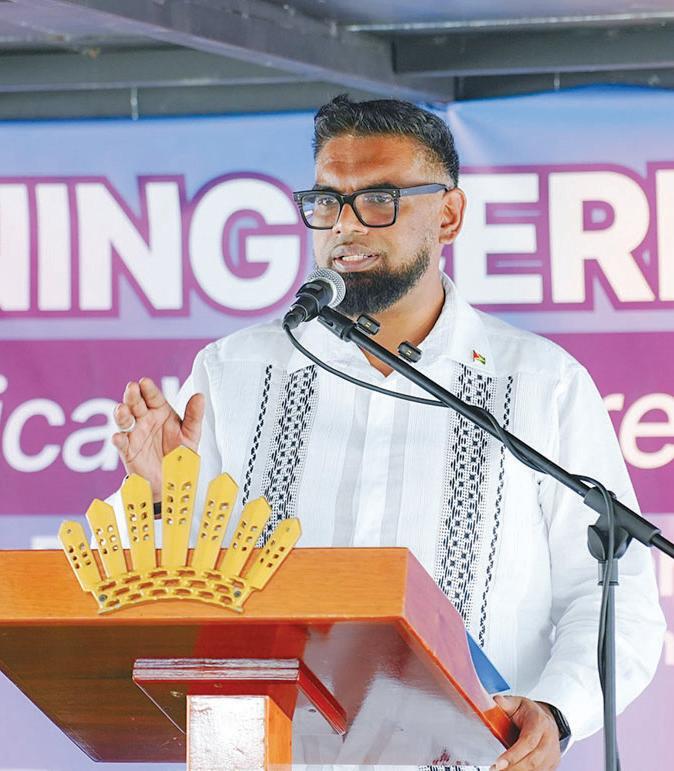
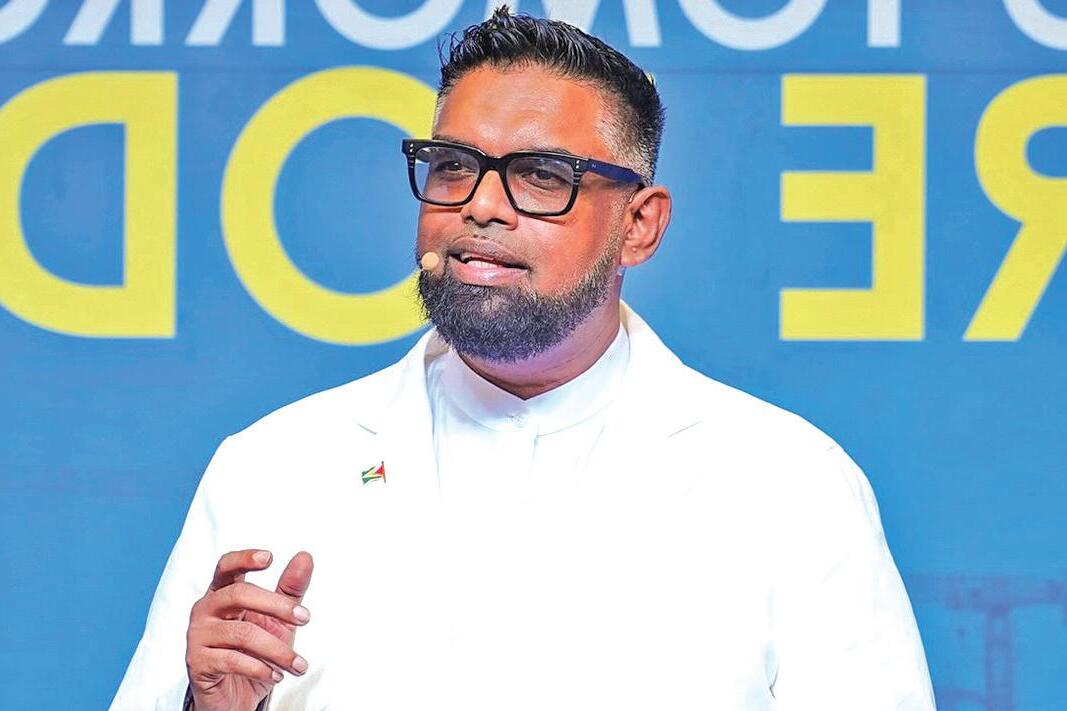
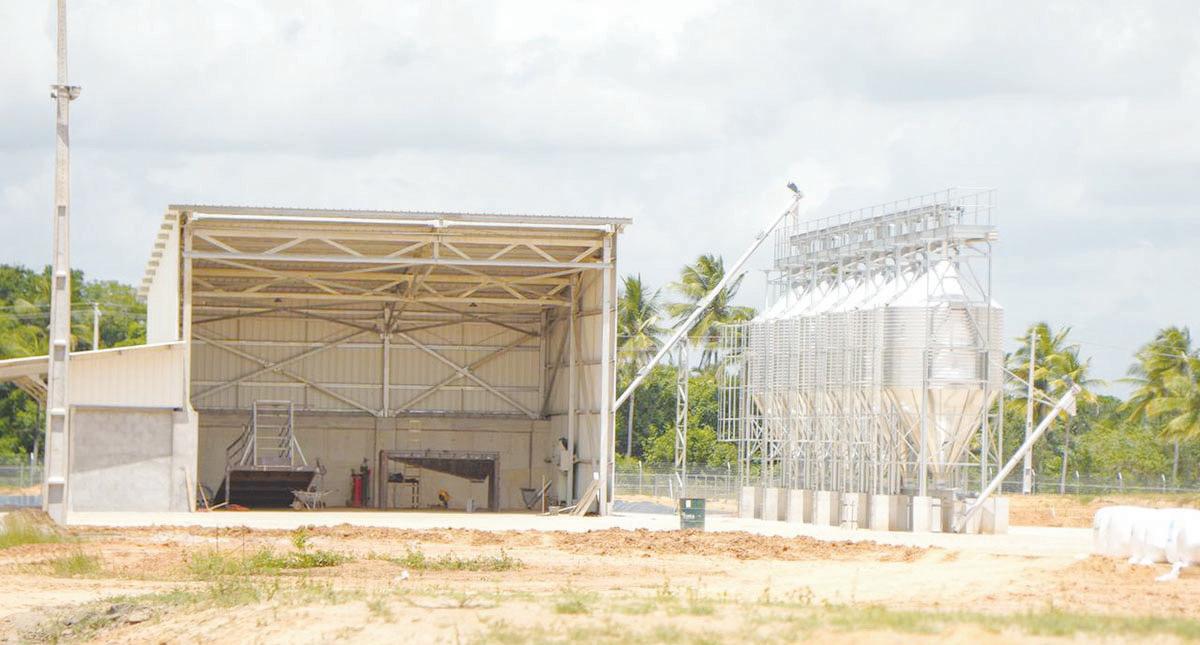
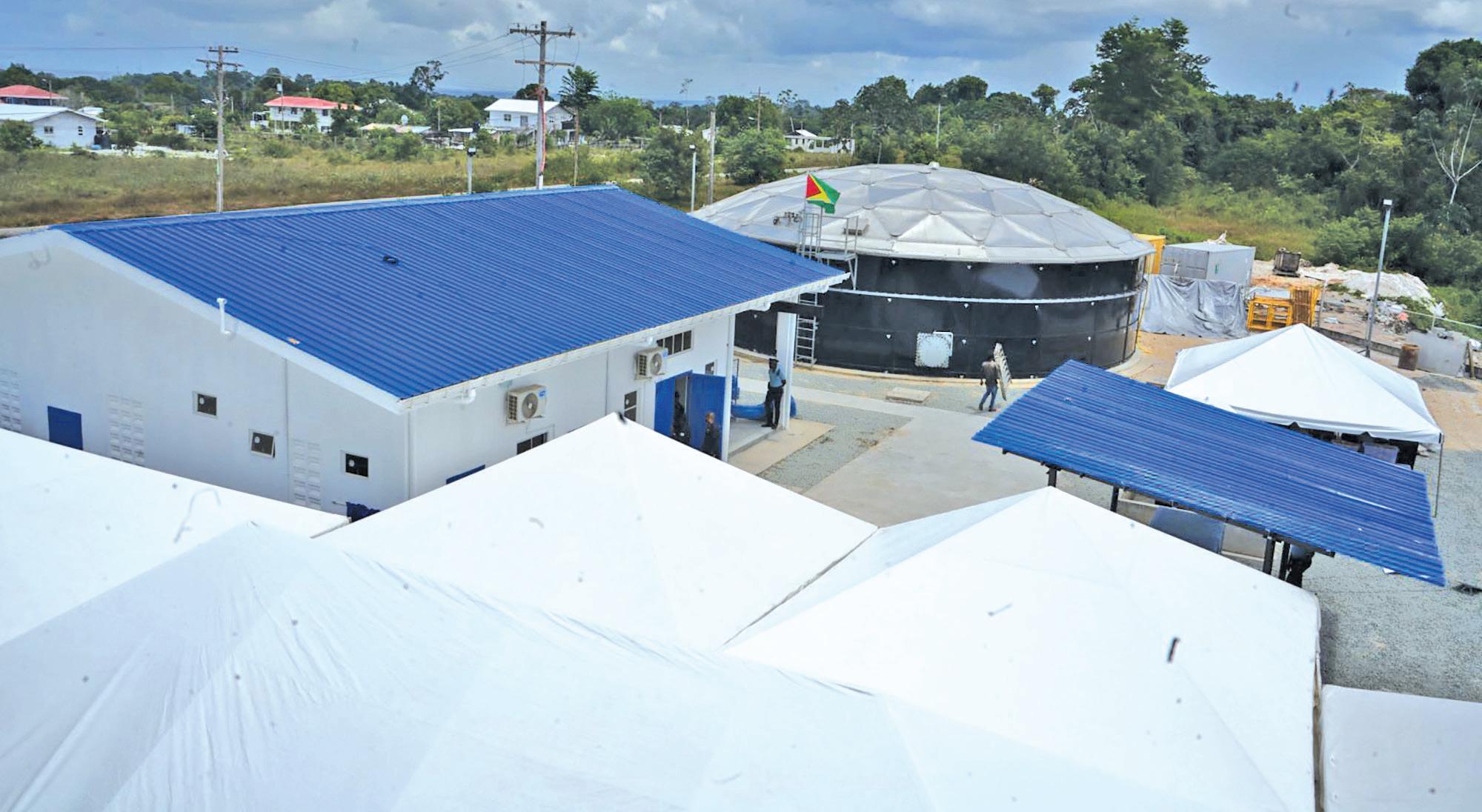
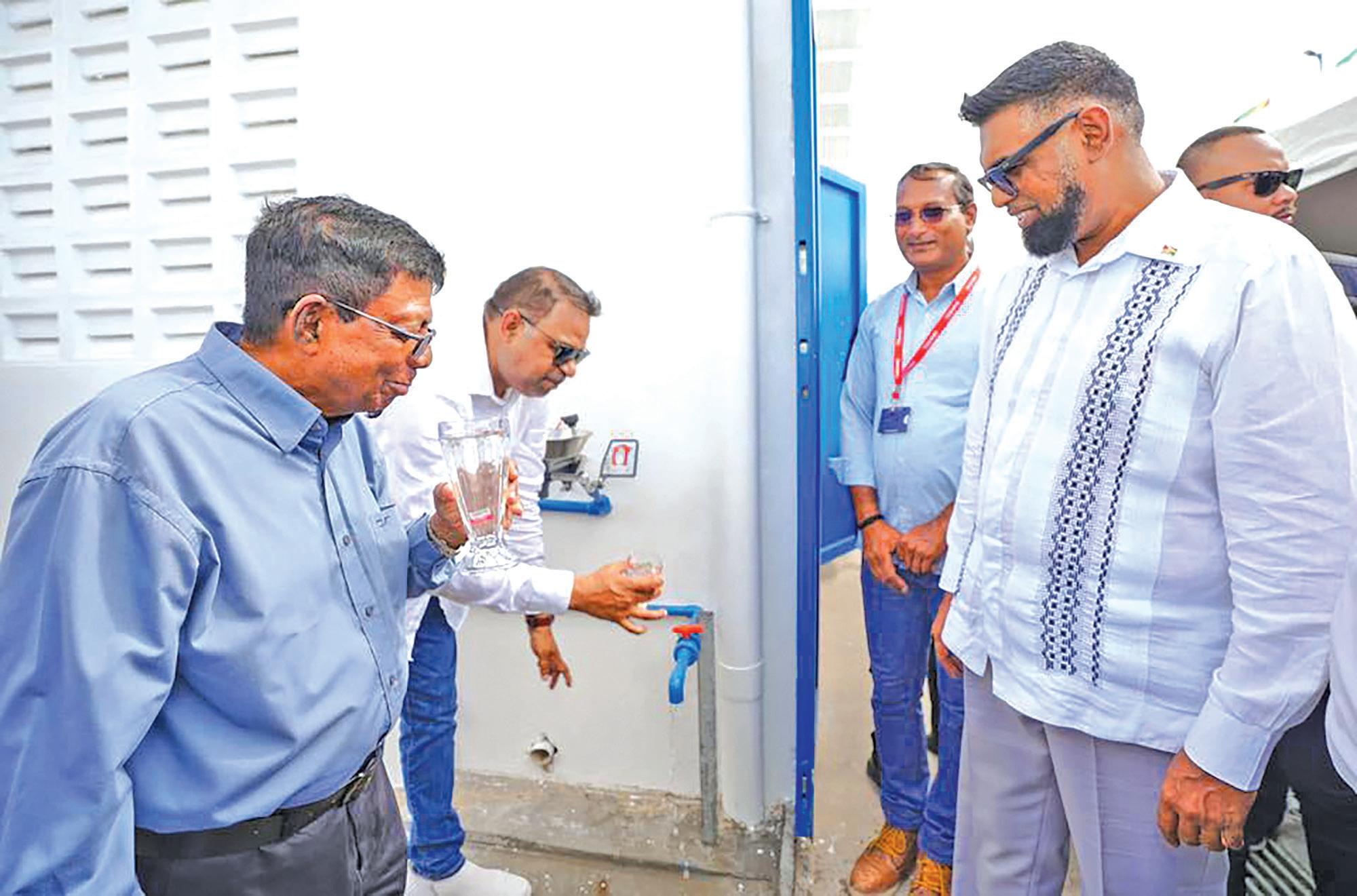
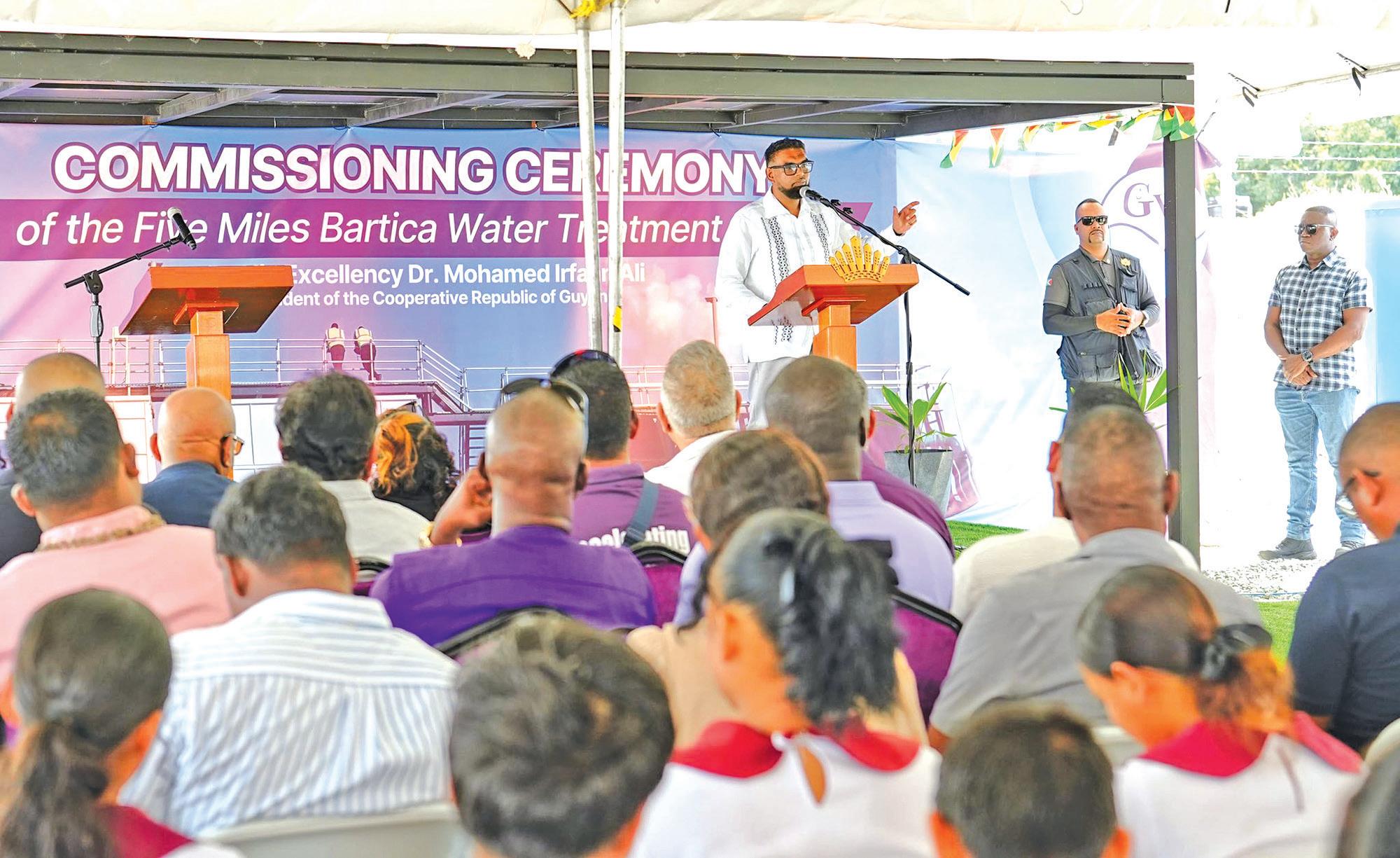
As a “Land of Many Waters”, President Dr Irfaan Ali is of the firm view that Guyana should not be importing bottled water given the country’s vast waterways and freshwater resources. The Head of State made these remarks on Saturday at the commissioning of the new Five Miles Water Treatment Plant at Bartica, Region Seven (Cuyuni-Mazaruni).
He charged the Ministry of Utilities and Aviation, headed by Minister Deodat Indar, to come up with a plan that will see, among other things, all the bottled water consumed locally produced right here.
“It can't be such a resource-rich country in freshwater, and we’re importing bottled water. This Ministry [of Utilities and Aviation, headed by Minister Deodat
“Water is also energy. Water is not only for human consumption and for agriculture and industrial. We have to understand there is something called industrial water, and we will have to move to a situation where we define water based on sector use –agriculture, industrial, residential. We have to study the energy potential. We know that the Mazaruni River has a very intense current flow. And if we are going to the river as the source for surface water, then we also have to examine in these studies how we convert that energy flow in a simple way to generate enough power or energy for the [water treatment] plants,” the Head of State noted.
Similarly, he added, the Government will also have to explore using the Haags Bosch Landfill site at Eccles, East Bank Demerara (EBD),
Indar] must therefore set its sight on a target of ensuring that all our water consumed locally is produced locally in the next 12 months,” he stated. According to President Ali, they have already looked at the numbers to economically bottle locally produced water, which could carry a market price of G$100 per bottle, taking into consideration operational costs.
The Guyanese leader went on to add that the local private sector must be involved in this initiative. “We can have one entity to produce all of the plastic bottle at standard size across the country so that we have economies of scale. We have to look at all the verticals and see how we can have economies of scale at every level so that we can bring down the cost of water. What we have to do is work with the private sector to see how we can actualise this so that a country that is known as the ‘Land of Many Waters’ can have the cheapest water available to its people,” Ali declared.
Economic commodity
Pointing to studies that predict a global recession of water in decades to come, the Guyanese leader emphasised the importance of recognising water as an economic commodity and developing an optimisation plan of the total water assets in Guyana. One option to optimise the value, especially of the country’s vast freshwater resources, is harnessing it to produce energy, Ali posited.
to generate power that can be used to operate the water treatment plant there, thus reducing the country’s high energy bill.
“That is a strategic objective of the sector. How do we use surface water? How do we convert wastewater management? How do we deploy en-
ergy to our treatment plants to reduce cost of operation? These plants consume a lot of energy. We have to build in LNG (Liquefied Natural Gas) and LPG (Liquefied Petroleum Gas) options for these plants… and that is how we optimise the economic value of water. Because the objective of having a Ministry dedicated to this is to allow us to optimise our value creation in terms of water,” Dr Ali stressed. Currently, the Guyana Government is undertaking the highly anticipated Gas-to-Energy (GtE) Project, which will see a 300-megawatt (MW) combined cycle power plant and Natural Gas Liquids (NGL) facility at Wales, West Bank Demerara. When this project comes on stream by this year's end, electricity costs in the country are expected to go down by half. Already, some 250 kilometres of 12-inch pipelines have been laid to bring the gas onshore. This first phase, however, will only utilise 40 per cent of the pipeline’s capacity, bringing 50 million standard cubic feet per day (mmscfd) of dry gas onshore.
But with the pipelines
having the capacity to push as much as 120 mmscfd of gas and given Guyana’s rapidly growing energy demand, Government has moved ahead with the second phase to utilise the remaining 60 per cent capacity of the pipeline. Moreover, there are plans underway for another major gas project in Berbice, Region Six (East Berbice-Corentyne), that will bring even more natural gas onshore. These initiatives, slated for 2030, are part of a much larger vision to position Guyana to take advantage of the energy demand within the Caribbean region.
In fact, President Ali stated on Saturday that Guyana has to look at “how are we building out our energy infrastructure to meet global changes and national changes that will incorporate gas, LPG and LNG… and how are we positioning Guyana and our private sector to build out an ecosystem that will allow us to be a major supplier of energy across the Caribbean? Take, for example, one of the island states; they will use about 50 to 40 MW of power. With our LPG and LNG coming on stream, it gives us an opportunity to partner in the building out of these plans and having power purchase agreements throughout the region. This allows us a natural market for LPG and LNG. It a llows us to build out our services industry, expand our private sector reach and create opportunities. It is this [Utilities and Aviation]. Ministry that must now actively look at the deployment of these resources,” President Ali stated.
The fifth Guyana Energy Conference and Supply Chain Expo has just concluded, and we can now mull some of its achievements under the theme "Building tomorrow’s future today”. As we transition into one of the top oil producers in the world, it is imperative that all Guyanese become au fait with the overarching national strategy that the government is implementing. President Irfaan Ali fortunately outlined that strategy when he delivered the opening address in which he outlined concrete steps to deal with the present challenges so that the future can be augmented with the solutions offered.
Fundamentally, the plan is to leverage our oil and gas revenues to fund sustainable development and economic diversification so that not only the lives of the present generation are improved but also the future ones. We see this focus in the push to complete the Wales Gas-toShore project that will help supply the increasing demand for electricity as the economy expands into manufacturing through a 300 MW generator. The plan is to use the gas to produce fertilisers that will assist in the expanding agricultural sectors that ultimately will provide long-term economic security after our fossil fuels are exhausted. Bids have already been announced. Agriculture is our comparative advantage par excellence, and the president can be proud that under the 25-by-25 Caricom initiative, we are now producing new crops like soya and corn that are used as feedstock to rebuild our historic cattle and livestock industries and again export meat regionally. At this time we are now self-sufficient in poultry production. At the personal, family level, the production of cooking gas – for which a local company is bidding – will bring down the cost of that item that is now used in every home.
But in addition to announcing that a second gas pipeline to Berbice will catalyse development there –while using the less polluting fossil fuel – we learnt that the government will diversify our energy mix and reduce reliance on traditional fossil fuels by resuscitating the Amaila Falls Hydroelectric Project (AFHEP) that had been torpedoed by APNU and AFC when they held a majority of seats in the National Assembly between 2011 and 2015. We were commended by several international attendees for the vision of sustainable growth that strikes a pragmatic and principled path between usage of fossil fuels and renewables even as we remain committed to retaining the carbon-sequestering role of our forests. President Ali’s strategy is giving Guyana a very high profile as a model for sustainable development.
The President gave concrete progress on positioning Guyana as a hub on South America’s northern coast for facilitating integrated economic development with the rest of the continent without delinking from its historic integration with the Caribbean. He reiterated his longstanding statesmanlike offer to Suriname on our east to cooperate in exploiting our gas finds – even as that country retains their claim to our new River Triangle. Looking at the giant on our southern border, President Ali reiterated the push to complete the Lethem-to-Linden all-weather highway. This will offer Brazil massive savings by allowing shipments of their agricultural and manufactured goods (from Manaus) to the north to be shipped via trucks to the new port just opened on the West Bank of the Demerara River. Internally, the President emphasised the importance of improving our internal road and bridge network so that our vaunted 83,000 square miles will not just be a number but an accessible landmass the size of England, Scotland and Wales. This is a point the old and new Opposition ignore when they play to the gallery about “people cannot eat roads". New regional airports in Berbice and Essequibo will also not only facilitate intra-country transportation but also inter-regional connectivity.
Finally, the president emphasised the thrust for equitable development of all of the peoples in our One Guyana. Equity means equality of opportunity for all so that we can each fulfil our innate potential – but which ultimately depends on how well we seize the opportunities. Manna will not fall from heaven as the Opposition wants.
President Ali among most dynamic Global South leaders on the world stage
Dear Editor,
After five years in office, His Excellency Dr Mohamed Irfaan Ali should be congratulated for turning a new and dynamic page for Guyana and its citizens.
The political, economic and social transformation in Guyana is due largely to his buoyancy, hope, faith and confidence in the people, and their unwavering support for his policies and the "One Guyana” initiative. The president pledged that in his second term, his administration will advance the economy and increase productivity and the Gross Domestic Product (GDP) with the intent to provide tangible financial relief to every household in the country.
Despite the fact that his election to office was marred by five months of intentional delay by the APNU coalition Government, after the votes were finally tabulated on August 2, 2020, history was made in Guyana, a page was turned, and a new chapter began with the swearing in of Dr Mohamed Irfaan Ali as the first Muslim president. Dr Ali knew that being from a minority group, the task ahead was not going to be easy, but with adequate training, resilience, and poise, he was ready to make the sacrifice to solve the nation’s woes, unite and uplift the people, grow the economy, and move the country forward. An eternal optimist, President Dr Ali is a
trustworthy and disciplined leader, a genuine and faithful son of the soil, a patriot, and a true champion of the people.
His Excellency, who is a strong believer in good governance, fairness, equality and transparency, has achieved more in his first term in office than many others have failed to achieve in a much longer period. He also believes that the people of Guyana deserve leaders who will serve their interests and not their own. His quiet resolve and his relentless effort to improve the lives of all Guyanese, especially those at the bottom of the economic ladder, and to make sure that no one is left behind and that all are treated fairly and equally sets him apart. He has inspired, influenced, and empowered others toward a shared vision, prioritising collective success over personal gain. Defined by his good character, integrity, charisma and action and not by position or power, the Head of State has fostered a cultivating and supportive environment in Guyana built on the people’s trust and togetherness.
Over the past five years, President Dr Irfaan Ali has done an excellent job as both a leader of small states, a serious voice in global development debates and a rising world leader, proudly representing Guyana at high-level forums across the region and around the world. On sev-
eral occasions, he participated in high-level discussions at the United Nations General Assembly, climate change summits and trade forums with various countries around the world, including the United States, Canada and the European powers. The leader of the fastest-growing economy in the world, Guyana's President, Dr Irfaan Ali, has emerged as a significant and leading regional voice for the Caribbean, particularly during his tenure as Chairman of CARICOM, where he advocated for food security, unity and regional integration.
Under his leadership, Guyana has emerged as the world’s fastest-growing economy, driven by its vast oil discoveries, while also pushing aggressive policies on food security, climate change, energy transition, and global cooperation. His leadership role has elevated his profile in the Caribbean and Latin America and has earned him praise and prestigious awards for his visionary and decisive leadership. Dr Ali has received numerous commendations from many world leaders who recognise his enormous impact on Guyana’s rapid and vibrant transformation. In October 2025, His Excellency was recognised by Time Magazine – one of the world’s most esteemed and respected magazines – as being one among 100 rising and most influential leaders in the world. A few
days ago, the Government of the State of Roraima in Brazil conferred its highest accolade, the Order of Merit Fort Sao Joaquim, upon His Excellency President Dr Irfaan Ali for his strong and brilliant leadership in strengthening economic ties between Guyana and the northern Brazilian state. The commendations have boosted his popularity at home and reinforced his image as a leader who not only has the highest respect locally but also abroad. It strengthens his vision to build a modern Guyana that would be recognised globally and validates his work and position among a new generation of an elite group of world leaders and visionaries who could influence events and issues in future years. Globally, the recognition adds to President Ali’s appeal as a dynamic statesman from the Global South who has championed the cause of developing nations in climate finance and biodiversity protection and has navigated complex geopolitics in the Caribbean and Latin America. His advocacy on issues of climate change, equity and unity resonates beyond Guyana and the Caribbean, which could seriously translate into greater diplomatic, trade, and investment opportunities for Guyana and make it a better place to live.
Yours sincerely, Dr Asquith Rose
Ramadan Village, Muslim Youth Organisation Ground, Woolford Avenue, Georgetown
YOUTH HAS NO AGE
y R yhaan S hah
B
In 1981, Harvard psychologist Ellen Langer ran an experiment that has come to be known as the “anticlockwise study”. For five days, she had a group of men in their 70s live in a monastery designed to look like 1959. They watched old programmes on black and white TV sets, listened to music of that time on vintage radios, read magazines and wore clothes from that decade.
The experiment went further. They were treated as if they were in their 50s and discussed the news and sports of that time. There were no photographs except those of their younger selves, and they had to fetch their own bags and do other activities as if they were younger.
At the end of the five days, independent observers said they all looked younger. They all stood taller, had better manual dexterity, and even their eyesight improved. In 2010, a BBC show recreated the experiment with ageing celebrities to similar effect.
Langer’s subsequent research led her to conclude that we can prime our minds to feel younger, which in turn can make our bodies follow suit. It would be difficult for us to retreat to a time warp, but there is no harm in recounting stories from our youth, rereading books we enjoyed when we were younger, or just listening to the music of our more youthful years.
When your parents or grandparents are sitting back and listening to Nat King Cole songs, or Mohamed Rafi and Lata Mangeshkar singing old Bollywood hits, let them! They could be helping themselves to healthier ageing.
While there are benefits to nurturing the younger self, it is just as important to stay connected to the world around us and to not ignore the wonder of the whole range of new technology that helps us stay connected, and so much more easily, through the use of cell phones and the internet. Our grandchildren can navigate this world with ease, but don’t get daunted; learn to use the new devices and the advantages they provide.
In a country where we all have close family members who live in the diaspora, the WhatsApp connection on our mobile phones has become a lifeline to staying close to loved ones.
Gandhi said that our future depends on what we do today, and that quote can be true for the ageing process. Life expectancy is on the rise, and it does not always depend on our genes. My father lived to be 98.
He was the last of eight siblings, all of whom died in their 70s, 80s or even earlier, in their 40s and 50s. He was always active. He kept fit, learned about cholesterol levels, kept to a good diet, and was active in his business and jamaat until the very final months. And, yes, he took great joy in listening to the Mohamed Rafi songs he enjoyed in his youth.
There is no doubt that you can help yourself to a longer and healthier life. Exercise is key and should include mental exercise, whether it is reading, doing puzzles or games like sudoku or chess that exercise the brain, doing some simple mental arithmetic, or learning new words and how to use them. My writing this weekly column is one way I stay mentally active.
Conditions like Alzheimer’s and dementia are associated with growing older, but mental decline does not have to be part of the ageing process. Keeping fit, eating well, and staying connected to family, friends, and our community can all help to stave off such decline. And beyond just staying healthy, being active helps keep us independent by improving our ability to do tasks for ourselves. It also helps with balance and coordination, which lowers the risk of falls and fractures.
We should look at regular exercise in a positive light even when we don’t feel motivated to get up and move. It’s a proven way to a healthier and even longer life, and that’s a good payoff for the work that’s put in.
Today, there is better health care available and much more information to tap into to find out about diet, exercise, and just about every facet of this journey.
The caption on this week’s column – “Youth has no age” – is a quote from Pablo Picasso, the Spanish artist who made the most impact on the art world during the last century. He lived large and lived to be 92, and during his lifetime created thousands of pieces of paintings, drawings and sculptures. He had no time for growing old.
Onverwagt prawns project coming into full fruition
Dear Editor,
I was always enamoured with the Onverwagt Prawns Project, and now the news has it that it is projected to produce over 360 tonnes of shrimp annually and is part of the Ministry of Agriculture’s strategy to expand the national shrimp industry, and why? To “… generate income for local farmers and reduce reliance on imported seafood.”
To contextualise what I have just said, I go back to the caption in the press recently, “Locally-farmed Vannamei Shrimp now in Massy Stores.” This is really big, and the details show that “Massy Stores (Guyana) Inc., in partnership with the Agriculture Ministry, has officially launched the sale of the locally produced Vannamei shrimp from the said Onverwagt Prawns
Project, and Guyanese can now access this well-packaged and processed product from their Massy Stores located all across the country. Quickly, let me say a few things about this variety of shrimp, known as the Litopenaeus vannamei. It is the world’s most cultivated shrimp, highly prized for a few good things – its high-density farming capability, disease resistance capability, and rapid growth. I add that it is a highly nutritious, lowfat protein source (approx. 20 g/100 g) rich in omega-3 (540 mg/100 g) and selenium. And very importantly, as of early 2026, farmgate prices range from USD 3.28 to $5.89 per kg for sizes 80 to 30, with Ecuador being a dominant exporter. So outside of the local milieu, Guyana is moving in a direction that has export possibilities.
Another good word on this is that the Assistant Vice President (VP) and General Manager (GM) of Massy Stores (Guyana) Inc, Christpen Bobb-Semple, emphasised the importance of public-private collaboration in advancing national development. He stated that “Our partnership with the Ministry of Agriculture demonstrates how public policy and private sector collaboration can translate vision into tangible outcomes.” He detailed that “By supporting initiatives such as the Onverwagt Vannamei Shrimp Project, we are contributing to Guyana’s non-oil economic diversification, strengthening local value chains, and providing consumers with greater access to high-quality, locally sourced food.”
What else can we ask for when it comes to this project bearing results that are
so tangible?
Editor, it is good to know that the Onverwagt initiative is a part of the People’s Progressive Party/ Civic Government’s overall plan to build a modern aquaculture industry that is capable of supplying local markets and eventually expanding into export. Late last year, I recall the Minister of Agriculture, Zulfikar Mustapha, telling the nation that “… the project aligns with Guyana’s wider goals of food security and economic diversification … as we are expanding this initiative nationally to attract more people into aquaculture. Our goal is to secure large investors so Guyana can become a major producer and exporter of prawns.” I think it is only a matter of time.
Yours truly, Raymond Anderson
Ministry must set more rigorous criteria for promotions to leadership in schools
Dear Editor, I noticed a section of the media reported that some GTU teachers wore black in protest against a Ministry of Education (MOE) decision to award one point for every five years of teaching experience in determining teacher promotions. These teachers did not wear black when many of our students did not do well at NGSA, when they did not do well at CSEC, and when matriculation rates were dismal. What seems to matter most here are “adult agendas", not student achievement and student outcomes, where we “put children first". Parents should be concerned about this. Apparently, there are several hundred vacancies for leadership positions becoming available, and some teachers are angling to get a senior slot. Why should the MOE promote someone who did not go and sharpen their saws by doing additional studies but sat on their aspirations all those years? I support the Ministry’s reallocation of points limiting what I call the “Methuselah” principle (where older age and the number of years you worked have undue weighting). Appointment to school leadership positions should never be based on how long one has been teaching, as that does not necessarily translate to leadership skills, leadership aptitude, leadership propensity, and leadership competency. The failures in education today are due to incompetent leadership at all levels. An education system needing to reform
itself must abandon old practices that do not correlate with effective school leadership. There has to be urgent reform and change, and teacher organisations must embrace a new unionism that supports leadership for impact and higher student outcomes. Not every teacher can be a school leader, which is a speciality skill. Most teachers will not make good Principals.
In North Carolina, USA, for instance, most teachers do not want to become Principals. To become a Principal (Guyana still uses the old colonial term of “Headmaster/ Headmistress”) seems difficult. To shake off the colonialism in our structures, you have to complete a master's degree in school leadership and obtain a "licence" or certification from the State Department of Education. Heads of Departments are not paid, and there are no “Senior Masters". Administrative vacancies are advertised widely. There is no entitlement to seniority based on how long you have worked. From the applicant pool, a small number are shortlisted for interviews based on information in their applications. The interview team recommends an applicant for the position. The selection is made based on qualifications, experience, accomplishments documented in a portfolio, your presentation on a topic, and how well you did in the interview. The number of years you have worked does not matter. They look for initiative, creativity, what co-curricular things you did for
your school, and the school leadership things you do at your school (sponsorship of clubs, volunteerism, time you spent helping in various ways, including voluntary tutoring of students who are behind, etc.). In NC, at the dismissal bell, teachers do not jostle with students to see who can get out of the campus quicker, as happens in Guyana.
Given the crisis we have in educational outcomes, we have to support the MOE when it tightens
up its rules and enforces stronger accountability. The fingerprint sign-in for attendance is a great move by the MOE. We need to resume teacher evaluations too. A union that opposes everything the MOE does must examine whether it is on the side of hapless students or whether it is committed only to teacher interests. Put Children First, Put Guyana First!
Yours sincerely, Dr Jerry Jailall
Page Foundation
How well can a computer think?
Do you ever finish your friends’ sentences? When you spend a lot of time talking with someone, you start to recognise patterns in the way they talk. Language models are computer programs that try to find patterns in text, such as books, magazines, and websites. You may have used a language model without knowing it! Language models predict the next word in a text message, correct typos, and even suggest how to finish writing a sentence in an email.
Nowadays, language models have become really good! People often have a hard time telling the difference between computer-generated and human text. Computer scientists build large language models using machine-learning techniques. Machine learning algorithms continually update themselves, finding hidden, complicated patterns in data. These mod -
els need a huge amount of training to build. It takes months and millions of dollars for supercomputers to run the code to build the model.
Some people think large language models have artificial intelligence. This is because the text they make feels so lifelike. But intelligence is hard to define. Cognitive psychologists carefully design tests to understand human intelligence. These tests help us recognise how people make decisions and why we tend to act in certain ways. What if a computer could take the same psychological tests as people? That’s what scientists wanted to try!
The idea was to treat the large language model GPT-3 as a participant in a psychological experiment. They used a series of tests from cognitive psychology. These tests don’t just check if you know something. Instead, these tests show how you think about
things. They also help to measure bias.
Scientists started with 12 well-known vignettes. In a vignette test, participants hear or read a simple scenario, then answer
in its training data. To get around that, they changed the order of words in the questions. This wouldn’t fool a human. But it might fool a computer if it’s only following patterns found in
man participants do in real psychological experiments.
Next, they gave GPT-3 a series of task-based questions. These are questions that help identify biases. They also help to understand the ways a participant chooses to solve tasks.
Scientists used questions from four different experiments. To make sure GPT3 hadn’t seen the questions before, we made thousands of versions of each question with slightly different numbers.
On all 12 standard vignettes, GPT-3 either provided the correct answer or it provided a human-like wrong answer. But GPT-3 had a hard time when we changed the wording (what we call the “adversarial” vignettes). GPT-3 answered every adversarial vignette wrong and did so in an un -
a question about it. Since these are taught in textbooks, GPT-3 had probably already seen the answers
its training data. GPT-3’s wrong answers were classified as human-like if it answered in a way that hu -
human-like way.
GPT-3 did worse than humans but better than random chance on many of the questions. Unlike people, GPT-3 didn’t show signs of strategically looking for missing information. In addition, GPT-3
People don’t make perfect decisions. We all have biases. Most people would rather take risks if they have a chance to gain a reward and avoid risks if they have a chance of losing something. But humans can also do some really amazing things. You can interpret people’s actions and tell if they are happy or sad. When you don’t know something, you can ask questions and find things out.
It’s exciting to see that GPT-3 can do so many things well! Because GPT-3 was trained on text written by humans, it shows some of the same strengths and weaknesses people have. The answers that GPT3 provides are only sometimes right. Sometimes, it’s wrong in a human-like way. Other times, it is wrong in ways that are very dissimilar to human responses. Scientists think that one big reason for this is a difference in the way humans and large language models learn. People actively look for new information. Instead, GPT-3 was given a pile of data to learn from. Maybe in the future, large language models can be designed to learn actively in the same way that humans do!
Large language models are like a shiny new tool. When you are using a tool, it’s really important to know what the tool can and can’t do so that you can use it safely. A sledgehammer is a very useful tool for breaking rocks up, but it would be a bad idea to use one to take a computer apart! It’s important to remember that programs like GPT-3 are not perfect. Our study helped us
shares some human biases – for example, loss aversion. GPT-3 gave different answers when a choice was presented as gaining something rather than losing something.
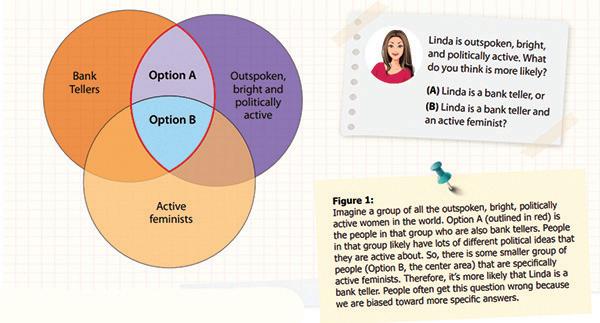
More people (and GPT3) choose Option A, even though there is a likelihood of loss in both cases.
see how GPT-3 “thinks”. In the same way, GPT-3 can be useful for some jobs but useless – or even dangerous – at others. Consider where GPT-3 could be useful in your daily life. Where might it be a hindrance?
(sciencejournalforkids. org)
St Kitts' PM lauds Guyana’s innovative approach to crime-fighting, security
…bilateral ties, regional integration discussed in talks with Pres Ali
Prime Minister (PM) of St Kitts and Nevis and current Chair of the Caribbean Community (CARICOM), Dr Terrance Drew, has said that his country, as well as the wider region, can learn from Guyana’s innovative approach to tackling crime and improving security across the country.
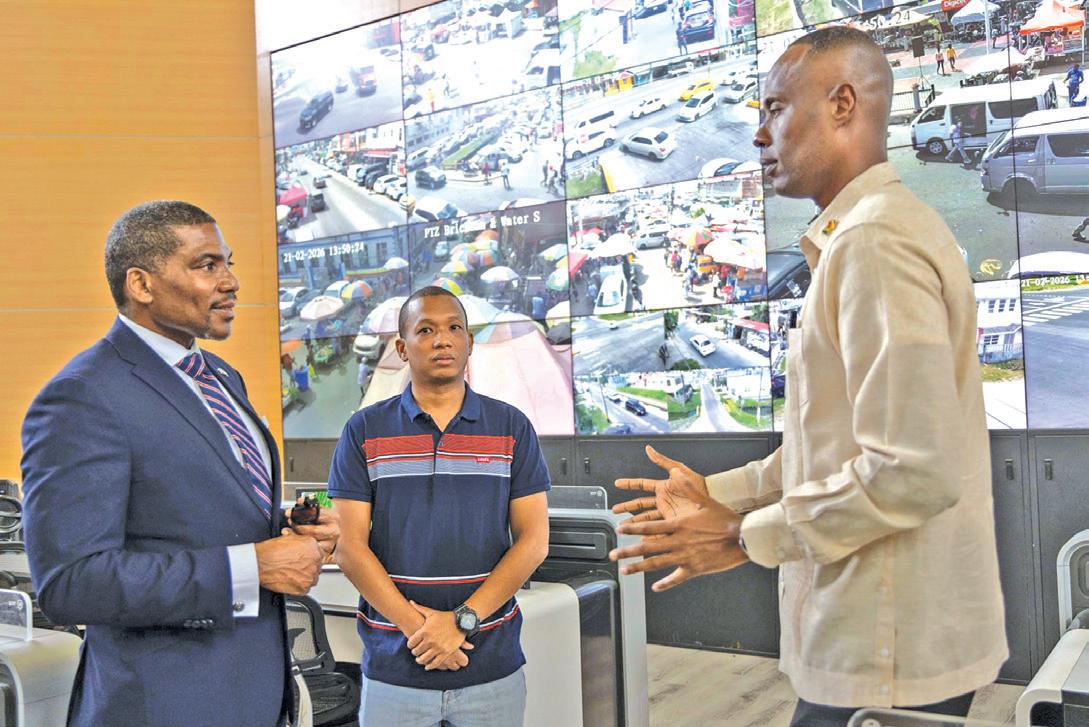
The St Kitts and Nevis leader made these remarks on Saturday following a visit to the National Command Centre in Georgetown, the nerve centre of Guyana’s intelligence and coordinated crime-fighting operations.
According to PM Drew, crime is not confined by borders. It is a regional challenge, complex and evolving – something which he pointed out requires modern, strategic, and collaborative responses.
“Seeing first-hand how Guyana integrates technology, intelligence, and inter-agency coordination to strengthen public safety was both insightful and in-
structive. There is much we can learn from each other.
This engagement opens the door for deeper collaboration between Saint Kitts and Nevis and Guyana, and it also contributes to a broader CARICOM conversation on strengthening regional security frameworks,” he noted.
The PM went on to add, “As Chairman, I remain committed to ensuring that our cooperation goes beyond meetings and into meaningful, practical action for the safety and protection of our people.”
PM Drew is currently on a regional tour for a series of engagements with leaders across the Caribbean ahead of the 50th Meeting of the Conference of Heads of Government of CARICOM, which will be held from February 24 to 27 in Basseterre, St Kitts and Nevis.
Prior to visiting the National Command Centre, the St Kitts and Nevis leader
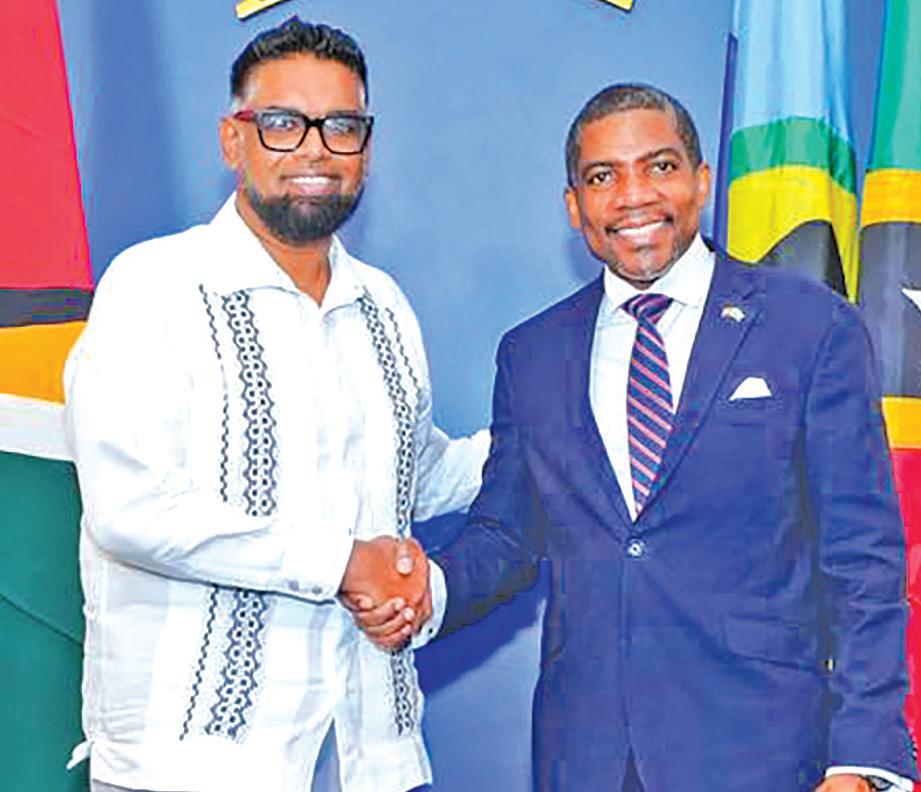
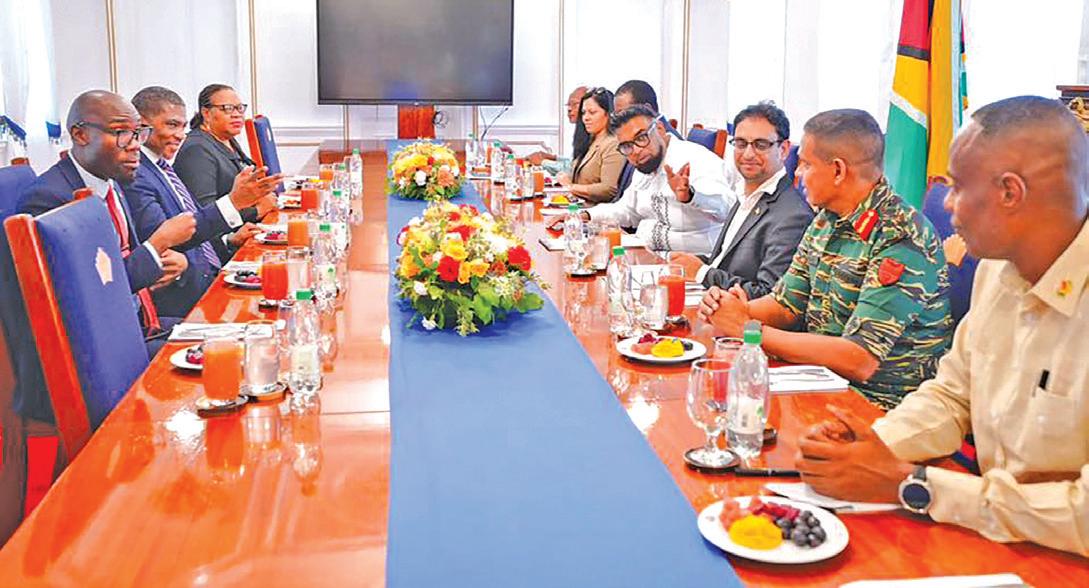
met with President Dr Irfaan Ali at the State House in Georgetown on Saturday.
Meeting "fruitful"
During that high-level engagement, President Ali and PM Drew discussed a number of issues relating to CARICOM and the advancement of Guyana–St Kitts and Nevis relations.
According to the Office of the President in Georgetown, PM Drew called the meeting "fruitful" and said that the CARICOM Heads will continue to push the idea of "regional integration and togetherness".
In a post on his Facebook page, PM Drew said, “In Guyana, I had a productive and forward-looking meeting with His Excellency Dr Mohamed Irfaan Ali and senior members of his government. Our discussions focused on deepening collab-
oration between Saint Kitts and Nevis and Guyana and the wider CARICOM.”
“As Chairman of CARICOM, I remain committed to strengthening these bilateral relationships, because when we work together, we build a stronger, more resilient Caribbean for our people. The future of our region depends on partnership, practical cooperation, and unity of purpose, and that is exactly what we are advancing.”
Also present during the meeting at State House in Georgetown were the Minister of Foreign Affairs and International Cooperation, Hugh Todd; Minister of Public Service, Government Efficiency, and Implementation, Zulfikar Ally; Chief of Defence Staff of the Guyana Defence Force (GDF), Brigadier Omar Khan; Permanent Secretary of the Ministry of Foreign
Affairs and International Cooperation, Sharon Roopchand-Edwards; and Director of the National Intelligence and Security Agency (NISA), Colonel Sheldon Howell.
Productive discussion
Meanwhile, PM Drew wrapped up the Guyana tour with a meeting with the CARICOM SecretaryGeneral, Dr Carla Barnett, at the newly constructed CARICOM Residence in Georgetown.
He said, “We had a focused and productive discussion on preparations for the upcoming Meeting of the Conference of Heads of Government of CARICOM. The work continues, strengthening regional unity, sharpening our priorities, and moving our community forward with purpose.”
The CARICOM Chair said his visits to the southern Caribbean utilised the support of the Regional Security System, reinforcing commitment to regional security cooperation and institutional partnership.
For his engagements in the northern Caribbean, Prime Minister Drew trav-
elled on inter-Caribbean Airways, a regional airline with which, he says, his country continues to collaborate closely in strengthening air connectivity.
During this visit, PM Drew met with the airline’s Founder and Chairman, Lyndon Gardiner, and his executive team. The St Kitts and Nevis leader and his team also toured the airline’s facilities and held substantive discussions focused on expanding routes, increasing frequency, and deepening collaboration to improve connectivity across the region.
“These engagements reflect a deliberate strategy: supporting regional institutions, strengthening regional enterprises, and advancing practical solutions that bring our Caribbean closer together.”
“Enhanced connectivity is essential to trade, tourism, education, investment, and diplomacy. As we prepare for the CARICOM Heads of Government Meeting, we remain focused on building a more integrated, resilient, and connected Caribbean,” the CARICOM Chair stated in a social media post on Friday.
Prime Minister of St Kitts & Nevis and CARICOM Chair Terrence Drew being given a tour of the National Command Centre in Georgetown by Director of Guyana’s National Intelligence and Security Agency Colonel Sheldon Howell on Saturday
President Dr Irfaan Ali with Prime Minister of St Kitts & Nevis and CARICOM Chair Terrence Drew
President Dr Irfaan Ali and other Government officials met with St Kitts and Nevis Prime Minister Terrence Drew and his team at the State House in Georgetown on Saturday
Doers… …versus talkers
Whenever we have these international conferences – such as the just concluded Energy Conference – we gotta look out for the hustlers, carpetbaggers, and grifters who’re looking to parlay some angle for a (quick) buck. Now these hustlers ain’t just private con artists – but also from Governments!! The trick to unmasking them is to dissect their spiels. Sadly, your Eyewitness couldn’t attend in person – his religious obligations conflicted in this period of Lent, Shivratri and Ramadan!! So he gotta go on what was covered in the media – even the about-to-be-shuttered Stabber!!
One operator was T&T’s Energy Minister Roodal Moonilal, who was sent with a “team” by the energetic PM Kamla Bissessar, who’d vociferously supported President Trump in his Venezuelan adventures – to the chagrin of some of her fellow Caricom heads!! She was rewarded with the reactivation of the contract to exploit Venezuela’s multi-trillion Dragon Gas Field!! Your Eyewitness figured that exploitation – where BP would be the operator – would occupy their attention as they try to dig themselves out of the hole after their oil runs out!! Their PM Eric Williams had boasted, “oil doan spoil" –but they discovered that “oil does done"!! It’s a lesson our leaders shouldn’t forget!!
Anyhow, back to Moonilall at the energy conference! He allowed that President Ali introduced him to some Saudis in attendance, and they’d discussed possible financing to get their Petrotrin Refinery – shuttered in 2018 by the PNM – going again!! Now if you know anything about Trinidad, that’s like the PPP shutting down Guysuco!! Things had to have been waaaay past the point of no return for them to concede that even the oil workers – who’d taken over the operations – were piling up debt every day the facility was run!! Petrotrin has a combined debt of US$2 BILLION that gotta be paid sooner rather than later!!
Moonilall exposed the hustler mentality when he suggested that a revived Petrotrin could possibly refine some of our oil – to deal with their major challenge: sourcing crude!! But the elephant in the room is that Petrotrin was built to process very heavy and sour (lotsa sulphur) crude, and our oil is very, very light and SWEET!! The hustle was explicit when Moonilall addressed this (fatal) objection by saying glibly: “That distinction with heavy and light crude is becoming less and less significant because now they have the technologies and the chemistry and so on to convert one to the other, so it’s really an issue of the 80s, 90s and so on to talk heavy, light crude. The technology is there now to convert and use into the refineries,” he said.
Really?? Anything can be done technologically, but the question is whether it’s commercially feasible!! And it ain’t!! Hustler!!
…in the Courts
In a decision that’s gonna test the separation of powers doctrine that’s fundamental to the rule of law in democratic governance, the US Supreme Court just struck down President Trump’s unilateral imposition of tariffs across the globe on friends and foes alike!! Now, this is both substantively and procedurally revolutionary!! For the latter, these Supremes are supposed to have a conservative majority – he even appointed three of them!! – and are expected to support Trump’s ideological bent!! Evidently, Trump’s been using a law from the seventies that was supposed to be used in emergencies – and not as a foreign policy strategy!!
Trump, of course, is livid – since this decision has removed his biggest weapon to create a new MAGA world order – and he hit back by immediately imposing an across-the-board 10% tariff that’s within his remit!! But his words show he ain’t taking the rebuff sitting down!! He called the justices – especially the ones he appointed – a “disgrace to our nation” of whom he was “ashamed”!!
…and no provocations
While our policy is “Drill, baby, drill!!”, the Government just turned down Exxon's request to drill closer to Venezuelan waters. Unlike Venezuela under Mad Maduro, we don’t want to seem provocative to the ICJ’s coming judgement!!
CCJ confirms validity of prescriptive title in decades-old Guyana land dispute
The Caribbean Court of Justice (CCJ) on Friday delivered Judgement in Eslene Vigilance v Roopnarine Persaud [2026], in which it dismissed the appeal, agreeing with the Court of Appeal of Guyana and the High Court that the application to amend a statement of claim and introduce further evidence made by counsel for the Vigilance estate on the date of delivery of Judgement in the High Court was too late and that to allow the application would be prejudicial to the defence.
The Vigilance estate’s appeal was its final attempt to overturn the grant of prescriptive title and subsequent sale of land at Coverden, East Bank, Demerara, on grounds of fraud. In a 2010 Judgement,
the High Court upheld the prescriptive title granted to George Estrick in 1994, extinguishing the Vigilance estate’s claim. Estrick then transferred the land to Roopnarine Persaud in 1996, and this title was challenged all the way to the CCJ.
In a release from the CCJ it was stated that the case is decades old and arose from the attempt of the Vigilance estate, the Appellant, to overturn prescriptive title granted to George Estrick and the subsequent transport of the land to Roopnarine Persaud, the Respondent. The estate alleged that Estrick obtained the land by fraud but never pleaded or proved any fraud against Persaud, who purchased the land from Estrick.
The High Court dis-
missed the claim, finding no evidence of fraud and holding that alleged irregularities in the Land Court process did not amount to fraud capable of invalidating a registered title. On the day set for Judgement, new counsel in the matter made an oral application to amend the pleadings to include particulars of fraud and to present further evidence. The trial Judge refused the application, and on appeal, the Court of Appeal affirmed the decision of the trial Judge. Before the CCJ, the Vigilance estate sought to have the Court of Appeal’s decision set aside, arguing that the refusal to allow amendments and admit further evidence amounted to a miscarriage of justice and that the courts below erred in failing to properly assess
the alleged fraudulent acquisition by Estrick and its impact on the subsequent sale to the Respondents and costs in this Court and the courts below.
In an opinion authored by Justice Denys Barrow with Justices Peter Jamadar, Chantal Ononaiwu, Chile Eboe-Osuji, and Arif Bulkan concurring, the Court held that the appeal was bound to fail because the estate’s case rested on allegations of fraud against Estrick, which were dismissed, and the claim against Estrick was not pursued on appeal. By the time new counsel sought to amend the pleadings, the trial Judge had already determined that there was no evidence of fraud. Without proof of fraud by Estrick, there could be no basis for alleging fraud against Persaud,
who acquired a derivative title from Estrick. Justice Barrow further emphasised that even if there were irregularities in the prescriptive title proceedings, such defects cannot invalidate a registered title unless actual fraud is established.
In his opinion, Justice Bulkan, with Justices Barrow, Jamadar, Ononaiwu, and Eboe-Osuji concurring, went further in analysing the underlying defects in the prescriptive title proceedings. He stressed that prescriptive title requires proof of actual, exclusive, and undisturbed possession and that applicants
must provide full, frank disclosure of all material facts. He compared Guyana’s system with the more structured approach used in Trinidad and Tobago and called for more stringent judicial oversight and legislative reform to combat any concerns about the potential for land fraud and procedural failures.
Attorneys Teni Housty and Sydney Fraser appeared for the Appellant, and C V Satram, Mahendra Satram, and Ron Motilall appeared for the Respondent. The Court dismissed the appeal and awarded costs to the Respondent.
Guyana launches 1st 3D digital design lab at GTI
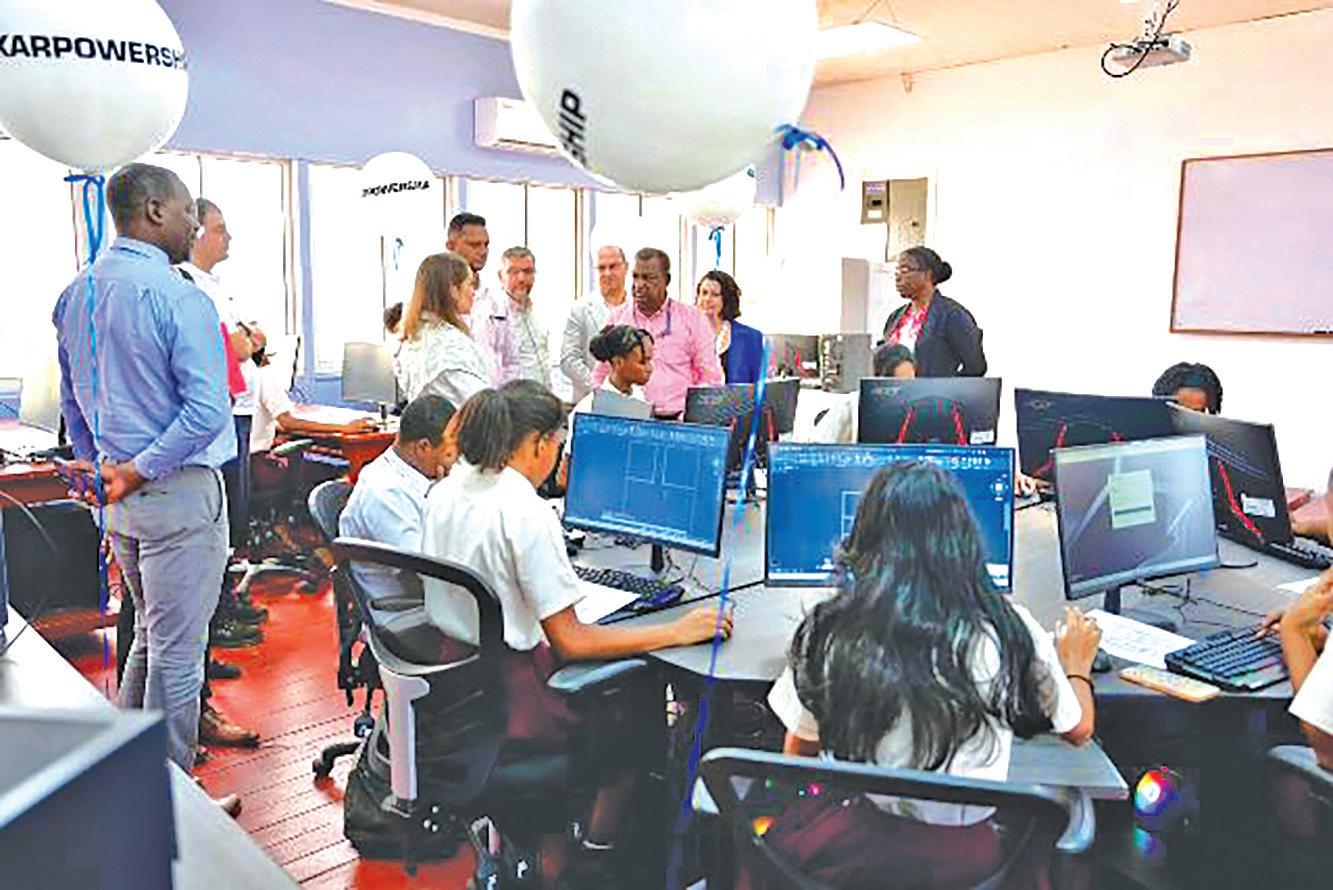
Guyana has taken a significant step in modernising technical education with the official commissioning of the Karpowership-GTI AutoCAD Technology Lab at the Government Technical Institute (GTI). The new facility replaces traditional manual drafting tools with 26 high-performance workstations equipped with specialised Computer-Aided Design (CAD) software, enabling students to move from 2D sketches to complex 3D models.
The lab, a product of a strategic partnership between the Ministry of Education and Karpowership, aims to bridge the gap between classroom learning and industrial application. It is expected to equip a new generation of local engineers and architects with the practical skills needed for Guyana’s expanding infrastructure, energy, and industrial sectors. Speaking at the launch, Americas Regional Director of Commercial Operations at Karpowership, Beyza Özdemir, highlighted the company’s commitment to supporting education and skills development. “By providing essential technology, we aim to help students develop practical skills that
can support their future careers,” she said. Meanwhile, Deputy Chief Education Officer (Technical), Dr Ritesh Tularam, described the lab as opening “doors to imagination, precision and professional opportunity,” noting that AutoCAD serves as “the backbone of modern engineering.” He emphasised the importance of maintaining the facility to ensure students could make meaningful contributions to their communities and the nation.
The commissioning ceremony included a ribbon-cutting and guided tour of the new workstations, marking the lab as a hub for innovation and technical excellence. Observers say the initiative positions Guyana’s technical education system to produce professionals capable of leading the country’s ambitious development projects. By integrating 3D digital design into the curriculum, the lab represents a landmark shift in vocational training, moving students beyond traditional methods and preparing them for the demands of modern industry. The facility is seen as a model for how public-private collaboration can align education with the needs of the 21st-century workforce.
Students working on the Karpowership-GTI AutoCAD Technology Lab at the Government Technical Institute (GTI)
Labourer fatally beaten by brother during dispute
Stabroek News and polemics P
While, as I wrote last week, Stabroek News was very open to publishing letters representing diverse views, its editorials also very strongly represented the publisher’s perspective on those views. One example resulted in the following letter from me in June 1998.
Ravi Dev
“The Stabroek News, as is the norm with newspapers in the West, attempts generally, by its tone and style, to indicate an ‘even-handedness’ and ‘impartiality’ in its editorials so as to appear to engage its reader in a reasoned discourse. However, every so often, there occurs an eruption of polemical truculence that puts into question the coherence of its editorial policy. The editorial of 24.5.98, captioned “A Federal System”, was one such polemic.
“The French postmodernist Michael Foucault drew what he considered to be the ‘essential’ distinction between entering discussion and engaging in polemic, which is very apropos to all of us, including the Stabroek News, at our historical moment. In “discussion”, participants implicitly understand commitments entailed by “the acceptance of dialogue” and avail themselves only of rights that “are in some sense immanent” in the “dialogic situation” itself. In “polemic”, by contrast, the intent is not merely “to wage war” but to regard “that struggle as a just undertaking”. The polemicist proceeds unconstrained by mutual rights and commitments and treats each interlocutor not as “a partner in search for truth but an adversary, an enemy who is wrong.”
“The SN, in ‘A federal system’, appears to be fighting its ‘just war’ in the Foucauldian sense and to that end deploys a formidable arsenal of polemical weapons which can only be intended to bludgeon into submission those who are proposing a federalised state structure for Guyana. Firstly, SN utilised cathected, slanted language to suggest that the Federalist proposals are somehow nefarious. It labels them, for instance, as “a panacea” emanating from “centrifugal tendencies... lurking... under the surface… [which] now reveal themselves more openly. “No one has ever suggested that federalism would deliver the promised land but that it was simply ‘a structural mechanism to address the ethnic security dilemma of the African community’ (SN 6.5.98) or a ‘limited strategy for power-sharing’ (SN 18.5.98).”
“Secondly, SN offers as conclusive statements that at best can only be held tentatively. Federalism, it pronounced magisterially, “would not achieve the desired end of reducing ethnic insecurities and redirecting ethnic rivalries. “ Or again, “The idea appears to be of limited appeal, finding support only among a small section of the Indian community. “Only a few days earlier (SN 19.5.98), under fire for publishing ‘inflammatory’ letters, SN had demanded of its inquisitors the unequivocal evidence, or even an opinion poll, to justify the requested censorship. Should the SN hold itself to a lesser standard for its own asseverations?
“Thirdly, SN argues through definitions of its own creation and is thus bootstrapping on tautological postulates: ‘A federal system is best suited to nations which are geographically large, have big populations and are ethnically diverse.’” When was this law promulgated? In mixing the categories of size and diversity, SN, from a normative standpoint, appears to be oblivious to distinctions of congruent and incongruent federalism.
“Fourthly, in declaring that Guyanese federalists should ‘seek a model on a small scale... and that model is the former Yugoslavia’, SN presents a predicament (a failed example) which in fact is an artefact of its own argument and consequently encounters performative contradiction. In what way, vis-à-vis Guyana, was Yugoslavia, with its 24 million citizens, diverse nationalities and historic federalised nature, different, by the SN’s own criteria, from Nigeria? Would not tiny Switzerland and its cantons have been more appropriate?
“Fifthly, possessed of the asymmetrical power to edit letters, the SN, as it concedes (19.5.98), can also vitiate, or indeed alter, a discussant’s argument and then proceed to take pot shots at the resultant travesty in its editorial. For example, in my letter (SN 6.5.98), one of the strongest arguments for federalism was excised, to wit that “political structures and institutions are introduced to provide the framework and incentives through which the moral links, essential for encouraging the needed accommodation and cooperation between the various ethnic groups (through their representatives), can develop. Without incentives, it would be naive to expect politicians to forego ethnic mobilisation simply because it is not in the “national interest”. The federalist arguments are reduced to a cold economic calculus and unfounded accusations of “dissecting Guyana”.
But to its credit, SN published the above strongly worded rebuttal!
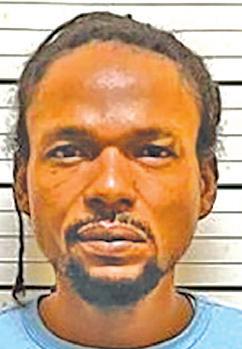
olice in Regional Division Two have launched an investigation into the alleged murder of a labourer at Capoey Mission, Capoey, Region Two (PomeroonSupenaam). Dead is Leslie Edwards, also known as “Bumpy” of Capoey Mission. Reports The incident reportedly occurred around 14:10h at his home. According to police, Edwards and his 59-yearold brother, with whom he shared the residence,
were at home when an argument ensued between them. The disagreement is said to have escalated, and during the confrontation, the suspect allegedly armed himself with a garden hoe and dealt Edwards several blows about his body.
Police were contacted and responded to the scene, where they found Edwards lying motionless in the yard. He was picked
up and rushed to the Lima Regional Hospital, where he was pronounced dead on arrival. His body has since been taken to the Suddie mortuary awaiting a post-mortem examination. The 59-year-old suspect was taken into police custody and later escorted to the Lima Regional Hospital for medical attention. He remains under police guard as investigations continue.
Dead: Leslie Edwards, also known as “Bumpy”
CANU finds over 10.5 kg of cocaine in Parika bust
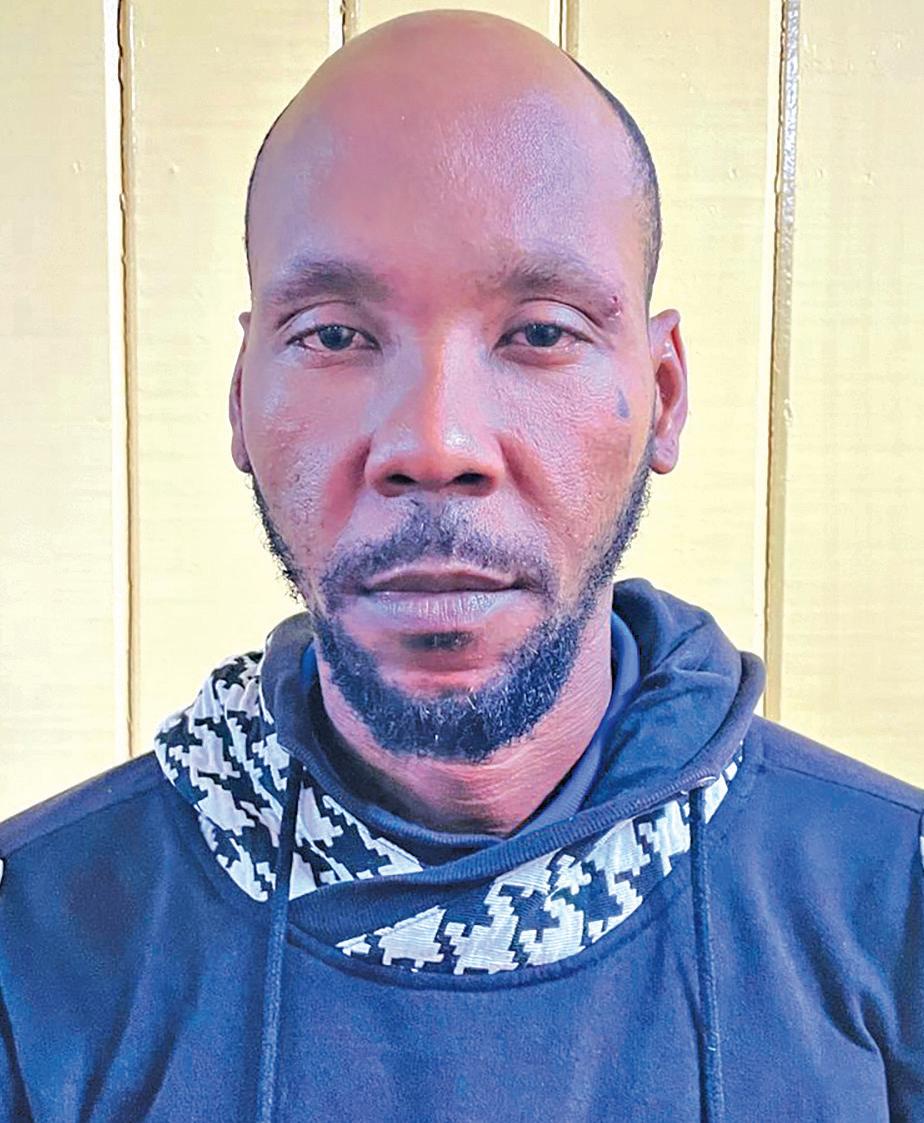
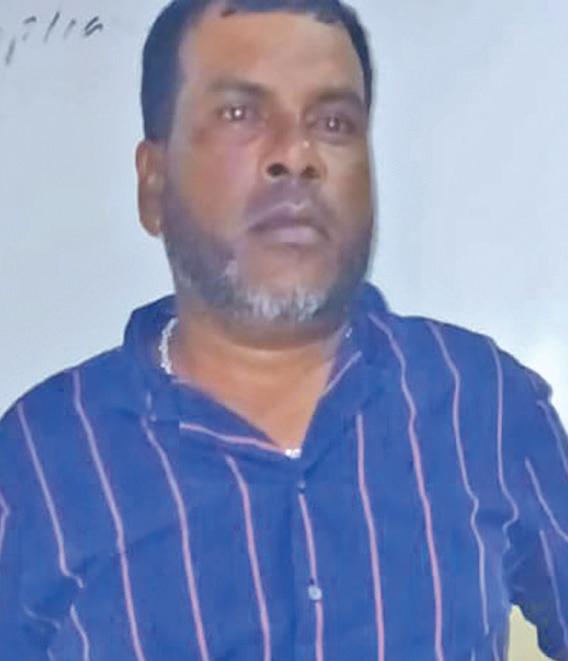
Officers of the Customs AntiNarcotic Unit (CANU) seized over 10.5 kilograms (kg) of cocaine during an operation at Mora Village, Parika, East Bank Essequibo on Friday. According to CANU, ranks acting on information received conducted an operation in the vicinity of Mora Village, where they intercepted three males. One of the men was carrying a haversack, CANU said, and a search of the haversack led to the discovery of three brick-like parcels of cocaine.
The men Jared Kellawan, Jahdiel Kellawan and David Newsum were arrested and escorted to the residence of Jared Kellawan, where CANU officers conducted a further search. During that search, officers reportedly discovered an additional seven brick-like parcels of cocaine. The three suspects were subsequently taken to CANU Headquarters along with the narcotics. The parcels weighed a total of 10.966 kg, CANU said on Saturday. The men remain in custody pending charges.
2 charged for narco trafficking after over 2.6 kg ganja bust
Charged: Isiah Charles
Two persons have been charged and remanded after the Customs Anti-Narcotics Unit (CANU) intercepted a motor vehicle in Success Village, East Bank Demerara, on Thursday, uncovering 2.614 kilograms of cannabis.
Charged: Sheldon Chase
Reports are that, acting on a tip-off, CANU officers stopped the vehicle along Rupert Craig Public Road. A search of the vehicle revealed several brick-like parcels containing the illicit substance. Two men, Isaiah Charles and Sheldon Chase, were arrested and taken to CANU Headquarters along with the seized narcotics. On Friday, Charles and Chase appeared before Magistrate Nurse at the Sparendaam Magistrate’s Court, facing charges of possession of narcotics for the purpose of trafficking. Both men pleaded not guilty, and bail was refused. The case has been adjourned to April 2. CANU continues to urge members of the public to report information related to illegal narcotics to assist ongoing operations.
The cocaine that was found in the Mora Village, Parika, East Bank Essequibo drug bust on Friday
Bids for Gas-to-Energy Phase 2 to come next month – Brassington
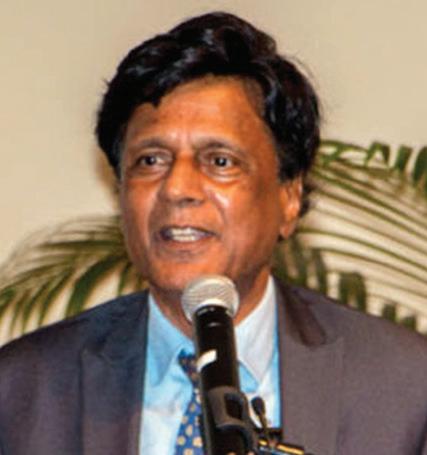
With the aim of building capacity to meet the rapidly growing electricity demand in the country, the Guyana Government is expected to receive bids from at least five shortlisted companies in March as it gears up to commence construction on Phase Two of the Gas-to-Energy (GtE) Project sometime this year. This is according to Project Lead of the Gas-to-Energy Project, Winston Brassington, during the Guyana Energy Conference and Supply Chain Expo 2026. Brassington appeared on a panel alongside Head of the Guyana Power and Light (GPL) Inc., Kesh Nandlall, and Chief Executive Officer of the Guyana Energy Agency (GEA), Dr Mahendar
Sharma, on Thursday to discuss the ‘Changing Power Landscape’ in the country.
Currently, Guyana’s peak demand is around 236 megawatts (MW), but this figure is estimated to go up to an estimated 1600-plus MW by 2030 – reflecting a 600 per cent growth.
Against this backdrop, Brassington underscored the need to start working on building capacity to deliver that electricity demand.
“We expect construction to start this year [on Phase Two] because we need the additional power as soon as possible,” he indicated.
Currently, GtE Phase One is underway with a 300-megawatt combined cycle power plant and a Natural Gas Liquids (NGL) facility being
constructed at Wales, West Bank Demerara, utilising natural gas that will be piped onshore from oil operation activities in the Stabroek Block.
Already, some 250 kilometres of 12-inch pipelines have been laid to bring the gas onshore. This first phase, however, will only utilise 40 per cent of the pipeline’s capacity, bringing 50 million standard cubic feet per day (mmscfd) of dry gas onshore.
But with the pipelines having the capacity to push as much as 120 mmscfd of gas, Government had moved ahead with Phase Two to utilise the remaining 60 per cent capacity of the pipeline, which will see an additional 75 million mmcfd of rich gas brought onshore to power a second 300 MW power plant and NGL fa-
cility right at the Wales location.
According to Brassington, five companies have been prequalified for GtE Phase Two and are expected to submit their proposals next month.
“So, we expected by the end of March, we have five companies [submitting their bids]. We’ve divided the expansion into three phases – one is the Natural Gas Liquids plant, which will go right next to the existing one at the [Wales] site; the second is the balance of plant; and [thirdly] the second power plant will go next to the existing one. So, we’re double from 300 megawatts of combined cycle power with gas to 600 MW,” the GtE Project Lead stated.
While Phase Two is target-
ing start-up in 2030, the first phase of the Gas-to-Energy Project is on track, with the revised timeline, to deliver power by the end of this year.
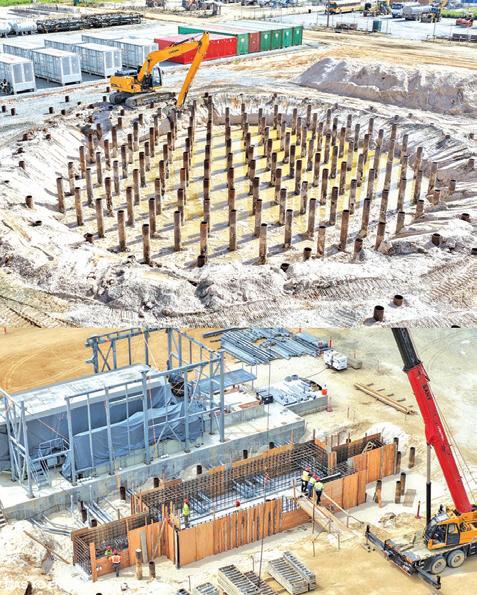
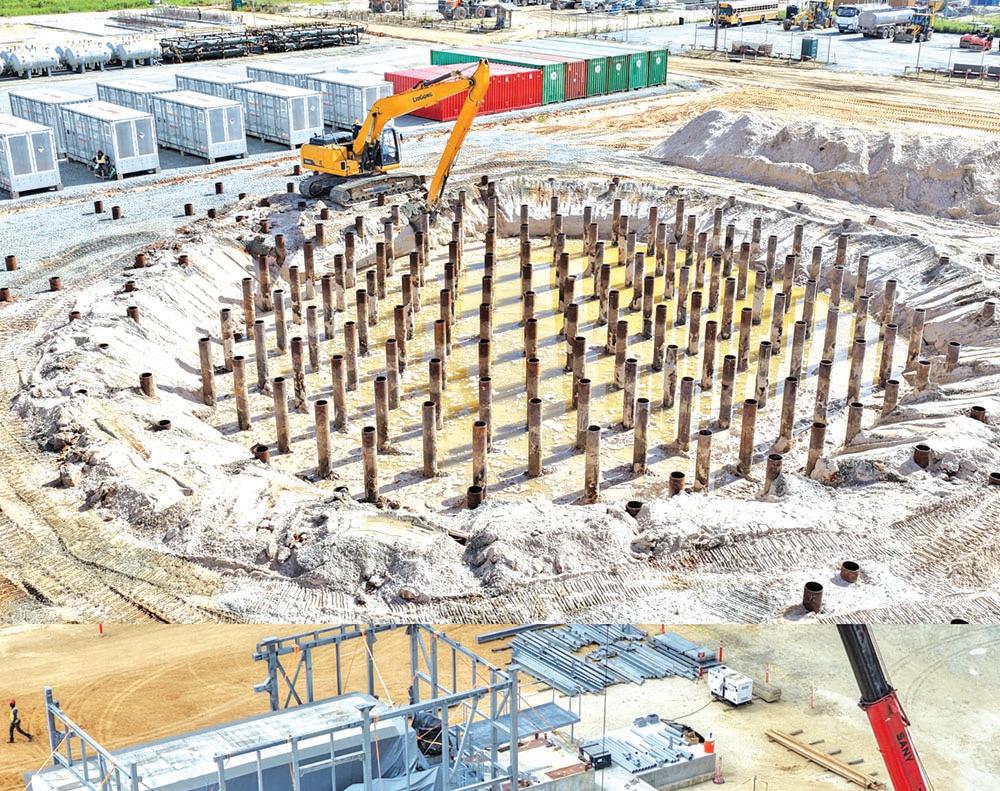
At the Wales Site, all four turbines are installed on their foundations alongside all four main transformers, as the
which will also house the control centre, and the other two at Wales.
Also in Wales, where an industrial hub is being mapped called the Wales Development Zone (WDZ), there is planning to use the excess natural gas from the pipeline to set up two major industrial projects – a gas bottling plant and a fertiliser plant.
Only on Thursday, the invite for Requests for Proposals (RFPs) for the Guyana Gas Bottling and Logistics Company (GGBLC) was closed, while the Guyana Ammonia and Urea Plant (GAUP) is open until March 5.
“It’s not a lot of gas compared to what will come in at Berbice, but I think we’re trying to maximise the value chain [with] not only electricity but also the cooking gas and then the downstream activities,” Brassington posited.
contractor, United Statesbased Lindsayca, has ramped up is work cycle and increased labour.
“Our contractor…has promised us that they’re going to complete the 300 MW project – first on simple cycle which is essentially the four gas turbines with a total installed capacity of about 228 megawatts. So that, we expect to have online by the end of the year. Coming with that will be the Natural Gas Liquids plant… By the middle of next year, we’re going to have the combined cycle [power plant] fully completed,” Brassington stated.
Upgrade of transmission infrastructure
Meanwhile, another component of the GtE Phase One is the upgrade of the country’s aged transmission infrastructure. This will see the current 69-kilovolt (kV) lines being replaced with new 230 kV transmission lines.
According to the Project Lead, the installation of the 230 kV line has been completed, running from the Wales site to the Garden of Eden, East Bank Demerara, power station and then to the new power station at Goedverwagting along the Ogle-Eccles Highway.
In addition, Phase One of the GtE Project also includes setting up three new power stations, with the main one being at Goedverwagting,
Bringing down costs
Only last month, Prime Minister Brigadier (Ret’d) Mark Phillips, whose office has responsibilities for the country’s energy sector, noted that investments in these two projects will be central to bringing down costs in Guyana, especially food prices.
“Once we could reach to the stage of manufacturing our own fertiliser, that will have a positive impact on agriculture, on our farmers… That has a trigger effect because if you cushion the effect in terms of the cost of production in the farming sector, it will also have an effect on the food that goes on our table, the price that we pay for food,” he had noted.
Currently, the Guyana Government is subsidising the cost of fertiliser to the tune of some $2 billion as part of efforts to support the local agriculture sector. The Prime Minister had pointed out that once Guyana starts producing its own fertiliser, it will not only reduce the cost but also bring in income through export to the Caribbean region.
Similarly, PM Phillips had further stated that Guyana could also be exporting excess bottled gas after meeting local demands.
These two initiatives are set to come onstream when Phase Two of the Gas-toEnergy project is operationalised by 2030.
Lead of the Gas-to-Energy Project, Winston Brassington
Works progressing on Gas-to-Energy Phase One at Wales
Death at National Psychiatric Hospital sparks questions
The National Psychiatric Hospital
did not report the death of 52-yearold Ravindra Yudeshwar Bishram to the Police following the incident which led to his death, relatives and his caretaker are alleging. According to relatives, law enforcement officials were only contacted after the deceased man’s caretaker went to the Police to formally report the death upon encountering confusion and a lack of documentation while seeking answers at the hospital. Bishram, a long-term patient at the National Psychiatric Hospital, was reportedly involved in an incident last Thursday evening inside a section of the institution. Initial information indicated that he may have been struck by another patient. He was subsequently transferred to the New Amsterdam Public Hospital, where he later succumbed to his injuries. Another patient was placed in isolation as investigations were launched into the circumstances surrounding the incident. Dairam Singh, who serves as the deceased man’s caretaker, said he was at work just before 09:00h when he received a phone call informing him that Bishram had been involved in an incident at the psychiatric institution. According to Singh, the caller first sought to confirm his connection to Bishram before stating that the patient had “ended up in a thing,” adding that there were reports he either fell or was struck by someone. He said he was then told that Bishram had already passed away and was at the public hospital’s emergency unit.
Singh said he went to the hospital shortly after receiving the call, arriving sometime around 09:30h.
“I went there immediately… I speak to the doctor… she told me that Ravi had an issue there,” he recalled. He further explained that when he visited the public hospital to enquire about the post-mortem process, he was met with what he described as confusion over the deceased’s records.
“When I go there, the doctor said he had no chart: he had no record about this patient who died,” he said. According to Singh, it was during those exchanges that he was informed that an official report would have to be made to the Police. “He said we have to make an official report to the Police…
Dead: 52-year-old Ravindra Yudeshwar Bishram
this is Police information,” he stated. The caretaker said he subsequently went to the Police station and made a formal report, after which officers from the Criminal Investigation Department (CID) contacted him and indicated that they would be taking over the matter. Singh further claimed that this was not the first time Bishram had sustained injuries while at the institution. “Several times you get injured… you get bruises on your face, hand,” he said, suggesting that previous incidents had raised concerns but were never fully addressed. He maintained that he is now seeking accountability for what transpired. “I want justice,” Singh declared. Singh explained that Bishram had been in and out of the institution for several years but had remained there continuously for the past six to eight years. “Well, he’s been there long… but since his mother got sick he remained there: he never come out,” he said. He noted that he last saw Bishram at Christmas. Bishram was reportedly found lying in a pool of blood inside a section of the hospital known as the Acute Centre, an enclosed transitional ward used to house patients who are being monitored between admission and placement in the general ward. Initial reports had indicated that another patient, a 38-year-old man from Bath Settlement, West Coast Berbice (WCB) may have been involved in the incident. That individual was subsequently placed in isolation as investigations commenced. A post-mortem examination (PME) is expected to be conducted in the coming days to determine the exact cause of death, while Police investigations remain ongoing. Up to late Saturday, no official statement had been issued by the National Psychiatric Hospital addressing the circumstances surrounding Bishram’s death or the timeline of the Police notification.
“We cannot repeat last year” – GuySuCo CEO warns 67% harvesters who missed target
…as top harvester earns $35,000 daily
Chief Executive Officer of Guyana Sugar Corporation (GuySuCo) Paul Cheong issued a stark warning on productivity while honouring the corporation’s top cane harvesters, revealing that 67 per cent of workers failed to meet the five-tonne daily target in 2025 – even as the most productive cutter earned more than $35,000 per day.
Addressing the awards ceremony for the second crop of 2025, Cheong noted the shortfall.
“We cannot afford to repeat that this year,” pointing to significant production losses and missed opportunities that placed the corporation well below its expected output.
While issuing the caution, Cheong also underscored that the ceremony was intended to celebrate excellence and reinforce the standards GuySuCo expects across its estates.
“Today is not simply a ceremony; it’s a declaration of what we value as a corporation,” he told the gathering of estate managers, union officials and harvesters.
“Behind every figure announced today are long days in the sun, disciplined efforts, and skilful cutting,” he added.
The CEO noted that high productivity translates directly into higher earnings, confirming that the corporation’s top-performing cane harvester averaged in excess of $35,000 per day during the second crop.
Among those leading the way were Siraj Thakuriyar of Albion Estate, who harvested 1474 tonnes; Samuel Jambri of Blairmont Estate with 1440 tonnes; and Keoba Phillip of Rose Hall Estate with 1051 tonnes. Kieran Bisundayat of Rose Hall also featured prominently among the top performers.
At the estate level, workers were recognised for out-
standing turnout and production averages, with some maintaining attendance above 90 per cent across the crop period while consistently exceeding daily output standards.
However, the CEO stressed that strong individual performances stood in sharp contrast to the broader productivity challenges facing the corporation.
“In 2025, 67 per cent of our harvesters… did not exceed or meet the standard
“Those figures represent loss of production, loss of employment, and loss of agility. They affect every estate, every department, and every employee,” Cheong warned.
He reminded workers that 2026 marks the first year of GuySuCo’s new fiveyear strategic plan and said the decisions and discipline demonstrated this year would determine the industry’s trajectory.
“This is an important
productivity target of five tonnes per day,” Cheong said, noting that many workers averaged as little as two tonnes per day.
He revealed that the 628 harvesters who fell below the target could have collectively contributed an additional 1256 tonnes of cane per day with greater consistency and adherence to standards – equivalent to roughly 100 tonnes of sugar daily.
Cheong further disclosed that during 2025, GuySuCo lost 3471 hours of factory time due to the unavailability of cane.
“For thousands of hours the factory stood idle, not because the machinery failed, but because there was not enough cane to crush,” he said.
Last year, the corporation produced just over 59,000 tonnes of sugar. With improved productivity and factory uptime, output could have been closer to 90,000 tonnes, he indicated.
year for GuySuCo. It marks the first year of the implementation of our new fiveyear strategic plan… The foundation we lay now will shape the future of the sugar industry,” he said.
Emphasising the need for stability, Cheong said, “We do not need disruption. We do not need absenteeism. We need stability, cooperation, and shared understanding.”
He added that productivity is not about speed but consistency, teamwork, and adherence to standards across the estates.
“The strength of GuySuCo is not in its machinery. It’s in our people,” he said.
Cheong challenged harvesters to build on the example set by the top performers and raise overall standards across the industry.
“The question is simple,” he told the audience. “Can we do it? Sure, yes, we can,” he convinced workers.
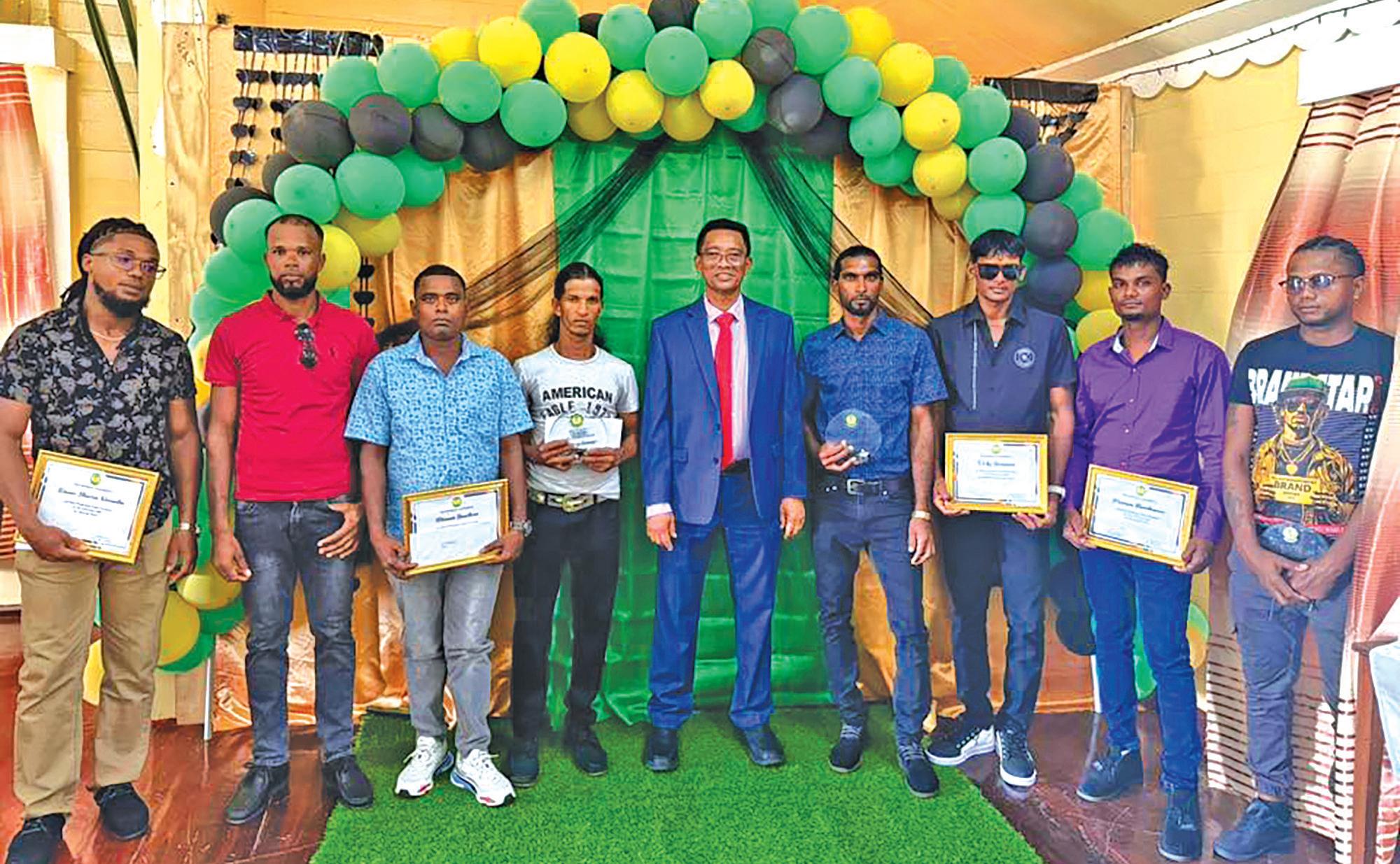
GuySuCo’s CEO Paul Cheong with top harvesters for 2025
SUNDAY, FEBRUARY 22, 2026 | GUYANATIMESGY.COM
GPHC expands retina services with 1st-ever scleral buckle surgeries
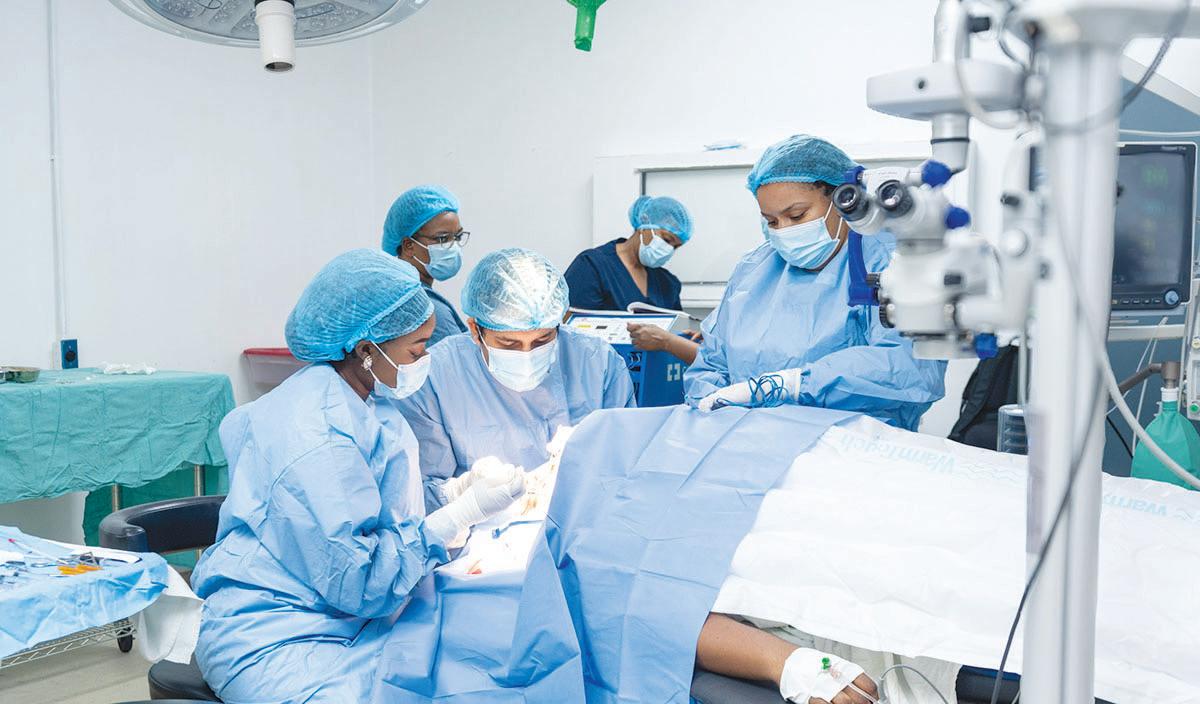
The Georgetown Public Hospital Corporation (GPHC) has expanded access to specialised eye care following a week-long surgical partnership aimed at strengthening the management of complex retinal conditions in Guyana.
The initiative, held from February 9 to 13, brought together local and international retina specialists to perform advanced procedures and support skills transfer within the hospital’s ophthalmology department.
The collaboration was led by GPHC’s Dr Arlene Bobb-Semple, an ophthalmologist with vitreoretinal speciality training, alongside visiting United States retina specialist Dr Krishi Peddada, who participat-
ed through the World Eye Mission. The exercise focused on identifying and surgically treating challenging retinal cases while providing hands-on collaboration and mentorship for local surgical teams.
During the mission, 11 complex retinal surgeries were performed. Among them were two scleral buckle procedures, carried out at GPHC for the first time. Hospital officials described the development as a significant step in expanding the institution’s retinal surgical capacity.
Scleral buckle surgery is used in the repair of retinal detachments. It can serve as a primary treatment method or be combined with a vitrectomy in complex or recurrent cases. The introduction of this procedure at
GPHC increases the range of treatment options available to patients locally.
Dr Bobb-Semple is currently the only practising retina surgeon in Guyana. Since joining GPHC in
2018, she has been instrumental in developing the hospital’s retina services. Following the acquisition of vitrectomy equipment, she has been performing complex retinal surgeries local-
ly since 2021. In Guyana, the absence of a local ophthalmology subspeciality programme requires doctors to pursue advanced training overseas before returning to
practice. Dr Bobb-Semple completed several years of postgraduate training, including an additional year in vitreoretinal surgery. Her return to Guyana has enabled the hospital to offer advanced retinal procedures that previously required overseas referral.
GPHC stated that visiting specialist missions play an important role in enhancing local capacity. Such engagements allow for the exchange of skills and advanced techniques while reducing the need for patients to seek treatment abroad. Hospital officials noted that strengthening in-country expertise contributes to improved access to timely care for individuals with complex eye conditions.
Guyana’s youth entrepreneurs now have a chamber
Anew organisation aimed at empowering young Guyanese entrepreneurs was officially launched on Thursday at the Guyana Energy Conference Youth Forum.
The Guyana Youth Entrepreneurship Chamber (GYEC) was founded by Dr Rosh Khan, President of ACE Consulting Group, and a founding cohort of 12 members to give young entrepreneurs, primarily between the ages of 18 and 40, access to the resources they need to build and grow their businesses.
In a release it was stated that the Chamber’s programming will include executive roundtable discussions, entrepreneur-
ial workshops, networking events, and a competitive Youth SME Incubator. An annual showcase will recognise outstanding youthled enterprises. GYEC has also invited representatives from several business support bodies, including the Georgetown Chamber of Commerce & Industry, the Guyana Manufacturing and Services Association, the Private Sector Commission, AmCham Guyana, and the Women’s Chamber of Commerce and Industry Guyana, to sit on a formal Advisory Council. Other organisations will also be approached for support in the coming weeks.
Public Service and Government Efficiency
Minister Zulfikar Ally offered support on behalf of the Government, telling the audience that the organisation has its full backing. He en-
couraged the founding members to hit the ground running and challenged them to expand the Chamber’s membership and make good on
its mandate. Meanwhile, President of the Georgetown Chamber of Commerce and Industry (GCCI), Kathy Smith, and
Chairman of the Private Sector Commission (PSC), Captain Gerry Gouveia Jnr, both offered congratulatory remarks, advising the young entrepreneurs to lean on one another and work in alignment with the existing business support organisations. The Chamber was launched with a founding membership of 12 drawn from sectors as varied as marine logistics, digital media, graphic design, finance, and the creative industries. Among the founders are University of Guyana students, a CARICOM Youth Ambassador, and experienced business operators, a mix that reflects the breadth of talent the GYEC hopes to serve.
Government Ministers and senior private sector officials at the launch of the youth chamber
Pres Ali signals new era of cashless banking, financial overhaul in Guyana
President Dr Irfaan Ali has revealed that digital wallet services will soon be available in Guyana as two local banks are preparing to launch modern electronic payment systems following approval from the Bank of Guyana. He made the comment as he delivered the feature address at the opening ceremony of the Guyana Energy Conference and Supply Chain Expo (GECSCE) 2026 at the Guyana Marriott Hotel Georgetown on Tuesday last. The President outlined sweeping financial sector reforms aimed at creating a digital backbone for the economy. “We want our economy to run on a digital backbone. Today, I am pleased that we
have completed the process at the central bank of building the national payment platforms, and two local banks are ready to go completely on the digital platform. They’ve already been approved so that we can now have digital wallets, digital payment systems and digital transformation here in Guyana that will be the new standard,” the President said. The digital wallet initiative marks a significant step in Guyana’s efforts to modernise its financial architecture, reduce reliance on cash transactions and expand access to secure, technology-driven banking services nationwide. The move builds on steps taken last November when Demerara Bank Limited (DBL) rolled
out new digital banking services allowing customers to open accounts entirely online. Since 1 November 2025, customers have been able to open accounts online at four commercial banks: DBL, Guyana Bank for Trade and Industry (GBTI), Republic Bank Guyana Limited and Scotiabank Guyana. According to President Ali, the digital payment rollout forms part of a broader national transformation agenda that also prioritises financial and technological inclusion. “We have to ensure financial inclusivity, technological inclusivity. That is why we are also going to offer people the opportunity to invest in their future collateral-free and interest-free. We
are backing this up with technical expertise by putting together a technical group that will transfer their ideas into bankable proposals and then hand-hold them through the process of management and creating viable and sustainable enterprises,” he said, as he spoke about the upcoming establishment of the Guyana Development Bank to unlock larger pools of lending from commercial banks. “We are looking at a Guyana Development Bank as a tool to unlock larger lending from the other banks, so the interest-free, collateral-free resources you’ve already negotiated with the commercial banks will now work towards unlocking additional resources at lower interest costs and lower collateral requirements. That brings the whole new generation into the umbrella of entrepreneurship and transforming their ideas into reality,” he stated. The President also pointed to plans for a junior stock exchange, noting that transparency and participation in formal financial markets are critical to sustainable growth. Apart from financial
President Dr Irfaan Ali
services, Ali emphasised that Government operations are also undergoing digital transformation. “The Government must be efficient. The Government must be transparent, and Government service must also be delivered effectively,” he said. “That is why the entire Government is now transforming itself on a technological platform to ensure there is speed, accuracy, efficiency and removal of human biases as far as possible.” He added that initiatives such as a citizen-centric digital ecosystem, innovation hubs, a national digital literacy programme and strengthened cybersecurity and data protection frameworks are central to the country’s mod-
ernisation drive. “What is the use of all of this if we don’t have a national security system to ensure that our financial system is safe and our people are safe? That is why we are investing. It is not about reacting; it’s about preventing crime. We’re not only doing tomorrow’s technology, because the technology we’re applying is predictive technology. It is AI (artificial intelligence) at a different scale,” the President said. “We believe we have to make the investments for tomorrow today. We have to make the investments for tomorrow today. That is why all of this development, security and investment in security is critical.”
Teen slapped with noise nuisance charge, granted $200,000 bail
A19-year-old technician of Adventure, Essequibo Coast, Region Two (PomeroonSupenaam) has been charged with making loud and continuous noises contrary to Section 174 (1) (a) of the Summary Jurisdiction Offences Act, Chapter 8:02.
The charge against Tushar Arjune stems from an incident involving a 52-year-old truck driver of Adventure, Essequibo
Coast. The offence allegedly occurred on February 14. Arjune appeared before the Anna Magistrate’s Court on Friday, where the matter was heard by Magistrate Ravindra
Mohabir. The charge was read to him, and he pleaded not guilty and bail was granted in the sum of $200,000.
The case was adjourned to March 6.
US-based pensioner dies, another hospitalised after ECD bee attack
Police in Regional Division Four C are investigating an incident at Success, East Coast Demerara (ECD), which resulted in the death of a 77-year-old pensioner and left a 25-year-old woman hospitalised.
Dead is Mohadai Sankar, 77, a resident of Success, who was visiting from the United States.
Reports are that the incident occurred at about 07:00h on Friday, and according to preliminary infor-
mation, Sankar was at the premises with the 25-yearold woman and two other persons when they were attacked by a swarm of bees believed to have come from the roof of a neighbouring house.
The victims sustained multiple suspected bee stings during the attack, Police said, and were assisted and transported to medical facilities. Sankar was taken to the Enmore Regional Hospital, where she succumbed at about 18:45h while receiv-
ing treatment. The 25-yearold woman was taken to the Georgetown Public Hospital Corporation, where her condition has been listed as stable. Sankar’s body was escorted to Jerricks Funeral Home, where it is awaiting a post-mortem examination. Police visited the scene, and personnel from the National Agricultural Research and Extension Institute were summoned to the area. The situation was subsequently brought under control. Investigations are ongoing.
Charged: Tushar Arjune
2 Essequibo Coast men fined $380,000 for drunk driving, traffic offences
Two men of Essequibo Coast, Region Two (Pomeroon-Supenaam), were fined a total of $380,000 after appearing before the Anna Regina Magistrate’s Court on traffic-related offences. Dwayne Stoby, 38, a construction worker of Riverstown, Essequibo Coast, was charged with multiple breaches of the motor vehicle and road traffic laws. The offences stemmed from an incident that occurred on January 27 on the Middlesex Public Road, Essequibo Coast.
Stoby was charged with being an unlicensed driver, contrary to Section 23(1) of the Motor Vehicle and Road Traffic Act, Chapter 51:02; operating an uninsured motor vehicle, contrary to Section 3(1) of the Motor Vehicle Insurance (Third Party Risks) Act, Chapter 51:03; having an obscured rear identification mark, contrary to Section
13 of the Motor Vehicle and Road Traffic Act, Chapter 51:02; and operating an unlicensed motor vehicle, contrary to Section 22(1) of the Motor Vehicle and Road Traffic Act, Chapter 51:02. The matters were heard on Friday before Magistrate Ravindra Mohabir, and after the charges were read to Stoby, he pleaded guilty. For the offence of operating an unlicensed motor vehicle, he was fined $10,000, with a default sentence of two weeks’ imprisonment. For having an obscured rear identification mark, he was fined $100,000, with a default sentence of three months’ imprisonment. For being an unlicensed driver, he was fined $30,000, with a default sentence of three months’ imprisonment. For operating an uninsured motor vehicle, he was fined $40,000, with a default sentence of three months’ imprisonment.
The total fines imposed on Stoby amounted to $180,000.
Drunk driving
In a separate matter, Totaram Narine, 41, a carpenter of Huist Dieren, Essequibo Coast, was charged with driving while his breath alcohol level exceeded the prescribed limit. The offence was committed on February 12, 2026, at Huist Dieren, Essequibo Coast. The charge was laid under Section 39A(1) of the Motor Vehicle and Road Traffic Act, Chapter 51:02, as amended by the Motor Vehicle and Road Traffic (Amendment) Act 17 of 2022.
Narine appeared before Magistrate Ravindra Mohabir on Friday at the Anna Regina Magistrate’s Court. The charge was read to him, and he pleaded guilty.
He was fined $200,000, with a default sentence of six months’ imprisonment.
Region 2 road safety campaign to intensify to tackle traffic violations
Police in Region Two (PomeroonSupenaam) and the Essequibo Road Safety Council (ERSC) have stepped up their collaboration to strengthen collaboration on road safety initiatives across the region. On Friday, Regional Divisional Commander No. 2, Senior Superintendent Khemraj Shivbaran, and Regional Traffic Officer Inspector V. Mahadeo met with the ERSC Chairwoman Vereena Rasheed and Vice Chairman Dhanraj Singh along with other council members and traffic ranks. The engagement focused on coordinating more effective and proactive approaches to addressing traffic violations and reducing accidents.
Discussions centred on reviewing traffic statistics
and analysis to better understand trends and identify priority areas for intervention. The meeting also addressed the equipment currently used to detect and address traffic violations, particularly in relation to accidents. Plans were outlined for increased joint activities between the police and the council, including visits to bars, clubs and sporting premises as part of efforts to curb unsafe driving practices. The parties also discussed conducting lectures at schools, as well as engaging drivers and companies on safe road use and compliance with traffic regulations. Training initiatives were highlighted, including the use of Breathalyser kits and tint meters that measure Visible Light Transmission (VLT).
These tools are intended to support enforcement efforts against driving under the influence and violations of regulations governing tinted vehicle windows.
The engagement also examined the continuation of “White Night” campaigns aimed at targeting high-risk areas and times associated with traffic breaches. In addition, the council and police discussed visits to persons involved in accidents, whether temporary or permanent injuries were sustained, as part of broader awareness and support efforts. Fundraising activities by the council were also addressed. Another area identified for joint action is the repainting of pedestrian crossings across the region to improve visibility and enhance safety for pedestrians.
Fined for traffic offences: Dwayne Stoby Fined for drunk driving: Totaram Narine
Meeting between Regional Divisional Commander No. 2, Senior Superintendent Khemraj Shivbaran, and Essequibo Road Safety Council (ERSC), Chairwoman Vereena Rasheed and Vice Chairman, Dhanraj Singh along with other council members and senior traffic ranks
US$20M dairy project at Moblissa
Farm to boost food security, local production, jobs - PM Phillips
Prime Minister (PM) Brigadier (Ret’d), Mark Phillips, toured the Demerara Dairies Incorporated (DDI) facility, which is Guyana’s first modern, large-scale dairy farm currently under construction at Moblissa along the Soesdyke-Linden Highway. During the visit on Friday, the PM received a comprehensive overview of ongoing developments at the US$20 million, 200acre technologically advanced facility, which is projected to begin fresh milk production by mid2026. At the site, Phillips commended the scale and vision of the initiative, stating that it represents a significant advancement in transforming Guyana’s agricultural and agri-industrial sectors. “In addi -
tion to producing milk and other dairy products, this facility will serve as a des -
Guyana’s 56th Republic Anniversary
Times Square display, bridge illumination in New York
to be part of celebration
The Consulate General of Guyana in New York will host a series of events to commemorate Guyana’s 56th Republic Anniversary, including a digital display in Times Square, the illumination of a major New York bridge, and an interfaith service in Brooklyn.
According to a press release, the activities are intended to highlight the spirit and unity of the Guyanese people and reflect the presence of the diaspora in New York.
The observances will begin with an official commencement ceremony for a commemorative visual display in Times Square at 12:15 am on Sunday, February 22, 2026. The display will be mounted on four large digital screens located at 1552 Broadway, between 46th and 47th Streets in Manhattan. A designated viewing landmark has been identified at 1535 Broadway, Suite 0161A, New York, NY 10036.
The advertisement will
run from Sunday, February 22 to Saturday, February 28, 2026. It will be featured three times per hour at 15, 35 and 55 minutes past each hour. The seven-day display is designed to underscore Guyana’s national identity and cultural heritage on an international platform widely recognized for public messaging and global visibility.
In a separate initiative, the Mid-Hudson Bridge in Poughkeepsie will be illumi-
nated in Guyana’s national colours from Monday, February 23 to Tuesday, February 24, 2026. The lighting will take place from sunset at 17:37h to sunrise at 06:38h on both evenings.
The bridge illumination is intended to recognize the contributions of the Guyanese diaspora across New York State and to mark the national anniversary in a visible manner. The lighting display will be located at 475 U.S. 44/55, Poughkeepsie, NY 12601.
An interfaith service and brunch reception are also scheduled for Sunday, February 22, 2026 at 21:30h. The event will be held at St Gabriel’s Episcopal Church, located at 331 Hawthorne Street, Brooklyn, New York 11225. The service is expected to bring together members of the Guyanese community and friends of Guyana for reflection and fellowship as part of the anniversary observances.
Guyana became a republic on February 23, 1970.
tination for dairy industry practitioners and as a learning centre for educational institutions, ranging from the University of Guyana (UG) to schools across Region 10 and the wider country. Here, students will observe modern dairy farming practices introduced from other regions.” A released from the Office of the Prime Minister (OPM) stated that he also commended the project team for their innovative efforts in converting the Moblissa savannah into high-quality pasture suitable for advanced dairy operations. He emphasised that the initiative extends beyond technological and agricultural advancements, contributing to employment, skills development and broader economic participation. It was noted that as the project enters its final stages, approximately 100 Guyanese workers, many from Linden, will be employed, with support operations connected to Demerara Distillers Limited’s (DDL) production facility at Diamond. Phillips emphasised that the initiative demonstrates the positive outcomes achievable through strong partnerships among the private sec -
tor, Government and local communities. “This project will benefit Moblissa, Region 10 and Guyana as a whole by advancing food security, providing training and education and creating employment opportunities,” adding, “The knowledge transfer from international experts collaborating with young Guyanese technicians, veterinarians and engineers will create mutually beneficial outcomes.” He fur -
ther commended the leadership of DDL and its project partners for their commitment to high standards in design, worker facilities and site management, describing the project as exemplary of the modernisation occurring across Guyana’s productive sectors. Executive Chairman of DDL, Komal Samaroo was also present, along with other representatives of DDL.
GPHC expands retina services...
The recent mission also provided an opportunity for local surgical teams to observe and participate in advanced techniques.
GPHC indicated that the long-term objective of these initiatives is to strengthen both the hospitals and the country’s ability to manage complex retinal diseases. With continued investment in equipment, training and
partnerships, procedures such as scleral buckle surgery could become routine treatment options for eligible patients.
Retinal conditions, particularly retinal detachments and other complex disorders, require timely surgical intervention to prevent permanent vision loss. Expanding local treatment capacity is expect-
ed to improve patient outcomes by shortening wait times and limiting delays associated with overseas referrals.
The hospital’s administration commended the surgical team for the successful collaboration and reaffirmed its commitment to advancing specialised services within the public healthcare system.
Prime Minister, Brigadier (Ret’d), Mark Phillips along with DDL officials including Executive Chairman of Demerara Distillers Limited (DDL), Komal Samaroo toured the dairy farm currently under construction at Moblissa
Consulate General of Guyana in New York, Michael Brotherson
6000 residents to benefit as Bartica gets $468M Water Treatment Plant
After years of grappling with poor water quality and constant shortages, residents in sections of Bartica, Region Seven (CuyuniMazaruni), will now have access to a high-quality and reliable water supply.
On Saturday, the $468 million Five Miles Water Treatment Plant was commissioned in Bartica to serve potable water to some 6000 residents between Four Miles and Seven Miles.
Constructed at Five Miles along the Bartica/ Potaro Road, the facility has a capacity to produce two million litres per day and is the first water treatment plant to utilise surface water, sourced from a nearby stream.
However, while this water treatment plant will bring relief to thousands, President Dr Irfaan is already contemplating the challenges in the coming years as the region, especially Bartica, undergoes major infrastructure and economic development.
“Because in one and a half year from now, we’ll have thousands of new homes in a new housing scheme. We will have a new state-of-the-art hospital. We will have a municipal-type airport. We will have new hotels and a marina. All of which would require abundant water supply as a part of their efficiency programme. That is why we cannot sit and wait. We have to plan continuously ahead of time,” the Head of State noted during his address at the
commissioning ceremony.
Nevertheless, he noted that the newly commissioned water treatment plant will serve as a critical investment to meet Bartica’s rapid growth and future water demand.
“In every aspect of development, we try, as far as possible, to ensure at least the medium-term demand is satisfied with that investment,” the President said.
The Guyanese leader further emphasised that all new water treatment facilities are being built to accommodate a seamless expansion in the future as demand grows.
“All the new plants are built in a modular way. That is, we can add capacity very easily without dismantling the existing infrastructure… Clean water is not a luxury. It is life. It is health in every glass. It is dignity in every household… Not with promises, but with pipes in the ground and water in the taps,” he stressed.
According to the Head of State, Region Seven has benefited from billions of dollars in investments between 2020 and 2025, including housing infrastructure, road rehabilitation, renewable energy projects and the construction of a new $7.5 billion regional hospital in Bartica.
The $468 million Five Miles Water Treatment Plant forms part of the Government’s $40 billion Coastal Water Treatment Infrastructure Programme (CWTIP), which aims
to increase treated water coverage to 90 per cent by 2026. The programme is being implemented by Guyana Water Incorporated (GWI).
The first phase of the CWTIP is completed with the construction of seven new large water treatment plants and 15 small water treatment plants, along with the upgrade of 12 existing plants and the installation of 200 kilometres of transmission mains to improve water quality, continuity of service, and level of service across Regions Two, Three, Four, Five, Six and Seven.
new water treatment plants at Maria’s Delight in Region Two; Wakenaam and Leguan in Region Three; Hope in Region Four; Bath in Region Five; Adventure in Region Six; and Bartica, with the now completed Five Miles Water Treatment Plant.
In addition to the $468 million spent on the construction of the plant, which was done by Toshiba Water Solutions Inc, supporting infrastructure such as the water
operational access.
According to Public Utilities Minister Deodat Indar, the People’s Progressive Party/Civic (PPP/C) Administration has spent some $1.7 billion since 2020 to enhance water quality and delivery to residents across the Cuyunu-Mazaruni region.
“Never before there was this level of investment into this region… We moved on to make sure that over 16,000 people have access to water in
7 new water treatment plants
Meanwhile, the second phase of the CWTIP has already begun, with the construction of another seven new water treatment plants across the country. These include
catchment system, pumping station and transmission pipeline was completed at a cost of $68 million.
A further $71 million will also be spent to reinforce the concrete access road to the catchment and pumping station to strengthen
this region, and with the coming to completion and the delivery of this plant to produce surface water to Four Miles straight up to Seven Miles was another huge investment of $607 million dollars so that 6000 additional resi -
dents that resides in this community can have access to treated water… That is a testament that nobody in this country, regardless of where you live, is forgotten… Wherever you are in Region Seven, we make sure that we bring services to you,” the Utilities Minister stated.
Dedicated technical research
Meanwhile, Chief Executive Officer of the GWI, Shaik Baksh, said that the Five Miles Water Treatment Plant at Bartica is the result of over two years of dedicated technical research and investment to overcome geological challenges.
He told attendees at Saturday’s commissioning ceremony that the facility utilises automated surface water treatment technology, ensuring 24-hour service and international standards for residents in Four Miles, Five Miles, and Seven Miles.
“This water is safe for drinking,” Baksh assured residents. “And this is what the government is about: transforming lives, livelihoods, ensuring a healthy population [with] safe water…. Having delivered this facility, we now have to care for this facility, operate it efficiently.”
In fact, GWI has trained technical operators to manage and maintain the new water treatment plant in Bartica.
The new $468 million Five Miles Water Treatment Plant at Bartica, Region Seven
President Dr Irfaan Ali watches on as GWI CEO Shaik Baksh (L) and Public Utilities Minister Deodat Indar sample water from the newly commissioned treatment facility at Bartica
President Dr Irfaan Ali addressing attendees at the commissioning ceremony of the new Five Miles Water Treatment Plant in Bartica, Region Seven
The Mashramani celebration started when the Junior Chamber – Jaycees –of Mackenzie (a community that now constitutes part of Linden), who had been organising the country’s Independence celebrations since 1966, sought to have a ‘carnival-like’ festival to commemorate British Guiana gaining its Republican status in 1970.
Chaired by popular West Indies cricketer the late Basil Butcher, the Jaycees Republic Committee was formed. It included members such as Jim Blackman, who was named Deputy to complete the task owing to Butcher being selected to the WI team about to tour Australia; resource personnel Adrian Thompson; Wordsworth McAndrew and Arthur Seymour.
Following the formation of the Committee, its members then began consultations so that a relevant name could be chosen for the festival, which was intended to celebrate the much-anticipated “Birth of the Republic.”
learnt from his grandfather that was used by Amerindians when they gathered to commemorate an auspicious event. As Fiedtkou explained, the celebration would last over several days, sometimes even up to a week. The men would go hunting and the women and children would gather materials to make a benab. Refreshments would be made and a feast would ensue.
According to Fiedtkou, the term for the celebration sounded like “Muster Many” or “Mashirimehi”, and it sounded like “Mashramani” in Arawak. After several authorities were consulted, there were no doubts or confirmations regarding the term. Mashramani became known as an Amerindian term for celebration after hard work or a cooperative effort or the celebration after a job well done. As such, the Committee decided to call the festival Mashramani, with the aim of hosting a national observance. As such, on February 23, 1970, Guyana’s first Republican festival was staged at Linden.
It was Butcher, who then made the suggestion that an Amerindian or Indigenous name would be best suited. After the members of the Committee agreed, they contacted several Amerindians, including Allan Fiedtkou, an employee attached to the Geological Department of the then bauxite company, Demba.
Fiedtkou suggested a name which he
The Jaycees, then headed by Jimmy Hamilton, had appointed the team to successfully organise the celebration, which was deemed a successful one. It featured three exciting days of competition and fun, attracting huge crowds from across the other administrative Regions.
The celebration eventually managed to secure sponsorship from the Demerara Distillers Limited (DDL). Guyanese were said to have welcomed the observances with as much splendour as they welcomed the status of becoming a Republic nation. There were activities such as ‘the Revolt dance’, a jouvert-like observance which became known as “Fo Day Mawnin Jump Up”; the Cde Mashramani contest; a calypso contest called the “Shanto” contest; a steel band contest and an extravagant float parade. Pageantry, in those days, was also a main attraction of the event, with the first winner of the Mashramani contest in 1970 being Hazel Figueira of Mackenzie, Linden.
In 1971, then Home Affairs Minister David Singh declared the celebrations in Linden open and decided that he would take a proposal to Cabinet to make the celebration a national one. With the assistance of the Jaycees Committee, the Minister travelled across the country to inform residents of the celebration. Since then, various activities were shifted to various areas across Guyana. Enjoyed by many, Mashramani’s popularity quickly grew as it became a national observance. In 1972, it was taken to the
capital city Georgetown, following Singh’s intervention and then President Forbes Burnham granting permission. That year, the bauxite company in Linden sent a 500-strong contingent to Georgetown to participate in the parade. The move also saw the event being held in Linden, Berbice and Georgetown, but Linden failed to garner much sponsorship to sustain the costume and float parade.
Eventually, it was centred in Georgetown and as the years went by, other areas across Guyana joined in. Throughout the decades, the celebrations have evolved. As a witness to the celebrations in those days recalled, it was somewhat different from the “bacchanal-style” prancing down the streets these days.
These days, lots of sponsorship is pumped into the celebrations. Each year, thousands line the streets, with hundreds participating in the annual float parade held in Georgetown. The parade is usually an annual competition, with big bands participating. Additionally, many new activities have been incorporated into the celebrations, including the Children’s Costume Competition, the Junior and Senior Calypso and Chutney competitions, Chutney dance competition, duck curry competition, folk evening observance, Bands Concert and National Art exhibition.
Traditional activities have remained, including the steel band concert and Panorama as well as Masquerade Jamboree. However, many long for the return of the Mashramani pageant, which was hosted back in those days. While a few pageants were hosted over the years, it has not been on the annual calendar of events.
As for the community of Linden where it all started, the celebration is held approximately a week after the grand float parade in Georgetown. Costumes are usually sponsored by the Regional Democratic Council (RDC) and a few businesses. However, the float pa-
Over the years, Lindeners have longed to see the return of the celebration to the town. With all that has changed over the years, few things have remained. These include flamboyant costumes; beaming faces; people dancing to the sounds of masquerade bands, calypso and steel pan music; hundreds lining the streets to get a glimpse of the spectacle and delicious Guyanese cuisine. Over the years, these features, which mark the observance of Guyana becoming a Republican nation back in February 1970, have never failed to delight Guyanese and visitors.
rade in the mining town can be considered miniature to that of the capital city. There is also a “Mash Bash” social and cultural event hosted in the community on February 23.
It is believed, by many Lindeners, that more should be done to preserve the history of the floats. They are advocating for a place where samples should be kept, as a reminder to youths of our rich, cultural heritage.
Looking back over the years at the celebration of Mashramani, a festival with its origin in the bauxite mining town of Linden, Region 10 (Upper Demerara-Berbice), one would note that it has undergone many unique and interesting transformations. This year marks 56 years of Guyana becoming a Republic nation. (Reproduced from story published by Guyana Times in 2020)
"The National Flag"
The National Flag of Guyana is called "The Golden Arrowhead". It bears five colours - red, black, yellow, white and green The flag has the unique design of two triangles (one within the other) issuing from the same base. The outer triangle is gold-colored (arrow-shaped) with a narrow border of white along two sides.
The inner triangle is red with a narrow strip of black bordering the sides. The background of the flag is green, representing the agricultural and forested nature of Guyana. The white border represents the rivers and water potential. The golden arrow represents Guyana's mineral wealth and the black border, the endurance that will sustain the forward thrust of the Guyanese people. The red of the flag represents the zeal and dynamic nature of nation-building which lies before the young and independent Guyana. The Flag was designed by Whitney Smith, Director of the Flag Centre, Florida, U.S.A.
"The Coat-Of-Arms"
The national Coat-of-Arms of Guyana is a composite of motifs suggested in separate designs by three Guyanese artists. The design is interpreted as follows:
The Amerindian head-dress symbolizes the Amerindians as the indigenous people of the country. The two diamonds at the side of the head-dress represent the country's mining industry. The helmet is the monarchial insignia. The two jaguars holding a pick axe, a sugar cane and a stalk of rice symbolize labor and the two main agricultural industries of the country - sugar and rice. The shield which is decorated with the National Flower, the Victoria Regia Lily, is to protect the nation. The three blue wavy lines represent the many waters of Guyana. The Canje Pheasant, the National Bird, at the bottom of the shield represents a rare bird found principally in this part of the world and also the rich fauna of Guyana. The streamer below the shield bears the Nation's Motto: "ONE PEOPLE, ONE NATION, ONE DESTINY".
The Coat of Arms was selected on the recommendation of the National History and Arts Council and approved by the College of Arms, England. It was accepted by the House of Assembly on Friday, 25th February, 1966.
"The National Anthem" "The National Flower"
A.L.
Dear land of Guyana, of rivers and plains, Made rich by the sunshine and lush by the rains, Set gemlike and fair between mountains and sea, Your children salute you, dear land of the free.
Green land of Guyana, our heroes of yore, Both bondsmen and free, laid their bones on your shore; This soil so they hallowed, and from them are we, All sons of one mother, Guyana the free.
Great land of Guyana, diverse though our strains, We are born of their sacrifice, heirs of their pains, And ours is the glory their eyes did not see, One land of six peoples, united and free.
Dear land of Guyana, to you will we give Our homage, our service, each day that we live; God guard you, great Mother, and make us to be More worthy our heritage - land of the free.
"The National Pledge"
I pledge myself to honor always the Flag of Guyana, and to be loyal to my country, to be obedient to the laws of Guyana, to love my fellow citizens, and to dedicate my energies towards the happiness and prosperity of Guyana.
habitat of tropical America, the plant is perennial. It grows in 4 to 6 feet of water, the base of the stems being situated in soft mud. From each plant there are seldom more than 4 or 5 leaves. The largest flowers can measure 10 inches to one foot in diameter. When first open, they are white with a sweet smell rather like a ripe fruit; by the second day they are fully expanded and a deeper pink; by the third day, they start to wither.
One of the other national symbols chosen for Guyana is a bird - the Hoatzin or Canje Pheasant. The adult Hoatzin is about 22 inches long from beak to tail. Its color is reddish-brown streaked with green. The under parts are pale brown. The feathers on its shoulder and sides are edged with creamy-white. There is a crest of very long feathers on its head which gives the bird an almost majestic look. The Hoatzin has a very short and very thick beak, and the skin around the crimson eye is of a pale blue color.This bird can be found throughout the year in areas along the banks of the Berbice River and its tributary, the Canje Creek, and to some extent, on the Abary, Mahaicony and Mahaica Rivers. It feeds on the leaves of aquatic vegetation. The nesting period for the Hoatzin, commonly known as the Canje Pheasant, is usually from April to September.
"SONG OF THE REPUBLIC"
From Pakaraima’s peaks of pow’r To Courentyne’s lush sands, Her children pledge each faithful hour To guard Guyana’s lands. To foil the shock of rude invader Who’d violate her earth, To cherish and defend forever The State that gave them birth.
We’ll forge a nation’s might soul Construct a nation’s frame; Freedom our everlasting goal, Courage and truth our aim, Unyielding in our quest for peace Like ancient heroes brave, To strive and strive and never cease With Strength beyond the slave.
Guyana, climb the glorious perch To fame, prosperity; Join in the universal search For world-wide comity. Your people what soe’er their breed Their hue or quality, With one firm never changing creed The nation’s unity.
WORDS BY CLEVELAND W. HAMILTON MUSIC BY FRANK DANIELS
National Anthem of Guyana
Lyrics:
Luker - Music: Robert Cyril Gladstone Potter Musical Score - Music
The Victoria Regia, a water lily, was discovered by Robert Schomburgk, a German Botanist in 1837, while leading an expedition into the interior of what was then British Guiana. In its native
Easy fried rice Chicken curry sliders
Ingredients
• 3 tablespoons butter, divided
• 2 eggs, whisked
• 2 medium carrots, peeled and diced
• 1 small white onion, diced
• 1/2 cup frozen peas
• 3 cloves garlic, minced
• salt and black pepper
• 4 cups cooked and chilled rice
• 3 green onions, thinly sliced
• 3-4 tablespoons soy sauce, or more to taste
• 2 teaspoons oyster sauce (optional)
• 1/2 teaspoons toasted sesame oil
Instructions
1. Heat 1/2 tablespoon of butter in a large sauté pan over medium-high heat until melted. Add egg, and cook until scrambled, stirring occasionally. Remove egg, and transfer to a separate plate.
2. Add an additional 1 tablespoon butter to the pan and heat until melted. Add carrots, onion, peas and garlic, and season with a generous pinch of salt and pepper. Sauté for about 5 minutes or until the onion and carrots are soft. Increase heat to high, add in the remaining 1 1/2 tablespoons of butter, and stir until melted. Immediately add the rice, green onions, soy sauce and oyster sauce (if using), and stir until combined. Continue stirring for an additional 3 minutes to fry the rice. Then add in the eggs and stir to combine. Remove from heat, and stir in the sesame oil until combined.
Crispy honey garlic chicken wings
Ingredients
• 2 tbsp olive oil
• 4 cloves minced garlic
• 1 cup honey
• 1/4 cup soy sauce
• 1 tsp black pepper
• 2 cups flour
• 3 tbsp powdered ginger, to taste
• 1 tsp cayenne pepper, more or less to taste
• 1 1/2 tbsp salt
• 2 tsp black pepper
• 3 lbs chicken wings
• 2 eggs
• 3 tbsp cold water
Instructions
1. In a small saucepan over medium heat, heat the olive oil and garlic. Saute to soften the garlic but do not let it brown.
2. Add the honey, soy sauce, and 1 tsp black pepper.
3. Simmer together for 5-10 minutes, remove from heat and allow to cool thoroughly. Watch this carefully as it simmers because it can foam up over the pot very easily.
4. Mix together the flour, ginger, cayenne pepper, salt and 1 tbsp black pepper.
5. Whisk together the eggs and water to make an egg wash.
6. Wash the wings, pat dry, trim the tips and cut them into sections.
7. Dip the wing pieces into the egg wash and then toss in the flour mixture. Drop the coated wings into a preheated 350 degree F deep fryer, filled with canola, peanut, or soy oil.
8. Fry until golden brown, about 15-20 min depending on the size of the wing pieces. While still hot out of the oil toss the wing pieces in a large bowl with some of the honey garlic sauce.
Ingredients
• 4 large boneless skinless chicken breasts, diced small
• 2 tsp curry powder
• 1 tsp sea salt
• 1 tsp freshly ground black pepper
• 1/2 tsp Chinese five spice powder
• 3/4 cup finely diced red pepper
• 3 tbsp extra virgin olive oil plus a little more for frying
• 3 cloves finely minced garlic
• French baguette slices or small dinner rolls to serve as buns
Instructions
1. Toss all of the ingredients together in a glass bowl. You can cover this mixture with plastic wrap and store in the fridge for several for in advance of cooking it which lets the spices penetrate the chicken but it is perfectly fine to use it right away of you don't have the time.
2. Heat a couple of tablespoons of olive oil in a nonstick frying pan over medium heat and drop rounded tablespoons of the curry chicken mixture into the pan, forming the little patties into an oval shape about 2 inches long. Fry for about 3 minutes on each side until fully cooked.
3. Cut thin slices of French baguette on a diagonal.
4. Rub fresh garlic cloves onto the surface of the bread and lightly butter the bread before toasting lightly under the broiler or a hot grill pan.
5. Serve the curry chicken patties between slices of the toasted garlic baguette.
Sausage rolls
• 1/2 tbsp olive oil
• 2 cloves garlic , minced
Ingredients
• 1 brown onion , small, finely chopped
• 1 celery stalk , finely chopped
• 5 oz / 150g bacon, finely minced (streaky and fatty, not the lean stuff!)
• 2 tsp fennel seeds , toasted (optional)
• 1 lb / 500g mince meat
• 3/4 cup / 40g panko breadcrumbs
• 1 egg
• 1/2 tsp salt
• Black pepper
• 2 1/2 sheets puff pastry , thawed then each cut into half
(Note 3)
• 1 egg , lightly whisked
• Ketchup / tomato sauce
Instructions
1. Heat oil in a nonstick fry pan over medium high heat. Sauté garlic, onion & celery for 2 minutes, then add bacon. Cook for a further 2 minutes (don't make bacon golden) then transfer to bowl and allow to cool for 10 minutes. Add remaining Filling ingredients into the bowl. Use your hands to mix well.
2. Lay out a rectangle of pastry, long edge closest to you. Brush egg along one long edge.
3. Get 1/5 th of the filling and shape into a long log shape down the middle of the pastry. Ensure the meat is tight and compact, without gaps. Brush edge of pastry with egg. Then roll up, finishing with the seam side down.
4. Roll up, sealing on the edge with egg wash on it.
Beef samosa
Ingredients
For the Samosa Dough
• 3 cups flour
• 1/2 tsp salt
• 4 tbsp vegetable oil
• 2/3 cup water at room temperature
For the Beef Filling
• 3 medium sized yellow potatoes peeled
• 4 tbsp vegetable oil
• 2 large red onions diced small
• 4 cloves minced garlic
• 2 lbs extra lean ground beef
• 1/2 tsp salt
• 1/2 tsp freshly ground black pepper
• 1 tsp red chili powder less for less heat
• 2 tsp yellow curry powder
• 1 tsp Chinese five spice powder
• 2 tsp garam masala
• 1 tsp ground cardamom
• 1 tsp ground fenugreek leaves methi
Instructions
For the Samosa Dough
1. Mix together the flour, salt, vegetable oil and water well until a soft dough forms which leaves the sides of the bowl. You may have to add a little more flour. Knead the dough for a few minutes on a well-floured surface before covering it in a bowl and letting it rest for 20-30 minutes.
2. Knead the dough for another couple of minutes. Divide into 16 equal portions and roll the portions into small balls. Let the balls rest for another few minutes, then roll them out into about 6 or 7 inch circles using plenty of flour on your board. Cut each circle in half with a pizza cutter or sharp knife.
3. Brush the edges of the semi-circles with an eggwash made from whisking together 1 egg and 2 tbsp water.
4. Spoon a heaping tablespoon of the beef filling onto the center of the half circle. Overlap the curved sides of the pastry over the filling, pinching together the bottom point of the dough to make sure that it is sealed.
5. Finally, fold the straight edge of the dough down to form the last side of the triangle. Dust the uncooked samosa in flour and place on a parchment paper lined baking sheet while you complete the rest of the batch.
6. Fry the samosas in vegetable oil at 325 degrees F for a few minutes until evenly golden brown.
For the Beef Filling
1. Dice the potatoes small in about a 1/4 inch dice and boil in salted water for only a few minutes until the pieces are fork tender. Be careful not to overcook the potato, the cubes should still stay together and not fall apart and be mushy. Drain and set aside to cool while you prepare the rest of the filling.
2. Cook the vegetable oil, red onion and garlic together in a large skillet over medium low heat until the onions are completely softened and translucent. Increase the heat to medium high and add the ground beef, salt and pepper. Break the beef up into as small pieces as possible while cooking and cook quickly tossing constantly so that the beef does not lose all its moisture.
3. Remove from heat and toss in the cooked potatoes along with the garam masala, curry powder, red chili powder, Chinese five spice powder, cardamom and fenugreek. Allow the filling to cool before stuffing the samosas.
Regional
Venezuela received over 1550 requests under amnesty law
Venezuela has received more than 1550 requests under its new amnesty law, National Assembly President Jorge Rodriguez said on state-run television on Saturday.
Rodriguez said hundreds of prisoners are currently being released under the law, which was passed by the ruling party-controlled legislature on Thursday. Human rights organisations say the law falls short of offering relief for hundreds of political prisoners in the country.
Interim President Delcy Rodriguez, who took power last month after the US
Venezuela’s National Assembly President Jorge Rodriguez holds the document of an amnesty law meant to grant immediate clemency to individuals jailed for participating in political protests, after its approval
ouster of President Nicolas Maduro, has bowed to Trump Administration demands on oil sales and released hundreds of people classified by human rights groups as political prisoners. Venezuela has denied holding political prisoners and says those jailed have committed crimes.
Opposition politician
Juan Pablo Guanipa, a close ally of Nobel Peace Prize winner Maria Corina Machado, had a house arrest order against him lifted, his brother, lawmaker Tomas Guanipa, told Reuters late on Thursday.
(Excerpt from reuters)
Haiti: 7, 5-year-old sisters killed in La Gonâve; Police make arrests
Two young sisters were found dead Thursday in the rural community of Kafoudèl, a communal section in Anse-à-Galets, sending shockwaves across the La Gonâve island and raising urgent questions about what happened inside – or outside – their family home.
Roselor Stimphile, the girls’ mother, said she found her daughters’ bodies the next morning in a wooded area near their home.
“It was a total shock for us,” she said. “I found our little girls in the woods on Thursday morning. They were at home, and it all ended in horror. They hadn’t done anything to anyone. I want justice.”
The victims, identified as Wilandia Stimphile, seven, and Wisberline Stimphile, five, were discovered hours after unknown individuals reportedly entered their home on the evening of February 18, according to Macknel Blanc, a local correspondent for state-owned Radio Nationale in the area.
It remains unclear whether the girls were killed inside the house during a burglary or taken from the home and later killed elsewhere. Their bodies were found in a wooded
area not far from the residence, according to Blanc.
Initial reports from residents suggested the home may have been targeted for theft, as the mother was selling in the open market and the girls were alone in the house. The attackers removed the children to prevent them from identifying those involved, according to those same reports.
However, investigators have not publicly confirmed that version.
Police have announced several arrests, but authorities have not released the names of suspects or detailed the evidence linking them to the crime. No formal Police statement has yet clarified the sequence of events. (Excerpt from The Haitian Times)
Magnitude 4.0 Earthquake Recorded North of Leeward Islands
Amagnitude 4.0 earthquake was recorded in the Eastern Caribbean this afternoon, according to the Seismic Research Centre (SRC) of the University of the West Indies.
The tremor occurred at 13:24H local time on Saturday.
Preliminary data indicate the quake was located at latitude 16.85N and lon -
gitude 62.74W, at a depth of 10 kilometres (km). It was measured about 49 km south of Basseterre, St Kitts and Nevis; 59 km west of Brades, Montserrat; and 103 km west-southwest of St John’s, Antigua and Barbuda. There were no immediate reports of damage or injuries.
The SRC noted that the
location was automatically generated by computer algorithms and may be revised after further review by analysts.
The Eastern Caribbean is part of the seismically active Lesser Antilles arc, where the Caribbean and North American tectonic plates interact, resulting in frequent earthquakes of varying magnitudes.
(Antigua Newsroom)
J’ca: 3-year-old boy killed, 2 injured in Denham Town gun attack
Athree-year-old boy is dead, while his father and another child are injured following a gun attack at their home on Nelson Street in Denham Town, Kingston, early Saturday.
The deceased has been identified as Zaylon Pinnock.
Observer Online understands that sometime after 01:00h, gunmen went to the home where there is also a business establishment and posed as customers before opening fire on the father and his family.
When the shooting subsided, the father, Zaylon and another child were found suffering from gunshot wounds.
They were taken to hospital, where Zaylon was pronounced dead and the father and other child admitted.
The Police have listed two persons of interest. They have been identified only as “Juby” and “Romy”, who are said to be members of the Scream Corner gang. They are being asked to turn themselves over to the Denham Town Criminal Investigation Branch (CIB)
within 24 hours.
Assistant Commissioner of Police (ACP) in charge of the Area Four Police division, Michael Phipps, said based on preliminary information, the incident is stemming from a resurgence of gang activities in the Denham Town community.
“We will be going into the area to try and ascertain exactly what may have transpired, but we do know that our early information is suggesting gang rivalry for the control of turf. We will be going into the community to do a number of operational responses, and of course the area has been under curfew, established by the Joint Commanders since Thursday of this week.” He noted.
The ACP assured that the Police will continue on their drive to stabilise the community and ensure that peace is maintained in the area. (Excerpt from Jamaica Observer)
Killer gets 48-year sentence for “execution-style” murder
Aconvicted killer has been ordered to serve at least 48 years in prison before he can be considered for release, after a Judge ruled that he posed a “clear and present danger” to the public over the “brutal execution-style killing” of a 26-year-old St John man.
“I am of the view that given the cold, calculated way you carried out this murder, in the presence of members of the community openly, unmasked, without you apparently being concerned that you would be identified as the perpetrator, says a lot about your potential threat to members of the public. I am of the view that there is
a significant risk that you will commit violent offences in the future,” said Justice Laurie-Ann Smith-Bovell while sentencing Gabriel Shando Hayde in the No. 4 Supreme Court on Friday.
The resident of Colleton, St John, was convicted by a jury last year of killing Sherwin Howell, formerly of Gall Hill, St John, on February 16, 2020.
The court had heard that Howell was speaking to another man outside the man’s house around 07:30h that Sunday, when Hayde and two other men walked onto the lawn of the property next door. According to the evidence, Hayde walked
right up behind the deceased and fired a gun, which he pulled from his waist, several times. Howell fell and died on the spot. The other man, whom Howell had been speaking to, struggled with Hayde to get the gun, but the now convicted man threw the gun to one of the men who was with him and, as others began struggling with that individual for the weapon, ran off.
A post-mortem revealed that Howell had died from haemorrhage caused by two gunshot wounds, one of which pierced his spinal column and the other his abdomen. (Barbados Today)
T&T: Blue Wave Harmony fails to depart PoS port
As concerns escalate over the disruption to the cargo service on the sea bridge, Tobago businesses have suffered yet another commercial blow.
The MV Blue Wave Harmony failed to set sail for Scarborough at the scheduled 21:30h departure time on Friday, leaving dozens of truckers –with their goods already loaded – frustrated.
Earlier that day, the Port Authority defended its management of the sea bridge since the Cabo Star exited on January 12. It outlined the contin-
gency measures in place and noted the Blue Wave Harmony’s schedule for the remainder of the month.
Loading of the vessel was scheduled from 10:00h to 14:00h, with sailing scheduled for seven and a half hours later.
Minister of Works and Infrastructure Jearlean John today confirmed to Guardian Media that the vessel did not depart Port of Spain (PoS) but said this was not abnormal. She said a press release will indicate when the vessel will finally set sail.
However, former Minority Leader Kelvon
Morris said he was “deeply concerned” by the litany of issues since the vessel arrived on January 22. Morris said it is becoming harder to source basic items on the islands, such as bread and butter. He called on Tobago to put politics aside, as this was now a matter of survival.
Morris said with reports of a US$25,000 per day lease for the vessel, a better service is to be expected.
“Are we getting value for money from a vessel that increasingly appears not fit for purpose?” (Excerpt from Trinidad Guardian)
Dead: Zaylon Pinnock
Undated picture of victims Wiseberline and Wilandia Stimphile
Trump says he will increase new global tariffs to 15%
US President Donald Trump has said that he will impose global tariffs of 15 per cent, as he continued to rail against a Supreme Court ruling that struck down his previous import taxes.
Trump said on Friday that he would replace the tariffs scrapped by the court with a 10 per cent levy on all goods coming into the US.
But on Saturday, he announced on Truth Social that this would be increased to the maximum allowed
under a never-used trade law.
That law allows these new tariffs to stay in place for around five months before the administration must seek congressional approval.
The 10 per cent tariffs were set to come into force on Tuesday, February 24. It's unclear if the increased 15 per cent would also be imposed starting then. The BBC has contacted the White House.
The new 15 per cent tax
rate – a temporary solution under Section 122 of the 1974 Trade Act – raises questions for countries such as the UK and Australia, which had agreed a 10 per cent tariff deal with the US.
Trump said his Administration had reached the decision to raise the levy following a review of the Supreme Court's "ridiculous, poorly written, and extraordinarily anti-American decision on tariffs issued yesterday". (Excerpt from BBC News)
Divers recover bodies of seven Chinese tourists from bottom of Lake Baikal
Russian authorities say divers have recovered the bodies of seven Chinese tourists and a Russian driver who died after their minibus plunged under the ice to the bottom of Lake Baikal in Siberia.
Irkutsk regional Governor Igor Kobzev offered his "deepest condolences to the families and friends of the victims". He earlier said one Chinese tourist had managed to escape.
The depth at the site of Friday's accident was 18 metres (m), and the divers had to use underwater cameras to search for the bodies.
DHS
Baikal – the world's deepest lake with a maximum depth of 1642 m – is a popular tourist destination. It often freezes during harsh winters and has seen a number of deadly accidents over the years.
The bus fell into a threemetre-wide ice fissure on Friday, Kobzev said in a post on Telegram. "I would like to remind you once again that going out onto Lake Baikal's ice is not just prohibited right now. It's mortally dangerous," the Governor said, urging tourists to use only official tour operators. He added that all the
Chinese tourists – including a 14-year-old child – had travelled independently.
A criminal investigation into the cause of the tragedy is now under way.
Shortly afterwards Kobzev took to social media again, saying that "sadly, even this tragedy hasn't taught people a lesson", informing that six people trapped in their cars had been rescued in two separate incidents on Friday and Saturday.
In late January, a Chinese tourist died after a car he was travelling in overturned on the frozen surface of Lake Baikal. (BBC News)
agent killed US citizen in March 2025, records show
AFederal immigration agent shot and killed a US citizen in Texas in March 2025, months before the Trump Administration began its deportation surge in Minnesota that led to the shooting deaths of Renee Good and Alex Pretti, according to records released this week.
Ruben Ray Martinez, 23, was killed by agents with the Department of Homeland Security (DHS), attorneys for Martinez's family said in a statement.
A DHS agent fired multiple rounds at Martinez, who allegedly hit another DHS agent with his car as the agents assisted local Police in South Padre
Island, Texas, with traffic control following an accident on March 15, 2025, according to records obtained by American Oversight, a non-profit watchdog group. The agents were conducting immigration enforcement, the records show. Martinez's shooting appears to be the first known instance of a US citizen being killed during US President Donald Trump's immigration crackdown. Federal agents conducting immigration enforcement shot at least five people in January alone, including Pretti and Good. Martinez was trying to comply with instructions from local law enforcement when he was shot, Charles
Around the World
Slovakia threatens to cut electricity to Ukraine over Russian oil spat
Slovak Prime Minister (PM) Robert Fico has issued Ukraine a two-day deadline to resume the pumping of Russian oil through its territory, threatening to cut off electricity to the war-torn country if this demand is not met.
PM Fico issued his ultimatum to Ukrainian President Volodymyr Zelenskyy on Saturday, warning on X that he would ask state-owned company SEPS to halt emergency supplies of electricity if flows of Russian crude via the Soviet-era Druzhba pipeline crossing Ukraine are not resumed by Monday.
Slovakia and neighbouring Hungary, which have both remained dependent on Russian oil since the Kremlin launched its invasion of Ukraine almost four years ago, have become increasingly vocal in demand-
ing Kyiv resume deliveries through the pipeline, which was shut down after what Ukraine said was a Russian drone strike hit infrastructure in late January.
The Slovak PM accused Zelenskyy of acting “mali-
ciously” towards his country, alluding to Ukraine’s earlier halting of Russian gas supplies after a five-year-old transit agreement expired on January 1, 2025, which he claimed is costing Slovakia “damages of 500 million [euros; about $589m] per year". ”.
Describing Zelenskyy’s actions as “unacceptable behaviour”, he said that his refusal to “involve the Slovak Republic in the latest 90 billion euro ($105bn) military loan for Ukraine” had been “absolutely correct”.
Slovakia is a major source of European electricity for Ukraine, which is needed as Russian attacks have damaged its grid. Energy sector experts say Slovakia provided 18 per cent of record-setting Ukrainian electricity imports last month. (Excerpt from Al Jazeera)
Iran refuses to export highly enriched uranium but willing to dilute purity, sources say
Iran is refusing to export its 300 kilogram (kg) stockpile of highly enriched uranium but is willing to dilute the purity of the stockpile it holds under the supervision of the UN nuclear inspectorate, the IAEA, Iranian sources have said.
The proposal will be at the heart of the offer Iran is due to make to the US in the next few days, as the US president, Donald Trump, weighs whether to use his vast naval buildup in the Middle East to attack the country.
Iran has a stockpile of uranium enriched to 60 per cent, close to weapons grade, but is willing to down-blend the purity to 20 per cent or below.
Iran’s Foreign Minister, Abbas Araghchi, is also claiming that there has been no US demand to even abandon the right to enrich inside Iran. The focus is instead on the purity of the enrichment and the number of centrifuges to be permitted.
There had been discus-
Stam and Alex Stamm, attorneys for Martinez's family, said in a statement. They called for a "full and fair investigation".
The mounting death toll has increased scrutiny of Trump's immigration crackdown, driving a backlash among lawmakers and the public.
Martinez, who was identified as a US citizen in the redacted records, was taken to a hospital in nearby Brownsville, Texas, where he was later pronounced dead. The agent who was hit with a car went to the hospital for a knee injury and was later released, according to the report. (Excerpt from Reuters)
sion of the stockpile being sent to Russia and for Iran’s domestic enrichment programme to be linked in with an overseas consortium, but Iranian sources are insisting the concept of a consortium has not been raised.
Iranian media close to the Government quoted an Iranian diplomat as saying, "We emphasised this position during the negotiations that nuclear materials will not leave the country.” The Iranian account of its relatively uncompromising position means a great deal of weight will have to be placed on the degree of access the IAEA would be given to inspect nuclear sites. The Iranian offer is likely to determine whether Trump feels compelled to launch military action against Iran. (Excerpt from The Guardian)
At least 5 killed in string of avalanches in western Austria
The Government office of the Tyrol region said intense snowfall over the last week led to accumulations of up to 1.5 metres. Combined with windy conditions and weak snowpack below, the conditions were especially susceptible to avalanches, it said.
Tyrol Police said five off-piste skiers were caught up in a nearly 448-metre-wide avalanche Friday afternoon in the St Anton am Arlberg area at an altitude of almost two kilometres.
An American and a Pole were among the five recovered dead after the avalanche, and a 21-year-old Austrian died of injuries after being rushed to the hospital, Police said.
Dozens of mountain-rescue team members, ambulance and fire department staffers, as well as several dog squads, were deployed for the operation.
Late Friday morning in the Nauders-Bergkastell resort to the southeast, a
42-year-old German man and his 16-year-old son were caught in an avalanche. The teen survived with injuries and called for help, but his father was killed.
"The recent snowfall is currently drawing many people to the mountains – even off-piste," Tyrol Governor Anton Mattle said in a statement. "It is painful that we have already had to record several avalanches with injuries and fatalities."
(Excerpt from CBS News)
Iran’s Foreign Minister, Abbas Araghchi, says there has been no US demand for Iran to abandon the right to enrich inside Iran
The bus fell into a three-metre-wide ice fissure on Lake Baikal on Friday
Slovakia's PM Robert Fico, pictured this month, wants Russian oil supplies to resume
(MAY 28June 20)
(April 20May 20) SCORPIO (Oct. 24Nov. 22)
VIRGO (Aug. 23Sept. 22) (March 21April 19)
Emotional challenges require thought before you make promises you cannot afford. Monitor time, energy, and money carefully to avoid setbacks. Rethink and redirect your plans to meet your needs. You don’t have to impress anyone, but you must take responsibility for your happiness and well-being. Change will lead to personal growth and smarter life choices. If you want to accomplish what you set out to do, work quietly and don’t draw unnecessary attention. Plan your day and your actions and refuse to let outside influences draw you into unwanted drama and emotional spats. Focus on using your discipline and imagination to help those less fortunate and make a difference.
Be open and assertive, say what’s on your mind, and show others how you feel by reaching out with kind gestures. The impression you make will impact how others treat you. Be bold, take the initiative, and the returns will be excellent. If you love someone, let them know. Romance is apparent if you are suggestive.
Place your feet firmly on the ground and take a realistic look around you. What you discover will determine what’s next. Too little thought and planning will get you in trouble. Leave nothing to chance or up to someone who isn’t qualified to take on the task. Trust your instincts, and when in doubt, take a pass.
You can get things done if you don’t waste time. Engage in direct, from-theheart talks and initiate conversations that resolve issues. Partnerships look inviting, and a positive change to your financial, emotional, or physical well-being will be the boost you need to tidy up loose ends. Participating in events that address your concerns will lead to interesting encounters. Choose compassion and understanding over anger and disruption. Social events will lead to interesting encounters and conversations. Listen, and respond with care, and it will change how you think about relationships and who you want to engage with as you move forward. Home and self-improvement will turn out better than you anticipate. If you love someone, tell them.
Set limits before you engage in anything that can cost you financially, emotionally, or physically. Indulgent behavior will lead to regret and can affect your reputation. Your best outcome will come from discipline, using your creativity to inspire others, and making worthwhile changes to your surroundings or routine. Choose caution and patience over risk.
Stay home. Avoid conversations with fast-talking scammers. If something sounds too good to be true, know enough to walk away. Protect your assets and emotional well-being, and focus on making your surroundings and lifestyle easier financially or physically. Set standards that suit your needs. Stop trying to please those you cannot satisfy, and do what’s best for you.
Opportunity is within reach. Gauge your time and sign up for events that offer opportunities to meet people who can help you advance your agenda. Don’t limit what you can do by the company you keep. Step out and see what’s available in your community and network, and make the most of whatever situations you encounter.
Take the plunge and follow through with your ideas. If you can change what you don’t like or what bores you with something that brings you joy, do so. Life is too short to waste your time stressing over things you cannot fix. Apply pressure where necessary and be the one to make a difference.
Social events will lead to new beginnings. Doors will open through the connections you make. Consider what moves you and indulge in activities that will encourage you to share your stories with like-minded people. Love, romance, and the exploration of new possibilities are on the rise. It’s up to you to make things happen.
Peanuts
Calvin and Hobbes
Pickles
Incessant rain washes out opening Super 8 fixture between New Zealand, Pakistan
New Zealand and Pakistan will share points after rain forced a washout in Colombo. The officials waited over two hours from the official start time for an improvement in the weather conditions, but the steady drizzle that began at the toss only grew heavier and never quite relented.
With puddles forming on the covers and the overhead conditions no closer to improving, the umpires made the inevitable call.
The visitors put together a superb allround display to secure just their second series win in Australia.
India 176 for 6 (Mandhana 82, Rodrigues 59) beat Australia 159 for 9 (Gardner 57, Patil 3-22, Charani 3-32) by 17 runs.
Smriti Mandhana and Jemimah Rodrigues produced a brilliant century partnership before offspinner Shreyanka Patil proved an inspired inclusion as India sealed the T20I leg of the multi-format series in game three.
After electing to bat, India posted the highest total in T20I women's cricket at the Adelaide Oval, with Mandhana and Rodrigues doing the heavy lifting with a 121-run partnership – India's highest for the second wicket in the format.
Chasing a record 177run target, Australia crashed to 32 for 3 with Patil dismissing Georgia Voll and Ellyse Perry. Ashleigh Gardner gave Australia hope with 57 off 45 balls until she fell to a brilliant catch by Rodrigues at deep midwicket.
Australia fell away as Sophie Molineux's captaincy reign started in shaky fashion. It was their first bilateral series defeat on home soil since 2017, while India's only previous bilateral series victory in Australia came a decade ago when they triumphed 2-1 in the T20Is.
For the third straight match, Australia resisted selecting Tahlia McGrath and Megan Schutt, with Grace Harris replacing all-rounder Nicola Carey in their only change from the side that drew level in the series with a 19-run victory in Canberra.
There was a strong chance of showers as toss time approached. The previous day, Pakistan's evening training session had to be cancelled due to rain. At the toss, which Pakistan won with Salman Agha opting to bat first, a drizzle began as the captains were speaking, and the ground staff began to move the covers into position. From thereon, the fate of the game was sealed.
Pakistan had left Khawaja Nafay out and brought in Fakhar Zaman,
The multi-format series shifts to the three ODIs, starting with Tuesday's match at the Allan Border Field in Brisbane.
Mandhana and Rodrigues lay a superb platform
After the early wicket of Shafali Verma, Rodrigues exploded out of the blocks as she zoomed past 2500 T20I career runs to join Mandhana and Harmanpreet Kaur as the only Indians to have reached that landmark.
She put pressure on Molineux with a first-ball boundary, and her cavalier approach helped take the pressure off Mandhana, who had started sluggishly. Mandhana started to find her rhythm with a couple of boundaries off Molineux at the end of the powerplay as India reached 54 for 1 after six overs.
The batters switched roles, with Mandhana suddenly becoming the aggressor, marked by a superb strike off Annabel Sutherland to the backward square boundary.
With an excellent platform laid at 86 for 1 at the midpoint, Mandhana reached her half-century off 38 balls, and the partnership soon passed triple figures.
They scored boundaries regularly and did have some fortune with miscues continually evading fielders. Mandhana eventually holed out for 82 in the 17th over before Richa Ghosh smashed a handy 18 off 7 balls.
But India suffered a late collapse much like in game two, losing 4 for 8 in the last nine deliveries.
Brown struggles to fire Seamer Darcie Brown entered the match under pressure after sport-
while New Zealand made three changes, including welcoming their captain Mitchell Santner back into the XI.
Both teams got off the mark in the Super Eight but are left with little room for error. Pakistan will play England next on Tuesday and Sri Lanka a week from today, while New Zealand will take on Sri Lanka on Wednesday and England on Friday. All games in this group take place in Sri Lanka.
India series win
ing figures of 0 for 39 off five overs across the opening two matches. Her confidence took an early beating with a 10-ball opening marred by a slew of wides.
Molineux lost faith with Brown, who was replaced by Kim Garth, and it did the trick, with Shafali hitting straight to mid-on in the third over. Brown returned in the eighth over and resorted to the short delivery only for Mandhana to stand up and powerfully cut to the boundary.
Brown did try to mix it up and went around the wicket in the 13th over but was left exasperated when Mandhana swung across the line and blasted over the legside boundary in arguably the shot of the innings.
Brown did not complete her slate of overs, finishing with 0 for 27 from three overs with the spotlight set to intensify over her spot. But she was not the only bowler struggling to fire in a ragged Australia effort as Molineux searched for answers in a tough early
test to her captaincy reign. Australia did perform better at the backend, with Sutherland finishing with a couple of wickets, but all six bowlers conceded more than eight runs per over.
Patil justifies the faith India made just one change, with Patil recalled at the expense of seamer Kranti Gaud. She was dropped after a tough opener at the SCG, where she conceded 24 runs from two overs and went wicketless.
She faced a tough test against an Australian top order backing an ultra-aggressive approach. Patil held her nerve by dismissing in-form Voll on her second delivery in the second over before clean bowling Perry, whose 350th match across formats did not go to plan after missing the pitch of the ball, having charged down the pitch.
Patil was unlucky not to have dismissed Sutherland for a golden duck when Renuka Singh dropped a straightforward chance at
cover point. But she eventually trapped Sutherland lbw to finish with 3 for 22 from 4 overs. Patil was well supported by left-arm spinner Shree Charani, who also claimed three wickets as India were all smiles by the end of the night.
Gardner tries valiantly, but Australia's batting misfires
Australia had a tough task at hand. They had never chased down a higher target – their best was mowing down 173 runs in a nine-wicket win over India in December 2022 in Mumbai.
Australia's overly attacking tactics in the powerplay did not work, and they were always up against it after a top-order collapse.
They did have some hope when Gardner and
Phoebe Litchfield combined for a lively 31-run partnership. Having effectively unfurled the switch hit to club a boundary off Charani, Litchfield couldn't repeat the dose on the very next ball, leaving Australia 63 for 4 in the 9th over.
Gardner had a reprieve on 26 when Amanjot Kaur dropped an easy return catch. She made them pay and blasted a 42-ball half-century until Rodrigues' brilliance in the outfield proved a game-changer.
Australia's hopes effectively ended when Harris fell in bizarre fashion when she stepped on her stumps, having pulled Charani for a boundary. The home side will need to do some soul searching before the ODI leg begins. ( ESPN cricinfo)
Mandhana, Rodrigues, Patil script famous
Shreyanka Patil took two wickets in the powerplay
Rain arrived in Colombo soon after the toss
Top horses to assemble at Kennard’s Memorial Turf Club on March 8
Horses from the top racing stables in Guyana will be out hunting for glory on Sunday, March 8, at the Kennard’s Memorial Turf Club.
Slingerz Racing Stables, JS Racing Stables, Jumbo Jet Racing Stables, Jagdeo Racing, and Simply Royal Racing Stables, among others, will be vying for GY$8 million in cash and prizes.
It will be the third race day for the year 2026, and it promises to be a spectacle for horse lovers.
The feature event on the
day’s card is the Phagwah Cup, which is open to all horses in Guyana, running at a distance of approximately nine furlongs for a winner’s purse of GY$2,000,000 and a trophy.
There is a race for H Class horses, which will see the winner claiming GY$450,000 and a trophy at a distance of seven furlongs. The three-year-old Guyana-bred Maiden event will see the winner walking away with GY$350,000 and a trophy in the six-furlong event.
The J Class 7-furlong
race has a pole position of GY$350,000 and a trophy.
The race for K Class and lower horses carries a winning purse of G$350,000 over six furlongs.
There is also an event for L Class maiden horses, which will see the animals racing for a top purse of GY$350,000 and a trophy, running at six furlongs.
The event will be held using the rules of the Kennard Memorial Turf Club.
These races are being run under the rules of the KENNARD MEMORIAL TURF CLUB.
The new executive of the Guyana Amateur Powerlifting Federation (GAPLF) will lift off their 2026 season with the hosting of the Novices/Juniors National Championship set for Sunday, March 8, at Saints Stanislaus College Auditorium, in the capital city.
Young lifters from across the country will compete as they showcase their progress and join a growing community dedicated to strength, discipline, and sportsmanship.
Weigh-in begins at 07:00h sharp, and the first lift will commence promptly at 09:00h. Competitors should arrive early with completed registration, valid identification, and competition-ready gear.
Coaches, parents, and supporters are encouraged to attend to cheer emerging talent and witness the next generation of Guyanese powerlifters.
This championship seeks to grow the sport by welcoming and harnessing fresh young talent to the strength sport arena.
Novice and junior divisions will follow standard federation rules and will be officiated by certified referees to ensure fair, safe, and transparent competition. Awards will be presented for top lifters in each weight class, and special recognition will be given for outstanding technique, sportsmanship, and personal bests.
Registration details, weight classes, and technical rules are available through the federation’s
official channels. For enquiries about entry, coaching accreditation, or volunteer opportunities, contact the federation’s Organising Committee.
Whether you are taking your first competitive steps or returning to test new limits, the 2026 Novices/Juniors National Championship is the place to begin a powerful journey. Join us on March 8 to lift, inspire, and build the future of Guyanese powerlifting.
Five horses to start before a third prize is to be paid.
Seven horses to start before a fourth prize to be paid. If only four horses
If there are fewer than five horses entered for any event, the club reserves the right to cancel or reframe the said event or reduce the prize money after consulting with the horses' owners. Owners of horses must pay the full fee for each horse at the point of entry.
start, the prize money will be reduced by 25 per cent. If only three horses start, the prize money will be reduced by 40 per cent. All entries must be paid in advance of racing day. No late entry will be accepted.
Students and teachers from the Berbice Educational Institute (BEI) travelled to Georgetown on Friday for preparatory Caribbean Secondary Education Certificate (CSEC) golf training, highlighting the school’s continued commitment to the golf PE programme development.
A total of 26 students and three teachers departed Berbice at 05:00h to participate in a four-hour training session at the Nexgen Golf Academy. The session was led by Master Coach Aleem Hussain and LPGA Girls Site Director Philip Haynes, who provid-
ed hands-on instruction in club grip, shot-making, and putting, followed by a competitive team exercise.
Coach Aleem Hussain praised the students’ performance, noting that BEI – one of the pilot schools in the school golf programme – placed third in last year’s national golf championship and said that this year’s team shows strong potential for this year’s competition.
The visit follows a recent training session by Bush Lot Secondary School as part of ongoing youth golf development initiatives led by the Guyana Golf Association in partnership with Nexgen
and the Westside Golf Course. The programme continues to expand participation in golf nationwide, particularly among young players and female athletes.
Students and teachers enjoyed golf training in Georgetown
A glimpse of what to expect at the KMTC on March 8
MODEC/Petra present uniforms to tertiary quarterfinalists
…Title sponsors to host career talks with participating Institutions
Things got a little bit more serious in the ongoing MODEC Tertiary Education Football tournament as the quarterfinalists were on the receiving end of full playing kits on Saturday.
The simple presentation was hosted at the Ministry of Education (MoE) Ground, Carifesta Avenue, where teams and players from across the country were on hand to receive their uniforms.
There, MODEC Country Manager Rafael Fumis, who was on hand to present the spanking new uniforms, remarked, “Today, we celebrate all the teams participating in this tournament; your dedication, teamwork, and sportsmanship have made this event a true success. Whether you advance or not, your efforts and commitment are what make this competition meaningful. At MODEC, we believe sports and education are both essential for the growth and development of young peo-
ple. By supporting this tournament, we hope to inspire you to excel in every area of your lives.”
Fumis went on to announce an upcoming venture, disclosing, “We also want to help you prepare for the future, and that’s why MODEC will soon host a career and technical talk for the participating teams. This session will give you a chance to learn about career opportunities in the energy sector, ask questions and get practical advice on building your future, whether in sports, engineering or any field you choose.”
Meanwhile, Petra co-director Troy Mendonca reflected on the tournament thus far, describing it as unique.
“Our experience for the past two weeks was very unique. I know for a lot of teams, one of our concerns was how they were going to put together the team because it’s an inaugural tournament, but they all put together their teams and gave
Ba good account of themselves,” Mendonca shared.
The Petra co-director added, “We want to thank each and every team for the efforts that they made. Like I said from the initial stage, we might have hiccups because it’s the first time we’re doing it, but so far, if we had any issue, with the support of you guys and the coordinators, everything was sorted out.
The tournament’s quarterfinalists include the University of Guyana (UG) Turkeyen Campus, Government Technical Institute (GTI), New Amsterdam Technical Institute (NATI), Upper Corentyne Industrial Training Centre (UCITC), Port Mourant Technical Institute (PMTI), Essequibo Technical Institute (ETI), Linden Technical Institute (LTI) and Mahaicony Technical Institute (MTI).
The quarterfinal action is billed to kick off on Saturday, February 28, at the Scotts Ground in New
Berbice Crowned Under-16 Champions
stantial partnerships and were eventually bowled out for 112 in 47.5 overs.
Despite occupying the crease for much of the innings, Demerara found scoring difficult against a disciplined Berbice bowling attack that maintained tight lines and consistent pressure.
Lomar
erbice were crowned champions of the Guyana Cricket Board Under-16 InterCounty tournament after securing a five-wicket victory over Demerara in the final at the historic Georgetown Cricket Club (GCC) Ground, Bourda.
After winning the toss, Demerara opted to bat first on what appeared to be a good surface. However, they struggled to build sub-
Seecharan led the scoring for Demerara with a patient 35 from 78 deliveries, attempting to anchor the innings after early wickets fell. His knock included controlled stroke play, but he lacked support from the middle order. A late cameo from Aston Collins provided a brief spark, as the lower-order batsman struck a quick 23 from 20 balls to push the total past the 100run mark. Still, the modest score left Demerara with plenty of work to do in the field.
Berbice’s bowlers were clinical throughout the innings. Ravindra Persaud was the standout performer, claiming three crucial wickets to derail Demerara’s progress. He was well supported by Jaden Gapnat, who picked up two wickets and helped ensure Demerara never gained momentum.
In response, Berbice’s openers made a steady start but were unable to convert their promising beginnings into significant contributions. Trevor Reynolds topscored with 24, while Altaf Ali played a composed and unbeaten knock of 17 to guide his team through the latter stages of the chase.
With rain interrupting play, the Duckworth-LewisStern (DLS) method came into effect. Berbice were 109 for 5 after 30 overs when the match was decided, handing them a five-wicket victory.
Ashton Collins tried valiantly for Demerara with figures of 3 for 38, but his efforts were not enough to prevent Berbice from lifting the Under-16 title in an entertaining final at Bourda.
Amsterdam, Berbice, where NATI will take on GTI in the first fixture of a doubleheader at 16:00h. Then, at 18:00h, UCITC battles PMTI.
Archery
On March 1, the action moves to the Queen’s College Ground in Georgetown, where UG will take on ETI at 13:00h, while LTI battles MTI at 15:30h.
teams in
are
for a $300,000
that will go towards a school project of their choice.
Guyana engages fulltime national coach in historic step for sport’s development
The Board of Directors of Archery Guyana Inc has announced the engagement of Ms Lourdes Maria Mederos Regalado as its full-time National Archery Coach, marking a transformative milestone in the Federation’s continued commitment to structured athlete development and high-performance excellence.
Mederos Regalado is a graduate in physical culture from the “Manuel Fajardo” Higher Institute of Physical Culture in Havana, Cuba, and brings over two decades of experience in international archery, both as an elite athlete and as a national-level coach.
Her distinguished career includes:
Member of the Cuban National Archery Team for eight years (1994–2002)
Participation in multiple World Championships, Pan American competitions, Central American & Caribbean Championships, and Olympic qualifying tournaments
Qualification achievement for the Sydney 2000
Olympic Games
World junior indoor record holder
Multi-medallist and national record holder in several international and domestic tournaments
Main Archery Coach (Children’s Category), 10 de Octubre Municipality, Havana (2021–2024)
Coach of the Havana Provincial Cadet Team (2011–2014)
Provincial Sports Methodologist in Havana (2004–2007)
She has completed Olympic Solidarity coaching courses and advanced seminars in sports planning and psychological preparation of high-performance athletes.
“Coach Lula”, as she is often referred to as, will lead the technical development of archers across beginner, junior, and elite levels; strengthen the Junior Programme; design structured national training systems; and mentor emerging coaches to build sustainable technical capacity within Guyana.
President Vidushi Persaud-McKinnon stated, “The engagement of a fulltime national coach rep-
resents a defining moment for Archery Guyana. Coach Lourdes brings not only elite international experience but also a proven record of developing young talent and building structured, high-performance programmes. This appointment signals our commitment to long-term excellence.”
The Board of Directors of Archery Guyana has extended its sincere gratitude to President Godfrey Munroe and the Executive Committee of the Guyana Olympic Association, as well as to Director of Sport Mr Steve Ninvalle and the National Sports Commission of Guyana, whose support and collaboration made this important step possible. Their commitment to strengthening national sport development continues to create meaningful opportunities for athletes across Guyana. This engagement forms part of Archery Guyana’s broader strategic objective to elevate the sport nationally, expand grassroots participation, and enhance Guyana’s competitiveness regionally and internationally.
The
the MODEC Tertiary Education tournament
competing
grand prize
President of Archery Guyana inks the agreement with Coach Lourdes Regalado
Berbice was crowned champions of the GCB U16 Inter- County tournament
Player of the final Ravindra Persaud receives his accolade
MODEC Country Manager Rafael Fumis presented uniforms to the competition’s quarterfinalists on Saturday