The Demerara Harbour Bridge will be closed to vehicular traffic on:
Demerara – Sunday, October 14 – 08:30h-10:00h and Monday, October 15 – 09:00h-10:30h.
The Berbice Bridge will be closed to vehicular traffic on:
Berbice – Sunday, October 14
– 07:10h-08:40h and Monday, October 15 – 07:50h-09:20h.
FERRY SCHEDULE
Parika and Supenaam departure times - 05:00h, 11:00h and 16:00h daily
WEATHER TODAY
Sunny weather can be expected throughout the day, while clear skies are expected in the evening. Temperatures are expected to range between 21 degrees Celsius and 32 degrees Celsius.
Winds: East North-easterly to North-easterly and North-easterly between 1.78 metres and 5.36 metres.
High Tide: 07:28h and 19:38h reaching maximum heights of 2.41 metres and 2.44 metre respectively.
Low Tide: 01:01h and 13:14h reaching minimum heights of 0.65 metre and 0.86 metre respectively.
LGE 2018: The start of a movement to take back Guyana – Jagdeo
…criticises Govt’s vision for country’s development
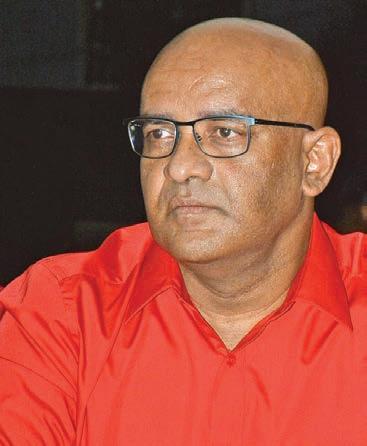
The People’s Progressive Party/ Civic’s (PPP/C) performance at the Local Government polls is the beginning of a movement to take back Guyana from the hands of the A Partnership for National Unity/Alliance For Change (APNU/AFC) Government, according to the Party’s General Secretary Bharrat Jagdeo.
Jagdeo made the statement at the Party’s public meeting at Kitty, Georgetown, on Saturday. The meeting was held for five of their 13 constituency members contesting the Georgetown municipality to present their vision for their respective constituencies.
Jagdeo told the gathering at the meeting that they need to understand the importance of the elections since it will send a clear message to the Government that the conclusion of their tenure in Government is near.
He said the last Local Government polls gave the PPP a good win but called for a more convincing win to ensure that the message “Guyanese are fed up” gets across to the Government.
“You’re part of a movement. You’re part of a movement not only to change the area which you live in but you’re the beginning of a movement to take back
Guyana from the hands of the APNU/AFC disaster that we have running our country now. That is what is at stake here, this is the beginning of that fight…,” Jagdeo said.
The Opposition Leader said the need to reclaim Guyana is all more important now because of how the Government destroying it.
“If the results of the last three-and-half years are anything to go by, then we have to get them out very early because this country will slide to the depths that we have never seen before if they continue with this approach to management,” he noted, while identifying that Government has spent over $1 trillion in just three years.
He explained that Government spending is supposed to boost the performance of every sector, as well as making the lives of the ordinary citizens much easier; but despite the APNU/AFC Government spending so much, they are yet to make an impact. He noted that every sector of the economy is rapidly deteriorating, and citizens are overburdened by unnecessary taxes.
Jagdeo identified that during its short time in Government, the APNU/ AFC Administration has introduced almost 200 new
taxes in order to finance its extravagant spending. He accused the Administration of wasting taxpayers’ money on unnecessary projects such as repainting State House from white to green costing some $30 million as well as a green fence for the Ministry of the Presidency (Office of the President).
“The
From left: Dion Younge (Constituency Five), PPP General Secretary Bharrat Jagdeo and Patrick De Santos (Constituency Four)
From left: Mohammed Isfehani (Constituency One), Dimitri Ali (Constituency Three) and Nalissa Ferguson (Constituency Two)
The number one producer of alcoholic beverages in Guyana, Demerara Distillers Limited (DDL), recently launched a “drink responsibly” campaign. This is quite commendable in view of the tremendous damage wreaked in our society by alcohol abuse. While alcoholism exists in all communities, like that other social pathology, suicide, it is particularly prevalent among Indian Guyanese, with both arising from their indentureship experience. That origin also helped shape their reaction to alcohol consumption, which –a fact not widely known - is always socially constructed. This should be taken into consideration by DDL in its programme.
Provided alcohol by the plantation administration sometimes in lieu of payment, and facilitated later by permitting rum shops to be established outside “pay offices”, Indians expressed their frustrations with plantation life by venting their anger violently on each other. Violence – especially against wives and children -- and alcoholism became a feature of Indian plantation life that continues into the present.
The epidemiological literature on alcohol consumption in New York makes an important relevant point for us in Guyana: in measuring drinking problems, there were “clear cut, significant and persistent group differences…the groups with the lowest incidence of alcohol abuse, the Jews and Italians, have (a) the lowest abstinence rates among these groups, and (b) (especially the Italians) the highest consumption rates.”
Alcohol abuse is a sociological problem.
Counterintuitively, then, the groups that drink the most and have the least number of members that abstain from alcohol have the least problems with alcohol abuse. One study of Irish-Americans in Boston over a 40-year period found that they were “7 times as likely to develop alcohol dependence as Italian-Americans -- this despite the Irish-Americans having a substantially higher abstinence rate.” What is going on? If nothing else, alcohol abuse is not an individual idiosyncrasy, and socio-cultural factors are as crucial as physiological and psychological ones.
“Ways of drinking and of thinking about drinking are learned by individuals within the context in which they learn ways of doing other things and of thinking about them. That is, whatever else drinking may be, it is an aspect of culture about which patterns of belief and behaviour are modelled by a combination of example, exhortation, rewards, punishments, and the many other means, both formal and informal, that societies use for communicating norms, attitudes, and values."
Another counterintuitive finding of anthropological studies is that aggression is not ineluctably linked to alcohol consumption. “Worldwide, however, such (aggressive) behaviour is typically quite rare, even among people who drink a great deal. Numerous anthropological studies demonstrate that alcohol-related violence is a learned behaviour, not an inevitable result of alcohol consumption.”
"The way people comport themselves when they are drunk is determined not by alcohol's toxic assault upon the seat of moral judgment, conscience, or the like, but by what their society makes of and imparts to them concerning the state of drunkenness."
"Cross-cultural evidence from diverse populations around the world shows that some have habitual drunkenness with little aggression, others show aggression only in specific drinking contexts, or against selected categories of drinking companions, and so forth. Such widespread and diverse variation contradicts the view -- shared by both `common sense' and much scientific writing -- that characterises alcohol as having a relatively direct pharmaconeurological effect in triggering aggression."
What has also been shown to be true is that cultures into which alcohol was forcibly introduced as a measure of control within a very compressed time had no time to evolve positive drinking norms, and in fact imbibed the foisted notion that the alcohol was a precursor to “letting off steam”. This was the case with Indians in the Caribbean. "The major colonial powers exported to those areas of the globe that fell under their control not only models of drunken behaviour but also a host of beliefs about the effects of alcohol on human beings. It may be that the widespread belief in alcohol as a disinhibitor is nothing but an ethnocentric European folk belief foisted on subject peoples around the world during the heyday of colonialism."
Look, Listen, Learn
activities
AFC’s ghost sure knows how to scare
Dear Editor, I was utterly bemused at the statements made by David Patterson at the AFC’s Candidates Expo at their headquarters at the Kitty Railway Embankment, Georgetown. He clearly extolled the ‘accomplishments’ of the Coalition Government in the Public Telecommunications Ministry and the Public Infrastructure Ministry as belonging solely to the AFC Ministers, but failed to recount the dismal failures.
In his uncharacteristic vitriolic and egocentric speech, he said, “People complaining that the AFC ministers are going into regions and saying that the community projects that Government done, we are claiming (them) as our contribution.
Any road I build, you tell them is David Patterson from AFC build it, and we have to walk the walk. We are too modest to take our credit.”
I wish to draw Patterson’s attention to the fact that, on more than one occasion, it was highlighted at the RDC meeting that an AFC Executive member is going around promising residents in various communities the installation of street lights, building and repairing of roads, and taking credit for the works done by the RDC.
This is to garner votes
at the upcoming LGE. I must remind him also that residents were asked to place their signatures to request these infrastructures, which were later used to support the AFC candidates on the backers’ form.
Moreover, I want to ask him to also take full credit for the numerous instances of reported cases of corruption and substandard works on ‘his roads’. The East Bank Berbice Road is a prime example.
This road’s foundation is in constant digging, refilling and re-digging, and each time the expensive road filling stuff is removed it is transported by the MoPI lorry to fill the yards of AFC members.
Please check opposite the Albion Police Station, your executive member has his yard filled with the stuff and the yard of the other AFC TV star in Canje. This faulty area is from Edinburgh to Glasgow Village.
In addition to this, the MoPI is using a defective asphalt spreader, which was purchased to do this East Bank Road, which is leaving more waves on the road than the nearby Berbice River.
This road should have been done at a cost of $1.2 billion, according to the engineering design of the IDB, but it is now clear that this design was not
followed, and, from all indications, this allocation will not be enough to bring that road to completion, since the corruption is galloping in all directions.
Can the Minister say what sums have already been spent, and when this project will be completed? This Minister should also take full credit for the breach of the Procurement Act in the award of the new Demerara Harbour Bridge Project study. He illegally gave contractors $148 million dollars to do that study.
The Minister of Public Security could not have bragged about his achievements in that sector, so he directed his full focus on the PPP. He went further than what he said on a TV station in Berbice. He advised his gathering of AFC candidates that if they are ‘harassed’ by the PPP members, they should call him on his cell phone and he would get the Police to deal with them. It seems that this minister is now in charge of the operations of the GPF, and not only the formulation of policies.
Should this minister then not give each and every citizen his personal number, so that they can call him when their homes and businesses are pillaged by bandits? Already, in four days of this week, Berbice has been assaulted by four daring and brutal robber-
ies. In addition, should he not also call on the GPF to investigate the numerous instances of electoral fraud perpetrated by his Party?
The ‘Champion’ of the sugar workers and the subject minister also failed to take credit for the AFC’s handiwork in the sugar industry and the corruption and retrogression of the rice industry. The Panama rice fiasco is threatening that lucrative market.
We are now importing rice to keep our foreign markets alive. The drastic reduction of the contribution of agriculture to the GDP was spared the agony of being mentioned at this ‘fit and proppa’ gathering.
Lastly, Patterson’s advice to his membership should be heeded with some concern. He vehemently told his membership, “If war break, defend yourself at all times. I don’t believe in turning the next cheek”. Is this his version of ‘slow fyah mo fyah’? Is this the speech of a responsible minister of Government, a campaign manager and the general secretary of his party?
The AFC’s ghost sure knows how to scare. The AFC’s campaign is so ‘fit and proppa’ that they have now withdrawn from contesting over 10 NDC areas!
Yours sincerely, Haseef Yusuf
As part of
slated for Fire Prevention Week, the Guyana Fire Service (GFS) hosted a fire safety fair for students along the East Bank of Demerara at the Providence Stadium. In photo, a rank of the GFS is seen speaking to students about fire prevention techniques
Keen observations being given to the operations at GECOM (Pt 1)
Dear Editor,
Recent published statements by representatives of the international community highlight the keen observations being given to the operations of the Guyana Elections Commission (GECOM). The implicit and justified attention are no doubt related to the many mixed signals that have emerged from the organization, in particular, those from the dubious and challenged imposition of the Chairman, Justice ‘retired’ James Patterson.
Given the circumstanc-
es of his unilateral appointment, which most Guyanese and observers are convinced is a constitutional breach, it was hoped by many that his performance would allay their fears of these dictatorial actions by President Granger. It is becoming even more frightening now, as, with each passing day, there is broader public conviction that Chairman Patterson’s contentious stay is more destructive than complementary.
Instead of improvements to correct the many known problematic imbal-
ances and areas of abuse existing within GECOM, Chairman Justice (retired) James Patterson’s watch is realising greater uncertainty. There have been countless biased and lopsided decisions compounding the less-than-transparent image required of the organisation. At the same time, we continue to witness the emergence of irrational and futile defences by the Chairman of efforts tantamount to the suppression Guyana’s democracy.
Among the latest widely published geriatrics
emerging from GECOM’s Chairman is the now infamous headliner: “quality trumps race” in hiring workers. The reported reactions of many readers of all ethnic persuasions inform a number of hair-raising questions. Among these are:
1. Is the current GECOM staff composition reflective of the best skill set or academic quality reflected by the results of national education demographics?
2. Given that the Chairman previously reported the staff make-up of GECOM consisting of 48
per cent of one ethnic group, is there a special quality or characteristic contained in that ethnic group which makes the group best suited to ‘trump’ the requirements of the organisation?
3. Is GECOM not responsible for training all staff employed, or do we have persons being employed with all of the skill sets?
4. What are the criteria established by the organisation’s policy for the selection of permanent and temporary staff? And,
5. Is the principle of objectivity or being a good
Judge in implementing the intent of the Constitution one that is negatively impacted by age?
The ominous signs of underhand and surreptitious happenings beacon brightly under a weakened and infiltrated system. These must serve to impress upon and justify for the awareness of all citizens a strengthened keenness of enquiry, and objection where required, to protect citizens’ rights.
Sincerely.
Neil Kumar
Guyana described as next big global oil beast without meaningful benefits
Dear Editor,
Mr Robin Mills, a guru in the oil industry, writing for “The National”, an online and print media platform, posted on October 8, 2018 that - “Guyana may be the next big beast in Global Oil”; Mills foresees the country emerging as the top per capita oil producer.
It is noteworthy that Mr Mills of The National ignored the robber baron 2 per cent royalty in the 2016 Production Sharing
Agreement (PSA) between Exxon’s Esso two partners, Hess & Nexen, and the Government of Guyana, which is so blatantly minuscule, odious and obnoxious. Guyana, after being referred to as a Frontier State by international energy research firm “Wood McKenzie”, and now an oil beast by The National”, has indeed suffered the slings and arrows of outrageous fortune. Our economic straits have now housed us as a glob-
al oil nation, without remedying the abysmal 2 per cent royalty that enchains us.
Many are inclined to focus on the shadowy and smoky 50/50 “profit sharing” post expense contract stipulation; it is more a contrivance than a condition of any value, that should be ignored due to its subjectivity in the treatment of capital and current costs, and what could be deducted and set-off from the profit share remnants, if any; with special emphasis on the
LGE 2018: The start of a...
They have put taxes on electricity bills, water bills, on baby diapers…,” he explained.
Jagdeo told the gathering that winning City Hall is very important since the People’s National Congress, now APNU, has been rapidly declining the state of Georgetown. He promised no increased taxation and better transparency and accountability at City Hall if the PPP gains a majority there.
He said the PPP is a national party since they are the only political party contesting all of the Local Authority Areas and has the interest of every Guyanese at heart. He noted that their list of candidates are diverse and every one of them resides in the constituency which they are contesting and would have decided to enter into the race on the PPP’s ticket after they saw the lack of development in their communities.
Candidates
The candidates who presented their plans for their respective constituencies were Mohammed Isfehani (Constituency One), Nalissa Ferguson (Constituency Two), Dimitri Ali (Constituency Three), Patrick De Santos (Constituency Four) and Dion Younge (Constituency Five).
Delivering a fiery speech was Younge who is contesting the Sophia/Liliendaal/ Turkeyen/Pattensen area. He noted that under the PPP/C Administration, Sophia was scheduled to be
developed but the APNU/ AFC Administration just halted all of those developmental plans. He said the US$30 million that was set aside for Sophia’s infrastructural development under the PPP Administration is yet to be touched by this Government, while the living conditions of residents there
from page 3
continue to deteriorate.
Collectively, all the candidates promised transparency and accountability if elected to serve on the Council. Additionally, they are campaigning on the promise of no parking meters, no taxation, citizen’s involvement, job creation and better infrastructure.
mysterious, coreless and fungible pre– contract costs.
The will of the Guyanese who seek and strive to obtain a fair share of our oil resources by having the incomparable, incongruous and incompatible 2 per cent royalty renegotiated is undiluted. Whether we have one billion or fifteen billion barrels of oil; whether we are governed by PPP/C or PNCR, we must benefit meaningfully from our resources.
Every Guyanese politician, non–governmental organisation, private sector executive, some local commentators, and international organisation such as Chatham House, Natural Resource Government Institution, among others, try to treat us as myopics and encourage us to focus on the terms of post oil contracts. The attempted Segway is an oily herring that is a form of glad-handing with the handlers.
The global oil giant ExxonMobil currently controls Guyana’s Stabroek Block contract, a block that represent 100 per cent of commercial oil discovered in Guyana’s offshore as at September 30, 2018.
Yet, we have some analysts and commentators twisting themselves into pretzels by seeking to have Guyanese focus on other oil contracts that the Government of Guyana has with Repsol, Tullow, MidAtlantic and Total, among others; though these companies have discovered zero oil in Guyana’s offshore. Let us focus our energies on revising the contract with Exxon’s Esso and their partners.
Some of our learned and “objective” oil aficionados have made a stormy fuss about the difference between one per cent and two per cent, while overlooking the depraved nature of the
beastly contract that has so far accounted for over five billion barrels of known oil recoverable reserves, carrying plundering 2 per cent royalty. The specialists compute the value of 1 per cent of zero; while the exploitative 2 per cent contract with Exxon’s Esso is not mentioned or made invisible to the general public, even as it is covered in sanctity and sanity by overlooking its morass contract terms.
Let us not endorse and make a reality of the words of Sophocles, the greatest of the Greek tragedians, who said, “The greatest grief are those we cause ourselves.” Yank and revise the 2016 PSA, as consistently requested by Christopher Ram, Melinda Janki and Ramon Gaskin.
Sincerely, Nigel Hinds
SUnDAY, october 14, 2018 | gUYAnAtimeSgY.com
A woman miner blazing through a male-dominated industry
The gold and diamond mining industry over the years has contributed significantly to the sustenance of many families. However, it takes lots of hard labour, long hours and courage to keep pursuing some of nature’s most precious minerals buried below.
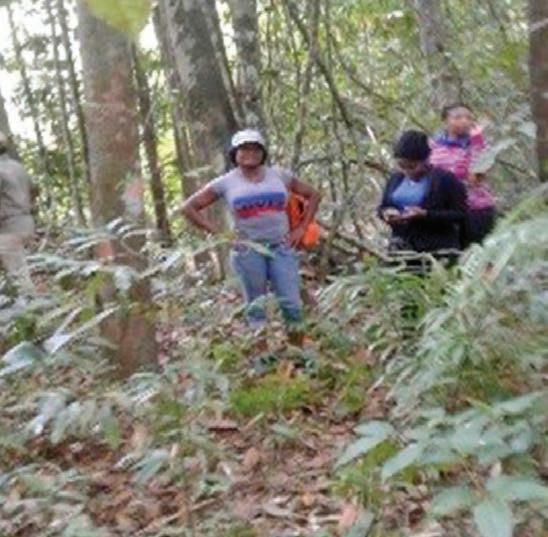
Deian Gordon is one of the few female miners in an industry dominated by men. She is also an executive member of the Guyana Women Miners Organisation (GWMO). She understands the struggle in this sector all too well.
Gordon, prior to taking up a career in gold mining, was engaged in street vending. She visited the interior only to understand how minerals are extracted from the earth, but that visit evolved into a business.
As a woman in mining, Deian has found it to be very challenging. She is a reservoir of good and bad experiences in the sector.
In a male-dominated field, Gordon has managed to rack up some 22 years in the sector but it takes strength and courage to keep persevering.
“You have to be strong to work with the men… spirit, mind and body. You have to be able to stand up and demand that this is your job, you have workers, you have to respect, even though you are a female; they have to respect that they working with you,” she explained.
Growing up with 11 brothers taught Gordon a great lot. So that gave her a little advantage working in a ‘man’s world’.
As a woman in mining, she has learnt that one has to be calm, in the eventual-
ly a situation arises. “Like when they get a dispute in the backdam, like in your camp, you have a dispute with another worker, if you can’t go and make peace or try and get it down it will lead to that (chopping up)”.
is a slang that is often used by miners, “Dutty battam dark” which means you invest unsure of what will be your returns but you remain hopeful.
The GWMO, along with a brother institution, have assisted in coaching Gordon in the mining field. Gordon through the organisation has been able to attend many training programmes, especially in the area of sustainable practices made possible by the organisation.
The workings of the mining Industry are totally different from most sectors, she explained, “…because for me, my work starts at 5:00 am, sometimes you does gotta get up from 2-3 am (02:00-03:00h) pumping water and so forth out of the pit. So, you close off at 6 pm (18:00h) and depends on how the sun goes, you could go up to 7 (pm)… so it ain’t get a factor really like a 7 am (07:00h) to 4 pm (16:00h) work,” she noted.
The GWMO executive said she was taught about the rules that govern the mining industry through the GGMC and the GWMO and abides by those rules.
She also engages in sustainable working practices. After mining is completed in an area, trees are often replanted by her workers.
To any dredge owner, Deian Gordon encourages to always have another business to assists in the steady flow of income due to the unpredictability of the sector.
She explained that there are times when large investments are made in the mining operation with very little returns and then there are times when the rewards are bountiful; however, Deian said there
Additionally, being away from family is also considered challenging. Gordon enjoys going to the movies and hanging with friends, to “ease the brains” as she puts it.
Navratri Day 6 The Day of Maa Katyayani
As per Hindu mythology, Devi Katayayani showers her blessings on those marriageable girls who worship her with complete devotion. This devotion towards Devi Katayayani is part of an age old tradition that started from Gokul in Braja. It is believed that, centuries ago, Gopis in Gokul used to fast during the first month of winter to fulfill their wish of marrying Lord Krishna. Since then, the sixth day of Navratri has been considered to be significant for those girls who have stepped into the age of marriage and, as such, it is devoted to the worship of Devi Katayayani.
Origin and History
According to legends, Devi Durga has been worshiped by several rishis and priests, the most prominent among them being Rishi Katyayan. It is said that Rishi Katyayan was a spirited devotee of Maa Durga and worshiped her for several years. When Maa Durga was pleased with his years of hard meditation, she incarnated as his daughter and came to be known as Katyayani. In her Katyayani avatar, Devi Durga ended the pain and sufferings inflicted by Danva Mahishasur and brought peace to the humankind.
Worshiping Devi Katyayani
Devi Katyayani is usually worshiped by young and marriageable girls who want to marry their soul mates. This tradition began in Gokul where the Gopis who wanted to marry Lord Krishna, fasted during the month of Margashirsha (the first month of winters). As time passed, this tradition started getting related with girls of marriageable age.
Customs and Rituals
While earlier Gopis used to fast for an entire month, nowadays the ritual goes on from anywhere between 21 to 41 days. Young girls worship Maa Katyayani for the purpose of timely marriage. While performing the rituals, nine minor girls and three small boys are worshiped as well, in order to please this Devi and obtain her blessings.
Meaning: “Oh Goddess Katyayani, Oh great potency of the lord, Oh possessor of great mystic power and mighty controller of all, please make the son of Nanda Maharaja my husband. I offer my respect and homage to you” This mantra should be chanted five times a day for at least 21 days. It is believed that repeatedly chanting this mantra is an effective way of removing all obstacles that are delaying the marriage of a girl, such as Manglik Dosha.
Colour for the day
While the Devi herself wears a yellow saree on this day, it is suggested that devotees should adorn themselves in orange color ethnic wear. Since the puja is done for the purpose of timely marriage, it is significant for girls to wear clothes that are orange in color.
"May this navratri maa sherawali fulfill all your dreams and bring happiness in your life"
Deian Gordon
Foreign Direct Investment
Enforcement of laws in Guyana lacking – US State Department
...points to complaints about judicial delays
Arecent report from the United States Economic Affairs Bureau has painted an unflattering picture of Guyana’s legal system and the way it doles out justice in contractual and civil matters. Among other things, the report cites complaints of sloth in the Judiciary As a factor in its analysis.
Guyana was among other countries that had their investment climates assessed by the US Department of State for 2018. The report makes it clear that the problem is not legislation; it’s the enforcement of said legislation.
“Sufficient legislation exists in Guyana to support foreign investment in the country, but implementation of relevant legislation continues to be inadequate. The objectives of the Investment Act of 2004 are to stimulate socio-economic development by attracting and facilitating foreign investment,” it states.
The Department noted that other relevant laws include the Income Tax Act, the Customs Act, the Procurement Act of 2003, the Companies Act of 1991, the Securities Act of 1998, and the Small Business Act.
It was pointed out however, that the regulators are still required to act in order
for much of these legislative measures to be implemented.
And even though the State Department acknowledged that there is no known case of executive interference, it noted that the court systems are still perceived as lacking.
“The judicial system is generally perceived to be slow and ineffective in enforcing legal contracts. The 2018 World Bank’s Doing Business Report states that it takes 581 days to enforce a contract in Guyana. Suspected corrupt practices and long delays make the courts an unattractive option for settling investment or contractual disputes, particularly for foreign investors unfamiliar with Guyana.”
“In order to redress this obstacle to investment, the Government of Guyana, with support from the InterAmerican Development Bank (IDB), established a Commercial Court in June 2006. Given Guyana’s
growth potential, there is need for expansion and strengthened capacity in the near future.”
In summing up, the State Department noted that implementing the legal framework remains inadequate as the judicial system is slow and ineffective in enforcing legal contracts.
The Department also noted that there have been no recent cases of expropriation. It went on to advise that all companies should conduct due diligence and seek appropriate legal counsel to have any concerns resolved prior to doing business in Guyana.
Persons have long complained about the sloth of the Judiciary. A recent case was Opposition Leader Bharrat Jagdeo, who had noted back in June that more than three years after his party filed an election petition in the High Court, the matter continued to languish in the courts.
38 arrested in operation “Restore Order”
Some of the items recovered during Operation “Restore Order” on Saturday
As part of efforts to restore law and order throughout the country, ranks of the Guyana Police Force carried out several cordon-and-search exercises which resulted in the arrests of 38 persons and the recovery of suspected stolen items.
Under Operation “Restore Order”, the exercises were carried out in A (Georgetown-East Bank Demerara) and C (East Coast Demerara) Divisions during the hours of 03:30h and 08:30h on Saturday.
In A Division, the exercise was centred in the East La Penitence Station District, which includes Guyhoc Park and part of Sophia, Greater Georgetown.
During the operation, three motorcycles – two with registration plates CG 8319 and CJ 570, 10 laptops, 42 cellular phones, a tablet, two Play Stations, a Pioneer auto digital timer, an X-box for Nintendo games, a quantity of computer and phone accessories, as well as 72 grams of cannabis were found.
Following the discoveries, seven persons, including a female, have been detained for offences ranging from receiving stolen property to possession of narcotics.
Meanwhile, over in C Division, the search was concentrated in the Beterverwagting (BV) and Sophia, Greater Georgetown, areas. The exercise resulted in three motorcycles with registration plates CH 8675, CG 3395 and CH 8917; a car bumper; two car doors; a vacuum; a power washer; a grass cutting machine; three cellular phones; a television set, and a music set with three speakers as well as a quantity of small-sized ziplock bags being found.
These discoveries resulted in 31 persons being detained for offences ranging from robbery under arms, possession of stolen articles, trafficking and possession of narcotics, and setting fire to a building.
Moreover, one of the detainees was identified as 36-year-old Desmond Junior Lewis of D Field Sophia, Greater Georgetown. When profiled, he was found to have been sentenced in absentia for six years on two counts of armed robbery committed in A Division.
The High Court, Georgetown
SUnDAY,
Inmate hospitalised after attack in prison
An inmate on remand at the Lusignan Prison, on the East Coast of Demerara, has been hospitalised after he was attacked on Friday night. The incident occurred sometime around 20:30h.
The 25-year-old suspect was charged and remanded to prison on Friday for being in possession of an illegal gun and matching ammunition.
However, according to acting Prisons Director Gladwin Samuels, later that night, “while housed in the Holding Bay, he was reportedly assaulted by prisoner(s) unknown.”
It was reported that the inmate sustained injuries to the head.
“When asked what might have caused such an attack, he was unable
to say. According to him, he has no conflict with anyone currently incarcerated,” the Prisons Director said.
Nevertheless, the 25-year-old young man remains hospitalised as the incident is being investigated by the Police.
The injured inmate, a dog food vendor of E Field, Sophia, Greater Georgetown, was arrested late Thursday evening at his home after the unlicensed weapon was discovered.
Acting on information received, ranks in A Division (Georgetown) went to the house where they carried out a search on the premises during which the .32 Taurus pistol along with 12 live matching rounds was found.
Corentyne labourer, taxi driver remanded on robbery charge
ACorentyne, Berbice, labourer and his accomplice, a taxi driver, who are accused of robbing a businessman of $270,000, were on Friday remanded to prison by Magistrate Charlyn Artiga.
Denroy Parks, called “Jaja”, of Cromarty Village, Corentyne, Berbice; and Neitein Dookhie, called “Angle”, 30, of Lot 24 A Phillip Farm, Corentyne Berbice, were not required to plead to the indictable offence when it was read to them in the Number 51 Magistrate’s Court.
It is alleged that the men on October 9 at Lot 6 Cromarty Farm, Corentyne, Berbice, while being armed with a dangerous weapon, they robbed Deraj Kumar of $270,000 before making good their escape.
However, bail was refused. The case was transferred to the Whim Magistrate’s Court and will continue on November 1.
Degutting…
…Teachers’ just demands
Well, this year’s sturm and drang of the GTU’s demand for “living wage” for teachers is over…and sadly, it ended not with a bang, but with a whimper! Starting from their demand for a 40 per cent increase in 2016 and just as hefty increases for subsequent years, the GTU justified the numbers by demonstrating that teachers were just unable to live in dignity under the present salary scales. They persuaded both of the umbrella Trade Union bodies, the Opposition and most Guyanese about the justness of their cause.
So whe n the terms they accepted were announced, your Eyewitness was flummoxed, to say the least. Way back in the day, he’d said a fix was in the works, and after the pantomime of pouting and prancing in the streets, the GTU and the Government would kiss and make up – with the Government getting its way, of course. His rationale was that teachers were by and large supporters of the PNC-led Government and neither side would want to go into the LGE with such a large bloc of supporters pissed off! Then again, old heads in the GTU would know that the PNC always played hardball when their insistence on absolute power was threatened. Accusations that the GTU President was “PPP” surfaced, and victimisation reared its ugly head.
But as the standoff progressed, your Eyewitness started to have some hopes that, with the widespread support, the GTU would grow a pair of cojones to stand up for their justified demand. The country is on the cusp of finally getting some real money to make the quantum leap out of grubbing for a living – but it would all depend on getting our next generation educated. Or we could end up like Venezuela, with all the oil in the world but nobody to translate that into real development.
But here it was, from a demand of 40 per cent for the base year 2016, the GTU accepted 12 per cent!!! What is going on?? How is this salary scale going to encourage bright young people to enter the teaching profession to gradually transform the modalities of education delivery for the demands of the 21st century?? Junior teachers with starting salaries of $61,000 would now get an increase of $7,320 for 2016; taking their salaries to $68,320; and a further eight per cent ($5,465) for 2018, which would take their salaries to $73,785. What will be left for them after NIS and taxes??
If it took a 50 per cent increase in just-appointed Ministers’ salaries – from a base of $347,000! -- to encourage them to do their job and not be seduced by corruption, how is a new teacher at $73,785 to be encouraged not to be a slacker?
This whole “deal” stinks to high heavens!!
…or debunching?
Now that the GTU’s thrown in the towel, your Eyewitness can discuss this term “debunching”, which always crops up when teachers negotiate for salaries. He must admit he hadn’t the faintest clue what they were talking about! So he did what he does in these matters: hit his “Google” search button!! And lo and behold, this in the ONLY entry that came up:
“ The process or phenomenon by which a beam of electrons or other particles in a vacuum tube or particle accelerator tends to become more dispersed (laterally and longitudinally) as it travels.” Now your Eyewitness knew teachers couldn’t be demanding electron dispersion, so he looked further! Nothing, save specific mentions in the Guyanese newspaper on the very same teachers’ demands! And after much digging and scratching he found this:
“Teachers who have been in the system for years receiving the same salary of a teacher of the same status, who has recently joined the profession. Hence, the implementation of the “debunching” payments, whereby teachers would be allocated according to qualifications.”
Guyanese invented a word!!
…the health profession
With understaffing at all levels in the health system, is the Government serious about encouraging “export” of public health workers to increase remittances??
Draft Mining Policy recommends Govt seek consensus with parliamentary Opposition
– increased Police, military presence in hinterland
tax waivers for green mining technology; assistance for miners
By Jarryl Bryan
The draft National Mining Policy has been released, and with it, a plethora of recommendations, including a crucial one that urges Government to seek a consensus with the parliamentary Opposition on the policy, to insulate it from the effects of a possible change of Government.
The 134-page document was compiled by University of Guyana Lecturer Sherwood Lowe and former Guyana Geology and Mines Commission (GGMC) Commissioners William Woolford and Karen Livan. Under the implementation risk assessment section, it stated that a change of Government is identified as one of the political risks, as well as Cabinet reshuffle and changes in national priorities.
To mitigate these risks, the document urges the Government to pursue “multi-party parliamentary endorsement of policies; full Cabinet endorsement; full public disclosure and longterm strategic planning.”
As the document has been made available to the public by the Natural Resources Ministry, at least one of these recommendations has been followed. It is unclear whether the parliamentary Opposition has been approached regard-
ing the policy.
According to the policy, these include financial, institutional, market, compliance, geological and security risks. Under compliance, the policy advises that miners be exposed to targeted education and encouragement.
While it was recommended that stakeholders and the community become more involved in compliance management, the policy also urges stricter enforcement of laws in a sector that was once described as a ‘Wild West.’
Noting that there are security risks posed by Trafficking in Persons (TIP), mining operators raiding neighbouring camps and stealing gold through intimidation and violent crime, the policy recommended increased Police and military attention and operations in mining areas. In addition, the policy speaks to using residents in communities as the “eyes and ears” on the ground for the authorities.
When it comes to financial risks, the policy recommends that long-term budget planning and prioritisation of goals and actions are done to prevent budgets for work plans being unavailable or only partly approved by the GGMC or the Ministry.
In terms of the institutional risk, it called for capacity building at the GGMC that included the use of ex-
ternal staff; including retirees, Private Sector and sister organisations. It was also advised that an interagency committee be set up to help coordinate decision-making that would include border security, health and law enforcement. To keep track of these initiatives, the policy advocates the use of monitoring and progress reports.
Lastly, the policy recommended that continuous and systematic regional exploration and mineral resource assessments be carried out by the GGMC. It was noted that uncertainties about the existence and exploitability of undiscovered mineral resources are geological risks.
Recommendations
One recommendation that
the policy document speaks of is introducing a scheme to provide assistance to miners in order to increase mechanisation. It also advises that tax waivers for green mining technology be expanded, in addition to the reach and resources of the Guyana Mining School.
“Amend mining regulations to favour specification of equipment and process over
mere performance standards,” the report states, adding that efforts should be made to “continue research on gold mining recovery options.”
The document adds that Government should “make tax concessions on fuel, spares, machinery and equipment predictable and more attuned to the various classes of Small and medium-scale (SMS) miners. Build sealed roads based on a priority list for coastal hinterland activity. Build feeder roads for internal access to new mining grounds.”
Right of appeal
The report also makes a crucial recommendation that changes should be made to the process used by miners to appeal GGMC decisions. It notes that given the connections between the GGMC and the Minister, this may pose problems.
“The Ministry, for example, has staff on GGMC’s Board and committees. Appeals
should best be made to an independent agency, such as the proposed Inspector General for the GGMC,” the policy states. Giving its rationale for such an office, the policy observes that the support of an independent Inspector General (IG) can help the Geology and Mines Commission improve its responsiveness to the public and stakeholders. It also listed some proposed functions, including conducting and supervising audits and investigations relating to GGMC.
Some specific functions, according to the policy, would also include receiving and investigating complaints from miners and general public against the GGMC. It warns that the office be kept spate and insulated.
“The IG office shall be independent of and external to the GGMC and [Ministry of Natural Resources] MNR. It shall be empowered to prepare its own annual budget, which will be a direct charge on the Consolidated Fund, set its own internal rules and procedures and be answerable to the National Assembly,” the policy advises.
The draft Mining Policy is expected to ignite a public debate on what is wanting in the mining sector
Former WBD cane farmers call for Govt subsidies
By Shemuel FanFair
...as they commence planting cash crops Piece work for teachers
Almost two years after the closure of the Wales Sugar Estate, cane farmers in the nearby village of Bellvue, West Bank Demerara are pleading for Government to assist them as they venture into diversified crops.
When Guyana Times met with farmers of the Bellvue Cane Farmers CoOp Society on Saturday, they were sourcing water as the mid-morning sunshine pierced the parched earth and rainfall remains scare owing to the prolonged dry season, which experts suggest could extend into the first months of 2019.
Some farmers are trying their hand at cash crop cultivation while others are planting banana and plantain suckers and coconut palms. According to overseas-based Balram Balkarran, the farmers are encountering added expenses through land preparation and pump rentals.
“At least the Government should have assisted the Co-op Society, as it costs members about $20,000 to $40,000 per acre to go into other crops. Farmers’ cane used to contribute 50 per cent of the canes. Wales Estate had more co-op societies that supplied cane more than any other estate, so the peasant cane farmers here are suffering more here than (at) any other location,” Balkarran told this newspa-
per. In December 2016, when Wales officially ended operations, water in the access canals leading to the Kamuni Creek flowed freely to the Wales area through the community of Renistyne, according to Balkarran. However, this all changed when the Guyana Sugar Corporation (GuySuCo) stopped maintaining the many punt trenches in the area. In fact, some sugar workers living in the area were also affected as they supplemented
their income via fishing in the trenches.
Farmer Ramchuran Sukhnan, 57, told this newspaper of the many expenses he has been paying since leaving the sugar industry, and he observed that he would be grateful for grants and subsidies as he still has to acquire seedlings. He said he had to pay $50,000 in labour costs to clean one of his plots, $40,000 to prepare the
beds, in addition to other costs.
“This is a-we livelihood; we not getting anything... we really need help here, we want water,” Sukhnan pointed out, referencing the dry conditions.
The farmer noted that he supports his 4 grandsons from his earnings.
“Since Wales close (down) things hard, we got children and grandchildren to send to school,” he noted.
Guyana Times was told that the National Drainage & Irrigation Authority (NDIA) was contacted since June 2018 to assist in clearing the bushy trenches, but as mid-October approaches, the farmers are awaiting the entity’s swift action.
Wales was the first of several estates closed under the Coalition Administration in moves to re-organise the industry. Though the closures were rationalised as cost-cutting initiatives, many observers -- including the Parliamentary Opposition -- had called for social impact studies to be conducted beforehand.
Aside from the plight of the farmers, many sugar workers in the Wales area are facing difficulties in acquiring consistent and lucrative employment. Only a few workers were rehired by the Special Purposes Unit (SPU) which now manages the closed estates.
Satiricus didn’t know how to react to the news about the teachers’ 12 per cent salary settlement. Like most Guyanese of a certain age, Satiricus had been a teacher for a while, right out of school. He had a soft spot for teachers from Brother Bob’s maxim, “Only he who feels it knows it”! He was headed to the Back Street Bar, and couldn’t wait to unload to the fellas.
“Budday, wha’ yuh worry ‘bout dem teacha fa?” asked Bungi to Satiricus’s question. “Dem bread done butta!”
“Yeah, Sato,” said Bungi in support. “Yuh t’ink dem care w’en all dem cane cutta get fiah?”
“ The teachers are only trying to do what’s right for them,” observed Hari. “What’s wrong with that?”
“ That’s right!” said Satiricus. “They need to make a decent living too, you know?”
“Not’ing na wrang wid da,” said Cappo. “But if de guvment can fin’ money fuh gi’e dem 12 per cent raise, how come dem cyaan fin’ money fuh pay cane cutta sev’rance?”
“Sato, 12 per cent na joke, yuh know! At least dem teacha can buy food,” said Bungi heatedly. “But dem cane-cutta an’ dem family a sta’ve.”
“Why are you mixing the two situations, fellas?” said Hari. “Both are bad.”
“Bad? Bad?” Bungi almost shrieked. “Dem teacha get 12 per cent raise fuh wuk fram 9 to 3 anda shade!”
“An’ de bes’ abee get bin 5 per cent fuh piece wuk!” continued Cappo. “Wha’ mek dem na pay teacha fuh piece wuk?”
“ Teachers’ piece work?” said Satiricus. “How would that work?”
“Budday, jus’ pay dem extra fuh how much mo’ pickney pass dem exam,” said Cappo.
“ That’s interesting,” said Hari. “Like an incentive system. What you think Sato?”
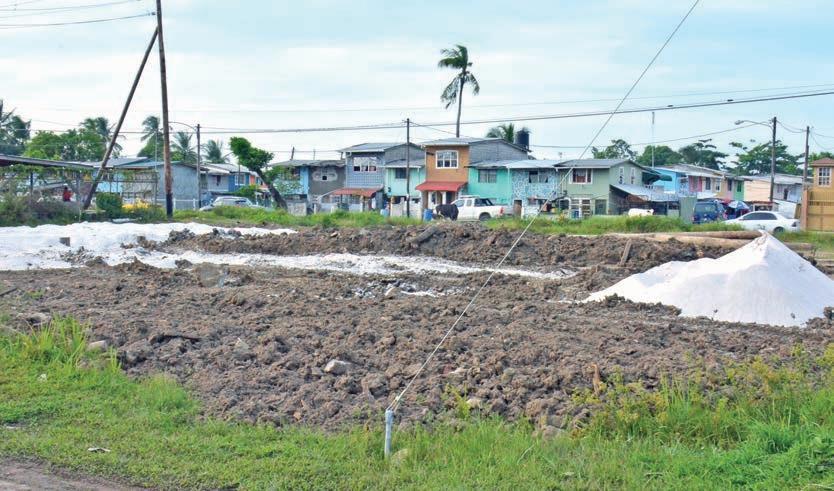
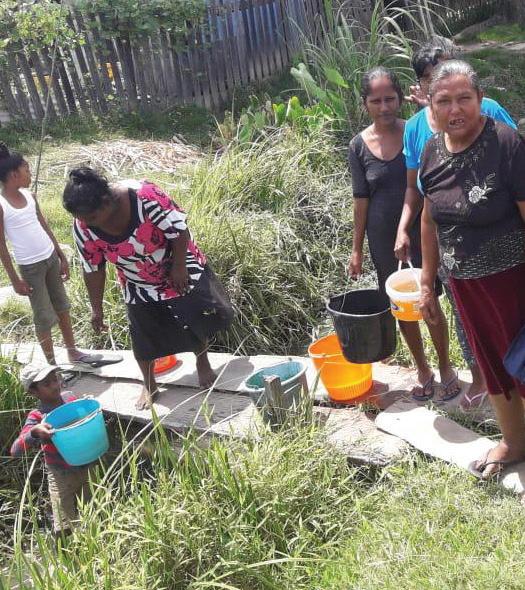
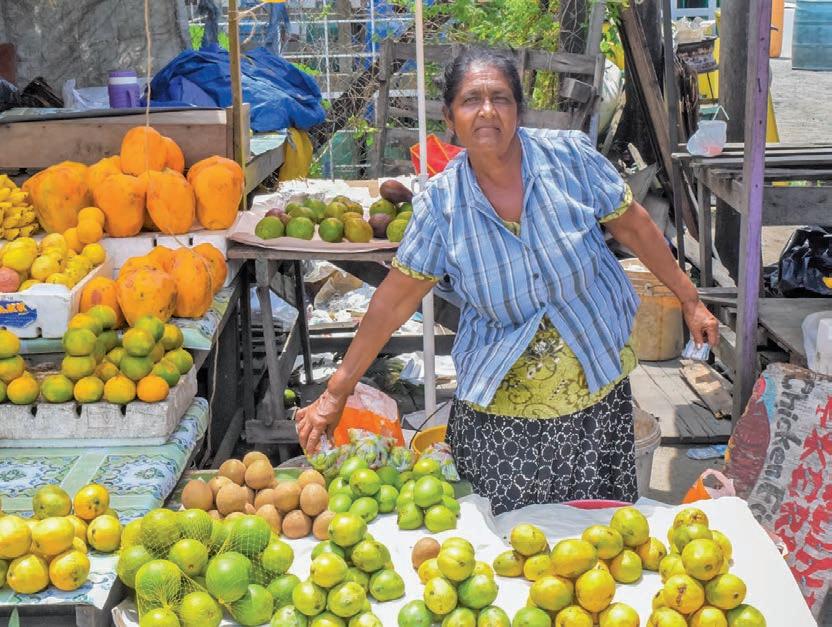
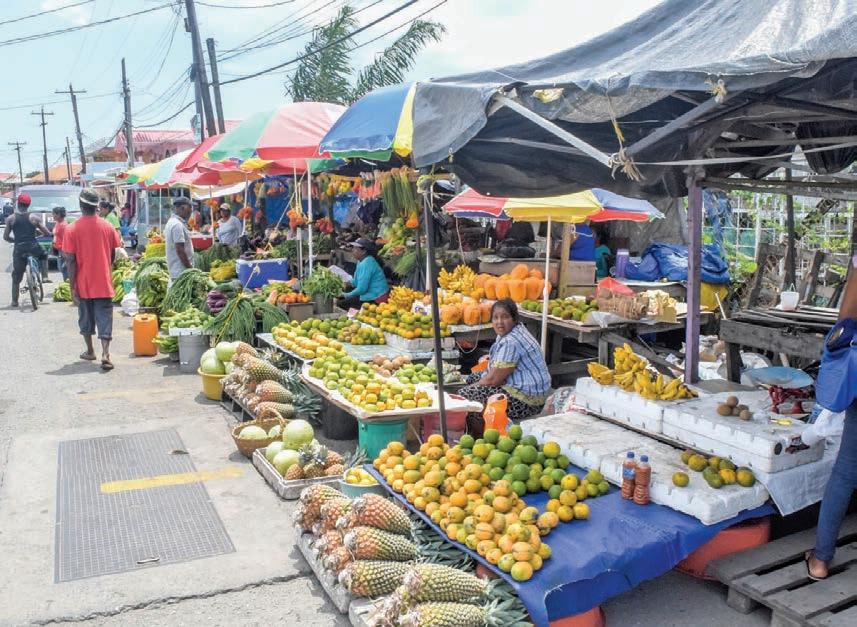
“You guys don’t understand teaching,” replied Satiricus. “There are many intervening variables for kids passing their exams.”
“Budday, abee does call da ‘obstacle” in de cane fiel’,” said Bungi. “An’ dem does pay mo’ fuh clear obstacle.”
“Suh if some pickney dunce,” explained Cappo, “pay de teacha mo if dem pass dem exam. Right now dem teacha guh keep de same dung-ke-dam attitude afta dem collec’ de 12 per cent!”
“ That’s something to think about,” said Satiricus quietly.
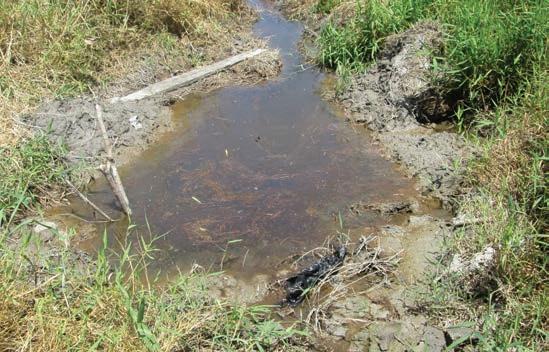
The depleted water source in what was meant to be a punt trench in Bellvue, West Bank Demerara (Shemuel Fanfair photo)
A burnt out section of the farmland
D Division hosts walk to stamp out crime, traffic “Lawlessness”
In efforts to re-enforce law and order in Region Three (Essequibo Islands-West Demerara), the Guyana Police Force’s D Division (West Bank Demerara-East Bank Essequibo) hosted a walk on Saturday morning.
The ‘Walk against Crime and Traffic Lawlessness’ moved off from Den Amstel and concluded at Leonora, West Coast Demerara. It saw a large turnout, including State Minister Joseph Harmon and Deputy Commissioner of Police, Maxine Graham.
Additionally, there were persons from various groups and organisations within the Division; such as churches, the business community, different youth groups, schools, Community Policing Groups (CPG) among others.
Upon culmination of the walk, Minister Harmon, along with Commander of D Division, Senior Superintendent Edmond Cooper, and Deputy Commissioner Graham addressed the large gathering.
The participants were
encouraged to continue working together, for there is much work to be done within to division and the Police alone cannot do it, hence there is a call for team work.
Speaking with Guyana Times, Commander Cooper explained that Saturday’s walk was a sensitivity exercise aimed at bridging the gap between the Force and the public by restoring the latter’s confidence in the country’s premier law enforcement agency.
The Divisional Commander was pleased with the turnout for the walk – the first of its kind – which was pegged at over 400 participants.
According to Cooper, he believes initiatives such as this will go a long way in sensitising the public on ‘crime and traffic lawlessness’ in the Division.
“While the sensitivity campaign is going on, people listen and so we get our message out to them. We will continue our campaigns, our outreaches and sensitivity exercises,” Commander Cooper posited.
First Lady commends CIOG for work done to assist vulnerable
children
FHe went on to note that there will be similar walks throughout the division to continue its efforts. Apart from the walk, the Commander said the division will continue with other activities such as lectures in schools and outreaches, among others.
Participants at D Division’s ‘Walk against Crime and Traffic Lawlessness’ on the West Coast of Demerara on Saturday
irst Lady Sandra Granger on Saturday attended the Central Islamic Organisation of Guyana’s (CIOG) annual fun day for orphans and vulnerable children, where she commended the organisation for its commitment to enhancing the lives of orphans and vulnerable children.
Vice President of the CIOG, Gulzar Namdar presents First Lady Sandra Granger with a token of appreciation
No international, regional observers approved for LGE 2018
As the clock counts down to Local Government Elections (LGE) 2018, it turns out that the Guyana Elections Commission (GECOM) has so far not approved any regional or international observers.
This was confirmed when Guyana Times made contact with GECOM Public Relations Officer Yolanda Warde. While she noted that advertisements were published calling for local observers, it is unclear whether any international and regional observers will be brought on board.
“The Commission has not
approved the regional and international observers. We approved for local observers, hence the advertisements were specifically for local observers. I can’t say whether the Commission has completely ruled out the possibility of international and regional observers, but as of this point that is what they have approved… local observers.”
“I think in the past international groups would have expressed an interest, which was subject to the approval of the Commission. I can’t say whether the process was done by just a way of a letter or whether there was an
advertisement,” Warde explained.
She related that an international observer has expressed an interest in
the Local Government Elections. As such, she noted that there is the possibility that observers will ultimately be approved. Warde
tem is one in which parties’ gain seats in proportion to the number of votes cast for them in a municipality or NDC. For someone to be elected under the Proportional Representation system, they must be on a party list or voluntary group list. Individuals cannot contest as the PR system.
explained that GECOM will communicate the method that will be used to get these observers on board.
“If the Commission makes the determination on the possible inclusion of international observers, then I’m sure they will also provide guidance in terms of the methodology, whether they will advertise or they will write the international and regional groups to indicate their interest.”
The last time Local Government Elections were held in 2016, the US embassy and the British and Canadian High Commissions had fielded observer teams. With LGEs expected to go down on November 12, the deadline for local observers to apply was October 11.
List of candidates in municipalities and Neighbourhood Democratic Councils (NDC) have already been approved. The Disciplined Services are expected to hit the polls on November 2, with the general population is scheduled to vote on November 12.
LGE
LGE will be held in all municipalities and NDCs in Guyana using a mixed electoral system of Proportional Representation (PR) and First Past the Post (FPTP).
The PR electoral sys-
Meanwhile, the FPTP system is one in which an individual gains control by the number of cast for him or her. These candidates can come from a party, voluntary group or as an independent.
Fifty per cent of Councillors for each municipality and NDC are elected through the Proportional Representation component, while the other half comes from FPTP component of the electoral system. Under the FPTP system, an individual candidate can contest for only one seat in a single constituency in which he or she is registered and resides. Candidates can only be nominated for one group for the PR and FPTP list.
The People’s Progressive Party has already indicated that over 3000 candidates have been put forward by the Party to contest LGEs in all 80 Local Authority Areas (LAAs). The other parties will be contesting on a smaller scale.
The A Partnership for National Unity will be contesting elections in 76 of the 80 LAAs, while the Alliance For Change (AFC) on Wednesday announced plans to contest only 38 LAAs at the upcoming November 12elections. This announcement follows previous statements made by the party, where the AFC had initially said that the party planned to contest the elections in more than 50 LAAs.
First Lady commends...
“There is the confluence of education and care and the building of better citizens, better students and a more stable society, through the various organs of the Central Islamic Organisation of Guyana. I would like to commend all the various officers of the CIOG for the work they are doing and the work they continue to do…,” Granger said at the organisation’s Woolford Avenue, Georgetown headquarters.
The First Lady noted CIOG’s inclusion of children from other organisations in its activities which she said also speaks to the organisation’s far reach across the country. She said too that she is pleased to have collaborated with the organisation on several of its initiatives.
Meanwhile, Vice President of the CIOG, Gulzar Namdar, thanked all partners for assisting CIOG in its various activities and programmes, particularly
those that benefit children and the vulnerable. He encouraged the children present at the organisation’s annual fun day to make good use of the opportunities presented to them.
“This is the time we are all making an effort to make you happy so we want you to make sure that you utilise everything that is given to you,” said Namdar, as he addressed the children gathered at CIOG’s headquarters.
Some 400 children benefit from CIOG’s “Orphans and Vulnerable Children” programme. Each child receives a monthly stipend along with school clothing, textbooks, free medical examinations, as well financial assistance for extra lessons and the payment of examination fees.
The programme costs the CIOG a monthly sum of $2.1 million and is sponsored by both local and international partners. from page 11
GECOM has so far only approved local observers for LGE 2018
Pragmatic multiracial politics
With the funeral rites about to be read over the AFC at the LGE, there are once again calls for a “multiracial” party. Now, what is a “multi-racial” party? Is it one in which the leaders are drawn from all or most of the various racial/ethnic blocs that constitute our polity? Is it one that has members drawn from all the various groups? Do the proportions have to roughly mirror the population, or will any assorted agglomeration (like APNU/AFC) do? Or does it mean that the interests of all the groups must be expressly articulated and represented? Should those interests be subsumed under some notion of a “national” interest? Who defines that “national” interest? And so on.
In Guyana, all political parties before ROAR claimed they were “multiracial”. They took special pains to have individuals from the major race groups in their executive, and courted votes from across the spectrum. They constructed “national” manifestos. Yet, when it came to elections, the majority of the people invariably voted for one of the two major parties which were firmly identified with specific ethnic blocs – the PPP with Indians and the PNC with Africans. This even occurred with the carefully crafted “multiracial” AFC in 2011 and 2015. So the question is posed again: “What is an “authentic” multiracial party?”
The question harks back to the roots of what constitutes “representation” in our “representative democracy”. The favoured approach from both the old Liberal and Marxist ideologies was the “representation of ideas”. That is, once the interests of the group are articulated, then anyone could “speak” for the group. By constructing “national” platforms in personnel and content, the PPP, the PNC and the AFC claimed to be capable of speaking for “all”. Yet, based on the results of elections, it is obvious in some way that the people were getting “ethnic” signals as to which party better represented their interests.
ROAR’s precursor, Jaguar Committee for Democracy’s insertion into Guyanese politics occurred in the immediate pre-1992 years, and the free and fair elections of that year proved its thesis that “multiracial” voting remained the exception in Guyana. At that time, as articulated in our 1990 paper, “For a New Political Culture”, we proposed representative, professionalized, disciplined forces and temporary Shared Governance - segueing into federalismto address the ethnic concerns over control of state power. If the status quo were retained, our theory predicted ethnic violence, which unfortunately came to pass in 1997 and the following decade.
So how do we arrive at “multiracial” politics that can represent all the groups to their satisfaction? We thought it was self-evident that the parties that the various ethnic groups selected via their votes should come together and work on a programme that combined their several platforms. We still believe that this is the way to begin, and then work towards a federal approach, which would need the trust engendered during a period of working together.
But a final piece of semantic confusion still remains, in addition to the need for political will. There still remains a distaste by the political parties to acknowledge they are “ethnically” based. The greatest irony is that this acknowledgement, coupled with the acceptance to work together, would result in “multiracial” governance, which, after all, is what they claim to be the goal of their politics. The “multiracial” party was supposed to only be a way-station to the “multiracial” government, wasn’t it?
A multiracial/multiethnic party must explicitly articulate the interests of the several constituent groups it purports to represent. This can be done, as in the Democratic party in the US, by having specific “caucuses” for African and Hispanic voters. There is no shame in this, or apologies to be made. It is now conceded that in addition to the old “representation of ideas,” there is the need for “representation by presence”, especially for those who have been excluded or have experienced unique defining experiences. Can’t we at least go this far in Guyana? We have quotas for women representatives.
“Representation by presence”, by its operation, has its own liberating potential. There are some who sincerely want to belong to “non-racial” parties, but I do not think we can create ever this unicorn in Guyana. Where has it been created? We have to work with the material we have: politics has to be pragmatic in the philosophical sense of the word.
“Administration can do better” – Deputy HR
While many stakeholders have related their disappointment with the supervision at City Hall, it seems as though those views are shared by some of its employees as well.
Deputy Human Resources Manager of the Mayor and City Council (M&CC), Michelle Smith, who was summoned to the Commission of Inquiry on Friday, specified that the administrative body “can do better” in terms of its processes and answerability.
“I would say that there is room for improvement and the administration can do better,” Smith said.
Some of the areas which Smith was required to answer to included payment of salaries and benefits, employment of new persons and disciplining of staffers.
It was stated that workers of the Council are disciplined after a letter is sent to the Human Resources Management Committee, outlining the particulars of the misdemeanour.
However, the complainant is allowed to sit at the hearing which seemed baffling to the Commission.
Smith’s explanation was puzzling for which the Legal Assistant, Sherwin Benjamin responded, “My understanding goes haywire. Whether he is asked questions from the Committee (or) he is there to give guidance. I think the HR lines are blurred at that point in time because natural law dictates that one cannot be a judge in his own case.”
At that instance, it was revealed that there are more persons employed under the unfixed agenda. Unfixed employees are those persons who would work until the age of 65 without receiving many benefits after retirement. The fixed employees retire at 55 years of age with gratuity and NIS payments.
For some of the persons who were not paid their benefits after retirement, Smith stated that she is of the belief that they have been paid
or are in the process of receiving their monies, which can be verified by records of the Council. This is contradicting what retired employees told the Commission while giving their statements.
“Over the past days, a number of employees would have come to us and would have indicated that they have issues with benefits,” said Benjamin, as he requested those records to verify what was paid and the outstanding balance.
Meanwhile when asked about the vacancy procedure which is used by the Council, it was indicated that advertisements are usually sent out. However, “there are relatives of persons in senior positions” which Smith claimed were subjected to the same employment procedures as other staffers.
Other employees of the local organ will be subpoenaed next week to answer to the Commission based on statements that were previously submitted.
Ravi Dev
Town Clerk Royston KingMayor Patricia Chase Green
SUnDAY, october 14, 2018| gUYAnAtimeSgY.com
President promises other half of severance for sugar workers
Nine months after the Government paid hundreds of workers half their severance, President David Granger has committed to ensuring that dismissed sugar workers receive the balance of their severance pay after Parliament resumes this week after its recess.
The Head of State’s assurance comes ahead of the November 12 Local Government Elections as he addressed an A Partnership for National Unity (APNU) meeting at Rose Hall, Corentyne, Berbice, Region Six (East BerbiceCorentyne).
However, while he was simultaneously making his announcement on Friday, he was greeted by angry protesters representing the People’s Progressive Party (PPP), who cried out about their continuing challenges since Government closed two estates in Berbice.
Party regional supervisor, Zamal Hussain told the press that they gathered to remind the President that he has an obligation to the
people of Region Six.
”He is here for a political activity which is to campaign for the Local Government Elections, and as such, we find it fit that we protest against certain issues; for instance we want to remind him that crime is on the upsurge in Region Six.”
Hussain said too that they wanted to send a strong reminder to the President that the region has been heavily dependent on the sugar industry.
“The economic situation across the entire country is coming to a halt now... we are not allowing the President to come here with his election gimmick again and to tell people to vote for his party; the one which has destroyed this country,” the PPP representative lamented.
However, it was an atmosphere of stark contrast when the President addressed his supporters, observing that his Government is all for local democracy and that is why LGEs are being held
for a second time under his Administration. At the same time, Granger once again criticised the handling of the industry by his predecessors. This comes almost one month after the President reiterated that his Administration has been forced to pump billions of Guyana dollars into the sugar industry to bail it out.
“The sugar industry was operating on subsidies; they were producing sugar at a higher cost than they were selling it for… we have not closed sugar, we want to have an efficient industry; one which will make money and be profitable. So we will have one Estate in East Berbice, one in West Berbice and one East Demerara,” the Head of State noted on Friday.
It was after these comments that the President indicated that workers would be paid their severance.
“At the beginning of the year, we said severance pay will be paid in two parts; one part in the first half of the year and the second part in the second half of
Mexican Embassy pledges support to Guyana as the country navigates its emerging Oil and Gas Sector
As we approach the end of 2018, it seems that concerns over the emerging oil and gas sector are on everyone's mind, given that the first oil is expected in 2020. Citizens share skepticism on what exactly this means for Guyana, and what framework the country would use to manage this industry, given that it’s new to the country. In response, stakeholder organisations are rapidly drawing up robust policies and strategies to cater to this new industry with an emphasis on strengthening technical capacity to regulate and monitor the sector.
Sharing experiences
the year. Next week we will go to the National Assembly to pass supplementary provisions for payment in the second half. Sugar workers are going to get their severance pay,” the President observed.
Speaking on LGE, he said Rose Hall could become one of the industrial hubs of the Region, while also highlighting that the town did not support the APNU at the 2016 LGE.
“You have a powerful agricultural region and you have a powerful town which could guide the commercial activity of this region... Regardless of which party they represent, you choose the person who will represent you the best,” he said.
The meeting was also used to introduce the APNU constituency candidates for Rose Hall.
Under Granger’s presidency, four estates have been closed by the Guyana Sugar Corporation (GuySuCo) under the entity’s austerity measures to alleviate its cash-strapped status. After the closure of Wales in December 2016, the Skeldon and Rose Hall estates in Berbice and the East Demerara (Enmore) Estate was shuttered. The closures left thousands of workers jobless.
The numbers revealed that 1851 workers were terminated from Skeldon, while Rose Hall accounted for 1181 workers being severed. There were also 1480 from the East Demerara Sugar Estate losing employment under the cost-cutting decisions.
However, a small percentage of these workers were rehired under the Special Purposes Unit (SPU) as that entity kept the estates running in a bid to secure private investors.
Government had acquired $1.931 billion in an effort to provide 50 per cent of severance packages to the fired workers. Some $609 million was paid out to Skeldon workers, while $705 million was paid to Rose Hall workers, and $815 million was paid to East Demerara workers. $150 million was paid out to the Wales workers over the last few years.
In an effort to share relevant experiences and jumpstart the transfer of skills for capacity-building among Guyanese stakeholders, the Environmental Protection Agency (EPA) and members from critical organisations involved in the extractive and natural resources sectors were invited by the Mexican Embassy to take part in a two and half-day workshop with experts from the Mexican Agency for Security, Energy and the Environment (ASEA). Executive Director of ASEA, Mr. Carlos de Regules and his team travelled to Guyana from Mexico to share their experience in the petroleum industry. The Executive Director shared that he felt privileged to be able to witness first-hand how Guyana is preparing for the oil and gas industry. “It is a personal satisfaction for me being able to be here with you and feeling a little bit of the same feeling we had four years ago when we were launching (ASEA) in Mexico.”
The team noted that Mexico has been managing its oil and
gas sector since 1904; however, four years ago, the organisation underwent a major reform, placing an emphasis on environmental regulations and safety in the sector.
Mexican Agency for Security, Energy and the Environment (ASEA)
ASEA was established in 2015 as a regulatory agency within Mexico’s Ministry of the Environment, to oversee industrial safety, operational security, and environmental protection regarding the extractive industries, in order to foster sustainable development. In its short time of operating, ASEA has managed over 300 oil platforms, six refineries with over 60,000 km of pipeline, and more than 100 oil and gas storage facilities. Since commencing operations, Carlos de Regules said, 107 contracts have been awarded, with US$200 billion committed for future investment, and 74 companies from over 20 countries visiting Mexico to seek investment opportunities.
Knowledge transfer
The ASEA team discussed their organisation’s regulatory model for industry safety and environmental protection in the oil and gas industry. The Executive Director noted, “Our lesson four years later is that regulatory certainty is a good deal for the industry. This is what we have found out, and we have been working closely with different stakeholders to build these regulations.” Presentations were also made on insurance guidelines, risk management, best practice principles for regulatory policies, and monitoring and enforcement. The Executive Director also delivered a presentation on scenario thinking on the best practices in managing oil, which addressed how the EPA and other key stakeholders can move forward in strengthening their capacity and sponsorship.
As Guyana moves forward
The Executive Director, ASEA, emphasised that Mexico’s recent experience can be of value to Guyana in deciding how to better harness this oil and gas industry to make it positive for the country. Guyana can benefit significantly from best practices and lessons learned from countries which have been involved in this sector. As the regulatory body, the EPA is committed to staying vigilant and ensuring that companies are in compliance with the Environmental Protection Act, Cap 20:05, Laws of Guyana. To this end, the Agency continues to work closely with partners, both local and international, to ensure it is adequately prepared for first oil in 2020.
Mexican Ambassador to Guyana, H.E. Ivan Sierra, expressed optimism that the event was a launching pad for future bilateral partnerships with the Government of Mexico. Ambassador Sierra also announced an internship for four representatives from Guyana to join at Mexican Agency for Security, Energy and the Environment (ASEA) in a six-week comprehensive internship programme that would involve further capacity-building and training in the oil and gas sector. The internship offer was further extended to a staff of the EPA.
You can share your ideas and questions by sending letters to: “Our Earth, Our Environment”, C/O ECEA Programme, Environmental Protection Agency, Ganges Street, Sophia, GEORGETOWN, or email us at: eit.epaguyana@ gmail.com or follow us on Facebook and Instagram.
Angry PPP protesters greeted President David Granger at his campaign stop in Rose Hall on Friday
Weak political institutions and economic governance: a developing economy context
In the Mid-Year Report for 2018, under the section captioned:
“Economic and fiscal risks and proposed policy responses”, one of the things highlighted by the Finance Minister is the weak institutions within Government that continue to hamper the quality and delivery of Government programmes. Unfortunately, as the caption of this section suggested, no explicit policy response(s) was/were outlined in this regard on how the Government intends to address these issues. This article thus seeks to address this issue from an empirical standpoint – in a developing country’s context.
The impact of institutional quality on economic growth and development
“During the last thirty years, economics literature and debates have increasingly referred to institutions as the answers to the longstanding questions concerning how economic growth arises; what policies can be used to promote best results in terms of economic performances; and what accounts for differences in GDP levels among countries, so that the analysis of the institutional framework under which any economy operates has now become an indispensable object of research” (Valeriani et.al., 2011: p1).
Political institutions and governance
The ability of the state to provide those institutions that support growth and poverty reduction – often referred to as good governance – is essential to development. Countries that have failed in this respect have seen incomes stagnate and poverty persist. Hence the importance of political institutions in creating incentives for governments to provide good governance. Political institutions such as constitutional rules, the division of power among levels of government, independent agencies, mechanisms for citizens to monitor public behaviour, and rules that inhibit corruption all succeed in restraining officials of the state from arbitrary action, and good governance will likely take root. There is no blueprint for change in political institutions to support good governance (World Bank, Development Report, 2002).
The nature of political institutions and the interaction of public officials with their constituencies dictate the type of policy advice most effective in a given country, and affect the policies adopted. Institutions affect how responsive Governments are to a broad spectrum of citizens in society, and how responsive they are to social and economic concerns. In so doing, they provide information, increasing competition, and clarify and enforce rights among different Government agencies and between the state and the governed. These are important considerations when building particular Government structures. For instance, the current popularity of policies such as greater decentralisation, or greater formal autonomy for regulatory or revenue agencies, needs to be tempered with the realisation that the success of these innovations depends heavily on complementary political and social institutions (World Bank Development Report, 2002).
If governments lack the broader checks and balances that would keep them from intervening in independent agencies, these agencies will be independent in name only. If political institutions that align to local government incentives with national interests are absent, and if local governments are no more accountable to their constituents than central governments, the benefits of decentralisation may not be fully realised.
Moreover, local capacity and general literacy levels may hinder the types of activities that can be effectively decentralised (World Bank Development Report, 2002).
Governance principles, institutional capacity and principles
Institutions are now widely viewed to be important in explaining performance. Countries that strive to respond effectively to crises and to build resilience need adaptable, capable institutions. A better understanding of how institutional capacities within countries form a building block for effective responses to economic shocks is essential for sustaining human development gains, including progress towards the MDGs (citations from UNDP, 2011):
Institutional capacities and qualities: While institutional performance is the foundation of state capacity to function and fulfil its obligations towards its citizens, it is not a sufficient condition for countries that need to respond to shocks and deal with a changing environment. Building resilience also requires institutions that are stable, yet adaptable.
Application of institutional qualities to core country systems: While each country’s context requires its own specific set of interventions and policy options, all countries can enhance their institutional capacity by introducing short-term measures, such as offering incentives to attract competent and educated members of the diaspora to support their country’s response to crisis.
Public financial management systems (PFM): Well performing systems become particularly relevant during an economic downturn, when countries’, particularly developing countries’, fiscal positions deteriorate.
Monitoring and evaluation: Reliable data and monitoring and evaluation systems at the national and local levels are critical for designing evidence-based responses and targeting interventions.
Governance principles: Core values and principles of democratic governance are important means of achieving and maintaining development goals (MDGs), which include: participation, equity, non-discrimination and inclusiveness; gender equality; rules-based; transparency; and accountability and responsiveness.
In Guyana’s context, it would appear that there is no clear-cut policy responses to address the acknowledged institutional weaknesses to deliver effectively Government programmes. In order to do so, a thorough analytical review of the current institutional frameworks needs firstly to be conducted, to inform policy changes in this respect – premised upon the core governance principles as highlighted within this article.
(For comments, questions and responses on articles featured in this column, readers can reach the author at jbinsights@outlook.com).
MoUs should be shared with public – former Minister
Amid some public outcry and concerns raised to have Memorandums of Understanding (MoU) signed between the Government of Guyana and other countries released to the general public, former Foreign Trade Minister, Dr Henry Jeffrey feels the Government should do so.
Dr Jeffrey feels there is nothing secretive in MoUs that cannot be shared, especially since it is not a legally binding document and does not tie one Government to the other to deliver on any specific area, unless a contract is signed.
“On the other hand, you could have MoUs that are narrow and those that are broad to deal with a general context of Guyana and to deal with any specific issue. But why shouldn’t they be made public? I don’t see them as any kind of documentation that could not be,” he stated during an interview with <<<<Guyana Times>>>>> on Wednesday.
The former Minister advised that Government consult with stakeholders to determine whether or not there is anything that they may
want to include. He said this may help in a large way to put some of the concerns they may have, to rest. Most importantly though, he said it allows for information sharing between Government and the citizenry.
Only recently, Opposition Leader Bharrat Jagdeo had called for Government to release the oil MoU signed between Guyana and Trinidad and Tobago.
Concerns in this regard were also raised by the local Private Sector, particularly the Georgetown Chamber of Commerce and Industry (GCCI) where it said individuals and business people here are fearful that the MoUs will give foreigners a greater advantage.
In fact, before the signing of the energy-related MoU with neighbouring Trinidad and Tobago (T&T), President of GCCI, Deodat Indar called for Government to show constraint where the oil industry is concerned and also made the call for the signing to be placed on hold, while assessing the impact such a move would have on local businesses. The GCCI head claimed
Guyanese businesses are already being sidestepped, and instead contracts have been awarded to foreign-based companies to benefit from the local oil sector. The Chamber was mainly concerned with the Guyana Government selling out opportunities to foreigners as opposed to locals.
Jeffrey said, “Let’s understand this clearly. Every country has to look after its interest but a MoU can’t sell you out, it’s for the Government of Guyana to make it public and involve people in it construction so that they may bring different points of view on the issues. But I don’t believe a MoU will sell anybody out. I think the issue lies in the fact that Guyanese were not treated well by Guyana.”
In July, Guyana and China signed a MoU on cooperation within the framework of Beijing’s global “Belt and Road Initiative,” which represents yet another milestone in Guyana-China relations. The accord is expected to enhance cooperation in five main areas; namely policy coordination, facilities connectivity, trade and investment, financial integration, and people-to-people interaction.
Public infrastructure is also expected to be a major focus under this agreement.
At the completion of the signing, there were also calls for that MoU to be released. While the Government released the MoU signed with T&T, Minister of State Joseph Harmon said the issue will be first discussed at Cabinet before a decision is made.
And in an effort to boost local capacity in the oil and gas sector, the Governments of Guyana and Canada’s Newfoundland will also sign a MoU this month.
Canadian High Commissioner to Guyana, Lillian Chatterjee says the Natural Resources Minister from the Canadian Province of Newfoundland will be visiting Guyana tomorrow to ink the agreement.
The Canadian envoy said the MoU will last for three years and will allow Guyana the opportunity of learning how Newfoundland managed to utilise that sector to improve its economy.
Canada has the third largest oil reserves, is the fifth largest oil producer and fourth largest oil exporter in the world.
Magistrate warns Ukrainians about contacting her relatives
Accused: Vitaly Paraschuck and Maksym Furtak
Magistrate Crystel Lambert who is sitting at the Bartica Magistrate’s Court on Friday again issued a warning against two Ukrainian security guards – Vitaly Paraschuck and Maksym Furtak – who were slapped with several assault charges back in August to desist from contacting her relatives.
Paraschuck and Furtak were charged after they were filmed allegedly assaulting two Guyanese miners. The videos went viral on social media.
In issuing the warning, Magistrate Lambert said persons acting on behalf of the two-accused contacted her relatives in relation to the matter.
Based on reports, the Magistrate related that she would not tolerate such actions, and as such, told the attorney representing the men to ask their clients to refrain from doing same.
The men were arrested and charged on August 14, 2018, after the Police sought legal advice from the Director of Public Prosecutions (DPP).
Paraschuck, 38, was slapped with two counts of threatening behaviour and assault causing actual bodily harm committed on Guyanese
miner Charles Clarke. Furtak, 33, was charged with threatening behaviour committed on Rudolph Deane. turn to page 17
SUnDAY, october 14, 2018 | gUYAnAtimeSgY.com
Businessman accuses Govt agencies of hindering development
Businessman
Shamnarine Narine
said he is forced to believe the Guyana Lands and Surveys Commission (GLSC) and the Central Housing and Planning Authority (CH&PA) are colluding to stymie development in the Mandela area, Georgetown, resulting in the chasing away of investors.
Narine’s statement comes after the CH&PA issued a cease work notice on October 6, 2018, to the Guyana Tractor and Equipment Company to terminate an unauthorised construction project that is taking place on Government reserve at plot HN Industrial Reserve, Plantation Ruimveldt, Georgetown.
The order stated that all activities are to be ceased immediately under the Town and Country Planning Act, Chapter 20:01 of the laws of Guyana. The businessman said he was leased the site to construct a gas station,
minimart and office spaces.
Detailing the events that led to the notice, Narine told Guyana Times that since 2016, the plot of land measuring 0.25 acres was in his possession through a lease from the Georgetown Mayor and City Council. However, the GLSC said they have jurisdiction over the State’s land and the lease had to be scrapped.
The man then approached the GLSC for a lease but was told that they would not be leasing the land, rather they are prepared to sell the plot for $8 million.
“We paid $4.5 million for the land to the Lands and Surveys Commission after negotiations. A receipt was issued and signed off by Trevor Benn (GLSC’s head). We paid the money in February 2017 and then we got the receipt. They told us that they will send us the title and later on in the month they sent a provisional
lease stating that they will now lease us the land for $250,000 per year and them never sent the lease to date,” he explained.
After they received the provisional lease and a document giving them permission
to occupy the said property, things were set in motion for the construction of the gas station and the minimart. They sought and received the relevant permission from the Environmental Protection Agency, the Mayor and City Council and the Guyana Water Incorporated. However, the Public Infrastructure Ministry had objections with the project and refused to give permission.
“They (MoPI) write and tell us we can’t build a gas station there because Mandela Avenue is being developed and they are not allowing egress and ingress in Mandela and to find an alternative route and they give permission to build the minimart and CH&PA also said to find alternative route and we did that and then it was approved,” Narine stated. The frustrated businessman said the company went ahead with the construction of the minimart but as they were driving piles, they re-
ceived the cease work notice and around 15:00h the same day, a notice of repossession from the GLSC.
“It is strange that these two agencies happen to send their notices on the same day. We have written to the CH&PA two times to state what is the contravention and they have not even acknowledged our letters. The Lands and Surveys want to repossess the land for public purposes and they too can’t say what is the public purpose. Them want repossess the land and we pay the $4.5 million for it and then don’t want to give back the money. All of this just looks like coordinated suspicious activity to me,” the irate man said.
Narine said he is still waiting on the responses to his letters, giving specific reasons for the actions taken by the two governmental agencies.
According to the CH&PA, Narine on April 30, 2018, submitted an application to the Planning Authority for
full approval of planning permission to erect a two-storey building (25 feet – 0 x 55 feet -0) for commercial use as a convenience store on the ground floor and offices on the first floor and to install four fuel pumps and three underground tanks for kerosene, gasoline and diesoline for use as a petrol station.
On May 11, 2018, the convenience store and offices were recommended for approval on condition that the developer amended plans in accordance with recommendations from the Public Infrastructure Ministry indicating no access from Mandela Avenue.
The CH&PA later disapproved the application after they detected that the site is not suitable for such development. Even though the approval was not given, the contractor continued construction works on the site.
The disapproval of the application came after residents of the Shirley Field-Ridley Square, South Ruimveldt, in a petition to the agency rejected the construction of the gas station and the convenience store and offices and also since it cannot be accessed from Mandela Avenue, which is the main thoroughfare.
Additionally, the proposed means of access (Plumbaggo Street and the roadway) are minor streets that cannot serve as means of ingress and egress since they are not suitable and inappropriate, the CH&PA said. Further, according to the agency, it is concerned with the destruction that was caused to the road and road shoulders by heavy-duty equipment used by Narine to drive piles into the ground.
The plot of land which the businessman had started to develop before the cease work order was issued
SUnDAY, october 14, 2018
Haags Bosch dumpsite
Prolonged dry season increases chances of landfill fires – site supervisor
An extensive dry season in Guyana can increase the possibility of landfill fires at the HaagsBosch dumpsite, Eccles, East Bank Demerara, if precautionary measures are not taken beforehand.
This is according to the Site Supervisor for the Communities Ministry, Lloyd Stanton, who related last week that a dry season will intensify these chances, but close monitoring can prevent such occurrences.
“A prolonged dry season in the worst-case scenario, the only thing we have to look out for is fires. Prolonged dry season is going to increase our chances of getting a fire but once we
continue our monitoring as done… most of the pickers know what to look out for, most of the staff know what to look out for,” Stanton said.
As an experienced recruit in this field, it was highlighted that workers onsite can lookout for smells and soil textures that can indicate if something seems
uncanny.
“One of the simplest signs is being past the required heat before bursting into fire is the smell of rotten eggs. It means that
down there is getting very hot and it’s likely to burst into flames. Another things is that the area becomes very fluid. You would find that when a machine moves on it, the machine is vibrating extra than usual.”
This means the layers of garbage beneath the ground are heating up which calls for immediate attention.
“It’s getting very hot so what we would do in cases like that is we have a fire tender available on site. We just go and create a small opening and we keep dousing water so the water runs down and cool that area.”
Stanton is positive that as long as workers take up the mantle of close observa-
tion, landfill fires can be prevented.
“It just means that we have to increase our monitoring but that’s the main downside of having an extended dry season. The prevalence of fire increases.”
In 2015, a fire erupted at the dumpsite and was extinguished after many weeks of combined efforts. After consuming the site and affecting many nearby residents, workers managed to restore the landfill and it has been up and running ever since. New equipment, such as shredders and a tarpaulin deployer, were also installed to assist with innovative waste composting and storage.
WCD villages still without potable water
One week after it was reported that several villages on the West Coast of Demerara (WCD) are without potable water, the supply has not yet been restored in the majority of these areas and villagers are still sourcing water from nearby trenches.
Councillor of Constituency Number Four, Poorandai Sukhu, informed Guyana Times on Saturday that there has been no improvement in the situation at Zeelugt for the past seven days.
“The situation is the same. We ain’t get no improvement in the community with the water. People still have to use the trench to get water,” Sukhu said.
Residents indicated that it is evident that the Guyana Water Incorporated (GWI) has made no effort whatsoever to have the water supply restored. On some days, a few houses are fortunate to have a very slow supply but this does not remedy the situation for the villagers.
“Late in the night, then you might be lucky to get it very slow and maybe early in the morning like 03:30h, but it just dripping so that can’t really do anything.”
Sukhu told Guyana Times last week that hundreds of persons from her district were affected by the unreliable water supply from the
Magistrate warns Ukrainians...
The men were also charged separately for contravention of the Private Security Services Act of 2009, for failing to wear their uniform.
The Ukrainian nationals were remanded to prison and ordered to lodge their travel documents at Police Headquarters, Eve Leary, Georgetown.
It has been reported that the assault on the two miners took place at the Quartzstone River in Region Seven (Cuyuni-Mazaruni).
Upon receiving this report, one of the aggrieved miners was referred to the Georgetown Public Hospital, where he was examined and treated by a doctor. He was discharged, and would have led a team of Police ranks to the area, resulting in the two Ukrainian guards being arrested.
Upon their arrest, the
men were also informed that at the time of the incident, they were not attired in the uniform prescribed by their employer and approved by the Guyana Police Force.
Following the incident, Natural Resources Minister Raphael Trotman has noted his concern with regards the content of the video.
“I am concerned about foreigners having weapons; licensed weapons. I am told that precepts were issued. A precept is really a kind of permission given by the Police Force to persons to act as security guards and also to carry firearm licences. I am concerned about that, and the number of persons who may have them,” Trotman disclosed.
Trotman explained the interior is known to be a “Wild West”, and so the number of guns present there would have a direct bearing
from page 15
on the levels of crime and violence in the area.
“It also tells us that people expect or need a greater Police presence, and so I believe Government is looking at that. We recently launched the Corps of Wardens, and that Corps of Wardens will come alongside the Police Force, when necessary, to assist not just with law and order, but of course to ensure that the laws (such as) mining laws, forest laws, wildlife protection laws etcetera, are respected,” the Minister added.
Also weighing in on the issue, the Guyana Trades Union Congress has called on the Government to send a strong message regarding its responsibility and commitment to respecting and defending the sovereignty of Guyana, its people and the Rule of Law.
utility company. Although they have been without potable water in the past, this has been the longest period.
“The entire village is without water. The residents have to go by the trench to dip water to do their chores. They have a pump station in Vergenoegen and since then we’ve been having this problem. We write GWI and they replied that they will fix the problem but the problem is getting worse.”
The number of hours for
which water was supplied was also reduced two years ago, followed by poor water quality, which is often deemed unfit for domestic chores.
“The water is not clear. It’s reddish, sometimes it’s muddy and sometimes you can’t use it because it causing itching on the children and the adults as well.”
Meanwhile, in the MetenMeer-Zorg area, the supply was restored a few days ago and it has since been consis-
tent.
“So far, we are getting back water. A few days back they put it on back and since then, it didn’t cut off,” Diana Ahmad, a resident, said. When this publication contacted GWI for a comment on the matter, all calls went unanswered. After many letters by the affected residents, they have no confidence that this matter will be resolved in the coming days since no explanation was given.
The Haags Bosch landfill site
Residents sourcing water from a nearby trench
Panama rice rejection
SOCU hauls in several persons for questioning
As the Special Organised Crime Unit (SOCU) undertakes an investigation into the Panamanian rice rejection, the Unit has pointed out that all persons associated with the recent shipment will be questioned.
This is according to head of SOCU, Sydney James, who on Saturday told Guyana Times that several persons were already taken in for questioning as the investigation continues.
“Investigations have started… we started questioning people in relation to this matter… everyone who is associated with the shipment I think they have to be questioned,” he explained.
James, who said he was not at liberty to disclose who those persons were, told this publication that SOCU is trying its best to wrap up this specific matter in a timely manner to have the report submitted for legal advice.
SOCU recently launched an investigation into some 20 containers of rice which were rejected by the Panamanian Government as it failed to meet the specifications.
Meanwhile, the President of the Guyana Rice Exports and Millers Association (GREMA), Rajindra Persaud, told this publication that the recent rejection does not have a hard blow on the country, as rice is still being shipped there.
Earlier this month, Persaud told Guyana Times that Guyana would be required to resend the shipment when the containers arrive here as the rice shipped was parboiled and not white
rice, as the Panamanians would have requested. He said he believes the rice will arrive during the coming week to be relabelled and reshipped to the country.
Persaud said, “I understand that it is a big issue but at the same time no serious damage was done because we are still shipping rice to Panama. Last week we shipped and the previous week we shipped, so nothing was destroyed”.
Although the President of GREMA said the matter is likely to not have a hard blow on the Guyanese rice market, it was pointed out that the Guyana Rice Development Board (GRDB) would have dropped the ball somewhere along the road, as they were responsible for conducting an inspection before the rice left the country.
Corrective measures
As a result of the recent downfall in the inspection process, Persaud said corrective measures are being put in place at the level of the miller and the GRDB.
“There are corrective measures that are being put in place, from the miller’s side we are very concerned and we talked to the miller and said something like that should never happen again and he is guilty of it and he agrees that it’s not gunna happen,” he asserted.
Meanwhile, at the level of the GRDB, the rice expert disclosed that they too are putting measures in place to ensure such incidents do not reoccur. “They lapsed. They were lackadaisical in what-
ever they did and I don’t think that there was serious damage.”
The GRBD came in for some harsh criticism from the Chief Executive Officer (CEO) of the Alesie Group of Companies, Turhane Doerga, who questioned the rationale for shipping the rice to Guyana’s most lucrative market without an inspection being done.
Back in 2014, Guyana had signed a five-year agreement with Panama, under the previous Administration, to have its product marketed.
With the collapse of the lucrative PetroCaribe (rice for oil) Venezuela market in 2015, the challenges faced within the rice industry have been significant.
The PetroCaribe deal was set to expire in November 2015, but Venezuela axed the rice deal months before the official due date. However, Government had said the Spanish-speaking nation may still be purchasing Guyana’s rice, but through neighbouring Suriname.
The PetroCaribe deal was sealed by then President Bharrat Jagdeo and late Venezuelan President Hugo Chávez. Under this deal, Guyana was required to pay upfront a percentage of the cost of fuel acquired from Venezuela, with the balance, which was placed in the PetroCaribe Fund at the Bank of Guyana, being treated as a loan repayable over 23 years with a two-year grace period and two per cent interest.
Threatening language lands
Gafoors employee before court
A22-year-old employee of Gafoors Industries, who reportedly threatened one of his colleagues was last week taken before Chief Magistrate Ann McLennan at the Georgetown Magistrates’ Courts slapped with two charges.
Vidoo Ramroop denied the charges which read that on October 4, 2018, at Gafoors, Houston Complex,
Greater Georgetown, he used abusive and threatening language against Chitaram Seegobin.
According to the facts presented in court, on October 4, the Virtual Complaint (VC), who is Ramroop’s supervisor, observed he was talking instead of working. According to the prosecution’s case, the VC told Ramroop to get back to work and this annoyed the defen-
dant, who started using profane language towards the VC, along with threatening to injure him. The matter was reported to the Police and Ramroop was charged for the offences.
Magistrate McLennan released Ramroop on selfbail, placing him on a 12-month bond to keep the peace. The cases will continue on October 16.
Largest safari heading to Brazil next month
In observance of a 50-year-long relationship with Brazil, the Foreign Affairs Ministry of Guyana has partnered with Rainforest Tours to take over 100 persons to Brazil in November for what is dubbed the “biggest safari expedition” ever.
The launch of the exciting event was held on Friday at the Foreign Affairs Ministry on South Road, Georgetown, and is expected to see participation from 10 other countries.
Director in the Department of Americas, Charlene Phoenix said, “Guyana and Brazil celebrated 50 years of relations (and) that date was marked on August 26, 1968, but what Guyana wants to do is not just to mark a date, so we have set aside a period from August onwards to December to roll out a number of events, some in partnership with other agencies and this is where the safari comes in”.
Among the events which will seek to additionally celebrate the bilateral relations between the two counties are the launch of
a commemorative stamp and a release of a documentary by the Department of Public Diplomacy within the Foreign Affairs Ministry. The Ministry also hopes to release a commemorative 50-year booklet for students to become aware of Guyana’s relationship with Brazil.
Meanwhile, the Deputy Head of Mission, Paulo Silos of the Embassy of Brazil noted that he believes the safari will improve relations between the two countries. “I think this initiative is one of the finest that we have developed because it gives people access and an indirect way to diplomacy… we hope that this year and over the next few years, we can continue improving the relationships between Brazil and Guyana,” he added.
Managing Director of Rainforest Tours, Frank Singh, said the objective of the safari is to promote domestic, international tourism, which gives locals and foreigners an opportunity to experience the culture and way of life of Brazilians.
The more than 30 vehicles which are already
geared for the event, and over 100 persons will leave on November 20 for the sixday, fun-packed journey. Among the exciting experiences which participants will benefit from are horse riding, lasso throwing and even cow branding, among others. They will overnight at the Rupununi Eco Hotel on November 21 and begin their journey for Brazil on November 22.
At the end of the six-day safari, tourists will be given the choice to return to Georgetown or overnight in Lethem.
Persons will be required to have a valid passport, as well as be fully covered with their yellow fever and Measles, Mumps, Rubella (MMR) vaccines.
The cost for a passenger on this trip is $120,000 and covers transportation, accommodation and food costs. Persons interested in participating can contact Rainforest Tours or the Foreign Affairs Ministry. Participants are being assured of safety as the Guyana Police Force has pledged allegiance and will be onboard. First aiders will also be on the trip.
3000 food handlers registered with M&CC
…expected to pay $5000 each yearly
Cash-strapped City Hall has been collecting revenues from some 3000 food handlers who are registered at the M&CC and who pay a sum of $5000 per person every year.
Chief Meat and Food Inspector at the Council, Oneka Alleyne gave insight into the operations at her department as was required by the Commission of Inquiry on Friday.
She explained that the Council would impose this fee on every person that comes into contact with food before it is sold to the public. Along with this sum, commercial premises are also charged $5 per square foot for the location where they operate. At present, there are approximately 500 to 600 properties which undergo regular inspection.
“It is $5000 per person per year. I would say it’s probably like around 3000 [persons]… anything that you do once you’re handling
food,” said Alleyne.
For persons to acquire their certification, a medical examination is required after which an informative session is conducted. The certificate is then issued in the form of a booklet. If a person tests positive for certain medical conditions, their certification is withheld.
“It’s not just a physical examination. They have to go to a lab and they have to get the other tests done. The certificate is issued by our department. That is their personal certificate.”
The inspection of premises is dissimilar since violations are caused based upon the absence of food handlers and the presentation and layout of the area among others.
“What happens is that the area that is being utilised for the operation is measured. It’s measured and rated at $5 per square foot. Some food handlers have businesses. If they
have workers working with them and they have an establishment, then yes.” Meanwhile, fees are set at the abattoir on Water Street, where persons would have to pay to use the facilities. Clerks would collect the cash after it is paid and would then be transported to the City Treasury Department of the Council. When questioned as to whether these procedures are suitable, Alleyne said the “process is fair”. The fee for the certificate was raised this year from $3000 to $5000 but in the midst of these implemented measures, the public is still concerned about the storage and preparation of food that is sold. It was stated during the announcement of the new fee that consumers should present their own bottles for beverages such as coconut water. This is particularly so because many vendors are unequipped with facilities to sanitise their bottles.
President of GREMA, Rajindra Persaud Head of the SOCU, Sydney James
From left: Director General of the Tourism Department, Donald Sinclair; Managing Director of Rainforest Tours, Frank Singh; Director in the Department of Americas, Charlene Phoenix; Deputy Head of Mission, Paulo Silos; and Senior Superintendent Errol Watts
Pepperell in the driving seat of British Masters final round
Eddie Pepperell will take a three-shot lead into the final day of the British Masters as he seeks the second European Tour title of his career – and with it a different Masters appearance next April.
Pepperell produced a third round of 71 at Walton Heath to finish nine under par, with fellow Englishman Jordan Smith, Sweden’s Alexander Björk, American Julian Suri and France’s Julien Guerrier all six under.
A victory on Sunday would take Pepperell into the world’s top 35 and almost certainly secure a Masters debut in 2019. The top 50 at the end of the year are guaran-
teed a place in the first major of the year at Augusta National in April.
The 27-year-old from Oxford began the day with a three-shot lead and was four clear when he holed from 14 feet for an eagle on the par-five 11th, with playing partners Smith and Matt Wallace remarkably also doing the same.
Smith also birdied the 12th after Pepperell three-putted and another birdie on the 15th took Smith within two shots of the lead, only for him to immediately drop a shot on the next.
Pepperell was ranked outside the world’s top 500 as recently as May last year but won his maid-
Real Madrid must be patient with ‘superstar’ Vinicius –Roberto Carlos
Roberto Carlos has called for patience with Vinicius Junior at Real Madrid but believes the teenager will develop into a “superstar”.
Vinicius joined Madrid from Flamengo in a reported €45million deal in July, with Cristiano Ronaldo’s departure from the Santiago Bernabeu leading some to suggest the Brazilian would become an instant fixture in the first team.
The 18-year-old has played only twice in LaLiga, though, appearing briefly from the bench on each occasion during what has been a difficult start to the season under Julen Lopetegui.
Further calls for Vinicius’ inclusion in the side have unsurprisingly followed, but compatriot Roberto Carlos does not want to see the new man rushed into the senior fold.
“[Vinicius] will be a superstar but he has to be given time because he is still very young,” the World Cup winner said, as quoted by AS. “He is acquiring a lot of experience at Real Madrid.
“It might seem that he is ready to play in the first team but, for the moment, he is going through the affiliated teams. I am sure that in a few years he will be demonstrating the great promise he has.” Madrid are fourth in LaLiga and have scored 12 goals from eight games – seven fewer than champions Barcelona. (SPORTSMAX)
en European Tour title in Qatar in February and followed a runners-up finish in the Scottish Open with a tie for sixth in the Open seven days later, making a closing 67 at Carnoustie despite being hungover.
“I remember feeling really comfortable with the lead in Qatar and I felt comfortable out there today,” Pepperell said. “I didn’t see any shots that frightened me and it’s about time I kicked on and won another event.
“It would have been nice to have holed a few putts on the back nine and gave myself more of a lead but I’m confident I can shoot three or four under on Sunday and make
everyone else’s life more difficult.”
Asked about the prospect of winning a prestigious title on home soil, Pepperell added: “When you are leading any golf tournament it’s pretty special but I’m having a hard time distinguishing this one from any other because I’m so immersed in the event.
“But ask me that in 24 hours when hopefully I will have the trophy and I’ll be ecstatic.”
Ryder Cup star Tommy Fleetwood is seven shots off the pace after rebounding from a 77 on Friday with a 70, while teammate and tournament host Justin Rose is another stroke adrift following a 69.
“Too early to tell” if Bolt lands Mariners deal after brace
Cchief executive
Shaun Mielekamp has stressed it is “too early to tell” if Usain Bolt’s two-goal showing in a friendly on Friday has persuaded the A-League club to offer him a full-time deal.
Eight-time Olympic champion Bolt, who retired from the track in 2017, is currently on trial with the Mariners as he bids to fulfill his dream of becoming a professional footballer.
He made his first start against Macarthur South West United and, despite missing several routine chances; the 32-year-old found the net twice in the second half to stake his claim for an offer ahead of the Mariners’ A-League campaign beginning next weekend.
“[It] just puts more attention on the discussion we would already have had,” Mielekamp told ESPN.
“It was always part of the programme to have him play this game and we will keep
talking the way we have been the whole time.
“We have genuinely treated Usain like we would have any other trialist. He’s been training hard with us and he showed weaknesses, but he also showed his strengths and got two goals, so all credit to him.
“Whether it sways the outcome, it’s too early to tell. We will now liaise heavily with our sporting director Mike Phelan, who is due back in the country shortly.”
For his own part, Phelan was also cautious about Bolt’s long-term prospects with the Mariners despite his double.
“He is working hard, he is improving every day and he still has weaknesses which he is clearly aware of,” he told the Sensible Soccer website.
“[Friday’s performance] is fantastic, unbelievable, but I’ve seen lots of footballers in my time burst on to the scene and disappear just as quickly as they arrived.
“Not that I’m telling you or Usain anything he doesn’t know - as he’s said in his interview - but there’s a long way to go if he’s going to be a consistent professional footballer. “Great start, yes. The best possible start, but that’s what it is - a start.”
(SPORTSMAX)
Vinicius
CWI President Dave Cameron ‘honoured’ by Hall of Fame induction
Cricket West Indies (CWI) President Dave Cameron has said he is honoured to share the same stage with a number of the sport’s luminaries while being inducted into the Cricket Council USA’s Cricket Hall of Fame on Saturday.
During the ceremony, held at the Hilton JFK Hotel in New York, Cameron and CWI Director of Cricket, Jimmy Adams, were inducted along with a long list of past players and administrators.
Cameron said it was also a quite nostalgic occasion.
“It was quite an honour to share the same stage with Jimmy Adams, someone who was actually my childhood hero, someone I grew up with playing,” Cameron told SportsMax.TV on Tuesday after he was congratulated by the CWI on the accolade.
“What was also interesting and was quite nostalgic, Len Chambers, former manager and selector of youth cricket while I was trying to make the youth team, was also honoured on the night.
“And Richard Staple (STETHS), who beat Kingston College in the final of the Spalding Cup some years ago. So it was quite an interesting night, having men who had taken different paths in cricket and who were recognised for their different roles.”
Cameron received his blazer and ring along with New York Councilman Alan Maisel and John Mitchell
from Pioneer Cricket Club in New York.
Also inducted were Shah Zafar, (who is actively involved in the administration of cricket in Canada), and former president of the New York Cricket Umpires Association Fitzroy Hayles.
Also among the inductees were President Eastern New York Cricket League, Rudy Persaud; founder of the Cornwall Cricket Club in New York, Byron Chambers; Jamaica and West Indies representative Leonard Chambers and former American captain Richard Staple.
New York radio announcer John Melbourne, New York’s well-known cricketer Trevor Walke, and Former President of the Connecticut Cricket League, Curtis Clark, were also among those inducted. (Sportsmax)
Blackwood, Campbell, Green crush...
When Campbell departed in the 23rd over, the Scorpions needed another 55 and Blackwood easily marshalled the chase with little trouble, despite losing Andre McCarthy in the 30th over for 14 runs.
Earlier, medium-pacer Derval Green starred with career-best 4-44 from his 10 overs, knocking over three of his victims as the Hurricanes who were sent in to bat, just managed to make 214-9 from their allocation of 50 overs.
The star of the show was Devon Thomas who played the clichéd “Captain’s innings”, hitting three fours and two sixes in the top score of 71 from 99 balls. The talented Hurricanes batting again failed to click with a handful of batsmen getting starts without carrying on and no significant partnerships apart from 28 apiece from all-rounder Rakeem Cornwall and Damion Jacobs down the order.
Action in group B continues on Sunday October 14 with the CCC Marooners playing the Scorpions at Cave Hill while Barbados Pride meets the Hurricanes at the Kensington Oval. (Clifton Ross)
AM McCarthy c O Peters b Cottrell 14 BA King not out 7
Extras 30 (lb 13, w 17)
TOTAL 215/3 (33.4 Overs, RR: 6.38)
Did not bat: NO Miller (c), NE Bonner, JE Taylor, C Lamont, DC Green, JH Merchant Fall of wickets: 1-67 (CAK Walton, 10.6 ov), 2-160 (JD Campbell, 22.2 ov), 3-196 (AM McCarthy, 29.6 ov)
BOWLING O M R W
Cottrell 6 0 30 1
Springer stars in Pride’s first win of tournament
Abrilliant MVP performance from all-rounder Shamar Springer gave hosts Barbados Pride their first victory of the championships, after beating a spirited the United States by 3 wickets in the second Group B game played at the Kensington Oval.
The ex-West Indies Under-19 World Cup winner produced a sterling display with bat and ball during the low-scoring contest. Springer bagged an impressive 3-21 from 10 overs before returning to smack three fours and a six in his 29 not out; as last season’s finalists achieved a much-needed win with 48 balls remaining during Friday’s day/night match. Before he succumbed to the skill of Springer, USA top-scorer Steven Taylor cracked seven fours and one six in a nicely put together innings of 64 from 88 balls. His only support came from left-hander Alex Amsterdam, who chipped in with 32 from 78 balls. Springer removed lefthander Amsterdam and Taylor in the space of eight balls, to transform the complexion of the visitors’ innings, after the pair shared 94 for the second wicket to take their side to 98 for one in the 28th over.
After their removal, there was little stability from the rest of the batting, except veteran all-rounder Elmore Hutchinson, whose 36 from 31 balls batting at eight, included two fours and three sixes, and played a role in the United States being held to 196 for nine from their allocation of 50 overs.
When Springer came to the crease in the Pride chase, they were 133 for five and there was tension around. But he, fellow all-rounder Justin Greaves (35) and Dominic Drakes (15), son of former Barbados and West Indies all-rounder Vasbert Drakes, inched their home team closer to the target and eased their team-mates’ nerves. Skipper Shamarh Brooks constructed 34 with the consistent Kevin Stoute, an ex-Super50 winning Captain, who lent support with 24 as just a few of the Pride’s batsmen managed to get across the line. Springer ended the match in grand style with almost more than 5 overs left to burn, hitting consecutive boundaries off Taylor, who ended as the best bowler with 2-40. The win now places the Pride in 3rd place with 6 points, while the Americans dwindle in last place with 5 points to their name. Group B’s action continues on Sunday with a double header at the three W’s Oval and the Kensington Oval. (Clifton Ross) 2018 CWI Regional Super50
Djokovic through to final as Federer is beaten Shanghai Masters
RogerFederer was beaten by Croatia’s Borna
in the Shanghai Masters semi-finals, but Novak Djokovic reached Sunday’s final with a dominant victory.
Swiss 20-time Grand Slam champion Federer, who will be replaced by Djokovic as world number two on Monday, lost 6-4 6-4 to Coric.
Serb Djokovic thrashed German world number five Alexander Zverev 6-2, 6-1 in just over an hour to reach the final. It will be Coric’s first final at a Masters 1000 tournament.
Djokovic, 31, is on a 17-match winning streak, a run that in-
cludes titles at the US Open and Cincinnati Masters.
The Wimbledon champion last lost a match in the Rogers Cup third round on 10 August.
“Being number two after this tournament is also a great achievement, considering the first four, five months of the year and considering I had the [elbow] surgery,” said 14-time Grand Slam champion Djokovic.
“Where I was about four months ago and where I am today is quite an extreme opposite.
“I’m just cherishing that achievement and every moment spent on the court.”
CWI President Dave Cameron presenting NY Congresswoman Yvette Clarke with a bouquet at the Cricket Council USA Hall of Fame ceremony at the Hilton JFK Hotel in New York on Saturday
Jamaica Scorpions seamer Derval Green snared a career best 4-44
Coric
Borna Coric
BCA Director Gregory Nicholls presents the Player-of-the-Match prize to Shamar Springer
CLASSIFIED ADS
LOT 38 BELLA DAM, WEST BANK DEMERARA, SIZE: 120*40 FT PRICE
“Mr Consistent” Terrence Daniels continues to shine
Conferences and retreats – full ser-
vice: Hotel, Catering & Facilities.
Aracari Resort WBD – 264-2946 Alex Wayne.
Weddings and anniversaries: Rental or full service: Banquet Hall & Catering. Aracari Resort 264-2946 Alex Wayne.
Aracari Hotel, WBD (Near Harbour Bridge) – All modern amenities, rates from $25. Phone 264-2946-8
Salon/Spa. Cosmetology – full course
$100,000, technician $40,000. Aracari Salon and Spa, WBD 264-3312
619-0106, 622-8162, 227-3869, 227-3835.
670-2653, 638-8499
MODEL 1227, AND MOVABLE STAGE PIECES FOR SALE. 650-1713 ONE FLUFFY DACHSHUND PUPPY 670-265
1 two door refrigerator (foreign use), 1 six hole 20’’ mag-rims with tires, fits tundra, Tacoma, Hilux pick-up, 1 diesel fuel pumps for Hilux 1KDFTV engine, 1 turbo for Hilux 1KDFTV engine, 1 turbo for Pardo 3.0 diesel engine, 1 Small twin tub washing machine. Contact Tel: 220-1630 or 638-1829.
MIRACLE HERB PRODUCTS - HAVE ONE OF THE MOST EFFECTIVE HERBAL CANCER TREATMENT. RESULTS IN 3 DAYS. CALL 612-8944, 688-3663
MIRACLE HERB PRODUCTS - HAVE THE CURE FOR DIABETIC FOOT AND OTHER WOUNDS. NO AMPUTATION NO MATTER HOW HARD. CALL 6128944, 688-3663
One transported land for sale 100x50ft at Hope Town village West Coast Berbice Price 1.2M Contact # 680-1009
Cloud 9 head-to-toe spa for massage, manicure, pedicure, facial and nails. Book appointment with Renisa on 625-1323.
Transported Land. 11.6 Acres. Lot 15 Public Road. #2 Village. West Coast Berbice. Price $18M. Contract # 6864818, 648-7109
DOUBLE LOT FOR SALE. LOCATED AT PERSEVERANCE ROADSIDE.. CONTACT OWNER ON 672-8778 Property for Sale: Friendship, EBD Interested persons contact Manjarie on 668-1092
Lot mini/farm 100x285 feet, privacy, security, convenience. Garden of Eden, EBD. 592-601-3232
TRANSPORTED LAND WITH COMMERCIAL BUILDING 33X40 LAND(108X200)
Lot 15 Public Road, #2 Village, West Coast Berbice. 49ft x 10,314ft Length. $18M. Contact: 648-7109 or 686-4818
House for sale, 2-family, privacy, security, convenience, $11.5m, Garden of Eden, EBD 592-601-3232
INDIAN ASTROLOGER AND SPIRITUAL CENTER. INTERNATIONAL FAMOUS ASTROLOGER. MASTER RAJARAM. ALL RELIGIONS ARE WELCOME. RISE, AWAKE AND STOP NOT TILL THE GOAL IS REACHED. SPECIALISED IN READING PAST, PRESENT, FUTURE, FACE READING, PALM READING, BOOK OPENING, SHELLS READING. GIVE SOLUTIONS FOR: HUSBAND AND WIFE, LOVE, PROMOTION, REUNITE LOVERS, BUSINESS, PROPERTY, STOP DIVORCE, SEXUAL PROBLEM, JEALOUSY PROBLEM, FINANCIAL PROBLEM ETC. PRIVATE AND CONFIDENTIAL. CONTACT: 6928449, 693-8655
Spiritual healing: remove blockages, voodoo, excurse, black magic, spell, business, upliftment, pregnancy, love & marriage problems, clearance, etc. Contact: 694-9569 or 6835228
Sri Guru Raghavendra Astrology. Master: VEERA BHADRA. Specialized in: PALM, FACE, PATRA READING & HOROSCOPE BOOK OPENING. An expert in clearing negativity in life by using ancient prayer methods. Gives complete solution to your problems like: love, children, finance, job, marriage, finance and education. Meet him once to get guidance. All religions are welcome. Private and confidential. Tel: 695-9805 & 6526427.
INDIAN FAMOUS ASTROLOGER MASTER VENKATESH ALL RELIGIONS WELCOME SPECIALISED IN BRINGING LOVED ONES BACK, EXPERT IN READING PALM & FACE READING. GET ADVISE AND SOLUTIONS FOR LOVE, MARRIAGE, DIVORCE, FAMILY PROBLEMS, SEXUAL PROBLEMS, FINANCE PROBLEMS, STOP ALCOHOL ADDICTION, SICKNESS, BUSINESS/ JOB CAREERS, VISA ETC. PANDIT CAN REMOVE ANY KIND OF BLACK MAGIC, VOODOO, AND GIVE PROTECTION. CONTACT- 600-8222 WWW.ASTROVENKATESH.COM
GR Taxi, 24 hours. Phone: 2257878, 219-5000 or 227-2100
ONE, 1-BEDROOM, SEMIFURNISHED CONCRETE STUDIO APARTMENT WITH LIGHT AND WATER, FULLY GRILLED ALL AROUND WITH GARAGE. WORKING COUPLE PREFERRED. NO CHILDREN, NO PETS. TEL: 615-7129 ONE BRAND NEW APARTMENTPARKING AVAILABLE.
It all went down as Basketball continued in the Rainforest Water/Malta Supreme/ Georgetown Amateur Basketball Association (GABA) tournament on Thursday evening at the Burnham Hard Court.
Playing first, the Plaisance Guardians were all over the Pepsi Sonics as they demolished them hardly giving them room to breathe, their conversions were sloppy, the passes were poor and the unity was not there as seen by the reaction of the crowd every time the ball turned over. The tension was high on the field as the Sonics players were flustered losing 81-54 all thanks to the immaculate playing of Guardians Terrence Daniels who led the team once again with 23 points, and was supported by Jared Sears with 21 points.
Speaking with Guyana Times Sport Captain of the Plaisance Guardians Terrence Daniels when asked how is it he is able to consistent throughout the tournament stated that, “ Well first of all I’d like to thank God for health and
strength, you no every morning I wake up and train hard from four to six o clock before I go to work so it is now a testament to my success, it is now paying off”. Daniels also went on to state that his team is not satisfied with the win as they are hungry for more wins, because they’re goal was to pass 100 points but they weren’t able so the team has to go back to the drawing board and work even harder.
When Daniels was asked what fans should expect from their next game he said, “ Well normally fans don’t like us when we come to town because we are the away team, but when we bring our supporters they should always expect a better game than the last one, since we will be facing the University of Guyana on November 11,2018 because we owe them a game, in our last encounter we lost by one so we have to come hard”.
The action continues today at the same venue, with the Eagles taking on the Kobras in the U23 and the Sonics vs the Ravens in the first division from 18:30 hrs.
(Timothy Jaikarran)
ICC launches global Women’s T20I team rankings
- Australia tops both lists as ICC introduces separate rankings for ODIs and T20Is in keeping in line with men’s rankings
The International Cricket Council (ICC) on October 12 launched a global MRF Tyres ICC Women’s T20I Team Rankings as it continues to drive the growth of the game through the shortest format.
combined rankings in place earlier and there is now a separate MRF Tyres ICC Women’s ODI Team Rankings table with 10 teams, in line with the men’s rankings, which are separate for each format.
SIZE: 35*101 FT PRICE $6M NEGOTIABLE. TEL: 673-9231, 216-4063, 685-5476
Drivers and Security Personnel. Apply to North West Mining Investment Inc. 344 Middle and East Streets, N/Cummingsburg
Three-time ICC Women’s World Twenty20 champions Australia lead the inaugural 46-team table, which follows the decision earlier this year to award international status to all T20 matches between Member countries. Whilst Scotland are the top ranked Associate Member in 11th and Thailand take 12th place in the first table following some good performances of late including a win over Sri Lanka in the Asia Cup earlier this year. All women’s T20 matches between Members have international status since the Asia Cup in June and the new rankings system will help teams gauge where they stand in the shortest format of the game. Teams will have to play six T20I matches in the previous three to four years to remain on the rankings table. The system moves away from the
ICC Chief Executive David Richardson: “We are committed to growing the game and T20 is the vehicle through which we’ll do this. Global rankings and international status for all T20 games between Members is a huge step forward and will contribute to our efforts to accelerate the growth of the women’s game. “The new rankings will provide incentive for teams to play regularly and mark their progress globally. I wish teams all the best.” Australia, who were top-ranked in the combined rankings system, are now ranked number one in both forms of the game and lead trans-Transman rivals New Zealand by three points in the T20I rankings table. Australia are on 280 points, New Zealand on 277 while England are just a further one point behind with 276 points. Australia, will however, have to win
their upcoming three-match T20I series from 25 to 29 October against Pakistan in Malaysia by a 3-0 margin to retain their top ranking. Pakistan will be unable to overtake sixth-ranked South Africa even if they were to pull off a shock 3-0 win. The West Indies, who will defend their ICC Women’s World T20 title at home from 9-24 November, are ranked fourth with 259 points and India are a further 10 points behind in fifth place. The next five teams on the table – South Africa, Pakistan, Sri Lanka, Bangladesh and Ireland – complete the lineup for the West Indies event. The list includes nine sides from Europe, 14 from Asia, 13 from Africa, four each from East Asia Pacific and the Americas, apart from Australia and the West Indies. Both old and new teams on the rankings table have welcomed the global rankings, which coincide with the annual update and have been introduced with less than a month to go to the ICC Women’s World T20 2018 in the West Indies.
Jean offers courses in Dressmaking, curtains, floral, cake decorations.
Daniels makes a basket
Australia’s female cricket team
Junior Hockey Championships off to a flying start
The 5th Annual National Junior Hockey Championships, which are being hosted by the Guyana Hockey Board (GHB), got off to a scintillating start this week, with the usual suspects going above and beyond their competitors’ expectations.
The tournament, which served off this week, will feature teams in Under-10, Under-13, Under-16 and Under-21 categories from clubs and schools.
The Under-16 competition is being sponsored by Ansa McCal’s ‘Lyrix’ soft drink, while both Under-21 males and females will be sponsored by Noble House Seafoods.
The National Gymnasium has been abuzz with activity since Wednesday evening, with intense competition on all levels.
On the opening night, in the Under-16 Girls, the dominant GCC Bingo Spartans recorded their first win against GCC Her-ricanes: 3-0.
The male side of the division saw GCC Pitbulls defeating Hikers 20 and Multi Rockets playing to a nil all draw with Toco. The category also featured the Joseph Warriors in a 2-2 draw with Saints.
Moving on to the higher categories, The GCC Bingo Spartans registered a blistering 5-0 win over GCC Her-ricanes in the Under 21 female division.
The Under-21 males saw Old Fort Top Form edging past Saints 2-1, whilst GCC Pitbulls settled for a 1-1 draw with Hikers. Thursday evening was also power-packed, with the fighting to the death to score much needed points.
The Under-16 Girls saw Saints and Joseph Stars being pitted against each other in an encounter which went Saints’ way for a 1-0 win.
The boys’ side of the coin featured Multi
Little Star leads Colaaco to another win
The Pee Wee Under-11 tournament continued yesterday afternoon with some exciting action on display by the youngest players of the game. In the competition, which is being coordinated by the Petra Organization, the first game on Saturday’s 16-match schedule featured F.E. Pollard and Colaaco Primary. Their match up saw both teams fighting hard to connect with the back of the net, and coming up short every time, as the strikers failed to complete their well put together plays. Nevertheless, this factor did not waver their confidence,
as the youngsters continued to hunt the goal. With just a few minutes to go before the last whistle was blown, Colaaco Primary was presented with a scoring opportunity after a foul inside the box. Stepping up to the challenge and the scoring line was little Jeremiah Parks. As confident as ever, Parks sent the ball flying past F. E. Pollard’s goalkeeper into the back of the net, and was afterwards seen as the golden boy for Colaaco with the late but timely goal.
Reflecting on his match winning performance, the youngster noted that he is very pleased with not only himself but his team’s overall performance.
“I feel good because my team worked hard, my coach told me just work and try to score,” he stated.
Looking to the future, Parks is also confident that his team will be able to bring home the champion’s trophy.
“Because our team is playing good, and hopefully we meet in the finals and we will bring it home,” he declared.
In other results, it was a battle for the top spot in Group ‘D’, as Mocha Arcadia met with an equally skilled Tucville Primary. The Mocha team shocked the usually successful Tucville Primary team with a 2-1 victory.
Rockets and the GCC Pitbulls locked in a highly defensive stalemate, which ended with both teams sharing the points. Saints got past Taco 3-1 whilst the highest scoring game saw Joseph Warriors barely edging pats Hikers in a 4-3 thriller.
The lone female Under-21 match of the night saw Saints facing off with Old Fort Goal Chasers in a 2-0 matchup which Old Fort won.
The male category featured Phoenix
The
who suffered a 1-0 defeat at the hands of Hikers.
As Friday evening approached, the competition intensified, with teams such as GCC Bingo Spartans stamping their authority.
In the Under-16, the GCC Bingo Spartans ladies cruised to a 1-0 win over the Joseph Stars. The following ladies matchup saw Saints pummeling the GCC Her-ricanes 2-0.
Playing to a draw, the first Under-16 boys’ match saw Toco and GCC Pitbulls trying to go one up each other, but eventually settled for their 2-2 draw. Later, on another draw in the category, was the result between Hikers and Saints.
The female Under-21 category once again showcased the GCC Bingo Spartans, who played brilliantly for a 2-1 win over. Also in the Under-21 females, Old Fort demolished GCC Her-ricanes with a 4-0 beating.
The men featured Hikers and Saints playing valiantly, but having to settle for shared points after their nil all draw. Additionally, Pitbulls vs Phoenix was the final encounter of the night. It resulted in Pitbulls going home as the happier team with 4-0 win.
The finals of the competition are expected to go down today at the National Gymnasium on Mandela Avenue.
countdown begins – Guyana Softball Cup promises excitement
With the Guyana Floodlights Softball Cricket Association (GFSCA) having launched its open ceremony in grand style, the Guyana Softball Cup 8 promises to be the most electrifying event ever to commence under floodlights. The action gets underway from October 26th to 28th in Georgetown and the East Coast of Demerara, and fans will witness two days of intense cricketing action.
Touted to be bigger than any softball event in the world, the tournament is expected to excel in glory over the Orlando Cup, Fort Lauderhill Cup, New York Cup and Canadian Cup, according to Secretary of the GFSCA, Anil Beharry.
Beharry has said he is grateful for the sponsors whom the tournament has attracted, and their continuous support throughout the years past and present is invaluable. The tournament will conclude at the Demerara Cricket Club (DCC) with the Over 45, Over 50, the Open and female exhibition matches. With just fourteen days remaining before the first match, Beharry has said that ev-
erything is already set in stone, and major sponsors such as ANSA McAL have promised to do more in the future. The Survival Group of Companies will treat lucky fans to prizes at the finals, such as a trip for three lucky couples to the majestic Kaieteur Falls and Orinduik Falls, compliments of Survival Travel Agency.
The registration fee for the Open category will remain at US$400, with the prize money set at US$4000; while the cost for registration for the Masters (O-45 and O-50) is set at US$700. The prize money for the Masters category is yet to be determined.
The tournament will feature teams from New York, Guyana, Canada and Florida.
Some of the Sponsors onboard thus far are ANSA McAL under their Lucozade, Stag and I Cool Water brands; Mike’s Pharmacy, Rubis Guyana, Trophy Stall, Survival Group of Companies, A and R Jewanram Printery, Rohan Auto Spares, Steve’s Jewellery, Ramchand’s Auto Spares, Clear Water, Busta, WJ Enterprise and Nandpersaud & Company Limited.
Jeremiah Parks shoots a flying ball into the goal, which could not be saved by F E Pollard’s goalkeeper
Last year’s Canadian entourage will be ready for action in this year’s Softball Cup
2018 West Indies Tour of India 2nd Test...
Chase’s ton headlines Windies day of mixed fortunes
India 308 for 4 (Pant 85*, Rahane 75*) trail West Indies 311 (Chase
All-rounder Roston Chase turned his overnight half-century into his 4th Test hundred following a gruelling second day of the 2nd Test against the Indians in Hyderabad.
West Indies all out for 311 saw Chase, the top scorer stroking a gritty 106, while skipper Jason Holder continued to mature with the bat making a defiant 52. The Caribbean side’s middle-order saw Shai Hope hitting 36 and wicket-keeper Shane Dowrich 30. Indian speedster Umesh Yadav was the pick of the bowlers, finishing with figures of 6-88 while the cunning spin of Kuldeep Yadav saw him bag 3-85.
The Windies lost their last three wickets cheaply as they were skittled out for a decent 311. Guyanese leg-spinner Devendra Bishoo was the first West Indian wicket to fall on
the resumption of play, when he chucked one onto his wicket from Yadav for 2.
Spinner Jomel Warrican joined Chase in the middle and it didn’t take Chase long to complete his second Test century against India. He got an easy two runs to take him to triple figures. Six runs later and Yadav slipped one between bat and pad to rattle Chase’s stumps. Shannon Gabriel got a first ball duck when Yadav got him to edge behind.
Prithvi Shaw looked intent on attacking the West Indies bowlers and did just that. His opening partner KL Rahul was the first wicket to fall when Jason Holder got him to play on to his stumps for 4. Shaw continued to make Holder’s pacers look meek, taking a particular liking to Shannon Gabriel. Cheteshwar Pujara joined Shaw and the pair looked to replicate their partnership from the first Test in Rajkot. However, it was not to be as Shannon Gabriel had Pujara caught by Hamilton for 10.
The visiting team had an injury scare when wicketkeeper Shane Dowrich had to be carried off the field after being struck on the knee from a delivery. Hospital
Blackwood, Campbell, Green crush Hurricanes
Fluent fifties from John Campbell and Jermaine Blackwood, coupled with a fine spell of seam bowling from Derval Green helped Jamaica Scorpions to an easy 7-wicket win over Leeward Islands Hurricanes as they preserved their unbeaten record following Friday night’s victory.
It was a boundary-filled display of hitting by Campbell as all but 29 of his runs during his blistering innings of 81 off 73 balls came in boundaries. The West Indies Test batsman Blackwood was a bit more subtle as he hit four fours and two sixes in 65 not out off 64 balls which saw Scorpions surging to their fourth straight victory while collecting their third bonus point following the Group ‘B’ encounter. Playing over at the Three W’s Oval in the flying-fish city of Barbados, Campbell and Blackwood allowed the Scorpions to make light work of a victory target of 197 with a stand of 73 for the second wicket. This was followed by Campbell’s dominance during an opening stand of 87 with Chadwick Walton inside the first 11 overs.
scans showed no damage but the effects of being hit from a 90mph delivery. He took no further part in the day’s play, with substitute Jahmar Hamilton taking up wicket-keeping duties.
Indian Captain Virat Kohli and his vice-captain Ajinkya Rahane then went about rebuilding the Indian innings to reach the Caribbean side’s 311 total. Striking 5-fours on his way to 45, Kohli was given out LBW but reviewed the decision. DRS determined that it was the on-field Umpire’s call and the original decision stayed.
India now 162-4, Rahane was joined by Rishabh Pant and the pair regained control of the match for India, just when the visitors breathed a sigh of relief in the dismissal of Kohli. Rahane played his natural game of patience chipping away at the West Indies bowlers, while Pant took a liking to Devendra Bishoo. Holder had to rotate his bowlers wisely but that still did not stop the flow of runs. Shannon Gabriel was exasperated after Hamilton dropped Pant on 24 when India was 196/4.
SCOREBOARD
India 1st Innings
KL Rahul b Holder 4
PP Shaw c Hetmyer b Warrican 70
CA Pujara c sub (JN Hamilton) b Gabriel 10
At the close of play on day two India are 308/4, trailing by 3 runs with 6 wickets remaining with the pugnacious Pant on 85 not out and the Indian ViceCaptain Rahane also unmoved on 75, with a 146-run partnership. Jason Holder had the best bowling figures for Holder’s men with 2/45, while Gabriel and Warrican had 1 each.
V Kohli (c) lbw b Holder 45 AM Rahane not out 75 RR Pant † not out 85 Extras 19 (b 12, lb 2, nb 5)
TOTAL 308/4 (81 Overs, RR: 3.8)
Yet to bat: R Ashwin, RA Jadeja, UT Yadav, Kuldeep Yadav, SN Thakur Fall of wickets: 1-61 (KL Rahul, 8.4 ov), 2-98 (PP Shaw, 18.4 ov), 3-102 (CA Pujara, 19.6 ov), 4-162 (V Kohli, 42.5 ov) BOWLING O M R W
No doubt the Windies will be going hard in the morning in search of those 6 remaining wickets. West Indies first innings centurion Roston Chase said “After the first game, I really looked at my game in both innings and I thought I was trying to over hit the ball and in these quick out-fields, that’s not really called for. You just have to stroke the ball into the gaps and pick up the ones and twos and put the bad ball away. Hopefully we get some wear and tear on the wicket to help the bowlers as the days go by because right now it’s a batters wicket.”
Umesh Yadav celebrates with skipper Virat Kohli knocking over Devendra Bishoo
Indian skipper Virat Kohli congratulates West Indies all-rounder Roston Chase following his 4th Test century at Hyderabad
Hurricanes skipper Devon Thomas punches one through the off-side during his defiant 71
in treatment after breakdown, lupus complications
Star Times Hollywood:
TIMES BOLLYWOOD: Selena Gomez
…miniaturising sugar: Guyana’s historically largest agricultural enterprise
Ironically, just over a week ago, as “Agriculture Month” was launched, the nation had to grapple with the fact that all a mother could do was cry when her children woke in the middle of the night asking for some food. We heard that she would give them a cup of water because that is all she can afford to do, but she is just one of thousands of persons so affected and the common cause – the closure of several sugar estates without a contingency plan.
When the A Partnership for National Unity/Alliance For Change (APNU-AFC) coalition came into power in 2015 after promising sugar workers better conditions, it established a multimillion-dollar Commission of Inquiry (CoI) into the state of the industry. The report of the CoI was presented to the Government only to be shelved along with several other reports.
In May of 2017, Agriculture Minister Noel
Holder presented the White Paper on the future of the sugar industry and according to many, it was and still remains a gloomy future. The White Paper outlined a number of initiatives to “save the sugar industry” and among those initiatives was the closure of several estates over a period of time. However, the Government never rolled out a contingency plan to cushion the effects of the closures and the results have been borderline disastrous.
Last year, 1851 workers were sacked from the Skeldon Sugar Estate, 1181 from the Rose Hall Estate, 1480 from the East Demerara Sugar Estate and 251 from the Wales Sugar Estate in addition to the hundreds terminated in 2016. The closure of the four estates and the displacement of the workers have had catastrophic impacts on the entire country, since many of the redundant workers are yet to be gainfully employed
and their loss of purchasing power cascades in the economy.
The Government has been conducting some training with the sugar workers, but that training is very limited and still does not guarantee them a source of steady income. Some of those workers have received their severance packages, but there are some still waiting and fighting to get what remains of theirs.
Many of the workers have taken up odd jobs, working as labourers in stores for salaries way below what they are accustomed to. They work as security guards and as is the case of several of them from the Wales Estates, they are battling for their salaries from Sentinel Security Service. These men and women have no other choice than to work in whatever fields they can gain employment, since many of them do not have high school certificates nor are they literate.
The reality of the lack of employment opportunities does not seem to be settling in with the officials since we often hear speeches about efforts to cushion the effect and provide more jobs, but see very little action.
The White Paper identified that the Guyana Sugar Corporation (GuySuCo) would offer the closed estates for sale while three estates would remain operational since that would be more feasible.
“The process will result in improving the relationship with some cane cutters, estate staff and about 1710
private cane farmers. These adjustments mean that GuySuCo would be scaleddown into a more efficient entity that focuses on producing sugar to satisfy the domestic and foreign markets that provide preferential access to our sugar. This entails taking advantage of the opportunity to merge better performing lands to operate factories more efficiently,” Minister Holder said during his presentation in Parliament last year.
To handle the sale of the
estates, the Government created the Special Purpose Unit (SPU) which evaluated the viability of the closed estates and recommended that the estates remain operational in order to increase sale value. To accomplish this, the SPU negotiated a $30 billion bond facility with Republic Bank Limited.
But since the announcement of the bond, concerns have been raised about Government’s vision for the industry and the genuineness of its actions thus far, since that very $30 billion could have gone into restructuring the industry while keeping all of the estates open and GuySuCo’s workforce employed and engaged.
The SPU is now in full control of the Wales, Skeldon, Rose Hall, and Enmore Estates.
Notwithstanding GuySuCo’s financial woes, some 14 companies hailing from as far as Canada and as near as Trinidad and Tobago and Guyana have expressed interest in purchasing the three sugar estates up for sale. A meeting with these investors and officials from the SPU was held on September 25, 2018. According to the Unit, they would have met with the executives to discuss taxes and permits, and the National Industrial and Commercial Investments Limited (NICIL) is expecting that they would be able to sell the Rose Hall, Skeldon and East Demerara Estates by next year.
The Unit is also accusing GuySuCo of misappropriating the monies released to it for the enhancement of its operations. The $30 billion syndicated bond with
an interest rate of 4.75 per cent was intended to capitalise GuySuCo’s remaining estates. It subsequently emerged that part of the bond was used by GuySuCo to repay interest on another debt.
Despite this fiasco, GuySuCo claims it is well on its way towards achieving the modest targets set for second crop production. Yet, according to the Corporation, the Albion, Blairmont and Uitvlugt Estates have achieved or exceeded weekly production targets less than half of the weeks they were in operation. The target per estate for the second crop is as follows: Uitvlugt –10,780, Albion – 38,160 and Blairmont – 19,105 tonnes of sugar.
As the sugar industry continues to deteriorate, the people continue to suffer. Wales and Berbice continue to grapple with the reality of the closures. Families there are very worried about where the next meal will come from and are living on measly earnings.
There are retrenched workers protesting for the remainder of their severance packages as promised. There are families that continue to worry about the next meal, about where the next dollar will come from, about what will happen if disaster strikes. There are businesses that have to lay off workers because the sugar workers are not spending as they used to. The demand for goods is low while the supply is high. There are farmers who suffer losses because their cash crops spoil all because people cannot afford to buy food.
Cane cutting
Ex sugar workers protesting for their severance pay
Enmore Estate
By Lakhram Bhagirat
The agriculture sector is dubbed as one of the most important sectors in any economy, given its ability to provide nourishment to us humans, yet the struggles of farmers are quite often downplayed. This is because many of us do not see the farmer rising before the crack of dawn or fighting to ensure that the crops are well-irrigated or even coming up with the right methods to eradicate pests and maximise yields.
Since ancient times, humans have been planting and rearing what they eat and to date, this is a necessity in order to ensure our survival. Guyana has bountiful and fertile lands, and many people are taking advantage of that. One of those persons is 46-year-old Roger Carryl.
Carryl grew up in a farming household in the village of Stanleytown, West Bank Demerara (WBD). Sugar cane is traditionally cultivated in the area, since the Wales Estate is located nearby. He remembers growing up in the village and going into the cane fields with his parents as they tend to the cane during the beginning and end of
remembers playing in the trenches and ever so often, striking a few fishes.
Those are the memories of his childhood and he holds them dear. When Carryl grew up, he decided that he too wanted to become a farmer and he began planting sugar cane at La Retraite, WBD. As the years went by, he acquired 25 acres of land and continued planting, taking his cane to the Wales Estate to be processed into sugar.
With the earnings from his sugar cane farm, Carryl was able to start his family and build a house where he now lives with his wife and four children.
“Growing up we had some cattle and so on, and you could develop yourself. From the cane money you could build a house and so, and that is what I do. But ever since they closed down Wales, things become really bad because we nah got no plan in place,” he said.
For Carryl, cash crop farming was the next avenue that was guaranteed to provide an income for him. He said he was literally forced by the circumstances to enter the cash crop arena because of the extreme lengths he had to go to, to ensure that his sugar cane
reached the Uitvlugt Estate.
He explains that to transport one ton of cane from his farm to Uitvlugt cost $3000 and he would have to pay the harvester $2000 per ton. It requires 16 tonnes of cane to produce one ton of sugar for which he would be paid about $67,000. When added up, the expenses far outweighed the earnings, making sugar cane farming not feasible for him anymore.
“Before them man close the estate, the Government never come and sit down with we and let we get the dialogue on the way forward. Until now them never had a meeting with we farmers and we suffering here, but we got to survive and that is why plenty of them man ah convert them crop,” Carryl said.
He said that he only recently began converting his sugar cane farm into a cash crop farm, but could only afford to do five acres to date. He would have expended over $2 million for the conversion, which included pur-
chasing new equipment and preparing his land.
“I had to grade down the land and plough and chip the place. I had to get mould and then buss the dam and put pipe to drain the
ple and them just don’t care and then them ah talk about green economy and grow you food.”
Apart from the lack of financial and technical assistance,
resulting in major losses and damage to the crops.
“To build a lil house there now is too much money. When was cane you didn’t have no problem. When you plant the cash crop, people thief it and then it also got the weather and so on. It hard to take care of the cash crop in this weather too,” he added.
the rest of the cane and plant rice, but money nah deh, bai. Nobody nah even come and say let we help you or this is how you can do it. NARI [National Agricultural Research & Extension Institute] peo-
Carryl
said that they have to deal with animals damaging crops as well as the human factor. He explained that since he plants in the backdam persons would usually raid the farm in the night
Carryl plants lettuce,
and
in his former sugar cane fields. He has also converted the yard space at his home into a farm as well. He said that he enjoys farming and wishes people would appreciate the efforts of farmers, since they are the ones responsible for all the food. (Photos
While growing up I would always hear my grandmother, who was a vendor at the Bourda Market in Georgetown, talking about the bargains at the Parika Market, East Bank Essequibo. She would boast about the freshness of the produce, as well as the great bargains one would receive. I mean that alone was enough to grasp the attention of everyone she spoke to.
She, in my mind, was the unpaid spokesperson for the vendors operating at the Parika Market. I remember my first visit to the Market. I was about 14 years old and I was amazed by the bountifulness of the produce as well as the vibrant colours.
With just over 4000 residents, Parika is a small community but a budding port since it serves as a gateway
to Regions One, Two, and Seven. There is never a quiet day at Parika as it is always bustling with people from all over the world. If they are not there to get the fresh produce, they are coming from the Essequibo Coast or Bartica or some island in the mighty Essequibo River to transact business or do shopping.
It is always bargain galore at Parika Market and when I visited there on Thursday, I was overwhelmed by how little I would have to spend to get so much. However, it is not only the bargains that attract people to Parika but it is the spirit of the persons who operate there. You can never visit Parika and say that you would have had a bad experience or encounter with a vendor. They are truly the best set of people I have encountered in my travels around our beautiful
Those familiar with the “Screaming Ladies Snackette” in the Stabroek Market would know what I mean when I say that the people of Parika have the sweetest tongues to make you want to shop more. You can always expect a top-up on your vegetables or provisions.
According to the Regional Democratic Council, there are over 700 persons who own and operate stalls within the Parika and Hydronie Markets. That number excludes those who would set up shop on the shoulders of the road – they would often provide some of the best deals.
The busiest days for the vendors are Sundays and Fridays. Sunday Market at Parika is embedded in the rituals of thousands of West Siders as they would leave their homes as early
as 05:00h to get to the market in order to capitalise on the best deals. You can find almost everything at the market, from your daily groceries to haberdasheries, construction materials and even exotic animals. Parrots and macaws are the stars whenever it is mating season. You can get a stylish
DeSouza – used to vend ground provisions, but after he died that became tedious and she moved to fruits.
She would wake up early in the morning and travel to Georgetown to pick up her foreign fruits. Sometimes she would also buy some local ones there as well and then travel back to Parika to
business was little more better, but it still good, man,” she tells me.
Her neighbour Angela who vends vegetables and ground provisions tells me that she has been at the market for over 30 years. She said as of recent there has been an increase in competition because the whole-
frock for as low as $500 from some vendors at the market and a shimmery pair of sandals to accessorise it starting at $350. I mean an entire outfit for under $1000. Now, isn’t that a sweet bargain?
When I visited the market on Thursday, I caught up with a few of the vendors. Almost everyone who is a regular knows Auntie Netty. She has been selling fruits in the same spot for over 20 years. Prior to selling fruits, she – along with her husband, Gilbert
vend. She spends an average of 10 hours per day vending and at the age of 64 it is a feat not many can speak of.
She has no intentions of retiring soon since she feels that her active lifestyle is the reason she is not overcome with sickness.
“Business don’t be bright every day, but you got to make do. Sometimes it up, sometimes it down, but I am able to save some money and feed myself so that is all that matters. I see this place change up so much, but it was better before because
salers would utilise the Hydronie Market for retailing as well and that affects the smaller man.
“We busy day here is Monday and Tuesday. Most days, it does be slow but that is how business is man,” she said.
The people at Parika remain resilient despite their challenges. So, if you have not had a chance to visit and interact with the people, I urge you to do so as soon as possible. Ciao. (Photos by Adam Baksh)
Auntie Netty in her natural element
Guyana.
As fresh as it gets- plantains being offloaded from a boat
Angela serving a customer
By Lakhram Bhagirat
If someone told Jason Lampley a few years ago, that he would give up his love for graphic designing and marketing to enter into the uncertain world of baking, then he would have definitely laughed at them. Now here he is, in a world where he is still trying to find his footing but is destined to leave his mark on the taste buds of every Guyanese and even those far afield.
Jason, along with his business partners Alan Ferreira and Roger Welch, recently opened Kupkakeinator Café located at Sheriff Street, Subryanville.
The name itself is one that would send English teachers into a frenzy, but rolls off the tongue perfectly and cements the business as a unique one. Jason says his former boss and marketing veteran, Alex Graham, was the one who came up with the name drawing inspiration from the movie “Cat in the Hat”.
The 34-year-old remembers how it all started in his small kitchen about four years ago. He said that a friend introduced him to baking and he quickly developed a liking for it, but never envisioned that he would make it his main source of income. At that time he was comfortable with being a graphics designer and building a career in marketing but his newfound hobby was too intense to ignore.
He would spend hours in his kitchen trying recipes and making his friends his guinea pigs. One of his close friends took the initiative of making a poster ad
his work place and sent me it and you have a sale and that I have to bake cupcakes to sell. I told him that I never made anything to sell to anyone and I did it and it was very successful. From then almost every week the Ministry of Health, particularly the Accounts Department, would order cupcakes and the business then took off from there,” he told me.
Jason said that they would have transitioned from just cupcakes to actual cakes and remembers visiting a friend in Trinidad who bakes cheesecakes on the side. With no formal training in baking, Jason’s friend took him under her wing and taught him the art of making cheesecakes. With her recipes as the base, over the years, Jason would have improved and modified them to suit the Guyanese palette.
Guess what? The cheesecakes at Kupkake-inator are to die for. They are light, fluffy and oh so satisfying. Jason experiments with the flavours, but my fa-
vourite is and remains the cream liqueur flavoured ones.
“She never imagined I would caught on so well. There are times she came and helped me with sales and so. Most of the recipes are hers and I would have modified over the years and came up with my own flavour and the cheesecakes here are the best sellers and it is my favourite thing to bake,” he said.
Roger, over the years of their friendship, would have encouraged Jason to expand his business as his client list grew, but he was sceptical since it was a path he had not planned. Sometimes the hassle of balancing his fulltime graphic designing job and his orders were so much that he would go to work late most days.
He tells me that there were days when it became so stressful that he wanted to throw in the proverbial towel and at one point he announced that his “ovens were closed”. It was a disappointing time for his clients, but they understood and after two months they begun asking him to do an order ever so often which resulted in him reopening his ovens.
Back to the idea of the café, Jason ex -
plains that Roger continued to encourage him and when a location was found for the business, he helped finance some of the equipment and aided in acquiring the
space. The Kupkake-inator Café officially opened its doors in September and is now a staple in people’s lives.
Every item available in the café is made from scratch with the finest ingredients available. For Jason and his team, quality always surpasses quantity.
“Response has been great and over the years, I have built up a lot of clients and good customers who supported me and were excited for the café and it was overwhelming. Opening day, we were sold out and it is just a start. Our prices make us different, because you can get something made from scratch at a really affordable price.”
Jason’s other business partner, Alan is just 20 years old but a true master of the kitchen. He is the one that decides what comes out of the kitchen into the display case as well as how it is presented. He, like Jason, has no formal culinary training, but comes from a family of bakers.
He says from a young age he always was intrigued with creating things and would YouTube simple recipes and execute them. As time progressed so did the difficulty of the recipes. He did a stint at the Marriott as a cook and would have learnt various techniques and now incorporates them in his work at Kupkakeinator.
“Working with a chef I learned the tips and tricks of the trade there. I like people critiquing my work and I am a bit of a perfectionist,” he said.
Kupkake-inator not only serves sweet treats but also classic breakfast, salads and sandwiches. But when you visit you cannot leave without a slice of cheesecake. Trust me when I say it is inexpensive, satisfying and totally worth the few extra ounces you’ll put on when you’re finished. But hey you only live once, right?
The Kupkake-inators, Jason (second left); Alan (centre) and Roger (right), with Nigel Hughes and Public Telecommunications Minister Cathy Hughes
The famous Cheesecake
Classic grilled chicken salad
World Food Day is celebrated every year around the world on 16 October in honor of the date of the founding of the Food and Agriculture Organization of the United Nations in 1945. The day is celebrated widely by many other organisations concerned with food security, including the World Food Programme and the International Fund for Agricultural Development.
This year, World Food Day is being observed under the theme, “Actions are our future- a #zeroHunger world by 2030.”
The Zero Hunger Challenge was launched by former United Nations Secretary-General Ban Kimoon in 2012. The Zero Hunger vision reflects five elements from within the Sustainable Development Goals, which taken together, can end hunger, eliminate all forms of malnutrition, and build inclusive and sustainable food systems.
SDG 2 targets ending hunger since, according to the United Nations, our soils, freshwater, oceans, forests and biodiversity are being rapidly degraded. Climate change is putting even more pressure on the resources we depend on, increasing risks associated with disasters, such as droughts and floods. Many rural women and men can no longer make ends meet on their land, forcing them to migrate to cities in search of opportunities. Poor food security is also causing millions of children to be stunted, or too short for the ages, due to severe malnutrition.
A profound change of the global food and agriculture system is needed if we are to nourish the 815 million people who are hungry today and the additional 2 billion people expected to be undernourished by 2050. Investments in agriculture are crucial to increasing the capacity for agricultural productivity and sustainable food production systems are necessary to help alleviate the perils of hunger. It is time to rethink how we grow, share and consume our food. If done right, agri-
culture, forestry and fisheries can provide nutritious food for all and generate decent incomes, while supporting people-centered rural development and protecting the environment.
Hunger Facts and Figures
Globally, one in nine people in the world today (815 million) are undernourished
• The majority of the world’s hungry people live in developing countries, where 12.9 per cent of the population is undernourished.
• Asia is the continent with the hungriest people –two thirds of the total. The percentage in southern Asia has fallen in recent years but in western Asia it has increased slightly.
• Southern Asia faces the greatest hunger burden, with about 281 million undernourished people. In subSaharan Africa, projections for the 2014-2016 period indicate a rate of undernourishment of almost 23 per cent.
Poor nutrition causes nearly half (45 per cent) of deaths in children under five – 3.1 million children each year.
One in four of the world’s children suffer stunted growth. In developing countries, the proportion can rise to one in three.
66 million primary school-age children attend classes hungry across the developing world, with 23 million in Africa alone.
Food security
Agriculture is the single largest employer in the world, providing livelihoods for 40 per cent of today’s global population. It is the largest source of income and jobs for poor rural households.
• 500 million small farms worldwide, most still rainfed, provide up to 80 per cent of food consumed in a large part of the developing world. Investing in smallholder women and men is an important way to increase food security and nutrition for the poorest, as well as food production for local and global markets.
• Since the 1900s, some 75 per cent of crop diversity has been lost from farmers’ fields. Better use of agricultural biodiversity can contribute to more nutritious diets, enhanced livelihoods for farming communities and more resilient and sustainable farming systems.
• If women farmers had the same access to resources as men, the number of hungry in the world could be reduced by up to 150 million.
4 billion people have no access to electricity worldwide – most of whom live in rural areas of the developing world. Energy poverty in many regions is a fundamental barrier to reducing hunger and ensuring that the world can produce enough food to meet future demand. (UN)
A Review by RyhAAn ShAh
Our JOurney ThrOugh The WOrld
The Indian Caribbean: Migration and Identity in the Diaspora
Professor Lomarsh Roopnarine
Ever since our Indian foreparents stepped aboard the ships that sailed across the kala pani and brought us to the New World, we have become world travellers. The most recent publication from Dr Lomarsh Roopnarine, Professor of Caribbean and Latin American history at Jackson State University, Mississippi, USA, follows our journeys since that initial embarkation which brought us from the known to the unknown with all the opportunities and advantages as well as the setbacks that came with colonialism and plantation life.
The main thrust of the study is to continue the story of our migration which has taken many forms: from the very first desertions from sugar plantations which were internal migrations “based on the desire for freedom and the power to dictate one’s own time” to our current journeyings to North American cities such as New York and Toronto where, in a sense, we are still seeking that freedom.
Roopnarine places our current journeys within the historical context of the indentureship period and adds to the theory of the push and pull factors that spurred the initial migration the idea that “Indians also migrated because of an expansion of world capitalism and the program of imperialism and colonialism.” While slave emancipation created a labour shortage in the Caribbean there was a parallel labour surplus in India because peasants had been displaced from their lands and Roopnarine posits that the British colonials saw the benefits of channelling the labour from one area to the other: “For the capitalist class, indentured labour was mobile labour.”
His research investigates the reasons and conditions that spurred internal migrations within Guyana, Surinam and Trinidad, as well as intraregional migrations from mainly Guyana to other Caribbean states, and Indian migration from the Caribbean to Europe and North America. Included in the
study are the return of
of migration that
Virgin Islands. Because much of this movement is recent and ongoing, there is little recorded data from archival and secondary sources so Roopnarine relied “on the voices of migrants and other people” even though these are not always accurate because people “reveal lived experiences normally not found in written sources”.
This gives the study an immediacy and accessibility since it deals with patterns
Caribbean countries. The movement from plantations to settlements then to urban areas, for instance, is the pattern of many of our own family history and accounts for the large Indian family businesses headquartered in the city of Georgetown: Gafoors, Kissoons, Muneshwer’s, Toolsie Persaud, Beharry’s. “The rural-urban movement was based on economic success and individual aspirations …. although they
Notice
If you have a poem and/or short story you would like to publish on our
had to compete with other ethnic groups which resulted in ethnic tensions,” Roopnarine writes. Whereas he himself, a migrant to the US, refers to the ethnic tensions and impoverishment that resulted from the introduction of cooperative socialism, and mentions “Forbes Burnham’s racial politics”, he does not fully explore or interrogate this major factor of racialised politics which spurred the migration of Indians out of Guyana. There are references to the varying degrees of ethnic tensions that exist in Guyana, Surinam and Trinidad, but the eruptions of open racial hostility and violence in Guyana from the 1960s onward are not included and the internal migration of thousands of Indians who fled as refugees from the Wismar/McKenzie area in May 1964 is overlooked. Indians fled the arson, rape, assault and murder that occurred over three days and resettled in various villages along the country’s East Coast of Demerara. This experience of Indians being victims of what is today known as ethnic cleansing was never replicated elsewhere in the Caribbean and the threat of that violence continues to spur Indian migration out of Guyana.
Serious academic study that would provide historical, economic, social and political analysis of this violence would be a vital component of any dialogue and discourse initiated with a view to resolving this issue and could themselves become the bases for meaningful discussions.
Ever since leaving India, we have continued to travel and to seek a permanence in the New World not only in the physical sense of having a home with the peace and stability the word connotes but also in a cultural and psychological sense as we continue to honour our heritage from India within the context of Western education, values, and lifestyles.
Roopnarine captures the restlessness that
to Readers
comes with such displacement and with the unsettled idea of who we are as a Caribbean people, an identity that is still in flux. He explores the concepts of creolization, coolitude and coolieology as various pathways to identity formation. Some Indians have assimilated into Caribbean or American culture; some are douglarised; and some maintain much of the cultural and religious norms of their foreparents, which are not viewed as being contrary to Western values and behaviours.
He writes: “Caribbean Indians have been shaped by Indian subcontinent customs such as the Hindu re-
ligion, music, folklore, and Bollywood films. Caribbean Indians have developed an in-between status. They are not like Indians in India nor are they like Caribbean Creoles. Instead, they have merged India and the Caribbean to produce a distinct and dynamic local entity.”
That first Indian footfall on May 5, 1838 at Plantation Highbury on the banks of the Berbice River had the romance of a beginning for all time. The story of our journey through the world is still being written and Roopnarine’s book is an important chapter in that story.
I walk along the river Luxuriant with life— A plump otter, A brilliant kingfisher, A doe, legs splayed to drink. Flat-topped boulders nestle the lapping current— Children sunning their soft white legs, Parents setting out sandwiches.
Brown water gushes from daily rain Smoothing foamy rapids into ripples As rafters pass by lazily No need for oars. We rejoice at the fullness, The excess, The rich water and leaping fish, The hunting eagle, The ambling bear. All is right with it; All is easy.
Across the world another river, Dry, torpid; Its bleached boulders With ancient carvings From desperate times Of drought and fear. They warn of troubles When rain is scarce, When seared crops fail And hunger begins. Children clamber over Dead moss and Trace the chiseled words:
If you see me, Weep.
By Patricia Thrushart
Kindly include your correct name and a contact number in your email. If you have any
Professor Lomarsh Roopnarine
Sunrise and sunset has the ability to transport us from our worldly problems to a place where we become one with the rising or setting sun. The time we take to appreciate the beauty and magnificence of the sun is by far time well spent.
While describing the joys of looking at the setting sun John Sexton once said, "It is light that reveals, light that obscures, light that communicates. It is light I "listen" to. The light late in the day has a distinct quality, as it fades toward the darkness of evening. After sunset there is a gentle leaving of the light, the air begins to still, and a quiet descends. I see magic
in the quiet light of dusk. I feel quiet, yet intense energy in the natural elements of our habitat. A sense of magic prevails. A sense of mystery. It is a time for contemplation, for listening - a time for making photographs.”
In Guyana we are exposed to a number of avenues to view either the rising sun or the setting sun and photographer Subhash Haimraj capitalizes on this. His shots of the sunrise and sunset are so intricately composed that even the minor details are not missed.
So let us take a journey through his lens and enjoy both the sunrise and sunset simultaneously.
Sunset on the Linden/Soesdyke Highway
Sunset at Perseverance Backdam, Essequibo Coast
Demerara Sunset -Journey to Vreed en Hoop Stelling from Stabroek. Sunrise on the Essequibo
Sunset at Crane, West Coast Demerara
Bird flies into the sunset at Hague Backdam, West Coast Demerara.
Overview
A migraine can cause severe throbbing pain or a pulsing sensation, usually on just one side of the head. It's often accompanied by nausea, vomiting, and extreme sensitivity to light and sound.
Migraine attacks can cause significant pain for hours to days and can be so severe that the pain is disabling. Warning symptoms known as aura may occur before or with the headache. These can include flashes of light, blind spots, or tingling on one side of the face or in your arm or leg.
Medications can help prevent some migraines and make them less painful. Talk to your doctor about different migraine treatment options if you can't find relief. The right medicines, combined with self-help remedies and lifestyle changes, may help.
Symptoms
Migraines often begin in childhood, adolescence or early adulthood. Migraines may progress through four stages: prodrome, aura, headache and post-drome, though you may not experience all stages.
Attack
A migraine usually lasts from four to 72 hours if untreated. The frequency with which headaches occur varies from person to person. Migraines may be rare, or strike several times a month.
During a migraine, you may experience:
• Pain on one side or both sides of your head
• Pain that feels throbbing or pulsing
• Sensitivity to light, sounds, and sometimes smells and touch
• Nausea and vomiting
• Blurred vision
• Lightheadedness, sometimes followed by fainting
When to see a doctor
Migraines are often undiagnosed and untreated. If you regularly experience signs and symptoms of migraine attacks, keep a record of your attacks and how you treated them. Then make an appointment with your doctor to discuss your headaches.
See your doctor immediately or go to the emergency room if you have any of the following signs and symptoms, which may indicate a more serious medical problem:
• An abrupt, severe headache like a thunderclap
• Headache with fever, stiff neck, mental confusion, seizures, double vision, weakness, numbness or trouble speaking
• Headache after a head injury, especially if the headache gets worse
• A chronic headache that is worse after coughing, exertion, straining or a sudden movement
• New headache pain if you're older than 50
Causes
Though migraine causes aren't understood, genetics and environmental factors appear to play a role. Migraines may be caused by changes in the brainstem and its interactions with the trigeminal nerve, a major pain pathway.
Migraine triggers
A number of factors may trigger migraines, including hormonal changes in women, foods and additives, drinks, stress among other things.
Risk factors
Several factors make you more prone to having migraines, including:
• Family history. If you have a family member with migraines, then you have a good chance of developing them too.
• Age. Migraines can begin at any age, though the first often occurs during adolescence. Migraines tend to peak during your 30s, and gradually become less severe and less frequent in the following decades.
• Sex. Women are three times more likely to have migraines. Headaches tend to affect boys more than girls during childhood, but by the time of puberty and beyond, more girls are affected.
• Hormonal changes. If you
are a woman who has migraines, you may find that your headaches begin just before or shortly after onset of menstruation.
They may also change during pregnancy or menopause. Migraines generally improve after menopause.
Some women report that migraine attacks begin during pregnancy, or their attacks worsen. For many, the attacks improved or didn't occur during later stages in the pregnancy. Migraines often return during the postpartum period.
Prevention
Until recently, experts recommended avoiding common migraine triggers. Some triggers can't be avoided, and avoidance isn't always effective. But some of these lifestyle changes and coping strategies may help you reduce the number and severity of your migraines:
• Transcutaneous supraorbital nerve stimulation (t-SNS). This device (Cefaly), similar to a headband with attached electrodes, was recently approved by the Food and Drug Administration as a preventive therapy for migraines. In research, those that used the device experienced fewer migraines.
• Learn to cope. Recent research shows that a strategy called learning to cope (LTC) may help prevent migraines.
In this practice, you are gradually exposed to headache triggers to help desensitize you to them. LTC may also be combined with cognitive behavioral therapy. More research is needed to better understand the effectiveness of LTC.
• Create a consistent daily schedule. Establish a daily routine with regular sleep patterns and regular meals. In addition, try to control stress.
• Exercise regularly. Regular aerobic exercise reduces tension and can help prevent migraines. If your doctor agrees, choose any aerobic exercise you enjoy, including walking, swimming and cycling. Warm up slowly, however, because sudden, intense exercise can cause headaches. Regular exercise can also help you lose weight or maintain a healthy body weight, and obesity is thought to be a factor in migraines.
• Reduce the effects of estrogen. If you are a woman who has migraines and estrogen seems to trigger or make your headaches worse, you may want to avoid or reduce the medications you take that contain estrogen.
These medications include birth control pills and hormone replacement therapy. Talk with your doctor about the appropriate alternatives or dosages for you. (Mayo Clinic)
Manyconventional beauty products contain hidden (or not so hidden) harmful ingredients and many are also super expensive. Here are some DIY beauty products and tricks that will get you addicted. But the extra work/time/money you say? It doesn’t take as much time as you’d think, and it certainly costs much less. Many of the ingredients you probably already have in your own kitchen, and you can make most of these products at a fraction of the cost of store-bought.
Coffee Mud Mask
• 4 tbsps. bentonite clay
• 2 tbsps. coffee grounds
• 2- 5 tbsps. apple cider vinegar (can be substituted for water)
Directions
Use
.15 oz lip balm tubes or containers
DIRECTIONS:
Melt the shea butter, coconut oil, sweet almond oil, and beeswax over a double boiler. Whisk together. Then use a pipette to divide the liquid amongst the tubes, filling them. Stir what ’s left in the bowl every so often while transferring to prevent separation. Let the balm set with the caps off for 12 hours.
In a small bowl add clay, coffee grounds and mix until incorporated, add 1-2 tbsps. apple cider vinegar to mixture and mix, if the mixture is to thick and more vinegar until it thins out. Smear over face in a circular motion and let it set for 5-10 minutes or until the mask hardens. Rinse mud from face and add a light layer of lotion to face, to prevent drying.
Mix together and pour into a microwaveable jar.
hair mask will naturally separate in the jar, Re-melt and stir before each application.
HOMEMADE VANILLA LIP BALM
Directions
Home & Cooking
or degree of
RULES OF THE GAME: 1. Words must be of four or more letters. 2. Words that acquire four letters by the addition of “s,” such as “bats” or “dies,” are not allowed. 3. Additional words made by adding a “d” or an “s” may not be used. For example, if “bake” is used, “baked” or “bakes” are not allowed, but “bake” and “baking” are admissible. 4. Proper nouns, slang words, or vulgar or sexually explicit words are not allowed.
Remember when Huawei and LG put three cameras on the back of their phones? How young and foolish we all were, not knowing that wonders like Samsung’s upcoming Galaxy A9 — with its four total cameras — would soon come into our lives.
Rumors have been circling that Samsung will release the A9 with four rear lenses for a while, but Wednesday marks the first time that we’ve actually seen renders of the impressive array, courtesy of Evan Blass.
As Blass’ photo shows, the A9 will feature four lenses: an 8-megapixel, 120-degree
wide angle lens; a 10-megapixel telephoto lens with 2x optical zoom; a 24-megapixel main lens; and a 5-megapixel “depth camera.”
Other leaks have indicated that the A9 will also feature a 6.38-inch display, a Qualcomm Snapdragon 660 processor, and a 3,720mAh battery, which are all perfectly fine, midrange specs for a midrange Android device.
Samsung is obviously hoping that the quad camera is going to be the big draw here, but we’ll find out for sure when it officially announces the A9. (The Verge)
Snapchat, which has struggled to keep its daily active users, is trying to entice teens to spend more time on the app with the release of new original shows.
On Wednesday, the ephemeral-messaging app unveiled a list of 12 exclusive scripted shows and docuseries that will make their debut this fall.
As video grows more popular, social media sites such as Snapchat and Facebook are offering people another reason to stick around. But they're also competing with Amazon, Netflix and Hulu.
Partnering on the shows with publishers such as Bunim/Murray Productions, the Duplass Brothers' DBP Donut and Brad Weston's Makeready, Snapchat has a fall
Wlineup that includes coming-of-age dramas, horror, romantic comedy and other genres.
One reality show called Endless Summer that premieres on Wednesday features social media stars Summer Mckeen and Dylan Jordan as they navigate their love life in Laguna Beach, California. Another show, Class of Lies, is about two college roommates and best friends who try to figure out why their best friend vanished without a trace.
These shows, which typically run for 5 minutes, will air a new episode daily. Snapchat also said it's introducing new augmented reality features so users can interact with a show's characters or react to scenes. (CNET)
hatsApp has reportedly fixed a bug that could've giv en hackers control of a user's app through video calls.
The maker of the chat app released a fix for the iOS version on Oct. 3 and updated the Android version on Sept. 28. Hackers could've seized a user's WhatsApp when he or she answered an incoming video call, according to CNET sister site ZDNet.
A security researcher at Google's Project Zero report edly discovered the flaw in August. The "memory cor ruption bug" affected WhatsApp's use of Real-Time Transport Protocol for video calls, ZDNet said. RTP is the technology used to transmit audio and video over IP networks. Web users weren't affected. (CNET)
Microsoft is now a top five PC maker in the US thanks to Surface
Microsoft has broken into the top five PC makers in the US for the first time. Market research firm Gartner revealed that Microsoft now holds 4.1 percent of the US PC market, edging out Acer for the fifth spot. It’s the first time Microsoft has entered the top five in the US, thanks to the company’s Surface devices.
While Microsoft has secured this top spot in the US, the company still has some work to do before that position is replicated worldwide. Both Acer and Asus
are jostling for the fifth spot worldwide, with Lenovo leading across the world.
Gartner and IDC both agree that Lenovo is the top PC maker, but the two research firms provide differing estimates for shipments overall.
Gartner says PC shipments increased by 0.1 percent in Q3 2018, while IDC says they declined by 0.9 percent.
As always, these estimates differ due to key differences between how Gartner and IDC count PCs. IDC’s data includes Chromebooks and excludes Windows tablets and devic-
es with a detachable keyboard like the Surface Pro. Gartner counts Windowsbased tablets as PCs and excludes Chromebooks or any non-Windows-based tablets.
The PC market still appears to be leveling out after six years of decline, and following signs earlier this year that it could grow again in 2018. There has been an increasing consolidation towards top PC makers like Lenovo, HP, and Dell recently, with Apple, Acer, and Asus all losing share of the market to others.
It’s clear now that Microsoft is taking a small slice of that market share in the US, just as the company seeks to widen the appeal of Surface with a new Surface Pro 6, Surface Laptop 2, Surface Studio 2, and Surface Headphones. The market share figures come just weeks before Microsoft is due to report its Q1 2019 financial earnings. Surface revenue jumped 25 percent to $1.1 billion in the most recent quarter, making Surface a billion dollar business for Microsoft. (The Verge)
Sony is finally letting PlayStation users change their PSN names
It’s been years in the making, but Sony is finally letting PlayStation users change their PSN IDs. The long-awaited feature is launching in beta soon for members of the PlayStation Preview Program, with a full rollout for all users planned for 2019.
The feature is simple: it will finally make it possible for you to fix the mistakes of a colorful youth by choosing PSN IDs like “xXx_360noskopeSlayerz_ xXx” in favor of more normal names (or vice versa, if that’s how you roll) without losing your entire account and friends list.
Users who decide to change their IDs will have the option to display their old username alongside their new one, so friends can still recognize who they are. But if you do decide to display the old one, for some reason, you won’t be able to
toggle that off.
According to Sony, during the preview program test, users will be able to change their PSN ID as many times as they want. The first change is free; after that, each swap will cost $9.99 (or $4.99 for PlayStation Plus members).
Sony warns that the name-swapping feature is compatible with all PS4 games that were released
Google didn’t mention its Pixel Buds at its annual hardware event, but it did announce a new pair of USB-C headphones. The company also didn’t mention these, but it did update its product page. The earbuds will cost $30 and are available to buy now. They’re only available in white. The earbuds feature the same fit mechanism as the Pixel Buds. They include fabric loops that can be adjusted to fit in each ear. The earbuds also include a button that can be activated to access the Google Assistant, hear notifications, or try real-time Google Translate translations. (The Verge)
after April 1st, 2018, and “a large majority of the mostplayed PS4 games” from before that date. However, the company is warning that not all games for the PS4, PS3, and PS Vita will work, and there may be some issues. The beta will run for November 2018, and the full rollout of the feature to all PS4 owners is planned for early 2019. (The Verge)
Bollywood/Hollywood
Allegations against Alok Nath are piling up.
After Vinta Nanda and Sandhya Mridul, actor Deepika Amin has come forward with her tale of harassment at the hands of the said actor.
Taking to Twitter, Deepika wrote how during an outdoor shoot of a telefilm, early in her career, Alok tried to barge into her room. She wrote: “Everyone in the industry knows that #AlokNath is an obnoxious drunkard who harasses women. Years ago on a telefilm outdoor shoot he tried to barge into my room. He slobbered over women, drunk and created a scene. The unit
Channing Tatum has reportedly moved on from Jenna Dewan with singer Jessie J. The actor and British pop star have been seeing each other for a few months, according to Us Weekly.
Per the mag, Tatum, 38, who split from the “Step Up” actress in April, has been spotted at the 30-year-old “Domino” singer’s concerts in Seattle and Salt Lake City. She is currently on tour. And last week the two were spotted at a mini golf course, according to a social media user.
“Lol they were hella nice,” they wrote. “Jessie came down and I was shook and then when I went to get them to play, Channing turned around and I was like. We hugged and got a pic and then I got to hear
rallied around me and made sure I was safe. #metoo.”
She added that her unit then protected her from him and hence she felt safe. Deepika further wrote on Facebook that she was quite young at that time but remembers “vividly how horrible he was”. She goes on to elaborate how she again worked with him recently in the film Sonu Ke Titu Ki Sweety but he was sober on the sets.
She wrote: “Everyone in the industry knows that #AlokNath is an obnoxious drunkard who harasses women. Years ago on a telefilm outdoor shoot he tried to barge into my room. He slob-
bered over women, drunk and created a scene. The unit rallied around me and made sure I was safe. I was quite young but I still remember vividly how horrible he was. But recently on the shoot of Sonu Ke Titu ki Sweety he was quiet and subdued . Maybe he has changed? Maybe because the director Luv Ranjan made it clear he wouldn’t tolerate bad behaviour. But after reading Vinta Nanda’s heartbreaking account I felt I had to support her. BELIEVE WOMEN . They have everything to lose by speaking out.
#IbelieveyouVintaNanda #metoo #Timesup.”
Deepika wrote this as she shared Vinta’s Facebook post.
“On October 8, writer-director Vinta Nanda, known for her TV series Tara, wrote a long post detailing how she was raped 19 years ago by Alok while she was on her way back from a party. On Wednesday, actor Sandhya shared her story from her early days as an actor when she was attacked by a drunk Alok while on an outdoor shoot.”
Jessie singing somebody to
Additionally, an insider told People on Tuesday that their relationship is “very new.” Tatum and Dewan
Crossword Solution
were together for nearly 10 years and share 5-year-old daughter Everly.
Reps for both Tatum and Jessie J have not responded to request for comment. (Page Six)
Julia Roberts dipped her toe into the social media pond earlier this year by joining Instagram and she’s already seen the negativity that comes along with it.
While the 50-year-old actress has blocked anyone she doesn’t follow from commenting on her posts -- and she only follows 25 people -- that didn’t stop her from seeing the hate spewed online about her appearance.
“Something did happen recently on my niece Emma’s Instagram that I think taught me a lot about what it’s like being a young person in today’s society,” Roberts told
Selena Gomez is in treatment for mental health issues after being hospitalized twice in the last two weeks, TMZ reports. The former Disney starlet, who underwent a kidney transplant in September 2017, was at her Studio City, Calif., home two weeks ago when sources tell the site she became “despondent and emotional” over a low white blood cell count, leading a family member to transport her to Cedars-Sinai Medical Center in Los Angeles.
Gomez, 26, returned home days later, but was readmitted the following week because her white blood cell count didn’t improve, which reportedly sent her spi raling.
ed to be released from the hospi tal and had an “emotional break down,” even attempting to rip her IVs from her arm.
suffers from the autoim mune disease lupus, cur rently is being treated in an East Coast psychiat ric facility. Insiders re vealed to People that Gomez had a “tough few weeks” and suf fered a panic attack in the hospital.
is undergoing dialec tical behavior therapy (DBT). Originally de veloped for treatment
of borderline personality disorder, DBT is a method often used to help treat several personality disorders and mental illnesses, including depression, eating disorders, bipolar disorder, post-traumatic stress disorder and substance abuse, according to Psychology Today.
DBT focuses on teaching patients mindfulness, healthy communication and behavioral patterns, emotional regulation and how to better respond to negative events.
It’s not the first time the troubled singer, who announced a social media sabbatical in late September, has sought help.
In February 2018, Gomez completed two ety, marking her third time in treatment for her issues, after which sources told Her sobriety wasn’t permanent, however: She revealed in the October issue of Elle, “As far as my personal life, someone sees me having a glass of wine? I could give two s—ts. I’m
ment at Arizona’s Dawn of ly 2014. Two years later, she checked into a Tennessee treatment center to focus on her mental health. She previously claimed that she suffers from depression and anxiety stemming from her ongoing battle with lupus.
Amitabh Bachchan says the best actor in the family is daughter Shweta Nanda
Bollywood star Amitabh Bachchan says his daughter Shweta Bachchan Nanda is a great help to him when it comes to choosing the right scripts.
Amitabh addressed the media at the launch of Shweta’s debut novel Paradise Towers in Mumbai on Wednesday. He said Shweta is opinionated and a lot of times they both discuss about various issues across the world.
“She really is the best actor in the family. She is also very perceptive about observations and I do rely on her many a times as just a rest of the family on many incidents that may happen within the city, home, country and world. She has an opinion. Many times, we discuss the outcome of a film that I may have done or a film that she may have seen. I have to say that she is always been right.
“When she says the film is going to do well, it does well and when she says it’s not going to do well, it doesn’t. So many times, I have begun to share some of my scripts with her. I am afraid, I couldn’t do that earlier and I want an excuse for that but re-
cently though she has been extremely helpful and very perceptive in giving me ideas and thoughts on what I was working on,” Amitabh said.
When Shweta’s mother Jaya was asked to share what she felt about her daughter becoming an author, she said: “I knew she would do this. Since she was a child, I knew that she would someday write. It was a mother’s instinct. I think she is very inspired by Karan Johar’s screenplay writing because the way he does the detailing of his characters in films, is what Shweta has done in this book.
“I was actually quite surprised and I keep asking her if ‘this character resembles that person we knew,” and then she would say “No, no, not at all’.”
Set in an apartment building in Mumbai, unlike the new-fangled high-rises dotting the city, Paradise Towers revolves around the lives of the residents. If the demographic is carefully inclusive -- Bengalis, Gujaratis, NRIs, Muslims -- the characters faithfully conform to every cliche associated with the communities.
Oprah Winfrey in the new issue of Harper’s Bazaar.
Referring to niece and “American Horror Story” star Emma Roberts, Julia said, “ One weekend morning Emma slept over, and we got up and were having tea and playing cards and having this beautiful morning, and then a couple of days later she posted a picture of us.”
“And the number of people who felt absolutely required to talk about how terrible I looked in the picture -- that I’m not aging well, that I look like a man, why would she even post a picture like this when I look that terrible -- I
was amazed at how that made me feel,” she continued.
“I’m a 50-year-old woman and I know who I am, and still my feelings got hurt,” Roberts added. “I was sad that people couldn’t see the point of it, the sweetness of it, the absolute shining joy of that photo. I thought, ‘What if I was 15?’”
While seeing those comments clearly wasn’t a wonderful experience, Roberts said she was “happy” it happened to her.
“I had this whole new glimpse into a way of living that I didn’t get at all,” she told Oprah. “You have to go through things to understand
them, and this was just a little paper cut of what can really go on with social media.”
Roberts added that she joined the social media app after her kids kept asking her about it. “Why don’t you do that? That’d be cool,” she said they’d ask.
“It’s definitely a balancing act, and it’s been tricky figuring out what to post because I am private, but I am also friendly,” she added.
Since joining the site, Roberts has racked up over 2 million followers and shared over 50 posts, giving fans a look inside both her personal and professional life.
love with the radio at the end of the course.”
Fun Times
ARIES (March 21April 19)
TAURUS (April 20May 20)
GEMINI (MAY 28June 20)
(June 21July 22)
LEO (July 23Aug. 22)
VIRGO (Aug. 23Sept. 22)
LIBRA (Sept. 23Oct. 23)
Don't give in to someone playing with your emotions. Size up whatever situation you face, and be honest about what you will and will not do. A physical outlet will ease stress.
Initiate change. Your efforts will pay off, and what you accomplish will give you the control you need to achieve your goal. Celebrate with a loved one.
Rethink your plans. Consider your options and what you can do to obtain a position that will satisfy you mentally, emotionally and financially. It's up to you to make changes.
Get involved in something that intrigues you. A creative project will open a door to new friendships and opportunities. Don't argue with a loved one. Offer romance, not discord.
Make your strengths prominent instead of highlighting your shortcomings. Be receptive to others, but don't let anyone take advantage of you or talk you into something you cannot afford. Maintain good health.
Do something you've never done before. Getting out of the house and spending time with people who have something unique to offer will be uplifting. Walk away from emotional drama.
If you take on a cause that you feel passionate about, you will gain momentum, make new connections and find inner peace. Positive change will improve your personal life.
SCORPIO (Oct. 24Nov. 22)
Don't let anger take the reins when discipline and hard work are what's required. Problems that surface due to changes being made at home or in your personal life should be handled cordially.
SAGITTARIUS (Nov. 23Dec. 21)
Confusion will surface if you or someone close to you isn't up-front about feelings, intentions or likes and dislikes. Clear the air so you can move forward.
Your reputation will be judged by the way you handle uncertainty or changes brought about by other people. Be accepting, and have a carefully considered plan in hand.
AQUARIUS
(Jan. 20Feb. 19) (Dec. 22Jan. 19)
PISCES
(Feb. 20Mar. 20)
Don't engage in events or activities that are detrimental to your emotional or physical health. Be aware of what others are doing, but don't feel you must participate.
A positive change is heading your way. A gift, winning or offer that is too good to refuse will appear out of thin air. Love, money and opportunity will highlight your day. Romance is encouraged.