President Dr Irfaan Ali, First Lady Arya Ali and their son Zayd pose for a photo with Shaikh Moeen ul-Hack of the Central Islamic Organisation of Guyana and others at the launch of the third National Ramadan Village on Sunday at the Muslim Youth Organisation Ground on Woolford Avenue, Georgetown (Photo: Office of the President)
President Dr Irfaan Ali joined by Attorney General Anil Nandlall and an official of the Cove and John Ashram during Maha Shivratri celebrations
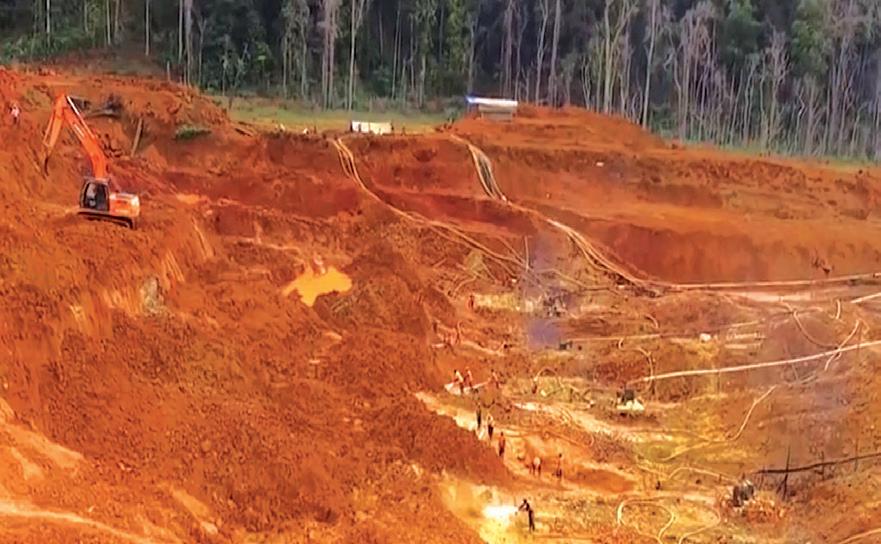
225 new 50-acre mining parcels to be distributed to small miners
The Natural Resources Ministry has announced the rollout of a new “Troy-like” land allocation model aimed at expanding access to mining lands for small-scale Guyanese miners while strengthening compliance and transparency in the gold mining subsector. The initiative follows the model implemented in the Issano 14 Mile area, formerly associated with Troy Resources. After the closure of that operation, a portion of the licence area was subdivided
into 27-acre parcels and allocated to small miners under a structured arrangement. Nearly 100 small miners are currently operating in the area, particularly benefiting miners in Regions Seven (CuyuniMazaruni) and Eight (Potaro-Siparuni). Through the Guyana Geology and Mines Commission (GGMC), the Ministry will open similar areas in Region One (Mabaruma/ Matthews Ridge sub-district), Region Seven and Region Eight. Within the
next two to three months at least 75 parcels will be made available in each region, resulting in approximately 225 allocations for small Guyanese miners. Under the new model, parcel sizes will increase from 27 acres to 50 acres per miner. Beneficiaries will have the option to relinquish their allocation once mined out and apply for another 50-acre parcel. To support more informed land allocation, the Government has engaged United States (US)-based company Global
Venturing to conduct mineral processing and data collection across mining districts. The aerial surveys, which are nearing completion are expected to provide geological data to guide allocations, reduce prospecting costs for small miners, minimise environmental impact and improve efficiency within the sector.
Mobile purchasing units
In addition, the Guyana Gold Board (GGB) will introduce mobile purchasing units to improve ac-
cess for miners operating in remote locations. The Ministry reiterated that all gold produced in Guyana must be sold to the GGB or a licensed buyer, in keeping with the law. The announcement comes as the mining officials maintain a zero-tolerance approach to illegal mining. Since intensified enforcement operations began in recent months, more than 400 pieces of equipment, including engines, pumps, generators and excavators, have been seized in joint
exercises conducted by the GGMC and the Guyana Police Force (GPF). Nearly 100 individuals have been prosecuted, with additional matters pending before the courts. According to the Ministry, the enforcement measures are intended to ensure compliance, protect the integrity of the industry and secure fair returns for the country. It reaffirmed its commitment to working with small and medium-scale miners to promote a transparent and sustainable gold mining sector.
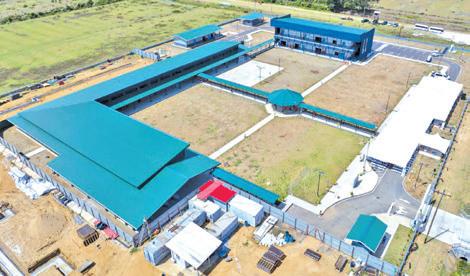
Prison Service pushes rehabilitation drive as recidivism hits regional low …says over 1300 inmates trained in accredited programmes
The Guyana Prison Service (GPS) has said that a sustained cultural shift, expanded accredited programmes, and institutional reforms are driving measurable improvements within the correctional system, as the country records one of the lowest recidivism rates in the Caribbean Community (CARICOM).
The disclosure was made during the first 2026 episode of Prisons in Focus, the Prison Service’s monthly televised programme, where senior officials outlined the progress made in reshaping the philosophy and operations of the prison system.
Assistant Superintendent of Prisons and Head of Prison Training, Abeid Decunta, said the Service has significantly strengthened its rehabilitation focus over the past year.
“Considering our recidi-
vism rate is so low, we have over 15 programs for prisoners, over 15 accredited programs,” Decunta stated.
He explained that the transformation goes beyond offering basic training and instead centres on preparing inmates for sustainable reintegration into society.
“We are now focused on not just giving persons a skill in prison, we are focused on ensuring that these men and women behind bars can have a skill to the point where either they are gainfully employed or become self-employed so as to reduce that recidivism rate, that reentry rate to prisons.”
According to Decunta, 2025 was used as a period of consolidation, during which the Prison Service addressed operational challenges while building on previous gains.
“While 2025 had its challenges, of course, we worked
with them, and from experience you learn.”
He noted that collaboration with external partners remains critical as the Service works to further reduce repeat offending.
“We are working with CDC to ensure that that figure goes lower. We want it in single digits.”
Decunta underscored that institutional reform has required internal cultural change among officers, ensuring alignment with the Service’s rehabilitative direction.
“We have enforced to the point where every prison officer at the basic level is informed of what the direction of the service is going. And as a result, they have buy-in.”
He emphasised that meaningful reform must also occur at the individual level.
“We want persons returning to society as better
individuals. That can only happen if the person we are trying to work with is encouraged to change and accept that reality that the change is inevitable. I have to change.”
Assistant Director of Prisons Olivia Cox also reflected on the Service’s evolution, highlighting infrastructural expansion and programme growth over the years.
“When I look at where, when I joined the service, where we were… we have come a very far way.” She added: “We’re climbing and we continue climbing.”
Guyana’s correctional system moved away from a predominantly punitive model over the recent years toward structured rehabilitation and reintegration. This policy direction, reinforced by government investment since 2020, has
produced measurable outcomes, including a recidivism rate that now stands at approximately 14 per cent, the lowest recorded within CARICOM. Previous figures hovered closer to 18 per cent, while several regional jurisdictions continue to record significantly higher averages.
Expanded vocational and academic programming has formed a central pillar of this transformation. Inmates across facilities have accessed certified training in trades such as carpentry, welding, masonry, agriculture, electrical installation and tailoring, while structured academic initiatives now allow incarcerated individuals to pursue formal qualifications, including Caribbean Secondary Education Certificate (CSEC) subjects.
In 2025 alone, more than
1,300 inmates benefited from rehabilitation and skills training programmes across the country’s correctional facilities, reflecting both institutional capacity and increased inmate participation.
Infrastructure upgrades at facilities, including Mazaruni and Lusignan have further strengthened the delivery of rehabilitation services, while enhanced officer training has aligned prison management with a reintegration-focused philosophy.
According to the Prison Service, sustained investment in rehabilitation, accredited training and family engagement will remain central to its strategy as it works to further reduce repeat offending and consolidate the cultural transformation underway within Guyana’s prison system.
BRIDGE OPENING
The Berbice Bridge will be closed to vehicular traffic on: Monday, February 16 –15:55h-17:25h and Tuesday, February 17 – 16:35h-18:05h.
FERRY SCHEDULE
Parika and Supenaam departure times – 05:00h, 10:00h-12:00h, 16:00h, 18:30h daily.
WEATHER TODAY
Sunny conditions are expected during the day, interrupted by light to thundery showers in the morning and afternoon hours. Clear skies are expected at night. Temperatures are expected to range between 22 degrees Celsius and 29 degrees Celsius.
Winds: East North-Easterly between 3.13 metres and 5.81 metres.
High Tide: 16:16h reaching a maximum height of 2.59 metres.
Low Tide: 09:51h and 22:14h reaching minimum heights of 0.76 metre and 0.59 metre.
Massive programme with religious communities on public health issues coming – Pres Ali ...as 3rd National Ramadan Village launched
The Guyana Government will soon be partnering with the various religious communities in Guyana on an initiative to address a series of public health issues and promote a healthy lifestyle among citizens. President Dr Irfaan Ali made this announcement on Sunday evening at the launch of the 3rd National Ramadan Village on the lawns of the Muslim Youth Organisation (MYO) ground on Woolford Avenue, Georgetown. “We are going to launch a massive programme with our religious community on public health issues, on primary health care. We are going to create in every single area with these religious institutions, a primary health care facility where we can do checks, where we can do corrective healing, where we can do counseling and where we can change living style and living habits from the ground up,” Dr Ali stated. The Guyanese Leader noted that there are already examples of such initiatives being rolled out. At the Eccles Masjid (Eccles Sunnatul Jamaat) on the East Bank of Demerara (EBD), a health outreach was recently held as part of its public health education programme that was previously initiated.
“[For] our religious institutions, this is where we want that consciousness to go. Whether it’s the temples, the mosques or the churches. We want us to be each other’s keeper. We must lead a revolution in public health education against diabetes, against all the primary health care challenges and issues that we have. Too many persons are going on dialysis…we want you to prevent dialysis,” President Ali stressed. In addition to its health programme, the Eccles Masjid is also working on launching a programme on how to keep the community in which the mosque is situated clean. Commending the Eccles Masjid on these initiatives, the Head of State underscored the importance of community and being each other’s keepers.
“We have a duty towards each other. We have a duty towards each other in the family of humanity. Not only in the context of Islam, we have a duty towards each other as members of the family of humanity,” he emphasised.
Community and inclusivity
During his address, President Ali also spoke about the importance of the National Ramadan Village in not just creating a space for Muslims but the wider Guyanese community. He said this example of community and inclusivity has drawn global attention.
“When I travel around the world, be it in the Middle East
and all over the place, people ask about the concept of the Ramadan Village. And that is what this village brings to life – that level of inclusivity,” the Guyanese Leader noted. Building on immense success of the previous two years, the 2026 edition of the National Ramadan Village will feature an expanded experience that includes more vendors, a children’s play park and enhanced tourism offerings aimed at attracting visitors locally, internationally and members of the Guyanese Diaspora. The more than 80 vendors, both Muslims and non-Muslims will display a wide range of halal cuisine, clothing, Islamic literature, accessories, gift items and educational exhibits on Islam.
This village is being organised by the Central Islamic Organisation of Guyana (CIOG), the MYO, and the Guyana Islamic Trust (GIT) in collaboration with the Government of Guyana and the Guyana Tourism
Authority (GTA). It serves as a place of unity, learning and cultural exchange during the holy month of Ramadan.
“Grateful at home, Compassionate to the world”
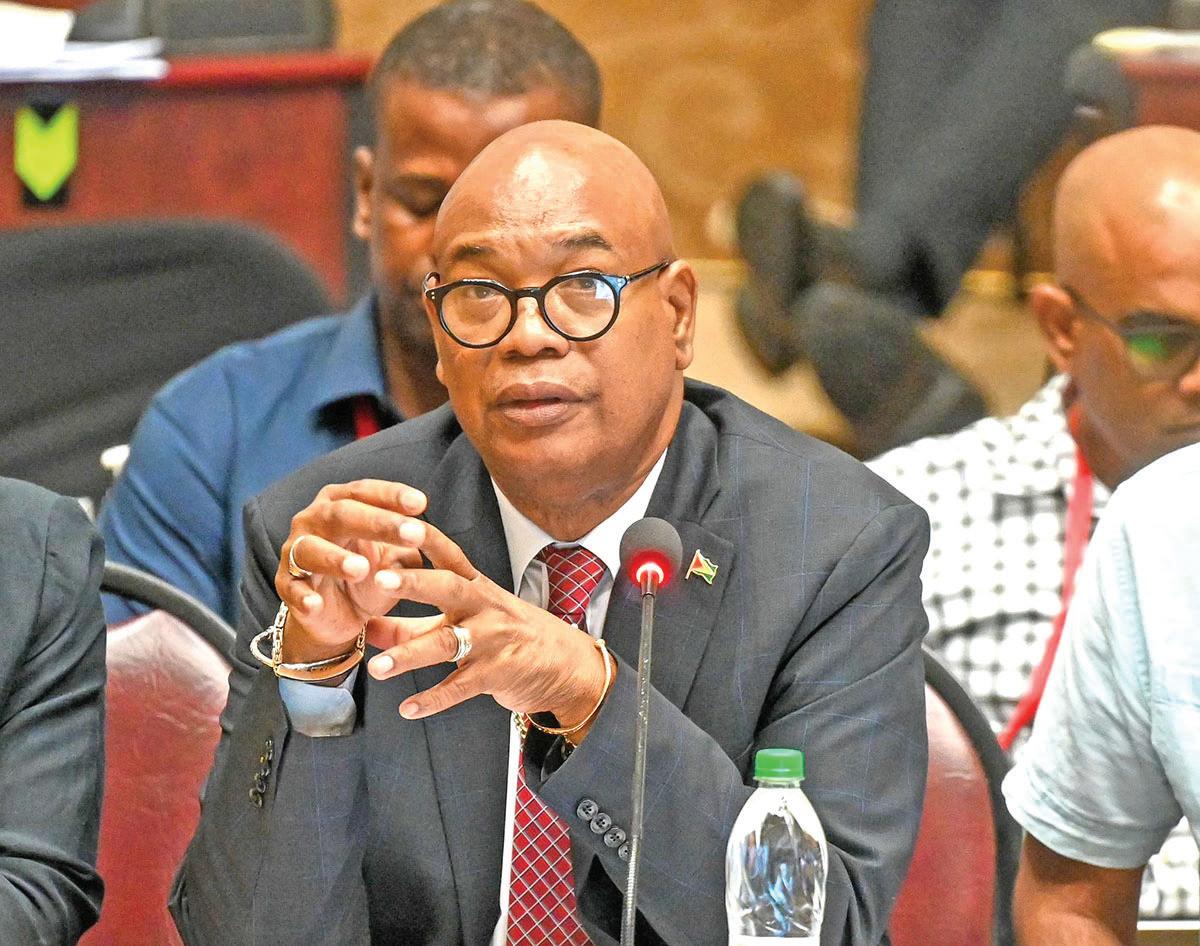
Speaking at Sunday’s launch, Head of Dawah and Education at CIOG, Shaikh Moeen ul-Hack, said the key themes of this year’s Ramadan Village is “Grateful at home, Compassionate to the world.” “This theme requires us to look inward at our land – our beautiful country, where Muslims can gather openly, sound the call to prayer five times per day, host a Ramadan Village and welcome all to space that will be transformed into a place of worship and reflection. And for this, we should be deeply grateful. Because in our home, difference is strength, diversity is celebrated, faith flourishes in the light,” he stated. According to the CIOG official, the kind of leadership demonstrated by President
Ali with initiatives like the National Ramadan Village has positioned Guyana, with its mosaic of faiths and cultures, as an example of what it looks like when a nation chooses inclusion over discrimination. “This National Ramadan Village…[is] a place where a families share food, stories and spiritual nourishment, where our non-Muslims brothers and sisters are not outsiders but our honoured guests. We’re also making a quiet but firm statement that here in Guyana, we intend to continue nurturing that model through stronger institutions, deeper inter-faith understanding and a commitment from State and society alike that hatred would find no sanctuary here,” he noted. The National Ramadan Village will be opened every Friday through Sunday from 16:00h to 22:00h and is expected to attract 30,000 visitors during the entire month of Ramadan, which commences on February 19.
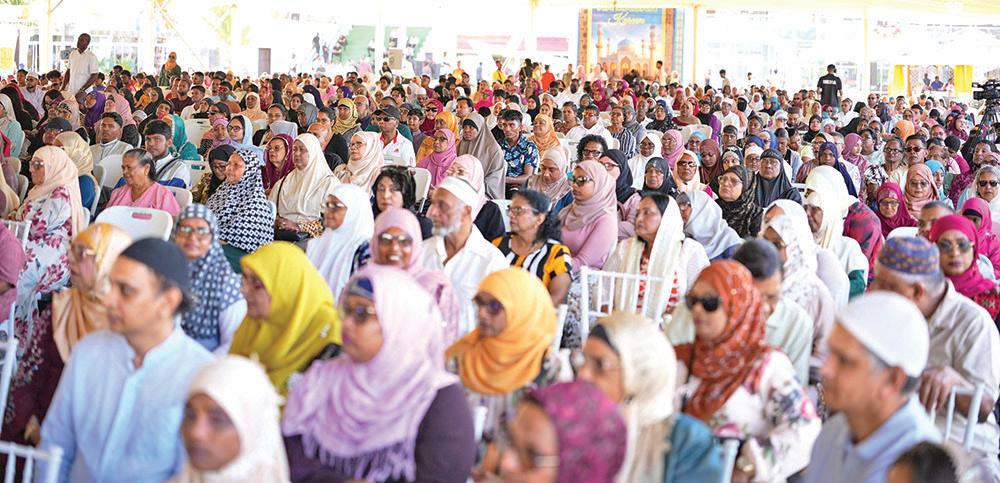
A section of the gathering at Sunday’s launch of the third National Ramadan Village
The present frenetic efforts to reverse the disreputable state into which Georgetown – the capital of the “fastestgrowing economy in the world” – has remained mired have a monocausal origin. Yes, there are innumerable casual ways in which our citizens dispose of their garbage – which leads to clogged drains, canals and sewers that create floods in large swathes of the city once rain falls during high tide and the kokers are closed. And then there are the vending proliferation which creates the impression that our capital is an unruly collection of shacks. But it all boils down to a Mayor and City Council (M&CC) that refuses to perform the job they’re elected to do, but insist to play politics. This can be rectified in the Local Government elections due later this year.
We can do worse than begin with the scourge of vending, where recently, the M&CC refused to comply with a court order. We repeat our previous calls for the need for a National Policy on Urban Street Vending that treats the issue in a comprehensive and holistic manner. Vending, dubbed “huckstering”, ballooned in Georgetown directly after the abolition of slavery as the ex-slaves flocked into the capital and soon overran its employment capabilities. The colonial authorities saw them as illegal interlopers that disrupted the flow of traffic and encroached on established tax-paying businesses. Relations were always tendentious. The vendors, however, were providing a very valuable service to their poor compatriots who were more than happy to secure necessities at a more affordable price. The dynamics have not altered appreciably in the present.
Street vending is a worldwide urban phenomenon. In the developed country, they are seen as a welcome addition to the landscape while in the Third World, they are considered a bane. The difference lies in the recognition of the activity as a legitimate economic endeavour and the concomitant need to regulate and protect it through comprehensive, winwin regulations. Women form the overwhelming majority of vendors, and vending is a significant source of employment for this often-neglected group. As mentioned above, vendors provide affordable services and goods to urban dwellers and visitors. A National Policy on Urban Street Vending has to address these positives against the just as legitimate need to provide security to citizens; absence of congestion; and maintenance of public hygiene and deal with unfair competition to tax-paying fixed businesses.
Our challenge is that the M&CC takes an ad hoc approach to urban vending and whenever the problem gets out of hand – due mainly to collusion of those appointed to enforce the rules – draconian measures are resorted to. One particularly flagrant recurring instance is the rescinding of the rules during the busy Christmas period with the unrealistic expectation that the vendors will later depart voluntarily.
Representatives of vendors should be involved in the drafting of and enforcement of the National Policy on Urban Street Vending. Its broad elements would have to include the demarcation of vending zones – which should be city/town specific. It should take into account the natural propensity of the street vendors to gravitate to certain places at certain times in response to patterns of demand for their goods/services. Mobile urban vending could be permitted in all areas even outside the designated vendors’ markets, unless designated as a ‘no-vending zone’ through a participatory process. The ‘novending zones’ should be identified both in terms of location and time.
While recognising the economic importance of street vendors, they will have to acknowledge the need for the crafted policy to be enforced. This is another area where the policymakers will have to be au fait of the reality that the “enforcers” often carry out their tasks quite literally: they become shakedown artists who hustle the hucksters. Representatives of the latter group on the oversight body should temper the excesses.
Street vendors cannot have it both ways. Areas become commercially attractive through the confluence of a host of factors and established fixed businesses pay exorbitant rates to secure such locations. They will have to accept the parameters of the new Policy or face the consequences.
Lawlessness in public transportation system
Dear Editor,
I write in response to a recent news report in which a senior functionary of the Guyana Police Force urged commuters to report minibus operators who overcharge, advising passengers to record vehicle numbers, use their phones to document incidents, and make reports to the nearest police station, traffic ranks, or the 911 system.
While accountability is essential, I was deeply concerned by what appears to be an attempt to transfer primary enforcement responsibility from the authorities to the commuting public. This approach might be reasonable if overcharging were sporadic. It is not. On major routes such as the East Bank and West Bank corridors, and even on speedboat
services, overcharging has become routine rather than exceptional.
If commuters were to follow this advice diligently, the 911 system would be inundated, police stations overwhelmed, and traffic ranks effectively reduced to processing complaints throughout the day. Hundreds of drivers and conductors are reportedly engaging in this unlawful practice daily. The scale of the problem clearly calls for systemic enforcement, not ad hoc reporting.
A more practical and effective solution would be proactive policing. Officers in plain clothes could conduct random spot checks by boarding minibuses, observing fare practices firsthand, and immediately charging offenders where breaches
occur. This would not only address overcharging but also related infractions such as overloading and the playing of obscene music in vehicles carrying minors and elderly passengers. Swift, visible enforcement would send a powerful deterrent message.
It is also worth noting that the police themselves have reminded operators that failure to display the approved fare structure constitutes an offence. Yet fare charts are conspicuously absent from most minibuses. Routine roadside checks already occur for fitness, licences, and insurance. Why not enforce compliance with fare display regulations at the same time? The legal basis for action already exists; what appears lacking is consistent implementation.
Respectfully, law enforcement cannot be outsourced to commuters. Maintaining order within the public transportation system is a statutory responsibility of the authorities. Asking citizens to chronicle and report what are widely known, daily infractions suggests a reactive posture where a proactive one is urgently required. The public deserves a transportation system that is regulated, fair, and safe. I urge the relevant authorities to adopt decisive enforcement measures that demonstrate commitment, restore public confidence, and ensure that the law is applied consistently and without delay.
Yours faithfully, Riley Matthews
GuySuCo should also produce rum
Dear Editor,
There was a recent letter in the press on the local rum industry that conveyed the misconception that the industry would be disadvantaged by GuySuco if price adjustments were made to some of its raw material inputs. The author seemed to lack in depth knowledge of the beverage alcohol industry. It should be noted that the beverage alcohol industry is one of the most profitable industries in the world and the products do not usually compete from a cost po-
sition, especially in the aged rum segment, but instead compete from the strength of its brand equity. GuySuco should be charging more competitive rates for the products being purchased by those in the beverage alcohol industry and they should be insisting on government support to keep external suppliers at a price disadvantage via import duties. Guyanese rum is an authentic and unique product with a national heritage that dates back centuries. It should be protected as such,
and we should be insisting on 100% Guyanese sourced ingredients and certify it as “Made in Guyana” with our famous Demerara Sugar. It is also important to note that entry into the rum industry was previously considered by GuySuco but was neglected. Entry into the rum industry should be relooked at to improve the overall profitability of the Corporation. The current high market demand for Guyanese Rum created by our award winning El Dorado Rum, which is owned by Demerara Distillers Limited, has also created many opportunities for additional Guyanese Rum offerings. I therefore recommend that the government provide the resources to make this a viable investment option for GuySuco during this administration’s current term in office. The effective implementation of this strategic initiative will allow GuySuco to return to profitability in the medium term.
Best regards, Jamil Changlee
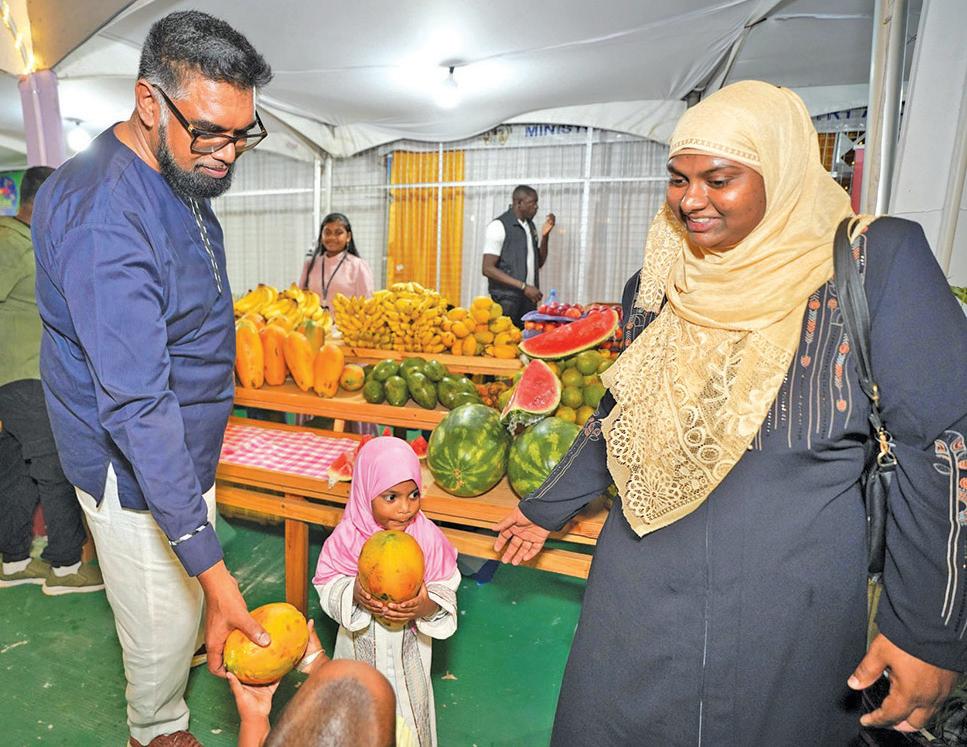
President Dr Irfaan Ali shares fruits with children from a vendor at the National Ramadan Village at the Muslim Youth Organisation Ground, Woolford Avenue and Albert Street, Georgetown, on Sunday evening (President Dr Irfaan Ali photos)
Regions 5, 6 tapped for major drainage, farm access, health expansion
Agriculture, drainage, and rural infrastructure dominated discussions in the National Assembly on Thursday as lawmakers examined allocations for Regions Five and Six during day four of the consideration of the 2026 National Budget, with the government outlining a broad package of works aimed at strengthening food production and expanding public services in two of the country’s most agriculture-dependent regions.
Both regions, long recognised as major contributors to national output, are set to benefit from expanded drainage, irrigation, road, health, and education investments under their respective Regional Democratic Councils, as the administration positions infrastructure and service delivery as central pillars of rural development.
Responding to questions in the Committee of Supply, Local Government and Regional Development Minister Priya Manickchand highlighted Region Five’s status as the country’s agriculture capital, noting that the region is home to 11,535 farmers and remains a leading producer of livestock and rice.
Under Region Five’s capital programme, $144 million has been allocated for drainage, irrigation, and agricultural development initiatives, primarily targeting farm-to-market access. Works are slated for areas including Britannia, sections of the western sideline at Number Seven Village, access roads linking the line top to Bennet Dam West and Murphy Dam South in Rosignol, as well as projects at Planters Hall, Quakers Hall, Champagne Top in Burma, Golden Fleece, and
Catherine.
Emphasising the importance of access roads, Manickchand told the Assembly, “Farm-tomarket roads are equally important… when that road was done from Burma to Governor Topside in Mahaicony, it changed the way farmers are able to take their paddy out, take their crops out, and access markets.”
She further noted the scale of agricultural activity in the region, stating, “Region 5 is the largest cattle-rearing region in the country… Region 5 also plants rice, cash crop, are known for their livestock production. So it’s a very large region as far as interest in and production of agricultural products go.”
Health expansion
Apart from agriculture, Region Five’s health sector is slated for continued upgrades. Capital works include major electrical improvements at the Mahaicony Cottage Hospital, extension works at Dundee and Haidam health centres, construction of a new health centre at Now or Never in the Mahaicony River, and upgrades at Mora Point. The region currently operates five land ambulances and one water ambulance, with one additional land ambulance budgeted for 2026.
In education, all secondary schools in Region Five now have guidance and counselling officers in place, while 29 additional sweepers are being appointed across the system. The Mahaicony dormitory, which houses approximately 47 students from riverine communities and is projected to serve about 50, continues to receive allocations for
dietary and operational support.
In Region Six, the agriculture programme has a stronger emphasis on drainage and water management. Outlining the projects, the minister stated, “We will be constructing a concrete culvert at Lonsdale Western Canal Dam to the tune of $11 million. About 1,200 residents will benefit, and 25 farmers will benefit. We will be rehabilitating the revetment at Coker Sluice and Byrne Bush Dam at $14 million. About 1,200 residents and 25 farmers are also going to benefit here. We are going to be constructing a revetment at Razack Street, West Canje, about 150 res-
idents will benefit. Borlam Sluice will be rehabilitated, and about 500 residents and 20 farmers are going to be benefiting there. We will rehabilitate the Sewell Sluice at $9 million, about 500 residents and 20 farmers will benefit there. The Eversham Sluice will be rehabilitated at $6 million; about 1,200 residents and 35 farmers are going to benefit here. We will rehabilitate the Cote d’Ivoire Sluice at $8 million, about 800 residents and 58 farmers will be benefiting here. Rehabilitation of Lightongue Street at $8.5 million, where 1,000 residents and 69 farmers are going to benefit. We are going to be purchasing the HDP
tubings at $7.5 million… and constructing a revetment at Sewell Village at 4th Street, which will benefit about 50 residents.”
Public works allocations in Region Six also include concrete road construction and bridge and culvert works across several neighbourhood democratic councils, including Bush Lot/Adventure, Gibraltar/ Fyrish, Black Bush Polder, Rose Hall, Good Hope, Port Mourant, and Enterprise, aimed at improving connectivity in agricultural communities.
Significant expansion is also underway in the region’s health sector. The minister disclosed that 209
patient care assistants are to be employed, alongside additional technical and administrative staff. Two new ambulances are budgeted for New Amsterdam and Port Mourant hospitals, bringing the region’s total road ambulances from ten to twelve. A water ambulance and an all-terrain vehicle are also earmarked for riverine communities in Orealla and Siparuta.
Nineteen health facility projects are listed under Region Six’s capital programme, including rehabilitation and extension works at New Amsterdam Hospital, Port Mourant Hospital, and Mabikuri Hospital, installation of central oxygen lines in multiple wards, and improvements to several health centres across the region.
On the education front, 23 schools in Region Six are scheduled for rehabilitation or upgrade. Two 30-seater buses and a boat and engine have also been budgeted to assist student transportation, particularly for those travelling from remote communities. A new secondary school at Orealla is expected to reduce reliance on dormitory accommodation in the Skeldon area once completed.
Page Foundation
Multiplying Whole Numbers
When you multiply whole numbers, start by lining up the numbers correctly. It is easy to line the numbers up if you are multiplying by a 1-digit number.
Example:
Line up 485 x 5 this way 485 x 5 2425
Multiply the 5 in the first line by the 5 in the second line. 5 x 5 = 25. You cannot write 25 in the ones place, so you do just what you did when adding. You write the 5 and save the 2 for the tens place. Keep that 2 in mind. Go back to the first line, and move one digit to the left to multiply 8 x 5, which is equal to 40. Then you are ready to add that 2. You get 40 + 2 = 42. Write the 2 in the tens place and set the 4 aside. Now go back to the first line again, and move one more digit to the left. Multiply 4 x 5 = 20. But remember the 4 you set aside. So 20 + 4 = 24. The product, or answer to this multiplication problem, is 2425.
When you are multiplying a number by a 2-digit or 3-digit number, you have to be careful to line up the place values correctly.
Remember :
Always multiply the entire top number by just one bottom digit at a time. Use a different line for the product of each bottom digit.
Exercises 1) 13 x _11_ 2) 74 x 49 3) 264 x 9 4) 56 x 11 5) 23 x 8
Ladybird pet rocks
You will need
Pebbles
Googly eyes
Paint (red and black)
Paintbrush
Glue
Prepare your work space by laying down some newspaper.
How to make
Paint the front of the pebble red, and leave to dry. Then turn it over and paint the back.
You may need to do a second coat of paint, depending on how well the first coat has covered your pebble.
Decide which end of your
pebble is going to be the face and paint it black.
Then paint a black stripe down the middle of the ladybird's back, and paint some black spots on either side.
When the paint is fully dry, place a dot of glue on the back of two googly eyes and stick them on to your ladybird. (hobbycraft.co.uk)
By Shireen Madon
It’s as though the birds all know each other, and how naively they seem to believe the world will go on. The swans oh-so-sweetly in their museum-white, yet all anger and sinew like teen girls, believing they own all of this, our planet, the greens and blues, until they gorgeously realize they have been neglected. The crows— their feathers touched with the most purplish verbena purples of a sunrise over a smoked sky—know otherwise. They seem to have known the fate of things before we did. Have you never heard them awake at the crack of dawn? What else do you think they have been preparing for, if not the end? In the Brooklyn Museum, there is a Vessel with Two Feet from which wine was drunk in Ancient Persia, when my people were still there, finding a religion. Wine would be poured into the clay vessel from above and flow out from holes in two actual feet at the bottom. It appears to be the bottom half of a pregnant woman, but only to me. Drinking from these little legged vessels was said to remove the drinker’s grief, and what are artifacts if not the misunderstandings of a happy life. The plaque helpfully reminds us that a vessel with holes on the bottom would not be practical for storage. On the rooftop across from our apartment, where just last week a twenty-something danced a primeval dance for TikTok, we watch a pair of crows make a nest in a cracked plant pot.
(Source: Poetry [October 2025])
Write about participating in the Children’s Mashramani Float Parade.
Financial services must extend to rural, hinterland communities – BoG Governor …says launch of Flopay addresses critical gap
Underscoring the importance of financial inclusion for sustainable economic development and shared prosperity, Governor of the Bank of Guyana (BoG) Dr Gobind Ganga is calling on institutions to ensure that their services capture communities in rural and hinterland areas across the country.
“Bank of Guyana encourages partnerships to be particularly mindful of our rural and hinterland communities. Financial inclusion must be truly inclusive. It cannot be a phenomenon limited to Georgetown and our urban centers,” Dr Ganga stated.
He noted that financial inclusion is not merely a policy objective, but a strategic priority of the Central Bank having recognised that expanding access to financial services is essential for poverty reduction, economic empowerment, and ensuring that all Guyanese benefit from the nation’s development trajectory.
“When we speak of financial inclusion, we envision an economy where every Guyanese, regardless of location or economic status, has access to affordable, convenient, and secure financial services that enable them to participate fully in our growing economy.”
“Despite our unprecedented economic growth, a segment of our population, particularly in the rural and hinterland communities, remain outside the formal financial system. Many small businesses still operate predominantly in cash, limiting their growth potential and exposing them to security risk. This financial exclusion perpetuates inequality and constrains our nation’s economic potential,” the BoG Head posited.
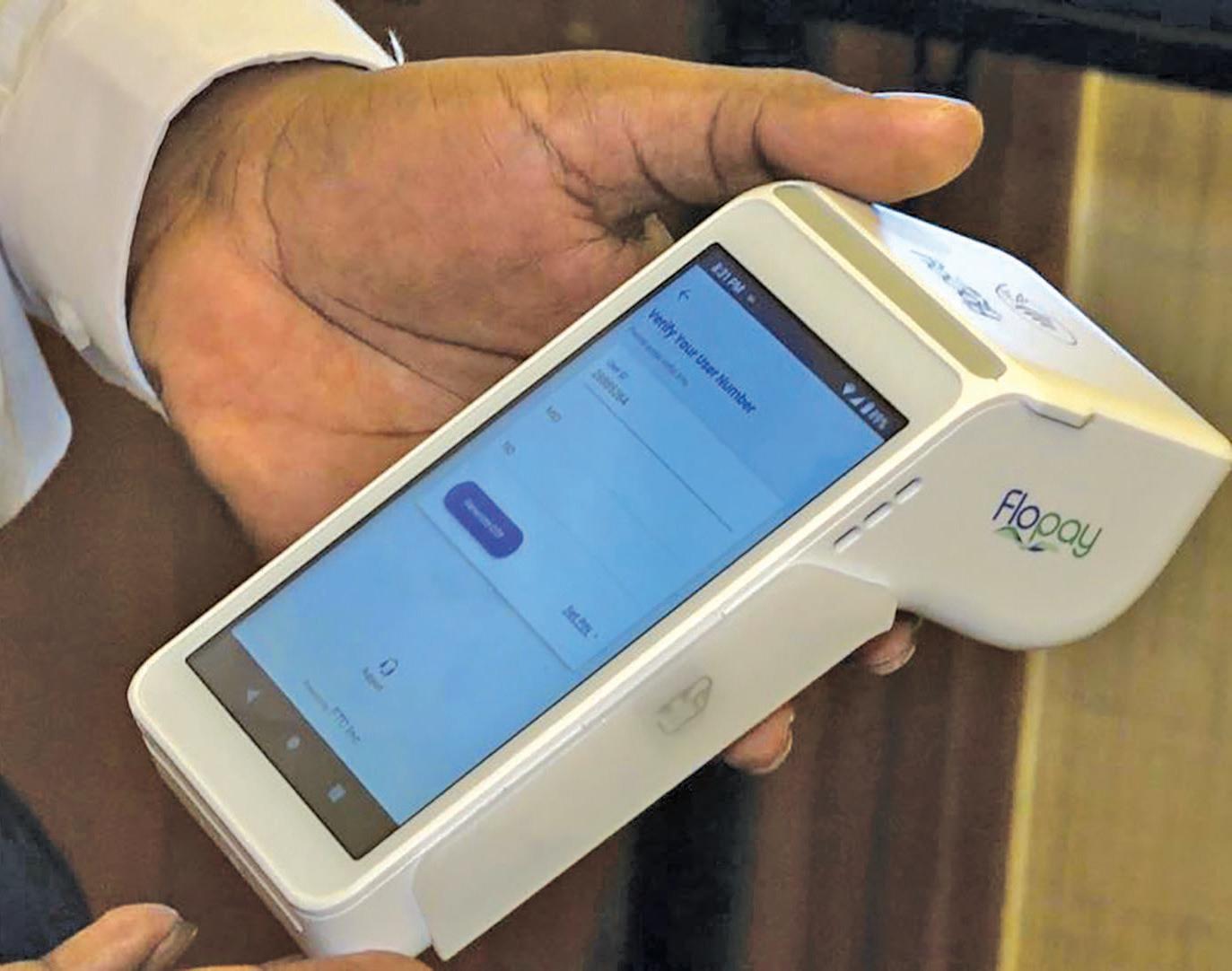
Dr Ganga made these remarks on Friday evening while delivering the feature address at the launch of Flopay – a new payment
service designed to expand access to modern card payment solutions for businesses across Guyana.
Introduced via a partnership between Demerara Bank Limited (DBL) and Flowcatalyst Technology Consulting (FTC) Inc., the Central Bank Governor said Flopay will address a critical gap in the financial infrastructure by allow electronic payments through the widespread availability of point-of-sale systems.
While this, he pointed out, may seem like a modest technological advancement, its implications are transformative, providing users with not just a more convenient, secure and cost-effective option, but also a better record keeping tool.
“Demerara Bank Limited brings established relationships with Guyana’s businesses and a deep understanding of local market needs. Flopay contributes technology expertise and modern payment solutions. Together, they can reach merchants who have historically been underserved by traditional banking infrastructure… The real test of Flopay’s commitment will be its reach into communities where payment infrastructure has been most limited,” Dr Ganga stated.
As part of ongoing efforts to continue to modernise Guyana’s payment system infrastructure to ensure it can support growing transaction volumes efficiently and securely, the BoG Head went onto highlight the importance of creating a robust digital ecosystem.
He said Flopay’s entry into the local market represents an important building block in this ecosystem and is reflective of the Central Bank’s work to create the enabling environment for such innovations.
“Flopay’s commitment to provide both hardware and software solutions demonstrate the comprehensive approach needed to drive adoption. Too often, payment innovations focus solely on technology without addressing the practical challenges merchants face, such as set-up, complexity, training needs, ongoing support, and affordability.”
“By offering a complete solution, Flopay is lowering the barriers that have historically prevented small businesses from accepting electronic payment. Anyhow, the collaboration between Flopay and
Demerara Bank Ltd. exemplifies that partnership, which is essential for advancing financial inclusion. While Bank of Guyana provides regulatory oversight on infrastructure, the innovations and customer services that drive adoption come from partnerships such as this one,” the Bank of Guyana Governor asserted.
Culture change Meanwhile, Chairman of DBL, Komal Samaroo, says the launch of Flopay is a giant leap forward for the business sector as well as for citizens, making it safer and easier to undertake transactions. He said the benefits of this transformative technological service will unfold in the coming years.
“I believe that this technology, and this service, that we’re launching…will result in a culture change in the way we do things in Guyana and in the way, businesses operate, particularly the small business sector across the length and breath of this country,” Samaroo posited.
The Bank’s partner in this initiative, FTC Inc., was founded by Canadianbased Guyanese, Aleema Seadath, a payment expert with over 21 years of experience in the global financial service industry working with United States-based Visa Inc.
According to Seadath, Guyana is moving forward rapidly and the country’s payment system must also advance. “Today, we take meaningful step towards that direction.”
She pointed out that moving to a technology-based system opens open financial opportunities especially for small businesses.
“When small business accepts only cash, opportunity is limited. Cash restricts who can buy, it restricts how much and it restricts how far a busi-
ness can grow. Flopay was built to remove barriers. Flopay enables merchants to accept digital payments simply and securely. It operates under the sponsorship of Demerara Bank. Merchants’ fund remains completely with their banks… We do not replace banks. We enable transactions. We focus on the outer core of payments,” the FTC founder stated.
Similarly, Demerara Bank’s Chief Executive Officer, Dowlat Parbhu, noted that the launch of is another meaningful step in Guyana’s journey towards a modern, and digital financial ecosystem. He said, “This partnership is more
than technology, it’s about vision, collaboration and nation-building… Flopay presents access, efficiency and empowerment.”
Flopay is supported by Visa, which Parbhu says sees Guyana as a strong mark and with potential to transform financial services.
Meanwhile, this moves to enhance payment services aligns with the Guyana Government’s push for a digital economy.
Under the direct intervention of the Dr Irfaan Aliled Administration, nearly all local commercial banks have now made banking access easlier by offering online opening of bank ac-
counts.
In fact, to further encourage bank account ownership several targeted outreaches have been held across the country. The mining industry is one area where the government has been working to ensure operators have bank accounts. Consequently, the Ministry of Natural Resources has collaborated with the Guyana Gold and Diamond Miners Association and the Small Miners Association, to facilitate an outreach by local banks for miners to access the entities and facilitate the opening of bank accounts in Bartica, Region Seven, on Wednesday.
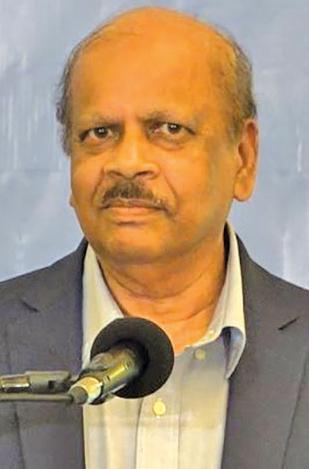
Bank of Guyana Governor, Dr Gobind Ganga
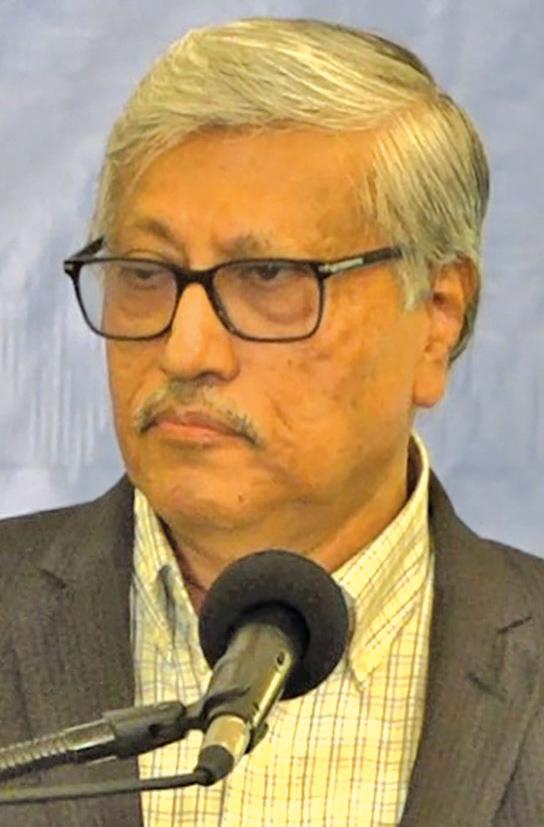
Chairman of DBL, Komal Samaroo
GPS warns public of serious consequences for smuggling contraband into facilities
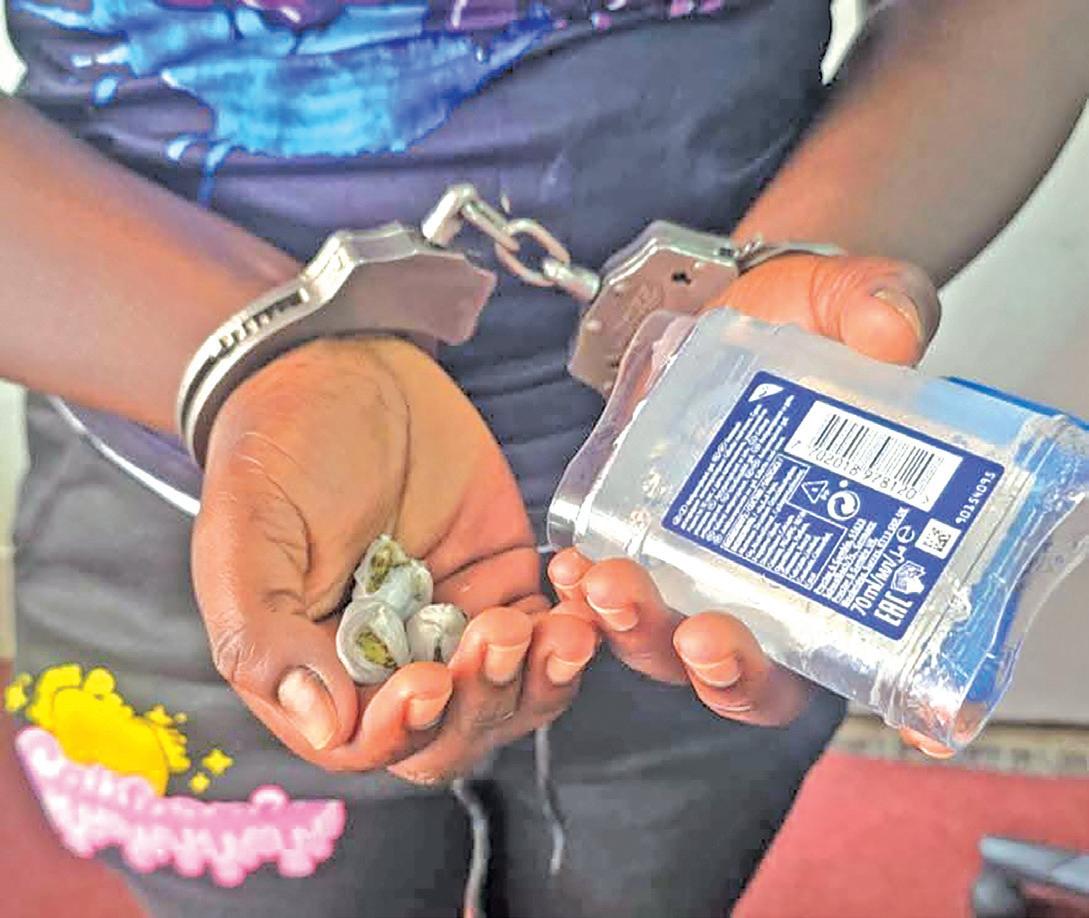
The Guyana Prison Service (GPS) has issued a strong warning to members of the public after an 18-year-old woman was recently caught attempting to smuggle contraband into a prison facility. The issue was addressed during the first 2026 episode of Prisons in Focus, the monthly televised programme of the GPS, where senior prison officials cautioned citizens against facilitating illegal activity. Two days ago, a young woman was arrested after she was found with three packs of cannabis while at the New Amsterdam Prison. The
18-year-old is from Rose Hall, Corentyne, Berbice. The drugs were retrieved after a search was conducted by the prison officers. The item was found in two Gillette deodorants for men, wrapped in a black plastic bag, in her handbag. The smuggling attempt prompted the Director of Prisons Nicklon Elliot to emphasise that smuggling contraband into a correctional facility is an offence that has serious consequences. He called on civilians to recognise the dangers they place themselves, society, inmates and officers in by engaging in the trade of contraband within the prison walls.
However, Assistant Director of Prisons Olivia Cox, while on the programme, said the Service has observed significant commentary on social media regarding the incident and stressed that many persons claim ignorance when caught. “Just like your relatives will tell you when you’re going to the airport, do not hold anything, do not take anything from anyone,” Cox said. She explained that in many cases, individuals report that they were
Starting…
…them young
Your Eyewitness has taken notice of the plethora of events designed to make Mashramani 2026 the “biggest and brightest” ever. Which is quite fitting seeing we just had our biggest budget ever – weighing in at $1.558 Trillion!! This is real money no matter how you cut, slice or dice the exchange rate of our Guyana dollar!! The Director of National Events had explained the rationale, “If you’ve been following President Ali’s pronouncements, his vision is for Guyana to become the premier entertainment destination in this part of the world, including the Caribbean and Latin America. We plan with that vision in mind”!! The theme this year is “Expressing Our Culture Through Innovation and Creativity”! Among other goings-on we were promised Calypso, Soca, Dancehall, Chutney Monarchs; Splashramani; Masharama; Republic Flag Raising; the Costume and Float Parade; and the Panorama Steel Band Competition”!! Now can you understand your Eyewitness’s flared nostrils – and racing pulse?? Having overthrown the English Monarch…ok…ok…they chose to leave!! – we’re gonna have FOUR local Monarchs!
unaware of the contents of items they were asked to deliver.
“Majority of the stories with persons who come in and who are caught… take for example the young lady who’s only 18, we have situations where persons say, listen, I was going away, and my neighbour asked me to just drop this off at a prison for me.” According to Cox, individuals often believe they are simply assisting someone, only to find themselves facing serious consequences after prison security checks uncover prohibited items. “And in their mind, they’re assisting and so they come, bring it, just go with your ID card, drop it and tell them the prisoner’s name. And so, when the items are searched, they’re caught.” She warned that persons who knowingly attempt to smuggle contraband risk imprisonment themselves.
“You’re only going to put yourself behind bars with those persons. You’re no good being behind bars with them.” Assistant Superintendent of Prisons and Head of Prison Training, Abeid Decunta, reinforced the warning, urging the public not to enable negative behaviour. “Do not, under any circumstances, empower those changes, the negative changes,” Dikuna said. He added that members of the public must avoid supporting addictions or unlawful habits among inmates. “We don’t want persons to encourage and empower the negative changes by supporting habits.” Decunta further stressed that the Prison Service maintains strict security protocols and illegal items will be detected. “We have multiple layers of security that persons who are visiting the prison must pass through. And anything illegal will be found.” The officials urged members of the public to refrain from accepting packages from third parties and to verify the contents of any items before attempting to deliver them to prison facilities.
Things had kicked off back on January 16 – exactly a month ago – when the refurbished old railway terminal over at Lamaha and High Streets – now the “Railway Courtyard” hosted a spectacular a high-energy concert!! It showcased some of Guyana’s “top performing artistes” who treated the large excited crowd to a fusion of music, dance, visual arts, and theatrical expression!! Many of the events were spread across the country – unlike in the past when GT hogged them all!! One Soca Monarch Competition semis – for instance, were held over in Essequibo and the finals gonna be in Linden on Feb 20!!!!
Last Saturday, we had the Children’s Mashramani Road Parade 2026 under the theme, “Little Builders of Guyana –Learning together, shaping a digital tomorrow”!! He knows that he’s gonna seem like a Grinch, but your Eyewitness gotta admit he didn’t see what the little darlings mashing, dancing, twirling and wining had to do with “a digital tomorrow”!! As he’s expressed before, he accepts that “sporting” is our defining national pastime – not cricket, football, tennis or whatever sports that’s played on some field – but just having a good time dancing to music with a good beat!! Rum and other liquors are mandatory, and while your Eyewitness didn’t hear about any of this being served at the Children’s Mash parade – there was that bus driver who was nabbed serving the stuff!! Getting them ready for Mash??
Your Eyewitness believes that we shouldn’t be confusing folks – especially the young’uns by mixing up categories in Mash. We’ve now committed to fostering an “Orange Economy” – centred on “creativity”. And since we’ve long decided on sporting as our art form supreme, why not call it as it is??
…inner peace
Guyana’s a multi-cultural, multi-religious, multiracial state, OK? Well, this year we’ve appeared to’ve hit the religious trifecta. Last night, one of those religions – Hinduism – celebrated one of their biggest festivals –Shivratri. They would’ve fasted all day and spent all night worshipping Lord Shiva, into whom the universe collapses. Not to worry, it’s not gonna happen for billions of years and all will reverse itself in another few billions of years and we would then be projected as a new creation. They take the looong view, don’t they?
The Islamic festival of Ramadan’s gonna begin this Wednesday when Muslims will fast for a month. That’s supposed to teach empathy for the less fortunate – read the poor and hungry the Opposition’s been emphasising and leads to spiritual growth, self-discipline, and increased devotion. Christians will also begin Lent - in which they’ll fast for forty days and forty nights before Easter – which commemorates Jesus rising into Heaven after his Crucifixion. Hopefully, they’ll empathise with Jesus’ performance of that sacrifice for his mission.
…over
Trinidad just got approval from the US – which is “running” Venezuela – to exploit the latter’s 4 trillion cubic ft Dragon Gas Field. This will give the Trinis a second chance to use their energy earnings wisely!!
Follow Guyana and diversify!!
The cannabis that was found on a teen at the New Amsterdam Prison
Assistant Superintendent of Prisons and Head of Prison Training, Abeid Decunta, and Assistant Director of Prisons, Olivia Cox speaking on “Prisons in Focus”
Opposition tactics personal, not policy-driven
–
Amerindian Affairs Minister on public attacks
…says she remains resolute
Amerindian Affairs
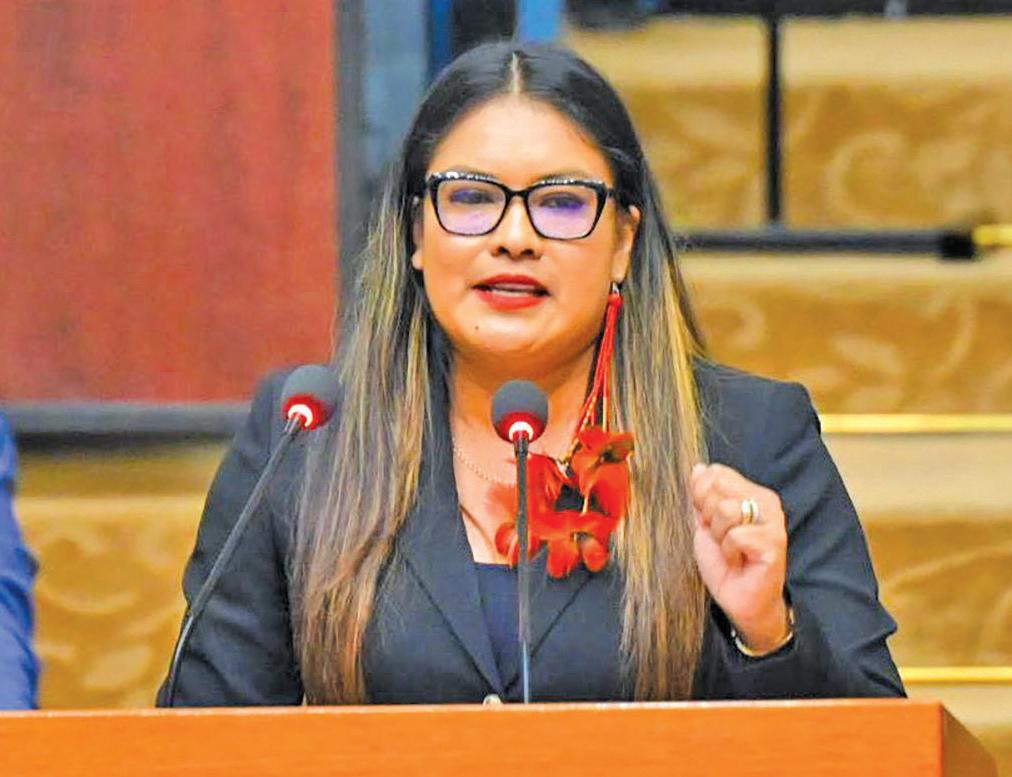
Minister Sarah Browne-Shadeek has described recent public confrontations and online attacks against her as politically motivated, admitting that the incidents have taken a personal toll and, at times, left her feeling fearful but nonetheless resolute.
Speaking on the Starting Point podcast, BrowneShadeek addressed recent encounters involving members of the We Invest in Nationhood (WIN) party and its leader, United States indicted Azruddin Mohamed, including a confrontation outside the Amerindian Hostel, visits to her home and public criticism in recent weeks.
“I would be lying if I’m going to say that it has not affected me, because it has,” the minister said. “There are times that I always look over my shoulder to see if I’ve been followed, and there’s always that fear,” she added.
Browne-Shadeek said the situation has been compounded by commentary on social media, including re-
marks from individuals she knows personally.
“Persons would say, this is happening, don’t look at the comments, but I chose to look at it because it gives me a different perspective,” she explained. “When you go on social media, you will see the comments mainly from people who have known you for a long time… some of your family members as well, your friends.”
She said it is not only the content of what is being said but the identities of those participating in the attacks that have been particularly difficult.
However, the minister rejected the framing that the confrontations are about accountability.
Trying to tarnish reputation
“For those who really sit and analyse the situation… it’s all political,” she said. “The We Invest in Nationhood party, they are trying to tarnish my reputation. It’s not about holding people accountable.”
Referring specifically to the confrontation outside the Amerindian Hostel
with US-indicted Azruddin Mohamed, Browne- Shadeek said one of the questions posed to her suggested the issue was personal rather than policy-driven.
“One of the questions that Mr. Mohamed asked me at that time was, why can’t I get work? You know, that wasn’t the issue at hand, and I’m not a person responsible for getting work,” she said. “It would have tell from that statement alone, it’s something deeply personal for him.”
Limited participation from Opposition
The minister also drew attention to what she described as inconsistent conduct by opposition members in Parliament. Her comments come on the heels of the Budget 2026 debates, during which she defended the current and capital expenditure allocations for the Ministry of Amerindian Affairs.
Browne-Shadeek said she was disappointed by what she described as limited participation from opposition members during the
Linden motorcyclist dies in accident
ALinden, Region 10
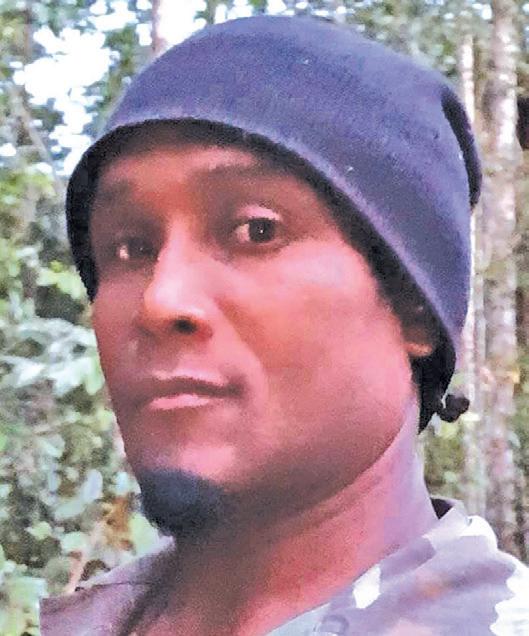
(Upper DemeraraUpper Berbice) resident, has died following a reported collision while riding his motorcycle home to his family, sparking concern over the circumstances surrounding his medical care. Dead is Trevor Daniels. According to information received, Daniels was involved in a vehicular collision while en route home.
He was subsequently taken to a medical facility in Linden for treatment.
It is unclear what specific injuries Daniels sustained or how long he remained at the initial medical facility before a transfer was sought for the to the Georgetown Public Hospital Corporation (GPHC). The circumstances of the collision, including the involvement of the other vehicle have not yet been disclosed by Police.
scrutiny of her ministry’s estimates.
“When I started to defend the budget, the first observation I made was that they were absent, clearly absent,” she said.
She added that opposition members entered the chamber later in the proceedings and did not fully engage in questioning the ministry’s current estimates.
“As Shadow Minister of Amerindian Affairs, I expected that Ms [Dawn] Hastings would have been able to ask the questions for her benefit, as well as the benefit of the Guyanese people who were also tuned in live,” Browne- Shadeek stated.
While expressing disappointment, she said she was not surprised.
“They portray themselves to be disciplined… obeying the standing orders. But then when they leave those doors, it’s a whole different scenario. They go on the internet behind the keyboards, and then they start to talk and to peddle a narrative,” she said.
Resolute
Despite the ongoing criticism, Browne- Shadeek maintained that she remains resolute in her role and committed to advancing her ministry’s mandate.
“That would not affect me,” she said. “I’m strong, and I’m confident that I will overcome whatever is happening.”
She added that her years in politics, dating back to age 21, have prepared her for public scrutiny and political challenges.
“I’ve been around for about 11 years at a leader-
ship level… and like I said, the people of Guyana would have put their trust in my party, and my party saw it fit to put me into this position. And I’m determined.”
The minister said she intends to continue advocating for Indigenous communities, particularly in the areas of youth empowerment, women’s development, and cultural preservation.
“How I can prove myself is by doing what is right, by continuing to advocate for my people, making the kind of representation we need. And that will be my vindication,” she said.
Amerindian Affairs Minister Sarah Browne-Shadeek
Dead: Trevor Daniels
Construction worker jailed for 10 years over raped 15-year-old
A46-year-old construction worker was on Friday sentenced to 10 years’ imprisonment for raping a 15-yearold girl in Achawib Village, South Rupununi, Region Nine (Upper Takatu-Upper Essequibo).
The sentence was imposed by Justice Priscilla Chandra-Hanif at the High Court in Suddie during the Essequibo Assizes in the matter of The State v. Asif Mohamed Abrahim, who had pleaded guilty to the offence of rape of a child under sixteen years, contrary to Section 10(3) of the Sexual Offences Act.
Abrahim had previously been convicted at the Lenora Magistrates’ Court for trafficking the same child and was sentenced to 48 months’ imprisonment.
According to the Statement of Agreed Facts, the complainant, who was 15 at the time, lived with her parents in Achawib Village. Abrahim, then 43, was part of a construction team contracted by the Village Council to build a health centre in the community.
On October 28, 2023, the teen was introduced to the accused at a birthday party at her parents’ home. The relationship developed and, on November 3, 2023, the accused engaged in sexual intercourse with the child at her parents’ residence.
During an audio and video interview conducted at CID Headquarters, the accused admitted to having sexual intercourse with the complainant. When cautioned by police, he reportedly said, “(the teen) is me wife and her parents give me permission to be with her.”
The complainant was escorted to the Georgetown Public Hospital on January 19, 2024, where a medical
examination revealed “ecchymosis to both lower extremities above the knee region.”
Victim impact statements were tendered from the child’s parents and community leaders.
The Toshao of Achawib Village, Wenceslaus Albert, stated that Abrahim “went against the village council decision, where we said to him that it was against the law and that he should not involve himself with an underage girl.”
He said the accused “took her from the home of her parents to Georgetown without the consent of the village council,” adding that the incident affected the entire community and caused emotional and social distress.
The child’s mother told the Court that since her daughter left home, the family has endured “significant emotional distress,” while her father said the family has experienced “deep emotional pain and suffering.”
The complainant, now 17 and in the care of the ministry, told the Court she has struggled emotionally and academically since the incident. She said she finds it difficult to focus on her
studies and still experiences painful memories.
“I started to feel depressed most of the time since I had no one to tell what I was going through,” she said in her statement. She added, “I think Asif should be punished for what he did to me. If he's not, he will do it to another young girl.”
Familial encouragement
In mitigation, defence attorney Tonza A. Sarrabo told the Court that the accused had pleaded guilty and had conducted himself in a compliant manner while incarcerated at Lusignan Prison. A conduct report stated that he attracted no disciplinary infractions and indicated willingness to participate in rehabilitative programmes.
The defence acknowledged that the complainant was under sixteen and legally incapable of consenting, and did not seek to minimise the seriousness of the offence. Counsel urged the Court to consider a sentence toward the lower end of the appropriate range, coupled with psychological intervention.
The defence also submitted that the accused believed
at the time that his conduct was acceptable because of familial encouragement, but accepted that such a belief reflected “a morally and socially deficient insight.”
deterrence, particularly in vulnerable indigenous communities.
The State further argued that the accused exploited his position as a contractor
ride protection afforded to children.”
The Court emphasized that the complainant was 15 years old and legally a child, and that the accused, as an
“Matters not if the parents give permission, community leaders approved… No culture, tradition, or community practice can override protection afforded to children” – Justice Priscilla Chandra-Hanif
The State, which was represented by State Counsel Caressa Henry, argued that the offence was serious and aggravating factors should apply, including the prior trafficking conviction arising from the same course of conduct.
The prosecution submitted that the offence struck “at the very core of the protection owed to the most vulnerable members of our society” and called for a sentence reflecting denunciation and
working within the village to gain access to the child, thereby breaching community trust.
In delivering the sentence, Justice ChandraHanif made it clear that parental or community approval could not override the law.
“Matters not if the parents give permission, community leaders approved… etc.,” the Judge stated. “No culture, tradition, or community practice can over-
adult, bore the responsibility to refrain from engaging in sexual activity with a minor.
“The girl was 15. Legally, she is a child. The accused was an adult and bears the responsibility to refrain from sexual act with a minor,” the Judge stated.
The Court sentenced Abrahim to 10 years’ imprisonment, to be served concurrently, with credit for time spent on remand, if applicable.
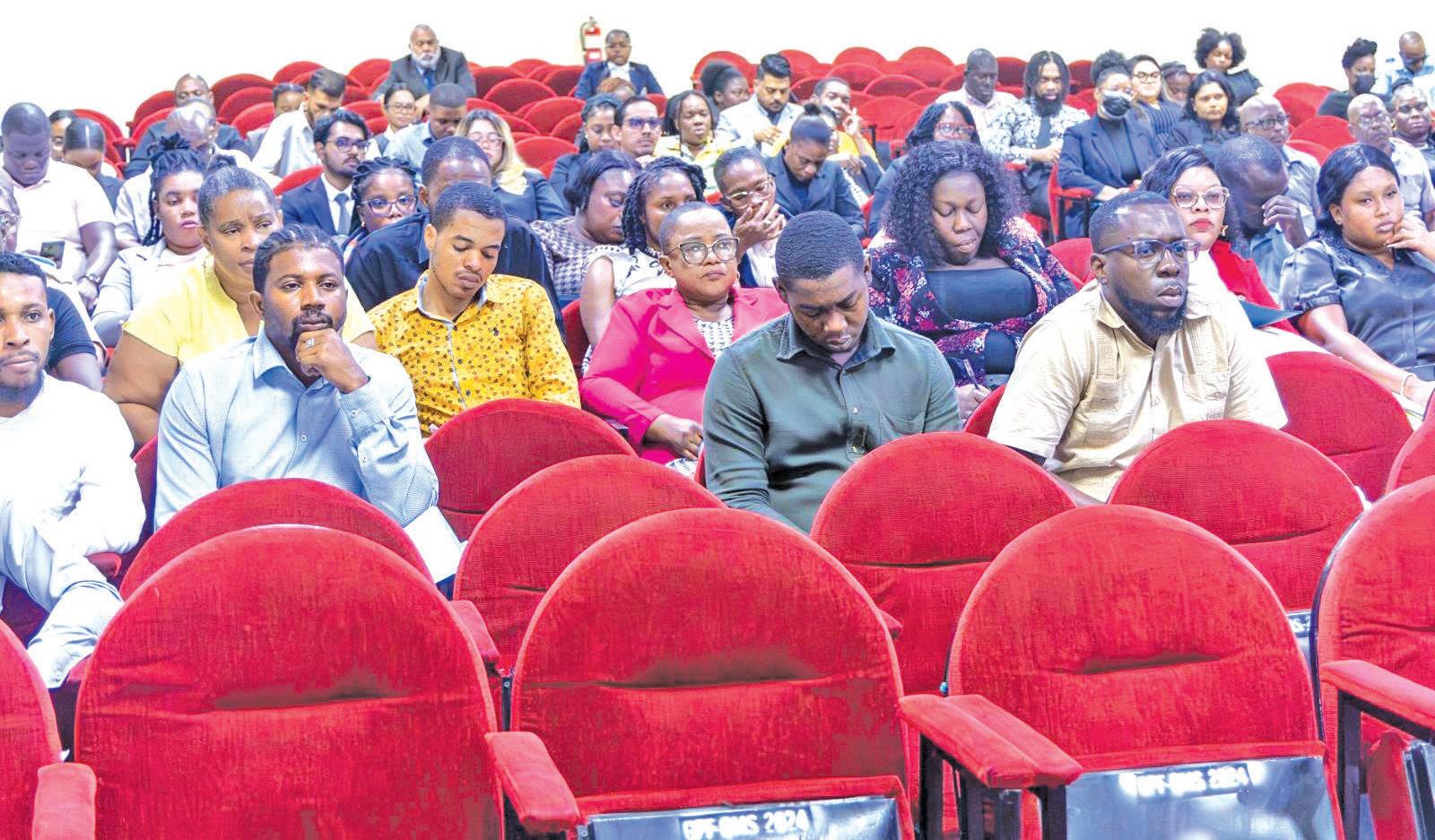
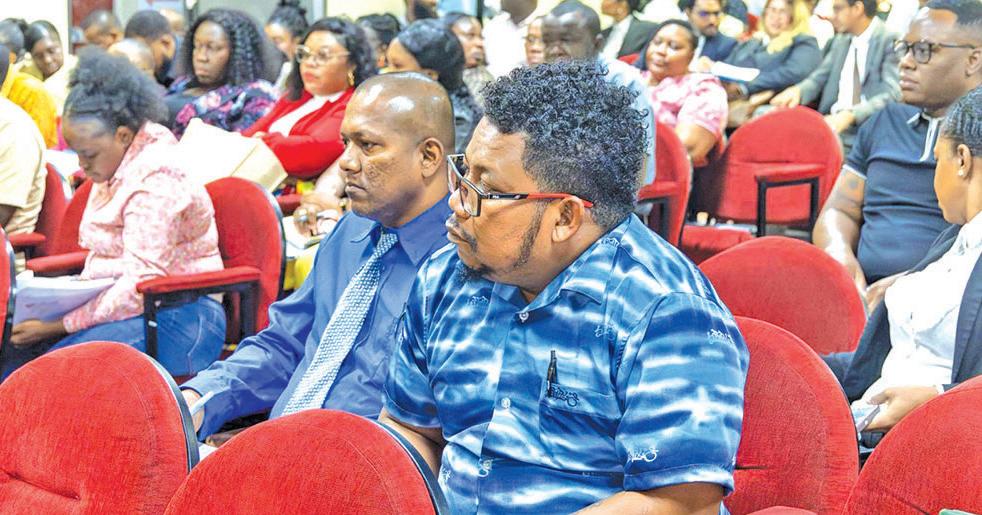
Justice officials strengthen skills in restorative justice implementation
Members of Guyana’s justice sector recently participated in a refresher training session on the Restorative Justice Act 2022, as authorities continue efforts to strengthen the practical implementation of the landmark legislation.
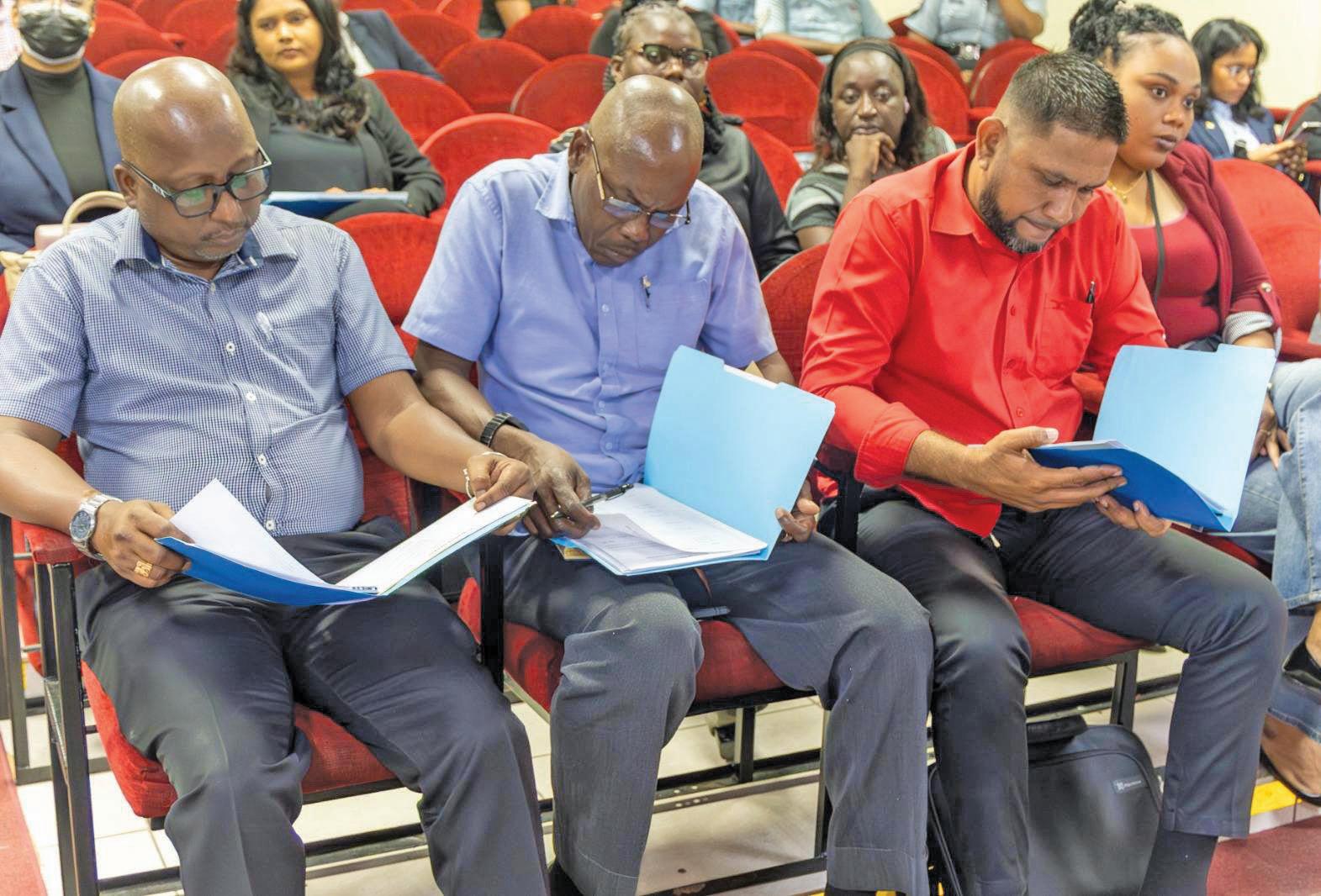
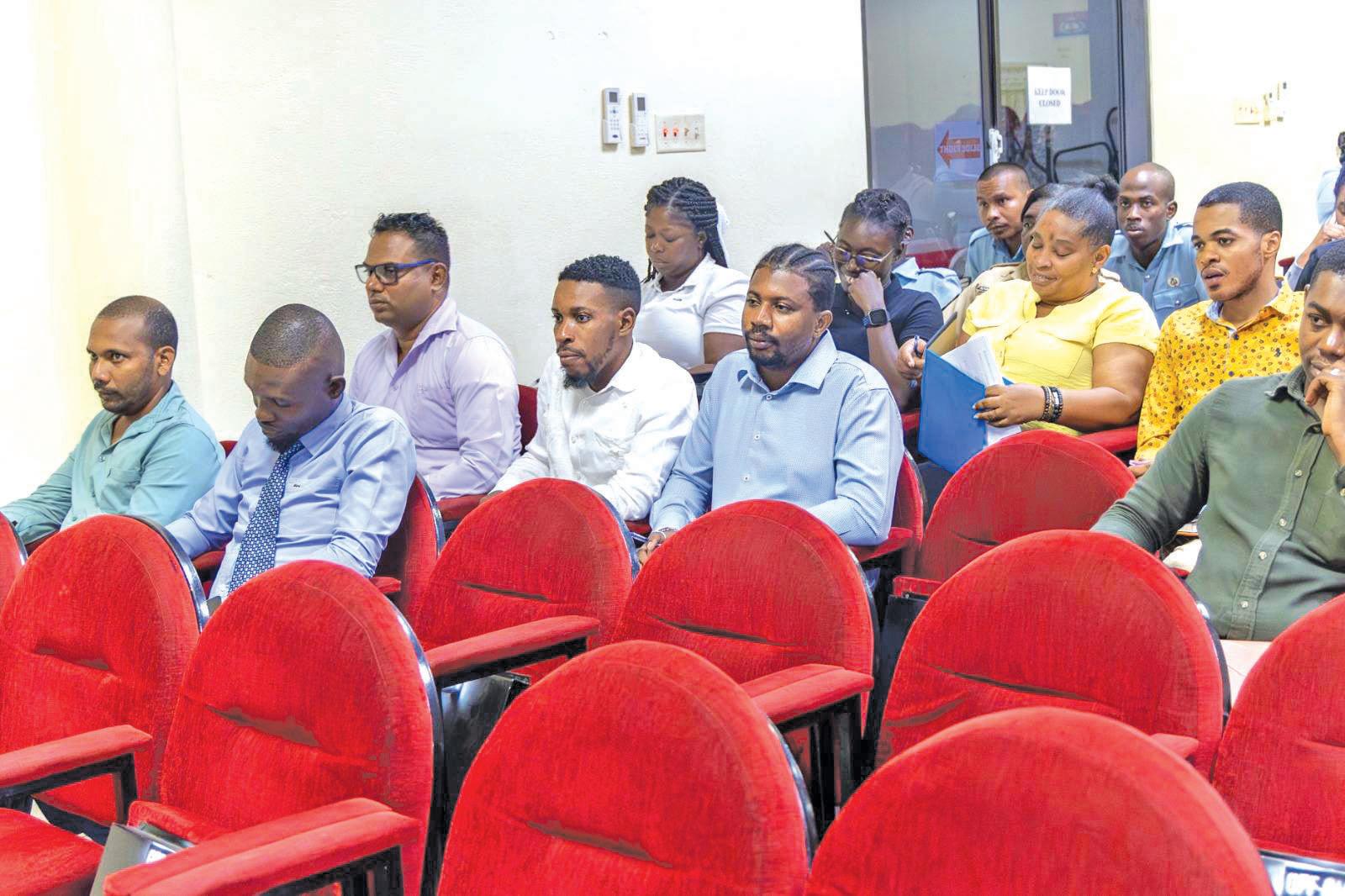
The session, held at the Officers’ Training Centre, Eve Leary, brought together prosecutors, police prosecutors, state attorneys, and restorative justice practitioners to reinforce their understanding of how the Act is to be applied within the criminal justice system.
Director of the Restorative Justice Centre, Orrin Boston, facilitated the engagement, guiding participants through operational procedures, referral processes, and inter-agency coordination required to effectively execute restorative measures.
Jailed: Asif Mohamed Abrahim
Scenes from the restorative justice training at Eve Leary
Structural works advancing on Govt Office Complex – Edghill
…as House clears $1.050B advance to accelerate project
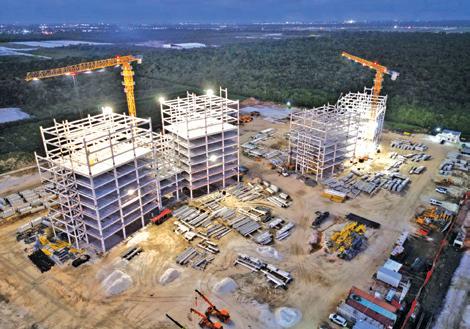
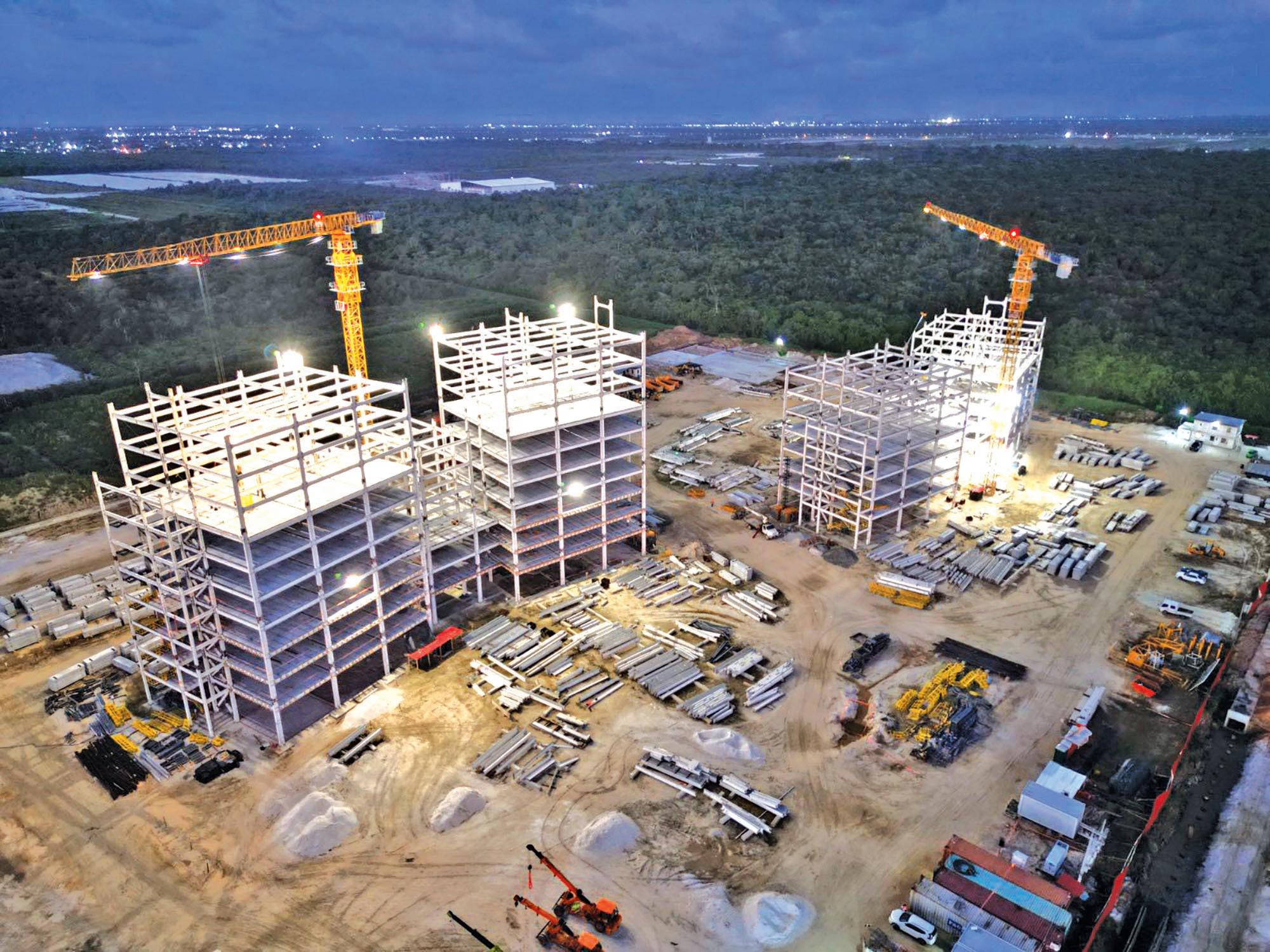
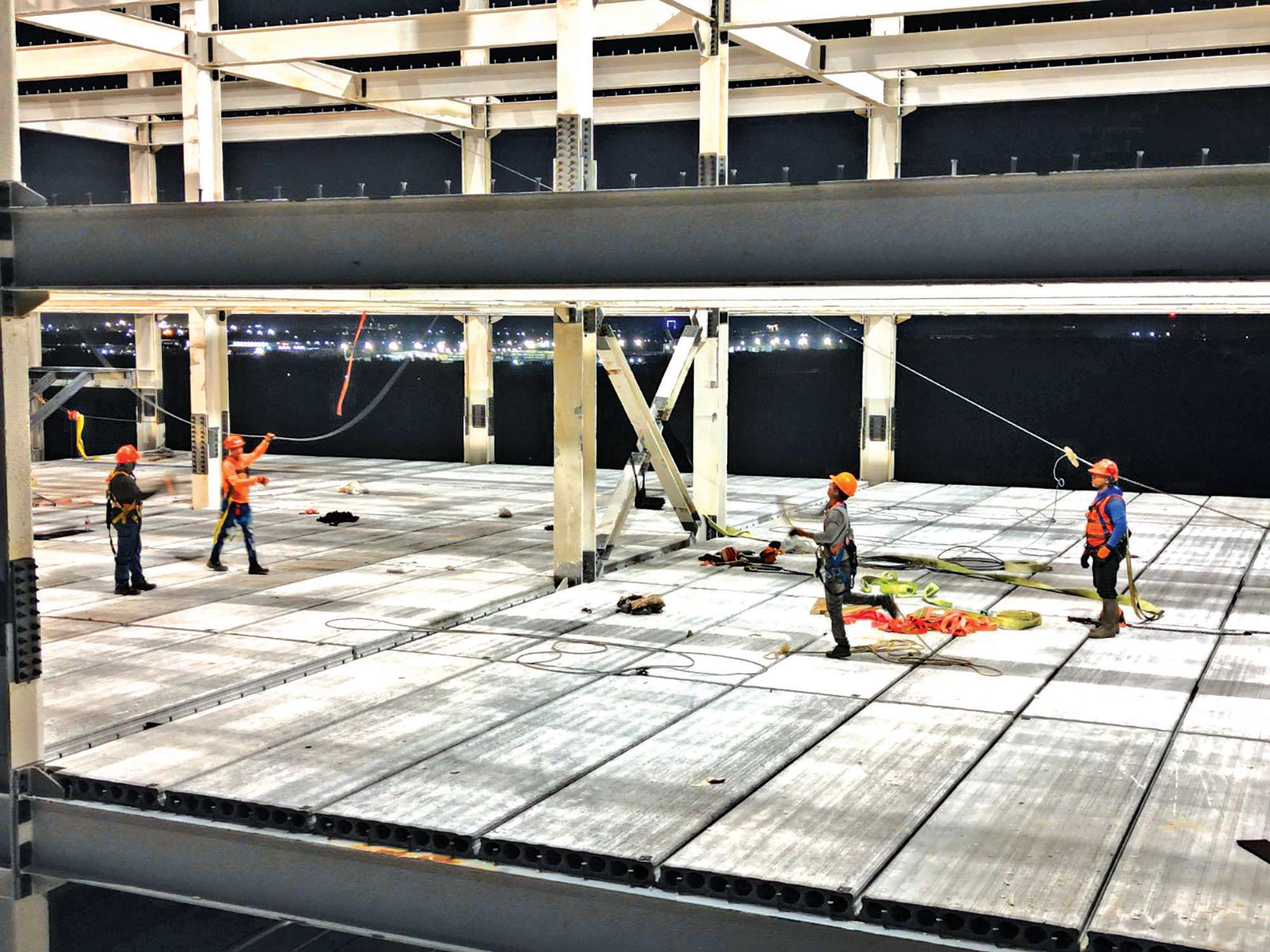
With 100 per cent of the structural steel now onsite, works are advancing on the $15.8 billion Government Office Complex near the new Eccles/Haags Bosch roundabout on the East Bank of Demerara (EBD).
This was recently revealed by Public Works Minister Juan Edghill in the National Assembly during the consideration of a $1.050 billion advance taken last year to fasttrack works on the project.
This sum was part of an $18.8 billion Financial Paper that was presented to the House for advances made from the Contingencies Fund that catered for developmental works countrywide and other initiatives during the period November 18 to December 16, 2025.
Edghill told the House late Friday evening that the advance was taken to pay the contractor for accelerated works done on the 12-storey, four-tower complex that is expected to accommodate 6000 staff. Designed to consolidate a host of government services to ease the congestion in central Georgetown, the new complex facility will also house a major parking facility and to be outfitted with its own utility complex.
The minister was at the time responding to questions by Opposition Member, Ganesh Mahipaul of the A Partnership for National Unity (APNU) on the reason for the advance.
“We pay for measured works,” Edghill indicated. “This is what happens when you have good management and more work is done than what was anticipated, and you have to pay
an interim certificate.”
To date, approximately $8.6 billion has been allocated to the project and the recent acceleration of works was due to the arrival of materials onsite.
According to the Public
and that’s what we did,” Edghill stressed.
The $15.8 billion Government Office Complex is being built by Caribbean Green Building Inc with Vicab Engineering as the project consultant.
Works Minister, piling and foundation works are now 100 per cent completed at a combined total of $3.17 billion, while another $1.1 billion was spent on grubbing and sand filling works to prepare the project site.
A further $3.10 billion has been expended on structural works thus far on both the four tower complex and the utility building. There is another $1.24 billion going towards the continued payment for design works.
“[Those were] the drivers of the numbers you were asking about. So, the need for the Contingency Fund advance was to ensure that the contractor was paid so that the Honourable Member Mahipaul don’t come to the House and say why is it delayed. But we must be able to celebrate why we’re getting it done so fast
Initially, the complex was located along the Heroes Highway but was subsequently relocated to a bigger space – 20 acres of which 13 acres will house the four tower buildings and the ministry’s Special Projects Unit along with all their machinery and equipment will take up the remaining seven acres.
As a result of the location change, government had issued the commencement order for the contractor to start works in February 2024, taking the deadline for completion to August 2026.
Deadline shifted
In a Facebook post last week, the Public Works Ministry indicated that the deadline has now shifted to January 2027.
The post said that Minister Edghill recently shared that the project
is currently at 48 per cent completed and that a 24hour work cycle has been implemented to meet the new deadline.
According to the ministry, the Government Office Complex is officially nearing the halfway mark with 100 per cent of the structural steel now on-site.
It went onto add had that work is moving fast across all four structures with Towers 1 and 2 currently seeing progress on the 8th and 9th floors, while Towers 3 and 4 are reaching the 6th and 7th floors.
The foundation slabs for the central utility
building are being poured, and staircase frames are being installed across the complex. In addition, internal roads and the surrounding drainage network (Northern, Eastern, wand Western channels) are also well underway.
Justice officials strengthen...
Among those in attendance were Deputy Director of Public Prosecutions
Diana O’Brian, Deputy Solicitor General Shoshanna Lall, facilitator Beverley Bishop-Cheddie, and Superintendent Delon Fraser. The training focused on ensuring that justice officials are not only familiar with the principles of restorative justice but are also equipped to integrate those principles into daily prosecutorial and policing functions.
The Restorative Justice Act, passed in November 2022, marked a significant shift in Guyana’s approach to certain categories of offences, particularly minor and non-violent matters. Instead of relying exclusively on punitive sanctions, the legislation promotes accountability
through dialogue between victims and offenders, me-
units have been introduced within probation and justice structures, while magistrates, police ranks, and facilitators have undergone specialised training to build capacity across regions.
Officials have also signalled their intention to expand restorative justice centres and embed the model as a permanent feature of Guyana’s justice system, with the broader objective of reducing recidivism and strengthening
diation, community participation, and structured rehabilitation. The framework was also designed to help reduce pressure on the prison system and ease the burden on the courts by diverting suitable cases away from full trials.
Restorative justice
public trust.
The refresher session at Eve Leary forms part of that sustained national rollout, aimed at ensuring that restorative justice is consistently and effectively applied as the system continues to evolve.
The $15.8B Government Office Complex is nearing the halfway mark
Works are ongoing 24 hours to advance the project
Public Works Minister Juan Edghill
(Office of the President photos)
FEBRUARY 16, 2026 |
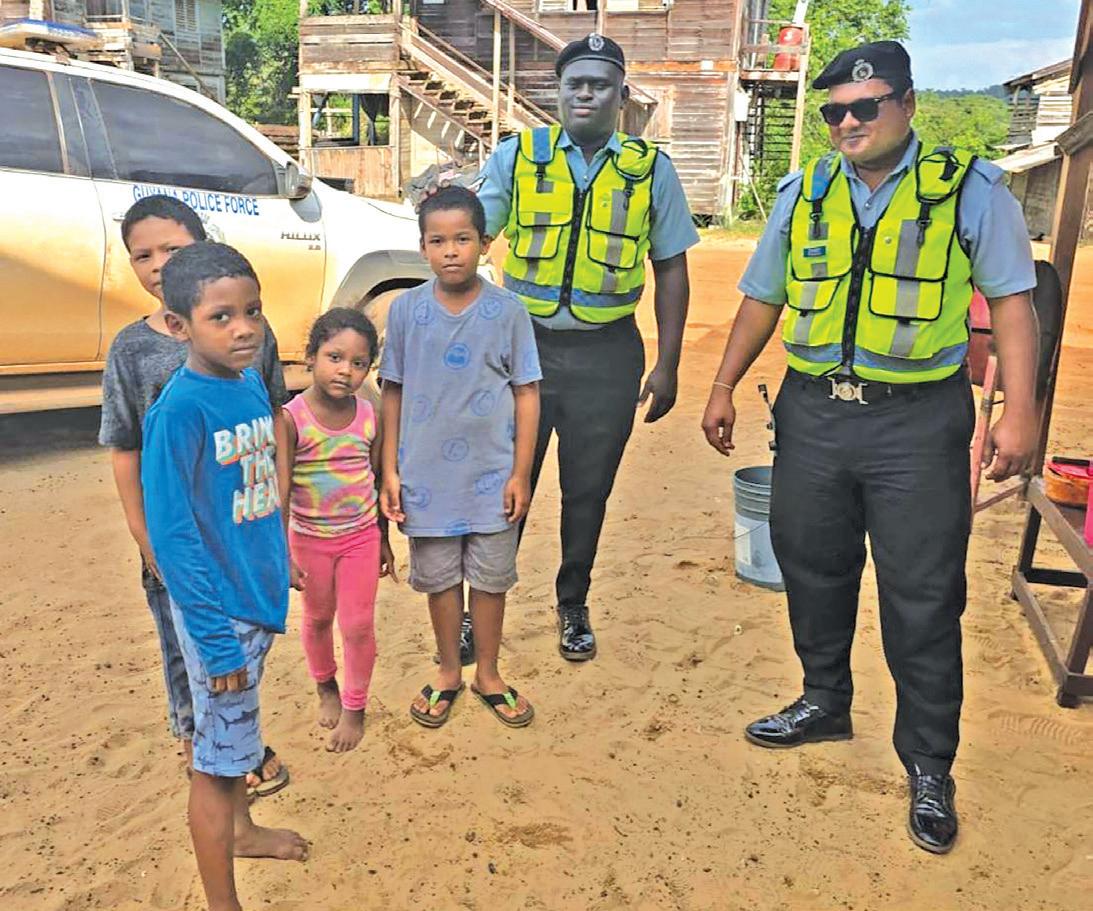
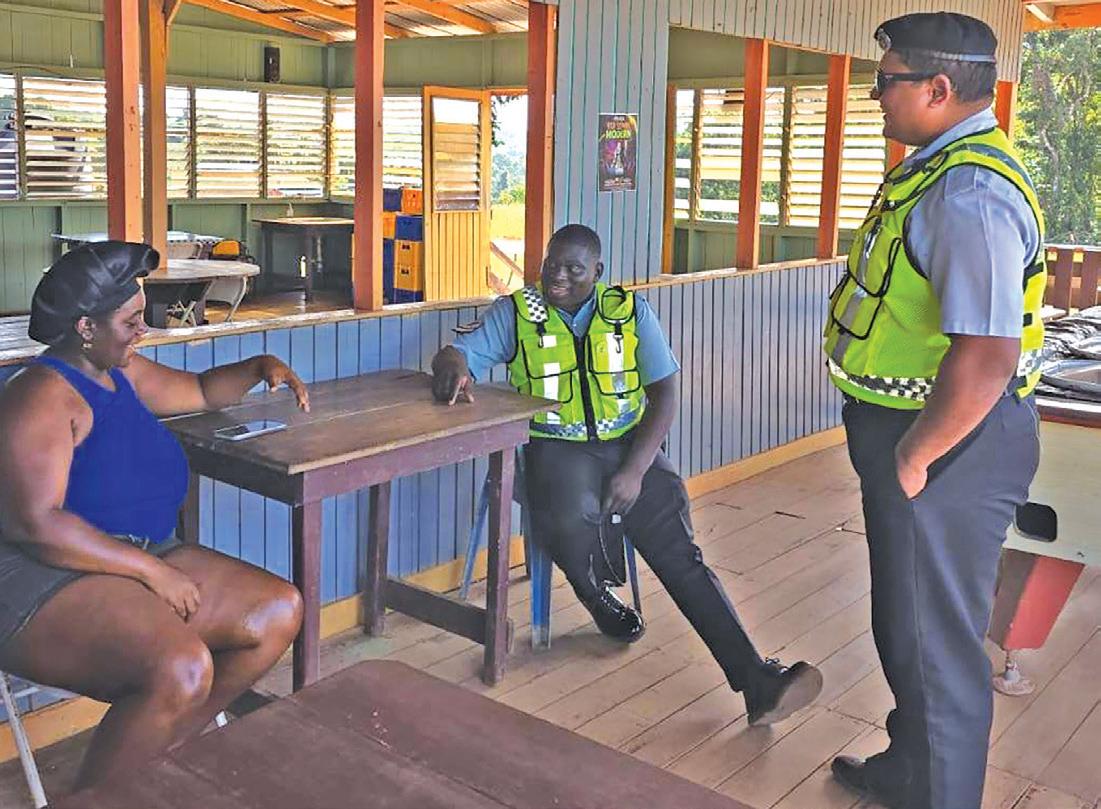
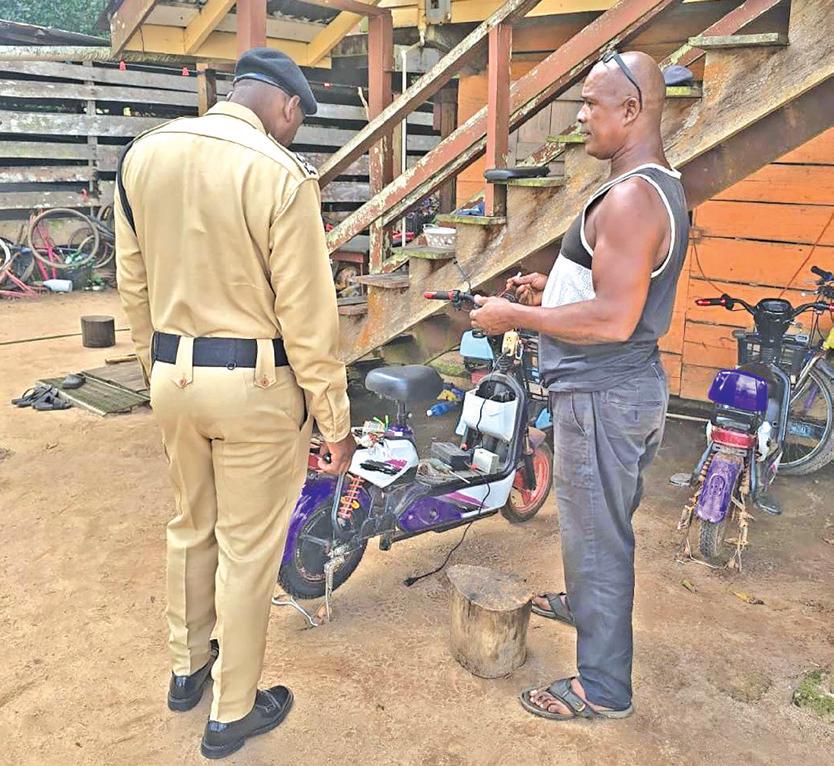
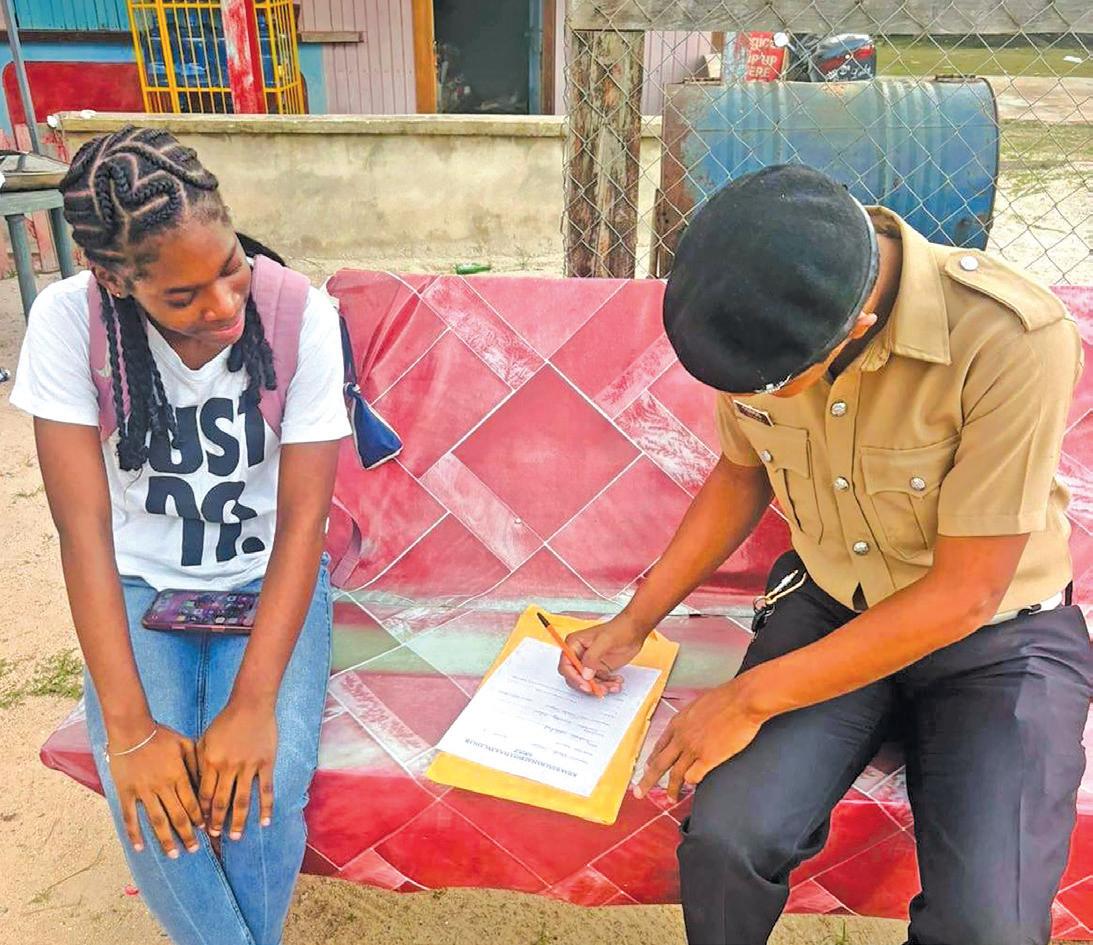
Over 30 young people registered for Kwakwani Police Waterfront Youth Group
…as Police expand community engagement efforts
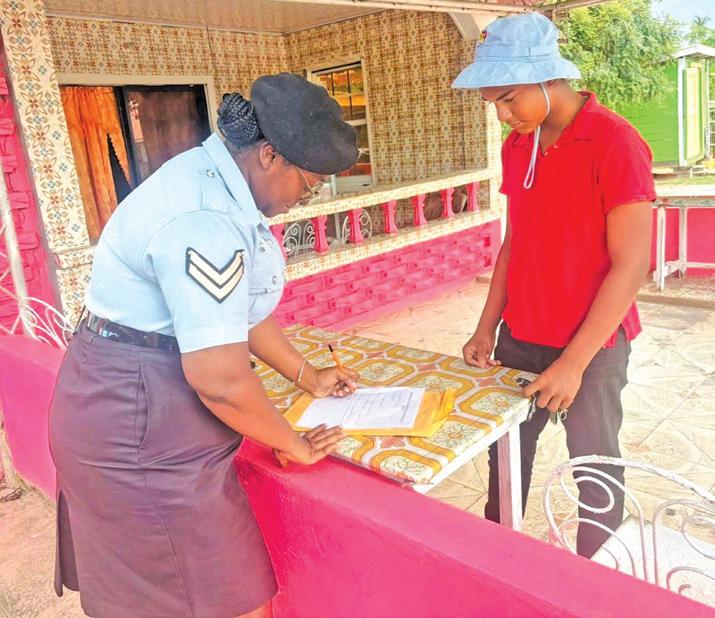
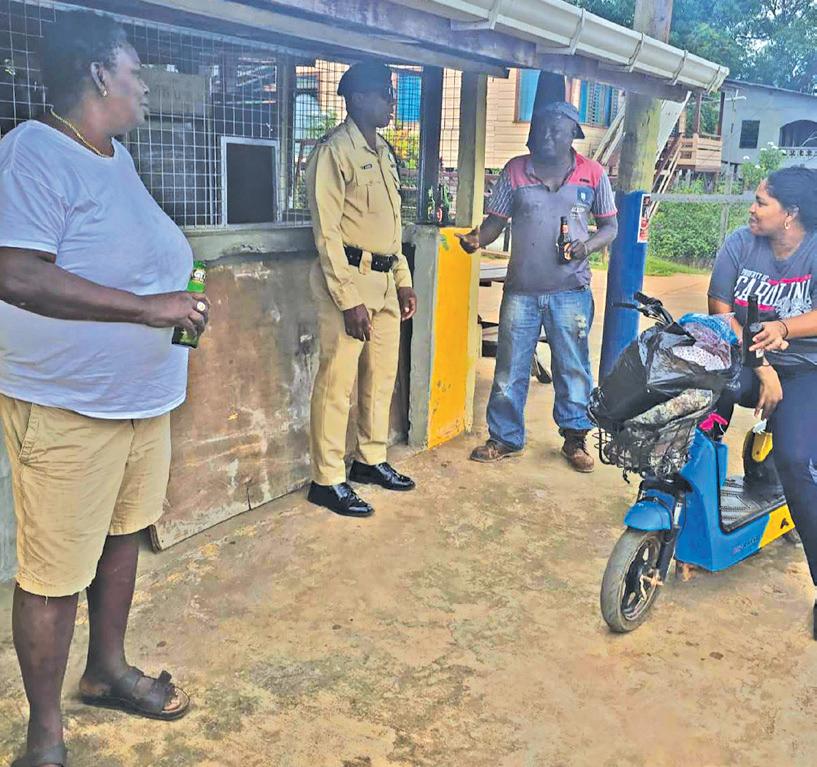
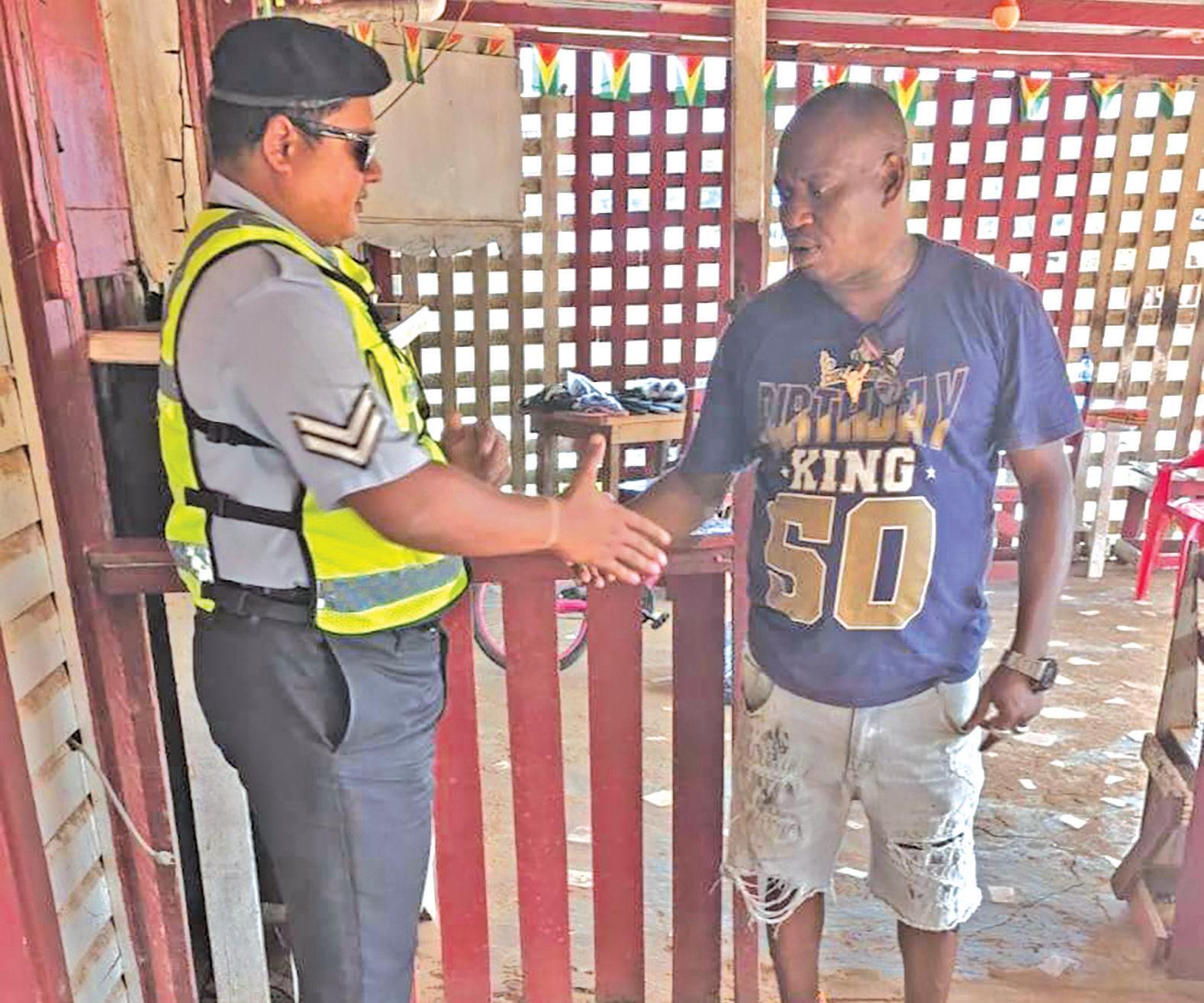
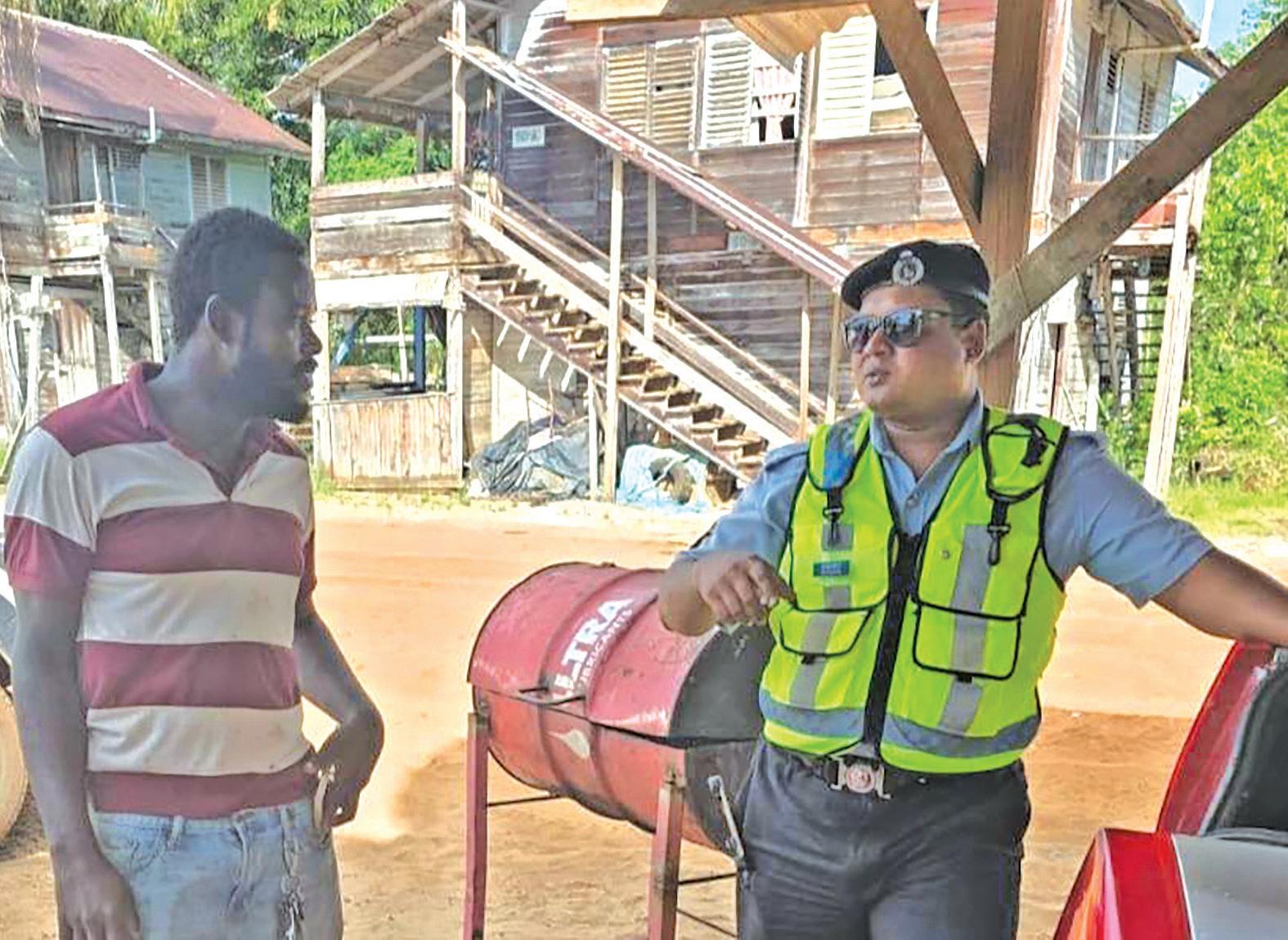
The Guyana Police Force (GPF) on Friday and Saturday conducted a series of community outreach activities across the Ituni, Kwakwani and Mabura districts, Region 10 (Upper DemeraraBerbice) as part of efforts to strengthen ties with residents and promote public safety. On Friday, a community engagement walkabout was held within the Ituni Station District. The exercise was led by Inspector R. Jackson alongside Woman Sergeant Quimbie, the Subordinate Officer-inCharge of the Ituni Police Station. In a post by Radio Eve Leary, the GPF online radio station, it was stated that during the walkabout, officers visited several sections of the
district where they met residents and engaged in discussions. The initiative focused on strengthening police-community relations, encouraging open communication and promoting a safer environment through partnership. Key issues addressed included crime prevention and reporting procedures, the importance of community–police partnerships, domestic violence awareness, youth involvement in positive activities, drug and alcohol abuse and respect for the law. Residents were encouraged to raise concerns and report suspicious activities promptly.
Youth group On Saturday, Woman Corporal Williams, Woman Constable David
77 grams of ganja found
at Soesdyke junction
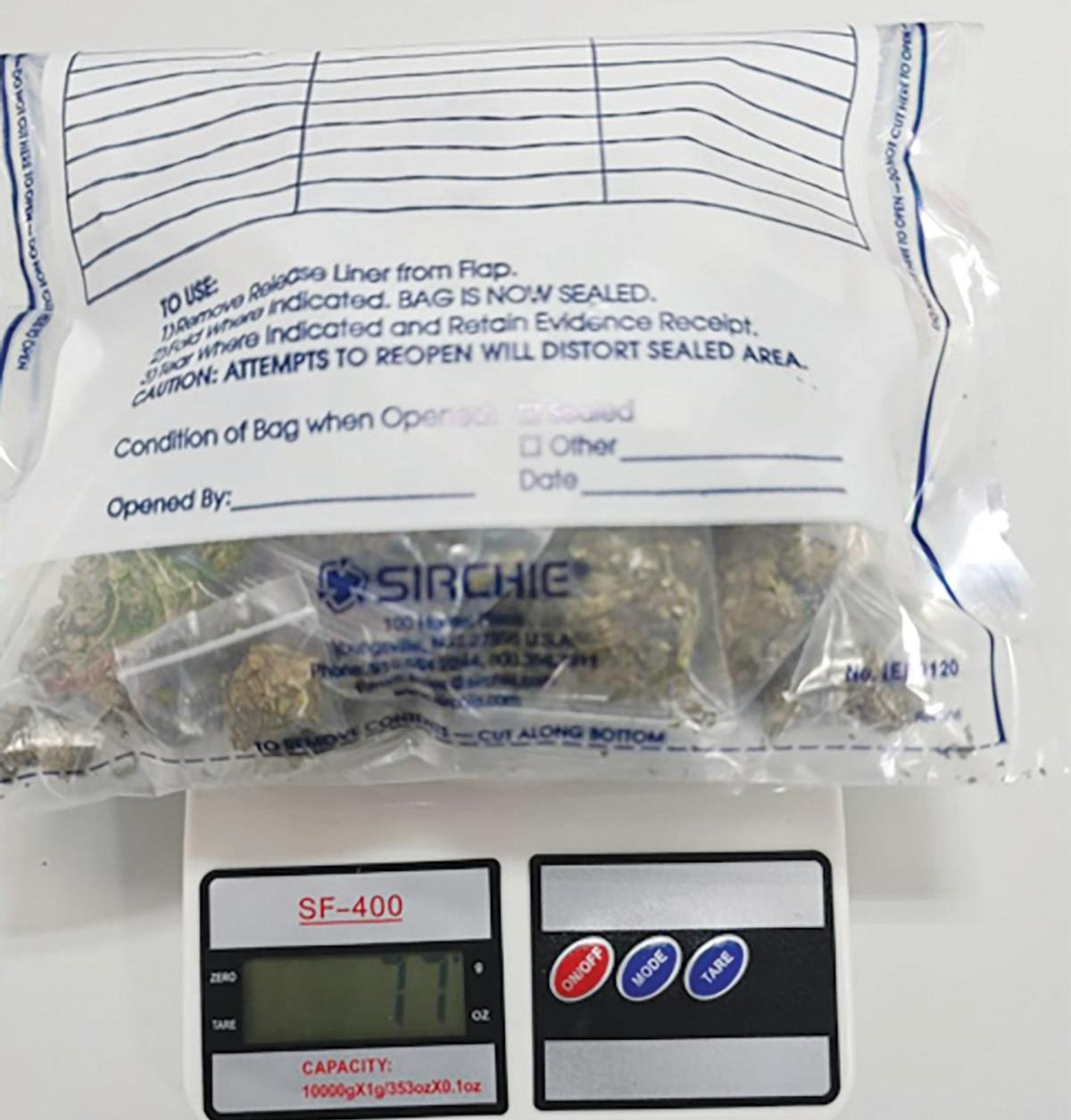
A37-year-old security guard/vendor is currently in custody after a quantity of suspected cannabis was discovered during an operation at Soesdyke Junction, East Bank Demerara (EBD), on Friday morning. The discovery was made at about 10:30h, during an intelligence-led exercise carried out in the area.
Reports indicate that law enforcement ranks conducted a search of a shop and its surrounding premises at Soesdyke Junction. During the operation, 45 transparent
Ziploc plastic bags containing leaves, seeds, and stems suspected to be cannabis were found concealed in sand beneath a coconut tree, a short distance from the building.
The suspected narcotics were retrieved and later weighed in the presence of the suspect, amounting to 77 grams.
The man, who is a resident of Soesdyke, EBD, was arrested at the scene and taken to the Timehri Police Station, where he remains in custody. Investigations into the matter are ongoing.
and a team of ranks conducted a community outreach at the Kwakwani Waterfront area. The activity aimed to register youths for the upcoming Kwakwani Police
Waterfront Youth Group. More than 30 youths registered to join the group. According to the police, parents expressed appreciation for the programme, which is intended to provide young people with opportunities to participate in structured activities. Also on Saturday, ranks conducted a communi-
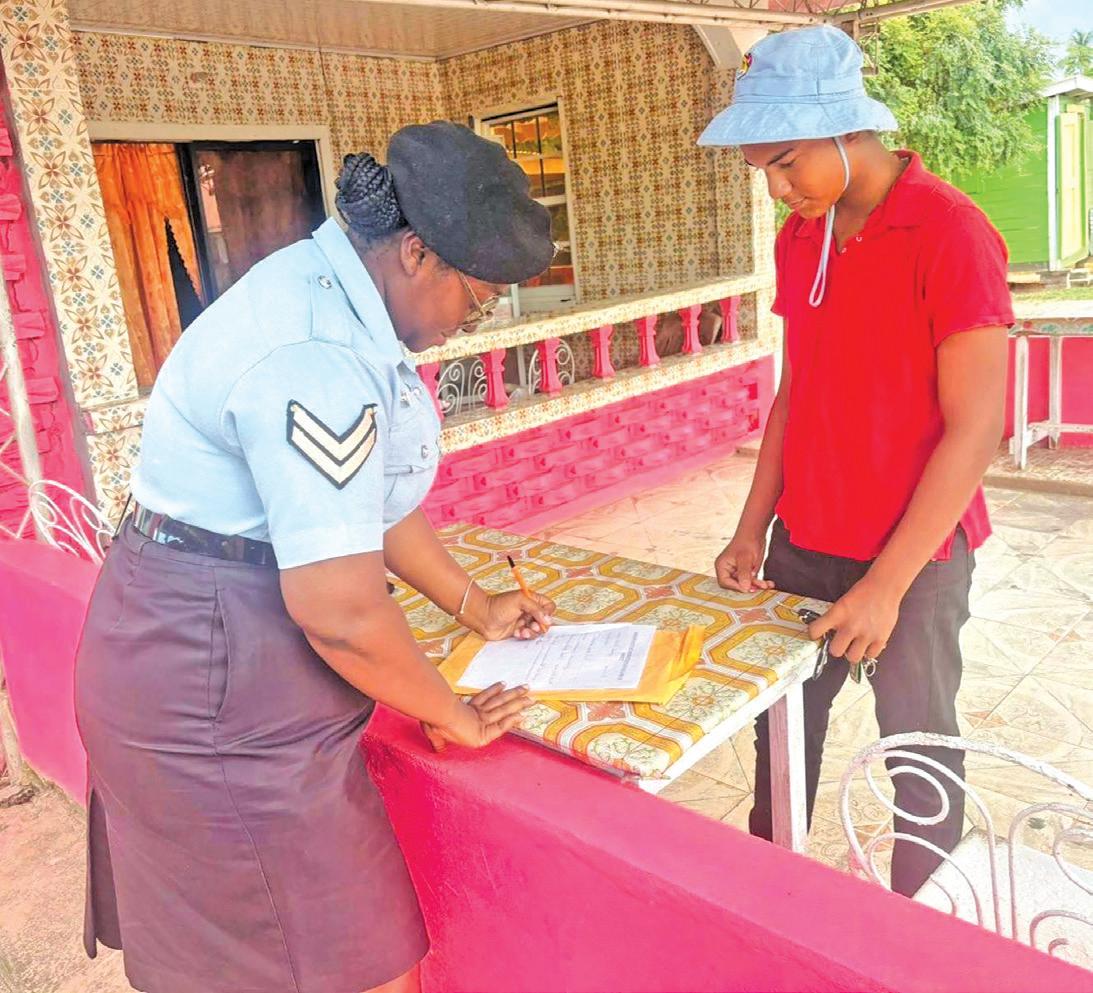
ty outreach within the Mabura Police Outpost Station District. Corporals Isaacs and Persaud led the initiative. The outreach sought to promote public awareness, enhance safety, build trust, encourage safe road practices, reinforce a zero-tolerance approach to domestic violence and urge residents to report unusual or suspicious activities.
Community engagement within the Ituni Station District (Radio Eve Leary photos)
Ranks conducted a community outreach within the Mabura Police Outpost Station District (Radio Eve Leary photos)
Police community outreach at the Kwakwani Waterfront area (Radio Eve Leary photos)
The illegal drug that was discovered by Police
Understanding stroke
Astroke happens when blood flow to the brain is suddenly interrupted. This can occur when a clot blocks a blood vessel or when a blood vessel bursts. When the brain is deprived of oxygen and nutrients, brain cells begin to die within minutes. The damage caused by a stroke can be permanent, affecting speech, movement, memory, and even personality.
Stroke is not a rare event in Guyana. It is one of the leading causes of death and long-term disability, and it often strikes without warning. Many people who suffer a stroke were previously walking, working, and caring for their families just hours before.
Why stroke is a major problem in Guyana
Stroke is becoming in-
Facility
HEALTH TIPS
Stroke in Guyana: When every minute counts
creasingly common in Guyana, affecting both older adults and people in their 40s and 50s. The impact is devastating not only for individuals, but also for families who must suddenly cope with disability, caregiving responsibilities, and loss of income.
A major concern is that many strokes in Guyana are preventable. High blood pressure, diabetes, obesity, smoking, and physical inactivity, conditions discussed in previous weeks, are the main drivers of stroke. When these conditions are not detected or controlled, the risk of stroke rises sharply.
What health workers see every day
Doctors and nurses across the country frequently treat patients who arrive at hospitals unable to move one side of their body, unable to speak, or unable to recognise their loved ones. Many families say the same thing: He was fine yesterday In many cases, patients had high blood pressure or diabetes that was undiagnosed or poorly controlled. Others ignored warning signs such as headaches, dizziness, or weakness. By the time medical help is sought, the damage is often severe.
What causes stroke
The most common cause of stroke in Guyana is uncontrolled high blood pres-
sure. High blood pressure damages blood vessels over time, making them more likely to become blocked or burst. Diabetes increases the risk by damaging blood vessels and promoting clot formation.
Other important causes include smoking, excessive alcohol use, obesity, high cholesterol, heart disease, and lack of physical activity. Stress and poor diet also contribute. Stroke is rarely caused by a single factor; it is usually the result of multiple risks acting together over many years.
Who is most at risk
Although stroke can happen to anyone, certain people are at higher risk. Adults over the age of 40 are more vulnerable, especially those with high blood pressure or diabetes. People who smoke, drink heavily, or are overweight face increased risk. Men tend to experience stroke earlier in life, while women often experience more severe outcomes.
Importantly, stroke is no longer a disease only of the elderly. Increasing
numbers of younger adults in Guyana are experiencing stroke due to poorly-controlled chronic conditions.
Warning signs of stroke:
Know them and act fast
Stroke symptoms usually appear suddenly. These may include weakness or numbness of the face, arm, or leg, especially on one side of the body; difficulty speaking or understanding speech; sudden confusion; loss of balance; dizziness; or severe headache.
Time is critical. The longer the brain goes without blood flow, the greater the damage. Recognising symptoms early and getting to a hospital immediately can mean the difference between recovery and lifelong disability.
What to do when stroke is suspected
If someone suddenly develops weakness, trouble speaking, or facial drooping, do not wait and do not attempt home remedies. Immediate medical attention is essential. Every
minute matters because early treatment can reduce brain damage and improve survival.
Family members and bystanders play a crucial role. Acting quickly can save a life or prevent permanent disability.
Diagnosis and treatment
Stroke is diagnosed using clinical examination and imaging of the brain. Treatment depends on the type of stroke and how quickly the person arrives at the hospital. Some strokes can be treated with medications that dissolve clots if given early enough, while others require supportive care and rehabilitation.
After the initial emergency, long-term treatment focuses on preventing another stroke. This includes controlling blood pressure, managing diabetes, stopping smoking, reducing alcohol use, and taking prescribed medications consistently.
Life after stroke
Many people survive a stroke, but are left with long-term challenges. These may include difficulty walking, speaking, swallowing, or performing daily activities. Rehabilitation, including physiotherapy and speech therapy, plays a key role in recovery, but progress can be slow.
Families often become caregivers, facing emotional, physical, and financial
$20B Technical Training College
a major boost
for
oil
and
gas
strain. Preventing the first stroke or a second one is, therefore, far better than managing the aftermath.
Preventing stroke
Most strokes can be prevented by controlling known risk factors.
Regular blood pressure checks, blood sugar testing, healthy eating, physical activity, and avoiding smoking are powerful protective measures. Taking prescribed medications as directed is essential, even when you feel well.
Knowing your health numbers and acting early reduces the risk of stroke dramatically.
A message to families and communities Stroke prevention is a shared responsibility. Encouraging loved ones to check their blood pressure, supporting healthier meals, and recognising stroke symptoms can save lives. Communities that promote healthy living help protect everyone. Stroke does not give second chances easily. It can take away speech, movement, independence, and life itself in a matter of minutes. Yet many strokes in Guyana are preventable. Do not wait until disaster strikes. Control your blood pressure, manage diabetes, stay active, and seek care early. When it comes to stroke, every minute counts and prevention saves lives.
workforce development – Natural Resources Ministry
The Natural Resources Ministry has welcomed the official opening of the $20 billion Guyana Technical Training College Inc (GTTCI) at Port Mourant, Berbice, describing the institution as a major investment in the country’s human capital development.
The college was commissioned on Saturday by President Dr Mohamed Irfaan Ali, who announced that Region Six (East Berbice-Corentyne) has been formally designated the national capital for oil and gas technical training. The GTTCI was realised under the vision of President Ali to establish a premier institute to train Guyanese in oil and gas and other critical skilled trades. The facility will deliver world-class certification in key technical disciplines, including pro-
duction operations, instrumentation, electrical and mechanical training. A key feature of the institution is a Facility Simulator (FacTor), established in 2024 by SBM Offshore with support from the Stabroek Block partners and the Government of Guyana. The simulator replicates the environment of a floating production, storage and offloading (FPSO) vessel and is designed to familiarise students with offshore operations. It will support an 18-month intensive residential programme leading to a globally accredited Advanced Diploma in Oil and Gas: Mechanical, Electrical, Instrumentation and Production. Natural Resources Minister, Vickram Bharrat said the simulator represents a source of national pride and eliminates the need to send students overseas, particu-
larly to Canada, for similar training. He noted that the facility ranks among one in ten globally and positions Guyana as a leader in oil sector management among new producers. President
Ali, addressing the opening ceremony, said the college is a strategic investment aimed at transforming oil revenues into long-term national capacity. “It’s an investment in a workforce, an investment in the future of
our country,” the President stated, adding that the institution forms a central pillar of the Government’s strategy to build a highly skilled Guyanese workforce. He explained that while the college is initially intended to
serve Guyanese, it is positioned to attract trainees from Suriname, Trinidad and Tobago and other regional territories engaged in deep-water energy development. The President also linked the institution to Guyana’s Local Content Act and broader economic objectives, noting that the country must ensure citizens and businesses benefit directly from oil production. By producing certified technicians, process operators and industrial maintenance specialists, the college is expected to help meet local content targets and reduce reliance on imported labour. According to the Natural Resources Ministry, the GTTCI is set to position Guyana to meet domestic workforce needs as well as to serve the wider region with technical training and capacity building.
The $20 billion Guyana Technical Training College Inc (GTTCI) at Port Mourant, Berbice
Regional
T&T Oilfield Workers Union millions in debt after failed bids to purchase refinery
President general of the Oilfield Workers Trade Union (OWTU)
Ancel Roget says the union is seeking to amicably resolve millions in debt, accumulated during its multiple failed attempts to acquire the Pointe-a-Pierre refinery through its company, Patriotic Energies and Technologies.
The OWTU, the country’s largest union, accumulated close to $40 million in debt and has two judgments against it—one by professional service firm, Deloitte and another by KCL Capital Market Brokers Ltd.
Guardian Media understands the union is still hopeful for further collaboration on the refinery under the Kamla Persad-Bissessar administration, but time has passed since the judgments.
Guardian Media was informed that five of the OWTU’s properties and financial assets, which it used as collateral to engage the KCL Capital, have been earmarked to be disposed of to pay off the debt.
Among the properties used as collateral is the OWTU’s headquarters in San Fernando.
However, while Roget acknowledged that OWTU used several properties, among them—the Palms located at Pointe-à-Pierre Road, two properties in San Fernando – 99A Circular Road (its headquarters) and 97D Circular Road and a commercial building in Portof-Spain, as well as its shareholding in One Caribbean Media, Trinidad Cement Ltd, Massy Holdings, and National Investment Fund Holding Company as collateral, he denied that they are
for sale.
“I wish to state that the OWTU properties are not for sale, and certainly no banks are foreclosing on our properties. On the contrary, we are working very closely and collaboratively with our creditors to settle the court judgment.
“You would recall that the last PNM administration in their attempt to destroy the OWTU, ensured that we did not complete the process for the restart of the refinery, even though our company, Patriotic, won the bid out of some 76 other international contenders. The entire country suffered as a result of the PNM’s vindictive action.
“However, this UNC and the coalition of interest government is totally different . And so we are currently working very closely with the current administration for a safe, secure, successful and sustainable restart of the Pointe-a-Pierre refinery, which will be a major benefit to the entire country,” he said yesterday.
Ernesto Kesar, former vice president of the OWTU, who signed one of the loan agreements as a trustee, is now the MP for Point Fortin and serves as Minister in the Ministry of Energy and Energy Industries.
Last week, Energy Minister Dr Roodal Moonilal said the Government is engaging internationally reputable firms to support a potential restart of the refinery.
With regard to Deloitte, Roget said they have entered a consent order and are working with the firm.
In 2022, the professional services firm took legal action against the union for
millions in outstanding fees.
The fees related to services the firm rendered to the OWTU when Patriotic Energies was bidding for Petrotrin’s mothballed oil refinery.
That venture spanned about three years, 2019 to 2021, and three unsuccessful bids by the OWTU to secure the rights to own and operate the refinery.
After several missed deadlines to settle the sums owed, Deloitte opted for legal action against the OWTU and Patriotic.
The OWTU initiated bankruptcy proceedings for Patriotic and filed to have the legal documents sealed.
Roget did not say how much is owed to Deloitte.
In November 2022, KCL Capital Market Brokers Ltd filed a claim against the OWTU, demanding over US$4.3 million in outstanding principal and interest.
According to court documents, the loans were used to pay consultants helping Patriotic prepare its offer to purchase 100 per cent of Guaracara Refining Company and Paria Fuel Trading Company.
The money, it was reported, was supposed to be repaid in scheduled instalments, but the OWTU never made any payments, despite new agreements in 2021 and 2022 extending their repayment period.
In July 2025, Justice Carol Gobin found that both OWTU and Patriotic failed to repay two loans to KCL Capital, one issued in November 2019 and another in May 2020, despite acknowledging the debts and agreeing to repayment terms. (Excerpted from T&T Guardian)
T&T couple killed in front of infant daughter
Awoman and her boyfriend were shot dead during a brazen gun attack near their home in Couva yesterday [Friday]. Police said Amelia Hernandez was killed even as she tried to protect their daughter.
The incident occurred around 2.30 pm in the Jade Court community in Lisas Gardens West. Police said a gunman wearing a hoodie got out of a grey Corolla vehicle and opened fire on 38-year-old Devaughn Toussaint, who was with Hernandez and their in-
fant daughter outside his car.
Hernandez, on seeing what was happening, ran to protect their daughter, but the gunman first shot Toussaint before chasing down Hernandez and firing at her several times in a nearby park. The couple’s daughter escaped unhurt although Hernandez was shot in front of her.
Other residents, including children who were in the park, had to scamper to safety when the gunshots rang out.
Toussaint died at the
Barbados’ Cabinet to be sworn in today
Following last week’s general election in Barbados, the swearing-in ceremony for members of Cabinet and Parliamentarians will be held on Monday.
The ceremony, scheduled to begin at 10 am (local time), will see officials take their Oaths of Office before the President of Barbados, Jeffrey Bostic.
Prime Minister Mia Mottley was sworn in for another term last week after her Barbados Labour Party (BLP) secured victory at the polls. The party retained a commanding majority in the 30-member House of Assembly, continuing its dominance of the political landscape since its historic clean sweep of all seats in the 2018 and 2022 general elections. Monday’s ceremony will formalise the appointment of Cabinet ministers
who will be responsible for key portfolios including finance, health and wellness, education, tourism and international transport, and foreign affairs and foreign trade. Barbados, which transitioned to a republic in November 2021, replacing the British monarch with a Barbadian head of state, conducts its swearing-in
ceremonies in keeping with constitutional provisions that require ministers and Members of Parliament to take the Oath of Allegiance and the Oath of Office before assuming their duties. The ceremony is expected to be attended by senior public officials, members of the diplomatic corps, and invited guests. (CMC)
Cuba cancels cigar festival amid economic crisis
Cuba on Saturday announced the cancellation of its iconic cigar festival, amid a major energy crisis sparked by United States (US) pressure on the cash-strapped island.
In a message to participants seen by AFP, organisers said they were postponing the annual event, scheduled to take place from February 24-27, but did not give a new date.
The cigar festival typically raises millions of dol-
lars from auction sales that are then funneled into the country’s health care system. Last year, it took in about $19.5 million. International sales of Cuban cigars, the island nation’s most emblematic export, bring much needed income to its struggling economy, with Europe the main market for the luxury smokes.
The United States cut off oil deliveries to Cuba from Havana’s key ally Venezuela
following the ouster of longtime president Nicolas Maduro in early January. US President Donald Trump also signed an executive order allowing his country to impose tariffs on countries selling oil to Havana. International airlines including Air Canada have halted Cuba flights due to a lack of fuel on the island, and several governments have urged citizens to reconsider travel there, warning they could be stranded. (AFP)
US boards 2nd oil tanker in Indian Ocean after it fled Venezuelan raid
US military forces boarded another sanctioned tanker in the Indian Ocean after tracking the vessel from the Caribbean Sea in an effort to target illicit oil connected to Venezuela, the Pentagon said on Sunday.
scene while Hernandez was pronounced dead on arrival at hospital.
The shooting left residents traumatised. A resident, who requested anonymity, said he was not at home at the time, but said from what he heard, Toussaint was the gunman’s intended target.
Police did not immediately disclose a motive but said Toussaint was known to the police and had a criminal record. Officers of the Homicide Bureau Region 3 are investigating.
(T&T Guardian)
Venezuela had faced US sanctions on its oil for several years, relying on a shadow fleet of falsely flagged tankers to smuggle crude into global supply chains. Donald Trump ordered a quarantine of sanctioned tankers in December to pressure the president, Nicolás Maduro, before Maduro was apprehended in January during a US military operation.
Several tankers fled the Venezuelan coast after the raid, including the ship that was boarded in the Indian Ocean overnight. The defense department said in a post on X that US forces boarded the Veronica III, conducting “a right-of-visit, maritime interdiction and
US forces board a second oil tanker linked to Venezuela – video snippet
boarding”.
The Pentagon said: “The vessel tried to defy President Trump’s quarantine – hoping to slip away,. We tracked it from the Caribbean to the Indian Ocean, closed the distance, and shut it down.”
Video posted by the Pentagon showed US troops boarding the tanker.
The Veronica III is a Panamanian-flagged vessel
under US sanctions related to Iran, according to the website of the Treasury department’s Office of Foreign Assets Control.
The Veronica III left Venezuela on 3 January, the same day as Maduro’s capture, with nearly 2m barrels of crude and fuel oil, TankerTrackers.com posted on Sunday on X. (Excerpted from The Guardian)
Barbados Prime Minister Mia Mottley
OIL NEWS
ADNOC’s LNG expansion signals a new phase of energy leverage
Abu Dhabi’s national oil company, ADNOC, keeps making headlines again, not only when looking at upstream but also in its LNG strategic operations. At present, the oil and gas giant’s quiet acceleration in LNG shipping is often treated as merely a capacity add. Mainstream media is focusing on factors such as increased hulls, greater flexibility, and improved service for export projects. This focus is, however, too narrow, as the UAE’s national champion is not simply expanding its fleet. ADNOC is clearly establishing the physical backbone of a strategy in which molecules, ships, contracts, and equity stakes are fused into a single, stronger geopolitical and geoeconomic instrument. LNG carriers are no longer transport assets, especially in a world where energy security has become a policy and a price. LNG carriers have become a leverage.
The current headlines indicate that ADNOC Logistics & Services is evaluating an additional order for four to six LNG carriers, in addition to the 14 LNG carriers already contracted. The latter is being framed solely to support ADNOC’s expanding international business and gas-trading ambitions. At the same time, the Abu Dhabi giant already has another, much broader newbuild programme, encompassing not only LNG but also ethane and ammonia carriers. These developments should be seen as an unmistakable signal of Abu Dhabi’s move to construct an integrated maritime platform for gas, chemicals, and future fuels.
At the same time, the above matters will change as LNG evolves. Markets and analysts still view it as a long-term, point-to-point business, constrained by destination clauses and slow-moving contracting cycles.
That reality, however, is diminishing or dying. LNG, especially amid current geopolitical and geoeconomic fragmentation, has become more tradable, more contested, and more politicised. (Excerpt from Oilprice.com)
Ukraine’s
ex-Energy Minister detained while attempting to leave country
Aformer Energy Minister in Ukraine has been detained while attempting to leave the country, authorities have said.
German Galushchenko, who was forced out of his government role last year after being among officials named in a corruption scandal, was reportedly apprehended while on a train leaving Ukraine. It is unclear where he intended to travel to.
He was one of several government figures implicated in an alleged US$100 million embezzlement scheme in November.
The scandal threatened to engulf Ukrainian President Volodymyr Zelensky’s Administration, which swept to power before Russia’s full-scale invasion on the promise to root out corruption.
Around the World
Israeli Cabinet approves West Bank land registration, Palestinians condemn “de-facto annexation”
Israel’s Cabinet on Sunday approved further measures to tighten Israel’s control over the occupied West Bank and make it easier for settlers to buy land, a move Palestinians called a ”de-facto annexation”.
The West Bank is among the territories that Palestinians seek for a future independent state. Much of it is under Israeli military control, with limited Palestinian self-ru-
le in some areas run by the Western-backed Palestinian Authority.
Israeli Prime Minister Benjamin Netanyahu, who is facing an election later this year, deems the establishment of any Palestinian state a security threat.
His ruling coalition, which has a large voter base in the settlements, includes many members who want Israel to annex the West Bank, land captured in the 1967 Middle East
war to which Israel cites biblical and historical ties.
Ministers voted in favour of beginning a process of land registration for the first time since 1967, a week after approving another series of measures in the West Bank that drew international condemnation.
”We are continuing the revolution of settlement and strengthening our hold across all parts of our land,” said far-right Finance
Minister Bezalel Smotrich. Defence Minister Israel Katz said land registration was a vital security measure while the cabinet said in a statement it was an ”appropriate response to illegal land registration processes promoted by the Palestinian Authority.” The Foreign Ministry said the measure would promote transparency and help resolve land disputes.
(Excerpts from Reuters and BBC News)
China’s Lunar New Year travel rush is world’s biggest annual migration
Hundreds of millions of people criss-cross China during Lunar New Year holidays each year to reunite with families in their hometowns or for sightseeing in an extended festive period, making it the world’s largest annual human migration.
The Lunar New Year travel rush, or ”Chunyun” in
Chinese, is often seen as a barometer for the country’s economic health and a pressure test of its vast transport system.
This year’s Lunar New Year travel rush kicked off on February 2 and will run for 40 days.
The official Spring Festival public holidays, as the new year celebrations
are known, will run from February 15 to 23.
Officials expect a record 9.5 billion domestic trips during the 40-day period, up from about 9.02 billion last year. Such annual official tallies have jumped since the transport ministry revamped the category before the Lunar New Year in 2023 to
include road trips on major national expressways. By February 10, China’s railways had carried 1.01? billion passengers since the rush began on February 2. Flights in the first week reached 16.32 million by February 8, of a total of 95 million expected during the entire 40-day period. (Excerpt from Reuters)
Rubio visits central Europe to bolster ties with pro-Trump leaders
US Secretary of State, Marco Rubio vowed to deepen cooperation with central Europe on Sunday as he kicked off a trip to Slovakia and Hungary, whose conservative leaders have warm ties with President Donald Trump.
Secretary of State to the country of 5.5 million that borders Ukraine.
”Under President Trump, this Administration is going to make not just Slovakia but central Europe a key component of how we engage the continent and the world,” Rubio said.
ty at the Munich Security Conference while maintaining the Administration’s criticism of Europe following a scarring year for Transatlantic ties.
Trump’s criticism of Europe, imposition of tariffs on EU countries and his ambition to acquire Greenland from fellow NATO member
rests are aligned ... this is an extraordinary opportunity for cooperation and partnership.”
The scandal has, however, increased pressure from the US to hold elections, which have been suspended since the start of the war in 2022 due to provisions in Ukraine’s constitution.
The National AntiCorruption Bureau of Ukraine (Nabu) said in a statement on Sunday that its detectives had detained the former Energy Minister ”while crossing the state border”, as part of the Midas case. It did not name Galushchenko explicitly, but he has been named by several prominent Ukrainian media organisations.
Galushchenko was briefly Justice Minister, a post he held when he was told by Zelensky to resign in November, having served as energy minister for three years prior to that.
(Excerpt from BBC News)
Zelensky’s chief-of-staff Andriy Yermak – his closest adviser throughout the war – resigned after his home was searched. Neither the President nor Yermak have been accused of any wrongdoing.
In Slovakia, which, like Hungary, relies on Russian oil and gas and has uneasy relations with the rest of the European Union, Rubio discussed energy and defence with Prime Minister Robert Fico and President Peter Pellegrini.
It was the first visit in seven years by a US
”We are not just going to engage in meetings and pleasantries, but in concrete actions that we will take together in ways that are beneficial to your people and our people.”
On Saturday Rubio, who is also Trump’s national security adviser, delivered a message of uni-
Denmark have prompted Western European leaders to increasingly look at carving an independent path.
”We expect every country in the world to act in their national interest.
That is what countries are supposed to do,” Rubio said.
”When our national inte-
Fico, who has said the European Union is in ”deep crisis”, visited Trump last month in Florida and showered the Republican president with praise, saying he would bring peace.
Both Fico and Hungarian Prime Minister Viktor Orban, whom Rubio will meet today in the second leg of his trip, have been accused by EU institutions of weakening the Judiciary, media and anti-corruption enforcement. (Excerpt from Reuters)
Iran ready to discuss compromises to reach nuclear deal, Minister tells BBC in Tehran
Iran is ready to consider compromises to reach a nuclear deal with the United States if the Americans are willing to discuss lifting sanctions, an Iranian Minister has told the BBC.
US officials have repeatedly emphasised that Iran, not the US, is holding up progress in this protracted negotiating process.
On Saturday, US Secretary of State Marco Rubio said President Donald Trump preferred a deal, but it was ”very hard to do” one with Iran.
But in an interview with the BBC in Tehran, Majid Takht-Ravanchi, Iran’s Deputy Foreign Minister, said the ball was ”in America’s
court to prove that they want to do a deal”, adding: ”If they are sincere, I’m sure we will be on the road to an agreement.”
Trump has threatened
strikes against Iran if a deal to curb its nuclear programme cannot be reached, with the US building up its military presence in the region.
This followed Iran’s vi-
olent repression of nationwide anti-government protests last month, which human rights groups say killed many thousands of people. (Excerpt from BBC News)
Wild storm in New Zealand disrupts flights, thousands without power
Heavy rain and wild winds disrupted flights, trains and ferries, and forced road closures across parts of New Zealand’s North Island today, taking out power to tens of thousands of residents.
Most flights in and out
of Wellington, the nation’s capital, were cancelled or delayed Monday morning, the airport said. Air New Zealand paused operations at Wellington, Napier and Palmerston North airports, media reported.
More than 30,000 properties were without po-
wer, including about 10,000 customers in Wellington, authorities said. Motorists across the Wellington region have been urged to stay off the roads, while several schools were closed as emergency crews responded to widespread damage.
(Excerpt from Reuters)
Put your time and energy into helping others. Don’t donate money; offer your time, skills and patience to those in need, and the rewards will be more gratifying than you can imagine.
Don’t let ego get in the way. You’ll make gains if you put your energy and skills to work. Your efforts will lead to greater security and a better quality of life.
Get the facts, pay attention to detail and honor your promises. You’ll gain insight by helping others and learning through research, travel and educational pursuits.
Stick to what you know. Act on your own behalf. How you respond to others will affect how much information people share with you. Be kind, considerate and willing to help.
It’s OK to dream, but don’t fall short on your promises. Offer only what’s feasible. A lack of practicality regarding money, debt and how you distribute what you earn will lead to complications.
SUDOKU
Pay attention, nurture meaningful relationships and rethink your work-play ratio. A partnership will help you bring about positive change in your life.
Put more effort into making your home user-friendly, and you will find it easier to reach your goals. Size up situations and figure out what you can do to make things better and how much it will cost to complete your mission.
Think matters through before you implement change. Not everyone will be on the same page as you. Get approval and the support you require to reach your destination.
Spend more time acting and less time hyping up what you intend to do next. Actions speak louder than words and help keep criticism at bay. Follow your instincts, not someone else’s lead.
Refuse to let anyone talk you into something you don’t need or cannot afford. Wellthought-out change and doing the legwork yourself will pay off and lead to new opportunities.
Choose the path that opens your mind to a host of new ideas and opportunities. Put your strength, courage and discipline to work for you. Self-improvement will encourage new beginnings.
Take care of unfinished business before you start something new. You’ll gain insight into what’s possible if you devote your undivided attention to what’s next.
ARCHIE
Kishan’s sensational 77 floors Pakistan and puts India in Super Eights
India 175 for 7 (Kishan 77, Suryakumar 32, Ayub 3-25) beat Pakistan 114 (Usman 44, Hardik 2-16, Bumrah 2-17, Varun 2-17, Axar 2-29) by 61 runs
A sensational 77 off 40 balls from Ishan Kishan on a slow, spin-friendly pitch helped India make it 8-1 against Pakistan in T20 World Cups and seal their place in the Super Eights.
The surface at the R Premadasa Stadium was so tacky that Pakistan bowled 18 overs of spin after sticking India in, but Kishan rose above the conditions to take India to what looked like 30 above par. With three wickets in the first two overs, Hardik Pandya and Jasprit Bumrah vindicated that feeling as India registered their biggest T20 International (T20I) win against Pakistan.
The impact of Kishan’s innings – after Salman Agha opened the bowling to get Abhishek Sharma for a duck – was clear from plain numbers. The rest of the India innings, including extras, managed just 98 off 80 balls, which was much closer to being representative of the conditions.
As was Pakistan’s innings, which went at over a run a ball only thanks to Usman Khan’s 44 off 34.
Agha springs a surprise It is a no-brainer to bowl offspin against two
got indicated India were still ahead in the game.
It was the return of Abrar and Afridi in the 18th and 20th overs that gave India the opportunity to achieve a final kick. Dube and Rinku Singh took the opportunity with 27 off 17 and 11 off 4. Between them, Afridi, Abrar and Shadab went for 86 in six overs, poor returns for the surface.
a slog sweep off Axar Patel to make it 34 for 4 in 4.5 overs.
Usman Khan shows promise
Agha, and not Saim Ayub. Even with the new ball, turn and lack of pace was obvious, resulting in one
left-hand openers on a slow surface, but the choice of the bowler was surprising:
run off the first five balls and a second duck in two innings for Abhishek in his World Cup career.
Kishan puts Pakistan to the sword
This is only the second month of the year, and nothing rode on this match in terms of progression in the tournament, but this is an early contender for the innings of the year just because of how much better Kishan was than the average batter on this surface. Shaheen Shah Afridi had the right idea to bowl into the surface even with the new ball, but the quick hands and low height of Kishan turned the first ball into a dismissive pull over forward square leg for a six. Then he hit Agha over mid-on against the turn.
A lot of focus has been around Usman Tariq, but Pakistan’s main spinner for long has been Abrar Ahmed with his mix of offbreaks and carrom balls.
Kishan did not let him settle, sweeping him first ball for six.
Despite the first over ending at 1 for 1, Kishan owned the power play, taking India to 52 for 1, which was absolutely essential before the field spread out. The easing of field restrictions did not matter to Kishan, who steered the first ball after the power play for four. Then he hit Abrar right over his head. Then drove him over extra-cover. The second of these fours brought up his fifty in just 27 balls.
Curiously, despite having an offspinner and two mystery spinners who can turn the ball away from the left-hander, Pakistan went to Shadab Khan’s legspin against two left-hand batters in the eighth over, and paid with 17 runs. By the time Ayub dismissed Kishan, one ball after a reverse-pull for four, he had scored 77 out of 88 in 8.4 overs.
Ayub interrupts India’s charge Suryakumar Yadav and Tilak Varma seemed content to play within themselves, the first sign that India knew Kishan had done something special and all they needed to do was preserve their position. They added 38 off 33, including a first-ball four off Tariq, but when they decided to go again in the 15th over, Ayub proved to be a difficult proposition. He got Tilak on the sweep, Hardik for a golden duck, and nearly bowled Shivam Dube with the hat-trick ball. The amount of turn he
Hardik, Bumrah crack open top order
He might have scored a golden duck in trying to impose himself on the game, but with the ball Hardik was meticulous. No driving length, no room, three dots, and out came the low-percentage pull for a fourball duck for Sahibzada Farhan. Bumrah cashed in on the pressure of a firstover wicket maiden with swing and hard lengths to send back Ayub and Agha. Babar Azam missed
India (20 ovs maximum)
Ishan Kishan † b Saim Ayub 77
Abhishek Sharma c Shaheen Shah Afridi
b Salman Agha 0
Tilak Varma lbw b Saim Ayub 25
Suryakumar Yadav (c) c Saim
Ayub b Usman Tariq 32
Hardik Pandya c Babar Azam
b Saim Ayub 0
Shivam Dube run out (Mohammad Nawaz/†Usman Khan) 27
Rinku Singh not out 11
Axar Patel c Saim Ayub
b Shaheen Shah Afridi 0
Extras (lb 2, w 1) 3
Total: 20 Ov (RR: 8.75) 175/7
Did not bat: Kuldeep Yadav, Varun Chakravarthy, Jasprit Bumrah
The game was all but over, but Usman Khan kept Pakistan interested with the innings that came closest to Kishan’s in terms of ease. He hit Pandya for a six and then took 27 off 15 balls from Axar with two inside-out fours and two through straight longoff after charging him. However, Axar had his own back when he saw Usman coming, fired one in, and fittingly Kishan was there to practically seal the win for India. Only formalities remained thereafter. (ESPNcricinfo)
Sahibzada Farhan c Singh b Pandya 0
Saim Ayub lbw b Bumrah 6 Salman Agha (c) c Pandya b Bumrah 4
Babar Azam b Patel 5 Usman Khan † st †Ishan Kishan b Patel 44
Shadab Khan c Dube b Tilak Varma 14 Mohammad Nawaz c
Pakistan (T: 176 runs from 20 ovs)
Hardik Pandya began with a wicket-maiden
Babar Azam is bowled
Varun Chakravarthy struck twice in two balls
Pakistan’s Mohammad Nawaz reacts
ETI, LTI, MTI dominate in MODEC Tertiary Tournament
The Essequibo, Mahaicony and Linden Technical Institutes had dream outings in the MODEC Tertiary Education Football Tournament on Saturday.
The day’s action began on the West Coast of Demerara (WCD) at the National Track and Field Centre (NTFC), Leonora where the Essequibo Technical Institute (ETI) drubbed the Leonora Technical and Vocational Training Centre (LT&VTC), 5-1.
LT&VTC took the lead first in the contest, through Kenard Simon in the seventh minute. Deangelo Davidson’s 18th-minute strike later levelled the scores for ETI.
With a 1-1 score at the half, it was anybody’s game
up until Momes Henry handed ETI the lead in the 46th minute. A Jim Carter brace in the 50th and 51st minutes, followed by one goal off the boots of M Simpson in the 76th gave ETI an unassailable lead and thus the victory.
Over at the Buxton Community Ground, the Mahaicony Technical Institute (MTI) got the better of the Guyana School of Agriculture (GSA) for a second time, getting past them 8-2.
The GSA got ahead first, producing goals in the 7th and 12th minutes, however MTI’s scorers rocked the net in the 22nd, 29th, 32nd, 40th, 46th, 48th, 52nd and 54th minutes.
Linden Technical Institute (LTI) brought the
curtains down on the day’s proceedings with a stunning comeback victory against the Cyril Potter College of Education (CPCE).
Theodore Alexander
The Berbice Cricket Board (BCB) has named its Under-16 male squad to compete in the upcoming Guyana Cricket Board (GCB) Inter-County Under-16 Cricket Tournament, which
bowls off today, Monday, February 16.
The team will be captained by Leon Reddy, with Luke Amsterdam serving as Vice Captain. The remainder of the squad comprises Shahid Gajnabi, Lemuel DeJonge, Brandon Grimmond, Nhar Latchagadu, Trevor Renolds, Ravindra Persaud, Akash Ramdewar, Jayden Ganpat, Justin Hicks, Altaf Ali, Said Jumratty, Asgaralli Nabi and Dinesh Singh. Five standby players have also been identified: Darren Sinclair, Gautam Dhanraj, Nicquan Fraser, Solomon Hercules, and Anthony Persaud.
Berbice will begin its campaign at home against the GCB Select XI at the Rose Hall Community Centre Ground, East Canje. In the other opening-day fixture, Demerara will face Essequibo at the La Bonne Intention (LBI) Ground on the East Coast of Demerara.
The competition continues on Tuesday with the GCB Select XI opposing Demerara at LBI, while Berbice take on Essequibo at the Lusignan Ground. On Thursday, Berbice and Demerara will clash at Lusignan, with the Select XI meeting Essequibo at LBI.
The final is set for February 21 and will be played at either the Georgetown Cricket Club (GCC) Ground or the LBI venue.
All matches are scheduled to commence at 09:30h.
Kymani Sealey’s (on ball) hat-trick brought LTI back from a 2-0
shocked LTI’s defence with a 3rd-minute strike while Dean Domingo found the back of the net in the 35th minute to hand CPCE a 2-0 lead by the half.
In the second half, however, Kymani Sealey spearheaded Linden’s come-
back with a hat-trick in the 40th, 51st and 61st minutes. Dexter Milo added another strike in the 73rd minute to seal LTI’s victory. The participating teams include University of Guyana Turkeyen; UG Tain Campus; Cyril
Potter College of Education (CPCE); Government Technical Institute (GTI); Linden Technical Institute (LTI); Port Mourant Technical Institute (PMTI); New Amsterdam Technical Institute (NATI); Mahaicony Technical Institute (MTI); Essequibo Technical Institute (ETI); Upper Corentyne Technical Training Centre (UCTTC); Texila American University (TAU); Guyana School of Agriculture (GSA); Leonora Technical and Vocational Training Centre (LT&VTC) and Guyana Industrial Training Centre (GITC). The teams in the tournament will be competing for a $300,000 grand prize to be given in kind for a school project. The second-, third- and fourth-place finishers will pocket $200,000, $100,000 and $50,000 for the same purpose.
NSC set to host specialised Physiotherapist Workshop
The National Sports Commission (NSC) will host a specialised Physiotherapist Workshop on February 27 at the Cliff Anderson Sports Hall, as part of its continued efforts to strengthen athlete care and medical support across the country’s expanding sports sector.
The initiative was formalised following a collaborative meeting between the NSC and the Ministry of Health’s Disability and Rehabilitation Services Department, headed by Dr Ariane Mangar.
The partnership reflects a growing recognition that athlete welfare must remain a central pillar of national sport development, particularly as Guyana continues to increase its participation in regional and international competitions.
Director of Sport, Steve Ninvalle emphasised the significance of the workshop, noting that the country’s sporting landscape has evolved rapidly in recent years, creating greater demand for qualified physiotherapy professionals who understand the unique needs of athletes.
“The NSC, and by extension the Ministry of Culture, Youth and Sport, has been working closely with the various physiotherapists across the country,” Ninvalle explained.
He fur-
ther highlighted, “however, this workshop will look to enhance the already exceptional care being provided, while also creating opportunities for networking and stronger collaboration with the different sporting associations.”
Physiotherapists, Ninvalle pointed out, play a critical role in modern sport, particularly at the elite level, as their expertise extends beyond injury treatment to include injury prevention, rehabilitation planning, performance optimisation, and recovery management.
For athletes competing internationally, having a physiotherapist travel with national teams is often essential, ensuring immediate medical response during training and competition, reducing recovery time, and safeguarding long-term athlete health.
“Access to qualified physiotherapy support allows athletes to maintain peak condition while also providing reassurance to coaches and administrators that medical best practices are being followed,” the Director of Sport stated.
expected to bring together physiotherapists, sports administrators, coaches, and medical personnel from multiple disciplines, creating a platform for knowledge exchange and practical learning.
Ninvalle also noted that the workshop aligns with the broader vision of the Ministry of Culture, Youth and Sport to professionalise support systems within sport and ensure Guyanese athletes receive worldclass care. Just last week, the NSC collaborated with the Epilepsy Foundation of Guyana to host a pioneering workshop aimed at improving awareness and management of epilepsy in sport.
The upcoming workshop is
Director of Sport, Steve Ninvalle
Berbice U16 Captain Leon Reddy
A look at the victorious ETI team
deficit
West Indies 134 for 1 (Hope 61*, Hetmyer 46*) beat Nepal 133 for 8 (Airee 58, Holder 4-27, Forde 1-10) by nine wickets
A dominant bowling display in the power play, backed up by a solid batting display helped a clinical West Indies ease to their third win of the tournament, confirming their spot in the Super Eights.
From the first over of the game until the last, West Indies were in complete control as they eased to a nine-wicket win, ending Nepal’s dreams of progressing in the process.
Matthew Forde shone with the new ball, while Jason Holder took four wickets. Dipendra Singh Airee was a bright spot for Nepal with a gritty half-century to take them to 133 for 8, but it was not enough against a power-packed West Indies line-up.
West Indies Captain Shai Hope found his feet with a fluent half-century while Shimron Hetmyer continued his destructive form as West Indies raced to their target in the 16th over.
West Indies dominate the power play
Hope wanted West Indies to make the most of a pitch he said was damper than they had expected, and his bowlers did just
Nepal (20 ovs maximum)
Kushal Bhurtel b Hosein 1
Aasif Sheikh † c Hetmyer
b Holder 11
Rohit Paudel (c) lbw b Forde 5 Dipendra Singh Airee c Powell
Holder, Hope seal WI’s Super Eights spot; Nepal knocked out
due to a slight niggle, got the ball to swing and seam around, and Nepal’s batters had no answers.
that. Akeal Hosein dealt the first blow, beating Kushal Bhurtel’s defence with an arm ball in the first over, improving an already impressive match-up. Hosein has now dismissed Bhurtel four times in the four T20 International (T20I) innings they have met and has conceded just 18 runs off as many balls. Then it was Forde’s turn to get in on the action. The
In his second over, he trapped Nepal Captain Rohit Paudel lbw with an inswinger, and then barely allowed Airee to get a touch on the ball as he completed a wicket maiden.
Holder then struck with his first ball of the match as Nepal lost two wickets in seven balls without scoring. It was a slot ball that should have been put away, but Aasif Sheikh’s flick went straight to Hetmyer at deep backward square.
Nepal survived the rest
all-rounder, playing because Romario Shepherd was left out as a precaution
Bowling O-M-R-W
Akeal Hosein 4-0-30-1
Matthew Forde 4-1-10-1
Jason Holder 4-0-27-4
Shamar Joseph 4-0-38-1
Gudakesh Motie 2-0-17-0
Roston Chase 2-0-10-1
West Indies (T: 134 runs from 20 ovs)
Brandon King c Bhurtel b Yadav 22
Shai Hope (c)† not out 61 Shimron Hetmyer not out 46
Extras (nb 1, w 4) 5 Total: 15.2 Ov (RR: 8.73) 134/1
Did not bat: Roston Chase, Sherfane Rutherford, Rovman Powell, Jason Holder, Matthew Forde, Gudakesh Motie, Akeal Hosein, Shamar Joseph Fall of wickets: 1-43 (Brandon King, 5.3 ov)
of the power play, but their 22 for 3 was the lowest score in the first six overs by any team in this World Cup.
Holder then removed the other Sheikh brother, with Aarif miscuing one to midwicket.
Airee, Kami lift Nepal at the death
Between overs 8 and 15, Nepal went at a run a ball, losing two more wickets. Airee stayed steady at one end, and if Nepal were to reach a respectable total, he would be key to that effort.
Airee and Sompal Kami – who came into the XI in place of Lalit Rajbanshi –picked up a boundary each in the 17th over, and then Kami hit Holder for three consecutive boundaries through the off side.
Airee cut a short and wide delivery from Shamar Joseph for six to bring up his half-century – only the second by a Nepal batter in a T20 World Cup – and finished an 18-run over with another six, this time slogging the West Indies quick over midwicket.
However, he fell to Holder in the final over while trying to clear the ropes. Holder closed the innings out well, conceding just seven runs despite offering Nepal a free hit.
He also dismissed Karan KC off the final ball to finish with figures of 4 for 27. It was a strong comeback after going wicketless and conceding 34 runs in two overs in the win over England.
West Indies start steady
Brandon King punched his first ball off the back foot through covers for four, but West Indies were not overly hurried in their chase. They picked up a boundary in each of the first three overs before King hit Kami for back-to-back fours.
If flashbacks of the 10-wicket defeat to Italy were worrying Nepal fans, Nandan Yadav offered some respite when he had
King caught at mid-on. West Indies finished the power play on 44 for 1.
Hetmyer takes over, Hope finishes off Hetmyer ensured West Indies did not slow down or come under pressure with a flurry of boundaries.
He struck two boundaries off Sandeep Lamichhane, the second coming off the outside edge right after Nepal removed the lone slip fielder, and then steered Airee through third for another.
Hetmyer launched Lamichhane for the first six of the innings as he raced to 26 off 16.
In the 12th over, Hetmyer whipped Yadav over midwicket before pull -
ing him behind square for four. But as the target drew closer, Hope picked up the pace and reclaimed the lead in the little race between him and Hetmyer.
A misfield at long-on gifted him a boundary off Bhurtel, and the next ball he swung over backward square for six.
Two sixes off Lamichhane – the first bringing up Hope’s fifty –saw West Indies level the scores in the 15th over, and they needed just two more balls to seal the win and the two points.
It was also a return to some form for Hope, with the West Indies skipper having only managed 19 runs in the first two games.
(ESPNcricinfo)
Jason Holder took two wickets in his first two overs
Shai Hope scored a fluent fifty
Airee and Sompal Kami put on 54 runs off 26 balls
Dipendra Singh Airee scored a fifty to lift Nepal
Jamaica CPL team to return to competition – Jamaican Sport Minister
Minister of Culture, Gender, Entertainment and Sport in Jamaica, Olivia “Babsy” Grange has revealed that the country will soon witness the return of a Caribbean Premier League (CPL) team, ahead of the 2026 edition.
Two-time champions of the CPL, Jamaica Tallawahs’ franchise saw their demise in 2024, and they were eventually replaced by
the Antigua and Barbuda Falcons franchise.
In a social media post titled “CPL to return to Jamaica in the summer”, Minister Grange expressed an intention to have the CPL games on the island coincide with the country’s Independence celebrations, which will occur on August 6.
Grange’s social media post informed, “The Minister of Culture, Gender, Entertainment and Sport, the Honourable
Holder, Hope seal WI’s Super Eights spot; Nepal knocked out
Olivia Grange, has announced that “the Caribbean Premier League, the CPL, will be back in Jamaica” this summer.
Minister Grange said that the Cabinet gave approval for a new Jamaica franchise and for the country to host matches in the CPL 2026 season starting in August.
“I’m very elated that the games will be around Independence time, so we’ll have an extended celebratory period. And I’m looking forward to the Diaspora coming to Jamaica to enjoy the Independence celebrations, the Grand Gala and CPL,” said Minister Grange.
The Cabinet’s approval comes after the Ministry of Culture, Gender, Entertainment and Sport, and the Ministry of Tourism concluded arrangements with the CPL.
Minister Grange said the new arrangement would advance Jamaica’s cricket development programme.
“We have worked out some details in regard to how Jamaica will benefit outside of the T20 games; and we will be able to promote Brand Jamaica, Destination Jamaica, because it’s a combination of two ministries partnering with the CPL and the new franchise holders.”
Tourism Minister Edmund Bartlett said: “The Government of Jamaica is delighted to
welcome the CPL family back to our shores in 2026 as we celebrate the exciting fusion of cricket, culture, and community. The return of CPL to Kingston represents more than just world-class sporting action – it signals a renewed wave of energy for our urban tourism strategy. We are committed to showcasing fresh experiences, vibrant city offerings, and even more compelling reasons for visitors to choose Jamaica as their destination.”
Minister Grange said more details on the CPL’s return to Jamaica will be announced at a press conference at a later date. There has not yet been any communication from the CPL itself on this development.
Jamaican Minister of Culture, Gender, Entertainment and Sport, Olivia “Babsy” Grange