


Fathers give strong support to school’s literacy programme Man dies after bike ploughs into utility pole

“No more shouts for justice” for simple things Highpowered guns’ ammunition found in taxi driver’s bedroom Church service launches Breastfeeding Week Paddy bug infestation under control –GRDB
Region Four RDC wants easier system for cash transfer


monday, september 16, 2013 | guyanatimesgy.com


Thundery showers are expected during the day and into the evening over coastal and near inland locations. Temperatures are expected to range between 24 degrees and 29 degrees Celsius.
Winds: Easterly between zero and 3.12 metres per second.
High Tide: 14:17h reaching a maximum height of 2.45 metres.
Low Tide: 07:45h and 20:11h reaching a minimum height of 0.74 metre.








The Guyana Prize for Literature award ceremony ended on a resounding note at the Pegasus Hotel on Sunday evening, with award-winning Guyanese authors Ruel Johnson and Ian McDonald, as well as Cassia Alphonso, Mosa Mathifa Telford and Chaitram Singh copping the top prizes in their respective categories.
Surrounded by distinguished men and women, including President Donald Ramotar, University of Guyana Vice Chancellor Dr Jacob Opadeyi and Guyana Prize for Literature Management Committee General Secretary Al Creighton, the chairperson of jury, Professor Jane Bryce, who has a strong background in African Literature dating back to 1992, announced the winners.
Jury report
Professor Bryce said major emphasis was placed on quality as the panel of judges read the various entries in the areas of fiction, poetry and drama as she declared Johnson the winner for the Best Book of Fiction with his work Ruel Johnson’s Collected Fiction over his
competitor Chaitram Singh, with his piece The February 23rd Coup
“This collection of short fiction displays a variety of techniques and approaches, some of which were better than others... the collection treats familiar themes such as racial and political tensions, relationships and displacement and the effects of emigration,” Professor Bryce said as she painted a picture of Johnson’s work.
Capitalising on interiority
The award-winning author was praised for capitalising on interiority, point of view and linguistic register. According to Professor Bryce, The Last Assassin is among leading stories that stand out in his collection. Johnson first won the Guyana Prize for Literature for Best First Fiction in 2002. He was 22 at the time, the youngest person ever to win the prize.
Meanwhile, in the Best Book of Poetry category, newcomer Alphonso’s Black Cake Mix and McDonald’s The Comfort of All Things shared the winning prize, leaving Sasenarine Persaud’s Lantana Strangling Ixora out in the cold.
According to the lead judge, Alphonso’s poetic range included dramatic monologue, dialogue and first person narrative, simultaneously depicting a distinctive voice and vision.
“Using words carefully to create rhythm and flow and with a sharp eye for social history, she is concerned about the relationship between language, representation and power,” Professor Bryce said while describing Alphonso’s Collection of Evocative Poems McDonald's work focuses on aging and mortality.
Best
Mosa Mathifa Telford’s Sauda emerged winner over Harold Bascom’s Deportee, in the Best Drama category. Bascom’s Deportee, a screenplay for a crime thriller set in New York and Georgetown, involving deportation, narco-trafficking and corruption, did not capitalise on the opportunity to “mix up the genre”, said Professor Bryce.
“Rather than using film to say something new and interesting about Guyana, the script opt for the translation of Guyana, into an American crime drama framework,” the head judge said as she
outlined its shortfalls.
On the other hand, Telford’s Sauda tells the story of rejection, which forced a teenage girl into prostitution, after feeling neglected by her mother.
“The drama is strong, dialogue, characterisation, pace and timing all work, and the way buried secrets are revealed in the course of the action, adds suspense,” Professor Bryce said as she give the audience a sneak peek into Telford’s work of art.
In the First Book of Fiction category, Singh received the winning prize. His book, the Flour Convoy reflected on political tensions that gripped Guyana in 1980s. Singh expressed gratitude to the jury of distinguished judges, the Guyana Prize for Literature Management Committee and the government of Guyana for their significant role in making the award ceremony for the 2013 Guyana Prize for Literature a major success.
The awardees were given the opportunity to read short excerpts of their work. President Ramotar renewed the government’s commitment to the development of literature in the country.



Editor: Nigel Williams
Tel: 225-5128, 231-0397, 226-9921, 226-2102, 223-7230 or 223-7231. Fax: 225-5134
Mailing address: 238 Camp & Quamina Streets, Georgetown
Email: news@guyanatimesgy.com, sales@guyanatimesgy.com
September is observed as Amerindian Heritage Month in Guyana and the government, through the Amerindian Affairs Ministry and a few non-governmental organisations (NGOs), has been engaged in various activities not only to recognise the contributions of our indigenous peoples, but to take stock and chart the way forward for their advancement.
Recently, there was a very small, but relevant debate, taking place via the letter column of the various newspapers in relation to the current situation of Amerindians, and which administration has done more for their development in Guyana. While we do not wish to be engaged in casting blame at the feet of any political party or group, it is necessary that an objective analysis be done so that members of the public could make their own conclusions.
The records show that over the past decade or so spending on social services in Amerindian communities has increased tremendously – whether it is in the area of education, health care or infrastructural development, among other areas – the figures give a true picture of what obtained under the People’s National Congress (PNC) administration when compared to the People’s Progressive Party/Civic (PPP/C).
Indeed the track record of the PPP/C seems very impressive when it comes to Amerindian development. What is also important to note is the excellent results due to these interventions tell a compelling story.
Access to education has improved significantly with the construction of schools equipped with dormitories. The government has also introduced the school feeding and uniform programmes which have contributed to increased attendance rates among pupils. The Hinterland Scholarship Programme (HSP) and technical vocational training have provided Amerindian students with the avenue for educational empowerment at all levels.
In every budgetary allocation since the PPP/C took the reins of power, Amerindians were given their fair share of the national pie. Among the major highlights of the 2013 budget for Amerindian development include US$6 million to the Amerindian Development Fund, $160 million for a hinterland water supply project benefiting over 15,000 citizens in Regions One, Seven, Eight, Nine and 10, $200 million for the commencement of a Hinterland Youth Entrepreneurial Skills Training Programme, the expenditure of $500 million as part of the overall information and communications technology (ICT) drive to create computer banks and supportive power supply in every Amerindian community, the expansion of the Women of Worth (WoW) empowerment project to hinterland areas, such as Region One, where over 100 single mothers will benefit, and the multi-million dollar construction of a half megawatt hydro power project to provide electricity to the Amerindian community of Kato in Region Eight.
Added to this, over 161 Hinterland communities or 10,000 households have so far benefited from the provision of solarpowered panel sets.
Very important to note too is that there were key legislative interventions made by the PPP/ C government geared toward ensuring that Amerindian rights are safeguarded. The protection of indigenous people’s rights and welfare has been given primacy with the legal framework captured in the Amerindian Act of 2006.
Just a few days ago, the government’s efforts aimed at promoting the rights of the indigenous population gained the recognition of the Amazon Cooperation Treaty Organisation (ACTO). Further, it was under the PPP/C administration that a week-long National Toshaos Council (NTC) meeting started which provides an opportunity for village leaders to interact directly with the president, government ministers and other officials. These engagements have been proven to be very useful both to the government and ordinary citizens.
While we recognise that there is still much work to do in terms of raising the quality of life and providing more safeguards for Amerindians communities in Guyana, there were numerous achievements made over the years which all Guyanese could be proud of.
That said, we join with the rest of the nation in honouring and recognising the contributions made by Guyana’s indigenous peoples to our country’s development.

Dear Editor,
The literacy drive this year went way beyond all my expectations. I was so enthused with the actual campaigns, leading towards the recent events. In fact, on the day, the fervour was truly felt. I guess Guyana is much more alert now where reading is concerned.
I commend the people behind the entire reading initiative that sought to promote literacy. The response was overwhelming. This initiative was well set up –reading on television and radio, in special places, the many tents and the giving away of books.
I remember reading about how one library func-
tions in Scotland. If a borrower returns late, there is no overdue fine, but that person has to spend time doing extra appropriate reading.
Now this caught my attention and the idea of appropriate reading is very important. People read, whether in their minds or audibly, but they may not pay attention to actual pronunciation. Appropriate reading for professionals comes in here. This has to do with what words and how we say them.
Getting to the book drive now, I remember my English teacher’s insistence on and inspection of our reading – he got the books
for each month and in the school year, we completed nine books. I know of one tutor at a tertiary institution here, who is doing the same, even awarding marks if reading can be improved.
All of our teachers must get a reading list for their classes and they must ensure that the students complete a quota of books before leaving that year to go to another class.
I am bold enough to say that the Education Ministry will be behind this, even if it calls for a few dollars worth of books. We may say that we do not have a literacy problem here – everyone can read and write (if only his/ her name), but how do we
measure up at the higher level?
At the level of the Education Ministry, we have to go for proper language usage, and a big way to achieve a positive feedback is to keep pushing this thing about reading and giving away books. I do add here that element of checking on what is happening: students should be checked on by their teachers, teachers via their headmasters, and the list goes on and on. As for the media houses, it will help if they can hire independent but qualified monitors.
Yours faithfully, Sharda Seeram
Dear Editor, I can identify with what is happening in the neighbourhood of Angoys Avenue. The residents there are complaining against a disturbing noise situation that has been ongoing now for some years. This seems a bit far fetched, but if it is true, I am not surprised. This is because we have taken noise nuisance in a very non-serious manner.
In my case, two cart vendors are sometimes at it all weekend at nights. They go up and down my street and the police are very much aware of this. I have called frequently and I have given up now. We read and hear
about the rule on this issue of noise from houses, vehicles and cart vendors, and yet when people complain, nothing is being done.
The Angoys Avenue neighbourhood is exasperated with this lawlessness, and I guess that is why the residents have to go public. I am also exasperated and I want something to be done quickly.
I remember there was a wedding the very weekend that I was preparing to sit a second year University of Guyana (UG) examination. I was bombed! After the noisy commotion all night, the celebration went over to Monday and Tuesday. On all three days and nights, the
noise was incessant and it was stopped just after midnight.
If it is indeed legal to go up to mid-night, I have objections to this.
How about students who have to write examinations and also those involved in normal preparation for classes? Many people work the mid-night to morning shift and they need to sleep before leaving for work.
So the mid-night cutoff is not very wise. On the whole, I cannot find a reason for the right to make noise by a few celebrants of some occasions.
Many times, it is noise and a just a handful of dancers and drinkers. We have
to change this whole set-up. Are we in the business of accommodating drinkers or students?
If doing business means making a whole lot of noise and getting people drunk, then we are not building a good country.
My message is clear – if a person reports on noise nuisance, it should not take 30 minutes to settle the issue. If the perpetrator keeps repeating the offence, take away the licence.
Let us not forget the Kitty issue, where a woman was burned with acid.
Yours faithfully, LuVerne Huggins
Dear Editor,
The probe into the recent Meten-Meer-Zorg robbery murder is on, and it is hoped that the guilty will be caught and served their full quota of justice. In the aftermath of the incident, it has been suggested that the home affairs minister and parliamentarians should budget for more money to boost the security sector, since it has a great role to play in securing the nation.
This is a noble and just calling, but it does not happen just like that. It took a lot of in-House fighting to get the combined opposition to support the budgetary allocations for the Home Affairs Ministry. Then the leader of the opposition kept saying that the stance of no-confidence against the minister of home affairs is going to always be there and that the A Partnership for National Unity (APNU) will not sup-
port any measures brought by the subject minister.
I am left to wonder what is of more national importance-personal vendettas or crime-fighting? Even now, the leader of the opposition is blaming government for so many things that are as a direct result of stymieing from the joint opposition.
During this same midyear period, the opposition parties waged a constant war with the government. It is common knowledge now that the Alliance For Change (AFC) and APNU used their one-seat majority to vote against the firearms bill, thereby illustrating their anti-nationalist position. They seemingly do not care about crimes designed to cripple many businessmen and women. It is really a sad state of affairs.
So I do sympathise with the family, relatives, and friends of the deceased and
I do support the call for increased budgetary allocations, but until the opposition is voted out and put in a minority position, the business community will suffer.
There have been calls for community members to be alert and be their brothers’ keepers. I even will go for our businessmen hiring a few private and armed security officers. This can be done jointly and for specific areas.
I think that Regent Street, Georgetown is a good place to start. The lot of business people there can call for a meeting with top officers of the Guyana Police Force and get advice on how to go about buttressing security in Guyana. The bottom line is that we have to stop this terrible onslaught on the businessmen and women of Guyana.
Sincerely, Rochelle Fraser
Dear Editor, Police must be better equipped when it comes to the detection of dangerous weapons. They are relying on searching the person, a vehicle or the general surroundings. This is just not going to do it. So I am glad that more patrolling is being done.
In April, a conductor stabbed a passenger. And just a few nights ago, a taxi driver, armed with his knife, left his car and stabbed to death a man with whom he had an altercation. I cannot fathom the idea that drivers and operators of passenger vehicles, on the whole, are carrying out their duty of driving, armed with dangerous weapons.
Sincerely, Delroy Hopkins

Dear Editor,
Even if an accused comes out clean, the tarnished image stays on and on, especially if the person is in a sensitive and responsible position. This is how I am seeing the outcome for the four employees attached to the Guyana Energy Agency (GEA) who were taken into police custody on bribery issues.
The four fuel inspectors had reportedly taken bribes to avoid prosecution of persons in possession of illegal fuel. Let me give even a clean legal bill to these four, and still they will be looked
at suspiciously. I know a bit about illegal fuel as I have been there when some very shady things were done. If bribery is attached to this thing, it is a get-rich quick situation.
This takes me back to the days when flour and split peas came from a few neighbouring countries. The black market went haywire and many got rich quickly. I even go back to earlier this year, when more than 20 GEA staffers were fired after they had failed polygraph tests.
So some work is needed in this present case, to really
find out what is happening. How about these men who offer these officers bribes? There should be some form of punitive measure exacted from them too. I would even charge anyone who tries to bribe, even if the offence is a minor one.
Guyana has the bad culture of always paying off someone. The fault is also with those who offer the bribes. We have to stop illegalities from every possible angle.
Sincerely, Racquel DeAbreau
Dear Editor, The community of Supenaam on the Essequibo Coast has been plunged into mourning after one of its young residents was killed in a road accident. We must all aim to make a concerted effort if we are going to make the society a better one.
If the post mortem says he was under heavy alcoholic influence, then to a large extent, we have to pity the
truck driver. It is very difficult to spot a sleeping man on the road. A man at Buxton could have been run over but there was a street light right there. The one at Kitty had just his feet extended into the pathway of the vehicles.
If my friend or relative is drunk, he is not going to leave my place. I will endure that until things get back to normal, or I will send him off with a taxi. This 19-year-old
was insensitively treated. In some countries, hosts and bars are responsible for intoxicated guests.
This is where we have to move now in Guyana. I keep hearing about more patrols, and if indeed we have more, maybe many of the street sleepers will be spared death.
Sincerely, Azeem Khan


Childlink's vision is a Guyanese society where every child enjoys the right to a childhood in a safe and caring family, free from poverty, violence, and exploitation

"If we are ever to have real peace in this world, we shall have to begin with the children"
– Mohandas K Gandhi
Fourteen-year-old Martin drank poison and was found in the backyard of his grandparents' house by his grandmother. He was subsequently rushed to the hospital for treatment. He was examined by a doctor and treated for possible effects. Martin’s grandmother is 67 years old and she related that Martin is living with his mother and father. Martin’s father abuses alcohol and when he is drunk, he becomes violent and beats Martin’s mother. Martin has tried to

stop his father from beating his mother on several occasions, but he was never successful in stopping his father. Martin’s mother over the past years has been calling him “no good, worthless”, and she tells him that he is like his father and will never amount to anything good in life. This is mainly as a result of frustration with her husband’s behaviour and drunken lifestyle. Martin has not been attending school regularly and prefers to hang out with his friends on the corner rather than
Case Study – Names and places have been changed to protect persons’ privacy.
attend school. Martin also does not like school because the teachers in his school call him a ‘dunce’. His parents do not give him money for clothing so he is often seen around in scabby looking clothes. With no money for clothes and sometimes being left to starve, Martin often resorts to stealing with his friends to provide for himself. His mother has two younger children and
Martin. Martin says that his mother only looks after the interests of the younger children and not his. Martin claims that the reason why he stays out of the house is because his parents are always cursing and fighting each other. When they are not cursing and fighting each other, they are doing it to Martin. The reason Martin drank poison on that day was because


“There is no trust more sacred than the one the world holds with children. There is no duty more important than ensuring that children's rights are respected, that their welfare is protected, that their lives are free from fear and want and that they can grow up in a peaceful and secure environment”
his mother accused him of stealing some money from her purse. Martin claims he did not steal the money and he might as well be dead.
Take some time to reflect on and explore the case story and try to answer the follow-


– Kofi Annan
ing questions.
• Try to identify the various forms of abuse that Martin was experiencing within his home environment.
• What are the types of abuse that Martin was experiencing in the school environment?
• Can you identify services that are available to help Martin in his situation?
• What are the responsibilities of the members in Martin’s community in helping?
• Is there anything else the doctors and nurses that attended to Martin at the hospital can do to help him?
• What types of violence Martin’s mother was experiencing?
Now you have read the case story and explored possible support for Martin, it is my hope that it has moved you in some way or another.
In the week of the September 22-28, we will be highlighting child protection with a week of activities to bring awareness to our fellow Guyanese on the issues of child protection. We urge you to make it your responsibility to protect children.
Please contact us on telephone number 2317174 or email us at programmes.childlink@networksgy.com for any support you may need on parenting and other challenges you are experiencing with your children.
The Canal Number Two Nursery School continues to receive overwhelming support for its literacy programme.
The school’s Principal Wandanee Harris told Guyana Times recently that the programme attracted the attention of fathers, who recently joined the school in promoting better reading skills.
Harris said the programme, which was executed during the month of August, saw proud fathers visiting the school where they listened to their children read.
This, she said is a great example of what parents should do; get more involved in their children’s education.
The kindergarten principal said while mothers would show interest in these activities, it was surprising to see that fathers too are now coming out. “Maximum tolerance for parents’ involvement in their children’s education at the school level is a sure indicator for school success”, she added.
From the headteacher’s perspective, the inclusion of the 10 Ralph readers into the

literacy programme has positively impacted the curriculum and has truly catapulted reading to a new level.
Young readers
Although only 75 per cent of the young readers were able to move on to the elevated reading, they learnt easily without any emotional strain.
Harris said it was interesting to note that the strategy used to involve the fathers was a very simple, but effective one.
Each father was required

Apolice rank is in a critical condition at the Georgetown Public Hospital, while two others sustained injuries after the vehicle in which they were travelling collided with a civilian's car at the corner of Church and Light streets, Georgetown on Saturday night.
The accident reportedly occurred about 23:00h. Sean George, 23, sustained severe head injuries and lacerations to his body.
He is said to be in a serious state and is being monitored by doctors at the said medical institution.
The two other police ranks, Twan Tony, 24, and Dorwin Rankin, 45, were treated for minor injuries and sent away.
The police have not released a statement with respect to the accident.
While information re-
mains sketchy, the driver of motorcar PPP 9928 was taken into custody for interrogation. According to information received, the police pickup may have jumped the corner and into the major road.
They reportedly told their superiors that they were on night patrol and were responding to a report of robbery in Queenstown when the accident occurred.
The driver of the car claimed that he was travelling along Church Street, and as he approached the intersection, the police vehicle slammed into him and ended up hitting a utility pole.
The driver of the car suffered minor injuries. Eyewitnesses said the police vehicle was speeding and did not stop at the intersection.
Attempts to get a comment from the injured police rank proved futile.
to just listen to his child read from the graded Ralph readers. Harris said the exercise was quite intriguing as children were so elated to talk about their father’s involvement. One father, Jerry Paul, a taxi driver, ensured he got home before his son reclined to bed, just to be read to by his son.
The conclusion of the literacy initiative revealed that children whose fathers were involved in the project performed satisfactorily in school. Harris said it was remarkable to see young readers can now display a love of reading.
The headteacher said Ian McDonald’s quote, “A child who develops a love of read-
ing wins a prize that would last and last until the end of time”, is fitting and should be used as a motivation for other educators, who want to make an impact on the community they work in and the children they teach.
“As educators, especially at the foundational level, let us resolve to give each child the gift of literacy”, she said. Harris said the future of learners lie in the hands of teachers and, therefore, the gift of literacy to every child that enters a classroom must be nurtured and developed.


MONday, septeMber 16, 2013| guyaNatiMesgy.cOM
BY: BHISHAM MOHAMED
Less than a week after Lallpersaud Jagadeo of 34 Number Nought Village, Corentyne, Berbice was shot and killed, another pensioner was on Sunday morning robbed and strangled at Number 70 Village, Corentyne.
Businessman Abdul Majid, 79, of Lot 12 Number 70 Village, was found dead about 10:30h in his hardware store with his mouth gagged, and hands and feet bound with lacerations to the head.
The discovery was made several minutes after four bandits invaded the home of the pensioner, terrorised his wife Kanrun Nesha, and took away at least $800,000 in jewellery, US$2000 and G$130,000. The couple operates a small hardware store in the community.
Rapping
According to information reaching this newspaper, the elderly couple was having breakfast when they heard someone rapping on the wall of the shop which was quite unusual, since persons would normally call out for “Uncle Majid” when the doors are shut.
The man reportedly got up and instructed his wife to clear the table and wash the dishes while he attended to the customers. As he went to the bond, four armed men reportedly confronted him and took him to the store where they demanded cash and jew-
ellery. Two remained with the man while another two attacked the man’s wife, who was in the kitchen.
One of them grabbed her by the throat and also demanded cash and jewellery, telling her that if she did not comply, they would kill both of them. The elderly woman reportedly begged for her life and agreed to give them all that she had.
They took her to a bedroom on the upper flat of the house where she handed over the money and jewellery. However, they still ransacked the other rooms in the hope of finding more cash and jewellery, but came up empty-handed.
After killing the man and completing the robbery, they reportedly boarded a car and sped away. The elderly woman raised an alarm and went to check on her husband. He was picked up and rushed to the Skeldon Hospital where he was pronounced dead on arrival.
“Eyeing up”
The elderly woman said she believes three of the men have been “eyeing up” the house for the past three months.
Majid recalled that on several occasions, she saw the men videotaping her home and feverishly attempted to persuade her husband to lodge a report at the police station, but was unsuccessful.
In addition, she explained that on Saturday last, three of them visited the store in-
quiring about nuts and bolts, but as she recognised them, she secretly told her husband that they were the men who were videotaping their house.
Pretending that he was looking for the items, she said, her husband subsequently informed the men that he did not have the type of bolts and nuts they requested. The woman, who was still shaken, said after the incident on Saturday, she again asked her husband to make a report, but he ignored her again.
On Sunday morning, she explained that her husband woke up and went into the backyard to check his fruits and vegetables while she prepared breakfast.
Majid recounted that while they were having tea, someone rapped at the wall and she immediately became uneasy, claiming that it was abnormal. Her husband, she noted, thought it was some-
one who wanted to purchase an item and left to attend to them.
A few minutes later, she said she felt a strong hand around her neck and thought it was their domestic worker, but when she looked at the hand, she realised something was amiss.
Ordeal
As she was being choked by one of the robbers, another was instructing him to kill her and gave him a knife to do so. During the ordeal, they demanded money, but she was reluctant at first and managed to scream for her husband, but received no response.
“They drag me to the room and tell me if meh want live meh got to give them all de money and jewel… meh tell them meh nah got but them determine and threaten meh… they start knock meh up and rough me up and tell me give them de money… Me bin frighten they do me and meh husband anything so meh give them all meh had,” she cried.
The elderly woman said when they left, she found her husband in the store. The couple’s two children are abroad. One daughter is in the U.S. and the other is on vacation in Canada. Their adopted daughter lives in another village. The elderly man was due to leave for Canada on Thursday.
The police are continuing their investigations. (bhisham@guyanatimesgy.com)
BY: BHISHAM MOHAMED
Ayoung biker was killed Sunday morning after he crashed into a utility pole at the corner of James and Campbell streets, Albouystown, Georgetown, pushing the road death toll to 70 for the year.
Ralph Junior Stewart, 22, formerly of French Guiana and of Lot 21 Walker Terrace Street, Costello Housing Scheme, Georgetown, was pronounced dead on arrival at the Georgetown Public Hospital about 09:35h.
According to hospital officials, he sustained severe head injuries. Based on reports received, while Stewart was riding his motorcycle, he reportedly collided with a resident of Albouystown, who was on his pedal cycle selling pastries.
Swerved
As a result of the collision, “Boyo” or “Cashew” as he is called, reportedly fell to the ground while Stewart swerved and hit his head on the base of the utility pole.
He reportedly died on the spot. The wrecked motorcycle was not located after the accident.
Stewart was then reportedly picked up by a man referred to as “Rastaman” and rushed to the Georgetown Public

Hospital where his death was confirmed by medical personnel.
At the scene of the accident, a group of young men explained that they were sitting at the corner of the street when they heard the motorcycle ridden by Stewart approaching.
As he approached the corner, the “pastry man” had just ridden out of Campbell Street and reportedly into the path of the motorcyclist.
At the home of the dead man, his aunt Gem Hall was in shock, claiming that she received the news of the accident some time after 09:00h but did
not know it was fatal, thus she did not go to the hospital.
“I thought he get lil scratch and lil bruise and must be a bruk foot or something because he does ride wild… I nah go to the hospital but when I get de news that he dead, I went but they tell me I can’t see he, only immediate family,” she cried.
Birthplace
She said Stewart lived with her since he was a child, but he would normally visit his mom in French Guiana, his birth place. He returned to Guyana about three months ago and bought a silver CG 150 Honda motorbike.
Contrary to what eyewitness told this newspaper at the scene, other relatives of the dead man explained that from reports they received, the police were chasing him when he collided with the utility pole.
He left home earlier in the morning for Albouystown, but did not tell relatives where he was heading.
Guyana Times was told that Stewart was a licensed driver and all his documents were in order. A young relative stated that when he arrived at the scene, the motorcycle had already disappeared and accused Albouystown residents of stealing it.
In addition, he noted that Stewart was wearing two gold
chains around his neck and these were also missing.
“He body de trembling… his head smashup and piece went on the road… is lash he lash in some post and he dead,” the teenager stated. His aunt described Stewart as reckless, but also said he was loved by everyone.
Goal
Five years ago, the now dead young man lost his father and reportedly used his savings for the funeral. He had also set himself a goal to to buy a motorcycle, given his love for bikes.
He left Guyana and went to French Guiana where he worked and upon his return, he finally had enough to get his own bike. He was also described as a young man who had a lot of skill since he would perform stunts for his friends using his motorcycle.
On Saturday, he was part of the funeral procession for slain biker Kirk Davis at Bagotstown.
Stewart leaves to mourn his mother who resides in French Guiana, and four siblings, among other relatives and friends. His body is at the hospital mortuary awaiting a post-mortem examination.
(bhisham@guyanatimesgy. com)

Only yesterday, Latin America and the Caribbean was considered to be “America’s backyard”. Not least of all by America itself: it coined the term. It was to announce that you can do whatever you damn well please in your backyard. And that’s exactly what America did for over a century – starting with its economic expansion in the 19th century. United Fruit Company was one of the first.
Once you have economic interests, they have to be defended, no? And defend them the U.S. certainly did. It first warned off the older European powers to keep their paws off its “backyard” with the “Monroe Doctrine” (of President James Monroe). And this had nothing to do with skirts billowing upwards and everything to do with marines landing downwards.
The technique started with the self-explanatory “Big Stick Policy” (of President Theodore Roosevelt) but morphed into the “Good Neighbour Policy” (of President Franklin Roosevelt) to assuage new nationalistic sensitivities. But as they say, “what’s in a name”? Throwing your weight around is throwing your weight around.
Keeping out the marines but training national guards to buttress local dictators, who kept their foreign policy aligned to the behemoth up north, worked just as good. As one Roosevelt said in a moment of candour about the Nicaraguan dictator Anastasio Somoza: “He may be a sonof-a-bitch” but he’s our son-of-a-bitch!” And there were a whole lot of sons-of-bitches across the region.
But matters changed from the 1980s as left leaning populists replaced the old dictators in a wave of democratisation, after the region had collapsed economically through the ministrations of the U.S.controlled International Monetay Fund (IMF). Led by Brazil and Argentina, most of the region began to flourish in the commodity boom that characterised the 1990s. The new confidence manifested itself at the turn of the millennium when Brazil quietly undermined the U.S. efforts to create a hemispheric “Free Trade of the Americas” trading zone.
Brazil has grown from strength to strength and that’s why today the President of Brazil, Dilma Rousseff is reconsidering a state visit to Washington next month. In the old days, tongues would have been hanging out. But Brazil (and Mexico) are outraged at revelations that the American National Security Agency (NSA) eavesdropped on their presidents’ confidential conversations.
That the U.S. even had to eavesdrop to find out what these leaders thought was in itself revealing of the changing relations. Back in the (not-so-distant) day, they would’ve just had their ambassador summon the presidents into their embassy and demand answers directly.
But even in our smaller sub-region, things are a-changing. This was highlighted by the recent visit of St Vincent’s Prime Minister Dr Ralph Gonsalves last week. Wasn’t too long ago (well during and directly after the People’s National Congress (PNC) days, if you want to be more precise) that no self-respecting Caribbean leader would concede he could learn anything from Guyana.
Wasn’t it Prime Minister Bruce Golding of Jamaica who mocked us for going around with “begging bowls” to the IMF? Well, Jamaica has since had to run with their bigger begging bowl to the same institution for a bailout – with all its attendant humiliations. And Golding had spurned President Bharrat Jagdeo’s offer to show him the ropes on debt relief!
Anyhow, Dr Gonsalves toured one of our housing developments with Housing Minister Irfaan Ali and expressed wonder at what he saw. He hazarded that in none of the other territories would one be able to find the level of activity to provide housing to all income brackets.
With our growth rates continuing to outperform the region, there’s much more for them to learn from us.
Imagine Carl Greenidge can mouth off about “corruption” of government officials today. What could be more corrupt than ruling for two decades via rigged elections. This is the ultimate corruption and vitiates any possible positive act Greenidge’s PNC might have done. The fruits of the poisoned tree are ineluctably also poisoned.

BY: Dr Yeaswantie Beekhoo
“Anyone can be angry, that is easy. But to be angry with the right person, to the right degree, at the right time, for the right reason, and in the right way, this is not easy”– Aristotle (384-322 BC)
As we look around it may seem that anger is everywhere in society. For example: just by reading the daily newspaper, or watching the evening news can change your views of the people in society. In some cases, just by using the wrong words you can create lots of useless, painful emotions, and to make matters worse you can react without thinking of the consequence.
Having said that, it is that type of behaviour that is affecting our children… for us to see a change in the way our young people is behaving, the change must start with us.
To make the world a better place for our children, we have to conduct ourselves in the right way.
Major challenges
Trying to control one’s anger and not understanding the root cause of it creates more personal suffering. It also creates major challenges in your brain and the way you respond to issues.
Uncontrolled anger is a major factor in domestic violence and spousal abuse, in aggressive driving violations, in workplace rudeness and disruption, in mar-

Anger is everywhere in society
ital conflicts, and in family fights.
Recent research also shows that anger is very bad for your health and general well-being. Angry people apparently have shorter life spans and are ill more often than others; however, if we know how to release our pent-up frustration we can live a longer, more amazing life.
Powerful emotion
Our intention is to assist young adults and middle age folks to understand that powerful emotion we all know as anger. We will teach you how to be aware of your anger in order to control it than to have it control you. These skills can successfully be applied in the workplace, in relationships, while driving, with one’s family, or in any other situation where angry incontrollable behaviour is an issue.
Anger expression can be viewed as behaviour, and like all behaviours, it has a
purpose. Another way to say this is when we get angry we are usually trying to accomplish some goal – like getting somebody to do something, or to be heard, or to solve a problem, or to get one or more of our needs met.
When does anger become a problem?
The only problem is that anger rarely is effective in getting us what we want –in perhaps 95 per cent of the time it actually makes things worse. Anger management is not about never getting angry which would be an unrealistic (and probably undesirable) goal given how our brains are “wired”.
Rather, anger management is about finding other, more positive ways to communicate or behave so that you become a more effective and satisfied person who has better relationships with other people.
If anger is sometimes positive but most of the time
not so positive, how can you tell if it is a problem or not for you? The short answer is that anger is a problem for you if the “cost” of it is greater than the benefit you get from it!
It is common for people to be in anger management and feel that they really don’t need it, but when they think about their behaviour, sometimes they change their minds. Even if you feel that you do not have an anger problem in itself, you will benefit from the materials in this programme in terms of self-development and personal growth.
I wish to take this opportunity to extend greatest gratitude to the Almighty Father, Dr Eton Simon for initiating this venture, Guyana Times General Manager Daniel Singh and his staff, Home Affairs Minister Clement Rohee, members of the Rotary Club of Stabroek, especially Sharon Sue-Hang, CNS Channel 6, Nurse Jones from Guyana National Printers, Bibi Sarju (motivated citizen working to develop young adults), individuals who attended our lectures, staff of Paper Craft, especially Richard, A Sattaur Gafoor (Gafsons Industries Limited), Austin (director of AUOPS), staff of GPCAP Zairol Neisha, Collis Spencer, Padmini Munilall and all members and students of the Anger Management Club for their continued support and interest in this initiative.
Feel free to contact us by emailing Ms Jennel Williams at acti.international@gmail. com.
Govt seeks more contractors – wants to remove “selected few” label
Works and Hydraulics Minister Robeson Benn said government is continuing to look at various avenues by which it could attract more competent contractors to undertake works being executed by government, and those with the support of international partners.
Benn said that it not true that there is a monopoly over the construction industry by a few major contractors. He noted that his ministry has over the past few years been encouraging more people to get involved in contracting and to become contractors for various projects.
Public advertisements
He said this is done by means of public advertisements, usually at the end of each year. Upon receiving these applications, a short list is usually compiled.
Benn said, “People come in at various capacities and varying experience.” The problem to some extent relates to bidding, he said. These are publicly tendered
projects and the process is usually the lower or qualifying tender wins.
The works minister believes that until there are changes within this process, only then some of the issues faced by government with contractors can be resolved.
“I guess based on past performance and based on what you are doing at the moment in terms of whether you have the capacity or it is taken
up… those are some issues we could probably look at,” he posited.
Asked whether he is happy with the current procurement process, Benn remarked that he is not entirely happy, given the fact that contractors come with varying levels of experience.
Tender process
“We have constrained the tendering or the numbers they would aim for by having engineers’ estimates and having reviews of capacity and so on, but usually these are things you look at and to find other ways of leveraging activity.”
In essence, the contract is usually awarded to the most responsive contractor, the one with the lowest bid and one that has some level of competency to deliver the job.
Meanwhile, Benn stated the government has been applying its right to get back liquidated damages for many public projects undertaken by contractors.
However, the difficulty sometimes with some of the
projects is that while each project has a planned deadline, contractors are later faced with inevitable challenges, he noted.
The East Bank Demerara four-lane highway project was given as an example. At present, contractors are faced with many challenges, especially as it relates to meeting the deadline.
Timelines
Contractors have complained that utility lines are yet to be removed. Another issue is the unpredictable weather patterns. “This is not only impacting on speedy delivery of projects, but expanding timelines for delivery,” he said.
On this note, he refuted suggestions being made that the government, particularly his ministry, which has the responsibility to overlook all major public works, is not doing what is necessary.
“We do quite well under the circumstances... we give extensions on projects and we take back projects,” he remarked.

Since de Stone Age, men and women been fightin over stones. Even in small days in school, de boys and girls does be fighting and peltin one another wid stones. Now it turn out that Guyana gotta big stone problem. Every body want stones at de same time.
Stones in so high demand in de country that plenty of de contractors now quarellin bout who got more stones, who got better stones, who got bigger stones, who got more stones pun de ground, and even who could mek more stones. And de problem get even wuss now that de guvament can’t seem to find proper stones.
Well most people already know that de guvament ain’t got balls, especially wid de way de opposition does handle dem in de Parliament, but to hear now that dem ain’t got stones is a big problem…bigger than even de balls whah dem don’t have and de stones whah dem can’t find.
Finally, de guvament decide to send Uncle Benn Man to look fuh stones. But it look like Benn Man didn’t want fuh bend down and look fuh any stones. Benn Man was already bent on believin whah he hear bout how no stones ain’t deh round.
Any body who want stones does look pun de ground fuh stones. After all, stones is a part of de earth whah God mek. But Benn Man some how decide to fly in de air fuh see stones pun de ground. So after he fly up and come back down, he fly up in a passion and seh no stones around.
But de people want fuh know why Benn Man didn’t go round near to BK stones, because BK tell everybody that he got nuff stones. Even de media people went and see BK stones and plenty a dem end up likin BK stones and didn’t want to come back.
Ting-a-ling-a-ling…friend tell friend…mattie tell mattie! So now is only Benn Man leff fuh see BK stones, but a reporter seh it look like he friken fuh see BK stones.
An officer attached to the Agriculture Ministry in Berbice was on Saturday evening injured by a police officer who was reportedly on a bottle pelting spree during a wedding reception at Shieldstown, West Bank Berbice.
An injured Lenard Warde, 27, of Lot 859 Glasgow Housing Scheme, East Bank Berbice, sustained a gaping wound to his head after one of the bottles struck him.
According to information received, Warde was at a reception at Shieldstown, where the wedding was being held, when a police officer, who is stationed at the Fort Wellington Police Station, and his friends entered the premises.
It is alleged that upon entry, the police officer and his friends approached a few women who were dancing and asked them to join them, but they refused.
Not taking no for an answer, the police officers re -
portedly insisted that the young ladies dance with them.
As a result, an argument ensued between the officer and his friends on one side and the wedding house celebrants on the other, and the scene quickly turned into a scuffle.
After a few minutes, it is alleged that the police rank and his friends exited the wedding house, picked up a few beer bottles and launched them into the wedding house.
Warde, who was on the dance floor, was struck in the head by one of the bottles.
Within seconds, blood started to trickle down the man’s head and face. He was taken to the New Amsterdam Public Hospital where he was treated and sent away.
A report was made and other police ranks made checks for the officer at his residence, but were told that he is not at home.
Police are continuing their investigations.

Measles is a deadly disease. In 2012, there were more than 20 million cases of measles around the world. More than 164,000 measles deaths were recorded last year. But Guyana has had no case of measles for more than 20 years now. The Caribbean has been declared measlesfree since the 1990s.
Yet Times Notebook is worried about a measles comeback in the Caribbean and the countries that place every other country in the region at risk may well be the most developed ones, and the ones that ought to know better, such as the USA and Canada, among others.
Times Notebook today urges the public health authorities in such countries to do a better job of ensuring all children are vaccinated against measles. It is our regional and global responsibility as we strive to protect children and achieve longer lives for our people. The USA, where measles was declared eliminated in 2000, is today seeing a significant comeback of measles.
Success story
Guyana has not recorded a measles case for decades. This clear public health success story in Guyana is also seen across the Caribbean. Indeed, the Caribbean countries represented the first region in the world to have eliminated measles as a public health scourge. In Guyana and across the Caribbean, the reason for this success is that almost 100 per cent of our children are immunised against measles.
Every child in Guyana receives a free measles, mumps and rubella (MMR) vaccine. Because of vaccine programmes like these, Guyana today is free of measles, mumps and rubella. Vaccines have also protected our children and our people from other diseases, such as polio and whooping cough.
But the USA is seeing a worrying trend. Last year the USA recorded 222 cases. This is in contrast to the average of about 50 per year in the decade before 2012. But by the end of August this year, the U.S. has already recorded more than 160 cases, being at pace to pass the 222 from last year. New York, where a large number of Guyanese and Caribbean people reside, is leading in the number of cases this year. This is a worrying trend.
Indeed, physicians and public health experts believe that the increasing number of cases in the USA in an environment, where millions of persons and millions of children are not protected by vaccine, create a public health risk. In the U.S. many parents today are choosing to
voluntarily not accept vaccines, including the measles vaccine. This is perplexing and worrisome.
With so many children not vaccinated against measles and the increasing number of cases, it is only a matter of time before there is a measles epidemic in the USA. With travelling increasing between our countries, this places a major risk across borders.
Transmission
Some would argue that if our children are already vaccinated, then there is little risk of transmission to our children. But these persons ignore the fact that whiles our children are indeed immunised, such immunisation is not immediate. A newborn child being visited by guests from overseas can be affected by a carrier who is not protected from the USA.
Recall in 2010 a newborn child got whooping cough from a relative who was visiting. The Health Ministry had to visit Port Mourant and on Christmas day vaccinated everyone who was not immunised against whooping cough.
At one time, before 1963, there were around 3.4 million cases in the U.S. every year. Around 48,000 people were hospitalised by the disease, 1000 were permanently disabled when measles led to a brain infection called encephalitis, and around 450 to 500 died – usually from either encephalitis or pneumonia.
In 1963, a vaccine was perfected and rates of measles began to drop. In 1992, the vaccination rate was 94 per cent and climbing. But after 1998, vaccination rate began to decline. Today, almost 40 per cent of American children tragically are not protected by the measles vaccine. Even more tragic is that they are not vaccinated and they are at risk for severe illnesses and death from measles because their parents have decided not to vaccinate their children.
Not trifling
If you think of measles as just another childhood rash with red spots, think again. Measles can cause fever as high as 106 degrees, brain damage and a respiratory infection that can turn into lifethreatening pneumonia.
Measles wasn’t a trifling illness before 1963, and it isn’t a trifling illness even now. One-third of Americans who got measles last year were hospitalised, and a twoyear-old in Minneapolis almost died. Measles usually starts with a fever, which can get very high, followed by a cough, runny nose and red eyes. Soon a rash of tiny, red spots will start at the head and spread to the rest of the body. The rash can last a

MMR vaccine being drawn into a syringe. This combined vaccine protects children from three viral diseases measles, mumps and rubella
week and coughing can last for up to 10 days. There are no drugs available to treat measles or its complications. Even with the best of modern care, about
three of 1000 who get measles die. Many more are seriously injured. The vaccine, however, is effective and prevents transmission of measles.
Almost all measles cases in the U.S. today are brought in by unvaccinated people either coming from, or coming back from, other countries –half from Europe. There were
15,000 reported cases of measles in France last year and seven deaths.
In the UK, where measles was once thought eradicated, the disease is again widespread. In Quebec alone in Canada, more than 900 cases of measles were reported in 2011.
Times Notebook believes that the authorities in the U.S. must take control of this upsurge of measles.
We believe that parents who have chosen to avoid their children being vaccinated are not just misguided, but they are also putting the lives of their children at considerable risk.
Readers are invited to comment on this article via email (times.notebook@ gmail.com) and on Facebook.

monday, september 16, 2013 | guyanatimesgy.com
"No
shouts
BY: INDRAWATTIE NATRAM
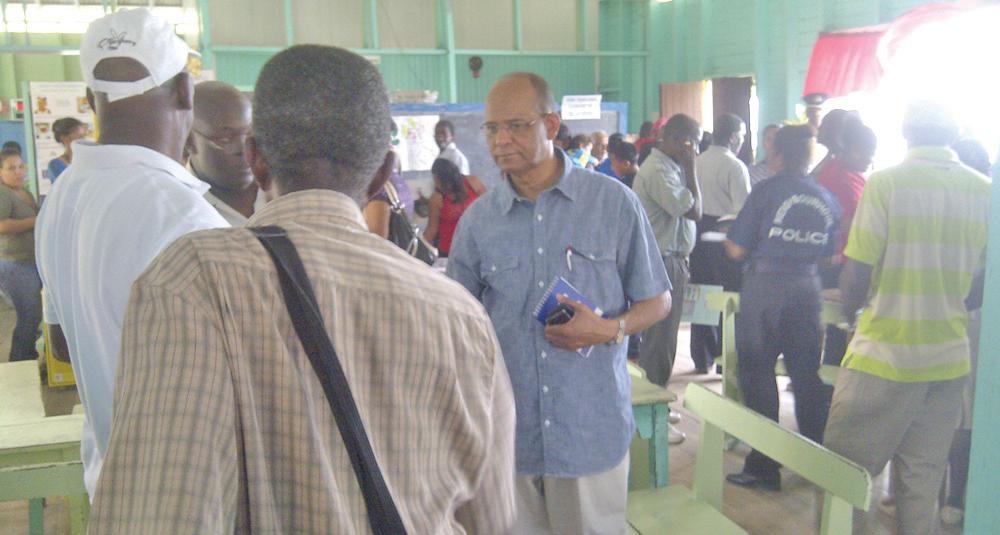
Home Affairs Minister Clement Rohee on Saturday assured Essequibians that there will be "no more shouts for justice" for minor problems, as he launched another instalment of the Houses of Justice Project in Region Two.
Addressing policemen, residents and other government officials at the Aurora Primary School on the Essequibo Coast, Minister Rohee said often persons spend too much time accessing simple services, and this must change.
As such, he said the Home Affairs Ministry came up with a bold initiative, the first of its kind in Guyana, to assist residents in various communities.
Essential services
He said the project aims to help communities, or in other words, make essential services available to them.
He said the Houses of Justice are multi-agency centres within communities geared at addressing pressing social and safety needs of citizens at the community level. He said it is designed to improve access to public services.
The minister noted that the project is aimed at elimi-
nating the everyday frustration people face in accessing services, by bringing together key agencies under the same roof.
Rohee said many times persons complain of not receiving justice and, with the launch of the project in Region Two, the issue of “not getting justice” will be resolved at the community level.
Make maximum use
The minister urged persons to make maximum use of the service since it is readily available free of cost. He said a special committee will be set up to analyse the work done by the Houses of Justice and recommendations will be made for improvement.
Giving an overview of the project, Coordinator Shawn Coonjah said the initial phase of the project will see the ministry bring together staff from the Guyana Police Force, the General Registrar's Office, the National Insurance Scheme, the Guyana Power and Light, the Human Services Ministry and community policing volunteers to render services and advise residents of the communities where these facilities are located.
He said the Region Two centres will be established at
Charity, Dartmouth, Suddie, Aurora and Kabakaburi.
Meanwhile, Region Two Chairman Parmanand Persaud welcomed the service in the various communities, and thanked the Home Affairs Ministry for the introduction of the project in his region.
Persaud noted that he will be spreading the word on the availability of the services that will be provided.
Issues to be addressed
He said there are many issues that need to be addressed within the various communities, and as such, he said the project was introduced in the region at an opportune time.
The regional chairman said there has been a significant increase in domestic violence, drugs trafficking and land issues in Region Two, and called on the officers of the Guyana Police Force to act promptly in addressing these matters. Persaud said while he is happy that many drug traffickers are apprehended, he contended more still needs to be done to comprehensively address the issue.
On that note, he said the project provides an opportunity to address the problem, and urged all to make maximum use of the facilities available.
ABerbice taxi driver was on Saturday taken into custody after police ranks found a round of 7.62x51 mm ammunition on his bedroom ledge at Angoy’s Avenue, New Amsterdam.
A report of assault was made against Lawrence Lewis called “G”, 27, of Timmer’s Dam, Angoy’s Avenue, but as police ranks went to investigate, they discovered the ammunition in the man’s bedroom. As a result, Lewis was told of the allegation, cautioned and arrested.
Guyana Times understands that the ammunition
is used in a M14 rifle or a M60 high powered machine gun. It is also similar to the ammunition used in a .308 Winchester firearm.
However, according to reports, after the police went to the home of the taxi driver to investigate the report made against him by his wife, he was in the yard and told ranks that he needed to change his clothes.
Not taking any chances, the constable escorted him to his bedroom where he saw one blank 7.62x51 mm round on a ledge. The constable took possession of the said ammunition and when questioned, Lewis explained
that he found it about six to seven years ago on the Soesdyke/Linden Highway.
The taxi driver was arrested and taken to New Amsterdam Police Station along with the ammunition, where it was initialled, placed in a white enveloped, sealed, lodged and handed over to the officer-in-charge.
Lewis reportedly gave a written statement under caution, stating that he found the bullet when he went to a solider camp at Seweyo.
He is in custody at the Reliance Police Station pending investigations and charges.

Breastfeeding Week
2013 opened with a religious ceremony at the Georgetown Public Hospital (GPH) on Sunday under the theme “Breast feeding Support: Close to Mothers”.
The event was not only held to emphasise the importance of breastfeeding, but also to usher in the first born.
Addressing scores of mothers and their bouncing baby boys and girls, along with medical personnel in GPH’s Postnatal Maternity Unit, Breastfeeding Coordinator Marjorie Arjune advocated for societal sup-
lenges, Arjune said mothers should practice exclusive breastfeeding for the first six months, noting that it is economical and guard babies against illnesses.
Exclusive breastfeeding decreases the chance of babies experiencing diarrhea and vomiting, similarly chest and ear infections and constipation can be avoided.
Children, who are breastfed, are less likely to become obese and therefore the possibilities of developing Type two diabetes and other illnesses later in life are very low. In addition to the health talk, those presented were
should exclusively breastfeed the child, so we did that for a year, so all of our children we breast fed for a year.”
Overwhelmed with joy
Stella Benjamin, 35, who hails from a small village called Hotoquai in Mabaruma, Region One, was overwhelmed with joy when she spoke to this publication. Benjamin gave birth to the first boy on Sunday at the GPH at 03:37h. She now has two boys and two girls.
“I am so glad this morning, I wasn’t expecting it, but my son has bringing great joy to me. I am happy we could

port, noting that the benefits to be derived from exclusive breastfeeding are tremendous.
“I want to encourage the people in the community to support mothers who are breastfeeding and we call on all government agencies as well to support this venture”, she said.
Peer counseling
However, Arjune said mothers themselves should encourage each other as she endorsed the notion of peer counselling. She explained that the “best person who can support a mother is another mother who is experiencing the same problem”.
Although mothers practise breastfeeding following delivery, reports have shown a steady decline in exclusive breastfeeding after several weeks. Amid chal-
equipped with the word of God, with a general call for children to grown up in the ways of the Almighty.
In marking Breastfeeding Week 2013, the GPH also donated tokens of appreciation to the two mothers who delivered the first babies on Sunday September 15. At 00:47h on Sunday, Deborah Aulder, 37, delivered the first child; a bouncing baby girl.
The mother of four, who hails from Enmore, East Coast Demerara, expressed gratitude to the hospital for the token of appreciation.
Aulder told Guyana Times that since the birth of her first child, she has been embracing exclusive breastfeeding, noting that the trend will continue this time around. “When I got my first child, the father said we
have heard the word and like the preacher said, he is a gift from God and must be cherished.”
International Breastfeeding Week was first launched 21 years ago under the theme “Baby-Friendly Hospital Initiative”.
At the time, it was an initiative undertaken by the World Alliance for Breastfeeding Action (WABA), but to date, it has expanded to include other organisations such as the World Health Organisation (WHO) and the United Nations Children’s Fund (UNICEF), among others.
During the week of activities, information is disseminated throughout the world as guides to protect and support exclusive breastfeeding for the first six months of babies lives.
monday, september 16, 2013
Atlantic Hotel Inc (AHI)
Chairman Winston Brassington has dismissed claims that a British Virgin Islands investor intends to buy the Marriott Hotel building for US$10 million.
In a statement on Saturday, Brassington said the claims made in another local newspaper are absolutely untrue.
Brassington said he told the publication that the AHI is in the closing stages of a deal with a foreign investor and that the name of this investor will be announced when there is financial closure.
Public disclosures
He said, in general, private investors are usually reluctant to make premature public disclosures about their business, and in this case, there is greater apprehension to do so given the hostile and unwelcoming political envi-
ronment created by the opposition parties.
“Nevertheless, the private investor is aware, and acknowledges, that given its intended relationship with the government of Guyana, it will be required to make a public announcement, which it is prepared to do at the appropriate time,” Brassington explained.
Construction of the Marriott Hotel and Entertainment Complex remains a priority for the government of Guyana.
While construction of the outer shell of the building is complete, design works on the interior continue, requiring great care and review in order to ensure that all aspects of design and construction achieve the Marriott Hotel standards for functionality and operations, Brassington said.

According to the publication's article, leader of the Alliance For Change (AFC) Khemraj Ramjattan said government was approached by a British Virgin Islandsincorporated investor to buy the building as is for US$10 million, as it is “finding it difficult to attract the investors and syndicated loans” to complete the hotel.

Guyana Rice Development Board (GRDB) General Manager Jagnarine Singh said the paddy bug infestation of rice crops in Region Two is under control.
Singh made the disclosure at a farmer’s field day held at Johanna Cecila on the Essequibo Coast last week. He said despite the many challenges rice farmers faced throughout Guyana, the yield has been good.
The top GRDB official said that a team of officers was dispatched to Region Two and visits were made to various rice mills. He said the team was surprised by the quality of
paddy harvested and the low infestation of bugs that was recorded.
The general manager, during his address to rice farmers from Regions Two, Three, Five and Six, said the paddy bug infestation was a major challenge to the rice industry as he acknowledged the damage it caused to rice cultivation in the first crop.
Singh commended the efforts by his staff and support given by farmers during the bug-infestation period.
He said the situation was seriously analysed and a number of measures were taken.
Singh said the GRDB field officers were out almost every weekend in the various regions sensitising farmers, doing demonstrations and offering assistance to farmers to address the situation.
He said the public awareness campaign and the demonstration paid off, noting that during harvesting, a small number of paddy bugs were noticed in the fields.
The average yield per hectare is 5.2 tonnes. Region Two farmers are presently harvesting and are receiving prices ranging from $4500 to $3500 per bag of paddy.
“This is not true and an inaccurate reflection of where the project stands to date.
"Ignore the truth"
"However, it has become a norm and acceptable for politicians and journalists to ignore the truth or facts in order to create doubt and mistrust in public officers, projects and general progress,” Brassington said in dismissing Ramjattan's claims.
The US$51 million edifice will have 197 rooms. It will boast a large ballroom, conference centre, a casino, entertainment complex, restaurant, concrete walkway, swimming pool, sport facilities, and all other amenities of a world-class hotel.
The night club and casino are on the western end of the hotel, while the ballroom is on the eastern end.
There are about 60 rooms on each floor, with the presidential suite on the 10th and final floor.


An opinion survey conducted in early August by the North American Caribbean Teachers Association (NACTA) found that the ruling People’s Progressive Party/Civic (PPP/C) leads the opposition in voter support in the event early elections are called to resolve the parliamentary impasse brought about by the November 2011 general elections.
However, the combined opposition enjoys a one-seat majority.
Voters are divided on whether a snap election should be called now, with a majority of voters saying they do not think any party will win a majority of seats in another election.
The poll also found that Education Minister Priya Manickchand; Housing Minister Irfaan Ali; Agriculture Minister Dr Leslie Ramsammy; Attorney General Anil Nandlall; Finance Minister Dr Ashni Singh; Natural Resources and Environment Minister Robert Persaud; Health Minister Dr Bheri Ramsaran; Culture, Youth

and Sport Minister Dr Frank Anthony and Labour Minister Dr Nanda K Gopaul are rated among the top performing ministers of the government.
These and other findings were obtained in the poll that queried voters for their views on a number of policy programmes.
The poll randomly interviewed 520 voters to yield a demographically representative sample (44 per cent Indian, 30 per cent African, 16 per cent mixed, nine per cent Amerindian, and one per cent other races) of the population.
The poll was conducted in face-to-face interviews and was coordinated by Vishnu Bisram, pollster, newspaper columnist, and educator based in New York.
The results of the poll were analysed at a 95 per cent significance level and a statistical sampling error of plus or minus four percentage points was found. Sampling results based on sub-groups (such as Indians or Africans) have a larger sampling error of about five per cent.
Asked who they feel
is the “best minister”, Manickchand leads with 17 per cent, closely followed by Ali (16 per cent); Dr Ramsammy (11 per cent); Nandlall (10 per cent); Dr Anthony (nine per cent); Ramsaran (eight per cent); Dr Singh (seven per cent); Persaud (seven per cent) and Dr Gopaul five per cent.
Asked if they think the government should call a snap election to resolve the parliamentary impasse that prevents the ruling party from carrying out its planned programmes, 43 per cent said yes, 40 per cent said no, and 17 per cent said they are not sure. Many voters said the parties should try to work together for the benefit and betterment of the nation, expressing a view that they do not think any party will win a majority at the next election.
Asked which party they would vote for if a snap election is called, 46 per cent said PPP/C, 37 per cent said the A Partnership for National Unity (APNU), and seven per cent said the Alliance For Change (AFC), with 10 per cent undecided.

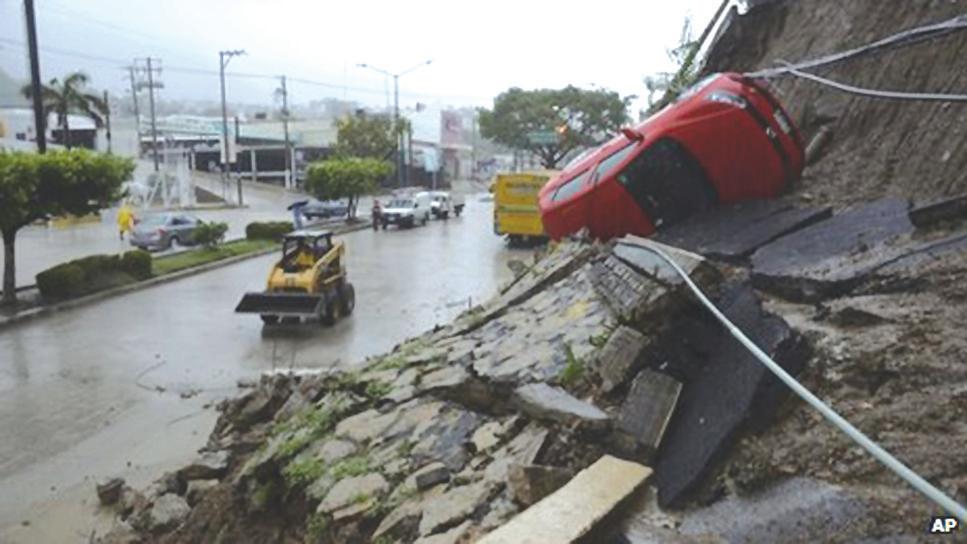
At least 17 people have been killed in Mexico as a hurricane and a tropical storm converge on the country. Two days of torrential rains and high winds have caused floods and landslides in several states.
Hurricane Ingrid is expected to make landfall on Mexico’s Gulf coast to-
day, while Tropical Storm Manuel approaches from the Pacific. The severe weather led to the cancellation of Independence Day celebrations in many Mexican towns.
Thousands of people have been forced to leave their homes.
On the Gulf of Mexico,
AMiami-based Cuban activist group, Democracy Movement, plans to move its protests against The Bahamas to Florida airports that have flights to the islands.
The new round of protests will focus on the rights of women who are housed at a detention centre in The Bahamas, group spokesman Ramon Sanchez said.
Democracy Movement also wants to meet with the Human Rights Commission of the Organisation of American States (OAS) to discuss alleged abuse of Cuban detainees at the facility.
Sanchez told The Nassau Guardian the group met with representatives from Carnival Cruise Lines last week to discuss the alleged abuse. A Carnival represen-
tative confirmed on Friday that executives met with Democracy Movement but did not offer further comment.
Sanchez said the group will not relent until the government releases the final report on an investigation into alleged abuse at the centre. The group also wants the government to put in place measures intended to prevent abuse of detainees and expand its investigation to include allegations of sexual abuse.
Sanchez said Democracy Movement is tired of hearing of delays in the investigation.
“We are certainly not going to rest until this issue is dealt with in a professional and substantial way,” he said. “We have several meetings lined up in the next few weeks. (Excerpt from Caribbean News Now)
more than 6000 people have been evacuated ahead of Hurricane Ingrid, which is expected to make landfall in hours.
It already has winds of 120km/h (75mph), causing widespread damage particularly in Veracruz and Tamaulipas states. Tropical Storm Manuel has hit the western coast, on the Pacific Ocean, bringing almost twice the monthly rainfall in just three days.
The states of Oaxaca, Guerrero, and Chihuahua have been the worst hit with some road and telecommunications links down. The BBC’s Will Grant in Mexico City says that Hurricane Ingrid is the second major storm of the hurricane season and has been steadily gathering strength in the Gulf of Mexico. (Excerpt from BBC News)
The United States Coast Guard on Saturday revealed the seizure of over 6000 pounds of marijuana in the Caribbean Sea.
The Coast Guard said the crew of the Cutter Thetis offloaded the drugs at Coast Guard Sector Key West, Florida on Wednesday last, stemming from two different Caribbean Sea interdictions.
In the first interdiction, it said the Thetis crew located a 30-foot go-fast vessel during a routine patrol. Using an over the horizon small boat, the Coast Guard said the Thetis boarding team “approached and witnessed the suspected smugglers aboard the gofast vessel jettison packages of contraband overboard.”
The suspects apprehended and the crew and recovered 69 packages, which later tested positive for marijuana.

A14-year-old boy perished in a house fire in Bolans early Sunday morning.
The teenager could not be accounted for after the smoke had cleared and lawmen who conducted a search among the debris came up empty-handed.
Residents carrying out a search after the police and fire personnel left the scene, made the gruesome discovery of the body.
The fire occurred just be-
The premier of Nevis has taken issue with what he considers interference in the running of the Federal Parliament by Prime Minister Denzil Douglas. Premier Vance Amory, an opposition Member of Parliament (MP) in the Federal Parliament, has suggested that Douglas is not observing the separation of powers that allows the parliament to be run by the
Speaker of the House. His concerns were raised at a news conference organised by the Unity Partnership involving Amory’s Concerned Citizens Movement, the People’s Action Movement and the recently launched People’s Labour Party of former senior government ministers Dr Timothy Harris and Sam Condor.
“Clearly the parliament is being manipulated to satis-
fy the prime minister and the agenda of the prime minister. That is something which, not left to just those of us who are here, but the people of this country have to begin to take this thing seriously,” Amory told reporters. He also made reference to the ninemonth-old motion of no confidence in the government of Prime Minister Douglas, filed last December but not yet tabled or debated. (Excerpt from Caribbean News Now)
fore 03:00h Sunday morning and the body was found about five hours later in the bedroom at the front of the house.
The lad was a student of the St Mary’s School of Excellence. His step-father, who was at home when the blaze started, had to be taken to hospital for high blood pressure. The 14-year-old is the fourth minor to die in a house fire for the year in Antigua. (Antigua Observer)

In another interdiction, a U.S. Coast Guard Law Enforcement Detachment (LEDET) aboard a United Kingdom Royal Fleet Auxiliary vessel, assigned to Joint Interagency Task Force South (JIATFS) detected a Jamaican fishing vessel jettisoning packages overboard.
The U.S. Coast Guard said the Jamaican Defence Force authorised the LEDET to board the flagged vessel and apprehend the suspects, recovering 55 packages, which later tested positive for marijuana. The total contraband weighed approximately 6250 pounds, with a wholesale value of more than US$5.5 million. (Jamaica Observer)
St Lucia not likely to decriminalise use
Asenior government minister says while he supports the idea of a regional debate on the legalisation of marijuana, St Lucia is unlikely to give any consideration to decriminalisation of the drug in the near future.
“I would certainly welcome Caricom giving a more detailed examination of this issue even if it is only for the purpose of advising the governments as we go forward, on what all the facts are on all sides of the debate and allow governments an opportunity to continue to look at this controversial issue in a critical way”, said Home Affairs Minister Phillip La Corbiniere.
In a letter sent to regional leaders earlier this month, St Vincent and the Grenadines Prime Minister Dr Ralph Gonsalves called on the region’s political and civic leadership to debate the decriminalisation of marijuana for medical purposes. Gonsalves said he wanted the issue raised at the Caricom Bureau heads meeting in Port of Spain on Tuesday. But la Corbiniere, who is also national sercurity minister, said what he gleaned from Gonsalves’ letter is for the 15-member Caricom grouping to discuss the issue and had no problem with that approach. (Excerpt from Antigua Observer)

The Jamaica Constabulary Force (JCF) says that 507 illegal firearms have been seized up to September this year, compared to 417 for the same period in 2012.
Meanwhile, the JCF has reported that over the past week lawmen across the island have recovered seven pistols, one .38 revolver and approximately 98 assorted rounds of ammunition.
The eight weapons and ammunition were seized in the St James, Kingston West, Hanover, Manchester, Kingston Central and St Catherine North Police divisions, the police say. Six people were arrested and taken into custody in relation to last week’s seizures. (Jamaica Observer)
Syria’s government hailed as a “victory” a Russian-brokered deal that has averted U.S. strikes, while President Barack Obama defended a chemical weapons pact that the rebels fear has bolstered their enemy in the civil war.
President Bashar alAssad’s jets and artillery hit rebel suburbs of the capital again on Sunday in an offensive that residents said began last week when Obama delayed air strikes in the face of opposition from Moscow and his own electorate.
Speaking of the U.S.Russian deal, Syrian minister Ali Haidar told
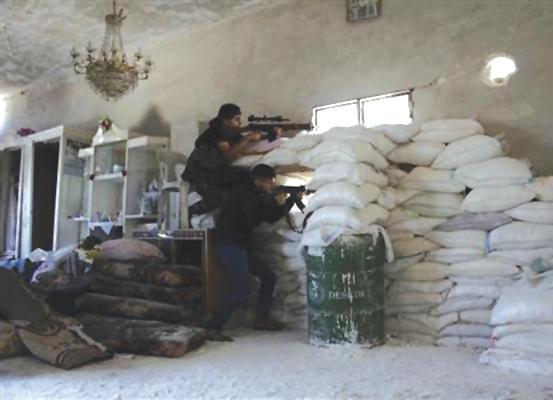
Moscow’s RIA news agency: “These agreements... are a victory for Syria, achieved thanks to our Russian friends.
Philippine troops are closing in on Muslim rebel positions and cutting off escape routes to end a week-long standoff that has left more than 60 people dead in the southern city of Zamboanga, officials said.
Thousands more residents have fled, while sporadic clashes continued as soldiers moved to clear Moro National Liberation Front (MNLF) gunmen from coastal neighbourhoods after a ceasefire plan collapsed.
“We are continuing to press forward with our calibrated military response,” military spokesman Lieutenant Colonel Ramon Zagala told AFP news agency on Sunday.
“Fighting is continuing as we speak. They continue to resist and conduct offensive actions against us.”
Heavily armed MNLF forces entered the port city’s coastal neighbourhoods last Monday and took dozens of hostages in a bid to scupper peace talks between another rebel group and the government aimed at ending a decades-long rebellion in the south.
But Zagala said the fighting was concentrated in two coastal districts, while other areas were now secure. Al Jazeera’s Jamela Alindogan, reporting from Zamboanga, said: “Up to now, the details on the ground remain sketchy.” (Excerpt from Al Jazeera)
Though not close to Assad, Ali was the first Syrian official to react
to Saturday’s accord in Geneva by U.S. Secretary of State John Kerry and Russian Foreign Minister Sergei Lavrov. Bridging an angry East-West rift over Syria, they agreed to back a nine-month UN programme to destroy Assad’s chemical arsenal.
The deal has put off the threat of air strikes Obama made after poison gas killed hundreds of Syrians on August 21, although he has stressed that force remains an option if Assad reneges. U.S. forces remain in position. Russia still opposes military action but now backs possible UN sanctions for non-compliance. (Excerpt from Reuters)
Welcoming the news that Russia and the United States have reached an agreement on a framework for Syria to destroy all of its chemical stockpiles, United Nations Secretary-General Ban Kimoon has also announced the Syrian government’s formal accession to the international treaty on banning chemical weapons, effective October 14.
A statement issued by his spokesperson in New York confirms that the SecretaryGeneral, in his capacity of the depositary of the 1992 Convention on the Prohibition of the Development, Production, Stockpiling and Use of Chemical Weapons and on their Destruction, re-
ceived the formal instrument of accession to the treaty by Syria.
“The Convention will enter into force for [Syria] on the 30th day following the date of deposit of this instrument of accession, namely on October 14, 2013”, the statement says, adding that the Convention can be acceded to at any time and that the UN chief welcomes Syria’s decision.
In a separate statement released, Ban welcomed the agreement reached by Russian Federation Foreign Minister Sergei Lavrov and United States Secretary of State John Kerry on a framework for the safeguarding and destruction of Syria’s chemical weapons stockpiles. (Excerpt from UN News Centre)
World saved some 90 million children, but likely to miss global target, UN agency reports
Global and national efforts to end preventable deaths of children under five years of age saved some 90 million lives in the past two decades, but at the current rate, a universal promise to reduce child mortality by two-thirds by 2015 will not be reached, the United Nations Children’s Fund (UNICEF) reported.
“Yes, we should celebrate the progress,” said Anthony Lake, UNICEF Executive Director. “But how can we celebrate when there is so much more to do before we reach the goal? And we can speed up the progress – we know how, but we need to act with a renewed sense of urgency.”
The Italian island of Giglio made final preparations Sunday on the eve of an unprecedented attempt to raise the 114,500-ton Costa Concordia cruise ship from its watery grave.
Salvage workers could be seen fixing the giant metal chains and cables that will hoist up the wreck measuring 290 metres (951 feet) in length, roughly the equivalent of three football fields.
The civil protection agency, which is overseeing the project, gave its final goahead on Sunday, saying the weather forecast looked favourable. The biggest salvage of a passenger ship ever attempted is to begin shortly after 6:00h (0400 GMT) today and could last up to 12 hours.

Final preparations were being made Sunday ahead of a recordbreaking attempt to raise the wreck of the Costa Concordia cruise ship, due to begin this morning. The ship capsized after hitting rocks off the Italian island of Giglio in January 2012

according the report released, 2013 Progress Report on Committing to Child Survival: A Promise Renewed.
The reductions are due to more effective and affordable treatments, improvements in mothers’ nutrition and education, innovations in bringing critical services to poor and excluded people and sustained political commitment.
The number of deaths fell to 6.6 million in 2012 from 12.6 million in 1990,
Unless progress is sped up, however, it will take until 2028 before the world meets the target set by the Millennium Development Goal (MDGs) to reduce overall child mortality by two-thirds by 2015. (Excerpt from UN News Centre)
Awave of car bombings and other attacks in Iraq killed at least 53 people on Sunday. The recent increase in violence, the worst since 2008, has raised fears that the country is returning to the level of killing that pushed it to the brink of civil war after the 2003 U.S.led invasion.
More than 4000 people have died since the start of April, including 804 just in August, according to the UN. Sunday’s deadliest at-
tack was in the city of Hilla, 60 miles south of Baghdad, where a car bomb near an outdoor market killed nine and wounded 15, a police officer said. A few minutes later, another car bomb went off nearby, killing six and wounding 14.
In the nearby town of Iskandariya, 30 miles south of the capital, a bomb went off in a car park, killing four and wounding nine, police said. Another car bomb went off in an industrial area of the Shia
city of Kerbala, killing five and wounding 25, a police officer said. Kerbala is 50 miles south of Baghdad. In the aftermath, security officials inspected burnt-out cars in front of what appeared to be a smashed row of workshops.
In Kut, another Shiadominated city 100 miles south-east of Baghdad, a car bomb targeted construction workers and food stalls, killing two and wounding 14, another provincial police officer said. (Excerpt from The Guardian)
JOnce the Costa Concordia is upright, the plan is to stabilise it, refloat it and then tow it away for scrapping in
“Tomorrow (Monday) we will show that everything we have imagined, thought of and calculated will happen as planned,” Franco Gabrielli, head of the civil protection agency, told reporters on the island.
a shipyard early next year. The South African leader of the operation, Nick Sloane, has warned it is now or never for the Costa Concordia because the hull is gradually weakening and might not survive another winter. (Excerpt from France24)
apan is shutting down its last functioning nuclear reactor, with no timetable for a restart. Reactor 4 at Ohi in western Japan stopped generating electricity in the early hours of this morning.
Analysts say Japan will be without nuclear power until December at the earliest, the longest shutdown since the 1960s. The Japanese public turned
against nuclear power after the meltdowns at the Fukushima plant in 2011.
Before the accident, which was caused by a massive earthquake and tsunami, nuclear plants supplied about 30 per cent of Japan’s power. But since then the plants have been closed, either for scheduled maintenance or because of safety fears, and have not been restarted.
Japan went without nuclear power during May and June last year, but operator Kepco was allowed to restart its reactors at Ohi. The government has been under pressure to tighten safety standards to allay public fears.
Analysts say it will take around six months to clear all of the safety checks and legal hurdles involved in a restart. (Excerpt from BBC News)
The University of the West Indies (UWI) St Augustine Campus has partnered with the National Gas Company (NGC) to host an historic UWI Research Expo from October 1-5. The multi-faceted event will feature interactive displays, a symposium on research, enterprise and impact, film screenings, concerts, over 30 mini-workshops, as well as a UWI Marketplace and Kids Fun Park.
Speaking at the official
launch of the UWI Research Expo, campus principal Professor Clement Sankat promised that it would be “informative, engaging, exciting and memorable.” He said: “Our students and researchers are passionate about what they do, they have an innate curiosity about the world and they continue to partner with local and international stakeholders to develop their innovations.”
Guest speakers at the launch, Pro Vice-Chancellor
Research at UWI, Professor Wayne Hunte; CEO of the Trinidad Chamber of Industry and Commerce, Catherine Kumar, and NGC president, Indar Maharaj, all lauded the university for hosting the timely event.
Next month, the UWI Research Expo kicks off with a day filled with everything chocolate, at the Cocoa Research Centre’s hosting of World Chocolate Day at the JFK Auditorium on October 1. (The Guardian)
Former U.S. Treasury
Secretary Larry Summers has withdrawn his candidacy to succeed Ben Bernanke as head of the U.S. central bank, the Federal Reserve.
In a letter to President Barack Obama, quoted by the Wall Street Journal, Summers said any confirmation process for him was likely to be “acrimonious”.
Summers was one of the front-runners for the post, along with current Fed vicechairman Janet Yellen. Obama said he had accepted Summers’ decision.
The president said in a statement: “Larry was a critical member of my team as we faced down the worst economic crisis since the Great Depression, and it was in no small part because of his ex-
Representatives from the International Monetary Fund (IMF), the European Commission and the European Central Bank have begun their latest audit of Portugal’s economic health.
A raft of reforms was promised by Portugal’s leaders in return for its May 2011 bailout. The visit from the socalled troika will determine whether the country receives
its next instalment of bailout funds.
It is expected to meet the criteria. The visit was originally expected to take place in July of this year, but was postponed following a political crisis. There are fears that Portugal’s economy remains volatile, and borrowing costs have climbed again in recent months.
The yield on a benchmark 10-year Portuguese govern-
pertise, wisdom, and leadership that we wrestled the economy back to growth and made the kind of progress we are seeing today.”
Obama added that he would always be grateful to Summers for his “tireless work and service on behalf of his country” and looked forward to continuing to seek his guidance and counsel in the future. (BBC News)
Uganda and 10 other African countries have started drafting a comprehensive policy that seeks to promote aquaculture, with the private sector as the major player.
The fisheries officials and government representatives from the Eastern Africa region meeting in Kampala said their governments have realised that the private sector can play a big role in boosting the contribution of the fishing industry to national income.
The officials met at
Hotel Africana in Kampala to evaluate the contribution of the Africa Caribbean Pacific (ACP) phase II fish programme in strengthening fisheries management in their countries. The programme that winds up in November is funded by the European commission (EC).
The acting head of the fisheries sector for Uganda, Lovelock Wadanya, said the European Commission funded process of developing a regional policy framework for aquaculture was in advanced
stages. “The comprehensive policy framework will promote aquaculture as a business and encourage the private sector to take the lead,” he added.
Wadanya said Uganda wants to use the framework to encourage large scale fish farming by identifying potential private sector players, assist them to access credit or enter into partnership with them to develop the fishing industry which is one of the largest foreign exchange earners for the country. (allAfrica)
This time, Japan keen to learn from Fed’s
As markets tune into how the Federal Reserve is going to rein in its massive stimulus programme, so is the Bank of Japan (BoJ).
The BoJ, the pioneer of so-called quantitative easing, is still years away from tapering off its own extraordinary stimulus programme so it has the luxury of watching the U.S. central bank go first.
But the more that the
BoJ is able to push inflation towards its policy target of two per cent – compared with less than one per cent now and following years of deflation – the more attention financial markets will pay to how Japan’s exit debate is shaping up. For now, all eyes are on the Fed.
It is widely expected this week to announce a trimming of its US$85 billion bond-buying programme, a delicate operation of com-
municating its plans to fickle investors without causing financial market turmoil. Those market expectations have already led to an emerging market rout this year.
“The difficulty of exit is already proven by the Fed,” said a source familiar with BoJ thinking. “Just hinting about tapering has jolted markets, probably much more than the Fed had thought.” (Reuters)
ment bond soared above the seven per cent barrier earlier this summer. That is the level at which other European countries have sought a bailout.
However, while unemployment in Portugal is amongst the highest in the eurozone, especially amongst the young, the country reported growth of 1.1 per cent for the second quarter of 2013, after a boost to its export market. (BBC News)
Dubai property giant Emaar is to launch sales of units at its upcoming The Address Fountain Views hotel in the emirate’s Downtown district.
Service apartments at The Address Residence Fountain Views III will go on sale simultaneously in Dubai, Abu Dhabi, London and Jeddah on September 21, with online registrations opening on September
18.
Located opposite the developer’s flagship Dubai Mall, the project will offer one, two and three-bedroom serviced residences. Apartments will also offer buyers views of Burj Khalifa, the world’s tallest building.
“The Address Residence Fountain Views III is a stunning tribute to Emaar’s commitment to provide world-class service, awe-
inspiring design, and unparalleled architecture,” commented Ahmad Al Matrooshi, managing director, Emaar Properties.
“Located in the heart of our flagship development, Downtown Dubai, The Address Residence Fountain Views III provides investors from across the world the opportunity to reside in one of the most dynamic communities in the city,” he added.(Arabianbusiness)

Months of anticipation will come to an end this week when the Federal Reserve finally says whether it will start to rein in its massive stimulus of the economy, which has flooded financial markets with some US$2.75 trillion over the past five years, supercharging returns on everything from stocks to junk bonds.
But for all the concerns that the reduced presence of such a giant asset buyer would be calamitous for in-
tenancy.
vestors, it appears equity and bond markets are poised to take this week’s Fed decision largely in stride –provided the central bank doesn’t surprise with the size of its move or shock in some other way.
The Fed has telegraphed its intentions to pare back its monthly purchases of US$85 billion in bonds at its two-day meeting that ends on Wednesday. The scale of the tapering and what Fed Chairman Ben Bernanke might say at his press con-
ference are key here, but the steady messaging in the last few months means the coming week probably will not see carnage in the markets.
Investors have already done a lot of work in absorbing the Fed’s message.
Benchmark bond yields are now hovering near twoyear highs, while stocks have edged off highs reached in early August, removing some of the froth that had started to concern some investment strategists. (Reuters)

When it comes to priorities, education has always taken the top spot as it has been recognised globally that poverty has a direct impact on development.
In Guyana, to ensure that the children’s education is sustained and improved, the government has, taken an aggressive stance and has, and continues to make the necessary investments.
To date, under the ruling administration, over $270.3 billion has been invested in the education sector, an indication of the value the government places on education.
Over the last two decades, the funding has been put towards the improvement and construction of facilities including schools, teachers’ quarters and Information Communication Technology (ICT) laboratories, teacher training, curriculum preparation and new initiatives such as the school feeding and uniform assistance programmes.
Education as a percent-
age of the national budget rose from 4.4 per cent in 1990, to an average of 15 per cent over the past seven years, a Government Information Agency (GINA) release stated.
Teacher training
One of the main goals of the 2008-2013 Education Strategic Plan has been to achieve a 70 per cent rate of trained teachers in the system. With the graduation of 862 teachers from the Cyril Potter College of Education (CPCE) in 2012, that goal was surpassed.
Importantly, the number of persons interested in the profession has improved while the number of teachers leaving Guyana has also decreased.
In recent years, there have been more earnest strides towards improving the quality of teachers and this was evident in 2010 when the US$4.2 million Guyana Improvement Teacher Education Project (GITEP) was initiated. An
additional $200 million was budgeted in 2011 towards this programme.
It not only ensured trainee teachers bettered themselves, but lecturers at the CPCE and those attached to the University of Guyana School of Education and Humanities were also given the opportunity to improve their qualifications.
For those teachers who hail from the hinterland regions and are unable to attend the CPCE central campus, they are able to access training through the distance education mode via the Guyana Basic Education Training (GBET). To date, this intervention has trained more than 1200 teachers and over 400 heads of schools.
Since the start of 2013, increased attention has been on the advancement and promotion of Technical and Vocational Education and Training (TVET). This was evident with the hosting of a stakeholder consultation

which gave participants the opportunity to peruse and discuss the TVET policy –TVET Guyana Vision 2020 – that seeks to facilitate a regional and concerted approach that guides TVET reform.
New technical institutions such as those at Leonora and Mahaicony will further TVET interest locally.
In keeping with the ICT thrust, the University of Guyana’s Education and Humanities School and the CPCE received a boost to deliver ICT training to teachers. Both entities are now equipped with state-of-theart IT laboratories as part of the government of Guyana, Inter-American Bank (IDB) funded GITEP.
CPCE now has two labs and equipment worth $22.4 million while the lab at UG is outfitted with 30 work stations which cost $8 million. Additionally, GITEP has also funded the distribution of ap-
proximately 600 notebook computers to students and staff at CPCE and the satellite centres.
The Guyana Learning Channel which was launched on April 1, 2011, installed another dish in 2013 allowing residents of Moraikobai, an Amerindian village in Region Five, to view the offerings of the channel.
It has about 200,000 viewers and is received in distant areas such as Mahdia, Region Eight; Aishalton, Annai, and Lethem, Region Nine; and Port Kaituma, Region One. The learning channel allows for all kinds of programmes that will help children’s learning process.
One of the major initiatives in the education sector has been the focus on harnessing ICT, to aid the delivery of quality education. To date, this project has incurred $147 million in preparatory costs while $56 million has been budgeted for its operations in 2011.
Moreover, 1300 nurs-
ery, primary and secondary school teachers were trained during the first half of the year in ICT, and training continued during the July/ August vacation. Thirty-five IT labs are expected to be completed this year, while 3000 teachers will be trained in ICT literacy this year.
Infrastructure
Providing and refurbishing infrastructure has been a most crucial plank in the government’s plan to improve the quality of education delivered to the nation’s students and over the past two decades, about 1000 schools have been built or renovated in the 10 administrative regions. Among the recently built schools are the $16 million C Field Sophia Nursery, the $58.3 million Parfaite Harmonie and $45 million De Hoop primary schools, the $293 million Leonora Secondary School, the $77.7 million Sand Creek Secondary School and the $427.5 million Leonora Technical Institute.
The Home Affairs Ministry recently launched the Cops and Faith Community Network (CFCN) in collaboration with the Guyana Police Force (GPF) and the clergy and the faith-based community in Guyana to bring peace within communities.
The initiative seeks to eliminate offences such as cruelty to animals, domestic violence, threatening behaviour and threatening language of persons, and damage to property, among others.
This programme will be rolled out in 10 selected communities in Regions Four and Six. They are Sophia, Agricola/McDoom, Plaisance, Buxton/ Friendship, Kilcoy/Chesney, Fyrish/Overwinning/ Glasgow, Edinburgh, Angoy’s Avenue, Port Mourant and Rose Hall.
Monitoring, evaluation
The programme will be carried out for six months with monitoring and evaluation, following which, Home Affairs Minister Clement
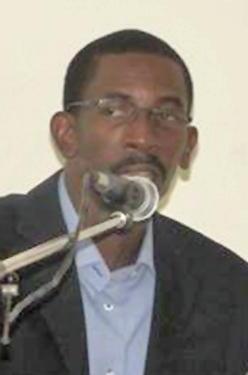
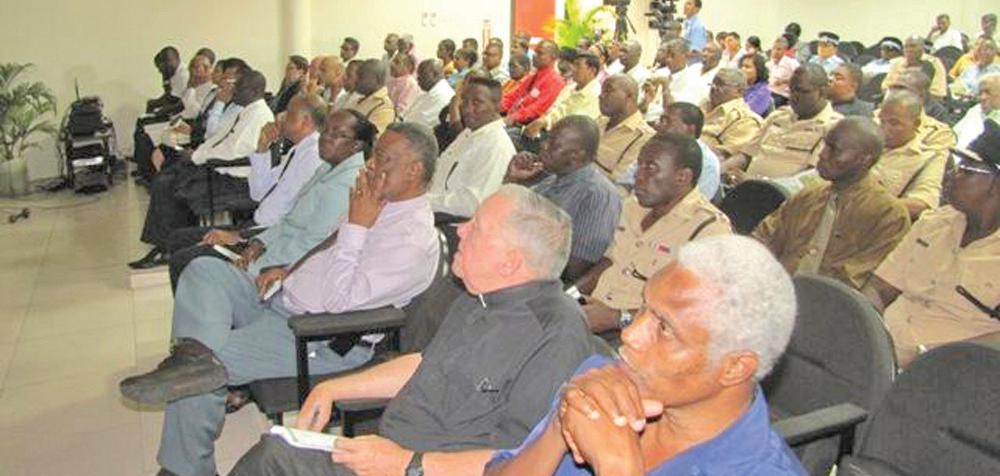
Rohee, based on progress reports, will decide whether it can be replicated in other areas.
Every six months there will be a meeting in the communities with the GPF and the religious and faithbased organisations along with residents to have an update on the programme, a Government Information Agency (GINA) release said.
Minister Rohee ex-
pressed satisfaction with the implementation of this programme and the response that the faith- based organisations and the GPF have shown.
All about people
“This project is all about people, it is what I would describe at a people centred project, aimed first and foremost at serving people in their respective communities,” Minister Rohee said.
“There are certain difficulties with, what people call
today, issues in life which neither the young nor the old seem to be able to grapple with, and that is exactly why certain manifestations of interpersonal violence, which never ever appeared in this country is appearing now in such rapid ways,” he said.
“I see this as a beautiful combination of law enforcement and moral enforcement. I am very pleased that the Guyana Police Force has bought into this concept and that it is now working towards its successful im-
plementation,” the minister stated.
Social Policy Adviser, Reverend Dr Kwame Gilbert, who conceived the idea of the CFCN, said the project seeks to ensure that other options can be utilised in dealing with youths who commit minor offences, rather than have them endure the penal system.
Conflict with the law
“It was first mooted in January 2012 by the local Community Action Component (CAC) meeting, at the level of the Citizens Community Programme, and is intended to deal with youths who will come into conflict with the law for minor offences. In this regard, it is a significant crime prevention effort,” he stated.
Meanwhile, Acting Police Commissioner Leroy Brumell pointed out that the GPF will pledge to give its best on this project. He added that it has promoted another partnership with religious organisations in communities.
Also at the launch of the CFCN were Home Affairs Ministry Permanent Secretary Angela Johnson, Human Services Ministry Deputy Permanent Secretary Patrick Findlay and Crime Chief Seelall Persaud.
He said the initiative has its origins in the COPS and Clergy Network of Red Lands California, U.S.A. and during a visit in 2012 to police departments in Los Angeles and Detroit, he was impressed with the way the initiative was working, and he shared it with Minister Rohee.















Letting emotional issues interfere with your ability to get things done will cause delays. You should concentrate on what you can accomplish, not what you cannot change.

By Bernice Bede Osol

(June 21July 22) (Jan. 20Feb. 19) (Dec. 22Jan. 19)
Education will be key today. Try to use your skills in diverse ways. Changing the way you approach your work will increase your earning potential.


An unusual subject, philosophy or form of entertainment will capture your attention. Prepare to debate as well as begin interesting friendships. Love and romance will enhance your day. Make needed alterations that will relieve you from unwanted responsibilities. You know what to do to improve your life –you just have to do it.
(July 23Aug. 22) (Feb. 20-March 20)
Take an innovative approach to investments. Spend more money on your image, developing your skills or marketing them, and a new revenue channel could open.

(March 21-April 19)
Give everything you’ve got when it comes to a situation that needs improvement. Use your versatile intelligence efficiently, and you’ll command newfound respect.

(April 20-May 20)
Refuse to let a minor problem turn into a major conflict. Go about your business and do whatever it takes to reach your goals. In the end, you will get your way.

(May 21June 20)
You will have to jump through hoops to get help. Try to wrap up what you can on your own, if you want to avoid wasted time and disappointment.

(Aug. 23Sept. 22)
Work with what you have to offer, while also keeping an eye on opportunities for expansion. Your skills are valuable and, if presented properly, will bring top dollar. Put time aside for romance.

(Sept. 23Oct. 23)
If you want to avoid a potentially harmful misunderstanding, communicate your thoughts and plans honestly and in full detail. Accept the inevitable.

(Oct. 24Nov. 22)
You may need to make a compromise in order to keep the peace on the home front. Good fortune is within reach if you are willing to share.

(Nov. 23Dec. 21)
You can offer your services or assistance, but don’t let anyone take advantage of your good nature. Focus on the positive changes you can make at home and to your financial situation.

ACCOmmODAtiON
Tourist villa apartments 1, 2 & 3 bedroom, long & short term, and car rental service. Phone: 227-2199, 227-2186

Dentures provided in 72 hours from as low as $4500. Contact Dr B Stuart, 209B Charlotte Street, Lacytown. Tel: 225-5034

Available: Fresh long-stemmed roses, fresh dried and silk floral arrangements, gift items, bridal boutiques and wreaths. Nesha’s Flowerland. 78 Church Street (opposite St George’s Cathedral). Tel: 227-3553/225-3315

Mixed breed pups. Phone: 253-3114, 692-0126
One 320 CL Excavator located at Mahdia; excellent working condition. Owner migrating, call 682-0365 or 614-1669
Gold Land, excellent investment.
Priced to sell, call 682-0365, 614-1669
Wine vessel (jue) Shang dynasty, old Chinese painting, old Ming prints, Ming dynasty Chinese painting on bamboo, Qi Baishi orginal painting, rare bowls and pots, all Chinese antiques. Phone: 592-623-7029
Pure bred American Akita puppies for sale $200,000. Phone: 639-8924, 2274674 Mercury in large quantities 99.9999% purity. Call: 679-1985, 219-4535, 6935004

Healthworld Holistic Centre: Psychotherapy available for all types of abnormal behaviors – addictions, emotional, suicidal, anger, relationship and sexual problems. Treatment of stress disorders, depression, fear, low self-esteem, insomnia, trauma, psychosomatic sicknesses, and children's disorders. We also conduct IQ evaluations and behavioral assessments. By appointments only. Clinic hours: 11:00 – 17:00h. Tel: 592621-0552. Email:healthworldhc@gmail. com
Ayurvedic herbal treatment for all chronic genetical /none genetical and diseases, including, HIV, Cancer, diabetic, pregnancy, sexual (weakness) etc. Phone: 685- 3220.
Are you pouring on pounds? Then call Raul /Carol Wilson: 660-6818, 641-5923, 216-3016, 216-3601 for your healthy eating package.
Stay healthy and flexible with yoga. Phone: 693-2233



Immigration & Visa Services We handle all Canadian, USA and UK, Immigration and Visa matters. Self Sponsorships, Holiday/ Visitor’s Visas, Work Permits, Students Visas, Family, Class, Immigration Forms, Embassy Enquiries, Appeals for Refused Cases, U.S Green
Business Class Waivers, Pardons etc. Get your Visa approved. High Success Rate. Balwant Persaud & Associates. Certified Immigration Consultants 68 Sixth Street, Alberttown, Georgetown (Between Cummings & Lights Sts.) Tel: 225-1540, 622-8308, 655-3105. Email: balwantpersaud@yahoo.ca

Professional Key Shop, 125 Carmichael Street, Georgetown. Phone: 2253923, mobile: 621-3249. We cut any type of key, service and repair all types of locks. Get your extra key today.
monday, September 16, 2013


Da Silva’s Optical. For Your Eyes Only, Look Better See Better. Phillip A Da Silva OD, Shannon L Da Silva OD, Natalie Da Silva OD. 248 South Road, Bourda. Phone: 227-3529, Linden: 444-6376, Corriverton: 339-3536, Meten-Meer-Zorg: 275-0322, Grand Cayman Islands: (345) 943-1515 for the perfect trendy touch.

Retired Engineer aged 66 would like to know a single female over the age of 50. Phone: 604-7022

One business property, Lamaha Street. Phone: 669-3313, 231-4586, 695-4382. Properties for sale. Phone: 642-2116
2-storey concrete house 32’x 55’, 4 bedrooms, block 8 Mon Repos, ECD, $35 million. Phone: 642-2116
EXECUTIVE TWO STOREY BUILDING 3 BEDROOMS WITH ALL MODERN CONVIENCES, MEADOW BROOK GARDENS, MR NARAINE. PHONE: 6968230

Dutch healing and upliftment, for clearing of land, dredging and ground work (strictly interior operation). Phone: 6621247.
J Eastman & Associates Financial Services: Taxation, VAT Compliance, Accounting & Consultancy, and Cash Flow Projection. Address: 190 Church St, S/Cburg (East of Austin’s Book Store) Phone: 662-7467, 223-2105

Suriname astrology palmist and Djuka healer, the most powerful spiritualist in the world, are you suffering from the following problems - (any religions) love, marriage, family, health, business, husband and wife relationships, property, court, children, promotion, visa, pregnancy, education, depression, job, sexual, jealousy, enemy, money, drinking, also you can have all evil forces destroyed such as black magic, witchcraft, voodoo, obeyah, etc, and gives powerful protection. Private and confidential. Phone: 674-2112.
Dutch Spiritual work. Unite lovers, get rid of evil, enhance prosperity, good luck baths and charm bowu guards, etc. Phone: 220-0708, 6126417, 687-5653


3 bedroom bottom flat for rental situated on the ECD. Phone: 669-9384, available for viewing after September 27 after 4:00pm. No animals.
One house located in Lamaha Gardens, hot and cold water. Call 219-4535
EXECUTIVE TWO STOREY BUILDING 3 BEDROOMS WITH ALL MODERN CONVIENCES FURNISHED/ UNFURNISHED, MEADOW BROOK GARDENS, MR NARAINE. PHONE: 6968230

Region Four
Chairman Clement Corlette is calling on the Local Government and Regional Development Ministry to implement a decentralised system by which funds are released to regional democratic organs.
Kaieteur Falls day tour, US$150. ManausBrazil US$800 Phone: 231-6663

One Honda Cappa (Yellow) ideal for taxi or private use. Leather seats and roof, reverse camera, DVD/TV/CD player, mag rims. Also Motorola Base Radio with Antennae. HC series; immaculate condition; give away price $1.2M. Call 647-2491.
One black scooter for sale, excellent condition. Phone: 602-7277, for information.
One new Yamaha R1 Motorcycle 1000cc (candy red & black) recently registered 2013. Latest double exhaust, bug lights, immaculate condition. Give away price, call 647-2491
JUST ARRIVED: TOP QUALITY RECONDITIONED VEHICLES; TOYOTA PREMIO; TOYOTA SPACIO; TOYOTA VITZ (NEW SHAPE); TOYOTA NOAH; SUZUKI SWIFT; MERCEDES BENZ C200 COMPRESSOR; BMW 318 I; COROLLA AE100 WAGON; LAND CRUISER (FULLY LOADED); MAZDA PROCEED 4WD EXTRACAB PICKUP; TOYOTA HILUX; 3RZ & 5L; 4WD EXTRACAB PICKUPS; HIACE PITBULL 19-SEATER; MITSUBISHI CANTER TRUCKS 3, 3.5 TONS OPEN TRAY; 3 TONS WITH TAILGATE HOIST; 2 TONS 4WD; 3 TON DUMP TRUCK. PRE-ORDER YOUR UNITS EARLY AND GET THE BEST PRICES. FULL AFTER SALES SERVICE AND FINANCING AVAILABLE. DEO MARAJ AUTO SALES, 2 CHIMNEY ROAD, CHATEAU MARGOT, ECD. 624-0762, 220-5177. A NAME AND A SERVICE YOU CAN TRUST.


L AND FOR SALE
Parfaite Harmonie $1M and $1.2M phone: 675-7292
46 houselots in residential area between Charles & Peter Streets, Parika, EBE. Phone: 622-6971/6612289
Divinations and cleansing of spiritual problems of all kinds. Powerful Ifá and Khemetian spiritual guards, pendants, crystals and rune stones to help you overcome problems with love, relationships, legal, sexual, pregnancy, business, sickness, jobs, enemies, work, money and many more. Call 10:00-16:00h on: +592690-1824. Email: anew-life@live.com

Corlette told Guyana Times that his regional office continues to face challenges when it comes to receiving funds on time to commence or continue projects that have been set out in the region’s annual work plan.
The regional chairman said this issue has been in existence for some time now and adds to the pressure of meeting deadlines.
According to him, this year’s budget was passed a bit later than usual, which caused a late start for works to be undertaken by the region.
Corlette said that has added to the ongoing issue, whereby funds being allocated to regional organs are delivered in piecemeal, even if there is an emergency.
He explained that in order to acquire funds to con-
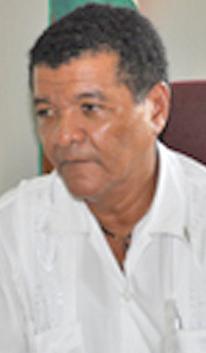
tinue a project or start a new one, the region would have to send in an expenditure list of what has been achieved, before money is released.
Corlette said this is not a problem, but the time that it takes for the region to receive the money is what causes major setbacks. The regional chairman said this holds up the entire process by which works are carried out.
This is not only a prob-
lem for Region Four, but also the other regions. Corlette said it is a bugbear and is calling for the ministry to be more lenient.
The regional chairman believes that an emergency fund should be set up by the ministry, so that regional administrations could access it in the case of an emergency.
He explained that the current process is lengthy since queries are usually done by economists attached to the Finance Ministry and the Accountant General's Department.
Corlette told this newspaper recently that the region is working to ensure its work plan for the year is accomplished, especially in the areas of health, education and public works.
He said there are a few issues being addressed through the Works Committee of the Regional Democratic Council (RDC).
The regional chairman said he is not pleased with the infrastructural works and has raised some level of concern that the contractors are behind schedule.

Over the past two days, scores of people took advantage of the free medical services that were available at a health fair held at the Square of the Revolution, Georgetown, as part of activities to mark Caribbean Wellness Week, the Government Information Agency (GINA) reported.
Speaking at the close of the event Sunday afternoon, Health Minister Dr Bheri Ramsaran said, “We had several tents offering different services; for example, there was a wellness tent in the wellness camp which was testing blood pressure and blood sugar, and advising people how to react to the results. We found a lot of persons for the first time
who learnt that they were either diabetic or they were hypertensive”.
He added that the ministry will be reaching out to schools in the communities in the vicinity of the Square of the Revolution advising them on creating school health clubs which will help to promote healthy lifestyles. Teachers who visited the health fair were also given flyers and posters for their students' education.
He added that during the health fair, they were able to collect 40 units of blood, and he took the opportunity to commend the donors, describing them as heroes. He highlighted the blood bank's achievement of 10,000 units of blood in 2012, stating that
they were aiming to exceed this amount in 2013.
The fair offered blood sugar, blood pressure and cholesterol testing, a blood donation drive, HIV/AIDS testing and counselling, done by the National AIDS Programme Secretariat (NAPS), dental services offered by the Cheddi Jagan Dental School, testing for and treatment of malaria, and eye screening services provided by Eye Care Guyana working along with the Health Ministry.
Another health fair will be held at the same location on September 21 and 22. These events are intended to have persons capitalise on a variety of services, free of cost, in various communities across Guyana.
Sreesanth’s legal counsel has called the life ban imposed by the BCCI “bizarre”, against the principles of natural justice and unlikely to stand legal scrutiny, and said the player would challenge the ban in court once he received a copy of the order.
A day after Sreesanth was handed the ban by the BCCI’s disciplinary committee, his counsel Rebecca John said the biggest flaw was the report drew heavily on the police findings in the criminal case, which itself is yet to reach a verdict.
Sanctions
The sanctions were based on the report compiled by the board’s anti-corruption commissioner Ravi Sawani.
“The [BCCI] order is completely against the principles of natural justice,” John told ESPNcricinfo. If Sawani had relied so heavily on the findings of Delhi Police, she said, then the least he and the BCCI should have done was wait for the final verdict by the Patiala House Court in Delhi, which is hearing the case.
“It has based its findings on personal interactions with members of Delhi Police as well as taken material from the chargesheet that has been filed by the police before a sessions court. If that is so then they should have waited for the court to determine whether or not any of this holds up in legal proceedings.
Conversations
They just picked up conversations they had with members of Delhi Police where they said Sreesanth and other members of the cricketing community confessed before them. It is a very, very loose report with little or no substance in it,” John, who was hired by Sreesanth as soon as Delhi Police arrested him on corruption charges during the IPL in May, said.
She pointed out that the evidence produced by Delhi Police against all the Rajasthan Royal players was found to be insufficient to keep them in custody - the sessions court has granted

bail to all of them, including Sreesanth.
“The fact is that the sessions court has released players on bail and said none of this adds up as a case. [The court said] it is very, very tenuous - the link between whatever bookie you are saying had a role to play and the players, particularly
Ethiopia’s Kenenisa Bekele saw off double world and Olympic champion Mo Farah’s late surge to win the Great North Run in a thrilling sprint finish on Sunday.
Britain’s Farah, 30, chased down Bekele in the last 400m in a great finale but was pipped to the line by one second.
Another Ethiopian, Haile Gebrselassie, was a distant third after falling behind in the last of the 13.1 miles.
“I’m disappointed but I was second to a great athlete,” said Farah after finishing in one hour and 10 seconds.
Fitting conclusion
The sight of Farah and Bekele fighting it out in the last 200m was a fitting conclusion to what had been an eagerly anticipated race from Newcastle upon Tyne to South Shields.
The three distance-running greats - Farah, Bekele and Gebrselassie - boast 12 world titles and seven Olympic gold medals between them and were together until 31-year-old Bekele, competing in his first half marathon, made his break down a steep slope.
“When Kenenisa went with a mile to go, I thought the pace was ridiculous,” said Farah, who won 5,000m and 10,000m gold at the World Championships in Moscow last month.
Sreesanth, and granted him bail. And then this BCCI’s one-man committee says that Sreesanth is guilty of spot-fixing and hands over a life sentence to him. Not only is it is excessive, it is completely contrary to all principles of natural justice.”
John said that from what she had read of his report on
the internet, Sawani’s findings, especially on Sreesanth, never added up to a case. “How does he come to a conclusion? By having personal conversations with police officials. And you are basing your findings on these?”
In his report Sawani had noted that he listened to and read the transcripts of audio tapes in possession of Delhi Police of conversations between Sreesanth and the alleged bookie.
“If you want to read these audio tapes, which are part of the Delhi Police [evidence] in a criminal trial, the link is so tenuous. You will believe it only because the Special Cell of Delhi Police is saying you will have to believe it in a particular way. In any case these are allegations which have to be assessed, processed and a finding has to be determined by a court of law,” John said. According to John Sreesanth is on bail only because “prima facie” Delhi Police had not managed to press a foolproof case against
him. “The only reason the life ban was imposed - Mr Srinivasan was very keen to tell the public and the people of India he was treating [the issue] with a heavy hand and some people had to be made scapegoats,” John said.
“What is more annoying from the point of the view of the players is that they have let the big fish get away. What happens to Mr Srinivasan. He is owner of Chennai Super Kings and there is a case of conflict of interest pending in the Supreme Court against him.
"The Bombay High Court recently had called the twomember committee illegal after it cleared Gurunath Meiyappan and Raj Kundra [part of Chennai Super Kings and Rajasthan Royals] from corruption charges.
“Now when the BCCI, of which Srinivasan is the de facto or de jure head, conducts itself in this kind of fashion and then it hands over these sentences to players, who are soft targets, it is a little bizarre,” John said. (Cricinfo)
Jussi Jaaskelainen produced several brilliant saves as West Ham came away from Premier League rivals Southampton with a fortunate point on Sunday.
The 38-year-old denied Dani Osvaldo, Morgan Schneiderlin and Rickie Lambert with three spectacular stops in a match dominated by the Saints.
Jaaskelainen also tipped over Victor Wanyama’s strike, while Lambert saw his header bounce back off the post.
James Collins wasted a glorious chance for West Ham in the closing stages.

triot Tirunesh Dibaba, another of the pre-race favourites.
Gebrselassie, 40, could not keep up with the younger pair but his time of 1:01:41 was still a world record over the distance for over-40s.
Course record
Kenya’s Priscah Jeptoo came close to breaking the course record as she ran the third-fastest time in women’s half-marathon history.
The 29-year-old, this year’s London marathon winner and London 2012 silver medallist, was only five seconds slower than the 1:05.40 Britain’s Paula Radcliffe ran 10 years ago.
Meseret Defar broke the Ethiopian record as she came second to Jeptoo in 1:06.09 but ahead of compa-
“I thought I could come back. It came to the last 200m, right to the line. It was a great race and a great finish.”
Britain’s David Weir, who was inaugurated into the Great North Run Hall of Fame this week, won the men’s wheelchair race for a fourth time.
“It was a good test to see where I’m at,” said the 34-year-old course-record holder, who crossed the line in 43:03.
“I surprised myself. I’ve only been back pushing for a couple of weeks so I’m really pleased with that time.”
Compatriot Shelly Woods claimed her fifth title in the women’s wheelchair race, but admitted the conditions had made it a tough day.
“The wind was swirling and I found it difficult out there,” said the 27-year-old after clocking 54:28. (BBC Sport)
That effort was the Hammers’ clearest opportunity of the match and summed up their profligacy in front of goal - Sam Allardyce’s men have now only managed six shots on target in the league all season and have not scored since the opening day.
Overall performance
Southampton supporters would have been left frustrated by their players’ inability to breach the last line of defence, although they would have been pleased with the overall performance.
They twice caused panic among the visiting defence inside the first 15 minutes with surges down right.
Jay Rodriguez was the first to attack, flying down the flank before picking out record-signing Osvaldo, who saw his eight-yard shot brilliantly blocked by Jaaskelainen.
Luke Shaw was next to try his luck. The 18-year-old drifted past Guy Demel but saw his cut-back blocked by the
West Ham defence.
The Hammers seemed devoid of ideas in attack. They had the ball in the net when Kevin Nolan superbly slotted the ball into an empty net after Artur Boruc had rushed out to try to block Matt Jarvis’s effort. However, the assistant had already flagged Jarvis offside.
Challenge
Moments later, the away support raised their voices again, but this time it was as a result of Schneiderlin’s two-footed challenge that floored West Ham midfielder Mohamed Diame. Referee Andre Marriner waved playon as the Senegal international lay on the grass.
Captain Nolan and his teammates made their views know to the West Midlands official.
The second half began much like the first with Mauricio Pochettino’s Saints on the attack.
Former Celtic midfielder Wanyama was first to test the ex-Bolton keeper with a 30-yard swerving shot that was tipped behind. From the corner, England striker Lambert, making his 200th appearance for the Saints, had the best chance of the contest when his header crashed off the near post. Moments later, came the best save when Jaaskelainen sprung to his left to prevent Schneiderlin’s volley from finding the bottom corner.
West Ham almost performed one of the greatest Premier League robberies in recent years when Collins was left with the goal at his mercy only to smash Mark Noble’s pull-back over the bar.
Asure-shot way of putting bums on seats for the relatively low-profile, non-international games played at capacity venues like the Chinnaswamy Stadium is the presence of big stars.
While India A’s “Test” squad has three of them featuring in two of the games, the limited-overs had one big drawcard - Yuvraj Singh.
Without meaning any disrespect to the rest looking to make a mark, the attention among the media and the fans was on one man on Sunday.
It’s possible that what Yuvraj delivered on Sunday exceeded everyone’s expectations, probably including his own. Four months after his last competitive match, he bludgeoned 123 to power his side to 312 in a shortened game.
West Indies A lacked the willpower to pose a serious threat and fell short by 77 runs in what was a rude initiation to their tour of India.
That Yuvraj had the hunger to make a return to the Indian side since his last international match in January was evident with a rigorous six-month rehab programme he underwent with Zaheer Khan in a small town in France.
If doubts still persisted, his A coach Lalchand Rajput
allayed them. He was lighter by a few pounds, he assured, looking fitter than ever.
While his fitness and attitude were in the right place, the question remained if one could say the same of his batting.
The western stands at Chinnaswamy were not packed to capacity, but the numbers were encouraging despite the knowledge of a delayed start. During the twohour delay, the decibel levels shot up each time Yuvraj appeared in his training gear, for throwdowns and then for the toss.
The expectations surged, when India were inserted. As did the restlessness when the openers looked circumspect against a pacy spell by the West Indies seamers.
The wait ended when Yuvraj walked in at the fall of the second wicket at 47 in the 12th over. Andre Russell greeted him with a bouncer straight up. No flashy opening statements.
Yuvraj began with the intent of biding his time, waiting for the opportunity to find the boundary. He was languid between the wickets, jogging the odd single as if conserving energy for the long haul. Mandeep Singh’s positive energy at the other end would have relieved the pressure off Yuvraj.

Off his 39th ball, Yuvraj struck the first of his 15 boundaries - a precise cut off Ronsford Beaton that beat backward point and the sweeper. Prior to that, he showed signs of breaking free, pulling short deliveries by the spinners but straight to the fielders.
The first real sign of Yuvraj of the old came as a result of frustration. Hunched at the crease having failed to
BRID ge T o WN , Barbados - When it comes to the love of the game, West Indian players rank amongst the most loyal.
That is the conclusion drawn by former Pakistan spinner Saqlain Mushtaq, who is currently conducting a spin bowling clinic at the Sagicor High Performance Centre (HPC).
Saqlain, who bewildered opponents with his mesmerizing off spin, said that bowlers such as Shane Shillingford and Davendra Bishoo, who are both participants at the clinic, have what it takes to become orld class spinners.
Potential
“When you speak about potential, you have to take a lot of things into consideration,” he explained during a press conference at the 3Ws oval.
“You have to look at how passionate the player is, how hard-working the player is, their love of the game, their commitment.
“The guys that I have been coaching have all of these things. They have been working extremely hard, full of passion and asking a lot of questions.

put away a free hit, Yuvraj took an off-stump guard.
As Miguel Cummins approached the crease, Yuvraj covered the stumps and launched a full delivery over long-on. Timing, placement and power clicked in unison as Yuvraj unfurled a series of boundaries after his fifty, including pulls to deep midwicket and lofted drives over extra cover.
A century seemed a very
realistic possibility.
Yuvraj’s first fifty came off 60 balls. He needed just 20 for his second. He capitalised on a weakness even the senior West Indies bowlers have been guilty of in recent months - death bowling.
Torn apart
Ashley Nurse and Nikita Miller were torn apart by Yuvraj and Yusuf Pathan who ransacked 125 for the fourth wicket in less than ten overs. Yuvraj began the assault with a slog off the leftarm spinner Miller sending the ball at least 20 rows back.
Yuvraj moved from 67 to the 90s in one over off Miller with consummate ease, pull-
ing the second ball over deep midwicket, skipping down the track and launching the third over the bowler, bludgeoning the next - a full toss - several rows over deep midwicket again before depositing the fifth over long-on.
Narsingh Deonarine was the only specialist batsman to convert his start to a half-century. The result was a foregone conclusion when they had lost their third wicket at 58.
The one-sided nature of the contest, though, was the sore point. Still, it was a day well spent for loyal fans who witnessed a player look another challenge in the eye and conquer it. (Cricinfo)
India A innings
R Uthappa c Cummins b Russell 23
U Chand c †Thomas b Cummins 1 Mandeep Singh b Miller 67
Yuvraj Singh* c Beaton b Bonner 123
Y Pathan not out 70
N Ojha† not out 10
Extras: (lb3, w13, nb2) 18
Total: (4 wkts, 42 overs) 312
Fall of wickets: 1-8, 2-47, 3-147, 4-272
Bowling: M Cummins 9-1-501, R Beaton 8-0-72-0, A Russell 4-0-17-1, N Miller 9-0-62-1, A Nurse 6-0-58-0, N Deonarine 4-0-20-0, N Bonner 2-0-30-1
West Indies A innings
N Bonner c †Ojha b Vinay Kumar 16
K Powell* c Narwal b Vinay Kumar 17
K Edwards c †Ojha b Narwal 19
N Deonarine c Mandeep Singh b Sharma 57
A Fletcher c Chand b Pathan 29
D Thomas† lbw b Pathan 10 A Russell run out (Vinay Kumar) 1 A Nurse c †Ojha b Narwal 57 N Miller c & b Sharma 2 R Beaton hit wicket b Unadkat 15 M Cummins not out 4 Extras: (lb3, w4, nb1) 8 Total: (all out, 39.1 overs) 235 Fall of wickets: 1-24, 2-47, 3-58, 4-112, 5-139, 6-140, 7-176, 8-181, 9-205, 10-235
Cristiano Ronaldo says he wants to stay at Real Madrid for the rest of his career after signing a new contract with the Spanish giants until 2018.
The Portugal forward, 28, was linked with a return to former club Manchester United over the summer.
“Manchester United is the past. Real Madrid is now my home,” he said. “I hope that I’m here until I retire. This is a great club.”
Spanish reports suggest he will earn an annual salary of 17 million euros (£14.25m).

and again and again, there will come a time when they will reach their full potential,” he explained.
His previous contract at the Bernabeu was due to expire in 2015.
Record transfer fee
Speaking specifically about Shillingford, Saqlain said that he was very impressed with his work ethic so far.
He revealed that since he had arrived at the camp, Shillingford had shown great interest and enthusiasm.
“Shane is a lovely guy and a hard working chap. He is watching really well, asking a lot of questions and you can tell that he is really thinking.
“Shane and the other guys are clicking all of these boxes, and once they continue to click these boxes again
“A great player is a great believer, a great thinker, great learner and a great observer . . . and in the nets I can see all of these qualities in the players,” Saqlain noted.
Saqlain outlined that along with trying to improve the players’ technical and tactical skills, he was also focusing on helping them to prepare mentally as well.
“We are working on a lot of mental preparation, because obviously the guys will be heading to India in about a month or so, and it can be tough in India.
“So along with working on a planning process and a training process, we are also spending a lot of time doing a lot of mental work, because that is extremely important,” he pointed out.
(First
Ronaldo joined Real from Premier League champions United in 2009 for a thenworld record transfer fee of £80m.
He has scored 203 goals in 203 games for Los Blancos, helping them win La Liga in 2011-12 and two domestic cups.
The Madeira-born star was also voted as the world’s second best player, behind Barcelona’s Lionel Messi, in 2011 and 2012.
But questions were raised about the ex-Sporting Lisbon youngster’s future as Real planned their 100m euros
(£85.3m) summer move for Tottenham forward gareth Bale.
As well as a return to old Trafford, he was also linked with a switch to big-spending French club Monaco.
“I respect all the clubs who ask about me,” he said. “But they always know that my decision, that my only goal, is to be here and to play at this club until, maybe, the end of my career.
“I’ll be here five more years. I just want to win trophies for this club.” Real president Florentino Perez, who sat alongside Ronaldo in a media conference on Sunday, labelled the new deal as “a great day” for the
nine-time european champions. “We have made the dream of all Madridistas,” said Perez. “Cristiano Ronaldo and Real Madrid will remain forever.”
Ronaldo was replaced as the planet’s most expensive player when Welshman Bale, 24, completed his switch earlier this month.
The pair both started as Real drew 2-2 at Villarreal in Bale’s first appearance for last season’s league runnersup.
Bale levelled after Villarreal’s opener and Ronaldo put the visitors ahead before home forward giovani Dos Santos equalised. (BBC Sport)
ST JOHN’S, Antigua –West Indies Test captain Darren Sammy said he was extremely delighted with the steps his side have taken in achieving their goals in the longest version of the international game.
West Indies are now the fifth-ranked Test side in the World, following the latest update of the ICC Test Rankings table.
It comes in the wake of an historic, 24-run victory for Zimbabwe in the second and final Test of their series against Pakistan on Saturday at the Harare Sports Club.
The two-Test series was drawn 1-1 and the Pakistanis, ranked No.4 before the series, conceded five ratings points, dropping them behind Australia and West Indies.
Top five
“One of our goals has always been to be in the top five by 2015,” Sammy said. “As a Test team, we have worked really hard in the last three years and to achieve that goal two years early is a plus for us.
Sammy said: “We now have to continue working harder in order for us to keep moving forward. Massive praise must go to our head coach Ottis Gibson and his staff for creating the atmosphere where we as players can go out and work

Darren Sammy
hard for each other and our fans in the Caribbean and everywhere else.
“This is a massive step in the right direction and we will continue to strive for excellence for the cause of putting West Indies cricket back on top of World cricket. The journey continues.”
Gibson said at a media conference this past week in Barbados that his side was targetting the climb into the top-five at the end of their upcoming Test series against New Zealand on the road in November-December – but they have now achieved the target three months ahead of schedule.
“If you look at the last six Tests we played, we won them,” he said at the time. “It’s been good progress, but I know people aren’t considering them as big wins.
“Against India howev-
er, we can really gauge the progress. I’d never discount wins against Zimbabwe and Bangladesh though because they are upcoming and talented, but India will be an immense challenge and we’re looking forward to it.”
Gibson added: “We were in India a couple of years ago and played good cricket, but didn’t win. Now the team dynamic is different,
and with Chris Gayle back, we’ll give a tougher run.
“Then, against New Zealand, we’ll be looking to move to No.5 in the Test rankings as that’s our aim. I want to put some distance between us and them, but they gave England a tough time in the Tests, so it won’t be easy. India into New Zealand is a tough duo to tour.”
Rankings
The Test Rankings table, unlike the ICC One-day International Rankings table, is updated only after the conclusion of current series.
West Indies face India in two Tests in November before flying to New Zealand for a series of three Tests.
The Windies last visited India in NovemberDecember 2011, when they lost a three-match Test series 2-0 – the drawn third match was the dramatic Mumbai Test that ended with the scores level. (WICB)
Nassau, BAHAMASSeven sporting associations in the Bahamas will be awarded with development grants, designed to propel them toward Olympic status and qualification.
The provisions, according to president of the Bahamas Olympic Committee (BOC) Wellington Miller, were based on the recent success and growth in programmes by the federations.
The grants were awarded to the Bahamas Volleyball Federation (BVF), the Bahamas Judo Federation (BJF), the Bahamas Lawn Tennis Association (BLTA), the Bahamas Rugby and Football Union (BRFU), the Bahamas Cycling Federation (BCF), the Amateur Boxing Federation of The Bahamas (ABFB) and the Bahamas Wrestling Federation (BWF).
Recent success
The BOC is hoping to strengthen its relationship with the Bahamas Basketball Federation (BBF), making the necessary provisions for them to educate more coaches, and players “before they step onto the court”.
Miller believes that the new partnership with the Pan American Sports Organisation (PASO) will make it easier for the BOC to assist federations with hosting international coaching clinics and courses.
The decision review system (DRS), along with the playing conditions at the 2015 World Cup, is set to dominate the proceedings at the two-day ICC chief executives’ committee (CEC) meeting in Dubai on September 16 and 17. Although the ICC has discontinued to publish the agenda and the results of the CEC from this year, it is understood that the meet will see a divided house with England and Australia joining hands to take on the other front led by India with support from the sub-continental neighbours - Sri Lanka, Pakistan and Bangladesh - especially on the topic of the referral system.
Aggrieved England and Australia both had reasons to feel aggrieved about the DRS during the recently completed Ashes series. Jonathan Trott was given out lbw on review at Trent Bridge despite an apparent edge, while Usman Khawaja’s caught behind dismissal in Manchester during the third Test was upheld even though replays showed daylight between bat and ball. Hot Spot’s inability to detect fine edges also created confu-
sion, and towards the end of the series, its evidence was routinely ignored by the third umpire. Geoff Allardice, the ICC operations chief, met with the two sides before the fourth match in Durham to address some of their concerns.
It is understood that the pair of David Collier, the ECB chief executive, and his Cricket Australia counterpart James Sutherland is expected to put forward a series of proposals at the CEC to make the DRS more consistent.
Hindrance
According to an official privy to the ECB-CA plan, both members want to continue utilising the DRS in bilateral series despite its shortcomings. During the latest Ashes, one visible hindrance to the DRS was the amount of umpiring errors. To remedy that, both England and Australia want the ICC to enhance the clarity in the communication between the third umpire and the on-field umpires.
“Based on evidence during the Ashes some conversations between the match officials were unintelligible because of language barriers and the ECB and CA want the ICC to create a mechanism where the
match officials can communicate between themselves and the broadcaster without creating much confusion,” the official said.
Another proposal is to make the role of the television umpire a specialist role. During the Ashes, the ICC had conducted trials allowing the third umpire instant access to TV replays which could help him overrule mistakes committed by the onfield official. During the Old Trafford Test, England umpire Nigel Llong sat in the back of the TV truck, where he received a direct feed of pictures to help him improve the quality of decision making using instant technology.
Dave Richardson, the ICC’s chief executive, had said that the exercise would help avoid incidents like the Stuart Broad one during the Trent Bridge Test, when the England allrounder edged Ashton Agar but stood his ground. Aleem Dar, the onfield umpire, failed to detect the edge and Australia, having exhausted their reviews, were left frustrated and annoyed.
The other suggestion England and Australia want to discuss is if the DRS is just there to clear up a howler then a team should not lose a review when it becomes an umpire’s call. “Because the margin of error is so minimal between an out and not and an umpire’s call,” the official said.
However, England and Australia feel not all umpires can adapt quickly to the challenges of being a television umpire. Collier and Sutherland are expected to discuss the issue with Simon Taufel, ICC’s umpires training and performance manager.
However constructive their suggestions sound, England and Australia still need India, the staunchest critic of the DRS, on their side. What might make their defence of the DRS weak is the admission of Warren Brennan, the Hot Spot inventor, who stated that tests carried out recently on various modern bats revealed protective coatings across the edges of bats unquestionably diminished the thermal signatures.
“We are pleased with the recent success of the Bahamas Volleyball Federation’s junior and senior men’s teams in regional competition in St. Martin and Guadeloupe,” said Miller. “As a result of the volleyball federation’s success, the Bahamas Olympic Committee, through its partner Olympic Solidarity, is pleased to provide a team assistance grant of US$60,000. Similarly, our young tennis players have performed remarkably well in international competition, resulting in the Bahamas Olympic Committee, through Olympic Solidarity, providing a coach’s development grant for level one courses of US$9,000 to tennis. This grant can be expanded up to US$12,000.”
“The Bahamas Olympic Committee has partnered with the Pan American Sports Organisation to offer international coaches courses in the sports of weightlifting, handball and very soon horsemanship,” said Miller. “We are pleased that the Bahamas Powerlifting and Weightlifting Federation have been energised by its new president, Robert ‘Bob’ Brown. He is committed to ensuring that his athletes compete in the Olympic sport of weightlifting. We welcome this initiative in weightlifting and we will do all we can to support Mr Brown’s transition from powerlifting to Olympic weightlifting,” he said.
“The Bahamas Olympic Committee welcomes the introduction of new Olympic sports to the sports calendar in The Bahamas. We welcome sports such as rowing, handball, fencing, horsemanship, badminton and archery. Through the International Fencing Federation, we have been able to provide the local fencing federation with equipment.”
In the fifth, Mayweather stood in the pocket in front of Alvarez and landed a series of combinations that rattled his opponent.
When Alvarez attempted to pin Mayweather in the corner in the seventh, the American slipped most of his punches and answered with a right hand, followed by a sequence of jabs and an uppercut, before backing the Mexican to the ropes and picking him apart.
It was the same in the 10th, Mayweather turning defense into offense as he landed counters off the ropes and sent Alvarez into retreat.
“I think if I had pressed the attack earlier, I could have got the stoppage. I like taking my time. But it was a great fight,” fivedivision world champion Mayweather said. By the end, Alvarez cut a forlorn figure, following Mayweather around the ring as his foe retreated and circled to lure him into a trap.
The final result appeared a formality, and it was a surprise when one of the judges scored the bout a draw. She was overruled by scores of 117-111 and 116112, which also seemed close but may have reflected the fact that Mayweather, seemingly confident of victory, effectively coasted through the final couple of rounds.
“I couldn’t connect,” Alvarez conceded. “He was very elusive and intelligent. He has a lot of experience and I honestly couldn’t find him. In the late rounds, I was frustrated. I recognise he beat me. He’s a great fighter.”
Mayweather praised his fallen foe.
“I fought a true champion tonight (Saturday night),” he said. “A guy like that can take a loss and bounce back from it. I’ve been in the sport 17 years, so just because I beat him the way I did, doesn’t mean he doesn’t have a great career ahead of him.” (Reuters)


Melanie held off a surging Wortmanville/ Werk-en-Rust to pull off an upset 69-62 victory in the Trinity Grid Holding (TGH) Pacesetters Inter-Ward basketball championships on Saturday night at the Cliff Anderson Sports Hall.
Melanie came out playing aggressive defence, placing pressure on the Georgetown side that caused many errors that resulted in Melanie running rings
around Wortmanville/Werken-Rust in the paint.
Wortmanville/Werk-enRust tried to force the game by taking jumpers, digging themselves a hole as the first quarter ended 22-5.
The Georgetown side in the second quarter started using their set plays while cutting well to get their offensive flow going. With this, they began to chip away at the lead.
Shawn Ellis then hit two back-to-back threes to send
the Georgetown unit into the half with some momentum but still down by 13 points.
After outscoring the East Coast side 18-14 in the second quarter, Wortmanville/Werk-enRust came out firing in the third period, taking control of the game and limiting Melanie to one shot per possession.
However, while being outscored in the third quarter 14-12, Melanie kept the
Georgetown side at bay using their tough defence and inside scoring as the third quarter ended with the East Coast side having an 11-point advantage.
Business picked up in the fourth quarter as Randy Richardson and Naylon Locnke combined for 15 points to bring the Georgetown unit within four points of the lead at 66-62 with 45s remaining in the game. Kurt English and Sherlon Legall buttressed
Distance ace Cleveland Forde proved why he is the best distance athlete in the country, notching up yet another 10k title Sunday morning.
Forde, who has been plagued with various niggling injuries over the past couple of months, easily bagged the AINLIM 10k event by clocking 33:16s to win ahead of Cleveland Thomas, with a time of 33:45s, and Dennis Horatio’s 34:05s.
Running Brave Athletic Club Winston Missenger finished fourth in the event in 34:18s to top Nathaniel Giddings, who was the early pacesetter, with a time of 34:34s, rounding out the top five finishers.
Meanwhile, overseas based Guyanese Euleen Josiah-Tanner rebounded from last year’s defeat to beat female defending champion Alika Morgan in a time of 39:21s. Morgan was relegated to third after two-time Carifta gold medalist Jevina Straker claimed the second spot in 40:51s; Morgan’s third place time was 40:52s.
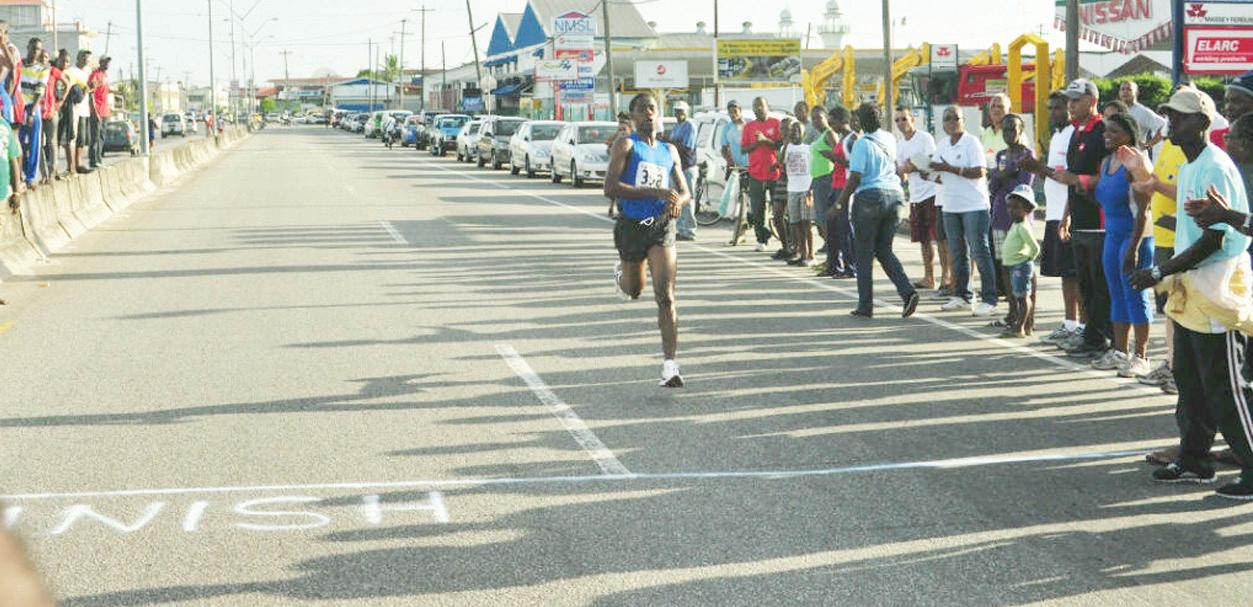
Guyana Defence Force (GDF) athlete Ashanti Scott finished fourth with a time of 45:12s while her teammate Carlissa Atkinson finished fifth in 47:19s.
The boys’ junior event was won by Cark McKenzie in 37:14s while Grivon Grant took second in a time of 37:32s. Kevin Nicholas (37:35s) and Samuel Kaiton (37:55s) were third and fourth respectively.
Carifta bronze medalist
Andrea Foster rebounded from her loss at the InterGuiana Games on Saturday to win the female junior version in 43:59s. Cassie Kirton clocked 45:43s for second while Adama Roberts took third in a time of 46:56s.
The Masters’ men 45-55 was won by Ian Archibald in a time of 39:32s while Llewellyn Gardener took the Masters’ men 55-and-over in a time of 42:49.
Sprint ace Alisha Fortune
ruled the women’s masters’ event, clocking 51:23 ahead of Cyrleen Phillips who recorded 52:33s. Meanwhile, Chief Executive Officer (CEO) of Neal and Massy Group of Companies Deo Persaud, at the prize giving ceremony congratulated all the athletes while president of the Athletics Association of Guyana (AAG) was pleased that the event was injury free.
Melanie’s lead as time expired to give the East Coast side the win.
Haslym Hooper scored 19 points and grabbed nine rebounds to lead Melanie while English helped out with 14 points. Legall notched a double-double of 13 points and 10 rebounds. Richardson grabbed a game-high 20 rebounds and netted 19 points to lead his losing side. Loncke also pulled off a double-double effort with 12 points
and 10 boards while Joslyn Crawford contributed 12 points.
Meanwhile, Defending champions Albouystown/ Charlestown got a routine win by routing Buxton 6039 in their group C encounter. Sheldon Thomas was unstoppable with a game-high 21 points and three steals. Collis Pluck netted 14 points to help with the blow out win. Ewart Smith scored 13 points to lead Buxton.
Defending champions Memorex defeated Universal DVD Titans by nine runs in the second Georgetown Softball Cricket League Inc. 12/12 tournament at the Everest Cricket Club ground, earning them a place in the quarterfinal this weekend. This came after defeating R1 in their Group D encounter. Also chalking up victories in Group B were Speed Boat, Recharge and Better Hope, although Better Hope would be later knocked out by Recharge.
Meanwhile, Universal DVD Titans won the toss and asked Memorex to take first strike and the defending champions posted 92 for 8 from their 12 overs. Alvin Ramdass, 31 (3x6), Roy Jaffarally, 27 (3x4, 1x6) and West Indies Under-19 selectee Shimron Hetmyer, 15 (2x6), led Memorex’s batting. Mahendra Baldeo took
Earlier in the day, Titans reduced R1 to 92 for 8 in their first match, with Khalim Baksh, 22 (2x6, 1x4) and Brian Mangar, 20 (2x6, 1x4) leading the batting. Rajendra Sookdeo (3 for 19), Lukenauth (2 for 16) and Totaram Seenanand (2 for 17) led Titans’ bowling attack. Lukenauth returned to hit an unbeaten 56 (3x4, 6x6) in 23 deliveries and together with Rajiv Ivan’s 20, steered the Titans to 94 for 3 from 7.4 overs. GSCL Inc. 12/12…
2 for 7 for Universal DVD Titans. In reply, Titans struggled and were bowled out for 84 from 11.4 overs. Only Chandrashaker Arjune, 21 (1x6), and David Lukenauth, 17 (1x6, 1x4), provided meaningful scores. Vikendar Mohammed, Keon Sinclair and Vishal Phillips took two wickets for 10, 16 and 27 runs respectively.



LAS VEGAS - American Floyd Mayweather produced a masterclass as he outboxed Saul Canelo Alvarez to take the Mexican’s WBA and WBC super welterweight titles by majority decision in Las Vegas on Saturday night.
The previously unbeaten Alvarez began by attempting to slow down Mayweather with stiff jabs and hooks to the body, but in response Mayweather (45-0, 26 KOs) snapped back his head with jabs of his own.
The more Alvarez (42-1-1, 30 KOs) stepped forward and became aggressive, the more he left himself vulnerable to Mayweather’s rapid counterpunches.
After a relatively quiet opening few rounds, Mayweather began to open up in the fourth, snapping back Alvarez’s head with a succession of jabs and then landing a sweeping right at the bell.