



These bright and beaming students were among a batch of 90 who graduated from the Al Ghazali Islamic Academy, Woolford Avenue, Thomas Lands, Georgetown on Saturday (Carl Croker photo)


Prime Minister Samuel Hinds, who was acting in the capacity of president, was among those gathered on Friday evening at a reception in observance of Venezuela’s 202nd independence anniversary which was held at the Impeccable Banquet Hall, Brickdam, Georgetown.
Throughout South America’s struggle for independence, Venezuela was the first nation to declare independence and maintained it. This move was led by the late Simón Bolívar.
Speaking at the event, Hinds said that the anniversary is a milestone for which Venezuela should be justly proud as it continues to exert great effort and determination to realise the dream of Simón Bolívar of a well-developed, united and independent country. Venezuela continues to play a vanguard role in the promotion of programmes which are aimed at bringing direct benefits to the people, especially vulnerable groups.
The acting president said that the creation of the Bolivarian Alliance for the Peoples of Our America (ALBA) and Petrocaribe can be seen within this framework and commended the late President Hugo Chávez for his vision in this regard.
Hinds also highlighted the relationship between Guyana and Venezuela which has allowed Guyana to comfort-

ably engage in regular political dialogue at the highest levels and to embark on programmes of cooperation that have seen tangible benefits for both of the countries’ peoples.
The Hugo Chávez Centre for Rehabilitation and Reintegration which will be opened in a few months, the vibrant trade in rice and the supply of petroleum to Guyana under the Petrocaribe initiative are examples of the ties between the two countries.
“We remain committed to working with the government
of Venezuela to preserve this healthy relationship,” Hinds added. He said Guyana will be looking forward to welcoming President Nicholas Maduro on his official visit next month.
The acting president also extended congratulations to Venezuela for the award they received for achieving the Millennium Development Goal (MDG) on poverty reduction. He reiterated government’s satisfaction with the excellent relation the two countries enjoy, and committed to continue working together at the bi-
lateral, regional and multilateral levels.
Venezuela’s Ambassador to Guyana, Reina Arratia Diaz explained the history behind the country’s independence and said that even as that struggle continues, the country has been aggressively fighting poverty, with special emphasis on health and education. Ambassador Diaz said that today Guyana and Venezuela have improved their bilateral relations through the late President Chávez and will continue through current President Maduro.
At least seven Brazilian and Colombian dancers are in police custody assisting in the investigation into the shooting incident involving a taxi driver in the wee hours of Friday morning, a police source has confined.
The foreigners are at the Alberttown Police Station, but the police are encountering difficulties to proceed with the investigations due to the language barrier. Nevertheless, they are questioning other person in the area and have sent the spent shells for ballistic testing.
A police official explained that from reports gathered, the injured taxi driver reportedly used abusive and degrading language to one of the dancers when he dropped them off at a property in Gerogetown. The police are also on the lookout for a green motorcar which the shooters used to carry out the brazen attack.
Leslie Woode, 26, of 54 Seaforth Street, Campbelville, Georgetown, remains in critical condition at the Georgetown Public Hospital (GPH) after he was attacked and shot twice on Cummings Street, Alberttown, Georgetown on Friday last.
He has been removed from the theatre and placed in the High Dependency Unit of the medical institution. Woode is nursing at least two gunshot wounds to his forehead and chest.
Guyana Times understands that Woode is trying to talk but the words are not too clear. In addition, a bullet is still lodged in his head and another in his chest, but doctors are focusing on removing the one in his chest first before they concentrate on his head. His right lung is also damaged, this publication was told. It was reported that Woode had just dropped off a group of Brazilian dancers at a property in Georgetown when he got into a heated argument with them. The argument may have stemmed from him using “suggestive language” at the dancers.
During the quarrel, the dancers allegedly summoned someone via telephone phone and within minutes a green car arrived on the scene; stopped alongside Woode’s car and the occupants then discharged a loaded firearm at him. Police visited the scene and retrieved a number of spent shells.
Police continue to investigate the incident.


The Demerara Harbour Bridge will be closed to vehicular traffic on Monday, July 8, from 14:30h to 16:00h.
The Berbice River Bridge will be closed to vehicular traffic on Monday, July 8, from 16:55h to 17:25h.
Education Minister Priya Manickchand said for Guyana’s children to be able to live enhanced lives, a sturdy partnership among the government, the ministry, teachers, parents, students and the community is required.
The minister made the remarks during an address to hundreds of Region Two teachers on Saturday. Manickchand was accompanied by Chief Education Officer Olato Sam, Permanent Secretary Delma Nedd, Assistant Chief Education Officer (Primary) Marcel Hudson and School Board Secretariat Coordinator Melcita Bovell. Regional Chairman Parmanand Persaud, outgoing Regional Education Officer Leslyn Charles and other regional officers were also present.







Region Two in 2012 produced Sarah Hack, the country’s top student at the Caribbean Secondary Education Certificate (CSEC) examinations. Not only did the 16-year-old top her country, she also secured the top spot in the Caribbean. Hack attended the Abram Zuil Secondary School on the Essequibo Coast.
Improving consistently
Over the last three years, the region’s CSEC performance has been improving consistently and this can be attributed to the fact that on the Essequibo Coast, 78 per cent of teachers are trained. Also, there are 40 teachers attending the University of Guyana (UG). With regard to the riverine teachers, they are second to the Essequibo Coast for upgrades prior to moving on to the Cyril Potter College of Education (CPCE).
“Guyana has been taking the lead in many areas… we help to contribute to saving the world by not cutting down our trees while at the same time we are putting food on our tables… we have a big contribution to make and the only place we could really make it is through the education system,” Minister Manickchand told the large gathering.
The education minister also spoke to the teach-

ers about the distribution of the uniform vouchers, exercise and text books and the school feeding programme (juice and biscuit). She acknowledged that while the government is making these investments, it is important that a good relationship be had between the Education Ministry and parents.
Good parents
“A good parent does not have to have millions in the bank account… a good parent has to understand that they have to be supportive,” the minister emphasised. She also spoke about the policy regarding automatic promotion which will be revised with effect from September. Other issues included the new age for entrance into nursery school, graduation fees and payments for test papers, hotline numbers introduced to provide rapid response to concerns and, by extension, provide a direct line of communication between the ministry and the public. With regards to the graduation fees, schools are only entitled to charge a maximum of $3000.
During the interaction with the teachers, Minister Manickchand introduced the gathering to their new Regional Education Officer (REDO), Baramdai Seepersaud. The meeting was the last event the outgoing REDO Leslyn Charles was attending in that capacity as she has been promoted to assistant chief education officer (secondary).
“The message is that we
are ideally poised to jumpstart this new era, to really move it to another level to the point where this region can be ranked among the best in the country and I think that one of the good things about speaking in that context is that we begin to appreciate that everything that goes on in our classrooms, homes, planning sessions, meetings… that they are all integrated,” Sam said.
Sam spoke of teachers who do not understand their value and purpose, and stressed that once teachers become au fait with that, they should begin to act differently, to mould Guyana’s children for the future.
Forward planning
In this regard, he called on all the teachers to use the July/August holiday to reflect on their performance at their respective schools and set a plan of action.
Sam emphasised that teachers also need to value the assessments being done in their primary schools since they indicate the gaps and problematic areas for students. As a result, teachers would be better able to meet the students’ needs which would in turn result in better secondary students.
“We do not teach the curriculum… we teach children and so before we can begin to teach, we need to know what we have in front of us,” he said.
The regional chairman, in his welcoming remarks, recognised the importance of the forum since it provides an-
swers to the questions regarding the education system that he could not answer.
He pointed out that the forum was coordinated by Member of Parliament Cornel Damon, who is a staunch supporter of the region’s development.
Persaud commended the teachers for their efforts towards the improvement in students’ performance, as he mentioned Abram Zuil Secondary which secured the top spot at the 2012 CSEC examinations and Sparta Primary which copped the top spots in the region at the National Grade Six Assessment (NGSA).
Teachers from all across the region were also given the opportunity to ask questions and share their concerns regarding the improvement of education delivery in the region.
Some of the concerns raised related to the need for a new school at Cotton Field, the national time table, technical/vocational education and training (TVET), professionalism of education officers, a new school for Abram Zuil, transfers for students, the age range for entrance into nursery school, and the school feeding programme.
Some amount of resolution was offered by the minister and her team with plans to follow up on actions to be taken.




Editor: Nigel Williams
Tel: 225-5128, 231-0397, 226-9921, 226-2102, 223-7230 or 223-7231. Fax: 225-5134
Mailing address: 238 Camp & Quamina Streets, Georgetown
Email: news@guyanatimesgy.com, sales@guyanatimesgy.com
One of the Millennium Development Goals (MDGs) is geared toward significantly reducing the maternal mortality ratio by three quarters by the year 2015. Guyana, also a signatory to the MDGs declaration, has been working feverishly to achieve all of the targets, but while commendable progress has been made in almost all of the other areas, there are still some challenges being faced with respect to the one that relates to reducing maternal mortality.
For its part, the administration has shown that it is fully committed to addressing this problem by making the necessary interventions and perhaps it is only a matter of time before we can safely say we are on track to achieve this particular goal.
According to a recent status report on the MDGs, which gives an account of the global situation for each target, too many women die in childbirth even though there are means to save them. The World Health Organisation (WHO) says that about 800 women die from pregnancy – or childbirth-related complications – around the world every day. In 2010, 287,000 women died during and following pregnancy and childbirth. It was found that almost all of these deaths occurred in lowresource settings, and most could have been prevented.
According to the WHO, the high number of maternal deaths in some areas of the world reflects inequities in access to health services, and highlights the gap between rich and poor. It is no surprise that almost all maternal deaths (99 per cent) occur in developing countries. More than half of these deaths occur in sub-Saharan Africa and almost one-third occur in South Asia.
The maternal mortality ratio in developing countries is 240 per 100,000 births versus 16 per 100,000 in developed countries. There are large disparities between countries, with few countries having extremely high maternal mortality ratios of 1000 or more per 100,000 live births. There are also large disparities within countries, between people with high and low income and between people living in rural and urban areas.
Of note, too, is that women in developing countries have on average many more pregnancies than women in developed countries, and their lifetime risk of death due to pregnancy is higher. A woman’s lifetime risk of maternal death – the probability that a 15-year-old woman will eventually die from a maternal cause – is one in 3800 in developed countries, versus one in 150 in developing countries.
Poor women in remote areas are the least likely to receive adequate health care. This is especially true for regions with low numbers of skilled health workers, such as sub-Saharan Africa and South Asia. While levels of antenatal care have increased in many parts of the world during the past decade, only 46 per cent of women in low-income countries benefit from skilled care during childbirth. This means that millions of births are not assisted by a midwife, a doctor, or a trained nurse.
In high-income countries, virtually all women have at least four antenatal care visits, are attended by a skilled health worker during childbirth, and receive postpartum care. In low-income countries, just over a third of all pregnant women have the recommended four antenatal care visits.
Since 1990, maternal deaths worldwide have dropped by close to 50 per cent. In sub-Saharan Africa, a number of countries have halved their levels of maternal mortality. In other regions, including Asia and North Africa, even greater headway has been made. However, between 1990 and 2010, the global maternal mortality ratio (that is, the number of maternal deaths per 100,000 live births) declined by only 3.1 per cent per year. This is far from the annual decline of 5.5 per cent required to achieve MDG number five.
As pointed out by the WHO, most maternal deaths are avoidable, as the health-care solutions to prevent or manage complications are well-known. All women need access to antenatal care in pregnancy, skilled care during childbirth, and care and support in the weeks after childbirth. It is particularly important that all births are attended by skilled health professionals, as timely management and treatment can make the difference between life and death.

Dear Editor,
I advise a lot of caution as regards the production of our own textbooks here in Guyana. The ambitious plan from the Education Ministry is about efforts in this area. Now I will not cast a wet blanket on this kind of thinking. It is always good to get our own. If we were never of this mind, the many Caribbean examinations done in schools would not have been here. But there are other things to consider. In the 1980s, when the Caribbean Examinations
Council (CXC) came on board, its trial run was just a few subjects, namely English Language and mathematics, and then later the whole range came into being, and subsequently, our schools dropped the General Certificate of Education (GCE) examinations.
So, the plan for our own textbooks must take a careful course, if only exploratory and experimentally at the beginning. If it works out, then we go full scale. If not, we simply continue to ponder and innovate, even as we
shift focus. This idea is good and it is tantamount to what happened with the automatic promotion policy. We tried it, but had to put it aside, since it was not working out.
I looked through a grade four social studies local text and I found at least one mistake. It was a historical blunder about Clive Lloyd and his tenure of captaincy. The point is a lot is needed if we are going to go this way. We will need a number of experts. I have read lessons in teaching works in English Language, and they
have quite a few mistakes. I guess these were hurriedly prepared. I think this may be so in almost every subject area. So the need is to go small-scale first – quality is better than quantity. There is no question that in Guyana we have a lot of educational expertise. When I follow some of the educational programmes in the media, I am most impressed. I sincerely trust that the textbook initiative will be successful.
Respectfully submitted, Ricardo Matthews
Dear Editor,
Critical care nursing is something that is long overdue in Guyana. We need many specialists in so many areas, and it is good that a start has been made. The news is quite welcoming that 18 nurses just graduated from a 15-month training programme in critical care nursing, a course that was developed to train and certify nurses in this aspect of health care. This is the field of nursing that focuses on the utmost care of the critically ill or unstable patients.
Critical care nurses can be found working in a wide variety of environments and specialties, such as emergency departments, intensive care units, postoperative care and high dependency units. They also work on medical evacuation and transport teams. Many times, their roles are most pivotal in life and death issues.
There was a time when many scoffed at the importance of this category of health care workers. In August 2004, the Massachusetts General Hospital, in order to de -
bunk false notions, invited a reporter from the Boston Globe to take part in an immersion experience in its Surgical Intensive Care Unit. (SICU). The duration was eight months and it involved shadowing an experienced nurse and a trainee nurse to learn about this aspect of nursing practice first hand.
The result was a four part front-page series that ran from October 23-October 26, 2005, entitled, “Critical care: the making of an ICU nurse.”
The overwhelming conclusion was one that ratified the indispensable nature of these nurses. Guyana is really on target then. These graduates are really the first batch of nurses to be a part of the course, which was introduced in 2011. In Guyana right now, there is a paucity of specialists where care for victims of HIV/AIDS, major heart complications, and kidney troubles is concerned. So, personally, I am looking forward for more of these training courses.
Yours sincerely, Fabian Gonsalves
Dear Editor, I believe that most Guyanese like to be told about things directly. Reading and listening/viewing audiences are quite small. Also, most people listen and look for entertainment. So it behoves the government to keep people informed, by going directly to them.
Every week, I listen to the “Digest” and the “President’s Diary”, and I have to listen with some duress to be able to follow what is happening. I shudder at the large segment of the population, who even though they may be listening, will not be able to follow what is happening.
A solar panel was sup-
posed to be installed at Low Wood’s Primary School. That request has since been fulfilled and within a year’s time. If I did not read about this, I would not have known. On going right now too is construction work on the teachers’ quarters and the health post. This work is moving apace quite well. Sometimes, people just get upset for a lack of information.
People do not like being kept in the dark. I was a bit concerned about what was happening in Low Wood, as I was fortunate to visit the area once, but that was two years ago. I am very happy that the government is investing in Low Wood.
Then over in Princess
Carolina, very shortly, the village’s primary school will benefit from repairs. The school population is low, but government is not about to discriminate and will still invest in the school so as to ensure that every child has access to education and this is in tandem with the Millennium Development Goal (MDG) that targets education. This will be a big boost, as currently most of the schoolchildren in the community attend the school at Timehri.
I am not going to belabour the point of emphasising how important it is for people to be apprised of what is happening. Judging from what I see, I can make a safe and guarded assump-
tion that people want directness when it comes to being informed. I think it would not be a bad idea for communications aides to go around and do the informing people to people.
The Government Information Agency (GINA) can also prepare CDs to distribute. I know of a church that does this, and the cost is next to nothing. All over the word news agencies are competing for people’s attention, and I see no problem in doing any and everything to achieve the objective of heralding the news to the public, especially when it is good.
Yours faithfully,
Evelyn James
Dear Editor, The “no child left behind” trial is now over. I commend the Education Ministry for being very candid in saying that its trial run of the automatic promotion ploy just did not work out. We all need to be bold and admit even when something is not a plus.
However, we must keep seeking ways to improve.
I know that the Education Ministry has a few ongoing pilot projects in English and, as an afterthought, I think that something like the “no child left behind” policy can still be tried in a selected school, or with some selected students.
The policy has worked in some places, albeit under a different set of conditions, namely having remedial sessions for the low achievers.
Concerning bad performances, a lot of educators are focusing on the cumulative effect all across the world. Some of the reasons cited are high rates of absenteeism, grade inflation, less thoughtful and critical reading, lack of emphasis on careful writing, little homework being given, and lower-reading-level textbooks.
The crucial question is what can the schools do to ensure that every student
receives an adequate education? We all agree that the goal to graduate properly trained students must begin, not in junior high or high school, but in the earliest of grades.
Educators should concentrate on making the first three years of schooling productive by establishing proper learning habits and setting high standards. In these early years, children must acquire their basic skills and educational foundation.
Each grade in the elementary school should have a minimum level of proficiency in reading, writing, and arithmetic,
Dear Editor,
The Drug Enforcement Unit (DEU) within the Guyana Revenue Authority (GRA) must be congratulated for the recent drug find at a city wharf. Details show that the marijuana was packed in several bags and placed in three cars and a Canter truck. The container actually arrived in Jamaica from Japan, with further trans-shipment to Guyana. So far, no one has been arrested, but I guess that more leads are being investigated.
I have a feeling that the DEU officers were most ready and in a kind of anticipatory mode for something like this. Earlier this month, the Jamaica customs boss spoke of increased ganja trafficking to Guyana. Then just about a year
ago, J$98 million worth of ganja was found in a Jamaica beef shipment.
Even before this, U.S. authorities had discovered a huge ganja shipment in a container at a Miami seaport.
Investigators say the vessel carrying the container began its voyage in Australia and had a stop in Kingston, where it is believed that the marijuana was loaded.
While I am not forming a judgement, it seems as though, there is a strong Jamaican link where the narcotics trade is concerned, and it would serve Guyana to involve the Jamaican authorities in its own investigations.
I cannot help but think of how damaging marijuana smoking is. The immediate effects include rapid heartbeat, disorientation,
and lack of physical coordination, often followed by depression or sleepiness. Some users even suffer panic attacks or anxiety.
But the bigger problem is that there is a long-term effect as well. Scientific studies show that the active ingredient in cannabis remains in the body for weeks or longer after smoking the drug. It moves rapidly from the lungs into the brain, where it creates further complications.
This bust then, as well and any other, has that medical dimension to it. It saves a country from producing a lot of mentally unstable persons. It will be a good survey to see how many demented people are also drug addicts.
Yours faithfully, Gerard Bodley
and there should be a minimum standard for graduation from junior high and high school.
The flip side is that many schools have reaped great success, when students were put back a maximum of one year, then advanced, contingent upon better studying, more commitment to do homework, higher attainment in tests, and competence in knowing to read and write. This has to be in the framework of not being absent, not cutting class, and not playing truant.
Yours sincerely, Bibi Nazeema Ali
letters@guyanatimesgy.com

Dear Editor, A disco owner was recently sentenced for human trafficking and while I would not question the court’s judgement as regards the extent of the penalty imposed, the report in the media caught my attention. I am not sure that the four-year sentence meted out was quite concomitant with the crime committed.
Trafficking in Persons (TIP) is most heinous, and what makes it even more terrible is the fact that many times, it is children who are the victims. This is tantamount to a double crime.
In April of 2012 in Hamilton, Canada, the leader of a human trafficking ring was sentenced to nine years in prison. This man of 49 pleaded guilty to being part of a criminal organ-
isation, conspiracy to trafficking human beings, and coercing victims to mislead immigration authorities.
In London just recently, a group of religious leaders were convicted and are now awaiting sentencing for being involved in grooming, that is, where they abduct young girls and train them forcibly to become sex slaves. I think here in Guyana, anyone found guilty of this crime must be dealt with severely, so as to send the message deep all across the nation.
I urge all Guyanese to become actively involved in helping the authorities to spot cases of trafficking in persons. We cannot allow this evil to grow in Guyana.
Yours sincerely, Haresh Gobin
Poor condition of markets must not be tolerated
Dear Editor,
I join the Local Government Ministry in denouncing the absolutely ridiculous market facilities and standards that town councils are tolerating. In fact, I should extend the disapprobation to many other situations across Guyana, but mainly the many food stalls on the streets. It is true indeed that the current state of markets across the country is appalling.
I remember one morning I was in one of the city markets and I had no access to a wash room. The things suggested to me bordered on primitiveness. I guess, based on the smell of a particular zone in this market, that what was suggested to me has been the norm for a long time.
The municipalities do garner revenues from rates and taxes collected from the various markets, but yet the councils have failed miserably to effectively meet the

needs of these facilities in terms of basic maintenance.
Another problem is that of a lack of effective vigil and quick response. Sometimes many little things are left for too long and these develop into bigger problems.
Sometimes, I think that health and aesthetics are lost and forgotten concerns these days. We all must strive to operate in a healthy and comfortable environ-
ment, that is, for both buyers and sellers. I will so much love to see a lifting of standards all across Guyana. We can start by asking vendors to make sure that they have proper stalls from which they operate. We must seek to maintain a high standard all across the country.
Yours faithfully, Damien Glasgow

The death of a parent is the most dreadful loss that a child can ever experience. It has been a popular trend in our culture to believe that children cannot understand death and lack the capacity to grieve. Because of this misconception, coupled with confusion and anxiety in communicating with children about death, children are often told that the dead parent has simply “gone away.” Shielding children from death deprives them of the ability to grieve and ultimately heal.
The age and stage of development of a child at the time of his or her parent’s death will strongly influence the ways in which the child reacts and adapts to the loss. An understanding of the child’s emotional and cognitive development can enable caregivers and professionals to determine how best to communicate about death with the particular child, to understand and empathise with the child’s experience and guide the child through the grieving and healing process.
Case Study – Names and places have been changed to protect the persons’ privacy.
Anna is presently living in a three-bedroom

– ChildLinK’s vision is a Guyanese society where every child enjoys the right to a childhood in a safe and caring family, free from poverty, violence, and exploitation
house with her two siblings, two cousins, aunts, one uncle, and her grandmother Irene who takes responsibility for caring for her. Anna’s mom had an illness; as a result of this, Anna was born with the illness also. Anna was about six years old when her mom found out about the illness and she felt that she had no hope but to die and subsequently she died. Anna spent her childhood without any biological parent present in her life. Despite the fact that her father is alive, he plays no fundamental or supportive role in her upbringing. Whenever Anna looked at other children with their parents, it affected her to the extent that she would cry for hours and go without eating. This situation became very stressful and unbearable for her grandmother, since she also needed to care for her other grandchildren. After sharing with concerned friends what has been happening with Anna, Irene was referred to ChildLinK for possible support.
In the midst of this distressing case, ChildLinK was able to intervene and help to bring closure to the
child’s situation. An initial individual session was scheduled with Anna to assess her emotional health and her readiness for counselling. Before Anna’s mother, Sharon, died they shared a close bond; as the firstborn of her mother, she was given the privilege to visit places and do several fun activities with her mother. Anna had several questions that she wanted answers for, these included: Why her mom had to die? Who is going to be her mother? Who will love her? During the sessions, the counsellors recognised Anna’s capacity to work through this situation.
Anna was not only angry at her mother for leaving, but she felt betrayed by her. These were all normal and expected feelings of a grieving child who has not been given the opportunity to grieve and express her feelings. In spite of Anna’s extended family’s and her sisters’ presence, she said she often felt alone.
She did not want to allow her family to fill her life with the love and attention that she was missing from her mother. She was of the opinion if she allowed her family, especially her grandmother, to

win her love and give her love she would be upsetting her mother. Because of the thought, Anna withdrew herself from her family.
Stages of grief
A family session was planned with all the adults within the family to help them understand what was happening to Anna and possibly her siblings. This session focused on the different stages of grieving and factors that can help Anna with the healing process. They were encouraged to continue to care and support the children, have open family communications, and maintain consistency and environmental stability for the children. They received both practical knowledge and emotional support in working with the children. This aided the adults to develop meaningful and open relationship with the children. The family members were very supportive and willing to try the suggestions in the best interest of the children. This will mean taking matters step by step and includes disclosure of the illness, since Anna is not fully aware of her medical condition. Her family has agreed that they will disclose responsibly:
when she is older and more capable of coping with the knowledge of her illness and getting the additional medical support to maintain a healthy life.
The home environment was not always private to conduct meaningful counselling sessions, so Anna was invited to sessions at one of ChildLink’s childfriendly spaces. This reassured her that the sessions were very private and confidential, and this facilitated even more open and rewarding sessions. During the individual sessions between the counsellors and Anna, her feelings of anger were often validated. She was told it was understood why she was angry and it was normal for her to feel anger about her mom’s death.
Further, Anna was supported with some practical activities that were used to help her cope with losing her mom without starving and separating herself from the family. This was possible through the use of the ‘hero book’, which helped the child to look at her situation for all the possible support system that exists.
This included her making a special effort to develop bonds with her aunts and

grandmother who are capable of playing the role of a mother figure in her life.
Anna and her sisters were given the opportunity to express their feelings in group sessions with other children who had lost their parents. These sessions provided the environment for them to hear from each other how they have worked through losing their parents, and they got the opportunity to socialise with other children and talk on various topics. In these group sessions, Anna was also able to develop a ‘memory book’ of activities of herself and mother to help keep her memories of her mother alive. This helped her to focus on the good or happy memories that she shared with her mother.
Over a series of individual and group sessions, Anna is now able to open up her heart and allow her grandmother and others to love and care for her. She knows that her mother would want her to be happy and have people to love her. She is able to look at the good times that she shared with her mom through her memory book, instead of focusing on her mother not being in her life to see her grow up. She has been speaking more openly about her mother and what she remembers about her without breaking into tears. She has more hope about her future and she is looking forward to becoming a nurse, because she wants to help people who are ill. She enjoys having her friends around that she can talk to and play games with them.
Children who are experiencing difficulties need an environment and role models they can trust with their feelings and thoughts.
The lack of people for children to trust with their feelings often results in a place of confusion to the extreme that they sometimes becomes withdrawn, establish dangerous coping mechanisms like self-harming, and becomes fixated resulting in unhealthy long-term or future relationships. This often is a major factor in making them more vulnerable to abuse and exploitation. Please contact us on telephone number 231-7174 or email us at programmes. childlink@networksgy.com for any support you may need on parenting and other challenges you are experiencing with your children.
Liaison officers and executives of the community policing groups (CPGs) on Saturday engaged in a Home Affairs Ministry sponsored leadership seminar specifically focused on community policing. The seminar was held at the Police Officers’ Mess Annex, Eve Leary to better CPGs, making them more efficient and for the representatives to share their ideas, concerns and suggestions.
The seminar was opened by Home Affairs Minister Clement Rohee, who highlighted that such an event was long overdue as there is some sort of connection among leadership and public safety and security.
The 37th anniversary of community policing in Guyana was observed throughout all the policing divisions during March. The CPGs consist of members of the respective communities with the responsibilities of enforcing and up-keeping the law.
Minster Rohee highlighted that although policing groups may not be given the full respect as those officers in uniforms, they per-
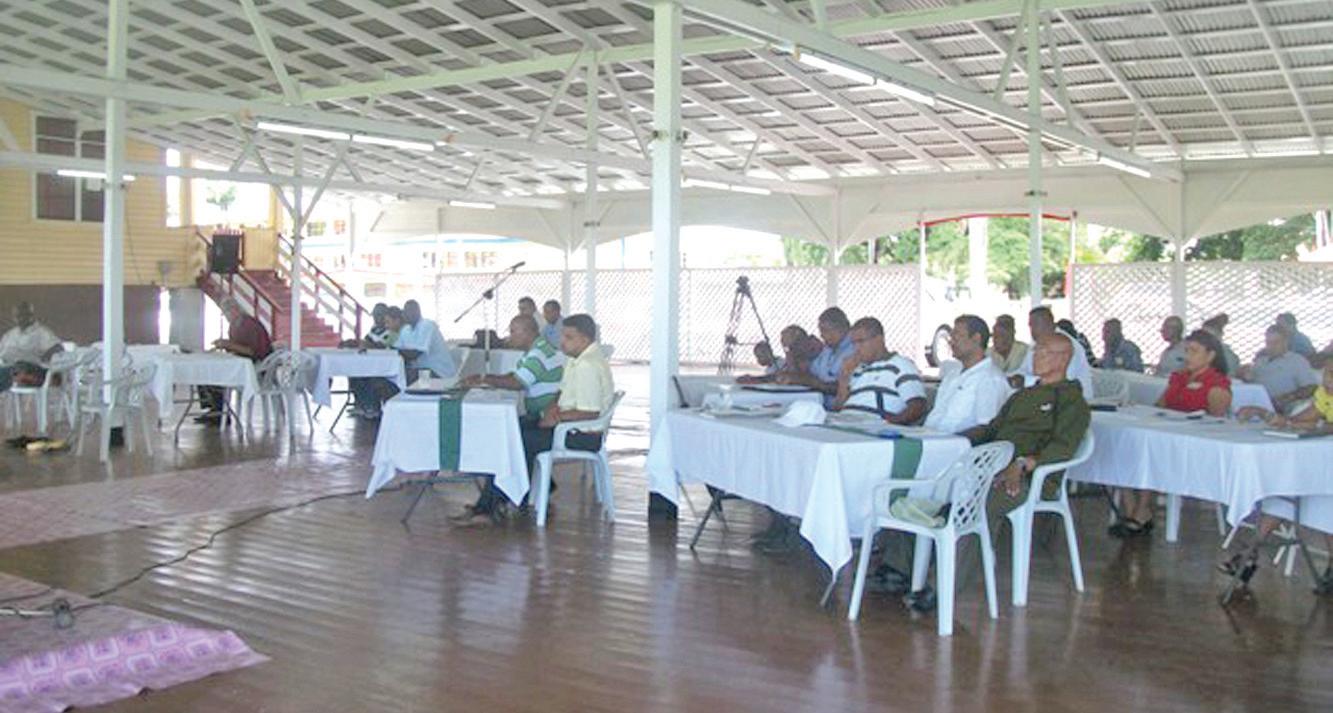
form very similar duties. He said the public looks at a policing group for some level of comfort, maybe not at the same level as uniformed officers, but they feel a lot safer knowing that these groups are present.
He noted that the most important part of the job is not about the way the groups are discerned, but for the comfort they provide to their community members and the standard of the service they provide. He added when standard is not upheld, leadership falls.
Minister Rohee said one difficulty the community members complain of is the boastfulness of the members of CPGs. He urged the members to be modest regardless of their position as modesty brings great respect and being humble is a major part of leadership.
Leadership means great responsibilities and if one cannot handle those responsibilities then he or she should not be in the position of a leader, he asserted.
There is always a very watchful eye at situations
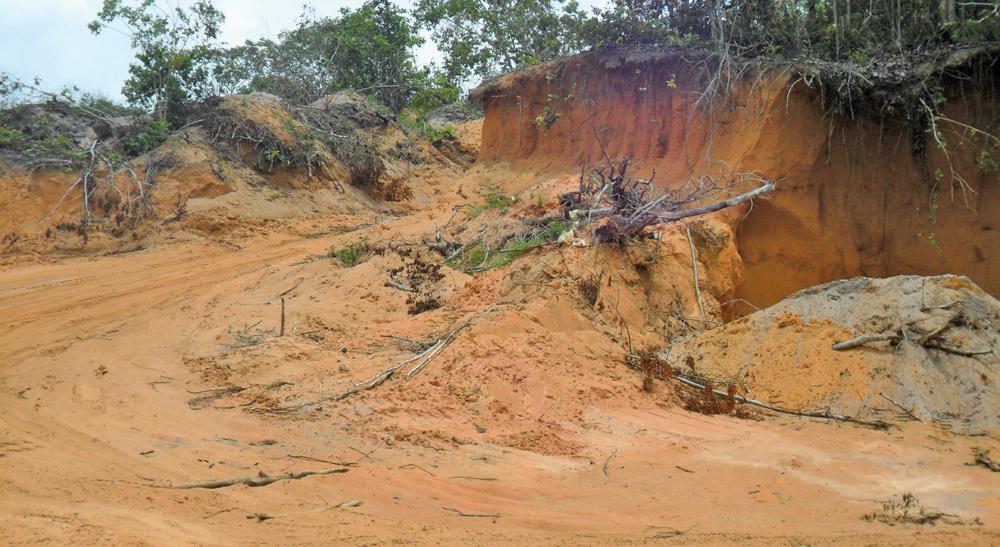
The Guyana Lands and Surveys Commission (GLSC) said lands at Three Miles, Mabura, Region 10, where laterite is being extracted by Bai Shan Lin are state lands, and no permission has been granted to anyone to extract laterite from the said location.
According to a release, the commission has since served a notice to Bai Shan Lin to halt all operations and removal of the company’s equipment.
Members of the public were advised in the release that the GLSC is the sole entity to administer state lands. As such, the commission is investigating reports of anyone authorising permission to occupy or sell state lands.
There was an under -
standing between the company and Region 10, that concessionary measures would be granted for the company to have its trucks use the Mackenzie/Wismar Bridge, to transport laterite from Three Miles on the west bank to Moblissa.
The laterite was for the rehabilitation of the $40 million farm road that the company’s vehicles had significantly damaged, causing hardships to residents.
Following the agreement, tests were done at Three Miles, on the Wismar Shore for suitable road building material.
There, the Chinese company identified a laterite pit and was granted permission to use it.
“The arrangement with Bai Shan Lin was that
we wanted the road at Moblissa to be fixed; we were going to give them all that was necessary to fix that road. We were going to give them access to the laterite pit; we were going to give them the results to show that this was the best material to use,” Regional Chairman Sharma Solomon said.
However, of the more than 100 truckloads of laterite that were removed from the laterite pit, less than 15 truck loads made it to Moblissa, Solomon claimed.
Meanwhile, the GLSC is seeking the public’s support in reporting any unauthorised occupation or sale of state lands by calling telephone numbers 227-2582, 226-0529-4-9.
First Lady Deolatchmie Ramotar has extended best wishes to the Muslim community as they commenced observance of the Holy Month of Ramadan.
According to the first lady in a message, the Holy Month is very dear to Muslims throughout the world and offers the followers of Islam, the opportunity to deepen their faith through prayer and acts of piety.
dealing with security as it is a critical area. So the law enforcers need to be very careful and should be able to perform their duties in a professional manner, upkeeping the standards of the Guyana Police Force (GPF) and to carry out their responsibilities, the home affairs minister said.
“Leadership has a price because when you fall as a leader, you fall hard,” the minister said
“It also promotes personal self-purification of body and mind by encouraging fasting, abstinence and the banishing of illthoughts and feelings.”
Ramadan is an exalted period, a time for Muslims to step aside from their worldly preoccupations and embrace a period of deep personal introspection, selfexamination, sacrifice and charity. Through this process, Muslims deepen their faith and encourage goodness and harmony in their
relations with each other and the wider society.
“I am particularly pleased by the example of devotion and self-discipline demonstrated by Muslims during this period. I hope that Ramadan will encourage all of us to recognise the values of these virtues in our lives and in improving relations in our society.”

The police are investigating several robberies committed in various parts of Berbice on Saturday with millions in cash, jewellery and other items being stolen.
According to information received, bandits broke into the house of Rajesh Mahabir, a businessman of lot 185 D’Edward Village, West Coast Berbice and carted off G$150,000, US$4000 and a quantity of jewellery worth over $1 million. They also stole two Guyanese passports belonging to the businessman and his wife.
Police investigation revealed that the act was committed between 16:30h and 22:00h on Saturday.
Information reaching this publication stated that
and his wife
Drupattie secured their home and went out, but upon their return, the businessman discovered one of the access doors to his home was opened.
As he entered the house, he noticed that the place was ransacked which prompted him to make checks for the articles and discovered them missing. The police were summoned and a probe was launched, but no arrest has been made.
In another robbery, thieves entered the dwelling house of Ramesh Khemraj, a businessman of Lot 26 ‘B’, Number 70 Village, Corentyne, Berbice and carted off one gold band value $300,000, one gold chain worth $200,000 and $1400 in cash.
Police stated that investigations revealed that
Khemraj resides in a twostorey concrete structure and on June 21, he secured his home and left for the U.S., leaving the cash under the drawer in his wardrobe and the jewellery in another drawer.
On his return on Saturday, he observed that one of the doors to the lower flat of the house was wrenched opened. Upon checking, he found that the several articles and items were missing. The matter was reported to the police who questioned several persons, but no one was arrested.
Meanwhile, as the robbing continues, bandits gained access into the home of Taigmattie Alvin, a widow of Lot 15 Pavilion Street De Edwards Village, West Coast Berbice and removed
one Apple iPhone value $80,000 and one Apple iPad cost $100,000. The robbery was committed on Saturday between 09:00h and 10:30h.
Based on reports gathered, Alvin resides in a twostorey wooden building in a well-fenced yard and occupies the bottom flat of the building while her brotherin-law Moontaz Alli occupies the upper flat.
On Saturday, the woman secured her home and went to the Rosignol Market, but upon her return, she discovered that the lock on one of the doors was ripped off. She entered her home and upon checking for the items which were left on a table in the sitting room, she realised that they were missing. Police are continuing their investigations into the robberies.
In light of the devas -
tating fire that left at least 12 persons making alternative living arrangements, the victims are now forced to solicit assistance from various agencies, including the Guyana Relief Council (GRC), as they struggle to put their lives back to normalcy.
The fire completely ravaged two houses and left extensive damage to one on Saturday. The occupants, who are claiming millions in losses, reportedly have nowhere to live as a result of the disaster.
Socota Fortune, the occupant of the upper flat of the house where the fire started explained that she has lost everything, rang -
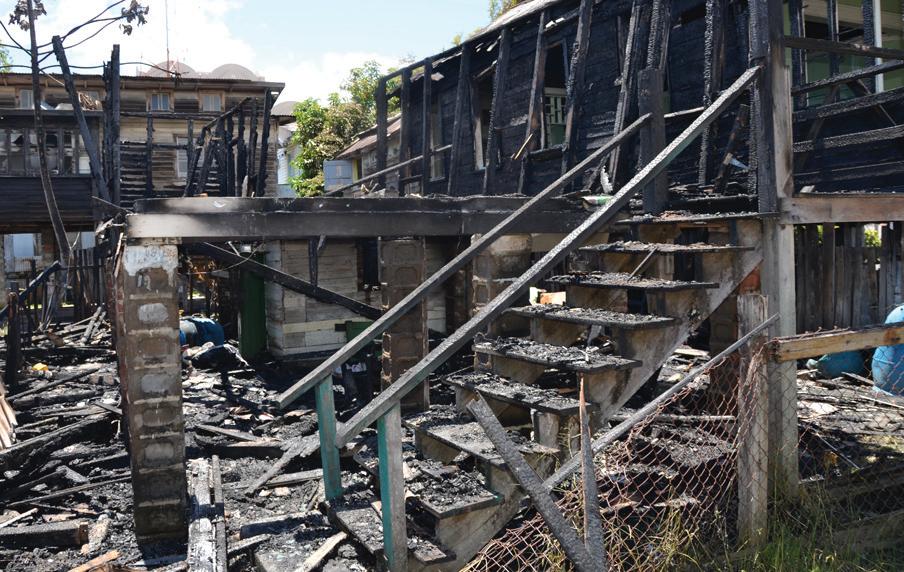
Despite her home is burnt to the ground, she
ing from computers to a refrigerator and a suite.
The woman, who works with Rubis, said she recently bought a few items from Courts with her hard earned money, but said philosophically that it is “just life”.
is optimistic that she will "rise again".
Fortune explained that she has already applied for a houselot and is hoping that her application will be treated with some priority.
She said that while she can rebuild at the present
location, she prefers to have her own land.
“Whether it be Parfaite Harmonie or East Bank…I will take it because I have a job that I can work and build my own home bit by bit,” she stated.
Fortune also intends to approach the commercial banks for a loan.
On the other hand, her mother, Vanessa Collymore, who was occupying the lower flat of the house, reaffirmed that prefers to rebuild at the same location.
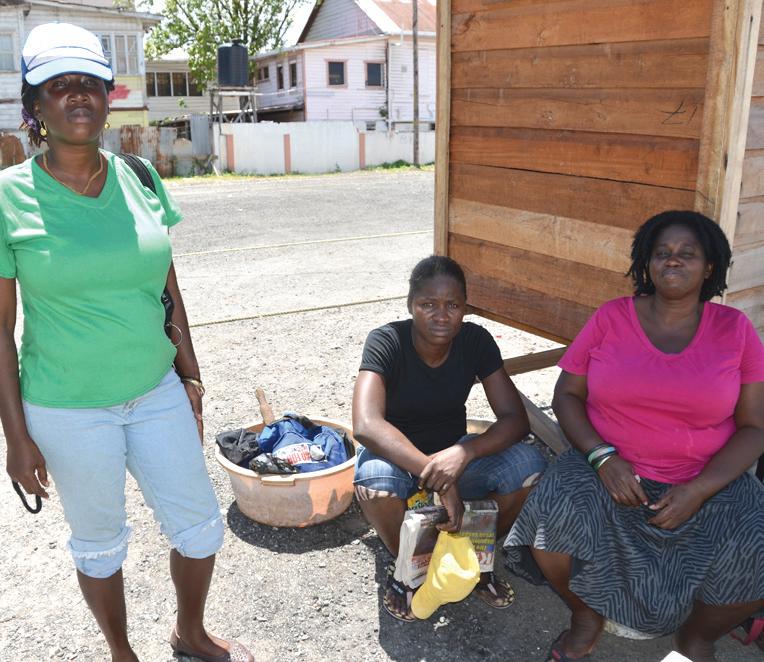
On Sunday, the occupants of the burnt out houses houses were seen at the Guyana Revenue Authority (GRA) Parking Lot with several pieces of garments and other items that were donated to them by persons in the area.
They were not sure of their next move, but they are hoping to meet with the Fire Chief Marlon Gentle and members of the GRC.
The mid-afternoon
blaze has left at least 12 persons homeless, completely destroying two buildings while damaging another.
The fire of unknown origin started about 15:00h at the Lot 107 Quamina Street property.
The fire reportedly began in the upper flat of one of the buildings and quickly spread to the two other buildings, leaving the occupants no time to salvage any household items.
By the time the fire engines arrived at the scene, two of the buildings were completely gutted, but firefighters managed to save the third with the help of public-spirited citizens.
There were a few hiccups as the firefighters attempted to source water.
Eye witnesses reasoned that the few minutes that were lost may have been the reason that the third building being was damaged significantly – more than half of which was burnt.

...to history
To use the phrase made popular by People’s National Congress (PNC) leader Desmond Hoyte, Adam Harris – now the editor-in-chief of the MuckrakerKN – is a “creature” of the PNC. From a school teacher at Bartica, he was catapulted to chief propagandist of Forbes Burnham as editor of the New Nation and then the Guyana Chronicle. One understands his gratitude to the PNC, but would expect some kind of easing of his bias – if he hopes for redemption in his dotage.
In his Sunday’s column, he launched into a vicious attack on President Donald Ramotar, going so far as to use the word “stupid”. His gripe was that at the “re-enactment” of the signing of the Treaty of Chaguaramas which launched the Caribbean Community (Caricom), the president extolled the virtues of Dr Cheddi Jagan rather than Harris’ benefactor Burnham.
Now in the world of diplomacy, it’s advised that if you can’t speak well of someone, then one should remain silent. The question is, what exactly could the president say “good” about Burnham if he wanted to speak the unvarnished truth – based on his experience? That one of Burnham’s major incentives in pushing Caribbean integration was to tilt the Guyanese political nose count in his favour?
Let’s not forget that, as far back as 1968, when he was seeking all sorts of means to remain in power, he pushed for small islanders to migrate to Guyana. This was the route Eric Williams had taken to retain control in Trinidad and Tobago for so many years. Burnham must’ve figured if it worked for Williams, it would work for him. Was President Ramotar also supposed to forget the “old boys’ club” Burnham formed with the other early leaders who stood mute while Burnham rigged himself into power for decades?
Was he supposed to praise Burnham for signing the Treaty of Chaguramas the same year his army seized all ballots and murdered two People’s Progressive Party (PPP) poll “watchers”? But Harris wasn’t satisfied with attacking Ramotar – he went after Dr Jagan himself – even as he accused the president of “hatred” for Burnham. He said Jagan was anti-West Indian integration because Guyana stayed out of the West Indian Federation.
What utter nonsense!!! Dr Jagan was “premier” between 1957 and 1961 and had no say in deciding Guyana’s position on the West Indian Federation. Belize and The Bahamas also stayed out. Dr Jagan was not against the West Indian Federation per se but, in common with all West Indian progressives, was against the neo-colonial structures imposed by Britain.
But it is interesting to know the anti-PPP vitriol still boils in Harris.
...easing on Caricom agriculture?
After almost a decade of just giving lip service to the development of Guyana’s comparative advantage in agriculture, which could feed the region, a small –and we hope significant – step was taken to rectify the neglect. On the sidelines of the above-mentioned Caricom heads of government meeting, Guyana and the Caricom Development Fund (CDF) signed a country assistance programme agreement that will inject US$7.32 million into Guyana’s agriculture sector.
This is really past due but better late than never. The programme to be funded will be used to improve infrastructure. But we were just as impressed with President Ramotar’s comment that the more fundamental goal will be to target young people to enter and remain in agriculture. We hope that the two concepts can be fused in the implementation of the project. That is, new lands should be opened up with necessary infrastructure and given over directly to young farmers.
For instance, over in Essequibo, the long promised new 5000 acres for farming could now become a reality for young farmers.
...of justice
Someone at the Guyana Elections Commission (GECOM) is confused. When it was pronounced that “justice is blind”, it meant she’s impartial – not blind to the merits of Gocool Boodhoo continuing as chief elections officer. Let’s not fix what’s not broken. We need local government elections ASAP to dump Hamilton Green.
Food For The Poor observed its 22nd anniversary with calls from leaders for renewed support to the charitable organisation.
Agriculture Minister Dr Leslie Ramsammy and head of Food For The Poor Kent Vincent, Chairman Paul Chan-a-Sue said the organisation continues to receive national and international support.
Referencing the organisation’s financial records, Chan-a-Sue during a recent dinner held at the Pegasus International Hotel said in 2010, Food For The Poor received US1.2 million in liquid cash while in 2011, there was slight increase which saw the organisation receiving US$1.5 million.
However, the figures dropped to US$0.9 million in 2012. Thus far, for 2013, Food For The Poor has received US$0.4 million.
Donations
“So over the last three and half years, US$4 million has come into us in cash,” the chairman told the packed audience.
He explained that the monies were used to maintain the operations of the organisation and execute charitable projects throughout
the length and breadth of Guyana.
In addition to monies received, Chan-a-Sue disclosed that with an average of 14 containers every month, Food For The Poor received $53 million in goods in 2010 while in 2011, $57 million in items were imported into Guyana for distribution. Last year, it secured $54 million. Chan-a-Sue said the Guyana Revenue Authority’s (GRA) unwavering support cannot go unnoticed.
Renewed commitment
However, to sustain the operations of the 22-year-old organisation, the chairman said continuous support is key from both local and international organisations
as he renewed his organisation’s commitment towards meeting the needs of the less fortunate.
While Food for Poor offers its services across the country, Chan-a-Sue said Regions One, Eight and Nine remain problematic.
“Though we do have some people going in there, and every now and then we are able to load up a truck and they take it in for us, so we do have the goods here but the cost of getting the goods in to those people who are very needed, it’s difficult.”
Amid these challenges, he said Food For The Poor Guyana will continue to provide clothing, food and housing to those in need. The non-governmental organisation also
has a rich history of giving support in the areas of agriculture, sport, culture, education, health, housing and technology.
U.S. Ambassador D Brent Hardt, in his brief remarks, lauded the work of Food for the Food in transforming the lives of the poor through the provision of better living conditions, adequate food, educational and recreational activities.
Transformative projects Ambassador Hardt alluded to 2012, when the non-governmental organisation constructed the Hosanna Village in the community of Mashabo, Essequibo Coast and commenced the construction of 40 homes and a water project at Swan Village located

in proximity of the Linden/ Soesdyke Highway. To date, Food For The Poor has constructed more than 3000 housing units for the poor.
The ambassador also made reference to the organisation’s partnership with orphanages under the Angel of Hope Programme, to provide shelter and education for 217 children.
Drawing a comparison between Guyana and the U.S., Ambassador Hardt said Food For The Poor “embodies some of the core values that Americans hold dear”.
He explained that in an effort to combat hunger, natural disasters and simultaneously advance global development, the U.S. is spending US$23
billion to achieve its objective.
Under the global health initiatives, Guyana stands to benefit as the U.S. has pledged its support in the fight against HIV/AIDS in Guyana. “Our funding to combat global climate change seeks to help the most vulnerable countries respond to the growing impact of climate change.”
Agriculture Minister Dr Leslie Ramsammy praised the entity for its outstanding performance in meeting the needs of the poor and the vulnerable.
Pledge Minister Ramsammy said like Food For The Poor and other charitable organisations in the country, all Guyanese must make a pledge to assist the vulnerable. “We should commit to this as long as there is one person that needs some help and we should be there to help that person.”
Food For The Food was birthed in Guyana on June 3, 1991 under the stewardship of Leon Davis, who employs a small staff in Kingston, Georgetown. In acknowledgement of his 21 years of unwavering support to the organisation, Davis was presented with a plaque.

Chief Medical Officer (CMO) Dr Shamdeo Persaud said Guyana stands to benefit tremendously through the recently established Caribbean Public Health Agency (CARPHA).
The agency was launched last week in Trinidad and Tobago. With a mandate to ensure the health and well-being of the 15 Caricom countries, CARPHA will provide technical assistance to health ministries and other health-related agencies across the region. Dr Persuad explained that through a laboratory network system, small countries with no public health labs will receive assistance from CARPHA.
“We are to benefit from the experiences, the technical support and the expertise that exist.” While Guyana can conduct tests determining whether someone is inflicted with dengue fever, the CMO said the country does not have the facility to determine the type of dengue fever. Hence, the Health Ministry will be able to have tests done at CARPHA’s BSL level three certified laboratory.
Speaking at the launch last week, Caricom Secretary General, Ambassador Irwin LaRocque said the event demonstrated clearly to the region how the cooperative deployment of many skills to achieve one objective can be of collective
benefit. “We had long recognised the desirability of creating such an institution. The Declaration of Needham’s Point issued by heads of government at their 28th regular meeting held in Barbados in July 2007, gave the impetus to the actual formation of CARPHA. In that declaration, the heads mandated “a comprehensive review of regional institutions with a view effectively to rationalising their functions, funding and structures better to provide common services.”
According to LaRocque, the road to the launch has not been easy. “To merge five regional health institutions into one single entity was a complex task requiring compromise and cooperation. Each institution had a track record of distinguished service to the region, but there was recognition by all of the benefit
that a regional institution with a broader, more succinct remit could bring to the health of the Caribbean Community.”
He said heads of government have long recognised the importance of health to the development of the community with the Nassau Declaration of 2001 stating that “the health of the region is the wealth of the region”. CARPHA is critical to the realisation of that vision enunciated by regional leaders. It has a vital role to play in Caricom’s efforts at addressing its health concerns.
He said the template for CARPHA will serve “us well in other areas and is in keeping with the forward thinking and leadership role of the health sector in the region, which was the first to demonstrate what became known as functional cooperation, even pre-dating the West Indies
Federation. The health sector has also paved the way, through the creation of this agency, for other sectors in the community with respect to the rationalisation of institutions.”
CARPHA was officially launched at the National Academy for the Performing Arts, Port of Spain.
Advisory committee
The agency will be led by Dr James Hospedales, who will continue to receive support from the Council for Human and Social Development (COHSOD). Additionally, the executive board which is a mixture of ministers, permanent secretaries and chief medical officers will also receive support from a Technical Advisory Committee in which Guyana is represented by the CMO.
The Caribbean heads of government gave the greenlight for the establishment of CARPHA in March 2010. It was designed to absorb the duties and build on the work of the Caribbean Community’s five regional health institutions (RHIs), subsequent to a transition period which started in December 2010. The RHI’s are: the Caribbean Epidemiology Centre (CAREC), the Caribbean Environmental Health Institute (CEHI), the Caribbean Food and Nutrition Institute (CFNI), the Caribbean Health Research Centre (CHRC) and the Caribbean Research and Drug Treatment Laboratory (CRDTL).

After playin like real losers in de ICC Champions Trophy in England, de West Indies come back and win two games in a row in de Caribbean against two different teams. Although that don’t happen very often, all de West Indies fans was happy and jumpin up fuh joy. One fan even start tellin he friends that West Indies done reach de final.
What he didn’t realise is that India was just tekkin a rest after winnin de trophy in England. So India come right back and cut dem down to size. And it didn’t help that de West Indies start playin like Waste Indies. Now de fans bawlin and worryin to know if de Waste Indies gon reach de final in a tournament that playin in dem own backyard.
And talkin bout backyard, even de new One Day skipper look like he playin ball and bat in he backyard. Two times now in de past 12 months he can’t bowl out all he overs in time and had to pay a match fine. Now he get suspended fuh one game and even de players had to tek a pay cut.
But de captain shoulda pay fuh all de players, since in de first place, is he who mek de team ain’t bowl all de overs in time. But comin to tink of it, de skipper didn’t want to bowl all de overs wid de way Kohli was battin. And de skipper know fully well that de Waste Indies can’t bat out 50 overs, so he didn’t want to bowl 50. At least de previous captain used to bowl out all de overs and he even win de Twenty20 World Cup.
Ting-a-ling-a-ling…friend tell friend…mattie tell mattie! Yet dem still don’t want to call up de Tiger – who battin like a tiger in England. So more and more it lookin more like it was de Waste Indies coach that had need to change and not de captain!


On March 31, India’s Appeal Court dismissed an appeal by the giant Swiss pharmaceutical multinational company, Novartis.
Novartis had appealed a previous ruling by the Indian Supreme Court three years ago that refused to allow Novartis to renew its patent for a cancer drug called Glivec. Glivec is a lifesaving medicine for thousands of cancer patients with myeloid leukaemia and other cancers around the world.
The problem is that the cost of the drug is out of reach for most people. Glivec costs about US$2600 per month per patient. Even the middle class and most wealthy people cannot afford this in developing countries. Indeed, this is a challenge for middle-class people in the developed countries too. But in developed countries, people get access because of various insurance schemes.
Partially solved
Fortunately, the problem is partially solved since Indian pharmaceutical companies have been able to make a generic version that sells for only about US$170 per month per patient, less than 10 per cent of the cost of the same medicine sold by Novartis.
Three years ago, the Indian Supreme Court ruled that the patent that Novartis possessed for Glivec, which prohibited generic companies from manufacturing generic versions of the medicines, cannot be continued. Novartis appealed the ruling and, in March, after a three-year court battle, the Indian Appeal Court ruled again against Novartis. This is a landmark ruling for many good reasons, but mostly because people can get access to affordable Glivec to save their lives.
When a company obtains a patent, it means that the medicine for which they obtain that patent can only be manufactured by that company for 20 years. This patent system protects the company, which may have expended hundreds of millions of dollars to develop the medicine. But the global experts believe that 20 years is more than enough time for the company to recover
its investment and make enough profits.
Consequently, the global patent system allows other companies to begin to manufacture generic versions of the medicine after 20 years. The first company that can market a generic version has protection for six months during which time it can compete with the original company in manufacturing the medicine.
Subsequent to the six months, other companies can join the competition.
There is no limit to the competition at that point. This system ensures that after a period of high profitability for the company that develops a particular medicine, the company is forced to lower prices after 20 years in order to compete with the generic versions of the medicine. This is the reason why medicines such as metformin, Valium, amoxicillin, Lasix, doxycilin, and other medicines are so cheap today.
Exclusive rights
This system ensures companies can invest resources to develop a medicine and enjoy exclusive rights to manufacture and sell the medicine. The high costs of medicines are related to the fact that for at least 20 years the company that develops the medicine enjoys a monopoly on marketing that medicine. Thus, when Glivec was under patent protection, it sold for US$2600 per month per patient and patients had no choice. It was either paying and becoming poor, or die.
But the global patent system also allows for a time-bound limitation on the high profit margins for companies that develop a medicine. Thus, with Glivec, when the 20 years were up, Indian pharmaceutical companies began to manufacture generic versions of the medicine for US$170 per month. People did not have to permanently impoverish themselves in order to access this lifesaving medicine.
But the system has a significant loophole – companies can make slight changes in the form of the medicine and renew the patent. The system is called “ever-greening”. What the pharmaceutical companies do is make

slight changes, not in the active ingredient, but in the form of the medicine. In the case of Glivec, when the patent ran out three years ago, Novartis made a new version that it claims absorb more efficiently into the bloodstream.
However, the Indian pharmaceutical companies challenged Novartis on this instance, claiming that even though it might have changed the form of the medicine to be more user-friendly, it was the same medicine. The court ruled that slight changes such as Novartis claimed for Glivec were not reason enough to extend its patent, and allowed the Indian companies to make the generic version.
Milestone decision
This milestone decision will now ensure that medicines such as Glivec can be obtained as generic versions, medicines that are just as good as the original, but at a fraction of the cost. Millions of cases of morbidity and hundreds of thousands of deaths, even millions of deaths, can be averted at a fraction of the cost of patented medicines.
And the cost of health care is lowered when health systems have access to a quantity of generic medicines. Guyana, for instance, where we extensively use generic medicines in the health-care system, saves more than G$5 billion per year because we procure generic medicines.
Take the example of Coartem, a malaria multidrug regimen, patented by Novartis. It was originally sold at a cost way beyond affordability for the millions who suffer from malaria. Novartis voluntarily gave permission for generic pharmaceutical companies to produce Coartem
at a cost below US$1 per treatment, when the original cost was more than US$50 per treatment.
The HIV medicines, called ARV medicines, originally cost about US$15,000 per patient per year. Guyana’s NEW GPC in 2001 started to make generic versions of some of the ARVs at a cost as low as US$140 per patient per year. Now, gener-
ic ARVs from America and India are between US$140 and US$600 per patient per year. The global patent system, by limiting the years of monopoly created by patents, ensures that medicines, which can only be afforded by the wealthy when the medicines are first introduced can, become cheaper when the patent protection ends.
Some argue that the 20-year period is too long.
Times Notebook is not debating that issue now. But Times Notebook believes that the patent protection period should not be forever and the “ever-green” system is unfair.
We, therefore, salute the Indian Supreme Court and the Indian Appeal Court. They acted with more than wisdom. They showed that we must care for people, and people’s health must take precedence over big profit and greediness. The world is
better off with a system that equally promotes innovation through research and development by allowing original patent to last for 20 years, but balances a profitability system that drives such innovativeness by imposing a limit via the threat of a generic system that can kick in after 20 years of high profitability.
The timing is important because medicines with a generic value of about US$150 billion are about to go off-patent in the next year.
Times Notebook knows that generic companies will see this as a bonanza. We see it as good news for millions who will see a dramatic reduction in the cost of many medicines that they need to sustain life.
Readers are invited to comment on this article via email (times.notebook@gmail.com) and on Facebook.

monday, july 8, 2013 | guyanatimeSgy.com

Anumber of events are currently being planned by the Region 10 Democratic Council (RDC), in commemoration of the series of protests, particularly on July 18 last year by Lindeners, over a proposed electricity tariff increase in the community which resulted in the death of three protestors.
Region 10 Chairman Sharma Solomon, who is spearheading the seven-day event, indicated that the observances will be held from July 12 to 18, commencing with a public meeting at the Palm Tree Cinema Square, organised by the Linden Evangelical Fellowship Movement.
“We want to have the presence of Almighty God and we believe that the religious community did a good so we are going to put it (this event) in the hands of the Evangelicals, who planned a very good programme for us last year,” he noted.
Photographic exhibition
On July 13, a photographic exhibition and counselling session is planned and is scheduled to take place at the MacKenzie Market Square. He noted that the photographic exhibition will include pictures on the July 18 protests. This will be followed by a cook-off competition on July 14.
On July 15, a schools’ programme is slated to take place at the Egbert Benjamin
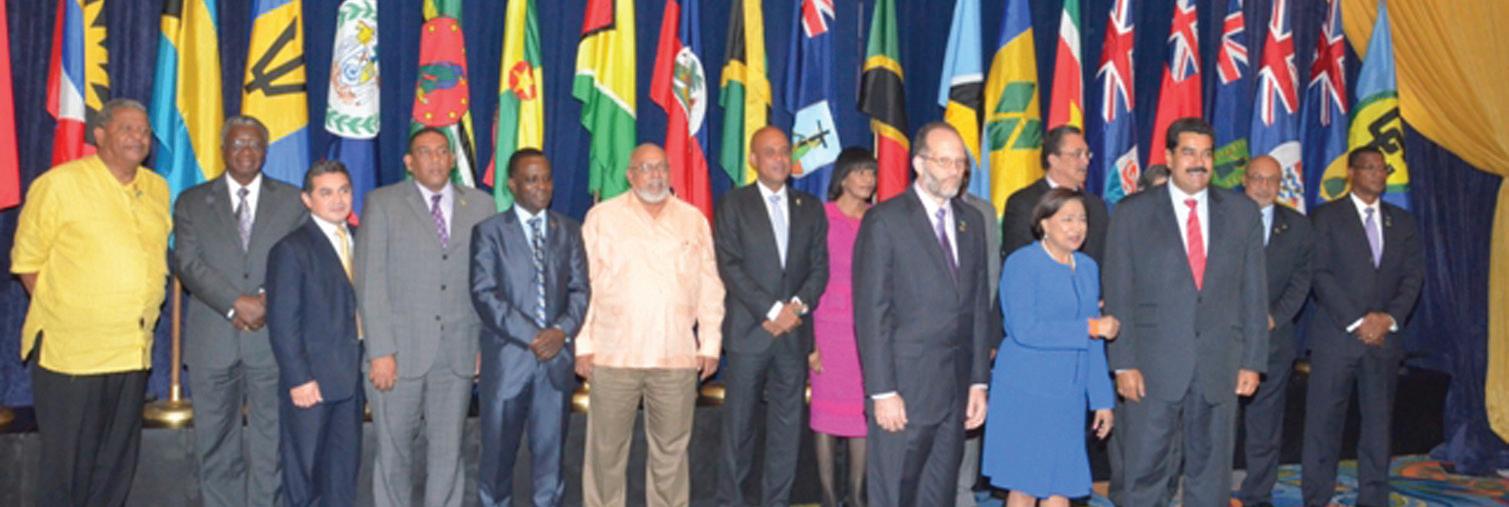
Heads of government of the Caribbean Community (Caricom), on the final day of their 34th regular meeting agreed on follow-up action on the matter of reparations for native genocide and slavery.
According to a Caricom Secretariat release, the meeting agreed to the establishment of a National Reparations Committee in each member state with the chair of each committee sitting on a Caricom Reparations Commission.
The heads of government of Barbados (chair), St Vincent and the Grenadines, Haiti, Guyana, Suriname and Trinidad and Tobago will

Centre. Students from various schools across the region are expected to participate in an essay writing competition based on the theme “What I learned from the July 18 event”. The competition, Solomon said, will be conducted between schools from the West and Eastern shores of Linden.
The unveiling of a design and proposed monument site for monuments in honour of those killed while protesting will take place at the Egbert Benjamin Centre on the morning of July 16. A five-member technical committee is also expected to be established to manage and deal with such commemorative events, Solomon noted.
On July 17, a candlelight vigil will be held in honour of Shemroy Boyeau, Ron Sommerset and Allan Lewis, who were shot dead last July on the Mackenzie-Wismar Bridge. Solomon explained that the theme for the event
will be “Black and White”. The activities will conclude on July 18 with the laying of floral wreaths by family members of the slain trio at their Bamia, Linden-Soesdyke Highway gravesite. That will be followed by a commemoration programme at the Mackenzie-Wismar Bridge in the evening.
Additionally, the regional chairman noted that the annual memorial of the Son Chapman incident, which is usually held on July 6 at Hurudaia, Upper Demerara River, will as of July 6 this year, be held at Linden. The incident relates to a boat tragedy which took place 49 years ago, where 43 persons from Linden were killed as a bomb exploded on the Son Chapman boat at Hurudaia.
Historic moments
The regional chairman said that it is important not to forget historic moments like these and such history should be kept alive.
Arrangements for the establishment of a monument site at Linden in honour of the Son Chapman incident are also currently underway.
“I think the community needed some assurance that this matter will not be lost to history, not forgetting that next year will be 50 years (since the incident) and it deserves some movement toward that proper recognition nationally,” he said.
BK International (BKI) said that the current traffic congestion on the East Bank Demerara Public Road is not in any way related to or affected by the construction works being carried out by the company for the expansion road project from Providence to Diamond.
BKI further stated that the assertions made by A Partnership for National Unity (APNU) parliamentarian Joe Harmon, with regard to the delays experienced by the contractor on the construction of the expansion project, are grossly ill-informed and irresponsible. “Had Harmon taken the time to consult with BKI and with the Ministry of Public Works and Transportation, the company would have readily placed the facts causing the delay at his disposal,” the company said.
BKI was responding to two articles which appeared in the mudslinging Kaieteur News last week on the road project and the traffic congestion.
Second to none
BKI said it is proud of the fact that it is the only Guyanese contractor fully mobilised, with the largest fleet of state-of-the-art road, sea defence and housing construction equipment in the country and has a group of highly qualified engineers and consultants on its payroll, second to none in the Caribbean. As a consequence, BKI has been able to bid and win contracts in competition against the best of international contractors for the benefit of Guyana, the company stated.
“It is worth noting that the cost of construction generally has been reduced by over 40 per cent as a result of BKI and other local contractors having taken the risk of investing in expansion within recent years to compete successfully against overseas contractors. BKI, therefore, considers the remarks attrib-
provide political oversight.
The decisions were taken followed presentations by member states, led by St Vincent and the Grenadines, and their unanimous support of the road map.
Chair of the community, Trinidad and Tobago Prime
Minister Kamla PersadBissessar at an end-of-meeting press conference at the Hilton Hotel, described progress on the subject as a very positive outcome. Earlier in the day, during his contribution to the discussions, Prime Minister Baldwin
Spencer said he conceptualised the call for reparations as an integral element of the community’s development strategy. The legacy of slavery and colonialism in the Caribbean severely impaired the region’s development options.
uted to Harmon criticising the number of contracts undertaken by the company to be totally uncalled for, wholly irresponsible and completely unfounded in fact,” the company said.
BKI said it was fully mobilised and began work on this project in January 2012, some 15 months ago as scheduled, but in fact, has been forced to suffer continued delays caused by the failure of government agencies to make adequate and timely provision for the removal and relocation of public utilities and other structures within the project area.
The company said it cannot proceed with its project construction if public utilities, such as power lines, gas lines, telephone lines and utility poles, are not removed and relocated by the contractors engaged to do this work. BKI said it has written numerous letters of complaints from the commencement of the project to the resident engineer and team leader of the consulting group responsible for this project, registering its concern about these delays.
The company said that since February last year, it placed on record that the failure to relocate utilities prevented it from proceeding as scheduled, and would result in BKI claiming for costs and an extension of time. “BKI has pointed out to the consultants that the company has been required to maintain a full complement of personnel and equipment on site while being unable to proceed with planned construction activities at considerable loss and expense to the company,” the company said.
On February 28, for instance, BKI wrote the consultants as follows: “In accordance with Clause 101-14 of the general specifications and Clause 8.3 of the general conditions of contract, we wish to remind you that we are still awaiting your in-
“We know that our constant search and struggle for development resources is linked directly to the historical inability of our nations to accumulate wealth from the efforts of our peoples during slavery and colonialism. These nations that have been the major producers of wealth for the European slave-owning economies during the enslavement and colonial periods entered independence with dependency straddling their economic, cultural, social and even political lives,” Prime Minister Spencer said.
Reparations, he added, had to be directed toward repairing the damage inflicted by slavery and racism. “We,
structions to proceed with the relocation of utilities. We wish to urgently stress the importance of utilities relocation to our programme of works and to remind you that very minimum construction works can be completed in any of the work zones until relocation is completed.”
Since that time, BKI said it has been forced to continuously write the consultant. The company has pointed out that, particularly in the area between Distribution Services Limited (DSL) and the Diamond Housing Scheme intersection, the concentration of utilities servicing commercial banks, a petrol station, a beverage company, installed by the Guyana Water Incorporated (GWI), the Guyana Power and Light (GPL) and the Guyana Telephone and Telegraph (GT&T) are a cause of major delay.
Relocation of utilities
In June last year, the company was forced to notify the consultant and the client that it “will suspend all works on the project with immediate effect” until the matter of the relocation of utilities, still to be solved, had been addressed. In fact, however, in the interest of the project, BKI did not suspend works.
The consultant was written in August, October and November last year, and again in March this year, by the company giving notice of being ready to begin work at the Diamond high bridge but the relocation of the gas line servicing the Demerara Distillers Limited (DDL) and water mains under the bridge had not been decided on.
This major hindrance to the progress of construction work on the project continues to exist and is completely out of the control of the contractor. In addition, a late introduction varying the contract for concrete drains on the carriageway have further delayed the contract.
as political leaders, must encourage our various reparation agencies to continue the education of our Caribbean people and our diaspora, and enhance their awareness of the reparations issue. It is important that there is solid people and multi-party support for our efforts and we must impress on our colleagues in both government and opposition that this is not an issue we should use as party-politics fodder. Our various reparation organisations must see the forging of bi-partisan political support and civil society consensus for reparations as one of their main objectives,” the Antigua and Barbuda prime minister added.
One of the schools in Berbice that recorded a 100 per cent pass rate at this year’s National Grade Six Assessment (NGSA) has now lost half of its student population. Zorg Primary held its first graduation exercise on Thursday for four of its eight students. The school which is manned by three teachers and employs a cleaner is situated in East Canje and referred to as “New Forest Primary”.
It caters for pupils of four villages with a combined total of about 65 residents. In what can be described as


an emotional graduation exercise and first for the school which has been in existence for over 60 years,
Headteacher Mira Thomas noted that a competent and qualified staff delivered the
curriculum to the pupils in a child-friendly environment.
Zorg Primary also houses a nursery department. Thomas noted that despite only having an enrolment of eight students, the school has been able to make its name
known over the past year as it secured gold at the Guyana teachers Union (GTU) InterSchool Championships and also did well at the national Mashramani costume competition.
The four students who graduated are Rollanda Jairaj, Ravindra Shiamsundar, Mercia Newyear and Davanand Seecharran. Thomas said there were no students to prepare for the National Grade Two Assessment this year, but noted that the graduating students sat both the national grade two and four assessments. “I am pleased to announce that there was 100 per cent pass.”
Meanwhile, on Wednesday at the Sandvoort Primary School at West Canje, Berbice, seven students sat the NGSA and for the first time in the history of the school, three students attained places at a Grade A secondary institution.
Government’s discussion with Atlantic Telecommunications Network (ATN), the parent company of Guyana Telephone and Telegraph (GT&T) on de-monopolisation and the de-liberalisation of the telecoms sector has been very fruitful, and though further deliberations are expected, the hope is that government will sooner than later be returning to the House for discussion on the government tabled bills. This is according to Cabinet Secretary Dr Roger Luncheon.
The Telecommunication Amendment Bill and the Public Utility Amendment Bill were put on hold to facilitate the discussion with ATN-GT&T. Over the first two quarters of the year, government has been in discussion with ATN-GT&T to arrive at an agreement on the de-monopolisation and the de-liberalisation of the telecoms sector. The goal is to arrive at consensus to put in place a rule-based, licence-based operation in
the telecoms sector and replace the 1990 agreement that privatised the Guyana Telecommunications Corporation.
“The encounters by the two sides have been fruitful in sharing the mutual concerns of both parties. I think it could be safe to say there is a fuller understanding at this stage of how far either party is willing to go in working towards an agreement on the way forward,” Dr Luncheon said.
He said ATN-GT&T and government have both produced documents outlining their demands. ATNGT&T provided its menu to the government and government has given a response and further deliberation is expected in the context of the two documents, the Cabinet secretary said.
Meanwhile, the government drafted and tabled Telecommunication Amendment Bill and the Public Utility Amendment Bill, and the private members bill by the leader of the Alliance For Change (AFC) have been put on hold in Parliament as the House has understandably allowed the government and ATN-GT&T to conduct these negotiations without having the bills being debated simultaneously.
Dr Luncheon said Prime Minister Samuel Hinds, who tabled the government bills, has indicated a date that sooner rather than later the government will be returning to the House to engage it on the government tabled bills and legislation.
monday, july 8, 2013 |
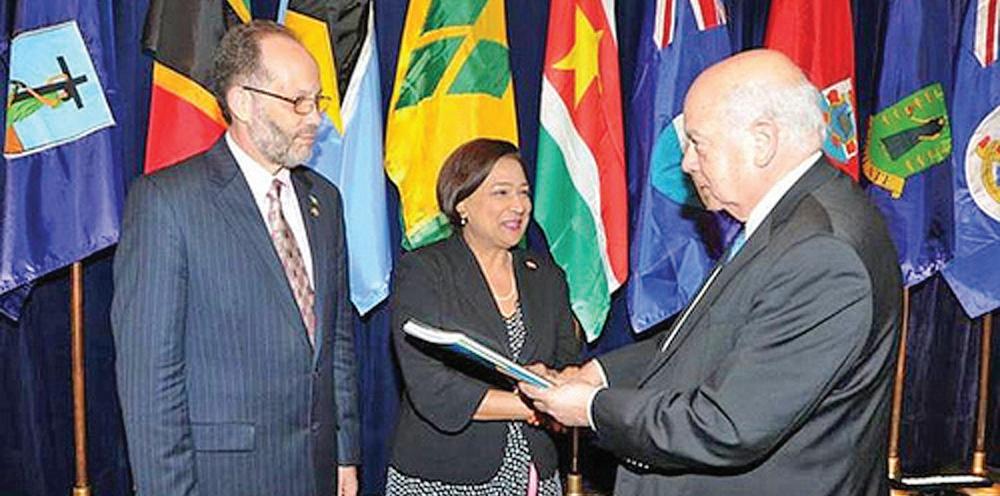
Organisation of American States (OAS) Secretary General José Miguel Insulza presented the Report on the Drug Problem in the Americas to the regular meeting of the conference of heads of government of the Caribbean Community (Caricom), held in Trinidad and Tobago.
The secretary general presented the report in the
meeting, and also delivered a copy to Trinidad and Tobago Prime Minister Kamla Persad-Bissessar, who currently holds the chair of the conference of heads of government of Caricom. The report was produced by the hemispheric organisation under Secretary General Insulza’s supervision, pursuant to a mandate from the sixth summit of the Americas in Cartagena, Colombia. The
document is divided into two parts: the analytical report and the scenarios report. Within the framework of the Caricom meeting, which he has attended each year since assuming his position in 2005, Secretary General Insulza met with several Caribbean leaders, among them the prime ministers of The Bahamas, Perry Christie, and Saint Kitts and Nevis, Denzil Douglas.
The Inter-American Development Bank (IDB) has launched the 2013 Call for Proposals of the initiative for the promotion of regional public goods in Latin America and the Caribbean (LAC).
The initiative is based on the premise that the countries of the region share challenges or opportunities for development that can be addressed or seized upon more effectively and efficiently by means of regional cooperation, IDB said in a release.
In 2013, the initiative will provide up to US$10 million in grants to finance regional public goods (RPGs) that are produced collectively by a group of IDB borrowing member countries. Even though the initiative is open to the promotion of RPGs in any development area covered by the IDB, alignment with the
IDB’s operational priorities is a selection criterion. The other two selection criteria are the value added of a regional verses national approach to addressing a development challenge or opportunity, and the prospects of sustaining the benefits of regional collective action beyond the support of the initiative.
The initiative is the bank’s most prominent grant instrument to support intra-regional cooperation and the collective design of development solutions in LAC. Demand for its resources has intensified in tandem with the increasing importance of multi or bilateral SouthSouth cooperation (SSC) in the development agenda of most LAC countries. The interest in SSC among the bank's borrowing members is a reflection of the fact that the region is a source of inno-
vative development solutions that can be shared and replicated by other countries in LAC and in other parts of the developing world.
The IDB has a longstanding commitment with its borrowing member states to foster functional cooperation and the promotion of RPGs. Its 2011 sector strategy to support competitive global and regional integration in LAC reaffirms the importance of intra-regional cooperation as a corollary of economic integration and the “missing link” that often allows the countries to fully realise the benefits of economic integration.
All proposals must be presented in accordance with the Call for Proposals Guidelines and must be submitted online before 23:59h (U.S. Eastern Standard Time) on August 15.
Two women and a man are in police custody following the discovery of a quantity of marijuana at Number Two Village and Betsy Ground, Berbice on Friday.
According to information received, a party of policemen went to the home of Chandradat Chandradan, 35, at Lot 359 Number Two Village, East Canje Berbice, to arrest him in relation to an allegation of rape. However, upon arrival at the premises, they met the accused wife, Nalini Baldeo, 28, who subsequently informed them that her husband was not at home. The woman then walked into the house when one of the officers recognised her throwing a black plastic bag through the window.
The bag was retrieved by the officer who instructed Baldeo to open it. When this was done, it was found to contain a quantity of leaves, seeds and stems suspected to be cannabis. The bag also contained a quantity of bamboo and one black handle scissors. Baldeo was told of the offence committed, cautioned and arrested. She was taken to the Reliance Police Station where the suspected cannabis was weighed and amounted to 63 grams. Baldeo is expected to make her first court appearance on Monday.
Meanwhile, about 23:30h on Friday, police acting upon information, went to the home of Goordat Baljit also called “Guru”, 38, of Lot 5 Betsy Ground, East Canje Berbice, where a search was
conducted. The house belonging to Goordat also houses a grocery and liquor shop on the lower flat.
During the search, a transparent plastic bag containing a “whitish” rock suspected to be cocaine was found hidden in the shop, next to a rum case. The rank took possession of the suspected cocaine and informed Goordat and his wife, Joanie Singh of his suspicion. The couple was questioned but remained silent. They were taken to the Reliance Police Station with the suspected cocaine which was weighed in their presence and amounted to 2.5 grams. Baljit and Singh are presently in custody at the Reliance Police Station. Charges are expected to be laid shortly.

contractor.
Cuban President Raul Castro on Sunday backed offers of asylum by Venezuela and other Latin American countries to fugitive United States spy agency contractor Edward Snowden and criticised America for what he described as bullying other nations.
Castro, speaking behind closed doors to Cuba’s National Assembly, said Venezuela and other countries in the region have the right to grant asylum “to those persecuted for their ideals or struggles for democracy, according to our tradition”, according to the official Prensa Latina News Agency.
Foreign journalists were barred from the parliament meeting.
Castro’s remarks were his first public comment on the Snowden affair.
Cuba over the years has given refuge to various U.S. fugitives it considers political refugees, most notably members of the Black Panthers group decades ago.
Communist-run Cuba’s

Cuban President Raul Castro
leftist allies Bolivia, Venezuela ,and Nicaragua have stated that their doors are open to Snowden. Castro did not say if Cuba had received an asylum request and what the country’s position would be if it does.
Snowden, 30, is believed to be holed up in the transit area of Moscow’s Sheremetyevo international airport and has been trying to find a country to give
him sanctuary since he landed there from Hong Kong on June 23.
Castro denounced U.S. threats of economic sanctions against any country that harbours Snowden and also denounced last week’s incident in which some European countries banned Bolivian President Evo Morales’s plane from their airspace on suspicion that it was carrying the former U.S. National Security Agency contractor.
(Excerpt from Reuters)
Jamaican minister with responsibility for information, Senator Sandrea Falconer, has urged media organisations to accept the government’s position, reflected in the Defamation Act 2013, not to put a cap on damages which may be awarded against them in court.
Senator Falconer was acknowledging the disagreement that exists between the government and the media, on the matter of whether there should be a cap on damages awarded by judges, in a statement to the Senate on Friday as the debate on the long-awaited legislation bill opened.
“It is one of the few areas where there is a disagreement with the Media Association of Jamaica and the Press Association of

Jamaica,” Falconer said. She explained that media owners and journalists have generally expressed a preference for having a judge assess damages, in all
the circumstances, as they feel that the judges would be more reasonable in setting damages than juries.
“Awards by juries have been a sore and vexing point among media owners and media practitioners, especially in light of some very hefty awards which have been made locally. It has often been noted that some of the awards made by our courts have had a chilling effect on freedom of expression and press freedom, for those huge awards which could wipe out a number of media houses. They could also serve to intimidate pursuers of truth in the media,” she observed.
The change proposed in the law has been strongly supported by the Media Association of Jamaica. (Excerpt from Jamaica Observer)
An international financial investigative agency has information that a government financier has amassed over a billion dollars in contracts over the three years that the People’s Partnership has been in power. This was revealed Saturday by forensic and fraud auditing specialist Stephon Grey. Grey is the managing director at BDO Forensic Accounting, the world’s fifth largest network of auditing firms; a sub-contractor at Kroll UK Ltd, the world’s leading forensic and investigative group; and the director of education at the Caribbean Institute of
Forensic Accounting. He is considered to be one of the leading forensic accounting consultants in the region.
Grey was at the time speaking at a forum titled “A Proper Procurement Framework as a Tool for National Development”, put on by Anointed Professionals Exhibiting Excellence (Apex) at the Hyatt Regency Hotel, Port of Spain. He spoke on the topic “Conducting Effective Procurement Investigations” and said that any procurement legislation being considered must treat first with the issue of political party financing.
Addressing the need to
conduct due diligence and background checks when considering the awarding of contracts, Grey said this was a process well followed in developed countries, but “we don’t do it in Trinidad”.
He said that this lack of due diligence had resulted in the largest contract awarded in the country over the last two years in a methanol deal, going to a non-existent company trading under the name Trinidad Development Company, and it was only when it was pointed out after the fact that such company was not registered in this country that the fact became known. (Excerpt from Trinidad Guardian)
Brazil will demand an explanation from the United States over a report its citizens’ electronic communications have been under surveillance by U.S. spy agencies for at least a decade, Foreign Minister Antonio Patriota said on Sunday.
Patriota’s remarks were in response to a report in the Globo daily newspaper on Sunday saying that the U.S. National Security Agency has been monitoring the telephone and email activity of Brazilian companies and individuals as part of U.S. espionage activities.
The report cited documents obtained from U.S. fugitive Edward Snowden, a former NSA intelligence
Patriota also said his government plans to propose changes to international communications rules administered by the Geneva-based International Telecommunications Union to improve communications secrecy, the statement said.
Brazil also plans to present proposals to the United Nations to protect the privacy of electronic communication.
“The Brazilian government is gravely concerned by the news that electronic and telephone communications of Brazilian citizens are the objective of espionage efforts by U.S. intelligence agencies,” a Foreign Ministry statement said.
The Globo report did not say how much traffic was monitored by NSA computers and intelligence officials. But the article pointed out that in the Americas, Brazil was second only to the United States in the number of transmissions intercepted.
In the 10-year period, the NSA captured 2.3 billion phone calls and messages in the United States and then used computers to analyse them for signs of suspicious activity, the paper said. In the United States, the NSA used legal but secret warrants to compel communications companies to turn over information about calls and emails for analysis. (Excerpt from Reuters)
The United States Immigration and Customs Enforcement (ICE) agency said a Grenadian is among 67 child predators arrested in an operation carried out in New York.
On Saturday, ICE reported that the unidentified 36-year-old Grenadian man was convicted of statutory rape with a female who was under the age of 14.
The immigration agency said its Enforcement and Removal Operations (ERO) officers arrested 93 foreign-born convicted sex of-
fenders in June through a targeted enforcement initiative known as Operation SOAR (Sex Offender Alien Removal).
Of the 93 people arrested, 67 were child predators convicted of sex offences involving minors.
The remaining offenders were convicted of victimising adults.
Operation SOAR, which began June 17 and ended June 28, was conducted by ERO Fugitive Operations teams based in New York with support from the U.S. Marshals Service.
“This operation was specifically designed to target and arrest criminal aliens who have been convicted of sex crimes,” said Christopher Shanahan, field office director for ERO New York.
“By removing these criminal aliens from our streets and our country, we immediately improve public safety in these communities,” he added.
With the exception of one woman from Ecuador, convicted of sexually assaulting a five-year-old girl, all of those arrested were men. (CMC)
Sir Frederick warns Barbadian govt not to touch Dottin issue
Government needs to stay far away from the controversy currently surrounding the attempted removal of Police Commissioner Darwin Dottin.
The advice has come from outspoken former Attorney General and retired Appeal Court judge, Sir Frederick “Sleepy” Smith.
According to Sir Frederick, if either Prime Minister Freundel Stuart or Attorney General Adriel Brathwaite got involved, it could amount to “serious political interference”.
He issued the warning Saturday as he spoke to men who attended the third and final legal clinic hosted by the Men’s Educational Support Association (MESA).
“Government should have no reason to get involved in the matter at this stage,” Sir Frederick said in the hall of the school named after him (formerly St James Secondary). “If they get involved now, I would call it political interference.” (Excerpt from Barbados Nation)
The United States Department of State said Acting Assistant Secretary of State for Political-Military Affairs, Tom Kelly, will travel to the Bahamas this week to “strengthen cooperation on counter-piracy”.
Kelly’s three-day trip, which begins today, involves consultations with senior Bahamian officials on “a wide range of political-military issues and to launch a series of information sharing and technical assistance agreements to meet shared security challenges through
strengthened military and law enforcement cooperation.”
On Tuesday, Kelly will join Bahamian officials to sign a new Memorandum of Understanding on counterpiracy, “which will establish new cooperative mechanisms for the prosecution of suspected pirates”.
“As the 2013 chair of The Contact Group on Piracy off the Coast of Somalia, the United States welcomes this new agreement with The Bahamas, which is a major flag registry state, as well as a source of mariners work-
ing in the global shipping industry,” the statement said.
The State Department said Kelly will also sign the Memorandum of Understanding for the Cooperative Situational Information Integration initiative.
This agreement will support “improved regional domain awareness and information sharing” among participating Caribbean Basin Security Initiative partners and citizen security efforts against transnational threats, such as illicit trafficking. (CMC)
Hundreds of thousands of supporters and opponents of ousted Egyptian President Mohamed Morsi gathered in Cairo and Alexandria on Sunday, two days after similar gatherings led to nationwide clashes that claimed more than 30 lives.
The huge rallies, which began to thin out towards midnight, have been largely peaceful, but a militarybacked plan to resolve the political crisis remained bogged down by infighting over who should be interim prime minister.
Protesters opposed to Morsi crammed into Cairo’s Tahrir Square and at the presidential palace in a festive atmosphere. Unlike Friday, there were no run-

ning street battles with Morsi’s supporters, despite a much bigger turnout.
Those who backed Morsi and his Muslim Brotherhood movement concentrated in large numbers outside
a mosque in the northeast of the city, and outside the Republican Guard barracks where Morsi was being held and three people were killed on Friday.
“We will not leave until
Morsi returns. Otherwise we’ll die as martyrs,” said 55-year-old Hanim Ahmad Ali Al-Sawi, wearing a veil over her face in the searing sun, as soldiers and policemen looked on from behind barbed wire. She had been there with her five children for the last three days.
Morsi was toppled on Wednesday in a takeover the military denied was a coup. The army said it stepped in to enforce the will of millions of Egyptians who rallied on June 30 demanding his resignation.
But while Morsi’s ouster was met with scenes of jubilation, it angered Islamists who held protests on Friday in which some 1400 people were wounded in addition to those killed. (Excerpt from Reuters)
Unidentified gunmen killed a police officer along with four members of his family inside their home in the southern Iraqi city of Hilla late on Sunday, police and medics said.
The attackers, who were driving a private vehicle, broke into the officer’s house in the evening, holding him and his mother, wife and two children in one room before shooting them dead, a
military source said.
Military personnel, police, and their families are prime targets for Sunni insurgent groups including al-Qaeda’s Iraqi wing, the Islamic State of Iraq, which see them as tools to support the Shi’ite-led government in its war against them.
“When we arrived after the neighbours called us, we found all the bodies in one room. Each one had many
shots in different parts of his or her body,” said a military officer who was at the scene and declined to be named.
“The officer got a dozen shots and his body was torn apart.”
The attack took place in the town of Jurf al-Sakhar, about 60 km (40 miles) south of Baghdad. Insurgents have been regaining strength in recent months, recruiting from the country’s Sunni mi-
nority, which resents Shi’ite domination since the U.S.led invasion that toppled Saddam Hussein in 2003.
Intercommunal tensions have been inflamed by the civil war in neighbouring Syria, which is increasingly been fought along sectarian lines, drawing in Shi’ite and Sunni fighters from Iraq and elsewhere to fight on opposite sides of the conflict.
(Excerpt from Reuters)
The Boeing 777 that crash-landed at San Francisco airport was “significantly below” its target speed near the runway and the pilot tried to abort the landing, U.S. investigators say.
The pilot of the Asiana Airlines flight from Seoul requested a “go-around” 1.5 seconds before the crash, they say.
The plane with 307 people came down short of runway on Saturday, killing two people and injuring dozens.
The aircraft apparently hit a sea wall, ripping off its tail. Passengers and crew escaped down emergency slides as it burst into flames.

Passenger Ben Levy: “It happened in a flash, nobody was worried about anything”
San Francisco’s coroner is currently trying to establish whether one of the two fatalities died of injuries after being run over by an emergency vehicle rushing to the scene of the crash.
At a news confer-
ence on Sunday, National Transportation Safety Board (NTSB) chief Deborah Hersman said the aircraft's speed was below the planned 137 knots (158mph; 254km/h) as it approached the runway.
Citing information both from the cockpit voice recorder and flight data recorder, she said there was a call to increase the speed about two seconds before the impact.
The pilot then requested a “call to go around” and not land, Hersman added.
“We have to take another look at the raw data and corroborate it with radar and air traffic information to make sure we have a very precise speed.
“But again, we are not talking about a few knots here or there. We’re talking about a significant amount of speed below 137,” she said. (Excerpt from BBC News)
Canada’s Prime Minister Stephen Harper said the part of Lac-Megantic affected by Saturday’s crude oil explosion looks like a “war zone”.
At least five people died when runaway train cars packed with crude oil derailed and blew up early on Saturday. Some 30 buildings had been completely incinerated by fires which engulfed the historic centre, said Harper.
Police are trying to find 40 missing people: a nearby bar was said to have been crowded at the time of the blast. “This is an enormous area, 30 buildings just completely destroyed, for all intents and purposes incinerated,’’ Harper said. “There isn’t a family that is not affected by this.’’
The fires were so intense and burnt for so long that Quebec police warn some bodies may never be recov-
ered.
The five bodies found are so charred they have been sent to Montreal for identification, police say. Fires were finally extinguished early on Sunday evening.
“The flames, the fires all have been put out now. We did it,” said fire chief Denis Lauzon.
Visiting the affected area on Sunday, Harper said an “unbelievable disaster” had befallen Lac-Megantic,
Syrian opposition head expects advanced weapons to reach rebels
The new president of the opposition Syrian National Coalition said on Sunday he expected advanced weapons supplied by Saudi Arabia to reach rebel fighters soon and change their military situation, which he described as weak.
Ahmad Jarba, who has close links to Saudi Arabia, told Reuters in the first interview since he was elected president of the coalition on Saturday in Istanbul that the opposition will not go to a proposed U.S.- and Russian-sponsored peace conference in Geneva unless its military position becomes strong.
“Geneva in these circumstances is not possible. If we are going to go to Geneva, we have to be strong on the ground, unlike the situation now, which is weak. We cannot go to Geneva unless we are strong,” Jarba said after returning from the northern
Syrian province of Idlib, where he met commanders of rebel brigades in the rugged Jabal al-Zawiya region. Asked if shoulder-fired weapons that could blunt Assad’s massive advantage in armour would reach the rebels after Saudi Arabia took a lead role in supporting the opposition in recent weeks, Jarba said: “We are pushing in this direction.”
“I think the situation is better than before. I think these weapons will arrive to Syria soon,” he said.
“My priority to secure two-tier support for the Syrian people: military and humanitarian. We are working qualitative and medium and other weapons to reach the Free Syrian army and the liberated areas.”
Jarba offered Assad’s forces a truce for the duration of the holy month of Ramadan to stop fighting in the besieged city of Homs.
(Excerpt from Reuters)
Japanese PM seeks personal

Japanese Prime Minister Shinzo Abe is a man with a mission: to erase the bitter stain of defeat and attain personal political redemption with a victory in a national election this month.
the last (2007) upper house election, which led us to lose power,” Abe’s close ally Chief Cabinet Secretary Yoshihide Suga told a news conference last week as the official campaign commenced.
which is around 250km (155 miles) east of Montreal.
Saturday’s pre-dawn explosion sent a fireball and black smoke into the air, forcing the evacuation of 2000 people.
Firefighters had been battling the flames with water and a fire retardant, but were staying at least 1000 feet from the burning tankers for fear of more blasts, Lauzon told reporters earlier on Sunday.(Excerpt from BBC News)
With his Liberal Democratic Party-led coalition (LDP) back in power since December and all but assured of a handsome win in a July 21 poll for the parliament’s upper house, Abe might forgiven for slowing his pace a bit.
But allies and critics agree the 58-year-old heir to an elite political family will not rest until the votes are counted and his ruling bloc is in control of the chamber, reversing a humiliating defeat that led to his resignation six years ago.
“I guess history is a turn of fortune’s wheel. The LDP led by Prime Minister Abe suffered a crushing defeat in
“We must resolve the split in Parliament through this upper house election. By doing so, Prime Minister Abe can finally get his revenge from the defeat of six years ago.”
Upper house lawmakers serve six-year terms and half the seats are contested every three years, so the seats to be filled in the coming election are those that were at stake in 2007.
When he succeeded popular Prime Minister Junichiro Koizumi in September 2006, Abe – then aged 52 – had high support ratings. Ten troubled months later, Abe led the LDP to its worst election defeat since it was founded in 1955.
Haitian President Michel Martelly and his administration are to trying to woo tourists, as they aim high to revive the country’s long stagnant tourism industry with investments totalling more than US$160 million.
While many in Haiti welcome anything that can create jobs, some critics are questioning the government’s priority of trying to attract high-end tourists at a time when the country faces so many other problems,
such as high unemployment, a deadly cholera outbreak, and lack of housing for people displaced by the earthquake more than three years ago.
“It’s good that the government is thinking about tourism, but I think it’s thinking about it in a very narrow way,” said Robert Maguire, a longtime Haiti scholar at George Washington University. “It’s an exclusive, high-end model that benefits a small group of the elite.”
Haiti’s Tourism Ministry
had about US$2 million in its budget under the previous administration, and received another US$1 million from a Venezuelan oil fund in the aftermath of a destructive storm season, according to the former tourism minister. Today, the department has a budget that’s US$4.7 million, plus US$27 million from Venezuela’s PetroCaribe fund.
“Haiti is ready for tourism. Haiti is a tourism destination,” said Tourism Minister Stephanie Villedrouin. (katu.com)
Talks aimed at creating the world’s largest free-trade zone between the European Union and the United States are set to open amid tensions over spying and protected industries. The talks come at a time of growing friction over snooping by the U.S. National Security Agency on its allies. France has demanded protection for its film and television industry.
If an agreement can be reached, it would create the world’s largest free-trade area, involving 820 million people.
German Chancellor Angela Merkel said on Thursday that the talks remain the “highest priority”. The talks in Washington will aim to remove barriers to trade and investment between the U.S. and the EU. Direct tariffs on goods and services between the two are already low, but there are other barriers such as regulatory and safety standards, inspection procedures, and preferences for domestic business.
Removing these could sig-
nificantly reduce the costs for companies doing transatlantic business.
For example, European negotiators will be pushing for U.S. states, cities, and federal departments to drop preferences for American contractors.
In turn, Washington will be looking for the EU to open up its market to U.S. biotechnology firms wanting to sell products like genetically-modified foods, something which remains controversial in Europe. (Reuters)
Greece is likely to reach a deal with foreign lenders on its latest bailout review before a meeting of eurozone finance ministers today to decide on further aid, EU and Greek officials said on Sunday.
Athens has been in talks with inspectors from the European Union, European Central Bank, and International Monetary Fund “troika” for nearly a week
to show it can deliver on its pledges after failing to meet public sector reform targets.
Greece hopes eurozone finance ministers will free up its next 8.1 billion-euro (US$10.4 billion) tranche of aid when they meet today, because it needs part of the money to redeem about 2.2 billion euros of bonds in August.
Bailed out twice by its foreign lenders, Greece relies on foreign aid to stay afloat.
Failure to successfully conclude its bailout review could push it close to bankruptcy once again, triggering a new upsurge in the euro zone crisis.
“We made very good progress,” Poul Thomsen, head of the International Monetary Fund’s mission to Greece, told reporters on Sunday, adding that he hoped talks would be concluded early today before the Eurogroup meeting of finance ministers. (Reuters)
The Congress of South African Trade Unions welcomes the Framework Agreement for a Sustainable Mining Industry, signed by organised labour (with the exception of Nactu and Amcu), organised business and government on July 3. The parties to the agreement acknowledged that there are serious problems within the mining industry, both long-term and short-term.
COSATU fully endorses the agreement’s view that “the
South African mining industry is central to our economy and job creation” and that we must “work together to ensure the sustainability of the mining sector for the future of our country and our people”.
“On the one hand, the industry’s problems are historical and structural – exploitation of workers, the migrant labour system, unhealthy and dangerous working conditions, squalid single-sex hostels, environmental pollution, and many more. But on the other
hand, we face an immediate crisis of violence and anarchy in and around the mines which has already cost far too many lives and it still is putting lives in danger.” It is vital to see all sides of the problem and find solutions to them all and not look only at the immediate threat to law and order and violence. As the agreement recognises, “workers have to see rapid changes in their working and living conditions and visibly improved career prospects”. (allAfrica)
Wal-Mart’s India expansion is stalled. When India announced last September that it would allow foreign supermarket chains to take majority ownership of their Indian operations, it marked a victory for Wal-Mart Stores Inc, which had spearheaded efforts to open the market and said its first retail store would open within two years.
Now, two sources within the Bentonville, Arkansasbased company’s Indian unit say it is unlikely to apply for
Iconic
Dits first retail store licence before March 2015. The company has said it needs a further 12 to 18 months after winning government approval to open each store, which means its first retail outlet in the country would open in 2016 at the earliest.
Meanwhile, Bharti Enterprises, its local partner in an existing wholesale business, is reconsidering its commitment to their joint venture given the heavy investment requirement and distant prospects for returns, four sources
with direct knowledge of the matter said.
Bharti denied that it is looking to exit the tie-up and said it remains fully committed to the joint venture, and a Wal-Mart spokeswoman declined to comment on what she called speculation.
The latest developments stem from an ongoing internal bribery probe relating to its Indian operations, still-evolving rules governing foreign participation in India’s retail sector, and national elections due by May 2014. (Reuters)
ubai Drydocks World Chairman Khamis Juma Buamim said on Sunday the ownership of the iconic QE2 liner has been transferred to a new entity called QE2 Shipping and is likely to leave Dubai on October 18.
The QE2 is being converted to a floating luxury hotel at Drydocks World, and Buamim confirmed all necessary registry documentation with the flag state on the ownership of the vessel had been completed.
In comments published by Arabian Supply Chain, Buamim confirmed that a tentative date had been set for a gala sail-off party in Dubai to bid farewell to the QE2 on October 18. She is then expected to reach Singapore on November 1 where she will stay for three days before proceeding to Hong Kong for another three days and thereafter leave for the selected shipyard in China to complete her transformation.
Buamim said: “Over the last few months, we have put a lot of effort and work into this project in planning and negotiation and our overall plans for the QE2 are well on track...”
A number of international concept designer houses including Benoy, Francis Leung of Hong Kong, Ong & Ong, Wilson Associates and Jeday Associates have been invited to submit their plans for the transformation of the QE2. (arabianbusiness)
Week Ahead: For stocks, there is no need to fear good news
Wall Street does not hate good news after all.
The June jobs figures were stronger than expected and caused a big selloff in the bond market. That further underscored expectations that the Federal Reserve will be chopping back its big bondbuying programme sooner rather than later. This kind of occurrence in the past would have caused the stock market to freak out.
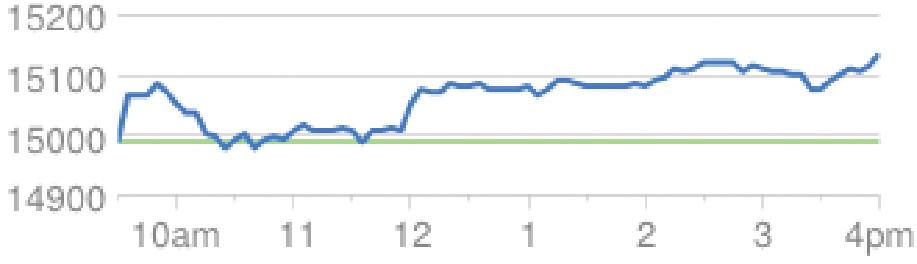
But the three major U.S. stock indexes climbed one per cent on Friday, possibly pointing the way to more gains ahead. The stock market has been in an odd spot for some time. Fear that the Federal Reserve would reduce its monthly bond-buying stimu-
lus, designed to boost borrowing demand and help the U.S. economy, put investors in the position of rooting for just-OK data, the kind of figures that would keep the spigot open while still pointing to decent growth.
This report may have definitively changed that outlook. In June, a total of 195,000 jobs were created –much stronger than the forecast for 165,000. Government data also showed that the U.S. labour force has increased for three straight months now.
The 10-year U.S. Treasury note’s yield jumped to a twoyear high above 2.70 per cent from 1.60 per cent in a matter of weeks.
In that time, equities have barely budged. Sure, the S&P
500 has drifted off its alltime closing high of 1669.16 reached on May 21. It is still less than three per cent from that mark despite the sharp rise in interest rates. Light volume in the stock market, however, means that the move up should be taken with a grain of salt. And it makes the next several days that much more important.
Good news in the form of bullish economic data has recently been taken as a negative, causing market selloffs on the theory that it means the Federal Reserve will slow its stimulus. While comments from Fed officials helped relieve those concerns last week, June’s strong payrolls data refocused investors’ attention on the uncertainty. (Reuters)
Exhibitors and representatives of several companies and Guyanese from all walks of life on Sunday hailed the fourth building expo as a success. The annual event got underway on Friday evening with persons flocking the Guyana National Stadium, Providence, East Bank Demerara.
David Mohamad, an entrepreneur of KB Homes, a local development company, told Guyana Times that the business is eyeing the Eccles area on the lower East Bank, to set up a local housing scheme.
According to Mohamad, the response from the public has been tremendous, adding that a lot of persons have been inquiring about the housing development scheme and some person have even signed contracts on purchasing lots. “We just have to wait now and see if that interest will translate into people actually purchasing our property,” said Mohamad.
Meanwhile, a patron at the expo, Clive Atwell noted that the event has afforded him the opportunity to view the variety of options which are available to him as a homeowner.
“This gives people the ability to know about the quality of products and services being offered by the business and where they can find quality product.”
Another patron Tash Van Doimen said, “You’re investing for a lifetime so we want you to be able to spend your money wisely.” She not-

able conditionalities.

ed that the expo gave the Guyanese populace the opportunity to choose the businesses they want to aid them in building their homes.
Another enthusiastic visitor Inderpaul Bisnauth noted that the response to the expo has been good. “Any queries that you may have, whether it’s the estimate for the house, how many gallons of paint you may need, what kind of finishes you should use, what kind of furniture you should use for a boy’s or girl’s room, anything you want to know, the building expo allows for you to make the right choices when doing any kind of construction work.”
Representatives of Demerara Bank Limited, which was offering loan services at the expo, say the response from the public has been overwhelming. The bank offered a wide variety of loans, credits with afford-
“A lot of people are very interested just because of the fact, the expo shows them the various materials they can use on their homes to make it very attractive, then you have the added benefit of discounts being offered by the banks and others business,” yet another patron Chetram Bux said.
Both exhibitors and patrons stated that the event hosted by the Housing Ministry was helpful in making their dream a reality through the massive housing development initiatives.
Some happily stated that the building expo 2013 was bigger and better than the year before and are hoping that next year will also be better than this year. This year’s expo was held under the theme “Consolidating partnership for sustainable development”.
More training needed to reduce under/unemployment – natural resources minister
Natural Resources and Environment
Minister Robert Persaud said more trained labourers can lead to the reduction of underemployment and unemployment in Guyana.
The minister made this comment while addressing a Board of Industrial Training (BIT) graduation ceremony on Sunday. Some 16 youths graduated from the programme which provided training in a number of forestry areas. The training was held in collaboration with the Guyana Forestry Commission.
The minister pointed out that training is a key aspect of erasing underemployment and unemployment in Guyana and for persons to get the right job as it relates to their skills, abilities and knowledge. He explained that the growth and expansion of the country’s economy has somewhat dealt with the issue; however, more can be done especially since there are a variety of sectors that are in dire need of
skilled personnel.
Persaud said the government has invested a lot in technical and vocational training over the years, noting that programmes such as the BIT/GFC training programme and the various technical institutes across Guyana are example of the government’s commitment.
“When you have an expanding and growing economy and new sectors, there will always be the need for different skills and what we have to do is train and provide the opportunities so that we can be able to man and to put staff in different sectors of the economy,” he stated.
The minister noted that Guyana’s economy is expanding and with the major developments in the country, new sectors are also emerging, hence there is this dilemma of not having sufficient, if any at all, skilled labourers to fully satisfy the workforce.
“We have to ensure every man, woman, every individ-
ual in our country are fully equipped and adequately utilised by our industries and various sectors,” noted Persaud.
He noted many of the private operators in the sectors need skilled labour and if persons take it upon themselves to get the requisite skills and adequate training, jobs will be easily available to them.
The minister also called on men and women to take every given opportunity to undergo whatever training is available to them in order to satisfy the needs of the various growing sectors.
Meanwhile, Labour Minister Dr Nanda Gopaul, who also speaking at that event, echoed similar sentiments as Minister Persaud, stating that there is sufficient sectors available to accommodate employment if persons obtained the necessary skills and trainings needed. “We do not want school drop-outs to be left without a skill and to be left in an area where they cannot gain employment,” he said.
Some 90 students at the nursery and primary levels graduated from the Al Ghazali Islamic Academy on Saturday when the school hosted its annual graduation and prize giving exercise at the Central Islamic Organisation of Guyana (CIOG), Woolford Avenue, Thomas Lands, Georgetown.
The students were presented with certificates while special trophies and prizes were also awarded to graduates in the categories of most improved student in various subject areas, the Most Disciplined Student, the Top Physical Education Student, the Best Student in Arabic studies, Islamic studies and Quranic recitation.
The programme featured several items including Quranic recitation, Islamic chants, poems, acrostics and addresses by United States Embassy Humanitarian Assistance Programme Director Melanie Collins and Director of Public Prosecution (DPP) Bibi Shalimar Ali-Hack.

Ali-Hack commented that she shares in the joy of Sheik Moin, the CIOG education director, because he is the drive behind the school, and the Headteacher Akeela Assad, who promised to improve students’ performance from 2011, and kept true to
the commitment.
Ali-Hack urged the graduates to set goals and work to achieve them, and on that note, congratulated the staff and students of the school, particularly the Grade Six students who made it into the school’s top 10 and the country’s top 100 at the National Grade Six Assessment (NGSA).
The DPP singled out teacher Johnny (a Grade Six teacher) for praise and noted that the success of all the children is based on a triangular relationship between teachers, students and parents. She urged that everyone continue to show their support and charged the graduates to follow their role models who can be found right at their school.
Ali-Hack told the parents present that children will have questions as they grow older and as parents, they should help them to the best of their abilities, noting that this will significantly improve relations between them and their children.
Agriculture Minister Dr Leslie Ramsammy said Guyana is seeking to self-sustain its stock feed with the production of corn and soya.
Speaking with Guyana Times in a recent interview, the minister said most of the corn and peas in Guyana are imported from Belize, and in an effort to reduce the food importation bill on these two products, the Agriculture Ministry is moving towards growing them.
“We continue to import stock feed and if we produce our own corn and soya, we can reduce the cost because we have the land and we have the farmers,” the minister said.
“Once we can demonstrate Guyana can do this,
other farmers will take up the initiative,” he said, adding that “I believe that we should not be importing black eye peas and corn, importers of stock feed will buy from home and this will allow them to save more and keep foreign exchange at home. This will add to the creation of jobs,” said Dr Ramsammy.
The ministry has already begun cultivation at Mon Repos, East Coast Demerara and on the Essequibo Coast, Region Two, and according to the minister, this will aid in the initiation of Guyana becoming an important producer of black eye peas, which will eventually replace the import of this crops.
“We continued to import stock feed from abroad;
however, with the crop rotation and cultivation of the crops, it will see Guyana importing less and being self-sustainable in that area and save money.”
Meanwhile, in the past, the minister said local farmers grow the crops. He had instructed the Guyana School of Agriculture (GSA) to use its land on the Essequibo Coast, and to plant 10 acres of black eye peas to ascertain how well it can grow in Guyana.
Similarly, the minister said he also instructed the National Agriculture Research and Extension Institute (NAREI) to work with the GSA and utilise 10 acres of land at Mon Repos, and cultivate corn to demonstrate to farmers that it can be grown locally.













saturday's solution


Even if it’s not formed for a commercial objective, a partnership arrangement you’re putting together can have far-reaching, favourable effects in that sphere.

By Bernice Bede Osol

(June 21July 22) (Jan. 20Feb. 19) (Dec. 22Jan. 19)
You could find yourself in a better position to fulfill an important, ambitious goal that you’ve had trouble reaching. It pays to keep the faith.

No one will be able to handle your affairs as competently as you, so do as little delegating as possible. Being self-sufficient will enhance your chances for success.

Finally, things could start happening that will enable you to fulfill an important objective. Make your move the moment you get the opportunity.

(Aug. 23Sept. 22)
(July 23Aug. 22) (Feb. 20-March 20)
You should give full expression to urges to organise your affairs more productively. With just a little effort, big improvements can be made.

(March 21-April 19)
Finally, you should be able to wrap up a troublesome situation. It’ll prove that persistence makes anything possible.

(April 20-May 20)
With your ingenuity and creativity trending upward, it’s a good day to capitalise on an unusual opportunity to bring in some big bucks.

(May 21June 20)
Lady Luck is your ally, so there’s a chance that several unusually big opportunities will become available to you. Keep your eyes peeled.
You must always strive for rational thought, but not to the extreme of quashing your dreams. Just make sure your optimism is based in reality.

(Sept. 23Oct. 23)
You’re about to enter a new cycle where, if you apply yourself, you should be able to upgrade your social status and make some big strides at work

(Oct. 24Nov. 22)
It’s a favourable time to find ways to develop your personality and work on your inner life. How much you learn and accomplish will be up to you.

(Nov. 23Dec. 21)
The timing is right and the conditions are conducive for making an important change that you’ve been anxious to implement. No more talk; start taking positive measures.

Furnished rooms and apartments; 1, 2 & 3 bedroom apartments- long & short term rental. Affordable rates Call: 227-2199, 227-2186, 227-2189

Journey Inn Apartments & car rent-
al. Rooms & car to rent from $3000 Premio, Vitz. Phone: 689-6668, 6394452.

Dentures provided in 72 hours from as low as $4500. Contact Dr B Stuart, 209B Charlotte Street, Lacytown. Tel: 225-5034

611-8416, 652-

Available: Fresh long-stemmed roses, fresh dried and silk floral arrangements, gift items, bridal boutiques and wreaths. Nesha’s Flowerland. 78 Church Street (opposite St George’s Cathedral). Tel: 227-3553/225-3315

All models of engines (Perkins, cummins, lister, deuez, john dere etc) enclosed and open air any size of KVA. Call Ram on 619-4483 or 226-6325
One two flat home: 3 bedrooms upper flat, with bath and kitchen, lower flat: bath & kitchen. Located in Atlantic Gardens, call 619-4483 or 656-7471 for more information.
4108 Perkins Engine. Call: 6805346 Husehold
Phone: 6875653 1 CHICKEN FARM (8 ACRES) 5 PENS, CAPACITY - 30,000 BIRDS WITH OWN WATER SOURCE AND OTHER AMENITIES AT LALUNI, PRICE NEG PHONE: 611-8049

Learn transcendental meditation and reduce stress, be happy increase intelligence, develop your full brain potential, improve relationships, be successful, be peaceful, develop higher states of consciousness , a technique that works for everyone, enroll now for next class. Contact Askoke (certified teacher) email kashokejp_68 @yahoo.com. Phone: 233-693
Healthworld Holistic Centre: Psychotherapy available for all types of abnormal behaviors – addictions, emotional, suicidal, anger, relationship and sexual problems. Treatment of stress disorders, depression, fear, low self-esteem, insomnia, trauma, psychosomatic sicknesses, and children's disorders. We also conduct IQ evaluations and behavioral assessments. By appointments only. Clinic hours: 11:00 – 17:00h. Tel: 592-6210552. Email:healthworldhc@gmail. com



Immigration & Visa Services We handle all Canadian, USA and UK, Immigration and Visa matters. Self Sponsorships, Holiday/
MONDAY, JULY 8, 2013
Get your Visa approved. High Success Rate. Balwant Persaud & Associates. Certified Immigration Consultants 68 Sixth Street, Alberttown, Georgetown (Between Cummings & Lights Sts.) Tel: 225-1540, 622-8308, 655-3105. Email: balwantpersaud@yahoo.ca

Professional Key Shop, 125 Carmichael Street, Georgetown. Phone: 225-3923, mobile: 6213249. We cut any type of key, service and repair all types of locks. Get your extra key today.

Da Silva’s Optical. For Your Eyes Only, Look Better See Better. Phillip A Da Silva OD, Shannon L Da Silva OD, Natalie Da Silva OD. 248 South Road, Bourda. Phone: 227-3529, Linden: 444-6376, Corriverton: 339-3536, Meten-Meer-Zorg: 275-0322, Grand Cayman Islands: (345) 943-1515 for the perfect trendy touch.

INDIAN GUY NEEDS FEMALE COMPANION PHONE: 644-2306

2-stoery concrete house, 32’x55’, 3 bedrooms, Block 8, Mon Repos, ECD. $36M. Phone: 642-2116



AA 60 CARINA CAR AUTOMATIC $360,000 PHONE: 644-2306
JUST ARRIVED: TOP QUALITY RECONDITIONED VEHICLES; TOYOTA PREMIO; TOYOTA SPACIO; TOYOTA VITZ (NEW SHAPE); TOYOTA NOAH; SUZUKI SWIFT; MERCEDES BENZ C200 COMPRESSOR; BMW 318 I; COROLLA AE100 WAGON; LAND CRUISER (FULLY LOADED); MAZDA PROCEED 4WD EXTRACAB PICKUP; TOYOTA HILUX; 3RZ AND 5L; 4WD EXTRACAB PICKUPS; HIACE PITBULL 19 SEATER; MITSUBISHI CANTER TRUCKS 3; 3.5; TONS OPEN TRAY; 3 TONS WITH TAILGATE HOIST; 2 TONS 4WD; 3 TONS DUMP TRUCK. PREORDER YOUR UNITS EARLY AND GET THE BEST PRICES. FULL AFTER SALES SERVICE AND FINANCING AVAILABLE. DEO MARAJ AUTO SALES, 2 CHIMNEY ROAD, CHATEAU MARGOT, ECD. 624-0762 , 220-5177. A NAME AND A SERVICE YOU CAN TRUST.
NEW ATVs INTRODUCTORY PRICE
$1,450,000 (DUTY FREE). PHONE: 691-0234.
NEW 2013 ISUZU DMAX, SINGLE & DOUBLE CABS. PHONE: 691-0234
Honda CRV, lady-driven. Phone 657-0482 SOLD AS IS.

J. Eastman and Associates Chartered Accountants, services, taxation, financial services, VAT preparation, auditing, income tax, vehicle and building compliances. Phone: 223-2105, 662-7467, located 190 Church Street, Georgetown (opp Pet Shop).

Learn transcendental meditation and gain deep relaxation, eliminate stress, increase creativity and intelligence, promote health, attain inner happiness and fulfillment and contribute to peace for the world. Contact certified teacher Ashoka: 233-6921, email kashokejp_68@yahoo.com
Suriname astrology palmist and Djuka healer, the most powerful spiritualist in the world, are you suffering from the following problems - (any religions) love, marriage, family, health, business, husband and wife relationships, property, court, children, promotion, visa, pregnancy, education, depression, job, sexual, jealousy, enemy, money, drinking, also you can have all evil forces destroyed such as black magic, witchcraft, voodoo, obeyah, etc, and gives powerful protection. Private and confidential. Phone: 601-5947.
Dutch Spiritual work. Unite lovers, get rid of evil, enhance prosperity, good luck baths and charm bowu guards, etc. Phone: 220-0708, 6126417, 687-5653
Divinations and cleansing of spiritual problems of all kinds. Powerful Ifá and Khemetian spiritual guards, pendants, crystals, and rune stones to help you overcome problems with love, relationships, legal, sexual, pregnancy, business, sickness, jobs, enemies, work, money and many more. Call 10:00-16:00h on: +592690-1824. Email: anew-life@live.com

SUMMERTIME TRAVEL DAILY FLIGHTS. LETHEM, PORT KAITUMA, MAHDIA, KAIETEUR FALLS, PARAMAKATOI. JUNE 29 - JULY 1. PARIMARIBO-SURINAME, BOA VISTA-BRAZIL, KAIETEUR FALLS DAY, ESSEQUIBO & MAZARUNI RIVER. TEL: 264-2851, CELL: 668-6501

Officials from North and South Korea have agreed in principle to reopen the Kaesong industrial complex.
The deal, which includes facilities inspections, was reached after marathon talks held at the truce village of Panmunjom in the demilitarised zone.
Work at the factory park was halted in April amid high regional tensions.
Correspondents say the closure of Kaesong, seen as a symbol of inter-Korean ties, showed how serious this year’s political tensions were.
The industrial complex is a major source of income for the North.

One cook interior phone:680-5346. Clerical staff. Must be computer literate, knowledge of CorelDraw will be an asset. Send applications to Jarrods, 51 Main Street, Georgetown.


Attempts to hold highlevel talks last month failed on procedural grounds.
The meeting on the North Korea side of Panmunjom started on Saturday and lasted at least 15 hours.
Officials will meet at
Kaesong on Wednesday to “restart operations, prevent an operation suspension in the future, and normalise the zone as soon as both sides are ready to do so”, South Korea’s chief delegate Suh Ho told reporters after the talks.
“We got an impression that the North was very willing to resolve the Kaesong issue and is making great efforts as well,” Suh Ho said.
As part of the deal, both sides agreed to allow South Korean company managers to inspect their factories, as well as retrieve finished goods and raw materials.
Prior to operations being suspended, there were around 120 South Korean businesses in the factory park. The firms have been unable to reach their goods for three months. Some have since threatened to abandon the zone entirely and relocate their equipment.
Seoul suggested the working-level talks on Thursday, a day after Pyongyang said Seoul businessmen could visit the closed complex to inspect and maintain equipment.
Late on Thursday, North Korea accepted the offer, the South said.
Pyongyang withdrew its 53,000 workers from the complex in April, apparently angered by tightened United Nations sanctions in the wake of its nuclear test in February, and annual South Korea-U.S. military drills.
North Korea also prevented South Korean workers from entering the joint commercial zone.
The last South Korean workers left the zone on May 3.
The talks were very limited but could pave the wave for discussion of bigger issues such as North Korea’s nuclear programme. (Excerpt from BBC News)
Secondary schools have been ordered closed across Nigeria’s north-eastern state of Yobe after a massacre in which suspected Islamist extremists killed 22 students and torched their school.
Yobe Governor Ibrahim Gaidam condemned as “cold-blooded murder” Saturday’s attack on the Mamudo boarding school.
Nigeria blamed Islamist militant group Boko Haram – which targeted two schools in the region in June – for the attack. The group’s name translates as “Western education is forbidden”.
Dozens of schools have been burned in attacks by Islamists since 2010.
Visiting the school on Sunday, Gaidam described the attackers as “callous and devoid of any shred of humanity”.
He ordered the state’s secondary schools to be closed until the start of the new academic term in September, to allow state and federal government officials, as well as community leaders to work on ways to guarantee the safety of schools.
He also called on the government to lift a blocking of mobile phone signals across the state.
“Lack of [Global System for Mobile Communications] service has prevented patriotic citizens who have hitherto been collaborating with security agents from reporting suspicious movements in their neighbourhoods,” said Gaidam in a statement.
Yobe is one of three states where President Goodluck Jonathan declared a state of emergency in May, sending thousands of troops to the area.
Eyewitnesses said some of the victims were burned alive in Saturday’s attack, while others were shot as they tried to flee.
A reporter from the Associated Press found chaotic scenes at the hospital in nearby Potiskum, where traumatised parents struggled to identify their children among the charred bodies and gunshot victims.
Survivors said suspected militants arrived with containers full of fuel and set fire to the school.
Gaidam ordered that those injured in the attack be given free medical attention.
More than 600 people were believed to have been killed in 2012 by Boko Haram, which is fighting to overthrow the government and create an Islamic state in Nigeria’s predominantly Muslim north. (BBC News)
monday, july 8, 2013
Andy Murray won his first Wimbledon title and ended Britain’s 77-year wait for a men’s champion with a hard-fought victory over world number one Novak Djokovic.
The Scot, 26, converted his fourth championship point in a dramatic final game to win 6-4 7-5 6-4 and claim his second major title.
In an atmosphere reminiscent of his Olympic final win last summer, Murray was willed on by the majority of the 15,000 spectators on Centre Court, thousands watching on the nearby big screen and millions more around the country.
The final game was a battle in itself, with Murray seeing three match points slip by from 40-0 and fending off three Djokovic break points with some fearless hitting, before the Serb netted a backhand to end the contest.
After a gruelling three hours, 10 minutes in searing temperatures, Murray had finally followed in the footsteps of Fred Perry’s 1936 win at the All England Club.
Celebration Perry used to leap over the net in celebration, but Britain’s new champion roared in delight before sinking to his knees on the turf.
Murray then headed into the stands to celebrate with his family and support team, moments later parading the trophy around Centre Court.
He could barely believe he had won saying: “It feels slightly different to last year.
Last year was one of the toughest moments of my career, so to manage to win the tournament today...
“It was an unbelievably tough match, so many long games.” He later tweeted: “Can’t believe what’s just happened!!!!!!!”
And he gathered his thoughts in a BBC TV interview telling Sue Barker: “It was tough speaking after the match. There are a lot of people who have worked with me over the last 10 or 15 years or so.
“I didn’t know what to do with myself. The noise levels during the whole match were just incredible.”
The Dunblane native becomes Scotland’s first Wimbledon singles champion since Harold Mahony in 1896.
Murray had been on top from the outset against an unusually erratic Djokovic, finally converting his seventh break point after three dramatic games that took 20 minutes.
The home supporters were brought down immediately when Djokovic recovered the break to love, but the Serb was leaking errors and his 13th in just seven games saw Murray move clear again at 4-3.
A tense game followed after Murray, serving into the sun, opened with two double faults, but he fought his way out of three break points and served out the set to love.
An hour gone, and all was going to plan for the British number one, but Djokovic began to find his range in the early stages of the second set.
The top seed got the better of two rallies approaching 30 strokes as he broke on his way to a 4-1 lead, and looked on course to level at 15-30 in the following game, but Murray would not give it up.
Having struggled to defend his own second serve, Murray now turned the tables and put the pressure on Djokovic, and the Serb succumbed with a double fault to give up his advantage in game seven.
Murray was the man in command once again and when he cracked a 128mph ace and a nerveless smash to save two break points for 4-4, the crowd sensed a real opportunity developing.
Vulnerable
Djokovic was vulnerable and he showed it with a tirade at the umpire over a line call when serving at 5-5, but he had run out of Hawk-Eye challenges and moments later netted a forehand to give Murray a priceless opportunity.
Once again, Murray found his best serving form when he needed it most, closing out the set to love with an ace to bring the Centre Court crowd to its feet.
The sense of hope around the stadium became something closer to disbelief when Murray raced in to pick up a drop shot and hammer a forehand on his way to a break at the start of the third, and he threatened to run away with it with seven out of eight games.
Back Djokovic came, throwing in drop shots to get the Briton on the run and reeling off four straight games on his way to a 4-2 lead, but Murray was not to be denied.
He wrestled back the initiative to level at 4-4 and surged on, hammering away at the Djokovic forehand and drawing yet another error to move 5-4 clear. All that was left was to serve for the title, and it was never likely to be straightforward, but after 10 tortuous minutes Murray stepped in and cracked a forehand that Djokovic could only put in the net.
The Scot added: “I have played in a lot of Slam finals, all against Roger or Novak. Roger is probably the greatest player ever, Novak is one of the mentally strongest ever. I never had experience on my side, to beat him was so tough, it was such a tough match.” (BBC Sport)
Sebastian Vettel won the German Grand Prix after a battle with Lotus’s Kimi Raikkonen and Romain Grosjean.
The Red Bull driver held off Raikkonen, who made a late pit stop from the lead to benefit from the extra grip of fresh tyres in the closing laps.
Raikkonen passed Grosjean under orders with five laps to go, the Frenchman holding off Ferrari’s Fernando Alonso.
Mercedes’ Lewis Hamilton faded from pole to finish fifth, passing McLaren’s Jenson Button on the last lap.
Vettel put himself in a position to control the race by passing Hamilton off the start line into the first corner.

But a safety car in the middle of the race closed up the field and left Vettel holding off Grosjean and Raikkonen, with Alonso running fourth.
The three front-runners ran nose-to-tail from the restart on lap 36 until Grosjean made his final
The Investec Ashes 2013…
stop on lap 40, with Vettel following him in the next time around.
Raikkonen and Alonso, though, stayed out for a further nine laps and fitted the faster but more fragile ‘soft’ tyres.
The Finn rejoined 2.3 seconds behind Grosjean,
who was 1.5secs behind Vettel, with Alonso a further 4.4secs behind.
Raikkonen closed in on Grosjean, who was ordered to let the Finn by with five laps to go, and had five laps to close the 2.5-second lead to Vettel.
He closed to within a second at the start of the final lap but although that put him in the range that allowed him to use the DRS overtaking aid, he was too far back when he entered the zone leading up to the final chicane and Vettel held on to win by one second.
“That was a tough one,” Vettel said as he whooped in delight over the team radio on the slowing down lap.
It was Vettel’s first victory in his home race and the 30th of his career. (BBC Sport)

England have their sights set on Michael Clarke as the Ashes looms, knowing that a quiet series for Australia’s captain will go a long way to ensuring the urn does not change hands.
Graeme Swann is well aware of the impact that restricting the opposition captain’s runs can have after watching Ricky Ponting endure a miserable series in 2010-11. On that occasion, England also limited Clarke’s output to 193 runs in five Tests - the last of which is his first in chargeand know that this current Australia side are hugely reliant on his performances.
Clarke is far and away Australia’s leading batsman, holding together what has often looked a callow order recently, and since returning from
the back injury that kept him out of the Champions Trophy, has made good use of the warm-up matches against Somerset and Worcestershire with scores of 45, 26, 62 and 124.
“He was their form batsman in England in 2009, although he didn’t have such a good series in Australia,” Swann told ESPNcricinfo.
“The year he’s had has been phenomenal, so we’ll be hoping to cut the head off the serpent if you like, as a captain.
“The two Ashes series I’ve played, and one of the main reasons we’ve won, is because we’ve been able to make some of their best players have poor series,” he added. “Clarke and Ponting last time, and Mike Hussey, until The Oval, in 2009.
“That’s what you need to do to win big series, make
sure the match-winners in their team don’t have a chance to perform. We’ll have two or three players on their team we’ll definitely be looking at to keep especially quiet - although you hope everyone on the opposition has a poor series.”
Swann fully appreciates the power that a prolific can have for a side having watched Alastair Cook begin his full-time captaincy career in with a consistently high return. “The best thing he’s done is lead from the front by scoring runs. There is no greater way for a team to get behind the captain than watch him pile on the runs,” Swann said.
Unsurprisingly, even though Swann is one of more forthcoming England players, he would not be drawn much in Australia’s recent problems. However,
he has always held Darren Lehmann, their new coach, in the highest regard since the pair duelled together on the field.
“We don’t know what their issues were and it’s not really for us to try and find out, although I’m sure we’d like to know, because everyone likes a gossip,” he said. “What I do know is that Darren Lehmann was a magnificent player, second to none, only Brian Lara has been a better player of those I’ve bowled against.
“They have a good man, he’s a good fella. Whether that brings the team together is probably for people to judge at the end of the summer. You could get rid of every clique and every problem in a team, but if you don’t win it doesn’t matter.”
(Cricinfo)
monday, july 8, 2013
Team Sky’s Chris Froome survived a series of ferocious attacks to retain the yellow jersey after a punishing stage nine of the Tour de France.
It was won by Ireland’s Dan Martin, who outsprinted Jakob Fuglsang after the two men launched a late breakaway.
But the main drama focused on British rider Froome, who lost all of his teammates early in the day, including Richie Porte, who started in second.
Alejandro Valverde is now second, one minute 25 seconds behind Froome.
It was a gripping and engrossing stage in the Pyrenees that saw Team Sky’s Peter Kennaugh go down in an early crash and teammate Porte, who looked so strong on Saturday as he helped Froome claim yellow, slip badly off the pace
and eventually finish 17 minutes 59 seconds after the stage winner.
“All in all it was a tough day for the team,” said Team Sky boss Sir David Brailsford.
“Everybody decided to take it on early and thankfully Chris had the legs to look after himself.
“He is a very resilient guy and he is going well –and if you are going well then that is what counts. He did not feel under pressure physically all day.
“Yesterday was one of our best days and today was one of our toughest. Everyone who said yesterday that the race was probably over can think again.”
Froome’s grip on the yellow jersey looked to be loosening as his teammates struggled to keep pace in a race that was splintered on the first of five punishing mountain climbs.

The Garmin-Sharp team of eventual stage winner Martin were chiefly responsible with Britain’s David Millar among the first of their riders to up the pace.
On the second climb, Garmin-Sharp duo Tom Danielson and Ryder Hesjedal attacked and reached the summit first, while Birmingham-born Martin sprinted clear on the final mountain with Astana
Netherlands v Ireland, WCL Championship, Amstelveen…
rider Fuglsang.
Martin and Fuglsang were allowed to move clear by Froome because they posed less of a threat to his overall race lead than other riders in the group, and he was more concerned with keeping tabs on Movistar duo Valverde and Nairo Quintana, and SaxoTinkoff’s two-time Tour winner Alberto Contador.
The Movistar team

The O’Brien brothers, Niall and Kevin, made telling contributions with bat and ball respectively to guide Ireland to a comprehensive 88-run win in Amstelveen, which left them needing just one more win to qualify for the 2015 World Cup. Niall scored 70 to help Ireland to 236 before Kevin ran through the Netherlands middle order to finish with his best ODI figures of 4-13 in seven overs to send Netherlands crashing to 148 in 36 overs.
Ireland began poorly when they opted to bat, losing Paul Stirling in the second over, bowled round his legs by Edgar Schiferli. Netherlands should have had William Porterfield off the second ball of the innings when he pushed the ball low to cover. The drop cost the hosts as the Ireland

captain went on to top score with 79. The fielder, Michael Swart, redeemed himself soon after when he held the catch at extra cover to send back Ed Joyce for 22.
Ireland then staged the most decisive partnership of the match, that of 125 between Porterfield and Niall. Porterfield hit eight fours in his 79, while Niall scored four fours in his 70. The stand was broken when Niall was run out in the 38th over. Ireland lost another quick wicket when Gary Wilson was stumped off Swart. Kevin then walked in to add a quick 32 off 22 balls with three fours and a six. He was out slogging to deep midwicket to Mudassar Bukhari, who took 3-41.
Netherlands started their chase confidently, progressing to 52-1 after 10 overs. They lost control after that as they lost three wick-
ets for 19 runs. Kevin took the first of his four wickets when he had Tom Cooper caught for eight, before taking a return catch to get rid of the innings top-scorer, Wesley Barresi, for 55. Barresi’s dismissal left the hosts limping at 99-5.
Kevin then claimed the wickets of Daan van Bunge and Bukhari to leave Ireland on the brink of victory. Alex Cusack sealed the win when
he had Peter Borren caught at cover. Ireland now have 19 points from 11 games, four ahead of Scotland. Netherlands and Ireland meet again on Tuesday and a win for Ireland will make them the first side to qualify for the World Cup. Should they lose, they will have another chance when they face Scotland in the final round of matches in September.
(Cricinfo)
Ireland innings (50 overs maximum)
WTS Porterfield* st †Barresi
b Jamil 79
PR Stirling b Schiferli 1
EC Joyce c Swart b Schiferli 22
NJ O’Brien run out (Borren) 70
GC Wilson† st †Barresi b Swart 1
KJ O’Brien c Rippon Mudassar Bukhari 32
JF Mooney c Cooper b Jamil 1
DT Johnston b Mudassar Bukhari 10
AR Cusack b Mudassar Bukhari 0
TJ Murtagh c Borren b Jamil 2
GH Dockrell not out 1
Extras (b-6, lb-1, w-10) 17
Total (all out; 49.5 overs) 236
Fall of wickets: 1-3 (Stirling, 1.6 ov), 2-29 (Joyce, 7.3 ov), 3-154 (NJ O’Brien, 37.6 ov), 4-161 (Wilson, 39.5 ov), 5-204 (KJ O’Brien, 44.6 ov), 6-213 (Mooney, 45.4 ov), 7-229 (Johnston, 48.4 ov), 8-229 (Cusack, 48.6 ov), 9-229 (Porterfield, 49.1 ov), 10-236 (Murtagh, 49.5 ov)
Bowling: Mudassar Bukhari
10-2-41-3 (1-w), E Schiferli
8-2-34-2, PW Borren 10-027-0, TLW Cooper 5-0-23-0 (1-w), MJG Rippon 4-0-22-0 (2-w), MAA Jamil 7.5-0-513 (2-w), MR Swart 5-0-31-1
Netherlands innings (target: 237 runs from 50 overs)
W Barresi† c & b KJ O’Brien 55 ES Szwarczynski c †Wilson b Murtagh 3 SJ Myburgh c Johnston b Stirling 22 TLW Cooper c Mooney b KJ O’Brien 8 MR Swart c Porterfield b Stirling 1 DLS van Bunge c Porterfield b KJ O’Brien 11 PW Borren* c Porterfield b Cusack 34 Mudassar Bukhari c Mooney b KJ O’Brien 0 MJG Rippon b Dockrell 3 E Schiferli b Mooney 5 MAA Jamil not out 3 Extras (w-3) 3
Total (all out; 36 overs) 148 Fall of wickets: 1-5 (Szwarczynski, 2.1 ov), 2-60 (Myburgh, 11.6 ov), 3-77 (Cooper, 16.2 ov), 4-79 (Swart, 17.1 ov), 5-99 (Barresi, 24.1 ov), 6-109 (van Bunge, 26.3 ov), 7-109 (Mudassar Bukhari, 26.5 ov), 8-112 (Rippon, 29.3 ov), 9-120 (Schiferli, 30.6 ov), 10-148 (Borren, 35.6 ov)
Bowling: TJ Murtagh 6-030-1, DT Johnston 5-0-17-0, AR Cusack 3-0-26-1 (1-w), PR Stirling 6-1-28-2, KJ O’Brien 7-0-13-4 (1-w), GH Dockrell 6-025-1, JF Mooney 3-0-9-1 (1-w)
maintained a well-marshalled presence towards the front of Froome’s group throughout the race and, after failing to shake off the British rider in the valleys, they tried to break him on the day’s final mountain ascent.
Three times Quintana attacked and three times Froome, who claimed yellow on Saturday, brought him back.
However, the expected counter-attack from either Valverde or Contador failed to materialise and the riders all reached the final summit together.
The final 30km was predominantly downhill and Froome was able to keep pace with his rivals as they all finished 20 seconds behind Martin.
Bauke Mollema moved up to third in the general classification, with Laurens ten Dam now fourth.
Martin, 26, won a stage of this year’s Volta a Catalunya and the LiegeBastogne-Liege one-day race.
“I knew the last corner was crucial,” said Martin of his stage victory on Sunday.
“I was quite confident of being a faster sprinter than Jakob but you never know what is going to happen.
“I was very confident and that comes from the victories I have had this year – it gives you a calmness.”
Team Sky are down to eight riders after Vasil Kiryienka was forced to abandon the race after finishing outside the time limit.
The first rest day of the Tour is today, before the race resumes in SaintGirons on Tuesday, with a 195km stage that is expected to finish in a bunch sprint in Saint-Malo. (BBC Sport)
djokovic says fatigue cost him in Wimbledon defeat

Novak Djokovic said his Wimbledon final defeat by Andy Murray was partly down to feeling exhausted after his gruelling semi-final victory.
Top seed Djokovic took four hours and 43 minutes to defeat Juan Martin del Potro in five sets on Friday.
And he looked weary at times against Murray on a sweltering Centre Court, eventually losing 6-4 7-5 6-4.
“I cannot look for excuses but the previous match took a lot out of me,” said Djokovic, champion in 2011.
“I’ve been in these situations before. I felt OK but maybe physically I didn’t have enough gas in the important moments.
“It was a very long match for three sets today. But the bottom line is that he was a better player in the decisive moments.”
Djokovic, a six-time Grand Slam champion, was in sublime form en route to the final, with only Del Potro stretching him.
But the Serb hit 40 unforced errors during his first straight-sets defeat in a Grand Slam tournament since a loss to Tomas Berdych at Wimbledon in 2010.
“In both second and third sets I was 4-2 up and dropped the serve in those games and allowed him to come back for no reason,” said Djokovic.
“I should have played better in the decisive moments. I wasn’t patient enough.
“I believed I could come back, but I didn’t play on the top of my abilities and with this kind of game I didn’t have a chance to win.
“He was getting some incredible shots on the stretch and running down the dropshots. He played fantastic tennis, he deserved to win.”
Djokovic, 26, was booed for questioning line calls and ranting at umpire Mohamed Lahyani following one decision.
But he refused to criticise the crowd and said he had expected them to be against him.
“The atmosphere was incredible for him,” he said. “For me, not so much. But that’s what I expected and that’s how it was.
“It must mean a lot to everybody. Wimbledon is the most important tennis tournament in the world. Especially for him as a British player, and the crowd.” (BBC Sport)

By TreisTon Joseph
Marian Academy made a late run to defeat Plaisance Academy 38-28 on Saturday evening to advance to the final of the National Schools Basketball Festival (NSBF) at the Cliff Anderson Sports Hall.
With the score tied at 24 in the final five minutes of the game, Marian exploded for a 10-4 run to close out a Plaisance Academy team that was playing physical basketball from tip off.
Marian played great defence on the tournament’s leading scorer in Nikkoloi Smith as they shut down his driving lanes to the rim while closing out every time he rose for a three-pointer.
Marian also limited the amount of fast break points that were a key facet to Plaisance’s offense, despite being out rebounded 45-25 by the east Coast regional champions.
Dominic Vincente had
his highest score of the tournament, dropping in a gamehigh 12 points, while Dale Beresford dropped 11 points to help Marian through to the final of the tournament.
Smith, who was shut down defensively, scored 10 points but was a beast on the glass grabbing a tournament-high 29 rebounds in the physical and heartbreaking loss.
Meanwhile, defending champions Kwakwani Secondary will be defending their title as they survived a late surge from Wismar Christianburg Secondary to win 55-51 to advance to the final.
The Kwakwani lads, who generated most of their offence in the paint as the two Region 10 teams battled, were seemingly on cruise control in the final five minutes of the game with a nine-point lead before WCSS made a late run but felt short.
Kwakwani used hard


cuts to free up their threepoint shooters, while dumping the ball to the inside as they played an inside-out game that was effectively
breaking down the defence of WCSS during the game.
However, with the scores reading 53-44 in favour Kwakwani, WCSS made a
7-2 run but could not finish off as time expired sounding the final buzzer with the score on 55-51 in favour of the defending champs.
Leonard Primo scored a double-double of 12 points and 15 rebounds to lead Kwakwani, while his teammates Shafeed Thomas and Jeremy Primo had 13 and 10 points respectively to help Kwakwani reach the final.
Terron Welch had a game-high 17 points in the loss, while Travin Dryden dropped 16 points and cleaned the glass for a gamehigh with 23 rebounds.
Darren Thomas also chipped in with 10 points and nine rebounds in the loss.
In the Under-17 category, New Amsterdam Multilateral (NAM) held off St Rose’s High School 38-32 to make it to the final.
Neil Weils was a force in the low post with 16 points, while collecting 18 rebounds to lead NAM to the win.
Shemar Simon also chipped
in with 10 points to help the Berbice champs to the final.
Nathan Howell dropped a team-high 15 points to lead St Rose’s in close defeat, while Anfernee Jervis had a team-high 10 rebounds for St Rose’s.
Meanwhile, the second Under-17 semi-final saw Kwakwani routing Marian Academy 63-31 to set up a Region 10 versus Region Six final.
Kwakwani, while missing most of their three-point attempts, dominated the game, stifling Marian’s offence on the defensive end.
Floyd Edmonds, Kerron Phillips and Domair Gladstone each had 10 points apiece to lead Kwakwani in the win. Christopher Joao was the high point man for Marian Academy with nine points in the blowout loss.
The competition is being sponsored by Digicel, the Beharry Group of Companies and Bank DIH Limited.
By TreisTon Joseph
America-based Guyanese track star, Kadecia Baird, is fast becoming Guyana’s most prized jewel for international success after picking up gold at the ongoing Central American and Caribbean (CAC) championship in Mexico.
This latest feat, after nabbing silver in last year’s World Junior Championship (WJC) in Spain (Guyana’s only medal at WJC) and picking up bronze earlier in the year at the junior Carifta games, was made more special after the 18-year-old recovered from a hamstring strain in January.
While Baird is still in Mexico, Guyana Times Sport caught up with one of her college coaches, a for-
mer Guyanese Olympian, Nicola Martial, who related her joy for Baird’s success, while wondering the drag in the process to select Baird for the event by the relevant authorities.
“I was just thinking how long it took for Guyana to decide it was sending Kadecia to the CAC games. It seems almost like they didn’t want to send her there, or maybe they didn’t have the money to pay. The coach (Shaun Dietz) end up paying for his ticket and his accommodations because it was so important for him to be there to assist Kadecia. So I am happy with the outcome of her performance,” Martial related to this publication via email.
Martial added, “Now it’s off to the World Championships in Russia. She has the quali-

Kadecia Baird
fication standards; the IAAF will pay for her and a coach, so I hope Guyana does the right thing in sending her and show that they support her in sending the coach she needs that will help her to perform well.”
Martial also believes that once Guyana gives Baird the right opportunities and support in the coming years, it will help her development towards being a medalist at the 2016 Olympics in Brazil.
“I think Kadecia, with the right support from the different Guyanese associations, can go very far. She just turned 18. By 2016 Olympics she could be competing for a medal. Guyana has to make sure it gives her every opportunity to compete on the international level. This will help in her development so she can be ready for the Olympics. The more Kadecia competes, the more she improves and the more she matures track wise,” Martial noted of Baird’s unique intelligence.
The former Olympian
also noted that Shaun Dietz is the man behind Baird’s success.
“The coach behind Kadecia’s success is Shaun Dietz. He is her primary coach and has worked on every aspect of her training and preparation for her races. He went with her to the World Junior Championships in Barcelona, Spain, last year and he is with her now in Mexico at the CAC games. Even though Guyana choose coach Joseph Ryan (Aliann Pompey’s college coach) as the team leader and coach for the CAC games, Shaun Dietz coached Kadecia Baird to her CAC gold medal. As a coach he knows how to get the athletes prepared to compete,” Martial affirmed.
Martial also told this publication that she believes that track and field in Guyana has talents that can help put Guyana on the world scene.
“As a Guyanese citizen, I want to make sure that Guyana track and field improves. Guyana track and field can be as good as Jamaica, The Bahamas, and Trinidad. Kadecia is one of the athletes that can help Guyana track and field,” she stated.
Martial added, “However, there are many athletes in Guyana and abroad that can develop like Kadecia. Hopefully, her winning is a step in the right direction and there will be many more athletes that will follow and achieve more successes.”
The experienced Robin Persaud outsprinted Linden’s Orville Hinds to capture the Open category of fourth edition of the Seven Seas Multivitamins/ Dr Chase Nerve Foods 50mile road race on Sunday on the West Demerara.
Persaud clocked one hour, 55 minutes (01h: 55m) to take his third win of the season in a thrilling finish with Hinds, who had to settle for second. Jude Bentley finished third among the 34 starters.
With the event starting at a high pace from the Wales Police Station, Bentley and
Stephen Fernandes got out early to hold a slight lead on the rest of the pack.
However, around the Uitvlugt area, Persaud and Hinds made their move to separate themselves from the remainder of the cyclists before Persaud held off Hinds in the final 200 metres to take the close win.
Veteran Godfrey Pollydore, Marlon Williams and Mario King made up the remainder of the top six in that order.
Along with winning the event, Persaud walked away with two sprint prizes along with Hinds and Bentley as
well. Meanwhile, Kennard Lovell topped the field in the veteran’s event, while Shameer Baksh and Gary Benjamin finished second and third respectively.
King took the junior event ahead of Hamzah Eastman in second and Linden’s Kravitz in third.
National cycling coach Hassan Mohamed speaking at the presentation ceremony held immediately after the event disclosed that his 37th annual Teach Them Young programme will commence at 09:00h in the National Park.
– James finishes seventh in South American 200m final
America-based Adam Harris and local star
Winston George competed in the final of the men’s 200 metres at the Central American and Caribbean (CAC) championships, but failed to medal at the event on Sunday in Mexico.
Harris, who competed for Guyana at the 2008 Olympics in Beijing, clocked 20.60s to finish sixth ahead of 2012
Olympian Winston George who clocked 20.67 seconds to finished seventh at the event.
World Junior Championship silver medalist, Kadecia Baird, who copped gold at the CAC event a day earlier was unable to qualify for the final of the 200 metres, clocking a time of 23.77 seconds in her preliminary round. Meanwhile, Stephan James who on Friday copped
bronze in the men’s 400 metres at the South American Senior Championships, finished seventh in the men’s 200 metres ,clocking a time of 21.31 seconds.
However, up to press time, results for the javelin throw at South American Championships, featuring Guyana’s Leslain Baird were unavailable.
Jamaica, Trinidad and Tobago and The Bahamas finished behind host Mexico following strong performances on the final day of competition at the XXIV Central American and Caribbean (CAC) Senior Athletics Championships on Sunday.
Mexico topped the medal count with a total of 47, including 17 gold medals. Jamaica was the top Englishspeaking Caribbean country with 21 medals, 11 of which are gold. They were followed by Trinidad and Tobago (13), The Bahamas (eight) and Barbados (four).
The highlight on the final day was a new championship record for Odayne Richards of Jamaica in the Men’s Shot Put event. He threw the iron ball at a distance of 20.97 metres, erasing his compatriot Dorian Scott’s mark of 20.21m set in 2007.
He was more than three metres ahead of his nearest rival, Josue Santana of Mexico (17.74m).
The winning throw also gives him an “A” standard qualifying mark in the event for the IAAF World Championships in Athletics in Moscow, Russia next month.
Also securing individual qualifying marks for the World Championships were Kineke Alexander of St Vincent and the Grenadines, Antoine Adams of St Kitts and Nevis, Lalonde Gordon of Trinidad and Tobago and Jason Livermore of Jamaica. Alexander won the Women’s 200m in 23.00, inside of the “A” standard time of 23.05s. She was followed by Aleen Bailey of Jamaica (23.08s) and Marielys Sanchez of the Dominican Republic (23.15s). Adams (20.13s), Gordon (20.28s) and Livermore (20.29s) took the top three positions in the Men’s 200m and confirmed qualifying times for selections on their respective national teams.
There were also victories for Cuba-born Yordanys
Durañona, who now competes for Dominica, in the Men’s Triple Jump (16.45m); Darrell Garwood of Jamaica the Men’s High Jump (2.22m), same height as Jamal Wilson of The Bahamas who took the silver medal; Emmanuel Mayers of TT in the Men’s 400m Hurdles (49.72s) and Danielle Dowdie of Jamaica in the Women’s 400m Hurdles (56.39s).
Trinidad and Tobago secured gold medals in the final two events – the 4x400m relays. The Trinidadian quartet of Shawna Fermin, Sparkle McKnight, Ramona Modeste and Alena Brooks took the gold in 3:30.64 followed by Mexico (3:34.52) and The Bahamas (3:36.41). Pre-race favourite Jamaica was disqualified.
Trinidad and Tobago also ran away with the Men’s version in 3:02.19, with the Bahamas (3:02.66) and The Dominican Republic (3:02.82) finishing second and third respectively. (CMC)
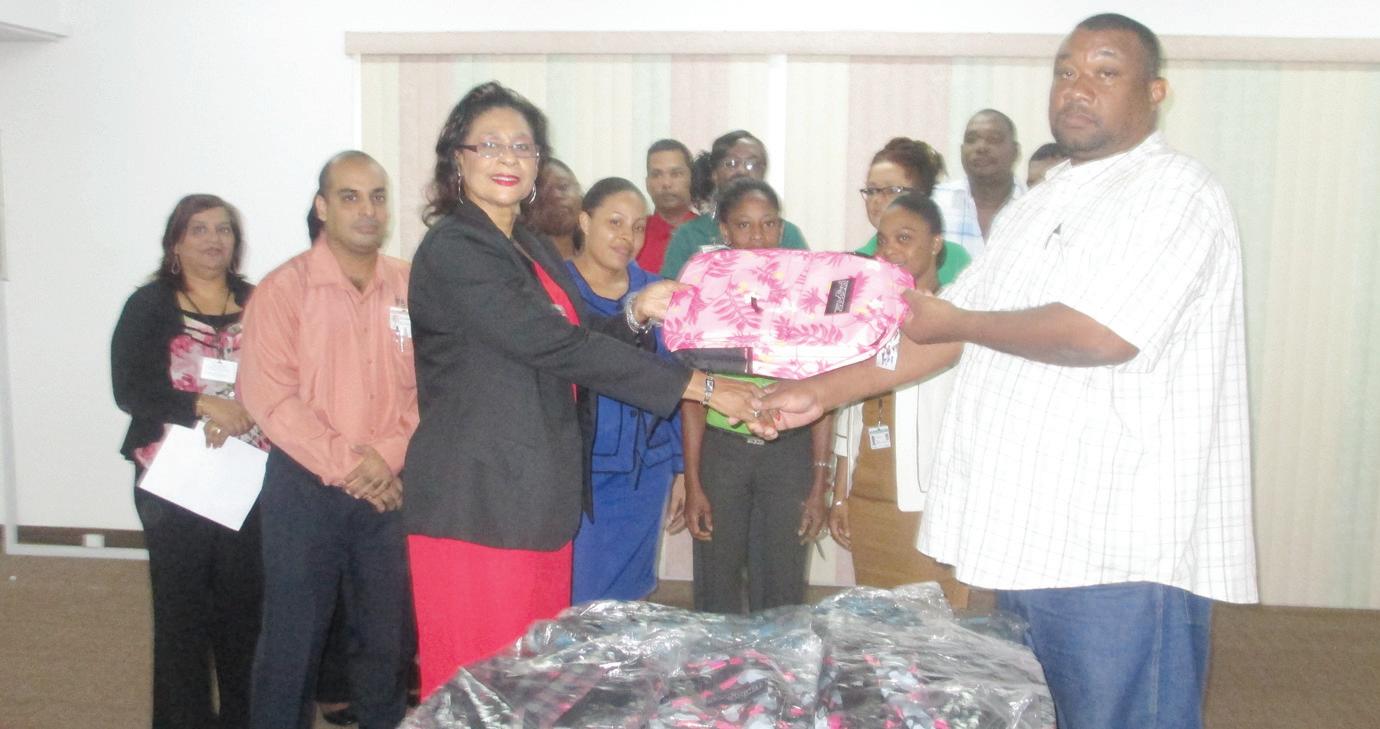
The Rose Hall Town Youth and Sports Club’s (RHTY&SC) one million dollars school bags for sports programme for less fortunate students received a major boost on Friday last when the GTM Group of Companies donated over $100,000 worth of school bags to the programme.
The Club’s Secretary/ CEO, Hilbert Foster, received the school bags from Donna Tucker, Human Resources Manager of GTM.
Foster stated that in 2012, the cricket teams of the club started the programme in response to the request from the parents of less fortunate children, and in August last year, distributed $600,000 worth of school bags. This year the club is aiming to distribute one million dollars worth of school bags and exercise books to students attending the annual summer camps and less fortunate students in the Lower Corentyne area.
School bags would also be donated to the Berbice Cricket Board. Foster stated that the RHTY&SC strongly believes in education as it was the foundation to a suc-
cessful future for youths and also because it makes sportsmen and women better ambassadors for their respective discipline.
He expressed gratitude to the management of GTM for its investment in the club education programme and expressed the hope that the relationship would continue into the future. The veteran sport administrator urged other sports club in Guyana to get involved in the antidrugs and pro-educational campaign as all sportspersons need to be fully educated to excel in sports while they need to understand the danger of drugs.
He expressed disappointment that too many youths are being denied an educational background due to poverty and pledged that the RHTY&SC would continue to assist to make a positive difference.
Company Secretary/ Finance Controller of the GTM Group of Insurance Companies, Khemraj Goberdhan, expressed his company’s delight to be associated with the RHTY&SC, which he described as the most dynamic and produc-
It was harshly called a wide, but it was the tonic West Indies needed after beefing up their attack with three fast bowlers in addition to Darren Sammy.
The tall Jason Holder, playing his third ODI, was handed the other new ball and he started by extracting disconcerting bounce off a length, with some deliveries ending up head-high for the wicketkeeper. But he did the smart thing by repeatedly testing batsmen with fuller-length outswingers.
It was another full-length delivery that brought him his first wicket as Tharanga, who had been dropped by the wicketkeeper in the previous over, drove him uppishly to cover where Darren Bravo took a good sharp catch leaping to his right. Sri Lanka’s troubles were compounded when they lost Mahela Jayawardene off the very next ball, a brute by Roach. It is seldom that
Jayawardene looks ungainly even while getting out, but he was too late on a sharp bouncer and top-edged his pull to the front lid of his helmet and saw the ball popping in the air for the point fielder to take a simple catch.
Roach’s best delivery was however the one that got Dinesh Chandimal, who hasn’t been in any form, but even if he was, it is hard to see how he would have tackled it. The ball pitched on a length and cut in sharply to hit the top of off stump.
tive club in Guyana. GTM, Goberdhan stated, that he is very passionate about the company’s investment in sport and education.
He congratulated the club on its wide range of activities that includes sport, education, cultural activities, antidrugs, awards, charity, social, religious and community as well as youth development. The company’s secretary also expressed the hope that the relationship between the club and the company would expand in the future.
Meanwhile, Feroze Barakat of Barakat Bros Limited also made a donation of a large amount of exercise books to the programme. West Indies 20/20 player Christopher Barnwell and Universal DVD Club of New Amsterdam have also donated to the programme. The school bags for the sports programme is being organised by the RHTY&SC’s Farfan and Mendes Under-15, Bakewell Under-17 and Second Division, Pepsi Under-19 and Intermediate, Gizmos and Gadgets Under-21 and First Division and Metro Females cricket teams.
Chandimal, who had gone forward to play a drive, was holding his pose, but the result left him shocked and embarrassed.
Sri Lanka limped to 50-3 after first 15 overs, with the 17 extras being the top-scorer in the scorecard. The rains came at the end of the 19th over to break West Indies’ rhythm, while in a sunny London, Murray finally ended Britain’s achingly long wait for a Wimbledon winner with a straight-set victory against the world number one (Cricinfo)




Persistent rain in Port of Spain, Trinidad meant play was called off for the day after only 19 overs were bowled during Sri Lanka’s innings. The match will continue from the current state today.
West Indies, motivated by the appearance of the pitch, chose to field the second time in a row, but unlike the previous match where they failed to make an early strike, this time, the bowlers found the right length on the pitch to topple
Sri Lanka’s top order while keeping their run-scoring on a leash. Kemar Roach was the wrecker-inchief, bowling a menacing spell upfront and was it not for a long and patient vigil by Lahiru Thirimanne and Kumar Sangakkara, the situation could have been far worse for Sri Lanka. While Andy Murray and Novak Djokovic were slugging it out like it was a hard court on the grass at Wimbledon, the pitch at Queen’s Park Oval was offering bounce
and expected sideways movement to excite the fast bowlers. Roach’s first ball was certainly an indication of what he thought of the pitch as he ambled in and got a shortish delivery to rear towards Upul Tharanga’s throat. In