
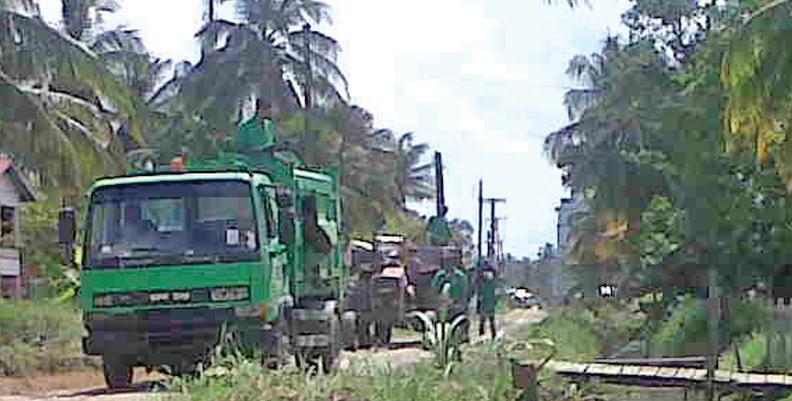
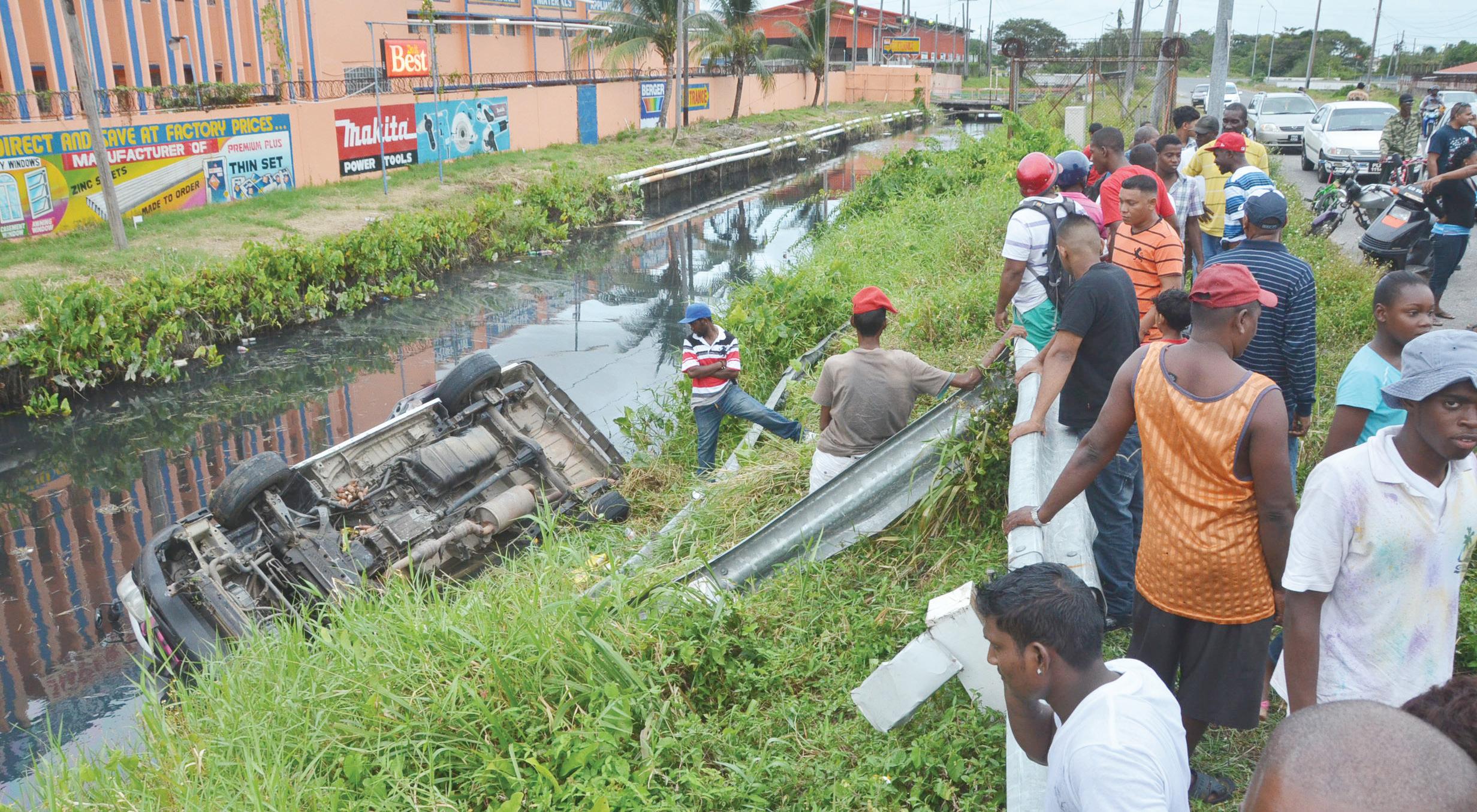

Narrow escape! The Route 42 minibus perched in the corner of this trench
Hardware, Meadow Bank, East Bank Demerara (Carl Croker photo)

monday, april 14, 2014| guyanatimesgy.com

monday, april 14, 2014| guyanatimesgy.com
The Government of Guyana, as a member state of the Caribbean Community (Caricom), will be supporting the regional Commission that is to be set up by Caricom to address issues relating to the use of marijuana.
Foreign Affairs Minister Carolyn Rodrigues-Birkett explained that while Guyana has not changed any of its laws to legalise the use of marijuana, it will nevertheless support the Commission that was mandated to be set up by Caricom Heads of Government.
“I don’t think the Commission has been established as yet so we support the Commission doing its work,” she said. RodriguesBirkett noted that after the commissioners are selected, they will meet and then present a report to the member countries. The Minister said that when the report is presented, Guyana will consider participating in the regional Commission. As it re-
lates to Guyana’s position on the topic of marijuana legalisation, Minister RodriguesBirkett told Guyana Times that while the country has not changed any of its laws at this point, it is yet to make a pronouncement on the matter. She noted that the country cannot position itself against the legalisation and then on the other hand support discussion on the matter.
Position
“Guyana’s position at the moment is that we support the Commission so it cannot be that Guyana is saying we don’t want any discussion on this, but then we support the Commission,” the Foreign Affairs Minister said.
At the recently concluded 25th Intersessional Meeting, Chairman of the Conference of Heads of Government, Dr Ralph Gonsalves, during a press conference disclosed that the heads had engaged in an intense discussions on
Foreign
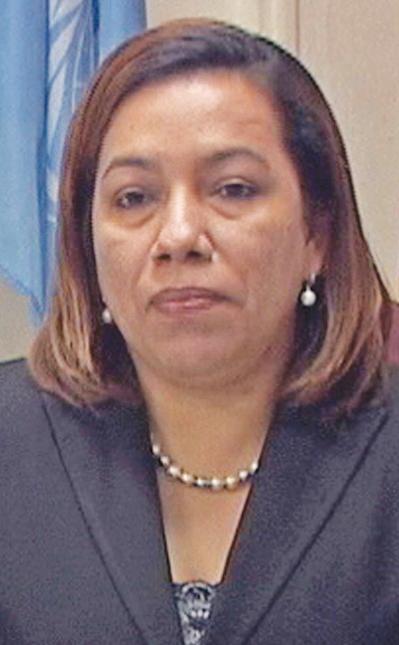
Carolyn Rodrigues-Birkett
the issue and decided that a regional Commission be established to address issues identified in relation to marijuana use.
According to the Community Chairman, the medical use and the decriminalisation of small quantities for recreational use were discussed He further stated that
concerns were expressed about the repercussion that would follow the legalisation and the decriminalisation of the drug, particularly as it relates to potential public and mental health hazards. The Commission is expected to report to the regular meeting of the conference in July 2014.
Meanwhile, there have been heated debate across the Caribbean over the legalisation of the drug; however, no country has taken the drastic step forward.
Much of these deliberations have been in Jamaica, ,which is considered the largest producer of marijuana in the Caribbean. Stakeholders in the country, prior to these discussions by Caricom, have urged the Jamaican Government to legalise the drug in order to boost the country’s economy.
In Guyana, there is division on the issue also.
However, Home Affairs Minister Clement Rohee, earlier this year, main-

tained that Government has a zero-tolerance policy on all drugs that are deemed illicit, which include marijuana.
He was at the time speaking at the launch of the National Drug Report for 2012, compiled by the Task Force on Narcotic Drugs and Illicit Weapons.
Support
The report is produced annually by the Home Affairs Ministry through support from the task force; the Customs Anti-Narcotics Unit (CANU); the Narcotic Branch of the Guyana Police Force; the Guyana Revenue Authority (GRA); and the Financial Intelligence Unit.
It highlights the actions taken by the Government through the various agencies to curb both the demand and supply of drugs. It also reviews policies and results achieved from a balanced, multisectoral approach in dealing with challenges of trafficking and substance abuse.
Rohee had said then that far too often, the constant fight against the drug trade is taken for granted and due recognition is not given to the relevant agencies in the security sector who continue to wage war against drug cartels, and battle with this scourge on behalf of the Government and people of Guyana. He lauded all the operatives from the various agencies and the task force for coordinating and combining those efforts.
“This document shows the extent to which national efforts are being made in this direction,” the Minister said.
Recognising that this is a global fight, Guyana has been partnering with various countries and organisations. The country has, over the years, developed close cooperative relations with neighbouring Brazil, Venezuela and Suriname (formal agreements have been entered into with all three countries).
Puran Brothers Disposal Inc on Sunday conducted a massive clean-up campaign in the community of Queenstown on the Essequibo Coast.
The clean-up campaign was held in collaboration with the Neighbourhood Democratic Council (NDC). Two health inspectors Haimant Narine and Anasha Henricks were on site assisting and advising residents about good health practices and correct disposal of garbage during the campaign. The campaign commenced at
Free garbage bags and bins were distributed to residents in the area. Residents were responsible of putting their garbage\solid waste\vegetation in bags and placing them outside on their parapet. The Office Manager said a trailer and with a tractor were mobilised in Queenstown to commence the campaign. The collection of solid and vegetation waste was done free of cost. Bins were also given to the Queenstown NDC to assist residents in disposing of their garbage neatly. Queenstown
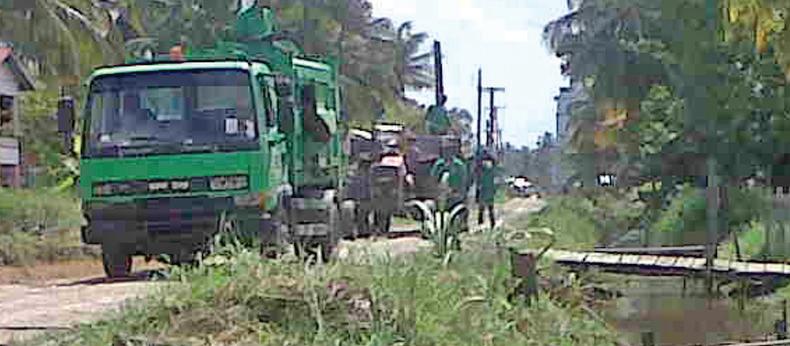
14:00h and concluded around 17:00h. Approximately 100 persons were registered and 50 bins were distributed during the campaign.
Television programmes along with banners were produced to inform persons about the campaign. Puran’s Field Manager, Matthew Munroe, said the clean-up was aimed at promoting safe disposal of solid waste as well as encouraging persons to dispose of their garbage in a more responsible manner. Munroe said the activity also helped to foster togetherness as it brought together residents. He noted that he had noticed persons were disposing of garbage carelessly in Queenstown and as such, a campaign was needed.
The company’s Essequibo Branch Office Manager Priya Mohabir noted that the campaign was a way of cleaning up Queenstown, explaining that clean-up campaigns are ongoing activities for the company. Mohabir said persons from various areas on the Essequibo Coast need to be informed of the correct way to dispose of garbage.
(only name given) said the Council was pleased to partner with Puran Brothers Disposal Inc in cleaning up the village of Queenstown. He said the NDC was responsible for providing a tractor, trailer, and workers to assist in the campaign.
Region Two Chairman Parmanand Persaud, in an invited comment, said he is pleased with the several campaigns that have been executed thus far by Puran Brothers Disposal Inc. Persaud, while lauding these efforts, said persons need to comply with the law by disposing of their garbage properly. He said that in the past, Region Two was deemed the cleanest region of Guyana and he was happy that Puran Brothers is helping in the fight to restore the area to its former status. Similar exercises have been held in Charity/ Usara NDC. Puran Brothers Disposal Inc first introduced its services to the people of the Essequibo Coast on January 16, 2013.

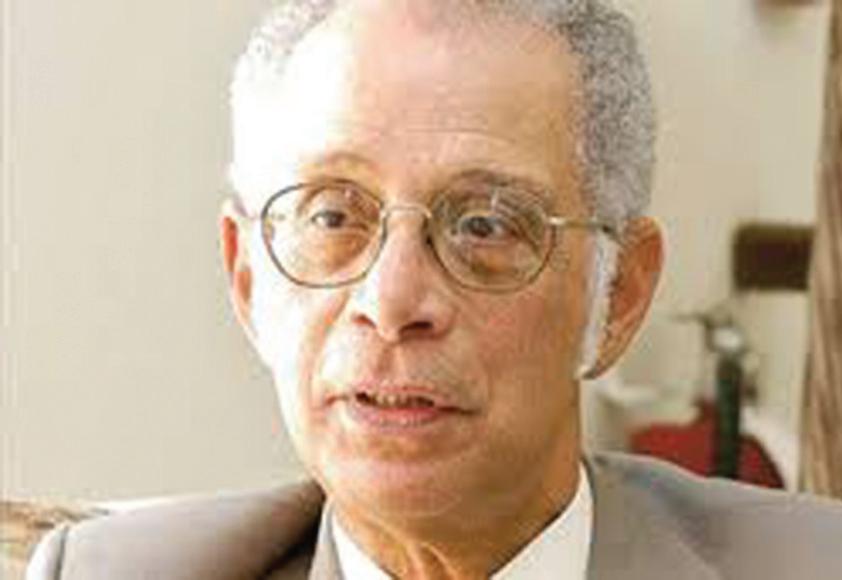
The death of United Nations (UN) special envoy on the Guyana/ Venezuela border controversy, Professor Norman Girvan will more than likely set back some of the progress made by the two countries in amicably working out long standing issues regarding the Essequibo region.







The University of the West Indies Professor passed away in Cuba last week, three months after he became paralysed following a fall while hiking in The Dominican Republic.
He was 72. Girvan’s role was to assist both countries in the search for a practical settlement in the controversy that emerged from the Venezuelan contention that the Arbitral Award of October 3, 1899 is null and void, thus claiming a significant amount of Guyana’s territory.
Meanwhile, as tributes continue to pour in for the Caribbean academic, Secretary General of the Organisation of American States (OAS), José Miguel Insulza in a message said Dr Girvan was a unique and outstanding Caribbean intellectual and development economist.
A Jamaican by birth, Girvan, the OAS Secretary General said, honed his intellectual skills and capacity at the ubiversity of the West Indies (UWI) Mona campus, where he was part of the well-known team of Girvan, Thomas and Best, who, through their writings and advocacy, advocated a new paradigm for the development of the wider Caribbean region.
“As Secretary General of the ACS, he promoted the vision of a truly integrated Caribbean – one that encompassed all the English, Spanish, French and Dutch speaking countries of this multifaceted and dynamic region. He had remained resolute and devoted to the cause of integrating the Greater Caribbean,” the Secretary General said.
Outstanding contribution Insulza noted that Girvan will be remembered for his outstanding contribution not only to the region, but also to development thinking in the Americas and other parts of the developing world. “Jamaica and the Caribbean have lost an exemplary figure, renowned for his brilliance, humility, and dedication to social justice. On behalf of the Organisation of American States, I, therefore, extend my sincere condolences to the family and many friends of Norman Girvan. May his vision of greater Caribbean unity and integration continue to imbue the people of the region.”
For his part, the UN Secretary General Ban Kimoon hailed Girvan as “one of the most distinguished Caribbean scholars of his time”.
“He was particularly devoted to the promotion of regional integration in the Caribbean and Latin America. This commitment earned him the respect and admiration of the entire region,” said the statement. Ban expressed his grati-
tude for Girvan’s contribution to the UN good offices process between Guyana and Venezuela. At issue is the disputed Essequibo region, which since 1899 has functioned as a territory administered by Guyana but is claimed by Venezuela.
“The progress achieved during his tenure was acknowledged by the Heads of State of Guyana and Venezuela and is part of his impressive legacy.”
Great regionalist
Also commenting on Girvan’s life, the Jamaica Observer in its Sunday Editorial said that at a time when the Caribbean Community needs him most, “we have lost a great regionalist, integrationist and intellectual warrior of the highest order”.
An economist by training, Professor Girvan received his Bachelor’s Degree in Economics from the then University College of the West Indies and his PhD in Economics from London School of Economics. During
his distinguished career, he was a scholar of world renown, publishing and speaking on matters of economic development, multinational corporations in mineral economies and Caribbean integration. He was at various times a university lecturer, mentor, political activist and public servant. According to the Observer, Dr Girvan spent most of his career in academia, although he believed in the unity of thought and praxis. For him, the point of understanding the world was to change it for the betterment of the majority of people. In his own words: “My field is the political economy of development...”
He published several books and numerous articles on foreign investment and multinational corporations, the mining industry, technology, the International Monetary Fund and external debt, social development, corporate imperialism, development planning, Caribbean integration, and economic thought.


Editor: Nigel Williams
Tel: 225-5128, 231-0397, 226-9921, 226-2102, 223-7230 or 223-7231. Fax: 225-5134
Mailing address: 238 Camp & Quamina Streets, Georgetown
Email: news@guyanatimesgy.com, sales@guyanatimesgy.com
Last week marked 20 years since the genocide took place in Rwanda, still considered one of the most horrifying and defining moments in post-Cold War history. On April 6, 1994, Hutus began slaughtering Tutsis, resulting in over 800,000 persons, mostly Tutsis and Hutu sympathisers, being killed over a period of 100 days.
The Rwandan violence was not just wartime violence; it was a directed, premeditated attempt to eliminate an entire people, and from all indications, there was evidence of this months before which the international community could have acted upon.
The story behind the Rwandan genocide has its genesis since colonialism. It is well-known that the split between the Hutus and Tutsis were not as a result of the religious or cultural differences; but economic ones.
Hutus, who happened to be the majority, were people who farmed crops, while Tutsis were involved in rearing cattle. Because cattle were more valuable than crops, the minority Tutsis became the elite. These class divisions were seen as ethnic designations.
Since the Hutus were the majority, they easily won the elections in 1961, and the regime that followed was staunchly Hutu nationalist. There was a great deal of fear and hatred long before the actual genocide took place. Intermittent violence between these two groups became a feature of postindependent Rwanda.
The day after the genocide began, the Tutsi rebel group Rwandan Patriotic Front (RPF), led by the current President Paul Kagame, launched an offensive aimed at toppling the Hutu-led Government. In about 100 days, the RPF defeated the Government forces and took control of the country.
The massacres in Rwanda constituted genocide, and the world should have acted accordingly to end the killings and restore order in that country. The international community stood idly by and just watched as thousands of persons were being slaughtered.
Bill Clinton, U.S. President at the time, apologised years later for American inaction. In a speech recently, United Nations Secretary General Ban Ki-moon reiterated the United Nations’ remorse that its peacekeepers had failed to stop the genocide.
Where is the country today in economic performance and how far has it has come in healing and forgiveness. According to the United Nations Development Programme (UNDP), Rwanda is now a thriving nation. In 2000, the Government introduced its Vision 2020, which seeks to transform the country from a low-income agriculture-based economy to a knowledge-based, service economy by 2020.
Between 2001 and 2012, the country’s Gross Domestic Product (GDP) grew by an average of eight per cent per year. Rwanda has made impressive progress in the area of human development. Poverty rates have plummeted by nearly 12 per cent, as a million children, men, and women were raised out of poverty since 2008.
There are several efforts being made to bring about healing and reconciliation among citizens. The Rwandan Government, in particular, had set about changing the narrative of Hutu and Tutsi enmity and they used a variety of means to do so.
Village-level meetings were promoted to discuss what had happened – how things were before they were incited to hatred, school clubs were formed to carry out massive public education work aimed at unification, and traditional village courts were reinstituted, oriented toward deep community engagement in restorative justice approaches rather than seeking more punitive and vengeful approaches.
A National Unity and Reconciliation Commission, which stimulated a broad range of activities to support a new narrative of unity for the country, was established. Today, a majority of the population identify first as Rwandans before they even consider whether they have another identity such as Hutu or Tutsi.
In spite of those positive developments, it is hard to imagine that the society in Rwanda is not a deeply damaged one. Even though it is more than two decades since that horrific tragedy took place, the scars are still fresh and the fear as to whether an event as tragic as this one could occur again still lingers.


Dear Editor,
It is common knowledge that the greatest constraints to overall development in our country originate from the racial prejudice that affects our activities in the various spheres of our existence, whether it is social, economic, political, or even, to some extent, spiritual.
Even the problems we are at present witnessing among the players in our Parliament can be traced to this schism within our society and although it may seem very improbable that we can solve this mountainous dilemma at any time in the foreseeable future, each Guyanese must see it as his/her duty to play a part in its elimination so that, even if we feel that we will not live to see the fruits of our labours, we can at least leave a legacy of communal peace and stability for those who come after us.
To do so, an assessment of the causes of and the extent to which this cancer has taken hold of our body politic would be useful in determining any strategy that needs to be instituted to deal with it. Anyone attempting such an objective appraisal of this phenomenon in our society will find so many factors which militate towards prolonging its existence that it would appear permanently intracta-
ble. Some of these are:
1. Race is intricately tied up in the economic imbalance that exists between the racial groups, especially the two in the majority. Employment practices, occupational habits, and preferences all tend to perpetuate this disparity.
2. Succeeding generations since the middle 1950s were born into a society largely divided by racial strife, and they have, whether on purpose or by default, passed this on to their own children who comprise the present generation.
3. The international powers created, and, to some extent, strive to maintain, the schism of our people into two racial camps so as to counteract, in their view, the threat of communism within the state apparatus. This means that, although our international benefactors may act generously towards our welfare in other areas, we cannot expect much help from outside in this our major problem.
4. The politicians of the two main political parties will not surrender their policy of playing the race card, as they see this as the only means of maintaining the support of their parties at elections, each being hopeful that they would be able to garner enough from
the other side to place or keep them in power.
5. Our religions are mainly aligned along racial lines, this being inherited either from those who brought their faith with them, or who adopted them for the centuries of their living here. It is true that Christian denominations have made some inroads among traditionally non-Christian groups, but it is still believed that racial prejudice still largely affects relations among respective members, especially in the rural areas, where other social factors impact on them.
6. The physical arrangement, in which the two main racial groups have settled historically in so many enclaves, and which has been maintained by various racial disturbances starting from the breakup of the original PPP in the 1950s, and heightened in the 196364 and other post-election disorders, have militated against groups benefiting from close interaction, which would have led to more understanding and appreciation, and consequently treating one another primarily as human beings rather than members of an alien entity.
7. Because of the inherent cultural differences which exist between the races, which in some
cases are diametrically varied, and the reluctance of all sides to compromise in these because of their perception that their culture would lose its gravity, many deep-seated differences have been maintained, and these further drive a wedge between our groups.
An examination of these factors must show how each one is problematic, and how slim are the chances for them to be resolved by any strategies that do not consider the personal element of racial prejudice, which is at the heart of the impasse. Although we tend to lay the blame for discrimination and racial violence on groups, including the Government, racial prejudice is basically a personal depravity that needs to be dealt with at the personal level if we are to permanently get rid of the problem.
The heart and soul of each of us is where it has to start, and I, therefore, call on each Guyanese to see it as his bounden duty to do whatever he can to eradicate this scourge from among our midst, and thus enable us to deal with each other as fellow human beings who share the same hopes and aspirations for our people as a nation.
Yours sincerely,
Roy Paul
Nationwide sugar subsidy only benefits workers when they work, unlike
Dear Editor,
It was not public information that Linden enjoyed a subsidy for more than 22 years during the PPP/C and also during the PNC’s 28 years in Government.That secret was closely guarded. For what reasons?
Only after the PPP/C Government attempted to ease the nationwide burden was the massive subsidy revealed, resulting in the 2012 Linden riots. But the justification to remove Linden’s electricity subsidy had prior approval by the same PNC-WPA leadership of Mr David Granger (PNC) and Dr Rupert Roopnarine (WPA) in an agreement with the PPP/C Government.
Why did WPA-PNC-AFC extremists subsequently find such fertile ground to demand continued subsidy for only Linden’s Black-based PNC supporters? All other Guyanese, regardless of colour, race religion and what not, did not alltogether matter at that time to Linden’s extremist champions?
Does even the rest of nationwide Black Guyanese matter to also get cheaper electricity? Are they rich unlike Linden’s “poor people”? Race only matters to those who are “possessed” and when the few jumbies so decide.
All other Guyanese, regardless of colour, religion, intermarriages, friendships and proximity as neighbours supposedly do not count or have any say. Sugar workers nationwide must regardless still work tomorrow to tap into the sugar levy, unlike every Lindener who automatically benefits regardless of working or not.
For anyone to croon in
delight about the nationwide sugar subsidy providing jobs, earning foreign exchange and ignoring its political, racial and economic repercussions is most pitiful and reprehensable.
How does it compare to validating rioting for Linden’s electricity subsidy? Well, since Linden is pre-dominantly Black, race is all that matters. It provides traction for mayhem and proves their point. Can there be any future magnanimous fairness and honesty?
Production of comparable rioting evidence that Indians indeed fought against subsidy for Linden based on race may do the trick. But such evidence simply does not exist.
Now we find some 300 sugar workers in 2014 picketing the National Assembly without disturbing the free flow of traffic, brutalising and robbing people, burning private buildings and schools, and throwing any stones at the police, have given excellent reasons why no one was arrested.
How can political affinity, race, behaviour, education, crowd control, or the race baiting agitation be responsible for any contrasts at both events? What was the role of those WPA and AFC instigators during the 2012 riots? Is it still a secret?
In contrast, how long has the sugar industry been subsidised, especially with AFC- APNU future goals to ensure its demise? Does Guyana’s nationwide sugar industry (and workers of all races) have the right to a subsidy? For how long can this last is the big question?
Indo-Guyanese workers
were quickly put to work to stabilise Guyana’s economy right after landing. Even those many freed Black slaves from the Caribbean who came as indentured servants as well as Portuguese and Chinese labours shied away.
Finally when all else failed, Indian sugar workers were brought to build the wealth of Guyana. They still continue to do so in contributions to subsidise education and upkeeping Guyana’s growing infrastructure.
In the 1970s, the PNC imposed a levy on sugar and skimmed the fat off the profits for “national development”. Was any such levy imposed on either Linden or bauxite for national development?
President Barack Obama quickly ensured that American banks and major car and housing industries were adequately subsidised after he was elected in 2008. (I stood in line for five hours to vote for him!)
However, what some champion is subsidy to a community, rather than an industry, only encouraging laziness which can only ultimately create a welfare country. Encouraging AfroGuyanese to remain anchored on handout dependency only continues to keep them mentally shackled and does them no good.
Sooner or later even GuySuCo, if it continues to remain needy, must be divested to prevent the entire ship from sinking. Only the PPP/C Government, and no one else, must be prepared to make that decision.
Sincerely, Vassan Ramracha
Dear Editor, A resolution to amalgamate the Guyana Legion and the X-GDF Association was welcomed with great applause and excitement.
The resolution was delivered by Frank Bishpan (Colonel Retired)and was seconded by a 90-yearold World War II veteran, Gladwyn Nestor. The resolution attracted a 100 per cent vote in favour.
This birthed a new organisation for military veterans which will now be recognised and renamed “Guyana Veterans Legion”.
APNU and AFC are disgraceful and heartless
Dear Editor,
The 2014 Budget Amerindian Fund sought to continue such development and now APNU and AFC have voted against these development programmes for our Amerindian sisters and brothers.
APNU also in its Manifesto spoke of its commitment to support a development strategy towards indigenous development and inhabitants. I ask today, where is that commitment and generosity? But the people will be the judge.
Throughout the 2014 Budget Debate, APNU and AFC have criticised the Government for not improving hinterland airstrips. Yet last year they voted out monies for the airstrips. Again in 2014, they have voted against the airstrips. This is barefaced and shameless pretense of caring, while ghoulishly brandishing the dreaded scissors.
Is this putting hinterland and Amerindian development as top priority? I say shame on you AFC and APNU. I am convinced that the PPP/C Government by budgeting for the Amerindian Fund has continued its strong commitment to the Amerindian people. APNU and AFC have again betrayed our Amerindian sisters and brothers by using the dispensation of the scissors.
The people of this nation must be the judge. For two consecutive years, the Opposition parties, APNU and AFC have cut the Amerindian Development Fund, despite detailed and rational explanation by the subject Minister to justify spending and its necessity. APNU and AFC ignored the fact that these Amerindian Fund projects were chosen by the Amerindian leaders themselves.
Irrational behaviour such
as those last Thursday night that cut the budget leaves one to ask: “Was the interest of Guyana’s first people only a top priority during Elections”? Did APNU and AFC ever have the interest of Amerindians at heart?
The answers are clear for all to see that the PPP/C has always kept the advancement of Amerindians on the front burner, not just at elections time. We have demonstrated our commitment throughout the years, every time and anytime, once it is in the interest of our people.
I am glad I belong to a party that is not “fair-weather” friends of our people. I am glad I belong to a party that stands firmly all the time as friends of our people, fearlessly and fairly protecting the interests of ALL PEOPLE in Guyana.
How can anyone vote against the Specialty Hospital? This hospital would ensure all Guyanese obtain health services that they can only access overseas. Cutting the Specialty Hospital is gross disregard, disrespect and insult to a whole nation. We should never restrict health care services and we should celebrate any development that improves and expand health services to our people.
The Specialty Hospital seeks to ensure that the Guyanese people access catastrophic healthcare services and to improve equity in health care. While the wealthy can access health care overseas, the majority of Guyanese cannot access these expensive health care services abroad. The PPP/C Government is catering for these services to be accessed locally at affordable costs, bringing health equity for ALL Guyanese.
The Specialty Hospital is being built through a low in-
terest loan from India. APNU and AFC used their scissors to cut this important social welfare public good from the budget. I note also that they cut the budget for the Eye Surgery Operating Room at Linden Hospital. This further exposes APNU and AFC as making a deliberate effort to hurt people merely as a power-hungry grab.
The vote to cut the Specialty Hospital and other healthcare services is cruel and inhumane and also exposes the AFC and APNU as not interested in the development of our people and our country.
Cutting the CJIA expansion Project is a deliberate effort to derail Guyana’s development In regards to the CJIA Expansion, APNU and AFC displayed arrogance and an overt effort to derail Guyana’s development.
We cannot seriously talk about tourism development and the overall development of our country unless we support projects such as the expansion of CJIA. Every economist and development specialist has recommended the expansion of CJIA. Yet APNU and AFC have sought to scuttle this major development project.
In their hunger for power, APNU and AFC do not respect anyone and they do not care who or how many people they hurt. They merely want power and the more they create chaos and under development, the more they take delight in the misery that they cause.
I call on my Guyanese brothers and sisters to stand in solidarity to condemn the reprehensible actions of APNU and AFC.
Minister of Agriculture, Dr Leslie Ramsammy
The new Constitution evoked extensive discussions before being endorsed by all present.
Highlighted in the Constitution were the new name of the organisation, the new motto and specific and improved benefits for World War veterans, among other things.
This Special General Members Meeting was held at its Headquarters on Carifesta Avenue on April 6, at which attendance was in excess of 200 members.
A new Constitution was presented to the membership by the President, George Gomes (Lieutenant-Colonel Retired).
The meeting was chaired by the President of the Organisation, while greetings were extended by visiting representatives of the New York and Canada Chapters of the X-GDF Association
Meetings at the Guyana Veterans Headquarters will be held on the first Sunday of each month at 14:00h. The new Executive will pay visits to the Berbice and Linden Branches.
Eon Andrews, Public Relations Officer Guyana Veterans Legion


– ChildLink’s vision is a Guyanese society where every child enjoys the right to a childhood in a safe and caring family, free from poverty, violence and exploitation
Violent behaviour in children and adolescents can include a wide range of conducts such as explosive temper tantrums, physical aggression, threats, or attempts to hurt self and/or others (including homicidal thoughts), use of weapons, cruelty towards animals, fire setting and intentional destruction of property. Some factors which increase the risk of violent behaviour are as follows:
Genetics and environment
Children of violent, disruptive parents are more likely to develop these violent tendencies. This suggests a hereditary cause of youth violence. At the same time, the risk of developing violent behaviour is even higher among these children if they are raised in an unfavourable family situation, suggesting that environmental factors are also at work in causing violent behaviour in children. If that same child has grown up in a violent environment, whether that violence is experienced in the house, at school or in neighbourhood, it may be interpreted as the correct way to deal problems and the cycle of violence will continue.
“Violence is the result of a combination of biological, social, and psychological factors, especially those that increase exposure to vulnerability, shame, and humiliation. Preventing violence must involve the opposite: making sure people feel safe, cared about, and connected, while ensuring they have a healthy and realistic sense of self-esteem and self-worth.”
– Lisa Firestone, PhD in Compassion Matters.

Poor parenting
Various aspects of poor parenting may contribute to violent behaviour in children. Here are five parenting flaws in particular that can contribute to children’s violent behaviour: poor supervision; erratic behaviours; harsh discipline; parental disharmony; and rejection of the child. As parents, guardians, family and family friends raise

a child, children learn to think, communicate and act as the adults around. Adults raising a child should realise that every action done in front of that child is a lesson to him/her on how the world works, whether it is negative or positive. If a child is raised in a household with poor communication, that child will not be able to relate as well to other children and adults in society.
Exposure to violence Research has shown, “children who are exposed to violence undergo lasting physical, mental, and emotional harm”, and are more likely to engage in violence themselves. In 2005,

UNICEF conducted a survey throughout Guyana which focused on children and their experiences of violence in their communities. In this survey, children often identified drinking places, mostly rum shops, as common locations for violence in the community. The violence in these locations rarely involved children, but some did give accounts of boys as young as 14 involved in drinking and fighting at such establishments, and girls described sexual harassment and even attempted rape by drunken men in rum shops. In addition, 74 per cent of children said they had seen a real gun (not a toy and not

on TV); 53 per cent of children had seen real guns held by private individuals (ie not police, army or security guards); and 35 per cent of children said they had held a real gun before. The survey also found, almost half (47 per cent) of the children in the general population knew someone who had been killed. The majority of these were people known to the children – friends or members of their community – but 2.5 per cent of the children had had caregivers killed, and nine per cent of the children had known other family members killed.
The Media
There is debate over the role of the media in the lives of violent youths due to violence on television, in movies, and in video games. Some research has found a correlation between media violence and real-world violence.
Prevention
Research has indicated that violent behaviour can be managed if risk factors are reduced. Much of this can be done through prevention and teaching the child to express feelings appropriately.
One of the most important and effective preventive actions is decreasing exposure to violence in the home, community, school, and media. According to the American Psychological Association Commission on Violence and Youth, “there is absolutely no doubt that higher levels of viewing violence on television are correlated with increased acceptance of aggressive attitudes and increased aggressive behaviour.”
Please contact us on telephone number 231-7174 or at programmes.childlink@ networksgy.com for any support you may need on parenting and any other challenges that you may be experiencing with your children.
BY BHISHAM MOHAMED
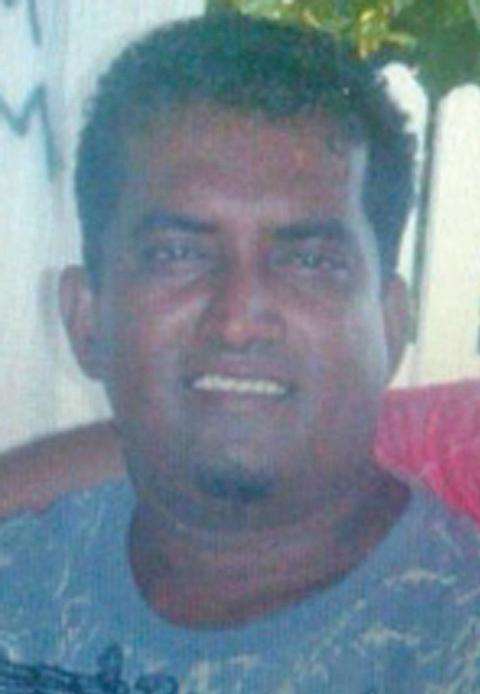
As the body of Rajendra Sunil Singh, former proprietor of Sunil’s Auto Spares was being cremated on Sunday, investigators were busy interrogating other suspects whom they believe play an integral role in his killing.
So far, three persons have reportedly confessed to the kidnapping and murder of the businessman, but the police are also looking for two others, one of whom might have sold a car to the businessman a few nights before his kidnapping. The man is reportedly from Plaisance, East Coast Demerara (ECD).
Guyana Times also understands that a prominent figure at Enmore, ECD is being fingered in connection with the man’s kidnapping and is believed to be the second mastermind. A police source told this publication that the three men who confessed to the killing are expected to be charged shortly.
The source also refuted claims by Stabroek News which accused the police of not going to the house where
Singh was kept by his abductors. He said as soon as the police got information about the house, they conducted a search, but Singh was not found there.
The source added that police also searched several houses in proximity of Goedverwagting, ECD, but came up empty-handed.
This was confirmed by a resident in the area, who told Guyana Times that his house was searched while his teenage daughter was at home. He thought that while the police are conducting their duties, they need to more responsible.
James Whyte related
that after the search, police returned the following morning and again ransacked his house. It was after the policemen left, he was told of the kidnapping incident. When asked if he had seen any suspicious movements in the area, he responded in the negative, but was more concern with the manner in which the police raided his home.
Meanwhile, at the businessman’s funeral on Sunday, his wife told Guyana Times that ever since her husband’s death, she has been concentrating on his funeral arrangements and did not check with the police at any time.
The woman said she is cognisant that the police are making some headway in the case and is looking for answers as to the real motive behind the kidnapping.
At the funeral, several small groups of people were in their corners talking about the man’s death and what they thought might have been the motive.
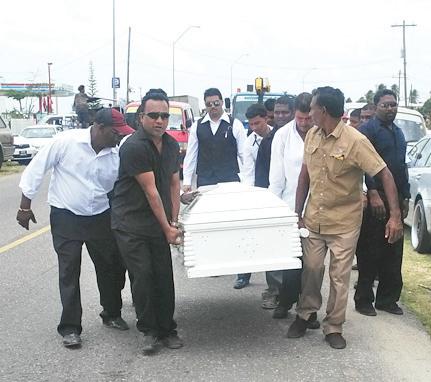
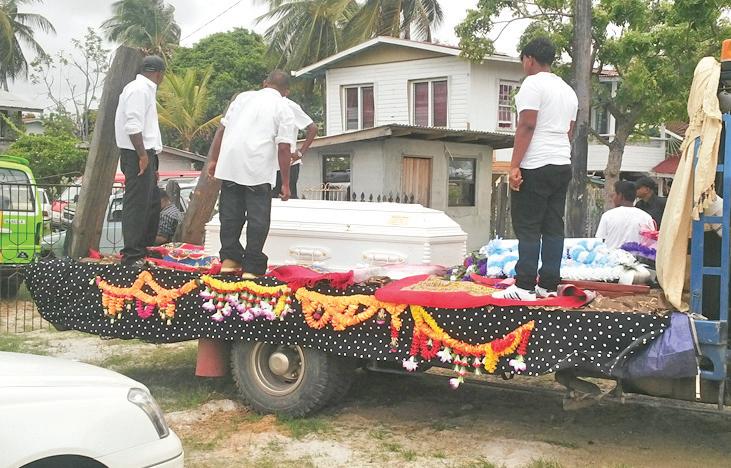
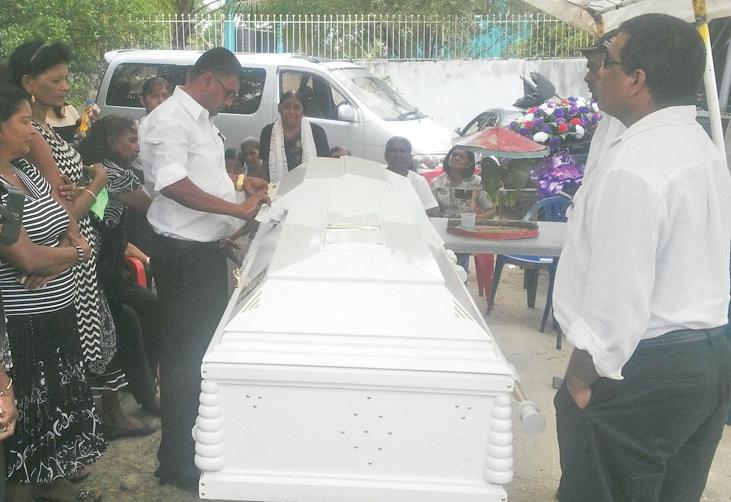
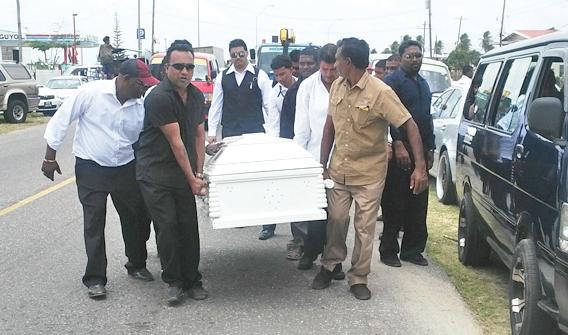
The businessman’s body lay in a white casket as family members stood around in tears.
His mother, who was sitting on a chair, wept uncontrollably. “Why it had to be
A Calabar High old boy, Dr Girvan came of age at the end of the colonial era and completed his university education in time to plunge into nation-building in the 1960s. His nationalist, anti-colonial, pro-development world view was strongly influenced by his father D T ‘Tom’ Girvan, a community development officer. He was active in the New
World Group and at the centre of the halcyon days at Mona, along with luminaries like Messrs George Beckford, Alister McIntyre, C Y Thomas, Walter Rodney, Orlando Patterson, Trevor Munroe, Rex Nettleford, Douglas Hall, Ken Post and Edward Brathwaite.
Until recently, Girvan was Professorial Research Fellow at the University of the West Indies (UWI)

Graduate Institute of International Relations.
In 2010, he was appointed United Nations Secretary General’s Personal Representative on the Guyana-Venezuela Border Controversy. In 2002-2011, he was a Board Member of the South Centre and served as Vice Chairman from 2006 to 2011.
Since 2009, he has been a member of the United
you… why… they tek you away and now you gone and left me… why they had to tek you away… why…” the grieving mother cried.
The man’s eldest son, who returned from the U.S. for the funeral, was seen standing with other relatives with a perplexed look on his face. Singh’s close relatives were also seen and so were several police ranks in plainclothes.
After the viewing at the man’s house in Enmore for close family and associates, his casket was lifted onto a truck and whisked off.
On their way to the man’s business place for the funeral service, the entourage
stopped at several of his other businesses. Finally, at his Lot 15 Foulis, East Coast Demerara home, the final funeral service was held.
A cousin of the dead man told Guyana Times that his family is still in shock at the way he was killed.
“If they de kill he the same time when they collect he on the night, we would a feel it yea, but this is unbearable... they kidnapped he, then torture he and oh man, they nah had to kill he in that way.”
Doubts
The relative recalled that after they found Singh’s body on Friday, he rushed to the La Repentir Cemetery with some doubts in his mind, but as he got close to the body, his worst fears were confirmed.
At that time, he said he was too distraught to talk, but now that he is much better, he is asking the police to find his cousin’s killers.
The slain businessman’s teenage son was not seen and is believed to be in protection since he was reportedly the main target in the kidnapping. Despite the man’s death, the investigations continue and three persons have since confessed to the killing on Friday evening. They have since revealed the identities of their accomplices to the police, who have launched a manhunt to apprehend them.
Guyana Times was told that one of the two masterminds behind the kidnapping and killing was apprehended, while the other is still on the run. It is believed that two men would have orchestrated the entire incident, and in turn, they would have contracted three others to execute the plan.
Nations Committee on Development Policy. He served as Secretary General of the Association of Caribbean States, Professor of Development Studies and Director of the Sir Arthur Lewis Institute of Social and Economic Studies at the University of the West Indies, and head of the National Planning Agency of the Government of Jamaica. He received his
Bachelor’s Degree in Economics from the University College of the West Indies and his PhD in Economics from the London School of Economics. Professor Girvan has published extensively on the political economy of development in the Caribbean and the Global South.
He is the recipient of several honours and awards. Regarding his role in the
Possible motive
The kidnapping reportedly stemmed from the sale of several of the businessman’s properties, which led to greed. It is believed that the men were business associates and would frequent Singh’s house, thus, they were well aware of his business deals.
The kidnapping was an attempt to extort money from the businessman, but the plan of the perpetrators failed. On the night in question, their main target was reportedly Singh’s teenage son whom they thought was in the car with him. Soon after the car sped away from the scene with Singh inside, the kidnappers contacted Singh’s wife, demanding $50 million for his safe return since they were aware that he had the money at home. After they realised the police had gotten involved in the matter, they reportedly lowered the ransom to $25 million. After three days and their demands were not met, the suspects reportedly shot the businessman twice to the head aback the La Repentir Cemetery, Georgetown. Singh was cremated at the Good Hope, ECD crematorium.
Guyana/Venezuela border controversy, the UN had said that he would assist the two countries in resolving the long-standing issue. His appointment was a response to a request from the parties to resume the Secretary General’s good offices, which were suspended in 2007 due to the death of the Secretary General’s last Personal Representative Oliver Jackman.

President Donald Ramotar and Opposition Leader David Granger have not had meaningful consultations on the setting up of several key service commissions, despite their importance.
This is according to the Attorney General Anil Nandlall. Nandlall told the National Assembly last week that members of several important commissions such as the Judicial Service Commission, Public Service Commission (PSC) and the Police Service Commission have not been appointed although the commissions have been expired.
He explained to the House that persons are appointed to these commissions by the President after extensive consultation with the Opposition Leader, or upon recommendations of the National Assembly.
However, he said the President’s attempt to consult with Granger on these appointments has not yielded success thus far.
“As far as I understand, the contention is the National Assembly must conclude first. With this contention I do not agree. However, the reality is that the process is not moving forward,” he lamented.
Minister Nandlall further pointed out that the Opposition controls the National Assembly and by extension, all its processes, including the committee system which are to generate these names.
“The particular committee in question has had a dismal record in terms of frequency of meetings since the commencement of the 10th Parliament. This committee is chaired and controlled by the Opposition by a majority of member-
ship. The Opposition, therefore, cannot escape blame for this constitutional negligence,” he added.
Alluding to the JSC, Nandlall said no Judge or Magistrate can be appointed because the JSC plays a pivotal role in such appointments. He further pointed out that there are no Commissioners of Title and Land Court Judges for the counties of Essequibo and Demerara; hence, there are no sittings of these important courts.
“The consequential pile up of backlog cases is phenomenal. There are several vacancies in the magistracy to be filled. This also cannot be done,” he stressed.
With Justice of Appeal Rabbie Sukul resigning, there is a vacancy in the Court of Appeal. The matter is further compounded by the fact that another Judge will retire soon, re-
sulting in another vacancy within the system. The situation with the PSC is not so different as there is a pile up of disciplinary and promotional matters affecting the careers of several public officers. The PSC is constitutionally required to play a part in determining which public officer should or should not be paid pensions and superannuation benefits.
“All these cases are now at a standstill. Similar problems result from the non-functioning of the Police Service Commission in relation to members of the Guyana Police Force,” Nandlall added.
The Attorney General had used the opportunity to make a public appeal to urge all involved to accelerate the appointments of the membership of these critical service commissions.


...against Rodney CoI
For the umpteenth time, the PNC’s proved that “moutar” is different from “guitar”. Since 2005, when it started to court elements in the WPA, the party’s made much ado about supporting calls for a Commission of Inquiry (CoI) into Rodney’s assassination. Sorry, that should be “Rodney’s death” because “assassination” –proposed by the PPP/C in its motion – would’ve been conclusive on what the CoI was supposed to investigate.
The eventual 2005 motion for the Inquiry was on “Rodney’s Death”. The PNC’d already conducted an Inquiry back in the day...and found the cause was “death by misadventure”. Obviously, the PNC had a thing about Rodney and “death”, Burnham had infamously warned the historian-activist that his “steel was sharper” and that Rodney should “make his will”.
In 2005, the WPA – with Rupert Roopnaraine as the point man – was responsible for drafting the Terms of Reference (ToRs) for the CoI in collaboration with Rodney’s widow, Patricia. No complaints then that the Rodney family was given too much leeway. The CoI never came off, because the WPA leaders decided that it would be prejudicial against the PNC with an election looming. The PNC had stoutly maintained it “welcomed” the CoI. Nothing to fear and all that.
Fast forward to the present...but not omitting that in the meantime the WPA and the PNC are now joined at the hip in APNU. After stoutly insisting it still wants an Inquiry, the PNC has now said it won’t participate!! Surprise! Surprise!! Its excuse? For one, the Government depended too much on Rodney’s family, which now requested the Government exclude the PNC and WPA from setting up the CoI. Who could blame the family after the foot dragging and red herrings drawn across the trail of the CoI back in 2005? Well, the PNC and WPA!
But the PNC’s major objection for bolting from the CoI is that one of its ToRs called the “Commission’s attention to the persons in command of the defence and security forces at the time”. The PNC feels this “was prejudicial to the outcome of the CoI”. Well, gracious me! Imagine that no one now denies that Gregory Smith – a member of the GDF, from which he received specialist training in explosives – was involved in the “death”.
The GDF had denied Smith being a soldier, but backed off after conclusive proof was offered. Burnham had just appointed a new head of the GDF after threatening Rodney. Wouldn’t it be prudent for the CoI to question this head if he’s still around?
Well, ex-Brigadier David Granger, who just happens to’ve been that head, doesn’t think so. Why aren’t we surprised?
...in the Opposition coalition
Seems that it isn’t all sweetness and light in the the parliamentary coalition between APNU and AFC. After it “tried a thing” against APNU – to stir up the Linden protests back in 2012 – the AFC’s been a faithful handmaiden to APNU’s ambitions. There hasn’t been an initiative of APNU that Ramjattan and Nagamootoo haven’t saluted and snapped, “Yes sir!!” They’re dealing with a General, no?
But you know what happens when you make yourself into a doormat? You’re taken for granted – or worse. Word is out that down in the town of Linden, local APNU warlord Sharma Solomon hasn’t been dealing on the up and up with its AFC Councillor on the RDC, Audwin Rutherford. Rutherford complained he’s been shut out from the negotiations between the Region 10 RDC and the Central Government, for sharing out all the goodies agreed to after the protests.
The poor dear! Welcome to the realpolitik world of the PNC, where the word “shafted” has a rather painful connotation!
...by the police
The Stabber suggests the police were less than diligent in following leads in the tragic Rajendra Singh kidnapping. But worse, claim that the police can’t come up with a motive for the crime. After $50 million was demanded?
BY GOMATIE GANGADIN
Years after a devastating fire destroyed the historic Sacred Heart Roman Catholic Church; members are still struggling to rebuild the edifice.
And though they had raised an initial $90 million to carry the building to where it is currently, another $70 million is needed to complete the project.
Originally built by Father Schembri, a Madeiran who came to the then British Guiana in 1835, the Sacred Heart Roman Catholic Church and Presbytery played an integral role in the historical and religious development of Catholism in Guyana.
The chapel was designed, built and established on a plot of land, now 67 Main Street by Schembri and was opened on December 25, 1861.
It was built to accommodate the Portuguese indentured immigrants who had come to work on the sugar and cotton plantations in British Guiana.
The original building was 100 feet by 30 feet in size. However, alterations and extensions produced by 1882, a structure which was four feet above the ground, 60 feet wide and 140 feet in length.
It eventually became a church which not only catered for the Portuguese but large Guyanese society in general as well.
Tragedy, however, struck on December 25, 2004 when a fire believed to be electrical origin, gutted the entire building, leaving nothing but ashes behind. The loss of the church affected the community, both physically and emotionally.
Parishioners lost not only a place of worship, but many of the outreach programmes to the less fortunate were severely affected. Hundreds of students were displaced as the adjoining Sacred Heart Primary school was also consumed in the blaze. The students were required to share spaces with colleagues of the St Mary’s Primary.
Fundraisers
Guyana Times caught up with the head for the Rebuilding Committee, Ramsay Ali, who noted that the Sacred Heart Parishioners Community still long to see their church rebuilt, despite the fact the fire was some eight years ago.
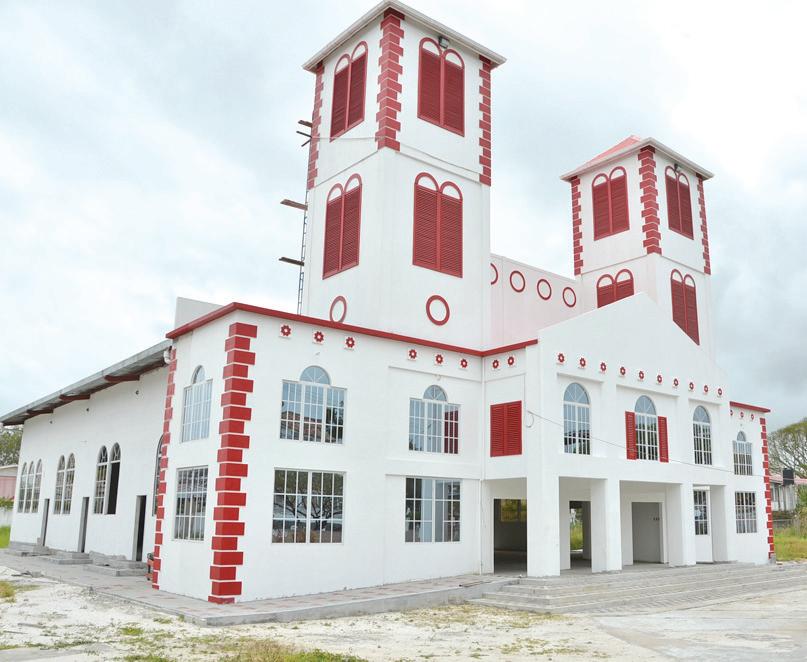
He related that the decision was made in 2011 to start construction of a new building for worshippers in the parish. The cost of a new building complete with furnishings was estimated at $160 million. Though the amount seemed insur-
mountable for such a small church, parishioners did not lose hope and had faith that it could be achieved. With cooperation and unity among themselves, they organised fundraiser after fundraiser which proved to be very successful. Over a short period of time, they had raised approximately $90 million, which has since completed the structure and fencing of the land.
An additional $70 million is required for the completion of the interior of the building and to provide final touches to the building itself. He related that the church will again embark on fundraising ventures with the hope that their target can be achieved.
Satisfaction
Leader of the church in absence of Bishop Francis Alleyne, Father James Gonsalves expressed satisfaction in how much they have been able to accomplish through cooperation and unity among themselves.
He disclosed that the fire created a huge gap in the lives of the parishioners and more so, left many deprived of their place of worship and learning. Father James, however, noted that even though there were many challenges in getting to where they are now; the church through the grace of God has prevailed, noting that there is no doubt in his mind that it will soon be completed.
“What I see now is a community effort. Every individual, every parishioner is taking the time off to give of themselves. They are all making contributions in any way possible to see the church come back to life. There is cooperation and unity. The people here would speak proudly of the Sacred Heart Church; they take pride in being part of the parish. Our history and traditions are embedded in Sacred Heart and we have a sense of belonging there. Not being able to worship there makes us feel displaced and even affects the turnout of the parishioners.
We want the construction to finish so that we can move back and regain our identity, our pride, our sense of belonging,” Father James said.
To recreate a sense of belonging and to preserve its identity, the church is being built and designed in the same way it was before it had burnt. The only difference now will be the accommodation of the church. Previously, it was said to have the capacity to hold some 800 persons. The present church will only have the capacity to hold 350 persons.
Since the destruction of the building by the fire, the parishioners have been displaced. Twelve o’ clock mass is being conducted at the Brickdam Cathedral with Sunday services being held at the Saint Ursaline Convent on Church and Camp Streets.
One parishioner, Sabita Pereira, who has been a member of the church for more than 15 years, told Guyana Times that this arrangement was tedious for her because of the various locations and she was counting down to the day she can step foot into the Sacred Heart Church once again.
She added that having to visit various places to conduct worshipping services; the feeling of belonging becomes lost as the sense of pride grows thin.
“We don’t feel at home. The sense of belonging or connection is simply not present. Additionally, we had space in the Sacred Heart compound for the children to play. There is none such space at the St Ursaline Convent for them to do so. And this is another reason why we are just counting down the days until our church can become inaugurated,” Pereira disclosed.
She noted that happiness was flowing among the members on the construction of the building and they were just praying for the funds to be raised to finish the construction, so that they can once again return to the days of tradition and history.
Nineteen-year-old Angus Chin, who is an altar boy, member of the Youth Ministry, the Sacred Heart Scouts and a singer in the choir, told Guyana Times that the Sacred Heart Church has always been a home away from home for him and he was in deep despair when he had heard about the fire even though he was at a tender age.
He related that even though the Sacred Heart family was still together, nowhere else has felt like home for him since the fire. Chin
noted too that he was happy that construction of the church is ongoing, and sooner rather than later, he will again be able to enter his second home.
If the funds are garnered in the time set aside, total completion can be expected by December 2014 or early next year.
Additionally, in an effort to raise the $70 million needed, the church will be hosting its annual cross buns sale on Thursday, April 17, at the church’s location on Main Street. It is asking the general public to come out and support the worthy cause. Those wishing to make a monetary con-
tribution to the project can do so by making deposits in any of the church’s accounts. These are account numbers 2684967 at Republic Bank Guyana, CIDA 802530 at the Guyana Bank for Trade and Industry (GBTI), 134769 at the New Building Society (NBS) and 10006626 at Scotia bank Guyana.

BY ANDREW CARMICHAEL
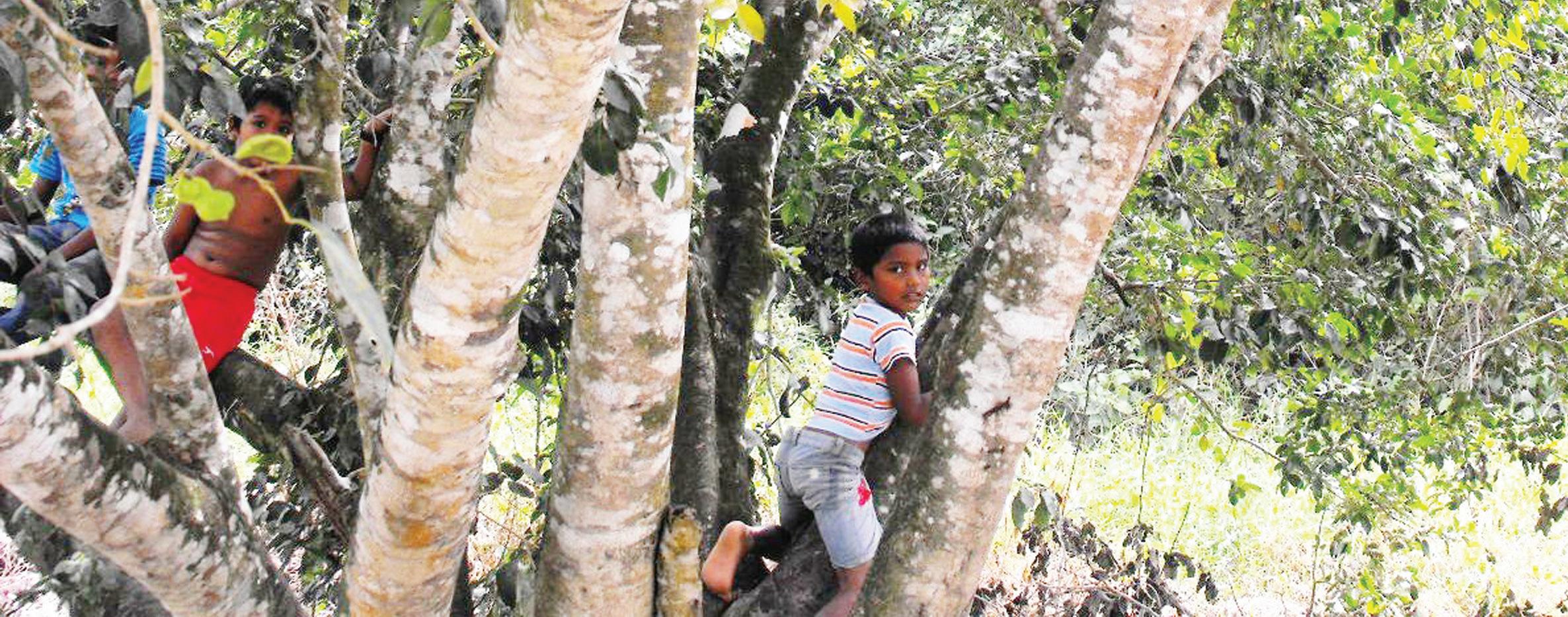
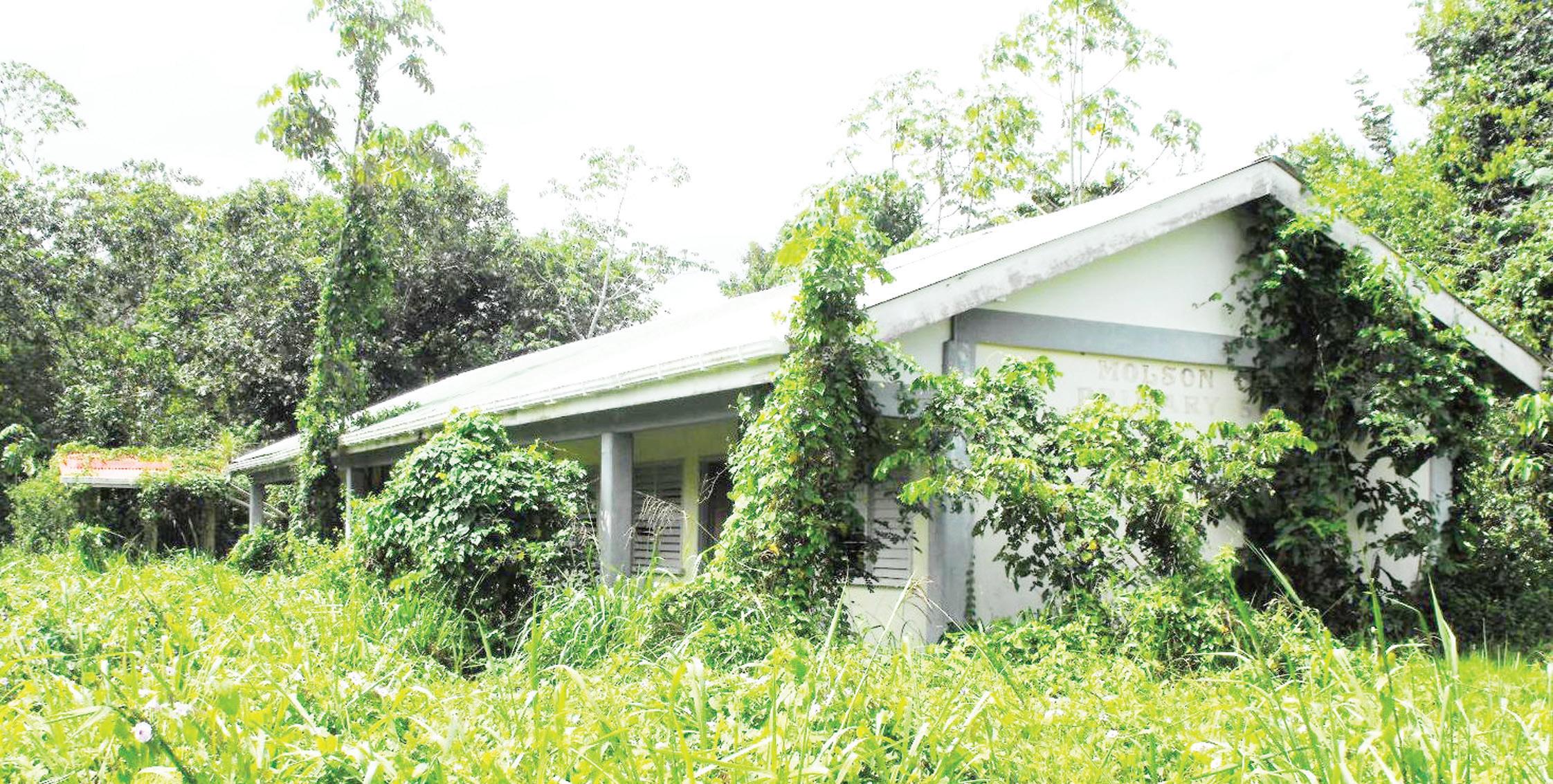
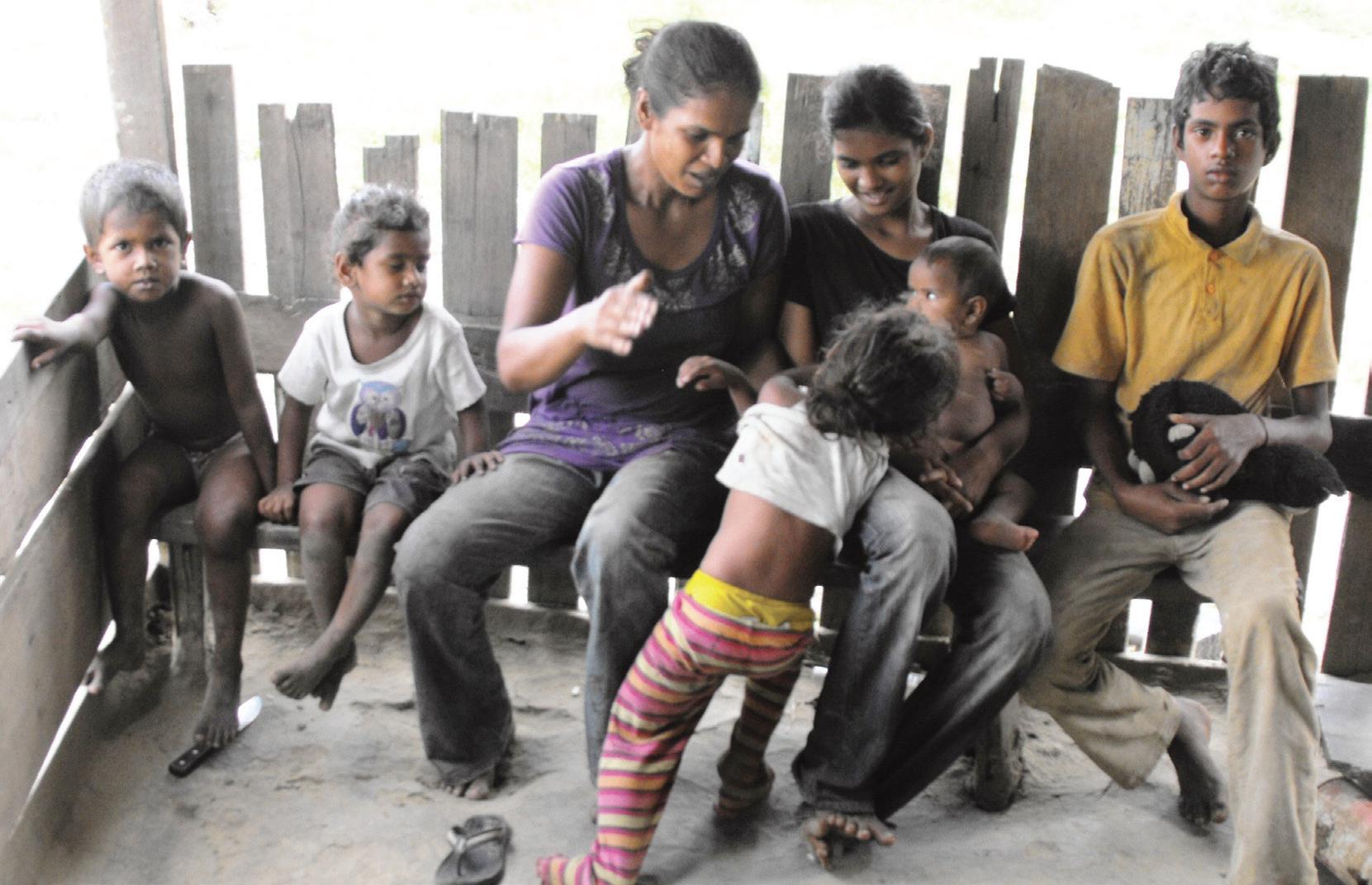
More than 40 children at Moleson Creek will not benefit from the $32.3 billion which has been earmarked for education in the 2014 National Budget.
These children have no school to attend. Last year, the Education Ministry had closed the Moleson Creek Primary School after residents had voiced their concerns over the state of the road during the rainy season. The school is built about one and a half miles from where the children live; it is isolated and during the rainy season, it is almost impossible for the children to get to school. Coupled with that, the Ministry said it was struggling to find teachers for the area, and as such, the school was closed.
However, at a recent press conference, Regional Executive Officer (REO) of Region Six Paul Ramrattan told reporters that this was not so. He said the reason for the Moleson Creek Primary School being closed was due to the fact that a murder took place there; neither the police nor any of the residents support that claim. After the school was closed, months later arrangements were made to have 30 of the children picked up and taken by bus to the Crabwood Creek Primary School which is located more than four miles
away. The children are picked up in the morning and taken home in the afternoon. There are still more than a dozen children who are not catered for. Added to this unfortunate situation, the travel arrangements were only made for the children who attend school at the primary level and no attention was given to the more
sums to get her child to and from school. “Before the Government start sending transportation, me used to send he to nursery school and it does cost me two thousand dollars for the half day.” That money is for the taxi transportation. There is no regular car or bus service in the community.
Parents say since the
very expensive… they used to go to the school here but now since it closed down, dem na go out deh.”
She too said it was too expensive for her to be spending $4000 per day. The mother explained that the names of her children have been taken off of the registers at school because of the length of time that they have been absent. After
than 50 who are of nursery school age. “Deh say that it can’t pay to carry dem kindergarten small children because they school over half day,” one parent told Guyana Times Jaclyn Thomas who has three children says she has been spending exorbitant
school closed, they cannot afford to send nursery age children to school because it costs them $4000 each day for each child’s transport to and from school.
Another parent, Radica Bhudwa, a mother of seven does not send any of her children to school. “It is
the Education Ministry ordered the school closed in September of 2013, it was not until January 2014 that arrangements were made to provide transportation for the children at the primary level.
The parents are still pushing to have a school


Pollin goin on in India right now. Pollin in India does tek a whole five weeks fuh 814 million people. That’s a whole lotta pollin. And 100 million people pollin fuh de first time. That’s a whole lotta people who never get a chance to poll.
De last pollin in Guyana was 2011 and it got a next couple a years before pollin start again. But in de meantime, some people gettin sheer pole before de time reach fuh that poll. De Naga Man and Hard Mouth try to pole de sugar workers, but de workers come from Berbice till to GT to pole dem back. De Naga Man badly want de sugar workers poll.
Linden people gettin sheer pole from Green Jah and de whole a de Pee-N-C, and de people ain’t even know it. Fuh any body not to even know when dem getting pole mean that dem been gettin pole from a long time. And who to blame but Green Jah, Green Bridge and de rest.
Right now Adumb tekkin sheer pole from de Boss Man because de Boss Man wanna look good and sound good to try out de next poll. Even Sleepin Tom look like he tekkin pole from de Boss Man. Last year, he had to call Boss Man de Man of de Year before he get pay fuh Christmas. That sound like a whole year with de Boss Man pole.
Adumb was bare face de other day and seh he never tek pole from Burnt Ham and de Heights Man, and that he was a professional when he was at de guvament news paper. Adumb even blame he former Pee-N-C pardna Nasty Mento fuh tekkin pole pun de Marriott.
It look like Adumb had to be gettin pole when he mek that statement. That mek he a professional wheh tekkin pole concern. He musbe mekkin more pole money than dem people down de road by Church Street.
Ting-a-ling-a-ling…friend tell friend…mattie tell mattie! Well, pole and hole does go together, and every body know by now which part is Adumb.
in the community. “If the school come up ah front here it gon betta because nobody nah live a back deh...”
Zalina Khan, a mother of one said. Another parent Kalif Alli is suggesting that the building that was constructed to house the head teacher be converted into a school and relocated.
“Move the wooden building and bring it closer to where residents live. They could take the school and convert it into a health centre,” he said. Meanwhile, none of the children attended school on Thursday and Friday because the driver who has been contracted by Government reportedly said that the children were not doing anything in school and therefore it was a waste of time to take them.
Finance Minister, Dr Ashni Singh in his National Budget said the education sector had received the largest allocation of $32.3 billion, surpassing last year’s allocation of $28.5 billion. According to the
Finance Minister, through this year’s allocation, emphasis will be placed on improving literacy rates, early childhood development, teacher training, enrolment in single sciences, and technical vocational educational programmes. In addition, the allocation will cater for more structured partnerships with private sector providers and parents. This year $2.9 billion has been allocated towards the construction, rehabilitation, extension and maintenance of educational facilities, including a new and expanded Zeeburg Secondary School and the Kato Secondary Complex. Under the allocation too, the Government will commence the implementation of a US$10 million Universal Secondary Education initiative, which will facilitate the construction of new secondary schools and the provision of materials for improved teaching techniques and technology assisted learning in mathematics.

Times Notebook is unequivocal in our condemnation of politicians who deliberately smear our country. We were distraught and angry during the general budget debate when politicians, some very senior ones, including the Leader of the Opposition, deliberately and shamelessly smeared our country.
The Leader of the Opposition called Guyana a “Narco-State”. He knew that this is a gargantuan lie. Other Members of the Opposition claimed that Guyana’s proud record of eight consecutive years of economic growth had nothing to do with the Government, but was driven by the drug trade, by drug lords. These are politicians who have dismissed the investment of citizens, rich and poor, in building their country.
One Member of Parliament (MP) from A Partnership for National Unity (APNU) called Guyana an apartheid state. Another APNU MP proclaimed that Guyana would need a “Nuremberg”style criminal trial for Government Ministers,
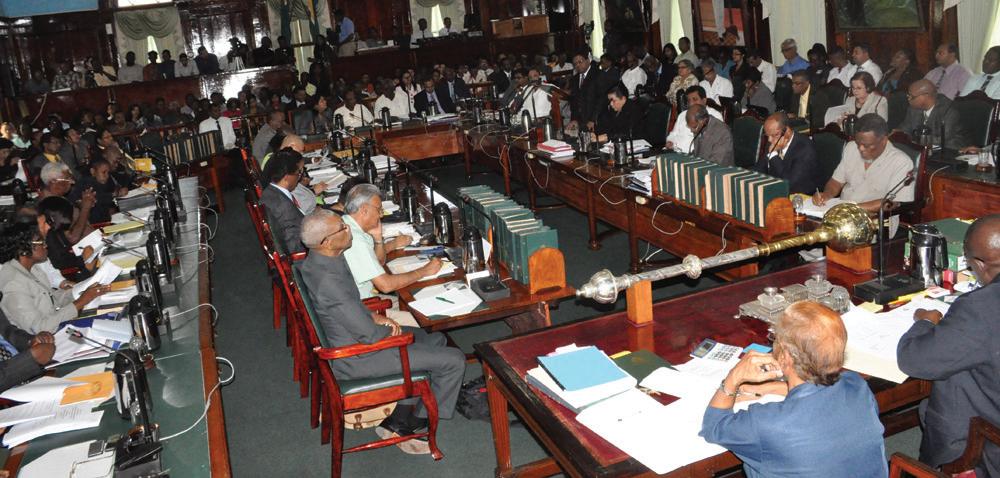
clearly deeming Guyana a criminal state. Basil Williams, a senior APNU MP and the Deputy Speaker of the National Assembly, described Guyana as a “dehbad” country. Williams even fabricated what he claimed is the 2013 UN Human Development Report, which he says is proof that “Guyana is fifth from the bottom out of 183 countries in the world”.
Other MPs, particularly from the Alliance For Change (AFC), claimed that our country has been taken over by the Chinese and that the Asians are now the
new imperialists, a clear sign of “Asia-phobia”.
MPs from both the AFC and APNU smeared Guyana by accusing the Government of “ethnic mobilisation” or of practising ethnic marginalisation. It was distressing that these Opposition MPs saw nothing good happening in Guyana. One MP even claimed that there were so many people dying of cancer that even women were getting prostate cancer.
It was depressing to hear these politicians smearing Guyana without any cause. None of them presented any evidence or made a
case to support their contention. On what basis did Granger called Guyana a narco-state? Could he tell us which drug kingpin is controlling Guyana?
How come his friends in the U.S.A. are not holding on to Government officials who travel to the U.S.A. every day? Can he tell us which building is going up in Guyana that is financed by drug money?
Guyana’s development is driven by Government’s plans and policies; prudent fiscal management that has reduced debt; stabilisation of Guyana’s currency; pro-
motion of new industries, like ICT and the service industries; strengthening and expansion of old industries; and the modernisation of Guyana’s infrastructure.
Guyana’s development is also driven by investment through Foreign Direct Investment (FDI). Last year, FDI was more than US$214 million. Every year, FDI is increasing.
But last year’s FDI of U$S214 was more than all the post-independence years until 1992. Loans to the local private sector surpassed $185 billion last year and have been more than $80 billion annually for the last four years.
Citizen-driven
Small-scale farmers, for instance, are investing every day in our country, driving a robust economic growth. Take rice farmers and how they are stimulating growth. The rice farmers in 2013 invested more than $30 billion in the economy; $28 billion in direct operation cost for cultivating 400,000 acres of rice; and $2 billion in equipment cost.
The rice millers have av-
eraged more than $2 billion annually in upgrading their factories. Together, millers and rice farmers earned more than $45 billion in 2013.
Sugar workers earned more than $20 billion last year and these families are the ones who spend their hard-earned cash at the local markets and stores and build their homes, activities that further stimulate our economy.
Public servants earned more than $36 billion in 2013. Public servant and old age pensions amount to almost $15 billion last year. Together, the Guyanese people procured almost 16,000 motor vehicles in 2013 at a cost of over $60 billion. This is how the economy is driven. Ordinary people play a pivotal role in driving the economy. Times Notebook thinks smearing the country is wrong and we urge Granger and the others to apologise for smearing our country and our people. It is downright unpatriotic.
Readers are invited to send their comments by email or Facebook to times. notebook@gmail.com.

The non-payment of rates and taxes by the Guyana Sugar Corporation (GuySuCo) to the Canefield/Enterprise Neighbourhood Democratic Council (NDC) is having a negative impact on the entity’s ability to carry out critical works in the communities.
This publication has been informed that GuySuCo has not paid taxes owed to the NDC for the past three years, resulting in the NDC not being able to fully execute its work programme. The NDC is expecting to collect $27 million from GuySuCo this year. The revenue for 2014 is $10 million added to the $17 million that the corporation already owes to the NDC.
In the past, the Canefield/Enterprise NDC had been one of the lead-
ing NDC’s when it comes to rate collection. This is because GuySuCo is responsible for 75 per cent of the taxes the NDC collects and had been paying promptly. Now the corporation has stopped making those payments, rendering the NDC incapable of meeting some of its responsibilities.
The Canefield/Enterprise NDC has its hands tied, in that it cannot take GuySuCo to court since it is unable to take legal actions against GuySuCo. However, letters have been sent to the Chief Executive Officer (CEO) of the corporation, the President of Guyana and the Local Government and Agriculture Ministers on the issue.
One of the main concerns of residents and the NDC is that of high overgrowth in the community which resi-
dents say is one of the main contributing factors for the high crime rate there. Revenue collection from the residential community is also low.
A source close to the NDC told Guyana Times that many property owners have migrated and as a result, no taxes are being collected from those residents.
The NDC is not able to serve those residents with notices that they need to clean their lands.
Canefield/Enterprise
NDC Chairman Jaipaul Kuldeep told this publication that the NDC has appealed to residents to pay their taxes as the NDC has a work programme for 2014.
“The rates and taxes are not coming in as it should but we have to do some ground work to get residents to pay.”
He said that the NDC will be able to carry out some infrastructural developmental work as part of its 2014 work programme. Some of that work has al-
ready commenced. Kuldeep noted that this is being done to avoid flooding during the expected rainy season. He said a street upgrade and maintenance programme will be carried out in all communities of the Canefield/Enterprise NDC.
According to Kuldeep, much of the funding will come from Government’s $3 million subvention to NDCs.
However, the NDC has road building material stockpiled and will use it to start its 2014 road programme.

monday, april 14, 2014 | guyanatimeSgy.com
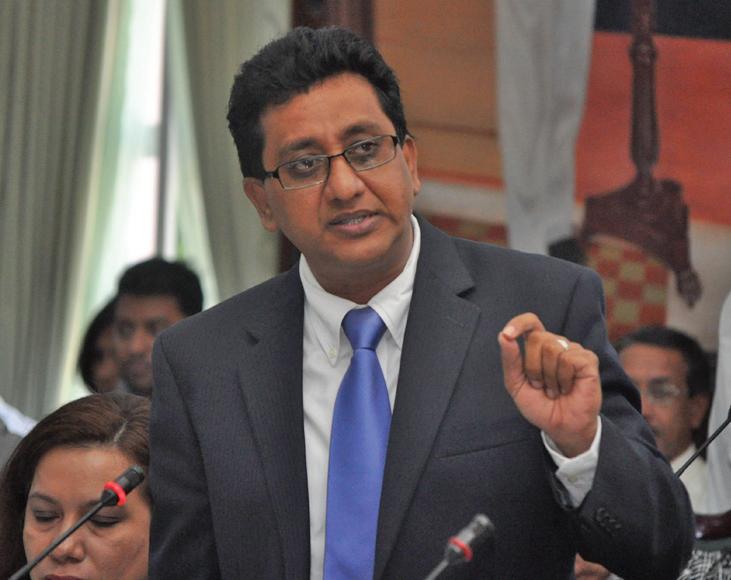
Legal Affairs Minister
Anil Nandlall said the automatic voice recording equipment is currently being installed in the Court of Appeal, the Courts of the Chief Justice and the Commercial Court of the High Court.
Speaking with Guyana Times on Sunday, Nandlall said the installation of the automatic voice recording equipment will continue today. While the equipment will only be installed in the identified courts, it is the intention of the Legal Affairs Ministry to replicate it in the other courts. This project is expected to make a transformational change in the speed of litigation in Guyana.
Minister Nandlall said too that fibre bucket chairs were expected to be installed in the Family Court on Saturday.
“They were expected to install them yesterday (Saturday)...” he explained. During the 2014 Budget Debate in the National
Assembly, Nandlall told the House that the Family Court would soon be commissioned, informing Members of Parliament (MPs) that the rules of the court have been completed and are with the Chancellor.
Boasting of the advancement made in the area of Legal Affairs, Minister Nandlall told the House that over the past two years, a number of courts have been renovated and in some cases, new courts built. These include the High Courts of Georgetown and New Amsterdam, the Court of Appeal, and Magistrate's Courts at Whim, New Amsterdam, Sisters Village, Reliance, Mibicuri, Georgetown, Leonora, and Wales.
“Almost every court in the High Court, both in Georgetown and New Amsterdam, are fully airconditioned for the first time in the history of this coun-
try. Almost every Magistrate Court, to which I have made reference, is now fully airconditioned, as well another first in the history of this sector,” Minister Nandlall pointed out.
The Magistrate's Courts at Wismar, Linden and Lethem are slated to be completed within weeks. These new facilities include residential quarters for the magistrates.
“In relation to the court at Wismar, a new Magistrate Clerk’s office will be established so that persons within the newlycreated Magisterial District of Region 10 do not have to travel all the way to the Vreed-en-Hoop Magistrate’s Court to transact their business,” he further explained.
Laptops Additionally, 18 laptops will be distributed to judges of the Court of Appeal and the High Court. These devices are expected to accelerate the work of the judges in the
decision-making process.
He reminded the House of moves by President Donald Ramotar to increase the statutory complement of High Court judges from 12 to 20. The complement of judges was last increased in the mid 70s.
“Litigation has increased, perhaps, tenfold since. Twelve judges have clearly proven to be inadequate to handle the work-
load. While, we may not have the physical capability to accommodate more judges currently, this is yet another demonstration of the Executive’s commitment to resource the Judiciary in order to deliver to our people a better quality of justice.”
He explained that with the Family Court coming into operation, judges of the High Court will likely migrate to that building, cre-
ating the physical space for new appointments to be made. However, there is currently no physical space to accommodate a new judge in the Supreme Court edifice.
This year, budgetary allocations have been made for the construction of a building in the compound of the Supreme Court, Georgetown, to facilitate the Land Court of Demerara, a Registry and storage facilities for the Supreme Court. The building will also house a minimum of two courtrooms and chambers for the judges.
The Magistrate's Court at Number 51 Village, Corentyne, is expected to be completed this year while construction of the Sparendaam Magistrate’s Court is expected to commence in June.
The fully air-condition ed building will be complemented with parking facilities, two courtrooms, along with chambers for the magistrates.
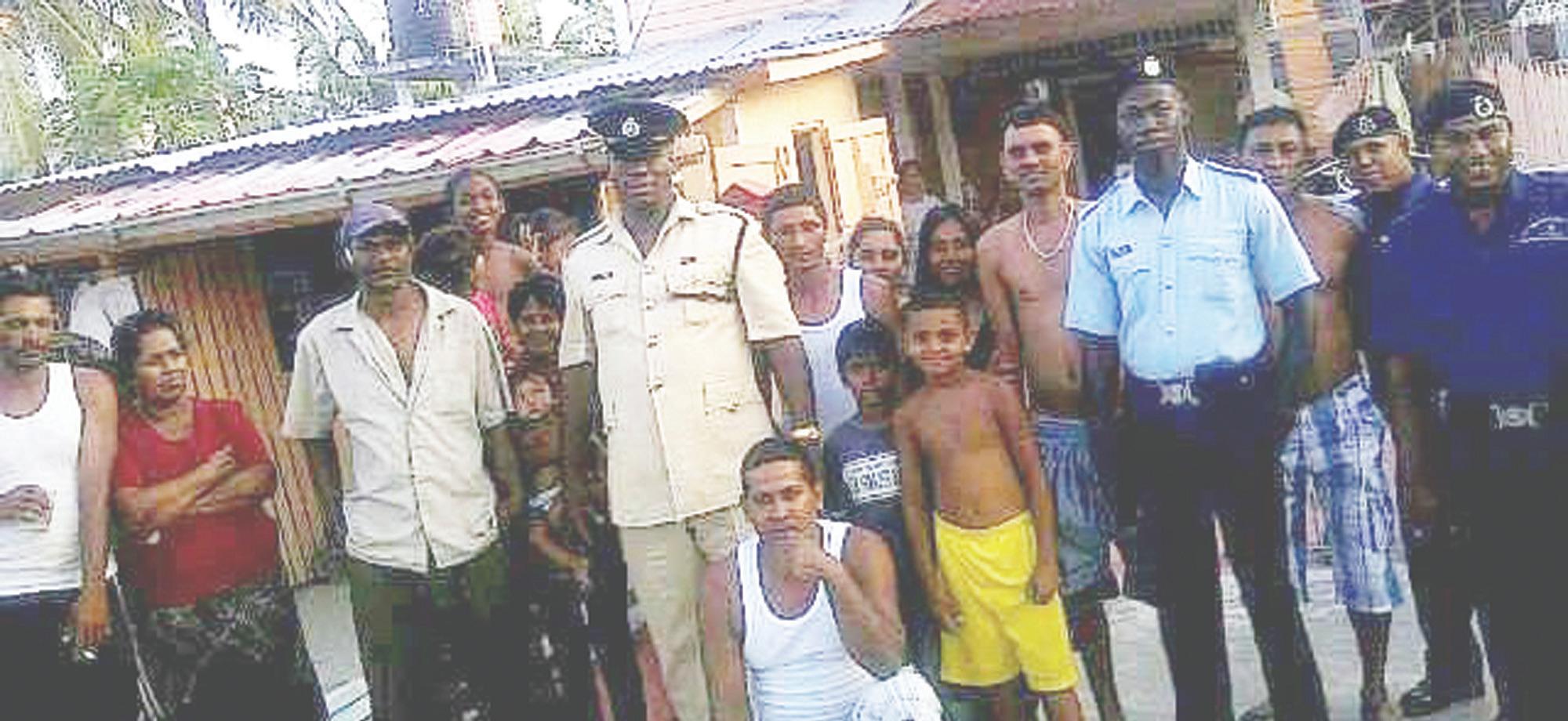
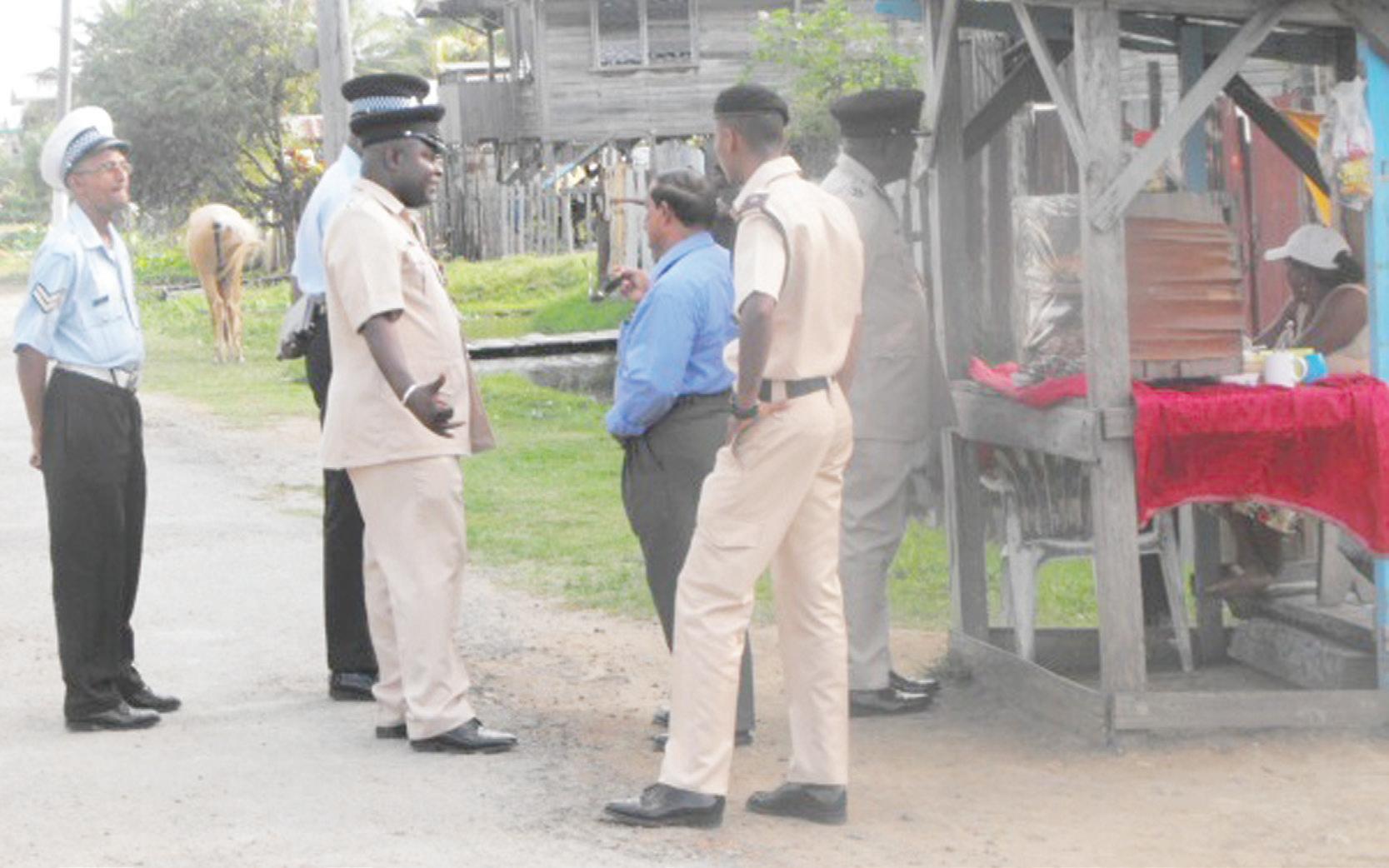
Desperate to regain the trust from citizens, the B Division (Berbice) top brass last week embarked on a walkabout in some of the crimeprone communities in New Amsterdam during which they listened to the complaints of residents and even made their own suggestions as to how the communities can help in the fight against crime.
The walkabout was spearheaded by Divisional Commander Brian Joseph who spoke about the decline in public trust in the police, wit h serious consequences for cooperation and social cohesion. “The public need to be confident that the police are on their side, accountable for the way they use their powers and for how they deal with victims of crime…” Joseph told residents during the walkabout. He added that if people do not trust that
the police have their interests at heart and believe there is a wide gap between the values of the two parties, they will not cooperate.
Chairman of the Safe
Neighbourhood Council in Angoy’s Avenue and its environs, Pastor Persaud stated that when an individual trusts the motives of an institution and its representatives and believes
that it has their interests at heart and is on their side, they are more likely to engage with it and assist it. According to residents in the Angoy’s Avenue area, the initiative by the police
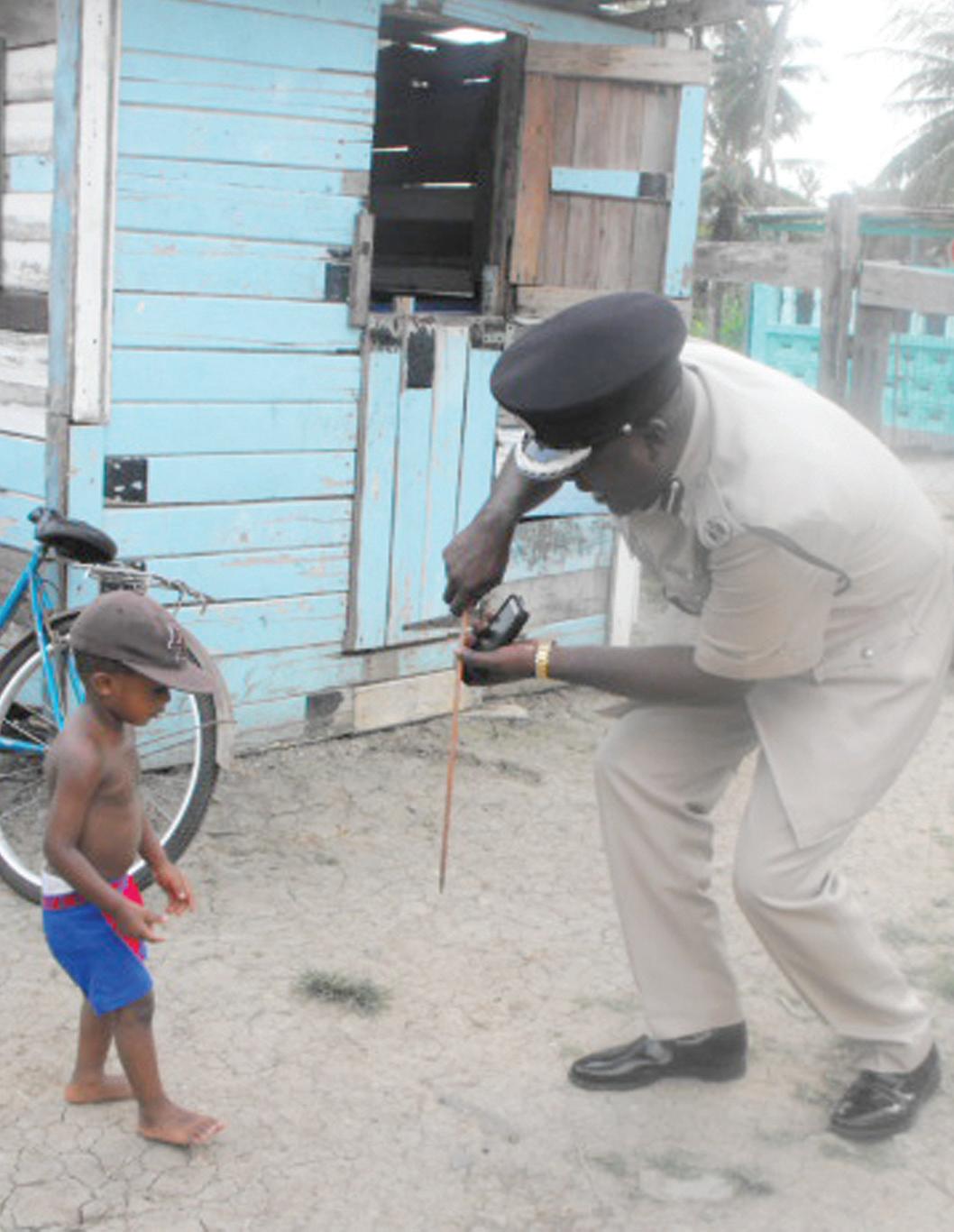
is most welcomed and it is their hope that this exercise will continue at least once per month. Joseph assured that this exercise will be continued and told the residents that he is always available to anyone in need of his assistance.
The walkabout was also done in the communities so that police can hear the views and listen to the issues and complaints and needs of the residents in terms of safety and security.
Stacy Johnson of Church Street Dam, Angoy’s Avenue, expressed delight that the police had visited them on friendly terms and not only when there is a crime or lawlessness in the area.
“This is something very nice, I feel good about it and I feel safe now,” she said. Meanwhile, over at Rose Hall Town, ranks visited several businesses and residential homes in order to listen to their concerns and also to assure them that the Guyana Police Force (GPF) has their safety at heart. Both businessmen and residents commended the police for taking the time to visit and interact with them at the ground level and most of them were able to speak one to one with the commander. Similar exercises were done in Region Five and the Upper Corentyne and Springlands areas. (Taken from the Berbice Times)
The Guyana Police Force has denied ever being told the whereabouts of Foulis businessman, Rajendra Singh before he was executed by his abductors, even as it announced that six men are in custody for the crime.
The police in a release also said that it applied for extension to hold the men beyond the legal 72 hours before laying any charges against them.
The police made these comments on Sunday while responding to an article published in the Sunday Stabroek News (SN) under the heading “Police told where kidnap victim held; did not search house until too late”.
In the article, it is stated that the police had been informed that murdered car dealer Rajendra Singh was being held captive in an abandoned house at Goedverwagting, East Coast Demerara, but ranks only visited the location hours later when he had been removed by his kidnappers.
Categorically deny
“The Guyana Police Force wishes to categorically deny that at any time during the course of the ongoing investigations into the kidnap and murder of businessman Rajendra Singh, has any information been received from any source that he was being held at any time in an abandoned house at Goedverwagting.”
According to the police, in responding to the report received, Singh’s motor vehicle was recovered on the railway embankment at Goedverwagting on the very night of his kidnapping. As a result, intensive patrols comprising police ranks and community policing personnel were mounted in the Goedverwagting area, but no useful information was obtained nor was anything suspicious seen or found.
The police said the following day, Sunday, the patrols continued and were extended to Plaisance and Sparendaam, including the squatting areas.
Based on information received, a house at Bel Air, Georgetown, and
one at Yarrowkabra on the Soesdyke/ Linden Highway were searched. A woman was arrested at Yarrowkabra and subsequently released.
It added that on Monday, April 07, consequent upon information received, the police conducted searches on four houses of the relatives of a family at Plaisance, East Coast Demerara, but nothing of evidentiary value was found. The next day, Tuesday, further searches were conducted on the same four homes in addition to a fifth home belonging to another family member, also at Plaisance, but again nothing suspicious was found.
“On the very Tuesday, the police received information that the kidnap victim was in a house in the Goedverwagting squatting area and searches were conducted on the target house and two others in the squatting area, as well as an abandoned ice factory at Claybrick Road, Goedverwagting. However, nothing of evidential value was found.”
Information received
“The Guyana Police Force reiterates that at no time was information received neither about Rajendra Singh being held in an abandoned house at Goedverwagting, nor about him being removed from the location in a white minibus. During the ongoing investigations and based on information received, a number of buildings were searched in the Goedverwagting area, but no abandoned house was searched,” the release said.
According to the police, the wellplaced sources who allegedly have given the information about the abandoned house at Goedverwagting to the Stabroek News did not pass such information to the police.
“The police have acted professionally, and are continuing to do so, in keeping with its operational procedures, in the investigations into the kidnap and murder of businessman Rajendra Singh,” the release concluded.
Hundreds turned out at the Indian Monument Gardens on Saturday evening to witness a dance production entitled “Dancing Enchanters” staged by the Nachgana Academy of Dance, in celebration of their first anniversary.
The event, which was supposed to commence at 19:00h, got underway some 45 minutes late. It opened with a prayer to Lord Ganesh with several dancers from the group using the well lit and decorated stage superbly to give thanks to the divine being.
This was followed by the official welcome for the evening by Director of the Academy, Devi Ramcharitar, who spoke about the group’s credentials and assured the audience of a wellplanned and mesmerising performance.
She also spoke about the various activities the group has undertaken, while noting that the academy has close to 50 dancers.
Soon after, Hashim Alli introduced Aditya Persaud and Indira Badal as the emcees for the evening’s proceedings. Initially, there were some technical glitches with the microphones but this
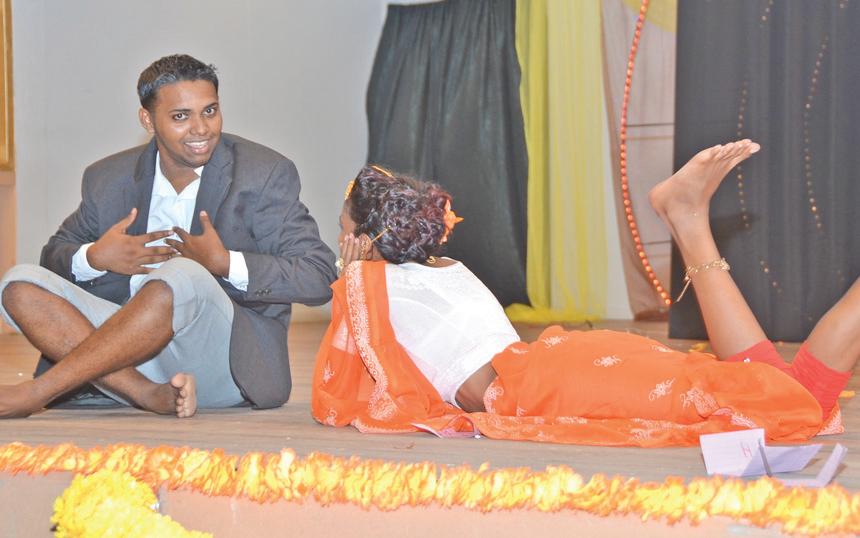
from the academy, who are fairly new. There were some signs of nervousness which might have resulted in their untimely movements.
Nevertheless, the night continued with a reflection of the magical era of mudgra dances, featuring fabulous pieces, but the eye-catching item of the night was that of little Janiya and Dinesh, who captured the audience’s attention with their well-executed contemporary dance.
With her little tutu, Janiya

was quickly sorted out as the emcees introduced a dance item.
The dance was done as a tribute to great Bollywood singer Mohammed Rafi, and was reasonably well executed.
The presentation would have exhausted more than 20 dancers
danced, showing off her expressions to the audience who enjoyed every second of the duo’s performance.
The night continued with some solid messages against domestic violence and the need for loving, kind and gentle relationships.
$5.7B approved for GPHC – $50M injected to boost maternal services
After intense grilling last Thursday, the combined parliamentary Opposition approved a whopping $5.7 billion for Georgetown Public Hospital Corporation (GPHC), as the consideration of the 2014 budget estimates continued in the National Assembly.
Minister of Health, Dr Bheri Ramsaran, was overwhelmed with a myriad of questions about monies directed towards salaries, infrastructural works, and acquisition of supplies and equipment as he sought approval for the allocations to the city’s hospital.
During this barrage, there were many questions
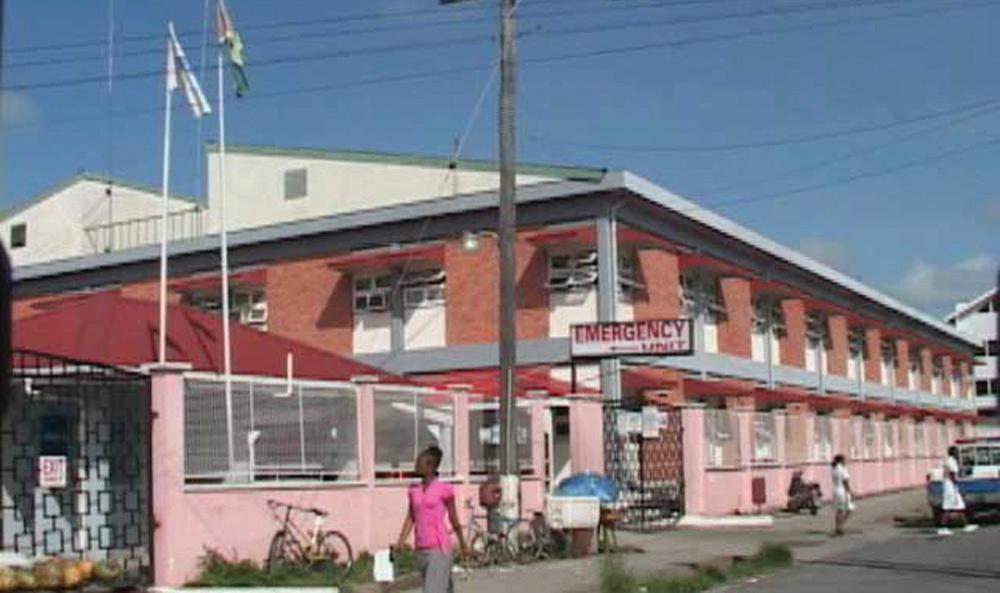
on increases in salaries paid to various specialised staff and contract employees. Some $100 million was requested for the salaries of contracted employees along with allowanc-
es and overtime payments.
The Minister disclosed that there was an increase of 99 contracted employees, which included the returning Cuba-trained doctors. In addition, Dr
Ramsaran disclosed that GPHC currently rents nine buildings, most of which are used to accommodate consultants and the Cuban medical brigade that comes every year.
Infrastructural upgrades
Meanwhile, on the topic of infrastructural upgrades, Dr Ramsaran noted that $50 million has been injected towards the extension of the maternity facility in order to increase its bed capacity. During the question-and-answer segment on the acquisition of drugs and supplies, the Minister was quizzed about the contract with the NEW GPC INC.
The Minister was asked what percentage of the
These two social issues were depicted in a dance, much to the delight of the audience.
The second half of the show was more organised and featured popular folk dances and contemporary executions of hip hop, soca, chutney, filmy, semiclassical, Nigerian, retro and belly dancing.
This aspect saw the debut of the first male belly dancer, teaming up with his partner to execute a well conceptualised piece which saw snippets from the common Bollywood Nagin style to the sassy Arabian style, ending with the electrifying Turkish style of belly dancing.
As this was not enough, the academy ended the night with the audience filled with great emotions and at a loss for words.
The academy promises that this was only its first year and it was of high standard, noting that greater things are in store in the years ahead.
In attendance was First Lady Deolatchmie Ramotar, who commended the efforts of the academy and encouraged others to become involved and to support children suffering with autism.
The event also saw the presence of the new Miss Earth Guyana Stacy Ramcharan and musical pieces by several chutney sensations including, Prince JP, Denesh Biseasar and Danny Bholoram, which definitely added some flavour to the evening.
drugs is being supplied by the company to the hospital and he responded saying a “significant portion”, but could not give a specific figure at the time.
He was further questioned whether there are procurement personnel at the GPHC to overlook the agreement to see if the facility is getting the supplies for the best prices.
The Minister replied that the Ministry uses a tender process to find the supplier and NEW GPC INC was the best qualifier.
Meanwhile, Dr Ramsaran justified the $8 million request for an ambulance. He said this is a “good investment”. He said that the ambulance being procured is of high quality and fully equipped with all the amenities needed.
The Health Minister continued that the GPHC has also introduced its National
Ambulance Authority to manage operations of ambulances attached to the facility. For this initiative, there are some cover expenses for several programmes implemented by the GPHC, including the Emergency Medical Technicians (EMTs) project, which now in its pilot stage. The first batch of 22 EMTs graduated in January.
After the prolonged questioning, the Opposition passed both the current and capital expenditures for the line items Public Hospital to the tune of $5,309,867,000 and $414,000,000 respectively.
Under the capital expenditure, sums of money were directed to four sectors. These include buildings, $150,000,000; land and water transport, $8,000,000; Equipment $114,000,000; and Equipment-medical $142,000,000 respectively.
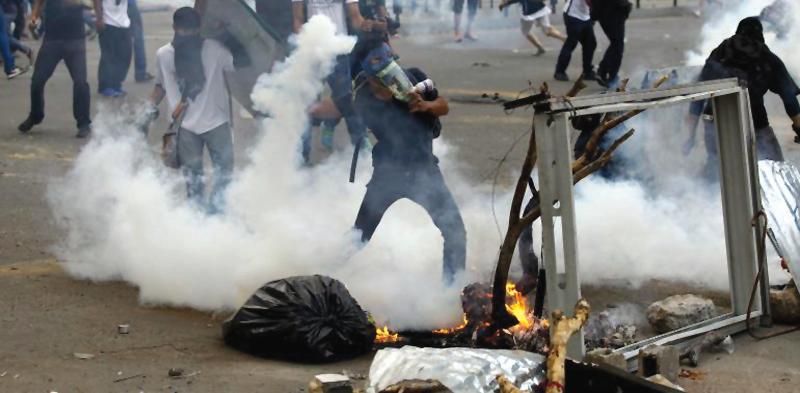
Student protests in Venezuela have again turned violent in the country’s capital. The National Guard has used tear gas and water cannons to disperse another studentled protests, indicating that the students will not accept the outcome of the peace talks between President Nicolás Maduro and members of the Opposition.
The students marched through the east of Caracas shouting “Resistance!” The protests have been ongoing for two months and have left 41 people dead and 600 injured.
The protesters in
Venezuela began in Plaza Venezuela on the outskirts of the city and also in the municipality of Chacao, in the state of Chacao. The protesters threw rocks and bottles and claimed they were the victims of an “ambush” on behalf of the police, claiming that the police let them pass through by various groups and then launched an attack on the protesters.
“This is the dialogue of Mr Maduro: brutal repression against young unarmed students who are marching peacefully to recuperate their future,” posted former Opposition Leader Maria Corina Machado.
Gaby Arellano, head of the Frente Universitario de Voluntad Popular, confirmed that a number of students had been arrested. “The more they attack us, the more they persecute us, the more vehemently we will be on the street: our territory is the street, our strategy is non-violence and our goal is for a better Venezuela,” Arellano told journalists.
The march illustrated a division in the ranks of protesters between those on the street and those seeking to distance themselves from the protests. (Latin Times)
In the 17th Century when buccaneers ruled the high seas, it was known as the wickedest city on Earth.
But in the 20th and 21st centuries, the sleepy fishing village of Port Royal has built a reputation of being a quiet, quaint and peaceful town which is relatively crime-free.
Those decades of solitude and freedom from crime are about to be shattered some residents fear, due to a mass migration of squatters from inner-city communities in Kingston, to Port Royal.
Just last week one man was shot in the face and the motor vehicle belonging to Lloyd Gordon, who heads the Port Royal Brotherhood, was stolen.
In the past, the police in Port Royal mainly dealt with domestic disputes, possession of marijuana, and other minor crimes. The jail house at the station was used mainly to house prisoners from other areas where the jails were bursting at the seams.
According to People’s National Party councillor for the community, Lorraine Dobson, the squat-
ters are creating nervous nights for the original inhabitants of the small town, and she said if something is not done about the problem, the economy of the town could crumble, as many people visit Port Royal to consume its world-famous seafood without fear of being targeted by criminals.
The squatters are reportedly refugees who have fled from a war-torn section of West Kingston, Rockfort, Mountain View Avenue, Southside and other crimeinfested communities in the Corporate Area. (Excerpt from Jamaica)
Prime Minister Dr Keith Mitchell says his inclusion as part of a high-level working group of the Commonwealth to advance the global intergovernmental negotiations on the Post-2015 Development Agenda will augur well for the Caribbean region.
Mitchell confirmed that he had been invited by the Commonwealth Chair-inOffice, President Mahinda Rajapaksa of Sri Lanka, to be part of the working group. Rajapaksa said the leaders chosen reflect the “geographical spread of the
Commonwealth membership, as well as the diversity and sizes of economies and stages of development”.
The other members of the working group are the leaders of Australia, Bangladesh, Cyprus, Grenada, Tanzania, Sierra Leone and Tonga.
“This is a great opportunity to represent the region among Commonwealth nations, to advance such a significant agenda.
“This diverse team of heads will pool our talents and perspectives together, and come up with recommendations that will serve in the best interest of
our shared community,” he added.
Prime Minister Mitchell was unable to attend the 2013 Commonwealth Heads of Government Meeting in Sri Lanka, where the leaders took the decision to “engage collectively and help shape the Post-2015 Development Agenda by constituting an open-ended High Level Working Group of Heads of Government to identify, through a Commonwealth Statement on the Post2015 Development Agenda, shared Commonwealth perspectives and recommendations.” (Excerpt from Antigua Observer)
The authorities in Mexico say 36 people have been killed in a bus crush in the south-east of the country.
The state Government of Veracruz said four people survived after the bus burst into flames. It slammed into the back of a broken-down lorry that was parked on a main road, just after midnight local time.
A statement from the
state civil defence agency said the victims were business people from the region who were en route to Mexico City. They were travelling from Villahermosa in Tabasco state when their bus hit the lorry, which the authorities said was “badly parked on the highway”.
“Apart from being hit, the bus also caught fire, making the job of identifying
bodies difficult,” Veracruz Governor Javier Duarte told local television. He visited the survivors at a local hospital in Veracruz.
The President of Mexico, Enrique Pena Nieto, sent a message of condolences to the families of those who died. Deadly road accidents are frequent in Mexico. (BBC News)
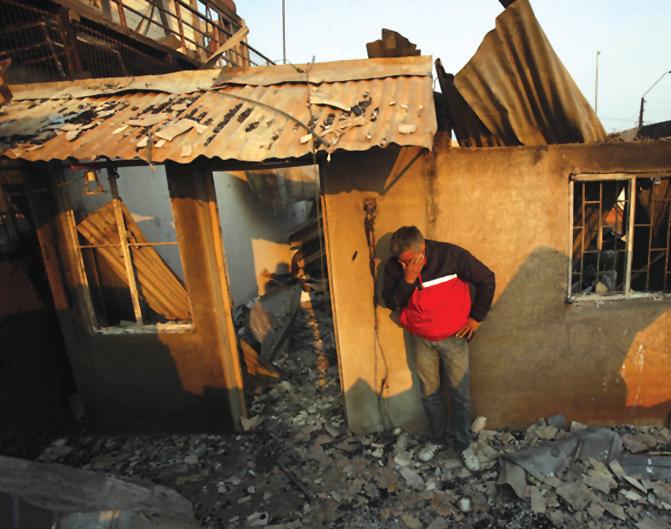
Thousands fled as about 1200 firefighters attempted to control the blaze (AP)
At least 11 people have died after a forest fire raged through the Chilean port city of Valparaiso.
The fire started on Saturday and destroyed more than 700 hectares of forest and at least 1000 homes, forcing thousands to flee, according to local authorities.
“We fled from the La
Cruz neighbourhood, from an apartment I just got not too long ago. It’s all burnt down, my sister’s house also burned to the ground,” said one resident, Rosa Guzman.
About 1200 firefighters battled the blaze, dropping water on the flames by plane and helicopter.
“It is still not completely extinguished,” said
Ricardo Bravo, a local government official, referring to lingering pockets of fire still burning in parts of the city.
Valparaiso’s hills and closely built houses, many of them made of wood, make it difficult to combat fires.
Michelle Bachelet, Chile’s President, declared a state of emergency and sent the army to maintain order in the city. Marines patrolled the streets while ambulance crews treated people for smoke inhalation and other injuries. This is the second emergency that Bachelet has faced in the first month of her new term, after an 8.2 magnitude earthquake hit northern Chile at the beginning of April.
Weather forecasts predict high temperatures and strong winds later on Sunday, a combination that could worsen the disaster if the remaining flames are not put out in time. (Excerpt from Al Jazeera)
Victims of Pinochet Government reburied in Chile after 40 years
The remains of six men have been reburied in Chile more than 40 years after they were killed by the military Government of Augusto Pinochet.
Their bodies were discovered in an unmarked grave in 1992. The men were among dozens of people killed by a military unit in late 1973, just weeks after General Pinochet came to power in a coup.
His officials flew
Attorney General Anand Ramlogan Saturday warned that former Executive Chairman of the Urban Development Corporation of TT (Udecott) Calder Hart will be hunted down and arrested if he fails to return to Trinidad for criminal and civil suits in which he is a key figure. The AG said Hart has given a commitment to testify in court. He said “by this week or next week”,
around the country in helicopters, and executed political prisoners by firing squad.
The men –- Carlos Berger, Carlos Escobedo, Luis Moreno, Hernan Moreno, Mario Arguelles and Jeronimo Carpanchay – were killed in the northern Chilean city of Calama. Berger, a lawyer and journalist, had been arrested on September 11, 1973 after refusing to broadcast a Government
message at the radio station where he worked. His and the other men’s remains were identified after extensive forensic tests in Europe, and finally buried in a ceremony at the main cemetery in the Chilean capital, Santiago. The six men were murdered by what became known as the Caravan of Death, in one of the most notorious episodes of the Pinochet Government. (Excerpt from BBC News)
Hart’s matter will come up for “case management with directions to be given for a trial”.
Hart has been living in Fort Lauderdale, Florida, since he resigned from Udecott and left the country in 2010. Ramlogan said one claim by the State is for TT$500 million for the mismanagement of the Brian Lara Cricket Stadium at Tarouba. Civil proceedings started after the Uff
Commission of Inquiry report, which called for the police to probe Hart for allegedly misspending billions of dollars in Udecott projects across the country.
“Mr Hart has, in fact, been located and has been communicating through his lawyers, and at the appropriate time, will have to come to testify and be cross-examined in court,” Ramlogan said. (Excerpt from TT Guardian)
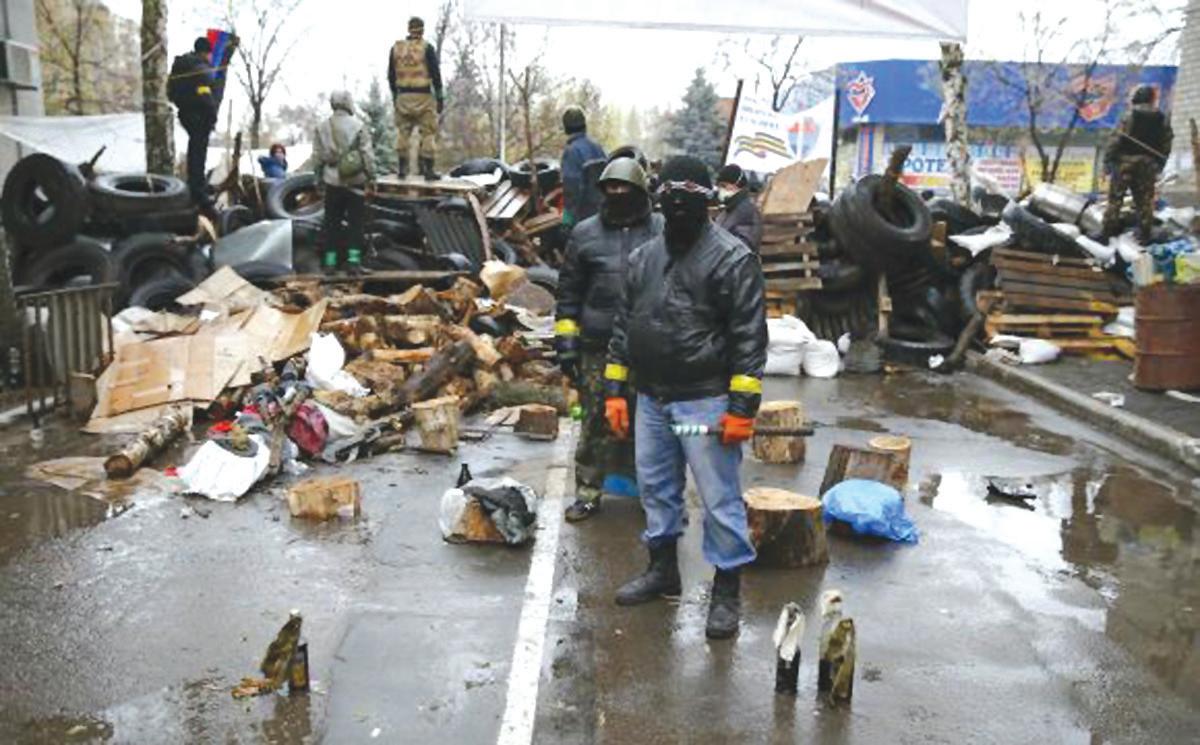
Useized official buildings and Ukrainian security forces
kraine has given pro-Russian separatists a deadline of this morning to disarm or face a “full-scale anti-terrorist operation” by its armed forces, raising the risk of a military confrontation with Moscow.
Angered by the death of a state security officer and the wounding of two comrades near the flashpoint eastern city of Slaviansk, acting President Oleksander Turchinov gave rebels occupying state buildings until 0600 GMT to lay down their weapons.
“The National Security and Defence Council has decided to launch a full-scale anti-terrorist operation involving the armed forces of Ukraine,” Turchinov said in an address to the nation.
He blamed Russia, which
At least three people have been shot dead in attacks at a Jewish community site and a retirement home in Kansas City in the U.S. Midwest.
Police said a suspect, a bearded white man in his 70s, was in custody.
The shootings occurred at the Jewish Community Campus at Overland Park and a nearby assisted living centre, Village Shalom, local
media said.
A local hospital said it was treating a teenage boy for a gunshot wound and that he was in a critical condition.
Two people were shot dead in the car park of the Jewish Community Campus, the Jewish Community Centre of Kansas said on its Facebook page.
Another person was shot dead at Village Shalom, a
retirement home several streets away from the community centre.
Local TV stations broadcast footage of police arresting a suspect at the scene. The man appeared to shout “Heil Hitler” from the back of a police car. Police said the suspect was not from the area. The attack took place just before the Jewish festival of Passover. (Excerpt from BBC News)

Along-awaited United Nations report on how to curb climate change says the world must rapidly move away from carbon-intensive fuels.
for this energy transition.
The report is the work of the UN’s Intergovernmental Panel on Climate Change (IPCC), which was set up to provide a clear scientific view on climate change and its impacts.
The Summary for Policymakers on mitigation paints a picture of a world with carbon emissions rising rapidly.
annexed Ukraine’s Crimea region when Moscowbacked former President Viktor Yanukovich fled after months of pro-Western protests, for being behind the rash of rebellions across Russian-speaking towns in eastern Ukraine.
“We will not allow Russia to repeat the Crimean scenario in the eastern regions of Ukraine,” Turchinov said.
Russia’s Foreign Ministry called the planned military operation a “criminal order” and said the West should bring its allies in Ukraine’s Government under control.
“It is now the West’s responsibility to prevent civil war in Ukraine,” the Ministry said in a statement.
A United Nations Security Council diplomat told Reuters on condition of anonymity that the council would meet at 20:00h (0100 GMT) in New York at Russia’s request. Another diplomat said negotiations were under way on Ukraine’s participation.
(Excerpt from Reuters)
Initial election results put Afghan Opposition figure Abdullah Abdullah in the lead on Sunday, but with less than 10 per cent of votes counted and widespread allegations of fraud, there was no clear indication of who would succeed Hamid Karzai.
Results based on 10 per cent of votes from 26 out of 34 provinces showed Abdullah with 41.9 per cent and Western-leaning academic Ashraf Ghani second with 37.6 per cent.
A third candidate, Zalmay Rassoul, backed by two of Karzai’s brothers, trailed far behind with 9.8 per cent. “I want to make clear that the results could change in future, as we announce the results with additional percentages of the vote, and this is not the final result,” said Independent
Election Commission (IEC) Chairman Ahmad Yousuf Nuristani.
Afghanistan’s allies praised the April 5 vote as a success because of a high turnout estimated at 60 per cent of 12 million eligible voters and the failure of the Taliban to stage high-profile attacks.
But awidespread fraud could undermine the legitimacy of an election meant to usher in Afghanistan’s first democratic transfer of power, as Karzai steps down after more than 12 years in power and as Western forces prepare to leave.
If no candidate secures more than 50 per cent of valid ballots, the top two will go into a run-off. Abdullah has said he had already discussed joining forces with other candidates for a run-off, including Rassoul. (Excerpt from Reuters)
Suspected Islamist militants killed at least 60 people in an attack on a village in north-east Nigeria, while a separate attack killed eight people at a teacher training college, witnesses said.
Boko Haram, which wants to carve an Islamic state out of Africa’s most populous country, split roughly equally between Christians and Muslims,
has killed thousands since launching an uprising in the northeast four and a half years ago.
Witnesses said the gunmen attacked the village of Kala Balge, near the Cameroon border, on Thursday, from several different quarters, shooting sporadically as terrified residents tried to flee.
“I’m making efforts to evacuate my parents from
the town,” said Ibrahim Bukar, 35, after escaping the attack. He said he counted 60 bodies scattered around after the insurgents left. Most have since been buried by the villagers, he said.
In a separate assault, insurgents killed eight people at a teacher training college in the remote village of Dikwa on Wednesday, witnesses said. (Excerpt from Reuters)
China: Water contamination affects 2.4M after oil leak

contained up to 200 micrograms per litre of the toxic chemical benzene – 20 times the national safety limit. The authorities have since said the contamination has returned to safe levels in most areas.
Exposure to benzene, often used in the petrochemical industry, can increase the risk of cancer and other diseases.
China’s biggest oil company has been blamed for water contamination affecting over 2.4 million people in Lanzhou.
There must be a “massive shift” to renewable energy, says the 33-page study released in Berlin. It has been finalised after a week of negotiations between scientists and Government officials.
“The high-speed mitigation train needs to leave the station very soon, and all of global society will have to get on board,” IPCC Chairman Rajendra Pachauri told journalists in Berlin at the launch of the report.
Natural gas is seen as a key bridge to move energy production away from oil and coal. But there have been battles between participants over who will pay
Dr Youba Sokono, a cochair of the IPCC’s working group 3, which drew up the report, said science has spoken. He added that policy makers were “the navigators, they have to make decisions, scientists are the map makers”. (Excerpt from BBC News)
State media said the city’s Environmental Protection Chief, Yan Zijiang, blamed it on a leak from a pipeline owned by a subsidiary of China National Petroleum Corporation.
The pipeline is now being repaired. Lanzhou is
the capital of north western Gansu province. Lanzhou Petrochemical Co is the subsidiary of state-owned CNPC believed to own the affected pipeline.
The leak tainted source water for a plant owned by Veolia Water, a joint SinoFrench venture and the sole supplier for urban Lanzhou, reported state news agency Xinhua.
It added that authorities have warned that tap water
Shops are said to have sold out of bottled water. The scare has once again raised concerns over China’s environmental safety record.
Last year, a ruptured oil pipeline caused explosions in the eastern city of Qingdao, killing 62 people. And in January 2012, toxic cadmium and other waste from factories contaminated water supplies serving millions of people in the southwestern region of Guangxi.
(Excerpt from BBC News)
monday, april 14, 2014|
– several key agencies up for scrutiny this week
The A Partnership for National Unity (APNU) and Alliance For Change (AFC) have to date cut approximately $9.279 billion from the $220 billion national budget for key projects under the Ministries of Amerindian Affairs, Transport and Health, much to the dissatisfaction of the Government.
In their pursuit to cut funding for the Specialty Hospital, the Cheddi Jagan International Airport Expansion Project and the Amerindian Development Fund, the Opposition axed funding for other developmental projects in the areas of transport, Amerindian development and regional and clinical services.
This week, the consideration of the 2014 Budget Estimates in the National Assembly commences with Regions Six to 10 budgetary allocations, in addition to the Office of the President, the Guyana Defence Force and the Office of the Prime Minister, among other agencies.
Vulnerable
Long before the presentation of the 2014 budget estimates, the joint parliamentary Opposition had signalled its intention to slash funding for the National Communications Network (NCN) and the Guyana Information Agency (GINA). In 2013, the Opposition used its one-seat majority in the House to reduce GINA and NCN’s estimates to $1 each. GINA was slated to receive $135,858,000 and NCN $81, 337, 000. In 2012, similar cuts were made by the Opposition.
This year, under the Office of the President, Capital Expenditures, $8 million has been budgeted for GINA for the rehabilitation of its building and the purchase of equipment and furniture. Additionally, $60.5 million has been bud-
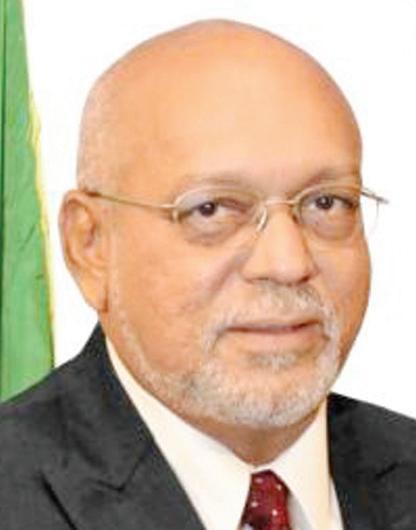
geted for NCN to aid in media production and transmission improvement.
It is unclear what the Opposition would do but any attempt to cut funding for GINA and NCN will also result in monies being cut for the rehabilitation of the Office of the President and State House, the continuation of the One Laptop per Family (OLPF) programme and other key projects.
Speaking with the press recently, President Donald Ramotar said any move to cut funding for NCN and GINA would be “pure vindictiveness”.
“I understand, that one APNU member was giving an interview on NCN and they almost dragged him off the television set, which contradicts what they have been saying,” President Ramotar said.
Declined
He said the Opposition had declined to debate on corruption at NCN. “It got to be pure vindictiveness, because the role of GINA is to give out information from the Government. I think they are actually trying to muzzle the Government with these things,” he added.
The acting Chief Justice Ian Chang has ruled that the move by APNU and AFC to cut the 2012 National Budget was unconstitutional, explaining that they do not have the power to
cut the national estimates. Justice Chang ruled also that the Opposition can only approve or disapprove the budget in its entirety or sections within.
Since the commencement of the 2014 budget estimates at the level of the Committee of Supply, the Opposition has been disapproving what it does not find favour with. Due to varying interpretations of the law, the Speaker of the National Assembly Raphael Trotman, at the start of the budget consideration last week, proposed
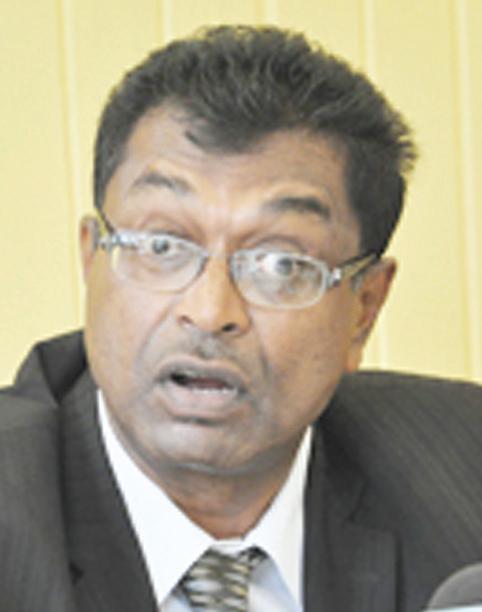
the establishment of a parliamentary sub-committee to review amendments to the budget. Giving his opinion on the matter, the Speaker said despite the views and opinions of the High Court, the decision does not, and cannot, do harm to the National Assembly’s procedures for treating with the Estimates of Expenditure while alluding to Article 165(1) of the Constitution.
But President Ramotar said Justice Chang is the correct authority to pronounce on the matter.
“Of course, the CJ [Chief Justice] is the qualified person to pronounce on these things and I think the CJ is far more competent to pronounce on that than the Speaker of the National Assembly.” He added: “I would say that
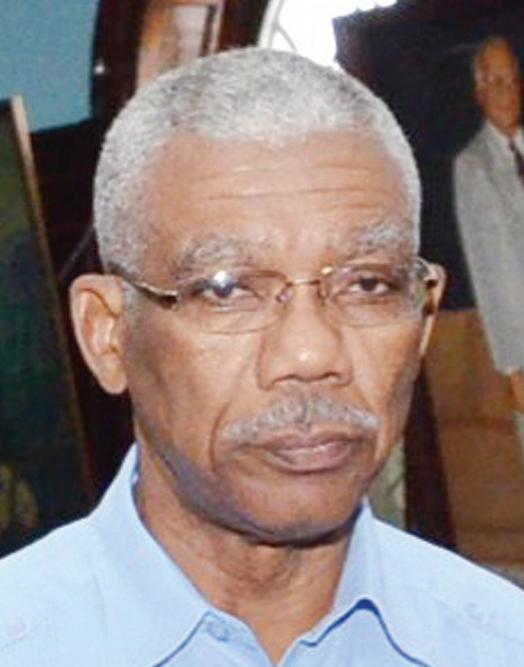
the Speaker of the National Assembly is wrong on some on these issues and the CJ is completely right.”
Meanwhile, People’s Progressive Party/ Civic (PPP/C) General Secretary Clement Rohee has lashed out at the Opposition over move to cut key funds, contending that APNU and the AFC have launched a vicious attack on the Amerindian population in particular.
The Opposition has disapproved the $1.1 billion for Capital Expenditure for the Amerindian Affairs Ministry. He said denial of such crucial funds is a demonstration of the uncaring and hypocritical attitude towards hinterland communities.
He also bashed the Opposition for disapproving funds for the Specialty Hospital.
“They have not taken into consideration that cutting the funding for this much needed hospital from the 2014 budget has in fact deny the provision of regional and clinical health services,” he told reporters on Friday.
In their pursuit to cut funds for the Cheddi Jagan International Airport (CJIA) Expansion Project, they have cut funding for the upgrading of hinterland roads and airstrip and the Guyana Civil Aviation Authority, Rohee said.
Aporter has succumbed to his injuries which he sustained after being pinned by a truck as it toppled down a hill in the Mazaruni area on Saturday.
The dead man has been identified as Robby Kopper, 27, of Canal Number Two Polder, West Bank Demerara.
Information reaching Guyana Times revealed that about 16:00h, the Bedford lorry was descending a hill at Puppy Show Landing, Mazaruni, when the driver lost control of the vehicle. As a result, it toppled several times before coming to a halt.
Kopper, who was in the tray of the truck, was pinned as the truck landed on its back. The truck at the time was loaded with fuel and was heading to a mining camp further up the Mazaruni.
It reportedly took some
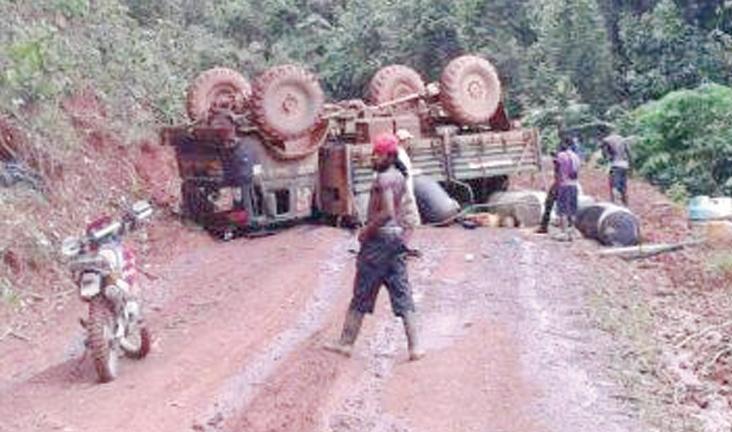
time for other persons to pull the injured man from under the truck. According to reports, the man sustained severe head and other injuries. He succumbed moments after he was pulled from the wreckage.
His body was transported to Bartica Hospital Mortuary. Attempts to make contact with the man’s rela-
tives proved futile. The driver of the truck was taken into custody as police continue their investigations. One year ago, four people died while several others were injured after a truck turned turtle after it rolled down a hill at Buck Hall, North West District.
The dead were identified as Aubrey Evans
of Supenaam, Essequibo Coast; Richard Doobay of Riverstown; Pamela Solomon of Sophia; and George Persaud of Berbice.
They were reportedly pinned by the heavy-duty truck and were severely burnt by the fuel which poured out of the tanks. According to information received, the Bedford truck bearing registration number GNN 8941 was climbing a hill at 113 Miles on the Barama Road when it started to experience mechanical problems. As a result, the truck toppled, landing on its wheels.
The truck was completely mangled after it plunged some 65 feet downhill.
The vehicle was reportedly heading to the Aranka Backdam with 22 passengers when the accident occurred.
New Food and Agriculture Organisation (FAO) estimates of greenhouse gas data show that emissions from agriculture, forestry and fisheries have nearly doubled over the past 50 years and could increase an additional 30 per cent by 2050, without greater efforts to reduce them.
This is the first time that FAO has released its own global estimates of greenhouse gas (GHG) emissions from agriculture, forestry and other land use (AFOLU), contributing to the Fifth Assessment Report of the Intergovernmental Panel on Climate Change (IPCC).
Agricultural emissions from crop and livestock production grew from 4.7 billion tonnes of carbon dioxide equivalent (CO2 eq) in 2001 to over 5.3 billion tonnes in 2011, a 14 per cent increase. The increase occurred mainly in developing countries, due to an expansion of total agricultural outputs.
Deforestation
Meanwhile, net GHG emissions due to land use change and deforestation registered a nearly 10 per cent decrease over the 2001-2010 period, averaging some three billion tonnes CO2 eq per year over the decade. This was the result of reduced levels of deforestation and increases in the amount of atmospheric carbon being sequestered in many countries.
Averaged over the 20012010 period, AFOLU emissions break down as follows: five billion tonnes CO2 eq per year from crop and livestock production; four billion tonnes CO2 eq per year due to net forest conversion to other lands (a proxy for deforestation); one billion tonnes CO2 eq per year from degraded peatlands; and 0.2 billion tonnes CO2 eq per year by biomass fires
In addition to these emissions, some two billion tonnes CO2 eq per year were removed from the atmosphere during the same time frame as a result of carbon sequestration in forest sinks.
FAO’s data based on country reports show that while those emissions continue to increase, they are not growing as fast as emissions from fossil fuel use in other sectors, so the share of AFOLU out of total anthropogenic emissions is actually decreasing over time.
The largest source of GHG emissions within agriculture is enteric fermentation –when methane is produced by livestock during digestion and released via belches – this accounted in 2011 for 39 per cent of the sector’s total GHG outputs. Emissions from enteric fermentation increased 11 per cent between 2001 and 2011.
Emissions generated during the application of synthetic fertilisers accounted for 13 per cent of agricultural emissions (725 Mt CO2 eq) in 2011, and are the fastest growing emissions source in agriculture, having increased some 37 per cent since 2001. Greenhouse gases resulting from biological processes in rice paddies that
generate methane make up 10 per cent of total agricultural emissions, while the burning of savannahs accounts for five per cent.
In 2011, 44 per cent of agriculture-related GHG outputs occurred in Asia, followed by the Americas (25 per cent), Africa (15 per cent), Europe (12 per cent), and Oceania (four per cent), according to FAO’s data. This regional distribution was fairly constant over the last decade.
In 1990, however, Asia’s contribution to the global total (38 per cent) was smaller than at present, while Europe’s was much larger (21 per cent).
The new FAO data also provide a detailed view of emissions from energy use in the agriculture sector generated from traditional fuel sources, including electricity and fossil fuels burned to power agricultural machinery, irrigation pumps and fishing vessels.
These emissions exceeded 785 million tonnes of CO2 eq in 2010, having increased by 75 per cent since 1990. Designing responses will require detailed assessments of both emission data and mitigation options.
Livestock sector
For instance, the FAO is already generating disaggregated assessments along supply chains and analysing the effectiveness of comprehensive mitigation interventions in the livestock sector.
“FAO’s new data represent the most comprehensive source of information on agriculture’s contribution to global warming made to date,” said Francesco Tubiello of the organisation’s Climate, Energy and Tenure Division.
“Up to now, information gaps have made it extremely difficult for scientists and policymakers to make strategic decisions regarding how to respond to climate change and have hampered efforts to mitigate agriculture’s emissions.
“Data on emissions for AFOLU activities support member countries in better identifying their mitigation options and enable their farmers to take faster and more targeted climate-smart responses. This in turn improves their overall resilience and their food security. It also allows the countries to tap into international climate funding and accomplish their rural development goals. We also see much interest in capacity development on these topics at country level and respond to these needs through regional and country-level activities around the globe,” he added.
Launched in 2012, the FAOSTAT emissions database has been, for the first time, a key source of GHG emissions data analysis of agriculture, forestry and other land use activities for the fifth IPPC Assessment Report, which is currently undergoing finalisation. The FAOSTAT emissions database was developed with financial support from the governments of Germany and Norway.
Several passengers, including two babies, escaped death Sunday afternoon when a Route 42 bus ploughed into a trench in the vicinity of National Hardware, Meadow Bank, East Bank Demerara (EBD).
The driver of the minibus bearing registration number GNN 7970 was reportedly speeding and lost control while negotiating the turn. Guyana Times understands that the minibus, which was coming from Timehri, might have encountered problems, while in Diamond, EBD, but the driver continued his journey to Georgetown.
When Guyana Times arrived on the scene, the “Pitbull” was on its side as a crash truck attempted to pull it from the trench. Several passengers were seen with scratches and bruises about their bodies.
After some time, the minibus was finally pulled from the water as passengers scampered to find their belongings that were left behind.
One young man, who was crying out for pain in his torso, told this publication that after the bus went into the water, his only focus was getting out with his family.
He claimed that he had a bag containing a substantial amount of money and he was waiting for the bus to be pulled from the trench so that he can collect his bag.
Another passenger explained that she boarded the bus at Coverden, EBD and as they journeyed to Georgetown, she felt a wobble but did not pay much attention.
She said as they approached Rent-A-Tent, she
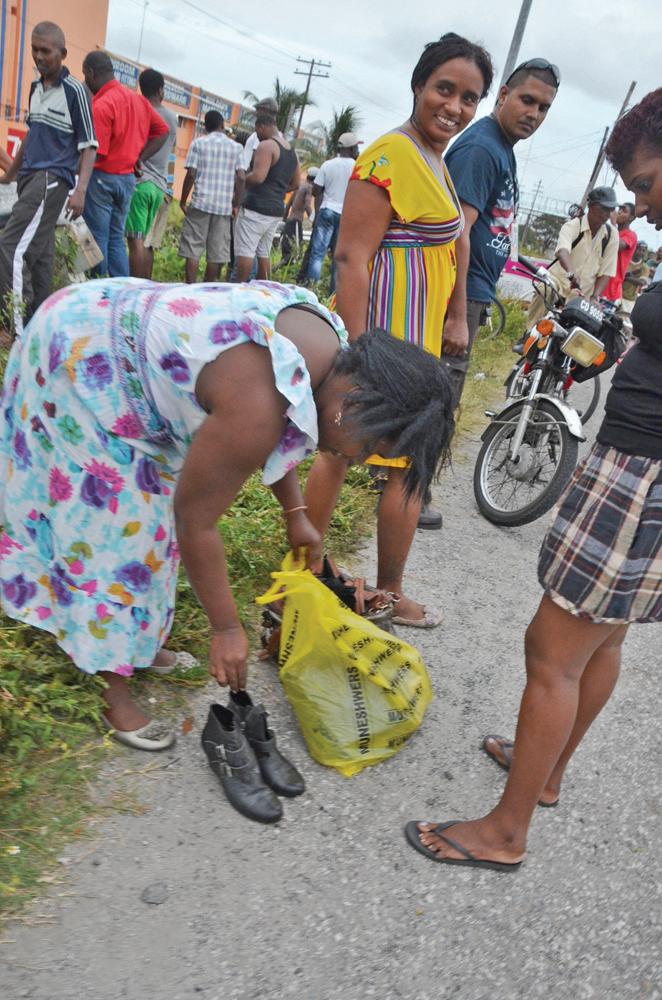
saw the driver “fighting up” with the steering wheel and thought to herself “Is dead ah dead now”.
Soon after, she said, the minibus slammed into the barrier and ultimately ended up in the trench. With her wet clothes on her body and a bag close to her, she said the conductor managed to open the door and some public-spirited citizens assisted them out of the trench.
Another woman thanked God for saving their lives, since the accident could have been more serious. She said that there were two babies in the bus and they were quickly rushed to the hospital for a medical check.
Police on the scene confirmed that no one suffered any serious injuries, but, as a precautionary measure, at least four persons were sent to the Georgetown Public Hospital, including the two toddlers.
Meanwhile, the owner of the minibus said she was at home when she received the news. She, too, praised God that nothing serious happened.
She explained that the driver, Collis (only name given) said that he took possession of the bus on Saturday. She said the bus was fully insured, but according to reports, the driver was taken into police custody.
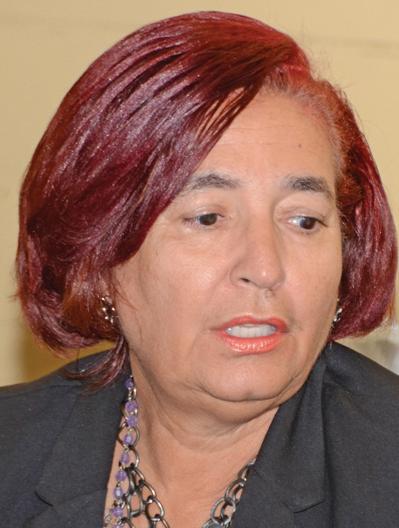
The Georgetown Mayor and City Council and Town Clerk Carol Sooba are at odds again over the sale of vending spots for the Easter Holidays.
Deputy Georgetown Mayor Patricia ChaseGreen, in an interview with Guyana Times, noted that Sooba never informed anyone nor did she seek permission from the Council before commencing the sale.
Chase-Green noted that it was only some nights ago that she was looking at a television programme when the notice popped up advertising the sale of vending spots along the seawalls in the vicinity of Sheriff Street and the Celina Atlantic Resort, Kitty. She noted that prior to that, she had never heard anything of such nature from the Town Clerk or the Council.
“I was informed of this via the television. The Honourable Madame feels that she is the alpha and omega of City Hall and as such, can make decisions as she wishes. All I know is that she came to the Finance Committee some weeks ago and requested the sum of $168,000 for Easter cleanup. The committee told her that if she can justify how the money will be spent,
they will give her the money. However, to this date she cannot justify how the money will be spent. So I guess this is her way of getting the money,” the Deputy Mayor said.
She noted that Council was equally shocked since Sooba did not request permission or informed them of such a move and it was disrespectful that they had to find out about such a move from the media.
The Deputy Mayor disclosed that Mayor Hamilton Green was very upset at the disregard by Sooba and will
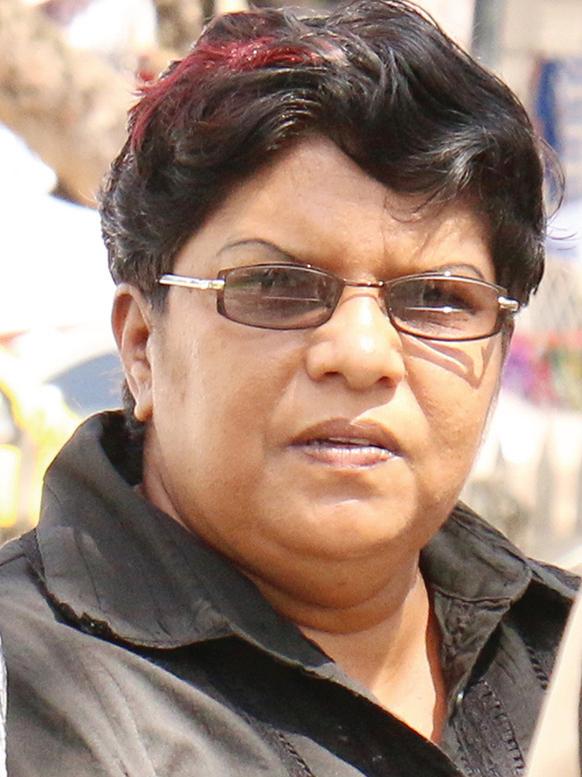
be writing to the Minister of Public Works, Robeson Benn to seek answers as to how Sooba can sell vending spots when a ban for such activities in that area was present.
“This is an area which was banned for liming and vending by the Honourable Minister. I do not know if she received permission from him, but it seems illogical to me that the Minister will place a ban and then resort to removing the ban for just one day. He would be reneging on his words if he does something like that and it would open the floodgates because people will question how vending can take place there on Easter
Achild is among several persons injured on Sunday evening following a two-vehicle smash-up in the vicinity of the Two Brothers Gas Station at Eccles, East Bank Demerara.
The accident occurred around 19:30h. The vehicles involved in the accident are a Route 31 big bus, bearing registration number BKK 335 and a Titan pickup, bearing registration GLL 5602.
According to reports reaching Guyana Times, the pickup was heading south along the western side of the East Bank Road when the bus tried to turn at the head of Flour Mill Road, causing the collision.
The Titan reportedly hit the left side of the bus and flung it into air, causing it to fall onto its side. When Guyana Times arrived at the scene, eyewit-
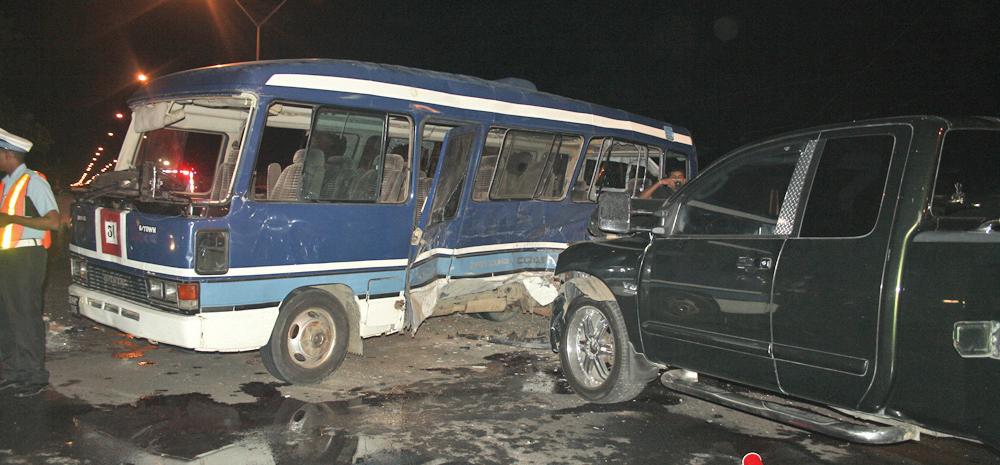
nesses related that the bus was turning to head back to Georgetown when the accident occurred. It is not clear how many persons were in the bus, but this newspaper was told that a child suffered serious injuries. She is reported to have been with two adults and another child when the accident occurred.
Eyewitnesses say the child’s left arm was broken and she is currently hospitalised.
The driver of the bus refused to speak to the media. Efforts to get more details on the injured child proved futile. Meanwhile, this publication was told that there were seven occupants in the
pickup and they were returning from a trip to the creek. One of the occupants, Nikita Nurse, recalled that she along with her father, Percy (only name given), her mother Neetu (only name given), and cousin Fiaz (only name given) were in the vehicle's cab while three others were in the tray.
Day, but all year-round, the ban is in place. Secondly, no one knows what the weather of tide will be like on Easter Day and this is one of the major garbage generating events, this is in Guyana,” she opined.
Most spots sold Guyana Times spoke to President of the Seawall Vendors Association, Carolina James who confirmed the reports that vending spots were being sold along the banned route. She indicated that the vendors would have already purchased their spots. Reportedly spots are being sold along the route for $10,000, $15,000 and $20,000 with a majority of the spots already sold by the Town Clerk. The Deputy Mayor related that the Council was not going to take the issue lightly and will be addressing the matter accordingly at its next meeting.
Meanwhile, Public Works Minister Robeson Benn have refuted claims made by both the Mayor and his Deputy which stated that permission was not given by the Minister to Sooba for the sale of vending spots along the seawalls for Easter. Vending and liming
on the seawalls in the vicinity of Celina Resort to Sheriff Street was banned early last year after a series of high tides led to the flooding of the highway.
They were Rahim Shahib, her uncle, and aunt, Debra Jones. Jones was seriously injured, suffering a broken arm while Percy, the driver of the pickup, suffered a cut to his wrist while his wife, in the passenger’s seat, hit her chest as a result of the impact of the hit.
“The bus just made one big turn and we crash into it,” the injured Nurse stated. Percy also spoke to this newspaper as he recounted what transpired.
The man claimed that he was driving at a moderate speed when the bus turned without giving any indication, and he "mashed" brakes, but it was too late so his vehicle crashed head-on into the bus.
He claimed that the police told him they had arrested the bus driver earlier in the day for a traffic breach, but subsequently let him go.
Minister Benn had, at the time of placing the ban, stated that the large amount of garbage which was generated from these “hangs” was a contributing factor to the high tides and persons could have faced serious difficulties if they were present on the seawalls at the time of a high tide.
On the heels of ChaseGreen’s statements, the Town Clerk and the Minister sought to respond to the claims stating that Sooba had requested permission from the Minister and it was given on the basis that vending will only be done on Easter Day.
Further, bins will be placed at strategic locations to ensure that litter will be properly disposed of, the statement from Minister Benn said. After Easter Monday, the ban will be put into full effect once again.














Be diplomatic and let your partner have a say before you voice your feelings. You probably have totally different points of view regarding the same situation.

By Bernice Bede Osol

(June 21July 22) (Jan. 20Feb. 19) (Dec. 22Jan. 19)
You can alleviate boredom by enrolling in a course or seminar that stimulates your interest. Take a trip to your local library and find information that will help you move forward.

Someone is likely to find fault with just about everything you do today. Arguing will get you nowhere. Find a quiet corner and stay out of the way until the tension subsides.

Negotiate household issues fairly. If you want to stay on good terms and achieve equality with your family, roommates or co-workers, get busy and do what’s expected of you without complaint.

(Aug. 23Sept. 22)
(July 23Aug. 22) (Feb. 20-March 20)
Form your own opinions instead of following the crowd. Getting involved in a joint venture with a relative could prove costly. Do your homework before signing a contract.

21-April 19)
Unexpected costs could cause you to limit your activities. Budget carefully until your bank account improves. You can rekindle the romance with your mate or special someone if you are more attentive and thoughtful.

(April 20-May 20)
Your friends may be too demanding today. Consider postponing a get-together until you feel confident and able to refuse unwelcome requests. Your boss will be upset if information is leaked. Proceed with caution.

(May 21June 20)
Take some time to get together with friends. Your energy level is high, and you will be able to keep up with any challenge that comes your way. Spend time with youngsters or those who are young at heart.
Think carefully before you speak. Be sure that you can live up to the promises you have made. Your reputation could take a tumble if you fail to follow through.

(Sept. 23Oct. 23)
Emotional frustration will tempt you to overindulge. Stay away from the fridge, your credit cards and stimulants. Instead, face problems head-on and resolve them openly.

(Oct. 24Nov. 22)
You may feel that you’re in a bit of a slump. Take care of your health with a sensible diet and regular exercise. An old friend is waiting to hear from you.

(Nov. 23Dec. 21)
If you are too self-absorbed, others will notice and complain. Make an effort to be more attentive and to show concern for what’s going on around you.






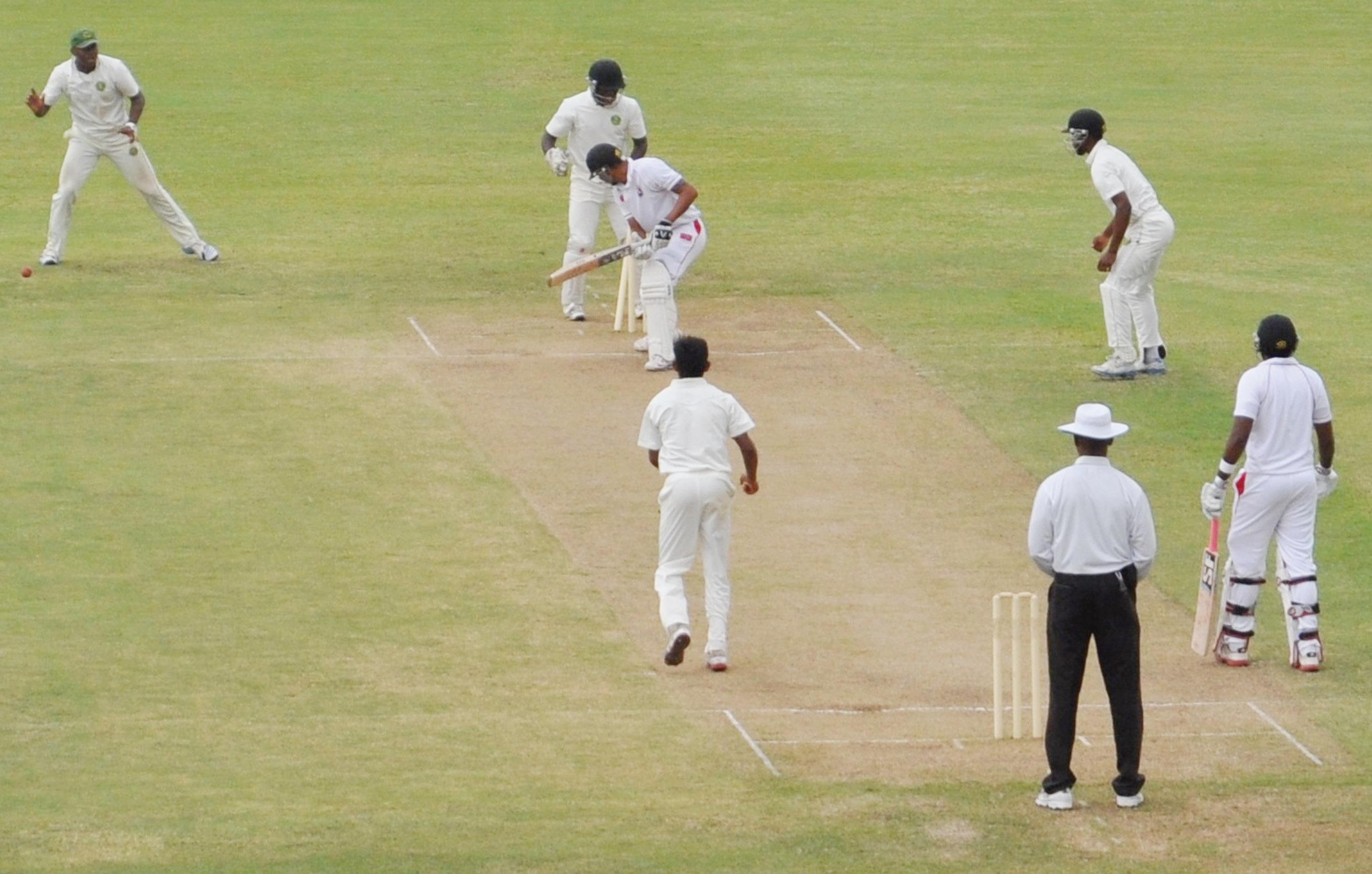
By Rajiv Bisnauth
Former Test leg-spin-
ner Devendra Bishoo and fast bowler Keon Joseph produced fine spells of bowling to give Guyana hope of claiming an incredible victory against Trinidad and Tobago at stumps on the penultimate day of the West Indies Cricket Board’s Regional four-day match.
The pair claimed all 10 Trinidad and Tobago’s second innings wickets between them to set up a thrilling final day today at the Guyana National Stadium.
Bishoo claimed six for 71 off 22.4 overs and bamboozled the Trinidad and Tobago’s batsmen into almost elementary mistakes, while Joseph’s superb spell, earned him figures of 4-55 off 14 overs. Bishoo eventu-
ally finished with match figures of 15 for 149.
When bad light stopped play on Sunday, Guyana were 17-1 off 11 overs, chasing a victory target of 225.
Opener Trevon Griffith (13) was the batsmen dismissed. Fellow opener Tagenarine Chanderpaul is on three, while night watchman Devendra Bishoo is yet to score.
Earlier Guyana had conceded a slender 12-run firstinnings lead despite a fighting 62-run partnership for the eighth wicket between overnight batsmen Zaheer Mohammed and Devendra Bishoo.
Resuming at 247 for seven, both batsmen were looking to spend more time at the crease in ensuring Guyana get past the visitors first innings total of 294.
But the Trinidadians bowled to a plan, pitching the ball up regularly to the two batsmen, who were guilty of looking for drives without settling in.
As a result, in the fifth over of the morning, Mohammed (58) edged to second slip, off Rayad Emrit. His fourth first-class halfcentury came off 88 balls, inclusive of eight fours and a six.
In the next over, Bishoo too played a poor shot, attempting a drive, and was bowled by Shannon Gabriel for 28. The Guyanese were eventually bowled out for 282, with Ronsford Beaton being the last batsman dismissed.
For Trinidad and Tobago, Amit Jaggernauth was the most successful bowler, finishing with 4-78 from 24
overs. He found ample support coming in from Emrit (3-29) and Gabriel (2-44).
Batting a second time, Trinidad and Tobago lost one wicket before lunch in their bid to collect quick runs.
The opening pair of Lendl Simmons and Stephen Katwaroo, who replaced the injured Evin Lewis at the top of the order, put on 37 for the first wicket, but just before lunch Keon Joseph, who was unlucky not to dismiss Simmons when he was on 23, provided the crucial breakthrough.
The Berbician struck big time by removing Simmons (25), who had no answer to an unplayable delivery which was pitched on a good length and swung back sharply to beat the batsman and knock back the leg
stump.
However, the post-lunch session belonged squarely to the hosts. The Trinidadians, who had gone to lunch on a promising 49 for one, lost five wickets during the session.
The Guyanese struck twice immediately after lunch when Darren Bravo was snared leg before wicket for eight by Devendra Bishoo, completing his second 10th wicket haul in first-class cricket, followed shortly after by Katwaroo, who also went leg before wicket off Joseph.
Jason Mohammed and Evin Lewis added 22 for the fourth wicket, but Bishoo was bang on target with his flighted leg breaks. He varied the length of his deliveries and pace through
the air to snap up the wickets of Lewis (12), Jonathan Augustus (3), to attain his 200th first-class wicket and Mohammed (33) before the break.
Bishoo struck soon after tea to remove Rayad Emrit (20) to pick up his fifth wicket in the innings before a slight shower sent the players off.
Imran Khan (29), Marlon Richards (25) and Amit Jaggernauth (13) provided brief resistance before Joseph claimed the wickets of Khan and Richards; and Bishoo wrapped up the innings with the wicket of Jaggernauth.
Play resumes today at 10:00h with Guyana needing a further 208 for victory with nine wickets remaining.
T&T 1st innings 294 Guyana 1st innings
T Griffith c Ketwaroo b Gabriel 23
T Chanderpaul run out (Augustus) 14
S Hetmyer c Richards b Jaggernauth 0
L Johnson c Ketwaroo b Jaggernauth 78
V Singh c Ketwaroo b Jaggernauth 2
A Bramble b Jaggernauth 16
C Barnwell lbw Emrit 50
Z Mohammed c Jaggernauth
b Emrit 58
D Bishoo b Gabriel 27
R Beaton c Jaggernauth b Emrit 1
K Joseph not out 5
Extras: (1nb, 4b, 2lb) 7
Total: (all out; 92.3 overs) 282
Fall of wickets: 1-34, 2-37, 3-51, 4-59, 5-89, 6-169, 7-213, 8-275, 9-275, 10-282
Bowling: Gabriel 20-4-44-2 (w1) Richards 4-0-21-0 Jaggernauth 24-5-78-4 Mohammed 143-27-0 (nb1) Khan 21-367-0 Emrit 9.3-2-39-3
T&T 2nd innings
L Simmons b Joseph 25
S Katwaroo lbw b Joseph 32
D Bravo lbw b Bishoo 8 J Mohammed
A Jaggernauth lbw b Bishoo 13
S Gabriel not
Manny Pacquiao beat Timothy Bradley on points to win the WBO welterweight title in Las Vegas.
Filipino Pacquiao, 35, who lost to American Bradley in a controversial encounter in 2012, was the winner on all three judges’ scorecards.
“I proved tonight that my journey in boxing will continue,” said Pacquiao, who
has won 56 of his 63 fights. Bradley, 30, said: “I tried, I really tried. I just lost to the best fighter in the world.”
Judges Craig Metcalfe and Michael Pernick scored the fight 116-112 for Pacquiao, while Glenn Trowbridge made him a 118110 winner.
Pacquiao has won world titles in eight weight divisions during an illustrious
career that began in 1995, but Bradley questioned his hunger in the build-up to their rematch.
Asked how much longer he will continue, Pacquiao said: “A couple more years.
“There’s no problem for me. My job is to fight in the ring - any opponent.”
Bradley, unbeaten in his previous 31 fights, received hate mail and death threats
after claiming a disputed points win over Pacquiao in their first bout.
“I thought I had to do more [than the first fight]that’s why I was going for a knockout,” Bradley said of his occasional ill-discipline at the MGM Grand on Saturday.
“Manny fought his heart out and the better man won tonight.
“I was trying to hit him
with something over the top when he was throwing. I got beaten here but the war is not over.”
Pacquiao was more aggressive and accurate from the start of the fight.
Although they exchanged big shots in the opening rounds, Pacquiao appeared to wear out Bradley with the heavy early pace.
Bradley responded impressively in the fourth
round, wobbling Pacquiao twice with a right hand, but he was outboxed for the majority of the remaining rounds.
“I didn’t want to get careless,” Pacquiao said. “I picked up more steam in the second half when I made adjustments.
“Bradley was much better than in the first fight we had. He hurt me on the chin.” (BBC
Pakistan’s conditional support for the ICC revamp hinges on the promise of six series against India, including a ‘home’ series in the Middle East as part of an upcoming, reworked eight-year FTP cycle from 2015 to 2023, ESPNcricinfo has learnt.
The change in the PCB’s stance has taken place on the condition that Pakistan would be involved in bilateral series against all Full Members, including India. If Indo-Pak series are officially slotted into the eight-year FTP, it could also involve a ‘home’ series for Pakistan against India in the United Arab Emirates.
The PCB is now waiting for a final confirmation from the BCCI following its Working Committee meeting, which the PCB have been informed, is expected to take place in the next 15 days. It will then enable the PCB to work out a long-term broadcasting deal with regular India series at its centre.
The PCB’s opposition to the ICC’s original position paper that recommended a remodeling of the ICC’s administrative structure and its revenue distribution rested on the argument that it was against the principle of “equality.” However, following certain changes in the resolutions, as well as the possibility of playing India frequently led PCB to support the governance, finance and FTP changes in the ICC, which was driven entirely by the BCCI, ECB and Cricket Australia.
ESPNcricinfo understands that all the nine member boards have con-

firmed their earlier commitments with PCB until 2020 and are chalking out a fresh plan for the period from 2020 to 2023.
The BCCI could look to slot in as many as six series against Pakistan, due to the gaps that are available in the existing FTP calendar. The first of these bilateral series could take place in the UAE in the winter of 2015. “Cricket between both countries is beneficial as the Pakistan government is also keen to revive ties with India on a high note,” PCB chairman Najam Sethi said on Friday following the twoday ICC board meeting in Dubai.
India and Pakistan have not played a full series since the 2008 terror attacks in Mumbai, which India blamed on militants based
across the border. However, Pakistan visited India for a short limited-over series in December 2012, but despite not getting any revenue out of the series, it was regarded as a stepping stone in reviving cricketing ties between both countries.
Since July 2013, Pakistan have been without a long-term broadcasting deal, one of the major sources of income for the PCB. The PCB already had to deal with a long-standing budget-deficit, which in August 2013, was calculated at nearly PKR 500 million. The PCB estimates that after committing to the ICC revamp, the financial benefits could reach PKR 30 billion from the bilateral ties, the major chunk of which will be earned from hosting India. (Cricinfo)
Kevin Pietersen’s taped little finger on the right hand is giving Delhi Daredevils some anxious moments, four days ahead of the their first match in the IPL. Pietersen, appointed the captain by the franchise, arrived last week in Delhi to join the squad with what is being described as a “niggle” in his finger. He subsequently avoided batting during the training sessions in Delhi. Pietersen continued to wrap his last two fingers on his right hand during the team’s training sessions to raise concerns.
However, Daredevils’ chief executive Hemant Dua remained confident on Pietersen being fit for the team’s first match on April 17 against Royal Challengers Bangalore in Sharjah. “He has said he will be fine. He

has done a little bit of batting,” Dua said. According to Mail Today, Pietersen is carrying a fracture but Dua was not ready to ring out the alarm bells yet. “I can’t comment on that. He hasn’t told me that he will not be playing the first game. It is a niggle he has told me.” Pietersen himself has sounded relaxed about the

Bubba Watson was poised to win the Masters for a second time in three years after stretching his lead to three shots with three holes remaining at the 78th Masters on Sunday.
The American left-hander, who clinched his first major title with a thrilling playoff victory over South African Louis Oosthuizen at Augusta National in 2012, mixed five birdies with two bogeys to get to eight under for the tournament.
Watson’s playing partner Jordan Spieth, at 20 aiming to become the youngest player to win the Masters,

had briefly been two strokes clear but faltered around the turn to slip back into a tie for second at five under.
Swede Jonas Blixt, like Spieth a Masters debutant, was also at five under, after 16 holes, with American Matt Kuchar and Spaniard Miguel Angel Jimenez a further shot back.
Kuchar, a Georgia resident seeking his first major victory, had completed 16 holes while the pony-tailed Jimenez was through 17.
Spieth had been the dominant figure in the early going with some riveting golf on a warm but mainly overcast afternoon, four bird-
ies and a bogey in the first seven holes putting him two ahead of the chasing pack. He picked up his first shot of the day at the parfive second, sinking a leftto-right breaking putt from 10 feet, then spectacularly holed out from a greenside bunker to birdie the parthree fourth, raising both arms in celebration.
Though he bogeyed the fifth after hitting his approach into a greenside bunker, he recovered with birdies at the par-three sixth, hitting his tee shot to three feet, and at the seventh, where he coaxed in a slick 12-footer downhill. (Reuters)
The Atlanta Hawks qualified for the National Basketball Association playoffs for the seventh straight season on Saturday with a 98-85 win over the Miami
Heat. The Hawks claimed the eighth seed in the Eastern Conference with the win, a result which eliminated the New York Knicks from the playoffs race.
Atlanta, who hold the longest streak of postseason appearances in the East, will meet either Miami or Indiana in the first round of the playoffs.
Liverpool took a huge step towards winning the Premier League title by beating Manchester City as Anfield marked the 25th anniversary of the Hillsborough disaster.
taped finger and even joked that he would avoid shaking hands in public as it would aggravate his injury. “I hit my little finger last week, but I will be okay. Just protecting it ( with the bandage covering) so I won’t be shaking hands with anybody ( laughs) in the next few weeks. It’s just a niggle, but I will be good,” Pietersen had told the Mail earlier this week.
The tournament will be Pietersen’s return to active cricket since his England contract was abruptly terminated by the ECB in February, less than a week before the IPL player auction. The sack, though, did not hurt Pietersen’s stock at all as Daredevils bought him for INR 9 crore (US $ 900,000) and a month later, unveiled him as the franchise captain.
The Reds looked like sweeping City aside in a dazzling opening half as goals from Raheem Sterling and Martin Skrtel put Brendan Rodgers’s team in complete command.
City, who lost Yaya Toure to injury early on, mounted a superb recovery and David Silva pulled one back early in the second half before his cross was deflected in off Glen Johnson and Liverpool keeper Simon Mignolet to draw them level five minutes later.
A gripping spectacle was decided 12 minutes from time when City captain Vincent Kompany - an injury doubt before the game and clearly lacking some of his familiar authoritysliced a clearance straight to Philippe Coutinho, who shot low and unerringly past Joe Hart to put Liverpool in control of the title race.

It set up a nail-biting finish in which Liverpool’s Jordan Henderson was shown a straight red card for a late challenge on Samir Nasri, one which means he will miss three of the last four games, and referee Mark Clattenburg missed Skrtel’s clear handball in the closing seconds.
The final whistle sounded seconds later and a wall of noise surrounded Anfield as Reds players gathered in a huddle in front of the Kop, four wins away from their first title since 1990.
If Liverpool win those games they will be champions, but Chelsea also have to visit Liverpool and there is every chance they will still be harbouring Premier League title ambitions of their own.
City’s impressive secondhalf showing demonstrated they must not be ruled out and they left Anfield nursing a sense of injustice, also believing Luis Suarez should have been sent off when Clattenburg declined to give him a second yellow card for diving.
monday, april 14, 2014




Available: Fresh long-stemmed roses, fresh dried and silk floral arrangements, gift items, bridal boutiques and wreaths. Nesha’s Flowerland. 78 Church Street (opposite St George’s Cathedral). Tel: 227-3553/225-3315




Get your home or business spiritually clean to enhance good luck and prosperity. Telephone: 687-5653 Cleansing of spiritual problems of all kinds. Powerful Ifá protection against evil. Get help to overcome problems with love, relationships, legal, sexual, pregnancy, business, sickness, jobs, enemies, work, money. Call 592-690-1824 from 10:00-16:00h Email:anew-life@live.com Dutch spiritual healing in removing evil spirit, bad luck, evil sickness, spells, re
uniting lovers and prosperity to businesses. Call: 612-6417, 220-0708, 687-5653.
By Treiston Joseph
The Guyana Olympic Association (GOA) must be lauded for their efforts to hear the voices of those concerned with the direction of sport in the country at an open forum on Friday at the Young Men’s Christian Association (YMCA) hall.
A number of associations and sport enthusiasts raised their concerns, most hovering around the same areas such as lack of facilities, the poor system of sport in schools, the science of the sport, finances, disorganized associations, governmental assistance, availability of resources, equipment and personnel and corporate sponsorship and branding.
ucation is not sport.
However, it was interesting to hear some associations raise sport in schools at a GOA function when the GOA has little to no input in any of the school events such as the National Athletics, Swimming and Cycling Championships, the National Schools Basketball Festival or the National Sports Commission Table Tennis Championships, to name a few, despite all of these sporting disciplines being Olympic sports.
There is no doubt that Guyana is in need of many more facilities to aid the development of quality sportsmen and women.
The government has been trying in this regard and should be commended for the infrastructure in place and currently those being built.
However, this is where the science of sport will prove critical in order to produce elite athletes to use for such facilities and venues.
fits the whole of Jamaica and because of Usain Bolt’s success the prestige of the Puma Company has been enhanced.
It makes one think that the corporate community in Guyana wants to see success before taking on such a venture; or maybe the associations themselves are not marketing their athletes as they should.



Healthworld Holistic Centre offers clinical psychotherapy for suicidal thoughts, attempted suicides, depression, stress, mood disorders, psychotic disorders, homicidal thoughts, hallucinations, loneliness, conflicts, anger management, relationship & sexual problems, paranoia and much more. Call +592621-0552 and make that appointment now before it’s too late. 12:00PM –6:00PM. Mondays - Fridays. Email: healthworldhc@gmail.com One furnished house in immaculate condition at Lamaha Gardens suitable for residence and office. US$2,500
enquiries, appeals for refused cases, US green card lottery, business class waivers, pardons, etc. Get your visa approved. High success rate. Balwant Persaud & Associates. Certified Immigration Consultants, 68 Sixth Street, Alberttown, Georgetown (Between Cummings & Lights Sts) Tel: 225-1540, 622-8308, 655-3105. Email: balwantpersaud@yahoo.ca


Suriname Astrology Palmist and Djuka Healing. The most powerful spiritualist in the world, are you suffering from the following problems? (any religion) love, marriage, family, health business, husband and wife relationship, property, court, children, promotion, visa, pregnancy, education, depression, job, sexual, jealousy, enemy, money, drinking? Also you can have all evil forces destroyed such as black magic, witchcraft, voodoo, obeyah, etc and get powerful protection. We also do upliftment for clearing of land, dredging operations strictly in the interior. For private and confidential service call 674-2112.

However, before this reporter begins an analysis of presentations at the forum, it must be said that it was saddening that no active athlete from any sport was present to air their personal concerns, since whatever decisions are made hereafter will indirectly and more so directly affect them.
Poor School system for sport It is a known fact that the schools system for sport is in dire need of total reconstruction, since sport is seen as an external part of school life and not as part of the school curriculum.
Some might say that physical education is on the curriculum, but physical ed-

JUST ARRIVED: TOP QUALITY RECONDITIONED VEHICLES; TOYOTA NOAH; TOYOTA VOXY; TOYOTA IST (NEW SHAPE); SUZUKI SWIFT; DAIHATSU MOVE (660CC); MERCEDES BENZ C200 KOMPRESSOR; COROLLA AE100 WAGON; HONDA CRV RD4; LAND CRUISER (FULLY LOADED); MAZDA PROCEED 4WD EXTRA-CAB PICK-UP; TOYOTA HILUX 4WD EXTRA CAB PICKUPS - 3RZ, 5L, 3L SOLID DEFFERNTIAL; MITSUBISHI CANTER TRUCKS 4 TONS FREEZER; 3 TONS OPEN TRAY; 2 TONS 4WD; 3 TONS DUMP TRUCK; NISSAN ATLAS 2 TONS OPEN TRAY TRUCK. PRE-ORDER YOUR UNITS EARLY AND GET THE BEST PRRICES. FULL AFTER SALES SERVICES AND FINANCING AVAILABLE. DEO MARAJ AUTO SALES, 2 CHIMNEY ROAD, CHATEAU MARGOT, ECD. 624-0762, 220-5177. A NAME AND SERVICE YOU CAN TRUST. 4x4 Nissan Titan fully powered
Immaculate condition $3.5M. No reasonable offer refused. 622-7740
One 19 seat minibus. BPP Series. Call 650-8080, 617-4487


Many a time it has been said by the likes of the Minister of Sport, Dr. Frank Anthony; the Director of Sport Neil Kumar, and even the president of the Guyana Teacher’s Union, Colin Bynoe, that the athletes participating in the National Schools Championships are future Olympians, yet the GOA has not been incorporated into the biggest school event in the nation.
The same can be said of the National Schools Basketball Festival or the table tennis schools championships, all of which are partly sponsored or sponsored by the National Sports Commission or the Ministry of Education.
This reveals only one thing: if communication among persons responsible for sport is lacking, then it is more than likely that the development of the sport would be at a standstill.
Facilities and science of
A deeper look into the development of the science of sport is needed to gain the maximum use of these facilities. Only then will future Olympians be born.
Sponsorship, funding and branding
In today’s world, sport is not seen as just sport, it is seen as a business and this is the avenue that will be needed, if sport in Guyana is to go anywhere.
The time for giving cheques and going no further is over; sport needs the full support of the corporate community in order to develop.
Corporate entities should join the fray and outfit a whole team bearing their logos and trademarks, while supporting that team fully or investing in an athlete.
The power of global branding is tremendous and can prove beneficial for both sponsor and sponsored.
For instance, Puma out-
One thing is certain in this regard: sponsorship and branding will need to go to another level if sport is to be taken to the highest level.
Another area that was mentioned was disorganized associations, which can hinder sports; however the estimation this reporter, the one way to deal with such a problem would be to sanction these associations that might be seen as doing more harm than good.
The forum provided the GOA with guidance on areas that they can tackle to improve sport.
However, if such a forum is held again it would be fitting to not just have athletes present, but to have government officials and other stakeholders present to listen to the concerns of those who are interested in seeing Guyana reach another level in sport; especially since the president of the GOA, KA Juman Yassin, made it known that, for that to be achieved, the effort will need to be collaborative.
Captain Kraigg
Brathwaite missed out on yet another century but Barbados strengthened their bid for victory over the Leeward Islands, on the second day of their final -round Regional Four-Day match here Saturday.
The right-handed Test batsman scored 92 as the visitors pushed on from their overnight 167 for one, to 326 all out after tea at the Vivian Richards Cricket Ground, and take a first innings lead of 232 runs.
Leg-spinner Anthony Martin picked up five for 78 while off-spinner Jacques Taylor (2-42) and seamer Kelbert Walters (264) finished with two wickets apiece.
Batting a second time, the Leewards reached 54 for two, with captain and Test batsman Kieran Powell unbeaten on 23. The hosts requiring another 178 runs to make Barbados bat again.
Barbados had a huge slice of luck early in the day when Brathwaite was
put down behind after he had added just one to his overnight 73.
He and Kirk Edwards (23) made slow progress, however, and Barbados put on just 12 runs inside the first hour.
Edwards was the first to fall, driving to Orlando Peters at point off Taylor attempting to break the shackles, with the score on 189 for two.
Unbeaten on 92 at lunch with Barbados on 219 for two, Brathwaite perished to the fourth delivery on resumption, lbw to Martin pushing forward.
It was the third time this season Brathwaite has fallen in the 90s, after missing out against Jamaica and Combined Campuses and Colleges.
Barbados then stumbled, losing Jonathan Carter for 39 at 246 for four and all-rounder Kevin Stoute first ball without scoring, yorked by Walters. With just seven runs added, wicketkeeper Shane Dowrich drove Taylor loosely to point to fall for two and Barbados’
slide continued, with the last five wickets falling for 73 runs.
Shai Hope, with 29, and
Carlos Brathwaite, 20, provided the energy in the late stages of the innings.
Leeward Islands 1st Innings
K Powell* c Hope b

Veteran West Indies left-hander Shiv Chanderpaul hit a typically composed, unbeaten half-century to prop up Derbyshire on the opening day of the English County season here Sunday.
At the close at Chelmsford, Derbyshire were 139 for five in reply to Essex’s paltry 94, with Chanderpaul leading the way with a top score of 66.
He has so far batted for just under three hours, faced 134 deliveries and struck nine fours and a six.
The Guyanese has been at the core of two key partnerships which helped to repair
the innings.
He added 56 for the third wicket with captain Wayne Madsen (30) after Derbyshire slipped to 17 for two, and then posted another 44 for the fifth wicket with Wes Durston (21), to pull the innings around from 91 for four.
Chanderpaul’s teammate, Leeward Islands lefthander Chesney Hughes, made just nine before he was fourth out, bowled by seamer Graham Napier.
At Edgbaston, Barbados pacer Chris Jordan made a bright start to the new campaign, picking up three for 15 for Sussex to help blow
away Warwickshire for 87 in their first innings.
The right-armer, who plays for England, conjured up a devastating opening spell to knock over openers Varun Chopra (1) and Laurie Evans (4) cheaply, before accounting for Test star Ian Bell without scoring, as Warwickshire crumbled after electing to bat first.
In reply, Sussex were dismissed for 229, to lead by 142 runs on first innings, with captain and opener Ed Joyce cracking 117.
Jordan fared poorly with the bat, however, scoring just 15 in nearly an hour at the crease. (Windiescricket)

By Treiston Joseph
The Guyana Amateur Swimming Association (GASA)

Ifor 40 from 15 overs, as CCC were dismissed for 161 to concede a first innings lead of 21 on the second day of the seventh round match.
Kevin McClean, batting at eight, hit the top score of 36 for the home team, pugnacious opener Shacaya Thomas made 33, Kyle Corbin got 22 and their captain Steven Jacobs added 20, but the rest of the CCC bat-
ting failed miserably to put up the resistance required to reinforce the advantage they secured on the opening day.
Jermaine Blackwood was not out on 23 and West Indies batsman Marlon Samuels was not out three, as Jamaica reached 79 for two in their second innings when stumps were drawn at the rain-sprinkled 3Ws Oval for an overall lead of 100.
(Windiescricket)
Combined Campuses & Colleges 1st Innings
S Thomas b Taylor 33
K Corbin c Baugh b Taylor 22
Raymon Reifer c Baugh b Taylor 0
C Walton+ LBW Miller 7
Floyd Reifer LBW Miller 11
S Jacobs LBW Miller 20
A Dewar b Cottrell 6
K McClean run out (McCarthy) 36
J Warrican st Baugh b Miller 4
P Palmer c Jacobs b Miller 4
R Austin not out 0
Extras: (b4, lb8, nb6) 18
Total: (68.1 Overs) 161
Jamaica 2nd Innings (Lead; 21)
N Bonner c Corbin b Raymon Reifer 12
John Campbell c Corbin b Warrican 38 J Blackwood not out 23
M Samuels not out 3
Extras: (b3) 3
Total: (2 wickets; 38 Overs) 79
Fall of Wickets: 1-22, 2-69. Still to Bat: Tamar Lambert*, Carlton Baugh Jr+, Brian Buchanan, Sheldon Cottrell, Andre McCarthy, Nikita Miller, Jerome Taylor
had an intense first day of swimming action on Saturday, with the Dorado Swim club dominating the pool at the National Aquatic Centre, Liliendaal.
Olympian Britany van Lange took two out of her three events for Dorado on the first day ,winning the girls’ 15 years and over 50 metres Butterfly in 32.87s, and the girl’s 15 years and over 100 freestyle in 1:04.22s.
Van Lange’s only loss came in the girls’ 15 years and over 50 metres backstroke to her club mate Soroya Simmons, who clocked 34.97s to win the event ahead of van Lange who clocked 35.53s for the second spot.
Simmons was second to van Lange in the 100 metres freestyle, clocking 1:06.09s to finish ahead of Jamila Sanmoogan of Dolphin swim club, who registered a time of 1:08.78s for third.
Dorado’s Hannibal Gaskin was also in top form winning two out his two events on the first day of competition.
Gaskin swam away with the boys’ 15 years and over 100 metres freestyle in 59.79s to finish ahead of club mate Omar Adams, who clocked 1:01.36s. Joseph Seguina of Dolphin was third in 1:02.60s.
freestyle clocking a time of 1:17.56s, while club mate Alex Winter finished a distant second with a time of 1:27.03s.
Hussein also swam away with the boys’ 11-12 years 50 metres backstroke in 42.59, while Winter finished second again in 51.76s.
Meanwhile, the top swimmer of the day might have come from Orca Swim Club as Aleka Persaud swam away with three out of three events.
Persaud won the girls’ eight years and under 100 metres freestyle, 50 backstroke and 50 metres butterfly in 1:36.92s, 51.63s and 58.16s.
However, Dorado’s Raekwon Noel would match the feat by Persaud, also going three for three at the inter-club championships.
Noel, in the boys’ eight years and under category won the 50 metres backstroke in 42.67s, the 100 metres freestyle in 1:24.34s and the 50 metres butterfly in 43.26s.
Leon Seaton of the Silver Shark club also had some success winning both his events in the boys’ 9-10 years age category. Seaton showed his ability by winning the 50 metres butterfly in 40.26s while taking the 100 metres freestyle in 1:18.36s.
nspired spells from Nikita Miller and Jerome Taylor led a Jamaica fight-back and intensified their battle against Combined Campuses & Colleges for the last semifinal slot in the Regional Four-Day Championship here on Saturday.
Left-arm spinner Miller was the pick of the Jamaican bowlers, capturing five for 31 from 31 miserly overs bowled on the trot, and Taylor supported with three
Fall of Wickets: 1-59, 2-59, 3-68, 4-70, 5-87, 6-106, 7-124, 8-143, 9-157, 10-161. Bowling: J Taylor 15-4-40-3, S Cottrell 15-3-56-1, N Miller 31-16-31-5, D Jacobs 5-118-0, T Lambert 2.1-0-4-0.
Bowling: K McClean 4-0-200, R Austin 13-2-29-0, Raymon Reifer 6-2-13-1, J Warrican 9-5-5-1, A Dewar 6-2-9-0.
Gaskin also took the boys’ 15 years and over 50 metres butterfly in 28.97s, while club mate Adams was second in 30.20s. Seguina also finished third in 30.61s.
Antonio Hussein dominated for Dorado in the boys’ 11-12 years 100 metres
Joseph deNobrega also had an impressive outing on the first day for Dorado, swimming away with the boys’ 13-14 years 100 metres freestyle in 1:02.35s, while capturing the 50 metres butterfly in 31.45s.

Berbice cyclists failed in their attempt to beat Andrew “Padlock” Green again as the Trojan Cycle Club (TCC) top wheeler rode away with the First Impression Hotel 50 miler on Sunday.
Green, who chalked up his third win in four races, started the event slowly and made his way to the front before taking team mate Jubon Crawford with him.
The two took the lead 10 miles into the race and never looked back. When the cyclists took the turn around at Number 43 Village, the duo had a one kilometre lead on the rest of the pack.
The two, as they did in the last Berbice Cycle Road Race, increased the lead as they pedalled with the aid of the Corentyne wild. However, with 15 miles left in the race, Crawford started to drop back and was soon fading in the distance, leaving Green to take the remaining two sprint point prizes unchallenged.
Crawford pedalled in a distant second.
Earlier, the wheelers pedalled off from Marks’ Bridge in New Amsterdam and as soon as they were outside the town, Sean Israel took to the lead but that was short lived when the cyclists raced for the first sprint point prize. Israel, Syborne Fernandes, Jubon Crawford, Adriel Ross, Romello Crawford and Kurt La Rose took the early lead with Green trailing until he caught the leaders and did not look back.
There was a sprint for the third position with four cyclists off their seats as they reached the finish line in front of First Impression Hotel at Hampshire Village on the Corentyne.
In third position was Romello Crawford ahead of La Rose, Andrew Hicks, Adriel Ross and Samuel Mootoo with Fernandes finishing during the presentation ceremony to claim the eighth spot just before officials had counted him out.
Green took home four sprint point prizes, Crawford three and La Rose one.
Meanwhile, the females raced from Adventure to the Finish line, a distance of 10 miles. Maricia Dick of Flying Ace Cycle Club (FCC) finished comfortably ahead of Christine Matterson.
Beyoncé Welch took the girls’ under-16 event with second place going to Shakira Teixeira.
Organizer of the event and coach of the FACC, Randolph Roberts, speaking at the presentation ceremony said the club is trying to prepare cyclists for the upcoming three-stage road cy-

cle race. “You cyclists have to do better timings and you have to pay attention to your diet…” He told the riders who he encouraged to get in shape.
Meanwhile, Janette Ikel of Furniture World which part -sponsored the event, told the participants that along with First Impression Hotel they had sponsored the event for the benefit of the cyclists and will continue to do so if cyclists show improvement. She also emphasized the need for cyclists to pay attention to their times in races.
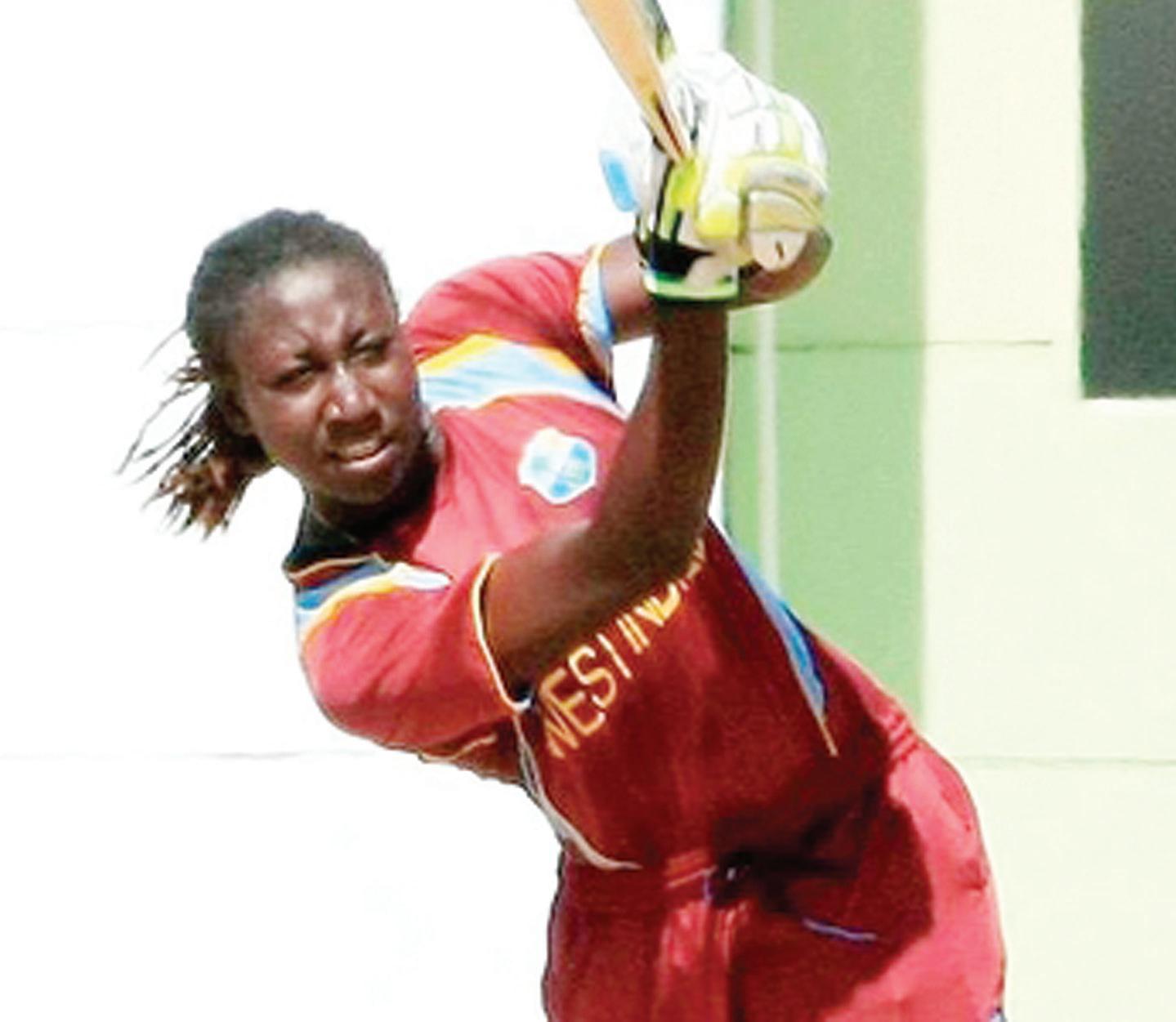
West Indies Women’s Stafanie Taylor is elated at her inclusion in the ICC Women’s World Twenty20 team of the tournament, and is looking forward to representing the outfit during an exhibition match next month.
The tournament team, which also includes hardhitting West Indies player Deandra Dottin, is scheduled to play a game against a MCC Women’s XI on May 19 at the famous Lord’s cricket ground in London, England.
“When I got the email that I was a part of the team of the tournament, I was excited,” Taylor said.
“It’s an honour and privilege, as I wouldn’t rate my performance during the tournament as my best. However, it always feels good to be recognised, and I look forward to doing well in the MCC match.”
The ICC Women’s World Twenty20 team was selected on the basis of performances in the tournament only, according to the ICC.
The world governing body also said that “statistics were used”, but were not the “sole basis” for selections.
The team is made up of two players from Women’s Twenty20 champions Australia, and four from runners-up England. Bangladesh, India and New Zealand also gained a selection each.
Chairman of an independent jury, which selected the team, and member of the ICC Elite Panel of ICC Match Referees, David
Boon, in commenting, said this year’s tournament again demonstrated the “incredible depth” of talent across women’s cricket.
“Selecting one team of 11 players was a tough task, as we saw standout performances from many players,” Boon added.
The independent jury also included Marais Erasmus of the ICC Elite Panel of Umpires, former Pakistan captain Wasim Akram, ex-England captain Nasser Hussain, former West Indies fast bowler Ian Bishop, and Utpal Shuvro, one of Bangladesh’s seniormost cricket correspondents.
The MCC Women’s XI match will be one of two organised by the MCC to commemorate it’s bicentennial celebrations.
The other will be a men’s showdown between an MCC XI and a Rest of the World team on July 5th at the same venue. The Rest of the World team will be captained by Shane Warne, and include the likes of Kevin Pietersen, Brett Lee and Muttiah Muralitharan.
ICC World Twenty20 2014 Women’s team of the tournament: Suzie Bates (New Zealand); Charlotte Edwards (captain, England); Meg Lanning (Australia); Sarah Taylor (England wicketkeeper); Stafanie Taylor (West Indies); Deandra Dottin (West Indies); Ellyse Perry (Australia); Natalie Sciver (England); Salma Khatun (Bangladesh); Poonam Yadav (India); Anya Shrubsole (England). 12th player: Shabnim Ismail (South Africa).