




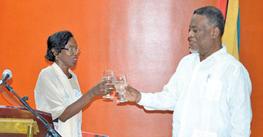


Winners of the Miss/Mister Talented Teen Pageants at
Avenue, Georgetown (Carl Croker photo)
Tuesday, july 8, 2014| guyanaTimesgy.com

Tuesday, july 8, 2014| guyanaTimesgy.com
The Port of Spain-based Caribbean Court of Justice (CCJ) has a new Registrar and Marshal.
Guyanese national Jacqueline Graham, who took up the post from July 1, is an Attorney with an MBA in Finance (University of Manchester, UK), and an undergraduate degree in Management Studies (University of Guyana) and is a graduate of the Hugh Wooding Law School at St Augustine.
Before her appointment at the CCJ, Graham was the legal assistant to the Chancellor of the Judiciary of Guyana and the Registrar of this country’s Court of Appeal.

As Registrar of the CCJ, Graham is the Chief Administrator of the operations of the Court and also has responsibility for managing the financial portfolio of the CCJ.
The Court has a US$100 million revenue base provided by the member states of Caricom, which is managed by a Trust Fund. In judicial matters, the Registrar is responsible for
the receipt, issuance and management of court documents and processes, the taxation of costs and assisting the President and Judges in their official functions.
In addition to her legal training and work experience, Graham has worked in the banking and finance sector, as a Prosecutor in the High and Magistrates’ Courts of Guyana, and was employed by the private law firm, Interlaw Consultants.
She was also an Assistant Lecturer at the University of Guyana in the Faculty of Social Sciences.
“With her distinguished academic career and practical work experience, Ms Graham brings significant administrative capacity and a sound legal education to her job responsibilities at the CCJ,” said CCJ President, Sir Dennis Byron. (Trinadad Express)
Belinda Williams, 30, of D’Aguiar Park, Meadow Bank, was taken into Police custody following the discovery of a quantity of cocaine in ceramic ornaments at the Cheddi Jagan International Airport (CJIA) on Sunday.
The discovery was made by members of the Police Narcotics Branch and the Criminal Investigations Department (CID) during a routine search on the ornament pieces that were concealed in a box.
Forty-seven-year-old Baitoon Hussain, who is accused of kidnapping Yuvesh Bistonauth called “Baby Avi” was granted bail in the sum of $300,000 by Justice Brassington Reynolds after her Attorney Rodwell Jagmohan made an application for bail through the Berbice High Court.
Attorney Jagmohan, in his bail application, stated that the offence is a bailable one and that his client is not a flight risk. However, Prosecutor Renita Singh noted that the offence is a serious one. The infant was nine days old at the time he was kidnapped.
Singh added that Hussain lives at Mahdia and there is a possibility that she may not return

The ornaments were about to board the Amerijet Cargo plane about 10:00h when Williams was arrested and interrogated. She is expected to make her first court appearance today at the Georgetown Magistrates’ Courts. On Friday, three persons, including a US and a UK citizen were held at the CJIA after a quantity of cocaine was discovered in milk tins and milk packets.
The US citizen, Jermaine Carter,was remanded to prison until today after he pleaded not guilty to the charge which stated that on July 4, he had 7.057kg of cocaine in
The shipment of ornaments was destined for Ireland. A source confirmed that the cocaine was neatly wrapped in transparent plastic and hidden in the ornaments which were then stuffed with pieces of foam.
his possession for the purpose of trafficking.
The cocaine was concealed in three Kerry Gold Milk packets in his suitcase. He was nabbed by members of the Police Narcotics Unit and CID.
The UK citizen, who was reportedly trying to smuggle cocaine in milk tins, was intercepted by members of the Custom Anti-Narcotics Unit (CANU) as he was about to board a TravelSpan flight destined for the John F Kennedy International Airport (JFK).
He is also expected to make a court appearance today and will be charged with possession of narcotics for the purpose of trafficking.

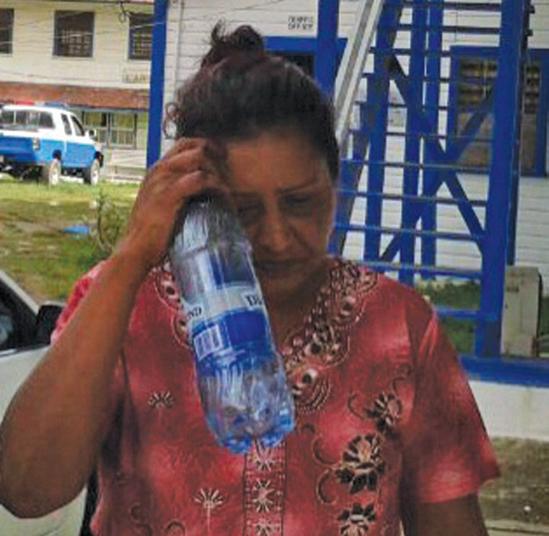
to court. In granting bail, Justice Brassington ordered that the woman report to the Whim Police Station every Monday.
On June 2, Hussain called “Debbie” of Chesney, Corentyne and of Mahdia was charged under Chapter 18:01 Section 19 for child
stealing and was remanded to prison when she made her first court appearance at the Whim Magistrate's Court before Magistrate Rabindranauth Singh.
On May 24, Hussain lured the mother of the child, Sandra McLean called “Pinky” to Rose Hall Town under the pretence that she had a special interest in the child. Hussain then took the young mother to the Port Mourant Market where she disappeared with the infant. The baby was found nine days later after Police, acting on an anonymous tip, closed in on a Chesney home where the woman and child were found. She was arrested and allegedly confessed to the crime and was remanded to prison. She made two court appearances and bail was refused on both occasions, prompting her Attorney to move to the High Court.
New 40 million-barrel oil discovery offshore Trinidad
Spanish oil company Repsol has announced the discovery of 40 million barrels of oil in its Trinidad and Tobago offshore acreage.
This oil is already on production and is adding to overall national oil production. The latest discovery is the fifth in the last two years and comes after discoveries by Petrotrin, Bayfield (now Trinity) and BP in 2012 and by Trinity in late 2013.
These discoveries are premised on a significant increase in exploration and development activity in both land and marine acreages over the last three years.
This is also reflected in the record levels of Foreign Direct Investment that the energy sector has experienced in the period 2011 to 2013.

These trends signal a resurgence of the upstream component of the national energy sector. The net result is an arresting of the decline in oil production, which declined sharply from 2006 to 2012.
According to Energy Minister Kevin Ramnarine, in the past four years, the Government has created an enabling environment for this level of investment through the introduction of a suite of fiscal incentives for companies operating in
the oil and gas industry. At present, there are eight rigs working in the waters of Trinidad and Tobago. This compares to one rig working in Trinidad and Tobago’s waters in mid2010. Two of these eight rigs are currently working for Repsol.
(Caribbean News Now)
Countrywide: Thundery rain showers are expected during the day, giving way to clear skies in the evening. Temperatures are expected to range between 24 degrees and 27 degrees Celsius.
Winds: East north-easterly between 4.47 metres and 2.68 metres per second.
High Tide: 13:03h reaching a maximum height of 2.32 metres.
Low Tide: 06:32h and 18:55h reaching minimum heights of 0.83 metre and 0.87 metre respectively.







BY VAHNU MANIKCHAND
The completion of the East Demerara Water Conservancy (EDWC) Northern Relief Channel has been further delayed as works on the Hope Canal Project are still ongoing.
Last month, Agriculture Minister, Dr Leslie Ramsammy had told Guyana Times that the EDWC Hope Canal Project is expected to be completed by the end of June; however, this deadline could not have been met due to several delays.
Minister Ramsammy on Sunday expressed his disappointment that there has been yet another delay in the completion of the project; however, he noted that all the time-consuming work has been completed, and only a small percentage of the work remains.
“If good weather prevails then we should finish the work within a month or so, but if not, it will take longer,” the Minister said. He added too that while he cannot give a specific date as to when the project is expected to be completed, he is scheduled to meet with the engineers to fix a date.
The Agriculture Minister noted that while the $3 billion project has experienced several delays, it has not exceeded its initial budget. Dr Ramsammy noted that with the completion of the bridge, half of the project’s work is done. He disclosed that the head regulator of the eightdoor sluice is 98 per cent completed while the outer sluice is 85 per cent completed. Most of the work is also done on the Canal; however, there are some areas in the Canal that were not dug.
The Minister explained that this is because persons, mostly students, from the neighbouring community use those areas as a short cut to get to Anns Grove via Douch Four and if the canal was completely dug out then
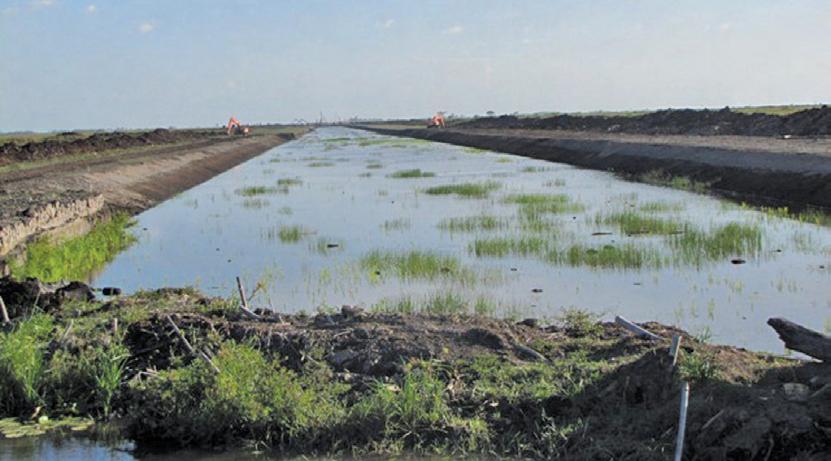
students would have had to walk all the way around using the public road.
Dr Ramsammy noted that a walk bridge will be built connecting the Hope New Scheme to Douch Four so that students would not have to face difficulties in getting access to their schools. He added that the bridge was not budgeted for, so the funds would have to be acquired.
Meanwhile, a wrench is currently being acquired for the head regulator of the eight-door sluice. According to the Minister, the piece of equipment has been purchased from a USbased company and they are awaiting its arrival. The wrench will be placed at the top of the regulator to help lift the gate of the sluice and will take approximately half of a day to be installed.
Foundation completed
As it relates to the outer sluice, the Agriculture Minister explained that the major foundation work has been completed; however, whatever small works left to done have been delayed by the rain. Additionally, a gate has to be installed and a walkway has to be built at the top of the sluice for the workers to access.
Dr Ramsammy further
stated that the current head regulator is manually operated; however, sometime in the near future, the Ministry would change to an automated system. The EDWC Hope Canal Project is an initiative of the Government to prevent excessive flooding along the EDWC, an area prone to floods particularly after heavy rainfall.
Following the 2005 floods, in 2008, excessive rainfall resulted in Regions Four and Five experiencing massive floods, and as such, then Agriculture Minister Robert Persaud through the National Drainage and Irrigation Authority (NDIA) commenced exploration of the Northern Relief Channel to address the situation.
The NDIA was mandated to establish a plan to undertake the necessary hydrological studies and an Environmental Management Plan. CEMCO/
SRKN Engineering, in association with Mott Mc Donald, was given the consultancy project to the value of $64 million for a 14-month period. The contract for the construction of the Hope Canal Project was awarded to Courtney Benn Contracting Services, DIPCON Engineering and BK International. The first mentioned contractor was tasked with the construction of the eight-door sluice while BK International was assigned with the construction of the three-gated head regulator.
DIPCON was awarded the contract of the $350 million overhead bridge, which the Agriculture Ministry commissioned on February 15 last. The Ministry also took the responsibility of the excavation of the 10.3 kilometre long earthen channel. (vahnum@guyanatimesgy.com)




Editor: Nigel Williams
Tel: 225-5128, 231-0397, 226-9921, 226-2102, 223-7230 or 223-7231. Fax: 225-5134
Mailing address: 238 Camp & Quamina Streets, Georgetown
Email: news@guyanatimesgy.com, sales@guyanatimesgy.com, letters@guyanatimesgy.com
As soon as the Football World Cup would have climaxed, Brazil will be hosting the Sixth Summit of the BRICS bloc of Brazil, Russia, India, China and South Africa on July 15-16. As part of a BRICS outreach strategy to emerging economies, a working session will be held on July 16 between the heads of states of BRICS and their counterparts from the governments of South American nations, including Guyana.
This is a signal opportunity for Guyana to recalibrate its foreign policy to take into account the rising importance of this bloc.
BRICS have 43 per cent of the world’s population and total foreign-currency reserves of US$4.4 trillion, which present them with the opportunity to reshape the present world order that has been practically unchanged since the end of WWII. It appears that the BRICS countries have achieved the confidence level to challenge the global order with the United States as the hegemonic power. The most recent conflict between the BRICS countries and the United States was at the spring meeting of the International Monetary Fund (IMF) in Washington in April when an agreed reform of the IMF failed because of a veto by the US Congress.
In 2010, IMF members had agreed to shift voting rights by six per cent in favour of the developing and emerging countries. The reason: over the past 10 years, BRICS countries increased their share of global Gross Domestic Product (GDP) from 18 per cent to 28 per cent. While it may have been expected that the Europeans would have dragged their heels on the proposals to reduce their voting rights, the US had given all assurances they would back the equitable shift.
In Brazil, the veto by the US Congress caused an outcry, further deteriorating the already strained relations between the two countries.
Of interest to Guyana and the other poorer countries invited to the BRICS Summit is that, in this Summit, BRICS will emphasise social inclusion and sustainable development. The debate will be informed by the theme, “Inclusive growth: sustainable solutions”. There will be concrete initiatives launched – a US$100 billion Contingency Reserve Arrangement (CRA) – and final details of the US$100 billion New Development Bank (NDB) will also be unveiled.
In last year’s BRICS Durban Summit, the leaders had approved the reserve fund to combat currency crises. All the BRICS leaders, excepting Brazil, have raised their hand for the Development Bank to be headquartered in their country. This issue might be settled at the summit.
India, Brazil and South Africa have also all demanded a permanent Security Council seat, and Russia and China endorsed their claim at the BRICS summit in Sanya, China in 2011. This cooperative spirit has been increased as the West has conspired to exclude Russia from the heavyweight of the old world order – G8. As the Ukraine crisis heightens, the BRICS countries are backing Russia even more – as they did on Crimea, and becoming less willing to accept US wilfulness.
Brazil views the participation of Chinese President Xi Jinping at the BRICS summit in Fortaleza as an absolute priority. His official visit is the first of a Chinese Head of State in Brazil and in the Region.
China replaced the US as the primary buyer of Brazilian products in 2009. Since 2012, the Chinese have also been Brazil’s most important import partner. But for Brazilian President Dilma Rousseff, the political and strategic cooperation with China is even more important than the growing trade between the two countries. Prime Minister of India, Narendra Modi is also expected to play a very influential role in the BRICS Summit – his first multilateral engagement.
Also of interest to Guyana are plans which the other South American nations are jointly exploring – the creation of a communications system to curtail US spying in the Region. Part of the final communiqué could call for an end to mass surveillance, like the that carried out by the US’s NSA.

and for the brave or unwary, an
Dear Editor,
In respect of what may be described as a spat between the Guyana Administration and the former Ambassador of the United States, Mr Brent Hardt, it is important to recognise that although Article 37 of the Constitution of the Cooperative Republic of Guyana is not without considerable relevance, this provision is not determinative.
What is determinative is the customary rule of international law which precludes a diplomatic envoy from interfering in the domestic affairs of the receiving state, a primordial obligation encapsulated in Article 41.1 of the Vienna Convention on Diplomatic Relations (1963) and also reflected in Article 2 (7) of the United Nations Charter.
It must be borne in mind that even though Article 8 of the Constitution establishes this instrument as the supreme law in Guyana, it is trite international law that the laws of a state may not be invoked as grounds for non-compliance with an international obligation: Article 27 Vienna Convention on the Law of Treaties (1969).
As a matter of law, a state may not even invoke its Constitution as grounds for non-compliance with an international obligation: Article 13 of the International Law Commission’s Draft Articles on the Rights and Duties of States.
In this context, reference may be made to Oppenheim’s International Law, 9th Edition, at page
1068 where it is stated: “(i) It is universally recognised that envoys (or other diplomatic agents) must not interfere with the internal political life of the state to which they are accredited.
“It certainly belongs to their functions to watch political events with a vigilant eye and to report their observations to their home state. But they have no right whatever to take part in that political life, to encourage one political party or to threaten another.
“It matters not whether an envoy acts thus on his own account or on the instructions from his home state. If he does so, he abuses his position, and the receiving state will either protest, or, in a more serious case, request his home state to recall him and ap-
point another individual in his place, or, if his interference is very flagrant, dismiss him.”
Oppenheim, an authoritative publicist on international law, further stated: “A line must, however, be drawn between functions which it is proper that a diplomatic mission may exercise, and those which it may not, although it has to be recognised that it is not always easy to draw such a line.” (at page 1067).
Ambassador Brent Hardt was due to leave Guyana on July 6 on determination of his assignment to this country.
Yours faithfully,
Professor Justice Duke Pollard Department of Law University of Guyana
Dear Editor,
The Guyana Police Force is responding to an article published in the Kaieteur News on Monday under the headline, “Recently promoted Police Sergeant caught with illegal 9mm pistol”.
The article, which deals with an incident where a Police Sergeant was found
with a 9mm pistol with 14 matching rounds at a wedding house at Cane Grove last Saturday night, states that “the Sergeant might have gotten away with being in possession of the firearm had he not discharged it indiscriminately during a drunken spree at the wedding house” and also that
“the cop opened fire during the celebrations sending guests scampering for cover”.
The Guyana Police Force would like to state that while the Police Sergeant is, indeed, under close arrest as the investigations continue, in order to ascertain the circumstances under which he came into possession of the firearm, it is refuting the allegation that the rank discharged the firearm during the wedding celebrations as is stated.
Ivelaw Whittaker, Police Public Relations and Press Officer
Dear Editor
Dear Editor
The People’s Progressive Party (PPP) is amused by statements made by the political Opposition that it is considering moving a no-confidence motion in National Assembly against the ruling PPP/Civic Government headed by President Donald Ramotar.
It is clear that the Opposition parties are running out of any ideas of substance and have now taken recourse to ‘man bites dog’ type of politicking based on rabid sensationalism and hot air.
The PPP is convinced that the only reason for such an enhanced level of absurdity by the Opposition is to divert public attention from their anti-national positions taken on the AntiMoney Laundering and the Countering the Financing of Terrorism Bill.
Both parties have come in for blistering attacks from the Guyanese people, including many of their own supporters, for their refusal to support programmes and projects that would create jobs and enhance the quality of life of the Guyanese people.
The PNC, in particular, has been greatly em-
barrassed by the damning disclosures coming out of the Rodney Commission of Inquiry (CoI) and is now seeking to use the proposed no-confidence motion as a diversionary tactic. Extending the life of the CoI has become a nightmare for them.
Regarding the AFC and Mr Nagamotoo, it is a known fact that he has always been driven by political vanity and unbridled craving for political office which eventually led to his separation from the PPP after he realised that his political manoeuvrings had failed to impress and find favour with the PPP leadership.
Granger is also on shaky political ground following his weak leadership which has created a political schism in the party, with his confrontational approach to his Linden constituents and other radical extremist elements in the party.
It is clear that Granger is trying to salvage his sinking image by making outlandish statements which are far removed from reality on the ground insofar as his influence and popularity are concerned.
The fact is that both the
AFC and the APNU are basking in the glory of their combined parliamentary one-seat majority which they fully well know would not continue in any future elections. The statements by the Opposition are, therefore, nothing but the work of a politically bankrupt Opposition intended to make up for their pathetic performance in and out of Parliament rather than out of any clear and wellthought-out position.
Statements by the AFC that it is receiving huge amounts of positive feedback from stakeholders lack credibility and are meant to deceive the public who are becoming increasingly tired of its deception and obstructionist behaviour. The PPP calls on the AFC to name the ‘stakeholders’ it claims to have consulted on the noconfidence proposal.
The PPP challenges the Opposition parties to demonstrate their testicular capacity by giving effect to their stated desire for a no-confidence motion in Parliament, failing which they should shut up and forever hold their peace.
PPP/C Freedom House
Dear Editor,
The Georgetown Chamber of Commerce and Industry (GCCI) urges our political policymakers to engage in constructive dialogue in order to arrive at agreement on the important issues facing our economy and social development. We do not subscribe to the notion that premature general elections are the solution to our current political impasse.
General elections are costly, time-consuming exercises which should preferably be conducted at the time when they are constitutionally due. The parliamentary parties must, therefore,
make every effort to find ways to discuss, negotiate and, reach some level of consensus on the issues critical to this nation’s growth and development.
The citizens of Guyana deserve no less an effort. This process of negotiation and agreement occurs in many comparative jurisdictions and it is, therefore, up to our political leaders to demonstrate resolve and maturity that lead to winwin outcomes.
Moreover, the elections discussions should instead be directed and concentrated at the hosting of Local Government Elections
(LGE), which were constitutionally due 17 years ago. In this regard, we echo the sentiments of the Private Sector Commission that the absence of LGE has made (and continues to make) it difficult for our businesses to operate. We also note that all discussions about constitutional reform seem to have fallen off the map.
The Chamber looks forward to a new level of political cooperation that ensures a prosperous and sustainable economic and social infrastructure.
Arnon Adams, GCCI
Dear Editor, Guyana has become one of the toughest tourist destinations to market to the international arena. I believe it’s evident to the eyes of everyone for some years now. Where is this ship heading? I honestly don’t know and no longer have a clue. However, I will now take the opportunity to share with Guyana a very impor-
tant current-day rule of life, which to my mind, will help tremendously with anyone’s personal self-development, even though the ship seems to be at sea with no clue of its destination.
Social graces are skills used to interact politely in social situations. They include manners, etiquette (the specific accepted rules within a culture for the application of uni-
versal manners), deportment, and fashion.
These skills were once taught to young women at a finishing school or a charm school. The focus of social graces has changed over the last century, recently with an emphasis on business etiquette and international protocol.
Yours faithfully, T Pemberton
Cognisant of media reports concerning protest activities by a number of persons on the Essequibo Coast on July 4, the Guyana Police Force is denying the allegation that Police ranks stripped the protest leader Mr Naithram, Chairman of the Essequibo Paddy Farmers’ Association, during their engagement with the protesters.
The Guyana Police Force states that on June 30, the Essequibo Paddy Farmers’ Association applied to the Police for approval to hold a protest march on July 4, commencing at 09:30h from the Bush Lot New Market to the Anna Regina High Bridge where a meeting was to be held. Approval was subsequently given by the Police.
The protest march and meeting commenced at 10:00h and proceeded peacefully with about 200 persons, that included farmers, participating. At the conclusion of the protest march and meeting, around 12:30h, most of the persons left, but some remained and began imbibing.
At approximately 17:15h, those who were imbibing and some others that included Mr Naithram boarded their motor vehicles, including tractors and trailers, and proceeded to drive along the middle of the main roadway in the vicinity of the villages of Reliance and Land of Plenty, Essequibo Coast, at a very slow rate.
This action resulted in a backup of traffic as other motor vehicles could not pass, and they continued their actions despite efforts by Police ranks to get them to drive on the left hand side of the road.
On reaching a short distance before the Land of Plenty Bridge, around 18:00h, the men continued breaching the law by proceeding to block the entire roadway with the use of their motor vehicles that included tractors and trailers and to set fire to tyres and other debris that were thrown on the roadway. A utility pole was also used to block the roadway.
By this time, the crowd had increased to over 400 persons and efforts by the Police to get them to remove the vehicles from across the roadway proved futile. Missiles comprising bricks, bottles and other articles were thrown at Police ranks in their attempt to remove the burning obstacles on the roadway, causing them to cease their efforts.
Personnel from the Guyana Fire Service at Anna Regina could not reach the scene owing to the blockages on the road.
The Police continued to appeal to the residents, but to no avail. The Police then arrested Mr Naithram, who was leading the protest, at which stage a number of other persons surged forward and accosted the ranks and took him away from the Police. During this incident, his clothing was torn and several Police ranks were thrown into a nearby trench.
Naithram then stood among the protesters and stripped himself, and several persons took his photograph. He then left the area and later returned dressed in a change of clothing.
The Guyana Police Force emphatically reiterates that Mr Naithram was not stripped by Police ranks. He took off his own cloth-
ing after he had been taken away from the custody of the Police by other protesters.
Around 22:45h, the Police once more appealed to the protesters, informing them that they were in breach of the law, but they steadfastly refused to remove, saying that they will only do so if His Excellency, the President comes to address their concerns.
The Police then used tear smoke to clear the unruly crowd and 19 men, including Mr Naithram, were arrested. They are presently still in Police custody.
Two tractors, four trailers, two motor cars, and two motor cycles that were among the vehicles used to block the roadway have been seized by the Police.
At approximately 00:10h on July 5, the blockage on the roadway was cleared and traffic commenced flowing freely.
A member of the Guyana Defence Force who was dressed in uniform, and in a motor vehicle that was caught up in the congestion caused by the blockage of the road, was assaulted by a number of protesters. He was later treated at the Suddie Hospital.
The Police are continuing to monitor the situation.
The Guyana Police Force recognises the rights of citizens to peaceful protest, but when such protests degenerate into a set of unlawful activities that infringe on the rights of other citizens, the Police will, of necessity, have to take the appropriate action in order to maintain law and order.
Ivelaw
Whittaker, Police Public Relations and Press Officer

By Kim ABrAhAm And mArney StudAKer-Cordner
“Have you ever wondered what’s going on inside your teenager’s head?” What was she thinking when she made that choice? Why won’t he listen to what I’m telling him? It can seem as if an adolescent is completely wrapped up in a separate world, feet planted firmly in the air instead of on the ground. As parents, we often come away bewildered or frustrated when our teen’s perspective seems so utterly different from our own. Parenthood is an ongoing lesson in learning to fearlessly let go of trying to control someone you would give your life to protect. It’s normal to feel like communication is difficult during your child’s adolescence. Your teen may not have mastered the art of communicating his thoughts and feelings yet, and sometimes you may feel like you have to “guess” at what he’s experiencing. This is especially true if a teen is defiant, arguing and fighting against your efforts to support him. Listening to a teenager without trying to fix or change what he’s thinking can be difficult – after all, as parents we guide and teach. But sometimes all they really need us to do is listen and hear what they’re trying to say. A word of caution: the opinion of one (or some) teens is not necessarily the opinion of all! Each child is unique. We asked a sample of teens the following question: “If you could tell parents one thing – just one thing – and know that they would listen and truly understand, what you say?”
Seven things your teenager really wants you to know
Stop trying to fix things for me.”
Adolescence is a time full of changes: physical, mental and emotional. When we see our children struggling, it’s tempting to jump in and offer solutions, even if they are well-intended, but too much focus on
what is “wrong” can leave him feeling as if there is something wrong with him. Before stepping in with suggestions on how your teen can do things differently, ask yourself: “Is this something I truly need to fix for my child? Is it a “Big” thing or a “Minor” thing? Is it a legal or safety issue?” If not, instead of jumping in to fix

things, offer a comment of support: “I’m sorry you’re going through that right now. Is there anything I can do to help or support you?”
“Think back to what it was like when you were a teenager. How did you feel?” If someone offered you money to go back and relive your adolescence, would you? Most of us wouldn’t! Think back for a moment about what it was like: conflict with parents (which is supposed to be “normal” but still hurts); peer pressure; falling out with friends; homework; being told what to do by every adult in your life; acne, social awkwardness. The further we get from adolescence, the less we remember the intense emotions with which we ourselves also struggled at times (or for some of us, most of the time). Your teen has the same type of struggles – maybe more, maybe less.
didn’t…you’ll get your chance to punish me again.” This teen’s comment says it all. No one likes being reminded over and over again of their past mistakes. So when the issue is over, let it be over. Don’t keep dragging up past mis-
me.” What this teen is really saying is, “Even when I use the coping skills I’ve learned, I still feel awful.” And that can be true. When your teen feels like “nothing works” and is ready to give up, that’s the time she needs your encourage-


“I make a lot of mistakes. And I take the consequences that I get. After I do the consequences, the lectures need to stop. Trust me that I learned. And if I

takes. And if another incident happens again, give the consequences you originally laid out. As James Lehman says, “Act as if you are the CEO of your family. Stay objective.” A good CEO doesn’t bring his or her workers into their office and remind them of all their past mistakes if they want to see good results.
“Sometimes coping skills don’t work for
ment and support the most. Unfortunately, hopelessness can also look like anger or irritation, which can push our buttons as parents. When your teen is struggling and seems to be taking it out on you (or her brother, or the family dog), step back before getting drawn into an argument over how she’s handling things. She may need your support in using those cop-

ing skills she’s learned “I’m as good as my brother; I’m just better at different things.” It’s easy to fall into the trap of comparing our children. “Why can’t you be more like your sister? She always turns in her homework and she’s getting all As!” But everyone has different talents, capabilities, strengths and weaknesses. If you were constantly compared to a co-worker at your job, you would likely come away angry and frustrated, too. It would also tear down that relationship as you came to resent the co-worker who was held up as better than you. Resist the urge when you’re tempted to use a sibling as an example of the behaviour you’d like to see in your teen.
“Can’t it just be about me sometimes? And can’t that just be okay?” Yes, adolescents typically appear to be wrapped up in themselves, sometimes to the point that they don’t seem to think of others. While we want to help our children learn empathy and step outside of their own experience to understand how their behaviour impacts others, there are times when they just need to know we understand. A hug, a pat on the shoulder or a simple, “I’m sorry you had a hard day,” can go a long way.
“Stop trying to control me.” Parenthood is an ongoing lesson in learning to fearlessly let go of trying to control someone you would give your life to protect. Watching someone you love make choices you believe are wrong is one of the hardest things to go through in life. It can leave you feeling helpless and afraid. But in reality, you don’t control your teen. In fact, you haven’t controlled your child from the moment he was born. (If you could, there would be no crying, no waking up in the middle of the night, and no tantrums.) You can comfort, soothe, encourage, give consequences, love, support, offer suggestions and guidance. But ultimately, your child will make his own choices. (Excerpt from empoweringparents.com)
A10-seater Islander aircraft piloted by Captain Orlando Charles skidded off the Monkey Mountain Airstrip seconds after touching down on Sunday morning.
The aircraft with registration number 8R-GGY received severe damage, but no injuries were incurred.
Guyana Civil Aviation Authority (GCAA) Director General Zulificar Mohamed told Guyana Times that a team of investigators was dispatched to the location of the accident just after midday on Sunday.
He confirmed that the accident occurred about 10:00h.
Mohamed related that the aircraft left the Ogle International Airport on Sunday morning, made two stops at Omai and Mahdia and it was while landing at Monkey Mountain, it ran off the runway. It is not clear if
it was raining at the time of the accident.
Mohamed further stated that the aircraft has received substantial damage. He said another aircraft in the area would have received the distress call via radio and would have alerted the officials who responded immediately.
GCAA, in a release after the crash was confirmed, said a team has been dispatched to Monkey Mountain, Region Eight (Potaro/Siparuni) to determine what caused the Britten Norman Islander aircraft to run off the airstrip there.
The twin-engine aircraft, the release added, was damaged but the extent will be confirm upon arrival at the scene. The aircraft is owned by Domestic Airways, the release added.
In June, an Air Services Limited (ASL) aircraft skidded off the Paramakatoi
Airstrip and crashed into a fence. It was reported that the Pilot tried to avoid a herd of cattle that was running across the airstrip as the plane was about to land.
The 8R-SUP Cessna 206 was shuttling food items from Mahdia when on approach to the airstrip, the Pilot encountered a strong cross-wind.
There were no passengers onboard and the Pilot was not injured. In light of the incident, members of the Guyana Aircraft Owners Association have renewed their calls for the Government to effectively handle the various inefficiencies in the aviation sector. One of their concerns was for the Government to maintain the interior landing strips. The Government has made provisions for these in the national budget, but the funds were voted down by the Opposition.
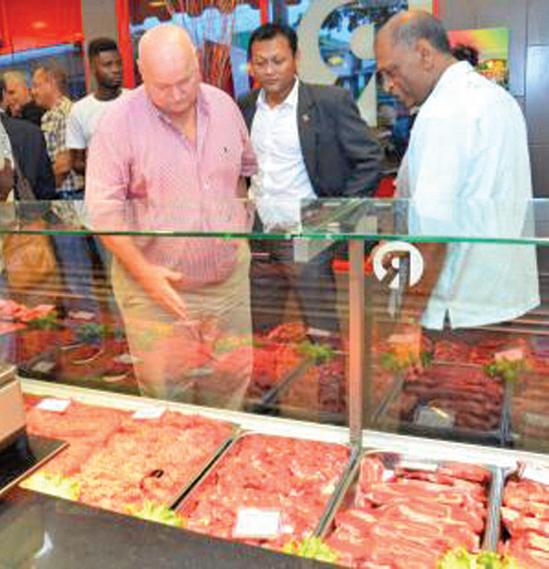
entrepreneurs are already investing in oxygen production, mining and tourism in Guyana, the Waterkant News reported.
Padarath is impressed by the agricultural sector of Guyana and said it looks promising for Surinamese investors.
Besides the bureaucracy that investors allege, they are also complaining about outdated and unfair investment laws. Rudisa recently won a case at the Caribbean Court of Justice against Guyana for unfair business practices. (Caribbean News Now)
Surinamese investors have their eyes set on neighbouring Guyana, where they are discovering more and more investment opportunities; however, they are very disappointed in the bureaucracy here, according to Paramaribo’s Waterkant News.
“Guyana is our main goal,” said Anil Padarath, board member of the Chamber of Commerce and Industry of Suriname.
While there are some setbacks in establishing a business quickly, investors said this is not discouraging them from expanding their businesses here.
According to the Chamber of Commerce of Suriname, in the first quarter of this year alone, more than $30 million of products were exported to Guyana. The chamber wants nothing
more than to encourage this trend.
“Guyana is very lucrative for Suriname. There is a good market for quality products from Suriname and there are many opportunities,” said Padarath.
Investing and setting up businesses in Guyana is becoming more widespread, he said.
“Rossignol Butcheries has been successful in Guyana,” said Padarath.
The Surinamese company opened last year in Guyana, a state-of-theart meat market and bakery, the first of its kind in Guyana. They also sell Dutch cheese, which is a favourite here.
Big names like Rudisa Beverages and Fernandes from Suriname are also in Guyana. The insurance company Assuria made its first overseas expansion into Guyana. Surinamese
Local Government and Regional Development Minister Norman Whittaker and City officials met with residents of Section ‘M’ Campbellville to get them involved in the massive City clean-up exercise in August.
The Minister was accompanied by Head of the Solid Waste Management Unit Gordon Gilkes and other City officials.
During the meeting held at the Campbellville Secondary School, residents raised concerns affecting their community and spoke about the critical works in the area which need to be undertaken in the fastest possible time.
One resident Oseyi Nedd, who said he spent his entire life in the community, called on the relevant authorities to look into the issue of clearing the alleyways and drains there. Nedd said while growing up, he was able to traverse the many alleyways in Campbellville freely.
“When I was small, we used to go and catch fish in all them drains in this area, now we can’t even walk through the alleyways, all over block up with garbage and the drain block up too.”
According to Nedd, the clogged drains and garbagefilled alleyways are responsible for the flooding of the community. Another resident Trevor Kennedy also expressed similar sentiments about the poor drainage in the community. Kennedy said the community is in urgent need of help as they are forced to endure flooding whenever it rains. He, however, pledged that after consultation with residents, they are committed to giving whatever support is necessary to clean-up their community.

Residents having been told that the $500 million clean-up exercise is a multistakeholder one, called on the relevant authorities to look into the possibility of putting in speed humps in some streets in Campbellville.
Building clause
The issue of persons not adhering to the building clauses of the City Council was also raised. Some residents believe the Council should look into the issue of persons who are putting up new structures, to ensure they refrain from blocking main drains, as this is contributing to flooding. Meanwhile, Gilke, addressed many of the concerns raised by the residents and he promised that the relevant authorities will do all they can to remedy the situation.
Also, Minister Whittaker, in his comments to the residents, called on them to play their part in the community’s clean-up exercise. The Minister told the residents that they all contribute in one way or the other to the sanitation and environmental issues that affect them.
Minister Whittaker, however, informed the residents that he thought it best to hear from them to determine what is most needed in their community. According to the Minister, while they may not be able to fix the entire problem, it is important that they address the most critical aspects.
A Technical Committee comprising representatives from different ministries and agencies has been established to spearhead the city’s clean-up exercise. The Local Government Ministry will be the executing agency for this exercise while stakeholders include the Tourism, Natural Resources, Agriculture, Public Works and Housing and Water Ministries; the private sector; City Council; and civil society, including non-government organisations and volunteer groups. Works to be undertaken include the desilting of main canals and drains in the city, the rehabilitation of the Le Repentir Cemetery, restoration of kokers and sluices which were out of operation and the general cleaning up of Georgetown and its environs.
Michelle Cole launches “Lotus” for Sesame Flyers Carnival
International designer and Corporate Executive of her brand “Colefacts”, Michelle Cole has recently launched her new costume line “Colefacts Carnival” in New York City.
Her first costume collection “Lotus” for Sesame Flyers will be featured in this year’s Labour Day Parade on September 6, on Brooklyn’s famous Eastern Parkway.
Cole is a trendsetter in creative fashion; her designs display statements of elegance and class. They are simply irresistible. She is no stranger to the fashion world.
Known for creating showstopping couture gowns, jewellery, swimwear and readyto-wear fashion, Michelle’s Colefacts has been featured in numerous fashion shows across the globe and worn by pageant contestants, finalists and queens.

Pink, yellow and gold are the official colours for Michelle Coles “Lotus”. Her designs are all handmade and eco-friendly. Colourful feathers with gold accents complement the beautifully crafted wire headpieces.
Michelle’s “Lotus” for Sesame Flyers provides options for all body types for both men and women. She loves creating her deigns with natural fabrics and specialise in hand designed, painted and decorated fabrics.
Her ability to create such exquisite and fashionable designs has taken carnival fashion to the next level. Currently, settling in New York, Michelle continues to shape and market her brand to fashion houses and various high-end runway events. She is currently sits on the committee of Miss World Guyana as one of its Executive Directors.
Prime Minister Samuel Hinds said the unresolved border controversy with neighbouring Venezuela are robbing the countries from making a bigger contribution to the development of their peoples.
Hinds made the remarks at a reception to mark the 203rd Independence Anniversary of Venezuela over the weekend. Prime Minister Hinds reiterated Guyana’s support towards preserving the Spanishspeaking country’s democracy, even as he saluted the Government and people of the Bolivarian Republic.
At a cocktail reception held at the New Thriving Events Centre, Lamaha Street, Georgetown to celebrate the occasion, Prime Minister Hinds said the observance serves as a historic reminder of the fulfilment of the dreams and aspirations of regional hero Simon Bolivar for an independent nation.
Common interests
“His aspiration has also been fulfilled through the formation of the Union of South American Nations (UNASUR) and the Community of Latin American and Caribbean States (CELAC).” The Prime Minister noted that Guyana
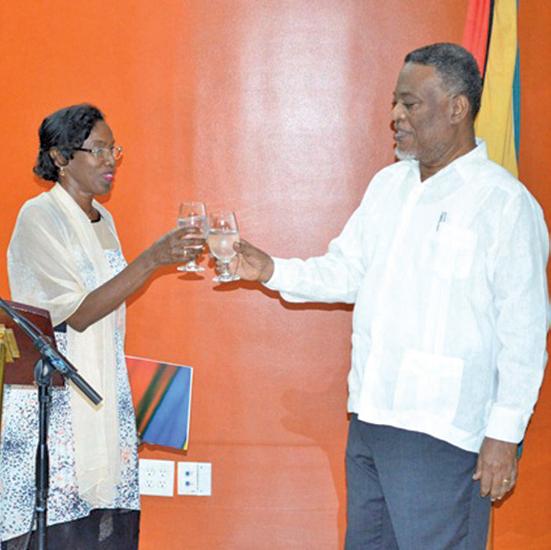
and Venezuela have been able to take advantage of these integration mechanisms to promote the common interests of the South American continent and the wider Latin American and Caribbean Region.
Prime Minister Hinds cited that Guyana joining UNASUR and CELAC shows its support for the preservation of the democratic process of Venezuela.
“I wish to reiterate that support tonight; the commitment to the principle of
comity among nations, nonintervention in the internal affairs of sovereign states, promotion of democracy and the peaceful co-existence of all nations remain the cornerstones of Guyana’s foreign policy.”
Prime Minister Hinds added that even as Guyana is collaborating in the regional effort, so too has the Government worked to maintain stability in its bilateral relations.
“We have been able to maintain a viable and mu-

tual beneficial agreement for the trade of rice and anticipate that in the near future that our trade relations will expand to include nontraditional products.”
It was noted that the establishment of a direct air link between the countries through Conviasa Airline would certainly serve to promote more people-to-people contact, as well as support the expansion of the movement of goods.
He alluded to the fact that Guyana has also continued to benefit from the PetroCaribe agreement with the provision of credit on preferential terms for the purchase of fuel and petroleum products.
“While we strive to advance our functional cooperation programme, we cannot sweep aside existing irritants that threaten the stability of our relations. Guyana will continue to pursue with Venezuela a peaceful resolution of the controversy over the claim by Venezuela that the 1899 Arbitral Award which settled the land boundary between our two countries is null and void.”
The Prime Minister said it is the Government’s hope that the process can be expedited, which will eventually lead to the delimitation of the maritime boundaries between the two countries.
“These unresolved issues continue to hinder our ability to freely develop our resources in the interest of the people of Guyana and restrict us from making a greater contribution to the welfare of the people of the wider Latin American and Caribbean Region.” To this end, the Prime Minister conceded that Guyana is prepared to work with Venezuela in a spirit of camaraderie and good faith.
Struggles
Meanwhile, Venezuelan Ambassador to Guyana, Reina Arratia Diaz, in her message, said the commemoration is as a result of struggles, battles, and victories, which continue in the country today with the aim of achieving the dream of its liberators and the supreme leader of the revolutionary process, Hugo Chávez.
“Especially today, one year and four months since his physical parting; a man that gave everything to have a free and democratic homeland, without interference from foreign powers.”
The Ambassador noted that the revolutionary Government of President Nicolas Maduro continuously faces media attacks on the national and international levels, from an internal oligarchy and external powers who want to overthrow a democratic Government, legitimately constituted and elected by the majority of Venezuelan men and women.

...on population
This newspaper ran an interesting feature on the census showing our population’s pretty much plateaued for over three decades. There’s no question that migration’s a big causative factor, but the article highlighted the unremarked effect of plunging fertility rates.
Back in the 1960s, the fertility rate was 6.1 children per female compared to 2.33 nowadays. Now we can’t blame this only on the old joke that our parents didn’t have TV back then!! If we want to talk about the effect of TV on the libido... the shows streaming into our living room aren’t just “hair raising”... there should be a population explosion now!
Fact of the matter is that couples are having fewer children. This is an effect of a Western “education” stressing the lack of “freedom”, especially on mothers, when they get children. This isn’t the case everywhere or with every group. Muslims, for instance, are having more children than most in whichever milieu they’re found.
And this brings us to the question the article posed: what are we gonna do about our population implosion? And it IS an implosion when you consider we’d have at least double the population if everything was “regulah”. A stagnant population leads to a stagnant economy. Following the justmentioned example, we should encourage larger families. The days of fears of a “population explosion” were a case of “crying wolf”’ as far as we’re concerned. It should now be the duty of every patriotic Guyanese family to produce at least six children – two for replacing themselves and four for the country!
As for migration, that might slow down but we’re not going to stop that anytime soon. So we suggest, if we can’t beat them – let’s join them. Let’s encourage immigration into Guyana. This Eyewitness can just hear the snickers at that suggestion. “Who’s gonna want to immigrate to Guyana??” Well, the answer is – a whole lotta people. If we offer the right incentives. And what are those incentives?
Well, for one, our land. As the corollary to the Jagdeo Initiative, we’ve announced millions of acres of land for farming available to Caricom citizens. All we have to do is to make the same offer to farmers from China and certain parts of India like the Punjab.
Pretty soon, we’ll have to worry about being too crowded. But wealthy!
...in diplomatic law
You’d hope that some of these legal types in politics would still have some pride in their training and not prostitute it away for pelf and power. But don’t hold your breath – based on the stand Khemraj Ramjattan from the AFC and Ralph Ramkarran, Senior Counsel, took on the US Ambassador’s interference in Guyana’s internal politics.
Ramjattan, who’d been kicked out from the PPP for “carrying news” to the US Embassy on PPP’s Ex-Co deliberations, not surprisingly backed the US Ambassador to the hilt. Even called for the President to apologise!! Ramkarran, who’d confirmed Ramjattan’s transgressions in the PPP’s Ex-Co, but who’s also out, now says there was “precedent” for the US Ambassador to pronounce stridently on our internal politics.
But at least there is one lawyer left standing, Professor Duke Pollard from UG. The gentleman pointed to Oppenheim’s International Law, 9th Edition, at page 1068 where it is stated: “(i) It is universally recognised that envoys (or other diplomatic agents) must not interfere with the internal political life of the state to which they are accredited...
“But they have no right whatever to take part in that political life, to encourage one political party or to threaten another...”
...on diplomatic overreach
And it concludes, “If he (the ambassador) does so, he abuses his position, and the receiving state will either protest, or, in a more serious case, request his home state to recall him... or, if his interference is very flagrant, dismiss him.”
The legal pair of Ramkarran and Ramjattan should hang their heads in shame.
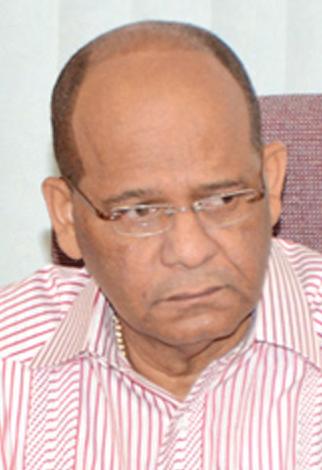
The Ministerial Task Force on Trafficking In Persons said it will be intensifying efforts to combat the scourge with countrywide activities aimed at arresting offenders and sensitising those vulnerable.
As part of its “National Plan of Action for the Prevention and Response to Trafficking In Persons”, the Task Force over the next two years will not only target interior locations, but urban communities as well. In its just released Plan of Action, the Task Force said it will conduct awareness and sensitisation sessions in the 10 administrative regions of Guyana, pointing out that the Human Services and Social Security Ministry will provide support to the 38 individuals who were trained in the Training of Trainers Workshop on Trafficking In Persons (TIP) back in September 2013.
From now until July 2015, approximately 5000 TIP awareness booklets will be distributed in Guyana, thereby equipping school-
children with the requisite information needed to aid in the fight against human trafficking, a scourge which continues to plague countries the world over.
Additionally, awareness and sensitisation sessions will be conducted in 30 secondary schools across the administrative regions, while similar activities will be geared at getting youth groups onboard. These awareness sessions will allow for the training of 100 youths who will be tasked with the responsibility of incorporating TIP awareness and prevention activities within their routine programmes. The first five youth groups will receive their training from JulySeptember 2014, while the other batch will be trained from February-May 2015.
Training
Additionally, during the period June-October 2014, 100 civil society representatives will be trained in identifying and reporting TIP. On Human Trafficking Awareness Day, January 11, 2015, the Task Force will start the year off with a rally, highlighting the negative impacts of TIP on children and women in particular.
By the end of December 2015, the Task Force is hoping to establish Action Task Forces in all 10 administrative regions to foster cooperation among the on-theground representatives from governmental and non-governmental agencies and faith-based organisations in TIP prevention activities.
“In addition to activities designed to prevent Trafficking In Persons, protecting survi-
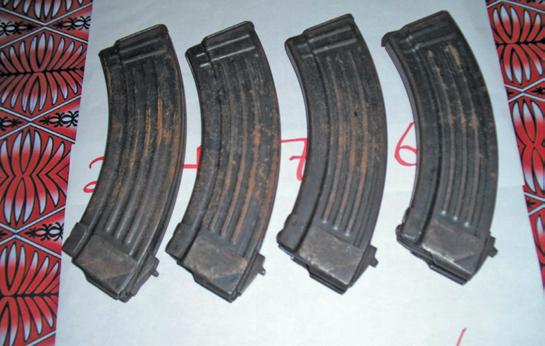
Two men are in Police custody assisting with investigations into the discovery of four AK-47 magazines and a quantity of spent shells in Albouystown on Saturday evening.
The discovery was made by Police ranks during a search on a house at James and Victoria Streets, Albouystown about 19:30h.
In addition to AK-47 spent shells, there were
“Together we will fight to defend the achievements made, Guyana and Venezuela share their commitment to respect the principles of international law, which allow both countries to coincide in the frameworks of regional integration mechanisms that are sustained in the self-determination of the people; equality, mutual respect, solidarity, cooperation and rejection of intervention from foreign powers in our internal affairs.”
The Ambassador said it is within these mechanisms, stand PetroCaribe, UNASUR,
vors of Trafficking In Persons is an essential part of any counter-trafficking response. It also means keeping alleged survivors of Trafficking In Persons safe, while meeting their immediate basic needs, for example, shelter; medical, psychological and psychosocial care, food; and clothing,” the Task Force said.
It was explained, that the Government-led organisation would be putting the requisite systems in place to ensure 100 per cent of the survivors of TIP are reintegrated into society through the provision of employment and educational opportunities.
In addition to the menu of support that will be given to victims, the Task Force said proactive measures will be instituted to identify, rescue and refer victims of TIP. Additionally, the Task Force will be moving to a tracer system and database of the TIP survivors.
Due to the importance of prosecution in the fight against human trafficking, the Ministerial Task Force will be enhancing the capacity of law enforcement to combat TIP and increase intelligence gathering to facilitate proactive law enforcement. According to the Action Plan, approximately 35 Law enforcement officers will be trained, thereby paving the way for a 50 per cent increase in surveillance of suspicious business and 50 per cent increase in conviction rate.
TIP scouts will also be trained and dispatched to all of the administrative re-
gions with the aim of targeting bars, kaymaoos and hotels. The Task Force was keen on pointing out that visits will be made to the Guyana Geology and Mines Commission (GGMC) check points and other vulnerable interior locations to observe activities and simultaneously develop strategies to eliminate TIP.
“The Ministerial Task Force on Trafficking In Persons recognises the complexity of combating this phenomenon and will continue to collaborate with members of non-governmental organisations and other stakeholders to heighten awareness of the populace and to ensure that

perpetrators are brought to justice.”
To guarantee a successful fight, the Task Force stressed that emphasis will be placed on partnership, and as such, it will continue to collaborate with organisations in the areas of prevention, protection and prosecution.
and CELAC, in which both countries, along with others of the Region, work to consolidate Latin American and Caribbean unity.
She added that on the level of bilateral relations, Guyana and Venezuela have signed a series of agreements on economic, social, political and cultural matters which have enabled them to advance in the construction and development of the two nations.
“The validity and efficiency of these agreements are the clear guarantee of our co-existence as neighbouring
countries and friends.”
She added that the relations are also an expression of what was stated before and is evident in the progress of the commercial activities between Venezuela and Guyana, which have materialised with the rice agreement and the supply of oil under the framework of the PetroCaribe.
“This interest in the commercial aspect has been strengthened with the launching at the beginning of the year, of the Georgetown/ Venezuela air connection through Conviasa Airline.”
The Food and Agriculture Organisation (FA)
Food Price Index was down for a third consecutive month in June, a decline mostly influenced by lower wheat, maize and palm oil prices that reflected ample supplies and improved global production prospects for these commodities.
According to the latest FAO Crop Prospects and Food Situation report, the outlook for global production of cereals – a staple food in many countries – improved further with upward revisions to coarse grains and wheat supply forecasts for 2014/15.
FAO’s latest forecast for world cereal production in 2014 now stands at 2498 million tonnes (including rice in milled terms), 18 million tonnes up from the previous figure in June, although still one per cent (23 million tonnes) below last year’s record output. The recent upward revision reflects improved production prospects for coarse grains and wheat crops, particularly in the United States, the EU and India.
However, despite increased supplies and lower average prices, many people in conflict and drought stricken areas require external assistance for food, said the report which has a special focus on developing countries and is published by FAO four times a year.

Index and 1.4 points (0.7 per cent) more than in May, a reflection of constrained world supplies.
other ammunition of various calibres.
At the time of the search, two men who were occupants of the house were arrested. Based on information received, the magazines and spent shells were found hidden in one of the rooms.
The men reportedly told Police they were not connected to the ammunition and were unsure how it got there. The Police are continuing their investigations.
She noted too that Guyana’s expression of solidarity has accompanied the Venezuelan people, always especially in very sensitive times such as the memorial events marking the first anniversary of the physical passing of Hugo Chávez.
“Finally, I wish to highlight the actions that both countries have consolidated in matters of education, cultural and sport cooperation recently with the participation of 33 Guyanese athletes at the Third South American Beach Games in Vargas State, last May.”
The Food Price Index, based on the prices of a basket of internationally-traded food commodities, averaged 206.0 points in June 2014, down 3.8 points (1.8 per cent) from May and nearly six points (2.8 per cent) below the June 2013 level. The index had risen to a 10-month high of 213 points in March 2014, but fell in April, May and June, mainly as a result of lower cereal, vegetable oil and dairy prices. Sugar prices also declined in June from May, but remained up from last year, while in contrast, meat prices on average increased from May.
The FAO Cereal Price Index averaged 196.2 points in June, down 10.9 points (5.2 per cent) from a revised value in May and 36.1 points (15.6 per cent) below last year. The slide was mainly caused by lower wheat and maize prices, both of which fell by close to seven per cent amid further improved crop prospects and diminishing concerns over possible disruption of shipments from Ukraine.
Vegetable oils averaged 188.9 points in June, down 6.4 points (3.3 per cent) from May, in part reflecting a nine-month low in the price of palm oil – the most widely traded edible oil. Meanwhile dairy prices averaged 236.5 points in June, down 2.5 points (1.0 per cent) over May, a less substantial decline than the previous three months. Meat prices however edged up, averaging 194.2 points in June on the FAO
While confirming the generally favourable crop production and supply outlook for 2014/15, the FAO Crop Prospects and Food Situation report warned that many people around the world face a situation of food insecurity. FAO estimates that globally, 33 countries, including 26 in Africa, are in need of external assistance due to a combination of conflict, crop failures and high domestic food prices. Strife in the Central African Republic has jeopardised crop production, which in 2013 declined by 34 per cent from the previous year. The number of people in need of food assistance was estimated in April 2014 at about 1.7 million, out of a total population of 4.6 million. The number of internally displaced persons as of late June, was estimated at 536,500 persons. Continued and escalating conflicts in parts of Eastern Africa are threatening local people’s access to food, while drierthan-normal weather conditions could threaten crops and livestock.
In Somalia, about 870,000 people are estimated to be in need of emergency assistance, mainly internally displaced persons and poor households in some pastoral central and northwestern areas.
In South Sudan, since the conflict started in mid-December 2013, the number of severely food insecure people increased dramatically to about 3.5 million, including 1.1 million internally displaced persons. The number of people estimated to be in need of humanitarian assistance in Sudan, mainly internally displaced persons in conflict-affected areas, has increased to five million. Adverse weather conditions and an escalation of conflicts in Syria and Iraq have negatively impacted on crop production and food security in those countries. In Syria, forecasts of about two million tonnes of wheat indicate a severe reduction in cereal crop production, while in Iraq where there are reports of deteriorating access to drinking water, food security conditions are likely to deteriorate.
Afather of one was on Sunday crushed to death by a falling tree at Frenchman Backdam, Essequibo River during a windstorm.
The accident occurred about 16:00h.
Dexter “Bogle” Dey, 26, of Lot 52 D’Urban Street, Georgetown, received injuries about the body and was rushed to the Linden Hospital Complex where he was pronounced dead on arrival.
When Guyana Times visited the man’s home on Monday, it was tightly locked, but upon inquiring, this publication was told that the relatives had gone to Linden to make arrangements to transport his body to the City.
This publication was also told that on the day of the incident, Dey and an-
other man were walking towards their camp when the top half of a tree broke and landed on him. The other man escaped unhurt. The wind was turbulent at the time of the unfortunate incident. Based on information received, Dey left home about three weeks ago for the interior for betterment and so that he can support his mother. He worked at Banks DIH and Carib Foods Limited before leaving to go into the interior.
From reports gathered, the young man did not inform any of his relatives that he was heading there, and it was until he arrived, he reportedly 'texted' his sister with the news.
The now dead man was described
as a very quiet and reserved individual. Attempts to contact his siblings proved futile. He leaves to mourn his mother and seven siblings.
A post mortem-examination is expected to be performed before the end of the week. Last year, Brian Smith, 50, of Aishalton Village, South Rupununi, Region Nine was killed after the branches of a tree he was cutting struck him on the head. The incident occurred at Bush Mouth, Aishalton.
It was reported that Smith was cutting a tree with a power saw, when branches struck him on the head as they fell. Smith was later pronounced dead on arrival at the Aishalton Hospital.
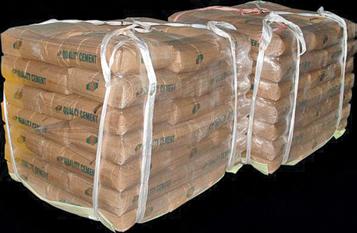
Trinidad Cement Limited Guyana Inc (TGI) has announced a $174 (8.7 per cent) increase in the price for the ex-terminal price of Portland Pozzolan Cement, which will take effect from today.
The company said it will be implementing this current adjustment in accordance with its phased approach as was previously indicated. A sack of the cement was being sold at $2000.
“Our last price adjustment was on May 1, 2013,” TGI said. According to the company, this current adjustment is a consequence of increases in operating cost, noting that over the last year, there have been increases in freight rates, the cost of spares, services and raw materials.
TGI
from today
“Upward movement in foreign exchange rates has also had a significant negative impact. The company has been absorbing these rising costs, but now finds itself in the position where it cannot continue so to do.”
According to TGI, in recognising that cement is a major element of Guyana’s economic growth, the projected increase has been kept to a minimum, “and we are pleased to state that our price still remains at the lower end of the tier when compared in a global context.”
The company said independent studies by Quantity Surveyors have confirmed that the total cost of cement in a standard dwelling house is no more than five to seven per cent of overall construction costs. Also in strong support of Guyana’s developmental goals, TGI stated that it will maintain its offer of a 20 per cent discount for first time homeowners under the Government’s low-income earners housing initiative. The company has been supporting this programme since 2010.
“TGI remains committed to providing a superior quality product at a very competitive price and to the delivery of exceptional service and technical expertise. The company takes this opportunity to express its sincere gratitude to all loyal customers for their continued support and looks forward to further strengthening and deepening its stakeholder relationships.”

De Hope Canal project just getta next deadline. That is deadline after deadline after de first deadline a long time ago. This project simply look like it line up fuh dead, so deadline getta new meanin now. But no body sure if de Hope Canal project should get another deadline or if dem should just consider it dead.
Even from de beginnin, dem had deadline after deadline fuh de whole project start in de first place. Now whah ever dem doin all de time can’t done yet. Dem gettin just like Rum Jhaat and Nagga Man who ain’t even start de no-confidence motion yet, much less done it.
De Hope Canal project turn like a overdue baby whah ain’t wanna come out he mother womb. Maybe this project shoulda begin wid “once upon a time”. But it gon never end wid “happily ever after” because it gon never end.
De Hope Canal project hopeless right now and de Guvament only hopin fuh de best. And de Minister hopin too, but he got some hopeless people wukkin pun this project. Whether dem wukkin or dem down tools is de same ting. All de hope gone down right in de Canal.
Well, every body got to be careful nowadays when dem usin de word “down”. One man drop down he pants in Essequibo and every ting had look down. In fact, when he look down, he couldn’t even see down nor see any ting down dey.
So when de Police tek he down to station, he had wanna bend down and lie down instead of sit down. But he realise that dem Police in Essequibo don’t get so low down unless dem wukkin down in GT by de market or down in Timehri.
Ting-a-ling-a-ling…friend tell friend…mattie tell mattie! But right now it look like all dem Police who misbehave gon go down!
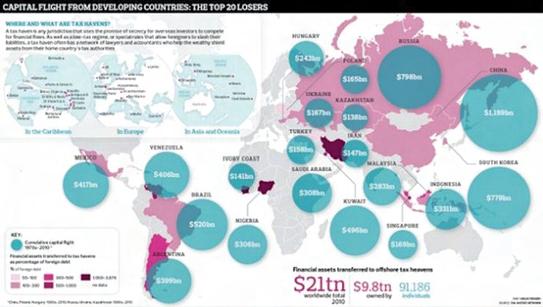
The US Foreign Account Tax Compliance Act (FATCA) is unlikely to contribute much to combating persistent tax evasion in Latin America, which will require more national and multilateral instruments, experts say.
FATCA, as it is better known, was approved in March 2010 and finally came into force on July 1 after a number of delays. It is a reciprocal agreement, which means that other countries may learn which of their citizens have accounts in the United States. The law requires Governments and financial institutions worldwide to report to the Internal Revenue Service (IRS) financial information about US citizens who are resident or have assets abroad.
“The limiting factor for developing countries is that it is bilateral. Mexico, for example, would benefit from receiving information about its residents who have accounts in the United States, but these residents may also have accounts in other jurisdictions,” analyst Andrés Knobel of the London-based Tax Justice Network told IPS.
Knobel and other experts consulted by IPS say that tax evasion and avoidance have reached such proportions that firm national
policies and multilateral instruments will be needed to combat them. FATCA could coexist with and support these. Knobel also complained that, although there is reciprocity between the US and its partners, the exchange is unequal. The US “demands more information from its partners but gives less. The information is supposed to be for tax purposes, but the authorities
30 per cent of any payments originating in or passing through US territory.
The IRS has registered over 77,000 institutions worldwide out of a total of between 200,000 and 400,000 that should adhere to FATCA. In Latin America, 3,800 institutions have come to an agreement with the IRS so far, while 800 have not. The US has signed bilateral agreements
decide what they use it for,” he said.
Under FATCA, banks, investments funds and other financial institutions must identify US citizens’ accounts abroad and notify the IRS of their account numbers, balances, names, addresses and US identification numbers. The law covers investments greater than $US50,000. Institutions that fail to comply risk the withholding of
with over 70 countries, in two categories. The first requires financial institutions to report information about US citizens to their national tax authority, which is to advise the IRS.
The second calls for the financial agency to report the information directly to the IRS. “FATCA has potential for preventing tax evasion, but better mechanisms are needed to process the information quickly and
take action as a result,” academic Benito Rivera, of the Faculty of Higher Studies at the National Autonomous University of Mexico, told IPS.
“Agreements have been signed, but fiscal paradises have not been touched, although some transactions have been identified,” he said. In its report on Tax Administration 2013, the Organisation for Economic Cooperation and Development (OECD) said that in Chile, taxpayers’ fiscal debt had increased continuously between 2005 and 2011.
Average growth during this period was 13 per cent. The country has a tax burden of nearly 20 per cent of GDP. Mexico, with a tax burden of 18 per cent, had similar growth figures, although data since 2010 are lacking. This is also the case with Brazil, which has a tax burden of 32 per cent, and Colombia, with 17 per cent. In Argentina the tax burden has fallen by 48 per cent, although the level of tax debt is still high. Its present tax burden is 33 per cent. The OECD estimates that at least 500,000 individuals in Latin America have a combined fortune of seven trillion dollars, with no certainty that they are paying appropriate taxes.
The Economic Commission for Latin
American and the Caribbean (ECLAC) puts income tax evasion at nearly 50 per cent in Argentina, 47 per cent in Chile, 64 per cent in Ecuador and 42 per cent in Mexico. The International Monetary Fund (IMF) has also warned of tax avoidance and evasion by means of “financial engineering”.
Fiscal paradises
In the document “Spillovers in International Corporate Taxation”, published in May, the IMF indicates that foreign direct investment (FDI) that leaves Brazil turns up in known fiscal paradises like the Cayman Islands, the British Virgin Islands, the Bahamas, the Netherlands and Luxemburg. In another example, it says that FDI arriving in El Salvador comes from countries like Panama and the Cayman Islands. “With FATCA, more information will be available, but there will be loopholes for rich companies and individuals to avoid the exchange of their information,” Knobel said.
He recalled that “for a long time, organisations have been asking for automatic information exchange. We asked for public registers of final beneficiaries, the real owners of any financial activity that takes place”. The US-Mexico FATCA agreement, signed
in November 2012, shows the disparity in the information provided. Mexico is required to report the total amount of interest, dividends and other income generated and paid by the account assets, as well as total income from sales of possessions that are recorded in the account. But the US will only inform Mexico of the total amount of interest paid on a deposit account, dividends or any other source of income.
In the case of Chile, the national tax authority must ask US account holders for their tax identification number and written consent. It must report annually to the IRS the number and balance of non-consenting accounts. Under the agreement, the US “shall cooperate with Chile to respond to requests to collect and exchange information on accounts held in US financial institutions by residents of Chile”. There are at least 60 tax havens in the world, including US territories like the northeastern state of Delaware, which has big tax discounts. For this reason, Washington has negotiated favourable bilateral agreements. The Tax Justice Network’s 2013 Financial Secrecy Index ranks the US in sixth position, behind Switzerland, Luxemburg and Hong Kong, among others.

BY SVETLANA MARSHALL
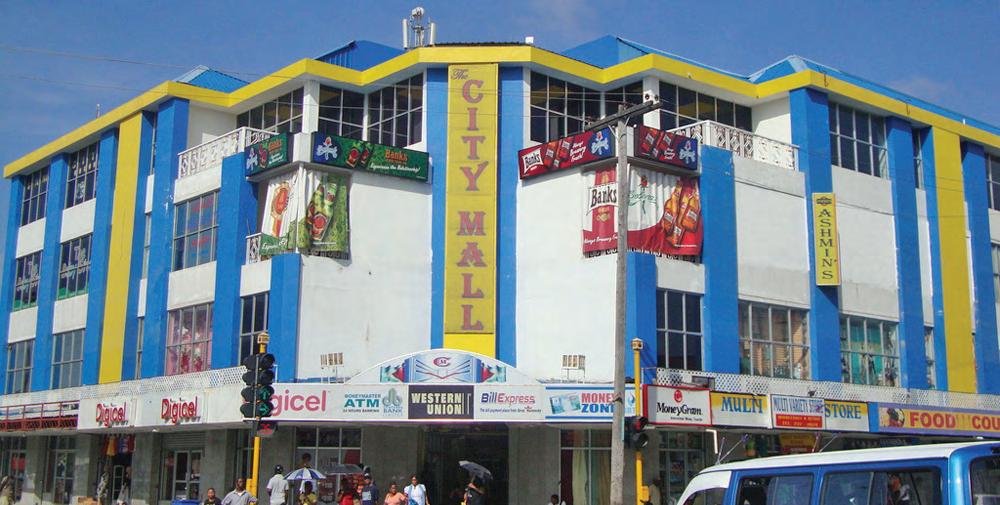
The number of buildings within the commercial sector has grown tremendously over a 10-year period. According to the Guyana Population and Housing Census 2012 Preliminary Report, the number of commercial buildings has increased by 26.4 per cent, moving 14,560 in 2002 to 18,537 in 2012.
According to the Bureau of Statistics, the distribution patterns remain the same when compared to 2002, pointing out that the number of business places had outstripped the level of growth of the building stocks when compared regionally.
Using Region Seven as an example, the Bureau of Statistics pointed out that the number of businesses nearly doubled with a recorded increase of 88.1 per cent. The increase in commercial buildings within the district was linked to the sharp rise in mining activities.
“The increase is an important indicator of economic growth in those regions, but would obviously require a more detailed survey of a
special type to ascertain the actual types of business activities that are being undertaken there,” the Bureau of Statistics stated in the preliminary report.
Significant increase
In Region One, there were 288 commercial buildings in 2002; but by 2012, the number increased to 433 while in Region Two, the number of businesses had dropped from 1203 in 2002 to 1077 in 2012. However, Region Three experienced significant growth jumping from 1885 in 2002 to 2672. Similarly, the number of business places increased from 6424 to 8745 in 2012 in Region Four, while there was a slight increase in Region Five, moving from 949 in 2002 to 1138 in 2012.
Regions Six, Nine and 10 experienced marginal increases while in Region Eight, there was a reduction in commercial buildings, moving from 117 in 2002 to 80 in 2012. However, in Region Seven, the commercial sector doubled with 662 businesses being recorded during the 2012 Census.
Overall, the country’s building stocks have increased by 16.9 per cent,
moving from 187,696 in 2002 to 219,509 in 2012. Regions Three and Four topped the chart, recording the highest increase in building stocks. According to the report, 13,120 new buildings were erected in Region Four since the 2002 Housing Census, increasing from 73,390 to 86,510 buildings. Region Three came in second with an increase of 8972 buildings. At the time of the 2002 Census, the coastal region building stock stood at 26,516, but jumped to 35,488 buildings by 2012.
The 2012 Census marked the 17th National Census of Guyana and Guyana’s seventh post-War National Census of Population and Housing. In conducting the census, Guyana joined the regional movement led by the Caribbean Community (Caricom) Secretariat, in compliance with the United Nations’ mandate to execute the 2010 Global Round of Censuses.
While the Bureau of Statistics has released the Guyana Population and Housing Census 2012 Preliminary Report, the detailed Census Analysis will be made public by the second quarter of 2015. (svetlanam@guyanatimesgy.com)
... motion
by
AFC reportedly a ‘damp squib’
Today is the deadline set by the parliamentary Opposition parties, A Partnership for National Unity (APNU) and the Alliance For Change (AFC) to decide whether they will be moving a no-confidence motion against the Government.
But, it seems as though the possibility of the motion being tabled is remote as APNU Leader David Granger appears downbeat.
When Guyana Times spoke to APNU Executive Member, Dr Rupert Roopnaraine on Monday, he noted that the parties will indeed be having deliberations today.
He said the parties are meeting to discuss the noconfidence motion, along with other possible “options” aimed at making Finance Minister, Dr Ashni Singh accountable for what has been deemed the “illegal spending” of $4.5 billion disapproved by the House.
Shadow Finance Minister Carl Greenidge has also signalled that APNU is making preparations to take the Finance Minister to court over the spending of the funds.
Greenidge is contending that the reasons cited by the
Minister for the use of the funds are inadequate, claiming that if the Minister is to abide by Article 218 (3B) and approach the House in that regard, he would be wrong.
Greenidge explained that that Article only comes into play if a budget for the amount was not presented to the National Assembly.
No abuse
But the Government is insisting that it did not abuse the Contingency Fund, with Dr Singh contending that his actions were in keeping with Guyana’s Constitution.
“I maintain that this Government has used the Contingencies Fund in a prudent and judicious manner; in a manner that has met fully the requirements of the law,” the Minister said.
Alluding to Article 220:1 of the Constitution, Dr Singh said it provides for the Finance Minister to make advances from the Contingencies Fund if there is an urgent need for expenditure for which no other provision exists, while Section 41 of the Fiscal Management and Accountability Act of 2003 also gives the Finance Minister the “sole authority” to release monies from the Contingencies Fund.
“The Minister shall have the sole authority for the release of monies from the Fund… an authority which shall not be delegated. The Minister, when satisfied that an urgent, unavoidable and unforeseen need for expenditure has risen, for which no monies have been appropriated or for which the sum appropriated is insufficient or for which monies cannot be reallocated or provided for which cannot be deferred, may approve a Contingencies Fund advance as an expenditure out of the Consolidated Fund by the issuance of a drawing right,” Dr Singh
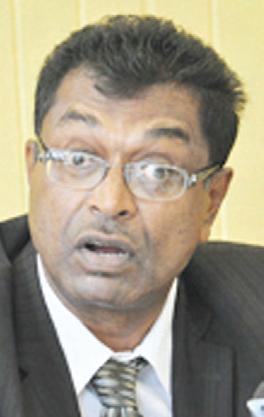
said.
AFC Leader Khemraj Ramjattan has signalled other routes that will be taken as it has also said that it will be filing an official Police complaint against the Minister for the spending of the funds.
No information
On Friday, Granger told reporters that although the two Opposition parties had met the previous day, he was not informed about the conditionality of the proposed motion by the AFC, including its content.
According to him, his party may not see the motion any time soon since there are some issues to be ironed out.
“We have not yet seen the motion. So the meeting we had yesterday (Thursday) was exploratory in that we needed to get information from the AFC about what their intentions are in that regard.”
According to Granger, APNU’s main concern embodies the prevention of the unauthorised expenditure of more funds and to put more measures in place to prevent the Government from spending and accessing funds which were not approved in the National Assembly.
International charity, the Friends of Humanity International Inc (FHII) recently paid a visit to the Muslim Community in Guyana.
The delegation from the US-based charity was headed by its Volunteer Programme Director Sister Naima Khan-Ghany. During the visit, the team was based at the Anna Catherina Islamic Complex (ACIC), where it conducted donation and outreach programmes.
The FHII distributed million of dollars worth of food items, school supplies, clothing and medical supplies. The delegation also included medical personnel, who conducted screening exercises and outreach programmes in several communities across the country.
Additionally, the
group distributed hampers at Masjid Najm in Georgetown; Zeelugt, Essequibo; Shaheed Orphanages, Anna Catherina; and the Central Islamic Organisation of Guyana (CIOG).
The delegation also met with representatives of the Guyana United Sadr Islamic Anjuman (GUSIA), the CIOG, the Guyana Islamic Trust and the ACIC.
Khan-Ghany and her team expressed their satisfaction at the outcome of their first visit to Guyana, appreciating the hospitality of the people, especially those from the ACIC.
The visitors also took time to explore Guyana and meet with many other persons during their outreach exercises. Khan-Ghany noted that the FHII intends to continue working with local

agencies, both Muslim and non-Muslim, in the future.
The delegation has identified several projects in Guyana which will be
undertaken by the FHII board. The team has organised similar projects in several other countries, with their visit to Guyana being
their first of what is hoped to be a long partnership with the country.
FHII is based in Florida, USA, and is committed to
providing help to the needy in a transparent and accountable manner overseen by a committed and dedicated team of Directors. The organisation is headed by Mohamed Javed Qureshi and Sister Naima-KhanGhany.
FHII is a non-profit organisation committed to alleviating hunger and suffering. Their goal is to help people notwithstanding their colour, race or creed. Its youth division – Youth Volunteer Board (YVB) is very active in promoting the ideals of FHII and is headed by Sister Afeefa AbdoolGhany, a high school student in the USA. One of its main programmes is labelled “Adopting Global Communities” and the Guyana visit was part of that programme.
Sunday was set aside as a day of mourning and commemoration for Lindeners and those who lost family and friends in the tragic explosion at the launch Son Chapman at Hurudaia some 50 years ago.
Over 40 persons were killed at Hurudaia, approximately 80 kilometres up the Demerara River, when an explosion wrecked the launch. Persons gather at the location every year to pay tribute to those killed while onboard the vessel, which was owned by then Linden businessman Norman Chapman.
Some 63 persons, mainly hucksters, were onboard the vessel. On Sunday morning, approximately 80 persons gathered at the location at Hurudaia and reflected deeply and meaningfully on those who lost their lives in the tragedy.
This was followed by a memorial symposium in the evening, which was held at the Egbert Benjamin Centre, Linden. Among those who paid tribute were A Partnership for National Unity (APNU) Leader David Granger, Region 10 Chairman Sharma Solomon, Regional Councillor Charles Sampson, families and friends of those who perished.
In addressing the gathering at the Egbert Benjamin Centre, Solomon said the incident is one of the most significant tragedies in Guyana’s history.
“But let us not forget,
there are so many others that would like to tell their story also, and those individuals must be given an opportunity, and it is there I would like to say that our recognition of this event must be buried. Our thoughts and our commitment towards their lives and the lives that they would have lived and the suffering that they would have endured, the families and this community that would have suffered tremendously 50 years on,” he said.
Solomon added that the Region 10 Democratic Council (RDC) would have moved to have the sort of commemoration that would move the observance of the Son Chapman tragedy closer to Linden.
The Regional Chairman said this would have prompted the administration to seek to set aside $500,000 in its budget annually, to give recognition to the commemorative event. He noted, however, that the RDC was unsuccessful since it was so far not given the opportunity to do so by Government.
“I can say to you, however, that it would not stop the Council from recognising how important this event is, and to ensure that we continue to ask for it to be recognised financially and through the institutions that represent the people of Region 10,”he noted.
He thanked local institutions such as churches within the community and politi-
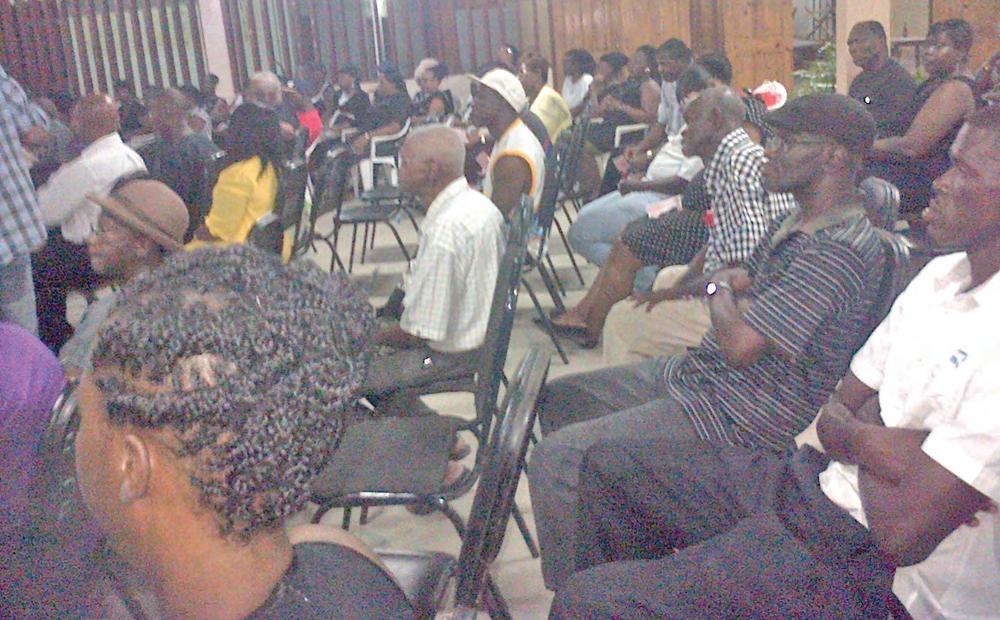
cal organisations, which he noted have been committed in recognising the sufferings of those who perished onboard the Son Chapman
“So there you have two institutions, the RDC promoting to have resources so that we can continuously have the sort of support to have this event commemorated and here; it is that we have the church resolving to ensure that they have the commitment to the survivors of those who perished.”
Solomon said the RDC has also engaged the Chapman family and has moved to adopt the tragedy as a regional commemorative event, adding that the administration will ensure that young people do not forget this important part of the community’s history.
“... we can never forget,
50 years ago, where this community stood and how we had to work to overcome challenges after the 6th of July when that incident occurred.”
He added: “I believe as a community, we must resolve to do much better... to ensure that this act which was perpetuated 50 years ago, (that) it is not only recognised as a commemorative celebration, but it is also given the sort of support and guidance.”
In addition, Solomon reflected on the three lives lost during the July 2012 protests in Linden where Shemroy Bouyea, Ron Sommerset and Allan Lewis were shot dead while protesting a proposed electricity tariff increase in the town.
“Though we have com-
mitted ourselves to ensure that never again will our people so senselessly lose their lives... but how do we ensure that that is so?” the Regional Chairman quened.
He said the RDC has asked for a Commission of Inquiry into the tragedy in order for the truth to be brought to the forefront and differences be reconciled.
Granger encouraged those present to look forward to the future and not to be consumed by hatred.
Look to future
“I encourage you to look to the future so that our children could grow up with a vision of something different to that which we had on July 6, 1964. I pray to God to rid our nation of the hatred, crime and violence and to unite our people
just as our Partnership for National Unity is seeking to do. We’ve not come here to perpetuate the atrocities; we’ve not come here to perpetuate hatred,” he noted.
He added that persons must be dedicated to ensuring that atrocities such as those that occurred in the 1960s do not occur.
“This must not become a hollow meaningless event; it must not become a ritual or an occasion for the renewal of old hatreds,” Granger said.
RDC Councillor Charles Sampson in his reflections noted that the act was “one of the most serious acts of terrorism in the Caribbean”.
In his tribute and reflections, Steven Carryl and his brothers, whose mother Carmen Carryl was killed when the tragedy struck, remembered the life of his mother in tears. His mother was reportedly pregnant at the time of her death. The mother of seven was reportedly only identified by the wedding ring she had on. The vessel was approximately 22 kilometres (14 miles) from Mackenzie when it exploded with persons, including children who were among those killed. Nine persons who died onboard were reportedly buried without being positively identified. Chapman had reportedly received several threats by persons who threatened to blow up the popular vessel in those days.
With recent revelations from the just released 2012 National Census that more than 4000 Guyanese are leaving Guyana for the US permanently every year, the country’s population growth
rate has remained stagnant at 0.04 per year.
The population dropped by 3329, and according to a recent study, this may not be a negative thing after all.
According to research done by Simona Vezzoli,
a researcher from the International Migration Institute (IMI), Oxford Department of International Development, University of Oxford, England, there are many positive effects which can be derived for the coun-
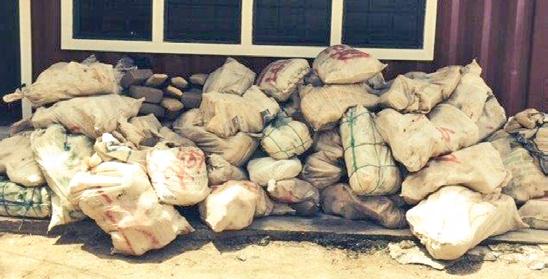
The Customs Anti Narcotics Unit (CANU) during an operation in Diamond New Housing Scheme, East Bank Demerara unearthed 1,227 kilograms of Jamaican marijuana in a canter truck.
The street value of the find is estimated at $216 million.
Based on reports received, CANU, acting upon information, conducted a search on the house in the vicinity of the third bridge where several bags of dried marijuana were found in a vehicle covered with black plastic.
Initially, the ranks thought it was garden mold
used for farming purposes, but upon checking, the large quantity of cannabis was discovered. One person was arrested and taken to CANU headquarters where he is being interrogated.
Meanwhile, a female was also taken into custody following the discovery of 4.2 kilograms of cocaine in another house in the said area. Again, the search was conducted by CANU members. The woman was being grilled by members of the unit up to press time. During the operation, the CANU ranks also seized over $1 million in cash.
Guyana Times understands that CANU is working on the theory that the two seizures might be connected as they continue their investigations.

try in which migration is taking place.
Vezzoli, the head of the research team, has contributed to the adoption and the adaptation of the scenario methodology for the study of the future of migration at IMI.
Currently, her research focuses on the determinants of migration, through the Determinants of International Migration (DEMIG) Project, specifically conducting research on the history and evolution of migration patterns and policies in the Caribbean region. Her research interests include migration policy, in particular countries’ perspec-
tives on emigration and the relation between emigration and immigration policies. The research involved interviews with migrants, remigrants and non-migrants, archival data from the country’s records, case studies and media reports.
According to the researcher, while many may see migration as a major area of concern for the country, given the fact that of that number, three quarters or 85 per cent of those migrating are skilled or trained personnel, there is a broader, more positive picture which is not being seen.
Vezzoli noted that the origin countries benefit from remittances (payments sent home by migrants) which are now often outstripping the foreign aid a country is given. Remittances to Guyana amounted to approximately US$415 million ($86,506,748,733) for last year (2013) – while the figure had stood at over $97.8 billion in 2012, a new report from the Multilateral Investment Fund (MIF), a member of the InterAmerican Development Bank (IDB) Group said. In
2011, remittances amounted to US$401 million.
The figure represents close to 17 per cent of the country’s Gross Domestic Product (GDP).
Remittances are more stable and predictable as compared to other financial flows and, more importantly, they are counter-cyclical, providing a buffer against economic shocks. In conflict or post–conflict situations, remittances can be crucial to survival, sustenance, rehabilitation, and reconstruction. In providing primarily for household livelihoods, remittances are spent on general consumption items in local communities that contribute to local economies by supporting small businesses. A fair share of these expenditures is directed to the construction of homes, health care and education, alongside savings in financial institutions, thereby generating employment in these critical services sectors. Moreover, in contributing to foreign exchange earnings, remittances can spur economic growth by improving sending countries’ creditworthiness and expanding their access to international capital markets
A6.9-magnitude earthquake has struck southern Mexico and Guatemala.
Guatemalan firefighters said they had received reports of two people being killed in the San Marcos region. Another person died in Huixtla, Mexico.
Dozens of homes are also said to have been damaged in San Marcos.
The quake’s epicentre was near the city of Puerto Madero in the southern Mexican state of Chiapas, but it could be felt as far north as Mexico City and as far south as El Salvador.
The US Geological Survey said the quake had originated 60 kilometres (37 miles) below the surface, while Mexican seismologists said its depth was more than 90 kilometres.
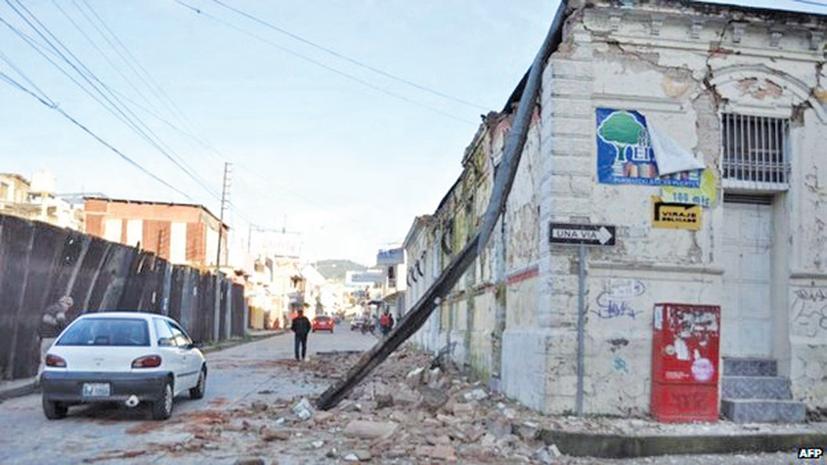
The emergency services in Guatemala said two people died when their house collapsed on top of them in the town of San Rafael Pie de la Cuesta.
The same area was
struck by a quake in 2012 which killed almost 50 people. A third person died when a wall crumbled in Huixtla, in Chiapas.
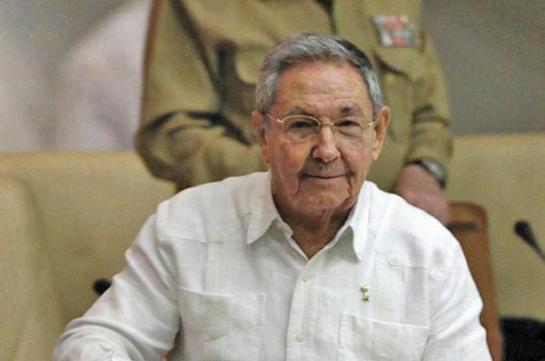
President Raul Castro has reiterated that Cuba’s programme of reforms will remain cautious and gradual, despite recent disappointing Gross Domestic Product (GDP) numbers that show the country’s already-struggling economy slowing.
Days after Cuba downgraded its 2014 economic growth forecast by nearly a percentage point, Castro told Parliament during the first of its biannual regular
sessions that the reforms “have great complexity but are advancing” at the necessary pace.
“This process, to be successful, must be conducted with the appropriate gradualness and be accompanied by the permanent control of different party and Government structures at all levels,” Castro said in a 25-minute speech.
“Gradualness is not a whim, much less a desire to delay the changes that
we must make,” he added. “On the contrary, it is about a need to ensure order and avoid gaps that would lead us directly to mistakes that distort the proposed objectives.”
Vice President Marino Murillo, Castro’s reforms czar, said a nascent project to eliminate Cuba’s unique dual currency system is continuing and warned islanders that monetary unification itself will not increase their purchasing power.
“For that to happen, we must produce more,” Murillo said.
Cuba’s Economy Minister announced at the end of June that officials were lowering their GDP growth expectations to 1.4 per cent for the year, down from a previous forecast of 2.2 per cent for 2014 and from 2.7 per cent growth recorded last year.
Castro and other officials say the reforms do not amount to an embrace of capitalism, but are rather an update of Cuba’s socialist model. (Excerpt from Al Jazeera)
Caribbean mobile provider Digicel has effectively barred users from accessing popular “free calls” applications Viber, Tango and Nimbuzz. Digicel has blocked free voice calling applications that utilise the Voice Over Internet Protocol (VoIP) on its service. In an e-mail exchange with the Sunday Guardian, Digicel’s Communications Manager in Trinidad, Penny Gomez confirmed the ban.
“Unlicensed VoIP operators like Viber and Nimbuzz
use telecoms networks to deliver their services, but they do not pay any money for the privilege. “This unauthorised activity puts enormous pressures on bandwidth – which means customers’ data usage experience is negatively impacted as a result,” she said. “As such, Digicel has been forced to take firm action to prevent this parasitic activity.”
Gomez said VoIP services by their nature are network intensive and given priority in terms of delivery across the
network.
“Which in turn means that other customers’ browsing will be impacted. Digicel uses a separate network for voice so that quality on our 4G network is not impacted by our own voice service,” she said. She said while Digicel “invested millions in its network and business,” unlicensed VoIP reaped the benefits with no capital investment. “The situation is untenable on a medium- to long-term basis and so we are taking a stand,” she said. (Excerpt from TT Guardian)
A resident of Guatemala City, Heidy Martinez, told the BBC she had been woken up by the quake which “shook her whole house”. (BBC News)
The National ParentTeachers’ Association (NPTA) has charged that schools are using graduation ceremonies to raise money, and is urging parents to boycott the schoolleaving event.
Everton Hannam, the NPTA President, made the call last week amid growing complaints from parents about the high costs associated with the events.
“A graduation exercise has, in many cases, become a fund-raising exercise for most of the schools. When I look at what the students get, based on the money they pay, I am inclined to believe that some of them have become fund-raising exercises for those who organise them,” Hannam told the Jamaica Observer.
“We have received complaints starting at the primary school and even at the
basic school [level] and it’s like J$6000 or J$7000 for graduation, and they are getting just a corsage and a certificate. It should not be,” Hannam said.
The exorbitant fees being requested for these ceremonies have been a long-standing concern for parents and have even been addressed by Education Minister Ronald Thwaites, who has urged parents to try and minimise spending for such events.
However, scores of parents attended graduation exercises at early childhood, primary and secondary schools last week, and more are in preparation mode to attend this week.
Hannam believes nothing will be done to reduce these costs until parents start to protest the payments. The best way he believes parents can do so is to not attend. (Excerpt from Jamaica Observer)
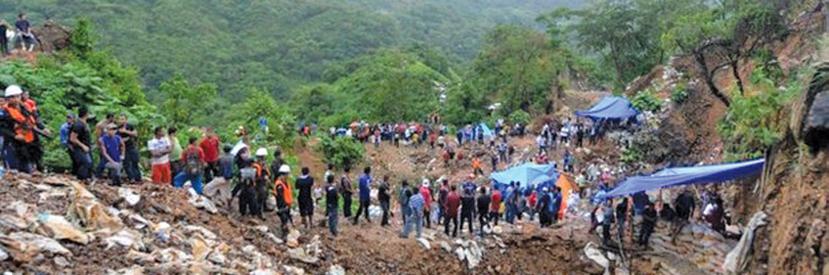
Authorities in Honduras have suspended the search for eight gold miners trapped in the south of the country since last Wednesday. The entrance to the informal mine, located about 110 kilometres (70 miles) from the capital Tegucigalpa, was blocked by a landslide last week.
Three men were rescued two days later, but eight others are missing. The three miners rescued on Friday are recovering in hospital and remain in a stable condition,
doctors say. They emerged dehydrated and exhausted.
Rescue teams say the danger of further landslides makes it too risky for the search to continue.
“We definitely cannot risk more lives,” said Geologist Anibal Godoy, who is leading the effort near the town of El Corpus.
He said that there was no way of reaching the missing men inside the mine because “poor mining practices are collapsing tunnels”.
Informal mines are common in Honduras and seri-
ous accidents are not unusual.
The mine is in an area prone to landslides and earthquakes. The mayor of El Corpus, Luis Andres Rueda, said there were more than 50 informal mines in the area.
He estimated that hundreds of people use ladders to climb down into shafts as deep as 200 metres (656 feet) every day.
Armed with pickaxes, they hack away at the tunnel walls to try to extract minute gold nuggets from the soil. (BBC News)
Football’s governing body FIFA should set an example to the world by giving 10 per cent of World Cup profits to the poor, a Venezuelan legislator has said.
“It would be stupendous news for the whole planet, which is in such need of good news,” William Ojeda said in comments widely published by Venezuelan media on Saturday.
“FIFA, which earns so much money from the organisation of the world event,
should demonstrate with actions that its vision is not only monetary, and should channel at least 10 per cent of its profits from the World Cup to help poor countries.”
The independent parliamentarian, an early supporter of late socialist President Hugo Chavez who then split with the Government but later also left the Opposition, said the money should go to schools, homes, clinics and sports facilities.
“It would be a great mor-
al example,” he added, praising Spanish club Barcelona who used to wear the United Nations Children’s Fund (UNICEF) logo on the front of their shirts instead of a corporate sponsor. They now have it on the back. Though frequently accused of corruption, FIFA is officially a non-profit organisation and does plough millions of dollars from World Cup revenues into grassroots football, especially in developing countries. (Daily Star)
Israeli officials say the Army will carry out more air raids on the Gaza Strip overnight and call up 1500 military reservists, as the country moves closer to its third major offensive in the Palestinian territory in six years.
The security Cabinet met on Monday after nine people were killed overnight in Gaza, governed by the Palestinian faction Hamas, and nearly 40 rockets and mortars were fired into southern Israel.
Late on Monday, there was another barrage of at least 20 rockets from Gaza into Israel.
The Qassam Brigades, the military wing of Hamas, which blamed Israel for the loss of seven members overnight, claimed responsibility for the latest salvo.
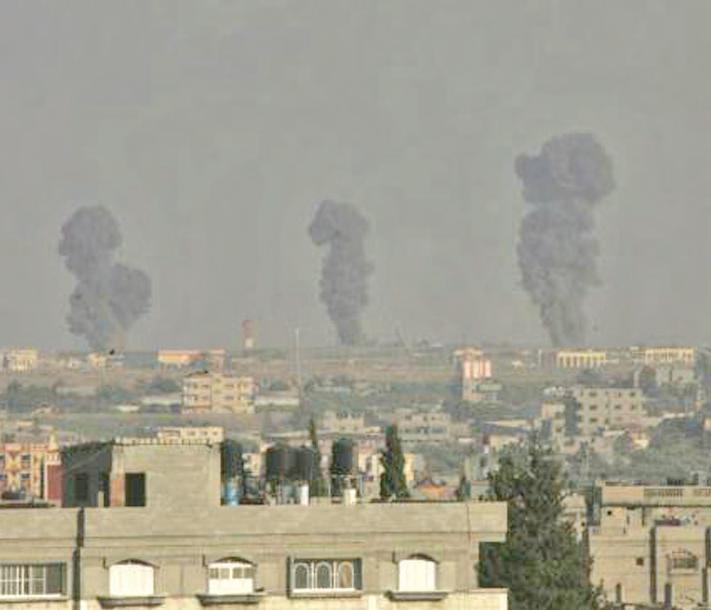
Israeli Government sources said the Cabinet agreed on an escalation, but stopped short of authorising a bombing campaign like the one Israel carried
out in 2012, or a ground offensive like the 2008-09 war which left more than 1400 Palestinians dead.
Sami Abu Zuhri, a
Hamas spokesman, accused Israel of a “grave escalation” and warned that it would “pay the price”.
Earlier on Monday Lieutenant-Colonel Peter Lerner, a spokesman for the Israeli army, said that about 40 rockets and mortars were fired from Gaza.
Lerner denied that the Qassam Brigades fighters were killed in an Israeli air strike, saying they died while “fiddling with explosives” in a tunnel that Israel bombed last week.
Hamas maintained that they were killed by Israel, and regardless, the group has threatened to respond.
Meanwhile, three people have confessed to murdering a Palestinian teenager in revenge for the deaths of three young settlers, which precipitated the latest round of hostility. (Excerpt from Al Jazeera)
Iraq’s newly-elected Parliament has postponed its next session until mid-August, according to state television, amid political deadlock over choosing a new Prime Minister.
Parliament met last Tuesday for the first time since its election in April and had planned to meet again today.
Pressure is running high to quickly form a new government that can confront a Sunni-led rebellion that
has overrun parts of western and northern Iraq.
The Parliament said in a statement on Monday that following “discussions with the heads of the blocs and concerned parties”, it was decided that “the next session will be held instead on August 12”.
It expressed hope that “another chance will be available for more dialogue and discussions to arrange that meeting”.
Under an informal sys-
tem that took root after the 2003 US-led invasion that deposed Saddam Hussein, the Prime Minister’s job goes to a Shia, the President’s post to a Kurd and the Speaker of Parliament’s chair to a Sunni.
The main point of contention right now is the post of Prime Minister, which holds most of the power in Iraq.
Last week’s session, the first since a May elec-
tion, broke up when Sunnis and Kurds walked out after Shias failed to name a prime minister to replace Nouri al-Maliki.
Within hours of the announcement of the Parliament session’s postponement, a suicide bomber drove a vehicle packed with explosives into a checkpoint in Baghdad’s Shia neighbourhood of Kadhimiyah, killing five Policemen and three civilians, according to a Police official. (Excerpt from Al Jazeera)
Egypt’s President Abdul Fattah al-Sisi has said he wishes the three al-Jazeera journalists imprisoned last month had never been put on trial, reports say.
Peter Greste, Mohamed Fahmy and Baher Mohamed were sentenced to between seven and 10 years in jail after being found guilty of aiding a “terrorist group”. Sisi was quoted by the alMasry al-Youm newspaper late on Sunday as saying the trial had “very negative effects”. His remarks received a mixed response from the journalists’ families. Foreign governments, media organisations and human rights groups accused the Egyptian authorities of
restricting freedom of speech.
Al-Jazeera said it defied “logic, sense and any semblance of justice”.
At a meeting with local journalists on Sunday, President Sisi sought to counter claims that the case had been politically motivated.
“The verdict issued against a number of journalists had very negative effects; and we had nothing to do with it,” he said, according to al-Masry al-Youm. “I wished they were deported immediately after they were arrested instead of being put on trial.”
Mohammed Abdul Hadi Allam, the Editor of the
state-run al-Ahram newspaper, and Imad Hussein, the Editor of the private daily alShurouq, confirmed for the BBC that the quotes were accurate.
The President’s initial reaction was to distance himself from the case and insist he would not interfere with the judiciary. His latest remarks will, therefore, raise hopes that he might issue pardons to set the journalists free, reports the BBC’s Sally Nabil in Cairo.
However, under Egyptian law this can only happen after the appeals process has ended, which could take months, our correspondent adds. (Excerpt from BBC News)
German Chancellor Angela Merkel is beginning a three-day visit to China with trade issues high on the agenda.
The countries are important trading partners and Merkel travelled with a large delegation of German business executives.
The visit is Merkel’s seventh to China since taking
office in 2005. She will also hold talks with Premier Li Keqiang and President Xi Jinping.
BBC Berlin Correspondent Stephen Evans says the Chinese market is important for Germany while China is looking to Germany as the supplier of machinery and cars for its rising middle
class.
In the past, the Chancellor has spoken out against human rights abuses in China, but it is not clear if she will voice her disapproval this time, he says.
At a joint business council in Beijing, the German delegation is expected to address sticking points such as fair market access for for-
eign companies and respect for intellectual property rights.
In an article in Welt am Sonntag, German Intelligence Chief HansGeorg Maassen warned that small and medium-sized German firms were at risk of industrial espionage from Chinese government agencies. (Excerpt from BBC News)
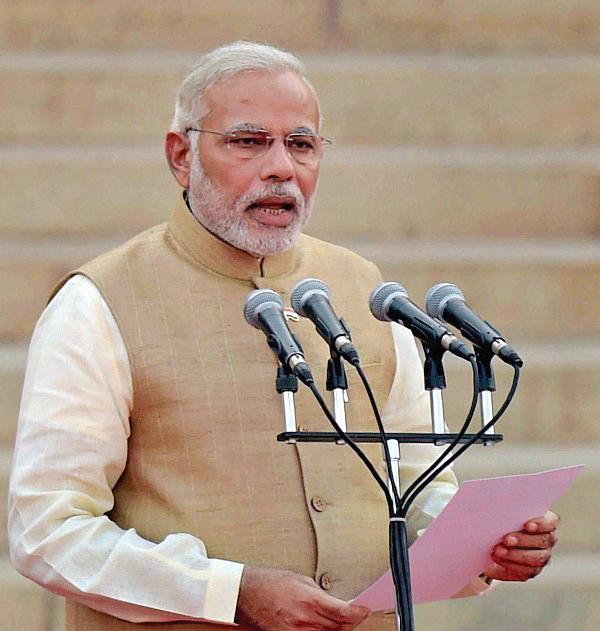
Senior British officials are set to meet India’s Prime Minister Narendra Modi this week in a bid to pursue deeper trade ties, as Western leaders seek to court the new leader since his election in May.
UK Foreign Secretary William Hague and Finance Minister George Osborne arrived in Mumbai on Monday on a two-day visit for talks with their Indian counterparts, an Indian Foreign Ministry Spokesman said on Sunday.
The pair will hold talks with Modi, who has raised hopes for foreign investors with his pledges to open up the stumbling economy and spur investment.
“The focus is on bilateral trade and economic ties,” Foreign Ministry Spokesman Syed Akbaruddin told reporters. “India and the UK have a trade relationship which is approximately US$15.8 billion. The trade is in favour of India,” Akbaruddin said. The two UK officials will meet Foreign Minister Sushma Swaraj, and Osborne will hold talks with Finance and Defence Minister Arun Jaitley in the capital on today. The talks are expected to include bolstering defence sales to India, a major importer of military weapons and other hardware. (Excerpt from Al Jazeera)
Former Afghan
Finance Minister Ashraf Ghani is leading the race to replace Hamid Karzai as President, according to preliminary results.
Ghani won 56.44 per cent of votes in the June 14 run-off, election officials said. His rival Abdullah Abdullah had 43.56 per cent.
Abdullah, who fell just short of an outright majority in the first round, rejected the result.
Both men have alleged fraud in the election. Votes are being re-checked at more than 7000 polling stations.
They represent nearly a third of centres where votes were cast and correspondents say recounts could significantly alter the result.
Chief Election Commissioner Ahmad Yusuf Nuristani stressed that the results were not final and acknowledged that
there had been “some mistakes in the overall process”.
“It is only initial results,” he told a news conference in Kabul. “There is a chance of change in the overall figure.
“The announcement of preliminary results does not mean that the leading candidate is the winner.
“We announced preliminary results today and it is now the complaints commission’s duty to inspect this case.”
Ahmad Yusuf Nuristani, Chairman of the Independent Election Commission of Afghanistan, announced the results. The Election Commission said it would now audit an estimated four million votes.
Final results are due on July 22.
Abdullah was well ahead after the first round in April, winning 45 per cent of votes cast while Ghani had 31.5 per cent and came second. (Excerpt
Delroy Adrian Walcott and Rissa Sooklall in the wee hours of Monday morning were crowned Mister and Miss Guyana Talented Teen 2014 after an evening of spectacular performances, featuring dazzling evening wear.
The lively event was held at the National Cultural Centre.
Breana Nicholas and the underdog Akeila Dey were the second and third runners-up respectively from the female contingent of the pageant, while on the male side, Daniel Ifill and Mikel Andrews copped second and third places.
Other prize winners included Kimberly Sattaur, Meshack Howard and Felicia Sears. Both Nicholas and Ifill captured the prizes for being photogenic while the Miss Congeniality prize went to overall winner Sooklall.
The pageant got off to a late start, but that did not change the mood of patrons who were eagerly awaiting the second edition of the Simpli Royal event.
Introducing themselves to the half-filled NCC on Sunday, Ifill and Nicolas were from the inception crowd favourites as the crowd erupted with applause when the introductions were made.
Moving on to the talent segment of the pageant, Stephen Validum, who was also a crowd favourite, sent the crowd into frenzied laughter when he appeared on stage to do his dramatic comedy piece shouting "Guyana Times" and the names of other newspapers.
He further woo them, reminding of the thing that truly made them Guyanese, in jokes.
Also noteworthy among the male contingent in the talent segment was Ifill, who

performed a breathtaking rendition of Sammy Baksh and The Prodigal Sons classic “To Be Lonely”.
And, although he got off to a false start and had to rush behind the curtains, when he returned, he mesmerised the audience with his soulful voice.
Second runner-up Nicholas showed up, delivering a powerful performance, effortlessly belting out the lyrics of Timeka Marshall’s “One More Day”.
Although she too had performance hiccups, having nearly tripped halfway through her performance, she still had the crowd going.
Her performance made way for “Splish Splash”, the swimwear segment, which heated up things on the cold night.
Then came the moment that revealed who would be moving closer to the title of Mister and Miss Talent Teen 2014.
It was not all a bed of ros-
“Remittance flows to Latin America and the Caribbean remain an important source of income for millions of poor and vulnerable families. Remittance recipients use these remittances to save and make investments for their future in areas like education, housing, and starting and growing businesses,” Vezzoli said.
Unemployment reduced
Another positive impact of migration is the fact that unemployment is drastically reduced and the younger generation can then enhance their life prospects.
Guyana in recent times has been burdened with unemployment, particularly for the youths leaving secondary school and even the University of Guyana. Given the reality that more than 780,000 persons have migrated from the country and yet a lack of employment opportunities still ex-
es for the contestants, however, as some of the finalists fumbled to answer the question on global warming.
The final six contestants were asked to send a message to the Guyanese public on the effects of global warming and the only persons that came close to answering the question properly were Nicholas and Walcott.
Female winner Sooklall told the crowd to “practise safety” when the question was posed to her.
The other contestants, including Dey, did fairly well with Ifill warning about the dangers of littering.
Walcott, however, took the stage with a feeling of pride as he briefly educated the audience on the prevailing danger of globaly warming.
He urged thento be the change they want to see, which in the judges’ estimation, was enough to earn him the title of Mister Talented Teen 2014.
from page 13
ists, one can only imagined what would have been the situation had those persons not migrated.
Migration too, according to the researcher, places reduced pressure on social service such as schooling, health and medical services, housing, and other public-oriented services since there are now less people in the country to access these.
Notably too, as a result of a decline in the population, the political Opposition becomes weaker and thus advantageous for the political party in power.
Vezzoli further detailed that when Guyanese migrate from the country, despite the number of years they may spend residing in the host country, they always return bringing with them their education, skills and acquired wealth.
“What you will find is that most Guyanese return. It does not matter how long
they stay there, they always come back and when they do, they come back educated, financially stabled, bringing back their skills and international contacts which can further develop the country,” the researcher related.
The University of Oxford Migration expert explained that while migration may often time stem from instability, fear and affordability of better opportunities, this may not be the only reason why persons migrate.
“Tradition plays an important role in migration. Sometimes persons do not want to migrate but because of the fact that their grandparents have migrated, their parents and siblings have also done so, they feel obligated to do so as well or are pressured to follow the tradition. Sometimes, numbers do not necessarily reflect the true situation of migration in a country,” Vezzoli emphasised.


n recent years, there has been an emergence of an increasing number of automobile spray painting shops. No doubt, this is associated with the increasing number of vehicles being imported into the country which provide steady business for these shops. Also, locally, the auto sales business is highly competitive, creating the need for vehicles to be regularly sprayed to enhance their visual appeal to customers.
Though business is a good thing, it is a fact that spray painting poses health and environmental risks if best practices are not followed. An observed trend is that many spray painting shops begin as small operations in residential areas but soon expand to a larger scale thereby magnifying the risks to nearby residents and shop operators alike. These risks are associated with Volatile Organic Compounds (VOCs) which are released during the spray-painting operation.
Cognisant of the risks associated with spray painting shops, the Environmental Protection Agency developed Environmental Guidelines for these operations to safeguard the health and safety of workers as well as persons who reside in close proximity to such operations. Over the coming weeks we will be focusing on the Spray Painting Guidelines beginning this week with best practices.
• Spray painting shops, should be located in a commercial or industrial area and not a residential area and at least 50 metres (164 feet) away from the nearest residence.
• Shops should not be in close proximity to dust producing facilities as dust will greatly affect the coating quality.
• Spraying must be done in booths or rooms that are constructed with non–flammable materials, such as steel, concrete and brick.
Booth walls must be smooth and without edges to avoid the trapping of residue.
• Booth floors and fire doors must be non-flammable since chemicals used in spray painting can explode in the event of a fire.
Booths should be adequately ventilat-
The distance between the spray gun’s tip and painting surface should be maintained based on the equipment specifications. (This will give the proper coat thickness, and minimise the use of more coats and so help to reduce VOC emissions).
Choose spray equipment that will cause the most paint to be applied to the surface when sprayed, eg, HVLP – High Volume Low Pressure paint gun.
• Determine the type of coating that will
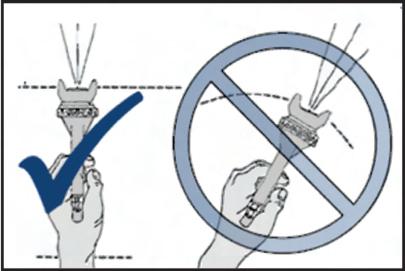
be sprayed through the equipment and use the paint gun that works best for the application of such coating. Follow the manufacturer suggestions regarding air pressure and tip sizes for the specific product and equipment being used.
Preparing for spraying and topcoats Wash dirt/grime from the vehicle using water or a soap and water mixture. Water-based cleaners can be used to remove sanding, sludge, fingerprints, waxes and other contaminants. Use solvent-based cleaners sparingly; mostly to remove grease, road tar, silicone, and driveline oils.
• Choose products that lessen the need for additional surface coating. Choose prep coats, primers and sealers in colours that can be easily covered with the topcoat.
• Apply only the number of coats needed to achieve a quality finish. Avoid the use of lacquer-based topcoats.
• Keep the use of paint additives to a minimum.
• When available, use water-based coats. Use low VOC primer-surfacers, primer-sealers such as Chrome-Free Etch Primer, Epoxy

ed to keep vapours and paint away from other work areas or have an exhaust vent to remove them.
• Booth exhaust vents should be at least two metres above the highest roof in the surrounding area and equipped with an effective filter or water wash system to reduce emissions.
• Workers should be trained in the proper use of spray-painting materials.
• The spray-gun should be held at a right angle to the surface being sprayed.
Primer-Sealers, and top coats products such as low VOC Lacquer Topcoats. Avoid zinc-phosphate primers with high VOC content.
• As much as possible, perform body work using a minimal amount of primer-surfacer.
Next week we will examine other aspects of the Spray Painting Guidelines. Share your ideas and questions by sending letters to: “Our Earth, Our Environment”, C/O EIT Division, Environmental Protection Agency, Ganges Street, Sophia, Georgetown, or email us at: eit.epaguyana@gmail.com.

Outgoing US Ambassador D Brent Hardt said the Cheddi Jagan International Airport (CJIA) Expansion Project would pave the way for more US-based airlines to operate in Guyana.
Hardt, who demittedoffice on Saturday, told Guyana Times that a number of American carriers have signalled their interest. He explained during a recent interview with this newspaper that US-based carriers had set their eyes on Guyana during the crafting of their “medium- and long-term” plans.
“Certainly, the expansion
of the airport would open up doors to different types of planes,” the US Ambassador added.
The US$138 million CJIA Expansion Project, which has thus far failed to receive the support of A Partnership for National Unity (APNU) and the Alliance For Change (AFC), is set to be completed in August 2015. The project will enhance the country’s ability to accommodate larger categories of aircraft, thereby tapping into the North and South American markets.
The project will see Guyana’s main port boasting a runway of 10,800 feet
to accommodate large transatlantic aircraft, a new terminal building, eight boarding bridges, elevators, escalators, three dimensional X-ray scanners, and flight information and security monitoring systems.
Even as the project progresses, Guyana’s aviation sector continues to grow with TravelSpan and Dynamic Airways commencing operating here. The US carriers, unlike the other airlines, are offering direct flights to the United States.
In a previous interview with Guyana Times, the US Ambassador had indicated that US-based carriers were
concerned with the fuel subsidy given to Trinidad-based Caribbean Airlines.
In May 2013, Delta Airlines wrapped up operations in the country to concentrate on other business deals. The inability to fill its planes to capacity and drug trafficking via the CJIA were among other concerns expressed by Delta.
But Ambassador Hardt said although Delta Airlines has left Guyana’s market on the basis of profitability, other American carriers have vested interests, but are demanding a level playing field.
BY SVETLANA MARSHALL
Guyana Women’s Miners Organisation (GWMO) President Simona Broomes is urging more support from the Government of Guyana to help her organisation fight human trafficking.
In rejecting the US State Department 2014 Trafficking In Persons Report on Guyana recently, Human Services Minister Jenifer Webster had said that the Ministerial Task Force on Trafficking in Persons (MTFTIP) has been collaborating with GWMO in the fight against human trafficking.
According to the Human Services Minister, the partnership between the Government and GWMO dates back to 2012; however, she was unable to cite examples of recent engagements.
Broomes, however, indicated that the Government has not been offering the requisite support in the fight against Trafficking in Persons (TIP).

“I don’t know what the Minister is talking about... I don’t know what collaboration she is speaking about, because the Government does not collaborate with us.”
GWMO has been in the forefront of the fight in Guyana, rescuing both women and girls from sections of the interior. The Organisation has, however, accused the Government of not being very supportive in the fight. Guyana has remained on the “US Tier 2
Watch List”.
According to the US, while the country has made progress in the fight against human trafficking, convicted traffickers have not been held accountable, pointing out that many of the cases have been dismissed.
It was pointed out that three convicted traffickers were given a maximum of five years' imprisonment, but were subsequently placed on bail pending the appeal of their cases. Additionally, the US said Guyana remains a source and destination for men, women and children, who are subjected to sex trafficking and forced labour; alleging that Guyanese and foreign women and girls from Venezuela, Suriname and Brazil are subjected to prostitution here.
But according to the Human Services Minister, the US report is far from the truth, arguing that there is a low prevalence of TIP in Guyana. Webster said the Ministerial Task Force on Trafficking in Persons has been aggressively tackling
The International Monetary Fund (IMF) is working with the Caribbean to strengthen its relationship and build a partnership for the future, according to its Managing Director Christine Lagarde.
Speaking at an event in Jamaica recently organised by the University of West Indies in Mona, Jamaica, she called on Caribbean countries to “build a partnership with each other and with the international community—including the IMF”.
“A partnership with the IMF is really a partnership with the community of nations,” Lagarde added. The IMF is an organisation that is “owned and operated” by its members – and that includes the people of the Caribbean. As part of this partnership with the region, the IMF has organised a number of high-level conferences on how to bring about sustainable and inclusive growth in the Caribbean. One conference was held in Trinidad in 2012 and one in the Bahamas in 2013 — and a third conference will take place in Jamaica, in Montego Bay, later this year. The IMF is also paying special attention to the needs and concerns of small states, Lagarde said.
The UWI event drew in students from campuses in Barbados and Trinidad and Tobago. During the question-and-answer session, students asked about the impact of the uncertain global environment on their countries.

human trafficking, reaching out to communities that are prone to trafficking.
Minister Webster said too that the Guyana Police Force investigates all reported cases of trafficking in person thoroughly before suspects are handed over to the courts.
She, however, made it clear that the Government will not usurp the functions of the courts by making public statements about cases that are under judicial consideration.
“The Caribbean has had a tendency to get stuck in the doldrums of stagnation — low growth, high debt, low competitiveness, high unemployment,” Lagarde observed. This has been especially true for the countries depending largely on tourism, like Jamaica. In these countries, growth has averaged less than two percent a year since the mid-1990s— and less than one per cent in Jamaica. “Given this legacy, the Caribbean was vulnerable going into the global financial crisis, and was hit with its full force. Six years on, output has still not returned to pre-crisis levels, and public debt is still at record highs – almost 100 per cent of GDP in tourismdependent countries, and 140 per cent of GDP here in Jamaica.”
“As always, the poor and the vulnerable were hit hardest by the crisis,” she added. Across the region, about a third of young people are out of work.
The global financial crisis was “a major wake-up call,” Lagarde pointed out. The good news, she noted, is that Caribbean lead-

ers understand the need for change and have begun to deliver on reforms. In the case of Jamaica, the country has made some hard choices to get growth higher and debt lower. “While Jamaica implemented difficult measures, it tried to spread the burden across society –a wage freeze on civil servants, a debt exchange for financial investors, increases in taxes and tariffs for water and transportation, and higher import prices as the exchange rate was allowed to adjust,” Lagarde said. “And while the Government was cutting spending, it was doing its best to protect the most vulnerable— raising cash transfers for poor households by 67 per cent for the elderly and 15 per cent for others last year, with another 15 per cent increase planned for October.”
While Jamaica is not out of the woods yet, there are some positive signs. Public finances are healthier and growth has returned. “We can see similar signs in some other countries that are navigating their way through difficult reforms,” Lagarde said.
Jamaica has also come up with a great innovation in ownership, Lagarde noted.
The Government’s reform programme is being monitored by an outside group, the Economic Programme Oversight Committee, drawn from all strands of society — public sector, private sector, civil society, and trade unions. “This is surely a role model that should be emulated elsewhere. With everybody inside the tent, all voices are heard, and everyone has a stake in success,” Lagarde said. Jamaica’s four-year economic reform programme, supported by the IMF, is off to a good start. The fourth review under the programme was completed on June 20.
The Caribbean is adapting and building economic stability to lay the structural foundations of sustained and inclusive growth. To continue with this change, Lagarde stressed that the Region needs to address the twin challenges of competitiveness and climate change.











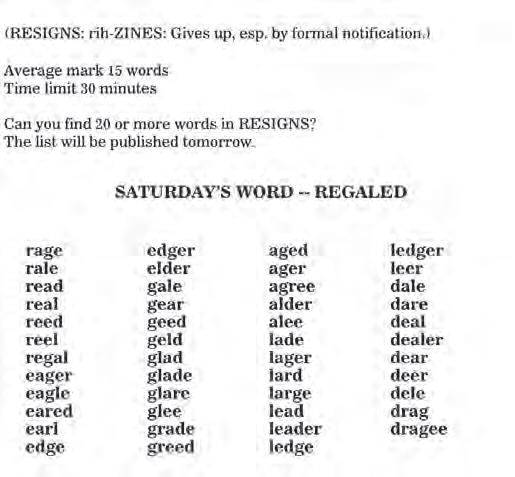




Opposition will set you back. If you find a way to compromise, it will be easier to reach your goals. Keep life simple until you can comfortably expand your interests.

By Bernice Bede Osol

(June 21July 22) (Jan. 20Feb. 19) (Dec. 22Jan. 19)
Friends and colleagues will be bowled over by your unique ideas. Find a platform where you can present your vision to people who will support your plans and impact your future.

People will think you’re pushy if you try to make plans for everyone around you. Listen and learn. By observing friends, colleagues and relatives you will gain experience and wisdom.

Show some consideration. Not everyone will opt to do things your way. Give your friends and family breathing room while you focus on mastering your skills.

(July 23Aug. 22) (Feb. 20-March 20)
It’s necessary to keep up-to-date with your banking records. Go over your statements meticulously and investigate any questionable withdrawals, expenses or bank charges.

(Aug. 23Sept. 22)
Make your own decisions. Let everyone know that you won’t be pressured into doing something that goes against your morals and beliefs. Take control, and you’ll have no regrets.
(March 21-April 19)
If someone is not being totally honest, ask direct questions. You can’t enter into an endeavor or move forward with your plans if you don’t know where you stand.

(April 20-May 20)
To decide the best course of action, different viewpoints are essential. Discussions with others in your chosen field will help you to make the right decisions. Network with others and learn.

(May 21June 20)
Take a break from your routine. You deserve a rest, and spending some time outdoors or simply relaxing will help your state of mind. Put your needs first.

(Sept. 23Oct. 23)
You’ll have plenty of energy today. No one will be able to keep up with you, making it easy for you to outdo the competition. A physical challenge will be satisfying.

(Oct. 24Nov. 22)
An escalating problem in a personal relationship could lead to estrangement if it’s not handled discreetly. Don’t compound the problem by revealing intimate details to outsiders.

(Nov. 23Dec. 21)
Don’t assume that everyone who asks for a donation is with a legitimate organization. If you are at all suspicious about the request, walk away and cut your losses. Charity begins at home.






ahamas defeat-
Bed Cuba 75-64 to win the Caribbean Basketball Confederation (CBC) Men’s Championship while Guyana rebounded to avenge a defeat to Barbados to end in fifth place at the Multi Purpose Sports Complex in Tortola, British Virgin Islands (BVI) on Saturday.
Both finalists, along with the United States Virgin Islands (USVI) who placed third after defeating hosts BVI, will participate in the 2014 Centro Basket Championship, in Nayarit, Mexico from August 1-7.
Bahamas’ championship conquest was spearheaded by the pair of Alonzo Hinds and Marvin Gray who both got 22 points while the other three starters – captain Magnun Rolle, Kadeem Coleby and Mitchell Johnson – all finished with 11 points.
For the losers, only Jasiel Rivero with 15 points and seven rebounds reached double figures.
For the bronze medal, the

USVI routed the BVI 102-68 with the USVI’s Cuthbert Victor top scoring with 20 points, Devon Peltier hitting
17, Johnathon Gray 11 and Laron Smith 10. The BVI were led by Rasheed Cann’s 19 points and 11 rebounds,
Kennedy Bass 14 and Halstead “JR” Chiverton 11. Former college standout Steve E. Parillon net-
ted 8 points and pulled 7 rebounds.
In the game to decide fifth and sixth position,
Guyana made amends for losing to Barbados in the group stage by winning 7958. The Guyanese had lost to the Bajans 69-80 in their final preliminary-round game on July 3.
This game was another story, however, as Guyana looked a different team that started the tournament and led the Bajans 56-47 at the end of the third quarter. The advantage of the Guyana team kept growing throughout the fourth quarter and the final score was Guyana 79 - Barbados 58.
The top scorer for Guyana was Gordon Klaiber with 17 points. Andrew Ifill and Dwayne Roberts both put in 16 points and captain Rawle Marshall netted 12. For Barbados, Akeem Marsh scored 14 points and eight rebounds while captain David Gill basketed 13 points.
Meanwhile, Antigua defeated St. Vincent and the Grenadines 109-81 to take 7th place.

Joshua Butts scored his second hat trick in as many matches as Tutorial Academy (TASS) continued their goal fest when second round action in the fourth annual Digicel Schools Football Tournament kicked off in Berbice on Thursday.
Butts was the chief goal
scorer as TASS trashed Corentyne Comprehensive Secondary 14-0 at the Skeldon Community Centre. Fresh from a 13-0 win against Central Corentyne Secondary, TASS continued their dominance on the field of play and restricted their opponents to just two runs in the 18-yard box during
the first half of play.
Keomo Logan made the run on both occasions but could not make much after receiving passes form Alex Williams. Logan was forced to spend most of the game backing up the defence and when he got his break his legs could not take him the distance fast enough.
Lumar Reid opened the scoring with an easy push past goalkeeper Tashaka Walrone in the 3rd minute. One minute later Orin Glen made it 2-0.
Players then tried to outdo each other for goals and squandered several goal scoring opportunities by either hitting the uprights or going over the bar.
The third goal came in the 25th minute off the boot of Jque Simmons and five minutes later Reid sent in
his second goal for a 4-0 halftime lead.
Aided by a strong Corentyne wind in the second half, TASS went on a goal fest with Butts scoring in the 52nd, 66th and 68th minutes while Shawez Thomas netted in the 69th minute. This was after Keon Williams scored in the 53rd and Jalell Fraser in the 62nd in a period that saw five goals in ten minutes.
Goalkeeper Walrone’s inability to kick the ball
beyond the 18-yard box was taken full advantage of as none of his team mates sought to assist him with his deficiency.
Duren Cornelly also got into the goal scoring act while Reid sent home his third in the 79th minute. Joshua Butts has now joined his elder brother Jamal of New Amsterdam Multilateral as the leading goal scorers. Jamal scored six goals when his school whipped Winifred Gaskin Secondary 13-0.
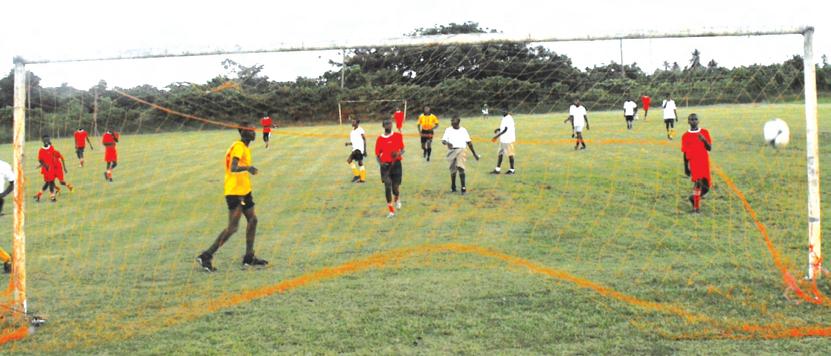

By AvenAsh RAmzAn
Linden’s rising star
Michael Anthony produced a solo effort for more than two thirds of the race, but Commonwealth Games selectee Marlon ‘Fishy’ Williams demonstrated tactics, skills and experience to win the feature 30-lap cycle race sponsored by the National Milling Company (NAMILCO) and organised by the Roraima Bikers Club (RBC) on Monday.
The day’s activities, held around the Seawall Bandstand Circuit in observance of Caricom Day, attracted a total of 63 riders,
but Williams emerged as the star cyclist, placing on the podium for three other races.
Apart from winning the main attraction, the 27-year-old RBC rider won the Points race, placed second in the Category 1-3 and third in the Win and Out.
Starting as one of the favorites of the feature 30-lap, Williams played a silent role up until the final two laps, as young Anthony, the recently crowned national Time Trial champion, dominated proceedings, leading for no less than 22 laps.
The race was off to a hot start as Enzo Matthews and Jaikarran Sukhai pulled
away from the pack, assuming the lead for the first five laps, before Robin Persaud and Anthony connected to assume the lead.
Thereafter, it was all Anthony from laps seven to 18, as he constantly increased the lead on a chasing pack. However, with the afternoon sea breeze doing little to stave off the scorching sunshine, Anthony started to tire and found himself in the middle of the pack. He managed to pull away once again on lap 21 and held the lead up until lap 28, before the chasing pack of Williams, Persaud and Paul deNobrega connected with him to give the spectators
During an interview with this publication, Panday further explained the procedure fans will have to follow from the time they enter the Stadium to the point of being seated.
“Once you arrive at the Stadium you will be greeted by staff in a very polite and kind manner; they will then escort you through the lanes, make sure you have the right ticket to go into the right lanes. As you approach the ticketing section, again you will be greeted by staff who will then scan your tickets. After your tickets would have been scanned you will
then walk to the stand and you will be shown and assisted to find your right seating,” Panday explained.
She added, “In addition to that, we will be having staff working in the hospitality area, the VIP area, in the Media Centre, as well as the car park area just to ensure that the spectators are greeted and they enjoy good experience while they’re there.”
Panday also reminded fans of the need to adhere to the list of restricted/prohibited items, noting that the ultimate aim is to ensure a smooth flow of persons to
and from the playing venue.
During the three games in Guyana, the home franchise Guyana Amazon Warriors will take on Trinidad and Tobago Red Steel at 19:30 hours on July 17, the St Lucia Zouks at 16:00 hours on July 19 and defending champions Jamaica Tallawahs at 16:00 hours on July 20.
Admission to the venue is $2000 for Grass Mound, $4000 for the Red and Green Stands and $5000 for the Orange Stand, now renamed the Palm Court VIP Party Stand.
Bangladesh all-round-
er Shakib Al Hasan has been banned for six months by the Bangladesh Cricket Board because of a “severe attitude problem”. The 27-yearold was punished for “serious misbehaviour” towards new coach Chandika Hathurusingha.
BCB president Nazmul Hassan said Shakib’s attitude problem is “unprecedented in the history of Bangladesh cricket”. The suspension applies to international and domestic cricket. Hassan added: “His behaviour is such that it’s directly impacting the team.

We want to give a clear message - if it is repeated, he might be banned for life. There will be no compromise when it comes to discipline.”
The BCB board voted unanimously to ban Shakib, who has not been granted the No Objection Certificate which would allow him to compete in domestic competitions outside Bangladesh.
He will miss Bangladesh’s tour of the West Indies starting next month, and will complete his ban shortly before the 2015 World Cup in Australia and New Zealand, which gets under way in February. Former captain Shakib is Bangladesh’s leading wicket-taker in Test history with 122 victims in 34 Tests, and only two players have scored more than his 2,278 runs.
six in that order.
In the other races, Anthony won the Juniors/ Category Four race ahead of Mark Harris and Mario King, while Romello Crawford, Raphael Leung and Dabiel Vossey were 1-23 in the 12-14 event.
what was sizing up to be a heated sprint finish.
The quartet held together for lap 29 and with the finish line in sight on the final lap, Williams stepped on the gas about 150 metres from the line to sprint away with the $30,000 first prize.
Persaud, who throughout the race kept closely behind Williams, finished second and won $25,000, while the brave Anthony, who earned the admiration of those present, ended third, carting off $15,000, as well as 11 of the 15 prime prizes on offer.
DeNobrega, Akeem Wilkinson and Alonzo Ambrose round off the top
Warren McKay was the top rider in the Category 1-3, finishing ahead of Williams and deNobrega, while Williams won the Points race ahead of Anthony and deNobrega. In the Veterans races, Linden Blackman won the Over-50 ahead of Virgin Jones and Monty Parris, while Ralph Williams was the leading rider in the Under-50, winning from Ian Jackson and Thuran Harris.
The Win and Out race was won by Persaud, with Crawford and MarlonWilliams in second and third respectively, with Leung, Adrian Sharma and Keon Rutherford being the top three in that order in the BMX Open.
Ozia McUally took top honours in the Mountain Bike race, leaving Emmanuel Gayral to settle for second and Julio Melville third, while Toshawna Doris got the better of Crystal Lambert and Deancae Welch in the lone Ladies event.
The other two races of the day- the BMX 6-9 and BMX 10-14- were won by Jeremiah Harrison and Amunike Gomes respectively.
At the presentation ceremony which followed, remarks were delivered by high ranking executives of NAMILCO, senior officials of the RBC and Director of Sport Neil Kumar.
They all agreed that the day’s activities were well organised and turned out to be a success, while pointing out that the event should now grow to include riders from Caricom countries and beyond.
NAMILCO was represented by Chief Executive Officer Bert Sukhai, Finance Controller Fitzroy McLeod, Assistant Managing Director Autamaram Lakeram and other staff, while the RBC’s executives, led by President Brian Allen, were also present, as well as members of the Humphrey family.
Apart from trophies, the top finishers in each of the categories were rewarded with cash incentives, as NAMILCO increased its sponsorship of the race this year to $500,000, a rise of 25 percent from last year.

Neymar’s tournamentending injury has left most Brazil fans in a state of shock, but there is at least one Seleção diehard - and a prestigious one at that - who is continuing to look on the bright side.
The fan in question is former Brazil idol Ronaldo, who knows only too well how the world’s great teams can make up for the absence of a key player by reinventing themselves. O Fenômeno saw that for himself in the Final of the 2002 FIFA World Cup Korea/ Japan 2002™, when Germany gave Brazil the sternest of tests despite the absence through suspension of their midfield powerhouse Michael Ballack.
Though the Brazilians prevailed on that occasion, the fight put up by a supposedly weakened Germany side gives
Ronaldo reason to believe that Brazil can more than hold their own without Neymar when the two nations meet in the semi-finals on Tuesday.
“Everyone got a little scared with the injury he picked up, and there’s no question Brazil have lost a star and their main goal threat,” Ronaldo told FIFA.com. “We have to press on, though. It’s a big match between two of world football’s great teams and I don’t see them as clear favourites. A Seleção are always favourites, against any team in the world.”
Ronaldo’s unshakable optimism is also founded on the role that Brazil coach Luiz Felipe Scolari will play in the build-up to the game, not just in getting the tactics right but in firing up his players.
“I know O Felipão very well,” said the ex-striker.
“He’s a great motivator, and I’m sure that he’s pushing his team on at this very moment in time, especially the player who’s going to be coming in for Neymar.” The joint-highest scorer in the history of the competition, tied on 15 goals with Germany veteran Miroslav Klose, Ronaldo added: “I think he’s got the team under control and he’s going to use every weapon at his disposal to put the strongest side together. I’m sure that the player who’ll replacing Neymar will be very determined to make people forget he’s not there.”
Doing his level best to boost Brazilian morale, Ronaldo signed off with a confident prediction: “Brazil are going to win 1-0.” Germany and Brazil meet today in the first semi-final from 16:00hrs.
tuesday, July 8, 2014


Dentures provided in 72 hours from as low as $4500. Contact Dr B Stuart, 209B Charlotte St, Lacytown. Tel: 225-5034





Healthworld Holistic Centre offers clinical psychotherapy for suicidal thoughts, attempted suicides, depression, stress, mood disorders, psychotic disorders, homicidal thoughts, hallucinations, loneliness, conflicts, anger management, relationship & sexual problems, paranoia and much more. Call +592621-0552 and make that appointment now before it’s too late. 12:00-6:00PM. Mondays-Fridays. Email: healthworldhc@gmail.com


Alberttown, Georgetown (Between Cummings & Lights Sts) Tel: 225-1540, 622-8308, 655-3105. Email: balwantpersaud@yahoo.ca

Professional Key Shop, 125 Carmichael Street, Georgetown. Phone: 225-3923, mobile: 621-3249. We cut any type of key, service and repair all types of



Get your home or business spiritually clean to enhance good luck and prosperity. Telephone: 687-5653
Cleansing of spiritual problems of all kinds. Powerful Ifá protection against evil. Get help to overcome problems with love, relationships, legal, sexual, pregnancy, business, sickness, jobs, enemies, work, money. Call 592-690-1824 from 10:00-16:00h Email:anew-life@ live.com
HEPHZIBAH MINISTRIES. 24hrs miracle line 322-5081/337-4510/3374259/337-4021/337-3070/337-5103
For healing, deliverance, financial difficulties, marriage issues. Call now. Jesus cares.
Suriname Astrology Palmist and Djuka Healing, the most powerful spiritualist in the world, are you suffering from the following problems (any religion) love, marriage, family, health business, husband and wife relationship, property, court, children, promotion, visa, pregnancy, education, depression, job, sexual, jealousy, enemy, money, drinking ? Also you can have all evil forces destroyed such as black magic, witchcraft, voodoo, obeyah etc and give powerful protection. We also do upliftment for clearing of land, dredging operations strictly in the interior. For private and confidential service call 674-2112.

One furnished house in immaculate condition at Lamaha Gardens suitable for residence and office. US$2,500 (AC, hot & cold, parking etc). One modern 3 bedroom apartment at Campbellville US$1,300 (AC, hot & cold, parking etc). One bond 135,000 square foot at Beterverwagting, ECD US$10,000. Call 219-4535 or 661-7169

Da Silva’s Optical. For Your Eyes Only, Look Better See Better. Phillip A Da Silva OD, Shannon L Da Silva OD, Natalie Da Silva OD. 248 South Road, Bourda. Phone: 227-3529, Linden: 444-6376, Corriverton: 339-3536, Meten-MeerZorg: 275-0322, Grand Cayman Islands: (345) 943-1515 for the perfect trendy touch.

Seven-room bungalow. Ideal for students, groups, short & long term rental - Triumph, ECD. Phone: 220-2130/6247111/622-7097. Self contained apartments, fully furnished. Phone: 220-2130/6247111/622-7097.

COROLLA AE100 WAGON; TOYOTA HIACE MINIBUS RZ; PITBULL-STYLE FREEZER VAN; LAND CRUISER (FULLY LOADED); MAZDA PROCEED 4WD EXTRA-CAB PICK-UP; TOYOTA HILUX 4WD EXTRA CAB PICKUPS - 3RZ, 5L, 3L SOLID DEFFERNTIAL; MITSUBISHI CANTER TRUCKS 4 TONS FREEZER; 3 TONS OPEN TRAY; 2 TONS 4WD;
SERVICE YOU CAN TRUST
4x4 Nissan Titan fully powered Immaculate condition $3.5M. No reasonable offer refused. 622-7740
Nissan Titan, very good condition leather interior, fully loaded $2.5M negotiable. Call: 620-1026 BMW 525i, M body kit, excellent condition, low mileage, price negotiable. Call: 620-1026
One Black Toyota Lexus 2004 Model. Price $2.1M Negotiable. Call Urgent 688-8189
One Mitsubishi Evo2. Mag rims, DVD & CD, Airbrush. Contact owner 6106927

Bedford truck, bobcat and excavators. Phone: 627-9977 or 698-0182
Vacancy exists for anyone with two or more years' experience to work at a travel service which will be located on the East Coast Demerara. For more information call 664-4000
Land to buy in Parfaite Harmonie, Cummings Lodge, Herstelling, Diamond, Grove, Tushen & Parika. Call 218-5591 or 675-7292.
Are you looking for a job anywhere in the country? Call Ron’s Real Estate 675-7292
Why Work for $50,000 monthly when you can earn it and more instantly 218-8891, 675-7592
Are you looking for big career or a business or a business partner? Call Ron`s Real Estate 675-7292



By AvenAsh RAmzAn
Patrons who flocked the National Stadium during the Limacol Caribbean Premier League (CPL) last year undoubtedly had a fantastic time, enjoying every moment of the games here in Guyana.
With the Guyana leg of the second edition of the League billed for July 17-20, much of the same
is expected, according to Stadium Staff Coordinator, Sabrina Panday.
To ensure a “spectacular spectator experience”, Panday, who has a wealth of experience in her field, having performed similar duties during the 2007 50over World Cup and the World T20 in 2010, said her team of personnel has been putting systems in place to ensure troublefree access for persons to their seats.
“We are definitely preparing to make sure our patrons have a spectacular spectator experience and in order to do that we need stadium staff and this is where my job entails preparing persons for that area. We will be training 104 persons in various job areas to ensure a smooth flow,” she said....
The Selection Committee of the Berbice Volleyball Association (BVA) has shortlisted a number of players to undergo intensive training over the next two weeks in preparation for the BVA’s male and female Inter-Association competitions.
BVA’s Under 23 Squad will also be chosen from the
players named. Males- Ian Bagot, Luen David, Junior Jhingree, Quacy Matheson, Trevlon McRae, Shemroy Ross, Jason Seelochan, Satesh Seenauth, Mahesh Motiepersaud, Satesh Motiepersaud, Julius Seenarine, Safraaz Hussain, Errol Chase, Neehaul Sukdeo, Levian Butchey, Glenroy Clement, Jason
Johnny, Zaide Quintyn, Akbar Hosein, Rohan Dhanpat, Navin Jairam, Sohan Dhanpat, and Ryan Dhoray.
Females: Vashti Pooran, Darshanie Pooran, Nadine Benjamin, Shenne Subrattie, Malika Jarvis, Tinesha Cort, Cynthia Harris, Tamala Felix, Lisa Marks and Melissa Marks.
On the heels of overcoming a strong field to win the 2-day Tiburon Amateur Championship at Naples in Florida, Guyanese golfer Chris Guyadeen recently won the Palmer Flight tournament in the Golf Channel Amateur Tour (GCAM) on Long Island, USA.
Guyadeen shot 74 (+2) to win at Harbor Links Golf Course.
The Guyanese golfer and businessman, who resides, works and plays golf in the USA, has been playing on the Golf Channel Amateur Tour for the past 4 years and has won several times.
Prior to winning at Harbor Links, Guyadeen continued his winning streak with a first round
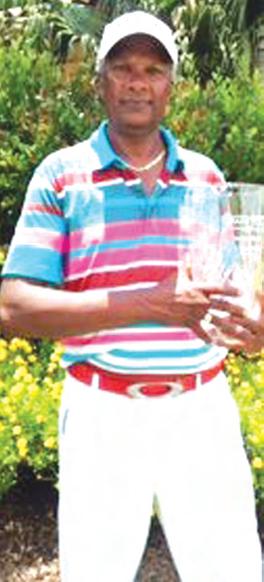
Chris Guyadeen
shot of +1 and a second round score of +7 to finish with a best score of 8 over par at Naples.
Guyadeen’s next major two-day tournament is on August 2-3 in Orlando Florida. “My win on the major tournaments qualifies me to play in the USA National tournament to be played in October 2014 in Arizona where I will be representing Guyana at a higher level,” a proud Guyadeen had related to Guyana Times Sport.
The USA National tournament will be telecast on The Golf Channel.
Guyadeen also said he plans to play in some tournaments here in Guyana this year.
By TreisTon Joseph
outh Basketball
YGuyana (YBG) in collaboration with the National Sports Commission (NSC) tipped off the ninth edition of the National Schools Basketball Festival (NSBF) with a grand opening ceremony and three games at the Cliff Anderson Sports Hall on Sunday.
With both Director of the YBG Chris Bowman and Director of Sport Neil Kumar commending the sponsors for their efforts in developing the youth of Guyana, Minister of Sport Dr Frank Anthony stressed that his Ministry hopes to see every youth play a sport.
“We would like to see every child play a sport and this is important because sport helps to develop an individual holistically and that is what we want,” Anthony noted.
Anthony also lauded the YBG for their efforts and de-
clared that the school festival “is the basis for selection to Inter Guiana Games”.
Following his remarks, Minister Anthony did the festival’s first jump ball to see St Roses and President’s College open action. St Roses High School would give up a comfortable lead to fall to President’s College (PC) 47-44.
The game started with great energy as both teams came out looking to run the basketball at every opportunity. This allowed the guards of St Roses to use their quickness and finesse to get the ball to the hole while drawing a number of fouls which allowed them to open a nine-point lead midway in the final period of the game.
However, PC continued to barrel their way into the paint and cut the lead to one with 42 seconds to play. A couple of turnovers later by St Roses would allow PC to create fast break opportu-
The Kennard Memorial Turf Club (KMTC) will stage its pre-Emancipation horse race meet at its Bush Lot Farm, Corentyne, Berbice, race track on August 3 and seven mouth-watering contests are carded for the day.
Most of the country’s top horses are expected to be on show, with the feature attraction being the A and Lower to be contested over a distance of one mile. The winner will cart off $1M, while the runner-up will win half that amount. The third and fourth place finishers will receive $250,000 and $125,000 respectively.
Several other events are slated for the day, starting with the J ‘3’ and Lower Class over a distance of 1000 metres for a purse of $150,000, while the second place finisher will collect half that amount. The third and fourth- place finishers will receive $38,000 and $19,000 respectively.
Then there is the D’3’ nonwinner in 2014 and E and Lower Open over a distance of 1700 metres with the winner carting off $500,000, and the second- place finisher getting $150,000. The third and fourth place finishers will receive $75,000 and $38, 000 respectively.
The J ‘1’ will see the ani-
mals running over a distance of 1000 metres. The winner will receive $180,000 while the second, third and fourth place finishers will collect $100,000, $50,000 and $25,000 respectively.
Other races include the J ‘3’& Lower, G ‘3’ & Lower, I and Lower and K Class.
Meanwhile, President of the KMTC Cecil Kennard, in an invited comment on Monday, said turfites could be assured of exciting action especially since jockeys and their mounts will be competing under improved track conditions.
Further, the organisers wish to remind horse owners that the event is being conducted under the aegis of the Guyana Horse Racing Authority (GHRA) and all the rules of the local governing body will be in effect.
The registration period will end on July 28 and horse owners can confirm to this requirement by contacting Justice Cecil Kennard on telephone numbers 226-1399, 225-4818, or 6237609, Roopnarine Matadial (Shine) on telephone number 325-3192, Isabella Beaton 6937812, Dennis Deroop 609-9143. Horse owners are asked to have their animals examined by the veterinarian by 11:00h on race day. (Rajiv Bisnauth)
nities that allowed them to win the game.
Shaquille Adonis had a team high 21 points while Eli Innis contributed 10 points to the win. Nathan Saul’s game high 25 points was unable to help St Roses hold on for the win.
In what could be considered a surprise result, New Amsterdam Technical Institute (NATI) routed Mackenzie High School (MHS) 32-18 to win their first game of the festival.
Dunash Roopnarine had a team high 11 points for NATI while MHS’ Daniel Anthony scored 12 of Mackenzie’s 18 points.
In the final game of the evening, Plaisance Academy easily defeated JC Chandersingh 47-33 to move closer to a national title.
Mallol Powder scored a game high 15 points for Plaisance while Kelvin Yorrick missed a doubledouble with 14 points and nine rebounds. Michael

ev-
throughout the course of the week until the final on Sunday July 13.

In a rousing finish, Treacle put in a superb performance to win the feature D and Lower race on Sunday before a large crowd at the Rising Sun Turf Club (RSTC).
Jockey Rad Drepaul took control of his animal within 100 meters of the finishing line to win the 1500m event and first prize of $1 million dollars.
The race saw five animals leaving the gate in an even break and then exchanging the lead as they approached the first turn. However, it was Treacle that had the final say as it pulled away from its ri-
vals on approaching the final turn.
Coming into the homestretch, jockey Drepaul showing his brilliance in the stirrups by giving his horse the full rein to win by about three lengths. Jack in my Style and Swinging Easy occupied the second and third position.
Eight races were carded for the day but organisers were forced to cancel the H Class event after the meet failed to attract the required number of registered animals. Meanwhile, results for the other races as follows:
J and Lower: Affinity,
Famous Pride, Natasha F and Lower: Princess Alisha, Rosetta, War Craft
Two-year-old Guyana and West Indian: Storm Bird, It’s My Choose, Settling Star.
G ‘3’ and Lower: Weekend Surprise, Release the Beast, Happy Choice.
Three-year-old Guyana and West Indies-bred: Unsettled and Setting Jet, Shooting Star and Today is My Day.
I ‘1’and Lower: I want Revenge, De Gump, Famous Pride.
The champion jockey award was taken by Colin
Ross with the Jumbo Jet
received their rewards compliment of trophy stall Bourda Market and the organisers.
Horse racing action continues this Sunday with the Ryan Crawford Memorial Turf Club and Sports Facilities horse race meet at the club’s Alness, Corentyne, Berbice racetrack. Over $5M is up for grabs with eight races billed for the day.


Three-time tournament champion Anthony Downes kept his composure amidst a fierce comeback warning from former number one seed Phillip Squires to cop the Men’s Open Singles title for the fourth time at the GBTI Open Tennis tournament on Friday last.
Both players held strong serves for their first game but after Downes broke Squires to go up 2-1, he capitalised on momentum gained with his powerful ground strokes to eventually lead 5-1. Squires then broke back to save the set at 5-2 but it was Downes who was able to win his service game to take the set at 6-2.
In the second set, Downes again was able to break Squires early to go up 4-1 even as Squires showed signs of regaining his form. But Squires, being the tactically stronger player was able to hold and break Downes again to take the score to 4-3.
Downes continued to drill ground strokes and broke back to go up 5-3. At this time, Squires seemed to better handle Downes’ power and broke to put himself in position to potentially take
Alex Arjoon played some exhilarating squash to retain his title when the Digicel-sponsored Guyana Squash Association Senior Tournament culminated at the Georgetown Club on Sunday.
Former Caribbean champion and overseas-based Guyanese Richard Chin came out with terrific energy taking control of the match to win the first set 11-6. Arjoon, finding his rhythm while volleying better, unsettled Chin as he took the second set 11-8 to level the match 1-1.
The third set was the best between the two players as they rallied the exchange of the lead before Arjoon prevailed to win 12-10.
Fatigue got the best of chin in the fourth set after
the second set. But Downes wasted no time breaking Squires again to take the title after a second set win of 6-4.
In the Ladies Singles final, the 15-year-old Nicola Ramdyhan had to endure three sets to hold off former champion Shawna Gentle, who at times used tricky slices to slow down the match.
The two young players entertained spectators with their long rallies where Gentle ensured that she dished out a fair share of loopy balls which forced aggression from Ramdyhan to finish points quickly. Ramdyhan was able to clinch the first set at 6-3 after which she seemed to be frustrated about the lack of pace from Gentle.
That strategy earned Gentle the second set at 6-1, but Ramdyhan mentally reprogrammed herself to take the final set and championship at 6-3.
In other final results, the two-time champion pair of Anthony Downes/Jason Andrews defeated Gavin Lewis/Daniel Lopes 6-1 7-6 to take the Men’s Doubles title; Ladies Doubles Final: National Coach Shelly DalyRamdyhan and daughter Nicola Ramdyhan defeated

almost an hour of intense squash as Arjoon prevailed 11-6 to win the match and retain his crown with a 3-1 victory. The women’s final was a showcase of brilliance by Mary Fung-A-Fat as she
Shawna Gentle and Afruica Gentle 7-5, 6-3; Mixed Doubles Final: Anthony Downes/Rebecca Mitchell made light work of Jason Andrews/Afruica Gentle 6-0 6-1; Men’s 35 Singles Final: Godfrey Lowden defeated Chetan Narayan 6-1, 3-6, 10-4; Boys 18s Final: Khalif Gobin defeated Craig Campbell in a three-hour epic 6-4, 6-7, 10-7; Novice Medley Doubles: Orande Dainty/Robert Bostwick defeated Charlie Adams/Kizzy Richmond 7-5; Novice Men’s Singles: Orande Dainty defeated Charles Adams 7-5; and Novice Ladies Singles: Cristy Campbell defeated Denise Barrington 6-3.
In his closing remarks, CEO of GBTI John Tracey, a former tennis player and member of the GTA executive, expressed his appreciation to the GTA for preserving the GBTI Open as a significant tournament on its calendar.
However, he lamented the lack of emphasis on the promotion of sports nationwide especially to highlight players with potential and to provide substantial coverage of video for television. He noted sister countries in the Caribbean making sports
played with aggression and skill to come out with the win in three straight sets against Akeila Wiltshire.
Fung-A-Fat showed her experience in winning the first set easily at 11-5.
Wiltshire, determined
a priority for development even if the economy shows signs of slippage.
In this regard, he gave the charge to the GTA to invest in a professional camera to be used for public relations and for players’ development. He also graciously extended the use of his facilities, amidst loud cheers, for the hosting of Guyana’s first international tennis tournament in several years, the Inter Guiana Games, which will be held in late October.
President of the GTA, Grace McCalman, in her remarks, congratulated GBTI for ensuring that its corporate support goes beyond the usual provision of a sponsorship cheque for a sport that needs much more.
The upkeep of facilities to ensure that the sport is substantially supported is most welcome and appreciated, she said. McCalman recounted developing a love for tennis as an employee of the bank at the same courts under the management of the late Ms DaSilva many years back and reminded members of her executive that it is one’s innermost motivation that brings about real assistance and not instructions from the President of
the day.
She noted the decline of the veteran categories, but reminded all that strong clubs form the basis for increased participation in tennis activities. “The fact that novice players have been steadily improving from the inception of that category supports their interest now for playing in the Open categories,” she said.
McCalman added, “The inter-school competition that
Yaw,
was recently held is also testament to the continued effort of the GTA to ensure that a new crop of juniors keeps coming, especially girls.”
She further urged coaches present to take information away from the tournament about their players to strengthen them during practice so that the quality of the tournament can improve next year.
‒

Rto win a set, played better squash in the second set and jumped out to a 7-5 lead but made a number of errors that allowed Fung-A-Fat to rally and win the set 11-8 before going on to win the final set and the title with an 11-9 win in the third set.
In the Veterans 3549 final, Joe Mekdeci was the winner while Alwyn Callender secured the Veteran’s Over 50 Title.
Meanwhile, Jason Ray Khalil easily won the third place playoff against Nyron Joseph 3-1 at 11-4, 7-11, 11-9 and 11-7
Ashley DeGroot was the winner of the women’s third place playoff, defeating Larissa Wiltshire in three straight sets at 11-6, 11-4 and 11-4.
ising star Jason Yaw added another accolade to his name by claiming a bronze medal at the recently concluded Central American and Caribbean (CAC) Junior Championships in Mexico at the weekend.
Yaw made amends for missing the podium earlier this year at the Carifta Games with a 47.71s run to claim podium position in the under-17 400 metres but failed to advance to the final of the boy’s 200 metres after clocking 22.16s.
Jevina Sampson captured her first international medal by clocking 57.22s to win bronze in the girl’s under17 400 metres at the championships but also failed to reach the final of the 200 metres with her time of 25.67s.


Meanwhile, three times Carifta Games 1500 metres gold medalist Cassey George had her worst performance internationally as she could not acclimatise to the conditions to produce the excellence she is known for. Mexico, which is 2200 metres above sea level, was too much for the promising athlete as she had to take oxygen after her 1500 metres in which she finished in 5:18.44s- a very slow time when compared to her Carifta times that are usually well under the five minute mark.
George was sixth in the 1500 metres. She also had difficulty breathing in the female 3000 metres and finished fifth in 11:23.76s. (Treiston Joseph)



With
Ramroop when Guyana Times Sport dropped in at the Grand Coastal Inn in Le Ressouvenir where the squad was having dinner last evening.
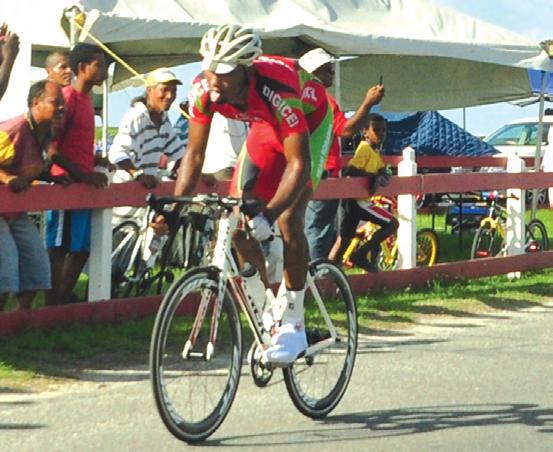

The squad will be interacting with the media around 10:45h today before heading to the Cheddi Jagan International Airport (CJIA).
on July 11 at the National Cricket