



Members of the Ishara Dance Troupe perform at the Guyana Bank of Trade and Industry’s (GBTI) Annual Diwali Cultural Evening at the bank’s Recreational Centre, Bel Air, Georgetown on Friday (Carl Crooker photo)

One of the most egregious examples of vigilante killings occurred in Mc Doom, Greater Georgetown, some 20 years ago at the hands of Glenn Lall, and follwing the revelations made in another section of the media, some staff members of the Guyana Revenue Authority (GRA) are now
fearful that they could end up being victims.
The latest revelation about Lall would seem to have set a pattern of excesses which have been btatantly condoned by the judiciary, law enforcement authorities and members of the Opposition.
Guyana Times spoke with several staff members who said they are seriously concerned about their verry safety, given the recent attacks on Commissioner General Khurshid Sattaur.
On January 20, 1994, in Mc Doom, according to the Stabroek News, Lall, the 'vigilante', now the Owner and Publisher of the Kaieteur News, "shot and killed 30-year-old resident Kenny France. Lall was never arrested nor were charges ever brought
against him.
The undisputed facts are that on that fateful Thursday, Lall and three friends were driving on the East Bank Public Road when he “spotted” one Oclive Marshall in a yard.
Revenge?
Lall felt that Marshall was one of the individuals who had attempted a burglary at his home. He stopped his car and demanded that Marshall accompany him to the police station – the nearest one which was at Ruimveldt, five minutes away.
Fearing that Marshall would be beaten by Lall and his cohorts, his aunt Pamela France, demanded that she be allowed to accompany him to the station.

By this time, a number of villagers had gathered and the aunt demanded identification, which Lall could not provide.
At this point, Lall reportedly whipped out his .38 weapon and demanded Marshall enter the vehicle. Lall spoke roughly to the aunt who remonstrated with him and her husband Kenny France protested that he could not speak to his wife like that.
At this point, Lall shot France in the “chest” and the man fell to the ground dead. Lall and his friends then drove off and he later said that the shooting was “an accident”.
This account was disputed by the wife Pamela Marshall and the dozens of villagers on the scene.
The Stabroek News reported that the Police took
ers may also fire when attacked, if they sustain serious danger to their person and are unable to defend themselves by other means; and when the property they are ordered to defend is attacked and they are unable to defend it by other means.
Lall left freely after killing France, even though he was never under any “attack”. But even if he were, these are questions of fact that a jury ought to decide on.
No charges were ever laid against Lall and it was unclear if the Police even passed on the file of the case to the Director of Public Prosecution’s (DPP) Office.
The law provides that whenever there is death, and there is some doubt as to the cause or who caused

a statement from Lall, but this was never released to the press.
Similarly, the Police never released their findings from their investigation into how far away was Lall from France when the fatal shot was fired.
Even though Lall had claimed he was a Rural Constable, it was later revealed that he was only sworn in subsequent to the killing of France.
But even as a licensed firearm holder or a Rural Constable, the law is very clear that the manner in which Lall shot France was totally prohibited.
An information sheet given to licensed firearm holders by the Police lists general principles to be followed and indicates four situations in which the armed person may fire.
The information sheet, under the heading “When you may fire”, states “When anyone is found committing or about to commit a felony, eg ‘Murder, Dangerous Violence To A Person, Robbery, Burglary, Shop Breaking, Store Breaking, House Breaking, Arson or Larceny’ and does not desist after warning and cannot be deterred or arrested by any other means.”
Licensed firearm hold-
the death, a Coroners’ inquest must be held.
Even a Coroner inquest was not held on the case. There is no statute of limitations on murder and until proven otherwise in a Court of Law, this is what occurred at Mc Doom Village on January 20, 1994, according to villagers.
Frequently, there is outcry against extra-judicial killings from the political Opposition as well as organisations representing human rights.
The Government has been put under tremendous pressures to hold Commission of Inquiries into extra-judicial killings; and this is a matter the majority of the public does not know about but the family of France is hoping that the voices of Opposition politicians and human rights organisations would support their call for an investigation.
Residents of the area are praying for the Police to reopen the file, so that closure and justice can be brought to the brutal killing of one of their loved ones at the hands of Kaieteur News’ Publisher Glenn Lall.










BY TAJERAM MOHABIR
With the NoConfidence Motion moved by the Alliance For Change (AFC) expected to be debated soon, Lindeners have become more vocal in their call for Local Government Elections (LGE).
Speaking to Guyana Times, they pointed out that there is a great need to improve management of their communities.
The leaders in the People’s National Congress Reform (PNCR) stronghold said they want to see the drainage and infrastructural problems in their communities fixed and to choose their own leaders.
“I am in full support of local democracy. Every year we putting it off and putting it off; and for what reason? We have been here for 11 years, that’s a long time, and just like how people fed up of us, we are also fed up because the truth of the matter is, it was not meant to be like
system for a long time, you get complacent and when you get complacent, you tend to behave in a certain manner and unless you are a very strong individual, you will find that it gets to some people’s head and that is not good for democracy. We need renewal, different perspectives, fresh ideas and change and all that,”
this,” Interim Management Committee (IMC) Chairman Orin Gordon said.
Local Government Elections were last held in 1994. Gordon said the long delay has a negative impact on local development.
“When you sit down in a
said the IMC Chairman who declined to be engaged on the No-Confidence Motion.
The President has accented to three of the Local Government Elections Bills passed in the House, namely the Fiscal Transfers Bill 2012, the Municipal and District

Councils (Amendment) Bill, and the Local Government Commission Bill
However, he has objected to the Local Government (Amendment) Bill, contending that the amendment, which the combined Opposition, the Alliance For Change (AFC) and the A Partnership for National Unity (APNU) used their oneseat majority to pass, was unconstitutional.
The President's though saying that the People’s Progressive Party/Civic (PPP/C) remains committed to holding Local Government Election, noted that the combined Opposition in the Local Government (Amendment) Bill is trying to take “the authority of the Minister and invest it into a Commission”.
But APNU Leader David Granger has accused the Government of frustrating the holding of Local Government Elections under the reformed local government system.
Region 10 PNCR representative and Trade Unionist
Leslie Gonsalves also stressed the need for LGE, pointing out that there is little details of the content of the No-Confidence Motion.
“If there is a NoConfidence Motion, you must state what the no-confidence is about, what exactly is the position and what you plan to do if and when the motion is debated, as simple as that. I’m just hearing about the noconfidence motion, but what it entails, I don’t know.”
Many Lindeners, particularly the youths who were approached by Guyana Times for their views on the motion, said they heard about it, and all they honestly know is the name of the motion.
Granger was at a public
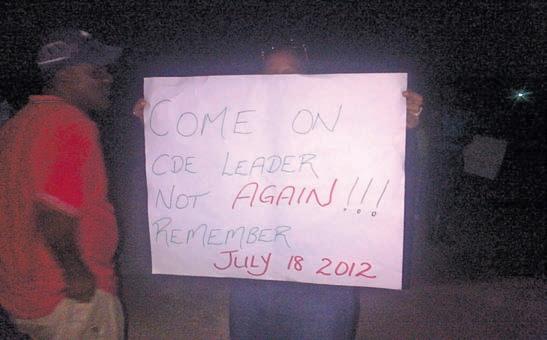
meeting in the mining town on Friday at the McKenzie High School, but ordinary Lindeners were locked out, sparking an angry protest. The Lindeners, who have accused Granger of doing his own thing, have expressed strong dissatisfaction with the PNCR leadership following the ruckus at its 18th Biannual Congress.
Speaking outside the locked school gate on Friday, Gonsalves said: “We would have invited him into Linden several times; he never turned up. So after we learnt he was going to be in Linden today, we turned up to let him understand. Why come to Linden to have a meeting and you can’t deal with issues which are outstanding? And when we turned up here, the gates are locked,” he said.
APNU had indicated that it will support the motion when it is brought before the House for debate, but recently told another section of the media that outstanding matters will be a priority when work in the House resumes.



Editor: Tajeram Mohabir
Tel: 225-5128, 231-0397, 226-9921, 226-2102, 223-7230 or 223-7231. Fax: 225-5134
Mailing address: 238 Camp & Quamina Streets, Georgetown
Email: news@guyanatimesgy.com, sales@guyanatimesgy.com
Rather serendipitously, October 5, which was the 22nd anniversary of democracy being returned to our country, was also “World Teachers’ Day” on the global calendar. “Serendipitous”, because the man Dr Cheddi Jagan, who more than anyone helped to restore that democratic order, was above all, a great teacher.
While the day is intended to focus on teachers in schools, it is widely accepted that some of the greatest lessons of life are imparted outside the walls of the official schools. And this has been the legacy of Cheddi Jagan, which must not be allowed to be forgotten in our land, if we are ever to fulfil the great potential that we have been endowed with.
Jagan’s first lesson was that even though he became a professional dentist in the US and could have enjoyed the American “good life” with his American wife, Janet, he chose to return to his native land. And this was in 1943, when because of the ongoing WWII, Guyana was in a depression because of goods not coming into the country and exports not leaving due to German U-Boats.
Today there are so many young Guyanese who could emulate him, by returning to develop the country that gave them a free education, after their overseas training.
Another lesson was his attitude and actions on girls and women. Yesterday was the “International Day of the Girl Child” with the theme of “Empowering Adolescent Girls”. Dr Jagan was way ahead of almost all his contemporaries on empowering girls and women. In his own life, he treated his wife Janet as an equal in all respects, both professionally and personally. She was a pioneer in the empowerment of women rights and was the founder of the Women Progressive Organisation.
Dr Jagan was also one of the teachers on the need for all children to become educated as an aspect of their total emancipation. When he first entered Government during the period of internal self-government starting in 1957, he began the process of removing schools from Church control and opened up many new primary and secondary schools that welcomed many children who had been kept out because of the pressures to convert.
But his greatest lesson was on relations between the several ethnic groups that had found themselves in Guyana, as the country moved inexorably towards independence. Dr Jagan is the father of multiracialism and multiethnicity in Guyana. When Dr Jagan returned to Guyana, political representation was funnelled through explicit ethnic organisations. For Indians, there was the British Guyana East Indian Association (BGEIA) and for Mixed and Africans, the League of Coloured Peoples (LCP). There were also the Portuguese and Chinese Associations.
As an East Indian, Dr Jagan joined the BGEIA, but soon quit to form an organisation that would include all Guyanese: this was the Political Affairs Committee, which was to transform itself into the People’s Progressive Party in 1950. It is ironic that when Forbes Burnham quit the PPP, and launched the People’s National Congress (PNC), he included the leaders of the LCP, which had by then formed its political wing – the United Democratic Party. But yet it is Jagan’s fervently multiracial party that is being accused of being “racial”.
Another contribution of Dr Jagan was his insistence that while there has to be a certain amount of pragmatism in everyday and national life, there must be some overarching principles that should guide citizens when it comes to making decisions and choices.
Dr Jagan was guided by the principles of MarxismLeninism so that others were always aware “where he was coming from”. His party in Government has never abandoned the tenets of the founder – encompassed in the maxim of being “for the working class, the poor and the powerless” – even as they have had to pragmatically accept aspects of the dominant liberal paradigm.
We salute the great teacher Dr Cheddi Jagan.

Dear Editor,
It seems as if West Indies cricket is in turmoil once again – there is a serious rift between the players and the West Indies Cricket Board (WICB) – so much so that the players called a possible strike on the eve of the first One Day International against India. But fortunately the cricketers decided to play and as a matter of fact won the match convincingly.
The row started after the WICB has decided to change the pay structure of the players which will decrease the fees to the players in all three format of the game: Tests, ODIs and T20.
Under the new Memorandum of Understanding (MoU), the players will be confined to
give priority to West Indies cricket rather than playing in more lucrative games such as the Indian Premium League (IPL).
The players are very upset with the President of the West Indies Players Association (WIPA) Wavell Hinds for agreeing to the new terms and conditions of the MoU, and captain of the ODI team Dwayne Bravo dispatched a letter to Hinds calling on him and other executive members of the WIPA to resign, accusing them of conflict of interest and for not acting in the interest of the players.
The letter added that the players have lost confidence in the WIPA and warned the WICB that the players themselves (and not the
WIPA) must have an input in the new MoU.
However Hinds in his response refused to resign stating that the WIPA is governing by rules and regulations and there is a procedure to remove its executive. He added that the WIPA is the bargaining agent for the players.
He expressed regret of the unfortunate stand taken by skipper Bravo who insinuated that he (Hinds) was closely connected to WICB President Dave Cameron since they were from the same club in Jamaica.
Former West Indies captain, Sir Vivian Richards is happy that the cricketers have decided to play.
He said he was pleased to see that good sense prevail. However, the players
have made it quite clear that the agreement to play should not be construed as acceptance by the players to the unreasonable terms set out under the new MoU. Bravo reiterated that the players are still governed by the previous MoU and do not accept the new one. It is not the first time that the Board and the players are embroiled in controversy surrounding remuneration. This unfortunate financial misunderstanding raises its ugly head fairly often in the history of West Indies cricket. Best wishes to the team – they started off extremely well. Hope the trend will continue.
Sincerely, Oscar
Ramjeet
Resign quickly and save yourself further
Dear Editor,
Things are indeed heating up in the Welshman versus Trotman rape and buggery matter. Temperature is at a giddying fever pitch as Anthony Welshman hires an attorney and is headed to court. It would be a messy and embarrassing experience for Trotman and crew, something that Lawyer Manickchand quite rightly advised the accused out of. But he is sticking to his guns in not meeting with the alleged victim half way; he is going to ride it out. Well, let us see where that stance would take him.
In the meantime, depraved souls, the likes of Benschop, has joined the fray. He is on board trying to convince the vic -
tim to back away from his claims. He has been interacting with Welshman on a level that has made him very suspect in this whole affair.
Instead of speaking to the accused and to work out a settlement, he tried the other route of bribing the victim into silence, while coaching him into implicating the PPP/C Administration as the ones behind this rape and buggery allegation.
It boils down to a situation of name and shame the Government, they are the ones responsible. Apparently this backfired on Benschop, because his “hush money” game did not work, instead he is the one in the hot spot exposed for all he’s worth in a wicked and malicious plot. All
of this is going to come out in court shortly.
May I pause here to ask the question: isn’t Benschop a social activist, one who should be championing the rights of the child? Instead of doing what he claims to be, he is in direct association with the accuser.
Not only is he in collusion but he is also concocting a wicked and malicious story implicating the Government in this mess. These are all serious offences that cannot be taken lightly. But such is the life and times of perverted people.
It has been an awfully long time since I’ve seen so many people embroiled in a “madman’s story.” It must have been an interesting episode to attract so
many actors. Again, I would wish to inform Trotman about a similar situation here between the Speaker of the St Lucian Parliament when allegations of rape and buggery was brought against him. In that case, his own brother-in-law was the accuser. As soon as word got out into the open, the Speaker quietly and quickly resigned his post and the dust soon settled. Trotman needs to do the same. If he thinks the PPP/C would sit and allow him to hold office then he is utterly mistaken. You cannot have it both ways.
Sincerely, Neil Adams
Dear Sir/Madam,
My name is Virgindra Jagdeo and I lived at Lot 44 Line Path D, Skeldon, Corriverton, Berbice. I had applied for a land line service with GT&T, and received a letter dated June 20, 2013, from the New Amsterdam Branch to pay $1160.00 for the service.
This I did on July 3, 2013 and to date, I am still without a land line service.
Several calls were made
to the New Amsterdam Office and I was told that my name is not in the system. I found this rather strange, because I am in receipt of bills every month from GT&T and I don’t have the service installed until now. Attempts to call GT&T New Amsterdam are futile – always get a busy tone or the line rings out. After much frustration, I subsequently called the Georgetown Office
and spoke to a Customer Service Supervisor who promised me to send an email to the Manager at the Berbice Office to enquire about my application. I made a follow up with her about a week after and she said that she already sent the email, and recommended that I should follow up with the Berbice Branch. To date I cannot get to speak with anyone on the phone. They
never seem to answer their phones.
I wanted GT&T to tell me something about my land line phone that I have already paid for. My reference number is B/ce 29337 and the phone number allotted to me is 339-2730.
I would be most happy if my phone line can be installed.
Respectfully,
V Jagdeo
Dear Editor,
A fever caused by a dangerous and highly contagious viral infection that causes severe hemorrhaging from the skin and mucous membranes, has occurred predominantly in Africa. This disease, the Ebola Virus Disease (EVD) – previously known as the Ebola Hemorrhagic Fever (EHF) – has no specific treatment and is fatal in many cases.
My advice is that Guyana take urgent measures to implement all the suggestions listed below. I would like also to suggest that all the leaders of our country urgently meet and discuss this matter at hand.
1. All persons, be it Guyanese nationals or any other foreign nationals wishing to travel to Guyana, must undergo an Ebola test by a highly recognised doctor or health organisation in whichever country they are travelling from. Same to be authorised by a Guyana High Commissioner or Embassy.
2. Results – an Ebola test result must be presented to the Guyana High Commission or embassy. The Guyana Embassy and or High Commission must then check with doctors and health organisations to verify the test results and then determine travel.
3. Airline – all airlines must demand results of Ebola tests from person or persons wishing to travel to Guyana using that airline service. Airline must also demand travel clearance from Guyana Embassy and or High Commission. Failure to do so must result in a revocation of contract or a fine.

The Ebola Virus Disease (EVD) – previously known as the Ebola Hemorrhagic Fever (EHF) – has no specific treatment and is fatal in many cases
Sincerely,
Allison Parker Public Relations Officer, GT&T
Dear Editor, Thank you for the opportunity to respond to Mr Virgindra Jagdeo’s letter. GT&T apologises to Mr Jagdeo for the unusual delay in providing the service which he had indeed paid for. This delay was compounded by the need to repair a line fault in his area. We are however pleased to report that his service on telephone number 339-2730 has been installed.
We continue to
Dear Editor,
As we continue to witness the increase in the incidence of suicide among our youths, it must be seen as imperative that we examine the efforts of the various agencies concerned with its eradication, and devise some new strategies to deal with this tragic phenomenon within our society.
I have no doubt that the organisations involved are vigorously striving towards stopping our young people from taking this drastic step, but unless those afflicted have clear and readily available knowledge about where they should go to ease their suffering, then these efforts may prove futile.
I am suggesting that we need to take positive steps towards becoming more visible in our approach,
so that those who are contemplating this unfortunate means of solving their emotional problems can be aware of where they can obtain the necessary professional assistance.
I am therefore proposing that we create some campaign which would disseminate this information by way of signs in every community, so as to point those afflicted with depression and suicidal tendencies to the people and places where they could readily access the needed emotional and/or spiritual help.
I dare say that this may entail a fair amount of resources, but it must be obvious that the budding lives we are losing so frequently must make it exceedingly worthwhile.
Yours sincerely, Roy Paul
5. Quarantine – any person showing symptoms of Ebola must not be taken to any clinic or hospital, be it private or public. Rather a facility setup to deal with Ebola infections only.
6. Facility – a facility
4. Ground – once on the ground in Guyana, all passengers must be subjected to a second Ebola test. Before entry into Guyana from any port of entry, if it is determined that any person exhibits symptoms of Ebola, that person must be quarantined.
must be set up to deal with Ebola and should be set up away from the population and off limits to the general population except for medical and security personnel.
7. Education – all efforts must be made to educate the Guyanese public about Ebola. What is Ebola? How to protect themselves. What are the symptoms of Ebola? This must be done in all public places.
Sincerely,
Dennis Atwell



esterday, October 11 was designated “International Day of the Girl Child” (IDGC) by the UN in recognition of the challenges faced by girls and their rights that are still being withheld.
Here in Guyana, we’ve come a long way from the days when girls were married off by 16 and not expected to complete school (and now we’re totally DOMINATING Schools everywhere, FYI. Whoo!).
But the thing is, we still do coddle (protect?) our girl-children as compared to our boys, don’t we?? Boys are allowed to stay out late, not expected to call to ‘check-in’ as frequently and generally allowed to do a lot more things than girls on the sole merit that ‘they’re boys’. I mean, girls do mature earlier than boys – you’d think we’d be treated as the more responsible ones. And besides, it’s a bit unfair to the boy-children if you’re just overprotective of your daughters
“The pen is mightier than the sword” –Edward Bulwer-Lytton, Richelieu, 1839
– bad things can happen to boys as well. But I’m digressing from the topic on hand – IDGC.
In a move to empower girls, Womenfound, the Afghan Women’s Writing Project (AWWP) and the Huffington Post are all working together to publish the works of Afghan women and adolescent girls. And I think that that’s an incredible idea. Writing is amazing on so many levels. By writing frequently, it becomes so much easier to formulate your thoughts and articulate them whether through writing or public speaking.
But most importantly for these girls, I think, is that through writing, their voices can now be heard. Being allowed to write and put your views out there into the world, to share your opinions is an amazing privilege. And an even more incredible thing is when people actually read the things you wrote.
Over the holidays in New York, I ran into several people who told me they read my articles and every time that happened, I cycled through different emotions: first came confusion (do you mean me? My articles?), then incredulousness (you actually enjoy what I’m writing?), then

sheer happiness (wow! I feel so special – people read the things I’m writing!) and then gratitude that people not only took the time to read what I wrote, but also to let me know how they felt about my writing.
So I think this is a truly admirable initiative by the AWWP and the HuffPo because writing really does empower the wielder of the pen (or computer, nowadays). Through writing you can say the things that you might be too scared or anxious about saying in a speech to 200 people. Through writing you can gain confidence. I love writing, and I really think more people should write more frequently – even if it’s just writing about your day in your Diary/Journal.
So pay attention to your girl child, not just on IDGC, but every day. Some of us are dainty princesses and some of us are Xena warrior princesses and some of us just don’t like the idea of royalty. We’re all individuals, built differently, with different hopes and aspirations and hopefully we can all be allowed the chance to follow our dreams. To quote Mark Wahlberg’s character in ‘The Other Guys’, “I am a peacock, you gotta let me fly!”
Symptoms of Ebola Virus Disease (EVD)
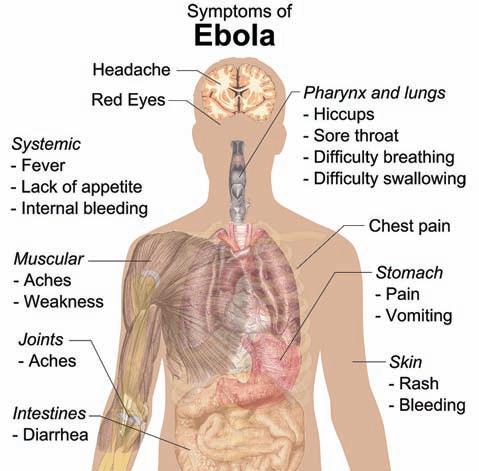
The incubation period, that is, the time interval from infection with the virus to onset of symptoms is two to 21 days. Humans are not infectious until they develop symptoms. First symptoms are the sudden onset of fever fatigue, muscle pain, headache and sore throat. This is followed by vomiting, diarrhoea, rash, symptoms of impaired kidney and liver function, and in some cases, both internal and external bleeding (eg oozing from the gums, blood in the stools). Laboratory findings include low white blood cell and platelet counts and elevated liver enzymes.
Diagnosis
It can be difficult to distinguish EVD from other infectious diseases such as malaria, typhoid fever and meningitis. Confirmation that symptoms are caused by Ebola virus infection are made using the following investigations:
maximum biological containment conditions.
Treatment and vaccines
Supportive care-rehydration with oral or intravenous fluids –and treatment of specific symptoms, improves survival. There is as yet no proven treatment available for EVD. However, a range of potential treatments including blood products, immune therapies and drug therapies are currently being evaluated. No licensed vaccines are available yet, but two potential vaccines are un-
Ebola, monitoring the health of contacts for 21 days, the importance of separating the healthy from the sick to prevent further spread, the importance of good hygiene and maintaining a clean environment.
Controlling infection in health-care settings:
* Health-care workers should always take standard precautions when caring for patients, regardless of their presumed diagnosis. These include basic hand hygiene, respiratory hygiene, use of personal protective equipment (to block splashes or other contact with infected materials), safe injection practices and safe burial practices.
* antibody-capture enzyme-linked immunosorbent assay (ELISA)
* antigen-capture detection tests
* serum neutralisation test
* reverse transcriptase polymerase chain reaction (RT-PCR) assay
* electron microscopy
* virus isolation by cell culture
Samples from patients are an extreme biohazard risk; laboratory testing on non-inactivated samples should be conducted under

dergoing human safety testing.
Prevention and control
Good outbreak control relies on applying a package of interventions, namely case management, surveillance and contact tracing, a good laboratory service, safe burials and social mobilisation. Community engagement is key to successfully controlling outbreaks. Raising awareness of risk factors for Ebola infection and protective measures that individuals can take is an effective way to reduce human transmission. Risk reduction messaging should focus on several factors:
Reducing the risk of wildlife-to-human transmission from contact with infected fruit bats or monkeys/apes and the consumption of their raw meat. Animals should be handled with gloves and other appropriate protective clothing. Animal products (blood and meat) should be thoroughly cooked before consumption.
Reducing the risk of humanto-human transmission from direct or close contact with people with Ebola symptoms, particularly with their bodily fluids. Gloves and appropriate personal protective equipment should be worn when taking care of ill patients at home.
Regular hand washing is required after visiting patients in hospital, as well as after taking care of patients at home.
Outbreak containment measures including prompt and safe burial of the dead, identifying people who may have been in contact with someone infected with
* Health-care workers caring for patients with suspected or confirmed Ebola virus should apply extra infection control measures to prevent contact with the patient’s blood and body fluids and contaminated surfaces or materials such as clothing and bedding. When in close contact (within one metre) of patients with EBV, health-care workers should wear face protection (a face shield or a medical mask and goggles), a clean, nonsterile long-sleeved gown, and gloves (sterile gloves for some procedures).
* Laboratory workers are also at risk. Samples taken from humans and animals for investigation of Ebola infection should be handled by trained staff and processed in suitably equipped laboratories.
WHO response WHO aims to prevent Ebola outbreaks by maintaining surveillance for Ebola virus disease and supporting at-risk countries to develop preparedness plans. The document provides overall guidance for control of Ebola and Marburg virus outbreaks: – Ebola and Marburg virus disease epidemics: preparedness, alert, control, and evaluation When an outbreak is detected WHO responds by supporting surveillance, community engagement, case management, laboratory services, contact tracing, infection control, logistical support and training and assistance with safe burial practices.
WHO has developed detailed advice on Ebola infection prevention and control:
– Infection prevention and control guidance for care of patients with suspected or confirmed Filovirus haemorrhagic fever in health-care settings, with focus on Ebola. (www.who.int)

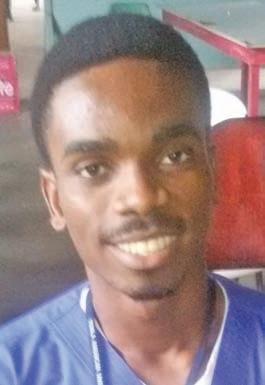
Nigerian students studying at the Texila American University said the rigorous surveillance and quarantine they were subjected to at interconnecting airports have been markedly absent in Guyana.
This is despite word by Health Minister, Dr Bheri Ramsaran, who told Guyana Times on Thursday that doctors have been deployed to carry out surveillance at the Cheddi Jagan International Airport (CJIA)
The Texila University in Guyana offers several health sciences programmes and attracts students from some 35 countries around the world, including Nigeria, a country known for its high prevalence of the Ebola virus.
Speaking with this publication on Friday, students related the horror they experience at ports, both within and outside the country of their birth.
Guyana Times was informed that there is no direct flight from Nigeria to Guyana, and that students are required to stop in about five countries before setting foot here. The interconnecting flights from Nigeria would often take between six days to one week.
“We would travel from Nigeria to Europe and sometimes have to take another flight to Germany and then maybe to The Netherlands, then depending on whatever connecting flights you are on, you would either travel to Trinidad, Barbados or Brazil,
then Guyana,” said medical student Nwanekezi Uganda Erastus.
Test and retest
At each of these stops, West African citizens are “tested and retested”. They are also placed in isolation during the examinations.
The students explained how they are treated within their own country.
Idris Raji, also of Nigeria said, “In Nigeria, you can’t even go to the shopping mall without being tested for Ebola. Nobody touches anything in the shopping mall. You just point and check in. They are at the entrance, blocking you and making checks on everybody.”
He said if one wants to leave, they are thoroughly examined at the airports. “You go to Germany and the other countries, and you go through the same routine,” he said
Two other Nigerian students Roland Dane OseenAsu and Ogheneyole Darell Ujorio-Okoro, who came to Guyana last Saturday, said

they are aware of the numerous testing which are required in their homeland.
They spoke of multiple blood tests and scans during and after the 21-day incubation period.
None of these rigorous activities are carried out at the CJIA, they related.
Meanwhile, the students are adamant that the Government is not doing all that it possibly can to
Granger had told Guyana Times that while APNU did not hold actual discussions with the people, the go ahead was given by their representatives; the executive and leadership councils.
The motion, which seeks to rid the country of the ruling Donald Ramotar Administration, was in early August filed in the National Assembly by the AFC after it accused the Government of failing to execute its duties within the constitutional ambit.
The AFC has at no time indicated that it will collate with APNU to face the People’s Progressive Party/ Civic (PPP/C) at the polls if the motion is passed.
As it stands, if the parties go to the polls, APNU after supporting the AFC to pass the No-Confidence Motion against the Government will have to face up with the AFC

keep the deadly virus out of Guyana, noting that emphasis is placed only on persons coming from West African territories.
The students and their representative are contending that the Ebola virus which has sprung out of Guinea, Liberia, Sierra Leone and Nigeria to the United States and Spain has become a global issue. They say equal surveillance should be carried out on individuals coming from all affected countries.
Erastus told Guyana Times that there are persons who also travelled from the United States and other parts of the world and are not hassled as much as Nigerian citizens.
He said Nigerians should be given some leverage since the virus has been “kicked out” of the country.
Quarantine everyone
“It’s unfair because whenever someone realises that you are from Nigeria, they look at you like an Ebola patient,” he said, continuing that “If you want to ensure safety, then you should go to the extreme and take all the measures. These guys are also coming from California and the United Kingdom. Quarantine everyone,” Erastus said.
Student Affairs Manager Clairmont Frank had expressed similar sentiments. He said while he could not say what exactly is being done by the Health Ministry here; Government should be a little more “proactive” in its ap-
From page 3
in the bitter elections struggle to maintain its seats in the House.
In the 2006 elections when the AFC came on the political scene, it took several seats in Parliament which were held by the PNCR. The PNC is now the largest party in the coalition APNU. The AFC has also been accused of selling out APNU on the Linden tariff increase, which caused a monthlong protest in the mining town in 2012, and resulting in the death of three protesters.
The AFC has also put APNU members in dim light when it leader Khemraj Ramjattan claimed that the PPP/C had approached three of the coalition’s leaders with an offer of $30 million each to not support the NoConfidence Motion.
When asked if the leadership of the coalition made the right decision, in light of
proach to the Ebola virus and people from the West African countries.
“The problem with Ebola; however, is that a person may leave looking and feeling healthy, but it has an incubation period of 21 days. We have a system in place. We have a student who was travelling from Cameroon landed in Brazil, was sent back and is now on her way back here. For that period the incubation period has long gone past.”
Frank, whose responsibility is to the students of the university, said that the system of the university has caused for Nigerian students to remain home for some 21 days, even after they would have spent an equal amount of time undergoing surveillance and quarantine.
“If there are no symptoms of fever or pain, they are allowed to return to class,” Frank told this publication.
While many of the students did not return home during the August holiday, Frank said the few who did, have already completed the 21-day quarantine and are back at school.
With a population of over 80 per cent foreign students, including a large number coming out of the West African country of Nigeria, the Texila America University had said that it is taking every precaution against the spread of the Ebola virus here.
Frank said the university has a high percentage of students coming from Nigeria. Many of these students had gone home during the holiday break and are now returning to classes.
To be safe, Frank explained that the university

has been carrying out its own surveillance to ensure the returning students are not infected with the virus.
He explained the students, upon returning to Guyana, are asked to remain at home for at least one week to make sure they are not infected.
He said the university has also been seeking information from the students on the ports of entries through which they had travelled, explaining that coming from Nigeria, these students would have had connecting flights through Europe and other destinations.
Tested negative
Meanwhile, the BBC has reported that the Guinean man who had been suspected of having Ebola has tested negative for the disease.
The man arrived in Brazil on Thursday and had been quarantined.
Souleymane Bah went to a public health centre in the town of Cascavel in the southern state of Parana after suffering a fever.
He was flown to the National Institute of Infectology in Rio de Janeiro
but fears he was the country’s first case of Ebola infection proved unfounded.
Health Minister Arthur Chioro said “all health protocols and procedures were applied efficiently and with great success”.
Guinea is one of the three West African countries most affected by Ebola. Bah’s symptoms appeared on the 20th day after he left Guinea – within the 21-day incubation period. He no longer has the fever.
Bah arrived in Brazil as a refugee and was granted leave to remain until 2015 by Immigration Police.
Sixty-four people who came into contact with Bah, mostly in the health centre in Parana, were monitored for symptoms of Ebola, the BBC said.
Notwithstanding the suspected Ebola patient in neighbouring Brazil has tested negative, persons here are calling on the Health Ministry to do rigorous testing at the country’s borders.
They have also appealing to the Government to increase patrol of the country’s porous borders.
these, some APNU leaders refused to share their opinion, opting to say “no comment”.
They were also reticent to give their views on whether they believe that the coalition was outmanoeuvred by its junior partner, the AFC, in giving a commitment to support the motion.
The issue of the coalition’s preparedness for General Elections was also met with “no comment”.
But PNCR Region 10 Councillor Maurice Butters, who was locked out of the meeting held by Granger on Friday, was forthright, saying he fully supports the NoConfidence Motion, and the coalition’s leadership has not been outfoxed by the AFC.
The motion, which is unprecedented in the history of Guyana, if passed, will see Guyanese heading to the snap elections for the first time.
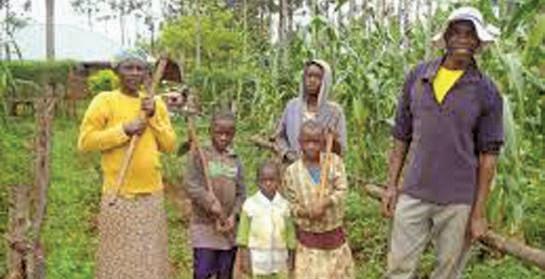
Key regional and international organisations have pledged their commitment to improving the lot of family farmers across the Caribbean Region through collaboration with each other.
In their remarks at the formal opening ceremony of the Caribbean Week of Agriculture (CWA) in Paramaribo, Suriname on Wednesday October 8, representatives of regional and international organisations lamented that family farmers were unheralded, even though they were playing a critical role in the agriculture sector.
“Transforming Caribbean Agriculture through family farming is the theme of this year’s CWA.
Family farmers include indigenous peoples, traditional communities, fisher folk, pastoralists, and collectors. Family farming is understood to include crop, livestock, forestry, fishery and aquaculture producers.
These producers are largely smallholders and mediumscale farmers and peasants. They play a vital role in helping to reduce the high food import bill as well as in aiding the revitalisation of Agriculture in the Caribbean Community (Caricom).
About 80 per cent of the food supply in developing and developed countries is produced by an estimated 500 million family farms, Food and Agriculture Organisation (FAO) Caribbean Region Coordinator, Dr Deep Ford said in his remarks to the opening ceremony.
In Latin America and the Caribbean, family farming accounts for more than 80 per cent of agricultural production and generates more than 50 per cent of agricultural employment. In Haiti alone, there are one million family farmers who produce about 50 per cent of the food that is consumed there.
“In addition to being a major supplier of traditional food which contributes to healthy,
balanced diets, family farming provides employment opportunities, preserves and enhances the culture, skills and traditions of local communities and contributes to the conservation of plant and animal species,” he said.
Although strides have been made, in family farming in Caricom, much more needs to be done to improve the lot of those farmers. For starters, there was need for the development of a Caribbean definition of family farmers in consideration of the diverse range of circumstances under which family farms in the region operated.
developing the detailed analysis to inform the identification and evaluation of policy options, trade policy assessments, vulnerability and resilience analysis, and developing measures to improve agricultural productivity and sustainability, including the design of effective social protection systems.
In recognition that such an undertaking could not be done alone, he said the FAO will continue to collaborate with developmental partners such as Caribbean Agricultural Research and Development Institute (CARDI), the InterAmerican Institute for
“This is necessary so that we can develop targeted policies, directed at specific family farms. This includes technologies to enhance the productivity of family farmers tailored to their specific circumstances, taking into account the people and the environment. We must also promote, enhance and expand their current sustainable practices and ensure that they not only feed their families but feed the rest of country and region, so that we rely less on imported foods. Also, we must ensure that these families realise improved livelihoods. Family farmers are among the poorest households in our countries,” Dr Ford pointed out.
The FAO Regional Coordinator said the FAO was committed to supporting regional and national efforts in a number of areas. Among them:
Cooperation on Agriculture (IICA), Agricultural and Rural Cooperation (CTA), Caricom, Governments, civil society, private sector and academia to support family farmers in the region.
The Technical Centre for CTA, a key partner in the hosting of the CWA, also weighed in on the importance of family farmers.
CTA Director, Michael Hailu, said his organisation wanted to explore how to make conditions better for smallholder farmers who he described as the backbone of food production in the Caribbean.
“There is also another important dimension to family farming. I’m talking about young people and the role that they should and can play in supporting agricultural development, in light of an age-
ing farmer community in the Caribbean and across the ACP,” he told the audience at the opening ceremony.
That was the reason CTA was making a special effort to encourage young people to engage in agriculture in ways they could relate to, utilising new technologies that were far removed from the old image of agriculture, he said.
The CTA has spearheaded two competitions this year aimed at youth and the innovative contributions they could make to agriculture and rural development in the Caribbean.
For many years, the populace of the region has depended on family farming to keep it satisfied, said CARDI Executive Director, Dr Arlington Chesney.
“It is the income from family farms that has facilitated the education of most of our doctors, engineers, lawyers and perhaps politicians. But the family farmers have generally been unheralded and sometimes despised. It is my sincere hope that following CWA and 2014, the family farm and the family farmers will be given the respect and place of honour that they are so deserving of,” he said.
The reality of family farming in the Region includes thousands of small farms as well as some successful large farms, all applying indigenous knowledge and technology and acting as innovators in their own right, Dr Victor Villalobos, Director of the Inter-American Institute for Cooperation on Agriculture (IICA) said.
He pointed out that some of the large and very successful commercial family-managed farms in the Caribbean included the Mennonite farmers in Belize who were responsible for much of the corn, beans and dairy production; rice farmers in Guyana, cassava farmers in Suriname, and sheep and goat farmers in Jamaica and Trinidad and Tobago.


Y...in Linden
ou don’t have to be a Marxist to accept that contradictions – whether in persons or organisations – end in conflict. Either with the said individuals “tripping”, the organisations “splitting” or rather rarely, the contradictions “resolving”. Just look at what’s happening in the PNC.
The contradiction manifesting this time is that while the members always accepted their organisation rigged elections – no apology’s going to ever be issued about that, baby!! – they never expected their own internal elections would be rigged! And certainly as blatantly as it was by David Granger. And to rub salt into their collective, the wanker wasn’t even a “regular” PNC!! All he’d done back in the day was to ensure that the ballots being “counted” – well, actually “substituted” – at Camp Ayangana didn’t end up giving his soldiers “writers’ cramp”.
And to periodically “condignly” remind ignorant citizens who thought soldiers shouldn’t hijack ballot boxes, a lesson or two. Anyhow, after being denied their right to vote for their party leader, the Lindeners beat a retreat back to their township. The gunshot fired by Granger’s bodyguard probably reminded them about the fate of those two Berbicians who’d been taught the lesson at 63 Village. Death is so final.
It was just the latest in a long string of humiliations for them. Wasn’t their representative Vanessa Kissoon banished to the back benches for daring to disagree with Granger! Then she wouldn’t even accept her demotion to the back benches like a good little girl!! Followed by the imposition of Granger’s handselected, hand-maiden to “organise” Linden.
Seems she came down to Linden with her boss Granger to organise Linden for the latter’s pet project of protesting for [Local Government Election] LGE AND DIDNT INVITE ANY OF THE CARD CARRYING PNC MEMBERS WHO’D APPOSED GRANGER AT THE LEADERSHIP ELECTIONS!!! Locked the gate on them! Threw out the ones who’d managed to sneak into the yard. And these are the people who’re accusing the PPP of not practicing “democracy”!! Oh Pharisees! Granger and his band of sycophants wouldn’t recognise democracy if it crept up and bit him on his behind!
But in the end, the Linden PNCites have nobody to blame but themselves. After they were kicked out of Congress Place, they swore that they were “still loyal PNC”. And now that they’ve been locked out of their own house in Linden, they again vowed “We’re PNC to the bone”.
They have to learn this lesson – nobody gives a damn about doormats. They just walk all over them!!
...on no-confidence
Well, October 10 came and went not with a bang, but a whimper. Well, dear reader, did you really expect anything to happen when the official end of the “Parliamentary Recess” came to an end? Like school recess, nothing happens in the first week.
But as we’ve been saying all along...nothing’s gonna happen even next week even though the AFC’s now moved their Armageddon Day to October 16. And the reason is – and your humble Eyewitness told you so!! – the PNC under Granger, can’t be seen as the AFC’s handmaiden.
That’s why Granger’s hitched his wagon to the LGE star and has been bobbing and weaving on the NoConfidence Motion. Yes...yes...yes...he did say last week he’s in support. What else did you expect him to say?? But his action speaks louder than words – and his actions have shown he ain’t gearing for any snap elections.
In fact, he’s now changed his words. Rather than the No-Confidence Motion being the first order of business, Granger’s now talking about “hauling” Ashni Singh to the Privileges Committee. Oh he who speaks/ with a forked tongue!!
...with fifth columnist
PPP/C’s General Secretary Clement Rohee dubbed Carl Greenidge a “fifth columnist” in the PNC. Well inquiring minds want to know,” for whom?” Aubrey Norton batted for him as leader in 2011. Is he now returning the back scratching favour??
By Jomo Paul
Stalled developmental initiatives such as the Amaila Falls, the Cheddi Jagan International Airport Expansion and the Marriot Hotel Projects have the capacity to make Guyana a major contributor in the fight against climate change.
Effectively, this will make Guyana a vanguard in efforts to reduce the effects of the global phenomenon and provide other Caribbean countries with working examples to follow.
This is according to former President and United Nations Champion of the Earth, Bharrat Jagdeo during a recently held Guyana Manufacturing Services Association (GMSA) dinner at the Princess International Hotel, Providence, East Bank Demerara.
Making specific reference to the Amaila Falls Hydropower Project, Jagdeo emphasised the need for Guyana and the Caribbean as a whole to pursue cleaner sources of energy.
He pointed out that the project has an overall capacity to save Guyana some $94 million per year and US$3.5 billion over a 20year period, yet still monies were not granted for the completion of the project.
“Yet we have controversy because of this silly politics, silly politics. This doesn’t have whether you’re a consumer, it doesn’t differentiate whether you’re APNU supporter or PPP supporter or whether you have a business in this country. We have never judged people based on what they supported.
That’s their private business. But clearly when something is so transparently and vividly beneficial then you expect everyone to support it,” said the former President.
Jagdeo underscored the fact that as time progresses, it will become increasingly harder for developing countries to acquire financing from international bodies for traditional ways of sourcing energy.
He contended too that the countries that invest early in green technologies can become the world’s leaders in the production of technology.
“The new spurt of world growth can come from the green sector as it came in the past from the industrial revolution. Fixing the problems of climate change can spur a new level of growth across the world which in turn will have an impact on us. So we in Guyana and in the Caribbean cannot be oblivious of what is happening in the rest of the world. If we are then we will miss out on this huge opportunity. And my fear is that is precisely what is happen-
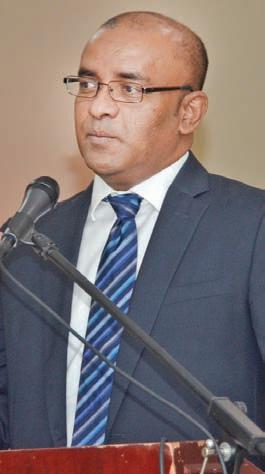
ing in Guyana.”
He also lashed out at Opposition spokespersons who have been making comments on the project deeming it unwise and unfit for Guyana at this point in time.
“I heard from some Opposition commentators that we would have incurred a debt from $700 million to $2.1 billion… the debt is zero because the Government is buying power,” he said.
“The biggest green opportunity in Guyana, everyone knows it is the hydro power. The hydropower will allow us to practically decarbonise our entire energy sector,” he went on to say.
Revival In June, President Donald Ramotar has signalled his Government’s intention to revive the US$840 million Amaila Falls Hydropower Project, despite hindrance from the Opposition.
The President said the country’s economic landscape will undergo major transformation when the hydropower project materialises.
Though the implementation process has been delayed, he assured the Private Sector that progress is being made. It was disclosed that the InterAmerican Development Bank (IDB) approved US$64 million for the
Guyana Power and Light (GPL).
According to President Ramotar, the approved funds will be used to put GPL in a state of readiness to receive power from the Amaila Falls Hydropower Plant when it comes into operation.
According to him, the Government is hoping to wrap up negotiations sooner rather than later. “We are still hoping and ready to go with Sithe Global and Blackstone for this project, but we are not going to wait forever. We have other options and we have to bring those discussions to a conclusion,” he posited.
“One way or another,” the project will come into fruition, the President said, noting that the Government is trying to avoid unnecessary delays.
Before crumbling in 2013, the Amaila Falls Hydropower Project was a Private Sector-led initiative, designed to be financed through debt from the IDB and China Development Bank (CDB) and with equity from Sithe Global and the Government of Guyana. China Railway First Group was identified for the construction of the power facility.

The nine delegates vying for the coveted title of Miss Guyana Universe 2014 were on Friday evening sashed by their respective sponsors during a simple ceremony at the Pegasus Poolside, ahead of the grand finale.
Despite the international pageant has been pushed back to January 24, 2015, in Miami, Florida, the local leg of the competition will be held on October 26.
The nine beauties were first unveiled to the public about two weeks ago at Palm Court and they have since been promoting themselves on social media.
At the sashing ceremony, Franchise Holder Odinga Lumumba said this time around, the cream of the crop has been selected and fans will be in for a grand time.
He said the delegates were
in training for the past three months and are fully prepared for competition night.
On this note, he added that the contestants are competitive and whoever wins will be the ideal person to represent Guyana on the international stage.
He reiterated that the competition is judged fairly and the Planning Committee is anticipating a fierce competition. He also announced that Trinidadian soca sensation, Kees Dieffenthaller from Kes the Band will be performing on the evening of the finals.
The contestants are Jyoti Hardat, who is sponsored by Guyana Mobile; Alicia Kirton sponsored by Tempe Tea; Sonia Cummings sponsored by Kawloon Inc; Cardella Hamilton sponsored by Water Chris Hotel; Rochelle Cheddie sponsored
The delegates after the sashing ceremony took time to mix and mingle with the special invitees. The amazing delegates are all optimistic in winning the coveted title, claiming that they have been training hard over the past weeks to get the perfect posture for the big night. Their confidence level is high and they promised to bring their ‘A Game’ on October 26.
On pageant night, the delegates will be competing in swimwear, evening wear and an intelligence segment.
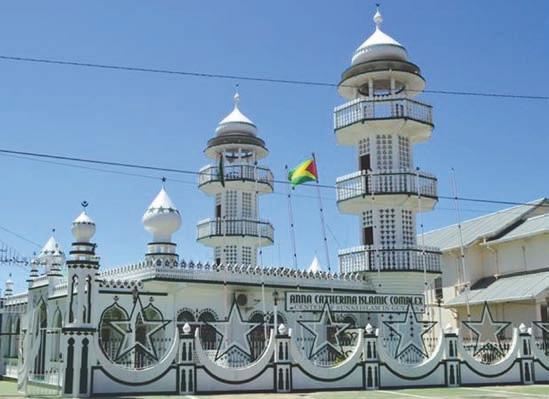
The 17th Annual Cultural Programme to mark the commencement of the Islamic New Year 1436/2015 will be held on November 2 at the Anna Catherina Islamic Complex (ACIC).
According to a release, the programme, which is now a premiere activity on the calendar of events for Muslims in Guyana, is hosted by the ACIC and the Guyana United Sadr Islamic Anjuman.

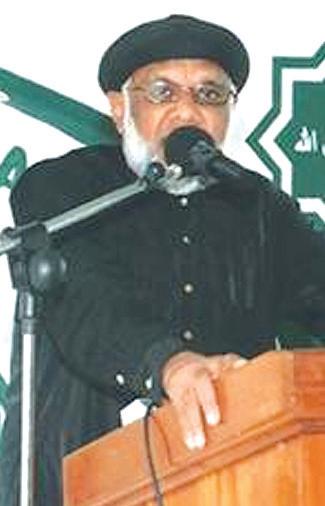
The guest speaker for the event is dynamic Caribbean International Muslim scholar Al Haj Kamaludeen Ghanny of Trinidad and Tobago. He will deliver the feature address.
Ghanny is a world-renowned scholar and has lectured in many countries throughout the world.
He first graced the stage in Guyana in 1999 and has since delivered many lectures here. In attendance also will be delegations from the Caribbean, South and North America.

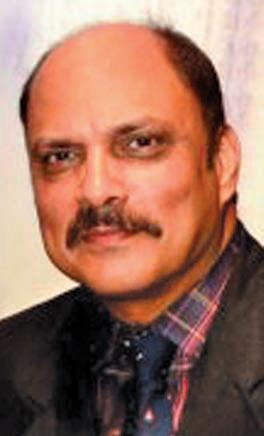
Health Minister, Dr Bheri Ramsaran said the Government is looking to make eye care more accessible, including for persons in hinterland communities.
Minister Ramsaran, while addressing a gathering of mainly doctors at the Herdmanston Lodge Georgetown on Thursday, said World Sight Day (WSD), which is an annual activity, is strongly supported by Eye Care Guyana, and the Health Ministry is happy to be a junior partner in the programme.
“I would like to recognise the good work that is being done by the NonGovernmental Organisation,” Minister Ramsaran said.
WSD is an international day of awareness, held annually on the second Thursday of October to focus attention on the global issue of avoidable blindness and visual impairment.
This year, WDS was observed on October 9 and was coordinated by the International Agency for the Prevention of Blindness (IAPB). WSD was held under the theme “Universal Eye Health”.
Minister Ramsaran added that over the past few years, many things have happened in the health sector in relation to eye care, much of which has been taken for granted. He explained that eye care in the recent past has not been on the front burner.
“We had a small but growing NGO and small efforts at the Georgetown Hospital and in the private sector.”
The Health Minister stated that it was discovered a
few years ago that cataract and glaucoma were major issues affecting Guyanese; therefore the Government invested and launched activities to raise awareness and fight these diseases.
The Government also accepted whatever help was available in order to promote the fight against these diseases.
Human resource development within the sector was enhanced and institutions were built such as the National Ophthalmology Hospital at Port Mourant, Berbice; which unfortunately, had a section of it damaged by fire recently.
Minister Ramsaran said, nevertheless, the Government is working to overcome the challenge and getting the complex back up and running.
Further, as the Ministry continues to move toward decentralising eye care, a small
Centre at the Georgetown Public Hospital, which is also supported by Eye Care Guyana and the Local Optometrist Centre.
Statistics state that 80 per cent of blindness cases are avoidable, and that 90 per cent of the world’s blind people are living in developing countries.
“We are getting there slowly and the Ministry is saying we cannot do it alone and that’s why we have these strategic partnerships that we are trying to generate and consolidate. Eye Care Guyana and the Ministry of Health is the way to go.” The goal of the Global Action Plan is to reduce avoidable blindness by 25 per cent by 2019.
The Ministry has also targeted populations, every
partnerships between the Government and the organisations help to promote development, and cited the Cancer Institute of Guyana as one such partnership.
He also spoke of the Chinese medical team, which performs cataract surgeries at the Georgetown Public Hospital and also donates equipment to Guyana.
Eye Care Guyana operates out of the Campbellville Health Centre, where lectures are done. Other organisations are invited to get on board with the Ministry.
The Minister further explained the Government’s commitment to raising awareness of eye diseases and said the health sector’s budget has stayed at around 10 per cent and it runs at the same pace as the education budget. Dr Ramsaran also stated that the health budget grad-
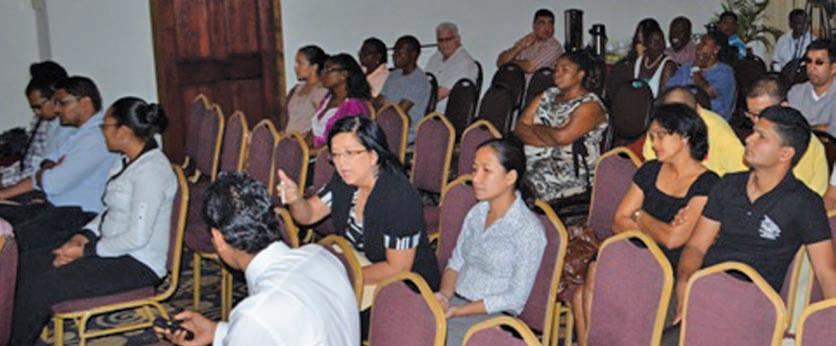
unit headed by a trained doctor who was trained by the intervention of Eye Care Guyana, is present at the Linden Hospital.
“She was trained at an overseas centre of excellence and is performing well. We at trying to create a small ophthalmology centre at Linden so people from Region 10 and adjoining areas would not have to travel to Georgetown.”
He added that much of the required eye care equipment is being sourced from the United States through the efforts of Eye Care Guyana.
He cautioned that a lot of eye diseases can be managed if there are early eye interventions, and as such, the Heath Ministry is looking to work along with the Education Ministry to spot early eye problems in children.
Spectacles will then be provided at a subsidised cost through the Low Vision
year at the National Toshaos Conference. The eyes of each participant are tested and the Ministry has been able to reach the Amerindian communities.
Helpful
“Not only are we venturing into their communities, but we meet them when they come here. Over the past few years, we interact with the representatives from the approximate 208 villages. This is done by Eye Care Guyana, Ministries of Health and Amerindian Affairs. We provide them with spectacles subsidised by the National Low Vision Centre,” Minister Ramsaran stated.
He added that those are the little things the Government is doing to bring forth equity and achieve the millennium development goals.
The Minister said such

ually increases for eye care every year. A few years ago, the Ministry decided that Guyana needed to have efforts beyond the isolated optometrists and ophthalmologists and thus, a very broad-based national committee was formed Vision 20/20.
This committee fell through, but Minister Ramsaran said the Ministry is currently resuscitating it. Various doctors in this field are expected to be as part of this committee.
National Programme Manager Charles Vandyke, who is also Coordinator for the Caribbean Counsel for the Blind/National Vision 20/20, said about three to four years ago, the Caribbean received funds for the vision 20/20 project.
He added that lots of initiatives have been taken through this project.

Satiricus was worried. Here it was the childwelfare folks, the court system folks, and the teaching commission folks were all reporting that “big people in position” were diddling people’s’ children. Satiricus wasn’t born yesterday....and as a matter of fact, he had once been a child. He’d known about some of the diddling of his young friends.
The problem had always been how to get people to believe the children weren’t just making up stories. Satiricus had concluded that some big people believed what they wanted to believe. Especially when it came to little boys being diddled. And they didn’t want to believe that some of their friends might be so low-down swines to do the dirty to children. “So what to do when the children told their stories?” wondered Satiricus.
Well now he knew: send them to BenchCock. He was the expert on diddled boys. For quite a while, Satiricus had thought BenchCock was Guyana’s answer to Malcolm X. All hot, bothered and angry about all sorts of things. Wasn’t a gathering anywhere of more than two people pissed off about something, and before you could say, “Kooma Kooma fish”, BenchCock was there in his nice, right-fitting suit and placard in his hot, little hands.
But then he messed up big time, and had to spend those five years at 12 Camp Street. Locked away with hundreds of men, Satiricus has wondered what life was like for BenchCock behind those galvanised walls. Satiricus heard stories about showers and soap but all he knew was when BenchCock came out, he was a changed man. He became an expert on diddled boys.
There was this boy from Linden who claimed a fella in the Government had solicited him. BenchCock immediately announced he KNEW what was going on. He went on a campaign and mobilised support for the boy. Some sceptics claimed that because BenchCock was violently opposed to the Government, he was just using the occasion to get back and embarrass them. But Satiricus knew that only those who felt something could know it. And it was clear that when it came to being diddled BenchCock FELT it.
But here was this young man WeltMan, claiming that he’d been diddled by the Opposition Speaker TrotMam, when he was just 12 years old. Being the expert on diddled boys, BenchCock, of course, immediately sought out and interviewed the young man.
And immediately echoed the Speaker, that the boy was “troubled”. BenchCock used even stronger words. And pronounced the boy wasn’t diddled. Was it because BenchCock and the Speaker were sworn to “appose, expose, and depose” the government?? “Nah,” concluded Satiricus, “BenchCock, was the expert on diddled boys. He’d FELT it.”
Religious and civic leaders as well as members of mosques throughout Guyana have all been invited to attend this programme.
The lunar Islamic Calendar began its calculation after the migration of Prophet Muhammad to Medina. The first month of the calendar is Muharram, in which the 10th day (called Ashura) is significant not only to Muslims,
but humanity.
“It is reported that the entire universe was created on this day; the first drop of rain fell on this day; the first human, Prophet Adam was created on this day; Prophet Jesus ascended to the heavens on this day; Prophet Ayube (Jacob) regained his eyesight on this day; Prophet Moses saved the children of Israel from Pharaoh’s Army by the opening of the Red Sea on
from page 9
this day; and our Prophet Muhammad’s grandsons, Imam Hussain and Hassan were martyred,” a release said. The 10th day of Muharram is very auspicious to Muslims and is observed with fasting, prayers and special programmes at the various mosques. The Islamic New Year is expected to commence on October 25.
Finance Minister, Dr Ashni Singh has signed two agreements with the World Bank to the tune of US$21 million to support Guyana’s education and agriculture sectors.
“On behalf of the Government of Guyana, I would like to extend my gratitude for the support of the World Bank towards these two important sectors which Government views
Improvement Programme which aims to increase enrollment in general secondary schools and improve teaching standards of Mathematics at the secondary level.
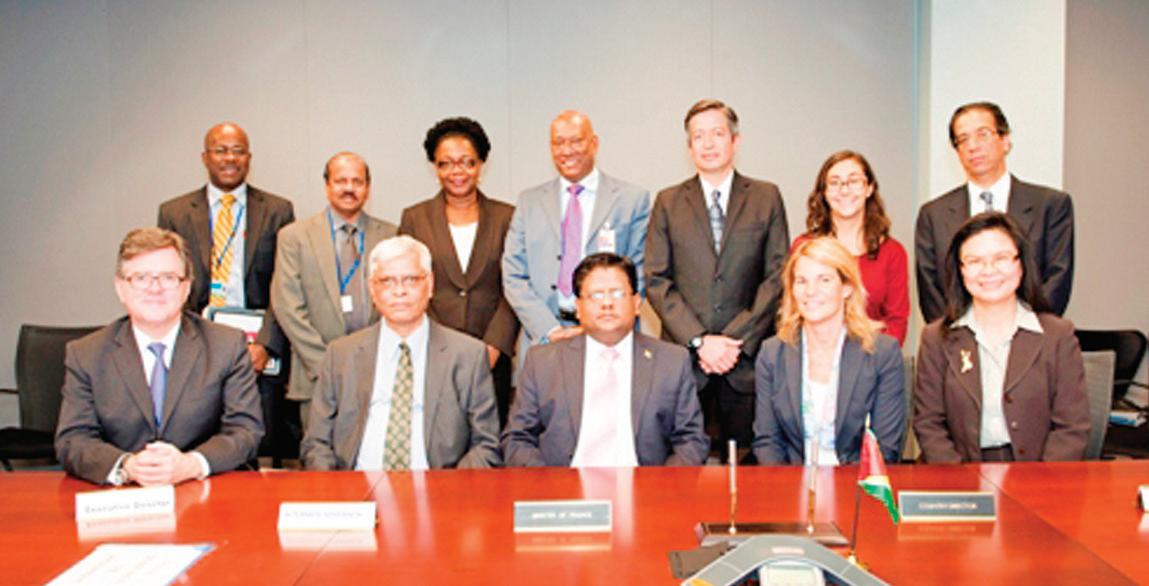
The agreement signed in Washington, DC, this week by Minister Singh and World Bank Caribbean Country Management Unit Director Sophie Sirtaine, is to support increased enrollment in general secondary schools and improve standards of Mathematics teaching for secondary education.
In the agriculture sector, the loan agreement will support the implementation of a flood risk management programme.
as vital to the development of Guyana,” said Minister Singh at the signing.
“These agreements serve to reinforce the commitment of the current governing administration towards the demonstrable development of Guyana’s infrastructural and social sectors.”
Education
One of the agreements signed is for a loan of US$10 million in support of the Secondary School
The Secondary School Improvement Project forms part of the Government of Guyana’s long-term initiative to achieve Universal Secondary Education by 2016.
About 85 per cent of young Guyanese are enrolled in secondary education institutions. Guyana has already achieved Universal Primary Education in keeping with the UN Millennium Development Goal (MDG).
Minister Singh at the

signing noted that the two projects form part of the Guyana Government’s ongoing effort to ensure improved standard of living for all Guyanese.
“The Government of Guyana has over the years demonstrated a firm commitment to education as a national priority and views access to quality education as vital to the development of our country’s youth and to the general development of Guyana,” Minister Singh noted.
Among concrete results to be achieved by the project are the following: 2600 new students from vulnerable areas enrolled in general secondary schools; a pilot technology-assisted learning in Mathematics; and 600 secondary Mathematics teachers trained, Mathematics standards for secondary school teachers increased, and Maths kits distributed to 250 secondary schools.
Flood risk management
A second loan signed by Minister Singh is for US$11 million to reduce flooding along the flood-prone East Coast of Demerara.
More than 300,000 people from the area will benefit from reduced flooding and climate risks as a re-
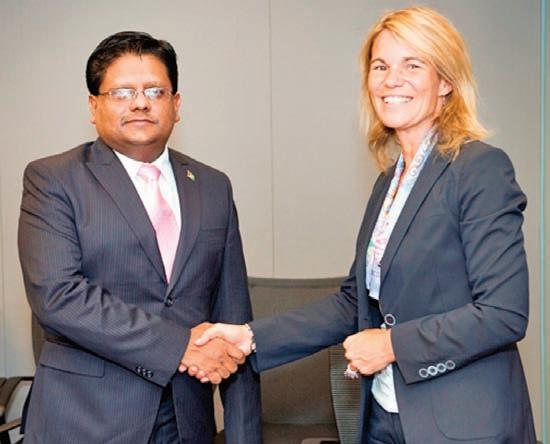
sult of the loan which forms part of the International Development Association (IDA) approved by the World Bank.
Minister Singh noted that close to 90 per cent of Guyana’s population lives on the coastal plain which is largely below sea level and vulnerable to the effects of climate change. He noted that in 2005, Guyana faced devastation from flooding that led to damage in excess of 60 per cent of Gross Domestic Product (GDP).
“The Government of Guyana is working to ensure that measures are put in place to ensure that the floods of 2005 and such destruction to both human and physical resources never occur again,” Minister Singh said.
The Flood Risk Management Programme seeks to upgrade critical sections of the East Demerara Water Conservancy dams and channels; improve drainage capacity in priority areas along the East Demerara Coast; and increase flood preparedness by installing instruments to monitor hydro-meteorological data.

The Government is conducting a study for the potential adoption of the Extractive Industries Transparency Initiative (EITI) in Guyana.
The study will be conducted by Moore Stephens International and a report will be submitted to the Natural Resources and the Environment Ministry by January 2015. The undertaking is costing over $17 million.
In May 2012, the Government signed a Memorandum of Understanding (MoU) aimed at adopting the EITI global transparency standard.
Natural Resources and Environment Minister Robert Persaud noted that
litical will and its commitment to transparency.
Emphasising the need for transparency and accountability and the responsiveness to citizens’ call for this, the Minister cited the late Dr Cheddi Jagan’ urging on the issue during Guyana’s return to democracy.
He explained that transparency is seen in the Auditor General’s annual reports which are submitted directly to the National Assembly and examined by the Public Accounts Committee, chaired by the Parliamentary Opposition.
The Minister said that the project could not have been possible without the macro and societal framework to accommodate it. He

ing mechanisms to satisfy accountability.
Minister Persaud ex-
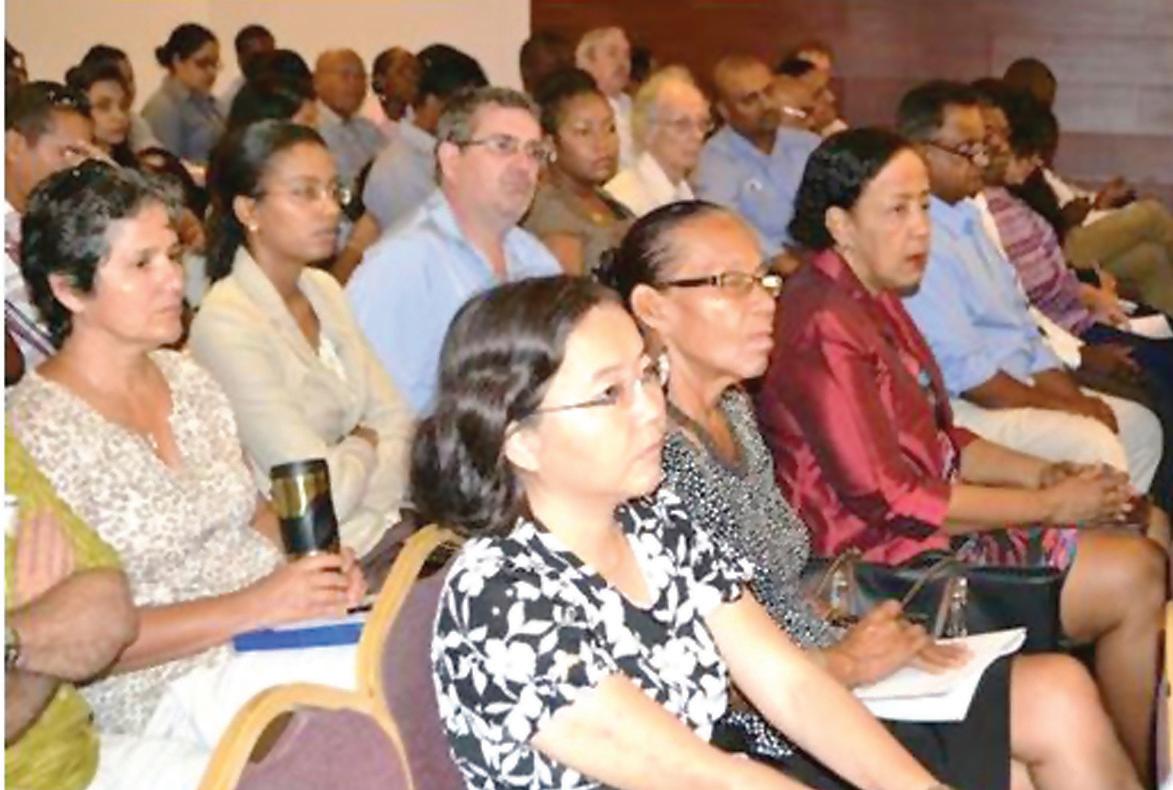
conducting the study demonstrates Government’s po-
added that there are other projects which have report-
plained that when Guyana in 2012 had applied to join
EITI, stakeholders were consulted and attended several discourses and events to enable their understanding of the process. He pointed that this groundwork had to be done if Guyana’s candidacy was to be considered favourably.
The Minister noted that consultations have been held with international partners including the Inter-American Development Bank, the World Bank, the US Embassy and the Kingdom of Norway. Additionally, local partners have also been consulted, as well all targeting the accelerating the process.
Forestry sector included
Observing that the extractive industry continues to grow, the Minister said that the project is not confined to mineral extractions.
“If we do not adequately prepare to deal with issues of transparency, in terms of how we manage and utilise the resources… we will be doing an injustice to this country and future generations…,” Minister Persaud said.
He pointed out too that investors are comfortable in countries where standards are maintained.
The Natural Resources Minister insisted that the EITI activity is aimed at taking Guyana to an international benchmark while positioning it to face the effects of the “resource curse” which has plagued bigger countries.

It is time for Guyanese youth to recognise the role they must play in defending and safeguarding the spate of economic development and social progress that have redefined their collective futures, providing them with insurmountable opportunities to soar.

Youth in this country can no longer afford to remain passive and silent as everyday important decisions are being made that can have devastating long-term effects on their future and the development trajectory of Guyana.
They must make a decision to defend the gains made in Guyana over the past two and a half decades in the areas of education, health, security, housing, public works, transportation, water and sanitation, entertainment and culture, and tourism.
However, this must not be done blindly but with a sense of conviction that there is still a lot more to be done to further the development of those sectors, with the aim of boosting Guyana’s overall socio-economic development.
It is also pivotal that young people accept that they too have the power and resources to change the prevailing realities which threaten their future development and ability to lead comfortable lives.
Too often, they realise this power very late and live in regret as they reminisce on the opportunities they missed and squandered that could have served them well now.
Additionally, young people must be wary of those socalled leaders in our society, both political and social, who are happy with the status quo and deafening silence from the youth population.
There are also those leaders who use youth for photo opportunities as a prop to secure votes; as political accessories to make them look good; and a cult to spread their anti-development messages.
It is time for youth here to shun these leaders who only spew hate and negativity about Guyana.
Youth must rally around leaders who demonstrate optimism, hope, compromise, maturity, and high levels of patriotism.
It is time for youths who are of the firm belief that progress is taking place in every nook and cranny in this country to stand together, united against the increasing onslaught of attacks on the developmental programmes as adumbrated by the Government.
These anti-development postures demonstrated by some leaders in our society, who have partisan views, have never been so evil and patient.
History will not judge those young people lightly who chose to fiddle with their thumbs as certain sections of the media and political corps collude to stand in the way of a better Guyana.
It is therefore just and necessary for youth to use every legal forum available to them to speak out against the decisions which are being taken by politicians, with "crossedeyed visions”, that can see a stoppage or decline in the bill of health of the economy and its development incentives.
Speaking out is not enough and it is reasonable to ask youth to also create platforms and initiatives, within the laws of the country, that allow them to mount activism rallies and marches in the name of development with the aim of occasioning a change in culture within the higher echelons of our society and opposition political core.
Young people should send a strong message that the politics of this country is fetid. They must occasion real change by also launching campaigns in the name of projects that they support via social media platforms and the mass media.
Youths are ready to give counsel to the “old boys” who dominate the decision-making processes in the country.
The writing on the wall must be made as clear as day. And youths must recognise and respond to the call to action…
Most of us would know by now about the studentled marches and protests in Hong Kong. Thus far, there has been a great deal of selfcontrol on the part of these student protestors on one hand and law enforcement on the other.
We can only hope that it does not turn ugly as in so many other places where protests become an excuse or trigger for death and destruction.
Having been to Hong Kong a few times and having met with many lecturers and students there, I know them to be deeply thoughtful and law-abiding people. Much of their restraint comes from the ancient habits of the Taoists and Buddhist influences. It was always interesting for me to sit with them and have a conversation about all things under the sun, including politics, religion, academics, philosophy, world affairs, and economics.
In this protest, what to me is remarkable (apart from this fabulous restraint thus far!) is that these students are protesting about matters much bigger than themselves and their day to day lives of study/home/ fun. They are not protesting about grades! Nothing as tiny as that! These university students are protesting about the manner in which the political system works! They are protesting about democratic processes! When our university students think as deeply and as widely as this, we know that no matter what comes out of this, we have a future generation who are truly educated, whose thoughts are as deep as they are wide. For them, it is not about the specificity or the particularity; rather, it is about the principle that governs a process which affects all lives.
Our university students in Guyana have not achieved as yet this kind of sophistication. They would protest a bit about broken buildings, toilets, a hike in tuition, and so on. There will be a few noises made, and then it is back to the usual ordinariness. Let me get my A and I done! Our students are similar to other students in most other places. Only grades matter.
I was fortunate to have lecturers who made me understand that the grades will come if you attend to the work, but that the work is much bigger than what you will learn in any single course or course of study. It is about discipline and the willingness to learn about those great things that will not appear in examinations.
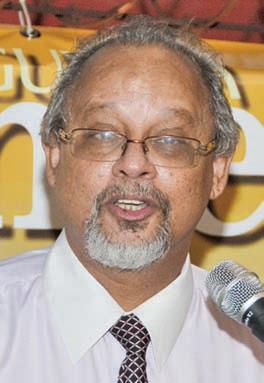
Professor Daizal Samad
Things like the future of the nation and ways in which I may serve all humanity. Things like contributing in meaningful ways to any body of knowledge in any or all academic disciplines. They were right. Thanks to these lecturers, I never attended to the ordinariness of grades. I followed their educated guidance.
The grades came! Our current students follow the examples set by the batch of current lecturers. As a student of the University of Guyana (UG), I followed the examples set by my lecturers. My lecturers did fine research and published! I followed. Today, if any brave student dares ask a lecturer to provide some evidence of published work from that lecturer (so that the student may follow the example), that student is punished!
This narrowness is to be found in many of the people who “teach” at UG (Turkeyen) and University of Guyana Berbice Campus (UGBC). UGBC itself was condemned to slipping backward into the much of sub-mediocrity. Our religious and social and business leaders spoke out! Even some of our “older” and wiser “retired” politicians from Berbice spoke out. Our students remained dumb. There is always a price to pay for being silent in the face of injustice and abuse. The price is often very, very high. Not such dumb silence from the university students in Hong Kong!
Lest I be misunderstood, let me make it clear that I am not in any way glorifying violent protest. What I am admiring of is the stand that Hong Kong university have taken, how they have taken it, and why they have taken it.
It is not about small things; it is about the very fate of their home. Also, in potentially going up against Mainland China, it is very risky business. I admire the depth of thought before the action. I admire the fact that this is not just some automatic reflex, some knee-jerk reaction. It is
considered.
Hong Kong was handed over to China by Britain in 1979. It was a pivotal moment. I was in Southeast Asia at the time, and supported this hand-over. This protest by university students may prove to be another pivotal moment in the history of that Island. We can only hope that this evolution comes about with no deaths and no destruction.
As Guyanese, we can learn so very much about attitudes from this incident! But we cannot grow until we break free from the ropes of ignorance and arrogance and stubborn and willfulness that tie us like beasts of burden to the stave while we graze.
Adding that focus is also being placed on transparency in the forest sector, he reiterated that all such processes required the involvement of national stakeholders. As he encouraged stakeholders, the Minister reiterated Government’s commitment to joining EITI.
Guyana Gold and Diamond Miners Association (GGDMA) President Patrick Harding acknowledging the purpose of the EITI, said that the GGDMA wanted all monies accounted for. He stated that EITI was best suited to conduct the study.
Guyana Geology and Mines Commission (GGMC) Chairman Clinton Williams noted that the study comes at an opportune time and would seek to ensure that deliverables are being distributed across the country as they should be.
EITI sets global standards for revenues for natural resources and is run by a coalition of Governments
and Associations working together. It will conduct the Guyana study in several phases. Guyana’s extractive industry is thus moving closer to acquiring greater transparency through the participation of representatives from all levels of the extractive industries, including miners.
The principles and criteria of the EITI will allow Guyana to adopt international standards for the mining sector and promote greater transparency for the various sub-industries.
It is anticipated that the implementation of the EITI in Guyana will give investors more confidence in the country’s mining industries while providing a framework for full accountability and transparency to all stakeholders.
Stakeholders who are involved in the study are drawn from the GGMC, the Private Sector Commission (PSC), the GGDMA, the Environmental Protection Agency (EPA), The Amerindian Action Movement of Guyana (TAAMOG), the Amerindian Affairs Ministry, Iwokrama International Centre, the Guyana Women Miners Association (GWMA), the Finance Ministry, the Guyana Revenue Authority (GRA), the Audit Office of Guyana, the Legal Affairs and Local Government and Regional Development Ministries, representatives from bauxite, sand and stones companies, as well as representatives from the Natural Resources and the Environment Ministry.
The EITI global transparency standard has been implemented in 35 countries since its launch in the United Kingdom in 2002. Over the years, it has grown tremendously to include the world’s largest oil, gas and mining companies. It increases transparency over the payments by companies from the oil and mining industries to Governments.

As the official number of Ebola deaths in West Africa’s crisis topped 4000 last week – experts say the actual figure is at least twice as high – the UN issued a stark call to arms. Even to simply slow down the rate of infection, the international humanitarian effort would have to increase massively, warned Secretary General Ban Ki-moon.
“We need a 20-fold resource mobilisation,” he said. “We need at least a 20-fold surge in assistance – mobile laboratories, vehicles, helicopters, protective equipment, trained medical personnel, and medevac capacities.”
But big hitters such as China or Brazil, or former colonial powers such France and the UK, have not been stepping up to the plate. Instead, the single biggest medical force on the Ebola frontline has been a small island: Cuba.
That a nation of 11 million people, with a GDP of US$6051 per cap-
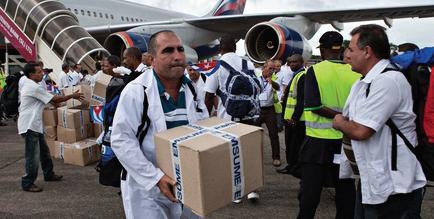
ita, is leading the effort says much of the international response. A brigade of 165 Cuban health workers arrived in Sierra Leone last week, the first batch of a total of 461. In sharp contrast, western governments have appeared more focused on stopping the
epidemic at their borders than actually stemming it in West Africa. The international effort now struggling to keep ahead of the burgeoning cases might have nipped the outbreak in the bud had it come earlier. (Excerpt from The Guardian)
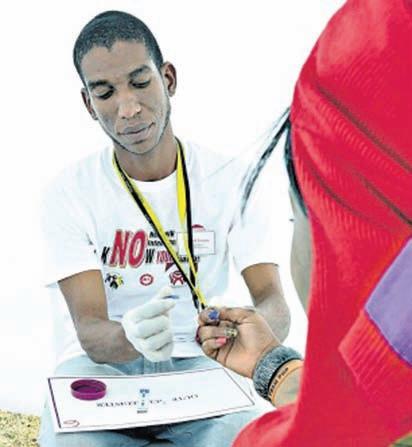
A Jamaica Observer file photo of a health worker testing a young woman for HIV/AIDS. Adolescents are among the most at risk for HIV due to a prevailing culture of multiple sex partners and inconsistent condom use
Asenior technical team from the Washington-headquartered Office of the Global AIDS Coordinator (OGAC) on Friday wrapped up a week-long series of meetings on HIV/AIDS programmes in Jamaica.
The OGAC team was hosted by US Embassy in Kingston, with funding from the US President’s Emergency Plan for AIDs Relief (PEPFAR).
PEPFAR is the same facility which financed the Caribbean HIV/AIDS Regional Training (CHART) Programme, formerly headed by retired University of the West Indies (UWI) Professor Brendan Bain. In the wake of raging public debate earlier this year over Bain’s testimony in opposition of gay rights, PEPFAR, through the Health Resources Services Administration, announced that funding support for CHART would be cut as part of a global policy shift, effective September 1.
“All PEPFAR programmes are being realigned to meet the 50 per cent care and treatment earmark mandated in authorising US legislation,” the HRSA said in a letter to the UWI.
According to the embassy, last week’s meetings were to examine the implementation of HIV/AIDS prevention and treatment programmes by Jamaica’s Health Ministry and US Government agencies represented at the Embassy as part of the effort to refocus and restructure HIV/AIDS programme funding in the island and throughout the Region. (Excerpt from Jamaica Observer)
Approximately 7000 people have registered at outpatient psychiatric clinics for mental health and other mental disorders annually with the South-West Regional Health Authority (SWRHA).
SWRHA Chief Executive Officer Anil Gosine made the disclosure while addressing a group of pupils and adults at a World Mental Health Day 2014 function on Friday, at Harris Promenade, San Fernando.
The World Mental Health Day theme for this year is “Living with Schizophrenia”. An estimat-
ed 26 million persons are affected with schizophrenia worldwide.
Speaking at the function, head of the Department of Psychiatry Dr Celia Ramcharran said schizophrenia is a psychotic illness defined as abnormalities of unusual behaviour, unlikely dressing habits, abnormality of emotions, disorganised thinking, experiencing of hallucinations and experiencing disillusions.
Regional manager Mental Health/Psychiatric Services Pooran Sankar said 832 persons have been diagnosed with schizophre-
nia and other mental illness disorders by the SWRHA. In 2013, 726 persons were treated for mental-illnessrelated disorders, according to Gosine.
Director of Health for the SWRHA Dr Shevanand Gopeesingh suggested for someone to maintain a mentally healthy lifestyle, they should connect with others, stay positive, get physically active, help others, get enough sleep, create joy and satisfaction, eat well, take care of their spirit, deal better with hard times and get professional help if you need it.
(Excerpt from Jamaica Observer)
Some of the bodies found in clandestine graves in southern Mexico do not correspond to any of the 43 students who went missing after an attack by ganglinked Police, according to an official.
Angel Aguirre, Governor of Guerrero state, declined on Saturday to confirm how many bodies had already been identified. “I can say that some of the bodies, according to the work of forensics experts, do not correspond to the youths from Ayotzinapa”, the town where the youths were studying before their disappearance in Iguala, 200km from Mexico City.
Aguirre made the remarks in Iguala, where municipal Police have been accused of working with
a drug gang in the disappearance of the students on September 26. The students vanished after Police Officers linked to the Guerreros Unidos gang attacked buses they had seized in Iguala. Vidulfo Rosales, a lawyer representing families of the missing students, said he had no information about identification of any of the remains. He said it was regrettable that authorities had not first informed the families before releasing the information. Aguirre made no comment about what authorities might have found in other mass graves that were discovered in the same area as the first site on the outskirts of Iguala. (Excerpt from Al Jazeera)
Hundreds of people in Haiti have attended the funeral of the country’s former ruler, JeanClaude “Baby Doc” Duvalier. Duvalier was accused of corruption and widespread human rights abuses during his 15-year rule.
He was not given a state funeral, but the Haitian Government sent representatives to the service. Duvalier died of a heart attack in the capital Port-au-Prince last Saturday, aged 63.
Some of those who served under him – including retired military officers – friends and family members paid their last respects at the chapel of his former school.
“Long live Duvalier! He’s not dead!” they chanted during the service.
President Michel Martelly wrote on Twitter last week that Duvalier was “an authentic son of Haiti”. Duvalier was just 19 when in 1971 he inherited the title of “President-for-life” from his father, the notorious Francois
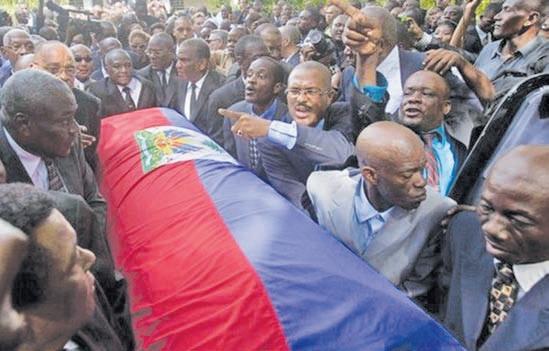
“Papa Doc” Duvalier.
During “Baby Doc” Duvalier’s repressive regime, tens of thousands of people were tortured and killed, human rights groups say. “Baby Doc” Duvalier was forced to flee Haiti following a popular rebellion in 1986. He lived in great luxury in France during exile, but returned home in 2011, a year after Haiti was devastated by a major earthquake.
Duvalier described his re-
turn to Haiti as a gesture of solidarity to the nation. He was arrested and charged, but released shortly afterwards. When he finally appeared in court in February 2013, he denied responsibility for abuses carried out during his time as President. Judges ruled he could face crimes against humanity charges, but the case had stalled some time before he died. (BBC News)
Top ranking intelligence sources have confirmed the presence of Trinidadian Shane Crawford in Syria, allegedly fighting for the terrorist organisation ISIS.
Crawford, 28, also called “Asadullah”, was one of the 16 men held during the state of emergency in 2011 in an alleged plot to assassinate the Prime Minister and other Government ministers but was later released without charges.
Since then, sources in the Muslim community say Crawford has virtually dropped off the radar along with another Trinidadian,
38-year-old Milton John Algernon, who was also one of the men held and released during the state of emergency for the alleged plot.
According to the information obtained from well-placed senior immigration and airport sources, Crawford left Trinidad for Caracas on November 27, 2013. Sources believe he later left there en route to London before travelling onward to Turkey and then crossing into Syria.
Senior intelligence officials confirmed that one of the men recently spotted in the YouTube video in which men with Trinidadian ac-
cents were bathing in the Euphrates River, bears a striking resemblance to Crawford.
A top ranking intelligence officer said, “Shane is there, we have him in military uniform and everything.” Another top ranking intelligence officer in The National Security Ministry said, “We have an active file on Crawford and are in possession of at least 10 other files pertaining to Trinidadian nationals now in Syria, while we have mostly open information on another possible 40 Trinidadians also there.”
(Excerpt from Caribbean News Now)
About 150,000 people were evacuated on India’s eastern seaboard on Saturday as cyclone Hudhud bore down and grew in sheer force, threatening to devastate farmland and fishing villages when it hits the coast on Sunday morning.
The India Meteorological Department (IMD) rated Hudhud as a very severe cyclonic storm that could pack gusts of 195 km/h and dump more than 24.5 centimetres of rain when it makes landfall.
The Global Disaster Alert and Coordination System (GDACS), run by the United Nations and the European
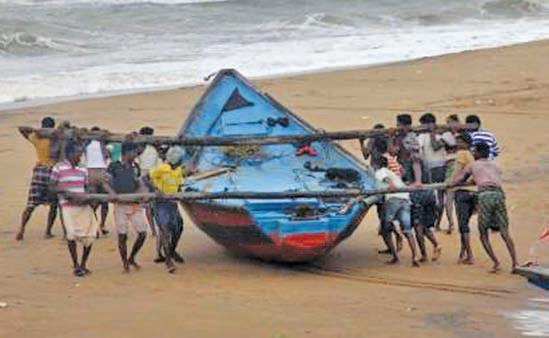
Commission, forecast even higher peak wind speeds of 212 km/h. That would make Hudhud a Category Four
storm capable of inflicting “catastrophic” damage.
Around 150,000 people have been evacuated in
Andhra Pradesh to high-rise buildings, shelters and relief centres, said senior disaster management official Hymabati. A further 50,000 may still be moved to safety, she added.
Authorities further North in Odisha state said they were monitoring the situation and would, if necessary, move 300,000 people most at risk to nearby shelters.
“We have already shifted about 10,000 people from low-lying areas and plan to evacuate 14,000 more,” N Yubaraj, Administrative Chief of the coastal district of Visakhapatnam, told Reuters. (Excerpt from MSN)
Kurdish forces defending the embattled Syrian border town of Kobani urged the US-led coalition to escalate air strikes on Islamic State (Isis) fighters as the militants tightened their grip on the town on Saturday.
A Kurdish military official said that Isis had brought more tanks and artillery to the frontlines, while street-to-street fighting was making it harder for jets to target the militants’
positions.
“We have a problem, which is the war between houses,” said Esmat alSheikh, head of the Kobani defence council. “The air strikes are benefiting us, but Islamic State is bringing tanks and artillery from the East. We didn’t see them with tanks, but yesterday (Friday) we saw T-57 tanks,” he added.
The US said it carried out six air strikes on Isis militants near Kobani on Friday
and Saturday, while US and Dutch planes launched three strikes on targets in Iraq near Tal Afar and Hit.
The aerial attacks, which were cheered by refugees on the Turkish side of the border, have helped to delay the advance of Isis by destroying some of their largest guns.
“We are getting stronger,” said Anwar Muslim, a lawyer and head of the city council who stayed on in Kobani after most offi-
Three more people have been admitted to hospital in Madrid to be monitored for signs of Ebola, bringing the total number under observation to 15.
Saturday’s development came as the Spanish nurse infected with Ebola was reported to be conscious and sitting unaided. Teresa Romero, 44, is the only person known to have caught the virus outside Africa.
None of the 15 others still under observation has been diagnosed with Ebola so far, though the Spanish Government is under fire for its handling both of Romero’s case and the threat of a wider outbreak of the disease.
Images by the Reuters news agency showed Romero alert and sitting upright in her hospital room with an oxygen mask strapped to her face and responding to
the hospital staff attending to her.
She had taken a turn for the worse two days ago, health authorities said, and is still considered critical.
“Teresa Romero’s condition has undergone no significant changes and is still serious, but stable,” a Government Ebola committee said in a statement on Saturday afternoon, adding that she has begun talking. (Excerpt from Al Jazeera)
UN Secretary General Ban Ki-moon flew to Tripoli on Saturday to urge the warring factions fighting for control of Libya to make peace, in the highest-level visit since an armed faction took the capital in August.
Oil producer Libya is struggling with two governments and two parliaments since an armed group from the western city of Misrata seized Tripoli, setting up its own cabinet and assem-
bly while forcing the internationally recognised Government to move to the East.
Western powers and Libya’s neighbours worry that the North African country will become a failed state as former rebels who helped oust Muammar Gaddafi in 2011 now fight for control and a share of the vast oil reserves.
“There is no alternative to dialogue,” said the UN Secretary General after ar-
rival. “It is my conviction that all problems in Libya can be solved through dialogue. Nevertheless, we understand that the path will be long and difficult. Peace building always is.”
Ban met a deputy speaker and other lawmakers from the elected Parliament, the House of Representatives, which has moved to the eastern city of Tobruk, as well as Misrata members of the assembly who have boycotted the sessions. (Excerpt from France24)
cials left. “What we wanted from the beginning was to get rid of the heavy weapons so we can fight honestly. They tried everything to get inside [Kurdish-controlled areas], but for now they are still outside.” (Excerpt from The Guardian)

Russian President Vladimir Putin has ordered thousands of troops stationed near the Ukrainian border to return to their bases, Russian media report.
Putin’s spokesman said about 17,600 soldiers on training exercises in the Rostov region would be pulled back. Russia has previously announced troop withdrawals that NATO and the US say were not actually carried out.
Russia has been accused of supplying troops and weapons to separatist rebels in East Ukraine – claims it denies. The latest order comes ahead of a planned meeting between Putin and Ukrainian President Petro Poroshenko on Friday.
Ukrainian troops have been fighting pro-Russia rebels in the regions of Donetsk and Luhansk since April, in a conflict that has killed more than 3500 people. The two sides agreed a truce on September 5, but fighting has continued, especially in and around Donetsk. “[Mr] Putin has ordered to start the returning of troops to regular station,” Presidential Spokesman Dmitry Peskov said in quotes carried by Interfax and Ria Novosti news agencies. Peskov said this was because the period of training was completed. Putin made similar statements about withdrawing troops from the Ukrainian border in March and May. (Excerpt from )

Act now and avert a global public health emergency. That, in essence, was the urgent demand of Jamaica, Trinidad and Tobago, Dominica, Guyana, Barbados and their Caribbean neighbours and the plea was made at the United Nations in New York at a time when the US was seeking to tame rising domestic worries about the potential spread of the deadly Ebola epidemic to America’s shores.
Essentially, what the island-nations and coastal states that belong to the Caribbean Community (Caricom) are asking is that the UN’s specialised agencies and rich states ramp up their aid to the African states which are now bearing the full brunt of the deadly Ebola virus disease.
The Caribbean also fears that the outbreak of the highly contagious disease would jump from Guinea, Nigeria, Liberia and Sierra Leone and spread to the rest of Africa and to developing nations in the Caribbean, Latin America, the Pacific and the Middle East. Thousands of victims have already died from Ebola in four African states.
“The specter of the deadly Ebola disease and the scourge of HIV/AIDS and non-communicable diseases have the potential to significantly impact our people and threaten the gains made so far by Small Island Developing States,” warned Senator Arnold Nicholson, Jamaica’s Foreign Minister in an address to the General Assembly.
“We cannot ignore the link
between our efforts to spur development and the need to safeguard the health of our people,” Nicholson added.
“The challenges to security and sustainable development posed by threats to global public health have been devastatingly illustrated by the recent outbreak of the Ebola epidemic.”
Barbados agreed but put it differently.
“The Ebola outbreak constitutes a public health emergency of international concern and a threat to global security,” said Senator Maxine McLean, Barbados’ Foreign Minister.
“It also threatens the peace-building and development gains of the most affected countries.”
That was why, she went on, there was an urgent need to accelerate the mobilisation of resources to assist the affected countries and halt the epidemic.”
Trinidad and Tobago (TT), whose Prime Minister, Kamla Persad-Bissessar was quick to explain to the UN that the epidemic’s potential threat was the main the reason her country had co-sponsored a Security Council resolution calling for prompt international action to combat the “Ebola virus disease”.
She praised UN Secretary General, Ban Ki-moon, for organising an “Ebola summit” that gave countries a chance “to take steps” to combat the “spread of the virus” and “supplement the United Nations Mission for Ebola Emergency response”.
The US recently recorded its first Ebola case when a Liberian, Eric Duncan arrived in Texas from Monrovia and showed symptoms of the deadly disease.
He is now in a Dallas medical centre in critical condition. That case raised the fears of hundreds of millions of Americans that the virus would jump to their shores.
When Guyana addressed the UN, its President Donald Ramotar described the epidemic as a “global problem” that required an immediate response of a scale far beyond what was currently being done.
Suriname, a close neighbour of Guyana, called the out-
break an “imminent threat” which must be met head-on, said Winston Lackin, the Republic’s Foreign Minister. That was why Suriname was working with “neighbouring countries” in the sub-region as well as the global community “to design and implement programmes” that would prevent “the spread of this deadly virus”.
Wilfred Erlington, Belize’s Foreign Minister and Attorney General, did not simply express concerns that the disease was “increasing exponentially”.
He complained “that international health agencies did not respond more vigorously to the Ebola outbreak many months ago”.
Dominica too raised the alarm while appealing to the UN, its agencies and other international organisation not to allow the disease to reverse the region’s health care successes.
“The specter of the deadly Ebola disease and the scourge of HIV/AIDS and non-communicable diseases have the potential to significantly impact our people and threaten the gains made so far by Small Island Developing States,” said Charles Savarin, Dominica’s President.
“This myriad of challenges, therefore call for collective global action to protect the gains that small island states like Dominica have been able to achieve over the past two decades, and to lay a path for development that is sustainable and people focused,” he said. (The New York Carib News)
The People’s Progressive Party (PPP) has once again raised objections to the appointment of Richard Francois as Public Relations Officer (PRO) for the Guyana Elections Commission (GECOM), saying that he has been a long-time supporter of the Opposition and Government critic.
General Secretary of the ruling party, Clement Rohee, said “Our information indicates Mr Francois as being openly supportive and sympathetic to the Opposition, this is premised on statements and views published by Mr Francois in the run up to the 2011 General Elections.”
According to Rohee, while his party respects the right and freedom of employment, he is of the view that Francois’ back-
By Sir ronald SanderS
Ilearnt of Rafiq Khan’s passing with a profound sense of sadness. He and I were rivals when we managed radio stations that competed for audiences and advertising revenue in the 1970s in an era where television did not exist and radio was the only form of electronic communication.
But, we were also friends. We both recognised that added value was brought to broadcasting in Guyana by the spirited efforts we made to have our stations outperform themselves in high quality programming.
But amidst our exciting rivalry, we also enjoyed engaging co-operation. Together, we started the Guyana Publishing and Broadcasting Association to set and selfregulate high standards for the media and to draw up a Code for advertising.
Beyond that, we found easy ground on which to agree that joint coverage by the radio stations of important events better served the interests of the Guyana public.
Our friendship endured after our Guyana sojourn when he was a Communications Consultant for the United Nations Educational, Scientific and Cultural Organisation UNESCO and I served as an elected member of its Executive Board.
Rafiq took to his communications role in the Caribbean, the same passion, vision, intellect, and managerial skill that was so plainly obvious in Guyana.
In more recent years, Rafiq lived in Jamaica where I called on him whenever I visited. In every visit our conversations resumed as if time had not passed in between, except when he lost his wife –his childhood sweetheart and life-long friend. He was never quite the same after that. But, he never lost his interest in broadcasting – and particularly in Guyana – once asking me, by email which I still have, if I thought the authorities in Guyana would accept an offer from him, Hugh Cholmondeley and me to conduct training programmes. He was a consummate broadcaster. Possessed of a
mellifluous voice, he knew that excellence in broadcasting required preparation and diligence. He was a voracious reader and his attention to detail even in what appeared to be a simple broadcast distinguished him from many others and made his broadcasts renowned. One such broadcast was the joint coverage by Radio Demerara and the Guyana Broadcasting Service of the funeral of Guyana’s Governor General, Sir David Rose. Rafiq was the final commentator in a relay of broadcasters, including Vic Insanally and me, who described the funeral procession through the streets of Georgetown to the Place of the Seven Ponds in the Botanical Gardens.
I cite now the words that Rafiq spoke as Sir David was laid to rest. They are taken from Shakespeare’s Hamlet, and are Horatio’s farewell to his dying friend Hamlet. They are wholly applicable to Rafiq Khan.
“Now cracks a noble heart. Goodnight, sweet prince; and flights of angels sing thee to thy rest”.
(The writer is a former Programme Director and General Manager of the Guyana Broadcasting Service, President of the Caribbean Broadcasting Union, Board Member of the Caribbean News Agency and member of the Executive Board of UNESCO)
In light of the Ebola outbreak, Airlines plying the Georgetown to John F Kennedy route and other destinations have taken all measures against the disease as recommended by the Centre for Disease Control (CDC).
Fly Jamaica’s Chief Executive Officer, Captain Paul Reece on Friday told Guyana Times that while they have connections and flights; they have no direct contact with passengers from West Africa where the virus is rampant.
ground and political allegiance will compromise the professionalism of GECOM and may very well lead to the biasness in the discharge of his duties.
The party made references to several letters published mostly in the Kaieteur News that were written by Francois and posts on social media, some of which he had been critical of the PPP Government.
In one letter published in the December 13, 2010 edition of the Kaieteur Newspaper, Francois called out the PPP for using the atrocities committed by the PNC Government during the latter’s time in Government.
continued on page 17
The World Health Organisation (WHO) on Saturday disclosed that over 4000 people have died from the three worst affected countries – Liberia, Sierra Leone and Guinea.
With this in mind, Reece said the airline in taking all the preventative measures seriously into consideration.
Reece added that even before the first case was confirmed in the US, airline crews, aircraft cleaners and cargo handlers would have already received guidance on Ebola.
The CDC had recommended “stopping ill travellers from boarding, managing and reporting onboard sick travellers, protecting crew and passengers from infection, and cleaning the plane and disinfecting contaminated areas”.
The CDC guidelines also remind airlines that they have the legal right to deny boarding to passengers with a serious communicable disease that could spread during flight, which includes travellers with possible Ebola symptoms.
While the guidelines emphasise that the risk of spreading Ebola on an aircraft is low, they are taking the necessary precautions.
Copa Airlines which operates mainly from Miami to Caribbean destinations have also taken preventative measures while also noting that they hardly come into contact with persons who have connections from other parts of the world.
Caribbean Airlines operates regionally-based flights and has also adapted to recommendations made by the Transportation Security
Administration (TSA), CDC and more locally, the Guyana Civil Aviation Authority (GCAA).
Speaking with Guyana Times, Caribbean Country Manager Carl Stuart said the airline has been following all the guidelines from the various agencies with respect to the epidemic, including screening at the Cheddi Jagan International Airport (CJIA).
However, he noted that while emphasis is placed on air traffic, he suggested that the same attention must be placed on cross-borders migration.
Recently, Health Minister, Dr Bheri Ramsaran said Guyana does not have the ability to test or treat patients for the disease. However, the Minister posited that surveillance has increased at all ports, with doctors being deployed at the Cheddi Jagan International Airport (CJIA).
These doctors, the Minister added are on the lookout for passengers, Guyanese and non-Guyanese coming into the country with any sign of the Ebola virus. He said while Guyana does not have the capacity to carry out the test for this disease, medical officials have been adequately trained to identify signs of the disease.
october 12, 2014 |
Jacqueline Thomas, a resident of Bartica and the guardian of a secondary school student has hailed the Government’s much anticipated initiative, the $10,000 grant.
“This is a very good initiative… it is important that students stay in school so I welcome this, and I must say kudos to the Government for this,” Thomas said.
Sharon Nelson, a mother of two school age children said, “I’m very proud and I know that it will help a lot of parents. I hope lots of parents will send their children more to school... this is a great step the Government is taking … I want to thank the entire Government.”
Diana Fredericks, a mother of two also expressed her gratitude to the Administration for the assistance. She also spoke in favour of a system to ensure that children remain in school; noting that there are some delinquent parents who show no interest in sending their children to school.
The initiative was launched at the Bartica Community Centre ground, Region Seven where scores of parents and children gathered to receive their grants as the disbursement process officially commenced in the presence of President Donald Ramotar, and several Government Ministers including Robeson Benn, Juan Edghill, and Dr Jennifer Westford, as well as Cabinet Member Odinga Lumumba.

cent going to the social sector and of that education gets the lion’s share,” President Ramotar said.
Important investment
He went on to explain that a country’s investment in the area of education is in essence an investment in that country’s future. As it is, the world is moving at rapid pace as a result of science and technology driving economies. This makes it incumbent not only on Guyana, but countries around to ensure that their human capital is provided with the necessary education and skills to function and remain competitive in the hub of sophistication that the world is fast becoming.
ing Universal Secondary Education.
He said that a sound primary and secondary education is the kind of foundation that Guyana’s children requires to go on becoming productive citizens, and his Administration is committed to providing it for children on the coast, as well as the hinterland.
Lift moral standards
students… we have the ability in a short period of time to
catch up and be described as a developed country,” President Ramotar said, according to a Government Information Agency (GINA) report.
He also spoke of other large investments that the Government is seeking to make such as the Specialty Hospital and a deep water port, but reminded that for these projects to materialise, the support of citizens is essential.
Public Service Minister, Dr Jennifer Westford in her brief remarks said the education grant programme is just another effort of the Government to ensure that the vulnerable population in society has a level playing field, particularly as it relates to something as vital
as education access. She called on recipients to ensure that the grant is used meaningfully, and for the purpose for which it was given.
Over the past few months, the Education Ministry had embarked on a series of consultations to find out the best way to disburse the funds. At Saturday’s distribution exercise, parents had to produce their ID cards before uplifting their vouchers which can be encashed at any Western Union outlet.
The $10,000 per child grant initiative is expected to benefit 188,406 families of the students of public nursery, primary, and secondary schools in the public school system.
As part of World Mental Health Day activities, the Health Ministry on Saturday conducted a Mental Health fair at the Square of the Revolution, Georgetown.
President Ramotar said the $10,000 per child ‘Because We Care’ grant is just another demonstration of his Government’s and party’s philosophical belief that no investment is more important than that made in people. This grant is one of the 2014 budget measures for which a total of $2 billion was made available by the Government.
From early on, the Government had begun putting plans in motion to move in this direction with the advent of the One Laptop Per Family (OLPF) Programme. This initiative has a direct impact on education in this digitalised world.
The President said that the OLPF Project goes again to the heart of the philosophical underpinning of the Government, whereby every Guyanese family is provided
However, while there will be no dearth of investments in the education sector, the President called on parents to match the efforts of the Government by assisting to lift the moral standard of society and eradicating many social ills that plague particularly the youths.
“Too many of our girls are getting pregnant… put selfdevelopment first… education is important not only in itself, but it underpins every sector of the country,” the President said.
Since the current Administration assumed Office, over 1000 schools and dormitories have been built. Additionally, a number of initiatives such as the hot meal, school-feeding, uniform assis-
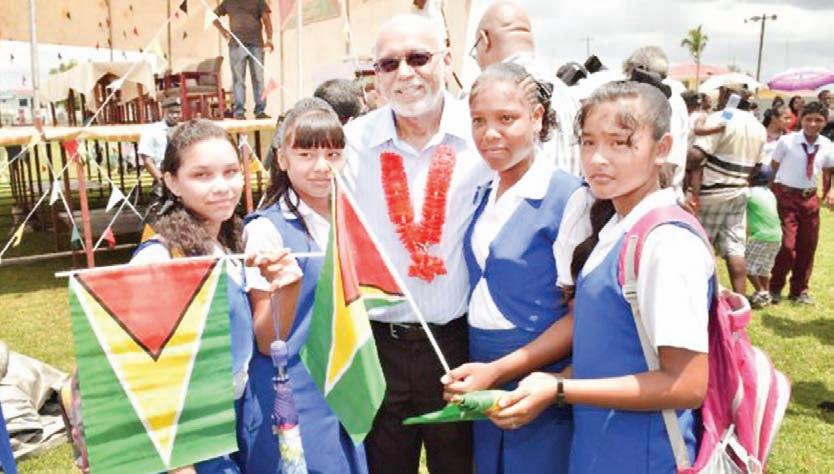
The Head of State explained that while Guyana’s natural resources are and will continue to make important contributions to national development, it is the human capital that is a country’s most significant resource.
“From the inception we have been investing in our people. In 1992, only eight per cent of our budget went to the social sector. Today when we have a far bigger budget we have more than 30 per
with equal opportunities. This type of equitable distribution precludes economic standing, geographic location and/or political affiliation.
The Head of State reminded that some 20 years ago, only 30 per cent of children leaving primary school were able to attend secondary school.
Today, Guyana has achieved the Millennium Development Goal (MDG) of Universal Primary Education and is on the verge of attain-
tance and hinterland scholarship programmes have been rolled out and have recorded tremendous success.
A simple look at the drastic increase in school attendance and improved performance is evidence of the success of these programmes. Today, access to tertiary education has also been made easier.
“We can grow faster, we have the ability and that is one of the reason we are investing more and more in our
There were various booths on display, which performed HIV, blood pressure, and blood glucose (sugar) testing among others, and these services were provided free of cost to the public.
Dr Bhiro Harry, who is in charge of the conversations on the National Mental Health Strategy, was present at the event.
He said mental health hardly has to do with persons becoming psychotic. He explained that depression, phobias, eating and sleeping disorders are all forms of mental health problems.
There were also four booths on display to specifically deal with different aspects of mental health. Testing for substance abuse, mental health counselling, adolescent counselling and psychiatric services were provided to the general public as well.
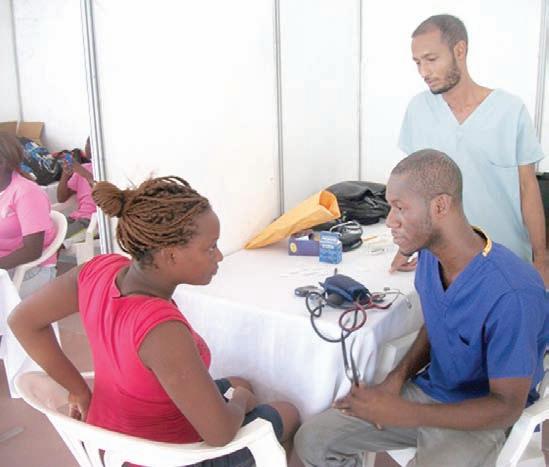
Persons were required to take a short test, from which they received a score which was analysed by a psychiatrist to determine their mental state in any of the above mentioned areas.
Police officers also benefited from the fair, as they were involved in a mental health discussion with Dr Harry, to teach them how to deal with the mentally-challenged and other issues related to mental health, which they come
“No Government is perfect! The PNC made errors during its time in office; however, they were responsible for a number of significant developments that have served and continue to serve the Guyanese people to this day…. Guyanese youth are very aware of the political atmosphere in which they live. They continue to witness the PPP/C Government in action. The policies that have been created and placed into action by the PPP/C are all known to the Guyanese youth. They do not need to be given continuous manipulated political history lessons for them to vote for a particular party,” he had stated.
In another letter prior to the 2011 elections, he said:
“The time has indeed come for a change! Guyana certainly cannot continue along the almost two-decade old beaten path of corruption, racial marginalisation, mismanagement and incompetence that has since become governance. The signs are distinctive and clear. Guyana needs new political leadership.”
In light of these publications, the ruling party is calling on GECOM to immediately reverse the appointment of Francois in order to ensure the integrity of the Commission is maintained.
Francois has a vast experience working at several agencies and Government Ministries in Guyana. He was Communications Officer with the Home
into contact with while on the job. There was also an anti-stress group session. The National Mental Health strategy will address issues of substance abuse, depression, suicidal tendencies and the new approaches to mental health in Guyana.
Today, the Health Ministry will continue its activities at the Square of the Revolution in observance of World Mental Health Day.
Affairs Ministry, a Strategic Communications Consultant at the Education Ministry, Public Relations Manager at the Guyana Power and Light Inc, Assistant Human Resources Manager at the Guyana Sugar Corporation and a freelance broadcaster at the National Communications Network. Additionally, he was the Director of Corporate Communications and Public Relations for Total Communications in the United Arab Emirates, as well as a Public Relations Consultant for Promoseven Weber Shandwick in the United Arab Emirates. Francois holds a Master’s Degree in Marketing Communications from Middlesex University. from page 16

By AvenAsh RAmzAn
Orville Hinds made a strong statement ahead of this week’s ‘Ride for Life’ Five-Stage, outgunning the field to win the feature 35-lap School Boys and Invitational race of the 10th annual Handin-Hand Insurance 11race programme at the inner circuit of the National Park on Saturday.
What was most impressive about Hinds’ win was the fact that the Lindener was making a return to competitive cycling after a few months break. The talented cyclist maintained a presence in the leading pack for a significant portion of the race, but made his move in the dying stages.
Hinds pulled away from the peloton with three laps to go, and consistently opened the gap, coasting to victory with none of his competitors in sight. Race official Joseph Britton stopped the clock at one hour, 16 minutes, 35.93 seconds (01h: 16m: 35.93s).
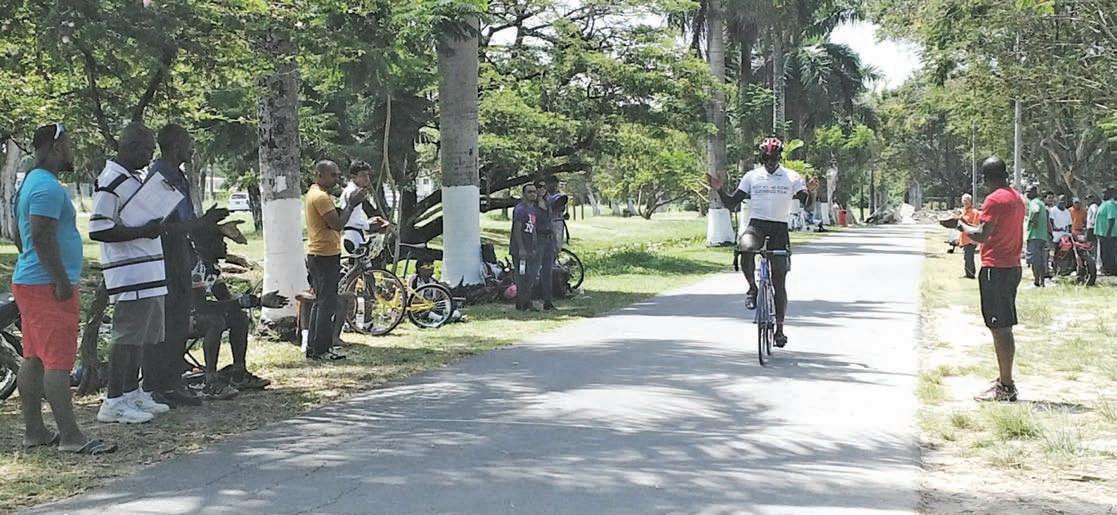
Mario King was also unchallenged in claiming second position, while Michael Anthony pipped Robin Persaud for third, and Stephano Husbands and Paul DeNobrega claimed fifth and sixth positions respectively. Hinds, DeNobrega and Anthony claimed two prime prizes each, while Persaud and Albert Philander had to settle for one apiece.
Also in winner’s row were Rakeem Blair (1214 Boys and Girls), Junior Niles (Veterans Under-50), Linden Blackman (Veterans Over-50), Monty Parris (Veterans Over60), Stephano Husbands (Juveniles), Damion Sukhdeo (Mountain Bikes), Jeremiah Harrison (BMX Boys 6-9) and Sherwin Sampson (BMX Boys 9-12 and 12-14).
As is customary, Handin-Hand Insurance presented new BMX cycles to three young riders. The recipients were Esau Jaisingh, Jeremiah Harrison and Nicholas D’Andrade, who incidentally celebrated his 10th birthday on Saturday.
Hand-in-Hand Insurance was represented by Supervisors Lashanna Thompson and Bonicka
Gordon, as well as Business Development Officer, Shanomae Baptiste. The trio expressed their company’s pleasure at being associated with the programme and promised their continued support.
National cycling coach and chief organiser of the day’s activities, Hassan Mohamed, lauded Handin-Hand Insurance for completing a decade of
sponsorship and reminded the representatives of the valuable contribution the company is making towards the development of the sport.
‘Ounce of gold’ Meanwhile, local riders will be in action again today when the third annual Kadir Mohamed memorial cycle road race, dubbed ‘Ounce of Gold’, is staged by the Flying Stars Cycle Club.
The race will pedal off at 07:30 hours on Homestretch Avenue, proceed to Dora before returning to the point of origin for the finish. While the Senior and Junior riders will compete on that course, the Veterans will turn at the hill after Splashmin’s Fun Park and return to Homestretch Avenue for the finish.
As the name of the race suggests, the overall winner will receive an ounce of gold, while the other podium positions will receive cash incentives. The defending champion is Paul DeNobrega.
By RAjiv BisnAuth
Aleft-hander, Tagenarine Chanderpaul marks his guard by hammering the bail into the pitch and in true family tradition prefers grinding away at the opposition rather than beating them to a pulp.
Tagenarine, like his father, is said to be a patient batsman, hard to dislodge and capable of spending a lot of time at the crease.
The 18-year-old has shown plenty of promise since making his FirstClass debut last year, but his career statistics remain below par for an opening batsman.
The young Chanderpaul has compiled 371 runs in nine matches at an aver-
age of just over 20. He has demonstrated his tendency to make good starts, but fail to capitalise. However, after earning selection to the Guyana franchise, Tagenarine, the son of West Indies batting great Shivnarine Chanderpaul, is hoping the upcoming West Indies Cricket Board (WICB) Professional Cricket League’s (PCL) Regional Four-Day and NAGICO Super50 Tournaments can prove his breakthrough season.
“Hopefully I can kick on from the starts and have a successful season. I have often done the hard work and got in, but then given it away. The lack of concentration is something I have worked on and hopefully it will work and I

will kick on with some big scores,” he said.
Tagenarine is among the retained players cho-
sen by the local franchise. He further revealed that playing for Guyana always mean a lot, and he is looking to make each and every opportunity count.
After making his First-Class debut against the Leeward Islands in Antigua in March last year, Tagenarine and his father created history by becoming only the second father/son pair to appear in a First-Class match in the Caribbean.
In September 1948, Lebrun Constantine made his final appearance for Trinidad and Tobago against Barbados in British Guiana at the age of 48 playing alongside his son Learie Constantine.
The other retained players for Guyana are: Devendra Bishoo,
Narsingh Deonarine, Assad Fudadin, Leon Johnson, Veerasammy Permaul, Christopher Barnwell, Ronsford Beaton, Anthony Bramble and Trevon Griffith.
Barbadian all-rounder Raymond Reifer, along with Guyanese opening batsman Rajendra Chandrika, middle-order batsman Vishaul Singh and fast bowlers Keon Joseph and Paul Wintz complete the Guyana Franchise.
The five players were chosen at last Monday’s inaugural Player Draft of the West Indies Cricket Board’s Professional Cricket League, staged at Accra Beach Hotel in Barbados.
Veteran West Indies batsman Shivnarine
Chanderpaul, who is a centrally contracted WICB player, is an automatic pick for Guyana Franchise.
The Professional First Class Franchise System will be engaged in a professional cricket structure on a day-to-day basis, year round, under a Head Coach and support staff. All six franchises will be given US$45,000 per month to fund their operations, but will be required to raise revenue as well. More so, under this new initiative, an ‘A’ contract will see players earning US$2,500 per month, a ‘B’ contract, US$1,700, and ‘C’ contract, US$1,250.
The Regional Four-Day tournament will bowl off on November 14.
By Rajiv Binsuath
Over $8 million in cash and trophies will be at stake when the People’s Progressive Party/Civic (PPP/C) stages its grand day of horse racing today
at Kennard’s Memorial Turf Club, Bush Lot Farm, Corentyne, Berbice.
Coordinator Dennis DeRoop told Guyana Times Sport on Saturday that over 80 of the country’s top horses will be in action with 10 mouth-watering contests carded for the day. DeRoop also confirmed that all systems are in place for the race meet.
“We have put all systems in place and, apart from that, the weather has been excellent for racing, resulting in the track being in tip top shape,” he said.
He further indicated that all the big names are set to be on show, adding that a competitive day of racing is definitely in the making.
Two feature races are bill for the day with the A and Lower animals run-
For the first time in more than two decades, clubs in the Upper Corentyne area will have a chance to match their skills on the football field.
The Corentyne Cup, which was launched on October 3, will kick off this afternoon at the Scottsburg Community Centre with a solitary game. Number 51 Football Club will take on the GTU Teachers United at 16:00 hours, while next Sunday, Courtland and Corriverton Links will do battle. The other team in the competition is Manchester Village.
The competition, which a collaborative effort of Corriverton Links Football Club and the Scottsburg Centre, is aimed at pro-
moting the game at the senior level in the area, while at the same time, assist with the development of the sport.
It is also hoped that the tournament will encourage clubs on the Corentyne that are not affiliated to the Berbice Football Association (BFA) to get organised.
At stake in the competition is the Swiss Springlands Trophy for the winning team, while the losing finalist will receive the Dr. Chand Trophy. The winner of the third place playoff will be presented with the BFA Trophy.
Individual awards will also be given out to the highest goal scorer and best goalkeeper. (Andrew Carmichael)
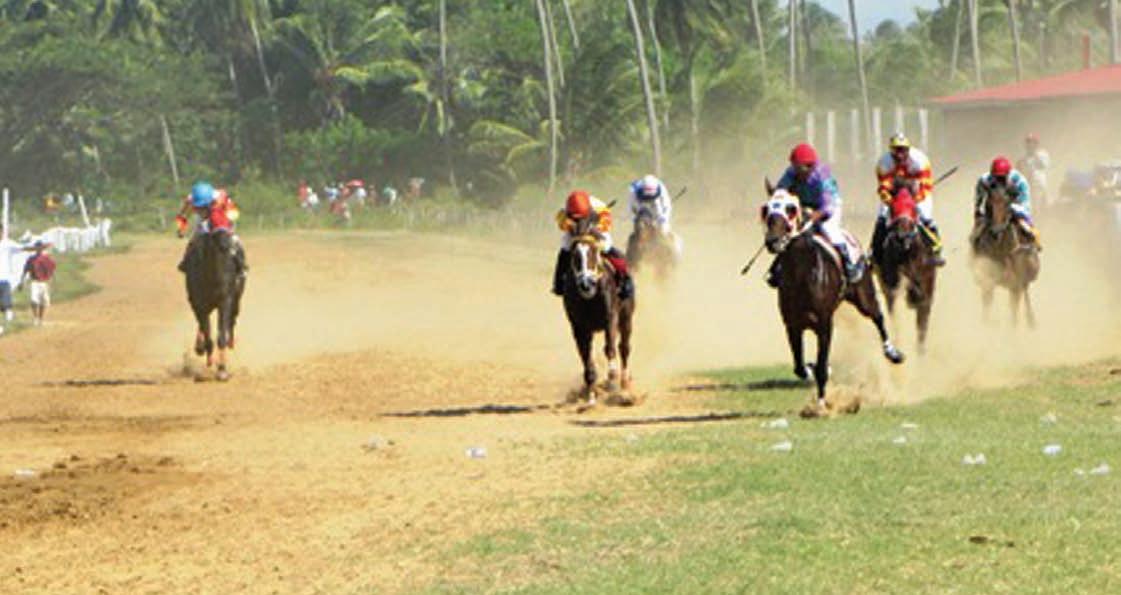
ning a mile for $1.5 million and the President’s Cup, while the other feature race, D3 non-winners in 2014, and the E and Lower are for a $600,000 top prize, over a distance of 1400 metres.
Other events billed for the day are the F3 and Lower race, which also carries a price tag of $600,000 and will run also held at
1400 metres.
Other 1400 metres races are for animals G3 nonwinners in 2014 and the H and Lower and I1 and Lower. The winning tags for those two races are set at $300,000 and $220,000 respectively.
There are five 1000 metres races and these are for animals classified J3 and Lower, Two-year-old race
for Guyana bred horses, J1 and Lower, Two-yearold race for West Indies bred horses and K and L Class. The winning tags for those races are $180,000, $200,000, $200,000, $300,000 and $140,000 respectively. Race time is 12:30 hours.
The race is being conducted under the rules of the Guyana Horse Racing
Authority (GHRA) and those rules would be rigidly enforced. Horses not properly registered will not be allowed to participate in the day’s proceedings.
Admission to the venue is $1500 for adults and $500 for children over 10 years old, while parking and race programme will be free.
Ballweavers in New Amsterdam are set to be in action this evening when the Revival 8-a-side Interward Fastball tournament continues at the All Saints Ground at Princess Elizabeth Road in New Amsterdam.
In tonight’s games, Central New Amsterdam will take on Savannah Park at 20:00 hours, before the much anticipated match-up between Canje and Vryman’s Ervin, which will kick off at 18:00 hours.
After three rounds,
the boys from Tucber Park are leading the points table on eight points, followed by Canje on six. Vryman’s Ervin and Savannah Park are locked on five points each, with Stanleytown on two and Central on a solitary point.
The competition is being played on a roundrobin basis with the team finishing on top of the points table advancing to the final and the second placed team qualifying for the semi-final. The third and fourth place finishers will meet
for a chance to take on the second placed team. The winner of that game will meet the first placed team in the final.
Teams registering outright wins are awarded three points, while drawn games are decided from the penalty spot, but the winning team only receives two points and the loser one point.
In action last Sunday, Canje got past Central New Amsterdam 2-1 with Sherwin Parris scoring a double, first with a header off a corner kick which he put wide of goal keeper
Omari Bentham. Shaka Roe scored the consolation goal for Central. Meanwhile, six schools will begin competing for the 8-a-side Inter-school Fastball trophy this evening. Berbice High will take on Vryman’s Ervin Secondary in a Group ‘A’ match from 18:00 hours, then Berbice Educational Institute and Tutorial Academy will clash in a Group ‘B’ match-up.
The other schools in the competition are New Amsterdam Multilateral and Canje Secondary. (Andrew Carmichael)


Chasing 264, West Indies were coasting. Dwayne Smith had gone past his highest ODI score, and his secondwicket partnership with Kieron Pollard was assuming threatening proportions. With nine wickets in hand, a long list of batsmen waiting in the dressing room, and 128 required at exactly a run a ball, this was West Indies’ match to lose. They went and lost it. It started with the wicket of Pollard, who chased a wide ball and dragged Amit Mishra onto his stumps. From that point, West Indies imploded. On a two-paced Feroz Shah Kotla pitch, India’s bowlers put the brakes on the scoring, and panic took hold of the batsmen. West Indies lost their last nine wickets for 79 runs, and their last eight for 45.
In ODI cricket, six an over is usually a doddle when you have wickets in hand and not too many runs left to get. On this pitch, however, scoring quickly wasn’t easy unless you had your eye in. India had discovered this to their detriment earlier in the day, both at the start and the end of their innings.
Having opted to bat first, they had struggled to break the shackles against accurate new-ball bowling from Ravi Rampaul and, in particular, Jerome Taylor, who attacked a good-length area close to off stump and allowed the pitch to do the rest. The second-wicket pair of Ajinkya Rahane and Ambati Rayudu had looked quite ill at ease while adding 46 in 67 balls, and even Virat Kohli had taken his time to find his feet.
Suresh Raina looked fluent right from the time he walked in, however, and his front-foot stride - the surest sign that his mind isn’t entirely consumed by thoughts
of the short ball - was light and sure whenever the bowlers gave him half an opportunity to drive through the off side.
Raina and Kohli slowly got on top of the bowling, and began the batting Powerplay on the cusp of India’s first century stand for the fourth wicket since August 2012, and the score read 163 for 3.
It looked like a launchpad to a 280-plus score, but the dismissals of Raina and Kohli, in the 37th and 41st overs, sucked the momentum out of India’s innings. Without MS Dhoni’s unbeaten 40-ball 51, it’s unlikely India would have gotten near their total of 263, with pretty much everyone else at the other end struggling to come to terms with the surface and West Indies’ adroit use of the slower ball at the death.
The wicket of Pollard caused a similar, and even
more dramatic, turnaround in the tempo of West Indies’ innings. Till then, Mishra had endured a frustrating evening. He had bowled a number of good balls, had had a close lbw shout against Pollard turned down, and had been picked off for three massive sixes, two of them by Pollard, and not necessarily off the middle of his bat. Having just struck his third six, he went after one tossed up wide outside off and inside-edged it onto leg stump.
Following that breakthrough, Mishra bowled 16 successive dot balls, landing everything on a good length on off stump, getting some balls to grip on the pitch and others to skid off the surface, and completely confounded Marlon Samuels, who had scored a century against this same attack three days ago.
Smith carried on fluently at the other end, picking off Kohli’s wrong-footed legcutters for four fours in two overs, and launched Mohammed Shami over the long-on boundary in the first over of the batting Powerplay. In sight of his first century in ODIs and List A cricket, however, Smith received the perfect riposte from Shami, a full, fast ball that swung in a touch and cannoned off the pads and into the stumps.
The required rate crept up to over seven, and Samuels slapped a perfectly slappable long-hop from Umesh Yadav straight to cover. The spinners then discovered the turn available on the pitch, Mishra spinning one sharply to find Denesh Ramdin’s outside edge, Ravindra Jadeja doing the same to beat Andre Russell’s edge and have him brilliantly stumped by Dhoni. By this point, West Indies had been knocked out - the four wickets that remained fell in the space of 26 balls, and India won with 21 balls left to play. (Cricinfo)
India innings
A Rahane c DJ Bravo b Sammy 12
S Dhawan b Taylor 1
A Rayudu c Sammy b Benn 32
V Kohli c Samuels b Rampaul 62
S Raina c Pollard b Taylor 62
*+MS Dhoni not out 51
R Jadeja b Taylor 6
B Kumar c Pollard b DJ Bravo 18
Mohammed Shami not out 1
Extras (b-4, lb-1, w-13) 18
TOTAL (7 wkts, 50 overs) 263
Fall of wickets: 1-4 (Dhawan, 1.4 overs), 2-50 (Rahane, 12.5), 3-74 (Rayudu, 17.4), 4-179 (Raina, 36.5), 5-196 (Kohli, 40.4), 6-219 (Jadeja, 45.1), 7-248 (Kumar, 49)
Bowling: Rampaul 8-0-47-1 (w2), Taylor 10-0-54-3 (w-2), Benn 10-0-47-1 (w-1), DJ Bravo 8-051-1 (w-1), Sammy 4-0-14-1, Samuels 5-1-21-0, Russell 3-014-0 (w-2), Pollard 2-0-10-0
West Indies innings
D Smith b Mohammed Shami 97

West Indies A were made to toil with little success as opener Dimuth Karunaratne struck a hundred to propel Sri Lanka A on the opening day of the first unofficial “Test” on Saturday.
Opting to bat first, Sri Lanka A finished the day on 261-2, with left-hander Karunaratne topscoring with a fine 139.
Lahiru Thirimanne was unbeaten at the close on 85, while Dinesh
Chandimal ended the day at the Mahinda Rajapaksa International Cricket Stadium on 29 not out.
Fast bowler Shannon Gabriel (1-30) and seamer and captain Carlos Brathwaite (1-46) shared the two wickets to fall.
The Caribbean side made a great start when Gabriel claimed Upul Tharanga for four with the score on six in the day’s fifth over, caught at the wicket by Chadwick Walton.
However, any hopes of any further immediate success were dashed by Karunaratne and Thirimanne who combined in superb second wicket stand of 217.
Karunaratne faced 234 balls and struck 14 fours, while Thirimanne has so far batted 145 balls and counted eight fours.
The partnership took Sri Lanka A safely through the first two sessions and ended in the final hour of the day when Brathwaite had Karunaratne taken behind by Walton.
Even then there was no capitulation as Thirimanne and Chandimal put on another 38 for the third wicket in an unbroken stand.
West Indies A are set to play three unofficial “Tests” and three one-dayers in a tour that wraps up November 14.
DM Bravo b Mohammed Shami 26
K Pollard b Mishra 40
M Samuels c Kohli b Yadav 16
+D Ramdin c Raina b Mishra 3
*DJ Bravo c Dhawan b Mohammed Shami 10
A Russell st Dhoni b Jadeja 4
D Sammy b Jadeja 1
R Rampaul c & b Mohammed Shami 16
J Taylor c Kumar b Jadeja 0 S Benn not out 0
Extras (lb-1, w-1) 2
TOTAL (all out, 46.3 overs) 215 Fall of wickets: 1-64 (DM Bravo, 13.1 overs), 2-136 (Pollard, 28.5), 3-170 (Smith, 35.4), 4-183 (Samuels, 39.1), 5-189 (Ramdin, 40.2), 6-195 (Russell, 42.1), 7-199 (Sammy, 43), 8-199 (DJ Bravo, 43.2), 9-201 (Taylor, 44.2), 10-215 (Rampaul, 46.3)
Bowling: Kumar 7-0-32-0, Yadav 9 9-0-42-1, Mohammed Shami 9.3-0-36-4, Jadeja 9-0-44-3 (w-1), Mishra 102-40-2, Kohli 2-0-20-0
Dangerous Cyclone Hudhud has forced West Indies to delay their travel to Visakhapatnam, the venue for the third One-Day International, and has also put that game in doubt.
The weather system is expected to make landfall in the eastern coastal city today, bringing with it heavy rains and winds of up to 195 kilometres per hour. Huge waves had already begun to lash the city late Saturday.
West Indies were due to travel today, but will remain until the all clear is given.
India Meteorological Department officials have described the system as a “very severe cyclonic storm” and said there was “no chance of it weakening.”
Evacuations have already started in the states of Andhra Pradesh and Odisha with thousands already moved away from the coast.
India Prime Minister Narendra Modi chaired a high-level emergency meeting on Saturday to review the country’s state of readi-
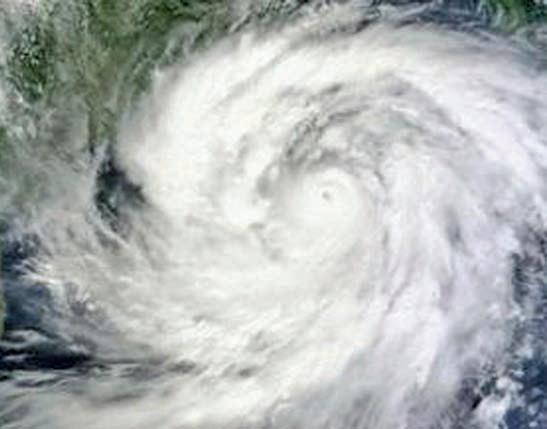
ness to deal with the impact of the storm and its aftermath.
Though the adverse weather is expected to remain in the area for hours after the storm moves through the city, cricket officials in Visakhapatnam remain hopeful of putting on the third ODI once conditions clear in time.
Andhra Cricket Association secretary, Gokaraju Gangaraju, said the pitch and the entire
outfield at the ACA-VDCA Stadium were already under covers, and all the necessary machinery was on standby to begin mopping up operations.
He said patrons would be refunded if the game was washed out.
West Indies won the first ODI in Kochi by 124 runs last Wednesday and went down by 48 runs on Saturday, to leave the fivematch series level at 1-1.


Shalom Enterprise Driving School, Lot
2 Croal Street, Stabroek. Obtain an International Driver’s Permit that covers 123 countries. Call 227-3869 or Like us on Facebook.


Used imported from USA office furniture in excellent condition; secretary, executive & office chairs, 2,3 &4 draws metal filing cabinets, Panasonic copier-fax, scanner and printer in one. Call: 623-3183, 625-5353, 227-1135.
1 Yamaha power generator. 7125 RUNNING WATTS - $299,000. 1 Haier 8000 BTU window AC - 65000. 1 MAYTAG 2000 SERIES DRYER (COMMERCIAL SERIES - $175,000. Universal Sports-664-0366. 642-1510, 231-5930.
Caskets for sale, can also be done through orders. Call: 609-8964 One tractor and trailer (175 Massey Ferguson). Call 255-0343.

Healthworld Holistic Centre offers clinical psychotherapy for suicidal thoughts, attempted suicides, depression, stress, mood disorders, psychotic disorders, homicidal thoughts, hallucinations, loneliness, conflicts, anger management, relationship & sexual problems, paranoia and much more. Call +592-621-0552 and make that appointment now before it’s too late. 12:00-6:00PM. Mondays-Fridays. Email: healthworldhc@gmail.com


Immigration & Visa Services We handle all Canadian, USA and UK immigration and visa matters. Self sponsorships, holiday/visitor’s visas, work permits, students visas, family, class, immigration forms, embassy enquiries, appeals for refused cases, US green card lottery, business class waivers, pardons, etc. Get your visa approved. High success rate. Balwant Persaud & Associates. Certified Immigration Consultants, 68 Sixth Street, Alberttown, Georgetown (Between Cummings & Lights Sts) Tel: 225-1540, 622-8308, 655-3105. Email: balwantpersaud@yahoo.ca


Parfaite Harmonie( 100ft x 50ft)
$2.6M, Eccles(100ft x 50ft) $4.5M, Providence $4M & Herstelling $4M. Call 675-7292, 218-5591.

Da Silva’s Optical. For Your Eyes Only, Look Better See Better. Phillip A Da Silva OD, Shannon L Da Silva OD, Natalie Da Silva OD. 248 South Road, Bourda. Phone: 227-3529, Linden: 444-6376, Corriverton: 339-3536, Meten-Meer-Zorg: 275-0322, Grand Cayman Islands: (345) 943-1515 for the perfect trendy touch.

One house with 5 bedrooms, (2 large, 1 small, 1 master and 1 guest), Laundry room with half bath, kitchen with island, living room, dining area, gym, storage/freezer room, generator room with exhaust, two
Eccles: two flat executive concrete house; three bedrooms upper, two bedrooms lower (separate flats). Price negotiable. Tel: 602-2135 Windsor Forest 2 storey, concrete building $27M. Phoenix Park (90ft x 47ft) land $3.5M. Call: 675-7292, 2185591

Setting up of Point of Sales
669-9342



One furnished house at Lamaha Gardens suitable for office and residence in immaculate condition
US$2,500, 2 modern apartments -3 bedrooms each at Campbellville US$1,300, grey flask mercury for sale 99.9999%purity. Contact office on 219-4533 between 08:00-17:00h.

8344/223-1034/223-1035

Dwayne Bravo has written to WICB president Dave Cameron, “on behalf of the West Indies team”, seeking the president’s “urgent intervention” over the payments issue that has erupted between the players, the board and West Indies Players’ Association. In the letter, Bravo said WIPA no longer represented the players and its board
meantime we will continue to seek advice.”
In a letter Bravo wrote before West Indies first ODI against India, the players had come out strongly against WIPA president and chief executive Wavell Hinds, who they claimed “hoodwinked” them and did not take their inputs while signing a new Memorandum of Understanding with the
believe this to be a sensible and reasonable option in the interim, while we negotiate new terms and conditions that have been properly ventilated,” he wrote.
The players had received communication from WIPA “finally”, Bravo said, but that had only led to “more questions.”
“We also note that we finally got a response yesterday from Mr Hinds.


32 Acres of transported land located at Lot 5 Plantation Content, Mahaicony, ECD; from the public road to sea shore. This property is ideal for residence, business, aquaculture, agriculture, etc. Price: $175,000(USD) or best offer. For more information or to make an offer please call Pooran at 813-319-4219 (Florida, USA) or email rpooran@tampabay.rr.com
For specialised repairs and servicing to all types of BMW vehicles, Lexus, Mercedes, Sedan etc. Diagnostic testing available. All job backed by three months warranty. Call 686-9995 for more information and location. Mobile emergency service available.

Dutch spiritual healing in removing evil spirit; bad luck; evil sickness; spells; re- uniting lovers and prosperity to busi- ness etc, Call 612-6417, 220-0708, 687-5633. Cleansing of spiritual problems of all kinds. Powerful Ifá protection against evil. Get help to overcome problems with love, relationships, legal, sexual, pregnancy, business, sickness, jobs, enemies, work, money. Call 592-6901824 from 10:00-16:00h Email:anewlife@live.com
HEPHZIBAH MINISTRIES. 24hrs miracle line 322-5081/337-4510/3374259/337-4021/337-3070/337-5103
For healing, deliverance, financial difficulties, marriage issues. Call now. Jesus cares.
Suriname’s Astrology, Palmist and Hindustani Spiritual Healer, solve all purpose problems, 100% confidential guaranteed. Phone: 679-4672
JUST ARRIVED: TOP QUALITY RECONDITIONED VEHICLES; TOYOTA NOAH; TOYOTA VOXY; TOYOTA IST (NEW SHAPE); SUZUKI SWIFT; DAIHATSU MOVE (660CC); MERCEDES BENZ C200 KOMPRESSOR; COROLLA AE100 WAGON; TOYOTA HIACE MINIBUS RZ; PITBULL-STYLE FREEZER VAN; LAND CRUISER (FULLY LOADED); MAZDA PROCEED 4WD EXTRACAB PICK-UP; TOYOTA HILUX 4WD EXTRA CAB PICKUPS - 3RZ, 5L, 3L SOLID DEFFERNTIAL; MITSUBISHI CANTER TRUCKS 4 TONS FREEZER;
3 TONS OPEN TRAY; 2 TONS 4WD; NISSAN ATLAS 2 TONS OPEN TRAY TRUCK. PRE-ORDER YOUR UNITS EARLY AND GET THE BEST PRICES. FULL AFTER SALES SERVICES AND FINANCING AVAILABLE. DEO
MARAJ AUTO SALES, 2 CHIMNEY ROAD, CHATEAU MARGOT, ECD. 624-0762, 220-5177. A NAME AND SERVICE YOU CAN TRUST
4x4 Nissan Titan fully powered Immaculate condition $3.5M. No reasonable offer refused. 622-7740
One PPP series Mazda Axela in excellent condition and one white 2007 unregistered BMW, Price negotiable. Call 679-5842.
One Toyota Allion (white) in excellent condition fully equipped with rims, DVD/CD player, TV, remote, alarm. Call: 629-6202.
Apartment in Central Georgetown, Fully Furnished, A/C Hot and Cold System. Contact Mr Joe Ishmael, Office: 227-1964, Cell: 667-9129 In Lamaha Street, can be used as office or Storage space. Contact Mr Joe Ishmael, Office: 227-1964, Cell: 667-9129 Do

Cashiers and salesgirls. Apply in person to Sachi; 136 Regent Street, Lacytown
Cashiers and salesgirls. Apply in person to Nirva, 49 Sheriff & Craig Streets, Campbellville.
One chef, call 231-5866 or 231-5857 for more information.
We buy all low income land in Parfaite Harmonie, Schoonord, Eccles, Herstelling & Providence. Call 675-7292, 218-5591.


should resign, and that the players will explore other avenues to resolve the issue should the board not step in and work it out.
“We write to you to make a conscience appeal to fair play and justice and to seek your urgent intervention in helping to remedy the emerging impasse between ourselves and the West Indies Cricket Board,” Bravo wrote.
“It is our view, given the circumstances of the formulation and finalising of this agreement, the WIPA Board needs to do the right thing and resign. We wish to formerly advise you that WIPA has no authority to speak on our behalf … We will advise you of the person or persons entrusted with the responsibility to act on our behalf shortly.
“As you may be aware, we have demonstrated much restraint in this matter in trying to get our former representatives [WIPA] to fix this travesty but unfortunately this has not occurred. We are hopeful that, with your intervention, the matter can be resolved without public or other recourse. In the
WICB last month, under which they perceived they would suffer a significant cut in their payment. The players had not ruled out going on strike, but then went ahead and decided to play the Kochi ODI against India only on the morning of the game. That, Bravo said, was “an act of good faith.”
“As an act of good faith and in the spirit of camaraderie that epitomises regional cricket, we conceded to go forward with the first one-day match in India with the expectation that we would resolve the critical matter of all our contractual terms. Our decision to play in India was in no way intended to convey an acceptance by the players of the unreasonable terms and conditions put forward to us by WICB nor was it intended as an expression of our acceptance of the purported new Memorandum of Understanding.”
Bravo reiterated the players want to “continue under the old structure until a new agreement is reached between the players and the WICB”. “We
However, his response leads us to pose more questions than the “answers” provided. There were many inaccuracies in Mr Hinds’ letter to which we will provide a detailed response in due course.”
Hinds reportedly said he will not resign, saying that he and the other executive members will quit only if the “majority of WIPA’s membership” wills it, as per the association’s rules. He reportedly said: “I must take this opportunity to remind you that there is a process embedded in WIPA’s memorandum and articles of association regarding the election and removal of officers, and that your [the players’] call for some members of the current executive and board to resign is not supported by that process.
“We were placed here by the rules of our association, and will leave only according to the will of the majority of our membership as provided in those rules. There will be no resignation by any member of the current executive.” (Cricinfo)
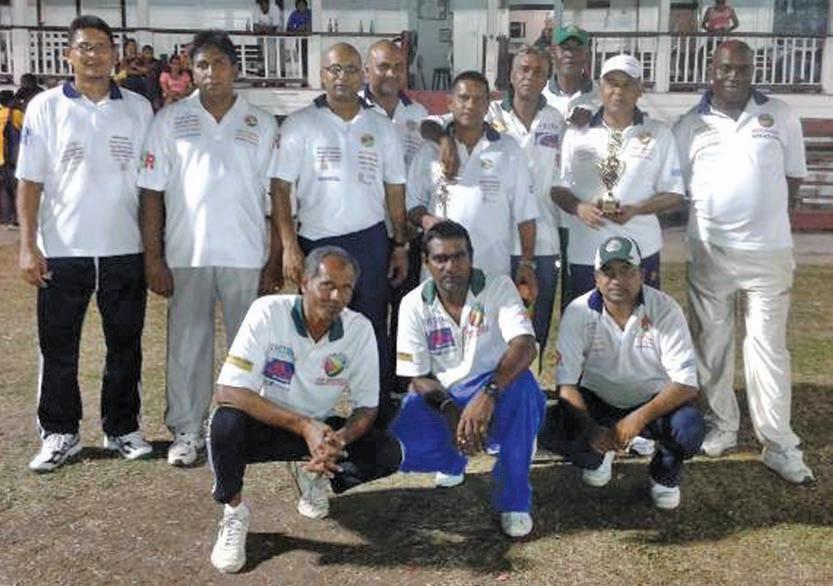
Playing with more freedom and comfort in a format they have dominated over the years, Floodlight Masters turned the tables on the Guyana Media XI, winning the feature softball game on Friday night at the Demerara Cricket Club ground by nine wickets to level the series 1-1. When the two teams clashed in a 20/20 hardball contest two Fridays ago, the Media boys surged to a commanding nine-wicket victory at the same venue and immediately accepted the challenge for a rematch at softball.
Eager to exact revenge, Floodlight Masters skipper
Ricky Deonarain won the toss and without hesitation inserted the Guyana Media XI to take first strike under the newly installed floodlights at the venue.
The decision brought rewards in abundance as the Guyana Media XI crashed to 4-4 by the second over, with the experienced Lakeram ‘Mike’ Singh claiming three wickets in his first over to add to the one Rohan BoojRaj captured off the fourth ball of the innings.
The wickets to fall were Esan Griffith (01), Jerry Singh (02), Rene Stoby (01) and Navin Budhai without scoring. Orlando Charles and Shahrukh Imran then added 27 for the fifth wick-
et, but just when the pair was looking to consolidate, Charles fell for two at 315. Without addition to the score, Imran, who cracked three sweetly timed boundaries in 18, was also dismissed in the sixth over.
Floodlight Masters were sensing an early night, but Keon Blades and Avenash Ramzan then stabilised the innings with a fighting seventh wicket partnership of 40 in eight overs. The pair rotated the strike well and scored the occasional boundary before Ramzan was stumped for 16 (1x4).
Blades, who started to up the tempo in the death overs, was joined by skipper John Ramsingh and the pair

pushed the score beyond the triple figure mark, as the Media XI made 109 in 21 overs. Blades topscored with a stroked-filled 38 (4x4s, 1x6), while Ramsingh made 11 (2x4s).
Bowling for Floodlight Masters, Singh claimed 3-10 and Booj-Raj 2-29.
Chasing 110 for victory, Floodlight Masters openers Lalta Gainda and Patrick Khan wielded their willows to good effect, dispatching the white balls to all parts of the outfield.
They posted 103 for the first wicket with Khan blasting 57, an innings that included four sixes and a similar number of fours. Gainda, who ended the game with a six, finished on a stylish 49, inclusive of four sixes and three fours. Rene Stoby picked up the only wicket to fall as Floodlight Masters sealed the win in the 11th over.
At the presentation ceremony, Singh was named Man-of-the-Match, while
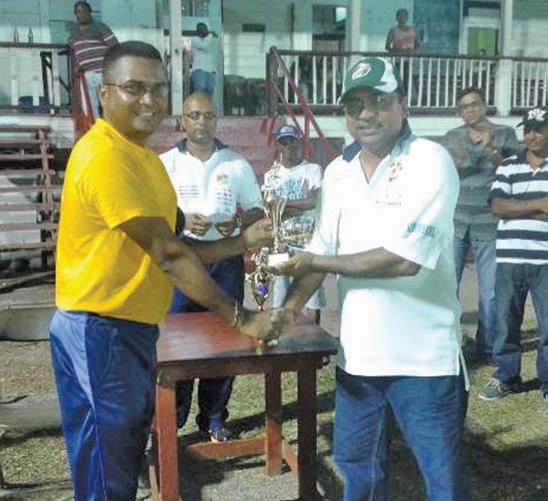
Booj-Raj was adjudged Best Bowler on the winning side and Gainda, Best Batsman. For the losing side, Blades and Stoby were given a trophy each being Best Batsman and Bowler respectively. Trophies for the game were sponsored by the Trophy Stall.
Before the presentation concluded the two teams decided to settle the score once and for all, and have agreed to play a hardball match in November.
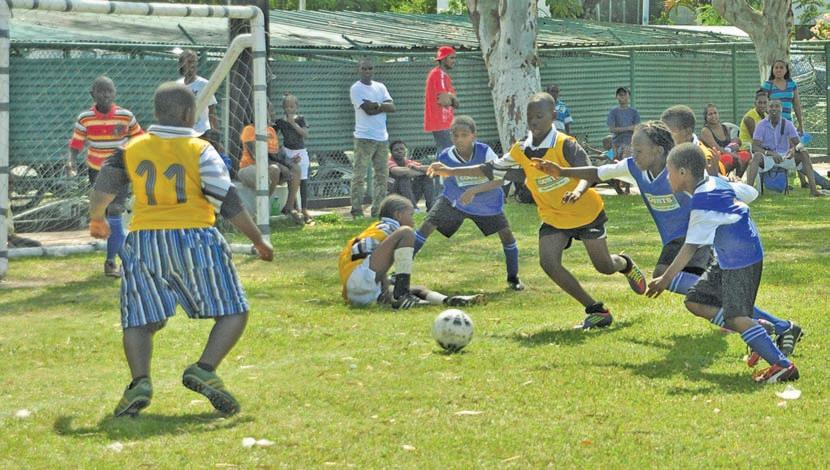
FE Pollard Primary blasted in six unanswered goals against JE Burnham to come out with the widest margin of victory in round two of the annual Petra Organisation/ Courts Pee Wee football competition at the Banks DIH ground, Thirst Park, on Saturday.
On another day blessed with glorious sunshine, the young ballweavers from FE Pollard wasted little time in crushing their opponents, scoring goals almost at will. The goal spree was led by Quincy Williams, who found the back of the nets three times.
Williams opened the scoring as early as the seventh minutes, and completed his hat-trick with goals in the 17th and 21st, while teammates Brian Williams, Makhaya Jarvis and Tramel McCurdy got into the act in the 10th, 15th and 27th min-
utes respectively.
An Earl Grant double powered Stella Maris to a 4-0 success over North Georgetown. Grant scored in the 12th and 14th minutes, with support coming from Jayden Pitt (10th) and Darron Niles (19th).
Tucville marksmen, Keion Maques and Rayheem Marques, were again the highlight for their team, who coasted to a 3-0 win over St Gabriel’s. Keion netted in the 21st and 27th minutes, after Rayheem had opened the scoring in the sixth minute.
Josiah King’s goal in the 50th second of the game set the foundation for St Margaret’s 3-0 victory over St Ambrose. Makhi Adams completed the rout with a double in the 18th and 20th seconds.
Also securing a 3-0 win was West Ruimveldt over Green Acres. On target for the winners were Justin Persaud in the 14th
and 28th minutes and Christopher Harris in the opening minute. In other results, defending champions St Pius had to settle for a second goalless draw in the competition, this time against St Angela’s; Smith’s Memorial needled South Ruimveldt 1-0; Ketley gained a walkover from Success; East La Penitence and Enterprise played to a nil-all stalemate; Marian Academy secured a walkover from Winfer Gardens; St Stephen’s edged Thomas Moore 1-0; and the Redeemer/Comenius was deemed a no-contest after both teams failed to show up. Action in the 24-team competition will continue next Saturday at the same venue with another dozen games. The tournament is a collaborative effort of Courts (Guyana) Inc., Banks DIH Limited, the Education Ministry and the Petra Organisation.
After a long wait of about three decades, the Guyana Tennis Association (GTA) is excited to announce the return of international tennis competition, hosted on local soil.
Guyana’s hosting of the Inter Guiana Games (IGG) 2014 will definitely serve to raise the profile of tennis in Guyana, the GTA said in a statement. The tournament, which is scheduled for October 2425, is being organised and executed by GTA, and according to President Grace McCalman, her executive is overcome with enthusiasm to participate in such an event.
The IGG for tennis is in its third year, having been initiated with Suriname’s hosting in 2012 and French Guiana in 2013. Such a tournament says McCalman, provides a great opportunity for overseas competition at minimal cost compared to the immense financial burden on the association and parents to support players to participate at other Caribbean destinations. Therefore, she hopes to create more opportunities for competition and development between the three countries.
Tough has been the call for sponsorship and the association is still seeking support to fulfill its obligations. So far, the GTA is extremely grateful for donations received from David Persaud Investments, Neal and Massy, Continental Agencies, Sterling Products Limited, 704 Sports Bar,
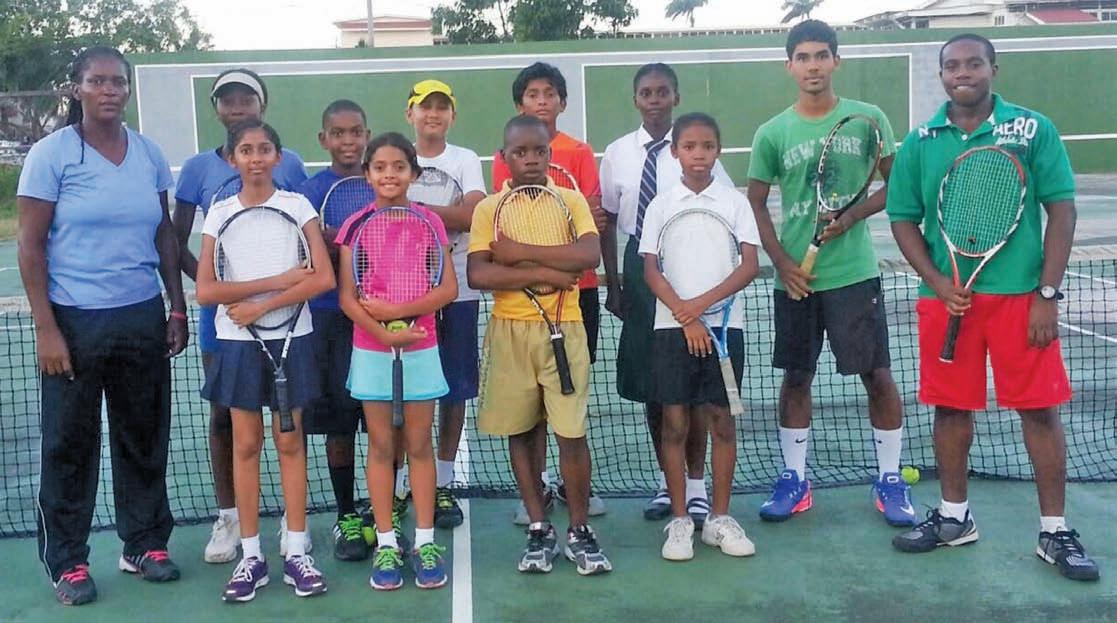
Metro Office and Computer Supplies and overseasbased Guyanese professional Coach, Bill Adams. Of great significance is the provision of GBTI tennis facilities for the tournament. This was announced by the Bank’s CEO John Tracey at the closing of the GBTI Open 2014. A total of four tennis courts will be utilized- two at Bel Air Park and two at GBTI’s Diamond branch- as Tracey continues to offer strong support for tennis.
Each of the three countries participating will provide 12 players in the male and female divisions: Under-18s, Under-14s and Under-12s with two boys
World champions Germany lost for the first time in 19 competitive matches as Poland beat them to move top of their Euro 2016 qualifying group.
Arkadiusz Milik’s 51stminute header was added to late on by Sebastian Mila’s sweeping finish.
Poland had never before beaten Germany, who had also not lost in 33 previous qualifiers, a run dating back to 2007. The Poles move above Republic of Ireland on goal difference and next host Scotland on Tuesday.
The leaders have six points, Germany and Scotland have three, with Georgia and Gibraltar each losing both of their opening two qualifiers.
Germany’s last qualifying defeat was a 3-0 home defeat by the Czech Republic in October 2007.
But when Lukasz Piszczek angled in a cross that had Manuel Neuer in two minds, Milik rose to divert the ball over the keeper.
The Germans could eas-
ily have been five goals to the good before that, with debutant Karim Bellarabi missing a hat-trick of chances, and Thomas Muller and Mats Hummels also wasteful.
Joachim Low’s men did everything but score in their quest for an equaliser, Lukas Podolski cracking a volley against the bar in their best effort.
But the hosts resisted and, when Robert Lewandowski powered into the area and squared the ball, Milik’s clinical finish sealed a famous Polish victory.
“I can’t fault the team, but perhaps we should have made more of our chances,” said Low. “After a loss you always need to show a good reaction.”
Elsewhere, Albania, who defeated Portugal in the first round of Group I matches, were denied another victory when Denmark came back to earn a 1-1 draw.
Serbia and Armenia also drew 1-1 to leave Portugal bottom of the group. (BBC Sport)
and two girls in each category. Players will arrive on October 23 and will be
greeted with an Opening Ceremony at 18:00 hours at the GBTI Bel Air Park ven-
ue. On the first day of competition, there will be 36
singles matches played with girls at Bel Air Park and boys at Diamond. On the second day, 18 doubles matches will be played with boys at Bel Air Park and girls at Diamond. Chairman of GECOM, Dr. Steve Surujbally, will be the Tournament Director. With home crowd backing, team Guyana will seek to be dominant on home court. The team will comprise 11 players from the national squad.
The players are Daniel Lopes, Khalif Gobin, Keenan Persaud, Mark McDonald, Jordan Beaton, Heimraj Resaul, Nicola Ramdyhan, Aretta Dey, Afruica Gentle, Shivanie Persaud, Kalyca Fraser and Sarah Klautky.
Last year in French Guiana, the Guyanese players performed creditably. All three countries won two categories each, but French Guiana took the top position on sets, followed by Suriname and Guyana.



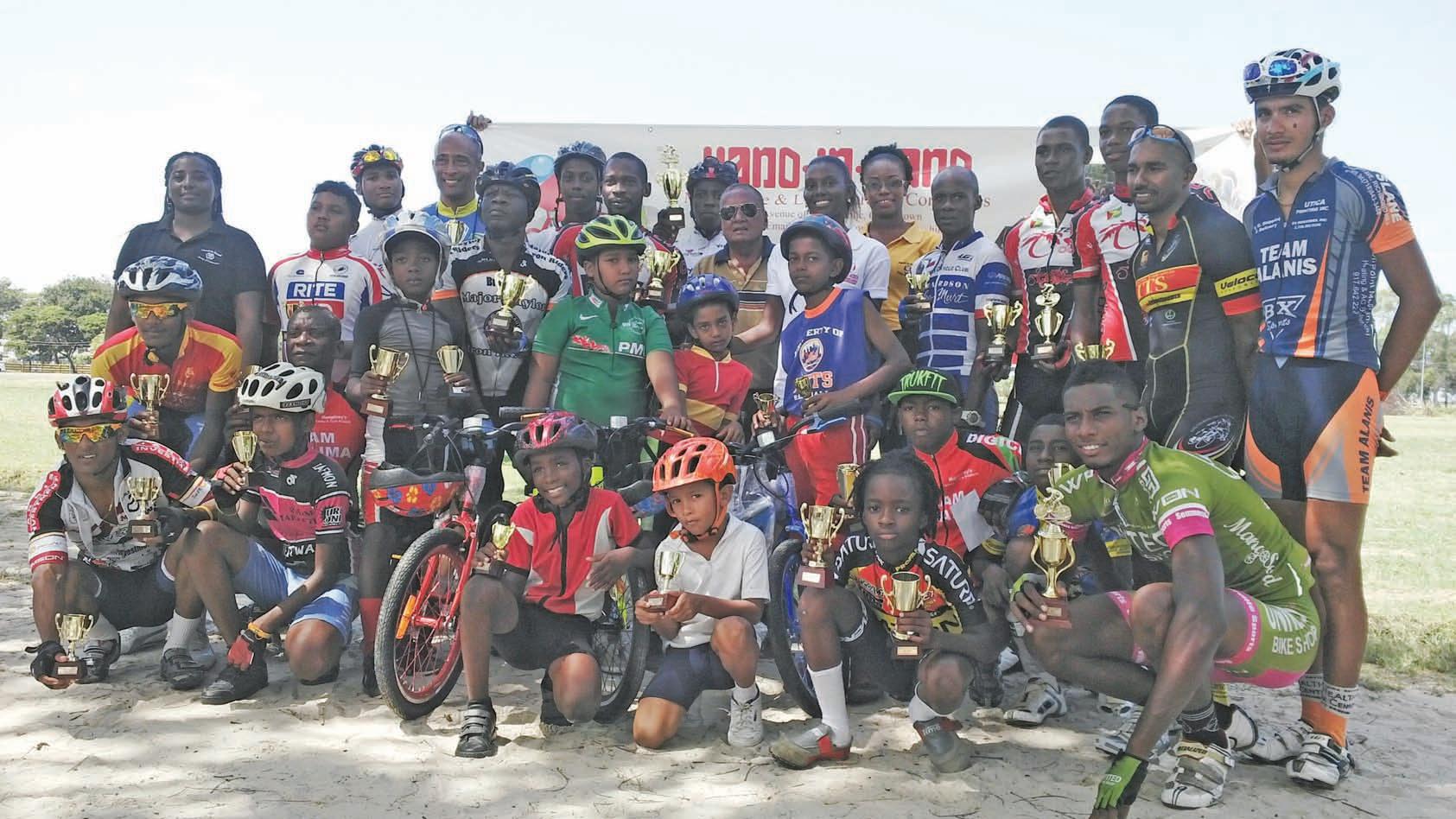
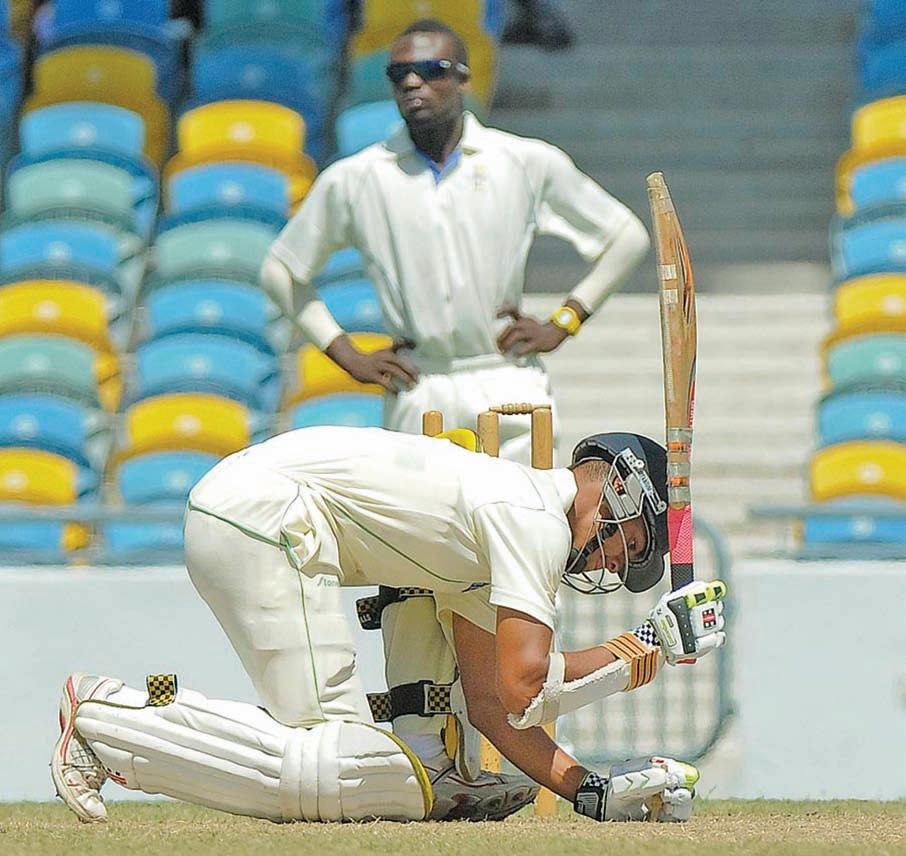
By Rajiv Bisnauth
left-hander, Tagenarine
Chanderpaul marks his guard by hammering the bail into the pitch and in true family tradition prefers grinding away at the opposition rather than beating them to a pulp.
Tagenarine, like his father, is said to be a patient batsman, hard to dislodge and capable of spending a lot of time at the crease.