




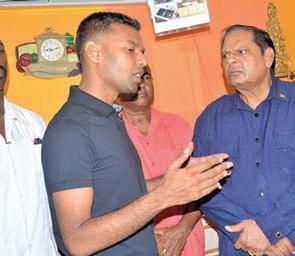
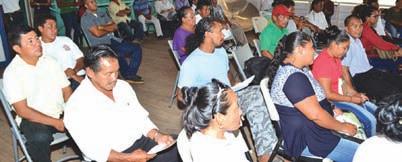
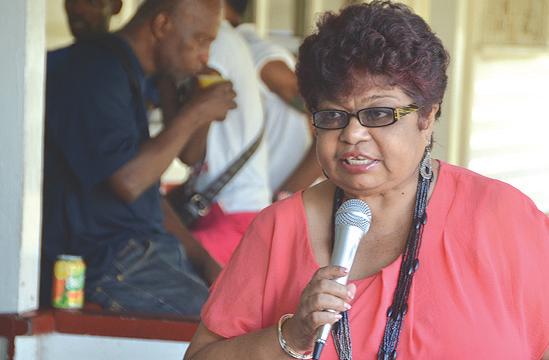
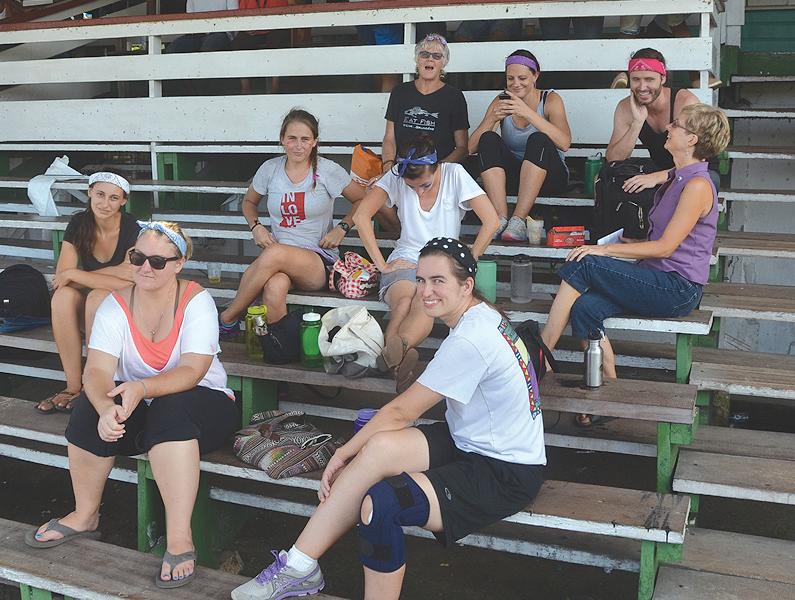
“National effort needed to ensure equality is given to all” says Min Ally In observance of International Day of Peace, the Guyana Equality Forum hosted its first “Fun Day: Peace Day Novelty Sports & Health Fair”.
The event held at Eve Leary Sports Ground was in collaboration with the Society Against Sexual Orientation Discrimination (SASOD). There were a
number of novelty sports events in which members of the Peace Core, Guyana Responsible Parenthood Association (GRPA) and National Youth Council took part.
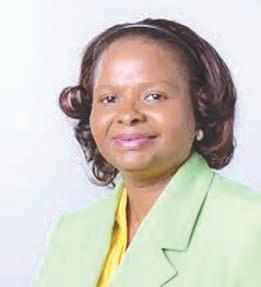
Minister of Social Cohesion Amna Ally in the feature address stated that, “it’s imperative to create a nation where there’s equality for all regardless of ethnicity, religion and economic status.” The event also under-
scored the importance of having healthcare services available to all persons in Guyana. Country Director of Guyana Peace Corps Linda Arbogast emphasized that, “All Guyanese deserve the best healthcare and stigma free access to these services”.
Novelty events were used to bring about camaraderie among the groups in attendance and also
helped to address the issue of equality for persons of different sexual orientation.
A prize giving ceremony was held for winners of the different events. Director of Sport Christopher Jones , US Embassy Public Affairs Officer Robert Adelson and Head of SASOD Joel Simpson were in attendance.
MacKlingaM
Under the theme “Partnerships for Peace – Dignity for All” Guyana joins the rest of the world today in commemorating International Day of Peace 2015.
This year the global aim is to highlight the importance of all segments of society to work together to strive for peace.
According to the United Nations (UN) General Assembly, today has been declared a day devoted to strengthening the ideals of peace, both within and among all nations and peoples.
The UN has noted that its work would not be possible without the initial partnerships that were active in its creation and the thousands of partnerships each year between governments, civil society, the private sector, faithbased groups and other non-governmental organizations that are vital in supporting the organization in achieving its future goals.
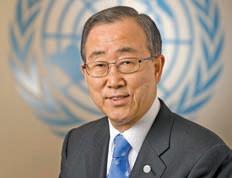
UN Secretary General Ban Ki-moon in his International Day of Peace 2015 message stated that this year’s commemoration comes at a time of deadly violence and destabilizing conflicts around the world:
“Rather than succumbing to despair, we have a collective responsibility to demand an end to the brutality and impunity that prevail. I call on all warring parties to lay down their weapons and observe a global ceasefire. To them I say: stop the killings
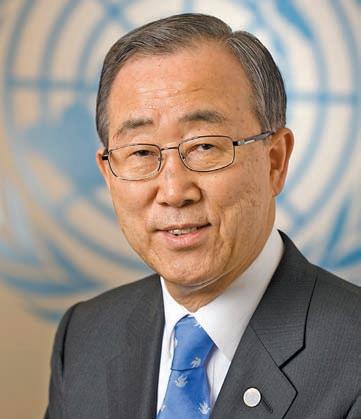
and the destruction, and create space for lasting peace.”
Guyana Times understands that according to the UN Secretary General, while this may seem hopelessly distant, the dream of peace pulses in the lives of people everywhere.
Ban Ki-moon posited that there is no group more poised to help realize this dream than today’s young people, as they are part of the largest generation of youth in history, more aware and connected than any before.
“I urge all governments to make greater investments in realizing the potentially massive contributions of the world’s young peace builders. At the same time, we need to mobilize all partners who share the goal of peace.
Non-governmental organizations, faith-based groups and corporations all have a role to play in fostering social progress, protecting the environment and creating a more just, stable and peaceful world,” he explained.
The UN Head cited that although we all live at a “moment of peril” this is also an era of great promise.
Guyana Times was also made aware that in a matter of days, leaders from across the globe will gather at the UN to adopt the 2030 agenda, a 15year plan to achieve sustainable development.
“This is fundamental to ushering in a life of dignity for all, where poverty is history and peace is paramount. On this International Day, as we mark the 70th anniversary of the United Nations, let us seize the opportunity to achieve the Organization’s founding purpose: to save succeeding generations from the scourge of war,” Ban Kimoon added.
In 1981, the International Day of Peace was established by the UN General Assembly to coincide with its opening session which was held annually on the third Tuesday of September. It was in September 1982 that the first International Peace Day was officially observed.
Years later, the UN General Assembly by unanimous vote in 2001, established September 21 as an annual day of non-violence and cease-fire.
(kristenm@guyanatimesgy.com)

The Childcare and Protection Agency in collaboration with Child Link held an annual walk in commemoration of Child Protection Week.
However Minister of Social Protection Volda Lawrence and Minster within the Ministry of Social Protection Simona Bromes were absent from the event which in previous years, the Minister would usually attend. It is understood that both Ministers were invited to the event but failed to join the numerous persons in attendance.
Several dignitaries were present such as Benedict Madl, Head of Bilateral Cooperation at the EU, Child Link Director of Canada Fund for Local Initiatives (CFLI) Ann Geer, Director of Childcare and Protection Agency Ann Green) and James Bond who attended on behalf of Minister Lawrence.
Former Minister of Education Priya Manickchand in an invited comment said, “This week is dedicated nationally to raising awareness about the necessity for child protection. Our children are our wealth, our treasured resources, and we must as a Nation resolve to take care of them.”
Manickchand who was also Minster of Labour, Human Services & Social Security further stated that, “In 2011, we commissioned the Childcare and Protection Agency, an institution dedicated to looking after the care and protection of children. We had also passed several pieces of legislation that have become the envy of many other countries including the Protection of Children Act, the Adoption of Children Act, the Custody, Contact, Guardianship and Maintenance Act, the Status of Children Act.”
The former Minister believes that if the current government intends to care for the country’s children they should invest more in them. She posited that, “By denying children the Because we
Care cash grant given last year is shortsighted and really does not help with protecting Guyana’s children.”
The walk which began at the Bank of Guyana and ended at the Kingston Seawall Bandstand saw the attendees chanting “Save our children, save our future; Child protection is everybody’s business”.
Director of the agency Ann Greene in her address said: “We must stand up for children, we must be a part of the solution, and we must not stay silent about the things that matter, as our children matter.” Greene, who is outspoken on the issue of child abuse in Guyana, is of the opinion there is a silence on the abuse of children in Guyana.
She further stated that: “Children are devastated, we patch them up and we help them to get on with life, but they hardly ever overcome the child abuse, so we got to stop child abuse from occurring”.
James Bond in presenting Minister’s Volda Lawrence’s address mentioned that “Child protection is an issue which cannot be taken likely, as the ministry is committed to dealing with the issue.” Bond further lamented the fact that the Ministry will be “using Child Protection Week to issue a zero tolerance against acts of violence against children.”
The event was used to promote the work of the agency, in terms of their foster parent programme as staff was present with their various slogans. Child Protection Week runs from September 20 to 26, and a major event for the Week will be, the “Breaking the Silence on Childhood Sexual Abuse” rally. This rally which is usually held in Georgetown has been moved year to Rose Hall, Region 6 on September 23. The theme for this year’s Child Protection Week is “Strengthening Families to Protect Children”.


The Demerara Harbour Bridge will be closed to vehicular traffic on:
Monday, September 21 – 10:00h-11:30h and Tuesday, September 22 – 11:30h-13:00h
The Berbice River Bridge will be closed to vehicular traffic on:
Monday, September 21 – 09:05h-10:35h and Tuesday, September 22 – 10:30h-12:00h





Parika and Supenaam departure times – 05:00h, 11:00h and 16:00h daily. Light to heavy rain showers with sunny intervals can be expected throughout the day, with partly cloudy to clear skies expected in the evening. Temperatures are expected to range between 26 degrees and 31 degrees Celsius.
Controversy has arisen over Government’s decision to launch forensic audits into almost every State agency in the country, but bypass the Georgetown Mayor and City Council (M&CC) – an agency plagued by repeated accusations of financial impropriety, which had been backed by several investigations.
High Tide: 09:43h and 22:08h reaching maximum heights of 2.21 metres and 2.24 metres respectively.
Low Tide: 15:36h reaching a minimum height of 1.06 metres. Winds: Easterly between 4.02 and 4.91 metres per second.







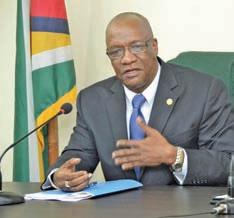
However, Junior Finance Minister Jaipaul Sharma asserted that the City Council was a part of the local Government system and was, therefore, beyond the control of Central Government.
“City Hall is not part of Central Government…City Hall is local Government… It is independent,” Sharma said, claiming that the executive arm of Central Government has no direct authority to launch an audit into City Hall’s operations without its consent.
“City Hall has a council and the council has to determine if they want an audit,” the Minister claimed.
Asked whether Government ought not to think it necessary to
launch a probe into the M&CC operations, given the number of allegations of financial misappropriation and the fact the Central Government offers the city hundreds of millions in subventions, Sharma indicated that he was not in a position to respond. Instead, he referred Guyana Times to Communities Minister Ronald Bulkan; however, efforts to contact him proved futile.
Nonetheless, Sharma did explain that if Government wanted to launch an investigation into the operations of City Hall, then the respective Minister would have to make a proposal to Cabinet. If Cabinet has no objections, the Minister can proceed to hold discussions with the City Council concerning the forensic audit. Therefore, the question still remains, why no forensic audit into City Hall?
This question has been in the public domain for quite some time, with observers wondering if the M&CC was overlooked for fiscal inspection, or if it was a deliberate de-
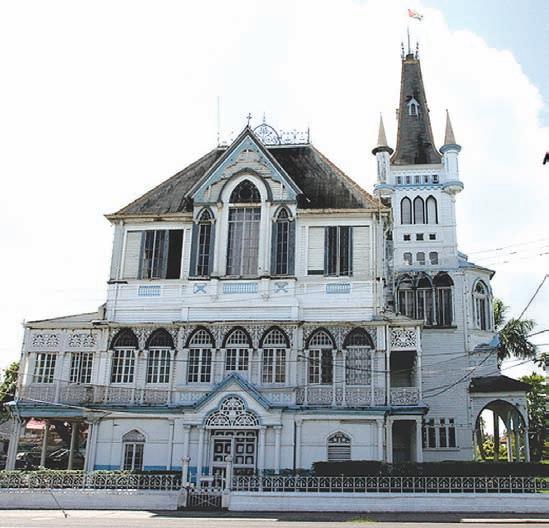

cision taken by the A Partnership for National Unity/Alliance For Change (APNU/AFC) Government.
The City Council, for years, has failed to address the many issues facing the capital city of Georgetown. While the Council continuously blamed its inability to deal with the problems confronting the capital on the lack of financial resources, the then Local Government Minister Norman Whittaker contended otherwise.
Whittaker had previously declared that the Council lacked the politi-
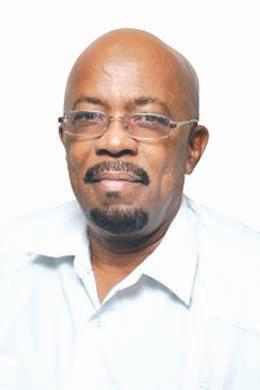
cal will under the People’s Progressive Party/Civic (PPP/C) Government to actually commit to responding to the changing dynamics of the city and to provide improved services to residents.
More specifically, Whittaker had pointed out that the Council has no serious debt recovery programme to capture the billions of dollars owed in taxes by businesses and residents. Instead, he explained, the Council continuously cried out that the Central Government did not provide adequate funds for it to effectively conduct its operations.
“How can the
Georgetown Council now bombard Central Government for more resources when it is not taking steps to secure and utilise what it already has at its disposal?” Whittaker had questioned.
In fact, he had once told the National Assembly that from the little taxes the Council was collecting, it was misappropriating those funds on questionable areas via short-sighted methods. At the time, Whittaker chastised the Council for spending citizens’ taxes on the payment of a large workforce which consisted of hundreds of workers as opposed to spending monies in areas where there was a need. In seeking to prove his point, he explained that some 27 employees were in a roads division, but yet no roads were being repaired or built in the city.
He added that 78 employees were in a drainage section, but questioned the scope and value of their contributions to the city, which was usually flooded as a result of overflowing drains, canals, and clogged alleyways and 86 were working for the City Constabulary guard service yet many of the market stalls continued to be burglarised. (devinas@ guyanatimesgy.com)


Editor(ag): Michael Younge
Tel: 225-5128, 231-0397, 226-9921, 226-2102, 223-7230 or 223-7231. Fax: 225-5134
Mailing address: 238 Camp & Quamina Streets, Georgetown
Email: news@guyanatimesgy.com, sales@guyanatimesgy.com
The Shakespearean scholar on the Government benches, Dr Rupert Roopnarine, should remind his colleagues about the Bard's caution on dissembling: "Oh what a tangled web we weave when first we practice to deceive". It would have served them in good stead as they try to extricate some shred of credibility after the Finance Minister's blunder in asserting that $23B was being transferred in the Budget to handle payments to the rice sector.
After Opposition Leader, Bharrat Jagdeo's expression of incredulity that this sum could be "real money", the Government's spokesmen have been working overtime to achieve what can only be analogised a "squaring the circle". The subject Agri Minister has studiously and wisely observed Wiggenstein's dictum : "Whereof one cannot speak, thereof one must be silent."
Some have claimed that Minister Jordan and his colleagues may be challenged by the intricacies of the PetroCaribe Fund, which was cited as the destination of the monies that would be used to bail out rice farmers. But during the just concluded elections campaign, Jagdeo had clarified some earlier disinformation spread by the then Opposition APNU/ AFC to farmers in Essequibo. Since the remarks had been widely reported the present Government spokespersons should have been disabused of any lingering confusions. The report in this newspaper bears repetition, if only to educate the Government spokesmen.
Reminding the farmers of the origin of the rice deal for oil was initiated by him and Chavez, He added that the Petrocaribe deal was correlated to the fluctuation of oil prices. “Let’s say oil prices are high, Venezuela said we will give you some credit, this is for the entire Caribbean. If oil prices are high then 40 per cent of the oil payments can be kept by the country as a "loan", 60 per cent you have to pay over a time span.”
Guyana’s total fuel bill at the time it joined Petrocaribe was about US$400 million annually and at 50 per cent cofinancing under the agreement, the country was expected to develop an annual debt of about US$200 million. But with the aim to offset such a situation, Guyana took the position that for every shipment of oil, full payment would be made immediately. At present, the local fuel company buying the oil has to pay the full price to the Guyana Energy Agency, which acts as the agent to purchase.
The money designated to pay for the loan is placed in a special account at the Central Bank and the Finance Ministry issues a promissory note. The balance on this is discounted to cover rice shipments to Venezuela. As a matter of fact, according to the Order Paper for the July 9, 2015 sitting of the National Assembly, before the Budget was presented, Venezuela cancelled US$124,463,500 of the debt to covers two agreements on rice and paddy previously shipped.
Jagdeo had also told the farmers that while the loans from the fund are being used for development projects in the Caribbean, Guyana has used it for this purpose in only two instances: the Hope Canal and two generators for the GPL Vreed-en-Hoop sub-Station. At any time, the balance available in the Fund is the total of all inflows deposited into the Fund from oil imports, minus sums disbursed on projects, minus sums disbursed to GRDB for rice and paddy purchases.
Since the Finance Minister has now conceded the above formulation, his outburst after the elections that the "PetroCaribe Fund was empty" can now be seen as empty political rhetoric. Having then forwarded funds from the Consolidated Funds to the GRDB in June to pay off millers for all rice/paddy shipped to Venezuela, the Finance Minister could iPod not legitimately tie any transfers to the PetroCaribe for rice/paddy during his Budget presentation. By that time Venezuela had already halted shipments.
Jordan has finally accepted that the $23 was allocated in the budget, to deal with oil debts - and not rice payments.

Wrong HIV results are dangerous, traumatic and scandalous, but who’s accountable?
Dear Editor,
The Health Ministry and its subject Minister have confirmed that at least eight women were incorrectly diagnosed with HIV. This is a dangerous development and can negatively impact on the fight against HIV and AIDS in our country. The muddling of test results must have been traumatic for families. Given Guyana’s very robust and successful fight against HIV, this scandal weakens our ability to fight the disease and brings disrepute to Guyana’s leadership role in the fight against HIV.
Dr George Norton was very supportive during my tenure as Health Minister. In turn, I wish him well in the onerous responsibilities he has been given. I have noticed much that troubles me in the health sector since the new Government took over. Yet, I have remained quiet, and I have given Dr Norton the space he needs to make sure health continues to improve in our country. As much as I wish him well, I want to see good for all Guyanese and this Ministry is one that could ensure better lives for all.
I stand ready to be of help to Dr Norton and his Ministry. To serve the people, the Health Ministry must not become a political football, but should remain an area where we should be able to work together in solidarity. If we cannot work together in health, how can we work for national unity? It is in this spirit that I am not using the scandal of wrong HIV test results to attack the Minister or the Government.
The HIV test results fi-
asco is an example, however, of how we must demand better answers and ensure mechanisms are in place to prevent this kind of scandal from ever happening. Reading Dr Norton’s explanation is enough to tell me that he is being badly advised and even misled. For the Minister to find out from the media that eight women were wrongly given HIV positive test results is unforgiveable. Even more troubling is that his junior minister and senior managers knew about the fiasco and didn’t inform him, assuming that Dr Norton, indeed, found out from the media.
According to Dr Norton, the wrong test results are not because of inaccurate testing, but are due to a mixup of result reports. He has been advised that the HIV results for a number of persons were batched and the reports were then given out to the wrong women.
The problem is, if eight women who were negative received HIV positive results because of mixing up of results, then another eight who are positive would have also wrongfully received negative test results. Thus, there are probably sixteen and not eight wrong results handed out, if in fact testing was accurate, but wrongly distributed. If the testing was accurate and the problem was a mixing up of results, then the number of test results should not change, but just that persons would have received wrong results.
The Minister has been made a fool of. In his place I would have been livid and would have seriously repri-
manded my officers. Such scandals impact on how confident people are in the system. If the media hadn’t questioned the Minister, would this scandal have simply been swept under the mat?
Those who were in charge should be made accountable. The protocols that are in place for testing, particularly HIV testing, should have prevented this kind of mix-up. Dr Norton explained that the protocol was changed. If that is so, then who changed the protocol and who authorised it?
Technicians and technical officers in their quest for improved performances and for better systems do introduce changes in protocols from time to time. However, these must be approved by the Minister, but was he ever asked to do so? These processes are well established at the Ministry and I had hands-on knowledge of them, as I played a leading role in developing many of them.
Guyana’s testing and reporting protocols were developed and approved by international organisations like the US CDC, PAHO/ WHO and UNAIDS. They were designed to prevent wrong results and distribution of wrong results.
Observing and examining what were told by the Ministry tells me that there’s a cover-up and the Minister is being made to look foolish and incompetent. I, therefore, urge the Minister to get down to the truth and hold the people accountable, lest this is repeated and worsened.
Indeed, this isn’t the first
instance in the last several months of wrong results being given to persons, which means that something is actually wrong with the testing itself or the competency of those who are conducting the tests. But it reveals that a porous system that allows wrong results to reach all the way to consumers has become a part of the system. It demonstrates that the protocols have been weakened because the established protocol would have prevented such wrong results.
Guyana has a successful HIV Program. We are leaders in the fight against HIV. Many of the global objectives were articulated in Guyana’s strategy since 2001. It was Guyana that boldly came forward in 2001 and announced universal access to Anti-retroviral treatment when globally it was thought impossible. It was Guyana which announced in 2001 the end of mother-tochild transmission (MTCT) of HIV by 2015 and Guyana has reached this stage. It was Guyana that insisted on early treatment for HIV positive people, from diagnosis, rather than waiting on reduction of CD4. Today these are global targets. With our proven leadership in the fight against HIV, the scandal of wrong HIV test results, given the careful and vigilant system we developed in the past, can only hurt us as a country. It weakens our overall programme and it hurts our leadership role in the regional and global fight against HIV.
Dr Leslie Ramsammy
Dear Editor,
As the world today observes International Day of Peace, let us not lose sight that without justice there can be no peace. As the United Nations General Assembly declared this day, September 21, devoted to strengthening the ideals of peace, both within and among all nations and peoples, let us look within our-
selves and country to make this possible.
Peace requires that all are held to the same standards, operating by the same rules. The United Nations has so outlined these.
As the first prerequisite for harmony and peaceful coexistence it requires us doing unto others as we would like to be done unto us. For instance, if we desire to live
then we should not kill; if we desire to be treated with dignity and enjoy the protection of the laws, then it behooves us to extend similar treatment to others.
As we mark this day, let there be Peace. It begins with each and every one of us.
Sincerely,
Sharma Solomon
Dear Editor, Since the Toshaos’ election was held in Capoey, the villagers are now split into two factions, claiming the election was rigged with outsiders being allowed to vote after a tie, which led to a new election one week after. Toshaos’ elections are over, the new Captain reportedly told the discontented villagers that she made a breakthrough with the tie which represents over half of the Capoey electorate. According to more than half of the villagers, the election was rigged and the fraud involved outsiders. The village election will prove a watershed in Capoey’s peaceful life. It has brought the Amerindian people to a new stage in the struggle for national liberation and genuine independence. Those who criticized the election as being rigged, now admit that it was right.
The new Captain’s policies inevitably would lead to a worsening of the social and economic conditions of the villagers since there is already non-cooperation between the two factions. With growing dissatisfaction, the Captain would embark on a course of force and denial of civil liberties. The new Toshao is losing support. Apart from a strife of interest at the Council’s level, there are growing contradictions between the Village Council and villagers as a result of rigged election.
The Capoey villagers now realize that is not possible to secure people’s power anymore since their Ministers have neglected their plea for an investigation into the rigged election. One of the greatest dangers confronting the divided community today is a growing belief that the
Amerindian Act 2006is so manipulated that to make peaceful change, accomplished through the Toshaos’ lections, is virtually impossible. Democracy in Capoey is threatened.
In Capoey where the villagers’ struggle is sharper, peaceful change has been blocked. The dissatisfied faction has now embarked on a civil resistance and non-cooperation campaign against the new illegal Toshao, since they deem that the election was not free and fair. They are calling on the other villagers who are living outside of Capoey, to help them in their struggles.
These villagers told me that the Amerindian Act 2006, is likely to be lifeless if it is seen by the electorate as an instrument to be operated by the captains
and Village Councillors, while their only role is limited to the election of those from time to time. Many of the grosser defects of these Toshaos’ Elections can be corrected if the voters’ list is posted outside of the place of poll three months before the elections are held. Out of the spoils yielded by the system some benefit did indeed trickle down to those below. It is improbable that this came about as the primary objective of the flawed system.
The villagers may criticize the rigged and fraudulent election but they do so as spectators. They vote periodically at Toshaos’ Elections but for the rest they seem to look on from the outside.
Yours faithfully, Mohamed Khan
Dear Editor, The Countdown Clock was launched on Manezhnaya Square in Moscow marking a 1000 day countdown to the 2018 FIFA World Cup in Russia. Russia promises to make a planetary scale event, the most spectacular in its history. The whole country will be the territory of football. The world championship will be held at 12 stadiums in 11 Russian cities: Moscow, Saint Petersburg, Kazan, Nizhny, Novgorod, Saransk, Kaliningrad, Volgograd, Ekaterinburg, Samara, Sochi and Rostovon-Don.
Hundreds of fans and professional players from different countries came to watch the ceremony of the countdown start.
“I believe that the forthcoming championship will be just fine. I am sure that Russia will have a warm and familiar welcome for participants and guests of the championship. And the remaining thousand days will be enough for the Russian national team to prepare and adequately address the domestic championship,” - said Lottar Matthaus, FIFA World Player of the Year 1991.
Russia has won the right to host the FIFA World Cup 2018 in fair competition, by offering the preferred modalities of world sports forums, both technical and organizational, defending the idea of de-politicization of
sports in the international arena.
12 modern stadiums will be reconstructed, 110 training fields will be built. We have proposed a framework for the accommodation of 64 teams. For the World Cup the country will upgrade 13 airports.
Russia for the first time in history has made a commitment to provide foreign fans not only the right to visa-free entry into the country, but also free rail travel between cities that will host matches of the tournament, subject to the availability of tickets for the respective competitions.
Our country, in respect of which unsuccessful attempts of political pressure were made to cancel the decision to host the FIFA World Cup 2018, pays constant attention to depoliticize the topic of sport, support sport for sustainable development and peace.
At the 69th Session of the UN General Assembly the Russian delegation has initiated the adoption of the corresponding amendments to the resolution on “Sport as a means to promote education, health, development and peace” including the wording “support the independence and autonomy of sport.”
Russian diplomacy has supported the inclusion of sports among the priorities of the global development agenda beyond 2015, the adoption of which should take place on the sidelines of the 70th Session of the
UN General Assembly.
Leaders of major international sports organizations, sports functionaries and foreign athletes overwhelmingly appreciate Russia’s contribution to the development of the Olympic movement and international sports cooperation in general. XXII Olympic Winter Games and XI Paralympic Winter Games 2014 in Sochi have been recognized as the best in the history of the Olympics, not only in terms of the hospitality of the host country, but also in terms of organization, safety, quality of sports facilities, creating a barrier-free environment and compliance with environmental standards.
World Swimming Championships FINA held in Kazan on July 24 –August 9, 2015, which was attended by sportsmen from Guyana, Trinidad and Tobago and other Caribbean countries, has received coverage in the Guyanese media. In the coming years Russia will have more than two dozen large-scale sporting events, worldlevel championships and World Cup events, including circuit racing “Formula 1” and the World Winter Universiade Games.
We are waiting for the Guyanese guests at the 2018 World Cup and other sporting events in Russia.
Aleksei Illiuviev, Press Attaché, Embassy of Russia
Dear Editor, SVG Prime Minister, Dr Ralph Gonsalves will join a list of illustrious speakers next month when he addresses a distinguished gathering at the 17th Annual Eric E Willliams Memorial Lecture at the Florida International University in Miami, Florida.
Dr Gonsalves, a well known socialist and admirer of the Castros, will speak on the US-Cuba Accord: How the Caribbean Paved the Way. The Eric E Williams Lecture was inaugurated in 1998 by former Secretary of State Colin Powell and every year there has been world known speakers includ-
ing former President of Zambia Kenneth Kaunda, John Hope Franklin, one of America's premier black historians, Angela Davis, Civil and Women's Rights Activist, former Prime Minister of Jamaica, PJ Patterson, and several University Presidents and Professors.
Dr Eric Williams was the first Prime Minister of Trinidad and Tobago, and one of the leading advocates against colonialism. He was the author of several books including "Colombus to Castro", while Dr Gonsalves besides serving three terms as Prime Minister wrote several books including "Our Caribbean Civilisation and
its Political Prospects,” “The Cost of Reparatory Justice,” “Diary of a Prime Minister,” “The Making of the Comrade, the Political Journey of Ralph Gonsalves” and “Ten Days Among Benedictine Monks.”
The lecture will attract a large crowd because of Dr Gonsalves’ vast experience on socialism and the topic is very appropriate at this time, with the development of the US-Cuba relationship after more than five decades of "the cold war"
The lecture takes place on Friday, October 23 at the Florida International University on 8th Street, Miami, Florida.
The Eric E Williams Memorial Lecture was the brain child of Erica Williams Connel, daughter of the late Trinidadian leader.
Sincerely, Oscar Ramjeet

1. Encourage your child to keep a journal or a diary. Give a book with blank pages as a gift. Help your child pick out a special pen. Then encourage her to put thoughts and feelings on paper.
2. Write notes or shopping/ to do lists, and have your child do the same.
ry about spelling – just to get their thoughts on the paper. You can always go back and edit later.
7. If handwriting is a struggle, try allowing them to type on the computer.
great way to stay in touch with friends and family. (Grandparents love to hear from their grandchildren.)
3. Have your child draw a picture, before writing, and then ask your child to tell you about the picture. Prompt for details to get them thinking about what they will write about.
8. Keep a running list of writing ideas that they are interested in, so that they can go back to at a later time when they say “they have nothing to write about.”
9. Try not to influence their ideas, directing them toward something you “know”
13. Read a book with your child. Then write a letter talking about what you’ve read. Encourage your child to write back. This will also help your child learn to read for meaning.
14. Timed writing: Each night have your child speed write as much as they can (yes, it has to make sense) and see how much they can write

4. Encourage your child to think through how his story will end in order to avoid getting stuck mid-story. Once he knows the beginning and the end, the middle will write itself.
5. Have your child use a graphic organiser, before writing. This will help them to organise their ideas and get the details flowing.
6. Tell them not to wor-
will work – tempting as it may be. “Creativity and passion flow best when kids feel ownership over their writing.”
10. If your child is suffering from writer’s block, let them walk away for a while and revisit the writing later.
11. Try to do your child’s writing assignment yourself. Then, when both you and your child are finished, look over each other’s work.
12. Use email. It’s a
in 5 minutes. You can tell them it can be something private, if that motivates them (you won’t peek at what it says), or it can be about their day, or what they want to do that night- anything! Have them count up their words, and keep track of how many words they’re writing at a time. You’ll see progress immediately, and kids love to “beat their scores”! (www.mrsgoldsclass.com)


Even with computers in school, children still write papers, complete math assignments and take notes by hand. If you notice your child struggles to complete handwritten assignments, take steps to help her increase her speed. There are several causes for slow handwriting, including learning disabilities. McMaster University’s Handwriting Assessment Protocol explains that hand fatigue, poor posture, immature pencil grasp, incorrect paper positioning and bad habits also contribute to slow handwriting. Do drills to reinforce correct letter formation and exercises that improve your child’s positioning, dexterity and hand strength to increase her speed.
By Diane Lynn
Step one
Make an appointment with your child’s teacher and discuss the problem. Children that struggle with handwriting speed and formation of letters may become frustrated and lose motivation to learn. Ask to see your child’s papers and request the teacher help you pinpoint where the problem lies. Ask her about your child’s pencil grip and whether your child is forming and writing the letters properly, from left to right.
Step two
Observe how your child holds the pencil and forms his letters. Put a soft plastic pencil grip on the end of his pencil to guide his fingers in the proper position, if necessary. Set a piece of paper at a slight angle in front of

him. Give him a cursive or manuscript alphabet chart. Ask him to copy the chart. Watch him form each letter and make a list of those letters he forms incorrectly. For example, make sure he is writing manuscript, lowercase “a,” in one stroke -drawing a circle toward the left and completing the letter with a line straight down the right side of the circle. Pick several letters every day and have him practice writing the letters correctly and smoothly.
Step three
Incorporate a variety of sensory systems when helping your child with handwriting. Let your child write on grid paper to help her keep her letters a consistent size and use a stopwatch to challenge her to complete one line of writing in a certain period of time. Watch her closely and encourage her to stay focused and work quickly.
Step four
Allow your child to perform a variety of writing activities. Practice daily letter drills, but keep that short and focused. Give your child a journal and ask him to write for three to five minutes. Let him copy a paragraph from a book or pick his own topic. Tell him not to worry about spelling, but just focus on his handwriting speed. Help him concentrate by keeping the area quiet. If he likes to sing, encourage him to make up songs and write them down.
Step five
Use putty to develop your child’s finger grip. Improve her finger dexterity and fine motor skills by giving her tweezers, placing small objects in the palm of your child’s hand and asking her to use the tweezers to move the objects to the table without using her other hand. This helps strengthen her hand muscles to keep her from writing slowly due to muscle pain and hand fatigue. (www. livestrong.com)
...even as harvesting of “big
By Kristen MacKlingaM
Contrary to the com-
mon belief that the Guyana Rice Development Board (GRDB) is responsible for securing markets for rice millers and/or rice farmers, the Administration is contending this is not the case.
Many farmers in general and the Rice Action Committee in particular have demanded that the GRDB use the $500 million it receives annually from rice exports to secure new markets. These calls have intensified after the cancellation of the Venezuelan market for 200,000 tonnes annually.
Agriculture Minister Noel Holder, in a telephone interview with Guyana Times last week, however, stated that the role of GRDB was to ensure markets were found for the Government to supply other countries with rice.
He explained that the entity which falls under the Agriculture Ministry was to facilitate this by engaging importers from different parts of the world in what he deemed “a government-togovernment approach”. For stance, recently a market for 10,000 tonnes of rice was secured from Panama.
This newspaper was told that the Rice Board had to ensure that whatever agreement was contracted between the importers from different countries and Guyana was honoured by “selling what is agreed to be sold”.
Minister Holder further

emphasised that in this regard, quality control was of vital importance to securing and maintaining markets whether they be new ones or markets that have already existed. The GRDB is supposed to monitor the quality of rice shipped from local ports.
“Quality control in the rice shipments is important so as to not let Guyana suffer. If the rice being supplied as per contract is not up to standard as agreed, then we could lose the contract. In fact, Guyana could end up being blacklisted by the country/countries should this happen, hence more focus is being placed on quality control,” he posited.
He also stated that although much attention was being placed on the PetroCaribe deal and the loss of the Venezuelan market, it must be realised Guyana supplied rice to a number of other countries.
These markets have already been in existence, the Minister noted.
It was divulged that in 2009 when Venezuela first began the “rice for oil” exchange, the Spanishspeaking country used to contract almost 70 per cent of the rice which Guyana exported, because at that time Guyana was shipping a smaller overall total.
As time went by, this
percentage dropped to 30 per cent and Guyana was already shipping its increasing production of rice to other markets.
Holder clarified that the GRDB was never mandated to aid local farmers in obtaining international markets for their rice, although many would believe otherwise.
This newspaper also understands that while rice farmers are being plagued with a number of difficulties due to the low paddy prices, they are expectant that GRDB would relieve their burden by offering its assistance, financial or by aiding in securing higher paying markets.
Meanwhile, in Region Two (Pomeroon-Supenaam), where harvesting has already begun for the “big crop”, reports are that some Essequibo rice farmers are complaining about the type of seed paddy being sold by the GRDB in their region.
The argument is that if these farmers are given ‘bad seed paddy’, then their produce would not be of high quality, and as a result the prices they would be offered per bag of paddy would be extremely low.
However, when Guyana Times contacted the GRDB in Essequibo on Sunday concerning the issue, a representative from the agency

stated that he has not heard of any such claims concerning bad seed paddy from rice farmers.
“We have had no reports of any bad seed paddy that farmers purchased from us. What we are selling is sourced from the Burma Research Station and that is what we sell to the rice farmers. But so far, no reports have come from any farmers that the seed paddy that they are purchasing is of bad quality,” said the Essequibo GRDB official. (kristenm@ guyanatimesgy.com)
ourteen-year-old Intia Boodram, who went missing on September 16, was found by Police Officers at the popular Dave’s Sports Bar, Grove, East Bank Demerara (EBD) on Saturday morning.
This was confirmed by Crime Chief Wendell Blanhum, who told Guyana Times that the Police received several tips that the girl was spotted in the area. Upon investigation, the Police ranks discovered the girl in the vicinity of the popular bar.
Three men are currently in custody in connection with her disappearance and are assisting with the investigations.
Intia, a fourth form student of the Institute of Professional Education (IPE), was last seen at her Lot 12 Supply, East Bank Demerara (EBD) home around 12:00h. According to her mother, Indira Boodram, her daughter had left to visit a nearby relative, but she never returned home. The mother strongly believed that the child was being held against her will as she never ran away from home before. However, the mother did disclose that her daughter was acting a little strange several weeks before her disappearance, but

the family never paid much heed to the child’s odd behaviour.
On the day of the disappearance, the mother discovered three letters from her daughter stating that she would return within a month with money, houses and cars.
“She left a letter saying ‘Mommy I’m sorry for what I put you through…I’m leaving this home with my head down and my hands together. Don’t inform the Police, I’m not a bad person’,” the mother related.
When Guyana Times contacted the mother late on Sunday evening, she was at the Georgetown Public Hospital with her daughter. She politely declined to answer any questions at the time, since she was preoccupied with making sure her little girl was healthy and well. (devinas@guyanatimesgy.com)

monday, september 21, 2015 | guyanatimesgy.com
By Kristen MacKlingaM
As focus is being placed on the Orealla Health Centre and reports surface about constraints which medical staff stationed there have to face, Chairman of Region Six David Armogan contends his office has never received information concerning those matters.
He told Guyana Times in an exclusive interview on Sunday that a medical outreach programme had been taken to the area on Friday last, and the team who visited the area had not yet made any formal complaints or reports about issues supposedly surrounding the health centre.
According to the Chairman, he was notified that there was a report in the media stating that the Orealla Health Centre pres-
ently has several issues which need to be urgently addressed, however his office was never told of these problems prior to this.
“There are teams which go there regularly and previously Dr Vishwa Mahadeo used to go every month to Orealla but our regional office never had any reports as is being publicized as of Friday. As it is this recent team only came out Friday and haven’t said anything to me so maybe on Monday they will officially do so. However, had the Regional Office been notified about these issues then they would have been rectified much earlier,” he stated.
Guyana Times was told the only problem identified and reported to the Berbice Regional Office was that the doctor at Orealla was encountering difficulties in obtaining transportation
from his location to go to Siparuta.
Structural problems and issues such as leaking pipes and broken septic tanks were never mentioned to him.
“I don’t know about this and had these issues been brought to our attention of course we would have swiftly moved to deal with them. Even at the end of last year we still had money remaining in our health budget that could have remedied most, if not all of these issues. Up to elections this year in May when persons went to Orealla they did not come back and say that the health centre had these problems so we would not have known,” he explained.
On Friday, last, the Berbice Health Services conducted a one-day medical outreach exercise to the above mentioned commu-
nity comprising a team of three doctors and other administrative staff. It was reported during this visit, that a number of issues were plaguing the village with regards to the health centre which includes administrative issues; lack of adequate facilities for the doctor stationed there, broken septic tanks and more.
The Regional Health Services Director pledged that immediate actions would be taken to rectify the situation and that he will be engaging the Regional Executive Officer (REO) of Region Six, Dr Veerasammy Ramayya as well as Public Health Minister Dr George Norton to discuss the problems with the aim of implementing solutions. (kristenm@guyanatimesgy. com)
rofessional Guard
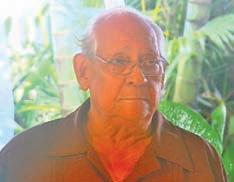
PServices Inc Chief Executive Officer (CEO) and veteran Guyanese businessman Dougal Kirkpatrick passed away at the St Joseph Mercy Hospital on Saturday morning aged 75.
Kirkpatrick was the husband of the late Margery Kirkpatrick, former Deputy President of the Chinese Association of Guyana and the force behind popular local cater Kirkpatrick’s Catering who passed away on March 21, also at age 75. Kirkpatrick leaves to
mourn his three children, relatives, friends, and colleagues.
The Guyana Association of Private Security Organisations (GAPSO) said that it was deeply saddened by the death of Kirkpatrick.
“Over the years, Mr Kirkpatrick has worked tirelessly and made a significant contribution to GAPSO and the Private Security Industry in Guyana. No words can adequately express our sadness at Mr Kirkpatrick’s passing. We are honoured to have had the opportunity to work
with him and will honour his memory by continuing to build the industry he loved so much. We extend our deepest sympathy to his
family, as well as to his clients, staff and professional colleagues,” GAPSO said in a media release.


Ralph Ramkarran loves to buttress his argumentsany argument – by quoting Cheddi Jagan. This is the default setting for ideologues, whether of the right or the left. And in the PPP where – even though Ramkarran mightn't have clocked in as many years as his erstwhile comrade Nagamootoo–- he was always the senior cardcarrying Marxist ideologue in the party. So rather than thinking things through when confronted with reality, he regurgitates what Cheddi might've said.
All of this, of course, assumes that Cheddi was in possession of all knowledge, not only of his present and past - but of the future. But then, with Marxists like Ramkarran, once you've mastered the "laws of history" and "dialectical materialism", that's no sweat. And so we arrive at his thread-worn "shared governance" spiel which, he insists, Jagan'd been working towards ever since when. Never mind that before he'd been thrown out of power by JFK and his successors, he'd never shown the slightest inclination to "share".
And if he'd just zipped his lips about his ideological leanings when visiting JFK stateside, he'd never have had to get to "share". But they do say that necessity is the mother of invention, no.? So, yes... Cheddi tried to get another shot at power...again and again. But Burnham was never serious, was he? He just used Jagan to threaten the Americans as to who they'd end up with if they bounced him out. And Jagan went along.
But ineffectual as he was, even HE knew he couldn't just roll over and play dead. While he mightn't have necessarily practiced it because of his own inner demons, Jagan did preach something that Ramkarran studiously, if not disingenuously, ignores. You just can't talk of "unity" there must always also be STRUGGLE! For example in the instance Ramkarran rhapsodises about in 1976 when the PPP gave "critical support" to the PNC and then went on to propose a National Front Government, Jagan wrote this about GAWU - which was busy burning canes in its STRUGGLE for recognition:
“In the complex Guyana situation, the trade union movement must operate on the basis of unity and struggle or alliance and struggle. It must unite or allay itself with all those who are fighting for progressive and revolutionary positions, and at the same time struggle against all backward, reactionary, racist and anti-working class positions.”
Right now, the APNU/AFC government is taking "backward, reactionary, racist and anti-working class positions” against which the PPP must STRUGGLE, even while it may listen to what they have to say about "unity".
"All unity and no struggle" is the road to serfdom!!
They say, "to the victors go the spoils", and after the victory of the APNU/AFC coalition, so said, so done. But since they'd lambasted the PPP for being doggedly partisan in their hiring practices, you'd think the new government would've been a bit circumspect about doling out "jobs for the boys and girls"l wouldn't you? Not this lot, mate! And for a while they didn't even think about the "girls" until Andaie and the sisters straightened them out.
What makes things even more sticky for the new incumbents, is because they're such a motley coalition of the detritus of the political fragmentation of the last two decades, there's a whole lotta boys and girls from outside the PNC, which is really the heart, soul and body of the group that won this election.
So a struggle's brewing in the heartland that the party leadership will have to head off.
And you have the recent meeting at Congress Placewhere the President actually had to promise "jobs for the boys and girls"!!
Linden sometimes marches to its own drummer. And that's why Pressie had to make his abrupt "rock star" visit. He was asked what'd he bring.
How quickly the billions in electricity's forgotten!!
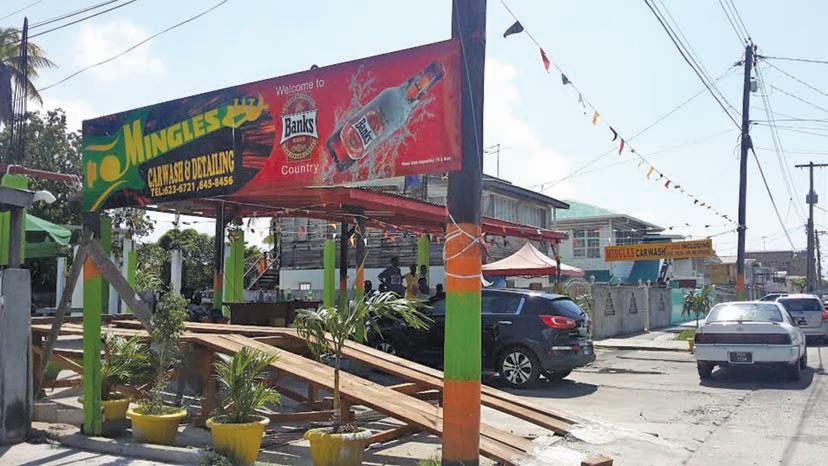
Aday-light robbery has left occupants of a Garnett Street, Campbellville, Georgetown traumatised after gunmen robbed them early Sunday afternoon. The incident occurred sometime around 13:15h at the Mingles Car Wash and Detailing.
Guyana Times was made to understand two men entered the Car Wash located at 43 Garnett Street, under the pretext of washing a CG motorcycle, however as soon as everyone was distracted, they pounced, robbing the owner, Mike Fung, a customer and two workers. The men escaped with a quantity of cash, several cellular phones, jewellery, and a firearm.
Speaking with this newspaper, Fung stated that the entire ordeal lasted for about three to four minutes. The man r noted
that one worker refused to wash the bike as such another one proceeded to do so.
Fung recalled he was talking to another customer that was having his car
Following the death of one of its engineers and another being injured, the China Harbour Engineering Company (CHEC) has stoped works on the Cheddi Jagan International Airport (CJIA) expansion project.
On Thursday afternoon, the two Chinese Nationals were working on the airport expansion project at Timehri, East Bank Demerara (EBD). They were testing the soil when the land caved in and trapped them beneath, killing one and injuring the other.
The dead man was identified as Lui Li while the injured man is Zhang Yixun. In a release, CHEC said it is deeply saddened by the unfortunate accident. The company noted that in light of the engineer’s tragic death, they are continuing to monitor the health and safety of its workers very carefully and is taking all the necessary measures to safeguard its staff.
“At the occurrence of this unfortunate event, CHEC immediately launched its emergency plan, and deployed its emergency team to address this issue. Since that time, the site has been closed until there is some resolution of the matter,” the Company outlined in the statement.
Furthermore, CHEC noted that it will continue to work with the relevant authorities to investigate the circumstances which led to the tragedy in order to ensure the continued safety of its employees.
According to information, Li was conducting a soil test in the Timehri area when the soil collapsed. He was pulled from beneath the
soil several minutes later and rushed to the Diamond Diagnostic Centre where he was pronounced dead on arrival.
The Public Infrastructure Ministry had stated that rescue efforts were immediately activated but unfortunately, Li died while receiving medical attention. Yixun was transferred to the Georgetown Public Hospital for further treatment.
In light of the tragedy, Public Infrastructure Minister David Patterson had requested that an investigation be launched into the incident immediately. A release from the Ministry stated the Chinese company is responsible for the health and safety of its employees on the work site.
China Harbour Engineering is a largescale construction, full service provider in nearly 90 countries around the world. CHEC has maintained a continuous presence in the Caribbean Region, with developmental infrastructure projects, including major airports, highways, marine ports and dredging services.
Only recently, the report of the Commission of Inquiry into mining deaths proved that over the last 15 months, 28 persons had lost their lives; most coming from pit cave-ins. In addition, from 2012 to 2015, 62 miners, particularly young men, lost their lives on the job in pursuit of a livelihood in the mining sector.
The CoI into mining accidents was ordered by President David Granger after the death toll in the industry spiked in May when a Potaro Mining pit collapsed and killed 10 miners.
washed at the time when one of the men ran up to him and placed a gun to his head. He said the gunman then reached for his .9 mm Beretta handgun. By this time the other accomplice was at his side and relieved Fung
of his gold chain and two rings amounting to some $2 million, approximately $65,000 cash and his Samsung Smartphone. According to the businessman, he recognised one of men from a visit a few days ago. “They know ev -
erything, they know I had my firearm on me… but I recognised one of them... he was here before, that’s how I know him,” he said.
The gunmen did not spare the other persons present. After robbing Fung, they turned onto the customer who was sitting nearby and took away his cellular phone and wallet. They also relieved one of the workers of his cell phone.
The worker, Lloyd December, related to Guyana Times that when the men came they asked how much to wash the bike and he said $500 but they said they only had $400. “I tell them alright man don’t worry about the $100. I blow down the bike and before I start soap it down, I see the two of them walk up and stick up the boss,” the man recounted.
After the men finished robbing the occupants, they jumped on
the bike and rode off in an eastern direction along Garnett Street. This newspaper was told the armed one was donned in a black shirt and blue pants, while the other had on a green shirt and brown pants. The perpetrators were said to be young men in their early 20s.
When this publication arrived on scene following the incident, the businessman bemoaned the attitude of the police in handling the matter. He pointed out that when they called to report the matter the 911 emergency lines were not working, then they got onto the Station but the officer who took the call did not show any sign of urgency.
Adding to the frustration of the distressed man, the police took a while to get there thus reducing chances of them catching up with the perpetrators.

Two elderly women are now traumatized after they were terrorised by two young men who barged into their shop, beating and robbing them. The incident occurred sometime before 09:00h on Saturday.
The victims are sisters, Ester and Nagama Venkatasammi called “Baby” of 43 Third Street, Tain, Port Mourant, Berbice. The perpetrators were said to be two young men, probably in their late teens to early 20s, and one of them was armed with a piece of “iron rod”.
Guyana Times understands the sisters, both in their 60s, live alone and operate a shop. They were badly beaten and robbed of a quantity of cash, phone cards and other items.
Initial reports received indicated that one of the young men went into the well known shop, which is located opposite Tain Primary School, and posed as a customer. He reportedly ordered a lemonade while his accomplice entered the house from a side door.
Speaking to this newspaper, a neighbour Basmattie Balkission said she was in her yard when she heard some moaning sounds coming from the women’s home

and as such she alerted her son-in-law and went to check on the women.
“When we go, they were on the ground crying in pain; they couldn’t even talk hard;that’s how much pain they were in… they (perpetrators) beat them bad, man, lash up them head on the concrete and so,” the woman stated. She noted that one of the women was bleeding profusely in the head from the bashing they had received.
Balkission told this publication that one of the sisters, Ester, had gone to a grocery shop in the village and on her return, the two young men were already in the yard staking out. “The yard has a lot of bushes so nobody saw them there. When Ester come and call for the other sister to open the door ‘round the back, one of the boys followed her in and that’s how they get to go

inside,” the woman stated.
The neighbour went on to say that while inside, the youngsters terrorised the two elderly sisters, hitting them and even bashing their heads on the concrete floor. She added that the perpetrators even ransacked the entire bottom flat before escaping.
Balkissoon further detailed that neighbours had seen the two perpetrators
moments before heading into the shop but did not suspect anything. She added that when they got into the shop, there was another customer there whom they forced to lie on the ground but the man managed to escape and ran out to the Public Road.
After neighbours went to assist the sisters, the women were taken for medical attention at the Anamayah
Memorial Hospital where they were kept overnight. Ester is suffering from bodily pain as a result of the beating while her older sister “Baby” is suffering from head injuries she received from being bashed into the concrete.
They were discharged on Sunday, however, they were too traumatized to return home so they went to stay with a relative.
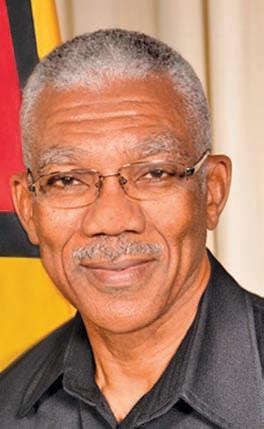
Days after Venezuela refused to accept Guyana’s newly appointed Ambassador and the Venezuelan instigated border controversy simmers, President David Granger has reiterated that Guyana would be seeking to move to the International Court of Justice (ICJ) to have the controversy resolved once and for all.
President Granger, who was speaking ahead of his first address to the United Nations General Assembly this week, said: “Our message will be that we have to resolve this matter by juridical means. We will be going to court; we are not interested any longer in any sterile Good Officer Process. We are going to go to court and settle this matter. It is affecting our development too long; 50 years is too long.”
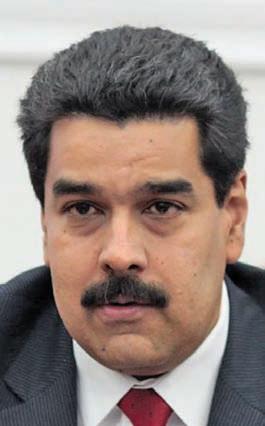
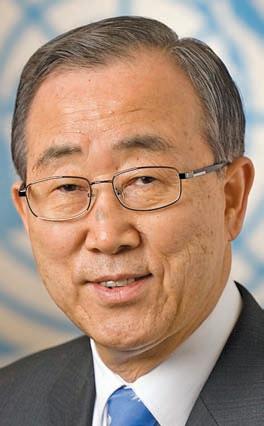
The President said he would be meeting with UN Secretary General Ban Ki-moon and “presumably” Venezuelan President Nicolás Maduro, and his focus was to end the controversy, as it was hindering Guyana’s development.
Last week, the Venezuelan Government did not accredit Guyana’s Ambassador to Venezuela, Cheryl Miles, after it claimed Guyana’s Foreign Affairs Minister Carl Greenidge attacked that country during his visit to the United States
earlier in the week.
President Maduro was reported as saying that “provocations” were made by Guyana. He explained that Venezuelan Foreign Affairs Minister Delcy Rodriguez reported that Greenidge made “offensive statements and attacks against Venezuela”. However, according to the Venezuelan report, President Maduro indicated that he was willing to send recalled Venezuelan Ambassador Reina Margarita back to Guyana.
In response, Minister Greenidge later noted that Guyana had a right to defend its sovereignty.
Guyana’s perceived “attacks” come on the heels of Venezuela’s recent claims to two-thirds of its landmass –the Essequibo. In fact, border controversy, which was not on Venezuela’s front burner for several years after being first mooted in 1962, was recently reignited by the latter country when US oil giant ExxonMobil began exploratory works earlier this year in the Stabroek Block offshore the Essequibo Coast.
Evidently fearful that Guyana might strike oil, President Maduro issued a decree claiming that the majority of Guyana waters now belonged to Venezuela.
The decree was seen as a “flagrant violation of inter-
national law and is inconsistent with the principle that all states should respect the sovereignty and territorial integrity of other states”. Consequently, in an effort to defend its sovereignty, Guyana made it clear to the Venezuelan Government that the Essequibo and its offshore waters belonged to Guyana, and strengthened its push for judicial settlement of the issue, as the Good Officers process had yielded little result.
The border between the countries was set by an international tribunal in 1899, in an award the parties, including Venezuela, had agreed would be a final settlement.
Since the recent belligerence from Venezuela, moves have been made by the international community, including the United Nations Secretary General Ban Kimoon, to push for a peaceful resolution of the issue.
A UN team, which was dispatched by the UN Secretary General to which both countries had appealed for help, visited Guyana in August and discussed options under the Geneva Agreement that had been agreed to in 1966, for a resolution of Venezuela’s continuous contention that the Arbitral Award of 1899 was null and void. (akeemg@ guyanatimesgy.com)

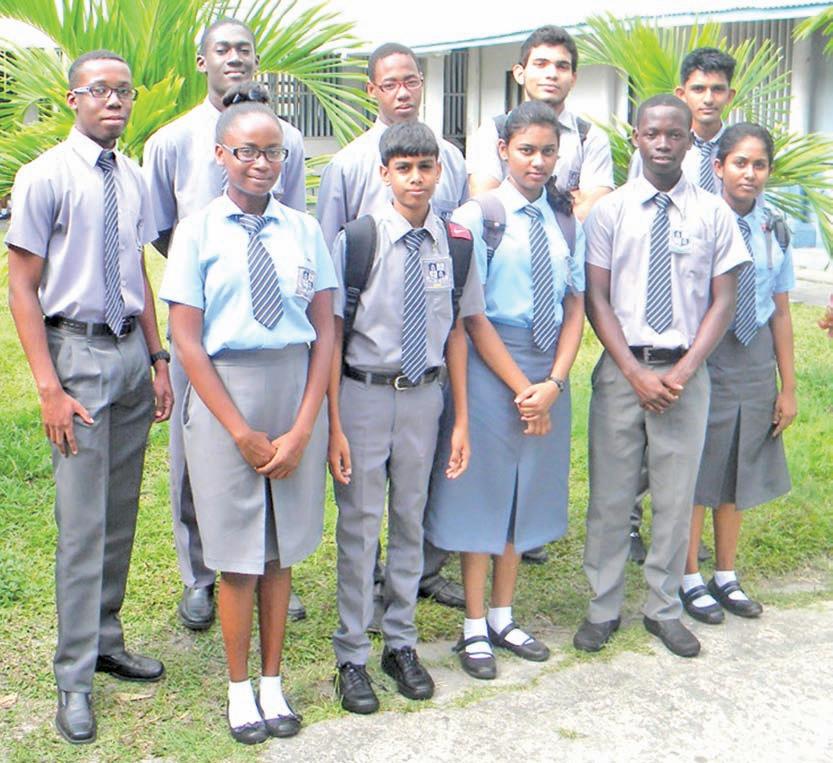
Once again the students of St Stanislaus College have displayed remarkable performances at the Caribbean Secondary Education Certificate (CSEC) and Caribbean Advanced Proficiency Examination (CAPE) this year.
“Ain’t no stopping us now; we’re on the move” was the exuberant chant of the school’s Fifth and Sixth Form classes of 2015, who have shown a marked overall improvement in results obtained from CXC.
The school’s upward movement began with the drastic increase in the number of students who wrote the CSEC examinations in 2014, compared to those in 2015. Progression is also displayed in the 31 subject areas written at CAPE in 2015 when compared to only 28 written in 2014.
This trend continued to soar with the high rise in passes with Grade Ones and Twos in a majority of the subject areas. In 2014, St Stanislaus obtained a total of 280 Grade Ones and 242 Grade Twos passes while this year, there was 367 Grade Ones and 324 Grade Twos.
In addition, the school successfully maintained its 100 per cent pass rate in the general subject areas at the 2015 CSEC examinations. These include Economics, Electrical and Electronic Technology, Electronic Document Preparation and Management (EDPM), Food and Nutrition, Home Economics, Integrated science, Office Procedure, Principles of Business, Social Studies, and Technical Drawing.
Meanwhile, as it relates to English A and B along with Mathematics, the students managed to acquire outstanding performances of 99, 97 and 98 per cent passes respectively. However, the English Department was commended for starting a trend of gaining more Grade One passes than Grade Twos and Threes.
A total of 89 students wrote the English A examination and saw a pass rate of 66 Distinction/Grade One.
Notwithstanding, the Mathematics Department also displayed a similar performance. A total 89 students wrote Mathematics, of which 51 passed with Distinction/Grade One. These two subject areas are
likened by students as two dangerous opponents who should be avoided, but definitely has to be confronted.
On this note, the contributions of the teachers and efforts by students for overcoming the problems attached to these two subject s are commendable. Moreover, the school’s Science Department has also outdone itself with seven Grade One passes from the seven students who
wrote Integrated Science.
Overall in 2015, 60 per cent of the students at St Stanislaus College have passed 10 and more subjects, while 100 per cent have passed five and more subjects at CSEC.
As it relates to CAPE, the students have also made headway at this examination with 62 per cent of them having gained passes of Grades One to Four in 2015, when compared with
44 per cent last year.
“Going down memory lane, it is with relish that we saunter through our school’s performance from 2010 to 2015 and view with enjoyment, the progress made by both staff and students of St Stanislaus
College at their academic pursuits. The accomplishment of this grand performance can be perceived that discipline is once more on the rise at this institution,” the school stated.
Yes! We’re on the move!
According to Marvin Garraway, the time spent at St Stanislaus College had many excitements, disappointments and challenges. He noted that as the years got harder, optimism was a crucial factor in development.
Garraway credited his success to his hard work, perseverance, an ability to learn, comprehend and to be aware of the world around you. “The Caribbean Examinations had me putting in more effort than usual. I am now a graduate possessing twelve subjects, all with Grades One to Three passes. My gratitude is expressed to God, my parents and teachers all, for their endless support and dedication, for without them, I would not have been the victor I am today. Nevertheless, focus played a key role in my success.”
On the other hand, Schauvonne Perreira said being at the St Stanislaus
College has been a long and rewarding experience for her. Having enrolled in 2009, she realised that she would have to work hard in order to be successful at the CXC exams.
“As time progressed, I started to recognise and appreciate the sacrifices that my family made in order to provide me with all the resources that I needed to prepare for my exams. I wrote CSEC examinations in 2014 and gained two Grade One passes, so I decided to further my studies at this institution because of the level of discipline and the multitude of dedicated and qualified teachers available, to deliver the various syllabi.”
After attaining five CAPE subjects, Perreira is furthering her academia in the second year of CAPE studies. “My life’s aspiration is to become an economist and one day I hope to receive a scholarship to further my studies in the field of Economics. In addition, I am inclined to make a positive change in the lives of the voiceless people of my country and will not stop until my dreams become a reality”.
(vahnum@guyanatimesgy.com)

monday, september 21, 2015 | guyanatimesgy.com
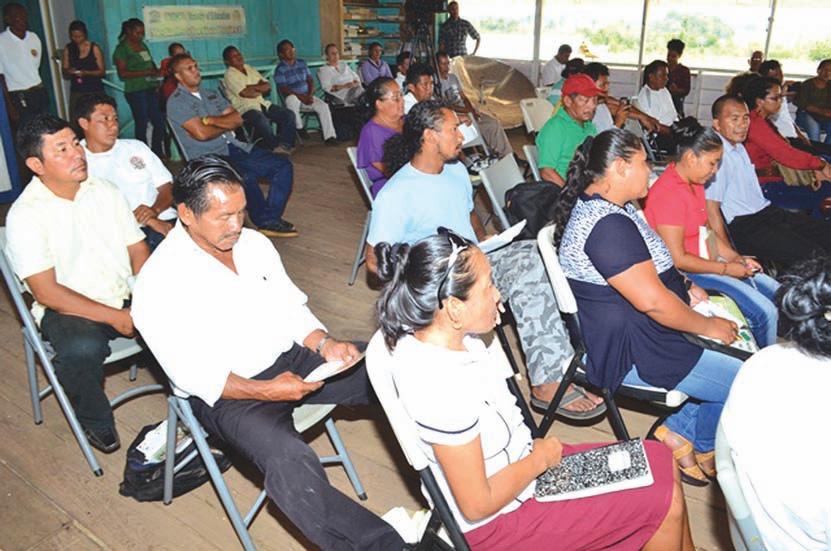
There is need for a more strategic and integrated approach as it relates to the development of indigenous communities, Indigenous Peoples’ Affairs Minister Sydney Allicock told indigenous leaders of North Rupununi, Region Nine (Upper Takutu-Upper Essequibo).
The Minister noted that the North Rupununi District Development Board (NRDDB) would now have the opportunity to truly fulfil its mandate, as it was given the responsibility to assist in overseeing community development projects in the North Rupununi, the Government Information Agency (GINA) reported. The Board will be working closely with the communities to implement sustainable, income generating projects, and also provide technical support.
The Indigenous Peoples’ Affairs Ministry is prepared to support any viable community projects, he said, noting that indigenous people need to move away from col-
lecting handouts.
“We must have a district that we could manage effectively, have economic strength for our community. All projects we will be looking at should have an economic slant to it and we will support you with your ideas,” Minister Allicock told the leaders. He further noted that the Ministry, along with the NRDDB, would be closely monitoring the projects to ensure they are sustained. “Over the years, too many projects have been failing,” Allicock said.
The Minister also took the opportunity to highlight the five-year strategic plan for indigenous development. This plan encapsulates a Hinterland Education Support Programme; Hinterland Poverty Reduction Programme; Hinterland Employment and Youth Service; Hinterland Infrastructure Extension; Hinterland Happy Household and Energy Development Programme; Hinterland
and Indigenous Land Commission; Hinterland Language, Culture and Sports Commission; Hinterland Tourism Development Service, and Hinterland Public Service Provision Scheme. Minister Allicock urged the leaders to put aside their political differences, and examine those programmes and support them so that there can be development in the hinterland.
To further boost community projects, the Ministry will be launching a Youth Skills Training programme on October 1. This initiative will replace the Youth Entrepreneurship and Apprenticeship Programme (YEAP), and will allow indigenous youths to become certified in areas such as tourism, agriculture, and mechanical engineering.
In her address to the leaders, Minister within the Ministry of Communities, Dawn Hastings-Williams spoke of the need to link the hinterland to the coastland,
Social Cohesion Minister Amna Ally was very vague on providing details about the progress made regarding Government’s fivepoint plan to achieve social cohesion. When questioned by Guyana Times on Sunday at an event in observance of International Day of Peace, Minster Ally declined to divulge any comprehensive information about the social cohesion plan.
“…they are making progress and more information will come from a media release.” was all she would say.
When further prompted, the Minister disclosed that Government will soon be officially launching the five-point plan, declining again to provide any specific information on the topic.
The A Partnership for National Unity/Alliance For Change (APNU/AFC) Government has long been touting the subject of social cohesion in Guyana, creating much hype about the intend-
ed activities they will embark upon to ensure “unity” and “togetherness” prevail in this land of six people. In fact, the coalition time and time again, has placed much emphasis on the need for a “social cohesion ministry” which will roll out initiatives aimed at bringing people together, but to date, the
not only through road networks and airstrips but also through communication and education.
Hastings-Williams reminded the leaders that the Prime Minister, who has responsibility for the information sector, has announced the expansion of the Paiwomak Radio Station. “Gone are the days when Amerindians will be left in the dark. They have their radio station that will allow them to keep up with what is happening nationally, and even internationally,” she said.
She also noted that most of the Budget 2015 projects have been advertised, and
urged the leaders, through their Village Councils, to get involved, by bidding for some of these projects.
United Nations Development Programme (UNDP) Representative Patrick Chesney, who was also at the meeting, noted that there was the need for procurement of inputs, training, the promotion of business development and advertising, all of which need to be brought together for a successful project.
“We need instruments that will help protect our way of life and create a space where we can take our villages further, and at the same time, better the lives
of the residents,” Chesney said.
The UNDP is assisting the Government to implement the Amerindian Development Fund which is used to finance the Community Development Plans (CDPs). The UNDP will be making funds available to build the capacity of the NRDDB.
Also at the meeting were: Permanent Secretary in the Ministry of Indigenous Peoples’ Affairs, Vibert Welch, Advisor to the Minister on Indigenous Peoples’ Affairs, Mervyn Williams, and the newly appointed members of the NRDDB.
...to intermediate funds for economic expansion
In pointing that Government must play a key role in ensuring that local investors enjoy favourable benefits and concessions and there was “ample opportunity” for investment in both agriculture and aquaculture, Prime Minister Moses Nagamootoo announced the reestablishment of an Agricultural and Industrial Development Bank. With Guyana having a comparative advantage over many countries in agriculture, funding has proven to be a major constraint in the sector not moving towards diversification and vertical integration.
The Prime Minister was at the time making the feature address at the opening of the Berbice Expo on Friday at the Albion Community Centre Ground, Corentyne, Berbice.
only activity that was organised was the National Social Cohesion Roundtable where discussions were held among stakeholders with the objective of seeking out practical ways of pulling Guyanese, despite their various cultures, together. It was at this event that President David Granger announced the five point plan towards achieving social togetherness.
But since this conference, government is yet to release any further detail as it relates to their plan for social cohesion.
The People’s Progressive Party/ Civic (PPP/C) Opposition had pointed out that a simple glance at its track record since it came into Executive Office will be proof enough to conclude that the big fuss being created by the David Granger-led Administration with regard to social cohesion is a big façade to mislead the Guyanese public and the international community.
The Prime Minister highlighted the bounty of nature that Guyana was blessed with, saying that he was proud that Berbice in particular produced some of the finest agricultural produce. He noted that Guyana had a high rate of unemployment and the Development Bank would provide seed capital and financing to the Agricultural Sector, which would boost entrepreneurship.
“Our Government recognises that entrepreneurship is necessary in getting young people into small businesses as self-employers and as creators of wealth. We recognise also that Government must play a key role in ensuring that local investors enjoy the same benefits and concessions as foreign investors,” the Prime Minister stated.
He said Government hoped that the Berbice Expo would “inspire new entrepreneurs to come forward and occupy the space for more investment”, as he reaffirmed its commitment to the development of micro enterprises in Guyana which are critical to strengthening
and sustaining the country’s economy, the Government Information Agency (GINA) reported.
The Prime Minister acknowledged that serious challenges were being experienced in the traditional export sectors – rice, sugar and gold, with the loss of the Venezuelan market and low paddy prices, continued problems in the sugar industry and the plummeting world gold price.
Nagamootoo told the gathering at the Berbice Expo, “...the answer lies in diversification...You have signalled that we must not depend only on rice and sugar to create or maintain employment. We need to get into other types of business to create wealth, to promote jobs and offer a better life in our various communities.”
The announcement of an Agri Bank was applauded by the hilt to the Private Sector Commission (PSC), who was present at the Berbice Expo. While the Private Sector banks have been very forthcoming in supporting the Agricultural Sector, the risks involved have evidently proved to be too great for a more expansive lending poli-
cy that could be undertaken by a development bank. Such institutions normally charge lower interest rates than the commercial banks.
While this initiative is much welcomed by the Private Sector, it is not a new idea, the Guyana Agricultural and Industrial Development Bank (GAIBANK) was established many years ago, but was closed down over a decade ago. One of the problems was in collecting outstanding debt that was extended. In the present climate of higher liquidity in the banking community, however, the Agri Bank would be able to intermediate funds to the sector in a more focused manner because of its specialisation. It should be noted that proper management will be crucial in order for this bank to survive especially now, given the state of the economy and the plight which those in the agricultural sector was currently facing.
For a number of years, the privately-owned Guyana Bank for Trade and Industry (GBTI) has been in the forefront of providing loans to rice farmers and other persons involved in agriculture.
The Canadian government recently warned its diplomatic missions to stay away from meddling in its federal elections. In its warning note, the government reminded them that the terms of the Vienna Convention on Diplomatic Relations and the Vienna Convention on Consular Relations state that diplomatic heads have a duty to “not interfere in the internal affairs of the receiving state”.

Shah
As a receiving State, Guyana was meddled with rather famously in the 1960s when the country became a pawn for Cold War politics. The US, in collusion with the British, funded race riots and rocked Premier Cheddi Jagan from office and placed their favoured man, the PNC’s Burnham, in power. The rest, as they say, is history.
For over two decades, the Western powers and the entire Caribbean region all looked the other way as Burnham proceeded to wreck the country with his anti-Indian racism, his brutality, media repression, and his ill-conceived economic policies. But none of that mattered.
What mattered was that American interests were protected from a Jagan Government because he was perceived as a Communist threat who might prove to be another Castro in their “backyard”, that term that relegates the Caribbean and Latin America to a much diminished status in their eyes.
As a developing country with the need for aid and loans, Guyana is hardly independent. We are vulnerable to external manipulation, and when there are political parties and leaders willing to trade the country’s sovereignty for public office, as happened before with Burnham, the results can only be detrimental since the trade-off never gives primary importance to the country’s interests.
The US protected its own interests at the expense of Guyana’s development once and many are feeling a dreaded sense of déjà vu as the economy falters and the signs of PNC power emerge once again. That power is bold and unapologetic and can quickly become absolute if it is not going to be reined in by local and international criticism.
Prior to the May 11th general elections, the ABC countries were highly critical of the previous administration especially over its failure to hold local government elections. Government fired back with claims that the diplomatic heads were meddling in the country’s internal affairs, and with its infamous “feral blast”.
At the time, the government was also being accused of corruption by the opposition and the widespread public perception that the ABC countries wanted the PPP government gone has led many to believe that there might have been more than a little meddling to lever the Coalition into office even if by a mere whisker.
But was it the PPP government’s administrative arrogance and alleged corruption that irked the US and its allies especially since the Granger government is proceeding, and unchecked by any criticism from the diplomatic community, with its own corruptions and high-handed manner?
As we know from firsthand experience, US foreign relations hardly ever hold up to any ethical and moral scrutiny so the more relevant question might be whether the PPP government was too independent for America’s liking with its investment deals and friendly relations with countries like Russia, China and Venezuela.
Perhaps, the government was not always playing to what might be viewed as American interests especially since the PPP party is still seen as holding to the socialist ideals of its founder Dr Cheddi Jagan.
Dr Leslie Ramsammy asked in a recent letter to the press whether government’s stand-off over helping the rice industry might have racist connotations. Added to that query could be a question about the collapse of the Petro Caribe deal: Was that partnership not viewed favourably by the US given their unfriendly relations with Venezuela’s Maduro?
International relations require a fine balance between the host country and the diplomatic community that respects the country’s sovereignty and the conventions that govern relationships and alliances.
Tipping that balance results in meddling and, as much as that is frowned on by international conventions, it is power and control for your side at all costs that matters in global politics. Sometimes, that cost can be small, developing and vulnerable countries such as ours where personal ambitions and political interests can override good governance and determine the outcome of deals and partnerships.
One side gains political power and the other, the control of large oil reserves and a “backyard” country which, with a new Cold War possibly in the offing, could become a strategic pawn yet again.
And the pawn, as Guyana has experienced before, is the most expendable piece on the board.
Readers are invited to send their comments by email to shah@guyanatimesgy.com

The grand display of indigenous culture amidst the splendour of the Rupununi savannahs created the perfect ambiance at the three-day Rupununi Music and Arts Festival which was hosted once again at the Rock View Lodge, Annai, North Rupununi, Region Nine (Upper Takatu/ Upper Essequibo).
Various indigenous groups were excited to showcase to the world their unique way of life through music, dance, poetry and storytelling. Also on display were local craft, paintings, and de-
world including JJ Kent from the United States, Samba Group from Brazil, Maya from Suriname, and local musicians. Throughout the festival, workshops on craft and paintings were also ongoing.
Delivering the feature address at the opening ceremony, Tourism Minister Cathy Hughes announced the Ministry is on its way to adding the Rupununi Festival on its calendar of activities as an eco-festival. She underscored the importance of music in the development of the local tour-

licious delicacies. The event had an auspicious start on September 18 with hundreds of Guyanese and foreigners enjoying the variety of exotic sights and sounds, and simply being captivated by the Amerindian way of life. The festival experience was accompanied by exhilarating performances by performers from all across the
ism sector. The Minister said it is the diversity of Guyanese culture that provides the blueprint for music as a drive for tourism and as such, intends to direct more focus on this aspect.
“When visitors hear our music, they would want to see who created it, where it was created and what was the spectacular forces that
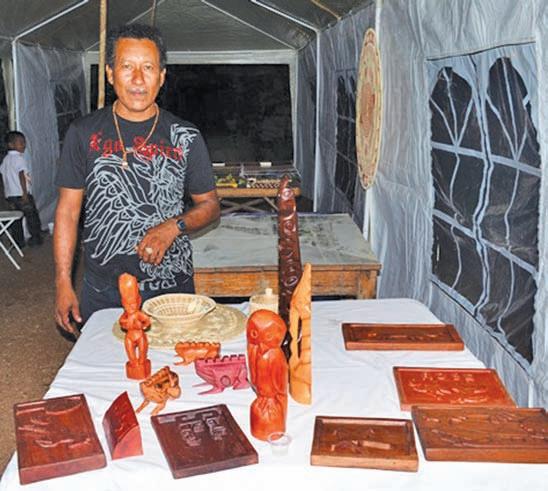
contributed to such creation. Music sells our image and make people want to see more of our products,” Hughes said. She also spoke about creating a conducive environment in which the talents of Guyanese involved in the creative indus-
indigenous population, to showcase their way of life and simultaneously provide the opportunity for the exchange of culture both locally and overseas.
Also present at the event were Public Infrastructure Minister David Patterson,

tries can grow.
Meanwhile, Indigenous People’s Affairs Minister Sydney Allicock, who entered the festival in grand style on a horse, stated the festival allows for all Guyanese, particularly the
of the Diplomatic Community.
The curtains closed on that event on Sunday evening.
Pope Francis led tens of thousands of Cubans in a mass in Havana’s Revolution Square, the political heart of Cuba where the Communist Government stages its biggest rallies.
Ahead of the mass on Sunday, the Pope greeted the massive crowds of fans and faithful as he arrived in his popemobile.
The Argentine pontiff leaned out from his white open-air vehicle to grasp the hands of festive onlookers and wave to the crowds gathered under the cloudy sky.
Cuban President Raul Castro and Argentine President Cristina Kirchner also attended the mass.
The huge plaza is where Cubans celebrate May Day beneath massive portraits of revolutionary leaders Ernesto “Che” Guevara and Camilo Cienfuegos built into the facades of state buildings.
To welcome the Pope, who helped bring about the recent rapprochement between Cuba and the United States, a similarly giant poster of Jesus Christ was hung nearby.
Some people in the crowd

waited in the square from early morning on Sunday.
“Francis has come to bless this new union between Cuba and the United States,” said Enrique Mesa, a 32-year-old tourism worker.
Ahead of mass, Cuban authorities detained between 30-40 dissidents to stop them from attending the papal events, a dissident
human rights group said. Security agents wrestled two men and a woman to the ground at the edge of Revolution Square, then led them off, after they started shouting and tried to hand out flyers, a Reuters witness said.
Francis visited retired leader Fidel Castro, 89, later on Sunday. (Excerpt from Al Jazeera)
Pope Francis urged Colombia’s Government and Marxist FARC guerrillas on Sunday to ensure that nearly three years of peace talks in Cuba were successful and ended their “long night” of war.
“Please, we do not have the right to allow ourselves yet another failure on this path of peace and reconciliation,” the Argentine pontiff said in an address at the end of a mass he celebrated in Havana’s Revolution Square.
Colombian President Juan Manuel Santos has staked his reputation on reaching a pact with the
Revolutionary Armed Forces of Colombia (FARC) to end Latin America’s longest insurgency, which has killed some 220,000 people and displaced millions over 50 years.
“May the blood shed by thousands of innocent people during long decades of armed conflict, united to that of the Lord Jesus Christ crucified, sustain all the efforts being made, including those on this beautiful island, to achieve definitive reconciliation,” Francis said.
“Thus may the long night of pain and violence, with the support of all Colombians, become an unending day of
concord, justice, fraternity and love, in respect for institutions and for national and international law, so that there may be lasting peace.”
At the negotiations in Havana, Santos’ Government and the FARC have reached partial agreements on land reform, an end to drug trafficking, political participation for exrebels and efforts to remove land mines. Discussions on victim reparations and demobilisation are ongoing.
If they can reach a comprehensive peace deal, it would be placed before Colombian voters for approval. (Excerpt from Reuters)
The United States Coast Guard says it has seized drugs estimated at more than US$11 million during operations in the Caribbean Sea this month.
It said that the drugs including 254 kilograms (559 pounds) of cocaine and 1664 kilograms (3600 pounds) of marijuana were seized as part of Operation Martillo, which is one component in the United States Government’s approach to countering the use of the Central American littorals
as trans-shipment routes for illicit drugs, weapons and cash through the Caribbean Sea.
The Coast Guard said that on September 3, it boarded a Panamanian flagged vessel, southeast of Nicaragua, after receiving permission from the Panamanian Government.
It said the boarding team discovered 254 kg of cocaine in a hidden compartment worth an estimated wholesale value of US$8.5 million.
The suspects were
transferred to law enforcement authorities in Tampa, Florida on September 12, the Coast Guard said.
Also on September 3, the Coast Guard said it received a report of three people clinging to a capsized vessel and following their rescue, 68 bales of marijuana was discovered floating in the water.
The Coast Guard said that it recovered marijuana with an estimated wholesale value of US$3.3 million.(Excerpt from CMC)

The Jamaican Government has signed a contract with global leader in diagnostic and pharmaceutical products, Roche, that will see a new cancer medication made available to local breast cancer patients.
The medication is Herceptin Subcutaneous (SC), an agent commonly used in the treatment of early stage Human Epidermal Growth Factor Receptor (HER) 2 Positive breast cancer. Herceptin is a cellular antibody that inhibits the protein that fuels tumour growth and should be used in conjunction with surgery and chemotherapy treatment.
The product was launched on Wednesday.
Health Minister Dr Fenton Ferguson, said that Herceptin SC would be a valuable addition to the country’s cancer treatment system.
“This is an achievement that is set to revolutionise the landscape for the treatment of HER 2 Positive breast cancer,” he said.
Citing breast cancer as the fifth leading cause of death in Jamaican women, Ferguson said that a crucial area for reducing deaths from this disease is early detection.
“Early detection, in order to improve breast cancer outcome and survival, re-
mains the fundamental cornerstone in managing the disease. As we continue to push for early detection in order to improve breast cancer outcome and survival, we recognise that strong and fruitful partnerships like this one will help us achieve this goal,” Ferguson noted.
Stewart Dougan, the country manager for Roche Pharma Jamaica and Cayman which will distribute the product, said the medication is now available to the public at several institutions islandwide.
But he cautioned that it should only be administered by a licensed health care professional.
Barbados’ Commerce Minister Donville
Inniss has given the United States a tongue lashing for continuing to support Puerto Rican and US Virgin Islands rum producers with
a “cover-over” tax at the expense of Caribbean rum producers.
He said it was posing a significant challenge to manufacturers and maintained that the US move was “wrong and goes against the fundamental tenets of fair trade”.
Cover-over subsidies are annual payments from the US Government to the US Virgin Islands (USVI) and Puerto Rico out of federal excise taxes. When a bottle of rum is produced in either the USVI or Puerto Rico, and then sold in the US, the federal excise tax on that bottle is returned to its place of production.
Inniss said that put regional rum manufacturers at a disadvantage.
“It has done and can do considerable damage to the economies in the Region, and we have been lobbying over and over again for that cover-over tax to be removed,” he said as he addressed a recent West Indies Rum and Spirit Producers Association cocktail reception.
“I make this point and I really cannot apologise for it. I don’t know that the current occupant of the White House has been of any tremendous benefit to us in the region, certainly when it comes to matters like these. I am very hurt because I have seen many entities in the Region challenged by decisions made in the White House in the last couple of years that have me very concerned.” (Excerpt from Caribbean360)

Venezuelans have marched in cities across the country to protest against the jailing of Opposition Leader Leopoldo Lopez
Thousands of Venezuelans have marched in cities across the country to protest against the jailing of Opposition Leader Leopoldo Lopez. He was sentenced to nearly 14 years in prison earlier this month on the
charge of inciting violence at anti-Government demonstrations last year.
Protesters claim the sentence was politically motivated.
Lopez supporters last took to the streets in May, when the imprisoned poli-
tician went on strike to demand that the Government set a date for legislative elections. Those elections have since been set for December 6 and the Opposition is polling well ahead of the socialist party. (Al Jazeera)
Greece’s left-wing Syriza party has taken an early lead over the conservative New Democracy, with counting under way in the nation’s fifth election in six years.
With 10 per cent of votes counted, Alexis Tsipras’s Syriza had 35 per cent of the vote, according to Interior Ministry data, with New Democracy on 28 per cent.
This would not give Syriza an absolute majority and it would need partners.
The snap election was called after Syriza lost its majority in August.
Tsipras’s popularity had plummeted after he agreed to a new financial bailout deal with international creditors.
The final exit poll suggested Syriza had a lead of between 4.5 and 5 points over New Democracy.
Syriza supporters at the party’s main electoral HQ in Athens cheered and clapped as the exit polls were announced.
Tsipras was hugged by party supporters as he arrived there.
But the BBC’s Richard Galpin in

Athens says that without a majority result, there will be another period of political instability just as deadlines loom for the implementation of a series of key financial reforms.
Tsipras had signed the bailout deal shortly after holding a referendum in which more than 60 per cent of voters
rejected the austerity measures creditors wanted to impose.
In interviews leading up to the election, Tsipras said he had put his country above his party. He said that had he not agreed to the three-year bailout, Greece would probably have had to leave the eurozone.
Bitterly divided European leaders will seek to find a credible response to the worst migration crisis affecting the continent since World War Two at an emergency summit this week as they try to restore its tarnished image as a beacon of peace.
European Council
President Donald Tusk, who chairs European Union summits, said on Twitter on Sunday following a weekend visit to Jordan and Egypt that the EU needed to help Syrian refugees find a better life closer at home.
That will be one of the topics of discussion for Wednesday’s summit in Brussels as hundreds of
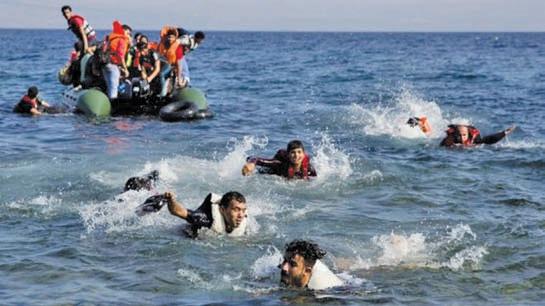
The influx of migrants, most of them fleeing war and poverty in the Middle East, Africa and Asia, has led to bitter recriminations between European Governments
thousands of refugees and migrants brave the seas and trek across the impoverished Balkan peninsula to reach the more affluent countries in northern Europe.
The 28-member bloc has struggled to find a unified response to the crisis, which has tested many of its newer members in the East that are unaccustomed to large-
scale immigration.
On Sunday, Hungary erected a steel gate and fence posts at a border crossing with Croatia, the EU’s newest member state. Overwhelmed by an influx of some 25,000 migrants this week, Croatia has been sending them north by bus and train to Hungary, which has waved them on to Austria.
Around 10,700 migrants walked into Austria from Hungary on Sunday, some 200 more than on Saturday.
Meanwhile, at least 13 migrants, including children, died after their dinghy and a ferry collided off Turkey, the BBC reported.
(Excerpt from Reuters)
The only school in Navi Mumbai, and possibly in the whole of Maharashtra, which is run from a police station, is helping reduce juvenile crimes in the satellite city, according to Police.
A year and a half ago, a group of volunteer teachers had been conducting the classes on roads, before the Nerul Police offered their conference hall to them. At present, around 60 students from the city’s slums are attending the classes, which are held every afternoon from Monday to Saturday.
The children are taught Mathematics, Science, English and other subjects. The school has been named Ashakiran.
Prabhat Ranjan, Police Commissioner of Navi Mumbai, said, “These students belong to poor families. Had they not been
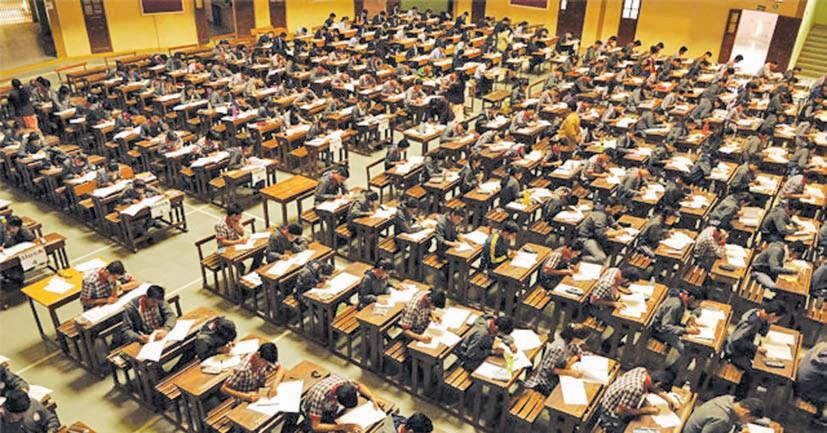
shown the right path of life, many of them would have probably got into petty crimes like theft, pickpocketing and chain snatching. We are happy that they are getting a good education
through this school, and are far away from criminal activities.”
Sangeeta Alphonso, Senior Police Inspector with the Nerul Police Station, said, “Around 10 students
Nepal has adopted a new constitution aimed at bolstering its transformation from a Hindu monarchy to a secular democracy, as violent protests raged against some of the terms of the charter.
Firecrackers went off on Sunday in celebration in Kathmandu and President Ram Baran Yadav announced the adoption of the constitution, the first to be drafted by elected representatives.
“I announce the presented constitution of Nepal, passed by the Constituent Assembly and authenticated by the Chairman of the Constituent Assembly, effective from today, 20 September 2015, before the people of Nepal,” he said.
Members of the Parliament approved the charter on Wednesday despite weeks of violent protests against plans to divide the Himalayan nation of 28 million people into seven provinces.
More than 40 people have
been killed in clashes between protesters and Police, among them two children and a Police Officer lynched as he was driven to hospital in an ambulance, according to the AFP news agency.
One protester was killed on Sunday when Police fired into a crowd of people who had defied a curfew in the southern district of Parsa to demonstrate against the charter.
The move to create a new federal structure that will devolve power from the centre has widespread support, but critics say the planned internal borders will leave some historically marginalised groups under-represented in Parliament.
They include the Madhesi and Tharu ethnic minorities, mainly from Nepal’s southern plains along the border with India.
India has expressed concern at the violence, which has seen some parts of southern Nepal shut down for weeks. (Excerpt from Al Jazeera)
China warns Japan over expanding military
China has said Japan is endangering peace in the region after it passed controversial laws expanding the role of its military abroad.
Japan should learn “profound lessons from history”, China’s Defence Ministry said after Japan’s parliamentary vote.
The vote allows Japanese troops to fight overseas for the first time since the end of World War Two 70 years ago.
Tensions between China
and Japan have escalated in recent months over a group of islands to which both lay claim.
The security laws were voted through Japan’s Upper House late on Friday, with 148 lawmakers voting in support and 90 against. It followed nearly 200 hours of political wrangling, with scuffles breaking out at various points between the bills’ supporters and Opposition members attempting to delay the vote.
(Excerpt from BBC News)
The General who led a coup in Burkina Faso last week insists on remaining in power until polls are held, according to a document seen by the BBC.
General Gilbert Diendere made the proposal at talks brokered by West African mediators in the capital Ouagadougou.
On Saturday, one of the mediators had spoken of a breakthrough and hinted at a new transition Government reinstating interim President Michel Kafando.
At least 10 people have been killed in clashes since Thursday’s coup.
from the school appeared for the SSC exams this year. To our satisfaction, nine of them cleared the exams. Eight students secured above 60 per cent.” (Excerpt from Hindustan
The overthrow of the civilian interim Government – carried out by the presidential guard – was widely condemned. Burkina Faso has been suspended from
the African Union. BBC West Africa reporter Thomas Fessy says the junta’s proposal is unlikely to signal a return to power of the civilian authorities.
The document, signed by General Diendere and exclusively seen by the BBC, says he should remain President until elections – currently due on 11 October.
This is in stark contradiction to the optimism shown on Saturday by one of the mediators, Benin President Yayi Boni, who suggested the presidential guard might give up power, our correspondent adds.
General Diendere was chief of staff of former President Blaise Compaore, who was deposed in a popular uprising last October. (Excerpt from BBC News)
The premier exhibition in the Ancient Country, the Berbice Exposition and Trade Fair, has seen a good turnout and more than 60 exhibitors in its 11th edition. The four-day exhibition, being held under the theme “Fostering National Pride, Advancing Economic Progress”, ends on Monday
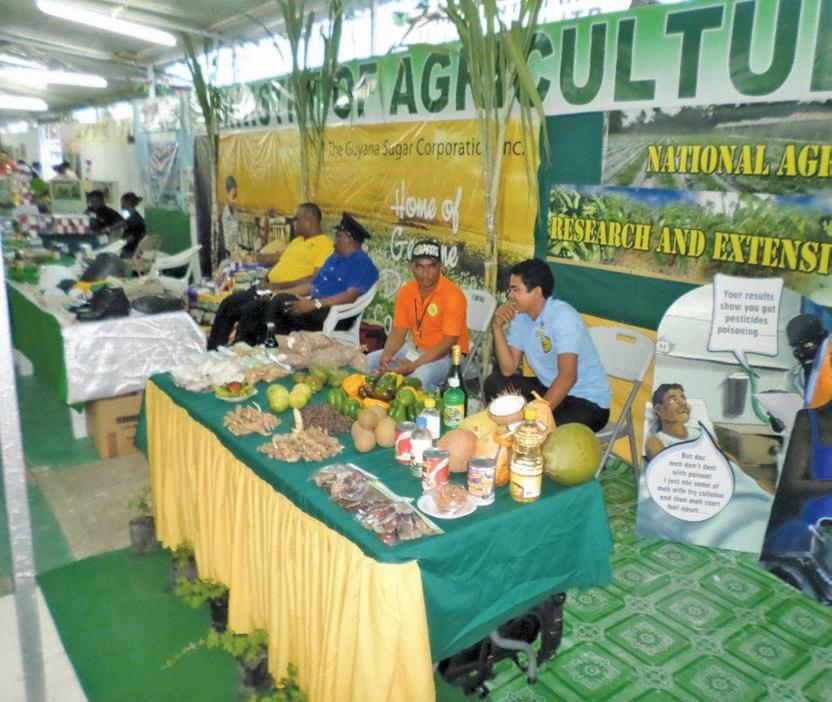



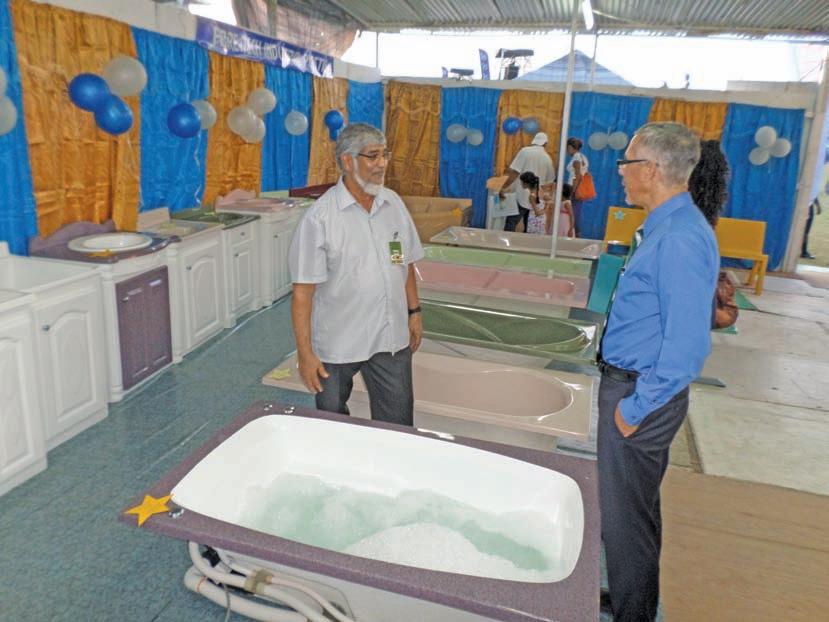
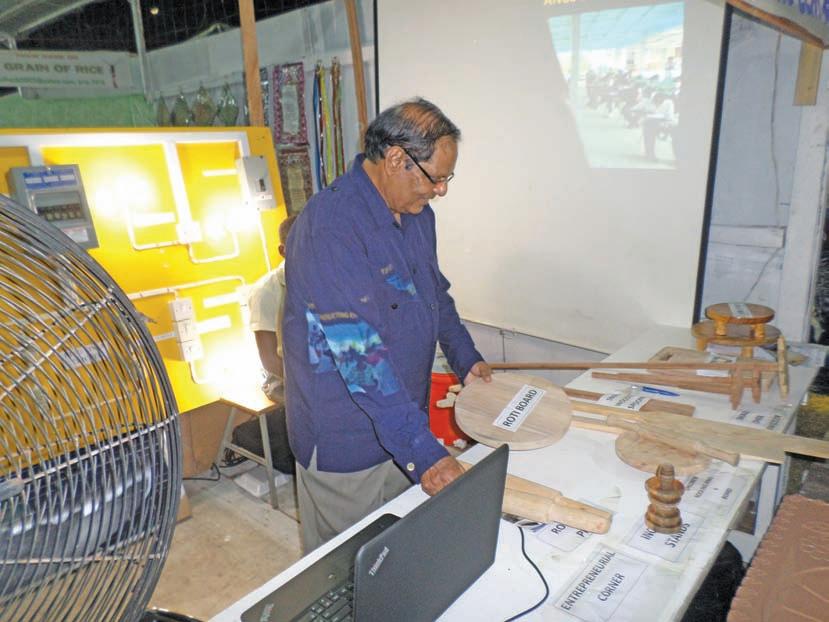
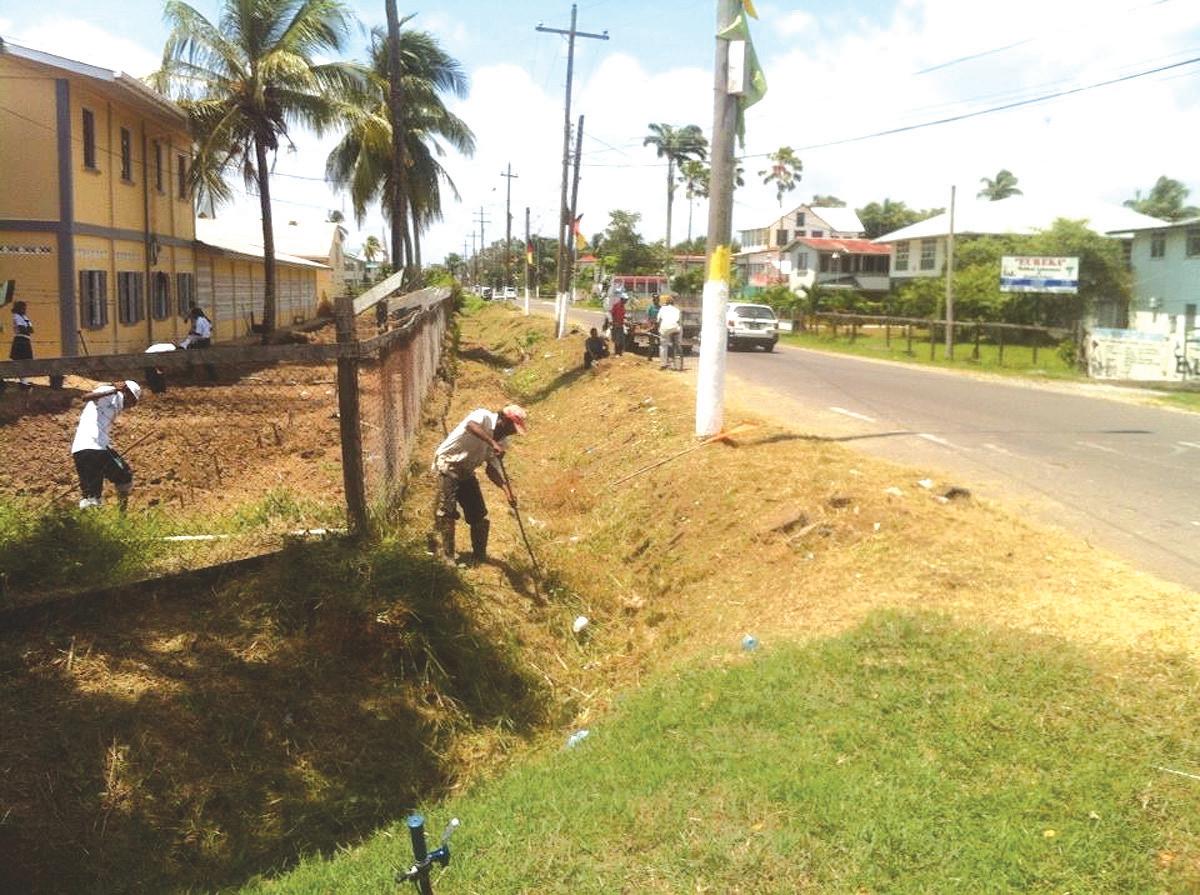
Region Six (East Berbice-Corentyne)
Vice Chairman Denis DeRoop is calling on the Municipality of New Amsterdam to take up its responsibility and clean the town including its drainage system.
“The Town Council should get busy now their party is in Government –there is garbage all over and the drainage system needs to be cleaned ahead of the rainy season.”
The Vice Chairman told Guyana Times that the Regional Administration
the Regional Administration to clean up the area in time for Monday, when officials are expected to visit BHS to be part of that school’s 150 anniversary celebrations.
On Friday, a backhoe, mini-excavator and all of the Regional’s technical team were at the site. Asked why all technical staff were engaged in the exercise, DeRoop said he could not understand why they were out there since the Administration already had machinery on the ground.
He explained that instead of the Administration’s
the Town Council was informed of the exercise on Friday, but chose not to be part of it: “We told them that we were providing the equipment for the clean-up and they were expected to do it, but they did not come out.”
According to the Regional Vice Chairman, over the years, the New Amsterdam Municipality has only focused attention on removing garbage.
Meanwhile, residents have been very critical of the Municipality, noting that for weeks their garbage was not removed from their homes.
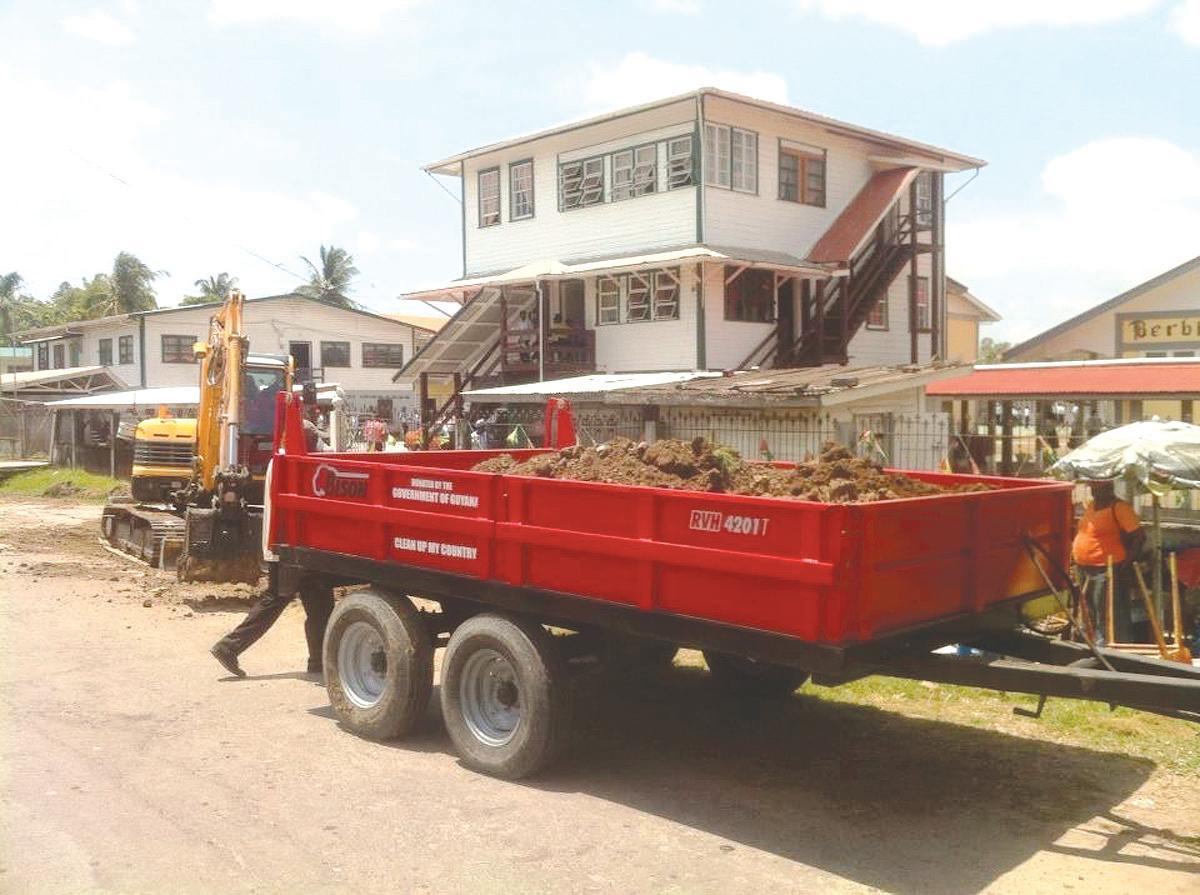
would assist and has been assisting but cannot do all. He noted that the New Amsterdam Town Council has not been pulling its weight to manage the affairs of the town. “It is their responsibility,” he says.
DeRoop’s comments came in wake of a clean-up exercise in the vicinity of the New Amsterdam Hospital and Berbice High School (BHS) on Friday. According to him, Government officials asked
staff, the staff from the Municipality should have been on the ground. “I have not seen anyone from the Town Council and it is their responsibility to clean the town. When the PPP/C [People’s Progressive Party/ Civic] Government was in power, the New Amsterdam Town Council did nothing, now it is their Government in power… I don’t know what they are up to.”
The Vice Chairman said
Some residents have resorted to dumping waste on the street which puts more pressure on the Council’s limited resources, an officer from the Municipality said.
Residents argue they pay taxes and don’t get service. Of concern too is the state of many of the town’s streets and drainage system. They say despite a change in Government, there is no change in the attitude of the municipality.
monday, september 21, 2015 | guyanatimesgy.com
French researchers said Thursday they had patented a method to create sperm using stem cells harvested from infertile men – though they do not know if the lab-fabricated seed actually works.
The team hailed their technique as a step towards solving male infertility, but admitted it would take several years before the “quality” of the sperm will be confirmed.
The method, patented in June, took 20 years to refine, said the researchers from Kallistem biotech company in Lyon, east France.
It involved recreating, outside the human body, the fluid in which seminiferous tubules -- the tiny structures where sperm cells are formed in the male testes –can survive.
They used it to coax rat, monkey and then human sperm cells from spermatogonia, immature cells that become eggs or sperm. The process is complex, and takes about 72 hours.
The sperm are “morphologically normal” (normallooking), the researchers said. It is not known whether the tiny cells are up to the job of creating babies.
The next step, the team
said, is to try and give life to rats with rat sperm created using the method.
“We must see if the baby rats are normal, whether they are able to reproduce,” project member Philippe Durand told journalists in Lyon.
Then there will be a
“From a testicular biopsy in these infertile men, the scientists will be able to obtain spermatozoa in vitro,” said the statement.
The Government intends to give more powers to the Integrity Commission to enforce decisions that will lead to a more transparent and accountable public system.
Minister of State Joseph Harmon made this disclosure, while hosting the media at his post-Cabinet press briefing on September 18 at the Ministry of the Presidency.
The Integrity Commission has not been functioning for a number of years due to it not being properly constituted, the Government Information Agency (GINA) reported.
Minister Harmon said he met with the staff of the Integrity Commission recently and explained that, as soon as the 11th Parliament can allow for the appointment of the Commissioners, this would be done so the work of the Commission can proceed.
“It may very well be us recognising that those persons who are there had gone through a process, and the Government might say let’s agree to this, but it has to have the stamp of the 11th Parliament, which will then be taken to the President for his signature, (since) as of now, the Commission is one without Commissioners, and it is functioning under a CEO [Chief Executive Officer] and small staff with a limited budget,” Minister Harmon said.
The Minister of State further disclosed that the
battery of tests with the lab-manufactured human sperm, to compare it to ordinary sperm, and finally clinical trials.
The work has not yet been validated through publication in a peer-reviewed science journal.
But the team said in a statement their work “opens the way for therapeutic avenues that have been eagerly awaited by clinicians for many years.”
However, Nathalie Rives, an infertility expert from Rouen in northern France, cautioned: “We are not there yet”.

“Before this technique can find any practical application, it must be proven to work with (cells) from the testes of prepubescent boys and men who have trouble generating sperm,” she told AFP.
In August 2011, scientists in Kyoto said they had successfully coaxed sperm cells from mouse embryonic stem cells. (AFP)
Government intended to have a fresh look at the mandate of the Commission. “We felt that the Commission did not have enough powers to enforce any of its decisions, and the fact that public offi-
the Commission and say you have one house and you have 12 other houses all across the country, if they do not have the capacity to investigate that statement, then it is a waste of time,” Harmon pos-
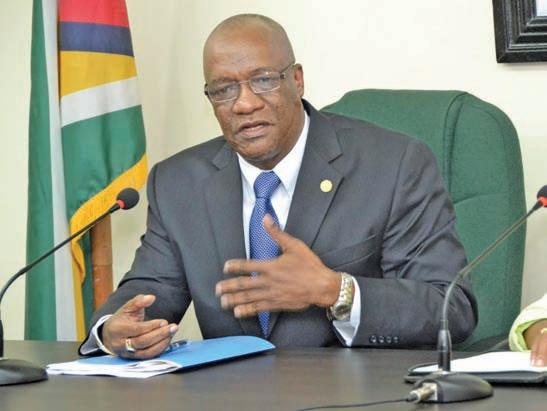
cials would just submit to the Commission and there were no clear positions as to what happens after that,” Harmon explained.
He is of the view that there must be some mechanisms within the law to allow for follow-up. “In fact, this was discussed with the CEO,” the Minister said.
He told the media that there were models in Trinidad and Tobago, Barbados and other countries within the Caribbean Region, where submissions to the Integrity Commission were subjected to further scrutiny. “When you go to
ited. He noted that what obtained in the past would be changed as the Government was desirous of having a Commission with integrity and one that had the capacity to follow up on submissions made and take actions where necessary.
“I can tell you that it is something that we are very concerned about…it will be law that by a certain time of the year, you declare your assets, and if you don’t, the Commission has the power to do certain things about it,” Minister Harmon said.









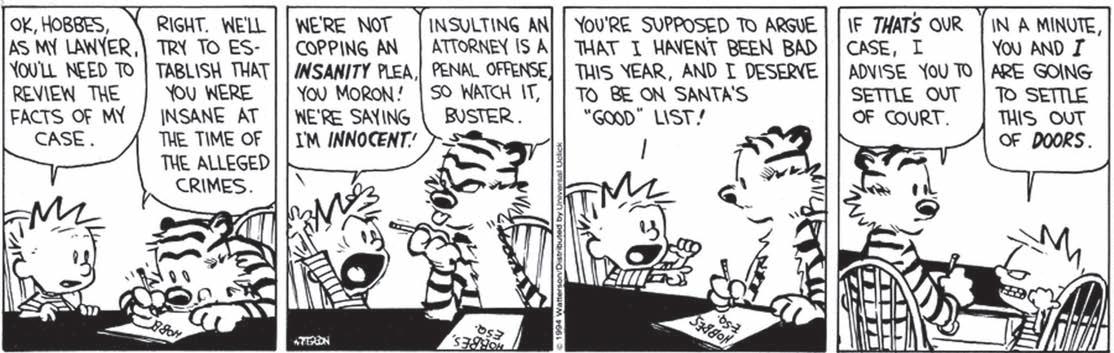

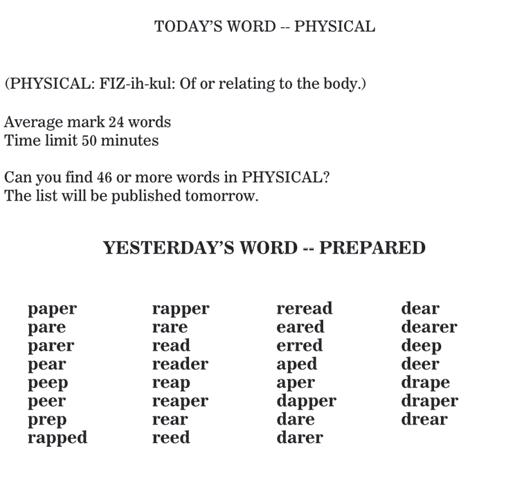





ARIES (March 21April 19)


TAURUS (April 20May 20)


(May 21June 20)


CANCER
Put love high on your list. Don’t hesitate to call in a favour. Ask about getting a raise or promotion, or apply for a new position that excites you.
You will feel restless. Timely advice from a close friend or relative will help steer you back to your original plans or convince you to resurrect an idea that you had previously discarded.
Not everyone will share your sense of humour. An offhand remark will be hurtful if it’s misinterpreted. Do your best to be thoughtful and sensitive to the feelings of others.







LEO (July 23Aug. 22)
VIRGO (Aug. 23Sept. 22)
Someone in the workplace will try to damage your reputation. Don’t get involved in gossip or disputes. If you let your work speak for itself, negative rumours will be dismissed.
Lighten up and have some fun. Someone you haven’t thought much about will turn out to be a better friend than anticipated. Do your best to put others at ease.
Someone having a tough time will appreciate your help. Offer comfort and suggestions, but be careful not to take on troubles or responsibilities that don’t belong to you.
LIBRA (Sept. 23Oct. 23)
A chance to travel or learn something new is evident. The experience you gain and the acquaintances you make will give you insight and inspiration. Enrol in a course or attend a conference.


SCORPIO (Oct. 24Nov. 22)
You will hit a roadblock, but with careful manoeuvring you will outperform the competition. Money matters look promising if you make the most of an opportunity to present what you have to offer.


CAPRICORN (June 21July 22)
SAGITTARIUS (Nov. 23Dec. 21)
Pace yourself. You will get a clearer picture of what’s going on around you if you are patient. Listen and observe, but don’t disclose your own agenda.


(Jan. 20Feb. 19) (Dec. 22Jan. 19)
Deception is evident. Don’t take what others say at face value. This can be a prosperous time for you if you focus on contracts, financial collaborations or settlements.
AQUARIUS


PISCES
(Feb. 20March 20)

You have so much to offer. Join forces with other volunteers at your local food bank or community charity in order to boost your self-esteem and make new friends.
An old friend will provide valuable insight into a situation you are facing. Someone you were counting on will let you down. Do as much as you can on your own.




Spain won their third European championship in style after a blistering performance by the talismanic Pau Gasol inspired them to an 80-63 win over Lithuania in Sunday’s final.
The Chicago Bulls center poured 25 points and racked up 12 rebounds for the 2009 and 2011 winners.
Runners-up on home court in 2007 and third in 2013, Spain forced Lithuania into submission with an electrifying display of speed, skill and lethal long-range shooting at crunch moments.
The 35-year-old Gasol, a double former NBA champion with the Los Angeles Lakers, was named the competition’s most valuable player after carrying his injury-hit team throughout the grueling 24-nation event.
Unstoppable in attack and a pillar in defense, Gasol engineered a 19-8 first quarter lead as the Spaniards turned their half of the court into a fortress.
Missing five key players and having scraped through the group stage, Spain also benefited from sound performances by their backcourt players who sprung to life after struggling for much of the campaign.
Dynamic playmaker Sergio Lull added 12 points,
six rebounds and five assists, while Rudy Fernandez chipped in with 11 points before he limped off with an injury in the third quarter.
Gasol’s Lithuanian counterpart Jonas Valanciunas, who was at the heart of their semi-final win over Serbia, was subdued this time and
ovation when he was substituted in the final minute.
Earlier on Sunday, hosts France won the bronze medal after beating Serbia 8168.
Spain and Lithuania secured automatic berths in next year’s Olympic Games while France, Serbia, Italy,

fouled out with 10 points and nine rebounds.
Roared on by most of the fans in Lille’s soccer stadium, adapted for the tournament’s knockout rounds, the Lithuanians fought hard to stay in touch but a late Gasol three-pointer vanquished their faint hopes of a comeback.
Rafa Nadal, winner of 14 grand slam tennis titles, was among the Spanish fans who treated Gasol to a standing
Greece and the Czech Republic will enter three intercontinental qualifying tournaments for an extra three spots.
The United States beat Spain in the 2008 and 2012 Olympic finals but the European giants will hope to be at full strength for the 2016 Games in Rio de Janeiro and have another tilt at the only major trophy missing in their cabinet.
(Reuters)
Andy Murray took Great Britain through to a first Davis Cup final since 1978 with victory over Australia’s Bernard Tomic in Glasgow.
The British number one secured his third point of the match, and an unassailable 3-1 lead, with a comprehensive 7-5 6-3 6-2 win.
Britain last won the Davis Cup in 1936, with a team led by Fred Perry, and will face Belgium away in November’s final.
Dan Evans lost 7-5 6-4 to Thanasi Kokkinakis in the final rubber.
Belgium reached their first final in 111 years when Steve Darcis beat Argentina’s Federico Delbonis in four sets in a deciding fifth rubber in Brussels.
The final will be played from 27-29 November, with
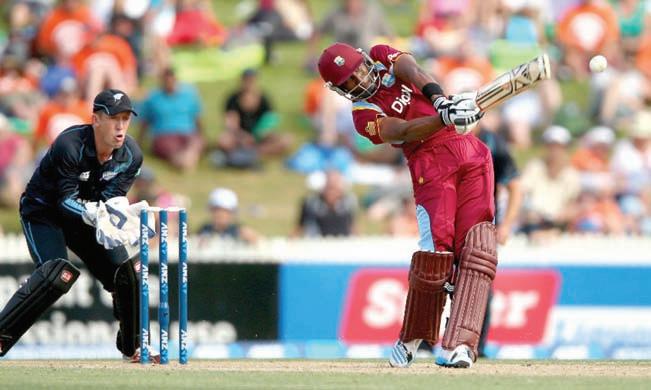

Championship leader Lewis Hamilton suffered his first retirement of the year as Sebastian Vettel romped to victory in the Singapore Grand Prix.
Vettel took his third win of the year in dominant style, controlling the race from start to finish as two safety cars led to hectic action behind.
The second caution period was caused by a man wandering along the track.
Hamilton suffered a loss of power while running fourth, dropping down the field before eventually being told to retire.
His Mercedes team-mate Nico Rosberg cut Hamilton’s championship lead to 41 points by finishing fourth.
There are 150 points still available in the remaining six races, starting in Japan next weekend.
Vettel, meanwhile, is now only eight points adrift of Rosberg and a real threat for second place in the championship if Ferrari can maintain this form.
Both Mercedes were incapable of challenging at the front as Daniel Ricciardo took second for Red Bull, ahead of Ferrari’s Kimi Raikkonen.
Vettel turns clock back
Vettel’s victory was the third of the year - meeting Ferrari’s pre-season targetbut it was of a completely different character to those in Malaysia and Hungary.
Both of those came about because of specific circumstances - in Malaysia because Ferrari had better tyre
life than Mercedes and could do one fewer stop and in Hungary because Hamilton dropped back with errors.
This time, Vettel and Ferrari were for the first time unquestionably the fastest combination on the track - in a manner reminiscent of the German’s many dominant victories for Red Bull - as

a league of his own, pulling out three seconds on the first lap and five by lap three, before backing off and stabilising his lead.
Ricciardo began to close in as the leaders neared their first pit stops, but these were triggered early when Nico Hulkenberg turned into Massa as the Brazilian rejoined after his own first stop.
Hulkenberg was penalised with a three-place grid drop at next weekend’s Japanese Grand Prix for causing a collision.
Ricciardo got on the radio to say to his team that Vettel had “got lucky” with the timing of the safety car.
But subsequent events proved nothing could have been further from the truth.
Vettel held Ricciardo’s pace for several laps after the restart, apparently trying to give Raikkonen a chance to pressure the Australian for second.
But after the three cars ran nose to tail for eight laps, Vettel suddenly sprinted clear, pulling out 2.7 seconds in one lap, four seconds in three before again backing off.
Mercedes, inexplicably off the pace in qualifying, continued to struggle.
Hamilton and Rosberg ran fifth and sixth in the opening stint, unable to keep up with the Ferraris and Red Bulls ahead.
Vettel, meanwhile, was in
From that point, it was clear the race for the lead was over and Vettel was able to calmly stroke home, despite the surreal circumstances of the second safety car intervention.
At the same time, Ricciardo was substantially quicker than Raikkonen and the top three were settled, despite late drama. (BBC Sport)

every likelihood that the home side will choose a slow clay surface to try and neutralise Murray’s strengths. It always seemed unlikely that Murray would let a chance to make history slip away after Saturday’s thrilling doubles victory, and the
Scot completed the job in another raucous Glasgow atmosphere.
Australia captain Wally Masur had chosen to stick with Tomic, his number one player at 23rd in the world, for the fourth match.
Murray had won both
previous contests against the 22-year-old, but the Davis Cup brings its own unique pressure and he betrayed signs of nerves when failing to serve out the first set.
He made up for it with another break of serve in
the 12th game, however, urged on by most of the 8,000 watching as he sealed the set with a nerveless drop shot.
Murray comes through back trouble
There had been some concerns Murray might strug-
gle a little after Saturday’s doubles, but he revealed afterwards that it was actually his back which was the worry.
The 28-year-old had surgery in 2013 to correct a long-standing problem, and he explained that this was not a recurrence of that issue.
“I was more concerned about my back, which has given me a lot of trouble this week, the few days before the tie as well,” said Murray.
“I felt fine through all of New York and then took a break for five or six days. Sometimes after you’ve played a lot of tennis, when you do then take a break, the muscles and everything tighten up.
“When you come back, you can have some issues, so maybe it was to do with that.”
(BBC Sport)
Jagmohan Dalmiya, the BCCI president, died on Sunday night at the BM Birla hospital in Kolkata, where he had been admitted after suffering a heart attack on Thursday. He was 75 and had faced concerns around his health since starting his second term as president in March.
Dalmiya had been admitted to hospital after complaining of chest pain on Thursday and had to have an angiography. He was reported to be stable but remained in critical care for the next two days. The hospital statement said his condition had become unstable on Sunday morning and he died at 8.45 pm. Dalmiya’s body will be taken to the Cricket Association of Bengal (CAB) headquarters at Eden Gardens on Monday afternoon for the public to pay their respects.
A long-serving cricket administrator, Dalmiya had since 1979 worked his way from the CAB to president of the ICC and twice headed the BCCI. He is widely credited with being one of two BCCI officials responsible for India’s emergence as world cricket’s financial powerhouse and the tributes pouring in from across the globe bore witness to the breadth of his relationships.
“As a visionary and a father figure of Indian cricket, Mr. Dalmiya worked towards the development of the game of cricket in India. The cricketing fraternity will miss him dearly,” said BCCI
secretary Anurag Thakur. “Mr. Dalmiya played a significant part in positioning Indian cricket at the global level and the astute administrator in him, guided Indian cricket to greater heights. His untiring efforts will be remembered for generations to come and his contribution to Indian cricket will remain unparalleled.”
He had initially made
was staged outside England. It was during Dalmiya and Bindra’s tenures in the BCCI that the television rights for matches played in India were first sold to private television channels.
After the successful conduct of the 1996 World Cup, Dalmiya was elected ICC president in 1997 and served in the role until 2000, after which he was elect-
a name in the construction business, which he took over from his father at the age of 20, and joined the BCCI in 1979. Along with the then BCCI president NKP Salve and IS Bindra, Dalmiya was the force behind bringing the World Cup to India and Pakistan in 1987, the first time the tournament
ed BCCI president for the first time in 2001. In an acrimonious BCCI election in 2004, Dalmiya’s casting vote helped his candidate Ranbir Singh Mahendra get elected as president; but a year later, Dalmiya was beaten in a BCCI election for the first time in over two decades, by Sharad Pawar. His oppo-
nents at the time went after him - Dalmiya was banned from BCCI meetings, and an FIR was filed against himbut Dalmiya bounced back to win the CAB presidential elections in July 2006.
Five months later the BCCI expelled him on charges of embezzling funds from the 1996 World Cup and he was forced to step down as CAB chief. After a long legal battle, he was allowed to contest the CAB elections again and he won the presidency in 2008. For the next five years, Dalmiya stayed in charge at the CAB but his influence was diminished at the BCCI level. In 2013, however, when N Srinivasan stepped aside temporarily from discharging his duties as BCCI president, the board turned to Dalmiya to run its affairs in the interim.
With the influence of Srinivasan waning because of the corruption and spotfixing scandals in the IPL under his watch and the board mired in legal trouble, Dalmiya was unanimously elected the BCCI president for a second term in March 2015. His health was already a concern by that time, though, and he had to be assisted at several board meetings. The last BCCI meeting Dalmiya attended was a working committee meeting in Kolkata on August 28, which he adjourned sine die because of confusion over whether Srinivasan was eligible to attend. (Cricinfo)
By AKEEM GREENE
In collaboration with Guyana’s national cricket team, Youth Coach Garvin Nedd, the Demerara Cricket Club (DCC) are hosting a series of 20-over matches for young under-15 and some under-17 cricketers that began on Saturday evening. In the opening fixture played under lights on Saturday, DCC lost to Everest by 4 wickets. Batting first, National under-15 player Raymond Perez stroked his way to 33 while Sachin Singh helped himself to a handy 15 as DCC reached 113-9 from 20 overs. Bowling for the Everest side N Peters wreaked havoc with figures of 5-20 from his 4 overs. In reply, R Looknaught’s
35 and P Persaud 15 helped Everest to 114-6.
As the Camp Road side got over the line in the final over of the game. Ashmead Nedd took 2-14 (4) in a losing cause. In Sunday’s fixture, Georgetown Cricket Club (GCC) lost to Gandhi Youth Organisation (GYO) by 8 wickets. The GCC side who took first strike were bowled out for 92 in 17 overs.
Vishnu Ramkalawan’s knock of 47 (6x4s) was the main contributor with the bat. Andre Foster 3-6 (3) and Elnathan Suknandan 3-10 (3) were chief wicket takers for the GYO side.
In response Navindra Persaud 31 (6x4s) and Brandon Mathews 18 (2x4s) as GCC reached 93-2 from 19.4 overs.
The competition is being organised in commemoration of the Coach Garvin Need birth anniversary.
Nedd is former First Class player, took 29 wickets from his 14 games and has been in the coaching arena for a number of years.
The teams in the competition are DCC, Everest Cricket Club, Transport Cricket, Georgetown Cricket Club, Maltenoes Cricket Club, Gandhi Youth Organization,
Bel Air and Guyana National Industrial Corporation (GNIC).
The event on Sunday also saw the presence of some other local youth coaches and West Indies T20 player Christopher Barnwell who conducted various cricket drills.
The event will see the top teams walking away with trophies and medals. Prizes for the player with most wickets, most runs and special award will be given to the Most Valuable Player of the Competition. (akeemg@guyantimesgy.com)
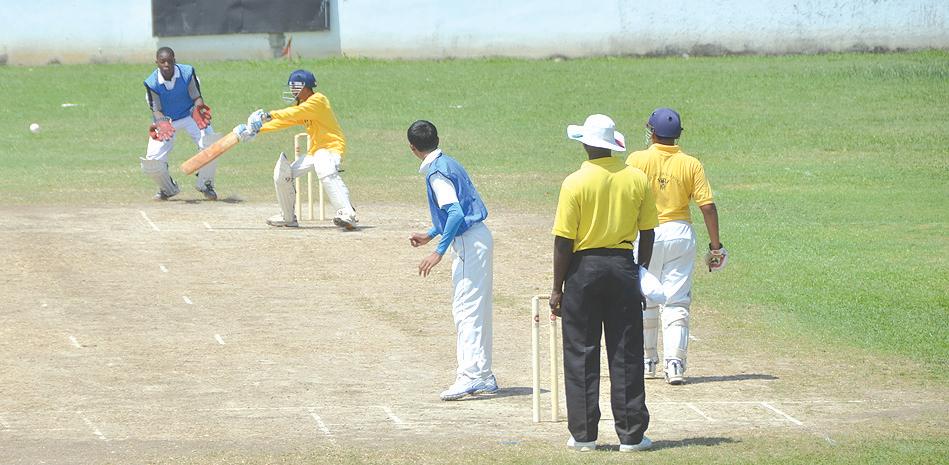
Action continued in the NBS sponsored 40-overs Second Division competition as GCC got the better of GYO on Sunday at the Georgetown Cricket Club (GCC) ground, Bourda.
GCC batted first and amassed 233-6 from their 40 overs. National youth cricketer Ronaldo AliMohammed stared in a well played knock of 70 (7x4s) (1x6).
The Guyana under-19 player featured in a 114 runs partnership with Gavin Singh 48 (2x4s). Ronaldo who looked set for a big score fell late in the innings, as Devon Lord 29 (4x4s) added impetus at the end for the home side. GYO’s bowling was led by D Ramjattan 4-50 from 8 overs.
In reply GYO got off to good start with their openers putting on a 50 runs partnership in the first 14 overs.
But the Woolford Avenue side lost their way during the middle overs as they reached 162-8 from their 40 overs. S Hiralal 48 (3x4s) and Bashkar Yadram 27 not-out were the main scorers for GYO.
Devon Lord returned with the ball and took 2-28 (8) with his left-arm spin. He was supported by Gavin Singh 2-30 (8) and Stefan Wilson 2-38 (8) as they easily restricted the GYO side. (akeemg@guyanatimesgy. com)

By TREisToN JosEph
Night two of the Stag Elite League produced two decisive victories with Fruta Conquerors and Monedderlust walking away with three points each on Sunday night at the Number Five ground in Berbice.
The first game of the night saw Fruta Conquerors stunning Buxton United in a thrilling game that got fans involved.
Both teams played with aggression, looking to score on numerous occasions, only to have wayward shots or shots that whizzed past the goal that drew murmurs and cheers from fans.
However, with both teams still goalless at
the 90-minute mark, Eon Alleyne produced a stunner to win the game for the Tucville based side in the 90th+1 minute.
Meanwhile in the second game, the Guyana Defence Force (GDF) gave up a 2-nil lead to lose to Monedderlust 3-2.
Delroy Fraser scored the game’s opening goal for GDF in the 11th minute while Delwyn Fraser added to the GDF’s score line in the 22nd minute to give the army side a comfortable lead.
However, a defensive lapse by the GDF gave the Berbice based side some hope with a goal in the 29th minute and the first half played out with GDF leading 2-1.
However, it went all downhill fro GDF when the second half resumed, as they never really produced any threatening attack while Monedderlust, urged on by their fans and supports, produced an equaliser in the 52nd minute from Travis Henry and the winner two minutes later from Kevin Cottoi in the 54th minute.
Action in the League will continue on Wednesday evening at the Georgetown Football Club (GFC) ground with GFC taking on Slingerz FC and Alpha United going against Pele FC. Kickoff is set for 18:00h.
monday, september 21, 2015

Need a car to rent? Then call 6111018 for the best cars at great prices.


SHALOM ENTERPRISE 2 CROAL
STREET, STABROEK. ENQUIRE ABOUT OUR DRIVING PACKAGE & INTERNATIONAL DRIVER'S PERMIT (JOIN US ON FACEBOOK) 2273869/622-8162/644-7052


Da Silva’s Optical. For Your Eyes Only, Look Better See Better. Phillip A Da Silva OD, Shannon L Da Silva OD, Natalie Da Silva OD. 248 South Road, Bourda. Phone: 227-3529, Linden: 444-6376, Corriverton: 3393536, Meten-Meer-Zorg: 275-0322, Grand Cayman Islands: (345) 9431515 for the perfect trendy touch.

Tain, Corentyne, Berbice, Opposite UG Campus. Tel: 675-5648
One property Ogle; One property Anna Catherina; One property Good Hope. Contact; 2223060/6735546/622-6448/679-0987 Upper & lower flat situated at Lot 90 M&TC Housing Scheme, New Amsterdam, Berbice. Contact 6479148 One two-storey concrete house, 3-bedroom located at 8th Street Foulis Enmore. Price 18 million neg. Tel: 256-3360/685-8485

House plans & estimates, weeding of grass and spraying done within 48hrs. Call: 216-0671; 622-0267; 692-8464

Available: Fresh long-stemmed roses, fresh dried and silk floral arrangements, gift items, bridal boutiques and wreaths. Nesha’s Flowerland. 78 Church Street (opposite St George’s Cathedral). Tel: 2273553/225-3315

Clean Garden earth. Also excavating, grading and leveling done. Call 6279977
For sale by lot: Lot (1): 2 bath tubs, bathroom fittings and fixtures & toilet set; shower fittings - $150,000 and Lot (2): 1 Dell desktop computer & HP scanner - $25,000. Call 225-2676 or 601-5285.
Puppies for sale. German shepherd and pitbull (mixed) $40,000 each. Contact: 269-0711 /621-7842
Puppies for Sale. Pure Breed Dachshund Pups. $15,000 each. Tel: 256-3360 / 685-8485


waivers, pardons, etc. Get your visa approved. High success rate. Balwant Persaud & Associates. Certified Immigration Consultants, 68 Sixth Street, Alberttown, Georgetown (Between Cummings & Lights Sts) Tel: 225-1540, 622-8308, 655-3105. Email: balwantpersaud@yahoo.ca




B y T reis T on J oseph

AKhemraj & Son -landscaping & plant nursery. Lot 77 Independence Street, La Grange, West Bank Demerara. Landscaping, planting grass, weeding, killing wood ants, killing roaches, rats & mealy bug, treat plants, coconut trees and flowers, cleaning ceiling, grafting coconut plants: 18 months bearing period, treating land, grass & spraying grass, grafted papaya plants: 6 months bearing, grafted cherry plant, sour sop & sapodilla, cutting big trees & removing, treated mould for sale & flower plants for sale. Tel 627-5969/ 603-1134
Cab service and cooking gas delivery available, East Bank area. Tel: 2163326, 683-9910
K. LAKERAM - BUILDING CONTRACTOR, HOUSE PLAN, ESTIMATES, WEEDING & SPRAYING GRASS DONE WITHIN 48HRS. CARPENTRY, MASON, TILING, PAINTING, PLUMBING. PROMPT & AFFORDABLE GENERAL HOME MAINTENANCE. FREE ESTIMATES. TEL: 216-0671/622-0267/692-8464. EMAIL: klakeram.construction@ gmail.com

Surinamese spiritualist. Resolving all problems. Money, love, blockage etc. Call 223-6834/600-7719
Suriname’s Astrology, Palmist and Hindustani Spiritual Healer, solve all purpose problems, 100% confidential guaranteed. Phone: 602-8997
FOR PERSON WITH STROKE AND PHYSICAL DISABILITIES WE HAVE HERBAL BATHS AND SPIRITUAL MASSAGE MEDICINE. CALL: 2200708/687-5653/612-6417
HEPHZIBAH MINISTRIES 24 hrs Prayer Line 322-5081,337-4510,3374259,337-4583,337-3070,337-5103. For healing, deliverance, financial difficulties, marriage issues call now. Jesus Cares.
Dutch spiritual healing in removing evil spirits, bad luck, evil sickness, spells, reuniting lovers and prosperity to business Call 612-6417, 6875653, 220-0708

Three Storey 75ft’x 30ft’ bldg, open floors, 2 offices, 2 washrooms, driveway. 25B Princess St, Charlestown. Tel: 223-0654, 225-0605
Two Self-contained single bedroom furnished apartments for rental. Selfcontained 7 bedroom bungalow idea for family/ guests/ students local or overseas long/ short term rental. Contact: 622-7097 / 624-7111
JUST ARRIVED: TOP QUALITY RECONDITIONED VEHICLES; TOYOTA NOAH; TOYOTA VOXY; TOYOTA IST (NEW SHAPE); SUZUKI SWIFT; DAIHATSU MOVE (660CC); MERCEDES BENZ C200 KOMPRESSOR; COROLLA AE100 WAGON; TOYOTA HIACE MINIBUS RZ; PITBULL-STYLE FREEZER VAN; LAND CRUISER (FULLY LOADED); MAZDA PROCEED 4WD EXTRA-CAB PICK-UP; TOYOTA HILUX 4WD EXTRA CAB PICKUPS - 3RZ, 5L, 3L SOLID DEFFERNTIAL; MITSUBISHI CANTER TRUCKS 4 TONS FREEZER; 3 TONS OPEN TRAY; 2 TONS 4WD; NISSAN ATLAS 2 TONS OPEN TRAY TRUCK. PRE-ORDER YOUR UNITS EARLY AND GET THE BEST PRICES. FULL AFTER SALES SERVICES AND FINANCING AVAILABLE. DEO MARAJ AUTO SALES, 2 CHIMNEY ROAD, CHATEAU MARGOT, ECD. 624-0762, 220-5177. A NAME AND SERVICE YOU CAN TRUST
BMW320 I; NISSAN MARCH - PMM SERIES, BLUEBIRD, 4-DOOR PICKUP; TOYOTA - AT212, AT192, RAUM, I.S.T, L-TOURING WAGON, EP71 STARLET, HILUX 4-RUNNER AND PICK-UP; HONDA 600RR. TEL 644-5096 / 697-1453

GR Taxi, 24 hours. Phone: 2257878, 219-5000 or 227-2100
Sunshine Cabs, 24hours. Phone: 227-1720, 227-1721, 660-6102



fter a comfortable Courts 10k win on Sunday, Guyana’s top female distance athlete, Euleen Josiah-Tanner was not shy in sharing her thoughts on the Athletics Association of Guyana’s (AAG) selection process.
The 40 year old who described the 10k as “extremely humid” due to the late start noted that she hopes the AAG has a “better selection process”.
“I hope they have a better method of selection because I have done everything they asked me to do which is to come on home soil and compete in order to be selected to go to these games and despite doing that, despite being number one, despite defeating my opponents over and over, they are still being selected ahead of me,” JosiahTanner stated.
Josiah-Tanner who trains in the United States of America (USA) also questioned the AAG’s intent because of their selection process.
“I really do not know what type of messages they are sending to the sen-

ior athletes, it’s like a two edged sword, every time you ask the senior athletes to step up, they step up and they it’s like a slap in our face.
“I think when it comes to certain championships, I think they should hold trails like every other country and if the athlete win then they go, if they don’t win then they don’t go…
you just don’t select an athlete because you think that they can perform,” JosiahTanner opined.
Nevertheless JoisahTanner also confirmed her intentions to participate in the South American 10k event noting that she will put her best foot forward to do well for Guyana. (Josepht@guyanatimesgy.com)
Viv Richards has supported Jason Holder’s promotion to the West Indies Test captaincy, saying the allrounder had the ability and was not too young for the job. Richards’ endorsement came days after Brian Lara also approved of the new West Indies captain, who replaced Denesh Ramdin in the job.
“Well, I have heard maybe that some folks are suggesting that he is too young, but it is better to start at that particular age,” Richards told CMC. “And if he gets lucky enough and we are successful, you have a long successful period of your captain being in place rather than the chopping and changing on a regular basis.”
Holder, 23, is West Indies’ second youngest Test captain, and has led the ODI side in 12 matches. He showed resilience by scoring a hundred to draw a Test against England in Antigua, and then made a counter-attacking 92 against Australia in Jamaica.
“I believe this individual does have the ability,” Richards said. “Certainly, he comes over very well and you hear about the respect factor you get from other members of the dressing room and that is of vital importance because when you have that respect, it is amazing.
“When you look and see what’s around him, when you look and see how he would have gone about his business as a batsman, you can see there is some im-
provement... but certainly the signs are there and I think maybe it’s not a bad choice.”
While Holder’s appointment received approval from Lara and Richards, former West Indies batsman Philo Wallace, who like Holder is from Barbados, said it was too early to give him such a responsibility. “
“Jason has a tremendous amount to offer West Indies cricket but we must be careful that we don’t
my opinion.
“When you look at the Barbados set up, Kraigg Brathwaite is the captain of the team in the PCL. He is the captain of the Barbados team in the longer format, Jason plays under him and now he will play under Jason in the Test team. This puts the Barbados Cricket Association in a very interesting position and they will now have to decide whether they continue with Brathwaite as captain or re-

push him too soon, which I think is what is happening here,” Wallace said. “He has not led Barbados in the PCL (Professional Cricket League) and to give him captaincy in the longer format without the experience is too much at this stage in
move him and put Holder.” Holder’s first series in charge of West Indies in all formats will be the tour of Sri Lanka, where they play two Tests, three ODIs and two T20Is in October and November. (Cricinfo)
monday, september 21, 2015
The future of Guyana’s cycling was on show on Sunday, as two of the country’s rising stars outperformed their most seasoned competitors to take 1-2 in the 13th annual Victor Macedo memorial road race.
Junior riders Jamal John and Raphael Leung finished as winner and runner-up respectively in the grueling race, which was organised by the Flying Stars Cycling Club.
The event commenced with the traditional ‘roll start’ from Peter Rose Street in Queenstown to Homestretch Avenue, where it officially started.
Senior and junior riders proceeded to Dora on the Soesdyke/Linden Highway, while the veterans, juveniles, and mountain bikers rode to the hill after the Splashmin’s Fun Park.
The cyclists turned at their respective points on
Courts 10k…
the highway and returned to Homestretch Avenue for the finish.
John and Leung, both 18 years old, displayed great stamina and determination that belied their age during the 80-mile sojourn.
John pipped Leung in a sprint finish to win in a time of three hours, nine minutes, 51 seconds (03h: 09m: 51s).
Notably, the winning time was significantly faster than the three hours, 14 minutes, 19.92 seconds (03h: 14m: 19.92s) recorded by 2014 champion Michael Anthony.
John copped three prime prizes, while Leung had four. Team Alanis’ Paul DeNobrega took third, followed by Orville Hinds, Andrew Hicks, Akeem Wilkinson, Shaquel Agard and Silvio Inniss in that order.
By virtue of their finish, John and Leung were the

Sukhai sec-
ond and third respectively, while Keon Thomas, Ozia Mcaulay and Seon Budhan
were 1-2-3 in the Mountain Bike race. (aramzan@guyanatimesgy.com)

By TreisTon Joseph
Guyana’s top distance star, Cleveland Forde once again put his superior talent on display with yet another victory at the Courts 10k on Sunday morning while Euleen Josiah-Tanner ruled the roost in the women’s version of the event.
The event that started and ended in front of Courts’ Main Street Office had its largest turnout of over 150 entrants in the
history of the event. Nevertheless, not even the spike in competition was able to stop Forde who finished the event in a winning time 32mins, 45s.
Defending champion from 2014 Cleveland Thomas was second in 32mins, 58s, Winston Missenger third in 33mins, 01s and Kelvin Johnson fourth in 33mins, 17s. Nathaniel Giddings rounded out the top five with a time of 34mins, 01s.
The race was tightly knit at the blast of the pis-
tol, before a six man group namely; the above five as well as top junior distance athlete Matthew McKenzie quickly broke away from the pack on the upward journey around the Russian Embassy area.
Thomas, Missenger and McKenzie all from the Running Brave Athletics Club, took turns in attacking the race, utilising a team style of distance running in order to wear down the tactician that is Forde.
However, a four man
group was later formed around the Guyana Defence Force (GDF) Camp Ayanganna area with Thomas leading the way while Johnson, Forde and Missenger closely followed.
Thomas and Forde would separate themselves from the four at Camp and Lamaha Street before Forde who expressed after the race that he had a few hamstring niggles kicked in with his finishing speed
third female overall to cross the finish but was the first junior female cross the line in the event.
Alicia Jack was the fourth female open athlete (5th overall) to cross the line in a time of 45mins, 51s while Shion Boyer rounded out the top five female open athletes with a time of 47mins, 31s.
In junior male action, McKenzie won the event in a time of 34mins, 36s but
finishing with a time of 48mins, 33s while Maria McKenzie was third in a time of 56mins, 48s. Llewellyn Gardner won the men’s masters event while Cyrlene Phillips win the female version of the event.
At the presentation ceremony held immediately after the event Manager Director of Courts Guyana Inc, Clyde De Haas was pleased with the event.

at New Market and Main Street to easily run away with the Courts 2015 title.
Meanwhile on the distaff side Josiah-Tanner showed why she is Guyana’s best distance athlete at the age of 40 with an easy victory in a time of 39mins, 39s as she led from start to finish. Andrea Foster was second in 42mins, 17s while Alika Morgan who finished fourth overall for females was third in the women’s open with a time of 44mins, 38s. Shantel Hinds was the
showed some grit to keep up with the pace of the top athletes up to the six kilometres mark.
Odwin Tudor was the second junior male to cross the line in a time of 37mins, 45s while Samuel Lynch was third in 38mins, 36s.
Winning the junior female category was Hinds in 44mins, 08s after finishing an impressive third for females overall.
Simona Lawrence of Region Nine (Rupununi) was second in the event
“Congratulations to everybody and this type of turnout gives us more inspiration to make this event bigger and better and we already in talks to see how we can do so,” De Haas mentioned.
President of the Athletics Association of Guyana (AAG) Aubrey Huston thanked the athletes as well as Courts Guyana and Banks DIH form making the event a major success. (josepht@guyanatimesgy. com)
By AKEEM GREENE
The High Performance
Centre (HPC) in Barbados will be revamped; the revelation was made by WICB CEO Michael Muirhead.
Based on reports, the CEO said there will now be a high performance programme that can be administered in any of the regional territories.
Murihead was reported as saying that “Our director of cricket (Richard Pybus) revamped that whole programme in terms of how we do it.”
Launched in 2010; the HPC was geared towards toning the skills of young talented cricketers in the region. The system previously instituted by the HPC was a nomination of players by the various territories where after they were forged as a team in the progamme.
Murihead further stated that “What we have now is a high performance programme which can be administered in any territory.

We can administer the programme in any island; all we have to do is be consistent in what the programme has to offer.”
The CEO explained that “Before, we had them (participants) in a classroom sometimes and it was like a curriculum. We are not doing it like that anymore. We are now identifying what needs to be done at specific points in time and coming up with a programme that can be administered in any territory. We are rolling it out right now.”
The HPC has certainly been a great asset for the
region as newly appointed West Indies Test captain Jason Holder, wicketkeeper Shane Dowrich, Guyanese batsman Rajindra Chandrika and fast bowler Shannon Gabriel, who are in the West Indies team for the upcoming Sri Lankan tour are all products of the institution.
The centre was developed at a time, where it was felt by many cricket pundits that the region was in need of an institution to cater for our young talented cricketers since many other cricket playing nations had
several academies in their respective territories; pressure was on the West Indies Cricket Board to find avenues to have one erected in the Caribbean.
Only recently, the West Indies HPC Head Coach, Englishman Graeme West along with its bowling Coach former West Indies pacer Barbadian Vasbert Drakes arrived in Guyana to scout Guyanese cricketers for this year’s class of the HPC.
Drakes was reported as saying “We want to have a look at the players who at-
tended but also as much local players so that we will have some background information when they come to the HPC.
We want to work along with the local coaches when a Guyanese comes to the HPC their initiation will be easier.”
Guyana’s cricket has benefitted immensely from the programme as players such as left arm spinner Veerasammy Permaul who has already played six Tests and six ODIs for the regional side and Brandon Bess who played a solitary test match.
Other promising local talents such as Trevon Griffith Ronsford Beaton and Chanderpaul Hemraj have all benefited from the high profile coaching at the centre.
The changes can certainly foster a better development for cricket around the region, decentralising such a programme can give the smaller islands a chance to improve better local talents while information is passed around easier; as a result
domestic cricket can produce better results.
If we look at the region currently, the larger and more developed territories still dominate regional cricket despite the franchise system currently being implemented which in essence attempts to share the talent pool throughout the region.
The base players for franchises from the Windward and Leeward islands are still in some regards underpar.
With a revamped HPC programme, more players can be able to benefit from improved coaching techniques and training, which will holistically up the standard of regional cricket.
The HPC programme certainly is not a panacea for the problems the WICB faces in terms of the performance of the senior team but this programme can certainly go a far way in helping the WICB to produce better cricketers of the future. (akeemg@guyantimesgy.com)
In honour of the late Bakewell Chief Executive Officer Naeem Nasir, the Guyana Tennis Association (GTA) last Friday launched the second annual Bakewell Junior Championship Tennis Tournament amidst enthusiastic young tennis players.
supporter of sport, specifically tennis.
“Bakewell will carry on his legacy and continue to support the development of sport,” he promised.
He reminded the juniors of the discipline that sport fosters, and urged them not to lose the thought that education has to come first.
She mentioned that the tournament will help to determine which players are selected for the upcoming Inter Guiana Games to be held in Paramaribo, Suriname, during late October.
confident that its initiatives are being recognised favourably.
Matches in the competition started last Saturday. The tournament will feature rivalry among the Under-12s, Under-14s and Under-18s for boys and girls.
The competition will run over three weekends with matches being played at the National Racquet Centre from 08:30h to 16:00h and the National Park from noon to 16:00h.
Some matches will also be played at the President’s College tennis courts, which were built by Nasir during April 2010. Nearby communities will be invited to participate, according to the GTA. (aramzan@guyanatimesgy.com)
General Manager of Bakewell, Jacob Nanan, was delighted to serve the first ball of the tournament and in his remarks; he recounted the enormous generosity with which former CEO, Naeem Nasir, was a dedicated fan and
GTA Chairman of Junior Development, William Spangler, alluded to the current plans of

President of the GTA, Grace McCalman, applauded Bakewell for upholding its commitment to come onboard as a longterm sponsor, stating that this is what the sport needs.
the GTA to strengthen all aspects of the junior programme for higher quality outcomes.
He stated that the GTA is in discussions with the sport’s authorities and that the organisation feels



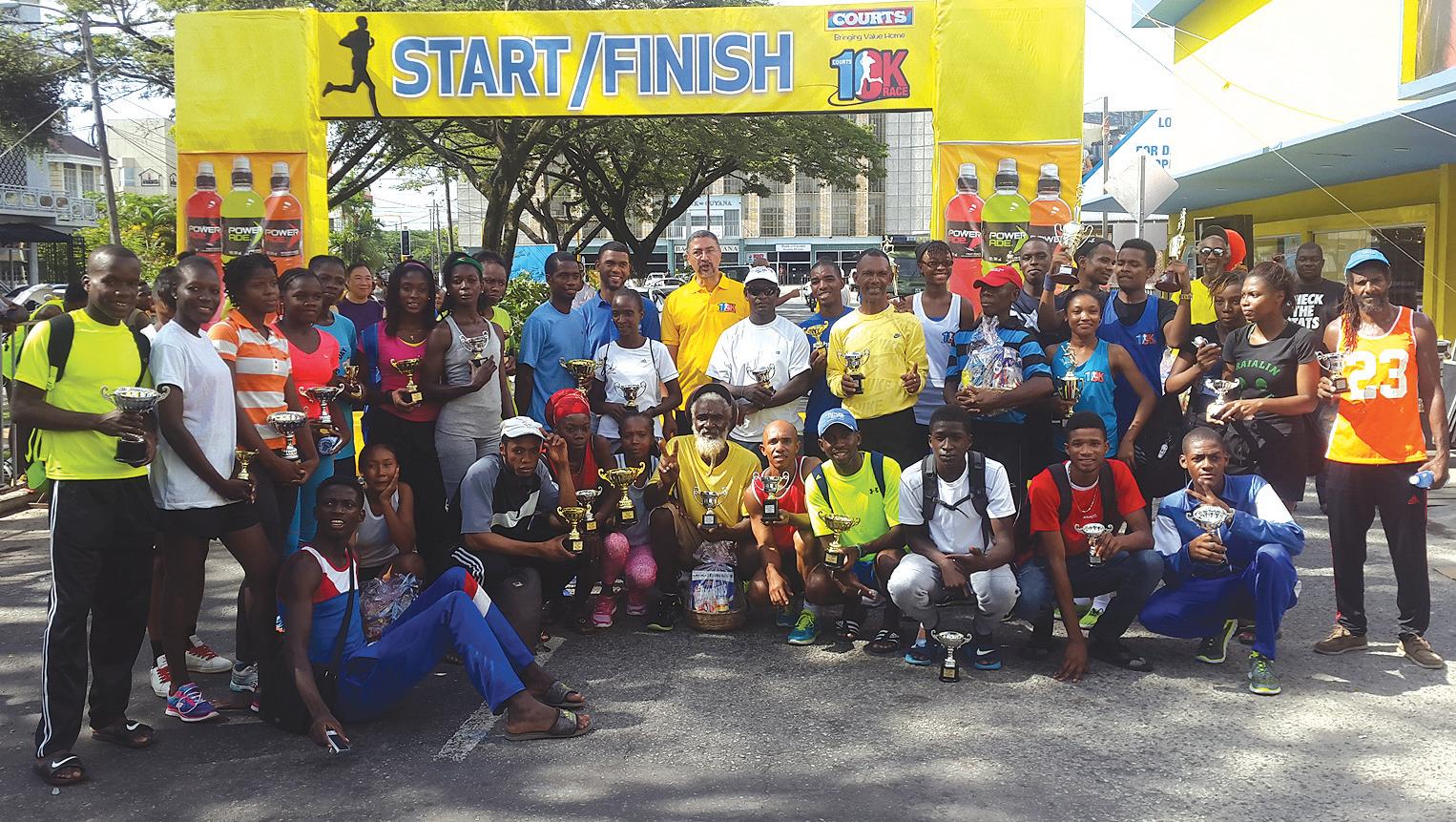
By TreisTon Joseph
An action packed day of swimming was the order of the day when the Guyana Amateur Swimming Association (GASA) in conjunction with the Ministry of Indigenous People Affairs and Digicel held the first ever Amerindian na tional swim meet on Sunday at the National Aquatic Centre.
Teyeal Campbell, Lucas Nelson and Teshanna Hunter, all of Region One starred at the event winning doubles.
For swimmers not consistently involved in the everyday activity of the sport, both showed poise and talent during their events.
Lucas who was a part of the boy’s 11-12 category won both the 25 and 50 me tres freestyle events in 16.17s and 35.96s respectively. Campbell in the 18 boy’s and over category dominated the same events as Lucas by winning the 25 metres event in 12.34s and the 50 metres event in 29.40s. Hunter, seemed a natural in the water winning the girl’s 13-14 25 metres free style in 16.34s while winning the 50 metres freestyle in 36.65s.

Natoya Percy was the star of the 18 and over female category, swimming for Region Seven and winning both the 25 and 50 me tres events in 15.66s and 35.59s respectively.
Sponsorship Executive of Digicel, Louanna Abrams highlighted Digicel’s pleasure contributing to the success of the event.
“Well Digicel is pleased onboard with this event, it’s the firs tof its kind with both the swimming and archery to commemorate Amerindian Heritage Month and we at Digicel will continue to be commit ted to this event as well as making it bigger and bet ter each year,” Abrams noted. (Josepht@guyanatimesgy.com)