





Re-elected Brazilian President Dilma Rousseff (left) waves next to former Brazilian President Luiz Inacio Lula Da Silva, following her win, in Brasilia on Sunday
mondAY, october 27, 2014 | guYAnAtimesgY.com

mondAY, october 27, 2014 | guYAnAtimesgY.com
By Jomo Paul
While the Private Sector and the two major phone companies, Guyana Telephone and Telegraph Company (GT&T) and Digicel Guyana have repeatedly stated the need for the speedy passage of the Telecoms Bills, the Government is afraid it may not be passed in this 10th Parliament.
This is as a result of the current No-Confidence Motion against the Government. If the motion is debated and passed ahead of the Telecoms Bill, the Bill will have to be re-tabled in the 11th Parliament. This will further delay Guyana’s advancement into the technological age.
The Alliance For Change (AFC), the party that tabled the motion, is
pushing for it to be the first thing debated upon the resumption of Parliament; this effectively places not only the Telecoms Bill, but the Customs Amendment Bill and the education reform bill on the back burner.
Further, several services that are to become available from local service providers on the passage of the Bill will have to wait until it is retabled, debated and passed in the 11th Parliament which can take a long period of time.
The Telecommunications Bill was tabled along with the Public Utilities Commission (Amendment) Bill on August 9, 2013. Since the first reading of the two Bills, the second reading has been deferred several times, as the Government continues to hold discussions with the two telecommunications
companies. GT&T currently has the monopoly on landline and international services. Digicel has to pay GT&T for its mobile services bandwidth, which is provided through the local company.
The Telecommunications Bill seeks to provide the establishment of a tel-
ecommunications agency and a regular, coordinated, open and competitive telecommunications sector and other related matters. Meanwhile, the other piece of legislation seeks to amend the PUC Act to facilitate the provisions of the Telecommunications Bill.

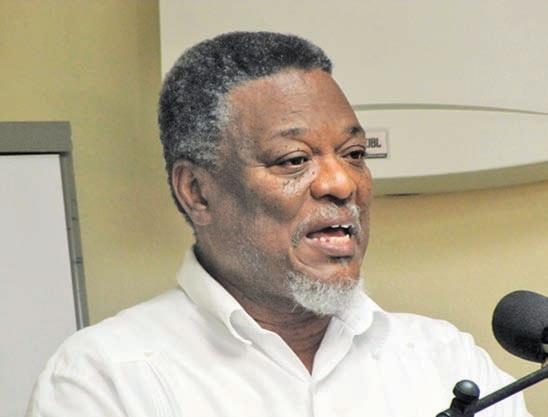
Speaking to Guyana Times in a recent interview, Prime Minister Samuel Hinds said that indeed it would be an immense disadvantage to the development of the country, if the Bill was not passed at this present time. He said: “It would be a great loss if we couldn’t conclude it (talks on the Bill) at this time.”
The Bill is currently before a Special Select Committee in the National Assembly where amendments are being made. Pointing to the way forward, Hinds said that if the Bill is not passed in the current Parliament, “we would have to get back to it when we have a new parliament”.
Former Private Sector Commission (PSC) Chairman and current President of the Caribbean Association of Industry and Commerce (CAIC), Ramesh Dookhoo, said Guyana was lagging in the Information and Communications Technology (ICT) sector and priority should be given to the passage of the Bill.
“I think we are way back when it comes to having a 4G [fourth generation] network. I think our politicians are vacillating too much on this issue. This is not about GT&T or Digicel; this is about the people of Guyana, the businesses of Guyana,” Dookhoo said.
Both GT&T and Digicel have said that they are awaiting the passage of the Bill to provide additional services, and Dookhoo said that this was testament to how urgently the Bill should be passed. “It will significantly improve the provision of services in several Private Sector and Government agencies…” Dookhoo added.
The CAIC President noted that accessing faster speeds on the information highway means “business processes improve: they become more efficient, they’re cheaper. As a result, the consumer benefits because the processes are cheaper”.
Digicel is eagerly awaiting the passage of the Telecoms Bill in the National Assembly, which will demonopolise telephone service in Guyana and pave the way for the company to provide the critical landline service. The company said it is watching with vivid interest the process with respect to the Telecoms Bills, since it will be taking expedited steps towards the provision of the service for the Guyanese locale.
Digicel’s Chief Executive Officer (CEO) Gregory Dean told Guyana Times in a recent interview that the company “has plans for major expansions but a lot of these are awaiting the liberalisation of the sector” and in a subsequent interview stating that the uncertainty surrounding the issue was a major cause of concern (see story on page 3). He pointed out that some of those services include the provision of wireline services and a host of other affiliated services. “We would like to introduce them tomorrow, but we don’t know whether the liberalisation will happen tomorrow.” When asked why Digicel would want to dive into the sector, knowing that its competitor has reported losses, Dean related that he believes the sector can be profitable, but shied away from an explanation, citing GT&T’s current application before the Public Utilities Commission.
“I wouldn’t want to speak for GT&T, the only thing I want to say, we want to be a full communications provider of all services to residential and commercial customers… we want to offer the full range of services to Guyana.” He related that the National Assembly should pass the Telecoms Bill, contending that the company does not “see the need for the long delay for the Bill… all the other territories we operate in already have it”.
Awoman was on Saturday evening struck down and killed by a speeding motor vehicle at Happy Acres, East Coast Demerara. The accident occurred around 23:40h.
The woman was identified as 58-year-old Joan Williams of Happy Acres.
Guyana Times was told that the woman was on her way home when she realised that she was being followed by a male. In an attempt
to escape the man, she ran across the road and into the path of an approaching vehicle.
She sustained injuries and was picked up and taken to the Georgetown Public Hospital where she was pronounced dead on arrival.
The woman was described as a good mother.
The driver of the motor vehicle was taken into Police custody to assist with the investigation.
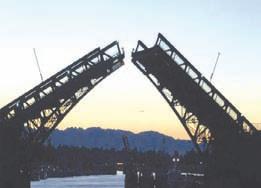
Demerara Harbour Bridge will be closed to vehicular traffic on Monday, October 27 from 05:00h-06:30h
The Berbice River Bridge will be closed to vehicular traffic on Monday, October 27 from 06:10h-07:40h

Weather: Thundery showers can be expected in the morning, with sunny weather otherwise prevailing. Partly cloudy skies are expected in the evening. Temperatures are expected to range between 25 degrees and 31 degrees Celsius.

Winds: East South-easterly to East Northeasterly between 4.02 and 4.47 metres per second.

High Tide: 06:22h and 18:33h reaching maximum heights of 2.63 metre and 2.71 metre respectively.

Low Tide: 12:08h reaching a minimum height of 0.63 metre.






BY SVETLANA MARSHALL
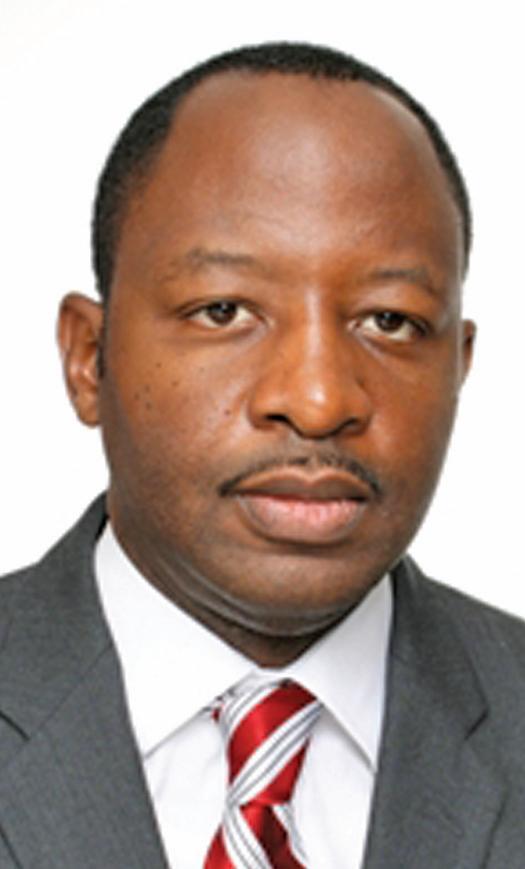
Digicel (Guyana) Chief Executive Officer (CEO) Gregory Dean said the uncertainties surrounding the National Assembly are “a major cause for concern”.
During an interview with Guyana Times on Friday, Dean said Digicel is “extremely worried” that the Telecommunications Bill 2012 might not be placed high on the agenda when the National Assembly holds its next sitting.
However, he said Digicel hopes that the long-awaited Bill would be given priority. Dean disclosed that Digicel last Friday in keeping with a deadline set out by the Parliamentary Special Select Committee considering the Bill, made additional submissions.
Though a date for the next sitting for the National Assembly has not been set, the CEO said he is pleased that the Select Committee is conducting its work.
Asked whether the delays in the passage of the Bill would affect the company rolling out new fibre-optic cable here, Dean said, “Well, uncertainty doesn’t help.”
However, he explained that Digicel is still in discussion with Government on the installation of another fibre-optic cable to improve the Information Communication Technology (ICT) Sector.
Earlier this year, Digicel Group announced that it received the required approvals from Government and regulatory authorities with regard to the purchase of a submarine fibre network across the Caribbean Region from the Guadeloupe-based Loret Group and Caribbean Fibre Holdings.
In November 2013, the Telecommunications Bill 2012, which was tabled by Prime Minister Samuel Hinds in the National Assembly, was committed to a Parliamentary Special Select Committee for review. However, 11 months later, the Bill which is responsible for the liberalisation of the telecommunications sector remains with the Committee.
In a prior interview with Guyana Times, Dean expressed dissatisfaction over the fact that two years af-
ter the Telecommunications Bill would have been laid in the National Assembly, it is yet to be debated and passed.
“We are very disappointed and frustrated,” he said, as he underscored the importance of liberalisation.
According to him, Guyana continues to lag behind even as the rest of the Caribbean and the world at large continue to advance in the world of technology and telecommunications.
“Guyana is the only country in the English-speaking Caribbean that does not have a 3G or faster mobile phone service,” Dean said as he painted a picture of the country’s state of affairs in relation to mobile services.
3G – the 3rd Generation refers to a networking stand in cellphone technology that is capable of providing high-speed data service to mobile devices.
Behind
But while Guyana is still in the in the 2nd Generation (2G), other nations have advanced to 4G networks. Breaking the telecommunications monopoly in Guyana would allow Digicel to bring Guyanese up to speed with the rest of the world, Dean said.
“In terms of Internet penetration rates, you know we are hovering somewhere way below the 10 per cent mark… when you look at surveys and benchmarks showing Guyana against the Caribbean and even Latin American countries, you can see that in terms of access to broadband services, we have very low penetration and we come very low in those benchmarks. In terms of speed of service, we are very low,” he further explained.
According to the Digicel CEO, broadband should no longer be seen as a luxury but a necessity. As the international company eyes the possibility of liberalisation in the near future, Dean has plans to expand its services to meet the needs of the Guyanese people.
“Definitely, we would want to run our own fibre in Guyana, we are looking to expand into the landline and Internet zone, business solution services. We want to be a full communications player; we are not interested in just being a mobile phone provider,” Dean further explained.
He said the local staff of Digicel stands ready to be trained in the new and emerging areas that could bring Guyanese on par with the rest of the world. As Digicel expands operations, Dean said additional staff would be a prerequisite.
The Bill has been crafted to allow for an open and competitive telecommunications sector, thereby breaking the monopoly currently being held by the Guyana Telephone and Telegraph Company (GT&T).
This means that additional telecommunication companies would be licensed and regularised.
However, days before the National Assembly went into recess in July, the Prime Minister, though expressing optimism that the Bill will be passed before the end of the year, explained that there are at least five more meetings which must be held before the Bill leaves the Committee.
He confirmed that Digicel Guyana and GT&T had appeared before the Committee, submitting various proposals and recommendations, but explained the documents have to be scrutinised by the Committee members. (svetlanam@guyanatimesgy. com)



Editor: Nigel Williams
Tel: 225-5128, 231-0397, 226-9921, 226-2102, 223-7230 or 223-7231. Fax: 225-5134
Mailing address: 238 Camp & Quamina Streets, Georgetown
Email: news@guyanatimesgy.com, sales@guyanatimesgy.com
Ali Al'Amin Mazrui passed away on October 12, in Binghamton, New York and in accordance with his wishes, his body was returned to his native Kenya and interred in the family cemetery.
It is unfortunate that the death of this world-famous intellectual, Islamic scholar and Pan Africanist could have been so unremarked here. Especially when a Commission of Inquiry is investigating the murder of Walter Rodney, with whom Mazrui is always remembered.
Born in 1933 in a prominent Muslim family in Mombassa, Mazrui was a full decade older than Rodney, but also subjected to the pressures of a British colonial environment. Like the father of Barack Obama, Mazrui was of that generation that was identified and assisted with their education in the expectation that they would be fifth columnists for colonial interests when they returned to their native land.
Mazrui was sent off to the University of Manchester in England for his Bachelor’s (1960); Columbia University in New York, for a Master’s (1961); and Oxford University for a PhD (1966).
Rodney completed his PhD the same year, from the School of African and Oriental Studies, but there is no indication that their paths crossed in England. Part of the reason was that at this time they not only held completely different ideological beliefs, but their perspectives were as a consequence completely disparate on the nature of the anti-colonial struggle.
Returning to Africa to teach at Uganda's Makerere University in 1966, Mazrui articulated the classic liberal perspective on the "progressive" role of capitalism and capital for development in addition to an emphasis of individual political rights, etc. He criticised leaders such as Nkrumah and Nyerere. Mazrui was famously articulate and regarded as the best debater in East Africa.
In 1970, Walter Rodney, who was teaching in Tanzania, challenged the Liberal from a Marxist perspective. As told by John Otim, the Editor of Nile Journal:
"Those who followed his (Mazrui's) career and knew him well remember that the only occasion he ever lost his cool was at a debate with Walter Rodney, the famous author of How Europe Underdeveloped Africa
“On that occasion, Rodney refused to swallow Mazrui's customary bait, which was to lure his interlocutor into a frontal engagement with him before an audience he had already softened through the magic of his oratory. That time, however, Rodney side-stepped the bait. In the process, he skilfully implied that, concerning the colonial issue which was the topic of their debate, Mazrui was at best a daydreamer and at worst, a collaborator.
“There was no commonality of interests between the coloniser and the colonised, Rodney said. Mazrui who prided himself on his African and nationalist credentials was suddenly stung. Worst of all, it was before his home audience at Makerere University."
But it is a mark of the intellectual integrity of Mazrui that when he was forced to leave Uganda in 1973 after he criticised Idi Amin for his dictatorial policies that drove out Asians, he wrote against the Burnhamite dictatorship in Guyana denying Rodney a job in 1974.
By that time Mazrui was teaching at the University of Michigan, where he remained until 1989, before moving on to the University of Binghamton, where he died. In the US, he staunchly defended the need for Pan Africanism and offended many when he also defended the cause of the Palestinians. On the other hand, he defended a greater role for women in Islam.
He condemned the murder of Rodney in 1980, and when he was invited to Guyana on the 150th anniversary of the abolition of slavery in 1988, he publicly asked Hoyte for Rodney's seminal role to be acknowledged.
In 1998, he was appointed by Dr Jagan to the First Walter Rodney Chair of History at UG. In 2005, he travelled to Guyana to participate in the 25th anniversary of the assassination of Walter Rodney.

Dear Editor, Climate
Leucaena leucocephala is a tropical plant with a pan-tropical presence. The claim that it requires a dry climate is simply erroneous.
There have been specific studies done on this species in Guyana. As recently as 2002, two studies were done on Leucaena as a potential source of plant nutrients in the Intermediate Savannahs of Guyana, and this report was published by the Caribbean Agricultural Research and Development Institute, CARDI (Leslie A Simpson and Claudius V Wikham).
They are “The Performance of Leucaena and Glyricidia and their potential as sources of plant nutrients in the Intermediate Savannahs of Guyana, in Review: a compilation of CARDI research papers”, 2nd Edition, August 2002, and Leslie A Simpson and Claudius V Wikham, “The Performance of cowpea, maize and sorghum in an alley cropping trial with Leucaena and Glyricidia in the Intermediate Savannahs of Guyana, in Review: a compilation of CARDI research papers”, 2nd Edition, August 2002).
Although in these trials Glyricidia grew more prolifically than Leucaena, there were no problems encountered in growing Leucaena.
Furthermore, Leucaena was also specifically recommended for agroforestry in Guyana in a study published by
the Inter-American Institute for Cooperation on Agriculture, IICA (Thorwald Geuze and Pauline van den Ende, Agroforestry in Guyana: Guidelines for Establishment and Management of Agroforestry Practices, Inter-American Institute for Cooperation on Agriculture, 1996).
Leucaena has been specifically recommended for the tropics; for example, a joint report in 1977 by the Philippine Council for Agricultural and Resource Research and the United States National Academy of Science, titled, “Leucaena: Promising Forage and Tree Crop for the Tropics”, heralded significant cultivation of Leucaena in tropical countries, including India where Leucaena is commonly called “Subabool”.
Indeed, from our studies, we expect that Leucaena grown in the Pomeroon will provide a fuel wood yield of 30 MT/acre, which is why we required a minimum of 5000 acres of land, because we require 90,000 MT/annum of dry wood to supply our proposed 200 TPD pellet plant.
Additionally, Leucaena is already present in many regions of Guyana, and is also specifically growing prolifically in this tropical climate in acidic peaty soils. Indeed, because of its proliferation in the wild in Guyana, the wild type species of this plant is listed as a potential invasive species in the Guyana Fourth Report to the Convention on Biological Diversity
(www.cbd.int).
Invasive potential Leucaena in the wild poses a threat to biodiversity, as it proliferates, particularly in tropical climates. In Guyana, the wild species is present and is not controlled and can be found in a diversity of areas and a diversity of soils.
However, the cultivated species are used in many countries around the world, and worldwide Standard Operating Procedures have been developed for the safe, nonproliferating cultivation of certain sub-species of Leucaena, which we shall be using.
For example, an exhaustive report done by the Ministry of Natural Resources and Mines of the Queensland Government of Australia (CS Walton, “Leucaena Leucocephala in Queensland, in the Pest Review Series – Land Protection”, published by the Department of Natural Resources and Mines, Queensland, February 2003), clearly establishes the best practices and degree of manageable risk associated with the cultivation of this species.
Another website which provides guidelines on the safe and non-proliferating cultivation of Leucaena is www.daff.qld.gov.au.
Leucaena seeds through a pod. The pod dehisces and releases a much heavier than air seed immediately below itself. Because the seed is not dispersible by air, it does not travel very far and thus does not
proliferate to even small distances.
This is why wherever there is a Leucaena plant, it is always present in bunches. One plant is originally grown and a bunch develops later around the original plant.
This is why controlled cultivation is possible and safely practised in so many countries in the world. One can physically ensure that the plant does not go beyond the defined boundaries of the farm. Our proposed plantation shall go through all required permits and regulatory processes required by the Guyanese Government, before cultivation is started.
We wish to lastly comment on our collaboration with the Institute of Applied Science and Technology (IAST). Firstly, the IAST is not, as far as we are aware, an institute expert in agriculture, or cultivation of energy forests, and we did not seek them out for such expertise.
We were introduced to the IAST through our enquiries with GO-Invest and the Ministry of Tourism, Industry and Commerce. We approached GOInvest to specifically invest in the growing of Leucaena leucocephala or any other suitable energy crop, for the specific purpose of producing energy pellets for export to Europe. Our MoU with the GO-Invest was completed before we were introduced to the IAST.
continue on page 5
Dear Editor,
Vladimir Putin has lashed out at the United States for destabilising the world order of checks and balances for its own gains. He also accused the West of inflaming the situation in Ukraine and said Russia was not interested in building an empire.
The Russian President delivered a fierce broadside aimed at the United States at a speech for the Valdai Club in Sochi, which is an informal group of scholars. He hit out at Washington for behaving without regard to the rest of the world’s interests.
“The system of international relations needed some changes, but the USA, who believe they were the winners of the Cold War, have not seen the need for this.” He added that the US has been trying to create the world “for their own gains”. The Russian President added that because of this, regional and global security had been weakened.
Putin also touched on the issue of the growth of Islamic State in Syria and Iraq, while also accusing the West of “turning a blind eye,” to the encroachment of international terrorism into Russia and Central Asia.
Putin believes the US has played a considerable role in sponsoring the growth of Islamic extremism, using the example of Washington’s funding of the Mujaheddin in the Afghan-Soviet war in the 1980s, which eventually gave birth to the Taliban and Al-Qaeda.
“It never ceases to amaze me how our partners have been guilty of making the same mistakes time and again. They have in the past sponsored Islamic extremists who were battling against the Soviet Union, which took place in
Afghanistan. It was because of this the Taliban and Al Qaeda was created,” the President added.
Islamic State (IS, formerly ISIS) is the latest terrorist organisation, which is destabilising the world and Putin was scathing of countries that have been helping to fund the Islamist militants by buying the cut-price oil they are selling.
“Terrorists have been selling oil at really low prices and those countries who have been buying it and then selling it on, are financing terrorism, which will eventually come back to bite them,” the Russian President said.
Relations between Russia and the US have been plummeting for months. Putin also accused the US of using the EU to further their own gains against Russia. He hit out at the numerous sanctions that had been imposed on Moscow, saying, “This was a mistake, which has a knock-on effect on everyone.”
“The USA, which has implemented sanctions against Russia, is cutting down the branches, upon which they are sitting,” President Putin added.
The reduction of nuclear arsenals was another issue, which was high on the agenda for the Russian President and once again, he was not afraid of having a dig at Washington for their reluctance to cut the number of nuclear missiles. He mentioned that unfortunately many countries see the only way to preserve their sovereignty is, “To make a nuclear bomb.”
The reduction in nuclear arsenals was initially proposed by the Obama Administration and Putin admitted it had potential, before talks about decreasing weapons stockpiles collapsed.
“Russia has been all for the continuation of talks about the reduction of nuclear arsenals,” and according to President Putin, “Moscow is ready for serious talks, but without “double standards”.
Perhaps Putin’s harshest criticism was reserved for the West’s creation of colour revolutions and “controlled chaos,” which he likened to “letting the genie out of the bottle”, with particular reference to Ukraine.
“We have been trying to discuss the Ukraine issue with the EU for a long time, but we were told this was none of other business. They then put two countries against each other, which has led to countless destruction of infrastructure. When I asked ‘why did they do this?’ they just shrug their shoulders and don’t have an answer,” Putin added.
The Russian President said that there is no truth whatsoever in claims from the West that Russia is interested in Empire building and that Moscow is looking to destabilise the world order. With relations between Russia and the West at a very low ebb, Putin also hinted Russia will look to develop allies further afield.
“Russia has made its choice – we want to develop our economy and develop democratic values. We work with our counterparts in the Shanghai Cooperation, the BRICS union for example. We want our opinions to be respected likewise. We all need to be cautious to not make hasty and dangerous steps. Some of the players on the global front have forgotten about the need for this,” he said in another barb directed at Washington.
Submitted by, Denis Kopyl Press Attaché Russian Embassy
The Director of IAST, Professor Suresh Narine, provided convincing arguments to Pinnacle’s principals Manish Gupta, Manu Bansal, and Rajneesh Mehra on the merits of Pinnacle additionally investing in facilities to produce activated carbon from waste coconut shells and for the production of 8 megawatts per hour MW/h of electricity from waste biomass already present in Guyana.
We were not only impressed by Professor Narine’s cogent arguments, but were immensely impressed by the technologies developed in these and other areas by the Institute.
We were also impressed by the state-of-the-art laboratories, pilot facilities, and the competence of the
IAST’s staff.
As a foreign company which was convinced by a local institute to invest an additional US$18.5 million, beyond the US$16.5 million we already had earmarked for investment, I can assure your readership that we performed careful due diligence.
Furthermore, we feel that our access to the IAST’s knowhow, expertise and developed technology warranted providing the Institute with a five per cent stake in the paid up equity of our entire investment portfolio in Guyana and a prominent place on our Board of Directors.
We operate in many countries around the world, and wish to express our admiration for the unusual level of pro-
Dear Editor, While Diwali celebration may be over in Guyana, in the US, the celebrations continued over the weekend with a Diwali Yatra and cultural variety concert in West Palm Beach held by organisers of Guyanese descent on Saturday.
In Washington, Secretary of State John Kerry celebrated Diwali with the Indian American community on October 23 at the US State Department for the first time. “Diwali is a time for the revitalisation of mind and spirit,” said Kerry.
He added: “It affords a chance to reflect on how we can bring light to others. It is an opportunity for us all, regardless of our own traditions, to renew a shared commitment to human dignity, compassion, and service — and it is a commitment, I think, at the heart of all great faiths.”
A report said Kerry was joined by Indian Ambassador S Jaishankar who stated: “As the days grow shorter, Diwali reminds us that spring always returns — that knowledge triumphs over ignorance, hope outlasts despair, and light replaces darkness.
Some 300 guests, including a large number of eminent Indian Americans and envoys from other South Asian countries, were present to celebrate Diwali for the first time at the State Department’s historic Benjamin Franklin room, which was lit with many small diyas and candles.
The report stated top Indian American officials
working for President Barack Obama, including Assistant Secretary of State for South and Central Asia Nisha Desai Biswal and USAID Administrator Raj Shah, attended the function. Kerry greeted guests with, “Saal Mubarak.”
Kerry told the gathering: “We worked hard to prove that we were, in fact, natural partners, which I believe we are. We are two optimistic nations who believe that history doesn’t shape us, but that we have the power to shape history. And that spirit of hope and optimism is really at the centre of the Diwali celebration.”
The report noted that Diwali was the only major world festival that had been missing from the State Department’s celebration of festivals.
“I want to thank all of you for joining us at the State Department’s first-ever Diwali celebration. I guarantee you it will not be our last,” Kerry said amid applause.
President Obama had also greeted the community with a ‘Happy Diwali’ to all those who were celebrating the Festival of Lights. Priest Narayanachar L Digalakote from the Sri Siva Vishnu Temple in a Washington, DC suburb in Maryland presided over the ceremonial lighting and presented Kerry with a traditional shawl.
The guests were served with the traditional Indian dishes — including sweet dishes like jalebi, gulab jamun, different varieties of burfi, kaju katli and kheer.
Some of the dishes were in fact made inside the State Department kitchen, while other dishes were procured from a popular Indian restaurant in Washington, DC. It was also one of the rarest occasions that no alcohol was served. It was all soft drinks, juices and, of course, the traditional mango ‘lassi’. Kerry praised the Indian American community. He said: “The South Asian diaspora is a pillar of every aspect of American society. South Asians sit in the executive suites of some of the country’s most successful companies, or at the very helm of all of them.
“They launch startups and earn graduate degrees at several times the national average. They are a driving force behind American leadership and science and innovation and in the history of our nation – and we are a nation of immigrants – it is hard to find any group of Americans who have achieved more in such a relatively short period of time."
Supermodel Naomi Campbell also observed Diwali by sporting a lovely sari at a handbag launch on Friday. She wished her friends and fans a happy Diwali. She tweeted: "Happy Diwali wishing you an amazing New Year on this special moon." She surprised reporters and fans when she donned the black lace sari with a red border.
Yours truly, Vishnu Bisram
fessionalism, competence and cutting-edge science that we witnessed at the IAST. It is an institution of which Guyanese should be proud.
In closing, we would like to thank Dr Janette Bulkan for raising questions about our proposed investments, and would like to extend to her and any other concerned Guyanese, our collaboration in answering your questions.
Copies of all of our agreements with the Guyanese Government can be procured by simply requesting same, to mbansal@pinnaclegreen.sg.
Yours sincerely, Manu Bansal, Executive Director Pinnacle Green Resources (Guyana) Inc

In 1959, the French microbiologist René Dubos gazed into his crystal ball and found reasons to be concerned. In his lifetime Dubos had witnessed the steady decline of diseases such as diphtheria, tuberculosis and polio, but rather than giving him confidence these medical successes filled him with foreboding. Though vaccines and therapeutic drugs had neutralised many of the threats of the past, he warned that humans could not escape the microbes that transmitted infectious diseases, because they were part of the environment and our ecology.
Complete freedom from infectious disease was a mirage, he warned. “At some unpredictable time and in some unforeseeable manner, nature will strike back.”
The Ebola outbreak is arguably just such a riposte, shattering Western dreams of medical utopias. While the reservoir (the long-term host) of the virus has yet to be identified (fruit bats and apes are the leading contenders) there is little doubt that Ebola is the greatest threat to the world’s health and security since HIV/Aids or that the fault lies with man and his insatiable demand for the world’s natural resources – a demand that puts an intolerable strain on ecosystems and the parasites that inhabit them.
No one knows for certain where or when the decisive “spill- over” event occurred – one theory is that “patient zero” was a two-year-old boy from Guéckédou in south-
eastern Guinea who contracted Ebola from contaminated bush meat in December; another, is that Ebola is continuously emerging and that there were several simultaneous spill-overs. Whatever the case, however, the situation in West Africa is dire and getting worse by the hour – a humanitarian disaster, according to Oxfam – which is why infectious-disease experts are increasingly looking to a vaccine as our next best hope.
Vaccine critical “A vaccine is critical be-
cause the truth is we just don’t know what is going to happen,” says Jeremy Farrar, the Director of the Wellcome Trust and a veteran of several epidemic scares, including the 2003 Sars outbreak and the wave of bird flu that swept south-east Asia in 2005. “I’m very much hoping that we will be able to bring this epidemic under control using classic public health containment measures, but if those measures fail, then we need an alternative strategy.”
That strategy is now the responsibility of research-
ers at laboratories in Russia, Britain, Canada, the US and Mali, where scientists are in a race to develop vaccines that could be shipped to West Africa as early as December, with more doses to follow next year if trials demonstrate that they are safe and effective. The frontrunner is a vaccine known as ChAd3, developed jointly by the biowarfare arm of the US National Institute of Allergy and Infectious Diseases (NIAID) and Okairos, a Swiss-Italian biotechnology company that is now part of the pharmaceu-
tical firm GlaxoSmithKline.
Trials of different versions of the ChAd3 vaccine are under way at the Jenner Institute in Oxford, the National Institutes of Health (NIH) clinical centre in Bethesda, Maryland, and the centre for vaccine development in Mali.
About 140 volunteers are being enrolled across the three trial sites between now and the end of the year.
Meanwhile, China’s Academy of Military Medical Sciences has donated several thousand doses of an experimental drug, JK-05, for



emergency use by Chinese aid workers in west Africa, while Peter Horby, a tropical disease specialist from Oxford, is in the process of testing several other promising drug candidates, including ZMapp, the drug used to successfully treat two American missionaries and the British nurse Will Pooley, at clinics in Liberia operated by Médecins Sans Frontières (MSF).
Spiralling out of control
Whether these efforts will bear fruit quickly enough to halt the tide of human infections depends on two factors: how quickly the world can ramp up its response to the epidemic and what the virus decides to do next. While the first is in our hands, the second is not. Ebola, like all viruses, is constantly mutating and could theoretically become even more virulent or, conversely, evolve so as to become less virulent and more widely infective. It is this second scenario that keeps disease experts awake at night.
“This virus is now in thousands of individuals and every time that happens it gives a virus the ability to change and adapt to human beings,” says Farrar. “Then you don’t know where the virus is going to go but you run the risk that it will become a natural endemic human infection.”
In other words, Ebola could become more like HIV, a virus that, because it does not provoke obvious symptoms, at least in the early stages of infection, to date has succeeded in infecting 75 million people worldwide.
The problem is that what began as a highly containable outbreak in Guinea last December has now changed into a conflagration that is threatening to spill over from Liberia and Sierra Leone, the two worst affected countries, to Ivory Coast and GuineaBissau, with Mali confirming its first case last week (though, thankfully, both Senegal and Nigeria recently have been declared free of infection). Meanwhile, as the isolation of in New York last week of a MSF doctor who had recently returned from Guinea shows, there is an ongoing risk of health workers introducing Ebola to countries outside Africa.
And the longer Ebola is allowed to burn in Africa, the greater the chances that it will set off bush fires in other parts of the world. But as the World Health Organisation charts the epidemic’s relentless upward curve (10,000 cases a week by the end of October is the current prediction; cumulatively, perhaps as many as 1.4 million cases by January) and stories emerge of elementary errors by hospitals and health authorities that should know better, many experts are beginning to worry that the worst could happen. (Excerpt from the Guardian)
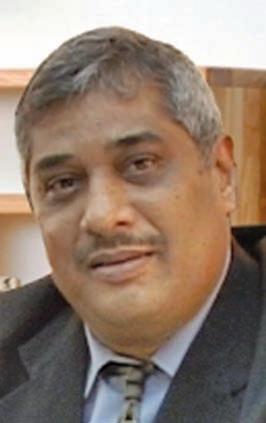
Guyana Revenue Authority (GRA) Commissioner General Khurshid Sattaur believes that Kaieteur News Publisher Glenn Lall is allegedly into phone-tapping. He also clarified misinformation in that newspaper on his importation of a vehicle.
Lall has been constantly attacking Sattaur ever since information was unveiled about him (Lall) allegedly defrauding the State of millions of dollars by illegal importing two luxury vehicles under the remigrant scheme.
Speaking to Guyana Times on Sunday, the GRA head said his lawyer received a call on Sunday from a very close contact of Lall who had also been caught up in the remigrant scam.
Sattaur said the contact informed his lawyer that Lall has a recording of a conversation he (Sattaur) had with another individual.
Sattaur said while the time given when the conversation took place was not accurate, the individual he spoke to was correct.
Sattaur only recently had also accused Lall of hacking into GRA’s email accounts. He believes based upon the revelation that a recording of his conversation was in the possession of Lall; it is an indication that the newspaper
publisher is involved in extreme measures to get at him.
Back in 2002, the Guyana Defence Force (GDF) had seized a very sophisticated piece of equipment from convicted drug trafficker Shaheed Roger Khan, which was used to tap into mobile phones. A GDF patrol had seized one piece of equipment, but it appeared that there had been more than one because another almost identical device was tendered in a New York court during Khan’s trial.
Additionally, another businessman (name withheld by request) also told Guyana Times that Lall is allegedly in the habit of tapping the cellphone calls of his staff members and of persons whom they are in contact with.
He revealed that he re-
cently had a conversation with a senior official in Government surrounding legitimate business queries, only to be told a few hours after of Lall, having a recording of the conversation. In another matter, a staff member in the newsroom of Kaieteur News was reportedly called by Lall minutes after he had a conversation on the cellphone with a Government official and was fiercely reprimanded. It has been surmised that Lall taps into these cellphone calls in order to obtain private and confidential information.
It has been surmised that Lall taps into these cell phone calls in order to obtain private and confidential information, as well as for snitching – which he is no stranger to – on businessmen, some of them being his friends.
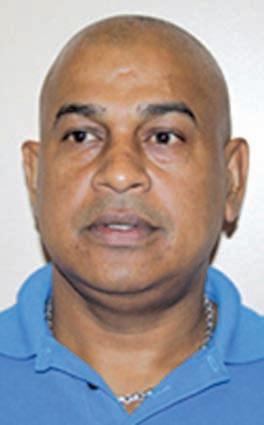
Vehicle import Meanwhile, in responding to an article in the Kaieteur News on Sunday under the headline “GRA boss imports Prado for $1.5M”, Sattaur said the story contains obvious and grave misunderstanding.
“I yield willingly to this opportunity as I feel that while ignorance of the law is not an excuse to commit an offence in the law, a certain amount of education on those laws that affect us in our day to day life can avoid us being haunted by our mistakes.”
In the article, Kaieteur News mentioned the tax details of what Attorney General Anil Nandlall and Member of Parliament (MP) Kwame Gilbert paid on a similar vehicle to the one imported by Sattaur but with higher tax value. However, Sattaur clarified that taxes on imports are applied on the basis of the Cost, Insurance and Freight (CIF) value. He said the Customs value is determined by the acquisition cost and not what a comparison would look like with similar vehicles months after. According to him, as such, the value of a vehicle acquired new from a show room differs significantly in value from a vehicle that is used and has a significant amount of miles on the odometer and even considerable less if ac-
quired from a salvage firm with considerable damages.
“Unfortunately, my vehicle belongs to the latter category as I had done the honourable thing of buying a used salvaged vehicle at an auction at an amount I can afford. I have not chosen to hide any income and later through money laundering such income to disguise the fact that the purchase belongs to someone else and in the process commit criminal offenses.”
Sattaur said it is not ideal to purchase a salvage vehicle with extensive damage since serious mechanical and other problems develop from time to time and requires further investment in repairs and maintenance. However, as a public servant “with a family to maintain, I could not afford a new vehicle as many others could and was compelled to purchase a damaged vehicle”.
The GRA head said his vehicle cannot be compared with a show room vehicle acquired by the Honorable MP and Attorney General.
“When compared with those that were recently detained by the GRA belonging to the Brijnanans (Lexus LX 570 over 5000 cc), it is more than 12 times less expensive,” he said.
According to him, the public must be getting very “exhausted having to endure all of this nonsense. Mr Lall, whether out of ig-
norance or some unfathomable reason has been very liberal in using his newspaper to attack the character of the Commissioner General. Of course, I welcome the opportunity he is giving me once again to demonstrate that these stories are baseless and libelous. These statements are designed to implicate me in conduct similar to Lall. I am forced to reject any such insinuation or comparison.”
Explaining what he described as the “Economic reason for purchasing a salvage vehicle”, Sattaur pointed out that: Suppose A spent $7 million on a show room vehicle and paid taxes at 30 per cent, in total; A would have paid $9.1 million.
Suppose the same vehicle was acquired by B at an auction for $1.5 million, but it was in need of major repairs. The taxes when B brought it into the country are the same 30 per cent or $450,000, instead of $2.1 million. At this point of removing the vehicle at the Customs, B would have paid $1,950,000. However, B spent a further $4 million to bring the vehicle into good repair. As such, the total cost to B is now $5,950,000. A comparison between A and B vehicles shows a difference or savings of $3.15 million. He said that is exactly what he did in the purchase of his vehicle.

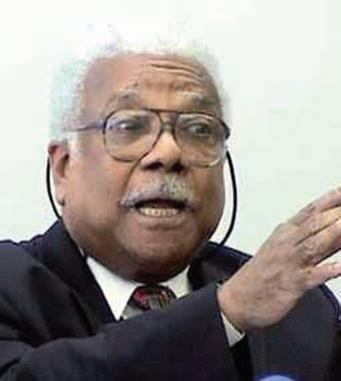
The People’s Progressive Party /Civic (PPP/C) is mourning the death of Professor Ali Mazrui, who was known throughout the world for his scholarship and progressive writings.
He died on October 12at age 81 and was at the time a faculty member at Binghamton University, New York.
Mazrui was a Kenyaborn political scientist and one of Africa's leading academics and writers, having published over 30 books.
He graduated in 1960 from the University of Manchester, England and received a Masters Degree from Columbia University, New York a year later. He later completed a PhD at Oxford.
After teaching in Uganda for 10 years, he publicly clashed with the country's Dictator Idi Amin and was forced to leave the country. He went to the United States where he continued his teaching and research work.
Throughout his career, he was critical of the dictatorial tendencies of African leaders.
Among his several works was his book on "Towards a Pax Africana" in which he built a case for African empowerment free of the influence of the continent's colonial past.
Apart from his numerous books and publications, Professor Mazrui delivered lectures at several universities, including the University of Guyana.


ne phenomenon that's unremarked in Guyana is "self-fulfilling prophesies" (SFPs) by the Opposition. In an SFP, a person or group describes a situation in a way that is quite untrue...but the statement is followed by actions ensuring that the original description comes into being.
As the scholar who popularised the term said, "This specious validity of the self-fulfilling prophecy perpetuates a reign of error. For the prophet will cite the actual course of events as proof that he was right from the very beginning."
Let's look at what the Opposition's been saying about Guyana. From the time the PNC were thrown out of their illegal occupation of office, they insisted Guyana wouldn't develop under the PPP/C. And everything they've done since is to make that prophesy come true.
First, there was the incitement of "ethnic cleansing" by Hoyte when the new Government removed some of the "square pegs in round holes" from the Government. Tempers frayed as the political temperature rose. Hoyte came up with his "shoot to kill directive" on some land issue. The Government was transfixed with "outing" PNC fires and it was only due to superhuman efforts by the Administration that the economy grew.
After the PNC's violent street protests following the 1997 elections, what the SN called "Terror in the City" unfolded as ethnic violence, and was brutally inflicted on presumptive "supporters" of the PPP/C. The Government had to truncate its term of office by two years even though no electoral impropriety had been found. This was development delayed.
A wave of robberies and kidnappings by the notorious "Blackie" London gang then terrorised sections of the country, but Hoyte draped a flag of Guyana over his coffin at the Square of the Revolution.
It should surprise no one that after Hoyte unleashed his "slow fyaah, mo' fyaah" strategy of violent attacks against the Government, “Blackie” London's lieutenant Andrew Douglas continued with the "Buxton Insurrection".
Another six years of marking time ensued as the PPP/C – under a new leader Bharrat Jagdeo – continued to struggle heroically to stave off the waves of attacks by the bandits, while trying to continue with their development programme for Guyana. But the success of the Jagdeo Administration in both areas didn't stop the PNC from pushing their self-fulfilling prophecy for stymieing Guyana's development.
Under Granger, they've merely changed the approach. Now it's more subtle: economic sabotage like derailing the Amaila Falls Hydro, raising political risk factors to Bosai in Linden, blocking the AML/CFT Bill, etc.
As Burnham taught his acolytes, there are many ways to kill a cat.
But, of course, not everything happens as "selffulfilling prophesies". There are those situations where folks will jump up and down and deny something's going to happen, but then, lo and behold, it does!!
Not being Marxist or anything like that, this Eyewitness doesn't know about "dialectics" acting out, but there's always the inexorable logic of some situations that lead to inevitable conclusions.
Just take a look at the AFC. We know with all that's going on in that House of Sleaze, you'd want to avert your gaze...but bear with us. As even their new comrade David Hinds pointed out, the AFC began by promising to remain untethered to either of the two big parties – the PPP/C and PNC. They'd support or oppose both of them depending on their stand on specific issues.
But the moment the AFC declared war on the PPP/C –it was only a matter of time they'd be in bed with the PNC. We hear there's a coalition/marriage in the works –with Nagamootoo as the PM/bride.
The marriage kiss will be the "kiss of death" for the AFC!
Harmon says reconvening Parliament's not on the table in the Ramotar-Granger talks. So exactly how are the two heavyweights able to ignore this elephant in the room??
Afamily of six is now counting their losses while making alternative living arrangement after a fire gutted their two-storey dwelling place on Diwali Night at Coverden, East Bank Demerara (EBD).
The concrete and wooden structure located at Lot 7 Public Road, Coverden, went up in flames about 21:45h, giving family members no time to salvage their personal belongings.
According to information received, the fire started at the altar where a diya was lit in observance of Diwali. Within a few minutes, the entire upper flat of the four bedroom house was engulfed, despite desperate measures by the owners to put out the blaze.
By the time the fire tender arrived from Timehri, EBD, the house was already gutted and the family out of danger. Kedar Nauth, the owner of the house, who is still devastated by the unfortunate incident, could not have estimated his losses, but said they amount to millions of dollars.
He recalled on the night of the fire that he and his family were conversing with his ill mother when he suddenly heard a clicking sound which prompted him to look around, and it was then he saw a bright light.
Initially, he thought the light was a reflection from the street lights from the glass windows, but as he looked closer, he thought something was amiss.
He went to the upper flat of the house where he saw a ball of fire which quickly caught on the altar decorations.
He ran to get a bucket of water but picked up a fivegallon bottle of water in the process which he threw on the blaze, but it did not help. At this point in time, he raised an alarm and everyone ran out of the house.
He again tried to put out the blaze, but instead it caught the ceiling and spread rapidly from then on. The man explained that the only thing that they were able to do was run to safety.
A fireman in the area reportedly saw what was
happening and telephoned the fire service at Timehri, but on their way, they were reportedly stalled at the Soesdyke/Linden Highway Junction because of a road block caused by a “jam session”.
Nauth went on to say that by the time the fire tender arrived at the scene; the house was almost down to the ground.
“When they arrive, they bring out a lil generator, but it didn’t start… they said that the battery was dead.”
The distraught man said the people in the neighbourhood assisted him and his sons to douse the extension at the back of the house to prevent the fire from spreading there.
Nauth’s family is now occupying the area as they contemplate rebuilding.
On the same night, several other houses went up in flames, three on the East Coast of Demerara and one at Canal Number One Polder, West Bank Demerara. In all instances, negligence regarding lighted diyas was blamed.
About a month ago, I was sent a photograph (a pic we call it these days) of a new lab built for a small school in Bush Lot, West Coast Berbice (WCB). It was a small space with a sink and a table of wood, a “chemistry lab”.
The school is Vedanta Academy, headed by Mr Rampersaud. Miss Shazeena sent me the pic and asked me to do what I could to help. She also promised that she will MAKE me come to visit the school.
I said I would, and like people of honour, we kept our promise. We helped as much as we could and we visited.
We were welcomed with grace by Mr Rampersaud, members of the Board of Governors, a good Pandit-Ji, parents, and teachers. We met the entire school of students, dressed in the Academy’s orange uniform.
The school is a twostorey building, L-shaped, neat, with nice land space at the back and front. The desk-type chairs are polished and there is a burnished podium. Downstairs is an auditorium, aback of which is the chemistry space. It is all aligned, neat, clean.
The headteacher, Mr Rampersaud informed me that the school was set up by donors from within and
without the country. Salaries and expenses are dependable. Clearly, there are people who care enough to make things well for our children.
The reward is a future for the children that I met and spoke with. It is a future wrought from generosity, vision, effort, dedication, and discipline. The hallmark of the school is discipline.
It is a school dedicated not only to academic performance but also to moral values and ethics. The headteacher, the teachers, the Board, and the supporters understand that academic performance can be measured rather easily.
But they also realise that moral substance, not
measured easily, is even more important. Vitally, the children seem to understand this as well. As Miss Shazeena and Mr Rampersaud said to me: “The concern is for the WHOLE person!” I could not agree more.
Vedanta Academy is built upon moral foundations established in the Vedic texts. Those texts are inclusive instead of exclusive. They embrace good habits rather than rule by brute force and ignorance.
When I entered the Academy, I was told by the headteacher that they were honoured and thankful that I could come down and visit and so on. Mr Rampersaud is clearly a good man, but he was wrong in this instance. It was a simple soul like me that was honoured to have been asked to be a part of something special. I was honoured and quite a bit shy. They all set me at ease with their welcoming embrace. I have no words to say except thank you and Shanti. This Vedanta Academy took me back to the days when Mrs J C Chandisingh and Mr Haroon Samad created Corentyne High School. I was a child then, as I became again when I visited Vedanta. This school shall be a model for many, I am confident of it.

BY JOMO PAUL
Rice export for this year will likely reach over 500,000 tonnes, Agriculture Minister, Dr Leslie Ramsammy has said.
Dr Ramsammy said the amount of rice exported so far this year is 401,000 tonnes and there is still 137,000 tonnes left to be exported by the end of 2014.
“That was supposed to be the production in 2020, but that is now the export. Some of you who have followed the story that in January we were being attacked, that we can’t sell our rice, the truth is that we better have a minimum of 160,000 tonnes on hand, because during January, February and March, we have no production as rice is still growing,” Dr Ramsammy said.
In 2013, rice export accounted for about 395,000 tonnes and approximately 58 per cent of the rice was exported to Venezuela with other significant buyers being Europe, Jamaica, Trinidad and Tobago and other Caribbean countries.
Dr Ramsammy has said Guyana’s rice export market will be able to survive in the eventuality the PetroCaribe rice for oil agreement with neighbouring Venezuela falls through.
The Minister also noted that the Government through the Guyana Rice Development Board (GRDB) and other agencies has been assiduously working to ac-

quire additional markets.
Dr Ramsammy told Guyana Times in a recent interview that everything is moving according to plan and the contract with the Panamanian Government should follow through without any hiccup.
Since the start of October 2014, 5000 tonnes of rice has been exported to Panama under the rice shipment deal signed between Guyana and Panama late August.
A recent article in the Jamaica Observer says Jamaica and the Caribbean need to prepare stress tests that include the halt of the PetroCaribe oil arrangement with Venezuela.
Experts think that the dip in the price of oil from US$100 to its cur-
rent US$82.70 a barrel can remain for 2015. That could result in the oil exports from Venezuela declining by US$15 to US$20 billion annually, reasoned Alejandro Werner, Director, Western Hemisphere Department, International Monetary Fund (IMF), at the 2014 High-Level Caribbean Forum under the theme "Unlocking Economic Growth," in Montego Bay.
"That might trigger obviously either an important policy adjustment in Venezuela that might imply some adjustment with PetroCaribe," he explained. Already, Venezuelan President Nicolas Maduro is under pressure to re-examine the PetroCaribe arrangement. The Bolivar Fuerte currency declined sharply against its US counterpart, inflation is even
higher than usual and USbased Standard & Poor's downgraded Venezuelan bonds to junk status.
Maduro's Government has imposed foreign currency restrictions in an attempt to achieve economic stability, but this only angered citizens to protest.
"In the case in which there is more volatility in Venezuela, there might be disruptions in the programme and countries should continue to prepare contingency plans in this event," Werner said.
Since 2005, Governments across the region entered into the PetroCaribe arrangement, a deferred oil payment deal with oil-producing Venezuela.
"But now the distribution of probabilities have shifted to the left and you should be more careful than before and stress-test your precautionary frameworks because maybe the scenario we have been dreading for the last few years may be realised," warned Werner.
The International Monetary Fund (IMF) expects the Caribbean to achieve growth rates into 2015 that are sub-par to the wider Latin American region.
Werner reasoned that the dip in the price of oil will benefit much of the region's current accounts, so long as it does not inadvertently lead to the end of the PetroCaribe arrangement.

Old people seh it got some tings whah even a blind man can see, except David Blind of course. De ting bout David Blind is that some times he don’t see at all, some times he does only see half of whah he supposed to see, and now people realise he does some times see doubles.
David Blind does only see half way when he reading de fallin paper and de stabber paper. But he does see doubles when he readin de Times paper. And he don’t see a ting when a certain set of people attackin another set of certain people. That is certainly when David Blind does turn blind.
Old people also seh it got some tings whah even a deaf man can hear. All dem people who don’t hear good done hear that de Speaker, who is Uncle Rafeel, ain’t got de power to re-convene the House.
But Lalloo and M&Maxwell got hard ears, so dem ain’t hear that. Or dem hear, but dem play dem ain’t hear. That mean yuh can never be sure when dem hear from when dem don’t hear, or whah dem hear and whah dem ain’t hear.
None of dem ain’t hear when de lil boy call Uncle Rafeel name. Yet, all of dem hear when a big man start bawlin after he get ketch red handed. And de more de big man bawl is de more dem bawl too. It look like dem prefer big man than lil boy, unlike Uncle Rafeel.
And talkin bout lil boy, some body seh Ron play both blind and deaf when de lil boy come out wid he story. And it look like he get dumb too, because day after day pass and he ain’t seh nutten.
Ron run and sign a paper wid UNICEF to protect lil boys and lil gyurls. Yet, de more de lil boy talk is de more Ron run. Good ting Peter Hugh gotta huge heart and he ain’t blind, deaf or dumb like Ron.
Ting-a-ling-a-ling…friend tell friend…mattie tell mattie! Although one Peter deny Christ, this Peter ain’t deny de lil boy rights!
Linden Interim Management Committee (IMC)
Chairman Orrin Gordon has urged more action in the construction of the LindenLethem Road.
He said the failure so far to develop the roadway is a major stumbling block for development in the mining township.
According to him, Brazil has identified Linden, Region 10 (Upper DemeraraBerbice) as a key transhipment point, but has been unable to capitalise on the existing opportunity due to the poor state of the Linden to Lethem Road.
He explained that in 2005, the then Linden Economic Advancement Programme (LEAP) led a Guyanese delegation to Boa Vista to discuss the establishment of Linden as a commercial hub. The local delegation met with the Brazilian Micro and Small Business Support Service (SEBRAE) and the Brazilian Chamber of Commerce of Roraima.
The Brazilian organisations had analysed the pos-
sibility of having containers moved from Manaus to Linden by road and then to Georgetown via the Demerara River due to the economical viability of water transportation.
“It is costing them US$1,800 to send a 40ft container down South and to get to Europe or North America and it will cost just about US$900 if they use our path to get to the Atlantic,” the IMC Chairman explained.
Based on a promise to upgrade the main link between Guyana and Brazil, a US$4 million Container Transhipment Terminal Project was birthed after a team of business experts had conducted a fact-finding mission in the Brazilian cities of Boa Vista, Manaus and Belem in 2007. Based on studies conducted, the experts had concluded that great potential lies between Guyana and Brazil, noting that Linden would have been an ideal community to construct a terminal to facilitate the shipment of cargoes.
It was a welcome initiative by the Guyana National
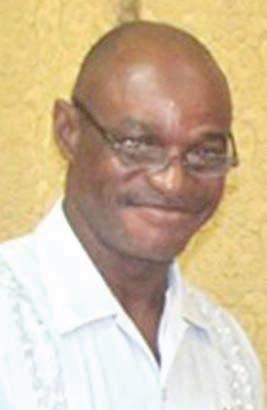
IMC Chairman Orrin Gordon
Industrial Corporation (GNIC) and in collaboration with the then Linden Economic Advancement Programme (LEAP), the construction of the multimillion-dollar project began in 2009 and by March 2010, the first phase was completed. To date, the project remains stalled.
Gordon, who was at the time speaking during the Linden Chamber of Commerce, Industry and Development Annual
Luncheon, said Government must do more to accelerate the transformational plans for the Linden to Lethem Road. A few months ago, Prime Minister Samuel Hinds indicated that US$10 million is needed to have an engineering design of the road. However, to date, the Guyana and Brazil Governments are yet to complete discussions on the financing of the critical project.
A Joint Working Group established under the Guyana-Brazil Corporation Agreement had submitted the proposal. In December 2012, the Working Group on Infrastructure Projects was established following the signing of a Memorandum of Understanding (MoU) between the two countries.
Interconnected Foreign Affairs Minister Carolyn Rodrigues-Birkett had said earlier this year that the redesigning and construction of the Linden to Lethem Road and the development of hydropower stations at Middle and Upper Mazaruni are interconnected.
“It (the road) will cost a handsome sum and we at this point in time, we are not able to increase our debt,” she said, but explained that if the hydropower development project is feasible, the road project will be accelerated.
“So we will be able to get our road, get some energy, sell some energy, and get some revenue. So if we are able to do this the right way, have all of the negative impacts addressed, we would be in good shape,” an optimistic Rodrigues-Birkett said.
In the 2014 budget presentation, Finance Minister, Dr Ashni Singh said “negotiations have advanced substantially between the Brazilian and Guyanese technical working groups regarding the preparation of a design study for the construction of the Linden to Lethem Road”.
Meanwhile, under the Public Works Ministry, $55.092 million has been set aside for Inter-American Bank (IDB) studies to be conducted on the Georgetown to Lethem Road. The ongoing
project entails the provision for biodiversity study in the specified area. The total biodiversity study costs $78.8 million; a project which is being financed by IDB loan grants. Prior to 2014, approximately $18.708 million was expended. In 2009, during the commissioning ceremony of the Takutu River Bridge, then Guyana and Brazil Presidents Bharrat Jagdeo and Luiz Ignacio Lula da Silva said the full potential of Guyana-Brazil trade and economic relations will not be realised if the road from Linden to Lethem is not developed.
Both Guyanese and Brazilian nationals have long bemoaned the deteriorating state of the Linden to Lethem Road, despite constant repairs by the Guyana Government. When the road is paved, it will significantly enhance the lives of Guyanese, particularly traders using the route. Such a move will also result in the reduction of transportation costs while stimulating increase trade and other economic opportunities.


On October 24, rumours spread wildly that Guyana had its first Ebola patient. It was amazing how quickly it seemed that all of Guyana knew of the case. Fortunately, it turned out not to be.
One could sense genuine fear in the population and the story was not just a wicked rumour. There was a basis for the story. A woman showed up with certain symptoms and it happens that she had travelled to a West African country on the border of Guinea, one of the most affected countries. She was discharged from an isolation unit and sent home after doctors had determined that she did not have Ebola.
There is a sense of worry whether we are truly ready to deal with a real Ebola case. Important questions are being asked and the Ministry of Health must provide comprehensive answers.
Kudos to the healthcare staff that responded to the possibility that Guyana might have had its first Ebola case. The statement from the Georgetown Public Hospital Corporation (GPHC) was timely and allayed the mounting fears. A private physician acted with urgency in alerting the GPHC and President Donald Ramotar ensured that all necessary personnel and expertise were gathered to respond.
The Ministry and the GPHC must meet with other experts for a forensic and clinical audit of the case to determine what improvements, if any, might be needed for future response.
Check for weaknesses
The President must in-
sist that such a detailed step-by-step analysis be made to identify any weaknesses. This will help to ensure that should a real Ebola case occur, Guyana will be ready.
The GPHC immediately extracted the patient away from the physician’s office and directly to an Ebola isolation unit. But was the emergency team that did the extraction properly equipped? Was the team Hazmat-ready? Any response must assume that the patient has Ebola and must act in accordance with this assumption.
Even as the doctors were engaged in determining the cause of illness, certain actions had to be taken assuming that this was an Ebola case. For example, what happened at the private doctor’s office? Were this doctor and his staff subject to any kind of quarantine, voluntary or imposed? Was a tracking team in place? Was any sanitisation initiated for the doctor’s office and the ambulance? Was there protective equipment for the staff at the GPHC?
Ebola has appeared in about six countries outside Africa. Where infection occurred outside of Africa, it has been health workers affected. It kills health workers by exposing them to patients who, by the end, exude up to 10 litres of virus-laden fluids a day. Were the medical personnel properly equipped for the Ebola response? What kind of testing service was available?
The GPHC statement failed to answer some of these questions. The authorities may have taken these factors into consideration, but such information should be provided to allay fears and uncertainty. Ebola has stirred great
fear; hence, information on processing possible cases must be provided.
Communication focal point
As rumours circulated and fears mounted on October 24, no one at the Ministry or at the GPHC was in any position or willing to talk to the media and to other interested parties. This compounded the problem.
answer questions and provide information to prevent wild rumours from becoming the story.
The Ebola Readiness and Response Programme must have a communication focal point that could
The medical and clinical team at the GPHC appeared competent in their response and their first test in a possible Ebola case. This should allay some of the fears and Guyana is particularly proud of the team. But the communication component of the response was almost non-existent.

monDAY, october 27,
BY STEPHEN ORNDORF
When most people think of Guyana, they think of the 1978 mass suicide of Jim Jones, and members of the Peoples Temple.
Today, the few tourists who visit this South American country of about 800,000 people, are often drawn to see Kaieteur Falls, an impressive 741-foot waterfall that is four times the height of Niagara Falls and twice that of Africa’s Victoria Falls.
For fishermen, however, there is a different but equally impressive attraction in Guyana – the Arapaima or Pirarucu, the largest scaled freshwater fish in the world. These fish can reach lengths of nine feet and weigh in excess of 400 pounds.
Arapaima typically surface to breathe air every 10 minutes or so, a trait which, when combined with the fact that they are good to eat, has resulted in severe drops in their population throughout South America.
Eighty per cent of Guyana is pristine tropical rainforest, and the country is essentially unpopulated in its interior. This is one of the few places that arapaima can still be caught, and the Essequibo River is the place to find them. It is strictly catch-and-release fishing, and bait fishing is not allowed.
Over the past 40 years, I have made more than 15 fishing excursions to different countries in the jungles of South America. Guyana and its Arapaima had been on my wish list for some time, and my friend, Dave Coffin, and I journeyed there in late September. Dave and I worked together at Napa Pipe before it closed, and we have fished together in Costa Rica and Brazil.
Our Guyana trip was organised through Adventure Travel Alliance, an outfitter based in Southern California that seeks remote fishing locations around the globe.
From Georgetown, Guyana’s capital, we flew on a charter plane with five
population of bats. We all agreed it would have made a tremendous Halloween haunted house.
Our base camp for the trip was about 50 miles south of Apoteri. We had our choice of sleeping in tents or hammocks, and Dave and I opted for the former. The camp had been recently hacked out of the jungle about 30 feet up from the Essequibo.
English is the official language in Guyana, and being able to communicate with our guides was a definite plus. Each camp boat had two Macushi guides to accompany two fishermen. All of the Arapaima fishing was in lagoons connected to the river by long, shallow and sinuous waterways, which were marginally passable due to low-water conditions.
other fishermen to Apoteri, a remote jungle town with a population of 275. Most of the inhabitants today are Macushi Indians, and they attempt to augment an otherwise meagre existence by promoting fishing.
Maintained by machetes
The Apoteri airstrip was cleared out of the surrounding jungle, and its condition is maintained by continuous use of machetes. I asked the village chief whether they had considered sheep or goats as an alternate approach to this arduous task, and he advised me that they had brought in 200 sheep for that purpose (and for food), but the resident jaguar and puma population had killed
Catching an arapaima using lures proved to be challenging. We were using 85-pound braided lines and very large lures, the hooks of which had been upgraded due to the size of the fish. Arapaima are skittish, and with flat calm conditions you need to throw the lure a long way. The best technique is to wait for a fish coming up to breathe and to heave your lure into that spot.
The hits were few and far between, but when one was on the line, there was little doubt that something special was at hand. Arapaima jump when hooked, and seeing fish in the 100- to
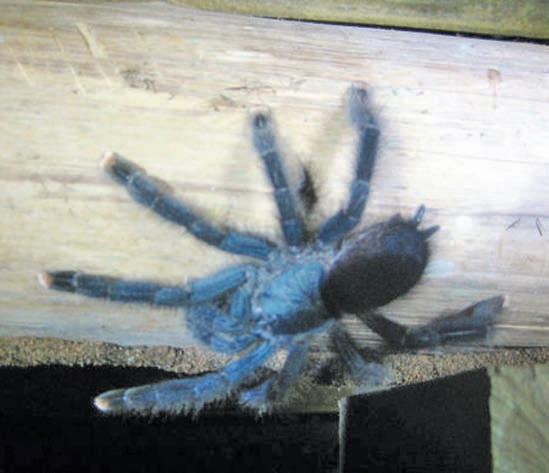
all but five of them.
We spent the first night in Apoteri, where we slept in a rudimentary open-air structure with beds covered by mosquito netting. The netting was a welcome sight, as the outfitter had advised us that there was a serious outbreak in Guyana of Chikungunya, a virus similar to dengue fever that results from being bitten by infected mosquitoes.
Before going to sleep that first night, we discovered that an enclosed 300square-foot structure next to ours was the home for more than a dozen pink-toed tarantulas the size of your hand, along with a healthy
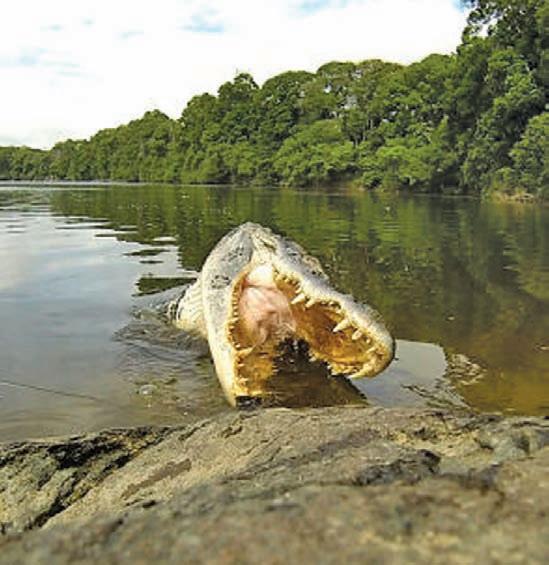
alligators. They grow to 13 feet long and were more aggressive than those I’ve encountered in the past.
On many occasions, they were attracted right up to the boat by fish that we were catching. In fact, I lost the biggest peacock bass I had on the line when a caiman appeared from nowhere to try to take the fish. The peacock luckily got off the line while I was hoisting it up on the bank and it managed to escape.
Our guide, Katuf, whom we nicknamed Cactus, subsequently tied a rope around the tail of a piranha, heaved it in the water to lure the caiman back over for a brief but exciting tug-of-war.
Three caiman attacks I asked the guides whether caimans posed a threat
the river), we were on high alert while taking our nightly baths off of a sandbar in the river.
When one of the Macushi went back to Apoteri for supplies, he learnt that two village residents had drowned the prior day when their boat was sucked into a whirlpool. That incident apparently occurred farther up the river, as there weren’t any dangerous rapids where we were fishing, and there wasn’t an adequate supply of gasoline for us to advance much farther up.
The outfitter informed us that before more organised fishing excursions became available, people would occasionally fly into Apoteri and ask one of the locals to take them upriver to explore, hunt and fish. One such boat with the guide
his needle-nosed pliers. The result was two angry-looking, quarter-sized bites in the palm of his right hand. That was the end of his fishing for three days. The piranhas there were ubiquitous and large. Dave and I caught more than 100 on one afternoon, and the average weight was about three-and-a-half pounds.
The outfitter said they grow to more than 10 pounds in the Essequibo.
While the Guyana trip was not one of the most successful for me from a fishing perspective, it was incredibly informative. All of the Amerindians were gracious and accommodating, and they truly seemed to enjoy what they were doing.
Dave and I are introducing two friends to jungle fishing in late January

to the residents of Apoteri. They said there had been three recent attacks, one of which resulted in a nineyear-old boy being dragged under the surface in broad daylight. A guide’s son was also attacked while in shallow water, but he was able to dispatch it with his bow and arrow, and the boy sustained only modest injuries. Another young Amerindian lost a leg in an attack.
Based on these stories and our close encounters (I almost stepped on an unseen five-footer while fishing from a rocky island in
300-pound range erupting out of the water close to your comparatively flimsy boat is a spectacular experience.
My biggest was estimated at 160 pounds, but after a 20-minute fight, it managed to jump off the line about 10 feet from the boat as we were getting out for a picture. Dave managed to get a 115-pounder for a photo. It turned out to be the smallest one caught by anyone in our camp. Another angler, Kevin Mattson of San Diego, caught a couple that weighed about 300 pounds.
The Essequibo River in this area has a healthy population of black caiman, the South American version of
and two customers never came back, and no trace was found of them or the boat.
The second day, Paul Silva, a fisherman from New Jersey, had an unpleasant experience. The Indian guides on the Essequibo unhooked all of the fish, a chore that we particularly appreciated when dealing with a piranha. Paul, temporarily separated from his guides while fishing on a small rocky island, tried to get a relatively small nine-inch piranha off the line without
After the case was determined, the Ministry failed to hold a full media briefing to inform and assure the nation of Guyana’s readiness. Questions as to how the woman came back from a West African country and was never screened were not answered.
The Ministry also failed to convene a mandatory assessment of the overall response. For countries like Guyana, and given that the possibility of Ebola is a
new experience, an audit of the response is vital.
Overall, Guyana passed its first test. The 2014 Ebola outbreak is raging on. While Senegal and Nigeria have been declared Ebola-free, Sierra Leone, Liberia and Guinea are reeling. Mali is now another West African country that has declared a case of Ebola.
Guyana has in place a policy of no visas for visitors from West Africa.
on a trip to the Mataveni River in Colombia. My older brother and I fished for peacock bass and payara on the Mataveni with great success more than 30 years ago. For quite some time, fishing in Colombia has been essentially off limits due to dangers associated with FARC (Revolutionary Armed Forces of Colombia) rebels. The outfitter for this trip has assured us that the fishing is still fantastic, and that there are no threats from FARC. As of today, there is still one slot open for the trip. (Napa Valley Register.com)
From page 11
Guyana is also advising against travelling to West Africa. But one citizen did not heed the advice and was the subject of a close call. This close call provided Guyana with an opportunity to examine itself and answer the question: Are we ready in case Ebola comes? Readers are invited to send their comments by email or Facebook to times. notebook@gmail.com.
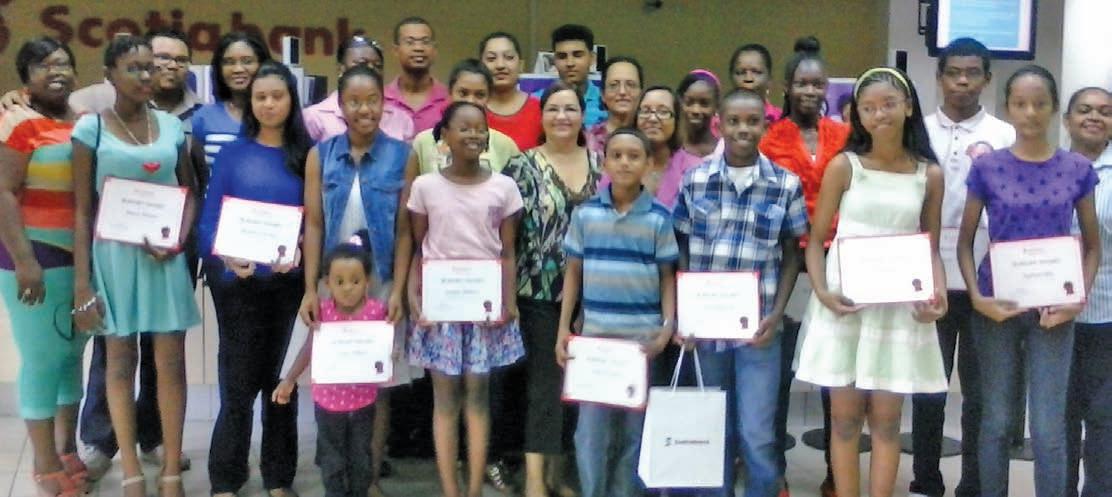
Scotiabank on Saturday awarded the children of its employees for their outstanding performance at the 2014 Caribbean Secondary Education Certificate (CSEC) and the National Grade Six Assessment (NGSA).
The students were honoured at a simple ceremony at the bank’s Robb Street branch, Georgetown.
The bank’s annual bursary awards are aimed at encouraging students in their educational pursuits and assist its employees with school expenses.
Those awarded were children from Grades Six to 11. Additionally, Kindle Fires HD were given to Natifa Williams and Ryan McGarrell for performing exceedingly well at the CSEC and NGSA, respectively.
Williams shared with Guyana Times that she was awarded for being in the top 100 when she wrote the NGSA in 2011. That was the first time the bursary award
initiative was launched.
She told those in attendance that she was a bit upset she did not achieve the top spot in the country; however, she agreed that it was quite an accomplishment as she had topped her school.
The young lady shared that she had to make much sacrifice to achieve good grades at the 2014 CSEC exams.
She encouraged students who are yet to write the CSEC examinations to continue to push for the top position.
Amanda St Aubyn, Scotiabank’s Country Manager also encouraged the awardees to be focused. Human Resource Manager Jennifer Ally said the awards are a great motivator for the students to do better every year and it also gives them some “healthy competition” to do so as everyone tries to outdo the other for the next year.
However, Ally posited that the main focus is really to assist their employees with their children’s educa-
tion.

The three Air Traffic Controllers who were placed on desk duties following the control tower fiasco at the Cheddi Jagan International Airport (CJIA) in March of this year are expected to return to their post in about three weeks
This is according to Guyana Civil Aviation Authority (GCAA) Chairman Hugh Denbow.
He said recommendations were made to the GCAA with respect to the incident following an intense investigation.
Guyana Times understands that their licenses to operate in the Control Tower would have expired; hence, the three men will have to be placed under supervision when they are filtered back into the tower.
On this note, Denbow stated that the affected employees will have to undergo light training in order to refresh their capabilities.
Transport Minister Robeson Benn said the issue must be taken seriously since the GCAA has invested in training air traffic controllers.
“We don’t want to have any situation where the lives of people in an aircraft would be put at risk by any issue in the tower.”
The issues arise after an Air Traffic
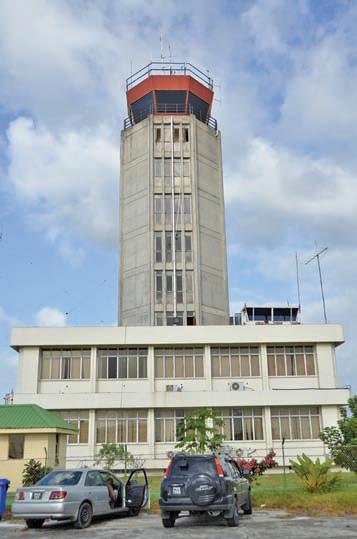
Control Officer abandoning his post while a Caribbean Airlines Limited (CAL) aircraft was mid-air. Benn said the recommendations would have been informed by that attitude and posture of the GCAA. The three trained Air Traffic Controllers were initially sus-
BY SVETLANA MARSHALL
nvironmental
EConsultant Samuel Wright is calling on Lindeners to petition the Linden Mayor and Town Council (M&TC) against the construction of the Rehabilitation Centre for Children with Special Needs on the River Front.
According to him, the approval which was granted to Digicel Guyana for the construction of the facility at the said location should be rescinded.
In the petition dated October 26, Wright said Digicel should be commended for initiating the project, but said the integrity of the Linden River Front should be preserved.
“Its funding of the construction of the proposed centre sets an example of corporate engagement that other companies should emulate…(but) the Linden River Front between the Egbert Benjamin Exhibition and Conference Centre (EBECC) and the Lands and Survey Commission Office for various reasons should not be the location for the rehabilitation centre,” Wright posited.
He added: “The River Front is a unique environment and should be preserved for activities and structures that maximise its special social, cultural and ecological features.”
According to the Environmental Consultant, in addition to the appropriate use of the land, there are also issues relating to drainage, parking traffic, flooding and noise.
the design for the Bandstand Recreation Park stipulates that activities must be familycentred, with the picturesque view of the Demerara River intact.
According to him, the proposed site for the centre was already identified for the establishment of a miniature golf-course.
He opined that there are many other vacant properties controlled by the Interim Management Committee (IMC), the Regional Democratic Council (RDC) and Central Government that would suffice.
“The fact that Digicel requested the site does not mean that the community must drop every other consultation to meet the needs of the company.”
pended for more than two months, but subsequently returned to work where they were given administrative duties.
It was reported that on the night of the incident, the Air Traffic Controller would have indicated to his superior that he was not feeling well and could not work the extra shift, since the other person who was supposed to take over reported sick as well.
When the Supervisor reportedly refused to listen, the young man left the control room. Even at that time, the Supervisor, who is believed to be a member of the Guyana Public Service Union (GPSU), refused to land the aircraft which was already in proximity to the CJIA.
Several minutes had elapsed which caused a delay in facilitating the aircraft’s landing. It was during this period that the Supervisor rushed to the control room and landed the aircraft safely.
With respect to the Air Traffic Controller who reported sick, the GCAA had an issue with the manner in which he reported to his Supervisor -- via a text message. The three employees were initially suspended from work for more than a month, but were recalled and place to perform administrative duties.
“Access to the location would impede traffic on the roundabout and could potentially endanger the lives of parents and students; often there is pounding of water and flooding in the roundabout during even moderate rainfall; noise from activities from the EBECC can disrupt the centre’s activities,” the Environmental Consultant said in a bid to argue his case.
He further stated that
He is maintaining that the M&TC should engage in a town-wide consultation before a site is identified for the centre. Earlier in this month, Digicel had the official sod-turning ceremony for the Special Needs Centre in Linden.
The construction of the multimillion-dollar, state-ofthe-art facility is expected to commence before month-end and be completed at the start of the new academic school year. The centre is expected to cater for a minimum of 60 children with physical disabilities. It is also expected to have an established school curriculum.
Afisherman is now dead while another is injured following an altercation during a drinking spree on Sunday afternoon at Number 66 Village, Corentyne, Berbice.
The dead man was identified as Lakeram Singh, 53, also called “David” or “Dafat” of Lot 13 Fryish Village, Corentyne, while the injured man is Elton Lilley, 44, of Golden Grove, East Coast Demerara.
According to reports received, the two men were imbibing at house at Lot 47, Number 66 Village when an argument ensued, followed by an altercation.
During the scramble,
Singh reportedly picked up a cutlass and dealt Lilly a chop to his hand. In retaliating, Lilly reportedly collected a knife and stabbed Singh about five times, once to the face, three times to the back and once to the head. After the stabbing incident, Singh was picked up and rushed to the Skeldon Hospital where he died while receiving medical attention. Lilly, on the other hand, fled the scene and was arrested at Cove and John as he was on his way home. The suspect was taken into Police custody and is expected to be charged with the capital offense of murder. Police are continuing their investigations.
Brazil’s leftist President Dilma Rousseff narrowly won re-election on Sunday after convincing voters that her party’s strong record of reducing poverty over the last 12 years was more important than a recent economic slump.
After one of the closest, most divisive campaigns in Brazil in decades, Rousseff won 51.6 percent of votes in a runoff against centrist opposition leader Aecio Neves, who won 48.4 percent with more than 99 percent of the votes tallied. At a hotel in Brasilia where Rousseff was due to speak, party supporters waved red flags and jumped up and down, screaming in celebration.
In Sao Paulo, a stronghold of Neves’ Brazilian Social Democracy Party (PSDB), a more subdued mood was punctuated by some government supporters honking horns and screaming with joy. Voting was peaceful and Brazil’s robust democracy is free of the political violence that mars some other countries in Latin America. Yet, at a time when the economy is facing deep challenges, Ideli Salvatti, one of Rousseff’s top ministers, said the government would seek to lead “a national reconciliation process given how tight the result was.”
“We have to calm our hearts down first and then get back to work tomorrow,” she told reporters. The result means another four years in power for the Workers’ Party, which since 2003 has virtually transformed Brazil - lifting 40 million from poverty, reducing unemployment to record lows and making big inroads
against hunger in what remains one of the world’s most unequal countries.
The party’s star has faded recently. The economy has slowed dramatically under Rousseff’s heavy-handed and often unpredictable policies, making Brazil’s glory days of robust growth last decade an ever-more distant memory. Numerous corruption scandals, high inflation and frustration over poor public services like health care tempted many to consider a switch to Neves’ more pro-business agenda.
Yet Rousseff and her supporters spent the campaign warning voters, especially the poor, that a vote for the PSDB would mean a return to the less compassionate, more unequal Brazil of the 1990s - an argument that Neves rigorously denied, but ultimately prevailed anyway.
“We need Dilma to continue the programs that improve the lives of those in need,” said Livia Roma, 19, a university student in Sao Paulo, as she voted on Sunday. “I didn’t vote for myself, but for the minorities and less fortunate classes.” Investors have generally disliked Rousseff’s interventionist management of state-run companies and other sectors of the economy, and Brazil’s financial markets plummeted last week when polls showed she was likely to win a second term. They could see another selloff on Monday.
With 200 million people and a gross domestic product of some $2 trillion, Brazil is Latin America’s largest economy and its most populous country. By re-electing Rousseff, it will remain

on a middle ground between more socialist governments in Venezuela and Argentina, and the freer-trading, faster-growing countries on the Pacific coast that include Colombia and Chile.
Rousseff owed her victory to overwhelming support from the roughly 40 percent of Brazilians who live in households earning less than $700 a month. They have benefited from the Workers’ Party’s rollout of a program that pays a small monthly stipend to one in four Brazilian families, as well as federal housing programs, government-sponsored vocational schools and an expansion of credit to the working class.
Rousseff, 66, is unlikely to enjoy much, if any, of a honeymoon when her second term starts on New Year’s Day. Recent allegations of systemic corruption at state-run oil giant Petrobras (PETR4.SA) roiled the final days of the campaign and are likely to be a major political
Haiti’s Government announced Sunday it was postponing long delayed legislative and municipal elections, on the same day they were supposed to be held.
The Office of President Michel Martelly made the announcement postponing the vote, which is already three years overdue. No new date has been announced.
“President Michel Martelly, in his constant concern to guarantee political stability, promises to pursue consultations with the different sectors of national life in order to hold the elections as soon as possible,” his office said in a statement.
The Opposition had called a protest for Sunday to demand Martelly’s resignation.
Haitians were supposed to go to the polls Sunday to
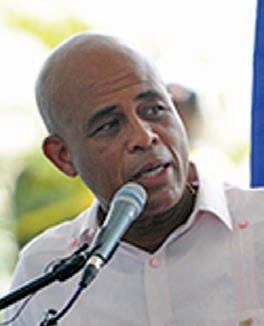
elect 20 senators, 102 deputies and municipal officials.
Martelly had decreed in June that there would be an election on October 26, but the National Assembly did not pass an electoral law in time because of a political impasse.
Legislators and the Opposition resisted attempts to hold the vote,
saying the rules had been rigged by Martelly’s camp.
However, the failure to organise elections means that the mandates of the rest of the members of the already depleted assembly will expire, potentially leaving Martelly to rule by decree. The mandates of a third of the senators in the 30-strong body had already expired, leaving it struggling to find a quorum, and Martelly has imposed 120 municipal leaders on towns to replace elected councils.
Haiti, the poorest country in the Western hemisphere and still recovering from a devastating 2010 earthquake, has struggled with its difficult post-colonial legacy, corrupt rule, civil unrest, environmental degradation and natural disasters. (Excerpt from AFP)
headache in coming months and years as prosecutors pursue those responsible.
The economy slipped into a recession earlier this year, and ratings agencies have warned that a credit downgrade is possible unless Rousseff makes hefty spending cuts to correct deficits that have mushroomed in recent months.
Her aides have said she will try to win back the confidence of financial markets by announcing a more pragmatic finance minister for her second term, although many investors worry that Rousseff will continue to call most of the shots herself.
The election was one of the most dramatic since full democracy returned to Brazil in 1989. One candidate was killed in a plane crash in August, and his replacement then soared into the lead in opinion polls, only to fade in the final days before the first round of voting on Oct. 5.
During the runoff, senior leaders from both parties compared their rivals to Nazis - a break from the relatively genteel tone that has prevailed in Brazilian politics in recent years, and one that analysts say heralds a more divisive era ahead. That, in turn, may make consensus on a much-needed overhaul of the tax code and other economic reforms more difficult for Rousseff to push through.
Rousseff, who was jailed
and tortured in the early 1970s for opposing that era’s military dictatorship, is the country’s first woman president. The daughter of a Bulgarian aristocrat who emigrated to Brazil during World War Two, she was a relatively obscure government technocrat until her predecessor Luiz Inacio Lula da Silva hand-picked her as his successor. Many in the Workers’ Party are already thinking ahead to the next election in 2018, when Lula, who governed from 2003 to 2010, has said he may run again. Brazil’s constitution doesn’t allow presidents to seek a third consecutive term.
Neves’ PSDB, meanwhile, faces an uncertain future after falling short in three straight presidential contests due in part to its image as the party of Brazil’s wealthy minority. The PSDB is under added pressure because of a long drought in Sao Paulo state, which it governs, that has raised the prospect of severe water rationing in coming months.
The political party of outgoing President Jose Mujica, who gained international notice for social reforms such as legalisation of marijuana and gay marriage, leads going into Sunday’s election to replace him but victory is far from assured.
Polls suggest that neither of the parties of the top two presidential candidates will obtain the 50 per cent needed to avoid a second round on November 30.
The competing parties are Mujica’s left-leaning Broad Front and the centreright National Party.
Uruguay’s Constitution bars a president from hold-
ing two consecutive terms in office so Tabare Vazquez returned to be the Broad Front’s candidate.
Vazquez, the Broad Front’s 74-year-old presidential candidate, was President of Uruguay in 2005-2010. His top challenger, 41-year-old National Party candidate Luis Alberto Lacalle Pou, is the son of a former president.
“Vazquez is going to be president again, because Uruguayans don’t want to return to the past,” said Analia Vernini, a 36-year-old dentist.
The latest opinion polls show Vazquez with the support of 43 per cent of voters compared with 31 per cent
for Lacalle Pou.
The Uruguayan law barred Mujica from running for another term, even though he remains popular after leading Uruguay during a period that saw the economy grow and wages rise.
But critics say his Government failed to deal with problems in education, security and environmental protection.
“A part of society has changed its mood and seems to be demanding new ideas from the political leadership,’’ said Daniel Chasquetti, a political scientist at Universidad de la Republica in the capital. (Excerpt formal Jazeera)
Barbados-based Caribbean Development Bank (CDB) President, Dr Warren Smith, has warned that high debt poses an inherent risk to the success of structural adjustment programmes being undertaken by some regional countries in their bid to turn around their ailing economies.
Addressing the International Monetary Fund (IMF) 2014 High Level Caribbean Forum in Jamaica, Smith said large debt overhangs represent a drag on economic growth, and “failure to tackle this problem in a substantive way, early in the adjustment process, is likely to heighten
the risk of premature abandonment of the adjustment programme.
“In short, the slow-burn approach to whittling down large debt overhangs is fraught with danger and cries out for an urgent solution. This is especially so for countries which have demonstrated great resolve in adopting most of the appropriate adjustment measures,” Smith told delegates.
He noted, however, that the Bank, the Region’s premier financial institution, has been providing some assistance to countries in that area.
“The Caribbean Development Bank, working with some of the small
island states of the Eastern Caribbean, has deployed its balance sheet creatively to assist St Kitts/Nevis and is now working with Grenada to reduce their debt overhang.
“In both instances these initiatives were pursued under the cover of home-grown IMF-supported adjustment programmes; if the substantially stronger and larger balance sheets of the international financial institutions are also deployed creatively, similar outcomes are possible for the larger Caribbean countries with sizeable debt overhangs and somewhat different circumstances,” Smith said. (Excerpt from Jamaica Observer)
The Lebanese Army has brought tanks and commando forces into the northern city of Tripoli, where fighting with suspected Islamic State of Iraq and the Levant (ISIL) - and alQaeda-inspired fighters has intensified and spread to nearby areas.
Several tanks, armoured personnel carriers and Humvees carrying commandos arrived on the edge of the Bab al-Tabbaneh area on Sunday, where clashes were heaviest over the weekend.
The clashes, which broke out first on Friday night, have so far killed 10 soldiers, two civilians and wounded many others.
Fighting was also heavy around the town’s old souk area, after which Lebanese soldiers began house searches looking for “ISIL suspects”.
Troops on Wednesday killed three fighters and arrested a local leader in a raid in the northern Dinniyeh region, setting off the spark that led to the Tripoli fighting.
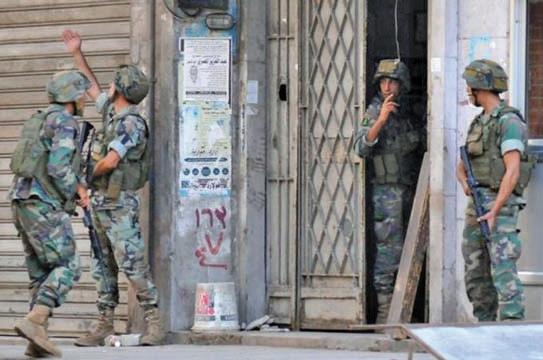
The Lebanese Army said that troops attacked a school in the nearby town of Bhannine that fighters were using. It said several were wounded while others fled, adding that troops found two cars rigged with explosives as well as weapons.
The Army said troops are deploying in Bab al-Tabbaneh and responding to the gunfire “of terrorists”.
The state-run National News Agency said the troops were now in full control of Tripoli’s northern suburb of Minyeh after arresting sev-
eral fighters.
Fighters inspired by alQaeda and ISIL have killed and wounded several soldiers in a string of attacks in recent months.
Meanwhile, Iraqi Kurdish forces will not engage in ground fighting in the Syrian town of Kobani but provide artillery support for fellow Kurds fending off Islamic State militants there, a Kurdish spokesman said on Sunday, as Reuters reported that ISIL was losing ground in Iraq. (Excerpt from Al Jazeera)
Botswana’s ruling party has won majority seats in the country’s Parliament, putting President Ian Khama at the helm for a second five-year term.
High Court Chief Justice Maruping Dibotelo said in a statement on Sunday that Khama “has been reelected as the President of the Republic after his political party, the Botswana Democratic Party (BDP) garnered at least 29 of the 57 parliamentary seats” at Friday’s general election.
But the Opposition coali-
tion managed to reduce the majority of Khama’s party, which has ruled the diamond-producing nation since independence from Britain 48 years ago.
Parliament elects the President, and it is expected that Khama will win a second term, but with a reduced majority. In the previous elections in 2009, BDP won 79 per cent of the seats. Observer missions from the regional Southern African Development Community (SADC), the Commonwealth and the
Twenty-four European banks have failed stress tests of their finances, the European Banking Authority has announced.
The banks now have nine months to shore up their finances or risk being shut down. No UK banks are included. The review was based on the banks’ financial health at the end of 2013.
Ten of them have taken measures to bolster their balance sheets in the meantime. All the remaining 14 banks are in the eurozone.
The health check was carried out on 123 EU banks by the EBA to determine whether they could withstand another financial crisis.
The list of 14 includes four Italian banks, two Greek banks, two Belgian banks and two Slovenian banks. The worst affected was Italian bank Monte dei Paschi, which had a capital shortfall of €2.1 billion (US$2.6 billion).
BBC World Service economic correspondent Andrew Walker says concerns about banks were a central element in the eurozone financial crisis and in some countries, their weakness remains a factor holding back economic growth.
Four UK banks were subjected to the EBA test: Royal Bank of Scotland, HSBC, Lloyds Banking Group and Barclays. (Excerpt from BBC News)
The last United Kingdom base in Afghanistan has been handed over to the control of Afghan security forces, ending British combat operations in the country.
The union flag was lowered at Camp Bastion, while Camp Leatherneck – the adjoining US base – was also handed over to Afghan control.
Prime Minister David Cameron said Britain would never forget those who had died serving their country.
The number of deaths of British troops throughout the conflict stands at 453. The death toll among US military personnel stands at
2349.
Cameron tweeted: “I made a commitment that I would get our Armed Forces out of Afghanistan by 2015 and today sees the end of combat operations in the country.
“We will always remember the courage of those who served in Afghanistan on our behalf and never forget those who made the ultimate sacrifice.”
A spokesman for the Afghan Defence Ministry welcomed the handover, which he said “puts our capabilities into practice”.
“Afghan security forces have been leading the fight in ground operations in the
country for two years now.”
The UK forces were part of a US-led coalition which toppled the ruling Taliban in 2001, following the 9/11 attacks in the US.
After 9/11, US President George Bush had demanded that the Taliban hand over any leaders of al-Qaeda – the militant group which later claimed responsibility for the attacks – in Afghanistan, but the Taliban did not immediately comply.
Taliban leaders called for talks, but President Bush said there would be “no negotiations” and military action started on October 7.
Pro-Western parties will dominate Ukraine’s Parliament after the first elections to the body since February’s revolution, exit polls suggest.
President Petro Poroshenko’s bloc is expected win the most seats, with Prime Minister Arseny Yatsenyuk’s People’s Front party a close second. Poroshenko called an early poll in a bid to set Ukraine on a new path after the ousting of pro-Russian leaders.
European Union were expected to report officially on the vote later.
South Africa’s High Commissioner to Gaborone, Mdu Lembede, one of the observers, told a local news agency that the polls were “peaceful”.
The landlocked, diamond-rich southern African country of two million people is seen as one of the continent’s strongest democracies, and Friday’s vote saw a high turnout of the 800,000 registered voters. (Excerpt from Al Jazeera)
About three million people in the eastern Donetsk and Luhansk regions did not take part. Separatists in the area plan to hold their own polls next month. Another 1.8 million people in Crimea, annexed by Russia in March, also did not take part.
The vote also comes amid an energy crisis, with Russia cutting off gas supplies to Ukraine in June in a dispute over unpaid bills.
Ukraine’s economy is collapsing, with Gross Domestic Product (GDP) forecast to fall between 7 and 10 per cent this year.
Two exit polls published
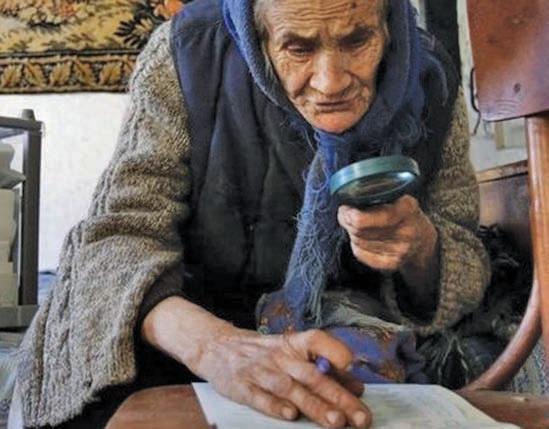
immediately after voting ended showed Poroshenko’s bloc, comprising his own Solidarity Party and Udar, led by boxer Vitali Klitschko, leading with about 23 per cent. Yatsenyuk’s People’s Front appeared to have performed unexpectedly well, polling in the region of 21 per cent. The Self Help party, based in western Ukraine, was third with more than 13 per cent, the exit polls indicated.
Correspondents say all
three groups are strongly pro-European and should give Poroshenko a strong mandate to pursue democratic reforms and a plan to end the conflict in the east. Four other party lists seemed set to enter Parliament, overcoming a five per cent threshold. They include the Opposition Bloc, formed by allies of ousted Pro-Russia President Viktor Yanukovych. Preliminary official results are expected today. (Excerpt from BBC News)
At least 33 people have been arrested following clashes between Hindus and Muslims in the Trilokpuri area of India’s capital, New Delhi, India Today website reported quoting the Police.
“Ten people were arrested on Friday and 23 today for rioting in the area,” an unnamed Police officer was quoted as saying on Saturday.
Clashes between the two communities took place after Diwali celebrations in Trilokpuri’s B-Block, with the two groups pelting each other with stones. It was still unclear what prompted the unrest.
Arvind Kejriwal, Aam Aadmi Party leader and former Delhi Chief Minister, hinted at the role of vested
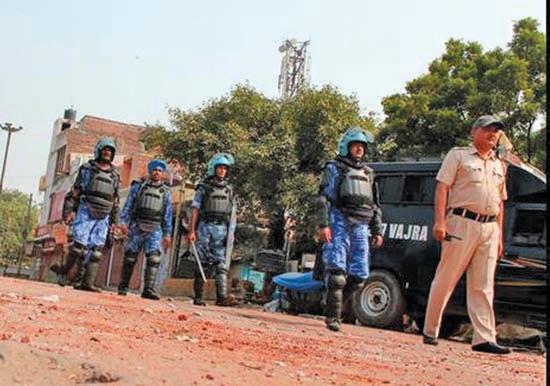
interests in a tweet.
Tensions continued throughout Saturday and Sunday, with the India Today reporting that clashes had spread to three districts
on Sunday. But in Trilokpuri area, residents said they were determined to end the tensions that continued over the weekend and into Sunday,
as the district was placed under order, restricting movement after hours.
Ramchander Tilkak, a volunteer of a community group called the HinduMuslim-Sikh-Isai Ekta committee in East Delhi, formed to ease the tensions, told Al Jazeera the incident was certainly not the first to happen in the vicinity.
Tilkak alleged that the trouble was essentially between two households that slipped out of control.
“The fight was between two houses and the people here in our locality are always used by bad elements who also act as rumour mills. We are clueless how the things went from bad to worse,” he said. (Excerpt from Al Jazeera)

Troy Mendonca – Owner of The Guinness Bar
“I think it is the responsibility of both the players and the management. At least, it is about the players being compensated and they know that whatever they do would affect the career and status of West Indies, so they should have let good sense prevail and continue the tour and at the end of it, they sort out their problems. Because it’s not like those 14 players are paupers. They are all professional players that earn money at different competitions and I just think it’s only right that they finish off the competition and sort out whatever they had to sort out.”
Wayne Plummer
“It’s a sad situation, it’s sad to say. According to Mr Patterson, “it’s humiliating” and you know I’m a fan who expects the West Indies Board now to invite all stakeholders, those who protested to come forward and sit at the table and iron out the differences and get on with the cricket, because cricket is what we want to see.”
Frederick Wilkie – Government Technical Institute Student
“Well, I think as people of Guyana we back West Indies and as Guyanese, we think of West Indies as inspirations to youth. What they did was really shameful and really made our hands fall and I think they really need to pull up their socks because they acting as rock stars to me and they are role models and as a proud country, we think that was just shameful what they did.”
Natasha Sawh –Environmental and Social Officer
“They were wronged by the Cricket Board. Even though it was an unprofessional thing to do, I still support the players 100 per cent.”

Rafi Khan – Security Guard at King’s Jewellery World “I think they did the right thing, because they’re very good players. I think the Board has a problem within themselves and I think they have to get it first right and then deal with the cricketers, because I think them boys work hard and I think they should get their demands.”
Ronaldo Renee – Cricketer
“I think they had a right to do it, because the cricketers work all their life to reach that stage and I think they should be paid, because there has been a lot of sacrifice they made, waking up all the mornings to be there. So, I think they made the right decision, because they work so hard to reach there and now they cut the pay, so I think that’s right.”

Daniel Fiffe – Contractor
“They supposed to have notified the players before they made any agreement. But I think the players should have stayed on and play out the game and then discuss the problem more, than just walking out so I prefer they play out and then discuss it after.”
Michael Shalim – University of Guyana Student
“Cricket is the players’ livelihood and cutting their pay by such a substantial amount is wrong, so the players are doing what any worker in their own profession would do –strike.”
Julia Sugram – Housewife
“As usual West Indies are screwing things up basically. It’s always something with money with West Indies and they are usually in the wrong. You know they’re really wrong and strong, that’s how West Indies stay and that’s exactly what they did.”
Gopaul Mangar
“I think it’s bad for the fans, because we looking forward to see West Indies play all the time. But in terms of the issue with the Board, the Board needs to do much more for the players and they should give the players confidence so they will be able to play with all these differences, because we the fans looking forward to see WI play. I am disappointed as a fan, because I didn’t get to see them, but in terms of the payment issue, I think they had a right.”
Sherlock Atwell “I think the WI cricketers were totally wrong to grumble for a few dollars when India is one of the countries who made all of them who played millionaires. They should have finished the tournament, come back to the table with their superiors and trash it out amicably.”
...is a Guyana Times effort to give expression to issues concerning Guyanese. Every week we will publish views on one issue along with contributors’ photographs. The views expressed in comments published do not reflect the opinions of the Guyana Times Inc. I Say... will be published every Monday
The Giftland OfficeMax Mega Mall at Turkeyen, Greater Georgetown, is now expected to have its grand opening before May 2015.
The last deadline was set for before June 2014. Chief Executive Officer Ian Ramdeo told the Guyana Times in an interview that construction is still in progress. He said additional work that was not initially catered for such as traffic control facilities at the main intersection among other infrastructural conveniences are still being developed.
The delay is also owed to a fluctuation of material prices and missed deadlines of some subcontracted works.
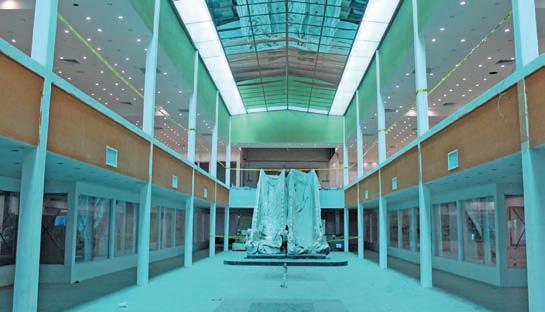
cy. However, due to the com
longer than the company initially expected. Nevertheless, moves are afoot to make sure the mall is opened as soon as possible. The company acquired the land in 2007 and construction began in 2009. According to reports, the mall has an estimated cost of US$30 million and is being financed by Guyana Bank for Trade and Industry (GBTI), Citizens Bank, Scotiabank Guyana, two private investors, and the standard grant from the Government of Guyana. Ramdeo stated that the mall will accommodate Giftland and other tenants, creating job opportunities for over 2000 persons, including security and maintenance.
Furthermore, he said they are in the process of training staff for the new operations at the mall. He noted that so far everyone employed for the mall is either working at the mall or at the retail sister company Giftland OfficeMax.
Being the first of its kind in Guyana, the mall will be introducing a number of exciting amenities such as free drinking fountains; valet parking; a playground featuring zip lines, rock climbing and bungee jumping, and a 90-station sheltered bus terminal.
“We will also be featuring the 560 feet “Strip” comprising four fine dining restaurants, the sports bar, the Brazilian Grill and Bar, and
a British Pub for evening entertainment. The street will be closed for vehicular traffic in the evenings from 6:00 pm allowing us to turn this area into a street entertainment area…This area will also be used to showcase Guyanese Culture and exhibitions, talent and other shows, poetry reading, horticultural, crafts and other areas in need of being highlighted in an open-air atmosphere,” Ramdeo highlighted.
With all the exhilarating features and amenities the mall has to offer, the Water and Holmes Street business will be closed and relocated to the world-class shopping plaza when it opens.
President Donald Ramotar, Education Minister Priya Manickchand and Regional Chairman of Region Six (East Berbice-Corentyne) David Armogan yesterday visited the J C Chandisingh Secondary, and Port Mourant and Cropper Primary Schools, where scores of parents and guardians turn up to receive Government’s “Because We Care” $10,000 student grant.
The programme was officially launched on October 11 in Region Seven (CuyuniMazaruni) and already over $600 million in vouchers has been distributed to parents throughout the country, the Government Information Agency (GINA) reported.
President Ramotar told parents that this investment is aimed at ensuring that the country’s children attend school and receive the
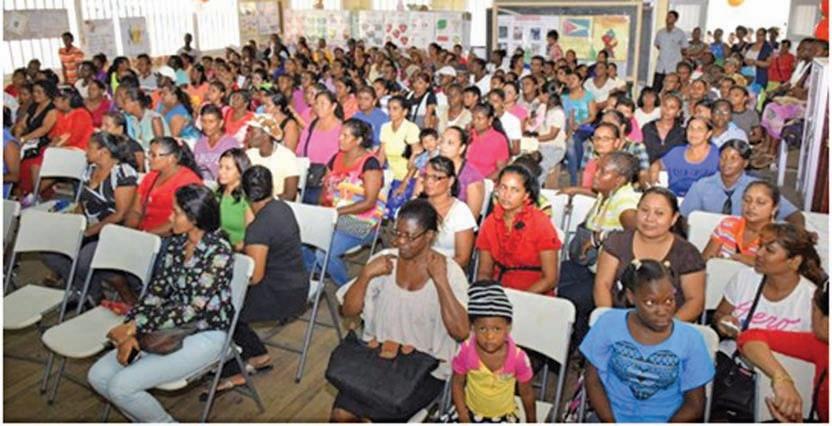
The President explained that since the People’s Progressive Party/Civic (PPP/C) took office in 1992, more than 1000 schools have been built and rehabilitated, and more children are able to attend secondary school.
“In 1992, we had 30 percent of the children leav-
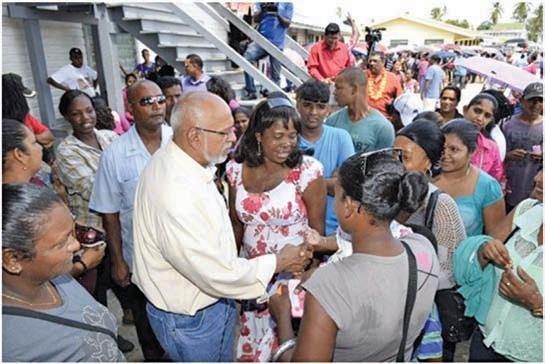
quality of education needed for their development. He said this is a continuation of what Government has been doing over the past 22 years to improve the quality of lives of people.
ing primary school and going into secondary school. The majority of the children had to fail common entrance because they was no space for them, and therefore they could not write CXC
[Caribbean Examinations Council]. We have achieved Universal Primary Education and we are very close to achieving Universal Secondary Education,” he noted.
President Ramotar added that the Education Ministry’s strategy is to ensure that all children complete secondary level education.
The student grant complements the school feeding, hot meal and uniform programmes, which Government has put in place in an effort to increase enrollment and attendance rates, as well as reduce dropouts.
“We do have the natural resources and most importantly we have talented people and we are investing in the people because we know that this can take us forward. That is the most important investment we need so that they can take our country forward,” Ramotar reiterated.
Meanwhile, Minister Manickchand also highlighted some of the developments
in the Education Sector, one of the latest being at the CXC level, where Guyana copped four of the eight regional awards.
“We are at a place where you don’t have to be rich or wealthy, or you don’t have to come from parents who are doctors of lawyers to do well. Even if you can’t read and write, your children have the facilities that we put in place to ensure they top the Caribbean,” Manickchand said.
She said that when Government implements a project, all citizens benefit regardless of their ethnicity, religion, or political affiliation. “We in the government will provide the environment where children can prosper,” she noted.
The student grant was introduced this year. Government plans to ensure that the sum of $10,000 is allocated to every child in the public school system. The initiative is expected to benefit 188,406 families with children at nursery, primary, and secondary school levels, and will cost a total of $2 billion.
Three years of sluggish growth in the exports of Latin America and the Caribbean (LAC) make it urgent to implement policies that facilitate trade, according to a study published last week by the Inter-American Development Bank (IDB).
The Trade and Integration Monitor 2014 notes that the fall in international demand and in the prices of many basic goods that are exported from the Region highlight pre-existing vulnerabilities in the external sector. Despite efforts to diversify exports, over the past decade the Region’s export basket has been concentrated on basic goods and their by-products, making Latin America and the Caribbean vul-
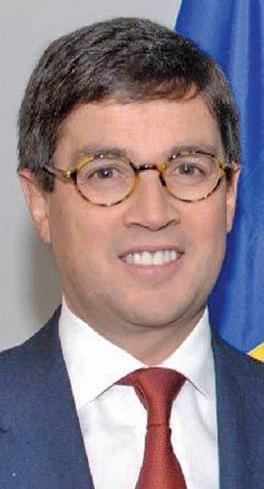
nerable to fluctuations in price and demand. In 2013, the region’s exports rose only 0.1 per cent, after having grown 1.2 per cent in
2012. Mexico and Central America posted moderate growth (2.5 per cent and 1.6 per cent, respectively), while exports from the Andean countries and MERCOSUR fell slightly (–1.8 per cent and –1.0 per cent, respectively), and those of the Caribbean declined substantially (–4,2 per cent).
It is estimated that in the first seven months of 2014, aggregate exports from the Region increased only 0.5 per cent, suggesting that growth for whole year will come in at less than 1 per cent.
The Monitor argues that, given uncertainty in multilateral trade-facilitation talks, the countries of Latin America and the Caribbean should implement unilateral reforms and other measures linked
Professional boundaries are probably one of the most challenging ethical skills to practise, though they’re easy to understand. It is so important to have a clear understanding of our limits, especially when we are in positions of power.
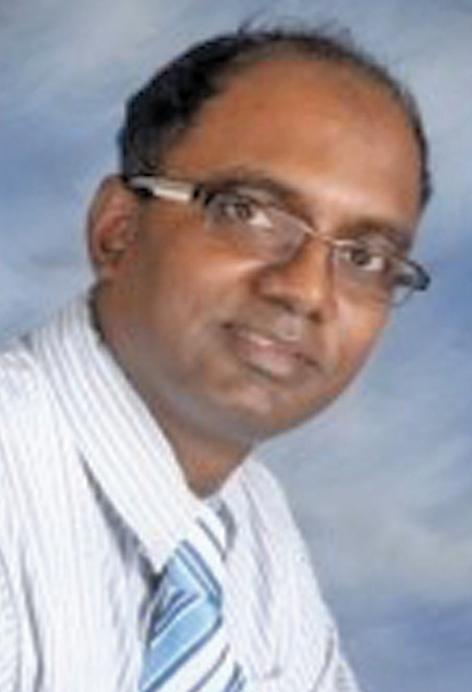
Generally speaking, boundaries are usually put in place to keep us focused on the work we are doing with the client, for those of us who are constantly in contact with a client for example. The thing is, without any sort of boundaries, there is that chance of us overstepping our obligations when providing support to our clients.
In a professional relationship, we can certainly be friendly with our client, but we cannot be their friend – a key factor to remember. Once we understand this and put it into practice, then we are making life easy for everyone.
Some poor boundaries would be a situation where we find ourselves discussing the client and his/her case with our family and friends or if we are having discussions with the client about other workers or staff members at the workplace.
It could even be things like exchanging gifts with the client between us and the client, or worse yet if we are revealing personal information that is not relevant to our client’s case. These are all things to consider when we are working with a client.
To avoid any conflict, it is best to explain our role as the helper and the limits of our availability to the client outside of business hours right from the beginning of the first meeting.
Once it is understood that the client will only be able to contact us at an arranged location and that our personal life is not up for discussion, then that should help. If we are in a situation where a client crosses the professional boundaries, it is so important to take quick action to redirect it right away to clarify our role and the limits of our relationship with them.
to preferential accords in the Region so as to stimulate exports. Conservative estimates indicate that only 20 per cent of the commitments included in the Agreement on Trade Facilitation negotiated through the World Trade Organisation have taken force under regional preferential agreements.
The study includes a detailed report on recent trade performance indicators for the IDB’s 26 borrowing-member countries as well as profiles of free trade accords that are in effect. The Monitor is part of a series of annual studies that analyse the evolution of Latin American and Caribbean integration within the global trading system using systematised data available in the INTrade database.
The bottom line is to avoid having a dual relationship with a client. And basically, a dual relationship is when we have a therapeutic relationship with our client and soon after find out that we both attended the same school and had the same teachers for example.
In a situation like this, it is best to end the professional relationship by referring him/her to another worker. Mentioning the situation to our coworker or the person we report to is not a bad idea.
It is key for us to know the consequences of poor boundaries, because without it we may not be able to provide a relationship boundary in an appropriate manner to our client. Actually, we may make it difficult for the client to present their problems: if we are acting as a friend, the client might want to see us in the helping role.
So being their friend isn’t really helping. Believe it or not when we fail to set professional boundaries, we can cause ourselves to burn out from caring for our client beyond what is required of us as a professional helper.
If professional boundaries are not maintained, we may find ourselves acting in an unethical manner. For example, if a student is having sex with his/her teacher, this is unethical, but it can happen. Professional training can help to prevent this, so let’s do our part to avoid any unethical situation.
For questions, comments or feedback, email them to mcnarine@rogers.com.














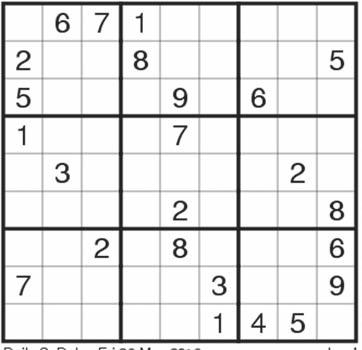


ARIES (March 21April 19)


TAURUS (April 20May 20)



(May 21June 20)

Money matters look favourable. If a partnership isn’t running smoothly, it would be best to examine it carefully. Consider whether you want to pursue or walk away from someone you are questioning.
You can get your way and surpass opponents if you keep your emotions in check. You will be able to outmanoeuvre and outsmart anyone if you stick to the facts and remain calm.
Activities with youngsters will brighten your day. Don’t be surprised if your current situation goes through an unexpected change. Finish any incomplete tasks that you’ve been avoiding.







LEO (July 23Aug. 22)
VIRGO (Aug. 23Sept. 22)
You can achieve greater popularity at a work or networking event. You will come up with original solutions to perplexing situations that will impress even your toughest sceptics.
Before you commit to purchasing property or a luxury item, check the fineprint. Shop around for the best deal. You will be torn between two opposing ideas, so weigh the pros and cons.
Change your routine by making a point to do things differently. You will learn a lot from a friend, relative or co-worker regarding the best way to tackle your projects.



LIBRA (Sept. 23Oct. 23)
Don’t be intimidated by someone with more experience than you. You are intelligent and intuitive, and a new opportunity is right around the corner. Don’t back down; move forward.
SCORPIO (Oct. 24Nov. 22)
Don’t allow anyone to put restrictions on you. It will be obvious to everyone that you mean business if you are firm and forthright. Be strong, and rewards will be yours.


CAPRICORN (June 21July 22)
SAGITTARIUS (Nov. 23Dec. 21)
Stop letting old ideas and negativity hold you back. Tie up loose ends and give yourself a chance to move forward unencumbered by past mistakes and disappointments.


(Jan. 20Feb. 19) (Dec. 22Jan. 19)


PISCES
(Feb. 20March 20)

You will be surrounded by negative opinions. Your creativity and ingenuity will help you find a way around any obstacles you encounter. A successful outcome will show everyone how astute you are.
Stand your ground if anyone tries to stymie your plans. It’s your future, and you have a right to choose your direction. Exercise your right to have a voice and an opinion.
A financial or legal matter requires attention. Don’t be deterred by friends or colleagues who try to change your mind. You know what’s right and best for you.




Billionaire Paul Allen, who owns the Seattle Seahawks and the Portland Trail Blazers, has pledged to contribute at least $100 million to the fight against the deadly Ebola virus.
We’re faced with a huge challenge with Ebola,” Allen told ESPN.com’s Kevin Arnovitz on Friday night.
“If you have one of these epidemics with the number of cases potentially doubling every 20 days, to get ahead of that and contain it, you have to send large numbers of health workers over to the affected areas, and get them in place and get communications going with communities. If the health workers get ill, they want to know they can get medevaced out of there. So we’ve been trying to do a few things, to build containers that can go on planes to help with the health workers evacuated.
“I’m just trying to help
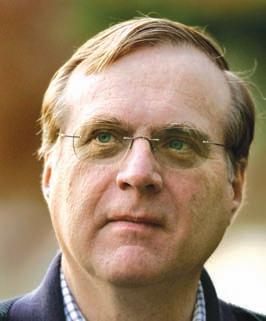
show the way that we need to really increase what we’re doing now, because we’re currently chasing the expansion of the disease, and we’ve got to get ahead of expansion.”
The Microsoft co-founder said Thursday that among the initiatives he’s supporting is the development of two medevac containment units that the U.S. State Department can use to safe-
ly evacuate health workers who become infected.
Allen said he’s working with the World Health Organization to increase its capacity for handling the logistics of transporting international aid workers, and he’s establishing a fund to help cover the costs of emergency transportation of the workers.
Money also will go to the University of Massachusetts Medical School to help provide decontamination and lab equipment to Liberian hospitals, as well as community outreach and education in Liberia.
“I think we’ve now seen that even something that’s happening in West Africa, how it can arrive on our doorsteps very quickly,” Allen told ESPN.com. “We’re all interconnected in today’s world.”
Allen’s foundation previously pledged $26.5 million. (ESPN)

Roger Federer won the Swiss Indoors title in his home city of Basel for a sixth time as he beat Belgium’s David Goffin 6-2 6-2 in the final.
The world number two broke his opponent twice in each set to win in 52 minutes.
Victory increased Federer’s chances of overtaking Novak Djokovic to finish 2014 at the top of
the world rankings. The 17-time Grand Slam champion has won all of his last 12 matches, and he has moved to within 500 points of Djokovic in the ATP standings.
A total of 1,000 points will go to the winner of the Paris Masters, which starts on Monday, and a further 1,500 to the champion at the season-ending ATP World Tour Finals in
London, running from 9 to 16 November.
Goffin, 23, had lost only two of his previous 45 matches, but his serve was broken in the opening game as he hit a backhand wide.
A delightful crosscourt forehand in the seventh game then gave Federer three more break points, the second of which left him serving for the set when Goffin sliced into the net.
The Swiss number one secured the set with the third of four successive love service games, ending the set with an ace followed by an unreturnable serve.
Goffin saved one break point in the fifth game but hit a backhand into the net after a long rally to hand Federer another advantage.
The 33-year-old swiftly secured another double break to leave him serving for the match - and he sealed the win with a delicately-placed shot over the net, which Goffin managed to get to but couldn’t return. (BBC Sport)
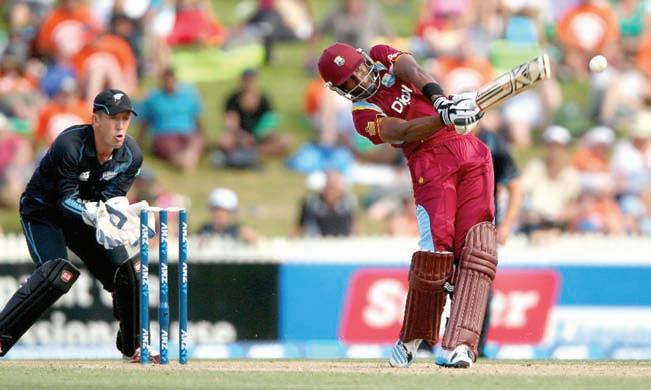


Sscored twice as Everton climbed into the top half of the Premier League to leave joint-bottom Burnley still without a league win.
Eto’o’s powerful early header was cancelled out by Danny Ings when he capitalised on a Romelu Lukaku mistake to convert Lukas Jutkiewicz’s pass.
Yet Lukaku soon made amends when his scuffed shot found the left corner.
Eto’o then made the points certain with a superbly curled shot before being denied a hat-trick by the post.
It was the ideal end to an encouraging week for Toffees manager Roberto Martinez as his team finally begin to build some momentum following last weekend’s 3-0 victory over Aston Villa and a battling 0-0 Europa League draw in Lille.
The Clarets’ problems continue to mount, meanwhile, and they will go bottom on Monday if QPR avoid defeat by Aston Villa.
While Sean Dyche’s team could not be faulted for industry, they struggled to break down a Toffees side who never had to find top gear.
The visitors showed no signs of being affected by their busy schedule, beginning purposefully at Turf Moor, with a sweep -
ing move that culminated in a cross from the overlapping Leighton Baines being emphatically headed home by Cameroonian veteran Eto’o.
But the Clarets showed their fighting spirit by responding within 14 minutes as Jutkiewicz cut out a sloppy Lukaku pass back towards his defence before threading the ball to Ings, who rounded goalkeeper Tim Howard and slotted in.
Lukaku soon atoned, however, when he finished off another flowing Toffees move which saw them string together 24 passes.
The Belgium international controlled Steven Naismith’s pass before rolling Jason Shackell and beating Burnley goalkeeper Tom Heaton with a scuffed shot after his first attempt was blocked.
Naismith then almost doubled the visitors’ advantage before the interval with a looping header against the crossbar from Leon Osman’s cross.
But the visitors made the points certain when substitute Steven Pienaar fed Eto’o, who bent a brilliant shot inside the right post from 22 yards.
Ings and Naismith threatened at either end before Eto’o, with the angle tight after rounding Heaton, agonisingly missed out on a third when his effort clipped the inside of the post and drib -
bled across the goalline.
Everton manager Roberto Martinez: “We knew we had to be professional and really concentrate. Burnley play with a lot of energy and pressure but we dealt with it and I thought we took our goals with real class.
“We worked really hard for 12 months to earn the right to be in the Europa League. The squad is big enough to deal with [playing lots of games] and I am really pleased with that.
“What Samuel Eto’o brings is incredible experience but with that is also a great hunger. He is a terrific example to have him around. He is a clinical finisher. He knows how to hurt back fours. He first touch is with the thought of what he is going to do next.”
Burnley manager Sean Dyche: “Generally I thought we performed well but they are a very high quality side with highly clinical players and they showed that. That is where our growth needs to come - the clinical edge.
“We have to fight beyond our means at times but we have to build a team that can win games. That is the challenge. The margins are tight, we know that and we have to find a way of turning the margins in our favour. We never came into this thinking it would easy.”
Captain Carlos Brathwaite and legspinner Devendra Bishoo engineered a West Indies A fightback with two wickets apiece, as the honours were shared evenly on the second day of the third and final four-day “Test” here Sunday.
At the close, Sri Lanka A were 248 for six in reply to West Indies A’s first innings of 282 all out at the Tyronne Fernando Stadium, only 34 runs behind.
Seamer Brathwaite picked up two for 20 from eight tight overs while Bishoo grabbed two for 81 in an expensive outing.
However, they combined to pull back Sri Lanka A who were cruising at one stage behind knocks of 77 from captain and opener Upul Tharanga, 43 not out from Dinesh Chandimal and 38 from Kusal Perera.
The left-handed Tharanga anchored two successive half-century partnerships to put the hosts in early command. He added 72 for the first wicket with Perera before putting on a further 66 for the second wicket with Lahiru Thirimanne who got 21.
Tharanga, who has played 19 Tests, faced 120 balls and counted 12 fours.
Part-time off-spinner Jermaine Blackwood got the breakthrough, having Perera caught at the wicket after the left-hander had struck four fours and a six in his 48-ball stay at the crease.
Tharanga and Thirimanne were frustrating the Caribbean side in another productive stand when Brathwaite struck to
remove both in successive overs – both taken behind by wicketkeeper Chadwick Walton.
With three wickets having fallen for just 13 runs, Sri Lanka A again consolidated, this time through Chandimal and Kithuruwan Vithanage (25) the pair putting on 42 runs for the fifth wicket.
Chandimal has so far faced 99 balls and counted four fours in a patient knock while Vithanage struck four fours off 36 balls before falling lbw to Bishoo at 193 for five.
Wicketkeeper Niroshan Dickwella fell to seamer Jonathan Carter for
just four with seven runs added to the total but Chandimal found a partner in Chaturanga de Silva (24 not out), to rebuild Sri Lanka A’s innings with an unbroken 48-run, seventh wicket partnership.
Earlier, West Indies, resuming at their overnight 239 for six, added 43 more runs for the loss of the four remaining wickets.
Walton and Carlos Brathwaite, the overnight batsmen, carried on for 27 and 25 respectively before falling to fast bowler Nuwan Pradeep who finished with four for 40. Offspinner Tharindu Kaushal took five for 125. (CMC)
West Indies A 1st Innings
Kraigg Brathwaite c Priyanjan b Kaushal 75
A Fudadin c & b Kaushal 103
J Blackwood b Kaushal 7 J Carter st Dickwella b Kaushal 2
A Fletcher c Perera b Madushanka 0
S Ambris c Thirimanne
b Kaushal 5
C Walton+ c Dickwella
b Pradeep 27 Carlos Brathwaite* b Pradeep 25
D Bishoo b Pradeep 7
ML Cummins b Pradeep 10
S Gabriel not out 3
Total: 282 All Out (74.5 Overs)
Extras: (b 9, lb 1, nb 3, pen 5) 18
Fall of Wickets: 1-137 (Kraigg Brathwaite, 37.3 ov), 2-149 (Blackwood, 39.6 ov), 3-157 (Carter, 41.4 ov), 4-169 (Fletcher, 44.6 ov), 5-178 (Ambris, 47.6 ov), 6-219 (Fudadin, 63.5 ov), 7-256 (Carlos Brathwaite, 68.4 ov), 8-257 (Walton, 70.5 ov), 9-264 (Bishoo, 72.1 ov), 10282 (Cummins, 74.5 ov).
Bowling: N Pradeep 14.52-40-4, K Madushanka 10-
0-41-1, C de Silva 16-1-500, T Kaushal 32-4-125-5, A Priyanjan 2-0-11-0.
Sri Lanka A 1st Innings
U Tharanga* c Walton b Carlos Brathwaite 77
K Perera c Walton b Blackwood 38
L Thirimanne c Walton b Carlos Brathwaite 21
D Chandimal not out 43
A Priyanjan st Walton b Bishoo 2
K Vithanage LBW Bishoo 25
N Dickwella c Walton b Carter 4
C de Silva not out 24
Total: 248/6 (72 Overs)
Extras: (b 4, lb 2, w 1, nb 7) 14
Still to Bat: N Pradeep, K Madushanka, T Kaushal.
Fall of Wickets: 1-72 (Perera, 15.2 ov), 2-138 (Thirimanne, 38.3 ov), 3-142 (Tharanga, 40.2 ov), 4-151 (Priyanjan, 47.2 ov), 5-193 (Vithanage, 57.2 ov), 6-200 (Dickwella, 60.1 ov).
Bowling: S Gabriel 10-0-430, M Cummins 11-1-40-0, Carlos Brathwaite 8-3-20-2, J Blackwood 10-4-34-1, D Bishoo 22-2-81-2, J Carter 11-2-24-1.
Robin van Persie’s equaliser deep into injury time gave Manchester United a point and kept Chelsea within range of their Premier League title rivals after a dramatic Old Trafford finale.
Didier Drogba’s header, glanced in off Van Persie early in the second half, looked to have extended Chelsea’s lead at the top of the table to six points until a thunderous conclusion in front of the Stretford End.
In scenes reminiscent of days gone by at the Theatre of Dreams, Chelsea’s Branislav Ivanovic was shown a
hand to thrash home the rebound and spark wild celebrations around Old Trafford.
Blues manager Jose Mourinho turned away in disgust as Van Persie scored, frustrated that the victory his side deserved for controlling long periods had slipped away in a chaotic conclusion.
The Portuguese’s side remain four points clear of second-placed Southampton - and, perhaps more significantly, six points ahead of last season’s champions Manchester Citybut this is a result that will almost have the after-taste of defeat, even
ing in an enthralling first half that saw chances for both sides.
Courtois saved superbly from Van Persie after the Dutchman was played through, and home keeper David de Gea also excelled to save with his legs after Oscar’s pass found Drogba only 12 yards out.
There was one highly contentious moment when Ivanovic was dragged to the floor by Chris Smalling as they chased Cesc Fabregas’s delivery into the box but referee Phil Dowd gave nothing.
Chelsea increased the tempo and power at the start of the second

second yellow card for a foul on Angel Di Maria as United applied late pressure.
Di Maria’s resulting free-kick saw Chelsea goalkeeper Thibaut Courtois save brilliantly from Marouane Fellaini but Van Persie was on
Oscar Pistorius could still face a murder conviction and 15 years in prison for killing his girlfriend as prosecutors said Friday they had consulted a South African criminal law expert over an appeal.
Chief prosecutor Gerrie Nel has talked to Prof. James Grant, a criminal law specialist at Johannesburg’s University of the Witwatersrand, prosecution spokesman Nathi Mncube confirmed to The Associated Press.
“We are busy. We are considering appealing,” Mncube said.
Pistorius started serving a five-year prison sentence on Tuesday after he was acquitted of murder by a judge and found guilty of a lesser charge of culpable homicide, or manslaughter, for shooting Reeva Steenkamp through a toilet door. The Olympic runner is eligible for release after 10 months and would then complete his sentence under
house arrest.
Prosecutors insisted he should have been found guilty of murder and when Judge Thokozile Masipa acquitted the double-amputee athlete on that charge, her decision
Twitter earlier Friday that he had advised prosecutor Nel to appeal during their talks and agreed to assist if prosecutors decide to.
Experts say there are grounds for an appeal, partly

was widely questioned by legal analysts.
Grant, a television analyst during Pistorius’ trial, was one of those. He wrote on
because the judge may have misapplied a part of South African law called “dolus eventualis” -- which says someone should be found guilty of mur-
der if they foresaw the possibility of killing someone and went ahead anyway. The experts questioned how Masipa ruled that Pistorius did not predict that someone might die when he decided to shoot four times from close range into a small toilet cubicle in his home, hitting Steenkamp in the hip, arm and head.
Grant wrote online analyses of the case, arguing in one that “there appears to be nothing to save us from the inevitable conclusion that Masipa made errors of law and errors of logic.”
Prosecutors have 14 days from the announcement of Pistorius’ sentence on Tuesday to apply initially to Masipa for permission to appeal. They could appeal the verdict or Pistorius’ sentence.
Mncube declined to comment on what they are considering appealing, but it’s likely to be Masipa’s decision to acquit the world-famous runner of murder. (ESPN)
though Chelsea’s unbeaten run continues.
Without injured top scorer Diego Costa, the old warrior Drogba stepped into the breach and, when United did threaten Chelsea’s defence, keeper Courtois was faultless. The Belgian was powerless to prevent Van Persie’s leveller.
Despite the late concession, Chelsea looked ominously powerful and carry all the hallmarks of the team to beat this season.
For United manager Louis van Gaal, there will be pleasure in showing the resilience and fighting spirit of old to earn a point - but also the reality that Chelsea showed him how much ground they still have to make up, despite that £150m outlay this summer.
Blues striker Diego Costa’s “little chance” of playing turned out to be no chance as his lingering hamstring strain ruled him out while United, without suspended captain Wayne Rooney, were also missing the injured Radamel Falcao.
The old friends, and on this day foes, Van Gaal and Mourinho were in no mood to hold back and it was only the finishing touches that were miss-
half and it was only another fine save from De Gea that stopped Eden Hazard as he ran clean through and looked certain to score.
There was no let-off, though, as Drogba escaped his marker - who mystifyingly was the diminutive Rafael - and headed in off Van Persie at the near post. The striker’s attempted headed clearance was flimsy at best.
Drogba will hope the goal is not taken off him after Van Persie’s unwitting intervention as it will otherwise go down as his first Premier League goal for Chelsea since he scored against Stoke in March 2012.
Scenting the chance to kill their hosts off, Willian forced De Gea into an athletic save and Ivanovic’s bustling run into the area ended with a shot flashed across the face of goal.
United were looking to Van Persie to create a spark but he found Courtois in his way once more after creating space inside the area.
Then came that Ivanovic red card, the scramble in front of the Stretford End and United had their point courtesy of Van Persie. (BBC Sport)



Caskets for sale, can also be done through orders. Call: 609-8964
One tractor and trailer (175 Massey Ferguson). Call 255-0343.

al thoughts, attempted suicides, de
pression, stress, mood disorders, psy
chotic disorders, homicidal thoughts, hallucinations, loneliness, conflicts, anger management, relationship & sexual problems, paranoia and much more. Call +592-621-0552 and make that appointment now before it’s too late. 12:00-6:00PM. Mondays-Fridays. Email: healthworldhc@gmail.com


business class waivers, pardons, etc. Get your visa approved. High success rate. Balwant Persaud & Associates. Certified Immigration Consultants, 68 Sixth Street, Alberttown, Georgetown (Between Cummings & Lights Sts) Tel: 225-1540, 622-8308, 655-3105. Email: balwantpersaud@yahoo.ca

Do you want to earn fast cash? Working at your own time? Being your own boss? Then join Avon today. Contact Ms Nanda. Tel: 680-9624 or 625-3949



One house with 5 bedrooms, (2 large, 1 small, 1 master and 1 guest), Laundry room with half bath, kitchen with island, living room, dining area, gym, storage/freezer room, generator room with exhaust, two storage rooms, one small front office, 3 car-parking area. House is sold with a running document center with all equipment and supplies. Property (2900+sq) is located on a corner lot close to the public road. Contact Hans/Andrew: 6455596/638-8599
Eccles: two flat executive concrete house; three bedrooms upper, two bedrooms lower (separate flats). Price negotiable. Tel: 602-2135
Windsor Forest 2 storey, concrete building $27M. Phoenix Park (90ft x 47ft) land $3.5M. Call: 675-7292, 218-5591
One house at Parfaite Harmonie. Call 643-4740

For specialised repairs and servicing to all types of BMW vehicles, Lexus, Mercedes, Sedan etc. Diagnostic testing available. All job backed by three months warranty. Call 6869995 for more information and location. Mobile emergency service available.

32 Acres of transported land located at Lot 5 Plantation Content, Mahaicony, ECD; from the public road to sea shore. This property is ideal for residence, business, aquaculture, agriculture, etc. Price: $175,000(USD) or best offer. For more information or to make an offer please call Pooran at 813319-4219 (Florida, USA) or email rpooran@tampabay.rr.com
Parfaite Harmonie( 100ft x 50ft) $2.6M, Eccles(100ft x 50ft) $4.5M, Providence $4M & Herstelling $4M. Call 675-7292, 218-5591.

275-0322, Grand Cayman Islands: (345) 943-1515 for the perfect trendy touch.


JUST ARRIVED: TOP QUALITY RECONDITIONED VEHICLES; TOYOTA NOAH; TOYOTA VOXY; TOYOTA IST (NEW SHAPE); SUZUKI SWIFT; DAIHATSU MOVE (660CC); MERCEDES BENZ C200 KOMPRESSOR; COROLLA AE100 WAGON; TOYOTA HIACE MINIBUS RZ; PITBULL-STYLE FREEZER VAN; LAND CRUISER (FULLY LOADED); MAZDA PROCEED 4WD EXTRACAB PICK-UP; TOYOTA HILUX 4WD EXTRA CAB PICKUPS - 3RZ, 5L, 3L SOLID DEFFERNTIAL; MITSUBISHI CANTER TRUCKS 4 TONS FREEZER; 3 TONS OPEN TRAY; 2 TONS 4WD; NISSAN ATLAS 2 TONS OPEN TRAY TRUCK. PRE-ORDER YOUR UNITS EARLY AND GET THE BEST PRICES. FULL AFTER SALES SERVICES AND FINANCING AVAILABLE. DEO MARAJ AUTO SALES, 2 CHIMNEY ROAD, CHATEAU MARGOT, ECD. 624-0762, 220-5177. A NAME AND SERVICE YOU CAN TRUST
4x4 Nissan Titan fully powered Immaculate condition $3.5M. No reasonable offer refused. 622-7740
One PPP series Mazda Axela in excellent condition and one white 2007 unregistered BMW, Price negotiable. Call 679-5842.

We buy all low income land in Parfaite Harmonie, Schoonord, Eccles, Herstelling & Providence. Call 675-7292, 218-5591.

A-Z Building construction, Plan drafting, foundation, masonry, carpentry, plumbing, electrical installation, surveillance cameras, landscaping, insurance, roofing. Contact us for all your building needs. Chromium Investments: 225-8061 / 672-4090

Dutch spiritual healing in removing evil spirit; bad luck; evil sickness; spells; re- uniting lovers and prosperity to busi- ness etc, Call 6126417, 220-0708, 687-5633.
Cleansing of spiritual problems of all kinds. Powerful Ifá protection against evil. Get help to overcome problems with love, relationships, legal, sexual, pregnancy, business, sickness, jobs, enemies, work, money. Call 592-690-1824 from 10:0016:00h Email:anew-life@live.com
HEPHZIBAH MINISTRIES. 24hrs miracle line 322-5081/337-4510/3374259/337-4021/337-3070/3375103 For healing, deliverance, financial difficulties, marriage issues. Call now. Jesus cares.
Suriname’s Astrology, Palmist and Hindustani Spiritual Healer, solve all purpose problems, 100% confidential guaranteed. Phone: 679-4672










By
Guyana’s male volleyballers copped gold late on Sunday night in Suriname to finish the Inter-Guiana Games (IGG) on a high, beating the host country 3-1 at the Ismay Van Wilgen Sporthal.
Buoyed by a solid support cast bellowing; “GT! GT! GT!”, the national volleyballers dropped just one set on their way to victory, following their 2-0 success over French Guiana on Friday night at the same venue.
The Guyanese won the first set 25-18 before the
hosts equalised with a 2517 set.
Under the expert tutelage of Coach Levi Nedd, the boys from the Land of Many Waters rebounded to take the lead 2-1 with a 2520 victory.
Game four, which attracted the attention of a packed Sporthal, ended 2517 in favour of the Guyanese, sparking wild celebrations among their supporters.
The last time Guyana won the male volleyball title at IGG was back in 2007, and undoubtedly it was a joy for coach Nedd to break the shackles.
“The turning point for
me was our viciousness and thinking and we had better ball control. This is a big plus for us, it will get us more players coming into the game,” Nedd said.
The 53-year-old, who has 38 years experience as a volleyball player turned coach, said the bunch of players have bright futures ahead and it’s just now a matter of nurturing their talents for the benefit of the game.
The volleyball contest brought the curtains down on a highly successful second leg of the IGG. A report on the closing ceremony will be published in Tuesday’s edition.

SThe
The 27-year-old played for Orlando Pirates and had played in South Africa’s last four Africa Cup of Nations qualifiers.


reportedly happened at Meyiwa’s girlfriend’s house in Vosloorus, south of Johannesburg.
On Saturday, he was in action for his club, when they progressed to the semifinals of the South African League Cup.
In a statement, the South African Police Service said two men had entered the house, around 20:00 (18:00 GMT), while a third man remained outside.
All three fled after shots were fired, in what local media reports say was an attempted burglary.
Meyiwa was declared dead on arrival at the hospital.
He started playing for Orlando Pirates, based in the Parktown district of Johannesburg, in 2005.
“This is a sad loss whichever way you look at it, to Senzo’s family, his extended family, Orlando Pirates and to the nation.’’ said Pirates’ chairman Irvin Khoza. Last year, the Pirates were runners-up in the CAF Champions League. losing 3-1 on aggregate to Al Ahly of Egypt. (BBC Sport)
By AvenAsh RAmzAn in PARAmARiBo, suRinAme
Guyana badminton team went down to Suriname 1-4 in the demonstration games at the Inter-Guiana Games (IGG) on Sunday at the Ismay Van Walgen Sporthal.
Guyana’s lone success came in the Mixed Doubles when the brother-sister combination of Narayan and Priyanna Ramdhani defeated Suriname’s Alrick Toney and Santusha Ramzan 2220, 14-21, 21-15.
Suriname started with victory in the Boys Singles when Patrick Vigilandzoon got the better of Jonathon Mangra 14-21, 21-17, 21-15.

Shemara Windveld kept the hosts in winner’s row, outplaying P. Ramdhani 2118, 21-13 in the Girls Singles, while Toney and Kevin Lou extended Suriname’s winning streak, defeating N. Ramdhani and Mangra in the Boys Doubles. Windveld and Ramzan combined to defeat Ambika Ramraj and Krystal Peters 21-4, 21-7 in the Girls Doubles to hand Suriname
a 4-0 advantage, before the Ramdhanis pulled off victory in the Mixed Doubles to snap the streak.
Guyana had also suffered defeat to the Dutch nation on Saturday, losing by a 2-3 margin at the same venue.
Coach of the team, Gokarn Ramdhani, said he was enthused that badminton has been introduced at the Games, which first started in 1967.
“It’s good to have badminton at IGG; this will help to make our territory strong and help us to perform even better at international tournaments,” he said.
Badminton was one of six disciplines which were contested at the second leg of the IGG; the others being table-tennis, volleyball, chess, cycling and football.
The Games concluded last evening with a grand closing ceremony.

Britain’s Andy Murray saved five match points against Spaniard Tommy Robredo for the second time in a month to win the Valencia Open.
The Scot, who also beat Robredo in last month’s Shenzhen final, won 3-6 7-6 (9-7) 7-6 (10-8) after three hours and 20 minutes.
Murray, 27, claimed his third title in five weeks and closes in on a place at the ATP World Tour Finals.
He moves up to fifth in the standings, with ninth good enough to qualify.
“I know it was an incredible match,” said Murray. “The tennis at the end and in the second set was high level. I played well at the right moments.”
Murray will now head to the Paris Masters, the final event of the regular season, and would need an unfortunate set of results next week to slip out of the places for London.
Whether he will be in any shape to make the latter stages in Paris must be in doubt after winning the longest ATP final of 2014 against Robredo.
In one of the most remarkable matches of his ca-
reer, Murray overcame bouts of exhaustion and cramp and fought off a succession of match points before finally clinching victory.
Both finalists were playing for the fifth week in succession and Robredo, 32, was similarly affected by fatigue.
It looked as though the Spanish veteran would make amends for a heartbreaking loss against Murray in China last month but in the event history repeated itself, with another five match points slipping by.
Robredo was the more clinical player for much of the contest, converting all four break points compared with two from 13 by Murray, and after taking the first set the Spaniard hauled his way back into the second to force a tie-break.
With victory in his sights, Robredo pushed a nervy forehand wide on his first match point before Murray slammed down an ace on the second.
The former Wimbledon champion grabbed his opportunity to extend the match by reeling off the next two points, forcing a decider and surely wresting the momentum decisively in his favour.
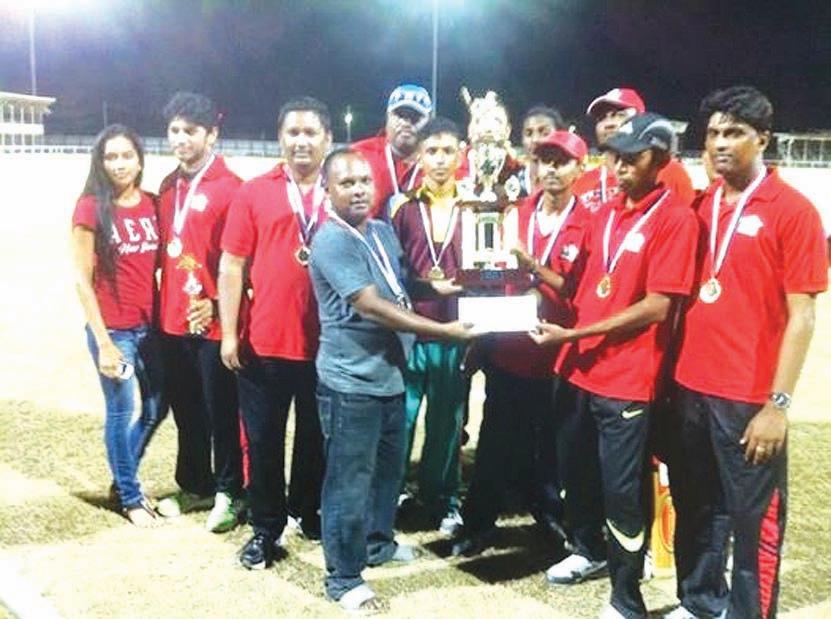
New Building Society (NBS) are the winners of the Corporate Business Industry Sports (CBIS) 2014 tournament played on Saturday at the Albion Sports Complex.
NBS topped beverage giants Banks DIH Ltd in the final to disqualify themselves from next year competition.
According to a rule of the tournament, the winning team will be ineligible to play after they have won.
Batting first after losing the toss, the beverage boys were restricted to 51-5 off their allotted six over.
In reply, NBS raced to victory in 4.2 overs without losing a wicket as David Looknauth smashed 32 runs
the one day tournament while the final and semi-finals were played under lights.
It was never likely to be that straightforward, and with chants of “Tommy! Tommy!” ringing around the arena, both men looked to be suffering with cramp at times.
Murray dropped serve to love at 3-3, in a game bookended by double faults, only to recover the deficit immediately with a backhand winner, and Robredo then twisted the knife by saving Murray’s first championship point with a thumping forehand in game 10.
The only predictable thing about the match was that it would require another tiebreak to settle it, and it was a thriller.
Three times Robredo moved to the brink of victory and each time Murray stood firm, saving the first of them in a stunning rally after the Spaniard looked to have hit a return winner.
Murray simply would not be moved and when he brought up his second championship point, the Scot constructed a beautiful rally before firing a backhand winner down the line and then collapsing in elation and exhaustion. (BBC Sport)
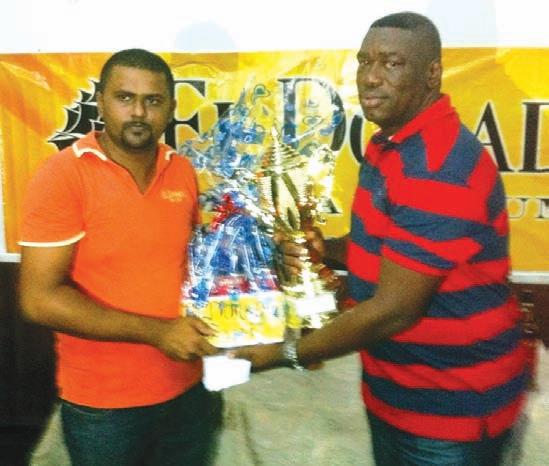
Assistant Superintendent of Police (ASP)
Boodnarine Persaud in charge of ‘B’ Division Traffic along with ASP Terrence Browne led a team of officers to the New Amsterdam Town Hall domino title on Friday evening.
The Police men defeated the Demerara Distillers Limited (DDL) with a total of 86 games. DDL was able to score 79 games for the second position.
Municipal Constabulary also finished on 79 games but was disqualified because one player played more than the allotted amount of games which allowed NA Killers to finish in third with 78 games.
Cambio and Sentinel Security finished jointly on 75 games with Sentinel being given the edge by virtue of registering more sixes.
The Guyana Defence Force (GDF) was at the bottom on the points table with 67 games.
Michael Nurse of NA Killers scored the maximum of 18 games and received good support form the only female in the competition Samantha Smith who scored 17 games.
The love birds were Joel Chisholm of GDF, Andy Bell of Sentinel Security and Petamba Sukra of police Meanwhile Sales Manager of DDL Albert Budhoo said he was pleased that DDL could be associated with the Town day activities.
The event was organized by the Constabulary department of the Municipality. (Andrew Carmichael)
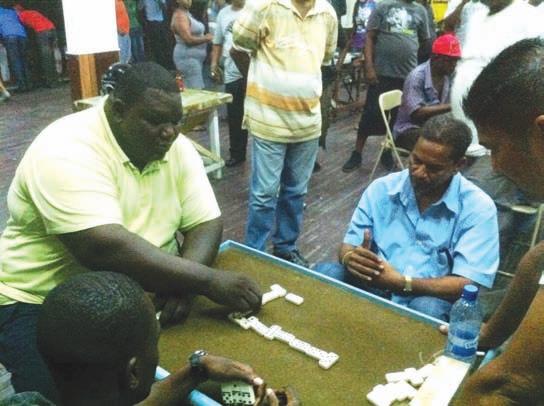
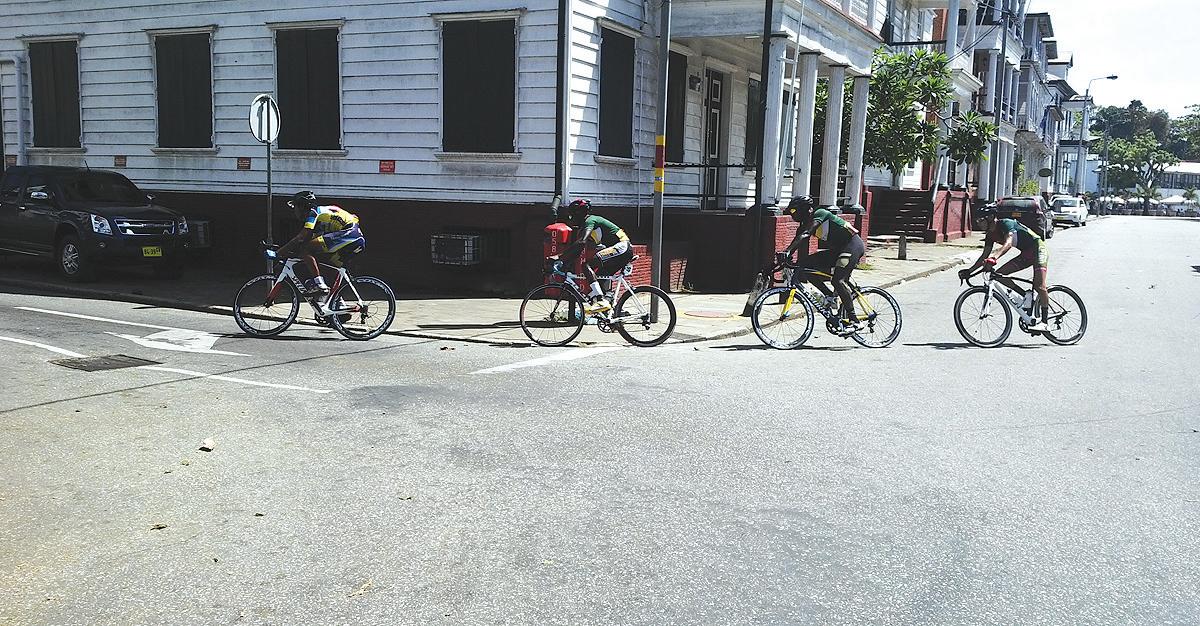
By
Backed by vocal support from the national female volleyball and table tennis teams, Guyana’s four-member male cycling team made a mockery of the road race on Sunday, filling the top four positions in an exceptional performance on the final day of the Inter-Guiana Games (IGG).

Serena Williams beat
Romania’s Simona Halep to win the season-ending WTA Tour Finals for the third year in a row on the event’s debut in Singapore.
stage had she lost to Ana Ivanovic in straight sets, but the Romanian lost in three to throw the champion a lifeline.
Williams looked to have taken charge at 4-2 only to double-fault twice in handing the advantage straight back.
Halep was ranked as low as 64 in the world 18 months ago and has enjoyed an astonishing rise, but she could not reproduce the accurate hitting that took her to the French Open final in her first WTA Finals decider.
The Romanian, 23, sprayed a backhand wide to drop serve for the third time and Williams hammered down two aces on her way to serving out the set after 46 minutes.
Despite enjoying the support of much of the crowd, who were chanting “Simona! Simona!” at regular intervals, Halep could not withstand an improving Williams in the second set.
Jeffrey’s sudden burst at the tail end of the race was set up by a brilliant piece of riding by 2014 Junior Caribbean Championships bronze medalist Ambrose.
Ambrose had set the tone for victory, racing to the front after about 10km and constantly opening the gap on his teammates, who were locked with French Guiana’s Raphael Janvio. It was a scenario that continued for the majority of the race, until Ambrose, in a tactical move, slowed his pace to connect with the other Guyanese, dropping Janvio in the process.
The Guyanese – Alonzo Ambrose, Shaquille Agard, Akeem Arthur and Kravitz Jeffrey- seemed destined to cross the finish line together, but with about 50 metres to go, Jeffrey pulled away from the bunch to claim the gold medal in one hour, 50 minutes, 26 seconds.
Janvio finished a distant fifth, clocking 01:53:01s.
In the female segment of the road race, Guyana’s Ronella Samuels (4th) and Toshwanna Doris (5th) were not as fortunate as their countrymen since the formidable hosts occupied all three spots on the podium.
In the 34.5km event, Marelva Springer, Zulehka Burnet and Tamia Slijngaard earned the top three podium spots for Suriname.
After a points tally, Team Guyana was adjudged champions of the cycling segment of this year’s Games which concluded on Sunday evening.
The American top seed won 6-3 6-0 to claim the WTA title for the fifth time.
Williams also gained revenge for suffering her heaviest defeat in 16 years against Halep in the group stage.
The 33-year-old, who won her 18th Grand Slam singles title at the US Open in September, will end the year as world number one for the fourth time.
“I had to play more Serenastyle tennis and just do what I do best,” said Williams.
“I was expecting a much better player than I was in the earlier round. Being ready for that really was able to help me out.”
Halep could have eliminated Williams in the group
“I have no regrets, because I did my job on court against Ivanovic,” said Halep. “I tried to win the match. I couldn’t, but I never thought that I have to lose in two sets against Ivanovic.”
Both Williams and Halep were below their best in the final, which failed to live up to the American’s thrilling semi-final win over Caroline Wozniacki, but once she had clinched the first set there was little danger of Williams giving up her title.
She began the match in edgy fashion, having to save break point in her opening service game before being broken in her second, but Halep could not convert a chance to move 3-1 ahead and was pegged back.
With both players struggling to find any rhythm,
The American cut out the double-faults and attacked the Halep serve at will as she raced into a double-break lead, before a flashing forehand return made it 5-0 and prompted a victorious raised fist.
Williams lost her first championship point with a misjudged drop shot but wrapped up the win moments later, claiming her fifth WTA title 13 years after her first in Munich.
“I knew she will play better this match because she saw how I play, she saw what she has to do during the match, so she did really well today,” added Halep. (BBC Sport)
Meanwhile on the distaff side, Trinidad’s Tonya Nero led from start to finish winning the event in 37:35.46s while finishing ahead of American based Guyanese Euleen Josiah-Tanner who clocked 37:39.18s for second.
Guyana’s Alika Morgan was third in a time of 40:05.39s, outrunning Andrea Foster who finished fourth in 40:22.68s. Jenelle Nedd of Trinidad took fifth in 41:21.89s. The junior male category was won by Matthew McKenzie who clocked 35:29.68s for the win to finish ahead of his brother
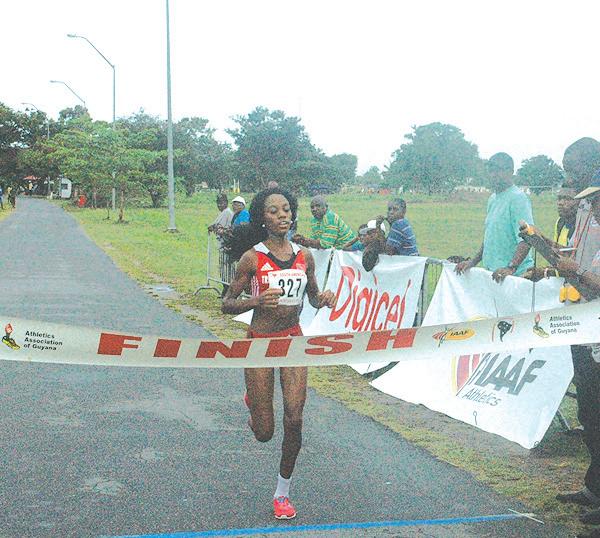
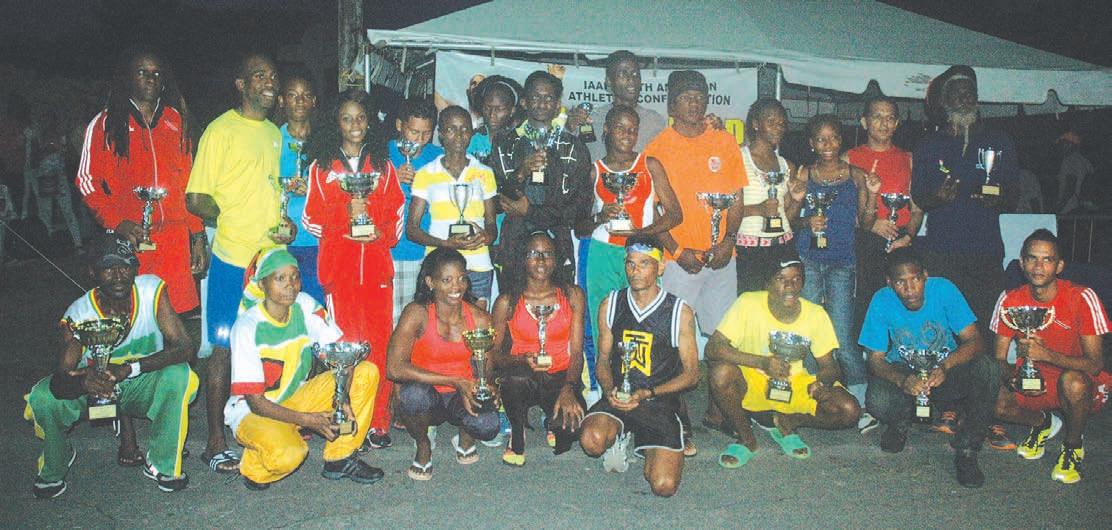
Carl McKenzie who clocked 36:25.28s for second. Leon Benjamin was third in a time of 39:22.46s. Mariah McKenzie won the female junior category in 43:13.96s while Shontel Hinds took second in 45:06.89s. Cassie Kirton fin-
ished third in 48:56.39s. Alisha Fortune won the women’s masters category in a time of 50:16.28s, finishing ahead of Cyrleen Phillips who clocked 50:24.89s for second to leave Carla Benjamin picking up the slacks in third with a
time of 50:44.25s. The men’s 40-55 masters age category was won by Ian Archibald in a time of 37:12.86s while Ravi Purohit won the men’s master 56 and over in a time of 46:13.31s.
At the presentation cer-
emony held immediately after the race, the athletes received the trophies and prizes and were congratulated by the President of the Athletics Association of Guyana, Aubrey Hutson.


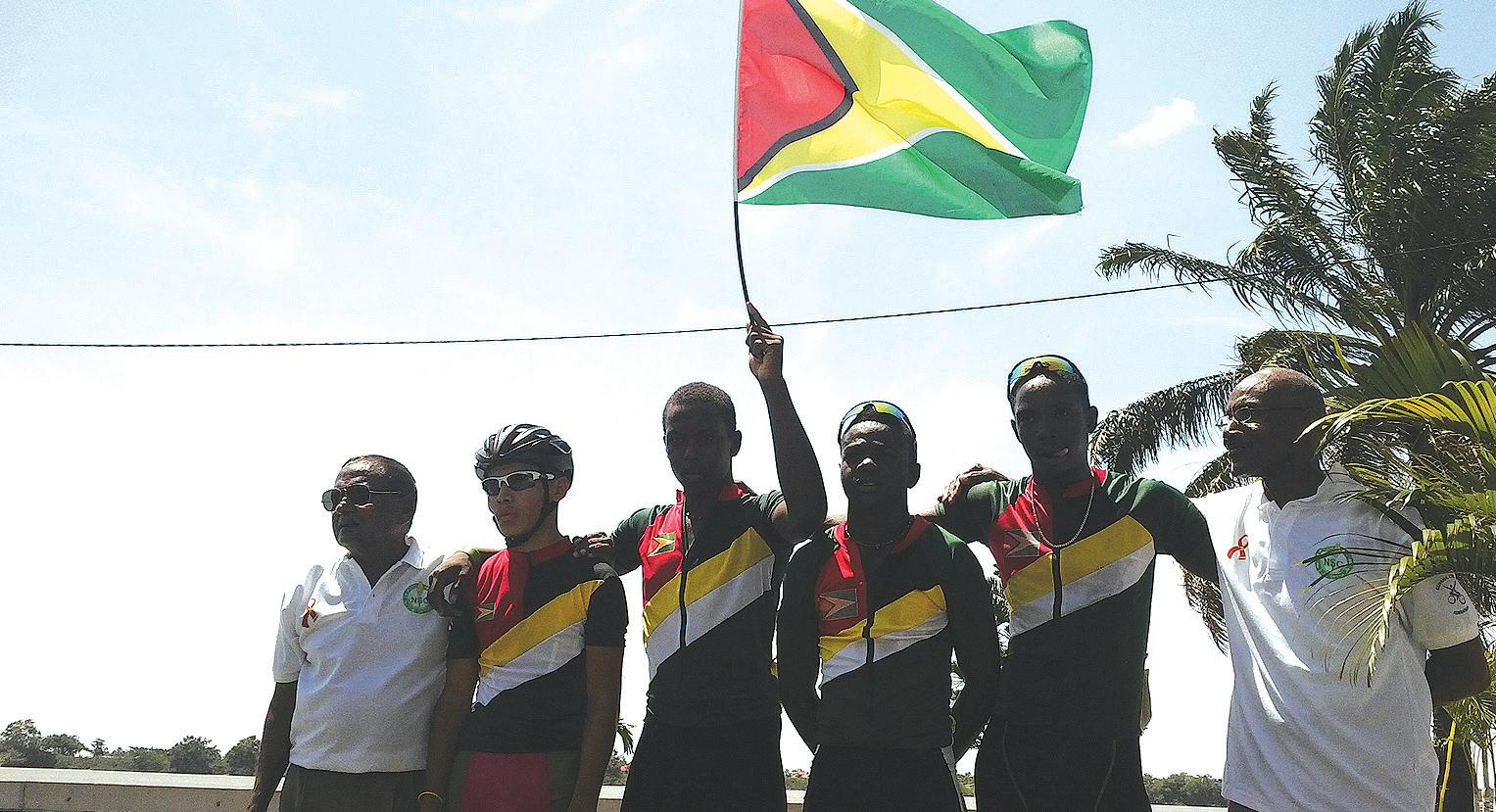
By TreisTon Joseph
Linden’s Orville Hinds with outstretched arms, celebrated a grueling 65 mile victory as he crossed the line to win the Digicel sponsored Breast Cancer awareness ride on Sunday that ended `.
Hinds pulled away from the pack to comfortably win the event in the final five miles crossing the finish line in 2h 39m 29s for the win.
Paul deNobrega finished in second while Robin Persaud was third. Andrew Greaves finished fourth ahead of Gebron Crawford for fifth and Marlon Williams sixth. The race started off with
a fiery pace with the likes of Robin Persaud, Hinds and Alonzo Greaves taking the early lead.
However a few attacks between the cyclists in the lead peloton allowed Hinds to hold a slim lead from the Abari Bridge.
While a few other cyclists challenged Hinds after the initial break away at the Abari Bridge, the Lindener kept with his pace before eventually pulling away for the win which also won him all three of the primes.
“I t was grueling, a lot of attacks because everybody is looking for everybody but I held through to the end…
“I support this event and I would hope that all those fighting breast cancer keep-
ing fighting and never give up,” Hinds told the media after the event.
Meanwhile Hazina Bharrat successfully defended her title finishing in 1h 28m 15s to finish ahead of Marcia Dick.
The juniors also did not disappoint as Andrew Greaves crossed the finish line to win the category ahead of Raul Leal and Michael Anthony who finished second and third respectively.
Romalo Crawford won the Juveniles while Stephen Fernandes won the veteran category. Prizes were also given to the youngest rider in Berbician Whitney Boyer and the oldest in Montgomery Paris.
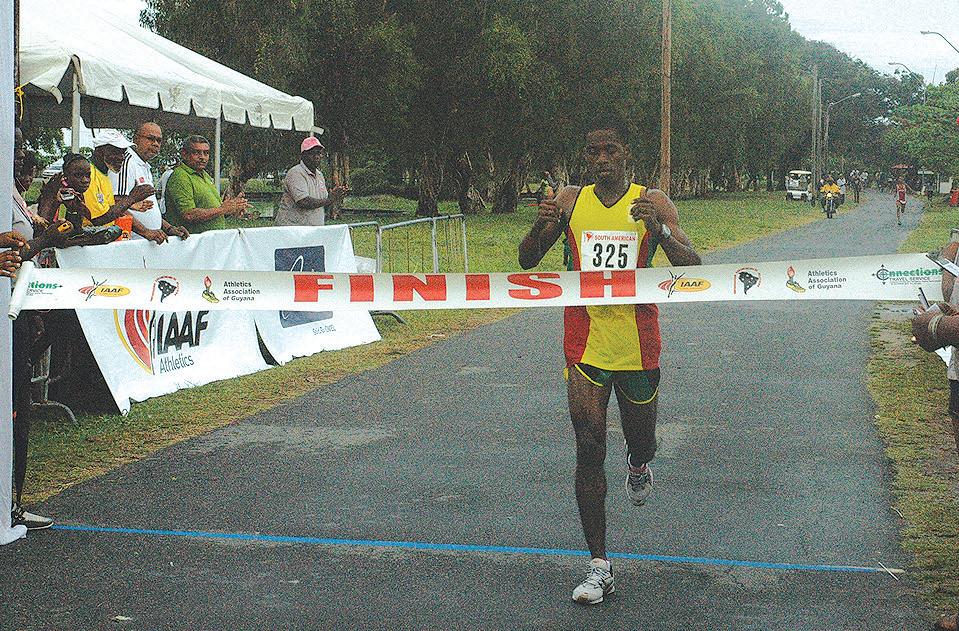
By TreisTon Joseph
leveland Forde waited until he passed his training ground at Base Camp Ayanganna before making his move that eventually won him another

South American title on Sunday that finished inside of the National Park.
Forde clocked the fastest 10k time in Guyana this year of 32:27.39s to win the event ahead of Trinidad’s Richard Jones who clocked
32:39.21s. Cleveland Thomas was third with a time of 32:56.25s while Overseas based Guyanese Kelvin Johnson was fourth in 33:21.28s. Nathaniel Giddings rounded out the top five with a time of 33:24.43s.
The race started with a bit of a mundane pace before Kevin Bayley, Giddings, Thomas, Jones, Forde, Johnson, Jones and Horatio broke away from the group after the first kilometers.
However, at the turning point at Turkeyen the race was further broken down to just five athletes with Johnson leading the way followed by Thomas, Giddings, Jones and Forde. With both Giddings and Johnson falling away at the Russian embassy, Jones took over the lead for a short period before Forde made his move just in front of the Guyana Defence Force (GDF) ground.
continued on page 23