John Stanislaus, 5 ft-tall and of Amerindian and Portuguese ancestry, was the first to hit a cricket ball clear over the Pomeroon River, in a match between Jacklow Cricket Club and Picker's Gill Cricket Club along the Upper Pomeroon River.
The historic event occurred at Picker's Gill Saw Mill Sports Ground, some 16 miles from Charity, Upper Pomeroon River. The Picker's Gill Saw Mill was a huge steam complex, the first of its kind constructed in 1915. The company employed more than 200 workers, who mostly lived around the complex with suitable housing facility. Picker's Gill was also the turning point for Bitmoutty Cargo Steamer Service operated by T&HD, which came from Georgetown.
The Picker's Gill Sports complex’s sub-soil was mixed with saw dust and bagasse, and was always wet. It supported a market, rental shop and dance hall. The epicentre of the cricket ground was close to 200 feet from the Pomeroon River bank in the east and west direction. It was a sunny Sunday when the Jacklow cricket team arrived at Picker's Gill to be well-received by Leroy Westmas. The Jacklow team comprised Stanley Castello, Philbert Austin, Housman
Alli, John Fernandes, Cecil Garraway, John Stanislaus, Dennis Gildhari, Harold De Mattos, Dolphos Williams, Thomas Tacourdeen and Henry James. The wicketkeeper was Fernandes and umpire was Michael Austin.
The Picker's Gill cricket team comprised William Brant, Moti Singh, Renold Smith, John Seymour, Oscar Paddy, Basil Harris, Neil McConnel, Thomas Trim, Charlie Chapelle, Leroy Westmas and Cecil Harris.
The match began with Picker's Gill winning the toss and choosing to bat. Picker's Gill wicketkeeper was John Seymour, whose father was the owner of the Affiance Sugar Estate on the Essequibo. The umpire was Harold Tobin.
During that period, only batting and wicketkeeping pads were available. A Wisden cricket ball would then have cost $2 and a Wisden, Spauldin or Christiani cricket bat would have cost $12. The Picker's Gill team made 105 runs.
Jacklow’s fast bowler was John Castello, a lanky 6 ft 6 inch person, and the leg spinner was Housman Alli. Picker's Gill’s fast bowler was Thomas Trim, a 6 ft forestry worker who was an aggressive pace man.
The Dance Hall Pavilion was filled with fans from Aripiaco, Kabacaburiand, and Abrams Creek.
John Stanislaus was a middle-order batsman and considered a slugger. While at his base waiting on the bowler, John would keep lifting his bat up and down to swipe at any ball. Sometimes, in different cricket matches, he would be bowled for duck, but on several occasions he would hit 10 sixes; as such he commanded an unusual audience. He was a 35-year-old with an unpredictable character, a good Catholic, very quiet with an unassuming personality, and smiles with his eyes expressing friendliness.
On that historic Sunday August 1953, John started batting around 3:30pm. He missed a couple of ‘wide balls’ from fast bowler Thomas Trim, whose over ended with a maiden. John Seymour, a medium pace off-spinner, began to bowl to
with Jacklow's team losing still – by 10 runs.
The collapse of the sugar estate in Essequibo by 1934 and World War II from1935 to 1945 saw the demise of cricket in Essequibo; even horse racing disappeared. However, the Pomeroon River district kept the spirit alive with play fields at Jacklow, Siriki, Martindale and St. John, by the Gonsalves in lower Pomeroon.
The hardship created by World War II saw Pomeroon sportsmen being innovative and substituting professional cricket bats for those made from cedar and silverballi wood. Rubber and balata milk were used to make cricket balls and fiddle head savannah grass was used to make scoring sheets.
At that time the tide was rising and the breeze was strong when John, the slugger, crouched on his right knee, and with a vigorous left hook, struck the rising ball, which mounted over 200 feet into the air. It sailed over the Pomeroon River, landing on Joseph Goddett's Shop, parallel to the opposite river bank.
Pandemonium broke out as the umpire at the eastern end kept spinning his hands not knowing where the ball went. When the crowd ran on the pitch, John too was not sure where the ball went. He
John’s parents and the surrounding community constructed a cricket ground parallel to the cemetery and alongside Stanislaus’ farm land. The cemetery came about in 1934 when an epidemic caused the death of dozens of residents. The community support comprised of the Vansluytmans, Allens, Stolls, Garraways, Durgas, Younges, Dasses, Evans, Austins, Daniels, Ramdehols, Tacoordeens, Braithwaites, and Bairds.
The history of John Stanislaus’ career is being promoted by his sons, all of whom are well-established cricketers residing in Pomeroon, who enjoy a record of good standing in their community.
The Alphonsos inclusive of Alfro Alphonso, who has
was subsequently drenched with wine and cassirie. Part of the crowd scampered to the nearby river edge and the surrounding wharf to search for the ball. Some even paddled in canoes in search of the missing red Wisden cricket ball. When Joseph Goddett shouted from across the river, it was then the destination of the famous stroke was established. The match continued
invested much funding in the community, is the live wire of cricket inclusive of his uncle Joakim and George Alphonso; they are all the luminaries of cricket in the region.
Still alive are these persons who witnessed the above historic event: Alvin Melville of Jacklow, Cecil Harris of Good Hope, and Tabrack Basir, CCH, formerly of Jacklow.
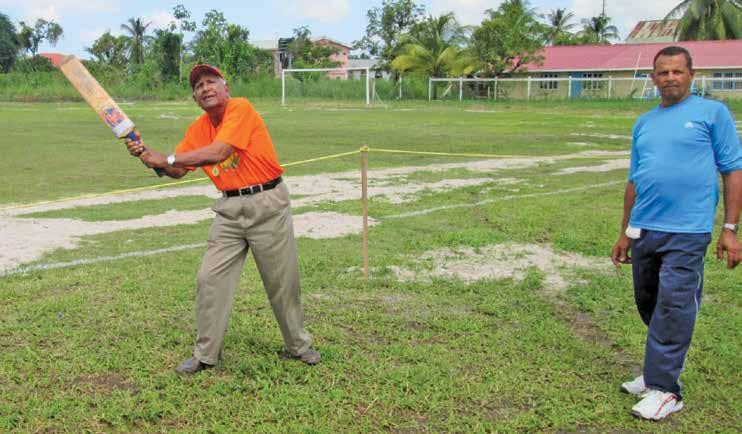
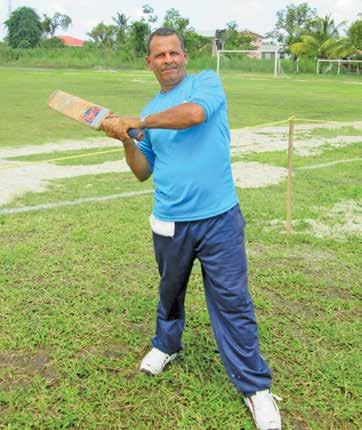
Basir (left) demonstrating the hit
One of John Stanislaus' sons, Barry
Cecil Garraway who scored his second one run. It was now John’s turn to bat.
Every day we travel throughout Georgetown, navigating our way through various streets. But have you ever wondered where the streets got their names?
Luke M. Hill, once the City Engineer of Georgetown or – as the post was called in those days – the Town Superintendent, contributed to the journal “Timehri”, a most interesting article on the origin of the area and streets of Georgetown. In Vincent Roth’s book, “Roth’s Pepper-Pot”, Roth penned vital information on the history of those streets based on what was found in “Timehri”.
Naming the capital According to Roth, the oldest part of the city of Georgetown is Brickdam and the strips of land on either side that were built by the French in 1782 and called La Novelle Ville – the new town. When the Dutch resumed possession of the country in 1783, they named the infant settlement Stabroek after Nicolas Geelvinck, Lord of Capsicum, Bakum and Stabroek, president of the Dutch West Indian Company.
As the little town grew, by the addition of the front lands of adjoining plantations Vlissengen, La Bourgade and Eve Leary on the north, and Werken-Rust, Le Repentir and La Penitence on the south, it was on April 29, 1812 named George Town (two words), after King George III, the then reigning sovereign. Indeed, many of the city street names will be found to refer to his reign and those of his immediate successors.
In 1842, the city of Georgetown – one word – was set up by Royal Warrant.
Street Names
Water Street was so named because it ran along the Demerara River foreshore and formed the original river dam protecting the plantations from tidal water on their river frontage.
At first, all the building lots were on the eastern side of the street. The lands on the western side or river side were termed mud lots, on which wharfs or stellings with warehouses were constructed. Most these mud lots were subsequently further protected by building river walls of brick, and the intervening space between filled up, forming the site for the buildings on the western side of the street.
Camp Street was so named because it was the leading thoroughfare to the camp or garrison at the extreme north end of the city.
Young Street, in some of the earlier charts called Camp Road, took its name
from H. Fox Young, a former government secretary.
Cowan Street was named after Edward Cowan, an assistant commissary-general at the garrison.
Mundy Street was named after Major Robert M. Mundy, a lieutenant-governor in 1866.
Urquhart Street was named after J. Urquhart, a former Water Street merchant.
Hope Street was named after Admiral Hope, who visited the colony about that time (1866).
Carmichael Street was named after General Hugh Lyle Carmichael, lieutenant-governor in 1812-1813. He died in March 1813 from typhoid fever and was buried in the Officers Cemetery at Eve Leary. He was responsible for many reforms in the civil service.
Waterloo Street was named after Wellington’s great battle and victory of June 18, 1815. The Battle of Waterloo was fought
the command of the Duke of Wellington combined with a Prussian army.
Thomas Street was named from its being the main road to Plantation Thomas, and East Street on account of its easterly position in Cummingsburg.
Cummings Street was the back dam of Plantation La Bourgade and was named after the original proprietor of the plantation.
Lamaha Street was so named because it ran beside the north drainage trench of the area, which had direct connection with the Lamaha canal through East Street.
Bentinck Street commemorated H. W. Bentinck, lieutenant-governor from 1809 to 1812, while Middle Street was the old
Church Street got its name because it led citizens to and from the parish church now St George’s Cathedral.
Robbstown, together with Newtown, formed the front portion of Plantation Vlissengen and was originally called Bridgetown and consisted of small shacks in which dwelt free people of colour. It was leased by John Robb who laid out the area in house lots.
Hincks Street was named after Sir Francis Hincks, governor from 1862 to 1868 and later Finance Minister of Canada.
Robb Street was named after John Robb, its founder. Regent Street was named after the Prince Regent, subsequently King
near Waterloo in presentday Belgium, then part of the United Kingdom of the Netherlands. A French army under the command of Napoleon was defeated by the armies of the Seventh Coalition, comprising an Anglo-allied army under
Middle Walk of Plantation Bourgade.
Murray Street was named after lieutenant-governor, Major General John Murray, who was notorious for his ruthless suppression of the East Coast insurrection of 1823.
IV. South Street was so named because of it being the southernmost street of that ward. (Information from “Roth’s Pepper-Pot” by Vincent Roth) To be conTinued nexT week…
George
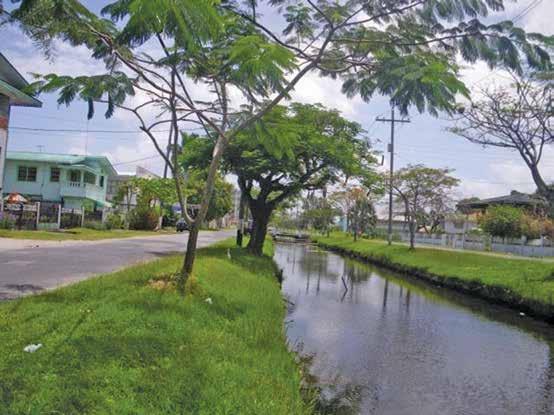
Canal on South Road (Street)
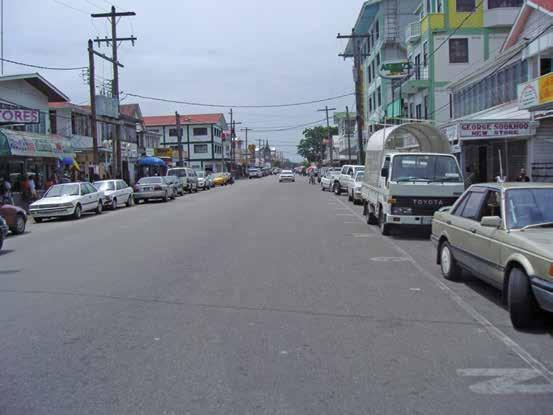
Regent Street looking east
History of Georgetown
Street lighting and tree planting in the city
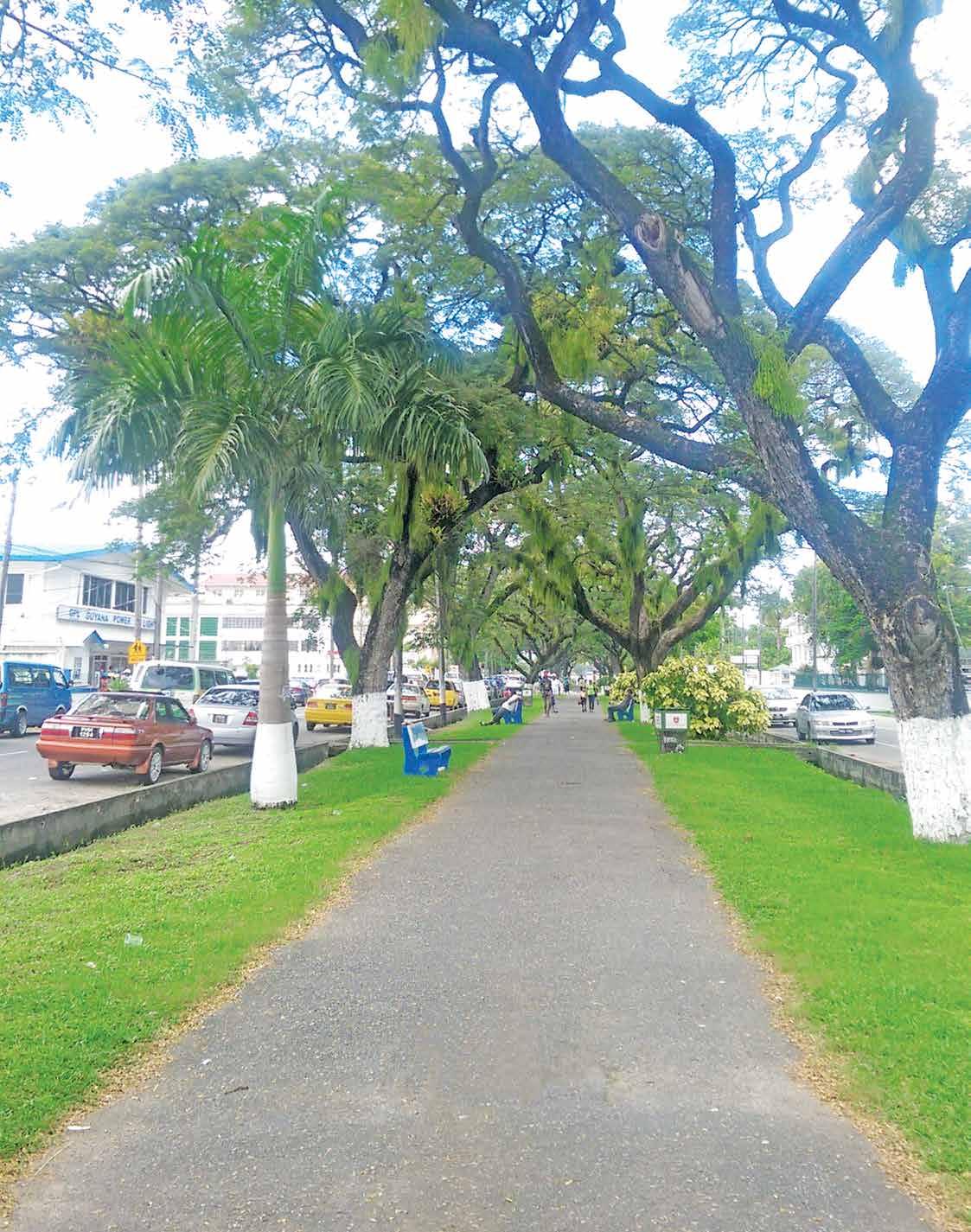
Have you ever looked at the towering trees on Main Street or around Georgetown and thought of when tree planting in the capital city began? Or thought of the history of the installation of street lights?
Gas lighting
According to the book “The story of Georgetown” by James Rodway, Stabroek was lighted in early times with lanterns fastened to wallaba posts. The oil used was probably train oil. In 1860 kerosene was introduced and iron lamp posts erected. Rodway also said in his book that gas lighting had been mentioned many times before it was seriously considered; it was proposed in 1838.
The Town Council back then seriously considered the introduction of gas in 1860. It was spoken of as likely to be a great improvement, but there were doubts as to whether people generally would adopt it. It was not to be supposed that the town lighting alone could support a gas company. However, several persons came forward with projects: the first being T. C. Jenkins, an American Consul. This offer was withdrawn after news of the impending war
of secession.
Then came James Appleby, who offered to get up a company in London; his estimate was £4 4s. per street lamp, and 12 shillings per thousand feet for the public. The most serious offer was by S. R. Dickson, who, in 1861, proposed to establish the Demerara Gas Light Company. He asked for a lot of land for the works and offered to light 300 street lamps at $25 per annum and to supply light to private persons at $5 per 1,000 feet. He also stipulated that half the shares should be subscribed in the colony. The result of his action was a petition to the court and an
ordinance dated August 2, 1862, which stated that the establishment of gas works in Georgetown would be of public advantage. The petitioners were S. R. Dickson, H. I. de Jonge, Jos. Kaufmann and Jas. Brady.
Nothing appears to have been actually done, and in 1864 a new ordinance was passed on the petition of A. W. Perot, F. A. R. Winter, J. S. Hill, J. Kaufmann and others. This also failed or at least did not get into working order in the time given by the ordinance and a new charter was granted in 1870. The preamble stated that the Demerara Company ordinance having ceased, A. W. Perot and G.
H. Oliver, directors of that company, agreed with G. W. Harris, A. Williams, and others in England, to apply for a new ordinance to establish the Georgetown Gas Company.
At last, in March 1873 gas lighting became an accomplished fact. The Georgetown Gas Company did fairly well, and although there were complaints of the high price, still there was small ground for anything like dissatisfaction.
Electric lighting
Early in 1889, Julius Conrad, R. Allan, W. S. Turner and R. Dodds applied to the Town Council for a conditional promise to support an electric light company, and as they wanted a monopoly they were referred to the government. Their request for a monopoly for 30 years and for permission to use the streets were considered by the court and referred to the Town Council. Nothing was actually done until the following year, when a meeting was held at the house of Jacob Conrad on March 25, at which it was agreed to form a company.
On May 5 the town council agreed to refer a motion of Mr Gibson that a test of 50 electric street lamps should be made to the light-
ing committee, which ultimately arranged for such a test. At the first general meeting of the company, on August 6, it was reported that 650 private lamps and 50 street lamps had been ordered and works expected to start on January 1, followed by lighting the greater part of High Street from Brickdam to Kingston.
On January 17, 1891, crowds of people filled the street to look at the new lights being turned on. Since that time, electric slowly, but surely, replaced gas, until the gas company was compelled to discontinue its operations and gas lighting came to an end.
Tree planting
The first attempt at tree planting in the streets was a short line of Fiddlewood trees, with here and there a bat-seed, Andira inermis , in Commerce Street. These were planted before 1870. A great impetus was given to ornamental planting by the laying out of the Promenade Gardens in 1853, when many trees and shrubs were imported from the Trinidad Botanical
Gardens and elsewhere.
An early attempt to decorate Main Street was by a double line of Oleanders on either side of the canal, but these bushes never looked well due to them being damaged by the public.
An avenue of Mahogany trees in Le Repentir Cemetery dates from about 1870, and the coconut palms near the seawall were planted about the same time.
Rodway in his book stated, “All these were but poor attempts at street decoration, and we must thank the Botanic Gardens for almost everything [regarding trees] we have today.”
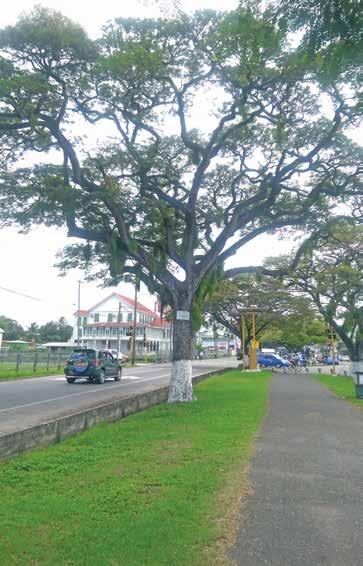
A recently added sign on one of the trees, obliquely of Walter Roth Museum on Main Street, reads: “Rain Tree, scientific name: Samanea saman. Interesting facts: Native to Tropical America, grows up to 50m tall and spreads as wide as 200 human steps, seeds are chewed for sore throat.” (Information from “The story of Georgetown” by James Rodway) (Cover photo- Serene Main Street walkway sheltered by trees)
Present day electric lights along the East Coast seawall (Michael C Lam photo)
The impressive Rain Tree on Main Street
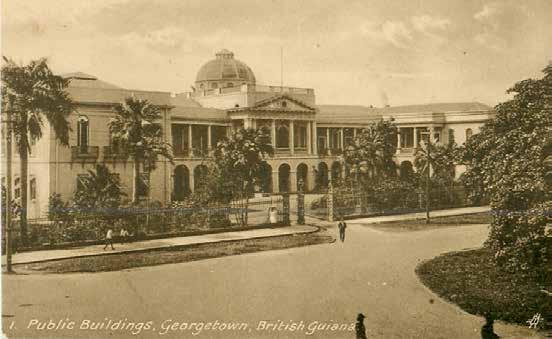
Trees decorated the Public Buildings, British Guiana
Working for about 15 years now in the field of physiotherapy, Stacey Greaves never let her lack of sight discourage her dreams
Determined, optimistic and cheerful are just a few attributes that aptly describe Stacey Greaves. Although she is completely blind, that has not dampened her resolve to fulfil her goal of becoming a physiotherapist.
Stacey was born in Bartica, Region Seven (Cuyuni-Mazaruni), but later moved to Georgetown at the age of eight.
“In Georgetown, I attended Sacred Heart Primary School then to St
my sight I was neither depressed nor afraid. I always hoped I would gain my sight. But it really hit home I would never see again after listening to a radio programme where a doctor was discussing about being blind. At that time I was already married and had my daughter, who is now 14 years old. Although I was saddened by this, I did not allow it to break my determination to fulfil my goals,”
Stacey recalled in an interview with Guyana Times
Roses Unit for the Blind. I started to lose my sight from six years old. At the age of 14, I completely lost my sight. The doctors, up to now, do not know the reason why I am blind. I am the only one in my family who is blind. When I lost
Sunday Magazine
L She taught at the St Roses Unit for the Blind for a year, worked as a receptionist at Dr Hanoman’s office on Brickdam for a year, and was a switchboard operator at the Guyana Sewerage and
Water Commission for a few months. She later went to train at the Georgetown Public Hospital (GPHC) for her present job as a rehabilitation assistant.
Coming to terms with her life
“When it hit home that I will never see again, I was saddened. However, I did not allow it to keep me down. I had to stop and examine my life and be grateful for all that I had achieved although being blind. I was determined to just pull myself together and be a role model for others. That is when I decided to dedicate myself to the two-year training I received from GPHC. It trained me to work with persons with physical injuries, and stroke patients, using rehabilitative techniques. I recorded the training sessions and had an electric typewriter, which I used to type my notes,” she reminisced.
Stacey noted that she has always been a “confident, fearless person” and being blind is not a trial for her. She credits her family for showing their full support and never shutting her away. As a little girl growing up, Stacey said she was never isolated or treated like a blind person. She still had chores to get done. Now, Stacey, a single mother, faces life with an optimistic mindset. She washes, cooks, and cleans.
Working for about 15 years now in the field of physiotherapy, Stacey is currently employed through the Ministry of Health and is stationed at the Palms.
“I am trained in speech, occupational and physiotherapy. Currently, I am working in the physiotherapy department at the Palms,dealing with orthopaedic and neurological cases. I work with stroke patients and others, using heat and cold therapy among other techniques,” she outlined.
Stacey said too that she wrote History and English at CSEC and is presently studying Business, Human and Social Biology, Office
Administration and Social Studies at the Guyana Society for the Blind. She is preparing to write those subjects at the upcoming CSEC exam.
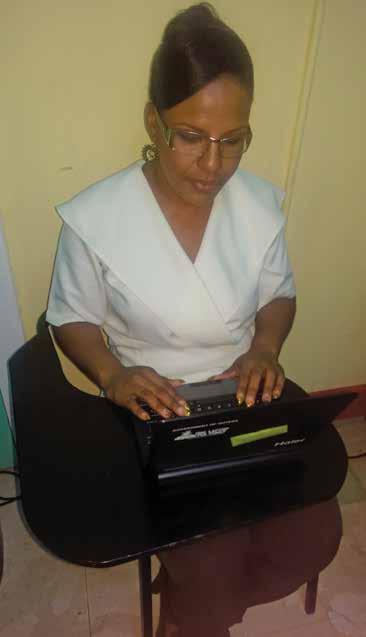
“I am thankful for the programme the Society is offering because it gives blind and visually impaired individuals a second chance to achieve their academic goals.I decided to join the programme because I would like to move ahead in my career. Ican read my notes via JAWS [Job Access with Speech] installed on my One Laptop per Family computer. JAWS reads my notes to me and that is how I am able to study for my subjects. My goals are even more a reality thanks to the CSEC programme at the Society,” Stacey declared.
After CSEC, Stacey would like to pursue a degree in rehabilitation science at University of Guyana.
Her advice to blind individuals is to “go after your dreams and not allow anyone to discourage you.”
“Anything in life is achievable once you dedicate your life to it. I am also grateful to God for giving me the strength. For those sighted persons, I would like to say that we [blind individuals] want to be treated as normal, and not to pity or shun us. Just give us a chance in life; we can
visualise things and understand. We want to be loved and respected just like ev-
eryone else. Being blind does not make us less of a person,” she stated.
Stacey Greaves
Stacey on the computer at the Guyana Society for the Blind studying for her upcoming CSEC exams
Times Book World
The Shaping of guyaneSe LiTeraTure
By PetamBer Persaud
This article has its genesis in the wake of two events: the announcement of the Guyana Prize for Literature and the just concluded Pravasi Bharatiya Divas 2015.
The announcement of the Guyana Prize for Literature brought back fond memories of Victor Ramraj, a colleague and respected academic, who passed away in 2014. Ramraj was involved in The Prize on many occasions, twice serving as Chief Judge. Over the years, Ramraj had been one of many who bequeathed me loads of publications in line with my work.
Over the years, he would tug along heavy tomes, some with hard covers, in his suitcase/s, sometimes in his wife Ruby's, suitcase/s, for this grateful litterateur.
The Bharatiya Divas started its celebration Jan 9, the day Mahatma Gandhi returned to India from South Africa. It is an annual event to celebrate the contributions/achievements of people of Indian origin (PIO). Pravasi Bharatiya Divas is also called the Non-Resident Indian Day.
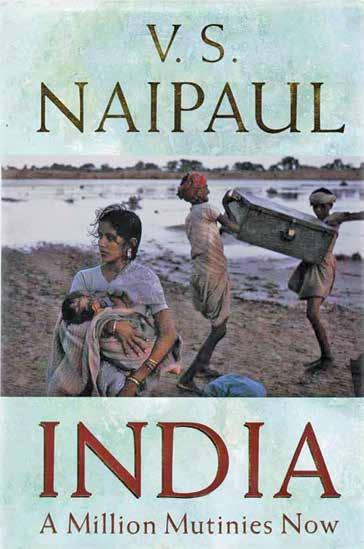
One of the publications that Ramraj gave to me is entitled, “The man who suffers and the mind which creates: V. S Naipaul
on Mahatma Gandhi”, which was the transcript of Ramraj’s lecture at the 2009 Annual Lecture for The Gandhi Society of Calgary, published by the University of Calgary.
The Gandhi Society “promotes the values that Mahatma Gandhi focused on such ideas as non-violence, peace, and international understanding”.
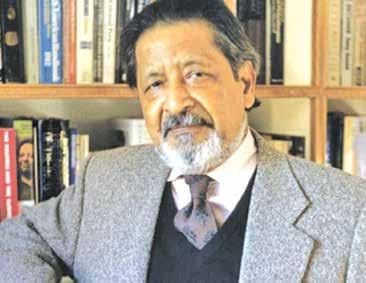
Naipaul is the most prominent Indian writer in the diaspora to comment extensively on Gandhi. He is just as scathing and critical of Gandhi as dealing with other personalities and situations. Naipaul’s thoughts on Gandhi could be found
in the following books, “An Area of Darkness” (1964), “India: A wounded civilization” (1977), and “India a million mutinies now” (1990). In his latest non-fiction collection, “A writer’s people” (2008), Naipaul focused on Gandhi again in two essays ‘Looking and not seeing – the Indian way’ and ‘India again’.
Naipaul was born in Trinidad to second generation Indians who came from India to Trinidad as indenture workers.
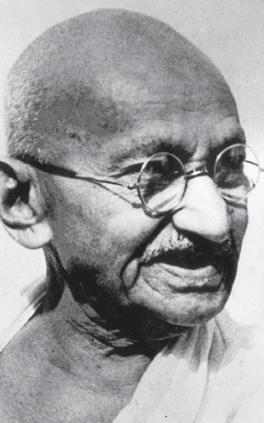
Mohandas Karamchand Gandhi known as the Mahatma (Great Soul) was the most significant voice in India independence movement against British colonial rule. He was nominated five times for the Nobel Prize for Peace.
Victor Ramraj was born in British Guiana where he
exhibited a leaning towards literature before migrating to North America. His Indian ancestors were brought to Guyana from India as indenture labourers.
All three men – Gandhi, Naipaul and Ramraj - in various ways contributed to the shaping of Guyanese Literature.
Responses to this author
telephone (592) 226-0065 or email: oraltradition2002@ yahoo.com
What’s happening: Now available two new books by Basdeo Mangru, "Colonial Emigration from the Bengal Presidency” and “Kanpur to Kolkata: Labour recruitment for the sugar colonies”.
Victor ramraj (1941-2014)
V.S. naipaul (b 1932)
Mohandas Gandhi (1869-1948)
the thing about CurioSity…
Why we must continue needing to know
By the time most of us leave our childhood behind, our insatiable desire to ask “why” has gone, been reduced, restricted or discouraged. As life marches on we are caught up in social relationships, peer pressure, dealing with life issues such as employment, family, health; dealing with work or assaulted with information that dulls our sense of enquiry,which further diminishes curiosity.
Studies have suggested that adults who display a more curious nature tend to live longer and healthier. They also suggest that declining curiosity may be related to neurological illness or quicker declining health among the elderly. Among children, those who are more emotionally secure seem to display a greater curiosity and hence develop their mental faculties faster as they grow than those who are not.
Curiosity drives us to experience new things; it is this
new knowledge and novelty that keeps our minds sharp. Research shows that curiosity and intelligence correlate for positive benefits in an individual. Among children, the curious toddler grows up to be a more intelligent 11-yearold than the toddler who expresses little curiosity. Among adults, continuous curiosity further boosts IQ, analytical skills and problem solving.
Additional studies prove that social relationships are more satisfying among curious individuals. People who are genuinely interested in their friends and family and enthusiastically engage in satisfying that curiosity are more likely to retain strong social bonds. These include persons who express a positive interest in their friends’ or family’s hobbies or interests, and ask questions about their partner’s wellbeing to engage in meaningful interactions.
One of the most important elements of curiosity is our enthusiasm or passion. Motivated by curiosity we are passionate about knowing; motivated by our passion, we are curious to know more. Most of the world’s greatest inventors, thinkers and such have confessed to a desire to know that drove them to discover: brought a purpose to their lives. Curiosity has the ability to bring meaning to our lives.
All curiosity is not equal however. There is both positive and negative curiosity: we learn from positive curiosity while negative curiosity deprives us. Wanting to know why the world is as it is brings positive benefits as it stimulates and brings wider knowledge. But always wanting to know what our friends are doing because we don’t want to feel left out is negative curiosity that encourages insecurity.
Opportunities for novel experiences to gain knowledge from them are everywhere. Most of us are too busy, tired or see no economic value in wanting to know. A child, walking home, sees an excavator digging up a canal. His or her desire to know how it works compels him/her to stand and watch. An adult, hurrying to get to work or go home after a long day at work or in the sun or rain, has no time and no desire to “see how it works” if they haven’t before. They are not curious to learn of it because it provides no recognizable value to their life. Some may not satisfy their curiosity because it may seem socially unacceptable for a grown person to “behave like a child”.
But the late Bernard Baruch, a respected and wealthy American financier, statesman and philanthropist once said, “Millions saw the apple fall, but Newton asked why.” Curiosity helps us see life differently and, many times, even helps us change the world.
Treasure Alana James
FromMabaruma in Region One, Treasure Alana James is the essence of beauty and brains. She completed nursery and primary school in Mabaruma then moved to Georgetown where she wrote CSEC at President's College. She later wrote‘ A’ Levels at Queen’s College, and now holds an associate degree in Chemistry from the University of Guyana. She is currently pursuing a medical degree at Texila American University. Besides studying, James enjoys pageantry and modelling. She said they are some of the things that make her “happy, and the experiences are priceless”. The beauty has won the Miss Region One 2011 pageant, copped the first runner-up prize in the Miss Amerindian Heritage 2011 pageant, and was recently crowned Miss Texila American University. For the past five years, she has been a shape model for Guyanese designer Donna Ramsammy-James. Treasure wants to be a forensic pathologist, but also has an interest in plastic surgery. Her advice to youths is to stay in school, focus on academic pursuits, stay away from drugs, and to be “bigger than the influence.”
Creature Corner
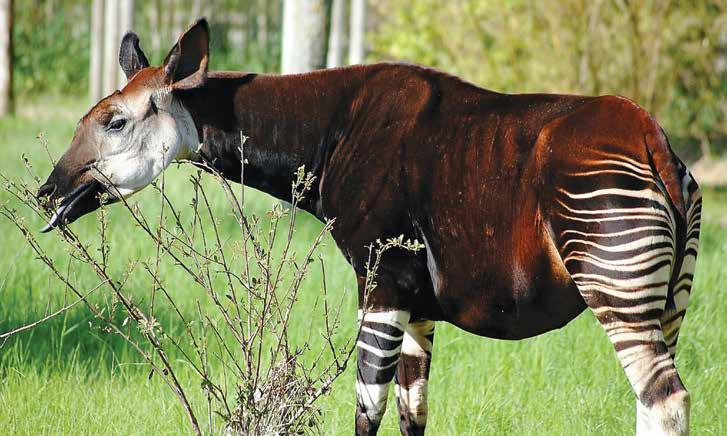
Found only in the dense, damp rainforests of northeast Democratic Republic of Congo (DRC, once known as Zaire), the Okapi is an herbivore that was discovered just over 100 years ago by scientists.
The closest relative of the giraffe, the Okapi –standing between 5 and 5 feet 6 ins tall – browses for leaves, buds, shoots and fungi, which it can strip from branches or root out from the ground with its long tongue. It also uses its tongue to clean its eyes and ears and, like the giraffe, must spread its legs to drink. The okapi’s ears rotate independently, so it can listen for sounds both in front and behind.
Females, which are usually larger than males,take between 14 to 16 months to bring their offspring to term, so take two years between each birth of a single young.
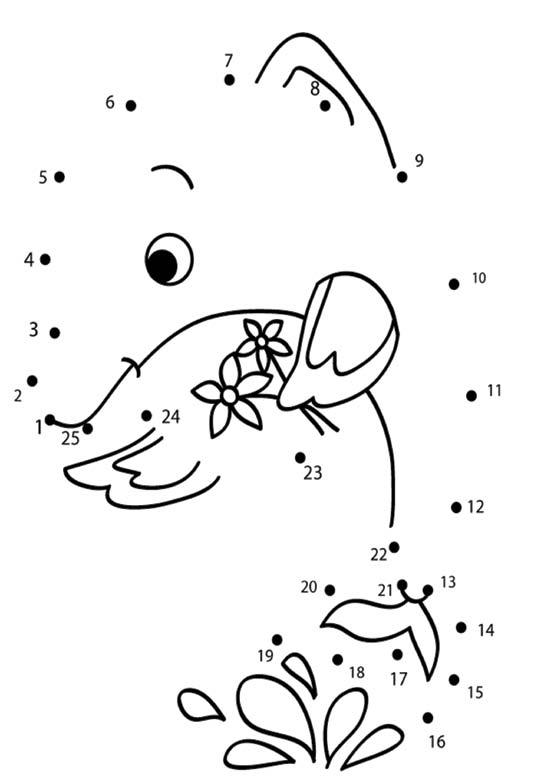
Dot to dot
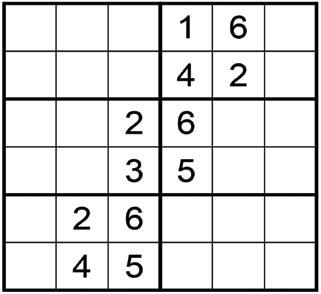
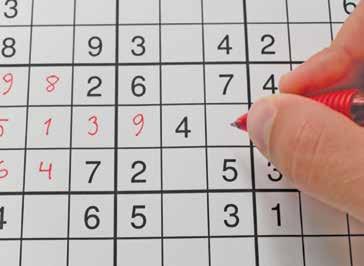
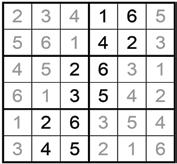
The objective of the game is to fill all the blank squares in a game with the correct numbers. Every row of 9 numbers must include all digits 1 through 9 in any order. Every column of 9 numbers must include all digits 1 through 9 in any order. Every 3 by 3 subsection of the 9 by 9 square must include all digits 1 through 9.
Minerals
Scientists who study minerals are called mineralogists. Minerals are commonly found in rocks and soil on Earth, but they are also found on the moon and other planets. There are more than 3,000 kinds of minerals.
Minerals occur naturally and have atoms arranged in regular patterns, called crystals, that form a solid unit and are generally made from substances that were never alive.
Identification
Mineralogists and collectors use a variety of methods to study and identify minerals. Specific gravity is a weight comparison between the mineral and water. (Some minerals are lighter than water; others are heavier.) Hardness is determined by how easily the mineral is scratched. It is measured using a scale called Mohs. The softest mineral is talc; the hardest is a diamond. Color, luster and transparency also aid in identification. Cleavage is the way a mineral splits along flat surfaces. Minerals that do not have cleavage planes often break into irregular shapes — this is called fracture. Some minerals leave a powdery residue when you scratch them on a white, unglazed porcelain surface (e.g., the back of a bathroom tile). The color of the streak is often a clue to mineral identification. Most minerals occur as crystals — the form and shape the crystals take is yet another way to identify a mineral.
By Laurie Triefeldt
ROCKS & MINERALS
Rocks and minerals are appreciated for their beauty, as useful and valuable resources and as scientific objects to be studied to reveal the history of our planet. Some people think that rocks and minerals are the same thing, but they’re not. Minerals are a naturally occurring, solid material with a specific chemical composition. Rocks are usually a combination of minerals.
All that glitters
Pyrite is sometimes called “fool’s gold” because of its golden color. Pyrite contains iron and sulfur, but no gold. Gold is one of a few metallic minerals that occur naturally in a pure form (not mixed with other elements). Silver, platinum and copper can also be found as native elements.
Precious stones
Many precious and semiprecious stones are transparent crystals that, when artfully cut into certain shapes, become beautiful gems. A person who cuts and polishes gemstones is called a lapidary There are two basic kinds of finished stones — faceted and cabochon. Clear or transparent stones like diamond or emerald are usually faceted (cut and polished all the way around). Opaque stones like turquoise and opal are often cut with a flat bottom and a polished top and made into round or oval cabochon shapes. Diamonds are almost pure carbon in crystalline form. They are the most valuable of gemstones and the hardest. In order to cut diamonds, a special grinding paste made of other diamonds is used. Diamonds that are not good enough to be gems are used in industry to cut and drill hard materials. Today, more than 95 percent of industrial diamonds are manmade from graphite.
Collecting as a hobby
Collecting rocks and minerals can be a lot of fun. Serious rock collectors are sometimes called rock hounds. Rocks can be found just about everywhere, but it’s not always legal to take them, so it is important to check with authorities before collecting specimens.
Collecting loose rocks doesn’t require much equipment. A durable bag to hold your rocks and a guidebook to help with identification are the essentials. When you get your rocks home, you may want to organize and label them in a specimen box.
On the rocks
Geologists study rocks to learn about the history of Earth. Rocks act like a sort of Earth diary, recording ancient floods, earthquakes, volcanic eruptions and crust and ocean movement. We also learn a lot about prehistoric life through the fossils of ancient animals found in rocks.
Most rocks contain two or more minerals, but some have only one. Igneous rocks are made from molten rock deep within the Earth. The word igneous is based on a Latin word meaning fire. How fast or slow molten rock cools plays a large part in what kind of rock is formed.
Rocks made by volcanic lava flows that cool quickly above ground are called extrusive rocks. Basalt, pumice and obsidian are common igneous, extrusive rocks. Rocks formed below the surface from magma that cools slowly are called intrusive rocks. Granite is the most common of igneous, intrusive rocks.
Sedimentary rocks are formed by layer upon layer of smaller, older rocks, dust, sand, plants and animals. Often, these layers form under oceans or lakes, but not always. Over thousands of years, the pressure of the top layers of sediment turns the bottom layers into solid rock. Fossils are found in sedimentary rock. Limestone, sandstone, chalk, coal, flint and shale are all sedimentary rocks. Metamorphic rocks are formed by the weight and pressure of huge rocks in combination with heat or water. These are rocks that change from one kind of rock into another. Marble begins as limestone, and quartzite comes from sandstone. Soapstone, gneiss and schist are also metamorphic rocks.
Basic crystal shapes
Granite is usually made up of large grains of quartz, feldspar and mica.
Quartz comes in many colors and shapes.
Geode
The ancient Greeks believed pyrite contained fire because it produces a spark when hit with a hammer.
Unlike other metals, gold never loses its shine. It is a very soft mineral that scratches easily, but acid and salt water won’t hurt it.
Yukon gold
Pyrite
Emerald
Ruby
Opal
Turquoise
Hope diamond
Geodes are rocks that are plain on the outside but have beautiful crystals on the inside. In the Greek language, geode means “shape of the earth.”
Quartz crystals
Obsidian
Obsidian is a black glass formed by rapidly cooling lava. It made an excellent tool in prehistoric times because of its sharp edges.
Granite
Both diamonds and graphite are pure carbon, but one is very hard and the other very soft.
This massive sandstone block balances on a small rock base in the Garden of the Gods, near Colorado Springs. This rock formation was caused by wind erosion.
Inspired by Culture
Guyanese designer Andy Cummings’s recent collection, Journey, highlights his designing talents in creating pieces for a distinct look inspired by his African and Guyanese Caribbean cultures.
“My collection was aptly named ‘Journey’ because I believe that life is a journey, not a destination. I get my inspiration from my African culture in the Caribbean, but mostly from Guyana. The detail is from the traditional basket weave that was used many years ago. The colours used were mint green, brown, white, cream - these colours speak about growth in the African culture,” the designer said in an interview with Guyana Times Sunday Magazine.
Cummings graduated from the Burrowes School of Art in 2012 with a
major in Ceramics and minor in Textiles. He was awarded best graduating student and best ceramic student for his year.
In that same year, he won the Guyana Model Search/Designers Portfolio, which gave him the opportunity to be fashion partner with veteran Guyanese designer Sonia Noel.
Cummings was named Most Promising Young Designer of 2013.
The designer’s dreams, which he is working feverishly to make a reality, are to pursue a fashion degree from an accredited university and to work for an international fashion company with the aim of one day operating his own business.
To contact the designer, call 615-5673 or 672-2243 or email a.acummings68@yahoo.com
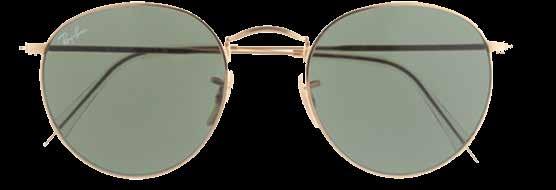
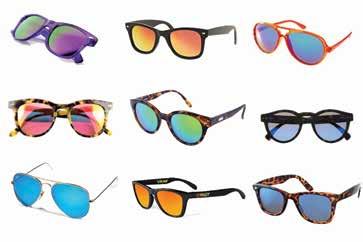
The reflective sunglasses were a hit in 2014, but it is time to take a breather from the statement sunnies in favour of more classic styles. Instead, try rounded glasses.
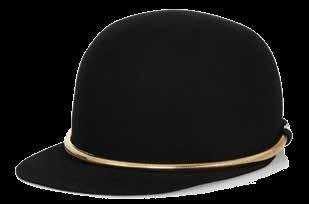
While some can still pull off this trend, it is time for a change! Try a sleek cap for a more fashionable look.
Trend #3: Tabsleeve shirt
This shirt detail has been adopted by so many fastfashion brands that it has started to feel like the calling card of a cheap blouse. As an alternative, try a collared shirt with the sleeves rolled high up past the elbow.
Trend #4: Tulle skirt
When styled in a certain way, a tulle skirt can often feel cloyingly feminine. Instead try a fashionable pencil skirt.
Trend #2: Floppy hats
Trend #1: Mirrored sunglasses
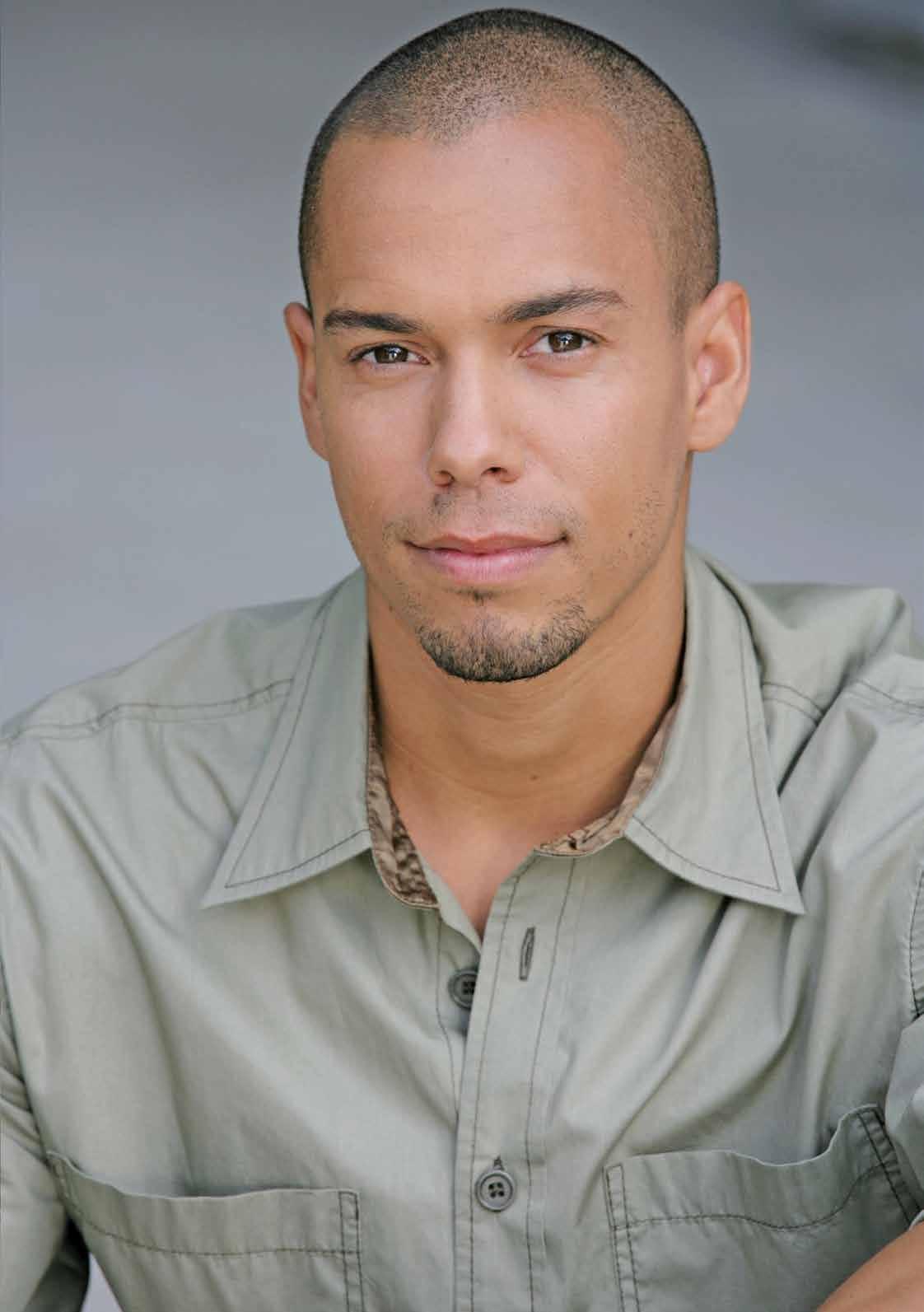
Bryton James is an American actor and singer. As a child actor, he played Richie Crawford in the ABC/CBS sitcom “Family Matters”. He currently plays Devon Hamilton in the CBS soap opera, “The Young and the Restless”. He won the 2007 Daytime Emmy Award for Outstanding Younger Actor in a Drama Series, and earned nominations for the same award in 2006 and 2008. After being nominated for the NAACP Image Award for Outstanding Actor in a Daytime Drama Series from 2005 to 2008, James won the award in 2009. He was a guest star in the drama, “The Vampire Diaries”. James was also a recording artist and performed on Disney Channel.
Times Hollywood
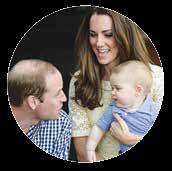
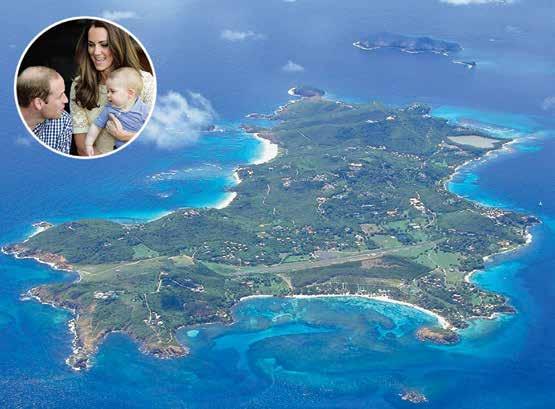
Prince George is waking up in the paradise isle of Mustique Friday.
The lucky little one has been taken on a sunny holiday by his parents Prince William and Kate, who are also believed to be vacationing with her family.
William and Kate have made it a regular winter break for the family, but much of the focus this year will very much be on George's grandmother, Carole, who's celebrating her
60th birthday on the last day of the month.
There were sightings of the family arriving in St. Lucia en route from London. It is there that visitors switch to a local flight to the other island.
William and Kate like to picnic on the beautiful beaches, swim and play tennis during their breaks there while the famous Basil's Bar is a popular entertainment spot in the evening. (PEOPLE)
Emma Watson’s latest UN speech is powerful reading
Emma Watson has been "stunned" by the positive reaction she's received from men since launching the #HeForShe campaign last year.
"I've been stunned by the amount of men in my life that have contacted me since my speech to tell me to keep going, and that they want to make sure that their daughters will still be alive to see a world where women have power and equality, economically and politically," said Watson at the World Economic Forum in Davos, Switzerland this morning.
The UN goodwill ambassador unveiled the IMPACT 10X10X10 plan, which aims to "engage governments, corporations and universities as instruments of change" to help fight gender inequality in areas and communities that need it most.
"We need all-country leadership, as well as that of hundreds of universities and corporations, to follow HeForShe's IMPACT 10X10X10 so as to bring an end to the persisting inequalities faced by women and girls globally," said Watson, who was appearing in her capacity as a goodwill ambassador for UN Women, the United Nations organisation dedicated to gender equality.
The actress said that the #HeForShe campaign has already made a difference.
"I've had my breath taken away when a fan told me since watching my speech she has stopped herself being beaten up by her father," said Watson. "We are tapping into what the world wants: to be a part of change. Now we have to channel that energy into purposeful action."
Famous names to show their support for the initiative include Lena Dunham, Douglas Booth, Logan Lerman and Chloe Moretz. (PEOPLE)
"The Hunger Games: Mockingjay, Part 1" is now 2014's highest-grossing movie in the U.S.
The Jennifer Lawrence-starring film snatched the title from the previous holder "Guardians of the Galaxy" following a battle at the box office. Per Wednesday, January 21, "Mockingjay" collected $333.2 million while "Guardians" garnered $333.17 million domestically.
"Mockingjay" was released on November 21 and so far has collected over $700 million worldwide. It opens in China on February 8.
In 2013, "The Hunger Games: Catching Fire" also faced off a Marvel movie in a similar battle. Back then, the Lionsgate project toppled "Iron Man 3" from its top position as the highest-grossing movie. It eventually garnered $424.7M, passing Robert Downey Jr.-starring superhero film at $409M.
"The Hunger Games: Mockingjay, Part 2" is set for release on November 20. Also featuring Josh Hutcherson and Liam Hemsworth among others, the action adventure movie is directed by Francis Lawrence.
(AceShowbiz)
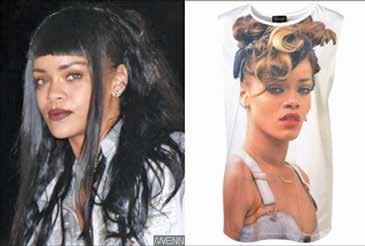
Rihanna has won a two-year legal battle against Topshop over a T-shirt using her photo. On Thursday, January 22, the Court of Appeal in London upheld a ban on the store selling the T-shirt without obtaining her permission.
Three appeal judges unanimously agreed that selling the T-shirt without RiRi's permission was damaging to her brand. Lord Justice David Kitchin said, "People could be deceived into buying the T-shirt perhaps believing it was authorised by Rihanna. Topshop sold the T-shirt without Rihanna's approval and this amounted to passing off."
Back in 2013, RiRi sued Topshop's parent company Arcadia for $5.5 million over the T-Shirt which featured a photo of her taken by a freelance photographer in Northern Ireland during the filming of her "We Found Love" music video in 2011.
EThe photo was similar to images included in the CD sleeve of RiRi's album "Talk That Talk" and her lawyer claimed the use of the image on an unauthorized T-shirt was deceptive to fans.
High Court Judge Justice Birss agreed and ruled that fans would be deceived into buying the T-shirt because of the "false belief" that RiRi had agreed to let Topshop use her image. Topshop's lawyer Geoffrey Hobbs QC later urged the three appeal
arlier this month, will.i.am confirmed that Black Eyed Peas would celebrate their 20th anniversary with new music that's coming out later this year. Now, frontwoman Stacy Ferguson a.k.a. Fergie revealed in a new interview that she might not be a part of the group's new project.
Speaking to U.K.'s DigitalSpy, the mother of one argued she wouldn't be on it because she only joined will.i.am and Co. in 2003. "I was just in the studio last week and I saw Taboo there, and I heard something will was doing and it was great. But maybe the guys are doing something?" she said.
"I haven't been in the group for 20 years, so it's more their anniversary of being together for 20 years. So maybe they're putting out an album themselves," she continued.
That's not the only reason why Ferg decided not to help the band with their 20th anniversary celebration. The vocalist, who's been in the studio for her first solo effort since 2008's "The Dutchess", went on telling the site, "I'm working on my stuff and I only have a certain amount of hours I can be in the studio because I have Axl. So I'm just
judges to overturn Justice's decision, claiming that the judge "had misunderstood the law on celebrity merchandising."
Geoffrey argued in court there was a tradition of merchandising celebrity's images over the decades, including those of Elvis Presley, Jimi Hendrix and Prince. He suggested RiRi was using the law wrongly to claim that "only a celebrity may ever market his or her own character." (AceShowbiz)
very focused on finishing my album right now."
Black Eyed Peas' latest album "The Beginning" arrived in 2010. After completing the tour launched to support the release, they announced in 2011 that they were taking an indefinite hiatus.
A few weeks ago, will.i.am confirmed the group's comeback when he said in an interview, "But there's a bunch of PEAbodies out there that we've been Tweeting back and forth for the past couple of days, on the excitement of 20 years of the Black Eyed Peas... We'll have experiences and a bunch of stuff to get the PEAbodies, and the folks that supported us, that got us to this point, all the support the love, the encouragement and listening to and sharing our music."
Not much has been revealed about the new BEP project. However, there will likely be a collaboration with K-pop star CL of 2NE1. As pointed out by Korea Joongang Daily, will.i.am recently reached out to CL on Twitter, writing, "We need to collaborate with you on the new @bep release." The South Korean singer excitedly responded, "Yay! Let's go!" (AceShowbiz)
Willow Smith's new 'topless' photo stirs controversy
Willow Smith is stirring up controversy after she changed her profile picture on Instagram. In her new profile picture, Willow is seen wearing a colorful long-sleeved, turtleneck top which depicts a woman's naked body, revealing nipples and all. Sporting yellow eye-shadow, the 14-yearold daughter of Will Smith and Jada Pinkett Smith, glares into the camera with both of
her hands place behind her neck. The photo is reposted by a fan account named willowsmithfan along with caption, "#Vfiles #willowsmith."
Back in May, Willow received backlash after she posed in bed with shirtless 20-year-old actor Moises Arias. Moises posted the controversial picture on his Tumblr, but later deleted it.
Jada later defended Willow and slammed the critics. "Here's the deal: there was nothing sexual about that picture or that situation," the star of "The Matrix Reloaded" told a TMZ paparazzo when asked of the matter, "You guys are projecting your trash onto it, and you're acting like covert pedophiles, and that's not cool."
In another interview with Net-A-Porter's The Edit, Jada said, "Just don't pollute something that's not dirty... I want my kids to be happy and I want them to be themselves. I was saying to a friend the other day, 'Remember, our kids are not us.' They're not. Sometimes we're trying to fix things that happened to us or projecting [onto them], and that's a terrible, terrible trap." (AceShowbiz)
Meera Chopra is an Indian film actress who appears in Tamil, Telugu and Hindi films. She is Priyanka Chopra’s cousin. Her debut movie, “Anbe Aaruyire”, was a big hit in the Tamil film industry. She achieved further success, this time in the Telugu film industry, with her critically acclaimed performance in “Vaana”. Chopra starred in Vikram Bhatt's “1920 London”, marking her Bollywood debut. The actress is currently working on other movies scheduled for release this year.
‘PK’
ABollywood
filmmakers accused of plagiarism
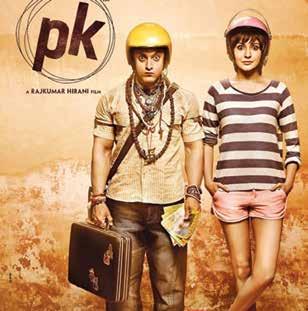
court notice has been issued to the filmmakers behind “PK” following accusations of plagiarism.
The Delhi High Court issued the notice to directors Vidhu Vinod Chopra and Rajkumar Hirani, their respective production companies and scriptwriter Abhijat Joshi, summoning them to give evidence in court on April 16.
According to IANS, Justice Najmi Waziri said: "Notice issued. Let them say what they have to say in regard to the allegation before [the] joint registrar."
A plea was entered on Wednesday (January 21) made by author Kapil Isapuri, who alleges
that the filmmakers have "stolen the characters, expression of ideas [and] scenes (sequences)" from his Hindi-language novel Farishta, which was published in 2013.
Isapuri is seeking punitive damages of 10 million rupees from the makers of “PK”, along with credit for his work.
“PK”, which stars Aamir Khan, Anushka Sharma, Sanjay Dutt and Sushant Singh Rajput, was the focus of controversy with accusations that it is anti-Hindu and promotes the notion of lovejihad.
Both Khan and Hirani have defended the film, explaining that it carries a message of humanity and respects all religions. (IANS)
Kareena Kapoor Khan: 'Hopefully I will have a family of my own'
Kareena Kapoor Khan has revealed she plans to have children someday.
The actress is married to Saif Ali Khan, who already has two children - Ibrahim and Sara - from his first marriage to Amrita Singh.
In an interview with Femina Magazine, the 33-year-old star said: "I have been lucky to experience both professional success and a fulfilling personal life. So hopefully, I would be having a family of my own.
"Saif and I would continue to live in India. But we will see the world with our children. When I turn 70, I should be sitting in a large dining room with my family, and just laughing, eating and drinking," she said.
The actress is currently shooting “Bajrangi Bhaijaan” with Salman Khan, and is due to begin work on a thriller to be directed by Raj Kumar Gupta. It has been reported that she has walked out of the Mohammaed Azharuddin biopic after committing to Abhishek Chaubey's “Udta Punjab”. (Femina Magazine)
Shah Rukh Khan to host new TV show
Shah Rukh Khan has announced he will return to the small screen in a new TV quiz show.
The “Happy New Year” star is to begin shooting for the show called “Sabse Shaana Kaun” in March.
Khan told IANS: "People from all walks of life will be asking the questions and normal people only will be
Soha Ali
answering them. It deals with questions that are very easy to answer."
The 49-year-old star joked that the hosting role won't be too demanding.
"I'm only here for my beauty because the questions are asked by normal people and answered also by normal people. I just have to make sure people have fun. They told me you don't even have to learn a script or anything," he explained.
Khan is not unfamiliar with the quiz show format having hosted season three of “Kaun Banega Crorepati” and one season of “Kya App Paanchvi Paas Se Tez Hai”.
Earlier, the actor commented that TV is a factor in achieving stardom today. Amitabh Bachchan, Aamir Khan, Salman Khan, Madhuri Dixit and Akshay Kumar have all fronted popular TV shows. (IANS)
Khan, Kunal Khemu
to marry in intimate ceremony
Soha Ali Khan is to marry long-term boyfriend Kunal Khemu.
The couple will be married in an intimate ceremony at her home on January 25.
Speaking to Mumbai Mirror about the preparations for the wedding, Soha said: "It's a small, simple ceremony with us registering the marriage at home and we haven't even planned a big reception. So there is no need for loads of shopping."
The actress revealed that her mother Sharmila Tagore has gifted her some jewellery and sister-in-law Kareena Kapoor has been helping with shopping for her big day.
She has also received some good advice about marriage.
"Amma's advice to us is: Don't hurt a man's ego and don't hurt a woman's emotions."
The couple will skip the honeymoon for the moment since Soha starts shooting for “Ghayal 2” in February. "No honeymoon right now. We'll plan something fun when the weather in Europe is better, perhaps in summer," she revealed.
The two actors met on the set of the 2009 comedy “Dhoondte Reh Jaaoge” and were later engaged. In 2012, she said she wasn't ready to marry as she felt too young. (Mumbai Mirror)
Reducing Traffic Fatalities, Injuries
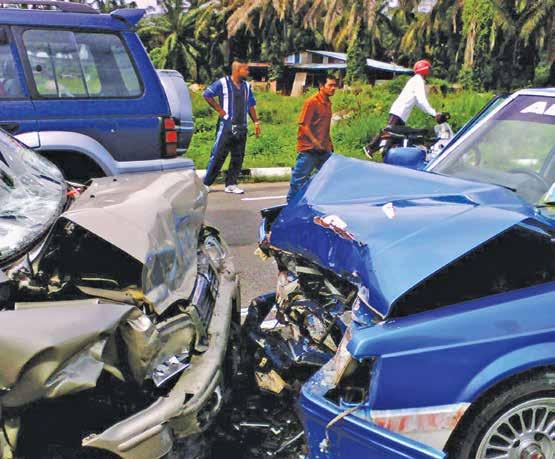
With a resolution on May 10, 2010, the United Nations General Assembly proclaimed the period 2011–2020 as the Decade of Action for Road Safety, aiming to stabilize and then reduce the forecast level of road traffic fatalities around the world.
The UN noted on its website that road traffic injuries are a major public health problem and a leading cause of death, injury and disability around the world. Each year, nearly 1.3 million people die, and between 20 million and 50 million more are injured because of road crashes. Road traffic injuries are among the three leading causes of death for people between 5 and 44 years of age.
A number of factors have been identified as increasing the risk of traffic-related injuries, including inappropriate and excess speed, nonuse of seat belts and child restraints, drinking and driving, non-use of helmets by riders of motorized twowheelers, poorly designed or insufficiently maintained road infrastructure, and vehicles that are old, not well maintained or that lack safety features.
At-risk groups
The World Health Organization in 2013 published its “Global Status Report on Road Safety 2013. Supporting a Decade of Action”. In the report, it noted that half of those dying on the world’s roads are “vulnerable road users”: pedestrians, cyclists and motorcyclists.
More than 90 percent of road deaths occur in lowincome and middle-income countries, which have less than half of the world’s vehicles. Even within high-income countries, people from lower socioeconomic backgrounds are more likely to
be involved in a road traffic crashes than their more affluent counterparts.
Young adults aged between 15 and 44 years account for 59 percent of global road traffic deaths. From a young age, males are more likely to be involved in road traffic crashes than females.
More than three-quarters (77 percent) of all road traffic deaths occur among men. Among young drivers, young males under the age of 25 years are almost three times as likely to be killed in a car crash as young females.
Addressing risk factors
WHO states that road traffic injuries can be prevented with significant involvement from public sectors such as transport, police, health and education that would address the safety of roads through infrastructure, and vehicles by improving the safety features of vehicles while setting and enforcing laws relating to key risk factors.
In addition, improving post-crash care for victims of road crashes, interventions that target road user behavior, and raising public awareness about these can also help reduce road fatalities and injuries.
An increase in average speed, it notes too, is directly related both to the likelihood of a crash occurring and to the severity of the consequences of the crash. Pedestrians have a greater chance of surviving a car crash at 30 km/h or below.
Drinking and driving increases both the risk of a crash and the likelihood that death or serious injury will result. The risk of being involved in a crash increases significantly above a blood alcohol concentration (BAC) of 0.04 g/dl.
Enforcing sobriety checkpoints and random breath testing can lead to reductions in alcohol-related
Appendicitis
By Zenica DaBichan
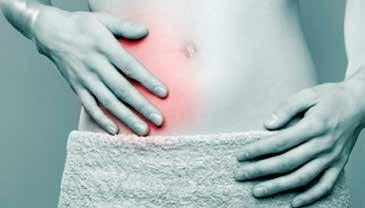
The appendix is a small finger shaped pouch attached to the large intestine. It is located in the lower right part of the abdomen. Appendicitis is inflammation of the appendix. This occurs when swelling, faeces, a foreign object or rarely, a tumour blocks the appendix. If the blockage is not treated, the appendix can burst and spread infection into the abdomen.
What are the symptoms of appendicitis?
The first symptom is often sudden pain around the belly button. Pain may be minor at first, but becomes more sharp and severe. You may also have a loss of appetite, nausea, vomiting, and a low fever. The pain tends to move into the right lower part of your belly. This most often occurs 12 to 24 hours after the illness starts. Your pain may be worse when
crashes of about 20 percent and have shown to be very cost-effective.
Wearing a seat belt reduces the risk of a fatality among front-seat passengers by 40–50 percent and of rear-seat passengers by between 25–75 percent. If correctly installed and used, child restraints reduce deaths among infants by approximately 70 percent and deaths among small children by between 54 percent and 80 percent.
Wearing a good-quality helmet can also reduce the risk of severe injury by more than 70 percent. Ninety countries, representing 77 percent of the world’s population, have a comprehensive helmet law covering all riders, all roads and all engine types, and apply a helmet standard.
Recently there has been a marked increase in the use of mobile phones by drivers that is becoming a growing concern for road safety. Text messaging results in considerably reduced driving performance. Drivers using a mobile phone are approximately four times more likely to be involved in a crash than when a driver does not use a phone. Hands-free phones are not much safer than hand-held phone sets.
WHO’s report outlined that only 28 countries, representing 416 million people (7 percent of the world’s population), have adequate laws that address all five risk factors (speed, drinkdriving, helmets, seat-belts and child restraints). Since 2007, 88 countries have reduced the number of road traffic deaths. However, in 87 countries the number of road traffic deaths has increased.
Without action, it cautioned, road traffic crashes are predicted to result in the deaths of around 1.9 million people annually by 2020.
you walk, cough, or make sudden movements. Later symptoms include chills and shaking, constipation or diarrhea.
When to seek medical attention?
Appendicitis is a surgical emergency so if you have the mentioned symptoms, visit the emergency room immediately, because timely diagnosis and treatment is very important.
Treatment and Outlook
Once you are diagnosed with appendicitis, the treat-
ment is surgery to remove the appendix. Most people recover quickly after surgery if the appendix is removed before it ruptures. If your appendix ruptures before surgery, recovery may take longer and you are also more likely to develop complications such as abscess formation in the abdomen, infection inside the abdomen and infection of the wound after surgery. Therefore, the most important step is to get to the hospital as soon as possible.
Improving Maternal Health
As instances of maternal deaths remain prevalent, the World Health Organization (WHO) reported last year that although maternal mortality worldwide dropped by almost 50 percent between 1990 and 2013 (from 523,000 to 289,000), about 800 women worldwide still die every day from preventable causes related to pregnancy and childbirth.
Calling this figure “unacceptably high”, WHO disclosed that 99 percent of these deaths occur in developing countries, mainly among the rural poor. WHO noted that some areas with the highest number of maternal deaths reflect the inequity of access to maternal health care services, with more than half of these deaths occurring in sub-Saharan Africa and almost one third in South Asia.
The international health organization also pointed out that complications in pregnancy and childbirth are the leading cause of death among adolescent girls in developing countries. Because women in developing countries have on average more pregnancies than their counterparts in developed states have, they are at a higher lifetime risk of death due to pregnancy: 1 in 160 in developing nations compared with one in 3700 in developed countries.
of all maternal deaths are severe bleeding (mostly bleeding after childbirth), infections (usually after childbirth), high blood pressure during pregnancy (pre-eclampsia and eclampsia); complications from delivery and unsafe abortion. The remainder are caused by or associated with diseases such as malaria and AIDS during pregnancy.
How to save lives
The organization reiterated that most maternal deaths are preventable since health-care solutions to manage complications or prevent deaths are well known. It stressed the need for quality antenatal care, care during childbirth and postnatal care, and the importance of skilled attending health professionals, since timely management and treatment can make a significant difference between life and death.
What causes maternal deaths?
WHO illustrated that according to L. et al: "Global Causes of Maternal Death, 2014", 28 percent of maternal deaths were due to pre-existing conditions while 27 percent were a result of severe bleeding. Pregnancy-induced high blood pressure accounted for 14 percent of deaths, as infections accounted for 11 percent. Other maternal deaths, some nine percent, were a result of obstructed labor and other such conditions; abortion complications were to blame for eight percent of maternal death in 2014 and blood clots and embolism accounted for three percent that year.
The report cited that the major complications that account for nearly 75 percent
According to WHO, severe bleeding after birth can kill a healthy woman within hours if she is unattended. Injecting oxytocin immediately after childbirth effectively reduces the risk of bleeding. Infection after childbirth can be eliminated if good hygiene is practiced and if early signs of infection are recognized and treated in a timely manner. Pre-eclampsia should be detected and appropriately managed before the onset of convulsions (eclampsia) and other lifethreatening complications. Administering drugs such as magnesium sulfate for preeclampsia can lower a woman’s risk of developing eclampsia.
It went on to note that it is also critical for women to be able to access contraception and safe abortion services easily, since these factors play a role in preventing too-early and unwanted pregnancies.
WHO noted that improving maternal health is one of the eight Millennium Development Goals (MDGs) adopted by the international community in 2000. Under MDG5, countries committed to reducing maternal mortality by three quarters between 1990 and 2015.
Design Solutions for Small Homes
If your home is small, making the most of its space is an important consideration for your interior design. Consider these creative ideas to live large…
If your front door seems to open to the entire house, several design elements may work.
A small divider, low wall, small glass enclosure or even small seating at the front door may be the solution to define the area without losing valuable space.
Especially in crowded urban environments, private outdoor space can be premium. A Juliet balcony may be the answer.
A large sliding door, patio door or French doors, with a railing on the face of the building, provide the feeling of open space and bringing the outside in.
Chicken Curry Kerala Style
(Kozhi Kuttan)
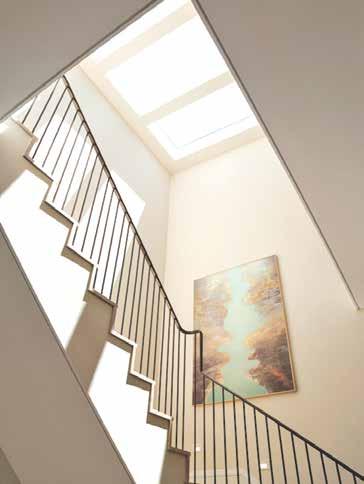
Consider skylights if your stairways seem tight and cramped. A well-placed skylight could raise the ceiling height, brighten the space and even provide ventilation.
Method: Rub chicken pieces with 1 tsp turmeric powder, 1 tsp salt and curd. Put aside. Extract 1 cup thick milk from coconut using one cup water. Add ¾ cup water to same coconut and extract ¾ cup thin milk.
In a pan,
and
GREATEST KITCHEN TIPS HOME HELP
For sticky, rotisserie-style skin with fall-apart meat, cook chicken at a low temperature for hours – some recipes call for three hours at 300˚. If it’s glossy, crackling skin you’re after, cook the bird quickly at a high temperature. Jump-start the process by getting a gorgeous sear on the stovetop in a pan (preferably cast-iron). Once the skin is golden, transfer the skillet to an oven set at 425˚. The chicken will cook in just 35-40 minutes— depending, of course, on the size of the bird.
Before you throw out your old newspaper, use it to get rid of some garbage grime. Cover the bottom of your trashcan with old newspapers to soak up leaks and odors.
If you cringe at the idea of being splashed by toilet water when cleaning the toilet, push the toilet brush in and carefully pull it out of the trap before you begin. This lowers the water level, allowing you to scrub away without worry. Ingredients:
Mrs. Duffus would often complain when Duffus left the door to the basement open. "The cool air from the basement makes the upstairs cold; close that door, Duffus!" she would rant.
"It won't do any such thing," Duffus would reply and go on his way. Duffus was right, but why?
Times Creative Writing
By Peter Newell
THE BASEMENT
When Fritz, the Janitor's bad kid, Went snooping in the basement, He found a rocket snugly hid
Beneath the window casement.
He struck a match with one fell swoop; Then, on the concrete kneeling,
He lit the rocket and--she-oop!
It shot up through the ceiling.
FIRST FLAT
The Steiners on the floor above
Of breakfast were partaking; Crash! Came the rocket, unannounced,
And set them all a-quaking!
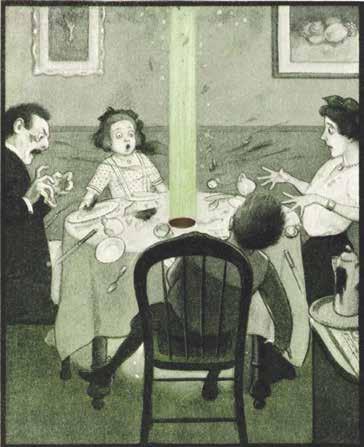
It smote a catsup bottle, fair,
And bang! The thing exploded!
And now these people all declare That catsup flask was loaded.
But Algy turned in mild disgust, And called to Mama Bracket,
"Say, did you hear that bubble bust?
It made an awful racket!"
FOURTH FLAT
Jo Budd, who'd bought a
SECOND FLAT
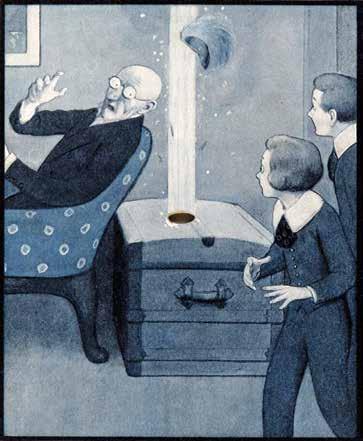
Before the fire old Grandpa Hopp
Dozed in his arm-chair big, When from a trunk the rocket burst
And carried off his wig!
It passed so near his ancient head
He roused up with a start, And, turning to his grandsons, said, "You fellows think you're smart!"
THIRD FLAT
Algernon Bracket, somewhat rash, Had blown a monster bubble, When, oh! There came a blinding flash, Precipitating trouble!
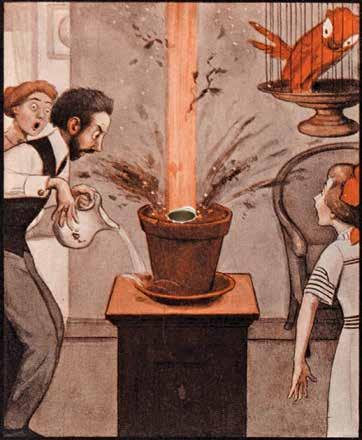
potted plant, Was dousing it with water. He fancied this would make it grow, And Joseph loved to potter.
Then through the pot the rocket shot
And made the scene look sickly!
"Well, now," said Jo, "I never thought That plant would shoot so quickly!"
FIFTH FLAT
Right here 'tis needful to remark
That Dick and "Little Son" Were playing with a Noah's ark
And having loads of fun,
When all at once that rock-
et, stout,
Up through the ark came blazing!
The animals were tossed about
And did some stunts amazing.
SIXTH FLAT
A Burglar on the next floor up
The sideboard was exploring.
(The family, with the brindled pup, Were still asleep and snoring.)
Just then, up through the silverware
The rocket thundered, flar-
thing,
When suddenly the rocket, hot, The old piano jumbled! It stopped that rag-time like a shot, Then through the ceiling rumbled.
EIGHTH FLAT
Up through the next floor on its way
That rocket, dread, went tearing Where Winkle stood in bathrobe, gay, A tepid bath preparing.
The tub it punctured like a shot
And made a mighty splashing.
The man was rooted to the spot; Then out the door went dashing.
NINTH FLAT
Bob Brooks was puffing very hard
His football to inflate, While round him stood his faithful guard, And they could hardly wait.
Then came the rocket, fierce and bright, And through the football rumbled.
"You've got a pair of lungs, all right!"
His staring playmates grumbled.
TENTH FLAT
The family dog, with frenzied mien, Was chasing Fluff, the mouser, When, poof! The rocket
ing!
The Burglar got a dreadful scare; Then out the door went tearing.
SEVENTH FLAT
Miss Mamie Briggs with no mean skill
Was playing "Casey's Fling"
To please her cousin, Amos Gill, Who liked that sort of
flashed between, And quite astonished Towzer.
Now, if this dog had wit enough
The English tongue to torture, He might have growled such silly stuff
As, "Whew! That cat's a scorcher!"
(TO BE CONTINUED)
Nightmare
The silver and violet leopard of the night Spotted with stars and smooth with silence sprang; And though three doors stood open, the end of light Closed like a trap; and stillness was a clang.
Under the leopard sky of lurid stars I strove with evil sleep the hot night long, Dreams dumb and swollen of triumphs without wars, Of tongueless trumpet and unanswering gong.
I saw a pale imperial pomp go by, Helmet and hornèd mitre and heavy wreath; Their high strange ensigns hung upon the sky And their great shields were like the doors of death.
Their mitres were as moving pyramids And all their crowns as marching towers were tall; Their eyes were cold under their carven lids And the same carven smile was on them all.
Over a paven plain that seemed unending They passed unfaltering till it found an end In one long shallow step; and these descending Fared forth anew as long away to wend.
I thought they travelled for a thousand years; And at the end was nothing for them all, For all that splendour of sceptres and of spears, But a new step, another easy fall.
The smile of stone seemed but a little less, The load of silver but a little more: And ever was that terraced wilderness And falling plain paved like a palace floor.
Rust red as gore crawled on their arms of might
And on their faces wrinkles and not scars: Till the dream suddenly ended; noise and light Loosened the tyranny of the tropic stars.
But over them like a subterranean sun I saw the sign of all the fiends that fell; And a wild voice cried "Hasten and be done, Is there no steepness in the stairs of hell?"
He that returns, He that remains the same, Turned the round real world, His iron vice; Down the grey garden paths a bird called twice, And through three doors mysterious daylight came.
By Gilbert Keith Chesterton
ARIES (March 21April 19)
TAURUS (April 20May 20)
GEMINI (May 21June 20)
(June 21July 22)
LEO (July 23Aug. 22)
VIRGO (Aug. 23Sept. 22)
LIBRA (Sept. 23Oct. 23)
SCORPIO (Oct. 24Nov. 22)
SAGITTARIUS (Nov. 23Dec. 21)
(Jan. 20Feb. 19) (Dec. 22Jan. 19)
PISCES
(Feb. 20March 20)
You will entice others to join forces with you. Once you have all the facts and relevant information on hand, get whatever else you require to reach your destination.
Lighten up and don’t get rattled if someone creates a problem for you. You can easily finish any job if you stay calm and avoid overreacting.
Pick your direction and get moving. An unexpected diversion will slow you down, but if you stick to your plan and trust in your ability, you will excel.
Do your best to avoid disappointment by relying on your wisdom and strength. Let others do what they think is right, while you continue down the path best suited to your needs.
You will gain the support necessary to complete a project from an interested party. With the right ally and assistance, significant strides can be made. A last-minute change will lead to unexpected results.
You are sympathetic, but that doesn’t mean you should allow someone to curtail your freedom or plans. Respect others’ feelings, but stick to your own agenda.
A onetime partner is likely to resurface. Your creativity will lead to travel and a romantic encounter. You will feel energized if you get out and enthusiastically enjoy life.
Travel will lead to increased knowledge. Spending time with new acquaintances will benefit you in more ways than one. You should steer clear of a tumultuous emotional situation.
You will receive a unique offer out of the blue. Don’t be afraid to try something new. Make the most of any opportunity to unite with people who share your interests.
Someone from your past can offer you insight regarding your next move. A problem surrounding a friend, relative or neighbor will catch you off your guard.
Establish what you want to do and position yourself accordingly. Ask questions and talk to people who can offer facts and positively influence your path.
Be sincere about your needs and wants. Trouble will result if you don’t stick to the truth. Gather all the details before you put an offer on the table.
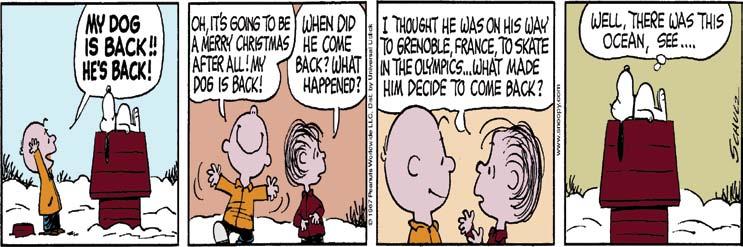
Peanuts
Calvin and Hobbes
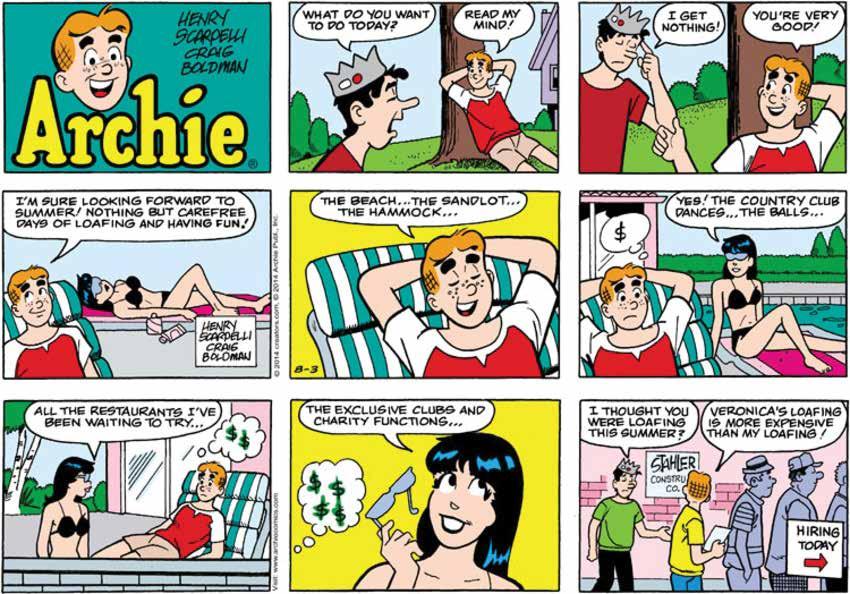
Archie
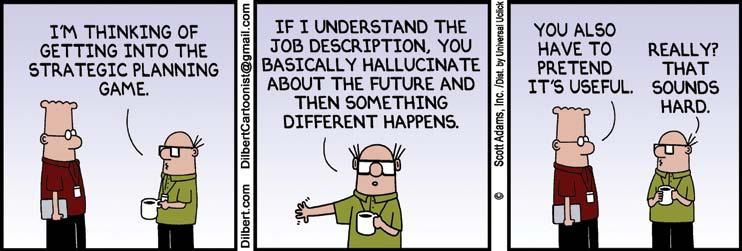
Dilbert
AQUARIUS
CANCER
CAPRICORN
Apple is threatening Samsung's dominance on its home turf, as the iPhone maker wins over South Korean consumers with its largescreen smartphones.
The iPhone maker captured a record 33 percent of smartphone sales in South Korea in November, according to Counterpoint Research, the first time a foreign brand has exceeded the 20 percent market share in the history of the country's smartphone industry.
Tech
Samsung's share of the market, meanwhile, stood at 46 percent – down from above 60 percent just six months earlier.
"[Korea] has always been dominated by the global smartphone leader, Samsung. But iPhone 6 and
6 Plus have made a difference here, denting the competition's phablet sales," said Tom Kang, research director at Counterpoint Research.
"If there was a better supply of iPhone 6 & 6 Plus 64GB & 128GB models dur-
BYTe Tech news TVs at CES 2015 go beyond 4K
Sing the month then Apple's share could have climbed to the 40 percent level," he said.
Apple's 5.5-inch 6 Plus, launched in September, been a smash hit with consumers in Asia, where there is strong demand for phablets – or devices with a screen size of 5-inches and above.
Japan was the other bright spot for Apple in the region, where it captured more than half of the smartphone sales in November.
Apple also made significant headway in China, the world's largest smartphone market, recording record
sales in the mainland in November as rich, urban consumers warmed to the bigger iPhone form-factors.
"This has helped propel Apple's smartphone market share to above 12 percent, capturing third spot behind Lenovo and the market leader Xiaomi," said Neil Shah, research director at Counterpoint Research.
"Apple with iPhone 6 & 6 Plus has been able to impact Samsung's premium Galaxy S5 & Note 4 sales. But with launch of Xiaomi Note & Note Pro it is going to be a fierce battle in the premium segment, with Samsung being attacked from both ends." (CNBC)
Air Force UFO files hit the Web
amsung, the world's biggest TV maker and dominant force in 4K UHD (Ultra High Definition) sales, bet big on an array of new terms at this year’s Consumer Electronics Show (CES 2015), beginning with SUHD. Other TV makers joined in, adding HDR, pixel splitting and numerous other enhancements to their best TVs.
prominent this year.
The reason is simple: 4K TVs are dropping to mainstream prices fast, so something else is needed to sell profitable, high-end TVs. That's why Quantum Dots, HDR and curved, bendable and ultra-slim sets were so
Both Samsung and LG, the number two TV maker, introduced more lines of 4K TVs than 1080p TVs at the show, and Sony's ratio of 4K to 1080p series was 4:1. The show's big booths were packed with 4K sets, with very few 1080p models on hand. (CNET)
Samsung's SUHD JS9500. The curved JS9500 series is Samsung's flagship 2015 TV design. (The "S" in SUHD doesn't stand for anything, says Samsung – don’t call it Super). According to Samsung, it surpasses the limitations of previous displays as its stylish curved design provides viewers with a more immersive viewing experience, delivering superior picture quality with stunning contrast, striking brightness and spectacular color.
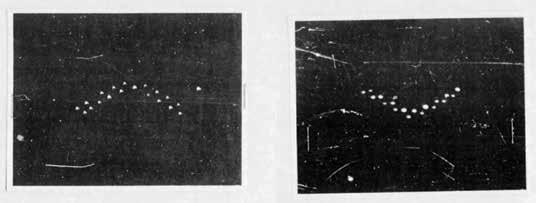
The Lubbock Lights incident (August 30, 1951
Texas)
widely
one of the first great UFO cases in the United States. The USAF concluded that these lights were most likely a natural phenomenon, namely plovers (birds with a white breast that "could easily reflect city lights").
The fabled Project Blue Book, the U.S. Air Force's files on UFO sightings and investigations, have tantalized and frustrated extraterrestrial enthusiasts for decades. But this past week, nearly 130,000 pages of declassified UFO records were put online.
UFO enthusiast John Greenewald has spent nearly two decades filing Freedom of Information Act requests for the government's files on UFOs and other phenomena. On Jan. 12, Greenewald posted the Blue Book files — as well as files on Blue Book's 1940sera predecessors, Project Sign and Project Grudge — on his online database, The Black Vault.
Project Blue Book was based at Wright-Patterson Air Force Base near Dayton, Ohio. Between 1947 and 1969, the Air Force recorded 12,618 sightings of strange phenomena — 701 of which remain "unidentified."
The National Archives has made these files available to public on microfilm in its Washington headquarters. Parts of the Project Blue Book files previously have been posted online in various locations.
But Greenewald said his webpage is the first time the complete files have been posted in PDF form in a searchable database.
One thing you won't find online are records related to the alleged 1947 Roswell,
N.M., incident, where conspiracy theorists maintain the military recovered a crashed alien spacecraft and its occupants. But Roswell does pop up several times in the files. Several blurry photographs of lights in the sky were taken at Roswell in 1949. And in 1950, airmen there spotted a circular object 10 feet in diameter with a bluish-white color going fast at 8,000 feet and taking a sharp turn to the right.
The National Archives maintains it "has been unable to locate any documentation among the Project Blue Book records which discuss the 1947 incident in Roswell, N.M." (USA Today)
— Lubbock,
is
regarded as
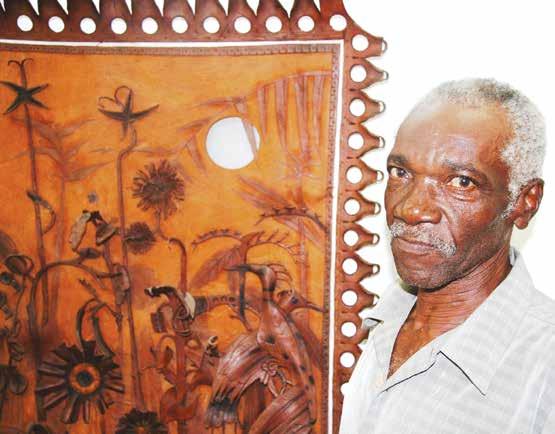
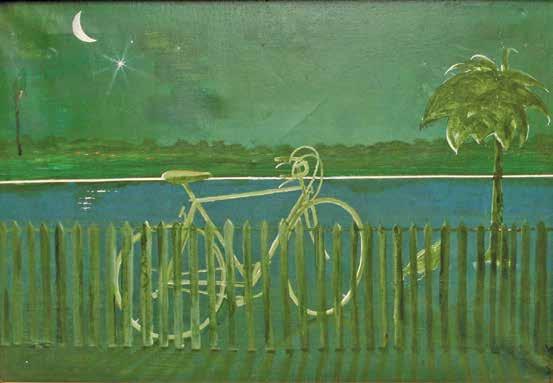
Winston Strick’s artistic talents and dedication to his passion for art have made him a notable artist whose mastery in creating distinguished artwork has been celebrated, as some of his pieces are a permanent fixture in the National Collection housed at Castellani House.
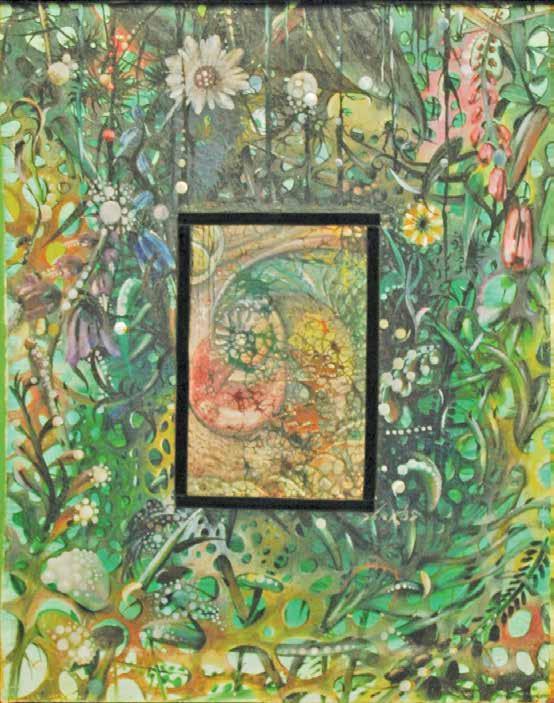
His painting “Silver Moon; Walk on Water”, part of the National Collection, is a beautiful, evocative painting. It is one of the few, not wellknown paintings by Strick.
This is because Strick is best known for his superb work in leather. “Silver Moon; Walk on Water” shows that he is an equally excellent painter. In fact, he had pursued painting at the Brooklyn Museum Art School, New York, from 1972-1973. In 1974, he returned to Guyana at a time of nationalistic fervour, when artists of African heritage were returning to their roots.
Although he has never mounted a solo exhibition, Strick’s oeuvre is large and varied. He has won many
awards and prizes for his leatherwork, but his paintings have also been recognised - as in 1985 when he won the Brewmasters Competition Painting category.
His artwork “Woman”, also part of the National Collection, is an example of Strick’s artistry in leather. While there are Guyanese who use local leather to make an array of footwear, handbags and crafts items, most of them have not ventured beyond these. Strick’s use of this medium for creative, artis -
tic pieces is unprecedented.
In addition to this, he displays an astonishing level of artistry and inventiveness in the pieces he has produced. He uses various kinds of leather of different thicknesses, and incorporate seeds, pieces of metal and other objects and materials to produce works that are truly pieces of fine art. Indeed, he has won numerous awards for his work.
Strick discovered leather around 1975 and began creating remarkable pieces of sculptural, decorative and even wearable art in this medium. He became associated with the Roots and Culture Gallery, which opened in 1983. The grassroots orientation of this gallery gave Strick an excellent context to explore local materials and develop his art.
In 1991, for his sterling contributions to the field of art in Guyana, Strick was bestowed the Medal of Service by former President of Guyana, the late Hugh Desmond Hoyte. (Information on Strick’s artwork taken from “Panorama: A Portrait of Guyana”. Photos courtesy of Castellani House)
artist Winston Strick with his national Collection piece "Morning Breeze"
"Silver Moon; Walk on Water" n.d. (acrylic)
"Woman" 1989 (Leather)
This year, National Trust of Guyana’s calendar narrates the history of several distinctive Guyanese buildings of unique architecture and rich history that have been lost to time. These buildings were an irreplaceable part of our built legacy.
According to Lauren Grant from National Trust, the calendar’s objective is to “remind persons of the historic buildings which once
graced our landscapes and to inform the younger generation of what once was, lest they think that the modern buildings today represented what was there before”.
The once illustrious Sacred Heart Church is featured for January and February months. In 1860, the construction of this new church commenced to accommodate the vast numbers of Roman Catholics in British Guiana. Once de-
signed in a rectangular shape, the original building measured 30.5m x 9.1m. An eastern façade, which became the main façade, was designed by architect Cesar Castellani and erected in 1872. This church, once situated on Main Street, Georgetown, was destroyed by fire in 2004.
The old New Amsterdam Hospital is highlighted for March and April. The old New Amsterdam Hospital, once located in Region Six, Berbice, in the town of New Amsterdam, was one of Guyana’s outstanding historical buildings. It was
built in 1844 and designed by renowned architect Cesar Castellani, and described as a “timber architectural masterpiece”. The building was declared unfit to function as the primary hospital of the region and it was left abandoned where it collapsed over time due to constant vandalism and deterioration.
May and June highlights The Alms House. The architectural design of the original Alms House, in Brickdam, was again the ingenuity of architect, Cesar Castellani. It was completed in 1878. Since its original construction, other structures have been added in the complex to accommodate its growing population of the elderly and disabled. The Alms House was renamed the Palms but the nature and objectives of the institution remained the same. Over time the original Alms House slowly deteriorated and was later demolished.
For the months of July and August, the Roman Catholic Cathedral of the Immaculate Conception is featured. Located in Brickdam, the foundation stone for this edifice was laid April 21, 1868 by Governor Hincks. It was consecrat-
ed August 25, 1878. The remarkable feat of timber craftsmanship was designed by celebrated architect, Cesar Castellani. On March 7, 1913 it was destroyed by fire. The “Brickdam Cathedral” a stone edifice, replaced the structure.
Park Hotel is the feature building for September and October. The Park Hotel was built during the 1900s and was owned by the Kissoon family. Its colonial architecture, evident in the use of timber, Demerara shutters and its veranda, was common at that time.
Once located in Main Street in the heart of the city of Georgetown, this landmark hotel was destroyed by fire in May 2000. November and December features the St. Barnabas Church. The Anglican Church of St. Barnabas, where it once stood at Regent Street and Orange Walk, Bourda, opened as a rather small building in 1884. It was consecrated in 1938. The St. Barnabas Church with its flying buttresses and massive towers was sold and later demolished in 2011.
Hot air rises and cold air descends, so cool air from the basement wouldn't rise and make upstairs rooms colder.
Sacred Heart Church
St. Barnabas Church
The old new amsterdam Hospital
Park Hotel
alms House
SUDOKU KID SUDOKU
The Screaming Piha Nature Trail is one of thenumerouswildlife trails you can visit inthe Iwokrama forest. It is located near the Iwokrama River Lodge and Research Centre.
Entering this trail, you experience the magnificent Mora forest, one of the many forest types in Guyana. This forest experiences seasonal flooding,which is typical of this forest type. As part of your walk, you would be amazed by the stunning views of the Essequibo River. Some of the trees you would encounter are the hugeMora treesthat rise over the canopy, which defines this forest type; the Soft Wallaba trees, which we get electricity poles and shingles from, and the Wamara trees – found only in Guyana.
birds such as the screaming piha, a small bird with a beautiful call – that obviously gave the trail its name; capuchin birds, the grey-chinned hermit humming bird, grey antbird, chestnut woodpecker, the grey-winged trumpeter, the black-necked aracari and many others. Often there are also sightings of mammals like the agouti, an important seed disperser, various species of monkeys, and if you are very lucky, you may see the elusive cats such as the jaguar or ocelot.
The Screaming Piha Nature Trail
Additionally, there are opportunities to see various lianas(woody vines) and aerial roots such as the Kufa and Nibbi. Kufa and Nibbi are important non-timber forest products that are used to make furniture, baskets and many other items.
On the Screaming Piha Nature Trail, you can also experience a rich, diverse fauna, including
To learn more about the Screaming Piha Nature Trail call Iwokrama’s office on 225-1504, email tourism@iwokrama.org; visit www. iwokramariverlodge.com or theIwokrama International Centre for Rainforest Conservation and Development Centre on Facebook.
Screaming Piha impressively vocalising, which leaves all in awe of its thunderous voice (Photo by Dave Curtis)
Tour guide describing young Kufa vines to tourists
Giant Mora tree on the trail
It's still fun on the trail even in the wet season
aerial view of Iwokrama river Lodge and research Centre and untouched rainforest where the Screaming Piha nature Trail is located (Photo by Alan Hopkins)
By Melvin Durai
Anyone want to adopt a chicken?
Hundreds of chickens are being dropped off at animal shelters and sanctuaries around America every year, according to an NBC News article. Chickens, as you know, make really good pets: they don’t need much food, they don’t require you to take them for walks, and they easily fit in a small space, such as between the two metal racks in your oven.
The NBC News article states that about 225 former backyard chickens are awaiting new homes at three shelters operated by Farm Sanctuary – and many more are also seeking adoptive families at oth- er shelters around the country. The good thing about adopting a chicken is that it doesn’t involve as much paperwork as adopting a turkey. I tried to adopt a turkey last November, but there were just too many other families interested in giving the turkey a good home. It probably didn’t help my chances that when the shelter worker asked me, “Do you have any experience with turkeys?” I felt compelled to share my favorite turkey recipe. This year, I might try to adopt a chicken. I called the bylaw officer in my city to ask if they residents to have and he said sternly, “No backyard chickens permitted!” So if I get a chicken, I’m going to have to keep it in my front yard. I don’t mind that at all, but my neighbors might complain. Neighbors can be such hypocrites. They don’t want to see a bird in my front yard, but have no problem putting a bunch of plastic pink flamingos in theirs. Truth is, my wife and I have talked about having several chickens – not just one. We’d love to have fresh eggs from our very own layers. But we also know that it’s not as easy as it sounds. As the NBC News article points out, chickens can be “noisy, messy, labor-intensive and expensive,” which is the same description I use when people ask about my children. The difference, of course,
Ais that chickens produce eggs and can usually go an entire day without listening to a Taylor Swift song.
The egg-laying, unfortunately, lasts only two years or so, but a chicken may live an entire decade longer. Most chickens are unprepared for this, having set aside not a scrap toward their retirement. Thanks to humans, they’ve been left with no nest egg whatsoever.
So what becomes of them? Well, if they’re lucky, they get dropped off at animal shelters and sanctuaries, the closest thing they have to a retirement home. That’s sometimes what happens to chickens raised by city folk who thought it would be nifty to have a backyard coop, but didn’t consider all the problems, not just the noise and mess, but even the pests and predators that chickens attract, such as rats, raccoons
“People don’t know what they’re doing,” Mary Britton Clouse, who runs the Chicken Run Rescue in Minneapolis, told NBC News. “And you’ve got this whole culture of people who don’t know what the hell they’re doing teaching every other idiot out there.”
With so many birds being dropped off at her shelter, you can’t really blame her for crying fowl. But is it really such a huge problem, one that threatens the growing backyard chicken/ self-sufficiency movement that has convinced many cities to allow residents to have hens and filled many neighborhoods with the sound of clucking, mostly from disapproving neighbors?
Certainly not, says Rob Ludlow, owner of the website, BackYardChickens.com. “Hundreds of thousands of people are realizing the wonderful benefits of raising a small flock of backyard chickens, the pets that make you breakfast,” he said.
Pets that make you breakfast? Somewhere in America, there’s a guy sipping a beer and yelling at a chicken: “Hey bird brain, I said I wanted pancakes and bacon too!”
Ludlow has authored three books, including one called “Raising Chickens for Dummies.” It has sold so many copies that he might have to write a follow-up book: “Surviving Dummies for Chickens.”
Oh Baby!
Lady sits down on a train. Man sitting next to her turns to her and says, “Lady, that is the ugliest baby I have ever seen. That baby looks in a mirror, it’s going to shatter. You oughta put a bag on that baby’s head. That baby is just ugly.”
The woman, horrified, stands up and shouts for the conductor. “Conductor, this man has insulted me.”
“I’m so sorry, ma’am,” the conductor replies. “What he did is totally unacceptable on this train. I will deal with him later, but for now, please come with me. We’ll give you a nice seat in the first-class carriage — and a banana for your monkey.”
Soup Story
Old man comes into a restaurant, sits at his usual table, and orders the usual — matzoh ball soup.
The waiter sets it down in front of him, and stands back to watch him enjoy it. But the man just sits there.
“Is there something wrong?” the waiter asks.
“I can’t eat this soup,” the man replies.
“Is it too hot?” the waiter asks. “No.” “Too cold?” “No.” “Too salty?” “No.”
The waiter calls for the maître d’, and for the chef, and each goes through the same routine: “Too hot?” “Too cold?”
“No, no no.”
Finally, the chief, at his wits end, says, “Sir, I will taste the soup myself. Where is the spoon?”
Says the old man: “A-ha!”
Riddles
What did one eye say to the other eye?
Don’t look now, but something between us smells.
Why did Tigger stick his head in the toilet?
He was looking for Pooh!
What does JCpenny and teenagers have in common?
Pants 50 percent off.
Why did the chicken cross the basketball court?
He heard the referee calling fowls.
Labour laugh
A guy calls the hospital. He says, "You gotta send help! My wife's going into labour!"
The nurse says, "Calm down. Is this her first child?"
He says, "No! This is her husband!"
The here after
A vicar was talking to one of his parishioners.
Vicar: When you get to my age, you'll spend a lot more time thinking about the hereafter.
Parishioner: Why do you say that?
Vicar: Well, I often find myself going into a room and thinking, what did I come in here after?
One Liners
1. Escalators don’t break down… they just turn into stairs.
2. “I’m sorry” and “I apologize” mean the same thing… except when you’re at a funeral.
3. Light travels faster than sound. This is why some people appear bright until you hear them speak.
Three birders walk into a bar…
Birder 1: What kind of bird is that?
Birder 2: A gulp.
Birder 1: A gulp? Never heard of it.
Birder 2: It's like a swallow, only it's bigger
Funny Real Signs
Sign on restaurant window: "Don't stand there and be hungry. Come in and get fed up."
Sign on a long-established New Mexico dry cleaners: “38 years on the same spot.”
Sign in a Maine restaurant: “Open 7 days a week and weekends.”
Sign in a non-smoking area: “If we see you smoking we will assume you are on fire and take appropriate action.”