Govt scraps $10,000 school grant …to continue $1500 uniform voucher programme
Enmore cell phone store robbed thrice in 3 months
Rice farmers concerned about collapse of Venezuela deal
Govt pushes through Bill to alter former Presidents’
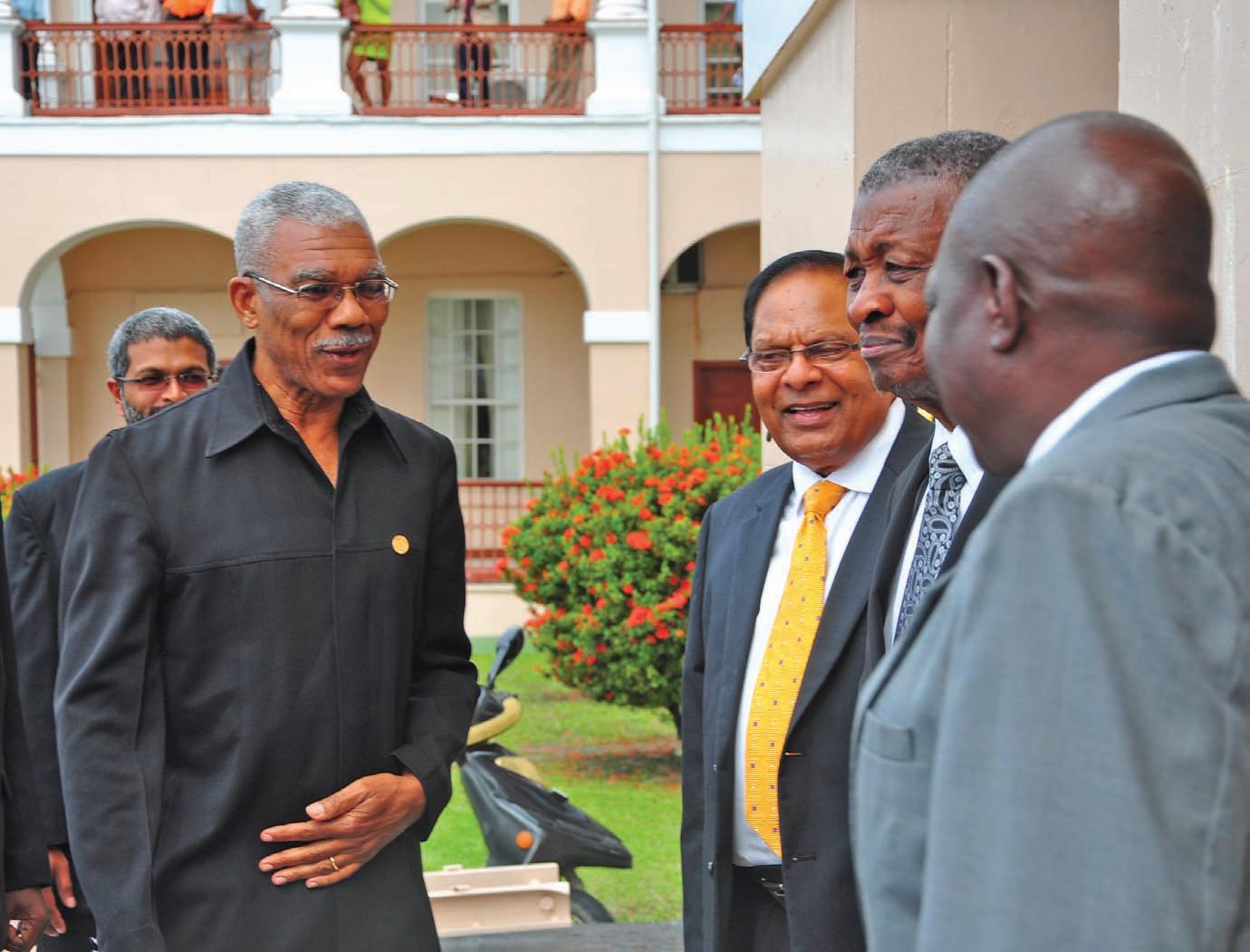
President David Granger being greeted on his arrival at Parliament Buildings by Prime Minister Moses Nagamootoo, Speaker of the National Assembly Dr Barton Scotland and Clerk of the National Assembly Sherlock Isaacs (Marceano Narine photo)
Jordan apologises for wrong external figures
inance Minister
FWinston Jordan on Thursday afternoon told the National Assembly that he had erred while providing Guyana’s external debt figure when he made his presentation on June 26, 2015.
During that time, Jordan had told the House that as it currently stood, Guyana had an external debt of US$1.6 billion although he could not quote the exact figure for the domestic or internal debt the country had.
Subsequent to this statement, the People’s Progressive Party/Civic (PPP/C) had protested the figure, stating that it was grossly inaccurate and misleading. At the time, many thought that the former Administration was simply making “noise” and was bent on defending itself.
Former Finance Minister, Dr Ashni Singh had said that Appendix VI to the National Budget Speech for 2014 reported that Guyana’s external debt stock stood at US$1.247 billion at the end of December 2013, and provided a detailed disaggregation by creditor.
Secondly, he said Appendix F1 to the MidYear Report for 2014 reported that the external debt stock stood at US$1.227 bil-
lion at the end of June 2014, and provided a similar level of disaggregation. Thirdly, Table 7-III of the Statistical Annexe to the Bank of Guyana Annual Report for 2014 reported that Guyana’s stock of external public debt amounted to US$1.217 billion at the end of December 2014, disaggregated by creditor type.
“All three of the aforementioned documents have been freely available in the public domain since their respective issuance, including on the Ministry of Finance and Bank of Guyana websites, where they could still be sourced when I last checked...”
Dr Singh had also called
on the Minister to make publicly available disaggregated details of the US$1.6 billion that he reported to the National Assembly last Friday as Guyana’s external debt stock. “Alternatively, he might wish to consider issuing an appropriate correction, including in the National Assembly where his statement was originally made. He might also wish to consider examining more closely the accuracy of other aspects of what he is reported to have said in the same article and address them similarly,” Dr Singh advocated.
Grossly exaggerated
The former Finance Minister had said that figures released on Guyana’s domestic and external debts were grossly exaggerated and slammed his successor for misleading the country. He had also called on the Minister to retract the statement and also apologise to the nation.
On this note, on Thursday afternoon, when the fourth sitting of the 11th Parliament was convened, the Finance Minister admitted to the House that indeed the figures were inaccurate and made in error.
“On Friday, June 26, 2015, I informed this
Honourable House that the external public debt had risen to US$1.6 billion and that the domestic debt had also increased, though I did not state a figure. On my return to Guyana on Tuesday, July 1, 2015 from Venezuela, where I had gone on official Government business, I was informed that the figure I quoted from the external debt was incorrect,” he said.
He noted that he has had the opportunity to recheck the figures and consequent to that, he has found that the public debt comprising the external debt and the domestic debt is what stands at US$1.6 billion and not the external debt.
As it stood, he said, the external debt was US$1.2 billion and the domestic debt is US$0.4 billion. “I apologise to this Honourable House for the earlier mistake and for the erroneous impression caused,” Minister Jordan said on Thursday.
Speaking in the National Assembly on Friday, June 26, Minister Jordan disclosed that Guyana was highly indebted, even carrying a deficit of more than $60 billion.
“Guyana’s external debt is US$1.6 billion, and we were recipients of generous debt write-offs from both bilateral and multilateral agents that have put us in a category where we have to pay careful attention to what we borrow, how we borrow, and what we borrow for,” Jordan had intoned.
CANU nabs man with 3.5 kg of cocaine, marijuana
Members of the Customs AntiNarcotics Unit (CANU) on Wednesday evening intercepted a 30-yearold passenger at the Ogle International Airport as he was about to smuggle more than 3.5 kilograms of cocaine and marijuana out of the country.
CANU Head James Singh confirmed that the passenger, a security guard, was about to board a LIAT Flight for Barbados when he was caught. He had in his possession one kilogram of cocaine and 2.5 kilograms of cannabis. The security guard who is not a first time traveller reportedly took time off from his job at Edward B Beharry and company to "do something important".
Singh stated that investigations were currently ongoing, but the mule was expected to make his court appearance today at the Sparendaam Magistrates’ Court. Guyana Times understands that the quantity of drugs was unearthed in a suitcase bearing the man’s name. The smuggler was reportedly from Parfaite Harmonie, West Bank Demerara.
The man was immediately arrested and taken to the CANU Headquarters where he was grilled.
In June, an 18-yearold Kaneville, East Bank Demerara resident was busted with 810 grams of cocaine strapped to her waist at the Ogle International Airport.
The teen, whose name was withheld by Police, was due to travel on a LIAT Flight to Barbados when she was arrested by members of the Police Narcotics Branch.
Information reaching this publication revealed that as the teenager was at the check-in counter, she was seen acting in a strange manner. She was subsequently taken to a room where her luggage was searched, but nothing was found. However, when ranks conducted a physical search of her person, the cocaine was found strapped to her waist.
Two days prior, a 33-yearold barber of Canje, Berbice was intercepted at the Cheddi Jagan International Airport (CJIA) with 12.2 kilograms of cocaine concealed in milk powder and in the false walls of his suitcase. The bust was done by members of CANU. It was reported that the first-time traveller was booked to travel to the John F Kennedy International Airport, New York on a Dynamic Airlines Flight when he was arrested.
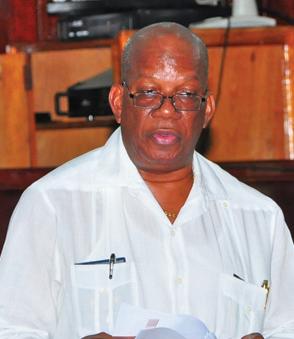
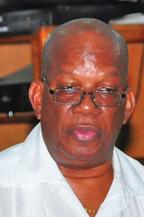
Finance Minister Winston Jordan
july 10, 2015 |
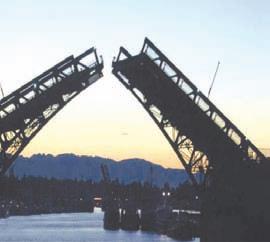
BRIDGE OPENINGS
The Demerara Harbour Bridge will be closed to vehicular traffic on:
Thursday, July 9 – 11:00h-12:30h and Friday, July 10 – 12:30h-14:00h
The Berbice River Bridge will be closed to vehicular traffic on:
Thursday, July 9 – 10:20h-11:50h and Friday, July 10 – 11:40h-13:10h
FERRY SCHEDULE
Parika and Supenaam departure times – 05:00h, 11:00h and 16:00h daily.
WEATHER TODAY
Thundery to heavy rain showers can be expected throughout the morning and afternoon, with thundery showers expected in the evening over coastal regions and near inland locations. Temperatures are expected to range between 24 degrees and 29 degrees Celsius.
Winds: East to North-easterly between 2.68 metres and 4.02 metres per second.
High Tide: 10:28h and 23:00h reaching maximum heights of 2.38 metres and 2.40 metres respectively.
Low Tide: 03:57h and 16:26 reaching minimum heights of 0.80 metre and 0.84 metre respectively.
Venezuela territorial controversy Granger promises wideranging diplomacy …reiterates pursuit of
By Vahnu Manikchand
President David Granger on Thursday assured the nation that Guyana would not condone Venezuela’s continuous illegal claims on its land and maritime territory, even as he promised that his Government would pursue a wide-ranging diplomatic initiative even as it sought a permanent judicial settlement to the decades-old controversy.
President Granger made his comments in an address to the Parliament Thursday. He said his Administration would not allow Venezuela to continue with its aggressive behaviour, which was against international laws and a violation of the 1966 Geneva Agreement. The agreement outlined steps to be followed to determine whether the controversy introduced by Venezuela about the validity of the 1899 Arbitral Award had any merit. It further stipulated that no new claim can be made while the agreement was in force. According to the President, this border controversy was his main focus during his participation at the recent Caribbean Community (Caricom) Heads of Government summit held in Barbados. He noted that he managed to secure the support of several Member States, who have expressed concerns not only about the effect the neighbouring country’s actions have on Guyana but on several other Caricom countries.
Since Venezuelan President Nicolás Maduro issued Decree 1787 claiming most of Guyana’s maritime space off the Essequibo Coast, President Granger has been pushing for the proclamation to be withdrawn. After months of rising tension between the two countries, President Maduro finally withdrew the decree but replaced it with another that was still making illegal claims on Guyana’s territory; however, without any specified coordinates. In the previous decree, the coordinates affected countries such as Barbados, Trinidad, Grenada and even Suriname.
judicial settlement
Granger expressed appreciation for the Secretary General of the United Nations, Ban Ki-moon, whom he met in Barbados, for committing to deploy missions to the neighbouring countries in efforts to have the decades-old controversy resolved.
Resolute
Nevertheless, the Head of State maintained that with the backing of these countries as well as several international organisations, Guyana would remain resolute against this unilateral position taken by neighbouring Venezuela.“Guyana will continue to pursue a wide range of diplomatic options as our first line of defence. Guyana will remain resolute in defending itself against all forms of aggression … We have never as an independent nation provoked or used aggression against any other nation and never will … We have never stymied development in another nation’s State. We do not expect and do not condone if any country attempt to do the same to us,” he told the Legislative Assembly.
President Granger went on to point out that the neighbouring country’s illegal territorial claims have, over the past decades, hindered economical development in Guyana. He noted that
Guyana has never before, and never will, take any action that obstructed development in another country or discouraged investors from investing there. “Guyana is a sovereign State. It is empowered under the international laws to exercise sovereign rights over its Continental Shelf and Exclusive Economic Zone (EEZ). Guyana has full … authority to unilaterally explore and exploit living and non-living resources within its jurisdiction,” he stated.
The Head of State was referring to the Spanishspeaking country’s objection to United States company ExxonMobil’s exploration activities in the Stabroek block which was licensed by Guyana.
President Maduro had written the company, warning it not to proceed with the oil drilling exercise off Essequibo. However, backed by its home country and the Guyana Government, the company went ahead and found reserves with “significant” oil.
The first Maduro decree was issued exactly a week after this discovery and claimed sovereignty over a 200-mile range of Guyana’s continental shelf covering the area where the US company is carrying out exploration activities. Furthermore, Grange rubbished claims by the Venezuelan President that his country was the victim of aggression from Guyana. Addressing the Venezuelan National Assembly on Monday, Maduro claimed that the country was being “attacked” daily by his Guyanese counterpart. He specifically referred to a recent statement by President Granger, which he said was full of insults, contempt and racism towards his country. President Granger declared that Guyana could in no way be aggressive to a country that was four times bigger, has a population that was 40 times larger and a stronger military. In fact, the Guyanese Head of State noted that it was Venezuela who has been aggressive towards Guyana for decades. He went further to mention that over the years, past and even current Venezuelan Presidents have displayed aggression towards Guyana.
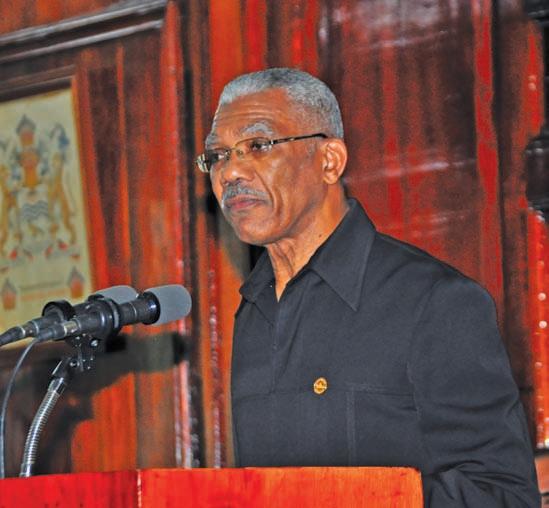
President David Granger addressing the Guyana Parliament
Editor: Nigel Williams
Tel: 225-5128, 231-0397, 226-9921, 226-2102, 223-7230 or 223-7231. Fax: 225-5134
In spite of boasting on the campaign trail about having a comprehensive national security plan for Guyana, it is clear that the APNU+AFC government came into office without really giving any serious thought about effective national security policies that are suited to this country, more particularly the new dimension crime is taking. At the moment criminals are creating havoc in Guyana and the Administration only recently brought together its top brass to discuss and come up with a plan.
Take for example the issue of piracy which has once again been given much prominence in the media recently due to the level of attacks being experienced by fishermen. The Public Security Minister is clueless about what direction the Administration intends to go in terms of addressing this scourge. Guyanese fishermen have endured the most brazen attacks at sea by gangs of criminals with fast boats and assault rifles. In addition to being robbed of their valuable possessions, quite a few of them have been killed by their captors.
What is even more worrying is that some of the persons carrying out these crimes are themselves fishermen. There is widespread speculation that some of the pirates collude with other fishermen to carry out these attacks which makes it even more challenging to deal with the issue. It is also no secret that the individuals who are found to be involved in these attacks get off because they manage to settle the matter with their victims. This has been allowed to go on for years due to a number of reasons, the main one being that the authorities are too lenient with the perpetrators even though the legislation provides for hefty fines and heavy jail time.
To date, the Public Security Ministry has not come up with any definitive plan as to how to solve the problem, except the minister himself suggesting that fishermen be armed to defend themselves in the event they are pounced upon. This suggestion, as was expected, was rejected as it was clearly not the answer to the problem.
Citizens expect the State to put the necessary security measures in place to ensure their safety at all times. And the State has an obligation to ensure that effective policies are drafted and implemented to ensure all segments of the population can go about their business in a peaceful and safe environment.
The economic reality is that the fisheries sector employs over 16,000 fishermen and fish farmers, and a further 6000 in processing and marketing. Thousands more depend directly or indirectly from fishing-related occupations, such as boat building, accessories supply, and maintenance services.
We are fully cognizant of the fact that it is not an easy task to ensure persons who go out to sea are given the maximum protection from piracy attacks especially considering Guyana’s expansive waterways and the difficulty policing these areas. Even though the anti-piracy law was toughened and a number of steps were taken to assist victims of piracy by the previous Government, enforcement and patrol continue to pose a challenge to the authorities. And this is the area that the new Government must seek to focus on.
To begin with, the marine police seem incapable of dealing with the problem, and the GPF certainly needs sufficient vessels and skilled personnel to conduct maritime patrols along the coastland and in the estuaries of the numerous creeks and rivers, especially in hotspots such as Berbice areas.
Additionally, we had stated before that there is a need for more coordination among public and private agencies to exercise efficient control over the country’s ports, harbours and coastlines. The coast guards should intensify their patrols, especially during certain periods of the year when there is an increase in piracy. Also the Guyana Police Force; Customs & Trade Administration, Fisheries Department; Shipping Association; Transport & Harbours Department; and the Maritime Administration Department (MARAD) need to be brought together to plan for the long-term safety of persons legitimately using our rivers and coast, and for the security of commercial and other activities.
Further, the Government should seek closer collaboration with neighbouring countries so as to develop an effective communication network so that in the event of a piracy attack, that mechanism would lead to more patrols being activated. While it would be very difficult to totally eliminate piracy, these are measures which can be taken immediately to lessen the frequency of these attacks, thus reducing the risk of losses of equipment, catch, and in some cases, the loss of lives.
The Venezuelan Rice Deal – Too Important to just Drop
Dear Editor, The Venezuelan Rice Deal has been an important one for Guyana. The 2015 arrangements called for Guyana to export approximately 200,000 tons of rice and paddy to Caracas, worth about $US120M. For 2015, this would have been about 30% of the total production in 2015.
In 2010, the export to Venezuela accounted for almost 70% of the total production in Guyana. Because we have increased production since 2010 and because the export market increased dramatically, the export to Venezuela gradually accounted for less of the production and in 2015 would have been only about 30%.
Yet the market remained one of the most important markets in the Guyana Rice Industry. It is a market that has always needed special nurturing. The Jagdeo/Chavez Initiative essentially used the loan from the Petro Caribe arrangement to pay for the rice Venezuela imported from Guyana.
This meant that Guyana kept a smaller portion of the Petro Caribe Funds than most of the other countries engaged in Petro Caribe. This was an important part of the negotiation with the Venezuelans. Guyana had to purchase enough oil from Venezuela to ensure that there was enough money in the Petro Caribe Account to pay for paddy and rice exported to Venezuela.
I negotiated deals for 2012, 2013, 2014 and 2015. During those times, Guyana and Venezuela had some
tense moments over the border issue. The Guyana Government managed these tense moments and throughout it all, Guyana and Venezuela maintained the rice arrangement, for the mutual benefits of both countries, our farmers and our people.
Venezuela has always had a rice industry of its own. By 2010, the Venezuelan Rice Industry had been experiencing great difficulties. When Venezuela started to buy rice from various countries, including Guyana, through a Petro Caribe arrangement, Venezuela had intimated that its intention is to resuscitate its own rice industry. Each year during negotiation, we discussed Venezuela’s rice industry’s status.
It is the reason why Guyana never sought to increase how much we sold to Venezuela. We ensured that we diversified the market so that Guyana was not dependent on any single market. From less than 300,000 tons export in 2011, we increased the export market to more than 500,000 by the end of 2014. From a handful of countries, we were already exporting to more than 33 countries around the world.
When we signed the 2015 Rice Contract for approximately $US120M and about 200,000 tons of rice and paddy, we also agreed to meet again later in the year to discuss our future arrangements, given that the oil price had reduced and that the Petro Caribe Account might not be sufficient to pay for the
amount of rice and paddy Venezuela was importing from Guyana.
At no time did we agree that the 2015 Rice Deal was the last deal between our countries. It is true that each year, we discuss the possibility that Venezuela might not need to import as much paddy and rice as they were doing at the time because the Venezuelan Rice Industry might pick up again.
As a backdrop to each negotiation, this assertion that Venezuelan Rice was going to be successful again was always raised. In 2012 and each year after, Venezuela approached the discussion as if they were not going to need to import as much paddy and rice as they were doing at the time.
I suspect that it was not different again this time. Guyana’s position with Venezuela throughout those discussions was always based on a very sensitive approach – we were supportive of Venezuela’s efforts to resuscitate its own rice industry and we fully appreciate that when that resuscitation occurred that Venezuela would not be able to continue buying Guyana’s rice and paddy.
We reiterated those sentiments during the 2015 discussions earlier in the year before we started the 2015 contract. The inclusion by Venezuela of their intention to resuscitate their own rice industry and Guyana’s understanding that when that time comes the Venezuelan market for Guyana’s rice and paddy would shrink were always part of the preliminary dis-
cussions in finalising the market.
The present situation with the collapse of the Rice Deal has to do with the present tense situation between the countries.
I hope that the markets I was developing and that the GRDB and the rice millers were working on would be further developed. Guyana can sell more than 700,000 tons if we allow the industry to continue the work it did before the new government took over.
The new government had promised during the elections that they had markets that would pay farmers more than $9,000 per bag of paddy.
They had boasted that some of their people had in fact developed the Venezuelan market and had markets all over the world, but that the PPP/C Government was suffocating them from being able to export Guyana’s rice and paddy.
Well, some rice farmers did listen to them. Now is APNU+AFC’s chance to put in place their markets, their price structures and to show the farmers that they were not lying to them during the election campaign.
This is not the time for them to use Venezuela as an excuse. This is not the time for them to cast blame on others. The industry needs good stewardship in order to continue to grow. That stewardship requires a strong Government support – a support that the PPP/C gave fully.
Dr. Leslie Ramsammy
Success Elementary School students dance at their graduation ceremony held at the National Cultural Centre (NCC) on Tuesday (Carl Croker photo)
The Venezuelan gas in the President’s tank
Dear Editor, I wish to register a strenuous objection to His Excellency David Granger’s statement about our neighbour to the West. Venezuela is not “a monkey on our back” and if History was still offered at the University of Guyana, we could easily show that Venezuela has been among Guyana’s staunchest supporters, from the fuel crisis in 1986 when we had no credit worthiness to purchase fuel supplies to this day, when we continue to benefit from the Petro Caribe initiative begun by the Late Venezuelan President Hugo Chavez.
Our President’s utterances display a lack of grace and gratefulness for the assistance provided to us by the Bolivarian State, assistance that continues in the face of this provocation. Has our glorious leader considered the consequences of an abrupt end to the Petro Caribe arrangement? Guyana is already struggling to find markets for its increased rice production while Venezuela pays more than world market prices for what it buys from us. No other country has paid as much and there is no doubt now that we could find another supplier of fuel given the credit worthy State we enjoy, and the promises of the Exxon find. However, we can be sure that no deal would be beneficial as the one we currently enjoy.
The solution to the recent
decrees by the Venezuelan Government lies in the area of Diplomacy; Former Ambassador Odeen Ishmael has offered advice that should be given serious consideration.
His Excellency is behaving like a schoolboy with the toughest big brother, his warlike rhetoric far exceeds the capacity of this tiny nation, our army is seemingly incapable of cutting the grass in Camp Ayangana, (a job which is outsourced to contractors), so while having America on his side is a wonderful thing, it doesn’t however make Guyana the 51st State of America. One would be advised not to lean too heavily on a brother already carrying the large burden of being the conscience of the western world.
The government and people of Venezuela have demonstrated strong friendship and support for our Nation and we shouldn’t let this special relationship, developed over decades, to be destroyed by the promise of new wealth and friends. I believe that this situation can be resolved amicably and without the need for empty rhetoric and name calling.
Mr. President, please spare us the patriotic drum beating while you drive around with Venezuelan gas in your tank.
Yours Faithfully, Robin Singh
Our police force is headed backwards
Dear Editor,
I wish to bring to your attention a recent situation which took place at the Leonora Police Station, (West Coast Demerara) in relation to motor vehicle fitness. Many years ago with the advent of modern sign and poster technology, vehicles were allowed to use computerised number plates, mini bus zones and name tags on commercial vehicles. This has proven to be cost effective, durable and would last for many years. It can withstand the daily assault of our weather and washing with soap and other detergents. It is no secret that using synthetic paint on these signs had outgrown its usefulness since it this method only lasts about six months on vehicles. For years our Police Force has recognised this and we were allowed to use the computerisedtechnology. I went to the Lenora Police Station to obtain a fitness for my vehicle and was told that I have to replace the computerized stickers with synthetic sign painting. I am not sure if this is happening countrywide but it is disgusting, aggravating and callous the least to
Ramjattan trying to cover the shame of his incompetence
Dear Editor,
Violent crime has escalated in Guyana since the APNU+AFC coalition government took control of the country. The Public Security MinisterKhemraj Ramjattan, seems to be at sea in tackling this crime monster the Guyanese people are now faced with, and therefore on this basis, the Public Security Minister should submit his resignation.
What is ironic, is that when Minister Ramjattan was a member of the oppo-
sition, he blasted the then Minister of Home Affairs Clement Rohee,accusing him of being incompetent in addressing crime.
Today, Ramjattan is occupying the sameseatpreviously held by Rohee and it is only justified that he should receive greater blasting for being incapable of addressing the crime spree which rose sharply under this de facto government. However,there is a saying that “mouthar and guitar are two different things” which rightly applies
not only toRamjattan, but also to the other Ministers of the Granger government. Ramjattan, just to cover the shame of his incompetence imposed the 2am curfew, which in my opinion, will never solve or control the violence and unending crime spree.
But what is important to note is that while the 2am curfew targets the established entertainment night spots, for crime control it fails to address or include the numerous roadside bars popu-
larly known for their chicken and fish fries blasting loud music until the wee hours of the morning across the country. Many bars are also located in residences. What is important to note as well is that the 2am curfew is not a hindrance to criminals.
The question is, will the Public Security Minister conduct an evaluation of his imposed 2am curfew to determine its effectiveness?
Yours sincerely Paul Thomas
The new Administration must prove itself
Dear Editor,
When the present government came into parliament lots of things became apparent, two of which I wish to address.
Firstly, the coalition never envisaged that with a superpower help, coupled with the GECOM’s rigging machine, things could have worked out so well. The machine was so efficient that the coalition doesn’t have to worry about the public being offered the truth.
This last election was not open for public scrutiny, itasserts, so there will be no recount. This last election
was a private affair between GECOM and a superpower.
The coalition arrived at their great surprise in Office without a plan for the future and decided that it was best to start with witch hunting in a failed attempt to humiliate the previous administration.
However, the opposition has failed to realize that all the positives around us were built by the PPP/C for the good of all Guyanese, while the PNC has failed tremendously. The PNC’s history is one of doom and destruction which the party tries to erase from his-
tory. Sustaining negativity against the PPP/C would be difficult since today the country has a booming economy built by the PPP/C and new Administrationhas no plans for Guyana. Criticisms and talks of corruption are of no value if the coalition cannotprove itself progressive.This is the main problem confronting the de-facto government. Therefore, the new Administration has to show its ability and competence in achieving better. Witch hunting and bad - mouthing the previous administration cannot achieve this. It
takes vision and hard work. The PPP/C has rightfully claimed this title. Certainly, all the corruption claims have made the PPP/C stand outas the only party that has done and continues to do the work of nation building. Trying to dismantle a thing of beauty is dumb to say the least. Trying to upset the peace, progress and prosperity we grew accustomed to for these last twenty three years is the most foolish thing I have ever seen in a long time.
Neil Adams
Carl Parker is sabotaging Village Council elections
Dear Editor,
The Amerindian Village Council’s elections will be held on Wednesday, July 22, 2015.
say. When the world is moving forward, our police force is heading backward.
Concerned Citizen
The Returning Officer for these elections is the clerk of the Regional Democratic Council (RDC) who will act in this capacity or shall appoint another person on his behalf (section 66(1) of the Amerindian Act 2006).
The Returning Officer has the overall responsibility for ensuring the proper conduct of the elections for
the Toshaos and Councillors, and among other things s/he is to “ensure that the village is notified of the arrangements for, the elections” (section 66 (2) (A) (1) of the Amerindian Act 2006).
The Returning Officer for the Amerindian Village Councils elections in the Rupununi, Region Nine, is currently Carl Parker, the acting Regional Executive Officer (REO), since REOs are the clerks of the RDCs around the country.
So far Carl Parker has
done absolutely nothing to ensure that his functions as a Returning Officer for the Amerindian Village Councils elections in his region are effectivelycarried out. Village residents still want to know what the arrangements are for their elections.
They would also like to be shown a specimen copy of the ballot paper that will be in use for their elections. But Parker has no time to spare for anyone, not even the persons he ap-
pointed to act on his behalf as the Returning Officer. Parker only has time to drive around in Lethem in the Government’s vehicle, doing absolutely nothing. Both the Ministers of Indigenous People’s Affairs and of Communities need to urgently check on Carl Parker before he sabotages the Amerindian Village Councils elections in the Rupununi.
Yours sincerely, J Antone
friday, july 10, 2015|
78 graduate from GuySuCo’s training school
...urged to play key role in turnaround of industry
The Guyana Sugar Corporation (GuySuCo) on Wednesday graduated 78 young graduates during its 54th Apprentice Graduation programme at the Corporation’s Training Centre, Port Mourant, Berbice.
In a release by the Agriculture Ministry, the students received certificates after four years of intense training in several areas such as Fitting and Machining, Electrical and Instrument, Agricultural Mechanic, Instrument Repair Mechanic and Sugar Boiler.
Agriculture Minister Noel Holder, in delivering the feature address underscored the importance of the industry, alluding to the fact that the continued success of GuySuCo was equally dependent on per-
sonnel excellence as it was on teamwork and participation.
In this regard, he said, the graduates have an important role to play in fostering the changes needed to engender the success of GuySuCo.
He added that the Corporation’s fields and offices required core techni-
cal skills, as well as new competencies in order to effectively cope with the highly computerised and automated technology being implemented.“The skills you now possess will allow you access to a number of positions similar to the ones you studied … furthermore, there will be a number of advancement opportunities
CDB, IDB to promote road safety in Caribbean through responsible driving
available in the future to enable you to play your part in continuing the improvement and success of the industry,” he said.
Minister Holder pointed out too that graduation did not mean the end of studies, as it was the beginning of a process of learning much more. The students were reminded that GuySuCo’s training was intended to produce individuals capable of manning the industry.
In addition, the Agriculture Minister lauded the parents of the graduands for supporting them throughout their course. He commended the performance of the trainees over the last four years, contending that given the current challenges facing the industry, a workplace culture attuned to its needs was required for forward movement.
Despite the challenges, the sugar industry continues to be the backbone of Guyana, significantly contributing to the country’s export earnings. With this new batch of trainees, the industry will see a significant number of new skills being added to its employees, hence contributing to GuySuCo’s endeavours to revive the industry.
GuySuCo’s acting Chief Executive Officer, Paul Bhim, congratulated the graduands and staff of the institution for making this programme a continued success annually.
He said GuySuCo was committed to being “worker friendly” and would always be open to them airing their concerns and offering solutions. Meanwhile, Best Overall Performance by First Year Apprentice for Groups A, B and C went to David Balkissoon of the Rose Hall Estate, Randel Balkarran of Albion Estate and Stephen Bowen of Wales Estate respectively. Best Overall 1st year Apprentice went to David Balkissoon while the Alumni Award (CANADA) went to Naresh Singh also of Rose Hall Estate.
GuySuCo continues to produce high-quality craftsmen and women, engineers, managers and entrepreneurs, contributing significantly, not only to Guyana’s economy but those of countries in the Caribbean, Europe and North America.
“Being part of Proyecto Luz
therefore, is an important mechanism by which we hope to raise awareness, and reduce the road fatality rate among young persons in the Caribbean”
Apicture is worth a thousand words, and a video could possibly save a life. That’s the thinking behind the second annual staging of Proyecto Luz Amarilla (Project Yellow Light), a video contest which invites young people from Latin America and the Caribbean to get creative while thinking about solving the problem of road fatalities among youth. By creating and submitting a short video on the importance of responsible and safe driving, they could win a trip to see professional drivers and fast cars in action at the Formula 1 Grand Prix, Mexico in October. In a bid to increase road safety awareness in Latin America and the Caribbean, the Caribbean Development Bank (CDB) has partnered with the Inter-American Development Bank (IDB) to launch the second edition of Proyecto Luz Amarilla.
Young persons living in CDB and IDB member countries in Latin America and the Caribbean, who are between 18 and 30 years of age, are invited to participate.
The top three finalists will win a trip to Mexico in October 2015 to present their work and attend the Formula 1 Grand Prix, while the fourth- and fifthplace finishers will receive iPad Minis.
CDB Operations Officer (Civil Engineer) Glen McCarvell noted that partnering in this project was a natural extension of the work that CDB has been doing in the Region to promote road safety awareness among youth.
He said that “30 per cent of the road traffic fatalities in the Region are youth, and of that, 90 per cent are males. Contests have been an effective means for us to engage youth, especially in the area of road safety awareness.
We have found that youth have proven to be effective ambassadors and communicators, especially when it comes to conveying an un-
derstanding of the risks that they and their peers face as road users. Being part of Proyecto Luz Amarilla, therefore, is an important mechanism by which we hope to raise awareness, and reduce the road fatality rate among young persons in the Caribbean”.
Since 2008, the CDB has been supporting its Borrowing Member Countries (BMCs), in their efforts to reduce road traffic injuries and fatalities. These efforts have included capacity building and training, as well as specific interventions in various countries. In 2013, the CDB, in conjunction with the Government of Belize, funded an ongoing US$8.844 million Road Safety Project, which was aimed at supporting interventions to build the country’s road safety management capacity, improve the safety of road infrastructure and improve post-crash care.
The Youth and Road Safety Capacity Building Project, which was launched in 2014, and also funded by the CDB and the Government of Belize, is expected to enhance the original Road Safety Project, by educating 2000 Belizean youths between ages 16 and 29 about road safety, and youth-related issues surrounding the safe use of Belize’s road network.
Proyecto Luz Amarilla was created by the IDB, and the sponsors for 2015 are the Caribbean Development Bank, Fédération Internationale de l’Automobile (FIA) and MTV LA. The campaign draws its inspiration from a programme of the same name (Project Yellow Light) founded by Julie Garner, an American who lost her 17-year-old son in an automobile accident in 2007. Entries should be 25 or 55 seconds in length and be submitted by September 21, 2015.
For more information on the campaign, persons may go to proyectoluzamarillaen. iadb.org.
A section of the graduates of GuySuCo’s 54th Apprenticeship Graduation, Port Mourant, Berbice
Amarilla,
Govt scraps $10,000 school grant
…to continue $1500 uniform voucher programme
The David Granger-led Administration will scrap the “Because We Care” $10,000 per student grant initiative started under the previous Administration to assist students of the public education school system.
Education Minister, Dr Rupert Roopnaraine told reporters at the National Assembly on Thursday afternoon that this was not because the new Government did not care, but because the Government had been against the initiative even when it was the Opposition. Roopnaraine stated, however, that the $1500 school uniform vouchers would continue to be distributed.
The “Because We Care” initiative was launched at the Bartica Community Centre Ground, Region Seven (Cuyuni-Mazaruni) in October 2014, when scores of parents and children gathered to receive the grants. The initiative was approved in the 2014 national budget and was set to target each child in the public education sector. More than 188, 400 families were to benefit overall from the initiative.
Former President Donald Ramotar had said that the $10,000 per child grant was a demonstration of his Government’s and Party’s philosophical belief that no investment was more important than that made in people. The cash grant initiative was announced by then Finance Minister, Dr Ashni Singh during the presentation of Budget 2014. He had explained that the programme was meant to provide more support to parents with school-age children and increase the disposable income of parents with schoolage children with a view to raising enrolment and attendance rates.
He said it was the first programme of its kind in the Caribbean and indeed anywhere else in this part of the world whereby every public school child was entitled to this benefit. The Education Ministry then had said too that cognisant of Article
Bandits rob, beat Judge, husband
…four caught following shootout
Four bandits were Thursday morning captured shortly after they burglarised the home of a sitting Judge, beating her and her husband before attempting to escape with a money safe.
Justice Nicola Pierre, 43, of Felicity, East Coast Demerara (ECD) and her husband Mohamed Chand, 40, were brutally attacked and robbed around 01:30h on Thursday in the presence of their 11-year-old son.
Pierre and her husband have since been admitted to a private hospital for medical treatment. According to information received, the perpetrators forced their way into the gated community and tied up the Special Constable who was on duty at the time.
13 of the Constitution of Guyana, which recommends inclusionary democracy and because of the Government’s deep commitment to making decisions based on the desires of the people of Guyana, it engaged in consultations all across Guyana to hear from Guyana’s parents what systems they believed would serve them best.
More than 55 public consultations were held where the following questions were examined whether parents would prefer to be able to receive cash or exchange a voucher for goods in the manner that the uniform voucher programme is currently operated; and if the former were the preferred option, which service would parents prefer to use to be able to encash their vouchers (choices ranged from the Banks, Mobile Money, Western Union/Bill Express, the Post Office, and Moneygram. Almost unanimously parents chose to receive cash as opposed to goods and an overwhelming majority chose to be able to encash at Western Union/ Bill Express money services. Where geographically there was a limitation of financial services, different arrangements shall be made.
Amerindians
Meanwhile, Minister Sydney Allicock, in an interview with Guyana Times on Wednesday, stated that his Ministry now has a Permanent Secretary who was at the moment working towards sorting out lists and equipment so that students in the hinterland communities can receive their vouchers. He added that waiting on records to check everything is what takes time and spurs uncertainty. He said that the Ministry was trying to sort out all issues as it related to hinterland students receiving their vouchers and he was very hopeful that the situation will soon be resolved and the hinterland students would definitely receive vouchers for the new school year.
Police reports indicated that the perpetrators then attempted to cart off a portable safe containing an undisclosed sum of money, an undisclosed quantity of jewellery and a suitcase containing several valuable articles.
However, as the culprits were exiting the premises, they were confronted by an armed security guard at a neighbouring residence and there was an exchange of gunfire during which the perpetrators dropped the stolen items and escaped.
Responding to the report, the Police succeeded in capturing the bandits who are now in custody at the Sparendaam Police Station assisting with investigations.
They then broke into the three-storey home, rounded up the family of three, and delivered several blows to the couple as they demanded cash and other valuables.
Meanwhile, when Guyana Times visited the area, security was tight and the media was not allowed access within the premises. However, several neighbours related to this publi-
cation that the incident took them by surprise as they never thought bandits would be brazen enough to rob individuals residing in a gated community which would typically feature high-level security.
Nonetheless, they expressed some concern that the bandits nearly succeeded in making good their escape. One resident, speaking under the condition of anonym-
ity, told this newspaper that she leapt out of her sleep at the sound of gunshots.
“I was sleeping and then I heard the noise and I woke up. I thought it was fireworks or that a party was going on, I did not know it was a robbery right here. I peeped through my window and I did not notice anything and so I went back to sleep. It was this morning I realised what actually happened,” she stated. In 2014, Pierre was sworn in as Commissioner of Title (Land Court Judge) by then Prime Minister Samuel Hinds. Pierre boasts a Certificate of Legal Education from Hugh Wooding Law School, a Bachelor of Law from the University of Guyana, and 16 years of work experience which includes legislative drafter, lecturer at the University of Guyana (UG) and Attorney-at-Law in the Chambers of Oliver Valz, SC.
Commissioner of Title, Nicola Pierre
Education Minister, Dr Rupert Roopnaraine
PPP/C taps Nandlall for Deputy Speaker post
Anil Nandlall will be the People’s Progressive Party/ Civic’s nominee for the post of Deputy Speaker of the National Assembly in the 11th Parliament whenever the Party decides to occupy its 32 seats in the legislature.
Guyana Times was reliably informed that the decision was made at the level of the Party’s Central Committee and ratified by its Executive Committee following the May 11, 2015 General and Regional Elections which it claims were fraudulent and rigged.
He would have to be elected by the National Assembly when the PPP/C enters Parliament officially without opposition from the A Partnership for National Unity and Alliance For Change coalition which enjoys a oneseat majority, in order to successfully become the next Deputy Speaker. When contacted for confirmation on the issue, Nandlall declined to comment pointing this newspaper in the direction of PPP General Secretary Clement Rohee whom he
said would have answers to any and all questions on this matter.
However, this newspaper understands that Nandlall was chosen from a field of experienced parliamentarians who served in both the Ninth and 10th Parliaments with distinction and have a very good grasp of the parliamentary apparatus, norms and conventions, and standing orders. Nandlall had served as a Member of Parliament in the Ninth Parliament before serving as Attorney General and Legal Affairs Minister in the Tenth
Parliament until this year when Parliament was dissolved following its prorogation last November. This newspaper was also able to confirm that Gail Teixeira has been selected as the PPP/C’s Chief Whip for a third consecutive time having served the Party since 1992 as a parliamentarian and Senior Minister of Government. Having reviewed her performance in the 10th Parliament, the PPP/C has decided that it will tap into her expertise and knowledge of the workings of the 65-seat legislature.
Enmore cellphone store robbed thrice in 3 months
Exactly two months after the Super Deal Cellphone Store located at Lot 37 Blossom Scheme, Enmore, East Coast Demerara, was burglarised and millions stolen, the owner of the store was on Thursday bound and gagged by two gunmen who carted off more than $2 million in items. According to information received, the two men who were dressed as male nurses entered the store at about 14:00h and enquired the price to change the screen of a Blackberry Q10 mobile phone. After giving them the price to fix the phone, one of the men exited the story under the pretext of making a telephone call but after a while reenter the store and locked the glass door behind him. He then whipped out a
firearm and held the owner Damein Etwaru at gunpoint while the other man bound his hands and feet and gagged his mouth with duct tape. They then placed him to lay on the ground behind the counter.
After doing so, the men then cleared the shelves of the glass case and left. A still shaken Etwaru told Guyana Times that after the men left, he managed to grab a pair of scissors and cut himself loose. As he ran out of the store –which is less than five minutes away from the Police station – he saw the men turning into a street.
He immediately contacted the Police who went in the direction of the men but there were nowhere in sight. Etwaru later found out that the men left in a waiting motorcar.
Investigators dusted the store for fingerprints and would have secured one that bore a cut in the palm of a hand.
The young businessman stated that the men escaped with at least 48 mobile phones, a quantity of phone cards, several speakers and phone cases and some other items. He confirmed that the items cost in excess of $2 million.
A frustrated Etwaru disclosed that this is the third robbery and he thinks it is time for him to close his business. He recalled in April, he and another employee had just locked the store for business when they were confronted by three men with handguns. They were relieved of close to $1.5 million in cash and mobile handsets. Two men were arrested and
charged for the crime but were subsequently granted bail at the Cove and John Magistrate’s Court. Meanwhile, back in May, bandits had also burglarised the store, carting off over $4 million in items. It was reported that the men were reportedly seen making their way into the business place at about 02:05h as they pried open the padlock on the shutters. They then opened the glass door and proceeded to bag off several car stereos, more than 40 mobile phones, speakers, car lights and a quantity of car accessories.
They were wearing hats, long sleeve white shirts and gloves and were seen escaping in a Toyota Allion motorcar which was parked in a poorly lit spot.
Found and lost...
...rice markets
Your Eyewitness isn’t in the “blame game” business. There’s no percentage in that. He figures we’re all in the same boat and there’s no point in drilling hole in the hull. We’ll all be going down, won’t we? So let’s talk about our Venezuelan markets for rice that might just disappear come November - without pointing fingers.
Back when Jagdeo was President, the rice farmers were “up the creek” without the proverbial paddle, as prices plunged below production costs. What was interesting was that even though the industry had been “privatised”, the marketing of the rice and paddy was still, by and large, left up to the government.
For some reason that’s never been fully explained, private exporters - such as abound in neighbouring Suriname - never stepped up to the crease here. Someone should investigate whether the “co-op experiment” that had rice as one of its major planks, killed initiative or know-how in rice marketing.
Anyhow up comes Jagdeo, who runs into President Chavez of Venezuela at a Climate Change parley in - of all places - the U.S. in 2009. Being a fella who’s always on the lookout for Guyana, he suggests to Chavez that maybe Venezuela could buy rice from Guyana. And a deal was born.
Rice farmers sang hosannas to Jagdeo as the price of paddy rose immediately when 50,000 tonnes of rice were shipped to Venezuela. How quickly they forget, eh? This figure jumped to the 200,000+ tonnes last year. The deal became even sweeter when it was negotiated that payments for oil shipped from Venezuela - under the 2007 PetroCaribe facility could be written off against rice shipments. Guyana was thus spared finding hundreds of millions in foreign currency for oil, by paying for it in Guyana dollars, which it could simply print!
And who conceptualised and negotiated all of this? Not Jagdeo, right? Wrong! But you wouldn’t hear anything about this, will you? But, like they say, as the world turns, things change. Venezuelans are still eating the same amount of rice - more as the population rises. They’re still smuggling 200,000 tonnes of their own rice production - at a premium price - to Columbia.
They’ve still cut back their purchases from the U.S. by 200,000 tonnes. And they still have rice shortages. So why are they threatening to cancel our rice-foroil deal? Well, like we said in the beginning...we’re not pointing fingers...but maybe some diplomatic lapse?
We’re waiting for those rice farmers in Essequibowho’d been marching up and down the road in various stages of undress against the PPP - to raise their index fingers!!
...the movie experience
Don’t ever let it be said your Eyewitness doesn’t have his kinder, gentler side. Last week, he took his kids to the movies at the new Giftland Mall. Not all altruism, mind you: he hoped to wean them off Roosevelt Field Mall, over in Long Island. Which not so incidentally also has its multiplex. So he arrived at the now famous “road to the mall” and espied the long awaited edifice. Not bad...lots of glass and glitz. He’d seen the grand opening on TV and wondered where was Jagdeo.
Your Eyewitness remembered the stitch Jagdeo had taken when, after leasing the land to Giftland in 2007, building didn’t even start for years. But this was only one of the transformational mega projects he believed in. But the cinemas were great... his kids schlepped off to see “Inside Out” and he and the missus checked out the latest Terminator. Imagine Arnold gets to look like when he’d just hitched up with that Kennedy girl! Even kids teared up at the pixelated 3-D images. And the popcorn was free!!
...space and time
The world’s celebrating that it’s100 years since Einstein unveiled his Special Theory of Relativity!! And 99.9999% of us still can’t get it that gravity can slow down time.
But at least as he gets older, your Eyewitness appreciates that time is relative!
Readers are invited to send their comments by email to eye@guyanatimesgy.com
Rice farmers concerned about collapse of Venezuela deal
Rice millers across the country have expressed grave concerns over the imminent end of the rice for oil deal between Guyana and Venezuela and are urging Government to see how best it could lobby for its continuation.
The deal which began in 2009, and which comes to an end in November later this year, has been part of a pact between the two Governments where Venezuela would provide oil to Guyana in exchange for rice.
The transaction has been ongoing amid a political stalemate between the countries. Finance Minister Winston Jordan said Venezuela has decided to pull the plug here because of a new rice deal with Suriname and as such, did not require the large amount which was currently being sent from Guyana.
The Minister made the announcement to Guyana Times on Wednesday, a few days after his return from the neighbouring Spanish speaking nation, where the country during discussions with Jordan, indicated that it would not be renewing the agreement.
While Government would lose out on this new development, the ones to suffer more are millers and to a greater extent, rice farmers.
Chief Executive Officer (CEO) of the Nand Persaud and Co Ltd Mohindra Persaud told Guyana Times that while his company was expecting this announcement, and while he has always been seeking out other markets for his rice deal, Government should see how best it could fix the fall out, which, if not addressed, is bound to affect thousands of local farmers. Persaud has close to 5000 farmers attached to his mill. This year, his mill was given a 9000-ton quota for exportation by Government.
He said the new development will place a serious strain on his market, as he is still to get some 10,000 tons of rice off his hands.
Meanwhile, Head of the Alesie Group of Companies Turhane Doerga told Guyana Times that the previous Administration was warned long before of such a possibility. However, it failed to take heed. He even lambasted the current Administration’s Finance Minister for taking head of the (GRDB) Jagnarine Singh on the Venezuela trip, since he was part of the team which contributed to the collapse of the agreement. He said he feels deeply for the farmers and millers who will lose out.
“What I’ve been saying is, we are talking about the rice industry. This is the largest Private Sector in this country. In commodity trade, what we are talking about, you never panic. The problem is, when you know the industry, you anticipate things. This is what my main concern is”. He said when he raised the issue mid last
year; he was shunned by the then Government.
“Today, I am really sad to see that it was true what we were saying.They have siphoned off billions of US dollars. For the farmers it is a further hit, but it is not like they don’t know. But it is a sad situation; it will injure the farmers and the rice millers badly. But you have to understand that the millers make a living off the farmers. People like me have to fight for the farmers. We want to make a profit yes, but if you kill the goose that lays the golden egg, what will you do with the mill”, Doerga questioned.
Asked how the collapse would affect him, Doerga explained that his company since 1988 has been bringing “every single lucrative deal to Guyana”. However, his company for over 15 years was marginalised.
“The Venezuelan deal was brought by me, I made that deal but it was hijacked after they saw how much money was being made… They need to fix this thing… I am asking all of them, like Seeraj and the others. Do not play politics with this thing. Stop with the nonsense”.
Doerga further related that the industry and Venezuela deal could be salvaged if politics is taken out of the equation. “There are enough markets, but they have to be engineered like the Venezuela deal and before then, the same way it was done with Euro. Today, Guyana is the laughing stock, since people have been saying you can’t get through to be fixed. We need professionals to fix it, and the industry will be fixed. I really feel sad about the collapse, but it s not too late, it could be fixed,” Doerga said.
Meanwhile, General Secretary of the Guyana Rice Producers Association (GRPA) Dharamkumar Seeraj told Guyana Times that he was not aware of an impending collapse under the People’s Progressive Party/ Civic (PPP/C) Government. He said he had travelled on several occasions to Venezuela, noting that the only area of concern was over the expansion of the amount normally sent to Venezuela. According to him, discussions were held in that regard, noting that there was no indica-
tion that Venezuela was going to terminate that deal. “I am still coming to grips with this news myself and I now have to do an analysis of what is most likely to happen to the industry. I know that a number of occasions prior to elections, they said that the price was too low and they promised farmers six and nine thousand… it came as a big
surprise to me that the deal as terminated”.
Parliamentary representative for Region Six (East Berbice-Corentyne) and former Regional Chairman Zulficar Mustapha said he will continue to make representation for the people of that region. According to him, the collapse is “very unfortunate”, since the
PPP/C had done all it possibly could to protect the deal. He related that the current Administration “will now have to be more aggressive to protect that deal”.
Speaking to this publication on Wednesday, Finance Minister Winston Jordon stated however that Venezuela may still be interested in taking small amounts of rice from Guyana.
Questioned on the implications of this on Guyana, Jordan said that the Government was looking at alternative solutions which would include another deal with Venezuela. This, which will be in the form of a joint venture, will see Guyana and any other interested country producing rice, and Venezuela, marketing the rice to countries such as Iran, which consumes a large amount of the product.
Minister of State, Joseph Harmon told reporters last week that Guyana would be looking for an extension of the deal even as the competing South American nations were
eyeing the Venezuelan rice market, when the industry was not at its best with longstanding stakeholders. He had remained optimistic that owing to the length of time that the two countries have been engaged in this trade that Guyana would have had an advantage in maintaining its market share.
Long before the current crisis concerning the future of PetroCaribe, the political unrest and economic difficulties which had coincided with President Nicolás Maduro’s accession to office had raised questions about the future of the agreement. Venezuela has been by far the major market for Guyana’s rice and paddy, accounting for around 60 per cent of total exports in 2010. In 2014, exports to Venezuela accounted for approximately 38 per cent of total exports though the overall tonnage exported (150,000 tonnes of rice and 50,000 tonnes of paddy) far exceeded the 2013 export levels.
Venezuela has been by far the major market for Guyana’s rice and paddy, accounting for around 60 per cent of total exports in 2010
PPP/C blames “belligerent” Govt for collapse of Venezuela rice deal
The People’s Progressive Party/ Civic (PPP/C) has blamed the “belligerence” of the David Granger-led Administration for the collapse of the Venezuela oil for rice deal with Guyana.
In a statement, the party said that it notes the decision by the Venezuelan Government to discontinue the rice agreement with Guyana which was negotiated by former Presidents Bharrat Jagdeo and Hugo Chávez and also noted Prime Minister Moses Nagamootoo’s, accusation that the PPP/C was aware of the imminent collapse of the deal and failed to inform the Guyanese public, implying that the PPP/C is somehow responsible for this state of affairs.
According to the PPP/C, what the Prime Minister does not want to admit is that the non-renewal of the rice agreement has nothing to do with the PPP/C, and perhaps even with rice, “but with the rapid deterioration of relations between Guyana and Venezuela since the Granger Administration assumed office.”
Reputed wife withdraws assault charge against partner
AThe party said the Administration appears to eschew dialogue and this is evidenced by Foreign Affairs Minister Carl Greenidge saying to the President of Venezuela “go talk with Caricom” while only days before announcing that his Government will send a team to Venezuela to negotiate a long-term rice agreement. “This is some kind of distorted diplomacy which was bound to yield the result now realised.”
The PPP/C said that on every occasion that a new agreement was signed, the Venezuelan Government informed that they could not guarantee an agreement for the next year as they too were developing their rice industry. “However, on every single occasion the PPP/C Government was able to negotiate a new agreement with generous terms and conditions while
The PPP/C said it has always held firm to the 1899 Arbitral Award which definitively settled Guyana’s border with Venezuela and has always received the support from the Caribbean Community (Caricom) and the Commonwealth on this matter. “No doubt that will continue to be the case. However, the PPP/C also believes that controversies and disagreements cannot be resolved through brinksmanship, belligerence or name-calling (a la “monkey on back”) and there must be room for dialogue.”
we looked for additional markets.” The party said this was the case even when there were heightened tensions in relation to the border controversy. Indeed, the last agreement was signed during the period when the PPP/C had announced that it was no longer interested in pursuing the United Nations (UN) Good Offices process and will be reviewing the other options under the Geneva Agreement – a position the Venezuelan Government did not support. The successful negotiation of all of the rice agreements was possible because of the strong functional cooperation programme and the good relations the PPP/C had developed with the Venezuelan Government of which the rice agreement was the flagship.
Let it be clear that the information provided when the 2015 agreement was signed with respect to no guarantee for a new agreement was nothing new and there was even agreement to continue discussions, as was done in the past. Why those discussions did not continue is anyone’s guess. What is sure is that the responsibility for the collapse of the rice agreement lies squarely with the de facto Government.
charge of assault was dropped against a 32-year-old Prashad Nagar resident on Thursday when his partner of 12 years decided to withdraw the assault charges she lodged against him.
Wayne Barnwell of 298 Prashad Nagar, Greater Georgetown and Duncan Street, was saved from the full brunt of the law on Thursday when his reputed wife Nakesha Haverson refused to offer testimony
against him after she had lodged a complaint of assault at the Prashad Nagar Police Outpost.
The charge against him detailed that he had unlawfully assaulted her on June 26 while on Nikita Street, Prashad Nagar.
Barnwell was represented by Attorney Paul Fung-AFat, who told the court that the couple simply had a lovers spat over their children. He said the couple has been together for 12 years and
so the Virtual Complainant (VC) does not wish to see him in jail.
Police Prosecutor, Corporal Deniro Jones had no objections against the charges being dropped against the defendant. The VC also stated that she was not forced nor threatened to drop the case. With this, Magistrate Ann McLennan, who presided in Court Two of the Georgetown Magistrates’ Courts, dimissed the case against Barnwell.
GRA makes further amendments to Customs import policy
Effective July 20, importers and licensed Customshouse Brokers will be required to submit a third copy of their Customs declaration (otherwise known as Form C 72) documents to the Guyana Revenue Authority’s Customs Lodging Area.
In a release, the GRA said copies of accompanying Bill of Laden and/or commercial invoices where necessary will also be required. In cases where there are tax exemp-
tions, a tax exemption copy in the form of a C72 should be prepared, showing revenue loss as a result of the tax exemptions granted. Importers and licensed Customshouse Brokers can be assured that these amendments will in no way impact negatively or bring undue delays to the processing time for import declarations lodged.
The public is reminded that in the past Customs declaration documents had to be submitted in quadruplicate.
However, the paperwork requirements were shortened as management sought to expedite processing time. In wake of the new impending changes, plans are in the making to reorient current staff of the GRA, especially at the Entry Processing Unit (EPU) and Customshouse brokers, particularly new recruits about the procedures involved in preparing and lodging customs declarations and relevant documents.
BASS officer charged for allegedly killing labourer
Amember of the Berbice Anti Smuggling Squad (BASS) appeared in a Berbice court on Thursday charged for allegedly killing a labourer during an antismuggling raid in Corentyne last Saturday.
Shafraz Khan, 40, of Lot 35 Hassim Street Corriverton, Region Six (East Berbice/ Corentyne) appeared at the Springlands Magistrate’s Court on Thursday before Magistrate Rabindranauth Singh on a charge of manslaughter. He was granted bail
in the sum of $250,000. He is alleged to have killed Charles Caesar on July 3, 2015.
According to the charge, which was read to Khan, on July 3, at the Number 67 Village, Corentyne Foreshore, he discharged a loaded firearm thereby causing the death of Caesar. Attorney-atLaw Adrian Anamayah, in a bail application, said Khan was a first-time offender and a father of two. “He has been employed with BASS for over 19 years as a Customs Monitoring Officer.”
According to Anamayah, at the time of the incident, Khan was carrying out his duties. He asked for reasonable bail. The lawyer said since the investigation started, Khan had been cooperating with Police and after 72 hours in custody, he was released into the custody of BASS. Police Prosecutor, Inspector Godfrey Playter had no objection to bail. Khan was granted bail and released into the custody of BASS. He will have to return to court on August 27 for a Police report.
Opposition’s witch-hunting claims
PPP/C starts pre-litigation proceedings against Govt
– seeks compensation for wrongfully dismissed workers
BY MICHAEL YOUNGE
The People’s Progressive Party/ Civic (PPP/C) this week officially commenced pre-litigation proceedings against the Government of Guyana and several other State agencies, following what it has deemed the wrongful dismissals of scores of workers from their jobs after the new David Granger-led Administration came to power on May 16.
The party had established an AntiDiscriminatory Committee and a Legal Affairs Committee after complaints were received from its supporters and other young professionals that they were being made the victims of the new Government’s witchhunting campaign following the May 11 General and Regional Elections because they were perceived to be PPP/C supporters or sympathisers.
Those who appeared before the two Committees had argued that they were wrongfully dismissed while others had their contracts arbitrarily terminated without proper notice.
Others claimed that they
were dismissed from their state jobs because of their ethnicity and perceived political affiliation to the previous Administration.
Former Attorney General and Legal Affairs Minister Anil Nandlall on Thursday told the Guyana Times that the party has already issued letters and other forms of correspondence to the new Government and other agencies as part of the prelitigation process.
“We have established an Anti-Discriminatory Committee and a Legal Affairs Committee where we are receiving reports from persons who are being dismissed, witch-hunted and discriminated against by the current Administration and we are documenting these complaints. Where necessary we plan to file legal proceedings and it is our intention also to draw national attention to these legal atrocities as well as to internationalise them as evidence of institutional and systemic policies of discrimination on ethnic, racial and political grounds”, he reaffirmed during the interview.
Nandlall said so far, the party has 50 solid causes it was actively representing,
Govt debunks claims of facilitating US spying on Venezuela
Minister of State Joseph Harmon has debunked claims by Venezuelan media that “international intelligence agencies are carrying out infiltration activities” from Guyana into Venezuela.
The report allegedly appeared in a popular Venezuelan Newspaper earlier this week. Pressed by Journalists on Wednesday, the Minister said “I can categorically say to you that there is no such training taking place in Guyana , sponsored by the State or any element of the State… it is not so”, Harmon told reporters.
The report claimed that the Central Intelligence Agency (CIA) of the United States; the British Military Intelligence (MI6) and Israeli intelligence (Mossad) “have been collaborating with the military and intelligence training of troops of Guyana Defence Force”.
“US Special Forces are reinforcing these activities in the area and, from the waterways of the Yuruani River in Essequibo in the vicinity of the sector called Anacoco, they are training person-
Minister of State Joseph Harmon
nel to raid Venezuelan areas as part of a social and economic destabilisation programme in the region,” Journalist José Vicente Rangel said on Monday in his TV programme”, the report claimed. Harmon however said, “you have these things arising – people try to justify these things. We don’t have MI5 or MI6 in Guyana”. It added that, according to intelligence sources, “there is a large flow of weapons from the reclamation area in Essequibo into Venezuela.”
with the aim of ensuring that justice is served and a strong message is sent to the current Government.
“Some of them will be filed in the High Court and when the Ethnic Relations
Commission becomes functional, we intend to put the cases before that tribunal and we intend also to write international bodies whose mandate are to address issues of discrimination and to lodge formal complaints with those bodies”, Nandlall reported. Asked about the characteristics and sociopolitical backgrounds of the persons to be represented, the PPP/C Executive said that the complaints are coming from persons of all ages, but largely from one ethnic group, and individuals within the entire Government and State apparatus.
He said that every day that passes proves the insincerity of the assurance given by President David Granger that workers and public servants had nothing to fear
once they performed their jobs professionally and competently, regardless of their political persuasions.
Additionally, Nandlall confirmed that he has already begun a process of writing pre-litigation letters to various Government agencies and State agencies as the case may be requesting compensation and severance pay and allowances in relation to these unlawful dismissals. The PPP/C Executive said,
“When one computes the measures of damages that are likely to be awarded for wrongful dismissals, the termination and severance allowance payable under the law, the gratuity owing under contracts of employment along with vacation allowance and salary in lieu of no-
tice… we are speaking about millions of dollars that will become an additional burden on the backs of taxpayers of this country, in an already contracting economy”.
To date, the party has not received any responses from the respective agencies making litigation the next resort.
“What is alarming is that some of these officers are public servants holding offices in the permanent establishment of the public service and, therefore, can only be lawfully disciplined and dismissed by the Public Service Commission. Yet you have the political directorate dismissing these public officers when they have absolutely no authority to do so,” he maintained.
Attorney Anil Nandlall
Presidential candidacy in Guyana
Court quashes restrictions on citizens' democratic choice
... referendum needed to effect constitutionality
By Vahnu Manikchand
Chief Justice Ian Chang on Thursday ruled that the two-term limit and other restrictions imposed on the candidature of Presidents and on overseas citizens were in violation of the substantive foundational democratic imperative of the Constitution, which was normative, via a clause that was merely procedural. Such a change that diminishes the very essence of the Guyanese state required not only the two-thirds approval of the Parliament but the subsequent approval of the people themselves via a referendum.
In effect, Chief Justice Chang quashed the twoterm limit of serving or retired Presidents, which was imposed by the National Assembly via a two-thirds majority back in 2001, following the Herdmanston Accord Reform process which was fully supported by the then Government and Opposition political parties.
After several delays, the Chief Justice finally handed down his decision his Chambers at the High Court. Back in December, a Guyanese citizen; Cedric Richardson had filed a motion, challenging the constitutionality of the twoterm limit. Former Attorney General Anil Nandlall and former Speaker of the National Assembly Raphael Trotman were named defendants in the matter.
In the writ filed on February 2, by Richardson, age 50, of Lot 4 West Ruimveldt, Georgetown, it is pointed out that Act No 17 of 2001, passed by a twothird majority of members of the National Assembly
that altered Article 90 of the Constitution, “curtails and restricts the sovereign and democratic rights and freedom as a qualified elector to elect the person of former President (Bharrat) Jagdeo as the Executive President of Guyana”.
Guyana’s Constitution, upon passing of the Act, states that a person elected as President after the year 2000 is eligible for re-election only once. The Constitution further states that a person who acceded to the presidency after 2000 and served therein, for a single occasion for not less than such a period as may be determined by the National Assembly, is eligible for election as President only once. As such, the defendant asked the court to determine, that the Act is unconstitutional and is of no effect for reason of non-compliance with Article 164 (2) (a) of the Constitution; and that the National Assembly restricted and curtailed the democratic rights and freedom of the electorate by purporting to eliminate from the executive Presidential candidature a person who has
been re-elected as Executive President.
The court was further tasked with determining whether Act 17 of 2001 which purports to alter Article 90 of the 1980 Constitution by way of a twothirds majority vote of the National Assembly, in so far as it has the effect of restricting and curtailing the democratic rights and freedom of the electorate providing for the non-eligibility of a person who has been re-elected as Executive President for presidential election candidature, required for its legal validity the holding of a referendum of the people. And finally, Richardson requested the court to pronounce on whether the National Assembly by passing the said Act, restricted and curtailed the democratic rights and freedom of the electorate enjoyed under the 1980 Constitution prior to its purported alteration by Act 17 of 2001, diminishes and reduces the level of democracy enjoyed by the electorate prior to the purported alteration and therefore required the holding of a referendum for such alteration.
After citing numerous precedents from across Commonwealth jurisdictions that also derived their Constitutions from common origins, the Chief Justice concluded his 37-page decision, by ruling “The answers to the questions posed in paragraphs 1, 2, 3 and 4 of the Originating Summons (which are listed above) must therefore be answered in the affirmative”.
Justice Chang pointed out that the amendments under Act No 17 of 2001 to Article 90 of the Constitution (which details the requirements for
presidential candidates) in effect “undoubtedly” diminishes the democratic rights of the electorate in electing a person of their own choice as President, by excluding from presidential candidature persons who are: Citizens of Guyana not resident in Guyana on Nomination Day; Citizens of Guyana resident in Guyana on Nomination Day but who have not been continuously resident in Guyana for seven years prior to that date; Citizens of Guyana by registration, and citizens of Guyana who have served for two terms as President.
According to the Chief Justice, the alterations in Act No 17 of 2001 seeks to curtail the people’s electoral democratic choices and to offend the declaration in Article One that Guyana is a democratic state in which the sovereignty resides in the people. This, he explained, is precisely why the voice of two-thirds of the elected members of the National Assembly is not the voice of the people. “The court therefore holds that Act No 17 of 2001, in so far as it seeks
to trench on and to dilute the pre-existing democratic rights of the electorate to elect as President a person of their own choice, needed a referendum and is invalid and without legal effect for reason of non-compliance with Article 164 (2) (a) and/ or repugnancy with Article 1 (democratic society) and Article 9 (sovereignty belongs to the people) – both of which Articles require a referendum for any alteration,” the Chief Judge declared. It would be as if the National Assembly were to rule that Policemen or doctors could not run for the Presidency.
He went on to explain that “Articles 1 and 9 underpin the republican commitment to the fundamental concept of popular sovereignty or imperium populi, thereby safeguarding against elective despotism by the elected representatives of the people. Thus, while the Constitution provides for representative democracy, such representative democracy cannot trench on popular sovereignty from which it derives and which is entrenched by the requirement of a referendum”.
Reactions
Meanwhile, in an immediate reaction to the ruling, Attorney General (AG) and Legal Affairs Minister Basil Williams expressed surprise at the Chief Justice’s ruling, stating that he was not expecting the Judge to take this position. Nevertheless, the AG noted that he has not fully examined the ruling but after doing so, will determine the next appropriate action. On the other hand, Former Speaker of the National Assembly and current Minister of Governance
Raphael Trotman said that he was not surprised by Chang’s decision as the Judge had allegedly prepared the ruling since before the May 11 General and Regional Elections. Trotman said that given the “far reaching impact” of the ruling, it was necessary for a higher court to review Chang’s decisions as other critical changes which emanated from the 2001 reform process could also be negatively impacted and challenged if the ruling is left to stand. “It’s important for the Supreme Court of law to review this matter because you may be thinking that you are going at one provision but really and truly, this ruling if allowed to stand really sets apart and washes away all of the reforms that would being agreed to by Herdmanston process in 2011”, he told media. He said he was generally disappointed at the ruling.
PPP/C, Jagdeo supporters satisfied Meanwhile, the Opposition People’s Progressive Party/Civic (PPP/C) supporters were largely ecstatic at the ruling and there were celebrations taking place informally in several PPP/C stronghold areas across the country as Guyanese relish the possible return of Bharrat Jagdeo to the presidency. Over the last few years, thousands of Guyanese have called for Jagdeo’s return, with hundreds lobbying the PPP/C at various levels for the Guyanese leader to return to Parliament and be featured prominently on the List Of Candidates. He was recently chosen to be the Opposition Leader in Parliament by the PPP/C.
Chief Justice Ian Chang
Former President Bharrat Jagdeo
PPP/C wants US to lift restrictions on Guyanese banks
The People’s Progressive Party/ Civic (PPP/C) said it welcomed the statement by US Chargé d’Affaires to Guyana, Bryan Hunt that the “USA has declared the Anti-Money Laundering and Countering of Financing Terrorism (AML/CFT) Bill as fully compliant’’.
In his declaration, Hunt offered the United States’ hope for “maximum implementation’’ of this legislation.
The Party said that the Guyanese people must remember that it was the PPP/C Administration that fought tooth and nail in and out of Parliament, nationally and internationally, to ensure that Guyana was not blacklisted because of noncompliance with Caribbean Financial Action Task Force (CFATF) obligations.
Now that the Bill is deemed “fully compliant’’ by the US authorities, the PPP/C said that it expected sooner rather than later the United States will ensure that all US banks and financial institutions remove all extant restrictions vis-à-vis all Guyanese banking and financial institutions which were imposed at a time when Guyana was non-compliant.
“The PPP looks forward to regular progress reports from the US Embassy being made public as regards the pace with which these restrictions are removed from their Guyanese counterparts by US banks and financial institutions,” the Party said.
This is even as President David Granger is yet to affix his signature to the AML/ CFT Bill which was passed on June 26 in the National Assembly.
Minister of State, Joseph Harmon, when questioned on the matter on Wednesday at the post-Cabinet press briefing at the Ministry of the Presidency, noted that while the Bill was currently on the desk of the President, he was yet to affix his signature.
He, however, expressed that it was expected that he would soon do so.
“We are just as anxious as you are or as any other bank or business entity is in ensuring that we have anti-money and the countering the financing of terrorism legislation that not only meet the international requirements but satisfies us as Guyanese that we have strong legislation that deals with the issues that affect us as well,” he said.
In the meantime, Harmon shared that the Government has been having consultations with several agencies and thus far, the AML/CFT Bill seem to have satisfied the CFATF and the Financial Action Task Force (FATF).
“From all we’ve been told
New batch of Peace Corp Volunteers sworn in
PPP General Secretary Clement Rohee
is that the legislation that we debated and passed and that will soon be assented to by the President will make us CFATF and FATF compliant,” Harmon said.
According to Harmon, while international compliance was paramount for the Administration, it took more than that for the legislation to work.
“International compliance is one aspect of it, but it also requires some other administrative actions to be taken by the State and those actions we’ve already started to take such as the establishment of the Special Organised Crime Unit (SOCU), and there are some other major things which we are doing, so the legislation is a major element of satisfying that requirement and we feel confident that the legislation will satisfy those requirement,” he said.
Amendments were made to Section 37 (A) and another section where the Director of the Financial Intelligence Unit (FIU) was previously appointed by the Finance Minister or the President. Describing the situation as “untenable”, Attorney General Basil Williams said an independent authority would now be placed over the FIU, with the National Assembly having oversight. This independent body will advertise for and scrutinise persons for the position of Director and Deputy Director of the Unit.
The PPP/C said the proposed AML/CFT Amendment Bill contained some provisions that had been rejected by the CFATF as well as the FATF and Government ran the risk of passing into a law a Bill that may not be compliant with international requirements.
Guyana was referred by FATF to its Americas Review Group in September 2014 and went before this body on two occasions (most recently on April 2015) to work on an agreed Action Plan with targets and six monthly reports to ensure targets were being achieved. These targets included legislative and non-legislative interventions.
The 27th batch of Peace Corp Volunteers was on Wednesday sworn in at a simple ceremony held at the Parc Rayne in Rahamas Park, East Bank Demerara.
The 32 young men and women arrived in Guyana in April to begin their two years of service to the people of Guyana. The group had undergone 12 weeks of training, in which the trainees lived with local host families who taught them the Guyanese way of life as they
learnt how to cook local cuisine, negotiate in the market place, and participate in community activities.
The pre-service training had also entailed a technical component within both the health and education sectors where trainees were engaged in field practicum in local schools and health centres, as this enhanced their abilities to meet the needs of the communities they will serve. US Chargé d’Affaires Bryan Hunt, in his address to the gathering, stat-
ed that the United States Government was working hard to forge a closer and more productive partnership with the Government and people of Guyana to help build a more prosperous, secure, democratic, and healthy Guyana.
He added that as many of the US’s volunteers may have already discovered, Guyana was a country for nature lovers and adventure seekers. It has an irresistible combination of fascinating and breathtaking natural beau-
ty, including pristine rainforests, incredible waterfalls, and amazing wildlife, along with a vibrant culture, a diverse and rich heritage, and some of the most hospitable and friendly people in the world. He said despite its intense beauty and tremendous potential, Guyana was also a developing country, and, as such, faced considerable challenges, including poverty, an HIV/AIDS situation, ethnic divisions, crime and security threats, and education gaps.
The newly sworn-in batch of Peace Corp Volunteers, with US Chargé d’Affaires, Bryan Hunt, (third from right), and other dignitaries
friday, july 10, 2015 | guyanatimesgy.com
Bulkan holds talks with GECOM on holding of LGE
Communities Minister Ronald Bulkan and a team from his office recently met with the Guyana Elections Commission (GECOM) to hold discussions on the way forward for the holding of Local Government Elections (LGE).
While the elections body has not given any assurance regarding its ability to hold the long overdue elections by November, it has reportedly expressed optimism about its preparedness for the election. Bulkan had proposed the November deadline when he addressed Parliament on June 16, expressing that he still needed to confirm with the elections body.
The team which met with GECOM’s Chairman, Dr Steve Surujbally, and Chief Elections Officer (CEO) Keith Lowenfield included Citizenship Minister Winston Felix , Junior Communities Minister Dawn Hastings-Williams, Deputy Permanent
Secretary Abena Moore and other staff.
The meeting sought to discuss and iron out details for the holding of LGE. The Ministry said it was hoping that the engagements continue in preparations for LGE. Details of work to be done by GECOM, the Communities Ministry, and Government and more were discussed at the meeting.
According to a release from the Ministry, both officials from the Ministry and GECOM expressed optimism and confidence that they are capable of disposing of any outstanding issues related to the holding of LGE, including, but not limited to delineation of the boundaries of local Government organs, wherever current circumstances indicate the desirability for such adjustments, and updating any relevant legislation, as required.
Minister Bulkan had said in his address to the National Assembly on June 26, 2015, that he had indi-
cated to GECOM that the Government would like to have the elections held in November later this year in line with the promise made during the elections campaign, a proposition that was dubbed as “comical and nonsensical”, by the Opposition People’s Progressive Party/ Civic (PPP/C)
That Party’s General
Secretary Clement Rohee, addressing journalists at the PPP/C’s press conference said Bulkan was fully aware of the realities that would prevent any such election from happening this year. “He is throwing dust in the eyes of the electorate by making them believe that the [A Partnership for National Unity+Alliance
considering all the implications of the parliamentary recess, the nation should be expecting the elections to be held in the second half of next year. “All of this is contingent on information provided to GECOM as regards to the candidates contesting the elections in the municipalities and the NDCs.”
For Change] APNU+AFC coalition Administration is sticking to its first 100day commitment by holding the long overdue elections before the end of this year… Compounding the situation further is the need for GECOM to finalise the boundaries of each of the 71 NDCs and to ensure that the electors in each of the legally demarcated NDCs are properly registered to vote. In addition, there are certain non assented bills that must be brought back to the National Assembly for passage. Then there is the preparation of over 500 digital ballot papers for each of the six municipalities that must be printed. Not to mention those for the 71 NDCs,” Rohee told journalists on Monday.
Six-month period
Rohee recalled that back in November last year, People’s National Congress nominated GECOM Commissioner Vincent Alexander had said that the Commission would need at least six months to deal with LGE. He said a calculation of the six-month period began when Government announced that it wanted elections to be held. “This means that since Government wants [LGE] elections in November, according to the six-month need, Local Government Elections will be held in May of 2016.”
He said that with the 2015 budget calculated to be presented in August, and
The Party said it remained ready to contest the elections as provided for in the new laws whenever enacted. However, it restated its position as regards contesting any election with Dr Surujbally at the helm as “he cannot be trusted”. Rohee said considerations must also be given to the fact that an election petition initiated by his Party was soon to be heard in the High Court. The petition, according to him, calls for a number of irregularities to be remedied, before another election is held in Guyana. “This is a legitimate expectation of the PPP. The Party has demanded certain reforms of GECOM, including the replacement of the current Chairman and a totally revamped machinery of GECOM, starting with the recruitment of its key and critical staff,” he informed. It suggested too that the Secretariat fell under the purview and command of Commissioners and that Polling Day staff be properly vetted while Returning, Deputy Returning and Presiding Officers must be acceptable to the Commission and its Commissioners, and the rules under which they conduct their duties be reviewed.
“There must be some internationalisation of some of the key posts in GECOM’s operational arrangement. Based on all that needs to happen, it appears that local Government [polls] will be held until next year. We are ready to take part in the elections once they are called. We have a number of issues on the table. We have to look at our participation with the complexities that are on the table. We have to look at it with the dynamics,” Rohee further stated.
Communities Minister Ronald Bulkan and other officials of his Ministry during their meeting with GECOM
Ruling of Chief Justice Ian Chang on presidential term limit
2015 HC-DEM-CIV-CM-10 DEMERARA
IN THE HIGH COURT OF THE SUPREME COURT OF JUDICATURE
CIVIL JURISDICTION
BETWEEN:
CEDRIC RICHARDSON
Plaintiff
-and-
1. THE ATTORNEY-GENERAL OF GUYANA
2. RAPHAEL TROTMAN in his capacity as Speaker of the National Assembly.
Defendants
BEFORE:
HON. MR. JUSTICE IAN CHANG – CHIEF JUSTICE (ag.)
Mr. Shawn Allicock and Miss Emily Dodson for the Plaintiff.
Mr. Anil Nandlall, Attorney General in person.
Mr. Roysdale Forde for the second-named Defendant.
D E C I S I O N
On the 3rd December 2014, the plaintiff, Cedric Richardson, by way of Originating Summons, in his capacity as a qualified elector for the past and present Presidential elections applied to the court for the determination of the following questions: -
Whether Act 17 of 2001 which purports to altar Article 90 of the 1980 Constitution by way of a two thirds (2/3) majority vote of all the members of the National Assembly is unconstitutional and of no effect for reason of non-compliance with Article 164 (2) (a) of the Constitution.
Whether Act No. 17 of 2001 which purports to alter Article 90 of the 1980 Constitution by way of a two thirds (2/3) majority vote of all the elected members of the National Assembly has the consequence (advertent or inadvertent) or restricting and curtailing the democratic rights and freedom of the electorate by purporting to eliminate from the executive Presidential candidature a person who has been re-elected as executive President e.g. former President Bharrat Jagdeo.
Whether Act 17 of 2001 which purports to alter Article 90 of the 1980 Constitution by way of a two-thirds majority vote of all the elected members of the National Assembly, in so far as it has the effect of restricting and curtailing the democratic rights and freedom of the electorate providing for the non-eligibility of a person who has been re-elected as executive President for presidential elections candidature, required for its legal validity the holding of a referendum of the people.
Whether Act No. 17 of 2001 which purports to alter Article 90 of the 1980 Constitution by way of a two-thirds (2/3) majority vote of all the elected members of the National Assembly, in so far as it has the effect of restricting and curtailing the democratic rights and freedom of the electorate enjoyed under the 1980 Constitution prior to its purported alteration by Act 17 of 2001, diminishes and reduces the level of democracy enjoyed by the electorate prior to the purported alteration and therefore required the holding of a referendum for such alteration.”
In his Affidavit in support of Summons, the applicant, Cedric Richardson, deposed that he was born on the 2nd June 1959 in the State of Guyana and is a Guyanese citizen and a qualified and registered elector for the National Assembly and Presidential elections in the State of Guyana. He had voted at every election since 1993.
He deposed that Act No.17 of 2001 purported to alter Article 90 of the 1980 Constitution by adding Clauses (2) and (3) to Article 90. In accordance with the purported alteration, Article 90 (2) and (3) now reads:
“(2) A person elected as President after the year 2000 is eligible for re-election only once (3) A person who acceded to the Presidency after the year 2000 and served therein on a single occasion for not less than such period as may be determined by the
National Assembly is eligible for election as President only once.”
He deposed that his Attorney-at-Law had advised him that the effect and consequence of the purported alteration by Act 17 of 2001 are to curtail or delimit the electorate’s choice of Presidential candidate by rendering ineligible for the candidature any person who has been re-elected once as President e.g. former President Bharrat Jagdeo and that the illegal effect and consequence of the Purported alteration by Act 17 of 2001 is not only to curtail or delimit the democratic rights of the electorate in choosing a person as President but also to purport to amend Articles 1 and 9 of the 1980 Constitution which allowed the electorate to elect as President a person who had been re-elected as President. His Attorneyat-Law had further advised him that Articles 1 and 9, which had guaranteed the electorate as part of the democratic rights and freedom the right to elect as President a person even though he had been re-elected as President before, cannot be altered by a two-thirds (2/3) majority vote of all the elected members of the National Assembly and can be altered only by the holding of a referendum of the people as mandated by Article 164 (2) of the Constitution. His Attorney-at-Law had further advised him that Act No 17 of 2001 is unconstitutional, null and void and of no legal effect since it was not passed following the holding of a referendum even though it purports to take away the democratic rights and freedom of the electorate to elect as President a person who had been re-elected once – which right was in existence in the electorate under the 1980 Constitution before the purported alteration by Act 17 of 2001. His Attorney-at-Law had further advised him that Bharrat Jagdeo as a person who had been re-elected once as President is not legally prohibited from being a candidate for Presidential elections for the reason that he is a person who had been reelected once as President.
Section 57(2) of the Interpretation and General Clauses Act, Cap. 2:01, which applies to Article 232(9) of the Constitution for the purpose of interpreting the Constitution, provides:
“The preamble of any written law may be referred to for assistance in explaining the scope and object of the written law.”
The original Preamble to the 1980 Constitution which, as the Schedule to the Constitution of the Co-operative Republic of Guyana Act 1980, received a favourable vote of the electorate in a referendum declared:
“We, the people of the Co-operative Republic of Guyana………………………………………………………… do solemnly resolve
“to establish the State on social and economic justice, and full, free and open discussion, debate and participation” do adopt the following
“Constitution of the Co-operative Republic of Guyana”
The Preamble which purports to replace or alter the original Preamble declares
“As citizens of Guyana, we adopt these fundamental laws and make provision for their amendment to reflect changes in our society inspired by our collective quest for a perfect nation, whose characteristics include the commitments, concepts and other principles proclaimed in this preamble.”
Curiously, the alternation or replacement of the original 1980 Preamble was effected by Act 6 of 2001 which did not receive the approval of the Guyanese citizens in a referendum. Yet, it declares
“As citizens of Guyana, we adopt these fundamental laws and make provision for their amendment to reflect changes in our society……”
The truth is that the citizens of Guyana had already made provision for alterations to the fundamental laws (the Constitution) in Article 164 of the 1980 Constitution. Nevertheless, whether the quest is for the establishment of a State based on “social and economic justice”
or for “a perfect nation whose characteristics include the commitments, concepts and other principles proclaimed in this preamble (the 2001 Preamble)”, alterations to the provisions of the Constitution as the fundamental laws must be progressively democratic and not in dilution or restriction of the democratic values of the Guyanese people which obtained at the time of the coming into operations of the Constitution of the Co-operative Republic of Guyana Act on the 6th October, 1980. After all, a Constitution which constitutes the State as a democratic State (Article 1) cannot, consistently with its status as a democratic state, allow its legislature to diminish the democratic rights and freedoms of the people without diminishing its status as a democratic state. This is precisely why Article 1 of the Constitution in which Guyana was constituted as a democratic state requires the approval of the people themselves for its alteration. Democracy is an essential or basic structure of the State of Guyana on the basis of the Constitution.
The articles of the 1980 Constitution, having received the favourable vote of the electorate in a referendum, represent the direct voice of the people. Since Article 164 procedurally mandates how each and every provision of the 1980 (including Article 8 which declares the supremacy of the Constitution) can be altered, it can hardly be argued that the 1980 Constitution has an immutable basic structure. Nevertheless, certain specified Articles of the said Constitution are so deeply entrenched that their alteration is beyond the reach of any supreme organ of democratic power as identified in Article 50 (Parliament, President and Cabinet) without approval by the electorate (Article 164 (2) (a)).
It is true that Article 9 of the Constitution declares:
“Sovereignty belongs to the people who exercise it through their representatives and the democratic organs established by or under this Constitution.”
But Article 164 (2) (a) does procedurally mandate that a Bill to alter the Articles therein specified cannot be presented to the President for his assent unless that Bill, within a specified time frame after its passage through the National Assembly, has received the approval of the electorate. In other words, it is after the Bill has passed through the National Assembly (not before) that it must be presented to the electorate for its approval. The National Assembly fashions for the approval of the electorate. Among those specified Articles is Article 1 which provides:
“Guyana is an indivisible, secular, democratic sovereign state in the course of transition from capitatism to socialism and shall be known as the Co-operative Republic of Guyana.”
Article 50 of the Constitution provides:
“The supreme organs of democratic power in Guyana shall be –the Parliament the President; and the Cabinet
Since Parliament is comprised of the National Assembly and the President (Article 51) and the amending Bill cannot be submitted to the President for his assent until after it has received the approval of the electorate, Article 1 (inter alia) is outside the reach of Parliament as a supreme organ of democratic power without the approval of the electorate.
Article 90 of the Constitution, prior to its purported alteration by Act 17 of 2001, provided:
“A person shall be qualified for election as President and shall not be so qualified unless he or she –is a citizen of Guyana; and is otherwise qualified to be elected as a member of the National Assembly.”
Provided that a person holding the office of President or otherwise discharging the functions of that office shall not on that account be disqualified for election as President.”
After the purported alteration by Act No. 17
See Story on page 12
of 2001, Article 90 now reads:
A person shall be qualified for election as President and shall not be so qualified unless he or she –
is a citizen of Guyana and is a Guyanese by birth or parentage as defined in articles 43 and 44.
is residing in Guyana on the date of nomination for election and was continuously residing therein for a period of seven years before that date.” is otherwise qualified to be elected as a member of the National Assembly.
A person elected as President after the year 2000 is eligible for re-election only once.
A person who has acceded to the Presidency after the year 2000 and served therein on a single occasion for not less than such period as may be determined by the National Assembly is eligible for election as President only once.”
The underlined provisions or parts thereof are the alterations purportedly effected by Act No. 17 of 2001 which was supported by 2/3 of all the elected members of the National Assembly.
It does appear that, although the challenge of the plaintiff is only to the constitutionality of Article 90 (2) and (3), Article 90 (1) (a) and (b), as altered by Act No 17 of 2001, also purports to disqualify for Presidential candidature citizens of Guyana by registration and citizens of Guyana not resident in Guyana on the date of nomination and for at least 7 years immediately preceding that date.
Article 90 (2) and (3) purports to render a person who has served as President for at least two terms (whether consecutive or not) ineligible for election or re-election as President. There can be no doubt that the purported effect of the alterations to Article 90 is to render persons previously qualified or eligible for Presidential candidature as unqualified or ineligible therefor. Among these would be perhaps hundreds of persons who have acquired citizens of Guyana by registration and perhaps thousands of nonresident citizens of Guyana by birth or descent. The purported effect of the alterations is also to render former President Bharrat Jagdeo, who has served as President for two terms, disqualified for re-election as President.
As a document which is constitutively complete and holistic, the 1980 Constitution cannot be the subject of amendment by addition to its provisions since there can be no addition to a complete and holistic document. Any addition would mean the creation of a new Constitution. However, the Constitution can be altered in accordance with the procedures outlined in Article 164. Article 164 is procedural and this is precisely why the marginal note to that Article reads “Procedure for altering this Constitution”. An alteration of the 1980 Constitution may be by way of repeal (with or without re-enactment thereof or the making of a different provision in lieu thereof), modification or suspension of any of its original provisions (Article 164 (3) (b)). But there can be no substantive addition to its provisions in the sense that no new subject matter can be introduced under the guise of alteration. Simply put, there can be no amendment by the addition of any new subject matter to the original provisions even though there can be alterations of the original provisions by way of repeal, modification or suspension.
In the instant case, it is the submission of the plaintiff that, while Act No. 17 of 2001 has been enacted in procedural compliance with Article 164 (2) (b) in so far as it purports to alter the original Article 90 by way a 2/3 majority of all the elected members of the National Assembly, the said Act is, nevertheless, unconstitutional and of no legal effect in so far as it has the indirect effect or consequence of diluting, diminishing or restricting the preexisting democratic right of the electorate to elect a person as President in contradistinction to widening or enlarging or promoting such pre-existing rights.
friday, july 10, 2015| guyanatimesgy.com
Ruling of Chief Justice...
In Bowen V The Attorney-General of Belize (BZ 2009 S.C2), the Government of Belize sought to amend the right to property provision in the Constitution Belize to exclude from application of that provision petroleum, minerals and accompanying substances. The amending Bill was duly passed in both Houses with the requisite majority for the amendment of that constitutional provision. But before the Bill had received the Governor’s assent, two private landowners mounted a challenge to the legal validity of Clause 2 of the Bill on the ground of unconstitutionality. Conteh, C.J granted the declarations sought by the applicants on the ground that Clause 2 as worded “would not be in consonance with the Constitution” since the proposed amendment was in violation of the basic structure of the Constitution regarding separation of powers, the rule of law and the protection of fundamental rights. In that case, it was the submission of the Attorney-General that all amendments to the Constitution are valid so long as they have conformed to the procedures set out in section 69 of the Constitution of Belize (the parallel to Article 164 of the Guyana Constitution). But Conteh C.J. rejected that submission and described section 69 of the Constitution of Belize as a provision of merely “manner and form” requirements for the alteration of the Constitution, derisively terming it “a procedural handbook”. He posited that, in addition to those formal procedures, any prospective amendment to the Constitution has to be in conformity with the Constitution’s “normative requirements” encapsulated in section 68 of the Constitution of Belize which stipulates that all laws must be subject to the Constitution (Article 8 of the Constitution of Guyana). According to Conteh C.J, if the submissions of the AttorneyGeneral were to prevail, constitutional supremacy would be dethroned in favour of Parliamentary supremacy.
It does appear to this court that the learned Chief Justice was saying that the Constitution of Belize is having not just a procedural element but also a normative element as part and parcel of its basic structure and that the procedural element cannot be used for the purpose of altering the Constitution in disregard and nullification of that normative element. An appeal to the Court of Appeal against the decision of Conteh C.J was dismissed because, while the appeal was pending, the proposed amendment was modified to preserve the right of royalty and the right of access to courts in vindication of that right. The issue of the applicability of the basic structure doctrine to the proposed constitutional amendment had been overtaken by events and had become academic.
In the case of Golaknauth V State of Punjab (A.I.R 1967 SC 1643), the Indian Supreme Court, overruling its previous decisions, held that the fundamental right provisions of the Constitution of India were inviolable. The Supreme Court of India held that section 368 of the Indian Constitution (the equivalent of Section 164 of the Guyana Constitution) did not empower Parliament to remove the fundamental rights because it was subject to section 13 (2) which provided that no law could be made to take away or abridge any of the fundamental rights in Part 111 of the Indian Constitution. However, the Indian Supreme Court in the case of Kesavada Bharati V State of Kerala (AIR 1973 S.C 1461), overruled its own decision in the Golanauth’s case (supra) and held by a majority that, while there was no implied limit to constitutional amendment, the very nature of the word “amend” meant that Parliament could not abrogate or destroy the foundation or the basic structure of the Constitution. In other words, the essence or core identity of the Indian Constitution could not be violated by Parliament under the guise of an amendment. There were therefore implied limits to the exercise of the power of
amendment by Parliament of the provisions of the Indian Constitution.
It is crucially important to appreciate that Article 164 of the Constitution is but a procedural provision and that, being procedural, it is merely the handmaiden and not the master of the substantive provisions of the Constitution – especially those substantive provisions with which the normative characteristics of Guyana as an indivisible, secular, democratic and sovereign State can be identified. While it is true that no provision of the Constitution of Guyana is immutable or immune from alteration, it would not be legally possible for a majority or 2/3 majority of all the elected members of the National Assembly to alter a provision of the Constitution in diminution or dilution of the normative characteristics which define and determine Guyana as an indivisible, secular, democratic and sovereign State. Otherwise, a majority or 2/3 majority of the elected members of the Assembly would be supreme and not the Constitution itself so that the Constitution itself could be denuded of its essential normative character by the National Assembly. One cannot mechanically use the procedural provision of the Constitution (Article 164) in isolation to subvert the Constitution itself. That would be possible only with the approval of the electorate.
If, in isolated conformity with Article 164 (2) (b) of the Constitution, Articles 138 to 151 (Bill of Rights provisions) or Article 122 A (Independence of the Judiciary) were to be repealed by a 2/3 majority of all the elected members of the National Assembly, Guyana would cease to have the normative character of a democratic State as declared in Article 1 of the Constitution – which itself is entrenched by a referendum. On the other hand, an alteration of any of those provision which seeks to widen or promote the values and rights therein contained would not require a referendum and a 2/3 majority vote of all the elected members of the National Assembly would suffice without the need for approval in a referendum (just as how an ordinary majority would suffice for the alteration of an ordinary Act of Parliament which is not inconsistent with the Constitution.
In British Caribbean Bank Ltd. V The Attorney-General of Belize (Claim No. 597 of 2011), the applicants had originally challenged the constitutionality of the Belize Telecommunications (Amendment) Act 2009, the purpose of which was to enable the Government to compulsorily acquire the properties, rights and interests held by the applicants in Belize Telemedia Ltd, a major provider of telecommunication services in Belize. The challenge failed at first instance. But it succeeded on appeal on the grounds (inter alia) that the amending Act was contrary to the rights to property under section 17 (1) of the Belize Constitution in so far as it had failed to prescribe the principles on which reasonable compensation was to be paid for the acquisition of the applicants’ property within a reasonable time.
The Government’s response was to enact the Belize Telecommunication (Amendment) Act 2011 which sought to address some of the problems of the Telecommunications (Amendment) Act 2009 identified by the Court of Appeal. At the same time, the Government secured the enactment of the Belize Constitution (Eight Amendment) Act 2011. That constitutional amendment purported not only to disapply the supreme law clause, by stating:
“a law to alter any of the provisions of this Constitution which was passed by the National Assembly in conformity with section 69 of the Constitution.”
but it also expressly declared that:
“the provisions of (S.69) are all inclusive and exhaustive and there is no other limitation, whether substantive or procedural, on the power of the National Assembly to alter this Constitution.”
The Eight Constitutional Amendment Act further added a new Part X111 to the Constitution which, in effect, defined “public utilities”, vested majority ownership of all public utility providers in the Government, and declared the Government’s acquisition of such public utilities was for a public purpose.
A challenge to the constitutionality of that Eight amendment to the Belize Constitution was upheld by the Supreme Court of Belize which concurred with the judgment of Conteh C.J in Bowen (supra). The court concluded that the National Assembly was not legally authorised to make any amendment to the Constitution which would remove or destroy any part of the basic structure of the Belize Constitution. It was held that, since the Eight Amendment sought to preclude the court from determining whether arbitrary deprivation of property by the Government was for a public purpose, it offended the principle of separation of powers and the basic structure of the Constitution and, to that extent, was unconstitutional, null and void.
In Premier of Kwazuly Natel V President of South Africa CCT 36/95, the South African constitutional court asserted its power to review the content of constitutional amendments for violation of certain implied limits. In National Newspapers Pty Ltd. V. Willis (1992) ALR 681, the High Court of Australia recognized that the law-making powers of Parliament were subject to limitations which might be implied “in and from the text of the Constitution”.
Even in Britain, in the absence of a codified Constitution, a theory of common law constitutionalism has emerged from the dicta of a number of Law Lords in the case of Jackson V. A.G (2005) U.K.H.L 56 to the effect that the British Parliament, traditionally regarded as legislatively supreme, might be subject to certain implied constitutional limits. Lord Steyn remarked at page 102:
“In exceptional circumstances involving an attempt to abolish judicial review or the ordinary role of the courts, the House of Lords may have to consider whether this is a constitutional fundamental which even a sovereign Parliament cannot abolish.”
Lord Hope stated at page 107:
“…….. the rule of law enforced by the courts is the ultimate controlling factor on which our Constitution in based.” and at page 126:
“The principle of parliamentary sovereignty which, in the absence of a higher authority, has been created by the Common law, is built on the principle that Parliament represents the people whom it exists to serve.
Lord Hope returned briefly to the discussion as to whether sovereignty of the U.K. Parliament is absolute or subject to limitations in exceptional circumstances in Axa General Insurance Ltd. V Lord Advocate (2011) U.K.S.C 46 at page 50.
“The question whether the principle of the sovereignty of the United Kingdom Parliament is absolute or may be subject to limitations in exceptional circumstances is still under discussion”.
The point is that representative or Parliamentary democracy cannot trump constitutional democracy – regardless of the level of support garnered in the National Assembly and that certain constitutional fundamentals are always beyond the legislative reach of Parliament as a representative body. After all, Parliament cannot under the guise of an “alteration” diminish or destroy the fundamentals of a Constitution from which its own power has been derived. The approval of the people itself must be obtained.
The case of U.S Term Limits Inc. V. Ray Thornton 514 U.S 779115 S. Ct (1995) is of particular relevance. In that case, an amendment to the Arkansas State Constitution purported to prohibit the name of an otherwise eligible candidate for the
Congress of the United States from appearing on the general election ballot if that candidate had already served three terms in the United States House of Representatives or two terms in the United States Senate. The U.S. Supreme Court held the amendment to be in contravention of the U.S Constitution since it sole purpose was to create additional (dis) qualifications which had the likely effect of handicapping a class of candidates and was offensive to the fundamental principle of representative democracy which allows people to choose who should govern them.
In that case, the U.S. Supreme Court endorsed its own previous decision in Powell v Mc Comack 395 U.S. 486 in which it stated: “That the right of the electors to be represented by men of their own choice was so essential for the preservation of all their other rights that it ought to be considered as the most sacred part of our constitution.”
The U.S. Supreme Court remarked that “….an aspect of sovereignty is the right of the people to vote for whom they wish. Again, the source of the qualification is of little moment in assessing the qualification’s restrictive impact.”
In Powell, the U.S. Supreme Court made the following pertinent observation: The qualifications of electors and elected were fundamental articles in a Republican Government and ought to be fixed by the Constitution. If the Legislature could regulate those or either, it can by degrees subvert the Constitution.
The qualifications of those who may choose or be chosen, as has been remarked upon other occurs, are defined and fixed in the Constitution and are unalterable by the legislature ……………………………… The Committee of Elections considered the qualifications of members to have been unalterably determined by the Federal Convention, unless changed by an authority equal to that which framed the constitution at first…….”
It is instructive to note that, in 1951, the U.S.A amended its Constitution to limit the holding of the office of President to two terms. Such an amendment required the ratification of three-fourths of the legislatures of all the federated States – the highest level of entrenchment in the U.S. Constitution. This was the same level of agreement needed from among the States for the birth of the U.S. Constitution in its original form. (See History of the United States by Dibacco, Mason and Appy Vol. 2 at page 18 and the 22nd Amendment to the U.S. Constitution).
In his treatise “Caribbean Constitutional Reform” (2002) by Simeon C.R. Mc Intosh, the learned author came the following pertinent conclusion at page 66:
“In sum, the amending power is ultimately constrained by the fundamental character and the nature of the political order it recommends. For amendment, as a process of reform, is bound by the rule of law as well as the substantive limits in the constitutional document as a whole. That is to say, constitutional changes, even to the prescribed procedure itself, must take place within an understanding of the core meaning of constitutional democracy. The legal process for amending the constitution expresses a deeper value of fidelity. It honours the deepest norms of the constitution. Fundamental rights, for example are defining elements of the fundamental nature of a democratic republican constitution; therefore, they could not possibly be substantively changed in fidelity to the constitution. In other words, an amendment to amend away fundamental rights may be treated by judges as unconstitutional – that is to say, as violative of the first principles of a democratic constitutional order, despite formal compliance with the amendment procedure.”
Ruling of Chief Justice...
In the case of Guyana, as before mentioned, even though there is no provision in the 1980 Constitution which is immutable or immune from alteration, there are some provisions enumerated in Article 164 (2) (a) the contents of which are so conceptually foundational that they have been put beyond the reach of Parliament without approval of the electorate in a referendum. It is therefore the legal and political truth that the Parliament of Guyana does not have untrammelled power to reconstitute the political foundation of the nation. As such, legislative acts without the approval of the electorate can be invalidated as unconstitutional. In the State v Khoyratty P. C No 59 of 2004, an amendment to the Mauritius Constitution sought to deny the grant of bail to persons charged with certain specified offences viz. terrorism and drug offences. The Privy Council held that the lower court was correct in holding that, despite the fact that the law amended the Constitution, it was nevertheless unconstitutional since it was in violation of the doctrine of separation of powers which inhered in the classification of Mauritius as a democratic State by Article 1 of the Constitution. The grant of bail was an issue intrinsically within the domain of the judiciary and, in a State which Article 1 of the Constitution declared and classified as “democratic”, it could not be removed from that domain without amending Article 1 which required the approval of the electorate in a referendum.
Under Article 164 (2) (a), Article 90 can be altered by a 2/3 Majority of all the elected members of the National Assembly. But, if the nature and content of the amending Bill alters not merely the qualifications for Presidential Candidature, to which Article 90 directly speaks, but also impinges on the contents of other provisions of the Constitution, then those other provisions of the Constitution, incidentally or consequentially affected, would also need an alteration to accommodate the full effect of the alteration of Article 90.
In the Privy Council decision in the case of Independent Jamaica Council for Human Rights and Others V Marshall Burnett (2005) 65 W.I.R 268, it was accepted that there could have been no objection to a constitutional amendment of section 110 of the Jamaica Constitution by a majority of all the members of each House of Parliament which simply abolished the right of appeal to the Privy Council from the Court of Appeal of Jamaica and no more. It was also accepted that the Jamaica Parliament could have validly provided, in effect, for the Caribbean Court of Justice to take the place of the Privy Council as the ultimate Court of Appeal from the Jamaica Courts. But that latter object, it was submitted, could not, consistently with the Constitution, be achieved by such ordinary majority since it undermined other provisions of the Constitution relating to security of tenure which were accorded special protection and which could be altered only by employing the special procedure appropriate for altering such provisions. That submission was upheld by the Privy Council. (See also Akar V AG of Sierra Leone (1970) AC 853 (P.C)).
This court is acutely cognisant of the decision of the Privy Council in the case of Attorney-General of Trinidad and Tobago V Mc Leod (1984) 32 W.I.R 450 in which it was held that section 3 of the Constitution of the Republic of Trinidad and Tobago (Amendment) Act 1978 by a simple majority of Parliament, validly added paragraph (e) to section 49 (2) (a) to (d) of 1976 Constitution of Trinidad and Tobago to provide for the disqualification of an elected party candidate for reason of his resignation or expulsion even though section 49 (1) of the said Constitution which gave “tenure until dissolution” was entrenched at the deepest
level. The Privy Council was able to reach this conclusion, allowing an appeal against the decision of a strong bench of the Court of Appeal, by having regard to the contents of section 49 (2) (d) which provided that:
“A Member of the House of Representatives shall also vacate his seat in the House where –
Subject to the provisions of subsection (3), any circumstances arise that, if he were not a Member of the House of Representatives, would cause him to be disqualified for election by virtue of subsection (1) of section 48 or any law enacted in pursuance subsection 2 of that section.”
The Privy Council noted that, apart from the fact that neither section 49 (2) nor section 48 was subject to any level of entrenchment, section 48 (1) (g) opened the door to further grounds of disqualification in futuro not already specified in section 48 (1) (a) to (f) since it disqualified from election to the House of Representatives any person who:
“is not qualified to be registered as an elector at a Parliamentary election under any law in force in Trinidad and Tobago.”
Section 48 (1) (g) therefore took the attention of the Privy Council to section 51 which dealt with the qualification of voters which, though entrenched by section 54 (3), provided:
“Subject to such disqualifications as Parliament may prescribe, a person shall be qualified to vote at an election of Members to serve in the House of Representatives if, and shall not be qualified to vote at such an election unless, he - ………………….”
It is obvious that the words “Subject to such disqualifications as Parliament may prescribe” were words which gave Parliament a disentrenching power in respect of section 51 and allowed Parliament by ordinary legislation to prescribe disqualifications for voting at an election of Members of the House of Representatives and, consequentially, disqualification for continuing to be a member of that House. Quite apart from the fact that both section 49 (2) and section 48 were not entrenched provisions of the Constitution, it was section 48 (g) read in conjunction with section 51 which conduced to the legal finding of the Privy Council that section 49 (2) was not entrenched by infection by section 49 (1).
In the instant case, there is nothing in the original Article 90 of the 1980 Constitution of Guyana which is capable of speaking against a deeper entrenchment by infection of Article 90 by Article 1 of the said Constitution which is entrenched by the requirement of a referendum. As such, the Mc Leod case (supra) provides no assistance to the defendants and has no application to the instant case.
There can be no doubt that Parliament could have altered Article 90 by 2/3 majority of all the elected members of the National Assembly. But, in so far as those alterations diluted and further restricted democratic sovereignty which, under Article 164 (2) (a), was procedurally protected by the requirement of a referendum for its legal validity and efficacy, the holding of a referendum was required. It would have been otherwise if the alterations were directed to the removal of a preexisting disqualifications rather than to the imposition of further disqualification on persons for Presidential candidature. Since the alterations effected by Act No. 17 of 2001 to Article 90 also dilute and diminish democratic sovereignty under Articles 1 and 9, the holding of a referendum was required to achieve legal validity and efficacy. None was held.
If Article 90 (2) and (3) in their present
form were part and parcel of the original 1980 Constitution, they would have then stood as constitutional limitations defining and determining the democratic rights of the electorate in the election of a President. However, since those paragraphs were sought to be inserted in the Constitution after the coming into operation of the Constitution and they purported to impose further restrictions on the sovereign democratic rights of the electorate in their election of President, a referendum was needed. Articles 1 and 9 cannot be altered expressly or by necessary implication except by the procedure of a referendum in accordance with Article 164 (2) (a).
It is conceded that Article 90 can be altered by a 2/3 majority of all the elected members of the National Assembly. But an alteration by such a procedure is possible only if the alteration seeks to remove an item of disqualification since the removal of such an item entails no dilution, curtailment, or restriction on the pre-existing democratic rights of the electorate. On the contrary, such an alteration enlarges and widens the democratic rights of the electorate. But Article 90 (2) and (3) as amending provisions did not seek to remove a disqualification but rather sought to impose additional disqualifications which impact restrictively on the electorate’s sovereign and democratic right to elect a person of their own choice as President.
If the amending provisions had sought to disqualify all professional lawyers, medical doctors, accountants or engineers as Presidential candidates, surely the electorate’s choice of a person as President would be further and severely restricted or curtailed. Such an alteration to Article 90 in its original form would restrictively nullify not only the civil rights of lawyers, doctors, accountants and engineers to seek election to the Presidency but also the electorate’s pre-existing right to elect any such person as President. Another example is – if Article 90 were to be altered to limit the maximum age for Presidential candidature to 50 years, the (indirect) result would be similarly restrictive of the exercise of the democratic rights of the people. On the other hand, a removal of one item of qualification requirement mentioned in the original Article 90 would not detract from but would rather enhance the sovereign democratic right of the electorate and can be effected by a 2/3 majority of all the elected members of the National Assembly. But any additional item of disqualification, besides those mentioned in the original Article 90, would require a referendum for reason of its further restrictive impact on democratic sovereignty mentioned in Articles 1 and 9.
This court is acutely aware that, under Article 164 (2) (b), Articles 40 (Fundamental rights and freedom of the individual), Article 122 A (Independence of Judiciary) and Articles 138 to 153 (Protection of fundamental rights and freedoms of the Individual) all appear to be within the amending legislative reach of 2/3 majority of all the elected members of the National Assembly since alteration of these Articles are not stated to unconditionally require a referendum. However, it does appear to the court that, in so far as the creation of a democratic State necessarily entails the existence of an independent judiciary and certain fundamental rights and freedoms and protection under the law, any Act of Parliament which seeks to diminish such essential democratic values cannot be of legal effect without a referendum-since Article 1, which establishes Guyana as a democratic sovereign State, is entrenched by referendum (Article 164 (2) (a)). It would be different if an amending Act of Parliament seeks to enhance or promote such democratic values and rights. In such a case, a 2/3 majority of all the elected members
of the National Assembly would suffice. For example, removal of the provision relating to the independence of the judiciary can hardly be within the reach of a 2/3 majority of all the elected members of the National Assembly (See Bar Association of Belize V AG (Unreported) 19th April 2013 Supreme Court of Belize) and would require a referendum before being submitted for Presidential assent. On the other hand, a Bill which seeks to constitutionalise a provision for the enhancement or strengthening of judicial independence would be within the reach of 2/3 majority of all the elected members of the National Assembly and would not need a referendum for its legal validity and efficacy.
While the proviso to Article 164 (2) (b) applies to Article 90 (inter alia) and a 2/3 majority of all the elected members of the National Assembly can render the approval of a majority of the electors (referendum) unnecessary, it is important to note that the application of that proviso is conditional upon the alteration not affecting any one of the provisions mentioned in subparagraph (a) which includes Articles 1 and 9. The proviso to Article 164 (2) (b) clearly states:
“Provided that if the Bill does not alter any of the provisions mentioned in subparagraph (a) and………”
The purported alteration of Article 90 by Act No. 17 of 2001, in substance and effect, undoubtedly diminishes the democratic rights of the electorate in electing a person of their own choice as President, by excluding from Presidential candidature
Citizens of Guyana not resident in Guyana on Nomination Day.
Citizens of Guyana resident in Guyana on Nomination Day but who have not been continuously resident in Guyana for 7 years prior to that date.
Citizens of Guyana by registration.
Citizens of Guyana who have served for two terms as President.
As such, the purported alteration by Act No. 17 of 2001 purports to curtail the people’s electoral democratic choices and to offend the declaration in Article 1 that Guyana is a democratic state-in which the sovereignty resides in the people Article 9).
This is precisely why, for the purpose of any alteration of Articles 1 and 9, the voice of 2/3 of the elected members of the National Assembly is not the voice of the people.
The court therefore holds that Act No. 17 of 2001, in so far as it seeks to trench on and to dilute the pre-existing democratic rights of the electorate to elect as President a person of their own choice, needed a referendum and is invalid and without legal effect for reason of non-compliance with Article 164 (2) (a) and/or repugnancy with Article 1 (democratic society) and Article 9 (sovereignty belongs to the people) – both of which Articles require a referendum for any alteration. Articles 1 and 9 underpin the republican commitment to the fundamental concept of popular sovereignty or imperium populi thereby safeguarding against elective despotism by the elected representatives of the people. Thus, while the Constitution provides for representative democracy, such representative democracy cannot trench on popular sovereignty from which it derives and which is entrenched by the requirement of a referendum.
The answers to the questions posed in paragraphs 1, 2, 3 and 4 of the Originating Summons must therefore be answered in the affirmative.
There will be no order as to costs.
Ian N. Chang, C.C.H, S.C Hon. Chief Justice (ag.)
Dated this 9th day of July, 2015
Govt pushes through Bill to alter former presidents’ benefits
Government on Thursday evening rammed through the Former Presidents (Benefits and Other Facilities) Bill 2015 in the National Assembly, which places caps on benefits former Presidents enjoy at the expense of the State.
However, despite the passage of the Bill, the benefits of former Presidents Bharrat Jagdeo and Donald Ramotar and current President David Granger will not be affected. The Bill will take effect on the benefits of every other President after Granger.
Finance Minister Winston Jordan, who tabled the Bill, said its purpose was to repeal the Former Presidents (Benefits and Other Facilities) Act, Chapter 27:17, Act 12 of 2009, and to replace it with this Act, to provide greater specificity, especially if account is taken of the fact that the former President is eligible for a pension which is seven eighths the salary of the President in office.
In keeping with Resolution 22, which was passed by the National Assembly on August 2, 2012, the Minister said that the Bill seeks to render conditions acceptable and predictable and to place a limit on the benefits, including tax-free concessions, to which former Presidents are now entitled. The Bill also specifies some conditions under which the benefits may be enjoyed.
According to Jordan, while the Resolution No 22 says in part “and whereas the provisions of the Former Presidents’ (Benefits and Other Facilities) Act 2009 has caused concern and resulted in adverse reaction among sections of the citizens of Guyana, in particular as to the viability of the
country to sustain the benefits set out therein, be it resolved that this National Assembly immediately take steps to have the aforementioned legislation without prejudice…”, with “immediately” being the key word, the government could be forgiven for bringing the Bill almost three years after approval of Resolutions No 22 of 2012, given the circumstances, obstacles, challenges and manoeuvres that were made to frustrate the earlier passage of the Bill.
“When the Bill was eventually passed with the combined strength of the APNU and AFC, sitting on the opposite side of this House, even though they possessed the majority, the then President failed to assent to the Bill to give it the legal force of the law,” Jordan said.
As he drew a comparison between the benefits enjoyed by former Presidents of the United States and those in Guyana, noting that former Presidents of the US earn a taxable pension while in Guyana a former President draws an un-taxable pension, the Minister noted that the taxpayers of Guyana have a burden on their backs.
“…The sitting President’s salary is $1,630,934; so the current pension of a former President is $1,427,067.
The absurdity of this anomalous situation is laid bare when you consider the pension of a public servant after he/she would have laboured for 33 years,” Jordan told the House.
The Finance Minister said that while Guyanese people were aware and accept that former Presidents must live out their natural lives in dignity, what taxpayers would not countenance was “on top of such a humongous pension, a former President is accord-
ed an equally outrageous and scandalous other benefits package”, which the country can ill afford. He said that at a time when Guyana was faced with a large debt and pressure on the deficit, especially as a result of billions of dollars in unplanned transfers to state corporations, the time was opportune for the Government to act to “cut out waste and unnecessary and uncalled for expenditure.”
“We can begin at no less a place than this House and no less a time than now to trim the quantum and unlimited value of benefits of former Presidents that were enshrined in the statuses in 2009,” the Minister said. The Bill allows a capped allowance of $75,000 for water, electricity and telephone expenses each month; limits personal household staff of former Presidents to three and clerical and technical staff to three. Former Presidents and their children will also be subject to a financial limit of $200,000 per annum in free medical attention and treatment or reimbursement of medical expenses incurred by a former President himself and his children below the age of 18 years and the former President would not be allowed more than two motor vehicles owned and maintained by the state.
In addition, his security detail shall not exceed two persons including the services of the Presidential Guard Service at the residence and will only receive an annual vacation allowance equivalent to the cost of two first class return tickets provided on the same conditions applicable to the Judges of the Supreme Court of Judicature. The benefits will not be subjected to any tax exemptions, concessions or privileges.
Klepto, accomplice fined $75,000 each for attempted break in
Aproven kleptomaniac and his accomplice were found guilty of break and enter on Thursday when they appeared at the Georgetown Magistrates’ Courts.
Albert De Freitas, 51, a Fisherman of Leopold Street, Georgetown and his accomplice, Bertie Gulliver, 66, a Taxi Driver of Goedverwagting, East Coast Demerara, was fined $75,000 each for attempting to commit a felony earlier this year.
Magistrate Judy Latchman, in Court Three of the Georgetown Magistrates’ Courts stated that the men were guilty of trying to break into a motor car that was parked along the Kitty Seawalls on January 23.
De Freitas was caught trying to break into the car
while Gulliver acted as his look out. A Corporal who was at the Seawall caught the duo in the act.
On Thursday, Magistrate Latchman said she considered all the mitigating factors of the case against the men and instated the fines, informing them that failure to pay will make them prisoners at the Camp Street Prison for a month.
The men asked for time to pay the fines. However, the Magistrate only granted them one day, ordering that they should never be seen in her courtroom ever again.
De Freitas is no stranger to those employed at the Georgetown Magistrates’ Courts as it is his fifth time in court, having faced charges of break and enter or attempted break and enter several times.
PPP/C MPs List
Harry Gill replaces Ramsammy, Yvonne Pearson replaces Rodrigues-Birkett
People’s Progressive Party/Civic (PPP/C) activist and spokesperson Harry Gill is set to replace former Agriculture Minister, Dr Leslie Ramsammy on the Party’s List of Members of Parliament (MPs), while former Head of the National Toshaos Council, Yvonne Pearson will replace former Foreign Affairs Minister Carolyn Rodrigues- Birkett.
The PPP/C has won 32 seats in the 65 seat-chamber; however, earlier this week, it released a list of 31 individuals to represent the Party in Parliament.
Among the newcomers on the list are: Africo Selman, Nigel Dharamlall and Collin Croal.
Among those absent from the list is Rodrigues-Birkett, who already gave an explanation for her absence. Her reason for not participating is due to work engagements overseas which will not allow her time to serve as an MP at this time.
Ramsammy was slated to return to represent the
PPP/C whenever it decided to participate in Parliament; however, only recently, due to ill health, he withdrew.
“In a communication to the Party, Dr Ramsammy wrote, ‘... After being sick and in bed for two weeks in Guyana, I left last week. I have been in hospital in New York and was discharged subsequently. But given my special situation and my deteriorating health, I have decided that I will not be able to serve with the dedication and commitment necessary for the 11th Parliament. I am sorry that I cannot at this time find it possible to continue the fight as a Member of Parliament’,” a press release from the Party explained.
Following consultations, it was decided that Gill would be the most suitable candidate to replace the former Minister. Furthermore, the PPP/C decided that Pearson would be the best candidate to replace Rodrigues-Birkett.
Pearson was recently fired from her longstanding position as advisor to the Indigenous People’s Affairs Minister by the A Partnership for National Unity+ Alliance For Change (APNU+AFC) Government.
In light of the dismissal, Rodrigues-Birkett, who is one of the most respected persons in Guyana, registered her disappointment over the irrational firing of the professional.
In a social media post, Rodrigues-Birkett explained that it was expected that a change in Government would automatically result in changes in person-
nel at certain levels; “however, one would expect that certain persons with unique and valuable expertise would be retained for at least some time”. She also stated that the Ministry was now poorer without Pearson’s wealth of knowledge and experience. Meanwhile, representing the PPP/C in Parliament are Adrian Anamayah, Dr Frank Anthony, Indranie Chandarpal, Nigel Dharamlall, Juan Edghill, Joseph Hamilton, Dr Clive Jagan, Bharrat Jagdeo, Odinga Lumumba, Ganga Persaud, Dr Vindhya Persaud, Dr Bheri Ramsaran, Charles Ramson Jr, Clement Rohee, Dharamkumar Seeraj, Africo Selman, Pauline Sukhai, Gail Teixeira, Collin Croal, Carnel Damon, Irfaan Ali, Komal Chand, Anil Nandlall, Kumar Neend, Gillian Persaud, Priya Manickchand, Vishwa Mahadeo, Zulfikar Mustapha, Dr Jennifer Westford, and Alister Charlie.
Couple robbed 3 houses from Ramjattan
As crime continues to spiral out of control, two brazen bandits attacked and robbed a married couple who live only a few houses away from Public Security Minister Khemraj Ramjattan.
He appeared only last June before Chief Magistrate Priya Sewnarine-Beharry to answer a charge of attempted break and enter of Vindyartie Ganesh’s car while on the Kingston Seawall on June 25.
De Freitas was also charged for breaking into Farah Arjune’s vehicle on August 18, 2014. He had successfully stolen approximately $55,000 from her car before he was apprehended.
Also, in 2013, De Freitas had pleaded not guilty to another charge which stated that on October 16, at Sheriff Street, Georgetown, he stole a quantity of clothing, fishing equipment, two compact still cameras, one cellphone, one i-Phone charger and one British passport, totalling £5000 (G$1.5 million) from Nicholas Barrage.
Fifty-year-old Nandkishore Lulla, who is the owner of the Price Rite Store on Regent Street, and his wife, had just arrived in front of their Lot 14 Delph Street, Campbellville home when the incident occurred about 18:30h on Thursday.
Ramjattan, who lives at Lot 10 Delph Street, was in Parliament at the time of the incident. According to Lulla, he had parked his Canter GNN 7272 in his driveway and his wife had exited the vehicle to open the gate when a gold Toyota Spacio drove up behind him and out came the two armed bandits who pounced on the pair.
The bandits opened fire on the businessman, but luckily, the bullet missed him and hit the vehicle instead. They succeeded in escaping with over $100,000. “I was coming home and I parked the vehicle there and then a car came and parked behind me and then two persons came out, one from the driver’s side and one from the passenger’s
side – both had guns – and they came and took the gun and he shoot inside the vehicle but it did not hit me,” the businessman related.
“They grabbed whatever I had in my hand, my lunchbox, she had her bag, she had her phone inside there, and we had some cash also inside there…about $100,000 and $150,000. They asked to give us everything and I gave them what I had because I was scared for my life,” the traumatised resident explained. Lulla said the bandits immediately fled the scene thereafter as neighbours and passersby began to respond to the sound of the gunshot. The businessman believed he was trailed
from the store.
Meanwhile, when the perpetrators departed, Lulla immediately sought help from the security guard on duty by the Minister’s home. He said the guard advised him to make a report at the Kitty Police Station; however, Lulla thought the best thing to do at that time was to return to the store on Regent Street to change the locks on the door.
“They had the keys to the store; the keys to my house so I thought the best thing to do was to go change the locks,” he said. When Guyana Times arrived at the scene around 20:00h, the businessman was only then about to make a report at the station.
The bullet barely missed the businessman, hitting the door instead
Harry Gill Yvonne Pearson
Bill passed to grant financial autonomy to several state agencies
The Parliament on Thursday evening passed the Constitution Amendment Act 2015, paving the way for several state agencies to be given financial autonomy.
The Bill, which was read for the second and third time at the fourth sitting of the 11th Parliament on Thursday evening, was unanimously passed by the Government’s side, in the absence of the People’s Progressive Party/ Civic (PPP/C).
According to the Attorney General, Basil Williams, who opened the debate on the Bill, it sought to amend the Third Schedule to the Constitution to add the named entities with the intention of enhancing the functioning of those entities by guaranteeing and strengthening their administration and control of monies allocated to them for carrying out their functions pursuant to the Constitution.
He noted that the piece of legislations sought to facilitate good governance and to restore due constitutionality to the independence of those constitutional bodies.
According to the Attorney General, Article 222 (A) of the Constitution provides, “in order to assure the independence of the entities listed in the Third Schedule”. The entities listed in the Third Schedule are – the Ethnic Relations Commission, the Human Rights Commission, the Women and Gender
Equality Commission, the Indigenous Peoples Commission, the Rights of the Child Commission, the Judiciary and the Office of the Auditor General.
The listing of those seven entities to the exclusion of the entities listed in clause two of the Bill infers, he said, that the previous Government did not consider or was unconcerned that they were also independent entities under the Constitution. The list included the Judicial Service Commission, Public Service Commission; Police Service Commission, the Teaching Service Commission and the Guyana Elections Commission which he said are independent entities by virtue of the provisions of Articles 226 (1) and (7) of the
New batch of...
FROM PAGE 13
Hunt added that the US has a strong interest in working in partnership with Guyana to support national efforts to meet these challenges.
He mentioned that the talented and hard-working personnel at the US Mission in Guyana sought to achieve this through active diplomatic engagement, targeted development assistance, and an active two-way flow of people, ideas, and information.
He added that the Mission would continue to work with the Government and people of Guyana to solidify the gains in democratic governance, bolster economic growth, and promote equality and opportunity, particularly for young people, women, the disabled, and members of the lesbian, gay, bisexual, and transgender communities.
Development
Also speaking at this event, Public Health Minister, Dr George Norton expressed gratitude for the new US Peace Corps Volunteers in Guyana, and hoped that they would greatly contribute to the development of the health sector. He added that he was very confident in this new
batch and encouraged them to make the very best of their time spent in Guyana.
Also present at the event, Education Minister, Dr Rupert Roopnaraine urged the volunteers to meaningfully participate in the development of education across Guyana.
The Peace Corps was first active in Guyana from 1966 to 1971.In 1993, the Peace Corps was invited to return to Guyana by the late President, Dr Cheddi Jagan, and the first group arrived in 1995. Since its establishment, more than 700 American volunteers have served the people of Guyana. The late US President John F Kennedy created the Peace Corps in March 1961 to provide human resource and technical assistance to developing countries that have requested such engagement.
The Peace Corps welcomes the opportunity to work with the people of Guyana and extends its gratitude to the Government and people of Guyana for their hospitality and for the possibility they offer the Volunteers in working together to advance Guyana’s development aspirations.
Constitution which provide “… in the exercise of its function under this Constitution a Commission shall not be subject to the direction or control of any other person or authority”.
It is in light of these premises that he said that the Government was seeking to assure the independence of these entities, by amending the Third Schedule of the Constitution to add them to the list therein.
In the meantime, Social Protection Minister Volda Lawrence, in giving her supporting presentation for the passage of the Bill, said the Bill was at the head of social protection and it sought to
give independence to bodies which will keep Governments accountable, prevent illegalities of unconstitutional conduct, be voices of the people and improve efficiency.
In addition, Lawrence said that granting of financial autonomy to these agencies will see the promotion of democracy, something the David Granger Administration held in high regard. “We believe that the independence of the Commissions and offices are critical for the promotion of democracy. The amendment seeks to impress the greater responsibility of the management, functions and control of these institutions
within the very body. The Constitution in all countries is based on the philosophy of the decentralisation of power and ours is no different. The Bill seeks to enforce the guiding principles in the position of an amendment by giving the institutions the power of administering and controlling money allocated to them for the execution of their duties,” the Social Protection Minister said.
The passage of this Bill, Lawrence intoned, would see their dependence on other institutions or the executive arm being limited thereby reducing interference.
“The efficiency is limited when they are forced to
depend on the executive for funding. This is inexcusable and clearly not the independence that the architects of this Constitution intended,” she said.
In the meantime, Foreign Affairs Minister Carl Greenidge, who also debated the Bill on Thursday, said that it was important that aspects of the constitutional bodies be addressed at this time. He too expressed similar sentiments as Williams and Lawrence, signalling his support for the passage of the Bill. The Bill will now go to the President, David Granger for his signature, to be made into law.
Attorney General Basil Williams
The Ashes…
Moeen stars as England’s pressure brings rewards
Any England supporter with the vaguest sense of Ashes history would have felt mild trepidation as they defended a first-innings score of 430 on a sunny Cardiff day. The last time an Ashes Test ventured into Wales, England made pretty much the same score, only to concede 674 for 6 and need some heroic resistance from James Anderson and Monty Panesar to escape with a draw.
That being so, England,
even while believing the total was a par score, will have been relieved to prise out five Australian batsmen by the close of the second day with a largely disciplined bowling performance. They lead by 166 and will hope to cut deep into the tail with the second new ball, which is 10 overs away.
Six years on, the Land of Song has produced another placid Ashes surface - when the ball goes soft, it is less Tom Jones’ Green, Green Grass of Home than
SCOREBOARD
England 1st innings
A Lyth c Warner b Hazlewood 6
AN Cook* c †Haddin b Lyon 20
GS Ballance lbw b Hazlewood 61
IR Bell lbw b Starc 1
JE Root c Watson b Starc 134
BA Stokes b Starc 52
JC Buttler† c Johnson b Hazlewood 27
MM Ali c Watson b Starc 77
SCJ Broad c †Haddin b Lyon 18
MA Wood not out 7
JM Anderson b Starc 1
Extras: (b 17, lb 3, w 5, nb 1) 26
Total:(all out; 102.1 overs) 430
Fall of wickets: 1-7, 2-42, 3-43, 4-196, 5-280, 6-293, 7-343, 8-395, 9-419, 10-430
Bowling: MA Starc 24.1-4-1145, JR Hazlewood 23-8-83-3, MG Johnson 25-3-111-0, NM Lyon
20-4-69-2, SR Watson 8-0-24-0,
DA Warner 2-0-9-0. Australia 1st innings CJL Rogers c †Buttler b Wood 95 DA Warner c Cook b Anderson 17 SPD Smith c Cook b Ali 33
MJ Clarke* c & b Ali 38
AC Voges c Anderson b Stokes 31 SR Watson not out 29
NM Lyon not out 6
Extras:(b 2, lb 10, w 3) 15
Total:(5 wickets; 70 overs) 264
To bat: BJ Haddin†, MG Johnson, MA Starc, JR Hazlewood
Fall of wickets: 1-52, 2-129, 3-180, 4-207, 5-258
Bowling: JM Anderson 16-636-1, SCJ Broad 12-1-55-0, MA Wood 16-3-59-1, MM Ali 14-167-2, BA Stokes 12-5-35-1.
the Manic Street Preachers’ Some Kind of Nothingness, slow enough on occasions to crush any happiness you know. That this first Investec Test has generally been so fascinating is testimony to the attacking resolve of both sides.
The businesslike figure of Chris Rogers fashioned Australia’s response. A prolonged career in English county cricket before Australia finally came calling has made such slow, low pitches his natural habitat.
His wicket carries slightly less kudos than some, outside a dressing room at any rate, but his 95 was the innings of a solid citizen, replete with watchful off-side drives: he pushed the ball into the covers as if emerging warily from a T-junction on the lookout for oncoming traffic.
He fell five runs short of what would have been his fourth Ashes hundred, cutting a ball quite tight to him from Mark Wood and edging to Jos Buttler. From
180 for 3, gambolling along at more than four in over, in keeping with England’s progress, Australia dried, with James Anderson to the fore, and the rate slipped to three an over against a softening ball, for the loss of Michael Clarke and Adam Voges, before the close.
Rogers did have a world record to ponder. His feat of seven successive Test fifties had been achieved only by Everton Weekes, Andy Flower, Shivnarine Chanderpaul and Kumar
Sangakkara. Perhaps not surprisingly for a record that reveals consistency rather than grandeur, all of them, with the exception of Weekes, the domineering West Indian, have often been described in the same workmanlike terms befitting Rogers.
That sequence was interrupted by the concussion that forced him out of a recent Test series in the West Indies and Stuart Broad might have exposed one or two leftover signs with the short ball. Rogers, though, did achieve his first Test six - a sort of coming of age in his 21st Test - when he hooked a bouncer to long leg, brushing the fingertips of the leaping Moeen Ali who crossed the line in a vain attempt to fashion a catch.
Rogers also survived a review. There was swing initially for England’s newball attack and Broad came close to removing Rogers, on 2, only for England’s review - encouraged as ever by Broad, his ravenous desire for wickets colouring his conclusion - to be rejected as Rogers was saved by a thin inside edge.
David Warner was the first Australian batsman to fall, driving Anderson on the up and well taken by Alastair Cook at first slip. (Cricinfo)
Tour de France 2015: Leader Tony Martin breaks collarbone
Germany’s Tony Martin retained the yellow jersey at the Tour de France but could be out of the race after breaking his collarbone in a dramatic crash at the end of stage six.
Etixx-Quick Step’s Martin crashed in the final kilometre with defending champion Vincenzo Nibali also involved.
Martin’s team-mate Zdenek Stybar came through to win the 191.5km stage from Abbeville to Le Havre.
Team Sky’s Chris Froome remains in second place, 12 seconds behind Martin.
Briton Froome tweeted shortly after the stage that he had managed to get away with a “minor graze to his knee” after finding himself in the middle of the chaos, but Martin was not so fortunate.
“Collarbone is broken,” said Martin. “We will discuss further steps.
“I was unlucky. I don’t even remember how I went down. I touched the rear wheel of the rider in front of me - Bryan Coquard - but it’s the Tour, luck and bad luck are always close.”
The German, who was in yellow for the second day, went down heavily within
the last kilometre and, after eventually picking himself up, had to be nursed to the finish line by three of his team-mates.
Martin - and indeed the rest of those involved, including GC contender Nairo Quintana, who also went down - were awarded the same time because the crash took place within the last three kilometres of the stage.
His Etixx-Quick Step team-mate Mark Cavendish - beaten in a sprint finish on Wednesday - crossed the line unscathed and will hope to contest what is expected to be a bunch sprint at the end of stage seven on Friday.
That would be the 26th stage win of Cavendish’s career as he goes in search of
his first victory since stage 13 of the 2013 Tour - but his chances will not be helped if Martin, a key member of his lead-out train, is absent.
The dramatic late drama led to an initial period of confusion as riders tried to scrape themselves off the road - and it came at the end of what had been a relatively sedate day’s racing, with the peloton rolling into the sunshine of Le Havre later than the organisers expected.
The most notable achievement had been by MTN-Quebeka’s Eritrean rider Daniel Teklehaimanot, who was part of a lengthy three-man breakaway that enabled him to collect enough points to claim the King of the Mountains jersey. (BBC Sport)
Moeen Ali bowls for England
Martin went down inside the final kilometre of the stage to La Havre
YOU COULD ALSO OBTAIN AN INTERNATIONAL DRIVER’S PERMIT COVERING OVER 130 COUNTRIES (LIKE US ON FACEBOOK) Tel: 6447050/619-0106/227-3869/227-3835
Da Silva’s Optical. For Your Eyes Only, Look Better See Better. Phillip A Da Silva OD, Shannon L Da Silva OD, Natalie Da Silva OD. 248 South Road, Bourda. Phone: 227-3529, Linden: 444-6376, Corriverton: 339-3536, Meten-Meer-Zorg: 275-0322, Grand Cayman Islands: (345) 943-1515 for the perfect trendy touch.
Two bedroom upstairs apartment.
$60,000 monthly with parking. Couples preferable. Tel 233-2607 / 644-7089
Three Storey 75ft’x 30ft’ bldg, open floors, 2 offices, 2 washrooms, driveway. 25B Princess St, Charlestown. Tel : 223-0654, 225-0605
Two Self contained single bedroom furnished apartments for rental. Self contained 7 bedroom bungalow idea for family/ guests/ students local or overseas long/ short term rental. Contact # 622-7097 / 624-7111
JUST ARRIVED: TOP QUALITY RECONDITIONED VEHICLES; TOYOTA NOAH; TOYOTA VOXY; TOYOTA IST (NEW SHAPE); SUZUKI SWIFT; DAIHATSU MOVE (660CC); MERCEDES BENZ C200 KOMPRESSOR; COROLLA AE100 WAGON; TOYOTA HIACE MINIBUS RZ; PITBULL-STYLE FREEZER VAN; LAND CRUISER (FULLY LOADED); MAZDA PROCEED 4WD EXTRACAB PICK-UP; TOYOTA HILUX 4WD EXTRA CAB PICKUPS - 3RZ, 5L, 3L SOLID DEFFERNTIAL; MITSUBISHI CANTER TRUCKS 4 TONS FREEZER; 3 TONS OPEN TRAY; 2 TONS 4WD; NISSAN ATLAS 2 TONS OPEN TRAY TRUCK. PRE-ORDER YOUR UNITS EARLY AND GET THE BEST PRICES. FULL AFTER SALES SERVICES AND FINANCING AVAILABLE. DEO MARAJ AUTO SALES, 2 CHIMNEY ROAD, CHATEAU MARGOT, ECD. 624-0762, 220-5177. A NAME AND SERVICE YOU CAN TRUST
Private Custom’s brokers certificate training course. All importer/ exporters and others who trade is on the increase globally and locally. Learn how to prepare custom documents. Date :4th August 2015 (for three weeks). Classes from 2:004:00 pm and 5:00-7:00 pm (optional). For more information call:6948322 or 223-1506. Register early and save$$$ We buy lands in Parfaite Harmonie, Eccles, Farm, Herstelling, Uitvlugt and Elsewhere. C A l l: 675-7292 / 611-7223
FOR SALE
House plans & estimates, weeding of grass and spraying done within 48hrs. Call: 216-0671; 622-0267; 692-8464
Repairs and spare parts for fridge, freezers, A/C, washers, gas stoves, etc. Call Nick tel # 683-1312 or 6273206
Khemraj & Son -landscaping & plant nursery. Lot 77 Independence Street, La Grange, West Bank Demerara. Landscaping, planting grass, weeding, killing wood ants, killing roaches, rats & mealy bug, treat plants, coconut trees and flowers, cleaning ceiling, grafting coconut plants: 18 months bearing period, treating land, grass & spraying grass, grafted papaya plants: 6 months bearing, grafted cherry plant, sour sop & sapodilla, cutting big trees & removing, treated mould for sale & flower plants for sale. Tel 627-5969/ 603-1134
Caterpillar back hoe /loader with extended arm 8.6 million; Call:
GBTI Tennis Open... Downes, Andrews take Doubles title
The curtains came down on the final doubles matches of the GBTI Open 2015, but it was an anti-climax as a result of the tardiness of Nicolas Fenty and Leyland Leacock in the Men’s Doubles championship game.
The officials took precedence by giving a walkover to Jason Andrews and Anthony Downes. Despite Downes carrying an injury, he noted that he had been looking forward to a great match against the number two seeds.
Andrews echoed the sentiment, adding, “I am disappointed because playing in a championship you want to have a match point and lift the trophy the right way. We take solace in the fact that we had great matches to reach the final and being seeded as number one. I favour the precedence set by the tournament official which would help lift the discipline of the game.”
Andrews started playing in Berbice at the age of 18 with Coach Carol Humphrey, who is known as “Aunty Carol” around the tennis court.
his 13th major doubles title. This is his sixth straight Men’s Doubles title at the GBTI Open.
years of experience representing Guyana on the regional stage helped to keep the nerves at bay. Lopes pointed out, “The experience as a pair is something I feared, but I had to treat with it and approach it like any other match and I thought we played really well.”
Dey was happy with the win, “We stuck to our game plan of keeping the rallies going and force the opponents to make the errors.”
While a career in the sport usually starts to decline around age 29, one can play recreationally into their 60s and beyond. Andrews has now attained
In other results, the young Aretta Dey and Daniel Lopes prevailed against the veterans, Carol Humphrey and Godfrey Lowden, in the Mixed Doubles. Dey and Lopes have come through the ranks of the national squad and found their passion for the sport at the P&P Insurance Broker tennis camp. The two were in unison although they were playing as a unit for the first time. There was some nervousness at the beginning since they grew up watching the veterans and knowing their capabilities, but
Dey and Lopes got a good start in the first set with a 5-0 lead and were on the verge of giving a bagel, but Humphrey and Lowden were able to hold for a game as it ended 6-1. The second set ended 6-2.
Serena mauls Sharapova to reach Wimbledon final
Surinamese spiritualist. Resolving all problems. Money, love, blockage etc. Call 223-6834/600-7719
Suriname’s Astrology, Palmist and Hindustani Spiritual Healer, solve all purpose problems, 100% confidential guaranteed. Phone: 602-8997
HEPHZIBAH MINISTRIES 24 hrs Prayer Line 322-5081,337-4510,3374259,337-4583,337-3070,337-5103. For healing, deliverance, financial difficulties, marriage issues call now. Jesus Cares. Clean Garden earth. Also excavating, grading and leveling done. Call 6279977 20 tons heavy duty trailer – 2.7 million; Call: 678-6022 or 613-9277 Caterpillar skid loader 246B low hours – 6.6 MILLION; Call: 678-6022 or 613-9277
GR Taxi, 24 hours. Phone: 2257878, 219-5000 or 227-2100
Serena Williams feasted on familiar prey as she reached an eighth Wimbledon final with a superb 6-2 6-4 victory over Maria Sharapova on Thursday, her 17th win in a row over the Russian.
The five times champion is one match away from reinforcing her stranglehold on the women’s game by holding all four grand slam titles at the same time, a feat she will achieve for the second occasion if she beats 20th-seeded surprise pack-
age Garbine Muguruza of Spain in Saturday’s final.
“I’m so excited. I got a bit nervous because it was a semi-final and it’s a long time since I’ve been this far,” said Williams, who last reached the Wimbledon final in 2012.
“I’m excited to get through it.
“Maria played well and when she stepped up, I managed to step up. It wasn’t easy, it was interesting.”
Sharapova could not
deal with the ferocity of the Williams return, her serve crumbling as the American increased the pressure.
The Russian is one of the game’s most powerful hitters but looked overawed at times in the face of Williams’s sledgehammer game.
Double faults are a familiar flaw for Sharapova, but three in the opening game handed an early break and the initiative to her opponent.
It was then one-way traffic as a cool-headed Williams set about savagely dismantling her opponent.
The world number one launched an attacking barrage, breaking twice in the first set, which she clinched in 33 minutes with a scorching backhand winner.
The second set was closer as Sharapova ditched all caution and came out swinging, but when Williams broke for a 3-2 lead, the outcome seemed inevitable.
Sharapova saved one match point on her own serve, but the reprieve lasted just one game as Williams brought up another match point with an ace and thundered down a huge serve to clinch a one-sided victory. (Reuters)
Parfaite Harmonie $1.5 million, Tuschen $1.6 million, Linden/ Soesdyke highway -30 acres agricultural land $9 million. C A l l : 6757292 /611-7223
Men’s Doubles champions Anthony Downes (left) and Jason Andrews won the final without breaking a sweat
Serena Williams
GSSF pays courtesy call on Public Security Minister
Board members of the Guyana Sport Shooting Federation (GSSF) recently paid a courtesy call on the second Vice President of Guyana, Public Security Minister Khemraj Ramjattan, at the Ministry’s headquarters on Brickdam.
During the visit, GSSF President Vidushi Persaud,
Vice President Michael Blake, Assistant Secretary/ Treasurer Ryan McKinnon, Internal Auditor Dr Bhiro Harry and Committee Member Dr Pravesh Harry discussed with Minister Ramjattan their plans for the future. They also gave an update
as to the accomplishments thus far. Recently, the GSSF celebrated its first anniversary.
Over the past year, the Federation was busy staging tournaments almost every month, consistently providing an avenue for the nation’s shooters to showcase their skills.
DCY&S recognises Ross’ recent success at bodybuilding championship
The Education Ministry’s Department of Culture, Youth and Sport has recognised phenomenal Guyanese bodybuilder Hugh Ross for his success at this year’s World Bodybuilding Championship, where he secured the top spot in the Masters category. Minister within the
Education Ministry, Nicolette Henry, earlier this week presented a token of appreciation to Ross at her office on Main Street.
The recent success is one in a line of major achievements for Ross, who is a Berbician by birth, but currently resides in New York.
In 2010, he was crowned Mr Universe, while in 2012
and 2014 he came out on top in the Masters category.
According to the Minister, the Department recognises Ross as one of Guyana’s most outstanding athletes, who has demonstrated that hard work and commitment can lead to success in any sport discipline – bodybuilding in this case.
P&P tennis camp attracts dozens
The annual P&P Insurance Brokers and Consultants Limited’s tennis camp for young, aspiring players got off to a tremendous start on Tuesday last with a total of 42 youngsters turning out to the programme, organised by the Guyana Tennis Association (GTA).
Varsha Panday and Jaya Panday, the daughters of P&P Insurance Brokers proprietor Bish Panday, were in attendance at the National Gymnasium on Mandela Avenue to welcome the new players and wish them great enjoyment and success.
In her message to the players, Varsha commended national junior coach Shelly Daly-Ramdyhan for
her commitment to making the activity attractive to young children for the past 11 years.
She also told the players about the possibility of being on the national team and representing Guyana should they continue to play and progress in the sport.
GTA President Grace McCalman, in her remarks, commended the parents for braving the rainy weather after school to ensure that a new opportunity was provided for their young ones through the great sport of tennis.
Tennis is just one of many sports, she said, that complement academics, and parents should ensure that children can explore their
potential to earn an academic scholarship while developing essential life skills.
Coach Daly-Ramdyhan promised the little ones that they would have a great variety of fun activities during the camp and reported that there are players in the finals of the Open categories of the biggest GTA tennis tournament, the GBTI Open 2015, who were once in the P&P junior camp when it started many years ago.
The camp will conclude on July 17. Children aged 6-11 will be at the National Gymnasium from 09:00h to 11:00h, while the 12-18 group will be at the National Racquet Centre, opposite the Passport Office, from noon to 14:00h.
VCB shows a spark with 10.99
Jamaican sprinting legend Veronica Campbell-Brown may be getting ready to surprise a few people at the World Championships in Beijing, China next month.
The hint at improving form came at the Gyulai Istvan Memorial in Budapest, Hungary yesterday, where CampbellBrown, running into a -1.2 Mps headwind, still managed to dip below 11 seconds for the first time this season.
Campbell-Brown’s 10.99
second clocking earned her a win over American Tianna Bartoletta (11.18), and Carina Horn of South Africa, (11.19).
At the Meeting Internazionale di Atletica Leggera in Lignano, Italy, another Jamaican sprinter was also tuning up for the World Championships.
Elaine Thompson came to prominence this season with two sub-11clockings over 100 metres, but has opted to run the 200 metre at the World Championships next month.
Still, Thompson is doing speed work in preparations for the event and so ran the 100 metres, clocking 11.11 running into a 1.1 mps headwind to beat compatriot Natasha Morrison 11.3.
Another athlete doing speed work ahead of a 200-metre appearance at the World Championships was Jamaican, Julian Forte. He won a timed-final 100 metre, clocking 10.18 in his heat. (Digicel Sportsmax)
Mackenzie High remain...
Anthony Yasen scored six points while Jermiah and Joshua Spencer scored four points each to help produce the win.
In Under-16 action, Marian Academy routed Queen’s College 69-18 for one of their best showings of the tournament.
Jonathon Mangra had a monster performance with 19 points and 19 rebounds while Joshua Brazao recorded a double-double of 16 points and 13 rebounds. Jahleel Young also scored a double-double with 16 points and 16 rebounds to help Marian complete their most dominant game yet.
Omari Joseph scored 16 of Queen’s College’s 18 points in the losing effort.
Kwakwani Secondary scraped by Tutorial High School 39-35 in Under-16 action in one of the few close games of the tournament thus far.
Kwakwani’s superior fast break game is what helped them hold off a much bigger Tutorial side.
Ronaldo Patoir had a team-high 15 points for Kwakwani while Christaf Caleb was the high point man for Tutorial in the loss.
In the final Under-16 game of Day Four, Bishops’ High School topped New Amsterdam Multilateral 4630 behind a monster performance from Timothy Thompson.
Thompson was a beast in the paint scoring 28 points and grabbing 20 rebounds in a brilliant display of allround basketball.
Michael Lewis has 12 points as well in the win while Kevon Wiggins was high point man for New Amsterdam with 15 points.
Linden Technical Institute (LTI) dropped the hammer on St Joseph High School with a 66-20 drub-
bing.
Teron Welch and Tahquille Johnson each scored a double-double of 20 points and 12 rebounds while Dennis Niles Jr also had a double-double of 18 points and 11 rebounds in the lopsided win. The final Under-19 game of the evening saw Kwakwani Secondary defeating the Government Technical Institute (GTI) 5831. Kemol Benjamin had 14 points in the win for Kwakwani while Dellon Wallace contributed 11 points. Sebastian Luke scored 15 points for GTI while Darroll Williams had 10 points.
Games in the tournament will continue throughout the remainder of the week, with the finals being held on Sunday.
Public Security Minister Khemraj Ramjattan with some of the Directors of the GSSF Board
Representatives of P&P Insurance Brokers and Consultants Limited and national coach Shelly Daly-Ramdyhan (left) pose with some of the eager youngsters
Team Evolution receives Gillette sponsorship
ANSA McAL Trading Limited has once again shown its commitment to the development of sports by providing sponsorship to Team Gillette Evolution and outfitting them with new kits.
Evolution Cycling Club President Keith Fernandes said, “Team Evolution is comprised of a number of talented senior cyclists and a large number of veteran cyclists whose enthusiasm for the sport far outweighs the team’s collective talent. I would like to thank ANSA McAL for their support and for recognising our talent. ANSA McAL is the premier company that supports sports in Guyana and we at Team Evolution, now renamed Team Gillette Evolution, are very honoured to be chosen to represent the Gillette brand.”
Fernandes went on to give reassurance by stating that “the value and responsibility of this sponsorship is
not lost on us and I can assure you that we will carry the name Gillette with great pride and honour.”
ANSA McAL Trading Limited Public Relations Officer Darshanie Yussuf said Team Evolution have proven themselves as the number one cycling team in Guyana, and as such, ANSA McAL, through its Gillette brand, was more than happy to be associated with such high performance and quality – attributes that Gillette was known for internationally.
The team were formed in early 2015 and have become arguably the top cycling team in the country. This is no small feat considering the short space of time they have been in existence.
Team Gillette Evolution comprises top riders Orville Hinds, Stephen Fernandes, Raul Leal, Akeem Wilkinson, Michael Anthony and Marlon Williams among others.
Sunshine Supermarket on board with Caricom Championship
Popular Sunshine Supermarket of Public Road, Kilcoy/ Chesney, has provided sponsorship for the much-anticipated Berbice Cricket Board (BCB) organised Caricom Championship.
At the simple presentation held recently, Managing Director Aakash Singh expressed his delight to be part of the Championship.
He also expressed his confidence in the work of the BCB. He added that a tournament of such nature provided an opportunity for young people to be positively occupied.
In response, BCB Executive Member Imtiaz Bacchus thanked the business establishment for its kind gesture and promised that it would get good mileage for its contribution. He said that Singh, through his business, always supported cricket in Berbice and the Board was very grateful for that.
He called on other businesses and private individuals to come on board to help return three-day FirstDivision cricket to the county.
The one-day tournament
will be played on Sunday, July 19 at the Albion Sports Complex.
Proceeds from this event will be used mainly to organise a three-day FirstDivision cricket competition for teams in Berbice.
Eight top T20 FirstDivision teams in Berbice will compete in a 10-over knockout competition with the final of 20 overs to be played under lights for a top prize of $80,000 and a trophy. The runner-up will receive $40,000 and a trophy, with the losing semi-finalists copping $15,000 each. The Man of the Match in every game will be rewarded. Action will commence at 10:00h sharp.
The participating teams are Upper Corentyne/ Skeldon, Port Mourant, Rose Hall Town Youth and Sports Club, Albion, Young Warriors/Rose Hall Centre, Police/Bermine, Blairmont/ West Berbice and Bush Lot/ D’Edward.
To promote the game, 15 passes each will be given to eight schools in the Lower Corentyne area. Admission is $300 for adults, with children under 12 free.
ANSA McAL Trading Limited’s representatives share a moment with the Team Gillette Evolution members
BCB Executive Member Imtiaz Bacchus (right) receives the sponsorship cheque from Sunshine Supermarket Managing Director Aakash Singh
Abrilliant century from Chris Gayle took the Jamaica Tallawahs to a 50-run victory against Trinidad & Tobago Red Steel at Sabina Park. Gayle’s century carried the Tallawahs to 180-6 which proved far too many for the Red Steel as they collapsed in a heap in their run-chase, managing just 130-9.
Gayle, who has now scored a staggering 676 runs in his last nine T20 innings, was the only player in the match who appeared totally at ease on a slightly twopaced pitch. Gayle hit three sixes inside the first 11 balls of the match and was on 47 by the end of the Powerplay.
However, after the Tallawahs exited the Powerplay they suddenly lost a flurry of wickets. Chadwick Walton, Chris Lynn, Mahela Jayawardene and Narsingh Deonarine falling before the
Gayle’s Ton Guides Tallawahs to Home Victory!
end of the twelfth over.
Gayle, however, endured. After a ferocious start he played responsibly in the middle-overs, striking occasional boundaries but making a clear effort not to give his wicket away.
Gayle’s patience paid dividends. As the innings entered its final quarter he kick-started the power once more and alongside Jermaine Blackwood he took the Tallawahs past 150. He brought up his 16th T20 hundred with a single before he was dismissed for 105 in the penultimate over.
A six off the final ball of the innings from Juan Theron took the Tallawahs to 180-6 from their twenty overs, the highest T20 score at Sabina Park. Sulieman Benn and Kevon Cooper were the standout bowlers for the Red Steel on a tough evening for them.
The Red Steel run-chase got off to a terrible start when they lost Cameron Delport for a duck in the second over. Things got even worse very quickly. Two more batsmen in the top five, both Darren and Dwayne Bravo also got ducks, while Kamran Akmal managed just 2 as they exited the Powerplay reeling at 41-4.
SCOREBOARD
innings (target:
JH Kallis c Russell b Theron
CS Delport c Santokie b Vettori
c Delport b
Russell not
3
DM Bravo c †Walton b Santokie 0 Kamran Akmal† lbw b Taylor 2 DJ Bravo* c Gayle b Russell 0 M Deyal c Gayle b Vettori 23 J Botha c Russell b Santokie 13 JPR Scantlebury-Searles c Theron b Taylor 2 KK Cooper b Santokie
Jacques Kallis was the only Red Steel batsman who could make a significant contribution, scoring 45, but the pressure of the scoreboard continued to squeeze the Red Steel and they lost wickets at regular intervals, eventually finishing 130-9
Daniel Vettori was the pick of the Tallawahs bowl-
Theron not out 6 Extras (b 1, w 4) 5 Total (6 wickets; 20 overs) 180 Did not bat: DL Vettori, JE Taylor, K Santokie Fall of wickets: 1-70, 2-91, 3-93, 4-102, 5-170, 6-173 Bowling: JH Kallis 1-0-60, J Botha 3-0-32-1, JPR Scantlebury-Searles 3-0-320, DJ Bravo 4-0-47-1, S Badree 2-0-16-1, KK Cooper 4-027-1, SJ Benn 3-0-19-2. Trinidad & Tobago Red
ackenzie High School(MHS) continue to roll over the competition with a dominant 48-7 victory over the Bishops’ High School on Wednesday evening when Day Four of action in the National School Basketball Festival (NSBF) at the Cliff Anderson Sports Hall. MHS were clearly the better team with their superior defence and scoring in the Under-14 match-up. Kobe Tappin led the way with 14 points while Stephon Duncan contributed 10 points and seven rebounds. In the second Under-14 game of the night, St Rose’s High School overcame a tough Marian Academy to eventually come out with an easy 25-15 win.
Internationally renowned Guyanese bodybuilder Hugh Ross (left) receives his accolade from Minister within the Education Ministry, Nicolette Henry
By TreisTon Joseph
Stephon Duncan scores a lay-up for Mackenzie High School in Under-14 action
ers, taking 2 for 12 from his four overs. Krishmar Santokie took three wickets, while Jerome Taylor also
took two. This night however, will be remembered for one man: Christopher Henry Gayle. (CPL.com)
Chris Gayle strikes one for a Hero CPL maximum during his brilliant knock of 105 to set up Tallawahs 50-run victory against Red Steel