Generally, persons diagnosed with a life threatening illness require much love and support from family and friends; sometimes they even require professional help for the emotional and psy-
chological strain bought on by their condition. That’s where Donna’s Room at the Periwinkle Club comes in.
Donna’s Room is a place of solace for cancer patients and survivors. It is a place where
persons can receive counselling, comfort and relaxation.
A collaborative effort between Periwinkle Club and the Association of Guyanese Nurses and Allied Professional (AGNAP), Donna’s Room was
established at the behest of the late Donna Sage to provide counselling and complementary therapy to cancer patients, their caretakers and family.
While living in London, Donna received treatment for breast cancer and was impressed by the support and medical attention offered;as a result she wanted similar treatment provided in Guyana.
Donna’s mother, Norma Sage, upon losing her daughter to cancer, fulfilled Donna’s wish by approaching AGNAP to build Donna’s Room in 2009, in a vacant office at the Periwinkle Club.
After benefitting from the support and counselling services in the UK, Donna’s moth-
is a cancer support group focused on raising awareness on the disease among cancer survivors and members of the public, and offering advice on coping with it.
The club collaborates with several local and international organisations to provide cancer survivors with support for diagnosis and treatment as well as for nutritional and emotional wellbeing. It also provides counselling services in Donna’s Room and facilitates breast self-examination and cervical cancer screening for interested groups of persons.
The Periwinkle Club was first introduced October 17, 2006 as a women’s forum for breast and cervical cancer sur-
er also approached AGNAP to help establish a similar service in Guyana.
Donna willed money to the club to transform the vacant office into a counselling room and to make it as comfortable as possible.
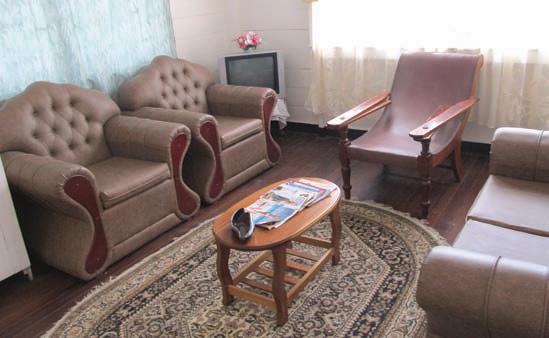
Donna’s Room is a cosy room room found on the second floor of the Periwinkle Club. It is furnished with a sofa set, a Berbice chair, a television, a carpet and coffee table.
The Periwinkle Club continues to receive support from AGNAP on an annual basis, which enables them to do more, such as training for nurses, counselling and education in cancer prevention and outreach palliative care.
Periwinkle Club
Periwinkle Club, located at 148C Alberttown, Georgetown,
Educational material is available at the Periwinkle Club headquarters in the form of pamphlets on various types of cancer, in particular breast and Members of the club are willing to facilitate talks on cancer to organisations to help to share information on the disease and provide prevention and other relevant tips.
From time to time, various professional persons make presentations at the Periwinkle Cancer Club. Also, there are reference library facilities at the Periwinkle Club headquarters for researchers and persons who wish to enhance their knowledge of cancer. These books, periodicals and magazines, have been primarily
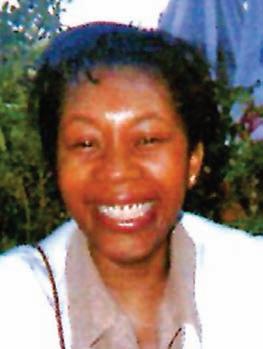
Sage will always be remembered for
kindly donated by AGNAP. The club also collaborates with the Health Ministry in outreach sessions to assist persons who wish advice and testing. It recently held its annual Breast Cancer Awareness Outreach, and a church service at the Redeemer Lutheran Church.
Feel free to contact Periwinkle Club on (592) 2267152 on Mondays, Wednesdays and Fridays between 10am and 2pm for assistance. Check out www.periwinklecancerclub.org
vivors and persons with an interest in supporting cancer patients, to meet and freely discuss their health and related experiences. After about five months of meeting and interacting quietly, it was decided to present the club to the wider
or Periwinkle Cancer Club on Facebook for more info. The club welcomes, as members, all persons interested in working to get rid of the stigma of cancer and create equality of treatment for cancer patients in Guyana.
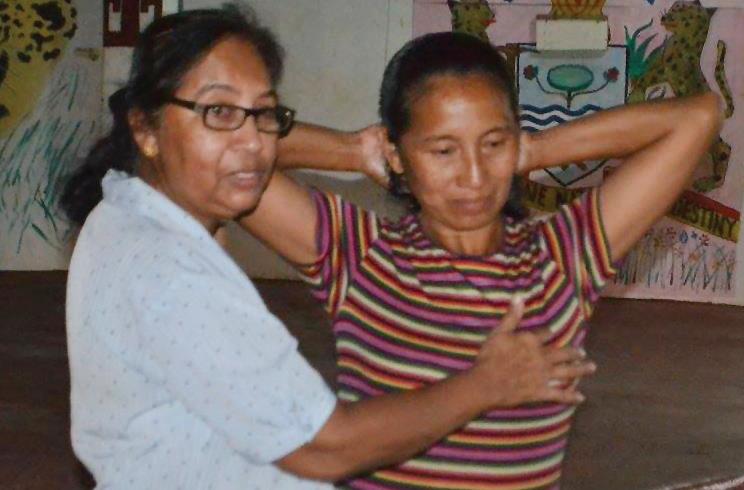
A member of Periwinkle demonstrating how to do breast examinations as part of their outreach in Lethem
Donna's Room, where cancer victims, survivors and their family members are given counselling
Plaque in memory of Donna Sage on the room's door
Donna
her infectious smile
Some 5,000 years ago there was a transition in human life. Prehistoric indigenous people in Guyana went from being a mobile, foraging people to living a settled village life, and turning to plant domestication.
Today, their descendants have retained their traditional hunting and fishing skills and knowledge in gathering wild foods from the forest. Over the years they developed culinary techniques to preserve meats and vegetables, and to cook foods that have evolved into gourmet dishes - some now accepted nationally and internationally.
In Guyana, nine indigenous groups live in different parts of the country;some in the rich alluvial swamplands of the coastal plain, and others in the terra firma of the hinterland. These two environments provide inhabitants with adequate food resources, which are used in a sustainable manner.
The Arawaks, Caribs and Warraus live on the north/west and east coast swampy region of the country, the Arecuna, Akawaio and Wai Wai in the forested and riverine region; the
Patamona on the part forest/ part savannah Pakaraima Mountains, and the Makushi and Wapishana on the flat Rupununi savannahs. Each tribe is a master of his environment.
In the wild coast of Guyana, the north/west region of the country has some 30 shell mounds. These
mounds attest to the magnitude of subsistence resources available to the first inhabitants in the region, such as the Carib, Warrau and Arawak, who still live there.
Archaeologists have excavated some of these mounds and marvelled at the remains found in them, as they revealed that the in-
habitants consumed a variety of animals, birds and seafood, which included a variety of fish, shellfish, crab, oyster, lobster, shrimp, and snails. Vegetables, fruits and nuts gathered from the forest and reefs supplemented their diet.
The Upper Mazaruni is home to the Arecuna and Akawaio, the Pakaraima Mountains to the Patamona, and the Upper Essequibo to the Wai Wai. These four tribes live in almost the same environmental situation and get their supply of food from the rivers and forest where there is an abundance of animals, fish and birds. The most popular game animals are the deer, wild cow, wild hogs, labba, acuri (agouti), sloth, manatee, capybara, alligator and
all types of monkeys. They also hunt birds like the powis, marudi, maam, and pigeons. Frogs, maggots and insects, both land and river turtles and turtle eggs, vegetables and fruits are collected from the forest, and a variety of fishes and eels from rivers are all part of their diet.
For the Makushi people, who live in the north, and the Wapishana, to the
south Rupununi savannah, their food supply originates from the savannahs, the Rupununi River and streams that drain the vast savannah. The Rupununi savannah and the Pakaraima Mountain region have an abundance of ants, armadillo, swamp birds, and savannah deer that add to their diet.
The most important domesticated plant in Amazonia is the manioc (cassava). It is a staple crop absolutely essential to survival. It is a woody shrub and grows readily from cuttings. The tubers can be processed and stored until needed. It is protein-deficient, but rich in carbohydrates. It is highly productive even on poor soil and is an ideal complement to fish and game. It can also be fermented to produce a nutritious, mildly alcoholic drink.
All manioc tubers contain toxic substances. In the “sweet” varieties, they can be eliminated by merely peeling and simple cooking, whereas the “bitter” varieties require more elaborate processing and are especially suitable for flour. The Wai Wai has developed at least 14 types of bread and 13 beverages based on bitter manioc and its by-products.
In various villages, special plants are grown in larg-
er farms, which are some distance away from the village. These would include bitter cassava, plantain – a variety of bananas: ite banana, alikunama (purple) banana andalaso banana; a variety of pineapples, with names like kaburichi nana (‘nana’ meaning pineapple), kama shi nana (wild cow head), baremo shi nana, wariru nana, ekili nana, arwa shi nana, alibero anana; purple and sweet potatoes; kunali; yow ro cuna; mawantin, and cassava mama. Some of their meals include tree frogs, and small frogs are boiled; grass frogs, medium sized, are boiled or smoked; tacuma worms, a maggot cultivated in the Ite palm, are roasted in leaf on coals, fried, stewed or eaten fresh; tacuma beetle, boiled or smoked; caterpillars that feed on cassava leaves are slow dried over fire, boiled or smoked; Mora tree caterpillars are slow dried over fire; Maho tree and sand bee caterpillars are also boiled; acushi ants (Queen) are either served raw or parched. Indigenous gastronomy is a delightful celebration of what makes Guyana unique, and a call to everyone who loves Guyanese food to rediscover its full flavours and develop a national taste.(Text from Lokono
Arawak archaeologist George Simon)
Descendants of Pre-historic Amerindians have retained traditional skills to preserve meats and vegetables and to cook foods that have evolved into gourmet dishes
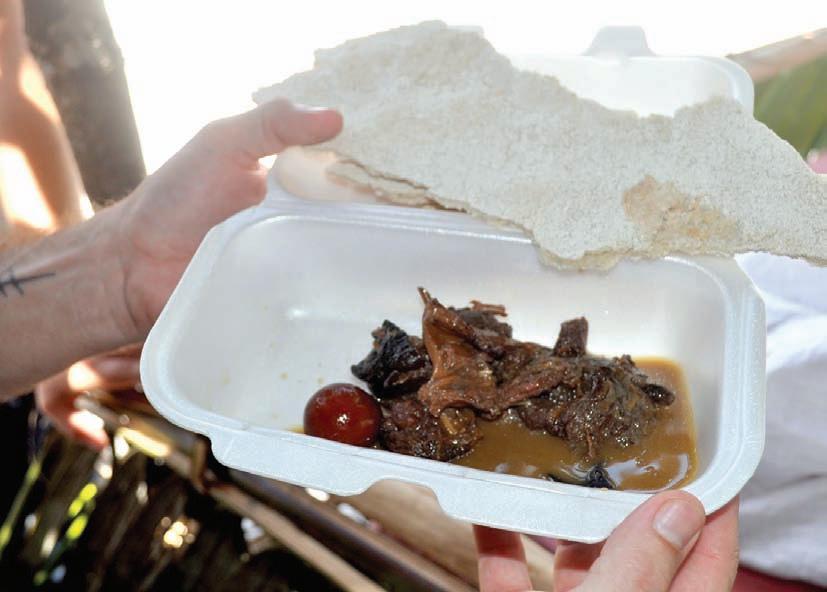
Meat of a wild animal and its egg are enjoyed with cassava bread
Tacuma worms, a maggot cultivated in the Ite palm, are roasted in leaf on coals, fried, stewed or eaten fresh
None of which are actually tigers
Part IV
By Matt Hallett
Guyana is home to six species of wild cat – each with unique natural histories, beautiful physical attributes, and interesting behaviours. Each of the six species plays an important role in the vast forests and savannas of Guyana, a niche that evolved over millions of years.
Continuing from last Sunday and concluding today, let me introduce you to the remaining ‘tigers’ of Guyana – none of which are actually tigers at all.
The jaguarundi (Puma yagouaroundi), also known as tiger cat, black puma, tigrillo, leoncillo, onza, and gatocolorado, is a small wild cat that is closely related to the larger puma. Jaguarundis can be highly variable in colour, with black, grey, and brown (to red or chestnut) colour phas-
es in a base coat that lacks identifiable markings other than a few faints spots on their faces. Jaguarundis are most easily identified for their plain coats and small size – with short legs, elongated body, and short tail. Jaguarundis are relatively common, inhabit a variety of habitat types (from savanna, to dry forest, lowland and upland forests), and are wide-ranging, found from southern Texas to Northern Argentina.
Jaguarundis are unique among Guyana’s cats because they are mostly diurnal. Although largely solitary, jaguarundis are also unique in that they are more tolerant of individuals of the same species in close proximity. Jaguarundis are shy and elusive, but often inhabit open habitats close proximity to human populations. This close association can bring them in conflict with
people if they begin to prey on chickens. Jaguarundis are good climbers, but they prefer to hunt on the ground during the day in search of
rodents, small reptiles, and ground feeding birds. While other wild cats in Guyana may inhabit savanna edges, cross savannas between forest patches, or periodically pursue prey in savanna, jaguarundis most likely are the most common and furthest ranging cat species when it comes to savanna habitat. Despite being relatively common and a species of ‘Least Concern’ when it comes to prioritizing conservation efforts, jaguarundis are an important small animal predator, a role is critical for maintaining balance savanna ecosystems.
The oncilla (Leopardus tigrinus), also known as tiger cat, tigrillo or little spotted cat, is the smallest species of wild cat found in Guyana – longer but lighter than most domestic cats. Oncillas closely resemble ocelots and margays, with a light brown
be found from high montane forests to savanna and scrubland environments. Although oncillas are not considered to be common anywhere, they can be found at higher elevations (as high as 4500m) than any of the other small cats and this lack of competition may make them more common in montane habitats.
Little is actually known about this naturally rare and extremely elusive species. Mainly nocturnal, oncillas stalk small mammals, lizards, ground birds, and invertebrates before pouncing on their prey. Oncillas are also adept climbers and may also feed on birds, eggs, and frogs found in the canopy. Oncillas are considered ‘Vulnerable’ with their populations generally decreasing due to habitat loss and overhunting. Oncilla pelts were once prized for clothing
lowland habitat for agriculture, mining and other uses and upland habitat for coffee plantations continues to threaten this unique species. Oncillas play an important role as a predator of small mammals, reptiles, and birds in montane forests, thus helping to keep these systems in balance. The wild cats of Guyana are each beautiful and unique in their own right and should serve as a source of national pride for all Guyanese. Misconceptions and misidentifications of the past have allowed myths and untruths about these species to persist, frequently bringing us into unnecessary conflict. While coexisting with wild cats isn’t always easy, perhaps understanding their role in the greater ecosystems can provide us each with a broader perspective of the impor-
to dark ochre coat that is covered dark rosettes across its back and flanks, but are typically smaller, with a more slender build and narrow muzzle. Perhaps the most identifiable characteristic that separates oncillas from Guyana’s other small cats is its tail length – approximately half the length of its body. Oncillas range from Costa Rica to Northern Argentina, where they can
and they were heavily hunted in the 1970s and 1980s as a result. Following a decline in oncilla populations, trade in pelts and products made from the coat of this species was banned internationally. Unlike the ocelot, the slow reproducing oncilla has had difficulty bouncing back from the impacts of heavy trading in their furs. While this ban may eventually help, conversion of
tance of each of these species in their own right.
Ecosystems are like working machines with lots of parts, and in many ways wild cats are critical parts that regulate the function of the whole. It is only by understanding and respecting these creatures that they can continue to serve this role and maintain the function of our native ecosystems into the future.
Jaguarundi captured on camera traps near Karanambu Ranch, Region Nine
Oncilla captured on cameras traps near Karanambu Ranch, Region Nine (Photo courtesy of Panthera)
Raising awareness to fight domestic abuse
iss World Caribbean 2014
MRafieya Husain returns from the U.S.A to host her second annual charity gala in aid of Rafieya International Vision and Hope (RIVAH).
RIVAH Charity Gala is scheduled for Oct. 23 in the Kokomo room upstairs of popular night spot, Palm Court. It is a charity dinner to raise funds to support RIVAH’s outreach centre and victims of domestic abuse.
In a press release, Husain stated that last year was a great success and she hopes that this year will be bigger and better.
The gala is an evening filled with food, entertainment and music. It will be a mesmerizing evening of dance by the Isharah Dance Troupe. Joel Ghansham, dance and cultural promoter, and TV show host, will be emceeing. Also present as RIVAH’s guest of honour is reigning Miss World Guyana 2015 Lisa Punch, there to perform her theme song “Stay Alive” and speak about her Beauty with a Purpose platform: suicide.
Husain has also planned a walk in Essequibo on Oct 25, as the world commemorates Domestic Abuse Awareness Month (October). The walk begins at 9am from the Anna Regina car park to the Shafeek Khan Outreach Centre in Land of Plenty. Husain will be joined by officials of Region Two, students and residents as they walk for RIVAH Walk for Hope.
RIVAH was founded last year by Husain during her reign as Miss World Guyana 2014. Some of her accomplishments include the new outreach centre in Region Two, several donations to other NGOs such as Guyana Red Cross, Help & Shelter, and others. Recently, the philanthropist collaborated with Blossoms Inc. and made numerous visits to schools around Guyana to talk about the
early signs of domestic violence.
“My passion for improving lives and making a difference started from an early aged as I was inspired by my late grandfather, Shaffeek Khan. His philanthropic work for the community, building schools for children, is one of the reasons I was inspired to build an outreach centre in Essequibo for domestic abuse victims.
“Being a victim myself, my main reason for the charity and building the outreach centre is to spread awareness of the initial signs of domestic violence. I chose to build my awareness campaign around dating violence and to educate teens and children in schools so that we can reduce the percentage of victims over time. By focusing on the root cause of domes-
tic violence, we will educate our youths, the next generation, to be able to identify and mitigate abuse at an early stage,” Husain pointed out.
RIVAH, in collabora tion with UNICEF and Miss World Guyana organisation, has planned several events to visit schools in Regions Five and Ten, along with visits to NGO Women Across Differences, and the nursing school in Georgetown where Husain will speak about the work being done by her charity.
create a better future for our families by donating and supporting this cause,” the humanitarian adjure.
Husain is urging all of Guyana to support these events, as all proceeds will benefit RIVAH. She disclosed that the most difficult struggle is getting the support from businesses in Guyana. She pleads for the support to continue her
Husain is grateful to her sponsors of the walk: True Value Pharmacy & Gift Store in Charity, Essequibo, and Twins Manufacturing. For more information on the outreach centre visit RIVAHRafieya International Vision and Hope on Facebook.
The newly built outreach centre in Essequibo
Rafieya Husain
The Shaping of Guyanese Literature Story of the Heroes
Egbert ‘Leo’ Martin
Part VI
By PetamBer Persaud
So far in this series, we have concentrated on the contribution of women, and with good reasons, promising to return to the contribution of men in due course.
So here we go, turning back the pages to part 1 of P. H. Daly’s series of three books, “Story of the Heroes”, published in the early 1940s, highlighting some forty men who contributed in one way or the other to the shape of a Guyana in which we now live.
Daly was a historian who “made historical biography literally his one, true, and only love.”
Of those forty men, there was one born in Guyana to become a significant writer, bearing the distinction of being Guyana’s first major poet. His name is Egbert Martin aka “Leo”.
Egbert Martin died young but in his short life, and still shorter writing career, he was able to produce a body of writing so significant to cause a stir more than a century later. In fact, his “Themes of Song” is frequently performed today.
That apart, and despite ef-
forts by N. E. Cameron and A. J. Seymour to keep the name current, Martin is a forgotten poet from another era. Martin was writing in the late nineteen century, a Victorian poet who was a master at employing the metrical forms of the time, and, oh, what songs he composed.
But he was also ahead of his time, for much of his writing is post-modern in concept as he explored various aspects of spirituality.
Martin knew what was expected of a poet and he delivered:
The poet is a magician
The philosopher’s stone is his
He takes into his hands the clay
All shapeless, black, and dull
A mass of baseless mould
Transformed to purest gold.
Martin also knew the role of the poet in relation to the society. His first published collection of poems was criticized on the ground of being universal, containing too much “goody-goodiness”, and the poet acknowledged “that the opinions were not without foundation.”
In response, he produced
Martin was a frequent contributor to The Argosy and Echo newspapers of the time
his second volume, “Leo’s Local Lyrics” which was published in 1886. He said that he hoped this collection was “more in accordance … with public taste”, producing such locally flavoured pieces like “The Sorrel-Tree”, “The
Creek”, “The Locust Tree” and “The Swallow”. In the poem, “Patria Mea Te Amo”, he went to great lengths in responding to patriotic impulses: Demerara! dearest country
Thou art dearest to me
Tales of hills and streams
of beauty
Cannot steal my love from thee
…Conscious of thy native charms.
The criticism of his first book of poems worked in his favour; it spoke of a fan club, an audience anticipating further offerings. The criticism also spoke of an output affecting a wide range of people. And there is evidence of his influence on the society, especially from the local press.
The Daily Chronicle published in Demerara described Martin as “the ablest of the poetical writers of whom British Guiana can boast”, while the Berbice Gazette reported Martin to be “one whose works plainly bespeak talent and ability of the highest order.” Further afield, Martin’s poetry was admired by Lord Tennyson.
Additionally, he had at least two patrons, men of great influence in the colony: James Thompson, editor of The Argosy newspaper, and George Anderson Forshaw, mayor of Georgetown.
Another source of support could be found in the preface to “Leo’s Local Lyrics”, where Martin mentioned “a poet friend of mine whose opinion I value very highly.”
Not much more is known about Egbert Martin, and
there is no photograph of him. Martin is reported to have been born around 1861; supposedly in Georgetown.
What is known about Martin was that while he lived in East Street, he was confined to an invalid’s bed. At 19, his poetry was first published in a local journal, The Colonist. He was a frequent contributor to The Argosy and Echo.
He died June 23, 1890. In June 2007, the Caribbean Press released Martin’s “Selected Poems”.
In closing, it would be good to listen to the wisdom on his poem, “Looking Back”. It is good on gaining every station
In life…
To pause a little while in contemplation…
Tis looking back that gives the future colour
Because, in life, we find The past analogizes all the future
Upon the plastic mind…
Responses to this author telephone (592) 226-0065 or email: oraltradition2002@yahoo.com
What’s happening: The 2016 Commonwealth Short Story Prize is now open for entry; please go to the website for more information.
trade, Van Pere would send 40 persons to colonise the area but they were forbidden from infringing on the Essequibo territory.
The contract also stipulated that the colonists were exempt from taxes for the first 10 years and were bound to reside there for seven years. They were also advised to spread the Christian faith, and prohibited from harassing the indigenous females while in Berbice.
According to the authors of “The Voyages…” the other regulations in the contract basically implied that Van Pere owned the colony as a “hereditary fief” and “gained the rights of possession of the colony he was to establish in Berbice”, though he did have to abide by company and States
charter as incoming patrons of Berbice”, paying 20 guilders for the heergewaad, “the recognition of his feudal authority”.
The book states that the two would sign a new charter in 1660 for patronship of Berbice following the virtual bankruptcy of the WIC after losing north eastern Brazil. The company in 1657 had transferred their Essequibo colony to another company called the Nova Zeelandia conglomerate. Van Pere continued to hold on to patronage of Berbice when they were reconfirmed in 1678, despite the closure of the WIC in 1674 – though it was later re-established, albeit downsized.
In 1683, Abraham Jr. died and his eldest son, (also named) Cornelis van Pere automatically became patron. The family moved in the upper echelons of Dutch society to become established as Lords of the Estate of West Souburg in 18th century Holland.
Over the years, the now absentee family came into “juridical” conflict with colonists and eventually “abandoned its rights on Berbice to the Sociëteit van Berbice”, formed in 1720. It was the privateering
In their book “The Voyages of Adriaan van Berkel to Guiana: Amerindian-Dutch Relationships in 17thCentury Guyana” edited by Martijn van den Bel et al state that they write Berbice’s history is “intimately associated with the van Pere family from Zeeland (the Netherlands).”
Abraham van Pere was one of the directors of the Zeeland Chamber of the WIC [(Dutch) West India Company] who, “The Voyage…” states, attempted to encourage colonisation of the region “by granting patronages to private entrepreneurs”.
In 1627, the company drew up a contract with Van Pere, who was also a Zeeland merchant that grated him a patronage for the Berbice River. The contract stipulated that while the WIC controlled all
General rules, and seek permission for certain activities.
He had to obtain permits from the WIC for each ship he wanted to send to the colony, for example.
In 1627, van Pere is said to have instructed that four 4-lb swivel guns be made to put at a fort he intended to set up in Berbice. It is said too that van Pere sent 60 whites and six blacks to establish the colony.
In 1629, Abraham Sr’s eldest son Cornelis van Pere, was residing as governor/commander on the colony at its main post which was located “near the confluence of the Berbice and Wiruni Rivers.”
When Abraham Sr died in 1639, his other son Abraham Jr. took over, and, with his friend and associate Pieter van Rhee, in 1640 signed “a renewed
demands of French corsairs that also helped put an end to the van Pere landlordism in Berbice.
In 1712 some 180,000 guilders were promised as remaining ransom to be paid by the van Peres as owners of the colony. However, the family, now in Holland, refused to pay on the grounds that the colonists had no authority to make such promises on their behalf, and instead threatened to let the French have the settlement instead.
After two years of negotiating, four Dutch merchants (who would soon after convert ownership and governance into the “sharefunded” Society of Berbice) paid the ransom, which was then agreed upon at 108,000 guilders, and the van Pere family relinquished the region.
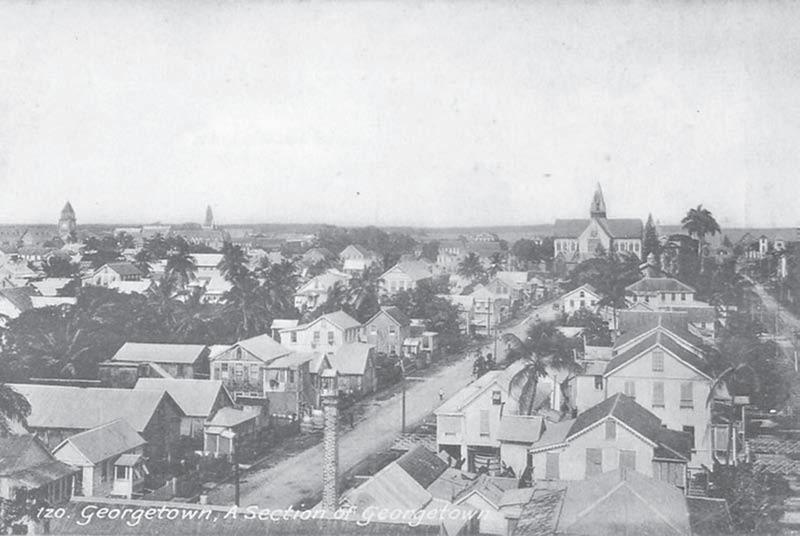
Section of Georgetown, British Guiana
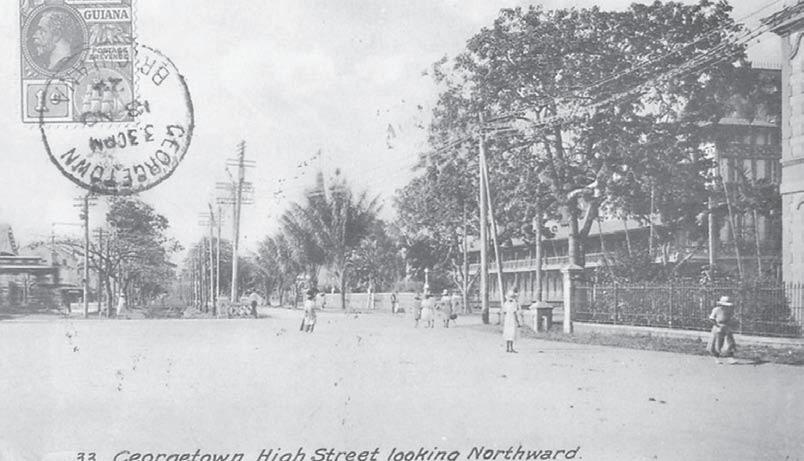
High Street, Georgetown looking north n.d.
Map of the Berbice River (c1625) by Jean Mousnier de la Montagne
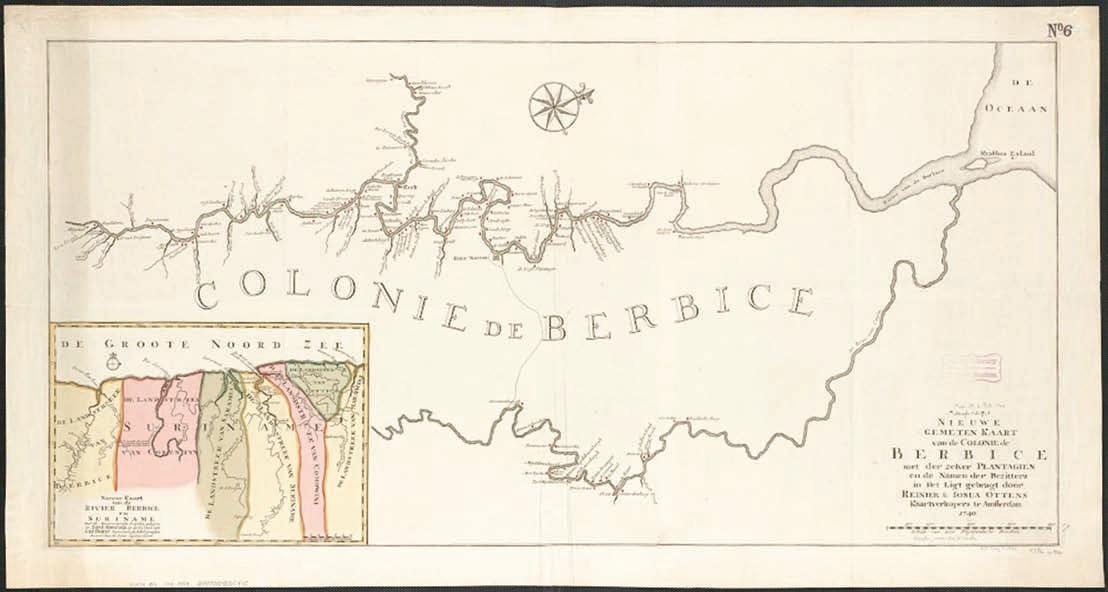
Map of the Berbice colony; inset shows name of plantations and owners (18th century)
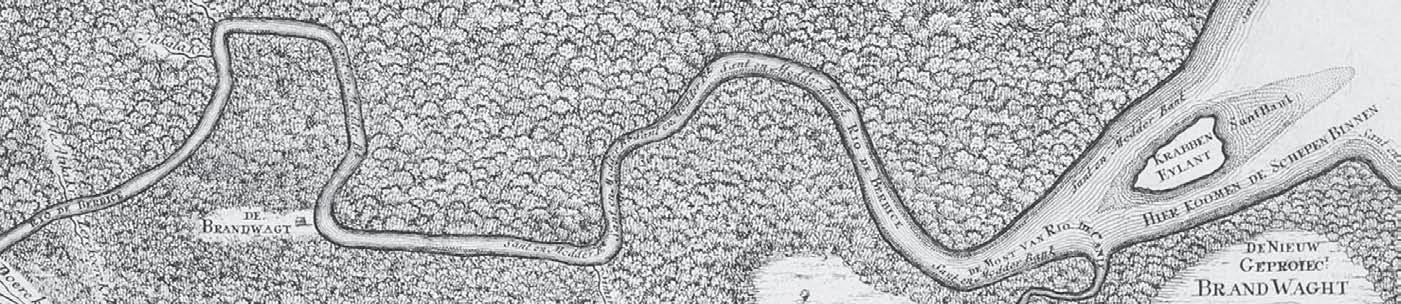
Up the Berbice River with Crab Island at the river mouth (c1730) ( Detail
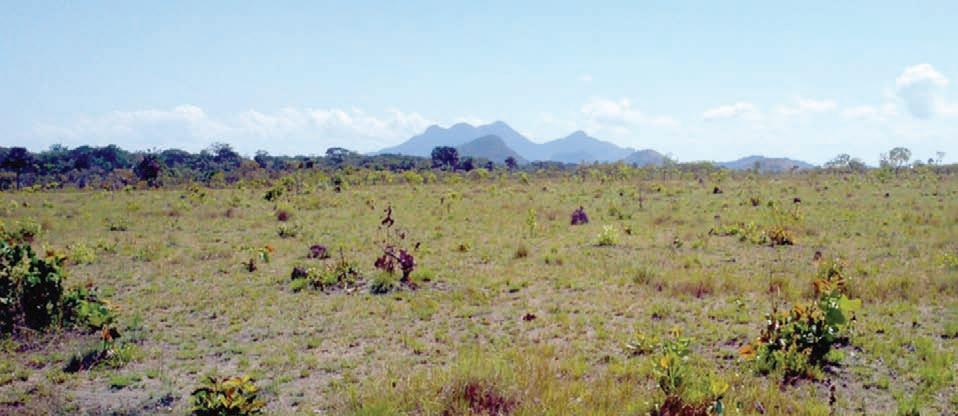
Into the big open savannah of Lethem, about a two-hour drive along dirt tracks, through rivers and remote lands, lies Saddle Mountain.
Saddle Mountain is the backdrop to a Guyanese-owned working cattle ranch.
Days are spent at Saddle Mountain Ranch riding horses, rounding up cattle and relaxing while taking in the fresh, sweet air of the savannah. There is also a small creek nearby for a cool dip.
Though there isn’t any electricity, phone or mobile coverage, and things are quite basic at the ranch, a small solar-charged battery provides lights in the evening, and a water pump in a well provides running water to the house.
Visitors of the ranch can also climb Saddle Mountain; a tough, but short climb. The view from the top really puts it in perspective how in the middle of nowhere the ranch really is.
For birdwatchers, a trek to the mountain might provide an opportunity to see the four-inch Red Siskin bird. (Cover
A water oasis in the vicinity of Saddle
Scenic view of the mountain
Breathtaking landscape of Saddle Mountain
Home of the Red Siskin near Saddle Mountain Ranch (Photo by Jon Hornbuckle)
Dusk falls upon the land (Photo by Jon Hornbuckle)
Saddle Mountain Ranch
photo:
Mountain (Photo by Jon Hornbuckle)
Times Healthy Living
Sleep deprivation can have profound consequences on your physical health. The cost of sleepless nights is more than just bad moods and a lack of focus.
One in three persons suffers from poor sleep; stress, computers and taking work home are often blamed. Regular poor sleep puts you at risk of serious medical conditions, including obesity, heart disease and diabetes – and it shortens your life expectancy.
It’s now clear that a solid night’s sleep is essential for a long and healthy life.
Most of us need around eight hours of good-quality sleep a night to function properly – but some need more and some less. What matters is that you find out how much sleep you need and then try to achieve it.
As a general rule, if you wake up tired and spend the day longing for a chance to have a nap, it’s likely that you’re not getting enough sleep. A variety of factors can cause poor sleep, including health conditions such as sleep apnoea. But in most cases, it’s
due to bad sleeping habits.
Everyone has experienced the fatigue, short temper and lack of focus that often follow a poor night’s sleep.
An occasional night without sleep makes you feel tired and irritable the next day, but it won’t harm your health.
After several sleepless nights, the mental effects become more serious. Your brain will fog, making it difficult to concentrate and make decisions. You’ll start to feel down, and may fall asleep during the day. Your risk of injury and accidents at home, work and on the road also increases.
If it continues, lack of sleep can affect your overall health and make you prone to serious medical conditions, such as obesity, heart disease, high blood pressure and diabetes.
A good night’s sleep to boost your health
Sleep boosts immunity. If you seem to catch every cold and flu that’s going around, your bedtime could be to blame. Prolonged lack of sleep can disrupt your immune system, so you’re less able to
Your feet take the weight of your whole body, so foot problems can quickly lead to discomfort and affect the way you walk. This can in turn cause knee, hip and back pain.
The good news is that looking after your feet can prevent most of these problems. Investing a bit of time and thought into caring for your feet now can prevent them causing you pain later.
Wash your feet often. Don’t go to bed without washing your feet. If you leave dirt on the skin’s surface, it can become irritated and infected. Wash your feet every evening with soap and water.
Dry your feet well. Dry your feet thoroughly after washing them, especially between the toes which is where germs such as Athlete’s foot can easily breed. Then, apply a moisturis -
fend off bugs.
Sleep can slim you. Sleeping less can make you weigh more! Studies have shown that people who sleep less than seven hours a day are 30 per cent more likely to be
Sleep boosts mental wellbeing. Given that a single sleepless night can make you irritable and moody the following day, it’s not surprising that chronic sleep debt may lead to long-term
obese than those who get nine hours or more of sleep.
It’s believed to be because sleep-deprived people have reduced levels of leptin (the chemical that makes you feel full) and increased levels of ghrelin (the hunger-stimulating hormone).
mood disorders like depression and anxiety.
When people with anxiety or depression were surveyed to calculate their sleeping habits, it turned out that most of them slept for less than six hours a night.
Sleep prevents diabetes.
Studies have suggested that people who usually sleep less than five hours a night have an increased risk of having or developing diabetes.
It seems that missing out on deep sleep may lead to type 2 diabetes by changing the way the body processes glucose –the high-energy carbohydrate that cells use for fuel.
Sleep increases sex drive. Men and women who don’t get enough quality sleep have lower libidos and less of an interest in sex, research shows.
Men who suffer from sleep apnoea – a disorder in which breathing difficulties lead to interrupted sleep – also tend to have lower testosterone levels, which can lower libido.
Sleep wards off heart disease. Long-standing sleep deprivation seems to be associated with increased heart rate, an increase in blood pressure and higher levels of certain chemicals linked with inflammation, which may put extra strain on your heart.
Sleep increases fertility. Difficulty conceiving a baby has been claimed as one of the effects of sleep deprivation, in both men and women.
Apparently, regular sleep disruptions can cause trouble conceiving by reducing the secretion of reproductive hormones.
Catch up on lost sleep If you don’t get enough sleep, there’s only one way to compensate – get more sleep. It won’t happen with a single early night. If you’ve had months of restricted sleep, you’ll have built up a significant sleep debt, so expect recovery to take several weeks.
Starting on a weekend, try to add on an extra hour or two of sleep a night. The way to do this is to go to bed when you’re tired, and allow your body to wake you in the morning (no alarm clocks allowed!). Expect to sleep for upwards of 10 hours a night at first. After a while, the amount of time you sleep will gradually decrease to a normal level. Don’t rely on caffeine or energy drinks as a short-term pick-me-up. They may boost your energy and concentration temporarily, but can disrupt your sleep patterns even further in the long term.
ing foot cream (not body lotion). Remove hard skin. Gently remove hard skin and calluses with a pumice stone or foot file regularly.
Cut toenails carefully. Always trim your toenails straight across, never at an angle or down the edges. This can cause ingrown toenails.
Shop for shoes in the afternoon. Feet swell as the day goes on and if shoes fit in the afternoon when your feet are at their largest, you can be assured they will always be comfortable.
If you have to wear heels at work, wear comfortable shoes to and from the office and only wear your smart shoes once you’re in the office. Also, try to vary the heel height, between low, medium and high. Limit time wearing high heels; be shoe savvy. Wear high heels and pointed shoes for special occasions only, and always
wear the right shoes for the job (so no sandals for mountain climbing).
Change your socks often to avoid foot odour. Change your socks daily.
Watch out for foot bugs in communal changing areas.
Wear flip-flops to avoid catching athlete’s foot and verrucas when you use public areas such as gym showers, swimming pools or hotel bathrooms.
But don’t wear flip-flops all the time. They don’t provide support for your feet and can give you arch and heel pain if you wear them too much.
If you’re over 60, foot care becomes even more important.
Age takes its toll: your skin thins, your joints begin to stiffen and your feet become more vulnerable to the cold.
Not only that, but as podiatrist Emma Supple says: “Physically, it gets more difficult for us to get to our feet, and failing eyesight doesn’t help... never put up with foot pain as if it is normal. Your feet shouldn’t hurt.” (nhs.uk)
Shan Anthony Seecharan
Reflections, one of Guyana’s most prestigious fashion shows, slated for November 21, promises to be the most exciting this year.
According to Guyanese fashion designer Nelsion Nurse, Reflections is more than a fashion show because it is choreographed to tell a fashion story – incorporating music, dance and drama.
Collections by some of Guyana’s leading designers such as Sonia Noel and Mwanza Glenn, along with visiting regional designers Rosamund Davis from Barbados and Keshon Hawthorne from Jamaica, would be some of the highlights of the show.
Guyana Times Sunday Magazine will feature every week until the fashion event, the different designers presenting at the show.
beginning, but through trial and error, I honed my skills and I am now actively doing what I love the most,” the young designer told Sunday Magazine
Although young and fairly new to the local fashion industry, Seecharan, whose brand is SAS Designs, said his aim is to “produce designs that are comfortable, unique and boost confidence in whoever wears them.”
“As I think ahead, I see myself having my own boutique, hosting fashion shows throughout Guyana, the Caribbean and taking my brand to the international stage,” Seecharan revealed.
Designer Shan Anthony Seecharan
This week we feature Shan Anthony Seecharan, a 20-year-old from Mabaruma, Region One.
Seecharan was born and raised in Mabaruma where he attended the Mabaruma Secondary School. After completing his secondary education, Seecharan moved to Georgetown to pursue his passion for designing.
“Growing up was sometimes difficult, but this motivated me to strive harder to achieve my goals and make a name for myself in the fashion industry. I had a creative mind from an early age. It all began when I started experimenting with the sewing machine, cutting and making clothes for my cousins. I was far from perfect in the
The designer pointed out that his greatest inspiration and role models are US-based Guyanese designers Roger Gary and Michelle Cole. He is also inspired by Lebanese designer Zuhair Murad.
“Starting in a small community in a somewhat remote part of Guyana to becoming a designer is a major success for me all by itself. I am also the official designer for Tazmein Coats, hostess of the TLC Television show. The feeling I get from seeing a client looking sexy, feeling happy and satisfied when wearing one of my designs, is all that keeps me doing what I love,” he declared.
For more information on the designer, check out SAS Designs GY on Facebook.
Jessica Ellen Cornish, better known by her stage name Jessie J, is an English singer and songwriter. Born and raised in London, she began her career on stage at just 11 years old. She studied at the BRIT School before signing with Gut Records and striking a songwriting deal with Sony/ ATV Music Publishing where she wrote for artists including Chris Brown and Miley Cyrus. Jessie J came to prominence following the release of her debut single "Do It Like a Dude". Her next song "Price Tag" topped the charts in nineteen countries including the UK and was followed by the release of her debut album Who You Are (2011), which charted at number two in the UK. Other releases from the album included "Nobody's Perfect", and "Who You Are", "Domino" and "Laserlight", which all which all charted within the top 10 in the UK Singles Chart, making Jessie J the first British female artist to have six top ten singles from a studio album. She has garnered various awards and nominations for her music, including the 2011 Critics' Choice Brit Award and the BBC's Sound of 2011. Jessie J has supported various charitable causes, and has appeared on the UK charity telethons BBC Children in Need and Comic Relief. She has served as coach and mentor on the television shows The Voice UK and The Voice Australia.
Times Hollywood
Taylor Swift’s heartbreak songs have prompted many to speculate about who they’re about, but she’s not going to confirm who inspired them any time soon.
“I don’t feel there is any injustice when people expand beyond my music and speculate on who certain songs might be about,” she said.
“I’ve never named names, so I feel like I still have a sense of power over what people say - even if that isn’t true, and even if I don’t have any power over what people say about me.”
“The fact that I’ve never confirmed who those songs are about makes me feel like there is still one card I’m holding.”
She says she’s asked a lot about the subjects of her more angsty music, alluding perhaps to Bad Bloodwhich is allegedly about a
Wfall-out with Katy Perry.
“And you sit there, and you know you’re on good terms with your ex-boyfriend, and you don’t want him - or his family - to think you’re firing shots at him,” she told GQ.
“So you say, ‘That was about losing a friend.’ And that’s basically all you say. But then people cryptically tweet about what you meant.”
She confirmed that the track was not prompted by a break-up.
“And nothing could be further from the truth,” she said. “It was important to show that losing friendships can be just as damaging to a person as losing a romantic relationship.” (GQ)
hile some women may not look forward to growing older, Angelina Jolie embraces it. In Vogue’s latest issue in which she graces the cover with a beachy shoot, the actress-turned-director explains why she looks forward to turning 50.
“I feel grounded as a woman,” the mother of six says in her cover story. “I know others do too. Both of the women in my family, my mother and my grandmother started dying in their 40s. I’m 40. I can’t wait to hit 50 and know I made it.”
Jolie also talks about her double mastectomy surgeries.
“It’s hard. They are not easy surgeries. The ovaries are an easy surgery, but the hormone changes,” she says, “interesting. We did joke that I had my Monday edit. Tuesday surgery. Wednesday go into menopause. Thursday come back to edit, a little funky with my steps.”
She and her husband, Brad Pitt, have just finished filming a movie together. In “By the Sea”, they play a married couple who is going through a hard time. “It’s not autobiographical,” she says of the film. “Brad and I have our issues, but if the characters were even remotely close to our problems we couldn’t have made the film ... As artists we wanted something that took us out of our comfort zones. Just being raw actors. It’s not the safest idea. But life is short.” (AceShowbiz)
Lady GaGa opens up about her battle with depression and anxiety
Lady GaGa understands really well the struggles faced by the children involved in her charity, Born This Way foundation. In an interview with Billboard for the magazine’s latest issue, the Mother Monster reveals that she has also suffered depression and anxiety like those kids.
She says, “I’ve suffered through depression and anxiety my entire life, I still suffer with it every single day. I just want these kids to know that that depth that they feel as human beings is normal. We were born that way. This modern thing, where everyone is feeling shallow and less connected? That’s not human.”
“There is something in the way that we are now,” she explains, “with our cell phones and people are not
looking at each other and not being in the moment with each other, that kids feel isolated. They read all of this extremely hateful language on the Internet. The internet is a toilet. It is. It used to be a fantastic resource -- but you have to sort through sh*t to find the good stuff.”
The “American Horror Story: Hotel” actress continues, “These kids just want to feel human, but they feel like robots. They don’t understand why they’re so sad. There are scientific reasons, which the foundation researches, why you feel sad when you look at your phone all day.”
Justin Bieber enjoys performing his community labour for egging case
Justin Bieber clearly enjoyed doing community labour for his 2014 egging case. The “What Do You Mean?” singer took to Instagram on Tuesday, October 13 to share a video showing him moving his hips to background music while painting the wall at the Youth Gang Intervention Center.
The 21-year-old singer wore a white oversized T-shirt and black shorts. He donned gray-and-black cap and gray Nike shoes. In the said video, he showed off his painting skills while boogying to the music. A caption for the video read, “For the people who think I picked the paint brush to look like I am painting I’m really in this s**t.”
Justin also posted other two videos showing him panting the wall. He looked working hard on it. The background songs in the
Court might seem like a serious place, but Jay Z hit the witness stand on Oct 14 with some jokes. He was in court because of a copyright infringement trial. Osama Ahmed Fahmy claims his late uncle Baligh Hamdi’s “Khosara Khosara” was sampled in Jigga’s “Big Pimpin’” without permission.
videos seemingly featured his songs. They were apparently from his new studio album “Purpose” as there were no old songs played in the videos. The two videos were captioned, “Lol” and “Work hard play hard,” respectively.
Following his community labor, the singer went to the Santa Monica Courthouse for a meeting with his probation officer, TMZ report-
ed. Multiple sources told the website that Justin got good marks for his community labor performance. Back in July 2014, Justin was charged with misdemeanor vandalism for allegedly throwing eggs at his neighbour’s home in Calabasas earlier that year. For his action, he’s required to perform 5 days of community labour. (AceShowbiz)
to use the song.”
In a 90-minute testimony, Jay said Timbaland (the song’s producer) “is known for not using samples” and that he didn’t know there was a sample in the beat. Despite that, he added that he believed this whole thing was resolved. “At some point there was a claim for it, and it was cleared up,” he explained. “The rights were granted…We have a license
So what about the Kanye joke? That came when Hov talked about signing artists, including Rihanna and Yeezy. His lawyer Andrew Bart said, “Some might have heard of him,” referring to Ye, according to the New York Daily News.
“One or two,” Jigga said.
“He’s running for president.”
Nancy Dillon — who wrote the story for the paper — added that this caused “a ripple of laughs among the 70 courtroom spectators.”
But that wasn’t all. Jay
apparently also “scored” laughs about “winning” an ongoing battle with Timbaland over whether his raps are better than Tim’s beats. The New York Times reported that even Tim had a laugh there. And then, after listing all his businesses, Jay’s lawyer had to remind him about Tidal. “Oh yeah,” he reportedly said with a laugh. “I forgot about that.” Looks like Jay was in a humorous mood, but it wasn’t all laughs. According to The Times, the MC mixed those jokes with “no-nonsense, one-word answers [and] humility about his success.”
The trial isn’t over just yet. The defense began its case on Friday. (MTV)
Girish Kumar Taurani, known popularly as Girish Kumar, is an Indian actor working in the Hindi film industry. Girish made his Bollywood debut in the romance comedy film “Ramaiya Vastavaiya” (2013), opposite Shruti Haasan. Although new to the big screen, Girish has said in various interviews that he wants to become one of Bollywood’s legendary actors. His next movie “LoveShuda” is set for release later this year.
Girish Kumar
Shah Rukh Khan given honorary doctorate by University of Edinburgh
One of the most celebrated actors in the Hindi Film industry, Shah Rukh Khan is all heart when it comes to words. He has a way with them and the sheer enormity of experiences he has had in his Bollywood journey transform them into pearls of wisdom.
SRK was invited to bestow these pearls on the students of the University of Edinburgh, UK, on October 15 and as expected, King Khan held the audience in awe with his ‘life lessons’. And gave a whole lot of reasons as to why he still rules the bylanes of Bollywood.
Shah Rukh Khan was presented with the degree of Doctor Honoris Causa from the University Chancellor HRH The Princess Royal in Edinburgh. Thereby, beginning with gratitude, but not ‘humility’ as he said,
his speech was a perfect amalgamation of wisdom and humour.
The superstar received the honorary doctorate for his contribution to film and his philanthropic work. It is indeed an honour for me to re-
Shahid Kapoor:
ceive this doctorate today. ‘Humbled’ is a word often used by people in my profession. I dislike the hypocritically obsequious connotation of it in these contexts so I’m not going to use it, but I will say that such occasions have a way of putting me right in my place! I get invited to conferences and inaugurations now and then to speak. When I receive the invitations, I also receive my brief. It’s usually about ‘success’ and my ‘tips’ on it (not my toes- those are covered by the ‘I will never show my toes’ clause in my acting contracts. It’s my attempt at gender equality. My co-stars have no nipple clauses; I have a no toes one),” SRK said in his speech.
After ending his speech on that note, SRK took to the stage and grooved to the chartbuster “Lungi Dance”. (Indian Express)
‘We are different but good at communication’
Shahid Kapoor recent-
ly married Mira Rajput, who hails from a ‘nonfilmy’ background. The actor, however, claims this difference works better for them.
“I think the fact that we are different works for us. It is a nice thing that we are different from each other. But at the same time we are good at communication, we get along well. She (Mira) makes me feel very normal. I go back to a very real atmosphere and I really like that a lot. She has no desire to get overtly ‘filmi’ as a person. She is very much an individual in her own right. Mira is
Priyanka Chopra will be part of ‘Don 3’,
confirms producer
Recently, reports claimed that Farhan Akhtar and Shah Rukh Khan are keen to start work on the third instalment of the “Don” franchise. Speculations were rife that Priyanka Chopra, who played the female lead in “Don” (2006) and “Don 2” (2011), might not be a part of “Don 3”.
Refuting the rumours, Ritesh Sidhwani, who co-produced the film with Farhan, announced that Priyanka will be part of the project. “Much speculation on #Don3 & it’s Casting. No thoughts of changing its casting. Working towards developing the script. Will keep u posted. Luv (sic),” he tweeted. Priyanka, who has been busy shuttling between the US and India to shoot for her international TV show and Sanjay Leela Bhansali’s “Bajirao Mastani” respectively, is apparently excited to be in Farhan’s film.
“She is looking forward to the next instalment. The makers will meet her once the script is locked to take things forward,” says a source.
However, adding to the confusion, Farhan also tweeted the following post on October 13, “Dear #Don fans, please do not react to rumors regarding the sequel. As & when the time comes, you’ll hear the truth from me.@iamsrk (sic)” (Hindustan Times)
yet to get used to the paparazzi that surrounds her actor husband all the time. She finds it difficult (to get used to the paparazzi) it will take some time for her to get used to it. But she is understanding,” he said.
Shahid said he decided to settle down with Mira after spending time with her.
“We met, spend time and we really liked each other. I feel you should be with someone who you are comfortable with it doesn’t matter how and where you met. Everybody meets a certain way but after you meet how you feel is important.”
(Hindustan Times)
Sylvester Stallone has shradh performed in Haridwar for dead son
Sylvester Stallone reportedly had ‘shradh’ ceremony performed for his son Sage, who died in 2012. According to a newspaper report, Sylvester called up a vedic scholar from Rishikesh that he still sees his dead son and was very disturbed.
The 36-year-old was found dead at his apartment in Los Angeles three years ago. While it was initially reported that he died of a drug overdose, it was later revealed that he suffered a heart attack.
The scholar advised Sylvester to perform the ritual. Following the advice, Stallone sent his halfbrother Michael, his wife and two others to Kankhal, Haridwar to perform ‘tithi shradh’, which is done for those who died of accident or murder.
Worried that his visit will grab media attention, Sylvester stayed back himself and sent his brother as the ritual can be performed by any blood relative. After the shradh of Sage, Michael also performed a ceremony for his sister Toni Ann, who also died in 2012.
Sylvester recently made
a public appeal last month for an end to “speculation and questionable reporting” about his son using drugs.
“Because when a parent loses a child there is no greater pain,” Stallone said. “Therefore I am imploring people to respect my wonderfully talented son’s memory and feel compassion for his loving mother, Sasha, because this agonising loss will be felt for the rest of our lives. Sage was our first child and the centre of our universe and I am humbly begging for all to have my son’s memory and soul left in peace.” (Hindustan Times)
Imran Khan: ‘Unlike others, I don’t work for fame’
Actor Imran Khan says that it is only the process of filmmaking that interests him and not the fame that accompanies it.
The 32-year-old says that unlike many of his contemporaries, he is not fond of being in the limelight.
“My reason for working are different than that of a lot of other people. A lot of people work for fame. They do movies, social appearances and are very active on Twitter and Instagram. Across a variety of media, people work and do things to bolster your stardom. That is their personal stardom. That doesn’t attract me. To me, the only interesting thing is the process of making a movie. And as a by-product, you become recognisable and famous. But that is not my motivation,” he says.
Imran says that he is not someone who doesn’t think about work once he is home. “The second my work is done, my phone goes off, as I have no interest in talking about movies and work after that. I am very clear about separating my personal life from my work,” he says. (Hindustan Times) Book on Emraan Hashmi’s struggle with son’s cancer releasing soon
Abook unfolding the pages of the struggle and hardship of Emraan Hashmi with son Ayan’s cancer treatment will soon be released.
The actor says the “last two years” have been the most trying phase of his life and have made him wiser, adding that he is eager to share his story with his fans.
Publishing house Penguin Books India announced that they are working on the book, which is expected to be out next year. The official Twitter handle of the publishing house read: “Delighted to announce we will be publishing @emraanhashmi’s book on the fight against cancer with his son. Out 2016”.
The actor, known for films like “Murder” and “The
The actor adds that he only wants to use his stardom to promote his projects and nothing else. “When I was on a break, I stayed out of everything. I didn’t have people sending out stories. I was not giving interviews. It serves the purpose of promoting my films and has no other value personally,” says Imran, who was last seen in Katti Batti, after a gap of two years.
Dirty Picture”, tweeted: “The last two years have been the most trying phase of my life. Through it I have found two of my greatest teachers. Cancer and my son.”
He also thanked the publishers for the gesture. “Thank you to the entire team at penguin! Can’t wait for the book launch. Will keep you all in the loop on the exact release date. Cheers,” he shared. (Times of India)
Trending now
Straight haired-girls can be the envy of many curly-haired ladies, but just because hair is without waves, it doesn’t make it frizz-free: a good blow-dry and plenty of styling serum is often required for truly silken tresses.
For those faking a poker straight look with straightening irons or heat styling, a protecting product is essential: those smooth locks won’t stay that way for long if you’re frequently frying them.
With those words of warning, let’s look to the celebs for inspiration: from pomaded pixie crops to choppy bobs, sleek side-sweeps and rainbow hair, it may be straight but it’s anything but boring.
STar of The week
Yam Chan Chu, born May 4, 1997, is a first generation Guyanese who grew up in the heart of Georgetown. Chu, who graduated from St. John’s High School and lives with her mother who migrated from Guangdong, China to Guyana in the early 90s. Chu has been exposed to the world of business at a tender age, since her mother owns and manages a restaurant.
Growing up in a single parent family was not always easy, but her older brother, also Guyanese, proved to be an inspiration since childhood. Chu has taught herself to be humble, selfless and to always strive to become a better person as each day passes. Notably, she will be part of the cast for Guyana’s upcoming TV drama show, “WHO?” This is her debut performance on television. Her character is Élise Chin.
She does not want to give too much away about her character as the show is a work in progress at present. Apart from being engaged in her acting career, Chu is also competitive and athletic, and dreams of “acquiring that perfect physique”. In so doing, she encourages all young women to keep fit and engage in an active lifestyle since their health and well-being must be a top priority.
As Chu enters a different stage in her life (acting), she wishes to “not only follow the steps of independency, but to be wise and learn from past mistakes and to get back up when it [a mistake] knocks you down.”
Hollywood actress Katie Holmes looks sexy in super straight brunette bob and bangs: a blunt cut with a longer length at the front. Attitude is required when pulling-off the look.
Kristen Stewart punks up her look by texturising the roots and adopting a swept back volumised style. Get out your back-combing brush and hairspray to follow suit.
English singer Rita Ora livens up a poker straight style with a rainbow hair dye job.
Actress Anne Hathaway fashions her straight hair into a heavily pomaded pixie crop.
From watch vendor to notable artist who focuses on portrait drawings
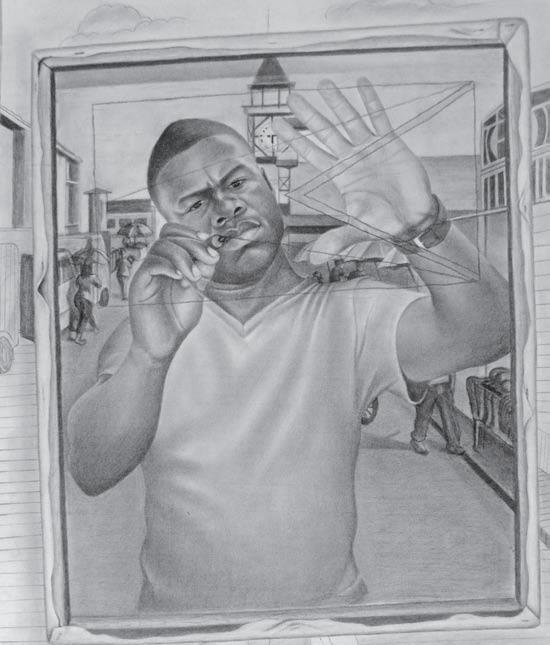
Michael Griffith has been drawing mostly portraits of people ever since he was a little boy. He has taken his art to a revolutionary level, one that is not very well-known in Guyana.
In an interview with Sunday Times Magazine, Michael revealed he grew up in a humble home in South Georgetown. He had to drop out of school at 16 to contribute to his family – still holding on to his passion for drawing.
“In order to accommodate my desire to draw I had to find a flexible job without supervision so I sold watches on the pave. I practiced my art, improving my skills with experience alone. In September 2009, I joined the Burrowes’ School of Art’s evening one-year certificate programme. This was significant in polishing my drawing skills. After that my life changed and I took art as a profession more seriously.”
Michael worked as a self-taught freelance artist for years before attending the Burrowes’ School of Art where he majored in painting and drawing. He excelled in his classes and has renewed his efforts in his specialty, portraiture: the art or practice of making portraits. He is now a professional portrait artist but also does other artwork.
“I was drawing ever since I could hold a pencil. Those early drawings were about my surroundings and stick people. I would say that my style is very detailed, hyper realistic. My inspiration is life. I like to capture things as I see them, expressions, emotions and beauty especially the unusual. Almost all my work is portraits of people. What I use the
most is pencil, charcoal, pencil crayons and I have used pastel and mix media.”
For his outstanding portraits, Michael received first prize in the Guyana Visual Arts Competition and Exhibition 2012 and first prize in the Guyana Visual Arts Competition and Exhibition 2014. He also recently exhibited his work in Haiti at the 2015 CARIFESTA celebrations.
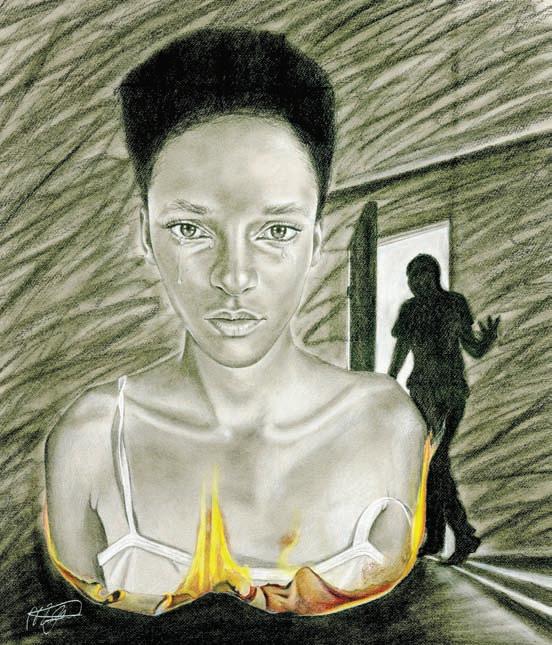
“My recent works show the countless examples of strong women within our society. Displaying strength in regards to the hardships
women face on a daily basis, from heartbreak and labour to rape and abandonment.
Growing up seeing my mother deal with the different obstacles caused me to be a bit more considerate to the conflicts that go hand-inhand with being a female in our society. This sentiment sometimes tends to spill over in my work consciously as well as unconsciously,” explained the artist.
For portraits and other works of art, contact the
on (5902) 691-5356 or visit
artist
Portraits and More by Michael Griffith on Facebook.
The artist with his paintings at CARIFESTA held in Haiti recently
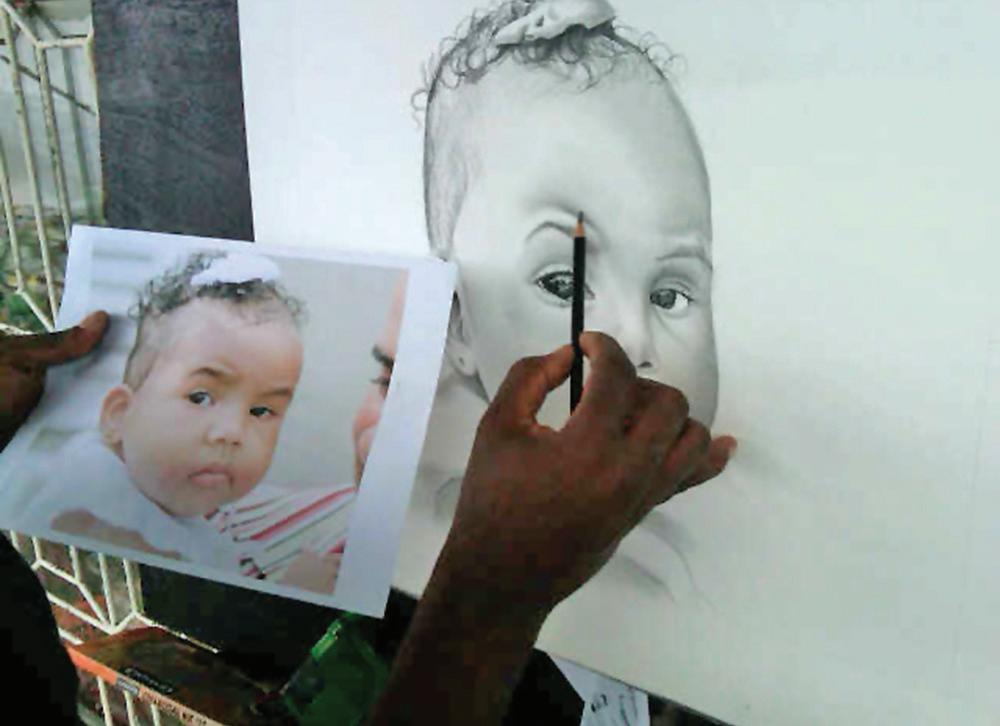
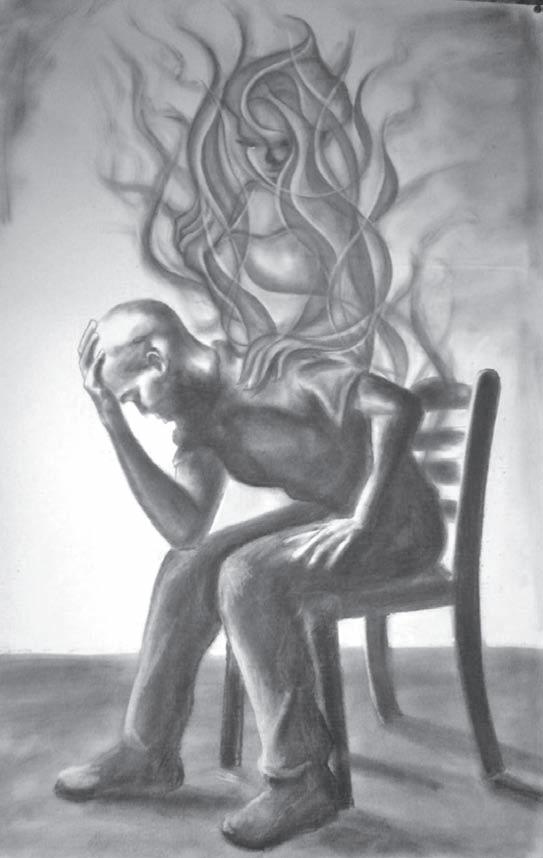
In process of drawing a portrait of a baby
'Jilted'. Mixed media. Charcoal and pencil crayon
The artist's portrait of UN Secretary-General Ban Ki-moon. The intricacies are amazing Award-wining piece 'Through the Canvas'
'The comforter'
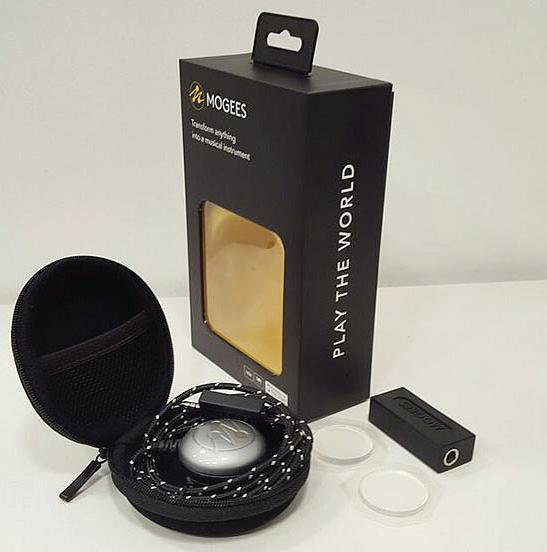
London-based tech startup Mogees has smashed its crowdfunding target and attracted hundreds of backers after a video demonstrating their incredible product went viral overnight.
The minute-and-a-half long clip shows Conor Barry turning his door into a drum kit by sticking a small device called a Mogees sensor onto it, and connecting the sensor to his iPhone.
Using the sensor and the app, Conor is able to turn the surface of his door into a drum kit by assigning different hand strokes on the door to different sounds produced by different parts of a drum kit.
Thanks to the video, in a matter of hours the Kickstarter campaign had raised over £50,000 - well over its initial target.
As part of a larger effort to revamp Yahoo ‘s email service into something so compelling and easy to use that that it stands out among other email services like Google’s Gmail and Microsoft’s Outlook, the Internet giant thinks it can make your password a thing of the past.
One of the new features announced Thursday lets people log into their email accounts without a password. You go to mail.yahoo.com, enter your user name and press “continue.” Instead of entering an annoyingly complex or easy-to-crack password, the company sends an alert to your smartphone and asks if you’d like to sign in. Hit “yes,” and you’re in.
“We’re going to kill passwords altogether,” Dylan Casey, Yahoo’s vice president of product management, said at a press event in San Francisco on Wednesday.
If Yahoo’s tech catches on, it means consumers could eventually live in a world without having to remember passwords. That’s a big deal because most security experts agree passwords in general
Eare unsafe. What’s more, it doesn’t even matter if you are logging into a secure website.
High-profile hacks at places including Sony Pictures, the IRS and Ashley Madison, a dating website for married people, have brought a lot of attention to people’s digital vulnerability.
One of the problems is too many people use an easy-to-guess password or the same one for multiple sites. The result either way is that if a hacker breaks into one site, it could mean trouble for the rest of your online life.
To use the tool, you log into your email with your regular password, turn on Account Key, and register your phone. The catch, of course, is you must own a smartphone and be willing to give your phone number to Yahoo.
If people lose their phones or their battery dies, they can still login using traditional passwords or through email. (Excerpt from “Yahoo wants to kill passwords with revamped Mail app” by Richard Nieva, CNET)
Deadly USB sticks instantly killing computers
xperts are warning gadget lovers to be on the lookout for killer USB sticks.
The tiny devices instantly fry any tech products they’re plugged in to, by pumping 220 volts of electricity directly through the circuit board.
Russian hackers appear to be behind the terrifying memory stick and have even posted a video of it in action.
The YouTube clip shows a researcher named ‘Dark Purple’ plugging the USB stick into a PC, and within seconds the computer shuts
The Mogees sensor consists of a vibration sensor which transforms any tap, scratch or strike into the sound of a musical instrument.
It’s the first contact microphone to be designed to work with smartphones and can turn any wood, metal and glass surface into a chosen instrument.
NASA is looking to uncover some bright ideas about how materials already found on Mars can be put to use by human
As NASA ramps up talk of a manned missions to Mars, it is turning to the public to help build the infrastructure to keep us there.
The freshly launched In Situ Resource Utilization Challenge puts the call out for clever ideas to use resources already found on Mars to help carve out a human presence on its surface.
Each piece of material gleaned from the Red Planet and put to use in building infrastructure will mean less that needs to be ferried some 140 million miles (225 million km) from Earth. NASA says this could equate to savings of more than US$100,000 per kg (2.2 lb) of cargo on each launch.
So it is set to award $10,000 to the brightest design idea for building a structure on Mars that uses in situ materials, along with $2,500 for two second-place submissions. The designs could
Ydown and refuses to restart.
Whilst the powerful current blows the circuitry it appears not to damage the hard disk.
Experts say that this new USB stick highlights the dangers of
consist of surface materials like rocks or soil, or even draw on the planet’s water supply, like the recent winner of the agency’s 3-D Printed Habitat Challenge Design Competition.
“In situ resource utilization is key to our exploration of the universe,” said Robert Mueller, senior technologist at Swamp Works, a lab at NASA’s Kennedy Space Center.
“We must find ways to make what we need once we are at our destination. For example, the soil on Mars could be used to make modular structural building blocks to make shelters, landing pads and other useful structures. We are looking for creative and novel solutions from all types of people.”
NASA is taking submissions until December 3, with winners to be announced in late January 2016. (Gizmag)
Siri, Google Now hear silent commands 16 feet away
ou might not want to keep your wired headphones plugged into your iPhone or Android handset. The wires act as an antenna and with the right equipment, hackers can take advantage of that.
Wired reports that a group of researchers at France’s government information security group found a way to silently send commands to nearby iOS and Android smartphones.
The attacking method uses connected headphones in an iPhone or Android handset to act as a receiving antenna; similar to how FM radio chips do so inside mobile devices.
With the open source GNU Radio software on a laptop, electromagnetic signals can be sent to those devices. Depending on the sent command, Siri or Google Now can be told to open up a website, send a text, place a call or do any other number of things.
Granted, most handset owners don’t have wired headphones plugged into them when not in use. And if someone was remotely sending silent “voice” commands to your phone, you’d likely
see what’s going on; the hack doesn’t disable the handset’s display. Even so, it’s a disconcerting proof of concept that both Google and Apple should consider researching and finding a way to close the door on any potential unwanted access. The researchers say they have shared their information with both companies. (ZDNet)
The Mogee sensor will allow users to create music anywhere on almost any surface
(Photo: Mogees)
visitors (Credit: NASA)
Home & Cooking
Exterior siding
Siding gives you a great way to add colour and definition to your house façade says HGTV. Pull the look of your home together by choosing the right siding material.
Most popular types of siding include vinyl, wood, brick of fibre-cement siding (pictured). Fibre-cement can imitate wood siding, clapboard and shingles. Other popular types are stucco, stone and stone-veneer siding
Recipe of the Week Ramen Burger
Ingredients
1 pack instant ramen noodles
Kosher salt and freshly ground black pepper
2 tablespoons vegetable oil
8 ounces freshly ground beef, formed into two 4-ounce patties
2 slices American, Cheddar, or Swiss cheese
Toppings as desired
Special equipment: 4-inch ring mould or empty 28-ounce can
Method
Cook noodles according to package directions, draining 1 minute before time indicated on package. Transfer to a rimmed baking sheet and spread out to allow them to dry slightly.
Season to taste with salt and pepper.
Divide noodles into 4 piles. Heat oil in a large non-stick or cast iron skillet over mediumhigh heat until shimmering. Place ring mould or empty 28-ounce can with both ends cut off on one side of pan.
Place 1 pile of noodles into mould and press down gently with a rubber spatula to form a thin, even layer. Carefully lift mould.
Repeat with other piles of noodles until you have four circular piles of noodles cooking. Cook without moving until well browned on first side, about 3 minutes.
Carefully flip and brown on second side, about 3 minutes longer. Transfer to a plate and set aside.
Season meat with ramen seasoning packet, adding additional salt and pepper to taste. Wipe out skillet with paper towel and heat over high heat until lightly smoking.
Add burger patties and press down immediately with a stiff spatula so that patties make contact with skillet. Cook without moving until seared on first side, about 2 minutes.
Carefully scrape up patties and flip. Top with cheese and continue to cook until desired doneness is achieved, about 1 minute for medium rare.
Top bottom ramen buns as desired, add burger patties, top with second ramen buns and serve immediately.
Serves 2
Don’t refrigerate your tomatoes. You’ll kill their flavour, and their juicy texture doesn’t survive so well in the cold either. To make the most of your tomatoes, keep them on a counter to allow them to ripen them to their full potential. Other veggies that shouldn’t live in the fridge include potatoes and onions, although they should be stored in a cool dark place rather than within the sun’s reach.
Buying fresh herbs in a bag and keeping them in there is certain to spoil them rotten. Instead, use what you need on the day, and then store the rest of the bunch in a glass of water on the windowsill.
Ice your greens. If your lettuce is limp rehydrate and refresh your leaves by separating them and tossing them into a sink full of iced water for anywhere from 5 to 30 minutes, depending on how sad they’re looking.
Instead of tossing your daily newspaper, use as mulch and to deter noxious weeds. Simply wet the sheets and put the layers around your plants and garden beds, covering with soil as you go. The weeds won’t be able to get through the wet newspaper layers.
To deter silverfish, place whole cloves in wardrobes and drawers. Lemons can also be used to remove mineral deposits that build up in your tea kettle. Fill it up with water, add a handful of thin lemon-peel slices and bring to a boil. Afterwards, let it sit for an hour, drain and rinse.
Stone-veneer siding. There are lots of options these days to help you create the perfect façade and you want to choose carefully. While aesthetics are always important, you also want to consider the material’s durability, ability to resist water, ease of installation and versatility.
Stucco siding. “From a functional point of view, siding gives you protection,” architect
Amy A. Alper tells HGTV. “From an architectural point of view, there’s an interest now in using a variety of materials to highlight special features on a home.
JOKES
Breathe a sigh of relief
A science teacher tells his class, “Oxygen is a must for breathing and life. It was discovered in 1773.”
The class clown responds, “Thank God I was born after 1773! Otherwise I would have died without it.”
Q&A
Q: Why can’t you trust an atom?
A: Because they make up everything.
Sentence constructions
A teacher asked her students to use the word “beans” in a sentence. “My father grows beans,” said one girl. “My mother cooks beans,” said a boy. A third student spoke up, “We are all human beans.”
He’s watching
In a Catholic school cafeteria, a nun places a note in front of a pile of apples, “Only take one. God is watching.” Further down the line is a pile of cookies. A little boy makes his own note, “Take all you want. God is watching the apples.”
Dumb criminal
A bank robber pulls out gun points it at the teller, and says, “Give me all the money or you’re geography!”
The puzzled teller replies, “Did you mean to say ‘or you’re history?”
The robber says, “Don’t change the subject!”
Read this
A recent worldwide survey showed that out of 2,146,703,436 people, 94 per cent were too lazy to actually read that number.
Funny signs
Ad for a safe company: “If your stuff is stolen, it’s not our vault.”
Notice at a public swimming pool: “Minnesota State Law strictly prohibits underwater smoking.” Sign on a door: “Emergency Exit Only. If you open this door, wait outside for the police to arrive. Tell them you are an idiot because you opened a door you were told not to.” On a high school display screen: “School resumes Aug 20. Resistance is futile. You will be educated.” Sign on a street: “No trespassing without permission”
Negative parenting behaviours that keep children from becoming leaders
Conclusion
Dr. Tim Elmore is a best-selling author of more than 25 books on children and founder and president of Growing Leaders, an organization dedicated to mentoring today’s young people to become the leaders of tomorrow.
After his suggestions, Dr. Elmore answered some questions about parenting.
Q: How can parents move
away from these negative behaviours (without having to hire a family therapist to help)?
“It’s important for parents to become exceedingly self-aware of their words and actions when interacting with their children, or with others when their children are nearby. Care enough to train them, not merely treat them to a good life. Coach them, more than coddle. “
Here’s a start: Talk over the issues you wish you would’ve known about adulthood. Allow children to attempt things that stretch them and even let them fail. Discuss future consequences if they fail to master certain disciplines. Aid them in matching their strengths to real-world problems.
Furnish projects that require patience, so they learn to delay gratification. Teach
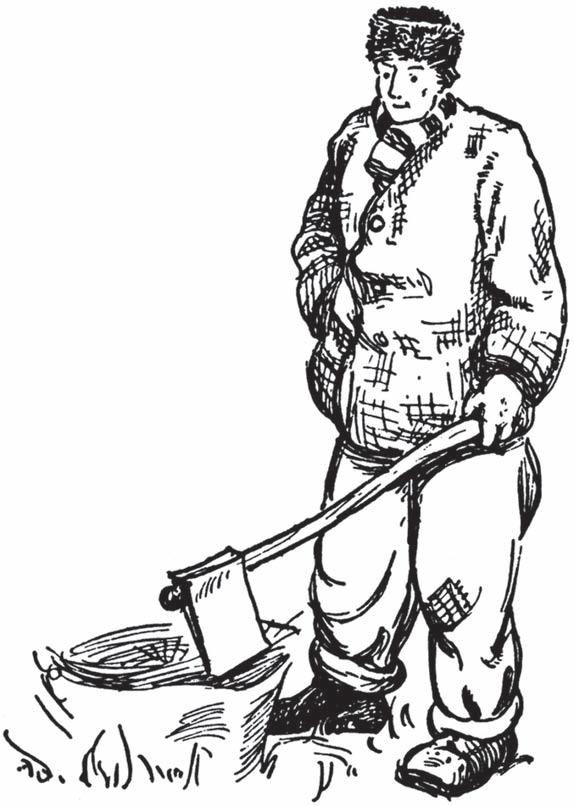
The Stolen Axe
Awoodcutter went out one morning to cut some firewood and discovered that his favourite axe was missing. He couldn’t find it anywhere.
Then he noticed his neighbour’s son standing near the woodshed.
The woodcutter thought, “Aha! That boy must have stolen my axe. I see how he lurks about the shed, shifting uneasily from foot to foot, greedy hands stuffed in his pockets, a guilty look on his face. I can’t prove it, but he MUST have stolen my axe.”
A few days later the woodcutter was surprised and happy to come upon the axe under a pile of firewood. “I remember now,” he said, “Just where I’d left it!”
The next time he saw his neighbour’s son, the woodcutter looked intently at the boy, scrutinizing him from head to toe. How odd, he thought, somehow this boy has lost his guilty look . . . (A Taoist Tale from China by Lieh Tzu)
them that life is about choices and trade-offs; they can’t do everything. Initiate (or simulate) adult tasks like paying bills or making business deals. Introduce them to potential mentors from your network. Help them envision a fulfilling future, and then discuss the steps to get there. Celebrate progress they make toward autonomy and responsibility.
Reflections STORY TIME
By Grammar G
With this month considered by many one to make plans for Halloween, Grammar G. thought we’d look at some spooky language, starting with the suffix - mancy
Coming into English from Old French - mancie, derived from Latin -mantia, which in turn originates from Greek -manteia, the suffix forms nouns meaning “divination or prophecy” by using something.
(The Oxford American Dictionary notes that Greek manteia means “divination”).
Examples are always helpful: the Old French word carte (“card”) with the suffix mancy becomes “cartomancy”: using cards to foretell or prophesy (think Tarot cards).
Since we associate most -mancy words with fortunetelling, which is in turn associated with magic and superstition, many such words deal with the mystical, “dark magic” notions
Looking Back
I might have been rich if I’d wanted the gold instead of the friendships I’ve made. I might have had fame if I’d sought for renown in the hours when I purposely played. Now I’m standing to-day on the far edge of life, and I’m just looking backward to see What I’ve done with the years and the days that were mine, and all that has happened to me. I haven’t built much of a fortune to leave to those who shall carry my name, And nothing I’ve done shall entitle me now to a place on the tablets of fame. But I’ve loved the great sky and its spaces of blue; I’ve lived with the birds and the trees; I’ve turned from the splendour of silver and gold to share in such pleasures as these.
I’ve lived with my friends and I’ve shared in their joys, known sorrow with all of its tears; I have harvested much from my acres of life, though some say I’ve squandered my years. For much that is fine has been mine to enjoy, and I think I have lived to my best, And I have no regret, as I’m nearing the end, for the gold that I might have possessed.
Edgar Guest
that we tend to scare ourselves with.
Words such as demonomancy (calling upon demons for prophecies) and necromancy (communicating with the spirits of the dead for prophecies) are two such examples that you may be familiar with.
Animals are apparently a rich source from which to form prophecies: ophio-
mancy means using snakes (by looking at their manner of eating, or by studying their coils) to foretell the future. The Aztecs and Egyptians are among those said to have used this method.
Alectoromancy means divination by observing a rooster eating corn scattered on letters. In Africa, a black hen or a gamefowl
is used. Ancient Romans used a white rooster. As the bird moves to a letter while pecking the corn, the letters would form words the diviner would then interpret.
Myomancy means divination by the movements of mice; arachnomancy divination by observing spider behaviour; hippomancy is a prophecy using horses; hyomancy using wild pigs; and there are many others. Some macabre foretelling devices include anthropomancy using human entrails, cephalomancy by boiling an animal’s head (usually a donkey), scatomancy using faeces, uromancy, using urine, ossomancy using bones, and hematomancy using blood.
Not all prophetic strategies are grisly. Consider for example astromancy using the stars (we call it astrology); bibliomancy using the bible or books; ceneromancy using ashes, tyromancy using cheese, and oneiromancy using dreams.
A girl was offered a drink of water with icecubes at a party. She narrowed her eyes and said, “This is part alcohol.” How did she know?
see answers on page 23
Colouring Fun
The objective of the game is to fill all the blank squares in a game with the correct numbers. Every row of 9 numbers must include all digits 1 through 9 in any order. Every column of 9 numbers must include all digits 1 through 9 in any order. Every 3 by 3 subsection of the 9 by 9 square must include all digits 1 through 9.
Creature Corner Caecilian
Caecilians (pronounced seh-SILLyens) are tropical amphibians that look like large worms or small snakes. They have no arms or legs, and sometimes it’s hard to tell which end is the head and which is the tail.
Their shiny skin is ringed with skin folds called annuli. Caecilians usually come in shades of gray, brown, black, orange, or yellow. Some species have tiny, fishlike scales within the rings. Some, like the one pictured here, are lungless.
Their range include Central Africa, Southeast Asia, and southern Mexico to Argentina in South America, where
they inhabit loose soil and ground litter in tropical forests, or in rivers or streams.
Because most live underground, they do not hear and see quite in the sense that humans do and have reduced eye sight and sensitive organs and tentacles that help them find food.
Inside a caecilian’s mouth are dozens of needle-sharp teeth for grabbing worms, termites, beetle pupae, molluscs, small snakes, frogs, lizards, and even other caecilians to eat whole.
Some South American species spend their lives in water instead of on land.
GeoZone
Badlands
Badlands are said to be a type of dry landscape where softer sedimentary rocks and clay-rich soils have been extensively eroded by wind and water. Marked by deep ravines, sharp ridges, pinnacles, and other landforms carved by running water, badlands occur throughout the world in arid and semiarid regions where rains, though infrequent, are hard and particularly erosive when they do occur. Usually there is no vegetative covering on the land, allowing rapid runoff of water. Badlands may form either by a natural process or as a result of improper use, such as the overgrazing of range land.
Because of the extremely rough terrain, badlands are of no agricultural value, are difficult to cross, and have been avoided for permanent settlement.
The Valle de la Luna (“Valley of the Moon”) is one of many examples of badland formations in midwestern Argentina, South America. This geological formation is the only place in the world where nearly all of the Triassic is represented in an undisturbed sequence of rock deposits. More well-known are the badlands of Montana and South Dakota in the United States.
Baby olinguito discovered by scientists in 2013
By Laurie Triefeldt
The nose knows
Q: How do we smell scents with our nose?
While conventional science tells us our brain processes all scent information, recent research has shown that our nasal neurons pre-process some of the information.
The millions of receptors in our smelling organ are said to “congregate in small regions” to also help the brain discern “good smells from bad ones” (stink and sweet). It can be said to be similar to the way our tongue has areas to detect sour, sweet and salty tastes.
According to National Geographic, the human nose contains the “olfactory epithelium”, which is a “postage stamp-size smelling organ” at the top of our nasal cavity. Humans have 400 scent receptors that can recognize some 10,000 different smells. (By comparison, only three receptor types are used for all our colour vision.)
During their research, the neuroscientists found that some regions of the epithelium are better at detecting scent than other nose regions, with some “tiny hot spots” for “interpreting” and telling our brain about pleasant and unpleasant smells.
To the scientists, this suggests “something about the epithelium is tuned to pick up certain information…” –something of a mystery to be further researched.
Brain Teaser Answer
The ice-cubes were floating in the middle of the drink. Since alcohol is less dense than ice-cubes, it floats to the top and the ice-cubes go to the middle, above the water where water stays at the bottom.
SUDOKU KID SUDOKU
Just in time for Christmas!
Aman who has legally changed his name to Santa Claus has been elected to the six-member city council of North Pole, Alaska.
The UK Mirror newspaper reports that local media said the man, formerly named Thomas Patrick O’Connor Claus, won with 58 write-in votes from the town of 2,200.
In an October 14 post on Facebook, Claus, a child advocate who is also a monk, thanked those who had voted for him.
He wrote: “I’m happy to announce that I have been elected to the North Pole City Council! My thanks to everyone who voted for me, the news media that covered my campaign, and all who supported my run for office via social media. I look forward to continuing to serve my community.”
Shaolin monk performs one-finger handstand
Shi Liliang, the 39-yearold monk who made international headlines when he broke his own distance records several times by running across water on floating wooden planks for 125 metres, this week wowed a crowd with another stunt during a performance in the city of Chaoyang, in northeastern China’s Liaoning province.
Liliang is reportedly one of the few monks to have mastered the one-finger handstand, and performed the difficult skill in front of an impressed crowd at a scenic spot.
He said he began practising the stunt by doing regular press-ups and headstands. As he increased his strength, Liliang began reducing the number of fin-
gers he used to support himself and was eventually able
to do press-ups with two fingers.
He claimed to have mastered the one-finger handstand 11 years ago, and that it was one of his most popular stunts before his “running on water” stole headlines around the world. He is now giving public performances in and around China to gain more followers for his religion and the discipline behind it.
Although most people commenting were clearly impressed, some accused him of cheating by saying it was clear to see that he was also using his feet to support himself so that not all the pressure was on his finger. You can see for yourself in the video at dailystar.co.uk.
Meerkat expert Caroline Westlake leaves Westminster Magistrates Court after being sentenced to 80 hours community service for glassing love-rival (John Stillwell / PA)
Aformer meerkat expert at London Zoo has been ordered to pay compensation to a monkey handler she attacked with a wine glass, in a love spat over a llama keeper.
Mercury News reports that a judge at Westminster Magistrates’ Court said Wednesday that Caroline Westlake must pay 800 pounds (US$1,235) to Kate Sanders for assaulting her in a dispute over colleague Adam Davies, who had dated both women.
Judge Jeremy Colman also sentenced 30-year-old Westlake to 12 months community service for assault. The judge said Sanders had suffered a “nasty” face injury in the fracas at a zoo Christmas party on Dec. 8. Westlake had claimed that Sanders punched her first, and said she did not remember hitting her colleague with the glass. She was fired by the zoo after the incident.
The PhilonoisT
Lilang’s “fingerstand”
Santa Claus’ Facebook page cover photo
ARIES (March 21April 19)
TAURUS (April 20May 20)
(May 21June 20)
(June 21July 22)
LEO (July 23Aug. 22)
VIRGO (Aug. 23Sept. 22)
LIBRA (Sept. 23Oct. 23)
SCORPIO (Oct. 24Nov. 22)
SAGITTARIUS (Nov. 23Dec. 21)
(Jan. 20Feb. 19) (Dec. 22Jan. 19)
PISCES
(Feb. 20March 20)
Don’t give up on your plans because of a minor setback. Obstacles are to be expected. Find an appropriate way to deal with the dilemma and move forward.
Don’t waste your money on questionable people or organizations. You stand to lose if you try to buy love or attention. Make an impression with your intellect, not your cash.
Make the most of your day. Pursue pleasurable activities and put your career on hold while you enjoy the company of good friends or family. Youngsters will play an important role in your life.
Athletic or physical activities will keep you from fretting over a dilemma. Walking, bike riding or tackling an overlooked domestic chore will help you blow off steam.
Love is on the rise. You will have no trouble dazzling everyone around you with your quick wit and jovial personality. If you put your best foot forward, you’ll be the center of attention.
Don’t expect personal issues to disappear. Secondhand information will be biased. Find out the truth and act accordingly. Discovering a solution will take the weight off your shoulders.
Show a special someone how much you care. Put professional worries aside and dedicate yourself to having fun and taking care of your personal priorities. All work and no play will lead to regret.
If you have been overdoing it lately, you should delegate tasks to others. It’s hard to maintain your focus when you are pulled in too many different directions.
Don’t be daunted by the scope of your plans. A methodical step-by-step approach will enable you to reach your destination. Ask for help if you need it along the way.
The voice of experience will offer you some excellent advice. Someone who has gone through similar situations will guide you and teach you how to make the most of your plans.
Financial gains are in store for you. Repayment of a loan or an unanticipated bonus will have you thinking big. Be cautious, or your windfall will slip through your fingers.
An emotional decision will lead to regret. Consider the consequences before you make a tough call. What seems like a foolproof plan will backfire. Do your research.