
$55M approved to improve community roads in WCB
The National Assembly last week approved some $55 million to rehabilitate a number of community roads on the West Coast Berbice.
The roads to be rehabilitated include: Bath Settlement, Lovely Lass and Cotton Tree, and $16 million for the rehabilitation of streets in housing schemes including Zorgen-Hoop, Blairmont and Shieldstown. The sum of $14 million will cater for the rehabilitation of the wharf at Central Mahaicony.
This announcement was made last Friday when the National Assembly approved the estimates for Region Five. A total of $1.982 billion was approved for the Region Five, Regional Democratic Council (RDC). Approved for Region Five’s Regional Administration and Finance was the total sum of $118.368 million; agriculture projects received 203.118 million; public works, $182.689 million; education delivery $1.114 billion; and health Services, the sum of $362.951 million.
Under agriculture, the sum of $82.5 million will bring improved drainage and irrigation interven-

be rehabilitated and structures will also be done at Washclothes among others.
cess to more than 500 residents in that community.
will fund the completion of the Novar Primary and the Mahaicony Secondary School, the construction of teacher’s quarters at Gordon Table, the construction of tarmacs at Fort Wellington Secondary and Novar and Belladrum Primary Schools, the extension of the Woodley Park Primary and the enclosure of the teachers’ quarters at Karamat.
The sum of $14.485 million will provide for the purchase of education furniture, from which 11 secondary schools and 30 nursery and primary schools will benefit, Minister Whittaker explained. Meanwhile, under health services, $27.5 mil-
lion will be used to improve the Fort Wellington Hospital. Works to be covered include the construction of an administrative building and incinerator, the extension of the pharmacy and the rewiring of the building. The sum of $21.192 million will provide for the purchase of health equipment and furniture for the regional health facilities, whilst $11 million will purchase an ambulance which will be placed at the Mahaicony Hospital. The consideration of the estimates and expenditure for the remaining five administrative regions will continue on April 14.
tions to several communities. Minister of Local Government and Regional Development, Norman Whittaker, who defended the allocations to the region, explained that residents from Pine Ground to Perth/Biabu will benefit from the construction of drainage channels and embankment, and those at Poor Fellow, Basket Plimper and Rutherford, from the construction and rehabilitation of access dams. The sluice at Farm will
Minister Whittaker noted that these interventions all target farming areas that are susceptible to flooding. Also under agriculture, a provision of $9 million has been made for the purchase of a vehicle while under public works, a provision of $6 million was made for the construction of a bridge. Asked to clarify the type of structure, Minister Whittaker explained that it will be a greenheart timber bridge in the Number Five Village that will provide ac-
Minister Whittaker explained that the roads will be upgraded from ‘mud’ to crusher run or Double Bituminous Surface Treatment in some cases and in other instances there will be the move from DBST to asphalt. He also committed to providing the National Assembly with a print out of each of the roads and bridges to be undertaken in 2014 under the headings the amount to be spent and the materials to be used.
Meanwhile, under Education, $53.623 million
Bahá′ís to observe Festival of Ridván
The Inter Religious Organisation of Guyana has extended to the Bahá'ís community here greetings and best wishes on the observance of the 12-day Festival of Ridván, from April 21 to May 2.

In a release, the IRO said Ridvan marks the period when Bahá'u'lláh declared His Mission in Baghdad in 1863. The arrival of Bahá'u'lláh in the Najibiyyih Garden, subsequently designated by His followers the Garden of Ridván, signals the commencement of what has come to be recognised as the holiest and most significant of all Bahá'í festivals, the festival commemorating the Declaration of His Mission to His companions. According to the IRO the ethical, the moral and doctrinal foundations of a nascent community had been established, in the course of Bahá'u'lláh’s exile in Baghdad. And finally, it was in the Garden of Ridván, on the eve of His banishment to Constantinople, that He made the Declaration of His Mission.
What now remained to be achieved was the proclamation, in the city of Adrianople, of that same Mission to the world's secular and ecclesiastical leaders, to be followed, in successive decades, by a further unfoldment, in the prisonfortress of 'Akká, of the principles and precepts constituting the bedrock of that Faith, by the formulation of the laws and ordinances designed to safeguard its integrity, by the establishment, immediately after His ascension, of the Covenant designed to preserve its unity and perpetuate its influence, by the prodigious and worldwide extension of its activities, under the guidance of 'Abdu'l-Bahá, the Centre of that Covenant, and lastly, by the rise, in the Formative Age of that Faith, of its Administrative Order.
During this period, Bahá'ís also assemble for the annual elections of their local and national administrative institutions.
Local Government and Regional Development Minister Norman Whittaker
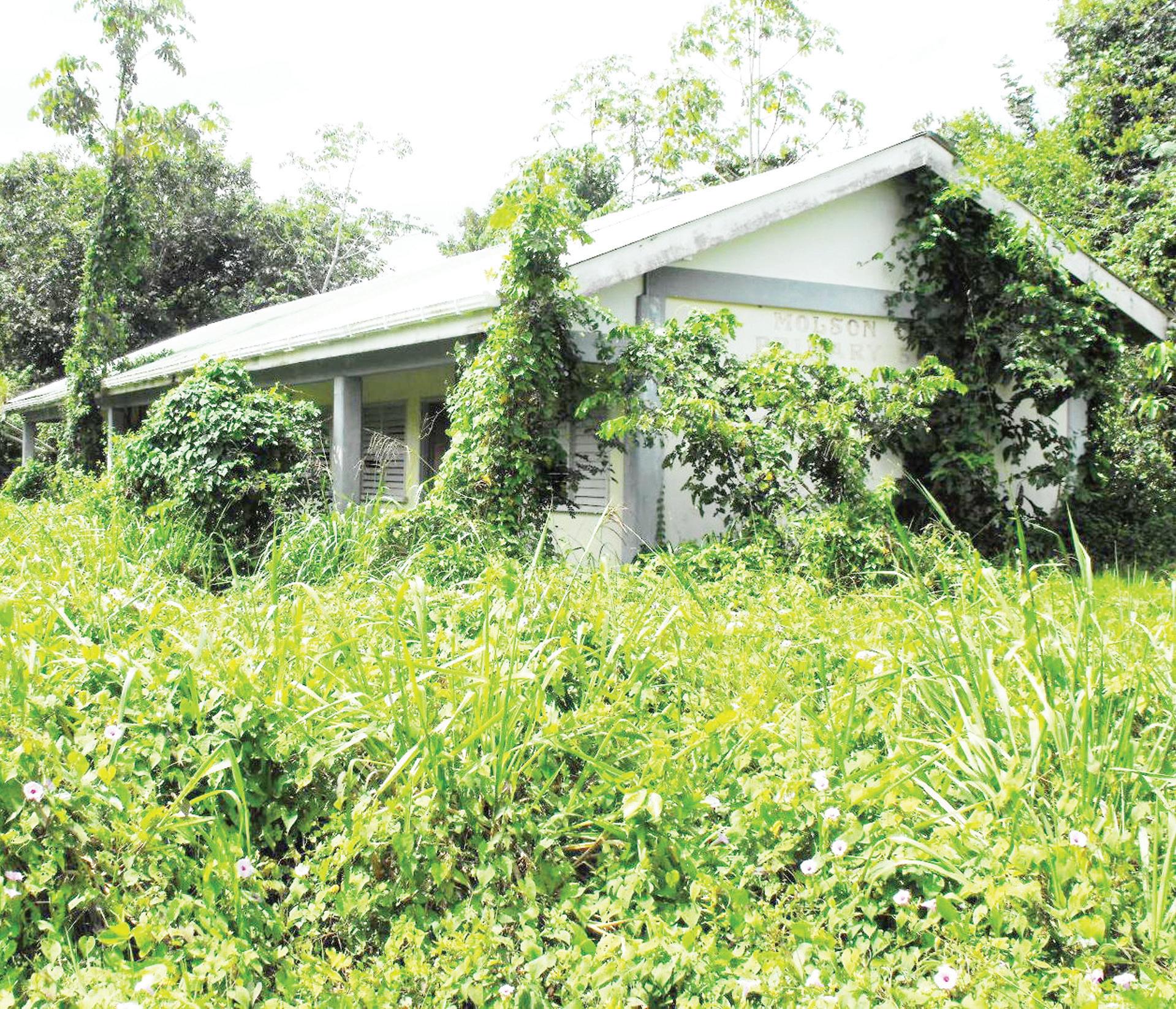
No school for 40 Moleson Creek children
BY ANDREW CARMICHAEL
More than 40 children at Moleson Creek will not benefit from the $32.3 billion which has been earmarked for education in the 2014 National Budget.
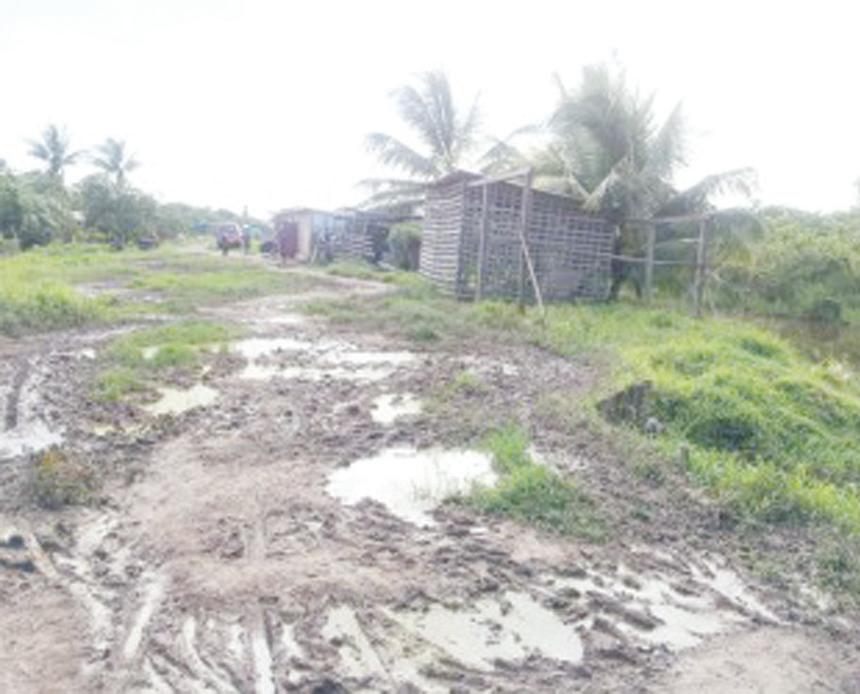
These children have no school to attend. Last year, the Education Ministry had closed the Moleson Creek Primary School after residents had voiced their concerns over the state of the road during the rainy season. The school is built about one and a half miles from where the children live; it is isolated and during the rainy season, it is almost impossible for the children to get to school. Coupled with that, the Ministry said it was struggling to find teachers for the
area, and as such, the school was closed.
However, at a recent press conference, Regional Executive Officer (REO) of Region Six Paul Ramrattan told reporters that this was not so. He said the reason for the Moleson Creek Primary School being closed was due to the fact that a murder took place there; neither the police nor any of the residents support that claim. After the school was closed, months later arrangements were made to have 30 of the children picked up and taken by bus to the Crabwood Creek Primary School which is located more than four miles away.
The children are picked up in the morning and taken home in the afternoon. There are still more than a dozen
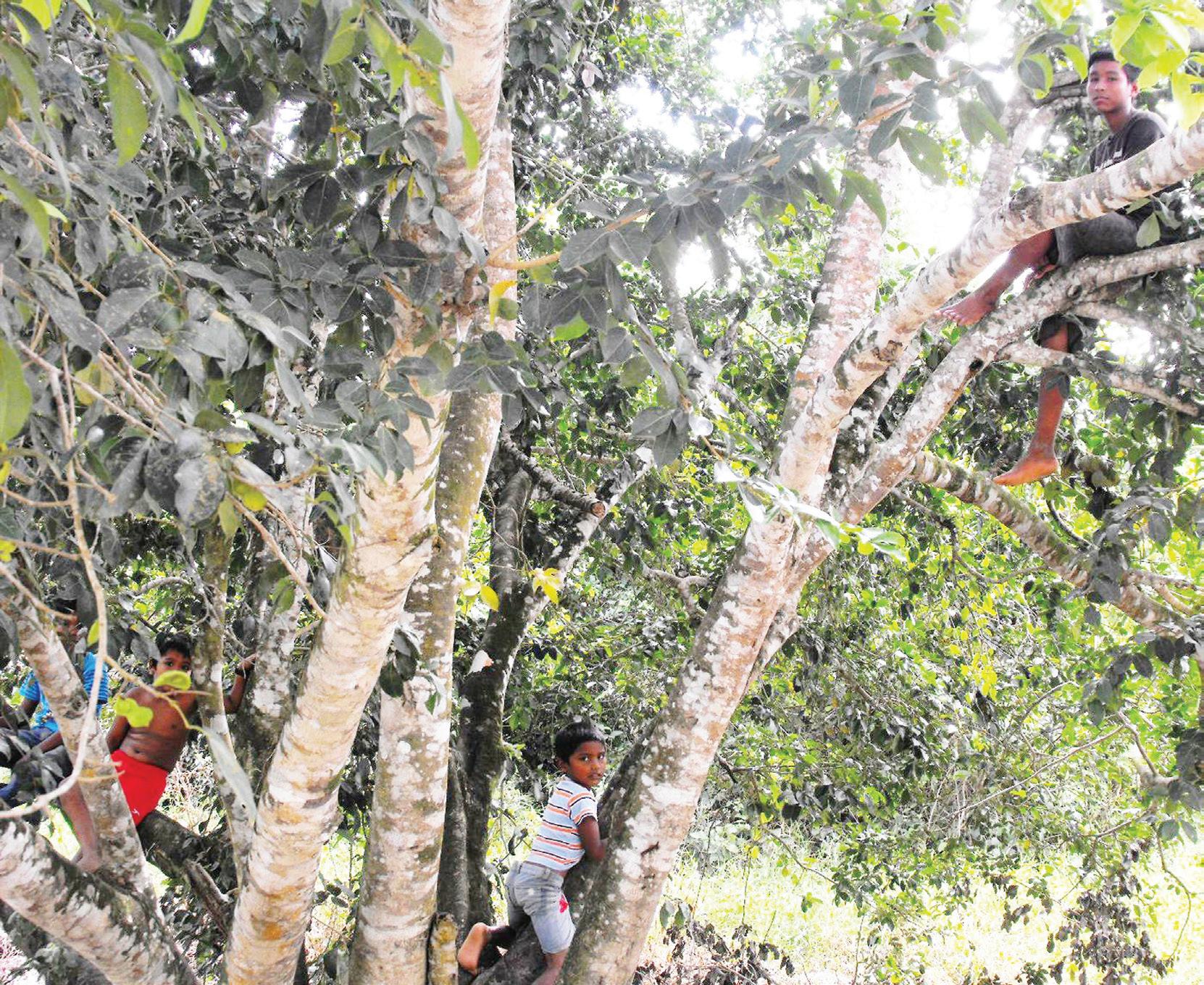
age children hanging out during school hours
children who are not catered for. Added to this unfortunate situation, the travel arrangements were only made for the children who attend school at the primary level and no attention was given to the more than 50 who are of nursery school age. “Deh say that it can’t pay to carry dem kindergarten small children because they school over half day,” one parent told Berbice Times.
Jaclyn Thomas who has three children says she has been spending exorbitant sums to get her child to and from school. “Before the Government start sending transportation, me used to send he to nursery school and it does cost me two thousand dollars for the half day.” That money is for the taxi trans-
portation. There is no regular car or bus service in the community.
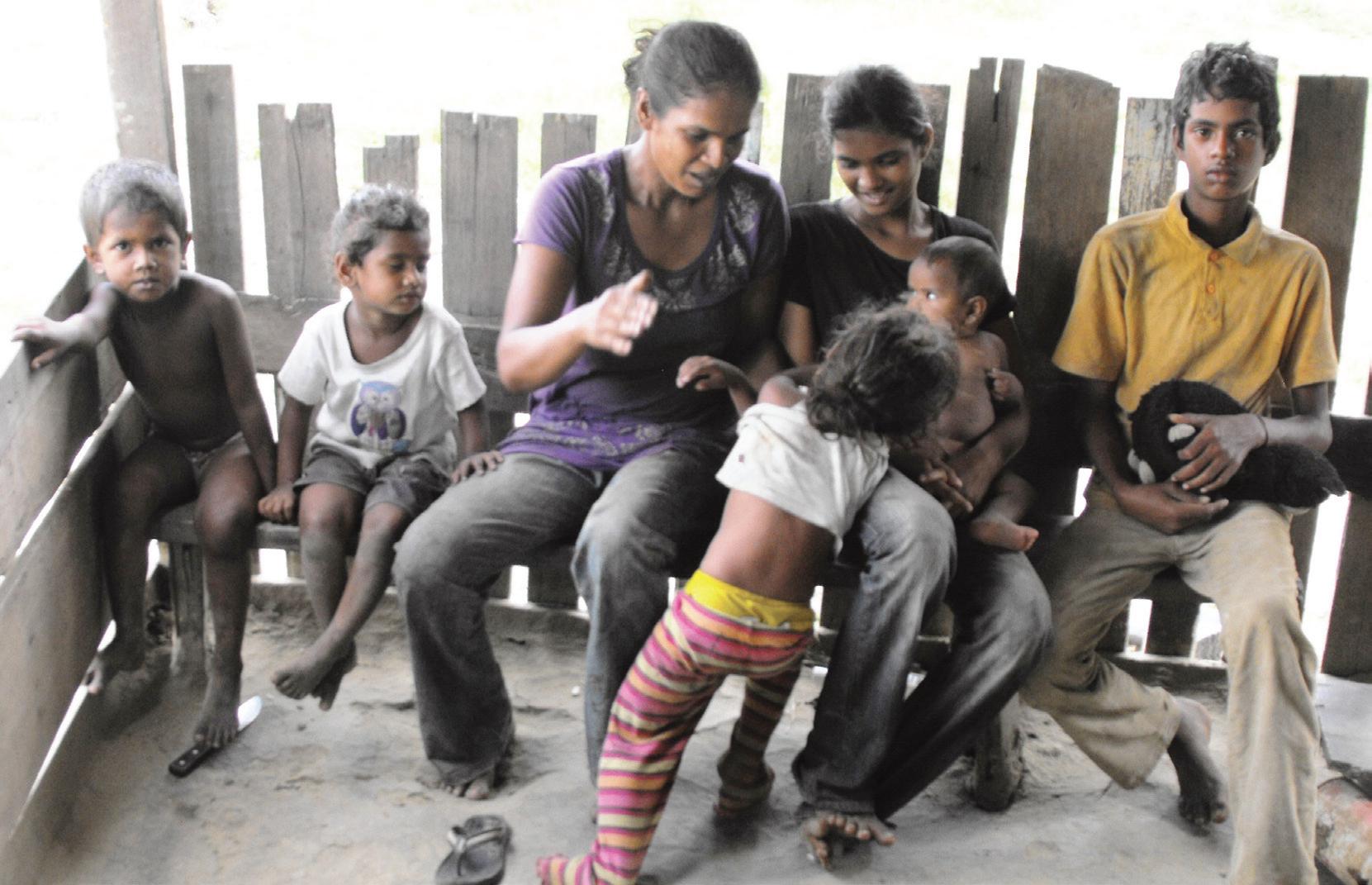
Parents say since the school closed, they cannot afford to send nursery age children to school because it costs them $4000 each day for each child’s transport to and from school. Another parent, Radica Bhudwa, a mother of seven does not send any of her children to school. “It is very expensive… they used to go to the school here but now since it closed down, dem na go out deh.”
She too said it was too expensive for her to be spending $4000 per day. The mother explained that the names of her children have been taken off of the registers at school because of the length of time that they have been absent. After the Education Ministry ordered the school closed in September of 2013, it was not until January 2014 that arrangements were made to provide transportation for the children at the primary level.
The parents are still push-
ing to have a school in the community. “If the school come up ah front here it gon betta because nobody nah live a back deh...” Zalina Khan, a mother of one said. Another parent Kalif Alli is suggesting that the building that was constructed to house the head teacher be converted into a school and relocated.
“Move the wooden building and bring it closer to where residents live. They could take the school and convert it into a health centre,” he said. Meanwhile, none of the children attended school on Thursday and Friday because the driver who has been contracted by Government reportedly said that the children were not doing anything in school and therefore it was a waste of time to take them.
Finance Minister, Dr Ashni Singh in his National Budget said the education sector had received the largest allocation of $32.3 billion, surpassing last year’s allocation of $28.5 billion.
According to the Finance
Minister, through this year’s allocation, emphasis will be placed on improving literacy rates, early childhood development, teacher training, enrolment in single sciences, and technical vocational educational programmes.
In addition, the allocation will cater for more structured partnerships with private sector providers and parents. This year $2.9 billion has been allocated towards the construction, rehabilitation, extension and maintenance of educational facilities, including a new and expanded Zeeburg Secondary School and the Kato Secondary Complex. Under the allocation too, the Government will commence the implementation of a US$10 million Universal Secondary Education initiative, which will facilitate the construction of new secondary schools and the provision of materials for improved teaching techniques and technology assisted learning in mathematics.
Non-payment of taxes by GuySuCo strangling Canefield NDC
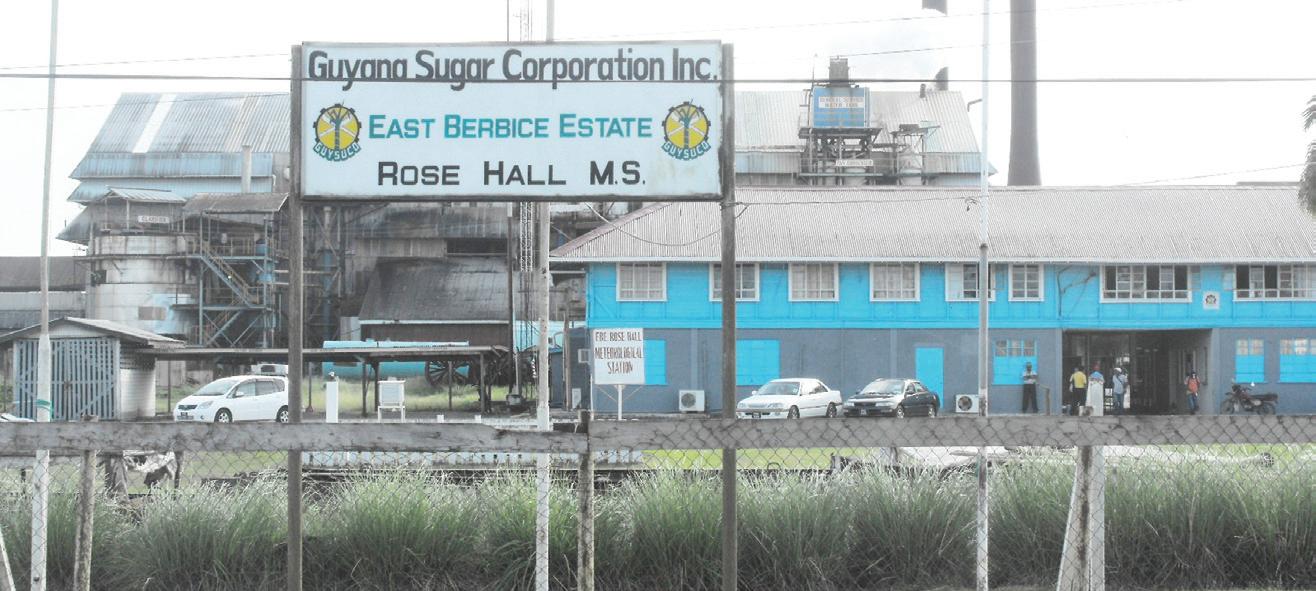
The non-payment of rates and taxes by the Guyana Sugar Corporation (GuySuCo) to the Canefield/Enterprise Neighbourhood Democratic Council (NDC) is having a negative impact on the entity’s ability to carry out critical works in the communities.
This publication has been informed that GuySuCo has not paid taxes owed to the NDC for the past three years, resulting in the NDC not being able to fully execute its work programme. The NDC is expecting to collect $27 million from GuySuCo this year. The revenue for 2014 is $10 million added to the $17 million that the corporation already owes to the NDC.
In the past, the Canefield/ Enterprise NDC had been one of the leading NDC’s when it comes to rate collection. This is because GuySuCo is responsible for 75 per cent of the taxes the NDC collects and had been paying promptly. Now the corporation has stopped making those pay-
ments, rendering the NDC incapable of meeting some of its responsibilities.
The Canefield/Enterprise NDC has its hands tied, in that it cannot take GuySuCo to court since it is unable to take legal actions against GuySuCo. However, letters have been sent to the Chief Executive Officer (CEO) of the corporation, the President of Guyana and the

Local Government and Agriculture Ministers on the issue.
One of the main concerns of residents and the NDC is that of high overgrowth in the community which residents say is one of the main contributing factors for the high crime rate there. Revenue collection from the residential community is also low.
A source close to the NDC told
Berbice Times that many property owners have migrated and as a result, no taxes are being collected from those residents. The NDC is not able to serve those residents with notices that they need to clean their lands.
Canefield/Enterprise NDC
Chairman Jaipaul Kuldeep told this publication that the NDC has appealed to residents to pay their taxes as the NDC has a work programme for 2014. “The rates and taxes are not coming in as it should but we have to do some ground work to get residents to pay.”
He said that the NDC will be able to carry out some infrastructural developmental work as part of its 2014 work programme. Some of that work has already commenced. Kuldeep noted that this is being done to avoid flooding during the expected rainy season. He said a street upgrade and maintenance programme will be carried out in all communities of the Canefield/Enterprise

Canefield/Enterprise NDC
NDC. According to Kuldeep, much of the funding will come from Government’s $3 million subvention to NDCs. However, the NDC has road building material stockpiled and will use it to start its 2014 road programme.

School
Radica Bhudwa and six of her seven children
The Rose Hall Estate is in the Canefield/Enterprise NDC
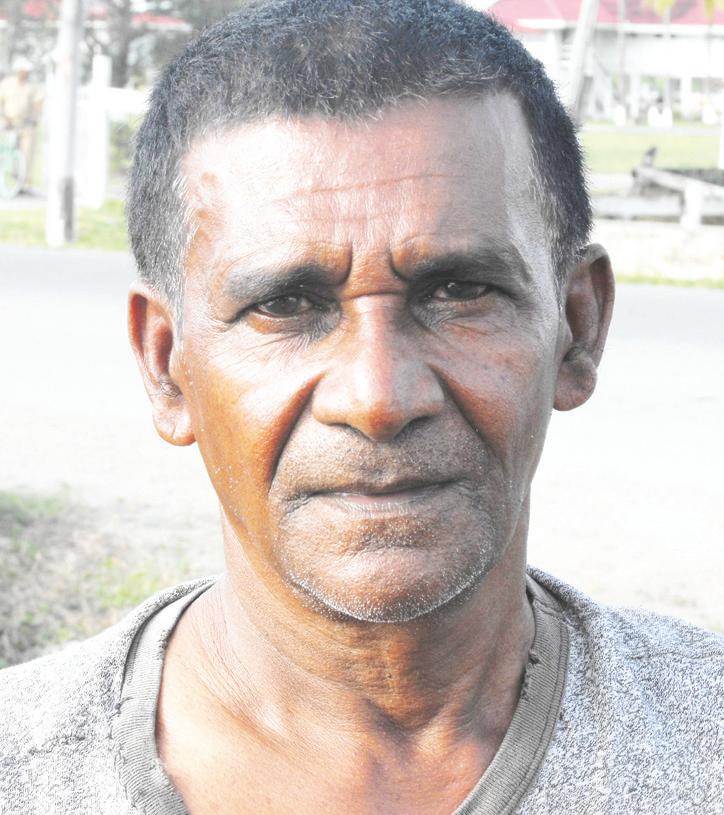
Chairman Jaipaul Kuldeep
Simply the
Truth
Cotton Tree Primary School
The good Headmistress of Cotton Tree Primary School and civil leaders of the area invited me to meet with the parents and their children who barely avoided catastrophe when the bus taking the children on an educational tour erupted into flames. There were 55 children, aged eight and nine; their parents and guardians, and their teachers.
The children were encouraged to speak about the incident, and they told of fire, screams, panic, and school bags left behind to be ravaged by flames. They told of escape and panic, the fear still liquid in their eyes.

They told of recurring nightmares about the fire. In some nightmares, the children saw themselves being burned the way their school bags were burned. They toss and turn, and awaken in sweat and tears. One child has flashbacks when awake.
Parents spoke of their ordeal. And the ordeal continues since their babies are re-living this incident day after day, night after night. The parents told of their children who refuse to sleep by themselves as they once did. Any harsh sound causes panic.
Any fire causes alarm, and any spark re-awakens hysteria. There were tears and there was tremulousness. Certain key words were repeated: “fire”, “burn”, “bags”, “frighten”. Some parents reported that the mere mention of the word “tour” triggered tears and fear in the children.
To be sure, there were brief exchanges of blame. But it was mostly worry and pain that they expressed. And throughout the session, they gave thanks to the divine powers that prevented an even greater tragedy. Throughout there was the restatement of love of parents for children, and the love of children for parents. This is how they cope: with faith and love.
Many parents were adamant that they would never send their children on any of these tours again. Some disagreed. I have suggested measures be put in place immediately that would minimise the chances of this ever happening again. And we suggested various methods of coping and strategies towards healing.
To her credit, the Headmistress deals with it all in the best way she knows how. So do the teachers. But this kind of trauma takes professional counselling. One would have thought that the various authorities would have had teams of specialists descending on the place to help in the coping and healing. But nothing!
I have not read nor heard of any official from any ministry of Government utter a single word of comfort and concern. One would have thought that there would be a great deal of alarm in the hearts and minds of our “leaders”. Nothing!
Or if they did, we have not heard nor read it. But their presence would have been such a good thing: it would have demonstrated to these children and their parents that someone in authority cares.
It could be that our political leaders are too busy with more pressing matters of state. But I am at a loss to see what is more important than our children.
I would encourage social workers and counsellors to go to Cotton Tree Primary School, go to the homes of these children. You do not need to call a meeting with each other and talk about what we are going to do. You know, I hope, what to do. Now go do, please!

WHAT THE PEOPLE SAY ABOUT ISSUES AFFECTING THEM IN BERBICE
Alvin Goodman - Public Servant
“I am concerned about the growing number of suicides not only in Berbice but around the country in general. When you look at it, it’s our young people who are killing themselves for reasons that aren’t really known. This shows that something is going wrong somewhere and I think as a country, more needs to be done to stop this. Religious organisations, families, government ministries, help agencies all need to get on board and work to reduce this rapidly growing number because I don’t believe enough is being done for Berbicians and others around the country in education and awareness of suicide.”

Celeste Robertson - Housewife

“My concerns are about the way our youths carry themselves. They are rude and lawless and when you try to talk to them they abuse you. A lot of them who are of school age would not go to school many days. Some of the parents know about it but they do not take complaints. They tell you to mind your own business. Some of them are liming after school and can get into trouble. The Schools’ Welfare Officers and the police need to do something about it. They should visit the school and talk to them about the importance of going to school and have an education.”
Arnold Persaud - Retired Headmaster
“Why can’t we be like the people in Venezuela? They weed in front of their homes and that is discounted from their tax. Some persons were employed by the government through the drainage and irrigation programme. They started and did a slapdash job; but I don’t see them anymore. They wait until the rain comes and then we would get flood. The D&I is pumping money down the drain and the work is not being done. The public health officer should go around and check and if he finds that persons are not cleaning, he should send them warning letters door to door. We go to North America and we see no litter. We come back, we practise the clean habits for a time but eventually go back to the same thing. So you see my dear Guyanese, how difficult it is to break a habit. Persons should not throw their litter in the drains. Why can’t we put heads and hands together and make this glorious country a place where all would like to come and live?”

Panzie David - Poultry Rearer/CBR Volunteer
“I am totally against domestic violence; I do not believe any man should hit a woman. I offer counselling to the victims and their abusive partners. Some of them think that they would no longer be accepted in society. The men make the women feel guilty as though it is their fault that they are being abused. The women are so weak that even if the police lock up the men they would feel sorry for them and get them released. When the matter reaches the court the women would go and beg the magistrates to give the men a chance. But then the same thing would happen and even the police would not want to bother with them anymore. I think that the perpetrators of domestic violence also need assistance; many times after talking to them I get them to stop abusing their partners. I am also disappointed in the behaviour of some schoolchildren. They do not show respect to the elders.”
Fazeela Bacchus - Seamstress
“I am concerned that we have a lot of school dropouts in Berbice. Parents may have a lot of children to take care of and they cannot afford to send them to school. In many cases when the children reach a certain class they would stop going to school. Then the girls would get married at a young age. They would start having children early and would not be able to take care of them. When they face the pressure they would regret it, but it may be too late for them to get out. Right now I know of two girls who recently turned 15 and are preparing to get married.”



Professor Daizal Samad
Opposition councillors not pleased with Regional Budget
APartnership for National Unity (APNU) and the Alliance For Change (AFC) are not pleased with the projects that the Region Six Administration have indicated are the priority for the region.
APNU says more attention should have been given to residents of the Canje River while the AFC lashed out at the administration for its neglect of the people living on the East Bank of Berbice and says the administration has also neglected some Corentyne farmers. According to APNU’s Regional Councillor Kevin Crawford, on several occasions the party had brought to the administration’s attention the need to address concerns of the residents of Canje River but once again, the administration has neglected them.
Prior to the regional budget being sent to the Local Government Ministry, both opposition parties are given a chance to review the proposals and make an impute.
This act does not make any sense, Rohan Jaggiswar who represents the AFC notes. “This form that they gave us was just to entertain us.”
The Region Six party representative adds that they also were not given enough time to properly peruse what the administration was proposing and they have not been offered an explanation to justify some of the spending. “The
budget has six million dollars to purchase fans… They justify it by saying that the hospitals and health centres need fans but they did not say what types of fans they want to purchase and how many.”
Referring to the regional budget as being vague, Jaggiswar says farmers along one section on the Corentyne Coast are also left out of the administration’s plans for 2014. “They should declare the front lands from Bloomfield to Number 51 Village as drainage and irrigation (D&I) areas so that the farmers their can reap the same benefits as farmers at Black Bush Polder, 52-74 and Crabwood Creek.”
As a D&I area, the Water Users Association maintains the D&I system. He notes that the farmers from the neglected area are mostly of a particular ethnic group. Meanwhile, there are no plans in the regional budget to fix the Upper East Bank main access road. The farmers there also produce a great percentage of what is consumed by Berbicians and also exported from the Region, Jaggiswar explained.
The administration in its proposals have indicated the need for a boat to assist the administration but Crawford says as equally important is a boat for residents living along the Canje River. “There is need for a boat to assist the children who live at Ikrou to
take them to Baracara so that they can attend school. Many children are not attending school because they have no way of getting there.”
Recently, Education Minister Priya Manickchand told parents at Bath Settlement that the current administration has education as its number one priority and proposes to spend $32 billion on the sector this year. She boasted that Guyana has achieved universal primary education. “All our primary age children can access a school, which means that there is a school nearby that we can go to. The truth is that we still have some problems with parents not sending their children to school…”
Crawford says that APNU has taken notice that they have not seen proposed finances for the construction of a dormitory for children coming out of the Canje River area. The administration has in its 2014 budget proposal highlighted that $11 million has been proposed to construct a dormitory at Corriverton for students coming out of Orealla. Crawford says he is hoping that in the 2014 budget somehow funds could be secured to put these things in place for the Canje river residents. He too noted that most of the persons living along the Canje River are of a particular ethnic group.
Homeschooling vs public schooling
For some schools, the learning styles can be one of the main reasons why a parent’s decision is to homeschool their child; however there are other factors as well. One such example would be children who are living in areas where transportation is an ongoing issue, particularly those growing up in urban areas.
This can be a challenge for many children who have other interests in dance or art for instance. While some may argue that it is not in the best interest of the child to homeschool, some parents who choose to go that route do so in an attempt to ease scheduling issues between traditional class time and time spent pursuing their children’s specialised talents. For some parents who homeschool, this opportunity is a choice towards their advantage.

Parents can take advantage through homeschooling to stress the importance of self-respect and setting goals that have nothing to do with one’s appearance, so that by the time the child reaches adolescence, there is no chance of their self-esteem being affected by factors such as peer pressure and an increased focus on body shape, etc.
And of course, many parents may look at the social aspect. For example, one of the best things most will usually recall about school is the friends we had, so if parents homeschool their children, they will have to make some extra effort to enrol their children in activities where they can socialise with other children their age and this once again could involve time, effort and money.
Some parents may choose the opposite, maybe because it is reserved by a variety of trips and learning experiences and can be highly creative and child-led. But for some, these easygoing homeschooling days may instead be parent-led, where children are being pushed to concentrate their efforts on interests to the parent rather than for themselves, or in some cases, religious ideology may be a factor as well.
On the other hand though, because each teaching style varies among parents who homeschool their children, some may follow standard school curriculum, by utilising textbooks and following a schedule that includes math and English, whereas others may not follow a curriculum whatsoever, which means each day is different from the other.
Some may argue that a good reason to attend regular school is the opportunity children get to be exposed to a wide variety of subject areas in a variety of interests, but most importantly children get the opportunity to learn in a diverse group of people.
And they also have the opportunity to socialise with others which is a bonus, despite the fact that not all schools are created equally. So the choice is yours. All and all, the choice in homeschooling or not will be a question to look at after the decision has been made to send your children to school in the first place.
GPL in major system upgrade in Corentyne
The Guyana Power and Light (GPL) is currently undertaking major system upgrades of its Berbice operations to correct low voltage distribution in the 110/220 volts in several areas on the Corentyne.
Operations Manager
Berbice Branch Ayube Bacchus said some of the areas earmarked for immediate upgrading include Lochaber, Cumberland, Edingburgh, Rose Hall Town, Port Mourant and Corriverton. “These areas were surveyed and well thought out,” he said. “Those areas were selected because the network in there has been for numerous years and with the advent of loads coming on to that low voltage system, we have been getting a lot of technical losses,” he disclosed.
He said that this has resulted in numerous emergency calls showing up from consumers. “The entire concept of the system upgrade was thought out, surveyed and these areas were targeted.” Bacchus said upon completion
of the exercise, GPL would then measure to see what improvements and success have been made in terms of the technical losses.
Bacchus is confident that this initiative will bring about much needed improvement in terms of the losses, the reduction in emergency calls and more so, a better quality of service offered to consumers. “The conductors are very small and at its maximum thermal limit, thus a lot of overheating and energy losses have been taking place,” he said, while noting that larger conductors will be installed to cater for the load development.
This system upgrading project is a collaborative effort between the Government of Guyana and the InterAmerican Development Bank (IDB) and according to Bacchus, the basic objective of the exercise is geared at reducing the company’s losses. He said customers will experience inconveniences from time to time as sections of the area



will need to be de-energised in order for operations to commence. However, he is appealing to consumers to have patience, as all these works are being done to assist in the improvement and better quality of delivery from GPL.
Kite flying
Meanwhile, with the closure of school for the Easter holiday, Bacchus took the opportunity to caution against flying kites close to power lines. “This is dangerous to the kite flyers as they can suffer electric shock when their kites get entangled with the networks… I would advise that if this occurs, it should be left there and the call centre contacted for assistance.”
He further advised parents and elders to supervise their children in their kite flying exercises and be very responsible as his company wants to encourage safety at all times.
“During the Easter season, we would have additional crews monitoring those corri-
dors and they would be traversing the entire division to assist in any emergency that may arise,” he said.
On the troubled issue of electricity theft, Bacchus reiterated his appeal to consumers to desist from stealing electricity, unlawful tampering and bypassing of the company’s meters. “You may think that you are saving by maybe scheming off a couple of kilowatts here and there… but when you are caught of course, there is a penalty for that.”
He cautioned that this practice can be a very expensive way of trying to cut back on electricity, saying that consumers who are faced with problems with regards their billing should visit the commercial office and the company will assist in working out a payment plan. “There is no need to go into that illegal practice of obtaining electricity and apart from, that it is exceedingly dangerous as you are putting your property and life at risk…” he warned.

Narine Dat Sookram
A GPL technician hard at work
Berbice police on drive to rebuild public trust

BY BHISHAM MOHAMED
Desperate to regain the trust from citi-
zens, the B Division (Berbice) top brass last week embarked on a walkabout in some of the crimeprone communities in New Amsterdam during which they listened to the complaints of residents and even made their own suggestions as to how the communities can help in the fight against crime.
The walkabout was spearheaded by Divisional
Commander Brian Joseph who spoke about the decline in public trust in the police, with serious consequences for cooperation and social cohesion. “The public need to be confident that the police are on their side, accountable for the way they use their powers and for how they deal with victims of crime…” Joseph told residents during the walkabout. He added that if people do not trust that the police have their interests at heart and believe there is a wide gap between
the values of the two parties, they will not cooperate.
Chairman of the Safe Neighbourhood Council in Angoy’s Avenue and its environs, Pastor Persaud stated that when an individual trusts the motives of an institution and its representatives and believes that it has their interests at heart and is on their side, they are more likely to engage with it and assist it. According to residents in the Angoy’s Avenue area, the initiative by the police

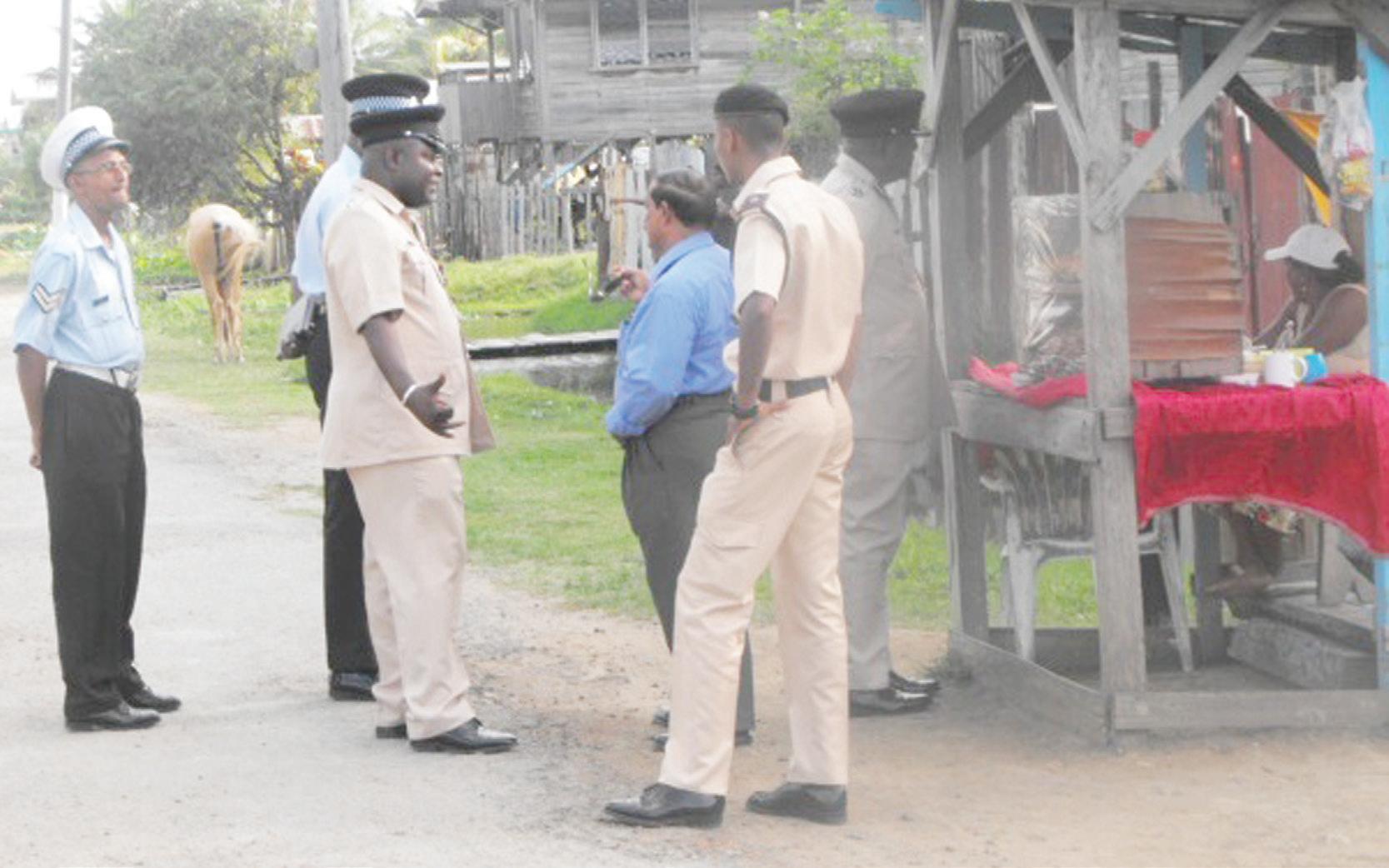
is most welcomed and it is their hope that this exercise will continue at least once per month. Joseph assured that this exercise will be continued and told the residents that he is always available to anyone in need of his assistance.
The walkabout was also done in the communities so that police can hear the views and listen to the issues and complaints and needs of the residents in terms of safety and secu-
rity.
Stacy Johnson of Church Street Dam, Angoy’s Avenue, expressed delight that the police had visited them on friendly terms and not only when there is a crime or lawlessness in the area.
“This is something very nice, I feel good about it and I feel safe now,” she said. Meanwhile, over at Rose Hall Town, ranks visited several businesses and residential homes
in order to listen to their concerns and also to assure them that the Guyana Police Force (GPF) has their safety at heart. Both businessmen and residents commended the police for taking the time to visit and interact with them at the ground level and most of them were able to speak one to one with the commander. Similar exercises were done in Region Five and the Upper Corentyne and Springlands areas.

Ranks in the upper Corentyne area with residents
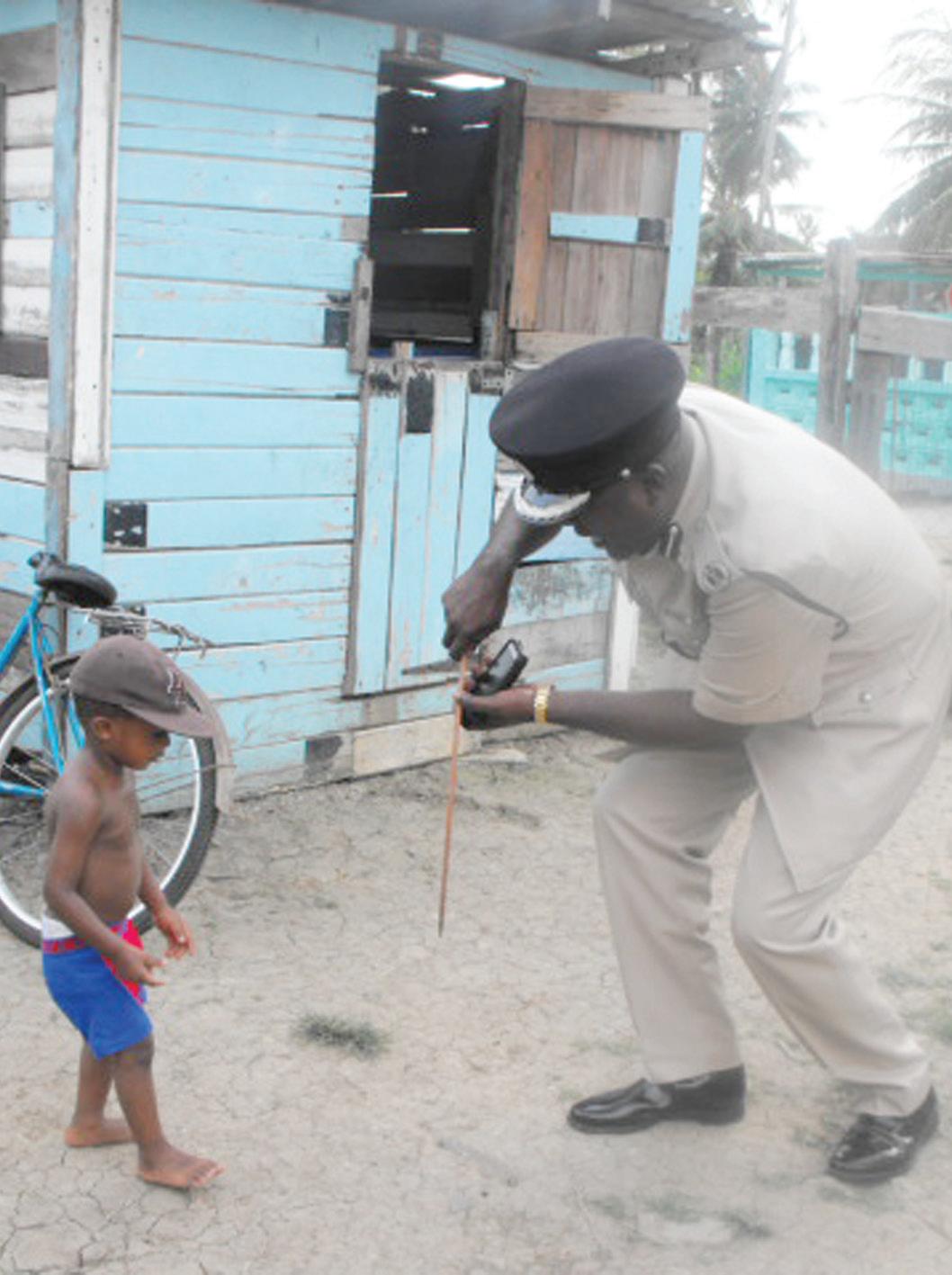
Commander Brian Joseph interacting with a child in Angoy’s Avenue
Police ranks during their walkabout in Angoy’s Avenue, New Amsterdam
Who killed “Vishal” Poonwassie?
When 33-yearold Nankumar Poonwassie called “Vishal” and “Darshnie” left a party to head home, everyone thought he would have reached safely and they would see him the next day as they usually would, but what they were met with the following morning left all in a state of shock.
“Vishal’s” battered body was discovered in a pool of blood bracing a metal pipe in a street in Port Mourant, Berbice. At the time of his discovery, he was wearing plaid short pants, and a white T-shirt.

Nankumar “vishal” Poonwassie
From all indications, the man was making his way to his lot 132 Tain Settlement home. It was reported that he was last seen in the company of a male. The incident occurred on November 26, 2013 and to date, no one has been held accountable.
The question family members are asking is how could a person just end up dead after happily entertaining others the night before? Was someone jealous of him, who was responsible for his death?
The family are still mourning and are trying to come to grips with his death as they described “Vishal” as a person who was friendly to everyone, willing, always loving and caring and a man who had no enemies.
Aunt of the dead man, Dato Poonwassie said she last saw her nephew two
weeks before his demise, when he performed a function at a Mandir. She related on the morning of November 26, 2013, she received a call from a woman who lives in close proximity to “Vishal” informing her of his murder. She said, “I left right away and went to see him, I couldn’t believe that was he, was blood all over his face”.
Dato Poonwassie added that the sight of her nephew’s dead body brought memories of her sister who was also murdered sometime back. She further added that to relive the entire ordeal was devastating and opened the door to many questions. She is pleading with the police to fast track their investigation.
What is baffling to many is why investigators have not been able to solve the case since it was report-
ed that a piece of wood with blood stains, suspected to be the murder weapon, was retrieved at the scene. In addition, an autopsy performed on Vishal’s body by Dr Nehaul Singh at the Georgetown Public Hospital Mortuary revealed that Poonwassie’s cause of death was strangulation. Potential suspects were also questioned but investigators have been unable to crack the case.
According to the police, based on reports and information received, the police have launched a manhunt for the man who is suspected to be from the same village. Commander of B Division Brian Joseph has stated, “We know who the person is but we have to find him”.
A cousin of Poonwassie who resided with him at the Tain Residence, stated that “Vishal” generally did not come home late, so when 22:00h passed, he placed a telephone call to him but was disconnected. He noted that several other calls were made the said night but all were unanswered. Nandkumar Poonwassie leaves to mourn his father and four siblings.
UCCA making big impact on cricket in Corentyne
The Upper Corentyne Cricket Association (UCCA) has been mak ing a big impact on the devel opment of cricket in Berbice.
The association which was resuscitated last year after being defunct for sever al years has been making big waves in the cricket fraternity, while allowing hundreds of players to be involved in organised cricket for the first time in close to a decade.

At the recently held Berbice Cricket Board (BCB) 2013 awards ceremony, the association was awarded for its remarkable stewardship of cricket in the Upper Corentyne area and working beyond the call of duty.
Public Relation Officer (PRO) of the BCB Hilbert Foster noted that the UCCA, “took proper care of the Upper Corentyne area,” as it relates to organising, sponsorship and playing of the game.
Since the association was resuscitated last year, they have successfully hosted the Price Is Rite Supermarket 40-over Second Division Competition which involved 26 teams from that area, along with a T/20 competition in which 28 teams took part.
There are 33 clubs in that community with a few still not functioning. Already
West Berbice residents call for more active police presence
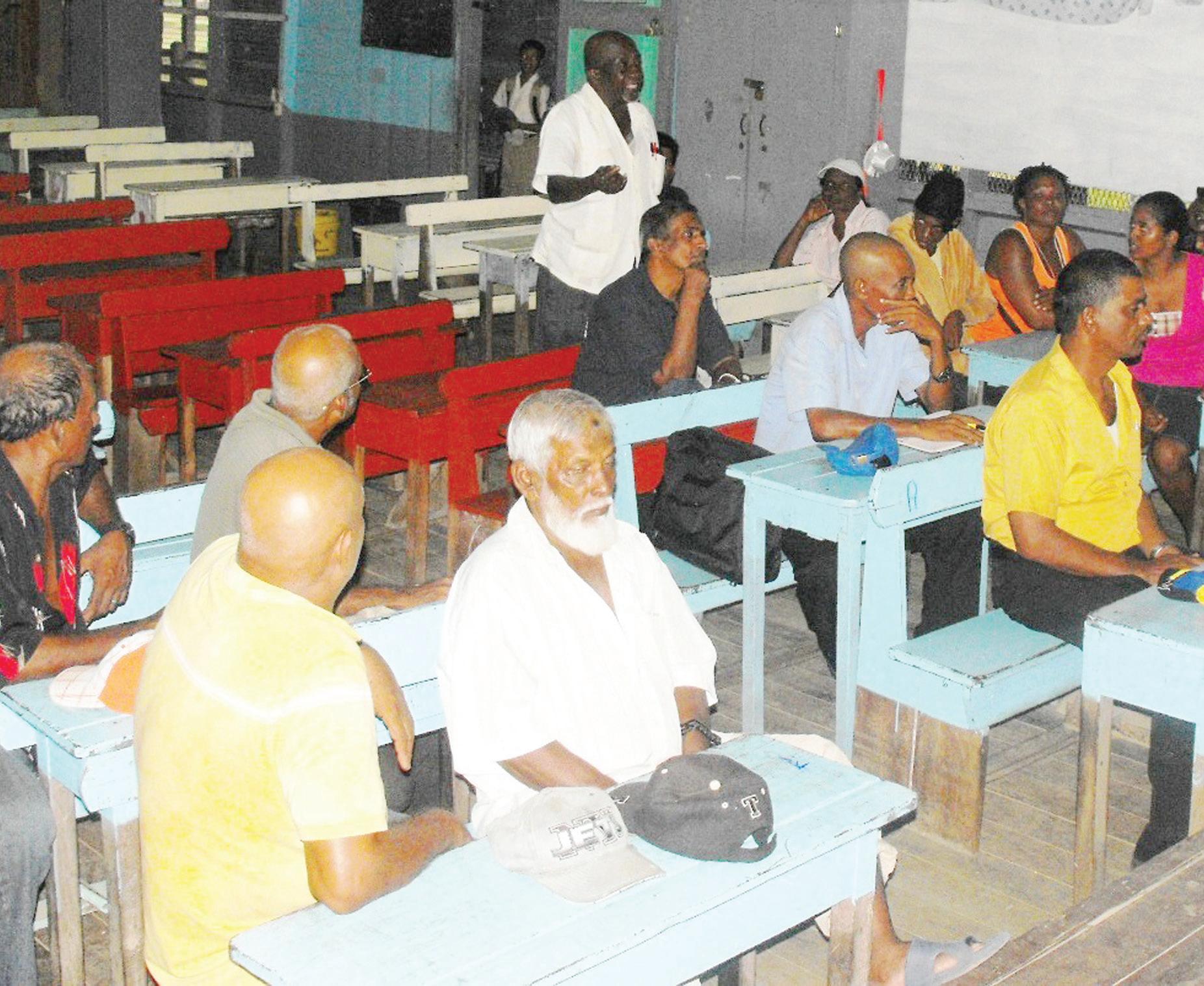
A resident making a point during the meeting
Residents of West Berbice want a more active police presence in their communities even as they complained about a range of issues including noise nuisance and the prevalence of many illegal rum shops.
The call was made when senior police officers in Berbice met with residents last week Thursday. Deputy Commander of B Division (Berbice), Stephen Mansell told the meeting held at the Rosignol Primary School that police officers need to work beyond the call of duty and must not compromise the integrity of the Guyana Police Force (GPF).
when those rum shops are open after the specified time, they become illegal. He instructed Officer-inCharge of Number Three Sub Division to ensure that all illegal rum shops are shutdown. Mansell emphasised the need for active policing groups to support the
ny the welfare officer to ensure the safety of that officer in the execution of his or her duties.” He, however, promised to raise the issue with the relevant department.
this year the UCCA has hosted an Under-17 Inter-Secondary School tournament and will soon be holding a competition for Under-19 players at the club level to be sponsored by Riverton Suites.
The organisation has already received a commitment from two separate T/20 competitions this year.
The sponsors are Guytrac and Price is Rite Supermarket. The UCCA this year has not organised any cricket for the Under-15 level. This will be done until the end of the year. According to PRO of the UCCA Vicky Bharosy, this is so because the National Inter-zone at that age group is played early in the year and in running off a competition later this year; it will give more players from the Upper Corentyne an opportunity of making the Berbice team. Meanwhile this is the first time the Upper Corentyne has six players shortlisted for a trial match to select a Berbice Under-19 squad. The players will be part of a three-day trial match at Albion which commences today and concludes on Wednesday. The highest number of players from the Upper Corentyne to be selected for that trial match was two. The short listing of the six players is being considered a major achievement for the UCCA.
According to the senior police officer, the force also needs the involvement of community policing groups (CPG) if they are to fight crime. The meeting was held with the aim of addressing several of the issues affecting residents as it relates to security. Also attending the meeting were senior officers in West Berbice and Officerin-Charge of Number Three sub Division (West Berbice) and Assistant Superintendent Joshua Harvey-John along with Region Five Vice Chairman (Mahaica/Berbice), Rion Peters.
Among some of the issues raised were the lack of adequate road markings, the need for regularisation of car parks, the formation of a youth club, juvenile delinquency, female officers, alone working the night shift and rum shops being open after licensed hours.
According to Mansell,

Commander of B Division, Assistant Commissioner Brian Joseph
force and ensure that there are always male ranks at police stations, especially at nights.
Residents explained their concern is nover the fact that in some areas, there are children who do not attend school, noting that it could result in criminal activity. However Mansell said that the police cannot address that issue alone but need the Welfare Department of the Education Ministry. “These matters are welfare matters and the police will accompa-
Meanwhile, HarveyJohn stressed the need for Rural Constables (RC) to be of more assistance. Responding to reports that there are not enough patrols at night, the Assistant Superintendent said RC’s need to play a more active role in policing. “That is why we are asking for RC’s to come out…”
Some residents were very critical of some CPG members saying that they only carry out arrests when they are under the influence of alcohol. According to Mansell, if there are issues that residents feel are not being addressed in a professional way, they should approach the officer in charge of the station. If that fails, then the Officer-in-Charge of Number Three Sub-Division Harvey-John and if they are still not satisfied they can go to him directly or the Commander of the Division, Assistant Commissioner Brian Joseph. “There is also the OPR [Office of Professional Responsibility] and the Police Complaints Authority.” He noted that police officers need to conduct a tougher investigation when dealing with a matter. “Not always the person who comes to the station first is right. The other person also has a story…” Residents were high in their praise for initiatives taken by the police.
Matthias meets Berbice clubs
- promises help
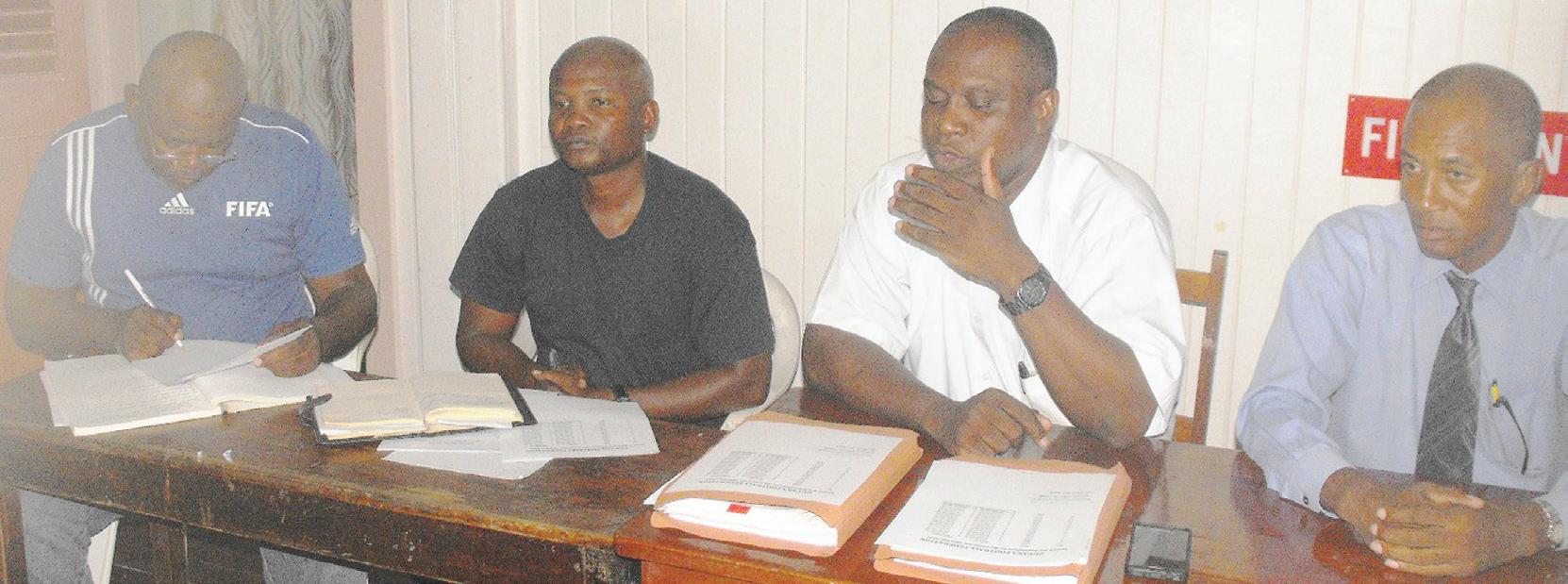
President of the Guyana Football Federation (GFF) Chris Matthias is encouraging the Berbice football Association to have the game of football played on a regular basis.
To this end, Matthias met with football officials and club representatives in Berbice on Friday evening to plot the way forward. The GFF President visited along with
Keith O’Jeer who is in charge of football infrastructure in Guyana and currently acting head of the Technical and Tactical Committee.
According to Matthias, the visit was an effort to re-establish what the Guyana Football Federation is doing as it relates to the development of football in a structured manner towards the development of the game as mandated by
Fédération Internationale de Football Association (FIFA), Confederation of North, Central American and Caribbean Association Football (CONCAF) and the CFA.
He expressed the need for the Berbice Football Association (BFA) to have appreciation for structure and the BFA is being regarded as the pioneers as it relates to

structure. Under his stewardship, clubs in Berbice as well as all the clubs in Guyana,

expect good governance and strict accountability as they develop. “We will ensure their holistic development in terms of the courses that we introduce them to and in terms of the resources made available to them because it is all about football development.”
According to the Federation’s boss, all sub associations should organise the playing of the game at the league level as well as the knockout level for clubs annually. Most of the clubs under the umbrella of the BFA and more particularly those on the Corentyne and in New Amsterdam have not been actively involved in the game through the structure of the
BFA.
Matthias said Lagging sub-associations under his presidency will be afforded the necessary resources. “Human resources, financial resources, equipment or whatever it takes to have the game played we are committed to that.” Many of the clubs in East Berbice will be eagerly looking forward to that, while at the same time, focusing on whether the President of the BFA Clay Flatts will have them more involved in football in Berbice.” Meanwhile, O’Jeer took the opportunity to present to the BFA a quantity of equipment to be used for the training of the Berbice Under-19 squad.
Scotiabank/ Pepsi
Despite their poor showing in their opening game in the competition, Berbice Educational Institute (BEI) has held their own to stay on top after the first half of the Scotiabank/Pepsi Schools Football Academy Berbice Zone.
BEI are jointly heading the points table on six points. Berbice High School (BHS) who went down to BIE when the two teams clashed in game two on the Berbice leg, have bounced back well to head the points table. However, they have played one more game than BEI.
Tutorial Academy Secondary School (TASS), New Amsterdam Multilateral School (NAMS) and Vryman’s Erven Secondary School (VESS) are locked on three points each. However, VESS played one more game than TASS and NAMS. The latter of the three (VESS) will only have one chance when they come up against BEI when the schools meet, but judging from their last performance when they received a 7-1 hammering from BHS, this seems very unlikely.
TASS on the other hand, still with their hopes up of winning the Berbice leg, will only be able to do so if BEI loses one of their three remaining matches. It is highly unlikely that they will lose to Canje Secondary who has lost all their games so far and are still to register a point on the points table. If BEI loses any game henceforth, BHS will be on top because of their high goal difference. The competition continues on Tuesday at the Esplanade Park in New Amsterdam.
O’Jeer handing over football gear to President of the BFA Clay Flatts while Secretary of the BFA Joseph Simeon (left) and President Matthias look on
Left to right: Secretary of the BFA Joseph Simeon, President of the BFA Clay Flatts, President of GFF Chris Matthias and Keith O’Jeer