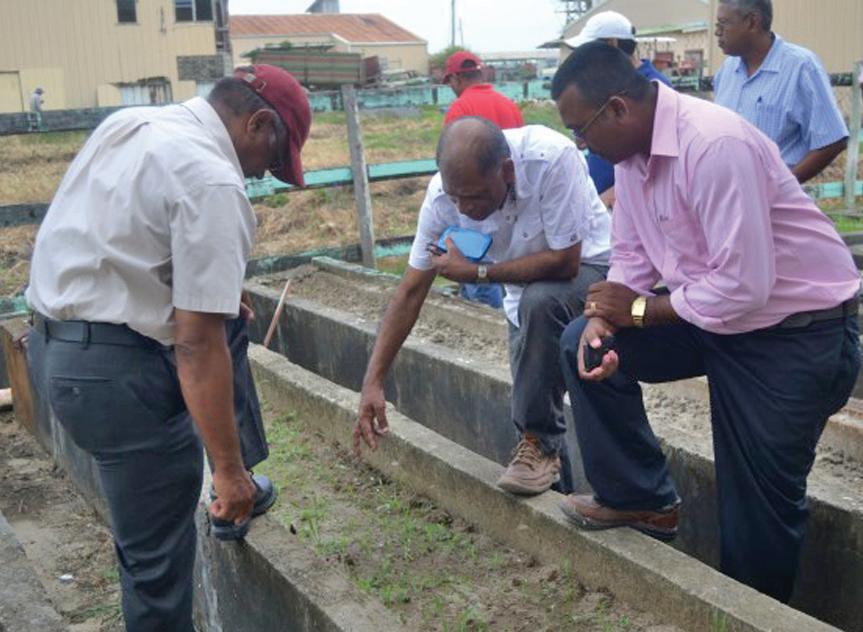
Agriculture Minister, Dr Leslie Ramsammy; GRDB General Manager Jagnarine Singh; and Chief Scientist, Dr Mahendra Singh inspect a nursery at the Burma Rice Research Station during a tour of the facility last week
There are several young unemployed graduates facing the constraints of finding employment in Berbice.
Three years after finishing her Degree in Public Management at the University of Guyana Berbice Campus (UGBC), one young lady said she is still seeking a job.
Shaneeza Bhux, 27, of Belvidere Settlement, on the Corentyne, said she completed her degree in 2012 and applied for a job at over 22 places, however, there has been no positive reply.
“I was a cash student at the UGBC, I spent over one million dollars for tuition and other fees and upon completion of my studies, I am still sitting at home contemplating my next move,” she stated. Bhux, who recently got married and is expecting her first baby, said it is a difficult time for her as she has to solely depend on her husband’s income for their daily needs.
“It is very difficult, because when you are newly married you have to start a new life, we just purchased a plot of land, we have a mortgage at the bank and that is putting a lot of pressure on him,” she pointed out. The young woman noted that if she was employed, she could have rendered some assistance in terms of paying their mortgage at the bank.
Unemployment is an issue that affects everyone, she said, and not just A Partnership for National Unity, Alliance for Change or
People’s Progressive Party/Civic supporters, it’s about all Guyanese.
“Berbicians are employed by GuySuCo and they try their best to educate their children and most of their salaries are small, but they try their best to send their children to school and educate them… they commit themselves for their children to have an education and when they complete their studies, one would expect them to have a job,” she lamented, adding that currently, there are no job opportunities in the Ancient County.
Her advice to youths is “education is the key to success, nobody can take education away from you, continue to study and speak out for your rights… let all politicians know that we are at our wits’ end
and we need jobs”.
She opined that it is due to the unemployment scenario that graduates are migrating and the country is left without its educated human resources and the less educated remain to propel the future.
“Education is good yes, but the Government ought to take drastic measures in terms of employment for Berbicians, if you need a job you have to go to Georgetown, everything is there… we need something more for Berbicians, if we are your stronghold, then you have to do something for the youths,” she charged, and stated that if something is not done to assist youths in Berbice, they would not give their votes.
While commending the
Government for the dynamic low cost housing schemes across the region, she reiterated the importance of becoming gainfully employed. “If you don’t have a job, how do you pay for these things, how do you build… jobs, jobs, and employment for youths are vital,” she concluded. Meanwhile, CSEC students are facing the same dilemma as they too are suffering the consequences of the unemployment scenario.
Haresh Chandradat, 17, of Lot 194 Section B, Number 72 Village, who attended the Line Path Secondary School, graduated two years ago with 10 subjects, Grade Ones to Three with Mathematics and English. He also boasts several certifi-
By Andrew CArmiChAel
Asurvivor of a minibus accident is now recovering from her injuries five years after.
“People are now telling me that I am now walking normal but I feel that since last year, I am walking normal,” Annelly Arthur of Rose Hall Town told Berbice Times. She was in a minibus which slammed into the back of an unlit paddy truck on the evening of November 21, 2009, at De Hoop, Mahaica, East Coast Demerara, killing five persons and injuring seven.
Arthur suffered a fractured pelvis and was incapacitated for years. At that time, she was just 17 years old and had already started a business of her own as a cosmetologist. Today she is out of a job. “I badly need a job and have been applying everywhere,” the young lady said.
The young lady who secured eight CXC subjects said: “I sent applications to so many places that I can’t remember all of them.” According to Arthur, most of the places that she applied to for work, including sev-
cates with an A+ at the ICT level where he would attend classes.
Even though he is fully qualified and equipped to enter the working arena, he is still standing on the threshold waiting for the doors of employment to be opened.
“I spend my time looking for gainful employment, I have made applications; however, there seem to be no jobs available,” he said. He is hoping that pretty soon something will be forthcoming, since he is still dependent on his parents for funds, even though he has completed his education. This, the young man said, is very embarrassing.
Another CSEC graduate, Ashika Tirkha, 18, of Lot 147 Line Path B, attended Skeldon High School and graduated in 2012 with seven subjects.
She disclosed that upon completion of her CSEC studies, she tried to gain employment; however it was futile. “I trained with SIMAP at the Skeldon Hospital in 2012 as a nurse aid; however, when I complete the training, I decide to remain and volunteer,” she disclosed, while pointing out that within the entire time, no stipend or allowance was forthcoming and since she needed money, she had no choice than to leave.
“I really need a job, I cannot ask my parents or anyone else when I need something, it’s hard to depend on people when you know you are educated and can work… how much will I depend on others, I really need a job,” she pleaded.
eral governmental agencies did not even reply to her applications.
As she told her story, tears settle in the eyes of listeners. She says that she can’t remember anything of the accident. “All I could remember is going into the bus at the park in Georgetown.”
What she vividly remembers is that a female passenger did not want to go into the seat the conductor was placing her and Arthur took that seat.
The passenger took the front seat and was one of the three who died on the spot when the accident occurred.
The then teenager woke up at the Georgetown Public Hospital where she spent one week before being transferred to the New Amsterdam Hospital where she spent three more weeks hospitalised.
After her hospitalisation, Arthur was confined to a wheelchair for the next three years. Today she sometimes still feels pain in her pelvis.
Although she still plies her trade, but on a very small scale, Arthur said that she would like to get back into business again, but for her that is way out
of her reach. “I have some of the stuff that is needed but there are a lot of things that have to be bought... if I am to set-up on the road and most of all… the rent I will not be able to afford that, so I just want to work because I am a young lady and I need things.”
However, getting that job has not been easy for the young lady who had no control over what happened to her. “I applied to Guyana Water, Rose Hall M&TC, GuySuCo three times, NIS… is everywhere I apply. The only place that I didn’t apply was GPL and Banks DIH, the commercial banks and GT&T.”
The frustrated young lady said that she only received a response from GuySuCo and that was on one occasion. “I even apply to teach and never heard from them, but I never applied to do nursing because I don’t like it.”
Determined to keep herself occupied, Arthur is currently perusing studies at the Institute of Distance and Continuing Education (IDCE) in the field of social work.
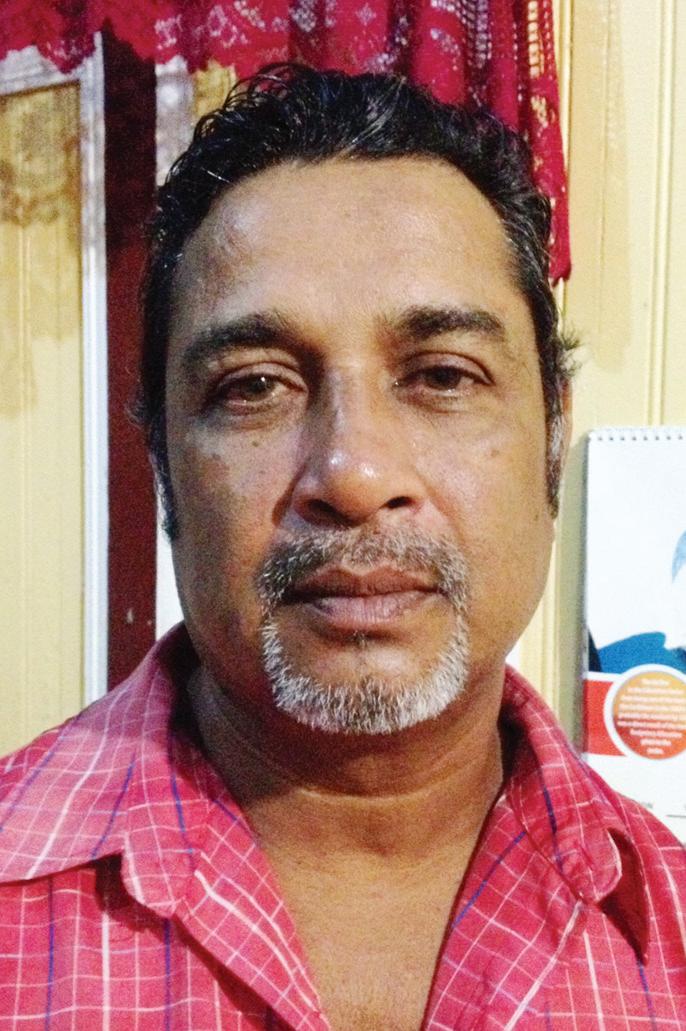
Shaneeza Bhux
Asheeka Tirkha
Haresh Chandradat
Chief-of-Staff of the Guyana Defence Force (GDF), Brigadier Mark Phillips said that one of the biggest challenges facing the organisation was its lack of human resources.
Phillips made the comment to Berbice Times during a recent visit to New Amsterdam to check on works being done on a new
like other vocations, where you can simply opt out as you please. Those who stay away from duty without authorisation and permission are imperilling the future of the army, affecting the security of our country and short-changing the taxpayers whose hard-earned dollars have provided for their training,” Ramotar had said. Phillips alluded to the
get a brief on the current activities of the soldiers here and at the same time, give some direction and instructions in which they can improve their profession,” he stated.
Speaking about the ongoing construction of a new base at the Esplanade Main Road in New Amsterdam, the Army Chief said this facility will improve the ac-
arise at any of our bases at the shortest possible time,” he asserted. Chief-of-Staff, Brigadier Phillips is now in his 30th year of military service and took the opportunity to send out an appeal for parents to encourage their children to join the army and serve with dedication.
base. The GDF’s strength has long been an issue and though the force recruits soldiers every year, a number of them abscond or resign owing to a number of reasons.
In a recent address to soldiers, Commander-in-Chief, President Donald Ramotar noted that the GDF continued to face many challenges, but he was confident that the current leadership of the army would take the necessary steps to address them. He, however, expressed concern over the number of soldiers who are listed as Absent Without Leave (AWOL). He reminded that, “Military service is un-
issue in his interview with Berbice Times, saying that he “thinks that the biggest issue in the army is it being under strength…”
In addition to checking on the base under construction, Phillips also paid a visit to the Army’s Base Camp Costa Battalion located in New Amsterdam, to inspect the living conditions of his officers based there and to make decisions in which to improve those if necessary. He also disclosed that as part of his approach in terms of ensuring a vibrant disciplinary force, he has decided to meet and interact with his staff at the grass root level. “I am here also to
commodation of staff. The new base he said is to “improve the accommodations for the soldiers because Camp Costa is a very old building that has been in existence for over 30 years so the new base is being constructed to house our soldiers in New Amsterdam.”
Since being appointed, Phillips says he does not sit in his office and direct operations only but rather, goes out and meet with soldiers, interacting and listening to them. “I need to know their issues first hand...” he told Berbice Times. According to him, with the support of his officers, “we are dealing with every issue that may
Despite piecemeal interventions by Government to secure markets and better prices, rice farmers, including those in Berbice, are still fearful about their livelihood as harvesting of the spring crop gets into full swing.
As the reality starts to step in, the farmers are beginning to panic. Traditionally, the best prices paid for paddy come early in the harvesting season. What millers are offering to farmers who have paddy for sale is not sufficient for them to meet their obligations to financial institutions and their employees.
Many farmers have already calculated this as a lost crop. When the 2013 spring crop started, millers were offering farmers between $3800 and $4000 per bag of paddy depending on the grade. By the end of that crop, they were receiving just over $3000 per bag. Now as farmers begin to sell their paddy for the 2014 spring crop, they are being offered $3200 per bag. “That can’t pay,” One farmer told this publication. However, he is not as worried as rice farmers who still have their paddy in the fields and do not foresee it being harvested within the next three weeks.
Deonarine Arjune of Number 64 Village is one such farmer. “If dah is wah dey geeing now, wha gon happen to me wen me start cut? Dem mighten even wan take am.” The big fear is that millers might not have adequate markets, a prediction made by Region Six Chairman David Armogan recently.
No comfort
Berbicans, he said, can benefit tremendously from joining the GDF as he pointed to one of his officers who originated from the Ancient County. “We have a Berbician here, Lieutenant Colonel Arthur, born, grown and educated in Berbice and he is a standing living example of the opportunity that is available in the Guyana Defence Force and he has about three master’s degrees right now, so that’s the GDF,” Phillips boasted. “So… come now, come join the Guyana Defence Force now, know your country and you get an opportunity to learn a trade to attend the University of Guyana and more specifically, to develop yourself professionally,” he said.
He revealed that the GDF is currently executing a massive recruitment drive countrywide and two large recruit courses are slated to take-off this year to have new soldiers for all the units of the force. He also told this publication that his aim and focus is to strengthen border security, while reiterating his commitment to his country to work towards a more vibrant, active and professional regiment.
Farmers are taking no comfort in claims by millers and Government officials that everything will be alright. Agriculture Minister, Dr Leslie Ramsammy had been on record as saying that “all of the traditional markets are still open and operations are progressing smoothly…”
Ramnarine Singh, who is cultivating three plots of land, said he was still indebted to the bank for money he borrowed last year to invest in his fields. He said after he received excellent prices for the first crop last year, he was able to borrow money to purchase an additional tractor and rent one plot of land (15 acres) to increase his production, as did many other farmers. The Regional Chairman noted that increased production in the second crop fuelled by investment meant that 200,000 tonnes of rice were left in storage last year.
According to Singh, apart from the investment of a tractor (a 2013 loan), he has borrowed just over $3.5 million to cultivate the 2014 spring crop. Referring to the 13 bags per acre some farmers have averaged this crop, Singh said the money garnered will not be enough to repay his loan for the 2014 spring crop and it looks like the bank may soon be coming for his new tractor. He says he is likely to receive just over $2 million, based on what the mills are currently offering.
Meanwhile, Guyana Rice Producers Association President Leekah Rambrich says this will not be a farmer’s crop, explaining that some farmers will be producing at a loss for this crop and some will be making very little profit.
Chief-of-Staff, Brigadier Mark Phillips and his soldiers visits Berbice
The new army base under construction
Truth
There is the annual crawl to Berbice to commemorate the death of Dr Cheddi Jagan. Our current politicians will come and do what they do every year. They will extol the virtues of this humble man from Ankerville, Port Mourant. This good, kind man of conscience. This man of Berbice and Guyana whose word was as good as gold.
Cheddi respected Berbicians not only because this was his political base, but because he knew from the inside that Berbicians deserved respect. He did not need some event to visit. He came home. One supposes that we all do that – come home to refresh ourselves when the world renders us weary. It is good and appropriate that we pay homage to such a man. It is even more fitting that we honour his service to this Guyana. One may disagree with Dr Jagan’s political ideology, but we may all agree that he was a man of honour, a man who listened to the people, and had their best interest at heart.
The homage we pay to Cheddi should not be paid for one day. Rather, it should be paid in our very words and deeds, in the way we carry ourselves and the way we serve our nation. Berbicians were never disenchanted with Dr Jagan. The respect we had for the man was the foundation of our belief in what he did and tried to do. Our respect overcame our doubts.
These days, our doubts have become bitter cynicism. Simple numbers show it. In 2008, there were large crowds at Babu John to partake in remembrance. In 2009, still a significant crowd. The crowds have got progressively thinner. And the progressive lessening of the numbers is not because of fatigue. It is not because we have forgotten or wish to forget Cheddi’s contribution and his honour.
Our numbers grow thin because Cheddi’s dreams for Berbice and Guyana seem to grow distant. Distant as light fading to just a memory and life is “Dark as a funeral scarf from stem to stern” (Alfred, Lord Tennyson, if anyone cares).
And we citizens grow almost irrelevant or invisible because our leaders are as Paul becoming Saul, with their seeing eyes blinded now by scales. The more blind they become, the more insubstantial become our lives and the lives of our children.
Dr Jagan’s dream was for us to be independent, to be a nation that determines its own destiny. Every beer bottle broken wilfully upon the strand of road in Berbice represents Dr Jagan’s dream: a thing in shards, sharp to the gentle touch of hope, sharp enough to draw blood.
On October 5 of last year, there was a gathering sponsored by the PPP/C to celebrate decades of democracy that was returned to Guyana. It was held on the UGBC tarmac. No more than 300 people showed up. Cheddi’s party having an event in Port Mourant! And just a sprinkle of people.
This year at Babu John, the crowds grow thin, like Berbicians’ belief in anything that any politician says. Is anyone seeing or listening?
Efforts are being made to increase the productive capacity and diversify the portfolio of farmers in the Mara, East Bank Berbice area.
This community was once the second main agricultural community in Berbice. However, owing to the deplorable state of the road and the lack of other basic facilities many of the residents have migrated to urban areas. This has had a negative impact on the community since the Region Six Administration has not been carrying out major infrastructural works in the area.
This has in turn made it more difficult for those who remain to eke out a living on farming. In an effort to assist those farmers, the Caribbean
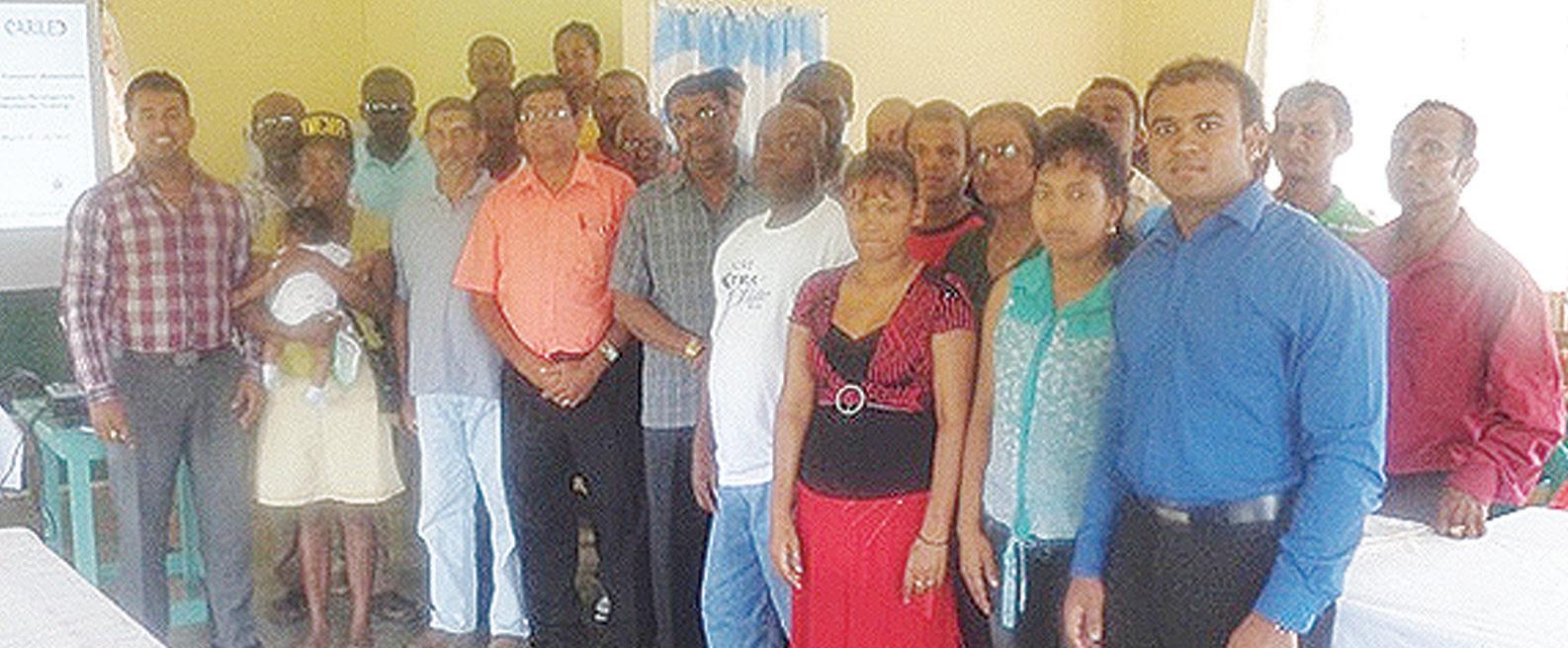
Local Economic Development Project (CARILED) recently helped the farmers attain much-needed skills to enhance their production.
This was done through a one-week workshop which focused on low-cost production techniques, small farm management, good agricultural practices in preventing and controlling contamination of fresh farm produce, and postharvest handling of crops with the main focus on preventing post-harvest crop losses.
The workshop, which was attended by 30 farmers, also focused on the development of marketing operations and new production techniques. The workshop was facilitated by the Inter-American Institute for Cooperation on Agriculture (IICA) Specialist
Speaking at the closing ceremony of the workshop, Region Six Chairman David Armogan commended participants for recognising the importance of continuous training and urged all to see agriculture as a business and not just a subsistence way of life. He said the farmers need to focus their attention on the impact of globalisation and international competition.
Armogan urged the farmers to adopt the new technologies and modern agriculture practices discussed as they are the way forward for success in agriculture as a business.
Mara Farmers’ Association Chairman Ovid Phillips expressed sincere
Three former employees of the Guyana Oil Company (GUYOIL) are bewildered after a court matter was discontinued with them, even though they made a court appearance.
The former security guards had sued the company for wrongful dismissal and the matter was set for hearing before Justice James Bovell-Drakes on February 6 in the Berbice High Court. The trio had secured the services of Attorney Murseline Bacchus and were each claiming damages in excess of $100,000 for wrongful dismissal committed on June 30, 2010.
The men, Wayne Taylor, 46; Edward Joseph, 60; and Gary Trim ,59, say that when they went to visit their attorney, they were told that they
did not have to appear and the company was obligated by law to pay them the equivalent of two months salaries each.
According to them, their attorney said that under the laws of Guyana, in such cases of wrongful dismissal, the employer has to compensate the employee the equivalent of two months salaries. “We were home for three years and the matter did not even go to trial. We are not satisfied with what happened,” Joseph said.
They say that the cheques were already prepared and all they had to do was to uplift them. “We want to know how much money GUYOIL gave to him,” Taylor asked. Documents at the court revealed that the matter was withdrawn and discontinued.
The men are asking for answers since they were not part of any negotiations nor were they informed that a settlement was being planned. “We have been home for three years and now they come and push two months salary in our hands… it is not fair,” Joseph argued.
Meanwhile, in a response to the statement of claim in the writ, the company through its Attorney Abdool Kadir claims that the three worked at the Heatburn Terminal in Berbice and between June 1-2, 2010, the three failed to prevent the stealing of fuel or deliberately allowed the fuel to be stolen.
The men are claiming that the fuel was stolen from a vessel which had its own security and they had no ju-
gratitude on behalf of the members. He noted that the Association is extremely grateful for the opportunity to receive such training. Philips expressed thanks to the Local Government and Regional Development Ministry; CARILED; the Regional Democratic Council; IICA; the National Agricultural and Extension Institute (NAREI); and the participants for making the workshop a grand success. He added that the training will tremendously improve the lives of the farmers.
Most of the vegetables and fruits sold in the New Amsterdam Market come from Mara and villages surrounding that community situated 26 miles away from New Amsterdam.
risdiction over that vessel. However, the matter was not brought to trial.
Taylor says that the company has admitted that they did not steal the fuel but he is being victimised because he was dismissed. “I went to GuySuCo, I was employed as a security, I worked three days and they received information which suggests that I stole fuel from GUYOIL and they dismissed me immediately.”
According to him, this is one reason why they need the court to make a ruling so that they can clear their names. Meanwhile they are seeking a way to take the company back to court so that they can be compensated for the embarrassment caused and for their names to be cleared.
Professor Daizal Samad
Arnold De Mendonza.
Mara Agricultural Enhancement Project (MAEP) – Farmers’ Training Workshop
Forty-two-year-old Shimoon Khan of Number 55 Village, Corentyne, Berbice, was like many other women seeking job opportunities, so when she heard of the training classes for sewing at the Roadside Baptist Skills Training Centre, she grabbed the opportunity.
Today Shimoon is one of the most thriving and successful seamstresses in the Upper Corentyne Area.
In 2002, she received a six-month sewing course in fashion designing and tailoring, and while her business started out relatively small, it grew over the years through word of mouth. As a result of her growth, she has invested in more machines to cater for her clients’ needs that range from schools, churches and business places.
She said she is very thankful for the skills gained as it has made her a better individual. Shimoon added that the look of satisfaction on her customer’s face is what gives her the courage to continue every day. This is just one of the many success stories of the Number 68 Roadside Baptiste Skills Training Centre located at Number 68 Village on the Corentyne Coast, where the organisation has touched the lives of thousands of people and has helped to make them entrepreneurs or more marketable in the field of employment by providing the necessary skills.
The mission of the organisation is simple: To improve the quality of life of people by creating opportunities for youths, men, women and the elderly, to build life and job skills through the provision of quality adult education, skills training and social services. This of course is no easy task and it takes a team of dedicated staff and volunteers who work around the clock to pull it off.
The centre has attracted thousands of people of all ages, ethnicities and religion from across Berbice starting from as far up the Corentyne River such as Orealla and Siparuta to West Coast Berbice. It has a strong support base from Black Bush Polder as well. Some of the programmes offered includes: skills training in electrical installation, plumbing, masonry/carpentry, remedial classes for school dropouts starting from the alphabet, full-time CSEC classes, information technology classes, peer education/counselling in HIV/AIDS, suicide etc.
To have an organisation that offers all the above mentioned courses and
more did not happen overnight, it took years of planning. Berbice Times sat down with the Director of the Centre Yetrawattie ”Nalini” Kathryan as she recalled how it all got started.
“The idea for the skills training centre came about as far back as the 1970s when people attending the Baptist Church used to approach us with their difficulties or problems faced by their neighbours, friends and relatives, so we decided to start an outreach programme, primarily for church members. While going around, we realised that people in the communities were suffering from various social ills and decided to do a needs assessment survey to find out what can be done to help make the situation better. The results were frightening as people were begging for social programmes, especially women.”
Mrs Kathryan along with her husband Pastor Almond Kathrayan and members of the church decided to make a difference and pooled their financial resources together, starting a homemaker skills training programme to target disadvantaged women. They also opened a small library in the church that was open to the public. These activities were done in the church building itself.
According to Kathryan the first course offered was cake decorating, “We had 20 peo-
ple registered to start, however, more people showed up and we were forced to move out of the church to accommodate everyone. As word spread, more and more persons got interested... we started offering other courses that required little or no financial resources such as crouching, knitting, sharing recipes, etc. The idea was to get people’s minds off of problems to help them recognise it’s not going to do any good to sit and complain or crying; get involve in meaningful things and in doing so people were able to receive counselling and guidance.”
As things started to pick up, an application was made to have funding for a building to house the library to cater for the growing demands of the reading class and a request for the lower flat to be enclosed for a skills training centre. The donor was worried that the funds would not have been enough for the library, however the Kathrayans and the members of the church all chipped in and did the work without having to pay for labour and saved enough to enclose the lower flat for the skills training centre.
In September 1995, the Road Side Baptist Centre was officially opened by the then Education Minister, Dale Bisnauth. The first courses offered in the new facility were sewing and cake decoration which attracted 50 women in the first batch.
As more people came on board, so were the number of programmes offered and the organisation moved from strength to strength. The rest as they say is history... the organisation has grown from a small group aimed at helping vulnerable women to one of
the largest non-governmental organisations in Guyana, working hand in hand with several other faith-based and social organisations, the Human Services Ministry, health and education ministries, Red Thread, Help and Shelter, Adult Education Association, and Food for the Poor, among others. They tackle all kinds of social issues such as gender based violence, HIV/AIDS, literacy, suicide, mental health, etc.
The success behind the growth is the organisation’s approach to issues based on needs analysis and the ability to provide solutions to those needs by hosting targeted programmes. The other key area of success is the ability of the centre to retain its base of volunteers hence reducing expenses on salaries for trainers/ facilitators and administrators. The organisation is very thankful for the support of the donor agencies that helped them over the years such as UNICEF, SIMAP, Food for the Poor, UNAIDS, CHF, CIDA, Education Ministry, etc. They are also appealing for more agencies and individuals to come on board to assist in any way possible.
Apart from the formal courses offered, the organisation also has a feeding programme that caters for under privileged children as well as an annual senior citizens luncheon where hot meals, goodies, as well as hampers are shared with senior citizens of the community. There is an annual graduation and prize giving ceremony for graduates of the various courses and programmes offered. This year’s ceremony is billed for May 9, where over 125 people are expected to graduate, excluding the CSEC students.
Taking small steps is a good start for realising your potential. There is an old saying, “You don’t go from crawling to running”. In other words, taking baby steps first is the right thing to do. Challenging yourself on an ongoing basis will lead you to maximise your potential. You remember how last week I talked about taking care of your physical body?
A good way to put this is, maybe 20 pushups were difficult for you before, but now you are doing it without thinking about it. In a situation like this, it is probably a good idea to bump it up to 40. The key point is whenever you feel like something is getting too easy to do, take it up a notch higher.
Narine Dat Sookram
Though there will always be challenges in the way, but no matter how long it takes you to do so, try your best to stay ahead, because you will surely get better and better in whatever you do.
One way to look at your failure is as an opportunity to get better. None of us knows everything and we will not always do things perfectly at our first try. If something did not work, use it as an opportunity to try something else.
However, when things are in your favour, do not be afraid to take credit for your achievements, because you have earned them. It is a good habit to try and keep track of these achievements in your journal, because it will remind yourself that you have made an achievement, and it surely feels good. Keep in mind too that it does not always have to be big, because the small things in life are usually important as well.
Some people have the tendency to cheer others and blame themselves when things are not going so well, because they sometimes believe that their success is out of luck and, therefore, give credits to someone else. Self-credit is not necessarily a bad thing when we deserve it, but looking at failures as a way to grow is a good balance to make improvements to maximise our potential.
The reality is setbacks and failures will happen at some point in our lives, they are all a natural part of our daily lives. The best way to look at it is as a way of showing us what we can do and cannot do or in some cases, it shows us the things we need to work harder on.
If we pay attention to this, it can help us to figure out what we are really capable of, because when you think about it, only we can really determine who we truly are!
Astudent of Cumberland Primary School in Canje is currently hospitalised after he allegedly took an overdose of medication intentionally.
Reports are that the eightyear-old of Canefield, Canje, consumed an unknown substance after he became frustrated with stomach pains he had been experiencing for quite some time now.
According to information received, the child was a victim of a gang fight at his school two weeks ago and was beaten unconscious.
He was taken to the New Amsterdam Hospital where, according to a source, the
child’s mother was told that his heart was ‘leaking’; however, it was later concluded that it was a false alarm. Sources at the hospital reliably informed this publication that the child told them that owing to the constant pain in his abdomen and side which resulted from the severe beating he suffered at the hands of his abusers, he became confused and drank an entire bottle of medication designated for external use only.
The eight-year-old is currently at Ward 1A of the hospital in stable condition. Doctors are closely monitoring his progress.
Training of single parents and school dropouts
Director of the centre Yetrawattie ”Nalini” Kathryan
Metro Office Supplies has made a huge step towards improving health care delivery in Berbice. The company donated two multimedia projectors to the health sector in Berbice to boost training for medical personal at the New Amsterdam Hospital and the Berbice Regional Health Authority (BRHA) which will bring benefits to both Berbice areas.
At a simple handing over ceremony held at the BRHA’s New Amsterdam boardroom, Chief Executive Officer (CEO) of Metro (Guyana) Ava Lindie said the realisation of the donation came from a whisper in her ear at a function at the New Amsterdam Hospital by CEO of the BRHA, Dr Vishwa Mahadeo who told her that the New Amsterdam Hospital needed a projector to assist with the training of staff.
“I was then put on the spot when Dr Mahadeo’s turn came to address the gathering. He boldly announced that Metro will be donating a multimedia projector. So I had no other choice…”
She said after contacting President of the company Ron Ramnarine, the arrangements were made. “I was surprised when I saw that it was two projectors that came for the BRHA.”
health sector between expected performance and actual performance. “Only training would be able to close that gap,” the Chairman said. He noted that it is also important that public private partnerships are being created in Guyana. “One of the things that we are trying to do in the public sector is to be able to build partnerships with the private sector because we feel that it is important that everyone comes on board, especially in an area as important as health. Everyone is a stakeholder in health. The health of every single Guyanese is important for all of us.”
Scientists at the Burma Rice Research Station have been instrumental in the past in releasing new strains of rice which have proven not only to enable farmers to harvest more paddy per acre, but withstand harsh climatic conditions.
According to a Government Information Agency (GINA) release, GRDB 9, 10 and 11, which were released over the last three years became the stars of the industry. Last Wednesday, Agriculture Minister, Dr Leslie Ramsammy visited the Research Station to check on the ongoing progress made thus far, and to get hands-on feek for some of the techniques used by the scientists.
While touring the facility, Dr Mahendra Singh explained some of the tests done on the F4, F6 and F8 (salt resistant) and the new line of varieties which is expected to be released shortly targeting 20 farmers in the initial stage.
“Over the years, we (scientists) at the Research Station have been working to ensure that we don’t only release new and improved varieties of rice, but also varieties which can withstand heavy climatic conditions and still produce exceptionally well,” he said.
Lindie noted that one projector will be used by the BRHA and the other by the New Amsterdam Hospital.
Chairman of Region Six David Armogan noted that training is a very important aspect of public health management. He said the donation is timely, bearing in mind that there is a huge gap in the
The creation of such partnerships, the Chairman said, is important for the development of the health sector.
David Armogan in applauding the efforts of Metro noted that the company had been living up to its corporate responsibility. “I think that they take their civic and corporate responsibility seriously and have always been finding a way to give back to society, whether it is in the form of donations, whether it is in the form of contributing to literary or debating competitions… In every form of daily activities that we find in Guyana, that company has come on board and has been able to help in most cases and today is another demonstration…”
The Region’s top figure took the opportunity to call on other businesses to come on board. He, however, acknowledged that many private donor and public entities have been joining forces with the public sector.
This he said will result in a better quality of service being offered and a higher level of training being provided, resulting in an improved quality of service being delivered.
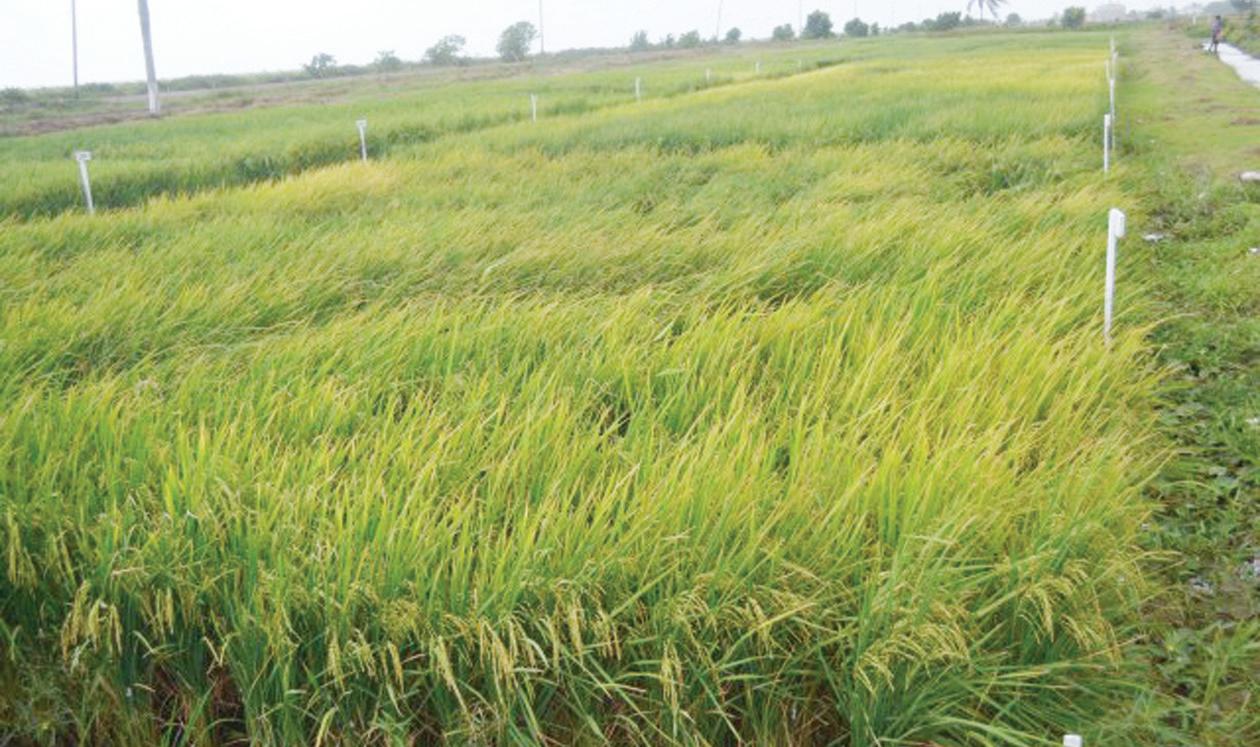
GRDB 11 and 12 have been proven successful in garnering more bags of paddy per acre, while GRDB 9 is known to be more feasible. Apart from tests being done to have more varieties released, the Research Station has also developed various Pedigree Nurseries
where testing for resistance to pest and disease, tolerance to lodging, and blast-resistant varieties are ongoing.
“The Research Station has come a long way over the years, and their work coupled with investment and farmers’ input have
seen the industry propelling…it is the hope of the Government to continue to work with the Research Station through GRDB to have the station evolve by incorporating new techniques,” Minister Ramsammy said.
One of the focal issues in ag-
riculture is climate change, and in light of its effects, the development of new rice varieties is necessary. Climate change impacts negatively on the availability, stability, access and utilisation of food security, and according to Minister Ramsammy, the development of rice varieties which are blast resistant and have high milling qualities can be not only beneficial to millers and farmers, but the industry as a whole.
“Food security is the most vulnerable and as such, it is important that we (Government) continue to push for the right varieties of rice to be developed; hence the reasons for pushing for climate smart agriculture,” Dr. Ramsammy said. The Guyana Rice Development Board (GRDB) has also incorporated the use of the six-point cultivation practice which has also proven successful with farmers across the rice-growing regions adopting it.
The six improved crop management practices include date of planting, density, treatment of seeds, weed control, fertilisation and water management. These techniques are part of the Ministry of Agriculture’s programme of having farmers adopt proper farm husbandry.
CEO of Metro, Ava Lindie making her presentation to Chairman of the BRHA Board, B Poonai
Metro CEO Ava Lindie handing over one of the projectors to CEO of the New Amsterdam Hospital, Allan Johnson
A section of the new rice variety which will be released shortly
Tsolicited the views of Berbicians on their expectations for the National Budget.
Godfrey Persaud – Businessman
“I would like to see a reduction of VAT: in doing so, people will have a better ability to spend. The opening of more industrial sites so as to reduce unemployment. If we get that, it will be great, because people can get involved in productive activities such as canned or dried fruits and that can even be exported. The sugar industry also needs a lot of work. In the area of tourism, emphasis should be placed on creating highways to the interiors so that the tourism industry can be boosted. Guyanese need to be treated to what the country has to offer, because Guyana is beautiful and more can be done to showcase it. The people need to see what Guyana is all about before visiting other countries. There must be proper access to these locations.”
Steve Ramsingh –Garbage collector
“Cost of living is high, so a raise in the salary for public servants would be great; they are the backbone of the country and as such, should be taken care of. In increasing the salary for public servants, especially the Joint Services, it will assist in the reduction of corruption and bribery.”
Jason Manns – Cobbler
“I believe that the budget should be standard not increasing on a yearly basis, because when it is increased and allocated to various sectors/regions, you don’t see much development. Berbicians need lots more opportunities; for example, proper access to the backlands, proper roads and water so that we can go back to farming in the backlands: the trenches have dried up and no proper access. I think if we go back to large-scale farming especially in Rose Hall Town, it would improve the livelihoods of many. Presently, a lot of youths are out of jobs because there is not much opportunities. The private sector nor Government is not doing much in providing jobs for the young people. Nurses, teachers and law enforcement officers should also be paid better. Berbice needs a lot, not just big buildings and roads. I know they have been developing community centres across the region, that’s good and one way to keep the youths involved in sporting activities.”
Farouk Sakur – Farmer
“Government should try to subsidise the cost of fertilisers and feed for poultry, because the feed for poultry is very expensive and if an small farmer want to invest, it is very difficult, so that is one area the Agriculture Ministry should focus on so that farmers can prosper. Many of times, the small farmers feel the brunt of it. In an effort to encourage smallscale farming, Government needs to subsidise these items so that all can benefit. The Human Services Ministry should try to take better care of the elderly and the homeless: create a shelter and provide meals and housing for the homeless. In addition, Government should also focus on programmes where persons who dropped out of school can further their education.”
ARegion Five non-governmental organisation (NGO) is moving to provide education with the aim of reducing the high number of persons who are killed on the roads in that part of Berbice.
Global Youth Movement (Guyana) had joined forces with the Guyana Police Force to make the roads in Region Five a safer place.
The group led the resuscitation of the Region Five Road Safety Association.
The West Berbice Road Safety Association has been non-functional since 2011. At the resuscitation of the association recently, Executive Director of Global Youth Movement (Guyana) Mark Ross noted that the organisation was thrilled to be given the support by the Regional Administration, the Guyana National Road Safety Council and all other stakeholders.
He pointed out that in 2013, there were 112 deaths from 103 accidents; compared to 110 deaths from 102 accidents in 2012. Speeding
was listed as one of the major causes along with inattentiveness and driving under the influence of alcohol.
Ten children, 18 motorcyclists, 13 pedal cyclists, 17 drivers, 22 passengers and 39 pedestrians died on the region’s roads last year. Ross explained that his organisation is very concerned that many victims of road accidents are young people and children. “Road fatalities are predicted to be the fifth leading cause of death in the world by 2030.”
Twenty-two representatives from the Department of Education and Public Works Ministry along with the police traffic departments of Fort Wellington
and Mahaicony, nine Neighbourhood Democratic Councils (NDCs), civic society, the minibus association and the Regional Democratic Council (RDC) met and elected an 11 member executive committee. The committee is headed by Regional ViceChairman Rion Peters, who will be the entity’s Chairman; Mark Ross as Treasurer; Regional Councillor Carole Smith-Joseph as Secretary and Accountant of the Department of Education, Annesta Douglas as Assistant Secretary/Treasurer.
include Regional Engineer Tyrone
Sandra
Dennis
Padmini
Balram Totaram, Keith James a representative from each NDC and one from the department of health. Dennis Stephen is the police representative of Fort Wellington while Mahaicony Police Station is yet to submit the name of their representative. The programme is expected to provide training for members of the association.
The committee members
Ritch,
Chesney,
Baldeo,
Jagnandan,
oday, Finance Minister, Dr Ashni Singh will present the country’s budget estimates for 2014, and Berbice Times
Executive Members of the Region five Road Safety Association pose for a photograph following their election