







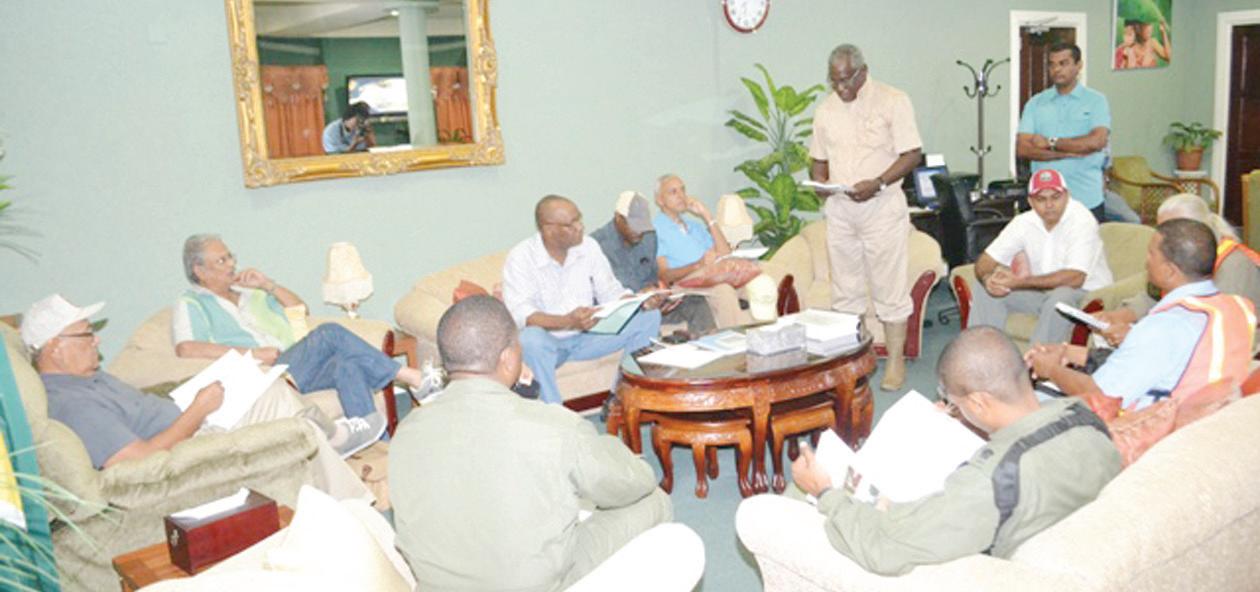
Representatives of the Alliance For Change (AFC) and the A Partnership for National Unity (APNU) which have both expressed reservations about the Amaila Falls hydropower initiative were on Saturday given a guided tour of the project site and the access road.






Describing the visit as timely, APNU parliamentarian Dr Rupert Roopnaraine said the coalition was pleased to have the opportunity to be on the ground, the Government Information Agency (GINA) said. “You see reports but it is only if you’re coming here to see what is actually happening, especially with some of the difficulties involved, that you grasp the project. From what I see reasonable progress is being made,” Roopnaraine is quoted by GINA as saying.
Excellent opportunity
APNU parliamentarian Joseph Harmon remarked that they had been afforded an excellent opportunity to see the road and challenges facing the contractors. “The fact that we have been able to see sections of the road has highlighted the need for government to make this kind of opportunity available for us as members of parliament so that we can get a better understanding of the challenges they face in completing the project… We have asked questions and received appropriate responses.”
The visit was deemed a
signal of “government’s willingness to be more open with opposition members as it was unreasonable to expect their buy-in on a project of such magnitude”, without questions being asked, according to APNU parliamentarian Ronald Bulkan.
For the AFC’s David Patterson, the site visit was “a timely and interesting effort to review the progress on the project and it was much appreciated”. He said he was pleased with the progress on sections completed and his party will pronounce on its findings after a due diligence report is completed by the Inter-American Development Bank (IDB) and a second follow-up visit is done in the next three or four months.
Public Works Minister Robeson Benn, accompanied by his ministry’s top engineering staff, said it was es-
sential for stakeholders to be aware of the efforts that are being undertaken to ensure Guyana’s largest ever project is successful. Minister Benn said the visit was put forward by President Donald Ramotar as a way to let the opposition members have a ‘look-see’ and understand the challenges faced in completing the project.
National interest
“I think we had a significant day in terms of seeing how we as Guyanese could develop our resources, in partnership with others for the further development of our country… in spite of our differences in Parliament or elsewhere, they should only support and not override national interest,” he stated.
In April, the parliamentary opposition voted to cut funding for the Low Carbon
Development Strategy programme under which money was allocated for the Amaila Falls project. Prime Minister Samuel Hinds, who has oversight for the energy sector, had pleaded with the opposition not to cut the budget and explained why such a huge project should not be jeopardised.
He said the cut in the expenditure from the Guyana Redd + Investment Fund (GRIF) will greatly compromise the development and, so, frustrate efforts to provide Guyanese with a much cheaper source of electricity.
At the last post- Cabinet briefing, Head of the Presidential Secretariat, Dr Roger Luncheon stated that amid significant challenges, the end- of -year deadline to complete the all-weather road to the project remains a target.



Editor: Nigel Williams
Tel: 225-5128, 231-0397, 226-9921, 226-2102, 223-7230 or 223-7231. Fax: 225-5134
Mailing address: 238 Camp & Quamina Streets, Georgetown
Email: news@guyanatimesgy.com, sales@guyanatimesgy.com
Bharrat Jagdeo has had, without a doubt, a remarkable tenure as president of Guyana and indeed more extensively as a member of the Cabinet of the People’s Progressive Party/Civic (PPP/C) government. That period of his administrative involvement, first, as a member and then, as leader of government, would have begun when democracy was restored to Guyana in 1992 and ended when his two successive and highly successful terms of presidency came to an official conclusion in 2011.
Now more than a year and a half since he demitted office, Jagdeo is still highly admired around the world and has become one of the most sought-after speakers on environmental, social, and economic issues, particularly those faced by poor and developing countries. Late last week, the Commonwealth Secretary General Kamalesh Sharma announced that Jagdeo will lead a high-level team of experts to identify solutions for unlocking resources to enable small, poor, and climate-vulnerable Commonwealth countries to combat climate change. Prior to this, on June 13, Guyana’s revolutionary Low Carbon Development Strategy (LCDS) was lauded by British High Commissioner to Guyana Andrew Ayre, who described the initiative as a definitive model of what is possible in a densely forested developing country. After becoming one of the youngest heads of state ever, Jagdeo pioneered the strategy, and the country embarked on one of the world’s most environment-friendly sustainable development programmes, while maintaining 99.5 per cent of its rainforest.
During that same week, the government, through the Agriculture Ministry, was preparing to dispatch a shipment of rice and paddy to Venezuela. Guyana and Venezuela would have signed the latest rice agreement, worth some US$130 million, on May 3, but the original pact was initiated in 2010 between Jagdeo and the late Venezuelan President Hugo Chávez as part of an overall ricefor-oil deal.
Earlier in June, as president of the Global Green Growth Institute (GGGI), Jagdeo, addressing world leaders, pointed out that a combination of robust analysis, proof of action, and an informed and critical mass of countries which advocate for systemic international policy change can transform global policies into a reality rather than a vision. He was at the time speaking to member countries at the Green Growth Summit in Songdo, South Korea, and stressed that the world can ill afford failure at addressing global climate change.
Recently, the government has been continuing its quest to equip every household with a laptop through its One Laptop Per Family (OLPF) programme. During one such distribution exercise, Prime Minister Samuel Hinds fittingly attributed the OLPF’s success to former President Jagdeo, who, during his tenure, recognised the need and importance of exposing the Guyanese population to ICT.
On June 5, the former president received the honorary doctorate conferred upon him by Trent University in the United Kingdom (UK), which was his fifth such honour in recent years. Trent University, with a world-class reputation in environmental and resource sciences, water science and biomaterials, conferred the honour on Jagdeo in recognition of his global advocacy for averted climate change through avoided deforestation.
Two days before that, Jagdeo, again on his global campaign to fight climate change, told a high-level Canadian audience that there must be incentives and strong regulations to fix the energy mix, decarbonise sectors, and chart a different pathway to development through a new global agreement. He was at the time one of several panellists at a Trent Centre for Biomaterials Research event. As a consequence of Jagdeo’s initiatives, Guyana is on track to become the world’s number one user of clean energy by 2017. Recognising a global champion of the environment, TIME magazine named Jagdeo a “Hero of the Environment” in 2008. In 2010, he was a recipient of the United Nations (UN) Champion of the Earth Award, and was asked to serve on the UN Secretary General’s High Level Advisory Group on Climate Finance.
In 2012, the International Union for the Conservation of Nature (IUCN) appointed him high-level envoy for sustainable development in forest countries and a patron of nature. He is also now roving ambassador for the Three Basins Initiative.
A very common notion exists about people sometimes not being respected on their own turf, but Jagdeo continues to be honoured and admired not only at home in Guyana, but also in the Caribbean region and beyond, although there are those few , sometimes subtle, sometimes overt, who are bent on tarnishing his image. But clearly such efforts have been unsuccessful.
All the while, Jagdeo has continued to make significant strides post-presidency and gain even more international recognition as a global ambassador for the environment and for his native Guyana.

Dear Editor
As the Home Affairs Ministry’s campaign against noise nuisance gains momentum, more reports are being made by citizens. This is good. I sense a new culture in the making. I say a few words of thanks in this regard, but I have some issues that need addressing.
Many of the young men are now plying the trade of selling compact discs via the cycle and cart method. It is a cute set-up and it does not release carbon wastes into the atmosphere.
However, the noise factor is most troubling. They ride though the streets of the villages and disrupt the people. Many times, they have startled sleeping babies. I once witnessed an adult
slapping up a small boy for this. Something must be done as regards this kind of noise nuisance. It really gets people upset.
I am not advocating a ban on the trade, but I ask that their stereo system be of such that noise will not affect people in the area. Some kind of enforcement of the noise pollution law must be applied here.
By the way, this kind of business, is there any kind of legality to it? I mean are these mobile CD vendors licensed? They sometimes impede the traffic a lot. So it is time that some attention be directed in this area.
I have no apologies too for commenting in another area, that is, of taxi drivers. They apparently get bet-
ter business with the louder systems. I think that a good start will be to target taxi services. Their vehicles should not be equipped with heavy sound systems. This kind of ruling must go across to all vehicles, catering for public transport, that is, the buses too.
Noise has terrible physiological and emotional consequences. Constant hammering at the eardrum can lead quickly to deafness. Then too many times, the quiet easygoing student or worker is upset with the noise in vehicles, to the point that his or her day is partly ruined. People who like loud music have a variety of ways to indulge without infringing on others. They can use their earpieces with their
cellphones.
My final little request is that of many parked vehicles at various junctions – they simply show off their sound systems. Some attention is needed here too.
Now it is good to know that the ministry is denouncing the discomfort and inconvenience experienced by residents as a result of the loud, continuous and repetitive playing of music. Perpetrators cannot hide from this criminal offence. And complainers need not make themselves available for prosecution. When noise makers are caught, it will be in the act – so just let them feel the force of the law.
Respectfully submitted, Gordon Edwards
Dear Editor,
It is very sickening to read that a social work student of the University of Guyana (UG) has been robbed. Understandably, she is now terrified of attending her evening classes and continuing her programme.
The incident took place after her social work class was over and she was walking to the bus park, to await pick-up by her father. There are two things that must be addressed.
First, UG needs better security, inside and out-
side. On the inside, the security officers do a fair job. I have never noticed anything amiss among the student population.
A few times, I have seen students get together for a little carousing among themselves. They usually walk with their own drinks and alcoholic beverages. Whether or not this is permissible is not my concern. If, however, it should become large scale, it can descend into something quite ugly. I call on the relevant bodies to look into this development.
The second issue on my mind is that of actual safety. I was told of at least one sexual assault that took place sometime early in the 20122013 academic year. Even if this is hearsay, it warrants a response.
UG holds classes way into the night and this creates vulnerability. It means that some kind of protection must be given, and internal security can never reach as far as the road.
For one, the walk to the road, even if it is up to the Cyril Potter College of Education (CPCE), is a dan-
gerous one: the access road has a number of bars.
So I am urging for some kind of police presence during the dark hours until classes are over. I notice police on their bikes, traversing the access road during the day some times. I think that this must extend into the night. The UG administration must press for this. If we are talking about lifting the standards at UG, then security must be assured.
Yours faithfully, Jerome Corbin
Dear Editor,
It gives me great pleasure to see former President Bharrat Jagdeo take his place on the world stage once again. His appointment as chair to a new Commonwealth Expert Group on Climate Finance puts us on the map as leaders in the area of climate change. Congratulations are in order!
There are growing problems of pollution and the effects of globalisation are many. These include, but are not limited to deforestation, potential food shortages, loss of flora and fauna and the increasing use of genetically modified foods.
This expert group is much needed as small countries such as ours can gain benefi-
cial knowledge on best practices in order to save our environment in our efforts to become sustainable.
I trust that more Guyanese are now motivated to take their place on the world front as former President Jagdeo is currently doing.
Yours truly, Anna Mingo
Dear Editor, Guyana has land mass and richness of soil and coconut is very easy to grow. According to the Agriculture Ministry, the increasing importance of coconut was evident with increased production from 10,725 metric tonnes (MT) in 2011 to 17,104 MT in 2012. Additionally, 2012 showed an increase in coconut exports, recording in excess of US$2.4 million for coconut and coconut products.
On the subject of coconut, we should realise by now, that it is a fruit that is consumed in a number of forms. It is so easily cultivated, and almost all the tropical countries indulge in it. Coconut water is one of nature’s most refreshing drinks, consumed worldwide for its nutritious and health-
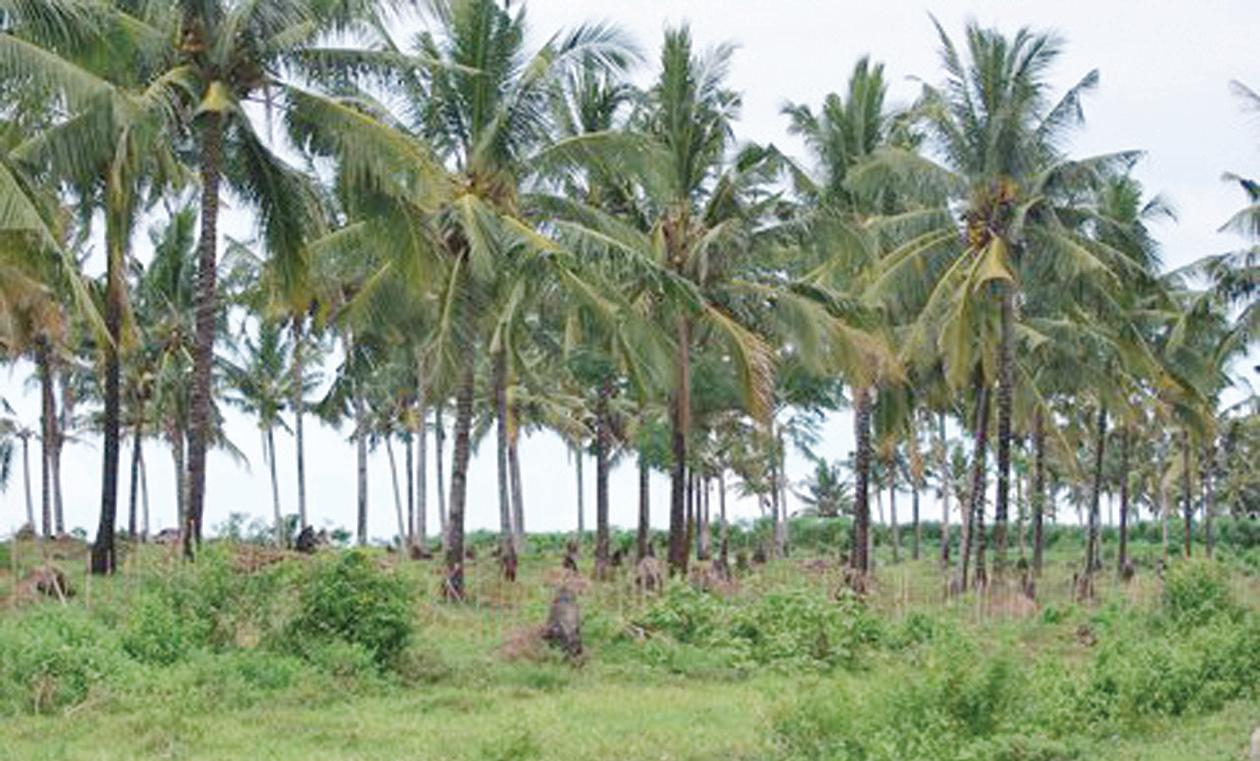
benefiting properties.
On the whole, coconut is actually a very healthy food and is good for the body. Coconut oil, for example, is very effective against a variety of infections due to its antifungal, antiviral and antibacterial properties.
The coconut industry in Guyana has been identified
as one of the sectors with a large potential for further development. There should be greater focus in this area, more so, that coconut is now the third largest crop in Guyana after rice and sugar.
Yours truly, Tanuja Singh
Dear Editor, World number one tennis player Serena Williams had to apologise after reportedly appearing to criticise the victim in a highprofile U.S. rape case.
It does not matter to me how people view this kind of outburst, my take is that youths are getting way out of control and this is a cause for worry. Many Guyanese copy the lifestyle of North Americans, particularly Americans.
Many believe that unbridled freedom is the way to go. We are now saying
that corporal punishment cannot be wisely used. We are also getting confused with parental discipline and abuse. We have to draw the line sometimes.
This young girl should not have been drinking; also, she should never be out that late. I make a strong case here for something to be done where taking care of our youths is concerned. We do have a problem with drinking and teenage pregnancy.
In Australia, a pressure group is now gathering support for a cur -
few on youths aged up to 16 or 17 between 23:00h and 05:00h in order to help reduce youth crime. In Philadelphia, leaders are now taking a stand to make sure that the character of the city is unmarred by imposing a curfew to keep ‘riley’ youths from wreaking havoc in the place.
Before things get worse in Guyana, some preventative moves should be made. Curfew is not bad at all.
Yours sincerely, Xavier Wilson

Dear Editor,
Region One now has better transportation thanks to a boat engine along with other supplementary supplies which were handed over, but this was long awaited. The effort here is to see that the lives of residents are made easier, particularly the student population. If lives can be enhanced, then ultimately production and profitability will be encouraged.
The decision to aid the community came after a recent visit to the riverine area, during a ministerial outreach. At that time, a teacher, on the students’ behalf, requested that an engine be made available to ease the woes of students, who had to paddle to and fro, along the Barima River to attend school. If anyone wants to know how arduous this can be on student life, just try paddling down and up a little stream. It is very physical.
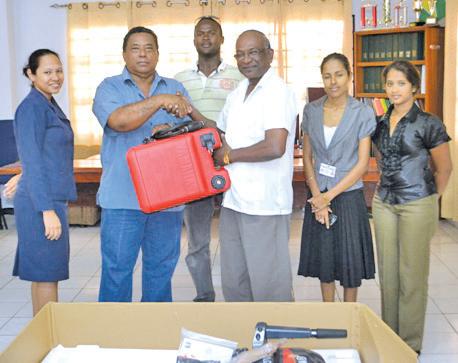
This was free for the beneficiaries, but quite costly to the government. That is why I am compelled to ask that there be proper care of the engine and accessories. I am sure that there are many cases of abuse and wrongful use of government property. I think that these matters should be highlighted.
Yours truly, Dwight Chalmers
Piracy must not be allowed to resurface
Dear Editor, Government is seeking to make things easier for fisherfolk. Only recently, there were talks about reduced fuel costs for the fishermen, and now, according to a recent report, two of them are dead following a pirate attack at sea. However, not too long ago, after a few months of many attacks at sea, things had become very peaceful.
Fishermen tend to know everyone in the business. Pirates make no effort to conceal themselves – they just act with impunity. I think that with three members still alive to tell their stories following the attack, authorities should now be able to track down the perpetrators.
Right now, local fishermen are angry and they are calling on the governments
of Guyana and Suriname to provide coastguards to patrol the river, especially at nights. It is an important call. The Pomeroon area used to suffer from endless piracy attacks. Now there is a floating base in operation and this has, so far, proved quite effective. I think that all areas of vulnerability must be patrolled. I hope that no effort will be spared in seek -
ing to get this boat and its criminal crew.
I am curious as to what happened when the three survivors arrived in Suriname. Were they helped by the police over there? I think that Guyana and Suriname must join hands in stamping out attacks at sea.
Yours truly, Nazeema Ali


BY ANGELA NORTON TYLER
Let’s face it, most students don’t know how to study. Everybody talks about the importance of grades and test scores, yet we neglect to show students how to do well. Our poor children either don’t study at all or spend hours trying to studying every night. Neither choice is good. The whole thing ends up being a waste of time and effort.
Students might need to do some extra studying before a test, but there are ways to stay on top of the information without having to put in hours of hours of work or burning out. Think quality more than quantity.
This is how I tell my own middle school daughter and intermediate (grades three to five) students how to study and prepare for upcoming tests:
First of all, get organised. I recommend having a separate folder for each school subject. Keep things to be turned in (papers, reports, homework, etc) on one side of the folder. On the other side, place all returned/ corrected homework, tests, handouts, etc. Keep everything – at least until the end of the semester! You will see why it is important to be able to put your hands on these papers.
A week or so before the test, ask the teacher for a study guide. (Do not become the annoying student who asks throughout every lecture “Is this going to be on the test?” It drives teachers bananas.)
If the teacher does not have a ready-made study guide, ask “What should I know for the test?” Often, teachers will tell you exactly what you need to know and where to find it. Write down whatever they say!
For maths tests: Do the endof-chapter problems or the sample test. If you can do these problems,
then you understand the most important concepts in the chapter and you should do well on the test.
Also for maths tests: Redo any homework problems you missed. Make certain that you understand where you went wrong the first time. Ask the teacher to explain any problems you still cannot do.
For social studies or science tests: Answer the end-of-chapter and/or end-of-unit questions. Often, you will find these exact questions on the test! At the very least, you will have a broad understanding of the most important concepts and ideas from the unit.
Review/organise/rewrite your notes. Take a look at your notes since the last test. Are they neat? Do they make sense? Is there a better way to organise them? For example, can you group certain ideas together? Would it make sense to have one page of dates and another page of important people? One of the best ways to get information into your head is to organise it and write it down. Rewrite your notes neatly.
Review/organise/rewrite handouts from the teacher. If the teacher took the time to copy something, she thinks you need to know it. Take a look at all of the handouts the teacher gave you. Do you understand them? Please don’t recreate all the handouts! Think about creating one page with the most important information from all of them.
Know the definition of all vocabulary words, concepts, ideas, people, etc. that have been introduced since the last test. These are the highlighted words found in a chapter. Sometimes, there will be a list of “important words” or “people to know.” Write down all of these words and be sure to include any word that your teacher takes the time to define


for you, as well.
Memorise. You will be amazed at how much information you know after organising your notes and looking for important words. Still, sometimes you must buckle down and commit things to memory.
How to study with flash cards
I love flash cards! Here’s how to use flash cards to study:
* Write the word on one side, the definition on the other, and test yourself. For example, write electorate on one side of the flash card and “the body of enfranchised citizens; those qualified to vote” on the other.
* Say “electorate,” then flip the card over and say “the body of enfranchised citizens; those qualified to vote”. Do this over and over until you can repeat the definition without looking at it.
* After you have learned all of the cards, start with the definitions and see if you remember the word before turning over the flash card. Speak up! Move around! You will learn faster if you hear the words out loud (auditory learning) and get your body involved (kinaesthetic learning). Who cares if your little brother thinks you’re crazy? He’ll be jealous of your grades!
* When you think you know all of the words and definitions, ask someone else to test you. Missed any? Go back and memorise them. Do this until you know every word.
How to study with folded paper Folded paper. I know, I am so high-tech! I learned how to study with this study method in the eighth
grade, and I have been using it ever since – even in graduate school. Fold a regular piece of lined binder paper in half the long way. In the left column, write the words you need to memorise. In the right column, write down the definitions. Think of the paper as a bunch of attached flash cards. Keep the paper folded and flip it back and forth as you learn each word and definition. Follow the same routine as with the flash cards: memorise, test yourself, get tested.
Start this process a few days before the test. So after you finish your regular homework, study for a halfhour or so. Don’t wait until the last minute and try to cram everything into your head. Put a little information in each night, and it will stick. Plus, by studying this way, you will still have time for a life outside of homework, and you will feel relaxed and confident about the test.
Finally, right before the test, review your notes (read them out loud if you can) and run through your flash cards or folded paper study sheets. You are ready to ace the test!
Learning how to study is not difficult at all. And the best part is that once you learn how to do it, you’re set. I don’t study much differently now than I did when I was in eigth grade. (Studying is probably the only thing I still do the same way!)
If you are a parent trying to convince your child to learn these techniques or a student trying to teach yourself how to study – don’t give up!
Knowing how to study is actually a skill you can use for the rest of your life. (www.schoolfamily.com)


As a parent, you are your child’s first and most important teacher. When parents and families are involved in their children’s schools, the children do better and have better feelings about going to school. In fact, many studies show that what the family does is more important to a child’s school success than how much money the family makes or how much education the parents have. There are many ways that parents can support their children’s learning at home and throughout the school year. Here are some ideas to get you started!
Develop a partnership with your child’s teachers and school staff
Meet your child’s teacher. As soon as the school year starts, try to find a way to meet your child’s teacher. Let the teacher know you want to help your child learn. Make it clear that you want the teacher to contact you if any problems develop with your child. Get to know who’s who at your child’s school. There are many people at your child’s school who are there to help your child learn, grow socially and emotionally, and navigate the school environment. Who’s Who at Your Child’s School describes the responsibilities of teachers, administrators, and district staff.
Attend parent-teacher conferences and keep in touch with your child’s teacher. Schools usually have one or two parentteacher conferences each year. You can also ask to meet with your child’s teacher any time during the year. If you have a concern and can’t meet face-to-face, send the teacher a short note or set up a time to talk on the phone.
Support your child academically
Find out how your child is doing. Ask the teacher how well your child is doing in class compared to other students. If your child is not keeping up, especially when it comes to reading, ask what you or the school can do to help. It’s important to act early before your child gets too far behind. Also be sure to review your child’s report card each time it comes out.
Make sure that your child gets homework done. Let your child know that you think education is important and that homework needs to be done each day. You can help your child with homework by setting aside a special place to study, establishing a regular time for homework, and removing distractions such as the television and social phone calls during homework time.
If you are reluctant to help your child with homework because you feel that you don’t know the subject well enough or because you don’t speak or read Standard English, you can help by showing that you are interested, helping your child get organised, providing the necessary materials, asking your child about daily assignments, monitoring work to make sure that it is completed, and praising all of your child’s efforts. Remember that doing your child’s homework for him won’t help him in the long run.
(Excerpt from colourincolorado.org)

The A Partnership for National Unity
(APNU) has called for immediate action to halt the high number of road deaths in Guyana.
The party said the recently released statistics that road fatalities have increased by an alarming 40 per cent over the same reporting period in 2012, is a clear indication that national road safety needs to command the immediate attention of the government.
“The figures show that there have been 49 fatal accidents in 2013, which have resulted in 52 persons being killed, including five children,” APNU said. The coalition said it is of the firm belief that the traffic statistics released by the Guyana Police Force for the first quarter of this year shows clearly that “we have a national road safety crisis. That 52 Guyanese have
been killed on our roads in just over five months ...is cause for great alarm, and time for us a nation to take immediate steps to reverse the trend.”
APNU noted that the police force has reported in their crime statistics for first quarter 2013 that motor cyclists have been the main road users affected, with eight such persons having lost their lives; in addition, seven pedestrians and seven pedal cyclists also died on the roads. Speeding continues to be a major contributing factor to fatal accidents.
The coalition said that along with speeding, driving under the influence of alcohol, poor lighting on major highways (especially the Soesdyke-Linden Highway), lack of enforcement and inadequate manpower and other resources, are all major causes of the high increase in road fatality.
“APNU calls on the government of Guyana to adopt a serious posture regarding road safety. It is clear that the government’s lack a coherent plan to deal with the carnage on our roads.”
Road safety strategy
Two weeks ago, a National Road Safety Strategy for 2013-2020 was launched by the Guyana National Road Safety Council (GNRSC). The plan seeks to strengthen the management and enforcement of safety systems at national and regional levels in Guyana.
The document was presented to stakeholders and members of the GNRSC. The plan, presented by GNRSC Chairman Nigel Erskine, is a key element in Guyana meeting its target for the United Nations Decade of Action for Road Safety, during which countries should accomplish a 50 per cent re-
The road is crucial to accessing the hydro site located in Region Eight, but according to Dr Luncheon, the magnitude of work required
to complete the road has presented formidable challenges. “It (construction) provides for an all-weather road that spans so many of the
geographic regions, moving through flat surface, moving through forested… the riverine communities and finally in Section Seven, Lot Seven
duction of traffic fatalities. By 2020, Guyana is expected to have a record of 58 deaths due to accidents, approximately half of the 115 road fatalities in 2010.
Erskine said the UN decade of action initially provides countries with guidelines that experts believe will save five million lives and prevent 50 million injuries. This can be achieved through the five pillars of road safety management, safer roads and a post-crash response.
He noted that the strategy has outlined priority actions in keeping with these pillars to address situations in Guyana’s context, such as the implementation of the UN road safety conventions and agreements, the establishment of an inter-sectoral system to monitor evaluations of road safety indicators, and increased public awareness on risk factors and compliance with laws.
into essentially virgin lands,” Dr Luncheon said.
Thus far, work in sections prior to seven has progressed satisfactorily, and according to Dr Luncheon, “additional contracting power” has been summoned to fortify efforts to complete work in crucial sections, particularly where the project will be built.
A major stumbling block was the termination of the road contract to ‘Fip’ Motilall of Synergy Holdings who failed to meet contractual obligations. Government had given consideration to contracting China Railway First Group Company Limited, which is building the plant, to complete the final sections of the road. The company was contracted to build the plant after signing off on a loan agreement in 2010 along with the Guyana Power and Light Incorporated, Sithe Global, and China Development Bank.
The US$840 million hydroelectric project involves the construction of a hydropower plant at the confluence of the Amaila and Kuribrong rivers. Electricity produced at the plant will be delivered to Georgetown and Linden by a transmission line. The project, once completed, will result in significant foreign exchange savings and a regular supply of inexpensive, reliable electricity.
The project is a fundamental component of Guyana’s LCDS, and will significantly lower the nation’s carbon footprint while reducing its long-term energy costs and exposure to imported oil price volatility. The roadway will be seven metres wide with a 20-tonne capacity, while bridges crossing creeks will have a 120-tonne capacity. Dynamic Engineering has been awarded the $393 million contract to construct a four-span bridge with steel caissons across the Kuribrong River.

They call this the “post-modern” age. You know... where all the “truths” of our lives are shifting and relational. There are no foundations any longer. So how then, do we communicate, when the language is so protean? Well, we’re also living in the age of “irony”. You know like when you say or do one thing but you mean the opposite.
To give one example just so you’ll understand what we mean: It’s like if we were to say, “That Khemraj Ramjattan is a real bright fella!” And even more ironic if you were to reply: “Right!!” Anyhow, one chap who’s a colleague of Ramjattan and knows quite about things like “irony” and suchlike is Dr Rupert Roopnaraine, deputy leader of the A Partnership for National Unity (APNU). He was once a true friend of Dr Walter Rodney, we are told. But that he is now in the party of Forbes Burnham – who he always swore assassinated Dr Rodney – is not ironic in the sense most might think.
Dr Roopnaraine, after all, now says that Dr Rodney was plotting – and had actually launched – an armed revolution against Burnham. Guns had already been collected and one can assume men would’ve been trained. Thus, there is not the necessary discordance between what Dr Roopnaraine is now saying and what he’d said before, as to constitute irony. The man is basically declaring that if Dr Rodney knowingly played with puppies, he should’ve expected to get bitten by fleas. This is justification not irony.
But while there mightn’t be verbal irony...there’s the situational variant to consider. I mean most of us might see that Dr Rodney’s act was justified. Burnham had already broken the social contract when, in 1968, he rigged elections. In fact, there was no contract after then. All bets were off from citizens. And it is this understanding of the situation by most Guyanese (who might not know “b” from “bullfoot”, but know “right from wrong”) that provides the necessary incongruity between Dr Roopnaraine’s actions today and his protestations of the past to constitute irony.
But there is more recent instance of Dr Roopnaraine’s ironic behaviour. He bitterly criticised the government for having people on the board of the Guyana Sugar Corporation (GuySuCo) who hadn’t even a passing acquaintance with agriculture. He spoke movingly of the need for people who would save the industry to have “hands-on” experience. Now, Dr Roopnaraine may have a point...but defeats it by the irony that surely he, who’s APNU’s shadow agriculture minister, couldn’t have picked up much “hands-on” experience up at Cambridge and Cornell.
There is, after all, the discordance between what he says and what we know about him.
Ex-Speaker Ralph Ramkarran was regarded as one of the “intellects” when he was a member of the People’s Progressive Party/Civic (PPP/C). He should also know a thing or two about irony. What does he say about the blurb that accompanies his now weekly column in the Stabber News: “This column first appeared in Ramkarran’s blog (www. conversationtree.gy)”?
Is it meant to suggest that Ramkarran is not really in league with the opposition, and that his opinions aren’t sent to them directly, but are simply copied? So how come the posts don’t go up at Conversation Tree until AFTER the Stabber prints them? How the heck does the Stabber manage to get it so that it’s up even before their Sunday edition gets printed? Ironic, isn’t it?
This week, Ramkarran weighed in on Guyana becoming a “kleptocracy”. He would’ve been much more credible if he’d addressed our earlier query as to (1) How he and Sir Shridath Ramphal became owners of Tigerwood that cut timber in Iwokrama and (2) How much he was bought out for as opposed to Kads Khan’s $130 million?
...in employment
The opposition is insisting that employment in Guyana is as high as it’s ever been. Yet we can’t get workers in the construction industry (we’re not going to even mention sugar). “Unemployment” is measured by those who’re actually looking for work.
Natural Resources and Environment Minister Robert Persaud on behalf of the chairman, directors, management and staff of the Guyana Geology and Mines Commission (GGMC) has congratulated Guyana Women Miners Organisation (GWMO) President Simona Broomes on her recent achievement of being declared a trafficking in persons (TIP) special hero by U.S. Secretary of State John Kerry.
Persaud said the ministry recognises GWMO’s efforts to reduce incidents of TIP, and this award in recognition of the work undertaken is certainly a major step in the efforts to reduce trafficking in persons.
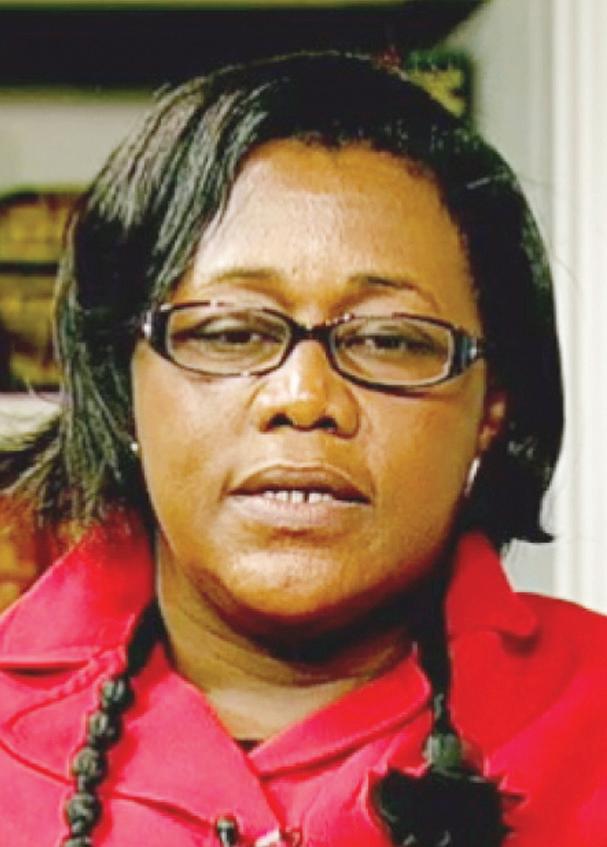
devoted their lives to the fight against human trafficking. These individuals are non-governmental workers, lawmakers, police officers, and concerned citizens committed to ending modern slavery.
lenges women face operating in remote areas. Broomes has rescued several trafficking victims, and her organisation provides temporary housing for victims to ensure their safety.
They are recognised for their tireless efforts – despite resistance, opposition, and threats to their lives – to protect victims, punish offenders, and raise awareness of ongoing criminal practices in their countries and abroad. In 2013, nine people were chosen as TIP report heroes in the fight against modernday slavery.
Each year, the U.S. State Department honours individuals around the world who have
“It’s in this regard that the Ministry of Natural Resources and the Environment applaud the efforts of Ms Broomes of the GWMO, and also commit ourselves ( since the launch of the GWMO) to continue in our strategic partnership working closely with the GWMO and all other relevant stakeholders in the fight against TIP.”
The U.S. said Broomes has demonstrated extraordinary bravery and leadership in raising the awareness of human trafficking in Guyana. After 25 years as a miner, she established the GWMO in 2012 to empower women miners and address unique chal-
Under Broomes’ dynamic leadership, the GWMO and its 440 members take direct action to protect victims and have become consistently powerful advocates against human trafficking. From a small group of women banding together to solve common challenges, the GWMO has become a recognised force in combating trafficking in persons and promoting equality and economic opportunities for women in Guyana. Broomes is a consistently powerful, vocal advocate against TIP and continues to take direct action – often at great personal risk –to protect and assist victims of trafficking.
Minutes after leaving home for work, a pensioner was killed on the Better Hope, East Coast Demerara Public Road in a road accident involving a car driven by a policeman.
The accident occurred about 04:30h. Dead is Chanderjit Sanichar, 70, of Lot 52 Zahora Street, Better Hope, East Coast Demerara. He suffered severe head injuries and succumbed while receiving medical attention at the Georgetown Public Hospital.
The driver of the motor car, who was reportedly speeding at the time of the accident, was detained at the Sparendaam Police Station assisting with investigations.
According to information received, Sanichar, also called “Canter”, left home about 04:00h for Ogle, East Coast Demerara, where he would purchase fish and shrimp to
sell in the neighbourhood and surrounding environs.
On his way to the koker, he attempted to cross the public road when the motor car which was travelling in the eastern direction slammed into him. Janet Singh, a sister of the deceased, who was at the Sparendaam Police Station on Sunday morning told this newspaper that she last saw her brother on Saturday afternoon about 17:30h before she retired to bed. She explained that he lived in the lower flat of their two-storey home while she occupied the upper flat.
Singh said she would not keep abreast with her brother’s movements, but knew he would leave home in the
wee hours in the mornings to “buy his load” so that he can be finished selling early. The woman further stated that she woke up about 04:30h and started to prepare for work. About 05:30h, she received the news that her brother was in an accident and was taken to the Georgetown Public Hospital.
After receiving the news, she rushed to the medical institution, but by the time she arrived, he was already dead. He had a big gash to the face and wounds on his arms and legs, the woman disclosed.
Sanichar leaves to morning his three children and five siblings. His body is at the hospital mortuary awaiting a post-mortem examination.
Amechanic died late Sunday evening after he lost control of his Toyota Mark 2 and crashed into a fence at the South Dakota Circuit, Timehri, East Bank Demerara (EBD).
The accident occurred about 21:30h.
The dead man was identified as David Persaud, 54,
of Lot 34 First Street, Grove Housing Scheme, EBD.
According to information received, Persaud visited his farm located in the vicinity of the South Dakota Circuit earlier in the day and was on his way home when the accident occurred.
Subrina Brijmohan, Persaud’s daughter-in-law,

stated that about 21:30h, the telephone rang and upon answering, she was given the terrible news.
She panicked but informed the man’s son, Junior who travelled up to the scene. She recalled that her father-in-law left home about 14:00h that day to go to the farm and he called about
18:00h to say that he would have been home shortly.
Persaud would normally visit his farms on weekends and return late in the evening. His body was removed from the scene and is at the Lyken Funeral Home. He leaves to mourn his wife, two children and siblings. Police are investigating the incident.

Earlier in the month, The Golden Arrowhead was hoisted in the city of East Orange, New Jersey, commemorating Guyana’s 47th independence anniversary; an event organised by the Guyana-American Heritage Foundation for the sixth consecutive year.
The organisation was founded by Allison ButtersGrant and Ira Lewis, who continues to keep the Guyanese flag flying high.
The Guyana-American Heritage Foundation Inc showcases diverse Guyanese talents from Guyana and from within its home state of New Jersey. Sonia Noel was described in high esteem, with Ralph Lauren and Ellen Tracy, as the fashion icon from Guyana who showcased astute designs from her collection while reigning soca monarch, Jumo Primo was also honoured for his contribution to Guyana’s music industry.
Mayor Robert Bowser said he was honoured that the nations celebrated their independence in the city of East Orange. He noted that Guyanese were a big part of the community described by politicians as a melting pot.
Bowser described the expatriates as enthusiastic people who share their culture with others in East Orange. “This is what we want in our city,” said Mayor Bowser, who called on Guyanese to continue to
make a contribution to the municipality, adding, “This ceremony is very important to our city.”
The mayor then memorialised Guyana’s independence with a proclamation which was handed over by the mayors’ aide Troy Webster to Bayney Karran, Guyana’s ambassador to Washington, who was representing President Donald Ramotar.
Ambassador Karran, in turn congratulated members of the Guyana-American Heritage Foundation Inc for the fitting tribute, and recalled when Guyana obtained independence on May 26, 1966, there was joyousness and celebration throughout the land, as was witnessed during the cultural presentation at City Hall Plaza.
In reading a statement from President Ramotar, Karran extended best wishes to the Guyanese people and an invitation to visit their homeland to witness the economic and social transformation that has taken place. He also congratulated the city of East Orange on its 150th anniversary, on behalf of the Guyanese president.
Butters-Grant challenged the attendees to visit Guyana and collectively adopt each of their hometowns by supporting tangible projects aimed at expanding development of Guyana.

By IndrawattIe natram
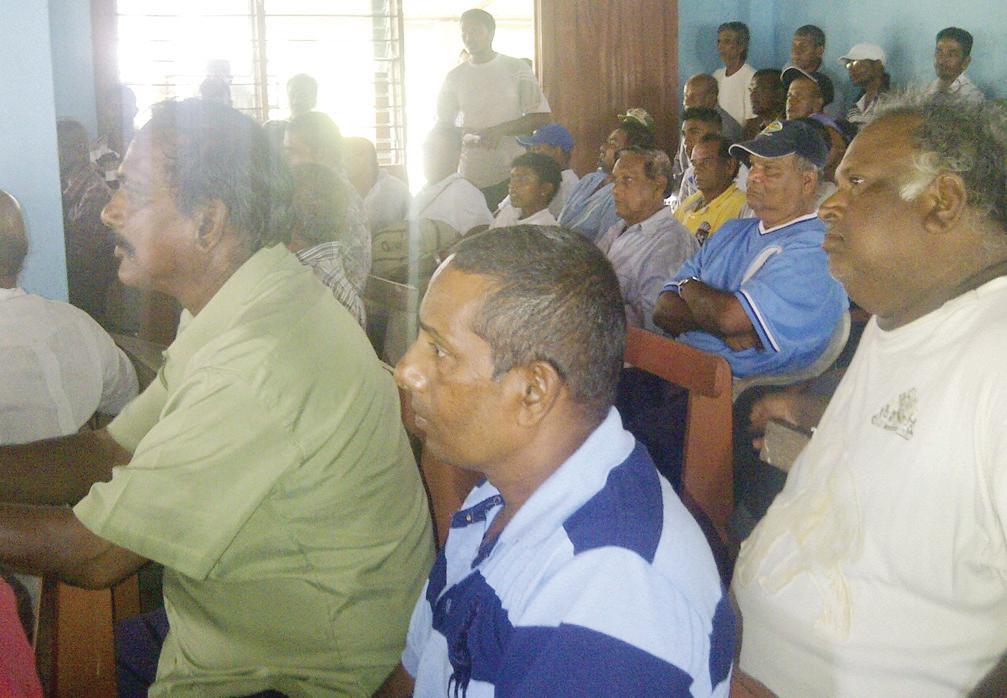
Rice farmers on the island of Wakenaam are calling on the Agriculture Ministry to construct a structure where they can dry and store their paddy. Scores of farmers called for the facility at a meeting held at the Neighbourhood Democratic Council in Sans Souci on Saturday. Speaking on behalf of the farmers, Sheikh Ahmad told officials of the Guyana Rice Development Board (GRDB) that millers do not visit the island in a timely manner to buy their paddy, so the facil-
ity would assist farmers in storing their paddy until millers do arrive. Ahmad said as soon as farmers harvest their paddy, they are forced to rush to a miller on the Essequibo Coast to sell it. This was impractical because the boat transport system servicing the island often suffers delay. He said the island does not have a permanent buyer and, as such, farmers are sometimes faced with a challenge marketing their paddy. Ahmad said the facility should be capable of storing approximately 60,000 tonnes of paddy. Farmers requested that the
millers properly examine their prices, as some of them received $1000 per bag of paddy. Miller Wazir Hussain from Vilvordeen, at the meeting, pledged to review paddy prices with farmers. Hussain said he has a list of Wakenaam farmers from which he purchases paddy and a better price will be offered.
GRDB General Manager Jagnarine Singh told farmers that the board is currently hosting 35 public awareness outreaches for farmers. He explained that the outreach is to assist, as well as advise farmers on the care of the crop, as the last spring crop was almost ruined by an infestation of paddy bugs, which resulted in low prices for badly affected paddy.
He said proper monitoring needed to be conducted in the fields, and extension officers are working with rice farmers to ensure that they spray and care for their crops. Singh said the board is trying to prevent the paddy bug infestation from recurring.
Farmers also asked the GRDB to introduce a new pesticide for use in the fields, since the chemicals currently being used are not effective in controlling the paddy bugs. They are, however, optimistic that they will receive a bumper harvest from the current crop, which is being sowed.

Just when de Bell Crier peep all de peepin that goin on around de world, is more peepin get expose in de UK and right here in Guyana. Even in the U.S., one man decide fuh peep what he own guvament was peepin all dem years. But de Americans get so vex wid he that dem want to put he in jail fuh de same ting that they been doin to people. Now, in de UK, a newspaper peep de guvament agency that was set up specially fuh peepin. De British guvament get ketch peepin people internet and phone calls and tellin de U.S. every ting that dem see and hear. A teacher from Berbice seh de US and de UK is just like Suruh and Duruh. Every ting one do, de other one got to know. But de U.S. and UK actin like Suruh and Duruh a long time now. Dem even want to jail another man who peep all dem duty wuk and put it pun WikiLeaks – de same tings that dem hidin from people all dem years, is de same
tings de WikiLeaks man peep and leak out.
Well, in Guyana, it got a lotta people peepin too. People who can’t see good does wear spectacle and peep because dem want fuh see wheh dem goin. But it also got nuff people who blind in dem mind and dem still peepin. And when dem don’t see any ting, dem does behave like if dem see jumbie. Dem does jump up and start hollerin like if de jumbie gon pun dem.
Dem boys who seh dem is boys got plenty of dem who peepin. Some of dem peepin one another and dem ain’t like what dem seein. One of dem peep pun Regent Street and he ain’t like what he see, so he stop peepin down dey.
Ting-a-ling-a-ling…friend tell friend…mattie tell mattie! That is de same one who does peep and he does tell de other one who does also peep what to write. Dem is Suruh and Duruh fuh real!
Dr Ivelaw Lloyd Griffith, provost and senior vice president at York College of the City University of New York, has been named as the ninth president of Fort Valley State University by the board of regents of the University System of Georgia. The board’s vote was unanimous, a release stated.
Griffith will assume his new post on July 22, according to board chairman “Dink” NeSmith. “Dr Griffith was the outstanding candidate,” said NeSmith. “He has this board’s
full support to provide the leadership Fort Valley State University needs at this moment. We are excited about his presidency and delighted he will become the university’s next president. This is a great day for Fort Valley.”
University System of Georgia (USG) Chancellor Hank Huckaby said, “The board of regents has made an outstanding selection for the next president of Fort Valley State University. Dr Griffith is an accomplished scholar whose career and academic training will take this institu-
tion to a level of achievement and quality so critical in the global world of tomorrow. I and the other members of my staff are totally committed to supporting President Griffith as he leads the students, faculty, and the extended Fort Valley community into the future. I know all who are committed to assuring a successful future for the university will lend their support to President Griffith’s administration.”
Griffith has served as provost at York College since 2007 and during his ten-

ure has increased the number of full-time faculty by 30 per cent, reorganised the academic division, and enhanced the research and scholarly climate by creating a Provost Lecture Series and a companion Distinguished Scholar Lecture Series, among other initiatives. Griffith also has established an undergraduate student research programme.
Before being named provost at York College, Griffith, in addition to his teaching duties as a tenured professor of political science, served as provost at Radford University in Radford, Virginia. He was budget dean of the College of Arts and Sciences at Florida International University in Miami, as well as dean of the FIU Honours College.
Distinguished
Griffith is a specialist on Caribbean security, drugs, and crime. In this capacity, he has been a consultant to Canada’s Foreign Affairs and International Trade Ministry, the United States Agency for International Development (USAID), and other organisations.
He also has spoken at military academies across the United States and in the Caribbean, and serves on the editorial board of the journal Security and Defence Studies Review, which is published by the Centre for Hemispheric Defence Studies, in Washington, DC. A past president of the Caribbean Studies Association, he has been a visiting scholar at the Centre for Hemispheric Defence Studies,
the Royal Military College of Canada, and the George Marshall European Centre for Security Studies in Germany. He has testified before the United States Congress on Caribbean security matters.
Publications
Griffith has published seven books and more than 50 articles on his area of expertise. The research for his highly acclaimed book, Drugs and Security in the Caribbean: Sovereignty Under Siege, was funded by the MacArthur Foundation, and his eighth book, Challenged Sovereignty, will be published next year by the University of Illinois Press.
Most recently, he was one of 45 experts invited by the Organisation of American States secretary general to review the hemisphere’s narcotics policies and practices and propose anti-narcotics scenarios. A member of The 100 Black Men of Long Island, he also serves on the vestry of the St George’s Episcopal Church in Long Island, and on the board of directors of the Jamaica Centre for Arts and Learning in Queens, New York.
Griffith earned a bachelor of social sciences from the University of Guyana, a master of arts degree in political science and public administration from Long Island University, New York; and a master of philosophy and doctorate in political science from the City University of New York. He also is a graduate of the Harvard Graduate School of Education’s educational leadership programme.

monday, june 24, 2013
Even as President Xi Jinping of China left the Annenberg Summit in the U.S., and the reality of a Group of Two (G2) effectively launched, there is a humbling truth for the G7 economies. There has been a major shift in global economic growth from the G7 countries of America, Britain, Japan, Germany, France, Italy and Canada to the south-eastern economies of India and China and the so-called emerging economies.
Caribbean Community (Caricom) leaders must pay heed and recognise that the failure to optimise the Caricom Single Market and Economy (CSME) means that we are increasingly threatened with becoming irrelevant economies, unable to compete, and abandoned by those who were once our partners as “developing” countries. Abandonment will not be because the emerging economies gave up our friendships, but because they will be too busy engaging at another level.
The truth is that the emerging economies now account for the greater share of economic growth around the world. Indeed, outside of the U.S., it is possible that each of the other G7 countries will fall out of the top 10 in terms of economic growth by 2018. In the period between 1982 and 1987, the emerg-
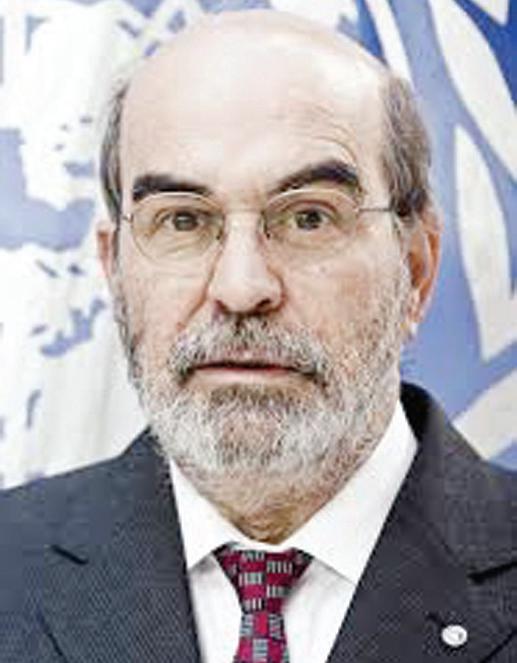
Food and Agriculture Organisation (FAO) members approved the organisation’s work programme and budget for 20142015 at the end of its weeklong 38th governing conference at its headquarters in Rome.
“I want to thank and applaud all of you for showing such a clear sign of commitment to this organisation and its goals – to your organisation, and your goals,” FAO Director General José Graziano da Silva told members.
“The consensus showed a willingness to work together to overcome differences. It showed trust. And it showed commitment to work together towards the hunger-free and sustainable future we all want,” added Graziano da Silva.
The budget of US$1028.1 billion, a 2.2 per cent increase over the current biennium, will enable the organisation to deliver its proposed programme of work focusing on five strategic objectives and a sixth objective related to the technical and normative work of the organisation.
Graziano da Silva also called on FAO members to support with voluntary contributions the full achievement of the strategic objectives and implementation of the work programme, which received unanimous and vigorous backing from the Conference.
ing economies of India, China, Brazil, Mexico, Malaysia and Singapore, among others, accounted for only 31 per cent of the global economic growth, compared to 69 per cent for the G7 developed economies. In the period 2012 to 2017, it is expected that the emerging economies will contribute 74 per cent, while the G7 countries will account for only 26 per cent of the growth in the global economy. This represents a total turnaround.
Clearly, economic power is shifting. The countries presently considered as the “emerging economies” led by China and India have emerged as economic giants. Between 1982 and1987, all the G7 countries were included in the top 10 economies of the world. Only the U.S. will firmly remain in the top 10 for the period 2012-2017, according to a new International Monetary Fund (IMF) projection. Britain will be on the verge of leaving the top 10 and Japan is likely to barely hold on. But China, India, Brazil, Mexico, Indonesia, Russia, South Korea, and even Turkey will concretise their places in the top 10 in terms of increasing and sustainable economic growth.
Can you imagine the list of countries projected to have the fastest growing economies in 2013? The list is South Sudan, Libya, Sierra Leone, Mongolia, Paraguay, Timor-
The 38th FAO Conference opened last Saturday with Nobel Economics Laureate Amartya Sen delivering the traditional McDougall Lecture on food security and telling delegates that if the world wants to conquer hunger, it needs to tackle all the causes of hunger simultaneously, particularly poverty, and not just concentrate on producing more food.
His words were echoed by Pope Francis when he received FAO Conference delegates in an audience on Wednesday. “It is a well-known fact that current levels of production are sufficient, yet millions of people are still suffering and dying of starvation. This is truly scandalous,” the pope said. The FAO’s new programme of work recognises the need of a more integral approach to promote food security, including social protection in its scope of action.
During the Conference, the FAO formally recognised 38 countries for reducing hunger by half well ahead of the 2015 deadline. Twenty of them achieved the first Millennium Development Goal of halving the percentage of hungry people in their populations. Eighteen also achieved the more stringent 1996 World Food Summit’s target of halving the number of their hungry citizens. “We need to ride this momentum forward towards the complete eradication of
Leste, Iraq, Panama, Gambia, and Mozambique. Granted, these are poor countries with poor economies and, therefore, open to dramatic growth. But there is a story being told as the economic centre of gravity changes. The truth is the majority of the world’s output is now coming from outside of the traditional developed world, for the first time since the industrial era of Britain. Standards of living remain greater than five times higher in the G7 countries, compared to living standards in emerging countries. But the truth is living standards have greatly narrowed since 1990. The gap was greater than 50 times prior to 1990. Some experts observe that countries with large populations have a better chance for economic growth in the present environment.
There are grave political and economic realities for countries like those in
hunger. We are the first generation that can end hunger. Let us seize this opportunity,” Graziano da Silva declared.
The Conference also approved the change of the FAO’s first global goal from

Caricom and our leaders must take cognisance of the political and economic realities which are emerging. While America continues to project itself as the bastion of capitalism, and China likes to promote itself as socialist, the ideological divide is less important as the G2 is likely to dominate the rest of the 21st century. But Caricom countries must also recognise that the “fellow” developing countries, which we once called the emerging economies, are graduating into developed countries and we must forge different relations with our “fellow developing” countries like India, China, Mexico, Brazil, Indonesia and South Korea, among others. These countries are poised and want to engage with the G7. In the process, we become casualties.
To ensure we are not abandoned, countries with our small economies must realise they need to work more close-
the reduction to the eradication of hunger, food insecurity, and malnutrition.
At a side-event during the Conference, Angola announced a US$10 million contribution to the Africa Solidarity Trust Fund, through which African countries will finance food security efforts in the region. This donation adds to the US$30 million donated earlier by Equatorial Guinea and other contributions from Cameroon and African civil society organisations. Renewing
ly as single economic spaces in order to be competitive and relevant. Even the whole economic space of Caricom remains as relatively small in comparison with the emerging states. It is this reality that must force us to seek innovation in our political and economic alliances.
Way back in the early 1970s, the African, Caribbean and Pacific (ACP) nations, in establishing the ACP in accordance with the Georgetown Declaration, recognised the need for a political and economic alliance to force the G7 countries to deal with us more fairly. Caricom recognised the same in the Chaguramas Declaration.
Both the ACP and Caricom have failed to recognise how important it is that we chart a partnership that promotes real political and economic alliances if we are to remain competitive and deal with our colleagues in any reasonably relevant way. Sadly, these alliances are more on paper than in meaningful and purposeful alliances.
We continue to foster individual interests, rather than seek to promote our interests as part of a larger good. Because we work in a divided way, the ACP failed to protect the benefits of the sugar, banana and cotton protocols. The Economic Partnership Agreements (EPAs) with the
European Union (EU) similarly saw us signing EPAs that were skewed in the EU’s favour.
The truth is that the centre of economic and political gravities have changed such that the emerging economies of countries including China, India, Russia, Mexico, and Brazil are more focused on their political and economic competition and partnership with the G7 than with paying special and differential attention to Caricom or the ACP, unless as united forces we make it worthwhile for them to pay attention to our combined political and economic partnerships.
We must create political and economic strength, standing in solidarity at the United Nations (UN) and other places that make us relevant as the “emerging economies” and the G7 and the G2 play out their competition and partnership. We are at risk of becoming subservient to a new world order in which we are but the playground of the more powerful economies of the G7; G2; Brazil, Russia, India, China, South Africa (BRICS), and the emerging economies. Caricom leaders and the leaders of the ACP must not fail to rise to the challenge of being relevant in the new world order. The leaders of the Pacific Alliance -- Mexico, Peru, Paraguay, and Chile -- appear to have recognised this truth.
partnership to end hunger in Africa will be the focus of a high-level meeting to take place on June 30-July 1, coorganised by the African Union, the FAO and Brazil’s Instituto Lula, with the participation of the International Fund for Agricultural Development (IFAD), the United Nations World Food Programme (WFP) and other partners.
The Conference also voted to accept Brunei Darussalam, Singapore, and South Sudan as new FAO member countries, bringing total membership to 197, comprising 194 member
nations, one member organisation (the European Union) and two associate members (Faroe Islands and Tokelau). The conference also elected Wilfred Joseph Ngirwa of the United Republic of Tanzania as independent chairperson of FAO’s executive council for the period July 2013 to June 2015. Ngirwa served as Tanzania’s Permanent Representative to United Nations food agencies in Rome between 2006 and 2012, and previously served as the Tanzanian Agriculture and Food Security Ministry’s permanent secretary.

monday, june 24, 2013 | guyanatimeSgy.com
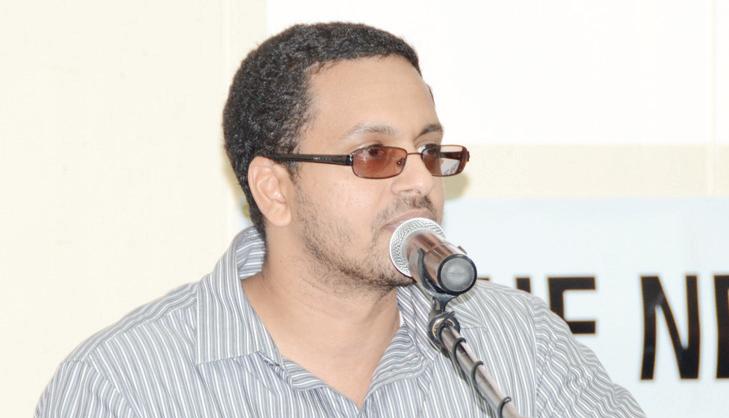
E-governance Project
Director Alexei
Ramotar said that government is in the process of protecting itself against possible instances of cyber crimes.
Ramotar disclosed that the Home Affairs Ministry is currently building a cybercrime team of experts with the intention of protecting government institutions.
This move is in anticipation of the country being on the verge of an Information Communication Technology (ICT) revolution. According to Ramotar, government is also working closely with Caricom countries in putting together a legal framework that would be utilised throughout the Caribbean in an effort to establish a common platform of prosecution.
Ramotar acknowledged that steps are also being made to iron out issues relating to the electricity sector, with the power company paying 35 U.S. cents per kilo watt per hour.
“This is incredibly expensive, which is why government proposed the Amaila Falls Hydro Power Project and also wishes to pursue a natural gas plant in the near future.”
Ramotar mentioned that
Alexei Ramotar
the idea behind it is to lower the cost of electricity to encourage major manufacturers and production industries which are utilising their own generators at a cheaper cost. Commenting on the reason the projects are only now being implemented, Ramotar said the state is now in the financial position required for the funding of such projects.
The e-governance programme started in 2006 when a plan was hatched for the development of the ICT sector in Guyana. “There was a big requirement for infrastructure and government came up with a plan to boost the infrastructural and human resources. The OLPF (One Laptop Per Family project) was designed to enhance this with the planned training pro-
grammes.”
The aim of that project is to improve the infrastructure, to lower the cost of investment, improve access to the Internet, and the ability to access high speed Internet. Government decided to use fibre optics as the fastest way of transmitting through a high-capacity 2.5 gigabyte network, which can easily be upgraded.
Huawei Technology, one of the leaders in fibre optics, was chosen to provide all the equipment for the project.
In order to improve electricity in Guyana, the Guyana Power and Light (GPL) has a fibreoptic cable to be utlised for telemetric purposes.
It is this that would allow the E-governance Project to “piggyback” on GPL’s fi-
breoptic cable and connect through routers in densely populated areas.
Ramotar revealed that one of the hindrances that prevent industries from getting in is the ability to use fibre. “If you use free spectrum, you will have interference and if you buy spectrum, then it’s too expensive. So by eliminating the cost of investment, companies can provide services for the people instead of spending money on infrastructure,” Ramotar explained.
Similar projects have been undertaken in Rwanda and Australia. Ramotar pointed out that government recognises the necessity of developing the ICT industry since traditional exports such as rice and sugar may not be as viable in the future.
“Young people do not want to get into the sugar industry necessarily, so there has to be an option for them and through these projects, we expect to provide that option,” Ramotar said.
He revealed that the project is expected to be finished by September as teams are currently doing field tests at installation sites as well as checking for sites that require reinstallation.
The importance of early detection of ill health was underscored during the launch of Rehab Week 2013 at the Promenade Garden on Sunday. Under the theme “Rehabilitation Moving Forward: New Ventures, New Technologies”, scores of persons participated in the launch which took the form of a prayer breakfast.
Residents renew calls for operationalisation of Wakenaam Airstrip
By: IndrawattIe natram
Residents of Wakenaam, Region Three, (Essequibo Islands/ West Demerara) are calling on the government to complete the upgrade of the $54 million airstrip located at Marias Pleasure on the island.
to the lack of a fast mode of transportation, and the airstrip will solve this problem. Singh said emergency medical cases can be attended to if the facility is upgraded.
Farmers, who are faced with lack of markets for their produce, said with the airstrip, millers can visit the island and offer better prices. They said the airstrip will attract investors to the island and encourage investment.
Additionally, special attention would be given to early detection, with a symposium set for Tuesday for nursery school teachers, as well as staff of the Guyana Geology and Mines Commission (GGMC) and the Guyana Telephone and
The Health Ministry’s principal physiotherapist, Beverly Nelson, said early detection means early intervention. “With early intervention you help to decrease the amount of complications that come with disabilities,” she explained. Throughout the week, the Health Ministry’s Disability and Rehabilitation Division will be beefing up its sensitisation campaign aimed at promoting its services in the areas of audiology, and occupational, speech and language therapies.
Telegraph Company (GT&T).
Other activities in the city include a stroke survivors’ induction session, a staff development retreat, and a street outreach at City Mall, Camp Street. The week will culminate on June 29 with a “Culture Fest and Song Competition”.
In addition to activities in the city, Nelson said activities will be staged across the country to mark the occasion. For the past 10 years, the attitude of citizens toward the services offered through the Health Ministry has improved drastically, the physiotherapist
noted. She posited that persons are seizing every opportunity to utilise the services.
“Previously, persons waited on doctors to refer them, but now persons are coming into the office.”
Questioned about the challenges faced by the Disability and Rehabilitation Division, Nelson said there is need for more professionals in the areas of occupational therapy and speech therapy.
“We really need a core of professionals that would be able to guide staff and our rehab assistance in those areas.”
The Guyana Police Force is investigating a report of a recent assault by a doctor attached to a government medical facility.
A police source close to the investigation said the file has been sent to the director of public prosecutions, (DPP) for advice. The doctor, whose name has been given, is accused of physically and verbally abusing a patient while he was on duty at the hospital.
Reports are that the doctor slapped and called the patient names that she did not like. The patient told Guyana Times that she is now afraid to go back to the doctor. “I attend his clinic, but I am so scared to go back to his clinic after
what happened,” she said.
She said on Thursday last she was bleeding from the nose and went to a private institution and met a doctor who also works at the government facility. She said on advice of the doctor, she visited him at a specialised clinic.
“It was very painful and, after treating me, the doctor told me that he was going to push a piece of gauze into my nose to stop the bleeding. When he pushed it in I jump back, because remember your nose is very sensitive,” said explained, adding that the gauze fell and the doctor told her that she needed to relax.
“He said ‘relax,’ and slapped me and start calling me names like ‘stupid girl’ and saying ‘you come
to waste my time over nose bleeding’?” she revealed. “And then he held my head and start shaking it.”
The young lady said she instantly got a headache.
“I work in the medical field and I have never heard of patient being slapped and head shaken to make them relax. No patient should have to endure being called names just because you need the assistance of that doctor at the time,” she said.
However, she is thankful for the assistance that was eventually provided by the same doctor, who eventually calmed down and returned to her to prescribe medication after the bleeding had stopped.
“Then he asked me if I will need leave and told me
to come back the next day to collect the leave certificate,” she said. She said was in pain that night and suffered trauma from the slap and shaking.
The matter was reported to the police, who instructed her to go to the very facility with her swollen face to get a medical certificate, which was done.
“Not only the medical I went for, I also had to see the doctor as a patient because my whole face was swollen and he had to give me an injection,” she further explained.
The patient said she also reported the matter to the facility’s chief executive officer. According to the patient, she was also instructed to take a statement to the facility today.
Residents, during an interview with Guyana Times, said they acknowledged the presence of the airstrip on the island, but wanted an official opening. Scores of businessmen as well as farmers from the quiet island said the operationalisation of the airstrip will boost tourism and business activity.
Isaac Narine, a shop owner from Marias Pleasure, said he welcomes the move by government in constructing the airstrip, but would like to see its completion.
The shop owner said he has to endure the tedious task of travelling to the city and other parts of Guyana to stock his shop with items. He said sometimes he has to spend days away from his family to do shopping, which he described as time-consuming. The businessman said with the operationalisation of the airstrip, he can fly to the city and transact his business.
Good venture
Dwarakanauth Persaud, a rice farmer, said he is eagerly waiting for the airstrip to become functional. He said he sees the airstrip as a good venture by the government that will encourage tourism and boost the socio-economic status of the island. Persaud, who is a largescale rice farmer, said he wants to tour around Guyana and take his family along. He said when the airstrip is put to use; he can make trips around Guyana.
Another farmer, Totaram Singh from Marias Pleasure, said the airstrip will be of great benefit to the island in terms of medical transport. He said pregnant women are forced to endure complications due
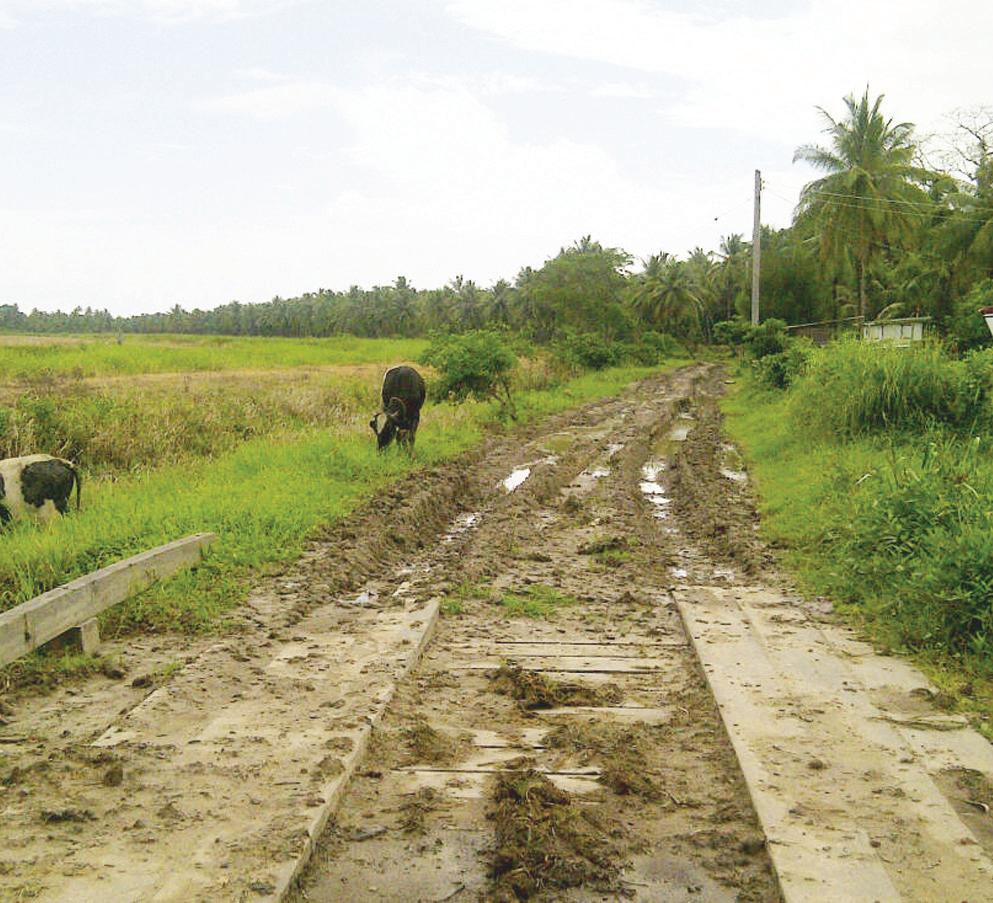
“We need persons to visit the island, explore and seek business opportunity, we lack hotel facility, milling and shopping outlets; with the airstrip, all these investments can be made possible,” one resident said. When this newspaper visited the airstrip recently, the entrance of the strip was in a deplorable state due to heavy rainfall. The land that was earmarked for the upgrading of the facility was well kept; however, cattle could be seen around the area.
Transport Minister Robeson Benn, in response to several recent articles in the Stabroek News on the airstrip, had told the Guyana Chronicle the facility will help in medivac operations, enhance tourism, and provide a security air depot.
Minister Benn said the airstrip was built for transporting tourists and goods and services, and for undertaking medical evacuations and security responses, among other uses. He added that a number of airstrips exist in Guyana in a state of readiness in the event of an emergency in terms of landing and evacuation. He noted in the near future, tourism will make the Wakenaam Airstrip popular, because a tour operator will soon commence operations there.
He disclosed that an initiative undertaken by the tourism sector would utilise the facility to maximise the tourism potential of the Essequibo island, creating a tourist destination.
Residents of Leguan and Wakenaam in Region Three have called on the authorities to upgrade their roads and improve sea defence structures during a recent outreach by the Local Government Ministry.
During the outreach, residents of Success, Maryville, Enterprise, Doorn Haag, Richmond Hill, and Endeavour on the island of Leguan complained bitterly about the current state of the sea defence. Over the years, the residents have been complaining about the deteriorating sea defence.
In addition to these concerns, residents expressed dissatisfaction with the deplorable road network on the island. They called on government to do more in the area of infrastructural development.
In response, the local government minister pointed out that the government of Guyana is currently pumping millions of dollars into remedying the situa-
road project was awarded to Eagle Transportation and General Construction Incorporated at an estimated cost of $62.382 million for construction of roads at La Bagatelle Factor, the Community Centre, Goed Intent, Blenheim Housing Scheme and Canefield.
“It is unfortunate that this contractor has not approached the works in a proactive way and so the works are behind schedule.”
Making good on its promise made to the residents of Leguan in 2012, the Labour, Human Services and Social
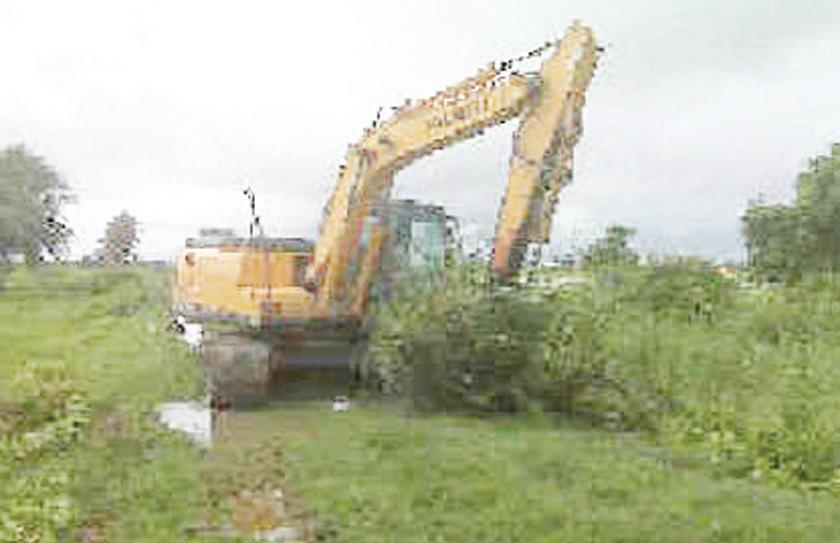
tion. At Louisiana, a 730metre rip rap river defence is being constructed to the tune of $261.868 million, while works are being conducted at Enterprise to the tune of $111.390 million.
Additionally, close to $300 million is being spent to construct varying sizes of rip rap river defence at Cane Garden, Maryville and at Blenheim.
Turning his attention to the road network, Persaud told residents that the government has taken stock of their concerns. He said the miscellaneous
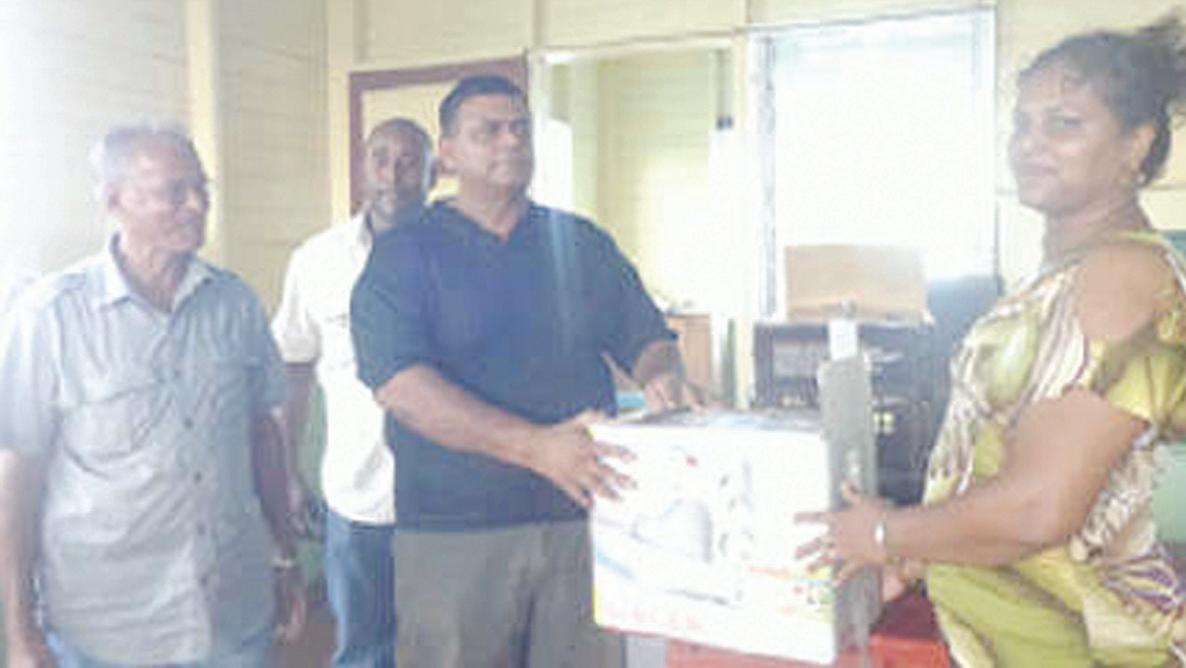
Security Ministry handed over three sewing machines to the women’s groups on the island, namely from the Doorn Haag, Endeavour and La Bagatelle.
Based on repeated requests from farmers, the Agriculture Ministry provided drainage and irrigation support which resulted in a significant increase in the acreage of land under rice cultivation. Additionally, villagers were overwhelmed with joy when junior Local Government Minister Norman Whittaker handed over a Hymac for
the island’s Neighbourhood Democratic Council (NDC), making good on a promise made by the Donald Ramotar administration.
Leguan NDC Chairman Albert James received the machine on behalf of the island. The handing over was done on behalf of the Agriculture Ministry and the National Drainage and Irrigation Authority (NDIA).
Communities visited
On the island of Wakenaam, the Local Government Ministry backed by the human services and social security, legal affairs, finance and public works ministries, visited eight communities, including Ridge, Good Success, Marias Pleasure, Zeelandia, Sans Souci, Belle Plaine, Noitgedacht and Meerzorg.
Resident's there too expressed concerns over the state of the sea defence while advocating for upgraded roads.
It was pointed out to the residents that government is currently investing approximately $300 million to construct various sizes of rip rap river defences at Amersfort, Zeelandia and Marias Pleasure.
Meanwhile, the miscellaneous road project was contracted to YMS General Contractors at an estimated cost of $43.925 million for the Cremation Road to Sarah and the Sarah to Caledonia Road sections.
“It is very unfortunate that the works have not started and the Ministry of Public Works is presently evaluating the situation with a view of correcting the present situation,” Whittaker said.
Monday, june 24, 2013 |
By Samuel Sukhnandan
British High Commissioner to Guyana Andrew Ayre said the passing of the Anti-Money Laundering and Countering the Financing of Terrorism Bill with the necessary amendments, is important to fighting the drug trafficking trade in Guyana.
The British diplomat made this statement at a recent public forum, stating that the bill not only applies to cash but to all illegally acquired property, exchanged for legitimate property, which are often linked to drug traffickers.
According to Ayre, crime and in particular “organised crime”, such as drug trafficking, is a huge business for financial gain. riminals, he said, regard being caught as an occupational hazard and are often quite prepared to pay a fine or serve a term in prison, knowing very well that their assets would not be affected. Latin America and the Caribbean suffer greatly from organised crime, mainly drug trafficking, and this has brought with it an increase in violence involving guns.
Escalating violence
Ayre said most Englishspeaking Caribbean countries have had proceeds of crime or anti-money laundering legislation for 20 years or more, but it has been rarely used to confiscate the assets of convicted criminals. This has allowed crime and violence to escalate. “Trafficking in cocaine continues to offer the criminal the highest profit margin, but the growth, shipment, and distribution of cannabis provides important seed funding for drug cartels, enabling them to commit further offences by trafficking more profitable drugs,” he noted.
Referring to the World Drug Report 2010, the British diplomat said it indicates that drug trafficking is a US$320 billion-a-year industry. This, he stated, highlights the significant challenges that small states face, as they commit precious resources to take the fight to criminals involved
in drug trafficking and money laundering. He posited that one of the things one almost never hears of is the retirement of a drug trafficker. “There are huge profits to be made, from sizable shipments of cocaine or marijuana, so they do not seem to content themselves to just one big pay day.”
Ayre said drug traffickers use part of the proceeds from a shipment to re-invest in another shipment and after that, another and so it continues. Soon they acquire excessive cash and have difficulty hiding it.
“The criminal’s solution, of course, is to change the form in which he holds the proceeds through money laundering,” he added. From the thousands of dollars in cash obtained through the sale of cocaine, drug traffickers may purchase houses, cars, and jewellery, so that possessions have the appearance of legitimate assets and are lawfully obtained. “The drug trafficker is, therefore, able to enjoy a comfortable lifestyle to which he is not legally entitled,” he added.
Money laundering is what makes crime pay, he emphasised. Ayre noted that it is the job of the White House Office of National Drug Control Policy (ONDCP) of the United States of America, to prevent money laundering and to take away the incentive to commit crime by depriving criminals of their profits. However, he added that crime and violence deter inward investment and hinder development, which means that everyone pays
the price for this illegal activity.
“So application of proceeds of crime legislation is a mean of deterring impressionable young people from being tempted by the trappings of a criminal lifestyle and the boosting of a country’s attractiveness to international investment,” he asserted. Further, the recovery of proceeds of crime not only removes a criminal’s ill-gotten gains but sends out a healthy signal that “crime does not pay”.
The envoy explained that money and assets obtained through unlawful conduct, once seized, can be fed back into worthwhile causes such as: hospitals, schools, and a more effective criminal justice system. He noted that a criminal who is seen to have a lavish lifestyle can gain and hold respect within a community, particularly in countries with relatively small populations such as Guyana.
Important message
“If they are prosecuted and their assets taken away from them, this can send an important message to the community. The message is crime does not pay,” he noted. However if legislation is not enforced, criminals will continue to target jurisdictions that they view as a “soft touch”. On this note, Ayre said: “I hope that the Guyana parliament passes soon the required amendments to the act.”
The UK government, through the Department for International Developmentfunded Caribbean Criminal Assets Recovery programme, has made a commitment to support law enforcement agencies, to confiscate the assets of organised criminals in Guyana and other Caribbean jurisdictions and to seize at least US$8 million worth of proceeds of crime over the period 2011-2015.
The programme provides mentoring on cases to financial investigators, prosecutors, magistrates, and the judiciary dealing with proceeds of crime and money laundering matters. This includes improving investigative and prosecution skills.
Sandy Jackman, 22, of Alberttown who was doused with acid on Friday evening by two unknown men, remains in stable condition at the Burns Unit of the Georgetown Public Hospital Corporation (GPHC) and is responding positively to treatment, a hospital source disclosed.
Hospital sources confirmed that the substance used with the intent of disfiguring the woman was battery acid. Hospital officials

say though her condition is stable, it remains delicate.
They also disclosed that the woman sustained firstdegree burns to the right side of her face, the left arm and portion of her right breast. She also received burns on her right eye.
Thus far, the woman is conscious, but the family is baffled as to who might want to harm her, a cousin stated on Sunday morning. Two suspects have been reported to the Alberttown
Police Station, but an arrest is yet to be made.
One relative told this newspaper that the two attackers were wearing hats which were pulled down over their faces.
He was not sure, if the attack had indeed stemmed from a triangular love affair, as has been reported in other sections of the media. He infact said that this is highly unlikely.
Relatives of the injured woman are holding out that
the act was malicious and recommended that the perpetrators be charged, noting that this could only happen when they are arrested.
On the night of the attack, Jackman, of Lot 64 sixth Street, Alberttown, had just left her aunt’s store in Alberttown, and as she approached the corners of Cummings and Sixth streets, Alberttown, when two unidentified males came up to her and reportedly threw acid in her face.
At the time of the attack, the young woman was texting on her mobile phone, thus making it difficult for her to identify the two men who escaped on a bicycle. After the attack, she felt a burning sensation and immediately ran screaming “Acid! Acid!”. Her aunt on hearing her cries came to her rescue. The young woman was subsequently taken to the Georgetown Public Hospital where she was admitted.
Fugitive former U.S. spy agency contractor
Edward Snowden is seeking asylum in Ecuador, the Quito government said on Sunday, after Hong Kong let him leave for Russia despite Washington’s efforts to extradite him on espionage charges.
In a major embarrassment for the Obama administration, an aircraft thought to have been carrying Snowden landed in Moscow, and the anti-secrecy group WikiLeaks said he was “bound for the Republic of Ecuador via a safe route for the purposes of asylum”.
Ecuadorean Foreign Minister Ricardo Patiño, visiting Vietnam, tweeted: “The Government of Ecuador has received an asylum request from Edward J. #Snowden.”
Ecuador has been sheltering WikiLeaks’ founder Julian Assange at its London embassy for the past year, and Ecuador’s ambassador to Russia said he expected to meet Snowden in

Moscow on Sunday.
Snowden, who worked for the U.S. National Security Agency in Hawaii, had been hiding in the former British colony, which returned to China in 1997, since leaking details about U.S. surveillance activities at home and abroad to news media.
U.S. authorities had said only on Saturday they were optimistic Hong Kong would cooperate over Snowden.
On Friday, U.S. authorities charged Snowden with theft of U.S. government property, unauthorised com-
munication of national defence information and wilful communication of classified communications intelligence to an unauthorised person, with the latter two charges falling under the U.S. Espionage Act.
A U.S. extradition request to Hong Kong failed, but Washington insists he should now be denied international travel. The U.S. Justice Department has said it will seek cooperation from whichever country Snowden arrives in. (Excerpt from Reuters)
After two months of surveillance, Trinidadian police Saturday uncovered a major diesel-bunkering racket in Sea Lots which led to the arrests of two men who were caught pumping diesel into a storage tank buried under a mound of dirt and concrete.
Police said several owners of gas stations and gang leaders were involved in the illegal activity and suspected they had been stealing diesel from National Petroleum (NP) service stations. NP officials were also said to be involved.
A backhoe was used to uncover the buried tanks.
Police sources said there were four tanks holding approximately 25,000 gal-
lons of diesel. Officers from the Besson Street Police Station, Customs and Excise officials, NP police, soldiers, and officials from the Energy Ministry were on the scene at the shoreline at Pioneer Drive.
Police said it was a wellorganised operation where small boats would come to be serviced at the shoreline on Tuesdays and Thursdays and then sail to bigger Caricom boats docked a short distance away. Senior police officers said in exchange for the subsidised fuel, gang leaders engaged in the illegal trade would receive guns and drugs.
Several residents of the area were in their yards and porches and continued
about their business despite the movements of police and soldiers. The two men who were arrested are from Tunapuna and Sea Lots.
The men made two trips from San Fernando to Sea Lots in a truck and were followed by police.
Police said in the next 48 hours they expect to make more arrests and intended to monitor other places where such illegal trade takes place. NP chairman Neil Gosine was said to have visited the scene. Calls to his mobile went unanswered Saturday night. The operation is headed by Deputy Police Commissioner Meryvn Richardson. The Besson Street Police CID is continuing investigations.
(Excerpt from Trinidad Guardian)
Jamaica: Identity thieves clean out former football head’s bank account
Identity thieves ravaged the bank account of a prominent Jamaican senior citizen, hitting it 38 times over one weekend recently.
Hundreds of thousands of dollars were extracted from the account of former president of the Jamaica Football Federation, Locksley Comrie, when his debit card was cloned, a situation that has pushed him against the ropes as he now struggles to survive.
To compound the problem, there has been bad blood between Comrie and the bank which holds the account, as the institution had initially, in the victim’s view, not been cooperating.
Things have apparently improved since Comrie retained the services of one of Jamaica’s prominent lawyers, he told the Jamaica Observer in an exclusive interview last week.
Not only was money withdrawn from the account, but several pointof-sale transactions were made against his account between May 18 and 19. Comrie only found out that something was amiss when he went to withdraw money from the account on May 20.
“There was no money in the bank account when I went there,” Comrie told the Sunday Observer.
Cash withdrawals were
made from four Automated Teller Machines (ATM), and business conducted at point-of-sale locations in wider Portmore, St Catherine, with a heavy concentration on the Port Henderson section of the populous community.
“Can you imagine that? I can count how many times I have been to Portmore or Port Henderson area,” Comrie said.
The money deposited to his account represented proceeds from the sale of Comrie’s Nissan Bluebird motor car mere days before, as he made plans to pay bills and “stretch things a bit”, by investing the money. (Excerpt from Jamaica Observer)

New clashes have taken place in Brazil despite President Dilma Rousseff’s attempt to respond to protesters’ demands and halt the violence.
Trouble was reported in Belo Horizonte and Salvador, the two cities hosting Confederations Cup matches on Saturday.
Largely peaceful protests continued in dozens of Brazilian cities on Saturday, including Sao Paulo.
President Rousseff announced several reforms on Friday as she tried to bring an end to days of demonstrations.
The demonstrations began over transport fare ris-
es in Sao Paulo, but quickly grew into nationwide rallies encompassing a raft of issues, from corruption and the poor quality of public services to the cost of hosting the current Confederations Cup and next year’s Fifa World Cup.
A crowd gathered in the centre of Belo Horizonte on Saturday and marched towards the Mineirao stadium, where Mexico were playing Japan in the Confederations Cup, the eight-team football tournament seen as a curtain-raiser for next year’s main event.
Police put the number of protesters at more than 60,000 people.
The clashes began when a group tried to break through a perimeter set by the police and the National Guard around the stadium. Riot police responded with tear gas and rubber bullets.
The trouble escalated after dark when car dealers had windows broken, some shops were looted, and protesters set fire to a car and several other objects on the streets.
Authorities sent in mounted police officers and fired more tear gas to disperse the crowd. Thousands of fans had to wait to leave the stadium because of the clashes, local reports said. (Excerpt from BBC News)
Bolivian police say a tanker carrying alcohol has collided with five cars and caught fire on a highway near the Peruvian border, killing 10 people.
Another 14 people were injured in Saturday’s accident, police said.
Transit Police Colonel Dainer Zurita says the alcohol spilled from the lorry and caught fire, burning 11 vehicles.
He says the lorry driver may not have noticed that cars were stopped ahead of him.
Traffic was restricted to a single lane because par-
tiers were occupying part of the road on Friday. It was a local
Ahigh-ranking United States military official claims that Haitian family members in South Florida are possibly behind a “dangerous new trend” in the smuggling of undocumented Haitian immigrants from The Dominican Republic to Puerto Rico.
“The new thing that’s happening is in the Mona Passage between The Dominican Republic and Puerto Rico, and it’s be-
ing fuelled, we think, by money from relatives probably, almost assuredly, up here in South Florida,” Rear Admiral William D Baumgartner, commander of the Seventh U.S. Coast Guard District in Miami, told reporters on Wednesday.
“In February, they started smuggling Haitians,” he said, adding that the [migrant smugglers] are charging US $1500 to US $2000 a person, again probably being paid for by relatives up here.”
According to the Miami Herald, the trend was first mentioned by U.S. Coast Guard officials earlier this year.
But it said Baumgartner’s statements are the first to “directly link the smuggling to possible payments to Dominican migrant smugglers by Haitian family members in South Florida”. Baumgartner said his goal was to publicise the dangers of the new Haitian migrant route and, by doing so, to try and deter family members in the U.S. from paying smugglers to get their loved ones to the United States.
“The (migrants) are going in homemade open boats that can have anywhere from 30 to 100 migrants stuffed in them and they’re highly unstable and they capsize easily, we are worried that it’s only a matter of time before we lose dozens of lives,” he said.
“The seas are fairly rough in the Mona Passage,” he continued. “When these boats slow down to approach the shoreline, they tend to lose control.” (Excerpt from
Nelson Mandela has become critically ill in hospital, the South African presidency has announced.
In a statement, President Jacob Zuma said Mandela’s doctors were “doing everything possible to get his condition to improve”.
“He is in good hands,” said Zuma. South Africa’s first black president, who is 94, was taken to hospital earlier this month for the third time this year, with a recurrent lung infection.
The statement said Zuma had visited Mandela in hospital in Pretoria on Sunday evening and was told the former president’s condition had worsened over the past 24 hours.
“The doctors are doing everything possible to get his condition to improve and are ensuring that Madiba is well-looked after and is comfortable. He is in good hands,” said President Zuma, using Mandela’s clan name by which he is widely known in South Africa.
Zuma appealed for prayers for Mandela and his medical team.
There has been little information about Mandela’s condition in recent days. On June13, Zuma, who releases all updates relating to the
revered leader, said the former president’s health continued to improve but that his condition remained serious.
More recently, one of Mandela’s grandsons, Ndaba Mandela, said his grandfather was getting better and he hoped he would be home soon. Mandela’s wife, Graca Machel, thanked all those who had sent messages of support, saying they had brought “love, comfort and hope”.
Mandela is revered for leading the fight against white minority rule in South Africa and then preaching reconciliation despite being imprisoned for 27 years. He left power after five years as president.
The former president and Nobel Peace Prize winner is
believed to have suffered damage to his lungs while working in a prison quarry. He contracted tuberculosis in the 1980s while being held in jail on the windswept Robben Island.
Mandela retired from public life in 2004 and has rarely been seen at official events since.
On Saturday, it emerged that the ambulance in which Mandela was taken to hospital on June 8 broke down, meaning he had to be moved to another vehicle.
But Zuma said he had been assured that “all care was taken to ensure his medical condition was not compromised”.
Zuma also denied reports that the former leader had suffered a cardiac arrest. (Excerpt from BBC News)
Gunmen have killed 10 people, including at least nine foreign tourists, after storming a hotel in northern Pakistan about 22:45 local time on Saturday.
The nationalities of the victims have not been fully confirmed, although they include a number of Ukrainians and Chinese. One Pakistani also died.
The assault happened at the base camp of Nanga Parbat, the world’s ninth highest mountain, in GilgitBaltistan.
The death toll in flash floods and landslides in northern India could climb to 1000, officials have warned.
More than 600 people are confirmed dead with more than 40,000 still said to be stranded in the mountains of Uttarakhand State.
Survivors are being airlifted from the worst-hit areas and special trains are also carrying people to safety. Search and rescue efforts have been stepped up as more downpours are expected. Early monsoon rains in India this year are believed to be the heaviest in 60 years.
Uttarakhand State Chief Minister Vijay Bahuguna told the BBC he feared at least 1000 people had died.
He has also denied a claim by Indian Home Minister Sushil Shinde that the rescue effort had lacked
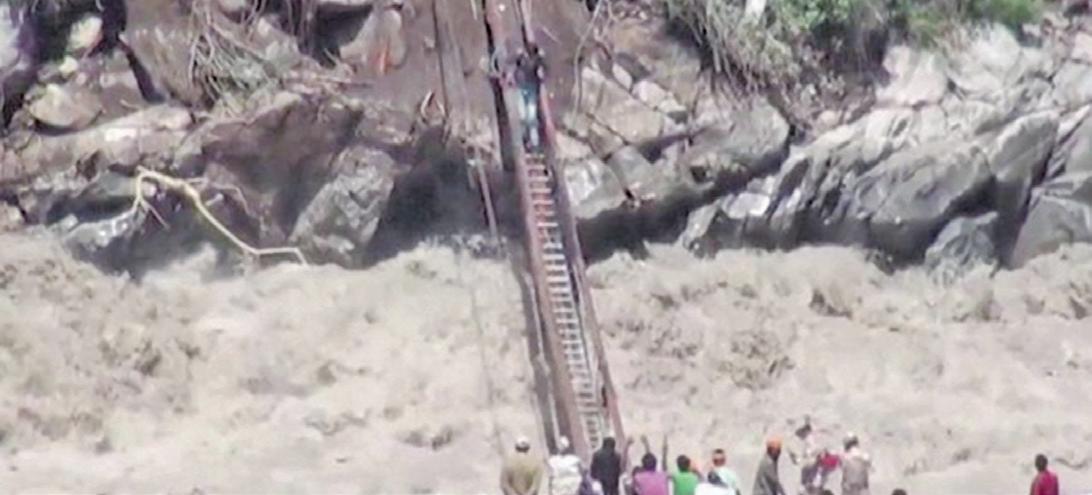
The Indian authorities are using every means possible to get to those affected
co-ordination.
Meanwhile, officials said that the severely damaged Hindu temple town of Kedarnath had now been cleared of survivors and teams were searching for the bodies of victims.
The biggest problems for rescue workers are the difficult mountainous terrain and the continuing poor weather.
Tourists and pilgrims were among those caught up
in the floods, which washed away homes, roads, and bridges. Many of those affected by the floods are accusing the government of neglect. Friends and relatives of those still missing have been protesting outside government offices. One woman who was rescued by an army helicopter said she had walked at least 25 kilometres (15 miles) trying to escape the floods. (Excerpt from BBC News)
Turkish Prime Minister Tayyip Erdogan piled ridicule on activists behind weeks of protests against his government during a rally on Sunday and defended riot police who fired water cannon at crowds in Istanbul a day earlier.
testers) thought the people would say nothing. They said we will burn and destroy and do what we want, but the people will do nothing,” he said.
Sunday’s mass rally was the fifth which Erdogan has called since protests began in Istanbul in an unprecedented challenge to his 10year rule.
The protests have underlined divisions in Turkish society between religious conservatives who form the bedrock of Erdogan’s support and more liberal Turks who have swelled the ranks of demonstrators.
A spokesman for Tehrike-Taliban said the attack was in retaliation for the killing of its second-in-command, Waliur Rehman, who died in a suspected U.S. drone strike in May.
Officials in the Diamir district of Gilgit-Baltistan say the area where the gunmen struck is extremely remote and there are no roads and no means of transportation other than mules.
They say the attackers must have been well-trained
It is the first such attack on tourists in the region. The Pakistani Taliban has told the BBC it was responsible.
and well-acclimatised. A lot of planning must have gone into conducting this operation. The area is a vast mountain desert, having approaches from three sides, each requiring 20 hours of walking; in practice two days of trekking.
Sunni Muslim hard-line groups have in the past carried out several attacks in this predominantly Shia region, mostly along the highway by targeting passenger buses, but this is the first time they have trekked deep into a remote area to kill foreigners. (Excerpt from BBC News)
Awoman has been arrested in eastern Spain on suspicion of attempted murder, after her newborn baby was rescued from inside a building’s drains.
Police say the 26-yearold woman was held in the city of Alicante.
The two-day-old baby boy – who still had his umbilical cord attached – was found wrapped in plastic bags in the manhole in the building’s courtyard.
The baby, weighing 2.1 kilograms (4.6lb), is in a serious but not life-threatening condition in a local hospital.
The baby was found after a neighbour had heard what he thought was a meowing cat trapped in the drains and decided to alert firefighters at about 02:00 local time (01:00 GMT) on Sunday.
In a statement, Spanish police said investigators later found the
woman who had lived in the building and was taken to hospital on June 21 claiming she had had a miscarriage.
She confessed she had tried to get rid of the baby, but did not have enough money for abortion, police said.
The investigators are trying to determine whether the mother acted alone or had any assistance from a third party.
(BBC News)
Looking out over a sea of Turkish flags waved by his AK Party faithful in the eastern city of Erzurum, Erdogan praised his supporters and the general public for opposing what he called a plot against his country.
“The people saw this game from the start and frustrated it. They (the pro-
The unrest was triggered when police used force against campaigners opposed to plans to develop Istanbul’s Gezi Park, but they quickly turned into a broader show of anger at what critics call Erdogan’s growing authoritarianism.
He ended his speech by throwing red carnations to the roughly 15,000-strong crowd in the AK Party stronghold.
The AK Party rallies are focused on boosting party support ahead of municipal elections scheduled for next March and Erdogan said voters would then give their verdict on the weeks of unrest. (Excerpt from Reuters)
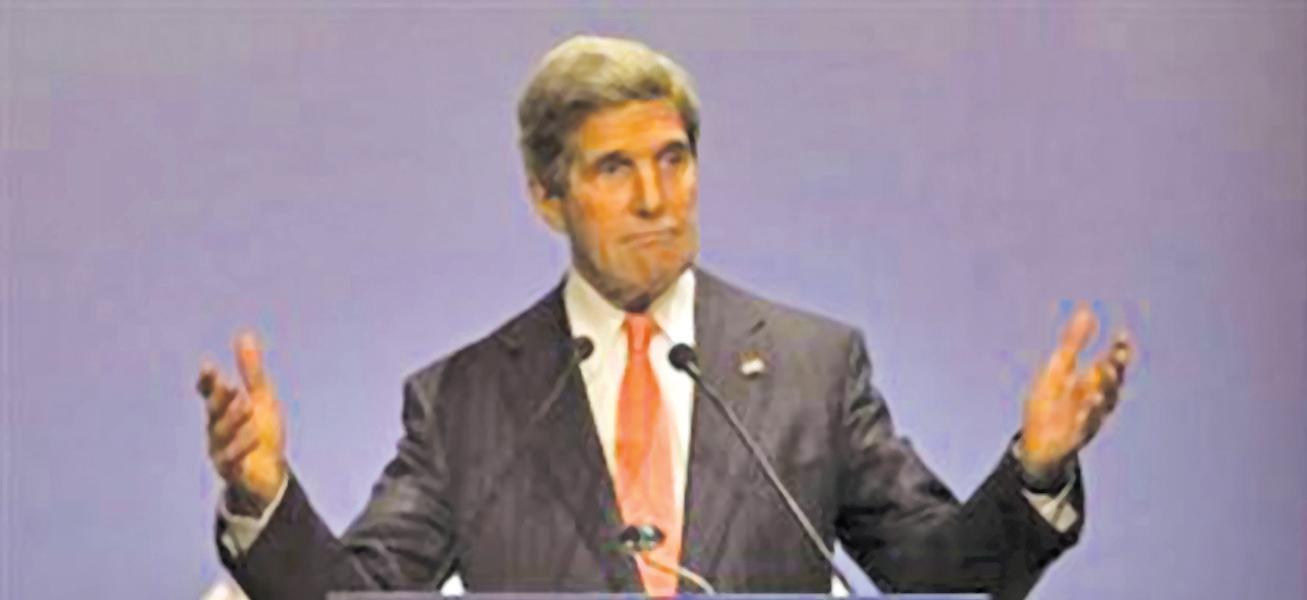
U.S. Secretary of State John Kerry speaks on the U.S.-India strategic partnership in New Delhi, June 23
United States Secretary of State
John Kerry urged fast-growing India to work with Washington to tackle climate change and develop green technologies, on the eve of talks on trade and regional security.
Emerging economies like India have resisted pressure in global climate talks to commit to targets to reduce greenhouse gas emissions, in a dispute with rich nations over whose industries should bear the brunt of the cuts.
But Kerry, on a seven-nation tour in the Middle East and Asia, said on Sunday failing to act would undermine growth and hurt the poorest the most.
The day before he was due to take part in the fourth annual U.S.-India Strategic Dialogue in New Delhi, he urged India to work with the U.S. to negotiate a global treaty on curbing global warming.
“We should work constructively side-by-side in the UN climate negotiations.
I am convinced we can move toward a global agreement ... that is sensitive to and respectful of the diversity of national circumstances,” he said in a speech.
“The health of our planet and the irreversible climate challenge speeding toward us, crying out for a global solution, is the place to begin this conversation,” Kerry added.
Cooperation on developing clean technologies would also spur economic growth and create jobs, he added.
“As we look forward, India and the United States, with our traditions of innovation and technology, are particularly well-positioned and ready to roll up our sleeves and take advantage of this opportunity,” he said.
“If we do this right, it won’t hurt our economies – it will grow them,” he said, noting that new energy markets were worth US$6 trillion.
(Excerpt from Reuters)
There are many opportunities in Trinidad and Tobago’s market, said Alejandro Bonoris, sales director, Agira, and representative of the Argentine Chamber for compressed natural gas (CNG) at TT’s Trade and Investment Convention (TIC). “We are present in over 30 countries all over the world. We think of T&T as the first big step to enter the Caribbean. We have already started to do business here
and we think this is a very promising country. Last year, we sold gas compressors for gas stations. We sold these units through our distributors Equip-US. Through this company, we won a tender from the National Gas Company (NGC) last year. Through them, we sold dispensers and storages,” he said.
TT has been on a CNG drive for the last 15 years, with former Finance Minister Winston Dookeran stating in
the fiscal 2012 budget that the government planned to “embark on an ambitious programme” for increasing the use of CNG. “This is part of our overall strategy to reduce the use of petroleum products and so reduce the size of the fuel subsidy. We are also implementing special measures to encourage the construction of multi-fuel stations to dispense gasoline, diesel and natural gas,” Dookeran said.
(Trinidad Guardian)
The prison sentence for the former boss of scandal-hit Enron has been reduced on appeal from 24 to 14 years.
Jeffrey Skilling presided over Enron when it became embroiled in one of the biggest corporate frauds in U.S. history.
In return for the more lenient sentence, Skilling, who has been in prison since 2006, has agreed to stop appealing against his conviction.
Thousands of workers lost their jobs and retirement savings when energy firm Enron collapsed in 2001. The company’s implosion came amid revelations executives had covered up the shoddy state of its finances with accounting trickery and shady business deals.
The agreement between Skilling and federal prosecutors also allows more than US$40 million seized from him to be distributed to the
victims of the Enron fraud.
His prison term is now set to expire in December 2020.
He was able to push for a sentence reduction after an appeals court ruled in 2009 that a sentencing guideline had not been correctly applied in the original trial.
Skilling worked for Enron for 20 years and was chief executive for just six months, leaving the company four months before bankruptcy.
(BBC News)
Africa’s “rise” precarious while investors still consider safer destinations
The G8 ended its two-day meet last week with a set of fairly flimsy bullet points on the issue of corporate taxation, at least as concerns the reported mass outflows lost by sub-Saharan Africa each year. That multinationals should “report to tax authorities what tax they pay where”, and Western governments have “a duty to help” developing countries collect tax owed to them, will be of little reassurance to African
leaders who capitalised on the pre-G8 fanfare.
The issue throws up a whole set of questions on African governments’ capacity not only to accurately assess and collect taxes owed to them, but also to attract foreign investment in the first place to relatively high-risk, high-cost environments without incentives.
Moreover, while African leaders joined what for a moment looked like a ‘collective
EU finance ministers have failed to agree on how to rescue troubled banks in any future crisis. After almost 20 hours of talks on Saturday, ministers are still split on whether savers should bear any of the cost of a bailout.
The impasse will now be debated at a meeting of EU heads of government on Wednesday.
“I have no doubt we
will reach a deal,” French Finance Minister Pierre Moscovici said.
Talks in Luxembourg on Saturday were centred on new rules determining the order in which investors and creditors would have to pay for bank bailouts.
Countries were divided on whether the Cyprus rescue should be a template for future bailouts, or whether losses should be limited to banks’ creditors.
The UK is reported to be one of the countries that do not want to be bound by EU rules, preferring to have some flexibility over whether to charge depositors in the case of future bailouts.
“It is principally an issue of the non-euro and the euro,” said Irish Finance Minister Michael Noonan.
The UK is one of 10 countries in the 27-member bloc that are not part of the euro.
(BBC News)
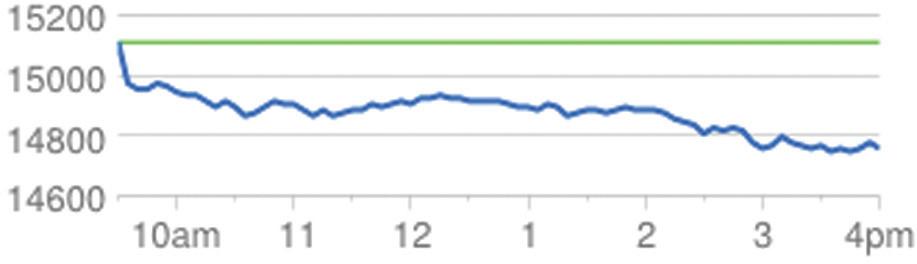
voice’ on corporate taxation in the lead-up to the G8, these countries also compete with their neighbours for foreign investment. In keeping with the rest of the world, such competition may limit harmonisation incentives.
African governments will need to look for revenues elsewhere. This was particularly apparent when four out of the five East African Community countries released their annual budgets. (allAfrica)
he Bank of England and its Chinese counterpart have signed a deal likely to boost trade between the UK and China in the yuan.
The Bank and the People’s Bank of China have signed a three-year currency swap arrangement worth 200 billion yuan (US$33 billion), the UK central bank confirmed.
The UK is looking to become a centre for the Chinese currency, also known as the renminbi. British banks hold
35 billion yuan worth of deposits in the Chinese currency. Currency-swap agreements allow central banks to swap currencies and can be used by firms to settle trade in local currencies rather than in U.S. dollars, as happens now, since China’s currency is not fully convertible to other currencies.
The prospective deal was first announced in February by B Bank of England Governor Sir Mervyn King.
“In the unlikely event
that a generalised shortage of offshore renminbi liquidity emerges, the bank will have the capability to facilitate renminbi liquidity to eligible institutions in the UK,” Sir Mervyn said on Saturday. Last year, the UK Treasury announced plans to make London – the world’s largest currency trading hub – the leading international centre for trading the yuan outside mainland China and Hong Kong. (BBC News)
AKuwaiti sheikh is suing UBS AG for US$21.4 million, alleging the Swiss bank failed to pay him for helping it become lead arranger on a US$9 billion asset sale by the Kuwaiti telecommunications operator Zain, a Dubai court heard on Sunday.
The case highlights the complexity of doing business in the Gulf, where personal connections to high-ranking officials or executives are often valued in deal-making.
Sheikh Meshal Jarah alSabah, a member of Kuwait’s ruling family, says UBS recruited him with a verbal contract in July 2009 to help scupper the French media conglomerate Vivendi’s bid to acquire Zain’s operations in about 15 African countries. UBS denies the allegation.
Vivendi called off the talks later that month. India’s Bharti Airtel subsequently bought Zain’s African assets for US$9 billion in 2010; UBS
advised Zain on the deal. Sheikh Meshal said he met with two UBS executives at Dubai’s opulent Atlantis hotel and agreed to urge Zain’s shareholders and management to open a tender to other bidders for the operator’s African units, according to documents submitted to the court. He said he also committed to help UBS become the lead bank for the sale, for a fee of 0.1-0.2 per cent of the total deal value. (Reuters)
PepsiCo Inc – best known for Pepsi-Cola and Frito-Lay chips –is taking its Muller yogurt brand nationwide, expanding its portfolio of healthier foods at a time that U.S. consumers are increasingly shunning traditional soft drinks. Yogurt is one of the fastest selling categories in grocery stores, and PepsiCo sees plenty of room for growth even though it has come late to the party.
“Dairy has become everybody’s favourite avenue when it comes to escaping the miseries of obesity,” said Bevmark Consulting Chief Executive Officer Tom Pirko. “Everybody’s trying to figure out a health angle.”
To boost its chances of success, PepsiCo has partnered with Germany’s Theo Muller Group, a stalwart of the European dairy industry,
repeating a strategy that has already made the snack-andsoda company a leading U.S. purveyor of hummus and other healthy dips.
Earlier this month, the Muller Quaker Dairy joint venture opened a yogurt plant in upstate New York. By combining Muller’s expertise with its own marketing and distribution muscle, PepsiCo aims to build a loyal U.S. following.
But that won’t be easy even with PepsiCo’s size, Muller’s reputation and growing demand for nutritious food, said industry experts. Consumers are demanding, and pricing is hyper-competitive. Traditional yogurts from General Mills Inc’s Yoplait and Danone’s Dannon often use eye-popping discounts. Even Chobani, the darling of the Greek yogurt craze, has been running promo-
tions more often. The competition was so fierce that Kraft Foods pulled its Athenos line of Greek yogurt in 2012, only two years after its launch.
PepsiCo is expected to fare better, said Wells Fargo analyst Bonnie Herzog, but a lot will ride on how much PepsiCo opens the company pocketbook. “Quite frankly it’s going to depend on how much marketing they put behind this big roll-out,” Herzog said. But PepsiCo chief executive Indra Nooyi says the company need not go overboard in its spending to make the brand a success. The company’s investment in the 50/50 joint venture will not “break the bank” and the yogurt is innovative enough to sell at a premium price, she said. There are no plans to fund aggressive promotions to spur sales temporarily. (Reuters)

The National Cultural Centre (NCC) on Sunday came alive when the Guyana Music Teachers’ Association hosted yet another “Musicians on Stage”, featuring a series of mesmerising melodies and beautifully choreographed dance pieces.
The programme included violin, piano, guitar, steel pan and drumming pieces. There was also choral and vocal singing, along with choral poetry. These items were performed by the members of the Associated Board of the Royal Schools of Music (ABRSM) and the winners of the Guyana Musical Arts Festival.
Dancing to “Classical Moods”, the National School of Dance performed the first presentation of the programme. There were 18 pieces of piano solos, two violin solos, a guitar solo, a vocal solo, steel pan solo and drumming by “The Diamond Drummers”.
Choral item
Students from Mae’s Primary School performed a choral item, “Whistle While You Work” and Success Elementary students recited the choral poem, “I Can’t Go To School Today” and choral song, “O No John Arr”.
The top performers from the recently concluded ABRSM examination were given trophies, awards and certificates during the programme for their outstanding performances.
Certificates were given to Adaeze Lumumba for Highest Merit for Violin, Grades Four to Five; Darrell Levans for Grade Six Piano, Highest
Merit, and Carole Fletcher for Grade Seven Piano, Highest Merit, both students of Marilyn Dewar Education School.
Thirteen trophies and awards were distributed, including the first ever Frank Anthony Trophy for Guitar Grades One to Three, which was given to Khalid Gobin, also a student of Dewar Music Education School, for acquiring a distinction in Grade Two Guitar.
Jinelle Thomas of Pauline Mitchell School won the Sarah Parris Trophy with a distinction in Grade One Piano. The Miriam Daniels/Sybil Husbands Trophy was copped by Rejan Mc Kay, who earned a distinction in Grade Two Piano.
Diante Callender of Clemsville Conservatory and Rueben Stanley of Marilyn Dewar Music Education School jointly won the Clara Burrowes Trophy for acquiring distinctions in Grade Three Piano.
Orin Burrow Trophy
The Orin Burrow Trophy was given to Chareese Vandyke, who scored distinction in Grade Four Piano while Adaeze Lumumba received the Marcelle Hack Trophy for gaining distinction in Grade Five Piano. They are both from Clemsville Conservatory.
The Dr Prashanti Mendis Trophy (Violin Grades One to Three) was given to Grade One Violin (distinction) student Rebecca Low of the Clemsville Conservatory. Low also received the Theodore Gandi Trophy Wind/Violin
for attaining a distinction in Grade One Violin.
Levans, who obtained a distinction, won the Edna Jordan Trophy Theory.
Levans also won the Philip Pilgrim Memorial Harp award for obtaining merit in Grade Six Piano.
The Junior Teachers’ Award was won by Pauline Mitchell School and Clemsville Conservatory, while the Junior Teachers’ Prize was jointly won by Jinelle Thomas and Rejan Mc Kay of the respective schools. Mc Kay and Thomas also jointly won the William Pilgrim Trophy.
Ensemble medley
The final two items of the programme were a tutors’ ensemble medley and dance. The harmonious medley was done by two guitarists, a violinist, a drummer and a keyboard player, who played “Suhani Raat”, “Spanish Eyes” and “O Danny Boy”.
The National School of Dance performed the final item of the programme, a dance to “Youth, The Pride Of Our Country”, choreographed by Linda Griffith.
ABRSM is a London-based music school and every year an examiner from the parent company comes to Guyana to oversee the ABRSM examination. This year, some 142 students entered the examination; however, seven of them withdrew. From the remaining students who took the examination, 19 obtained distinctions, 23 gained merits and 64 received passes. Examinations were done in piano, violin, guitar playing and singing.
An alleged burglar was in the wee hours of Sunday morning shot in the left knee after he reportedly attempted to commit a robbery at the Two Brothers' Gas Station at Land of Canaan, East Bank Demerara. The shooting incident took place about 03:00h. Michael Sargeant,53,of Lot 128 Land of Canaan, East Bank Demerara was shot and
injured by a licensed firearm holder after he attacked the man who reportedly found him in the compound of the business place. Guyana Times was told that the shooter is a security guard at the service station.
Immediately after the shooting, the police were summoned and Sargeant was rushed to the Diamond Diagnostic Centre but was
subsequently transferred to the Georgetown Public Hospital, where he was admitted a patient in the Male Surgical Ward.
The bullet was removed from his knee and a hospital official confirmed that he is in stable condition. His injuries are not lifethreatening, the official added. The police are investigating the incident.
monday, june 24, 2013 |
National basketball player Marlon Pollydore and Fabian Anthony, the two employees attached to bauxite mining company Bosai Minerals Group Guyana Incorporated (BMGGI) who were injured in Thursday’s accident involving a 100-tonne 769 B Caterpillar dump truck and a Nissan pickup truck along the Coomacka Mines access road, are still hospitalised.
The Lindeners were admitted to the Linden Hospital Complex (LHC) emergency unit in critical condition on Thursday following the smash-up, which claimed the lives of three other Bosai employees – 61-year-old Trenton Garner, 43-year-old Michael Williams, and 20-year-old Kester Grant.
Pollydore, former Linden Technical Institute (LTI) and Victory Valley Royals football team member, suffered serious head and bodily injuries. He remains a patient at the Intensive Care Unit, while Anthony was moved to the institution’s male ward. LHC officials confirmed that Anthony was listed as critical and was scheduled to receive blood over the weekend, since he suffered massive blood loss. The officials noted that approximately 20 persons from LTI on Friday participated in a blood drive, which was aimed at securing blood for Anthony who also suffered a cracked pelvic bone. Approximately four units of blood were reportedly secured from the drive.
Pollydore is said to be
conscious and communicating verbally, while Anthony has been listed as stable.
BMGGI Community Relations Officer Vanessa Davis said the company has not yet released any official statement on the accident as police are currently investigating, but noted that such should be expected today.
According to reports, at approximately 11:30h on Thursday, the five employees were in the Nissan pickup travelling along the roadway to Linden when the driver attempted to overtake the dump truck, but lost control and crashed beneath it.
The dump truck, also owned by BMGGI, was returning to Linden after its occupants conducted work in the Montgomery mines area as well.
The National Youth Policy is currently being updated with the expectation of having a consultant later in June, Culture, Youth and Sport Minister Dr Frank Anthony said.
He made the disclosure in an invited comment to Guyana Times at the recent launch of the National Drama Festival 2013, at the National Cultural Centre.
“We have an existing one, but it is old. The challenge has been how do we get people to form the Youth Council… we had an interim council years ago… Caricom had from time to time formulated a strategic direction for youths… they have formulated the Caricom Youth Ambassadors,” said Dr Anthony.
Current policy
The minister said the United Nations Development Fund (UNDP) has also assisted the government in understanding issues of youth. “We probably had about 10 or 15 reports dealing with youth policy and based on these reports… we even had face-to-face consultations… we will be updating the current policy,” stated Dr Anthony.
He continued that Guyana with the current youth policy, talks about a Youth Council, but the challenge is how to get people to form one. “We had an Interim Youth Council years ago and was never able to bring it to fruition because there was a fight for power, so it never got to the stage of being an actual Youth Council…” said Dr Anthony.
The minister noted last year he spoke with the Commonwealth director, who agreed that the Commonwealth Youth Programme (CYP) would be funding a consultant to come to Guyana to help with the draft of the new policy.
“That consultant is expected in Guyana during this month ... the way we have been going about it... is that
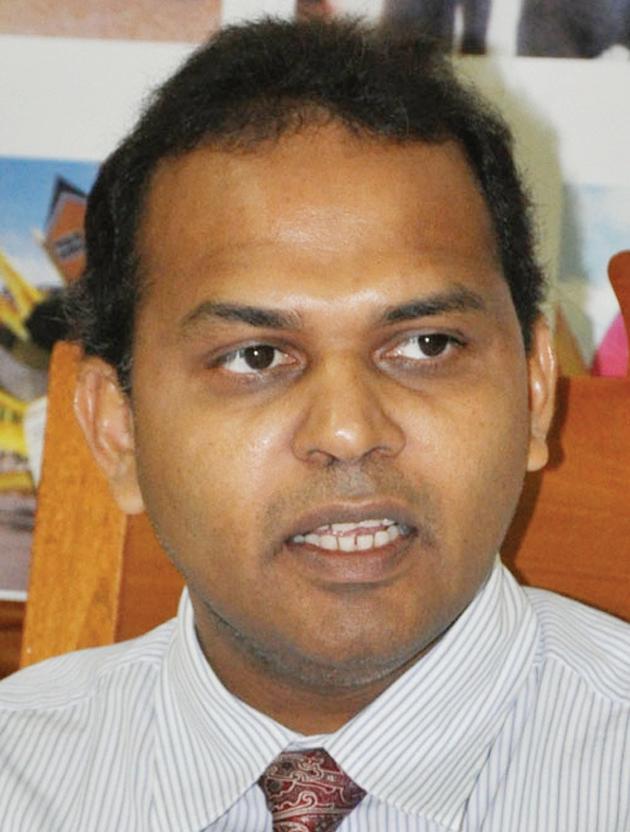
they have done a desk review on all the documents and will holding consultations with all the young people... talking to them and getting feedback of their issues,” he said, “We have been organising some stakeholder groups with youth from different backgrounds and after that, using the information... they would put together a draft and once that draft is out, together... we will try to finalise the policy.”
These comments came in the light of a recent consultation with the CYP, where Commonwealth youths renewed calls for the implementation of a National Youth Policy in Guyana and for the formation of a National Youth Council.
During the consultation held at the Regency Suites Hotel, Brickdam, Georgetown, the focus was on the establishment of a Regional Youth Council. The forum sought to establish the background between the first and second Commonwealth youth summits, while engaging in constitutional discussion on an update on the agreement to launch Commonwealth Youth Council (CYC).
During the meeting, youths associated along with various non-governmental organisations (NGOs), spoke about promises that were made to young people to integrate youths into policymaking and decisions at
the highest levels of governance. Others noted that this was promised through the National Youth Policy, which was supposed to be completed years ago.
Meanwhile, it was noted that, young people for years have continuously called for the document to be finalised; however, the only explanation forthcoming was that it was in its draft stages and will be completed shortly.
Independent body
The Commonwealth Youth Council was recommended as an independent body that would strengthen and widen the current PanCommonwealth youth caucus in order to represent a wide cross-section of youths in the Commonwealth. With the creation of a National Youth Council, Guyanese youths will be represented by the majority and be able to voice their concerns and participate in the discussion and policymaking process.
The National Youth Council will allow for all youth organisations to be represented by one major body which will, in turn, represent Guyanese youths at the regional and international councils. The body will be governed by the Commonwealth Youth Project Constitution.
The Commonwealth Youth Project Constitution is the culmination of several years of work by young people across the Commonwealth with support from the Commonwealth Secretariat through the CYP and its partners. The constitution was drafted by a committee of young people and was reviewed by national and regional youth conferences in all the four regions of the Commonwealth. It also seeks to help achieve the objectives and principles of the Commonwealth in ensuring a relevant, vibrant, effective, and prosperous Commonwealth in the 21st century and beyond.











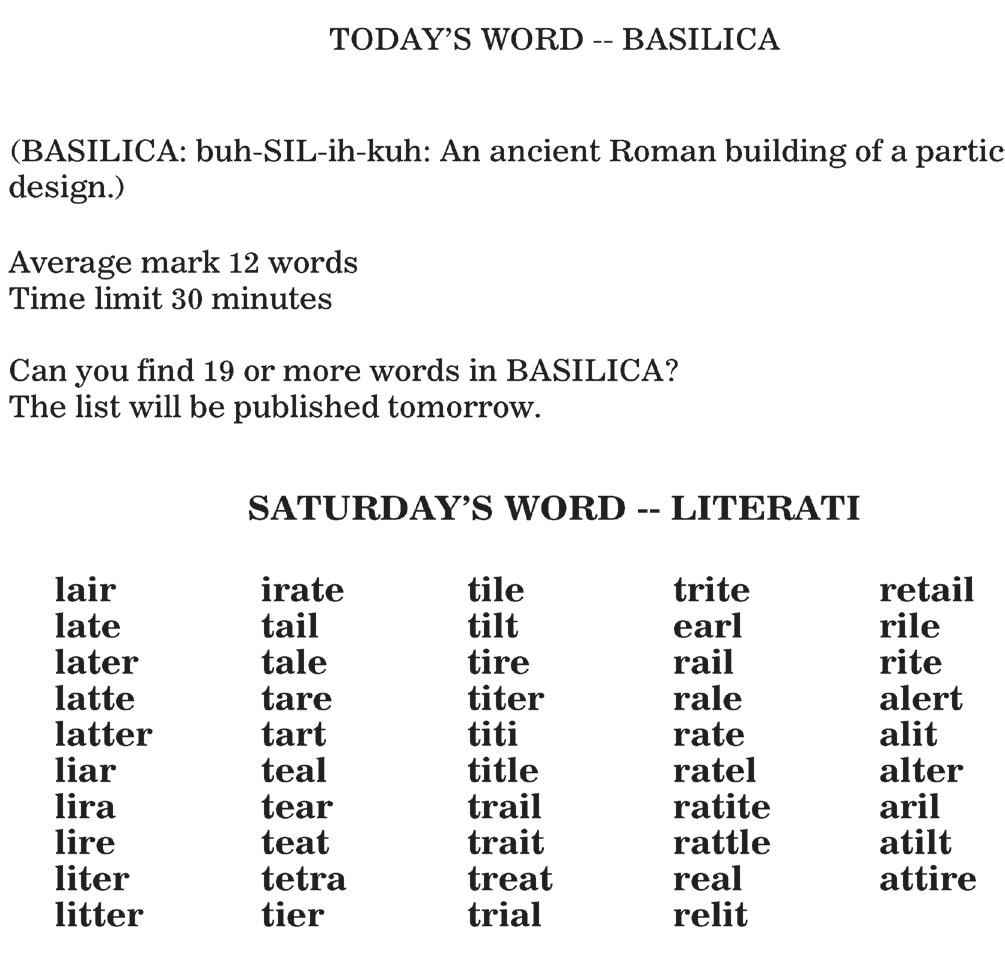




Your ability to evaluate things correctly might not be as effective as you think. Try to operate only in areas of strength.

By Bernice Bede Osol

(June 21July 22) (Jan. 20Feb. 19) (Dec. 22Jan. 19)
Try to relax and let things take their course. You’ve worked hard to plan something well, and you don’t need to make any last-minute changes.

When it comes to workrelated issues, don’t be overly dependent on coworkers who’ve helped you in the past. They might not be around this time.

As long as you’re permitted to think for yourself, you’ll be productive. Undue orders or interference will slow you down to a crawl.

(Aug. 23Sept. 22)
(July 23Aug. 22) (Feb. 20-March 20)
Success is likely if you’re able to organise your priorities in a methodical manner. If for some reason you can’t, you’re likely to end up being an also-ran.

(March 21-April 19)
Unless you have your mind on what you’re doing, you could end up taking one step forward and two steps back. Obviously, doing so will get you no place fast.

(April 20-May 20)
Your first thoughts are likely to be your best, yet for reasons known only to you, you’re likely to put far more stock in your less-accurate assessments.

(May 21June 20)
Don’t push your commercial dealings too far. Holding out for extra concessions might take all the snap out of the rubber band.
Your judgment is likely to be far superior to that of a well-intentioned friend. Listen to this person’s advice, but keep your own counsel.

(Sept. 23Oct. 23)
Don’t put off important assignments until the last minute. You’ll be much sharper early in the day, so you shouldn’t waste those hours.

(Oct. 24Nov. 22)
Tend to your own affairs before trying to help out other people. You won’t be thought of as selfish, just efficient.

(Nov. 23Dec. 21)
There is no valid reason why you should share your good fortune with persons who had no hand in bringing it about. However, be sure to reward those who did.

Furnished rooms and apartments; 1, 2 & 3 bedroom apartments- long & short term rental. Affordable rates Call: 227-2199, 227-2186, 227-2189

caR RenTal
Journey Inn Apartments & car rent-
al. Rooms & car to rent from $3000 Premio, Vitz. Phone: 689-6668, 6394452.

Dentures provided in 72 hours from as low as $4500. Contact Dr B Stuart, 209B Charlotte Street, Lacytown. Tel: 225-5034

It’s here again!!” Music summer camp 2013” register now!! keyboard, guitar,

Available: Fresh long-stemmed roses, fresh dried and silk floral arrangements, gift items, bridal boutiques and wreaths. Nesha’s Flowerland. 78 Church Street (opposite St George’s Cathedral). Tel: 227-3553/225-3315


Learn transcendental meditation and reduce stress, be happy increase intelligence, develop your full brain potential, improve relationships, be successful, be peaceful, develop higher states of consciousness , a technique that works for everyone, enroll now for next class. Contact Askoke (certified teacher) email kashokejp_68 @yahoo.com. Phone: 233-693
Healthworld Holistic Centre: Psychotherapy available for all types of abnormal behaviors –addictions, emotional, suicidal, anger, relationship and sexual problems. Treatment of stress disorders, depression, fear, low self-esteem, insomnia, trauma, psychosomatic sicknesses, and children's disorders. We also conduct IQ evaluations and behavioral assessments. By appointments only. Clinic hours: 11:00 – 17:00h. Tel: 592-621-0552. Email:healthworldhc@gmail.com



Immigration & Visa Services We handle all Canadian, USA and UK, Immigration and Visa matters. Self Sponsorships, Holiday/Visitor’s Visas, Work Permits, Students Visas, Family, Class, Immigration Forms, Embassy Enquiries, Appeals for Refused Cases, U.S Green Card Lottery, Business Class Waivers, Pardons etc. Get your Visa approved. High Success Rate. Balwant Persaud & Associates. Certified Immigration Consultants 68 Sixth Street, Alberttown, Georgetown (Between Cummings & Lights Sts.) Tel: 2251540, 622-8308, 655-3105. Email: balwantpersaud@yahoo.ca
MONday, juNe 24, 2013


Professional Key Shop, 125 Carmichael Street, Georgetown. Phone: 225-3923, mobile: 6213249. We cut any type of key, service and repair all types of locks. Get your extra key today. Key cUTTing

Da Silva’s Optical. For Your Eyes Only, Look Better See Better. Phillip A Da Silva OD, Shannon L Da Silva OD, Natalie Da Silva OD. 248 South Road, Bourda. Phone: 227-3529, Linden: 444-6376, Corriverton: 339-3536, Meten-Meer-Zorg: 2750322, Grand Cayman Islands: (345) 943-1515 for the perfect trendy touch. OpTician


Learn transcendental meditation and gain deep relaxation, eliminate stress, increase creativity and intelligence, promote health, attain inner happiness and fulfillment and contribute to peace for the world. Contact certified teacher Ashoka: 233-6921, email kashokejp_68@yahoo.com
Suriname astrology palmist and Djuka healer, the most powerful spiritualist in the world, are you suffering from the following problems - (any religions) love, marriage, family, health, business, husband and wife relationships, property, court, children, promotion, visa, pregnancy, education, depression, job, sexual, jealousy, enemy, money, drinking, also you can have all evil forces destroyed such as black magic, witchcraft, voodoo, obeyah, etc, and gives powerful protection. Private and confidential. Phone: 601-5947.
Dutch Spiritual work. Unite lovers, get rid of evil, enhance prosperity, good luck baths and charm bowu guards, etc. Phone: 220-0708, 612-6417, 687-5653
Divinations and cleansing of spiritual problems of all kinds. Powerful Ifá and Khemetian spiritual guards, pendants, crystals, and rune stones to help you overcome problems with love, relationships, legal, sexual, pregnancy, business, sickness, jobs, enemies, work, money and many more. Call 10:00-16:00h on: +592-690-1824. Email: anew-life@live.com

TOUR
SUMMERTIME TRAVEL DAILY FLIGHTS. LETHEM, PORT KAITUMA, MAHDIA, KAIETEUR FALLS, PARAMAKATOI. JUNE 29 - JULY 1. PARIMARIBO-SURINAME, BOA VISTA-BRAZIL, KAIETEUR FALLS DAY, ESSEQUIBO & MAZARUNI RIVER. TEL: 264-2851, CELL: 668-6501

TMARGOT, ECD. 624-0762 , 220-5177. A NAME AND A SERVICE YOU CAN TRUST.


One cook interior phone:680-5346.
Clerical staff. Must be computer literate, knowledge of CorelDraw will be an asset. Send applications to Jarrods, 51 Main Street, Georgetown.



he Human Services and Social Security Ministry, in collaboration with the United Nations Development Programme (UNDP), on Saturday, held a one-day training session in Bartica, Region Seven to sensitise residents about the issue of Trafficking in Persons (TIP) and to make them aware of government’s response to the crime.
The session was conducted at the Bartica Nursery school and facilitated by UNDP representative Trevor Benn, Help and Shelter Coordinator Margaret Kertzious and the ministry’s CounterTrafficking in Persons Unit coordinator, Tricia Watson and technical officer, Kester Harding. Also in attendance was Region Seven Chairman Gordon Bradford.
Human trafficking
The group took the participants, inclusive of persons from the local community policing group, police station and schools, through presentations and discussion on topics related to human trafficking. These included distinguishing labour exploitation, human smuggling and human trafficking, child work, child labour and child trafficking and Guyana’s response to these.
Additionally, the victim support services offered by the ministry and the role of Help and Shelter in combating TIP were also discussed.
Human trafficking can be defined as an organised criminal activity in which human beings are treated as possessions to be controlled and exploited (by being forced into prostitution or involuntary labour). Over the past years, the Labour, Human Services and Social Security Ministry, with support from stakeholder agencies, has sought to heighten awareness of this scourge, and in the process have visited several regions, targeting communities that are likely to be affected by TIP.
During this month, the ministry embarked upon a countrywide public awareness campaign, conducting training sessions in Regions Four, Six, Eight, and Nine. Region Seven is the latest region to be visited, the Government Information Agency (GINA) said.
Benn explained that essentially the campaign’s objective is to provide key stakeholders with information to prevent and support persons
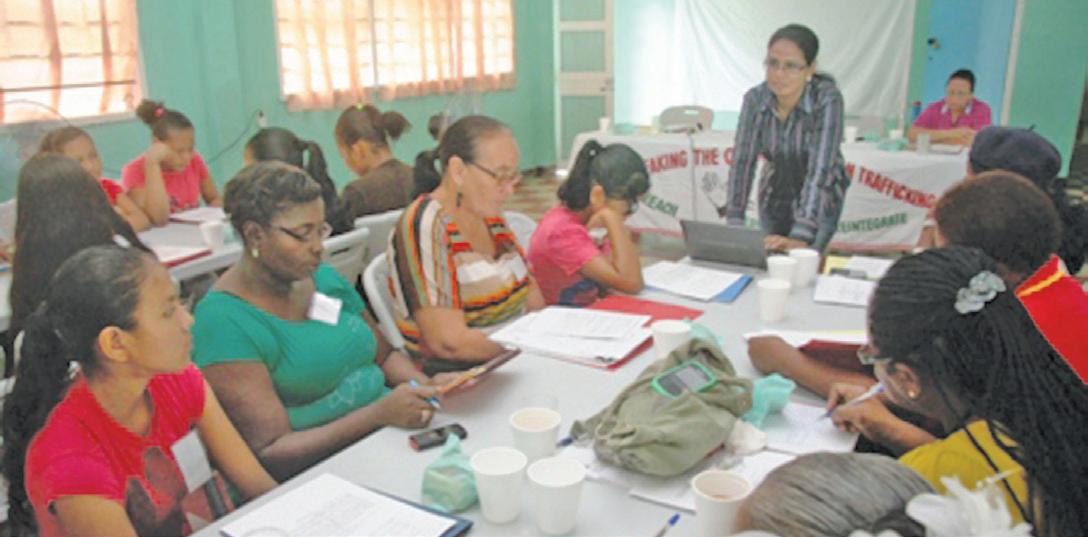
from becoming victims of TIP.
“We are going to the region to sensitise key stakeholders in the community who are either in direct contact with people who are tempted to get involved in TIP or who themselves have had something to do with TIP.
“We are reaching with officials in the regions, including the Regional Democratic Councils (RDCs,) health officials, the disciplined services officials, immigrants, police and the Guyana Geology and Mines Commission (GGMC.) We bring all of them on-board at the training and sensitising session,” he said.
Training sessions Benn observed that the training sessions have been well received in all the regions and that the groundwork is being set for better informed communities when it comes to combating issues relating to TIP.
“Hopefully in the not-too distant future, we will have many more people who, based on the new information, will be able to support the government and their communities in combating incidents of TIP,” he said.
“We know and recognise that this is a very sensitive and serious issue in the country and the UNDP hope that at some point based on our support, we will be able to assist the government in bringing some level of normalcy to the country when it comes to issues relating to TIP, in the sense that we will find ways to reduce as much as possible those incidences and eradicate if possible, and that we will be able to have a population that support those efforts,” he said.
Region Seven Chairman Gordon Bradford welcomed the session in the region. He said the more sessions that can be held, the more persons can learn about trafficking which can only serve to help the country.
He noted that human trafficking stigmatises Guyana and affects disbursement of funds to the country from donor countries and agencies. He called for all to be involved to combat the issue.
Gordon also said that he was pleased with the turnout, especially the large percentage of youth as they were the ones more vulnerable to the scourge. He said it was especially important that the youths from the Amerindian communities in the region be educated on the issue, since these communities usually lack the institution to provide such information.
Bartica Community Policing Group Public Relations Officer Edward Persaud, who participated in the training session, said the activity was most welcomed. He said it forms part of activities of the policing group.
Awareness
“This is much welcome here in Bartica and in transit communities. I am happy today to witness too, that there was a high percentage of people participating. This augers well to boost more awareness so that we can better able to recognise the criminal activity of TIP,” he said.
Persaud also advocated the setting up of an institution in the community to provide shelter for victims of TIP so that they could be reintegrated into society.
The ministry plans to host the next training exercise in Region One, following which the plan is to bring persons from all the regions where the sensitisation exercises were conducted.
The aim is to train these persons to conduct training and awareness workshops in their respective regions and communities and to sustain the ministry’s efforts in the regions. These persons will also work with the various stakeholder agencies in the regions in combating TIP.
Malaysia has declared a state of emergency in two southern districts after smog triggered by forest fires in Indonesia reached hazardous levels.
The coastal towns of Muar and Ledang are in shutdown, and residents have been advised to stay indoors.
Air pollution has also worsened in the capital, Kuala Lumpur, shrouding its landmark Petronas Towers in hazy smoke.
Malaysia’s environment minister is to meet his Indonesian
counterpart on Wednesday to discuss the problem.
Smog has become an annual problem in Malaysia, but this is the first time in eight years that a state of emergency has been called. People are angry that the authorities have not been able to address the health hazard.
Officials on Sunday confirmed the Pollutant Standards Index (PSI) had exceeded 700 in two districts. A reading above 300 indicates that air pollution has reached dangerous levels.
Schools in the region have
been ordered to remain closed. Local authorities have distributed face masks to residents.
Even in Kuala Lumpur, where smog levels have so far remained moderate, visibility is now strongly reduced and the smell of thick smoke hangs in the air.
Kuala Lumpur resident Raj Ahmed told the BBC: “You wake up in the morning and you can smell burnt wood – you look out the window and there is constant smog clouding the major landmarks that you would ordinarily see. (Excerpt from BBC News)
England’s search for a global one−day title goes on after they collapsed to a five−run defeat by India in a pulsating Champions Trophy final at Edgbaston on Sunday.
Chasing a modest 130 in a game reduced to 20 overs per side by rain, England were set for a historic triumph with 20 needed off 16 balls and Eoin Morgan and Ravi Bopara at the crease.
However, Morgan’s departure for 33 was the first of four wickets to fall for three runs in eight balls as a bout of nerves ran through the team.
England finished on 124−8 after James Tredwell missed the last ball of the innings with six required for victory.
Off-spinner Ravichandran Ashwin
claimed 2−14 and slow left− armer Ravindra Jadeja took 2−24 to complement his vital unbeaten 33 off 25 balls in India’s 129−7.
England are left to reflect on a fifth defeat in a major final − and another agonising loss in the Champions Trophy showpiece after losing to West Indies in 2004 −
following the sort of woeful batting display that many thought had been consigned to the past.
A jubilant India, meanwhile, can add the Champions Trophy to the World Cup they won in 2011.
They – and the thousands of India fans among a sell-out crowd − also owe a debt of thanks to the International Cricket Council, which extended the finish time by more than an hour to allow the match to finish at 20:30 BST.
The manner in which England floundered against spin − two batsmen were stumped, albeit one, in Ian Bell, despite replays suggesting otherwise − took the gloss off a fine performance with the ball.
Bopara’s 3-20 was therefore in vain, while his dismissal for a punchy 30 − in what looked like being the game’s most pivotal innings − is likely to be remembered as part of a collapse that will be recalled for all the wrong reasons.
A fifth−wicket stand of 64 between Morgan and Bopara aside, England were rarely comfortable during
a pursuit that was undermined when Alastair Cook edged Umesh Yadav to first slip in the second over.
Jonathan Trott, criticised for his strike−rate in this tournament, batted like he had a point to prove in making 20 off 17 balls, only to over−balance as he attempted to work Ashwin into the on−side and Mahendra Dhoni completed a smart stumping off a legside wide.
Joe Root swept Ashwin to short fine-leg and Bell was stumped − replays suggested his foot was grounded − when he dragged his foot out pushing at man of the match Jadeja, leaving England 46-4.
Bopara hit two huge leg− side sixes and Morgan one as they restored the balance of power, but the game changed in one remarkable over from the wayward Ishant Sharma.
He bowled two successive wides before Morgan, swiping across the line, found mid−wicket, and when Bopara pulled the next delivery to backward squareleg, England were reeling.
As if to illustrate the
Abel Hernandez scored a first-half hat-trick as 10-man Uruguay booked a place in the Confederations Cup semi-finals with a comprehensive win over Tahiti on Sunday.
The striker scored a header and finished a Nicolas Lodeiro pass before Diego Perez and Hernandez made it four.
Andres Scotti’s penalty was saved before the Uruguayan and Tahiti’s Teheivarii Ludivion were sent off.
Lodeiro scored a fifth and Hernandez converted from the spot before substitute Luis Suarez added two more.
Oscar Tabarez’s team will now face Brazil in the last four on Wednesday.
Uruguay knew that a point would probably be enough to progress and Tabarez was confident enough to make 11 changes with the last four in mind.
That included leaving out Suarez, Edinson Cavani, and Diego Forlan out of the starting line-up but Palermo’s Hernandez, who had only scored three international goals before the match, provided plenty of cutting edge.
The amateurs of Tahiti have won plenty of praise for their efforts in Brazil and there were positives for them to take away from Recife, with striker Steevy Chong-Hue impressing and debutant Gilbert Meriel being able to celebrate his penalty save from Scotti.
But their prospects of claiming any more than flashes of pride were over af-

ter just one minute and 19 seconds, when Hernandez scored the quickest goal in the history of the competition.
Lodeiro’s corner was glanced on by Scotti and Hernandez had a simple finish at the far post and the striker showed similar composure when he raced on to a Lodeiro pass and beat Meriel.
Perez scored a third – his second in 85 internationalswhen he ran on to a Walter Gargano lob and tapped in from close range after his initial header was stopped by the post.
Chong Hue gave Uruguay a scare when he coasted around goalkeeper Martin Silva but could only hit the side-netting from a narrow angle.
But Hernandez extended the advantage just before the interval when he guided a shot into the corner from
panic that had infested the dressing room, Jos Buttler was bowled first ball aiming an unsightly heave at Jadeja, then Tim Bresnan was run out after he went in search of an impossible single to point.
England’s precipitous slide put the contributions of Virat Kohli, who made 43, and Jadeja into greater context, on a pitch that turned more as the evening progressed.
They helped repair a scorecard that read 66-5 after the loss of Suresh Raina and Dhoni in the space of five balls, with Jadeja leading a late assault that brought 33 − ultimately crucial − runs off the last three overs.
England had to wait almost six hours to capitalise on overcast conditions little different from when they won the toss.
However, Stuart Broad struck in the fourth over when he nipped one back to beat Rohit Sharma’s drive.
The scalp of Shikhar Dhawan, the tournament’s leading run-scorer, was more highly prized, not least because he uppercut Broad for six and took successive
fours off Tredwell before he drove a Bopara slower ball to short extra-cover to depart for 31.
Dinesh Karthik topedged a sweep off Tredwell to short fine-leg, the first of three wickets to fall for two runs in 12 balls as Bopara had Suresh Raina taken at mid−on courtesy of a mistimed drive and Dhoni cut to third man.
Cue Kohli’s counter-
attack, which emboldened Jadeja and featured a mighty pulled six off Broad moments after he was dropped above his head by Trott at short third man.
Although Kohli fell when he lifted James Anderson to Bopara at long-off in the penultimate over, and Ashwin was run out by Ian Bell’s direct hit, India’s late wobble was nothing compared to England’s. (BBC Sport)
India innings
R Sharma b Broad 9
S Dhawan c Tredwell b Bopara 31
V Kohli c Bopara b Anderson 43
D Karthik c Morgan b Tredwell 6
S Raina c Cook b Bopara 1
MS Dhoni*† c Tredwell b Bopara 0
R Jadeja not out 33
R Ashwin run out (Bell) 1
B Kumar not out 1
Extras: (w4) 4
Total: (7 wkts, 20 overs) 129
Fall of wickets: 1-19, 2-50, 3-64, 4-66, 5-66, 6-113, 7-119
Bowling: J Anderson 4-0-241, S Broad 4-0-26-1, T Bresnan 4-0-34-0, J Tredwell 4-0-25-1, R Bopara
Defending champion Serena Williams will begin her bid for a sixth Wimbledon title against Mandy Minella on Tuesday.
The 31-year-old American has 16 Grand Slam titles and, since losing in the first round at the French Open last year, she has won 74 of her 77 matches.
That includes three of the last four major titles, the exception being this year’s Australian Open when she

yet another clever pass from Napoli midfielder Gargano.
Nicolas Vallar bundled over Matias Aguirregaray but Meriel, the third goalkeeper used by Tahiti in the tournament, managed to keep out Scotti’s effort.
Scotti’s frustration mounted when he was shown a second yellow card for a tug at Scotti, but the sides were soon evened up when Ludivion tripped Aguirregaray and was also given a second yellow.
Lodeiro turned in a drilled cross from Gargano and Hernandez made no mistake from the spot to make it six.
Suarez produced a fine solo run to score a seventh and then received a pass from Hernandez on the edge of the area and found the bottom corner to leave Tahiti with a record of scored one, conceded 24 in the tournament. (BBC Sport)

lost in the quarter-finals to Sloane Stephens.
Second seed Victoria Azarenka plays Maria Joao Koehler in round one.
Serena, who returned to Wimbledon last August to win the Olympic singles and doubles titles, will not have to face sister Venus, 33, the five-time Wimbledon champion, after she withdrew from the event because of a
back injury.
Serena, who has also won five Wimbledon doubles titles with Venus, has never previously played Luxembourg’s 27-year-old world number 92 Minella, who has never progressed beyond the first round stage at the Australian Open, French Open or Wimbledon, but who has twice reached round three at the US Open. Maria Sharapova,
who lost to Serena in the Olympic final and again in this year’s French Open final, is seeded third this year. The 26-year-old Russian, who won her sole Wimbledon title as a 17-year-old in 2004, will open her campaign against 20-year-old Kristina Mladenovic of France, the world number 39, who won her first WTA title at the Taipei Open last year.
Fourth seed Agnieszka Radwanska, who lost in three sets to Serena in last year’s Wimbledon final, will take on Austrian qualifier Yvonne Meusburger, ranked 116th. A possible women’s quarter-finals line-up could see Serena against seventh seed Angelique Kerber, Radwanska facing sixth seed Li Na, Sharapova against fifth seed Sara Errani and Azarenka playing eighth seed Petra Kvitova. (BBC Sport)
monday, june 24, 2013
Spain face Italy in the Confederations Cup semi-finals after they topped Group B with victory over Nigeria on Sunday.
Jordi Alba scored twice, stroking in following a flowing move early on and then rounding Nigerian goalkeeper Vincent Enyeama with two minutes left.
Nigeria caused problems for Spain’s defence in between with John Mikel Obi and Sunday Mba going close.
Fernando Torres headed in two minutes after coming on as a substitute, before Alba sealed it to knock Nigeria out.
The goal from Chelsea striker Torres took the heat out of the contest, but despite Spain’s superiority in possession, Nigeria were let down again by poor finishing when substitute Gambo Muhammad squirmed the ball wide with 15 minutes left.
He was set up by the impressive Ahmed Musa, who also created a great opportunity for Brown Ideye, but his touch let him down in front of an open goal.
And although coach Stephen Keshi’s Super Eagles bow out of the tournament with a solitary victory over Tahiti to finish third

in Group B behind Uruguay, there were signs of encouragement for his young side.
Had they converted their chances the story of this game might have been different, but there was a sense that Spain still had another gear to move into if they needed it.
The world champions established early control from the kick-off with Andres
Iniesta testing Enyeama before he played his part in Alba’s breakthrough goal after three minutes.
As the ball was shifted to right to left in Spain’s midfield, Iniesta latched onto it and played in the on-rushing Alba, who was perhaps fortunate to receive the ball back off Kenneth Omeruo before calmly passing the ball into the net.
London, EnGLAnd - Gordon Greenidge told Cricket AM how Clive Lloyd united the West Indies in a way that the politicians couldn’t.
The former opening batsman was part of a golden era for Caribbean cricket in the 1970s and 1980’s where he swept past all comers in the company of players such as Desmond Haynes, Michael Holding, Malcolm Marshall, Joel Garner and Andy Roberts.
And speaking on Cricket AM, he paid tribute to former skipper Lloyd for bringing together such a powerful group of players from across the Caribbean islands, despite the political in-fighting that existed in the region.
Greenidge said: “It was overheard someone saying how would other teams feel going in to play the West Indies when they know they are going to come off second best?
“We came from differ-
ent territories within the Caribbean and there’s a lot of animosity and insularity when that happens. Some islands feel their players should be better suited to this position or the team and so on.
“It doesn’t always turn out that way and when the players came together as a West Indies team, we just gelled beautifully. Whatever troubles and problems that faced us off the field, when we came together as a team on the field all of those things were put aside and we just focused on the job at hand.
“It was a nice way of letting the people know we can work together, but I think the politicians were really the problem in the whole situation. They don’t seem to live together well at all and were always at loggerheads.
“We gelled well, we played well together, we helped each other, we supported each other, we discussed the game a lot off the
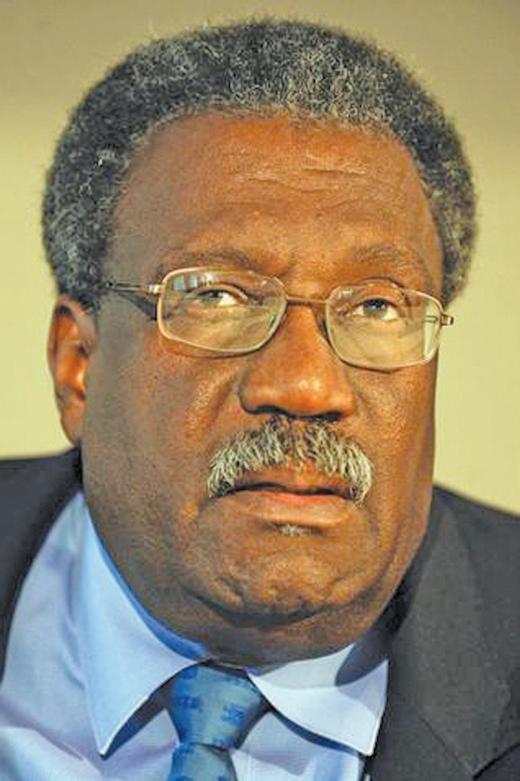
Clive Lloyd
field and we had many team meetings where we had battles off the field of play.
“But having a person like Clive Lloyd, who was at the helm then, was excellent. He really afforded the players to perform the way they wanted to, uninhibited: ‘You go out there and play the way you want to and we know you’ll be successful.’
“The players were not restricted at all in the way they played.” (First published on SkySports)
Port of SPAin, trinidAd – Cricket
fans will be pleased to note that tickets are currently on sale for the Trinidad leg of the Celkon Mobile Cup Series, which features hosts West Indies, India, and Sri Lanka.
The Celkon Mobile Cup Series will see matches being played both at the Sabina Park in Kingston, Jamaica and the Queen’s Park Oval
in St Clair.
According to a post on the Trinidad and Tobago Cricket Board (TTCB) Facebook page, the tickets for the Trinidad-based matches will be sold at the TTCB box office in the Queen’s Park Oval and the National Cricket Centre in Balmain, Couva.
Fans will have to dish out $130 in local currency to see West Indies against India on July 5 while the prices
will increase to $150 for the remaining three matches — West Indies against Sri Lanka (July 7), Sri Lanka against India (July 9) and the final (July 11). Matches at the Oval will begin at 09:30h each day.
The games in Jamaica are West Indies versus Sri Lanka (June 28), West Indies versus India (June 30), and India versus Sri Lanka (July 2). (WICB)
Despite an overwhelming advantage after beating Uruguay in their first game and hitting 10 goals past Tahiti, Spain still needed at least a point coming into this game to confirm their semi-final place in a competition they are yet to win.
So it was perhaps no surprise that boss Vicente Del Bosque re-introduced his first team, with only Sergio
Ramos remaining from the Tahiti mauling and Victor Valdes named in goal.
But with Nigeria still having an outside chance of qualifying, they committed to attack too, and only a Ramos block to deny Mikel and Valdes’s save from Mba’s shot prevented the Super Eagles from equalising.
Last time these two sides
met, Nigeria beat Spain in the group stages of the 1998 World Cup, and at times Keshi’s team caused further concern for Spain.
La Roja created the better opportunities before the break, though. Roberto Soldado should really have taken one of two chances when he was put through on goal. On both occasions, Enyeama produced good saves. Soldado then crossed for Barcelona’s Cesc Fabregas, who hit the post. Nigeria responded once more just after the interval when the pace of Musa allowed him to whip in a superb cross for Ideye, but the striker’s touch was clumsy.
Two minutes after coming on as a substitute, Torres then showed Ideye how it should be done by heading in Pedro’s centre following a smart move.
It took his total for the tournament to five goals overall and killed the game as a contest although Muhammad could have created a more exciting finish had he shown greater composure.
Alba had the final say by controlling David Villa’s long free-kick, beating Enyeama and booking Spain’s spot in the last four with a 100% record. (BBC Sport)
England batsman Kevin Pietersen made a seamless return from a knee injury with an unbeaten 177 for Surrey against Yorkshire at Headingley.
Pietersen hit 17 fours and seven sixes during his 48th first-class hundred – reached from just 106 balls – in his maiden knock of the season.
Adil Rashid missed a sharp chance with Pietersen on 78 while he was also dropped off the last ball before tea.
But he made full use of the chances before Surrey declared 80 runs behind.

Alex Lees was trapped lbw to Gary Keedy for 13 but the home side managed to negotiate the tricky 21 overs to reach 52-1 at the end of day three.
Surrey had begun the day on the back foot at 53-1 and slipped to 76-4 before Pietersen, with Zander de Bruyn (38) and Steve Davies (44), began the turnaround.
Following tea he unveiled some huge shots including the signature switch hit and looked in fine touch during the 188-ball innings before Surrey made their bold declaration.
And Pietersen left the field having rescued Surrey’s innings while simultaneously sending out a huge warning to Australia ahead of the Ashes. (BBC Sport)

Iowa.
Tand 200m at the World
The 30-year-old beat Isiah Young and Curtis Mitchell, who was third.
The win comes two days after Gay ran the fastest 100m time of the year, clocking 9.75 seconds.
Jamaican Bolt has a bye in the 200m and sealed his place for the World Championships 100m with a win in Friday’s trial.
Kimberlyn Duncan shocked Olympic champion Allyson Felix with a win in the women’s 200m in Iowa. (BBC
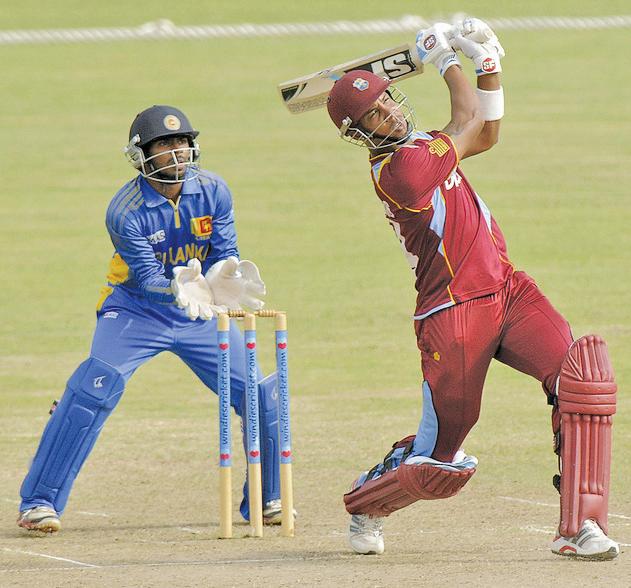
ST GeorGe’s, GreNADA - An aggressive half century from Seekkuge Prasanna upstaged a century by opener Lendl Simmons as West Indies A lost the momentum and toppled to a four-wicket defeat against Sri Lanka A in their first ODI at the national stadium on Sunday.
Prasanna smashed a busy unbeaten 51 to hasten a run rate that slowed down after a number of wickets fell on the heels of a solid opening stand that gave the visitors an impressive start.
Parasanna cracked a boundary to bring up his half century and carried Sri Lanka A to 287 for six after West Indies A had posted a competitive 282 for nine in 50 overs.
He faced just 17 balls, batted for 25 minutes and hit three fours and five sixes to bring his side firmly back into the game thereby avoiding a chase to the wire.
Dimuth Karunaratne and Niroshan Dockwella gave Sri Lanka A a powerful start by putting on 138 runs for the first wicket before Nikita Miller made the breakthrough shortly after he was brought into the attack.
Miller bowled Dickwella for 61 and trapped
Karunaratne for 89 to end with top figures of three for 51.
Earlier, Simmons scored 106 runs to anchor the Windies A innings after Kirk Edwards won the toss and decided to bat.
Simmons and Edwards shared in a second wicket stand of 116 after the home-
side lost opener Nkrumah Bonner for a duck in the fourth ball of the day.
The Trinidadian batsman hit seven fours and five sixes, faced 112 balls and batted for 167 minutes while Edwards supported with 57 which contained three fours and two sixes.
Simmons also shared in a century stand for the third wicket with Narsingh Deonarine who cracked three fours and hit three sixes in a knock of 60.
At one stage in the innings, West Indies A lost wickets quickly including three wickets in three balls with the score on 266.
Miller was run out for one while Andre Fletcher and Shane Sillingford were trappled lbw by Suranga Lakmal in successive balls.
Lakmal was the top bowler for Sri Lanka A with three for 45 while Lahiru Jayaratne and Dilruwah Perera picked up two wickets each.
The second ODI takes place on Tuesday at the national stadium in St George’s. (WICB)
WEST INDIES A
Nkrumah Bonner b Lakmal 0
Lendl Simmons c A. Priyanjana
b D.Perera 106
Kirk Edwards c and
b D. Perera 57
Narsingh Deonarine c D Perera
b L. Jayaratne 60
Leon Johnson c A. Priyanjana b De Silva 4
Andre Fletcher lbw Lakmal 15
Devon Thomas c A. Priyanjana
b L.Jayaratne 11
Nikkita Miller run out
(I .Jayaratne) 1
Jason Holder not out 15
Shane Shillingford lbw
Lakmal 0
Shannon Gabriel not out 1
Extras: (1b 4lb 7w) 12
Total: (9 wkts, 50 overs) 282
Fall of wickets: 1-0, 2-116,3227, 4-236,5-237, 6-263, 7- 266, 8-266, 9-266, Bowling: Lakmal 10-1-453, L. Jayaratne 8.0-0-542, Prasanna 5.0-0-36-0, A. Perera 3.0-0-26-0, I Jayaratne
4.0-0- 32-0, De Silva 10-035-1, D.Perera 10-0-49-2,
SRI LANKA A
Niroshan Dickwella b Miller 61
Dimuth Karunarathne
lbw Miller 89
Angelo Perera c Johnson B miller 5
Ashan Priyanjana lbw Holder 22
De Silva c Fletcher
B Shillingford 1
Thilina c Johnson b
Deonarine 24
Seekuge Prasanna not out 51
Dilruwah Perera not out 8
Extras: (8lb 17w 1nb) 26
Total: (6 wkts, 46.4 overs ) 287
Fall of wickets: 1-128, 2-145,3178,4-217,5-218,6-223
Bowling: Gabriel 7.0-0-41-0, Holder 9-1-46-1, Shillingford 9.4-0-77-1, Simmons 3-023-0, Miller 10-0-51-3, Deonarine 8-0-41-1.
Umpires:L Abraham L Reifer jn J Blades
Pollydore’s condition improving after horrific crash
Victory Valley Royals (VVR) point guard
Marlon Pollydore is said to be improving following a horrific accident in Linden that occurred last Thursday.
Currently at the Linden Hospital Complex, in Mackenzie, the former Linden Technical Institute (LTI) and New Silvercity Secondary School point guard is said to have undergone a successful surgery after suffering a punctured bladder, a broken pelvis bone and head injuries, according to Secretary of the Linden Amateur Basketball Association (LABA) Joseph Chapman.
“Based on what the doctors told me he had a suc-
cessful surgery.Whether he will be able to play basketball as yet I’m not too sure; we haven’t gotten that far as yet,” Chapman told Guyana Times Sport via telephone.
However, the 20-yearold’s condition is said to be improving which is a good sign for his road to recovery.
“Well, I didn’t go down to see him today (Sunday) as yet but he is improving; he was urinating blood but yesterday (Saturday) that was improving and his urines are becoming regular, but he is resting and talking,” Champman revealed to this publication.
Paulie Malignaggi lost his WBA welterweight title after being beaten by Adrien Broner in New York on Saturday night.
The bout was decided by split decision, with two judges scoring 117-111 and 115113 in favour of Broner and the other giving Malignaggi a 115-113 win.
Broner, 23, stepped up two weight divisions for the all-American contest and is now unbeaten in 27 fights.
“It’s a tremendous accomplishment,” he said. “Who’s doing it like me in the game? Nobody.”
Broner, who has also held the WBC world title at lightweight and WBO belt at super-featherweight, went past 10 rounds for the first time in his career as he joined Roberto Duran, Roy Jones Jr and Robert Guerrero in winning a world title in their first bout after moving up two weight classes.
“Paulie fought exactly

how I thought he was going to fight,” added Broner.
“Once he saw my power, he got on his bicycle and I had to cut him off the whole fight.
“I didn’t have to use my footwork. He ran. All I had to do was cut off the ring. He couldn’t hit me. He was shadow boxing.”
Malignaggi, 32, was making the second defence of the title he won from the previously unbeaten Vyacheslav Senchenko, who in turn sent Britain’s Ricky Hatton into retirement last December.
Malignaggi’s record now reads 32 wins and five defeats from 37 professional fights and he was unhappy at the judges’ decision.
“That was disgraceful. This was a close fight,” said Malignaggi.
“The fight could have gone either way. I don’t think he did enough to take the belt from the champion.
“I thought I worked him. He was sharp in his shots, but he wasn’t busy. He didn’t land a lot of the shots he was taking.” (BBC Sport)

Steve Smith has been drafted into Australia’s Ashes squad amid concerns over captain Michael Clarke’s fitness.
Smith has been called up as cover until at least the second Test at Lord’s, which starts on 18 July.
The 24-year-old allrounder will meet up with the original 16-man squad today ahead of Australia’s official tour opener against Somerset this week.
The move comes after
Pollydore’s crash occurred as he was descending a hill in the Bosai mines in a Nissan pick-up truck around 11:30h.
It was reported that a heavy-duty Caterpillar truck collided with the pickup, killing three occupants and leaving Pollydore and Fabian Anthony in critical condition. The victims of the crash were listed as Michael Williams, Kester Grant, and Trenton Gardener.
Clarke’s long-standing back problem flared up again shortly after arriving in England.
Clarke could still make his first appearance of the tour in the four-day game at Taunton this week, but with David Warner suspended until the first Test − after a bar-room altercation with England batsman Joe Root earlier this month − Smith’s inclusion has been deemed necessary.
The right-hand batsman,
who is also a useful leg spinner, is already in England after captaining Australia A during their threematch tour, which culminated in a 24-run win over Gloucestershire in Bristol on Sunday.
Australia chief selector John Inverarity said: “Given David Warner is unavailable for the upcoming tour games against Somerset and Worcestershire and while Michael Clarke continues to make good progress from a back injury, we feel further batting cover is required.
“Steve Smith has been added to the Australian Ashes squad until the beginning of the second Test, when it will be reviewed.”
Pakistan-born leg-spinner Fawad Ahmed had also been tipped for a late callup but will now return to Australia today to complete his citizenship qualification.
(BBC Sport)
Bri DG e T ow N , BArBADos − Former world 110 metre hurdles champion Ryan Brathwaite lowered his national record and confirmed his presence at the IAAF World Championships in Athletics in Moscow, Russia in August.
Brathwaite won the Men’s 110m hurdles at the National Championships this weekend in a new championship record of 13.25 seconds. His previous national mark was 13.37 set four years ago.
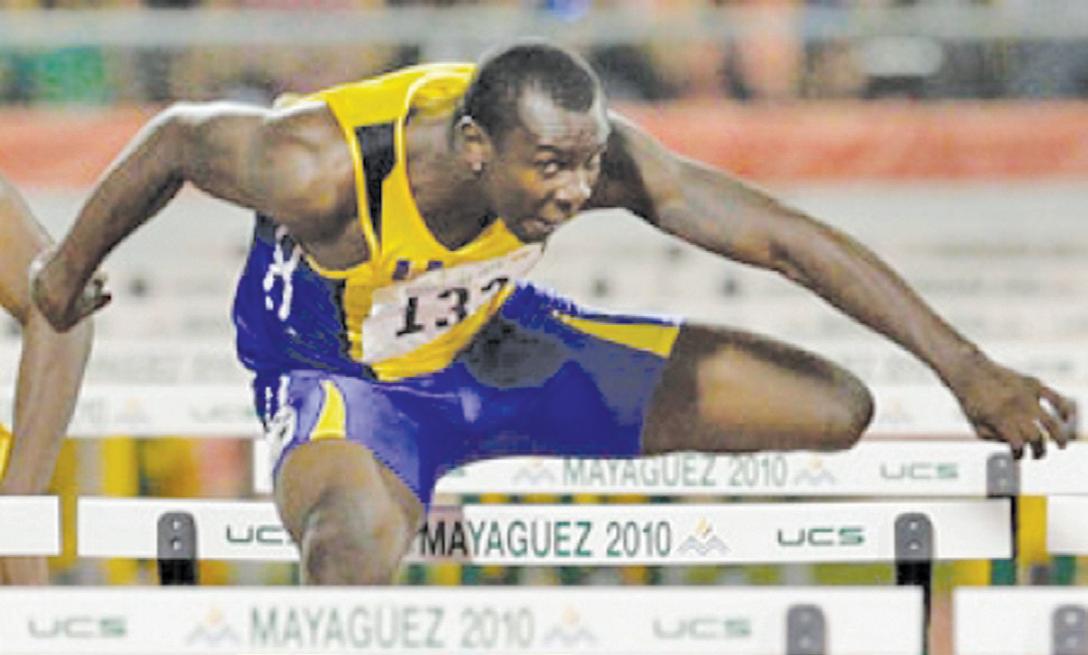
The 2009 world champion has been reaping some outstanding performances including a season’s best of 13.19 at the Adidas Grand Prix in New York on May 25. He also clocked 13.21 in Europe and 13.25 and 13.26 in Puerto Rico and Cayman Islands respectively.
Greegmar Swift took the second spot in a personal best of 13.48 and Shane Brathwaite was third in 13.50.
Ramon Gittens and Jade Bailey took the men’s and women’s 100m dash respectively.
Gittens stopped the clock at 10.18, a clear winner ahead of Andrew Hinds (10.24) and Levi Cadogan (10.28).
Bailey remained the top female sprinter from Barbados with a 11.59 clocking. Shakera Reece was second in 11.64 and Tristan Evelyn finished third in 11.92.
monday, june 24, 2013
Berbice
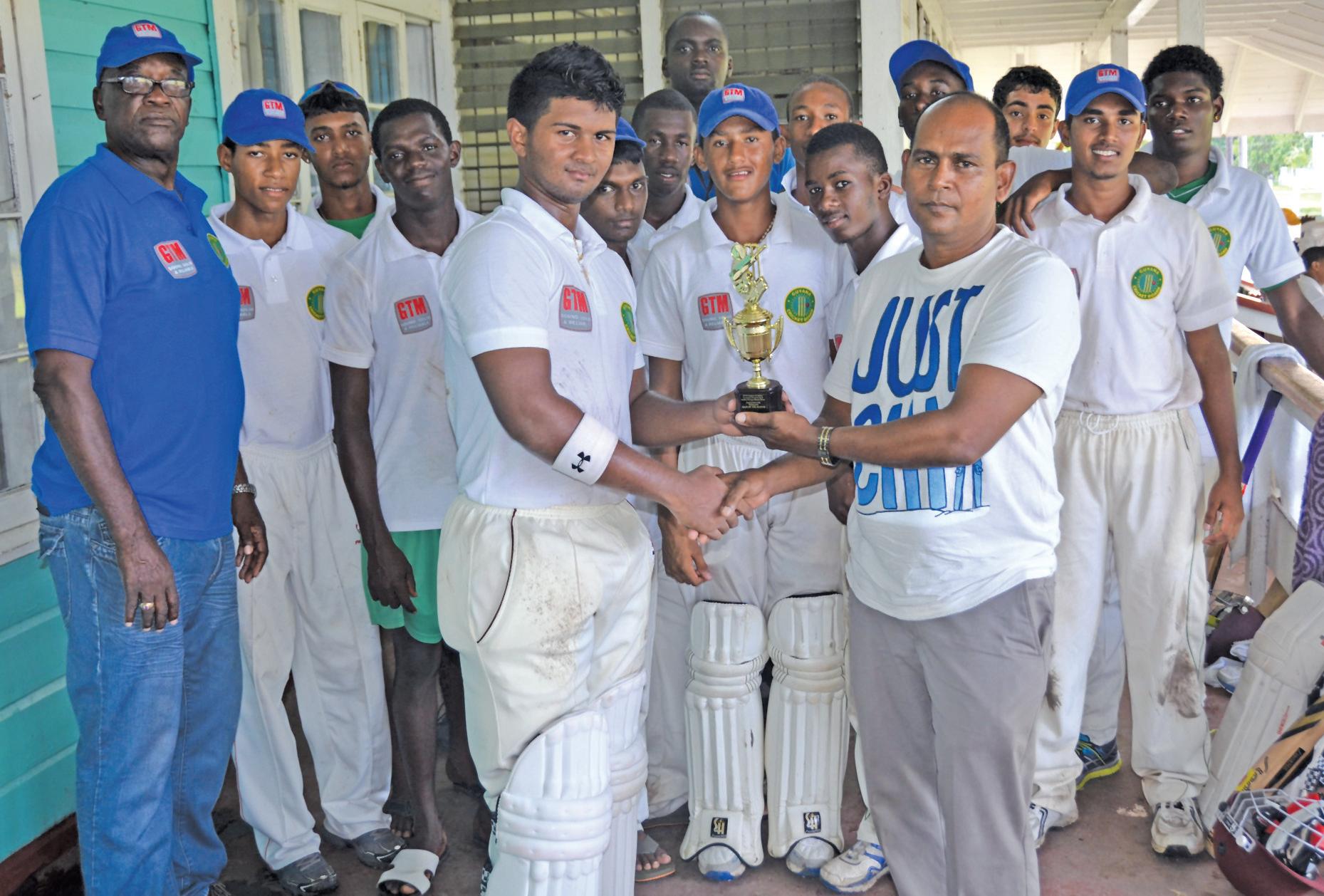
Aspirited Demerara team inflicted a humiliating 10-wicket defeat on Essequibo in their three-day fixture which ended on Sunday at the Police Sports Club ground, Eve Leary.
The national under-19 stroke player, Sattaur, who was forced to retire hurt after suffering from cramps just before the close on Saturday, added just five runs to his overnight 101. Sattaur was later named Man of the Match.
Pritipaul George and Zaheer Mohamed called off play at 17:19h, 11 minutes before the scheduled time.
…as many participate in walk/run 10k feature
B y T reis T on J oseph
The notion that a good team effort trumps that of a team of great individuals rang true when the Police A team won the $60,000 first place prize of World Olympic Day 10k race on Sunday.
The race began and ended in front of the Young Men’s Christian Association (YMCA) building, Thomas Lands.
With the newly sworn in Argentine Ambassador to Guyana Luis Alberto Martino on hand to start the event, the Guyana Defence Force (GDF) Track Club was touted as having the best shot at winning
Giddings and Bailey, who finished third and fourth respectively.
Meanwhile, with local distance queen Alika Morgan crossing the finish line ahead of all other
Roberts and Jonella Jonas claiming the top prize in a total time of three hours and 58 minutes (03:58:00).
GDF came in second with the team of Forde, Scott, Tyshon Bentick, Jamal Evans, Jemoul Chisholm, and Karlissa Atkinson, claiming $42,000 in 04:00 hours.
Needing 56 runs to win the match, after dismissing Essequibo for 167 in the second innings, the Demerara openers Tagnarine Chanderpaul (33) and first innings hero, Brian Sattaur (27), survived one dropped chance each to overhaul the target to complete the match which was dominated by the hosts.
With the declaration imminent, Yadram, one of nine players in the tournament who participated in last year’s regional under-19 competition, took his overnight 33, to an even half century, before the declaration.
Essequibo then reached 50-2 at lunch, but after the interval Ricardo Peters, who topscored with 65 (4x4, 1x6)
The President’s XI, resumed on 27 without loss, still with a deficit of 79 runs and were eventually bowled out for 183 in 82 overs, 20 minutes into the final session with an overall second innings lead of 78 runs.
Overnight batsmen
Martin Pestano-Bell and Ryan Shun took their individual scores to 40 (7x4) and 36 (3x4) respectively.
The other batsmen who made any meaningful contributions were Danesh Mangal (36), Vishal
Demerara reached 60-0 in 18.2 overs.
Earlier, Demerara declared just 77 minutes into the first session on 209 for 9 with a healthy first innings lead of 112.
After the hosts resumed on 174 for 2, Essequibo made inroads into the Demerara innings with left-arm spinner Herry Greene turning out to be effective, claiming the six wickets to fall. He finished with figures of 6 for 68 off 24.4 overs.
Overnight batsmen Kemol Savory and Kamash Yadram employed a cautious approach against Greene, but when Savory was dismissed, Demerara lost a cluster of wickets, including centurion Sattaur’s for 106.
and Rajiv Balgobin, who stroked 45 (3x4, 2x6), were the only batsmen that provided any resistance thereafter.
The other two batsmen that reached double figures were Captain Ricardo Adams (16) and opener Avinash Persaud (13), in yet another horrendous batting display by Essequibo.
Bowling for Demerara, Steven Sankar was the best bowler with 3-26. He received support from Yadram, 2-9; Shivram Persaud, 2-17; and Devon Lord, 2-46.
Meanwhile, over at the Everest Cricket Club ground, the game between Berbice and the President’s XI ended in a draw after rain arrived just before Berbice started their run chase of 78 runs for victory.
Umpires Imram Moakan,
Narayan (20), and Avishkar Sewkarran (18).
Man-of-the-Match
Derek Narine and leg spinner Shawn Perreira were the best bowlers for Berbice with figures of 3-10 and 3-14 respectively.
The second round of the competition will be played from Tuesday with Berbice playing Essequibo at the Police Sports Club ground, Eve Leary and Demerara taking on the President’s XI at the Everest Cricket Club ground.
The final round of the three-day competition, scheduled for June 29- July 1, will see Demerara playing Berbice at the Demerara Cricket Club ground while the President’s XI will oppose Essequibo at the Wales Community Centre ground.
the event, with distance ace Cleveland Forde on the team.
However, Lindenernow-turned-Police athlete Nathaniel Giddings went out with a bang as he pushed the pace from the start to slightly separate himself from the pack.
Coming to the turning point of the race just after Conversation Tree, Police’s Kevin Bailey then made his move, attacking the race and putting pressure on Forde.
It was only until midway on the way down to YMCA that Forde made his move, along with Police’s Dennis Horatio, who was sitting with Forde during the race.
In the final 400m, Forde turned on the gas to leave Horatio in his wake to win the event, while Horatio was second followed by
females, Ashanti Scott of GDF who was expected to dominate the field had to settle for second.
The outstanding indi-
Christianburg Wismar Secondary, out of the mining town of Linden, and comprising 1500m Carifta gold medalist Cassey George, Cassie Kirton, Orlando Adams, Stephan Cerow, Kelon and Kevin Nicolas finished third to receive $30,000.
Meanwhile, many associations participated in the 10k walk/jog to make the event a success. Table tennis champion Chelsea Edghill, Deputy Permanent Secretary of the Sport Ministry Steve Ninvalle, along with Athletics Association of
vidual performances by Scott and Forde were not able to trump the Police A team which consisted of Horatio, Giddings, Bailey, Jerome Johnson, Adama
Guyana and Guyana Table Tennis Association presidents Aubrey Hutson and Godfrey Munroe respectively were part of the event.
Trinidad-based distance athlete Lionel D’Andrade fell just short to place a close second in the ninth annual Neal and Massey Rainbow Cup 5k event in Turtle Beach, Tobago on Saturday.
Despite the humid conditions, Lionel displayed great tactical distance running strategies but was barely outdone by four seconds by Matthew Wright of Barbados, who clocked 16 minutes, one second to win the event.
D’Andrade finished in 16:05s while Elvis Turner
from
16:41s.
After placing fourth in a 20k event last Wednesday, D’Andrade believes that the lingering effects from the 20k were the factors for his missing out on the top podium position.
“I think I’m still recovering from after the Butler 20k Classic last Wednesday and placing fourth, the weather conditions here was very humid and I felt myself slowing down but I’ll be resting for the upcoming Caricom 10k,” D’Andrade stated. The Caricom
scheduled