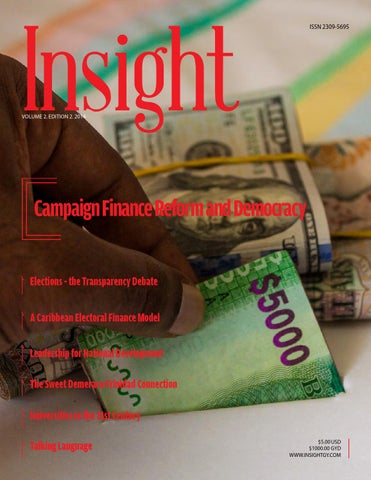
Insight
ISSN 2309-5695
VOLUME 2. EDITION 2. 2014
Campaign Finance Reform and Democracy Elections - the Transparency Debate A Caribbean Electoral Finance Model Leadership for National Development The Sweet Demerara-Trinidad Connection Universities in the 21st Century Talking Language
$5.00 USD $1000.00 GYD WWW.INSIGHTGY.COM
From The Desk of The Editor-In-Chief
JOINING THE DOTS BETWEEN MONEY AND ELECTIONS THE COMPLEX AND OFTEN questionable relationship between money and politics is the focus of this 4th edition of Insight. Within these pages, we engage a discussion on the several dimensions of the influence of money on politics. How and why it should be monitored. How monitoring mechanisms should be structured and why all of this is important to the development of politics, the democratic process and development in the Caribbean. Experts and close watchers from throughout the region have added their valuable insights, knowledge and recommendations to what is often a muted debate on the question of the financing of electoral campaigns, its impact on electoral outcomes and the maintenance of democratic systems. This edition brings together important literary contributions, thoughts and recommendations of experts on campaign financing across the region, all of whom agree with the principle of greater accountability and transparency on the processes that mix money and politics Professor Trevor Munroe, Executive Director of the National Integrity Action and Visiting Honorary Professor at the Sir Arthur Lewis Institute for Social and Economic Studies at UWI, Mona provides us with an interesting perspective which launches the debate. Prof. Munroe, who has written and spoken extensively on the issue of campaign financing, has used the opportunity to link the lack of effective electoral regulations in many countries with the prevalence of corruption and, ultimately, the threat to development. His contribution is ably supported by a number of articles and interviews that look at, among other things, the dangers of an unregulated electoral environment in which free and fair elections are expected to prevail even in the midst of problematic financing dynamics. We continue our focus on education from the previous edition with a short feature by Vice Chancellor of the University of the West Indies Prof. E. Nigel Harris. In this article, he focuses on the changing university in his piece “Universities in the 21st century�. We also take a look at members of a family who have dedicated their lives to the teaching profession. In this edition we present an exclusive interview with award-winning Trinidadian novelist, author and playwright, Earl Lovelace as he offers his opinion on the subject of reparations. We continue to present to readers a rich menu of informed opinions, analysis and literary offerings such as a peek at the historical relationship between sugar and soda - the connection between Trinidad and Demerara in the 19th century, written by Angelo Bissessarsingh.
.
We hope like our previous editions, this publication provides food for thought and contributes toward the shaping of informed public discourse on these issues of our times
NAZIMA RAGHUBIR EDITOR-IN-CHIEF
Insight Volume 2 Edition 2
3
www.Insightgy.com
Insight Volume 2. Edition 2. 2014
PUBLISHED BY INSIGHT INC
62 Area “Q”, Turkeyen, ECD, Guyana, South America
INSIGHT TEAM Editor-in-Chief: Nazima Raghubir Editorial Consultant: Wesley Gibbings Copy Editor: William J. Carter Editorial Assistant: Andrew Kendall Layout and Design: Tanika Van Sluytman Jones
Photography: Arian Browne, Neilon Dias, Wesley Gibbings and Kwesi Isles
Contributors: Dr Fred Nunes, Prof. E. Nigel Harris, Prof. Trevor Munroe, Lisa Soares Lewis, Penelope Harris, Tashana Redmond, Bishnu Ragoonath, Cynthia Barrow- Giles, Louisa Reynolds, Alim A. Hosein, Dr Joyce Jonas, Andrew Kendall, Angelo Bissessarsingh, Wesley Gibbings, Lenandlar Singh and Nazima Raghubir
LETTERS TO THE EDITOR Should be emailed to editor@insightgy.com Published letters may be edited for reasons of space and clarity.
ADVERTISING ENQUIRIES advertising@insightgy.com Insight Inc. 62 Area “Q”, Turkeyen, ECD, Guyana, South America (01) 592-222-2042
SOCIAL LINKS Visit our website at www.insightgy.com Follow us on Twitter @InsightGuyana Like us on Facebook - Insight Magazine All materials contained in this publication are protected by copyright law and may not be reproduced, distributed, transmitted, displayed or published without the prior written permission of Insight Inc. or in the case of third party materials, the owner of that content. You may not alter or remove any trademark, copyright or other notice from copies of the content. Copyright © 2014 Insight Inc.
Insight
Campaign Financing
This issue of Insight examines the need for strengthened electoral financing laws and complementing regulatory bodies in a changing political environment.
xx
08
01
In The Neighbourhood
02
Talking Language
03
Development Focus
04
Retrospective
06 | Uneven Remittance Reports in Latam and the Caribbean
08 | Language Prejudice
10 | Making a Case for Reparations - A Conversation with Earl Lovelace 12 | Abortion, Stigma and Inertia 14 | Leadership for National Development 16 | Tackling Noise Pollution
18 | Sugar and Soda - The TrinidadDemerara Connections in the 19th Century
Insight Volume 2 Edition 2
45
34
05
Personality
06
Features
20 | The King Family Legacy
08
Tech Bits
09
Nutrition
51 | Caring for Our laptops
53 | Butternut Squash 25 | New Regulation for an Old Problem 27 | Political Corruption and Campaign Finance Reform 30 | Strengthening Caribbean Democracy Facts & Fun 33 | The Campaign Financing Free for All 35 | Campaign Financing and The Politics of 54 | Facts about language Trinidad and Tobago 37 | Campaign Finance Reform - Levelling the Political Playing Field 39 | The Dangers of Unregulated Campaign Finance 41 | The Turks and Caicos Model 44 | Minimising Damage to The Public Good
10
07
Education
45 | Universities in the 21st Century 50 | CXC 2020 Vision Continued 5
www.Insightgy.com
In The Neighbourhood
News, Reports and Analysis From Our Latin American and Caribbean Neighbours
Regional Roundup Uneven Remittance Reports in Latam and the Caribbean OVERSEAS REMITTANCES ACCOUNT FOR a considerable slice of disposable incomes in many Caribbean countries. Turbulence in metropolitan markets since the crash of 2007-2008 however, until recently, dramatically reduced the levels at which these cash transfers from overseas Caribbean nationals reached home-based families and friends.
and Industry (GCCI) reported in March that remittances declined in 2013 from 2012 levels by as much as US$141.1 million. It is too early to predict what the figures might be for this year, but the 2014 Migration and Development Brief published in April by the World Bank is suggesting uneven trends throughout Latin America and the Caribbean.
In Guyana, the Georgetown Chamber of Commerce
Globally, there was growth in remittances to
developing countries of 3.5% over during the course of 2013 when compared against the figure for 2012. It is estimated that up to US$ 404 billion moved from developed countries to households in the developing world. The World Bank report suggests that in 2014, there can be an increase of up to 8.4% over the next three years. This would raise flows to US $436 billion in
Latin America and the Caribbean (selected Countries): variation in inflows of remittances from migrants abroad, 2010 - 2013a (Percentages)
Nicaragua Jamaica Honduras Guatemala
2012
El Salvador
2014
Mexico Dominican Rep. Columbia Ecuador -10
-8
-6
-4
-2
2010
0
2
4
6
8
10
12
2011
Source: Economic Commission for Latin America and the Caribbean (ECLAC), on the basis of official date. a
The figures for 2013 relate to different periods depending on the countries: 1. Jamaica and Nicaragua: First Quarter; 2. Columbia, Honduras and Mexico: January to April; 3. El Salvador and Guatemala: January to May;
No data was available for 2013 for Ecuador and the Dominican Republic.
Insight Volume 2 Edition 2
6
www.insightgy.com
Latin America and the Caribbean (selected Countries): remittances received from abroad (personal transfers and employee remuneration, 1980 - 2011a
2014 and US$516 billion in 2016. Rising anti-immigrant sentiment in some countries, including the United States, has however been blamed for relative unevenness in the level of transfers to many beneficiary destinations including countries of Latin America and the Caribbean.
(Percentages of GDP)
Columbia Costa Rica Panama Peru Antigua and Barbuda Mexico Barbados Saint Lucia Grenada Paraguay Ecuador Saint Vincent and the Grenadines Bolivia (Plurinational State of) Dominica Belize Dominican Republic Saint Kitts and Nevis Guatemala Nicaragua Guyana Jamaica El Salvador Haiti
In the United States, for example, the World Bank report notes that over 368,000 people were deported in 2013. On the other side of the coin, however, the average total cost of sending remittances fell in the first quarter of 2014, dipping below 8.4% (measured by the World Bank as a “simple average of countryspecific corridors”). For the same period in 2013, this measure was 9%. According to the report, the dollar-value weighted average dropped a full percentage point to 5.9% percent at the end of 2013, from 6.9% the previous year, “confirming the importance of remittance volume and competition to maintaining downward pressure on fees.” It was estimated in 2013 that in Latin America and the Caribbean, remittance flows reached US $61 billion in 2013, up 1.9% from 2012. It is expected that as the US economy continues to rebound from the trauma of seven years ago, the region can see such flows growing at a rate of 9% over the next three years. The impact of lowered diaspora remittances to developing countries is reflected in dampened
1980
1990
2000
2011
Source: Economic Commission for Latin America and the Caribbean (ECLAC), on the basis of figures from the World Bank. a
Includes countries in which remittances representation at least 1% of GDP in 2011. Data are obtained from the balance of payments, in current dollars each year.
demand for consumer durables with accompanying implications for domestic commerce. Former GCCI president, Clinton Urling, made the point at a press conference earlier this year that most of the transfers received by Guyanese go into the purchase of consumables and are not necessarily invested or saved.
Figures compiled by the United Nations Economic Commission for Latin America and the Caribbean suggest that in 2011 up to 14.5% of Guyana’s GDP is accountable to overseas’ remittances, outstripped in the wider region only by Haiti at 21.1%, El Salvador at 15.9% and Jamaica at 14.6%
.
Removals of migrants in the United States
FY2010
FY2011
FY2012
FY2013
Removals at the Interior of the U.S Removals at the border Total Removals % change % at the border % at the interior Source: U.S Immigration and Customs Enforcement
Insight Volume 2 Edition 2
7
www.insightgy.com
Talking Language Stimulating awareness and building understanding about language and culture
Language Prejudice By Alim A. Hosein newspaper widely reported the minister’s views. Not to be outdone, a prominent local historian swiftly picked up the matter and eloquently provided the historical “justification” for the minister’s claim. He linked Guyanese with slavery, and declared that it was “fungus growth” which we quickly need to get rid of. These statements reflect negative language prejudice. Language prejudice may be either negative (when persons look down upon a language) or positive (when persons have a high regard for a language). Both types of language prejudice are bad and harmful. Negative prejudice produces disregard for a language, while positive prejudice results in the promotion of one language above others. Language prejudice is fed by the power relationships between the societies that speak those languages: the languages of the powerful are seen as shining examples of linguistic excellence, while the languages of the powerless are regarded as inferior and backward. Both negative and positive language prejudice pose serious implications for cultural and national development since they are not separate from beliefs and perceptions about the people who speak those languages. IN MY LAST INSIGHT article, “Attitudes to Guyanese” I argued that, as Guyanese, we should change our attitude towards the language we speak. We call it Guyanese Creole, Creolese, Guyanese Creole English, or even, English, using descriptive or borrowed names. This might seem to be a trivial matter, but it is very important, since these names reflect deep-seated attitudes towards this language, our history, culture and ourselves. They suggest that we do not own the language as a real cultural possession - that it is just a medium of communication, just another version of English, or even a lower form of English. We have the same attitude to the languages of the Amerindians. Most Guyanese speak about
Insight Volume 2 Edition 2
“Amerindian dialects” rather than Amerindian languages. With the concept of “dialect” comes all kinds of notions of “folk” language, lesser language, sub-variety of language and so on. We also use the term “dialect” to refer to our language and the language of the Caribbean. Recently, in a newspaper column written by someone who is considered very insightful on matters Caribbean, the term “dialect” was used to refer to the speech of Caribbean people. Somewhat more distantly (but not less significantly) a local minister of government in the 1980s publicly described Guyanese as a bastardised, rough and ready, uncouth form of communication. The national
8
Language prejudice is a sword that cuts many ways: not only do others have attitudes to the language we speak and therefore perceptions about us, but we also have attitudes to their language, and perceptions about them; and worse, we internalise attitudes to ourselves because of the attitudes others have to our language. So, ultimately, we are being prejudiced against ourselves! The minister’s attitude is a perfect illustration of the truth of this. How many of us do not believe that someone is smarter, more civilised and better than us when we hear that person speaking in what we think is “good English” or with an “American twang”? How many of us are not ashamed of our friends, family members and colleagues when they speak to foreigners in
www.insightgy.com
“raw creole”? And how many of us do not overcorrect our speech and say “block out”, “royot” and “voilent” instead of “black out”, “riot” and “violent” because the latter words sound too “brawling”? Remarkably, language prejudice is not based on careful examination of the grammar or workings of the belittled language, nor is it based on an understanding of what language generally is and what it involves. Instead, the root causes of language prejudice are social and political reasons –expansionism and imperialism, racism, notions of social class, or just the desire to appear to be better than somebody else.
vocabulary is not English in origin! Of course, this borrowing has destroyed any claim that can be made about the “purity” of the English language. Nevertheless, English is still the dominant language in the modern world. Yet another example from English relates to grammar. In English we say “Two boys are at the gate” but in Guyanese we may say “Two bai deh at de gate”. English marks the plural three times: “two”, “boys” and “are”. In Guyanese, on the other hand, once plurality is established, it does not need to be
treatment, attention, care and protection, and these people then become easy targets for discrimination. Of course, the bases of linguistic judgment are skewed in favour of the “superior” group – they are the ones who set the examinations, they determine who passes or fails; they decide what “good language” is. And of course, they use their own language as the standard of “correctness” or “superiority”. Further, they operate on the basis of a self-justifying circular logic: “See? They deserve to be where they are. They cannot even speak properly.
But this kind of prejudice is often cloaked in claims about the languages themselves. For example, it may be claimed that one language has a more sophisticated grammar, a richer vocabulary, or a more elegant phonology. Other claims may assert the supposed purity of the language – that it has remained true to its original roots. Just recently, I read about a comment made in 1995 by Prince Charles at an event to launch a programme to preserve the high standards of the English language. The good Prince described American English as “very corrupting”. He said that the Americans “tend to invent all sorts of nouns and verbs, and make words that shouldn’t be”. The prince’s statement implies that the nouns, verbs and words of one language (and of course, this would be his language, English) are right and proper, while those of other languages are not. He also warned the public to be careful about the American influence on English or else the situation would become “rather a mess”. These claims, though, must be considered within an understanding of language as a whole. Claims about superior grammar, linguistic purity and so on are fragile notions as far as language is concerned. A good lesson is learnt from the case of Latin. Highly regarded as a sophisticated language for its declensions, conjugations, case marking, moods, inflections and other grammatical elements, Latin was the powerful language of scholarship in Europe and elsewhere for centuries. However, its “sophistication” could not save it from decline, and it eventually passed out of active use as a language. On the other hand, its “unsophisticated” colloquial, vernacular varieties have developed into full languages which continue to thrive. Another example comes from English, which has a rich vocabulary. However, much of this vocabulary comes from other languages, to such an extent that it is estimated that at least two-thirds of the English
Insight Volume 2 Edition 2
repeated. Should we say that Guyanese is superior to English in its efficiency? Or that Guyanese people are smarter than the English? The answer is no each language at any point or time is an efficient tool allowing its speakers to do what they need to do to carry on the tasks of living. Negative Language prejudice can be aimed at any people or language, including the rich and powerful (as Prince Charles’s comment shows), but it is more damaging when aimed, as it often is, against the language of poor countries and peoples. In this context it has serious and far-reaching implications. Persons who have their language categorised as “inferior” are stereotyped as being backward, or even unintelligent, lazy, untrustworthy, of low character, morality and worth. Once this happens, the “superior” culture stops seeing these people as human beings who deserve the same levels of
9
And since they cannot speak properly, they must be stupid, so how can they improve themselves?” The discrimination caused by linguistic prejudice is usually very subtle. There have been cases of outright violence against linguistic minorities, but in most cases the discrimination is so much a part and parcel of everyday life that we do not notice it. Worse, those who are discriminated against accept it as natural part of life and so do nothing about it. But there is more: we all practise some form of language prejudice: each of us looks down on persons who, in our opinion, speak “worse” (in whatever way we determine that) than we do.
.
Think about it. What’s your language prejudice?
www.insightgy.com
Development Focus
Making the Case for Reparations A Conversation with Earl Lovelace INSIGHT INTERVIEW Earl Lovelace is an acclaimed, award-winning Trinidad and Tobago novelist, playwright and author. His novels include While Gods Are Falling, The Schoolmaster, The Dragon Can't Dance and The Wine of Astonishment. The Dragon Can't Dance has been translated into five languages and is one of the most widely recognised Caribbean novels of all time. This was followed by a collection of plays, Jestina's Calypso, published in 1984, and a short story collection, A Brief Conversation & Other Stories, published in 1988. Lovelace's latest novel Is Just a Movie, published in 2011, was the winner of the Grand Prize for Caribbean Literature by the Regional Council of Guadeloupe and the 2012 OCM Bocas Prize for Caribbean Literature. But it is his novel Salt, which won him the Commonwealth Writer's Prize, and which establishes his unique argument in favour of reparations for the genocide of indigenous populations of the Caribbean and for the long period of enslavement of Africans in the region. In this exclusive interview with Insight's Wesley Gibbings, Lovelace states his case for reparations.
WG: Why should Caribbean people see the reparations issue as something that they should prioritise? EL: From the point of view of justice, of fairness, of independence of selfhood, and I am talking about all the Caribbean people, should participate in something that they believe is just. That brings us to the awareness of our humanness. That we are not just allowing might to conquer right. And that we are concerned about getting a new start.
Insight Volume 2 Edition 2
Earl Lovelace
I think that reparations suggest a new start. Because we have never had a new starting point in this region. Emancipation was setting Africans at liberty without any recompense and any notion that there was any concrete expression of this freedom that they were to get. Freedom is not just another abstract idea. Freedom is emphasised in land and ownership. If you have a people who have been set free, so to speak, and if you set them at liberty without anything. It’s really a terrible situation. WG: We are talking about almost 200 years. A lot has happened. You’ve had a lot of mixing - many members of our societies who have come after. How do you assign to them a sense of victimhood, if they came along 50 years, 100 years ago and helped to populate the region? They are of the Caribbean,
10
but they do not have a history of slavery and indentureship. They weren’t real victims. EL: I don’t know that one would have to be a victim to claim justice. We have been presenting the African in the Caribbean as somebody who was just the slave out in the field working. But remember these places that the Amerindians were largely killed. Imagine what kind of situation the Africans met. The Africans are the ones who developed these countries. Not only in terms of labour. In terms of architecture. In terms of building roads. Building buildings. All these buildings we see around the place, Africans built them. The roads. The whole society has been built by these people’s labour. The thing is that to talk about them as being victims. Yes, they’ve been victimised, but they haven’t taken the
www.insightgy.com
role as victims. We have to be participant in this. All of us – mixed, unmixed. All of us. WG: Including the former colonials? EL: Yes, everybody. This is what is going to free us. This is what is going to link us for another beginning. WG: You are suggesting that the entire society should be a part of this because we have all been a part of this oppression and dehumanisation. That all of us, including remnants of the slave-owners and others who were around back in those days too? EL: All of us need to participate in the discussion and the understanding of this and helping to determine what you’re going to get and where you’re going to put it. I’m not suggesting that everybody who has lived in the society is due for reparation, you know. That is not what I am saying. One of the problems we have here is that we recognise that these societies comprised different groups of people who were treated unequally. That’s historical. We know that Africans, for example, never
Insight Volume 2 Edition 2
got anything in that society. Never got land. Never got just deserves as opposed to Indians who might have gotten for different reasons. Europeans might have got for other reasons.
We can’t equate everybody in the same way. But we can all join and participate in the discussion about it. Everybody needs to join and see it as a good thing. Emblems of freedom for them to start to do whatever they had to do. We can’t equate everybody in the same way. But we can all join and participate in the discussion about it. Everybody needs to join and see it as a good thing. WG: But what would the algebra look like, so that you can work out a formula to compute and to settle this issue? You are talking about something tangible. This is not just an apology. EL: What is important, firstly, must be the acknowledgement that is due to you. And when you accept that, if somebody says – “Yes, you have been
11
wronged. We’ve made this amount of money over the years. Your labour is worth this …” They have computers. We can compute this over the years. It can be done. We have to talk further. I don’t think it is just a mathematical thing where you work things out and you make out a pay cheque. This requires, from my perspective, a lot of conversation. That this is the way for us to begin to become a society. Right now we are asking for reparation from Europe. I am surprised we have not asked for reparation from Trinidad. We have taken over from Europe. There is a point at which Europe will have to come in and we will have to involve Europe. But we must not assume that the governments in the region have been acting on behalf of black people or have advanced our interests. I don’t think our interests have been advanced by them. We have all fallen for the propaganda of black ineptitude of black criminality. When you tell me that CARICOM and the CARICOM governments are taking up this thing. They are taking it to whom?
.
They have to do more talking and they have to involve more people
www.insightgy.com
passed in 1994 has not been implemented 20 years later. Abortion is commonplace. In Guyana, about 70 per cent (7 of every 10) women will have at least one abortion by age 44.* In other words, most adult women and most adult men in our country, will have personal experience with an abortion. Having an abortion is a question of when – not whether. You have to be lucky to avoid causing or having an abortion. Those few who do, are the distinct minority. Almost no family in Guyana has not had and caused abortions. But the enormous burden of the stigma we attach to abortion leaves each of these persons feeling lonely and vulnerable. Abortion remains a subject that is never discussed. At a personal level, we deny and we suppress. And more broadly, we avoid the topic. An unwanted pregnancy is a natural consequence of sexual activity. While men bear at least half the risk of every unwanted pregnancy we are totally absolved of the stigma of abortion. How rational is that? How fair is that? Indeed we talk glibly of ‘teenage pregnancy’; but 74% of teenage pregnancies are caused by men 20 years or older. The power is with the men; they should be our focus. None of the denial, suppression, avoidance and stigmatisation of abortion has changed since Guyana expanded the ground for legal abortion in 1995. And we need to ask why.
Abortion Stigma and Inertia By Dr Fred Nunes SEVERAL READERS HAVE ALREADY turned away from this article in a strong, negative reaction to the first word. Very few persons have any appetite for learning about an issue that we have made into such an ‘awful’ topic. Yet that reaction, while perfectly understandable, is also profoundly foolish. We like to think of ourselves as rational and Insight Volume 2 Edition 2
informed. On the issue of abortion, we are terribly misinformed and driven more by our values than the facts. We have firm beliefs and flimsy data. The stigma of abortion prevents discussion. An absence of discussion fosters rumours. Rumours develop into myths. And myths nurture our values. The net outcome is a paralysis of action on all sides among leaders, victims and even advocates. That is why the Medical Termination of Pregnancy Act 12
The explanation is the same as it is for any social prejudice – whether tuberculosis, cancer, race, gender, or homosexuality: it takes an enormous investment in education, in public discussion and a monumental measure of personal courage from individuals to change stigma. It requires courage and leadership in all quarters -- teachers, artists, religious institutions, business, politics, sport, etc. People have to take risks. The law is both helpful and necessary; but it is not sufficient. Where our values lead us to shame others, to call them names, to exclude them, to treat them with contempt, to regard them as inferior, and to make them ‘wrong’ we foster division. This same behaviour makes it very difficult for leaders to stand up for fairness. In other words, we intimidate those who should lead. They become fearful and they do nothing. So we create a culture of inertia. Nothing happens, nothing changes. This phenomenon can take quite pernicious forms. During the campaign for law reform in 199294, there was a large street march, inspired and influenced by anti-choice groups from the US. At one point some persons gathered outside of the late Dr. M.Y Bacchus’s clinic and chanted ‘Murderer, Murderer!” He was furious. More than a few of the www.insightgy.com
economic and social power to change the situation, have no need to do so – they have ready access to safe, private medical services. And the certainly don’t want the ugly stigma of being ‘pro-abortion’.
women in that crowd had been patients who had sought and received abortions from him. In other words, in order to distinguish ourselves from what our community holds as negative (abortion, homosexuality, etc.) we have to make a loud public showing of being on the ‘other’ side. It is easy to describe this as hypocritical. It is in fact the price we pay for social inclusion – for espousing or ‘advertising’ our values to ensure that we are not ourselves at risk of being stigmatised, labelled, tarnished and excluded. We wear a cloak of protection.
Only leaders, from whatever realm, with real conviction and courage would step into this controversy. Clearly we are terribly short of such persons of character. It is safer to be popular than to lead. The end result is that we have a law that has not been enforced – ever. Various Ministers of Health, all well-meaning, have found one excuse after another – lack of resources, lack of equipment, resistance among nursing staff, reluctance of hospital leadership, the pressure of other priorities, fear of overcrowding if we offer the service.
More than 22 years ago, in 1992, the main drive for law reform was the fact that septic abortion was the third highest cause of admission to public hospitals. Worse: incomplete abortion was the eighth highest cause. Given the under-reporting associated with the shame of abortion, we contend that unsafe abortion was arguably the single leading cause of hospitalisation. All of this was entirely avoidable. Totally. This very expensive situation was unnecessary and could be completely eradicated. That is what propelled Gail Teixeira, then Minister of Health, to take the charge and announce her intention to change the law. That was a highly courageous stance. But who were these women being admitted in their thousands year after year? They were all poor. And thereby hangs the tale. Unsafe abortion is not uniformly spread across our society. Unsafe abortion was and remains largely a problem of poor women who cannot afford access to doctors. It is the experience of poor women. This is so widespread in the Caribbean that almost every large public hospital has a ‘Slip and Fell Ward’. They are so named to hide any attempt at an abortion and to pretend that their condition is the result of an accident. Women die rather than admit an attempt at an unsafe abortion. Such is the force of stigma.
Abortion is the most commonly performed surgical procedure in Guyana. In early pregnancy, it is a simple procedure. And some 85-90% of abortions in Guyana are done early, taking place in the first trimester. Every few years the technology of safe abortion improves. Today with manual vacuum abortion (MVA) and even more, with medication abortion (MA), the procedure is even safer. If the public problem is the power of stigma, the real problem is one of social power. The poor women who face the risk of unsafe abortion have no power to change their situation; the women who have the
This May 2014, that law will turn 20 years. In the first six months of the law the number of women admitted to Georgetown Hospital with unsafe abortions fell by 41%. The law forced doctors to improve their quality of service. But the Government failed to require public hospitals to provide abortion services. And that has not changed. This is shocking, shameful and sad. The problem is not resources. The problem is one of values vs prejudice, courage vs fear. The problem is one of leadership. We change stigma by speaking out. By standing up. By taking on the agents of the stigma. There is a need for investment in education in values clarification workshops for service providers and in sheer education for political leaders. Journalists need to wake up and climb above their inertia. Professional associations need to face their responsibilities as attorneys, doctors, midwives, nurses, social workers, etc. We need to put a face to abortion, literally. We need to come out of the closet. That is how we challenge and end stigma. Imagine 100 upper and middle class women taking snaps of their faces, giving their names and agreeing on a full page newspaper advertisement: “This is what abortion looks like.” Then imagine another 100 upper and middle class men doing the same.
It costs U.S tax payers far more to treat unsafe abortions than to provide safe ones, in the order of 5-10 times as much. This is madness.
.
Twenty years of excuses are far too many. We need a sense of urgency. Real change is long overdue * In the United States, that figure is about 40%, due to much higher access to contraceptive methods.
Dr Fred Nunes is a life member of the Family Planning Association of Guyana. Dr Nunes was integrally involved in the drafting of the Medical Termination of Pregnancy Act during his tenure at Pan American Health Organisation here in Guyana Insight Volume 2 Edition 2
13
www.insightgy.com
Leadership for National Development By Lisa Soares Lewis
NATIONAL DEVELOPMENT GOALS across the Caribbean tend to have similar priorities due to the nature of our small states, our history and shared beliefs. A typical grouping of our national development goals would include: o Equitable growth, prosperity and building a strong economy o Employment, Poverty alleviation and rural development o Ease of doing business o Preservation and sustainability of the environment o A safe, secure and just society o Good infrastructure o Good governance o Embracing technology and keeping pace with change o Education and Development of its people o Independent identity Insight Volume 2 Edition 2
14
www.insightgy.com
No one can argue with these goals as they help to achieve a vision to create places that people would choose to live, work, raise families and do business. Bringing this vision to life is not easy, even if we had all the resources we needed and the world stood still and did not introduce new changes and challenges every day. So with the added dimensions of being small states, having limited resources, underperforming economies and poor infrastructure, plus facing global economic slow downs and weather hazards, things can get over-whelming, especially for our public servants. When faced with these challenges, the quality of our leadership will be the differentiator between more success or less success at a national level. In order to undertake and deliver audacious national development goals, it will require public servants to have advanced leadership (capabilities) that are embedded, practiced and constantly benchmarked to global standards. The higher up the ladder you go, the more acute the need becomes for great leadership. It takes really advanced leadership (capabilities) for national leaders to perform well from mid-levels in government to the top job. The world today is highly interdependent, hypercompetitive and often unpredictable. So with a demanding national development mandate, we don’t need good leaders, we need great leaders!
knowledge. Live the values – Connect to your national values personally; have the courage to be incorruptible; be compassionate, balanced, generous and fair so you can be an advocate for equitable growth; embrace equality and diversity. Build relationships, collaborate and embrace teamwork – Harness synergies within the public and private sectors, NGO’s, other stakeholders and international business; build amazing relationships. Unlock people performance – Be inspirational and hold people accountable for performance; keep teams engaged, high-performing and delivering compelling results, in both steady and challenging conditions. Build trust - Trust is an asset of governments; deliver what you promised, communicate with authenticity; be a role model; insist on the rule of law; be reliable. Innovate, reinvent and be resilient – Commit to continuous learning, advancements in technology, creativity and enhancing the value chain; champion idea generation, hardiness, resourcefulness and the ability to bounce back and find solutions; be bold to transform; see trends; probe and sense patterns; make the changes and course correct to get back on track or ahead of trends.
To create leaders who can lead a national development agenda, governments should aspire to have an unmatched talent and capability development strategy. Here are some of the capability ingredients you will need:
Manage with excellence – Build and manage sound policies, resources, manpower, finances, infrastructure, controls, productivity, efficiency, quality and complexity. Cope with disruptive change, manage risk; execute flawlessly, set high standards and deliver to them (success will not come from mediocrity and low standards);
Own the vision and mandate – It takes a personal commitment and a deep connection to the desired outcomes to be able to deliver them. Seeing this vision every day and embedding it in your narrative is critical to making it come to life nationally; stay focused on success; have a deep desire to leave a legacy.
Embrace technology and change – Un-tap the power of technology and change. Use business intelligence and dashboards to manage optimally, uncover waste and plug leakages. Facilitate worker adaptation to new ways of working so they remain relevant. Set the pace and create the platform for change. Be plugged in.
Continuously build your functional and leadership capability – Use available opportunities to develop and educate yourself. Stay on top of new learnings, leadership training and best practices. Opt for job exchanges in the private sector and across the public sector. Build cross-functional
Govern – Understand and embed ethics, good conduct, rules and standards that meet national imperatives and principles of good governance and compliance. Manage with agility – Stay focused and agile;
understand the difference between urgent and important; take some risk and make decisions with ambiguity and not having 100% of the information; get things done; use technology and continuous improvement to deliver high quality services. Embrace Modern management – Manage the workforce and culture in a changing environment – attitudes, demographics, employability, new demands and expectations, changing social contracts, competition for talent; leaders need to adapt to these changes and remain inspirational. Understand and build brands – We all want to know that our countries have a recognisable brand and that we stand out despite our size; we want our diaspora to feel at home and give back generously; we want to live in nice environments, have educated populations, be a great place to do business and live; we want to be liked, therefore we must manage our country brand in a way that keeps our “consumers” connected, happy and proud. National development is a heavy load for any leader and therefore it is imperative for governments to invest in grooming leaders and building management excellence in the public sector. Leadership is like a muscle that you build as you bring these capabilities to life while embracing modernization. Our public servants therefore need to be well-equipped and constantly developed to lead the charge in delivering our national development goals
.
Lisa Soares Lewis
Lisa Soares Lewis is founder/CEO of Great People Solutions – an innovative consulting business committed to growing leadership in the Caribbean to world-class standards. Read more on https://greatpeoplesolutions.com. Insight Volume 2 Edition 2
15
www.insightgy.com
Tackling Noise Pollution By Tashana Redmond psychological effect on human beings and includes vibration.” Despite the widespread prevalence of exposure, noise has historically been treated differently from pollutants of a chemical or radiological nature, and air pollution. President of the Barbados antinoise group Carl Moore opined that “Noise is an environmental issue - as important as litter and water pollution.”
AS I REFLECT ON noise and its impact on human health and the environment I am reminded of a conversation with a friend from a few years ago. As her bus departed for its destination, another passenger shouted “Drivah buss mi ears”. This passenger, like so many other Guyanese, has become tolerant of noise at very loud levels. A walk around Georgetown often equals exposure to noise from numerous sources: buildings under construction, music vendors plying their trade, persons conversing, buses tooting horns incessantly in a loud bid to attract passengers, sellers hawking their goods and the list goes on. In the Guyanese context it is easy to conclude that noise is everywhere - this is neither a quiet place, nor, by any stretch of the imagination, a silent society.
A closer look at the impact of noise on human and the environment will highlight just how much of an issue it is. In 1981, the U.S. Environmental Protection Agency (EPA) estimated that nearly 100 million people in the United States (about 50% of the population) had annual exposures to traffic noise that were high enough to be harmful to health. Studies have shown that prolonged and continuous exposure to noise may result in noise-induced hearing loss (NIHL), problems with speech communication, sleep disturbance, annoyance, cardiovascular disease, endocrine effects, increased incidence of diabetes and psychosocial effects.
The Environmental Protection (Noise Management) Regulations, 2000 defines noise as “unwanted sound which may cause or tend to cause an adverse
In the natural environment noise also has detrimental effects. A growing body of research shows that birds and other animals change their behaviour in response to human made noise, such as the din of traffic or the hum of machinery. Birds that rely on hearing to find prey are seriously affected by noise. But human clamour does not just affect animals, as many animals also pollinate plants or eat or disperse their seeds, human noise can have ripple effects on plants too. Researchers believe that in cases where noise has ripple effects on long-lived plants like trees, the consequences persist after the source of the noise is removed. Given the impact noise has on the environment and human health and well- being, efforts should be taken to reduce the levels of exposure. Measures to attenuate noise from any source may be implemented in three ways. Firstly, by controlling the noise at the source, employing quieter technologies such as silencers and mufflers can achieve this. By arranging noisesensitive areas such as bedrooms away from the noise sources, the impact of noise on the receiver can be reduced. Sound insulation can also be used at the receiver’s end to reduce interior noises.
Apparently we are not the only country in the Caribbean region that has become accustomed to loud noise. The BBC Caribbean Forum Online in 2008 reported that in “Barbados, the issue has become one of national debate and has spawned the formation of the Society for a Quieter Barbados”. In St Kitts and Nevis, the government published legislation to regulate noise. In Jamaica, one of the Police Commissioner’s priorities was clamping down on late night noise. Many of these initiatives have been adapted locally, The Environmental Protection (Noise Management) Regulations, 2000 covers noise pollution. The Ministry of Home Affairs through the Guyana Police Force also regulates noise pollution.
significantly decreased attention, social adaptability and increased opposing behaviour in comparison with school children who were not exposed to elevated noise levels.
Thirdly, noise can be attenuated at a convenient intermediate location i.e. along the transmission path between the source and impacted receiver. Vegetative screening can assist in buffering noise as it travels. However, to be effective, the screen must be of adequate width and density.
Gordana Ristovska and colleagues (2004) in their article Psychosocial Effects of Community Noise: Cross Sectional Study of School Children in Urban Centre of Skopje, Macedonia, concluded that school children exposed to elevated noise level had
Noise has become very much a part of our society but we all can help to protect the environment and fellow citizens by doing our part to control noise pollution. Sound technology can be employed, good management practices can be implemented and effective environmental tools used to help protect Guyana’s environment and the well- being of its people
.
Tashana Redmond BSc is a graduate of University of Guyana with an MES from Dalhousie University.
Insight Volume 2 Edition 2
16
www.insightgy.com
Insight Volume 2 Edition 2
17
www.insightgy.com
Retrospective
Sugar and Soda The Trinidad-Demerara connection in the 19th century By Angelo Bissessarsingh
IN THE BUSTLING HEART of the city of San Fernando in south Trinidad there is an old colonial graveyard called Paradise Cemetery. Among the many memorials of British officers, planters and clergy are a few which draw a tangible connection between the sugar-belt of the Naparimas (of which San Fernando was the capital in the 19th century) and that of Demerara in what was then known as British Guiana. One monument in particular reads: “Isabella Wilhelmina Vass (nee Osborne,) the beloved wife of Alexander Holme Vass of British Guiana, who departed this life on the 18th day of June 1911 aged 37 years. When the day of toil is done, when the race of life is run, Father grant thy weary one life forevermore. When the breath of life is flown, when the grave must claim its own, Lord of life be our crown, and grant us life forevermore.“ Alexander was a Scotsman and manager of a sugar estate in Demerara before he came to Trinidad to work around 1900. Thirty years prior, the Colonial Company had erected what was then the British Empire’s largest sugar factory on one of its largest sugar estates, some four miles from San Fernando. Called Usine Ste. Madeline, it utilised the vacuum pan process which had already been put to good purpose in Demerara as one source recounted in the 1880s: “When the canes are cut they are brought in punts along the canals and deposited. They are put between large and heavy rollers, and the juice crushed out. The liquor, having been boiled to a certain density in the coppers, is put into a reservoir, and drawn thence by suction into a vacuum pan. It then goes into the centrifugals, the rapid revolving movement of which
Insight Volume 2 Edition 2
cleanses the sugar and makes it bright and dry, fit for immediate use. It is not necessary at this point to enter into any technical details. Suffice it to say that every possible experiment has been tried to increase the yield of the cane and improve the quality of the sugar, until now the Demerara crystals have a worldwide reputation. In Demerara an average of 2 to 3 tons of sugar may be expected from an acre of cane. Upon estates particularly well situated, the yield is greater.” The Usine Ste. Madeline quickly became a central refinery for a couple dozen estates which produced the bulk of the canes in the Naparimas. Moreover, from the 1880s onwards, a significant peasant farmer class had been established when thousands of indentured Indians (who began arriving in the island as labour in 1845) settled and became small cane farmers. These smallholders produced as much as 20% of the intake of Usine Ste. Madeline which was fed by a vast private railway network that fanned out over many miles. The rail yard was described by J.H Collens in 1887 as follows: “When a stranger, during crop season, enters the busy mill-yard, with its network of railway lines—a sort of miniature Clapham Junction in its way—its lively little locomotives, ‘ Kit,’ ‘ Dart,’ and other members of the family, hurrying in with any amount of noisy bustle from all sides, with their burden of canes in tow. Here we see seven of these small but powerful ‘ Puffing Billies,’ six being constantly on the go during the busy period, with 104 clean, strongly-built trucks, carrying six tons each, for the transport of the canes from the different estates to the central factory. Inside the yard itself are over 1”5 miles of rail, and the seventeen offshoots cover a distance of 18.58 miles,
18
irrespective of the Cipero and Usine St. Madeleine main lines. In all, there may be said to be 24-08, or over twenty-four miles of lines, railway gauge (4 ft. 8-J- in.), belonging to the company and converging towards the works. Here, too, apart from the serious business of sugar-making, are shops where turning, fitting, and smiths’ operations are carried on,so that any breakdown of the machinery may be promptly and effectually remedied without loss of time.” The awesome infrastructural scope of Usine Ste. Madeline was hopelessly beyond the existing pool of technical competence available in Trinidad’s domestic sugar industry at the time and thus many experts from British Guiana (particularly Demerara) came to the Naparimas to manage the facility. Not only did the mechanics, boiler-men, railway engineers and mill supervisors come, but also agricultural technicians and overseers who knew how to maximise the productivity of the fields. Sugar was to dominate Trinidad’s economy at least until the 1920s when the oil industry got underway and thus the estates of Demerara were a steady supply of trained personnel for Usine Ste. Madeline and the Colonial Company. Even the sole newspaper in the Naparimas, the San Fernando Gazette (1850-96), published news items from Demerara thus exemplifying the solid link between the two territories. Common reprints were obituaries like this one: “Mr. Templeton in Demerara. Aged 70 years. Partner in the firm of Pasley, Templeton and Co. of Demerara. Lived in the tropics from age 17, arrived from Trinidad about 1840 and had a dry goods business. Reported from the Argosy and Demerara Chronicle 24th April 1888”
www.insightgy.com
Not all of the newcomers from Demerara were sugar-specialists. Some, like the Chinese Austin family, settled in Cedros in the far south-western tip of the island around 1890 and began manufacturing carbonated drinks. Indeed, almost the entire soft
drink industry in Trinidad, at one time, bought its bottling and aerating equipment from Alexander Russell and Co. in Georgetown. Popular brands like Serra Kola Champagne and McShine’s aerated drinks owed their existence to machines imported
.
from Georgetown. Though now largely forgotten, the ties between British Guiana and Trinidad during the reign of King Sugar greatly contributed to the economic well-being of the latter colony
4
1
5
6
2
3
7
1. A sketch of Georgetown in the 1880s / 2. This 1890s photo shows croptime at Usine Ste. Madeline which was the largest sugar refinery in Trinidad and the British Empire when it was built in 1870. Many of its senior technicians were from Demerara's sugar estates / 3. Interior of a sugar factory near Georgetown in the 1920s showing the formidable machinery for making sugar, rum and molasses / 4. Sketch of Georgetown from the 1880s / 5. This 1904 ad from a Trinidadian magazine shows a soda water plant distributed in Demerara. Many small soft-drink manufacturers went into business with this equipment including the popular McShine and Serrao brands in Port-of-Spain / 6. This 103 year old grave in San Fernando, Trinidad, is the last resting place of the wife of a Scotsman from Demerara who was one of many who came to Trinidad between 1870 and 1920 to work in the sugar belt of the Napariams / 7. A sugar factory near Georgetown circa 1900
Insight Volume 2 Edition 2
19
www.insightgy.com
Personality
The King Family Legacy By Andrew Kendall
Insight Volume 2 Edition 2
You’re not only there to teach, you’re there as a mother. Students and teachers may come in with their own problems you have to talk with them, pray with them. 20
www.insightgy.com
AT THE END OF March 1967 Anna King found herself a widow. She was now faced with caring for seven children and must have wondered what would become of them. Almost fifty years later her children are scattered across the country and one is overseas. The eldest is now 62 and the youngest, 48. But it is the middle five who provide the subject for this Insight feature. From the home of a single mother struggling to make ends meet, five of the seven Kings became teachers. The five have accumulated a combined total of more than 180 years in the teaching profession. Moreover, with five children from the second generation of this family already in the profession, the tradition does not seem likely to end in the near future. But, how did this legacy begin? The eldest of the five teachers, Desiree says, “Some people talk of generational curses in some families, I think for us it’s a general blessing or a gift.” Desiree is the exception to the path of being educators her siblings have taken. None of the siblings had any initial desire to enter the profession. Like so many young Guyanese in the mid and late 1970s, there was a paucity of jobs available for students leaving high school after writing the GCE examinations. “In those times it was three things – teaching, nursing and policing.” Verna says, and the other siblings agree. Sometime in the early 70’s, a young nurse, a “Zamit girl” one of the siblings says – struggling to remember – had been killed leaving a hospital after a night shift. The incident made the nursing profession seem unsafe. Coupled with the seemingly ever-present danger members of the police service experienced in those days, the teaching profession was what remained. And from the family, five teachers have emerged. Desiree admits she wanted to be a teacher since her days as a preteen. She laughingly recounts her days as a child when she would line up the chairs as her students, pretending to be a teacher getting ready to discipline them. “I admired my teachers and I remember clearly I had a teacher in Prep B (grade 2) and she was very fat and I remembered when we were learning to write she would hug you, she would hold your hand as you held the pencil and it would feel so nice and warm. From something as simple as that I remember wanting to do this job.”
Insight Volume 2 Edition 2
Desiree’s determination never waned even when, just out of high school, she was teaching students a year younger. She describes it as initially scary, even as an assistant to a senior teacher for a College Prep class, being responsible and in charge of students she was only a few years older than. Nonetheless, she maintains the satisfaction of seeing them take so well to what she taught, even those so close to her age, and that was a paramount factor in her journey in the profession. Attaining a Bachelors’ Degree in Education Administration and a Doctorate in Theology, Desiree’s journey was unwavering. In the midnineties a dream began to gestate and came to fruition in 2001 when she opened a private school, Genesis Early Childhood Education Centre. On its opening in September the school had 7 students. Today, 13 years later it has more than 400 students. She is almost sixty years old now, running her own school in the private education industry, without chance of being waylaid by the public servants’ age of retirement; Desiree insists that she does not see herself slowing down. She admits on dark days she considers hanging up the mantle, but becomes newly energised at the thought of all she still has to offer to the students, as well as her staff. “As long as I am alive and I have strength I don’t see myself stopping it.” Leroy, the lone male of the lot, joined the profession in 1974 when an uncle, a priest affiliated with the primary school located in Linden, suggested him for the job. He spent years as a floating (or substitute) teacher, so he managed to get a chance to teach primary students of all ages. Six years after coming on the job, he started at the Cyril Potter College of Education and graduated two years later where his Head Master placed him as a teacher in Grade Six. He admits those first few months in that allimportant grade were nerve-wracking and credits his older teachers in the profession for providing assistance and support, one in particular. “There was this woman Desiree Andrews she was in the class next to mine and she took me under her wings. She would assist me and try to explain concepts I wouldn’t get the hang of. Two years after that, one of her daughters was writing the grade six exam and she put her in my class. And to know she had that much confidence in me was a really moving thing for me.” That was in the mid-1980s. Leroy would spend
21
twenty more years teaching Grade Six. He confesses that, even after becoming a Head Master in 2010 he still found himself trying to spend time in the classroom to give assistance where he could. “I mean, the school still has to be run. But there’s nothing like that satisfaction you get from actually being with the children in the classroom.” Verna admits she initially never wanted to become a teacher but remembers the specific moment she changed her mind. It was a few days after completing high school. “And I was walking down the road and a woman asked me if I wanted to be a teacher, she was in charge of nursery (school) and I said no. And a few stops down the road, a priest from the Anglican Church asked me the same question and I said to myself, ‘You know, let me take this job. It might help mommy out.’ And that’s how I started.” A job borne out of a desire to assist her mother, Verna admits that she soon found that she loved it. “Sometimes you’d see they would look at you so eagerly as if you’re giving them something so important, and you’d see them move from one stage to the next as they learned and it would give you so much satisfaction.” For Verna that sense of satisfaction is one which has kept her assiduously on the job since she started in 1976. She admits that over the years the challenges like the dwindling respect for the profession, the way some parents are so quick to doubt the wisdom of the teachers and increasing lack of discipline from students, she never feels moved to consider a life without teaching. At our meeting in March she recounted two recent incidents where she was shopping and had past students prevent her from paying, opting to assist the teacher who helped them so many years ago. Now a Head Teacher at Greenwich Park Primary School, she compares it to being a parent. “You’re not only there to teach, you’re there as a mother. Students and teachers may come in with their own problems you have to talk with them, pray with them. Being a Head Teacher is like being a mother for the entire school.” Myrna, Verna’s twin sister, had her heart set on being a nurse but her mother’s fears prevented her. From early on she recounts finding comfort in going to Cyril Potter College of Education and teaching in her early days with her older brother. “I always knew
www.insightgy.com
if there was anything I needed he’d help me.”The wide reach of teachers both among the siblings and the extended family was especially significant for her. “If ever there was a problem instead of us seeking out other teachers we would call on family. And then we had so many cousins who were teachers like Shelda, Teacher Annette, Joyce.” (She and Verna excitedly begin recounting more names at this.)
inspires you to continue doing it.”
From Left to Right: Verna Johnson, Desiree Penville, Myrna Kendall and Leroy King (sitting)
Most important in all this, though, was the knowledge that the older teachers were there as mentors. Her very first years in teaching saw her going back to teach with a teacher who had instructed her at grade school, an experience she insists was instrumental in shaping her worth in the profession. Teaching, Myrna believes, is a profession depending on finding examples to model yourself afterwards. And over her 30+ years in the service she’s always appreciated the chance to be a model for her students, one of whom is teaching alongside her now at Stella Maris Primary where she is Head Mistress. The chance to be a role model, for her, is significant. “I think of so many children, especially ones I remember without mothers who would look to me as a mother figure. And I felt responsible for them. They’d come to me and they’d want me to comb their hair, or paper their books. And you feel that need to assist them.” Myrna smiles wistfully, admitting that she still wonders what her life might have been like if she’d been a nurse. But in a way she’s content nurturing those she works with. For her it’s all about setting examples both for her staff and her students, “I remember the good mentors I had and when I think of how much they helped I feel the need to pass that goodwill on.” Arlene finished high school and moved to Linden to live with elder sister Desiree. She was uncertain of future prospects, running through various options
Insight Volume 2 Edition 2
in her head when Desiree wrote her a résumé and sent her off to the education office. “Be a teacher,” she told me. “So, in a way I guess she sort of pushed me into it.” She laughs, adding. “Don’t let her know I told you that.” Arlene, who now lives in New York teaching at a Get Set Kindergarten, recounts her nerve-wracking early experiences where she was teaching children her age who were bigger in size than she. “There were some really big students, physically and one day this huge fight broke out in the classroom and I ran to the office to the Head Teacher, and I said ‘No way, I am not staying in this class. And he put me in Grade 2.” Arlene taught in Guyana, Antigua and New York where she now lives and is the only sibling to have had an extended job in another field. She had worked for some years in the finance department of a company and says even though it was a nice change of pace for a while there was that need to teach. She soon returned to the profession before long. She admits it’s always at its worst when parents are belligerent and unable to appreciate the sacrifices teachers make, but ultimately the children make it worth it. For Arlene the greatest pleasure as a teacher comes with seeing the very young students entering her classroom with so much innocence and so ready to learn and leaving with so much knowledge. “I see the benefits clearly when the children come in almost like blank slates ready to learn and by the year’s end when you see the progress they’ve made like being able to now read, and write their names it
22
Re-examining their years in service, the siblings agree that the loss of respect for teachers has robbed the profession of its lustre. Verna believes children have lost appreciation for their teachers over the years. Arlene, who hasn’t taught in Guyana since the mid-1990s remembers, “Back when I was teaching in Guyana we had these big classes we had to control and it was not a problem. The children were well behaved and well disciplined. Sometimes over here (in the U.S.) even the younger children are quick to argue and even be disrespectful to teachers. But, I haven’t been there (Guyana) in a while.” Desiree adds, “I think the children long ago were a bit more respectful, what I have found is that especially children who come from wealthy homes they feel as if they own the world, they can be disrespectful, or say anything and you’re not supposed to reprimand.” Myrna points out, though, “Even with the occasional disrespect, children today are more open. Long ago children had to be seen and not heard and today that preciousness means they’re more likely to talk with you about their problems.” Verna nods, “Yes, it’s good when they can share their problems with you. And you can create that bond.” It’s that relationship with their children, seeing them grow and succeed and then thrive after school which has made the King quintet so pleased with their careers in teaching. Insight: How do you think your mother felt having raised five teachers, and now with five grandchildren on that path? Arlene: I think I witnessed the pride and joy on her face. Just the way she would look at us as we go in and out to work you would see that pride. Verna: I KNOW she was proud of us. She always said she was. And I think even more from us growing up without a father in a time when it was so hard for women, she did it singlehandedly. And we’re doing something that’s helping people.
.
As Desiree says, it is a family blessing
www.insightgy.com
INFOMERCIAL
Litter In My Country By Aretha Forde
I WAS TAUGHT THE importance of clean and healthy surroundings as a child and because of this, appreciation and respect for the environment arrested my conscience from a very tender age. This value has remained with me over the years. It is disheartening, then, to see the enormous piles of garbage around my country mainly caused by insensitive and irresponsible actions. We are confronted on a daily basis with heaps of smelly garbage, dilapidated vehicles on street corners, and an endless array of plastic bottles and Styrofoam boxes which clog our drains and obstruct the free flow of water. It seems that many people have the ‘out of sight, out of mind’ mentality when it comes to disposing of our waste. We are disconnected from the invaluable service the environment provides and how vital it is to our health and well-being. We carelessly throw away our garbage, and unrealistically hope that Georgetown and other parts of our once beautiful country, plagued by litter, will return to their once pristine state. Littering is an act which not only speaks volumes about our lack of appreciation for the environment on which we depend for our daily sustenance, but has far-reaching implications given the vulnerability of the densely populated low coastal plain. Littering affects all aspects of life: public health, economic growth, social development, marine and terrestrial ecosystems, and the impact felt by all members of society. Even those who do not litter. As an Environmental Officer, I have participated in a number of initiatives seeking to raise public awareness on the dangers of improper solid waste disposal, all in an effort to foster positive actions towards the environment.
Unfortunately, some persons still continue to show blatant disregard for the environment. However, I was very elated with the passage of the Litter Prevention Regulations in November 2013 which provides impetus for action even as that elation was tinged with some disappointment that the country had to reached a stage where littering had to be a criminal offence for persons to understand the serious implications of their actions. The Litter Prevention Regulations set out a number of offenses which include: littering in public places; on private property; keeping derelict vehicles; littering from a moving vehicle and causing other persons to litter. The fines attached to littering offenses are quite hefty, and indeed they should be, as the costs of littering to the state, businesses, environment and individuals are huge. The Regulations, which will be enforced by the Environmental Protection Agency (EPA), also make provision for the hiring of Litter Prevention Wardens, who will primarily be responsible for enforcing the law. Additionally, agencies with the responsibility for waste management are also held to task. They are legally bound to provide receptacles for the disposal of litter, making certain that those receptacles are emptied on a timely basis, and ensuring that public places under their management are kept free of litter.
how we dispose of our waste. We all have a role to play. Practicing the ‘R’s of waste management, Reduce, Reuse, Recycle is key among the first steps. You can reduce the amount of waste you produce by buying items in bulk, buying local to reduce packaging, and opting for reusable shopping bags as opposed to a multitude of plastic bags. After adopting changes to make a move towards reducing your waste, take that environmentallyfriendly lifestyle a step further by reusing or donating items that would otherwise end up in the landfill: clothing, toys, boxes, bottles. Although Guyana has no established recycling facility, with the exception of office paper and cardboard which are recycled by Caribbean Containers Inc, you should adopt nature’s way. Separate your food waste from your regular waste, and compost these items along with suitable yard waste.
.
As citizens of Guyana, we each have a responsibility to safeguard our environment, and we should each make the effort to live more environmentally conscious lifestyles
It is my firm belief that, once these Regulations are vigorously enforced, the visible changes that we all want to see will be manifested. What will be even more effective is the change in our collective thinking and attitude towards our environment, and in particular,
Aretha Forde is Environmental Officer in the Ministry of Natural Resources and the Environment .
Insight Volume 2 Edition 2
23
www.insightgy.com
Feature
CAMPAIGN FINANCING
CONTENT
25 | New Regulation for an Old Problem 27 | Strengthening Caribbean Democracy 30 | The Campaign Financing Free for All 32 | Campaign Financing and The Politics of Trinidad and Tobago 34 | Campaign Finance Reform - Levelling the Political Playing Field 37 | The Dangers of Unregulated Campaign Finance 38 | The Turks and Caicos Model 39 | Political Corruption and Campaign Finance Reform Insight Volume 2 Edition 2 44 | Minimising Damage to The Public Good
24
www.Insightgy.com
New Regulation for an Old Problem By Nazima Raghubir
an Alliance for Change Member of Parliament. A motion entitled: “Political parties Campaign Financing” was tabled in the 9th Parliament but never approved. It sought to press the government to bring to the National Assembly, campaign
Group. Article 108 of the Representation of the People’s Act is “not respected” the observer group noted. Article 108 is the only legislated requirement that speaks to some form of monitoring of electoral
Elections Commission Guyana
MODERN LEGISLATION DEMANDING GREATER levels of financial transparency by political parties is clearly needed in Guyana. The electorate has a right to know by what means political parties generate revenues to make them survivable especially when it comes to the funding of election campaigns.
The list of requirements is a tall order but the current political scenario has been stained with allegations of corruption and cronyism. Greater transparency and accountability are probably the least citizens can demand of politicians. Campaign financing laws represent a small but meaningful step in pursuit of political accountability. In Guyana, the possibility of such regulations makes an appearance every now and then on the campaign trail. In recent times, regulating funding of political parties was first publicly pursued by the late Sheila Holder,
Insight Volume 2 Edition 2
financing laws with an aim to “curtail abuse of public resources by the incumbent leading up to and during elections”.
spending by political parties. Last revised in 1990, it is deemed as outdated in addressing ever changing challenges confronting political accountability.
The motion pointed out a few burning issues that had been long ventilated. These include the lack of adherence to the existing clauses in the Representation of the People’s Act that seek to regulate party election spending. The motion determined that the clauses were “meaningless.”
The clauses ask that political parties follow several simple procedures. For example, political parties have to submit, along with their lists of representatives, a financial declaration. That financial declaration which is submitted to the Chief Elections Officer must contain statements of among other things payments made by elections agents, personal expenses paid by candidates, monies received by candidates or any other party members for campaign purposes.
Fast forward to the 2011 elections, the very issue of political parties ignoring these clauses was pointed out in a report by the Commonwealth Observer
25
www.insightgy.com
The Commonwealth Observer report points out that failure to make this declaration is deemed an “illegal practice” adding that the law remains “largely symbolic and respected in the breach”. The law is also vague when it comes to pointing out what exactly is this illegal practice and what penalties follow. Despite signing a Code of Conduct in 2011 which among other things speaks to adherence to “laws pertaining to campaign financing and accountability” there is no information to suggest that political parties made declarations to GECOM under Article 108. This may have prompted the Commonwealth Observer Group to advocate for the “proper implementation of the laws”.
this. “The state-owned Guyana Sugar Corporation vehicles allegedly being used to transport PPP/C supporters to rallies” and “on November 4th President Bharrat Jagdeo approved across-theboard increases in salaries for all government employees retroactive to January 2011 and payable a few days before the election. There are also complaints about spending in Hinterland communities with allegations surrounding the misuse of public funds for elections campaigning. But there is little evidence to substantiate this. The Commonwealth Observer Report did document complaints made by Opposition parties during the last elections when
In October 2011, the online news agency Demerara Waves estimated that the PPP’s elections campaign could have cost up to $240 million or US$1.2 million. “From Grassroots to Airwaves, Paying for Political Parties and Campaigns in the Caribbean” a report published by the Organization of American States (OAS) and International IDEA in 2005, examined statements made about the 2001elections, where “concerns have been expressed about vast sums expended on the electronic media campaign advertisements and on large rallies at which thousands are entertained by popular singers, big bands and dancers and given food and alcoholic and non-alcoholic beverages”. The report finds too that the “major political players keep their campaign costs a secret”. The report drives home the point that political parties have no incentives to ensure they adhere to regulations set out in the Representation of the People’s Act, and we may add that there is no public pressure for political parties to declare their finances. Making a case to change electoral financing laws may not be everyone’s business but Dr Daniel Zovatto, Regional Director for Latin America and the Caribbean, International IDEA feels that an unregulated political environment should be avoided at all costs. “Latin America and the Caribbean is also a region in which organised crime – particularly drug trafficking – is involved in the movement of billions of dollars every year, and is therefore capable of corrupting and subverting democratic institutions.
Launch of the PPP's 2011 Elections Campaign at Babu John, Corentyne
“If tackling regulation of political financing is an urgent task for democracies in this region, it is because the wide range of risks that comes with a lack of effective regulation has become evident,” said Dr Zovatto.
APNU Leaders on Nomination Day 2011
Members of the Alliance for Change in 2011
We will use the 2011 national and general elections to show why Guyana needs to strengthen its accountability image and political financing laws. It seems like all political parties in the race for political power were not forthcoming with costs associated with their elections campaign. The incumbent People’s Progressive Party (PPP) faced the brunt of scrutiny having been accused of misusing state funds and apparatus for election campaigning.
they accused the government of “handing out $20,000 (or US$100) each to hundreds of Lethem residents from the PPP/C’s Region 9 Headquarters…” Outside of these examples, most parties steered clear of declaring budget figures for campaigning in the last elections. A Partnership for National Unity (APNU) estimated that its budget would be around US$6 million. What it actually spent is anyone’s guess.
The Commonwealth Report cited examples of
Insight Volume 2 Edition 2
26
He was addressing a forum aimed at strengthening political parties and campaign financing in the region last year and also pointed out that there is an obvious insalubrious relationship between politics and money. Dr Zovatto gave the politicians who attended that meeting some food for thought when he quoted from a report published by the Global Commission which, in part, reads: “For all democracies, rich and poor, old and new, poorly regulated political finance is an important threat to elections with integrity.”
.
Such a threat will continue to persist in the absence of the required legislative and regulatory reform
www.insightgy.com
Political Corruption
and Campaign Finance Reform By Prof. Trevor Munroe
INSIGHT FEATURE sector to public sector functionaries. From time to time the tip of this iceberg is revealed when prominent companies plead guilty and pay fines for corrupt conduct or arrive at settlements related to questionable behaviour.
WHAT IS POLITICAL CORUPTION? It is, I suggest – the use/misuse of entrusted political power and authority for illicit gains more often than not at the expense of the public interest. This, as you can well imagine, is not only a Caribbean phenomenon and therefore it would be helpful to place our experience in a global context. What are some of the most recent findings – first of all on the perception of corruption in general and political corruption in particular? o The Global Corruption Barometer Report 2013 which surveyed over 114,000 people in 117 countries found in most countries that the people perceived the political party as the institution most affected by corruption. This was the people’s perception in countries as different as Argentina and Australia, Brazil and Canada, India and Ireland and even, perhaps somewhat surprisingly, the United Kingdom and the United States. This perception is of course shared by the peoples of many Caribbean countries. o In many OECD countries, amongst developed economies, a majority believe that government is run by a few big interests looking out for themselves – Greece 83%, Israel 73%, US 64% and the UK 60%. o The Corruption Perception Index 2012 put out by Transparency International found the vast majority
Insight Volume 2 Edition 2
of the world’s states record low scores and is perceived to be more corrupt than clean. Regrettably, perception in this instance is closely tracked by reality. The United Nations estimated that in 2011 corruption prevented thirty percent of all development assistance from reaching its final destination. This means, in effect, that for every million dollars of aid to build clinics, equip hospitals, provide roads, expand water supplies, and repair damage from hurricanes three hundred thousand dollars is siphoned off into the pockets of corrupt public officials and private individuals. One recent example is in Uganda. There aid to the Office of the Prime Minister to restore war ravaged sections of the country ended up in the pockets of politicians. As a consequence, the Irish Government is reported to have suspended aid to the OPM. On another level, the World Bank Institute, a few years ago, in 2004 estimated that One Trillion United States Dollars was paid in bribes from private
27
For example, the German firm Siemens between 1998 and 2007 paid out US$1.4 billion to influence government officials in Asia, Africa, Europe, the Middle East and the Americas and agreed to pay fines of US$1.6 billion after being found guilty for this corruption. J.P. Morgan, the banking giant, just this week, concluded a US$13 billion settlement with the U.S Department of Justice, including a US$2 billion fine for improper conduct in the 2008 financial crisis. Closer home, the British bridgebuilding firm, Mabey and Johnson paid a fine of 6.5 million pounds having pleaded guilty in a British court of bribing public officials in Ghana, Iraq and Jamaica. The impact of political corruption has been well described by former Secretary General of the United Nations, Kofi Annan. He said, “Corruption is an insidious plague that has a wide range of corrosive effects on societies. It undermines democracy and the rule of law, leads to violations of human rights, distorts markets, erodes the quality of life and allows organised crime, terrorism and other threats to human security to flourish.”
www.insightgy.com
Lest we believe that Kofi Annan was talking about countries in the Caribbean and here I quote again “This evil phenomenon is found in all countries – big and small, rich and poor – but it is in the developing world that its effects are most destructive.” Annan continued. and here I ask you to note these remarks, particularly “Corruption hurts the poor disproportionately by diverting funds intended for development, undermining a Government’s ability to provide basic services, feeding inequality and injustice and discouraging foreign aid and investment. Corruption is a key element in economic underperformance and a major obstacle to poverty alleviation and development.” So much is this scourge an international one, that the global community came together to develop the United Nations Convention Against Corruption in 2005. The prevalence of corruption then should be seen, as the evidence suggests, as more than a governance issue but must be seen as a significant hindrance to development. It is the World Bank which estimated the economic cost of corruption by stating “countries that improve or control of corruption and the rule of law can expect on average in the long run, a fourfold increase in income per capita… business growth… on average it can make a difference of about 3% per year in annual growth for the enterprise. The difference can be between 2-4% per annum in the countries annual growth rate between countries with a different extent of corruption control. One study of foreign direct investment estimates that corruption is equivalent 20% tax to foreign investors. Corruption and bribery is a regressive tax” So, how does the Caribbean fit into this global context – in the first place, Caribbean people in survey after survey perceived corruption and political corruption in particular, as one of the main things wrong with the Caribbean. More often than not they have least confidence in political parties and politicians amongst institutions assessed in terms of the levels of the peoples’ trust. Take a look, if you can, at the Latin American Public Opinion Project (LAPOP 2010) which looks at the political culture of democracy across Latin America and the Caribbean – amongst the twenty six countries measured, the people of Trinidad and Tobago and Jamaica perceive their countries to be most corrupt with Guyana not far behind. The 2012 LAPOP report showed little change in Guyana and Trinidad but noteworthy improvement
Insight Volume 2 Edition 2
in Jamaica. In election after election, in the last twenty years across the region, corruption scandals have been significant, governments have been removed largely on the grounds of being corrupt and replaced by the opposition largely on the basis of promises of integrity, only to repeat the cycle subsequently, thereby reconfirming popular concern that the issue of political corruption contributes to growing cynicism. The external perception of Caribbean states is not different from citizens’ views of themselves. Over the last five years only three CARICOM states, Barbados, St. Lucia and St. Vincent score consistently well on Transparency International’s Corruption Perception Index. There can be no question that across the region, radical reforms are urgently required to build institutional capacity, to strengthen anti-corruption laws, anti-corruption institutions and integrity building activity. The consequences of continued failure in these regards are grave and serious. First of all in regard to economic growth, the increased levels of poverty and in the intensification of the burdens on the backs of the poor who suffer the most when scarce resources are diverted from development into the pockets of the corrupt. Our peoples’ demand for a better life is therefore also a cry for less corruption. That demand for a better life is grounded in harsh realities: o Over five percent of the population in Jamaica has to survive on less than two United States Dollars per day, 18 percent in Guyana, 13 percent in Trinidad and Tobago, 40 percent in St. Lucia and over 77 percent in Haiti – according to the latest figures in the 2013 World Development Indicators. o Of the 14 CARICOM states ranked in the 2013 UNDP Human Development Report, not one single country falls in the top quintile rank of the 186 states assessed, not even our best performers, Barbados (38), nor the Bahamas (49). o Raising investments, both foreign and local, is an important ingredient of this process. Yet the Global Competitiveness Report 2012/2013 ranks corruption among the top three most problematic factors for doing business in four of six CARICOM nations surveyed namely Jamaica, Guyana, Suriname and Haiti. A serious political consequence of continued failure to come to grips with this cancer is the undermining of confidence in institutions like the political party -
28
fundamental to modern democracy and the danger of growth of dissatisfaction with the performance of democracy in the region itself. Urgent measures are required – measures which require the support and assistance of our International Partners – both to have a deeper understanding of the dynamics of corruption across the Caribbean and, alongside this deeper understanding, to design as well as implement practical measures to build integrity and to combat corruption more effectively. One such measure must be the passage and robust enforcement of strong laws governing the funding of political campaigns and political parties. Despite consistent recommendations for such a measure from The Organisation of American States (OAS) election observer missions, CARICOM states have yet to step up to the plate. Recall the observation of the OAS electoral commission on the Guyana 2011 elections: “campaign contributions are unregulated, and there is no prohibition against donations by anonymous and/or foreign sources. This system effectively guarantees that all of political party working capital and campaign funds are based on private donations. In, general, the OAS/ EOM considers the lack of regulation on campaign contributions as creating unequal conditions for electoral competition. The system also opens the door to the use of state resources for electoral purposes… a legal review is necessary to require disclosure of campaign expenditures prior to the elections, determine criteria for private and foreign contributions, and consider instituting public financing for campaigns”. (See OAS Electoral Observation Mission Final Report on the 2011 General and Regional Elections in Guyana: pg. 13) The plugging of this most serious gap in our legislative anti-corruption framework, maybe assisted by adapting national statutes to deal with political party registration and campaign financing disclosure using the OAS draft model legislation as a template. The urgency to pass laws and regulations to deal effectively with the relationship between money, political parties and elections cannot be overstated. In Jamaica for example the two Parliamentary political parties made public the fact that between them, they had spent approximately one billion Jamaican Dollars from Party Central (not counting what candidates had spent) in the 2011 Jamaican General Elections. Then, and even today, no one knows who gave how much to each of these parties, whether commercial or criminal
www.insightgy.com
interests, and whether were they thereby seeking to buy influence, for example to get tax waivers, development approvals or to buy protection from the law in criminal activity. Is this acceptable? This is not far-fetched speculation. In April 2012, the Supreme Court of the Turks and Caicos Islands issued a Confiscation Order in which the Court held that David Smith, a convicted financial criminal and money launderer now serving over thirty years in a Florida prison, gave US$5 million to the Jamaica Labour Party and US$2 million to the People’s National Party and tens of thousands to other individual politicians.
contributor to Obama’s Campaign; that any of us at the click of a mouse can know that one Michael Farmer was the biggest donor to the British Conservative Party in the third quarter of 2012 and the Union and Shop Distributive and Allied Workers was the biggest contributor to the British Labour Party, but none of us can know who is giving how much to the political parties in our own Caribbean countries who exercise power over us. Let me add, we not only need legislation to plug this loophole but we also need enforcement of existing law, for example, against ‘ vote buying’. When last have we heard of an investigation, much less a prosecution
The Jamaican people are entitled thereby to ask: Is the fact that Smith was not prosecuted, tried and convicted in Jamaica for fleecing over six thousand Jamaicans and accumulating over US$220 million in stolen assets, but had to be prosecuted in South Florida and Turks and Caicos Islands related to the amount of money given to persons exercising political authority?
connected criminals go free and forty seven percent that powerful criminals, with money and contacts, go free. In all my research and investigation I am finding that the foundation of combating political corruption lies in strengthening public awareness of the costs of corruption to the man in the street, costs in terms of investments lost, more decent jobs not created and economic growth stagnating. I am also finding that there are persons in positions of authority – political and public – with whom likeminded people desirous of change to the existing status quo can speak, lobby and win support for passing legislation and enforcing laws, sometimes against the corrupt in their own ranks. I am also learning that to advance the struggle against political corruption and to challenge the impunity of the corrupt requires, in addition to building public demand, enhancing professional will and institutional capacity amongst investigators, prosecutors and judges.
The point is that we should not have to speculate but Campaign Finance Law and Regulation should provide for disclosure of which big donors give how much to which party and secondly should ban organisations like OLINT from giving money to political parties and election campaigns. The longer we fail to plug this and similar loopholes is the more our people shall lose confidence in the rule of law, in the justice system and ultimately in democratic governance. Is this a Jamaican phenomenon? Does a similar reality exist in Guyana, in Trinidad, in Barbados? It cannot be right that any citizen of the Caribbean with a click of the mouse can know that Sheldon Adelson owner of the Las Vegas Sands Casino Empire was the biggest donor to Romney’s 2012 Presidential Campaign and that Jeffrey Katzenberg, Hollywood Film Producer and Chief Executive of DreamWorks Animation was the number one
for this offence in any of our Caribbean states? Scientific work across the region is revealing a clear and present danger of popular disillusionment with critical institutions of governance and I refer not only to political parties. Please look at the findings relating to seven Caribbean countries of the UNDP Citizens Security Survey done in 2010. Across these countries almost fifty percent of the people believe that the justice system is corrupt – from a high of seventy percent in Trinidad and Tobago to a low of thirty four percent in Barbados. Relatedly across these states, fifty two percent of the people believe that politically
This is why I am proud to be a part of the organisation which I lead the National Integrity Action (NIA) in Jamaica. NIA was formed with one mandate; to combat corruption in Jamaica on a non-partisan basis. Since our launch in December 2011 we have seen huge progress but are mindful that the work has just begun. We urge the people of Guyana, in fact the people of the Caribbean to demand an end to corruption in your respective territories. Demand not just the passage but the enforcement of legislation aimed at stemming the tide of corruption. Laws such as campaign finance reform which seeks to ensure that governments act at all times in the interest of the people and not for special interests.
.
It is a tall order, a difficult task but one we must achieve. I end by sharing with you a simple equation coined and widely shared by NIA in Jamaica; “less corruption = more investment = more jobs”
Prof. Munroe is Executive Director, National Integrity Action and Visiting Honorary Professor at S.A.L.I.S.E.S, UWI, Mona.
Insight Volume 2 Edition 2
29
www.insightgy.com
Strengthening Caribbean Democracy By Cynthia Barrow-Giles
THERE IS LITTLE DOUBT that Caribbean democracies have achieved remarkable success since independence. Not only have we held regular general elections with the peaceful alternations of political power, but if we accept famed modernisation theorist Samuel Huntington’s view that the test of democratic consolidation is “two turnover� then, all Caribbean states are consolidated. Since the first general elections held under Universal adult suffrage, in every single state at least two political parties have held power with each giving way to the other at least twice. That aside, it is also equally true that the meaning of democracy has evolved over time to include greater levels of accountability and transparency. For sure, many of the contemporary arguments on democracy hinge therefore on its overall quality. It is anticipated that if states undertake reform of existing political institutions it would serve to both control corruption and tame abuses of power (Diamond 2008). In that vein, therefore, political institutions should be insulated to ensure political independence and vigour. Reframing existing laws on political party and election campaign spending fall under this general rubric.
Insight Volume 2 Edition 2
While globally both new and older democracies have been enhancing legislation to control the spending of parties especially at elections, the Caribbean seems trapped in time operating under an old model that had served the early political leaders well but did little to enhance the democratic character of the state. A review of the current regime of political party and elections campaign spending in the region shows that there is only minimal regulation of the system. Arguably, size is a major restraint on the willingness of the Caribbean State to engage in a refashioning of its legislative framework given fears of backlash from traditional donors and the potential for victimisation in a context of a disclosure of contributions. Indeed, David Granger, leader of the political opposition in Guyana stoutly maintained that the ethnic configuration of Guyana, the ethnic divide in the country, would result in serious political tension and victimization. Yet, the threat of undue influence peddling, the increasing penetration of our system by criminal elements, the pervasive influence of foreign governments in the decision making process of our
30
states and the persistent revelations of corruption scandal after scandal associated with party financing, lay bare the necessity of reform. It is clear that any debate regarding the financing of political parties and elections campaign must bear in mind that all parties require income and resources to undertake their myriad tasks, which are not limited to day to day routine activities. Additionally, we understand that electioneering and the cost of politics generally is rising. This is as a direct result of the expectations of the voter and the cost of undertaking politics in a modern democracy. This has placed increasing emphasis on advertising in the mass media, public opinion polls, professional image making (almost every major regional political party has on retainer a political and elections strategist) bill boards (democracy by photographs) leading inevitably to a race among political parties and candidates for political money. In a context of small size and relatively smaller membership which restricts the generation of income based on membership dues, political parties and candidates must have access to alternative sources of income. The question is whether these
www.insightgy.com
alternative sources should be wholly private, wholly public or some hybrid of the two. Whatever the choice, a minimum requirement is for an acceptable level of transparency and accountability of the political actors. The regime of political party financing and elections spending is remarkably unregulated. None of the Commonwealth Caribbean countries are defined by the existence of modern legislation to govern financing of political parties and elections campaign. Existing law is limited and largely applies to candidates. Invariably therefore political parties are excluded. These regulations are generally contained under the Representation of the People’s Act which sometime imposes spending limits on candidates. In that regard and as I have argued elsewhere, these amounts are often unrealistic and consequently frequently and routinely result in non-compliance by candidates. In Jamaica, Trinidad and Tobago and Barbados, the People’s Representation Act stipulates how much the individual candidates can spend. In Jamaica there is currently an upper limit of US$50,000. Interestingly, it is estimated that between the two major parties J$2 billion was spent on the campaign for the December 29, 2011 general election. While five companies voluntarily disclosed that they had contributed some J$69 million in campaign funds to the JLP and PNP, the source of an estimated J$1.931 billion, was unaccounted. What was the source of the income? And what was the impact on the electorate? How did such funds impact public policy? In Trinidad and Tobago, candidates are permitted an upper spending limit of TT$50,000.00 (US$8,000) and candidates in Barbados are allowed to spend up to BD$10.00 per constituent. Additionally, the 2000 amendment to the Representation of People’s Ordinance of Trinidad and Tobago provides for Candidates or their agents to receive gifts and other contributions for the conduct and management of elections up to a statutory limit of TT$5,000.00 for general elections. In Trinidad and Tobago, one businessman claimed he donated TT$60 million to campaign for the 2010 election. Again the question arises, in exchange for what? Where the OECS countries are concerned, with the exception of Antigua and Barbuda, existing
Insight Volume 2 Edition 2
legislation does not impose any limits on spending nor does it limit contributions. In Antigua and Barbuda, a 2001 Act provides for disclosure by candidates and parties and also makes provision for the independent elections commission to impose penalties on offending parties who fail to have their accounts audited within six months of a general election. The provisions of the Act also require disclosure of contributions exceeding $25,000.00, the prohibition of political parties from accepting anonymous contributions exceeding EC$5,000.00 and sanctions for non-compliance. In essence then the Law in Antigua and Barbuda provides for three things not previously adequately regulated in the Commonwealth Caribbean. Firstly, for the first time, limits on campaign expenditure are imposed. Secondly, disclosure by both parties and individual candidates is required whether such contribution is known or anonymous. Thirdly, an independent Commission is empowered to receive statements
from parties and candidates and the Commission is empowered to impose sanctions for noncompliance. Recent developments in Jamaica and Barbados however suggest a shifting of attitudes. In 2012, the Barbados government succeeded in piloting through Parliament a prohibition of corruption Act which includes provisions to regulate political party and elections spending. Under the Act, not only is an Independent Political Parties Commission provided for, but the Act requires that all political parties file a declaration stating the name and address of every financial contributor to the political party. A second element is the provision for punishment in case of non-compliance. In that case, the general secretary is liable on conviction on indictment to a fine of $500 000 or to imprisonment for a term of 5 years or to both. While this certainly represents a positive step, it remains to be seen whether or not, it will be enforced prior to and following the constitutionally due elections in 2018.
31
Public support for political parties is also increasingly important in modern democracies. Seen as a strategy for curbing over reliance on private sources of income, this has not generally been an element of the regime in the region regime, although St. Lucia and Barbados provide small financial assistance for parliamentary parties in the form of a subvention. It is generally argued that state funding of political parties presents a fundamental dilemma. While it can help to alleviate existing inequality of opportunity in the competition between parties, and serve to reduce the dependence of parties on powerful economic interests in society and in so doing help to curb corruption, it may also create a dependence on public funds. Such dependency , is viewed as problematic as it has the potential to seriously erode the existing link between party and rank-and-file. Secondly public dependency it is also argued, has the capacity to worsen the accountability deficit as parliamentary parties would essentially be awarding themselves funds. This may, in so doing, cast doubt on the legitimacy of the process and contribute to a worsening of the legitimacy problem. As I have argued elsewhere, the Organisation of American States (OAS) has played a pivotal role in democratic progress in CARICOM. Not only has the organisation been involved in the training of electoral officials, it has participated in a number of general elections in the region including Guyana and has made major recommendations for improving the democratic quality regionally. In more recent times, the OAS has made a point of addressing the absence of more regulations governing our regime of political party and elections campaign spending. In the last three years, the OAS has moved beyond a recommendation phase to a production and activist phase by commissioning a model legislation for the Caribbean Community and engaging in consultation of regional political stake holders which has taken the form of two major regional workshops held in Jamaica in September 2010 and Barbados in May 2013. The model legislation goes well beyond what regional stake holders may be willing to address given the over broad and extended reach of the proposed legislation. Among other things, one of the key provisions of the draft legislation is the
www.insightgy.com
establishment of an autonomous Political Party Commission as the main regulatory agency for the supervision of political parties and their finances. Given the major gap that exists in our current system, the draft model legislation, requires that the Commission establish and maintain a register of political parties along with all the requisite particulars such as the leader and officers. Secondly, the draft legislation makes provision for full disclosure (which does not sit well with the political parties), and limits on spending as well as prohibits all donations whether in kind or cash from non-citizens, foreign Parliament of Guyana governments; a foreign agency or foreign political party; an international organisation; an association of employers and employees; certain categories of anonymous donors, a governmental entity, State body, public
company or legal person. In the context of the over reliance of regional political parties on foreign contributions and in the absence of a wider regional financial pool from which to draw, this aspect of the
draft legislation makes it unpalatable to the political parties. Given the dominance of money in politics, and
questions surrounding the source of that money, we are quite rightly concerned about the quality of democracy regionally. At a basic level, the concern centres on the potential for public policy to be hijacked by money interests whether legal or illegal and foreign governments. Recent controversies in the region have served to highlight the myriad problems associated with money politics and have encouraged public discourse, but for the most part the regime remains unchanged. Unfortunately, far too often in the region, it appears that the drivers for reform lie outside. Unless the State is forced to undertake reform whether by strong domestic currents driven by the perception that the state is illegitimate, or by external commitments, Caribbean democracies will remain rooted in their current form, which is quite clearly unacceptable
.
Cynthia Barrow-Giles is Senior Lecturer, Political Science Department of Government, Sociology and Social Work, Cave Hill Campus, Barbados, U.WI.
Insight Volume 2 Edition 2
32
www.insightgy.com
The Campaign Financing Free-For-All Excerpts from a paper delivered by Dr Norbert Masson, Chairman of the Elections and Boundaries Commission of Trinidad and Tobago, at an Anti-Corruption Conference hosted by the Trinidad and Tobago Transparency Institute in Port of Spain on March 14, 2014.
contracts; (ii) unauthorised use of State resources such as transport facilities and equipment in the conduct of political campaigns; (iii) use of funds obtained from defendants accused of corrupt practices in return for avoidance of prosecution or corrupted judgments in legal entanglements with the State; (iv) use of money obtained in the form of bribes from local or foreign companies for favours such as grant of concessions and licences; (v) use of money obtained in advance in anticipation of an exchange of favours when a representative obtains office; and
Dr Norbert Masson
(vi) vote buying by treating and by the grant of a variety of favours.
THE URGE OF POLITICAL parties to obtain campaign funds, and the gains some contributors anticipate from their donations, spawn a multitude of practices that lead to contamination and corruption of the electoral process. The resultant state of affairs is one where democracy is distorted and, by extension, governance of the State: electoral representatives becoming the alter egos of monopoly capitalists Can elections conducted in a free-for-all campaign financing environment be regarded as free and fair?
Thus far, I have drawn attention to deficiencies militating against transparency in the Representation of the People Act as they relate to campaign expenditure and, in this regard, to attributes very likely to strengthen current legislation, namely:
Examination of a sample of real campaign funding scandals including corruption as reported in the literature reveals a wide variety of methodologies, some of which are:
ii. Inclusion in the provisions relating to disclosure requirements of potent sanctions for either noncompliance or wilful submission of incorrect information; and
(i) use for political-party purposes of money (“kickbacks�) obtained by means of corrupt transactions such as inflated government
iii. Auditing by appropriately-qualified independent professionals of all financial statements submitted by political parties and
Insight Volume 2 Edition 2
i. Full disclosure, both by political parties and candidates of the sources and flow of finance, in the conduct of their administration and management of election campaigns;
33
candidates and the publication of the findings of such audits and of any investigation associated therewith. It is axiomatic that political parties require money in order to maintain their organisations and to participate in elections. Direct and indirect public funding which are not uncommon in a host of democratic countries, excluding significantly all of the Anglophone Caribbean as far as I am aware, are means by which controlled funding by the State is used to counteract the negatory effects of unregulated finance in political campaigning. According to a study entitled Political Finance Regulations Around the World published by the Institute for Democracy and Electoral Assistance (IDEA), 68% or 116 countries out of 180 surveyed, have provisions for direct public funding of political parties. In this same study it was pointed out that the data obtained revealed that in designing a system of State funding of political parties three important questions need to be addressed namely: 1. Which political parties should be eligible to receive funds? 2. How should the available funds be allocated between eligible parties? 3. Are some or all of the funds earmarked for a particular purpose or purposes?� The answers to these questions depend on established criteria for determination of eligibility based on, say, number of registered party members, proportion of candidates contesting elections in relation to total number of electoral districts, and Parliamentary representation, to name a few. Similarly, in respect to allocation of funds to parties
www.insightgy.com
deemed to be eligible, public funding may depend on the criterion of eligibility alone with equal amounts being allocated to all parties, also the number of registered members, proportion of the total votes obtained in elections, and proportion of seats received. In answering the third question, which relates to earmarking of funds by the State, an authority may consider whether it wants to allocate part of public funding for campaign purposes and part for non-electoral activities. Alternatively, consideration could be given to earmarking such funding for such activities as civic education, psephological research and introduction of gender development policies for strengthening the part that women play in the political life of the country. Government may wish, also, to provide indirect public funding by means of free or subsidised media access to political parties and their candidates. Other forms of indirect funding include tax relief for political parties or for the donors of Parliament of Jamaica such parties, provision of government premises, e.g. schools for holding of political campaign meetings, and free or subsidised transportation facilities. Such is the nature of direct and indirect political party financing by the State as it exists in the democratic world today and as such would constitute a good backdrop against which we in Trinidad and Tobago could develop our own methodology. The issue of registration of political parties is to my mind highly correlated with campaign financing especially in regard to proposals for State funding whether direct or indirect. I have drawn attention to the absence of a juridical definition of the term political party in the laws of Trinidad and Tobago and adduced as evidence in support of a proposal for registration of political parties the incidents involving certain political parties which occurred during the run up to general elections in 2001 and 2007, the former having to be resolved in the Court. Clearly, the call for registration would be bolstered
Insight Volume 2 Edition 2
by any proposal for accessing state funding since eligibility criteria including such a requirement would need to be established. At present, any lunatic can declare that he or she is a political party and write to the EBC requesting registration of a symbol. Production of a symbol costs time and money and most of the time such parties do not contest any election anyway.
Within the Caribbean region, the efforts of the Electoral Commission of Jamaica (ECJ) towards the monitoring and regulation of campaign financing stand out as a beacon of hope. In a report to Parliament dated July 2010 the ECJ recommended that “… Parliament amend the Representation of the People Act to include the registration and the financing of political parties.”
At this stage it may fairly be concluded that a case And in November 2011 another report was submitted by the ECJ to Parliament on Campaign Financing. Arising from the comments and opinions of Members of the House of Representatives and the Senate as expressed in the Parliamentary debates, the ECJ prepared another report dated August 2013 with revised recommendations to its Report on Campaign Financing.
has been made for a review of the Representation of the People Act to make provision for full disclosure both by political parties and candidates of their election expenses as disclosed in their financial statements submitted to the Commission’s Department, and to have such statements audited by an independent external auditor; independent investigators appointed to report on any violation; and all audited statements published for public consumption; also, for disclosure of (i) all sources of funding and (ii) the path along which such funding moves within the Party’s organisation. The issue of direct and/or indirect State funding of political parties (has been) broached, in which connection attention was drawn to the essential elements to be considered in the design of any plan based on such allocation of funds and the different types of eligibility and allocation criteria. A cogent argument (has been) made in support of a requirement in the law for the registration of political parties.
34
It therefore appears that Jamaica may be the first country in the Caribbean to enact legislation for (i) Registration of Political Parties, (ii) Financing of Political Parties and (iii) Regulating Political Campaign-Financing of Political Parties. Trinidad and Tobago must follow. If we fail to address the ominous issue of money in politics, a handful of special interests will dominate political funding, and big money will continue to erode our system of governance and the sacred name of democracy parodied before the altar of Croesus. In the free society ordained by our Constitution it is not the government, but the people - individually as citizens and candidates and collectively as associations and political committees - who must create active change on the thorny subject of electoral financing reform. If the nature of politics is that politicians must be beholden to their contributors, then let their contributors be mainly from the public by way of public funding, and so a vote, according to the will of their largest contributors, would be a vote for the good of the people. Remember, money in politics is scary but some money is definitely scarier than others
.
www.insightgy.com
Campaign Financing and the politics of Trinidad and Tobago By Bishnu Ragoonath
"ELECTION CAMPAIGN Financing is a veritable juggernaut that results in financiers arrogating political power unto themselves and thereby undermining the system of governance. Curiously, when political parties are in opposition, they call for transparency in campaign financing; yet, when in the seat of power, they conveniently neglect to address the issue. We must really get serious. The time has come when we must bite the bullet of campaign financing reform and introduce appropriate measures for disclosure, reporting and enforcement laws to ensure transparency and accountability in the management of the country’s electoral system. This will certainly build citizen confidence and enhance our system of democratic governance…” President of Trinidad and Tobago, Anthony Carmona
From as far back as 2001, the Attorney General in the United National Congress (UNC) Government of Trinidad and Tobago instructed the Law Reform Commission to develop a paper on “Political Parties and the Law.”
The Parliament Building of Trinidad and Tobago, Port of Spain
When the President of the Republic of Trinidad and Tobago addressed Parliament in 2013 and made the above statement, he did so against the backdrop of several allegations of impropriety and poor governance resulting from the absence of controls related to campaign financing. Moreover, while the President highlighted the prospect of “financiers arrogating political power unto themselves,” by extension and without any campaign financing regulations, a government, and in turn the state, can be “captured” by some political entrepreneur or investor. But has the lack of campaign financing regulations only now (2013-14) been recognised? And why is it now emerging to become a real issue for this society?
Insight Volume 2 Edition 2
The Law Reform Commission’s paper in recognising the limits of existing legislation called on political parties and NGOs to engage in consultations so as to strengthen legislation relating to registration and election expenditure of parties. Accepting this challenge, the Trinidad and Tobago Transparency Institute, (TTTI), the local chapter of Transparency International, in April 2002 convened a meeting to engage stakeholders on the issue of Campaign Financing. However beyond this meeting, and with the next General Elections due in 2007, the issue went off the front burner. In 2006, the UNC Member of Parliament for Caroni East moved a Private Motion in the House of Representatives for “the House to appoint a special select committee to make recommendations as to what principles and systems of financing of political
35
parties would be appropriate in the public interest.” Debate on the Motion started and ended on October 27, 2006, for after the mover of the motion spoke, the Peoples National Movement (PNM) government responded through their Minister of Works. However even before the Minister had concluded his contribution, a motion was moved by the Leader of Government Business for the adjournment of the sitting. Effectively, this brought a premature end not only of the sitting for the day, but also for the Motion, since there was no other reading of the Motion in the Parliament following the contributions of that day. From a political perspective, it may be noted that Trinidad and Tobago went into election mode in 2007. More critically, with the convolutions in the UNC, the party split and a new party, the Congress of the People (COP), was born. As the election date came closer, the Transparency Institute wrote all three parties (PNM, UNC and COP) requesting a meeting so as to ascertain the respective party positions on Campaign Financing. Only the COP responded to TTTI’s letter, and when TTTI met with the COP, it was quickly realised that the COP had not yet formulated a position on Campaign financing. Based on the PNM and the UNC lack of willingness to earlier debate the matter in Parliament, it could easily be said that those parties too did not have any formulated position on Campaign financing. In 2009, Independent Senator Prof. Ramesh Deosaran asked that “Parliament appoint a Joint Select Committee to consider establishing a
www.insightgy.com
legislative framework to govern the financing of election campaigns and to submit its report with recommendations to both Houses of Parliament within six months of its appointment.” The debate on this Motion continued over three days. At the end of debate, the question was put and the Motion was approved with all the Independent and Opposition (UNC) Members of the Senate voting for, whilst the Government (PNM) members abstained. The abstention of the PNM members could be interpreted as a lack of a burning desire to pursue the issue, and this became even clearer when, notwithstanding that the Motion was approved, the Joint Select Committee was never established. Following the 2013 President’s speech, Independent Senator Helen Drayton brought back the Motion which was approved in 2009 to the Senate. In this instance though she attempted to advance the process for in the resolution she removed the word ‘consider’ and substituted it with the word ‘propose’. Debate on this latest attempt has not yet been concluded in the Senate. Two other issues must also be highlighted. The first of these is that for the 2010 General elections, both of the major parties failed to discuss the issue of campaign finance reform in their manifestoes. Whether they have been so moved to now pay full attention to this shortcoming in the nation’s political development only time will tell. The second issue is related to what the President would have said in the Parliament when he spoke of the changing views of parties depending on whether they were in Government or in Opposition. From the PNM’s perspective, now that they are in opposition, the leadership seems to have become supportive of campaign finance reform. The PNM sent representatives to OAS convened meetings on the subject in Jamaica (2010) and Barbados (May 2013). The party did not however send a representative to a similar meeting which was held in Trinidad in December 2013. Notwithstanding this, the new political leader, Dr Keith Rowley is on record as making a public call in 2011 for the Government to bring Campaign finance legislation to the Parliament. The question that remains is that now that the UNC is in government will they continue to support the call for campaign finance reform as they
did whilst in opposition? Section 48. (1) of the Representation of the People’s Act states: “No sum shall be paid and no expenses shall be incurred by a candidate at an election or by his election agent whether before, during or after an election on account of or in respect of the conduct or management of an election in excess of fifty thousand dollars in the case of a Parliamentary election or twenty five thousand dollars in the case of a Municipal Council or the Tobago House of Assembly election.” (Laws of Trinidad and Tobago, Representation of the People Act, Chap 2:01)
INFORMATION IN THE PUBLIC DOMAIN SUGGESTS THAT IN TRINIDAD SOME INDIVIDUAL FINANCIERS/POLITICAL ENTREPRENEURS CONTRIBUTE AS MUCH AS TT$30 MILLION TO THEIR PARTY OF CHOICE IN ONE ELECTION. The Act clearly defines the limits of expenditure by candidates in an election. But notwithstanding these defined limits, one can question the extent to which these limits are followed. Such questions arise on the basis that in the current context all parties and candidates utilise a twopronged approach to campaigning. There is the “ground-based” campaign, which incur costs related to election paraphernalia (T-shirts, buttons, cups, flyers, posters of candidates, horns, bunting, flags, banners); Stage and related expenditure; Rental of maxi taxis, music trucks and other vehicles; Crews hired to design, distribute and pin up flyers and posters and even to walk with the Candidate; and food and drinks. It is estimated that each candidate in an election can spend upwards of TT$100,000.00 in a less than moderate ground campaign. In marginal constituencies where the election is a ‘tight race,’ the cost of a “ground-campaign” can run into millions of dollars. Alongside the “ground campaign” is the “air campaign” which is carried out in the mass media. Costing of an air campaign can best be described as expensive. Television is a primary mode in this campaign but this comes with very high price tags.
live broadcast of rallies and meetings whereupon the cost of coverage of one event costs in the hundreds of thousands of dollars. Using 2007 data, a three hour live broadcast on a Saturday afternoon (not prime time) was sold for TT$218,500. Six years later, in 2013, when there were four elections, the citizenry was bombarded for at least two weeks before each of the four elections to “live” broadcasts of meetings at prime time (8.0010.00pm). Cognisant that such live coverage was beamed on all five local television stations and several radio stations, the contesting political parties would have had to spend millions for such coverage. Who financed these ‘air-campaigns?’ Turning to the print media, in 2013 a full page advertisement in the daily newspapers ranged from TT$9300 to TT$10775.00. Clearly the TT$50,000.00 legal limit on elections expenses can only be described as being farcical. But what is more important is the answer to the question where is the money coming from to fund these campaigns? And furthermore is there any accountability and transparency in campaign financing? Information in the public domain suggests that in Trinidad some individual financiers/political entrepreneurs contribute as much as TT$30 million to their party of choice in one election. There are however no records of such transfers, and it is not uncommon to hear that these large sums of money were received as “gifts.” Moreover, in return for these “gifts,” lucrative contracts, which are not always in the best interest of the country, are given to these political entrepreneurs. Be that as it may, in the absence of adequate campaign financing regulations, this trend will no doubt continue and even increase exponentially. The government, inclusive of the opposition must therefore heed the clarion call from the President to get serious, bite the bullet and act now by introducing adequate reforms in regards to campaign financing
.
In 2013, in Trinidad, a 30 second ad on prime time television was sold at approximately TT$3000.00. But candidates and parties do not only use 30 second advertisements. It is now the norm to have
Bishnu Ragoonath is Senior Lecturer in Government at The University of the West Indies, St. Augustine
Insight Volume 2 Edition 2
36
www.insightgy.com
Campaign Finance Reform Levelling the Political Playing Field INSIGHT INTERVIEW President of the Transparency Institute of Guyana, Anand Goolsarran speaks with Insight on the need for campaign financing legislation. The retired Auditor-General tells Insight of the body's plans to promote reformed legislation as well as the need for strict monitoring of the access of political parties to funding at election time. Insight: As the Head of the Transparency Institute of Guyana do you see the need for campaign finance legislation? Even in the absence of such laws, do you think we need some kind of mechanism to monitor electoral spending? Goolsarran: I think Guyana has reached a stage where we need that piece of legislation. We have seen over the years that when it comes to elections and campaign financing, the playing field is not level. The opposition parties are struggling to raise funds to even keep them going whereas the government has access to state resources to put them at an advantage. So the government has all the advantage when it comes to elections, in terms of funds to run an election while opposition parties are struggling, they have to virtually beg, curtail their activities because they just don’t have the money - except the government, by virtue of the fact that they are in power and they are in a better position to use state resources funds. I know, coming close to election time, the Amerindians are given outboard engines and all sorts of resources from the state just close to elections. And you could see the evidence of biasing your programmes around elections time to win some votes. So the point I am making, in Guyana, the playing field is not level and campaign financing legislation will go a long way in addressing that deficiency. We want a level playing field so that all political parties
Insight Volume 2 Edition 2
Parliament of Guyana
can compete fairly for the votes of the citizens of this country. Insight: Guyana seems to have a history of governments abusing state resources for their own gain, it is not new. We seem to have a culture for this sort of thing, can we change that culture with a simple piece of legislation? Goolsarran: Well, there are two issues here, abuse of state assets for personal use. That is defined as corruption in its own right. The abuse of state
37
assets for elections purposes, that’s a bigger issue. It is a different form of corruption. It is corruption collectively at the state level. To use that position of power and to change the outcome of the electoral process is a much larger issue. This is why parliament has to be dissolved three months before an election, so that the government of the day cannot have access to state resources and they cannot sign major contracts. You know what happened in 2011? Many contracts were signed close to elections, radio licenses granted. So all of
www.insightgy.com
that smacks of a lack of good governance practice. Insight: This is a very small society. Having such legislation that also looks at electoral spending and donations will put in the public domain who are your donors and identify people who donate to political parties. Do you think that is a path we ought to go along? Goolsarran: Oh yes. And there should be a limit and an audit of funds received and some kind of monitoring to make sure that no back door approach is taken. All of this should be part of campaign financing mechanism. If the legislation says what look you can receive donation of ‘X’ amount of dollars, whatever it is, there should be a monitoring of the limit, who you can accept (donations) from and who you can’t.
Insight: Do you see that form of accountability filtering down into greater public accountability. Goolsarran: Of course. Remember accountability starts with the casting of a ballot. That is the highest form of accountability, the beginning of a framework of public accountability. It starts with the holding of free and fair elections and counting of the ballots. Once the results are announced then the government of the day that has been elected owes a duty to be accountable.
Insight: The Representation of the People’s Act speaks of parties submitting financial declarations which must include statements of all payments made by representatives of the (party’s) list, the amount of personal expenses paid by each candidate and all funds received by representatives or candidates or any other person for the purpose of the campaign. Goolsarran: Yes but we are talking about a piece of legislation that can define clearly how much money you can receive, who you ought to receive the money from and what recording keeping, a register or something, you have to have documented evidence for the purpose of checking and verify that you are in compliance with the law.
Insight Volume 2 Edition 2
Insight: None of the political parties have actively pursued campaign financing legislation. The Alliance for Change through Sheila Holder in the 9th Parliament tabled a motion on the issue that was never debated. But none of the parties have pursued it to the extent that a Bill has been drafted or tabled. Also as recently as the 2011 elections none of the parties were willing to speak about expenditure, much less donations to the parties or what the election cost them, Why do you think they have not actively pursued it? Goolsarran: There are so many things they are not pursuing; there are many things the government will not have an interest in pursuing. Any government of the day, because they are in a position of advantage, it is a non-starter for them. The Opposition? I think they are saddled with too many issues out there that perhaps they felt that to deal with that now is going to compound all of the fundamental problems that they have. That is the way I see it. .
And there must be a mechanism in place to check that. Otherwise the legislation is going to be meaningless without enforcement and monitoring to ensure compliance. Let us say for all practical purposes, the political parties are allowed to raise money through A,B,C,D, maximum, one hundred Anand Goolsarran million (dollars), somebody has to go and check before the elections, how much money they have collected- let’s see your records.
know it is going to filter down.
If you have a proper system of accountability to ensure that the national elections are above board and the playing field is equal and no one political party is at an advantage financially, that will promote greater accountability. Campaign financing, free and fair elections, people voluntarily going out and vote and voting based on issues and not on racial considerations, not being coerced in anyway, not being influenced financially to vote for one party or another, if you have that clean process and a government is elected you know a government is elected based on a clean, morally, ethically held elections. That is going to filter down because you start on a good footing. You know good intentions will result in better outcomes. You start there with what is morally and ethically right. And once you get into power you
38
Insight: But opposition parties are also calling for accountability. Maybe if they identify a mechanism and how they can be a part of it, citizens would think they are serious. Goolsarran: They should be more aggressive in terms of arguing the case for campaign financing laws but as I said the way I assess it, perhaps they are more preoccupied with other burning issues that they haven’t gotten around to dealing with. We at Transparency have on the agenda to push and to lobby for campaign financing laws. In fact, Transparency International has a model of a legislation which we will use. We are going to put it on this year’s programme that we need to come out and speak on campaign financing. Once we study the model legislation, we will promote it. We are going to sensitise the public and political parties if they are receptive to what we are saying
.
www.insightgy.com
2011 Voter's List
The Dangers of Unregulated Campaign Finance By Louisa Reynolds
MONEY WAS NO OBJECT for Manuel de Jesús “Manolito” Castillo, a former Congressman who ran for mayor in Guatemala’s eastern department of Jutiapa, in 2007. “Manolito” wooed voters by raffling cars, houses, purebred horses and cellphones, donating ambulances to the local health clinic and throwing lavish parties where alcohol flowed and copious amounts of free food was distributed. Media speculation surrounding the origins of “Manolito’s” fortune was rife. The US Drug Enforcement Agency had had its eye on him for years as the suspected leader of the Jutiapa drug
Insight Volume 2 Edition 2
cartel and his visa to enter the United States had been revoked. After his alleged connections to the drug trade had been exposed, he had been expelled from the UNE, one of the country’s biggest parties. Undeterred, he founded his own “civic committee” (a temporary political organisation created to take part in mayoral elections) and won a landslide victory. However, a year later he was arrested for his involvement in the high profile murder of four Salvadoran congressmen and their driver in 2007 and is currently serving a life sentence.
39
The “Manolito” case highlighted one of the greatest perils associated with unregulated political finance in Latin America: an increase in campaigns funded by organised crime and a rising tide of violence as mafias use their muscle to secure the victory of their candidates. The study “Funding of political parties in Latin America”, published by the Organization of American States (OAS) in 2011, also quotes the election campaigns of former presidents Jaime Paz Zamora in Bolivia, Ernesto Samper in Colombia and Ernesto Pérez Balladares in Panama, in the 90s, as
www.insightgy.com
campaign funding vary widely throughout the region and have evolved as a result of each country’s political context. Colombia and Mexico have taken important steps towards holding publicly funded elections in an effort to minimise donations from individuals or corporations, unlike Venezuela and Peru, where public funding is non-existent. As well as reducing the risk of criminal organisations hijacking electoral processes, public funding helps to level the playing field and gives new political organisations a fairer chance. In Peru’s 1990 elections, right wing candidate Mario Vargas LLosa’s campaign spending exceeded that of his rival candidate Alberto Fujimori by a ratio of 56 to one, an example of how huge asymmetries between political parties can cast doubt on the legitimacy of an election.
Bocagrande Cartagena, Colombia
some of the clearest examples of the penetration of drug cartels in election campaigns, a risk that is particularly acute in a context in which most Latin American countries have de-centralised the voting process and local politics plays an increasingly important role. “We’re not just talking about political parties breaking the rules and exceeding the limits on campaign funding imposed by the law; we’re talking about organised crime funding election campaigns, which represents a serious threat to democratic order”, says Carlos Navarro Fierro, director of the International Affairs Unit, of Mexico’s Federal Electoral Institute (IFE). As well as drug cartels, other criminal actors such as Colombia’s paramilitary groups have also been known to finance mayoral and congressional candidates over the past ten years and in 2012, Salvatore Mancuso, head of the United Self-Defense Forces of Colombia (AUC), openly admitted that his organisation had funded the election campaign of former president Álvaro Uribe, in 2006, claims that are currently being investigated by the Attorney General’s Office. Aside from the involvement of criminal organisations in party politics, there are many risks associated with unregulated political finance, such as the possibility that contractors might pour money into campaign coffers with the hope of obtaining lucrative deals once the party or candidate they have supported reaches office. In March 2012, a Congressional enquiry in Guatemala revealed that 17 medicines purchased
Insight Volume 2 Edition 2
in bulk by the Ministry of Health two months earlier had been overvalued by as much as 2,464%. Seventy five per cent of all the purchases had been made from five companies, including J.I. Cohen, a supplier which, for the past 14 years, has repeatedly financed the campaign of whichever party is most likely to win Guatemala’s general elections, regardless of its political leanings. Construction companies in Brazil and Costa Rica and lottery and football pools licensees in Uruguay, which depend heavily on state contracts, in the case of the former, and government regulations with regard to gambling activities, in the case of the latter, have also been known to fund election campaigns in those countries. Ineffective oversight also allows the misuse of public funds to finance the ruling party’s election campaign to go undetected. The Mexican government, for example, was accused for decades of channelling funds from state-owned petroleum company Petróleos Mexicanos (Pemex) to the campaign coffers of the Institutional Revolutionary Party (PRI). “Democratic governance depends on transparent campaign funding, otherwise governments are beholden to the interests of those who funded their campaigns, as occurs in many countries in Latin America”, says Manfredo Marroquín, director of Acción Ciudadana, the Guatemalan chapter of Transparency International. Latin America’s transition towards democratic rule has brought about tighter controls on political spending that seek to ensure fairer and more transparent elections. Such regulations on
40
“Ideally, campaign funding ought to be one hundred per cent public but at the moment it’s difficult to achieve that given that political parties enjoy little credibility among the population”, says Nicaraguan political scientist José Dávila. The OAS report also notes that most countries in Latin America have made it compulsory for political parties to provide expenditure reports, 11 of the 18 countries included in the study have public bureaus with effective mechanisms to independently verify these reports and 13 have implemented effective sanctions for parties that break the law. Navarro outlines the key factors that are needed in order to achieve an effective campaign oversight: truly independent electoral authorities that are not beholden to political or corporate ties and have the necessary legal powers to conduct thorough and far-reaching investigations. “Arguments such as bank privacy, commercial or trust secrecy cannot be used to deny the electoral authorities access to information”, he says. Navarro stresses the importance of effective sanctions, which implies much more than fines and ought to include forcing winning candidates to step down if it is proved that they have broken the law or voiding the elections. Dávila warns “It is also important for civil society, including grassroots citizen organisations and protransparency NGOs to rise up and demand greater accountability otherwise we will be doomed to endure a situation in which inequality persists and democracy is at a stalemate and”
.
www.insightgy.com
The Turks and Caicos Model By Wesley Gibbings
DECADES-OLD CONCERNS BY British colonial authorities over the quality of governance within the Turks and Caicos Islands (TCI) have led to a legislative framework for the administering of integrity in public life standards that is without parallel in the English-speaking Caribbean.
donations if the identity of the donor cannot be ascertained or if it is suspected that the donation represents the proceeds of unlawful activity. The maximum permitted donation is US$30, 000.
Under the territory’s constitution, a 53-page Code of Conduct for Persons in Public Life is administered by the Integrity Commission.
The TCI is one of 14 U.K. Overseas Territories. It consists of an archipelago of small islands, south of the Bahamas Chain and about 612 miles southeast of Miami and 90 miles north of Haiti and the Dominican Republic. The territory comprises some 40 islands and cays. The whole land area is about 190 square miles and the total population is about 36, 000 and there is a significant number of illegal Haitian immigrants. Chairman of the TCI Integrity Commission, Sir David Simmons of Barbados, framed the discussion on the TCI model of integrity legislation during a March anti-corruption conference in Trinidad and Tobago by referring to the territory’s “history of endemic corruption.”
Trinidad conference. He attributes this success to the contracting of Commission staff “dedicated only to the implementation and operationalising of the Ordinance and, secondly, we undertook a robust public education programme.”
In addition to filing declarations of their income, assets and liabilities and those of their spouses and children, members of the House of Assembly are also required to file with the Commission, annually, Statements of Registrable Interests of themselves, their spouses and dependent children. The Statements of Registrable Interests contain the following information relating to Members, their spouses and children: • Particulars of directorships in corporate bodies; Sir David Simmons
• Particulars of any contracts with the Government;
Such concerns, in the context of political parties and their activities, have prompted the colonial authorities to extend the functions of the Integrity Commission to include the administering of TCI elections regulations under the Political Activities Ordinance of 2012 which came into force in August that year – four months before a general election.
The party treasurer is required to submit donation reports every six months, except during election campaigns when such reports are due on a weekly basis.
• The name of any company in which a Member is an investor;
Among the major components of the legislation are: the registration of political parties and their officeholders; a requirement that parties keep accounting records which show day-to-day details of income and expenditure and a requirement, once either income or expenditure exceeds US$500,000 in any year, for such accounts to be audited. Copies of statement of accounts, in some instances, must also be made available for public inspection.
No campaign expenditure is to be incurred by a political party unless authorised by the treasurer or a deputy.
The ordinance also regulates elections expenses other than the expenses of candidates.
There are limits on expenditure in most electoral districts (US$30,000 per district) and the limit on expenditure by a party leader is US$100,000. Where campaign expenditure exceeds US$250,000 for the party, a report must be prepared by a qualified auditor. Heavy criminal and civil sanctions loom.
It is also the prerogative of the Integrity Commission to determine the financial year of a registered party and organisation’s treasurer must have accounts prepared for each financial year.
“My own view,” Sir David said, “is that the legislation, imposed from the U.K. and reflective of U.K. culture is unnecessarily detailed for the TCI.”
The ordinance also controls donations to political parties by requiring that they must not accept
“But having said that, I must confess that it worked well for the 2012 General Elections,” he told the
Insight Volume 2 Edition 2
41
• A concise description of any Trust in which a Member is a beneficiary or trustee; • Particulars relating to sources of income; • Particulars of any political, trade or professional association to which the Member belongs; and • Any other substantial interest which may give rise to a material conflict between the Member’s private interests and public duties. In Sir David’s view, once a country has the political will, it “can seek to control corruption by the enactment of appropriate legislation.” “Defeatist attitudes of laissez-faire and complacency are contrary to the public interest,” he told the Trinidad conference. “The law must seek to prescribe the minimum content of appropriate political conduct to ensure good governance in the best interests of the people”
.
www.insightgy.com
Insight Volume 2 Edition 2
42
www.insightgy.com
Insight Volume 2 Edition 2
43
www.insightgy.com
FORMER SECRETARY OF THE Trinidad and Tobago Transparency Institute, Boyd Reid, is a strong believer in the view that when governments are elected, they need to function as “servants” of the electorate. When viewed this way, he says it is easier to understand why greater levels of transparency and accountability ought to be the norm when applied to the election of people to public office.
make a difference to what the outcome is going to be, has to account,” he says. “They also have to come by similar standards.” “If a businessman wants to fund a political party,” Reid says, “he’s perfectly entitled to do so. But he should not feel that it’s any infringement on his right of privacy that the public should know he is funding that party and to what extent. The greater good of the society demands it.”
In an interview with Insight at his Santa Cruz, Trinidad home - where he now enjoys retirement surrounded by a carefully-manicured flower garden and the dense forests of the island’s Northern Range, Reid says he stays closely-tuned to public affairs developments and has become even more convinced of his belief that greater accountability on the part of those in power should be the subject of stringent laws and regulations. “Like everything else,” he says, “what the government does is done on our behalf. The rulers are really our servants. And the master needs to know what the servant is doing.” With few exceptions, Reid believes there should be few limits on the ability of Caribbean populations to receive full disclosure on the conduct of public business. “We can think of such things as national security where the country can be at risk if certain kinds of information were made known at certain times,” he says. “But, by and large it should be the rule that we know what they are doing with our money … with our property.” “When it comes to elections, which is the way in which we are supposed to choose these people to be our servants or employees, we also need full disclosure,” he argues. “Remember, they are to be employed by us. They have to work for us. We have to know what they are doing.” He is also a strong advocate for greater informationsharing on the elections process. “When it comes to choosing them (leaders), we need to understand the system by which this is done … and all the influences that are brought to bear when people are asking for your vote.” “That is what transparency is about. That is what it means,” Reid says. “Things being done visibly. In the open. It’s not only important. It’s essential.” He believes full disclosure is unfortunately not always in the interest of “so many people who are looking for power or are in power.” He is
Insight Volume 2 Edition 2
“If in our private lives we are doing things that are damaging our community or our society, we can’t claim that we have rights of privacy and people can’t know about these things,” he says. “This is exactly what happens when you have corrupt activities. This is what happens when you have corruption. It happens in the dark. It can’t function any other way.”
Boyd Reid
Minimising Damage to the Public Good By Wesley Gibbings
INSIGHT INTERVIEW convinced that “a lot of what goes on … it is not in their interest that everybody should know about it.” Asked whether different standards ought to be set to dictate the behaviour of state and public actors over private actors, Reid argues a similar standard of accountability should be applied, and everyone needs to be held to account. “The so-called private actors would include the people who are supporting, particularly financially, the campaigns of the political parties and the candidates - the people who are profiting from the whole activity,” he said. He cites the mass media as one such example. “This (elections) is one of their greatest sources of income.” “There are innumerable other actors like that,” Reid adds. “As at Carnival time you have all kinds of people making money out of Carnival, you have all kinds of people making money out of political campaigns.” “Anybody who gets involved in the process and has an influence in the process and whose action may
44
“Nobody is fully private,” Reid argues. “Our actions have social implications. They have consequences. Sometimes we don’t even realise the implications. We are all connected in society in various ways, so that nobody can claim ‘I’m a private actor in this business. No regulation can touch me.’ No. Transparency is very important for them too.” Yet, Reid believes the region is some distance away from arriving at an appropriate model to ensure there is greater transparency in the financing of election campaigns. “I think there is an awful lot of work to be done,” he said. “I don’t think we have even begun trying to work out what would be the best way for the English- speaking Caribbean countries to deal with this.” He is however certain that “payback time” for campaign financiers is a confirmed practice. “I certainly can’t bring something in a court of law to prove anything but I think we can be very sure it is an important factor in the political process,” he says. “The use of financial support for political parties as a means of acquiring lucrative contracts exists,” he said. “Not that having contracts is a bad thing at all. It’s just that it has to be done in such a way that justice and fairness and served and that people are not robbed. That is the problem.” He thinks while the “payback” is an issue, what is even more important is that, in the process, “the public good” is not often served.
.
“The public good,” Reid suggests, “is in fact damaged by such practices”
www.insightgy.com
Education
Universities in the 21st Century By Professor E. Nigel Harris
IN HIS BUDGET SPEECH on August 14, 2013, the Finance Minister of Barbados announced that Barbadian students attending the University of the West Indies would be expected to pay tuition and fees with effect from academic year 2014/2015. Not unexpectedly, it caused an uproar with an opposition Member of Parliament calling the decision “an act of treason”, there were mass meetings, students taking to the streets with petitions denouncing the decision, etc. – not quite as tumultuous as the demonstrations in the UK in 2012 following Parliament’s decision to increase university fees as recommended in Lord John
Insight Volume 2 Edition 2
Browne’s Report, but getting there. While many other West Indian governments have asked students to pay some fees, successive Barbadian governments have over their 50 postindependence years firmly held to the policy that no student should pay for education? Whether primary, secondary or tertiary. However, today times are different! Faced with an uncertain economy still suffering the effects of the global economic crisis and with arrears in payment to the University of tens of millions of dollars accumulated over the last 5 years, the government felt that they had few other
45
options available to meet the cost of a considerably expanded university population. Stories like this in many parts of the world have given rise to a sense that universities are in a state of turmoil and the outlook for many is grim. In an article entitled “The End of the University as we know it”, Nathan Hanlen wrote the following about Universities in the USA. “In 50 years, if not much sooner, half of the roughly 4,500 colleges and universities now operating in the United States will have ceased to exist. The
www.insightgy.com
technology driving this change is already at work and nothing can stop it. The future looks like this – access to college led education will be free for everyone; the residential college campus will become largely obsolete; tens of thousands of professors will lose their jobs; the bachelor’s degree will become increasingly obsolete and ten years from now Harvard will enroll ten million students”.
students to their universities is regarded as an important revenue source and the delivery of online programmes across geographic boundaries is often no different from huge business enterprises, criticism of the for profit motive of off-shore schools in the Caribbean may well need to be muted.
To what degree are these predictions correct? Even if true for universities in the USA, is this true for universities globally? Near global subscription in the last two decades to the ethos that higher education is a critical ingredient for national and individual competitiveness has led to massively increased demand for Tertiary Education, and today many universities the world over are struggling to cope with dramatic expansion in student enrolment and competition between an increasing and diverse array of local, regional and international institutions. Governments and the private sector in many countries, developed and developing, are demanding that degree programmes become more aligned with the “work place” -directed more at presumed employment needs in the society. The way courses are taught and information gathered are increasingly dependent on revolutionary new communication and information technologies. The construct of the so-called “residential campuses” has changed to ones where the majority of students are commuters rather than living on the campus. The gender balance has altered with an increasing female preponderance. In the Caribbean, 70 to 75% of the student population is female and these figures may not be unlike other parts of the world where women have the same access as men to higher education. The focus of university research is more directed at practical societal issues than basic investigator initiated subjects. The relationship of the university to their academics has also changed, with increasing numbers of part time or adjunct staff and fewer tenured members. Financing of public universities is changing, too, with many of these institutions looking more and more like private enterprises. Where many universities were relatively autonomous, many governments are exercising increasing influence over university teaching programmes, research and policy formation although providing the same or less funding. While it is hard to predict how this will play out 50 years from now, I believe that the essential objectives
Insight Volume 2 Edition 2
The entrance to the University of Guyana's main campus at Turkeyen
and character of established universities will remain broadly the same at least for the foreseeable future. The immediate future of universities in many developing countries will be influenced considerably by the effects of massive growth in student enrolment and in the number of universities, both public and private. Where there was only one university in Jamaica 30 years ago – The University of the West Indies,– today there exist over 100 tertiary institutions of all types - regional, national, international, public, private for profit, private not for profit or some blend of the above. In Uganda, where up to 1987 there was only one public university with 10,000 students, today there are 5 public and 24 private universities reportedly with a total of 300,000 students. The same is true in most of the developing (and doubtless, the developed) world. There has been, in many Caribbean countries, the appearance of a unique phenomenon - off-shore Medical and Veterinary Schools. These are essentially business enterprises catering primarily to students from the USA who cannot get into medicine in their own countries. There are over 30 such schools in the Caribbean, the oldest and most prominent being St George’s University in Grenada which enrolls over a thousand medical and veterinary students annually and contributes about 15% of GDP to tiny Grenada’s economy. In St Lucia, with a population of about 160,000, there are five such off-shore schools. This is one of the ultimate examples in my mind about how education has become a commodity, an enterprise in which people invest and which can be bought and sold. Bothersome, but when one considers that in many OECD countries the attraction of overseas
46
This often unregulated growth of tertiary institutions in developing countries may have brought gains but has resulted in significant challenges for the host societies. All too often, huge numbers of students are crammed into inadequate facilities with questionable technological support, taught by too few over-worked academics, many with questionable qualifications. It is estimated that half of the world’s academics have only Bachelor’s degrees. In China, one report states that only 9% of academics have doctoral degrees; in India it is 35% according to the same report. Up to 80% of academics in Latin America are believed to be part time and those who are full time are often said to be moonlighting at other institutions for salaries that are at best modest and not commensurate with their level of education. Research productivity is compromised in these settings. Arguably, the greatest challenge facing countries and the citizenry where tertiary education has expanded is the ability of governments and many students to finance this growth. Governments have responded differently to this challenge. Some have kept elite public institutions small, catering to the “talented few” while shifting the responsibility for tertiary education of the wider public to private institutions. In countries like Japan, Korea, Indonesia, 70% of higher education is private; it is estimated that in Latin America, 50% of students go to private institutions, and in Central and Eastern Europe and in Africa, 15-30% are private students. Other governments, like those in the Caribbean, have largely supported public institutions, some paying all the economic costs and others asking their students to pay a small portion of those costs. While this may be agreeable to students and their parents, invariably, these public institutions are under-funded; the numbers and educational level of academic staff are inadequate, as are libraries and other facilities. Faced with the same challenges, our own institution (the University of the West Indies (UWI)) has introduced several revenue generating activities including taught Master’s degree programmes for which students pay full fees, an evening university to attract part- time working students who pay full fees, provision of incremental numbers of places
www.insightgy.com
in Medicine or Law for students willing to pay full costs of their education, commercialisation of student dormitories, outsourcing of eating facilities to businesses and other commercial endeavours as well as expanding philanthropic activities. Where governments accounted for about 70% of our university’s revenues a decade ago, today it is 45%. I should point out that we have little access to funding for research and have had to rely on international donor agencies for such support, or on links developed by more aggressive academics to colleagues in the North with access to funding. Despite best efforts everywhere to expand access to tertiary institutions there is still a large unmet demand, which includes working adults wishing to continue education, as well as persons living in rural or other remote places. Invariably authorities are turning to e-learning options to enable these persons access – hence the creation of the Open Campus at the UWI. Advances in Information and Communication technologies to deliver an education, which utilises teaching modalities in written and interactive video streaming formats, as well as accessing vast sources of information electronically provide rich opportunities for instruction and learning by students who cannot be physically present in a classroom. E-learning opportunities exist even in the least developed parts of the world. When one considers that in some countries in Africa,
or in Haiti and other lesser developed countries 80% of banking and other financial transactions are conducted using cell phones, it is easy to imagine how the same people, utilising a variety of mobile devices could access E-learning opportunities. At The UWI, students are provided access to online courses and degree programmes, considerable library resources and recently, some groups of students have been provided tablets which enable them to access all their text book materials and other sources of information at a fraction of the cost of hard copies of the same material. The opportunity to reach large numbers of students anywhere at any time at much lower cost is an alluring one. The number of students taking degree granting programmes on line is considerable and growing the world over. There are estimated to be 24 megauniversities worldwide, some like the Indira Gandhi National Open University and the University of South Africa, with hundreds of thousands of students. Many traditional public universities, including our own, launched on-line degree programmes more than a decade ago. This has been happening long before the excitement about Massive Online Open Courses (MOOCs). But e-learning is not a panacea. The majority of enrolled students today tend to be older, working adults, studying part-time and without the option or a desire to be present on residential campuses. While there are ample studies showing that the quality of a well-conceived on-line education is equivalent to face-to-face offerings, business owners and others
prefer to hire graduates of traditional universities. The same biases exist in determining who will be accepted to postgraduate programmes. Of course, if on-line degrees come from “reputable institutions” prejudices against these degrees will probably diminish, hence the appeal of MOOCs. Other challenges include the difficulty with preparation of on-line courses, the need for instructors to be constantly available to students and the lack of buy–in by many, many academics teaching in traditional academic settings. I read a piece written by one academic who argued that the senior administrators were the only ones in the academic community sold on On-Line education. To date and, I believe, for the foreseeable future, 16-24 year olds, although demanding more technological infrastructure and other learning modalities in the classroom and on campuses, still prefer an education on residential campuses. It is noteworthy that application numbers to our campuses continue to grow exponentially, outstripping applications for our on-line degree programmes. In truth, I believe that preparing students today for the world in which they will live is best done within student communities on a campus. In a future where the work students do will likely change several times in a life time, it will not be the knowledge that is acquired in a first degree that will count, but the ability to keep learning, to question, analyse and synthesise, to communicate and interact with diverse people and ideas. I believe
University of The West Indies, St Augustine
Insight Volume 2 Edition 2
47
www.insightgy.com
University of The West Indies, St Augustine
Students enjoying a chat at U.W.I, St Augustine
that the setting in which young people can best be moulded and enriched is where face-to-face interaction can take place. Invariably what we remember about our universities is not what we were taught, but the people we came to know and in some cases to love, the opportunities for debate and reflection on every and all things important and unimportant. In the last few years, I have visited universities in Latin America, South Africa, the Grand Canary Islands, Hong Kong, Australia and elsewhere and I am struck by how alive and vibrant those campus communities are – none look like they will disappear tomorrow. We may be in the midst of a revolution, but one does not have to be at a Harvard, Yale, or Oxford to appreciate the immense value of universities as we have come to know them. Whatever the changes that may be taking place, we must fight to preserve the richness of a good education, the excitement of discovery of the new and inventive, the value of connecting with communities we serve to enhance their growth and development. The new thrust of universities from all parts of the world to establish links internationally not only for student and academic exchanges, but for sharing of ideas and discovery about issues affecting all of humanity such as climate change, and the efforts by organisations such as the EU through programmes such as EDULINK and Erasmus Mundus to promote those links provide the promise that universities in developing countries can become solid places
Help a friend. Students studying together at the University of Guyana, Turkeyen Campus
of learning and discovery, no matter their current challenges. I close with a quotation from Nelson Mandela, which I believe is universally applicable. “Education is the great driver of personal development. It is through education that the
daughter of a peasant can become a doctor, that the son of a mine worker can become the head of the mine that a child of farm workers can become the president of a great nation. It is what we achieve not what we are given that separates one person from another�
.
Professor E. Nigel Harris is the Vice Chancellor of the University of the West Indies
Insight Volume 2 Edition 2
48
www.insightgy.com
SURELY IT IS HIGH time for stock-taking. First, we need to remind ourselves of the goals of education. Any society, whatever its distinctive needs, assets and challenges, will aim for two things: first, to mould the young into good citizens, able to make a worthwhile contribution to community life, and secondly, to enable children to discover and develop their unique talents so that they will achieve personal and professional fulfilment. I strongly recommend Sir Ted Robinson’s excellent presentation on Ted Talks.* Robinson, in a thoughtful and entertaining discussion, asserts that schools, with their exam-driven curricula and regimented classroom activities, actually retard children’s creativity. In such a rapidly changing world, he insists, the next generation will need, above all, the ability to make creative responses to ongoing change. It is irresponsible and short-sighted for parents and educators not to take into consideration the fact that the world our children will have to cope with, find work in, and raise their children in, will be vastly different from our own. Robinson’s point is completely valid. The younger generations are far more at home with modern technology than we are. Theirs is a world of instant communication and readily-available information, of space travel and laparoscopic surgery, of nuclear energy and shifting global power structures. Should we be teaching Spanish, one wonders—or Mandarin? Why are we still with our “chalk and talk” in an age of Skype and Blackberry phones? Another guest on Ted Talks, Sugata Mitra, even argues that traditional schools are obsolete— training young people to function in a social system that no longer exists, and ill-equipped to cope with the “brave new world” that technology has ushered in. Give children a computer, he argues, and a stimulus research question, support their natural inquisitiveness with encouragement and those children with teach themselves. Computers are expensive, and Mitra’s School in the Clouds may not arrive tomorrow. But my concern here is not primarily with putting computers in schools; rather, I’m concerned about attitude and training. Teachers tend to teach as they were taught, and parents tend to parent as they themselves were parented—and in too many cases patterns of abuse are passed on from one generation to the next. How many teachers and parents act on the premise that
Shaping the Next Generation By Dr Joyce Jonas learning is fun? How open are we to switching to a child-driven curriculum instead of an exam-driven one--even for half a day? Why are our methods still predominantly punitive instead of offering encouragement? Here’s a multiple choice question for you. Young Jimmy takes to school a glove puppet he has made, and is playing with it in class. Which of the following will the teacher do? a) Shout at him to put it away, threatening to confiscate it?
our national university one hears of lecturers who require only that students give back in the exam what was dictated in the classroom! How can the young develop into creative, original thinkers with such training? Or again, if we want our children to be decent citizens, why are we tolerating the presence of teachers who are verbally and physically abusive, and why are we not up in arms about the environment of bullying, stealing, cheating, cursing, and disrespect for authority that our children have to contend with when we send them to school each day? We say we want our children to fully develop their potential, yet all their waking hours are spent going to lessons, poring over the same material again and again in preparation for exams. How mind-numbing! What happened to music? To creative arts? To team games? To dance and athletics? To drama? What happened to the glorious adventure of learning for the sheer joy of it?
c) Snatch it away and give the boy a hard slap.
We allow our children to spend their formative years in shabby buildings with unpainted, damaged furniture, filthy toilets, litter-filled yards—hoping that from these beginnings they will become civic minded, taking care of the environment. We allow our children to “buy” their SBAs and photocopy ad lib., and still hope they will turn out to be honest adults! What are we thinking?!
d) Have Jimmy talk about his puppet and then get the whole class involved in learning the skill and history of making puppets and planning dramatic presentations on a variety of topics.
We need change. Derek Walcott’s satirical comment on Caribbean life Parades, Parades is still relevant— even after over four decades (we still have not learned).
b) Invite him to tell the rest of the class about it and give other children an opportunity to talk about their hobbies too?
This writer once took her two grandsons for a swimming lesson and was horrified when the instructor angrily stopped the children (aged 3 and 5) from playing, made them sit, still and silent, on the edge of the pool, and proceeded to lecture them: “You’re not here to have fun. You’re here to learn!” How blind! It’s when we are having fun that we learn best! Any teacher who makes learning enjoyable is already halfway to her goal. Schooling should work in tandem with the natural curiosity of the child. If we want our children to be resourceful and creative—to think outside of the box—we must teach them to read critically and question the authority of the text. Yet even at
There’s the wide desert, but no one marches except in the pads of old caravans, there is the ocean, but the keels incise the precise, old parallels, there’s the blue sea above the mountains but they scratch the same lines in the jet trails-so the politicians plod without imagination… With new directions abundantly available to us, we persist in treading the same old paths—and unless this changes (certainly where education is concerned), we are robbing our children of their birthright
.
* http://www.ted.com/talks/ken_robinson_says_schools_kill_creativity.html * * http://www.ted.com/talks/sugata_mitra_build_a_school_in_the_cloud.html
Insight Volume 2 Edition 2
49
www.insightgy.com
No Education "Quick-Fix" In our 3rd edition we interviewed the then Caribbean Examinations Council (CXC) Registrar, Dr Didacus Jules, on the Council's Vision 2020 programme. Since then, Dr Jules has been appointed Director-General of the Organisation of Eastern Caribbean States (OECS). In this instalment of the interview, we continue to examine that vision, looking at the challenges facing the regional examinations and what is being done to counter them.
INSIGHT INTERVIEW Insight: One of the most asked questions over the years is about low performances in what some call the foundation subjects. You are on the record as saying there are no quick fixes to the issues. Are countries asking for guidance in addressing issues affecting these subjects? If yes, what have been some of these requests? Dr Jules: Yes, our politics is a politics of the short term. Governments have five years to deliver and so they feel driven to show immediate results. A consequence of this is that decisions made in education are predicated on quick fixes for short term results when what is often needed are longterm strategic interventions that will secure the future. A former Prime Minister of St. Lucia Sir John Compton once described it as “a preoccupation with today’s votes at the expense of tomorrow’s children”. Notwithstanding this, CXC has been engaged in vigorous advocacy on the need to take actions that are both immediate but also strategic. We have been getting traction with some governments. In the aftermath of the poor results in English and Maths in the 2012 CSEC exams, we proposed a regional English and Mathematics Strategy to all Governments that entailed immediate, emergency measures, medium and long term interventions that we were confident would drive improvements in these foundational subjects. In Guyana, we have been very actively engaged with the Ministry of Education on several far-reaching initiatives. At the request of Education Minister Priya Manickchand, we are working closely to offer Brazilian Portuguese at CSEC and possibly CCSLC (conversational) level – not only in Guyana but for the region. This is a good example of how responsive CXC is to the needs of the region. Brazil is a major hemispheric player and is now a highly influential member of the BRIC and the G20 and its economy is among the most buoyant internationally. Our ability to communicate fluently in Portuguese is essential to successfully engage in that economic space. Another important initiative that we have undertaken involves meeting with the Cabinet of
Insight Volume 2 Edition 2
waste of all that was invested by the country and by parents in the education of that individual. We have strongly advocated that Governments make some essential policy decisions related to this. It must start with answering the question – what are the core subjects that every Caribbean student should master and be certified in as they transition from secondary education? We believe that it should involve English (including English B – literature) and Maths, a foreign language (for global communication), Social Studies (for understanding of society and citizenship responsibilities), Caribbean History, some science subjects, some arts/physical education subjects, and technical subjects (including Information Technology).
Dr Didacus Jules
Ministers as well as the Parliamentary Opposition in every CXC Participating Territory to share our perspectives on the current state of education in the region, explain our strategic transformation effort and to seek their support in shaping national and regional consensus on what needs to be done in education. To date we have done presentations in five territories and they have been well received by all. Insight: A decline has been noted in the number of candidates entering for CSEC and there has been a noted decline in the number of subject entries, has the body been able to ascertain the reasons behind this? Dr Jules: There are several reasons for this decline. One is demographic – in many countries the age composition of the population is changing. Another is economic – both in situations in which Governments pay exam fees for candidates as well as where parents pay, the economic contraction has carried consequences for the ability to pay for subject registration. What is most worrying for us however is the fact that the average candidate sits less than three subjects at CSEC. This is worrying because secondary certification in the foundation and benchmark of a basic education in today’s Caribbean and to leave school after five years of secondary schooling with only two or three CSEC subjects represents a
50
Insight: CXC has stressed the importance of assessing student performance. The Council has been analysing information following the grading of examinations over the years. Can you say definitively if these assessments are being used to help the process? Dr Jules: We have sought to heighten awareness of the performance issues by having a formal release of exam results ceremony in a different participating territory every year. This public event is intended to throw a stronger spotlight on performance issues and to deepen CXC’s accountability to the Caribbean publics that we serve. We have also broadened the range of data provided to Ministries of Education – results are no longer given as simple broadsheet printouts but as electronic data on a CD with information for the current year and the preceding four years and in excel format. This enables Ministries to drill into the data and do comparative analyses. We know that many Ministries are making increasingly better use of the information and the analysis provided by CXC because we are getting requests and suggestions for augmenting the data. Recently we started discussion with the Caribbean Development Bank on a joint project for data warehousing that will facilitate access to information at appropriate levels for different categories of users
.
www.insightgy.com
Tech Bits Technology and The Internet
Caring for Our Laptop By Lenandlar Singh Insight Volume 2 Edition 2
51
www.insightgy.com
MODERN LIFESTYLES AND WORK arrangements mean that we are always on the go. Mobility is the name of the game and our laptop is still one of our most valued portable devices for serious work. While our mobile phones and tablet devices are important, we rely on our laptop for particularly high intensity work-related tasks such as report writing and data processing. Too often we are a bit too careless in caring for it, even though it holds so much valuable information. But, our laptop is essential to our lives, which makes caring for it an especially crucial task whether we’re on the go, at home or travelling abroad. What are some of the steps that we should take to care for our laptops while we travel? Local travel is slightly different from overseas travel and this must be taken into account. Overseas travel means various airport checks, packing and unpacking our laptops and storing them away while on flight. Overseas travel may also mean temperature changes. These factors are not necessarily considered when travelling locally. They are perhaps not even considered for office-based use. However, at all times temperature changes should be monitored. An office that is not properly ventilated will get warm. While fluctuating temperatures are not likely to affect your machine when travelling, if not properly stored or turned off, your laptop can become heated or frozen depending on the temperature. Here are some good points to consider when caring for your laptop:. * Keep your laptop with you at all times – do not leave your laptop unattended at any time. A laptop is very mobile and therefore very easy for someone to pick it up. Keep your laptop locked away securely in its case when not in use. * Use specially designed padded cases – your laptop is more fragile than you think. The use of specially designed backpacks or laptop bags is important for protecting your laptop from heavy shocks and excess movement. If you are travelling on a plane, keep your laptop with you in your carry on. Do not pack with your checked in luggage. Airport scans are often required. Do not worry about airport scans as the x-rays are not strong enough to cause damage to your laptop. * Temperature changes – laptops generate much
Insight Volume 2 Edition 2
heat while in use. Always keep your laptop in a cool place and watch out for changes in temperature. Excess heat or cold can damage your laptop. Cold temperatures can cause your laptop to freeze and damage to the battery and hard drive is likely. Excessively hot temperatures can cause similar damage. * Power management – in some countries, unstable power supply exists and this could affect your laptop. It is important to consider travelling with a voltage regulator. It is also important to keep in mind that power ratings may vary. Take note of the voltage ratings before plugging in your laptop. This is not a major problem however as most laptops will allow a range of voltages e.g. 110-240v. * Battery care – your laptop is portable mainly because of its battery. A number of important key points are to be considered at all times to maximise the battery lifetime of your laptop. While it may sound strange, allowing your laptop battery to run down to a really low level from time to time is essential to extending its life. In other words, keeping your laptop battery fully charged at all times may not the best thing to do as it reduces the battery life cycle. While different manufacturers may have slightly different recommendations, occasionally discharging your battery to a low level helps especially if your laptop is not equipped with the newer lithium batteries. It is best to check what your manufacturer suggests. If you are not going to use your laptop for some period of time (generally 2 weeks or more) it is a good idea to remove the battery pack from your laptop and securely store it away in a cool and dust free environment. (A file cabinet or regular drawer should be fine.) If you are installing a new battery pack, allow it to charge fully before turning your laptop on. Plug your laptop into an Uninterrupted Power Supply (UPS) and not directly into a power socket so that you are not at the risk of damage due to fluctuating power supply. This is especially useful if you are working with your laptop battery unplugged. Additionally, you should practice good power management to maximise the life time of your battery. Adjust the brightness of your screen to reduce power consumption and disable programs that might be running in the background and using up your processor.
to replace your laptop than buy a new battery. * Turn off if not in use – while some people prefer to keep their laptops on, it is useful to consider turning your laptop off if you are driving or want to store your laptop away while on the move. Do not keep your laptop on while travelling as heat may build up causing damage to your hard drive and battery. * Keep your laptop dust-free and away from food, drinks and other liquids. Laptop components can easily become damaged by dust particles, food and liquid. Use a cleaning kit as often as you can to take care of particles that have accumulated over time. * General care – your laptop power cords, LCD screens, USB ports and other components are fairly fragile. Handle these components with care at all time. Other factors that are important to consider are: * Password protect your laptop at all times to prevent access to your data and software * Use security locks and alarms where possible * Back up your data. If damage to your hard drive and data occurs as a result of travelling, you can restore your data. * Always update your security software on your laptop to prevent malware attacks * Consider buying travel insurance for your laptop if this is available * Avoid public usage of your laptop as much as possible if in a strange place. You can never be sure who’s ready to steal your laptop. * In some countries, you might be required to show proof of ownership of your laptop. It is advisable to walk with receipts and other documents to show ownership. Protecting your laptop means providing all the physical care our device needs. However, most importantly, it means protecting the data that is stored on your laptop from loss or damage.
.
Perhaps we need to remind ourselves that it could be much cheaper to replace our laptop than our valuable data
Remember, sometimes it is comparatively cheaper
52
www.insightgy.com
Nutrition
From Farm to Table
Butternut Squash By Penelope Harris, Nutritionist
low glycaemic index should be maximized and form an integral part of the diet.
ITS BOTANICAL NAME IS Cucurbita Moschata, but its household name, “butternut squash” caught my attention he very first time I heard it. The taste certainly did not disappoint. Butternut squash is listed on the Guyana Marketing Corporation website as a variety of pumpkin (Cucurbita Maxima). This scarcely known vegetable is actually cultivated in the savannahs of Guyana and its orange flesh, that of the pumpkin, is intensely flavourful and similar in nutrient value. It is small, elongated and round at one end, which makes it distinctive and the elongated section does not contain seeds, making it a chef’s delight. Even though the flesh is not eaten raw, it can be prepared in a variety of ways once the seeds have been removed (scooped out). Baking and roasting are two of the most common preparation techniques. With its rich orange hue, it is no surprise that butternut squash is an excellent source of provitamin A, or arytenoids, which are converted to vitamin A in the body. This vitamin is a powerful antioxidant, which provides the body with protection from disease. It is also an excellent source of vitamin E which is another potent anti-oxidant. Additionally, it is a source of vitamin C, manganese, magnesium, potassium and dietary fibre. It can be classified as an excellent health food, low in calories, with a low glycaemic index. The glycaemic index or load is a way of expressing the meal’s
Insight Volume 2 Edition 2
There are many ways to prepare butternut squash. My favourite is slicing and cooking it with the skin, in just enough water to tenderise it. Once it is tender enough to cut with a fork, it can be eaten with a rice dish. I love it served with a peanut butter sauce!
This variety of pumpkin is also known as Cucurbita Maxima
Starting from Seed – Grow your own butternut squash This vegetable requires fertile loam soil and it will germinate in 5 to 10 days. It takes 90 to 100 days to harvest. It also requires brilliant sunshine and regular watering. It can be planted in the soil, with a trellis to support the vine and the fruit and large containers can also be used. Butternut squash needs warm soil to germinate. Plant your seeds in larger (3”) seed pots rather than flats, with the seeds about an inch under the soil. You can plant 2 or 3 in each pot, to transplant together. Keep your pots somewhere sunny and warm or they may take a long time to sprout.
Butternut Squash Soup
Each butternut squash plant will produce several squash, so you won’t likely need more than 3 or 4 plants. It requires regular watering and a fertile, well-drained soil.
Roasted Butternut Squash
effect on blood sugar levels. If a person is diabetic or has other metabolic disorders, foods with a
53
.
Apart from roasting or cooking in water, it can be made into a delightful soup
www.insightgy.com
Facts & Fun Did You Know These Facts About Language? The derivation of the word trivia comes from the Latin “tri-” + “via”, which means three streets. This is because in ancient times, at an intersection of three streets in Rome (or some other Italian place), they would have a type of kiosk where ancillary information was listed. You might be interested in it, you might not, hence they were bits of “trivia.”
2
1
The word “lethologica” describes the state of not being able to remember the word you want.
The word “set” has more definitions than any other word in the English language. 3 “Euouae,” a medieval music term, is the longest word in English that contains only vowels.
“Rhythms” is the longest English word without the normal vowels, a, e, i, o, or u.
4
5 “Floccinaucinihilipilification” (the action or habit of estimating something as worthless) is the longest word in English that does not contain letter “e”. “Xmas” does not begin with the Roman letter X. It begins with the Greek letter “chi,” which was used in medieval manuscripts 7 as an abbreviation for the word “Christ” (xus=christus, etc.) No words in English rhyme with: “month,” “orange,” “silver,” 10 or “purple.”
The word “girl” appears only once in the Bible. 8
9 “Bookkeeper” is the only English word that has three consecutive double letters.
The verb “cleave” has definitions which are antonyms of each other: to adhere and to separate.15. The verb “sanction” also has definitions which are antonyms: to sponsor and to ban.
The English word with the most consonants in a row is latchstring. 11
13
“One thousand” contains the letter ‘A’. None of the words from one to nine hundred and ninety nine has an A.
The combination “ough” can be pronounced in nine different ways; the following sentence contains them all: “A rough-coated, dough-faced, thoughtful ploughman strode through the streets of Scarborough; after falling into a slough, he coughed and hiccoughed.”
15
12
Sudoku Puzzle 14
The letter ‘S’ , in the English language, begins more words than any other letter.
The ‘v’ in the name of a court case does not stand for ‘versus’, but for ‘and’ (in civil proceedings) or ‘against’ (in criminal proceedings).
17
6
16
There is a myth that the word “news” is formed from the first letters of the words North, East, West and South because information was being gathered from all different directions. News, however, was created as a plural to the adjective new providing information about recent (or new) events.
Insight Volume 2 Edition 2
54
www.insightgy.com