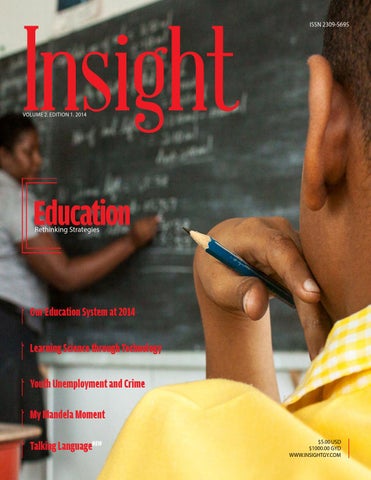
Insight
ISSN 2309-5695
VOLUME 2. EDITION 1. 2014
Education Rethinking Strategies
Our Education System at 2014 Learning Science through Technology Youth Unemployment and Crime My Mandela Moment Talking LanguageNEW
$5.00 USD $1000.00 GYD WWW.INSIGHTGY.COM
From The Desk of The Editor-In-Chief
SPOTLIGHT ON THE EDUCATION SYSTEM
W
ELCOME to Insight’s first edition for 2014. We are very pleased with the response to our previous editions published in September and December 2013. We are also encouraged by the feedback we have received via direct communication and on social media regarding the quality of the articles published. The Insight Team has been paying attention to what you have said and we have entertained a number of your suggestions for moving forward with the publication in 2014. This edition looks closely at one of the more challenging areas of life in the Caribbean – our education system. Though many of our features focus on analysing national performance, structures and themes within the education sector, we have managed to scan some issues facing the entire Caribbean region. With a main feature written by Mr Walter B. Jordan, a retired Permanent Secretary in the Ministry of Education, the issue has placed emphatic focus on contemplating some of the key issues affecting Guyana’s education system. Complementing that analysis is a series of articles by experienced educators and experts within the system who examine, among other issues, the approaches to foundation subjects like Mathematics and English. Educators share their perspective on where the focus may need to be applied as the system grapples with poor performances in Mathematics and English as core CSEC subjects and what seems to be a growing reluctance by students to engage the sciences. With the University of Guyana observing its 50th year we are hoping to begin a conversation on the state of the university through a series of articles. In this edition, education development specialist, Clarence Perry, examines the university and whether it is on the path to promoting academic growth. This issue also features a new column – “Talking Language”. Lecturer in Linguistics at the University of Guyana, Alim Hosein. His column aims at building awareness and revealing attitudes towards language in the Guyanese society. We also touch on several issues that continue to affect the education sector, some directly and others indirectly. Some space is devoted to our teachers in a sit-down interview with Guyana Teachers’ Union stalwart, Lancelot Baptiste, as he speaks about what is on the minds of teachers, what is affecting their performance in the school system and what changes they would prefer. What Insight hopes is that through this publication, noteworthy reflections on the sector’s existence and development are ventilated for deeper analysis and action.
.
There are several other interesting features focusing on the Caribbean Court of Justice, the impact of Youth Unemployment on societies of the hemisphere and a “Nelson Mandela moment” with Director of the Trinidad-based Institute of International Relations, Prof. W. Andy Knight. Enjoy these Insight exclusives and please keep the feedback coming!
NAZIMA RAGHUBIR EDITOR-IN-CHIEF
Insight Volume 2. Edition 1. 2014
3
www.insightgy.com
Insight Volume 2. Edition 1. 2014
PUBLISHED BY INSIGHT INC
62 Area “Q”, Turkeyen, ECD, Guyana, South America
INSIGHT TEAM Editor-in-Chief: Nazima Raghubir Editorial Consultant: Wesley Gibbings Editorial Assistant: Andrew Kendall Layout and Design: Tanika Van Sluytman Jones
Photography: Arian Browne, Neilon Dias, Wesley Gibbings
Contributors: Nazima Raghubir, William J. Carter, Wesley Gibbings, Andrew Kendall, Clarence O. Perry, Walter B. Alexander, Lancelot Baptiste, Leann Kendall, Mark McGowan, Dr Joyce Jonas, Lenandlar Singh, Rudolph Mahadeo, Onya Sam, Penelope Harris, Alim A. Hosein, Jennifer Cumberbatch, Dr Didacus Jules, Earl B. John, Hyacinth G. Massay, Anand Mangru, Teshanna Redmond, Prof. Andy Knight.
LETTERS TO THE EDITOR Should be emailed to editor@insightgy.com Published letters may be edited for reasons of space and clarity.
ADVERTISING ENQUIRIES Email advertising@insightgy.com. Insight Inc. 62 Area “Q”, Turkeyen, ECD, Guyana, South America (01) 592-222-2042
SOCIAL LINKS Visit our website at www.insightgy.com Follow us on Twitter @InsightGuyana Like us on Facebook - Insight Magazine All materials contained in this publication are protected by copyright law and may not be reproduced, distributed, transmitted, displayed or published without the prior written permission of Insight Inc. or in the case of third party materials, the owner of that content. You may not alter or remove any trademark, copyright or other notice from copies of the content. Copyright © 2014 Insight Inc.
Insight
Education System
This issue of Insight focuses on some of the Education Challenges in Guyana and the Caribbean
24
14
01
In The Neighbourhood
06 | Violence, Crime and The Poor 08 | Youth Unemployment Concerns Even in the Face of Growth 10 | Guyana Wants Cooperation on Food With Guyana
02
Development Focus
12 | Attitudes to Guyanese 14 | Exploring Alternatives to Styrofoam packaging 16 | Shaping a Regional Ethos for Caribbean Jurisprudence
03
Personality
18 | My Mandela Moment
Insight Volume 2. Edition 1. 2014
54
36
04
Features
21 | No Need to Panic 22 | Our Education in 2014 26 | Why Can't Our kids Pass CSEC English? 27 | The English Challenge 28 | CXC's 2020 Vision 29 | Some challenges in Post-Colonial Secondary Education 31 | A Perspective on the Education System 33 | Transitioning from Secondary School to University Life 34 | Can the University of Guyana Survive? 36 | Private Vs Public Schools 38 | A Role for Parents 40 | Well-rounded Education in Guyana and the Caribbean at Large 41 | Connecting Education, Science and Technology 44 | Using Technology to Transform Science Teaching 45 | Teaching Vacancies, Where are We Short? 48 | And What About Teachers ? 49 | The Harold B. Davis Special School, Another Step Towards Providing Special Education 5
05
Tech Bits
06
Nutrition
07
Facts & Fun
51 | Cyber Warefare
52 | A Serving of Boulanger Please
54 | Mashramani
www.insightgy.com
In The Neighbourhood
News, Reports and Analysis From Our Latin American and Caribbean Neighbours
Violence, Crime and The Poor By Wesley Gibbings
RESEARCH FINDINGS LAUNCHED IN January by the Inter-American Development Bank (IDB), using the experience of Mexico as a case study, measure the economic impacts of drug-related homicides – with low-income housing values as a key point of reference. The paper mirrors the findings of research conducted in Northern Ireland in 2012 and references measurable impacts, noted in a 2010, of crime on both the rich and poor of Buenos Aires, Argentina.
increase in homicides during the period 2008-2011 in Mexico to estimate the effect of drug-related homicides on housing prices. It was found that an increase in homicides, equivalent to one standard deviation, leads to a 3 percent decrease in lowincome housing prices. Moreover, the effect on housing prices of long-term increases in crime is 40 percent larger.
violence, insecurity and corruption of all varieties – particularly within the police force. The Governor of the Central Bank of Mexico, Agustín Carstens, is quoted in the IDB study as saying “Drugs are the most important factor inhibiting growth and investment.” The study however contends that the nature of local drug-related homicides “is unrelated to local economic conditions, since they are mainly associated with retaliation killings, battles among drug organisations, and clashes with the (Mexican) army.”
The IDB research, which forms part of a wider project on “The Costs of Crime in Latin America and the Caribbean”, attempts to assess the “Distributive Costs of Drug-Related Homicides” and was authored by Nicolás Ajzenman of Harvard University, Sebastián Galiani of the University of Maryland and Enrique Seira, a scholar from the Instituto Tecnológico Autónomo de México.
The study cites a 2012 paper by Melissa Dell of Harvard University (“Trafficking Networks and the Mexican Drug War”) which concludes that “over 85 percent of the drug violence consisted of people involved in the drug trade killing each other … either as a way of extracting revenge or as a way of expanding their territories.” She also notes that the killings are especially frequent after one side is weakened by government intervention. The IDB study meanwhile looks at the dramatic Insight Volume 2. Edition 1. 2014
Killings are especially frequent after one side is weakened by government intervention. According to the World Bank, the number of intentional murders per 100,000 in Mexico in 2011 was 24. In Guyana, the figure was 7.18 and in Trinidad and Tobago it was 35 in 2010. The common variable of drug production and trafficking however continues to constitute a major problem for most countries of Latin America and the Caribbean. With these activities come 6
Mexico City, Copyright Wesley Gibbings
Though Mexico represents an extreme model, Caribbean governments should pay attention to some of the study’s salient indicators. For one, it signals the need for more evidence-based commentary on the impacts of violence on economic outcomes – especially in the context of the ongoing “war” on illegal drug traffickers.
It shows that increases in such murders impact negatively on housing prices, but only in the case of low-quality housing. It is also argued that when the increase in violence is a long-term phenomenon, the negative effects on housing prices for the poor are about 40 percent larger. The IDB study references research conducted in Northern Ireland, published in 2012, which shows that peace can lead to increases in housing prices of between 1.3 and 3.5 percent, “with the effect being stronger in the regions where the violence was greatest.”
Also referenced is “The Economics of Crime – Lessons for and from Latin America”, published in 2010 by Rafael Di Tella and others, which finds that violence places a heavy burden on the poor, albeit in another environment and type of conflict. The absence of empirical work in the Englishspeaking Caribbean appears to be a gap worthy of filling by academia. Understanding the impact of growing violence and crime weighs heavily in favour of finding appropriate solutions
.
www.insightgy.com
Insight Volume 2. Edition 1. 2014
7
www.insightgy.com
THERE CONTINUES TO BE concern in Latin America and the Caribbean that even as some countries, such as Guyana, are emerging from long periods of economic decline, youth unemployment is accounting for a disproportionately high share of the national figures. One estimate, reported in the online resource Index Mundi, is that as many as 46.05% of young people between the age of 15 and 24 are currently unemployed in Guyana. The national estimate across all age groups is in the region of 24.1%. According to a recently-released International Labour Organisation (ILO) report, young people continue to be particularly affected by weak and uneven international economic recovery. It is estimated that, worldwide, some 74.5 million young people – aged 15–24 – were unemployed in 2013; that is almost 1 million more than in the year before. The global youth unemployment rate has reached 13.1 per cent, which is almost three times as high as the adult unemployment rate. In Latin America and the Caribbean, as economic activity decelerated following the financial crash of 2007/2008, employment growth slowed from 2.4 per cent in 2010 to less than 2 per cent in 2013.
Youth Unemployment Concerns Even in the Face of Growth By Wesley Gibbings
Nevertheless, the ILO report suggests, unemployment continued to recede as labour force growth also decelerated. In 2013, 6.5 per cent of the active population of the region as a whole was estimated to be looking for a job. And this was despite the expected recovery. In releasing the new report in January, ILO director, Guy Ryder, is quoted as saying: “If we fail to act, if we fail to tackle the youth jobs crisis, long-term unemployment, high drop-out rates and other pressing labour market issues, we will be destroying hopes for sustainable growth - and sowing the seeds of further, and perhaps deeper social unrest.” Angela Crumdy, research associate at the Council for Hemispheric Affairs says in a study on youth unemployment and entrepreneurship in the Caribbean that, among other things, “a general lack of preparation leads to unemployment among the young, as they often do not have the skills needed to compete against older, more experienced workers.” “This
Insight Volume 2. Edition 1. 2014
is
especially 8
true
in
low-income
communities where there are fewer resources,” she says. “Even if they manage to secure employment, younger workers are likely to be fired first under the assumption that they have fewer dependents, and thus the impact of their lost income would be less severe.” “Vulnerability on account of a strained economy, added to limited experience, makes it more difficult for youth to acquire and keep a job.” The ILO is reporting that “the youth-to-adult unemployment ratio has reached a historical peak.” In many countries, the proportion of young people neither in employment, nor in education or training has continued the steep upward trend recorded since the start of the financial crisis. Crumdy concluded in her paper that “youth unemployment could even be considered a threat to national security, due to the rampant crime, violence, and economic burdens it causes.” A United Nations Development Programme (UNDP) study has estimated “the cost of gangrelated crime is between 2.8 and 4 percent of gross domestic product (GDP) in the region through both the cost of policing and as a result of lost income from youth incarceration and reduced tourism.” “Widespread youth unemployment results in negative consequences that can be registered on both large and small scales,” the Crumdy says. According to Ryder, the ILO’s Global Employment Trends 2014 report “shows clearly that the modest economic recovery has not translated into an improvement in the labour market in most countries. “Businesses,” he says, “have been sitting on cash or buying back their own stocks, rather than investing in productive capacity and job creation.” “In part,” Ryder asserts, “this is a result of continued weakness in aggregate demand, both at national and global levels. It is compounded by uncertainty about where new sources of demand will come from and uncertainty about public policies, for example on financial sector reform.”
.
The evidence is that youth unemployment is a matter of urgency ignored at the peril of countries of our region www.insightgy.com
It is estimated that, worldwide, some 74.5 million young people – aged 15–24 – were unemployed in 2013; that is almost 1 million more than in the year before.
Insight Volume 2. Edition 1. 2014
9
www.insightgy.com
Grenada Wants
Cooperation
Ministry of Agriculture, Guyana
on Food With Guyana
Moco Moco Rice Fields In Region 9 Guyana, Copyright Kaiteur News kaieteurnewsonline.com
Insight Volume 2. Edition 1. 2014
10
Dried sugar cane at Grenada's rum factory, Copyright Kristin Carlson Examiner.com www.insightgy.com
with Guyana should be replicated throughout the region.
Grenada's Foreign Affairs and International Trade Minister Nicholas Steele
The Minister sat with Insight’s Wesley Gibbings in St George’s, Grenada on the eve of the country’s 40th anniversary of Independence.
GRENADA'S MINISTER OF FOREIGN Affairs and International Trade, Nicholas Steele, has suggested in an interview that Trinidad and Tobago’s land deal
Insight Volume 2. Edition 1. 2014
Steele said he thought the Food Security Facility under which up to 10,000 acres of land in the mainland territory is to be made available to Trinidad and Tobago farmers was “something that Grenada would want to look at.” “It is something that all CARICOM governments should be looking at Guyana for, in order to achieve mutual benefits,” the minister said. The Guyana-TT land deal had generated some initial concern among both the Guyanese and Trinidad and Tobago farming communities, but both governments have argued that mutual benefits can emerge from the arrangement.
11
It is expected that activities such as corn, soya, cassava and legume farming together with fish rearing and poultry will be the focus of attention. Steele said Grenada is “definitely looking at diversification of its economy,” the minister said. “Tourism cannot replace agriculture because we will be moving from one (economic) crop to another one-crop economy,” he added. Grenada’s nutmeg industry represents the lion’s share of the country’s agricultural output, rebounding after the devastation of Hurricane Ivan in 2004. “We are looking at diversification,” minister Steel said. “It is making sure that while we give agriculture the importance that is necessary that we also see tourism investment as the low hanging fruit, right now, that can create the labour and the demand for the very agricultural products that can being in the foreign exchange revenue … that is what is being looked at by this administration.” “Although right now Grenada does not have that close connection as we have had in the past (with Guyana), it is not because of a disconnect” he said. “It is because we have been going on different paths.
.
“But I see us coming together on some issues – food security in particular,” the minister added
www.insightgy.com
Development Focus Welcome to: Talking Language, our latest feature aimed at stimulating awareness and building understanding about language and culture.
Attitudes to "Guyanese" By Alim A. Hosein WE GUYANESE NEED TO change our attitude towards the language that we speak. Most of us live in a kind of linguistic schizophrenia as far as our attitude to our language is concerned. We conduct our entire lives in it, from the moment we awake to the time we go to bed; from childhood to the grave; from nursery school to the university; from parliament to the market to the minibus to the playfield, to church, and so on. We acquire education, wealth, friends, spouses, services, entertainment through it. We use it to think, plan, dream, build, remember, organise, direct, play, express ourselves, and more. Yet, it is a sure bet that most Guyanese have a dim view of this language. Even the names that we call it – “Creole”, “Creolese”, “Guyanese Creole English” – betray a lack of ownership of the language. These names are descriptive rather than possessive. The language of the English is called English; the language of the French is called French; that of the Germans, German and so on. Why don’t we call our language Guyanese? The answer is because we do not think of it as a language in its own right. We see it as a makeshift creation, a derivative of other languages, a poor form of English, a mongrel, bastardised, corrupt, broken, ungrammatical something. But no language is intrinsically better or worse than, or superior or inferior to, others. All languages are systems which allow their users to communicate with each other and so carry on the businesses of life and living. Notions of linguistic “superiority” and “inferiority” – like notions about “superior” or “inferior” race - are attitudes which people have, and these attitudes in turn are the products of ideological indoctrination. Therefore, it is within the context of history that we must locate our discussion to come to an understanding of our attitude to Guyanese. Guyanese was created during a particularly exploitative and brutal period of history. Between the 15th and 20th centuries, the Western Europeans rivaled each other in a blatant campaign of global exploitation. Driven by the ideologies of power, wealth-creation and nationalism, they ruthlessly plundered countries and tore people from their homelands to use as mere tools of production. One significant result of this forced movement of
Insight Volume 2. Edition 1. 2014
12
www.insightgy.com
people was that new forms of language emerged as people came into contact with languages that they had never heard before, yet had to find the means to communicate with. These kinds of languages are called “pidgin” and “creole” languages, and they are the products of tremendous human endeavour and creativity. Guyanese is one of them. Pseudo-intellectual, pseudo-religious and blatantly racist justifications were used to condone and perpetuate slavery and colonialism. Enslaved and colonised peoples were indoctrinated to believe that their own cultures, religions, histories and languages were worthless, while those of the Europeans were right, proper, correct, superior, and civilised. The pidgin and creole languages were derided as “broken-down” and “corrupted” versions of European languages. Many so-called “scholars” and “intellectuals” set out to “prove” that the enslaved peoples had lower intelligence which prevented them from acquiring the European languages. Some even “proved” that the shapes of heads, noses, and lips caused the enslaved people to fail to master the “perfection” of English, French, Dutch and other “superior” languages. Others “scientifically” compared the languages of the enslaved to the European languages to show that because the language of the enslaved did not contain the same features as the European languages, they were “proven” to be inferior. Few took time to notice that these “intellectual” and “scholarly” “proofs” were short-sighted, one-sided, and very short of being “scientific”. Within the
intellectual and social climate of those times, these ideas found root and thrived, and became accepted as “truth”. West Europeans were eager to embrace these “truths”, since among other things, slavery and colonisation helped them to attain the heights reached by the great civilisations of Rome, Greece and Egypt which they regarded as high points of human culture. They had codified these civilisations as “antiquity” and “classicism”, and borrowed heavily from them. Now, slavery and colonialism generated the wealth and gave Europe the scope to attain the status of “high cultures”. For the enslaved and colonised peoples, however, the effect was alienation from their original cultures, devaluation of their history, and loss of sense of self. These have been replaced by the values of the European masters. Thus, when we continue our negative attitude to Guyanese, we are really perpetuating colonialist myths and reinforcing racist, anti-human ideologies. Our attitude to Guyanese is a reflection of our attitude to our self, our environment, our culture, our history and therefore, to our future. Therefore, it is important that Guyanese understand not only our language and our attitude to it, but also where that attitude comes from. As Brother Bob advised “if you analyse your history, then you would know where you’re coming from/then you wouldn’t have to ask me, who the hell do I think I am.”
.
Alim A. Hosein is a Lecturer in Linguistics, Department of Language and Cultural Studies, School of Education and Humanities, University of Guyana.
Insight Volume 2. Edition 1. 2014
13
www.insightgy.com
Exploring alternatives to Styrofoam Packaging
Garbage in the capital city, the majority of which are styrofoam boxes
By Teshana Redmond
THE USE OF ENVIRONMENTALLY friendly packaging is not a new concept to Guyanese. Many should remember the Mixed Chinese Fried Rice that came in paper bags, the tasty BBQ that came in the cardboard boxes, the snow cone that you had to finish quickly before the paper cup was destroyed, and yes most people reused the rice bag when picking up weekly supplies. Back then it was not referred to as “environmentally friendly packaging”, “sustainable packaging” or “going green”. It was just the order of the day, the way things were. Overtime, there was the introduction of polystyrene commonly known as Styrofoam. This petroleum based plastic product with its strong insulation and cushioning properties soon overtook the market. Plates, cups, bowls, boxes in various shapes and sizes are often used in a society where many meals are picked up on the go. Some may question the need to return to paper based or other biodegradable forms of packaging, when Styrofoam containers seem so Insight Volume 2. Edition 1. 2014
much more convenient. Others posit that the cost is far less when compared to the alternatives and allows small businesses to spend less on packaging resulting in a bit more profits.
water ways. In the waterways, Styrofoam gradually disintegrates into smaller pieces that are consumed by unsuspecting marine and wildlife sometimes resulting in harm or even death.
But what is the true cost of Styrofoam containers in the food services sector? Many prefer a warm meal over a ‘dog-nose cold’ one, and once that tasty cookup rice purchased from the restaurant of choice goes cold many reheat the food in the Styrofoam containers. However, studies have shown that the toxic substance Styrene leaches from the containers when they come into contact with warm food or drink, alcohol, oils and acidic foods. Styrene poses a risk to human health since it is suspected to be cancerogenic and neurotoxic in nature.
In Guyana, we have experienced firsthand the clogging effect of Styrofoam in our drains and trenches. Clogged drains and slow flowing waters have contributed to flooding in many areas. When Styrofoam finally makes its way to landfills, it occupies far more space than paper based products and may even re enter the environment if the landfill is breached.
In the natural environment, Styrofoam is harmful since it is non-biodegradable and grease contamination makes it non-recyclable. As a result, Styrofoam containers readily litter our road and 14
With growing environmental and health concerns related to the use of Styrofoam, many countries globally have banned the use of Styrofoam in the food services sector. Guyana will join this group in June 2014 when a ban on the importation and use of Styrofoam comes into effect. Environmental taxes and stamp duty will be applied to Styrofoam www.insightgy.com
Common occurance in Guyana when one purchases a meal
People awaiting public transporation surrounded by styrofoam and plastic
imports making its use less attractive financially. On the other hand, tax incentives will be provided in order to increase the import and use of alternative products that are environmentally friendly and readily biodegradable.
from sugar cane fibres, harmless and healthy. The product line includes different sizes of bowls and boxes that can carry hot and cold foods. These containers are fully compostable and bio-degrade 90 days after use.
Are the alternatives available? Are they cost effective? Will they store food properly? I had my own experience during the recent Christmas holidays when children of my son’s day care were asked to take along one Styrofoam box to collect treats to be provided at their Christmas Party. Aware of all the preceding information, I offered to supply an “alternative”. I went in search of an “alternative”. Alternatives available range from cardboard, coated and uncoated paper, sugar cane and cornstarch based products as well as an organic alternative consisting of fungus, recycled paper and agricultural waste.
Several supermarkets also had in stock coated and
I hit our local streets and found the ECO PAK produced locally by Caribbean Container Inc. ECO PAK products are non-toxic since they are made
The Government has announced a ban on the importation of Styrofoam and related products from June 2014 non coated cardboard boxes in varying sizes. The prices were reasonable when considering the true cost of Styrofoam. According to the African proverb “we don’t inherit the earth from our ancestors we borrow it from our children”. Therefore, we must be willing to make wise choices with that in mind.
There is another very simple alternative to Styrofoam that has been around for some time - the reusable container. Instead of using Styrofoam cup after cup when getting water or coffee, have a mug at the office. Maybe you can try carrying a mug to the stall where you pick up that morning porridge to fuel your day. At the next family gathering instead of using Styrofoam plates, use reusable plates and if stashing the leftovers is your plan then walk with your own bowl, of course not the largest one. In the long run, you will save money and the environment. With increasing use of alternative forms of packaging coupled with behavioural change among our people, our landfill will receive less non biodegradable waste. Our drains would be less clogged, local marine and wildlife will face less risk from Styrofoam. With the reduction of litter, our road and water ways would be more aesthetically appealing and we will be a bit like the way we were. And, better yet, the way it should be if we care for our environment
.
Teshana Redmond BSc is a graduate of the University of Guyana with an MES from Dalhousie University .
Insight Volume 2. Edition 1. 2014
15
www.insightgy.com
Shaping a Regional Ethos for Caribbean Jurisprudence INSIGHT INTERVIEW Justice Adrian Saunders, about the work of the association and the extent to which regular meetings of the regional judiciary can make a difference in the quality of judicial services to Caribbean people Insight: How useful has CAJO been, since its inception, in promoting change in the manner in which the judicial system is being managed in the Caribbean? Saunders: Prior to the inauguration of CAJO, Caribbean judicial officers would meet, as we still do sometimes, at someone else’s conference, or else individual judges might receive funding to attend a Caribbean conference or workshop organised by an international agency. The value of CAJO is that Caribbean judicial officers now meet regularly under an agenda that we ourselves establish. We determine our own priorities and fashion our own judicial education programmes in keeping with those priorities. In this way, CAJO facilitates the sharing of best practices and promotes networking among regional judicial officers who on a daily basis encounter similar experiences. A perusal of the topics that we feature for discussion at our biennial conferences would indicate that a determined effort is made to expose judicial officers to new and/or exciting subject areas. We also seek consciously to promote a regional ethos because we recognise that solutions to judicial reform can be effectively carried out on a regional basis given the common legal, constitutional and regulatory infrastructure that exists across the Anglophone Caribbean. Insight: What was special about the meeting in Barbados? Saunders: In Barbados we had an excellent presentation from Professor Norman Girvan on the CSME and, among the several other issues we examined were cyber technology and human trafficking, balancing your personal and professional life, judicial Cooperation in Cross-Border Corporate Insolvency Cases and protection of the Rights of Children and Minorities, to name just a few.
Caribbean Association of Judicial Officers Chairman, Caribbean Court of Justice Adrian Saunders
The Caribbean Association of Judicial Officers (CAJO) is sponsored by the Caribbean Court of Justice (CCJ) and was inaugurated in Port of Spain, Trinidad in June 2009. This high-level association has as its major objective the development of judicial systems in the region and meets every two years. In 2011, the body met in the Bahamas and in 2013 in Barbados. Insight's Wesley Gibbings spoke exclusively with CAJO Chairman, CCJ
Insight Volume 2. Edition 1. 2014
16
The aim is to interest judicial officers and to raise their level of effectiveness as judges. Based on the evaluations we make at the end of each conference the attendees - who comprise judges, magistrates, registrars, court administrators and members of adjudicative tribunals - all leave very satisfied and looking forward to the next conference. The change made by CAJO to the judicial system may be incremental and not readily discernible but it is tangible and well appreciated by the judicial officers who are critical to the administration of justice. Insight: The theme for the Barbados meeting was “Equality, Justice and Caribbean Realities”. Does this suggest a level of concern by judicial officers regarding equity in the administration of justice in the region? How was such a concern reflected in the discussions among jurists?
www.insightgy.com
Saunders: Judicial officers can never tire of being concerned with equity, with justice, with protecting the rule of law, because that is a mission which is their very life blood. We wanted to highlight these issues in a very concrete and not an abstract way. We wanted to marry these concepts to our Caribbean realities. To this end we had an excellent keynote presentation on the very first morning of the Conference from Ms Tracy Robinson titled “Gender, Equality, Justice and Caribbean Realities: The Way Forward”. This was a masterly presentation that set the stage perfectly for discussion on how notions of gender have historically influenced the making and interpretation of law and what role is played by law and its interpretation in maintaining inequalities. Where inequality exists, often, what is warranted is not so much equality but rather specific measures that address vulnerability and disadvantage; measures which might actually demand different treatment. Insight: Attention was also paid to the question of women on the bench. What concerns was this intervention meant to address? What difference can an Association of Women Judges make against the backdrop of the concerns it is meant to address?
Naturally, the use of relevant, cost effective technological solutions that promote efficiency, effectiveness and enhanced access to justice is one way of fulfilling this remit. Early in the life of the CCJ, with the assistance of the European Union, the CCJ acquired and installed video conferencing facilities in the Supreme Courts of all the CARICOM States that did not have such facilities. A bridge unit was also provided to allow for multi-site video conferencing. Teleconferencing and audio/video conferencing are now regular tools used to support the work of the Court. Their use is not confined to those countries that send their appeals to us.
CAJO facilitates the sharing of best practices and promotes networking among regional judicial officers who on a daily basis encounter similar experiences. This technology reduces expenses considerably as it eliminates the need for airline travel, hotel accommodation, transportation etc. It is also convenient because attorneys can also take part in
case management conferences from their chambers using teleconferencing with the Court. Since the CCJ began using this technology there has been growing interest in its use by other courts in the region. I know that some domestic courts, Trinidad and Tobago for example, have also been using this video-conferencing in the courtroom and the governments of the region naturally support it. At the CCJ we are also using electronic solutions to eliminate the abundant use of paper. Our records of appeal and the filing of authorities are now done by email and this has encouraged, if not required the domestic courts themselves to create electronic files. As you indicated this has resulted in tremendous savings, not to mention the ease with which documents are now searched, retrieved and archived. The CCJ has also participated in regionwide efforts to promote the use of technology in the Court. In April 2012, the Eastern Caribbean Supreme Court hosted the 8th Annual CACTUS Conference in Grenada. CACTUS, the Caribbean Association for Court Technology Users, allows court technology practitioners from across the Caribbean to acquire and share skills and experiences and ensure that no State is left behind in taking advantage of relevant court technology
.
Saunders:: At the conference … there was a planning meeting to lay the foundations for the formation of a Caribbean Association of Women Judges. While it is true that at our Law Schools, in the legal profession and even on the Bench (both Magisterial and Supreme Court) in some Caribbean States women may now not necessarily be outnumbered by males, there is still a tremendous way to go in addressing a range of issues such as human trafficking; the rights of spouses on the breakdown of unions; reproductive rights and the adequacy of the law’s responsiveness to vulnerable groups, for example, children, persons suffering with debilitating diseases and challenged persons. The Association also intends to play a significant role as a chapter of the International Association of Women Judges and in that regard it intends to lending its voice to promoting gender equality throughout the world.
Caribbean Court of Justice, Trinidad
Insight: To what extent has the lead set by the CCJ in the use of new technologies caught on throughout the region? This certainly has budgeting implications at the national levels. What has the political response been so far? Saunders: One of the several ways in which the CCJ expresses its utility as a final court of appeal lies in its ability to provide leadership in judicial education and reform throughout the Caribbean. This is a responsibility we take extremely seriously.
Insight Volume 2. Edition 1. 2014
17
www.insightgy.com
Personality release from prison. I left my university dorm early that morning to head downtown because I had heard a rumour that Mandela would not be speaking at Nathan Phillips Square (which was closer to York University), as initially planned, but would address a large crowd on the legislative grounds at Queen’s Park in downtown Toronto. I managed to get a front row space, separated from the stage by phalanx of Toronto police and members of the Royal Canadian Mounted Police (RCMP). It seemed like an interminably long period before Nelson Mandela finally took to the stage. He didn’t look like a prisoner or terrorist to me. He was tall with stately bearing and salt and pepper hair. He reminded me of my grandfather.
My Nelson Mandela Moment By W. Andy Knight WHEN NELSON MANDELA DIED on the 5 December 2013, I found myself glued to the television set for hours watching tribute after tribute about this great man, this towering figure of South Africa’s struggle against racism. He was 95 years old when he passed, and while the world knew that moment was coming, it still came as a shock to realise that this great light had finally dimmed. My heart was heavy with sadness when I heard the news, but my mind was racing back to my Nelson
Insight Volume 2. Edition 1. 2014
Mandela moment. I was a student at York University twenty three years ago when Mandela, and his thenwife Winnie, visited the city of Toronto. It was a bright, hot summer day on 19 June 1990 when Mandela arrived in Canada. He had been out of prison for only four months. But Mandela had decided that Canada would be one of the first countries he would visit because it was one of the few countries in the Western world that supported the international campaign that lobbied for his
18
In a strong, distinctive voice and a slightly staccato delivery, Mandela thanked Canadians for their unwavering support of him and the African National Congress (ANC) during the struggle against the apartheid regime of South Africa. He asked the crowd to walk the last mile with him in his fight to put an end to the racist laws that permeated almost every aspect of life in his country. Throughout his speech, I felt a sense of pride to be Canadian. As someone born in the West Indies, I felt a sense of empathy with the plight of the South African black people. My father used to tell us stories about the time in Barbados when black kids could not walk through certain areas like Belleville. Those were the days of racial segregation in Barbados, not unlike the situation in South Africa. This feeling of empathy made me consider how difficult it must have been for Mandela to live under the conditions of segregation in his own country. Mandela wanted to eliminate apartheid, but was stymied by the racist government of that country which used legislation between 1948 and 1994 to curtail the rights of the black majority. In 1970 black people in South Africa were denied the right to citizenship and segregation was practiced in educational institutions, in medical centres, on the beaches, and in public services. Listening to Mandela on the lawns of the Ontario legislature, I could not help but reflect on the debate about whether or not Nelson Mandela was a terrorist or freedom fighter. While there is no
www.insightgy.com
internationally-agreed upon definition of terrorism, that term is generally reserved for the commission of premeditated violence, or the threat to commit such violence, aimed at destroying human lives and/or inflicting serious material damage that will disrupt social, economic and political processes and inculcate fear amongst a general population (i.e. beyond the immediate victims of the violence) with the view of forcing changes in society and/ or influencing political decision-making. For some, there are clearly problems with this definition – perhaps best encapsulated in the well-worn adage that “one man’s terrorist is another’s freedom fighter.”
with the colonial power’s resounding victory over the indigenous people of South Africa.
When the African National Congress (ANC) planted bombs indiscriminately during the 1980s in trash cans in Johannesburg, South Africa, was this organisation engaged in terrorism or freedom fighting? Nelson Mandela actually admitted to signing off on some of these violent acts.
In a leaflet – the Umkhonto we Sizwe (MK) -- issued by the military wing of the ANC in December 1961, one can deduce, clearly, the ANC’s frustration with the Nationalist government of South Africa. Part of that document reads:
TIMELINE DOB 1918
Imprisoned 1962
Free 1990
President of South Africa 1994 - 1999 Died - 2013
The American right-winger, Andrew C. McCarthy, a senior fellow at the National Review Institute, asserts that the members of the ANC “were no freedom fighters.” He claims that Mandela and the ANC were nothing but terrorists whose real history was “bleached” by Western journalists. He claims that the ANC killed more civilians than did the members of the apartheid regime in South Africa. However, a compelling case can be made that Mandela and the ANC resorted to this kind of extremism only because there was no other avenue within apartheid South Africa for opposition groups to express dissent. Prior to the founding of the ANC, blacks in South Africa had struggled with the British and Boar colonizers in an attempt to regain control over their land and resources. The many wars between the locals and foreigners ended in 1878
By the 1900, the British had broken the backs of the African kingdoms and for the first fifty years of the ANC’s existence that organisation was, for all intents and purposes, a non-violent movement for national liberation. However by the 1960s, out of frustration, the ANC decided to take up arms against the racist South African government because blacks were being systematically discriminated against, marginalised and, in some cases, deliberately massacred (note the Sharpeville incident).
“
The time comes in the life of any nation when there remain only two choices: submit or fight. That time has now come to South Africa. We shall not submit and we have no choice but to hit back by all means within our power in defence of our people, our future and our freedom. The government has interpreted the peacefulness of the movement as weakness; the people’s non-violent policies have been taken as a green light for government violence. Refusal to resort to force has been interpreted by the government as an invitation to use armed force against the people without any fear of reprisals. The methods of Umkhonto we Sizwe mark a break with that past.
It is at this point that the radical arm of the ANC, led by Nelson Mandela, made a conscious decision to embrace extremism. In his autobiography, Mandela explained what he thought were the various violent options available to the ANC at the time. He wrote:
“
We considered four types of violent activities: Sabotage, guerrilla warfare, terrorism and open revolution. For a small and fledgling army, open revolution was inconceivable. Terrorism inevitably reflected poorly on those who used it, undermining public support it might otherwise garner. Guerrilla warfare was a possibility, but since the ANC had been reluctant to embrace violence at all, it made sense to start with the form of violence that inflicted the least harm against individuals: sabotage.
Despite Mandela’s attempt to provide a nuanced explanation for the nature of the ANC’s resistance against the immoral South African government, at that time the US government (as did the Government of South Africa), and many within academia, labelled him “a terrorist” and the ANC organisation was viewed as a radicalized extremist (terrorist) group. Nelson Mandela spent a good chunk of his productive years in prison for sabotage because of his role in the ANC’s armed struggle. Eighteen of those years were spent on the former leper colony called Robben Island. Then he was later transferred to Pollsmoor Prison and then to Victor Verster Prison. All told, Mandela was deprived of his freedom for 27 years, six months and six days. In retrospect, many in the West came to view Nelson Mandela as a hero, a freedom fighter, and a cultural icon comparable to Mahatma Gandhi. He even went on, at the age of 75, to become the first President of his country to be elected (1994-1999) in a multiracial, democratic vote, and he won the Nobel Peace prize in 1993. Even if one considered Nelson Mandela a terrorist in his heyday, once out of prison he became an elder statesman who denounced terrorism and – a far cry from his days as co-founder of an organisation that was forced to use violence as a means to get the racist apartheid regime in South Africa to end the discrimination against the non-white majority. What this clearly shows is that someone who was considered a radical extremist and terrorist one day can be viewed completely differently the next. Apart from Mandela, other examples of individuals who made that personal transformation include Menachem Begin, Gerry Adams, and Yasser Arafat. Since radical extremism can be reversed, is it possible then that, someday, some of the same people who are being labelled as “terrorists” today by the US may one day be viewed as national liberators and statespersons? The difference between the revolutionary and the terrorist lies in the reason for which each fights. For whoever stands by a just cause and fights for the freedom and liberation of his land … cannot possibly be called terrorist.
.
During my Nelson Mandela moment, that distinction became clearer to me
Professor W. Andy Knight is Director of the Institute of International Relations at The University of the West Indies, St, Augustine, Trinidad and Professor of International Relations at the University of Alberta, Edmonton, Canada. Insight Volume 2. Edition 1. 2014
19
www.insightgy.com
Feature
EDUCATION EXAMINING EDUCATION IN GUYANA
CONTENT
21 | No Need to Panic 22 | Our Education in 2014 26 | Why Can't Our kids Pass CSEC English? 27 | The English Challenge 28 | CXC's 2020 Vision 29 | Some challenges in Post-Colonial Secondary Education 31 | A Perspective on the Education System 33 | Transitioning from Secondary School to University Life 34 | Can the University of Guyana Survive? 36 | Private Vs Public Schools 38 | A Role for Parents 40 | Well-rounded Education in Guyana and the Caribbean at Large 41 | Connecting Education, Science and Technology 44 | Using Technology to Transform Science Teaching 45 | Teaching Vacancies, Where are We Short? 48 | And What About Teachers ? 49 | The Harold B. Davis Special School, Another Insight VolumeProviding 2. Edition 1.Special 2014 Education Step Towards
20
www.insightgy.com
No Need To Panic By Nazima Raghubir
"THERE ARE NO quick fixes” Registrar of the Caribbean Examination Council Dr. Didacus Jules was quick to point out when questioned about the glaring under-performance by students in what has been considered the foundation CSEC subjects. In assessments, “Exams Results Reports”, published on www.cxc.org, performances in Mathematics and English in recent years have been described as moderate as assessors zoom in on some of the problems facing students - like poor reading and comprehension. Insight’s Editor Nazima Raghubir attended a press conference that followed CXC’s Governance Meeting in Guyana last year quoting from several assessments cited figures over the years which placed passes in both subjects under 60%. “We need to understand that when we present results, and you cited a number of statistics that are accurate and correct, what you are seeing there is not something that happened in one year. We are only picking it up – you know, it’s like taking the temperature way after the fever has occurred and all of the things before that have led to that fever. So we need to understand when we talk about education there are no quick fix solutions. Education is something that requires investment; it takes time for results to show and we have to understand that education is what we call an eco- system, some of these problems start from the infant, from preschool going up” Dr. Jules said the body designed a regional literacy and numeracy strategy in 2012 aimed at providing long- term solutions to tackle underperformance in these two subjects. CXC is pushing for the Caribbean Primary Exit Assessment to be adopted by all territories to replace Common Entrance and Grade Six assessments. “I mentioned the replacement of the Common Entrance Exams by The Caribbean Primary Exit Assessment, that is showing some very useful improvement of students core competency of literacy and numeracy, because of the methodology that is being embraced” The Ministry of Education in St. Vincent and the Grenadines began to register students for this assessment to be undertaken in 2014. The Ministry sees it as one that assesses the “key literacies,
Insight Volume 2. Edition 1. 2014
RESULTS IN BRIEF MAY/JUNE 2013 SITTING >> 58% PASSED ENGLISH >> 30% EARNED GRADES 1-3 IN MATHEMATICS VERSUS 40% IN JANUARY 2013 mathematical, language, scientific and civic, required of students leaving the primary school system” CPEA would see the child being assessed internally and externally as it “will require students to produce a book report, a writing port- folio and a project ..” with marks being awarded from students’ own assessment and from tests given by teachers. There are also short- term solutions to tackling under- performances in the foundation subjects. The CXC Head identified making syllabi available both to teachers and students as one. “If you only cover half of the syllabus how can you expect to pass the subject…” Pro - Registrar of CXC Glenroy Cumberbatch does not feel all is lost, he said there has been progress and assures there is no need to panic. “ We speak about performance in Mathematics and English, and that is because, there seems to be this idea that anybody who goes to secondary school and leaves secondary school should have a certificate in English and Math. Even though we speak about 40% and the percentage of people getting grades one to three, out of a hundred thousand who write English, fifty something thousand of them get grade one, two or three, fifty something thousand people every year, now that maybe seen as bad performance but those are a lot of people. There are more people getting grades one, two or three in English than writing all the sciences, history, and geography put together” Cumberbatch believes that the aim should not be for high percentages. “So what do we want, do we want excellence in the sense that we get high percentages, so we restrict
21
from a hundred thousand, 50,000 from writing it so we get 100 % passes, or do we want to make sure we have large numbers of people who are certified with the competencies and functioning in society… in Maths, there are 40,000 something students who write Maths every year, and I will bet you that if you check most of the Caribbean countries you have more people writing Maths and English now and getting acceptable grades now than any other time in the countries” An assessment of performance in English A Examinations written in January 2013 placed it at “moderate” with the assessor noting “there was a marked absence of superior scripts at one end and also few incompetent scripts at the other… Candidates are encouraged to do more critical reading and discussions, opportunities for more in class reading and discussion should be created and geared towards how writers say things and why” In the May June sitting of 2013, 58% of the candidates passed English. The assessment of the January 2012 English results was similar with the assessor noting that “most candidates’ reading is superficial…candidates miss what is being asked when they need to study and respond to questions” The inability to read and comprehend would affect students’ performance in other subject areas and in the assessment of the 2012 Biology results it was noted that “poor spelling of important biological terms continues to be problematic and sometimes prevents otherwise good candidates from being awarded marks” Passes in Mathematics over the years continue to at 40% and below. Some 12,900 candidates sat that exam in January 2013, 40% earned Grade 1-3. In the May/June sitting, 92,400 students sat the exam with 30% passing with Grade 1-3. In 2012, the January sitting saw some 14,200 students writing Math and 40% passing while in 95,000 students sat the exams in May/June, 33% passed.
.
The performance in both subjects continues to be debated by educators across the region as they recognise approaches to syllabi have to change
www.insightgy.com
Has The Education System Delivered? By Walter B. Alexander
INSIGHT FEATURE
Insight Volume 2. Edition 1. 2014
22
www.insightgy.com
THE EFFECTIVENESS AND THE efficiency of the education system have been in the dock in the court of public opinion since this trial first began in 1966 with Independence. The end of the trial is not in sight, because of the complexities of the case. The effectiveness of the system can be compared to the digestive system, where the intake of food is necessary for growth and functions of the body, and the food goes through changes and orderly stages. The efficiency can be likened to clockwork which can only keep accurate time if the wheels of the clock (not the Stabroek Market clock nor the General Post Office clock) are in good working order. Nevertheless, whatever are the analogies, the public is impatiently waiting for a decision by 2016 when we will observe (not celebrate) half a century of independence. But the question is basically whether the education system has been delivering. In order to begin to answer this question, one must take into consideration that any education system has various components which are interrelated and inter-dependent. The most visible of the components are the schools, and you can measure the quality of the schools on the whole by measuring the output. It is also useful for individual communities to assess the contribution of their schools to their individual communities. Remember that the whole picture is the sum-total of its part. And in looking at the schools we must also focus on the teachers, who are the role models for the students, academic-wise and otherwise. Lest we forget, the motto of the century and a quarter-old Guyana Teachers Union is “We mould the nation”. Furthermore, the corps of teachers comprises the products of the schools. Therefore, improved schools can lead to an improved quality of intake for initial Teacher Training. This in turn will lead to a better quality of teachers, who after graduation will hopefully contribute to moulding more students so as to renew and perpetuate the system of formal education, in the first place. And in the second place, the country needs improved schools so that they can contribute towards national development, an elusive goal since Independence. Following the increased demand for places in schools (especially secondary) since the 1960s and with the take-over of private schools by the State in 1976, the public education sector has expanded to such an extent that there is almost total access to education at the three levels (Nursery, Primary, and Secondary) in all Regions and in Georgetown at present. What is of major concern today is the quality of the output from the Primary Schools and both the quality and quantity of the graduates from the Secondary Schools.
Insight Volume 2. Edition 1. 2014
When one examines the statistics of the pupils who write the National Grade Six Assessment (NGSA), one finds that more than 50% of the pupils score less than 50% of the Raw Score and thereby obtain less that 430 marks out of a maximum of the Converted Score of about 560 marks. It has been found that more than one-half of the pupils leaving the state primary schools cannot read at an acceptable level. This is not like 50 years ago when the situation was healthier. While over 80% of primary school graduates gain places in secondary schools (including Senior Secondary Schools and other List A Schools), the majority enter the Fifth Form schools hoping to cope with the necessary reading of textbooks and written material on the chalkboard. We move from about 17,000 candidates at NGSA to about 14,000 in Form I (Grade 7) in State Schools to about 13,000 (country-wide) writing CSEC to less than 2000 matriculating (passing 5 subjects with English A and Mathematics) at the end of the formal school career.
When one considers the successes at CSEC of the private schools, one wonders how far the education system provides real equality of opportunity. In another light, it is noted that demographically males comprise about 50 % of the population, and that up to the end of the primary school cycle boys are just under 50 % of the total school enrolment. The gap in enrolment between boys and girls widens during the secondary school years, not to speak of the post-secondary enrolment. Also, in attempting to examine the performance of schools, it is useful to consider the role of parents as major stake-holders in education. Too many parents are not discharging their responsibilities. Let us now look at teachers and their impact on the education system. There are now about 9,000 teachers in the state schools at the nursery, primary and secondary levels. These teachers are changeagents in academic development of students, and it has been said that ‘a scholar makes a scholar.’ Now the present system does not attract the best and the brightest students to seek a career in teaching. There is a constant need for more competent teachers whose teaching is stimulating and challenging to students. Graduates with the Bachelor’s Degree in the Arts or in the Natural
23
Sciences do not become teachers. Over the last 30 years the majority of teachers in our Sixth Form Schools come from the Fifth Form Schools. While we moan about the country’s underperformance in Mathematics at CSEC, it should be pointed out that the University of Guyana is not producing from the Faculty of Natural Sciences Mathematics graduates. It may be argued that the School of Education and Humanities graduate majors in Mathematics for Secondary Schools, but the courses there are more about Methodology than Content. Many a B.Ed. graduate is ‘afraid’ to teach at the Form Five level. And let us not forget that there has been no Physics graduate from U.G. in the last seven years. There is a dearth of Physics lecturers. Consequently, the stream of Physics teachers for Secondary Schools will dry up! What is at the heart of the problem of attracting more able teachers? The low salary scales. The low earning power of teachers. Here is a striking comparison. Thirty years ago, two years of the gross salary of a Graduate Teacher was the equivalent of the price of a decent three-bedroom house in Georgetown. Today, a similar house cannot be acquired for less than the equivalent of 10 years of the gross salary of the same category of teacher. Furthermore, because of bunching of teachers within a scale and because of the cessation of payment of increments based on performance, there are no differentials in the salaries of teachers of the same category. Experience here counts for nought. And you cannot confer experience on a person, nor can you legislate commitment. In the not so distant past, relatively small batches of teachers (30 per year) were trained at a time. Then it was 150 teachers in training per batch. Today, the initial training of teachers has an annual intake of over 600 Trainee Teachers in Pre-Service Programmes and In-Service Programmes. These programmes are conducted at the Cyril Potter College of Education (at the Turkeyen Campus) and at Centres in out-lying Regions. It must be noted that a Distance Education mode forms part of the methodology for off-Campus Centres. However, the expansion in the number of students has not kept pace with the recruitment of staff. In recent years it has been a problem to appoint lecturers for some core courses and enrichment subjects. It is normal and expected to recruit lecturers from the pool of competent experienced teachers who are willing to change their career paths from school to college. But the conditions of service must be attractive. Such conditions must include Sabbatical Leave and Study Leave so that lecturers may expose themselves to practices in
www.insightgy.com
overseas Teacher Training institutions and/or seek to earn Higher Degrees. Further, it is embarrassing to see and inconvenient for lecturers to be hustling to catch public transportation. In this day and age it is necessary for lecturers to enjoy a Motor Car Allowance. How could a senior member of the College staff not own a car? Position and status must be real. Therefore, the attempts to expand training for teachers must be accompanied by provision for satisfied staff. While the Ministry of Education may boast of the provision of an adequate number of school places country-wide and of the increasing number of trained teachers, that in itself is not sufficient to ensure success for the majority of students in the Public Schools by the end of the third cycle of formal education. There are two problems that must be addressed. In the first place, schools need to be properly managed by the 11 Departments of Education (10 Regions and Georgetown) to ensure that the schools are performing at optimum levels. In the second place, the national curricula (which are revised from time to time) must be readily available in schools together with adequate resources for their implementation. For Departments of Education to properly manage their schools, these Departments must essentially be staffed with officers who have proven their competence and are thereby respected by teachers. You should recruit your Education Officers out of the ranks of successful teachers, especially Headteachers.
At this time, Departments need more Officers who are knowledgeable of the teaching of Mathematics, Science and Technology. Having the B.Ed. (Admin) is not enough, because the Officer is not a mere coordinator, but a leader in his/her field. With respect to curricula and teaching resources, both NCERD (National Centre for Educational Resource Development of the Central Ministry and the Resource Centres in the Regions must be adequately (not fully) staffed. Adequate staffing comes from offering attractive salaries and other benefits. One cannot expect to recruit only retired persons. Hence, the vision of NCERD established in 1986 is still to be realised. There was also a vision for the University of Guyana at its establishment 50 years ago. UG is at the apex of the education system. According to the University of Guyana Act Chapter 39:02, the aims of the University are “to provide a place of education, learning and research of a standard required and expected of a university of the highest standard …” The University’s Mission Statement says in part ‘to discover, generate, disseminate, and apply knowledge of the highest standard for the service of the community, the nation ...” By the time of the last Convocation (November 2013), there have been 15,000 graduates including 1,600 from the Turkeyen and Berbice campuses in 2013. The Historical Note in the 2013 Convocation booklet states that the graduates have “gone on to successful
careers both locally and internationally. True, but more of the graduates are overseas. Hence, local institutions are suffering from a shortage of personnel and personnel of quality. Like the Public Schools, UG cannot attract and retain enough qualified staff. The Salary Scales are such, that the quantum of pensions for Lecturers (including Senior Lecturers) in a Contributory Pension Scheme after 20, 25,or 30 years of service is LESS THAN THE NATIONAL MINIMUM WAGE. Therefore, the quality of teaching has declined. The teachers graduating today are not being exposed to the quality of lecturers as in earlier years. Hence, they proceed to schools where many of them offer a level of instruction that results in a case of diminishing returns. The students they produce later are admitted to UG and produce work of a lower quality, notwithstanding there are exceptions. Apparently, the education system is in a vicious circle, and the Ministry of Education has been tinkering with solutions to the problems in schools. We are being consumed by the mini-bus culture. The drivers and the conductors run things with their reckless driving and loud music. The policemen, including Traffic Police, are the products of our schools from which many leave (not graduate) with limited literacy and limited knowledge of science. Since a scholar makes a scholar, the salary must be right to attract and retain more teachers/lecturers of quality in the schools and in the University. Only satisfied and respected teachers/lecturers can make a difference in the effectiveness and efficiency of our education system
.
Walter B. Alexander is A Retired Permanent Secretary in the Ministry of Education and Former Lecturer at the University of Guyana .
Insight Volume 2. Edition 1. 2014
24
www.insightgy.com
Insight Volume 2. Edition 1. 2014
25
www.insightgy.com
CRADLING HER BABY, the young woman in the maternity ward approached the staff nurse newly recruited from a London hospital: “Nurse, de baby get operation.” Somewhat puzzled, the London nurse hastened to reassure her: “No, my dear. Your baby is just fine. He hasn’t had an operation, and he doesn’t need one!” But the mother insisted, “Yes Nurse. Dis morning de baby get operation. De nex’ nurse tell me fuh tell you!” Creolese speakers will have no problem in understanding: the mother was reporting that baby’s bowels were in good working order. But for the London nurse, the word “operation” had a totally different connotation--surgery. Even though we advertise ourselves as being the only English-speaking country on the South American continent, we in fact do not speak English: we speak Creolese. Our Standard West Indian speakers slide relatively easily along the continuum to function in Standard English, but for the majority, Standard English, both spoken and written, is a foreign language. Each year when the CSEC results are published, concerned parents and educators bemoan our dismal performance in the English exams. The official pass rate is below 50%, and if we take into consideration that hundreds of school leavers or drop-outs simply don’t take the exam, the real percentage is probably below 40%. Where are we going wrong? What can be done? Does it even matter? Yes, it matters. Tremendously. To function confidently in today’s world, school leavers needs the skills outlined in the CSEC English syllabus. They should be equipped to understand the written text, summarise it and extract the salient points, make a formal report in a clear, logical manner, recognise shifts in tone, present their opinion on a topic, bringing suitable arguments to support their case—all the time expressing themselves with grammatical accuracy. The Literature aspect of the English syllabus takes the student even further—to be able to appreciate and write about literary texts, whether drama, prose or poetry, showing an understanding of the themes and techniques employed by writers. So does it matter that less than half of our children can pass the exam? Surely it does! Surely we would want all of our young people to be empowered and equipped to use language to their advantage! Surely we want all of them to enjoy the works of great writers—from the Caribbean and beyond. So how can we bring about change? We began with a reminder that our mother tongue is Creolese. Many academics believe that until and unless Insight Volume 2. Edition 1. 2014
we take that as our starting point, our expensive remedial programmes and literacy initiatives will yield only minimal results. The challenge, though, is how to upgrade our children’s performance in Standard English AND at the same time build in them an appreciation for and pride in Guyanese Creole. Unless we achieve these twin goals, we are guilty of perpetuating debasing colonial attitudes. Some linguists insist that our children should be taught the structures of Creolese before they are introduced to Standard English. But, as Hamlet said, “Aye, there’s the rub!” Because we do not have, as yet, a formal analysis of the structure of Creolese— which itself is constantly evolving in response to changes in the world around us.
Why Can't Our Kids Pass CSEC English By Joyce Jonas, Ph.D FOR THE MAJORITY, STANDARD ENGLISH, BOTH SPOKEN AND WRITTEN, IS A FOREIGN LANGUAGE
In and of itself, Creolese is not a problem. But interference from Creolese does contribute to poor mastery of Standard English and poor performance in English exams. Another factor is that neither parents nor teachers give quality time to helping children develop proficiency in reading, comprehension and expression. I am quite sure that a survey of the students who shone like stars in the CSEC exams would reveal that their parents (or grandparents) spent many hours reading to them, listening to them read, explaining and discussing what had been read. The stars, I’m sure, were already competent readers and writers BEFORE they entered the school system. Education is not just about schooling and lessons; it’s a holistic experience. I heard of a 17 year old student who came to Georgetown from a country school with reading and writing skills that even an eight-year-old might be ashamed of. The student was put through 18 months of remedial work: reading aloud daily, extracting and learning new 26
vocabulary, learning lists of spellings, writing a minimum of 300 words every day. The literature texts were read and discussed together with the instructor, notes taken, and essays written on them at regular intervals. The learning environment was friendly and encouraging, often filled with giggles. After 18 months that student gained Grade 2 in English A and Grade 1 in English B. The secret? Consistency, interest shown by the adult, encouragement rather than criticism, fun rather than fear, and a fair amount of practice. The student was clearly capable, but equally clearly had been failed by the system. An individual can, of course, function perfectly well through life knowing only Creolese. But increasingly the world is shrinking, and Creolese speakers are a relatively small community. For better or worse, it is Standard English, not Creolese, that is the vehicle of communication in most formal situations, and certainly so whenever we are interacting with the world outside Guyana. English A skills are needed to deal with application forms, job interviews, academic textbooks, instructions on how to use your medication or prepare for your colonoscopy. Indeed, almost everything that will enable us to find our way in the modern world requires a working knowledge of Standard English. In this high-tech age, finding a good job can be very difficult for those who lack good language skills. A young Guyanese businessman, now living overseas, tells me he has interviewed scores of Guyanese applicants responding to advertisements for online work opportunities with his company, but over and over again he has found that the language skills of the would-be staffers are simply not at the required level. Ironically, second-language applicants from places like India and the Philippines can boast of far better language skills than Guyanese applicants (not to mention a far better work ethic!) Better minds than mine have struggled to solve the problem of poor literacy in Guyana—sadly without much success. But we dare not walk away from the challenge. The success story of that 17 year old can be replicated in each of our school leavers. If we have the political will. If parents step up to the plate and recognise their responsibilities regarding their children’s education. If teachers are properly trained—not only in content and methodology, but in their attitude and the emotional environment they create. If classes are made smaller and teacher remuneration more encouraging. If resources of television, radio and internet are creatively exploited. If voluntary groups already working on the problem are appropriately supported. If the media are required to improve the quality of printed material they present to the public…
.
www.insightgy.com
The English Challenge By Mark McGowan GUYANA CONTINUES TO SECURE pride of place among students sitting the Caribbean Secondary Education Certificate (CSEC) examinations. At the award ceremony for the 2013 May/ June examination, Guyana copped five of the eight regional awards. Apart from producing the most outstanding student in the region, the respective awards for Most Outstanding Candidates in Technical/Vocational Education, Science, Business Studies and Humanities also went to Guyanese. Commendable as these achievements may be, they fail to hide some worrying trends in the local results. Analysts have frequently pointed to the poor performances among the majority of the CSEC candidates particularly in the core subjects of Mathematics and English A (Language). Statistics from the Ministry of Education indicate that passes in Mathematics (Grades I-III) at the May/June 2013 examinations were recorded at 28.98 percent. This represents a decline from the 2012 pass rate of 29.69 percent. Passes for English A (Grades I-III) were recorded at 45.69 percent an improvement from the 37.02 percent pass rate achieved in 2012. Education Minister Priya Manickchand expressed her concern about these results and indicated that attempts would be made to develop other tactics to solve the problems in these two subject areas, particularly Mathematics. While the performances in English A are not as dire as the scores in Mathematics it is still very much a cause of concern. After improvements from 2009-2011 where Guyana recorded pass rates of 50.29 percent, 59.16 percent and 60.82 percent respectively, these rates have declined. The peak in performances had been attributed by the then Education Minister Shaikh Baksh to the successful implementation of a strategic plan by the Ministry of Education. Veteran educator Walter B. Alexander, in a recent article published in the Guyana Review, opined that the disappointing results in the core subjects at the CSEC exams are due to “deep seated” causes
with cures that remain “distant”. But Guyana does not stand alone as it relates to poor performances in English A. Statistics from the Caribbean Examinations Council reveal that, regionally, of the candidates who wrote the English examination at the sitting in May/ June 2013, 58 percent passed with Grades I-III. This represented an improvement from the 2012 exam, where 47 percent of the candidates achieved grades I-III. In 2011, the percentage of candidates who achieved Grades I-III was 67 compared to the 66 percent in 2010 and 56 percent in 2009.
Bar Graph showing pass rates in core subjects as reflected in data from the Ministry of Education:
In response to the below par results regionally in both core subjects, the Caribbean Examination Council (CXC), the parent body for most Caribbean exams, has proposed a regional strategy to counter these problems. This approach has been described as a more holistic approach. A key aspect of this approach is to address the problems at Forms Four and Five by attempting to tackle the issues from the earliest stages of the students’ education. This, in turn, would be built on through consistent initiatives through each stage of development. Given the influence of Creole languages in several territories, various stakeholders have called for the implementation of strategies and programmes which utilise Creole as a means of teaching English Language. One such advocate is former President of the Jamaica Teachers Association Clayton Hall, who in 2012 identified the teaching of English language as a second language as being critical to improving performances in the subject at the CSEC exams in Jamaica “We assume that our students are native speakers of English, therefore when we teach English, we are teaching it to persons who we think already know it, and that’s not the case,” Hall was quoted in the Jamaica Observer as saying. It was within a similar context that Alexander asserts that Standard English is no longer spoken in Guyana. This, when coupled with the ungrammatical lyrics of dancehall music which
Mathematics English A English A Surpasses Mathematics
*From 1990-1997 passes were (Grades I-II) *From 1998-2013, pass were (Grades I-III)
bombard students, contributes to a learning environment which makes the assimilation and mastery of the desired language difficult, he opines.
.
Whatever the difficulties may be, an acceptable solution needs to be found
Mark McGowan is the Assistant Lecturer in the Department of Language and Cultural Studies, School of Education and Humanities.
Insight Volume 2. Edition 1. 2014
27
www.insightgy.com
The Caribbean Examinations Council (CXC) was established in 1972 by Caribbean governments “to conduct such examinations as it may think appropriate and award certificates and diplomas on the results of any such examinations so conducted.
2020 VISION
Registrar and Chief Executive Officer, Dr Didacus Jules, a Saint Lucian national, was appointed in 2008. In this interview with Insight's Editor-in-Chief, Nazima Raghubir, Dr Jules discusses the regional body's vision of a fully certified Caribbean region by 2020. Insight: The Caribbean Examinations Council is hoping that by 2020 it would have given every West Indian a chance to certify their knowledge, skills and competencies, how realistic is this? What has driven the body to realise that such a plan is needed? Dr. Jules: In developing our 2020 Strategic Plan we undertook many different types of analyses because we wanted to ensure that the plan was not a “piein-the-sky” aspirational dream but something that: a. was based on the empirical reality of where Caribbean education was currently at b. responded to current as well as projected and continuing deficiencies in education but also built on educational strengths and achievements over the past couple decades c. was rooted in the developmental needs of Caribbean society in the context of globalization and the challenges that it posed for human resource competitiveness and the shaping of regenerative and sustainable societies. The vision of providing every West Indian with the opportunity to certify their knowledge, skills and competencies by 2020 is a very attainable goal. Because we are speaking about the provision of opportunity, it simply means that the educational systems of the region must put in place mechanisms of access to programs of quality to enable this to happen. CXC as the regional specialized certifying body is committing itself to ensure that an appropriate range of certification is available for different ages and stages and that this certification is globally recognised and accepted. Will every single Caribbean person be so certified by 2020 – not at all because it will be incumbent on the individual to seize the opportunities being extended to achieve this. The important thing is that the opportunity must be provided and it must be a World Class opportunity.
Insight Volume 2. Edition 1. 2014
INSIGHT INTERVIEW
In all countries of the region, there is substantial human wastage in education – notwithstanding the achievement of universal primary and near universal secondary education, completion rates fall short of the universal. Significant numbers of students who enter both primary school do not go on to secondary and of those who transition to secondary, significant numbers do not complete or enter for CSEC exams. Then, of those who sit exams, only about twenty two percent attain acceptable grades in 5 or more subjects. And, as you know, 5 or more subjects is the most common requirement for decent wage employment throughout the region. It means therefore that there is a huge demographic – almost as large as the in-school population – which is in need of continuing education opportunity and as the global economic environment becomes increasingly competitive, our only hope of building competitive economies and sustainable societies is to provide opportunities for second chance education, opportunities for worker retraining, opportunities for self-development leading to entrepreneurial initiative and ongoing professional enrichment to all who require it. Insight: What remains some of CXC’s challenges in addressing shortcomings within regional examinations? It is a very broad question, but I am curious to find out what you consider your major challenges when it comes to addressing issues like low performances, lack of parental supervision and the inability of teachers to understand their subjects and assess their student’s performance. Dr. Jules: In a nutshell, the greatest challenge is the assumption of responsibility by respective stakeholders for the tenacious execution of their respective remits! We have accepted the fallacy that education is the responsibility of teachers but the reality is that successful provision of education is a collective effort – teachers, parents, Ministries of Education, Churches and civic organisations, the business sector - all must make their contribution if we are to succeed and excel. As a result of this refusal to accept responsibility, we waste much time and energy playing the blame game. Teachers are blamed by everyone; the
28
teachers blame the Ministry; many parents have abdicated basic responsibilities for their children’s upbringing to the school; we see many religious authorities insisting on the exercise of authority in the operation of schools but accepting no responsibility for their maintenance or even their proper management. Then, after results are released, CXC becomes the object of blame for poor performance – we are the scale that weighs the bacon, our responsibility is to guarantee that the measurement that we pronounce is accurate, fair and consistent. We can’t be held responsibility for how that weight came to be. And so it goes on … What is required therefore is a broad social consensus about the necessity for transforming education in the Caribbean. We have tried many things in the past decade but the time is long past to continue to tinker. What is needed is fundamental whole system transformation that will ensure that change in every component of the education system reinforces each other. The leadership of the system must be anchored in an unambiguous vision of what education in the contemporary 21st Century Caribbean must be; changes in curriculum must be reinforced by changes in the pedagogy of the classroom and the training and preparation of teachers; assessment and examinations must be based on the key principles of that new pedagogy and assess the competencies that are expected to be mastered at every level of the system; performance results must be used for the purpose of improving teaching and learning – it’s a whole system approach. The CXC 2020 Strategic Plan lays out the roadmap the Council will take in playing a prominent role in facilitating this transformation. The unfortunate reality of our post-colonial British inheritance in education is that the system is very test driven. So we have taken the position that since teachers will always teach to the test, then if we change the way we test, we will cause changes in the way teaching and learning happen
.
Part Two of this interview will be carried in the next edition of Insight.
www.insightgy.com
Some students of Paramakatoi Secondary in Region 8 listen to a presentation
Some Challenges in Post-Colonial Secondary Education By William J. Carter ONE OF THE GAUGES that one can use to assess the value that societies place on education is the quantum allocated in the annual National Budget. If we were to use this as the only indicator, Trinidad and Tobago has Education as its highest priority, allocating TT$9.8 billion out of a total of $61.4 billion (Health was awarded 5 billion and National Security $6.5), Guyana also placed education as its main priority for many years and in 2013 it spent G$28 billion of its G$177.4 billion budget on this sector. This follows a post-colonial trend of all the governments in power starting with the oft-quoted exhortation of the First Prime Minister of Trinidad and Tobago, Dr Eric Williams to school children at an Independence rally in 1962 where he told them that they carried “the future of Trinidad and Tobago in their school bags”.
Insight Volume 2. Edition 1. 2014
There followed a concerted effort to widen and broaden Secondary Education in particular (though not exclusively). The elitist and exclusivist system of very limited state-paid ‘scholarships’ to the few existing Secondary schools was slowly but surely dismantled by a “Common Entrance Exam” taken at the end of the Primary cycle (also referred to as the “Eleven-Plus”). But there continued to be the element of ‘elitism’ as parents were given the choice of Secondary School their offspring would attend and these choices were (and still are) determined by the mark obtained in the exam. Naturally the longer-established (often owned and governed by boards connected with religious bodies) were and are considered the ‘elite’ or ‘prestige’ ‘first choice’ options.
This has set up a vicious circle which the more recently established government schools have found hard to break : the ‘prestige’ schools get the better students, if they are ‘denominational’, have greater choice and control over their teaching staff (though technically all come from the same pool) and on the empirical evidence of final exam results (both at CSEC and CAPE level) achieve and maintain higher exam standards. It is extremely difficult to see how this status quo can be changed as long as the placement process is oligarchic. There continues to be extreme anxiety over this placement exam now called the SEA (Secondary Entrance Assessment) with parents with means choosing private primary schools and/or extra lessons in an attempt to guarantee the ‘gold standard’ of the ‘first-choice’. Recent attempts by the Curriculum division of the
29
www.insightgy.com
Education Department to broaden the focus of the curriculum (instead of ‘drill for an exam’) and reduce anxiety through the use of ‘portfolio’ and ‘continuous’ assessment are proving to be a minefield since the stakes are so high and the conditions and facilities of schools in the Primary system are quite unequal. The Secondary school curriculum throughout the English-speaking CARICOM region is governed by what I consider to be possibly the only undisputed triumph of the integration movement in the Caribbean (CSME/CARICOM) – the Caribbean Examination Council (CXC) and its examination system (CSEC and CAPE) . Set up in the mid-70s to replace the British-based system of external examinations, it has taken over all the disciplines and in the 90’s both the ‘fifth-form’ (CSEC) and ‘sixth-form’ levels. Driven by the most modern Measurement and Evaluation principles from the beginning, (for example the principle of a “School-based assessment component”), it has garnered the skills of professionals in Education both at the University level and in the trenches of Secondary Schools throughout the region and has set up a most laudable system of curriculum development, assessment and exam administration.
the ‘academic’...meaning ‘technical and vocational’ training and certification e.g. ’woodwork’, ‘motor mechanics’, ‘metal work’ have very largely disappeared from schools’ departments particularly with the elimination of the “Junior Secondary” (which used to be a three-year school) followed by the “Senior Comprehensive” (two more years leading to CSEC level and possibly a small ‘advanced level’ group). This has left a significant proportion of the school population de-motivated and disinclined to any real effort at studies. Added to which, the Ministry of Education, without explaining clearly the change in philosophy (at least not in any public campaign), have been tinkering with the system. There was a decision to abandon “Junior Secs” and “Comprehensives” and convert all schools into either five-year or seven-year schools. They have also experimented arbitrarily, and, from reports coming from teachers involved, creating many challenges
One gets the impression that many of the decisions mentioned above were done without carefully considering any relevant research findings, certainly without any public campaign explaining the reasons, and very often seemingly for political gains in the narrowest sense – “It will look good”.. A prime example of this is the current scheme to give laptop computers to all Form One students. Very few of the current teaching personnel are “digital natives”, some aren’t even “digital immigrants” and the impact this very expensive adventure as far as pedagogical usefulness and heightened interest in learning is, in many minds, minimal. There is though at the Secondary level what is to me a rather intriguing phenomenon; the ‘super student’. This manifests itself in the sitting and passing of large numbers of CSEC subjects with distinctions. This seems to be a peculiarly Guyanese phenomenon – in 2012 Abram’s Zuil student Sarah Hakh won the award for the Most Outstanding Candidate in the region, she gained 16 grade ones with all As on the profile grades. Last year, Yogeeta Persaud of Anna Regina Secondary School captured the same award with 18 Grade ones while her fellow peer Zimeena Rasheed who wrote 20 subjects and gained 18 grade ones copped the award for the Most Outstanding Candidate in Technical/ Vocational Education
Though headquartered in Barbados it has sought involvement throughout the region from all the sources that can be of assistance to its task. In Trinidad and Tobago, the major challenge up to the Form Five level is, I feel, the bias of the curriculum in the majority of schools towards
thereby, with ‘single-sex’ schools, converting a mixed-school system into some ‘single-sex’ schools.
.
School boys playing Basketball
Of note is that Guyanese students dominate the Regional Top Awards for outstanding performances at the CSEC, while students from Trinidad and Tobago continued their dominance of awards for outstanding performances at the CAPE. Five of the eight awards for CSEC went to students from Guyana, while nine of the ten awards for CAPE went to students from Trinidad and Tobago. It would be interesting for readers especially those in Guyana to provide an explanation of this phenomenon, which by the way does not recur at the CAPE level where Trinidad and occasionally Jamaica tends to have the top students.
A final remark: I am not convinced that the male section of the school population is achieving anything near its academic potential at these final examinations. You may have noticed that the Guyanese ‘super students’ have been female and the schools that dominate the “Open School” awards in Trinidad (“Open schols” are awarded to the very top performers at CAPE) are single-sex female schools. The young males seem far more interested in achieving mastery at FIFA XIV®, Grand Theft Auto® and Warcraft® and becoming armchair experts on the Barclays Premier League®, La Liga® and the European Championship League® where their mastery of the statistics and knowledge of the ‘stars’ never ceases to amaze me... How can Shakespeare, Heidegger’s uncertainty principle or the intricacies of macro-economics compete?
William J. Carter has spent his entire career working in the area of Secondary Education at Queen’s Royal College, Trinidad where he spent his last ten years as Principal (1997- 2007).
Insight Volume 2. Edition 1. 2014
30
www.insightgy.com
A Perspective on the Education System By Rudolph Mahadeo FROM MANY QUARTERS, voices have proclaimed the education system in Guyana to be in crisis. It is no secret that many aspects of the system are in fact poorly addressed and even neglected much to the detriment of the nation. Formal schooling begins with the nursery schools, continuing on to the primary system, after which one qualifies to be placed in a tiered system of secondary schools and finally one exercises one of the following options: proceeding to university, locally or abroad, entering the world of work or other some similar option having left school. A cursory examination of the flow of students to these levels of schooling will reveal that there is little articulation among these levels thus inhibiting a smooth flow into a chosen career path. It is not unusual, especially at the secondary level, to hear students say they have not been prepared for a career to pursue after graduation. In the main, learning at these different levels focuses on passing traditional examinations and not putting in place systems to graduate students whose personal development can ultimately lead to national development. Our education may be aptly described as “examination oriented.” Our methods of teaching discourage students from displaying initiative and creativity. Assignments are done by regurgitating information gleaned from secondary sources. Teaching is confined to repeating facts and theorems established. It is rare to find a teacher at the nursery, primary or secondary level who encourages those under his/her charge to have enquiring minds and to demonstrate initiative. Students who pursue studies at the Sixth Form attest to being told in lower school, that unless they submit their work exactly as the teacher taught them, their marks will not reflect their effort. This speaks volumes for not encouraging investigation and creativity.
The Ministry of Education has led the way in putting measures in place in order to achieve successes in improved performances. It may be apposite to note that this situation is not alien to participating countries which offer examinations under the aegis of the Caribbean Examinations Council.
Some parents, teachers and other stakeholders have expressed their opinions about the madness of a student offering a shopping list of CSEC subjects and the attendant brouhaha that follows. We are caught up in a numbers game, all to no sensible benefit to any of the stakeholders.
Prime tertiary institutions demand a core of academic subjects to pursue particular disciplines leading to careers in the natural sciences, social sciences and the arts. Invariably these subjects are far below the totals “chased” by our “top performing” Caribbean students. Clearly teachers, parents, students and other related persons are caught up in a “numbers game.”
Poor performances in Mathematics and English at examinations continue to cause concern to all involved. Various opinions, recommendations and criticisms have been made widely known with the best of intentions aimed at improving the level of attainment in proficiency in these subjects.
Insight Volume 2. Edition 1. 2014
31
Students who are “streamed” in the natural sciences, social sciences and the arts are not well advised on the package of academic subjects that are required for careers in these respective disciplines. This is evident when they are encouraged
www.insightgy.com
to offer a shopping list of CSEC subjects in the Fifth Form. This writer was alarmed when the Minister of Education is reported to have said that no one will be persuaded to downsize the list of subjects offered at the CSEC examinations in the Fifth Form. I would want to view this as a personal view and not a policy supported by the Ministry of Education. There is need for a published curriculum for the guidance of students, teachers and parents. A close examination of the structures relating to students moving through the established levels of schooling, viz. nursery, primary, secondary and tertiary education will reveal a good deal of fragmentation. There is a lack of smooth transition from each of these levels to the next succeeding level. Programs are not streamlined, particularly at the secondary level to allow for a cohesive curriculum vis-Ă -vis career pursuits. This writer is integrally involved in the preparation of students at the post CSEC examinations in Additional Mathematics and CAPE Pure and Applied Mathematics. As a panel member for the syllabuses mentioned, the central aim is to demonstrate multiple literacies, independent and critical thinking and innovative application of science and technology to problem solving. Examinations are conducted for the purpose of awarding candidates with certificates that are reliable, credible and possessing a high degree of integrity. Examination questions are not designed
to foster rote learning and merely regurgitating memorised formulae and theorems. Candidates are required to demonstrate the ability to think rationally and to recall and apply sound and requisite mathematical techniques to explain real world phenomenon. It would be fair to say that concepts and proper foundation in mathematical techniques are necessary for students to pursue the next succeeding level of tuition. With particular reference to students preparing to offer CAPE Pure and Applied Mathematics, it was recognised that a wide gap existed between CSEC Mathematics and CAPE Mathematics. The Caribbean Examinations Council implemented the CSEC Additional Mathematics syllabus to bridge this gap. Evidence of the successful and positive influences by candidates who completed this syllabus in 2012 and 2013 and their results of CAPE Pure and Applied Mathematics have been noted. However, students who want to offer CSEC Additional Mathematics are restricted to a selected few senior secondary schools in Georgetown. This writer knows that one private secondary school outside of Georgetown is piloting this subject at the upcoming examinations in June 2014. Students who were not afforded the opportunity to take the CSEC Additional Mathematics examination and who apply for admission to the Sixth Form
at senior secondary schools are placed at a disadvantage. Results at the CAPE Pure and Applied Mathematics Unit 1 examinations highlight this situation when a comparison is made with the results of those students who offered CAPE Pure and Applied Mathematics Unit 1 after successfully completing the CSEC Additional Mathematics against those students who were denied the opportunity of taking CSEC Additional Mathematics. The inability to offer CSEC Additional Mathematics to all Fifth Form students is primarily due to a severe shortage of sufficiently qualified and experienced Mathematics teachers. The Ministry of Education proudly announces the continuing large number of teachers who are trained at the Cyril Potter College of Education and after graduation added to the cadre of trained teachers. This writer has reasons to question particularly graduands of Mathematics for secondary schools. Mathematics teachers who are admitted to be trained in Mathematics for secondary schools and who graduate from the Cyril Potter College of Education leave much to be desired for content. This situation will be amplified in a subsequent paper on the factors that may be inhibiting delivery of the syllabuses of CSEC Mathematics, CSEC Additional Mathematics and CAPE Pure and Applied Mathematics
.
Rudolph Mahadeo is a Senior Lecturer, Mathematics.
Insight Volume 2. Edition 1. 2014
32
www.insightgy.com
Many of the students who apply at the University of Guyana are high school graduates
Transitioning from Secondary School to University Life By Leann Kendall TRANSITIONING FROM SECONDARY SCHOOL to university life is linked to the preparedness and readiness of the student as they begin their journey towards higher learning. With any transitory period, hurdles are expected and the university experience is no different. This adjustment from secondary school to university can be difficult and the most critical change in environment is a significant reason for this. Human beings experience discomfort or tension to some degree when a change of environment is engendered. The way they react to this change in Insight Volume 2. Edition 1. 2014
environment results because of their own peculiar characteristic traits. Because of their idiosyncrasies, persons act accordingly, ultimately shaping their behavior; both publicly and privately and students are no different. As the largest tertiary education institution in Guyana, a Guyanese student heading to the University of Guyana from another Guyanese institution of learning will be faced with a change in environment. The change in environment, and the things which come with that new environment, are especially stark for the student coming from a 33
secondary school. A student’s ability to successfully transition from secondary school to university is largely dependent on the level of secondary education they received as well as the student’s own proclivities and personal background. Students who attended sixth form before entering university have been found to adjust to university life quicker as opposed to those who had only attained a fifth form education. When examining the freedom of choice which immediately greets a www.insightgy.com
first year university student on arrival at university some students may respond adversely to such independence at an academic level. Wanda Ferreira-Agdomar a holder of a BSc in Biology from the University of Guyana, on reflecting on her first year of study at the University noted:
“
My first year of study was crazy; I felt as though the lecturers just came into the lecture theatre, taught and walked away. They were emotionless”.
Melissa Chapman, a current third year sociology major of the University of Guyana, highlighted facing similar hurdles during her first year as well. She stated,:
“
My first year was strange, tough, and challenging. The environment was totally different and teaching techniques were much more advanced than I had expected”.
Wanda and Melissa’s thoughts are simply a microcosm of similar reactions from numerous students over the years. A great part of education depends on the student’s response to the physical institution itself. The environment contributes largely to the learning process. And, the environment in which learning takes place in high schools differs largely from a university setting. In secondary schools, students are members of a fixed classroom location which provides much needed stability for that period in their lives whereas universities have varied instructional settings; lectures, tutorials, practicals, laboratories, field work, and more. This shift in environment does not always auger well for many students who are transitioning
from fifth form education to university. For Wanda who came immediately from fifth form and Melissa who only completed one year of the two year sixth form programme, the shift in learning environment took some getting used to. It is not just a change in environment which marks the difference between the two modes of education. Another factor to consider is the disparity between teacher/student contact at secondary schools in comparison to university. In secondary schools the contact between student and teacher is closer and much more frequent unlike a university where lecturers are generally formal and sometimes carry out their duties quite impersonally. There are less contact hours with students per week at university than high school directly contributing to the climate of the learning environment reflected in the “strange feeling” and “emotionless” nature of lecturers experienced by Wanda and Melissa. It is that transition from childhood to adulthood evinced by the analogous change from high school life to university life. In considering this change, however, final year sociology major of the University of Guyana Taralyn Harris reflects on her first year different from her colleagues.
“
My first year at university was admittedly, a new experience. However, I was able to adjust to the changes therein and motivated myself accordingly to cope with my new workload” It is possible that Taralyn’s disposition and the ease with which she transitioned could have been
directly linked to her personal upbringing, but of great significant too is Taralyn’s sixth form education which doubtlessly played a contributory factor to her quick acclimation to university life. An integral aspect of transitioning to university life is navigating between learning styles. In secondary schools much absorption of information with much regurgitation takes place; in contrast University education promotes critical thinking to a larger extent and the generation of new ideas is imperative. That potential middle ground between regular high school and university becomes significant because at the senior secondary schools which offer sixth form education teachers make a decisive move to demand more critical analysis and input from students. At university students are expected to show a greater degree of independence and the study load is notably more intense. This is why the two years at sixth form could provide such an essential period of transition for students as they get more used to intense critical work. Ultimately the onus lies with the student to inculcate preparatory measures for such a transition. However, in considering the state of the education system in Guyana and questions about preparedness of high school students for university life it is significant to mention that the admittedly small numbers of sixth form schools in the country do provide with their two year programme a preparatory mechanism for students moving on to high school life. And, ultimately, the student from fifth form least prepared for the change environment is assured success at university life if willing to adapt to changes in environment
.
Leann Kendall is a lecturer in the Department of Sociology at the University of Guyana. She is currently on study leave pursing a Master’s Degree in Psychology and Behavioural Science.
Can the University of Guyana Survive? By Clarence O. Perry The Background IN 1985, ALMOST 30 YEARS AGO, a major and comprehensive study: “The Organisational Effectiveness of the University of Guyana: A Case Study of an Emergent University in a National Development Context” arrived at the following key findings which could have served as a basis for university reform:
Insight Volume 2. Edition 1. 2014
“The governing, administrative and managerial structures no longer serve the institution well. There is an absence of any clear statements of the appropriate goals for a university in a society as Guyana. “They are no specific policy guidelines to inform the daily operations of the institution, linking their activities to the university’s purposes and goals.
34
There is a serious lack of accountability on the part of the university establishment. Information flows are poor; there is not even common annual monitoring of data. “Decision-making is arbitrary, unstable and undemocratic. Decisions are made and rescinded regularly; recommendations are systematically ignored. There is undue bureaucratization and
www.insightgy.com
Lilliendhal, on January 11, 2008. Below is a review of the evidence gathered at the Public Consultation. The evidence indicated that: a) First degree graduates of the University of Guyana do not possess adequate communication, research and other intellectual skills and hence they are not prepared for the requirements of the graduate programs, nor do they satisfy those of employers.
Catwalk at University of Guyana
b) Programs are criticised both by the students taking courses, and the graduates and employers because of their purely academic emphasis. They are not suited to a society which demands professional and other job-oriented competence to be immediately useful on graduation. c) The curriculum balance is inappropriate. In spite of the demonstrated need for
centralisation of power. There is mistrust and constant conflict between the various Domains. “The lack of management leadership is manifested by the absence of entrepreneurship (creative and innovative ideas) to solve the university’s besetting problems. The university is being inadequately funded—a not surprising condition considering the state of Guyana’s economy. “But the administration has failed to cultivate alternative sources of revenue. The result has been low salaries, insufficient numbers of suitably qualified faculty members and support personnel, inadequate physical plant and support facilities and high faculty turnover. There is low productivity in terms of quantity and quality in the major university activities—teaching, research, and public service— and the Administration seems to have been unsuccessful in enticing or coercing its faculty into better performance. “Although it lacks the necessary critical mass of highly qualified faculty in all departments, the University does have a large number of well-trained and highly motivated faculty. Unfortunately its use of this scarce manpower is deplorable. Many are overburdened with committee work and trivial administrative tasks which divert them from teaching, research and public service. “Many academic departments are overworked. They would do well to have fewer programs
and strengthen the ones they decide to keep. Administrative leadership to ensure these painful decisions are taken is lacking. The criteria for the appointment and the duration of tenure of Deans and Heads of Departments bear little relationship to the tasks and responsibilities they are expected to perform. “The University is a good example of a weak version of the traditional Western liberal university, a modified English model with academic departments based on single disciplines – this in spite of the fact that the society’s development problems require a multidisciplinary approach for solution. “The University may have been an important and relevant institution in its early days when Guyana needed specific middle level skills to take over various administrative posts in the immediate postindependence era. But that requirement has been fulfilled. The current need is for highly qualified manpower—creative and innovative leaders and researchers capable of contributing to the social and economic development of Guyana.”
more graduates in the Sciences, the applied Sciences and Technology, programs in these areas remain inadequate and too many graduates emerge from the Humanities and Social Sciences. d) There is an insufficient development of postgraduate programmes. e) Insufficient attention is given to the all-round development of students. All too many simply take courses and by the end of their programs have no real experience of university life. f ) The inability of the university administration to develop a dynamic innovative climate which would foster the kind of creative, innovative programs that could enable the university to contribute to social and national development. On October 2013, the University celebrated its 50th anniversary under the stewardship of a new ViceChancellor, but with almost the identical politicallycontrolled University Council, which has been described as an albatross around the neck of the university, still in place. Recently it was announced that the University was operating on a G$ 480 million overdraft. It would appear that the institution has been on life support for quite some time.
However, the prevailing political immaturity at that time prevented any significant university reform or development, and institutional decline continued unabated.
The above gives a concise overview of what has been taking place at UG for the greater part of its existence.
Twenty-three years later, the Ministry of Education held a public consultation on issues re the University of Guyana (UG), at the National Convention Centre,
The survival of the University rests on the collective will of all Guyanese. The question is: “What needs to be done, if our only national institution of higher learning is to survive and have a Second Genesis?
.
Clarence O. Perry is an Education Development Specialist. Doctor of Education with specialisation in Post-Secondary Education, University of Toronto.
Insight Volume 2. Edition 1. 2014
35
www.insightgy.com
Private Vs Public Schools By Andrew Kendall
While children in public schools sometimes share one desk due to overcrowding, private school students have the comfort of one desk per child
THE CLOSEST WE GET to any significant comparative analysis of the two systems of education is when we consider the divide between private and public education in Guyana and the yearly results at the National Grade Six Assessment (NGSA) and the fifth and sixth form CSEC examinations. Last year, following the release of the NGSA results, there was much hullaballoo when it revealed that about half of the more than 170 top students emerged from private schools. What few cared to remember was that the effectiveness of any education system can and should be measured in more than its end of year academic results, and similarly the divide between what comprises the education system in public against private schools in Guyana demands more consideration than yearly exam results. Private schools are doing well at the National Grade Six Assessment. But is that an indication that public schools are underperforming, or revealing unique and maybe insurmountable differences in the way private and public schools functioned? In the United Kingdom, schools not under the purview of the government are given the moniker “Independent Schools” which, more than the term “private” schools, gets to the root of what makes the non-governmental education such a peculiar aspect of education, not just in Guyana but worldwide. The reasons for their genesis might be countless but the most significant aspect of private education, generally, is the fact that they sometimes exist with
Insight Volume 2. Edition 1. 2014
the freedom to operate outside of the control and scrutiny of the government. This point is not as much an indicator that existing within the strictures of governmental control is essentially bad, or meant to suggest a deficiency in Guyana’s Ministry of Education but it is curious that in contemporary society where the (relative) goodness of capitalism is always being argued, it seems unusual that debate on private schools in Guyana has never focused on this aspect. Guyana in no way qualifies as a particularly capitalist nation but when the merits of privately- owned services in medicine, insurance, are often considered, even lauded, the effect of private education’s ability to exist independently is worth some thought. The pertinent question, of course, is what is so especially peculiar about the private school system that the public school system is unable to act upon. Teacher’s salaries are usually the first thing considered, a relevant issue certainly. And, although the public continues to argue, somewhat unusually, that increased salaries have no effect on performance, this is not quite accurate. But the difference in the public and private school ways of functioning runs deeper than a salary issue. In 2009 there was a brief sit-in at a senior secondary school when the entire staff refused to teach classes when the school was prevented by the Education Ministry from expelling a student. The student failed multiple terms. The expulsion was, at the time, being blocked by the ministry’s policy to abate expulsions from school. Eventually, classes resumed when the
36
expulsion was allowed to follow through. However, the very fact that the issue caused such fervour in the first place is one of the most obvious examples of the issues which plague government education. Let us assume, for a moment, that the teachers’ sit-in was unsuccessful and the school was never allowed to expel the child. Consider a situation where the child had performed further transgressions. This indiscipline could conceivably have had a very damaging influence on his peers. Consider how teacher performance may have been adversely affected when dealing with this problematic child. Consider if said child had continued being indiscipline – imagine the attention the school’s administration would have had to expend to curb the issue. Perhaps the welfare system would have gotten involved and after prolonged interventions he may have been removed from the school after some months. These are all hypothetical but consider the alternative where an undisciplined, consistently failing child was at a private school. The stark difference is the private school in Guyana, independent of the governmental red tape, would have been able to immediately address the situation in the way they saw fit – even if it did include expulsion. This is not to imply that the private’s school way is immediately superior. Sometimes bureaucracy is important but the point reveals the major advantage of unquestioned control which characterise private schools. The public education system, as its name implies,
www.insightgy.com
is a public service – one provided to the citizens of a country living within its jurisdiction. At the senior secondary level, it depends on attaining top marks at the NGSA and in other cases it depends on proximity. But, ultimately, the promise of access to the public education is open to all. This prevents them from being especially discriminating in who gains access to behind their walls. The private education system is free of these reins. They do not have to check with the ministry of education before doling out whatever forms of discipline or expelling a child. The ability to exist autonomously, although potentially harmful if misused, gives them a significant amount of control and the capability of a speedy response to an issue which the public schools in Guyana, or any country, lack. Last September on his Plain Talk programme Christopher Ram invited Director of the privately run Mae’s High School, Onya Sam, and Former Minister of Education Dr Henry Jeffrey to discuss the education system. Speaking of private school fees, Dr Jeffrey jokingly pointed out that one term’s fees at Mae’s is more than what is spent in the public sector for a year. Significantly, though, Ms Sam responded, “We have to provide fifty times more the service.” This in reference to the fact that private schools, as a business entity, are putting them in a position where they are expected to exert significant more energy than their counterparts in the public school system to give parents value for money spent. It’s a fair point, but examining this issue further only reveals a flipside which suggests that in the long run the illusion of grandeur continues to be attached to them. Parents pay fees, sometimes incredibly steep ones, to get their children into private schools and
Insight Volume 2. Edition 1. 2014
this price almost immediately acts to prevent gross contempt of the school’s policy. It is not that incidence of indiscipline is absent in the private school system, but administration at a public school always exists with the postscript that ultimately their hands are tied when it comes to policies at school – unless it’s a Board school, and even then, the red-tape to go through regarding the higher-ups is lengthy. The main edict in public schools is that, at the end of the day, unless the situation is especially unique, a school must still provide for a child who is underperforming, or occasionally indisciplined. It is a noble decree, but clearly it is one which prevents public schools from functioning in a business-oriented way where only the best are allowed to remain and the system is permitted to thrive only off of these “best” ones. There’s a Guyanese adage that indicates that free goods are never appreciated for their freeness suggests inherent disvalue. In the case of the public school system this is not true, but the illusion of it being true is what hurts the education system where the value attached to the work done and services provided by a non-governmental school is often considered superior. After all, if all that money is being invested, parents would be wary of jeopardising that investment. Not the same for the public school where the investment cost is low, and possibly even nil. When year-end national exams come and some private schools hail their progenies with points such as “no student at X school gained below” and some measure of academic proficiency is inserted here,
37
the illusion is that private schools are outperforming public ones. This private school only has a few students not gaining entry to a senior secondary school. Or, this private school does not have any student who failed to get at least two grade ones at CXC. But these sentiments are bandied about without considering essential points. There are myriad differences between the two: private schools have smaller classrooms engendering more class discussion and a chance for teacher’s to specialise, oftentimes parents who send their children to private schools demand their children perform to ensure value for money and private schools are free to disassociate themselves with students who are underperforming and will blemish their academic reputation. No one can stop, for example, Marian Academy from refusing to accept a student in Grade 3 who does not academically qualify for their grade. Much issue would be made if St. Margaret’s Primary attempted to do the same. These are options are not available for the public school. It seems a true consideration on how in key areas the private school system, like any private sector, is allowed more flexibility in decision making is needed before the public school system gets egregiously lambasted for things outside of their purview. Ultimately, more students reside in the public school system and the public school system must attend to them irrespective of peripheral issues. We have not reached a situation where public education is considered emphatically inferior in Guyana, but each time when grumblings of how well private schools are doing in X situation arise, persons fail to remember that it is not a level playing field
.
www.insightgy.com
A Role For Parents By Jennifer Cumberbatch
Involved Supportive Parents
+
Effective, Committed Teachers
=
Successful Students
Parents - The Major Advocates Insight Volume 2. Edition 1. 2014
38
www.insightgy.com
ALL PARENTS IN FAVOUR, say ‘aye’. Say ‘aye’ to the fact that you want the best for your children. Parents do want better performance for their children; and parents do have a right to expect better. Parents want the best teachers and the best schools to improve their children’s chances of success. Education, then, must be high on the agenda of parents regardless of their economic or social status in life. There are several examples of children whose parents are poor who have still become successful in life. A popular example is American neurosurgeon Dr. Ben Carson. He came from a poor single parent family; however, his very determined mother, who could not read, made the big difference. She ensured that he borrowed books form the library on a regular basis and that he related to her the stories that he read. She ensured that he remained in school, giving him the continuous help, encouragement and support that he needed. All children need that special support. Other than the financial support, which is essential, the mere presence of the parent in the home helps a child to feel a sense of security. Showing interest in the work that the child is doing at school, whether or not you are knowledgeable in the area concerned, is of immense value to that child. The child, even though frustrated or overwhelmed, feels comfortable in knowing his parents are there for him.
Parents should not be bystanders but should get involved. There are endless ways. Their children would benefit in so many ways. From analyses of studies, Henderson and Berla (1994) posited that children, whose parents were involved in school, generally achieve better grades and are motivated, attend school more regularly, have better selfesteem, are more disciplined and better behaved, and show higher aspirations.
Parents automatically are members of the Parent Teachers’ Association (PTA) of their child’s school. But more than automatic members, they should be active members. They should attend meetings regularly and volunteer to do tasks. (What about being on the PTA Committee?) Other areas of involvement could be: Fund raising, organising and promoting cultural activities, helping children with special needs, volunteering during and after class hours among other activities.
One was a teacher – the tools she used Were books, music, and art. The other, a parent, worked with a guiding hand, And a gentle, loving, heart. Day after day, the teacher toiled with touch That was careful, deft, and sure. While the parent labored by her side And polished and smoothed it over. And when at last their work was done, They were proud of what they had wrought. For the things they had molded into the child Could neither be sold nor bought. And each agreed they would have failed If each had worked alone. For behind the parent stood the school And behind the teacher, the home. Author Unknown
This poem reminds us that each child needs both teacher and parents, and how in different ways they are vital to the child in their quest for the best for the child. Notice that they toiled in their different ways and were together proud of the result.
Parents should be the Number 1 advocates for their children. Their children expect this of them. This also helps to enhance their self- confidence. Studies have shown that in successful schools, high parental involvement was a major factor in their success. Many recognise that parents are the key to closing the achievement gap. But how do they do this? How do they ensure that their children achieve their personal best? Parents must believe that they are essential to their children’s success, and be prepared to do all they can to achieve this. They must get involved in their children’s school. This a great way for them to show their children that they are interested in their education, and it sends a positive message that they consider school and education to be a worthwhile venture.
The clay they used was a child’s mind And they fashioned it with care.
The study also found that these parents increased their interaction and discussion with their children and that they were much more responsive and sensitive to their children’s intellectual, social and emotional development needs. Parents were also found to have a better understanding of the job of the teacher. This led to improved relations. In addition to this they had a better understanding of the school curriculum and were thus more inclined to work with their children at home. The school and the home are inextricably linked. They are both of immeasurable importance to the success of the child as the poem which follows postulates.
The Dream
I dreamed I stood in a studio And watched two sculptors there.
Parents must also be committed to positive parentteacher relationships, especially when one thinks of the benefits to be accrued. There was once a teenager whose mother only knew that he was not promoted to Grade Eleven (Form Five) when she visited the school to find out about the payments for the Caribbean Secondary Examination (CSEC). This was after one of her friends mentioned the payment of her daughter’s examination fees. Another parent was unaware of having to sign her child’s National Grade Six Assessment application form. Sometimes parents are ignorant of their children’s attendance patterns at school. If parents visit their children’s school regularly, or are in frequent contact with their children’s teacher, they would have the necessary knowledge of what is happening in their children’s school life. A good point to note, too, is that teachers see the future before the rest of us, (Pastor Raphael Massiah, 2013.) Know and communicate with your children’s teachers. As teachers seriously recognise parents as vital partners and stakeholders, and that these parents, too, are integral to the students’ success, and as there exists mutual respect between the two teams, our children’s chances of enjoying school and doing well can only be increased!
.
Jennifer Cumberbatch is Director of NCERD and a Former Head Teacher.
Insight Volume 2. Edition 1. 2014
39
www.insightgy.com
Well-rounded Education in Guyana and the Caribbean at Large By Onya Sam
EDUCATION IS MEANT TO prepare its recipient for his/her vocation. In the Caribbean, high school education is the first opportunity for a student to personalise their acquisition of knowledge. During this period, our youths are expected to discover, then hone their skills, in pursuit of particular areas of expertise which will hopefully translate into a fulfilled life. Given the variety of talents we possess as humans, the high school experience we offer/receive must be as close to complete as possible, if it is to be efficient, in its curricular and co-curricular content. Such a programme necessitates the involvement of all stakeholders of this sector. This investment in our
region is sure to maximize the progress we achieve in attaining our developmental goals. Unless and until we change the methodology of our education system, we will continue to educate and train misfits throughout our society: doctors with no bedside manners, accountants who should have been writers, teachers who were destined to be chemists, etc. These misplaced citizens amalgamate into national disappointment. The Guyanese tragedy is that we once engaged, but then lost this reality of comprehensive education.
Relatively recently, some of us earned academic honours (in subjects including Woodwork, Home Management and Music) while exposed to a cadet corps and any number of clubs/societies (elocution, debating, sports, religious, stage, tour, etc.) during our high school years. Undoubtedly, this holistic approach to tutorship has benefitted us tremendously. In return, it is imperative that we commit to revitalising and sustaining a well-rounded system of education in Guyana; no excuses
.
Onya Sam is the Director at Mae’s High School.
Insight Volume 2. Edition 1. 2014
40
www.insightgy.com
Connecting Education, Science and Technology By Clarence O. Perry the training of the ruling class in a feudal society also had tremendous influence on the practice of education in the Caribbean from the latter part of the 19th, and for the most part of the 20th centuries, by virtue of their education certification policies. The emphasis at these two institutions was on the study of the classics and humanities. Although Cambridge did include chemistry in its curriculum at the beginning of the 19th century, it did not have a laboratory.
The World's First College of Applied Science, L'Ecole Polytechnique, Copyright X'Doc Xdoc.fr
THE CARIBBEAN PREPARATIONS COMMISSION, under the Chairmanship of Professor Sir Hilary Beckles, has identified six key issues plaguing the descendants of slavery to receive reparatory diplomacy and action. Among the six issues, education is listed second, and scientific and technological backwardness is listed sixth. It may not be readily acknowledged, but the two issues are intricately connected with each other. The aim here is to illustrate that educational practice in the English-speaking Caribbean is, and will remain the precursor of our scientific/ technological backwardness, unless this institution is drastically modified so that one of its chief outcomes is the implantation of scientific and technological literacy in the general culture of the Caribbean.
The Origins of Educational Practice in the English-speaking Caribbean The process of schooling in the English-speaking Caribbean was originally conceived by our English colonial masters for the domestication of former slaves and for the production of servile citizens. In 1835, The Reverend J. Sterling discussed the urgent need for education amongst ex-slaves:
Insight Volume 2. Edition 1. 2014
“
For although the negroes are now under a system of limited control, which secures to a certain extent their orderly and industrious conduct, in the short space of five years from the first of next August, their performance of the functions of a labouring class in a civilized community will depend entirely upon the power over their minds…”).
Much to the displeasure of most white plantation owners, missionaries who were in the vanguard of the movement for the abolition of slavery were already in the process of evangelising (converting to Christianity) slaves. In the years following emancipation, the missionaries to their credit did establish several schools. However, in most cases the curriculum was limited to the study of the Bible.
In fact both Oxford and Cambridge were greatly influenced by the Church of England and embraced an ideology antagonistic to science. This proved to be a severe impediment to the advancement of science/technology, and they remained scientifically moribund up to the late 19th century. As a consequence, the Oxbridge universities were in no position to further the cause of science/technology in England, much more in the Caribbean. It can be concluded that in the 19th century when slavery was abolished, education in England was characterised by an absence of: 1) institutions essential to national scientific/technological advancement; and, 2) efficient primary and secondary school systems prerequisite for the creation of cadres of trained scientists and technologists. Their combined absence contributed greatly to England’s loss of industrial supremacy during the 19th century industrial revolution.
The Rise of France and Germany as Leaders in Science and Technology during the Nineteenth Century
During the earlier years of the 19th century, there was no education for the working class in England prior to the passing of the Elementary Education Act of 1870. Up to that time all schools were charitable or private institutions. The Church of England was responsible for most education, while English educational practice, from the Middle Ages up to the mid-20th century, was profoundly influenced by the universities of Oxford, and Cambridge (Oxbridge).
In 1793 France established the first college of applied science in the world – the Ecole Polytechnique. It was designed to produce scientists and engineers. Its curriculum included chemistry, civil engineering, mathematics, and physics. By the first decade of the 19th century France had established a national, centrally controlled system of education. The national school curricula (throughout all France) included mathematics and science.
The Oxbridge institutions which were designed for
Eventually, a general climate of opinion favourable
41
www.insightgy.com
to the advancement of science flourished and as a result France not only became the ‘mother of organised scientific research’, but scientific/technological activity was also encouraged on a large scale. The results of these activities were widely propagated among the general population, thus furthering universal scientific/ technological education.
and industrial development. What is ominous is the fact that these legacies are still with us, which means that the Caribbean’s position relative to others in this modern scientific/ technological era is worsening.
French influence spread across the border to several German states where a system of popular schools with compulsory attendance was established. The dominating educational emphasis was on: “the critical, objective and empirical approach to all knowledge”. This emphasis on universal education and Free slaves learning to read and write, Copyright Newsninja2012.com the empirical approach to knowledge created the right conditions for the strongly support the claim that the scientific/ advancement of science and technology. technological advance of a nation, and as a corollary the quality of life of her citizens are inevitably At the Paris Exhibition of 1867, it had become dependent variables of its education system. obvious that Germany had surpassed British ‘What you want the State to be, you must first industrial production in many fields, and to this day put in the schools’. remains the foremost economic European power. The Germans in building a scientific/technological Our English Legacy: Our Inertia to Change and industrial society began with their schools. In England, on the other hand, attempts to create The distinctive features of English educational higher institutions of scientific/technological study practice in the Caribbean are well known, but perhaps were unsuccessful, as primary and secondary what is less well known is the extent to which its slow scientific/technological education had been growth and development has conditioned the pace neglected, and an integrated, cohesive educational of regional scientific/technological advance. This program did not evolve until the end of the 19th genius for gradual adaptation, claimed as a virtue in century. English education, could be criticised as being the consequence of our inertia to change. The effects The achievements by France and Germany (and of such an attitude, together with our inability to see more recently Japan, China, and others) as major the bigger picture has had disastrous consequences industrial powers of the 20th and 21st centuries, in the region’s scientific/technological education
The Registrar of the Caribbean Examinations Council, Dr D. Jules, in “Rethinking Education in the Caribbean”, made some very important observations, two of which are extremely pertinent: a) Our education systems are no longer working; and, b) Tinkering with the system no longer works, we need a new vehicle for human empowerment and social transformation. More than one hundred and fifty years ago, Julian Huxley of the 1858 Select Committee on Scientific Instruction in England when faced with a somewhat similar situation said:
“
My conception is that our present system of education should be turned upside down. At present the universities make literature and grammar the basis of education and they actually plume themselves upon their liberality when they stick a few bits of science on the outside of the fabric. Now that in my apprehension is not real culture, nor is it what I understand by a liberal education. The thing you really have to do is, in my opinion, to invert the whole edifice, and to make the foundation science, and literature the superstructure – the final covering”.
.
The implantation of scientific/technological literacy into the general Caribbean culture is the minimal and most critical demand of this era
Sources: Gordon, S., “A Century of West Indian Education”, 1968. Jules, D., “Rethinking Education in the Caribbean”, Guyana Review Vol. 18, #1, Jan – Mar., 2011. Perry, C. O., “Biological Sciences Education as an Organizing Centre in the Secondary Phase of the Education Process”, unpublished M Ed Thesis, London, U., 1973. Roderick, G.W., “The Emergence of a Science Society in England 1800 – 1965”, 1967.
Clarence O. Perry is an Education Development Specialist. Doctor in Education with specialisation in Post-Secondary Education from the University of Toronto.
Insight Volume 2. Edition 1. 2014
42
www.insightgy.com
Insight Volume 2. Edition 1. 2014
43
www.insightgy.com
Using Technology to Transform Science Teaching By Lenandlar Singh
demonstrated to students without endangering students. Additionally, games are now also a popular method for delivering science concepts effectively. For example, a teacher can actively engage students in the learning of the periodic table in chemistry by using a computer game. Many other such games and science applications are available online and in many cases, free of charge. These games and apps are also mostly available for mobile devices which make it convenient for students to learn anytime and anywhere.
Copyright David Flaherty
IN PARTICULAR, the use of modern technologies is proposed as one strategy to improve the teaching and learning of problematic subject areas such as the STEM (Science, Technology, Engineering, and Math) fields. However, integrating technology into science teaching and learning has also been identified as a challenge for teachers. The use of modern information technology to support the teaching and learning of science can be examined from a number of perspectives – from the very basic strategies to the more sophisticated. At the most basic level, these technologies provide real time access to science information from around the world and from reputable sources. For example, teachers preparing to deliver a science lesson may review resources on the particular topic and methods and strategies to facilitate effective learning. Teachers can learn how their colleagues and other educators from around the world incorporate effective delivery methods into their own teaching. Access to science resources could be termed the first function of technology in support of science teaching. Secondly, information technology can enhance the teaching of science through the use of specific hardware and software technologies. Simulation software is very effective for demonstrating science concepts in a multimedia environment. For example, a teacher in a science classroom can simulate experiments. In schools where actual laboratories are unavailable, simulations are excellent substitutes for engaging students learning. Further, students can conduct virtual experiments repeatedly until they master a concept. In environments where laboratories are possible, repeated experiments are hardly likely as they incur the use of expensive resources. One additional benefit of simulations is that they allow dangerous experiments to be
Similarly, computer hardware technologies can be used to enhance science teaching in many ways. Document cameras, smart boards and overhead projectors can be used to explain science concepts more effectively than traditional means. They can also be used to demonstrate the use of particular science equipment such as the microscope. Further, students can use technologies such as podcasts to document questions and post them on the Internet. Video cameras can be used to record experiments, students’ engagement and other activities that can be shared and used in future sessions. Smart phones and other portable technologies facilitate practical science inquiry in the field. Students in a Biology or Geography lesson for example can take pictures of objects under study and record their exact geographical positions, record videos and make voice notes of objects under study. The opportunities are limitless. However, a technology-enabled environment is a prerequisite to the improvement of science teaching and learning. Schools must be equipped with appropriate technologies to support teaching and learning. In addition, adequate support systems are necessary to ensure the effective use of technology. Teachers must be trained to effectively identify opportunities for enhancing the teaching of science through technology. The development of professional learning communities, facilitated by technology will provide ongoing support for teacher development. Teachers must also be allowed some freedom to explore creative ways to improve science teaching. Professional Development programs and reward systems are also an integral part of this process. The appropriate and effective use of technology in the science classroom will result in active students’ engagement in their knowledge construction. It will also improve their problem solving and thinking skills
.
Lenandlar Singh Lecturer/Learning Technologist at the University of Guyana.
Insight Volume 2. Edition 1. 2014
44
www.insightgy.com
Teaching Vacancies, Where are we short? By Earl B. John IN ANY ANALYSIS OF the productivity of the education (teaching) system, it is important to review relevant human resources capacity. This can partly be determined by the indicators of vacancies advertised by the Teaching Service Commission, reflecting the significant shortages of suitably trained personnel at the respective tiers of
institutional delivery.
The statistics, beginning say, from 2011 unto 2013 speak eloquently for themselves.
Resourcing the various grades of Schools, Practical Instruction Centres, and other delivery entities with relevantly qualified staff, has been the bane of the Teaching Service Commission.
Their plight (or is it blight?) first came to attention when the number of vacancies in the respective tiers were advertised. This is represented by the Table 1 below.
Table 1 - (2011)
In relation to the above the Table 2 following shows the distribution of vacant posts for Heads of Department across the same geography.
Table 2 - Teaching Service Commission Vacancies - Heads of Department (2011)
Insight Volume 2. Edition 1. 2014
45
www.insightgy.com
The 2012 distribution of vacancies shown below are also related to Senior positions only:
Table 3 - Vacancies by Region (2012)
Also in the year 2012 ‘specialist’ (HOD) shortages were recorded in the following subjects:
Table 4 (2012)
In that same year the Head of the Presidential Secretariat was sufficiently concerned that he opined that Guyana did not have sufficient qualified teachers in the areas of Maths and Science – in order to secure satisfactory pass rates. The incumbent Minister of Education on making the case for the
option of importing teachers, had this to say:
“
We don’t have the expertise to help our children and teachers. We need to examine new methods to ensure that we do. ” “… I see it as improving the skill set of our country with
access to making sure our children do work”. In this connection Table 5 following shows the vacancy distribution for 2013 (with 2012 figures shown in brackets) so far as the Sciences are concerned.
Table 5 - Regions (2013) Maths
In relation to the above the Table 2 following shows the distribution of vacant posts for Heads of Department across the same geography.
Table 6
Insight Volume 2. Edition 1. 2014
46
www.insightgy.com
The breakdown below may be of interest in year 2013:
But it is worth further exploring some of the possible reasons for these tempting vacancies not being filled, apart from actual shortages, that is. The fact is that the static TSC is chronically insensitive to the inhibitors that have so long been institutionlised and which dampen the enthusiasm some teachers might generate to apply for ‘promotion’. 1.
Practical Instruction Centres:
2.
Head Master/Mistress
3.
Deputy Master/Mistress
4.
Senior Master/Mistress
Closer examination of the fine print amongst the published advertisements reveals some of the elements of their restraint. For example, that only teachers in the system can offer their candidature provides pause for debate. Such a restriction excludes former teachers who may have transitioned to other employment, or indeed merely to private institutions, from displaying interest in re-entering the public teaching system. Meanwhile, Teachers in situ are expected to take the following seriously: “6. Please note, teachers are limited to apply for a maximum of four (4) advertised vacancies. Any
Insight Volume 2. Edition 1. 2014
additional application will be discarded.” “7. Teachers should apply only for those advertised vacant posts which they intend to take up, if offered, and In which they intend to remain for at two (2) years unless, they are transferred to a similar pot or they are promoted to another post in a school.” “8. Teachers who fail to take up the offer of an appointment within one (1) month of the date of the letter offering them the appointment may be debarred from promotion for up to three (3) years. Teachers are free, however, to withdraw any application made for a post, provided that the notification of withdrawal reaches the Secretary, Teaching Service Commission … no later than the closing Date ….” While one appreciates the obvious need for stability within individual teaching teams, there is the implication that the TSC alone reserves the right to effect movement at any time considered necessary. Why should this be a non-negotiable, particularly in light of the prevailing human resource constraints?
specific attention. Of particular interest is the consistent pattern of vacancies in Region 6 being greater than all other Regions. Regions 3, 4 and Georgetown, also invite questions as to why the delivery capacity is so persistently short of the most needed qualified teaching and administrative skills. Other documentation will also show the substantial financial investment in these Regions. But even without those particulars, it is reasonable to ask what accounts for these significant human resources deficits. Surely a concentrated investigation on the ground should be mounted towards understanding the contributory factors, amongst which may be: a) immigration factors (internal and external); and b) the apparent reluctance of eligible personnel opportunities in these locations. A relevant comparator would be the level of examination successes in those Regions despite the delivery shortfall.
To the reader apologies are due for the various tables. Admittedly there is need for more comprehensive analysis, which time has so far not permitted.
One thing which this void appears to suggest, is that the publicity given to outstanding individual examination achievements does not compensate for the fundamental weaknesses in the education delivery system.
However there are certain trends which emerge from almost, if not all the statistics – to the extent that they have been highlighted in order to attract
Taxpayers, parents and communities at large should demand more transparent accountability in this regard
47
.
www.insightgy.com
And What About Teachers? INSIGHT INTERVIEW For this interview, Insight's Andrew Kendall sat with Mr Lancelot Baptiste, a past president of the Guyana Teachers' Union currently in the post of Admin. Officer and Field Secretary. Mr Baptiste has been in the teaching profession since 1961. AK: What would you see as the major issues affecting teachers? LB: Generally, teaching can be improved. But there are certain things which have to be put in place first. The average teacher is an unsatisfied person. Not only because of the meagre salary they are receiving but also because of the environment in which they became teachers and later on had to work. As simple as it might sound, a major challenge facing teachers is the talking down from those in authority to the teachers. Talking down to the regular teachers and head teachers. These new teachers come from CPCE where they are taught that persons in authority when dealing with their subordinates, or their students, must not shout at them. Or label them. Or humiliate them. But they enter the profession and that is sometimes the way they are addressed by ministry officials or education officers or others in authority. And it leads to a situation where the teacher is resentful and frustrated in the profession. AK: This ‘talking down’ you mention. What’s the impetus behind it? LB: Teachers can do better, that’s for certain. But the issue is twofold. For new teachers what is needed and sorely lacking is mentorship. There is very little mentoring or orientation. The schools are so happy to see some of these teachers that they’re put to their classes immediately no mentoring or orientation. And they are given in most cases the slower group of students to operate with. Remember these are young people who have sometimes never taught before. The only part they have may have done is the three weeks of teaching practice and they’re put to work with the very slow group frustrating them even further. Along with that, because there is not enough mentoring by those in authoritative they do not know the rules and regulations and in some unfortunate cases education officers abuse them, shout on them and ask if they don’t know better. I’ve always believed that the role of the education officer is not only or primarily to go into schools to ask for school records. I believe that the main role should be to help the teacher in the system. Go into the Insight Volume 2. Edition 1. 2014
schools. Talk to the head teachers and teachers to find out what difficulties are occurring in the class room. They may be having some difficulties in showing students how to write, or methodology. Assist them. AK: Where do you stand on the question of salaries and teacher proficiency? LB: (A) teacher’s salary is not what it ought to be. That’s a fact, but more than that a newly trained teacher now coming into the teaching system has to wait about three months until she receives a single dollar from the government. A teacher employed in August or September has to wait for until December, sometimes January sometimes later before they receive a salary. Now during all this time this teacher has to be wearing clothes, travelling, eating, because that teacher has to pay expenses for all those things but yet the teacher is being told no salary for you as yet. All these things are issues which frustrate the teacher, yet everybody from the politician to the man in the street everyone expects that teacher to perform excellently as though nothing is wrong and everything is right. These teachers are human beings. Some of them have families they have to provide for. Some of them believe, or had believed that after graduation things will have been a bit better. But for some of them nothing is better until the end of the year into the next year. So the very beginning of their teaching career is marked with that dissatisfaction. And that bad start can affect the rest of their teaching career. AK: Is the problem of delayed salaries a prevalent situation? LB: This is across the board for all teachers who have now graduated from the pre-service. Meaning those who were live-in or going full time. Those who were going part time would already be receiving a salary but they’ll be waiting three months to get that upgraded salary. But they’re still carrying home a something while the others who were taking home the $5000 stipend paid to full time CPCE students; that stipend would have been stopped and there is nothing for them to carry home until the next 48
three or four or five months. When a teacher has to undergo those kinds of trials, the teacher obviously would have resentment. That’s why I say when people in authorities say that there are bad teachers, there are bad teachers because of the environment they are existing in. they are human beings and they feel as though they are being frustrated, slighted as though nobody cares about them. AK: Was that three-month wait always in effect affecting payment? LB: No, that was not so. I remember when I started to teach in 1961 I started in early January and by the end of the month I’d gotten my pay. In those days handwritten pay sheets were made up. for some reason or another, and that continued for a number of years, for some reason the government has decided that that should not be implemented anymore and that new system has been put in place. This new system is creating a problem with many teachers even those who are in the system acting in senior positions sometimes have to wait for six months some time for a whole year to get their senior allowance. AK: What of the positives, though? Look back at the education system or at the teaching profession over the last decade or two decades. What positive movements stand out to you? LB: You know, remedial teaching is a very good thing on paper. Here is one saying these children lack some basics and therefore let’s put measures in place to help them satisfy these basics instead of sending them off into the world of work without these basics. And so while I consider that one of the very good things, implementation is a difficulty. But, difficulties in implementation aside it is has been a praiseworthy initiative. The other good thing I can see is for the teachers, the head teachers and deputies who can qualify to receive duty free vehicles. I remember since in the sixties through various presidents the union was asking for these concessions and now the powers that be have decided that its time. My hope is that it will permeate and go all the
way down further. It started at head teachers, it’s now at deputies and I am hoping it can reach to the point where the ordinary teacher can also get a duty free vehicle so that they will be more comfortable in getting to work and more comfortable in their social life. It is not pleasing to see teachers waiting at the bus stop while their students are passing going to school on motorcycles and motorcars because of their affluence. AK: Much is changing in the world and classrooms. Is teaching training and the education system keeping up? LB: I do not think so based on the fact that we have not reached to the stage as yet where each teacher has access to IT facilities while at school. And if you don’t have it becomes a little more difficult for you to pass on certain knowledge and information to students. In some schools you may not even have enough instruments for students, much less teachers and it becomes a difficulty. And that’s why I still believe our staffrooms must be a bit more modernised, so teachers in their spare time (of which they already have so little) so they can use their period sometimes to gather information to pass on to students. AK: What advice would you give to teachers, young or old? LB: I would tell teachers to qualify themselves. To make you economically strong, it doesn’t matter how you try to run away from it we live on a dollar and cents basis. Qualify yourself to make you academically strong. Qualify yourself to be able to help your students to make your country a better one to live in. qualify yourself so you can make life better for you later on. Qualify yourself to enable your students to want to work, and not to lime or be involved in crime. Because the very ones you don’t want to help may be the ones coming back to you indirectly some way or the other. But most important qualify yourselves, because if you’re not qualified then you cannot help those who are seeking to be qualified and if that persists it will be like the blind leading the blind
.
www.insightgy.com
The Harold B. Davis Special School
Another StepTowards Providing Special Education On Monday 20th January 2014, the Harold B. Davis Special School was commissioned in the compound of the Ptolemy Reid Rehabilitation Centre on Carmichael Street in Georgetown. Funding for the school was provided by the Government of Guyana, His Excellency President Donald Ramotar cut the ceremonial ribbon and gave the feature address. The architectural design of the building was provided by Mr. Deen Kamaludeen of Deen + Partners, and incorporated all the international standards and requirements for accommodating children with disabilities, a first for Guyana. Construction of the school was undertaken by Nabi Construction Inc. During the ceremony, Headmaster Anand Mangru gave the following short history of the school from its genesis as a single classroom to the highly structured school it is today, and outlined plans for meeting future challenges.
Hyacinth G. Massay, Rehabilitation Officer, Ptolemy Reid Rehabilitation Centre.
WHEN THE PTOLEMY REID Rehabilitation Centre came into existence as the Polio Rehabilitation Centre in the 1960s to provide rehabilitative services for children who had suffered residual paralysis consequent to the poliomyelitis epidemics of the decade, it became apparent that the school needs of the children who resided at the Centre had to be met. So the nursing staff took it upon themselves to do what was possible in order to develop the literacy and numeracy skills of the children. As more and more children accessed the residential services, the need grew. The Newly opened Harold B. Davis Ministry of Education was called Nursery, Prep and Primary. Now they are approached for a teacher, and so the school began called Level 1, Level 2 and Level 3. The SEU places with one class and one teacher. its focus on individualization, as while children may have similar diagnoses, each has different The end of the poliomyelitis epidemics saw a needs. The teaching staff works with the therapists, nursing staff, orthotic & prosthetic staff, the social gradual reduction in the number of children with worker and the parents to address the needs of the poliomyelitis needing rehabilitation. Consequent to the change of focus, the Centre aggressively children. Presently, we have seven teachers, two conducted public awareness programmes via TV, aides and sixty-five students on roll, moving closer to the recommended ratio of students to teachers radio, newspapers, health centres and electronic media, attracting clientele with varying physical and in a special needs school of this nature. Here the Ministry of Education must be commended for developmental disabilities. demonstrating its commitment and support for As time went by, the single classroom expanded children with disabilities. to three, each with its own teacher, and was called the Special Education Unit (SEU). The classes were The SEU was housed in the top flat of the building
Insight Volume 2. Edition 1. 2014
49
which necessitated the use of the ramp and porters to ferry children to and from class. This system of transportation was not without its challenges. The former President of Guyana, Mr. Bharrat Jagdeo has always been a friend of this Centre, never failing to attend functions when invited – especially our Christmas Carnivals. During his final year in office he visited the Centre, and when he saw the cramped condition of the classrooms and saw how difficult it was for the children to use the stairs, and/or the dilapidated wooden ramp, he immediately took steps to initiate the process for the provision of a school at ground level. Elated at the news, the Management Board and Headmaster wasted no time working along with the Ministry of Finance and Ministry of Education to help bring the school into reality. In July 2011, the entire management team of PRRC organised its bi-annual retreat to Suriname with the aim of visiting special needs schools, where we took video recordings of the six schools/homes, and had extensive consultations with administrative staff. The video and photographs were given to Mr. Deen Kamaludeen, the architect, and after many discussions and changes between designer
www.insightgy.com
and the Centre’s staff, this gem of a Special Needs School Building now stands before you, providing an environment conducive to the provision of education for children with disabilities in Guyana.
containers, this ties in with science - Music & Movement: instruction, information, concepts, stimulation, physical education
- Games – outdoor cricket, Bocci To boost the competence of the teaching staff, the United States Peace Corps was approached to provide an expert in Special Education, to train staff, assist in the development of a curriculum, and to improve and modify our method of delivery to better serve our students. The Peace Corps has informed us that we will have this expert by March 20, 2014.
Harold B. Davis Special School was opened in January 2014
The school also utilises local and foreign specialists to do on-thejob training, e.g., the therapists and medical personnel, overseas volunteers and Ms. Sonja Abbott, who is one of the few teachers in Guyana with a Master’s Degree in Special Education. Our plans for the future include: - A new building to house the Vocational Training Centre (VTC) – funding has already been approved by the Caribbean Development Bank and the Basic Needs Trust Fund. This unit caters for the young adults and focuses on life skills.
It must be known that our visit to Suriname was made successful only through the input of the former Surinamese Director of Culture, Dr. James Ramlall. His hospitality, administrative skill and personal touch left nothing to be desired. He even arranged a national television appearance for our team leader, Ms. Massay, who spoke on the Centre and the purpose of our visit. Currently, the school accommodates both residents and non-residents, and offers such subjects as:
Extra-curricular/therapeutic activities such as: - Hydrotherapy (swimming) - Horseback riding - Organised therapy for individual students - Tours
- To improve and expand the gardening activity which is being supported by the Food and Agricultural Organisation through its Tele Food Project. We have already reaped the first crop of lettuce, pak choy, celery and Calaloo. Thanks to the FAO for its continued support.
.
- To acquire adequate and suitable staff through the support from the Ministry of Education
- Mathematics: figures & counting, using concrete objects to solve problems - Science: living things; plants, animals, our body
- Language Arts: speech patterns, rhymes, picture comprehension - Information Technology: becoming familiar with the use of computer, iPads, phones - Art: colouring books, veg prints, floral arrangement to bring out their creativity - Agricultural Science: planting in
Insight Volume 2. Edition 1. 2014
A classroom at the Harold B. Davis Special School
- Social Studies: important events, festivals, the environment, current affairs
50
www.insightgy.com
Tech Bits
Technology and The Internet
Cyber warfare By Lenandlar Singh
CYBER WARFARE IS WARFARE conducted on the Internet by computer experts and hackers using computer technology on behalf of a country or a nation state. Cyber warfare is generally politically motivated attacks by one country on another and directed to computer networks and other information infrastructure for the purpose of conducting sabotage and espionage. Acts of sabotage are directed actions aimed at causing disruption to particular services. For example, sabotage could result in the disabling of a government’s website and other services, the disabling of a computer system that controls a nuclear plant, compromising a military system, etc. Espionage is the illegal accessing of secret or confidential information through spying or other means. In the context of cyber warfare, espionage is means access by one country to critical information such as those related to the military, financial and economic and other strategic information sources.
because of two main reasons. First, it is very difficult and sometimes impossible to figure out the origin of cyber attacks. This makes it difficult to track attackers and subsequently hold anyone accountable for damages. Further, even if the origin of an attack is traced, it is still difficult to figure who the actual persons are that initiated an attack.
Cyber warfare is sponsored by nation states and executed by computer experts and hackers using computer software and hardware. Attacks are directed at vulnerable and sensitive resources of other countries. Hackers and computer experts study the computer systems of other countries to identify flaws and exploits, and direct attacks to these systems to control, take over and destroy these systems. Emerging evidence from the field suggests that cyber attacks are on the increase. In June 2010, a computer worm called Stuxnet was discovered. The Stuxnet worm was directed at Iran with the intention of causing damage to its nuclear facilities. It is believed that this worm was created by the United States and Israel. In 2007, a series of cyber attacks were directed at Estonia. A number of on government websites, ministries, banks, and other services were attacked. Insight Volume 2. Edition 1. 2014
Whitehall, Foreign Office, England was also affected by Titan Rain
Denial of Service (DoS) and defacement were the popular forms of attack. These attacks took place amid a controversy between Russia and Estonia. In 2003, a series of coordinated attacks called ‘Titan Rain’ were directed at computer systems of the United States. It is believed that these attacked originated from the Chinese military. Cyber warfare is a major challenge for everyone 51
Hackers can hide behind other computer technologies such as proxies which masks the origin of the attackers. Secondly, cyber attacks are likely to be as destructive to ordinary civilians as they are to military and other government services. While a nuclear weapon or a bomb might be more destructive than a malicious computer software, a compromised computer controlled systems as a result of cyber attacks may lead to civilian casualties. To mitigate the risks of cyber attacks, governments must deploy effective security protection plans and mechanisms to all information networks and cyber infrastructure and devise strategies for surviving and recovering from cyber attacks
.
www.insightgy.com
Nutrition
From Farm to Table
A Serving of Boulanger Please By Penelope Harris, Nutritionist BOULANGER, ALSO KNOWN as eggplant or baigan in Guyana, belongs to the family Solanacea; botanical name - Solanum Melongena. Several varieties are widely grown on the coast of Guyana and they include the pink and white, the long purple and the black beauty. They are fairly perishable and should be stored at the bottom of the refrigerator in the crisper at a temperature of about 10˚C. The vegetable is a rich source of vitamin K, folic acid, thiamine, manganese and potassium. It does not contain fats or cholesterol, but it does have relatively high amounts of sodium. Boulangers are also a useful source of fibre. Additionally, it has small but significant amounts of protein, vitamin A and calcium. If the purple skin is cooked with the vegetable, it provides the powerful antioxidant anthocyanin. Scientists believe that anthocyanins, which are compounds that give purple foods their color, are responsible for reducing bad cholesterol and high blood pressure. These compounds mop up free radicals and soothe inflammation. Currently, purple and blue foods make up a small percentage of the average Guyanese person’s diet. The potential benefits should encourage us to aim to eat more foods that have that vibrant reddish-blue hue, such as purple onions, purple cabbages and red-head eschallots in addition to garden boulangers with their skins. Boulanger can be grown in boxes of soil that are well drained. Seeds can be purchased at plant shops countrywide.
Insight Volume 2. Edition 1. 2014
The plant yields a beautiful flower which can also serve decorative purposes. If you grow your own boulanger, you should cook it in the skin to benefit from the anthocyanins. If you are using a very light soil, you will have to water enough times during the day so that the soil does not completely dry out. Depending on the size of your plant pot, you may need to water at least twice a day or possibly more. Your goal is to keep the soil moist but not soaking wet. If you are growing boulangers in a pot or container, it would be advisable to use some type of mulch, like straw or wood chips to cover the soil. These help to keep the soil moist.
Popular Recipes Using Boulanger Also Known As Eggplant or Baigan:
Baigan Choka, Copyright Colin Campbell for Theguardian.com
If you are planting seeds, you should be able to determine at what depth the seeds should be planted based on the information printed on the packet. When harvesting, as a rule of thumb, the fruit should be picked when the skin appears glossy and it has a little give when you squeeze it. While you don’t want to pick the fruit before it is ripe, it is worthwhile to harvest, when they are slightly under-ripe. baiganee, Copyright Colin Campbell for Caribbeanpot.com
A good idea would be to stake your boulangers before they get too large. This should be done once the plant is established to avoid disturbing the roots. Most varieties can be tied with a fine piece of twine to a wooden stake sunk all the way into your pot.
.
Popular dishes from Boulanger include baigan choka, baiganee and stews and it has also been used in beverage making
52
www.insightgy.com
Insight Volume 2. Edition 1. 2014
53
www.insightgy.com
Facts & Fun Did You Know These Facts About Mashramani? Guyana will be celebrating 44 years as a Republic in February. This year the country celebrates Mashramani under the theme "Cultural Folklore, Celebrating 44".
The festival of Mashramani or “Mash” as it is popularly called, takes place on 23rd February which is also Republic Day in Guyana. Amerindians say the correct word is “Mashirimehi”, which means cooperative work.
1
When there’s an important job to be done in an Amerindian community – e.g. the cutting of a cassava field, or the building of a house, people from the neighbouring village volunteer to help. When the work has been accomplished, the workers celebrate with dancing, feasting and the drinking of gallons of paiwari (a traditional Amerindian beverage made from cassava). This celebration could continue for several days until every drop of paiwari is consumed.
2
Mashramani was first celebrated in Linden in May 1966 to celebrate Guyana’s Independence.
3
4
The first person to suggest the use of the word was Basil Butcher, the former cricketer, and it was later adopted by the Jaycees of Guyana.
5 However, as May coincides with the height of the rainy season, a change of date was suggested and Mashramani is celebrated on 23rd February. Mashramani takes the form of a Carnival. Before the day of the 23rd there are calypso competitions for adults as well as children, steel band competitions, sports and several other activities. Masquerade bands dance in the streets and have their own competitions in the National 7 Park. Masquerade costumes are sponsored by local business firms. On Mash Day there are float parades sponsored by different organisations and businesses. Costume bands parade the streets accompanied by steel bands or string bands and they seem to become bigger and more professional each year.
At that time other celebrations were planned for Republic Day and it became increasingly difficult to keep them separated from those of Mashramani, so it was finally decided to merge 6 them and have one festival of Mashramani on Republic Day.
8
The children have their own celebrations one week before at the National Park in which school and youth groups from all over the country take part.
Mashramani is celebrated in the Regions as well as in Georgetown. 9
Insight Volume 2. Edition 1. 2014
54
www.insightgy.com