Volume 28 Number 1, 2022
Interchange Genesee & Wyoming Inc.
Kyle Railroad — One of G&W’s Leaders in the Agricultural Sector
Also: n Ringneck Energy n Women in Rail n SJVR and MMID Expand Transload Business
From the CEO Table of Contents Features
Spotlight on Women in Rail . . . . . . . . . . . . . . . . 2 Ringneck Energy. . . . . . . . . . . . . . . . . . . . . . . . 4 Kyle Railroad . . . . . . . . . . . . . . . . . . . . . . . . . 6 Interview with Mike Steinwachs . . . . . . . . . . . 10 Did You Know? . . . . . . . . . . . . . . . . . . . . . . . 11 Snapshot Colorado . . . . . . . . . . . . . . . . . . . . . 12 Around G&W
Western Region . . . . . . . . . . . . . . . . . . . . . . . . 13 Northern Region . . . . . . . . . . . . . . . . . . . . . . . . 16 Engineering Services. . . . . . . . . . . . . . . . . . . . 20 Southern Region . . . . . . . . . . . . . . . . . . . . . . . 23 Canada Region . . . . . . . . . . . . . . . . . . . . . . . . 26 UK/Europe Region . . . . . . . . . . . . . . . . . . . . . 28 Government and Industry Affairs . . . . . . . . . . 30 Heritage . . . . . . . . . . . . . . . . . . . . . . . . . . . . . . 32
Volume 28, Number 1, 2022
Interchange Genesee & Wyoming Inc. 20 West Avenue Darien, CT 06820
gwrr.com If you have news to share across G&W, please send it to the Communications team. Tel: 203-202-8926 Email: interchange@gwrr.com © 2022 Genesee & Wyoming Inc. All rights reserved. Recycled paper. Genesee & Wyoming is committed to using resources wisely
On May 18th, G&W celebrated one of the more unique events in our history with the christening of the Cherokee rail ferry in Mobile, Alabama. The Cherokee – and her sister vessel, the Mayan – are owned by CG Railway (CGR), G&W’s 50-50 joint venture with SEACOR Holdings, Inc. Managed by veteran G&W leader Hoffman Lijeron, CGR transports nearly 10,000 annual carloads between the ports of Mobile and Coatzacoalcos, Mexico, over the Gulf of Mexico – a threeday, 956-mile journey that is half the distance compared to land routes. Both vessels were commissioned in China in 2018, with CSSC Huangpu Wenchong Shipbuilding Company overseeing the construction. Completed in 2021, the state-of-the-art rail ferries measure 590 feet long, accommodate 135 railcars per sailing (a 17% capacity increase over CGR’s former two vessels), and travel at speeds up to 14 knots (doubling the velocity of the former rail ferries). The ships are the largest of their kind and, quite simply, a marvel to behold. In July 2021, the Cherokee departed China for Mobile, traversing the Panama Canal along the way. Her maiden roundtrip voyage from Mobile to Coatzacoalcos took place in mid-September 2021 with 252 railcars hauled over two sailings. While the delta and omicron variants of COVID-19 postponed the Cherokee’s christening celebration twice, Virginia Reeves, who has demonstrated an unwavering commitment to our Core Purpose and Values in her 34 years with G&W, was finally able to bestow her blessing as the ship’s godmother this May. (The Mayan was christened on May 12th at the port of Coatzacoalcos.) Nearly 100 guests, including 13 customers, Class I and other rail partners, Mobile Mayor Sandy Stimpson and Alabama Port Authority Deputy Director & Chief Operating Officer Richard Clark, were in attendance to witness the ferries’ capabilities first-hand and congratulate the CGR team on an investment that allows customers to reach growing markets in central Mexico in a safe, sustainable and efficient manner. CGR is a natural extension of G&W’s service offerings in Mobile, where our Alabama & Gulf Coast Railway extends from the port 250 miles to the north, connecting along the way to our Meridian & Bigbee Railroad and our Columbus and Greenville Railway, as well as to five Class I railroads. And CGR’s new ships represent just one of several innovations we have been working on to increase customer shipments by rail.
Cover: Kyle Railroad (KYLE) at Goodland Yard, Kansas. PHOTO BY DALTON BOGGS
The terms “Genesee & Wyoming,” “G&W,” “we,” “our,” and “us” refer collectively to Genesee & Wyoming Inc. and its subsidiaries and affiliated companies.
Jack Hellmann May 27, 2022
Christening | May 18, 2022 | Mobile, Alabama
Row One: Champagne bottle breaking n G&W’s Virginia Reeves, Cherokee’s godmother. Row Two: Hoffman Lijeron, President of CG Railway, with Sandy Stimpson, Mayor of Mobile, Alabama n Eric Fabrikant, CEO of SEACOR Holdings, Inc.; Lijeron; Reeves; and Jack Hellmann n Richard Clark, Deputy Director & Chief Operating Officer of Alabama Port Authority n Hellmann and Fabrikant shake hands. Row Three: Lijeron n Christening event n Michael B. Manzano, Captain of the Cherokee n Lower deck of the Cherokee.
Genesee & Wyoming Interchange 1
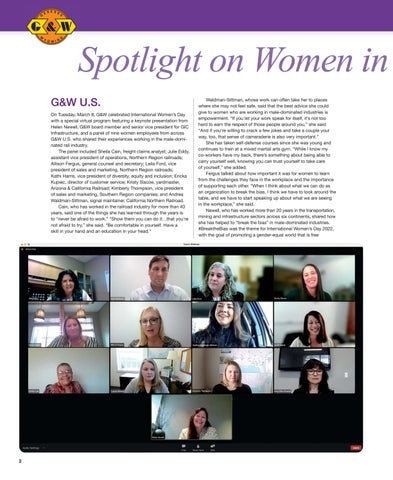
G&W U.S. On Tuesday, March 8, G&W celebrated International Women’s Day with a special virtual program featuring a keynote presentation from Helen Newell, G&W board member and senior vice president for GIC Infrastructure, and a panel of nine women employees from across G&W U.S. who shared their experiences working in the male-dominated rail industry. The panel included Sheila Cain, freight claims analyst; Julie Eddy, assistant vice president of operations, Northern Region railroads; Allison Fergus, general counsel and secretary; Leila Ford, vice president of sales and marketing, Northern Region railroads; Kathi Harris, vice president of diversity, equity and inclusion; Ericka Kupiec, director of customer service; Kristy Siscoe, yardmaster, Arizona & California Railroad; Kimberly Thompson, vice president of sales and marketing, Southern Region companies; and Andrea Waldman-Sittman, signal maintainer, California Northern Railroad. Cain, who has worked in the railroad industry for more than 40 years, said one of the things she has learned through the years is to “never be afraid to work.” “Show them you can do it…that you’re not afraid to try,” she said. “Be comfortable in yourself. Have a skill in your hand and an education in your head.”
2
Waldman-Sittman, whose work can often take her to places where she may not feel safe, said that the best advice she could give to women who are working in male-dominated industries is empowerment. “If you let your work speak for itself, it’s not too hard to earn the respect of those people around you,” she said. “And if you’re willing to crack a few jokes and take a couple your way, too, that sense of camaraderie is also very important.” She has taken self-defense courses since she was young and continues to train at a mixed martial arts gym. “While I know my co-workers have my back, there’s something about being able to carry yourself well, knowing you can trust yourself to take care of yourself,” she added. Fergus talked about how important it was for women to learn from the challenges they face in the workplace and the importance of supporting each other. “When I think about what we can do as an organization to break the bias, I think we have to look around the table, and we have to start speaking up about what we are seeing in the workplace,” she said. Newell, who has worked more than 20 years in the transportation, mining and infrastructure sectors across six continents, shared how she has helped to “break the bias” in male-dominated industries. #BreaktheBias was the theme for International Women’s Day 2022, with the goal of promoting a gender-equal world that is free
of bias, stereotypes and discrimination as well as diverse, equitable and inclusive. “My rule is if you can get three of any minority, and in this case, women, in a group setting, you’ve just got a different voice,” Newell said. “I’m not a psychologist, but my guess is this is because the group is starting to look like something we typically engage with outside the workplace. So, it just becomes less of an issue, and everyone has a view that is validly shared.” Panelists also shared the importance of mentors that have helped them in their careers. A recording of the program is available to watch on G&W’s intranet, Crossties.
From left, Michele Ashton of Railway Mission, and Glynis Appelbe, head of HR for G&W’s UK/Europe Region
G&W UK/Europe For the third year running, more than 40 women from across G&W’s UK/Europe Region came together in person and via Teams to celebrate International Women’s Day. The event took place at the Shared Service Center in Birmingham and included presentations from Brookfield’s Becky Lumlock and world champion boxer and classical musician, Hannah Rankin, on their respective experiences breaking the bias. Health, Safety and Sustainability Director Louise Ward also took an opportunity to gain valuable feedback from frontline women on their requirements for a safe and comfortable range of women’s personal protective equipment (PPE). The team was aware of some challenges with existing PPE but now feels better equipped for future supplier negotiations. The Region also presented a check for £1,000 to Michele Ashton of the Railway Mission, which aims to provide support to anybody associated with or impacted by rail operations in the U.K. The event ended with a presentation of awards to the Region’s female Shining Stars who were nominated by their respective management teams and recognized across a range of categories.
Clare Antrobus, Rail HR
Amy (Bessie) Matthews, Trainee Shunt Driver
Anika Shenfield, Learning & Development Manager
Katie Cook, Cannock Senior Planner
Sarah Welch, Business Manager
Antonia Kulakowski, Head of Pricing & Commercial Performance
Congratulations to the winners of the UK/Europe Region’s female Shining Stars award: Kelly Emmerson - Route, Utilisation and Logistics Manager, Lauren Powell - Container Control Administrator and Anna Weis - HR Officer
G&W Canada G&W’s Canada Region celebrated International Women’s Day on March 8 as women employees were invited to gather to listen to the panel and conference organized by the U.S. Human Resources team. At the Region’s headquarters in Montreal, a luncheon was held to thank and recognize all women employees. Sixteen women and five men attended, and about 40 people were connected virtually to listen to Canada Region President Rick McLellan’s presentation recognizing the work done by women in the industry and in the Region. Lunches were also organized on the Region’s railways to recognize and celebrate the work of women. “The G&W presentation was definitely the highlight of the day and such a wonderful tribute to the women of our company,” says Amber Watters, administrative assistant and marketing coordinator at Cape Breton & Central Nova Scotia Railway (CBNS). She adds, “All of the ladies were from different backgrounds and brought a different perspective yet united and empowered as women in a predominantly male industry.” n
G&W Canada’s women employees enjoy the International Women’s Day luncheon. Several of G&W Canada’s women employees gather to watch a presentation from Canada Region President Rick McLellan.
Genesee & Wyoming Interchange 3
CUSTOMER PROFILE
Rapid City, Pierre & Eastern Railroad
Helps Translate Vision into Reality at Ringneck Energy
Ringneck Energy’s environmentally friendly ethanol business in Onida, South Dakota.
L
SHU T TE R ST O CK BY S MI L EU S
eadership can be defined as the capacity to translate vision into reality. Over the past century, American business has been replete with leaders who match that definition. There have been high-profile leaders, ranging from Henry Ford and Walt Disney to Bill Gates and Steve Jobs, who built enterprises with global impact. There are also countless business leaders who have turned their visions into reality on a smaller scale, creating jobs and stimulating local economies. You can count Walt Wendland, president and CEO of Onida, South Dakotabased ethanol producer Ringneck Energy, among those. In the summer of 2014, Wendland envisioned building a profitable, environmentally friendly ethanol business in Onida, a town of about 650 people located almost squarely in the center of the state. To succeed in the ethanol marketplace, the business would take advantage
4
of locally grown corn crops as well as the availability of rural water and natural gas to fuel the operation. State-of-the-Art Plant
Wendland foresaw building a state-of-the-art manufacturing facility that would produce 80 million gallons of ethanol annually. The business would stimulate Onida’s economy by using local products, transportation modes and processes whenever possible and provide a safe and rewarding work environment for approximately 40 local employees. The new company would be named after the ring-necked pheasant, the official bird of South Dakota. Wendland’s vision took a step closer to reality in August 2017 when construction began on the manufacturing facility he imagined. It fully came to fruition in April 2019, when the Ringneck Energy plant produced its first gallon of ethanol. All in, the final cost of the plant was $150 million. RCPE Provides Conduit to Markets
A critical element in bringing Wendland’s vision to life was G&W’s Rapid City, Pierre & Eastern Railroad (RCPE), which spans the entire width of South Dakota and then some. The road would be an all-important conduit for moving to market the ethanol produced at Ringneck’s new plant. “RCPE gives us the ability to
“When RCPE cars both originate and terminate at the Ringneck plant, it means quicker cycle times and faster turns of equipment, which enable RCPE to handle higher grain volumes overall.” —Jared Gooch, assistant vice president of sales and marketing for G&W’s Western Region railroads
connect seamlessly with BNSF, Canadian Pacific and Union Pacific in order to get our ethanol to the best markets in North America,” Wendland says today. “About 60% of the approximately 2,500 carloads of ethanol shipped by Ringneck in 2021 were destined for markets on the West Coast, while another 40% were bound for the Southwest and Gulf Coast,” says Jared Gooch, assistant vice president of sales and marketing for G&W’s Western Region railroads. “The remaining shipments went to Texas and Oregon.”
with feedstock by rail,” Gooch continues. “This has had a very positive impact on the efficiency and effectiveness of our operations with Ringneck. When RCPE cars both originate and terminate at the Ringneck plant, it means quicker cycle times and faster turns of equipment, which enable RCPE to handle higher grain volumes overall.” The numbers best tell the story of RCPE’s increasing business with Ringneck. “RCPE is now delivering about 270,000 bushels of feedstock corn to our plant every month,” says Ringneck’s Kjorsvik. “In addition, about 98% of the ethanol we produce is delivered to market by rail, beginning with RCPE. So, to say that RCPE is important to our success is an understatement. I anticipate we will be partners well into the future.” n
Communication and Coordination Are Essential
Ethanol shipments from Ringneck’s site require a great deal of communication and coordination, according to Gooch. “Due to land limitations, Ringneck has a track layout that is not ideal for unit trains. As a result, we regularly communicate with the Ringneck team to ensure that we meet their service requirements.” “Good communication is the basis for the high service levels we need,” agrees Kevin Kjorsvik, Ringneck’s commodities manager who oversees rail transportation. “Emails go back and forth regularly, and we probably have four to five phone calls a week with RCPE’s operations teams, trainmasters and others to be certain that railcars are where we need them when we need them.” Safety is another reason communication between Ringneck and RCPE is so important. “Ethanol is a hazardous material, which requires an even higher level of communication and coordination than non-hazardous cargo,” says Gooch. “When the Ringneck plant ramped up ethanol production as the pandemic began easing, both Ringneck and RCPE made a determined effort to improve safety communications. As a result, we have had no safety issues, and we intend to keep it that way.”
Weathering the COVID Pandemic Key to Ringneck Energy’s Survival The new Ringneck Energy plant opened in April 2019 and, after a few months of fine tuning the operation, it was approaching full production capacity by the fall of that year. Ringneck’s good fortune, however, was not to last. In March 2020, eight months after Ringneck’s plant produced its first gallon of ethanol, the COVID-19 virus exploded in the U.S., and Ringneck found itself in a battle for survival. With millions of Americans quarantined at home and working virtually, the demand for ethanol dropped precipitously. In a matter of weeks from the onset of the pandemic, production at the company’s new plant fell from 250,000 gallons daily to about 135,000 gallons of ethanol per day. Ethanol prices plummeted from $1.30 per gallon in the early weeks of the pandemic to about 80 cents per gallon – well below the cost of production.
SH UT T ER ST O CK B Y P RO X I M A ST UD I O
Long-Term Partners
Today, RCPE is even more integral to Ringneck’s success than it was when the company first opened for business three years ago. “Locally grown corn supplies have tightened, as we witnessed this spring, forcing Ringneck to increase its supply radius to source product,” explains Gooch. “Because the corn is coming from up to 100 miles further away, rail economics are more attractive. It now makes more sense to bring it in by rail, and RCPE is the beneficiary. “Some of our biggest shippers, such as Agtegra and Archer Daniels Midland, now regularly supply Ringneck
SH UT T ER ST O CK B Y M AR I D AV
Luckily for Walt Wendland and his vision for Ringneck, a lifeline came from an unexpected source. Because the plant met certain purity and sanitation standards, the U.S. Food and Drug Administration (FDA) gave approval to Ringneck to produce badly needed alcohol for hand sanitizer. In April 2020, Ringneck began churning out alcohol bound for the hand sanitizer marketplace and would continue to do so until August 2020, when demand for hand sanitizers began to drop. Looking back, the ability of Ringneck to quickly pivot from producing ethanol to making alcohol for hand sanitizer was critical to keeping the company on the road to long-term success producing ethanol.
Genesee & Wyoming Interchange 5
RAILROAD PROFILE
T
he U.S. agricultural sector has been widely recognized as the world’s most efficient for more than 150 years, thanks in large measure to the nation’s railroads. U.S. railroads move approximately 16 million carloads of grain and other farm products in a typical year. Grain accounts for about 30% of these shipments, bound for export markets around the world. G&W makes an important contribution to maximizing the efficiency of U.S. agriculture. In 2021, 51 G&W roads moved approximately 225,000 carloads of grain and other ag products – with corn, wheat and soybeans comprising about half of those shipments. Among G&W’s leaders in the agricultural sector is the Western Region’s Kyle Railroad (KYLE). Operating in the heart of the U.S. grain belt, the road runs from north central Kansas approximately 550 miles into eastern Colorado. KYLE moved just shy of 20,000 carloads of agricultural products last year, primarily wheat for U.S. consumption as well as soybeans and milo bound for China.
Strong Exports to China
D ALT O N BO GG S
SH UT T ER ST O CK B Y R ANG IZ Z Z
Despite the highly disruptive impacts of the COVID-19 pandemic on U.S. agriculture, KYLE ended 2021 slightly above plan on revenue, according to General Manager Marv Lockman. “There were several reasons for that,” he says. “Strong exports of grain to China continued throughout the year. Also, our car storage revenues continued to be healthy as we signed a threeyear contract with Southern Companies to store their railcars. Finally, we really focused on KYLE fleet utilization, which helped both our carloads and car hire earnings.”
6
Kyle Railroad (KYLE) among the grain fields in Brewster, Kansas.
G&W and Kyle Railroad Help Make the U.S. Agriculture Sector the World’s Most Efficient
Kyle Railroad (KYLE) in Brewster, Kansas, following a snowstorm.
Steady Business Outlook So, what is the business outlook for 2022 and 2023? “We see our business remaining steady over the next two years,” Lockman continues. “We have two unit train facilities that will help us take advantage of export programs, and we anticipate that our single-car domestic grain shipments will remain reliable. Remember, however, that much of KYLE’s business is weather-dependent. We operate in an area where there is mostly dryland farming, so there is a direct correlation between weather events, such as droughts, and KYLE’s carload numbers.”
Changing the Game Two events that took place in 2021 are likely to change the game for KYLE in the coming years. “Over the course of 2021 and into early 2022, we undertook a bridge-strengthening project to increase the weight limit on KYLE’s line,” says Deb Alexander, sales and marketing manager for KYLE and other G&W Western Region railroads. “The project was completed on March 1 of this year, when the weight limit was upgraded to 286,000 pounds. This allows us to move more product more efficiently for ag and other customers because about half of our covered hopper fleet can accommodate the 286,000-pound weight.”
8
“Since its purchase of Prairie Horizon Agri-Energy, Summit has already moved some shipments of corn-based ethanol to KYLE to better reach western markets, and volume will continue to grow as the conversion to wheat starch takes place.” −Deb Alexander, sales and marketing manager for KYLE and other G&W Western Region railroads
The second game-changing event was Summit Agricultural Group’s acquisition of Phillipsburg, Kansas-based Prairie Horizon Agri-Energy in July 2021. Summit is investing more than $200 million to retrofit the existing ethanol plant, which is serviced by KYLE, in order to transition from production of corn-based ethanol to ethanol made from wheat starch. It is also constructing a state-of-the-art wheat protein production facility on the site, which will enable the company to meet growing U.S. demand for the product. On completion of the retrofit and construction projects, anticipated in mid-2023, Summit will be North America’s largest producer of low-carbon intensity renewable fuel made from wheat starch, and KYLE will play a key role in moving that fuel to the marketplace. “Since its purchase of Prairie Horizon Agri-Energy, Summit has already moved some shipments of cornbased ethanol to KYLE to better reach western markets,” says Alexander, “and volume will continue to grow as the conversion to wheat starch takes place.”
SHUTTER ST O CK B Y F O T O K O ST IC, SHUT T ER ST O CK B Y JENNI F ER WHI T E M AXWEL L DALTON B OGGS
Kyle Railroad (KYLE) owes its successful agriculture business to long-term relationships with three agribusinesses, which account for almost 75% of its agricultural carloads. Here is a quick look at each:
Highest Priority Is Safety
The largest of KYLE’s customers is Scoular, a 130-year-old agribusiness with annual sales over $6 billion. Its more than 1,000 employees buy, store and sell commodities, such as barley, corn, soybeans and wheat, as well as manage logistics and transportation for these products worldwide. Scoular has been doing business with KYLE since 2003.
Another long-term KYLE customer is AgMark LLC, an agricultural cooperative that merchandises locally produced, quality grains for approximately 60 Kansas-based entities. Today, AgMark handles over 100 million bushels of grain annually, bound for North American end users and exporters. KYLE has been providing rail service to AgMark since 1999.
SHU T TE R ST O CK BY M AK S NA RO DEN K O
Safely conducting day-to-day business remains the highest priority for KYLE, as it does for all G&W railroads. Looking back on 2021, there were positives and negatives to KYLE’s safety performance. “On the positive side, the road had just one human factor incident last year compared to four in 2020,” reports Lockman. “However, our biggest area of safety improvement was the reduction of derailments. We had 22 derailments in 2019, seven of which were FRAreportable; six derailments in 2020, one of which was reportable; and two in 2021, neither reportable.” On the negative side of the ledger, KYLE experienced its first workplace injury in five years during 2021. “Our single injury in 2021 was a setback for the team,” continues Lockman. “In 2022, all of our employees are committed to setting a new standard in safety. We will continue to live by KYLE’s Core Purpose, which is the same as G&W’s – to be the safest and most respected transportation service provider in the world.” n
Frontier Ag is a full-service agribusiness cooperative serving customers throughout northwest Kansas and eastern Colorado. It is one of the largest agribusiness cooperatives in the area, operating in 11 counties in Kansas and one county in Colorado. It has been relying on KYLE for rail transportation since 2008.
Genesee & Wyoming Interchange 9
A DAY IN THE LIFE OF...
Mike Steinwachs, BI & Data Analytics Manager
The most impactful project I’ve worked on so far was/is…
In the simplest terms, my job is to… Work with groups throughout G&W to find what datapoints impact their day-to-day lives, then take a whole bunch of that data and condense it into a format that humans can actually interpret. Nobody enjoys looking at a spreadsheet with a million rows, so we try to boil those spreadsheets down into quick, actionable numbers that can help people make better and faster decisions.
The Tie Data Analysis project currently in progress with the Engineering Department. While there is plenty more we plan to do with this data, we have laid the groundwork for future analysis by taking the tie quality scans that had been collected over the years and plotted them road by road, asset by asset, and mile by mile to identify potential hotspots in need of attention. While I don’t think we’ve quite scratched the surface of the full potential of this data, we can create tools that will help us deploy capital dollars most efficiently and are looking to take a similar approach with geometry, rail profile and other defect data to maintain and further improve the health of our infrastructure.
My favorite G&W location is… I can make a customer’s day by… Although I may not have had the opportunity to personally deliver any cars (yet), through Business Intelligence we try to improve our customer’s experience by providing tools that can directly impact their satisfaction on a day-to-day basis. That can be accomplished by building better reporting with GMs, roadmasters or trainmasters to see where each one of their customers’ cars are on their road and how to move traffic efficiently, working with the Safety team to help find insights in our data to make our employees safer at work, or building dashboards and reports with the Commercial group that can be used to help inform our sales team how G&W can be best positioned to build their individual customers’ businesses. The goal of any BI project ultimately is to enable those most connected with our customers to provide the safest and most reliable service possible.
10
My hometown railroad of Rochester & Southern Railroad (RSR), but I will give a nod to Portland & Western Railroad (PNWR) for being in one of my favorite areas of the country. I haven’t been able to visit them yet, but I hope to make my way at some point to see some of that road in person.
Outside of work, my favorite thing to do is… Teach my son to ice skate. Future Wayne Gretzky in the making.
My favorite food is… If coffee could be considered a food, coffee. Otherwise, I’ll go with a well-constructed bacon, egg and cheese breakfast sandwich – with a side of fresh coffee. n
hoppers DID YOU KNOW?
Covered hopper
Open hopper In our Commercial Link newsletter, we once delved into the origins of the word “frog” as it relates to the railroad industry. Many were surprised to learn that “frog” is used to describe the meeting point of two separate rails. Another industry term that might evoke the animal kingdom before the transportation industry is “hopper.” The word “hopper,” meaning a container with a narrow opening at bottom, goes back to the 13th century and is found in Geoffrey Chaucer’s story “The Reeve’s Tale” (written in the late 14th century) in reference to a machine for grinding grain into flour. These machines released the flour through chutes at the bottom. In the rail freight industry, a hopper is a type of railcar with – you guessed it – a chute underneath. Hoppers are primarily used to transport loose bulk commodities such as coal, ore, grain and track ballast. In the early days of the railroad, specifically the 1820s and 1830s, hoppers were small, two-axle cars that carried
TWO MAIN TYPES OF HOPPER CARS EXIST: Covered hoppers, equipped with hatches that close to form a roof Open hoppers, which do not have hatches
primarily coal; were pulled by mules; and included a lever to release the coal. By 1840, hoppers had been enhanced to enable larger loads and featured an improved chute mechanism. Just a decade later, the hopper was equipped with four axles and could carry nearly twice the load as the 1840 version. Covered hoppers specifically became popular after World War II for weather-sensitive commodities. Today, both covered and open hoppers are among the most common railcars seen on a freight train. n Genesee & Wyoming Interchange 11
snapshot COLORADO
Kyle Railroad
QuickFacts
G&W RAILROADS CURRENTLY OPERATING IN COLORADO:
Colorado is bordered by Arizona, Kansas, Nebraska, New Mexico, Wyoming, Oklahoma and Utah 12
Railroad
Operating Region
Year Acquired or Established
Number of Track Miles/ Kilometers in State
Kyle Railroad (KYLE) Utah Railway (UTAH)
Western Western
2012 2002
84 / 135 59 / 95
Columbine
Denver State Capitol
S HU TT E R STO CK B Y MA RT Y K R O PP
Rocky Mountains
WI K I CO M M O NS B Y AL EX AND ER MI GL
Land area in square miles (2010): 103,718 Population per square mile (2010): 55 Total population (2020): 5,773,714 Households (2019): 2,148,994 High school graduate or higher (2019): 91.7% Median household income (2019): $72,331 Mean travel time to work (in minutes): 25.8 Number of veterans (2019): 373,795 State bird: Lark Bunting State insect: Colorado Hairstreak Butterfly State flower: Columbine State tree: Colorado Blue Spruce State nickname: Centennial State State capital: Denver
Western Region MAJOR INFRASTRUCTURE IMPROVEMENT ON THE HORIZON FOR RCPE
— South Dakota Gov. Kristi Noem visiting the RCPE
BNSF BNSF
NORTH DAKOTA MONTANA
BN
SF
DM VW
OTVR
M
V
W
94
Aberdeen
SOUTH DAKOTA
35
Mansfield
T C W
RCPE
WYOMING
Box Elder
Wall Midland
BNSF
Watertown 29
Yale
Highmore Wolsey Huron
MPLI
BNSF
CP
Florence
90
90
MSWY
UP 90 90
Mankato
IOWA
N R
Chadron
IA
NNW
94 94
TCWR
Brookings Tracy
Major upgrade on the Rapid City to Fort Pierre track BNSF
Operated by NNW
Crawford 25
Fort Pierre
Redfield Miller
Pierre
Belle Fourche
Rapid City
Onida
MINNESOTA
IANR
Colony
R
“That’s a huge benefit,” says Wiseman. “It really changes the scope of the railroad. It’s going to reduce our track maintenance dramatically. It’s going to allow us to service the customers more quickly and move products faster. It’s going to allow our customers to run industry standard weight cars, and it gives them the ability to expand their businesses.” In addition to the federal Rebuilding American Infrastructure with Sustainability and Equity (RAISE) grant, Wiseman says that the State of South Dakota is providing support to go along with what’s expected to be a significant investment by the railroad. South Dakota Gov. Kristi Noem notes that the project “will benefit South Dakota for generations.” The project’s first phase, which will secure material and contractors, is expected to begin as soon as grant agreements are in place.
Jamestown
Bismarck
Dickinson
VW
The upgrades will more than double the mainline speed limit from 10 mph to 25 mph.
D A IR
RCPE will replace nearly 88 miles of rail with 136-pound continuous welded rail, replace 80,000 crossties, upgrade 121 bridges and install 11 new mainline turnouts. The project’s construction phase is expected to get underway in spring 2023, says General Manager Rod Wiseman, estimating that it will take two to three years to complete. “These major track upgrades will support the West River economy, improve the productivity of current customer supply chains and further enhance the attractiveness of western South Dakota for new business investments,” says Wiseman.
The project “will benefit South Dakota for generations.”
D
The securement of a $22 million federal grant will allow Rapid City, Pierre & Eastern Railroad (RCPE) to do a major upgrade on its main line in South Dakota between Rapid City and Fort Pierre.
RR
W I KI C O M MO N S B Y AND R EW K PE PPER
DALTON B OGGS
Line improvements at the GCC transload facility in Box Elder, South Dakota.
NEBRASKA
NENE
RCPE
Rapid City, Pierre & Eastern Railroad, Inc. Other Genesee & Wyoming Railroads OTVR Otter Tail Valley Railroad Company, Inc. IAI
Dashed line indicates Trackage Rights. 02/2022
IAI
S
S
Genesee & Wyoming Interchange 13
SDIY, VCRR SET HIGH STANDARD FOR SAFETY San Diego & Imperial Valley Railroad (SDIY) has gone reportable injury-free since July 8, 1998, when “Titanic” reigned as Academy Award winner for Best Picture. The railroad’s momentum is not waning; SDIY achieved Zero and Zero status in 2020 and 2021. Down the road from SDIY, Ventura County Railroad (VCRR) has almost mirrored that success. Coming off four consecutive Zero and Zero years from 2017 to 2020, VCRR’s most recent reportable injury occurred on April 25, 2006. VCRR barely missed a fifth consecutive year when it had a minor human-factor incident (HFI), says
Matthew Domen, general manager of both railroads. As of May 25, the six employees of SDIY have gone 990 consecutive days HFI-free, and VCRR – which added an employee in 2019 to brings its total to four – had 273 consecutive HFI-free days.
“With all of the unprecedented challenges that 2021 brought, the employees of VCRR and SDIY were still able to work the entire year without a reportable injury. This speaks of their character and ability to stay focused on the job at hand,” says Domen. From left, Conductors Rodrigo Gonzalez and Gage Parra help to uphold the high standard of workplace safety at VCRR.
PSAP TEAMWORK OVERCOMES MAJOR FLOODING Heavy, wet snow descended upon western Washington state the last week of December 2021, followed by steady rains during the first half of January. By the middle of the month, Puget Sound & Pacific Railroad (PSAP) had a major flooding event to contend with, one that washed out large sections of the main line. Although there were scattered washouts throughout PSAP’s territory, the major outage occurred on the Elma Subdivision, within the town of Elma, Washington. “For the first couple of weeks this year, it was pretty tough. We had a couple of sections of track washed out, ranging from 50 feet to 100 feet, and we were out of service for about a week,” says General Manager Larry Sorensen. “Every time we tried to repair the track, we would get more rain and the repairs would wash out. We lost a lot of inbound and outbound traffic for a while.” Compounding the problems, several PSAP employees were unable to get to work until the floodwaters began to recede in mid-January. Even before track could be repaired, PSAP’s operations team, spearheaded by Assistant General Manager Rollan Finch and several trainmasters, kept in contact with all affected customers, answering questions and providing as much clarity as possible, while scheduling trains to deliver ballast and riprap where needed. “Our customers understood; they were dealing with it themselves,” says Sorensen. “By just being down a week, though, we built up a lot of backlog.” Once track maintenance could begin, things improved quickly and dramatically. Roadmaster Robert Shaw led PSAP’s maintenance team response, working with a contractor to coordinate repairs and open the main line. Once the line reopened, trains ran 24 hours a day for more than a week before getting deliveries caught up by January 25. “My maintenance team did an outstanding job getting the railroad up and running and doing it safely,” says Sorensen. “My operations team also did a great job. It took about a week and a half to work through the backlogged traffic.” 14 AroundG&W
CORP INCREASES CARLOADS, CELEBRATES EIGHT SAFE YEARS
Heavy snow followed by rain created washouts and landslide conditions along PSAP track during January.
Safety briefings at Central Oregon & Pacific Railroad (CORP) can change daily, but for more than eight years, they’ve all acknowledged one central theme: Let’s keep our record going. The 67 CORP employees proudly advanced their all-craft reportable injury-free streak to eight years as of December 21, and they were keeping it intact into 2022. This has happened amid a sharp increase in carloads during 2021, says General Manager John Bullion. CORP employees handled 3,000 additional carloads last year — a 13% increase over 2020. “Our employees worked together to handle this increase, and they completed the year reportable injuryfree,” says Bullion. “They take pride in their job, and they follow the rules to look after one another.”
M ICHAEL P. R OTH
Western Region
Tier 4 locomotives en route to service on the SJVR.
SJVR ADDS TO ITS TIER 4 LOCOMOTIVE FLEET San Joaquin Valley Railroad’s (SJVR) experience with Tier 4 locomotives has proven to be a good one, and the railroad is continuing to build the fleet.
Pursuant to a partnership with the San Joaquin Unified Air District, SJVR is replacing older, less efficient locomotives to further enhance air quality. Two new Caterpillar Tier 4s showed up at SJVR in January, increasing the fleet to six. The energy-efficient units are used for both yard and local jobs due to their versatility and performance. “The locomotives are brand new with very high tractive effort and higher horsepower than some of the locomotives that we have on property,” says SJVR Assistant General Manager Sam Jones. “They are built around proven technology that allows our mechanics to troubleshoot issues locally.”
SJVR BROADENS ITS HORIZONS WITH TRANSLOAD FACILITY PURCHASE San Joaquin Valley Railroad (SJVR) increased its customer base and gained a valuable transload facility in one fell swoop when it acquired Ivory Choice Terminal in Reedley, California. Now known as Ivory Choice Terminal Co. (ICTC), it was purchased late spring of 2021 and is being operated as a bulk transfer facility. The 91-acre industrial park provides rail-to-truck transload and storage services for a wide range of commodities, including Distiller’s Dried Grains with Solubles (DDGs), canola, whole cottonseed, corn gluten, urea, sodium bicarbonate, phosphate, millrun pellets, sulfuric acid, fly ash, aggregate and lumber. SJVR Assistant General Manager Sam Jones says that the railroad was quite familiar with the facility before making the purchase. “This facility can receive unit grain trains and has multiple established customers,” says Jones. “It was a customer of SJVR for many years, and now all those internal customers are SJVR customers.” Jones said SJVR will benefit by working with the sales and marketing team from G&W’s Western Region to develop new transload possibilities. “We will see the return of unit train traffic that previously was flowing to this facility,” he says.
Genesee & Wyoming Interchange 15
MMID PROVIDES SERVICE FOR TRANSLOAD FACILITY
Maryland Transload Logistics (MTL) has opened a new transload facility in Thurmont, Maryland, and it is being served by Maryland Midland Railway (MMID). MTL, a rail-to-truck reloading/ transload facility in the heart of Maryland, serves the high-traffic areas of Maryland, Pennsylvania, Virginia and the surrounding Northeast. Its position
near major routes and highways makes it easy for customers to have items off-loaded and delivered to the locations needed. “The project has been in the development phase for over two years,” says Jonathan Rudman, director of sales and marketing for G&W’s Northern Region. “The first car was received in November 2021.” Rudman notes that the primary commodity being handled at the facility is lumber. However, the facility has enough land to expand and broaden its scope over time. Commodities could include bulk agricultural and aggregates, transformers and other specialized products, metals or essentially any commodity that can move by rail. Scott Austin, MTL president, says that MMID trains arrive at the facility carrying goods to be loaded onto trucks, or vice versa. “Things ship cheaper via rail, but not everybody has access to rail,” says Austin. “Now people can ship their products via rail to us. We’ll then unload it, put it on a truck and ship it locally. Our facility has over five acres of yard to organize and store customers’ products while managing their inventories and logistics.”
Shifting loads to rail decreases the time products spend on trucks. A single railcar can carry three to four truckloads of goods; so, one train of 100 cars can take over 300 trucks off the roads. In addition, a railroad can move a ton of freight 480 miles on one gallon of fuel, which means that money can be saved when shipping heavier and larger loads. Fuel costs are reduced, and truck maintenance fees, tolls and load fees are eliminated when shipping by rail — leading to lower transportation costs for customers.
A ribbon-cutting ceremony was held on December 2, 2021, at the new MTL transload location. Right: G&W’s Northern Region Senior Vice President Len Wagner (left) and Maryland Transload Logistics CEO Scott Austin. 16 AroundG&W
Northern Region
Construction Underway on NECR’S BUILD Project East Alburgh
QUEBEC, CANADA
SLQ Norton
Swanton FRANKLIN
GRAND ISLE
ORLEANS
ESSEX
St. Albans
Lake Champlain
ON
North Stratford
SLR
LAMOILLE
Essex Jct.
Burlington
CALEDONIA
Berlin COOS
WA S H I N G T O N
Middlesex Montpelier Jct
CHITTENDEN
ADDISON
91
ORANGE
89
GRAFTON
NEW HAMPSHIRE
VERMONT
MAINE MAIN
CARROLL
EN
White River Jct
NECR
Whitehall RUTLAND
WINDSOR S U L L I VA N
BELKNAP
89
MERRIMACK
YORK
Claremont Jct STRAFFORD
93
WA S H I N G T O N
95
Bellows Falls
GA WINDHAM
CHESHIRE
ROCKINGHAM
HILLSBOROUGH
Brattleboro
BENNINGTON
91 RENSSELAER ESSEX
BUILD Grant Project Limits
Millers Falls Gardner
FRANKLIN
495 MIDDLESEX
WORCESTER
HAMPSHIRE
MBIA
MASSACHUSETTS Belchertown Barretts
BERKSHIRE
Palmer Springfield
HAMPDEN
CSO
LITCHFIELD
90
Monson
TOLLAND
WINDHAM
Willimantic PW Plainfield Yantic-Fitchville Norwich
MIDDLESEX
FA I R F I E L D
New Haven
NORFOLK
Boston Switch
PROVIDENCE
Hartford
N E W H AV E N
PW
84
HARTFORD
CONNECTICUT
S
SUFFOLK
Worcester
PW
North Haven
95
RHODE ISLAND
P LY M O U T H BRISTOL
B A R N S TA B L E
After nearly four years of planning from federal, state and local agencies, construction is underway on New England Central Railroad’s (NECR) portion of the New England Corridor to bring its entire rail and bridge system up to the 286,000-pound national standard. The project utilizes FRA’s “Better Utilizing Investments to Leverage Development” (BUILD) grant funding and will rehabilitate 55 miles of NECR’s freight rail corridor in Massachusetts from Monson through Palmer to Northfield. This will close the gap of rail that isn’t rated for 286,000-pound loads, and it is the final track section within the 320-mile NECR freight rail corridor from New London, Connecticut, to St. Albans, Vermont, that needed to be brought up to the standard. “It has taken a long time to get to turning the shovel,” says G&W’s Northern Region Vice President of Engineering Todd Dragland. “Because the grant is administered through the FRA, there are a lot of issues pertaining to environmental concerns, historical property, ecological digging, as well as reviewing contracts and agreements.” The project’s scope involves replacing 240,000 linear feet of 100-pound jointed rail with 115-pound continuous welded rail (CWR); replacing approximately 30,000 ties; distributing approximately 18,000 tons of ballast; performing approximately 60 miles of track surfacing and leveling; replacing 30 existing turnouts with new steel and ties; and rehabbing 16 bridges by replacing steel, timber, concrete and ties. Brian McClain, assistant vice president of operations for the Northern Region’s east division, notes that this is positive news for the railroad and the customers served. “For us, everyone realizes the benefits that are coming,” says McClain. “Our people won’t have to look at each car to see what is 286 rated and what isn’t, and our customers are excited because they will be able to ship different amounts to different areas with greater ease. I am proud of our team and what this means for our future.”
BRISTOL
KENT
195 Tiverton NEWPORT
NEW LONDON WA S H I N G T O N
New London Atlantic Ocean
DUKES
Top: The first bridge for the project that was worked on and completed in February was at Milepost 61.57 on the Palmer Subdivision. Middle: Contractors work on setting a bridge cap. Bottom: The bridge is completed and ready for trains.
SUFFOLK NASSAU
The BUILD grant project will rehabilitate 55 miles of NECR. Genesee & Wyoming Interchange 17
NECR WELCOMES NEW MillerCoors BUSINESS Maple Leaf Distribution Services in Palmer, Massachusetts, has secured a new movement of MillerCoors traffic that will be served by New England Central Railroad (NECR), according to G&W’s Northern Region Assistant Vice President of Sales and Marketing Ed Foley. Originating from the MillerCoors Brewery in Trenton, Ohio, shipments will arrive at Maple Leaf Distribution’s 265,000-square-foot facility in Palmer. Along with Maple Leaf’s Owner Bill Rankin, Foley had been working with MillerCoors from 2012 to 2014 to establish a distribution of MillerCoors products by rail to New England. “Years went by; and in 2017, we re-engaged the group in Golden, Colorado,” says Foley. “We enlisted the help of GW’s Vice President of Corporate Accounts Doug Thompson. Together, the three of us went back to Colorado in hopes of securing a trial. In 2021, we were successful in handling two trial cars of Miller Lite by rail.”
Foley notes how this growth is positive news for NECR after having lost some business caused by plant closures in 2019. “We have had an uphill battle to replace this revenue ever since, and this will be a great help,” he says. “Everyone is excited to see this new business come after all of the hard work that was done to attain it.” The first-year volume estimates are to handle 300 carloads with normal service five days per week. “New England Central Railroad is excited about this project as it broadens both our customer base and Maple Leaf’s, and it gives us exposure to a new marketing channel,” says G&W’s Northern Region Director of Sales and Marketing Jonathan Rudman.
From left are G&W’s Northern Region Assistant Vice President of Sales and Marketing Ed Foley and Maple Leaf Distribution Owner Bill Rankin.
DELGALLO STARTS NEXT CHAPTER AFTER 46 YEARS OF RAILROADING Ohio Central Railroad (OHCR) Superintendent of Freight Equipment Joe DelGallo will soon conclude a career that began in 1976. Having started as a trackman for the OHCR’s predecessor, Conrail, he then moved to Mechanical, becoming a carman in 1978. After a stint with B&B and Engineering in Philadelphia, DelGallo returned to OHCR in 1992. “It was a chance to come back home, and I’m glad I did,” he says. The railroad was the right career choice for DelGallo, who notes that he appreciated his co-workers and being able to work outdoors. He also called the work “rewarding.” He credits his career success to dedication and focusing on teamwork. “You show up for work on time and be the best person you can be,” says DelGallo. “You try to be successful at what you like so you can do it better and do it more.” His father and brother both retired from railroad careers before him. One of his three sons followed him into railroading, while one is an attorney and another is working in the medical field. Retirement will mean more time to spend with his wife, Ava, and two grandchildren. Having grown up on a farm, DelGallo developed a lifelong love of the outdoors, OHCR Superintendent of Freight Equipwhich he will continue to explore in ment Joe DelGallo with his wife, Ava. retirement. His home on Tappan Lake in Ohio will provide plenty of opportunity to boat and fish. While retirement will offer many joys, turning the page is emotional. “I’m going to miss the people, the rail,” he says. DelGallo offers this advice for a successful career: “Be humble, learn all you can, pay attention and be safe in everything you do!”
DAY REFLECTS ON CAREER; LOOKS FORWARD TO RETIREMENT Laurie Day concluded her career with the company on March 1, shortly after reaching her 34-year anniversary. While she worked most of her career in corporate accounting, her final two years on the job were spent as mechanical supervisor for Buffalo & Pittsburgh Railroad (BPRR). “I like helping people and enjoy the relationships,” she says. “I’ve worked with a lot of great people, and it’s like a family.” Throughout her career, Day says that she learned to use various systems and helped to integrate new railroads. “I traveled around to meet the people and work with them, and I always enjoyed that,” she says. “G&W now has over 100 railroads worldwide; when I started, we had four. I have learned so much.” The Piffard, New York, native’s fulfilling career started after she circled a classified ad in her local newspaper and decided to apply. As an Alfred
18 AroundG&W
State College graduate with an associate degree in accounting, she was working at a bookkeeping job at that time. “Growing up, I never thought to look for a job with the railroad, even though it was right in my back yard,” she says. “It was almost like answering a blind ad; however, the person who interviewed me was someone I knew from high school. You couldn’t help but know someone who worked at the railroad.” Day offers straightforward and simple advice for a successful career. “Treat people the way you want to be treated,” she says. “Also, learn all you can — the railroad is huge, and there are many opportunities.” In retirement, Day says that she’ll enjoy time with her partner, Mark, their two children, two grandchildren and cat, Seven (at right). She also looks forward to doing more reading, painting and gardening.
Northern Region ZINC RECLAMATION FACILITY BUILDS AT LOCATION TO USE TPW SERVICE Toledo, Peoria & Western Railway (TPW) is now serving its newest customer, Waelz Sustainable Products (WSP), in Cass County, Indiana, near the town of Logansport. TPW General Manager Heath Mondragon says that it’s always exciting to get new business, adding how it speaks volumes that WSP chose to build its facility in a spot to utilize TPW service. “Most railroad customers are captive and stuck working with the railroad that is geographically closest,” says Mondragon. “In this case, WSP chose the location to build on from the ground up. If our service wasn’t at the level it needed, the company wouldn’t have built here. This has been a big morale booster for us.”
A new zinc reclamation facility in Cass County, Indiana, was built from the ground up to be able to access service by TPW.
WSP recovers zinc and other useful metals left over from manufacturing processes that used to be sent to landfills. WSP will take in carloads of electric arc furnace (EAF) dust, which is used in steel production. The company reclaims the zinc out of the dust and then ships out carloads of reclaimed zinc.
“We are expecting to move about 2,000 carloads annually,” says Mondragon. “There will be loaded cars going in with product that they will use in the manufacturing process and send out empties; and they also will take empty cars and fill them with reclaimed zinc. Most of these cars will go to Mexico.”
The project has been in the works for over two years, and it has involved people from numerous departments. These people include Director of Sales and Marketing Eric Thurlow, Jesse Shaver on the Transportation side who coordinated crews and locomotives, Trainmasters Jim Garrison and Mike Watkins, and Roadmaster Blake Gullett and his team.
‘Environmentally Sound’: New Hampshire Governor Praises New NECR/Carroll Concrete Cement Terminal G&W’s New England Central Railroad (NECR) recently partnered with Carroll Concrete in West Lebanon, New Hampshire, on the creation of a new cement terminal for the company, helping bolster efficiency while reducing their carbon footprint. The facility receives upwards of 300 tons of powder cement every day via rail from NECR, reducing the time the company was spending on getting the powder concrete from suppliers in neighboring communities or Massachusetts. The grand opening of the facility was held in late October 2021 and was attended by New Hampshire Governor Chris Sununu, who praised the new facility as an “environmentally sound way [of transporting powder concrete] at lower costs and faster speed.”
Left: NECR Trainmaster James Rivers with Governor Chris Sununu inside the train cab. Below: A ribbon-cutting ceremony for the new facility.
Genesee & Wyoming Interchange 19
Climbing comes naturally to many people when they are young, but the activity can become more complex — and riskier — as we age, especially if it involves structures such as bridges. Railroad Engineering Services’ annual bridge team training was held January 4-9 in Atlanta. Because of an emphasis on safety and skill training for climbing, the training was conducted at CSX’s REDI Center, which has a climbing structure with overhead fall protection. Every G&W Bridge Construction and Bridge Inspection team attended, as did regional bridge directors and managers. The structure was extremely helpful, says Assistant Chief Engineer of Bridge Construction Philip Ogram. “It enabled us to continue our climbing training in a controlled environment where we could focus on the training perspective around climbing and accessing our bridge components, rather than the inspection or repair processes if we were doing this training in the field,” he says. “In addition to the climbing structure, there were several small-scale bridge models to help with bridge nomenclature and inspection techniques that were valuable for members of both teams.” The field portion of climbing and inspection training was split between Ogram and Director of Structures Inspection Ian Elliott, while Chief Engineer of Structures Bill Riehl took a portion of the employees to the track panel for hands-on fall protection training. 20 AroundG&W
TIE AND SURFACING GANG 1
GETS A SUNNY START IN ARIZONA Tie and Surfacing Gang 1 started its production year in sunny Arizona, working on a 12,000-tie project for Arizona Eastern Railway (AZER). After wrapping up a smaller assignment near Bowie, Arizona, that was held over from December, Manager of Production Ancel Head and his team launched into a major tie replacement project near Safford, Arizona. Designed to increase the speed limit on AZER’s main line, the work was done over an uninterrupted 36-mile stretch, plus some other sections of track. “We did some jumping around,” says Head, adding that the project, which finished on February 13, went smoothly. TS-1 employees performed the work reportable injury-free. “This gang was reportable injury-free last year, and that is still going,” says Head.
SH UT T ER ST O CK B Y R O L AU ELENA
CLIMBING INSTRUCTION HIGHLIGHTS ANNUAL BRIDGE TEAM TRAINING
Engineering Services In 2021, TS-1, TS-2, TS-3 and S5 collectively installed 436,000 ties, gauged 19,000 feet of track, installed 560 switch ties and surfaced more than 1,000 miles of track on 30 different G&W railroads. They accomplished this while surpassing 560 days reportable injury-free, one of the longest such stretches in RES history.
TIE AND SURFACING TEAMS
HAVE YEAR TO REMEMBER; LOOK FOR MORE 2021 was described as a year to remember for Railroad Engineering Services (RES) tie and surfacing crews, which achieved high marks in safety and productivity across the board. “Given the challenges with COVID and manpower, our tie and surfacing teams had a very strong year,” says Director of Planning and Support Ann Waters. In 2021, TS-1, TS-2, TS-3 and S5 collectively installed 436,000 ties, gauged 19,000 feet of track, installed 560 switch ties and surfaced more than 1,000 miles of track on 30 different G&W railroads. They accomplished this while surpassing 560 days reportable injury-free, one of the longest such stretches in RES history. “It’s hard to overemphasize how difficult this was to achieve, given the stress on our manpower and their ability to maintain focus on safety,” says Waters. In 2022, the tie and surfacing teams aim to increase their productivity by 10%, which would mean installing nearly 490,000 ties. “The 2022 outlook is set up to take our teams to the next level with strong leadership, improved project scopes, and a focus on safety, efficiency and quality,” she says.
Top: Tie and Surfacing Gang 2 upgrades an Indiana & Ohio Railway (IORY) subdivision in western Ohio. Above: From left, Spiker Operators Daron Warthen and Tyron Smith focus on the task at hand. Genesee & Wyoming Interchange 21
TIE AND SURFACING GANGS
ANNUAL TIE-SURFACING TEAM TRAINING A TRANSITION Railroad Engineering Services (RES) tie and surfacing teams completed their year — and prepared for the next — at an annual training session during 2021 in Dallas from November 17-21. The event covered operational testing, continuous welded rail (CWR) policy and procedures, lockout/tagout, engineering safety rules, roadway worker protection, CPR/ first aid and environmental training. The agenda included a combination of management-focused discussion groups, lectures, short PowerPoint videos and hands-on CPR/first aid training certification for new hires. “Annual training has evolved over the years, with different locations, schedules and presenters, but we’ve maintained the same basic
HEAD, HINNANT PROMOTED TO MANAGERS OF PRODUCTION Two tie and surfacing gangs welcomed new managers of production as they prepared to ramp up for 2022. Ancel Head, who started his G&W career with TS-1, has returned to lead his former gang, and Will Hinnant takes over TS-2 after spending the last 18 months as its assistant supervisor. Ancel Head was foreman on TS-1 for five years before transitioning to TS-2 as assistant supervisor in 2020. After two years in that role, he went back to TS-1. “There are a lot of familiar faces,” says Head. “Things have gone well working with this group. We’re one big, happy family.” Will Hinnant joined G&W in August 2020 after spending 20 years with CSX, 10 of them as a roadmaster in Georgia, Florida and North Carolina.
22 AroundG&W
framework,” says Manager of Production Support Carla Porter. Team-building and recreational activities, including bowling and arcade games, were a big part of the week.
“Everyone was able to relax, enjoy themselves, laugh a LOT and participate in some light-hearted competition to win team prizes,” says Porter. “The main focus is on teaching, training and encouraging to make us better as a team.”
From left, Manager of Work Equipment Brandon Kosco and Assistant Chief Engineer Branden Graves face off at the shuffleboard table.
He takes over G&W’s largest tie and surfacing gang with 30-plus employees, including a mechanic. “Safety is our number one goal,” says Hinnant. “We’re not primarily focused on how many ties we install, but we’re going to do it safely and give a quality product to our customers. I’m proud of what these employees are doing. We have a good group, and I give them all the credit.”
of equipment training and has served as director of safety and compliance. He will lead the managers of production and assistant supervisors for the tie and surfacing teams. “His knowledge and experience will help continue to grow the safetyfirst culture of RES while improving operational efficiency and developing relationships with our internal customers on the regional and railroad level,” says Chandler.
“Sam was selected due to his leadership and employee development skills that fostered the ‘safety-first, quality-second, production-third’ culture that we are growing within RES,” Chandler says.
GRAVES, WALKER, MITTAN TAKE NEW LEADERSHIP ROLES Branden Graves, Sam Walker and Tim Mittan have taken on new responsibilities for G&W’s field management team. All three of them report to Chief Engineer of Production Arthur Chandler. Branden Graves, who was promoted in November 2021 to assistant chief engineer of production, joined Railroad Engineering Services (RES) in 2018 as director
Sam Walker was promoted to director of safety and equipment training in December 2021. He has been with RES since 2015, starting as a machine operator before rising to manager of production for TS-1 in 2019. He will be responsible for compliance on incident reporting, operational testing, FRA 243 Employee Qualification and FRA/DOT-required drug screening. He also will lead new-hire training and promote cross-training employees.
Above: Bowling was part of the recreation during the annual Tie and Surfacing team training in Dallas.
Tim Mittan joined RES in July 2021 as director of work equipment, coming off eight years of work equipment experience with Union Pacific, in addition to 20 years of mechanic experience outside of the railroad industry. His primary role with RES is management of long-term capital overhauls and replacements while also leading the mechanics assigned to each tie team and minimizing equipment downtime. “His knowledge of mechanical and hydraulic systems will help mentor and develop the field-based work equipment team,” says Chandler.
Southern Region
Sexton Bids Farewell to Co-workers
SAPT Trainmaster John Sexton (left) accepts a 15-year service pin in 2020 from Manager of Transportation Matt Folland in Garden City, Georgia.
Savannah Port Terminal Railroad (SAPT) Trainmaster John Sexton retired in October 2021 after more than 40 years working in the railroad industry. Sexton, a third-generation railroader, began his career with Southern Railway in 1976. After working for Southern, and later Norfolk Southern, John held various positions in the short line industry before joining G&W 17 years ago. While at SAPT, John was instrumental in improving the daily operations of the railroad. As trainmaster, he has been an integral part of the railroad’s growth, as it expands to meet the demands of its largest customer, the Georgia Ports Authority. John’s operational input, wealth of railroad knowledge, work ethic and devotion to the industry has been unmatched over the last four decades. John will be missed by his customers, while his fellow railroaders will miss his mentorship and friendship. SAPT Yardmaster Donald Morris began working with Sexton 15 years ago when Morris served as a SAPT supervisor and yardmaster. Morris says that he could rely on Sexton for guidance, which continued even after he transferred to Golden Isles Terminal Wharf (GITW) for two years. “It’s going to be different without him, because he’s been such a support to everyone who works with him,” says Morris, noting that was especially true for the yardmasters. “He was there for them with knowledge and experience, and we will miss him.” Congratulations to Trainmaster John Sexton on a stellar career and well-deserved retirement.
“It’s going to be different without him because he’s been such a support to everyone who works with him. He was there for them with knowledge and experience, and we will miss him.” —SAPT Yardmaster Donald Morris SAPT Yardmaster Donald Morris worked closely with Trainmaster John Sexton, who retired in October 2021.
Genesee & Wyoming Interchange 23
FORD REFLECTS ON CAREER, WORKING SAFELY With over a decade in the industry, Savannah Port Terminal Railroad (SAPT) Track Inspector Jahhanes Ford has become familiar with walking on ballast. “I knew I could make a career out of working for the railroad, but I didn’t think I would move up to being a track inspector," says Ford, whose boots first touched the ground for the railroad in Savannah, Georgia, as a Rail Link, Inc., track laborer on January 10, 2011. As a Rail Link, Inc., employee, he was based at the CSXI Intermodal Yard. Ford still remembers his early beginnings and how his hire date was a special day. “It was easy to remember because that’s the day my daughter was born,” says Ford. “That was my first hard labor job, so it was kind of difficult at first. I remember my first time trying to swing a hammer, and I couldn’t write with my hands for like a week because it was rough. But I got the hang of it.” Veterans, including Laborer and Foreman Willie Aikens, showed him the ropes. They taught him how to swing a hammer as well as identify track errors and other issues. Four years later, Ford was promoted to track foreman and started performing track inspections. In August 2019, he joined SAPT as a foreman and later became a track inspector. Ford notes that it feels good to go out and accomplish a big job and come back home safely to his family. “That is the whole goal — providing for your family and being with your family,” he says.
G PA PHOTO/STEPHEN B. MORTON
SAPT Track Inspector Jahhanes Ford reflects on a decade milestone with the railroad and working reportable injury-free.
SAPT YARDMASTERS RELOCATE TO MASON YARD Savannah Port Terminal Railroad (SAPT) yardmasters based at Chatham Yard recently relocated to a new building. They moved to a newly erected building on the other side of the ports, where Mason Yard is located. “We moved into Mason Yard because that is where the intermodals will be coming in and out,” says Yardmaster Donald Morris. “It’ll also be closer to the Georgia Ports Authority (GPA) employees.” Morris says that GPA employees are based in the same office building as the SAPT yardmasters, and they have new monitors set up to observe the yard. “I don’t know if that’s part of their plan to consolidate everyone in the same office, which I think will be a good idea,’’ says Morris. “It’s easier
24 AroundG&W
to look at someone and ask about paperwork instead of trying to get a hold of them on the phone.” There are still industries at Chatham Yard to work with the warehouses. There are approximately four yardmasters on the team, and there are plans to possibly hire more.
Above: Georgia Ports Authority yard Right: SAPT Yardmaster Donald Morris
Southern Region
MNA’S WEBB CITY SUBDIVISION TURNOUTS RECEIVE UPGRADE
A turnout installation project began in late August 2021 on Missouri & Northern Arkansas Railroad (MNA). Two new turnouts were installed in Joplin, Missouri, at Milepost 547.1 on the Webb City Subdivision. “We tore out the old switches and are putting in a brand new one,” says Manager of Track Brent Wilson, who is based in Carthage, Missouri. MNA employees supported a contractor to finish the job in about five
days. The project involved building the new switches, as well as taking a couple of days to remove the old switch and install the new one. The team upgraded one turnout at a time, and it took about two days to complete the installation. “Two switches for the No. 10 and No. 8 turnout had to be built off the track,” says Wilson. He noted that once they got the switches built, they coordinated with the operations side
to obtain a six-to-seven-hour window, so they could pull the old switch and clean the track bed to put the new one in. They then put new rock in and resurfaced the track. Wilson says that the work went smoothly since there was minimal train traffic and the work space was in an open area next to a road. “We worked around the train to get the job done,” he says. SHUTTERSTOCK – BY MAERZKIND
MNA SWITCH TIES REPLACED A Missouri & Northern Arkansas Railroad (MNA) switch ties installation project on the Nevada and Webb City subdivisions concluded late last year. “It wasn’t replacing the whole switch,” says Manager of Track Brent Wilson, who is based in Carthage, Missouri. “We just replaced the bad switch ties.” The project involved replacing 400 switch ties near the Carthage Yard area primarily at the south end of Pearl Yard — at Milepost 526.5 —
and a few in Miller Yard toward the diesel shop. The work was done by contractors with oversight from MNA employees. “We got some track protection and had a truck distribute the switch ties at the switch,” says Wilson. “Once the gang showed up, everything was sitting there for them to install the new ties.” Wilson says that the medium-size project started in August and took a few weeks to complete.
MNA WELCOMES BACK POWELL FEED AND MILLING In 2021, Missouri & Northern Arkansas Railroad (MNA) welcomed back a familiar customer, Powell Feed and Milling. Powell produces cattle and poultry feed at a non-rail-served location in Green Forest, Arkansas, to support feed stores in the surrounding area. Last year, Powell acquired a former Butterball facility along the MNA in Aurora, Missouri, where they transload grain and also receive corn and feed pellets via UP interchange and from another MNA customer, Montrose Grain.
Genesee & Wyoming Interchange 25
STAYING SAFE IN RAILROADING’S MOST EXTREME CONDITIONS
A snow wall is formed to protect the track from drifts.
ALCOCK TO CELEBRATE 25 YEARS WITH HCRY On July 29, Huron Central Railway (HCRY) Trainmaster Thomas Alcock will mark his 25th year with the short line railroad. “It doesn’t feel like 25 years; I started at the railway when I was 16, and I don’t know what life would be without it,” he says. Alcock’s railroad career began in 1979 as a shop laborer with Canadian Pacific Railway in his hometown of Sault Ste. Marie, Ontario. In 1980, he transferred to the Transportation Department. Afterward, in 1986, he went to work at the North Bay station for six months as a yard foreman. From 1988 to 1990, he trained and worked as a locomotive engineer based in Mactier, Ontario. In 1997, he joined HCRY. He accepted his current role as trainmaster in 2014. Alcock notes that some of his career highlights include qualifying as a locomotive engineer in 1989 and as a trainmaster in 2014. 26 AroundG&W
“Just being able to be in this business going on 43 years in June also is an achievement,” he says. “My whole life has been railroading.” He hails from a family of railroaders. His grandfather, Mert Alcock, retired from Canadian Pacific in the early 1970s. His father, Mert Alcock Jr., retired from the railroad twice — first in 1997 with Canadian Pacific and then from HCRY in 2010. His brother, HCRY Locomotive Engineer Bob Alcock started railroading in 1982 with Canadian Pacific, and he then transferred to HCRY in 1997. “This railroad offers a good quality of life in terms of scheduling and being able to be home at night,” says Alcock. Aside from work, he remains dedicated to his family. He and his wife, Kellie, will celebrate their 32-year wedding anniversary in June. He has two sons — ages 27 and 24 — and a 19-year-old daughter. His busy lifestyle doesn’t leave him with much free time. However, one of his past hobbies that he did for 15 years starting in 1995 was training racehorses and competing throughout Ontario. The lifelong railroader has thought about retirement but says that he’s in no rush to set a date.
Knob Lake & Timmins Railway (KLT) employees do their jobs on a remote tundra. Their colleagues on nearby Western Labrador Rail Services (WLRS) also work in challenging conditions. Both railroads facilitate the region’s iron ore mining trade and have stellar safety performances since being acquired by G&W. Assistant Vice President of Safety and Compliance Denys Del Cardo is among the leadership team that supports both railroads from Wabush, Labrador, which also is where WLRS is based. “We go on site on a regular basis to provide support,” he says. “The employees understand they have to step up when it comes to safety and stay aware.” Del Cardo notes that heavy-duty PPE is a must in both Wabush and Schefferville, Quebec, where KLT operations are centered. Employees can be called upon to walk a train amid a snowstorm or other severe weather; specialized equipment is necessary. Train crews haul as much as 8 million tons of iron ore annually. After expansion projects, train volumes are set to double, and 15 million tons will be hauled. Given the tonnage and weather conditions, Engineering employees have plenty of repair and maintenance work to do at both locations. Extreme cold is a consideration for both railroads, but few railroaders in the world work in conditions as challenging as KLT’s. There are no access roads to worksites; trains move employees. Clearing snow in temperatures of -40°C below zero is common during winter, which starts in September and doesn’t begin to release its grip until June. Summer snowstorms aren’t abnormal. Track can become blocked with as much as 50 feet of snow and, as in this past January, it can take weeks to dig out using excavators because conventional snowmoving equipment won’t suffice. At least 2 miles of track is adjacent to “rough cut.” In this case, it’s mountainside with strong winds whipping across. To protect track from drifts, a massive wall of snow is built to keep 164-car trains moving. To operate in these locations where whiteout conditions exist, the railroads adhere to strong safety protocols and partner with the mines they serve and first responders to plan for emergencies.
Canada Region RAILSYNERGY WINS FIRST INDUSTRIAL SWITCHING CONTRACT With the advent of RailSynergy, G&W is poised to serve a wider array of customers in additional ways and compete for new business by expanding its rail services. RailSynergy will offer switching, transloading, railcar repairs, inspections, track maintenance and snow-clearing activities as well as anything else a customer might need. In the first of its responsibilities, RailSynergy will spot and pull cars for a major automotive customer in southern Ontario. Director of Sales and Marketing Brendan Wallage says volumes should be “extremely high.” Starting the new business was an exceptional undertaking that required teamwork amid compressed timelines and leveraging customer trust built through strong relationships. While G&W’s ambition to create a business like RailSynergy isn’t new, the direct impetus for its development was the customer, which issued a
Founded on the concept that two companies working together are greater than the sum of their parts, the RailSynergy logo is two railcar knuckles made to resemble a handshake. Director of Sales and Marketing Brendan Wallage says that it represents working together, diversity, partnership, cooperation and joint success.
request for proposal for switching services in August 2021. RailSynergy was awarded the business at the end of October 2021 with startup slated for January 1. That allowed considerably less time than a project of this scale usually entails. “It was simply a matter of everyone challenging each other on what it would take for us to be able to get this done,” says Wallage. From our sales and marketing team working through the request for proposal to the communications team designing a new logo, the collaboration required a cross-functional presence. “This was definitely a scenario of all hands on deck, or perhaps, in our case, all hands on rail,” says Wallage. “RailSynergy is a morale booster, a systemic change in how we view our company and services. We can all take pride in this accomplishment — it’s a game-changer.”
From left, Locomotive Engineer Bikram Gill, Trainmasters Trisha Holroyd and Gary Adams, and Conductor Aman Sidhu proudly display their Take 5 Job Assessment booklets on their first day.
Genesee & Wyoming Interchange 27
EXPANSION AT PENTALVER’S LONDON GATEWAY TERMINAL COMPLETED In January, Pentalver announced the completion of an expansion of its container terminal at DP World London Gateway, the U.K.’s largest automated and fastest-growing deep-sea container port. Despite ongoing challenges from the pandemic, the extensive Phase 3 expansion work was completed to schedule and sees the operation grow from 9 to 14 acres, increasing overall site capacity from 4,000 TEUs to 7,400 TEUs and providing vital additional storage for customers. As well as increasing both maintenance and repair and reefer operations, the terminal now operates 24 hours per day, offering customers the option to return and collect both empty and laden containers to feed the vital transportation links that keep the U.K. supply chain flowing. Pentalver’s container terminal at DP World London Gateway.
28 AroundG&W
“With changing customer demand and COVID-impacted inventory, the U.K. logistics industry saw huge pressure on container terminal infrastructure in 2021,” said Chris Lawrenson, managing director of G&W’s U.K. terminal services. “Our new 24-hour, expanded facility allows us to add over 40% capacity to one of the U.K.’s critical mainline port operations and enhance crucial support to the U.K. logistics industry.” Ernst Schulze, U.K. chief executive of DP World, said, “I am delighted that Pentalver has completed their Phase 3 expansion at Berth 7. At London Gateway, we have the space, infrastructure and vision to support customers as they grow. Our partnership approach, logistics expertise, digital solutions and intermodal connectivity help us to solve logistical challenges and give our customers more control over their supply chains.”
UK/Europe Region
New Railcars Bring Commercial and Environmental Benefits to Freightliner and Its Customers As the first freight company to develop standard-height, 40-foot platform railcars (wagons) and the first to introduce the Shortliner (Ecofret) car, Freightliner has a history of setting the standard for innovative and sustainable railcar solutions in the U.K. Continuing this trend, in 2021 Freightliner took delivery of 230 new FFA-G wagons from Poland, representing the next generation of energyefficient intermodal railcars. The new car is the culmination of two-and-a-half years of work with partners Greenbrier Europe and Wabtec Axiom Rail and the latest contribution to Freightliner’s energy-saving strategy. Designed with fuel efficiency in mind, the FFA-G wagons are more than two tons lighter per platform than their nearest competitor, driving significantly less weight per train while maintaining industry safety standards. They also ensure significantly reduced noise levels and minimize track wear and tear. Compared to road, the FFA-G wagons achieve a 78% savings of carbon per gross ton moved. From a commercial perspective, as deep-sea containers are predominantly 40 feet, Freightliner’s new railcars are more load-efficient than traditional 60-foot cars. The ability for the FFA-G to also carry two 20-foot containers allows Freightliner to provide greater flexibility for customers. Designing, testing, building and authorizing a new railcar design during the pandemic is quite a remarkable endeavor made possible by the knowledge and dedication of all those involved in the project. Genesee & Wyoming Interchange 29
GOVERNMENT & INDUSTRY AFFAIRS
The Problem with Bigger Trucks As we travel the roadways in our hometowns or drive on highways for business or pleasure, there is no doubt most of us have encountered the tractor-trailers sharing the roads with us. For those of us at G&W who sell our rail-freight services, these trucks are most likely viewed in two ways: (1) a primary competitor for movement of freight and (2) an occasional partner when our rail-freight services reach our customers through transloading operations. For all of us, these tractor-trailers should serve as a reminder to exercise caution around them: Often on the end of the trailer are warnings about the large “blind spots” behind and next CAUTION! YOU CAN’T to the truck, and the sheer size of mod- SEEIF MY MIRRORS I CAN’T SEE YOU ern over-the-road trucks compared to a compact car or SUV should prompt every driver to be careful when driving around them.
TRIPLE-TRAILER
Moving Freight Rail vs. Truck There is another point regarding these larger trucks that every railroad employee should consider: As our primary source of competition in the movement of freight, are we competing against trucks on level playing field? As we all know, freight railroads typically own and must fully maintain their infrastructure. And all those miles of rail, bridges, yards, embankments, culverts, sidings and grade crossings can be very expensive to maintain. Trucking, on the other hand, shares an open, public infrastructure: the local and national roadway network. Trucks do, indeed, share in the expense of this public roadway network, primarily through paying a per-gallon fuel tax, both for the federal highway network and almost always for the state and/or local roadways. Additionally, trucks pay various permitting and license fees and, of course, tolls when operating over toll roads.
30
Since the prices we and our competitors charge for our services are a major part of a customer’s consideration to do business with us, it is important that our competitors bear the costs of their use of the public roadway infrastructure, and this becomes the major concern freight railroads have with bigger trucks.
What Is a “Bigger” Truck? First off, let’s define what “bigger” means. The national standard for a Class 8 tractor-single trailer is an 80,000 pound total weight limit with a single trailer 53 feet in length. However, the weight and length limits of these trucks vary considerably across states. Many western states, with the historic exception of California, have allowed heavier, and often longer, trucks. Weights can reach well over 100,000 pounds, while lengths are often allowed to increase through multiple trailers pulled by one tractor, or “cab.” As an example, many western states currently allow “Rocky Mountain Doubles,” consisting of one tractor pulling a trailer no longer than 48 feet and a second trailer not exceeding 28 ½ feet. However, these larger trucks are not limited to states west of the Mississippi River. Most notably is Michigan, which allows tractor-trailers weighing up to 164,000 pounds over one or two trailers with up to eleven axles. With the average U.S. automobile weighing slightly over 4,000 pounds, this is a tremendous difference in weight and mass for vehicles sharing a common roadway network.
ROCKY MOUNTAIN DOUBLE
Competing Against These Bigger Trucks So, do these larger trucks pay for their use of the roadway network? The most comprehensive evaluation of this was done by the U.S. Department of Transportation in 2000, later evaluated by the Governmental Accountability Office in 2008, reporting that “according to DOT’s
most recent calculations, the revenues generated from the fuel taxes leveled on smaller trucks that weigh less than 25,000 pounds cover 150% of their cost impact, but larger trucks weighing over 100,000 pounds pay only 40% of their costs.” It is estimated that even the standard 80,000 pound tractor-trailer pays only 80% of the costs it creates on the public roadway network. The bottom line is that a truck over 100,000 pounds is receiving a public subsidy of something over 50% of its infrastructure usage. This subsidy is paid for by the operators of smaller trucks and autos, as well as through general federal tax revenues — basically meaning everyone but the truckers. This massive level of truck subsidy must be met by railroads in order to effectively compete for freight shipments. However, there is no corresponding general offset of railroad infrastructure investments. All of the grants and credits given to smaller freight railroads cannot offset the negative competitive impacts caused by underpayment of big trucks for their use of the public roadway network. As noted in the 2008 GAO referenced above: “From an economic standpoint, this relationship between revenue and cost distorts the competitive environment by making it appear that heavier trucks are a less expensive shipping method than they actually are and puts other modes, such as rail and maritime, at a disadvantage.”
What Can We Do? If a big truck is only paying for about 50% of its use of the public infrastructure, clearly the user of that truck is benefiting. This is demonstrated in the numerous federal and state legislative fights by those supporting new laws to allow bigger trucks. We find some of the largest shippers typically supporting these efforts. These larger companies often have significant political clout to get the laws changed to allow bigger trucks onto roads. The one thing we have in our corner in this fight is the belief by many everyday citizens that larger trucks are inherently less safe than the normal 80,000-pound tractor-trailer. Past polling supports this view, which is shared by many law-enforcement and first-responder groups whose members are the first to arrive at crashes between passenger vehicles and large trucks. With a little bit of education and encouragement, people will often express their serious concerns about any effort to allow more of these big trucks on public roadways. This is where you can help. When we are
engaged in the next federal or state legislative fight against the special interests that want to increase truck weight or length limits, Government & Industry Affairs may reach out to you to contact your federal or state legislators. If we do, we will make it as easy as possible for you to express your opposition to bigger trucks on your roadways. Through these legislative fights over the years, it has become very clear that many legislators supporting bigger trucks would rather not have informed constituents opposing their efforts. Having them realize that the folks who vote for or against them staying in office are watching their actions regarding legislation calling for bigger trucks is very important. If you get an email from me asking for your help in one of these future fights, please make the time to send emails and make phone calls. And don’t be bashful in talking about the situation with your family members and neighbors. Our collective voices can make a difference! As always, please reach out to me with any questions or comments at jvest@gwrr.com.
Jerry Vest Senior Vice President Government & Industry Affairs CONVENTIONAL COMBINATION VEHICLES SINGLE
(53-foot trailer)
TWIN
(28-33-foot trailers)
LONGER COMBINATION VEHICLES
ROCKY MOUNTAIN DOUBLE (one 48- and one 28-foot trailer)
TURNPIKE DOUBLE (two 48-53-foot trailers)
TRIPLE-TRAILER (three 28-foot trailers)
Genesee & Wyoming Interchange 31
Mort Fuller Among Inaugural American Short Line and Regional Railroad Association Hall of Fame Inductees
2021 RANDALL PHOTOGRAPHY, MARY ELLEN KNOPP
On November 18, 2021, the American Short Line and Regional Railroad Association (ASLRRA) inducted its inaugural slate of Short Line Hall of Fame honorees, recognizing their contributions to the growth and success of the short line industry as a whole. Joining Eugene (Gene) Blabey II and Maggie Silver (posthumously) was G&W’s Mortimer (Mort) B. Fuller III.
Mort Fuller (left) receives induction award from Chuck Baker, ASLRRA president.
Mort became CEO, President and Chairman of G&W in 1977 when he purchased a controlling interest in the company, which his great-grandfather founded in 1899. Mort served as CEO for 30 years and Chairman for 40. Among his greatest achievements was establishing the company’s first Core Purpose of being the safest and most respected rail-service provider in the world. During his time with G&W, Mort was also a leader within the ASLRRA, serving on its Legislative Policy Committee for many years and generously sponsoring association activities and events.
At his induction during the 2021 ASLRRA Conference and Exhibition in Phoenix, Mort commented: “I’m often asked if I envisioned the G&W of today when I began our growth 40-plus years ago. The answer is ‘No’– not then, not when we went public in 1996, nor when we were contacted for an opportunity to bid in South Australia. I want to thank Jack Hellmann for his role in realizing G&W’s potential and his leadership since he joined us in early 2000 as Chief Financial Officer, succeeding me as CEO in 2007 and again as Chairman in 2017 when I turned 75 and retired. In addition, I want to thank and acknowledge ALL G&W team members for their critical contributions to the company’s purpose, values and goals.” 32
Heritage
Genesee & Wyoming Industries focused on leasing more than 200 covered hoppers to serve the salt industry and was led by Mortimer B. Fuller III (fourth from left above). Edward L. Fuller was to salt as Carnegie was to steel, Rockefeller to oil, and Gould and Vanderbilt to railroads. He was known as the “Salt King” because he briefly controlled most of the salt production in the U.S.
In 1976, Mort became president and chief executive officer of the single 14-mile Genesee and Wyoming Railroad (GNWR). In 1977, he founded Genesee & Wyoming Industries, a holding company based in Greenwich, Connecticut, and merged GNWR into it to facilitate diversification of the business.
E.L. Fuller acquired the 14-mile Genesee and Wyoming Railroad (GNWR) in 1899 to transport salt from the Retsof Mine (below) to major railroad lines. During the late 1900s and early 2000s, Genesee & Wyoming established its presence in the U.S. and worldwide through acquisition of short line and regional railroads. Examples below include the Buffalo & Pittsburgh Railroad (BPRR), purchased in 1988, and Rotterdam Rail Feeding in The Netherlands, acquired in 2008.
Switch lock from Fuller Yard in Retsof, New York, circa 1900
Mortimer (Mort) B. Fuller III is the greatgrandson of salt magnate E.L. Fuller.
The company entered the railcar leasing and management business soon after, primarily focused on covered hoppers to serve the salt industry. The deregulation of the railroad industry by the Staggers Act of 1980 created new opportunities for G&W. From there, the growth of the company exploded under Mort, who served as chairman, president and CEO for 40 years. Before his retirement in 2017, Mort traveled to each of G&W’s operating regions to thank employees for their contributions to the company over his 40-year tenure and demonstrate how their hard work and dedication contributed to the tremendous evolution of G&W.
G&WSafety Our Core Purpose To be the safest and most respected transportation service provider in the world
Genesee & Wyoming Inc. 20 West Ave. Darien, CT 06820
gwrr.com
North America Reportable Injuries by Month Injury-frequency rate per 200,000 hours
0
0.2
0.4
0.6
0.8
1
1.2
2022
2021
1.4
1.6
1.8
2
North America Human Factor Incidents by Month Frequency rate per 200,000 hours
0
1
2
3 2022
4
5
6
7
2021
North America Reportable Derailments by Month Frequency rate per 200,000 hours
0
0.2
0.4
0.6 2022
2021
0.8
1
1.2