G E O R G E WA S H I N G T O N ’ S
MOU N T V E R NON.ORG H W I N T E R 2026
THE
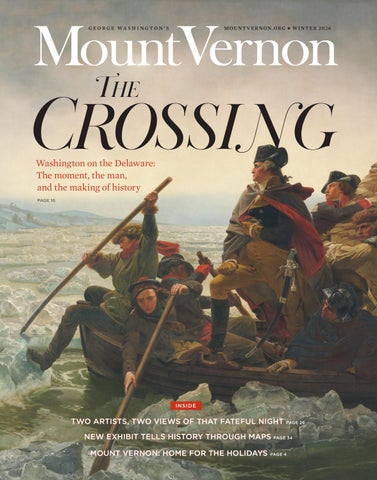
CROSSING Washington on the Delaware: The moment, the man, and the making of history PAGE 16
INSIDE
TWO ARTISTS, TWO VIEWS OF THAT FATEFUL NIGHT PAGE 26 NEW EXHIBIT TELLS HISTORY THROUGH MAPS PAGE 34 MOUNT VERNON: HOME FOR THE HOLIDAYS PAGE 4
HOLIDAY GIFT IDEAS G E O R G E WA S H I N G T O N ’ S
COMMEMORATE THE CROSSING SHOP MOUNT VERNON
MOUNT V ER NON.ORG H W INTER 2026
CONSULTING EDITOR: Norie Quintos DESIGNER: Jerry Sealy VICE PRESIDENT, MEDIA AND COMMUNICATIONS: Julie Almacy DIRECTOR OF MEDIA: Kayt Jonsson EDITORIAL COORDINATOR: Breck Pappas VISUAL RESOURCES: Dawn Bonner PRODUCTION COORDINATOR: Abigail Greenberg PROOFREADER: Lorna Notsch CONTRIBUTING WRITERS: Dawn Bonner Margaret Loftus Alexandra L. Montgomery, PhD Kristen Otto Breck Pappas
2026 MOUNT VERNON ANNUAL ORNAMENT Commemorate the 250th anniversary of George Washington’s daring crossing of the Delaware with Mount Vernon’s limited-edition 2026 Annual Ornament. Available at The Shops at Mount Vernon and shops.mountvernon.org.
Mount Vernon magazine is published three times a year by the Mount Vernon Ladies’ Association, the nonprofit organization that owns and manages George Washington’s estate. We envision an America where all know and value the singular story of the father of our country. Ever mindful of our past, we seek innovative and compelling ways to tell the story of George Washington, so that his timeless and relevant life lessons are accessible to the world. This publication is produced solely for nonprofit, educational purposes, and every reasonable effort is made to provide accurate and appropriate attribution for all elements, including historical images in the public domain. All written material, unless otherwise stated, is the copyright of the Mount Vernon Ladies’ Association. While vetted for accuracy, the feature articles included in this magazine reflect the research and interpretation of the contributing authors and historians. George Washington’s Mount Vernon P.O. Box 110, Mount Vernon, Virginia 22121 All editorial, reprint, or circulation correspondence should be directed to magazine@mountvernon.org. mountvernon.org/magazine
GEORGE WASHINGTON’S BOURBON WHISKEY Bottled by hand at Washington’s reconstructed distillery, this 375 mL bottle—featuring Washington Crossing the Delaware on its label—is the perfect holiday gift. Available at The Shops at Mount Vernon and at whiskey.mountvernon.org.
Emanuel Leutze’s monumental 1851 painting, Washington Crossing the Delaware, depicts a pivotal moment in the course of the Revolutionary War and thus, American history. The painting itself, while containing many historical inaccuracies and intended for a German market, nevertheless helped shape an American narrative around Washington and the new nation and inspired artists to continue the conversation with their own re-interpretations of the work. Detail, Washington Crossing the Delaware, Emanuel Leutze, 1851, The Metropolitan Museum of Art.
MVLA
ABOUT THE COVER
WASHINGTON CROSSES THE DELAWARE, KARL J. MUELLER STUDIOS, 20TH C., PURCHASE 1997, MVLA
FEATURES
One of a series of stained glass panels in Mount Vernon’s Ford Orientation Center.
16 | Mission Impossible Against all odds, Washington crosses the Delaware and alters the course of the war | By David Hackett Fischer
26 | Reality Check Two artists, a moment in history, and the shaping of a narrative | By D. Dodge Thompson
32 | Timeline: The Tide Turns In the winter of 1776–1777, defeat, retreat, and daring victories
34 | The Geographic Lens A new space explores Washington’s lifelong fascination with maps | By Alexandra L. Montgomery
DEPARTMENTS
4 | News Holiday happenings at Mount Vernon, awards from the American Legion and the National Archives Foundation, George Washington Prize winner announced, and more
12 | Focus on Philanthropy Education and service are at the core of Terri Lynn Land and Dan Hibma’s philanthropy
14 | Object Spotlight A hand-colored 1777 map visualizes the lay of the land following Washington’s Delaware crossing and the victories at Trenton and Princeton
38 | Washington in the Classroom Not far from Revolutionary War battlefields, a New Jersey teacher brings history to life for students
40 | Shows of Support The 25th annual Spirit of Mount Vernon and the special Gift to the Nation gala event
44 | Featured Photos A cold snap in February 1966 led to these images of the Potomac River in front of the Mansion
FOLLOW US ON SOCIAL MEDIA FACEBOOK/HISTORICMOUNTVERNON X.COM/MOUNTVERNON INSTAGR AM.COM/MOUNT_VERNON YOUTUBE.COM/MOUNTVERNON TIKTOK.COM/@GWMOUNTVERNON
2 WINTER 2026 | THE MOUNT VERNON LADIES’ ASSOCIATION
George Washington’s Mount Vernon estate is owned and maintained in trust for the people of the United States by the Mount Vernon Ladies’ Association of the Union, a private, nonprofit 501(c)(3) organization founded in 1853 by Ann Pamela Cunningham. THE MOUNT VERNON LADIES’ ASSOCIATION Anne Neal Petri, Regent Susan Marshall Townsend, Secretary Catherine Marlette Waddell, Treasurer VICE REGENTS Maribeth Armstrong Borthwick, California Ann Haunschild Bookout, Texas Virginia Dawson Lane, South Carolina Laura Peebles Rutherford, Alabama Susan Marshall Townsend, Delaware Liz Rollins Mauran, Rhode Island Ann Cady Scott, Missouri Sarah Miller Coulson, Pennsylvania Andrea Notman Sahin, Massachusetts Catherine Hamilton Mayton, Arkansas Margaret Hartman Nichols, Maine Helen Herboth Laughery, Wyoming Catherine Marlette Waddell, Illinois Lucia Bosqui Henderson, Virginia Mary Lang Bishop, Oregon Elizabeth Medlin Hale, Georgia Ann Sherrill Pyne, New York Hilary Carter West, District of Columbia Karen McCabe Kirby, New Jersey Adrian MacLean Jay, Tennessee Sarah Seaman Alijani, Colorado Susan Brewster McCarthy, Minnesota Carolyn Sherrill Fuller, North Carolina Deborah Ellen Jessiman, Maryland Helen Rankin Butler, Ohio EXECUTIVE STAFF Douglas Bradburn, PhD, President & CEO Julie Almacy, Vice President, Media & Communications Joe Bondi, Senior Vice President, Development Lindsay M. Chervinsky, PhD, Executive Director, George Washington Presidential Library Adam T. Erby, Executive Director, Historic Preservation & Collections & Martha Washington Chief Curator Joan Flintoft, Vice President, Hospitality Jonathan Kavalier, Lucy S. Rhame Executive Director, Gardens & Landscapes Phil Manno, Chief Financial Officer Cheryl Marling, Chief of Staff Joseph Sliger, Vice President, Operations & Maintenance K. Allison Wickens, Vice President, Education
From the President
I
n mid-December 1776, George Washington was desperate. Driven from New York, pursued across New Jersey, his battered Continental Army had retreated across the Delaware River into Pennsylvania. These were the times “that try men’s souls.” Barring the “speedy enlistment of a new army,” Washington wrote his brother, “I think the game will be pretty well up.” Yet Washington had an instinct for recognizing when the moment required bold action. “A lucky blow in this Quarter would be fatal to [our enemies],” he wrote on December 14, “and would most certainly raise the spirits of the People, which are quite sunk by our late misfortunes.” He found his moment on Christmas night, when Washington led his army across the ice-choked Delaware River for an audacious strike on the Hessian garrison at Trenton. No 18th-century army should attack in a blizzard. Washington needed heroes in the boat with him on that cold Christmas night. And together they changed the course of the American Revolution. As we commemorate the 250th anniversary of that crossing, this issue of Mount Vernon magazine explores the history of that extraordinary night and the place the crossing would come to take in the American imagination. Our lead feature comes from Pulitzer Prize–winning historian David Hackett Fischer and is adapted from his book Washington’s Crossing. Fischer takes readers into the storm on December 25, 1776, as Washington’s soldiers wrestle with darkness, freezing temperatures, floating ice, and a plan that appears to be unraveling. His account reminds us that the outcome of that bold maneuver, and of the war itself, was anything but inevitable. Next, D. Dodge Thompson, former chief of exhibitions at the National Gallery of Art in Washington, D.C., examines how two immigrant artists, close friends, working decades apart and with very different approaches to historical accuracy and symbolism, transformed the crossing of the Delaware into an enduring national image. In this issue, we are also pleased to unveil two new spaces at Mount Vernon designed to deepen learning for visitors of all ages. Dr. Alexandra Montgomery, director of the Lambert Institute for Digital History and Innovation, takes readers inside the Richard H. Brown “Mapping Washington’s Decisions” gallery in our new Education Center, where original maps and digital interactives reveal
how Washington used geography to make consequential decisions throughout his life. You will also discover the new Sanda and Jeremiah Lambert Hands-on-History Center, an imaginative space where children and their families can explore Washington’s world together. I hope you will experience these new offerings for yourself this holiday season, along with the many traditions that make Christmas at Mount Vernon such a special time of year. The story of the crossing shows that history is shaped not only by great moments but also by the resolve of many to carry something important forward. A private, nonprofit organization, Mount Vernon accepts no government funding, so the preservation, scholarship, and educational experiences described in these pages are possible because of the generosity of people like you. Thank you for helping us celebrate and preserve Washington’s legacy, and I look forward to seeing you at Mount Vernon soon. My very best regards,
Douglas Bradburn President and CEO
GEORGE WASHINGTON’S MOUNT VERNON 3
Mount Vernon News
Yuletide spirit: Clockwise from this image, a costumed volunteer greets guests before a candlelight tour; a family examines a Christmas tree; Aladdin the camel greets a staff member; a lighted arch for photo ops; and holiday fireworks over the Mansion.
HOLIDAY CHECKLIST
n Holiday Afternoon Tea n Breakfast with Santa n Chocolate-Making Demonstrations n Discovery Station: The Great Cake De-Constructed n Holiday Fifing Demonstrations n Mount Vernon’s 2026 Christmas ornament and holiday sales at The Shops
To explore these events and more, visit mountvernon.org/christmas.
4 WINTER 2026 | THE MOUNT VERNON LADIES’ ASSOCIATION
A Very Mount Vernon Christmas Two signature evening events anchor the season
GEORGE WASHINGTON’S MOUNT VERNON 5
MVLA
C
hristmas at Mount Vernon in George Washington’s time was a season of visiting, dining, music, and gathering with family and guests. Today, the estate carries that spirit into a holiday calendar that brings 18th-century stories to life, especially after dark. Mount Vernon by Candlelight invites guests on evening tours through the lantern-lit historic area and Mansion, with costumed interpreters sharing stories of Christmases past. The program offers a chance to experience the estate in the evening, when candlelight, music, and conversation evoke the atmosphere of Washington’s world. The program is offered select evenings in November and December. Christmas Illuminations turns the estate into a festive nighttime gathering, with fireworks over the Potomac, artisan wares, winter encampment activities, and the opportunity to bump into “George and Martha Washington” in the Interpretive Center. The program is offered December 19 and 20. Aladdin the camel, Mount Vernon’s annual visitor, also returns from his residence at a farm in Fairfax Station, Virginia—a nod to Washington’s 1787 payment to bring a camel to Mount Vernon for the holidays. “Mount Vernon during the holidays is a reminder that Washington’s home was a place of great hospitality, tradition, and joy,” said Anne Neal Petri, Regent of the Mount Vernon Ladies’ Association. Several other seasonal programs, including Holiday Afternoon Tea and Breakfast with Santa, round out the holiday calendar (see sidebar, opposite). ★
Mount Vernon News
Acquisitions
The Return of a Prized Platter Mount Vernon adds another important piece to its collection
M
ount Vernon has acquired a rare platter from Washington’s Society of the Cincinnati service, the most important Chinese export porcelain service connected to the early United States. The service was commissioned by Samuel Shaw, an aide-de-camp to General Henry Knox, when Shaw traveled to China aboard the Empress of China in 1784. The ship’s return to New York the following year marked the beginning of direct American trade with Canton. While in China, Shaw worked with a Chinese painter to create a 302-piece service decorated with the Roman
6 WINTER 2026 | THE MOUNT VERNON LADIES’ ASSOCIATION
goddess Fame holding the Cincinnati insignia, based on a design by Pierre Charles L’Enfant. Washington, the first president-general of the Society of the Cincinnati, purchased the service in 1786 for $150. Mount Vernon already owned several pieces from the service, but only one platter was previously represented in the collection. The newly acquired example, made in Jingdezhen and decorated in Guangzhou, is in particularly fine condition, with bright, intact painted enamel decoration. It was acquired through the generosity of the Scrooby Foundation.★
ACQUIRED THROUGH THE GENEROSITY OF THE SCROOBY FOUNDATION, 2026, PHOTO BY GAVIN ASHWORTH / MVLA
This platter was part of a 302-piece service owned by Washington.
Supporter of the Arts Dance subscription card bearing Washington’s signature acquired
DANCE SUBSCRIPTION, GIFT OF MRS. ALICE BEEBE DAVIES IN MEMORY OF MRS. MABEL ALLEYNE LIVINGSTONE BISHOP, REGENT AND VICE REGENT FOR OREGON, 2025, MVLA. THE VICTORY BALL, 1781, JEAN LEON GEROME FERRIS, 1929, VIRGINIA MUSEUM OF HISTORY & CULTURE
T
he G e org e Wa sh i ng ton Presidential Library at Mount Vernon recently acquired a rare dance subscription signed by George Washington and 34 officers and aides-de-camp, including Alexander Hamilton, Henry Knox, Nathanael Greene, and Clement Biddle. The document, created at Morristown, New Jersey, during the harsh winter of 1780, raised funds for a dancing assembly at headquarters. Each subscriber pledged 400 Continental dollars, agreeing to support “a dancing assembly to be held in Morris Town this present Winter 1780.” Though the exact date of the event is unknown, the document offers unusual evidence of social life in camp and Washington’s efforts to provide moments of respite during the war. “This document demonstrates that even during one of the most difficult winters of the Revolution, Washington and his officers made space for sociability and morale,” said Caroline Sharp, Mount Vernon’s special collections curator. The item was gifted by Alice Beebe Davies, in memory of Mabel Alleyne Livingstone Bishop, Regent and Vice Regent for Oregon. ★
Washington, depicted on the dance floor (left), and his pledge of support for a dance (above).
GEORGE WASHINGTON’S MOUNT VERNON 7
Mount Vernon News
EDUCATION
Little Hands, Big History A new dedicated space for children and adults to learn together
T
he Sanda and Jeremiah Lambert Hands-onHistory Center is now open at Mount Vernon, offering children and their grown-ups a colorful, interactive space to explore George Washington’s world. Designed for visitors ages 12 and younger, the center invites families to learn through hands-on activities, replica artifacts, interactive exhibits, and facilitated programs. Children can explore Mount Vernon’s gardens and farms through murals and wall activities, read in an area inspired by Washington’s study, try his “fan chair,” and take part in games and programs on such topics as surveying, experimental gardening, the Culper Spy Ring, the presidency, and Washington in popular culture. “This space gives children the chance to learn by doing, ask questions, and make connections to their own lives,” said Tramia Jackson, Mount Vernon’s director of education programs. “Families will love exploring the Hands-on-History Center together.” ★
ABIGAIL GREENBERG / MVLA
Located near the Education Center lobby, the Handson-History Center is included with general admission. Learn more at mountvernon.org/handsonhistory.
8 WINTER 2026 | THE MOUNT VERNON LADIES’ ASSOCIATION
Learning history through the senses: Clockwise from this image, creating place settings for foreign dignitaries; identifying fruit trees; and reading about lesser-known Revolutionary War figures.
Art Class Free virtual program brings Washington into classrooms
M
ount Vernon’s virtual classroom program welcomed 791 students for Beyond the Surface: Historical Thinking with Art. The program explored portraits of George Washington (above), works of art in Mount Vernon’s collection, and the power of portraiture. The “Mount Vernon in Your Classroom” series, sponsored by Amélie and Charles Cagle, brings Mount Vernon educators into classrooms nationwide through free virtual programs. Upcoming topics include Washington’s Thanksgiving legacy and his decision to cross the Delaware in 1776. ★
Summer School Online course on George Washington draws national audience
H
eld in July and August, The Indispensable Founder: George Washington was a six-session Osher Online course offered in collaboration with Northwestern University’s School of Professional Studies. Taught by Anne Neal Petri, Regent of the Mount Vernon Ladies’ Association, it drew enrollees from at least 27 states. Participants met virtually to explore Washington’s life and political leadership, as well as his work as a farmer, entrepreneur, and architect. The
course also highlighted the MVLA, which has owned and preserved Mount Vernon since 1858. “We were thrilled to see nearly 150 lifelong learners from across the country enroll in this course,” said Kevin DeCoux, program manager for Osher Online. “The 250th anniversary of the United States makes the subject especially timely, but there is an enduring interest in George Washington, Mount Vernon, and what their histories can teach us.” ★
GEORGE WASHINGTON’S MOUNT VERNON 9
Mount Vernon News
M
ount Vernon was honored with the National Archives Foundation’s 2026 Records of Achievement Award, recognizing its role in preserving and sharing the American story. The award, the Foundation’s highest honor, highlights contributions that foster broader public understanding of the history and heritage of the United States. Mount Vernon received the distinction alongside Thomas Jefferson’s Monticello, with both historic sites recognized for connecting visitors with the people, places, and ideas of the founding era. Past recipients have included Martin Scorsese, David McCullough, Tom Hanks, Steven Spielberg, Annette Gordon-Reed, and the creators of the Broadway musical Hamilton.
Top Read Richard Bell awarded George Washington Prize The American Revolution and the Fate of the World, by Richard Bell, has received the 2026 George Washington Prize, one of the nation’s most prestigious honors for works on early American history. The $50,000 prize, created by George Washington’s Mount Vernon, the Gilder Lehrman Institute of American History, and Washington College, recognizes the year’s best books on the founding era and works that broaden public understanding of the nation’s beginnings. Bell, a professor of history at the University of Maryland, recasts the American Revolution as a global conflict, following its consequences across oceans and empires and showing how the founding of the United States reshaped debates over liberty, commerce, and slavery. He was selected from a finalist list that included works by Joyce E. Chaplin, Steven Sarson, Paul Staiti, and Amy Watson. The finalists discussed their books at Mount Vernon in August, ahead of the winner’s announcement at an October gala dinner in New York City. ★
Mount Vernon recognized with an award from the National Archives Foundation.
“Historic sites like Mount Vernon and Monticello are essential stewards of our shared heritage, preserving both the physical spaces and the stories that shaped our nascent nation,” said Secretary Rodney E. Slater, chair and president of the National Archives Foundation Board of Directors. The ceremony was held September 30 at the National Archives Museum in Washington, D.C., and included a program with writer Rebecca Boggs Roberts and Lt. Gen. H.R. McMaster. ★
10 WINTER 2026 | THE MOUNT VERNON LADIES’ ASSOCIATION
Richard Bell (above left) and his prize-winning book (left).
GROUP, NATIONAL ARCHIVES FOUNDATION
A National Award for Mount Vernon
Notebook Volunteer shoutout: Pat Veatch received the George Washington Award for more
ABIGAIL GREENBERG / MVLA (CALVES). OWEN J. BAGWELL (AMERICAN LEGION AWARD)
than 7,500 hours of service over 41 years. Veatch supported Mount Vernon before the formal volunteer program began in 1992 and continues to welcome visitors to the estate. Bovine arrivals: Silas and Rex, new Randall Lineback heritage breed bull calves, are acclimating to their new home. They greeted visitors and demonstrated pulling a small log behind them. The calves were gifts of Lucia Bosqui Henderson, Vice Regent for Virginia, and Joe Henderson. Commemorative blanket: Mount Vernon’s head weaver Margaret Lineberger has been working on a blanket commemorating the nation’s 250th, using wool from Mount Vernon’s Hog Island and Leicester Longwool sheep. The blanket will be finished before the close of 2026. ★
Silas and Rex, with their handlers.
BY THE NUMBERS
30
29
13
Windsor chairs
Temperature in
Number of interior
arrayed on the
Fahrenheit at the beginning
fireplaces in the Mansion,
piazza on a
of Washington’s crossing
providing warmth for the
typical day
in 1776
Washingtons and guests
MVLA Receives American Legion Honor
T
he Mount Vernon Ladies’ Association received the American Legion Distinguished Service Medal at the Legion’s annual meeting last September. Anne Neal Petri, Mount Vernon Ladies’ Association (MVLA) Regent, accepted the award. First awarded in 1921, the Distinguished Service Medal is the Legion’s highest honor, recognizing individuals and organizations for “outstanding service to the nation and to the ideals of the American Legion.” Past recipients have included President Franklin D. Roosevelt, Gen. Dwight D. Eisenhower, and Babe Ruth. The honor carries particular significance, as it places the MVLA among the few women’s or women-led groups to be represented in the medal’s history. “It is such an honor to accept this award on behalf of the Mount Vernon Ladies’ Association,” Petri said. “We are especially honored because we know we share a mutual commitment to inspiring and teaching the next generation about this incredible country of ours and the legacy of George Washington.”
GEORGE WASHINGTON’S MOUNT VERNON 11
Focus on Philanthropy
Shared Principles Education and service are at the core of a Michigan couple’s philanthropy
T
erri Lynn Land and Dan Hibma have supported Mou nt Ver non si nce 2005, but their commitment to the principles that George Washington stood for is what brought them together in the first place. “I always liked history,” Land says. “It was my favorite subject in school. And so I thought I’d grow up to be a history teacher.” After graduating early from high school, she enrolled in community college, where she met a friend who worked on Gerald Ford’s 1976 presidential campaign, inspiring her to volunteer herself. Ford became the Republican nominee but lost the general election to Jimmy Carter. The experience prompted Land to switch her college major to political science. “I decided I wanted to make history rather than teach it,” she says. True to her word, at the age of 22, she ran for the Michigan House of Representatives. On the stump, she crossed paths with Hibma, who had just been elected supervisor of Byron Township and offered to help her knock on doors. Land lost that particular election, but she won Hibma’s heart, and they were married within the year. Terri Lynn Land and Dan Hibma, with the South Garden House in the background.
Ten years and two children later, politics still called: Land ran for Kent County clerk and won. In 2003, she became Michigan’s 41st secretary of state and held that office until 2010. Today, she serves on the Board of Governors at Wayne State University. Meanwhile, Hibma transitioned from politics to help run the
12 WINTER 2026 | THE MOUNT VERNON LADIES’ ASSOCIATION
family property management and development firm, all the while nurturing a fascination with early American history. His ancestral roots in this country date back to 1753 and include a soldier who fought in the Revolutionary War. After reading in Mount Vernon magazine about the George Washington Teacher Institute
DAN CHUNG/MVLA
(GWTI) and its wealth of education materials, he decided to spread the word to local school districts: “I’d sit in the lobby and just wait for someone to give me 10 minutes.” He found a taker in Mulonge Kalumbula, PhD, a school administrator heading up the social studies program for Grand Rapids Public
Schools. The two developed a friendship, which led to a broader relationship between the school district and Mount Vernon. Land and Hibma sponsored the first of many teachers from the state to attend GWTI’s summer program, ultimately opening the door to the couple’s greater involvement with the estate.
Today, Land and Hibma’s support of Mount Vernon goes beyond education. They began to attend the annual Life Guard Society gala, often bringing friends. For their 38th wedding anniversary in 2021, Hibma made a gift in Land’s honor: the restoration of George Washington’s South Garden House, which dates to 1785. And thanks to Hibma’s interest in artifacts and antiques—he has an office full of Washington busts and paintings—their contributions have also extended to acquisitions, including a spyglass used by Washington during the Revolution and an icery (an item used to keep ice cream cold) made by the Locré porcelain factory in France that once graced the Washingtons’ table. The two have been Washington Cabinet members since 2023. They’ve come to regard Mount Vernon as hallowed ground, even holding a family reunion there in 2024. “It all centers on George Washington, and obviously he was a very courageous guy, but what I admire about him was his persistence. He hung in there when everything was against him,” Hibma says. Last year, the couple created the Honorable Terri Lynn Land and Daniel Tedford Hibma GWTI Endowment to ensure that the program is supported in perpetuity. Land views the program as fulfilling her wish to teach history, albeit indirectly: “We’re really happy that we could do that, because it’s part of the very purposeful thing they’re doing there—educating people about George Washington. And we need a few George Washingtons right now.” ★
GEORGE WASHINGTON’S MOUNT VERNON 13
PLAN OF THE OPERATIONS OF GEORGE WASHINGTON AGAINST THE KING’S TROOPS IN NEW JERSEY, FROM THE 26TH OF DECEMBER 1776 TO THE 3D OF JANUARY 1777, WILLIAM FADEN, 1777, COURTESY OF RICHARD H. BROWN AND MARY JO OTSEA, MVLA
Object Spotlight
Mapping a Turning Point Hand-colored 1777 map illustrates the lay of the land following Washington’s crossing and the victories at Trenton
14 WINTER 2026 | THE MOUNT VERNON LADIES’ ASSOCIATION
M
aps of battles and campaigns were a powerful FAST FACT and popular way people on both sides of the The map was cut into Atlantic learned about the course of the pieces and backed on American Revolution. To meet this demand, London fine French linen to facilitate storage and engraver and publisher William Faden created this transportation, map showing the American victories at Trenton and a common 18thPrinceton following Washington’s Christmas 1776 century practice. crossing of the Delaware. It was published in April 1777, just a few months after the events it depicts. Beautifully hand-colored, this copy came from the personal collection of Michel Capitaine du Chesnoy, the Marquis de Lafayette’s mapmaker, who accompanied him throughout the American Revolution. Look for it on display in the Gilder Lehrman Gallery at Mount Vernon through early 2027. ★
FOLLOW THE ACTION n The map depicts several battles over the course of about a week. n The blue lines on the map represent American troop movements, while the red are that of the British and Hessians. n The action moves generally from west to east, beginning with the crossing itself on the left-hand side of the map.
1. The map begins (right) with Washington’s daring crossing of the Delaware on the night of Christmas, 1776.
2. On the morning of the 26th, Washington and
the Continental Army marched to Trenton, surprising the Hessian garrison. The Battle of Trenton provided a much-needed win for the demoralized American cause.
1. The Crossing
3. After successfully repelling a British attack near Trenton on January 2, Washington chose to secretly move his army in the dead of night and attack the British at Princeton, rather than face General Cornwallis’s main force. The victory at Princeton convinced the British to withdraw and further bolstered the American cause.
2. Trenton
3. Princeton
GEORGE WASHINGTON’S MOUNT VERNON 15
Nevermind the historical inaccuracies in this painting by Emanuel Leutze, Washington’s crossing of the Delaware River became a defining moment in the Revolutionary War.
WASHINGTON CROSSING THE DELAWARE, EMANUEL LEUTZE, 1851, THE METROPOLITAN MUSEUM OF ART
George Washington, who missed signing the Declaration, was indispensable to ensuring the survival of the nation it created By Richard Brookhiser
MISSION IM
Against all odds, George Washington crosses the Delaware with grim
16 WINTER 2026 | THE MOUNT VERNON LADIES’ ASSOCIATION
POSSIBLE
Susan Neely in London last year (opposite), and as a college determination, altering the course ofstudent war | By David Hackett Fischer and congressional intern visiting Mount Vernon in 1977 (above).
GEORGE WASHINGTON’S MOUNT VERNON 17
THE PASSAGE OF THE DELAWARE, 1819, THOMAS SULLY, GIFT OF THE OWNERS OF THE BOSTON MUSEUM, PHOTOGRAPH © 2026 MUSEUM OF FINE ARTS, BOSTON
O
n December 25, 1776, while the Continentals marched to McConkey’s Ferry, the weather was changing rapidly. Fifer John Greenwood recalled that when his regiment left their camp in Newtown a little after four o’clock in the afternoon, the sun was low on the horizon but still “shining brightly.” As they marched along snowy roads in the gathering darkness, the sky clouded over. A little after sunset, Greenwood wrote, “[I]t began to drizzle or grow wet.” By the time they reached the river, the drizzle had become a driving rain. About eleven o’clock, a howling storm hit them with terrific force. Greenwood remembered that “it rained, hailed, snowed and froze.” He forgot to mention sleet. The wind rose so high “it blew a perfect hurricane.” No single day in history was more decisive for the creation of the United States than December 25, 1776. On that Christmas night, a ragged army of 2,400 colonials crossed the ice-choked Delaware River from Pennsylvania to New Jersey in the teeth of a nor’easter that lashed their boats and bodies with sleet and snow. After marching all night, they attacked and defeated a garrison of 1,500 Hessian soldiers at Trenton. A week later, the Americans withstood a fierce British counterattack in Trenton and then stole away overnight to march 15 miles by back roads to Princeton, where they defeated British reinforcements rushing to Trenton. These actions would change the course of the war, American history, and indeed, the world itself.
18 WINTER 2026 | THE MOUNT VERNON LADIES’ ASSOCIATION
An 1819 painting by Thomas Sully depicts the moments before the Christmas night crossing, with Washington—astride a white horse on the Pennsylvania bank—watching his troops struggle through snowy conditions to board waiting boats.
GEORGE WASHINGTON’S MOUNT VERNON 19
Greenwood remembered that “it rained, hailed, snowed and froze.” He forgot to mention sleet. The wind rose so high “it blew a perfect hurricane.” Risky business But on that bleak December morning, George Washington had little cause for hope. A message had been intercepted from a “person in the Secrets of the Enemy” that seemed to indicate that British commanders were planning “to cross the Delaware as soon as the Ice is sufficiently strong.” A weakened American army could be shattered if it tried to fight a strong enemy on another frozen field. Even without a battle, the army could be ruined by another winter campaign. The weather was even more dangerous in another way. If the Delaware River froze over, as it often did in January, the enemy could march across the ice to Philadelphia. The Continental Army had never been able to stop them in open combat. After the conquest of New York, New Jersey, and Rhode Island, the loss of the largest American city would be a crushing blow to the cause. Any action was full of danger, but Washington knew that inaction could be worse. Washington reflected on these very hard choices in the quiet of the Widow Harris’s house, with clocks ticking around him. Rather than wait for the British to cross, Washington and his staff decided to strike first by taking the army across three separate spots along the Delaware River on Christmas night to attack the Hessian garrison at Trenton. On the day of the crossing, Washington expressed his grim but determined mindset and hopes for the mission in a A sketch of the engagement at Trenton on December 26, 1776, between American troops and three Hessian regiments (above right). Continental Army fifer and eyewitness John Greenwood (above left).
20 WINTER 2026 | THE MOUNT VERNON LADIES’ ASSOCIATION
letter to Robert Morris. “It is in vain to ruminate upon, or even reflect upon the Authors or Causes of our present Misfortunes. We should rather exert ourselves to look forward with Hopes, that some lucky chance may yet turn up in our Favour.” By midnight, the entire operation was on the verge of disaster. Of Washington’s three forces, two were defeated by ice on the river. Only the northern force remained at McConkey’s Ferry. But there at the water’s edge, one important part of the plan went right. “The boats were in
A dark and stormy night Most of the men, likely including Washington, crossed the Delaware standing up. Big river ferries and freight
boats had few seats or none at all. On a wet winter night, anyone who sat in the bottom of a Durham boat or ferry would have been sitting in ice water. There are accounts of other Delaware crossings in 1776 in which the men were ordered to jump up and down in several inches of watery slush to clear the ice from the boats and to keep from freezing. Those modern Americans who doubt George Washington stood up in the boat, as depicted in the iconic 1851 Emanuel Leutze painting (see story on page 26) might try sitting down in such conditions.
GEORGE WASHINGTON’S MOUNT VERNON 21
JOHN GREENWOOD, THE NATIONAL LIBRARY OF MEDICINE. SKETCH OF THE ENGAGEMENT AT TRENTON…, ANDREAS WIEDERHOLDT, 1776, LIBRARY OF CONGRESS
readiness,” Major James Wilkinson remembered. A large flotilla of small rivercraft was waiting when the men arrived, rounded up by the Jersey militia of Hunterdon County. Delaware ferries carried the army’s horses, artillery, and ammunition wagons; sturdy Durham boats with their high sides and sharp ends were excellent for infantry.
This late 19th–century painting depicts Continental Army soldiers reaching the New Jersey side of the Delaware and regrouping for the march on Trenton.
The crossing was a challenge to all their skills that night. The river near Trenton was described in late December 1776 as “extremely rapid here and in general about two ells [90 inches] deep.” At McConkey’s Ferry, the width of the stream was about 800 feet, and the water was high and swift. Ice had formed on the river and broken apart into floating cakes. The current had jammed large pieces along the banks in thick jagged rows. The main stream was full of large pancakes of ice, which came down the Delaware at surprising speed, spinning and turning in the whirls and eddies of the river. The temperature was falling, and more ice was forming in the river and even on the boats. Another problem was the darkness of the night. A bright moon had risen after sunset but was obscured by
22 WINTER 2026 | THE MOUNT VERNON LADIES’ ASSOCIATION
the storm. Visibility grew so poor that boatmen could barely see the opposite shore. Wilkinson recalled that “the force of the current, the sharpness of the frost, the darkness of the night, the ice which made during the operation, and a high wind, rendered the passage of the river extremely difficult.” Washington thought that the “greatest fatigue” was “in breaking a passage through the ice” along the shore. Likewise, Henry Knox, to whom Washington had given command of the crossing, believed that the worst of it was “floating ice in the river,” which “made the labor almost incredible.” Knox also had to get the infantry safely across the river. The great majority of the army, like other populations in 18th-century America and Europe, were unable to swim
Another looming challenge Not so happy was the commander in chief. According to tradition, Washington crossed the river with John Glover’s Marblehead Mariners (the 14th Continental Regiment), in a boat commanded by Captain William Blackler, with Private John Russell at an oar. Once on the Jersey shore, Washington wrapped himself in his cloak, sat down on a wooden box that had once been a beehive, and brooded over the ruin of his plan. The operation was now three hours behind schedule. Later he wrote that the delay “made me despair of surprising the Town, as I well knew we could not reach it before the day was fairly broke.” Sitting on his beehive, he watched his men struggling against the storm and ice and wondered if
GEORGE WASHINGTON’S MOUNT VERNON 23
WASHINGTON CROSSING THE DELAWARE, HARRINGTON G. FITZGERALD, 1870S-1890S, MUSEUM OF THE AMERICAN REVOLUTION, 2003.00.0507
a stroke. Soldiers joked that they did not fear to drown, for they were born to hang. Even seamen did not learn to swim, much to the disgust of Benjamin Franklin, who was a great swimmer himself and tried in vain to teach his American compatriots to take to the water. In the course of the crossing, some of the men tumbled into the icy water. One of them was Delaware’s Colonel John Haslet. He was fished out in the nick of time, suffering much from exposure. This unconquerable man went on to march 10 miles on severely swollen legs and fought a battle without complaint. The guardian angels of the army were working overtime: In the end, not a man was lost to the river. Every artillery piece also arrived in good order on the Jersey shore, much to the relief of Henry Knox.
Knox also had to get the infantry safely across the river. The great majority of the army, like other populations in 18th-century America and Europe, were unable to swim a stroke. he should call it off. But desperate as the mission had become, he decided that it might be more difficult to abandon it. Washington wrote, “As I was certain there was no making a Retreat without being discovered, and harassed on repassing the River, I determined to push on at all Events.” The assembly of the army on the Jersey shore went slowly but without a major hitch. Washington’s first concern was to protect the secrecy of the operation. He ordered Adam Stephen’s Virginia brigade to move quickly inland and “form a chain of sentries round the landing place at a sufficient distance from the river to permit troops to form.” They were told “not to suffer any person to go in or come out—but to detain all persons who attempts either.” Washington selected a secret password and wrote it himself on small slips for all the units in the army. Benjamin Rush had visited him the night before the crossing and wrote, “While I was talking to him, I observed him to play with his pen and ink upon several small pieces of paper. One of them by accident fell upon the floor near my feet. I was struck with the inscription upon it. It was ‘Victory or Death.’ ” The army would go on to march to Trenton and win a decisive victory in the surprise attack. Washington reported that American battle losses were “very trifling
24 WINTER 2026 | THE MOUNT VERNON LADIES’ ASSOCIATION
indeed, only two officers and one or two privates wounded.” These victories saved the American Revolution from collapse. Without them there would have been no United States, at least as we know it. The story is full of twists and turns of contingent moments when events seemed likely to move in one direction but then swung in another, and when leaders—none more so than George Washington—made key choices between two or more unappealing alternatives. Historian David Hackett Fischer won the Pulitzer Prize in history in 2005 for the book Washington’s Crossing. This article was adapted, with permission, from that work.
A BOOK’S LEGACY Historian Craig Bruce Smith on the continuing relevance of Washington’s Crossing Every schoolchild learns the tale of Washington and the Continental Army crossing the Delaware in 1776. Yet, shockingly, David Hackett Fischer was one of the few to write, in 2004, a standalone nonfiction book centered on the event. And none were as scholarly, deeply researched, or focused on the crossing’s history, myth, and legacy. Using his signature “braided narrative” that combines vivid storytelling and academic analysis, the Pulitzer Prize–winning historian captures the drama and dispels long-held misconceptions. There were no drunk Hessians, and Washington really did stand up in the boat. More importantly, the book highlights choices and consequences from all sides of the war. At its heart is a masterclass on Washington’s leadership that is still relevant from the classroom to the boardroom to the war room. But, fundamentally, Washington’s Crossing continues to inspire because it offers the definitive history of a singular event. Unlike prior centuries of Washingtonian lore, Fischer’s is the true story. More compelling than legend, it will ensure the crossing remains just as iconic for another 250 years.
GEORGE WASHINGTON’S MOUNT VERNON 25
HENRY KNOX, CHARLES PEALE POLK, AFTER 1783, NATIONAL PORTRAIT GALLERY, SMITHSONIAN INSTITUTION. THE CAPTURE OF THE HESSIANS AT TRENTON, DECEMBER 26, 1776, JOHN TRUMBULL, 1786-1828, YALE UNIVERSITY ART GALLERY, TRUMBULL COLLECTION
Henry Knox (portrait, opposite) brought the artillery that helped secure Washington’s win at the Battle of Trenton (this image).
Emanuel Leutze’s Washington Crossing the Delaware at New York’s Metropolitan Museum (this image), and Thomas Sully’s The Passage of the Delaware at Boston’s Museum of Fine Arts (opposite).
ROB CARDILLO/MVLA
REALITY CHECK
Two artists, a moment in history, and the shaping of a narrative |
26 WINTER 2026 | THE MOUNT VERNON LADIES’ ASSOCIATION
By D. Dodge Thompson
GEORGE WASHINGTON’S MOUNT VERNON 27
PATTI MCCONVILLE/ALAMY (HANDS HOLDING PHONE). PHOTO © 2026 MUSEUM OF FINE ARTS, BOSTON (PAINTING IN GALLERY)
H
istorians tell us that the Continental Army’s Christmas night crossing of the Delaware in 1776 took 11 hours and some 27 trips across the ice-filled river. But neither Washington nor his ranking officers, nor anyone in the enlisted troops, wrote much at all about the crossing. There is no reliable record of whether Washington crossed in the first or the last boat, with whom he crossed, or what he said during the crossing. In fact, at the time, the passage was not recognized as a significant feat. The most accomplished American painters of the Revolution, Charles Willson Peale and John Trumbull, focused their artistic efforts instead on the arguably more dramatic and consequential Battles of Trenton and Princeton, which immediately followed the crossing. Only in the following century was the event mythologized by two artists, using different pictorial approaches. The first but less remembered painting, The Passage of the Delaware, is a narrative image of the reported event, painted 43 years after the fact in 1819 by Philadelphia portrait artist Thomas Sully. Decades later, a friend of Sully’s, the aspiring younger artist Emanuel Leutze, created a romanticized depiction that elevated the event and became its iconic,
Self-made men Both artists were immigrants. Sully hailed from a family of itinerant actors from Lincolnshire, England, and Leutze from the Kingdom of Württemberg in what is now southern Germany. Both artists made vaunted international reputations in the United States and were ever after appreciative of the opportunities they enjoyed in this country. Despite their age difference of 33 years, the two artists knew each other in Philadelphia and continued correspondence after Leutze departed for the Art Academy in Düsseldorf, where he painted his celebrated tableau vivant. So close were they that Sully painted a portrait of Leutze’s widowed mother in Philadelphia to provide solace to the younger painter while he was abroad. Nevertheless, when it came to painting the crossing, the two artists diverged in both style and substance. Sully chose to depict the moment just before the crossing, with Washington on horseback on the Pennsylvania side looking back at his troops. Leutze famously imagined the crossing itself.
Emanuel Leutze
Classical and deeply researched Even without much firsthand information of the crossing itself, many of the facts surrounding it are known. Washington crossed the Delaware River at McConkey’s and Johnson’s Ferry, connecting Pennsylvania and New Jersey. The river is today—and was then—a mere 300 yards wide. A recently rediscovered perspective drawing from 1777 of a nearby ferry crossing by artist-soldier Charles Willson Peale confirms the distance. Peale’s drawing also documents the overhead wire cables by which most flat-bottomed ferries in the region would have been guided. While many historians have speculated that the transportation of the Continental Army’s 50 to 100 horses and 18 cannons relied on the use of such overhead cables, Peale’s drawing is the first visual proof of this local practice. The flatboats, which had hinged front and rear ramps normally used to accommodate loading and unloading of heavy freight, were ideal for safely conveying the horses and on- and off-loading the cannons. The majority of the 2,400 soldiers under Washington’s command who traversed the river did so not in the ferries but in locally commandeered (“borrowed”) Durham cargo boats—heavy, sturdy boats
ARTISTIC LICENSE Intended for a German market, the Leutze painting took more liberties with the facts; for example, the topographical features of the river are those of the Rhine, not the Delaware. The painting’s use of poles is historically accurate, though the task required rowers to stand.
28 WINTER 2026 | THE MOUNT VERNON LADIES’ ASSOCIATION
SELF-PORTRAIT, EMANUEL LEUTZE, C. 1843, BOOTH FAMILY CENTER FOR SPECIAL COLLECTIONS, GEORGETOWN UNIVERSITY, WASHINGTON, DC. DETAIL, WASHINGTON CROSSING THE DELAWARE, EMANUEL LEUTZE, 1851, THE METROPOLITAN MUSEUM OF ART
defining image: Washington Crossing the Delaware is recognizable to young and old the world over. Examined together, the paintings and their makers reveal much about the formation of a new country.
DETAIL, THE PASSAGE OF THE DELAWARE, 1819, THOMAS SULLY, GIFT OF THE OWNERS OF THE BOSTON MUSEUM, PHOTOGRAPH © 2026 MUSEUM OF FINE ARTS, BOSTON. PORTRAIT OF THE ARTIST, THOMAS SULLY, 1821, THE METROPOLITAN MUSEUM OF ART. DRAWING, THE FERRY THREE MILES BELOW BRISTOL, CHARLES WILLSON PEALE, 1777, FREE LIBRARY OF PHILADELPHIA
Thomas Sully
EXACTING DETAIL Sully went to great lengths to depict the scene accurately, painting the large, flat-bottomed cargo boats used and capturing the chaos of loading massive artillery and rearing horses onto the boats on a winter’s night.
FACT CHECK A recently rediscovered perspective drawing from 1777 of a nearby ferry crossing by artist-soldier Charles Willson Peale confirms the width of the river at about 300 yards and documents the overhead wire cables by which most flat-bottomed ferries in the region would have been guided.
GEORGE WASHINGTON’S MOUNT VERNON 29
Romantic and drama-laced Of the two versions of Washington’s crossing, Emanuel Leutze’s is vastly better known today and often used in modern history books to illustrate the event. Yet the painting was intended for the German art market (the first version was sold to the museum in Bremen) and was a more symbolic, rather than authentic, depiction of the event. The width of the river, the topography, and even the form of the ice floes in Leutze’s painting are features of the Rhine River, not the Delaware. Other anachronisms in Leutze’s painting are the presence of the future president James Monroe holding the flag (he crossed at a different place and time); the flag itself (it is the “Betsy Ross”– type flag adopted by Congress six months after the crossing); and the daylight setting (it was in the dead of night, and any light from the full moon would have been obscured by the falling snow). Nevertheless, one frequently pointed out anachronism—that Washington would not have stood up in the boat—needs correction. In fact, everyone must stand up in a Durham boat. These long, pointed cargo boats with high gunnels were largely propelled by “poling,” unlike the flat-bottomed ferries guided by cables. The soldiers would plant long wooden poles with metal tips into the riverbed and move the boat forward by pushing hand over hand on the pole, a task that required them to stand. That said, contrary to Leutze’s image, there are
30 WINTER 2026 | THE MOUNT VERNON LADIES’ ASSOCIATION
normally no seats in a Durham boat for those who rowed. The audience for the Leutze painting has always been divided: “empire versus satire.” After Leutze’s leviathan work arrived in New York via Paris in 1851, the initial, rapturous enthusiasm was followed by more mixed responses. A decade later, reactions to the painting typically took the form of satire. In 1864, a New York Times critic carped that Washington was depicted with “the head and air of a dancing-master [who stood] on the prow of the boat ready to teeter ashore and dance a pirouette on the snow.” While Washington and his soldiers were far more interested in the victories at the Battles of Princeton and Trenton, Thomas Sully and Emanuel Leutze transformed the crossing into the heroic moment we see it as today, aiding in the evolution of a new nation’s sense of itself. Even today these familiar images still shape conversations of nationhood, leadership, and citizenship. D. Dodge Thompson is the former chief of exhibitions at the National Gallery of Art in Washington, D.C.
TAKING LIBERTIES Leutze erroneously puts future fifth U.S. president James Monroe on the boat with Washington and paints him carrying a flag—the “Stars and Stripes” with 13 stars in a circle—that did not yet exist when the crossing took place.
DETAIL, WASHINGTON CROSSING THE DELAWARE, EMANUEL LEUTZE, 1851, THE METROPOLITAN MUSEUM OF ART
originally built to haul items like iron down the Delaware. In a broadside accompanying an exhibition of Sully’s painting around 1820, the artist recorded his historical research about the crossing. He had visited McConkey’s Ferry on December 23, 1818, “…and made my drawing during a snowstorm, therefore have been able to give much accuracy to the representation.” He identified a specific pair of officers accompanying Washington, probably in response to mistaken identities assumed by early viewers of the painting. Washington is prominently front and center; Colonel Henry Knox at the top of the image, directing the action with his unsheathed sword; and General Nathanael Greene, the largest figure at lower right, dressed in a fur-trimmed “blanket coat” and wearing a tricorn hat reserved for officers. Sully had done his homework: Greene and Knox had indeed been critical to the crossing, as well as Washington’s most trusted advisers throughout the war.
SHIMOMURA CROSSING THE DELAWARE, © ROGER SHIMOMURA, 2010, NATIONAL PORTRAIT GALLERY, SMITHSONIAN INSTITUTION; GIFT OF RAYMOND L. OCAMPO JR., SANDRA OLEKSY OCAMPO, AND ROBERT P. OCAMPO. LLOYD J. HARRISS PIES, AFTER LEUTZE, MILWAUKEE 1947, LIBRARY OF CONGRESS
CANVAS, REMIXED
The many re-interpretations of Leutze’s famous Crossing painting
B
ecause Leutze’s original image is ingrained in the public consciousness, 20th- and 21stcentury artists and commentators often use its instantly recognizable composition as a template to poke fun, criticize, or otherwise comment on American culture. Editorial cartoons have parodied no fewer than 14 U.S. presidents standing in the prow of the boat, from Theodore Roosevelt to Donald Trump. The satires have kept up with the proliferation of modern media, appearing in photography, cinema, television, and even commercial advertising from beer to cherry pies. One enduring trope is using remixes of the painting to explore who is or isn’t included in the American story. A boat filled with women was depicted crossing the Delaware as early as the 1913 march for women’s suffrage in Washington. In possibly the most famous artistic send-up, George Washington Carver Crossing the Delaware, artist Robert Colescott replaced Washington with the African American agricultural scientist George Washington Carver in a 1975 commentary on the
exclusion of Black achievements from American history textbooks. In Shimomura Crossing the Delaware, the Japanese American artist and internment camp survivor Roger Shimomura placed himself in Washington’s iconic pose and replaced the American soldiers with Japanese samurai. He painted the body of water to resemble San Francisco Harbor, with Angel Island (the processing center for Asian immigrants) in the background.
Black Americans, Indigenous Americans, Asian Americans, and LGBTQ+ Americans are among the many groups that have made themselves, if possible, more American by referencing a single national narrative of a brave American general crossing an icy river by night to secure a new nation’s future. Artist Roger Shimomura offers a 2010 satirical commentary (above), while Rocco Navigato aims for fun in a 1947 advertisement (below).
SHARE YOUR CROSSING Reimagine the famous painting, and submit your entry by December 25. Grand-prize winner receives a VIP Mount Vernon experience for up to 20 people. See page 45 for contest details and rules.
GEORGE WASHINGTON’S MOUNT VERNON 31
TIMELINE OF A REVOLUTION
The Tide Turns
In the winter of 1776–1777, defeat, retreat, and daring victories transform the Revolution’s darkest hour
sev en t h in a ser ies of nota ble momen ts from t he war for independence
November 16
Fort Washington, the last major American stronghold on Manhattan, falls. During the battle, Margaret Cochran Corbin takes her fallen
December 7–8
husband’s place on an American cannon crew and fires until wounded.
Washington’s retreating army crosses the Delaware River into Pennsylvania. On the western bank, he establishes a defensive base and awaits reinforcements.
•
The Dutch governor of St. Eustatius, in the West Indies, orders a nine-gun salute to an American ship, marking the first recognition of American independence by a foreign power.
November 28 In hot pursuit of
Washington’s army, General Charles Cornwallis takes Newark, New Jersey.
December 13
General Charles Lee, inexplicably staying at a tavern three miles from his troops, is captured by British cavalry near Basking Ridge, New Jersey.
December 14
Washington writes in a letter that a “lucky blow” against the enemy would “most certainly raise the spirits of the people, which are quite sunk by our late misfortunes.”
December 19
A drawing depicts British and Hessian troops approaching Fort Washington via the Harlem River (above). British General Charles Cornwallis (top) attacks from the eastern side and pursues Washington’s army.
32 WINTER 2026 | THE MOUNT VERNON LADIES’ ASSOCIATION
Thomas Paine publishes the first of his pamphlet series The American Crisis, whose famous opening line—“These are
CHARLES CORNWALLIS, 1ST MARQUESS CORNWALLIS, DIANA DIETZ HILL, 1786, GIFT OF KATHERINE MERLE-SMITH THOMAS, 2010, CONSERVATION COURTESY OF THE FOUNDERS, WASHINGTON COMMITTEE ENDOWMENT FUND, MVLA. A VIEW OF THE ATTACK AGAINST FORT WASHINGTON…, THOMAS DAVIES, 1776-1812, NEW YORK PUBLIC LIBRARY
★★★
WASHINGTON AT THE BATTLE OF PRINCETON, AFTER ALONZO CHAPPEL, JOHNSON FRY & CO. PUBLISHERS, 1857, GIFT OF MR. AND MRS. ROBERT B. GIBBY, 1984, MVLA. ALEXANDER HAMILTON, CHARLES WILLSON PEALE, C. 1790-1795, COURTESY INDEPENDENCE NATIONAL HISTORICAL PARK. LETTER, GEORGE WASHINGTON TO LT. COL. GRIER, 1777 MARCH 12, IN ALEXANDER HAMILTON’S HAND, PURCHASED WITH FUNDS PROVIDED BY THE MOUNT VERNON LICENSING FUND, 2010, MVLA
A surprise win for the Americans at the Battle of Princeton.
begins rebuilding and reorganizing the army.
February 6
Washington orders the Continental Army inoculated against smallpox, launching the first mass military inoculation campaign in American history.
the times that try men’s souls”—bolsters Patriot morale.
officers, seize supplies, and arrest disloyal persons.
December 25–26
January 2–3
Washington and his troops cross the icy Delaware River and launch a surprise attack at Trenton, capturing nearly 900 enemy soldiers and securing a badly needed American victory. (See story, page 16.)
After fending off Cornwallis’s attack at the Second Battle of Trenton, Washington executes a daring night march, leaving campfires burning as a deception and slipping away from the British.
January 3
The Americans surprise and defeat British forces at Princeton. The victory revives confidence in Washington’s leadership.
January 6
Washington establishes winter quarters at Morristown, New Jersey, where he
March 1
Alexander Hamilton is appointed one of Washington’s aides-decamp with the rank of lieutenant colonel. Alexander Hamilton (above) joins Washington’s headquarters staff. In a first, Washington orders Continental Army troops to be inoculated against smallpox (below).
December 27
With the army in crisis, Congress grants Washington temporary, sweeping powers. He can raise troops, appoint
GEORGE WASHINGTON’S MOUNT VERNON 33
THE GEOGRAP
A new space explores Washington’s lifelong fascination with maps
34 WINTER 2026 | THE MOUNT VERNON LADIES’ ASSOCIATION
HIC LENS
W
ashington often saw the world through a geographical lens. He made his first known survey when he was just 13 or 14 years old. His last known survey was made eight months before his death. In the years between, Washington’s letters show that he relied on maps to understand the world around him and help him make decisions as general, landowner, and president. The role of maps in Washington’s life is explored in the new Education Center’s Richard H. Brown “Mapping Washington’s Decisions” gallery. The space examines the various ways Washington used maps through digital interactives and items from the collection. While demonstrating Mount Vernon’s commitment to maps and map education in understanding Washington’s world, the gallery also builds on the multiinstitutional 18th-century-maps portal ARGO: American Revolutionary Geographies Online.
The new “Mapping Washington’s Decisions” gallery (left) in the Education Center showcases the various ways Washington used maps. An early survey by George Washington when he was just 17 (above) details 400 acres on the border of Augusta County, Virginia, along the Cacapon River (today in West Virginia).
GEORGE WASHINGTON’S MOUNT VERNON 35
MAP ROOM, MVLA. SURVEY AND PLAT FOR BARNABY MCHANDRY, GEORGE WASHINGTON, 1749, PURCHASED WITH FUNDS DONATED BY JIM AND JO CAROL PORTER IN MEMORY OF L. CARLTON BROWN, JR. AND HIS FATHER, 2008, MVLA
By Alexandra L. Montgomery
36
CARTE GENERALE DE L’ISLE DE NEW YORK ET DES ENVIRONS…AND RECONNAISSANCE GEOMETRIQUE DES OUVRAGES DU NORD DE L’ISLE DE NEW YORK…, 1781, GIFT OF RICHARD H. BROWN AND MARY JO OTSEA, 2024, MVLA. A PLAN OF NEW YORK ISLAND, AND PART OF LONG ISLAND…, CHARLES BLASKOWITZ, 1777, COURTESY OF RICHARD H. BROWN AND MARY JO OTSEA, MVLA
Spycraft Essential aps were a crucial part of a spy’s toolkit. Focusing on British-occupied New York, this section of the gallery invites visitors to learn more about how maps were used to win the American Revolution. An interactive spy game challenges visitors to use a historical map to evade capture in order to deliver key information on the movements of the French fleet to Washington.
M
Narrative Tool y 1781, the war had reached a near stalemate. Washington hoped to break it by using the recently arrived French forces under the Comte de Rochambeau and French ships commanded by Admiral de Grasse. Washington’s first plan was to attack the British in New York City, which they had held since 1776. His ultimate choice to instead attack the British at Yorktown, Virginia, was one of the most consequential of the war. The story of this decision is told in the gallery using contemporary and modern maps, in particular, a rare reconnaissance map of New York City made by the French and housed in the George Washington Presidential Library. Animated panels use the map to demonstrate the many pitfalls of attacking New York. These are contrasted with the success at Yorktown, where the Americans were able to take advantage of the geography and French naval successes to pin down the British Army and prevent their escape. A large dimensional map shows the epic 700-mile march undertaken by the American and French troops to reach Yorktown before the French fleet departed.
B
A rare reconnaissance map of New York City made by the French (opposite). A large-scale map shows the entirety of the New York Campaign and once hung in the British headquarters in occupied New York City (above).
Maps, Up Close n his first career as a surveyor, Washington made at least 182 surveys. He continued to use these skills throughout his life, making many surveys of his own land. But he didn’t just make maps, he also collected them. By the time of his death, Washington owned approximately 60 loose maps along with several bound atlases. The digital “Washington’s Atlas” guides visitors through 12 historical maps owned and used by Washington, many of which are part of the Richard H. Brown Revolutionary War Maps Collection, permanently housed at the George Washington Presidential Library at Mount Vernon. From battle maps to maps of the new nation, visitors will discover the maps that shaped Washington.
I
Explore more historical maps, stories, and interactive tools at the ARGO digital portal at argomaps.org
To Preserve and Protect his room is anchored by a state-of-the-art case to display items from Mount Vernon’s unique and historic map collection. The case is large enough to hold oversize maps—up to four and a half feet by three and a half feet —and deep enough for Mount Vernon’s largest atlases. Maps in the case will be rotated every six months to preserve these rare 18th-century objects. The first item on display is a massive manuscript map of New York made by Prussian-born British cartographer Charles Blaskowitz. This one-of-a-kind map shows the entirety of the New York Campaign and once hung in the British headquarters in occupied New York City.
T
Alexandra L. Montgomery, PhD, is director of the Lambert Institute for Digital History and Innovation.
GEORGE WASHINGTON’S MOUNT VERNON 37
Washington in the Classroom
Understanding Washington Not far from Revolutionary War battlefields, a New Jersey teacher brings history to life for students
38 WINTER 2026 | THE MOUNT VERNON LADIES’ ASSOCIATION
J
eff Boogaard teaches accelerated U.S. history, AP government and politics, and criminal law at Haddonfield Memorial High School in Haddonfield, New Jersey. He also serves as a George Washington Teacher Institute (GWTI) ambassador for New Jersey and Pennsylvania, conducting professional development sessions for teachers and sharing resources for teaching about George Washington.
ELIJAH S./ SNAPPR
How do you make George Washington and his role in history compelling to teenagers? One of the first books I ever read about George Washington was James Thomas Flexner’s biography Washington: The Indispensable Man. When I introduce George Washington to my sophomores, I usually start off by asking them to name an item they consider “indispensable.” They invariably say their cell phones! That conversation leads into why Washington was so important as a leader during the American Revolution and after. In my AP government classes, we start off our presidency units discussing the many precedents that Washington set as our first president—both formal and informal—and why they have lasted.
government. Students like to know that their leaders often struggled with decisions as well. Your school is less than an hour’s drive from Trenton, the site of one of the pivotal American victories in the Revolutionary War. How does the battle feature in your curriculum? We spend a great deal of time discussing local events. I have attended the annual reenactment of Washington crossing the Delaware River, which takes place every Christmas morning, and shared pictures with my students. We also have a reenactment of a skirmish in Haddonfield every summer that
many students attend and participate in as volunteers. The location of our school was actually used as an encampment for Hessian soldiers when they were preparing to fight at the Battle of Red Bank in 1777. It is really fun to teach American history right in the middle of where so many events happened. How has your time at Mount Vernon influenced how you teach? Being on-site at Mount Vernon for a week really helped me to understand George Washington more. I never really thought much about him as a businessperson, but seeing things such as his gristmill made me realize how many entrepreneurial ventures he pursued. I was also impressed with how Mount Vernon shares the full history of Washington, including the stories of the many enslaved people who lived and worked on the estate. ★
What kinds of teaching methods do you use? In teaching the founding era, I focus a lot on primary source documents. For George Washington specifically, we look at the Constitution, because he served as president of the Constitutional Convention, and his Farewell Address, as well as some of his private correspondence. One of his private letters to John Jay in 1786 reveals his fear that the new nation may not survive without a strong federal History teacher Jeff Boogaard, in front of Haddonfield High School (opposite), and in the classroom (right).
GEORGE WASHINGTON’S MOUNT VERNON 39
Shows of Support
Again, With Spirit Mount Vernon’s signature event marks its 25th anniversary during the Semiquincentennial year
T
he Spirit of Mount Vernon Sunset Reception and Dinner celebrated two milestones—its 25th anniversary and the 250th birthday of American independence—with a record-breaking night on the Mansion’s east lawn on October 8. The event raised more than $1.75 million for Mount Vernon’s education and preservation mission. More than 725 guests from the corporate, trade association, policymaking, and government affairs consulting communities joined the festivities honoring the impact of George Washington’s leadership on the country’s formation.
Clockwise from top, guests enjoy celebratory fireworks over the Potomac, sponsored by LiveEvent/Pyrotecnico; H&R Block’s George Agurkis and guest Kaya Singleton pose with the Washington Nationals’ Racing George Washington in the upper garden champagne reception; and “George Washington” toasts the 250th birthday of the U.S. and the 25th anniversary of the Spirit of Mount Vernon.
40 WINTER 2026 | THE MOUNT VERNON LADIES’ ASSOCIATION
Cathy Gillespie, America250 commissioner and co-chair of Constituting America, provided remarks, which were followed by reflections from “George Washington,” a special performance by the U.S. Marine Drum and Bugle Corps, and fireworks over the Potomac River. The evening also featured a sunset reception, a whiskey-tasting bar hosted by the Distilled Spirits Council, an elegant dinner, and a live auction that raised nearly $200,000. As a treat, the George Washington Racing President mascot for the Washington Nationals baseball team made an appearance, and top sponsors enjoyed a champagne reception in the upper garden in celebration of the country’s milestone. Ford Motor Company once again served as the event’s presenting sponsor. In recognition of the special year, 31 past co-chairs of the event, along with new leadership, came together to form an America250/SMV25 Leadership Committee. ★ Attend the 26th annual Spirit of Mount Vernon on October 7, 2027. Learn more at mountvernon.org/spirit.
America250/SMV25 Leadership Committee Steve Anderson National Association of Chain Drug Stores Kevin Burke Airports Council International—North America Steve Caldeira Household & Commercial Products Association John Courtney American Society for Nutrition Chip Davis Healthcare Distribution Alliance Matt DiLoreto PhRMA Michael Dykes International Dairy Foods Association Daniel Eubanks Intuit
Johnson & Johnson’s Jane Adams and guests enjoy dinner under the stars (top). The United States Drum and Bugle Corps performed for the guests (above). National Association of Manufacturers’ CEO Jay Timmons and guests applaud during the evening’s live auction.
Greg Ferrara National Grocers Association Ed Gillespie AT&T Matt Haller International Franchise Association Ben Jenkins LSG
DAN CHUNG / MVLA
Mike Johnson American Coatings Association Michelle Korsmo National Restaurant Association Katherine Lugar Hilton
Andrew Lundquist ConocoPhillips Shannon McGahn National Association of Realtors Shannon Meade Littler Mendelson P.C. Scott Melville Consumer Healthcare Products Association Gareth Moore Virginia Distillery Co. Susan Neely Mike Parrish Bayer Pete Rowan Mars Inc. Matt Shay National Retail Federation Jeff Shockey Boeing Mike Skahill DTB Agri-Trade Mike Sommers American Petroleum Institute Chris Swonger Distilled Spirits Council Jay Timmons National Association of Manufacturers Tucker Warren Penta David Whitestone Holland & Knight
GEORGE WASHINGTON’S MOUNT VERNON 41
Shows of Support
Campaign Salute Gift to the Nation Gala celebrates the restoration of the Mansion strengthened annual funding and endowment; and a renewed national awareness of Mount Vernon’s mission of preservation and education. In 2026, Mount Vernon stands stronger than ever—ready to inspire generations to come. The gala raised nearly $2.5 million, and proceeds directly advanced Strengthening Our Foundations: The Campaign for Mount Vernon to preserve, educate, and inspire in the true spirit of George Washington and his beloved Mount Vernon estate. The Campaign for Mount Vernon concludes on December 31, 2026. The event’s Board Committee was comprised of Anne “Dede” Neal Petri, Regent; Andrea Notman Sahin, event co-chair, campaign co-chair, and Vice Regent for Massachusetts; Catherine Marlette Waddell, event co-chair, campaign co-chair, and Vice Regent for Illinois; Susan Brewster McCarthy, Vice Regent for Minnesota; and Karen McCabe Kirby, Vice Regent for New Jersey. The event’s Honorary Committee included Valerie Burden of the Founders, Washington Committee; Kim David of the Life Guard Society; Audra Gannon of the Neighborhood Friends Steering Committee; Sanda Lambert of the Washington Cabinet; and Lucy Rhame of the Connoisseur Society. ★
Neighborhood Friends Steering Committee members Mike Fijalka and Llarna Burnett (above left) revel in the festivities. Fireworks light up the east lawn (above right).
42 WINTER 2026 | THE MOUNT VERNON LADIES’ ASSOCIATION
PHOTOS BY: STEPHEN BOBB AND DAN CHUNG/MVLA
T
he Mount Vernon Ladies’ Association presented the culmination of an ambitious, multiyear initiative to fortify the very foundations of George Washington’s estate at the Gift to the Nation Gala on October 17. The event celebrated the restoration of the Mansion and the transformed estate to welcome guests for the Semiquincentennial moment and into the future. Following a $40-million renovation, the Mansion’s doors were opened to more than 700 guests, who enjoyed cocktails on the east lawn, fireworks, an elegant dinner, and after-dinner drinks and dancing. Three generations of “George Washington” addressed the group. Out-oftown guests had the opportunity to tour the Mansion, historic area, Education Center exhibit, and George Washington Presidential Library prior to the gala and Washington’s Gristmill and Distillery the following day. Launched in 2018, the Campaign enabled one of the most comprehensive revitalizations in Mount Vernon’s history. Enhancements include restoration of the Mansion’s exterior, interior, and structural core; the return of significant original artifacts; protection of the Washingtons’ Tomb and the iconic Potomac River view; expanded educational offerings and access; a fully reimagined Museum and Education Center;
Gala co-chairs Vice Regent for Illinois Catherine Marlette Waddell and Vice Regent for Massachusetts Andrea Notman Sahin address supporters from across the country (above). Washington Cabinet members Ambassador Juan Ernesto Lytton Snead and Gloria Snead enjoy after-dinner dancing (below center). Life Guard Society member Kate Quiggle relishes the starry night (below left).
Texas Gate Society members Jeanne Tower Cox and Berry Cox savor cocktails and river views (top right). “General Washington” addresses the gathering (above). Douglas Bradburn, Mount Vernon’s president and CEO, offers remarks (left).
GEORGE WASHINGTON’S MOUNT VERNON 43
Featured Photos
Freeze Frame
A cold snap in 1966 led to these images of the Potomac River in front of the Mansion
sufficiently thick to bear a Man.” Nearly 70 years later, on January 6, 1856, John Augustine Washington III, a descendant of George Washington and resident of Mount Vernon, recorded: “Mr. Crutchett came down from Alexandria yesterday with a sleigh & wagon with two & a half tons of lumber on them on the ice on the Potomac. We drove over to Marshall Hall [Maryland] in his sleigh & mine with my family on the ice. The river has been completely closed for forty days... ice here still about twelve inches thick.”
Until 1892, traveling by boat was the fastest way for visitors to reach Mount Vernon. As a result, a frozen Potomac disrupted visitation. In January 1887, Harrison Dodge, superintendent for the Mount Vernon Ladies’ Association, reported: “... only 336 visitors came to Mount Vernon by the Boat during the month. There was so much ice in the River as to make the trips difficult and very irregular.” But solid freezes beca me increasingly uncommon, and today, a frozen Potomac River is a rare and beautiful sight. ★
An unidentified staff member on a frozen Potomac River (top) and an image of the Mansion from that rare vantage point (above).
44 WINTER 2026 | THE MOUNT VERNON LADIES’ ASSOCIATION
MVLA
T
wo Mount Vernon staff members ventured onto the frozen Potomac River, secured by a “life line,” to capture this remarkable view of the Mansion. The rare modern perspective was courtesy of an exceptional deep freeze in January and February 1966 that saw the river transformed. While crossing an ice-choked Delaware in a winter storm remains a singular feat, Washington had plenty of experience with frozen rivers, particularly his home waterway of the Potomac. Mount Vernon experienced many icy winters while George Washington was its proprietor. In fact, the cutting and harvesting of ice blocks from the Potomac River by enslaved workers was a regular winter occurrence. Residents of Mount Vernon documented their experiences with the Potomac’s icy winters. George Washington frequently noted the river’s condition in his diaries. On January 6, 1788, he wrote: “... the River was quite closed this Morning and the Ice on the flats hard, and
PUT YOUR OWN SPIN ON AN AMERICAN ICON Submit a photo, classroom creation, or work of art that cleverly reinterprets the famous Washington Crossing the Delaware painting. Be inventive. Make it your own. Nine finalists will advance to a public vote, with one grand-prize winner receiving a once-in-a-lifetime VIP Mount Vernon experience for up to 20 people.
ROCK THE
Get Inspired See page 31 to learn how artists have reimagined the famous work
BOAT
HOW TO ENTER
Submit your entries at mountvernon.org/ crossingcontest
DEADLINE
Submissions accepted through December 25
The Ultimate Mount Vernon Challenge!
STA FF HUDDLE Eleven willing Mount Vernon intepreters go overboard in the name of history.
CONTEST RULES: Entries accepted from November 1 through 11:59 p.m. ET December 25, 2026. Three finalists will be selected in each category and advance to a public vote on the Mount Vernon website. Voting closes 11:59 p.m. ET January 3, 2027. One overall grand-prize winner will be determined by the most valid public votes. Student/Classroom entries must be submitted by an adult. Submissions made with generative AI are prohibited. For full rules, visit mountvernon.org/crossingcontest.
P.O. Box 110, Mount Vernon, Virginia 22121
Christmas day at Night, one hour before day is the time fixed upon for our Attempt on Trenton. For heaven’s sake keep this to yourself, as the discovery of it may prove fatal to us … dire necessity will—nay must—justify any [attempt]. —George Washington to Colonel Joseph Reed 23 December 1776
★