G E O R G E WA S H I N G T O N ’ S
M O U N T V E R N O N . O R G H FA L L 2 0 2 6
LEADING
A NEW NATION ★ A M E R IC A★
250
Washington Turns the Declaration’s Words Into Action
SPECIAL ISSUE
PAGE 12
INSIDE
KEN BURNS ON THE POWER OF PLACE PAGE 22 NEW EXHIBIT EXPLORES WASHINGTON’S LIFE AND TIMES PAGE 26 THEN AND NOW: INDEPENDENCE DAY AT MOUNT VERNON PAGE 34
MARK YOUR CALENDAR G E O R G E WA S H I N G T O N ’ S
UPCOMING AT MOUNT VERNON JOIN US FOR THESE SPECIAL EVENTS
M O U N T V E R N O N . O R G H FA L L 2 0 2 6
CONSULTING EDITOR: Norie Quintos DESIGNER: Jerry Sealy VICE PRESIDENT, MEDIA AND COMMUNICATIONS: Julie Almacy DIRECTOR OF MEDIA: Kayt Jonsson EDITORIAL COORDINATOR: Breck Pappas VISUAL RESOURCES: Dawn Bonner PRODUCTION COORDINATOR: Abigail Greenberg PROOFREADER: Lorna Notsch CONTRIBUTING WRITERS: Dawn Bonner Margaret Loftus Kristen Otto Breck Pappas Samantha Snyder
COLONIAL MARKET & FAIR Shop 18th-century–inspired goods and meet the artisans at Mount Vernon’s Colonial Market & Fair—September 19–20. Admission is free for Mount Vernon members. mountvernon.org/colonialmarket
Mount Vernon magazine is published three times a year by the Mount Vernon Ladies’ Association, the nonprofit organization that owns and manages George Washington’s estate. We envision an America where all know and value the singular story of the father of our country. Ever mindful of our past, we seek innovative and compelling ways to tell the story of George Washington, so that his timeless and relevant life lessons are accessible to the world. This publication is produced solely for nonprofit, educational purposes, and every reasonable effort is made to provide accurate and appropriate attribution for all elements, including historical images in the public domain. All written material, unless otherwise stated, is the copyright of the Mount Vernon Ladies’ Association. While vetted for accuracy, the feature articles included in this magazine reflect the research and interpretation of the contributing authors and historians. George Washington’s Mount Vernon P.O. Box 110, Mount Vernon, Virginia 22121 All editorial, reprint, or circulation correspondence should be directed to magazine@mountvernon.org. mountvernon.org/magazine
ABOUT THE COVER
Taste unlimited samples of wines from Virginia’s finest wineries—October 9–11. Tickets are discounted for Mount Vernon members. mountvernon.org/fallwine
MVLA
FALL WINE FESTIVAL
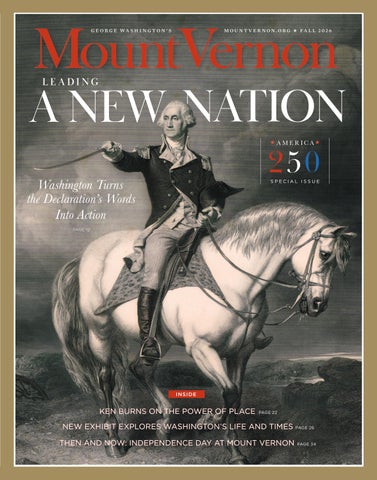
Wielding a sword in one hand and holding a tricorn hat in the other, General George Washington sits on his horse on the battlefield in Trenton. The image reflects a mid-19th–century effort to use Washington as a powerful symbol of national unity and leadership. Engraving by William Holl, after Faed, 1865, Gift of Mr. and Mrs. Robert B. Gibby, 1984, MVLA
FEATURES
★ A MER ICA ★
250
SPECIAL ISSUE
12 | The Man and the Moment
George Washington’s journey from provincial officer to revolutionary leader | By Richard Brookhiser
20 | Timeline of a Revolution In the fall of 1776, the fight for New York
22 | The Power of Place
Historical sites such as Mount Vernon matter, more than ever By Ken Burns
26 | A Revolutionary Life
BUDDY SECOR/MVLA
Behind the scenes at the Education Center’s new exhibition
34 | Celebrating Independence July 4 at Mount Vernon, through the years By Rebecca Baird and Breck Pappas
A new U.S. citizen holds an American flag at a naturalization ceremony at Mount Vernon.
DEPARTMENTS
4 | News VIPs on the grounds, “George Washington” takes on New York City, a new executive director of gardens and landscapes, Mount Vernon gifts a tree to King Charles, new archaeological discoveries, and more
10 | Focus on Philanthropy Physician and philanthropist Mario Molina supports the new Education Center
38 | Washington in the Classroom Pennsylvania teacher Melissa Dowches encourages fifth graders to “think like a historian”
40 | Shows of Support The opening of the new Education Center exhibit, a fundraiser for the restoration of Washington’s 1782 stable, and a Founders Committee reception
44 | Featured Photo In 1876 in Philadelphia, the Centennial Exposition put a re-creation of Washington’s military camp on display
FOLLOW US ON SOCIAL MEDIA FACEBOOK/HISTORICMOUNTVERNON X.COM/MOUNTVERNON INSTAGR AM.COM/MOUNT_VERNON YOUTUBE.COM/MOUNTVERNON TIKTOK.COM/@GWMOUNTVERNON
2 FALL 2026 | THE MOUNT VERNON LADIES’ ASSOCIATION
George Washington’s Mount Vernon estate is owned and maintained in trust for the people of the United States by the Mount Vernon Ladies’ Association of the Union, a private, nonprofit 501(c)(3) organization founded in 1853 by Ann Pamela Cunningham. THE MOUNT VERNON LADIES’ ASSOCIATION Anne Neal Petri, Regent Susan Marshall Townsend, Secretary Catherine Marlette Waddell, Treasurer VICE REGENTS Maribeth Armstrong Borthwick, California Ann Haunschild Bookout, Texas Virginia Dawson Lane, South Carolina Laura Peebles Rutherford, Alabama Susan Marshall Townsend, Delaware Liz Rollins Mauran, Rhode Island Ann Cady Scott, Missouri Sarah Miller Coulson, Pennsylvania Andrea Notman Sahin, Massachusetts Catherine Hamilton Mayton, Arkansas Margaret Hartman Nichols, Maine Helen Herboth Laughery, Wyoming Catherine Marlette Waddell, Illinois Lucia Bosqui Henderson, Virginia Mary Lang Bishop, Oregon Elizabeth Medlin Hale, Georgia Ann Sherrill Pyne, New York Hilary Carter West, District of Columbia Karen McCabe Kirby, New Jersey Adrian MacLean Jay, Tennessee Sarah Seaman Alijani, Colorado Susan Brewster McCarthy, Minnesota Carolyn Sherrill Fuller, North Carolina Deborah Ellen Jessiman, Maryland EXECUTIVE STAFF Douglas Bradburn, PhD, President & CEO Julie Almacy, Vice President, Media & Communications Joe Bondi, Senior Vice President, Development Lindsay M. Chervinsky, PhD, Executive Director, George Washington Presidential Library Adam T. Erby, Executive Director, Historic Preservation & Collections & Martha Washington Chief Curator Joan Flintoft, Vice President, Hospitality Jonathan Kavalier, Lucy S. Rhame Executive Director, Gardens & Landscapes Phil Manno, Chief Financial Officer Cheryl Marling, Chief of Staff Joseph Sliger, Vice President, Operations & Maintenance K. Allison Wickens, Vice President, Education
From the President
E
very July 4 at Mount Vernon, I am reminded that this is indeed “the place of places,” as described in 1874 by Mount Vernon Ladies’ Association founder Ann Pamela Cunningham. Families stroll the serpentine paths, reenactors perform military drills, and, in one of the most moving traditions we host, the country’s newest citizens take the oath of allegiance on the bowling green. Our 2026 celebration reached audiences far beyond the estate, as PBS’s A Capitol Fourth broadcast Mount Vernon’s fireworks live to the entire nation. This year carried even more significance than usual, as the United States marked 250 years since the signing of the Declaration of Independence. For us at Mount Vernon, the signing also represents something else: the moment when George Washington became not just the leader of a revolutionary movement but the central figure of an emerging nation. This special issue of Mount Vernon magazine, themed “A New Nation,” explores that defining moment when a people, and their leader, stepped onto the world stage. Our lead feature, by historian Richard Brookhiser, examines Washington at this turning point, arguing that, while he was not present in Philadelphia to sign the Declaration, he was nonetheless the indispensable figure in bringing its promises to life. It is a story that Mount Vernon tells every day, and one we are especially proud to share in our newly opened Education Center exhibition, George Washington: A Revolutionary Life. In this issue, we take readers behind the scenes of this experience, the result of an extensive rebuild that presents Washington’s life through captivating storytelling. Some viewers may have recognized the exhibition in HBO’s Life, Larry, and the Pursuit of Unhappiness, which includes scenes filmed here at Mount Vernon with former president Barack Obama and actor/ producer Larry David. As this year seemed like the perfect opportunity to flip through the Mount Vernon scrapbook, this issue also features a look back at the evolution of Independence Day celebrations at the estate. A piece from filmmaker Ken Burns reminds us of the importance of place in our national memory.
It is also my pleasure to introduce Jonathan Kavalier, who has joined Mount Vernon as the inaugural Lucy S. Rhame executive director of gardens and landscapes. With deep experience in historic preservation and sustainability, he will help ensure that Mount Vernon’s landscapes continue to thrive as a living part of Washington’s legacy. We look forward to the impact of his leadership. Thanks to so many of you, Mount Vernon demonstrated the best of our country’s past, present, and future on its 250th birthday, and media featuring stories about Mount Vernon reached millions of people. But this is just the beginning. Two hundred and fifty years ago, Washington still needed to secure our independence, just as we all have to work together to carry on our great experiment in self-governance. I look forward to our future together. Warm regards,
Douglas Bradburn President and CEO
GEORGE WASHINGTON’S MOUNT VERNON 3
Mount Vernon News
Former president Barack Obama and comedian Larry David with the crew of the HBO show Life, Larry, and the Pursuit of Unhappiness in Mount Vernon’s new Education Center.
4 FALL 2026 | THE MOUNT VERNON LADIES’ ASSOCIATION
In the Limelight TV comedy series filmed at Mount Vernon
GEORGE WASHINGTON’S MOUNT VERNON 5
COURTESY HBO
S
harp-eyed media viewers may recognize the backdrop in the ads for and the opener of the new HBO series Life, Larry, and the Pursuit of Unhappiness, featuring comedian Larry David. Former president Barack Obama is one of the producers on the sevenepisode show, which consists of comedy sketches exploring various historical moments. The opening and closing scenes, featuring Obama and David, were filmed at Mount Vernon in March inside the new Education Center exhibition, George Washington: A Revolutionary Life (see page 26). Obama and David shot scenes inside the immersive exhibition exploring Washington’s life and legacy. “It was an honor to welcome President Obama and Larry David to Mount Vernon,” said Douglas Bradburn, Mount Vernon’s president and CEO. “History is both fascinating and important, and we hope viewers of the show will be inspired to visit Mount Vernon to gain a deeper understanding of Washington and his relevancy in the ongoing story of the country.” The series premiered in June as part of programming around the U.S. 250th anniversary.★
Mount Vernon News
New Gardens Director Named Jonathan Kavalier to help steward Mount Vernon’s historic living landscape
J
onathan Kavalier joined Mount Vernon earlier this year as the inaugural Lucy S. Rhame executive director of gardens and landscapes, a role focused on the preservation, restoration, and long-term stewardship of the estate’s historic gardens, grounds, and natural resources. His work will support Mount Vernon’s interpretation of Washington as an innovative farmer and land steward, while helping care for the 500-acre estate as a living historic landscape. Kavalier most recently served as director of gardens and grounds at Dumbarton Oaks in Washington, D.C., where he oversaw preservation of the Beatrix Farrand– designed gardens and led major capital and conservation projects. His more than 20 years of experience also includes leadership roles with the Architect of the Capitol and the Smithsonian Institution.
Jonathan Kavalier joins Mount Vernon.
“Mount Vernon’s gardens and landscapes are essential to understanding George Washington’s character and creativity,” said Anne Neal Petri, Regent of the Mount Vernon Ladies’ Association. “We are thrilled to welcome Jonathan, a true expert in historic garden stewardship, whose experience and passion will help us preserve and elevate Mount Vernon’s extraordinary grounds for generations to come.” ★
Tree Fit for a King
D
uring His Majesty King Charles III’s April visit to the United States, U.S. Speaker of the House Mike Johnson presented the monarch with a tulip poplar tree, a cloned graft of a tree that George Washington selected and directed to be planted along the serpentine walks of the bowling green in 1785. The original tree still stands at Mount Vernon today. “It was an honor for Mount Vernon to provide a living gift from Washington’s own landscape,” said Jonathan Kavalier, Mount Vernon’s Lucy S. Rhame executive director of gardens and landscapes. “Few trees connect us so directly to the estate as Washington envisioned and shaped it.” Washington recorded finding “a number of very fine young Poplars” on his estate, and after an initial planting failed, he replanted trees from the same source in November 1785. Two of those trees survived, taking root along the bowling green, where they have stood for more than two centuries. ★ A 19th-century illustration of the tulip poplar.
6 FALL 2026 | THE MOUNT VERNON LADIES’ ASSOCIATION
COURTESY JONATHAN KAVALIER (HEAD SHOT), PUBLIC DOMAIN (TULIP POPLAR)
A royal gift rooted in Washington’s grounds
Expanding Reach Free, downloadable panels highlight Washington’s pioneering agricultural practices
A
new exhibit from Mount Vernon invites libraries, schools, museums, garden clubs, and community organizations to share George Washington’s role as a farmer and agricultural innovator with their audiences. George Washington and a Nation of Farmers, developed in partnership with the Oak Spring Garden Foundation, is a free, downloadable 18-panel display that can be printed and installed indoors or outdoors. “We are thrilled to have partnered with Mount Vernon and the Mount Vernon Ladies’ Association on the creation of this exhibit that invites audiences to reflect on the role that land use plays in our shared cultural story,” said
Sir Peter Crane, president of the Oak Spring Garden Foundation, based in Fauquier County, Virginia. The exhibit examines George Washington’s experiments with crop rotation, soil restoration, diversified planting, and improved farm management, connecting his work at Mount Vernon to broader ideas about land stewardship and the future of the new nation. Guest curator Bruce Ragsdale, PhD, author of Washington at the Plow, helped shape the exhibit’s exploration of Washington’s agricultural legacy. ★ Learn more at mountvernon.org/farmerexhibit.
FIELD TRIP
George Washington Takes Manhattan
ABIGAIL GREENBERG/MVLA (BOTH)
F
or several days in April 2026, George Washington stopped traffic in New York City. With Mount Vernon’s donor-funded Times Square ad encouraging visitors to make the journey to his Virginia home, “Washington” headed into the city to see it for himself and return to places tied to his own New York story. The visit coincided with the 250th anniversary of Washington’s arrival in New York in 1776, where he braced the Continental Army for a British attack. This
“George Washington” checks out the new ad for Mount Vernon in Times Square.
spring, in his buff-and-blue military uniform, he appeared at such sites as Federal Hall, Trinity Church, Bowling Green, and Fraunces Tavern, drawing double takes from pedestrians, tourists, and commuters along the way. The trip also brought Washington to national television. He greeted crowds on the Today show plaza and appeared on Fox & Friends, where anchors spoke with him about Mount Vernon and the country’s 250th anniversary. Social media videos from the visit reached hundreds of thousands of views across Mount Vernon’s digital platforms. ★
GEORGE WASHINGTON’S MOUNT VERNON 7
Mount Vernon News
Hollywood on the Potomac Young Washington screens at Mount Vernon
M
ou nt Ver non hosted a screening of Young Washing ton one week before the film’s nationwide theatrical release on July 3. More than 400 invited guests gathered to see the film, which explores Washington’s formative years. The evening included a red carpet and interviews with film director Jon Erwin and actor William Franklyn-Miller, who portrays George Washington. Guests also viewed artifacts connected to Washington’s early life, including the Braddock sash and letters from his youth. “You are going to learn about a devoted British subject and soldier … turned revolutionary, establishing a new country where people … would advance because of their merit … and not their bloodlines,” said Anne Neal Petri, Regent of the Mount Vernon Ladies’ Association, ahead of the screening. ★ ★
Style Setter
Washington’s wardrobe in hues of red, white, and blue
F
rom April until July, a special exhibition in Mount Vernon’s museum offered a red, white, and blue look at George Washington’s wardrobe, bringing together for the first time in modern history these original garments worn by the first president. “Opportunities to see original Washington clothing are extraordinarily rare,” noted Adam Erby, Mount Vernon’s executive director of historic preservation and collections. The display featured a red wool waistcoat on loan from the New Hampshire Historical Society, along with a white cotton and linen waistcoat with breeches and a blue wool coat from Mount Vernon’s collection. The garments offer a look at Washington’s personal style and public identity. They reflect his belief in “simplicity of dress,” favoring refined tailoring and quality materials over showy decoration. The blue coat, made from cloth woven in the United States, also highlighted his support for early American manufacturing as the young nation worked to establish political, economic, and cultural independence. ★
8 FALL 2026 | THE MOUNT VERNON LADIES’ ASSOCIATION
KAHFI HIDAYAT/MVLA (ACTOR), MVLA (CLOTHING)
William Franklyn-Miller at Mount Vernon.
Washington’s wardrobe.
Notebook French flyover: The Patrouille de France took to the skies above Mount Vernon
on June 22 as part of the U.S. semiquincentennial commemorations. Pocket change: On March 23, Mount Vernon hosted the U.S. Mint for the official launch of the Revolutionary War quarter featuring George Washington. The launch was part of the 2026 Semiquincentennial Circulating Coin Program commemorating the U.S. 250th anniversary. Some 1,500 coins were distributed to guests in attendance. New Education Center: The official opening on June 11 included remarks from MVLA Regent Anne “Dede” Neal Petri; Carly Fiorina, Virginia 250 Commission honorary national chair; and Douglas Bradburn, Mount Vernon president and CEO. Attendees included elected officials, donors, civic leaders, descendants connected to Mount Vernon, educators, and media. Location change: The Patriots Path encampment was relocated to Tomb Road, improving logistics and engagement. ★
Fifth Jaw Harp Unearthed
M
ABIGAIL GREENBERG/MVLA (FLYOVER), MVLA (JAW HARP)
French jets fly over Mount Vernon in U.S. birthday salute.
BY THE NUMBERS
129
19
9
Bottles of special
New fellows at the
Piglets born in summer
Spirit of ’76 bourbon
Washington Presidential
2026 to Mount Vernon’s
sold over the July 4
Library for the 2026–2027
heritage-breed Ossabaw
weekend
academic year
Island sows
ount Vernon archaeologists uncovered a large iron jaw harp while excavating at the south end of the Mansion. The small musical instrument, played by plucking a flexible metal tongue while holding the frame to the mouth, has a long global history and was commonly used in 18thand 19th-century Virginia by both free and enslaved people. The newly discovered harp is the fifth example found at Mount Vernon. It was discovered among domestic debris that had accumulated beneath a porch added to the south end of the Mansion by Bushrod Washington in the early 19th century. The Mount Vernon Ladies’ Association removed the porch in the 1930s. “This exciting discovery helps to highlight that the twangy drone of the jaw harp, and the sounds of other instruments, were still commonplace across the Mount Vernon landscape in the 19th century,” said Lily Carhart, curator of preservation collections.
GEORGE WASHINGTON’S MOUNT VERNON 9
“We will get through this, and I think we will come out on the other side of these growing pains a stronger republic.”
Focus on Philanthropy
Lessons in Leadership A history-loving physician and philanthropist supports the new Education Center
WILFREDO MARTINEZ/MVLA
A
beloved high school teacher sparked Mario Molina’s abiding interest in American history. As an undergrad at California State University, Long Beach, he devoured as many electives on the subject as possible—so much so that he unwittingly tacked on a minor in American Studies to his chemistry degree. But it wasn’t until he visited Washington, D.C., in 1978 that he fully appreciated how integral George Washington was to that history. He recalls touring Mount Vernon with a friend, when they paused on the Mansion’s piazza to take in the sweeping view of the Potomac River and the Maryland shore beyond. The tranquility of the scene made an impression: “Why would Washington leave this place? And yet he went away for years at a time. This was an impressive sacrifice,” he says. “It wasn’t like they were paying him a lot of money. He did this for love of country.” Decades later, Molina—by now an MD and an avid medical history book collector—would reconnect with Mount Vernon when staff reached out to him in their efforts to expand Washington’s library. He and his wife, Therese, visited the estate and have been involved ever since, becoming Washington Cabinet members in 2020. Molina continues to make pilgrimages to the estate on trips east from Southern California, where he and Therese raised five children, and he built a career as a physician and CEO of Molina Healthcare, a Fortune 500 company. Today, he is a trustee of the Huntington Library and sits on several boards, including the University of
Chicago Medical Center and the Rare Book School at the University of Virginia. But he spends much of his time on the philanthropy work of the Molina Family Foundation, one of whose earliest gifts was to help Mount Vernon retell the story of Washington. For his support of the newly opened Education Center, the tableau of Washington’s first inauguration is named for the Molina Family Foundation. The story of the country’s bold first steps as a republic struck a chord with Molina. “I’ve always thought that was very interesting: Washington comes in as the first president, and there’s no book, no manual, no policies, and no procedures on how to be president,” he says. “So, he really set the tone.” The fact that Washington relinquished the office after two terms is especially remarkable, he adds. “It shows you the power of his leadership in shaping the presidency.” Indeed, Washington’s leadership throughout his military career and presidency has inspired Molina in his own professional roles in the healthcare industry, business, and philanthropy. “Washington collected good people around him, and he felt like his job was to help them do their jobs. I think that’s an important part of leadership,” he says. “He brought out the best in people.” Two hundred fifty years later, Washington’s example holds strong, Molina contends. “We’re facing trying times at the moment, but I think the republic will endure,” he says. “We will get through this, and I think we will come out on the other side of these growing pains a stronger republic.” ★
Mario Molina, photographed at the newly opened Education Center, believes education and history are vital to the future of the republic.
GEORGE WASHINGTON’S MOUNT VERNON 11
America 250
MAN
THE AND THE
MOMENT George Washington, who missed signing the Declaration, was indispensable to ensuring the survival of the nation it created By Richard Brookhiser
12
Susan Neely in London last year (opposite), and as a college student and congressional intern visiting Mount Vernon in 1977 (above).
GEORGE WASHINGTON’S MOUNT VERNON 13
GEORGE WASHINGTON AT DORCHESTER HEIGHTS, ATTRIBUTED TO JANE STUART, CIRCA 1850, PURCHASE COURTESY OF THE MOUNT VERNON LICENSING FUND, 2011, MVLA. DECLARATION OF INDEPENDENCE, JULY 4, 1776, U.S. NATIONAL ARCHIVES AND RECORDS ADMINISTRATION
By leading the fight against the British, shaping the Constitution, and serving as the country’s first president, Washington, here depicted at Dorchester Heights, embodied the spirit and ideals of the Declaration of Independence (inset).
PULLING DOWN THE STATUE OF GEORGE III AT BOWLING GREEN, WILLIAM WALCUTT, 19TH CENTURY, LAFAYETTE COLLEGE ART COLLECTION, EASTON, PA, GIFT OF THE MARQUIS FOUNDATION. DRAFTING THE DECLARATION OF INDEPENDENCE, PUBLISHED BY JOHNSON, FRY & CO., AFTER CHAPPEL, MVLA
O
n July 9, 1776, George Washington, stationed in New York City, received a copy of the Declaration of Independence that Congress had ratified in Philadelphia five days earlier. The commander of the American army ordered it read to his troops at six o’clock that evening. Following the reading, a crowd descended on the bowling green at Manhattan’s southern tip and toppled a gilded equestrian statue of George III. Enthusiastic members of that crowd also knocked the crown-shaped finials off the posts of the iron fence that ringed the space; the uncrowned tops on the original fence can still be seen to this day. Washington had been tapped by Congress to serve as commander in chief of the American armed forces a
year earlier. Himself a delegate from Virginia, he knew many of Congress’s important figures. John Adams of Massachusetts had nominated him for this top spot; Thomas Jefferson of Virginia had been a younger colleague in the House of Burgesses (Adams and Jefferson were, respectively, editor and main author of the new Declaration). And during Washington’s first 13 months in the role, he had conducted a successful siege of Boston, compelling the British Army that occupied it to evacuate
14 FALL 2026 | THE MOUNT VERNON LADIES’ ASSOCIATION
After news that the Declaration, which had been drafted in Philadelphia (opposite), had been signed, a mob of New Yorkers, including some of Washington’s troops, toppled the statue of George III on July 9.
once cannons captured in Upstate New York were posted on the Dorchester Heights. He also had watched from afar as Patriot forces defended Charleston, South Carolina, and had tried and failed to conquer Canada. The weight of the British Empire’s military might was now, however, massed against him in New York. Enemy ships had been sailing through the Verrazzano Narrows into the harbor since the end of June. “All London,” wrote an astonished American soldier, seemed “afloat.” The armada unloaded
Enthusiastic members of that crowd also knocked the crownshaped finials off the posts of the iron fence that ringed the space; the uncrowned tops on the original fence can still be seen to this day.
GEORGE WASHINGTON’S MOUNT VERNON 15
VIEW OF THE NARROWS BETWEEN LONG ISLAND & STAATEN ISLAND…12TH JULY 1776, ARCHIBALD ROBERTSON, 1776, NEW YORK PUBLIC LIBRARY. READING THE DECLARATION OF INDEPENDENCE BEFORE WASHINGTON’S ARMY, 1776, HOWARD PYLE, 1862, ALAMY
troops on Staten Island to the south. Where and when they would strike was not known to the Americans, but that they would was certain. Born leader Why had Congress turned to Washington? Although the war had erupted in Massachusetts, John Adams and his cousin Samuel wanted the Virginian commander to make it an all-American effort. Washington had experience, having served as a militia officer two decades earlier in the French and Indian War, combatting French forces in the upper Ohio Valley and checking Native American raids against settlers on the Virginia frontier. His exploits had landed his name in colonial newspapers, which reprinted old articles of Washington’s exploits as the new war loomed. He looked the part of a commander. He was 6'3", athletic and graceful. Jefferson would call him the finest
More important perhaps than all these achievements was his respect for and embodiment of the principles embedded in the Declaration he had received in the summer of 1776.
16 FALL 2026 | THE MOUNT VERNON LADIES’ ASSOCIATION
horseman of the age. Washington had worn his old militia uniform to Congress in 1775 to show that the time for action had come again, and the cut showed him to advantage (he designed his uniforms himself ). When John Adams’s wife Abigail first met him, she wrote an awestruck letter to her husband. “Those lines of Dryden instantly occurd to me. ‘Mark his Majestick fabric! he’s a temple/ Sacred by birth, and built by hands divine/ His Souls the deity that lodges there/ Nor is the pile unworthy of the God.’” (The lines Abigail quoted originally described one of Dryden’s heroines. By transferring them to Washington, she projected herself, and all Patriotic women, into the struggle.) What impressed Abigail Adams was equally impressive to the Patriot soldiers. When Washington and his staff appeared on horseback, “[I]t was not difficult to distinguish him from all others,” wrote army surgeon James Thacher. The first job of a leader is to be seen.
The years showed that Washington also possessed resilience and determination. The expeditionary force the British gathered across New York Harbor in the summer of 1776 struck western Long Island in the fall. From then until the summer of 1778, Washington fought eight battles in three states (New York, New Jersey, and Pennsylvania), losing four, winning three, and ending one in a draw. He was no Alexander the Great, yet at the end of that period the British were back where they had started, in New York. Washington had prevented them from rolling up the Mid-Atlantic states. He had learned not to depend on holding fortified posts, but instead to keep his army both intact and mobile. He had modified his spycraft by using locals who could be agents in place, rather than brave but vulnerable outsiders such as Capt. Nathan Hale. In the midst of an epidemic that would rage over the entire continent, he had inoculated his army against smallpox. After his early
remarks about the uncouthness of New Englanders leaked out, he practiced iron discretion. Once France allied with the United States openly in 1778, turning the revolution into a world war, he found common ground with foreign officers who were not all as agreeable as the young Marquis de Lafayette. And as important as any of these individual accomplishments, he kept going—through conflict and boredom, hurrying up and waiting—ever watchful for the chance to strike a decisive blow, which would not come until October 1781, at Yorktown. Public servant More important perhaps than all these achievements was his respect for and embodiment of the principles embedded in the Declaration he had received in the summer of 1776. After stating that “all men are created equal,” and that they are “endowed by their Creator with certain unalienable rights,” the Declaration describes one
Just days after the Declaration was read to Washington’s troops (opposite), a massive British naval force meant to force the colonies to surrender awaited orders between Long Island and Staten Island.
GEORGE WASHINGTON’S MOUNT VERNON 17
In this 19th-century lithograph, General Washington, depicted at a Revolutionary war camp, dreams of a new nation. Justice, Commerce, and Liberty—symbolized as women—stand beneath 13 stars atop a globe emblazoned with “America.”
18 FALL 2026 | THE MOUNT VERNON LADIES’ ASSOCIATION
WASHINGTON’S DREAM, LOUIS MAURER, 1857, GIFT OF MR. AND MRS. STANLEY DEFOREST SCOTT, 1985, MVLA
of those rights, that of self-rule: “the Right of the People … to institute new Government … organizing its powers” as they thought best. The states—colonies no more—were just such new governments, but for the purposes of war-making and foreign relations, the government of all the states was lodged in Congress. Washington was in continuous touch with the civilian leaders of the states and Congress throughout the war, reporting, advising, requesting. One of his most urgent communications came in January 1781. The Pennsylvania line mutinied on New Year’s Day, demanding pay which had been in arrears for a year—an expenditure that would have to be approved by the states, following a requisition from Congress. Officers and soldiers had been killed early in the mutiny; Washington was afraid the violence would spread. He therefore sent a circular to the state governors on January 5. “It is not within the sphere of my duty to make requisitions, without the Authority of Congress, from individual states,” he wrote. But in such a crisis, he hoped Congress and the states would excuse him “when once for all I give it decidedly as my opinion that it is in vain to think the Army can be kept together” without “spirited measures.” Washington suggested three months’ pay and better clothes and food. “I have transmitted Congress a copy of this Letter, and … requested them to adopt the measure which I have above recommended, or something similar to it, and … I have thought proper to give you this previous notice.” Despite what he saw was the urgency to act, he understood and respected the sphere of his duty: He informed, he offered his opinion, he requested, he proposed an alternative. Here was no military dictator, as Cromwell had been or Napoleon would be. The Marquis de Chastellux, one of the French officers who served alongside Washington, described his modus operandi thus: He “has led the army … and he has obeyed Congress. No more need be said.” Man of honor The Declaration of Independence concludes with a vow that Washington also embodied: “[F]or the support of this Declaration … we mutually pledge to each other our Lives, our Fortunes and our sacred Honor.” From his arrival outside Boston in July 1775 until he
re-occupied New York in November 1783, Washington was with his troops, unless called to consult with Congress (he saw Mount Vernon once, in passing, on the way to Yorktown). He led a charge at the battle of Princeton. At the siege of Yorktown, he declined when a solicitous colonel advised him to step away from an exposed observation post. He was within the range of the enemy’s guns on other occasions. Fate spared him, through no caution of his own. He told Congress that as “no pecuniary consideration” could have tempted him to command the army, he would serve without pay, submitting his expenses only. Although he corresponded regularly with his on-site cousin Lund Washington about the condition of his estate, he willingly deprived it of what the Roman naturalist Pliny the Elder called the best fertilizer—its master’s eye. During the Revolution’s endgame—the long interval between Yorktown and the signing of the Treaty of Paris— Washington got a letter potentially more explosive than the mutiny of the Pennsylvania line. Col. Lewis Nicola, an Irish-born officer who supervised the Invalid Corps, injured vets who performed guard duty, wrote Washington suggesting that the war had shown the incapacity of the republican government; post-war America would need a king, preferably him. Washington rejected the suggestion “with abhorrence,” and gave Nicola three reasons why he should too: “regard for your Country,” “concern for yourself,” and finally, “respect for me.” Nicola had not just offered a bad idea; he had dissed the commander in chief. Washington equated his honor with the cause of the Revolution, and with his country. Not all officers in history thought so. The ancient world offered Alcibiades and Coriolanus, brilliant commanders turned traitors. America offered Benedict Arnold. Washington was not in Philadelphia to sign the Declaration, but he too pledged his sacred honor. The moment made the man. The man rose to the moment. Richard Brookhiser is a senior editor at the National Review. He has written a series of biographies of U.S. founders, including Alexander Hamilton, Gouverneur Morris, and George Washington. His latest is The Hero Returns: Lafayette and the Legacy of Revolution.
GEORGE WASHINGTON’S MOUNT VERNON 19
TIMELINE OF A REVOLUTION
The Fight for New York In the summer and fall of 1776, a crushing defeat on Long Island, a daring midnight escape, failed peace talks, and the struggle to hold Manhattan against the British Army
si xt h in a ser ies of nota ble momen ts from t he war for independence
August 27
At the Battle of Long Island, Howe’s forces overwhelm the Continental Army. American brigadier general Lord Stirling
holds out longer than most before surrendering. Samuel Sutphen, an enslaved man from New Jersey, serving in place of his enslaver with the promise of freedom, fights with the Continental Army.
August 28–29
Under cover of heavy fog, Washington conducts a daring nighttime evacuation.
The Continental Army silently withdraws from the Brooklyn lines and crosses the East River to Manhattan, narrowly escaping capture.
August 31
Washington informs Congress of the successful evacuation and reports that General Howe has requested a meeting with representatives of Congress.
September 6
Inventor David Bushnell attempts to sink the British HMS Eagle for the American side, using the experimental submersible Turtle, the first use of a submarine in combat.
September 11
Benjamin Franklin, John Adams, and Edward Rutledge meet with Admiral Lord Richard Howe, but negotiations collapse.
September 15
Lord Howe tries to negotiate an end to the war with congressional representatives (above right) following the American loss in Long Island. The Americans redeem themselves at the Battle of Harlem Heights (above).
20 FALL 2026 | THE MOUNT VERNON LADIES’ ASSOCIATION
British troops land on Manhattan at Kip’s Bay. A Connecticut militia unit flees, prompting Washington to condemn
BATTLE OF HARLEM, J. R. ARMYTAGE, AFTER CHAPPEL, 1859, GIFT OF MR. AND MRS. ROBERT B. GIBBY, 1984, MVLA. INTERVIEW BETWEEN LORD HOWE & COMMITTEE OF CONGRESS, PUBLISHED BY JOHNSON, FRY & CO., AFTER CHAPPEL, 1800–1910. NEW YORK PUBLIC LIBRARY
★★★
REPRESENTATION DU FEU TERRIBLE A NOUVELLE YORCK, PRINTED BY JACQUES CHEREAU, 1776, PURCHASE, 1997, MVLA. BOOK ILLUSTRATION, BUSHNELL’S AMERICAN TURTLE, HENRY L. ABBOT, 1881, LIBRARY OF CONGRESS
Drawings of the Turtle (below right), the first combat use of a submarine. Days after the British land on Manhattan, a fire ravages New York City (above).
its “disgraceful and dastardly conduct.” The following day, the same unit redeems itself at the Battle of Harlem Heights.
September 15
British officers stop at the estate of merchant Robert Murray near Kip’s Bay. Tradition holds that Mary Lindley Murray entertains them to delay the British, allowing American troops to escape north.
September 24
Washington writes Congress about the difficulties of building a permanent Continental Army and warns that reliance on short-term militia could cost the Americans the war.
October 11–13
Benedict Arnold’s small American fleet fights a losing battle with British forces on
Lake Champlain in the Battle of Valcour Island. Nevertheless, Arnold’s resistance delays a British invasion from Canada.
October 16
Washington begins withdrawing the Continental Army from Manhattan as British forces tighten their hold on New York.
October 26
Benjamin Franklin sails from Philadelphia for France to seek diplomatic recognition and military support.
October 28
At the Battle of White Plains, British and Hessian forces under General Howe force Washington’s army to withdraw, continuing the British advance in the New York Campaign.
September 20
A fire sweeps through New York, destroying much of the city.
GEORGE WASHINGTON’S MOUNT VERNON 21
THE POWER OF PLACE
T
here are places in America where the distance between past and present seems to collapse. At Gettysburg, standing on Little Round Top and imagining the chaos and the courage of battle at a pivotal turning point in the Civil War. And at the Statue of Liberty, where both the possibilities and contradictions of America imbue that tiny island. And you can feel it at Mount Vernon, where the man who
22 FALL 2026 | THE MOUNT VERNON LADIES’ ASSOCIATION
more than any other made the United States possible built a home, wrote lengthy letters about it, and returned to it as if to a fixed point in a world that had turned upside down in revolution. That is the power of place. History is not only something that happened, it is something that happened somewhere. And when we preserve those places—when we walk the grounds, enter the rooms, look out at the same rivers, fields, and horizons—we are reminded that the past is not abstract. It is human. It has a physical quality to it. It is all around us. We live in a time when it is easy to reduce everything to ones and zeros, to think that if we have read something online, we somehow fully know it. But there are things no highlight reel, digital image, or even a book can give us. To stand in a place where history unfolded is to recover scale, proportion, and feeling. You begin to understand that events we now flatten into names and dates were once lived by real people who did not know how the story would turn out. This is why places matter.
ROB CARDILLO/MVLA
Why historical sites like Mount Vernon matter, more than ever By Ken Burns
Meaning within landscape At Mount Vernon, that truth comes into focus with unusual force. George Washington can seem almost too large in our national memory, too familiar to us on currency, in monuments, through schoolbook legend. But Mount Vernon restores something essential. It returns him to human scale, even as it reminds us of his extraordinary significance. You begin to see not only the indispensable leader of the Revolution and the nation’s first president, but also a man bound to a particular landscape, attentive to weather and crops, worried about what was happening at home even while he was carrying the fate of a fragile new nation on his shoulders. Know him, and you begin to understand ourselves. And yet Mount Vernon, like every great historical site, asks more of us than reverence. It asks for curiosity. The most meaningful places where history happened are not shrines to uncomplicated virtue. They are classrooms of complexity and contradiction. At Mount Vernon, we encounter Washington’s discipline, restraint, and humility,
but we also confront the reality that his estate relied on enslaved labor. At Mount Vernon, at Civil War battlefields, at other sites of dispossession and conflict across the continent, we are called not to choose between admiration and judgment, but to hold both. The story of America demands that of us. That is not a weakness of history. That is its strength. A mature people does not preserve places to flatter themselves but to remember more truthfully. And truthful memory is one of the first obligations of citizenship. If we do not know where we have been, we cannot know where we are. More important, we cannot know where we might go. These walls can talk Historic places make that lesson tangible. They anchor us to a spot on the globe. They insist on attention. At a battlefield, you begin to grasp the cost of an idea. At a presidential home, you begin to understand that leadership is exercised by fallible human beings. At a
GEORGE WASHINGTON’S MOUNT VERNON 23
Know thyself That struggle is not over. Perhaps it never will be. But that is all the more reason to visit these places, bring our children to them, stand quietly in them. And listen. Because in the end, these places where history happened are not only about those who came before us. They are about us. They ask what kind of ancestors we intend to be. They remind us that we are the beneficiaries of an inheritance we did not earn, and the stewards of one we will pass on. And if we are wise, we will preserve these places not out of nostalgia, but out of responsibility, so that those who come after—standing where we once stood—may better understand who they are, who we were, and what America still might become. Emmy-winning documentary filmmaker Ken Burns has directed landmark series on the Civil War, jazz, baseball, and national parks. His most recent work is the six-episode The American Revolution, parts of which were filmed around the estate at Mount Vernon.
At the museum, a child looks up at a bust made from a life mask of Washington by the sculptor Jean-Antoine Houdon (above). The Mansion’s New Room (opposite), was a place for entertaining while Washington was alive; following his death, his body lay in state in the room for three days.
24 FALL 2026 | THE MOUNT VERNON LADIES’ ASSOCIATION
KAITLYN PRANGE/MVLA (MUSEUM). GAVIN ASHWORTH/MVLA (NEW ROOM)
preserved landscape, you realize that the land itself holds memory. It has outlasted the generations who fought, suffered, hoped, built, and failed upon it. The land remains, and in its remaining, it teaches. To save a place where an important historical event occurred is not merely to restore old wood, crumbling stone, or a view. It is to defend our collective memory against amnesia. It is to say that these stories, glorious and painful, inspiring and unfinished, still belong to all of us. It is to reject the impoverished idea that progress always means replacement, that the future can only be built by erasing what came before. In fact, the opposite is true. The future depends on remembering truthfully. Mount Vernon embodies that responsibility. It is not only the home of George Washington. It is one of the clearest expressions of a national promise: that the past, cared for faithfully, can still speak to the present. And it does speak, not just about Washington, but about the founding era and the long, messy, unfinished struggle to make real the ideals Americans were bold enough to declare before they knew how, or even whether, they could live up to them.
GEORGE WASHINGTON’S MOUNT VERNON 25
26 FALL 2026 | THE MOUNT VERNON LADIES’ ASSOCIATION
A Revolutionary LIFE
An insider’s tour of the new exhibition at Mount Vernon’s Education Center
In the Education Center’s new exhibit, visitors get a look at the only complete surviving set of Washington’s dentures.
ABIGAIL GREENBERG/MVLA
G
eorge Washington is both a familiar and littleunderstood figure. Mount Vernon’s newly opened exhibition, George Washington: A Revolutionary Life, at once expands on what people know, challenges assumptions, and puts Washington’s thoughts and deeds into historical context. Using the latest research and innovative technology, the 21,000-square-foot exhibit examines Washington’s remarkable life through his leadership, decisions, relationships, and legacies. The layout is practical—comfortably accommodating large groups and serving as the new primary exit from the full estate experience. It also helps to tell the story of Washington through his personal strengths, each of which aligns with a turning point in the young nation’s history. The space is specially designed for middle school–age children who come with their families and on school field trips and form a third of the estate’s one million visitors a year. “We wanted to spark curiosity and sustain the attention of digitally adept young people,” says K. Allison Wickens, vice president for education. “And so we filled the space with large-scale graphics and media, hands-on and digital interactives, and real 18th-century objects.”
GEORGE WASHINGTON’S MOUNT VERNON 27
The exhibit team planned every detail, from (clockwise from left) wax figures depicting key moments in Washington’s life; renderings of individuals who were never painted during their lives based on primary sources and using the latest technology; and hanging friezes projecting a highlight reel for each period of Washington’s life.
28 FALL 2026 | THE MOUNT VERNON LADIES’ ASSOCIATION
The exhibition was eight years in the making and built upon the scholarship of not only Mount Vernon staff, but also dozens of university professors, educators, museum curators, tribal representatives, and members of the League of Descendants of the Enslaved at Mount Vernon. Cutting-edge technology enabled new portraits, such as those of enslaved people, who weren’t painted in their lifetimes. “Digital artists used artificial intelligence to combine data from different sources—including photographs of 19th-century descendants, archival documents, physical family traits, and the expertise of historical clothing scholars—to create compelling portraits of actual people in Washington’s world,” says Wickens. “George Washington is timeless, but we needed to ensure his 18th-century story could be told in a way that resonates with 21st-century visitors,” says Douglas Bradburn, Mount Vernon’s president and CEO, who served as the exhibit’s main scriptwriter. “The way he faced seemingly insurmountable challenges can inform and inspire Americans in facing today’s struggles.”
A ROLE FOR REPRODUCTIONS State-of-the-art cases hold some of the most treasured objects in the nation’s history. But when material is too fragile to exhibit for long periods, reproductions fill the need. “We commissioned one-of-a-kind reproductions of Braddock’s sash, Martha Washington’s wedding gown (below), and the brown coat Washington wore at the first inauguration,” says Wickens. “Creating these genuine works of art took painstaking study of original materials
PHOTOS BY ABIGAIL GREENBERG/MVLA
by tailors, weavers,
Start here The Boeing Great Hall highlights seven moments in Washington’s life that reveal key leadership traits. It’s the jumping-off point to an exploration of Washington as a man, a patriot, and a leader. “You can choose to travel chronologically or let your interests guide you,” says Wickens. “Look up at the ceiling at the hanging friezes for a highlight reel for each era of Washington’s life. And look down on the floor and follow the compass floor medallions and the pillars.”
Washington’s many worlds The young surveyor, the Revolutionary War general, the entrepreneurial farmer, the first president of the United States. All lived within the political, cultural, and economic environment of the 18th century. This exhibition highlights not only Washington’s contributions during a period of tumultuous change but also those of the people in his orbit. “Take time to examine the portraits of these men and women who influenced and were influenced by Washington,” says Wickens. To bring the human
Floor medallions help guide visitors.
element of Washington’s leadership to the forefront, curators gathered 18th-century paintings or, when nonexistent, created renderings backed by primary sources, oral histories, and portraits of blood relatives.
beaders, and seamstresses skilled in 18th-century techniques.”
Be a fly on the wall You can eavesdrop on some of the political debates in the president’s house in Philadelphia. Or listen to the unspoken hopes and lamentations of people in a cabin where enslaved couple Agnes and Sambo Anderson lived. Or see visuals accompanying the journaled words of a teenaged Washington as he explored the western mountains. “It’s like being a fly on the wall,” says Wickens of the immersive new media pieces designed
GEORGE WASHINGTON’S MOUNT VERNON 29
to make the visitor feel like an active participant in history. “While animated by imagined sights and sounds, each scene is anchored by historical research and artifacts in nearby display cases.” Read the fine print The new exhibit at Mount Vernon holds authentic historical copies of the nation’s founding documents. Four custom, climate-controlled cases hold key papers, rotated every six months due to their fragility. From the Declaration of Independence, written while Washington was fighting for its ideals; to the U.S. Constitution, created under his leadership; to a document expressing Washington’s commitment to religious freedom, as well as others in Washington’s hand. “Together they illustrate George Washington’s centrality to the founding of the country,” says Wickens. “They are also critical to understanding the importance of the country’s ideals and institutions today.”
67+ years of history spanned
12 recently discovered cherry bottles
9 galleries
215 18th-century objects displayed
22 state-of-the-art custom display cases
48 portraits of Washington
360+ images throughout the exhibit
Revisit the classics Like a movie sequel that contains references to the original for its fans, so too has Mount Vernon brought back features beloved by visitors to the original 2006 exhibition. Many of those visitors now have children of their own with whom they can relive memories and create new ones. The wax figures of George Washington at three different ages return with refreshed surroundings. “Grown kids will be happy to know they can still get snowed upon in the 4D Revolutionary War Theater,” says Wickens. “And Washington’s dentures—always the most requested item—are back.”
PHOTOS BY ABIGAIL GREENBERG/MVLA
Follow the signs Bright yellow panels throughout the exhibit offer active learning
BY THE NUMBERS
opportunities, especially for young explorers. “Each one surfaces an interesting insight or makes a connection that prompts conversation,” notes Wickens. “The larger yellow panels call out important parts of Washington’s life that are sometimes overlooked, such as his use of spies, relations with Native American nations, and challenges making decisions about slavery.”
30 FALL 2026 | THE MOUNT VERNON LADIES’ ASSOCIATION
Scenes from a life: Exhibit highlights include (clockwise from left) Washington at Valley Forge; a copy of his famous Farewell Address; his Revolutionary War camp bed; projected happenings at his Philadelphia house during his presidency; and his inauguration.
GEORGE WASHINGTON’S MOUNT VERNON 31
1
3
4
2
32 FALL 2026 | THE MOUNT VERNON LADIES’ ASSOCIATION
5
MATERIAL
T
Memory
hroughout the new A Revolutionary Life exhibit, visitors can view original objects owned or handled by Washington or a member of the estate at Mount Vernon. “Viewed up close, these one-of-a-kind items get visitors as close as they can get to Washington’s world without traveling back in time,” says Allison Wickens, Mount Vernon’s vice president for education.
6
1. Seat of Power
that Washington used it while
Washington purchased this
commanding his army.
swiveling “Uncommon Chair” from New York cabinetmaker
5. Soldier’s Blade
Thomas Burling and used it
Washington likely carried this
throughout his presidency.
smallsword during the French and Indian War; its fashionable
2. Fruitful Find
fluted hilt was popular among
Buried in the Mansion cellar
colonial Virginia officers.
between 1758 and 1775, this glass bottle preserved cherries
6. More Than a Trinket
and reveals 18th-century food
A glass bead, discovered by
storage practices.
staff archaeologists, may have been used by an enslaved per-
3. Mapping the Frontier
son for personal adornment, as
As a young surveyor, Washing-
decoration of an item, or as part
ton used his compass to record
of a spiritual tradition.
bearings, map land, and define property boundaries.
7. Nothing to Smile About Made for Washington during his
4. Telescopic Tool
7
presidency, these spring-
This spyglass was passed
loaded dentures limited his
to Martha Washington’s
ability to speak and altered his
granddaughter, who noted
appearance in portraits.
1: THOMAS BURLING, 1790, PURCHASE 1905, PHOTO BY MARK FINKENSTAEDT/MVLA. 2: GEORGE BROWN/MVLA. 3: 1750-1800, GIFT OF JUDGE CHARLES BURGESS BALL, 1876, PHOTO BY AMANDA ISAAC/MVLA. 4: DOLLOND, 18TH CENTURY, ACQUIRED THROUGH THE GENEROSITY OF DANIEL TEDFORD HIBMA OF MICHIGAN IN HONOR OF HIS ANCESTOR CAPTAIN JOHN TEDFORD, ROCKBRIDGE COUNTY VIRGINIA MILITIA, PHOTO BY JILLIAN BARTO, KARL KNAUER, DIANA WELSH/MVLA. 5: JOHN CARMAN, 1753-1754, GIFT OF MRS. HILARY HERBERT, VICE REGENT FOR ALABAMA, 1884, PHOTO BY MARK FINKESTAEDT/MVLA. 6: GEORGE BROWN/MVLA. 7: PURCHASE, 1949, PHOTO BY GAVIN ASHWORTH/MVLA
ON DISPLAY
GEORGE WASHINGTON’S MOUNT VERNON 33
CELEBRATING INDEPENDENCE How Mount Vernon marks July 4, the most American of holidays By Rebecca Baird and Breck Pappas
are sources of inspiration and reflec-
historical sites from the
tion on this most American of holidays.
nation’s founding years, Mount
Washington in red, white, and blue bunting and placed potted plants around the exterior, but did not
Vernon has long been an unforgettable
The Early Years
plan any formal events or fireworks.
setting to mark Independence Day.
Independence Day commemorations
For decades, the installation of the
The earliest July 4 commemorations
at Mount Vernon before 1975 were
“usual decorations” was the sole
were marked with only flags, flowering
typically modest affairs. While
distinguishing acknowledgment of
plants, and larger-than-usual crowds;
Washington was alive and in residence,
the holiday.
the estate’s observance of U.S. inde-
he usually attended small parties or
One notable exception was the
pendence grew and evolved through
orations nearby, or celebrated upriver,
year 1918 when, in the midst of World
the years into the day packed with
in Alexandria. For the U.S. centennial
War I, President Woodrow Wilson
activities and fireworks we now recog-
year in 1876, the Mount Vernon Ladies’
attended a July 4 event at Mount
nize. But one thing remains unchanged:
Association prepared for increased
Vernon hailed as a “festival of loyalty
George Washington and Mount Vernon
attendance and draped the Tomb of
to America and the cause of the Allies.” Delegates from 33 nations came together for the commemoration, and the crowd of about 20,000 remains one of the largest gather-
PARTY POOPER During the 1820s through the 1850s, it was popular entertainment, especially on July 4, to travel down the Potomac on steamers for a visit to Mount Vernon to pay respects and enjoy a picnic. In his 2007 book, Fourth of July Encyclopedia, author James R. Heintze writes, “So many visitors [came] that Bushrod Washington announced on July 4, 1822, that the unruliness of the crowds prompted him to issue a notice that large groups arriving by steam boat and engaging in ‘eating, drinking, and dancing parties’ on the grounds would be prohibited.” Nevertheless, a few years later, in 1826, he put another notice in the paper saying that despite his earlier complaints, large parties were still arriving, and he now intended “to sue the commanders of those Steam boats, in which parties may hereafter be conveyed to Mount Vernon.”
ings recorded at the estate. Wilson gave a speech, and famous tenor and naturalized citizen John McCormack sang “The Star-Spangled Banner,” accompanied by a Steinway grand piano hidden in the trees. In 1961, the Army’s Third Infantry Drill Corps asked Mount Vernon to host its skills exhibition—known as “Pageant for Patriots”—on July 4. The event was so popular it became an annual ceremony. More theatrics were added in later years, with skits by staff and local community members, a carriage drawn by white
34 FALL 2026 | THE MOUNT VERNON LADIES’ ASSOCIATION
WOODROW WILSON, JULY 4, 1918, BAIN NEWS SERVICE, MVLA. POSTCARD, MVLA. WOMAN WITH FLAG AND CHARACTER INTERPRETER, JOHN A. MCCREARY/MVLA. BICENTENNIAL EPHEMERA, MVLA. NATURALIZATION CEREMONY, APRIL 23, 1966, MVLA. BOTTLE ILLUSTRATION, NOUN PROJECT/ROMAN
O
ne of the most well-preserved
Clockwise from top: President Woodrow Wilson with foreign-born U.S. citizens at Washington’s Tomb; a vintage Independence Day postcard, circa 1909; a character interpreter at the estate; the first naturalization ceremony held at Mount Vernon in 1966; a souvenir card from the U.S. Bicentennial; a woman holds an American flag at a naturalization ceremony at Mount Vernon in 2024.
horses carrying a George Washington
2009, they have been a part of every
character interpreter, and performanc-
Independence Day at Mount Vernon,
the Mansion with U.S. President Gerald
es by a fife and drum corps.
excluding 2020 (due to COVID-19
Ford, French President Valéry Giscard
restrictions). Notable speakers have
d’Estaing, and the MVLA Regent Eliza-
Naturalization Ceremonies
included high-ranking government
beth Cooke. Stories of Washington and other founders were brought to life
which included a ceremony in front of
For new citizens, the naturalization
officials such as Janet Yellen, Treasury
ceremony is often one of the most
secretary, in 2022, and celebrities such
through lights, a dramatic score, and a
significant moments in their lives. Even
as Arnold Schwarzenegger, in 2025.
narrative recorded by actors Gregory
of the rights and responsibilities of
The Bicentennial
Olivia de Havilland. Mount Vernon
being an American. Mount Vernon
On July 10, 1974, the MVLA Regent
ran the show every night, weather
has welcomed more than 2,000 new
Elizabeth Cooke visited the White
permitting, throughout the summer of
Americans through these joyful cer-
House for the formal presentation
1976 and extended it into the summer
emonies, and they are now a favorite
of a son et lumière (sound and light)
of 1977.
for witnesses, the event is a reminder
Peck, John Wayne, Kirk Douglas, and
staple in the estate’s annual obser-
production by the French ambassador
vances; some, though not all, have
Jacques Kosciusco-Morizet. Pioneered
The Semiquincentennial
been held on July 4.
by the French, such productions were a
In recent years, “An American Cele-
relatively new nighttime entertainment
bration,” sponsored by Boeing, has
concept featuring synchronized light-
become one of the most anticipated
Mills Godwin, Jr., and Supreme Court
ing effects, narration, and music. The
July 4 celebrations in the Washington,
justice Hugo Black officiated as 215
show—to be staged at Mount Vernon—
D.C., region. The day unfolds with
individuals took the oath of allegiance
was the official “Bicentennial gift of the
daytime fireworks over the Potomac,
to become new U.S. citizens. Twelve
French nation to the United States.”
military reenactments, 18th-century
The first one held at Mount Vernon was in April 1966. Virginia governor
years later, a larger ceremony was held
Mount Vernon’s bicentennial sound
games, and character interpretations.
for Constitution Day; some 400 peti-
and light spectacle, titled “The Father
A naturalization ceremony on the bowl-
tioners became Americans, witnessed
of Liberty,” debuted on May 19, 1976.
ing green, set against the backdrop of
by a crowd of a thousand.
Despite installation and logistical
Washington’s Mansion, remains one of
The ceremonies became an annual
hurdles, it was a resounding success.
the day’s most meaningful moments,
fixture starting in the mid-1990s. Since
Hundreds attended the premiere,
as America’s newest citizens take the
36 FALL 2026 | THE MOUNT VERNON LADIES’ ASSOCIATION
FRENCH PRESIDENT D’ESTAING PRESENTS THE SOUND AND LIGHT PROGRAM TO PRESIDENT FORD AND MRS. COOKE, MAY 19, 1976, THE GAZETTE STAFF, MVLA; BIRTHDAY CAKE SERVED ON JULY 4, 1997; FIREWORKS DISPLAY, 2026, KAYT JONSSON/MVLA. FIREWORKS ILLUSTRATION: NOUN PROJECT/RAHMAT DWI CAHYO
French President D’Estaing, standing beside U.S. President Ford, presents the sound and light program to the MVLA Regent Elizabeth Cooke in 1976 (opposite far left). An Independence Day–themed cake was served in 1997 (opposite left). The fireworks for the 250th anniversary (above).
oath and formally join the nation’s story. As Mount Vernon has grown as a destination, so too has its Fourth of
FIRE LOOKOUT At every fireworks show, members of Mount Vernon’s Fire Department are always stationed on or near the Mansion, sometimes on the roof. “It’s part of the mission to safeguard George Washington’s historic home,” says Joe Sliger, Mount Vernon’s fire chief and vice president of operations and maintenance. While the fireworks are set off at a safe distance—from a barge 500 feet into the Potomac River—Sliger explains that keeping a close watch on the Mansion is vital. “If there is a breeze in the wrong direction, it’s possible that firework remnants could drift towards the Mansion and outbuildings.” Sliger was “the guy on the roof” for about 35 years, but he’s now handed off that responsibility. Assisting is a small fire team on the river shore, as well as a crew in the historic area and a fire truck on the South Lane (south of the Mansion).
July. For the 2026 celebration, held on the nation’s 250th birthday, more than 10,000 visitors braved soaring temperatures to experience a restored Mansion and a newly opened Education Center telling a fuller story of Washington’s life. The celebration reached a national audience on July 3, when “A Capitol Fourth” broadcast Mount Vernon’s nighttime fireworks live on PBS as Loren Allred delivered a stunning performance of “God Bless America.” Rebecca Baird is Mount Vernon’s archivist. Breck Pappas is Mount Vernon’s content creator.
GEORGE WASHINGTON’S MOUNT VERNON 37
Washington in the Classroom
Learning Through Discovery A Pennsylvania teacher encourages fifth graders to “think like a historian”
M
elissa Dowches teaches fifth grade at Spring Garden Elementary in Bethlehem, Pennsylvania. As the lead ambassador for the George Washington Teacher Institute 250 (GWTI 250) for the Northeast, she’s the liaison between Mount Vernon and the other ambassadors who support teachers in their region with professional development and resources.
SABRINA EVANGELISTA / SNAPPR
How do you incorporate George Washington and Mount Vernon into your teaching? George Washington was such a versatile person that I have incorporated aspects of his life into a variety of disciplines. We study Washington as commander of the Continental Army at length during the American Revolution unit in social studies. However, my favorite way to incorporate his legacy is in teaching character education and leadership. I use a resource from Mount Vernon called “Character Chronicles,” which are short, newspaperstyle articles centered on a character trait, such as humility. Each article shares several stories, derived from primary sources, that capture Washington’s demonstration of each trait. Students are easily able to connect to these traits and understand why they are still important qualities of leaders today. How do you make 18th-century events resonate with students? To engage 10- and 11-year-olds in learning, I encourage them to think critically, or in other words, to “think like a historian.” This encourages them to learn about history through their own observations
38 FALL 2026 | THE MOUNT VERNON LADIES’ ASSOCIATION
Melissa Dowches at Spring Garden Elementary, in Bethlehem, Pennsylvania.
and interpretations and through engaging in collaborative conversations with their peers. Using high-interest texts, engaging videos and songs, and investigative learning strategies makes American history come alive for students, even 250 years later. Any special lessons around the country’s 250th birthday? For most of my students, this is their first experience learning about the Declaration and its content, so I deconstruct it into small sections for groups of students to interpret, analyze, and rewrite in their own words. For the Semiquincentennial, I add another dimension by encouraging students to include words, phrases, and ideas in their rewriting that they perceive to be the principles on which this country was founded, and that we still live by today. This is a great opportunity for young students—the future leaders of the country—to consider if we are living by the pledges of the founders. In addition, we will be assembling time capsules to be opened in 2076, the Tricentennial of the U.S. Has Mount Vernon influenced how and what you teach? My teaching methods have transformed since I began working with Mount Vernon and GWTI. Instead of teaching the Revolution as a story, I encourage and facilitate learning through discovery. I provide primary and secondary sources for students to analyze, paired with critical thinking routines that allow them to interpret, question, and draw conclusions. Rather than telling them what happened, they discover it for themselves as they learn about the multitude of perspectives from the time period. I strive to include perspectives of marginalized groups of people involved in the American Revolution, including Indigenous tribes, enslaved people, and women. Students learn that there isn’t just one story, but many, surrounding the events that founded the country. ★
GEORGE WASHINGTON’S MOUNT VERNON 39
Shows of Support
Celebrated Opening Donors and contributors gather at the new Education Center exhibit
Guests enjoy the reception in the Boeing Great Hall (top). Andrea Notman Sahin, Vice Regent for Massachusetts, joins in a celebratory huzzah (above).
40 FALL 2026 | THE MOUNT VERNON LADIES’ ASSOCIATION
The Gift to the Nation Gala will be held on Saturday, October 17. Tickets are available at mountvernon.org/gala.
STEPHEN BOBB (LOWER LEFT, OPPOSITE UPPER AND LOWER RIGHT) AND WILL MARTINEZ (REMAINING)
M
ount Vernon continued its Gift to the Nation events with the opening of the new Education Center exhibit, George Washington: A Revolutionary Life, on April 19. The event celebrated the generosity and expertise of those who brought the ambitious exhibit to life. More than 300 contributors to the exhibit were among the first to experience the breadth and depth of George Washington’s mind and character as presented in the new installation. Guests enjoyed drinks and hors d’oeuvres as they mingled in the Great Hall. Anne Neal Petri, Regent, welcomed attendees, and Mount Vernon’s Douglas Bradburn, president and CEO, provided remarks. The full MVLA Board attended and expressed thanks to all those whose work and creativity contributed to the exhibit, as well as those who donated to make it possible. The Boeing Great Hall now serves as the estate’s primary exit path, through which all of Mount Vernon’s nearly one million annual visitors—including 350,000 students—will pass. Visitors will have the opportunity to view the highlights of George Washington’s life, including seven featured leadership traits. They will also see authentic historical copies of the country’s founding documents, such as a broadside of the Declaration of Independence printed in 1776. Presented through Strengthening Our Foundations: The Campaign for Mount Vernon, the series of Gift to the Nation events throughout 2026 celebrates the 250th anniversary of the United States and includes reveals of the completed projects of the campaign. ★
Life Guard member Kate Quiggle and her husband Jim try the cannon interactive (below). Life Guard member Ellen Boer with Mary Bishop, Vice Regent for Oregon; Liz Mauran, Vice Regent for Rhode Island; Deborah Jessiman, Vice Regent for Maryland; and Ann Scott, Vice Regent for Missouri (right).
Members of the Life Guard Society of Mount Vernon in the gallery they sponsored (left). Standing beside a rendering of Tanacharison, an influential Seneca leader and ally of George Washington, is Elmer John (below), a historical reenactor and member of the Seneca Nation, who contributed to the development of the portrait.
TACTILE LEAR NING SPACE Families with children of all ages should check out the Sanda and Jeremiah Lambert Hands-on-History Center, which officially opened on July 2. It has been redesigned as a family learning space with activities targeted to youth ages 12 and younger.
GEORGE WASHINGTON’S MOUNT VERNON 41
Shows of Support
Founders Committee reception supports refurnishing of Mansion’s small dining room
O
n June 7, more than 200 attendees gathered on the Mansion’s east lawn overlooking the Potomac River for the Founders Committee’s spring reception in support of the refurnishing of the Mansion’s small dining room. The event raised more than $700,000—a record. As part of ongoing celebrations of the nation’s 250th anniversary, the evening honored George Washington’s enduring legacy and the stewardship that keeps his home and history vibrant for future generations. This year, Host Committee sponsors at the top three tiers were invited to a pre-reception tour of the lower garden, a presentation in the kitchen, and a rare opportunity to walk inside the small dining room for a brief talk from Adam Erby, executive director of historic preservation and collections.
Clockwise from top left: A talk in the small dining room; Founders Committee member Kathleen Patterson with Henrietta Burke; Founders Committee chair Valerie Burden introduces a skit by “George and Martha Washington”; Founders Committee member Ellen Boer, Pamela and Jeff Graham, and Junia Doan, with the Mansion’s piazza behind them.
42 FALL 2026 | THE MOUNT VERNON LADIES’ ASSOCIATION
At the main reception, guests enjoyed cocktails, a dinner buffet, and music as they learned more about the furnishings. Character interpreters portraying George and Martha Washington made a surprise appearance to promote the estate’s Adventure Maps and the pressed pennies children earn for completing them; the maps and pennies are funded by the Founders Committee. Proceeds from the reception supported the restoration to its 1799 appearance of one of Mount Vernon’s most significant interiors, drawing on new research from the Fairfax Account Book (records of accounts between George Washington and George William Fairfax), which includes information on the furniture George Washington purchased in 1774, and recent curatorial discoveries. This effort will reintroduce the brilliant verdigris-colored walls, crimson upholstery, and London-made furnishings originally acquired by the Washingtons, as well as accurate reproductions of the prints and frames hung in the space. The room will come back to life as the Washingtons knew it—deepening authenticity, advancing scholarship, and enriching the visitor experience. ★
DAN CHUNG /MVLA
Furniture Refresh
Equine Appeal Events raise awareness and money for the restoration of Washington’s 1782 stable
A
STEPHEN BOBB/MVLA
n avid and accomplished horseman, George Washington was described by Thomas Jefferson as “the best horseman of his age, and the most graceful figure that could be seen on horseback.” Mount Vernon is planning a comprehensive restoration of Washington’s original 1782 stable, located south of the Mansion. It remains one of the estate’s most significant original structures. Recent research has uncovered new insights into its history, including the discovery of a long-lost companion shed stable, which will be reconstructed. To introduce this compelling project to new supporters, Washington Cabinet member Jacqueline B. Mars welcomed more than 80 guests to her Meredyth Pavilion in The Plains, Virginia, on May 31. Guests were welcomed by Deborah Jessiman, MD, Vice Regent for Maryland, and learned more about George Washington as a horseman and his stable through remarks from Douglas Bradburn, president and CEO. Mars closed the program speaking of the importance of horses in American history and encouraged attendees to join her in supporting the restoration of Washington’s stable. Several items were on display, including the 1774–1777 daybook of Philadelphia carriage maker William Tod, George Washington’s riding crop and hunting horn, and 18th-century horseshoes found archaeologically at Mount Vernon. At a previous event on March 2, more than 75 guests learned about the stable project at an event hosted by Amy Roberts Ebeling at Tierra Contenta in Wellington, Florida. The evening generated considerable interest. Learn more at mountvernon.org/stable ★
Mount Vernon’s Douglas Bradburn addresses guests at the Meredyth Farm Pavilion (above). Jacqueline Mars speaks about her love of horses and the stable restoration project (below).
Hilary Carter West and Gail West, Vice Regent and Vice Regent Emerita for the District of Columbia; Anne “Dede” Neal Petri, Regent; and Deborah Jessiman, Vice Regent for Maryland (above left). Brady Stroyke, Mount Vernon's director of collections management, shows Trevor Potter George Washington’s riding crop (above center). Martha Dippell, Geoffrey Baker, Kathryn Baker, and Danny Korengold (above right).
GEORGE WASHINGTON’S MOUNT VERNON 43
Featured Photo
100 Years Later
C
oinciding with the 100th anniversary of the U.S. Declaration of Independence, the Centennial Exposition in Philadelphia’s Fairmount Park was the first world’s fair to take place in the United States. More than nine million visitors attended between May 10 and November 10, 1876. The event featured technological innovations, including the telephone and the typewriter, and an exchange of ideas among 37 participating countries, from Mexico to France to Egypt to Japan. President Ulysses S. Grant attended the opening. A dozen years after the end of the Civil War and in the midst of rapid industrialization, the Exposition took place during an era of renewed
44 FALL 2026 | THE MOUNT VERNON LADIES’ ASSOCIATION
interest in the colonial and founding years. One prominent display, located in the U.S. Government Building and draped in American flags, featured colonial- and Revolutionary-era relics honoring the nation’s founders. Among the items were George Washington’s uniform, a camp set, and his Revolutionary War tent from 1777. The arrangement re-created Washington’s military headquarters, paying tribute to his contributions and showcasing the preservation of his legacy. (Check out the new exhibit in the Education Center to view some of these items today, or see p. 31.) The display was captured in stereoscopic, or 3D, views by the Centennial Photographic Company. ★
PURCHASED BY THE A. ALFRED TAUBMAN FUND, 2010, MVLA
In 1876 in Philadelphia, the Centennial Exposition put a re-creation of Washington’s military camp on display
An EvEning At Mount vErnon
gift to thE nAtion gAlA
Saturday, October 17, 2026 6 o’clock in the Evening Black Tie | Valet Parking
CoME CElEbrAtE Restoring the Mansion
Securing Washington’s Legacy Carrying his Vision Forward
thE MAnsion Doors ArE opEn!
mountvernon.org/gala
P.O. Box 110, Mount Vernon, Virginia 22121
... the Congress have judged it necessary to dissolve the Connection between Great Britain and the American Colonies, and to declare them free & independent States; as you will perceive by the enclosed Declaration, which I am directed to transmit to you, and to request you will have it proclaimed at the Head of the Army in the Way, you shall think most proper. —John Hancock to George Washington 6 July 1776
★