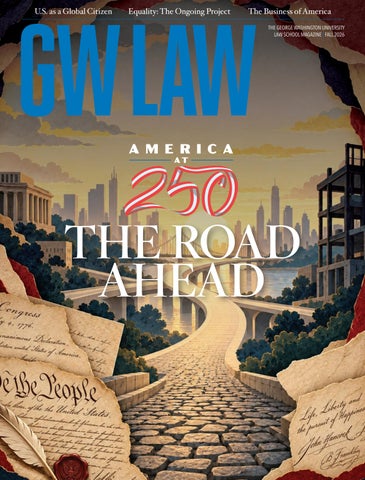
U.S. as a Global Citizen
Equality: The Ongoing Project
The Business of America THE GEORGE WASHINGTON UNIVERSITY LAW SCHOOL MAGAZINE | FALL 2026
THE ROAD AHEAD
12 Resilience and Reinvention: The Road Ahead As the U.S. celebrates its 250th birthday, GW Law’s preeminent constitutional law scholars reflect on the strength of the American experiment and the challenges that will define the country’s next chapter.
18 The United States as a Global Citizen GW Law faculty experts in international and foreign relations law take a close look at how international law has shaped the nation over the past 250 years, and how the nation has shaped international law in return.
24 Equality: The Ongoing Project America’s semiquincentennial stands as both a celebration of progress and a reckoning with unfinished work. Our professors share perspectives on how far the nation has come in fulfilling the democratic ideal that ‘all are created equal’ and the challenges that remain.
30 The Business of America GW Law’s nationally renowned business and finance law professors provide insights on the country’s evolution over 250 years into a global economic powerhouse and the challenges and opportunities that will shape its economic future.
a magazine for alumni and friends EDITOR IN CHIEF: Jamie L. Freedman, MA ‘96 CONTRIBUTING WRITERS: Mary A. Dempsey Sarah Kellogg Libby Stanford Greg Varner DEAN AND HAROLD H. GREENE PROFESSOR OF LAW: Dayna Bowen Matthew DIRECTOR OF STRATEGIC COMMUNICATIONS AND MARKETING: Rachel Hamrick DESIGN & PRODUCTION: Moiré Marketing Partners
contents FALL 2026
2 A MESSAGE FROM THE DEAN
CONTRIBUTING PHOTOGRAPHERS: Joy Asiko William Atkins Abdul El-Tayef Anna Falcione RJ Paulk Florence Shen
GW LAW magazine was awarded the MarCom Platinum award from the Association of Marketing & Communication Professionals. GW LAW MAGAZINE IS PUBLISHED BY: The George Washington University Law School 2000 H Street, N.W. Washington, D.C. 20052 202-994-6288 magazine@law.gwu.edu
COVER ILLUSTRATION BY ERIN PAIGE
PLEASE SEND CHANGE OF ADDRESS NOTICES TO: 2000 H Street Burns 203 Washington, D.C. 20052 or alumni@law.gwu.edu
3 LAW BRIEFS
36 CLASS NOTES
44 ALUMNI BOOKSHELF
45 20TH & H
GW Law magazine is mailed free of charge to GW Law alumni and friends of the university. Opinions expressed in these pages are those of the individuals and do not necessarily reflect official positions of the university. The George Washington University is an equal opportunity/affirmative action institution.
© 2026 The George Washington University FALL 2026 | www.law.gwu.edu
1
A MESSAGE FROM THE DEAN
AMERICA AT 250
DEAR FRIENDS OF GW LAW,
WE HAVE THE PRIVILEGE TO TRAIN THE NEXT GENERATION OF LAWYERS WHO WILL GIVE MEANING TO OUR NATION’S ASPIRATIONS TO PROTECT THE PURSUIT OF LIFE, LIBERTY, FREEDOM, AND EQUALITY FOR ALL.
I AM PROUD TO PRESENT THIS SPECIAL “AMERICA AT 250” EDITION OF GW Law magazine. America’s semiquincentennial is more than a celebration of longevity. It is a perfect moment to reflect as a community on the strength of the American experiment while looking ahead to the challenges that will define our nation’s next chapter. Many of the forces reshaping American life—from artificial intelligence, biotechnology, and cryptocurrency to shifting workplace and familial paradigms to the opportunities and challenges of governing a truly pluralist society—pose questions the nation’s founders could never have imagined. We have the privilege to train the next generation of lawyers who will give meaning to our nation’s aspirations to protect the pursuit of life, liberty, freedom, and equality for all. No law school in the nation exceeds the breadth of talent and expertise of our faculty who are up to this task and are featured in this issue of GW Law magazine. Within these pages, GW Law faculty experts across the disciplines take an expansive look at how law has adapted to the ever-changing landscape of U.S. history, and how emerging challenges will shape the next chapter of the American experiment. In our insightful cover story, GW Law’s stunning array of constitutional law scholars shed light on how national institutions designed in the 1700s are adapting to the profound scientific, technological, and social transformations of 21st century society. Our next feature, “The American Playbook: The U.S. as a Global Citizen,” turns to our faculty experts in international and foreign relations law who take a close look at how international law has shaped the nation over the past 250 years, and how the nation has shaped international law in return. “Equality: The Ongoing Project” examines the democratic ideal that ‘all are created equal,’ highlighting both the progress made and the challenges that remain in achieving true racial and gender equality in the United States. Our final feature story, “The Business of America: From Protest to Powerhouse,” casts a bright spotlight on the profound economic evolution that has occurred over the past 250 years and invites readers to consider how the relationship between citizens, markets, and government may continue to advance in response to new challenges and opportunities. Enjoy the magazine, and please keep in touch! I extend my very best wishes to each of you as we enter the final months of this semiquincentennial year. I hope to see you at one of our many upcoming alumni events on campus and across the country.
SINCERELY,
DAYNA BOWEN MATTHEW Dean and Harold H. Greene Professor of Law
2
GW LAW | FALL 2026
law briefs What’s on the Docket for the October Term?
From left, Chris Geidner, Robert L. Glicksman, Robert J. Cottrol, Renée Lettow Lerner, and Alan B. Morrison discuss pending Supreme Court cases.
AS THE U.S. SUPREME COURT justices prepared to return to the bench for the October 2026 term, GW Law hosted its popular Supreme Court Preview, an annual Constitution Day tradition at the law school. A panel of GW Law faculty experts moderated by award-winning Supreme Court journalist Chris Geidner of LawDork gathered in the Jacob Burns Moot Court Room on Sept. 22 to discuss a wide range of consequential cases scheduled for argument this term. Questions ranged from whether felony defendants in all 50 states are guaranteed 12-member juries to whether assault weapons are protected by the Second Amendment. GW Law faculty participants included Robert J. Cottrol, Harold Paul Green Research Professor of Law; Robert L. Glicksman, J.B. and Maurice C. Shapiro Professor of Environmental Law; Renée Lettow Lerner, Donald Phillip Rothschild Research Professor; and Alan B. Morrison, professorial lecturer in law.
Glicksman began with a discussion of Suncor Energy v. County Commissioners of Boulder County, an environmental law case stemming from a fire in Boulder County, Colo., in 2021, which burned 6,000 acres of land and destroyed about 1,000 homes. The county brought suit to be reimbursed for the costs incurred on the theory that the wildfire was made more likely and more severe because of climate change caused by fossil fuel products. “In addition,” Glicksman said, “Boulder County is arguing that the oil companies committed fraud. The theory is that the companies knew decades ago that their products when consumed generate greenhouse gases that would contribute to climate change. They knew what the adverse effects of climate change were likely to be, and they actively suppressed information so that it wouldn’t be made public.” The energy company argues that Boulder’s ability to recover damages is preempted for various reasons by federal law. “It’s hard to predict how the court’s going to
come out,” Glicksman said, adding, “This court has not been a friend of environmental law, to say the least.” Geidner expressed concern about the so-called shadow docket, which allows cases to be brought before SCOTUS on an emergency basis. The shadow docket has been criticized for its acceleration of normal legal processes and its lack of transparency. In a recent example, the court allowed the Trump administration to go forward with construction of a ballroom at the White House. Some justices have signaled that they’re uncomfortable with the frequent use of the shadow docket. “The problem,” Geidner said, “is that things are happening so quick, on an abbreviated schedule, without argument in most cases, and they’re happening before parties… who would file amicus briefs have time to really develop their arguments.” The result, he added, is that “things are happening that just shouldn’t be happening.” Cottrol discussed two Second Amendment cases, including Viramontes v. Cook County, which asks if an individual’s right to own semiautomatic rifles is constitutionally protected. He began by drawing attention to the peculiar fact that the Second Amendment, though ratified by the states in 1791, wasn’t the subject of much court action until more than 200 years later. “Basically, the Second Amendment goes on for two centuries without any really definitive definition of what it means,” Cottrol said. “The 21st century becomes the century of the Supreme Court looking at the Second Amendment and engaging in Second Amendment activism.” The reigning doctrine of the Second Amendment comes from the 2022 case of New York State Rifle and Pistol Association v. Bruen, which introduced a new test for gun regulation. “Typically, before Bruen, the court has used various kinds of balancing tests, looking at the right allegedly infringed and the interest of the government-aligned entity that is supposedly infringing the right,” Cottrol said. “With Bruen, Justice Thomas announced a new methodology, which is to look at the history of firearms regulation, particularly as it existed at the time of the enactment of the Second Amendment to see if a particular regulation is consistent with that history.” – continued on page 4 FALL 2026 | www.law.gwu.edu
3
law briefs – continued from page 3
FCC Commissioner Wins Belva Lockwood Award
FCC Commissioner Anna Gomez (second from left), celebrates her 2026 Belva Lockwood Award with GW Law Dean Dayna Bowen Matthew (far left), Associate Dean Rosa Celorio, (second from right), and student hosts.
ANNA M. GOMEZ, JD ’92, A COMMISsioner of the Federal Communications Commission, has received the 2026 Belva Ann Lockwood Award for her work to advance communications policy in the United States. The award, presented during a February luncheon at GW Law, recognizes alumnae who have made an impact through the law. “Commissioner Gomez embodies the spirit behind the Belva Ann Lockwood Award. Throughout her legal career, she has advanced communications law and policy, pushing the FCC into the future and serving as a national leader in communications law and policy,” said GW Law Dean Dayna Bowen Matthew. Gomez became an FCC commissioner in 2023, bringing more three decades of public and private sector experience to the position. Her experience includes high-impact initiatives at the U.S. Department of State and at the National Telecommunications and Information Administration, where she oversaw the 4
GW LAW | FALL 2026
transition to digital television and work related to the creation of a broadband network for first responders. “I am very thankful for this recognition,” Gomez said. “Mrs. Lockwood pushed our profession to a higher standard and broke through dogged barriers, opening a way for future generations of female attorneys. All of us benefit from the courage and support of the powerful women who came before us. It is an honor to receive an award that embodies those principles.” The Belva Ann Lockwood Award is named for the women’s rights advocate who, in 1873, became the first woman to graduate with a legal degree from National University, which later became the George Washington University. Six years after her graduation, Lockwood became the first woman to argue before the U.S. Supreme Court. The award presentation is hosted by the GW Law Belva Lockwood Society, the Law Association for Women, and the GW Law Office of Advancement.
One of the best indications of what the framers thought about military weapons, Cottrol said, was that they required them in the National Firearms Act of 1792, mandating that every white man own a rifle and a bayonet. The idea that military-grade weapons are outside of the protection of the Second Amendment contradicts the amendment’s actual purpose to ensure a citizen militia. Renée Lettow Lerner offered remarks on Kian v. Florida, a case asking if felony defendants are guaranteed a 12-member jury under the Sixth Amendment. While most states have such criminal juries, there are six states that do not. A landmark SCOTUS ruling in 1970 in Williams v. Florida held that the Sixth Amendment does not require 12 members on a jury. But if the court rules in favor of Kian, many cases would have to be retried. “In the good old days of the common law, there were lots of incentives for jurors to find unanimity quickly,” Lerner said. “First of all, a lot of jurors were repeat players. They sat on more than one jury. They sat quite a bit, so they were very familiar with the justice system. There were property requirements to serve on a jury. So, these were people who knew each other. That makes it easier to achieve unanimity.” There was no voir dire process to vet potential jurors, Lerner added, and judges frequently commented on evidence to juries. Most strikingly, she said, jurors were not allowed food, drink, heat or light from the time they were sworn in until the time they gave their verdicts. “It’s great to have 12-person unanimous juries but look what the common law had to do to make that efficient. And if you don’t do it, you get hung juries,” Lerner said. “In the end, what you get is fewer juries because there will be even more intense pressure for prosecutors to offer plea deals and more pressure for defendants to accept them.” The panel concluded with a questionand-answer period after Morrison briefly discussed a pending voter registration case, Republican National Committee v. Mi Familia Vota, asking whether Arizona state voting requirements clash with federal requirements. The case will not be argued until December, after the upcoming midterm elections, Morrison said, but could have a major impact moving forward.
SCHENCK RECEIVES LIFETIME SERVICE AWARD LISA SCHENCK, ASSOCIATE DEAN for National Security, Cybersecurity, and Foreign Relations Law, has received the Robinson O. Everett Distinguished Life Service Award from the Judge Advocates Association ( JAA). The award—the association’s highest honor—recognizes her lifetime of dedicated service to military and veterans law. “I have been inspired throughout my career by the dedication of so many judge advocates and colleagues who have worked tirelessly to advance military justice, national security law, and the rule of law,” Schenck said at the May 7 award ceremony. “I am grateful to the JAA for its vital role in supporting our community, and I remain committed to preparing the next generation of leaders in national security, cybersecurity, and foreign relations law at GW Law.” With Faculty Co-Directors Ed Swaine and Laura Dickinson, Schenck leads the premier National Security, Cybersecurity, and Foreign Relations Program in the country. In 2025, Cybersecurity Guide ranked GW Law’s program No. 1
Lisa Schenck
among LLM cybersecurity and national security programs. “There is no one more deserving of the Judge Advocates Association’s Robinson O. Everett Award than Dean Schenck,” said
GW Law Dean Dayna Bowen Matthew. “Her leadership, dedication, and mentorship have shaped the careers of countless GW Law alumni, and her work to advance military law is truly awe inspiring.” Before joining GW Law, Schenck served 25 years in the U.S. Army. She began her military career as a signal corps officer before becoming a judge, lawyer, and educator in the Judge Advocate General’s Corps. In 2021, she was appointed honorary colonel of the Army Judge Advocate General’s Corps Regiment, a position she still holds. Schenck was the first woman to serve as a senior judge on the U.S. Army Court of Criminal Appeals, concurrently serving as an associate judge—and then chief judge—on the U.S. Court of Military Commission Review. After her army retirement, she became a senior adviser to the Defense Task Force on Sexual Assault in the Military Services. The Judge Advocates Association previously awarded her the Outstanding Career Armed Services Attorney Award (Army).
SOLOVE NAMED AMONG ‘MOST INFLUENTIAL LEADERS IN CYBER INCIDENT RESPONSE’ GW LAW PROFESSOR DANIEL SOLOVE was named one of the 2026 “Most Influential Leaders in Cyber Incident Response” by BreachRx, a cyber incident response management platform. Solove, the Eugene L. and Barbara A. Bernard professor of intellectual property and technology law and faculty co-director of the GW Center for Law & Technology: The Bernard Center, was one of two people named in the “Incident Response Master of the Storm” section of BreachRx’s Rex awards. The award category “honors those whose legal, regulatory, and policy work helps organizations make sound, defensible decisions during complex data breach and cyber crisis scenarios,” according to Breach Rx. BreachRx cited Solove’s research on privacy, which “has become foundational reference material for regulators and incident response practitioners, shaping how the legal community frames
data breach response before, during, and after incidents,” according to the awards announcement. “I’m really honored to win this award and be recognized for my work on privacy and security,” Solove said. Solove is arguably the nation’s leading expert on privacy law. His scholarship is among the most downloaded legal scholarship on the Social Science Research Network (SSRN). Last year, he surpassed 500,000 total downloads on the platform, making him the second law professor in history to do so. In total, his scholarship has been cited in some 5,000 publications. A prolific author, his most recent books include On Privacy and Technology (Oxford University Press 2025) and Breached! Why Data Security Law Fails and How to Improve It (Oxford 2022) with Woodrow Hartzog. His work has been excerpted in many casebooks and discussed in many judicial opinions,
Daniel Solove
including those by the U.S. Supreme Court, federal courts of appeal, district courts, and state supreme courts. FALL 2026 | www.law.gwu.edu
5
law briefs CONFRONTING EMERGING TECHNOLOGIES
Speights Concludes Tenure as GW Board Chair
Grace Speights applauds graduates at Commencement during her tenure as chair of the GW Board of Trustees
GRACE SPEIGHTS, JD ’82, HAS concluded her service on the GW Board of Trustees after leading the board through some of the university’s most defining moments, including the COVID-19 pandemic. “Throughout her service as board chair, Grace has led with courage, integrity, and a deep belief in GW’s mission and the well-being of our community,” said GW President Ellen Granberg. “She has been a steady and trusted presence during some of the most consequential moments in the university’s history, and it has been my privilege to count her as not just as a trusted partner and mentor but as a friend.” Speights, an award-winning attorney at Morgan Lewis, ended her 13-year board service—seven of it as chair—on June 1. During that time, she was instrumental in advancing a new strategic framework and in marking the elevation of GW’s research 6
GW LAW | FALL 2026
reputation through admission to the Association of American Universities. Under her watch, the board also launched trustee working groups and task forces on environmental, social, and governance priorities; took action to remove fossil fuels from the endowment; renamed the student center; and introduced a new athletic team moniker. Speights assumed the chair’s role in 2019. Nine months later, the COVID-19 pandemic brought unprecedented challenges to higher education. GW worked to continue offering a world-class education while keeping students, faculty, and other members of the GW community safe. “When you think about the pandemic— who had ever gone through a pandemic before? But we didn’t panic. The whole university mobilized, and we got through that,” Speights said. Speights was on the board as the university opened dialogue related to the murder
THE MULTIRACIAL DEMOCRACY PROJECT (MDP) at GW Law has launched an Emerging Technologies Initiative with Dhanaraj Thakur, a leader in research on advanced human rights and civil liberties online, as its inaugural director. The initiative, unveiled in January, is focused on ensuring that technological advancement aligns with civil rights protections and strengthens multiracial democracy. It expands MDP’s work at the intersection of artificial intelligence, civil rights, and democracy and is anchored by the belief that AI will not be neutral without safeguards. As part of this initiative, MDP has partnered with the Jacob Burns Community Legal Clinics’ Civil and Human Rights Law Clinic to advance research on the civil rights implications of AI. GW Professor
of George Floyd, and she has been praised for strengthening the voices of faculty, staff, and students at the university. “Grace Speights has been one of the most influential, dedicated, and successful GW Law graduates in our school’s history,” said GW Law Dean Dayna Bowen Matthew. “Her impeccable national reputation as an attorney is exceeded only by her selfless generosity—giving her time, talent, and treasure to her university, her law school, and her profession. We congratulate and thank Chair Speights for a job exceedingly and inspiringly well done!” The board’s new chair, GW Law graduate Mark Chichester, BBA ’90, JD ’93, served as Speights’ vice chair. He praised her integrity and ability to navigate complicated landscapes. “She knows the room, she knows her fellow trustees, and she’s just very adroit at making sure that the perspectives and viewpoints that need to come to the table and be discussed, debated, and argued at times, get to the table,” Chichester said. “And out of that, we’re just a better governing body. We’ve got a very healthy governing culture, and I attribute much of that to Grace’s leadership.”
of Law Arturo Carrillo and Thakur, a former research director at the Center for Democracy and Technology, lead the collaboration to develop a civil rights assessment framework for legislation on the state level, which is where most AI policymaking is unfolding. The initiative builds on the longstanding leadership of MDP’s founder and faculty director GW Law Professor Spencer Overton, whose scholarship and public engagement have shaped national conversations on technology, race, and democracy. Through recent work such as “Overcoming Racial Harms to Democracy from Artificial Intelligence,” “Analyzing the Benefits of Artificial Intelligence to Racially Inclusive Democracy,” and “Ethnonationalism by Algorithm,” Overton has deepened understanding on how AI can impact democratic systems. As artificial intelligence continues to transform core institutions, MDP is developing actionable research, informing policy, and equipping civil rights
GW Law Professor Spencer Overton (left) and fellow panelists at the Antidiscrimination Law and AI Convening at Stanford Law School
organizations with the tools needed to navigate the technological landscape. On March 12 and 13, MDP co-hosted the Antidiscrimination Law and AI Convening at Stanford Law School, in partnership with the Stanford Center for Racial Justice and the Charles Hamilton Houston Institute for Race and Justice at Harvard Law School. The gathering brought together scholars, technologists,
civil rights advocates, and policymakers to discuss how antidiscrimination law must evolve in response to the rise of AI. Overton delivered both the opening and closing remarks, and Thakur co-facilitated a session at the convening, while Carrillo, MDP Executive Director Lisa Bornstein, and GW Law student Victoriana Smith all presented as part of the MDP program.
INTEREST IN ACTIVISM FUELS PRODIGY’S STUDIES JIVAN RAMESH BEGINS HIS SECOND year at GW Law this fall. He is only 17. “I knew I wanted to go to law school because I was getting very involved in activism,” Ramesh said, “and if you become a lawyer, you can get things done through the judicial system and through the legislative system.” The young law student received his undergraduate degree in biochemistry and music from Stony Brook University in New York at age 16. Then, with an almost perfect LSAT score, he moved with his parents to Fairfax, Va., so he could begin studies at GW Law in 2025. Beyond the required classes in constitutional law and criminal law during his first year at GW Law, Ramesh did pro bono legal research for the Mid-Atlantic Innocence Project. In the summer, he interned at the Federal Maritime Commission’s Office of Administrative Law Judges. For the upcoming academic year, he will serve as editor-in-chief of the GW Criminal Law Brief.
“My pro bono work, together with my criminal law class, really inspired me to think about how the criminal justice system is failing at times, and how it can be remedied,” he said. Ramesh is also involved in campus life, serving as deputy pro tempore in the Student Government Association and as treasurer of various student organizations. Though noticeably younger than his peers, he described GW Law as welcoming. “My years as an undergraduate felt weird,” he said. “But I guess because GW Law has so many students of widely ranging ages, people find my age less of a surprise. It’s a little bit less shocking when someone is quite a bit younger, because there are also people who are quite a bit older in the same class. I’ve been able to be quite involved in the community and make some friends. It’s been a great environment.” Music is one of Ramesh’s great interests. He began composing music and playing the cello at age 3. He also plays piano and the guzheng, the Chinese zither. Ramesh
Jivan Ramesh
has sung with the Metropolitan Opera Children’s Chorus, and his compositions have been performed by professional orchestras and in national venues. Of the prodigy’s many accomplishments, he said he is most proud of the Presidential Lifetime Volunteer Service Award he received in 2022 after logging more than 4,000 hours of community service. FALL 2026 | www.law.gwu.edu
7
law briefs TILLIPMAN TESTIFIES ON CAPITOL HILL SHAPIRO SYMPOSIUM
Shaping the Future of Both Energy and Environmental Law
From left, Panelists Karim Marshall, attorney at the Consumer Federation of America; Georgetown University Law Center Professor Sara Colangelo; University of Richmond Law Professor Danielle Stokes, and GW Law Professor Emily Hammond at the 2026 Shapiro Symposium
THE SPEED OF ECOLOGICAL, TECHnological, economic, and legal advances were in the spotlight when nearly 300 energy and environmental law experts joined GW Law students and faculty for the J.B. and Maurice C. Shapiro Environmental Law Symposium. Participants at the “Adapting to Paradigm Shifts in Environmental and Energy Law in the United States” symposium examined how markets, justice, and governance are shaping the future of environmental protection and energy development. The annual gathering, a signature event for GW Law’s Energy and Environmental Law program, brings together leading scholars, practitioners, and policymakers in environmental and energy law to discuss pressing challenges affecting the field. GW Law Dean Dayna Bowen Matthew opened the event. In the keynote speech, environmental justice activist Charles Lee called for resilience and hope, emphasizing practical paths forward for environmental justice. Lee is a former senior policy advisor at the U.S. Environmental Protection Agency. Professor Caroline Cecot, 8
GW LAW | FALL 2026
meanwhile, spoke of climate science and economic analysis being stronger and clearer than ever, even as political divisions have grown. Cecot is the Oswald Symister Colclough Dean’s Research Professor of Law at GW. Panel discussions addressed market mechanisms for resource sustainability, environmental and climate justice shifts in U.S. energy law, changes in U.S. environmental law, and international progress on climate action in light of the U.S. withdrawal from multilateral efforts. There was also a discussion on how criminal law could use tools like fraud, antitrust, and reckless endangerment to advance accountability. Participants on one panel responded in real time to the U.S. Supreme Court’s decision blocking tariffs in Learning Resources Inc. v. Trump, which was published just minutes after the panel began. Freda H. Alverson Professor of Law Sara C. Bronin provided closing remarks on the first day of the symposium, while J. B. and Maurice C. Shapiro Professor of Environmental Law Robert Glicksman closed the second day.
GW LAW ASSOCIATE DEAN OF Government Procurement Law Studies Jessica Tillipman testified before the U.S. Congress Joint Economic Committee at a hearing titled “Protecting Patients and Taxpayers: Combating Healthcare Fraud and Leakage to Strengthen Program Integrity.” During the June 24 hearing, Tillipman, who is also the Government Contracts Advisory Council Distinguished Professorial Lecturer in Law, provided expert testimony on the institutional and legal foundations of healthcare program integrity. Drawing on her experience in government procurement, anti-corruption, and compliance, she urged Congress to fund and sustain often-overlooked preventive work: verification before payment, independent oversight, information sharing, and implementation of recommendations already on the record. “The work that prevents and detects fraud rarely makes headlines, but it is the work that makes fraud enforcement
HEALTH LAW ROUNDTABLE
EXPANDING HEALTH REIMBURSEMENT BENEFITS THE FUTURE OF THE INDIVIDUAL Coverage Health Reimbursement Arrangement (ICHRA), an employerfunded health benefit, was the focus of a May 28 roundtable convened by the Health Law and Policy Program at GW Law. Academics, policymakers, think tank leaders, employers, and insurance industry representatives took part in the discussion, which looked at efforts to expand the use of ICHRAs or similar devices through which employers provide tax-free funds for employees to purchase plans compliant with the Affordable Care Act. Alexander Hamilton Professor of Law Barak Richman, who co-directs the Health Law and Policy Program, provided the welcome remarks at the event. In his
FRANKS RECEIVES NAACP AWARD
Jessica Tillipman
possible,” she said. “We don’t need a new idea. We need to fund and prioritize this critical work and protect the people who do it.” The June hearing was the second expert testimony Tillipman provided to Congress this year. In February, she testified on Medicare and Medicaid fraud during a hearing in the U.S. House of Representatives Committee on Energy and Commerce, Subcommittee on Oversight and Investigations.
MARY ANNE FRANKS, THE EUGENE L. and Barbara A. Bernard Professor in Intellectual Property, Technology, and Civil Rights Law, has received the 2026 NAACP Archewell Digital Civil Rights Award for her policy and advocacy work to combat online abuse and gender-based harassment. Franks is the author of Fearless Speech: Breaking Free from the First Amendment and president of the Cyber Civil Rights Initiative. She received the Archewell Philanthropies honor at the NAACP’s Feb. 28 Image Awards event. Archewell Philanthropies is the umbrella organization for the charitable work of Prince Harry, the Duke of Sussex, and his wife Meghan, the Duchess of Sussex. In a congratulatory video to Franks, Prince Harry called her groundbreaking work “genuinely inspiring.” He also said her book asks an important question: “When powerful people and powerful platforms claim to champion free speech, whose freedom are they actually protecting?” the prince said. “Dr. Franks makes the case,
From left, Panelists GW Law Professor Barak Richman, Melanie Egorin, Katie Keith, Jason Levitis, Ellen Montz, and Randy Pate at the ICHRA Roundtable
keynote address, Mark Bertolini, CEO of Oscar Health, underscored the potential of consumer-driven health insurance products to drive down health care costs. ICHRA adoption has been growing, particularly among small and mid-size
employers. Roundtable participants largely agreed that more data and analysis among large employers are needed to understand whether ICHRAs can be effective at scale. They also acknowledged that the success of ICHRA hinges on a
Mary Anne Franks
and I think she’s right, that true free speech should serve democracy, not the interests of those who would dismantle it.” The Duchess of Sussex called the GW Law professor “a fearless woman at the forefront of the modern civil rights movement.”
robust and consistent individual health insurance market. The U.S. market is currently undergoing shifts that threaten its stability. “We brought these multiple perspectives together to see if there are common areas of agreement to make healthcare more accessible and affordable,” Richman said. “As academics, we have the capacity to facilitate conversation between divergent perspectives and use empirical research to guide decision making. This is what universities are supposed to do.” The roundtable is among several recent events hosted by the Health Law and Policy Program. In the fall, the program held a symposium on the Inflation Reduction Act’s drug pricing provisions and to celebrate the anniversary of Medicare Part D. In early May, the program brought together attorneys, physicians, policymakers, advocates, and private equity investors to discuss the challenges and opportunities in private equity ownership of physician practices. FALL 2026 | www.law.gwu.edu
9
law briefs
GW Law Wins Inaugural Holloran Award
GW Law 1L students proudly display their new Inns of Court t-shirts at the Fall 2025 orientation.
GW LAW HAS BEEN NAMED THE first recipient of the Holloran Center Professional Identity Formation Signature Program Award, recognizing the excellence of the law school’s Fundamentals of Lawyering, Inns of Court, and Foundations of Practice programs. Working in tandem, these 1L professional formation programs equip GW Law students with the tools, knowledge, and experiences needed to excel as law students and practicing lawyers. “The Fundamentals of Lawyering, Inns of Court, and Foundations of Practice programs are the signature programs that distinguish the GW Law experience,” said Dean Dayna Bowen Matthew. “Through these three programs, GW Law students enter the workforce ready to make an impact on the law. I’m proud of our 1L programs for receiving this exciting award.” Professor Erika Pont, acting co-director of the Fundamentals of Lawyering program, 10
GW LAW | FALL 2026
said learning to be a lawyer “is not just about understanding legal doctrine, but about developing the judgment and professional habits that lawyers rely on in practice.” She said GW Law students are taught to work as lawyers do, making analytical choices and taking responsibility for the advice they give to clients. “That kind of foundation is especially important as the profession changes, including with the growing role of artificial intelligence, because the tools lawyers use may evolve, but the need for sound judgment, ethical decision-making, and client-centered lawyering does not,” she added. Through the Inns of Court program, students receive a combination of support, skills training, and career development starting with their first week at GW Law. The Foundations of Practice, meanwhile, is a voluntary professional development program that encourages students to take
advantage of resources that supplement their classroom education. The program guides students through the transition from law student to self-directed lawyer. GW Law’s Inns of Court and Foundations of Practice programs received the 2018 E. Smythe Gambrell Professionalism Award from the American Bar Association (ABA) Standing Committee on Professionalism. In addition to honoring the school at the April 25 Holloran Center Conference and Law Journal Symposium at St. Thomas University, the Holloran Center awarded GW Associate Professor of Fundamentals of Lawyering Katya Cronin with the Neil Hamilton Professional Identity Emerging Scholar Award for her article “ValueCentered Lawyering: Reshaping the Law School Curriculum to Promote Well-Being, Quality Representation, and a Thriving Legal Field.” The paper, published in the University of Detroit-Mercy Law Review in 2024, looks at the causes of diminished health, wellbeing, and professional dedication among lawyers—as well as how law schools might combat those challenges.
GWNY REUNION CELEBRATES A DECADE OF SUCCESS JUST AHEAD OF ITS 10TH ANNIversary, GW Law in New York (GWNY) held its first reunion, bringing together more than 50 GWNY alumni who participated in the program since its inception in 2017. The June 12 reunion enabled past GWNY participants to share their experiences and connect with one another. GW Law is the only non-New York law school to offer students a semester studying and interning in New York City. Since its launch, GWNY has welcomed 194 GW Law students to the once-in-acareer experience for students and sealed GW Law’s commitment to train exceptional business lawyers able to excel in the New York business law market. “The reunion celebrated GWNY’s continued growth and reinforced the deep connections students make during their semester in New York City,” said
SOLOW-NIEDERMAN RECEIVES MULTIPLE AWARDS THE GEORGE WASHINGTON University Office of the Vice Provost for Research has presented GW Law Professor Alicia Solow-Niederman with an award that recognizes faculty who are emerging as rising stars in their fields. The Early Career Research Award acknowledges Solow-Niederman’s scholarship at the intersection of law and technology, where she focuses on governance and emerging technologies. Her latest Stanford Law Review article, “AI and Doctrinal Collapse,” looks at how information privacy law and copyright law are responding to the rapidly evolving demands of artificial intelligence. “Becoming a law professor is not easy. Over the years, I have had many sleepless nights and moments of doubt as I wondered about my path,” Solow-Niederman said. “I know that I cannot rely on external metrics to measure my worth. At the same time, receiving this award helps to affirm that I’m making the right choices, and that my
Professor of Practice for Business and Finance Law Jeffrey Kohn, JD ’84, who coordinates the GWNY program. “GWNY alumni will often share how rewarding the New York semester has been for them. “Students in GWNY enjoy many opportunities to network with the New York legal community, develop a close bond with their classmates during the semester, and stay connected with each other and with the New York legal community after completing the program,” he added. “Some will say that GWNY has launched or shaped their careers.” The celebration included GWNY faculty, among them Louis Harkey Mayo Research Professor of Law Dalia Tsuk Mitchell, Associate Dean and Professor of Law Jeffrey Manns, and Assistant Dean for Business and Finance Law Michael Rand. Also present at the reunion were leading New York business lawyers who teach in the GWNY program, including banking law expert Wendy Goldberg, JD ’00; mergers and acquisitions practitioner Joseph Chan, JD ’94; and securities regulation expert Istvan Hajdu, LLM ’03.
BECOMING A LAW PROFESSOR IS NOT EASY. OVER THE YEARS, I HAVE HAD MANY SLEEPLESS NIGHTS AND MOMENTS OF DOUBT AS I WONDERED ABOUT MY PATH. – Alicia Solow-Niederman
Alicia Solow-Niederman
work is making an impact. I am humbled and honored.” The GW award spotlights promising researchers and scholars who earned a terminal degree within the past 10 years. Earlier this year, “AI and Doctrinal
Collapse” received a Scholarly Paper Competition Honorable Mention Award at the American Association of Law School’s annual meeting. Solow-Niederman also won a Privacy Papers for Policy Makers (PPPM) Award from the Future of Privacy Forum.
GW Law Dean Dayna Bowen Matthew (second from left), Professor Jeffrey Kohn (fourth from left), and GWNY alumni at the 10th anniversary reunion
Each semester, top New York City law firms host GWNY classes or workshops for students in the program. Students are also paired with GWNY mentors. As many as 20 students participate each semester.
“This experience offers prospective students … a chance to have their cake and eat it too by getting exposure to both the DC and NY legal markets,” said Manns. FALL 2026 | www.law.gwu.edu
11
12
GW LAW | FALL 2026
RESILIENCE AND REINVENTION
THE ROAD AHEAD T
WO HUNDRED AND FIFTY YEARS AFTER THE DECLARATION OF INDEPENDENCE, the United States finds itself confronting a paradox familiar throughout its history. The constitutional
system that has carried the nation through wars, economic upheavals, social movements, and technological revolutions has proved remarkably durable. Yet many of the forces now reshaping American life—from artificial intelligence and biotechnology to political polarization and shifting notions about work, family, and individual rights—pose questions the nation’s founders could scarcely have imagined. America has never been defined by stability alone. Its history is one of continual reinvention, as each generation has wrestled with how to preserve enduring principles while adapting to profound social, economic, and technological change. At every turning point, the country’s greatest challenge has been the same: how to remain faithful to its constitutional ideals while governing a society that never stops evolving. “At 250, America stands in a familiar yet unprecedented place,” said Dean Dayna Bowen Matthew, the Harold H. Greene Professor of Law. “It is confident in
the durability of its institutions, but uncertain about the forces reshaping its future. This anniversary is more than a celebration of longevity. It is a moment to reflect on the strength of the American experiment and the challenges that will define its next chapter.” The semiquincentennial offers more than an opportunity to celebrate the nation’s endurance. It invites a deeper examination of the American experiment itself. Can institutions designed in the 18th century continue to guide a 21st-century society and respond to today’s provocations?
BY SARAH KELLOGG ILLUSTRATION BY ERIN PAIGE
FALL 2026 | www.law.gwu.edu
13
Peter J. Smith
The issues facing the country are wide-ranging, but they are united by a common thread: law remains the framework through which Americans negotiate change. –Peter J. Smith
14
GW LAW | FALL 2026
The continuing tension—between permanence and adaptation, stability and change—provides the foundation for the conversations that follow, as GW Law’s distinguished constitutional scholars examine how America’s founding principles have persisted, how its institutions have adapted, and how emerging challenges will shape the next chapter of the American experiment. The issues facing the country are wide-ranging, but they are united by a common thread: law remains the framework through which Americans negotiate change, noted Peter J. Smith, the Arthur Selwyn Miller Research Professor. Whether confronting advances in artificial intelligence, emerging reproductive technologies, evolving workplaces, or deep political divisions, each new challenge ultimately becomes a question of governance, constitutional design, and democratic values. The nation’s future, Smith suggests, will depend not only on the durability of its institutions but also on their capacity to evolve without losing public trust. America has survived not because it has remained static, but because it has repeatedly adapted to new technologies, new economic realities, and new understandings of liberty and equality while preserving the principles at its core.
FRAGILE SUCCESS OF THE AMERICAN REPUBLIC AS THE UNITED STATES EXPERIENCES THIS MILEstone birthday, it may be less of a victory lap than a reminder of the republic’s fragility. Two and a half centuries of survival offer no guarantee of permanence. The American experiment has lasted longer than many expected, but longevity can breed its own complacency. “It’s a dangerous conceit to assume that because we have been here for 250 years, that we are assured to have another 250 years as a republic,” said constitutional scholar Jonathan Turley, J.B. and Maurice C. Shapiro Professor of Public Interest Law. The tension between resilience and fragility sits at the center of the current political and cultural moment. Drawing from his book Rage in the Republic, Turley situates today’s political climate within a longer historical arc, one in which democratic systems are never static achievements but ongoing experiments. “Every democratic system holds within it the seeds of its own destruction,” he explained, pointing to the founders’ awareness that popular government could devolve into instability or even tyranny if left unchecked. History does offer an equally compelling counterpoint, notes Matthew. If the republic has endured for 250 years, it is not because the nation has avoided division or escaped moments of profound uncertainty. Rather, the American experiment has repeatedly demonstrated an extraordinary capacity for self-correction. Each generation has tested the strength of the nation’s founding principles, and, more often than not, renewed them. “The story of America is not that it has avoided breaking points,” said Matthew. “It is that, time and again, it has found a way to bend without breaking. Every generation has inherited an unfinished republic, and every generation has left it more capable of meeting the next challenge.” Turley acknowledges that the American solution devised by the founders was remarkably resilient: a Constitution designed not to accelerate democratic impulses, but to temper them. Comparing the
American and French Revolutions, he notes that while both emerged from similar Enlightenment ideals, only one avoided descending into violence. That historical caution resonates today, a period marked by polarization, technological disruption, and economic uncertainty. What matters is not the presence of anger but how it is channeled, and whether institutions remain intact long enough for it to subside. Yet Turley resists the idea that this moment is wholly unprecedented. “This is not our first Age of Rage,” he said. “This country was born in rage. The Boston Tea Party, after all, was itself an act of collective fury.” Still, the pressures facing the United States are evolving. Artificial intelligence and automation are forces that could reshape the economic foundation of citizenship. Even under conservative business estimates, technological change could produce “a level of job loss which is unprecedented in history,” Turley said, raising questions about independence and participation in civic life. From the printing press to the internet, transformative innovations have always provoked fears of destabilization. Yet for all the disruption, Turley remains skeptical of claims that the Constitution itself is obsolete. “There is this dangerous conceit of every generation that their problems are somehow unique,” he said. “That’s simply not true.”
A REPUBLIC AT A CROSSROADS THE CENTRAL QUESTION THEN FOR THE UNITED States going forward is no longer simply how the nation has prevailed, but whether its founding ideals can withstand the pressures of a rapidly evolving social, technological, and cultural landscape. The Constitution was designed with a clear philosophical foundation, one that placed faith in the capacity of citizens to engage thoughtfully with competing ideas. The American experiment now faces a defining test: can a system built on reasoned deliberation survive in an age of polarization, social media, and AI-driven deep fakes. “Thomas Jefferson said, ‘Truth has nothing to fear from error, as long as reason is free to combat it,’ but that requires citizens to actually consider competing points of view,” said Professor Jeffrey Rosen, who also serves as CEO emeritus of the National Constitution Center. “This vision depends not only on access to information, but on the willingness to engage with it critically and patiently.” That patience is increasingly difficult to sustain. Digital platforms reward immediacy and emotional response rather than reflection. The result is an environment shaped by “algorithmic filter bubbles and echo chambers that don’t allow people to hear competing points of view,” said Rosen. In such conditions, the deliberative process envisioned by the founders is not merely strained, it is fundamentally altered. Equally significant is the erosion of time as a democratic safeguard. The framers designed institutions to slow decision-making, ensuring that intention and reason could prevail over fiery passion. “All of the structures of the Constitution are designed to slow down deliberation,” Rosen noted, emphasizing that this intentional pacing was central to the system’s integrity. Today, however, instant communication across social media
Jeffrey Rosen
Thomas Jefferson said, ‘Truth has nothing to fear from error, as long as reason is free to combat it,’ but that requires citizens to actually consider competing points of view. –Jeffrey Rosen compresses that timeline, encouraging rapid judgments rather than considered conclusions, and the rise of artificial intelligence introduces a new dimension of speed and breadth to this challenge. Described as a revolution that may be more significant than the Industrial Revolution, AI holds immense promise while raising profound concerns. Among them is the risk that technology could shape perception itself, presenting information in ways that discourage independent reasoning. “I am concerned that it’ll come to master the citizens, rather than the other way around,” Rosen warned. Sustaining this framework may require a deliberate shift in how individuals engage with information. In a culture dominated by speed, there is renewed importance in slowing down: reading deeply, engaging primary sources, and allowing space for reflection. Even simple changes in behavior can help reinforce the founders’ vision: political stability requires discipline, and a commitment to reason, virtue, and the common good. “Political self-government requires personal self-government, which in turn requires virtue – in other words, being devoted to selfimprovement and to looking to the common good, not to your own immediate selfish interests,” said Rosen, adding a stark reminder: “If citizens are going to spend all of our time doomscrolling, then no constitution can save us.” FALL 2026 | www.law.gwu.edu
15
FRICTION IS A SAFEGUARD, NOT A DEFECT
Naomi Schoenbaum
What are we going to do about work if technology allows the replacement of a lot of human labor? Are we going to find new things for people to do? –Naomi Schoenbaum
16
GW LAW | FALL 2026
THE STORY OF THE NATION IS NOT ONLY ONE OF independence won, and ideals proclaimed, but also of the subsequent legal order built to last. From the Declaration to the Constitution and the laws that followed, America’s success has rested on bold ideals paired with a durable structure designed to sustain them. “The structure has been the reason our Constitution has survived for as long as it has,” Bradford R. Clark, the William Cranch Research Professor of Law, explained. “It has enabled the country to grow and evolve and develop under a structure that bends but doesn’t break.” That “bends but doesn’t break” notion captures the quiet genius of founding documents. While many nations have rewritten theirs repeatedly, the United States has relied on a single framework, amended but fundamentally intact. “Ninety percent of the original Constitution is constituting the structure of government,” Clark said. “The rights are built on that structure. Without the structure, the others don’t mean much.” Despite its success, the Constitution was born out of failure. The Articles of Confederation, adopted in 1777 by the Continental Congress, created a loose alliance of sovereign states with a weak central authority. It quickly proved unworkable. “They couldn’t even raise the money to pay the interest on the national debt,” Clark noted. The problem was not a lack of ideals but a lack of coordination. States imposed tariffs on each other, ignored national obligations, and undermined foreign policy. The Constitution’s solution was radical: create a federal government strong enough to act on a global stage but limited enough to preserve local autonomy. “We’re going to transfer some, but not all, of the state’s sovereign authority to a new central government,” Clark explained, “but place constraints on the federal government’s exercise of that power.” One of those constraints created a complexity many Americans find frustrating. Passing a federal law requires agreement from the House, the Senate, and the President, a process deliberately designed to slow things down. In practice, this means most proposed laws never pass. “That makes change difficult by design,” Clark said. “It’s a feature, not a defect, because what that achieves is broad consensus. When Congress fails to enact a law, what happens? State law governs.” This dual system ensures continuity. Even in moments of national gridlock, governance does not stop. It simply shifts closer to home. Yet one of the Constitution’s most controversial features remains its design for equal representation in the Senate. Regardless of population, every state has two senators. “We either get equal suffrage in the Senate, or we’re going home,” Clark recounted of the smaller states’ position during the Constitutional Convention. The resulting compromise with population-based representation in the House and equal representation in the Senate eventually became a government cornerstone. “The Senate was designed to be this bulwark,” Clark said, “a safeguard strategically put in every lawmaking process that could yield supreme law.” The Republic’s genius lies in its embrace of tension: between states and federal power, between the executive and judicial
branches, and between competing political visions. This tension can feel like dysfunction. Clark argues it is precisely what prevents tyranny. “It’s the gridlock that’s preventing a king,” he said. “The system is made to work, and to last.”
THE CHANGING FACE OF WORK AND FAMILY FOR MUCH OF AMERICAN HISTORY, EACH INDUStrial revolution has carried the same promise: greater productivity, greater prosperity, and greater opportunity. Technological advances, industrial growth, wars, economic crises, and shifting labor markets have repeatedly transformed the American economy. But each transformation has reached far beyond the workplace, reshaping how Americans care for their families, organize their communities, and redefine the responsibilities of government. For Naomi Schoenbaum, the William Wallace Kirkpatrick Dean’s Research Professor of Law and a scholar of labor markets, work, and family, the United States now stands at the edge of another such significant transition. Artificial intelligence, robots, and automation may alter the workplace as profoundly as the factory system, mass production, or the computer revolution did in earlier eras. The challenge is not simply technological. It is social and political. “We’ve been going through a period, I would say, in the past several decades, that’s been dominated by neoliberalism,” Schoenbaum said, noting that markets were increasingly expected to solve problems that were once addressed through public policy and labor regulation. In times of disruption, Americans have repeatedly adapted laws, policies, and expectations to preserve both economic security and family stability. During World War II, labor shortages brought women into the workforce in unprecedented numbers and prompted the federal government to create childcare programs. The COVID-19 pandemic prompted lawmakers to enact the nation’s first temporary paid family leave program. In both cases, changing workplace realities exposed gaps in the social safety net and forced policymakers to act to protect families. “I think we can see historically, and I would predict for the future, that necessity is the mother of invention,” Schoenbaum said. Today, she believes the rise of artificial intelligence could create pressures that rival those earlier turning points. Unlike previous technologies that primarily affected manual labor, AI has the potential to reshape white-collar and professional work as well. “What are we going to do about work if technology allows the replacement of a lot of human labor?” she asked. “Are we going to find new things for people to do? And if they’re not going to be supported through paid work, the government is going to have to step in.” The question echoes earlier moments in American history. The Industrial Revolution led to labor laws and workplace protections. The growth of mass manufacturing fueled labor organizing and collective bargaining. The creation of the modern welfare state was a response to the Great Depression. In each case, Americans worked to ensure the benefits of economic change were shared rather than concentrated. Schoenbaum sees signs that the current workplace has already
been moving away from the model that defined much of the 20th century. Stable, long-term employment relationships have become less common. Gig work, contracting, and increasingly fragmented career paths have weakened the traditional bond between employers and employees. “It used to be that companies provided pensions and health care,” she said. “But people don’t stay with one company for their lifetimes anymore. You don’t have the same long-term relationships.” As those relationships weaken, many of the government supports once tied to employment become less reliable. The challenge is particularly acute for families, which continue to depend on wages, health care, and workplace benefits to maintain economic stability. If that pattern continues, the future of the American experiment will depend not on resisting change, but on ensuring that work and family remain at the heart of how the nation shares the benefits of progress and strengthens its social fabric in the face of widespread disruption. “Major economic transformations eventually generate demands for new rules, new protections, and new institutions from states and the federal government,” said Schoenbaum. “The emergence of AI and automation will force Americans to revisit the value of work, the importance of family, and the role of government in securing both.”
MINDFUL OF THE CHALLENGES AHEAD AMERICA’S 250TH ANNIVERSARY IS LESS A MILESTONE than a mirror, reflecting not just what has abided, but what must still be actively preserved. And much is at stake: can a system designed to sustain self-government adapt to a world the founders could scarcely have dreamed? Smith suggests the better question may be why Americans have continued to embrace its constitutional system at all. Unlike ordinary laws, constitutions are intentionally difficult to change. The amendment process demands extraordinary consensus, making formal revision rare. Yet American society has evolved dramatically since 1787, expanding rights, redefining equality, and confronting scientific and social transformations. The Constitution has remained relevant, Smith argues, not because it answers every new question, but because it establishes principles broad enough to be interpreted by successive generations. “One reason the Constitution endures is that it’s written generally enough that each generation can project onto it its own understanding of values like freedom and equality,” said Smith, adding that people have read their own meanings into deliberately vague clauses in both the Declaration and Constitution. That flexibility has helped the republic navigate two and a half centuries of profound change, offering reason to believe it can continue adapting in the coming centuries without losing sight of its founding principles. “It’s easy to look at the struggles of the day and think we’re in trouble,” said Smith. “But if you take the long view, we’re doing pretty well. I hope we’re able to survive the current troubles and continue the kind of progress that has defined much of the American story.” FALL 2026 | www.law.gwu.edu
17
THE AMERICAN PLAYBOOK
THE UNITED STATES as a
GLOBAL CITIZEN
A
S THE UNITED STATES CELEBRATES ITS semiquincentennial, the milestone moment invites a clear-eyed look at how international law has shaped the nation—and how the nation has shaped international law
in return. Over 250 years, U.S. engagement with the world has evolved through shifting political priorities, expanding global responsibilities, and ongoing debates about the role our country should play on the international stage. GW Law faculty experts in international, foreign relations, and comparative law—bringing sharply different viewpoints—take up those questions. They examine how the principles that once defined U.S. influence have evolved, whether they still carry weight, and what new ideas may guide the country’s posture in the years ahead.
BY MARY A. DEMPSEY ILLUSTRATION BY CARMAN LOURENE
18
GW LAW | FALL 2026
FALL 2026 | www.law.gwu.edu
19
The Declaration of Independence, from the standpoint of international law, was an attempt to establish a web of relationships with other states. — Edward Swaine
Edward Swaine
THE AMERICAN GLOBAL LEGACY
PROFESSORS EDWARD SWAINE and SEAN MURPHY “INTERNATIONAL LAW WAS IMPORTANT TO THE country’s founding generation in a way that may be difficult for us to understand now,” said Edward Swaine, the Charles Kennedy Poe Research Professor at GW Law and a former counselor on international law at the U.S. Department of State. Even before the Declaration of Independence was written, he noted, Benjamin Franklin reported that members of the Continental Congress were “continually” studying an international treatise on what was then known as the Law of Nations. “This was fundamental to the founding fathers. Being a small state, they thought it was necessary that they mastered how nations were required to conduct themselves. The Declaration of Independence, from the standpoint of international law, was an attempt to establish a web of relationships with other states,” Swaine said. “At the end of the document it said, in effect, ‘We’re open for business. We’re interested in entering into congress with other states. We’re ready to sign treaties.’” The U.S. Constitution adopted in 1789 also carried references to war powers, treaties, international commerce, and maritime affairs, a sign that the new country, even at its beginning, had an eye on the world. “When the Constitution was adopted and the first statutes enacted after the founding of the republic, it is striking to see how 20
GW LAW | FALL 2026
many of their provisions have to do with international affairs,” said Sean D. Murphy, the Manatt/Ahn Professor of International Law and a former member of the U.N. International Law Commission. “The founders were looking out at the world and recognized that the United States was a relatively weak country surrounded by European powers, with the British in Canada, Spain in Florida, and France out west. If the United States didn’t abide by international law as it was expected to, that could trigger armed conflict.” Indeed, in many ways, the United States was created through international law. International acquisitions in its first century— including the Louisiana Purchase from France, the Oregon Territory from Britain, Alaska from Russia—extended the new nation’s geographic borders while shaping its relationships with some of the most powerful countries on the planet. The United States approached foreign relations as an avenue for power and authority, but also as a tool to peacefully resolve international disputes. This push for military restraint was evident when the United States and Britain took their dispute over seal hunting before an international tribunal in Paris. The 1893 Bering Sea Arbitration more clearly defined maritime jurisdiction while also protecting seal populations. That was followed by the Hague Peace Conference, which set up the Permanent Court of Arbitration as a forum to resolve conflicts. The court’s first case resolved a
U.S. dispute with Mexico over a fund for religious endowments in California. A contested border issue with the United States, Canada, and Britain was settled through the Alaskan Boundary Tribunal. Then came U.S. sponsorship of the 1907 Drago-Porter Convention, which generally prohibited the use of military force to collect foreign public debts. By 1909, the United States had negotiated a web of bilateral arbitration treaties with more than 20 foreign powers. “Of course, it’s hard to make a claim that the United States was sowing flowers everywhere. It was exploiting its power and using treaties to subjugate others in some cases,” Swaine said. “It’s easier to say the United States has long viewed its ability to develop international law as a tool for its advantage, rather than something more charitable, whether that meant becoming a state coequal at its founding, as a way of growing by adding territory, or as a way of resolving disputes with other states.” Ironically, it was through war that the country’s advocacy for peace and justice became most powerful. With World War I, the country’s position as a rising military and economic power opened the door to President Woodrow Wilson’s Fourteen Points. This playbook for ending the war and preventing future global conflicts espoused principles of free trade, open diplomacy, freedom of the seas, national self-determination, human rights, and creation of an international peacekeeping body. “Wilson took what had been developed as part of our national law in the Bill of Rights and largely transposed it to the international domain. I think other countries were looking to find a way out of the quagmire of world war, and they were very receptive to Wilson’s overtures,” Murphy said.
The 1919 Paris Peace Conference whittled away much of the proposal, although one major point survived: establishment of the League of Nations. However, the United States did not become a member, one of many moments when it championed inspiring propositions but did not join their frameworks. World War II sparked some of the most durable U.S. contributions to global justice. After the war, states were motivated to develop the U.N. Charter, which took a broad view of the illegal use of force and established a new mechanism for collective security through the U.N. Security Council. Former first lady Eleanor Roosevelt guided the success of the Universal Declaration of Human Rights—a landmark of U.S. foreign policy. The Nuremberg Tribunal and the Tokyo War Crimes Trial, along with the Marshall Plan to rebuild Europe, entrenched the ethical influence of the United States. Murphy said he can see advantages to the retrenchment that began in the 1990s, even if it weakens the role of the United States. “We are not living in the world we had before. It’s a better world in many respects, with longer lifespans, medical breakthroughs, more renewable energies, and remarkable technological progress. In the context of human rights, in constitutions across the world are found some of the same rights that we have in our Bill of Rights. Indeed, some countries have taken the 1948 U.N. Declaration of Human Rights that Eleanor Roosevelt helped create and incorporated it verbatim in their constitutions,” he said. “By the United States being a less dominant player, it might allow other countries to step up economically or politically, creating a more level playing field for international law. It could allow regional organizations to take on more of the role of coordinating transnational behavior. “If so, then it’s not necessarily a statement about the decline of
Wilson took what had been developed as part of our national law in the Bill of Rights and largely transposed it to the international domain. — Sean Murphy
Sean Murphy FALL 2026 | www.law.gwu.edu
21
the United States, but more about the maturing of other countries and other regions, of a continuing upward trend in the way countries around the globe participate in the international system,” he added. If the U.S. is no longer the voice behind international law, how will the world cope with climate change, war, famine, pandemics, and other global challenges? What will the future world order look like? Many are watching China’s rise. Canadian Prime Minister Mark Carney envisions “middle powers” and smaller countries uniting to advance global policy marked by liberal democratic values. Religious authorities and states have gained traction. Fragmented informal alliances are arising around specific issues. In a world once commanded by monarchies, the international order advanced by the United States was distinctive. It integrated domestic law with international law, pushing aside Westphalian principles in order to embrace moral benchmarks that included democratic governance, individual rights, and private property rights. But after the Cold War ended and the threat of the Soviet Union was removed, Murphy said, a slow shift started. “It is in this time period that the United States begins to lose sight of some of the aspirations it had in the post-World War II period,” Murphy said. “Popular opinion begins to see the United States as using too much of its own economic resources to support others. Government leaders begin to feel that the international rules the United States helped to create have shackled its interests. And in so doing, sight is lost of the value of being in a rules-based relationship with other states, where the whole is greater than the sum of its parts. “You begin to see the United States pull back from the United Nations, from ratifying the Convention on the Law of the Sea, from joining the International Criminal Court, from supporting the World Trade Organization, and so on,” he added. These shifts come against the backdrop of a country and a world that has changed in far-reaching ways since 1776. For starters, there are fewer kings and more democracies. Domestically, executive power has strengthened. From the Emancipation Proclamation to the New Deal to the Korean War, presidents have bypassed Congress to act quickly, in secrecy, or without public deliberation. The Trump administration has made that strategy an anchor of its playbook as partisan politics dilute the checks-and-balances power of the legislative and judicial branches of government. “In international affairs, we have for a long time been trending toward executive authority without [oversight by] Congress,” Swaine said. “That is a trend that is difficult to square with the Declaration of Independence.” Evolving technology, weakened international institutions, and shifting geopolitics are among the many influences rewriting the international law landscape. The United States still holds enormous leverage. It has a massive, technologically sophisticated military, and the U.S. dollar is the closest thing to a world currency. But, more and more, U.S. foreign policy appears to be pivoting away from the international order it spent two centuries building. 22
GW LAW | FALL 2026
Laura Dickinson
THE FUTURE OF FOREIGN RELATIONS LAW
PROFESSOR LAURA DICKINSON “THE U.S. PLAYED A TREMENDOUSLY IMPORTANT role in shaping the post-World War II international legal order, including key treaties such as the U.N. charter, the Geneva Conventions, which regulate how armed conflict is fought, and the international human rights treaties, which protect against abuses to human dignity in peacetime,” said Lyle T. Alverson Professor of Law Laura Dickinson, whose work focuses on national security, human rights, the law of armed conflict, and foreign affairs privatization. “The United States was also at the forefront of establishing key international institutions, including the United Nations, NATO, the Organization for Security and Co-operation in Europe, and many others. “These institutions protect liberal democratic values and the rule of law in international affairs,” she said. “One question is whether these institutions and these laws will persist.” Dickinson said resistance to liberal values and the rule of law has come from multiple corners. She called Russia a “longtime scofflaw” and pointed to China’s efforts to advance illiberal goals. She also noted that the United States has not been supporting international institutions as strongly as it has in the past.
THE U.S. AND THE GLOBAL ECONOMY
PROFESSOR WILLIAM DODGE
William Dodge
New threats are emerging to global peace and security, Dickinson said. Some of that momentum is driven by big nations’ aggression against smaller states, including Russia’s invasion of Ukraine and China’s threat to Taiwan. Many commentators have raised questions about U.S. interventions in Venezuela and Iran. At the same time, the birth of combat drones and cyber-weapons has given small countries—and terrorists—new leverage against bigger opponents. The availability of autonomous weapons systems that operate with less human control, the growing ability of militaries to use generative AI tools, and the spread of conflict to urban battlegrounds also are putting pressure on existing legal frameworks, Dickinson said. For example, it is much harder to minimize civilian harm, and terrorist groups often exploit the urban setting by operating out of dense, civilian areas. Since AI tools are generating a need for data, she explained, military operations often involve attacks on data. However, if there are no kinetic effects when data is destroyed or acquired, it is unclear if the law of armed conflict applies at all. While new technologies and tools may be speeding up the pace of war, they also offer promise to enhance the rule of law, such as through capabilities to enhance precision in targeting, minimize civilian harm, and even deliver humanitarian aid and investigate atrocities. The United States is still positioned to lead within international organizations and globally on these cutting-edge legal and ethical issues, but will it continue to do so? “I think we’re at a crossroad,” Dickinson said. “That answer is unclear.”
THE COUNTRY ALSO TOOK THE LEAD ON A RULESbased web of global commerce. At the end of World War II, with Britain, France, the Soviet Union, and China decimated, the United States had become the world’s dominant industrial economy. Its support for new institutions—notably the World Bank, the International Monetary Fund, and the General Agreement on Tariffs and Trade (GATT)—underpinned the free movement of goods and capital across borders. “There was a desire after World War II to prevent a repeat of the Great Depression,” said William Dodge, the Lobingier Professor of Comparative Law and Jurisprudence. “And countries that are more economically integrated and more prosperous are less likely to go to war. Thomas Friedman 30 years ago called it the Big Mac Theory of Conflict Prevention. Two countries that have a McDonald’s will not go to war with each other.” Economic tools, including trade, have also been weaponized to achieve political goals, a strategy currently used aggressively by the United States. “Using economic tools for political influence, things likes sanctions, export controls, and tariffs, represents a very different approach to the international economic environment,” Dodge explained. “The ideas in the 1990s were about free trade, tariffs, and just-in-time logistics. There was a belief that greater prosperity and greater interdependence would lead to more peace. We now use interdependence to create conflict. We’re in a mindset that views everything through the lens of national security, with a very narrow concept of what national security is.” “Other countries are going to find alternatives—although it’s difficult to predict what they will be,” Dodge said. “It will take awhile but I don’t think we’ll go back to the system that existed for 80 years following World War II. Another 250 years from now, we may not even have international law. We may simply find other ways of organizing the world.” Although sometimes slow to fulfill its own aspirations, the United States has driven great strides in international law over the past 250 years. Dodge points to the famous “Spirit of Liberty” address on the essence of democracy that Judge Learned Hand delivered at an “I am an American Day” celebration in 1944. The GW Law scholar fears the current government is abandoning that vision. “I think about his speech in connection with the current political moment,” Dodge said. “Law is important but legal structures only get you so far. Judge Hand said, ‘Liberty lies in the hearts of men and women; when it dies there, no constitution, no law, no court can save it; no constitution, no law, no court can even do much to help it.’ “I fear the spirit of liberty is dying.” FALL 2026 | www.law.gwu.edu
23
EQUALITY THE ONGOING PROJECT
BY SARAH KELLOGG ARTWORK BY DAVID CLARK
W
AS THE NATION MARKS ITS 250th ANNIVERSARY, the American experiment stands as both a celebration of progress and a reckoning with unfinished work. Nowhere is
that tension more apparent than in the ongoing pursuit of what Walter Issacson calls the greatest sentence ever written: “We hold these truths to be self-evident, that all men are created equal…” What does it mean to say that the unalienable right spelled out in the second sentence of the Declaration of Independence is at the bedrock of our country? On these pages, Professors Peter Smith, Bradford Clark, Sonia Suter, Naomi Schoenbaum, Jonathan Turley, and Dean Dayna Bowen Matthew explore how far we have come over the past 250 years and what the next 250 will hold. Landmark periods such as Reconstruction, the Women’s Suffrage Movement, and the Civil Rights Movement produced significant advances towards extending equal rights to many of those
excluded when that greatest sentence was written in 1787. The resulting progress toward equality has been ensconced in several constitutional amendments and transformative federal legislation. Yet these advances were often followed by periods of resistance and reversal. “If you think of 1776 as the starting point, the Declaration of Independence reflected a very narrow conception of equality,” said Peter J. Smith, the Arthur Selwyn Miller Research Professor. “The remarkable story of the last 250 years is how much broader that conception has become, but also how there is so much more to do.”
THE REMARKABLE STORY OF THE LAST 250 YEARS IS HOW MUCH BROADER THAT CONCEPTION HAS BECOME, BUT ALSO HOW THERE IS SO MUCH MORE TO DO. – Peter J. Smith
24
GW LAW | FALL 2026
FALL 2026 | www.law.gwu.edu
25
THE PRINCIPLE THAT ‘ALL ARE CREATED EQUAL’ HAS FUNCTIONED HISTORICALLY AS A GOAL RATHER THAN AN ESTABLISHED FACT. – Dean Dayna Bowen Matthew
Equality in the United States has frequently been shaped through categories that both enable and constrain it. The law does not merely recognize differences; it helps construct them through medical definitions, administrative classifications, and legal frameworks that determine access to rights, resources, and citizenship. Each generation has been compelled to revisit fundamental questions about who belongs within the promises of liberty and citizenship. As courts, lawmakers, and communities reassess longstanding assumptions about race, gender, and identity, the struggle over equality remains not only a matter of legal doctrine but also a test of the nation’s commitment to its founding principles. “The Declaration of Independence and the Constitution were aspirational documents, and not self-executing,” said Dean Dayna Bowen Matthew, the Harold H. Greene Professor of Law. “The principle that ‘all are created equal’ has functioned historically as a goal rather than an established fact. Over the past two and a half centuries, progress toward that goal has been neither linear nor guaranteed but instead marked by periods of advancement followed by retrenchment.” Those tensions are especially present today, as public debates and legal rulings have questioned the expansion of rights and posited new definitions of identity over the last six decades. These extensions of rights have been neither permanent nor uncontested. The perspectives shared here highlight both the progress made and the challenges that remain in achieving racial and gender equality in the United States, portraying a nation still working to fulfill its democratic ideals.
A LEGACY OF PROGRESS AND RESISTANCE ONE OF THE DEFINING THEMES IN THE HISTORY OF equality in the United States is the cyclical nature of progress. Rights gained in one decade—or even one century—can be weakened or reversed in another. The Reconstruction Era and the rights of African Americans gained during that period provide a particularly instructive example. Following the Civil War, Reconstruction sought to rebuild the nation and secure rights for formerly enslaved people. “After the Civil War, the Union came back together and adopted the 13th, 14th, and 15th Amendments to the Constitution,” explained Bradford R. Clark, the William Cranch Research Professor of Law. “The 13th prohibits slavery, the 14th guarantees equal protection, due process, and privileges or immunities, and the 26
GW LAW | FALL 2026
Dean Dayna Bowen Matthew
15th Amendment protects the right to vote. Thus, the Civil War Amendments redressed the deepest flaw in the original Constitution by embracing equal rights for all citizens regardless of race.” Despite the remarkable expansion of African American political participation and economic autonomy during Reconstruction, the withdrawal of federal enforcement in the South led to the rapid erosion of those gains. Southern states rolled back rights and protections through Jim Crow laws, while poll taxes, literacy tests, and violence restricted African Americans’ ability to participate fully in civic life. These inequalities persisted well into the twentieth century. The Supreme Court’s decision in Plessy v. Ferguson (1896) upheld racial segregation, and discrimination remained pervasive across public and private life, including in education, housing, employment, and voting. Those conditions helped fuel the Civil Rights Movement, which sought to dismantle legally sanctioned segregation and secure meaningful voting rights. From the nation’s founding—when political participation was denied to enslaved people, women, Indigenous peoples, and many without property—to the present day, the franchise has remained the subject of continuous struggle, expansion, and the curtailing of rights.
“The reality is that equal voting rights met opposition and attack before the ink on the final signatures on the Declaration of Independence had dried,” Matthew said. “Democracy, especially in America, as Alexis de Tocqueville observed, depends entirely on equality of voice and influence. The most dangerous threat to our democracy right now is inequality. And when you compare historic to contemporary efforts to remove equal access to the rights to vote, obtain an education, and enjoy basic civil liberties, they are aimed at many of the same categories of marginalized people over time.” For example, recent administrative measures such as gerrymandering, voter identification laws, eliminating mail-in voting, polling place closures, and other barriers have disproportionately affected racial, socioeconomic, and ethnic minorities today, just as in the Jim Crow era. At the judicial level, the Supreme Court has weakened key provisions of the Voting Rights Act of 1965. In Shelby County v. Holder (2013), the Court struck down the preclearance formula that required certain states to obtain federal approval before changing voting laws. It further narrowed voting rights protections in Brnovich v. Democratic National Committee (2021) and, most recently, in Louisiana v. Callais (2026), making it more difficult to challenge electoral maps that dilute the voting power of racial minorities. To be sure, at GW Law, a school characterized by all forms of diversity, not all GW Law faculty agree. On the one hand, Matthew criticizes the decision, contending that justices have underestimated the persistence of racial discrimination in voting. In contrast, supporters of the Callais decisions say the Court is enforcing constitutional limits on federal authority and preventing unequal treatment of states based on outdated conditions. In contrast, other faculty members see these decisions differently. “The Court did not ‘gut’ the Voting Rights Act. It also did not strike down Section 2 of the act,” wrote Jonathan Turley, the J.B. and Maurice C. Shapiro Professor of Public Interest Law, in The Hill magazine after the Callais decision. “Rather, the court held that neither the act nor the Constitution gives legislators authority to manipulate districts so as to effectively guarantee the race of the elected representatives — any race.” The national discourse on voter equality is an ongoing conversation and nowhere is that conversation more robust than at GW Law.
Bradford R. Clark
THE 13TH PROHIBITS SLAVERY, THE 14TH GUARANTEES EQUAL PROTECTION, DUE PROCESS, AND PRIVILEGES OR IMMUNITIES, AND THE 15TH AMENDMENT PROTECTS THE RIGHT TO VOTE. – Bradford R. Clark
GENDER, RACE, AND REPRODUCTIVE FREEDOM AS WITH RACE, QUESTIONS OF GENDER EQUALITY remain deeply shaped by cultural and social narratives. That is especially true of the perception that gains for women come at men’s expense. Few issues illustrate those tensions more clearly than reproductive rights. “Some are operating with a zero-sum game view of the world,” said Professor Sonia Suter, who was awarded the newly endowed Kahan Family Professorship of Health Law and Policy. “They believe that if one person now has more rights, that takes rights away from them. I reject that framing. If we treat women with more equality, we all gain.” Suter said recent legal developments represent more than a policy shift; they signal a broader retreat from equality. In 2022, the high court’s decision in Dobbs v. Jackson Women’s Health Organization overturned Roe v. Wade and ended the federal constitutional right FALL 2026 | www.law.gwu.edu
27
Sonia Suter
THEY BELIEVE THAT IF ONE PERSON NOW HAS MORE RIGHTS, THAT TAKES RIGHTS AWAY FROM THEM. I REJECT THAT FRAMING. IF WE TREAT WOMEN WITH MORE EQUALITY, WE ALL GAIN. – Sonia Suter
to abortion. By allowing individual states to set their own abortion laws, the ruling led to widespread restrictions in many states and increased barriers to reproductive health care. “We’re going in the opposite direction of equality,” she said, pointing to Dobbs and its far-reaching consequences. “Women who are denied the right to choose an abortion are at greater risk of intimate partner violence, serious health problems, and even death.” Suter notes that abortion care is an essential part of women’s health care, which means that “abortion bans deprive women of important health care.” But the risks to women are also economic, with the denial of abortions leading to “greater risks of economic difficulties and insecurities for women and their children.” The Dobbs decision also intensifies racial inequalities. Because the incidence of unintended pregnancies is greater in people of color and low-income individuals, “abortion bans disproportionately harm women and children in those groups,” she said. Suter said that studies have shown that such bans are “correlated with higher rates of infant mortality, with black babies disproportionately affected.” Restrictions on reproductive freedom reverberate far beyond individual decisions, influencing education, careers, economic stability, and opportunity across generations. At the center of the debate is autonomy: the ability to control one’s own body as a prerequisite for full participation in social and economic life. Yet the most profound disruptions may still lie ahead. Emerging technologies such as ectogenesis—the ability to gestate embryos outside the human body—raise fundamental questions about the relationship between reproduction and women’s bodies. “If you could grow (a fetus) in an artificial womb and never need women’s bodies, what does that lead to?” Suter asked. “How does that challenge our notions of viability and autonomy?” Assisted reproductive technologies in the U.S. operate in what Suter calls a “Wild West” of minimal oversight. This revolution could lead to broader inequalities, as those seeking IVF or other specialized fertility treatments are often wealthier and wield greater political influence. It could undermine reproductive justice in making it harder for lower-income people and people of color to have agency in deciding whether and when to have children. These questions also emerge in contemporary debates over gender identity. While politically polarizing, such debates underscore a broader reality: sex and gender are not merely biological facts, but legal and social categories shaped by government institutions. Recognizing that complexity may create new avenues for equality even as it challenges previous assumptions. Even amid setbacks, Suter remains optimistic about the long arc of change on this 250th anniversary. Progress in women’s rights has never followed a straight path; it has advanced through cycles of expansion and rollback. “It’s difficult to envision a future in which there is not, in some form, a renewed constitutional recognition of the right to bodily autonomy and reproductive self-determination,” Suter said. “I don’t think we will stay here forever.”
A REVISED BIOLOGICAL CONTEXT THE EVOLVING UNDERSTANDING OF RACE AND gender has complicated both legal and scientific frameworks. For decades, civil-rights protections often rested on the idea of immutable characteristics—traits people are born with and cannot change. While that framework helped secure protections for 28
GW LAW | FALL 2026
THE COURT HELD THAT NEITHER THE ACT NOR THE CONSTITUTION GIVES LEGISLATORS AUTHORITY TO MANIPULATE DISTRICTS SO AS TO EFFECTIVELY GUARANTEE THE RACE OF THE ELECTED REPRESENTATIVES — ANY RACE. – Jonathan Turley
Jonathan Turley
marginalized groups, it also created a paradox: if differences among groups are viewed as fundamental, disparities in pay, power, and opportunity can be portrayed as natural rather than unjust. Today, scientific consensus generally rejects race as a biologically discrete category, yet the law continues to grapple with race because of the enduring effects of historically constructed racial hierarchies, said Professor Naomi Schoenbaum. “We can see that race is a social construct,” said Schoenbaum, emphasizing that legal protections have endured even as biological determinism around race has been rejected. “The implication is that equality may not require sameness at all. It may require abandoning the idea that biology should define social hierarchy.” Schoenbaum argues that current understandings of gender lag behind contemporary understandings of race. She said current “thinking in law about sex is like 100, 150 years behind thinking about race” when it comes to biology. That lag continues to shape workplace norms, political representation, and debates over reproductive freedom. Biology remains a factor in discussions of gender equality, even as scholars question the extent to which biological differences should determine legal and social outcomes. These questions have also become central to debates surrounding LGBTQ+ rights, particularly transgender rights. As
transgender Americans have gained visibility and legal protections in employment, education, and other areas, the public debate has increasingly focused on the relationship between gender identity and biological sex. Supporters of transgender rights argue that gender identity is a fundamental aspect of a person’s identity and that transgender individuals should be protected from discrimination. Opponents contend that biological differences between males and females remain relevant in areas such as women’s sports, prisons, shelters, and medical treatment for minors. The debate illustrates how biology has been and continues to be a central factor in the evolving struggle over civil rights and identity in America. Differences in health outcomes, for example, often stem less from inherent biological distinctions than from environmental and socioeconomic factors such as access to nutritious food, stable employment, and quality health care. Such disparities have also been exacerbated by unequal investment in scientific research across various groups. Recognizing these structural causes is important because assumptions about biological differences can shape how society interprets inequality in the first place. “If people, based on biology, are fundamentally dissimilar, then disparities in pay, power, and opportunity can be framed as inevitable rather than unjust,” said Schoenbaum. “I don’t think you’re going to really get to greater equality if we think that people are fundamentally different.”
CULTURE RATHER THAN DESTINY THE U.S. LEGAL SYSTEM HAS LONG FACED A fundamental challenge: bridging the gap between aspirational principles and lived experience. The historical record suggests that progress is contingent rather than inevitable. “If the benchmark is whether we’ve created a society without wealth gaps and opportunity gaps based on race and sex, then we still have a fair amount of work to do,” said Smith. This moment highlights the reality that rights secured through legislation and judicial interpretation require ongoing advocacy, civic engagement, and vigilance to endure. Matthew emphasized that sustaining those rights depends on the continued commitment of law schools, legal professionals, and government institutions to advancing justice. Legal education, particularly through impact lawyering programs, remains a critical part of that effort. “Achieving equality will depend on the willingness of legal professionals, policymakers, and citizens to confront structural inequality,” Matthew said, “and ensure that the promises of our founders are more than aspirational, that they are real.” FALL 2026 | www.law.gwu.edu
29
FROM PROTEST TO
POWERHOUSE THE BUSINESS OF A MER ICA
O
n this anniversary of our nation’s Declaration of Independence, the enduring tension between democracy and economic power is again at the center of national discussions. The country’s founding was not simply
viewed as a political revolution, but also as an economic experiment, and one that is still very much unfinished. The following perspectives illustrate the profound economic evolution that has occurred over nearly 250 years and invite readers to consider how the relationship between citizens, markets, and government may continue to advance in response to new challenges and opportunities.
BY SARAH KELLOGG ILLUSTRATIONS BY KIMBERLY QUEEN
30
GW LAW | FALL 2026
FALL 2026 | www.law.gwu.edu
31
ECONOMIC JUSTICE
PROFESSOR JEREMY BEARER-FRIEND
Jeremy Bearer-Friend
We have a lot of money in the hands of very few people, and that, I think, is our central dilemma. – Jeremy Bearer-Friend
32
GW LAW | FALL 2026
“THERE WAS A FASCINATING DILEMMA FOR OUR founders, which was how to build a society without kings,” said Professor Jeremy Bearer-Friend, an expert on tax law, tax administration, and tax policy. “They wanted a country that could work without royalty and without an aristocracy.” That aspiration, however, quickly collided with a persistent challenge: how to distribute wealth in a way that sustains democratic governance. Drawing on early American thought, Bearer-Friend pointed to the writings of Thomas Paine, the founding father and philosopher whose writings argued for independence from Great Britain. “Paine believed that the way to secure democracy for the future would be to have a 100 percent tax rate on the increase of any wealth above what would be a billion dollars today,” he noted, emphasizing how closely Paine’s threshold aligns with modern concentrations of wealth. Bearer-Friend published his own research updating the rate structure proposed by Paine with his co-author Vanessa Williamson, a senior fellow at the Brookings Institution. The tax was originally proposed by Paine in 1792 in the second volume of Rights of Man. “We have a lot of money in the hands of very few people, and that, I think, is our central dilemma,” Bearer-Friend said. “This concentration of wealth does more than distort markets; it reshapes the political landscape, frequently allowing a small group of oligarchs to divide our country in order to maintain its power.” At its core, taxation remains one of the most powerful tools for addressing that imbalance. Tax law is fundamentally about sharing resources, and taxes are how the United States uses the law to share wealth throughout society. This principle has evolved significantly over the nation’s history, from an income tax system that initially targeted only the wealthiest Americans to one that now touches the majority of U.S. households. The United States has repeatedly reimagined its tax system in response to national challenges—from the temporary corporate income tax enacted to finance the Civil War to the permanent federal income tax enacted in 1913 after ratification of the 16th Amendment. Yet the future of taxation in this country, particularly in an era defined by multinational corporations and artificial intelligence, may require new approaches by the federal government. Bearer-Friend highlighted his own recent proposal, with UC Davis School of Law Professor Sarah Polcz, to tax AI companies not in cash, but in the form of stock. “The people who have the most money right now have it in the form of stock, so the public could piggyback on what billionaires are already doing and demand that AI companies pay a tax in new stock rather than cash,” he said. “This would substantially dilute the value of the shares held by tech billionaires.” Beyond both reducing the wealth gap and raising federal revenue, such a system could fundamentally alter corporate governance. In an era when Goliath-sized technology companies shape everything from communication to national security,
this shift could redefine the relationship between the public and private sectors. “It would give the public a voice within the corporate governance structure of these firms that is distinct from ex-post regulations,” Bearer-Friend said, suggesting that taxpayers themselves could gain influence in ex-ante boardroom decisions that determine the future. Bearer-Friend believes that reducing the wealth gap and increasing the power of public voice would contribute to the health of our democracy. “We are at this critical moment right now, and technology companies are only going to grow in their political influence,” he said. “We should act now.”
DEMOCRATIZING FINANCIAL MARKETS
PROFESSOR KRISTIN JOHNSON THE FINANCIAL HISTORY OF THE UNITED STATES reflects a remarkable expansion of economic participation. Innovations that were once available exclusively to the wealthy and professional investors are now accessible to millions of individuals through smartphones, digital platforms, and emerging technologies. Artificial intelligence, prediction markets, and social mediadriven investing are accelerating this transformation, reshaping not only how markets operate but also who gets to participate in them. The rise of these tools represents one of the most significant democratizing forces in modern finance. “It’s true that there is greater access to global financial markets than ever before,” said Kristin Johnson, the Lyle T. Alverson Professor of Law. “With just a few quick clicks on their smartphones, a more diverse population of investors can access a wide range of financial products and potentially look to artificial intelligence or AI-driven brokers and investment advisors to help them decide which investment opportunities to pursue.” This broader access has fundamentally altered the relationship between individuals and financial markets. Everyday Americans can now act as investors, traders, and analysts, expanding their opportunities for wealth creation, information sharing, and economic engagement. At the same time, democratization raises important questions about financial literacy, transparency, and responsibility. Johnson noted that many of today’s participants are entering increasingly sophisticated markets without the traditional gatekeepers that once controlled but also guided investment decisions. “While there are many benefits to greater inclusion in financial markets, it is imperative to guard against predatory actors who may target vulnerable groups of investors who are less sophisticated and who may face new challenges,” Johnson said, particularly for “the orphans and widows or, in today’s terms, teenagers with iPhones.” The defining question for the next generation of financial innovation may not be whether markets become more accessible, because
Kristin Johnson
It’s true that there is greater access to global financial markets than ever before. – Kristin Johnson
FALL 2026 | www.law.gwu.edu
33
Karen Brown
Companies really need certainty. They just want something reasonable that they can anticipate.
they already have, but how institutions, technologies, and legal frameworks evolve to support a financial system that is more open than at any point in American history. The growth of these markets also blurs longstanding distinctions between investing and gambling. American law has historically approached such activities with caution, regulating access and oversight. Yet today’s platforms often operate in a gray zone, raising new questions about transparency, accountability, and social impact. A vivid illustration of that tension is recent cases where individuals were charged with using “inside information” in prediction markets. “Employees have a duty of loyalty to their employers,” Johnson explained. “Employees are not permitted to capture confidential information gained while working for their employers and use this information to financially benefit themselves by making successful bets or trades in financial markets.” Long before Congress enacted federal anti-fraud protections for financial markets in 1934, common law recognized that employees could not use confidential information obtained through their work for personal gain. The 1934 securities law was built on this longstanding principle rather than creating it from scratch. Tools such as prediction markets and crypto platforms allow individuals to trade on the likelihood of real-world events, generally outside traditional regulatory frameworks. From early merchant trading to modern derivatives and now digital prediction markets, each era has forced a reconsideration of how enduring principles apply in new contexts. “The tools and technologies may change, but the foundational expectations of loyalty, fairness, and the responsible use of information remain constant,” said Johnson. “The challenge for the next 250 years will be ensuring that those principles are not only preserved but effectively enforced.”
– Karen Brown
ECONOMIC POLICY IN A GLOBAL LIGHT
PROFESSOR KAREN BROWN THE UNITED STATES HAS REGULARLY USED ITS financial and trade policies to shape alliances, influence international trade flows, and reflect how nations balance economic self-interest with global cooperation. Today, the intersection of law, economics, and diplomacy has become more consequential than ever. Recent years have highlighted the growing overlap between taxation, trade policy, and geopolitics. The reemergence of tariffs in the Trump administration has demonstrated how economic measures can be used to pursue strategic objectives at home and abroad. “While debates over taxation have long occupied a central place in American political life, today’s challenges are fundamentally international,” said Karen Brown, the Theodore Rinehart Professor of Business Law and a leading expert in international tax policy. “The movement of capital, goods, and multinational enterprises 34
GW LAW | FALL 2026
across borders has transformed tax policy from a domestic concern into a critical component of global governance.” Nations now compete for investment, cooperate to combat tax avoidance, and negotiate agreements designed to manage increasingly interconnected markets. Policy decisions made in one country often trigger economic consequences elsewhere, creating ripple effects throughout the international economic system. “Tariffs often function as instruments of international negotiation, influencing relationships among nations while reshaping global supply chains and investment decisions,” said Brown. Multinational corporations, operating across numerous jurisdictions, continually adapt to shifting tax and trade rules. Their responses illustrate a central reality of globalization. For businesses engaged in cross-border commerce, uncertainty has become one of the defining challenges of the current era. “Companies really need certainty,” Brown emphasized. “They just want something reasonable that they can anticipate. Stable and predictable frameworks remain essential for investment, growth, and long-term planning in an interconnected world.” The current U.S. tax environment, shaped by regulatory retrenchment and political volatility, raises fundamental questions about whether the underlying structure can endure. The modern federal income tax is only 113 years old, but the deeper story is not about longevity but rather fragility. Recent years have seen a sharp shift in both tone and practice in domestic tax discussions, and the reemergence of tariffs as a central policy tool has injected new uncertainty into global markets. “Congress does have the same power to levy tariffs as it does to levy tax legislation,” Brown explained, but in practice, that authority has increasingly been ceded or reshaped in ways that blur traditional boundaries. What was once a technical matter of trade policy has become, again, a “lightning rod,” carrying political and economic consequences in Washington. The effects rarely stop at national borders. At the heart of these developments lies a fundamental tension between national sovereignty and global interdependence, Brown said. Governments seek to protect domestic interests and strengthen their competitive position, yet economic integration limits the effectiveness of purely unilateral action. “We are all so connected that everything we do will trigger something somewhere else,” she said. “Decisions about taxation, tariffs, and regulation inevitably affect trading partners, investors, and consumers around the world.” History demonstrates, however, that lasting international economic solutions often emerge through global cooperation. The post-World War II economic order, the expansion of bilateral tax treaties, and recent efforts to coordinate global corporate taxation all reflect attempts to balance national interests with collective stability. “You can’t be completely self-centered because of the interdependency of all economies,” she said. The future will require a careful balance between national objectives and global responsibilities, said Brown. U.S. leaders must seek a cooperative framework stable enough to support economic growth, flexible enough to respond to change, and cooperative enough to sustain an increasingly interconnected international order. Brown is clear on the key question of fairness: “Absolutely, we should expect corporations to pay their fair share. The challenge lies in achieving international consensus on what fairness means in a global economy.”
AMERICA’S ECONOMIC CHALLENGE AT 250 FOR MOST AMERICANS, THE ECONOMY IS EXPERIENCED through everyday realities: a weekly paycheck, federal and state taxes, monthly rent or mortgage payments, and the price of groceries. Yet behind these personal experiences lies a vast and evolving story that stretches back nearly 250 years to the founding of the United States. In 1776, the American economy was small, agrarian, and largely dependent on farming and manual labor. The federal government collected almost no direct taxes, had limited responsibilities, and exerted relatively little influence over daily economic life. Today, Americans live in one of the world’s most complex economies, supported by a government that sets economic policy, collects trillions of dollars in taxes, regulates financial markets, and plays a central role in economic stability around the globe. The transformation did not happen overnight. It unfolded through wars, industrial revolutions, political movements, technological breakthroughs, and changing ideas about the role of government itself. The creation of a national banking system, the introduction of the income tax, the rise of Social Security and Medicare, and the emergence of globalization each reshaped the relationship between Americans and their money. Each generation has wrestled with these arguments. Tax rates have risen and fallen. Government programs have expanded and contracted. Financial systems have been built, dismantled, and rebuilt. Economic policies once considered radical became commonplace. The result is a nation whose economic institutions would be unrecognizable to Americans who lived at its founding. America’s economic story is as much about its future as its past. The decisions made over the last two and a half centuries have created the opportunities and challenges facing the U.S. in 2026: rising national debt, demographic change, technological disruption, global competition, and growing questions about economic inequality and long-term prosperity. Understanding how America arrived at this moment provides more than historical perspective; it offers insight into the choices that will shape the nation’s economic future. FALL 2026 | www.law.gwu.edu
35
class notes ALUMNI NEWSMAKERS
1960s Bruce S. Kramer, JD ’69, has joined Herzfeld, Suetholz, Gastel, Leniski & Wall PLLC as of counsel. A member of the firm’s civil rights and complex litigation practice, he brings with him over 50 years of experience, including litigating some of the highest-profile civil rights cases in Tennessee history and serving on the American Civil Liberties Union of Tennessee Board of Directors for many decades.
1970s Marvin S. C. Dang, JD ’78, was honored at GW Law’s Diploma Celebration in May for receiving the 2025 National Asian Pacific American Bar Association’s Daniel K. Inouye Trailblazer Award. Dang is a preeminent Honolulu, Hawaii, attorney who serves as secretary of the American Bar Association—the first Asian American lawyer to serve as an ABA officer in the organization’s 145-year history. Randi S. Nathanson, JD ’79, recently co-founded The NovaLaw Group, the new home of her senior living licensure team specializing in representing owners and operators of senior living facilities.
1980s Lawrence Hill, JD ’84, LLM ’89, has joined Holland & Knight as a partner in the firm’s New York-based tax, executive 36
GW LAW | FALL 2026
compensation and benefits practice group. Gail Golman Holtzman, JD ’84, has joined Pierson Ferdinand LLP as a partner in the firm’s employment department based in Tampa, Fla. Richard M. Kuntz, JD ’84, is a member of the Chairman’s Advisory Board of the Hudson Institute, a national security research and advocacy organization. Abby Weiner, JD ’86, has joined Fox Rothschild as partner counsel in the firm’s Morristown, N.J., office. She specializes in corporate and commercial real estate law. Richard Weitzner, JD ’86, was the 2026 recipient of the National Association of College and University Attorneys’ Distinguished Service Award. Weitzner, who serves as GW’s deputy general counsel, was honored for his extraordinary service and long-term contributions to higher education law. Sharon Zissman, JD ’87, serves as the director of business development and client relations at Everyday Money Management. She is also the president of the American Association of Daily Money Managers. Andrew Mergen, JD ’89, faculty director of the Emmett Environmental Law and Policy Clinic, was named an assistant clinical professor at Harvard Law School, effective January 1.
ALUMNI PROFILE
Digital Media Powerhouse LONG BEFORE AARON PARNAS, JD ‘20, BECAME ONE OF THE most recognizable news voices on TikTok and Substack, he was a teenager captivated by a courtroom. Growing up in Florida, Parnas found himself glued to coverage of the Casey Anthony trial, the sensational murder case that transfixed the nation. Anthony was accused of killing her 2-year-old daughter but was ultimately acquitted of murder charges. While millions watched for the drama, he was drawn to the craft. “That was my first exposure to the law,” said Parnas, adding that watching lawyers build narratives and persuade juries sparked an obsession that would shape his life. “I kind of fell in love with the idea of being in a courtroom and advocating for people who couldn’t advocate for themselves.” GW Law served as Parnas’s first real test outside the protective orbit of home. Having entered college at 14 and commuted from home, he arrived in Foggy Bottom at 18 as a precocious student suddenly living on his own in Washington, D.C. The adjustment was significant, but so was the growth. Law school and internships reinforced his fascination with advocacy, while the rigor of legal training taught him how to distill complex issues into compelling narratives. Parnas distinguished
THE ENTIRE LAW SCHOOL JOURNEY HELPED PREPARE ME FOR WHAT CAME NEXT. — Aaron Parnas himself, receiving the Cohen & Cohen Mock Trial Award and the Graduation Award for Excellence in Pre-Trial and Trial Advocacy. “The entire law school journey helped prepare me for what came next,” he said. By his early twenties, he had clerked for a federal judge, worked in private practice, and followed the path expected of a rising legal star. The plan was simple: become a litigator and spend a career in the courtroom. Then came Ukraine. When Russia invaded in February 2022, Parnas began posting videos explaining the war through the lens of relatives living on the ground. Armed with little more than a smartphone and firsthand perspective, he found an audience almost overnight. Within a week,
Heidi Zimmerman, JD ’89, was the 2026 recipient of the President’s Award by the Massachusetts Association of School Business Officials. She serves as the finance and operations manager for the special education department of the Lexington Public Schools.
1990s David Powers, JD ’90, has joined Holland & Knight as a partner in the firm’s corporate, M&A, and securities section based in Boston.
ALUMNI NEWSMAKERS
Park, as well as parts of western Prince William County. Johnda D. Scott, JD ’96, has joined the Alvarez Law Firm based in the firm’s Alexandria, Va., office, bringing more than two decades of criminal defense and family law experience to the firm. Adm. Kevin Lunday, JD ’97, was confirmed as the next commandant of the U.S. Coast Guard. A 39-year veteran of the Coast Guard and a career judge advocate general, he previously served as commander of the U.S. Coast Guard Cyber Command. he had amassed one million followers. What began as a personal project evolved into a digital journalism success story. Today, millions turn to Parnas for rapid-fire analysis of politics, law, and world affairs. His TikTok account (5 million-plus followers) has become a daily briefing for a generation that increasingly gets its news from social media, while his Substack newsletter, The Parnas Perspective (800,000-plus subscribers), has emerged as a destination for readers seeking deeper reporting and commentary. What makes Parnas particularly effective is that he approaches journalism like a lawyer. “The law is just telling stories,” he said. The skills he honed preparing cases and addressing juries now power his reporting. “Now I’m just telling stories to a much larger jury, millions of people rather than 12.” Part of Parnas’s appeal is that he arrived at a moment when traditional media was struggling to connect with younger audiences. Rather than asking viewers to sit through a cable-news segment or read a lengthy newspaper article, he distilled complicated stories into clear, concise explanations delivered directly to a smartphone screen. The style is informal, but the substance is serious. As he puts it, social media offers “a more authentic way of sharing information.” That combination of legal training, curiosity, and understanding of digital platforms has made Parnas a trusted news source native to the social-media era. He has transformed himself from a young associate into a media phenomenon. Some have even called him the “20-something Walter Cronkite” and the “Defender of Gen Z.” — Sarah Kellogg
Greg Olaniran, JD ’95, was selected to serve as the next D.C. leader of Mitchell Silberberg by the firm’s governing board. He is a member of the firm’s intellectual property and litigation practice groups.
Michelle Lopes Maldonado, JD ’96, has joined The Information Technology and Innovation Foundation as associate director of AI policy. She retired from the Virginia House of Delegates in May after three terms representing the cities of Manassas and Manassas
Christin Bassett, JD ’98, has joined LucyRx as chief legal officer. Betsy Hellmann, JD ’98, has joined Skadden, Arps, Slate, Meagher & Flom as a partner. She is an experienced litigator with a focus on international dispute resolution. Kimberly Gatling, JD ’99, was included for the sixth consecutive year on Business North Carolina’s Power List. She also received the Community Impact Award at the 2nd annual United Negro College Fund (UNCF) Triad “A Mind Is…” reception. Gatling is a partner at Fox Rothschild, where she practices in the intellectual property department and serves as the firm’s chief cultural engagement officer.
2000s Erik Mengwall, JD ’01, has joined BakerHostetler’s New York office as a partner in the firm’s business practice group and mergers and acquisitions team. Neal Seth, JD ’01, has joined Woods Rogers as principal and Tysons office managing partner to lead the firm’s expansion into
Northern Virginia. He represents clients in complex intellectual property and commercial disputes and is a leading patent litigator. Evan D. Harms, JD ’02, has joined Arnall Golden Gregory LLP as a partner in the firm’s real estate practice based in Washington, D.C. Leigh Prince, JD ’02, was selected for inclusion on Connect CRE’s 2025 Atlanta and Southeast Lawyers in Real Estate Award list. She is a partner at Fox Rothschild who specializes in real estate and land use. Salim Rahim, JD ’03, the former chair of Baker McKenzie’s Americas tax practice, has joined Morgan Lewis & Bockius LLP’s Washington, D.C., team, where he’ll work as a partner on transfer pricing disputes and tax matters. Marc Sher, JD ’03, was promoted to senior vice president and general counsel at Tegna. Nicholas Van Brunt, JD ’03, a partner at Sheppard, was appointed co-managing partner of the firm’s Los Angeles office. Keith E. Cassidy, JD ’05, was appointed director of the Division of Examinations at the Securities and Exchange Commission. David Chung, JD ’05, has joined Holland & Hart as a partner in the firm’s environmental and natural resources practice based in Washington, D.C. He is one of the most respected environmental litigators and regulatory strategists in the nation’s capital. Alexandra Mitchell, JD ’05, has joined Holland & Knight as a partner in the tax-exempt organizations and philanthropy practice group based in Seattle. FALL 2026 | www.law.gwu.edu
37
ALUMNI NEWSMAKERS
ALUMNI PROFILE
Sweet Justice BON APPÉSWEET CHOCOLATE BARS CARRY AN UNUSUAL LOGO: a Tree of Life with Lady Justice as its trunk, a nod to CEO THEREASA BLACK’S, JD ’17, passion for criminal justice. Black was a naval officer on the USS George Washington aircraft carrier when she applied to GW Law. Her plan was to become a public defender, but once in law school her interest shifted to politics. As she prepared for the bar exam, she was also planning a campaign for a U.S. congressional seat. But a military deployment interrupted the political aspirations of the then-Navy Reservist. It also meant a year-long separation from her daughter. While Black was stationed in Djibouti, relatives indulged the toddler’s sweet tooth. “I wanted her to have sweets if she wanted them, but I wanted them to be healthy,” Black said, explaining why she launched Bon AppéSweet in 2018. “We source organic cacao from Peru and sweeten it with dates. Our chocolate is vegan, kosher, dairy free, gluten free—all with zero added sugar.” Earlier this year, she secured a deal for her guilt-free chocolate company on Shark Tank. Appearing on the Jan. 14 episode of the popular reality TV show for budding entrepreneurs, Black locked in an offer from business titans Robert Herjavec and Rashaun Williams, enabling the debut of two new products: a peanut butter cup and
I AM THE ATTORNEY FOR MY BUSINESS. I DO ALL MY CONTRACT WORK,” SHE EXPLAINED. “AND OUR PACKAGING CONTINUES MY COMMITMENT TO JUSTICE. — Thereasa Black
Jody C. Martin, JD ’06, was named secretary of the U.S. Nuclear Regulatory Commission effective July 1. Thomas Lloyd, JD ’07, was elected to partnership at Miller Nash, where he specializes in commercial litigation. Lauren Briggerman, JD ’08, has joined Squire Patton Boggs as a partner in the firm’s global antitrust and competition practice in Washington, D.C. Jonathan Janow, JD ’08, has joined Steptoe LLP as a partner in the firm’s antitrust practice based in Washington, D.C.
38
GW LAW | FALL 2026
Matthew S. Reddington, JD ’08, has joined Offit Kurman as a principal in the firm’s tax controversy and litigation practice. Matthew Rizzolo, JD ’08, has joined Morgan Lewis & Bockius LLP’s intellectual property practice as a partner based in Washington, D.C. Benjamin Wanger, JD ’08, was elected to partnership at BakerHostetler in Philadelphia. He is known as the go-to cybersecurity attorney for educational institutions, having provided cybersecurity counsel to more than 65 colleges, universities,
a chocolate bar with almonds, cashews, seeds, and date-sweetened peanut butter. Black, who oversees the company from Germany, said her law degree has proven invaluable. “I am the attorney for my business. I do all my contract work,” she explained. “And our packaging continues my commitment to justice. In addition to the logo, the back of every product has a message about social justice.” — Mary A. Dempsey
and other educational institutions across the country. Steven Groopman, JD ’09, has joined DiCello Levitt’s nationally recognized antitrust and competition litigation practice group as a partner.
2010s Patrick Lafferty, JD ’10, has joined Cahill Gordon & Reindel LLP as a partner in the firm’s technology intellectual property litigation practice based in Washington, D.C. Adam Maarec, JD ’10, was admitted as a fellow of the American College of Consumer
Financial Services Lawyers in recognition of his preeminence in the field. He serves as counsel at Ballard Spahr Consumer Financial Services. Kate Black, JD ’11, has joined Kelley Drye & Warren LLP as a partner in the firm’s privacy and information security group. Noah Fortinsky, JD ’11, was named director of the Office of Human Capital at the United States Department of Justice in June. David Shaw, JD ’11, has joined Latham & Watkins LLP as a partner in the firm’s intellectual property litigation practice based in Washington, D.C.
ALUMNI NEWSMAKERS
ALUMNI PROFILE
A Career at the Financial Frontier LITTLE MORE THAN 10 YEARS AGO, MICHAEL S. SELIG, JD ‘15, walked into the Commodity Futures Trading Commission (CFTC) as a new law clerk eager to learn how financial regulation worked. Today, he leads the agency as its chairman—a full-circle journey that even he admits he never saw coming. “I really could not have predicted I would be here right now,” said Selig, who was nominated to the chairmanship by President Trump in 2025. “To be the chairman and follow in a great mentor’s footsteps is such an honor.” That mentor was then-Commissioner J. Christopher Giancarlo, for whom Selig clerked during his final year at GW Law. The experience proved formative. Working inside the agency gave him a firsthand understanding of financial regulation and exposed him to some of the earliest government discussions surrounding cryptocurrency and digital assets. The path to that clerkship began years earlier at Pine Crest School in South Florida, where Selig served as captain of the debate team. Traveling the country for competitions, he developed a passion for research, analysis, and understanding every side of a complex issue. “I really enjoyed researching the issues, analyzing the issues, and then debating them,” he recalled. That curiosity followed him to law school, where he became fascinated by the emerging world of Bitcoin and blockchain technology. While cryptocurrency was still a niche topic, Selig devoted his law review research to understanding how existing securities and derivatives laws might apply to digital assets. After law school, Selig entered private practice, eventually becoming a partner and building a nationally recognized practice focused on cryptocurrency, blockchain technology, prediction markets, artificial intelligence, and other emerging financial innovations. While many firms remained focused on traditional Wall Street
I REALLY COULD NOT HAVE PREDICTED I WOULD BE HERE RIGHT NOW. TO BE THE CHAIRMAN AND FOLLOW IN A GREAT MENTOR’S FOOTSTEPS IS SUCH AN HONOR. — Michael S. Selig
Scott Gilmore, JD ’12, a leading international human rights lawyer, has joined DiCello Levitt as a partner in the firm’s award-winning civil and human rights litigation practice. Alexander R. Green, JD ’12, has joined Hinshaw & Culbertson LLP as a partner in the firm’s leading
national Consumer Financial Services group. Allison Hellreich, JD ’12, has joined Gibson Dunn as of counsel in the Washington, D.C., office and a member of the firm’s energy regulation and litigation practice group.
clients, Selig and his colleagues developed a pioneering practice advising technology companies, exchanges, and market innovators operating at the forefront of rapidly evolving regulatory frameworks— often working with technologies and business models that regulators, competitors, and even other lawyers had only just begun to understand. “I’ve put in many hours learning about blockchain, crypto, and now prediction markets,” Selig said. “I believe it’s essential to take the time to thoroughly research and become an expert in both your industry of practice as well as the relevant laws and regulations that you advise clients on.” That commitment to mastering emerging technologies eventually brought him back to public service. After helping shape digital asset policy at the Securities and Exchange Commission and serving on the President’s Working Group on Digital Asset Markets in 2025, Selig was nominated and confirmed as the 16th chairman of the CFTC. For Selig, the journey from law clerk to chairman was never part of a grand plan, and it has proved to be both humbling and deeply meaningful. “It was a rare opportunity to lead the institution that helped launch my career,” said Selig. — Sarah Kellogg
Jack Hobaugh, LLM ’12, a shareholder in Brownstein Hyatt Farber Schreck’s corporate and business department, was elected to the Colorado chapter board of trustees for Blood Cancer United.
U.S. Immigration Court in Sterling, Va., in March.
Anupriya Krishna, LLM ’12, was appointed as an immigration judge at the
Elizabeth Mastrogiacomo, JD ’12, was appointed to serve as a senior advisor to
Kevin C. Lee, JD ’12, was appointed a Superior Court judge in San Bernardino County, California.
FALL 2026 | www.law.gwu.edu
39
ALUMNI NEWSMAKERS
ALUMNI PROFILE
The Accidental Energy Law Pioneer ADRIENNE CLAIR, JD ’92, WANTED THE CREDIBILITY A LAW degree carries, not a career in law. Thanks to the encouragement of a GW Law professor, however, she became a trailblazer in energy law and today works at the forefront of one of the country’s most contentious issues: data centers. “I decided to go to law school because my dream of being a news anchor did not happen,” said Clair, who has a bachelor’s degree in mass media arts from Hampton University. “I owe my entire career to [Associate Dean Emerita for Trial Advocacy] Alfreda Robinson.” Not only did Robinson see Clair’s promise, but Robinson’s husband urged Clair to clerk at the Federal Energy Regulatory Commission (FERC), where he worked. That clerkship persuaded her to pursue a career in the “incredibly busy, incredibly dynamic” field of energy law even though she was a rarity—both as a woman and as an African American.
IF WE’RE PART OF THE GW COMMUNITY, WE SHOULD ALWAYS TAKE ADVANTAGE OF THE OPPORTUNITIES THAT ARE AVAILABLE TO US. — Adrienne Clair Today at Thompson Coburn LLP, where she is a partner and serves on the firm’s executive and management committees, the energy practice is dominated by women. About 90 percent of her work is before FERC, representing rural electric cooperatives and municipally owned utilities. Rural data centers and how they affect those utilities is part of her portfolio. Clair’s ties to GW run deep. Her mother, the late Maxine Clair, was
Commodity Futures Trading Commission Chairman Michael S. Selig, JD ’15. Darryl Nirenberg, JD ’12, was sworn in as the new United States ambassador to Romania in February. Samuel P. Quatromoni, JD ’12, has joined Tanenbaum Keale LLP as a partner based in New York City, where he specializes in civil litigation involving construction accidents, property damage, and premises liability.
40
GW LAW | FALL 2026
Arvind Jairam, JD ’13, has joined Ofinno as director of patent licensing and acquisitions. Will Moynahan, JD ’13, a captain in the Navy Reserve, was selected by Gov. Andy Beshear to serve as a judge on the Kentucky Court of Appeals. Joshua A. Crawford, JD ’14, was elected to partnership at Morrison Foerster, where he is a member of the firm’s patent group in the transactions
a GW professor of English. Her son, Noah, is an undergraduate in GW’s international business program. Clair has mentored GW Law students, and she is interested in joining the school’s Energy Law Advisory Council. Her firm, meanwhile, recruits from GW Law and supports two key annual events: the Black Student Law Association’s Patricia Robert Harris Awards Banquet and the Jeanette A. Michael Scholarship Reception organized by the Association of Black Law Alumni. “At this point in my career … I have the luxury of reflection. Dean Robinson made sure I did not get left behind. My advice to every GW student, to GW alumni, to every faculty member: If we’re part of the GW community, we should always take advantage of the opportunities that are available to us,” Clair said. — Mary A. Dempsey
department, based in Washington, D.C. Elizabeth Graffeo, JD ’14, has joined Reed Smith as a partner in the global corporate group of the firm’s business and finance department based in Denver. Anthony Raglani, JD ’14, has joined Arnold & Porter as a partner in the firm’s financial services practice based in Washington, D.C.
James K. Stewart, JD ’14, was promoted to partner at DLA Piper LLP (US), where he focuses on advertising, media, and intellectual property. Andrew Baskin, JD ’15, was elevated to partnership at ArentFox Schiff. He practices in the firm’s complex litigation group. Margeret B. Beasley, JD ’15, was promoted to partnership at Bracewell LLP in January. She practices in the firm’s government enforcement and
ALUMNI NEWSMAKERS
ALUMNI PROFILE
Opening Doors in Contract Law A GW LAW DEGREE OPENED DOORS THAT JOHN PACHTER, JD ’66, LLM ’70, never envisioned while growing up in a small town in the Mississippi Delta. Pachter studied English at Tulane University, earned a JD at GW Law, then joined the U.S. Army Judge Advocate General’s Corps. His work for the military on procurement contracts sent him back to GW Law for night classes in the country’s first, and now premier, Government Procurement Law Program. For the six decades that followed, government contract law defined his career, first with the military and then in private practice. In 1986, he co-founded the boutique firm that would become Smith Pachter McWhorter. In 2023, it combined with Haynes and Boone, where Pachter is now senior counsel. “I cannot imagine what my life would have been like without my GW Law education,” he said. In gratitude, he and his wife endowed the John and Ilene Pachter Government Contracts Scholarship at GW Law. Through the years, John has remained connected to the school. He co-designed a course in contractor debarment and suspension, taught as a professorial lecturer, and is a member of the Dean’s Advisory Council.
I CANNOT IMAGINE WHAT MY LIFE WOULD HAVE BEEN LIKE WITHOUT MY GW LAW EDUCATION. — John Pachter
investigations team based in New York. Kameron Hillstrom, JD ’15, has joined Armstrong Teasdale as a senior associate in the firm’s securities regulation and financial services practice. Betsy Luxenberg, JD ’15, was promoted to partnership at Sheppard. She is a member of the firm’s tax, employee benefits, and trusts and estates practice group based in Washington, D.C. Kyle Morse, JD ’15, was elected to partnership at BakerHostetler, where he concentrates his practice on the preparation and prosecution of patent applications.
He also co-authored a chapter in the Cambridge Handbook of Compliance and has published several articles in legal periodicals. When not busy with their son, two daughters, and their families, including eight grandchildren, Ilene Pachter can be found in her garden. John Pachter spends his free time taking photos, writing, and participating in a jazz workshop, fulfilling his high school classmates’ prophecy that he would become “a trombone playing barrister.” — Mary A. Dempsey
Diana S. Bae, JD ’16, was elevated to partnership at ArentFox Schiff. She centers her practice on protecting and strengthening clients’ brands.
Kevin Levy, JD ’16, has returned to Reed as a partner in the firm’s energy and natural resources group based in the San Francisco office.
Mary Clarke, JD ’16, has joined Spencer Fane LLP as an of counsel attorney based in the firm’s Washington, D.C., office. She is a member of the firm’s newly launched National Food and Beverage Law team.
Jeannette Rovira, JD ’16, has joined Seward & Kissel as a partner in the firm’s Washington, D.C., office and co-chair of the firm’s banking, payments, and fintech practice.
Peter Hrubiec, JD ’16, was promoted to counsel at Venable LLP, where he focuses his practice on strategic patent counseling and the preparation and prosecution of U.S. and international patent applications.
Bennett Sooy, JD ’16, was promoted to counsel at Hunton Andrews Kurth LLP, where he focuses his practice on antitrust and civil litigation. Xiaoban Xin, JD ’16, has joined FisherBroyles LLP as a member of the firm’s
intellectual property practice based in Washington, D.C. Daniel Brookins, JD ’17, was promoted to partnership at Warner Norcross + Judd LLP, where he chairs the employment litigation practice group. Taylor Burgener, JD ’17, was promoted to principal at Fish & Richardson, where she represents clients in complex intellectual property litigation. Barnabas T. Fekete, JD ’17, was elevated to partnership at ArentFox Schiff, where he provides comprehensive counsel to clients on all aspects of patent and intellectual property protection.
FALL 2026 | www.law.gwu.edu
41
ALUMNI NEWSMAKERS
ALUMNI PROFILE
Resolving Conflict, Creating Opportunity FOR MORE THAN FOUR DECADES, IRA F. JAFFE, JD ’77, HAS built a distinguished career as an arbitrator-mediator, helping employers, government agencies, unions, and employees resolve complex disputes with fairness and integrity. His title reflects not only his profession but also a lifelong commitment to neutrality and public service. “If I’m arbitrating, it’s equivalent to a private judge,” says Jaffe, who still works 70 hours a week as a neutral at age 72. “If I’m mediating, they’ve asked me to help facilitate some voluntary resolution that they can both accept. Far more often than not, I feel like I’m doing something positive with my time and my professional efforts.” Jaffe’s professional path began at Cornell University’s School of Industrial and Labor Relations, where he developed an interest in labor relations. He chose GW Law for its nationally recognized strength in labor and employment law and the opportunities Washington offered aspiring lawyers. While in law school, Jaffe gained experience across the labor spectrum, working on the management side, the union side, and for arbitrator-mediator and GW Law adjunct professor Laurence E. Seibel. The latter experience would prove transformative.
FAR MORE OFTEN THAN NOT, I FEEL LIKE I’M DOING SOMETHING POSITIVE WITH MY TIME AND MY PROFESSIONAL EFFORTS.
— Ira F. Jaffe
Jaffe practiced labor law in Boston after graduation before returning to Washington. Seibel had a thriving arbitration and mediation practice and invited Jaffe to join him. At just 27, Jaffe also began teaching as a GW Law adjunct professor. Eventually, he faced a tough choice: his dispute-resolution practice was expanding rapidly, leaving little room to pursue both callings. “I really enjoyed the teaching, but I absolutely loved serving as a neutral,” said Jaffe. He stepped away from the classroom, but never abandoned education entirely, regularly presenting at professional conferences and later returning to GW Law for a second stint as an adjunct professor in 2013. Jaffe devoted himself full-time to employment dispute resolution, earning national respect in the field. He has been appointed to eight Presidential Emergency Boards under the Railway Labor Act, among other critical government board service, and received recognition from organizations across the labor and employment law profession. His distinguished career has been matched by a lasting partnership with his wife of 49 years, Dr. Susan W. Jaffe, who earned her medical degree at GW in 1977. Raised in New York City, they grew
42
GW LAW | FALL 2026
up just four blocks apart, attended the same junior high school and high school, and eventually enrolled at Cornell University. Yet it was not until their freshman year that they truly got to know one another and began dating. Their partnership has endured through his extensive professional commitments and Susan Jaffe’s accomplished career as an obstetrician-gynecologist. Together, they raised four daughters, and share 11 grandchildren. “We’ve been partners in everything you can think of for a very long time,” he says. That shared commitment is also reflected in the couple’s philanthropy. Longtime supporters of Cornell and GW, the Jaffes believe they owe a debt to the institutions that helped shape their careers. Their support of GW Law began with the Lawrence E. Seibel Memorial Award in Labor and Employment Law, established in honor of Jaffe’s mentor. They later directed their giving toward GW Law students working with the District of Columbia Employment Justice Center, which merged with the Washington Lawyers’ Committee for Civil Rights and Urban Affairs in 2017 and now collaborates with GW Law clinical programs. The couple subsequently established the Ira Jaffe Award, recognizing students committed to advancing workplace protections through the Jacob Burns Community Legal Clinics. “It struck me as a win, win,” says Jaffe, noting that the award benefits students, the law school, and community members in need of legal assistance while creating opportunities for future generations of students with an interest in workers’ rights. — Sarah Kellogg
ALUMNI NEWSMAKERS
Nathan Ranns, JD ’17, was promoted to principal at Fish & Richardson, where he practices on the trademark, copyright, and media litigation team. Kevin M. Voelkel, JD ’17, was promoted to partnership at Bracewell LLP. He is a member of the firm’s environment, lands, and resources practice based in Washington, D.C. Adam Sandler, JD ’18, has joined Fletcher, Heald & Hildreth’s nationally recognized broadcast practice as counsel. Kyle Smithwick, LLM ’18, was appointed to serve as the deputy assistant secretary for oversight in the Department of Legislative Affairs at the U.S. Department of the Treasury.
2020s Andrew Current, JD ’20, has joined Kirkland & Ellis LLP as an associate in the firm’s government contracts practice group based in Washington, D.C. Rebecca (Xuechen) Ding, JD ’20, was elected a shareholder at Banner Witcoff, where she practices patent law. Brad Jorgensen, LLM ’20, has joined Kirkland & Ellis LLP as a partner in the firm’s government contracts practice group based in Austin, Texas.
Daniel (Dongil) Moon, JD ’20, was elected a principal shareholder at Banner Witcoff, where he specializes in patent law. Kisa Motiwala, JD ’20, was recently appointed chief of staff and counsel to the Office of Legislative Affairs at the United States Department of Justice. Rachel B. Gale, JD ’21, has joined Blank Rome LLP as an associate in the firm’s labor and employment group based in Washington, D.C. David Levintow, JD ’21, has joined Smith Anderson as a member of the firm’s business litigation group. Joseph Antonuccio, JD ’23, has joined Pisanelli Bice PLLC, a Las Vegas-based litigation law firm, as an associate. He previously served as assistant chief counsel for the United States Department of Homeland Security.
in memoriam Bernard Cantor, JD ’52, May 25, 2026 John S. Brookbank, Jr., JD ’56, March 17, 2026 Paul J. Mason, JD ’58, June 19, 2026 John Uilkema, JD ’61, Jan. 5th, 2026 Donald L. Smith, JD ’62, April 11, 2026 Paul Ebert, LLB ’63, June 23, 2026 Charles S. Asmar, Jr., JD ’66, Feb. 3, 2026 Alan R. Malasky, JD ’68, Feb. 18, 2026 Edwin L. Phelps, JD ’68, March 17, 2026 Henry L. P. Schmelzer, JD ’68, Jan. 12, 2026 Robert L. Maddex, JD ’70, Jan. 13, 2026
Haley Schopp, JD ’23, has joined Considine Arnold & Schopp LLP as a partner specializing in real estate and land use, estate planning, and business law.
Michael C. Blackstone, JD ’71, Jan. 11, 2026
Matthew Gino, JD ’24, has joined Barclay Damon as an associate in the firm’s environmental, regulatory, and energy practice areas based in New York City.
Jess H. Stribling, JD ’74, April 27, 2026
William Brownfield, Jr., JD ’71, May 4, 2026 Ron J. Twilegar, JD ’71, March 5, 2026 Judith A. Denny, JD ’72, Jan. 18, 2026
Sherry K. Kaswell, JD ’77, Jan. 16, 2026 Kirk K. McInerney, JD ’78, Feb. 13, 2026 Jeffrey H. Bowman, JD ’79, Feb. 15, 2026 Col. Edwin W. Welch, LLM ’79, Feb. 20, 2026
ALUMNI NEWSMAKERS
Stanley Krempa, JD ’81, Feb. 28, 2026
And What About You?
Clifford E. Muller, JD ’81, Jan. 2, 2026
Email us your own class note, book, or updates to:
Col. Joseph Piasta, LLM ’81, July 19, 2024
magazine@law.gwu.edu
Kent T. Jones, JD ’91, June 28, 2026
or by mail to:
Jacob C. D. Clark, JD ’13, May 17, 2026
GW LAW MAGAZINE 2000 H Street, NW Washington, D.C. 20052
Geoffrey H. Wright, JD ’15, Oct. 24, 2020
FALL 2026 | www.law.gwu.edu
43
ALUMNI NEWSMAKERS
alumni bookshelf
My SERENDIPITOUS Life
HOWARD E. FISCHER, JD ’65, recently published his autobiography, My SERENDIPITOUS Life. The wide-ranging book traces the major experiences that shaped the octogenarian’s life—from growing up in the Bronx as a Holland Avenue Boy to his varied careers as an entertainment lawyer, jazz museum founder, author, newspaper publisher, and film producer. The book also highlights the author’s five near-death experiences and the four publications that transformed his life. Among his many achievements, Fischer is the writer, producer, and director of the acclaimed 1998 film, The Holland Avenue Boys: A Success Story, a documentary that revisits Fischer’s tight-knit group of childhood friends who grew up together in the Bronx and maintained close lifelong ties through life’s hardships and triumphs. Fischer expanded the project into a 2006 book with the same title. 44
GW LAW | FALL 2026
Covenants Not to Compete: A State-by-State Survey BRIAN MALSBERGER, JD ’83, is the principal author of Covenants Not to Compete: A State-by-State Survey (Bloomberg Law 2024). The comprehensive legal treatise, which is now in its 13th edition, offers detailed guidance on drafting, counseling, and litigating noncompetition and restrictive covenant agreements across all U.S. states and jurisdictions. The treatise delivers the information practitioners need to analyze, draft, and confidently litigate agreements limiting the ability of one party to a contract to engage in activities that compete with the business of the other contracting party. The book is published by Bloomberg Law in partnership with the American Bar Association Division of Labor and Employment Law.
No Apologies: Love the Way You Live at Any Age
Spirits of the Law: A Suddenly French Mystery
NATHAN HALE WILLIAMS, JD ’00, co-authored the book No Apologies: Love the Way You Live at Any Age, with author Charlie Lewis, Jr. Drawing on more than five decades of lived experience, the uplifting book takes readers on an unflinching journey of self-discovery and reinvention. Part memoir, part life guide, and part workbook, it blends real stories with practical wisdom to show you how to break free from the limitations of societal pressure and embrace your life joyfully and without apology.
Spirits of the Law: A Suddenly French Mystery is the third book in the three-book series of Suddenly French Mysteries by ELLE JAUFFRET, JD ‘00. When a car plunges off a cliff during Caper Cove’s beloved harvest celebration, former criminal attorney turned caterer Claire Fontaine assumes it’s a tragic accident, until the medical examiner reveals the truth: the victim, a local psychic, was already dead. Claire Fontaine uses her sharp mind, legal expertise, and passion for justice to unravel this captivating mystery filled with small-town secrets, historic intrigue, vibrant characters, and a touch of humor.
With honesty, humor, and heart, No Apologies offers a framework rooted in the eight dimensions of wellness emotional, physical, spiritual, environmental, financial, occupational, intellectual, and social. Whether you are navigating midlife transitions or simply craving a fresh start, the book provides a powerful roadmap for readers longing to reinvent themselves at any age and live with confidence, wholeness, and freedom.
Jauffret is an award‑winning mystery author and former California criminal attorney whose work explores identity, perception, and the quiet power structures shaping our lives. A native of France and American attorney, she draws on her legal background and cross‑cultural experience to craft character‑driven mysteries that blend psychological depth with social insight.
20TH & H MILESTONES AND MEMORIES GW Law’s campus was abuzz with excitement in May and June as the law school community gathered to celebrate Commencement and Reunion. From GW Law’s newest graduates to our most seasoned alumni, celebrants enjoyed two event-filled weekends and made memories that will last a lifetime.
ABOVE: The Stockton Guard Breakfast and Installation brought together graduates from the Classes of 1966 through 1986.
ABOVE: More than 200 alumni and guests enjoyed the festive All-Class Reunion Dinner and Awards Ceremony at the historic National Press Club.
ABOVE: Keynote speaker Freeman A. Hrabowski III delivered a powerful address at the Law School Diploma Ceremony.
I LOOK AT YOU TODAY, AND YOU ARE MY HOPE. YOU ARE THE CHAMPIONS OF THE RULE OF LAW. DO NOT GIVE UP HOPE.
ABOVE: Graduates of the Class of 2016 enjoyed a Friday night reception at the Muni, a golf-themed sports bar and entertainment venue.
The George Washington University Law School 2000 H Street, NW Washington, D.C. 20052
67, 1972, 1977,1982, 1 9 1 G N I 987, 1 AT R B 992 2 1 , 0 2 2 0 , 7 1 LE 7 0 , 0 A 2 N , E 2 D 202 , 00 C 2 , 7 9 2 . 19
RETURN RENEW JUNE 4-5, 2027
www.law.gwu.edu/reunion-weekend