RESEARCH | CONSERVATION | POLICY | BIODIVERSITY | EDUCATION
Gamewise Research-led conservation for a thriving countryside
Summer 2014
Scottish special Scottish Game Fair preview and much more
Half a million acres for wildlife
Lucky seven for Langholm? Reconciling grouse and raptors
Big Farmland Bird Count results
Also in this issue
Swamped by floodwater
Advice you can trust: water and soils; lead shot; pheasant release pen Natural England has its say Reform of the Common Agricultural Policy Increasing food and bees Derek Calder has the final word
The effect of flooding on salmonids
www.gwct.org.uk www.gwct.org.uk
GAMEWISE • SUMMER 2014 | 1
OAK FRAMED BUILDINGS
HARDWOOD DECKING
OAK & WALNUT FLOORING
HOME & GARDEN FEATURES
www.roundwood.com Tel: 01435 867 072 Round Wood | Newick Lane | Mayfield | East Sussex | TN20 6RG
Contents
INSIDE THIS ISSUE |
24 Langholm
Summer 2014
27
Scotland’s premier Game Fair
Regulars 5
WELCOME Teresa Dent focuses on the uplands
7
23
HAVE YOUR SAY
42 CREATING THE ULTIMATE... Pheasant release pen, red grouse Q&As, shoot biodiversity, training
Conservation Features
Letters, heard in the Commons
14 SHARING KNOWLEDGE
27 OUR WORK IN SCOTLAND
Sharing our research at the Allerton Project
Scottish special - Scottish Game Fair
with local farmers, CAP reform
preview, policy, education, news and events
17 OUR CONSERVATION PARTNERS
47 COOKERY - COUNTRYSIDE FORAGING Mike Short shares his refreshing elderflower
Dave Webster, chief executive of Natural
and gooseberry mojito
England, gives his opinion
18 SWAMPED BY FLOODWATER
48 WAYS TO SUPPORT US
The effect of flooding on salmonids
CLA Game Fair, sweepstakes, Musto jacket, credit card, easyfundraising, GWCT shop
50 REGIONAL EVENTS A round-up of events around the UK
54 DATES FOR YOUR DIARY Plan your summer events
55 MARKETPLACE What’s hot
58 THE FINAL WORD Derek Calder explains about the team effort behind the Edinglassie Estate winning the 2013 Golden Plover Award
23 HALF A MILLION ACRES FOR WILDLIFE
Conservation News 9
MOUNTAIN HARES Informing the mountain hare debate
10 A GAME SOLUTION FOR WELSH UPLANDS Welsh Government and conservation agencies unite
11 GWCT AMBASSADOR ON SIDE Welcome new trustee David Flux
12 BRINGING LIFE TO LAPWING
Our Big Farmland Bird Count revealed that 80% of farmers are helping farmland birds
24 LUCKY SEVEN FOR LANGHOLM? The Langholm Moor Demonstration Project reconciling grouse and raptors
35 SATELLITE TAGGING WOODCOCK Unlocking secrets with your generous support
36 INCREASING FOOD AND BEES The importance of pollinators and the Darwin Initiative
Successful EU bid for the Avon Valley
13 SHARING TIPS FOR SUCCESS
38
Hertfordshire chairman Hugo Richardson
Expert Advice 38 RETAINING WATER WITH HEALTHY SOILS How to stop water run-off and soil loss
41 SUMMER ACTION PLAN Expert advice for June to October, lead shot Qs & As, Young shooters days
www.gwct.org.uk
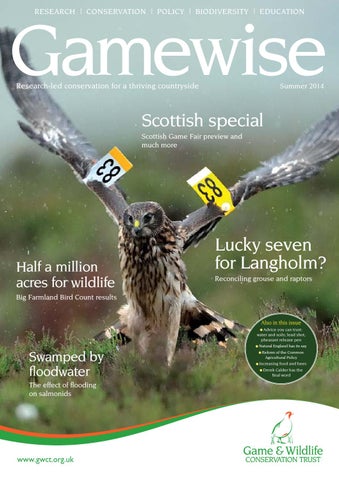
Member offer Buy one of eight signed copies of Lord Percy’s stunning book ‘Fields of Dreams’. Order yours today. See page 48. On the cover Hen harrier. The harriers are tagged as part of the Langholm Moor Demonstration Project (see p24). © Laurie Campbell
GAMEWISE • SUMMER 2014 | 3
Henrietta suspected she’d picked up something nasty in the farmyard Don’t be a chicken about worming! Treat regularly with Flubenvet® 1% - the proven wormer suitable for domestic poultry Further information is available from: Elanco Animal Health, Lilly House, Priestley Road Basingstoke RG24 9NL Telephone: 01256 353131 Fax: 01256 779510 Email: elancouk@lilly.com Flubenvet is a licensed trademark and contains flubendazole. Flubenvet 1% Medicated Premixture contains flubendazole 10 mg/g and is produced from Flubenvet 5% w/w Premix for Medicated Feeding Stuff Legal category POM-VPS . Vm 00006/4150 Flubendazole is a broad spectrum anthelmintic. Birds must not be slaughtered for human consumption during treatment. Chickens, turkeys, geese, partridges and pheasants: Meat :7 days. Chicken eggs: zero days. To be supplied only on a veterinary prescription UKLAYFBV00045 For full details on the use of these products please refer to the insert or SPC. Advice on the use of these, or alternative medicines should be sought from the medicine prescriber USE MEDICINES RESPONSIBLY www.noah.co.uk/responsible
Flubenvet
®
WELCOME FROM THE CHIEF EXECUTIVE |
Welcome
Teresa Dent CHIEF EXECUTIVE
Your membership benefits You can join your local county group and have exclusive access to advisory events. The chance to visit our pioneering Allerton Project Farm at Loddington. Free copies of Gamewise, our feature-packed magazine. Your own free personal copy of our annual Review. Participation in the exclusive members’ prize draw raffles. An invitation to our Scottish Game Fair at Scone Palace and our members’ area at the popular CLA Game Fair. Regular email updates of all our latest news and research. Pleasure from the knowledge that you’re helping the British countryside thrive both now and in the future.
I
n this issue of Gamewise we report on six years at Langholm (see page 24) and review the progress that project is making in trying to reconcile economically viable driven grouse shooting and raptor conservation. This is our Scottish ‘special’ (see page 27) and in it we highlight the attractions on offer at the GWCT Scottish Game Fair; an event not to be missed and we really look forward to seeing you there. We also report on pollinators in Westminster (see page 36); Dave Webster, chief executive of NE, gives his opinion (see page 17); and we look at the effect of the wet weather earlier this year Seventy five per cent of the remaining heather habitat in Europe on our salmonids (page 18) and soils (page 38). is in the UK. © Laurie Campbell The uplands are once again on the Grouse moors have saved our heather habitat agenda with debates about heather burning, (which is precious because 75% of the remaining biodiversity, land use, raptor conservation, heather habitat in Europe is in the UK), but carbon sequestration, the economics of upland attitudes to shooting can be farming and much more. Upland antagonistic and positive benefits of conservation is complex because Grouse moors grouse moor management such as nowadays we want our uplands to have saved our high populations of upland birds, and deliver ecosystem services: food, heather habitat... a strong contribution to employment fuel, wildlife, habitat, clean water, and the local economy are eclipsed flood alleviation, carbon storage, by concerns about raptor persecution. landscape, jobs, rural income and sport. Water What feels like differing objectives can often and flooding are examples of how moorland has converge if we look sufficiently long term (it is modern, interlocking demands placed on it by not in a moor owner’s interest, any more than society; uplands ‘catch’ water for many of our Natural England (NE), to let peat wash off his cities and we need them to be a giant sponge to hill) and recognise that no individual land use prevent flash flooding. delivers the perfect solution. But the evidence We also need to remember that our suggests that grouse moor management can demands have changed: 40 years ago a lot of deliver more of the ecosystem services NE is Government money was ploughed into making looking for, alongside a strong contribution to the uplands less sponge-like and better for the local economy. grazing. Subsequently, poor returns from upland As so often with nature conservation, there is farming and EU livestock headage payments a lot at stake, and it is worth working hard and pushed farmers into high stocking rates which, taking time to get the right, balanced solutions. over time, saw swathes of heather replaced by grassland. Our post-war desire to be more selfsufficient in timber meant that more heather disappeared altogether under tree canopies.
“
”
Director of Research Professor Nick Sotherton PhD Deputy Director of Research Nicholas Aebischer Lic ès Sc Math, PhD Director (Scotland) Adam Smith DPhil
Key dates Diary
for your diary
For a full list of events taking place near you please see page 54
12 June SE Wales shoot walk Glen Court, Usk Roger Thomas 07768 232334
4-6 July GWCT Scottish Game Fair Scone Palace, Perth Kerry Graham 01738 554826
6 August Essex young shots day County Farm, High Roding Michael Aldis 01992 560740
21 September North Yorkshire dog day in association with Help for Heroes Masham, North Yorkshire Sophie Dingwall 07925 597676
www.gwct.org.uk
Game & Wildlife Conservation Trust Fordingbridge, Hampshire SP6 1EF Tel: 01425 652381 Fax: 01425 655848 Email: info@gwct.org.uk Reg: Charity No: 1112023 Reg: Company No. 05579632 Vat No. 665 2959 92 Patron HRH The Duke of Edinburgh KG, KT, OM, GBE President The Marquess of Salisbury PC, DL Chairman Ian Coghill Chief Executive Teresa Dent FRAgS Director of Fundraising Edward Hay Director of Marketing & Membership Andrew Gilruth Director of Policy & Public Affairs Alastair Leake PhD, FRAgS
Main contact numbers Advisory T: 01425 651013 E: advisory@gwct.org.uk Accounts T: 01425 651017 E: accounts@gwct.org.uk Marketing T: 01425 651021 E: marketing@gwct.org.uk Membership/donations T: 01425 651024/651016 E: membership@gwct.org.uk PR and media T: 01425 651000 E: press@gwct.org.uk Research T: 01425 651025 E: research@gwct.org.uk Shop T: 01425 651016 E: shop@gwct.org.uk
Get in touch
Other offices The Allerton Project T: 01572 717220 E: allerton@gwct.org.uk London/Fundraising T: 020 7290 0110 E: london@gwct.org.uk Scotland T: 01738 551511 E: scottishhq@gwct.org.uk Salmon & Trout Research Centre T: 01929 401893 E: fisheries@gwct.org.uk Editing, Design and Layout Louise Shervington 01425 651002 E: editor@gwct.org.uk Advertising, Production Mark Brown, Fellows Media Ltd, The Gallery, Manor Farm, Southam, Cheltenham, Glos GL52 3PB. Tel: 01242 259249 Email: mark@fellowsmedia.com ISSN 1757-7357
Printed on chlorine-free paper from sustainable forests
GAMEWISE • SUMMER 2014 | 5
2 YEAR WARRANTY AS STANDARD*
*Conditions apply to 2nd year - see dealer for details.
RTV 400Ci
RTV 500
RTV 900
RTV 1140
Whatever the terrain, the Kubota RTV gives you the advantage. From hauling heavy loads to negotiating steep ridges, the RTV range of all terrain utility vehicles offers exceptional performance and versatility for all year round working. Featuring selectable 4WD and Kubota’s innovative transmission, the RTV delivers optimum traction, acceleration and unrivalled hill control. Additionally a full range of Kubota engineered implements from mowers to trailers are available for enhanced productivity.
Tel: 01844 268 000 www.kubota.co.uk
www.gwct.org.uk
76% of our members have attended a
LETTERS |
GWCT event in the past five years. See page 54 for our complete diary listing
Let us know your views
Have your say
Email: editor@gwct.org.uk Letters to: Editor, GWCT, Burgate Manor, Fordingbridge, Hants, SP6 1EF Game & Wildlife Conservation Trust (GWCT)
© Laurie Campbell
@Gameandwildlife
STAR LETTER Unravelling the mysteries of woodcock Dear Editor I have always had a fascination for woodcock, both in its rather secretive lifestyle and its sporting appeal. I have witnessed a female carrying its young to safety, observed just how far a woodcock will run when pursued by dogs, and rather miraculously, last season a flushed woodcock struck out of the air by a sparrowhawk in the middle of a drive.
Countryfile Dear Editor It was good to see your Big Farmland Bird Count and the GWCT’s Allerton Project featured on Countryfile. However, what was rather depressing from a practical point of view was the absence of your spokesman laying any blame for farmland bird numbers’ decline at the hands of predation. It was all about habitat, which plays into the hands of the RSPB, Countryfile and many others. I know that I am one of very many of your supporters who feel the same way. It may be that the BBC did not either allow this sort of comment or cut it out, but I think you need to make sure that you have editorial control so you don’t upset your supporters. Mark Osborne Banbury
www.gwct.org.uk
The woodcock migration study has been a revelation in the distances covered by this remarkable bird, which raises the question why do some travel vast distances and some stay as residents. Surely this can only be a genetic trait? I can say that whether standing on a covert side or rough shooting with a dog, every time a woodcock gets up I am
amazed at how far this bird may have come to be among us. Kevin Appleton Dartford
Teresa Dent replies: Countryfile wanted an exclusive of the results of our Big Farmland Bird Count and we were delighted to oblige, as it was a fitting acknowledgement of our efforts to highlight this extremely successful campaign. Nearer the time it became obvious the programme wanted to feature the importance of predation control in farmland bird recovery, which we were of course happy to do. In the event we had our comments on predation control cut and instead the programme used the interview with Robin Page. This was disappointing, but I suspect that there are a number of contributors to Countryfile who have mourned the cutting of some important gem. However, there is always more than one way to get a message across and we were
pleased to be able to get the predation control story told in Charles Clover’s piece in the Sunday Times the following weekend.
Andrew Hoodless replies: Yes, we do believe it to be a genetic trait as to whether woodcock are resident or not. See www.woodcockwatch.com to see the amazing journeys these birds have taken.
Mechanisation at fault
Dear Editor Scrap the High Speed 2 railway. Scientific observation during 2009-10, when we benefited from a local labour-intensive Flood Relief Scheme organised by Defra, revealed that we had vastly increased numbers of diverse bird species, poppies and ox-eye daises galore, and even a stoat. The conclusion is that labour-intensive activities attract wildlife and that the countryside is empty as a direct result of mechanisation. Scrap the 4x4 and use ponies and bicycles. Catherine Lacy Pontefract
Win an Oregon chainsaw Thanks to Oregon we have a 36V Cordless Electric SelfSharpening Chainsaw (the world’s only chainsaw with an integrated sharpening system) available as a prize for the star letter*. With up to 200 cuts (5-7cm wood), it starts immediately without the hassle of fuel or a cord, is much quieter to use and is silent between cuts. Please send your letters to: The Editor, Gamewise, GWCT, Fordingbridge, Hants, SP6 1EF Email: editor@gwct.org.uk * We reserve the right to edit letters for inclusion. Best letter is in editor’s opinion. Letters are the opinion of the writer and are not necessarily the views of the Trust.
Heard in the Commons Our Allerton Project received praise in the House of Commons in April from Sir John Randall, MP for Uxbridge and South Ruislip, during a debate about the state of British grasslands.
“We must be careful not just to point out what is wrong abroad. We have problems here. I am pleased to support Wildlife Trusts in their campaign to save our grasslands, which are rapidly disappearing, and support wide biodiversity. I was lucky a couple of weeks ago to visit the GWCT’s Allerton Project farm. I was impressed by the ability to show how a farm can be commercial, but also aware of its conservation and wildlife responsibilities. I recommend to any Member who has an interest and to Defra officials, to visit the project as it is doing very good work. I was shown around by Professor Chris Stoate, who impressed me with his knowledge and his love of the subject.” GAMEWISE • SUMMER 2014 | 7
© David Humphreys
| GWCT APPEAL
Discovering the truth about predation What impact does predation have on our game and wildlife? How good are we at managing it? We are appealing for funds to maintain the vital function of GWCT in answering these questions
I
n our membership survey last year, more than half of you told us that predator control was the most important issue facing the countryside. But predator control is controversial. It is never far from the spotlight. You may have seen recent coverage of Natural England’s proposed changes to the General Licences, which raised the prospect of a ‘shoo before you shoot’ ruling – requiring you to try all other methods before shooting crows or pigeons. That was an exaggerated scare, but it illustrates an increasing insistence that the lethal control of problem wildlife must be justified by evidence. Several lobbying groups would like to see predator control ended entirely. So the regulating authorities need robust, dependable evidence on which to base their policy decisions. Very often, the GWCT alone is able to provide it. Already in 2014 we have had to interface with the Government on several regulatory issues relating to predator control: General Licences, fox snares, corvid traps, brown hares. Our science gives us a voice above the crowd. We try to anticipate issues in time to prepare appropriate research. Examples of practical methods we pioneered include Fenn traps (1950s); the Larsen trap (1990); GWCT Mink Rafts (2004); DOC traps (2008); and GWCT breakaway fox snares (2012). Each of these was a solution to a problem of its time. Other aspects of predation control are less conveniently wrapped up, and we 8 | GAMEWISE • SUMMER 2014
must develop our understanding of them piecemeal, as opportunity and resources allow. Examples include how to measure and improve the effectiveness of predator control, how urbanisation and new food resources affect predator populations, and the unending search for more humane and more selective trapping methods.
“Our predation team does the field research, publishes the science and briefs politicians. It is honest and trusted. It is completely unique” With our expertise founded in practical experience, our scientific skills and our reputation for ‘telling things how they are’, we are also well-placed to undertake commissioned research. In the late 1990s we carried out a major study of fox control across three large regions of England and Wales, which made a significant impact during Lord Burns’ Inquiry into Hunting with Dogs in 2000. In 2009-12, we were contracted by Defra to determine the extent of the use of snares and evaluate their humaneness against international standards; and in 2014 we are just starting a study for Scottish Natural Heritage on the use of corvid traps in Scotland. Our predation team consists of three people, and costs £480/day to run, including field costs and equipment. Its value depends
on maintaining research threads developed over a long period. With such research, we can put facts in front of policymakers and the public. No other organisation in Europe has made this long commitment to refine and improve predation control methods. That we could do so has been entirely thanks to your support. We are raising funds to continue the vital role played by our predation team. For more than 80 years the GWCT has aimed to conserve our heritage of game and associated wildlife. After studying lapwing, curlew and golden plover in the uplands from 2000-08, we found that the average breeding pair was three and a half times more likely to breed successfully if it was in an area subject to predator control. On areas without predator control, these species are in long-term decline. Does the sight and sound of a lapwing displaying over its territory add anything to your life? It is conceivable that our grandchildren may never have this pleasure. Let’s make sure that it’s not because decisions by our regulators have been poorly informed. Please help fund our research to ensure that predation and predator control are correctly understood by politicians and the public.
To support our predation research, simply visit www.gwct.org.uk/predators or donate by phone on 01425 651016.
www.gwct.org.uk/predators
IN FOCUS - MOUNTAIN HARES |
Sustainable management of mountain hares must go hand-in-hand with sustainable management for grouse. Š Laurie Campbell
The mountain hare debate Adam Smith responds to media activity about concerns over the conservation status of the mountain hare. However, using evidence from our long-term data we can help inform the debate Adam Smith is our director Scotland and regularly deals with Scottish policy & public affairs with the help of our researchers. He formulates policies on a range of issues from muirburn to hen harriers.
www.gwct.org.uk
M
ountain hares are part of the sporting interest on many upland Scottish estates, where they are found at high densities, benefiting from the production of cover, young heather and few predators. There has been a lot of media activity as contemporary moorland management for red grouse, notably culling mountain hares to prevent tick-borne disease transmission, is raising concern over the long-term conservation status of the species. Through the National Gamebag Census, we can evaluate trends in mountain hare bags over much longer periods than any other monitoring scheme. Since the 1950s, when keepering increased again after World War 11, the bags show
a clear cyclical pattern of peaks and troughs. Despite these large short- and medium-term changes, there is no discernible long-term trend in numbers of hares in the bag. In 2008, in collaboration with Scottish Natural Heritage and the James Hutton Institute, we established that the Scottish range of mountain hare is not shrinking (range contraction is often the first sign of a population in trouble). The fact that we still commonly see hares even in areas where there are intensive culls suggests that the population may be more robust than some think. However, this cannot be taken for granted, and sustainable management of hares must go hand-in-hand with sustainable management of grouse. GAMEWISE • SUMMER 2014 | 9
Innovative research The latest news and advice that matter to you
GWCT in numbers
Conservation
A game solution for Welsh uplands
2,000 male black grouse have been counted this spring at about 400 leks, in three different UK countries Species such as curlew, which were once common in the Welsh uplands, are at very low numbers. © Dave Kjaer
1,003 T PIT-tagged salmon smolts were detected going past our equipment on the River Frome at East Stoke this year
756 people have visited the Langholm Moor Demonstration Project since 2011
5.9m w watched our Big Farmland Bird Fa Count on Countryfile C in April, 28% of the th total Sunday audience at 7pm au 10 | GAMEWISE • SUMMER 2014
he decline of wildlife in Wales has been well documented, but there is renewed hope that working together with conservation organisations and the Welsh Government, the Welsh uplands can be restored to their former glory. Not long ago the wildlife of Wales was rich and diverse with an active and successful sporting scene, but since the 1990s bird populations have crashed alarmingly. This was depicted by the State of Nature report, which reported a story of decline throughout the UK. This was starkly illustrated in the Welsh uplands where species such as curlew, black grouse, lapwing, golden plover and red grouse, which are still common on the grouse moors of northern England, were identified as in steep and possibly terminal decline. We have been aware of this decline, and after producing remarkable recoveries in some of these species at the Welsh Grouse Project at Pale Moor by the simple application of good game management, we had to
watch from the sidelines as these precious gains disappeared when game management ceased. However, with the amalgamation of the Forestry Commission, Environment Agency and Countryside Council for Wales to form Natural Resources Wales, coupled with enthusiasm from the Welsh Government to investigate innovative ways to breathe new life into the uplands, we believe Support in Wales The committees in Wales, under the chairmanship of Roger Thomas (south-east) and Richard Thomas (north), are playing a huge part in our achievements so far. They have held various events to highlight the Trust’s work and to raise funds, from evening talks to shoot walks. There is also a group of very supportive people in south-west Wales who have held a talk on our woodcock work and hopefully will form a larger committee very shortly. Help and support in Wales are much appreciated so please get in touch if you would like to help in any way. Please contact Max Kendry mkendry@gwct.org.uk or 01789 840348.
this could be an excellent opportunity to demonstrate how properly conducted game management can reinvigorate not just upland wildlife, but the local economy. Our existing science-based management options are applicable to many Welsh problems and our record in resolving site- and species-specific issues makes us ideally suited to help everyone with the best interests of the Welsh uplands at heart. This includes involving the many existing landowners and land managers who have suffered years of frustration watching valuable assets degrade for no significant biodiversity gain. We have appointed Catherine Hughes as our first policy and development officer who will focus solely on issues in Wales, and together with the resurgence of excellent Welsh regional committees and the absolute commitment of our scientists and executive, we will do all we can to show how the principles of game management can help wildlife recovery and ensure that our key bird species are flourishing once more.
www.gwct.org.uk/news
Did you know
over 90% of wild bee visits were to just 10 plant species (see page 36)
NEWS |
Trustee
GWCT ambassador on side
W
Successes
high and I am interested in the GWCT’s new shoot Biodiversity Assessment service. I would like to use that and check for myself that the land I am managing for shooting is better for biodiversity because of the shoot, rather than if it wasn’t there.” David has also recently taken on two small grouse moors and explains: “One is in north Derbyshire and one in south Yorkshire, but they are relatively close together and provide two days on each back-to-back. It has been great fun getting involved in running
a grouse moor and the sense of anticipation is great. I am already on the phone most days to the keeper to see how spring counts are going. We usually have a family holiday for the start of the grouse season and my family think I am mad because every year I re-read J. K. Stanford’s The Twelfth and After as my way of getting into the mood!” We are indebted to David and all our trustees, whose advice and knowledge prove invaluable, and we are extremely grateful for their support.
General Licence consultation
N
atural England held a consultation on proposed changes to the Class and General Licences in May. Although the changes are ostensibly aimed at protecting vulnerable species, concerns were raised about a number of the proposals for those involved in wildlife management. One of the proposed changes to the General Licences raises the prospect of a ‘shoo before you shoot’ ruling – requiring you to ensure that all other methods are tried before shooting crows and pigeons. This is a misinterpretation of what was intended in the legislation. It is for national Governments to decide which species can be lethally controlled and those where alternative action should take place in advance of lethal control, not individuals on the ground. Any change would tie the hands of many of those who use predator control to protect game and wildlife. We have responded to proposed changes to the General Licences. We hope that Natural England understands that the more difficult it becomes for wildlife managers to operate, the more unlikely it is that we will see the species listed in the State of Nature report making the dramatic recoveries that we have previously achieved on studies such as the Allerton Project and the Sussex Study. To read our response to the proposed changes go to www.gwct.org.uk/neconsultation
REBECCA, one of our tagged woodcock, has returned to breed in the same forest in Somensk Oblast, Western Russia, three years in a row. www.woodcockwatch.com AMERICAN mink bags have increased 10-fold in the 15 years since 1961, but have since dropped by half, perhaps because of competition with otters or mink control.
© Dave Kjaer
Norfolk businessman and new trustee David Flux.
Policy
www.gwct.org.uk/news
Research
BLACK grouse translocation has led to the establishment of new leks in areas from which they had disappeared.
Setbacks UPLAND sites with the highest tick burdens were those with the lowest grouse productivity.
© Dave Kjaer
e are delighted to welcome David Flux, a Norfolk businessman and keen shot and fisherman, who started a four-year term as a trustee of the Trust in July last year. A great ambassador of our research, David said: “I am a huge supporter of the GWCT and I was delighted to become a trustee. I love the countryside as much of my enjoyment in life comes from it, and I want my children to have the chance to enjoy it as much as I do. I believe supporting the GWCT in its amazing research and conservation work is the key to making that happen.” David is senior partner at Adrian Flux Insurance Group and has lived in Norfolk since an early age, with strong family and business connections in the county. He runs two lowland shoots and says: “I try and make my Norfolk shoot a mix of wild and released birds, but the Lincolnshire one is all released. I am very conscious that shooting needs to be able to hold its head
LAPWING pairs in the Avon Valley have declined by 66% over 10 years.
GAMEWISE • SUMMER 2014 | 11
| NEWS
SSee how salmon fared last year.
G Go to www.gwct.org.uk/salmonreport tto download the latest report
In brief
Research
Bringing LIFE to lapwing
Join us at the Allerton Project in June.
Open Farm Sunday OUR ALLERTON PROJECT farm in Leicestershire will be opening its doors to the public on Sunday 8 June as part of Open Farm Sunday. This is an excellent opportunity to come and see the wide-ranging research carried out on the farm. For more information go to www.farmsunday.org
Top 100 papers
A new LIFE-funded project aims to improve lapwing populations in the Avon Valley in Hampshire. © Dave Kjaer
Wales
Hatcheries to close
N
Farmers help heroes THE FARMER-LED Marlborough Downs Nature Improvement Area has provided access to miles of open country to Riding for the Disabled. The Kennet Valley Carriage Driving group has been able to offer wounded, injured and sick serving personnel and veterans, who are receiving support from Help for Heroes, an opportunity to try carriage driving and enjoy a visit to the Marlborough Downs as part of a rolling recovery programme.
12 | GAMEWISE • SUMMER 2014
Recycling
Nominated for National Recycling Awards
W
OUR 1992 RESEARCH paper Do parasites make prey vulnerable to predation? Red grouse and parasites made it into the British Ecological Society’s top 100 influential papers, which it published to mark its 100th anniversary. www.gwct.org.uk/bes
Farmer-led consortium brings a smile to carriage driving heroes.
T
he plight of breeding waders, especially lapwing in the Avon Valley, is causing great concern. The Avon Valley, near Fordingbridge, Hampshire, is one of the top eight wet grassland sites in the UK and despite having funding available to improve habitats specifically for waders, populations of lapwing have fallen from 260 breeding pairs in the 1980s to probably about 60 last year. Funding through the EU to improve such highly designated sites as the Avon Valley is available through the LIFE+ scheme. The GWCT’s Andrew Hoodless, together with the Hampshire & Isle of Wight Wildlife Trust as partners, submitted a bid to improve population densities on the lower Avon Valley. We are delighted to report that our bid succeeded and we will be reporting on this project in future issues.
atural Resources Wales recently held a consultation in which it proposes to close three of its four salmon hatcheries in Wales, with the last hatchery at Cynrig near Brecon being turned into a research unit. This follows its review of salmon stocking research which resulted in ‘salmon stocking being deemed largely ineffective and potentially harmful’ to naturally spawned salmon stocks. It plans to divert the resources saved to undertake river improvement measures in the form of the easement of barriers to migration and habitat improvement works. If this consultation is approved it may result in the end of stocking hatchery-reared salmon into the rivers of Wales.
e’re very proud to announce that our Allerton Project farm has been nominated in this year’s National Recycling Awards. The project was voted through as a finalist Our farm recycling project is a finalist in the by a panel of 23 expert National Recycling Awards. judges. Competition is fierce, with other nominees including major organisations such as M&S and John Lewis. We have been shortlisted in the Resource Management Business of the Year (small) category for our farm plastics recycling operation. The judges particularly noted the effect we had on the design of pesticide containers that are in circulation today, most of which feature attributes designed to make them easier to recycle. The winners will be announced on 3 July.
Prize draw
Enter our gun draw
O
ur new gun draw tickets are now available. Don’t miss out on your chance to win a beautiful Last year’s winner George Ponsonby.
pair of guns worth £14,250, courtesy of William Powell, and help us raise money to promote the importance of boosting biodiversity through shooting. The prize also includes your own measuring and fitting session, a day’s driven grouse shooting, 500 cartridges and a double leather and canvas case. Find out more at www.gwct.org.uk/gundraw
www.gwct.org.uk/news
Get involved your local
NEWS AND VOLUNTEERING |
committee would love to hear from you or you can volunteer at the Game Fair
Top 5
Sharing fundraising tips for success
T
he secret behind the success of a county committee is to make it fun. Bring together enthusiastic people who want to enjoy the meetings and events, and ensure everyone is part of the team. These words of wisdom are the philosophy and evidence in practice of the Hertfordshire committee under the chairmanship of Hugo Richardson. Hugo, a chartered surveyor by profession, is a keen shot and sailor in his leisure and in his precious spare time is an extremely capable and successful event organiser for both the GWCT and his local Rotary Club. He has been at the helm of the committee for the past four years but steps down as chairman this summer. He confirms, however, that he is firmly staying Hertfordshire chairman Hugo Richardson believes that the secret behind the success of county committees is to aboard the committee. make it fun. By his own admission Hugo says: “I enjoy organising events. We have a great rural property agency and land management committee with a balance between young business. Hugo says his involvement with members with ideas, energy and enthusiasm, the GWCT keeps him up-to-date with and the mature members who have the current issues affecting his clients. It has also experience and contacts. Grey hair is raised his professional profile and increased a welcome asset to the dynamics of a his network. successful committee.” ...a balance between Focusing on the The element of fun future for the GWCT, is in abundance in the young members with Hugo concludes: “The county events and so ideas, energy and three words I would use too is the close working enthusiam and the to sum up the research relationship between Hertfordshire and its mature members who the GWCT does is proven, unbiased and neighbouring counties, in have the experience independent. These particular Essex, which crucial factors are has resulted in the biand contacts what drives the annual Hertfordshire/Essex continued support from Sporting Ball. the Trust’s committees and members to Both counties are pragmatic about ensure this vital research continues.” it – they are fundraising for the same We would like to thank Hugo Richardson cause. There is a 50/50 split on the event and his hardworking proceeds. As to the auction lots, committee for all the whichever county brings it work they do on our takes the proceeds. behalf. We rely on There is a ball committee volunteers to help us made up of three or continue our valuable four people from each research and we are committee. Hugo adds: “We extremely grateful for have plenty of gin and tonic their support. and get the business done. The action points are then See page 51 for photos reported back to the main of the Hertfordshire body of their respective and Essex Sporting Ball, county committees.” which raised a fantastic £17,000, and all our In 2011 Hugo set up other fundraising events. Weldon Beesly, a successful
“
”
www.gwct.org.uk/news
Things to do this summer
1
Attend an event
We have a packed calendar of events this summer with shoot walks in almost every county, clay shoots, drinks parties, theatre and dog days. Come and enjoy a fun, social event this summer (see page 54).
2
Look after grass margins
Grass margins provide cover for small mammals, a home for beneficial insects and are excellent nesting cover for gamebirds. Many butterflies also over-winter as caterpillars in grass margins, so only cut half of the margin in the autumn/winter.
3
Attend a Game Fair
Our very own Scottish Game Fair is being held at Scone Palace from 4-6 July and offers something for all the family. If you are heading to Blenheim Palace for the CLA Game Fair on 18-20 July, come and see us and enjoy our relaxing members’ area.
4
Encourage pollinators
Don’t forget to plant your pollen and nectar mix for bees and butterflies. Plant a range of flowers in your garden such as wildflowers, lavender and verbena (see page 36).
5
Sign up for your Biodiversity Audit
Find out how to improve the biodiversity contribution from your shoot. It only takes a few small projects that enhance the environment to make a substantial difference overall (see page 43). GAMEWISE • SUMMER 2014 | 13
| ALLERTON PROJECT - INNOVATIVE FARMING
Sharing knowledge Professor Chris Stoate explains why it is important we share our research with the local farming community
T
Welland Valley Partnership he Allerton Project has been carrying out research into the relationship The GWCT’s Allerton Project is located between land use and water quality, in the central section of the Eye Brook and especially the role of soil management, catchment, a headwater tributary of the for more than a decade now. The results of River Welland. We are active members this research are valued nationwide, but we of the Welland Valley Partnership, a group are particularly active in sharing the lessons comprising the Welland Rivers Trust, the learned with the local farming community. National Farmers’ Union, Country Land The Welland Valley Partnership and Business Association, the Environment ‘Resource Protection Group’ co-ordinates a Agency, Natural England, Anglian Water, range of measures to improve river water Internal Drainage Board, Angling Trust and quality through improved soil and nutrient local councils. This apparently disparate group management on farms, and reducing the of members has identified common interests effect of livestock. The group has been relating to the river basin and collaborates offering soil nutrient tests and provides to address them. It has become a prime one-to-one advice to farmers, as well as example of collaboration between statutory co-ordinating a series of workshops held agencies, NGOs and local businesses. at venues across the upper river basin and covering topics such as nutrient and soil management, biobed design and management, 20 farmers across an area of nearly two thousand hectares, a major landscape-scale slug pellet use and grass weed control. In experiment that will enable us to assess to some cases, the group has been able to what extent we can move provide farmers with 50% towards Government water grants for capital works to The results of quality targets by combining reduce their effect on water. our research a range of practical The greatest emphasis is are valued measures. In common in the upper Eye Brook and with the collaborative neighbouring Stonton Brook. nationwide... approach adopted in the We are working with local Nature Improvement Areas and cluster farm farmers to explore the potential of a range networks, we intend to take this forward of remote sensing and ground-sourced data with our local farming community to deliver to identify areas that can be targeted, to both improve water quality and the efficiency further public benefits through the new Environmental Stewardship scheme with which soils and nutrients are managed from 2016. to optimise crop yields. At the heart of this area lies the Water Friendly Farming See page 38 for advice on healthy soils and how to project, in which we are working with about stop water run-off.
“
”
Soil compaction reduces crop yields as well as increasing soil and nutrient loss to water.
14 | GAMEWISE • SUMMER 2014
Chris Stoate is head of research at the Allerton Project and chairman of the Welland Valley Partnership ‘Resource Protection Group’, which provides advice to farmers on soil and water. Top cover
Reed canary grass and perenial chicory, planted alongside kalebased wild bird seed mixtures, provides excellent habitat
Cover crop corner
W
ith a very wet winter and early spring, the team at the Allerton Project has had to be patient managing the cover crop areas. The on-going strategy to develop a range of crop types has reduced the workload this spring, with a mix of perennial game cover and two-year wild bird seed mixtures grown for the Higher Level Stewardship agreement. Three-metre headlands on each plot are made up of reed canary grass and perennial chicory alongside kale-based wild bird seed mixtures. This habitat combination is providing farmland birds excellent protection from overhead predation at a time when other cover is limited. The resulting canopy is also a valuable nesting area and will double up as brood-rearing cover through May, June and July. We are waiting to see how conditions unfold before selecting the spring seed mixes for cover crops. With no frost or cold weather to aid the breakdown of the heavy clay, the cultivated ground is going to need time to enable a good seed bed to be created. With 25 acres of second-year wild bird seed and autumn-sown brood-rearing and perennial cover already in the ground, the pressure to plant new season crops is much lower than may have previously been the case. Kings Game Cover and Conservation Crops provide detailed agronomy advice and supply seed for the farm’s game cover crops.
www.gwct.org.uk/allerton
ALLERTON PROJECT - INNOVATIVE FARMING | 5%
of land on each holding will be designated as an Ecological Focus Area. Existing land in Stewardship schemes will not be eligible
Greening measures placed on farmers Alastair Leake looks at the reform of the Common Agricultural Policy and how it is not all positive news for farmers
S
ince agricultural support payments were removed and crop prices were allowed to be set by the market, the EU Commission has increasingly found itself being asked by the taxpayers to justify EU payments being made to farmers, simply for being farmers. In an attempt to provide reassurance to taxpayers, the latest set of Common Agricultural Policy (CAP) reform proposals include greening measures, which are intended to benefit the environment without impinging on business efficiency. These include proposals to give added protection to areas of permanent pasture, a requirement that 5% of land on each holding be designated as an Ecological Focus Area (EFA) and that a minimum of three crops are grown on land which is in arable cropping. At first the Commission suggested that permanent pasture should be kept at farm level, rather than an overall national level, which was set at a minimum of 90% retention of the 2003 level. The national quota allowed different farms
across the country to establish or plough out permanent pasture, and one way or another we have managed to stay within the quota. This approach had the advantage of not ‘fossilising’ farming into a system based on historical factors, rather than future opportunities. However, the prospect of pasture land becoming ineligible for anything meant that some farmers have ploughed their land to get it back into the rotation and de-classify it as permanent pasture. The result is the opposite of what was intended and much of the damage done before the Commission reverted to the previous system. Visitors to our Allerton Project will know the huge amount of work we have done to reduce soil erosion and the catchment approach Professor Chris Stoate is pioneering in his Water Friendly Farming project (see page 14). On the north side of the Eye Brook catchment many measures have been put in place to reduce erosion, while on the south bank, one farm has reverted all its permanent pasture into maize. This will not tick the Commission’s environmental box.
Alastair Leake is our director of policy & public affairs and head of the Allerton Project. He formulates policies on a range of issues from Stewardship to lead shot.
Likewise the three crop rule. Cattle farmers growing small amounts of under sown spring barley to supplement the ration in grass-based systems, dairy farmers growing grass and maize, malting barley growers and broiler producers growing home grown feed wheat will all be affected. The EFA requirement looks neither ecological nor focused. In contrast with most of Europe, 70% of farmers in England are already in an environmental scheme, and many will have taken land out of production to grow wild bird and flowering strips, for instance. Farmers will not be able to count these as part of their EFA as they are already being paid for these under their Stewardship agreement. So unless land left in winter stubbles, cover crops or the growing of legumes can be counted towards EFA, then more land may be needed for ‘greening’. It is hard to see how any of this will make a significant environmental effect and even less how it will not impinge on business efficiency.
Research into practice... Shoot days at the Allerton Project The Butterfield and Roughton guns enjoying their day at the Allerton Project.
www.gwct.org.uk/allerton
Twelve shoot days are held at our Allerton Project each year.The days are auctioned to help raise funds for the Trust and give our loyal supporters the opportunity to enjoy a day’s shooting, and experience the work we are doing at the same time. Chris Butterfield re-lives his day last year and says: “Traditionally we have a family Christmas shoot, but last December we tried something rather different – a family day at Loddington. Set in 800 acres of rolling Leicestershire countryside, the Loddington Estate is not only home to the GWCT Allerton Project but also hosts a very good shoot. Eight Butterfield and Roughton guns plus other family met at Launde
Abbey, an elegant Elizabethan manor house. Now a retreat, the Abbey hosted breakfast, a very good lunch and tea. Shoot manager Brian Elson, previously of Thistleton renown, ably hosted the day along with head keeper James Watchorn. Seven varied pheasant drives through woodland and over grass and arable produced an excellent bag of 150. “The great thing about the Allerton Project, is interest and variety. Here a successful livestock and arable farm with well managed habitat shows that commercial farming, best practice conservation and a top quality shoot really can exist together.”
GAMEWISE • SUMMER 2014 | 15
Members’ Gun Draw
Your chance to WIN a Pair of Guns and a day’s Driven Grouse Shooting worth over ÂŁ14,250 The prize includes: ˆ
A pair of William Powell 12-bore Monarch shotguns
=SYV S[R QIEWYVMRK ERH ½ XXMRK WIWWMSR [MXL E XIEQ SJ TVSJIWWMSREPW ˆ
A day’s driven grouse shooting for one gun ˆ ˆ
500 shotgun cartridges
A double leather and canvas case
3 EASY WAYS TO ENTER
Kindly supported by
1. Call now on 01425 652381 2. Enter online at www.gwct.org.uk/gundraw 3. Complete and return the form below
ORDER FORM Please send me tickets for the Members’ Gun Draw @ ÂŁ50 each I enclose a cheque made payable to “GWCTâ€? for ÂŁ or I wish to pay by debit/credit card
Name
Please debit my MasterCard / Visa / Other (please delete as appropriate)
Address
For the sum of ÂŁ Card No. Expiry date
Telephone
Signature
/
Security Code Date
4 numbers if Amex
Please return the completed form to:
Gun Draw, GWCT, Burgate Manor, Fordingbridge, Hampshire, SP6 1EF 8LERO ]SY JSV XEOMRK TEVX MR XLI HVE[ %PP XMGOIX TYVGLEWIVW [MPP VIGIMZI E WTIGMEP TVM^I HVE[ EGORS[PIHKIQIRX PIXXIV [MXL E YRMUYI XMGOIX RYQFIV 2S XMGOIX QE] FI WSPH SV FSYKLX F] ER] TIVWSR YRHIV ]IEVW SJ EKI 4VM^I HVE[ TVSHYGIH F] XLI +EQI ERH ;MPHPMJI 'SRWIVZEXMSR 8VYWX 4VSQSXIV 8 (IRX SJ XLI TVS½ X QEHI [MPP KS XS[EVHW SYV VIWIEVGL +EQI ;MPHPMJI 'SRWIVZEXMSR 8VYWX JSVQIVP] 8LI +EQI 'SRWIVZERG] 8VYWX MW E GLEVMXEFPI GSQTER] PMQMXIH F] KYEVERXII VIKMWXIVIH MR )RKPERH ERH ;EPIW YRHIV RYQFIV VIKMWXIVIH GLEVMX] RS 6IKMWXIVIH SJ½ GI &YVKEXI 1ERSV *SVHMRKFVMHKI ,EQTWLMVI 74 )* 6IKMWXIVIH [MXL XLI +EQFPMRK 'SQQMWWMSR ¯ [[[ KEQFPMRKGSQQMWWMSR KSZ YO (VE[ XEOIW TPEGI SR 8LYVWHE] XL (IGIQFIV
OPINION - OUR CONSERVATION PARTNERS |
How others see us What do other organisations think of our work? This column offers an opportunity to hear their views and helps offer insight into our relationship with them. Here, Dave Webster, chief executive of Natural England, gives his opinion
S
uccessful conservation relies on strong partnerships and sound science. Throughout my tenure as chief executive of Natural England, the GWCT has been a shining example of both. Conservation across large areas of the English countryside poses many challenges, not least how best to help farmers and land managers to act in the best interests of the natural environment, while running a profitable farm or other businesses. GWCT’s contribution to meeting these challenges is huge. For example, research undertaken at the Allerton Project Farm, which I recently visited, showed how winter feeding can improve farmland bird numbers. And last winter’s Big Farmland Bird Count helped showcase the work farmers do and brought the issue into the public eye. I saw real innovation when I visited the Marlborough Downs Nature Improvement Area. I was impressed by how the Trust has helped forge a new and everstrengthening bond between the farmers and the local authority, Wiltshire Council. It’s a new bottom-up approach to conservation that is already delivering real benefits to wildlife and people in and around the Marlborough Downs. The work that the GWCT is leading on ‘cluster farms’ takes this approach forward. Again, the Trust is bringing people together to help deliver biodiversity and wider environmental improvements across the farmed landscape. All the feedback I’ve had suggests that there is real enthusiasm for this approach among landowners, and this is great news: conservation should be a source of pride not a burden, and we will achieve so much more when all sectors work together. The local approach to farm clusters mirrors the approach we are taking at Natural England. Changes we’ve made recently to devolve power and decisionmaking to our 14 new Area Teams will, I hope, support this approach, and enable our local advisors to work
www.gwct.org.uk
“...there is real enthusiasm for this approach among landowners...”
more closely with local communities and interests to get the best results for the local patch. This exciting ‘farm cluster’ model is also helping to shape the design of the new Rural Development Programme. Innovations like ‘option bundles’ for certain groups of species like wild pollinators and farmland birds could make a real difference in the farmed environment. As well as benefiting wildlife, there is also potential for this work to reduce diffuse pollution and improve water quality. This integrated approach to the environment is exactly what is needed now. We may not always agree on every issue, and nor should we, but the pragmatic approach the GWCT takes, aligned with its expertise and dedication to wildlife conservation, show how farming, shooting and nature can work in harmony. Dave Webster Chief Executive, Natural England
Natural England
advises the Government on the natural environment. Its work is focused on enhancing England’s wildlife and landscapes and maximising the benefits they bring to the public. www.naturalengland.org.uk Dave Webster has been Chief Executive since March 2012 and joined Natural England as a founding Executive Board member in September 2006. He has over 20 years’ experience in the environment sector in senior leadership roles.
GAMEWISE • SUMMER 2014 | 17
| SALMON - COPING WITH FLOODS
Swamped by floodwater? Following the winter floods, Stephen Gregory looks at how extreme weather affects salmonids
A
ccording to the Met Office, January 2014 was the wettest month in almost 250 years following an appallingly soggy 2012 that has gone down in history as the second wettest year on record, followed closely by 2000, the wettest year on record. It seems that long-term woodland destruction, urbanisation, loss of lakes and ponds, and modifications to natural river channels have literally cleared the way for a torrent of water to cascade unabated into lower river catchments. This happens so quickly, there isn’t time for drainage systems to cope, and flooding ensues and endures. Although its effect on human habitations is all too obvious, we are not the only species to be affected by floods. Unlike humans, however, fish have been experiencing floods in their native river habitats for many years. And because floods present a strong evolutionarily selective force, fish have adapted to survive and even thrive under certain flood conditions. Salmonids are a good example of a group of fish species that have adapted to local flow regimes, inhabiting a range of rivers from those in Scotland with highly variable flows and high-gradient channels to shallow and stable slow-flowing chalk streams in southern England. Understanding how floods affect salmon is complicated by three unavoidable factors: Floods will affect different salmon life stages, such as eggs and adults, differently. 18 | GAMEWISE • SUMMER 2014
Floods of different characteristics, such as timing and duration, will affect each life stage differently. Our ability to study salmon movements and behaviours under flood conditions is impacted by turbid waters and reduced equipment efficiency or malfunction. The interactions between the first two complexities have not been well studied, perhaps because floods are rare events. A factor that limits the distribution of salmonids is availability of usable spawning gravels. Floods can allow salmonids to reach otherwise inaccessible spawning grounds. This instinct to seek suitable gravels high in the river channel could, however, prove a poor adaptation if the channel then dries in spring, causing the eggs to die – a type of evolutionary trap. One of the most sensitive salmonid life stages is the egg. Salmonids lay their eggs in gravels, in part, to protect them from adverse environmental conditions, such as high flows. Under flood conditions, high-velocity water can wash eggs out of redds, causing them to die. This is particularly true for grayling that lay their eggs shallow in redds. Conversely, a comparatively low magnitude or long duration flood can help by washing sediments out of redds that would otherwise asphyxiate the developing eggs, thereby improving egg survival. If eggs survive the floods, they emerge as fry and stay in the shallow, protected waters at the edges of river channels to avoid predators because they are not strong swimmers. High flows during or shortly after emergence
Stephen Gregory is our statistician on the MorFish project. He is a keen conservationist who uses population dynamics modelling to inform management of endangered populations and species, which have included Galapagos rodents and Malaysian orangutan.
We are also working in partnership with INRA in France to evaluate the impacts of events like flooding, using the part EU-funded MorFish project.
www.gwct.org.uk/fishing
SALMON - COPING WITH FLOODS |
Salmon migration in rivers... Some juvenile salmon parr migrate to the lower river in autumn, perhaps to seek better habitat.
By early spring, juvenile salmon undergo a physiological change called smoltification and start their migration to sea. Salmon that avoid predation by humans, seals and other fish aggregate on feeding grounds in Arctic waters. After typically one to four years at sea feeding, the adult salmon migrate back to their natal rivers to spawn.
has been associated with high fry mortality: they too can be washed out of the river and die. However, fry swimming ability increases quickly with size and so the timing of the flood is critical to fry survival. Summer floods are perhaps less common and so their effects are even less well understood. One factor thought to affect the growth and development of juvenile salmonids is the number of other juveniles, all competing to find food in the same area, so a summer flood that replenishes food can increase chances of survival. With their improved swimming ability compared with fry, juveniles are less susceptible to washout during floods. Once beyond the juvenile stage, the effect of flow on salmon and sea trout becomes important for migration timing. Flows facilitate the downstream migration of smolts. High flows and associated turbidity could increase the rate at which smolts migrate out of the river in murky water, both of which will help to lessen the risk of predation. When it comes to re-entering the river as a spawning adult, then flow again appears to be a trigger, although the exact nature of the relationship between flow and migration timing has proven elusive: (1) it is not clear whether they move on or after floods (or freshets) or, indeed, whether they are even present in the river mouth at the time of floods, and (2) there is high variability between rivers; for example, flow might be less influential on chalk streams with more stable flow conditions relative to granite rivers. Once in the river, salmon migration occurs in three phases: (1) the upstream migration phase, (2) the spawning ground searching phase and (3) the spawning site holding phase. Of these, going upstream is the most affected by flow. The speed of upstream migration seems to increase with increasing flow, although in floods the salmon may stop moving and be forced to take refuge. It seems clear that flooding can affect salmonids in many ways and the long-term data we collect helps us understand this. However, fish cannot simply be counted like birds because they can’t be seen without additional apparatus. This is further complicated because water is
“...we will have to find ways to cope with flooding and the effects it will have on our salmon and grayling monitoring...” corrosive, conductive and carries debris and huge energy, particularly during flood conditions. We have been monitoring salmon for many years on the River Frome at East Stoke, using a range of monitoring equipment including a resistivity counter, a 24-hour video surveillance camera and electronic tagreading devices. This equipment does an excellent job of detecting migrating salmon, and despite sometimes treacherous conditions. Only in three years of our longterm monitoring have extraordinary flows forced us to lift our electronic readers and substantially reduce our resistivity and video counter efficiency. With the prediction that winters will be wetter and warmer, we will have to find ways to cope with flooding and the effects it will have on our salmon and grayling monitoring programmes. We need also, however, to be mindful of the effects on our salmonid populations and our ability to monitor them during drought conditions, which are forecast to become more frequent and intense.
Research in action... Preparing for the smolt run
1 Following the bad winter weather, we had to make quite a few repairs to our equipment.The vanes become brittle over time and can be damaged by the persistent high flows.
www.gwct.org.uk/fishing
2 Some of our in-river structures required maintenance following the unusual flows. Here, Bill Beaumont is fixing underwater panels in a dry suit.
3
4
Repairing equipment over a raging river can be quite challenging especially with health and safety guidelines. These vanes monitor the tagged salmon as they swim past.
The fisheries team clearing the hatches of debris that was washed downstream. A large branch was wedged up against the hatches.
GAMEWISE • SUMMER 2014 | 19
NI G E L R HODE S FINE ART pa i n t i n g s, w o r k s o f a r t, f u r n i t u r e
maggi hambling cbe (born 1945) Wave Tunnel III Oil on canvas, 25.4 Ă— 30.4 cm 20
m a ry b e a l e (1633–1699) Portrait of Margaret Wharton (1649–1699) Oil on canvas, 126 × 103 cm
nigel rhodes fine art gallery ltd 32 e a s t g a t e l i n c o l n l n2 1 q a
01522 569522 / 07950271898 www.nigelrhodesfineart.com enquiries@nigelrhodesfineart.com
%(+#'! , (* ',*# + *# / -'
' + / -%/ '#!",+ *# ! (' ('
) ,*# $ " . + ('" &+ (&
'(
*# + +"(.' #' %- -/ *0+ )* &#-& , #%+ ' (-' , ('" &+ (&
GA ME
FE E
D S A ND G A M E C
R OV E
D SEE
S
QUALITY GAME FEEDS & GAMECOVER SEEDS Nationwide delivery on feeds & seeds
Bartholomews game feeds, with our own proven formulae, including the use of fish meal, provide for the changing dietary needs of chicks & poults. We do not use sunflower or rape meal in our rearing diets as these are poor substitutes for fish meal. The raw materials we use are proven to be beneficial in the bird’s development. Craig Coughtrey 07970 292 211 for game feeds
Qualified & experienced advice on all aspects of growing your crop including soil analysis, fertilizer advice & crop protection, all backed with information gained from our years of experience. Ginnie Griffiths 07584 517 634 or
Andrew Stilwell 07920 134 992 for gamecover crops
COPIES OF OUR 2014 CATALOGUE AVAILABLE NOW Head Office: Bartholomews Agri Food Ltd Portfield Chichester West Sussex PO19 7TT Tel. +44 (0) 1243 784 171 Fax. +44 (0) 1243 775 747 Email. agri@bartholomews.co.uk Website. www.bartholomews.co.uk
22 | GAMEWISE • SUMMER 2014
www.gwct.org.uk
FARMLAND BIRDS - THE BIG FARMLAND BIRD COUNT RESULTS |
25 most counted species 25,000
1,320
birds counted by the Pitts brothers on their farm in half an hour
20,000
15,000
© Peter Thompson, Dave Kjaer, David Mason
10,000
5,000
0
Half a million acres for wildlife Our Big Farmland Bird Count revealed that nearly 80% of farmers are helping farmland birds. Jim Egan explains
M
ore than 500 farmers, covering nearly half a million acres of UK farmland, rose to the challenge of taking part in the first year of our Big Farmland Bird Count. In total, the farmers, who represented every county in England, as well as Scotland, Wales and Ireland, recorded seeing 116 different types of birds. Significantly, six red-listed data species appeared in the top 25 of birds counted. These included linnet, yellowhammer, house sparrow, tree sparrow, starling and lapwing. Starlings were seen on over 40% of the farms taking part and were the most abundant bird recorded in the survey. It was interesting to note that nearly 60% of the farmers taking part in the survey reported that they had a shoot on their farm
www.gwct.org.uk/bfbc
and as a result of this grew game cover crops on their land. Overall it was a remarkable result, both in terms of the range of species counted as well as the number of red-listed species appearing within the top 25. These are some of our most rapidly declining species but they are being supported by our farmers through the many conservation measures that are now being implemented on farmland across the country. Over-winter supplementary feeding and areas planted with wild bird seed mixes proved to be fruitful counting sites for many farmers, with participants recording impressive numbers of yellowhammers and corn buntings as well as many other seed-eating birds. The survey showed that 60% of farmers were providing food specifically
for their birds’, helping them thrive and stay alive over winter. The Big Farmland Bird Count revealed that nearly 80% of farmers taking part in the survey were in an Environmental Stewardship scheme. Their survey area included important environmental features such as hedges, woodland ponds, grass margins, ditches and trees. Although participants recorded many species on the Red List, it does not mean that we no longer have a problem with the number of farmland birds. However, the results show that farmers really can make a difference. We received massive support from a range of farming, industry and conservation organisations and we are grateful to BASF for sponsoring the survey, which was run in partnership with FWAG (Farming & Wildlife Advisory
The Pitts brothers from Northamptonshire, counted 1,320 birds in their half-hour survey. On their land they grow wild bird seed mixes and game cover crops, and provide supplementary grain through scatter feeding. Jim Egan says: “With farmers like the Pitts doing their bit to help nature, we have every reason to believe that the future could look much brighter for our precious wildlife.”
Group) and LEAF (Linking Environment and Farming). The second Big Farmland Bird Count will take place during 7-15 February 2015. To register go to www.gwct.org.uk/bfbc Jim Egan is head of development and training at our Allerton Project and ran the Big Farmland Bird Count.
GAMEWISE • SUMMER 2014 | 23
| LANGHOLM - RECONCILING GROUSE AND RAPTORS
‘Lucky seven’ for Langholm? The Langholm Moor Demonstration Project shows the reality of ‘wildlife management’, but seven years on, recovery is at best ‘steady’. Adam Smith explains
© Laurie Campbell
2
013 was so near and yet so far for the Langholm Moor Demonstration Project’s ambitions to drive grouse. Will 2014, the project’s seventh year, be any better? In 2007 the Project’s partners (Buccleuch Estates, Scottish Natural Heritage (SNH), GWCT, RSPB and Natural England) set out to turn around the marked decline of grouse, waders, harriers, heather, jobs and income at Langholm that followed the end of management after the Joint Raptor Study. The strategic aim of the project is to demonstrate how to reconcile the conflict between driven grouse shooting and raptors on this moor. And this was to be done in the context of a demonstration project, not an experiment. To date the project has not been able to recover any of the investment made by shooting grouse. One of the questions we are asked during the many visits by keepers, conservationists and landowners is “Why not?” The keepers came back to Langholm in the spring of 2008 and grouse recovered well for the first two years of the project, with good counts in 2009 and 2010. There
24 | GAMEWISE • SUMMER 2014
was even a thought that we might shoot in 2011 after encouraging spring counts, but thereafter recovery has stalled. We did not shoot in 2011 and have not since. A number of factors may have contributed to this lack of sustained recovery. Firstly the grouse have had two years of poor breeding success despite the hens being in excellent condition in the spring, with no disease and clutch sizes being above average. Grouse breeding success was considerably improved in the warmer, drier summer of 2013 relative to the summers of 2011 and 2012. This seems to indicate a link to weather affecting breeding success. The keepering team were concerned about losses of clutches and chicks to ravens in the poor weather years. We radio-tagged young ravens and hen grouse in 2013; no radio-tagged hen grouse nests were taken by ravens, but whether this was related to the better weather was not clear. We do know that there is considerable predation of grouse throughout the year. Over the course of the project (until
September 2013) 874 dead grouse have been collected by scientists or keepers. Of these, 718 have been attributed by the science team to raptors as kills. It is not possible to say from the field signs which raptor; Langholm hosts peregrines, goshawks and buzzards. Of those, buzzards are by far the most numerous and are at higher levels compared with the period of the Joint Raptor Study. A very important question is whether these numbers of grouse being taken relate to a meaningful impact on the grouse population, possibly limiting population growth. There is agreement among the scientists involved with Langholm that the most effective way to measure predator impact would be a removal experiment. However, such a groundbreaking study with raptors would take time, be costly and require significant public policy support. Therefore we are evaluating buzzard effect through increased monitoring, and in July 2012 a PhD in conjunction with Newcastle University was started. This study has had cameras on buzzard nests and we have
www.gwct.org.uk/research
LANGHOLM - RECONCILING GROUSE AND RAPTORS |
“...1,000 brace is the minimum target we have to aim for...”
© Richard Faulks
been maintaining over-winter vantage point watches. Last winter we started radio- and GPS-tagging buzzards on the moor, and we are analysing buzzard pellets for prey remains. It is more difficult to reach firm conclusions from this sort of information compared with a removal experiment. We have to remember, though, that Langholm is a scientifically monitored restoration project – we cannot make it an experiment as we have no ability to replicate it, or create different treatments. If we are to actually address the key challenge of producing more young grouse, we hope the importance of this difference is not lost on the other project partners. An important outcome of the Project has been to give SNH, Natural England and RSPB experience of the pragmatic decisions that are required when managing a grouse moor. Over seven years they have experienced the challenges of getting enough heather burnt, managing heather beetle damage, the importance of medicated grit, the expense of capital projects such as roads, the endless vigilance required to keep predators under control, and all of the challenges associated with restoring the population of wild birds amidst the vagaries of weather and season. We have learnt that it is possible to manage hen harrier predation by diversionary feeding when there are modest grouse densities and relatively few nesting harriers, with good access to the nests for feeding. However, we have not determined why, despite excellent breeding success, harrier numbers have not built up as they did from two pairs to 20 pairs during the Joint Raptor Study. Persecution of harriers away from Langholm could play a role, though there has been no clear evidence of illegal killing of the birds tagged at
Langholm, whereas post-mortem evidence of starvation and disease has been recorded. Exposure to these challenges has been a tangible benefit in creating an understanding of grouse moor management and an appreciation of the investment and commitment it takes. SNH certainly appears to be committed to using Langholm Moor to find out what the realities of ‘adaptive wildlife management’ will mean for grouse moors. Langholm is well placed to test and profile the game and wildlife management as being in the public’s and sporting shooter’s interests. Having to think this way and make evidence-led moves in policy and practice means progress will not be fast, especially when there is so much else going on in Scotland’s political landscape. But we are heading in the right direction.
And the grouse shooting? We don’t know yet, whether after 10 years, we will be able to shoot 1,000 brace of grouse. Yet the 1,000 brace is the minimum target we have to aim for to even begin to justify this level of investment in moorland restoration. The project intends to shoot a typical day’s driven grouse as soon as possible without damaging this long-term, wholly justifiable aim for the moor and project. This summer, may the gods smile upon all who have been involved in this seven-year journey and make this a reality. Adam Smith is our director Scotland and works with the Langholm Moor Demonstration Project staff and partners to deliver media coverage and project information. www.langholmproject.com
Research in action... Studying buzzard diet
1 As part of Richard Francksen’s PhD study on buzzards at Langholm Moor, he climbs up to the buzzard nests and collects prey remains and pellets.
www.gwct.org.uk/research
2
3
Motion-triggered cameras were placed at buzzard nests to record prey deliveries by adults to chicks. Field voles were the most common food for buzzards.
The team check for active buzzard nests. This is very time-consuming work as the moor is about 7,600 hectares and the surrounding woods are searched too.
GAMEWISE • SUMMER 2014 | 25
ADVERTORIAL - SHOOTING CLUBS & VAT |
Shooting clubs and VAT
F
ollowing a ruling in a recent VAT case, changes are likely on the inclusion of VAT on fees, for the participation in sport provided by non-profit-making clubs. The decision in the recent VAT case was in respect of a golf club, but will equally apply to other not-for-profit bodies such as shooting clubs. Historically a shooting club treated members’ subscriptions or contributions as exempt supplies, but guests were charged VAT at the standard rate. In this recent case it was decided that the granting of the right to
VAT collected and paid to HMRC over the last four years.
participate in sport by a not-forprofit club is an exempt supply for VAT purposes regardless of whether the supply is to members or guests.
For a claim to have a chance of succeeding, however, it has to be demonstrated that the charge would have been no different if VAT was not chargeable (repayments can be refused where there is unjust enrichment).
This means that the charge for a gun for a day by a non-profitmaking shooting club is likely to be exempt and members’ clubs should therefore review their current procedures to ensure that VAT is not incorrectly charged.
In addition clubs will need to consider the impact of any reclaim on their input VAT recovery for the claim period, though if most purchases were zero rated there should be little impact.
On the basis of the golf club decision shooting clubs may also consider submitting a claim to HMRC to recover any overcharged
Brigitte Potts is an Associate Director and VAT specialist at Smith & Williamson
For further advice on the impact of this change, please contact: Brigitte Potts, Associate Director and VAT specialist at Smith & Williamson on 01722 434800 or email brigitte.potts@smith.williamson.co.uk or Jerry Barnes, Partner at Smith & Williamson on 0117 376 2000 or email jerry.barnes@smith.williamson.co.uk
A wealth of experience Smith & Williamson has been looking after the financial affairs of private clients, their families and business interests for over a century. We specialise in: • Accountancy services • Tax compliance • Inheritance and capital gains tax planning • Succession planning
• Trust administration and executorships • Acquisition and disposal of assets • VAT and PAYE • Investments and financial services
Please come and see us for drinks at 2.00pm, or throughout the day in the GWCT display area at the CLA Game Fair at Blenheim Palace on 18 July 2014. We look forward to seeing you there. London Private Client Tax Services Joss Dalrymple 020 7131 4297
London Investment Management Charles Gowlland 020 7131 4635
Salisbury Private Client Tax Services Andrew Lockwood 01722 434809
Bristol Private Client Tax Services Jerry Barnes 0117 376 2043
email: firstname.surname@smith.williamson.co.uk
www.smith.williamson.co.uk Smith & Williamson LLP Regulated by the Institute of Chartered Accountants in England and Wales for a range of investment business activities. A member of Nexia International. Smith & Williamson Financial Services Limited Authorised and regulated by the Financial Conduct Authority. Smith & Williamson Investment Management LLP Authorised and regulated by the Financial Conduct Authority. The Financial Conduct Authority does not regulate all of the products and services referred to above.
Game & Wildlife Conservation Trust
Scotland news
Scotland’s premier game fair Your preview of the GWCT Scottish Game Fair, 4-6 July
Also in this issue Sunlit uplands? ITV film at Langholm Mammals in arable Your complete guide to the Scottish Game Fair School plants hedges for partridges Latest events
Kindly sponsored by
www.gwct.org.uk www.gwct.org.uk
GAMEWISE • SUMMER 2014 | 27
| WELCOME - OUR WORK IN SCOTLAND
Foreword
A vision of the sunlit uplands?
I
t is increasingly clear that society wants moorland managers and investors to describe how they propose to balance sporting interests with management that delivers public benefits such as resilient breeding bird of prey, hare and deer populations and water and carbon management. We think this is an important issue and pressure for a vision will continue. Our work at Langholm and efforts to deliver a Hen Harrier Joint Action Plan in England are evidence of our intent to test these challenges in the real world with evidence (see page 24). But we are also delighted to have started working with the Scottish Moorland Group to find a way of publically describing the opportunities and challenges. This will be part of an explicit plan that protects the incentive to invest in our moorland habitats and delivers the social benefits, striking the balance in some sort of ‘social contract’ or long-term vision. Moving grouse moors and policymakers towards these positions is taking time, but it is the price of a new approach to resolving some conflicts in a different and hopefully successful way. If you have any views on striking this balance please let us know through scottishhq@gwct.org.uk and watch this space. Andrew Salvesen and Allan Murray (chairman of the Royal Highland Agricultural Society Scotland) at the 2013 Scottish Game Fair.
© Laurie Campbell
I
t is already nine months since I took over the chairmanship of GWCT Scotland from Alasdair Laing. How time flies, but it didn’t take long to recognise that the Scottish staff of the GWCT dedicate an enormous amount of time and effort to addressing the ever-increasing threats to the traditional ways we manage our countryside for the benefit of game and wildlife. Informing politicians from all parties and the urban majority that what is good for game is good for wildlife, is sometimes an uphill struggle, but the scientific work such as the Langholm Moor Demonstration Project, the Upland Predation Experiment at Otterburn and the Scottish Grey Partridge Demonstration Project at Whitburgh lends credence to our arguments. There is a beginning of an understanding that land management has to be an adaptive and dynamic process. The heavy hands of regulation and the market do not deliver alone. And there is a need to develop knowledge on the ways in which game management principles can deliver conservation at low cost alongside our social and economic requirements. The simple message that predator control is essential if groundnesting birds are going to thrive – and in some cases survive – is gaining traction and I believe increasingly recognised. On behalf of our members we will tirelessly drum home this theme. I look forward to meeting many of you at the Scottish Game Fair in July.
ITV film at Langholm
I
TV Borders spent a wet and windy day at the Langholm Moor Demonstration Project at the end of March to film a feature for Border Life, which is a regional weekly show. Presenter Emma Baker and cameraman Paul Robinson braved the elements to interview project staff Simon Lester, Sonja Ludwig and Graeme Dalby. Cat Barlow of the Langholm Education Project also explained the barn owl monitoring programme within the Project. The programme was aired on 5 May and can be viewed at itv.com/border ITV Borders came and interviewed Langholm Moor Project staff in March.
Andrew Salvesen SCOTTISH COMMITTEE CHAIRMAN
28 | GAMEWISE • SUMMER 2014
www.gwct.org.uk/scotland
OUR WORK IN SCOTLAND |
Secret life of mammals in arable farmland
During the growing season wood mice make use of both crop and semi-natural habitat.
A
St Andrews University student is shedding light on the secret life of small mammals in arable farmland. Amanda Wilson is being mentored through her PhD by Dave Parish, our senior scientist, and is investigating how small mammals use arable habitat within Tayside. Amanda is a joint student between the University of St Andrews and the James Hutton Institute in Dundee, where she is being supervised by Dr Brian Fenton, Dr Graham Begg and Professor Steve Hubbard. Research into the effect of small mammals within agricultural systems has been traditionally lacking. Nevertheless, they may play an important positive or negative role in achieving sustainable agriculture, by consuming weed seeds for example. They are an abundant and common environmental resource and provide a food source for rare and threatened birds of prey and larger mammals. They may also compromise food production, especially at high densities, by consuming crops. “We have been combining molecular genetics with live trapping to investigate habitat use by individuals at different
Amanda Wilson is a PhD student looking at how small mammals, especially wood mice, use arable habitat within Tayside.
stages of the growing season,” explained Amanda, who has captured hundreds of wood mice and extracted DNA from their hair. “This information can be used to identify positions where unique individuals have been recaptured and to investigate population genetic structure and how it changes throughout the growing season. “Initial findings have shown that during the early growing season, wood mice made use of both crop and semi-natural habitat. In contrast, voles appeared to make greater use of semi-natural habitat provided via agri-environment schemes. We found evidence that wood mouse population structure is altered around the time when harvesting occurs, perhaps being driven by this disturbance. Research at a larger scale has suggested that wood mice move through arable habitats easier than urban ones, as the latter are usually more fragmented.” Amanda hopes her research will provide greater insight into small mammal population structure within agricultural habitat, the most common type of habitat in Britain (70-75% of all land). See more at www.gwct.org.uk/scotland/smallmammals
What next for the reform of landownership?
W
hatever the outcome of the referendum in September, the rural sector is bracing itself for significant changes, which include: The interim reports from the Review Groups on Land Reform and Agricultural Holdings legislation. A proposed Community Empowerment Bill. Imminent changes to farming subsidies. The Scottish replacement for Stamp
www.gwct.org.uk/scotland
Duty, which is likely to lead to a significant increase in duty paid for highvalue properties. The Scottish rate of income tax. The concerns expressed by the Scottish Affairs Committee about Agricultural Property Relief. Richard Blake, Consultant in the Land and Rural Business team at Thorntons Solicitors, Perth commented: “It is easy for landowners and farmers to assume that all this depends
on the referendum but significant legal and taxation changes will take place whether there is a yes or no outcome. It has never been more important to take professional advice on the implications for succession and business planning.” Richard Blake, Consultant in the Land and Rural Business team at Thorntons
GAMEWISE • SUMMER 2014 | 29
| OUR WORK IN SCOTLAND - GWCT SCOTTISH GAME FAIR
Join us at Scotland’s premier Game Fair 4-6 July Tickets
are available to buy online with some great seasonal offers. For more information on the programme, events and all available ticket packages, please visit www.scottishfair.com
I
f you haven’t yet visited the Trust’s Scottish Game Fair at Scone Palace, Perth then get yourself north of the border this July and take part in what is Scotland’s most enjoyable outdoor event. Welsh axemen and hunting hounds will be prowling the Palace parklands this year, but don’t worry as they are part of the superb line-up of entertainment offering something for every visitor. The 26th annual Fair on 4, 5 and 6 July is set to be as spectacular as ever and promises an incredible weekend for all the family. This popular three-day event will be home to over 400 traders and a wealth of activities, great food and excellent shopping. The essence of Scotland’s natural heritage
The Fair captures the very essence of Scotland’s natural heritage and presents an excellent opportunity for all to engage with the countryside and discover more about the importance of conservation, Scotland’s game and wildlife management and sports. The ubiquitous pheasant will form the hub of the GWCT main exhibit this year with an intriguing live display titled ‘All pheasant and correct’, which will shed light on the many species of pheasant and other gamebirds, in association with the World Pheasant Association. The GWCT ‘village’ will also include our own shop, Artists in Action marquee, the Heather Trust and our Wee Beasties education area, which is always bustling with activity. 30 | GAMEWISE • SUMMER 2014
Culinary delights in revamped members’ area
Our new look members’ enclosure offers mouth-watering food and drink for you and your guests, including a hearty breakfast to start the day. We are delighted that Saltire Catering will be providing bespoke menus for this area, which will include seasonal produce and fresh bakery goods from Saltire Patisserie for the ultimate taste experience (see page 31). With a well-manned bar and the best Pimms on site, our friendly members’ area is the finest place to come and relax with friends and enjoy the delights on offer. Be amazed with our new attractions
2014 sees the welcome return of popular events such as the gnat shooting, clay shooting, dog agility, hill ponies, falconry, fly fishing and more with expert demonstrations and professionals on hand to share their top tips. New in 2014 are the Welsh Axemen, who will be racing using razor sharp axes in competition to simulate the felling of a tree,
and cutting it up into lengths. The finale of their show is the tree climb using just an axe and foot boards. Adding a splash of colour and tradition to the main ring is the Fife Foxhounds – one of the most northerly packs of hounds in Scotland and one that has been in existence for over 200 years. Unique shopping experience
The finest crafts, clothing, equipment and sporting goods will be for sale and the impressive Food Hall houses some of Scotland’s top food and drink producers, from artisan cheese manufacturers and dairy delights to the finest game, poultry and preserves all under one roof. For the first time this venue will also house an exciting new whisky station hosted by Ian Macleod Distillers, our generous sponsors. Commenting on the Fair, director David Noble said: “Each year the Fair attracts many thousands of outdoor enthusiasts, tourists and locals alike and with Scotland hosting some of the greatest sporting events this year, we anticipate higher than ever visitor numbers. “We are extremely excited about this year’s programme, which welcomes the return of some of our most popular attractions as well as a few new headline events. We have received an unprecedented level of interest in the Fair from new clothing and equipment retailers and look forward to expanding the retail and catering offerings for visitors.”
www.scottishfair.com
SCOTLAND |
Exclusive benefits for members
Come and join us New ringside attractions Excellent shopping Sumptious food Relaxed atmosphere Capturing the essence of Scotland’s natural heritage www.scottishfair.com
Buy your tickets at www.scottishfair.com
In focus... Saltire Catering
Members registered in Scotland will receive a Fair information pack informing them of our members’ welcome marquee and entry lane at the pedestrian access to the Fair. We will be delighted to greet you here and provide you with your official swingtag to allow you and your guests entry to the members’ enclosure. If you reside outwith Scotland and have not previously registered for this mailing, then please telephone 01738 551511.
Meet and greet service The Fair continues to offer a meet and greet service at Perth Airport. Visitors who travel by plane will be met off the runway by a Fair representative with a welcome pack, before being driven to the event courtesy of Mitsubishi – one of the Fair’s sponsors. This exclusive package ensures that visitors will:
B
ran Jankovic is the executive chef at Saltire Hospitality and is delighted that they have been brought on board to delight guests in our members’ enclosure at this year’s Scottish Game Fair. “Being associated with such a prestigious event is a privilege for me and my close-knit team of chefs,” said Bran. “Preparations on our bespoke menus are well under way and I look forward to incorporating some of the finest produce and ingredients that July offers such as spring lamb, fresh asparagus, tasty Scottish seafood selections and juicy locally sourced summer berries, which I personally hope you will be able to sample. My chosen
www.scottishfair.com
suppliers ensure that the quality of products is second to none.” The whole team at Saltire Hospitality is very excited to be looking after all visitors at this year’s show and our ethos is simple: a firm belief in using only the finest, local, seasonal Scottish produce. Visitors can drop in either for a drink and tasty snack or mouthwatering lunches and feel comfortable and welcomed by attentive waiting staff. Saltire will be offering several food concepts such as breakfast, hot lunch selection and fresh bakery goods from their very own in-house bakery, Saltire Patisserie.
Enjoy a refreshing glass of champagne or soft beverage in our members’ enclosure. Experience an exciting ride on the Mitsubishi 4x4 off-road exhibit on the banks of the River Tay. Receive complimentary return transport to the airport. Anyone wishing to take advantage of this package should apply to Kerry Graham on 01738 554826 by Friday 27 June. A charge of £30 per person in addition to the ticket price will be levied for this exclusive offer. GAMEWISE • SUMMER 2014 | 31
| OUR WORK IN SCOTLAND
Youngsters plant hedges for partridges
Pupils from Belhaven Hill School planting a new hedge to help benefit grey partridges.
T
he GWCT in Scotland prides itself on a busy educational programme and we were delighted to help Tom Rawson from Belhaven Hill school in Dunbar, East Lothian, who was seeking ideas for an out of doors conservation initiative that supported the school’s initial idea for its pupils to plant a hedge. Hugo Straker, our senior advisor, helped steer this innovative concept towards local wild grey partridge conservation. In 2002, Hugo was responsible for setting up the popular East Lothian Grey Partridge Project, where a bronze grey partridge trophy, sponsored by Dods of Haddington, is now awarded annually to the farm that achieves the most for wild grey partridge recovery. In 2013, the trophy was awarded to Tanderlane Farm near Garvald and therefore a logical venue for the Belhaven Hill youngsters to try their hand at practical conservation work. A 150-metre section of a rough grass bank between two arable fields was selected as an ideal site, one known to provide good nesting cover within territories of at least two pairs of grey partridges. The first visit in March enabled pupils to mark out the site and prepare the strip for the hedge, prior to which Hugo gave a brief overview of the habitat and management requirements for grey partridges. The second trip two weeks later concluded with over 500 mixed hedgerow plants, supplied by the local Alba Trees Forest Nursery, being planted and protected. The choice of plants included hawthorn and blackthorn, which should grow to provide shelter in a harsh winter as well 32 | GAMEWISE • SUMMER 2014
Hugo Straker is our Scottish and North of England advisor. An expert on upland issues, he is passionate about grey partridges and educating the younger generation.
as creating ‘umbrella’ cover to help protect the birds from avian predators such as sparrowhawks. Tom Rawson was justifiably chuffed with the outcome and said: “We have recently introduced a programme of Outdoor Learning at Belhaven Hill School and planting a hedge is a great way to make a lasting positive effect on the beautiful countryside around us. By creating something that will last for generations, the children will gain a better understanding of the countryside and appreciate and enjoy their surroundings just that little bit more.” Meanwhile Hugo was only too happy to have assisted on behalf of the GWCT and of course directly benefiting the bird he is so passionate about, and said: “I take my hat off to the school for taking the classroom out to the countryside. The smiles and interest on the youngsters’ faces spoke volumes. This was a wonderfully practical opportunity to help tomorrow’s stewards of the countryside understand the importance of habitat management and predator control for our native wild grey partridges and farmland songbirds. Nothing can beat the hands-on experience of planting a new hedge and we are delighted to have facilitated this cheerful and thoroughly practical initiative.” Whereas the new hedge will hopefully make a lasting effect on the grey partridge population at Tanderlane Farm, the excellent venture between school and farm will certainly have a lasting positive effect on those children involved.
www.gwct.org.uk/scotland
Young shooters day
SCOTTISH EVENTS - GET INVOLVED |
aimed at 12-15 year olds is being held on 26 August at Garvald Grange, Haddington, East Lothian – Irene Johnston 01738 554821
Edinburgh
Fife
Glasgow
Fife launch
L-R: Bran Jankovic, executive chef at Saltire Hospitality; Karen West; Ewen West, deputy director of Scottish Game Fair; and Graeme Pacitti and Rebecca Peters of Saltire Hospitality.
Flavour of the Fair
B
onhams auction house in Edinburgh was the superb setting for a Scottish Game Fair launch party in March. The evening was tailored to welcome sponsors and supporters, old and new, and to provide a ‘flavour of the fair’. A string quartet, wine by Cockburns of Leith and canapés by Ginger Snap set the tone for a jolly evening which incorporated a preview of Bonhams’ Scottish silver sale. Mini trade stands were also incorporated with Kate Macpherson, Colin Woolf, Yvette Jelfs, Graham Mackinlay, Scottish Field and Giles Lawson Johnston. The event was sponsored by ARC Electrical.
Diary
Highlands
Sporting auction success
T
he Highland region’s hugely successful sporting auction held at The Storehouse of Foulis, by kind permission of Mr and Mrs Stevens, raised an impressive £22,500. This year’s catalogue
www.gwct.org.uk/scotland
was bursting with exciting lots including wild boar stalking, a round of golf at Balmoral Castle and a unique opportunity to radio-tag woodcock as part of our Woodcock Watch project. Guests were treated to
For a full list of events taking place near you please see page 54
a delicious supper before the action of the live auction, which was led by the Highland regional chairman Chris Swift. Special thanks go to the generous sponsors CKD Galbraith and Saffery Champness.
© Scottish Field
© Scottish Field
T
he recently formed Fife committee held two very well-attended events this spring. The local committee was split from Tayside earlier this year to reflect the unique nature of the county and to date has seen welcome patronage from game and wildlife enthusiasts in the area. An official launch was held in the County Buildings in Cupar in early March, swiftly followed by a shoot walk on Edward Baxter’s Gilston Estate later the same month. The new committee, under the chairmanship of Douglas Williams, is being supported by regional organiser Sally Hamilton.
Speaker Andrew Hoodless and Scottish chairman Andrew Salvesen.
Glasgow dinner
A
very successful inaugural west of Scotland dinner was held at Le Chardon d’Or restaurant in Glasgow in February. Sixty guests attended the evening, hosted by television and radio presenter Fred MacAulay. Following a drinks reception and welcome from the Trust’s Scottish chairman, Andrew Salvesen, the guests enjoyed a spectacular dinner with fine wines. A very interesting talk on woodcock migration from the Trust’s expert Andrew Hoodless followed dinner, and to round off the evening Fred MacAulay conducted an often hilarious auction, which brought the total raised on the night to £13,000.
GAMEWISE • SUMMER 2014 | 33
GWCT_0613_ads_2-60_gwct0613 07/05/2013 16:20 Page 34
RURAL LAND & ESTATE PARTNERS since 1857
INNOVATIVE SOLUTIONS FOR RURAL BUSINESSES Thorntons is recognised as a leader in the field of rural and agricultural law in Scotland and can guide you through all the traditional legal areas relating to the sector. We also have specialist knowledge of newer developments such as brand protection, e-commerce and social media so we can help ensure you are in the strongest possible position to protect your business, allowing you to concentrate on making it prosper and grow. — Brand protection — Diversification into outdoor pursuits — Fishing and sporting rights — Social Media
— Employer/employee issues — E-commerce — Event management — Website terms and conditions
17-21 George Street, Perth PH1 5JY Tel 01738 621212 16 Alva Street, Edinburgh EH2 4QG Tel 0131 225 8705 33 Yeaman Shore, Dundee DD1 4BJ Tel 01382 229111 53 East High Street, Forfar DD8 2EL Tel 01307 466886 Brothockbank House, Arbroath DD11 1NE Tel 01274 872683
Thorntons is a trading name of Thorntons Law LLP.
WOODCOCK - THANK YOU TO OUR SPONSORS |
Supporters of our woodcock tagging work can see how far their bird has travelled. (Top) Jerry Barnes from Smith & Williamson joined Andrew Hoodless to help tag ‘Smithy’.
Unlocking secrets with your generous support Andrew Hoodless, has just returned from tagging a further 11 woodcock and reflects on our members’ support for this work
W
its own woodcock. Jerry Barnes, a partner and ith another season of woodcock private tax specialist at the firm, even helped to tagging now complete, we would like facilitate the satellite tagging of ‘Smithy’ at his to thank everyone who has kindly shoot near Bristol. Jerry said: “It was a privilege sponsored a woodcock in the last 12 months. to see these birds in their natural environment, We have been lucky to have some very generous feeding in the wet soil. Being a Cornishman, I supporters of this work, which has enabled us to have been aware of woodcock all my life, track 24 woodcock on their travels. having seen them fly in to feed at dusk. Every sponsor helps to pay for the “I am fascinated how They are magical but to add to that, their satellite tracking, which has seen birds far they migrate and I always look story of a migration all the way to Finland tagged in the British Isles travel to forward to the news or Siberia and back is truly incredible.” breeding grounds in Scandinavia and of where my bird is We have been able to tag a further Eastern Europe, including a 4,360-mile at the moment” 11 birds in recent months and these journey to Siberia. Without the support are now available for sponsorship. of your sponsorship, we would not have From as little as £36 a year, you can enjoy the known about these extraordinary migrations or pleasure of sponsoring one of these remarkable the details of stop-over locations that are vital to woodcock and supporting our research. In each journey. addition to being able to track your bird online, Each migratory season has revealed new you will receive a sponsorship pack including a insights into this fascinating species. Being a part certificate, factsheet and your own woodcock of this ground-breaking science is one benefit of lapel pin. www.woodcockwatch.com being a sponsor. Many of you have contacted us to tell us about the joy you receive as a result of following your chosen woodcock, including Andrew Hoodless is our Claes Gronhagen, who wrote from Sweden to head of wetland research say: “I am fascinated how far they migrate and I and a world authority on woodcock. He has spent always look forward to the news of where ‘my’ more than 20 years studying bird is at the moment.” them and has ringed more Accountancy and investment management than 800. group Smith & Williamson has also sponsored
www.woodcockwatch.com
Your views... “The study has been a revelation in the distances covered by this remarkable bird.” Kevin Appleton
“My interest in these lovely birds is general – their migratory patterns, our resident birds and their habits and habitat. I think that it behoves us to know as much as we can about any quarry species.” David Houston
“I think the ground-breaking work you are doing is fascinating – keep up the good work.” William McCabe
Sponsor a woodcock today for just £36 and get involved in our cutting-edge research. Go to www.woodcockwatch.com or call us on 01425 651024. GAMEWISE • SUMMER 2014 | 35
| POLLINATORS - CONSERVATION GRADE
Top flowers for... bees
Increasing food and bees Agri-environment schemes are targeted to provide a suitable habitat for a particular group of species such as farmland birds or pollinating insects, but can they help even more species? John Holland explains
Alsike clover (above) Red clover Bird’s-foot trefoil Yellow trefoil Lucerne
Main results On the clay soils, little extra soil nitrogen was detected after the two-year legume ley, however on the sandy soils there was on average an extra 65kg of nitrogen per hectare, with a maximum of 188kg of nitrogen per hectare. In one year heavy rainfall destroyed the ley, so in future years we will sow legumes within the wild bird seed mixture, as many legumes leak nitrogen while they grow. 36 | GAMEWISE • SUMMER 2014
Sainfoin (above) Black knapweed Creeping and Meadow buttercup Ox-eye daisy (below)
(L-R) Kale benefited from the nitrogen released by legumes; Legume leys provided a more reliable source of flowers.
Hoverfly facts - One third of all species (110 species) consume aphids
- One larvae can consume up to The diversity and abundance of wild bees 1,200 aphids was higher in the legume ley compared - Adults feed upon nectar and pollen, the latter providing essenwith nearby wild flower habitats. There tial proteins for egg maturation was much less variation between plots, so - Larvae are generally nocturnal legume leys provided a more reliable source of flowers. Long-tongued bees and solitary bees preferred the legume ley compared with wild flower habitats. Over 90% of wild bee visits were to just 10 plant species, of which six were in the legume ley and four common wild flowers (see top flowers for bees). Hoverflies, whose larvae are voracious aphid predators, preferred to forage on smaller flowers such as black medic and other flowers found in the wild flower habitats. The legume ley supported over four times more grey partridge chick-food insects and almost twice as much John Holland is our general farmland bird food and pest natural enemies head of farmland ecology and has carried compared with wildflower or grass-only habitats.
Pollinators in Westminster We presented this work at the Game & Wildlife Conservation All-Party Parliamentary Group (APPG) meeting in Westminster this spring. Parliamentarians heard that we need to up our game in terms of creating the right farmland environment to protect vital bees and other important pollinating insects, while at the same time increasing food production. A vibrant discussion followed with a number of questions from MPs including; Caroline Spellman MP, Angela Smith MP, Richard Benyon MP and Baroness Byford.
out many years of research into crops and pollinators.
We wish to thank Conservation Grade, the Wixamtree Trust and the John Oldacre Foundation for supporting this work.
www.gwct.org.uk/pollinators
© Kevin Mcgee
T
here is increasing pressure for agri-environment schemes to deliver greater benefits and farmland to provide more food. Therefore if the value of agri-environment schemes could be extended to support additional species, provide extra functions such as reducing soil erosion and generating nitrogen, and improve the overall quality, less land would need to be taken out of production. For many species of our declining farmland wildlife it is a shortage of plant and insect food that is limiting their numbers. As well as food, insects perform vital roles on farmland, including pollinating crops and helping to control crop pests, so we need to encourage them by planting appropriate mixes that may include legumes. Since 2009 we have been working in partnership with Conservation Grade to develop multi-functional wildlife crops and produce them in a more integrated way, reducing the need for agrochemicals. We tested a wildlife crop rotation of a grass and legume mix across different soil types, aimed to support bees, butterflies and insect chick-food; generate soil nitrogen; and inhibit noxious weeds. This was followed by two years of a wild bird seed mix that would provide seed and insect food for birds and cover in winter. The grass legume mix was made up of two grasses (meadow fescue and timothy), four clovers (red, alsike, crimson and white), bird’s-foot trefoil, sainfoin, early English vetch, yellow trefoil and lucerne. Conservation Grade’s technical manager Brin Hughes explains: “This complex mix was designed to support both short- and long-tongued bees and butterflies, and have a long flowering period. Then when it was destroyed, it would release the nitrogen slowly.” The wild bird seed mix included kale, as this has been shown in our previous research to benefit from up to 90kg of nitrogen, easily achievable from a legume ley, therefore saving on fertiliser costs.
POLLINATORS - DARWIN INITIATIVE |
“...Over 90% of visits by wild bees were to just 10 plant species”
Top flowers for... hoverflies Black medic Hogweed Cow parsley White campion
Corn flower (above) Field scabious (below) Black knapweed Yarrow (left)
F
armers’ problems are the same throughout the world and since 2012 we have been leading an externally funded Darwin Initiative Project in partnership with the University of Calcutta in India, that aims to study, conserve and restore pollinator populations. This is important as pollinators are essential for productive vegetable crops on which many people in India depend. By sharing our experience and applying the tools that have been successfully applied in the UK, we can help global conservation efforts. We have now successfully established a Centre for Pollination Studies (CPS) at the University and in two Indian states, Tripura and Orissa, under the direction of Dr Parthib Basu. In both the UK and India, it is crucial that farmers’ voices are heard at all levels of Government. Farmers are invited to attend informal workshops where they share their knowledge on trends in crop yields, farming practice and pollinator decline. Farmers have told us that key pollinators have declined in the last 10 years, and in five areas the blue-banded bee has declined by over 80%. We have also established a longterm monitoring programme to help us understand the effects of agricultural practice
www.gwct.org.uk/pollinators
(Above) Educating farmers; pan trap setting; the blue banded bee has declined by 80%. (Right) The
Megachilid bee collects pollen on its abdomen.
Barbara Smith is a senior ecologist in our farmland ecology unit. She is leading the Darwin Initiative partnership to increase understanding of crop pollination in India.
and land use change on pollinators. This network has attracted much attention and therefore we have been able to expand, with pan traps now being set in 15 villages in both Tripura and Orissa states, involving the local community. The aim is to keep expanding to give an even better picture of pollinator distribution in India. The current challenge at the CPS revolves around identifying the bee species caught in the pan traps, as there are very few keys available and few existing experts. This year, Stuart Roberts, chairman of the Bee Wasp and Ant Recording Scheme, visited the CPS to give a workshop on sample preservation and identification. There is a nucleus of taxonomic expertise growing in Kolkata, which we hope will contribute to the global efforts to address the questions around potential declines in pollinator diversity and abundance. Enhancing the Relationship between People and Pollinators in Eastern India is a Defra Darwin Initiative Project (No. 019-24). The research partners are the GWCT (UK), Calcutta University (India), Exeter University (UK) and Inspiral Pathways (UK). Funded by Defra Darwin Initiative (UK), The Department of Science and Technology (India) and Calcutta University.
GAMEWISE • SUMMER 2014 | 37
© Supratim Laha, Pushan Chakraborty, Arnob Chatterjee
Pollinators abroad
| EXPERT ADVICE
Retaining water with healthy soils
Following the bad winter flooding, Peter Thompson discusses how to stop water run-off and soil loss
I
n the last issue of Gamewise I wrote about the drying out of farmland and how important it is that we better manage and conserve our water, only for the magazine to drop through your letter box following the wettest winter on record. However, as the scientists that study global climate change are frequently telling us, not only is there a high probability that we will get more extremes in our weather patterns in the form of heavy periods of rainfall, but also more times of drought. I believe that the way we manage water, controlling flooding while also conserving it for times of need, is quickly becoming a key part of managing our countryside. Three quarters of our countryside is farmed, so it makes sense to look at what can be done here first. The way we manage our soils makes an enormous difference to what happens to a rain drop when it lands in a field. Any soil’s structure is affected by tillage, cropping, rotations, texture, organic matter and compaction, all of which combine to affect the drainage capabilities of that particular soil. We know that by maintaining a good, stable soil structure we can increase the water holding capacity of the soil, allowing water to slowly percolate down through the ground. Where the structure is poor however, the water runs across the surface, eroding the field as it goes and depositing the earth, much of it containing fertilisers and pesticides, into the nearby stream. This not only pollutes watercourses, but also clogs up the important gravel breeding grounds used by many species such as salmon and trout. 38 | GAMEWISE • SUMMER 2014
A poor soil has little or no gaps and those that are present tend to run horizontally as a result of past cultivations. Some soils can smell really quite nasty; starved of oxygen and any sign of life, they smell of stagnation. Interestingly, many farmers concentrate solely on their arable fields when it comes to thinking of water running off the land, but in fact many grass fields have over the years become extremely compacted with cattle and vehicles constantly running across them. During heavy rainfall, water finds it difficult to penetrate the soil and simply flows off down the slope. However, a good soil structure is one where the gaps between the soil particles and the tubes made by numerous earthworms run vertically up and down, leaving a fresh, sweet smelling, crumbly soil. Earthworms will pull down organic matter such as straw from the surface, ‘feeding’ the soil, and deep-rooted crops such as oilseed rape also help to open soils up with their tap roots. In times of drought, the roots of crops simply follow these vertical lines deep down into the soil, chasing the lowering water table. By concentrating efforts on achieving improved soil management, much of the research work being carried out on our Allerton Project farm at Loddington is showing that the extremes of weather can have much less of an effect on farmland, with both soils and surrounding watercourses benefiting hugely. We also believe that in the longer term both crop yields and wildlife will also respond positively, making farmland altogether much more resilient and better able to cope with the predicted changes to our weather patterns.
Peter Thompson is our biodiversity advisor and an expert on farmland habitat and wildlife. In 2013 he was a finalist in the Farmers Weekly advisor awards.
www.gwct.org.uk/allerton
EXPERT ADVICE |
“...good soil structure can increase the water holding capacity of the soil” One percent
of organic matter in the top six inches of soil can hold about 27,000 gallons of water per acre
How to improve your soil Dig a hole and look at the soil structure – ideally you want to see vertical lines running down through the soil rather than horizontal lines running across the profile.
The benefits of... healthy soil
Consider moving to a minimal tillage regime – ploughing destroys worms so by reducing cultivation you will see an enormous growth in earthworm numbers, which will help your soil gain a vertical profile.
There can be up to a million earthworms in just one acre of soil – the equivalent of fitting the entire human population of this country into a 70-acre field.
Minimise compaction by choosing lowpressure tyres.
Each ‘acre’ of worms can eat 10 tonnes of dead material such as leaves and roots a year, and turn over 40 tonnes of soil.
Consider running tramlines across the slope. Our research showed that one of the major causes of water run-off was compacted tramlines.
One gramme of old, unploughed grassland soil can contain 10 billion bacteria and two kilometres of fungal hyphae.
Check grassland for compaction problems.
Above: The cracking of soil can be a natural way of restructuring its profile.
www.gwct.org.uk/allerton
Plant winter cover crops to help protect soil – they will also add organic matter and create root structure. GAMEWISE • SUMMER 2014 | 39
The Cushman 1600XD lives to conquer any job. There’s no task too big for the 22-hp diesel engine, 1,600-lb payload and massive cargo bed. And no matter where work needs to be done, you’ll get there thanks to user-selectable 4WD, a locking rear differential and 4-wheel independent suspension. So, whether you’re moving mountains or driving over them, the 1600XD is ready for action.
Let’s Work
Make Molehills Out Of Mountains
www.cushman.co.uk
local dealer for details ur yo t ac nt Co e! bl la ai Finance options av Distributed in the UK by Ransomes Jacobsen Ltd GW/Cushman1600XD/06/2014
S R E M R O F R E P GREAT D A O R E H T F F O & ON THE KYMCO MXU300
ONL £3,3 Y 3 + VAT 3
• • • • • •
Versatile Lightweight Automatic with Reverse Tow hitch as standard Robust & Reliable Value for money
THE KYMCO MXU150
ONL £2,1 Y 6 + VAT 6
See the full KYMCO range online at www.kymco.co.uk
40 | GAMEWISE • SUMMER 2014
www.gwct.org.uk
EXPERT ADVICE |
© Andy Hook
Lead shot
Q&A
animals exposed to lead from ammunition, ie. milk from cows grazing on shot-over land, and the effect on wildlife and the environment generally.
Q
What is the likely effect of consuming lead shot game on human health?
Q
Q
In 2009 the RSPB wrote to the then Secretary of State. In that letter it made the following statement: “We contend that the evidence that lead poisoning from ammunition sources poses a risk to both wildlife and human health is compelling and requires urgent attention by the Government”.
A
Q
Q
Why is lead ammunition under the spotlight?
A
What was the response?
The Minister appointed a stakeholder group, under the chairmanship of John Swift (then-chief executive of BASC) to look at the issues.
A
Who are these stakeholders?
The Lead Ammunition Group (LAG) is made up of representatives from BASC, CLA, Gun Trades Association, National Game Dealers Association, Universities Federation For Animal Welfare, Countryside Alliance, GWCT, Institute of Environment & Health, RSPB and the Wildfowl & Wetlands Trust.
What progress has been made?
LAG appointed a sub-group under the chairmanship of Len Levy, Emeritus Professor of Environmental Health, to review the published scientific evidence. This sub-group was asked to look at evidence of the potential effect of consuming lead-shot game on human health, on the health of animals and the products from
A
LAG has yet to provide the Minister with the evidence, but the Food Standards Agency (FSA) has had a look at this. The FSA’s advice is that frequent consumers of lead-shot game should eat less of this type of meat.
A
Q
What constitutes ‘frequent consumption’?
One meal a week of around 200g (7oz) meat eaten throughout the year.
A
Q
What happens next?
The LAG will report its findings to the Minister, Owen Patterson, who will then decide what, if anything, should be done.
A
Alastair Leake is our director of policy & public affairs. He formulates the Trust’s policies and sits on the LAG sub-group.
SUMMER
ACTION PLAN Good diet for poults Pheasant poults need a good diet to grow well and thrive. Make sure you supply growers pellets until they are at least 12 weeks old, before gradually changing to wheat.
Keep hoppers full Make sure you have filled up hoppers outside the pen well before the first birds start spreading away.
Feeding flight ponds To attract home-bred ducks, start feeding your flight pond in mid-July.
Extra cover after harvest For extra cover on winter stubbles, broadcast mustard into standing corn in mid-July. The crop should be well established by harvest time.
Reduce disease risk Training
For a full list of courses and training go to www.gwct.org.uk/ courses
Young shooters days
Our highly acclaimed young shooters days, in memory of Norman Clarke, are ever popular. This year we are holding three days, starting at Caerhays in Cornwall on 23 July, Haddington in East Lothian on 26 August and Ashfield Green Farm, Wickhambrook, Suffolk on 29 October. These events give youngsters a splendid opportunity to have a fun day in the countryside. As well as an opportunity to break a few clays under expert guidance, the participants will enjoy the chance to understand a little about game conservation and management. To book please contact us on 01425 651013.
www.gwct.org.uk/advisory
Look out for... Weeds
Remember to check your cover crops every week. This kale crop is about to be choked out by weeds.
Reduce parasites and disease – always thoroughly clean your rearing and release kit before you put it away in the autumn.
Specialist advice For tailored advice please contact your local advisor on 01425 651013 or go to www.gwct.org.uk/advisory GAMEWISE • SUMMER 2014 | 41
| EXPERT ADVICE
Creating the ultimate... pheasant release pen
Once you have decided which wood to locate the release pen in, you need to create the right environment for poults to thrive. An ideal pen will include one third each of open ground, low shrubby cover and roosting cover of varying heights. This habitat should extend beyond the release pen into the surrounding woodland habitat.
P
Roger Draycott is our head of advisory and has worked as both a gamebird scientist and advisor, specialising in the management and ecology of pheasants and partridges.
heasant release pens should provide a safe, stimulating environment for poults to acclimatise themselves to a life in the wild. Attention to detail and getting the key elements right are essential to produce strong, healthy, well-adapted pheasants. Building a new pen is a significant investment in time and money, so it is important to get it right. Get it wrong and you could suffer high losses to predation, stress or disease. The key elements of open ground, shrubby cover and diverse roosting cover should be spread evenly throughout the pen. This prevents crowding and, by ensuring that there is plenty of shrubby cover in the pen, will reduce problems with buzzards and other aerial predators, as the poults will always have cover close by. For more advice please contact us on 01425 651013 or download the factsheet at www.gwct.org.uk/releasepen
Red grouse
Q&A © Dave Kjaer
With a few notable exceptions, these attempts at rearing and releasing have failed, and there is general agreement among sportsmen, moor owners and game biologists that such measures should not be necessary and would be highly undesirable.
Q
What can I do to increase numbers?
Q
Are red grouse wild or released?
More than any other British gamebird, the red grouse is essentially the natural product of a carefully managed and controlled semi-natural environment. Unlike pheasants, partridges and some types of
A
42 | GAMEWISE • SUMMER 2014
sporting wildfowl, red grouse populations are not maintained or boosted by the release of birds which have been hatched and reared in captivity.
Q
Is it possible to breed them in captivity?
It is possible to breed grouse in captivity, but significant and often insuperable problems have been encountered when efforts have been made to acclimatise captive-bred grouse to wild conditions, and to release them into a moorland environment to augment whatever wild populations of grouse may already exist there.
A
Truly wild and amply selfsustaining populations of wild grouse occur wherever the habitat is suitable, where predation is controlled, where disease and disease-carrying parasites are at low levels, and where a carefully planned shooting harvest takes only what the population can yield without encroaching upon the stock essential for future breeding. Where grouse numbers dwindle it is a sure indication that one or more of these criteria is not being met and the secret of bringing about a recovery of red grouse numbers lies not in releasing captive birds, but in improving conditions in the wild so that the population increases naturally.
A
Q
How long can recovery take?
Grouse numbers can recover quite dramatically in a very short time, bouncing back from relative scarcity to remarkable abundance when the conditions are right. The maintenance of a high grouse density depends upon the wellequipped gamekeepers’ success in maintaining an environment in which well-nourished, healthy grouse can live secure from heavy predation pressures. Also that they can breed successfully in an environment which promotes good rates of chick survival and high levels of recruitment of young birds to the population.
A
For more expert advice please contact us on 01425 651013.
Hugo Straker is our Scottish and North of England advisor. An expert on upland issues, he has advised many clients and leads our Grouse Technical Services.
www.gwct.org.uk/advisory
EXPERT ADVICE |
Build a fence (a minimum of 2.1 metres high) with two mesh sizes: 2cm wire mesh at the bottom (essential to prevent damage by rats) and 5cm mesh at the top (wire or black plastic). Black plastic deer fencing for the upper section of fencing is cost effective, has a lower visual impact and can be re-used if the pen is re-sited in the future. Leave 30cm of wire mesh dug in or laid out and pegged at the bottom. Also, have a fringe folded outwards (30cm) at the top. Avoid square corners to the pen.
Allow a one-hectare release pen for every 1,000 poults (10m² per bird). If possible, avoid reIeasing in ancient woodland, but if there is no other suitable release site, reduce the stocking density to 700 birds/ha per release pen to avoid damage to woodland ground flora.
Hang the netting loosely to make climbing difficult for predators. Construct a pop hole with an anti-fox re-entry grid every 50m. Make gates wide enough for vehicular access
Use two strands of electric fencing wire at 15cm and 30cm height set back 50cm from the pen.
Release pens and return rates Are you interested in comparing return rates between different release pens on your shoot? Then please participate in the GWCT wing tagging survey. This fascinating research study collects data on release pen characteristics and releasing strategies and how these factors influence return rates. For more information, contact Maureen Woodburn at mwoodburn@gwct.org.uk
Training
Tailored courses
Shoot biodiversity
Raising the biodiversity gain
For a full list of courses and training go to www.gwct.org.uk/ courses
We have a range of courses on offer this summer.
Cutting glades
Demonstrate your shoot’s benefits with a Biodiversity Assessment. © Dave Kjaer
S
ince the launch of our Campaign for Game last summer, which challenged shoots to demonstrate that they were delivering biodiversity benefits, several shoots have stepped up to the plate and commissioned the Advisory Service to undertake a Biodiversity Assessment. The aims of these surveys are to: Highlight areas where game management is already having a positive effect. Identify any potential negative impacts of game management activities and find a workable solution to them. To explore areas where there is potential for further biodiversity gain.
www.gwct.org.uk/advisory
in woodland can help breeding warblers as well as giving better flushing and holding habitat for pheasants.
Our approach to measuring the environmental sustainability of pheasant shoots has now been adopted by Marks & Spencers which has commissioned our Advisory Service to work with its game suppliers.
More information For further details or to book a GWCT Shoot Biodiversity Assessment please call 01425 651013 or email advisory@gwct.org.uk. Go to www.gwct.org.uk/shootbiodiversity for a shoot owner’s perspective on the new assessment.
Top training
W
e have a range of courses and events on offer this summer, whatever your interest. We are holding specialised game management days including our renowned part-time keepers course, pollinator and grey partridge events. The Cotswold Grey Partridge Group meeting on Monday 30 June is an excellent opportunity to visit the Englefield Estate, Theale, Berkshire by kind permission of Richard Benyon MP. The estate won the Cotswold group trophy last year, kindly sponsored by Ruffer, in recognition of the huge amount of work that has been carried out for grey partridges. For more details on all our events please go to www.gwct.org.uk/courses GAMEWISE • SUMMER 2014 | 43
B
POSH SHOOTER
AV RO NE PL AIL C W EA AB H SE LE UR C NO E AL W L
Have you shot with this man? Shooting Suits from £159.99 plus a full range of quality clothing The better you look, the better you shoot
S H O O T I N G
&
C O U N T R Y
C L O T H I N G
Bob Parratt Countrywear CALL US or log onto our website for information on our full range
015395 64475 • info@bobparratt.co.uk www.bobparratt.co.uk Bob Parratt Countrywear, 49 Beetham Road, Milnthorpe, Cumbria LA77QN
Longthorne... Redefining English Gunmaking ü100% English üTrue Sidelock üSteel proofed üLightweight üNegligible recoil üBespoke üadvanced barrel
technology with no soldered joints See us here: The Game & Wildlife Conservation Trust Shoot 6th June 2014 to be held at Audley End Off London Road, Saffron Walden, Essex – CB11 4JF. Hedsor House BASC charity shoot 13th June 2014 Hedsor House, Hedsor Park, Taplow, Buckinghamshire SL6 0HX The Sussex Country Show 14th & 15th June 2014 Parham Park, Pulborough, West Sussex RH20 4HS CLA Game Fair 18th – 20th July 2014 Blenheim Palace, Woodstock, Oxfordshire. Chatsworth Country Fair 29th August, Saturday 30th August & Sunday 31st August 2014 Chatsworth House, Chatsworth, Bakewell, Derbyshire, DE45 1PP Full details on website
www.longthorneguns.com admin@longthorneguns.com Tel...++44 (0)1772 811215 44 | GAMEWISE • SUMMER 2014
www.gwct.org.uk
SEE US AT THE GWCT SCOTTISH GAME FAIR |
Woodland that works
The 26th GWCT Scottish Game Fair is at Scone Palace from Friday 4 – Sunday 6 July 2014. Here is a small selection of companies that are taking stands that are well worth a visit...
www.rtsforestry.co.uk
Healthy dog nutrition Lightweight, and made to last • www.nomaduk.net
Greycoat Lumleys – setting the standard in recruitment for Scotland • www.greycoatlumleys.co.uk
www.gwct.org.uk
www.skinnerspetfoods.co.uk
Delightful homes for your pooches www.timberbuilddogkennels.co.uk
GAMEWISE SUMMER 2014 | 45
POACHER CATCHER CAM
NOW AVAILABLE
Purpose built security device for remote and rural use Instant call alert & images to your phone Battery operated - long life & rechargeable Completely covert using ‘black’ infra-red light
For more information and to order call
Gavin Gardiner Limited ----------------------------------------------------------------------------------------------------------------
Auctioneers of Fine Modern and Vintage Sporting Guns, Rifles and Accessories
Fine Sporting Guns at the Gleneagles Hotel Auction in Scotland Now Accepting Entries:
Free Valuation Days: Tiverton
13th June
Harrogate London
18th June 25th June
GIVE THEM A SMALLER MOUNTAIN TO CLIMB.
Image: Colin Henderson/Scottish Mountain Rescue.
07775 602766 or visit www.poachercatcher.co.uk
Edinburgh 2nd July Glasgow 3rd July Scone Palace
4th July
46 | GAMEWISE • SUMMER 2014
R
H IS
MO
TA IN UN
Tel 01798 875300
www. gavingardiner.com
SCOTT
For an appointment and advice on how to consign please do not hesitate to contact us.
ESCUE
15p from every bottle sold of Isle of Skye whisky goes to help Scottish Mountain Rescue. So try the true mountain spirit, an 8 year old blend of the finest malt and grain whiskies. Visit isleofskyewhisky.com
www.gwct.org.uk
COOKERY - COUNTRYSIDE FORAGING |
Elderflower and gooseberry mojito Mike Short shares his passion for food and foraging in the countryside
Mike Short is a senior field ecologist specialising in mammal research. He is passionate about harvesting wild food, and here shares his enthusiasm for tasty ingredients found in the great British countryside.
T
he backbone of this scintillating summer cocktail is homemade elderflower cordial, made from the blossom of elder trees. I’ve tasted many different elderflower cordial recipes over the years, but this one wins hands down. I hasten to add that it was given to me by fellow scientist Maureen Swan, who originally gleaned it from Scottish advisor Hugo Straker – so it’s obviously the GWCT’s in-house recipe. I make around two gallons every summer, from the moment elderflowers start blossoming in late May until the season ends a month later. When making the cordial, wait for a sunny day and use secateurs to snip off whole elderflower heads. Seek out the freshest blossoms, those with creamy umbels adorned with sweet-scented yellow pollen: they pack far more flavour than older, insipid-looking flower-heads that have lost their sparkle. Aside from diluting the cordial with fizzy water to make refreshing elderflower spritzers, I use the sugary syrup in all kinds of summer desserts. Elderflower is classically partnered with gooseberries to make syllabubs, fruit fools and ice creams. Its delicate floral taste is the perfect match for tangy goose-gogs. The cordial makes a great mixer in alcoholic drinks, and
www.gwct.org.uk
when the barbecue is sizzling, this mojito-style summer-in-aglass cocktail is a favourite with friends. Classic rum mojitos include brown sugar, fresh limes and mint leaves, but I reckon sweet elderflower, zingy goosegogs and fragrant lemon balm, plucked straight from the herb garden, make a splendid English countryside version of that Caribbean favourite. I freeze the gooseberries to chill the drink, rather than using ice cubes, so unconventionally this cocktail gets stronger as you get down the glass. It’s devilishly drinkable, so beware.
Elderflower cordial 30 large elderflower heads 50g citric acid powder 1.5kg caster sugar 4 large lemons (thickly sliced) 2 pints boiling water
2. Pour on the boiling water. Briefly mix and pound the brew with a potato masher and then stir every day for four days. 3. Pour the liquid through a muslin-lined sieve into a clean jug. Squeeze every last drop of sticky juice from the lemons and elderflowers. 4. Pour into plastic screw-top bottles. The cordial will store in the fridge for around two weeks or in the freezer for up to a year.
Elderflower and gooseberry mojito 50ml elderflower cordial 10 freshly frozen gooseberries 8 fresh lemon balm leaves (or fresh mint) 35ml light rum Splash of soda Lemon or lime wedge to garnish
Method 1. Shake any insects from the elderflowers before placing in a large plastic bucket with the citric acid, sugar and lemons.
fruit into a glass tumbler. Add the lemon balm and cordial, then pound the mixture for a minute using the end of a wooden spoon handle to release the aromatic oils in the lemon balm. (In the cocktailshaking business, this ‘mashing’ process is known as ‘muddling’.) 2. Add the rum, top-up with soda and stir. Garnish with a whole gooseberry, a wedge of lemon or lime and a lemon balm leaf. Cheers!
Method 1. Wrap the gooseberries in clingfilm and pulverise them with a rolling pin. Scrape the crushed
Elder Bruised elder leaves are an effective insect repellent and ploughmen tied them to working horse’s manes to deter flies. Elder branch pith-wood is used by horologists for cleaning delicate tools. In France, elderflowers are used to make a liqueur called St Germain.
GAMEWISE • SUMMER 2014 | 47
| MEMBERSHIP - WAYS TO SUPPORT US
See us at the CLA Game Fair Join us at Blenheim Palace from 18-20 July and help us celebrate our latest research work at the CLA Game Fair. Take advantage of our members’ bar and dining area and listen to talks from some of our leading scientists on subjects ranging from woodcock, modern predator control, fishing, improving shoot performance and the great work farmers do for conservation. These offer you the chance to ask questions and air your views. Keep up-todate by signing up for our free newsletter at www.gwct.org.uk/newsletter
Top ways to support us
Don’t forget our shoot sweepstakes With the shooting season just around the corner, don’t forget to see if your shoot would be interested in participating in our sweepstakes. They are a fun way to raise funds and you receive a bottle of sloe gin for every £100 raised. For more information, please contact Kathryn Solari ksolari@gwct.org.uk
New GWCT Musto jacket now available You can now own the Musto Fenland Packaway jacket with an embroidered GWCT logo to wear with pride. The Fenland jacket is waterproof, breathable and exceptionally light and versatile. Whatever your country activity, this jacket is designed for warm wet summers and when light performance clothing is essential. Priced at £175, order yours today at www.gwctshop.org.uk or by calling 01425 651016.
Signed copies
We are delighted to offer eight signed copies of Lord James Percy’s wonderful book, Fields of Dreams, a Journey of Sporting Passion. With over 120 stunning colour photographs, this popular book is a delightful celebration of shooting and fishing. The first eight customers to order from this advert will receive a signed copy, so be quick to ensure you don’t miss out.
www.gwctshop.org.uk or 01425 651016.
Shop online
We’re excited to announce that we’ve joined easyfundraising.org.uk, a service that generates donations from companies every time you spend money with them online, at no extra cost to you. More than 2,700 major UK retailers, insurers, travel companies, utility companies and banks support the scheme. Simply register for free and select us as a charity you’d like to support.
www.easyfundraising.org.uk/causes/gwct
GWCT credit card Sneak preview of Christmas cards We have six new exquisite Christmas cards this year designed by renowned wildlife artists. Full details will appear in w the next issue or email marketing@ t gwct.org.uk so that we can let you g know as soon as they are available. k
We’ve partnered with MBNA who have created a unique and stylish credit card exclusively for our members. Each time you use your GWCT credit card we receive a percentage of the amount spent so you are helping to raise funds at no additional cost to yourself. Call 0800 028 2440 and ask for a GWCT credit card.
www.gwct.org.uk/creditcard
The ultimate game shooting and fishing package...
APRIL/MAY 2014
£5.00
GAME SHOOTING AND FISHING
SALMON IN THE SPOTLIGHT Ian Gordon on the king of fish DOING BATTLE WITH GIANTS Gearing up for MONSTER GTs UNTAMED ALASKA A fishing trip of a lifetime
THE ULTIMATE FLY BOX 12 patterns that work ANYWHERE
CHRIS TARRANT Who wants to fish everywhere
Now published SIX times a year, each issue of Fieldsports Magazine is packed full of all of the things you love... Game shooting, stalking, fly fishing, hunting, guns, rifles, gear and news... What more could a countryman possibly need? Find us on Facebook: www.facebook.com/fieldsports
The
Fishing issue
SHROPSHIRE GROUSE RIGBY’S RETURN TRACKING WOODCOCK A VISUAL DILEMMA IAN OPENSHAW SUMMER PIGEONS
Visit www.fieldsportsmagazine.com to find out more, subscribe or get in touch. FIELDSPORTS IS PUBLISHED SIX TIMES A YEAR AND GOES ON SALE ON THE 1ST OF FEBRUARY, APRIL, JUNE, AUGUST, OCTOBER AND DECEMBER.
48 | GAMEWISE • SUMMER 2014
www.gwct.org.uk/shop
FLAIL MOWERS & POWER SCYTHES
Mulch vegetation in one pass.
Cut material up to 1" thick.
CUT THE TOUGHEST VEGETATION WITH EASE BCS Power Scythes are ideal for creating and maintaining wildflower areas and taming dense vegetation. Serrated cutting teeth cut vegetation of any height and density up to 1" thick with cutting widths from 80 to 135cm. BCS Flail Mowers are designed to tackle heavily overgrown areas and are perfect for cutting walkways and runs through the thickest vegetation.
UK wide dealer network - demonstrations easily arranged - 3 year domestic warranty - other attachments available
www.tracmaster.co.uk
Tel: 01444 247689
The only pick-up to carry a 6 year warranty*
The Steed range from just £13,998 CV OTR
†
Class leading insurance
Class leading fuel economy
• Leather interior • Heated seats • Galvanised body panels • Air-conditioning • Keyless entry • Six speed manual transmission • Steering wheel audio controls • Bluetooth® hands free
08430 227144
greatwallmotor.co.uk *
2.5T TOWING
6 year / 125,000 mile warranty comprises the first 3 year / 60,000 Standard Limited Manufacturer’s Warranty with an extended 3 year / 125,000 mile (whichever comes sooner) Extended Powertrain Warranty. The Extended Powertrain Warranty applies to vehicles registered after 1st April. For full details ask your local Dealer or visit greatwallmotor.co.uk †The Commercial Vehicle on the Road Price (CV OTR) quoted for commercial vehicles excludes VAT, but includes the cost of delivery to the Dealer’s premises, number plates along with Government road fund licence for 12 months and DVLA first registration fee. Bluetooth is a registered trademark of Bluetooth SIG, Inc. America.
www.gwct.org.uk
GAMEWISE • SUMMER 2014 | 49
| REGIONAL EVENTS - GET INVOLVED
In brief
Record Bang Bang Ball
Events for you
East Yorkshire
B
Woodcock insight GUESTS WERE TREATED to a fascinating insight into the world of the woodcock at the RAF Club talk in London in March. Trust expert Andrew Hoodless and Owen Williams of the Woodcock Network, spoke about their tremendous work studying this bird’s migratory patterns. Guest speaker Al Stewart, from the USA, delighted and amused the crowd with a brief segment on studies currently happening in Michigan with American woodcock. An exciting and fast-paced auction raised an impressive £21,000.
Really wild dinner ONCE AGAIN OUR Derbyshire committee, chaired by Jonathan Wildgoose, excelled themselves at their sell-out Really Wild dinner at Hassop Hall. This popular event is a firm favourite with guests and raised a fantastic £24,900.
Testing times HEREFORDSHIRE HELD AN extremely popular quiz evening at Lyde Arundel, by kind permission of Mr and Mrs Robert Watkins. More than one hundred people turned out to test their knowledge, while Ted Clive expertly conducted the auction, contributing to a very successful evening. Over the border, Worcestershire held its quiz at Deer Park Hall thanks to Mr and Mrs Mark Steele. Guests were not only put through their paces mentally but were also tested on the laser clay shooting with the winner crowned top gun, which all added to the enjoyment.
50 | GAMEWISE • SUMMER 2014
eatrice Augusta and her band, Pink Cadillac, entertained guests at the spectacular Bang Bang Ball at Willerby Manor in February, which raised a record amount of £27,486. The top auction lot was a unique opportunity to shoot on four excellent drives on the Houghton, Drewton, (L-R) Amelia Dales, Stephen Dales, Steve Richardson and Gwynn Richardson. (Inset) The Southwold and Hotham estates on the sponsors board. © James Mitchell same day, including lunch at Drewtons. We would like to thank Lord Manton, Christian Taylor, Robert Mountifield and Christian Carver who donated the drives with the hammer falling at £10,000. Thank you to everyone who supported this event and to Raisthorpe for providing the cocktails. For enquiries about next year’s Ball please contact Amelia Dales at bangbangball@gmail.com
Leicestershire
West Yorkshire
Inaugural dinner success Pigeon Friday
T
he Leicestershire and Rutland committee held its inaugural dinner at Belvoir Castle. Nearly 100 guests were entertained in the splendour of the State Dining Room, with speeches from their hostess, The Duchess of Rutland, and our head of policy Alastair Leake, which helped to raise £11,500. Thank you to our sponsors Brewin Dolphin, Grant Thornton, Fisher German, Hutchinsons and Barnack Country Clothing and all the auction lot donors.
Guests at Belvoir Castle. © Fieldsports Magazine
GCUSA
A
fun and informal afternoon organised by Charlie Hare and the West Yorkshire committee in February, allowed supporters to enjoy North Deighton’s pigeonfilled woods for several hours’ shooting. Kindly sponsored by Savills, guests were then treated to a mini auction and a pigeon pie and cheese supper, helping to raise £1,600. This popular event will be repeated next year. Please contact Charlie Hare on 07801 798704.
GCUSA news
M
embers and friends of GCUSA (see below) gathered at the Mashomack Preserve Club in Pine Plains, New York in March for GCUSA’s annual winter fundraiser, with the generous sponsorship and support of Winchester Ammunition,
Connecticut Shotgun and Arader Galleries, New York. The Board of GCUSA is pleased to announce the election of four new Trustees: Donald G Calder of New York, NY; David L Goodman of Reston, VA; Ralph Morgan of Brooklyn Heights, NY; and William T Vogt, Jr, of Corpus Christi, TX.
Upcoming GCUSA events include sporting clays at the Orvis Game Fair at Sandanona on 20 September and the charity auction in New York on Tuesday 18 November. For more information and to receive notice of upcoming events, contact us at info@gcusa. org, or (203) 661-5959.
www.gwct.org.uk/events
£17,775
raised by the Jersey committee at its dinner and auction, expertly organised by committee chairman Robert Jones
REGIONAL EVENTS - GET INVOLVED |
London
How to... make the winning hip flask tipple
(L-R) Guests enjoying the fantastic hospitality at Le Gavroche; Annabel Vetch and Michel Roux Jr. © Fieldsports Magazine
A feast at Le Gavroche
N
early 100 people were delighted by the talents of Michel Roux Jr at Le Gavroche for London’s annual dinner and sporting auction in March. Michel took guests through the impeccable menu before everyone tucked into the four courses of skate, chef Michel’s unique take on bacon and eggs, venison and tarte tatin; each one accompanied by delicious wines. An auction of 16 top shooting and wine lots provoked some strong competition within the room, which resulted in a record-breaking £81,000 being raised.
Lincolnshire
Hertfordshire and Essex
March hares Sporting ball
L
incolnshire’s Mad March Hares dinner at The Lincoln Hotel was a huge success, with guests entertained by Godfrey Bloom MEP, who spoke very amusingly about the alarming misuse of funds and status that can sometimes be found among charities. Ian Walter conducted the competitive auction, helping to raise £13,000. Thank you to our sponsors GFP Agriculture, Brewin Dolphin, Streets, Andrew and Co Solicitors, Duckworth Land Rover, Branston Potatoes and Handelsbanken.
A
sporting ball, organised jointly by the Hertfordshire and Essex committees was held at Parklands at Quendon Hall, Essex. Chairman Hugo Richardson, said: “It was a fantastic evening. The 266 guests enjoyed an excellent meal, followed by an auction and dancing to live band 4-gig. We raised more than £17,000 and are very grateful to all who came, to our auction prize donors and to our sponsors Nockolds, Strutt & Parker The glittering sporting ball room and Hardcastle Burton.”
The best of British game
M
ore than 100 people attended Staffordshire’s ‘A celebration of the best of British game evening’ at Baden Hall, and raised £5,000. Chef Paul Gilmore gave a cookery demonstration followed by a fabulous four-course gourmet dinner, paired with fine wines from Whitebridge Wines. Thank you to the Staffordshire committee for working so hard to arrange such an entertaining evening.
www.gwct.org.uk/events
Staffordshire
Guests enjoying ‘A celebration of the best of British game evening’.
(L-R) Winner of the challenge Kate Hayward with chairman Richard Wright. NORTHANTS HIP FLASK CHALLENGE held at Dallas Burston’s new ballroom was a huge success with 32 concoctions entered, varying from apple and pear brandy, manx stirrup cup to plum whisky. Kate Hayward was declared the overall winner with her delicious damson gin and she won a ‘Growler’ – a one gallon hip flask. More than £3,000 was raised, with the best tip of the night being to use a Velco Cleaning brush for piercing the fruit (Velcleaner). Kate
Hayward shares her winning recipe:
1
Use good quality fruit – nice and plump. Good quality gin makes a huge difference and ensures an excellent brew – cheap gin spoils the taste.
2
Take one large Kilner jar. Fill a third of it with frozen damsons (freezing damsons first ensures that the skins split, saving you having to hand break them).
3 4
Just cover the fruit with granulated sugar. Add one litre of gin and seal. Shake the jar once a day until all the sugar has dissolved, then leave the jar for three to four months Strain and enjoy. For a special treat take the strained damsons and dip them in chocolate to make fantastic after dinner treats.
GAMEWISE • SUMMER 2014 | 51
How one of your life’s greatest achievements... ...might be after your death
What would you like to be remembered for? How about helping safeguard Britain’s rich biodiversity, unique woodland, productive farmland and traditional uses of the countryside? That’s a legacy to be proud of. Become an Honorary Fellow today
W
e are inviting Gamewise readers to join us and share in the Trust’s achievements in protecting the Great British countryside by becoming Honorary Fellows. There’s no membership fee to become an Honorary Fellow. Instead, Honorary Fellows are simply people who appreciate the proven connection between country sports and nature conservation and who have named (or intend to name) the Trust in their Will.
Protect the countryside from an uncertain future We can’t be sure of the fresh challenges the countryside will face in 30 years’ time. What we do know is that with the help of your gift we can continue to fund pioneering research to provide the evidence needed to protect it. Many of our findings have influenced common practice for decades to come.
www.gwct.org.uk/legacy
Leave a gift that could last for generations We introduced beetle banks over 25 years ago and today they support endangered wildlife, decrease soil erosion and encourage biodiversity nationwide. Sustained research at our Allerton project has seen songbird numbers rise 42% higher than in 1992. Our efforts to promote a fact-driven discussion on the wider benefits of field sports and game management continue to influence policy at Whitehall. It is only with the help of our members that any of this is possible.
Be part of something very special Gifts in wills are a very important source of income to the Game and Wildlife Conservation Trust and help to support our most groundbreaking work. Sadly, there is still a lot to be done.
We strive for simpler legislation, a wider understanding of the importance countrysude management and better protection for the traditional rural way of life which we have been fortunate enough to share. We want our grandchildren and future generations to enjoy this too.
Enjoy life as a Fellow By becoming an Honorary Fellow, not only will you help us achieve our goals for years to come, you will also receive exclusive invitations to special annual events where you can hear presentations from our different projects such as Allerton, the Salmon Research Centre and the Black Grouse Recovery Project. You will also be able to meet like-minded individuals and ask us any questions you may have about our work. Including a gift to the Game & Wildlife Conservation Trust in your Will is simple to arrange. All you need to do is contact your solicitor to arrange a Codicil to update your existing Will. If you would like any further information on becoming a Fellow, please contact Corinne Duggins on 01425 652381 or email legacies@gwct.org.uk.
Join us for our clay shoots
© Jon Farmer
Bring your friends and take part in competitive clay shoots around the country this summer. See page 54 for a full listing
FORTHCOMING EVENTS - GET INVOLVED |
All counties
Key dates for your diary
Diary
Shoot walk insights
For a full list of events taking place near you please see page 54
I
f you are particularly interested in shoot walks then you are spoilt for choice in June and July as they are being held throughout the country. Each one gives a unique insight into the individual shoot and are fun social events. Aston-le-Walls opens its doors in Warwickshire; the Glencourt shoot in Usk in Wales; the beautiful Nature Improvement Area and Gold Purdey award winner, Temple Farm on the Marlborough Downs; and Cowley shoot at Elkstone, near Cheltenham. Shropshire will visit Aston Hall, and a tour of Ruabon Moor is on offer in North Wales, with walks on the Hales Estate in Staffordshire and Fourstones in Lancashire. For full details of all these walks plus many more, see page 54.
Yorkshire
Dog bonanza day
O
n Sunday 21 September a bonanza dog day, run in association with Help for Heroes, is taking place at Marfield Fields, just outside Masham, North Yorkshire. The day will include a range of classes to include There are classes for all types of dogs the waggiest tail, best at North Yorkshire’s dog day. fancy dress, best six legs, scruffiest dog, best rescue dog and much more. There is something for everyone and it promises to be a fun day out for the whole family. A variety of dog demonstrations, terrier racing, dog scurries and surprise judges will provide additional entertainment. Classes must be pre-booked and for anyone unable to attend there is the opportunity to enter our national dog ‘beauty’ competition online at £1 per entry. For further details please contact Sophie Dingwall 07925 597676.
Enjoy a fantastic performance of Shakespeare’s Twelfth Night.
Shakespeare’s Twelfth Night THE CASTLE THEATRE Company returns to Glemham Hall on 5 July to present Shakespeare’s Twelfth Night. This promises to be a wonderfully atmospheric and utterly English evening of pastoral comedy, gender confusion, romance, disguise, revelry and pretence. The fabulous gardens open at 5.30pm for picnics, with the performance starting at 7pm. Please contact Glemham Hall for tickets on 01728 746704.
Glemham Hall’s spectacular gardens are the perfect setting to host the garden theatre for the 15th year.
Northumberland
Partridge winning estate opens doors
T
he award-winning Pallinsburn Estate near Cornhill-on-Tweed, will host a shoot walk on 24 June. Pallinsburn is a well managed shoot run by George Farr, a keen sportsman and winner of last year’s Northumberland Grey Partridge Award. Guests will get the opportunity to see examples
www.gwct.org.uk/events
of woodland management, game crops and floristic margins, general gamekeeping and much more. A pie and peas supper is available afterwards at the Blue Bell Inn at Cookham. To book please contact Sophie Dingwall on 07925 597676. (L-R) Kevin Milnes, Pallinsburn’s gamekeeper who has recently retired, and George Farr.
GAMEWISE • SUMMER 2014 | 53
| EVENTS DIARY - JUNE TO OCTOBER
Local events near you
Diary
2
Nick Barnard 07740 642510. 2 3
Dates are correct at time of going to press. We advise checking with the organiser before attending any of the events listed. For a full listing see www.gwct.org.uk/events
5 6
19
20
8
12
13
Waddesdon Manor,
Richard Thomas 07836 719000.
BRISTOL & north Somerset clay
Jennifer Thomas 01844 343477.
8
BUCKINGHAMSHIRE garden drinks, Crockmore House, Fawley, Henley-onThames, Julia Kirkham 07866 725744.
12
SUFFOLK clay day, Suffolk Foods Hall, Wherstead, Iain Jamie 01394 446910.
15
WORCESTERSHIRE drinks party and auction, Middle Beach Hall, Bradley Green, Martin McAleese 07816 351318.
17
CAMBRIDGESHIRE shoot walk, The Allerton Project, Loddington, Leicestershire,
HAMPSHIRE garden tour, dinner and
Claire Brackley 07968 739850.
NORTHUMBERLAND shoot walk,
auction, Highgrove, Henry Mountain
Somerset, Andy Pearce 07711 938904.
Pallinsburn, Cornhill-on-Tweed,
henry@flyfishergroup.com
Kibworth Shooting Ground, Harborough
WARWICKSHIRE shoot walk, Aston-le-
jamesjackson@denwickwaterside.co.uk
GLOUCESTERSHIRE shoot walk,
Road, Kibworth Beauchamp,
24
8
CAMBRIDGESHIRE golf day,
Cowley shoot, Cowley, Cheltenham,
GLOUCESTERSHIRE clay shoot,
Bourn Golf Club, Toft Rd,
Mike Goode 07790 548714.
Crickley Barrow, Northleach,
Richard Pemberton 07748 636564.
25
25
Deene Park, Corby,
Estate, Long Whatton, Lottie Meeson
Tessa Goodhart 07785 736899. 26
WORCESTERSHIRE shoot walk,
NORTH WALES shoot walk, Ruabon
Barton Shoot, Colwall, Malvern,
Moor, william.richards@carterjonas.co.uk
Martin McAleese 07816 351318.
SOUTH-EAST WALES shoot walk, Glen
27
10
NORTHAMPTONSHIRE shoot walk,
LEICESTERSHIRE shoot walk, Whatton
BUCKINGHAMSHIRE simulated game day, Painsend, Peter Vallis 07801 042093.
Roger Cross rogercross@lowerwaye.com 16
House, Sarah Dean 01233 820360.
SCOTLAND Highland region drinks
Philip Bodie 07887 770669.
Eashing Farm, Godalming,
Fair, Moy, Inverness-shire,
CORNWALL shoot walk, venue tbc,
Jennie Wisher 01483 567636.
Chris Swift 01463 831381.
30
CAMBRIDGESHIRE/ESSEX Spartan
6
ESSEX young shots day, County Farm,
NORTHAMPTONSHIRE go-kart
Challenge, Carver Barracks, Saffron
High Roding, Michael Aldis and Sue Hart
event, Whilton Mill, Daventry,
Walden, Mel Dellow 07738 320339.
01992 560740/07802 821525.
HERTFORDSHIRE shoot walk,
July 1
Hugo Richardson 07800 587660. OXFORDSHIRE drinks party and
10
(clay shoot), West Tanfield,
LANCASHIRE shoot walk, Fourstones, Sarah Matson 01948 661342.
N YORKSHIRE Tanfield grouse Sophie Dingwall 07925 597676.
23
CORNWALL clay shoot, Caerhays
GLOUCESTERSHIRE Highgrove dinner
Castle, St Austell, Sheila Tidball
auction, Haseley Court, Little Haseley,
and garden walk, Highgrove,
sheila@caerhays.co.uk
Tom Windett 07775 542467.
Mike Goode 07790 548999.
54 | GAMEWISE • SUMMER 2014
1
26
SCOTLAND Young shooters day,
DEVON dinner and auction, Bickleigh Castle, rogercross@lowerwaye.com
28
N YORKSHIRE national Spartan Challenge sprint, Ellington Banks, Kirby
Blenheim Palace, Oxfordshire.
1
N YORKSHIRE dog day, Masham, Sophie Dingwall 07925 597676.
26
18-20 OXFORDSHIRE CLA Game Fair,
August
LEICESTERSHIRE clay shoot,
Lottie Meeson 07976 207113. 21
KENT river and shoot walk, Godinton
party, GWCT Marquee, Highland Sports
28
18
DEVON shoot walk, Powderham Castle,
SURREY clay shoot and auction,
SUFFOLK shoot walk, Sotterley,
Hauxton Pit Shoot, Hauxton, 19
Owthorpe, Lottie Meeson 07976 207113. 11
NOTTINGHAMSHIRE shoot walk, The
circuit, Jamie Daniell 07970 524177.
Pete Swinfen 07753 819388. 18
8
Allerton Project, Loddington, Leicestershire,
22
Border Woods Shooting Ground,
SUFFOLK Shakespeare in the
BUCKINGHAMSHIRE gundog day,
WILTSHIRE go-kart racing day, Thruxton
Sheila Tidball sheila@caerhays.co.uk 14
Kerry Graham 01738 554826.
Alscot Park, Rod Bird 01789 206103.
Court, Usk, Roger Thomas 07768 232334. 12
DEVON cider tasting/art exhibition,
Woodbridge, 01728 746704.
07976 207113. 12
Fair, Scone Palace, Perth,
WARWICKSHIRE drinks party,
Harry Sheppard 07841 066815. 12
brendankiely@btinternet.com
park, Twelfth Night, Glemham Hall,
20
tbc NOTTINGHAMSHIRE clay shoot,
4-6 SCOTLAND GWCT Scottish Game
Causley events@theconsultancywheel.com
ESSEX clay shoot and auction, Audley
September
KENT clay day and auction, Hole Park,
Owestry, Tim Main 07970 784327.
Walls, Rod Bird 01789 206103. 12
BEDFORDSHIRE shoot walk, Luton
The Cider Barn, Clappmill Farm, Rachel
shoot, Middle Ellick Farm, Blagdon, N 10
Sussex, Mel Dellow 07738 320339.
SUSSEX shoot walk, Angmering Park
SHROPSHIRE shoot walk, Aston Hall,
End, John Savage 07850 608936. 6
Challenge, Pippingford Park, Nutley, East
Rolvenden, Anthony Field 07912 308048.
5
LONDON/SUSSEX national Spartan
Rockley, Sid Vincent 07778 395675.
Hoo Estate, Julia Barnes 07966 393405.
STAFFORDSHIRE shoot walk, Hales Estate, Brendan Kiely
NORFOLK shoot walk, Raveningham, Jake Fiennes 07786 171895.
Lothian, Irene Johnston 01738 554821. 31
WILTSHIRE shoot walk, Temple Farm,
Estate, George Butler 01825 790262. 3 4
5
Garvald Grange, Haddington, East
Snilesworth, North Yorkshire Moors,
June to October
June
N YORKSHIRE shoot walk,
Road, Mel Dellow 07738 320339.
October 9
HERTFORDSHIRE shoot dinner, Tewin Bury, Welwyn, Hugo Richardson 07800 587660.
9
LANCASHIRE game dinner, The Inn at Whitewell, Forest of Bowland, Sue Taylor sue.taylor.smith@hotmail.co.uk
10 CORNWALL dinner and auction, Hotel Bristol, Newquay, Sheila Tidball sheila@caerhays.co.uk 11 LONDON/SUSSEX national Spartan Challenge, Pippingford Park, Nutley, Sussex, Mel Dellow 07738 320339. 23 BUCKINGHAMSHIRE brewery tour Tring, John Tyroll 07715 003277.
www.gwct.org.uk/events
MARKETPLACE |
Celebrating 60 years www.marsdensfeeds.co.uk
High tech, low cost security solutions to rural crime www.poachercatcher.co.uk
Pocket water purification Smart entertaining • www.theabbotswell.co.uk
www.watertogo.eu
Great little mover www.kymco.co.uk
Drug-free pain relief? www.magneticpower4u.net
For gift ideas see www.gwctshop.org.uk www.gwct.org.uk
GAMEWISE • SUMMER 2014 | 55
GUN REPAIRS & REFURBISHMENT We provide a timely, efficient and very high quality repair and refurbishment service to all makes of guns at very sensible prices.
Tel: 01295 701701 gunroom@williampowell.com
www.williampowell.com
PRUNING MADE EASY
Silky Fox Saws Foxley Estate Office, Mansel Lacy, Hereford HR4 7HQ
The world’s finest pruning saws
Tel: 01981 590224 Fax: 01981 590355 www.silkyfox.co.uk
fineshootingaccessories.com tel: 01890 88 2139
Many fine English guns for sale. Let our London trained craftsman restore your gun to its former glory at a fraction of West End prices. We are also keen to purchase English guns. Expert advice freely given. The Swan, High Street Tetsworth, Nr. Thame Oxon. OX9 7AB Telephone: 01844 281765 Fax: 01844 281815 Email: ja@jasonabbotgunmakers.co.uk 56 | GAMEWISE • SUMMER 2014
Sinclairs Loadmaster in canvas and leather, holding 40 x 12 bore cartridges - £125 www.gwct.org.uk
Gamewise Summer 2014
LINTRAN TRANSIT BOXES – Light, Cool & Washable With the popularity of Double Cab Pick Ups Lintran, famous for over 25 years for fitting out Range Rovers with quality Gun drawers and dog boxes and large universal range and supplying quality thermo insulated dog trailers, has designed and developed a new range. Lintran introduces 2014 dog and gun pick up range with 15 standard fit outs or a bespoke service which can include Lintran dog boxes or tailgates, K9 Alarm, Fans, Transafe and Gap Flap offering excellent storage and safety for Lintran price promise • We will not be the dogs and equipment.
beaten on price, quality or service PATENTED, COPYRIGHT PROTECTED • ALL MAJOR CREDIT CARDS ACCEPTED Tel: 01673 885959 Fax: 01673 885956
www.lintran.co.uk
Lintran (GW), Brentwood House, Lincoln Rd, Faldingworth, Market Rasen, Lincs LN8 3SF
FREE BROCHURE CALL 01243-786701
Sherlocks Kennels & Runs Design & manufacture since 1978 e-mail: sales@sherlocks-kennels.co.uk www.sherlocks- country-store.co.uk
BIOFLOW BEATS JOHN’S BAD BACK. For 3 years, agricultural worker and sportsman, John Dunston was unable to work or even climb the stairs to go to bed. He tried osteopathy, acupuncture and took high doses of strong pain-killers but nothing eased the pain of his badly damaged spine until his wife, Pat, bought him a Bioflow magnetic therapy wristband. Pat found out about Bioflow from a friend whose Jack Russell had severe arthritis and couldn't move freely. Pat was amazed that when the dog started wearing a Bioflow collar he was back to running around like a pup. She felt that Bioflow must be worth a try for John and bought him an Elite wristband. John is now back at work full time and is living a normal life. Pat, her horse and her spaniel, now all benefit from wearing Bioflow products. FOR
PEST CONTROL AND CONSERVATION COMPREHENSIVE RANGE DESIGNED & DEVELOPED WITH GAMEKEEPERS & PEST CONTROLLERS THANK YOU FOR SUPPORTING UK MANUFACTURING
FOR DETAILS OF YOUR LOCAL STOCKLIST CONTACT
www.gwct.org.uk
Bioflows are now used by over 3,000,000 people and animals in Britain to help with a wide variety of problems. For further information contact: Jenny Ryan, 0114 2307844, 07817671259, 16 Den Bank Crescent, Sheffield S10 5PD jennyryan@magneticpower4u.com www.magneticpower4u.net
GAMEWISE • SUMMER 2014 | 57
| INTERVIEW - DEREK CALDER
The Final Word
Research in practice Derek Calder, headkeeper at Edinglassie Estate, Donside, explains about the team effort that won them the inaugural Golden Plover Award in 2013
D
erek Calder is the headkeeper at Edinglassie Estate and, in recognition of the huge team effort, the estate won the inaugural Golden Plover Award presented at last year’s GWCT Scottish Game Fair. This award recognises a real commitment to moorland management by any estate, farm, shooting syndicate, conservation group or gamekeeper who has gone the ‘extra mile’ to promote and support heather moorland in Scotland. Edinglassie Estate has been a key study area for scientific research into a range About of moorland issues, and has also hosted research and studies into black Derek grouse, capercaillie and wildcats, putting the estate at the scientific forefront of modern wildlife conservation in Scotland. Edinglassie was also one of the first estates in a minute to attain Level Two accreditation by the Wildlife Estates Scotland (WES) scheme, Favourite food? Mrs Calder’s roast chicken which highlights the very best in sustainable Last book you read? In the Heart of the moorland management. Sea – Nathaniel Philbrick
Calder
How has the GWCT’s advice helped both with the estate and shoot?
How do you relax? Playing the bagpipes Favourite place? Edinglassie Estate Most inspirational people? My father Charlie Calder and grandfather Geordie Campbell Favourite bird? It has to be the red grouse
The GWCT’s advice and research have been invaluable in terms of the estate’s management. Much of the Trust’s pioneering work on using sheep as tick mops took place on the estate, and this would never have got off the ground if it wasn’t for their support. In the same way, we also have the GWCT to thank for the huge progress made in using medicated grit.
control to an increasing focus on health and safety.
What has been the biggest change to the running of the estate since you arrived?
What is your number one priority in running a successful estate?
The biggest changes have all come from outside influences. The ever-increasing burden of legislation and regulation has made things harder and harder, from the licensing of pest
The bottom line has to be producing a surplus of grouse for shooting, but within that there is great scope to maintain and enhance the conservation value of the ground.
What is the best advice you have received?
I’ve had so much good advice all my life that it is hard to pin down any one piece, but I’d say ‘always try and do your best’ is a good starting point. What are the main issues currently affecting Scottish upland estates?
Adverse PR is a big problem. Estates get a great deal of undeserved criticism in the press, no matter how well they do. There is also the major problem of interference from the Government. It hardly seems like a year goes by without some new batch of changes to the regulations and General Licences. All these alterations have a cumulative effect so that it sometimes feels like gamekeeping in particular is dying a ‘death by a thousand cuts’. What GWCT piece of research has been most applicable to your work?
The use of tick mops and medicated grit, without a doubt. What has it meant to win the Golden Plover Award?
It was a great feeling for the team to feel like all our hard work was being recognised. Can you give your reasons why you think people should join the GWCT?
The GWCT is hugely important to provide a scientific backing to the work we do. Without it, upland estates and even gamekeeping itself would be in an awful state. The Golden Plover Award is presented jointly by the Heather Trust and the GWCT to an individual or estate to celebrate and promote sustainable and progressive moorland management. This year’s winner will be announced at the Scottish Game Fair. www.gwct.org.uk/goldenplover
Gamewise is published three times a year and is sent to members of the Trust free of charge. The appearance of an advertisement in this or any other Game & Wildlife Conservation Trust publication does not imply the Game & Wildlife Conservation Trust’s approval of the product or service in question. The Game & Wildlife Conservation Trust is a charitable company limited by guarantee registered in England and Wales under number 05579632, registered charity number 1112023. Registered Office: Burgate Manor, Fordingbridge, Hampshire SP6 1EF Tel: +44(0)1425 652381. Email: info@gwct.org.uk Web: www.gwct.org.uk Game & Wildlife Conservation Trading Ltd is a company limited by guarantee (registered no 1503620, VAT Reg No 323 7013 94) which carries out trading and advisory activities and some fundraising events for the Game & Wildlife Conservation Trust. Registered in England and Wales. Registered Office: Burgate Manor, Fordingbridge, Hampshire SP6 1EF. Game & Wildlife Conservation Trust © 2014 MPUBGCT-GmWs06/14. All rights reserved. No part of this publication may be reproduced without the written permission from the Game & Wildlife Conservation Trust.
58 | GAMEWISE • SUMMER 2014
www.gwct.org.uk
The UK’s leading Game Feed brand Marsdens is the clear market leader in the UK, feeding 1 in every 3 game birds reared in this country. Marsdens Game feeds is now celebrating its 60 year anniversary. featuring
A R9S5D4E N 1
S
M
incorporating...
G
A
2 014
S
60 YEARS D ME FEE
60 Years of nutritional excellence... from a name you can trust! Customer Services: Burston 08700 500328 Radstock 08456 060333 Selby 08452 709016 www.marsdensfeeds.co.uk
m fro
0 5 3,7
inc
T VA
ÂŁ
r a e w t ’ n d l u o w u Yo too e r e w t a h t s e o h s big for you?
Take your shooting seriously, get a gun that’s made to measure!
$ ZHOO Č´ WWHG JXQ FDQ PDNH WKH GLÎ? HUHQFH EHWZHHQ SXWWLQJ WKDW KLJK ELUG LQ WKH EDJ RU ZDONLQJ DZD\ HPSW\ KDQGHG :KHQ \RX EX\ D &RQWLQHQWDO VKRWJXQ IURP :LOOLDP 3RZHOO ZH EXLOG LW WR Č´ W \RXU H[DFW PHDVXUHPHQWV UHVXOWLQJ LQ D JXQ WKDW Č´ WV \RX SHUIHFWO\ 7KLV ZLOO HQDEOH \RX WR VKRRW PRUH FRQVLVWHQWO\ ZLWK FRQČ´ GHQFH VDIH LQ WKH knowledge that your gun is pointing at the very same point that you are looking.
<RXȇOO EH DPD]HG DW WKH GLÎ? HUHQFH LW PDNHV For the ultimate choice in high quality, reliable shotguns visit our website
WILLIAM POWELL
5 Year Guarantee
or call into our Banbury showroom for more details. Made to measure Over & Unders and Side by Sides from as little as ÂŁ3,750 inc VAT.
ON ALL NEW WILLIAM POWELL CONTINENTAL SHOTGUNS
Tel: 01295 701701
www.williampowell.com
Email: gunroom@williampowell.com /williampowellgun /williampowells
@William__Powell williampowellcountry.com
Carrs House, Tramway, Banbury, Oxfordshire, OX16 5TD
Outstanding Quality Since 1802