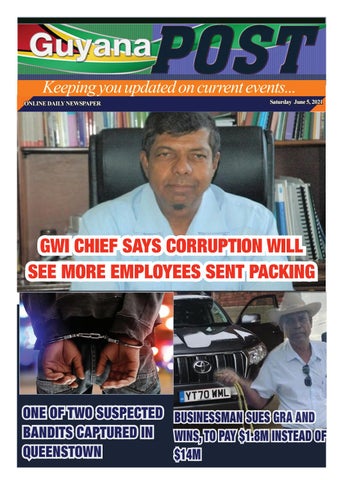
Keeping you updated on current events... ONLINE DAILY NEWSPAPER
Saturday June 5, 2021
GWI CHIEF SAYS CORRUPTION WILL SEE MORE EMPLOYEES SENT PACKING
ONE OF TWO SUSPECTED BUSINESSMAN SUES GRA AND BANDITS CAPTURED IN WINS, TO PAY $1.8M INSTEAD OF QUEENSTOWN $14M
Saturday June 5, 2021
GWI CHIEF SAYS CORRUPTION WILL SEE MORE EMPLOYEES SENT PACKING
Chief Executive Officer(CEO), Shaik Baksh
Coupled with the firing of over 150 workers due to overstaffing, Guyana Water Incorporated (GWI) through its audit will look to fire more employees who are fingered for fraud transactions at the company over the
previous year. This was revealed by the Chief Executive Officer(CEO), Shaik Baksh, in a press conference in which he explained that due to the ongoing audit, the Special Organized Crime Unit has been called in.
The findings have so far seen the firing of some members of staff. The audit is being conducted by an internal Auditor. Baksh said, “SOCU has been called in and forensic audits are being conducted as I speak because we have seen an internal auditor report at GWI looked at it and we had to move.” That move, Mr. Baksh explained, was because of irregularities in the area of procuring chemicals. He said that a middle man was used. That would have caused the overspending and breached some tender and procurement laws. Mr Baksh added that there have also been fictitious charges on invoice and transportation costs, which management had
approved also. He also noted questionable delivery of some goods. In some instances, the Clerk in charge was signing on behalf of the regional authorities and there remains in some instances no evidence that the product was delivered. Additionally, he added that there was also contract splitting, which is prohibited. Those along with many other irregularities were found and as such Mr. Baksh said that they had no choice but to call in the authorities. “We had no choice but to do a forensic audit on this…There was contract splitting. So, they breached everything. Double charges, fictitious charges, and questionable delivery of
goods. Baksh added that the clerk and Manager were dismissed due to the findings and more are expected to go. This number of people that will be laid off according to Mr. Baksh cannot be determined at the said moment but through the findings of the audit, those people will face the consequences. Just a few weeks ago the Board of Directors announced that fraud was perpetrated at a commercial bank and resulted in the debit of nearly $30m from GWI’s bank account. GWI back then explained that the fraud was discovered by the Finance Department upon reconciling accounts for March 2021.
That amounts according to GWI $17,489,417 debited on March 16, 2021 and $12,327,515 debited on March 24, 2021. Upon querying, the bank informed GWI that the amounts represent payments made via wire transfer instructions, payable to two persons (names given) resident in the USA. The addresses of the recipients are 1405 Brooklyn Avenue, AF2F Brooklyn Avenue, New York 11210, and 1998 Pacific Street, Brooklyn NY 11216. GWI has since said it has never conducted business with these persons or at no time initiated or instructed the bank to carry out these fictitious transactions. Since then an investigation has been launched into that matter.
BUSINESSMAN SUES GRA AND WINS, TO PAY $1.8M INSTEAD OF $14M Commercial vehicle as a passenger vehicle under the tariff heading 8703. This incorrect classification would have required Mr. Jahan to pay nearly $14 Million in taxes and duties to the GRA. Additionally, Justice Younge also ordered that the respondents take all steps necessary to see to the release of the vehicle as soon as practicable. The judge also ordered that Mr. Jahan be reimbursed by the GRA and Mr. Statia Mr. Mohamed Shaw Jahan
A local businessman who took the Guyana Revenue Authority (GRA) to court for over-taxing him for his imported Land Cruiser has won his case. He will only pay 1.8 Million instead of the $14 M levied by the authority. On October 30, 2020, Mr. Mohamed Shaw
Jahan brought the Land Cruiser from England, the United Kingdom where it was classified as a ‘light goods vehicle’. However, the GRA insisted that the vehicle was a passenger vehicle. Mr. Jahan, with representation from His Attorney at law, Stand Dhurjon, took GRA to
the court. Today Justice Damone Younge granted several orders in which will see Mr. Jahan only pay $1,871,457. In the court ruling today, Justice Younge said that the GRA and Mr. Godfrey Statia wrongfully classified the 2020 Toyota Land Cruiser Utility
2
for the costs of storing the vehicle at the John Fernandes terminal from January 2021 to the date of its release. The learned judge also ordered that the GRA and Mr. Statia pay the costs of Jahan’s lawsuit to him. Attorney Dhurjon welcomed the decision. According to him, this is believed to be the first case of its kind in Guyana. The learned judge came to her determination after a very thorough and exhaustive survey on
the law of tariffs and classification. He added that in this case, Justice Younge considered the World Customs Organisation’s explanatory notes, the Customs Act, and Guyana’s Common External Tariff introducing the Harmonized Commodity Description and Coding System into law before disagreeing with the submissions of the attorneys for the GRA, Ms. Judy AdonisStuart, and four other GRA attorneys.
Saturday June 5, 2021
Why 84 countries are borrowing from the IMF
By Sir Ronald Sanders (The writer is Antigua and Barbuda’s Ambassador to the United States and the Organization of American States. He is also a Senior Fellow at the Institute of Commonwealth Studies at the University of London and Massey College at the University of Toronto. The views expressed are entirely his own) In the wake of the economic damage done by the effects of the COVID-19 pandemic, countries in every continent of the world have turned to the International Monetary Fund (IMF) for assistance. It is right that they have done so. The IMF exists to provide economic and financial support to countries when other options have been extinguished.
The pandemic brought countries to that situation in rapid time, particularly tourism-dependent countries which were the hardest hit. In some countries, there is an ideological resentment of the IMF. That resentment is based on past harsh conditionalities that the Fund included in the terms of its loans to countries already in desperate straits. That resentment should be re-evaluated. IMF conditionalities still exist, but they are more geared to recognizing the breathing space governments require to get their countries’ economies performing at an optimum level. The Fund wants to be repaid, so that, in turn, it can pay back the banks, governments, and institutions from which it borrows to supplement its lending resources. While the main source
for IMF loans on nonconcessional terms is provided by member countries, through their quota payments, the Fund also borrows money that it lends. Of the IMF’s current total resources for lending, amounting to about US$1 trillion, a significant portion is a money that must be repaid. If the IMF fails to service its loans, the entire world will lose an extremely important pillar of the global financial architecture, resulting in infectious economic instability and, eventually, political chaos and civil strife. Consequently, like any lender, the IMF has to make sure that borrowing countries will be able to repay. It sets terms – called conditionalities – to ensure that the best use is made by borrowers of the money they are advanced and that loans can be repaid.
Presently, IMF loans are on more generous terms than they used to be. For instance, financing for approved medium-term growth and development strategies could be secured with a repayment period of 14 years, a four-year moratorium, and an interest rate of one percent. Loans of this nature are not available from any other source. Of course, negotiating the best conditionalities is important. This is not the time to lay off public sector workers, especially in countries where employment in the private sector has declined disastrously because of the COVID-19 pandemic. The IMF Executive Board and Management are aware of that and have adopted policies that are more open to supporting vulnerable groups than they were in the past. What is more, approval by the IMF to fund a programme opens the door to borrowing from other financial institutions, and to rescheduling debt with agencies such as the Paris Club. These institutions, including the Caribbean Development Bank, regard the imprimatur of the IMF as crucial in determining a country’s creditworthiness. In the present global economic crisis, 84
countries have already taken advantage of the IMF’s lending to the tune of US$109,594.38 million. Of those countries, eight are CARICOM states, namely: Bahamas, Barbados, Dominica, Grenada, Haiti, Jamaica, St Lucia, and St Vincent, and the Grenadines which have borrowed US$842 million. Eleven Latin American countries, including Honduras, Costa Rica, Panama, Peru, Ecuador, and Nicaragua, have borrowed US$66,677.46 million. Those, who argue against the IMF on ideological grounds, should have alternative sources of financing to propose. Either they must show a clear path to the capacity of their countries to recover and prosper from renewed and sustainable economic activity, or they must identify cheaper sources of borrowing with less strenuous terms. If they cannot identify such possibilities in a realistic way, then the only alternative to borrowing from the IMF is to leave their economies to languish, running out of money and failing to provide goods and services that their people expect. The current economic conditions, across the CARICOM states except for Guyana, and possibly
St Kitts-Nevis and Trinidad and Tobago, require pragmatism and practicality in recognising that working with the IMF has value. There is no shame in going to the IMF to borrow in the current climate. It is a necessity, particularly when other options have dried up. Further, the IMF is fulfilling the role for which it was created – to lend when other options are closed. The anti-IMF ideological argument is one that cuts off your nose to spite your face. It makes little sense. In the current crisis, political parties and others that try to discredit governments because they opt to borrow from the IMF, ignore two salient points. First, governments are not now constrained to approach the IMF because of any failed policies they pursued; they approach the IMF because the devastating effects of the pandemic forced them there. And, second, the IMF is a lender of last resort. Governments contract with the IMF because the economic circumstances of their countries are such that they must borrow to sustain their populations, and, in those conditions, were better than the institution that provides the cheapest lending.
The Ministry of Health, on Thursday, confirmed four additional COVID-19 deaths, taking Guyana’s COVID-19 death toll since March 11, 2020, to 400. It is important to note that on May 3, exactly one month ago, the Ministry of Health confirmed three deaths which led to the
death toll increasing to 303. Two months prior, on March 4, Guyana passed 200 COVID-19 deaths. May has since emerged as the deadliest month since the pandemic hit Guyana. Ninety-seven deaths were recorded. One month earlier, in April, there were 69
deaths making that month the deadliest. Many Guyanese could put a face to COVID deaths. Mondale Smith, a reporter, an entertainer, a communications adviser attached to the Education Ministry, and more recently a chef, became one of the grim statistics.
Exactly a month after passing 300 deaths, Guyana now has 400 ‘COVID’ deaths
Saturday June 5, 2021
GTT LAUNCHES WHATSAPP BILLING FOR POSTPAID CUSTOMERS – company continues to look at new innovative ways to better serve Guyana
conveniently receive their monthly billing invoices via WhatsApp. GTT’s Product Marketing Coordinator, Diangelly Singh explained that the company has been working on new ways to provide customers with even more convenience to access their bills on time – and in their preferred format. “Our increasingly innovative solutions Postpaid customers of and Telegraph Company around billing, counter the Guyana Telephone (GTT) can now opt to the challenges that some
customers may face in not receiving their bills on time, for a range of reasons. Appreciating this challenge, the GTT team is committed to offering ongoing ease and billing access to our customers, and we hope that this new platform will prove helpful,” she said. Through this development, GTT customers can access their DSL, Blaze, Landline and mobile bills immediately after it is available on their
mobile phones via the WhatsApp medium. Singh further noted that in order to receive the bill via WhatsApp, customers must update their contact information with the company via gtt. gy/update5 “No matter what network you are on, once you register to receive the postpaid bill through this medium, we will ensure you receive your bill on time,” Singh reassured. Only recently, GTT
launched a new and improved MyGTT app that allows customers the convenience of accessing all their bills at the same time among other new features. “Options to ensure ontime billing and payments abound,” added Singh. She said that should customers need assistance in accessing the MyGTT app or establishing WhatsApp billing, they can simply contact GTT at 0488 or live chat for guidance.
ONE OF TWO SUSPECTED BANDITS CAPTURED IN QUEENSTOWN One of two alleged gun-toting bandits was caught after a high-speed chase in the Queenstown area, yesterday. Reports are that just after 15:00 hours, two men on a motorcycle were seen by two patrol cops on motorcycles also acting suspiciously. An approach by the cops saw the men quickly trying to escape from the attention of the police. The incident quickly turned into a high-speed chase. The two alleged bandits
Reporters must provide proof of vaccine or COVID test
INTERNATIONAL INC.
VACANCY EXISTS FOR AN ELECTRICAL ENGINEER
DUTIES & RESPONSIBILITIES:
• Knowledge iof PLC (Programme Logistical Controller) • Rebuilding Control Circuit QUALIFICATIONS: • Degree in Electrical Engineer • Computer Literate REMUNERATION: • Negotiable Depending on Qualification and Experience Interested and qualifying candidate may forward his/ her resume before 8th of June, 2021 to the Office Manager
INTERNATIONAL INC.
LOT 1&2 MUD LOT, WATER STREET KINGSTON, GEORGETOWN GUYANA, SOUTH AMERICA HEAD OFFICE TEL: (592) 226-5513-4 | 226-5314-5, 226-4113 FAX: (592) 226-5517, 223-7421 | EMAIL: bkinc@bkinc.biz
later crashed into a parked vehicle. The chase, however, did not end there, as the two men now took the chase to foot in the Queenstown area. In the process, the two men jumped several fences and fired several shots. Sometime later one of two men became stuck in a nearby fence and was apprehended. The other jumped into a hallway and later could not be found. Police searched for some time but turned up
With effect from Monday, June 7, 2021, members of the media will be required to produce proof of their COVID-19 vaccination
4
card or a negative COVID test result before gaining access to the Arthur Chung Conference Centre for Sittings of the National Assembly.
Saturday June 5, 2021
INDEPENDENCE 55 YEARS LATE
ADAM’s Notebook The people of Guyana woke up to the 55th anniversary of its independence on Wednesday. For most of the population this country became independent a very long time ago. Most of the people living on this land were not born so they don’t know anything about singing “God Save the Queen’ and waving the Union Jack. In fact, if one were to do a random quiz on the streets, less than 20 per cent of the people questioned would say what the Union Jack is. The few who were around would remember the visit by the Queen in February 1966. There was a big fair on what was then the BGCC ground. That is the ground adjoining the Queen’s College ground to the east. The Queen’s sister came to this country in 1962. What is now the National Park was the Queen Elizabeth Park. Many Georgetown people back then knew it as the golf ground. Go into the National Assembly and ask the members of Parliament to tell you something
info@guyanapostonline.com
about their experience on Independence Day 1966. Very few would be able to. Robeson Benn, Juan Edghill, Joe Harmon, Gail Teixeira, and perhaps Khemraj Ramjattan would have some vague recollection. Bharrat Jagdeo would have none. In the run up to 1966, some of the ordinary people were afraid. They had grown up eating what the British sent to the colony. Some planted crops but for the greater part they fell in love with Irish or English potatoes—today we eat potatoes from Idaho in the United States. Canned sardines, salted fish or saltfish, apples which we called iceapples, grapes, walnuts and the likes still adorn our tables. Such was our dependence on these things. Salt beef and salt pork were imported. Today they are integral to the cook-up. Although one must say that we make our own salt fish, salt beef and salt pork. People nearly died when wheat flour was banned and when split peas was restricted. These are still imported products,
foisted on us by the colonial masters prior to independence. Most people would not know that the potato from those days were a far cry from the potatoes of today. They were harder and took an eternity to cook. That was because they had to be preserved in order to be shipped over long distances. It was the same with the split peas. People were also uncertain about the future. Most of the older folk felt that the colonial master was needed to manage just about everything. The Guyanese never realized that they were the ones doing the work under the supervision of the colonial master. There was a time before independence when people of African ancestry and those of Indian ancestry could not go to certain places. The Georgetown Club, Colgrain House, Watooka Club in Linden, the estate houses on the various sugar estates were just a few. There was segregation in sports. We had East Indian Cricket Club (later Everest), and
Chinese Cricket Club (later Cosmos). We also had Indian Educational Trust College. Guyana was Guyana. Today people complain about infrastructure. In the pre-independence days the road from Crane, West Coast Demerara, was burnt brick—not laterite-- all the way to Parika. After Boeraserie people had to put their vehicles on trains to reach Parika. On the East Coast, once one passed Ogle, the road was burnt brick and laterite. People made money burning logs to make bricks for the road. The locals worked side by side but they harboured a distrust of each other, instilled by the first rulers. If someone or something looks different it should be carefully examined or avoided. There were deep wounds. In the days
5
before Independence Guyanese waged a bitter civil war among themselves. They killed anyone who looked different; they destroyed property. Some people swapped homes. For two years the murder rate was higher than it could ever be today. People died by the dozens. They were clubbed to death or brutally chopped. Those were the conditions under which Guyana became independent. There is a saying that time heals all wounds. It has not healed the wounds in Guyana. Some of us watched squatter settlements grow up where there are now permanent and fancy homes. The squatters were the displaced residents from the villages. Segregation is still rife. There are villages of predominantly one ethnic
group. Georgetown is considered the melting pot but any inspection would reveal the gaps. Prior to independence people of African ancestry mimicked the colonial master. He became the teacher, the policeman, the post master and the engineer. He was also the doctor and the lawyer. The people of Indian ancestry also became the doctor, the teacher and the lawyer but overwhelmingly they tilled the land and made millions of dollars. They continue to be the farmers in predominant numbers. The sun will rise on Guyana 55 years after independence. Those who know where to look will see the scars of the violence of 55 years ago. There are many in Georgetown. And the scarred relationship between the people also remains.
Email or text your letters to us, we would be happy to have publish them ExxonMobil Oil Rig
lendellnurse6995@gmail.com
adameharris@yahoo.com info@guyanapostonline.com info@guyanapostonline.com
6