Keeping you updated on current events...
Wednesday June 2, 2021
ONLINE DAILY NEWSPAPER
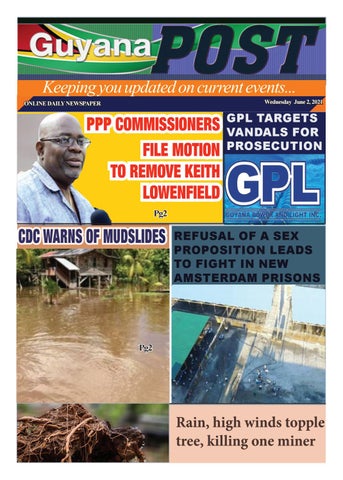
PPP COMMISSIONERS FILE MOTION TO REMOVE KEITH LOWENFIELD
GPL TARGETS VANDALS FOR PROSECUTION Pg2
Pg2
Pg2
CDC WARNS OF MUDSLIDES
REFUSAL OF A SEX PROPOSITION LEADS TO FIGHT IN NEW AMSTERDAM PRISONS
Pg2
Rain, high winds topple tree, killing one miner
Wednesday June 2, 2021
PPP COMMISSIONERS FILE MOTION TO REMOVE KEITH LOWENFIELD
People’s Progressive Party/Civic (PPP/C) Elections nominated Commissioners – Sase Gunraj, Bibi Shadick, and Robeson Benn have filed a motion seeking the
removal of the Guyana Elections Commission, Chief Elections Officer, Keith Lowenfield. They are alleging several breaches while performing their duty.
At a meeting held at the GECOM headquarters, the motion was presented. A meeting is to be scheduled to discuss the motion.
CDC WARNS OF MUDSLIDES
With Guyana expecting more rainfall in the days to come, the Civil Defence Commission is urging residents in the CuyuniMazaruni Region to move to higher ground, as mudslides may be imminent. As CDC continues to monitor the situation around Guyana, the commission has assessed
all regions including Region Seven. Guyana in nine of its ten administrative regions over the past few days experienced continuous rainfall. This trend is expected to continue in the coming days according to the National Weather Watch Center forecasts. Since the continuous rainfall, some regions are
experiencing over five feet of water covering their land and causing millions of dollars in losses. Some residents have been forced to leave their homes. The CDC has activated its disaster response plan and has so far started its relief camp and ensured that all disaster prevention mechanisms are activated.
GPL TARGETS VANDALS FOR PROSECUTION
The Guyana Power and Light (GPL) has signaled its intention through to the legal route for persons for individuals who are accused of vandalizing their Automatic Metering Infrastructure (AMI) in the effort to reduce the electrical bill. In a statement from GPL, it was noted that the new meters represent part of their Power Utility Upgrade Program (PUUP), which is geared to upgrade the GPL distribution network and metering infrastructure to not only reduce overall losses but improve the quality of service. The programme that has been financed by the
European Union (EU) and the Inter-American Bank (IDB), expended billions of dollars to install new poles, upgrade conductors and install meters that have the capability to convert to and operate as smart meters with the Company’s future AMI. Local contractors were contracted and are involved extensively in this project, undertaking both network upgrade and meter installation. However, according to GPL as they seek to improve the quality of service the system is being exploited by some unscrupulous characters for nefarious gains. GPL said that the
project is being hampered due to the expensive meters being vandalized, and in some instances, with the cooperation of Customers with the intention of reducing their electricity bills. The company noted that hundreds of meters have been found, damaged beyond repair. The company maintained that Customers will be held liable for charges associated with the replacement of the meter and any unbilled electricity consumed. The company insisted that these actions provide extreme concern and more so, in most instances have pointed to a specific category of customers. This category of customers, including some businesses who are not considered to be impoverished have been encouraging destruction to the Company’s property.
REFUSAL OF A SEX PROPOSITION LEADS TO FIGHT IN NEW AMSTERDAM PRISONS
A fight broke in the New Amsterdam Prisons after one prisoner refused to have sex for cigarettes and weed. The clash has left both parties suffering from injuries to their bodies. Reports are that it was just after 12:30 hours yesterday at the prison when Ravin Ramdehol approached 40-year-old, Davendra Samwaru and made an offer of sex for
2
weed and cigarettes. At the time the two were reportedly inside a bathroom. As that proposal was refused, Samwaru quickly exited the area without his underwear but was followed by the suspect and an argument over his underwear ensued. Ramdehol, being annoyed, brandished a razor blade and inflicted injuries to the Samwaru’s
lower right arm and a scuffle ensued between the two. That fight resulted in both of them being taken to the medical area of the facility where Ramdehol was later transferred to the New Amsterdam Public Hospital due to the seriousness of his injuries. Samwaru’s condition on the other hang is listed as serious but stable
Wednesday June 2, 2021
RAIN, HIGH WINDS TOPPLE TREE, KILLING ONE MINER An accident in the Sand Hills Backdam, Cuyuni River, has claimed the life of one while leaving two others with serious injuries. The accident is blamed on heavy rainfall coupled with high winds that uprooted a tree, that later fell into a mining pit. The incident occurred just after midday, yesterday, killing Olrick Matthews, a miner of Port Kaituma, North West District, and injuring 49-yearold Edwin Garraway, of Diamond Housing
Scheme, East Bank Demerara, and 40-yearold Bryan Richards a miner of Pomeroon River According to a statement from the police on the matter, the three persons who are employed by Romeo King, a miner, were at his mining operation at Sand Hills when a heavy downpour, coupled with high winds caused a tree to be uprooted and fall into the mining pit, hitting the three workers who were working at the time.
On witnessing the incident, other workers then ran to the assistance of the three. Upon examination, they found Matthews motionless. Garraway sustained a fractured left hand while Richards received lacerations to his forehead. Both are presently seeking medical attention at the Bartica Regional Hospital. A report was made and Matthews’s body was escorted to Bartica Regional Hospital where a doctor pronounced him
dead on arrival at 23:00 hrs. The body was then placed into the Bartica Mortuary where it awaits a post mortem examination.
COVID-19 PANDEMIC COULD OBLITERATE GAINS IN MATERNAL MORTALITY
Washington, D.C., (PAHO) –Pan American Health Organization (PAHO) Director Carissa F. Etienne warned that continued disruption of women’s health services due to COVID-19 could “obliterate” more than 20 years of progress in reducing maternal mortality and increasing access to family planning in Latin America and the Caribbean. “I want to spotlight the devastating health, social and economic impacts that this virus has had on women,” Dr. Etienne said during her weekly media briefing. Women have been particularly impacted
by interruptions of reproductive and maternal health services, she said. “According to UN estimates, up to 20 million women in the Americas will have their birth control disrupted during the pandemic, either because services are unavailable or because women will no longer have the means to pay for contraception.” Pregnancy and newborn care also have been interrupted in nearly half of countries in the Americas, she said. At the same time, pregnant women are more vulnerable to respiratory infections such as COVID-19. If they get sick, they tend to develop more serious symptoms
that require intubation, which can put both the mother and baby at risk. “If this continues, the pandemic is expected to obliterate more than 20 years of progress in expanding women’s access to family planning and tackling maternal deaths in the region,” Dr. Etienne said. “Nearly all maternal deaths are preventable and even getting back to prepandemic levels of maternal mortality, which were already high, could take more than a decade.” The maternal mortality rate in Latin America and the Caribbean declined from 96 to 74 maternal deaths per 100,000 live
births between 2000 and 2017, an overall reduction of 23.1%. Calling attention to the upcoming International Day of Action on Women’s Health, celebrated on May 28, Dr. Etienne said, “We urge countries to do just that – to act. We can start by ensuring that women and girls can access the health services they need – like sexual and reproductive health services, and pregnancy and newbornrelated care – during the COVID response.” “We must remember that the challenges and inequities that we faced prior to COVID haven’t gone away during the
3
pandemic – they’ve only worsened and can’t be overlooked. That’s why we must make protecting the lives of women a collective priority,” she continued. Cases and deaths are plateauing at alarmingly high levels Dr. Etienne also drew attention to the World Health Organization’s (WHO) assertion last week that casualties due to COVID-19 have been seriously underreported. “COVID’s true global 2020 death toll is closer to three million people – nearly double the figures reported last year,” she said. “Worryingly, half of these deaths have taken place here, in the Americas, demonstrating the outsized impact this pandemic has had in our region.” “These figures have remained unchanged over the last weeks, illuminating a worrying trend: cases and deaths are plateauing at alarmingly high levels,” Dr. Etienne said. “In fact, last week, four out of five of the countries reporting the highest number of new infections were here in our region. Latin American countries represented the
top five highest mortality rates worldwide.” Increases in cases have been reported in Central American countries, including Costa Rica, Panama, Belize, and Honduras, where ICU beds are at more than 80% capacity. In the Caribbean, Trinidad and Tobago has declared a national emergency following a recent COVID-19 outbreak. Cuba continues to report a significant increase, and Saint Vincent and the Grenadines are still experiencing spikes after people were moved to shelters because of recent volcanic eruptions. “We are also concerned about increasing trends in hospitalizations in Haiti,” Dr. Etienne noted. In South America, new infections have declined in Chile, Peru, and Paraguay. But Uruguay, Argentina, and Brazil, after experiencing progress for several weeks, are once again seeing a rise in cases. Bolivia is reporting a dramatic increase in cases and deaths, and Guyana is experiencing its highest volume of cases and deaths since the beginning of the pandemic.
WOMAN AWAKES TO FIND MAN AT HER BEDSIDE
A
young woman in her house besides her in Moruca Village, and the suspect was later Northwest District, woke caught. up with an alleged thief According to a police
report, it was just 19:25 About 23:00 hours hours that a young she woke up and saw the woman secured the suspect, a 24-year-old house and retired to bed. man next to her bedside.
She immediately jumped off the bed and raised an alarm. She then ran out of the house to her
uncle’s abode which is nearby and told him. The uncle accompanied by others went to the suspect’s house. The suspect tried to make good his escape but was restrained and bound. The Community Policing Group of Rincón Village was summoned and responded immediately. Its members arrested the suspect and escorted him to the Acquero Police Station. The suspect remains in custody
before Independence Guyanese waged a bitter civil war among themselves. They killed anyone who looked different; they destroyed property. Some people swapped homes. For two years the murder rate was higher than it could ever be today. People died by the dozens. They were clubbed to death or brutally chopped. Those were the conditions under which Guyana became independent. There is a saying that time heals all wounds. It has not healed the wounds in Guyana. Some of us watched squatter settlements grow up where there are now permanent and fancy homes. The squatters were the displaced residents from the villages. Segregation is still rife. There are villages of predominantly one ethnic
group. Georgetown is considered the melting pot but any inspection would reveal the gaps. Prior to independence people of African ancestry mimicked the colonial master. He became the teacher, the policeman, the post master and the engineer. He was also the doctor and the lawyer. The people of Indian ancestry also became the doctor, the teacher and the lawyer but overwhelmingly they tilled the land and made millions of dollars. They continue to be the farmers in predominant numbers. The sun will rise on Guyana 55 years after independence. Those who know where to look will see the scars of the violence of 55 years ago. There are many in Georgetown. And the scarred relationship between the people also remains.
INDEPENDENCE 55 YEARS LATE
ADAM’s Notebook
The people of Guyana woke up to the 55th anniversary of its independence on Wednesday. For most of the population this country became independent a very long time ago. Most of the people living on this land were not born so they don’t know anything about singing “God Save the Queen’ and waving the Union Jack. In fact, if one were to do a random quiz on the streets, less than 20 per cent of the people questioned would say what the Union Jack is. The few who were around would remember the visit by the Queen in February 1966. There was a big fair on what was then the BGCC ground. That is the ground adjoining the Queen’s College ground to the east. The Queen’s sister came to this country in 1962. What is now the National Park was the Queen Elizabeth Park. Many Georgetown people back then knew it as the golf ground. Go into the National Assembly and ask the members of Parliament to tell you something info@guyanapostonline.com
about their experience on Independence Day 1966. Very few would be able to. Robeson Benn, Juan Edghill, Joe Harmon, Gail Teixeira, and perhaps Khemraj Ramjattan would have some vague recollection. Bharrat Jagdeo would have none. In the run up to 1966, some of the ordinary people were afraid. They had grown up eating what the British sent to the colony. Some planted crops but for the greater part they fell in love with Irish or English potatoes—today we eat potatoes from Idaho in the United States. Canned sardines, salted fish or saltfish, apples which we called iceapples, grapes, walnuts and the likes still adorn our tables. Such was our dependence on these things. Salt beef and salt pork were imported. Today they are integral to the cook-up. Although one must say that we make our own salt fish, salt beef and salt pork. People nearly died when wheat flour was banned and when split peas was restricted. These are still imported products,
foisted on us by the colonial masters prior to independence. Most people would not know that the potato from those days were a far cry from the potatoes of today. They were harder and took an eternity to cook. That was because they had to be preserved in order to be shipped over long distances. It was the same with the split peas. People were also uncertain about the future. Most of the older folk felt that the colonial master was needed to manage just about everything. The Guyanese never realized that they were the ones doing the work under the supervision of the colonial master. There was a time before independence when people of African ancestry and those of Indian ancestry could not go to certain places. The Georgetown Club, Colgrain House, Watooka Club in Linden, the estate houses on the various sugar estates were just a few. There was segregation in sports. We had East Indian Cricket Club (later Everest), and
Chinese Cricket Club (later Cosmos). We also had Indian Educational Trust College. Guyana was Guyana. Today people complain about infrastructure. In the pre-independence days the road from Crane, West Coast Demerara, was burnt brick—not laterite-- all the way to Parika. After Boeraserie people had to put their vehicles on trains to reach Parika. On the East Coast, once one passed Ogle, the road was burnt brick and laterite. People made money burning logs to make bricks for the road. The locals worked side by side but they harboured a distrust of each other, instilled by the first rulers. If someone or something looks different it should be carefully examined or avoided. There were deep wounds. In the days
4
Vaccine refusal is as dangerous a pandemic as COVID-19
By Sir Ronald Sanders (The writer is Antigua and Barbuda’s Ambassador to the United States and the Organization of American States. He is also a Senior Fellow at the Institute of Commonwealth Studies at the University of London and Massey College at the University of Toronto. The views expressed are entirely his own) Vaccine refusal is fast becoming as dangerous to human health and to economies as the COVID-19 pandemic. In 2019, even before the novel coronavirus was confirmed and began its spread around the world, the World Health Organization (WHO) revealed that vaccine refusals had led to a resurgence of diseases such as measles in countries that were close to eliminating them. The WHO identified vaccine refusal as one of the 10 leading threats to global health. At
that time, complacency, inconvenience in access, and a lack of confidence were said to be the driving factors for people’s refusal to inoculate against disease. Since the advent of the COVID-19 pandemic, the problem has become worse and so widespread that a comprehensive approach by all governments and non-governmental organizations, globally, is now necessary to overcome it. Promoted on social media platforms by farright organisations and church groups in the U.S., the anti-vaccine propaganda has spread like wildfire, convincing persons at all levels of societies that they would either die from an inoculation or some harmful material would be injected into their bodies. Religious groups in the Caribbean, influenced by fundamentalist U.S. churches, also encourage
their followers not to vaccinate. Research done by the New York Times reported, on April 5, that “among evangelicals in the U.S., Pentecostal and charismatic Christians may be particularly wary of the vaccine, in part because their tradition historically emphasizes divine health and miraculous healing in ways that can rival traditional medicine”. Charismatic churches also attract followers in the Caribbean. The most popular social media platforms used by anti-vaxxers are Facebook, Twitter, and Instagram which have all committed to banning anti-vaccine content. But, accounts on these platforms turn up as quickly as they are taken down. In turn, the propaganda, which includes fabricated videos purporting to show actual events, is communicated tens of thousands of times around the world on
WhatsApp. Governments and social media platforms, such as those named in this commentary, as well as organizations such as the WHO and the Pan-American Health Organization (PAHO), must gather specialists together to find ways to counter the antivaccination propaganda campaigns and to strengthen educational progammes showing the benefit of vaccines. PAHO has started using Facebook to educate about the benefits of vaccines, but more effective communications techniques should be used, including dropping huge images of syringes and needles, that may be reinforcing reticence to inoculate. Groups of persons in many parts of the world, who decline to take the COVID-19 vaccine, now pose a risk to themselves and the people with whom they come into contact, especially their families. They also pose a risk to the opening-up of the economies of their countries. Data, gathered worldwide, shows that the claims of the anti-vaxxers, concerning detrimental effects of the vaccine, are wrong. Figures confirm that the COVID-19 vaccine prevents severe infection and deaths at astounding rates. Studies show that
in Israel for instance, vaccines prevented hospitalization among adults 65 and older by 94%. They also prevented symptomatic infection among healthcare workers by 97% and blocked severe disease by 97.4% in Qatar. Dr. Monica Gandhi, an Infectious-Diseases Specialist, and Professor of Medicine at The University of California at San Francisco, reports that serious infections among vaccinated individuals are extremely rare. She points out that “of over 115 million vaccinated Americans, only 0.0009% contracted severe COVID-19 after vaccination despite the virus continuing to circulate in their communities. As she concluded: “Vaccines truly defang the virus”. In the U.S. and Britain where (at the time of writing on 20 May) 48.09% and 55.49% of the populations have been vaccinated, data shows that vaccines also block transmission. People, who have been inoculated against the coronavirus, are rightly concerned that, despite their responsible action in taking the vaccine, irresponsible persons are asserting their right to refuse it. The question that has to be asked is: whose rights are greater? Are the rights to safeguard lives and livelihood less than the right to put lives
and livelihoods at risk by refusing to be vaccinated? This is not a moral dilemma; it is a commonsense question, deserving a common-sense answer. However, no answer is being attempted as individual governments and their health authorities shy away from the question for political reasons. No ruling political party wants to risk losing electoral support to its rivals on the back of an accusation of depriving people of their rights. Yet, when that right is upheld, it threatens others and entire societies. Just as measles has returned in countries where groups of people decline to be inoculated against it, COVID-19 will not be subdued or eliminated in countries where groups of people refuse to be vaccinated. This conflict must be tackled and resolved by global agreement and action. No one country can act alone. Maybe the answer lies in an intense education programme globally constructed, financed, and implemented. The mantra that “we’re all in this together” assumes a profound global relevance for maintaining life and sustaining livelihoods. Doing nothing is not a solution. The 74th World Health Assembly being held from May 24 to June 1, is the ideal place to start.
Unnecessary hassle at CJIA Dear Editor, On April 25, 2021, I was making the midnight Jet Blue trip to NY. In the departure lounge after clearing Immigration, and preparing to be screened, I had my second most horrifying experience with the screening technician. Because of a radiationrelated cancer surgery I had in 2007, I requested
a pat-down instead of using the x-ray machine. This request was denied, I was made to parade myself four times in and out of that machine with undue care from uncouth staff. As if this was not enough, CANU continued with the most degrading search on my personal effects. I am a septuagenarian; I was never involved in
transporting any illicit stuff, and would like to know why I am being targeted when attempting to depart Guyana. I would like Mr. Ramesh Ghir and the Civil Aviation Director to note my harassment. These people need to be trained. They are an embarrassment to Guyana. Traumatized citizen.
Email or text your letters to us, we would be happy to have publish them ExxonMobil Oil Rig
lendellnurse6995@gmail.com
adameharris@yahoo.com info@guyanapostonline.com info@guyanapostonline.com
6