Time for rejoicing and sober reflection PAGE 2
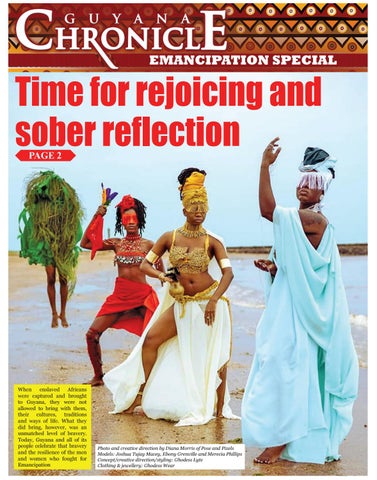
When enslaved Africans were captured and brought to Guyana, they were not allowed to bring with them, their cultures, traditions and ways of life. What they did bring, however, was an unmatched level of bravery. Today, Guyana and all of its people celebrate that bravery and the resilience of the men and women who fought for Emancipation
Photo and creative direction by Diana Morris of Pose and Pixels Models: Joshua Tujay Macey, Ebony Grenville and Merecia Phillips Concept/creative direction/styling: Ghodess Lyte Clothing & jewellery: Ghodess Wear
2
GUYANA CHRONICLE EMANCIPATION SPECIAL Sunday, August 1, 2021
Time for rejoicing and sober reflection
By Tota C. Mangar
THIS month of August 2021 commemorates the 187th anniversary of Emancipation. It was on August1, 1834 that the despicable system of slavery was abolished in all British colonies including Guyana, the former British Guiana. Such a development emerged as a consequence of intense and persistent struggle, sacrifice and resistance by the unfortunate victims themselves along with the valiant efforts of energetic supporters such as religious leaders, humanitarians, politicians and enlightened individuals of the day. Our history tells us that our Afro-Guyanese forefathers were first brought here to provide enslaved labour during the early decades of the 17th century by the Dutch in their quest for settlement and colonisation. This was part of a much wider and forced movement of people from the continent
A sign with a historical synopsis of the village of Victoria (Samuel Maughn photo) of Africa to the West Indian islands and the Americas which started a century earlier.
NEW WORLD SLAVERY Slavery in the New World was institutionalised
by the Europeans on the grounds of economic necessity through the Trans - Atlantic slave trade. The end result was that millions of Africans were uprooted from their homeland through trickery, kidnapping, raids, bribery and other forms of deception and taken against their will to these parts where they found themselves within the monstrous system of plantation slavery. In order to justify their actions, Europeans quite arrogantly argued that slavery was in existence in Africa even before they made contact with that continent .But let me hasten to say that the slavery which existed in Africa before the advent of New World slavery was a completely different system. It was more or less a social institution. Africans saw it as an honour and obligation to give service to their rulers in the army, in agriculture, in construction works and other areas of development. It was a relatively humane system which permitted upward social mobility and enhanced dignity and pride. On the contrary, the slavery that emerged in the West Indies and the Americas due to European imposition was characterised by greed, injustice, cruelty and gross exploitation .There was nothing humane about the system and the victims were reduced to the status
of ‘properties or things’ of their masters. It is little wonder that prominent African scholar, Dr. Ajayi, aptly states that it is absurd to use the same word “slavery” to describe the two systems: the humane social institution in existence in Africa, as against the very oppressive economic institution which unfolded in the New World as a consequence of European imposition. The Trans-Atlantic slave trade and plantation slavery were degrading, demoralising and dehumanising to the victims. From the very outset they required supreme sacrifice and valiant struggle to survive the obviously harsh and oppressive system. RESISTANCE It was not surprising that resistance quickly became an integral part of the slavery system. The victims resisted capture on the African continent itself; they adopted innovative methods of resistance on board the overcrowded slave ships while crossing the Middle or Atlantic Passage, and on the plantations they justifiably intensified their resistance to the system of enslaved labour. These varied forms of passive and active resistance clearly demonstrated their determination as a people, and their non-compliance with the evils of bondage
and oppression. Malingering, feigning illness or ignorance, hunger strike, deliberately doing poor work, self-inflicted actions, damage to master’s property, marronage and slave rebellions were all part of the strategy to undermine the economic, social, political and cultural dominance the master class enjoyed at the expense of the enslaved. The 1763 Berbice Slave Revolt and the heroic efforts of Cuffy, Atta, Accabre and others were certainly an inspiration to many as they advanced the cause of Emancipation. The same could be said of other slave rebellions, including the1823 East Coast Demerara Insurrection which vividly illustrated the slaves’ desire for freedom. Those very actions of the enslaved Africans undoubtedly instilled fear and uncertainty in the minds of the plantocracy. Above all, they contributed significantly in complementing the strenuous efforts of those enlightened individuals within the Anti- Slavery Movement to sensitise and mould public opinion in the furtherance of Emancipation.. EMANCIPATION AND APPRENTICESHIP The ongoing struggle, sacrifice and resistance eventually bore fruit as the British Emancipation Act was passed in 1833. It came into force on August 1, 1834, bringing to an end the atrocious system of slavery which for centuries had brought so much pain, suffering and bitterness. At midnight of July 31, 1834, an estimated three quarters of a million men, women and children ceased to be slaves. In the case of Guyana, it meant that approximately 85,000 enslaved Africans became ‘ partially freed ‘ in 1834. It was considered ‘partially freed’ because it was not ‘full freedom’ in the initial stage. The Emancipation Act catered for a period of transition called the apprenticeship system under which the ex- slaves were apprenticed to their former masters. This system lasted for four years [1834-1838] before Continued on page 12
3
GUYANA CHRONICLE EMANCIPATION SPECIAL Sunday, August 1, 2021
President Ali recommits Guyana’s reparations efforts
— As Emancipation Day 2021 is observed
I extend greetings to all Guyanese on the occasion of Emancipation Day 2021. I am gratified to belong to a country that honours and celebrates its ethnic diversity and which on this occasion gladly embraces, in unity, our African-Guyanese heritage. I am especially pleased to be joining all Guyanese in commemorating Emancipation Day. My upbringing and my political career have been moulded by the bonds of friendship cultivated over the years. I have benefited from the advice and support of a number of outstanding and dedicated professionals of African descent whom I am proud to call friends, colleagues, brothers and sisters. These relationships, however, are not defined by distinctions of race, class or religion. This, to me, is the essence of being Guyanese. While we take the time to pay homage to our AfricanGuyanese brothers and sisters on the occasion of Emancipation, we must seize this opportunity to acknowledge, to value, and to celebrate their tremendous achievements and contributions to national development. U n d o u b t e d l y, A f r i can-Guyanese have distinguished themselves in all spheres of human endeavour. Among the many achievements have been the laying of the foundation of Guyana’s economic infrastructure, establishing the Village Movement, pioneering undertakings of the peasantry, developing local government systems, promoting co-operative institutions and other social organisations and being in the forefront of the emergence of local trade unionism. You, our African-Guyanese brothers and sisters, remain integral to national development and continue to excel and contribute to our nation’s progress. African-Guyanese doctors, nurses and other medical personnel are among those on the
frontlines providing life-saving care and treatment to our sick and infirmed. They are securing our borders, policing our territorial waters and safeguarding our towns, villages and communities. You are among Guyana’s dedicated teachers who are molding the minds and values of our children – Guyana’s future leaders. As sportsmen and women, you are making our country and region proud by your amazing accomplishments and performance. African-Guyanese occupy senior positions in the State’s administration. You are working assiduously to improve the quality of public services to our citizens. African-Guyanese farmers, fishers, loggers and miners are generating wealth; professionals and entrepreneurs are helping to propel industry and commerce. Whilst we look to the future with hope and optimism, on this occasion, we are called to reflect on our past. The abolition of slavery was a defining moment in our country’s history. It ended the abhorrent, inhumane system of human enslavement, which had seen millions of innocent Africans being transported across the Atlantic Ocean only to be sold into chattel slavery and forced into unmitigated toil and suppression. Emancipation Day recalls the heroic courage and sacrifices of our African ancestors in their epic struggle for freedom and human dignity. Today, and every Emancipation Day, we salute the indomitable will of those who rebelled against the indignities of slavery. Guyana’s history is punctuated by uprisings – courageous acts by enslaved Africans, including the decisive blows for freedom that took place in 1763 and 1823. Freedom, however, was not accompanied by recompense for the atrocities committed against those enslaved. Emancipation Day remains a constant reminder
President Irfaan Ali of the debt that is still owed to Africans and their descendants. It is therefore fitting that on this day, we as Guya-
nese recommit to the goal of gaining international reparations for the crime of African enslavement. Reparative justice must include a full
and unconditional apology from those responsible and/ or who benefitted from the transatlantic trade in captive Africans and their consequent enslavement. Reparative justice, however, cannot be confined to such an apology. It but must go further. Guyana will continue to support the efforts being made within the Caribbean Community to press for the convening of an international summit to demand reparative justice for the victims of the transatlantic slave trade, African enslavement, and its enduring effects. As we look to the future on this anniversary of Emancipation, I assure you, our African-Guyanese brothers and sisters, that you will not be excluded from or left behind in Guyana’s national development. Every citizen will benefit from the opportunities which are being unlocked. We want every Guyanese to be part of this development, sharing in its transformation and in its
resultant benefits. As I said during my inaugural address to the 12th Parliament earlier this year and as I have repeated on many occasions after, an essential part of my Government is inclusion. As Guyanese, we should be defined by our nationality and by our common love for our country. The establishment of the ‘One Guyana Commission” will give life to our vision of oneness. On the occasion of Emancipation, we recall our African ancestors struggle for freedom. Let us, the heirs of their struggles and sacrifices, safeguard that freedom we now enjoy and use it as a springboard for national development. An exciting and glorious future lies ahead. Let us all work together as brothers and sisters to realise the aspirations that were birthed on the very first Emancipation Day. Happy Emancipation Day to all! God bless you.
4
GUYANA CHRONICLE EMANCIPATION SPECIAL Sunday, August 1, 2021
When the lights go out, the ‘jumbie’ stories come to life
By Naomi Parris
GUYANESE ghost stories are not the typical ‘sit-ina-circle, roasting marshmallows over a camp fire’ as seen in the movies. In Guyana, we tell very vivid ‘jumbie’ stories, featuring some very specific and petrifying creatures of the night. And, more often than not, the storytelling bits are not a planned affair; it is usually triggered by the boredom that comes from having a power outage, or what we Guyanese call a ‘blackout’. In one of my most treasured memories, the sun is about to set on a beautiful Sunday, and I am nine
years old, trying to catch my breath after an entire day of “galivanting” and playing “ketcha” with my friends. Just as the street lights were coming on, and we were preparing to get ahead of our parents’ call for us to retire to our respective houses, the Guyana Power and Light (GPL) did their thing where they brought darkness across the land, well at least across my village. So, instead of going home, we pleaded with our parents to spare us one more minute outside, and, with that time, we sat in the alleyway of one of our houses and began sharing tales of the questionable people in our community.
The oldest of the group, Roxy (not real name), started off the night with the story of an old man by the name of Egbert (not real name) who lived not too far from us. To the adult eye, uncle Egbert, as many called him,
was nothing but a poor old man, but to us children, he was definitely not a man. As a matter of fact, to us, he was not even human; he was the neighbourhood ‘bacoo’. Legends have it that bacoos are souls that have been
trapped in empty rum bottles and tossed into the Caribbean Sea. They are rumoured to bear a striking resemblance to a leprechaun, while operating much like Alladin’s “Genie of the Lamp” – dancing to the tunes of its owner, once kept satisfied. Interestingly, in many West African languages, bacoo or “bacucu” means “little brother” or “short man.” Research shows that bacoos are at their happiest once they are properly fed with an abundance of banana and milk. A bacoo is said to be an avid trickster that can shapeshift and become invisible when wreaking havoc, and, according Roxy, she had seen uncle Egbert in action, transforming into his true self. As she described her horrifying experience, I shivered, and fear took over as I continued to listen intently as she told the tale of how the man we were all afraid of, shrunk into a muscled dwarf and scurried up her mango tree, waiting to prey on his next victim. Visibly terrified, Roxy said she spotted the creature as she was returning to bed after using the washroom; his bold eyes stared into hers through the glass window, and she held her breath. According to her, uncle ‘bacoo’ Egbert sported teeth as yellow as the sun and as pointy as a knife, while giving her a most mischievous grin. At age nine, my other friend Tony (not real name) and I were in horror and disbelief, but then Tony broke the proverbial ice as he shot up and blurted, “girl is lie you telling.” Tony stood up and argued that there was no way that Roxy’s story could be true. He rebutted that he, however, had seen a creature far worse than a ‘bacoo,’ Tony alleged that another elderly resident in our neighbourhood was disguising herself as a monster of the
night. Cousin Mabel (not real name), lived in the house right in front of mine and she was not one to mess with. Profanity dominated her vocabulary and her voice always echoed like the sirens of a fire truck. The woman cursed from early in the morning, all the way to noon and well into the nights, until she fell asleep. I remember thinking of her as the alarm clock of our neighbourhood, blaring from as early as four in the morning, and her voice was never pleasant. Carrying on with his story, Tony insisted that Cousin Mabel was an Ol’ Higue. With an annoyed look on my face, I remember shouting at Tony, “boy shut yuh mouth, you ain’t know what you talking bout.” But deep down, I believed him. According to Tony, he was sure he saw Cousin Mabel transform into the monster she really was, shedding her wrinkled skin in the dead of the night, on her back landing (patio). Tony said he got a glimpse of her on the night of a full moon through his glass veranda door. According to him the woman transformed into a ball of fire, flying into my bedroom window. “My bedroom window?” I clarified, as my eyes widened and my voice began to crack. I told him he had to be lying, but with a blank look on his face, Tony reminded me of the time I complained of waking up with a weird “black and blue” mark on my thigh. “The Ol’higue suck yuh,” he whispered in my ear. And just as I was about to respond, the power was restored and in unison, we all jumped up screaming “CURRENT!” That’s when our parents registered their final warnings for us to go home. Tony, Roxy and I said our goodnights and went home; however, that night, the thought weighed heavy on my mind. Was it true? Is Uncle Egbert really a ‘bacoo’? Did an ‘Ol’higue’ really suck me? Perhaps I may never know, but as we celebrate Emancipation Day 2021, I am quite appreciative of all the intriguing cultures and traditions that my African foreparents have brought to this land, including the ‘jumbies’ that still freak me out.
5
GUYANA CHRONICLE EMANCIPATION SPECIAL Sunday, August 1, 2021
47 African cultural organisations get cash for Emancipation Day celebrations
THE Ministry of C u l t u re , Yo u t h a n d Sport has donated a sum of money to 47 African cultural organisations to assist with costs for their various Emancipation Day celebrations.
and so thankful for it because of the time, the corona time. People really… you know, they looking out for something so we have to do something to get them together again.” Berget McGregor from
Minister of Culture, Youth and Sport, Charles Ramson Jr. presents the cheque to Iam Roberts at the ACCC as Minister in the Office of the Prime Minister with responsibility for Public Affairs, Kwame McCoy, and Minister of Tourism, Industry and Commerce, Oneidge Walrond look on (DPI photo)
Subject Minister Charles Ramson Jr. made the presentations at a simple ceremony held on Friday at the Arthur Chung Conference Centre, Liliendaal, East Coast Demerara. Minister in
the Number 53-Union Cultural Group, who also received $200,000 said the donation was timely. “I would like to thank the Government of Guyana for the continuous help in Emancipation time. We
Lelia Sinclair of the Macedonia-Jappa Group
the Office of the Prime Minister with responsibility for Public Affairs, Kwame McCoy and Minister of Tourism, Industry and Commerce, Oneidge Walrond also attended the ceremony. The recipients all thanked the government for the donation, noting that it would help to preserve their celebrations. Lelia Sinclair of the Macedonia-Jappa Group, who received $200,000, said the money would be put to good use. “I feel so great about it, really great
would like to say thank you and we will continue to do the normal Emancipation traditional thing in the village. In this pandemic we’re going to be very cautious; we’re going to try to be as safe as possible to continue to do the work of our ancestors.” Meanwhile, Iam Roberts of the Mahaica Dynamic Youth Organisation said their celebration will be different this year and the money from the Government will help in the educational aspect of their
celebration. “I plan to do something different this year. We are collaborating with the Women’s group and we will at least try to get more stuff than last year, like get more sanitisers, sharing away books to the youths, sports gears, bags, school supplies and
so on. The money is very important to us because we used up most of our money on food, clothing and drummers and so on.” Minister Ramson said the government will be supporting regional celebrations of Emancipation Day, especially in areas that host traditional ac-
tivities. He also called on the public to take the COVID-19 vaccines, which he said would allow for the return of the normal Emancipation Day observances at the National Park. “I want to also encourage you to take the
leadership of taking the vaccine because being vaccinated, it is going to help us to get back to that environment, so that we can celebrate this more elaborately.” Emancipation Day will be celebrated on Sunday, August 1. (DPI)
6
GUYANA CHRONICLE EMANCIPATION SPECIAL Sunday, August 1, 2021
Cuffy and Damon: the brave African men who must never be forgotten
By Naomi Parris
STRIPPED of their names, religions, cultures, and identities, over three million Africans were shipped across the Atlantic Ocean in what was known as the Transatlantic Slave Trade. Stolen from their motherland, they were auctioned off and sold as slaves to British-owned colonies to work on plantations in the Caribbean. By the 1760s, there were about 15,000 slaves toiling endlessly across the three colonies of the then British Guiana – Essequibo, Demerara and Berbice. Eventually, the slaves had become exhausted of living a life of torture and captivity, and so, several of them banded together and began
The 1763 monument, also known as ‘Cuffy’ photographed by Dan Sloan
plotting and planning their escape. Several attempts were made, but the African slaves remained shackled to the inhumane treatment they received on the plantations. Moreover, their attempts to escape in the first place were heinously rewarded as some were flogged, while others suffered amputation or were
killed. CUFFY AND THE RIPPLE EFFECT However, despite the British attempt to instill fear in the slaves, their determination and strength led to one of the Caribbean’s first and largest slave rebellions. Led by a house slave
This bronze monument of Damon is located next to the Anna Regina Town Hall on the Essequibo Coast
named Cuffy (or Kofi), the 1763 revolution is recorded as a pivotal move in the abolition of slavery. Creating a ripple effect, Cuffy, with his two lieutenants Atta and Akara by his side, led 3,833 enslaved Africans to their freedom. Together, the Berbice slaves overran plantation Magdaleneburg, removing the colonial masters, and taking their freedom. Cuffy had planned the revolt just as two shiploads of people from Africa had arrived at the docks, which significantly increased the number of Africans in the fight to overthrow the 346 colonial masters. News of the rebellion spread like a forest fire on a hot day and soon enough uproars began at plantations across Guiana and in other Caribbean nations such as Barbados and Jamaica. Within one month, Africans were in full command of most of the plantations in Berbice. Cuffy then declared freedom for the enslaved Africans, and they managed the plantations for almost a year. Unfortunately, after the plantations were reconquered by the Dutch, Cuffy shot himself in the head, in a bid to never submit to his enslavers. Although their freedom did not last due to Dutch reinforcements arriving by ships with heavy machinery and artillery to recapture the slaves, Cuffy left a lasting legacy, one that inspired other slaves to fight for their freedom and to never give up until they were free.
The February 23, 1763 Cuffy-led revolution was recorded in European history as the first major revolution by Africans in the western hemisphere and influenced several other revolutions in the west, including the Haitian revolution led by Toussaint Louverture. To date in monumental form of Cuffy adorns the Square of the Revolution, in the capital city of Georgetown. DAMON AND THE FALL OF LA BELLE ALLIANCE After Cuffy’s demise, the fight for freedom did not stop. Eventually, the African slaves gained the rights to liberation on August 1, 1834. However, the road to freedom was no smooth sail, because, despite having the Emancipation Act passed in 1833, the now freed Africans still had to fight to be treated fairly. They were transitioned into a period of apprenticeship and continued to work with their former masters for miniscule wages. This did not sit well with the exslaves who had a different vision of what life would be like after freedom. What started the fall of La Belle Alliance at Essequibo was a problematic move by the owner of Richmond sugar plantation, Charles Bean, who stirred up trouble by killing the pigs and cutting down the fruit trees that the former slaves had been rearing
for their livelihoods. His excuse for this destruction of the ex-slaves’ properties was that their pigs were destroying the roots of his young canes. In rebuttal to Bean’s destruction, an ex-slave named Damon, led a protest which resulted in some 700 apprentices downing their tools in support of Damon’s cause. On August 3, 1838, they protested the apprenticeship scheme. The following morning, the freed slaves were more than surprised, and became angry when they were ordered by their former masters to return to work; however, the protests continued and by August 9, the labour situation had worsened with exslaves from Richmond to Devonshire Castle gathered in the Trinity Churchyard at La Belle Alliance to stand beside Damon. Governor Smyth addressed the workers at Plantation Richmond, telling them that the apprenticeship period was still in force and they should go back to work. He arrested the leaders of the peaceful demonstration. Pin pointed as the “captain” and “ringleader” of the unrest, Damon was hung in front of Parliament Buildings at noon on October 13, 1834. Although his attempts then were futile, the fight for freedom did not end with him. His resilience influenced many other ex-slaves and served as a warning to other plantation owners that the Africans were a strong and brave people. Also in monument form, the statue of Damon stands next to the Anna Regina Town Hall on the Essequibo Coast. These heroes fought the greatest for us all to be able to experience the freedom and the Guyana that we do today. Happy Emancipation, Guyana.
7
GUYANA CHRONICLE EMANCIPATION SPECIAL Sunday, August 1, 2021
Public Service Minister recognises African contributions to society
THE Ministry of Public Service, on Friday, held a celebration in the compound of its Waterloo Street, Georgetown, branch, to commemorate the 183rd anniversary of the official end to slavery in Guyana. While the Slavery Abolition Act received Royal Assent in August, 1833, and took effect on August 1, 1834, the Africans who were brought to work as slaves in British Guiana and other parts of the Caribbean, with the exception of Antigua and Barbuda, were not freed until 1838, after a four-year period of forced apprenticeship, which required former slaves to work for their masters with minimal compensation. Minister of Public Service, Sonia Parag, took to the forefront of the activities on Friday to share a few words on the significance of Emancipation Day. “Emancipation, for me, was learning about it in History, in primary school. Today, as an adult, we know so much more about emancipation. It represents the second ethnic group that came to Guyana, but they came to Guyana in a very different way, and left a very different message for us,” she explained. She touched on the Slavery Abolition Act, and acknowledged the unfair and selfish treatment plantation owners dished out to the then-slaves, but noted that
Minister of Public Service, Sonia Parag while the abolition of slavery was important when the slaves were first freed, it was much more significant now, in the modern society we live in. “Back then, emancipation represented the freedom, or the physical act of freeing slaves. Today, in a more con-
President of the Ghana Day Organisation and representative of the African Cultural and Development Association (ACDA), Penda Guyan
temporary society, emancipation means so much more. It means your freedom of thought; it means your freedom of expression. It means you are free to formulate ideas; it means you are free to be an individual; and we are moving slowly towards that,” Parag effused. She further noted that the contribution of the Africans who were brought to British Guiana plays a significant role in the cultures that we have today. “…the West Indies, as opposed to so many other places, is blessed, because of the rich culture that we have, and the African community is no exception. Because when the Africans came from Africa, they brought with them the real culture, and it has been blended in, and remains
a scene from the Scholarship department’s cultural display on Friday so today. “So we are rich, not just because we have your presence, but because of so much that they would have brought here in terms of culture, in terms of imparting, and in terms of building a country and an economy from their hard work,” the Minister expressed. She later extended her sincere gratitude to the African community for its contributions to Guyana. President of the Ghana Day Organisation and representative of the African
Cultural and Development Association (ACDA), Penda Guyan, thanked the Minister for her words, and touched on a few more points in African history. The programme continued with miniature performances enacted by the Ministry’s staff, including a cheerful rendition of “Small
Days” by the personnel department, poem recitals, including one by the reigning Ms Emancipation Queen 2019, Melynda Smith, titled “The Average Black Girl”, and a colourful cultural display by the scholarship department and Minister’s Secretariat of the Public Service Ministry.
That scrumptious AfroGuyanese flavour!
8
African recipes are often centred on natural, unrefined food items found all over the continent and outside of Africa. These items include vegetables, fruits and cereals that are easily grown at subsistence farms not far away from home. African dishes tend to be starch based and feature generous amounts of vegetables and fresh or roasted fish or meat. Most foods from Africa are based on common foodstuffs like cassava, yam, cocoyam, rice, beans, maize, sorghum, millet, groundnut, coconut, plantain, melons, sea foods, poultry, beef, goat meat, bush meat, palm oil, potatoes, lentil, vegetables, vegetable oils, and a wide selection of tantalizing spices. Out of these seemingly few lists of items come a literally unending array of various
delicacies.
BREAKFAST In West Africa, Breakfast food items would include: Kunu or millet porridge in Northern Nigeria, Ogi or maize pap (also called akamu) served with akara also called beans cake in Southern, Western and Eastern Nigeria or Boiled Yam and plantain, served with fresh fish pepper soup. LUNCH Lunch is eaten at any time from midday to 4pm, and is easily prepared from any of the main staples including Cassava products like Gari akpu or starch (usin served with vegetable soup or banga soup or egusi soup or Ofe Onubu, Pounded yam or semolina or ground rice (tuwo shinkafa) or corn meal (tuwo masara) or amala made from
elubo served with any of the above soups or ewedu or abula or gbegiri soup in the south of Nigeria, or Miyan kuka or Miyan kabewa or Jollof rice served with moimoi and fried plantain.
SUPPER OR DINNER Supper is eaten any time from 5pm to 10pm in Africa and is often a light meal, but can also. Where ever they went, Africans took along with them their cooking. Thus today, all over the world, Africans still cook alike with some little variations. Like their Asian counterparts, most cuisines of Africa are quite spicy, prepared with very hot chilies a common trend in most hot countries. In the West Indies, the afro-Caribbean food is thus not a great deviation from traditional African dishes. In North America, the African
GUYANA CHRONICLE EMANCIPATION SPECIAL Sunday, August 1, 2021
American foods are now generally referred to as soul food. AFRICAN RECIPES Cook-up Rice Ingredients ½ lb cooked meat ¼ lb salt meat, if desired 1 lb (2 cups) rice 4½ cups water 1 onion 1 – 2 tomatoes 2 – 3 blades chives Thyme and parsley ½ tsp salt–more if no salt meat is used ½ tsp pepper 2 tbsp oil or drippings 1 heaped tsp brown sugar
Preparation • Wash and soak the salt meat and prepare the seasonings. • Heat the oil, add the sugar, and fry until it bubbles. Add the seasonings, fry till golden brown. • Cut the salt meat into neat pieces, and add to seasonings
dishing up.
Corn Bread Ingredients ¾ cup flour ¼ cup sugar 4 tsp baking powder ½ tsp salt 1 cup cornmeal 1 egg 1 cup milk ¼ cup oil, or melted shortening PREPARATION • Combine the flour, sugar, baking powder, salt and cornmeal. Mix well then make a well in the centre. • Separately, combine the egg, milk and oil or melted shortening, then pour into the well in the dry ingredients. Mix together well. • Pour into a greased 8 inch square pan and bake for 25 – 30 minutes at 375°F. Cut into squares when done. • Alternatively, the mixture could be poured into bun/
6 oz sugar ¼ tsp spice and black pepper ½ tsp essence ¼ tsp salt Preparation • Peel, wash, grate and mix the cassava and coconut together. • Work in the butter with a fork. • Add the other ingredients and enough water to bind stiffly. • Put the mixture into a greased dripping pan, where it should be about 1 inch thick. • Bake in a moderate oven until crisp and brown on top. • Cut into 1½ to 2 inch squares before serving.
METEMGEE (METAGEE) Ingredients 1 dry coconut ¾ lb mixed meat 1 lb (approx.) fried fish or salt fish 1lb cassava
Cook-up with water, rice, and salt. Put to boil. • Remove the skin and bones from the cooked meat, cut into neat pieces, and add to the rice when it is nearly cooked. If desired, add a dollop or two of butter before
muffin pans and baked for 15 minutes. Makes 16. Cassava Pone Ingredients 2 medium sweet cassava 1 small dried coconut 2 tbsp butter or margarine
1lb plantain (your choice of ripeness) 1lb eddoes, yam or dasheen 1 large onion — cut in rings ½ lb ochroes (okra) Dumplings (optional) Continued on page 9
9
GUYANA CHRONICLE EMANCIPATION SPECIAL Sunday, August 1, 2021
That scrumptious...
Cassava pone Preparation • Cover the mixed meat with water and boil for ½ hour. Put salt-fish to soak in water; if using fresh fish this may be fried or placed on top of vegetables about 10 minutes before the end of the cooking time. • Grate the coconut, pour one pint of water over, squeeze well and strain to extract the coconut milk. Pour over the meat. • Peel the vegetables, then put the meat and vegetables to cook in the coconut milk. Cook until almost tender. • Put the salt fish with the skin and bones removed, or fresh fish or fried fish on top of vegetables. Add the onion and ochroes. • Cook until the coconut milk is almost absorbed. If dumplings are used, they should be added about 8 min-
utes before the vegetables are ready. BLACK PUDDING Ingredients 4 yards runners Filling 2 pts rice 1 coconut, grated 4 oz salt meat Eschallot Celery Thyme, broad and fine leaf Married Man Pork 1 tsp ground cinnamon Salt Sugar 1 pint cow blood Limes or lime juice Preparation • Clean the runners with lime juice and salt until free from mucus. • Cook the rice with the grated coconut and salted meat. Allow to cool when
finished. • Mix the rice with chopped herbs, spice, salt and sugar to taste. • Strain the blood over this mixture and mix together until rice is evenly coated and free of lumps. • Fill the runners using a funnel, making sure that there is no space left after filling. • Tie the ends of the runners and boil gently for about 20 minutes. Prick with a skewer to test for “dampness”. When thoroughly cooked, the blood is congealed around the grains of rice. • When quite finished, allow to cool and darken before brushing with oil. Serve with sour. (Reproduced from August 1, 2011)
Pudding (Photos taken from Tourism Guyana)
Metem
10
GUYANA CHRONICLE EMANCIPATION SPECIAL Sunday, August 1, 2021
Post-Emancipation strides and the militant women of Buxton-Friendship By Naomi Parris DESPITE passage of the Emancipation Act in 1833, the newfound freedom that the ex-slaves had once craved was no paradise. There were more battles to be fought and the liberated Africans found themselves spearheading protest after protest to ensure that their civil rights were not trampled on. Soon after slavery was officially abolished in 1838, the ex-slaves began what
is known today as the Village Movement; they pooled their resources and purchased plantations where they settled and started to build new lives for themselves. Villages were established, communities were built, and co-operative societies and village councils were developed. Today, many of these structures remain an integral part of Guyana’s local government body. One of these villages was Buxton-Friendship located on the East Coast of Demerara, once called plantation Orange
Nassau. The village became known for having the largest local authority in what was then the colony of Demerara. As the first village to be established in an organised manner, this local authority took a leadership role in dealing with the plantation owners and the central government, which really was one and the same. As far as the British were concerned, the liberated Africans were a threat, having had “too much independence.” Seeing their successes Buxton, East Coast Demerara, is one of the very first villages established by liberated Africans; it is home to many brave and resilient women and how they were smoothly running their own affairs, a major scheme was “cooked up” by the British to suppress the villages which had begun to thrive. In attempts to undermine them, the legislature enacted a law in 1856 granting powers to the government to levy “improvement taxes” on the properties of villagers. This however did not sit well with the Africans, especially the Buxtonians. Consequently, a group of proprietors of Friendship, led by James Jupiter, Blucher Dorsett and Hector John was the most active and determined of the ex-slaves. They headed a list of 88 proprietors from Buxton who sent a petition to the governor of the colony, asking him to reconsider the tax levy. Turning a blind eye to their plea, the governor refused to listen to the men. Instead, he branded the men as ringleaders and accused them of organising unrest. In response to the villagers, the government confiscated the properties of James Jupiter, Blucher Dorsett, Hector John, Webster Ogle, Chance Bacchus, and James Rodney Sr. To enforce his decree, the governor dispatched a contingent of policemen and a detachment of the 21st Regiment of Fusiliers. They took possession of the houses, throwing the occupants and their belongings into the streets. The villagers made several attempts to meet with the governor to discuss their complaints, but he again refused to meet with them. They then turned to the Honourable Clementson, a member of the Court of Policy (legislature) for help, but this too failed. To this end, the Africans
felt they had no recourse but to initiate protests and unrest. This meant that those persons who had bought the confiscated houses were unable to occupy them and live their lives in peace. In one instance, James Rodney mobilised a huge mob and forcibly took possession of his former property from the new owner. Attempts were also made to contact the queen of England herself to express their disapproval; unsurprisingly, that too was in vain. WOMEN ASSEMBLE As a final straw, the Africans learnt that the governor was expected to travel by train through the village to inspect the newly extended railway farther up the coast. Deciding to confront him face to face, a group of women mobilised a delegation and forced the governor to listen to them and resolve the problem once and for all. Standing their ground, these militant women cornered the governor on the train tracks; they blocked the vehicle from going any farther and locked the wheels of the train with large chains and padlocks. This course of action left the governor no choice but to listen to the women. The men joined in moments later and eventually, the governor listened and with immediate effect, all taxes were removed from properties in Buxton. While the train tracks have been covered by new infrastructure over the years, the foot prints of these women are still embedded in the soils of the village and is a constant reminder that the women of Buxton are descendants of bravery and resilience.
11
GUYANA CHRONICLE EMANCIPATION SPECIAL Sunday, August 1, 2021
Birth of the Village Movement
— a legacy that lives on Immediately after Emancipation the European planters and the Government took a decision not to sell land to the free Africans. The general aim was to ensure that the Africans continued to be a source of labour on the plantations. But economic circumstances forced the planters, shortly after, to change their position. Many cotton plantations in particular became unprofitable by 1838 because Britain began to purchase cheaper cotton from the United States where there were very large cotton plantations which used African slave labour. The smaller cotton plantations in Guyana could not survive in such a situation and some of them were abandoned. The owner of Plantation Northbrook, a cotton plantation on the East Coast Demerara, decided to sell it to a group of 83 Africans for 30,000 guilders, equivalent to 2000 British pounds or $10,000. These Africans, like many others, had saved money that they had earned from over-time work over the years. They were mainly headmen and mechanics from Grove, Paradise, Hope and Enmore; and since much of the money they had saved was in the form of coins, they had to transport the payment in wheel-barrows to the seller. Shortly after, Queen Victoria agreed to a request from the new owners to rename the plantation Victoria, in her honour. By 1839, Africans purchased plantations of Lichfield, Golden Grove, St. John and Providence in West Berbice. Lichfield was bought by one person, Cudjoe Mc Pherson for $3000, and he later divided the plantation into 12 sections which he sold to other Africans for a profit. By this time the planters realised that many Africans had accumulated much savings, so they immediately raised land prices. When 61 Africans bought Beterverwagting, a plantation smaller than Northbrook, they had to pay $22,000 for it. New Orange Nassau, a plantation of 800 acres, was purchased by 128 persons for $50,000
in 1840 and it was renamed Buxton in honour of Thomas Buxton who championed the cause of Emancipation in the British Parliament. In 1841, another group paid $80,000 for Plantation Friendship, located next to Buxton. Some planters used other methods to make quick money by selling portions of their estates to African labourers. On the Essequibo Coast, for instance, the owners of Dageraad, Mocha and Westfield divided the front lands into lots and sold them for $100 to $200 each. Soon, a thriving “proprietary” village of Africans developed in that area and was named Queenstown in honour of Queen Victoria. In the same manner, the front lands of Plantation Aberdeen were divided and sold to Africans who established the village of Williamstown. In a very short time, other “proprietary” villages were established throughout the coast of Guyana. In 1840, the White sugar plantation owners decided to reduce the wages for African field and factory labourers. They claimed that they had to do so because the export price per ton of sugar had dropped below the cost of production. The owners also discontinued the allowances of food and medicine to the workers, most of whom had continued to live on the plantations. To deprive the workers of other forms of subsistence and to force them to accept the lower wages, they also prevented them from fishing in the canals, and destroyed their pigs and chopped down the fruit trees growing on their small cultivation plots. If the African labourers did not comply meekly to this new situation, they were expelled from estates. In response to these developments, the African workers on the Demerara and Essequibo estates went on strike from January to March. This strike greatly affected sugar production, since the indentured Indian, Portuguese and other imported African labourers were still insufficient to handle all the work. The Africans were of the
view that they had no economic future if they continued to reside on the sugar plantations. They were seeing other Africans buying up the abandoned cotton plantations, and they felt that they too must acquire their own land. During the period of the strike, 65 of them pooled their savings and purchased Plaisance for $39,000. The estates of Peter’s Hall, Farm and Garden of Eden on the East Bank Demerara, and Danielstown and Bush Lot on the Essequibo Coast were also acquired in 1840 by groups of Africans. Another strike in December 1847 to protest another cut in wages, forced more Africans to abandon the sugar estates. Some of them moved to the existing villages while others who had no savings squatted on Crown lands. The moving away of Africans from the estates placed added pressures on sugar production and the planters used devious means to force them to return to work there. One of these means was to let loose water from the estate canals to flood the nearby African villages. The planters, no doubt, felt that if the Africans’ farms were damaged, they would return to the estates to work. The African villages also faced administrative problems during the 1840s. The shareholders, or proprietors, possessed no experience in cooperative management, and since they used up their savings to purchase land, they had nothing left for maintaining the roads, bridges, sluice gates, and drainage canals. As a result, the conditions of the villages and the communal plantations deteriorated. The land buying by Africans continued until 1852. There were at this period over 82,000 Africans of working age and roughly half of them lived in villages and worked from time to time on the estates. By that time, too, Africans had established 25 villages on lands that they purchased for over one million dollars. Africans also owned over 2000 freehold properties. (Story from guyana.org)
The Bethel Congregational Church was built by freed Africans who purchased the village of Beterverwagting for $52,000
12
Time for rejoice... From page 2 full freedom was achieved.. During this period the apprentices had to provide compulsory unpaid labour to the extent of three-quarters the working week for their former masters while the remaining quarter working week they were expected to earn wages. By opting for the apprenticeship period, the British Government intended to have a smooth transition from slavery to full freedom.
It also wanted to provide a continuous labour supply to plantation owners thereby ensuring the survival of the dominant sugar industry. Indeed, the piece of legislation which ended slavery hinted at momentous, far-reaching changes in society. It transformed the legal status of more than 80 percent of the population by abolishing the legal oddity of property in person and by substituting equality for all before the law. It altered the
labour base of the society by substituting a wage labour system for unpaid slave labour. It outlined the basis for the existence of a greatly enlarged body of free persons, by removing the legal authority which had, over the years, enabled a small elite group [ the planters ] to exercise unlimited arbitrary power over the activities and lives of the overwhelming majority [ enslaved Africans ] .
GUYANA CHRONICLE EMANCIPATION SPECIAL Sunday, August 1, 2021 PROBLEMS In reality, Emancipation and Apprenticeship created numerous problems. The exslaves quite rightly could not understand why they had to be apprenticed to their former masters and at the same time being told that they were free Moreover, planters made life more difficult for them by adopting an increasingly hostile attitude. They were bent on extracting maximum labour out of the apprentices before the period was over. They arbitrarily deducted wage rates and even withdrew basic supplies. They indulged in
unjust provocation and often apprentices had to fend for themselves. In short, they brazenly practised many features of slavery. This state of affairs led to the heroic passive resistance by Damon and his followers on the Essequibo Coast in 1834 and by labourers elsewhere. It was not surprising, therefore, that the system of apprenticeship came to a premature end in 1838 and full freedom was eventually achieved. Undoubtedly, the exslaves had high hopes, aspirations and expectations with the coming of Emancipation. Their mass exodus from the plantations during the critical period of ‘crisis, experimentation and change’ was testimony to this. Several decades of cruelty and injustice under slavery had resulted in the plantation being seen as the symbol of dehumanisation, degradation and demoralisation as far as the victims were concerned. They quite naturally wanted to rid themselves of planter class social, cultural and political domination and at the same time they were very keen to assert their economic independence, largely through agricultural activities. They wanted to start life afresh and with dignity and pride.
the 19th century. It was the free village life which initiated development in many rural communities such as the establishment of churches, schools, roads, bridges, sea defence structures, drainage and irrigation canals and of added significance, village management. The latter was really local democracy in its infancy stage. Emancipation Month is certainly an occasion for rejoicing and at the same time one for sober reflection. Our Afro-Guyanese fore-fathers who endured slavery with all its viciousness have paid the supreme sacrifice to help lay the foundation for our country’s development. Their descendants have, over the years, given, and continue to give, invaluable contributions to every sphere of activity including the social, economic, cultural and political fields. Some of our very prominent politicians, religious leaders, trade unionists, professionals, agriculturists, miners,, sports personalities, businessmen, artistes, industrialists and the like are proud descendants of those Africans who dedicated their lives for betterment. We should be heartened by the active roles of our local and regional Reparatory Committees as they pursue reparatory justice and within CONTRIBUTION the framework of developIn spite of the tremen- ment co-operation. dous difficulties these freed Chairman of Caricom people faced, it was with Reparations Commission great determination and en- and Vice- Chancellor, UWI, thusiasm that they embarked Professor, Sir Hilary Beckon the village movement les, in addressing the House commencing with the admi- of Commons in the Britrable communal purchase of ish Parliament, convincingly Northbrook [ now Victoria argued that Great Britain has ] and other abandoned es- a moral obligation to comtates countrywide. Through pensate Caribbean nations their laudable efforts many for the evils associated with communal and even pro- slavery. prietary villages emerged. This is clearly a time for Within a few years follow- us to take inspiration as we ing emancipation the Afri- strenuously strive for greater can village population had national unity so necessary by far outnumbered that of for our country’s continued the estates. Associated with progress and the well-being this was their cash crop cul- of all Guyanese. Against the tivation which resulted in a background of an increasvibrant and rapidly expan- ingly harsh global environsive peasantry. ment, with the realities of In the face of planter the impact of climate change class antagonism, inade- and COVID-19 pandemic, quate finance for capital we need to take this matter investment and infrastruc- with all seriousness. ture development, periodic I salute our Afro- Guyflooding and destruction of anese brothers and siscrops, exorbitant land prices ters and indeed all Guyand high rentals, virtually anese on the occasion of non-existent transportation our 187th Anniversary and marketing facilities, the of Emancipation. Happy ex-slaves and their descen- Emancipation Day and dants persisted throughout Month to all.
13
GUYANA CHRONICLE EMANCIPATION SPECIAL Sunday, August 1, 2021
PPP: Contributions of Afro-Guyanese to Guyana’s development invaluable
THE People’s Progressive Party (PPP) wishes to extend greetings to our Afro-Guyanese brothers and sisters across the country and to those in the diaspora on the occasion of Emancipation 2021, which marks the 187th anniversary of the formal abolition of slavery in British colonies. This anniversary provides yet another opportune moment to reflect on the sacrifices made by our African ancestors who were brought to these shores in chains in order to provide free labour to the sugar planters. Stripped of their humanity and dignity and forced to toil long hours, to say that our African ancestors suffered at the hands of the sugar planters would be a gross understatement. During that genocidal pro-
for the betterment of all and to confront adversities. The values they have instilled and the contributions they and their descendants have made and continue to make in advancing our country will remain in-
cess, many were tortured and brutally killed for standing up for their rights. In the long march to freedom, many battles were fought, including the Berbice Slave rebellion led by our National Hero, Cuffy. In the end, the resilient spirit of resistance prevailed and freedom was attained. The fortitude and the resoluteness for success of our African ancestors and the foundations they laid for our society, must therefore serve to imbue us all with a profound sense of pride and purpose as we endeavour together to build our country
PNC: Towards economic emancipation
EMANCIPATION celebrates the greatest enterprise in our nation’s history – the abolition of human enslavement and the transformation of plantations into a nation. Emancipation marked the termination of 200 years of the greatest crime against humanity – the Trans-Atlantic Trade in captive Africans – and their enslavement in the Guiana colonies of Demerara, Essequibo and Berbice. Emancipation was driven by the human desire for freedom and economic independence. Emancipation in the Guiana colonies initiated the greatest movement of freed peoples in the western hemisphere. The Village Movement began on 7th November 1839 when 83 free men and women from five plantations – Ann’s Grove, Dochfour, Enmore, Hope and Paradise – agreed to pay 30,000 guilders (£ 30.000) for Plantation Northbrook, which they renamed Victoria Village. Africans, once free, were able to buy 6,000 hectares (about 15,000 acres) of land in cash, attesting to their visionary thinking and thrift in the decade after Emancipation. Historians wrote: “This was an economic miracle… In the whole western hemisphere there was no movement like the Village Movement of British Guiana at the time in which thousands of people were able to move off of the plantations.” Emancipation, this year, reminds us of the resolutions of the General Assembly of the United Nations designating the decade – 1st January 2015 to 31st December 2024 – as the International Decade for the People of African Descent. The ‘International Decade’ acknowledges that Africans were the victims of the greatest crime against humanity and continue to suffer from dispossession and discrimination. The Decade recognises that persons of African descent have not yet fully overcome the legacy of colonial under-development which continues to contribute to their present condition. Guyanese today are the beneficiaries of the economic enterprise and efforts of the pioneers of the Village Movement. Our fore-parents bequeathed the legacy of land to build a robust agrarian economy and an independent peasantry. Our generation must aim at establishing enduring economic emancipation on the solid foundation they laid.
valuable. Traditionally, during this period, there would have been a plethora of activities across the country to mark this very significant national event which attracted thousands of Guyanese. However, the
ongoing COVID-19 pandemic has led to an unavoidable scaling down of public events again with direct impact on this year’s celebrations. Despite those challenges, the true spirit of what Emancipation symbo-
lises will never be diminished. Our party once again extends Emancipation greetings to all Guyanese, in particular our Afro-Guyanese brothers and sisters.
14
GUYANA CHRONICLE EMANCIPATION SPECIAL Sunday, August 1, 2021
GAWU salutes the struggles, sacrifices of African freedom fighters THE spirit of yearning for freedom – that liberty of mind, body, and soul from ownership by others-- never deserted the African slaves and the indentured contracted workers who followed them after full Emancipation in 1838. Numerous were the uprisings, rebellions, protests, riots and strikes. Emancipation never came willingly nor cheaply from the colonialists. Against those sentiments, the GAWU salutes the memory of those who struggled and sacrificed for freedom and the descendants of our African forefathers who today have hopefully
inherited their spirit of justice and true freedom from those who dared to stand up against the brutal, enslaving colonial system. As we look back across the centuries at the atrocities and wrenching pain which slaves suffered, during what should be assessed as the darkest period in human history, it seems mandatory that we celebrate the measures of freedom we now enjoy. Slavery was established for economic reasons, with accompanying assumptions about race, colour and perceived inferiority, which for centuries was rationalised from biology to theology, but such theories have long
been proven unscientific and self-serving. Slavery was an organised, profitable enterprise. Former Prime Minister of Trinidad and Tobago, Dr Eric Williams, in his “Capitalism and Slavery” demonstrated that it was the profits from the slave trade and slavery, which consequently made England the great workshop of the world. The late Professor Walter Rodney also explained that Western Europe’s vital sectors in finance, shipping, mining, insurance, agriculture, manufacturing and technology were developed from these two enterprises, and in that process, millions were reduced to beasts of
burden, and stripped of their overall identity. Western Europe went to Africa with their superior ships and cannons. Slaves were traded and packaged in barracoons as cargo, then taken across the horrendous ordeal of the Middle Passage. Men, women, children were brutally abused on journeys that lasted between six weeks to three months, depending on the weather. Diseases were rampant, mental stress and suicides were high, with many slaves throwing themselves overboard. In the new lands, millions lived their entire lives, working from dusk to dawn,
in pain. Over succeeding generations, the minds of their children were scrubbed, being replaced with European narratives, which ensured, among other things, that they forgot their past. Such unspeakable hurt, torment and cruelty cannot be equated to or compared with any other form of human interaction or relationship. GAWU feels that this Emancipation 2021 period should reinforce in us all the lessons of the post-1838 history. In unity, strength is most sustained. The descendants of Emancipation must all share in equal opportunity as our natural and human resources become available
to development for all. No group should be favoured or discriminated against because of political expediency. It is such approaches that will help preserve and give enduring meaning to achievements such as emancipation and independence. GAWU urges reflection at this time. Emancipation, Arrival and today’s challenges are issues that hold lessons for us and guide us in our pursuit and future endeavours. Let us heed them on Emancipation Day and onwards. A pleasant Emancipation Observance 2021 from GAWU.
15
GUYANA CHRONICLE EMANCIPATION SPECIAL Sunday, August 1, 2021
ERC: extend hands of friendship and brotherhood
THE Ethnic Relations Commission (ERC) extends Emancipation greetings to all Guyanese at home and in the diaspora in observing another anniversary commemorating the end of slavery. The ERC, with its task to promote national harmony, contemplates that in 2021, 183 years after Emancipation, Guyanese of African descent can reflect on the sanctity and right to freedom; an entitlement of all humankind. From the ships at sea transporting their chained human cargo to a life of privation and hardship on the plantations, the ancestral experience remained imbued with the courage to change and shape the future for a bet-
ter existence. The rebellions and the consequences are graphic memorials of that yearning. Stripped of their identities and cul-
tura l baggage, they endured the challenges to re-discover self and value as freedmen. It is that
In some West African religions, the Egungun is said to be a masquerade that represents the spirits of the ancestors. According to Godlyn Lyte, the creative director of this photoshoot, it is told that the masquerade dances on its on own.
perennial resolve and desire that must remain throughout from every commemoration to the next. The initial
foundations of the colonial state were laid by the sacrifices of the bondsmen,
not omitting contributions made later by other compatriots to the diverse society. The ERC encourages all during this commemoration, and in the midst of the pandemic, to extend their hand of friendship and brotherhood to neighbours virtually, as a show of appreciation for that inevitable, memorable event -- the abolition of slavery. It paved the way for the future assembly of more peoples with a repository of unique cultures to share and thrive in one multi-ethnic Guyana. Happy Emancipation Anniversary to all from the management and staff of the Ethnic Relations Commission!