Sunday, April 7, 2019
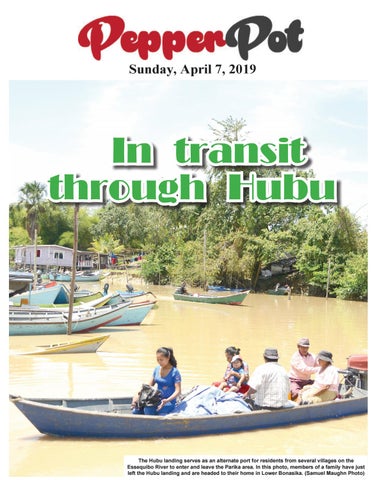
In transit through Hubu
The Hubu landing serves as an alternate port for residents from several villages on the Essequibo River to enter and leave the Parika area. In this photo, members of a family have just left the Hubu landing and are headed to their home in Lower Bonasika. (Samuel Maughn Photo)
II
A visionary for his people and other communities
Chronicle Pepperpot April 7, 2019
Moving young steelpan players beyond limits
nently returned to Buxton in May 2010. STEEL ORCHESTRA “Back in 2010, it started with eight players but has grown to a current number of 36 players, with an average age of 15 years’ experience,” Coordinator of the orchestra, Younge, stated. He added that the orchestra which has continued to enjoy a trainer, tuner and arranger in the person of Frank Lynch for the past nine years, draws most of its players from schools in and around the village of Buxton.
GBTI-Buxton Steel Orchestra doing a session in the Botanical Gardens
By M Margaret Burke FITZROY E. Younge, fondly called ‘Rollo’, has been leading one of Guyana’s most prominent steelpan groups since 2010. Officially known as the GBTI-Buxton Steel Orchestra, they have been growing from strength to strength over the years under sole sponsorship of the GBTI since 2013. Younge was born and bred in Buxton/
Friendship, achieved some of his education in the USA, gaining a BSc in Business Management in 2007 from the Quiznos University, Colorado. He also received the franchise owner Store Management Training in December 2006; Heald’s Engineering College training in San Francisco, USA and a Diploma in Electrical Engineering Technology in June 1979. He also lived and worked in the San Francisco Bay Area for 32 years, after which he perma-
Additionally, Sergeant Ray Sparman of the Guyana Police Force Band has been lending his expertise to the band in arranging and conducting. In this regard, some seven graduates from the Buxton Steel Orchestra formed part of this year’s winning Police Force Steel Orchestra in the Large Band Category. The event, held on February 17, was sponsored by Republic Bank Ltd. He said that at present the orchestra practices at Tipperary Hall in Buxton. This is done every Tuesday, Thursday and Friday after school. RECOGNITION AND ACHIEVEMENTS “In June of 2016, Guyana’s 50th Independence Anniversary Celebration Committee [New York], in collaboration with the Consul-General of Guyana invited our steel band to travel up to New York to participate in the Jubilee Week festivities. So on June 1, a total of 19 players and chaperones travelled up to New York for three weeks to perform,” Young told the Pepperpot Magazine. The Buxton Steel Orchestra recently won the 2019 Mashramani Pan-o-Rama Steel Band Competition for Large School Bands. This is the fourth time that the young group outplayed its competitors to capture first place, having won in 2014, 2015 and 2017 as well. The orchestra also placed second in 2016, then in 2018, the band took a break from the competition. Two senior members of the GBTI-Buxton Steel Orchestra also scored huge wins in the 2019 Mashramani competitions. Twentyyear-old Jamal Stuart was crowned Guyana’s Junior Calypso Monarch, while Daniel Daly won the Junior Soloist Pan-o-Rama Competition, playing Single Tenor.
Fitzroy ‘Rollo’ Younge (Photos courtesy of Fitzroy Younge)
Now policemen, they were also part of the victorious Police Steel Orchestra, which copped first place in the large-band category. In recognition of their stellar performances, the two were honoured by the Guyana Police Force’s Music Department and were promoted to the rank of lance corporal. DIFFERENT CAPACITIES Younge has also been very active in different capacities here in Guyana. He is currently the Chief Facilitator for First Lady Sandra Granger’s Information and Communication Technology (ICT) initiative. He explained that there are six-week workshops, with the main objective to provide adolescent and out-of-school youths with the opportunity to access training in ICT. This, he said, will enable these young people to effectively perform in various sectors of Guyana, while simultaneously strengthening the community with knowledgeable persons. These workshops are done in all 10 regions of Guyana, in collaboration with the Ministry of Social Protection and the Board of Industrial Training. So far, four were done in Buxton, one each in Regions Two, Three and Nine and two in Region 10. Turn to page VIII►►►
Chronicle Pepperpot April 7, 2019
Empowering Mocha-Arcadia youth and single parents
III
NDC making strides to improve lives of community members Rudolph Adams
He stated that they are seeking to have the land tenure matter resolved, so that squatting areas will be regularised, as well as farmlands within the village. “There is still the fear among the villagers that the farmlands would be flooded yet again and because of that concern, many have not been fully utilising the RAID project. We are in a basin so it is easily flooded during the rainy season and folks do not want to suffer any loss as it regards to farming,” he said. Adams disclosed that although they do not have pilfering as a widespread problem in Mocha-Arcadia, the drug issue remains in which illicit drugs are being sold in the village. TACKLING DRUG USE With more than 4,000 residents, he said the issue of drug use is of great concern to the NDC and they have initiated a programme with ranks from the Mocha-Arcadia Police Outpost to be present at every statutory meeting to listen to the concerns raised by residents. In addition, Adams pointed out that at the NDC Social Committee level, they are in the process of setting up a programme in schools to educate students as to the dangers of using illicit substances.
By Michel Outridge CHAIRMAN of the Mocha-Arcadia Neighbourhood Democratic Council (NDC), Rudolph Adams, said that at the NDC level, continuous strides are being made to empower women in Mocha-Arcadia, East Bank Demerara. With 50 percent of residents engaged in agriculture as part of their livelihood, they saw the need to make single parents and young adults entrepreneurs. Adams told the Pepperpot Magazine that through the Caribbean Local Economic Development (CARILED) project, the youths and single parents were encouraged to tap into the market project in which 40 stalls have been constructed for use. However, only 10 are being utilised by all female vendors, in an effort to rid the village of roadside vending and to restore some form of order when it comes to street vending. Adams stated that five young men and women also underwent life skills training and they have since established their small businesses. He reported that a young lady has a successful weekend pastry business at the Mocha-Arcadia market and another has started poultry rearing. ENTREPRENEURSHIP The NDC official told the Pepperpot Magazine that these self-employed persons received initial finances plus money to set up their businesses through the CARILED project. Adams added that in their security initiative project more youths, especially school drop-outs between the ages of 15 to 35, were targeted and benefitted from life skills training. And today, some of them have become successful entrepreneurs, manning their own businesses right in the community. Adams said, “We wanted the young people to have something to do in their spare time, so we have an Information and Communication Technology (ICT) hub, which is housed in the community centre and is outfitted with 20 computers from the E-Government project; but there is an issue with internet connectivity.” He related that from the time the President David Granger-led administration took office, they have seen significant improvements in the community, such as new roads which were previously neglected, dilapidated bridges being re-built and other infrastructural developments. The NDC official said in terms of development, they have made great strides and they are most pleased about having more access to the various ministries and ministers. “We are no longer stymied, because we have access to ministers and our concerns are being addressed and it is due to Local Government Elections (LGEs),” Adams said.
He added that they are aware that illegal drugs are being sold right in the village and have since pinpointed the culprits, but nothing has been done to those persons, because when the cops make an arrest, folks do not want to come forward and give evidence. Adams reported that owing to the lack of evidence, the police cannot charge the suspected drug peddlers in the community. He said, “From time to time, we experience minor thefts, but it is not any everyday occurrence, because there is only one access road that leads to and from the village, so everyone is fully aware of the consequences.” Adams however, noted that recently they have received some reports of some cattle belonging to villagers ending up in a newly established slaughter house in the village. He stated that although the operation is legal, they have since learnt that the operators are buying cattle on the ‘black market’ and some people are not happy about losing their cattle in that manner. Adams said cows are being slaughtered, and the meat is sold within the village. The operators have since agreed to repay the owner of one of the slaughtered cows.
IV
Chronicle Pepperpot April 7, 2019
The Grove Multi-purpose Community Centre
A small building, encapsulating many offices with very useful roles By M Margaret Burke
Mr. Leon Moses, Secretary-Manager of the Parika-Mora Del Cote Coop Society Ltd; Chairman of the Parika-Mora African Culture group
AS the name implies, this multi-purpose community centre in the Grove, Parika community continues to be the host centre for a number of other offices that facilitate different activities. Leon Moses is a man who wears many hats in the community: he is the Secretary-Manager of the Parika-Mora Del Cote Coop Society Ltd and also the Chairman of the Parika-Mora African Culture group. According to him, “This centre houses the Parika-Mora Del Conte Coop Society Ltd; the Parika-Mora African Culture group; the E-Governance Internet hub; Robotic training office, as well as the Parika-Mora small miners’ associate syndicate. So at its peak, this building really facilitates a hive of activities and many of these activities are peaking just around now.”
The Grove Multi-purpose Community Centre, performing as the name implies
CULTURAL ACTIVITIES Moses told the Pepperpot Magazine that the main activity of the Parika-Mora African Culture group is the commemoration of the African Emancipation every August. For this year, he said that the celebration will be held on August 3, 2019, where there will be a mega event in Parika. He pointed out that every year there is a different venue. The event was held at Bagotsville in 2017 and Den Amstel in 2018. “These activities are set through the national committee, which is the African Cultural and Development Association (ACDA), and the activities usually include a series of cultural presentations in the form of dances, singing, poetry, drama, modelling cultural wear and many more. Varieties of foods, especially related to African cuisine, are also on display and sold at the event as well,” he said. Moses added that as part of the calendar of events for this year, plans are in the works for large-scale exhibitions, showcasing not only African foods and dress styles, but also products and productive activities such as honey production, garment-making, agro-processing , skills, handicraft and much more. MULTI-TASKING Moses said that there is a Robotics training centre, which is an initiative of the First Lady, Mrs. Sandra Granger. He noted that from time to time there are training activities going on, where many young people from all around the communities benefit. He particularly highlighted the GPS training, which was done recently by the Guyana Geology and Mines (GGMC). “They came and trained a number of youth and so youth activities are strong in the area, which not [only] provides training and employment for the young ones, but also enhances development in and around the communities here.” He went on to tell the Pepperpot Magazine that the e-Government Internet Hub
also provide a very important service, which serves to enrich the lives of the young people and others within Grove, Parika and by extension all the surrounding villages. He added that while there are some existing challenges with the service at this time, it serves the purpose of helping children at school, university and others with assignments, research and other important services. Moses said that while the Parika-Mora small miners associate syndicate speak for themselves, he can attest to the fact that the office, like all the other offices within the community centre, do a beneficial service to the communities, which are all located in Region Three. OTHER SERVICES He stated that for the first time, Hyde Park and Grove got water in their homes, starting from late last year. “The line was always on the main, but it was not going into their homes through the Guyana Water Inc. (GWI). Further, he added that there are a number of bridges that were done in an effort to make the people comfortable, especially when they have to transport their produce to the market and other places; the accessibility of the Hubu stelling and there are also plans to add a stelling to Salem also – one of the sister villages in the community, just like the Parika stelling that is soon to be renovated as well. Noting that the leadership within Region Three is working very hard to ensure that people are not only able to create wealth, which is necessary, but that they also benefit from improved lifestyles; to live in a comfortable manner with facilities that are considered ‘tangible.’ Moses said that there are also other cultural and community development groups that plan and execute sporting activities and competitions by the young people, so that they can be meaningful exchanges and other such activities. (mercilinburke2017@gmail.com)
Chronicle Pepperpot April 7, 2019
V
The ‘Eccentric Creations’ of Alexandra Willabus beaded and shell earrings as well as beaded necklaces. There are also macramé necklaces made from string and accessories made from ribbon. She related that some of the pieces created from African prints can be purchased as part of a set. “You can get the hair accessory, earring, necklace and band to go with it,” she explained. The same is true for accessories made from other materials. Alexandra noted that she also makes unisex hand bands. “Sometimes I feel like if leave out the men too much,” she laughingly said. The pieces have been a success thus far and she intends to continue making them. Within the next few months, Alexandra hopes to begin creating African print neckties for men. She related that she does not want her pieces to be like those that can be found in stores. Her goal is for them to be unique. She noted that she also creates custom-made accessories. “As long as I have the materials available and I am able to do the design I can do it for the person.” STRIKING A BALANCE Balancing her academic life with her business is a challenge that Alexandra knows all too well. She told the Pepperpot Magazine that she sets her schedule according to her timetable for the semester, just like any other working person would. To illustrate, she said, “Let’s say class is on Monday, Wednesday and Friday, [then] Tuesday and Thursday would
Alexandra Willabus (All photos courtesy of Alexandra Willabus)
By Gibron Rahim EMPOWERMENT can take many forms. It is undeniable that a simple accessory can change the way we perceive ourselves and the way we present ourselves to the world. For this reason, artisans who craft accessories can empower in a unique way. One of these artisans is Alexandra Willabus. Alexandra is the founder and owner of Eccentric Creations. Currently pursuing a Degree in International Relations at the University of Guyana, Alexandra told the Pepperpot Magazine that her goal is to make women feel good about themselves. She explained, “For a number of years, I was going through a stage of depression and I was a really shy person.” As she has always loved art and craft, starting a business centred on crafting accessories felt natural to her. “I thought to myself that it wouldn’t make sense to keep on doing all of these things for myself and not share it with other people,” Alexandra said. “I not only started my business to uplift myself, but I started the business to make other people feel good about themselves at the same time.” Her love for art and craft has had a major impact on Alexandra’s life. She recalled that in secondary school she was faced with the decision of choosing between the science and arts streams. “If I did go in the science stream, I would not have gotten to do Visual Arts as a subject,” she explained. She thus made the decision to enter the arts stream. “I always wanted to do something involving art, something involving craft,” she said. “As long as it involved making something or something with creativity, just call me and I would be there.” Alexandra’s pieces are made from scratch. She noted that most of the items are made with African prints or beads. Many of the hair accessories and earrings Alexandra creates are made from African print fabrics. She also makes use of tie-dyed fabric in hair accessories. “Everything that I make, I usually buy my materials and I make them by myself,” she stated. In addition to hair accessories, Alexandra creates tassel,
be my working days.” She explained that she usually sets a goal every week. She said that, as an example, one week her goal might be to make beaded items only on the days when she is free. “In that way, I can study on the days when I have classes and do work on the days when I don’t,” Alexandra related. Turn to page IX►►►
VI
Chronicle Pepperpot April 7, 2019
40 years since Tangerine Clarke wrote about ‘Road Hogs’ By Francis Quamina Farrier GOING through my archives, I uncovered a feature article in the Sunday Guyana Chronicle of April 8, 1979, with the headline, “BAN THE ROAD HOGS” by Tangerine Clarke. It was her very first article in her 40-year (so far) career as a journalist. The sub-headline of that paramount article of hers reads, “School children in daily danger”. The first paragraph of that historic article which launched the illustrious journalism career of Tangerine Clarke begins: “Have you ever sat down to think how dangerous our roads are becoming for pedestrians and cyclists?” Professional though that question was for the reading public, it came directly from the grieving heart of the then very young Tangerine
Clarke who had two immediate family members of hers, perish in road crashes. Relating the direct way in which road fatalities literally came into her life at a young age, Tangerine said, “My father was killed while riding his motorcycle on Vlissengen Road on my mother’s birthday in May 1966, just two weeks before Independence. A year later, my grandmother also died the same way while riding her bicycle to work.” Some years later, Guyana’s celebrated drummer, Art Brooms, who is her uncle, was involved in a road accident which resulted in him being hospitalised. So, it is no surprise that the now veteran journalist had chosen “Road Hogs” as her first feature article 40 years ago. Closer home, the ‘Chronicle Family’ also experienced traffic fatalities with at least two of its members losing their lives in road
accidents. Former General Manager, Bob Grandsault lost his life while driving his car along the East Coast Demerara Public Road, heading from Georgetown to Berbice, which was a journey in his professional capacity. As such, it could be stated that he died on the job. The accident occurred when another vehicle which was speeding, ran his vehicle off the road at a (then) sharp bend on the Mahaica Public Road. “Why are they so many road deaths today?”, was another question posed in that very first paragraph of Tangerine Clarke’s Tangerine Clarke on assignment indoors first feature article. Continuing, it stated, “The latest figure is 11 children killed out some of her own personal experiences when of a total of 65 deaths.” And that was just at travelling in minibuses in Guyana. She statthe beginning of April of that year,1979. The ed that there have even instances when she article further informed readers, “That figure asked to be let off before the actual end of is much higher than last year’s, (1978) and her journey. we have to do something about these road In more recent years, women who have
Tangerine Clarke with President David Granger at a function
hogs,” the young Tangerine demanded. But has her demand of 40 years ago been heeded by the relevant authorities? Although she is now based in New York, Tangerine visits the land of her birth regularly, and says that “The Traffic situation has become even worse over the years with the importation of thousands more vehicles.” During the past 40 years, there may be over 7,000 Guyanese men, women and children killed on our roads. We are aware of that horrific crash on the Soesdyke/Linden Highway in which the two teenage daughters of then Prime Minister Desmond Hoyte lost their lives. Dozens more victims have died by crashes on that highway. The first casualty was an American who was killed even as the highway was in construction. A bulldozer ran over him in a freak accident; a tragedy which I happened to witness. Among the high number of children who have lost their lives due to road accidents was one particular case in which a student was killed while using a pedestrian crossing on the lower East Coast Demerara Public Road. That was a prime example of the “Road Hogs” mentioned by Tangerine and her demand that they are banned. During the past two decades, minibus drivers have become notorious as the worst drivers on the roads of Guyana and are responsible for hundreds of road fatalities. This category of drivers is classified as “Road Hogs”, by Tangerine Clarke, who related
lost children due to road accidents, have banned themselves together in a group known as, “Mothers in Black”, and have been, like Tangerine was, 40 years ago, advocating for safer roads. Strong advocates for road safety, are a number of Guyana Road Safety Councils. Over the years the Police Traffic Division has also been doing its part, especially with Traffic Education. However, many members of the public, have been talking about individuals who “buy” their Driver’s Licenses and go on to become Road Hogs. That is certainly a serious problem which the Police need to address. Some well-known citizens have also been killed on our roads during the past four decades. Mrs. Christobelle Hughes of the Guyana Heritage Society, who was the mother of Attorney-at-Law, Nigel Hughes, was killed when the car in which she was a passenger while returning home from a family gathering was struck by a speeding vehicle which was driven by a drunken driver. Another woman of standing in the society, Chief Librarian Gillian Thompson, was also killed when a speeding vehicle broadsided the Library vehicle in which she was a passenger on her way to work, just two days before Christmas of 2011. Another woman of distinction who tragically lost her life in a road accident was Minister within the Ministry of Education, Dr. Desrey Fox. Turn to page IX►►►
Chronicle Pepperpot April 7, 2019
VII
Denise Jennings launches couture collection By Wendella Davidson
GROWING up, she remembers that she liked to dress up, loved nice clothing, and as most little girls, had a penchant for wearing her mother’s shoes and posing with her handbags. And as she grew older, whenever she wanted a new outfit, she would sketch the idea in mind on a sheet of paper and take it to the seamstress. “I always wanted, whenever I showed up somewhere, to stand out and be different and not wear what everyone else was wearing,” said this feisty individual Denise Jennings, who would later spend over 20 years behind a sewing machine and is now a fashion designer who also loves to design costumes. In an interview with the Pepperpot Magazine, Jennings reminisced on how her fantasy grew into a lifelong love and eventually a
career. On March 10, 2019, she staged a successful launch of a Couture Line at the Arthur Chung Convention Centre. The occasion featured 34 models, all in couture dresses that were sewn by Jennings. “Each dress was of a different form or different colour; it was a challenge, but I learnt how to use stretch taffeta, satin, velvet, lace and even fur. “In Guyana, there are not many places that one can go with a long, flowing gown with a lot of fabric behind you, and couture is fabric with lots and lots of cloth. I designed a dress that can be worn at an evening outing or a wedding and fashioned to fit the Guyanese society,” she said. She added that the fashion show went well and people have since been enquiring what’s next on her agenda, now that she is home permanently.
NEW TERRITORY Jennings, who worked at a commercial bank before leaving these shores to live in neighbouring Barbados, remarked that while she liked fashion, she never thought that she would have become a fashion designer. She left Guyana for Barbados, where she spent many years and eventually honed her skill as a seamstress. “I had a function to attend and had difficulty in finding someone suitable to sew the kind of clothing that I wanted. It was a christening. I had to go to the church, so you know I had to dress appropriately. As frustration started to step in, I bought a piece of fabric, spread it out on the bed and using one of my old dresses, I set about cutting out and sewing the dress of my choice and likeness. “I did it with my hands -- the darts, the collar, the sleeves, the zipper - everything I put together with my hands and when I
arrived at the function, I was surprised at the attention the dress generated. A lot of the ladies wanted to know where I got the dress or who sewed it because, according to them, it fit really nicely. They couldn’t believe their ears when I said that I did it and using my hands, those ladies all but undressed me to find out if I was speaking the truth,” she said. Jennings also remembers being approached by an elderly woman at the function; the woman told her that one day she would be sewing for people. The woman went as far as to advise her to “learn to measure and cut out,” which served as an encouragement for her to begin sewing classes. FROM SCRATCH Jennings said that she joined the sewing class of a fellow Guyanese named `Yvette’, who as an assignment one day, requested of the students to partly sew a skirt using a pat-
tern that was provided. The students were mandated to finish the assignment for the next day of class, but according to Jennings, because she used to practise stripping old clothing and then putting them back together, as a form of sewing practice; she was able to complete the entire skirt without supervision. She also remembered the teacher, after viewing her work,
being in awe at her expertise and remarking that she was “way above an elementary-class level.” And, upon a suggestion by the teacher, Jennings said that she assisted in teaching the class in which there were students older than her, and some others who didn’t even know how or where to find the switch. Turn to page XXIX►►►
VIII
Chronicle Pepperpot April 7, 2019
◄◄◄ From page II
VOLUNTEERING Younge has also been working as a volunteer for the Buxton/ Friendship Heritage Fund, which is run by Lorna Campbell. He has been the project’s coordinator since 2010, where they seek to ensure that about 50 students from primary schools in Buxton receive backpacks, calculators, geometry sets, books, pencils, pens and erasers to help them make the transition to secondary school. He also volunteers as local coordinator for CSEC students to receive ‘Bursaries’ from organisations overseas. Last year, six students received bursaries of $200,000 each to attend the University of Guyana and University of the West Indies. These monies came from the Buxton Heritage Fund (New York) and COTAB, Toronto, Canada. In addition to the Medal of Service, a national award which was bestowed on him on February 23, 2019, he also received the Buxton/Friendship Heritage Award for Youth Engagement and Skills Development in New York in May 2015; the Buxton/ Friendship Restoration Committee Award in June 2016 and many more overseas and in Guyana. The GBTI-Buxton Steel Orchestra’s vision statement is ‘To be the best Steel Pan music provider in Guyana.’
GBTI-Buxton Steel Orchestra’s Mash School Band Competition
A man of honour
Charles Hutson
INTERNATIONAL Civil Aviation Organization pays tribute to Guyanese aviation pioneer THE image and a brief history of the work of Retired Lieutenant Colonel Charles Compton Courtney Hutson are now among several South American aviation pioneers decorating the Hall of Tribute of the International Civil Aviation Organization (ICAO)’s South American Regional Office, San Isidro, Peru. The event took place as part of a series of activities to commemorate the 70th anniversary of the SAM Regional Office on December 7, 2018. This award was rightfully presented to Huston for the impact he has made in the aviation sector. He started his lifelong career in the aviation sector in September of 1961. He was employed with the British Guiana Airways (known then as BG Airways), a Department of the Ministry of Communication and Works. During his early years at the Ramp Ruimveldt (1963), Hutson was involved with the rebuild and inspection of 8R-GEU Certificate of Airworthiness. He gained significant experience in this area, which resulted in him, many years after, being capable of preparing similar documents. In 1976, Hutson was seconded to the Army, along with Harcourt Browman, Planning and Administrative Engineer at GAC, to develop the Army Air Corps aviation capability. At the GDF Air Corps, Hutson focused mainly on developing the Engineering capability of the Army so that it emerged quite self-sufficient, capable of undertaking the many maintenance tasks that it was called upon to execute. Many young persons were afforded both OJT and overseas training, as such on his return to the Guyana Airways Corporation in August 1988, the Corps remained strong. The Art Williams and Harry Wendt Aeronautical Engineering School was conceived by Capt. Chan-a-Sue, A.A., M.S. and Col. Charles Hutson, and began operating in 1993. Hutson served the CAMS until 2001. Today, Hutson is the Chief Technical Officer of Orinduik Development, a company that is establishing a heliport at Lusignan.
Chronicle Pepperpot April 7, 2019 ◄◄◄ From page V
There was not any specific difficulty in starting up her business, according to Alexandra. She recalled that her first exhibition was at a church fair. “After the church fair, I ended up making a Facebook page to promote my business, to make it known to the public,” related Alexandra. She pointed out though that, at first, she was shy and for that reason had difficulty with encouraging and motivating herself to keep on going. “I kept on pushing myself and encouraging myself to keep going because everything can’t just come easy in life,” she said. Alexandra has words of advice for other young people. “You shouldn’t hold back yourself from doing certain things, you shouldn’t keep yourself in this barrel or in this circle where you can’t get out,” she said. “You should let go of certain things and become more open because you never know what God has in store for you.” She affirmed that it is always good to push oneself and aim high to reach another level. “Don’t keep yourself in this phase where you can’t get out and you can’t do something that you love or you can’t do something that you actually want to do because, for me, I would say [that] doing something that I want to do and doing something that I love makes me happy.” ◄◄◄ From page VI
Tangerine Clarke on assignment outdoors
One of her sons was driving the car in which she was a passenger at the time, and which was rammed by a speeding vehicle on Vlissengen Road in Georgetown. Even the Police are not exempt from fatal traffic crashes. Former Commissioner of Police, Henry Greene, lost his life in a horrible two-vehicle crash which occurred on the West Coast Demerara Public Road and in which a young girl who was in the other vehicle, was also killed. Recently, the current Police Commissioner, Leslie James, was in a vehicle which was struck by another one on the East Bank Demerara Public Road. Fortunately, Commissioner James escaped unhurt. Some years ago, well-known Lawyer, Leslie Sobers, was in a minibus travelling from Georgetown to Lethem when it crashed in the North Rupununi, resulting in Sobers being severely injured, and having to use walking aids for a long time before regaining perfect use of his legs. A young child who was killed in that North Rupununi crash fell into the lap of Sobers where he died. During her 40-year journey along ‘Highway Journalism’, Tangerine Clarke has travelled extensively over the years, meeting a wide range of individuals - the rich and famous; the powerful and the simple; the pleasant and the disagreeable and written many in-depth stories for her diverse readers both here in Guyana and abroad. For the upcoming Oil and Gas “Rags to Riches” Republic of Guyana, her prime desires are, “That there be a transportation system friendly to the elderly and a fare structure to benefit students, among others.” She also pointed out that the government must make sure that the revenue from the Oil and Gas, benefit all Guyanese. In all of that, she wants to see the roads of Guyana become safe as the relevant authorities establish a zero tolerance with reckless drivers and ban the Road Hogs.
IX
X
Chronicle Pepperpot April 7, 2019
Education changed his life, now he’s changing the lives of others By Marissa V. Foster THE eldest of six siblings, born on January 10, 1996, Collin Moore is the son of a cleaner and labourer. He attended the Nurney Nursery School, Kildonan Primary and later on the Central Corentyne Secondary School. His father died when he was just sev-
en years old and in many ways, that made his upbringing quite difficult. Collin realised education was the only way out of his situation at home. “It was an absolute struggle but I did it anyway. I did it because I knew that education was the only way to help me out of my unfortunate situation. I could
not have done that without the help of my mother and grandmother who have helped and encouraged me in whatever way they could have,” said Collin. “ I would walk to school daily without any money and this was the case for my entire high school experience. I was desperate to learn and build my capacity. I had a
strong desire to become a better man.” The efforts of his determination truly paid off as he graduated high school with eight (8) CXC subjects. He benefitted from numerous training programmes from various fields and he is currently a second-year social work student at the University of Guyana.
Collin was always taught by his mother to try his best in life to not only make himself better as an individual but to also uplift others at the same time. His journey to help other youth started when he was chosen to attend a Youth Leadership Training with the Ministry of Presidency Empowerment Unit. He admitted that he was quite skeptical about the training because he thought one cannot be trained to lead. As it turns out, he was wrong. He acquired a vast array of knowledge from the then advisor to the President on Youth Empowerment Mr. Aubrey Norton and his team. After graduating from the impactful training, he returned home to Berbice with his developed leadership skills and collaborated with other young leaders (Krystal Thomas, Jelissa Ward). Together, they formed the Youth organisation, Youth Champions Network (YCN). The aim of this organisation is to empower young people through education, training and networking. They have worked on several projects and programmes over the years, such as their youth drive programmes called “Youths on the move” which was created to reach out to young people across the East Berbice region, to listen to their problems and work to find possible solutions for those issues. Through their efforts and the vision of the then advisor to the President on Youth Empowerment, YCN was able to establish the Kildonan Night School programme, which aims to give school drop-outs a second chance to earn an education. Presently the programme has over 30 young people who will be sitting the Caribbean Secondary Education Certificate (CSEC) Examinations in May and a new batch which will be sitting next year. The Youth Champions Network has also worked with the Ministry of Communities to see the realisation of the new Kildonan block-making facility which will soon see the employment of young people within the Kildonan community. Apart from being the president of YCN, Collin also serves in several organisations and boards. He is the coordinator of the New Leaders for Social Betterment; the Chairman of the Community Action Council Ministry of Public Security from 2018/2019; serves in
Collin Moore (Photo courtesy of Collin Moore)
the capacity of Chairman of the management committee of the Kildonan ICT Hub and Chairman of the Kildonan Community Development Council. He was elected to the office of Councillor at age 19 and then ascended to the Chairmanship at age 21 and today he still serves as the Chairman of the Adventure/ Bush Lot Neighbourhood Democratic Council. Moore is a recipient of a National Youth Award from the Ministry of the Presidency’s Department of Youth. He intends to continue to make his service available to the youth population of our county and all Guyanese at large. He has intentions of working for the people at the highest office of the land. While his work and its origins are from Kildonan, it spreads to all parts of Berbice and it is his hope that one day it expands to the rest of the country. The aspiring politician’s advice to young people is, “Who told you that you can’t? Who said that you can’t follow and achieve your dreams? Well, believe me when I say that you can achieve your goals and be anything that you set your mind to, once you are willing to work honestly and hard towards it. You must have a love for what you are doing, so if you must get into youth work then do it for the love of it. In Chronixx’s own words, ‘D’weet fi di love, we nuh d’weet fi di likes’. So at no point should your self-interest be the motivation behind your work unless that interest is to see others develop and become better human beings. Remember not to lose hope and track of your goals because surely you would not see the fruit of your labour overnight. Just like alkaline said, ‘Everything in life just takes time. Gwaan build, but you got to wait on it. Wul out youth, so you got to wait on it.’ Overall I say to you, nothing comes easy and don’t allow your today to determine your tomorrow, so all now the grind continues.”
ocus F Chronicle Pepperpot April 7, 2019
XI
on the Village
A journey from Parika to Hubu WHILE most persons are familiar with Parika, you may not know about the various small villages that fall within this large East Bank Essequibo community. This week, we venture into the communities within Parika and bring you stories on the way of life of the residents there. Stories by M. Margaret Burke and Shirley Thomas. PARIKA is located approximately 19 miles from Vreed-en-Hoop. It is considered to be somewhat the parent village for many of the other small villages along the way. Parika is seen as the port township and has been evolving into such with the mammoth economic activities that continue to see expansion within this central location. It is where hundreds of sellers and buyers from the many villages meet to transact business. These include some from islands in the Es-
not-so-good times. IMPROVED FACILITIES Starting from the front road at Parika, the road that took the team into Hubu had a smooth drive. While some parts seemed narrow, causing one vehicle to have to await the passing of another, moving through each village was undisturbed by potholes and other hindrances. Michael Smith and Sam Ruben told the Pepperpot Magazine that many of the roads and bridges that adjoin villages and most of the culverts were renovated or built over in recent times. The bridge at Hubu, sandwiched by Unity and Saint Lawrence or Big Sands, received renovation works, as well as the landing that facilitates a lot of transportation activities to and from Hubu by persons living on neigh-
The start of a journey through the Parika road leading to Hubu (Photos by Samuel Maughn)
Children out to play at the Blake Primary School with the nursery school in the background
Entering the village of Hubu, Parika and viewing one of the many boats that are made there
sequibo River, who seek to bring out their farming produce and other items for wholesale and retail sale at the Parika market. HUBU, PARIKA Hubu, also pronounced “Hooboo,” can be found some five miles up from Parika. Similar to many of the other villages along the way, Hubu is a very quiet place during most of the weekdays; on Fridays and Sundays however, the village comes alive with lots of activities, especially in relation to the marketplace. Hubu has a landing that links other villages, not only along the stretch of road to Parika, but across the river. There it forms a major hub for river transport to many other islands and villages, such as Fort Island, Aliki, Morishi, Bonasika and other areas. While some people travel to Parika by using speed boats or the bigger ferry, others use speed boats to Hubu, then take the road to their other destinations. Farming has been the main economic activity for a large percentage of the people of Hubu for many years. However, there are
A hardworking family who are obviously pleased with their harvest as they cruise home in a very relaxed mood
many people with well-established businesses such as sawmills, grocery shops and hardware stores, supermarkets, block-making, taxi and other transportation services, a modern three-storey car parking facility, a fuel station and other businesses within the community. There are also many public servants from Hubu who cover every scope of work in areas of public service. “In this area we do not have ‘limers,’ even though we sometimes sit outdoors in the open, by the landing, by a shop or sometimes just in front of a friend’s house; this is mostly late
in the afternoons after a hard day’s work,” a group of young men told the Pepperpot Magazine. Indeed, the Pepperpot Magazine discovered on the ‘Journey to Hubu’ there is that quietude, graced by some smiling and appreciative faces. Though spread with some amount of activities on the way, the people from this relatively small community live a very relaxed lifestyle with the essential services of electricity, potable water, telephones, an internet hub and a good family-type life, where they share in the good and sometimes
bouring islands and villages. In the area of education, while there are many teachers who come from the villages along the journey, there are a number of schools to facilitate at least some of the teachers; others teach outside of the community. In Parika, there is a nursery, primary and secondary school; while in some communities there is just nursery or primary. The Pepperpot Magazine was told that the children within the communities graduate to the school for which they are qualified after sitting the Secondary School Entrance Examination (SSEE), and Hubu is one such community. The religious buildings in these communities are also very prominent in the villages. These include the many churches, mosques and mandirs or temples with shrines and murtis. In what appears to be the coziness of the communities along the journey, are the recreational facilities, which also add to the laissez-faire atmosphere the villagers seem to enjoy. There is also the Stanley Hing recreational park and other smaller playfields within the community.
XII
Chronicle Pepperpot April 7, 2019
An ideal location The Hubu landing snackette brings convenience for travellers ONE of the most important ways through which many women launch out and excel is small business. Some women may feel that they did not acquire sufficient education or skills to advance in the world of work; others may simply love the feeling of independence which comes from working with themselves. They become entrepreneurs in their own right. \In Guyana, many women feel the freedom to engage themselves in small food businesses, especially as it relates to the prepared local foods. Snacks such as plantain chips, ‘chicken foot’, ‘mittai’, a variety of cakes, roti and curry, puri, channa and many more. They also prepare many local drinks for sale, which include the good old mauby, sorrel drink, cherry juice and many more juices, as well as local drinks. Ms. Debbie, the name she is referred to by those who visit to buy (and the only name given) is a shy, small lady, but who stands tall at the edge of the Hubu landing, where she has established the only snackette in that location. There are other snackettes around, but none so close to the landing. TAKING UP THE CHALLENGE She told the Pepperpot Magazine that she is a single mother of three children, who are all adults now. However, she explained that because of her need to be employed she decided to make a shop where very many people
women and men farm,” she stated. She said that she is comfortable with doing her small business and still do some amount of kitchen gardening, from which she would take out to the shop to sell from time to time. At the same time, Ms. Debbie said that she is very encouraged with the support and encouragement she has been receiving from her fellow villagers, but more so from the people who need to use the landing to go to the different islands and villages in Essequibo.
Ms. Debbie, the Hubu landing snackette owner (Photo by Samuel Maughn)
pass through on a daily basis, knowing that her sales are sure. “I am not out here very long now, but I have been doing fairly well because I make all sort of nice things that I think people would like and put them out…I still have to get much more things; for example, I have not been able to buy a lot of water and other things that people would need. However, I am doing well with what I have at the moment,” she related.
ST. LAWRENCE Ms. Debbie said that even though she was born in Hubu and spent some of the years there, she is now living in St. Lawrence and feels very happy. According to Ms. Debbie, St. Lawrence, like Hubu, is a very quiet village where most of the people are doing some amount of farming; “Some farm in large quantities to sell retail and wholesale, while others farm mostly for their domestic purposes; and the
ENCOURAGING OTHERS She told the Pepperpot Magazine that women should not be afraid of pursuing their own businesses. However, she went on to point out that with some amount of encouragement from other people who are able to help, the lives of many other women can be improved. “Many more women are willing to take up the challenge of doing their own thing in business or other things, but some of them are not bold enough and some may not even have the money to start; some might even be afraid that people may take advantage of them in some way or another. However, with some help, they can overcome the challenge of starting their own business. I did not have much and I still do not have much, but I started,” she offered.
In transit through Hubu Lower Bonasika family among many who pass through on their way home
THE Pepperpot Magazine met Thelma and Hubert Harris, along with their daughterin-law Denita Harris and her two-year-old son Paul Harris, at the Hubu landing. They were about to take a speedboat to cross over to their place of residence, which is Lower Bonasika. Thelma seemed very happy to meet the Pepperpot team and even happier to acquire copies of the Guyana Chronicle, which were in our possession. According to Thelma, whenever the family come out to do business, they usually use a speedboat from the Hubu landing to take them back to the Lower Bonasika community. Bonasika is an indigenous settlement on the eastern bank of the Essequibo River. Thelma informed the Pepperpot Magazine that her community is a very decent one and that her Toshao is Mr. Stassford Williams. She said that they are a very religious set of people and this helps the people to see things differently. “As an interior location we live well with all the neighbouring communities and we do not encourage wrong things like stealing, limers, drinking up and behaving bad and so on, even though sometimes you have a few who may go overboard,” she related. She added that the people in the communities, which include Aliki, Fort Island-- which is just across the river from Hubu-- Morashee
have a close relationship with Parika, explaining that this is where the large-scale farming and agro-processing items go for sale; also, it is where a lot of buying is done to renew supplies for shops and other businesses in the communities. The Lower Bonasika community has just over 150 residents; however, they have a school, which is about three miles downriver. On the other hand, in Upper Bonasika, the population is much more and they do have some added facilities. Other than a school, there is a community centre and a health centre.
The Harris family and others are preparing to leave the Hubu boat landing for Lower Bonasika
and the others share in the many activities that the villagers hold from time to time. In addition, the church forms an important part of lives in the villages and as such, this is reflected in their lifestyles to a large extent. FARMING, A WAY OF LIFE Thelma said that farming is a general way of life for most, if not every member of the
community. She explained that even though more and more people are taking education seriously; and many of the young people are writing the Caribbean Secondary Education Certificate (CSEC) Examinations and gaining places in other education and secular institutions, most people still see the need to “put down, even if it is a few plants in their yards.” She mentioned that all the communities
EXPECTATIONS Last year, the government commissioned a computer lab at Lower Bonasika and according to Thelma, while the villagers are a contented bunch of people, they are also expecting more, especially to help the young ones to make themselves more marketable. She stated that as villagers they are always willing to work hard and help themselves; and will continue to do so. However, improved services in every respect will always be welcomed, especially as it relates to education, health, community welfare and recreational facilities. Turn to page XIII►►►
Chronicle Pepperpot April 7, 2019
XIII
◄◄◄ From page XII
Denita Harris receiving a copy of the Guyana Chronicle from Kim Halley of the Guyana National Newspapers Limited ( Photos by Samuel Maughn)
Heading into the speedboat with newspapers in hand are Thelma Harris and her daughter-in-law, Denita Harris
More in the pipeline for residents of Parika Façade
An impressive view of one of the trenches in Parika Façade after being manicured by members of the CDC
IMBUED with a sense of dynamism, the people of Parika Façade, under the leadership of the Parika Façade Community Development Council (CDC), have proved themselves to be not only go-getters, but pacesetters and are making a name for themselves. Founded about a year ago, the Parika Façade CDC, under the chairmanship of Sunil Oudit, with Vice-chairman John Raggobeer; Secretary Dasia Thomas and Treasurer, Shabina Ali, has already completed more than
• A Christmas gift-sharing for 200 children within the community. • Cleaning of trenches in the area, along with the cutting and spraying of bushes in the vicinity. • A Christmas tree light-up, along with a fund-raising Bar-B-Que • A tree-planting exercise along the walls of the Parika Backdam Canal, the evidence of which remains to date. This was a precursor to the massive desilting of the Parika Backdam Canal by the regional authorities in the recent past.
CDC now awaits the arrival of technicians to connect the service, said Chairman Sunil Oudit. The chairman also disclosed that the documents were signed since last year. • They are also lobbying for a bridge to be made across the Parika Backdam Canal, in proximity to the Parika Salem Schoool, so as to allow the children quick, safe and easy access to the school, instead of having to walk the very long route they now traverse to access the school building. • The establishment of a Community Policing Group in the Parika Façade commu-
Department of Social Cohesion, Culture, Youth and Sport. Some of the projects already undertaken successfully include: • A sensitisation programme in the area, conducted by the Ministry of Social Cohesion. Residents were made aware of the objectives of the Council and how it is designed to help them. Held at the Beach View Hotel in Parika, the forum was conducted over two days and accommodated 45 residents of the community. • A tree-planting exercise along the Members of the Parika Façade Community Development Council pose for this Shirley Thomas Photo next to the Parika Backdam Canal.
Members of the Parika Façade CDC join residents in weeding and spraying bushes in the community.
five projects that are visibly bringing benefits to the community; and there are more in the pipeline. Motivated to develop their community, whilst bringing about more social cohesion, the group has been working in close collaboration with the Ministry of the Presidency’s
walls of the Parika Canal for the purpose of preventing erosion of the walls of the Parika Backdam Canal. Among the distinguished persons present were: Minister of Social Cohesion, Dr. George Norton; the Regional Executive Officer, Mr. Denis Jaikarran and others.
The CDC is working zestfully towards the achievement/implementation of other projects, which include: • The establishment of a poultry farm project for which they hope to get assistance from government. A lot of energy has already been put into it; documentation has been prepared and already the momentum is building up. The project is intended to be an income generator, which will redound to the benefit of the entire community, said the CDC Vice-chairman, John Raggobeer. • An Internet Access facility that will allow 24-hour Access Wi-Fi to an approved venue in the community. This proposal was made particularly with the education needs of the young people of Parika Facade in mind. The Ministry of Public Telecommunications has already given their approval and the
nity. The Council is in the process of getting the policing authorities to visit them with a view to putting systems in place for an early start of the service. “We are both aware, willing and committed to the cause, and will be willing to work along with the authorities, and eagerly look forward to the commencement of the service,” the residents told the Sunday Pepperpot Magazine. Meanwhile, the Parika Façade CDC has expressed deep appreciation to Minister of Public Infrastructure, Hon. Annette Ferguson for facilitating the setting up of street lights in the community. They reasoned that not only does it serve as a deterrent to criminal activities at nights, but enhances the safety of road users, particular motorcycles and bicycles plying that route at nights.
XIV
Chronicle Pepperpot April 7, 2019
Residents of Parika fear water contamination through leaks in broken mains IT was at the opening of the Guyana Water Inc’s (GWI) new sub-office in the Lotus Mall, Parika, East Bank Essequibo on February 18, 2018, that its Managing-Director, Dr. Richard Van-West Charles assured residents that the GWI is moving aggressively to ensure it becomes the best utility company in the Caribbean. But residents have still been experiencing issues with water discolouration and other matters and hope that this can be rectified soon. Said Dr. Van-West Charles, “This year [2018], GWI is focusing on having a strategic relationship with Neighbourhood Democratic Councils (NDCs) throughout the country.” As such, he said he expects the staff at the new office (at Parika) to be involved in NDC meetings to garner feedback from customers in order to provide and improve service delivery throughout the country. The managing-director also stressed the importance of a fixed presence in the community and working with members of the community and organs of the NDC. Dr Van-West Charles remarked that the company has seen a tremendous response from customers in the reporting of leaks and conceded that they now have a greater understanding of the negative impact of leaks on their water pressure, flow and quality. For this reason, he said he expects the staff at the new office to be involved. Meanwhile, the GWI urged customers to ensure that their taps are properly turned off and that they report leaks and breakages. Nevertheless, residents are now expressing dissatisfaction with the low pressure of water coming through their taps, adding that there are times when they turn on their taps and do not get water at all. This, they say, has led to some residents apparently breaking the mains. As such, there are several breakages along the line – a situation they would like the GWI to address urgently, since the possibility of the water in the mains becoming contaminated looms large. Another area of concern, residents say, is the discolouration of the water and iron deposits on the surface when they eventually get it. They claim that they have made complaints, but the situation remains the same. One resident claimed that he reported his concern to the Pouderoyen office, but was told to go back to Parika, since Parika now has an office. Executives of the Parika Façade Neighbourhood Democratic Council are however optimistic that should the GWI and the CDC work hand in hand, there will be hope for the Parika East Bank Essequibo office becoming the best GWI utility service in Guyana. They are now mooting the idea of having sensitisation workshops run off, to educate residents about ‘safe water’ and the health threats caused by leaking water mains. This newspaper attempted to get a response from the Public Relations Department at Parika about leaks in the mains and discolouration of water, but was referred to the Engineer in Charge of the Parika area. He, in turn, advised that they are not allowed to address complaints. All such complaints should be addressed to the Public Relations Department at the Georgetown head office. That, however, was an exercise in futility.
Chronicle Pepperpot April 7, 2019
XV
Intellectual property and the future of new businesses in Guyana
I WAS invited to do an interview for television on the cultural industries subvention and some reflections of copyright. Though it was never aired on TV it was relegated to the radio, and I got some calls by phone and stops on the street by people who just didn’t understand what Intellectual Property Rights mean. We are behind the world when it comes to believing and understanding that it is more likely that someone with money will steal your manifest idea and there’s nothing you can do about it. This has been happening for the past decades with the music, art via acts of public plagiarism that have occurred with no option from the courts, as even the police have no understanding of what constitutes Intellectual Property, much less how to apply the law, and what law, or even if a law is broken in respect to a copyright (Intellectual Property right) allegation. This situation will change, simply because the world has changed and the nature of business will not remain merchant vending of imported merchandise acquired through foreclosures and bond clearances. There will also emerge from within or from external sources the presence of legitimate franchise owners- regional representatives who will provide some form of accountability backup for products, and also seek protective space through the courts as was
once normal in Guyana. Already, online shopping has encroached on our market and foreign companies are presenting options to niche markets for cultural industries to which copyright and patent registration are wise pre-requirements. The protection process for the visual arts is sought through the Library of Congress in Washington- PRS elsewhere. The fact is that a loss of foreign revenue for the state is the result that only the passing of copyright legislation can intercept, thus, empowering the Commercial Registry. On a recent visit to Mahdia with the commission I serve with, the question of copyright protection was raised by a young resident who is also a musician. Through the same commission, in a discourse with a visiting politician, the topic of Patents for indigenous medicines was raised, for the specific organic formulas used to harm and to heal that are shrouded by mysticism and lore are the agents of pharmaceutical wealth, if proactively harnessed by us for us, that wealth and the employment that accompanies it will serve us generously. For any of this to be effective the laws of patent must be in place, and a lively scheme of educating both the relevant institutions and the public extended within this time frame, because it is obvious that we have a surprisingly minimal legal and bureaucratic expertise in that area, and an even lower level of political understanding
with tremendous ‘Dunce cap’ candidates on the specific subject of familiarity in respect to an active appreciation for ‘Intellectual Property Rights’. Yes, we must understand that it is not a request for an unusual favour. Copyright ownership in the age we live in; is a natural human right. One of the first written about cases of copyright ownership in the context of an intensely protected item concerns maps inherited from the Moors by the Portuguese at the end of the 800 year old Moorish administrated civilisation in Europe. The Moorish maps dated back to the Phoenicians and even further and though they had at some point indicated publishing this knowledge, the Portuguese changed their minds. Protecting their voyages, encounters and maps with the same sacrosanct seriousness of a modern copyright owner, except in the 15th century ,the punishment was not financial awards through the courts but by deathmost likely beheading. A country without copyright legislation renders its innovative citizenry vulnerable. The late Denis Williams told me a story repeatedly about a local musician who sang his song to the guitar he played around old Georgetown when he was a boy, for shillings and pennies, at certain rum shops and hotels opened to the moods of the locals. He eventually sold the song to a visiting American for about $30. The name of the song is ‘Stardust’. The song was made
popular by Nat King Cole after originally done in 1927 by Hoagy Carmichael and 15 other singers and was copyrighted to Hoagy Carmichael with the lyricist as Mitchell Parish. A sad and tragic tale that returns to me each time I hear Family Teach’s song ‘Ent want no man pon meh island’ redone and sold on Karaoke CDs. Remembering his sad demeanour on his return to Guyana, with a smile he stared beyond me and into the unknown as I tried to talk to him, while he leaned on a lamp post in America Street, then he was gone, forever. Every Industrial innovation, ICT programme built, traditional healing method; every novel, photograph, piece of clothing and accessory designed, artwork, play written, song composed, furniture and Jewellery designed, fabric design, tapestry and recipe that summons attention carries with it a potential industry, if legally protected. The age of mass semiskilled industry employment is gone; Artificial Intelligence is staring at us with cold and unfeeling eyes. We are training a young generation towards self employment. This is the wise thing to do, but they cannot achieve the benefits of any innovative act without the legal framework to protect their efforts. Administrators must understand that the future is now; the potential is staring at us in anticipation. It has been that way for a long, too long time.
XVI
Chronicle Pepperpot April 7, 2019
FILES E S A C COURT Unpaid teacher sued CEO in personal capacity
Loses in small court but wins on appeal
By George Barclay
GRADE one teacher Lucille Harry who sued Chief Education Officer James Theophilus Thom for withholding 18 day’s pay due to her while on sick leave was told by a judge in Chambers that she could not legally pursue the claim. She appealed, resulting in the Full Court, comprising Justices Victor Crane, G.A.S. Van Sertima and Dhan Jhappan allowing her appeal and remitting her application to the judge in Chambers with the intimation that he deals with it on the merits. The Respondent C E O was ordered to pay costs to the applicant Harry Evidence disclosed that the appellant, who was a teacher employed by the Government of Guyana, applied to the Chief Education Officer for 18 day’s sick leave under regulation 60 (3) (b) of the Education Code, Chapter 91 [G], which was granted, but without pay. She protested but to no avail. She then took out an originating summons naming the Chief Education Officer in his individual capacity as defendant, in which she sought the determination of the question whether the Chief Education Officer or other official of the Ministry of Education has the power to withhold her salary for the period during which she was granted leave; and a declaration that she was entitled to salary for the abovementioned period. In the court below, the judge, on submissions in limine, refused to entertain the application on the ground that a declaration could not be properly made against the Chief Education Officer in his individual capacity which would have the effect of involving the Crown’s purse. On appeal by the applicant, the Full Court held : (i) no judgment can be entered against a Crown servant for any unauthorized act done by him in that capacity, though an action for damages may be maintained against him in his individual capacity; (ii) a question of construction of a regulation arose: (iii) the question of the deprivation of a fundamental human right was involved in the withholding of salary. Appeal allowed. Matter remitted to court of first instance for determination on the merits. During the hearing, the Full Court had referred to 17 cases. Senior Counsel Mr. H.D. Hoyte, had appeared for the appellant while Mr. Doodnauth Singh, S.C. represented the respondent Thom. According to Justice Crane, who delivered the judgment of the Full Court, “The appellant took out an originating summons under O. 432, regulation 2, claiming to be entitled to a legal right depending upon a question of construction of the Education Code, Chapter 91 [G] – particularly r. 60 of the said code. Her summons sought the determination of the following questions, the first two of which are referred to in the ruling under appeal as the first and second questions: “(1) Whether the Chief Education or other official of the Ministry of Education has power to withhold the plaintiff’s salary under the said code or otherwise for the period June 28, 1964, to July 15, 1964, after she had applied for leave under reg. 60 (3) (b) and the said leave had been granted under regulation 60 (3) (e) of the said code. (2) A declaration that the plaintiff is entitled to her salary for the abovementioned period. (3) Costs.” On August 4, 1966, a judge made an order in Chambers dismissing her application with costs; he did so on a preliminary point. Lucille Harry now appeals against that order, on the following grounds: Turn to page XXX►►►
Chronicle Pepperpot April 7, 2019
XVII
Parents keeping good mental health I’D like to talk about one of the (if not THE) most difficult jobs there is. Parenting is challenging in many ways and therefore can become problematic if the parents do not have/ are not maintaining good mental health or if they are parenting with an existing mental illness. You may think your child’s mental health comes first and most of you prioritise it that way. However, there’s the famous example that comes from the first and simple rule we are told to do in the case of an emergency when in an aircraft. If something goes wrong, you must put your mask on before attending to anyone else in your care. This encompasses a valuable life lesson because if you do not take care of yourself, you will not be equipped to effectively take care of anyone else. The truth is parents often feel isolated and unsupported in their struggles, even though many others are experiencing the same. It’s not surprising as nurturing is supposed to be your job. However, unless you make personal health the number one priority, your ill health will negatively affect your parenting either way. If you are parenting with a mental health issue, there are a few things that you can do to make the process easier. Firstly, do not be afraid to confide in your loved ones and ask for help. This includes your children if they are old enough. This happens so often that children who care for a parent with mental health difficulties are known and labelled as young carers. I’m aware of the difficulty of this due to stigma and your fear of others thinking you may be unfit to parent. This is a disappointing issue as many parents with physical health issues are rarely ever questioned. On the contrary, they are praised for ‘managing it all’ while those with mental health issues are often stigmatised and not offered the same help and praise. Mental health issues make everyday duties feel like challenges and there will be days that you are not able to carry out your usual parenting responsibilities. Furthermore, this happens to every parent, not just those with mental health issues. There are things you can do to manage or even prevent mental health issues. As always, begin with the basics such as maintaining a healthy diet and regular exercise. I know this is difficult if there is an existing illness but you can find something that you actually enjoy doing such as physical activity that increases your heart rate can be considered exercise. Develop self- help tools and healthy coping skills. What are you going to do if it’s a low day? Do you have any healthy relaxation go to techniques? Do not give up, try different treatment options if you feel that a particular one isn’t working for you. It’s a rarity when an individual finds what most benefits them on the first go. This could pertain to types of medication, counselling sessions etc. Explore as many aid options as you can. Stay organized as many maintain good mental health through healthy and consistent routines. One is much more likely to stick to a schedule than randomly do what’s expected of you every day. For example, if you have a specific day and time set to exercise, you are more likely to succeed. If you feel as though you are struggling with a mental illness, I would advise against hiding it from your family. The more you talk about it, the more understanding and comfort develops. It especially allows your children some clarity as to how they can help. Why not start a support group with other parents in your community? Every parent struggles and listening to and sharing with others in similar situations may decrease your feelings of stress, denial or guilt. I hope this week all parents make a commitment to make their own mental health their priority. If you are also worried about your children, next week I will discuss how to better manage your child’s mental health or any progression of mental illness.
Please remember that with the right support and use of available resources, it is more than possible to be a great parent while managing a mental health illness. Thanking you for reading. Please keep sending any topics
you’d like to talk about to caitlinvieira@gmail.com Suicide Prevention Helpline numbers: 223-0001, 2230009, 623-4444, 600-7896. Say Yes to Life and No to Drugs! Always
XVIII
Chronicle Pepperpot April 7, 2019
Chronicle Pepperpot April 7, 2019
XIX
Learning tourism from the Bajans I AM one of those persons who would champion Guyana as the place to be any day, any time. And I’d say for maybe the past few years or so, there has been this great push for Guyana to develop its tourism industry, you know, since the country literally has a lot to offer and tourism is a pretty lucrative, sustainable industry. But this past week I visited Barbados for the first time, and this (inter alia) has changed my outlook towards tourism here. Barbados is a country that thrives off on tourism. A walk through Bridgetown or on any beach, on any day, at any time, would reveal that at least a quarter of the population is made up of tourists. And it would appear that most of these tourists come with a great deal of spending power-- just because of the places at which they stay and things they do while in the country. Due to the cognisance of this, perhaps, the country has adapted itself to cater to these needs and the people have integrated themselves into this mould. One of the definite standout points of Barbados was how safe everyone reassured it was. Now, I am a wild child -- so much so that I got lost in Barbados because I took the wrong bus -- but the people on the island were very helpful and I didn’t feel the need to panic, because of how safe I felt. Two weeks ago, a cruise ship made a historic stop in Guyana. It was a momentous occasion that took weeks of careful planning to get right, according to Director-General of Tourism, Donald Sinclair. One passenger
however ventured around on his own and unfortunately, was robbed. The man acted of his own volition, beyond where the passengers were supposed to stay-- but that isn’t enough to justify what happened to him. And this doesn’t augur well for Guyana as it hopes to attract more cruise ships and tourists. The contrast in Barbados is that I wondered about for maybe an hour before I found my way back and nothing, thankfully, happened to me. Maybe I was lucky or maybe the people on the island understand the value of tourists. Now I’m not trying to say that Guyana isn’t safe, nor am I putting my head on a block for Barbados. What I am saying
is that it would appear again, that the Bajans have structured the country in such a way that makes it conducive for tourism, practically at all times. Aside from the unfortunate robbery, the director-general shared that the policy-makers within the local tourism industry put together a task force to cater for the smooth transitioning of these tourists and moving forward, a manual on the Standard Operational Procedures (SOPs) for cruise-ship visits would be crafted. These measures would place a greater focus on security and safety concerns. A contract valued at US$250,000 has been recently awarded for the construction of a hospitality
institute also. This institute, which has been in the pipeline for years, would enable workers in the tourism industry to benefit from training and become qualified -- all in an attempt to better serve tourists. What this shows is that institutionally, the country is making moves to ready itself for greater tourism. So now, what is left to be focused on is changing people’s outlook on Guyana and getting them to experience greatness for themselves. I spoke to one of the passengers, a retired Chemistry teacher from the United Kingdom, Richard Chambers, when the cruise ship came to Guyana. Chambers shared that Guyana isn’t seen as a tourist destination, in the usual sense. The country doesn’t have the white sandy beaches and the ‘blue water’ that are very attractive to others (myself included, admittedly). However, this country does boast unmatched (totally not biased) eco-tourism with its beautiful natural environment and wildlife. And not to brag or anything, but Guyana bagged the World’s Best Eco-tourism Destination award recently, also. And it is well known that Guyana boasts a vibrant multi-ethnic society; it is the definition of being culturally alive, in fact (again, definitely not biased). Reflecting on Barbados and the Bajans, there are areas on which Guyana can improve. And with moves apace to do just that, maybe the future for tourism is bright. Better must come.
Miss Earth Guyana contestant aspires to make a difference A woman of the earth is an esteemed title held by many persons who see themselves as protectors of the environment. One such individual is 21-year-old Amelia Baksh who is a contestant in the Miss Earth Guyana 2019 pageant. Baksh, a teacher, said her aspiration is to make a difference and meaningful impact on the world by making it a better place. “I am motivated when I see my voice has the ability to better someone’s life and the way they see the earth,” she said, adding that this is one of the main reasons why she became a teacher. She has been teaching for just about four years. Over her years in the education sector, she taught at three different schools. Despite her taxing professional life, she still finds time to draw and create manga which is the Japanese version of comics. “I also enjoy gardening, researching and executing ideas…I also enjoy reading horror stories,”
said Baksh. Over the next few days, she’ll be using both her professional and creative skills to win the Miss Earth Guyana Pageant. She believes that the pageant will empower her to make a difference in her country because it’ll give her the opportunity to raise awareness about the environment through her “Beauty for a cause project.” “This aims to bring youths together so that they can promote environmental sustainability while learning and becoming self - aware, thus improving their mental health. “I’ve always wanted to be a part of a pageant. I believe it requires a level of maturity to fulfill not only beauty and poise but also the cause/ mission to accomplish. I believe I possess the determination needed to accomplish my goal. This is my endeavour,” she said. Her advice to persons who share similar aspirations was to never give up hope when you love doing something. She believes that once it is making you happy, see it as a positive aspect of life despite what others think or say.
Amelia Baksh
XX
Chronicle Pepperpot April 7, 2019
Transitioning Guyana through STEM education PRESIDENT David Granger envisions an education system that provides students with the knowledge, skills, and values they need to become productive contributors in the economy of the future. In what is commonly referred to as the world’s fourth industrial revolution, Science, Technology, Engineering, and Mathematics (STEM) have become driving forces in the global market. This edition of Government in Action was co-produced by Jeremiah Barker, a fifth-grade student at St. Margaret’s Primary school, who spoke to the Minister of Education about the role that STEM plays in the education of Guyana’s children. Jeremiah: Can you give me an update on advancements within the ministry? Minister of Education, Ms. Nicolette Henry: “Thank you for your question. I certainly can do that… First of all, we have been able to improve and include technology in learning. So, we’re now using things like computers and smart classrooms that we have not used in the past. We have also enlarged or strengthened our School Support and Welfare Unit. We’re looking at curriculum reform, so that the information that you receive at school is modern and relevant. We’re also looking at teacher training, teacher support, and teacher preparation; and, of course, we’re looking at students’ performance in the classroom, not only for examination and test-scoring purpos-
es, but [to] ensure that they’re competent… well-learned citizens by the time they get out of school.” Jeremiah: “What about STEM? What is it? Why is it so important that young people learn [these] subjects in school?” Minister Henry: “Well, STEM is really that part of the curriculum that focuses heavily on Science, Technology, Engineering, and Mathematics and it is important because it enables our students to get engaged in collaborative ways. They work together. They develop critical thinking. They develop soft skills. They’re able… to connect with their environment and their community… It is believed that because of STEM, people will be better able to adjust to their environment and to be more accommodating and tolerant and, therefore, [better able to] develop their communities.” Jeremiah: “What are smart classrooms? How can STEM change my learning experience?” Minister Henry: “It’s just like [the] classroom you have in your school, except that it has technology. So, they will have things like computers; they will have things like… audio and video and microphones … set up [so] they could increase connectivity in your classroom and in another classroom or in another space. It might not be a classroom. For instance, here in Guyana, we have the main hub, which is at [the National Centre for Educational ReFirst Lady, Mrs. Sandra Granger, donates a robotic kit to the students of Den Amstel Primary School in July 2018.
The STEM Guyana booth at the GTT Innov8 Summit, held at the Guyana Marriott Hotel in March 2018.
source Development] NCERD. So, we’ve set up the main hub… right here in Georgetown and so, a school outside of Georgetown, let’s say… somewhere in Berbice, can go to their smart classroom and speak to someone who is a subject specialist at NCERD right in their classroom, with all of the students seeing and benefitting. Also, you might find that there are some schools where teachers are considered specialists and highly skilled teachers… They might be able to explain something that can be easily understood as compared with another teacher. So, you can have that teacher as a model teacher… That will enable the other teachers and the students in the other classrooms to learn what is happening. That is what a smart classroom is about.” Jeremiah: “What about other, more artistic subjects? Are they still important?” Minister Henry: “Oh, they are and they’ll always be important, because there is also a creative side in all of us. There is also the arts and the culture, which pretty much define who [we] are as a people. So, those are very, very important subjects too… A lot of times they are overlooked, but they’re very, very
important. I’m certain that you enjoy doing some art in school.” Jeremiah: “Yes, Miss, very much. So, what would you say is your ultimate vision for the education sector?” Minister Henry: “Well, my vision is the ministry’s vision. It is to modernise the sector, ensure that we’re using technology-enabled learning where possible. It is also to eliminate illiteracy, to ensure that every part of this country, every child who is in school is well-educated, so that he or she goes out and functions well… Certainly, it is to ensure that we have tolerance for each other. So, that would be the big aim, not only of the ministry, but certainly that of the minister. Jeremiah: Sometimes school is really tough, how would you encourage kids like me to stay in school and work hard at it? Minister Henry: You’re right. Sometimes school gets tough [like] many things that you do … you have to, first of all, understand the purpose of school. The reason why you’re going to school is to ensure that you understand what is required of you to function very well and to adjust when you [become]
Chronicle Pepperpot April 7, 2019
Jeremiah Barker shares a light moment with Minister of Education, Ms. Nicolette Henry, after conducting the interview.
an adult. And so, the school provides the platform and the support that you need, so that when you get to be like your mom and your dad and like the minister, you’re well-rounded, you’re well-prepared. So, school is where that preparation takes place… It is important. Even if you want to be like your teacher. Your teacher had to be at school in order to become a teacher. So, school is important to provide you with that foundation so that whatever you decide to be, or whatever is your journey or your purpose, that you’ll be the best that you can be… So, I encourage you to stay in school. I know there are times when things can become a little difficult, but if you stay the course, if you remain committed, if you continue reading, if you continue listening to your teachers, listing to your parents, you’ll certainly be able to overcome whatever odds the school system would present to you. STEM GUYANA In January 2017, Ms. Karen Abrams co-founded STEM Guyana, an organisation that trains young people across Guyana in Robotics and Computer Programming. Ms. Abrams said that for Guyana to reach her full potential, every cross-section of the population needs to be accessed and activated.
“We do not know what the future will hold exactly, but we kind of directionally know the skills that will be needed for them to be successful in any version of the future and those skills include the ability to think critically, the ability to come up with lots of ideas… to work on teams and convince people of your ideas… to come up with real solutions… More and more the jobs of the future will be done by robots and artificial intelligence. There will be a lot of coding,” she said. Ms. Abrams added that while Guyana as a small nation may not yet be counted among the strongest the coders in the world, she is confident that we do have the talent, intellect and the drive, which we can leverage for success. “For such a small nation, we might not be able to compete with some of the coders in the world, but we have always been some of the most brilliant people in the world. So, we want to leverage girls. We want to leverage kids who normally wouldn’t be a part of this, kids who didn’t have the right foundation. We want to leverage every single child and we want to have them prepared in some way for the future, so that they can
make a contribution to the development of Guyana,” she said.
Students of West Demerara Secondary School demonstrate the functions of the robots built during the two-day Robotics Camp held in August 2018.
XXI
Fifth-grade students at St. Margaret’s Primary School, Nylah Fordyce and Jeremiah Barker get a taste of robotics at the STEM Guyana Headquarters.
Intellectual heft [sic], she reiterated, will be critical to the successful development of Guyana. “Right now, it might sound trite… but if we don’t engage girls, that’s half of the
population. If they don’t start early engaging, learning about Science, Technology,
Engineering, Math, learning about the soft skills… if we don’t engage a lot of young people who have been historically disadvantaged by… the quality of the schools, by… poverty at home… If we don’t give them an equal chance, then basically what you’re doing is, you’re using a model which allows 10 per cent of the kids in the country to be the one to lead and make a contribution, a sound contribution to the economy and that’s untenable” she said. Ms. Abrams also encourages Guyanese to become producers of technology, rather than just consumers. “Everybody is on the front side of technology, on the consuming side… There is no money there on the consuming side of technology. Well, we’re not making money on it anyway. The real money in technology is on the back side of it. It’s understanding how you make a ‘Facebook’, how you make an ‘Instagram’, how you make a ‘WhatsApp’. These are not terribly complicated things to learn and so, more than anything else, what I want to stress is [that] anyone can learn at any level,” she said. FIRST LADY IN ACTION First Lady, Mrs. Sandra Granger has partnered with STEM Guyana to host Robotic camps throughout the country. Mrs. Granger’s goal is to ensure that Guyana’s children are well versed in the world of Information and Communications Technology (ICT). “Education has to be relevant and the children of today will require education in ICT. This is what everybody calls the fourth industrial revolution. You have to know ICT,” she said. The First Lady added that the children of Guyana are armed with tech literacy. “I think we have to get very enthused about this because this is where the jobs will be… It is estimated [that] 90 per cent of the work women do will become obsolete, because they’ll either have it online or some gadget will be doing it. Robots will be taking over. Already you have drones in agriculture, artificial intelligence in medicine, in manufacturing, in everything. So, if we’re not forward thinking, especially when you think of where Guyana is now, and where we want it to be, I think we owe it to our young people to train them so that they know they can be very comfortable in the world of ICT; and this is something I want to encourage,” she said. The Government of Guyana is investing in its youngest citizens and, through the Ministry of Education, is giving the children of this country the tools and skills needed to pursue a bright future in STEM.
XXII
Chronicle Pepperpot April 7, 2019
NAREI’s CEO meets with Canal Number Two farmers to address concerns
The National Agricultural Research and Extension Institute (NAREI)’s Chief Executive Officer, Dr. Oudho Homenauth on Wednesday met with a group of vegetable and fruit farmers at Canal Number Two, West Bank Demerara (WBD). The visit was as a result of an interaction Dr. Homenauth had with two farmers from the Spilweir Group at Square of the Revolution at D’Urban Park two Wednesdays ago. The farmers complained of losing crops, mainly sweet pepper as a result of an unknown disease in the area. “The farmers met with us at Cuffy Square and complained about investing money and time in this crop and then losing it all because of this unknown disease so right away I gave them my commitment to visit the area,” the CEO said. Dr. Homenauth and a team from the institute visited some of the farmers and examined their crops. It was later found that the sweet peppers were not being affected by any disease but in fact, there were symptoms of calcium deficiency and iron toxicity. The soils were very acidic and this resulted in the fruits being affected by blossom end rot which is a physiological disorder. “When you cut the plant, you will see that the plants are healthy and there is no disease but because the pH in the soil is low, the peppers appear to have these black spots. The soil is acidic,” Dr. Homenauth said. To correct this problem, he recommended the use of limestone. Adding limestone to the soil will raise the pH by correcting excess acidity. It is the application of calcium- and magnesium-rich materials to the soil. NAREI’s officers will be working with the farmers to apply limestone to the area and to monitor the crops. In addition to applying limestone, Dr. Homenauth advised the farmers to practice crop rotation and intercropping. Crop rotation is the practice of growing a series of different types of crops in the same area in sequential seasons. It gives various nutrients to the soil. Crop rotation also mitigates the build-up of pathogens and pests that often occurs when one species is continuously cropped, and can also improve soil structure and fertility by alternating deep-rooted and shallow-rooted plants. Intercropping, on the other hand, is the practice of growing two or more crop types on one field to maximize the use of space.
Chronicle Pepperpot April 7, 2019
XXIII
That extraction could get complicated just inside the jaw bone, entering the tongue and supplying sense of touch and taste to the right and left half of the anterior 2/3 of the tongue as well as the lingual gingiva (i.e. the gums on the inside surface of the dental arch). Such injuries can occur while lifting teeth (typically the inferior alveolar) but are most commonly caused by inadvertent damage with a surgical drill. Such injuries are rare and are usually temporary, but depending on the type of injury (i.e. Seddon classification: neuropraxia, axonotmesis, & neurotmesis), can be prolonged or even permanent.
EXTRACTIONS are often categorised as “simple” or “complex”. Simple extractions are performed on teeth that are visible in the mouth, usually under local anaesthetic, and require only the use of instruments to elevate and/or grasp the visible portion of the tooth. Typically the tooth is lifted using an elevator, and subsequently using forceps rocked back and forth until it is loosened from the alveolar bone. Complex extractions involve the removal of teeth that cannot be easily accessed, either because it has broken under the gum line or because it has not come in yet. In a complex or surgical extraction, the dentist makes an incision in the gum to reach the tooth and may also require the removal of overlying bone with a drill. After the tooth is removed, a clot will usually form in the socket. Occasionally this clot can become dislodged, resulting in a condition called dry socket also known as alveolar osteitis. This is not uncommon and occurs almost exclusively after extraction of lower molars, due to their lesser blood supply than their maxillary counterparts. Certain factors contribute to its development, such as age, smoking, birth-control, the extent of surgery performed to extract the tooth, duration of time the extraction site was surgically exposed, and various others. Dry-socket lengthens the healing process and usually causes severe pain and discomfort that is often not manageable with pain medications. It is appropriately treated with a medicated gauze or resorbable gel-foam or surgical packing that is changed (or replaced) every two to three days until granulation tissue can cover the bone at the extraction site. Often, these dressings contain a material called “eugenol”, an obtundant which alleviates dry-socket pain. Although infections are somewhat uncommon, it can (and does) occur. The dentist may opt to prescribe antibiotics - and/or postoperatively if he/she determines the patient to be at risk. With prolonged bleeding, the dentist has a variety of means at his/her disposal to address bleeding, however, it is important to note that small amounts of blood mixed in the saliva after extractions are normal--even up to 48 hours after extraction. Swelling is often dictated by the amount of surgery performed to extract a tooth (e.g. surgical insult to the tissues both hard and soft surrounding a tooth). Generally, when a surgical flap must be elevated and the tissue covering the bone is thus injured, minor to moderate swelling will occur. A poorly-cut soft tissue flap, for instance, where the peri-
osteum is torn off rather than cleanly elevated off the underlying bone will often increase such swelling. Similarly, when bone must be removed using a drill, more swelling is likely to occur. Sinus exposure and oral-antral communication can occur when extracting upper molars (and in some patients, upper premolars). The maxillary sinus sits right above the roots of maxillary molars and premolars. There is a bony floor of the sinus dividing the tooth socket from the sinus itself. This bone can range from thick to thin from tooth to tooth from patient to patient. In some cases it is absent and the root is in fact in the sinus. At other times, this bone may be removed with the tooth or may be perforated during surgical extractions. The dentist typically mentions this risk to patients, based on the evaluation of x-rays showing the relationship of the tooth to the sinus. It is important to note that the sinus cavity is lined with a membrane called the Schneiderian membrane, which may or may not be perforated. If this membrane is exposed after an extraction, but intact, a “sinus exposed” has occurred. If the membrane is perforated, however, it is a “sinus communication”. These two conditions are treated differently. In the event of a sinus communication, the dentist may decide to let it heal on its own or may need to surgically obtain primary closure--depending on the size of the exposure as well as the likelihood of the patient to heal. In both cases, a resorbable material called “gelfoam” is typically placed in the extraction site to promote clotting and serve as a framework for granulation tissue to accumulate. Patients are typically provided with prescriptions for antibiotics that cover sinus bacterial flora, decongestants, as well as careful instructions to follow during the healing period. Nerve injury is primarily an issue with extraction of third molars, however, can technically occur with the extraction of any tooth should the nerve be in close proximity to the surgical site. Two nerves are typically of concern. They are found in duplicate (one left and one right side). The inferior alveolar nerve, which enters the mandible at the mandibular foramen and exits the mandible at the sides of the chin from the mental foramen. This nerve supplies sensation to the lower teeth on the right or left half of the dental arch, as well as the sense of touch to the right or left half of the chin and lower lip. The lingual nerve (one right and one left side), which branches off the mandibular branches of the trigeminal nerve and courses
In cases of displacement of a tooth or part of it into the maxillary sinus (upper teeth only), almost always the tooth or tooth fragment must be retrieved. In some cases, the sinus cavity can be irrigated with saline (antral lavage) and the tooth fragment may be brought back to the site of the opening through which it entered the sinus and may be retrievable. At other times, a window must be made into the sinus in the canine fossa--a procedure referred to as “Caldwell luc”.
XXIV
Chronicle Pepperpot April 7, 2019
Celebrating World Health Day 2019 WORLD Health Day 2019 focuses on Universal Health Coverage (UHC), the medical services provided by health facilities, and the way to obtain them. Universal health coverage is about ensuring that all people and communities have access to quality health services where and when they need them, without suffering financial hardship. It includes the full spectrum of services needed throughout life—from health promotion to prevention, treatment, rehabilitation, and palliative care— and is best based on a strong primary health care system. One of our main roles at the EPA is to ensure that the public is fully considered when assessing the impact of developmental projects and activities carried out in the environment. This is important, since human health and the environment are integrally interrelated. Environmental factors influencing the spread of communicable diseases A number of environmental factors influence the spread of communicable diseases that are prone to cause epidemics. A lack of safe water, inadequate excreta-disposal facilities, poor hygiene, poor living conditions and unsafe food can all cause and contribute to a number of diseases. Climate can affect disease transmission in a variety of ways. The distribution and population size of disease vectors can be heavily affected by local climate. Flooding after
heavy rains can result in sewage overflow and widespread water contamination. In addition, there is some evidence to suggest that pathogens can be spread from one region to another along air streams or by the wind. The depletion of important biodiversity species contributes indirectly to the spread and transmission of diseases. A number of animals are considered indicator species, such as butterflies, frogs, fish and some types of worms. The absence of these in a particular ecosystem indicates that something is not right—such as a change in temperature, water quality and air quality. Some other species help to control the spread of pathogens and disease through biological methods. Additionally, rapid expansion in cities due to urbanisation can also contribute to the spread and introduction of disease. Increased activities in traffic, construction, and even the human population can put pressure on resources. HOW IS THE EPA WORKING TO PROTECT PUBLIC HEALTH? The very mandate of the EPA is to ensure the effective protection and management of natural resources by controlling and monitoring pollution and by assessing the impacts of developmental activities on the environment. Specifically, a major part of our work programme aims to safeguard human and environmental health. This is achieved through:-
EDUCATION AND AWARENESS The EPA works to develop and deliver a number of educational materials and programmes to raise awareness on the importance of good environmental practices at the household, community and country levels, to protect the environment and safeguard human health. ENVIRONMENTAL AUTHORISATION Through its authorisation process, the EPA ensures that business and different project activities that might have significant impacts on the environment are permitted in accordance with the Environmental Protection Act, Cap. 20:05. This is important, since these activities can have negative impacts on the environment and human health by reducing water, air and soil quality, destroying important biodiversity and releasing harmful gases and chemicals to contribute to climate change. Through this process, the EPA works closely with persons to ensure all possible impacts are identified and that measures are put in place to reduce, remedy and avoid negative impacts. ENVIRONMENTAL COMPLI-
ANCE AND ENFORCEMENT In addition to ensuring that persons and businesses are authorised to carry out certain activities in the environment, checks are constantly being made by the EPA to ensure that persons are operating in accordance with what is required in their permits. We work along with relevant agencies to develop a number of standards, regulations and guidelines in the area of water quality, air quality and waste management, etc., to guide and support environmental users in accordance with the laws. HAPPY WORLD HEALTH DAY 2019! You can share your ideas and questions by sending letters to: “Our Earth, Our Environment”, C/O ECEA Programme, Environmental Protection Agency, Ganges Street, Sophia, Georgetown, or email us at: eit.epaguyana@gmail.com or follow us on Facebook and Instagram.
Chronicle Pepperpot April 7, 2019
XXV
#SupportCreativity
By Subraj Singh
Madeline Miller’s ‘Circe’
“Circe,” Little, Brown and Company, 2018
IT is true that female authors often face an uphill battle in getting published, getting the respect they deserve and establishing a space for themselves in the literary world; and I have often felt it necessary to do my part to ensure that female writers are given their due. Early on in my university life, I decided to try as much as possible to ensure that I read as many works of literature written by women, people of colour, and LGBTQIA+ persons, as those written by straight, white men. These days, I am happy to say that I mostly read works written by women, people of colour, or LGBTQIA+ persons; and lately, I have been thinking about why I found it necessary to allow myself to experience these writers on the margins – those whose work may not be recognised or appreciated because history and/or politics has shifted them off to the sidelines. Perhaps it has to do with recognising as a child that J.K.Rowling was a woman and she wrote the best books I ever read in those childhood days. Perhaps it had to do with being a person of colour in the Caribbean and not seeing myself represented in much of the literature that was passed on to me when I was younger. Perhaps it had to with my university education, which propelled me along a path that revealed to me the fact that writers of colour and others who dwelled on the outskirts of the literary world could be as talented, and sometimes even more talented, than those who stood at the centre and commanded it. Therefore, when I heard about Madeline Miller’s book – a book written by a woman with a story about one of the most famous female characters in classical literature, where she had been given not only form, but feelings and desires and goals and a fleshed-out retelling of the tale the world had heard 100 times before -- I knew this was right up my alley. A woman-writer giving voice, finally, to one of the
most famous marginalised women (nymph/ witch/goddess) in mythical antiquity. When one thinks of Circe, one immediately thinks of her in connection to a man – Odysseus. The story is well-known and well-worn by now. Odysseus returning from war lands upon the deserted island of Circe, the powerful enchantress, where she transforms him and his men into pigs. The story is probably from where the adage, “men are pigs” comes, but more importantly, although Circe’s actions and depictions throughout the years have presented her as a strong, resilient and powerful woman, little has been done to give her a personality beyond femme fatale or sinister temptress, which only seem to paint Circe’s figure in broad strokes, rendering her to be on the darker side of the Madonna/whore complex, which in itself serves as a stark reminder of how women will be portrayed were it left up to men to create the depictions of female icons such as Circe. This argument is important, because it explains the necessity and value of Miller’s book, which, despite a few weaknesses, overall manages to present a vivid, vivacious and realistic interpretation of Circe. In the novel, Circe’s story is given from her birth, chronicling her rise from awkward, giftless daughter to a witty, brave and incredibly gifted enchantress. Miller’s main talents are not only to do with storytelling or characterisation, but also with pulling myriad strands of ancient Greek myths and using them to bind the central narrative of Circe. For example, Circe’s complex relationship with Odysseus is explored in new and surprising ways in the book. The links that the author creates between Glaucus, the mortal who is turned into a god in the form of a merman is connected to Circe, as is the story of famed Medea, Penelope, Hermes, Daedalus, the Minotaur, Ariadne, and even Prometheus. The inclusion of all the classical figures not only adds depth to the text, but they are also used in creative ways to develop Circe’s own story, to show her as a sexual being, to demonstrate the limits of her power, to show that she can be both cunning and kind, to highlight the plight of a woman who has to find her own power in the world if she is to survive. Miller incorporates the pantheon into her tale, but she never once loses sight of the fact that the story, despite Athena streaking towards the earth or Scylla with her six heads swinging out of a cave and other such vivid classical imagery, belongs to Circe. Revisionist literature is important and while it is important to revise the lives and stories and legacies of real-life people, it is equally important for the stories involving fictional characters to be revised. Circe in Madeline Miller’s book is a fully-realised symbol of the 21st Century woman, despite being a mythical witch from ancient times; but such is the reflective power of literature. She is strong and protective, willing to cross hurdles to protect the ones she loves. She is also kind and funny and intelligent. She is emotionally-aware and sensitive to the plight of all creatures. She is a figure who moulds the environment into what she wants it to be and works hard to achieve her goals. Undoubtedly,
a perfect symbol for the modern woman. This rewriting and developing of the character of Circe by Miller is reflective of the age in which we live and is undoubtedly
meant to draw this woman-character from the fringes, so that she may be appreciated in all of her full glory – not idealised and no longer vilified, but real.
XXVI
Chronicle Pepperpot April 7, 2019
June, my other favourite month
Beyond the Runway with Dr. Sonia Noel ... Inspiring lives through fashion
MARCH is one of my favourite months, because of all the wonderful events around the world celebrating women. June is not far off and that is another month I look forward to in the U.S., because it is Caribbean-American Heritage Month. From the events hosted by the Caribbean Tourism Organisation (CTO) and the Caribbean-American Chamber of Commerce and Industry (CACCI) based in New York to the exciting forums organised by the Institute of Caribbean Studies (ICS) in Washington. Last year I was invited by Mr. Wesley Kirton to be on a panel on Capitol Hill speaking about the Caribbean Creative Sector as a pillar for economic growth. Captain Gerry Gouveia was on a panel presenting with the business sector.
Plans are underway for this year’s observance of National Caribbean American Heritage Month (NCAHM) in June, which will mark the 14th anniversary of this designation. Fourteen years ago, U.S. President George Bush signed the Proclamation designating June as Caribbean- American Heritage month, thereby culminating years of struggle to achieve such designation in recognition of the contribution of Caribbean nationals to the social and economic development of the United States and of the longstanding good relations that exist between the Caribbean region and the United States of America. Celebrations are also held in cities across the United States, where there are significant Caribbean-American communities. Each year, Caribbean-American Heritage Month is celebrated with, among other activities, Caribbean- American Legislative Week in Washington, DC during which key issues affecting Caribbean-Americans as well as US/Caribbean relations are addressed by Members of Congress and the U.S. Administration, including the White House and U.S. State Department at a series of meetings and briefings. Representatives of the Organisation of American States, the CARICOM Diplomatic Caucus, the International Financial Institutions (IFIs), including the Inter-American Development Bank (IDB) and World Bank also participate in the deliberations. This year, Caribbean-American Legislative Week will be held June 2 – 8 under the aegis of the Washington-based Institute of Caribbean Studies (ICS), which spearheaded the lobby for the designation of June as Caribbean Heritage Month and the annual celebrations which have followed over the years. The patrons of the week’s activities are Members of Congress Hon. Barbara Lee and Hon. Yvette Clarke. Co-Chairs of the Planning Committee for this year’s Legislative Week activities are former Guyanese diplomat Wesley Kirton and Eric Walcott, ICS Director of Strategic Partnerships. This is the sixth year that Kirton, Chair of the Private Sector Council of the Institute of Caribbean Studies (ICS) and President of the Guyanese-American Chamber of Commerce (GACC), is co-chairing the planning committee. Among the major achievements of the work of the ICS and its Legislative Week activities has been the advocacy for the introduction and passage of a Bill in the U.S. Congress entitled The U.S. Caribbean Strategic Engagement Act (HR 4939), which was signed into law by U.S. President Barack Obama in December 2016. ICS President, Dr. Claire Nelson, states that the Act which covers a menu of sectors for collaboration between the U.S. and the Caribbean, including diplomacy, security, trade and investment, energy, education and health, provides for enhanced U.S. support for the development of these sectors in the Caribbean Region and will be an integral part of the deliberations this year, along with the extension of the Caribbean Basin Economic Recovery Act (CBERA). Additionally, Wesley Kirton notes the need for increased collaborative action on the part of the diaspora, Caribbean governments and private sector to ensure the extension beyond 2020 of the CBERA and the Caribbean Basin Trade Partnership Act (CBTPA) which govern trade relations between the US and the Caribbean. “This year we will be crafting an agenda which speaks to the need for specific action, implementation of a range of initiatives which are necessary to give more positive and impactful meaning to the instruments in place to enhance Caribbean-U.S. relations and the quality of life of the people in the Region. The issue of correspondent banking relations will also feature once again on the agenda,” Kirton said. Caribbean people have something special to offer the world and I commend these organisations that are representing Caribbean people in the diaspora. Let’s make a contribution to Caribbean/American Heritage month as we celebrate this journey called life BEYOND THE RUNWAY.
Chronicle Pepperpot April 7, 2019
XXVII
‘Self-Care, I’m treatin’ me right!’ that same context in our everyday lives before we attend to the needs and wants of others. Self-care is not selfish. Some examples of self-care include eating healthy, sleeping regularly, exercising, going on vacations when needed and scheduling time in your daily/weekly schedule for self-care activities. Try it and I promise you will see improvements with your self-esteem, confidence, levels of stress, increase self-awareness/knowledge and finally, you’ll be better able to help others. You will have more to give, more of yourself. “I helped myself. wiped my own tears. put balm over fresh wounds. plastered parts of my heart that were still hurting. Gave myself time. read books that soothed my soul.
“SELF-care, I’m treatin’ me right” are some of the lyrics to the song ‘Self-care’ by Mac Miller. That song was released on July 31, 2018. On September 7, 2018, Mac was found dead due to an overdose from drugs. While a column piece on drug abuse is long overdue from me, I think the term ‘self-care’ is the first stepping stone before I write on that. Self-care is a broad term that basically includes any good thing you do to or for yourself. A point to note is that not all that glitters is gold; not because it feels or looks good means it is. Just Like Mac Miller, drugs perhaps were his ‘self-care’. We need to differentiate between what is actually good for us and what is not. While some search for healthy coping mechanisms, there are many who live by the saying, “We’re here for a good time not a long time.” That is, either way, we have to die, so why waste time behind trying to be healthy? My response to that is that we have to be mindful that who we are and how we live also affects those closest around us (the people who love and care for us) and even if you think someone does not love you or care, you’re wrong. Our jobs, studies, families and other life commitments often take up our time and we forget to take care of ourselves. Re-read the last sentence, we ‘forget’ to take care of ourselves. HOW? If we fail to, then there will come a point in time where we’ll be burned out (lack of energy, enthusiasm, frustration). In the field of social work, there are many courses and subtopics that teach prospective social workers that they need to help themselves, explore unresolved issues and their true selves before they even think to help others. We can put
heard music that calmed my nerves. watched movies that made me smile. bit by bit. Piece by piece. I put myself back together again. and I gave myself a second chance. because I knew that if I didn’t then no one else would. Above, is a poem that was written by Ruby Dhal. She expressed her methods of self-care and I hope you can take heed and find your own. All in all, I was a big fan of Mac Miller and it was and still is tragic to think about how his life ended. He is no different from any of us as we all face our inner demons every day and we find ways to cope. All I’m asking is to find healthy, beneficial ways to deal with yourself and your problems; all I’m asking you to do is to take care of yourself.
XXVIII
Chronicle Pepperpot April 7, 2019
Chronicle Pepperpot April 7, 2019 ◄◄◄ From page VII
The new experience further built her confidence to the extent that she was motivated to start designing and hold her first exhibition. Lots of people visited the exhibition and purchased stuff that led her further. FILLING THE GAP She said that it was her disappointment in not finding a swimwear to fit her plus-size for an occasion that she was forced to sew one. “I just couldn’t find anything to fit me; it was either the bottom or the top was too small or vice versa,” she said with a hearty laugh. Frustrated in not finding something suitable for herself, Jennings said she designed and stitched a swimwear that she wore on the beach, adding, that the style attracted the eyes of many, including Guyanese-born Joan ward. It was after Ward was told that the apparel was done by Jennings, that she requested that the designer/seamstress put together a swimwear collection, specifically for plus-size women. With the collection, Jennings said she had a photo-shoot and was also featured in a magazine. “This began my actual journey into designing and more than 20 years on my machine in Barbados, doing fashionable wear, swimwear, school uniforms , working uniforms, curtains, sheets, pillowcases and almost anything that you can think can be sewn on a machine,” she said. “I never turned away a job, and as word got around the island, I became more popular with the Bajan public,” she added, recalling that it was after she was featured on the cover of the `Barbados Today magazine, that she was further encouraged to do a fashion show in her homeland, Guyana. BACK HOME Jennings said she returned to Guyana two years ago and tried to connect with the “right” people to host a fashion show, after registering her business as` Hibiscus Couture Fashion. She thought of holding the fashion show at the Princess Hotel, but after a tour of the facility her production manager, Oral Welshman, who accompanied her, found the location unsuitable for what he wanted to portray. I wanted to host a fashion show that was different from the `run-of-the-mill type’, an event that was in line with international standards, and Welshman wanted a production-style `Fashion and Movement’ affair, comprising choreography and fashion. Earlier this year, Jennings said a few pieces of her work were featured at an event hosted by CineffX, the Caribbean’s Premier Photo and Film Expo, when she was asked to design six pieces for their mannequin model. The event was a tremendous success. Jennings, also the fashion and marketing director of CineffX, said that the Guyanese public can expect a lot, hinting that a red-carpet gala is being planned for June at the Pegasus. And, as the Chief Executive Officer (CEO) of her own company, `Hibiscus Couture Fashion, ’ Jennings said she has lots of surprises, including one for Easter in store for the fashion-loving Guyanese, even as she is toying with the idea of staging something involving only children. With a love for designing costumes, Jennings said she wouldn’t mind getting into the act with other designers for the upcoming Independence Carnival.
XXIX
XXX
Chronicle Pepperpot April 7, 2019 ◄◄◄ From page XVI
“(1) The learned Chief Justice erred in law when he held that it would be unconstitutional for the Court to grant the declaration sought by the plaintiff (appellant). (2) The learned Chief Justice erred in law and exercised his discretion on a wrong principle in refusing to construe regulation 60 of the Education Code and to make the consequential declaration.” Continuing his judgment, Justice Crane added, “In her affidavit in support of the originating summons, Lucille Harry affirms her status as a Grade 1 teacher attached to St. Aloysius Roman Catholic School, New Amsterdam, Berbice; also that she was in July, 1964, in the same capacity attached to the New Market Anglican School at No. 64 Village, Corentyne, at a salary of $210.00 per month. She was unwell, she says, and so applied in June 1964 , to the Chief Education Officer that she be granted sick leave for the period June 28 to July 15, 1964, in accordance with regulation 60 (3) (b) of the Education Code, at the same time submitting the necessary medical certificate along with her application. This was approved for the required period, but without pay, for on receiving salary for August, 1964, she observed that 18 days’ pay, representing the period of sick leave granted her, had been deducted. A protest to the Chief Education Officer achieved nothing save a letter to the effect that the latter was abiding by his previous decision to grant sick leave without pay. Judge Crane added, “It was in these circumstances that she sought legal advice which culminated in the summons. The rubric shows that the respondent, James Theophilus Thom, is proceeded against in a personal capacity. In his reply to Harry’s affidavit, Thom declares he is the Chief Education Officer attached to the Ministry of Education and Race Relations. But while his reply substantially admits the facts in Harry’s affidavit, including the fact that eighteen days’ sick leave had been granted her, somehow illogically and inconsistently, it would appear, goes on to allege that he had been informed and verily believes that the plaintiff absented herself from school from June 29, 1964 , i.e., the day after her sick leave commenced without authority or without assigning any reason, though he believes she attended the In-Service Teacher Training Programme at the Skeldon Centre. As has been stated, the merits of the application were not explored, and the matter fell in limine on a two-point submission by counsel for the defendant/respondent, Crane said and added. “It is our respectful opinion that the learned judge misdirected himself in his approach to the matter when he refused Lucille Harry a hearing of her summons on its merits for the reasons he has given. “It is our considered opinion that the deduction of eighteen days’ pay is prima facie unconstitutional unless made under due process of law. By an improper exercise of his discretion under the aforesaid regulation the Chief Education Officer could well render the deduction unconstitutional. It is precisely the exercise of that discretion that Harry is seeking a ruling on. “It is our considered opinion that this appeal must be allowed. This application must be remitted to a judge in chambers with the intimation that he deals with it on the merits.. The respondent will bear the costs of this appeal, fit for counsel.
Chronicle Pepperpot April 7, 2019
XXXI
XXXII
Chronicle Pepperpot April 7, 2019
Chronicle Pepperpot April 7, 2019
XXXIII
XXXIV
Chronicle Pepperpot April 7, 2019
Chronicle Pepperpot April 7, 2019
XXXV
XXXVI
Chronicle Pepperpot April 7, 2019
Chronicle Pepperpot April 7, 2019
XXXVII
XXXVIII
Chronicle Pepperpot April 7, 2019
English
Dear student, Fact-finding for a research project sometimes demands that you heavily source personal observation or experience. This source is valuable but, like other sources, it has both advantages and disadvantages. Individual impressions can be misleading, especially when people observe other people; but otherwise it can be very reliable. One great advantage about using the personal observation and experience source is that your report is likely to be more vivid and interesting than one garnered entirely from books. Be wise. Love you. GOOD WRITING Narrative devices Reminder: A narrative device is a technique used by a story writer in telling a listener or reader about a series of events. Narrative devices are used to manipulate the writing style or the content of the story to make it more complete, complicated, or interesting. Deliberately try to use whatever you can of these devices, as you lift your writing prowess to a higher level. Let us now look at some common techniques relevant to plot as authorities have defined them: flashback, flashforward, and foreshadowing. ? Flashback is a general term for altering time sequences, taking the characters back to the beginning of the tale, for instance…. It is what happens in a scene relating an event that happened in the past…. It may deal with something important
about a character’s past. ? Flashforward is a scene that temporarily jumps the narrative forward in time…. Flashforwards often represent events expected, projected, or imagined to occur in the future…. They may also reveal significant parts of the story that have not yet occurred, but soon will in greater detail. ? Foreshadowing is a device by which the author provides clues that hint at events to come…. Foreshadowing refers to the use of words or phrases that set the stage for the story to unfold…. Descriptive details such as storm clouds on the horizon, bits of dialogue, and even names an author gives characters…. Foreshadowing gives a hint of something that is going to happen without revealing the story or spoiling the suspense…. Sometimes a red herring is given to throw the reader off the chase. FIRST PASSAGE “Mimi, wake up. You’re going to be late for school,” Mom’s voice cut through my dream. I got slowly out of bed, dazed and disoriented. For a few moments, I didn’t even know where I was. Then I remembered, and my dreams and memories came flooding back. I remembered that long journey and the day after my cousin’s death when we finally found land. We’d landed on a Malaysian island and stayed for 16 months before being sponsored by St. Mary’s Church in Ohio. The Lord had answered all our prayers! Six years have passed, but I still occasionally have dreams about my long journey to America. I feel so lucky and grateful that we found land and a new life in America. I learned that life should be appreciated and loved. Above all, I learned never
THOUGHT FOR THE DAY
The stage but echoes back the public voice. The drama’s laws the drama’s patrons give, For we that live to please, must please to live. SAMUEL JOHNSON (1709-1784) Prologue at the Opening of the Theatre in Drury Lane, 1747 to give up hope. (Van Ngo, Thomas Jefferson High School) About the Passage: If you read again carefully, you’ll see that a strategy is used where the writer provides information she had deliberately omitted when the narration began. As she relates her personal experience, the writer also states in the end that the experience has more than one meaning for her. Then meanings are provided. What to Do Write a story in which you manipulate the order of events. Share it with your study partners and listen to their informed comments. Personal Writing Guidelines Follow the upcoming guidelines when doing a story on personal experience: 1. Maintain a first-person point of view using the first-person pronoun “I.” 2. Make your narrative live by including specific facts and details. 3. Use your language well by using vivid adjectives, precise verbs and adverbs, and concrete nouns. This strategy helps readers share your excitement, fear, or sorrow. 4. Build a good conclusion about the thoughts and feelings you experienced. Then tell what the experience means to you. SECOND PASSAGE “Well, still day-dreaming?” my uncle asked. “Yes…No…I…” “If you go on like this, we’ll lose the lead.” “I was thinking about Uncle Bo. Where is he now?” “God only knows! On his last visit, he was … You see, I don’t know where he is anymore! He’s never in the same place: he’s like a bird: he can’t stay quietly on one tree, he needs the whole sky.” “Will I, too, be like a bird some day?” “What are you talking about?” “Well, you’ve just told me that Uncle Bo is like a bird.” “Do you want to become like him?” “I don’t know yet.” “Well, you have plenty of time to make your mind up, anyhow. Meanwhile, take this sheaf.” And he would go on reaping. Even though his body was soaking wet, he always returned to his work with great vigour, as if he was only just beginning. But all the same, the heat was a burden; the air would seem to weigh down upon us: and weariness would gradually begin to creep over us: draughts of cold water were no longer any good, and so we would begin to fight our weariness with singing. “Sing with us,” my uncle would say. (Camara Laye’s “The African Child”) About the Passage Today’s second passage also is simply written. It is chosen moreso for its use of dialogue to portray characteristics of persons, feeling, conflict, and environment in building a story. Work out the author’s purpose(s) of using dialogue, with your study partners. The skilful use of dialogue in the two passages used so far today should be of interest to those who find dialogue challenging to employ, who have not yet quite recognised the great value of dialogue in story-writing. It is our hope that you persist in overcoming this barrier of fear and go on to produce a better variety of good stories. Something to Do 1. Write a short story based on any interesting thing that has happened around you. Use some purposeful and sprightly dialogue. 2. Allow your study partners to offer informed comments when you are sure your writing is complete.
Chronicle Pepperpot April 7, 2019
Cassava Puffs
INGREDIENTS 1 lb cassava 1 egg 1 tbsp margarine 1 tsp baking powder INSTRUCTIONS Boil cassava, and while hot, crush until smooth. Add lightly beaten egg, margarine, white pepper and salt, and baking powder. Mix thoroughly/ Form into small balls and coat with flour. Fry in hot oil until brown. Drain and serve. Makes 8 Note The same method can be used for eddoes, tannias, and hard yams. Chopped cooked meat, well seasoned, may be used for a stuffing before frying
XXXIX
XL
Chronicle Pepperpot April 7, 2019