Sunday, February 07, 2021
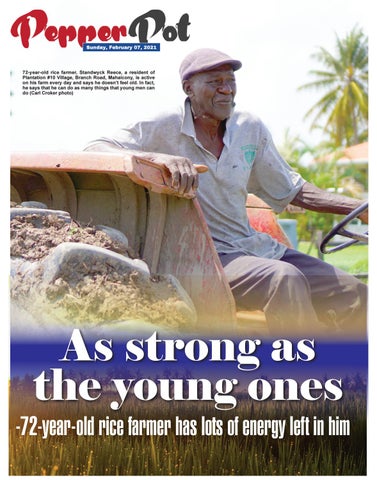
72-year-old rice farmer, Standwyck Reece, a resident of Plantation #10 Village, Branch Road, Mahaicony, is active on his farm every day and says he doesn’t feel old. In fact, he says that he can do as many things that young men can do (Carl Croker photo)
As strong as the young ones
-72-year-old rice farmer has lots of energy left in him
II
CHRONICLE PEPPERPOT ― Sunday, February 07, 2021
BANKS DIH goes Virtual for 2021 Annual Shareholders Meetings
By Francis Quamina Farrier
IT was no surprise that the BANKS DIH Annual Shareholders Meetings 2021 were combined and held virtually as one. Observing one of the COVID-19 protocols -- social distancing -- it was, of course, a wise and responsible decision by Chairman Clifford Barrington Reis, CCH, and the Board of Directors of the company. Traditionally, the meetings are held at Thirst Park in Georgetown on the fourth Saturday of January, followed by the branch meetings at Airy Hall on the Essequibo Coast, Region Two, the next day (Sunday). At Bartica, Region Seven, on the following Wednesday. The Branch Meetings usually continue at Linden, Region 10, on Friday, culminating the following Sunday at New Amsterdam, the capital of Berbice.
The BANKS DIH Rotunda at Thirst Park, which is the headquarters of the company. It is from this location that the Virtual Annual Shareholders Meeting 2021 was streamed (Photo by Francis Q. Farrier)
That has been the tradition for years until this year, 2021, when the COVID-19 epidemic took control of the way annual events have had to be restructured, and in some cases, rescheduled. The International Summer Olympics is a prime example, since
the one which was scheduled for 2020 had to be rescheduled to this year, 2021. This time around, the restructured BANKS DIH Annual Shareholders Meetings had to be held virtually. In fact, they were all combined into one virtual meeting in which all
information was presented to shareholders who were able to log in. Due to the ongoing COVID-19 situation, the usual gifts presented to shareholders were not available this year; something which shareholders understand. The ongoing COVID-19 global pandemic is still with us, but there are some countries such as New Zealand, where it has subsided. Deaths through the coronavirus in that twin-island country have remained at 25 since May 2020. Unfortunately, many other countries including Guyana, are still battling to bring the spread of the virus under control. It is a difficult task made even more difficult because many citizens are flouting the COVID-19 protocols. That has affected the normal operations of BANKS DIH and other companies in these abnormal times. At this time, many citizens reflect and reminisce about their lives and environment before COVID-19. Some of the elders who live in the Ruimveldt area can recall the changes at the Thirst
BANKS DIH Chairman Clifford B. Reis, CCH, and Magistrate C. Persaud, in discussion just after a Shareholders Branch Meeting at New Amsterdam, Berbice (Photo by Francis Q. Farrier) tour of Thirst Park. Chairman Clifford Reis took time out from his regular duties to give the students a history lesson about Richard Ishmael the Educator, Businessman and Trade Unionist -- the person who founded their school. The company places a high premium on education and at the Annual Shareholders Meetings, a number of schools are presented with cheques to finance specific
GUINNESS stout, which is also brewed at BANKS DIH Limited, Thirst Park, is one of my favourite brews by the Guyanese company Park location. A large grinding sugar factory occupied the location of Thirst Park, back in colonial British Guiana. The aroma of molasses emanating from that location, mixed at times with the black smoke from the factory chimney, has long been blown away, as it were, since the construction of the ultra-modern bottling plant and bakery by BANKS DIH. On the ground floor of the impressive Rotunda is a mini-museum which is regarded by many visitors as being impressive. Among visitors to Thirst Park, are students who are taken on guided tours. There was the occasion when a group from the Richard Ishmael Secondary School on Woolford Avenue in Georgetown, was on a
projects to enhance the operation of the school. Among the many VIPs who have visited Thirst Park over the years was President Nana Akufo-Addo of Ghana. Since GUINNESS stout is also brewed at the Guinness Ghana Brewery in Kumasi, Ghana’s second city, the Ghanaian president visited Thirst Park and was taken on a tour of the brewery and shown aspects of the brewing of Guinness stout. It is apt that mention is made that BANKS DIH produces not only alcoholic beverages such as Rums, Whisky, Wines and Beers as well as GUINNESS stout, but also soft drinks, Bread, Crackers and a range of other edibles. There is, of course, a range of BANKS DIH Qik Serv restaurants in all of the larg-
er towns around the country. The OMG on Sheriff Street in Georgetown leads them all. From my archives I have extracted the following two quotes by the chairman to shareholders: “No one says the journey to excellence would be easy, but it can be a rewarding experience.” The other was posed by the chairman as a question; “Is the achievement of excellence a journey or a destination?” It is obvious that the Chairman of BANKS DIH Limited is passionate and focused on excellence as the principal objective of the company, to ensure that customers receive only the very best. BANKS DIH Limited has over the years, been supportive of sporting activities as well, giving sponsorship to players of excellence and games such as cricket and football. The company has also sponsored special students for higher education at the University of Guyana. Another annual humanitarian event is the Senior Citizens Fete where about 100 elders are wined and dined at that special event at Thirst Park, where they are served by senior management officials. Citizens Bank, which is a subsidiary of BANKS DIH Ltd., also had a good year despite the COVID-19 constraints. There has been a reported increase of $327 million in revenue by the bank for the immediate past financial year. With the main branch located at Camp Street and South Road in Georgetown, there are branches at New Amsterdam, Berbice, Linden, Region 10, Parika in Region Three and Bartica in Region Seven. The theme of the company this year is, “Celebrating our Heritage of Innovation.”
III
CHRONICLE PEPPERPOT ― Sunday, February 07, 2021
Rupununi Conservation Society looking at fire impacts on wildlife WITH wildlife increasingly at risk due to regular occurrences of fires in the Rupununi, the South Rupununi Conservation Society’s (SRCS) newest project to collect data on the issue can potentially fix some of the problems associated with wildfires. The Rupununi savannahs
tively small in the savannahs, they can enter the forest in very dry seasons. Further, it is difficult to assess how wildlife reacts to fire over time because ecosystem dynamics are unstable and fluctuate in response to climate change, human activities, and other factors. For this reason, the SRCS
President of SRCS Leroy Ignacio are natural, and fires are a common occurrence in the area, particularly in the dry season. While some these fires at times have natural causes, many indigenous people use fire in their daily lives to create farms, manage their pastures, and hunt for food, among other things. Of particular concern is that while these fires are rela-
is piloting its new project, called the Impact of Fire on Wildlife as it believes that it is important to understand the response of wildlife to fire because not a lot is known about it. If this pilot is successful, it can serve as a baseline for the Rupununi and also as an example for other places on how they can collect information on fire
and wildlife. “Rupununi wildlife is one of the major draws for tourism, and a better understanding of fire’s impact on wildlife can help contribute to decisions about fire management in the Rupununi savannas,” SRCS President Leroy Ignacio told Pepperpot Magazine. With funding from the Sustainable Wildlife Management programme, SRCS is working with a local team in Shulinab Village to set transects in key areas in the savannah and at the forest edge. These will be monitored twice a month by a three-person ‘fire team’ who will record information on plants and animals. For wildlife, the SRCS wants to assess how animals use burnt and unburnt areas with a primary focus on birds and mammals, but also a secondary focus on reptiles and amphibians. The team will be looking for live sightings of animals using burnt or regenerating habitats, and for any animals that may have perished in fires. The SRCS also want to understand what plants are fire-adapted, what vegetation grows back after a fire, how fast, and under what conditions. “An understanding of how fire interacts with plants and the environment can help us understand how fire impacts wildlife and the behaviour of animals,” Ignacio noted. A recently conducted training focused on using
In very dry seasons, savannah fires can enter the forest
smartphones and an app called KoboCollect with forms designed for this project to record information. The training also touched on GPS use and how to set and monitor the fire transects. Part of this project will also focus on freshly burnt areas and the team will record any immediate effects on wildlife, which animals are using the area after a fire, or maybe which ones have been affected, either injured or killed. The SRCS is also building on work that is being done on fire in the Rupununi. Shulinab Village already has a fire management plan, which they developed in 2019, and identified key areas where fire posed a risk,
Recording information Measuring transects
as well as an established fire committee that is responsible for making decisions about fire management in the village. The SRDC, which represents the South Central and South Rupununi communities also have a territorial plan within which they identify key areas for protection, and outline the importance of fire management in the Rupununi. Using this information and in discussion with Shulinab village’s fire committee, the areas were chosen to set the transects. The local SRCS fire team from Shulinab includes Maxi Ignace (who is collecting information on birds), Susan Balvadore (who is collecting information on mammals,
amphibians, and reptiles), Nicholas Mandookin and/or Allan Mandookin (who will be collecting information on vegetation and the interaction of fire with the environment). This team is supported by Dr. Brian O’Shea from North Carolina Museum of Natural Sciences ( providing technical support on birds and data analysis), Dr. Evi Paemelaere, People and Wildlife Solutions (providing technical support on KoboCollect design and data analysis on mammals), and Dr. Matt Hallet from University of Florida, Jacksonville Zoo and Gardens (technical support for mammals and data analysis).
IV
CHRONICLE PEPPERPOT ― Sunday, February 07, 2021
Glo Skincare offering Guyanese first-world facial treatments
By Telesha Ramnarine
NOW licensed as a fullface specialist, Sadia Ali Rahaman initially loved makeup, but a meaningful conversation she had while in Florida with an esthetician sparked her interest in proper skin care and the quality of the everyday products that she would use on her skin. Because of her fondness for makeup, she became interested in the ingredients that were being used in them and after hearing about the harmful effects that some of these products can have on the skin, she decided it was time to shift her focus from just makeup. “I spent hours reading up on skincare and my love for makeup kind of went and I became more interested in being confident in my bare skin; putting the right ingre-
dients that wouldn’t cause me to have to hide it,” Sadia recalled during an interview with Pepperpot Magazine. Noting her intense interest in skincare as she read continuously on the subject late into the nights, her husband, Javid Rahaman, mentioned to her that she should perhaps pursue it further. She
didn’t know if he was joking or not, but the next opportunity she got, she enrolled in a skin-care course. “He planted the seed to turn my interest, or obsession as he called it, into more.” Initially, the intention of enrolling was not to start up a business; it was due to her new-found passion for
Glo Skincare administers the ultimate anti-ageing treatment, which uses micro-current
learning how to care for her skin properly. She started doing skincare for her friends; from one friend to another led to a referral. “What I love about skincare is the ability to see how people’s self-confidence can increase when they understand their skin and can see changes,” Sadia expressed. Having received her licence in Florida, she followed up with advanced courses in micro-needling, micro-current, skin analysis and hyperpigmentation, and eventually opened Glo Skincare, which is now located at Rahaman’s Park, East Bank Demerara. Glo offers professional facial treatments for any kind of skin concerns and issues including ageing, acne, hyperpigmentation, or just overall dryness. Everything ‘Glo’ does, she said, is customised. “We start each treatment with a skin analysis and we customise the facial for that client. It’s not just about making a profit and having people come back to us or become dependent on us,” she expressed. Sadia especially likes sharing her knowledge with her clients so that they too can develop confidence in themselves and learn to care for their skin on their own. “I found working in the business was fulfilling because I was able to turn my passion into a business. It is rewarding. I like meeting people, sharing experiences and views, and that is what I love most about it,” she said. At Glo, they focus on applying a holistic approach
Sadia Ali Rahaman, full-face specialist
Four ‘Glo’ boxes have been prepared to assist persons to carry out at-home treatments to skincare. “We try to un- States and take other adderstand how the body; vanced courses because the lifestyle, etc. play a role in skincare industry is always breakouts and so forth,” she changing and we have to noted, adding that because keep up with the change she believes in continued and trends to provide the education, she would keep Guyanese community with herself informed. “I would first-world services.” Sadia has put together a go up ever so often to the ‘Glo box’ that has practical benefits, especially in the coronavirus epidemic where Glo Skincare offers professional facial many people are skeptical treatments for any skin condition about leaving their homes. “The Glo box is an at-home facial box that follows full professional protocol, comes with detailed instructions and products; the clients can give themselves a treatment at home,” she explained. Four types of boxes have been prepared for people with different skin concerns. There is an organic box and others for acne, brightening, and hydrating/anti-ageing.
V
CHRONICLE PEPPERPOT ― Sunday, February 07, 2021
Local nurse launches business to provide expecting mothers with care packages
By Naomi Parris
FOR many pregnant women, the most exciting time of their journey is the last days of their pregnancy as they are preparing to welcome their little one into the world. It’s a time filled with joy, fear and sometimes anxiety. Cognisant of this, being a mother herself and a nurse stationed in the maternity ward of the Georgetown Public Hospital Corporation (GPHC), Kamila Atherley has been providing a service of pre-packed hospital care packages for expecting mothers. The service which is the first of its kind offers expecting mothers a pre-packed bag of all the essentials they will need for themselves and a newborn baby when it’s time to go into labour. The 33-year-old told the Pepperpot Magazine that after working in the hospital’s post-anaesthetic care unit for some time, she would often see many new mothers not knowing what they need to pack in their maternity bags to prepare for labour. “I was placed in the maternity unit and during that time I noticed that [there were] some patients that for some reason or the other, they have to belong in the ward or persons in some situations where they don’t have much and sometimes you have persons who would come in the hospital with too much stuff or too little,” she said. “I decided that it would be a good idea if I pack bags with all the essentials that
Kamila Atherley, founder of ‘Mila’s mommy and me’
mothers would need for their trip to the hospital.” Atherley disclosed that she had the idea for some time and had been sitting on it since she was uncertain if the initiative would be welcome. “I didn’t want to start because of a few reasons- one, because I didn’t want to do the business as just a parttime thing, I wanted in the future to expand.” Nevertheless, the young woman noted that she decided to launch her business in
July 2020 in the height of the epidemic, which proved to be the perfect timing since many persons were confined to their homes and many pregnant women were advised to take all necessary precautions to safeguard themselves and unborn child or children. “That was the ideal time for me to launch, because persons were scared to go out because of the virus,” she said. Wanting her business to be more than just a part-time service, Atherley disclosed that she recently began taking a management course to further her knowledge in business management to build her business. She said that the goal is to expand her services and business to reach as many mothers as possible. The care packages consist of all the necessities an expecting mother would need; each bag has a complimentary sanitiser and face mask. Atherley noted that the packages are affordable and mothers can customise their packages also. Additionally, the packages come along A few of the packages that are available by ‘Mila’s mommy with a booklet with and me’
information for both expecting mothers and fathers. She disclosed that she is currently adding some more information to the booklet for expecting fathers and for new mothers on how to take care of themselves and postpartum depression. “I’m editing right now. It has information for both mommy and daddy as in how daddy can support mommy
during the pregnancy,” she said, adding: “There’s information on how to give the baby a bath, on breastfeeding, how to take care of the baby’s navel cord. I also have information about the importance of vaccination of the baby,” she explained. Atherley disclosed that her business is currently skyrocketing and the support she has been receiving from
customers has been both rewarding and encouraging to provide the best services. “It has been great. I have many persons who have been interested call to say that they’re glad that I’m doing and that they’ve never seen it done in Guyana and their [sic] very much in support of it,” she said.
VI
THIS week the Pepperpot Magazine visited the farflung village of Mortice, which is one of many small villages located at Branch Road, Mahaicony, East Coast Demerara. It is located within Region Five (Mahaica-Berbice) and it is home to large-scale rice farmers, cash-crop farmers, livestock and cattle farmers, and also skilled professionals, who hold jobs within both the private and public sectors. Mortice Village has a primary and nursery school
CHRONICLE PEPPERPOT ― Sunday, February 07, 2021
housed in one compound and the nearest health centre is located villages away at Strath Campbell. The village is home to about 150 residents, who are mostly Indo-Guyanese and they have electricity, potable water, cell- phone service and internet service but it is not
reliable. The main access road to this community is good up to a certain section, after which a mud dam accompanied by huge potholes make up sections of this road. There are no internal streets in this community, but with just a few houses on
both sides of the access road. It is a nice village rich with natural attractions which remind one of being in the jungle, because of the abundance of greenery that makes up the environment and there are rice fields as far as the eye can see. Most of the lands were handed down from generation to generation and most of the villages along this stretch of road were once plantations. According to villagers, Mortice was a plantation with silk cotton trees marking the boundaries and was owned by a man named Mortice, as such, the name was derived. However, little is known about his ancestors but after a time, new settlers came to the land and their families began occupying the lands there. The Mahaicony River is within reach at the rear of the access road where a creek takes you to many other riv-
erine villages beyond Esau and Jacob and Governor’s Light. There are two rice mills within Branch Road, which employ some residents and others work with large-scale rice farmers. The villagers are hardworking, ordinary folk, who toil from dawn to dusk tending to their crops, livestock and cattle and keeping their farms and gardens weed-free. The residents of this farming community hardly ever buy fruits and vegetables, because they all have kitchen gardens and they eat what they grow. As for meats, they rear their own chickens and they have sheep, goats, cows and they catch fish right within the village which has vast backlands, an ideal place for fishing, birdwatching, sightseeing, and cook-outs. M o r t i c e Vi l l a g e i s semi-isolated and the people
like it that way and its central point is at Mahaicony Junction, where there are a market, bus park, and several business places. Residents of this community are self-sufficient but welcome development in any form, since they need street lights, better drainage and irrigation, and a better access road through the village. Mortice Village doesn’t have a Neighbourhood Democratic Council (NDC), but late last year a Community Development Council (CDC) was formed to develop the village. There are large houses with interesting architecture in Mortice with lovely flower gardens and well-manicured lawns and expensive fences outfitted with lights. However, over time many people left the village for various reasons, but those that remain one thing is for sure, they seem comfortable and they are environmentally friendly. Most villagers are locals, while others have been there for many years and have no intention of relocating, since the place is home for them. Mortice Village is accessible via land and river and it is a lovely, scenic place to live or visit.
Scenic Mortice Village (Carl Croker photos)
VIII
CHRONICLE PEPPERPOT ― Sunday, February 07, 2021
As strong as the young ones
-72-year-old rice farmer has lots of energy left in him By Michel Outridge At 7 2 y e a r s o f a g e , Standwyck Reece still has the energy and drive as his younger counterparts because it is what he knows to do as a rice farmer in his village. At the time, he was on his tractor, making his way out the rice fields, to his home, a few yards away. It was then the Pepperpot Magazine
caught up with this friendly man, who seems to have the energy like a teenager. Reece reported that he went into the backdam very early that morning since he is an early riser and would get on with the farming chores before sunrise. The elder stated that despite his age there is not anything he cannot do and would do normal things as any young man and do it
even better because his age doesn’t prevent him from working. He disclosed that he went to the rice fields to throw manure on the crop of rice he has and himself and family would work together on the farm since it is quite large. “I don’t feel old, in fact I feel good because I am always working and I don’t sit down and wonder what to do instead I have a lot to
Standwyck Reece on his tractor (Carl Croker photos)
do because being a farmer is a lot of work daily,” he said. Reece is a descendant of Jacob James and back in the days his father was a large scale livestock and cattle farmer, who was a supplier of meat and meat products. The father of two revealed that his father was also a rice farmer and his childhood home ( his grandfather’s house) is still standing but in dire need of repairs. Reece recalled that the wooden two-storey house was a grand structure back in the days and it stood tall among trees and vast rice fields and was a sight to take in. “It is this family’s wish to have this house, which is a landmark in this village, to be restored to his former glory in memory of our loved ones, who passed away because it holds a lot of memories and most of us grew up in that house,” he said. Reece stated that rice farming runs in the family and he has been doing it as a boy and is still at it today. He is the third generation of the family tree and it is ancestral lands, acres upon acres that are being cultivated jointly among relatives. Reece explained that in the early days, his father had a large coconut farm and they used to have about 3,000 dry coconuts ready daily to make coconut oil which was supplied to retail stores in the city such as, Resal Maraj on Water Street. He added that they used to make copra with the by-products of the dry coco-
nuts and that too, was sold. The rice farmer reported that over time, that business went down because the demand was not there and they had to resort to rice farming
fields it damages the crops and it is not good, a loss is incurred, all around,” he said. Reece disclosed that they would plant 10 varieties of rice in more than 400 acres
Standwyck Reece
and cattle rearing Reece is a resident of Plantation #10 Village, a small farming community on Branch Road, Mahaicony, which consists mostly of one large family, all farmers. The village elder reported that his sons and nephews all work with him and when they harvest they would employ young men in the village to assist. Reece said he was going home for a meal and take rest before going back out to the rice field where he has some work to complete before the nightfall. “As a rice farmer, it is challenging at times when I cannot access fresh water before of how the drainage and irrigation system is set up for the crops and when the saltwater gets into the rice
of lands, which was handed down from his ancestors, who were among the first settlers. He revealed that the family also has a lot of cows in the backdam and some chickens which are homegrown in the backyard pens. The 72-year-old told the Pepperpot Magazine that being a farmer is ‘a give and take’ kind of work because depending on the weather one will get a good harvest then there are other expenses to cater to. Reece pointed out that the entire family keeps the rice fields going and they work collectively to keep the family business alive daily and that is a blessing indeed when the family can work together and combine their efforts.
IX
A cut above the rest
CHRONICLE PEPPERPOT ― Sunday, February 07, 2021
Inderjeet Persaud (Carl Croker photos)
Mortice Primary School teacher instrumental in developing his community
By Michel Outridge
Often, the saying goes, it is not what we do but it is how we do it, it is a true saying when it comes to giving back to society, schoolteacher, Inderjeet Persaud has been doing a lot behind the scene to home-school children during the pandemic. The 54-year-old told the Pepperpot Magazine that he would distribute worksheets weekly to the 12 pupils in his class. Once a week he would allow six of them at a time to go to his house where he has wooden benches and practice social distancing, hand washing, wearing of face masks is necessary and sanitising to prevent COVID-19 to school them. It is something he does on his own accord because he is aware the children need guidance and the face to face interaction is vital to promote learning. Persaud added that online teaching is not working out in the community because they do not have a reliable internet provider and they would have to buy data and use their cell phones to access the school work and it is costly. With this in mind, he started the home-schooling once a week for six of his
online classwork,” he said. Persaud stated that whatever he is doing for the children he wants to do it as his way of giving back to society and even though it is not blackboard teaching he is, however, reaching out to the children through worksheets and other printed handouts. The Wash Clothes resident related that the challenge with online teaching is that internet connectivity
Inderjeet Persaud with his freshly picked water coconuts is really bad and the children cannot access the classwork. Persaud explained that his son is a student of the
Inderjeet Persaud’s harvest of mangoes pupils and he would go over classwork and mark their completed worksheets, identify weak areas and go over it with them. “I would also do my own printed materials and gave it to my pupils free of cost because I know the position they are in terms of accessing
his humble upbringing from his father, who instilled discipline and the way to a good life is to be simple, humble and honest. “I patterned myself according to my upbringing and it has proven to be successful so far and I became a teacher because it is a noble profession and it is my way of contributing to society,” he said. Persaud disclosed that
University of Guyana (UG) and he would have to find $7,000 weekly to access his school work via the internet on his cell phone because the internet provider is unreliable and it is a paying service monthly. The teacher stated that he became a teacher because of
his father was a rice farmer, a very hard working and simple man, who passed away 20 years ago, he has acres of prime rice lands, deep into the Wash Clothes community. He pointed out that after his death, he left that residence and came out to settle at Wash Clothes with his family. Persaud reported that his father’s land is still there and they have cultivated fruit trees on the land which has no house. The father of one noted that when he completed secondary school he wanted to become a soldier and his parents would not hear of it. He was the only son among eight sisters and he was encouraged to try another profession so he became a teacher. Persaud has another side to him, he loves cricket and is a cricket commentator professionally and works with the Caribbean Media Corporation (CMC), Guardian Group of Company and One Caribbean Radio and National Communications Network (NCN). Within recent times a lot
of young people from the community have become career-oriented that is a plus for the village. Persaud revealed that there were 176 pupils registered at the Mortice Primary School but today they only have 62 and it is due to migration. He started his teaching career in 1989 and he taught most of the young people in the village, who grew up to have meaningful lives with good jobs. Persaud told the Pepper-
See Page XXII
X
CHRONICLE PEPPERPOT ― Sunday, February 07, 2021
Mortice Village residents working to enhance the community Rice fields in Branch Road, Mahaicony
CIIP worker, Gleavia Bourne (Carl Croker photos)
By Michel Outridge
G
leavia Bourne is among 14 others of Perth Village, Branch Road, Mahaicony, East Coast Demerara, who are Community Infrastructure Improvement Project (CIIP) workers. The group was out in the community, braving the sun, cleaning drains and parapets as part of their daily job. The mother of three reported that CIIP comes under the Hamlet/Chance Neighbourhood Democratic Council (NDC) and she has been at that job for the past 15 years. The 35-year-old, who was decked out in her long boots and cutlass was among a group of See Page XVIII women and one man, in drains in Rice Farmer, Deonarine Sasenarine called ‘Chow’
CHRONICLE PEPPERPOT ― Sunday, February 07, 2021
XI
XII
CHRONICLE PEPPERPOT ― Sunday, February 07, 2021
Diabetes
I RECEIVED two emails last week concerning diabetes. One was an avid reader who briefly mentioned that they were struggling with diabetes and the other was a newer follower who was
just diagnosed and therefore asked me to spread awareness on this disease. Diabetes is a worldwide issue with Guyana being no exception. World Health Organization statistics reported
that over 420 million people have diabetes worldwide. I would like to spread awareness on not only diabetes itself, but also the way in how disorders such as this affect one’s general mental health
and well-being Diabetes is a metabolic disorder that occurs when one’s blood glucose (also called blood sugar) is too high. Our blood sugar is one of the main sources of energy and mainly comes from the food we eat. Insulin (which is produced by our pancreas) is what extracts the glucose from food to be used for energy. Sometimes, our body doesn’t produce enough insulin or the insulin that is produced is not strong enough to do the job which means the glucose cannot be properly used. When this happens, the individual would be diagnosed with diabetes. There are three major types of diabetes. Type 1 occurs when the pancreas fails to produce enough insulin and therefore a diagnosis means the individual would have to take insulin daily. This has a sudden onset and is more common among children and young adults. Type 2 occurs when the insulin being produced is not sufficient to do the job. This is more of a gradual onset, is more prevalent than type 1 and occurs mostly in adults. Gestational diabetes occurs only during pregnancy and is the development of high blood sugar levels. More often than not, this goes away after the baby is born, but in some cases can develop into type 2 diabetes. Overall, it seems that men and women are equally affected by the disorder. All types of diabetes have similar symptoms which range from mild to severe. Mild cases include sweating, fatigue and increased appetite, while more serious cases can include aggression, confusion, seizures, unconsciousness and even death. While there is no cure for diabetes, prevention and
maintenance of diabetes include prescription medication (in some cases), counselling as well as a special, individualistic diet created by your health care professional. Maintaining a healthy diet as well as daily exercise can reduce the likelihood of developing the disorder, as well as lower symptoms if there has already been a diagnosis. People with diabetes may also suffer from a variety of other physical issues such as heart and kidney disease, stroke, nerve damage, as well as issues with eyes, teeth and feet. Unfortunately, those with diabetes also subsequently
suffer from a variety of mental health issues. Diabetes especially has been known to cause high levels of stress, anger, fear, disappointment and even denial, all of which can lead to depression, anxiety and substance abuse. Research shows that someone with diabetes is twice as likely to develop any of the aforementioned. Developing healthy coping skills is the best way to move forward in dealing with your diagnosis. Try things (old or new) that help with and promotes relaxation, such as deep breathing, yoga, music or simply going for a walk. Talk to people you are comfortable with about your diagnosis. It is okay to seek help. Most importantly, remember to practise the basics – eat, sleep and exercise well! Diabetes is a life-changing diagnosis, one which
many people have a hard time accepting, let alone managing. The management is mostly self-care due to daily management. A diabetic is supported by many physical health care professionals, but it is mostly up to the individual to ensure proper management and self-care. This makes it overwhelming for most people. Are you not sure if you are likely to develop or may already have diabetes? One is more likely to develop diabetes if one has a family history of the disease, are overweight, not physically active, over 45 years of age (referring to type 2), have high blood pressure or have a history of heart disease or strokes. The classic symptoms of diabetes include dry mouth, increased hunger and thirst, frequent urination, unexplained weight loss, blurred vision, skin rashes, fatigue or numbness in hands or feet. When one has diabetes, one’s body also takes a long time to recover from any injury or illness. If you are troubled by any of the above, please go to your nearest health centre to share these concerns. If you are having a hard time dealing with your diagnosis, you are not alone; reach out to your nearest health care professional for additional options. Thank you for reading and please send in any questions, comments or topics to caitlinvieira@gmail.com. If you would like personal counselling sessions, please contact +592 623 0433 Suicide Prevention Helpline Numbers: 223-0001, 223-0009, 623-4444, 6007896 Say Yes to Life and No to Drugs! Always!
XIII
CHRONICLE PEPPERPOT ― Sunday, February 07, 2021
HISTORY AND ME
L
IFE is a mystery, love and adventure, and history for me, a fascination. From a young age, I developed a passion for reading and looking back from then to now, I must say, reading became my first love. It was something beautiful that opened doors to the world and from my curious mind wanting to learn, to understand the concept of life and the stories that defined our existence on this planet, I became fascinated with history. I rode my bike to school and long distances to libraries because my family; labourers on the sugar estates, couldn’t afford to buy all the books I wanted to read. Once I even sold a little basket of cherries from our tree to a kind gentleman to be able to buy extra pencils because I wrote a lot as well, making notes of all the interesting things I saw in daily life and read from books I borrowed. Riding my bike allowed me to stop or pause to look at places of interest; iconic colonial buildings, the intricate designs of tombs in churchyards, and reading inscriptions of who was laid there a long time ago. One of the places I often stopped by was opposite the Rose Hall estate compound, an area with old tombs sheltered by thick, wild shrubs and tall trees. It always had a dark, haunted look and people kept a safe distance for it was said, it was an old Dutch cemetery. But with my curiosity for the past, as a 12-year-old, I was drawn to that cemetery. I would stand for long periods looking and wondering, “Why
does it look so mysterious? Who was laid there? What’s their story?” I did not know why, but I had a strong feeling something unknown was also there. Two decades passed, but that cemetery never left my mind. I became a short story writer, one of my dreams, and over the years, many of the stories I wrote highlighted our colonial history. One of those stories using the site of this old cemetery was “The Golden Cross,” which was about a Dutch plantation owner’s young daughter buried there and whose soul was still earthbound, waiting for something to release her. My wandering mind went all the way to an old cathedral in the Netherlands for that story. It’s amazing what ‘treasures’ of the past one can find when a vivid imagination crosses boundaries and transcends time. There are stories everywhere in this land, just waiting to be found, given our rich history from the Indigenous peoples who crossed the Bering Strait during the Ice Age to this land; colonized by the Dutch, French and English; to Independence. So I was more intrigued than amazed when I heard the news of the discovery of a secret burial site of 15 bodies near the cemetery at Rose Hall. It was a shocking revelation for the people of the community to hear the story of how 15 labourers were killed by the colonial police 101 years ago to quell a riot, and a deep pit was dug on the night to dump their bodies. A concrete base was constructed to seal the pit that stayed hidden as the
bodies of those poor souls, laid in the cold bosom of the earth. I could not believe that that intuition I had as a young schoolgirl nearly three decades ago was right. Something unknown had been lying there 101 years ago. An astounding discovery from a lost document found! There will always be profound and unending conversations on the past and its meaning. From the countless pages written over the centuries, and in my journal, I continued to make notes of interesting things of the long-gone past. A new chapter in my life was living in the sugar estate compound in different regions, that brought me closer to the facts and fables of colonial life on the plantations. The first thing that caught my interest at Skeldon estate was a tomb under a huge Wisteria tree on the expansive grounds. It looked like a small church with intricate designs on the walls. There was nothing inscribed to tell who laid within the sealed walls, so different theories were told over the decades. One of those theories was that it was a child, the master’s only son, and from that, I wrote the story ‘The Magic Sword’, my mind journeying to the Far East to find a doctor with magical powers to save the child but a little too late. In another section of the grounds from the backdrop of a water fountain were the two sculpted busts of the plantation’s owner ’s daughters – Eliza and Mary, a beautiful piece of art. But there were no stories of their lives except for reports that
night-shift guards claimed to have seen their ghosts in the backlands. Not sure if that was true or not, but the thing is, ghost stories centred on the colonial era have been a part of the culture in our society. I
grew up with these stories and even though I never saw the Dutch master riding his white horse through the streets at midnight, I believed. A curious mind with infinite possibilities of a
story teller, and it has been quite fascinating for me romanticising facts and fiction in my writing; a fun and exciting journey that continues with myth, adventures, mysteries and romance.
XIV
CHRONICLE PEPPERPOT ― Sunday, February 07, 2021
Virtual Writers Retreat
MY last weekend in January started and ended on a night and that is a tremendous blessing. I am one of the facilitators along with Claudia Vidal f ro m t h e U S A a n d Richard Young from Trinidad for the Virtual Writers’ Retreat. Sometimes a group of participants gel extremely well, considering the people are from different countries, race, religion etc and the opposite can happen. The group from the first virtual retreat had unbelievable synergy and the team was hoping for this to re-occur--and it did with even more energy. The participants were from various parts of Guyana, The Bahamas, Florida,New Jersey, New
York, Arizona, Mississippi and Washington. It was one weekend packed with valuable content. Day one’s focus was
on the writer ’s mindset, mindfulness and story-generator sessions. Day two looked at writing proposals, story structure and creative
writing. Day three was on developing the story structure and introduction to self-publishing. Every one of the participants was given assignments and at the end of the retreat, they had a framework for a book and a large percentage had for more than one. A bonus that was made available for reviews and the presentation of the first three pages of their books. From the very first session, the participants were already feeling a good vibe. I am sharing two testimonials: “When I signed up for this, I was at a low point. I was stuck. I longed to write a novel, but I didn’t know where to begin. I didn’t think I had any stories worth telling. So far with just that one session helped me realise that I have a lifetime of experiences just waiting to be tapped into, a lifetime of stories, characters, settings and plot twists. Anyone can teach the mechanics of writing, but not anyone can inspire like you guys. I eagerly look forward to today’s session.” MalikaGuyana “Joining this retreat just on day one far surpasses everything I thought previously. Such amazing energy from start to finish and so in-
spiring. I’ve thought of 10 more ideas for books going forward. So much support throughout, sharing and learning the steps it takes to write in today’s world. How you share in true form for the most impact for those you’ve written for. Excellent information on how to connect with your reader and many nuggets helping to pinpoint our most purposeful book for our readers. I can’t wait to see what’s in store for day two... Love it, Love It... this is a must-take Writer ’s Retreat... I recommend anyone who wants to make an impact on others in our world, just be you and your book will write itself, and with the framework and Invaluable information... Your book will not just be a dream it will become reality! You will even get to know you better in the process!” Nikki –Canada Sharing two other testimonials after the retreat. “The Virtual Writers Retreat was far from ordinary. I was able to gain invaluable insights into writing and publishing material. I would encourage anyone who would love to write or even want to know if writing is the path they should take, to participate in the next retreat. So many ideas have been birthed from the retreat, new skills learned and new friendships and connections were formed.” Andrea, Florida ‘It has truly been a long time coming. Writing a book has always been on my list of things to do, but the opportunity never aligned itself before now. When I received the email about the retreat I automatically thought, ‘The Time is NOW!’. With everything that is going on in the world and all I have to offer,
I can not afford to put this opportunity off. My birthday is the 15th of January and I quickly decided I would make it my birthday gift to myself, however, I started to doubt myself. It was that reassuring call from Sonia that solidified my attendance that I am so thankful for. I had yet another reason to show up and apply myself. From the very start on Friday evening, the connection started, the nuggets poured and we all drank from the well of knowledge both Claudia and Sonia shared. I finished my first assignment immediately after the call, excited for the day ahead. It is the mesh between personalities of our support team and coaching techniques that brought out the best in all of us the following day. I felt as though something unlocked in me, it came so quickly, it came so naturally. I started this journey saying I would like to leave with an unforgettable experience that I will always want to talk about and that I did. Today, I stand before you well equipped and ready to make my music. I stand aware of my contribution to the solution in a world that is much within my reach than has ever been before. The virtual writers retreat not only harnessed my innermost voice but expanded my mindset that tapped into my ability to now write compelling authentic stories. Write, I shall. Thank you Dr. Sonia E. Noel for your encouragement, support and love. Thank you Claudia Vidal for your insight, vision and strategy. Thank you Richard Young for challenging me to add another layer to my creative arts ability and making music with my words, Lia, Bahamas I encourage you to join us on the next retreat in June as we continue to celebrate this journey called life BEYOND THE RUNWAY.
XV XXI
CHRONICLE PEPPERPOT ― Sunday, February 07, 2021 CHRONICLE PEPPERPOT ― Sunday, December 20, 2020
THE MYSTERY OF CHRISTMAS Nurturing theSYSTEM imagination of a child A enable tale oftheir thechances humanofethos will survival in more ways than you can imagine
OF course, it’s a commercial period that from my perspective, husbands should keep the attention of their wives ago at home OVER a decade a ratherteacher, than walking downsenior the wife I thinkcolleague from experioftown. a business encea woman that there and whoare hadmany spiritsmy embodied taught wife at in thewhat Campbellville is defined as theGovspirit of ernment School Christmas, like closed the muses down evening class-catethey the have different esgories that catered for the one of inspiration children of somebeyond of the the is ‘Shopping country’s wealthiest boundaries of necessity’ parents, herinspiration almost sad tarand that response to the Most word-men gets women. less question I had the have a list that includes asked with my readable stress-related bills, the last expression was: “They have record I read, mentioned no references.” What this that men die more from elegant lady was referring than tostress-related was not thatillnesses they would women; that’s because not pass examinations and we’re with importthis list get nice,born and even of not-to-dos ant well-payingthat jobs.define But ‘manhood’: whine, will the minddon’t be able to complain, beg, cry,selfand be trained, whether realiseorthat are to no trained to bethere sensitive ‘Sugar Mamas’ only the worlds beyond self‘Sugand ar Daddies’consumption? don’t become conspicuous one, the stress will deTo be or curious enough, to question and investigate the stroy you. human that Thisenvironment is a phenomenon envelops the very authority of Christmas not only in that they will, may house Guyana, butorfrom larger themselves in, as they proceed to set the dangerous stage of a moat around a gated dwelling, where the analytical perception, trained by exploring the imagination to evolve from the inception, into a youthful interpretation of the world that encircled that childhood evolution, would have enabled the skill to ‘empathise and recognise’ that the answer may not rest with the moat and the walls around the gated township, but instead, hearing what is whispered and comprehending the conversations and expectations of the ‘Grounded exchange.’ What this teacher meant by ‘no references’ can be translated as having a void of symbolic and interpretive language which relates largely to the realms of literature, for example, terms in conversation and emphasise on the layers of ideas, like “That was his Achilles heel” or
economies that I’ve lived in for a while, where the enthusiasm of the season compels an intoxication of shopping. They, however, have a consumer privilege to take back items, rebalancing the budget into reality, that provides a favourable sober-up reprieve. From the beginning of time, human governance has instilled in populations the longing for redemption; thus, more so the longing for divine intervention. Somehow this has accounted for the remarkable presence of shepherd Elders across “Common bornabefore cultures. I sense inherited book book” or “Conscience ain’t published in 1913 on comneed loudspeaker”. To put parative religions by Rev. it simply, proverbs, quotes, Charles H. Vail titled ‘The cultural, religious, or historiWorld Saviors.’ tookfrom me cal references all It come some years to explore its habits of reading or been read narratives and in-depth to at a younger age. Theconantent on the similarity of cients sustained admirable ciunusual revolutionary souls vilisations through the drama thatdance have emerged acrossand all and of storytelling, human variations, not so long ago inProphets, Guyana Messiahs, Avatars stories, etc. It there were Anancy occurred to mePork-Knockthat cynical Jumbie stories, asstories I am, and that fairy it is tales doubtful er (the latter basedwas on European that there a global and exborrowed This change offolk this tales). idea, since ispeople a background takenover for hardly travelled granted, but these cultural practices contributed to stimulation of the imagination, which is an essential faculty in applying such metaphors learnt, to every-day re-enactments by current characters high and low, whom we will encounter that will summon reminiscences of a ‘Brigah Bobby’ here and there, in comparison to a solid person, a useful part of the socio-cultural toolkit for sensible assessment and decision- making, provided by grassroots sociology. It was to the absence of the above that the teacher referred to the lack of references. In primary and secondary school, ‘Reading’ was part of the weekly school timetable during the old school age. Today, with more subjects to grapple with, I’m not sure how this essential area is being guided. With the technology available it needs to be guided because it would be easy for young and not so young to be tied to the
100 miles to go anywhere, except by sea routes, here and there, for example, the entire Biblical geography is located on the African continent. The remarkable thing is that in this very book and others after, there was a common denominator, of common birth timing, based on a specific astronomical uniformity for all these saviours. However, the essence of the birth of Jesus who would become the ‘Christ’ is rooted in our human culture of the sacred, that echoes the relevance of religion over-burden of gossip-based, and the constant quest of and opinion on change wheninformation the illuminasocial media, and worse intion dims, and the business cluding mysticism on the net of man-contrived gods usurp and social media, though the higher ex-a surfing is responsibility essentially not pounded at the birth of the bad thing, a survey should manifestation. be done to enquire of the Christmas enveearly teens andalso pre-teens lopes the old harvest fesabout ‘who are their favoutival custom through the rite authors’ with a direct cleansing preparing of request ofand probable hobby the whether owned or andhome, long term reading on carented, acknowledging a reer interests, it would that be an house is notsurvey. a home,Recently, a home interesting a an four-year-old of is environmentrelative within the mine spent a few weekends walls, of souls with shared at my home, I was starempathy andand compassion. tled at how he would find his way on my phone to Cartoon character animation stuff. I did admire how he comfortably handled the phone -- it’s his world. Then that little voice whispered to me to transcend my admiration and chum-up with the little person, so I started with alphabet characters, he knew them. The problem came when I put them together, the way my pre-school teacher did before I started school in ‘little ABC’ to ‘Big ABC’. Then to ‘First Standard’ yep, a couple of hundred years ago. He couldn’t understand common and capital usage for letters, nor could he identify them together as Cat, Dog etc. I had opened a ‘Pandora’s box ‘ on the task me and this little Pickney have. I went down to Austin’s and bought chalk and a blackboard for our next fun encounter. Seriously, I think learning should be fun and must be encouraged, not driven by fear. We live in a much more
In another age, we cleansed and treated tribal farmlands and waterways, shared food and gifts for those less productive, with Christmas we are still cued to the profound symbolism that has sustained us through the ages. The Christ season sum-
complicated world, which requires an in-house coverage of the most basic skill of being able to read, to be transferred to upcoming family members and friends. With COVID’s grip upon the world, economic options are not going to be the same for a long time. A retreat to simpler, but effective methods
mons the otherwise deeper contained aspects of our nature: we think of gifts to persons who have affected us positively, our famimust be to considered, lies--and meaning spouse and the culture develoffspring andformative others; oped in-- the despite social years will media, remain we an are still inspired by of beauactive influence the young adult and possible leader of the future. In 2011, I purchased a recommended text “Over-schooled, but under-educated” by John Abbot with Heather Mac Taggart. The book is based on an argued crisis in education. It’s not a book that can be discussed in an article, however, I close with an extract from this same text for observation and examination, as locally we hear the blame on the school for the behaviour of children, we should add this extract to the debate: “ And here is the problem that
tiful and relevant funny cards. We must also think of those out of employment, for those relatives and friends, we worse; apply inan seems to be getting old family custom; we do creasing numbers of today’s that sub-ration ‘thing.’ adolescents suffer fromAnd the fact that their parents haven’t See Page XXIIthemselves, grown op [sic] and so have nothing to say to their children about how to become effective parents themselves.” The reality is both the schools and society are occupied by the humanity identified in the extract, so how do we start to deal with it? Note: CORRECTIONbriefly in last week’s article Saddam Hussein was mentioned as responsible for the 1975 OPEC attack. A literary source related that Ilich Ramirez Sanchez -- aka Carlos the Jackal -- identified Qathafi as the source of that incident.
XVI
CHRONICLE PEPPERPOT ― Sunday, February 07, 2021
Public Participation in Environmental Management
ENVIRONMENTAL management entails an understanding of how the Earth functions and how humans interact with these functions. It is a multi-faceted approach to identifying environmental changes and maximising the benefits of the environment, while seeking to avoid or reduce degradation. Environmental management systems are set up to protect the environment and human health by active measures such as control, mitigation, planning and implementation. The goal is to improve the quality of life while ensuring the quality of the environment is not compromised. Effective environmental management is integral to the mandate of the EPA. Public participation can contribute to better decisions! Public participation seeks to involve stakeholders and ‘the public’ in problem-solving or decision-making and utilises those inputs to aid in the decision-making process. Decision-makers have more access to information during their interactions with the public -- people who know the proposed project area can share additional facts, values, and
perspectives critical to the implementation of the project. Public input can have a heavy bearing on the decision-making process. It affords stakeholders (those that have an interest, such as individuals, interest groups, communities etc.) the opportunity to influence decisions that affect them and/or the natural environment. They can then incorporate the best information and expertise from stakeholders involved to ensure that the most feasible decisions are made regarding the project. Public Participation involves you! Public participation is integral to the operations of the Environmental Protection Agency. The Environmental Protection Act 1996 (hereafter, “the Act”) requires the agency: * To promote the participation of members of the public in the process of integrating environmental concerns in planning for development on a sustainable basis. (Section 4 (1) (b) of the Act); * To promote and encourage a better understanding and appreciation of the natural environment and its role in social and economic development. (Section 4 (1) (j) of the Act); Additionally, for projects requiring Environmental Impact Assessments (EIAs), public participation at all stages of the project is critical to the success of the project. Moreover, during the conduct of the EIA, the engagement of appropriate and adequate stakeholders should not be undermined. Further, the Act requires the developer and persons carrying out the EIA to: * Consult members of the public, interested bodies and organisations. (Section 11 (9) (a) of the Act); and * Provide to members of the public on request, copies of information for the EIA. (Section 11 (9) (b) of the Act). Public participation should not be seen as a single event, but as a process. It consists of a series of activities and actions. Moreover, the agency has established guidelines for
projects requiring EIAs and will continue to work with developers to ensure adequate stakeholder engagement in developmental projects. Public participation might take different approaches This really is dependent on several factors, including the legal and institutional system requirements, the capacity of the relevant actors, socio-cultural factors, economic factors,
scope of the project, risks the project may pose etc. The approaches to public participation include information-sharing, written submissions, scoping meetings, consultations, disclosure meetings, active participation, etc. Working together with the public to identify alternatives and the preferred solutions to potential adverse impacts can also empower the community to take ownership of the project. According to the International Development Bank in its “Meaningful-Stakeholder-Consultation” publication, public participation is not limited to the use of one tool only; a variety of tools and techniques can be used to inform the public, generate public participation, collect inputs and ensure some level of consensus is reached. Why is public participation important? Public participation is not simply a prudent but necessary course of action; it actually results in better outcomes and better governance of projects. The agency has always recognised the need for public participation and has been working on strengthening our stakeholder engagement policies. When executed in a meaningful way, public participation will benefit not only the agency, but also the project developer and or company, some of which include: 1. Saving costs 2. Avoiding damage to reputation 3. Identifying potential hazards and reducing risks 4. Providing a more holistic view of the project 5. Identifying available skills 6. Early warning, better understanding, more perspectives; and 7. Aiding in acquiring baseline data. Public participation allows for more informed decision-making that reflects public interests and values. The EPA publishes Public Notices for written submissions on projects in accordance with the requirements of the Environmental Protection Act, 1996. Additionally, public meetings and consultations are held in collaboration with the developer for various projects. Be sure to follow the agency’s social media pages, visit our website, listen to our media programmes and participate in the public meetings/ consultations on projects in your area. You can share your ideas and questions by sending letters to: “Our Earth, Our Environment”, C/O ECEA Programme, Environmental Protection Agency, Ganges Street, Sophia, GEORGETOWN, or email us at: eit. epaguyana@gmail.com. Follow us on Facebook and Instagram and subscribe to our YouTube channel
CHRONICLE PEPPERPOT ― Sunday, February 07, 2021
XXIV
Cleanliness of one’s environment should be embedded in Guyanese culture
AS you walk around Georgetown, or, in fact any other town and notice a towering amount of garbage and waste on the streets? Do you enjoy the smell of the nearby stagnant drains? Seeing the beautiful greenery and scenery certainly makes us all proud as Guyanese, right? It should make you proud, but vanity and cosmetics are not considered progress. In fact, it’s a cover-up. The tall hotels, mega-malls and resorts will be reduced to nothing, if they’ll be surrounded by pools of plastic. Are these concerns even addressed when planning and implementing national developmental policies and strategies? I wonder. In the town where I live, there’s a known “dump site” oblique to my home. The municipal body has done everything it can to fix this issue. From putting a “no dumping” sign to even putting an industrial size waste bin. Somehow, the garbage and waste are dumped in, around, near or next to the bin. This leads to frustration and disgust amongst residents like myself. Now, as citizens we have rights, but we also have responsibilities. Citizens of my township should be responsible enough to know that their littering has an overall negative impact on the very town in which they they reside. At one point the municipality even banned residents from throwing their garbage at the site. They did
this without giving citizens an alternative site to use. Also, what good does governance serve if it cannot lead and have others follow? I explained this ongoing situation about environmental pollution and waste management, because I am sure that this is the reason many other towns and villages are polluted with waste. Before you hop on the “Well maybe you should pay a private company to collect your garbage” train. Sure, I can but can others afford to do the same? Will the low-income villages be left to live in filth? To promote Guyana’s green economy, its great structures, sceneries and historical landmarks alone suffer injustice due to what is done to the environment we live in. There is no denying the fact that our sewage infrastructure is outdated. We still have opened drain ways and trenches, filled with dirty waters and garbage throughout our country. There’s no structure and/or functionality to waste management. There is also limited sensitisation to waste management, pollution and cleanliness. Making posters to teach people is one thing, actually teaching people at their levels of comprehension is another. I do not have all the answers and solutions because I am no expert in the sustainability of environments. Nonetheless, as I help to
XVII
CHRONICLE PEPPERPOT ― Sunday, December 27, 2020
point out the obvious and ask the right questions, the experts can take heed. I also hope that those in the appropriate authoritative positions understand the intensity of this issue and the impact it has on Guyana and its way forward to becoming a developed country. As I end this week’s
There was The Renaissance after the ‘Black Death’, what will come after the COVID-19 pandemic?
column piece, I’d like to leave some words of wisdom with you all. Will Rogers once said, “Show me a healthy community with a healthy economy and I will show you a community that has its green infrastructure in order and understands the relationship between the built and the unbuilt environment.” I hope we can all ponder them as we think about what’s next for our country.
The Renaissance was the impassioned rebirth of european societies after the Middle Ages. It is considered to be one the most, if not the most exciting periods of european history. Many philosophers, authors, scientist and thinkers who we hold with high regards today thrived during this era. The Renaissance opened up a new way of thinking, new cultural identities alongside feelings of boldness and curiosity. This, of course, was influenced heavily due to the 14th-century pandemic. This pandemic originated from Asia and made its way to europe through merchant ships. The disease was first carried by fleas on black rats but was then transmitted to human fleas which in return caused a pneumonic plague (which was airborne). The “Black Death” as it’s known reduced the world’s population from 450 million to 350 million. I shared that little insight on the Black Death because I wanted you to understand the negative impact and dark era the world was in during that time. In a time when technological advances were practically nonexistent and the society was theological-metaphysical in “rationality”—there was still The Renaissance. There light after the darkness. That era metamorphosed like Phoenix and was the beginning of the end for the Middle Ages and the birth of modern-day civilization. Can we overcome the ongoing pandemic the same way the Europeans did in the 14th century? Will there be a Renaissance after the COVID-19 pandemic? I can’t say for sure because I am merely a writer, not a fortune-teller. What I do know for sure is that if we take heed to the history of plagues, diseases, pandemics and even war; we can see the parallels for ourselves of what not to and what to do. Dante, Leonardo Da Vinci, Michelangelo and William Shakespeare are all famous and noteworthy Europeans from this era. Their work is still alive and relevant in the 21st century. Some scholars believe that without The Renaissance, the world and the very root of how our society functions would have been completely different. We would have probably been a theocracy, with many of our “rationality” equating to religious thoughts and work instead of science. I’d like to think that after the COVID-19 pandemic, we become motivated to live boldly and impassioned with positivity like never before. Many tasted death during the Black Death and they were eager to live after the 14th-century pandemic, not just survive. I wrote this piece with the hope of allowing my fellow Guyanese to still be motivated during these difficult days. We can overcome this and I am hopeful that we can create a new era of rebirth of new thinkers, philosophers, artists, writers, scientist and innovators. We can turn the negatives of this era into something phenomenal for the next. As I researched and read about the Black Death, “isolation” or as we call it; quarantine is what saved the world back then. That alongside sanitization, mask-wearing and other COVID-19 safety guidelines will be able to help us stop the spread of this virus until vaccination is accessible to everyone worldwide. As we welcome the New Year; 2021, keep The Renaissance in mind. The year 2020 might have one of the darkest periods of our era but there’s always light after darkness.
XVIII
CHRONICLE PEPPERPOT ― Sunday, February 07, 2021
Mortice Village residents ...
From Page X Perth Village, in knee-deep water removing weeds and refuse from the drains. Bourne told the Pepperpot Magazine that she didn’t have a career as a CIIP worker in mind when she wanted a job but at that time when she needed work that was the only available option and she took it. Fifteen years later she is still at it but is doing other jobs on a part-time basis to supplement her income. Bourne is also a wash bay attendant in her community and a councillor with the Hamlet/Chance NDC. She explained that the 14 CIIP workers are divided into two groups and they have to work 16 days to clean all drains and parapets in the village of Perth.
“We work four hours a day on weekdays and get paid through the NDC and I don’t feel inferior working along with men because it is an honest job and there is no shame in earning,” she said. Bourne stated that she has three children ages 19, 17 and 12 and she doesn’t feel ashamed to work in a male-dominated field at all because she has others depending on her. Her 12-year-old is doing online studies and would go to a friend’s house within the village to do sessions via the internet. Bourne is a community worker, who does a lot of volunteer work to promote sports in her village. She is responsible for gifting the village football team with gears and also provided support to the circle tennis group and the cricket team. Bourne added that country life is nice once you work and Gleavia Bourne at work in her community
it is the best life because the air of fresh and not polluted and people know each other and they have a lot of space and they are comfortable and prefer the simple life there. She told the Pepperpot Magazine that Perth Village is a place of farmers and other hardworking folks, who would go about their daily routine in peace and quiet. Bourne said the best thing about the country is the people and the way they live, unlike other areas they do not have issues and they co-exist naturally among other ethnicities. The Rice Farmer Meanwhile, the Pepperpot Magazine also met Deonarine Sasenarine called ‘Chow’, he is a rice farmer, who was on his motorcycle about to go to his rice field to do some spraying. He has a cultivation of 150 acres of different varieties of rice and would employ workers when the need arises, the men are from the community. Sasenarine, a re-migrant, who returned to Guyana to far, related that the only issue he has as a rice farmer is they need a drying floor for the paddy because a hefty cost is attached to get it to the main road and transport it back into the village. He explained that the only place they have to dry paddy is on the public road and that is a challenge by itself and it is a time-consuming process for many rice farmers. Sasenarine reported that drying paddy on the public road includes dealing with traffic and they can only do so on the pedestrian section of the road while in the village they have a lot of space for a drying floor facility. The rice farmer stated that they would sell to different rice mills but they have two within Branch Road, Mahaicony itself. Sasenarine added that most people in the village inherited lands, lots of ancestral lands so they ended up farming like their parents and fore-parents. He related like everything else the price for rice and paddy fluctuates and that would depend on how much a profit they make after every crop. Sasenarine like others toil daily on their rice fields and he was doing just that when he met the team.
CHRONICLE PEPPERPOT ― Sunday, February 07, 2021
ON GENOCIDE COMMEMORATION
ON December 8 2020, World Genocide Commemoration Day was marked worldwide. It was commemorated under the auspices of the United Nations “to commemorate the victims of genocide and highlight humanity’s responsibility to prevent future genocides.”. Genocide has been defined as “the intentional and systematic eradication of an ethnic, racial or religious group” The media in Guyana gave little notice to the Day, except for Swami Aksharananda’s enlightening letter to the editor. Swami Aksharananda stands out as one of Guyana’s greatest humanists and educationists. One fact alone, (in addition to others) elevates him to one of the country’s greatest educationists: with almost no funds, he created a school at Cornelia Ida in the countryside which admitted children whom all schools had rejected and who came from financially poor backgrounds. In a few short years, he created a school which rivalled Queen’s College in results. Swamiji’s reputation attracted donations which were directed towards the creation of new school buildings which today stand out as among the best school buildings in Guyana. This article is largely inspired by Swamiji’s writings. Most people associate “genocide” with the Nazi murder of the Jewish people of Europe -- some six million -- the horrors of which are well documented. To now, most people still cannot believe that such an atrocity could occur in the 20th century in the most civilised continent in the world where the cream of Europe’s cultured middle classes were destroyed. We must however not forget there have been other genocides in this century such as the Armenian genocide by the Turks, when one million Armenians were killed or the Rwandan
genocide when one million people were suddenly attacked and killed, mostly with cutlasses. Almost the same as genocide is the mass expulsion of communities as was the case of the Huguenots (French Protestants) or the Jewish communities in the Arab world. Genocides and mass expulsions always do irretrievable damage to the social and economic life of the countries where these crimes are perpetrated. The group which has suffered genocides and expulsions continuously over the last thousand years are the Romas or Gypsy people of Europe. Europeans, as a whole. have become inured to their plight and seem not to be able to see their suffering though it stares them in the face. Proportionate to their population, more Romas were murdered in the Nazi death camps than Jews. Eli Wiesel, a Jewish survivor of the Holocaust and a Nobel Prize winner, said that the Gypsies (Roma) suffered more than any other group in the death camps since, unlike the Jews who had persons of power and influence to speak up on their behalf, the Gypsies had no one since they were poor and powerless. At the Nuremberg trials of the Nazi war criminals, no mention or notice was taken of the Gypsies. Today, right-wing politicians in Europe still speak of the Roma in terms almost identical to Hitler’s “final solution”. In Hungary, for example, Zsolt Bayer, a leading member of the governmental party, referring to Gypsies, declared: “They are not suitable for being among people. Most are animals and behave like animals. Animals should not exist”. . .Bayer is oblivious to the important contributions Gypsies have made to Hungarian music. Likewise, Gypsies have made important contributions to Spanish music. Mr Sarcozy, when President of France, a country known as the
home of humanitarianism and freedom, harassed the Roma and expelled many of them. The Roma emigrated from India some 1500 years ago and still remember their Indian affinity. India has never recognised the Roma and has never offered them any help, though individual groups in India had extended the hand of friendship to them. When Ashook Ramsaran, a Guyanese-American, was President of GOPIO, the Organization
XIX
for people of Indian origin, he was able to offer associate membership to the Roma. Since Guyanese people are descended from African slaves, Indian semi-slaves and Amerindians who were neglected and expected to diminish and disappear by the colonialists, it was expected that the media would have given more notice to World Genocide Commemoration Day and showed a fellow feeling for the plight of the Gypsies.
XX
CHRONICLE PEPPERPOT ― Sunday, February 07, 2021
The people of ... From Page VII
child, to ensure they have classwork to occupy their time at home. The Pepperpot Magazine also met another villager, a housewife and mother, Sahodra Baldeo, who was relaxing in her hammock after completing household chores and cooking. She stated that life in the country is very quiet and breezy and they enjoy relative peace because the people are not nosy and they are familiar with each other and too busy to be idle. Baldeo added that the men would wake up early and go to the back dam to work and the only child, a grown son would go to work outside the village and return before nightfall. “I am from the creek, a place called Pine Ground but when I got married I came to live here, in Mortice with my husband 27 years ago so this is home,” she said. Baldeo noted that they keep in the know as it relates to news via the television and they are organised and are accustomed to the quiet country life. She pointed out that vans would come in the village with greens and groceries but at times they go to the central point, that is, Mahaicony Junction where there is a market. Baldeo has a kitchen garden and a flower garden which is well-kept and trimmed and it enhances the already beautiful surrounding of her spacious yard which has no shortage of trees. Like most residents, they eat what they grow in their gardens and farms and for meat they have their livestock and chickens. The Mortice resident reported that things are a bit slow in the community and there is no rush to do things and they live quite peacefully, as is. She, however, would like the village to get street lights, being semi-remote, the place is very dark at nights and they welcome landline phone service and an upgraded road.
Shahendra Singh from Nonpareil, East Coast Demerara throwing his cast net in a canal at Branch Road, Mahaicony.
Feroze Mohamed on his fishing expedition in Branch Road, Mahaicony
CHRONICLE PEPPERPOT ― Sunday, February 07, 2021
Preventing gum disease
THE following statement was made by Antoni Van Leeuwenhoek, the man who discovered the existence of bacteria, blood cells and human semen on a microscope, which incidentally he invented himself more than 300 years ago. “ I am in the habit of rubbing my teeth with salt in the morning, then rinsing my mouth with water, and often after eating to clean my back teeth with a toothpick as well as rubbing them hard with a cloth, wherefore my teeth, back and front, remain as clean and white that only a few people of my
age of 51 years can compare. Also, when I rub my gums with hard salt, they will not bleed.� Even before there were dentists or toothbrushes, this Dutch biologist and inventor recognised the relationship between oral hygiene and periodontitis (gum disease). Bleeding on brushing is the well-accepted and primary sign of gum disease. While texts describe the difference between health and disease in the gums based on colour, texture, shape and adhesion to the tooth, and the position of the gums on the teeth, these are very subjective signs, difficult for a patient in a poorly lit home environment to observe, and also quite subjective for the health professional. The absence of bleeding is in most instances a sign of health, although it is acknowledged that deep pocketing between the tooth and gum in advanced gum disease will not demonstrate bleeding on brushing, unless there is superimposed gingivitis. The cooperation and compliance of patients and the degree to which they make use of tooth-cleaning skills seem to be affected by a number of factors beyond the control of the dental profession. Self-involvement of the patient in the instructional process seems to be the most effective method of achieving long-term improvement in oral health care. When studying motives for seeking preventive care, one tends to focus on four factors in motivation: belief in susceptibility, seriousness, the effectiveness of activities and the importance of dental problems as predictors in involvement in the management of health care, particularly when considering brushing habits. Only a small number of persons see themselves capable of suffering from gum disease because of it being a chronic condition. The majority of people have a toothbrush and use it at least once a day, which is sufficient to satisfy personal beauty, if not to prevent disease. Therefore, it is not enough to tell people to clean their teeth more regularly, rather, the focus must be the specifics of tooth cleaning and the way one can recognise the productiveness of this process. By far the best way to prevent tooth decay and gum disease is to obey the triple-one meth-
od. This formula advocates that ONE minute should be spent cleaning ONE tooth in ONE day. In other words, if a person has 28 teeth, he should spend at least a total of 28 minutes every 24 hours in brushing and flossing etc. Bleeding is a fearful thing for many people, but demonstration by the dentist will show that this is a sign of disease which in most cases can be overcome by simple measures. Timing and the mechanics of cleaning can be assisted by the dentist (or dental nurse) who can help the patient to find the
XXI
right techniques for brushing, flossing and gum massaging. The contemporary patient has come to accept that a reasonable level of personal responsibility is necessary for his well-being. Achievement and maintenance of health are seen as a cooperative programme between the individual and the health care provider. The modern preventive regimen includes abstaining from unhealthy practices, as well as practising those measures which are thought to improve personal health.
XXII
A cut above ...
CHRONICLE PEPPERPOT ― Sunday, February 07, 2021
From Page IX
Part of his garden at home pot Magazine that the village has produced some top performers out of the school system over the years and pupils continue to excel and attend Grade As secondary schools. “Mortice Primary School has talented dancers and they have won many competitions at the national level and their drama group is also gifted and have performed well on stage,” he said. Persaud reported that the community has produced doctors such as Seema Dhanpaul and Roman Chalmoosai and attorney-at-law, Chitrarakha Persaud. He is also the Chairman of the CDC in the village and they are in the process of being registered with 35 members. They wish to foster development within the village and the first plan is to have a multi-purpose building for skills training for youths and women. The CDC would like to equip young people with a skill so they can become empowered to earn and own their own small businesses. Persaud is also the Chairman of the local board of Guardians in Region Five, a position he was recently appointed. Persaud’s first love is planting and when he is not in his garden, tending to crops, he is schooling children at his home. The greens and fruits he gets from his garden it is not for commercial use but is shared with neighbours and friends and used in his own kitchen. Persaud has a few beds of cabbage, peppers, boulanger, thick leaf calaloo, bora, cassava, pumpkin among other vegetables. He has used every available space in his yard and in front of his yard to plant and also has some budding flowers which add a bit of colour to his surroundings. “We nice here and I don’t sell the greens but that’s not my intention but share it and the gardening is my spare time activity, I find real joy cultivating the land,” he said.
Inderjeet Persaud in his garden
CHRONICLE PEPPERPOT ― Sunday, February 07, 2021
XXIII
XXIV
CHRONICLE PEPPERPOT ― Sunday, February 07, 2021
CHRONICLE PEPPERPOT ― Sunday, February 07, 2021
XXV
XXVI
CHRONICLE PEPPERPOT ― Sunday, February 07, 2021
THOUGHT
Reader, beholdFOR TODAY ! This monster w ild Has gobbled up The infant childthe infant child. It has been eate is not aware A.E. HOUSMAN n by the bear. fant Innocence. (1859-1936) InLaurence Housman, A.E.H. (1 937), p. 256
February 07, 2021 STUDY SUCCESS Dear Student, Welcome, dear friend. Much revision is misnamed. Too many students find themselves calling it a season to begin trying to
learn topics or memorise concepts, much too close to examination time. Ignore this approach! From the beginning of study, all students should employ an efficient revise-as-yougo technique. Efficient revision replaces shallow learning with in-dept understanding, and bewilderment with confidence. Make revision effective and organised. Cramming will not work nor last-minute strenuous attempts. Be smart. Love you. GRAMMAR Spotting errors to improve sentences. Always proofread your effort as you write and thereafter which is every good writer’s advice. Exercise One Correct any grammatical errors in the following sentences. They present several grammar faults that have already been dealt with. Recognise them quickly and accurately. Write OK for any sentence that has no error. Work along with your study partners. 1. Our district sent two account executives. Wayne and she, to the Hilton convention. 2. Our advertising agency pays higher wages than any agency in the area. 3. Deidre always presents us with first-class designs and most unique drawings. 4. In comparing Kathy and Georgianna, I decided that Kathy is fastest but Georgiana is more accurate. 5. Lansford is considered better than anyone in his department. 6. Either James or Franklyn, two of our wellknown chemists, are accepting the award in behalf of the entire research team. 7. There’s several reasons for delaying the meeting with Mrs. Saddlestone. 8. Ask Mr. Brownes’ assistant whether he has the file. 9 Who did Ms. Nors want to talk with? 10. Give these brochures to Mr. Manger; I’m sure he needs them more than I. 11. Until this morning, these cartons had laid there
untouched for nearly six months. 12. Perhaps Brandon and myself could help you finish these invoices before closing. Exercise Two Select the correct words in the following sentences. 1. Of all the ideas that the designers presented, Eva’s was certainly (unique, the most unique). 2. Constance is one of the (most tactful, tactless) student teachers in the present batch. 3. Pauline has already ordered (a, an) uniform, hasn’t she? 4. Mrs. P. Sammy always recommends buying (high quality, high-quality) merchandise. 5. My supervisor, Sandton Prince, is a better manager than (anyone, anyone else) in the Georgetown office. 6. We prefer this word processor to (any, any other) on the market. 7. Clearly, the diamond she showed us is the (valuablest, more nearly valuable, most valuable) of the jewels on display. 8. Ithaca Post will not insure (this, these) sorts of packages. 9. If you prefer (this, these) kind of frame, you should go to the Frame Shop on Main Street. CLOSE READING Similar or different? Students are sometimes asked to say whether two statements are similar in meaning to test their understanding of a text under close reading. Close reading of a text encourages critical thinking skills, and measures how much the student has moved from word level to phrase and sentence level understanding. It is careful reading. It is rereading to figure out more and deeper information with each time of reading; attempting to get more and more out of the wording. It is purposeful reading with argumentation – a rereading for understanding of what the author is trying to say in a short, selected text.
In the following sets of sentences, each first sentence is from the selected passage, “Electric Fish”, and each second is from the examiner. 1. a) Even more strangely, this curious power has been acquired in different ways by fish belonging to quite different families. b) It is hardly strange that this power has been acquired by different families of fish in different ways. 2. a) They possess on each side of the head, behind the eyes, a large organ consisting of a number of hexagonal shaped cells rather like a honeycomb. b) They possess behind the head, instead of eyes, a large hexagonal organ, rather like a honeycomb. 3. a) The strength of this shock depends upon the size of the fish, but newly born ones only about 5 centimetres across can be made to light the bulb of a pocket flashlight for a few moments, while a fully grown torpedo gives a shock capable of knocking a man down… b) A newly born one can be trained to provide light from a pocket flashlight while its fully grown partner knocks its victim down. 4. a) The system is different from that of the torpedo in that the electric plates run longitudinally and are supplied with nerves from the spinal cord. b) … in that fish, the torpedo, the electric plates run lengthways. 5. a) The electric catfish of the Nile and of other African fresh waters has a different system again by which current passes over the whole body from the tail to the head. b) The electric catfish shows even more further variation in its system of producing electricity, which involves the whole surface of the body. 6. a) The power of producing electricity may serve these fish both for defence and attack. b) Electric power may serve a dual purpose for these fish.
CHRONICLE PEPPERPOT ― Sunday, February 07, 2021
The need for meaningful dialogue manifests… yet again
EVERY few months or so, there comes along something on the Guyanese Facebook space that causes public outrage for a few days. Sometimes it’s a horrific act of physical violence that exposes the worst of us. Other times, like the most recent occurrence, it’s something that reminds us that we have much more work to interrogate the racialised relations within our multiethnic society. Recently, a local artist publicised a painting he did of the First Family. At first glance, it seemed as though the painting portrayed racial stereotypes of an Afro-Guyanese woman and an Afro-Guyanese child. There was a noticeable absence of a father figure, a very common stereotype of Afro-Guyanese families. And to me, personally, the painting seemed to give an air of dominance to the First Family, Subsequently, it was made known that the artist drew inspiration from real photographs. By that time, however, the painting had already been widely ridiculed and “cancelled.” The artist apologised, but noted that it was not his intention to misrepresent Afro-Guyanese in this manner. I don’t know what was the intention of the artist, but I know that the racial stereotypes, at the very least, were quite evident in the painting. It was most certainly interpreted as a racist depiction. And even with the best of intentions, the artist has to take responsibility for his art. What was troubling was the emergence of the defensive lot, who not only sought to justify the painting but sought to discount the very real feelings of persons who were offended by the painting. For me, if we can’t see what is amiss with a problematic depiction that does not reflect careful consideration of our multiracial society, and those harmful stereotypes that have plagued groups of our society, then, what does that say about us as individuals? Here again manifests the need for meaningful and sus-
tainable dialogue on our race relations. How do we live in a multiracial and multiethnic society and we cannot begin to identify harmful, problematic, and plain wrong depictions of a group of people? Why do we continue to invalidate the feelings of people who are rightfully offended? It’s not rocket science that we need to find ways of encouraging us to interrogate those learned and normalised sentiments. And we can do that through meaningful dialogue that allows us to speak and listen and empathise and try to be better. While those conversations took place in the virtual space, I continued having dialogue sessions in my community on race relations. Though our underpinning aim has been to interrogate our racialised relations, this past week we all tried to navigate our personal experiences of being discriminated against, whether in a racial context, due to gender or otherwise. During our dialogue, we sat and we listened to each other. One friend shared about discrimination in the workplace and how he believed that he did not receive a promotion because of his race. We tried to offer whatever support we could to the friend sharing his unpleasant personal experience. I don’t know if other factors led to him not receiving that promotion, but at that moment, the entire group accepted that he had a disheartening experience. We didn’t try to tell him how to feel or try to justify the actions of his employer, because we simply don’t know. Similarly, in trying to understand the painting and the varying reactions towards it, I feel as though the situation demanded that we respect people’s feelings. The fact remains that the artist created something that featured these harmful stereotypes, nevertheless, and people were saddened, angered, and/or offended by it. Even if he had the best intentions, this
is an unshakeable fact. Beyond merely respecting that people’s feelings are valid, we ought to continue with our efforts to educate each other on the nuances of our racialised relations and the learned biases, prejudices, and stereotypes that we have (and might not even realise that we have until we create a painting portraying them). We have to continue the conversations and remain resolute in our attempts to interrogate our shortcomings Most of all, we must be willing to listen and respect each other’s feelings, instead of invalidating those feelings and the lived experiences that might have contributed to those
XXVII
feelings. If we don’t undertake meaningful and sustainable action geared at interrogating racial dynamics in Guyana, we will continue to dance around slogans that emphasise the ‘oneness’ articulated in our National Motto and rub powder on each other on Phagwah, thinking that we are blissfully colour blind people. And it will continue this way until the next ‘out-ofpocket’ post, comment, or painting. If you would like to discuss this column or any of my previous writings, please feel free to contact me via email: vish14ragobeer@gmail.com
XXVIII
CHRONICLE PEPPERPOT ― Sunday, February 07, 2021