Entrepreneurship is alive and well among the youth of Green Valley, Linden
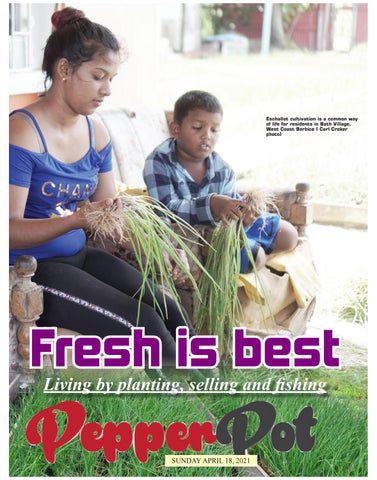
Eschallot cultivation is a common way of life for residents in Bath Village, West Coast Berbice ( Carl Croker photo)
Fresh is best Living by planting, selling and fishing
SUNDAY APRIL 18, 2021
II
CHRONICLE PEPPERPOT ― Sunday, April 18, 2021
A ‘Diaspora diamond’
Canada-based Guyanese has made Guyana proud By Frederick Halley IT has been a most exciting roller coaster ride for Canada-based, Guy-
his publication of Kissoon30: a commemorative magazine in celebration of Guyana-born Dhaman Kissoon’s March 2021 30th
Tony McWatt
ana-born Anthony “Tony” McWatt, a staunch advocate of sports, particularly cricket and tourism, while being a business marketing manager and publisher among other portfolios he has held over the years. McWatt’s most recent endeavour as TMac Enterprises Publisher has been
Anniversary as an Ontario Barrister. As many may be aware, he is the son of the former Guyana and West Indies wicket-keeper/batsman Clifford McWatt, of whose record, especially that of having given Gary Sobers his very first Test wicket, he is extremely proud.
Before migrating to Canada from Guyana, McWatt’s endearing love for tourism started when he served as President of the St Rose’s High School Tour Club between 1976-78. During that period, he was credited with organising student group tours to New Amsterdam, Mainstay Lake and the Essequibo islands. He also coordinated a one-week overland tour to Paramaribo, Suriname, for 25 St Rose’s High students and staff. Despite migration, Tony never wavered in his sports and cricket tourism endeavours as between 1981-85, he was the Cultural Commissioner, Scarborough Campus, University of Toronto, where he was studying. Among the highlights while serving in that prestigious post, he was responsible for organising Caribbean Students Association annual sports tours to Ontario and Quebec City Universities: McMaster, Western, Guelph, Concordia and Carlton. He also coordinated a Canadian SEE PAGE XIII
A front cover of the monthly Wickets produced TMac Enterprises
III
CHRONICLE PEPPERPOT ― Sunday, April 18, 2021
Unconditional love for her child with Autism helped her make it through By Telesha Ramnarine ONE day when she felt like she could no longer stand up to the pressure, Samantha Alicia Thompson left home in search of a place that might be able to accommodate her son with autism. Equipped with very little knowledge more than two decades ago, she figured it might’ve been a step in the right direction to get little Kester the help he so badly needed. But on her way to look for a suitable home, Samantha’s conscience started to plague her and she started quizzing herself about whether or not she was doing the right thing. “Are you sure this is the best thing to do? How would
home and decided to keep trying with Kester, irrespective of how hard she knew it would be. Speaking with the Pepperpot Magazine, the 43-year-old mother of East La Penitence, Georgetown, got Kester when she was only 19 years old, and then his sister Kennyah one year later. She hadn’t a clue that Kester had any problems, but her mother did notice that at three months old, Kester was not able to hold up his head like other babies that age would do. As the months went by, Samantha further observed that Kester was unable to creep, walk and do other things expected of children at his level. “We didn’t know anything and thought he would do these things
Samantha Alicia Thompson resumed her studies at age 38 and last year completed her Bachelor’s Degree in Social Work.
a special school and that’s when he went to Ptolemy Reid rehabilitation Center where he spent about three years before moving on to
David Rose Special School until he turned 18 years old. According to the World Health Organisation (WHO), Autism Spectrum Disorder
(ASD) is a diverse group of conditions, characterised by some degree of difficulty with social interaction and communication. Other
Social Worker Samantha Alicia Thompson.
the people there treat him? Would they be able to deal with him and care for him?” she recalled asking herself. The tender, loving feelings that are generally present within mothers must have kicked in because Samantha made her way back
later. When it was time for school, the nursery teacher noticed he was unable to do stuff like the other children but she too was giving him a chance,” Samantha recalled. When he reached Grade One, the teacher there said that Kester needed to be in
Samantha said she is happy that she never gave up on her son Kester.
characteristics are atypical patterns of activities and behaviours, such as difficulty with transitioning from one activity to another, a focus on details and unusual reactions to sensations. Autism, according to WHO, often has an impact on education and employment opportunities and the demands on families providing care and support can be significant. Samantha knew this all too well. Life for her was very difficult during Kester’s school years; so overwhelming at times that she just wanted to quit. She shared that she even got very close to committing suicide but it somehow didn’t happen. As more knowledge became available on autism though, Samantha began learning how to better cope with Kester and her situation. She eventually became very grateful that she didn’t take her life and did not send Kester away. “It’s the best thing I did to keep him,” she heartily expressed. It was a time where she had to focus entirely on her son. Even well-meaning relatives were not able to provide what Kester needed; only his mother had what it took, and she knew that. Perhaps that’s why she placed her studies – in fact, her whole life – on hold to look after Kester. She was working a shift system at Banks DIH and recalled some of the daily hardships she endured. “Sometimes I had to be called off the job because teachers weren’t trained to deal with kids like Kester. So many times I had to leave and go for trivial things, such as him wetting himself or not finding his school bag. It was overwhelming and tiring.” But through it all, Samantha found that continuing to show her son lots of love helped a great deal. She would constantly hug and kiss him and try her best to calm him when he started to throw tantrums. Dealing with Kester has certainly turned her into a more patient person and toSEE PAGE XVIII
IV
CHRONICLE PEPPERPOT ― Sunday, April 18, 2021
Community is key New women-led co-op business trend gaining momentum locally
By Telesha Ramnarine CO-WORKING spaces for small and budding businesses have been working wonders for those women who value an environment that promotes connection, friendship, and a helping hand in times of need from like-minded businesswomen. This current business trend facilitates an alternative to acquiring traditional store space and allows for great flexibility for women to promote their businesses remotely, while at the same time, growing their popularity and customer base. While this development has been booming in many developed countries, at least two young, driven women are leading the charge locally, providing a space for dozens of other businesses registered with them. The country’s first and largest collaborative space for women in business is owned by Amber Low, the founder of the Babe Cave, which provides small, female-led businesses with a safe place to grow, while giving their customers a great space to shop and pick up
munity. Being able to build together as a community of women who are facing the same challenges and finding ways to grow through them
together is the biggest goal for us,” she expressed in an interview with Pepperpot Magazine. The businesses range
from fashion for adults and kids to skincare, home decor, wine, locally designed clothing and selfcare products. “We provide
Owner of the Babe Cave, Amber Low
their orders. For Amber, who has some 30 businesses registered with
her, the idea came about when she started the Naked Closet (an online fashion marketplace) and experienced the struggles of a small business. “Finding a safe location was tough, trying to afford a space on your own is tough when you’re just starting, but more than that, I always have believed in the effort of comSEE PAGE XXIV
Some of the business owners registered with the Babe Cave
Products being advertised in the Co-op Shoppe
Proprietor of the Co-op Shoppe, Keleisha Pearce
CHRONICLE PEPPERPOT ― Sunday, April 18, 2021
SFCD invests in multiple developmental projects - Aimed at helping children, the elderly and professionals
By Marissa Foster THE St. Francis Community Developers (SFCD) is a local Non-Governmental Organisation that is known across Guyana for its contributions to social and community development. For the past four months, SFCD collaborated with the United Nations Population Fund and the European Union on the Spotlight Initiative Project. The success
of this project allowed SFCD to launch Guyana’s first-ever Early Childhood Development Center as well as, a resource centre for Elderly and Sick Care at SFCD’s headquarter in Portuguese Quarters, Corentyne. These centres were declared opened by the Honourable Minister of Human Services and Social Security, Dr. Vindhya Persaud. Alex Foster, President of the St. Francis Community
Developers is no stranger to projects of this nature. Foster expressed that, “With the establishment of this resource centre and the 26 corners in the centre, we can be able to train our early-childhood practitioners. We will be able to develop a new generational harvest of persons who possess love, care and passion for the children of this nation. The childhood centre seeks to use teaching methods and materials from North
Minister Vindhya Persaud cutting the ribbon, declaring the SFCD resource centres open.
SFCD’s Early Childhood Developmental Centre.
The St. Francis Community Developer’s “Dress for Success” closet.
SEE PAGE XXXV
SFCD’s Elderly and Patient Care Centre.
V
VI
CHRONICLE PEPPERPOT ― Sunday, April 18, 2021
Bath Village. (Carl Croker photos)
Bath Village A bustling community
By Michel Outridge This week the Pepperpot Magazine visited Bath Village, also called Number 12 Village, which is between Hopetown and Woodley Park (Number 11) villages. BATH is located on the
West Coast of Berbice and it is the home of garden-fresh produce such as celery, tomatoes, eschallot and many other vegetables. The major employer is the Guyana Sugar Corporation’s Blairmont Sugar Estate and the central point for business is at Rosignol,
but in the village itself, there are many businesses of various sizes. Bath is a very large village which comprises several sections and it extends from the foreshore, deep into the backlands area. It is a predominantly Indo-Guyanese village,
Villagers making use of a sale in Bath Village on Monday.
Focus on the Village
The Bath Community Centre Ground
but over time, more people moved in, including Afro-Guyanese. Bath Village comprises the old scheme Waterloo/Bath, Experiment/Bath, Hope/Bath and Bath Settlement, the old scheme. The village has a population of about 6,000 and is self-sufficient with many supermarkets, shops, mechanic and welding businesses, beauty salons, hardware stores, sawmills, restaurants, boutiques, and other businesses. Bath has a majority of sugar workers, skilled professionals, construction
workers, teachers, nurses, farmers both cash crops and rice, doctors, and self-employed, small-business owners. There are many internal streets in this community and they have basic necessities such as electricity, potable water supply, landline and cellphone services, internet and infrastructure. Bath is an agriculture-based village and in every yard, there is a vibrant garden going with either celery, peppers, tomatoes, eschallot, lettuce, boulanger, calaloo, bora, and ochro, among other vegetables.
In this community most services are within reach, since they have a nursery school a primary school, large businesses with the Fort Wellington Hospital also on that corridor and several banks at Rosignol. The nearest secondary school is at Woodley Park, which also has a primary school and the Experiment Health Centre which was converted into the COVID-19 facility. Bath Public Road is lined with many large supermarkets, stores and other busiSEE PAGE XII
CHRONICLE PEPPERPOT ― Sunday, April 18, 2021
Fresh is best
VII
Living by planting, selling and fishing
By Michel Outridge SITTING and cleaning heaps of freshly pulled shallot from their back yard is something the people of Bath Village, West Coast Berbice are accustomed to in their bid to earn. This was exactly the scene at the home of Dineshwar Andrew called ‘Terry’ who, had pulled several banks of shallots and was cleaning it along with three
others to make the work lighter. The father of one explained that they would plant only shallots and when it is time to harvest he would pull as many as possible and they would have to clean it first before it is weighed and parcelled for wholesale buyers, who often offer them just $80 per pound. The 27-year-old added that he is a full-time cane harvester but on the days he is not working he would
Dineshwar Andrew and his wife
assist in the garden. He explained that like almost every household in the village they too are cultivating shallots and one bank would give them about 100 pounds of shallots which will be weighed and parcelled off to be sold.
Andrew stated that it is a family small business and they would help because the ‘shallot business’ is a lot of work. “You wouldn’t make a lot of profit because you have to invest time and money to tend to the shallots by watering it, fertilise it and pluck it as well as maintain-
ing the banks and so on,” he said. Andrew added that some people would sell the shallot at the village market but often wholesale buyers would make the bulk purchase and sell it elsewhere outside the village to make a hefty profit. The Village fisherman,
first resident of that section of Bath Village Meanwhile, Andrew’s relative, Alfred Muttoo has been a fisherman for more than 50 years. He has two fishing boats and the men in the family are also fishermen, who would make regular fishing trips in the Atlantic Ocean.
SEE PAGE XXV Donkey carts owned by Alfred Muttoo
Cleaning shallots after harvest (Carl Croker photos)
Focus on the Village
VIII
Pressing onwards
CHRONICLE PEPPERPOT ― Sunday, April 18, 2021
Bath Village residents are resilient people By Michel Outridge H A Z R A D Subhan is a mother of two and is a better known as “Lilly” in the village and she would usually take a half-day job of cleaning shallot just to get money to buy groceries. She explained that she fell on hard times when the
disability benefit was taken away some years ago. The 61-year-old stated that her husband, who was a sugar worker died in a road accident when she was just 32 years old and it was after some time had passed she started a relationship with Manohar Rattan.
They have been together for the past 20 years and he had to quit his job after he became a heart patient. His wife passed away and he has four children too but relocated to Bath Village when he met Subhan. She use to work in the village as a domestic help
Pooran Manroop, the village milkman selling
The fresh cow’s milk
Hazrad Subhan’s fireside
Hazrad Subhan and her husband, Manohar Rattan
Focus on the Village
but after she got a stroke five years ago she is unable to do as such, took up the cleaning shallot job to bring in money in the home. When the Pepperpot Magazine met the elderly couple they were relaxing under their house, Subhan was seated on a chair while Rattan was lying in the hammock.
They had just finished having breakfast of roti and boulanger choka. Since they were fasting, in observance of Navratri, no meat, Subhan reported that she would be preparing dhal, rice and coconut choka for lunch. She stated that she would have to journey to the Corentyne to see a spe-
cialist doctor and that would incur a cost, plus she would have to buy medications and her husband would have to visit Fort Wellington Hospital often due to his heart condition. “We does try because the children all have families to maintain and that’s why I does work to ensure we have food in the house but my neighbour does assist and my daughter would give whatever she has which is sufficient,” she said. Subhan pointed out that if they did not have to buy medications for herself and husband they would have enough money for food and bills. “Cleaning shallot isn’t easy because it would burn your eyes and it is a time-consuming task that takes hours just for $500 or $1,000 for half-day,” she said. Despite these challenges, this elderly couple seems to be happy and make do with what they have and are thankful for life and hoping they would continue to be blessed with good health. The cattle farmer/milkman Another villager, Pooran Manroop, a cattle and cash crop farmer told the Pepperpot Magazine that he is also the village milkman, who goes around the community selling fresh cow’s milk at $100 per pint. Manroop would get about two gallons of milk daily which he would place in a bucket and sell in the SEE PAGE XV
IX
CHRONICLE PEPPERPOT ― Sunday, April 18, 2021
Providing reliable health care to the community The Woodley Park Health Centre
By Michel Outridge THE Woodley Park Health Centre, West Coast Berbice is a people-friendly facility whose staff know how to relate to patients and provide quality healthcare to those that need it the most. The facility has two visiting doctors but when they are
would want to be treated as well as my family and relatives and that is the way a nurse is supposed to be,’ she said. The Woodley Park Health Centre three Community Health Workers, one office assistant, one registered nurse, one pharmacy assistant, one health centre atten-
Midwife, Banbhanmattie Jairaj
not present, midwife, Banbhanmattie Jairaj is in charge of the Family Planning and Maternal and Child Health Section of the facility. She has been there from 2016 to present but joined the midwifery programme in 2010 and graduated in 2012. Jairaj was appointed a midwife in 2012 and served at Dundee Health Centre, Mahaicony, East Coast Demerara for four years before she was transferred to Woodley Park. “I was motivated during my hospitalisation at New Amsterdam Hospital after I was a patient there following a motor vehicle accident in 2007 because the quality of care given to me was commendable and I knew I wanted to become a nurse to serve people,” she said. Jairaj is very passionate about nursing and served at health centres at # 7, 8, 12 and at Bath/Woodley Park. “I treat people how I
dant, a midwife and a visiting pharmacist on Wednesdays only. There are no in-house doctors but two doctors would visit on Tuesdays and Wednesdays and serious cases are referred to Fort Wellington Hospital. The health care facility provides free services of family planning, child and maternal health, antenatal, postnatal, adolescent health clinic, chronic diseases, dressings, and in and outpatient care. Midwife Jairaj told the Pepperpot Magazine that currently, they are seeing an overflow of patients because the Experiment Health Centre, a large facility was converted into the COVID-19 hospital as such, a lot of people that used to visit there are going to Woodley Park Health Centre for treatment. T h e Wo o d l e y P a r k Health Centre is a small place that has a vaccination/
exam room, a small space for child health, a dressing room/lunchroom and the children friendly corner was converted into the doctor’s room/pharmacy and for the COVID-19 Vaccination team. The health centre is opened only on weekdays from 08:00 to 16:30hrs on Mondays to Thursdays and closes at 15:30hrs on Fridays. Midwife, Jairaj reported that 2,847 patients pass through the facility monthly but on any given day especially on chronic disease clinic days they would see about 50 patients. The Woodley Park Health Centre started the COVID-19 vaccination on March 31 and the response has been overwhelming, so far. As for the Team Leader of the COVID-19 Vaccination Team, Denise Daniels, a mild-mannered retired midwife, one of six, who were trained to administer the COVID-19 vaccine is at Woodley Park Health Centre. “Since we started the response has been overwhelming some days because of the influx of people coming to be vaccinated and that is good so per day we see about 25 to 30 persons alone for vaccination,” she said. Daniels stated that last week when they started they had more than 100 persons, who were vaccinated and as the news is spreading more people are showing up for their vaccine. When the Pepperpot Magazine was at this facility there was a lot of people waiting their turn to be vaccinated and those that received theirs reported that they had no immediate side effects and was happy to be vaccinated.
Focus
Retired Midwife, Denise Daniels, who administers the COVID-19 vaccine at the Woodley Park Health Centre (Carl Croker
The vials of the Sputnik vaccines
on the Village
The Woodley Park Health Centre
X
CHRONICLE PEPPERPOT ― Sunday, April 18, 2021
The importance of giving back Community business cares about village, residents
By Michel Outridge SUMAN Budhram and her husband jointly own and operate two Super Value General Stores and have quietly been doing their bit behind the scenes to assist the community through their hot meals feeding programme and counselling services.
A branch of the store is at Bath Village, West Coast Berbice and the other branch is at Dundee, Mahaicony, East Coast Demerara, which is also the residence of the owners. Suman Budhram, who is a writer, poet, volunteer, yoga enthusiast and an in-training psychologist is very passionate about spending time
with youths and people, who needs someone to talk to. She does a lot of behind the scenes charity work in the community and would spend her time taking care of people through counselling sessions. Budhram told the Pepperpot Magazine that in 2016 they opened the Dundee branch and it is also where they reside and have good
Some of the staffers of the Bath branch
relations with both customers and the community. She stated that the branch at Bath Village was just a small shop that was converted into a general store/ supermarket and they added the Money Gram section last year. The businesswoman reported that she is a vegetarian, who practices yoga and
meditation and would spend many waking hours writing, she completed two poetry books and is on two others where she is expressing her thoughts of psychology at a glance. Budhram explained that before COVID-19 they used to give back a lot to the community but haven’t been able to as they should these
days because their sales have dropped significantly. She hosted many senior citizen feeding programmes and over the years as their sales plummeted they had to scale down on some charitable projects. But they do give back in whatever way they can and has never turned away anySEE PAGE XI
Businesswoman, Suman Budhram (Carl Croker photos)
Focus on the Village
XI
CHRONICLE PEPPERPOT ― Sunday, April 18, 2021
The importance of giving ... FROM PAGE X
Suman Budhram and some of her employees at the Dundee branch
The Bath Village branch of Super Value Supermarket and General Store
The Dundee branch of Super Value Supermarket.
to talk to. Without these avenues, some people turn to alcohol, drugs, self-cutting and other things to comfort themselves when things get overwhelming. She is of the view that a Business Manager, Sanjay Singh
one, who showed up for help. She explained that there are a lot of social issues in the community among young people and others, at times she would give of her time to counsel troubled minds and offer moral support. “With the advent of technology, the cell phones have replaced books and others recreational activities in children and youths and it has dominated their minds so much so they have no time for games and others things to relieve the mind of pent up frustrations and whatever else is happening in the home,” she said.
Budhram disclosed that she came from humble beginnings and used to walk miles upon miles to school with just a book and pencil but she didn’t did allow her financial situation to direct her life, she studied and utilise their school-age to become educated because she wanted to help others and had to get means to do so. She said that people, no matter what they are going through in their life, need to be constantly motivated to pick up the pieces and mend them to repair their lives because they are experiencing many forms of abuse includ-
ing physical, financial, verbal and emotional. That’s why she has been counselling people to become motivated through self-care by having them realise their worth and do things to earn and maintain good mental health. “A lot of young people have ideas and they use their creativity to get things done but they need the extra push to stay motivated and also need someone to talk,” she said. Budhram related that we have a lot of people with mental health issues and anxiety problems, who doesn’t have a place to go or anyone
Bath Village
lot of youths feel they have nothing to look forward to, as such, indulge in rogue behaviour and activities but instead they should be empowered to do things such as learning a skill or benefit from parental guidance due
to low self-esteem. “The sore issue with some people is that they need to be heard and it is driving them to the edge and they act out and it often leads to suicide among other things,” she said.
XII
Bath Village FROM PAGE VI
nesses, which are convenient for locals and passers-by. The Bath/Woodley Park NDC Meanwhile, the Bath/ Woodley Park Neighbourhood Democratic Council (NDC) Chairman, Dalchan Sanmohan, told the Pepperpot Magazine that the NDC is from Number 11, which is Woodley Park, to the end of Bath/Experiment villages. He reported that the NDC covers six villages, which is a tall task because the villages are very large. Sanmohan added that some streets were recently asphalted, while others were repaved with crush-and-run composition and plans are in stream to have most streets in the community upgraded.
He noted that in some sections, such as Block D Bath, the streets are in a deplorable state and need to be upgraded. Although he took office in January this year, Sanmohan related that the NDC is doing what it can with the resources at hand and they have sandfilled the Bath Community Centre ground with 25 loads of sand. He stated that they will fix the pavilion and do maintenance of the actual ground itself, so recreational activities can resume. The Dalchan Bulkan Community Centre pavilion at Bath/Woodley Park was repaired and the ground will be de-weeded and reopened to the public soon, he said. The NDC Chairman pointed out that a management committee will
be installed to oversee the once-abandoned community centre. He disclosed that the Block B section of Bath is without landline service and that was reported to the region and they are awaiting the service. “We have 12 councillors at present, because two resigned and two passed away; so we are doing what we can with what we have presently and everything can’t be done at the same time, so we are asking the people to give us some time to enhance the community,” he said. Sanmohan added that as part of the developmental aspect of the community, a footpath bridge will be constructed linking the villages of Experiment and Hope, so schoolchildren and residents can access the schools in the
CHRONICLE PEPPERPOT ― Sunday, April 18, 2021
village and other sections of the community with ease. In addition, the community centre grounds will be fixed, drains, canals, trenches and parapets are being cleaned and cleared by 30 Community Infrastructure Improvement Project (CIIP) workers from the community that comes under the NDC. “At the NDC level we also award top performers in the villages; we cover with stationery, certificates and tablets when they do well in the CSEC exam,” he said. Sanmohan told the Pepperpot Magazine that some villagers who have business-
es are not in compliance with the NDC building code; as such, all efforts to bring them to conformity have failed, so they are taking them to court. He stated that other persons who are parking vehicles on the public road were asked to desist and notices were also served, but they have failed to comply. As such, the matter is engaging the court. The NDC Chairman related that they are a lot of businesses owned both by villagers and others, including three Chinese restaurants, two Indo, three hardware stores, many mini-marts,
small shops, mechanic and welding places among others. He noted that Bath has churches, mosques, and mandirs and a private clinic operated by a resident, who is a doctor and an ultrasound facility that charges just $3000 for an ultrasound by another doctor, Alicia Bulkan, also a resident of Bath. Sanmohan however, pointed out that of the 6,000 residents, most are employed with the Blairmont Sugar Estate as their sole source of income to the home, while and others are farmers.
XIII
CHRONICLE PEPPERPOT ― Sunday, April 18, 2021
A ‘Diaspora diamond’ Canada-based Guyanese has made ... FROMPAGE II Caribbean Students – University of the West Indies Sports exchange resulting in the visit of 35 Canada-based Caribbean students to UWI’s Cave Hill, Barbados Campus for soccer, netball and basketball matches. After Tony became the Executive Director of the Ontario Cricket Association in 1992, he developed and coordinated the Ontario cricket team tour to Guyana, conceived, developed and organised a group tour for 35 Canada-based South Africans to attend the 1993 West Indies – South Africa Test Match in Barbados and worked with Canadian Cricket Association President Jim Siew to secure Canada’s participation in the West Indies Cricket Board’s annual Red Stripe Cup Limited Overs Competition. He also accompanied the Canadian team to the 1994 Red Stripe Cup matches in Jamaica. As the International Business Development Manager, Western Union North America between 1996- 2001, Tony was responsible for writing Western Union-sponsored West Indies cricket articles for Caribbean Camera newspaper. Among his other duties was to organise annual Canadian group tours for West Indies Test Matches in Antigua, Barbados, Guyana, Jamaica and Trinidad & Tobago. He also provided Western Union-sponsored Caribbean Camera newspaper on-site coverage of Canada’s cricketing participation in the 1998 Malaysia-hosted Commonwealth Games and coordinated the participation of 25 Western Union Canadian agents and customers in the 1999 Trinidad & Tobago Carnival As Managing-Director of TMac Enterprises between 2010 and 2015, Tony developed and implemented a Canadian advertising campaign for Guyana’s Roraima Airways. He was also tasked with coordinating with the Barbados Tourism Authority to provide onsite coverage of the 2013 Barbados Gospelfest and Crop Over Festivals, conceived, developed and published a Caribbean Tourism-sponsored Toronto
Caribbean Week Caribbean Graphic Supplement and provided on-site Caribbean Graphic coverage of the 2014 Guyana Festival. Venturing into the publishing business in 2015, Tony headed Caribbean Graphic which was responsible for launching Facebook Social Media Group: Greenheart Canucks; developed and placed Greenheart Digest Supplements in Caribbean Graphic Issues; identified and placed tourism promotion-related articles for Caribbean Graphic Greenheart Digest Supplement inclusion; developed promotional links with Guyanese Online and Guyanese On The Internet Social Media websites, while continuously posting numerous Guyana Tourism related promotional articles on Facebook As the Caribbean Graphic/Media Relations Director, Tony quarterbacked the formation of the Guyanese-Canadian Tourism Council(GCTC); provided on-site coverage of the St Kitts Ocean Terrace Inn Fisherman’s Wharf Restaurant Official Reopening; organized the GCTC’s Fly Jamaica-sponsored Inaugural FAM Tour To Guyana; produced an eight-page Guyana Tourism Supplement for placement in Caribbean Graphic’s November 2017 Tourism Awareness Special Issue and published the 2018 InTouch Guyanese-Canadian Business Directory as a Guyana Tourism promotional vehicle During 2018, Tony relayed on-site media coverage of the St Lucia-hosted 2018 ICC Women’s T20 World Cup matches and also published Legacy Ensured Magazine to celebrate Bedessee Imports’40-year Cricket Gear Supplier Company history; he developed, edited and published Wickets as Cricket Canada’s monthly online magazine; provided onsite media coverage of the Cricket West Indies Barbados Regional Super50 Competition semi-finals and final. I n 2 0 1 9 , To n y p r o vided on-site coverage of the Barbados Kensington Oval-hosted West In-
dies-England first Test for Cricket Canada Wickets magazine readers. Summing up his connection to his late father, Tony confessed that “growing up as the only son of one of the most well-liked cricketers Guyana has ever produced, I always felt that my father had been disappointed not so much that my talents as a cricketer were not even a shadow by comparison to his, but far more that I didn’t make the very most of whatever little talent I did have.” According to Tony, “at Queen’s College playing representative cricket for the school, there was always the ridiculously unfair judgements of my cricketing achievements against the backdrop of being the son of a famous national and West Indies cricketer. The fact that I finished second as the school’s highest wicket-taker in both the 1974-75 and 1975-76 Wight Cup seasons and was the only bowler to capture a five-wicket haul in the latter season, the respect I felt I deserved was never forthcoming.” Tony pointed out that “the greatest influence my father’s cricket career had on me was that it allowed me to fully appreciate how much West Indies cricket meant to him and those he played with. The enduring personal friend-
Tony McWatt with his three sons (L-R; Cameron Anderson. Clifford Isaac and Matthew Everton) all born from his since ended marriage to Tracey McWatt (nee Smith) the youngest daughter of the former Barbados and West Indies Opening batsman Cammie Smith and named after famous West Indian cricketers.
ships he’d formed with the likes of each of the three Ws: Sir Frank, Sir Clyde and particularly Sir Everton, as well as those he had with Jk Holt, Sir Garfield Sobers and Lance Gibbs and the expressed admiration each of those individuals had for him left an indelible impression on me.” Touching on his father’s sudden demise, Tony said “when he died as unexpectedly and tragically as he did, the effect was to make me
want to honour his memory by endeavouring to use my writing skills and my publishing activities in service to either West Indies and/or Canadian cricket, specifically on the sport as a whole and to always try to do so to the very best of my God-given abilities in the hope that by so doing I would make him as proud of me as I was of him! Ironically it has been as the Publisher of Wickets, a Canadian rather than
Caribbean cricket magazine and which is now in its third full year of publication that Tony McWatt now finally believes that he has indeed engaged in activities of which his father would have been justifiably proud! He also now still harbours ambitions for publishing activities to eventually serve as a catalyst for boosting cricket and sports tourism ventures from Canada to the Caribbean.
XIV
CHRONICLE PEPPERPOT ― Sunday, February 28, 2021
CHRONICLE PEPPERPOT ― Sunday, April 18, 2021
XIII
ON THEOTHER AWARENESS OF THE AESTHETIC AND THE SIDE OF SCIENCE THE ‘BEING’ OF OUR YOUNG NATION Part II - ‘VICTIMS’ APPLAUDING THE WEALTH OF THE ‘WISH MASTER’
WE have failed to intercept the marketing for illegal drugs of all types, with a marketing strategy and package against the usage and addiction of these products. There must always be the warning and the belt, as most tough juvenile parent testing offspring can tell, that the belt followed the stern warning. We recognised the dangers of marijuana when it hit Guyana. It caused an increase in suffering in grassroot areas that were invisible from the mid 70s down, to the authorities, until a particular series of events were orchestrated by an external involvement that resulted in a dossier of evidence being placed before then-President Hoyte, that demanded his intervention. He acted and following that embarrassing confrontation,
IN concluding this discussion, which is intended to raise questions within the reader and inspire responsible actions among those that acquire decision making positions or are already there, we cannot arrive at a sensible without considerations in retrospect. So in a brief flashback, we must recognise, what we have lost to our physical memory reference archive, and use this as inspiration, to be able to raise a natural alarm, a connection to the aesthetic sensitivity alerting us to the fact that we need to have a historical memory in respect to our surroundings, as buildings, landscapes and architecture are inherent of memories in both the conscious and subconscious awareness. We have to become other than people who occupy a geographic space on this planet, and relate to what is the necessary thinking that will enable us to address from the now onward what is significant to telling our stories, especially stories important to our timelines. When we became independent, the euphoria of self-governed nationhood intoxicated us, it had its grounds for intoxication alongside sober examination. We did not make the observation that all around us within the borders of countries we still held controlled admiration for, had retained the edifices of past times. Our own coloniser England never dismantled Hadrian’s Wall. In more ways than one, from previous colonisers and also from despised local leaders, they kept the memory for reflection, in our Caribbean, Christophe’s spectacular fortress of defence in Haiti will remain, regardless of his history. Europe with the obvious white supremacy that emerged with colonisation did not destroy the sculptures of Afro-European Knights, artworks and literature that spoke of, or alluded to the African presence in a much older Europe, of course, they didn’t in-depth celebrate them either, and also hid their identities with new portraits and in movies. Where we erred in Guyana was not to use the structures that became available with the decline of trademark services like the Trains, to build museums dedicated to that part of our historical memory. Why preserve the physical imagery of the past? Simple, our ancestors lived it, for the historian, the creative mind, the investigative journalist, the physical location is important. The development of museums was a continuous peeve of the late Dr. Dennis Williams, who had identified Five Museums to be built, he insisted that a marine museum would have been a must. I can now imagine a display of the ship’s kitchen on Lady Northcourt with its cook, the portrait of indifference ‘John’, ‘keep away from John’s kitchen, and why?’ A caption should read before this rude faced ship’s cook made of papier máché –“whose kitchen lay beneath a toilet, from which water dripped continuously, or so we were made See Page XIX
marijuana came to the front burner and the not-well-thoughtout mandatory three-year sentence for marijuana became law. This was a response to a process of not understanding, paying enough attention, coupled with the procrastination of indifference. But there followed no campaign of pertinent information to deflate the immortal cure for all, physical, spiritual, and mental superiority that this high was supposed to achieve, to date. In fact, I witnessed too many brethren die young. Perhaps or perhaps not, an edutainment campaign debunking the ganja mythology might have saved some lives, even a few; can’t be an alarmist crusader when it comes to human faith in anything that sounds mystical enough. Why?
Because I lived through that era then and lived addiction later as the custodian of a seed of mine, and I’m mystified with how quickly the veins of a negative mass trend can possess persons one would have thought, should have been wiser. Are we anymore enlightened in 2021, to recognise the need to not be indifferent on the pretext that people will through observation make the right choice? By 1985 Guyana was described as a major cocaine transit exit route in an edition of National Geographic. A school mate back then told me that the “money gon spread and people gon come out ah poverty.” He died in a GT drug war in NY that spilled over to Guyana, and we aren’t rich either, but we’re damaged. However, it’s not cocaine we’re looking at in this article; marijuana, or what has enveloped marijuana instead, and the impetus rests with a curious development that had inflicted a friend, a fellow artist, a sculptor who over two years ago began acting erratically and strange and seemed always in a hurry, not sure going where in particular, in engaging him if I didn’t know this brother before, I would have concluded that his condition, reflected another mental deterioration case in the constrained terrain of ‘living Guyanese’ we had some conversations and I knew something was wrong, he told me he had some offspring working on Robb Street, but I haven’t seen him for a while, over a year plus, so I’ve been making enquiries about his whereabouts. Because I’ve spent some time reading areas of science for a fictional work I’m doing, when the reality hit home and I turned to some acquaintances to enquire on local comparisons of what I’ve read, only to recognise that we have possibly lost our complete innocence as a nation, the Zombie products I read about are here. The prophetic classic written by Mary Shelly we know as ‘Frankenstein’ should have carried its other title, ‘The Modern Prometheus’ in the context of the temerity of the times we live in. In contextualising that statement, I refer to events in 1988 when several reputable University laboratories began the process to create synthetic marijuana, Clemson, the Hebrew University, and Pfizer all proceeded to imitate nature and produce a synthetic cannabinoid to mimic the THC found in marijuana that is responsible for its high and also its psychotic capacity. The medical identification of these products is so far- HU-210, JWH-018 and CP 47,497. The ‘good intentions for doing this was to target the internal (a natural bodily system) - endocannabinoid system in our bodies [a coined term by researchers studying the effects of the Cannabinoid marijuana compounds like-THC] and regulate the negative effects of natural THC, as with the most popular Drug product-RIMONABANT, the intention was to “reduce Appetite, treat Addiction, harmful Cholesterol and Diabetes and ‘guess what? ’ Healthier sperm. But within months the side effects contradicted the projections. Restrictions were imposed on these medications, but the concept of the research is so tantalising that it continues. Where the danger comes in, is in the underground and legal [now & again] market that uses the synthetic formula targeting an unsuspecting public. These are narcotic imitation marijuana like Spice, K-2, Yucatan Fire, Blaze, Skunk, and lots of other names. In closing I quote from the internet article by Alice G. Walton – by Jeff Lapoint, MD, an emergency room doctor and toxicologist “I drink a cup of water, and I’m fine. I drink gallons of it and I could have a seizure and die. Synthetic cannabinoids are tailor-made to hit cannabinoid receptors and hit hard. This is not marijuana. Its actions in the brain may be similar, but the physical effect is different.” Anticipated at 100 percent more severe than natural THC. Several of these synthetics have been here for a while; shouldn’t this other side of science get different legal treatment? See also- Discover Mag. Nov. 2011
CHRONICLE PEPPERPOT ― Sunday, April 18, 2021
Pressing onwards...
FROM PAGE VIII
Ramrattan Persaud (Carl Croker photos)
community. He goes around the village on his bicycle after milking and tending to his 30-head cattle which he rears on the old railway line within the village since his yard doesn’t have space to accommodate that many cows. In his spare time, he would tend to his cultivation of cash crops which he would use in the home and the excess would be sold. Like almost every resident of Bath, he doesn’t have to buy greens because everyone plants and it is only other food items are purchased. Manroop disclosed that he was forced to sell off some of his cows because of limited space and is advocating for some land to house his cows. The 58-year-old added that he is also trying to resolve the name change on a land title but has had no success despite seeking an audience with the authorities for many years now. The father of three is very upset and would like the matter to be resolved quickly since the landowner is elderly and resides overseas.
Concern for the youth Ramrattan Persaud is a resident of Bath Village, West Coast Berbice and is one of the many elders in the community, who used to work with the Blairmont Sugar Estate. The 60-year-old told the Pepperpot Magazine that presently he is not working because of an accident he had and became disabled due to the severity of the injury to his leg. Persaud is receiving a disability benefit from the sugar estate and he is also trying his hand at farming, to bring in an income to the home. He had to quit his job five years ago and underwent three surgeries on his leg and is slated to undergo another to replace the foreign object in it which has stopped the healing process causing the leg to become infected. The father of three stated that due to his health condition with his leg he is unable to do much around the house or work as he would like and has to see doctors constantly. He is originally from Cotton Tree but relocated to Bath Village 35 years ago.
“Life here is how you make it, you can’t sit down and complain instead you have to get up and get going, to do something,” Persaud said. He reported that due to the wanton abuse of drugs and alcohol in the community by some youths, it is alleged that in the night they would break into houses and go into yards and take away valuables much to the annoyance of residents. So the people of his street pooled their money and bought street lights and paid to have them mounted on utility poles but are upset that they have to pay for the use of electricity for those security lights. Persaud added that most youths and the young people in the village are doing something for work while he believes a handful are up to no good and it would be a good idea to get them engaged in some life skills activities. He stated that when schools closed a year ago, some youths have been liming at street corners and doing some unsavoury things in the village and it needs to be looked at before it gets out of control.
Focus on the Village
XV
XVI
CHRONICLE PEPPERPOT ― Sunday, April 18, 2021
COMING HOME TO PARADISE ISLAND
MADHU stood on the Parika Wharf, looking across the mighty Essequibo River, the third largest in South America. A glint of excitement shone in her eyes, the sound of the rolling waves, like music that brought a smile to her lips. Home was on one of the 365 islands that made up Essequibo. A place she would exchange for anywhere else in the world though she had migrated to America 22 years ago, and it lived in her heart every day, for only one place could be home. The island of Wakenaam! The speed boat operator called to say they were ready to leave and she stepped cautiously down the ramp. She was not that young girl anymore who made regular trips across the river on speed boats, braving sometimes the rain and rough waters. She was now a mature woman in her early forties, and mother of two young adult children. “Time has really moved on,” she mused, “Can’t believe my last trip was so long ago.” Her heart had ached so deeply that tears had flowed non-stop down her face, but because it had been raining slightly, no one knew how much she cried that night, as the boat left her island home. Now, she sat back and inhaled deeply, as the boat sped across the river, riding the waves deftly, the impact as it lifted and hit the water, sending a thrill through her body. “Gosh, I really miss this!” she said to her cousin who had travelled with her. “So do I!” she responded. Madhu had never returned since she left because of her husband’s regular travels to other countries due to his job; then the children were born and her part-time job as a librarian did not give her much free time. But now, with her responsibilities eased, it was time to visit home. The boat reached and stepping out onto the wharf, she literally ran up to the top and stretched out her arms with a cry of joy.
“I am home again, my sweet paradise!” A sign a little way ahead read boldly, ‘Welcome to Wakenaam’. She stood by the sign, a proud moment for her and called to her cousin, “This is where we start and I want pictures of everything!” “Sure, this will be fun.” On the drive along the way she recaptured in her mind the farming life of the rice, coconut and plantain farms. The modern houses were beautiful, a change to the landscape, but it was the old houses that interested her, for those would tell stories of her life growing up. The rich vegetation and natural beauty of the island had always enthralled her. In her mind, as a little girl, it was like a place in the fairytale stories. She had never thought about life anywhere else beyond that until a handsome young foreigner saw her at a wedding. He had asked for her hand in marriage, but young as she was, she hadn’t been sure, not wanting to leave her little paradise. But over her canvas, he had drawn a beautiful life in bright colours in different parts of the world to interest her to accept his proposal. A beautiful, happy life it had indeed been, but her heart was never won by all the incredibly beautiful, spectacular and splendid
places she saw. Here in the Cinderella County on a small island in the farmlands, was her love. At the family home, a warm reception awaited her with hugs and kisses from extended family members, even the young ones she didn’t know. The scrumptious food, authentic country style, laughter and engaging conversations were for her, so heartwarming, it brought tears to her eyes. That night she fell into a blissful sleep in her old room, with the cool wind blowing in from the farmlands. She awoke early the next morning and stood on the verandah, watching the glorious sunrise as its golden rays spread across the rice lands and streamed through the branches of the coconut palms. A serene scene, blushes of nature’s finest moments. As the days went by, she visited some older families, old friends, her old school and church, as she reconnected with the people. One day she stopped under a big, old tree at the side of the road where she and her friends would stop to rest sometimes, on their way home from school. Once, on a rainy day, their clothes half wet, they had carved their names on the tree trunk with a caption, ‘Wakenaam Girls’. Madhu passed her hand slowly along the tree trunk and was surprised to see the carved names still there. “Gosh!” she exclaimed quietly, “This brings back such beautiful memories.” Her two friends, Kamla and Priya had left for the city, became successful businesswomen and got married. “I wonder if they remember this tree?” Madhu questioned, smiling, “I’ve got to get together with my old friends.” Time, she knew could not be rewound, but she could recapture some things of the past in present time. She walked barefoot in the coconut farms, drank the cool, sweet coconut water and sat on a tractor behind the driver as it ploughed through the rice fields. Her relatives looked at her, bemused but concerned, “You should not be doing these things at your age.” Madhu laughed, “Age is just a number, there’s a spirited young girl living inside of me.” She was having a wonderful time and as she looked back at her young days, just the same when she gets older, she would look back at her time now. The tide and time of life. The days were going by so fast, Madhu was happy she had come for a three-month vacation. It was long overdue so every day, on the island, she enjoyed it to the fullest. In the second month of her vacation, she invited her old friends for a get-together, and that day the joy and laughter, no sophistication nor talk of wealth or travels, just plain simple country girls, reliving their beautiful memories, was something precious. On the last week of her vacation, she travelled all over the island, saying emotional ‘goodbyes’ to the people and the place, “Until I visit again.” She did not cry this time when the boat left the island, though she felt sad, for there was an overwhelming joy in her heart of recapturing her life on that island, her name carved on the old tree, her footprints not erased from the farmlands, the fairytale place she loved so much. She made a promise to herself to visit often now and she will tell her children that when her time is up, they must bring her back home to her paradise, “The island of Wakenaam.”
CHRONICLE PEPPERPOT ― Sunday, April 18, 2021
XVII
XVIII
CHRONICLE PEPPERPOT ― Sunday, April 18, 2021
24-year-old Kester Baird.
Unconditional love for her child ... FROM PAGE III day she can help other parents. “And I’m continuing to help my son. I’m glad I did not give up.” Attending UG It has been more than two years now since Samantha, a Ministry of Education Teacher, received her secondment to the Step by Step Foundation, a school that specifically caters for the needs of children with autism. Samantha did not write CXC at the time but never gave up on the idea of continuing her studies. In fact, she resumed her studies at the age of 38. “Education wasn’t what I was thinking of at the time,” she admits, but she eventually did a one year programme at the Institute of Distance and Continuing Education (IDCE) which gave her entry to the University of Guyana. Just last year, Samantha was able to finish her Bachelor’s Degree in Social Work. She also learnt the Applied Behavioral Analysis (ABA) method of dealing with children with autism, and that greatly helps in her work. At the moment, she works with three autistic children ages seven, eight, and ten, two of whom are non-verbal. Having been dealing with her own child for 24 years now, Samantha says patience is a key requirement for dealing with autistic children. “Also, try to get your child into a school that deals directly with autism and make sure you’re very involved with the teachers,” she said. Many parents, she said, will tell her that their family members do not understand what their child is going through, and this, in turn, results in them feeling more depressed. Reflecting on her life so far, she noted how things have gotten easier in some matters. “When Kester was younger, he couldn’t go to the washroom, walk and eat, but now he can do all those things. Now he wants a girlfriend and all sorts of things; so the challenges are different.”
CHRONICLE PEPPERPOT ― Sunday, April 18, 2021
RESTORE OUR EARTH the UN International Decade for Ecosystem Restoration and includes three days of climate action organised by global environmental organisations, including EARTHDAY.ORG, and a virtual summit on 22 and 23 April to highlight the urgency for stronger climate action. The event will be live-streamed because of the pandemic. The Environmental Protection Agency in Guyana has planned a week of activities to commemorate Earth Day with a focus on bees, including webinars, radio and television interviews, a “WE must look at the natural processes, green technologies and innovative thinking that can make a lasting and transformative impact to restore our Earth.” Every year, Earth Day is a timely reminder to each of us that the Earth and its vast ecosystems provide us with life and sustenance. This day also recognises a collective responsibility, as called for in the 1992 Rio Declaration, to promote harmony with nature and the Earth to achieve a just balance among the economic, social and environmental needs of present and future generations of humanity. Overcoming the many challenges to celebrate this day required collaboration and participation from key players at all levels. Fast forward fifty-one (51) years later, even though much has
changed, increased efforts and emphasis are still needed to overcome new and emerging environmental threats and challenges. History of “Earth Day” On April 22, 1970, in the United States, millions of people took to the streets to protest the negative impacts of 150 years of industrial development. This was a time when smog was becoming deadly and evidence was growing that pollution led to developmental delays in children. Biodiversity was in decline as a result of the heavy use of pesticides and other pollutants. Industry belched out smoke and sludge with little fear of legal consequences or bad press. Air pollution was commonly accepted as the smell of prosperity. “Environment” was a word that appeared more often in
spelling bees than on the evening news. Although mainstream America largely remained oblivious to environmental concerns, the stage had been set for change by the publication of Rachel Carson’s New York Times bestseller, Silent Spring, in 1962. The book represented a watershed moment, selling more than 500,000 copies in 24 countries, and beginning to raise public awareness and concern for living organisms, the environment and links between pollution and public health. The global ecological awareness was growing, and the U.S. Congress and President Nixon responded quickly. In July of the same year, they created the Environmental Protection Agency, and robust environmental laws such as the Clean Water Act and the Endangered Species Act, among many. Earth Day 1970 gave voice to that emerging consciousness, channelling the energy of the anti-war protest movement and putting environmental concerns on the front page. Earth Day 2021 The theme this year is, “Restore Our Earth,” which focuses not only on the need to reduce our impact on the planet as we recover from the effects of COVID-19, but also on how we can play a role in repairing the damage we have done. The theme is in keeping with
XIX
radio quiz, and competitions for children. You can share your ideas and questions by sending letters to: “Our Earth, Our Environment”, C/O ECEA Programme, Environmental Protection Agency, Ganges Street, Sophia, GEORGETOWN, or email us at: eit.epaguyana@gmail.com. Follow us on Facebook and Instagram and subscribe to our YouTube channel.
haring their journeys XX
CHRONICLE PEPPERPOT ― Sunday, April 18, 2021
amazing women from the Women ogies. Watch Radio NY requested an interhim if it was okay for me to invite e. I am sharing some excerpts from
illips -- born in St Lucia, living in
being a Midwife of Purpose came broken, displaced, and is journey, I experienced a divorce, ot displaced on administrator’s position. Coupled wo major eclipses An eclipse happens when you can becomes greater than your current this process, you can transcend to a g where you can connect with your as one with nature. born in Guyana and living in NY have the real experience of dreameam world alive. I was immediately w with the agency where they tested Microsoft Office and typing speed.
One week later I completed my assignment with CTO and was now ready to move on to my next career move. I called Monique to let her know I was available as we agreed and she was so happy to have me start my first temporary assignment with Deutsche Bank. My first
Our future leaders deserve a fighting chance assignment lasted two weeks, covering someone’s vacation. Due to my work ethic and desire to go the extra mile, I landed another assignment in the same department for six months, then another for three months, which finally led to my permanent position, allowing me to live a dream. Dr. Safeeya Mohamed – Trinidad We received the updates that the accident was horrific and that the victim was stuck in the car. The vehicle had to be cut open to get to the victim. It never occurred to me that my brother could be remotely involved. The next thing I remember, I was looking at the body of my brother covered in blood in a hearse. The strident, agonising scream of my mother in the A&E that early morning has not escaped my mind almost 17 years later as she howled “my son died, my son died, nobody’s helping us!” But nobody could, as his spirit departed at the point of impact. Up to this day, I ponder where the strength came from to navigate that night. Shanon Paar – Arizona
When I was six years old I started school in Mesa, Arizona, so I began staying with my mom and her husband routinely. It was like going from heaven to hell. It was a horror story that’s yet to be written. While at grandma’s I was filled with the love of a grandma and Jesus daily. On the other hand, at my mother’s house, I was filled with Rock ‘N Roll, drugs and inappropriate, wild sex parties. Ultimately, from such an environment you can imagine the kinds of abuse that mom’s house provided. When I was 11 years old, grandma Shirley died and my stepdad left. My mom had an emotional breakdown, so I ran away! I couldn’t take any more. Andrea Edwards – born in Guyana, living in Florida As I sat in the back of my dad’s Nissan Bluebird, I peered through the windows at the images on the fence of the Guyana Botanical Gardens and Zoological Park. The radio blasted the popular calypso song “1985” by a then-popular calypsonian. I would have just celebrated my sixth birthday, quite oblivious to the concept of time, but that song would not allow me to forget that it was 1985.
I knew that I would be in I HAD a fantastic few days at Iwokrama in 2020. Hiking trouble if I told to mythe dad upbig Turtle Mountain Canopy Walkway made it to had happened. It was mywhat amazing adventure list. a secret: the of age, race or culture, humans find nature Regardless kindand that could get don’t me realise the positive impact pleasing many people into big has trouble. didn’t that nature on ourIlives. know howheals! Nature much trouble,soothes! but Nature Nature restores! Nature I wasn’t willing to connects! I developed an appreciation for such an environa chance. “Shhhh...Vacationing during August in ment take growing up in Bartica. Don’t telloranyone.” Wineperu Bara Bara where my grandfather worked has it’s the traumafrom of my childhood. Navigating some Maybe of the best memories my experience, but for some the jungle, climbing trees and relaxing in the creeks for reason still cannot rememhours andI eating a variety of wild meats. Memories to last ber how a lifetime! oftenofitthe happened, when One highlights of my first trip was interacting it started, or even when it with the young people in Fairview Village. I made a promended ise to return later in the year, but because of the pandemic that was not possible in 2020. When I left in 2020 I knew I Penny Phakahi –South needed to contribute in some way to that community. Every Africa time I had flashes of the faces of those beautiful young girls I have had my share of theturmoil conviction and I became stronglystronger. believe I shared that with my friend Drthat Raquel Thomas-Caesar who was excited to hear that. it is these stints of turWe decided to invite the young ladies to join the Conmoil that brought me fidence Becomes You Virtual this far in my life. I wasProgramme. This was in collaboration with Iwokrama, who facilitated the young ladies and perhaps is still in my at refinery the fieldprocess. office for the zoom sessions. The feedback was extremely and II could As a positive young girl, grew not wait to meet them again to up interact in person. This was not another session on confiwith one main ambition, dence, but we wanting to had getAfternoon away, farTea and Storytelling. The from young away theladies systemwere of inspired by the stories from the 365 Invaluable Life and Women Across thinking or the box Experiences that Borders. we often find ourselves in. We had dinner prepared by master chef Collin Brown Apart from understanding and the young were veryto appreciative of the etiquette tips myself I always dared sharedbeduring our dinner. This different, which was a was a small group that did theconstant online struggle programme butsurwe needed to also meet with when others and by amplify on the areas of discussion, including rounded my situations. I thegrew menstrual cycle and teenage pregnancy facilitated by up under a strict Leandre Stellingburg, whomy is a Medex at Iwokrama. Dr Christian family with Raquel Thomas also didgranny, a presentation on behalf of the Citgrandfather and step izen rapelost group. as against my mother her The momyoung men also had sessions independently collectively SEE and PAGE XXV with the females. Some of the topics facilitated by Sergeant Michael Jobes were domestic abuse; age of consent; trafficking in persons, etc. The discussions were very informative and new to some of the participants. The participants were placed into small groups where they felt more comfortable addressing questions and more intimate discussions. I shared some personal stories about growing up in a small village and navigating my way through life when
SEE PAGE XXI
CHRONICLE PEPPERPOT ― Sunday, April 18, 2021
Our future leaders deserve a ... FROM PAGE XX the water got rough. I was a small-town girl but did not let that deter me from achieving extraordinary things and if I can do so, so can all of them. Resma Persaud, Jonathan Jaipaul, Ranger Richie Richardson, Qaudo Vancooten and Michael De Mendoca also interacted with this amazing group of young men and women. “These sessions were good and we learnt new things and we need more like these,” one young man remarked. One of the young ladies asked me if I can stay a month and another asked if I can stay a year. I got very emotional because I couldn’t, but I did reassure them of my commitment to their development and we have the technology to assist. The moment that pulled even more on my heartstrings was just before breakfast on the last day of my trip. I was washing my hands and I heard “When are you coming back?” I turned around and saw the friendly faces of two of the female staff who are parents. We started chatting and they shared how much the young ladies need me and they also, because they were so inspired by the things I am doing. In last week’s column, I mentioned why our ‘Dash’ is important and moments such as these are reminders. Theodore Roosevelt said, “People don’t care how much you know until they know how much you care.” I admire how Raquel cares for people and that is one of the reasons we connected. “Our youth are our future and we all have to invest our time in them. Leaders, parents, citizens - we must educate, protect and support them. I implore parents to support their teen moms and elders not to victim blame as many are so young and vulnerable. Open the conversation on relationships and confidence with boys too; let us help our youth make healthy choices for their future and with respect for each other. Let us provide them with the knowledge to become resilient adults,” said Dr Raquel Thomas-Caesar. We owe it to our future leaders to give them a fighting chance. Frederick Douglass said that “It is easier to build strong children than to repair broken men.” And it’s true. You cannot give a child back their childhood. It is far more effective, cost-effective, and fruitful to do everything in our power to give all children the kind of start and the kind of future they deserve. I made a commitment years ago and that is why I push so hard many times, even without knowing where the resources will come from, because I also know because of my faith that what seems impossible can be possible. Some of the things I do are featured in the public with the hope to inspire others that they can, but I chose not to highlight many. I pledge to do this until my expiry date and you can hold me to that as we continue to celebrate this beautiful journey called Life BEYOND THE RUNWAY.
XXI
XXII
CHRONICLE PEPPERPOT ― Sunday, April 18, 2021
CHRONICLE PEPPERPOT ― Sunday, April 18, 2021
The tooth nerve EACH tooth has a dental pulp commonly called “nerve” by patients. The anatomy of the pulp is well known to dentists. Individual teeth have divisions of the pulp called root canals. Each tooth has one to four root canals. When these small pieces of soft tissue die or become injured or infected, the resulting pain can be as debilitating as almost any other physical condition experienced by humans. Why does a piece of diseased or dead tissue cause pain? A tooth is usually sealed externally by the outside tooth coating (enamel). Only a small opening into the supporting bone is present on the tooth end, deep within the bone. When dental pulp is diseased or dead, pulp blood-flow and cellular activity increase, and there is no possibility for the release of pressure from inside the tooth, except into the supporting bone. The result is pain, and it is usually present when a tooth is dead or dying. Occasionally, the infection finds its way into the bone and perforates out into the soft gum tissue. The patient observes a pimple-like projection on the gums, commonly called a gum boil, and this “dead” tooth is usually not painful. What clinical conditions are commonly observed related to the dead or dying teeth? When chewing on the suspect tooth, significant pain is experienced. Pushing on the tooth or tapping on it with a hard object creates pain. The tooth may have periods of no pain. Antibiotic therapy usually reduces or eliminates the pain for a while. Pressure pain may be indicative of a dead or dying tooth, but it may also indicate a cracked tooth or a tooth that has had recent heavy chewing or “bruxing” on it. If your dentist finds a dead or dying tooth, you have the following alternatives: either root canal therapy, or extraction of the offending tooth. A red, pimple-like projection on the cheek side or tongue side of the tooth near to the tooth root end usually indicates that the tooth pulp ( nerve ) is dead and that the infection has broken through the bone to the outside. This condition creates a fistula or canal from the tooth root end through the gums. Often, the yellow pus can be expressed from the red projection without much pain, but the pus will return until the therapy is completed. Treatment for the draining fistula may include the following: A. Endodontic therapy alone. B. Root canal (endodontic) therapy and an apicoectomy (root-tip amputation and root-tip filling) if the defect in the bone is large. C. Hemisection ( amputation of one or more roots) may be needed if the disease is especially persistent and involves only one root of a multi-rooted tooth. D. Extraction of the tooth. Although over 95 percent of root canal treatments are successful, occasionally a few of these teeth cause subsequent pain or other problems. After discussion with your dentist, you will have several alternatives: A. Redoing the root canal therapy B. Apicectomy ( root amputation and root-tip filling)
C. Hemisection (amputation of one or more roots) D. Extraction of the tooth.
XXIII
XXIV
CHRONICLE PEPPERPOT ― Sunday, April 18, 2021
Community is... tailored packages to suit small-business needs; from display space for items to clothing racks and safe pick-up locations. We also have a “collab” room which our members can use to sit down, get work done, relax and interact with like-minded women and hopefully feel inspired,” explained Amber. She added: “I’d just like to say that if you have a small business and you’re looking to find a space to help it grow, we’re the perfect spot for you. Beyond that, our community comprises of [sic] driven, dedicated and innovative women who support each other in business, motherhood, sisterhood and friendship.” Keleisha Pearce, who owns the Co-op Shoppe, has 20 businesses registered with her, eight of which operate
online. Last November, she held a pop-up shop under her Girlboss organisation, which received tremendous interest from women in small businesses. Unfortunately, due to the COVID-19 guidelines, Keleisha could not accommodate all the businesses at the pop-up shop. “That was truly heartbreaking for me. It made me realise that so many businesses yearn for a chance to have their business displayed at any level. I immediately started my hunt for a physical location to permanently house small businesses,” she recalled. Keleisha genuinely has a passion for helping women in business and this is what fuelled her desire to start her organisation. “I realised that so many women lack basic resources and information that can propel their busi-
nesses.” Her plan is to partner with the relevant government agencies to provide as much assistance to women in business as possible. “It’s my firm belief that we need each other in order to grow and that there is room for everyone to win.” Businesses that sign up to share spaces get spared from having to pay large amounts for rent. What they pay for rent in co-op spaces is nowhere near to what they would have to pay if they found a space independently. Meanwhile, the Girlboss Inc. has a monthly membership that provides advertising, business resources, merchandise, and business broadcasts. They are also trying to add funding to the list of benefits.
FROM PAGE IV
This current business trend allows women to promote their businesses remotely and build their customer bases
CHRONICLE PEPPERPOT ― Sunday, April 18, 2021
Shallot The village, cultivation Number 74 Stockholm. (Carl Croker photos)
Fresh is...
FROM PAGE VII
Muttoo explained that he was a full-time cane cutter with Blairmont Sugar Estate and used to do fishing on a part-time basis and as he perfected the skill he gave up cane cutting and started fishing as his sole earner. The 68-year-old reported that he would make most fishing trips which would last between three to four days or a week depending on the catch and freezer space. This trip he didn’t go but his grandson and son went out to sea with a fishing boat and was expected back shortly. Muttoo added that they would go about three miles offshore and make their catch of gilbaka, snapper, trout, banga mary and whatever fishes are in season filling three freezers that is with ice. The father of three pointed out that being a fisherman is a skilled job like most jobs and he would often make a good catch when the tide is calm and fishes have seasons just like the weather. As a seasoned fisherman he is versed in reading the weather pattern and he knows what kind of fish would be in season and he would take advantage of that and use it to make a good catch. Muttoo has three carts and a donkey he would use to sell the fish in the village whenever he return from his fishing trips. He is a resident of Bath Village and is well-known and respected in the community. Muttoo told the Pepperpot Magazine that when he bought the plot of land there were no houses, the place was a swamp, over-run by vine-like vegetation and he cleared his land and build a house and started living there as the very first resident. “I bought this land in 1969 for just $900 and back then it was a lot of money and I was a cane cutter then and after construction which took some time I began living here in 1978 as the only resident in this side of the village,” he said. Muttoo stated that it has been 43 years he is a resident of Bath Village, a place that is often quiet and breezy but like every village they have some social issues with the young people, who are addicted to drugs and alcohol and are pilfering and breaking into houses.
XXV
XXVI
CHRONICLE PEPPERPOT ― Sunday, April 18, 2021
Intercropping of coconut estates
CHRONICLE PEPPERPOT ― Sunday, April 18, 2021
T
HE coconut is a permanent crop that has the potential of being a huge income earner for farmers and the country as a whole. It is known that palms, depending on the variety, may take between two and five years to reach maturity and start to produce coconuts. As such, the National Agricultural Research and Extension Institute (NAREI) encourages farmers to engage in intercropping practices to earn as their coconut palms grow to maturity. To this end, NAREI has been partnering with local farmers, the Caribbean Agricultural Research and Development Institute (CARDI) and International Trade Centre to accelerate the coconut industry. Crucial to this is having productive intercropping of coconut through climate-smart agriculture. As part of the agreement
between the above-mentioned agencies, NAREI is responsible for guiding lead farmers in establishing openfield intercropping systems in newly installed or producing coconut plantations. The fundamental aim of this project is to enhance the resilience and productivity of smallholder coconut farmers through the adoption of climate-smart agricultural practices in two of Guyana’s major eco-zones. This initiative demonstrates how farmers could secure multiple income options through the production of coconuts and associated crops. NAREI is undertaking these initiatives within target communities. The intention is to include a larger number of farmers in different communities. On the coastal region, two lead farmers who have been in the coconut business for many years are participating to better their farming systems and gain maximum returns based on their cost of production and maintenance of crops on their farms. One farmer hails from Friendship/Buxton, and the other from the village of Victoria, ECD. In Friendship, the farmer is currently cultivating various cash and orchard crops, along with a few tuber crops, spreading over an area of six acres. The farmer also cultivates coconut on this same plantation, where he planted several varieties; three-year, 18-month dwarf, and five-year. While at Victoria, the farmer also plants several cash, tuber, and fruit crops along with several coconut varieties of varying ages. The varieties planted at Victoria are: 18-month dwarf, Panama tall, Malaysian green, and Jamaican tall. Coconuts produced at both farms are usually being sold on the local market, for water or as dried coconut. A lot size of one acre was selected on each farm, cleared and planted with
crops chosen. At Friendship, the plot was further divided into two half-acre plots, where hot pepper; Tiger teeth variety, and Sweet potato; the Beauregard variety were planted. Both crops are at the harvesting stage, and data is being collected by NAREI personnel to measure the profitability of the said system. Also, at Friendship, half acre of Okra; Clemson variety, and half acre of Hot pepper were planted, where the Okra is at the production stage, and the pepper is flowering. NAREI’s Research and Extension staff usually interact and visit farmers on a weekly basis, providing them with guidance and materials needed to complete the various agro-practices for each crop.
XXVII
XXVIII
CHRONICLE PEPPERPOT ― CHRONICLE Sunday, February 28,April2021 PEPPERPOT ― Sunday, 18, 2021
Words Matter
o not always know what I’m looking losing your phone would be on a scale of 1-10. 98 percent y phone is such a normal part of my said 10 and 2 percent said 9. They all claimed that it would my hand that I cannot count the numbe the worst material possession that they could ever lose. hed for it, while it was actually in my They continued to say that feelings of anxiety, irritation and times it’s intentional, while in our minds for decades to anese treat each other with Hello Readers! o when I get up in the morning and overwhelming sadness would if theyscar were lose and their at other times it’s in the heat be comefelt and sometimes suchto disrespect say the of the moment. Either way, us for life. They create low most hateful things when upWITHIN every one of my e going to sleep is check my phone. Icolumns,phone lectures, today. speech- the impression and effects self-esteem and self-con- set. It’s actually not a normal fidence, high anxiety and thing around the world to caoutreaches, I like are the same. healthy and something must be done.esto and seems harmless, right? so much about a The repercussions of stressCaring levels, self-hatred, sually abuse someone when think thatIt there is an message of the simple words are unparal- aggressive behaviour, de- angry. Of course, abuse hapand found that women were moreunspoken phone? Well, this week I’ve been really paying attention importance of words; how leled. We don’t think of it pressive symptoms and even pens everywhere and there thoughts.aroundisme crueltygive far worse and often as it comes d to their phones simply because menthey cantoboth theuplift importance thatso Inatuandsuicidal others toglobally a Unfortunately, we tend to -- but in my personal experiderail us. However, (based rally to us, but our words ocial media apps. Also, older peopleon somephone, the most powerful thing.actually believe the negative ence -- hell hath no fury like behaviours rather I saw are than what’s goingbefore on around them. during the holidays), I was Words can be weapons that the positive. We internalise a Guyanese scorned. e addicted. I believe this is becausethinkingOur enormous weightwe and are these opinions and beginto to other Secondly, this piece is that today may carry phones -- whether speaking people, be a good day to openly impacts everyone around see ourselves through the not coming from a judgeuse smartphones (My father actuallyreiterateusing social us. media games -- can mental be addictive They canor give playing people eyes of others. place as I too am this message. guilty of saying cruel words It is not a topic that peo- the courage to overcome asto talk they ourormoods, and the feeling of beliefs I want to make trigger a few when enjoyable I’m upset. I’ve lost or ple love about alter be- obstacles hopelessness to give up. things clear. I love Guyana. almost lost so many treacause we are all guilty at y colleagues and friends how badone pointand unenjoyable feelings. Apart from obviously being I believe the widely I grew up here; this is my sured people in mymy life beor another; we say popular saying, “sticks and home and even though I can, cause of this. Many things unkind things that we know source of communication, mybe newspamay break my bones I would my not likephone to live any- iscould the reason for this would main harm others. Some- stones but words never hurt” is the where else. It is also home to -- my environment, my per, watch, alarm, map, recorder, day planner, calendar, most ridiculous statement the nicest people I have ever childhood, or the company ever invented. In time,calculator, phys- met. However, I have been I choose to have -- then and camera, music player, a weapon (sometimes) ical wounds heal and may fortunate enough to live in now. The same goes for even bewhen forgotten. The samebored two other continents for long many of you. However, and my friend I’m or lonelybasically ev-who cannot be said for cruel and periods and I can say with SEE PAGE XXXIX unkind words. it These that Guyerything. However, is replay also full myconfidence, constant interrupter and distractor. I (I imagine much like most of you out there) have a deep desire to know everything that is going on. I believe that is human nature. But when does it become too much? Well, I believe it’s too much when it has a name. ‘Nomophobia’ is the term coined to describe the fear of being without a mobile phone. Seriously, what have we come to? It becomes an addiction when the object begins to control your life and interferes with your daily activities, work, and relationships. I read somewhere that “The biggest obstacle to productivity is connectivity,” but overuse can affect a lot more than our productivity. The truth is, overuse of our phones can harm us psychologically, socially and physically. With regard to affecting our social skills, how many of us miss out on a joke or good conversation as we were on our phones? How many times have we annoyed our good friend or family member because we were posting on social media how much fun we are having with them? It truly affects our
XXIX
CHRONICLE PEPPERPOT ― Sunday, April 18, 2021
Graduates from the University of Guyana and their success stories after being faced with challenges from the pandemic by the students because they endured a global pandemic but yet still they persevered. The Pepperpot Magazine was eager to find out a bit more about the challenges some students faced during the pandemic with their academic studies and how they were able to overcome such to graduate. Due to COVID-19 restrictions, all classes are now being held on virtual mediums at the University of Guyana. Before the pandemic, many students were asked to physically work in groups to share the workload and/ or engage in peer teaching. There was also a sense of support in these in-class interactions. Aneisa Alonzo explained the challenges of teamwork and group activities that were caused due to the COVID-19 pandemic; “After on-campus classes were suspended many
Aneisa Alonzo, Associate’s Degree in Public Management
By Marissa Foster THE University of Guyana recently held its convocation ceremony for the academic year of 2020. Students graduated from both the Berbice Campus and Turkeyen Campus via an online ceremony that was held for each faculty. Social media was filled with pictures of the graduates alongside their success stories. Many of these success stories resulted from hard work and determination
Muzzammil Mohabir, Bachelor’s Degree in Geography
lecturers were forced to adjust their course outlines, and in some instances, change their teaching methods. It wasn’t long before all of our lecturers introduced multiple group assignments. While this method was meant to reduce the burden of grading hundreds of individual papers for the lecturers, it proved to be quite challenging for the students. Amidst a pandemic where social distancing is the new norm, and where many students across Guyana do not have access to reliable internet services, group assignments turned out to be a complete disaster. Simply organising a meeting with the members of the group presented challenges: persons with children were only available at a specific time, while other SEE PAGE XXXII
XXX
CHRONICLE PEPPERPOT ― Sunday, April 18, 2021
GFS EMBARKS ON PROGRAMME TO PROVIDE AN EVEN BETTER SERVICE XX XIV
CHRONICLE PEPPERPOT ―― Sunday, CHRONICLE PEPPERPOT Sunday,February January 28, 10, 2021 2021
THE SEAWALLS FOREVER!
REVISITING THE GUYANA/ VENEZUELA CONTROVERSY SOON TO COME BEFORE THE ICJ
THE Guyana Fire Service ter’s address, Fire Chief initially manned by volun- were one or two-storeyed (GFS) recently held its Se- Kamaladeen Edoo rolled teers from among the British wooden houses and the town nior Officers’ Conference out a 10-point plan for the colonists. The Brigade used was small, consisting of a at which Minister of Home reform and strengthening fire reels which were long few streets. The newly esAffairs Robeson Benn was of the GFS. lengths of hose wrapped tablished Town Council also guest of honour. Minister The GFS has a long his- in the form of a reel and got into the act of fire-protecBenn, before giving his ad- tory, almost coeval with the assisted by a pump to get tion by planting trees along dress, took the opportunity life of the colony of British water into the hose. These the parapets of every street, of presenting the service Guiana, will since again almostshortly as soon and reelsdiscussions were pulledwhere manually as fire breaks and THE Guyana/Venezuela controversy factualwhich basesacted invariably become withup four newthe fireInternational tenders as Court the colony became Brit- blurred. or by horse to the scene crisscrossing the town with come before of Justice (ICJ). to strengthen their fleet to ish in 1815, the authorities of the fire and were fairly canals which both acted as In38. Guyana, most of thedeep writingsestablished on the controversy have effective, In thisisoffering, wehouses will depart from this normseashells and try to THE Seawalls lie consciousness Guyanese today rathermost muddy was once covered with and Following the minis-in the a FireofBrigade, since drainage catchments and also beenpeople, of a historical and factual nature and this a good questions have been asking since but especially Georgetowners. Yet itis has rarelyanswer theretwo would alwaysthat be many children exploring and picking as reservoirs for public the useup thing, since the Guyanese of theoftwo Guyanese fishing boats Guyana’s terribeen noticed by the newspublic mediaare andnot the encouraged last time it wasseizure seashells different colours; sometimes may water find large and also tointhey provide in mentioned as an item into of national concern was five or sixtorial conch shells. to move their attention the realms of arguments waters by a Venezuelan navy ship. The first question time of fires. By the middle years ago when the Ocean overtopped the wall and flooded The foreshore or continental gradually risesmost and falls ofshelf the 20th century, of the yards parallel to the Public Road. This was the first every 20 years and today, the these foreshore landwere between canals filledCamp up time in living memory that there was such an occurrence Street and the Pegasus Hotel has almost avenues risen to the forming orheight walk-of and it led to great panic. The authorities hurriedly con- the wall and coconut trees and otherbetween vegetation on it. ways the grow two carriageways, leaving six canals structed a barrier of standing concrete to drain the town, examples slabs on the Walls to counter such overtopbeing the Sussex Street ping. In the last few weeks, the Seawalls and Church Street cahave again featured in the news, but in a nals. When running happier vein. piped water from the From Camp Street to the Demerara River, Lamaha was supplied the wall had become disfigured by an accuto the town, conduits, mulation of unsightly garbage and no one “fire hydrants” were assumed the responsibility of cleaning it. A established on the homeless man, Carl Melville, who sometimes mains in various parts slept there was noticed by Dwayne Hackett of the town which the trying to clean the garbage and immediately Fire Brigade could tap volunteered to help him. Hackett placed the for use. incident on social media and immediately In the 20th century, numbers of persons volunteered their services. the central government First Lady Arya Ali was one of the first to assumed control of the volunteer and the Ministry of Public Works, Fire Brigade which was renamed ‘Guyana the Director of Solid Waste Department of the Fire Service,’ since it could Georgetown City Council and the Fire Service be called out of Georgetown became involved with her. The Fire Service and the Fire Service became cleaned the bandstand and in a few days all the one of the most popular govgarbage was removed and Seawalls appeared ernment departments. It had as if they had always been maintained! Many modernised its equipment have been high in their praises of this example and andthe was fairly of civic responsibility. Likewise, the sea has reclaimed thetraining land along Kitty Seaeffective in outing fires. CitThe Seawalls had always been the promenade and park for wall where houses once stood. Indeed, a substantial building izens appreciated the dedithe people of Georgetown and the surrounding villages from is still standing close to the wall near of thethe Kitty Pumpand Station, cation firemen the the last quarter of the 19th century and continued to be so until but the sea is under it. Old fishermen who set their risks to life and limbnets theyon the 1960s when the country became plagued with political ten- the foreshore sea could vividlytook describe theothers’ cyclical rise and to save property sion and there were robberies on the Seawalls. For most of the fall of the beach. and lives. 1960s, therefore, fewer and fewer people visited the Seawalls. The Seawalls provided a favourite place for enThey were alsohealth appreIn its heyday, the Seawalls were the most delightful place thusiasts. Many would go there to practise breathing ciative of thedeep help the ser-of in Georgetown. The vast openness of the seascape and the the clean and fresh sea breezes. Others vice was would willingbetocycling renderor surrounding landscape, the blue skies and silver clouds, the even training for cycle races. Probably the most notable were to the population in many other waysMany such of as this medical ever-present seagulls and the steady flow of the health-giving the ones who went for physical culture. group first-aid, an ambulance trade winds and the enveloping peace and quietude attracted would go to the Seawalls by either jogging to get there seror by vice, at rescuing children who hundreds of people at all times of the day. The beach which cycle and they would arrive there 5 o’clock, long before had climbed trees and could not get down, or getting into houses and recovering keys of persons who had locked themselves out of their houses and so on. Sometimes sufferers would complain that the GFS did not arrive in From Page III a timely manner to save their timate for that area and zone in the village. “So we several short documentaries properties or they had no wain the space of 18 months, will work with the villagers called the “Secret Life of ter and so on, but the service some 33 Giant Anteaters to create certain rules and Giant Anteaters” and each was always willing to listen were identified. help them to know what they episode focuses on different to complaints and improve. Minister Benn was forthAccording to Millar, re- should and should not do. For aspects of the work being right in his address and urged searching the animals includ- example, no one is allowed done. Two more episodes are his listeners to provide a ed going out on horseback to kill them, keep them as a expected to be released this better service: “Our Service” and following them from a pet, destroy their habitat, and month. he said, “is a professional one distance to be able to stock light a fire in certain places, The team also does a lot and we need to set aside some up on more scientific infor- so that we can further protect of awareness work, including of the negative and confusing mation. One of the things the population.” environmental education. issues which impede our prothey discovered is that the The SRCS has been They have another project for viding the requisite service .
Research work helping curb... animals love to climb trees.
granted two years of addi-
which they have designed an
. the . We to improve the respond with the speed with sunneed had risen. is, why iscorps the Venezuelan public sowere they esprit of the the FireSeawalls which itconvinced would wish. With Ondemoonlit nights always athat crowded have a valid claim to two-thirds of Guyana’s territory and Service and get rid of issues the relocation of this station, promenade. Many went to socialise with friends, but all went why their politicians are so bellicose and aggressive about of intrigued corruption and the service would be able to enjoy the beauty of the moon rising from the sea and the all other which we question to respond much to this claim?issues And the second is, why did quicker President blue-green moonlight which was brighter, since there were know areof there in other calls. Astopart ofthe this plan Maduro Venezuela choose this time seize the boats no road lights toasdilute it. Others would enjoy various agencies.” New of background dealing withofstations, the when he would the Guyanese population phasesheofknew the Moon alienate with the purple skies Minister Benn then went Fire Chief gave the welcome and cause embellished the international community to condemn or with thousands of stars which appear on to enjoinofthat thatisolated fire stations disapprove hiswomen action, leaving Venezuela interbrighter since be thereindication were no city lights. Others welcomed to join the oper- will be established at Mahdia,
nationally on the issue. would go to the Seawalls in the late afternoons to The answer to the sunsets first question began during theinto Cold admire gradually transforming the light ofof dusk. War: At theblue beginning the 1960s Britain had decided to joysthe of colony the Seawalls were the withdraw fromAnother Guyana of andthe grant independence, earlylikely evening concerts givenof bythe the newly Militia but it was very thatSunday the Prime Minister the Police at the Bandstand which independentBand stateand would be DrBand Cheddi Jagan, an avowed attracted of people. Their repertoire conMarxist. U.S. Cold hundreds War interests tried to persuade Britain sisted ofindependence, light classical music Strauss’ and to delay Guyana’s but allsuch that as Britain could ballet Delibes’ pizzicato promise wasother that waltzes, she would handmusic over such power to a non-ComandMinister. Sylvia, atAmerican least one English patriotic such munist Prime Intelligence feltsong that this as “This royal throne of Kings” and Guyanese and British offer needed further insurance and so they devised Caribbean folk songs. The concerts were arranged a plan whereby their client Venezuela would threaten to for early evening so that children could attend; many Guyanese in later life have admitted that their first exposure to classical music was from these Bandstand concerts. On Easter Monday thousands of kite-flyers ational facet of the service Lethem, Mabaruma and at turned out from five o’clock in the morning. Kites and that they should do this Eccles on the East Bank of were all hand-made were in a variety of shapes without any semblance of and Demerara. such as boxes, birds and discrimination and abuse. Osnakes, t h e r i but t e mthe s opredomf the inant shape was the Guyanese octagon in a He went on to point out the 10-point plan were and greater variety colours. Singing engines, a kite which important fact that of buildings collaboration and cooperaa loud droning the most popular. ofmade several storeys highsound, are was tion one withofother government Kite-flying was always combined with picnicking. The coming up in several parts of agencies, especially theEaster Cenkite-flying is a pale reminiscence of theand heyday. Guyana and today that such buildtral Housing Planning As mentioned above, the political tensions andMayor criminality ings should equip themselves Authority and the and with systems. He Seawalls City Council Georgetown, keptsprinkler people away from the in theof1960s. By the invade Guyana if theremore was any possibility of a Marxist also took the of stable to ensure that again they effectu1990s life hadopportunity become and people began to government being installed in Guyana. calling upon homeowners to ate greater compliance with frequent the Seawalls, but the ambience had changed. There Theup Award had the boundaries of invest in1899 smoke alarms and fire-prevention methods in grew stallsArbitral lining the parapet ofsettled the Public Road from the Guyana and Venezuela and these boundaries were fully fire extinguishers theirPegasus, housing construction which Kitty Pump Stationfor to the selling refreshments and accepted byand both parties and the communiown that of well-lit. their come under their purview. all ofsafety these stalls were TheInternational character of the Seawalls properties. There would also be estabty. One of the junior lawyers representing Venezuela at had changed from a peaceful promenade to a lively fair. Chief Kamaladeen lished a Legal Department; theFire arbitration, MalletPrevost, left letter that was not Now that the tourism industry is being revived, the Edoo’s dealt strict- after an his Occupational and toSeawalls haveaddress been death. In Safety that letter, stillopened offer anuntil attractive attraction. ly with the business of the Health Department; training he claimed that the Arbitral Award was the result of an conference. laid out a courses the staff, both arrangement He between Britain and the for Russian arbitrator 10-point programme that locally and internationally; to deprive Venezuela of its rights. After more than half a would inform the work of a Public Relations Unit; opcentury, Venezuela, based on Mallet-Prevost’s posthumous the GFS for the next year and erational pole training for all letter, now rejected the Arbitral Award and claimed called upon his colleagues to staff; and expansion oftwothe thirds of Guyana’s territory. posthumous help perfect a strategic plan Mallet-Prevost’s emergency medical service. letterthey wascould the causus Venezuela used threaten Guyana that implement Fire toChief Edoo conand this continued the Cold War, the raison d’etrethat for new strategies thatafter would cluded: “We recognise not the image of competence and enhanced the only claim,boost had ended. the Most GFS, but makeand it more performance be lawyers historians who tookcould any only notice efficient and effective. letter dismissed realised if itstructural changof Mallet-Prevost’s as a historical The first his plan es are During curiosity or item very offlimsy evidence ontaking which place, to attempt to which Chief EdooArbitral out- Award. our deliberations, we will upset aFire long-accepted But the Venezuelan lined was the fine-tune and conpoliticians andmodernisation the Venezuelancertainly public gave credence and and renovation of the existing sider in greater detail our importance to Mallet-Prevost’s posthumous letter, which fire stations, including the 10-point plan. The GFS is wouldheadquarters have been dismissed the modern world. But GFS at Sta- in committed to improving its the Venezuelan politicians and public still live in the the 19th broek, Georgetown. This sta- performance and procentury world where territorial were tion is inNapoleonic the most congested vision of theconquests best service to regarded and even In today’s world, part of the as cityacceptable and this makes theheroic. nation.” 19th-century hastobeen completely rejected. itthis impossible for theethic station The Guyana/Venezuela controversy has been an alba-
CHRONICLE PEPPERPOT ― Sunday, April 18, 2021
XXXI
XXXII
CHRONICLE PEPPERPOT ― Sunday, April 18, 2021
Graduates from the University... FROM PAGE XXIX
persons struggled with internet issues. Students working with shift systems found it difficult to make time for classes as well as group meetings. This meant that oftentimes, the burden of completing assignments fell on a few students. So, to answer the question, absolutely not”. Despite this dilemma, Aneisa managed to graduate with a distinction from the Associates of Public Management program at the Berbice Campus. As students were forced to stay away from physical classroom settings due to the virus, this meant that their home space also became their school/workspace as well.
This can pose a challenge for many, including Ornissa Gordon. She recently graduated with a Bachelor’s Degree in Economics. Gordon explained that, “Suddenly my home became my classroom. At first, it was quite difficult not only for myself to adjust to the new norm but also for some lecturers. At one point we were all hoping to return to the classrooms but COVID-19 seemed not to be going anywhere. My biggest challenge while being at home was the very poor internet connection we had in Linden. I had to resort to putting on data plans just to access my classes. Thankfully, that worked out quite fine even though expensive. There were some minor challenges like being disciplined enough to always be present at every lecture. Some days I felt so SEE PAGE XXXVIII
Ornissa Gordon, Bachelor’s Degree in Economics
Delroy Marks, Associate’s Degree in Social Work
CHRONICLE PEPPERPOT ― Sunday, April 18, 2021
Raising Awareness of Autism By Dillon Goring AUTISM Spectrum Disorder (ASD) is a complex developmental condition that involves persistent challenges in social interaction, speech and non-verbal communication, and restricted/repetitive behaviours. The effects of ASD and the severity of symptoms are different in each person as quoted by Leroy Phillip of the National Communications Network (NCN) on a programme hosted by the United States Embassy on the observance of World Autism Awareness Day and month, which is being observed in April. Guyana, over the years, has had to grapple with persons in the school system who had been severely affected by autism. According to Phillip, a Disability Rights Advocate who works at NCN, Trained Specialists and Professionals are critical in dealing with people with autism. He also advocated that within the near future, there should be persons in the education system who are professionally trained and specialised to deal with children with ASD. The panellists also suggested that there should be more persons who are trained in behavioural change to deal with children with autism in Guyana. “In order to raise awareness to the ordinary Guyanese about autism, we have the power of the media, and we need more programmes like this one to inform Guyanese about autism,” Phillip said. He also made mention that a more robust programme by the Ministry of Health is needed to talk more about autism. The Step by Step School, a special autism-focused institution established in September 2011 has played its role in the fight to bring awareness about the disease. “ Since then, [the Foundation has] grown rapidly, trying to meet the urgent need for such an ambitious, specialised facility designed to educate children diagnosed with autism spectrum disorders (ASDs) in the country. We presently have 11 children, five tutors and one administrator. Run by the Step by Step Foundation, a registered charity in Guyana since 2011, the Step by Step School is registered with Guyana’s National Commission on Disabilities,” said an article posted on the school’s Facebook page. The article further disclosed that parents play a crucial role in the development of their child; not only do parents need to follow through with the teaching methods used at the school, but they also need to create a wholesome environment for their child’s development. The school hopes to partner with parents more effectively as resources become available soon. In the meantime, parents have already benefited from workshops and one-toone chats with our consultant when he visits three to four times a year. The Chronicle newspaper dated August 31, 2020, reported that Autism Spectrum Disorder (ASD) is a disorder that has no cure; an autistic person will be autistic for the rest of his/her life. Once autism is diagnosed, a specialist doctor or psychologist can teach parents and autistic children how best to get by in life. As the child grows, aspects of the disorder may improve and be replaced by other difficulties that may arise, especially in adolescence and sometimes in adulthood. Ordinary, everyday people are known as being neuro-typical; they go about their lives talking, laughing, interacting with others, concentrating, working, feeling emotional, happy, sad, and angry, etc. They participate in communication naturally. They use body language, gestures, facial expressions and eye contact without a second thought. An international study done by the Centre for Disease SEE PAGE XXXV
XXXIII
XXXIV
CHRONICLE PEPPERPOT ― Sunday, April 18, 2021
There’s a need for guidance counsellors in secondary schools in Guyana
IN secondary school, many of us made/are still making the fondest of memories. It is in these adolescent, hormone-filled years when
we are learning and grasping certain concepts about life that never made sense to us as children. During these years, teenagers are
still quite impressionable and as such, they still need guidance. We may finally understand our sexuality and sexual orientation, we
may understand the concept of friendship and we may even have our first heartbreak in these years. We are finally seeing the tip of the iceberg of this thing that they call “life.” School plays an integral role in child-rearing and yes, let’s not forget that teenagers (under 18) are still children. We spend the majority of our teenage days in school and as such, it only makes sense that our children have resources and equipment readily available to help them excel in every way possible. Yes, certain resources are available already. Students may have libraries of books, teachers for every subject area and even computer labs to help with SBAs. These and many more might be available for students to use, but if these students are not mentally ready to learn because of underlying factors, those said resources will be of no help. These students need professional workers and resources to help them. A pamphlet or poster on mental health won’t cut it. We need counsellors in every single school in Guyana. “We already have enough social workers” is a phrase I am frequently hearing from some Guyanese. It’s embarrassing. This belligerent perspective on mental health clearly needs to stop. I am pleading with the Ministry of Education and the Ministry of Social Protection to consider this recommendation. Allowing teachers with a Social Work degree to teach at a school simply is not a solution. We need specialised and trained social workers or psychologists who may have experiences and/or formal training with adolescent development. I acknowledge the fact that there are welfare officers attached to every region, but a majority of the cases that are processed by these officers are post-conflict. As they say, prevention is better than cure and yes, we may not be able to prevent every single issue that happens to or because of a child. Nonetheless, if we help one child per school with any issue that they may be faced with, that will still be a win for our society. These school counsellors will be able to observe and interact with the students on a day-to-day basis and their offices will be open to every student to enter. These counsellors will be able to provide necessary guidance to students; academic, mental health and otherwise. I can’t stress enough how I alongside many other high school friends and colleagues wished we had someone older to talk to when we felt down or unsure. Some teachers helped, but they still lacked that professional training as a counsellor. As such, their advice came from instinct and experiences rather than professionality and facts. We should not allow our children to slip through the cracks because of this. Schools are one of the most important social institutions of society and our children are the future of this country. It’s about time we invest further in both, Guyana.
CHRONICLE PEPPERPOT ― Sunday, April 18, 2021
SFCD invests in multiple...
XXXV
FROM PAGE V America and transform them into an indigenised form to fit Guyana’s context. This will promote practicality of overall comprehensive development of children in our country.” The second centre launched will allow residents of the Ancient County to access resources that will aid in elderly and sick care. SFCD is confident that this centre will be able to professionally train elderly-care practitioners. This will provide many with a valuable skill that can allow them to gain employment, while promoting efficiency in the health care of the elderly in our country. The realisation on the reality that surrounds elderly care in Guyana was sparked by the fact that Foster’s very own mother is an elder who depends on such practitioners. The livelihood and well-being of such elders in Berbice rely on trained practitioners who possess professionality
and practicality in their line of work. Dress for success The St. Francis Community Developers was determined to show just how committed they are towards the overall development for all members of the communities they serve. As such, to fulfil their mandate of community development, the team also launched a “Dress for Success” closet. It is one of the first of its kind in Guyana. As the name suggests, this project was developed to help give persons the opportunity to receive professional work attire which they can use to attend job interviews and/ or wear to their work. The closet is filled with a variety of professional work ensembles. A seamstress will also be available to help with fittings. Persons who need such clothing can visit the SFCD’s headquarters
Raising Awareness of ... FROM PAGE XXXIII
Control (CDC) in the United States, found that autism occurs more regularly in boys than girls. The ways in which people with autism learn, think and problem-solve can range from highly skilled to severely challenged. Some people with ASD may require significant support in their daily lives, while others may need less support and, in some cases, live entirely independently. Several factors may influence the development of autism, and it is often accompanied by sensory sensitivities and medical issues such as gastrointestinal (GI) disorders, seizures or sleep disorders, as well as mental health challenges such as anxiety, depression and attention issues. Signs of autism usually appear by age two or three. Some associated development delays can appear even earlier, and often, it can be diagnosed as early as 18 months. Research shows that early intervention leads to positive outcomes later in life for people with autism.
and the team also urges the general public to donate professional work clothing to the closet to help make someone’s wish of obtaining their dream job; a reality. Every piece of clothing that is available in the “Dress for Success” closet will be free of cost. Minister Vindhya Persaud expressed her gratitude and delight to SFCD for launching such a proj-
ect that complements the Ministry of Human Services and Social Protection. “We must have local content and we will be collaborating with UNICEF to make this possible,” expressed Dr. Persaud. She further went on to say that, “It takes a community to raise a child; am very happy that the resource centre will be serving many communities.” The Ministry of
Human Services in collaboration with the Ministry of Labour will also be rolling out certificate programmes that are focused on care for the elderly, child care and patient care and extends an invitation to work alongside St. Francis Community Developers. These resource centres will be able to also serve as facilities for women and youth empowerment, counselling
provided by professional social workers alongside psycho-social support services and playschool services. Representatives from UNICEF, UNFPA, the Ministry of Human Services, the Ministry of Education and Friends of St. Francis were also present at the launching of these projects, as they are all collaborative partners with SFCD.
XXXVI
CHRONICLE PEPPERPOT ― Sunday, February 28, 2021
CHRONICLE PEPPERPOT ― Sunday, April 18, 2021
XXVII
AyeOne or no for parliamentary disaster decorum?
and then a next
DURING this past week’s edition of ‘In the National Assembly,’ Parliamentarians debated the 2021 National Budget, which was presented earlier in the month by Senior Minister in the Office of the President with responsibility for finance, Dr. Ashni Singh. The debate, however, spotlighted a lack of decorum in the Parliament. It is both understandable and acceptable for the different sides of the house -- the government and opposition sides -to have opposing views on the budget. After all, the national budget illustrates the government’s vision, priority areas, and general policy direction, since it points towards what policies, programmes and plans the government intends to use Guyana’s money to fund. It would be strange for each member to agree on every single thing, since various individuals have different priorities and views and perhaps different sides of the house have different plans, projects, or policies that would guide Guyana’s developments; and, that is completely fine. It is neither understandable nor remotely acceptable, however, for elected officials, sworn in as Members of Parliament (MPs), to openly hurl insults at each other and make racist, sexist, homophobic remarks. It is not acceptable for this level of disrespect to be entertained in the National Assembly. The normalisation of racist, sexist, and homophobic remarks in our common, social spaces might be a conversation for another day, but for crying out loud, this is our National Assembly! Or, our Parliament, as it is more commonly called. It is not touting at the bus park! Imagine the astonishment one would experience, years from now, if they were to revisit the hansards. Instead of only well-articulated, thorough analyses of the $383.1 billion budget that was presented for the year 2021, there would be remarks signalling homophobia or thinly veiled insults of an MP’s reproductive capabilities. To be fair, however, there were a few salient presentations. On the first day of the debate, it is a point of pride that two women -- MPs Susan Rodrigues and Amanza Walton-Desir who are also new Parliamentarians -- made good presentations that one would expect at this forum. Though this absence of decorum from many of the MPs,is perhaps, not a new occurrence in the local context, it begs us to ask ourselves: what valuable contributions are our elected officials making at this forum? One would hope that the leaders elected by the people of Guyana, whether in government or opposition, would maintain a certain level of decorum in the house. In discharging their duties towards the people of the nation, at the very least, it is expected that they would engage in critical analyses of the budget. The budget debate should attempt to pinpoint deficiencies in allocations, or indicate what other areas of priority should be focused on. This is how you operate in a democracy, where transparency and accountability are underpinning tenets. This is how you respect the sanctity of Parliament. And above all else, is this how you adequately represent the people of the nation you committed to serve? Parliamentary affairs -- every single aspect-- should be geared towards enhancing the development of the nation and its citizenry. Admittedly, clever innuendos and witty remarks have long been part of parliamentary presentations, not only in Guyana, but around the world. The addition of clever satire has its usefulness in communication, no doubt. Much of what we saw last week, however, appeared to be a common bottom house or rumshop debacle, replete with “props” and all, that left much to be desired. Last December, Clerk of the National Assembly, Sherlock Isaacs, told the Guyana Chronicle that the Parliament Office would arrange and conduct training sessions for MPs. Training, the clerk said, is essential because Parliamentarians need to learn how to draft questions and motions, deal with standing orders, and, most importantly, need to learn about the duties of a Member of Parliament. This is particularly necessary
training of Parliamentarians so eruption that a semblance of decorum A CATASTROPHIC volcanic amid a pandemic couldhas becrippled maintained in the for National Assembly. It is envithat the world more than a year seems to sioned that such training sessions would also help to guide be a bit of fiction straight out of a dystopian novel -- except the officials that it is not.onItproper is theparliamentary real situationprocedures. being faced by the But in also, events us to reconsider what people St. these Vincent, andshould it is a force real situation that highwe expect andtoaccept ourare elected officials -- allinof lights the need revisitfrom how we building resilience them-while they discharge their responsibilities towards us. the Caribbean. one of the earlier Economics tutorials I had in make my AreDuring they articulating our collective values when they racist, sexist, homophobic, and other derogatory statements?
Are they adequately representing us and our best interests at all times? I hope we can do better. If you would like to discuss this column or any of my previous writings, please feel free to contact me via email: vish14ragobeer@gmail.com
first year at university, my microeconomics lecturer told us that some studies have found that a country could experience some amount of economic growth in the year following a major (natural) disaster. The simple, condensed reasoning for this was that the increased inflow of foreign aid would not only help recovery, but could sometimes spur economic growth. She, however, noted that there was a high possibility of some decline in the long run. I remember being completely taken aback by that conversation, completely amazed that this was a possibility, but was also overwhelmed by my introduction to the study of Economics. A semester later, after I passed that class and began learning about macroeconomics, I met the lecturer again. She was not lecturing or tutoring me. Instead, she was presenting at a forum centred on building a resilient Caribbean, in the face of the Region’s susceptibility to natural disasters. She reminded us all that the Caribbean Region is dependent upon its natural resources -- whether it is marketing the white sandy beaches or growing crops for export -- the major sources of income in the Region are natural-source based. Juxtaposing that fact with the vulnerability of the Region to natural disasters such as floods, hurricanes, earthquakes, and volcanoes, means that any damage to the natural environment would result in complications for the countries in the Region. Furthermore, there are overarching climate change considerations that exacerbate this precarious situation. Now, the “economics” of it all would dictate that Caribbean countries find ways of being less dependent on their natural resources and become more diversified. Emphasis should be placed on environmental conservation rather than exploitation. But, as my lecturer begged us to consider: how do you encourage people to think about the long-term benefits that can be garnered, when their immediate needs would suffer? The answer is, you can’t. At least not successfully. So then, what can be done? Well, fortunately, some bit of hope exists in the case of Dominica. Through the establishment of the Climate Resilience Executing Agency of Dominica (CREAD), the country has strived towards focusing on coordinating a single climate-resilient recovery plan for Dominica. One of the initiatives, out of a suite of measures that has already been rolled out, is the construction of climate-resilient infrastructure. This helped the country to build back stronger from Hurricane Maria, which ravaged the island in 2017, and prepare for similar disasters. But that is just a hurricane consideration. There are other unavoidable disasters -- including pandemics -- to think about. Last year, as the tourism-dependent economies in the Caribbean Region were just about obliterated by the travel SEE PAGE XXXVII
CHRONICLE PEPPERPOT ― Sunday, April 18, 2021
One disaster and ...
FROM PAGE XXXVI
restrictions, Barbados Prime Minister Mia Mottley called for a revival of a ‘Vulnerability Index’ that could validate the claims of small states -- like us here in the Caribbean -- for special treatment in international relations. Subsequently, Jan Yves Remy and Alicia Nicholls from the University of the West Indies’ Shridath Ramphal Centre (SRC), and J. Jason Cotton, an Economist at the Caribbean Development Bank, emphasised that COVID-19 validates the belief that inherent vulnerabilities predispose countries in the Caribbean to less favourable outcomes in times of crises. As such, they posited that a vulnerability index “can help provide a sound and evidential basis for decisions taken by international institutions to allocate limited resources to the most vulnerable.” We often celebrate that resilience is a characteristic of Caribbean countries and it is characteristic of Caribbean people. There is no doubt in my mind that St. Vincent will rebuild and recover following this disaster, though I am not sure to what extent the COVID-19 + Volcano eruption dynamic will lengthen the time for recovery. I wish to contend, however, that this eruption -- amid a pandemic -- presents us with yet another opportunity to think about how we are systemically building resilience in the Caribbean and how we are protecting our economies from being crippled. We don’t necessarily know when the next disaster will be, but we can certainly take steps to ensure that we are prepared to withstand, or at least mitigate, the effects of what happens to us. If you would like to discuss this column or any of my previous writings, please feel free to contact me via email: vish14ragobeer@gmail.com
XXXVII
XXXVIII
CHRONICLE PEPPERPOT ― Sunday, April 18, 2021
Graduates from the University... FROM PAGE XXXII
exhausted from being restricted to the four walls of my home and having to engage in lectures at home. However, I had to remind myself that this is our new norm and this is my final lap to completion. Thankfully, my neighbourhood is quiet so the issue of disturbances during classes wasn’t a problem for me. I believe that it was my faith and positivity that kept me going strong”, said Ornissa. Muzzammil Mohabir recently graduated with a Bachelor’s Degree in Geography. Speaking about whether it was challenging to be away from his colleagues with no face-to-face interaction, Muzzammil said, “It was my final semester when COVID-19 caused a nationwide lockdown. It would be quite an understatement to say YES, I was affected. It was challenging not to have the face-to-face interaction that I had grown accustomed to for the last three and half years. My colleagues and I relied on each other for moral, academic and mental support. However, without any alternative but to engage in online classes, I found solace that I wasn’t the only one with similar struggles. However, how I would overcome these challenges was still a burning question. I would constantly feel like I was tumbling down a mountain. Nevertheless, I overcame these challenges by keeping in contact with my colleagues, trusting my family’s support, and relying on my wonderful lectures. It was a slow process, but one of Abraham Lincoln’s quote lifted my will power and remained my mantra to this day; ‘Discipline is choosing between what you want now and what you want most’ and ultimately what I wanted to do most at that time was to graduate with my Distinction in Geography”. Due to the classes being held online, students had to utilise e-services to access their classes. Delroy Marks recently graduated from the University of Guyana Berbice Campus with an Associate’s Degree in Social Work. Delroy explained some of the challenges he faced by saying, “Guyana’s e-services possess a great challenge for all Guyanese especially students at the University of Guyana. I can recall many days they were endless assignments, exams, and presentations that were put on halt or pause due to the services provided by the e-services I use. If it wasn’t for understanding lecturers, these services would’ve failed me and other students. The quality of services needs improvement as the world and our country advance into a technological era”. These students graduated from the first batch of students to ever graduate from completing online classes done by the University of Guyana. They all shared their stories with the Pepperpot Magazine in hopes of inspiring other students who may have faced similar challenges.
CHRONICLE PEPPERPOT ― Sunday, April 18, 2021
Words Matter... FROM PAGE XXVIII we are, including what we say, is ultimately a choice that only we can make. We can choose to motivate and uplift others rather than push them down. It is much easier to jump down from a table to someone else’s level than it is to pull them up to ours. That action is true strength. It is also important to remember that cruel words create a vicious cycle for everyone. Basically, cruelty breeds cruelty. I know that when my day is started with harsh words directed at me, it affects everyone else around me. My patience is thinner than usual, my tone of voice is harsher and I can be downright unapproachable. Sometimes I feel that it’s not exactly my fault, that I was pushed to that point. But wasn’t it my fault? Should I allow others to cause me to upset those I care about? Should any of us? Some justify it by calling it ‘tough love,’ but this method of reinforcement does not minimise problematic behaviour but instead aggravates it. Overall, we can all do better. When we say we can’t, it basically just means we think it is too much effort to actually try. Everyone is capable, granted some with more effort than others, to take the high road. We have at our disposal a power that can change lives, make an ill spirit healthy, inspire success, provide guidance,
improve relationships and create a lasting impression of us as kind and worthy people. That power is the power of words. Be the change. Can you think of a time that you have severely hurt someone with words? Well, that’s okay -- I’m sure we all can. Maya Angelou said, “You did then what you knew how to do. When you knew better, you did better.” These few words allowed me to forgive myself for all my wrongdoings and to appreciate that I’m not the same person who said those things- that we can all evolve into what we want to be. Doing this is not easy- it is an overall life change. Frank Outlaw said it best – ‘“Watch your thoughts; they become words. Watch your words; they become actions. Watch your actions, they become habits. Watch your habits, they become character. Watch your character; it becomes your destiny.” The choice is yours. How will our words impact others? Thank you for reading. Please keep sending any topics you’d like to talk about to caitlinvieira@ gmail.com. If you would like personal counselling sessions, please contact me on 623 0433 Say Yes to Life and No to Drugs! Always! Suicide Prevention Helpline – 223-0001, 2230009, 623-4444 or 600-7896 Do not be afraid to reach out!
XXXIX
XL
CHRONICLE PEPPERPOT ― Sunday, April 18, 2021
CHRONICLE PEPPERPOT ― Sunday, April 18, 2021
XLI
XLII
CHRONICLE PEPPERPOT ― Sunday, April 18, 2021
CHRONICLE PEPPERPOT ― Sunday, April 18, 2021
XLIII
XLIV
CHRONICLE PEPPERPOT ― Sunday, April 18, 2021
CHRONICLE PEPPERPOT ― Sunday, April 18, 2021
XLV
XLVI
CHRONICLE PEPPERPOT ― Sunday, April 18, 2021
CHRONICLE PEPPERPOT ― Sunday, April 18, 2021
XLVII
XLVIII
CHRONICLE PEPPERPOT ― Sunday, April 18, 2021
CHRONICLE PEPPERPOT ― Sunday, April 18, 2021
XLIX
L
CHRONICLE PEPPERPOT ― Sunday, April 18, 2021
THOUGHT FOR TODAY
Nobody holds of a man who haa good opinion s a low opinion of himself. ANTHONY TRO LLOPE (18151882) Orley Farm (1862), ch. 22
APRIL 18, 2021 STUDY SUCCESS Dear Student, Welcome, dear friend. Things sometimes get tedious and unmanageable close to examination time. Although you use walking, biking, or swimming to help keep muscles, ligaments, and discs
in your neck toned, try our convenient and effective head and neck exercise. Drop your head forward gently. Try not to pull it down. Feel the muscles at back of your neck stretching by the weight of your head. Drop your head backward, then to the left and right. Repeat, as necessary. Love you. THE TEXT I first met Lamar Dodd over fifteen years ago in Athens, Ga., at the Georgian Museum of Art that was hosting an exhibition of his paintings. For years I had worked as a management trainer at the state university, but the routine and the bureaucracy had begun to stifle me. Now I faced a crossroads in my career. I could return where I was, secure but without hope for growth, or I could open my own business, which had long been my secret ambition. I watched confident achievers chatting firmly in the exhibition room. I felt out of place. Dodd stood surrounded by admirers. He was not a big man, but he commanded attention. He leaned on a gold-topped cane. I was struck by the brilliance of Dodd’s light-blue eyes and his manner which made me feel strong and included. The artists’ concepts and powerful movements were as audacious as the exploits they celebrated. He invited my husband and me to see sketches for a painting and talk about his work at his house. There he guided us to his studio. In the centre stood an easel and a large canvas.... Dodd wanted to portray in his painting the emergence of the soul from illness. He talked about how to best create a vision of the turmoil, trial and healing that is at the heart of human existence. He and my husband discussed the images that might capture the vision. “And what do you think, my dear?” he asked me. ... He so naturally included me in the discussion that later, over coffee, I found myself talking about my dream to start a business that would allow me to teach and write, the two things I loved most.... (“A Special Sort of Stubbornness” by Joan Curtis) About the Passage As you read, did the writer help bring into focus the aims and aspirations raging in your
own young mind? Who do you think wanted a release into a new phase in life or a realm in career? See also how the brilliant professor was toying with a new and specific idea of his own? See how he knew to whom to appeal? Look how brilliantly he solicited help! There is a strategy in the meeting of minds. Discuss your work and problems with people of concern and ideas, and you will succeed. What to Do 1. Explore the language of the writer and give your observations. “I first met Lamar Dodd over fifteen years ago in Athens.” “The routine and bureaucracy had begun to stifle me.” (I noticed) “his manner which made me feel strong and included.” “He invited my husband and me to see sketches for a painting and talk about his work...” “I found myself talking about my dream...” 2. Do you think that the other admirers of Lamar’s works were also an influence in his career? 3. Write a fitting ending to the passage. Say how you think the writer birthed her idea after airing it in the presence of Professor Lamar Dodd? YOUR READING EXPERTISE Drawing conclusions Directions: Read the selection. Then answer questions 1 to 4. As we came into town, I could see that many things had changed over the years. The huge trees that once shaded the streets were gone. The houses looked smaller to my adult eyes. Many small stores along High Street were empty, with “For Rent” signs in the windows. There was no workday bustle – people going to lunch and shopping. At the end of the street was a brand-new shopping mall. But even its parking lot was only half-full. I wondered what on earth I would do here! 1. Why would you conclude that the town was no longer prosperous? A.. storm damage and no trees B.. a new shopping mall and no trees C.. people shopping and going to lunch
D.. “For Rent” signs and empty stores 2. Which conclusion is most logical? A.. The narrator had never visited the town before. B.. The narrator is excited about what he sees. C.. The narrator is starting up a business. D.. The narrator had known the town years before. 3. What can you conclude from the statement? - “The houses looked smaller to my adult eyes.” A.. The narrator is holding a child in his arms. B.. The narrator is thinking about buying a house in the town. C.. The narrator was a child when he lived there. D.. The narrator is an architect. 4. Which conclusion is most logical? A.. The narrator is visiting his grandmother’s. B.. The narrator is planning to move back into town. C.. The narrator is passing through his old town. D.. The narrator prefers to walk through High Street. YOUR READING EXPERTISE Paraphrasing Paraphrasing is a restatement or rewriting of someone else’s text, passage, or work, giving the meaning in another form. In paraphrasing we do these among other steps: 1. Read the text over until it is understood and write down the key concepts. 2. Write your own version of the text. 3. Make changes if words resemble the original too closely. 4. Break up longer sentences merge shorter ones. Paraphrase this poem, “The Raven” by Edgar Alan Poe. Once upon a midnight dreary, Over many a quaint and curious volume of forgotten lore, While I nodded, nearly napping, suddenly there came a tapping, As of someone gently rapping, rapping at my chamber door. “’Tis some visitor,” I muttered, “tapping on my chamber door.” Only this and nothing more. 1. Paraphrase the first two lines of the poem. 2. Paraphrase the entire six lines of the poem.
CHRONICLE PEPPERPOT ― Sunday, April 18, 2021
LI
50 years of ‘sowing seeds of knowledge’ in the heads of young Guyanese
By Indrawattie Natram
MAYDHA Persaud fondly known by all as Sir Maydha has reached a milestone in his life. On April 19 he will be celebrating 50 years as an active classroom teacher. The name Sir Maydha has become a household name in the entire Pomeroon-Supenaam as he is known for his humanitarian works and is also considered to be the best Mathematics teacher. During an interview with Sir Maydha, he said his career life started on April,19,1971 when he started his teaching profession at Fisher Primary School in Golden Fleece, Region Two. He said that was a very memorable day for him and he reflected that being a teacher he quickly got everyone’s attention with excellent results at examinations. Persaud has devoted his life to helping children to get an education and for them to see themselves as empowered. Since 1971 he has been giving extra Tuition to students to help them pass their examinations. Back in the ‘80s, Persaud converted his parent’s house into a classroom arena where he used to conduct night classes.
69-year-old Sir Maydha Persaud
Reflecting on his life, he said he spent 11 years living in a “Logie” – a house built by the Indentured Immigrants back in the days. He related that his struggles had led him into becoming an epitome of a teacher. Persaud said that whatever he does he always insists on discipline and hard work. In 1983 he was transferred to the Abram Zuil Secondary school where he continued with diligence and was quickly promoted to Senior Master/Deputy Headmaster Then Principal. At Abram Zuil he worked beyond the call of duty and made Abram Zuil one of the top schools in Guyana. As the population increased because of the school’s successful academic and co-curricular activities he and the Parent Teachers Association (PTA) built a troolie benab and two large tents to be used as classrooms. During his tenure at Abram Zuil Secondary School, the school did excellently at regional examinations and debating competitions. He taught Mathematics, English A, English B, Geography at the Caribbean Secondary Education Certificate (CSEC), and Biology and Human Biology at the General Certificate of Education (GCE) levels. He credited his success to teamwork, discipline, and leadership. His favourite quote is “A fish rots from its head”. When asked to encapsulate his sojourn he said, “I have sown the seeds of knowledge in the heads and flowers of love in the hearts of thousands of students. I have wiped the tears from the eyes of poor students and put sparkling smiles on their faces.” After retirement, he continues to tutor students who need help with CSEC Mathematics and English. He never insisted students pay for tuition. Poor children are entirely exempted from even paying for their lessons. He gives free accommodation for students coming from the Pomeroon and Lakes
and even helped students from the New Opportunity Corps to write the CSEC examinations. His shining moment came when in 2001 he was adjudged the best teacher in Guyana where he was the recipient of one million Guyana dollars and also a trip to his ancestral land India. This gem of a teacher still gives students CSEC lessons voluntarily. At the age of 69-years-old Sir Maydha is encouraging his fellow educators to continue to dedicate their energies to changing the lives of children. “I want to let educators know that he who opens the school
door closes the prison gate and another one of my favourite quotes is ‘there if I grow the harvest is yours’.” The Pepperpot Magazine caught up with a few past and present students who said that Sir Maydha a “World Class Teacher”, “the best teacher I ever had” and also the “teacher with the most patience”. Sir Maydha intends to continue to help children. He is the proud father of two children Gem and Khem Persaud. His wife Juilet Persaud said that she admires the enthusiasm of her husband and the way he dedicates this time and passion towards teaching even though he retired.
LII
CHRONICLE PEPPERPOT ― Sunday, April 18, 2021