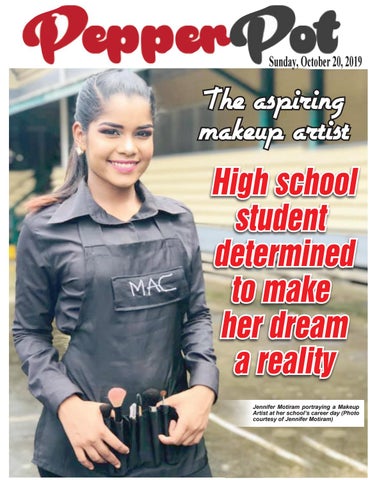
Sunday, October 20, 2019
The aspiring makeup artist High school student determined to make her dream a reality Jennifer Motiram portraying a Makeup Artist at her school’s career day (Photo courtesy of Jennifer Motiram)
2
Chronicle Pepperpot October 20, 2019
The aspiring makeup artist
High school student determined to make her dream a reality By Marissa V. Foster JENNIFER Motiram is a secondary school student with a big ambition of one day becoming one of Guyana’s top make-up artists. She described her childhood as being quite amazing and filled with good memories, having grown up in a very big and loving family. Though her father was absent from the home, her mother still made sure that all of their needs were always met, regardless of the sacrifice. Her mother always fulfilled her needs in every way possible and never fell short on any of her promises. Jennifer’s mother is the main reason
for her success. Motiram expressed always having an eagerness to learn new things every day. While learning new things, she was also taught to focus on finishing her secondary-level education and to do so successfully. Growing up with less has driven this youth with a passion for make-up to develop herself and to always strive to be the best of who she is and with what she does. Over the years, Jennifer has developed a very strong desire to express her creativity. This has been the key to success in her makeup journey thus far. She first started as having makeup as a hobby. Eventually, she placed more
Turn to page III ►►►
emphasis on her skills and practised until she perfected them. Motiram is currently a secondary school student, studying at Line Path Secondary. She is filled with ambitions of being an independent woman with her very own established business. She is also part of a dance group called ‘Team Extreme’ or ‘TX’ from the East-Berbice/Upper Corentyne area. She is active as a freelance make-up artist and professional dancer. Despite still being in school, Jennifer has already copped more than 50 make-up customers. She also had over 30 bookings as a professional dancer. Her future highlights
success and big ambitions as she plans to proceed in building her very own brand for make-up and as a dancer, after completing her secondary school education. Her main focus and goal are to always keep growing as an individual— to blossom into her best self, possible through the support of her family and closest friends. She also hopes to enhance her skills as a Guyanese make-up artist and while doing so, she hopes to contribute positively to the lives of others, especially to other young girls who look up to her as a shining role model. Growing up without the presence of her father was a major life challenge she had to face from a very young age. Although she never really received any type of unconditional love from her father, she stressed that she still got the gift of confidence and high self-esteem, all possible because of her loving mother. Her mother filled the shoes of both parenting roles and she never made Jennifer feel the absence of her father. Her mother filled that void to the fullest and she always had the full support from her mother in any journey or path where she decided to tread. Jennifer advises other young girls who have a passion for make-up and dance to always follow their dreams. She stressed that you should, “Never quit! Sometimes, there will be challenges that will come your way, but don’t you ever give up. Just be sure to view those challenges as an opportunity to learn and grow from in this life.” Jennifer also wants to encourage those who are still in secondary school to make education their priority-- unless, of course, you can balance pursuing your dreams and obtaining good grades, then go for it!
Jennifer Motiram
Chronicle Pepperpot October 20, 2019
III
Bartica continues its ‘Green’ transformation By Svetlana Marshall
BARTICA – the capital town located in the CuyuniMazaruni District (Region Seven) – is well on its way to becoming the country’s first Green Model Town in keeping with a vision of His Excellency, President David Granger. “The transformation is evident,” the Mayor of Bartica, Gifford Marshall said as he alluded to the fact the town has made gigantic steps in the areas of solid waste management, environmental protection, energy conservation and the use of renewable and reliable sources of energy. At the time, he was being interviewed on Guyana Chronicle’s online programme called ‘Vantage Point.’ “It was important for us to have open spaces, and open spaces, of course, have
a number of benefits, and also they contribute significantly to raising the value of properties; so we would have constructed the West Indian Housing Scheme Green Park,” the Mayor explained while adding that the green park not only attracts residents but visitors and tourists from across the country, and world at large. The West Indian Housing Scheme Green Park, constructed at a cost of $31M with the support of the Government, is powered by solar energy and features a three-tier fountain. It also consists of a playground with walkways, benches, benabs, arched (kissing) bridges, and a green space for trees. The fountain’s water is sourced from a natural freshwater spring that was found at the backlands. It is at Green Park that residents and tourists alike, hold their barbeques,
receptions, weddings, anniversary celebrations and other public events. The Green Park in the West Indian Housing Scheme was among the first set of beautification initiatives taken by the Mayor and Town Council of Bartica. The Water Front Project, which comprises of the Golden Beach Boulevard, is another such initiative undertaken to boost the town’s tourism potential. The Golden Beach Boulevard was commissioned in 2018. It comprises of a walkway, mini-marts and lights powered by PV panel. It has recently, intensified its tree-planting programme. In addition to beautifying the town’s surroundings, the Mayor said the Town Council has been working with the Ministry of Communities, Ministry of Natural Resources, the Guyana Geology and Mines Commission (GGMC),
Golden Beach Boulevard and the Environmental Protection Agency (EPA) to minimize the damages done to the environment as a result to mining activities done in and around Bartica. “Most of the residents depend heavily on the Mining Industry, so we had to create a balance because here you are talking about greening but also about mining, and mining has a significant impact, negative of course on the environment. We would have seen the pollution of our rivers, we would have seen the deforestation Trees planted in Bartica as part of its Green Initiative
The West Indian Housing Scheme Green Park
Turn to page IV ►►►
IV
Bartica continues its ‘Green’. . ◄◄◄ From page III
and the large ponds that would be left, and if those areas are not managed properly…it could affect the environment. So we have been working with the authorities to minimize the negative impacts,” Marshall explained. In the areas of energy conservation and renewable and reliable energy supply, the Mayor pointed out that approximately 96 per cent of the town’s street lights are Light Emitted Diode (LED). “Bartica was a very dark town because when it came to street lighting, only five percent of the
town was covered, and now we have in excess of 95 per cent of the town covered, so that’s a major plus,” he said. Added to that, solar Photovoltaic (PV) panels have been installed in a majority of the municipality buildings. “We would have started last year, or sometime in 2017 to ensure that the municipal buildings, first of all, are equipped with PV panels. This, of course, would reduce significantly, our light bill, so it is an economic project in terms of reducing electricity cost, and also it’s a project in which, we will contribute
towards reducing our dependence on fossil fuel,” Marshall explained. He noted that the Bartica Town Hall, the Bartica Community Centre, the Green Park, Bartica Municipal Market and the Bartica Police Station are among facilities being powered by solar energy. Importantly too, the Council with tremendous support from the Ministry of Public Infrastructure has been able to arrest the power supply issues that were plaguing the town, while simultaneously reducing the impact the use of fossil fuel has on the environment. Earlier this year, the Government through the
Inside of the Bartica Municipal Market
Chronicle Pepperpot October 20, 2019
The Bartica Municipal Market Guyana Power and Light Incorporated (GPL), completed the construction of an $800M Power Plant at Dogg Point, Bartica. The $800Million power station is sufficiently powered by three 1.1 megawatt high-speed diesel engines, which have a total output of 3.3 megawatts of electricity. This is expected to meet the demand of the residents of Bartica. Marshall was in high praises of the Government, noting that not only were Barticians faced with frequent power outages, but their environments were also severely affected particularly those residing and operating along First Avenue where the old power station was located. “Where GPL was located, it was right next to our market and those engines were probably older than my grandparents,
and when the engines came on, there were these thick suds that would go to the market; the drains around the market and the power company were thick with oil and so, so it was pollutant and it was something that we worried a lot,” he told this newspaper. But while the town has been gifted with a new power station, the Mayor said the town is still forging ahead with its plans to depend heavily on renewable sources of energy.
“Though we have a brand new facility, our objectives remain the same, we need to reduce our dependence on fossil fuel because of course, when we use a lot of fossil fuel that of course impact our environment, our quality of air which leads to climate,” he explained. The renovation of the Bartica Municipal Market was among other projects down under the watch of Marshall and his team of councillors at the council.
LED lights being installed along the streets of Bartica
Chronicle Pepperpot October 20, 2019
V
RAISING STANDARDS IN ART COMPETITIONS ON October 5, photographers around the world participated in Scott Kelby’s Worldwide Photo Walk. Locally, our walk took us around the Bourda market area. It was the first time that I participated in such a venture and I must say it was a great experience. On the walk, we captured elements of our local market scene, such as our fresh fruits and vegetables, the busyness of the Saturday afternoon hustle, men at work, homelessness and so much more. Scott Kelby’s Worldwide Photo Walk is more than just a walk, it is also a photography competition. As I prepared my entry, I pondered: what is the purpose of competitions? why should persons enter? and what makes a winning entry? In my opinion, an art competition is meant to encourage innovation. It’s an opportunity to present yourself to the world; to show others what makes your work unique -- a demonstration of creativity, originality and craftsmanship. But how does one develop these elements)? The answer may surprise you. Even though art comes from within, if we don’t spend time studying or researching other artists and techniques, we will never be able to develop our craft. I was very disappointed to learn that the standards of art entries at the secondary school level for local competitions have dropped. I strongly believe that our young artists are running on “empty” They may be of the impression that creating art isn’t that serious. I don’t know what may be tainting their perception, but I know that it is time to raise the standard again. Each competition has rules, and some have themes. They give guidance on how the final piece should look. Apart from that, individuals need to take pride in their work; execution should be done with a great deal of craftsmanship. As I heard the disappointment over the recent entries for the Lions International poster competition, I recall hearing similar sentiments at the past Guyana Visual Arts Competition and Exhibition (GVACE). So, artists, young and old have to step up their game. As we use competitions to gauge OUR level of work compared to those of others, we must do our very best. Winning entries are those that have what the judges are looking for. However, this varies according to context and criteria. So, we must read our instructions carefully and proceed accordingly. The judges from GVACE were looking for an approach rather than an idea. In their presentations, they emphasised the fact that creating art involves not only the practical aspect, but the theoretical as
well. Most techniques we use today were used in the past. This requires that we know our craft -- material, function, technique and form. Part of being a creative person is thinking outside the box. We must use other artists to inspire our thinking. Simple words such as close, open, wide, tall, short, in front, behind and mere physical objects can trigger an artistic response. We must use different materials with familiar techniques; use our work to say something that is important to us. So, as we work towards the next competition, let’s keep these tips in mind. Let’s raise and keep our standards high!
Photograp
hy by Aie sha Sc The Weig ottland entitled ht.
VI
Chronicle Pepperpot October 20, 2019
Without policing, the economic shackles will eclipse every pay rise EVERY crisis throughout our recent history, post-Emancipation onwards, has revolved around economic confrontation and abuses by dishonest plantation owners, shopkeepers and in the 20th century, with crooked scales. The 1889 riots began with a quarrel between a young boy and a shop owner over a gill bread. “The working people as consumers erupted against the most accessible agents in the hierarchy of exploitation--not the plantation capitalists nor the big import--export firms-- but the small shopkeepers.” Walter Rodney-A History of the Guyanese Working People, 1881-1905. I have no knowledge that the Guyana
to enrich businesses who in the majority, have exhibited no corporate responsibility to support any area of sports, arts, or any social enhancement project, even a domino competition, or sponsor a school debate. Now that we have entered the realm of nullifying dual citizenship in respect of participating in public administration, another area must be explored, a declaration of assets abroad, with financial sources clarified. Guyana, like all of the New World, in the period of the Atlantic Slave Trade, is populated by peoples who were not wealthy overlords from whence they came. Upon arrival to these shores, be they Mongolian or African tribesmen, Europeans and Asians
wouldn’t voluntarily repair a bridge, or equip their old school with a laboratory and ensure it’s sustained, but right away they buy property(ies) in America, England and Canada. The fact is that history tells us that they are not unusual; this kind of clique has led to revolutions and social upheavals, even mass murders across time. Now be clear on this: if one is resident in another country it is understood that real estate purchases there is a necessary option, what is ‘our’ concern is when you deny contributing here through taxes etcetera, leaving the burden on people who can hardly visit the dentist, while you willingly pay taxes where you will hardly, ever truly belong.
he was addressing, what skills he was referring to that the rest of the world so badly needed, that we possessed an excess of? Not for one moment did he contemplate or seem to recognise that both India and China had an excess of skills that they were eagerly trying to export or its qualified people were trying to privately export those very skills for external employment. This was a completely bizarre and ridiculous assessment by a president whose dismal vision of a nation (Guyana in particular) of tremendous resources as a hopeless vendor and remittance-subsidised economy, a perception, in four years another administration has begun to reverse.
dollar has been recently devalued, yet prices in the supermarkets have gone up over the past months. Is this politics? Because to squeeze the people towards betraying their own better interests have always been a mechanism of businesses wanting a special administration, in our case, who would waive taxes from them onto the public service workers who have carried our major tax burden since independence, or is it just the old proverbial greed? There was a chicken crisis of sorts, prices went up, the crisis is over but chicken prices remained the same. We experienced this when oil prices went up and mini-bus fares rose. When the oil prices stabilised, transportation prices remained the same. Providers of electronics and computers are in a maze of their own. Most of the more recognisable offer no backup services and questionable items when it comes to related chargers, etc. The comfortable nexus between inflicting price hikes and unreliable merchandise that keep consumers ‘hand to mouth’ must be challenged. It is a vicious, self-serving policy
alike, but they quickly fell in line with the purposely un-developing plural economic planter system that was supported by religious mythology, an aggressive edutainment propaganda system of definitions of where on earth heaven is. Thus, creating no majority recognition towards new options and frontiers, simply put, with no vision, nor urge to build a new road, but rather rename one that already exists, and to compound this laziness of spirit, that refuses to immerse one’s being to add to the landscape a new spark, like the proverbial Kakaroach, creeps into whatever initiatives the sincere few had crafted and struggled into being, not to enhance any proven idea, whether it be trade unionism, political parties, NGOs or religious standards. This callous opportunistic aspect of our nature will proceed to postulate, con and extract whatever they could for themselves and closest families, sprouting disillusionment where hope and aspirations once existed. The mocking irony is that they steal from this beautiful mudflat, where they
In our context, it is the lack of enforcement when laws are enacted, but however, laws must first exist to address deformities that have lasted far too long. If this country and its people as we are, are to survive outside of further confusion with respect to the social and economic ills that constantly creep into our lives, and instead hold on to the positive perspective of our country, we must continue to knock at doors, lobbying as best we can, in this world, as a nation without Ballistic missiles, then the thinking must evolve. I’m compelled to use the opposition leader, then as president, as an example of a mode of reasoning that belongs to what must change, evolve, or mature and be rejected in our self-interpretation. September 2006, Stabroek News, The then President advocated to students, that since ...”the Caribbean does not have the high number of export products as China, India, and the USA, we must sell services to the world, become the intellectual capital of the world,” but he did not expound to the students that
There is need for an aggressive consumer-monitoring authority that is proactive and has its own prosecuting and education arm. There are too many intentional violations and a philosophy that for every 10 per cent rise of national wages, a subsequent 12 per cent rise must be levied on goods. This increase in prices of consumer items should be a requested item based on established norms; not all companies or businesses behave this way, but many do. The trade unions must participate in rescuing both blue and lower-level white-collar workers. They in turn, after a worker has paid 20 years of union dues upon dismissal or retirement, the unions should present the worker with a percentage of dues paid, in good faith. We have got to address working-class relief, from 19th-century customs and practices, with new, progressive laws, and positively affect the social and domestic predicaments, that there’s so much pretence about, as to why our domestic life has so many fatal casualties.
Chronicle Pepperpot October 20, 2019
Nismes
Where livestock and self-employment abound
By Michel Outridge THIS week the Pepperpot Magazine visited the quiet and peaceful village of Nismes, West Bank Demerara. Nismes, a quiet countryside village located on the West Bank of Demerara, can be found about 15 minutes from the Demerara Harbour Bridge (DHB). This village is sandwiched between Bagotville and Toevlugt and is a farming community where mature residents are self-employed through rice, cash-crop or livestock farming. This village boasts a primary school, churches, a gas station, roadside stalls, good roads which was paved about a month ago and many shops. It has about 1,500 residents who reside in three housing schemes-- the Old Road,
Electra and ‘Raphael’ or ‘Rice Bed’ Housing Schemes. Nismes is run by 15 councillors, who operate from the Bagotville/Nismes Neighbourhood Democratic Council (NDC) building. Nazim Khan is one of the many faces you will see while visiting Nismes. Nazim is a pensioner and poultry farmer. He resides at Old Road, Nismes, and although he is not originally from the village, he has been living there for the past 40 years. Khan told the Pepperpot Magazine that he has been there since he was 12 years old at the property he inherited from his deceased parents; things, however, have become difficult for him with the establishment of a new housing scheme just behind his property. “From 100 goats I am down to five, because of thieves and dogs. I am a poultry farmer, I rear chickens and then I pluck them
The recently paved Old Road, Nismes (Carl Croker photo)
VII
ocus F on the Village
and sell it [sic] to a vendor in the city; but with this scheme, the people complaining of the pungent odour from the waste of the chickens and I had to scale down my business,” he said. He explained that the new housing scheme is now on land which used to be rice beds back in the days, but they were bought and converted into privately owned land, which was sold and converted into about 40 house lots. He pointed out that his parents bought the land for farming purposes and he followed in their footsteps, but today, his business is
down to 500 chickens and he is trying to change the shaving often so it does not smell but like any other business, it takes time and money. Despite Khan’s difficulties, the village itself has benefitted from many developments including well-paved roads and it is a good sign since the area once had pot-holed streets, Khan said. He stated that other than a few hiccups along the way, Nismes is a good place to reside because residents get along with each other and do what they have to do to make a living.
VIII
The Riverside …
Chronicle Pepperpot October 20, 2019
Where some residents call home By Michel Outridge NISMES Old Road, Riverside, has a privately owned shipyard and on the sea dam, a few residents have made it their home. One such villager is Indranie Sookdeo, a mom of five who is married to the current koker operator and has a wooden house on the sea dam; the house rests flat on the ground and she would like it to be placed on stilts as it used to be. She told the Pepperpot Magazine that her eldest son is 25 years old and she has been living at the location since he was born; she is originally from Goed Fortuin, another West
Bank Demerara village. Sookdeo explained that her modest house was previously on posts, but when sea defence works were done by a contracting service, they removed the edifice and placed it not far away. She reported that when the works were completed, they placed the house back at its original spot but failed to install the posts the way they were before and she is hoping that can be fixed. The resident stated that her husband is from Bella Dam, also on the West Bank of Demerara, but they moved away from their families many years ago because they wanted
Nismes Old Road, Riverside (Carl Croker photo) to live separately. She added that so far, life there has been fair and they manage with the little they have; her sons have constructed two small houses there too and are working to upkeep themselves. Sookdeo stated that with her husband’s income as the koker operator, she ‘makes do,’ since she still has school-aged children to take care of. This family also rears chickens and goats and even has a small kitchen garden of vegetables. “Life is not perfect, but it is peaceful and nobody does trouble you here and that suits
me just fine,” she said. As for the tide from the Demerara River which is a few feet away from her house, Sookdeo explained that she is not afraid; the water does not reach up to the dam and she is accustomed to the sounds of the waves. “We by we self here and things normal, because people should be allowed to live their lives however they see fit and we are humble people trying to make an honest living for our family,” she said. Sookdeo and her family are the only residents of the sea dam at Nismes Riverside, which is much closer to the village of Toevlugt.
Chronicle Pepperpot October 20, 2019
IX
Nismes: the best place for a quiet family life
By Michel Outridge DURING a visit to Nismes, West Bank Demerara, the Pepperpot Magazine seized the opportunity to interact with residents who shared their bit about the village and their lives. Ivan Phillips related that he has been there all his life and works at a private furniture business within the community, which provides for him adequately making his life normal. He said that life in Nismes is good because everybody is doing something meaningful with their lives.
The 30-year-old reported that his friends in the village are mostly soldiers and cops and they get along very well, since they do not tolerate ill behaviour among their peers and life is nice at Nismes. Chandra Girwar, a mother of two, told the Pepperpot Magazine that she is the sole breadwinner for her household, because her husband and son are not well and she has taken up the task of providing for them. In addition, she also takes care of her granddaughter and would ensure she is dropped off at school and picked up, but with the car out of order due to the bad state of
One of the many unique houses in Nismes (Carl Croker photos)
the road before it was resurfaced, she has to replace some parts. To do so, she needs some money and she has been home for a few weeks from her job at a fishery business. “Other than that, we are trying at this end and with good roads now we don’t have to replace car parts often like before [but] some street lights will be nice to go with the roads,” she said. The 56-year-old stated that Nismes is a quiet place where both Indo and Afro Guyanese co-exist in harmony most times and with employment, things are good. Another villager, Jonelle Souvenir, told the Pepperpot Magazine that being a mom isn’t easy, but she has her small business of
rearing chickens and that is now starting to blossom because she encountered great losses recently, when all the chickens suddenly died. “So I now bought a fresh batch of chicks and I hope they grow healthy, because I will sell it to continue the process of being self-employed and to sustain my business,” she said. She is a resident of Electra Housing Scheme, where picture-perfect claybrick houses that are neatly lined up in the street and well-tended yards complement those houses. “I came here at Electra Housing Scheme 10 years ago with my mom to live Turn to page X ►►►
X
Nismes: the best place for a quiet ... ◄◄◄ From page IX
and so I am here. This place is very quiet; if you are looking for that nice country life to rear chickens, or do your own small business,” she said. Souvenir stated that the people of Nismes are working folk, most of whom are away for most of the day and the ones at home have their own businesses or are rice farmers.
She reported that some people work in offices in the city as well. One thing that she would like to see, she said, is a playfield for the children and youths of the community, since they have adequate land to accommodate an area for sport activities and recreational purposes. Electra Housing Scheme has about 20 houses and the people there are familiar with each other, so there are no brewing conflicts or other problems.
Chronicle Pepperpot October 20, 2019
Jonelle Souvenir with her son at her chicken pen
Chronicle Pepperpot October 20, 2019
Dreams
of dreams is called oneirology. It’s basically saying that even though our brains are active during wake and sleep, the content obviously differs. This may be because the emotional centres of the brain trigger dreams, rather than the logical regions. There are many psychological theories of dreams, one of the most popular being the Freudian theory of dreams. Sigmund
I WAS having a discussion the other day when someone asked me whether dreams had anything to do with mental health. I know there is a whole science behind the examination of dreams but I never really thought of it or its relation. So, I thought I’d do some research and share as it was quite interesting. Much is known about the important role of sleep and the good it does for our body and mind. But it’s been more difficult for researchers to explain the role of dreams. Dreams are images, stories, ideas or
even emotions that our minds create when we’re asleep. They are involuntary and occur during certain stages of sleep, mainly during the rapid-eye movement (REM) stage of sleep- a deep sleep, when brain activity is high. Dreams in other stages of sleep tend to be vague or not easily remembered. The average person has three to five dreams per night. How many do you remember? There is a science of dream interpretation but it has many facets that are still not quite understood. It attempts to draw meaning from our dreams, the specific scientific study
XI
Freud believed that dreams reveal our hidden desires and deepest fears, often related to childhood experiences. That they may be repressed feelings or memories where dreams make them accessible for retrieval. We all know the types of dreams we have; they can be exciting, frightening, Turn to page XII ►►►
XII
Dreams ◄◄◄ From page XI
supernatural or sexual and most people do not have control over this. However, there is something called lucid dreaming where the dreamer is self-aware. This happens when the person knows they are dreaming and can even control what happens within that dream. There have been so many other theories as to why we dream. Neuroscientists believe a few things. That dreams are happenings from the day being processed and consolidated, it’s a preparation for perceived future threats or the brain’s way of developing additional cognitive abilities. Some also believe dreams are simply visual manifestations of what we think about before we fall
asleep. We have all had examples of dreams which support every theory. For example, I remember as a student dreaming about being late or failing an exam the night before I had an actual exam. People dream about their partners after they are the last face they see or the last voice they hear before going to sleep. Other researchers believe that dreams can predict the future which I’m sure we all hope it not true based on some of our dreams. While some people have suggested this, there hasn’t been enough evidence to prove this. Some other theorists believe that dreams are solely for our creative tendencies as there are no restrictions for our creative flow. This is due to many famous artists claiming that their famous works of art came to them in
Chronicle Pepperpot October 20, 2019
dreams. Other theories focus on the role of memories when it comes to dreaming. Where memory is consolidated overnightt, where we keep the things that truly matteras the sole purpose of dreams. Basically, I think that dreams may help us to learn more about our feelings and beliefs. They let us know what is on our mind and even things that we may want to overcome. I’m sure we have all heard or even used the famous expression “let me sleep on it”. Of course, a huge part of this is the important revitalisation that comes from a good night’s rest but I also believe this is because dreams can cause clarity. Have you ever fallen asleep unsure about a decision you were trying to make? Then when you woke up, the answer somehow became clear? This could be from a dream that you can’t even consciously remember. I think we also dream of things that are constantly on our minds throughout the day- consciously or unconsciously. For example, one study done in Trinidad and Tobago on the dreams of recovering cocaine addicts showed that almost 90% of the individuals had drug-related dreams. This lasted up until about six months into their recovery.
Dreams can be associated with mental illness, especially when nightmares are involved. Nightmares can be caused by stress, anxiety or even a reaction to certain mental health illnesses and their medications. Depression, anxiety and suicidal thoughts are often accompanied by nightmares. People with post-traumatic stress disorder (PTSD) are also haunted by nightmares. Often nightmares may also be a sign of sleeping disorders. Other mental health issues such as substance abuse can affect dreaming. Alcohol disrupts the normal, healthy sleep cycle and leads to fragmented sleep. Consuming large amounts of alcohol and marijuana may also alter and diminish the time spent in REM sleep, which means it affects our dreaming as well as our ability to recall them. If you don’t often remember your dreams, one researcher found that taking Vitamin B 6 has been proven helpful in remembering dreams. Thank you for reading and please send in any topics you’d like to talk about to caitlinvieira@gmail.com. Suicide Helpline numbers: 223-0001, 223-0009, 623-4444 or 600-7896 Say Yes to Life and No to Drugs! Always!
Chronicle Pepperpot October 20, 2019
XIII
The St George’s Cathedral
A true Guyanese relic By Jared Liddell STANDING majestically at the centre of Church Street and North Road is one of the most famous Guyanese ar-
chitectural wonders --- the St George’s Cathedral. The building, which is known as ‘the tallest wooden building in the western hemisphere,’ stands at a towering 143 feet. It
The St George’s Cathedral (Delano Williams Photo)
is not just world famous for its height, but also for the immense amount of detailing that went into not only the exterior but also the interior of the building. From the hand-carved mouldings to the majestic, stained glass windows, Gothic arches, clustered columns, flying buttresses, arched ceiling and built-in musical organs with musical pipes, the cathedral is not just a sight to behold; it is also a national treasure. The cathedral was built
in 1889 and stands some 177 years, with almost all of its original architecture intact. In 2017, the leadership of the cathedral decided that the church was overdue for repairs, but they didn’t wish to modernise the structure. They had a vision of preserving the history it, so they embarked on the St George’s Cathedral Restoration Plan. Turn to page XIV►►►
XIV
The St George’s ... ◄◄◄ From page XIII
The plan was devised between the leadership of the church and the National Trust of Guyana. The purpose for the restoration was to ensure that as much thought as went into the initial design of the building, be brought back today, to ensure that every detail is restored as, and redone exactly the same as before. In an interview with the present Bishop of the cathedral, Bishop Charles Davidson, he posited that the commissioning of the cathedral has an extremely rich history with the emergence of the city of Georgetown, but that many persons are not aware of the true significance of the St George’s Cathedral. “The history of the cathedral is pretty close to the history of the city. In colonial days, when the British ruled Guy-
Chronicle Pepperpot October 20, 2019
ana, it was said that cities will only come into being after cathedrals are built. The city of Georgetown is 176 years old, and the St George’s Cathedral is 177 years old. That seems to be true. In 1842, when Percy Austin became Bishop of the Anglican Church, he consecrated the building and named it the St George’s Cathedral after King George of course, and consequently, the city became known as Georgetown,” said Davidson. He went on to state that the decision to keep the church’s initial design and detailing was not just a decision made by himself and the other leaders of the church, but also by the National Trust of Guyana. He explained that buildings which are national treasures come under the Guyana National Trust, and as such, they are protected as monuments; therefore, no structural changes can be made without the express approval
of this body. “Once the National Trust says that your building is a national building you have to get permission from them to change it. This is a National Trust building and if you see the pictures from years gone by, you’ll recognise that things have been changed on the building. You can’t change the inside, but you are able to make minor changes to the outside. The National Trust wants to be able to say to the world that this is the original building that existed in 1889, and we haven’t changed anything on the inside; you can change on the outside but not on the inside.” Davidson stated that some work was started on the building, but that came to a standstill as the church had run out of funds to complete the project. He stated that they were able to complete the northern wall of the church, but that single change cost the church over $38 million. The Bishop stated that the total cost for the entire restoration process would be somewhere around 175 m. “We finished the north wall which is furnished with a new ramp and all that kind of stuff; the west wall I think is almost finished and we ran out of money, so we stopped the work nearly seven months ago. What we have to do now is complete the west wall and south wall, maybe half of the south wall has been constructed, but it needs to be completed. So basically that’s what we are doing at this point. When asked if the National Trust of Guyana had contributed to the renovation, Bishop Charles remarked, “So because it was a national shrine, the government during 2017 and 2018 gave us about $22 million to help us to do the work. Outside of that, the church has financed the whole project. So far, the church would be spending like $175 million to do the four walls. We have to go back and look at the west wall and do some work on that. When that’s done, we would have to do the main roof, but we do not yet have an estimate for that.” The bishop further stated that donations from members of the church were able to cover some $12 million of the cost in Phase One of the restoration. Davison told the Pepperpot Magazine that cathedrals are known historically to be largely expensive buildings to restore, due to having to find experts in the field of carpentry, as well as the cost it would be to replace the wood (in this case greenheart), stained glass windows, and every other tiny detail that went into the initial building. Bishop Davidson went on to explain that although the church has received donations from prominent Guyanese businesses such as Banks DIH and all of the paint used thus far, the renovation is still far from over. He said that he would welcome other members of society’s contributions to be able to complete in a timely manner, the work on this historic landmark of which all Guyanese are extremely proud.
Chronicle Pepperpot October 20, 2019
XV
Take your pills and prevent filaria! IT is mid-October and by now many of us are aware that it is that time of the year again when we would be required to take the pills brought to our homes, schools, and workplaces, to safeguard ourselves from Lymphatic Filariasis. Lymphatic Filariasis (LF), commonly known as filaria, is a disease that affects the body’s lymphatic system. This system functions to remove unwanted fluids from the body and transports ‘lymph’– a fluid that contains white blood cells that help the body to fight infections. For countries in the Americas such as Guyana, the disease is transmitted by the culex mosquito. If bitten by a mosquito carrying the infection, the worms are transmitted into the body and they stay there for years before a chronic condition develops. This chronic condition include the external manifestations of lymphoedema (tissue swelling), elephantiasis (skin/tissue thickening) of the limbs and hydrocele (scrotal swelling). A point to note, however, is that once that chronic condition manifests itself, the effects of the disease are irreversible. And, there is no cure for Lymphatic Filariasis. So here’s where taking those pills brought to you shows its relevance. The distribution of those pills is part of what is known as a Mass Drug Administration (MDA) campaign. This campaign is one that is organised in an attempt to eliminate Lymphatic Filariasis, by ensuring that every person in the population who is at risk of being bitten and infected is given tablets to ‘disinfect’ themselves. Since filaria has no cure, and since those external manifestations of the swollen leg or the swollen scrotum are irreversible, the only way of tackling the disease is by preventing it. And the prevention is fostered through the use of Diethylcarbamazine (DEC) tablet, which targets the adult worms that cause Filaria and Albendazole (ALB), which targets your intestinal parasites. Years, ago, Guyana had failed in a previous mandatory World Health Organisation (WHO) MDA campaign, targeting filaria, since the country was unable to meet the 65 percent coverage. When a country fails to meet that mark during any one of the five successive rounds, the campaign fails. In 2017, when the campaign was restarted so that the neglected tropical disease could be eliminated as a public health problem from Guyana, the country recorded a massive 86 percent coverage in the four regions targeted during the first round. In the 2018 round of the MDA, an overall 85 percent coverage was recorded. This year, logically, the country is looking to build on its successes and use the lessons learnt during the past two years to improve execution of the MDA. What this means is that every aspect of the MDA--from the actual pill distribution to the social mobilisation and the public relations efforts--will be intensified. The country has already recorded two successful rounds, and failing to secure more than 65 percent coverage would be detrimental to the MDA, and the health of at-risk citizens. But this year as well, the country will be introducing another drug to the regimen. This drug is Ivermectin, which is known to kill and sterilise the adult worms that cause Lymphatic Filariasis. Since the drug has this ability, the number of years needed for the MDA to be successful is reduced from five (the five successive rounds) to only two. Not only is this a cost-effective strategy for the public health ministry, but I mean, that equates to fewer years we would have to take those tablets. It is a win-win-win situation, so why not take your pills to prevent filaria? I’ll admit that it is due to personal reasons that I am such a fervent supporter of the MDA. A close relative of mine has been affected with Lymphatic Filariasis for a number of years now and I have seen how his swollen leg is a hindrance to him as he goes about his daily life; and I have seen him at times when he was frustrated and irritated because he left as if his leg was not his own. Last week, while members of the media were being apprised on this year’s MDA, a patient diagnosed with lymphat-
ic filariasis provided a testimonial to illustrate the stark reality of living with the irreversible disease. The man shared that sometimes the itching gets so unbearable, that he would take a knife and dig into his skin. Gruesome, yes, but that’s just a bit of insight into what it is like living with filaria. I have personally been hesitant to consume these pills, especially now with the introduction of yet another one (I just don’t like taking tablets). But when those feelings of reservation take shape, however, I
remember my relative and all those persons who are living with filaria and only have the option of learning how to treat the disease and make living with it a normal part of their lives. I’ve seen how hard it is to do both of these things. So, my gentle plea is, when you do see the pill distributors, take a few minutes out of your schedule and take the pills. Prevention is not better than cure; prevention is the only option.
XVI
Leading by example By Michel Outridge
ACTING General Manager of the state-owned Guyana Chronicle newspaper, Donna Todd, believes in leading by example; so much so, that she visited Ithaca Village, West Bank Berbice, with a team of employees to market the newspaper and interact with vendors. Todd, who comes from an accounting background and has amassed a wealth of experience in the fields of management and finance, is
not easily fazed and goes ‘out into the fields,’ so to speak, with her staff. On September 9, 2019, she, along with Marketing Manager Reshma Ajodha and Circulation Consultant George Clarke and others journeyed to the farming community where she had the pleasure of meeting several newspaper vendors. There, on the ground, Todd went on a walkabout in the village where she visited several shops and encouraged the locals to sell the
newspapers, to increase our readership along the West Bank Berbice corridor. Todd even took the time out to meet other newspaper vendors along the way to enquire of their concerns and the way forward when it comes to selling the daily and Sunday newspapers. Just as any employee, Todd doesn’t hesitate to go out with her employees to get a first-hand look at the operations of the newspaper and how the newspaper is being marketed across the country.
Chronicle Pepperpot October 20, 2019
Todd shares a light moment with sugar workers at Blairmont
GNNL Acting General Manager Donna Todd and Marketing Manager Reshma Ajodha on a walkabout in Ithaca village
A resident of Ithaca catching up on the latest news in the Guyana Chronicle (Carl Croker photos) “In order to sell a product, as we do, the newspaper, both management and staff must work hand-in-hand and side by side to foster better relations and have common objections[sic]; so I am always willing to ‘get down to business and get out there’ when it comes to
the promotion of the Guyana Chronicle,” she said. Todd has been at the helm of the Guyana National Newspapers Limited (GNNL) for more than a year and to sum things up, she has had nothing more
Turn to page XVII►►►
Chronicle Pepperpot October 20, 2019
XVII
Lasting memories gained from working aboard oil rig An intense, but enlightening experience
By Wendella Davidson AT first glance, Dr Ayesha Wilburg does not seem to be someone who is adventurous, much less would ever entertain the idea of working on an oil rig, way out at sea. But this petite and
soft-spoken lady, who was born at Mabaruma, completed an intense and hair-raising training that enabled her to work aboard the `Noble Bob Douglas,’ ExxonMobil’s rig. Today, she has many memories, including living aboard an extremely huge ship operating in such
Dr Ayesha Wilburg, Managing-Director, St Joseph Mercy Hospital
Leading by ... ◄◄◄ From page XVI
than the interest of the workers at heart and has made many changes in favour of all employees. Todd has over the months went on many community outreaches across the country to market and promote the Guyana Chronicle and has made strides to boost the resources of the company. She is advocating that the Guyana Chronicle boosts readership in all regions in Guyana including, the far-flung communities. “We are a newspaper of record and we aim to bring the news to people wherever they are; so they can be informed of both local and foreign news,” she said. After the meeting, newspaper vendors expressed their concerns, but at the same time were pleased to meet Todd and her team, all of whom promised to work together to stimulate the sales, reach and readership of the newspaper.
Todd in conversation with newspaper vendor Junior Beharry at Rosignol
depth of water that at times it would create a sudden movement; this would her feeling uncomfortable, until one day she called it quits. Had she still been there, the ship would have been her home for 28 straight days before being able to see land again. Dr Wilburg is now serv-
ing as the Medical Director at the St Joseph Mercy Hospital, Parade Street, Kingston. Born as one of two children to her parents, Leslie Wilburg, a public servant and Verna Chan-Wilburg a teacher, at the Mabaruma Public Hospital in Region One (Barima-Waini), Ayesha and only brother, Abiose,
subsequently relocated to the city. Initially, she was enrolled at the F.E. Pollard Primary School on David Street, Kitty, as the family then lived at Khan’s Park, Ogle. When they relocated to South Ruimveldt, they sought a transfer to the primary school there, where she wrote the
then Common Entrance Examination. According to Dr Wilburg, she was awarded a place at Christ Church Secondary and after doing well in her first year, she moved to St Rose’s High
Turn to page XVIII►►►
XVIII
Lasting memories gained ... ◄◄◄ From page XVII
where she wrote the Caribbean Examination Council exams (CXC) and was successful; she then wrote `A’ Levels at Queen’s College. With her mind set on becoming a chemical pathologist, Dr Wilburg said she applied at the University of Guyana to undertake studies in chemical pathology, but during a rotation stint she was sent to Prashad’s
Hospital, where she enjoyed interacting with the patients and had a change of heart. She said she did a year of chemistry and in 2004, applied to do medicine and spent three years on rotation at the Georgetown Public Hospital Corporation (GPHC). In 2009, she graduated from the University of Guyana Medical School as a general practitioner.
According to Dr Wilburg, she completed one year of internship at the Georgetown Public Hospital Corporation (GPHC) before applying to work in Jamaica, as her class, being the first to be accredited, was allowed to work in any Caribbean country. Arriving on the island, she spent the first six months working at the Savannah Lamar Cottage Hospital be-
fore moving to the Cornwall Regional Hospital, Mount Salem, Montego Bay. At the latter hospital, she did rotations in orthopaedics, plastic surgery, and neurosurgery rotation before returning to Guyana. The young doctor said she returned to study for the U.S. examination to become a plastic surgeon, but during that time she became bored and went to work at Dr
Chronicle Pepperpot October 20, 2019
Dr Wilburg captured this beautiful scenery during one of her visits home in the hinterland Balwant Singh’s hospital for three years as Head of the Emergency Room. The oil rig Her next job was in the oil and gas sector, where she was posted on the `Noble Bob Douglas’ oil rig, a job she described as “very exciting and interesting,” as safety is viewed as paramount by the company; hence, the training was very intense. Without disclosing much information, she briefly recalled the helicopter training which entailed being submerged underwater four times and having to escape from the submerged,
upturned aircraft -- in some cases without windows and in other cases with windows, while using her elbows to open the windows and escape. The safety training also included an aspect called `abandon ship’ and according to her, employees must pass all of the safety training before being allowed to work aboard the rig. Dr Wilburg likened her experience serving as a doctor aboard `Noble Bob Douglas’ along with her interaction with the other foreign and local employees as “quite memorable and interesting.”
The Noble `Bob’ Douglas aboard which Dr Wilburg lived and worked as a doctor
Dr Ayesha Wilburg and Dr Asif Subhan during a trip to the hinterland
Chronicle Pepperpot October 20, 2019
Tissue Culture Technology stirs the crowd at World Food Day HUNDREDS of patrons who visited the National Agricultural Research and Extension Institute (NAREI)’s exhibit at this year’s World Food Day activity were well informed about the use of Plant Tissue Culture technology. “Our Actions are our Future: Healthy Diets for a Zero Hunger World,” was the theme for this year’s event. As such, NAREI believed it was appropriate to display Tissue Culture technology, which is crucial to our present and future agricultural practices, especially for a zero hunger world. Staff of the Biotechnology Department took the lead in showcasing research being done in this regard at NAREI. Patrons- mainly students and farmers- were informed about the stages involved in Plant Tissue Culture: Stage 0: Preparation- Identification of parent plant and reparation of stock solutions under hygienic conditions Stage 1: Initiation: The establishment of new plants under laboratory conditions. Stage 2: Multiplication: Rapid growth of material. New shoots are routinely placed in fresh media in new culture vessels. Stage 3: Rooting: Roots are induced by adding plant hormones to the growth media Stage 4: Weaning: The movement of plantlets from growth media to potting compost. This difficult stage requires controlled conditions of temperature, light and humidity. Uses of Plant Tissue Culture * Vegetative/ clonal propagation (micropropagation) of plants * Storage of plants * International and national transport of plant material * Elimination of virus from plant tissue * Breeding of selected plants Benefits of Plant Tissue Culture * All-year-round multiplication of planting material * Use of small-sized explants to multiply plants * Rapid bulking-up of plant material * More secure storage of plant material (germplasm), compared to the traditional method of field storage * More efficient utilization of space to store large numbers of plant containers Visitors to the boot particularly farmers were intrigued with the use of the technology. The excitement of accessing pest and disease-free planting materials thrilled many. They were pleased to know that the Institute has a quantity in stock for distribution. The Institute distributes pineapple and plantain plantlets free of cost to farmers. Breadfruit plantlets are sold for $1,500 per one, which is half the market price. Cassava and sweet potato are tissue cultured for germplasm storage.
XIX
Dr. Oudho Homenauth, CEO of NAREI and Research Scientist, Samantha Brotherson interact with a visitor to NAREI’s bootH
XX
Chronicle Pepperpot October 20, 2019
AGRICULTURE MONTH
––FOOD SAFETY AND FOOD SECURITY THE Ministry of Agriculture has declared October to be ‘Agriculture Month’ when the ministry would be outreaching to the education institutions and communities all over the country. The month will also encompass the World Health Organization’s (WHO) World Food Day on October 16. The theme for World Food Day is, “Our Actions are our Future, Healthy Diets for a Zero Hunger World.” The theme for Agriculture Month is somewhat similar to that for World Food Day and is, “Sustainable Agriculture for ensuring Food Safety and a Green Economy.” These themes together in effect call for both Food Safety and Food Security. The Ministry of Agriculture has organised a month-long programme of daily events with the emphasis being on educating the populations in the regions about Food Safety and the value of Agriculture. The programme is adequate in working towards agricultural education, but since it also encompasses the World Food Day theme, we feel the programme could have included several other supporting activities. The first of these is proposing the use of oil revenues to fund an agricultural revolution, something for which Guyana had been yearning for nearly two centuries since the abolition of slavery. An agricultural revolution would again modernise the sugar industry and improve its management, so that the industry would again become as relevant and as important as it was for two centuries when it maintained the colony of British Guiana and independent Guyana for some decades after independence. The agricultural revolution would also modernise all the other sub-sectors of the industry, including rice, dairy, meat and root crops. When agriculture again begins to provide lucrative employment, it will again attract young people. Another activity which could have been emphasised is the introduction and development of new crops and the work of NAREI in this direction could have been highlighted. For instance, NAREI has successfully cultivated a number of spices which have both a local and international demand, some of which could capture international niche markets as Grenada’s nutmegs had done. Fish-farming and its methodology could have been encouraged in all the regions and interested farmers could have been given loans or grants to start up their own ponds. Successful livestock experiments, such as the introduction of the Barbados Black Belly sheep or the Peking Duck could have been resuscitated. The encouragement of kitchen gardens could have been supplemented by the sale of various seeds at very cheap, subsidised prices. Only one session of cooking of locally grown food was programmed for the New Guyana Marketing Corporation. The hotels and restaurants could have been brought on board, offering cheaper local meals during the month. Mention should also have been made of INFOSAN, the International Food Safety Authorities Network, a global network jointly managed by FAO and WHO on which the ministry represents Guyana. INFOSAN, among its other activities, promotes the rapid exchange of information during food-safety events. Food Safety is multi-faceted and we will mention three examples of it: when chickens are fed with antibiotic-laced feeds, many such drugs are retained in the chicken meat and those who consume such meat would be unknowingly ingesting large amounts of antibiotics which could seriously impair their health in several ways. A second example of unsafe food is when farmers use drains or polluted water to spray their leafy vegetables. A great deal of the polluted water is retained in the leaves and one would be unknowingly eating bacteria-filled salads or bhajis. A third area of unsafe foods lies in the importation of substandard or even toxic food. The Food and Drugs Department has on various occasions found low-quality sardines using packaging which resembles the well-known Brunswick brand or vegetable protein powdered milk passing itself off as full cream or soya and other oils passing themselves off as olive oil. When a society or country has attained food security, the population would always have enough food to withstand any eventuality. Eventualities could include floods, adverse weather conditions or wars. Guyana, fortunately, has never had any extreme food insecurity resulting in famine-like conditions. With adequate investment and effective management in agriculture, Guyana could attain full food security. Agriculture Month has been a useful commemoration.
Chronicle Pepperpot October 20, 2019
XXI
Electra Housing Scheme…
A model residential area
By Michel Outridge REGION Three (Essequibo Islands-West Demerara) Councillor Michael Scotland was drawn to the quiet, countryside life at Electra Housing Scheme, Nismes, West Bank Demerara. He told the Pepperpot Magazine that the area has come a long way in terms of development; when the scheme was established, they moved in without water and electricity and today, every house is equipped with internet and landline services. Scotland related that when Nismes was first established as a village, most of the buildings there were government buildings. Giving the background history of Electra Housing Scheme, he said it was established in the early 1980s and the houses were built through the assistance of the Guyana Mortgage Finance Bank. He pointed out that the first set of houses were constructed in 1986, but the land was purchased in 1981. Scotland added that the
Electra Housing Scheme is primarily a residential area and it forms part of Nismes village, which comprises two other housing schemes. The Electra Housing Scheme has 27 house lots, with 23 houses and Scotland said life is quite comfortable and quiet there. Scotland related that the Neighbourhood Democratic Council (NDC) is tasked with the cleaning of internal drains, the weeding of bushes and other works that fall within the body. “The grass on the public road is weeded every month and comes under the responsibility of the Ministry of Public Infrastructure, but internal works are done by the NDC,” he said. Scotland explained that the Strategic Investment Programme (SIP) which falls under the Ministry of Public Infrastructure, has in its employ workers from Nismes, who work for 16 days per month for four hours daily. He added that the SIP workers are paid by the ministry and they clean drains and clear the community of weeds and overgrown bushes.
Scotland reported that the NDC does what it needs to do with the resources it have at hand, because getting people to pay their rates and taxes is still a ‘tall’ challenge. He pointed out that contracts have been awarded for excavation of canals in the village and they have made some recommendations, which seek to foster development of the village. They are, however, awaiting the installation of street lights, given that they benefitted from well-paved roads about a month ago. “Basically, the first thought is about the young people. There is a community ground and they have been trying to upgrade it, but so far our efforts haven’t borne fruit. We talked to people for assistance and partnerships, but nothing yet, but first of all, it needs a proper fence after which we can arrange fundraisers to further develop it,” he said. Scotland stated that a fence is needed because Nismes is an area with a lot of cows, goats, sheep and other animals, so they have
Nismes entrance (Carl Croker photos) to maintain the ground at the community centre. He said Nismes is a traditional village where people rear their livestock and cattle and some are into farming; it is also a place of vast backlands, which are used
for rice cultivation and the lands are privately owned. Scotland, a former regional councillor, noted that it is his second term with the NDC and the NDC is made up of 14 councillors; these are drawn from both the
coalition and the opposition party. He added that A Partnership for National Unity (APNU) has six councillors while the People’s Progressive Party (PPP) has eight at the Nismes NDC.
Gafoor’s building relations with residents, developing communities By Michel Outridge WITH the establishment of Gafoor’s Shopping Complex, located at Nismes Public Road, West Bank Demerara four years ago, the architectural landscape of the community has been transformed and valuable service is being provided to residents in that corridor. Manager of the Gafoor’s, Nismes branch, Alicia Singh, told the Pepperpot Magazine that their relationship with the people of Nismes and other communities along that side is a good one and they try to meet the needs of customers, even if they have to introduce newer products. “My role here is to manage this store, ensure that goods are available for customers who want newer products, and we also try to introduce those to cater to the needs of the customers,” she said. She related that even if a product is not available at the store they would import it if they have to, since the customers tell them what the market is like. Singh said, “Some items Gafoor’s may stock and it might be a selling item in the area; some high-end items are not sellers here and we constantly try to meet the needs of customers.” She pointed out though, that at Nismes
most agricultural products are best sellers, since it is a farming community and with that in mind, they have recently introduced seeds and fertilisers in their store. Singh stated that grass knives, cutlasses and files are also big sellers there and they also launched their household department, especially for housewives, prices which are pocket-friendly and they have a wide range of quality products. The manager added that they chose that location because they were looking to expand their services and with a branch already at Parika, they got the land and decided to construct a store there. She related that they aim to reach all ends of this country and they had their eyes on La Parfaite Harmonie, but that plan wasn’t realised. Singh reported that since the business was established, they have been doing fairly well; they have developed good relations in all sectors and are making a difference in the lives of many, since they give back to society in many ways. She explained that they refrain from highlighting their benevolent side, but they focus on children, education, the less fortunate, religious organisations and others. Singh disclosed that concessions are stan-
Gafoor’s Shopping Complex, Nismes dard for churches and religious bodies and they provide free delivery when a large purchase is made; and they would assist the communities along that stretch in whatever way possible. “This is the village of teachers and they would approach us to ask for assistance and we deliver, because we believe in fostering education and the development of communities
and people. “Gafoor’s is providing a service to the community, in addition, build [sic] houses for [persons living with disabilities]; we send students to technical institutes annually; we host Christmas parties for children and provide bicycles [for] schoolchildren, among other things,” Singh said.
XXII
Chronicle Pepperpot October 20, 2019
Agro-processing is key to national food security FOR many years, it has been said that Guyana has the potential to feed, not only all of her citizens, but also the islands in the Caribbean Region. The Government of Guyana has always believed in this potential, investing heavily in the agricultural industry which helped to fund the first 150 years of development in this nation. Even as Guyana stands on the cusp of the country’s newest endeavour, the establishment of an oil and gas sector, the Government’s view of agriculture as a national economic cornerstone has not changed. This edition of Government in Action, is in honour of National Agriculture Month, which is observed in October and seeks to explore the steps taken to solidify Guyana’s place as the breadbasket of the Caribbean. FOOD SECURITY On October 11th this year, the Ministry of Agriculture held its annual National Tree Day activity in No. 53 Village, East Berbice-Corentyne (Region Six). While there, President David Granger expressed his unwavering belief in the Region’s potential, which he said could be the key to guaranteed food security in Guyana. “Food security is a situation when everybody at all times can have physical, social, economic access to sufficient safe President David Granger plants a tree at the Union Sports and Culture Complex, No. 53 Village, Corentyne, East and nutritious food. Food which meets their Berbice-Corentyne Region
President David Granger receives a tree from Minister of Agriculture, Mr. Noel Holder. Also photographed is Mrs. Kim Williams-Stephens, Regional Executive Officer (REO) East Berbice-Corentyne.
dietary needs and food preferences for an active and healthy life. This means that food must be available and food must be available in sufficient quantities and it must be accessible to everyone, not just rich people, but everyone… I’ve long held the view that East Berbice-Corentyne has the land, it has the expertise, and the experience to guarantee Guyana’s food security and to make its residents prosperous. It can even guarantee the food security of the Eastern Caribbean,” the Head of State said. The President also said that while Guyana enjoys a certain level of food security, there still remains spots of insufficient security throughout the country. A robust agro-processing industry, he said, is the key to addressing these deficiencies. “Guyana exported fruit and vegetables worth $8M US dollars last year. That is not much. That is way below our potential. The economists calculate that if we had a more robust programme for agro-processing, we could export $250M US dollars-worth of agricultural produce… That is what we’re talking about when we’re talking about trees and agro-processing. We’re talking about a new chapter in our economy, in our hinterland and rural village economy. We can go more robustly into the packaging and bottling of food and drink using modern equipment on a large scale and that is one of the elements in our policy to ensure food security, of reducing food imports and increasing exports,” he said.
Chronicle Pepperpot October 20, 2019
W E R D N A G N I R E B M E M RE A S A E I G E CARN A N A Y U G F O R O T C A F BENE
XXIII
at the Ministry’s World Food Day Exhibition held at LBI on October 16th, Minister Holder said that once all Guyanese can access healthy food options, public health should significantly improve. “We reinforce our commitment to safe food and healthy diets. Guyana is a food secure country but there are pockets of food insecurity and hunger that we need to address. Additionally, given the significant amount spent annually on health problems related to malnutrition, strategies and policies to ensure the availability and affordability of healthy diets are essential for the food and nutrition security of our citizens,” he said.
Ms. Grace Paris, Manager of the Agro-Processing Facility at the Guyana School of Agriculture. The Head of State also assured those present that Agriculture will not take a back seat once Guyana’s oil and gas sector emerges. “We will launch a ‘Decade of Development’ from 2020 to 2029… I’ll be here to make sure that this decade of development is launched because agro-processing is a key part of that decade and the Green State Development Strategy is a key component of that decade. That strategy is a road map for making Guyana a ‘green’ State, but it is also our road map to food security,” he said. WORLD FOOD DAY Minister of Agriculture, Mr. Noel Holder is using this year’s observance to assure Guyanese that his Ministry is committed to food safety and security in Guyana. In his message to the nation, the Minister highlighted his Ministry’s focus on food security to promote healthy diets. “We will join the United Nation’s Food and Agriculture Organisation on October 16 to celebrate World Food Day under the theme, ‘Our Actions are our future, Healthy Diets for a #ZeroHungerWorld,’ at the La Bonne Intention (LBI) Agricultural Complex… We will reinforce our commitment to ‘Safe food and healthy diets’. The importance of food safety in achieving better human nutrition through healthy nutritious diets cannot be reiterated enough. For healthy diets we must improve food safety… A paradigm shift in the approach to food safety is required starting from our farms and ending at the dining table,” the Minister said. Subsequently, during his welcome address
THE GUYANA SCHOOL OF AGRICULTURE (GSA) The Guyana School of Agriculture (GSA) has been producing agricultural professionals since 1963. The school now places significant emphasis on agro-processing which encourages students to create food products from locally grown produce. Manager of the Agro-Processing Facility, Ms. Grace Paris explains. “Agro-processing is what I would call the value added… industry. For too long we in Guyana have been… exporting fresh [produce]… Rice straight out of the field… Sugar, same thing. I think It’s time that we start to add value… When you start adding value, you have a bigger market place for a longer time. That product can sit on the shelf for a year or two years… So, you don’t have to be held at ransom to get your product off… the shelves because it is fresh… Guyanese have a lot of talent. Even pepper… there is a wide variety of pepper sauce and [they] all taste good. That is just one raw material, pepper. We can expand that to so many other things. So, why not,” she said. Ms. Paris also explained the benefits of buying local. “I think we have to prove, and we have proven that our products are just as good or even better than the foreign branded ones… I do not know how that [negative] stigma came about… We keep on telling people that this is locally grown. It doesn’t have any preservatives. It doesn’t have any additives and we are accustomed to it,” she said. Ms. Paris added, “Overseas people are wanting our products. So, why can’t we, at home, utilise what we have already, right here, right now, locally grown. You are boosting your own economy. You are encouraging your farmers to work and you are adding value to products that can sit on a shelf in a supermarket for as long as you want… I encourage our Guyanese brothers and sisters to try our local products. They will be surprised.” Recent graduate, Ms. Kelshine Griffith,
Recent Guyana School of Agriculture graduate, Ms. Kelshine Griffith, who now owns Shine Agri Manufacturing, stands beside a display of her pilot agro-processing product, boxed Sweet Potato Cake Mix. who now owns Shine Agri Manufacturing, attended the food exhibition to display her pilot agro-processing product, boxed Sweet Potato Cake Mix. Ms. Griffith recounted her time at the GSA. “My time at the Guyana School of Agriculture was very interesting… It was very challenging as well, but I was able to graduate with the help of everyone there… I always [knew] I wanted to be my own boss, but… in 2016 I did a crash course [by] the Government at the Guyana School of Agriculture and there is where my eyes [were] opened. I applied… I’ve graduated… Now I’m working on my own business in the line of agro-processing,” Ms. Griffith said. The young entrepreneur said that it was the GSA’s curriculum that inspired her to create the cake mix. “Once you’re enrolled at GSA doing the agro-processing course, you’re tasked with
creating a product that is 100 per cent Guyanese and that is not yet on the market… I always loved cake, but… I know we have a high percentage of imports of cake mix. So… my focus was to create something that can help eliminate or cut down the imports to some extent and also offer something that is healthier,” she said. The Ministry of Agriculture’s calendar of events for National Agriculture Month has a wide range of activities, from farmers’ markets to pesticide awareness sessions. Agriculture is on the rise. The industry is being modernised and expanded to create the kind of products that will adequately feed and bring in the quantum of revenue that is needed to develop our nation. The Government of Guyana is committed to fostering a food-secure environment where products are made for Guyanese with produce grown right here in Guyana.
XXIV
Chronicle Pepperpot October 20, 2019
#SupportCreativity
By Subraj Singh
A Most Difficult Decision in Claire Adam’s 'Golden Child' CLAIRE Adam’s novel, “Golden Child” is set in Trinidad and tells the story of the Deyalsingh family. There is Clyde, the breadwinner, who wants nothing more than to be able to provide for his family and to ensure his sons’ future. There is Joy, his dutiful wife who takes care of Clyde and her sons. Then, there are the twins. The first is the ‘golden child’ of the novel – Peter – who is extremely intelligent, confident, handsome, and set to win a nationwide scholarship to further his studies in the United States. The other twin is Paul, who seems to be the exact opposite of everything that Peter is. Paul finds school to be onerous, and he maintains a somewhat unkempt appearance. He is awkward and misunderstood by almost everyone. His prospects, especially from the perspective of his father, are extremely bleak and pale in comparison to everything that Peter represents for his family. This scenario, of having two children who are extremely different from each other, of having an obvious ‘favourite’ without ever actually having to resort to saying that one child is better, is something that is not alien to Caribbean households. I think there is some truth in saying that parents do often prefer one child a little bit more than another. For the most part, this kind of preference goes unacknowledged and does not really influence anyone’s life at all. However, what happens in a situation where parents have to choose one child over another – specifically in a life or death situation? What are the factors that are weighed? How does one choose? Adam ensures that Turn to page XXVI ►►►
“Golden Child” by Claire Adam, Faber & Faber, 2019 – Image Source: Goodreads
Chronicle Pepperpot October 20, 2019
XXV
XXVI
Chronicle Pepperpot October 20, 2019
A Most Difficult Decision ... ◄◄◄ From page XXIV
Clyde, in “Golden Child,” faces his very own Sophie’s choice, and the shocking part of the whole thing is that while the reader may expect the writer to hold back or offer some sort of middle-ground when it comes to such a difficult choice, Adam avoids all such expectations by making the character choose, and by making the choice clear and focused. Clyde chooses and the novel catapults into an emotional slam-dunk of an ending – but it is the journey to the heart-wrenching climax that truly makes this novel such a good read in the first place. One of the things that Adam does really well is her ability to clearly define characters. Peter and Paul may be twins, but Adam’s writing ensures that the reader understands that these are two very different boys. Peter is continually referred to as “the bright one” whereas everyone seems to think that there is something wrong with Paul. This contrast is one that could have been easily rendered in an exact, and cliched, manner, but the writer avoids this through the inclusion of specific details that develop the characters, moving them beyond expectations and stereotypes. Peter, despite being the beloved, has a strong relationship with his brother, understanding his deficiencies, but never losing sight of the fact that Paul is his brother, and he loves him as such. Paul is given the ability to be able to pick up on the smallest details, to be able to see and hear things that are glossed over by people who are less perceptive than he is. So, while he does not do well in school, Paul is definitely far-removed from the simpleton that others might regard him as being. Adam’s themes are very Caribbean and are only strengthened as the story goes on. Family, poverty, crime, and education are all elements that have come to define the oeuvre of Caribbean literature and they are all on display in “Golden Child,” ensuring that the Trinidadian nature of the book comes across to the reader. This is done through the author’s description of the setting, the use of dialogue, in the exploration of the dynamics of the relationships that exist between various characters in the novel, and in the presentation of the characters. For example, Clyde, as the man of the house, is prepared to do whatever it takes to ensure that Peter gets the education that is needed to take him out of the poverty in which he lives. Clyde’s goals are rooted in his desire to ‘save’ his favourite child from crime-ridden Trinidad, and it is this protective nature, this need to seek betterment for his child, that drives him along the path where he is forced to make the choice between his two sons. To say that the novel’s ending is surprising might be a bit of an understatement. Without further spoiling the novel, I think that it is safe to say that the book has the kind of ending that stays with you for a long time as you continuously contemplate what you would have done were you in the situation faced by the principal characters. It is a chilling, disturbing, and sorrowful ending that contrasts with all of the hope that the reader has for the family at the beginning of the novel. Perhaps this is deliberate. Perhaps the author is trying to say that such outcomes are the products of crime and poverty, of frenzied ambition and desperation, and of all of the other elements that threaten the sunny, beautiful side of the various countries and people in the Caribbean.
Chronicle Pepperpot October 20, 2019
Beyond the Runway with Dr. Sonia Noel ... Inspiring lives through fashion
IT PAYS TO BE DIFFERENT “YOU have the most beautiful hair I have ever seen”; “ OMG your hair is gorgeous”; “Can I take a pic with your hair?” If I had one dollar for every time I heard those compliments, they would amount to a substantial figure. Maybe I should start asking for a dollar, lol. You stand out when you are different but that sometimes can be intimidating if you are not sure of who you are. From an early age, I did not mind people referring to me as different and I have witnessed many benefits. I have had many memorable and proud moments this year at the Florida International Cultural and Trade Expo (FITCE). My foundation and Women’s Association for Sustainable Development organised the group of women who exhibited in the Women in Business Expo to participate at FITCE. During one of the presentations, John H. Dickson, Senior Adviser to the World Trade Center, remarked that he was impressed with the delegation from Guyana and mentioned the products from Intricate Creations by Melba La Gaude.Vice Mayor Dale Holness received one of her exclusive displays and expressed to me that he is elated to display it in his office. The representative from UNA, Eileen Davis –Jerome, did not leave FITCE without securing her pieces. She could not contain her excitement and encouraged Melba to extend the teaching of this art form because it promotes a clean and beautiful environment. Her work stood out because it was different. Melba has been creating masterpieces using upcycling and recycling for 18 years, but her reorganisation came when she participated in the first Women in Business Expo at the Pegasus in 2015. “To think that trash can be converted into such breathtaking decorative pieces that will add a creative touch to the home of office,” Melba said, while introducing her pieces to a friend who told her she does not deal with trash. That comment added fuel to her passion and years later that friend must be saying “WOW,” because she is seeing and reading about her work everywhere. One of the things I admire about her is her willingness to share. She collaborated with my foundation to host a workshop for people living with disabilities to learn this art form and they enjoyed it. We intend to provide meaningful employment to this neglected group of people; training will be ongoing, so as the demands increase this group will create some the pieces. ”I got very emotional with the response from the people and it touched me when they mentioned my work from the stage during a presentation. This exposure has motivated me to take upcycling and Turn to page XXIX ►►►
XXVII
XXVIII
Chronicle Pepperpot October 20, 2019
Chronicle Pepperpot October 20, 2019
IT PAYS TO ... ◄◄◄ From page XXVII
recycling to the next level; and I am thankful for the people who had faith in my vision. “As Bob Marley said, a king is not a king in his own land,” Melba said. Sandra Craig was another exhibitor who stood out because her fruit-flavoured bar-b-que sauce was different. She met lots of people who are interested in distributing the products around the world and she travelled back with an empty suitcase. Although Rebekah Abdool was not there in person, her brand, Beckey’s Blessings, was a hit. She has pineapple-flavoured achar, pepper sauce and dip. It was not just the normal peppersauce so people were intrigued. A couple who live in Canada but are from St Vincent and Barbados got some achar and peppersauce. The next day they sent a friend to get more to take for friends in Canada. At FITCE we could not do sampling, but at the Miami Carnival we did and you had to be there to experience what took
place. People were there from all over the U.S. and beyond. Every Caribbean country was present; people were sampling the products with phulourie and it was crazy. For people who did not like hot peppersauce, they fell in love with the pineapple dip which had a hint of pepper. I know of mango achar, never heard of pineapple, but when they tried it they wanted it was and the same for the peppersauces. One woman from Texas exclaimed that she will be bugging us to get it online soon. People also made suggestions for the products to be in various supermarkets, so they have access. One of the things I observed was people who said they did not like hot sauce, but tried it and liked it because it was not just hot, but had flavour. She had mild products for the people who enjoy less spicy food. Again, the reaction to this product stemmed from fact that it was different. Natasha David created a stunning indigenous headpiece for me to wear on Carnival Day and I received so many compliments because it was different. I am proud of all these entrepreneurs
and others who are reinventing themselves and who decided that no matter what, they would try something new . If you have never heard of some of the products, visit our pop-up shop on October 26 at the Pegasus and you will not be disappointed. One of the projects I am immensely proud of is Women in Business Expo, because of the positive impact it has had on many lives and the testimonials are many. I know one day I will be able to do more for these women. We all had challenges making this trip a reality and I must thank all the people who supported our fundraisers. Thank you to the Ministry of Finance and Min-
XXIX ister Jordan for supporting by waiving taxes on the airline tickets for our group. Special thank you to Minister Raphael Trotman for his usual encouragement for the association and his contribution to this trip. I believe one day we will be able to do more for these women and I encourage people to come on board for women in Business Expo 2020. Registration is now open for women in Business Expo. Check the Sonia Noel Foundation page for info or call 684-8129 as we continue to celebrate this beautiful journey called life BEYOND THE RUNWAY.
XXX
Chronicle Pepperpot October 20, 2019
Chronicle Pepperpot October 20, 2019
XXXI
XXXII
Chronicle Pepperpot October 20, 2019
Chronicle Pepperpot October 20, 2019
XXXIII
XXXIV
Chronicle Pepperpot October 20, 2019
Chronicle Pepperpot October 20, 2019
XXXV
XXXVI
Chronicle Pepperpot October 20, 2019
Chronicle Pepperpot October 20, 2019
XXXVII
XXXVIII
Chronicle Pepperpot October 20, 2019
Chronicle Pepperpot October 20, 2019
XXXIX
XL
Chronicle Pepperpot October 20, 2019
Save energy, cut carbon, breathe easier ON October 02, citizens in the US and the UK celebrated Energy Efficiency Day under the theme “Save Money. Cut Carbon. Breathe Easier”. While celebrated in these two countries, energy efficiency should be the goal of all nations. It is important to use less energy, especially given its connection to global climate change. WHAT IS ENERGY? Energy Efficiency is using less energy to provide the same service/output. Why is energy efficiency important? Energy efficiency is important because it plays a vital role in the reduction of greenhouse emissions as the production of electricity is done by burning fossil fuels. Not forgetting it also helps in saving money used in the production of electricity, reduce air pollution and saves water. BENEFITS OF ENERGY EFFICIENCY · Better thermal comfort An energy-efficient home often has a lower indoor temperature compared with a conventional one. This is because it is constructed with materials that make it more difficult for heat to get in. Autoclave aerated concrete bricks, roof and wall insulation materials, and reflective paint, among others, can protect your home from the heat and keep the indoor temperature more comfortable. · Protect your vision Energy-efficient homes equipped with efficient lighting systems not only help reduce your energy bills but are also better for your eyes/vision and health. Efficient lighting systems do not contain mercury and are hence safer for the household. They also produce less heat than conventional lights. · Save energy cost According to the US Environmental Protection Agency (EPA), by using less energy for cooling and lighting and choosing 5-star energy-efficient appliances, a home can deliver 20% savings on annual utility bills. Over the seven to eight years that a typical family lives in an energy-efficient home, you can save thousands of dollars in maintenance cost. · Good for investment An energy-efficient home is future proof. Never cringe at the thought of higher electricity tariffs. If you are buying houses for investment, this is the kind of house that you want to look for as it will probably have a higher resale value. Apart from that, you may find it easier to rent or sell your house by focusing on all the energy-efficient selling points above. · Environmentally friendly The more energy we consume, the more emissions that harm our environment are produced. Obviously, if you live in an energy-efficient home you will consume less energy/ electricity. This benefits the environment as your house indirectly releases fewer carbon emissions that contribute to pollution and climate change. ENERGY EFFICIENCY TIPS (HOME APPLIANCES) * Turn your refrigerator down. Refrigerators account for about 20% of household electricity use. Use a thermometer to set your refrigerator temperature as close to 37o and your freezer as close to 3o as possible. Make sure that its energy saver switch is turned on. Also, check the gaskets around your refrigerator/freezer doors to make sure they are clean and sealed tightly. * Set your clothes washer to the warm or cold water setting, not hot. Switching from hot to warm for two loads per week can save nearly 500 pounds of CO2 per year if you have an electric water heater or 150 pounds for a gas heater. * Select the most energy-efficient models when you replace your old appliances. Look for the Energy Star Label – your assurance that the product saves energy and prevents pollution. Buy the product that is sized to your typical needs – not the biggest one available. Front loading washing machines will usually cut hot water use by 60 to 70% compared to typical machines. Replacing a typical 1973 refrigerator with a new energy-efficient model saves 1.4 tons of CO2 per year. Investing in a solar water heater can save 4.9 tons of CO2 annually. Sources http://www.cbo.gov/sites/default/files/cbofiles/ftpdocs/29xx/doc2962/hr2587.pdf https://eteurope.eu/news-article/technology-focus-ep-1-energy-efficiency/ http://www.usgaselectric.net/page10.php https://www.iea.org/newsroom/news/2014/september/energy-efficiency-a-key-tool-for-boosting-economic-and-social-development.html You can share your ideas and questions by sending letters to: “Our Earth, Our Environment”, C/O ECEA Programme, Environmental Protection Agency, Ganges Street, Sophia, GEORGETOWN, or email us at: eit.epaguyana@gmail.com or follow us on Facebook and Instagram.
Chronicle Pepperpot October 20, 2019
XLI
XLII
Chronicle Pepperpot October 20, 2019
English
STUDY SUCCESS
blow it into the sea.
encounters a complication
(From Gerald Durrell “My Family Dear Student, If you are aware that the first
and Other Friends”)
situation that he/she confronts and solves.” In other words, a
THOUGHT FOR THE DAY Errors, like straws, upon the surface flow; He who would search for pearls must dive below. JOHN DRYDEN (1631-1700) All for Love Prologue
About the Passage
story centres on a problem, or
step to learning a topic is by under-
This passage is one of my favou-
complication, and its solution,
standing it, then you are stepping
rite pieces. It is highly descriptive
in the right direction. But be aware
and yet simple to follow in its ways
The Complication: The
of the use of cramming; it is bene-
of expression; in its twists and turns
most attention-grabbing ele-
ficial only if you first understand a
of phrasings. In the passage the
ment of a story is its compli-
matter and you then want to place
approaching change of weather is
cation. The complication may
its points at your fingertips. Keep
obviously making a great impres-
be external (Simon is trying to keep up
yourself from stressful situations,
sion upon the writer.
Read the
with his big money-spending friends
dears. Be wise.
occurrences carefully and see how
in his street) or it may be internal
Love you.
Durrell treats his topics with rich,
(Simon is torn between loyalty and
THE PASSAGE
authentic details
honesty when a big money-spending
. .... In a few days small white clouds
or resolution.
friend tells a lie). WHAT TO DO
The Resolution: This is the solu-
started their winter parade, trooping
1. a) Read the passage, and then
tion to the character’s problem.
across the sky, soft and chubby, long,
underline all the phrases you rec-
The resolution must grow out of
and driving them before it, like an
ognise that allude to participating
the story.
ill-assorted flock of sheep, would
activities in the weather change. GRAMMAR
first, and came in gentle gusts, rubbing
scriptive terms of colour and motion.
Possessive Nouns
through the olive-groves so that the
Discuss possibilities of when they can
Possessive nouns are still a prob-
leaves trembled and turned silver with
be used in essays or short stories by
lem in some students’ life. The prob-
excitement, rocking the cypresses so
group members.
lem turns up in their speaking but
b) Subsequently, secure a picture
is highlighted more in their writing,
the dead leaves into gay, swirling little
or painting or poem that supports the
making it ugly and regrettable; the
dances that died as suddenly as they
passage just as how the writer has
rules are known but not adhered to.
began.
made you see the weather conditions
Let’s look at the topic again.
Playfully, it rubbed the feathers
he is describing. Put the touching
Possessive nouns show ownership.
on the sparrows’ backs, so that they
picture in your Commonplace Book
They are formed in different ways for
shuddered and fluffed themselves; and
for future use.
plural and singular nouns.
The short story was just mentioned.
and had to curve their white wings
It is one kind of fictional narrative. It
against it. Shutters started to bang,
is created in the writer’s imagination.
and doors chattered suddenly in their
It tells about some made-up event or
frames. But still the sun shone, the sea
occurrence. In a short story, an event
remained placid, and the mountains
or series of events form the plot. The
sat complacently, summer bronzed,
events happen to characters, usually
wearing their splendid snow hats.
people. They happen in a time and
For a week or so the wind played with the island, patting it,
place - setting - and are told from a certain angle, or point of view.
cassava THE EXCERPT Read this excerpt and write a fitting conclusion to the story. It was a sweltering day in Philadelphia - I can feel it still, 57 years later.
about for something different.
that they undulated gently, and stirring
so that they were stopped in mid-air
3. The products of the bitter
tired of marbles and were casting
Proceed to list its moving de-
Just to Remind You
dancers
The five boys I was with had grown
come the wind. This was warm at
it leapt without warning to the gulls,
5. The banquets of the professional
Singular noun: add an apostrophe and -s: child’s Plural noun that ends in -s: add an apostrophe: schools’ Plural nouns not ending in -s: ad an apostrophe and -s: children’s Examples: The bottle of the child becomes the child’s bottle. The whistling of the birds becomes the birds’ whistling. The neighbourhoods of the men
humming to itself among the bare
Other Story Elements: Beside plot,
becomes the men’s neighbourhoods.
branches. Then there was a lull, a few
characters, setting, and plot of view,
Practice Work
days’ strange calm; suddenly, when
there are other equally important story
Rewrite each of the following
you least expected it, the wind would
elements. Jon Franklin, an American
using the correct form of apostrophe.
be back. But it was a changed wind,
feature story writer, says that a story
a mad, hooting, bellowing wind that
“consists of a sequence of actions that
leapt down on the island and tried to
occur when a sympathetic character
1. the boots of the soldiers
4. the
rules of the churches 2. the submarines of the smugglers
“Hey!” said Ned. “We haven’t climbed that cliff in a long while.’ “Let’s go!” someone shouted. I hesitated. ….. “Come on!” called Larry, my best friend. Don’t be a sissy.” “I’m coming! I yelled, running after them. We finally came to a clearing. At the far side loomed the cliff, a near-vertical wall of jutting rocks, earth slides, scraggy bushes and saplings. It was only 60 feet high, but to me it looked like the very embodiment of the Forbidden and Impossible. One by one, the other boys scrambled upward toward the narrow ledge twothirds of the way up. At last I reached them, and settled uneasily as far back on the ledge as I could. Then they started to the top, from where they could walk home from a round about route. After they wiggled their wat to the top, they peered down at me. “You can stay if you want to.” Time passed, and dusk began to gather. Silent now, I lay on my stomach, stupefied by fear and fatigue, unable to move…..
Chronicle Pepperpot October 20, 2019
Plantain Chips
4 Green Plantains canola oil for frying salt Makes about 4 servings Method Peel plantains, and cut into thin slices. Heat about 2 inches of oil to about 350 degrees. If you don’t have a thermometer, test the oil by dropping one chip in the oil. The oil is at the perfect tempera ture if the chip floats to the top and is surrounded by tiny bubbles. Fry for about 2 mins or until golden brown. Remove from oil and sprinkle with salt. Enjoy this with mango sour. jehancancook.com
XLIII
XLIV
Chronicle Pepperpot September 8, 2019