See inside: Fighting fire with fire ► Page XXXII
‘I want to be IX free’ ► Page
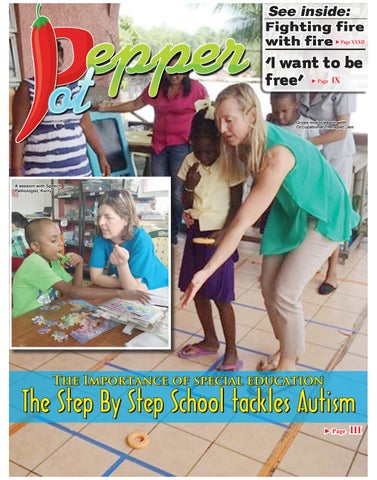
Gross motor lesson with Occupational Therapist, Jen
A session with Speech Pathologist, Kerry
The Importance of special education
The Step By Step School tackles Autism ► Page
III
II
Editor’s note
This week’s Pepperpot is one of those editions where, while we stick to a general theme, we could not help but incorporate a variety of stories that combine to make a unique mixture of what our native Pepperpot represents. As both Indigenous Heritage Month and Education Month come to a close, we include some stories that focus on both areas. Our lead story highlights the
importance of special education and looks at how one institution is placing focus on an often overlooked group of personsthose living with autism. We also look at the efforts by some teachers to return to their homes in remote communities to instil knowledge in the children there, thereby giving them a fighting chance to excel and move on to access opportunities that are
Chronicle Pepperpot September 24, 2017 otherwise far from reach. Then there is the story of a young footballer who wishes to live his life as an openly gay man, but fears the discrimination that could threaten to end his career. This story is a harsh reminder of the distance Guyana is yet to go as regards LGBT and other issues, and begs the question of when this would change. These, along with stories on health, women empowerment, sport and other interesting topics are sure to equip you with worthwhile, entertaining content for your Sunday reading.
Returning to serve …young trained teachers boosting students’ performance in Pomeroon schools AS the new school term opened on September 4, 13-year-old Dane Richards joined scores of students who started their secondary education at the Anna Regina Multilateral School (ARMS) in Region Two. Securing a spot at ARMS, noted for producing top CSEC performers, is quite an achievement, but for Dane, it is beyond a personal success. He is reportedly the first student from the Indigenous community of Akawini in Pomeroon, to receive a pass to the premier secondary institution. His parents even relocated from their home and business to facilitate Dane’s schooling at ARMS, situated at Cotton Field, on the Essequibo Coast, and many miles away from the riverain village. There is a dormitory at ARMS, but Dane’s family felt it more convenient to re-
scheme to attract teachers to low-performing schools and those in the hinterland. To encourage teachers into the hinterland, the CoI also suggested consideration of temporary holding and close-ended appointments or contracts for at least two years rather than one year. “Such would allow them to be available for training, which should be mandatory, during the long vacation. Also, it has been reported Dane Richards and Shinika Fredericks flanked by Head Master - L(ag) Tristan Joseph and Grade 6 Teacher R- Daniel Gildharie at graduation last July (Ministry of Indigenous People’s Affairs photo)
2017 NGSA stirred great excitement in Akawini
locate in support of their son’s education. Back in the community, Dane’s success not only sparked excitement, but a renewed sense of hope and motivation for other students who now rest their educational dreams and aspirations in their Grade Six Teacher, Daniel Gildharie. He is a 21-year-old trained teacher of the Baracara Primary School (Annexe). Dane was one of six students who Gildharie tutored and who sat the National Grade Six Assessment last April. Another student, Shinika Fredericks, gained a spot at the Abrams Zuil Secondary. This young teacher returned to serve the community just over a year ago after completing a two-year Associate Degree in Education at the Cyril Potter’s College of Education, Turkeyen Campus. Each year, CPCE produces over 2,000 trained teachers, but most are reluctant to take appointments at hinterland schools. Even those from native communities seem unwilling to return and serve, instead opting for coastal employment. It is challenges like these that place hinterland students at great disadvantages in accessing facilities, opportunities and educational services, comparable to those in coastland schools. A Commission of Inquiry (CoI) into the local education system, which concluded last July, reported an unfair distribution of educators, and suggested an incentive
that renewal of appointments or contracts for such teachers takes a long time and subsequent payment much longer,” the COI indicated. At Akawini, Gildharie is one of three educators, including the headteacher, who serves at the Baracara Annexe, which has a student population of 77. There is another school, the Akawini Primary, located about one mile from the Annexe. Though he was born and grew up in Akawini, Gildharie relocated to the Upper Pomeroon and attained his secondary education at the 8th of May Secondary School at Darthmouth Village on the Essequibo Coast, where he emerged the top graduate. He returned to Akawini and taught for one year before he enrolled at CPCE. After completing the teachers’ training, he again returned to serve at Baracara. CHALLENGES AND OPPORTUNITIES “Teaching in these locations is very challenging, but I returned because I saw a need to work with the children here, and to try and make the best effort to help them improve their education, and ultimately their lives and that of their families and community,” Gildharie said. He related working late into the nights, sometimes with the aid of a lantern, to prepare his teaching modules for classes. Though the teachers’ accomodation is equipped with solar, power supply is sometimes unreliable. The remote location with no access to electricity or modern technology is often a deterrent for young trained
teachers, and the meagre ‘hardline’ allowance is hardly an ideal incentive. In the meantime, teacher Gildharie observed that students are poor at reading and writing, and while some parents show interest in their children’s educational advancement, there are others who appear unconcerned, and this, he personally believes, is one of the factors affecting performance. However, Gildharie is adamant that students can overcome these challenges with support of the entire community. He noted the cooperation and commitment of the Akawini Village Council which actively advocates for text books and other supplies for the teachers and students. The school feeding programme has also been credited as a positive move in Akawini, as it has improved the students’ attendance. Meanwhile, in the Upper Pomeroon, another hinterland school, Jacklow Primary, is yielding outstanding students’ performance at the NGSA with the aid of highly-qualified teachers who have returned to serve their community. At the April 2017 sitting, one student earned a spot at the St Joseph’s High in Georgetown with 498 marks, while six others were awarded places at ARMS. The headteacher, Rajendra Pershad, is a University of Guyana (UG) graduate who continues to work with the community. The last Grade Six class was also taught by Demetria Alphonso, a 20-year-old trained teacher who remains in her community to serve. Jacklow has also reported an improved attendance with the school feeding programme. A 2017 mid-year report of the Ministry of Finance indicated an increase in the catchment of the school feeding programme. The hot meal initiative currently reaches 22,475 students across 165 schools in the hinterland, and, by the end of 2017, it is expected that an additional 2,616 students from 47 hinterland schools (nursery and primary) will benefit. The breakfast initiative under this programme is on-going in 36 schools on the coastland, and expansion will continue in the second half of the year as well, the report stated.
Chronicle Pepperpot September 24, 2017
The Importance of special education
III
The Step By Step School tackles Autism By Gibron Rahim EDUCATION is never a one-size-fits-all. Every child has different educational needs. And every child has the right to have those needs fulfilled to the greatest extent possible. As we approach the end of Education Month 2017, an important branch of education must not be neglected – special education. Operating through the Step By Step Foundation, the Step By Step School for children along the autism spectrum is one of the special education institutions that are changing the lives of its pupils in Guyana. The Step By Step Foundation School is reflective of the essential role of special education in the overall education system. Guyana’s forward movement in special education, notably for children along the autism spectrum, should not be surprising
one-on-one interactions with a tutor. Group sessions are also conducted every day and Beshpatty relayed that these have proven themselves as useful as the individual sessions. The principles and techniques used by the school aim to foster basic skills such as eye contact, listening, verbal communication and imitation, as well as, complex skills such as reading, writing, mathematics, and conversing with and understanding another person. These are all areas that children with autism typically struggle with.
Posing for a group photo (All photos courtesy of Step By Step Foundation)
listening to a child read or write when they could not speak or hold a pencil before. These tasks that we take for granted are momentous for the child with autism. Those occasions where the children rise to the challenges of life within the autism spectrum are “the most rewarding and amazing events for a parent or a tutor,” she said. Beshpatty’s role as a special education teacher has much personal meaning to her. Her son, Sameir, now 14-years-old, suffers from autism. Her journey to finding an answer for what was wrong with her son when he was just two years old, is
er the cost of the school. The Step By Step Foundation is a registered charity and relies almost exclusively on the generosity of its numerous donors. There is a high financial cost associated with the education the school provides, primarily because a low pupil to teacher ratio is demanded. Fortunately, she said, the Ministry of Education has recently provided them with three teachers whose salaries they cover, helping to reduce their costs. Moreover, the school’s three US-based consultants, whose inputs are essential to maintaining a high standard at the school, provide their expertise and skills at no cost. Another pressing concern is the size of the present school’s site which is located in Bagotstown, East Bank Demerara. Ismail explained that there are many children on the school’s waiting list who cannot be admitted because the school is filled to capacity. “We are now actively fund-raising to build a new,
what made her life take on a new meaning. “It turned into a passion for finding a way to give him the best quality of life within the spectrum of autism,” she said. “A passion that still burns to this day because as he reached each goal set for him, a new one is added.” She expounded that, for her, it would be a sin to not share the knowledge and experience she has gained over the years and make a difference in the lives of other families.
bigger and better school,” she said. Special education is undoubtedly necessary to providing every child the opportunity to live their very best life. Though, as Dr. Ismail noted, the preferred policy is to include children with special education needs in mainstream schools, it is not possible for all these children, particularly those with moderate or severe conditions. “It is for this reason that we need special schools for those children, schools such as Step By Step School,” she said. More information about the Step By Step School and the Step By Step Foundation can be found at stepbystepguyana. org.
Fine motor lesson with our occupational therapists
considering how much has become known about autism in recent years. We now know that it is possible,with their special educational needs met, for children living with autism to have a very high quality of life. Dr. Suraiya Ismail, Chairperson of the Step By Step Foundation and Ms. Anjalena Beshpatty, Senior Tutor of the Step by Step School, took some time to inform the Pepperpot Magazine about the functioning of the school and the challenges it faces in meeting those special educational needs. SPECIALISED NEEDS Beshpatty noted that the school uses the applied behaviour analysis teaching method. This method has been scientifically validated and is dedicated to understanding how the actions and skills of children with autism are affected by the environment. She elaborated that ‘environment’ in this case “includes any influence, physical or social, that changes or is changed by one’s behaviour.” The school, she said, sets individualised programmes to meet each child’s strengths and weaknesses at all developmental skill levels. The school’s tutors work under the guidance of the school’s three US-based consultants, led by Dr. James Ellis. There are structured classroom sessions every day where each child is able to have
ALL IN A DAY’S WORK A typical day at the school, explained Beshpatty, begins at 08:00hrs for the tutors. They arrive early to prepare for the arrival of the students at 08:30hrs. One-on-one sessions begin from the students’ arrival to 11:00hrs. From 11:00hrs to 11:30hrs students receive individual gross motor sessions followed by small social group sessions. Then, from 11:30hrs to 12:00hrs, they have lunch, which also acts as a structured lesson to teach independence at mealtime, Beshpatty said. After lunch, the children are divided into three groups for more structured learning in a social environment. Finally, from 13:00hrs to 14:00hrs the children return to the classrooms where they receive more one-on-one learning sessions and also work on self-care programmes for their independence. After the students are dismissed at 14:00 hrs, the tutors spend an hour preparing materials and programmes for the next day. ACHIEVEMENTS There are often moments that affirm the school’s importance. These achievements, Beshpatty explained, include having a conversation with a child who could not speak before, seeing a child sit and eat independently, or getting dressed by him or herself, and
CHALLENGES FACED The school has its share of difficulties. The primary challenge Dr. Ismail told the Pepperpot Magazine is fund-raising to cov-
IV
Chronicle Pepperpot September 24, 2017
FILES E S A C COURT
Unauthorised construction
Insanally loses to City Council
Federal Supreme Court upturned High Court decision THE Town Clerk of Georgetown was victorious in a court battle in 1959 which resulted in the High Court ordering an injunction, restraining appellant Insanally from making further alterations or additions to his building in breach of the Ordinance and Bye-laws. But Insanally appealed and the Federal Supreme Court after a hearing which lasted four days found that the Georgetown Town Council, the respondent, had no locus standi in proceedings for an injunction, and that the Attorney General would have been the proper plaintiff. The appeal was allowed by the Federal Supreme Court, constituted by Chief Justice Hallinan and Justices of Appeal, Lewis and Marnan. Dr. Fenton Ramsahoye, Q.C., and Mr. Clarence Hughes, Q.C., appeared for the appellant while Mr. C. Lloyd Luckhoo, Q.C. and Mr. S. Rahaman, represented the respondent. Delivering the judgment Chief Justice Hallinan said, The Georgetown Town Council, on September 1, 1959, issued a summons in the Magistrates’ Court against the appellant under Section 136 of the Public Health Ordinance , Chapter 145 [B.G.], for breach of that Ordinance .
The Building Inspector had visited the appellant’s premises, Lot 9, Camp Street, Newburg, and found that he had extended the building on the northern side by a structure, 8 feet 6 inches x 47 feet 6 inches, so that a building whose authorised area was 767 square feet had been increased by 408 square feet. After numerous adjournments in the magistrates’ court, the appellant, during the absence of the Town Council’s lawyer, succeeded (in circumstances which reflect little credit on the court and still less on the appellant) in amending the summons so that the area, the subject matter of the offence, was reduced from 408 square feet to a mere area of some 67 square feet; where upon the appellant quickly pleaded guilty and the magistrate fined him $10. According to the Chief Justice, even after the case, in the magistrate’s court had ended, the appellant continued to extend his building, and by February 17, 1960, the area of unauthorised building had reached 408 square feet. The Town Council then launched the present proceeding in the name of the Town Council claiming a declaration that the appellant had, by altering and adding to the building, done acts of nuisance and was in breach of the Public Health Ordinance and
By Abdool A. Aziz ‘CHINEE’ would sit on his concrete fence every Friday at 13:30hrs. He would watch the Estate’s Land Rover pass, on it was the metal canister containing the workers’ wages. He has a bout of Adrenalin Rush. HE MUST GET THAT MONEY! He planned a heist but needed an accomplice, and found one in Kendo. A kleptomaniac and ex-con Kendo was recently released from jail for burglary. He jumped at the idea. At a lonely spot on the Ruimzeigt Highway, at about 12:45 hrs, Kendo will lie on the roadway as though dead. The rover will stop; the armed guard will jump out to investigate. Kendo will spring up and wrestle the gun away. ‘Chinee’ will take over the
of the Bye-laws made under the Georgetown Town Council Ordinance, Chapter 152 [B.G.]; also the Town Council claimed a mandatory injunction that the appellant should pull down the unauthorised building, and an injunction to restrain him from doing further alterations or additions. The Court granted the Town Council the declarations as claimed and also granted an injunction to restrain the appellant from doing and making further additions or alterations. Continuing, the Chief Justice noted that it can be said at once that the declaration granted by the court cannot stand. There was no evidence of nuisance and no authority has been cited to us where a declaration was made in civil proceedings that the defendant had committed a criminal offence. On principle, said the Chief Justice, I am of opinion that it is a wrong exercise of the court’s jurisdiction to give a declaratory judgment of that kind. However, had this action been properly constituted, an injunction might have been an appropriate remedy; A.G. v Ashbourne Recreation Ground Co. (1) v Wimbledon House Estate Co. Ltd. (2) are cases where suits were successfully
driver’s seat, he will drive the vehicle away to some bush on a lonely road. And the money will be all theirs. When they executed the act, the gunman was feeble; he was no match for the burly Kendo. The driver ran for cover – scared to death. With the shotgun, they blew open the ‘strong box’ and the minted notes dazzled their eyes and set their hearts on ‘cloud nine’. ‘Chinee’ dipped up a few wads and placed them in a bag. He told Kendo to hit the train line. ‘Chinee’ threw the empty canister and gun into the swamp. He took his money. To where? No one knows to this day. ‘Chinee’ went to the estate a few hours later, he saw the rage of the workers demanding their pay. He asked “Wah appen, wa appen?” One worker said “Deh Tief we money. Whiteman got to find money
brought by the Attorney General on behalf of the public to restrain, by injunction, infringement of statutes dealing with public health and bye-laws made thereunder. In the Ashbourne case (1), Justice Buckley, [1908] 1 Ch. at pp 160-107) first stated the general principle that where a liability is created by statute and a remedy given, the statute can only be enforced by the statutory a remedy. But he says: “there is at least one exception to the general rule . There may co-exist a remedy by injunction to protect rights. It cannot be disputed after Cooper v Whittingham (3), that if a plaintiff is suing in a personal right to himself he may be protected by injunction; the Attorney General suing in respect of the invasion of the public rights has at least as large a right to invoke the protection of the court.” Continuing his judgment, Chief Justice Hallinan explained that the main ground of appeal is that the respondent had no locus standi, except at the relation of the Attorney General who should have been the plaintiff in these proceedings. It was submitted that the acts alleged against the appellant did not infringe any right vested in the Town Council either under Chapter 145 or under Bye-law 15, made under Chapter 152. The case of Davenport
to pay we.” “Who tief money?” asked the bare-faced bandit “Me Nah no!” They said. Kendo strolled on the train line singing. He saw a policeman with a gun. “Hello affisa! Anything wrang?” The constable said, “You see anyone with a gun?” “Nah man. Only Police carry gun,” Kendo walked on. “Ah gwine down to Parika to get some wuk.” “Carry on,” barked the Officer. Kendo began to sing, but then the policeman reacted “What you gat in de bag?” Kendo dropped it on the tracks. “Some old clothes and stale bread.” The cop opened it. “Ah ha! Drop to your knees!” It didn’t take long for the criminal to ‘sing’ following some scare tactics, and
By George Barclay
Corpn. v Tozer (4) is clear authority in support of this ground of appeal, and I am unable to distinguish it from the present case. In the Devonport case (4), the Corporation alleged that the defendants were laying out highways in “new streets “ which did not comply with the borough bye-laws as to width. The suit failed; Collins, M.R., stated the reason thus ([1908] 1Ch. At p.762}: “Where the local authority which have certain special rights to sue in their own name for certain special remedies, but have not done so, and are trying to put in suit a public wrong, they must do it in the recognised way, namely, at the suit of the Attorney General.” Before deciding in favour of the appellant, Chief Justice Hallinan cited an interesting passage from the judgment of Lush L.J., in A.G. v Kerr and Bull (1914), 79 J.P at p. 53): “Obedience to bye-laws even as to the construction of a dwelling house, is, I think, a public duty, and disobedience to their instructions is prima facie a public wrong ….” Ruling the Chief Justice said “I think the judgment in this case should be set aside and judgment entered for the appellant with costs here and below. Justices Lewis and Marnan concurred.
the mastermind was grabbed. ‘Chinee’still wearing his off-white vest and wooden slippers zipped his lips. No question answered. No defense offered at the trial. TOTAL SILENCE. Both bandits were sent to the Mazaruni penitentiary. Years of hard labour and lashes with the horrible cat – o – nine tails [a whip with nine leather staps]. This form of punishment ‘breaks’ a man. ‘Chinee’ died a cripple in prison. Kendo came out a ‘skeleton’ dying later at the hands of villagers who caught him stealing fowl. To this day no one knows where ‘Chinee’ hid the loot. It is rumoured that one of his cousins used the money to open a lemonade factory. Only one-third went back to the estate. The cat – o -nine- tails was banned. CRIME DOES NOT PAY!
Chronicle Pepperpot September 24, 2017
V
#SupportCreativity
By Subraj Singh
Kaori Fujino’s “You Okay for Time?” and the power of translation BECAUSE Guyanese readers tend to read literature that is written in English, they never come across the sea of fantastic literary work that exists in other languages. Arabic, Japanese, Russian, Burmese, Hebrew and many, many others are languages that are alien to most people in Guyana and the wider Caribbean, are used to tell amazing stories. Therefore, translation is crucial to understanding the literature of today’s world. It is through translation that readers are able to be exposed to a variety of forms, subjects and literary styles that exist beyond the English-speaking world. It is through translation that we truly begin to understand and to know the world. It is through translation that I was able to discover and enjoy the wonderful short-story, “You Okay for Time?” by Japanese writer, Kaori Fujino, who is a part of this year’s International Writing Programme. Fujino’s story can be found on Granta online, where it has been translated from Japanese by Ginny Tapley Takemori. One of the reasons why I like this story so much is because it was an early reminder, coupled with the myriad of beautiful readings being conducted by IWP (The International Writing Programme) writers, that translated literature is a truly profound thing that those who read only works written in English are completely missing out on. Fujino’s story also resonated with me because, in my interpretation of the tale, it is really about a relationship that exists between two friends who do not see each other for a while. As I am currently away from home, the story reminded me of my own relationships that currently exist in a limbo-land between two continents. I also felt that other Guyanese readers might relate well with “You Okay for Time?”, given that almost every Guyanese has relatives who live abroad. How has distance impacted our relationships with the people we love and care for? How do we sustain these relationships, with these people who we do not see for years and years? How do we nurture them? How do these relationships benefit us and them? These and more are the questions Fujino’s stories explore. “You Okay for Time?” begins with the narrator telling us about her best friend who is newly married. The narrator has sent her friend a gift in the form of a sansevieria plant (also known as the snake plant or money plant). Early on, the friend is clearly dedicated to the plant, wanting to water it more than necessary and taking special care to separate the plant into several plants when it gets big enough, which is juxtaposed with the narrator’s initial thoughts that the friend would be unable to keep the plant alive for very long because she has a history of being unable to care for plants. This might seem like a simple thing, but what does it tell us about the women and about their relationship? Anyone who has received gifts from someone they’re close to who belongs to the Guyanese diaspora knows the emotional value of these presents. So, the friend’s ability to care for something her best friend has sent her is really unsurprising since, on a symbolic level, it represents her very relationship with the narrator – which is something she values immensely, as seen in the way she constantly calls to talk to the narrator about her husband and family and, sometimes, even when she has nothing to say (and only cries into the phone).
The narrator notes that “it was always she who called”, and this is enough to tell us which of the two women values the relationship more and this, by extension, also informs us of the value of what the plant represents to that person. The narrator is the more detached of the two and might even be regarded as unreliable, subtly judging the actions of her friend without appearing to be explicitly judgmental. The friend is clearly the needier of the two, as seen in the ways she recounts to the narrator the faults in her marriage (lack of sex, not really getting to know her husband before marrying him, etc.) and the fact that she is always the one to share so much information about her private life with the narrator who, in turn, shares the information with us, the readers, while withholding details about her own personal life. Despite all that is going on in her life, how does the friend manage to remain (appear?) stable and happy? There must be a source of sustenance for her, a source of nourishment, a source of the kind of care and attention that is required. Could it be that despite being so far away, it is the narrator who provides this to her through her long chats on the phone? The relationship presented here is a complex and tricky one to navigate, especially given the way the narrator is presented. In a very slight manner, it is indeed reminiscent of diasporic long-distance relationships, of those Guyanese who refuse to leave where they are but yearn to maintain those relationships that have been left in their home country and, truly, still try to sustain those relationships as a form of remedying whatever trials they might be experiencing in their adoptive country. This theory is supported by the presence of the sansevieria plant which has air purification abilities and is used in feng shui to counter negative vibrations. If the plant represents the friendship between the two women and is traditionally regarded in Asian culture as being a purifier, and being able to remove negative energy, then the friend’s nurturing nature of the plant becomes obvious. Her need to keep the plant alive and to allow it to thrive reflects her need to wipe out the negative energy in her life through her conversations with the narrator. She cares for the plant because she cares for her friendship. She allows the plant to thrive because she needs the relationship to thrive. Perhaps, her friendship and those conversations with the narrator are the only ways of counteracting the reality of the negative experiences in her marriage. Perhaps this is what makes her truly happy. Fujino is regarded as a horror writer in Japan – a label that she does not seem to deem applicable to all of her work. In “Are You Okay for Time?” something happens at the end of the story that skims it over the top of the realm of horror. The sansevieria plant, representing this one-sided relationship between the two friends becomes transfigured into something that even the narrator could not have imagined. At the climax of the story when she comes face to face with the horror that she, in a way, has helped to create, we get a jolt of the terror that has caused Fujino to be regarded as a horror writer. But her work is about so much more than simply fear. This single story, for example, is about friendship, relationships in general, the effects of distance between people, and the effects of transfiguring pain and anger into something
else. Ultimately, because I could only have read it once it was translated, the story also
exists, in my mind, as a symbol of the power of translation.
VI
Chronicle Pepperpot September 24, 2017
Propagating the Memory of Indigenous Hero, Stephen Campbell By Francis Quamina Farrier
some event named after him. Maybe the new NTC (National Toshaos Council) SecretarASK the average American iat could be named after him. who Geronimo, Cochise, These are some ideas I have Sitting Bull, Chato or Chief been trying to sell but this Crazy Horse were, and they needs to be discussed.” will tell you that they are Diplomat, Indigenous Huall great Native American man Rights Activist and Poet, Heroes. But ask the averMercedes Pierre said, “On age Guyanese who Stephen the subject of Mr. Stephen Campbell was, and they will Campbell, I think more has likely respond with a mysto be done to showcase our tified look and ask, “Who Indigenous heroes by way of is that?” education and the promotion So let me give the answer of cultural events such as stoimmediately: Stephen Camprytelling, plays, dances, songs bell is Guyana’s premier Inand panel discussions, that digenous National Hero. And highlight the contributions while he passed away in May of Indigenous leaders such as 1966, there is, unfortunately, Mr. Stephen Campbell.” not enough being taught to Retired Teacher, Scout the present younger Guyanese Leader and Theatre Guild Adgeneration about this great ministrator, Aileen Hintzen, Guyanese Hero. stated that “Nothing much is I’ve decided to do this known about this Indigenous particular topic in this week’s Hero, except his immediate feature of mine, as Indigenous family.” She recommends Heritage Month 2017 draws that, “In this Heritage Month, to a close. Part of the reason the social-media and all the why September was chonewspapers, should have an sen for Indigenous Heritage article about this hero.” Month, is because it was on Educator and Author, Dr. September 10, 1957, that SteLaureen Pierre, has for years, phen Campbell first entered Hon. Stephen Esterban Campbell, MP, presenting the Amerindian Land Rights Petition to the British Secretary of been promoting the works and the British Guiana Legislative memory of Stephen Campbell, State, Hon. Duncan Sandys, in London, England, in 1962, after the two had a one-hour-long meeting Council (Parliament). primarily with lectures and Stephen Esterban Campessays. “I suggest that activist Campbell, President Cheddi Jagan told receiving their Land Titles. That was even bell was, by the wishes of the Indigenous that gathering at the Amerindian Hostel before British Guiana had gained its Inde- organisations... devote some of their energies Peoples of Guyana, made a National Hero. on Princes Street, Georgetown, which in- pendence in 1966. and resources to promoting the image and He was born in Santa Rosa, Moruca, in cluded members of the Diplomatic Corps, A very respected politician, Stephen struggle of Stephen Campbell.” She added, Region One, on December 26, 1897, and about his struggles among his own political Campbell attended the British Guiana “These organisations are well placed to do died in Toronto Canada, on May 12, 1966, party comrades, to have Stephen Campbell Independence Conferences in London in so since they can choose to be politically having gone there for medical attention. He declared a National Hero of Guyana. “Some 1962, 1963 and 1965, where he continued to impartial about their work in this sphere.” was buried in Canada. His, was a life of party members were saying that Campbell champion for the Land Rights of the Indige- Dr. Laureen Pierre also noted, that “There is struggles and achievements, mainly for the was not a member of the PPP, that he was nous Peoples of British Guiana. always the need to include age-appropriate education and the Land Rights of Guyana’s a member of the United Force, and that he On that first visit to London, Stephen information about national heroes in the First Peoples. should not be elevated to National Hero,” Campbell took with him a petition which school curriculum,” adding that, “If Stephen Although Stephen Campbell did not President Jagan told the attentive gathering. was written on a long scroll and signed by Campbell is not included in current texts, fight his battles with arrows and bows and However, President Jagan said that he was dozens of Indigenous leaders of the day. He there should be space for him in the next guns for justice like his North American finally able to win his case over his dissent- presented it to the British Secretary of State, edition.” cousins, he is regarded as a hero by the ing party comrades, and so, Stephen Ester- Hon. Duncan Sandys, in London, after havA granddaughter of Stephen Campbell, Indigenous Peoples of Guyana. But his el- ban Campbell was officially elevated to the ing a private, one-hour meeting with him. Anna Correia Bevan, expressed the view; evation to the status of National Hero was status of a National Hero of The Cooper“I don’t think enough is known about him, not without battles, according to President ative Republic of Guyana, and September TRIBUTES especially the younger people.” Cheddi Jagan, who in addressing a gathering was officially accepted as the Indigenous A large portrait of Stephen Campbell has In preparing this feature article, I apat the Amerindian Hostel on Princes Street, Heritage Month. proached a few Indigenous Guyanese who been on display at the National Museum on Georgetown, on September 10, 1993, said have had an interest in Stephen Campbell North Road, Georgetown, for many years. that he had a tough battle with some of his HIS LIFE over the years, and solicited their opinions There are also two plaques dedicated to fellow comrades in the People’s ProgresStephen Campbell lost both his parents regarding the fact that so little is now known his honour and memory at Santa Rosa and sive Party (PPP), to accept his proposal to while very young and was brought up by a about Stephen Campbell, who was such a Arakara on the Moruca river in Region One make Stephen Campbell a National Hero grandmother. He had his early education at well-known political personality, back in the (Barima –Waini). There is also a plan to have of Guyana. a portrait of Stephen Campbell mounted in the Santa Rosa Primary School which was 1960s. Here are their responses; Campbell’s work among the Indigenous run by Catholic nuns in those early years. Fourth Vice President and Minister of the Ministry of Indigenous Peoples’ Affairs, Peoples goes back to the early 1920s as a His working life included teaching and Indigenous Peoples’ Affairs, Hon. Sydney in Georgetown, sometime in the future. teacher and catechist in the Pomeroon Riv- farming and other wage-earning pursuits. Allicock, MP, expressed his views with At this year’s Indigenous Month Exer District. Later, he worked in the South He entered politics somewhat late in life, in the following statement; “I do not think hibition at the Sophia Centre in GeorgeRupununi. He also prospected for bauxite 1957, at age 59, as a member of the National the great Indigenous fighter, Mr. Stephen town, there was a section at the Indigeand at one time, was a coffee farmer. He Labour Front (NFL) winning the only seat Campbell, is well known through Guyana, nous Village, which showcased `The Life also served as a manager at the Government for that political party and making history especially in the hinterland among the and Work of Stephen Esterban Campbell’ Trade Store at Kamarang on the Upper as the first Amerindian to win a seat in a young. [There should be] short stories de- and other Indigenous Guyanese, which Mazaruni River. And throughout his many General Election in British Guiana. picting his family and life, with his portrait was sponsored by the Ministry of Indigetravels around the country’s hinterland, he Campbell later joined the United Force published and given to every community nous Peoples’ Affairs. This may very well championed the many causes of Guyana’s and won in the 1961 and 1964 General and school; a statue to be placed in appro- be the catalyst for further on-going series First Peoples; Land Rights being the most Elections, all the while, working tirelessly priate places; maybe to have a scholarship of projects to enlighten more Guyanese, important. for Indigenous Land Rights, which resulted programme of two youths every year, male especially the youths, of one of the counAn admirer of the life’s work of Stephen in a number of Indigenous communities and female. [There should probably] be try’s great heroes.
Chronicle Pepperpot September 24, 2017
VII
Sore throat
WE all suffer from a sore throat at some time. But while this seems normal, the cause and evolution of the disease may vary quite a lot. Included in the respiratory system disorders, the acute or chronic condition arises from causes such as infection, allergies, tumors and drug reactions. A sore throat is usually a prominent symptom of a wide variety of diseases among which are, rheumatic, scarlet and relapsing fevers, (the latter is spread by a tick). Others include polio, tetanus, tonsillitis and Vitamin B deficiency. What we commonly call the throat is really the oropharynx which is visible at the back of the mouth, situated below the nasopharynx and above the larynx (voice box). Tonsils are spongy tissues at the back of the throat,composed mainly of lymphocytic cells.There are three types. The palatine tonsils usually referred to as just the “tonsils”, are visible between the arches that extend from the uvula (bell-shaped structure at the centre of the opening) to the floor of the mouth. The pharyngeal tonsils, often called the adenoids, lie at the back of the throat. These generally shrink as a child grows, but may have to be surgically removed if it becomes enlarged or inflamed. The lingual tonsils are on the upper surface of each side of the back of the tongue.
The tonsils’ function is to protect the pharynx (common entrance to the gullet, nose and wind-pipe) and the rest of the body from infectious organisms (bacteria, viruses and fungi). Infection of the tonsils, called tonsillitis, may serve as a source of infection elsewhere in the body. The tonsils form lymphocytes which are white blood cells that produce antibodies to combat harmful organisms trapped in the mucous membrane lining the throat. In fact, the lymphocytic tissue circumscribing the throat actually represents the first line of defense against invading pathogens (germs that cause disease). In reality, the HIV virus it too frail to kill anyone. Most people who die from AIDS succumb generally as a result of either pneumocystis carinii pneumonia, or cancer. These situations develop because there is the development of
special white blood cells known as Tee Four Lymphocytes which have the responsibility of providing immunity against the aggressive germs. The AIDS virus also invades and kills Tee Four Lymphocytes leaving the body vulnerable.These protective cells are manufactured in the tonsils,bone marrow and spleen. A sore throat that is not responding to conventional treatment may be gonorrhea of the oropharynx contracted from oral sex. Also occurring sometimes is diphtheria which begins gradually with fever and sore throat and swollen lymph nodes (glands) in the neck. A thick white membrane forms on the tonsils and may obstruct breathing to necessitate the surgical opening of the windpipe. Heart muscle and nerves may be affected, causing heart failure, paralysis and sometimes death. The throat communicates with the middle ear, located behind the eardrum, by means of a passage called the Eustachian tube. This is why the pain of an ear infection is occasionally experienced when the victim has a cold. With a sore throat, the typical complaint is a raw, dry or burning sensation and pain on swallowing all but cool substances, such as ice cream. If the infection spreads downwards to the larynx, a hoarseness and temporary loss of voice may ensue. Regardless, even when the symptoms seem relatively mild, no one should underrate a sore throat.
VIII
Chronicle Pepperpot September 24, 2017
GPL needs to focus on addressing consumer complaints with same commitment they give to Macro Projects
ONE of the major consumer concerns has always been the lack of reliable and affordable electricity supplies. Except for an infinitesimal number who use so-
lar power or use their own generators at all times, the overwhelming majority of consumers depend on the Guyana Power and Light Inc. (GPL) for their electricity
supplies. From the large number of complaints both the GPL and the consumer bodies receive from customers, it is fair to conclude that GPL would have to keep trying harder and harder to improve their service. It would be impossible to give all the various kinds of complaints consumers suffer but we will mention a few of the most common. There is the question of billing, the issue of meter-reading and estimated supplies, and the fact that it is not always easy to contact GPL by telephone. Sometimes, also, there would be disconnections without consumers having received a bill or disconnections after customers would have settled their bills. But the overarching complaint is the blackouts, sometimes running for very extended periods. The effects of blackouts are far-reaching: students are unable to study; educational establishments are unable to run their classes; thousands of children do poorly or fail their Caribbean Examinations; homeowners and small shops suffer great losses and inconveniences with the destruction of perishable goods, such as fish and meat owing to their freezers and refrigerators not functioning; small shops may not be able to open owing to the lack of lights and manufacturers suffer losses in labour costs and production output. The sufferings of old and sick people are intensified by blackouts. Sometimes blackouts and power surges destroy electrical equipment. The work of the Judiciary - lawyers’ offices and judges’ chambers - is stymied by blackouts. In other words, the GPL blackouts deeply affect the social and economic life of the country. The bitterness of public complaints against GPL is intensified because the public feels that GPL could do better if it made the required effort. The upper echelons of GPL management and governments over the years have been conscious of the problems and have aspired for fundamental solutions.
Solar power, wind power or a nuclear power station have never been considered feasible replacements for the present system which depends on fossil fuels. Governments, as well as GPL, since the 1970’s have opted for hydropower. The attraction of hydropower is that power would be generated from one of the many waterfalls which abound in Guyana. The main capital costs to birth a hydropower system would be roads, transmission cables and generation equipment. The technology for hydropower is not esoteric and is easily available. The main stumbling block has been finding investors for an adequate hydropower station. Under the Presidency of Mr. L.F.S. Burnham, a large hydropower plant was being built in the Interior and under President Jagdeo, the Amaila Falls project was the nearest the country ever got to hydropower. Unfortunately, both projects were the victims of political discord. The first one was a victim of the Cold War machinations and the other was a victim of the mindless political embroglio which sometimes submerges Guyanese life. Last year, there was brief talk of resuscitating the Amaila Falls project but it became muted. GPL is thus thrown back unto its own resources in its struggle to maintain its present standards and hopefully to make some small strides forward. In this effort, GPL has been greatly favoured by the unexpected fall in fuel prices and of this windfall of funds gained, GPL would be spending $11.5 billions in upgrading. We will mention the main elements of this upgrading so that the public would be aware of what they should expect in the various locations: There would be the installation at Canefield, Berbice, of a 5.5-megawatt heavy-fuel generator; at Anna Regina, a 5.4-megawatt power plant; and at Bartica, a 3.5-megawatt power station. In addition, to further improve electricity supplies in Georgetown and the countryside, four substations would be built at Parika, Wales, Williamsburg in East Berbice and at Kuru Kururu. There would also be the upgrading and expanding six substations at No.53, East Berbice; Garden of Eden; Vreed-en-Hoop; Edinburgh, WCD; Kingston and Sophia. There would also be 47 kilometres of new transmission lines covering these areas. The GPL upgrading we have mentioned above are all macro projects and we welcome them but it is the smaller complaints of GPL’s deficiencies which directly and immediately affect people’s lives. GPL must consistently address these micro matters and should do so with immediacy. Most of these micro matters could be easily dealt with, and when there are inexplicable delays, they fuel a rising crescendo of resentment. We enjoin GPL to be more proactive in dealing with and solving consumer complaints.
Chronicle Pepperpot September 24, 2017
‘I want to be free’
IX
Local footballer wishes to ‘come out of the closet’, fears discrimination By Rawle Toney IT is said that there is no room for discrimination of any kind in sport, especially when it comes to race and sexual orientation, but, that notion is often times put to the test, particularly in football; the world’s most popular sport. One such case can be seen with “Steve” (name changed to protect his identity) a Guyanese footballer, who features for one of the country’s popular teams. The conflicted sportsman is wary of hiding in the closet, but fears victimisation from other players, including his own teammates, should he tell the world that he is gay. “I want to be able to say I’m gay without my friends and teammates looking down on me,” Steve told the Pepperpot Magazine. “I want to be able to live in a country where I don’t have to watch over my shoulders on the football field because of someone wanting to be reckless, and dirty, and hit me to cause an injury. It’s very depressing living under a rock, instead of being happy and free.” But, while pointing out his desire to be ‘openly gay’, Steve, who has played for Guyana at both the youth and senior levels, is fully aware of Guyana’s football culture and its allegedly strong position against homosexuals, as well as existing forms of homophobia in other parts of society. “I grew up in the ‘ghetto’ and trust me, there are people that I know all my life who will condemn me should I tell them I’m gay. In Guyana, football is very homophobic and that’s the frightening part. For me, for example, you wouldn’t know I’m gay unless I tell you and that’s the troubling part; acceptance,” Steve said. NO ROLE MODEL There are many openly gay athletes, but Steve cannot look to them as role models, since, they live in countries that he referred to as “more welcoming and understanding within their society”. In Guyana, Steve said, this is not the case. “Imagine, you have a church pastor...leading a march against homosexuality in Linden, and, then there’s the Laws of Guyana that sees homosexuality as gross indecency,” said Steve. Section 335 of the Laws of Guyana, states that “any male person who, in public or private, commits or is a party to the commission, or procures or attempts to procure the commission, by any male person, of any act of gross indecency with any other male person shall be guilty of a misdemeanour and liable to imprisonment for two years.” Despite efforts by FIFA to fight homophobia in football, the sport’s global governing body has not been too successful in their battle. Article 67 of FIFA’s Disciplinary Code of Conduct,does not specifically include sexual orientation, but FIFA has used it to
sanction countries over their fans’ anti-gay conduct. “The home association or home club is liable for improper conduct among spectators, regardless of the question of culpable conduct or culpable oversight, and, depending on the situation, may be fined,” states Article 67 of FIFA’s Disciplinary Code. “Improper conduct includes violence towards persons or objects, letting off incendiary devices, throwing missiles, displaying insulting or political slogans in any form, uttering insulting words or sounds, or invading the pitch,” reads Article 67. In 2015, FIFA fined Chile US$187,149 for “homophobic chants by supporters” and “improper conduct among spectators” that included “homophobic chants” and “homophobic and insulting chants.” In Honduras, the country was fined US$41,589 after fans shouted “homophobic chants” and threw water bottles during November 11, 2016, game against Panama.
and disseminating its Code of Conduct to their Regional Member Associations (RMAs). “We’re not here to condemn or promote anyone’s lifestyle, but we wouldn’t accept discrimination of any kind in our football,” Forde said. According to the GFF President, no one should be discriminated against “regardless of their height, colour or sexual orientation and those Member Associations will have to ensure that they administer the game with the guidelines of those codes of conduct.”
FIFA since November 2015 has fined Mexico US$135,163 for “homophobic chants” among its supporters during matches against the U.S., El Salvador, Canada, Honduras, Panama and Costa Rica. GFF & ANTI-DESCRIMINATION President of the Guyana Football Federation (GFF), Wayne Forde, stated that his federation is in the process of finalising
SASOD AND SPORT Founder and Co-Chairperson of the Society Against Sexual Orientation Discrimination (SASOD), Joel Simpson, admitted that his organisation has not worked specifically with the sporting fraternity with regards to LGBT concerns. “It’s on our agenda, but we have not been able to work in this area due to resource constraints,” he said. “We, however, have been hosting annual sport competitions for LGBT persons, allies and civil society to foster social cohesion with sports as a vehicle for developing respect for diversity. SASOD
offers counselling services to anyone who needs it, especially LGBT people who are dealing with the challenges of coming out to their friends, families, colleagues or the general public,” Simpson said. He highlighted that SASOD is also developing a robust Community Paralegal Programme to “aggressively litigate human rights abuses against vulnerable and marginalised people.” Meanwhile, Steve said that his need to come out is not an attention-grabbing stunt, but for a chance to be himself while playing the sport that he loves. “I love football, I represented this country at a youth level in the sport and so, I believe that I should be allowed to live freely in the game that I love to play; football is more than just a sport for me, it’s what I do to get away from my troubles,” he said. He added “I would listen to the guys talk sometimes about not wanting no [homosexuals] around them. Sometimes I would laugh because they believe homosexuality is contagious, so playing with and against a gay person might make them gay, which is ridiculous.” Steve said that in the same way that he has played against persons who have committed blatant misdemeanours and crimes in their past and no one seems to judge them on these matters, he would love to play the sport as an openly gay man, but is unsure if that will ever happen. “When I hear the players talk about homosexuals, I cringe, but some time or the other, someone must stand up for what you believe and just live free,” he said.
X
Chronicle Pepperpot September 24, 2017
‘Hockey is my life’
– Marzana Fiedtkou and her love for the sport
Pizza Hut GCC central midfielder Marzana Fiedtkou controls the ball in attack
By Stephan Sookram “HOCKEY is basically my life; it is [built] into my daily schedule. If I’m not playing I’m definitely thinking about it.” That is what hockey means to 22-yearold Marzana Fiedtkou, a defender/midfielder of the GCC Hockey Club. At this age, she’s spent more than half of her life playing the sport,14 to be exact, and she is one of the standout performers on the local and international scenes. In an interview with the second generation hockey player, Marzana told the Pepperpot Magazine that the sport is very close to her family, one of the main reasons for her passion. “My entire family played, so there was no doubt that this would be the sport I would be involved with. I was one of those little children running around the sidelines while my parents played,” Marzana said. The Marian Academy graduate who attended lower Sixth Form at the Queens College, went on to gain a scholarship to the Robert Morris University to study and play hockey. “After my second year, the school cut the hockey programme there because of funding so I transferred to the University of Massachusetts Lowell where I graduated with a Mechanical Engineering Degree.” And, while this perfect mixture of academics and athletics may seem like the perfect package, she is all about the team first. “The most important thing to me in
hockey is my performance and my contribution to the success of the team and hockey in Guyana,” she said. “The most memorable moment in my career is definitely Saving one of the Argentines’ goals in the Pan Am cup recently, I think that will forever stay with me.” Even though she has tried her hand in various sports, hockey will always be her first love, she said, adding, “I have stuck with the sport because I have a passion for it that I never lost, even when trying new sports, I never got that sort of feeling as when I am playing hockey.” Marzana encourages young people who may be interested in taking up a sport to try hockey, adding that they may very well get hooked on it, just like she did. “It is considered one of the most overall fitness sport; both physically and mentally,” she said. However, with the Pan American Championships just around the corner, things are beginning to get tough. “Preparation for the tournament is intense, the training is focused and everyone is channelled into the main goal, which is to qualify for the World Cup in Germany next year,” she added. “Personally, the nerves will kick in soon, sometimes when I daydream about the tournament they pop up. I know everyone is anxious to play against the competing countries.” But Marzana is just happy that, even with the ever important competition ahead of her, that she is able to partake in a sport that also brings her so much joy.
Chronicle Pepperpot September 24, 2017
XI
Lost loved ones WE continue this week with our stories in observance of World Suicide Prevention Day which was observed earlier this month. This is the story of Andrea, who lost her father. “It was August 10, 2017, when I decided to write my story. That Thursday was a very difficult one for me. That day completed one year since my father killed himself. After that decision, many thoughts stirred up in my mind. Things I`ve lived and also the many alternative scenarios I often imagine for that night. My father had been continuously suffering from depression for the past 10 years, which was already a reoccurrence. I realised from my father`s patterns that depression comes in waves. There were years of great happiness, months of terrible sadness and days alternating both. He had suffered from deep depression in the late 90s and had to be taken urgently to Canada for treatment. After he was treated, he spent an entire decade, without medication and depression free. In the beginning, it was more of an “I don’t want to see anyone” situation than anything else. He still felt safe around friends and family. My father and I were way closer than I’ve ever been to my mom. He would make an effort to come to my house as long as only a few known people were there. Soon it turned into “I don’t want to be seen by anyone.” When I called he would put on the best voice he had. No one could ever know what was going on inside that house unless those who were there 24/7. There were so many rushes to the hospital; many interventions. I always knew that depression is the outcome of something deeper within. In the case of my father, there was this internal battle where the proud man he was couldn’t live with the decisions that he made. My sister and I offered so many solutions. We played so many scenarios. He could live with me, I could come and work with him, all so that he knew that as long as we love and support each other, we can make adaptations. No. He refused. It was like knowing that darkness is killing you, yet, you decide to live in a cave - and whoever wanted to meet him, had to go right in there. It was a Wednesday night when I got a call saying dad shot his wife. I heard that and I couldn’t believe it. I think I flew from LBI to Lacytown and reached in about 10 minutes. I remember driving and trying to get my husband who was in town to go there and save the day, like he always does, so that I could just arrive and collect my father and deal with police and hospital. When I arrived, my husband was behind
the thick green-heart door, talking through a little strip. I later learned that the gun was loaded and ready, that is why he didn’t enter. I pushed my husband and he pulled me and I told him: “Let me go!” and I entered that living room and stood up looking at my father from a distance of around 15 feet while he held the gun beside his leg. I told him so many things. First, I told him he didn’t have to worry about his wife being shot. We would just say it was an accident or something. I reassured him he wouldn’t be implicated with police. He did not even blink. That look on my father’s face I cannot describe to anyone. It was like he didn’t know who I was and he showed no fear, no anger, no nervousness. He just stood there like a wax figure. When I told him how much I loved him and how much he meant to me, he didn’t give me any kind of acknowledgment. Not a frown, not a nod, nothing. At some point, I did realise somehow that he was done with everything. At that point, I started talking about everything and everyone that could’ve mattered, like my sisters and how they had already lost their mother. I talked to him in English. I talked to him in Portuguese. He just stood there for about 40 minutes just looking at my face. That’s when I told him: “Okay, you don’t want to talk? No problem. It’s going to be me and you here then. I am NOT leaving you. We’re both staying here not talking anything.” The same place I was, bracing the wall, I just slid down and sat on the floor. This is when he made his first move, and that move was lifting the gun to his head. I begged him please not to do that: “Please don’t do this to me… are you really going to do this in front of me?”. That’s when he entered the kitchen, which was just behind him, closed the door and turned off the light. (You see, when I arrived there, I went with full confidence that I was going to solve that mess and get my father to a safe place. In my mind, if there was someone in this world that could do this, it was me. In my mind, I was the apple of his eye and in my heart, he was mine. As I pushed my husband and uncle who were standing behind the door and entered and closed myself just with him in that living room, my dad would never shoot me. Not me! I would calm him, reassure him of his safety and of my love and I would make him put that gun down and go home with me. It didn’t work. Instead, I associate the fact that he went into the kitchen, closed the door and turned off the lights as a response to my plea for him not to do that in front of me) I ran downstairs and told my uncle who was downstairs that dad put his gun to his head. Then we heard a BOOM. I flew up the
stairs and the kitchen door was still closed. I didn’t know if dad was okay, wounded or dead. I was scared to see the truth. My uncle opened the door and I saw his feet and I was already on the floor, crawled to my father’s feet. There is no such thing as killing yourself so that you won’t be a burden. Not in this case, at least. In the case of my father, I can’t say it was so that he wouldn’t be a burden because he shot his wife before. Ever since that happened I changed a lot. I consciously make an effort to observe who can be suffering from depression around me. I try to occupy myself with work and children because I know that if it wasn’t for having to wake up every day, get dressed, to drop children at school, I wouldn’t get up for anything. For months I lay in bed. My husband was an angel throughout this episode. So supportive, patient and kind. I felt I lost my identity. I was born and lived in Brazil and visited Guyana sporadically because I was “Totty Adams’ daughter”. Not anymore. I still feel forsakened. I often think about what I could have done to avoid what happened during and before that tragic night. I pray and talk to God or the Universe asking to at least dream of my dad so I could talk to him, ask him stuff… This worries me now, to observe and detect who might be in a hard situation… maybe for my own good. Maybe to think that I can help somebody will make me feel better about not being successful in helping my dad and also it puts me in the position where I can forget to be depressed myself. - Andrea Adams Below is an anonymous story of someone who has lost a best friend. “The song Jack and Diane by John Mellencamp was our favourite song and we blared it every chance we got. Shout-singing it and playing air drums and pretend guitars until we ended up laugh-singing it, every time. Over and over, our young voices blended in a joyful warble about two kids doing the best they can. We were best friends rather than lovers, but the song was ours, every syllable and note; the song is ours, even 35 years in the future. It will always be ours. Only now I sing it by myself, without the will to conjure make-believe cymbals or imaginary fretboards. I whisper-sing it until I end up choke-singing it, every time. You left me a letter, an affectionate letter that you thought was kind. You said you loved me for being the best friend you’d ever had. You thanked me and wished me a wonderful life as if those words would be a salve for my soul. What you didn’t write; what hangs thick and dark and stifling and shaming is the ‘but’. The unwritten but, the
but that permanently changed our lives. I was a loving friend to you, but…not enough. Not enough to lift you from desperation. Not enough to give you hope. Not enough to save you. So, you stopped your own breath and turned me into powder. Not a satiny powder that dances downward onto eager skin, but a crude and grainy powder that blisters soles and souls, like miniscule rocks in a shoe. The pain of loss and pangs of shame grind and grate without compassion, each chafe whispering, “You weren’t enough. You’re not enough.” After a while, those whispers were all I heard, and I thought they were coming from everyone around me. I had let my friend die and deserved nothing good. I should just dissipate and float away like ash and smoke. But as Mellencamp said, usually life goes on, and so it did for me. Decades and measureless mercies later, I am whole, intact, and content. With age and hindsight, I have learned to be grateful for the handful of blows life has dealt me; every blow but one. No good thing came from your death. It forever scarred and altered everyone who cared about you and slowly slaughtered those who loved you most, your family. For me, the acute pain of missing you has dissipated with time, but the shame and grief have never scarred or callused. The slightest graze still causes blood and angst to surge from those wounds, threatening to crush me again into a useless powder of disgrace. That’s my side of our story or at least a part of it, but what about yours? Where have you been since that blood-chilling February morning when you stopped the music for good? Do you waft in powdery peace or do you exist only in our memories? Did you watch me discover your body? Do you ever wish you had stayed here to do good deeds and improve the world for others? I still think about and love you. I still think about and hate you. To me, you are forever a teenager, joyously shout-singing while destructively silent-screaming. You are younger than my own children and no longer my peer. Instead of playing pretend guitars, I make believe that I was enough; enough to recognise your smoke signals of distress and help you love yourself and persevere through your despondence into a place of self-value and hopefulness. Those problems that squashed you then should be little more than dim memories now in your healthy, wise middle-aged mind. And when Jack and Diane plays on an 80’s radio station, you and I should be smiling and remembering one another fondly, and maybe drumming a bit on a table top. That’s how it might have been, but….” - Anonymous
XII
Chronicle Pepperpot September 24, 2017
#SupportCreativity
Merging technology and Art How Andre Jacobus found his niche FROM as far back as Andre Jacobus could recall, he has always been driven to create. This early affinity for art, he explained in a recent interview, was ultimately what led him to consider embracing his creativity in a way that would eventually complement his professional practice. With that in mind, he opted to develop the natural talent he had by enrolling at the E.R. Burrowes School of Art. Jacobus began his journey in 2010 and graduated three years later with a diploma, specialising in the areas of painting and graphic design. By recognising early on that these two areas could work together in his favour, he was able to carve out his niche in a relatively young creative field in Guyana, that is, animation. Born February 6, 1993, in Charity on the Essequibo Coast, Jacobus recalled one of the challenges he encountered while still a student at the art school and how it has shifted his trajectory as a creative practitioner.
“My experience at the art school was somewhat of a learning curve because I had to move away from the traditional medium I was accustomed to using in secondary school, that is, in the painting area.” This shift in his methodology, he explained, was made harder by the fact that he was in an entirely new setting, miles away from his family. But in spite of the occasional separation anxiety that crept up on him, he managed to hold on to and cherish the memories he was making in this new environment. Although there might have been initial feelings of unfamiliarity, they soon dissipated with every opportunity he was given to engage with tutors and other
prominent artists, all of whom would have inspired his creative journey in some way. Jacobus went on to explain that while his transition from being a student to a professional was relatively easy, there are a few changes he would like to see in the art school’s curriculum. These changes, in his opinion, could provide the kind of support necessary for the students who weren’t as fortunate as him to catch an easy break post-
completing his studies, but to also have it be an integral part of his day-to-day job, as opposed to something that he is indulged in sporadically, after working long hours in an unrelated field. He recognised that this has allowed him to propel even further along in his creative endeavours, and he hopes to use this momentum to push past even more boundaries that tend to separate computer generated art from “fine art.” In fact, he has been steadily building his portfolio and reputation as a graphic designer and animator with the hope of one day mounting a solo
Andre Jacobus
mains committed to using them in the initial stages of his work. “Drawing is everything if you want to become better. If you’re into graphics, painting, whatever, you have to practice drawing. My creative process hasn’t changed. I still have to draw and sketch everything on paper before I put it on the computer for the final render. If I have any creative blocks I usually get past them by just leaving what I’m doing at the moment and doing something else. After a while, I would return with a clear head and try again.” When asked to provide a fun-fact about himself, Jacobus enthusiastically declared his ability to do at least 10 reel out backflips. This remarkable feat could most likely be linked to the fact that he has also been an avid Capoeira practitioner for a number of years and has spent a significant amount of his downtime perfecting his martial arts skills.
art school. “I wish the art school focused more on the computer graphics department when it comes to having enough computers and a wide variety of software. I feel the school also could do more to prepare students for the working world by introducing marketing courses or even by providing internship opportunities for students [so that they become familiar with] the business side of art. My transition from being an art student to working in the creative industry was quite easy. Thankfully I was already an intern at Brain Street Animation Studio while I was a student, so that opened up doors for me to start working.” Indeed, Jacobus was fortunate enough to have been one of the few graduates to not only sustain a creative practice after
exhibition of digital paintings. Jacobus believes that drawing remains at the core of every kind of creative output. In his opinion, it is the very foundation upon which all other disciplines are built and as such should be treated with the same level of respect. So although his work has shifted away from traditional drawing tools and techniques, he re-
Chronicle Pepperpot September 24, 2017
XIII
The Lokono Sculptors of Pakuri – still leading the way for Indigenous art almost four decades later
By Ravena Gildharie
WITH each piece of wood that they transformed into an artistic marvel, the Lokono artists of Pakuri Village (formally St Cuthbert’s Mission) cemented their names, talents, creativity and culture into Guyana’s history of indigenous art and native forms. Unlike any other indigenous village in Guyana, this Arawak-based community situated on the left bank of the Mahaica Creek, has produced well over a handful talented artists and sculptors recognised throughout the Caribbean and beyond for their remarkable craftsmanship and indigenous-inspired creativity. From indigenous totem poles that tower 20 feet and above, to minuscule emblems of native subjects and symbols, to intricate but master-crafted depictions of flora and fauna, held dear to the Indigenous people, the Lokono sculptors` no doubt’ represent their people well. Speak the names: George and Foster Simon, Oswald ‘Ozzie’ Hussein, Roland and the late Telford Taylor and Lynus Klenkian, also deceased, and people are quick to attach the label ‘the Lokono Artists of St. Cuthbert’s’ to this group. Back in the 1980s, they banded together to promote, exhibit and market their art, seeking sponsorship through various funding initiatives under leadership and direction of George, the leading artist of his generation, and who led the development of what is today branded ‘Lokono art.’ “They have created a school for Indigenous art in Guyana,” says Curator (ag) of Castellani House, Ohene Koama, during an exclusive interview with the Pepperpot Magazine.
The `Lokono’ Artists of Pakuri (St Cuthbert’s) in earlier days
at Thurrock and Basildon College in Grays, Essex, England and later pursued a Bachelor of Arts Degree in Fine Art at the University of Portsmouth. His earliest work as a painter focused on his heritage in depictions of the Amerindians’ way of life. He later returned to Guyana and worked alongside renowned archeologist and anthropologist, Dennis Williams.
Oswald Hussein at work mounting a totem pole in Guyana
Oswald Hussein’s King Fisher
Smaller works of art from the `Lokono’ artists
Koama stated. The works of Hussein, Simon and Taylor are mounted in the National Collection at Castellani House and some of them have exhibited in the Caribbean, North America and Europe.
He highlighted the intuitiveness of the Lokono artists in learning and adapting common styles and forms, even of European and North American origins, to reference their own concepts and indigenous identity. “It is unique and it sets the foundation for young and upcoming artists from indigenous communities and that will be there for generations to come,”
ORIGINS Koama highlighted how the artists recognised and embraced each other’s work, and encouraged indigenous identity and inspiration from Amerindians’ way of life, their environment, and native experiences, all installed in fine art form. He observed the intricate depictions, including the Harpy Eagle noted in many of Ozzie’s work especially his totem poles, which have various sculpted symbols on both sides, visible from almost all angles. The form of Indigenous identity is evident in his pieces right down to the stand on which it is mounted. The curator (ag) emphasised the role of George Simon, who led the `Lokono’ venture and helped developed indigenous art in Guyana. George, born in Pakuri, was adopted by an English Anglican Priest. He is Foster’s brother. During the early 1970s, he initially studied A-level Art
Indigenous-inspired art from the `Lokono’ artists
George guided the `Lokono’ group on national exhibitions, established a craft shop in the village and other forms of exposure. Hussein said he benefitted tremendously from the group, having produced over 1,000 pieces over the three decades. He explained that the artists met frequently during early years of formation, discussed their work, took walks through the village and forests, drawing insights and concepts from each other and things around them. “Like brothers, we embraced each other’s work and it gave us a chance to relax while we improved and promoted our work, especially the spiritual aspect of the art. It helped our inspiration, pushed our creativity to be more observant and to connect with nature and everything in it,” Hussein told the Pepperpot Magazine. They have since each expanded their work individually Turn to page XVIII ►►►
XIV
Chronicle Pepperpot September 24, 2017
Never too old to learn – Overseas-based Guyanese recounts racing start GUYANESE youngsters are making waves across the Americas and in Europe but some of the older folks are following suit as well. One former resident of Bee Hive on the East Coast of Demerara continues to fly the Golden Arrowhead high. Fifty-year-old, Canadian based Latchman Singh migrated to Canada only last year, and, with his new beginning also decided to venture into new territory when he started his racing career. The Guyanese racer competes in his debut car, a 1994 Honda Civic. Latchman competes in the Super Street Front Wheel Drive class in the Canadian Sport Compact Series (CSCS) and even recently picked up a second place finish in the latest round. Speaking to the Pepperpot Magazine, Latchman said, “I started in the same 1994 Honda Civic Hatchback which I’ve grown with and learned to drive. Prior to September 2016, I had no clue how to drive so ever
since that day, I’ve been learning.” Singh believes that he has come a far way circuit-wise having lowered his home track’s class record of one minute 26 seconds to one minute 23 seconds. “I don’t think that anyone is too old to learn. I think that once you’re willing to put your mind and dedicate your time, you can do wonders,” he said. “I plan to continue growing in the sport. I really like what I am doing and have done so far but there is still a long way to go. But I am committed to learning as much as I can while I still can,” he added. Though he has never been to a local circuit racing meet, he is planning an outing on the blacktop of the South Dakota Circuit. “Me and my Civic plan to come to Guyana next year- probably in March- to make my debut. I think that it would be an interesting change for me and I’m really looking forward to it, should all go well,” he said.
Singh (centre) stands with his team
His team includes his two children, as well as Guyanese racer, Daniel Dookie, and his brother, and Latchman says without the support of that strong team, he
would be lost. “Without my team, I would still be struggling to keep the car in tip-top shape after I come off the track in pit lane. They also can see my mistakes on the outside and correct me when I come into pits. They are always there with liquid ready for me to drink and always checking my oil, tire pressure, brake fluid and much more. They relieve a lot of stress.” Singh is excited to return home even after such a short time, to show his Guyanese people just how much he has learned.
folklore A SAD LESSON Chronicle Pepperpot September 24, 2017
XV
By Neil Primus
IN a small remote settlement in the hinterland, a group was making ready to depart the village. It was comprised of seven young men in their early teens and three men of the village. They were on a learning expedition. The boys would be trained in the ways of the village. The group moved away from the village and headed deep into the forest. They would be away for a few days. As they trekked along the men pointed out bushes, herbs and roots that were used for many different purposes. They fished for lunch then continued on. That night the trainees were allowed to make the fire and roast the catch; two labbas. After eating, they slept in hammocks tied to the nearby trees. Next day, they set out early. The elders showed them many fruits and vines. They were also able to spot a few animals like anteaters, monkeys, sloths and accuri. Soon they were learning the different marks left by animals and how to track them. The most exciting were the prints of the solitary jaguar. It had passed that way the previous night. They picked up the tracks of a deer and followed it through the dense forest. As they proceeded they came upon a magnificent flatland with rich vegetation. Deer and other animals could be seen grazing in the distance. The eager group tracked a number of animals including the labba, tapir, agoutie and anteater. They ended the second day much like the first. The third morning they set off again. They focused on birds especially the powis and wild duck. They learned to set traps for most of the animals they would have to hunt. The next morning they began their return trip. On the way, they caught crabs and roasted them. They picked fruits and ate as they travelled. One of the trainees at the front of the group motioned for them to stop. He pointed to the forest floor and the elder told them that it was the tracks of a large snake. The group buzzed with excitement. They all wanted to hunt the reptile. Each youth was armed with a knife, a bow and a quiver of arrows. Two of them had machetes. The elders had old shotguns. They set out in pursuit of the snake. They followed the tracks for close to two hours sometimes losing it and having to backtrack to pick up its signs again. The tracks led them to a bushy plain and they spread out sensing that they were closing in on the snake. The oldest trainer named Basil suggested that they break off the search and head back to the village. They ignored him and pressed on. Hssssss! One of the youths had come suddenly upon the creature. He sprang back barely avoiding a bite. “It's here!” The group converged on the location. The snake slipped into the vegetation and disappeared. Now they would find out if their training was any good. They soon located its tracks and followed it. Each time they closed in the crafty snake slipped away. It was as if it was reading their minds. “The next time we sight it, go softly. I will shoot it.” The trainer cocked his weapon and advanced, ready for action. The next sighting was different than the others. This time they tried to surround the animal teasing it mercilessly. “Let’s catch it!” “No! let’s kill it!” CLICK! BANG ! The snake writhed and slithered swiftly away leaving a trail of blood. It had been wounded. They chased after it and eventually lost its track when the animal slithered into the river. Disappointed, they trudged back to the village each with an exciting story to tell. All, except one. Basil, the quiet, elderly man walked back to his village with head hung low in thought. He seemed to have aged rapidly but he walked faster than them all. The group stopped to eat then continued their journey back to the little village. At the village, there was excitement and joy for the young men who were now considered adults. They would be joining future hunting parties. The old man headed for his hut at the lower edge of the village. As he entered he gave an anguished cry. Loud sobbing
could be heard coming from his hut. News of this got around and villagers arrived to attend to their friend. When they entered the small, dark dwelling, a great shock awaited them. Lying next to his aged wife, the old man sobbed as he stroked her wet silver hair. There was one bizarre thing
about this scene. The man’s wife lay dead in his arms. She had been shot in the head by a shotgun. When the full significance of this hit them, the villagers withdrew quietly. There would be quiet prayers that night in thanksgiving for the death of a Kanaima.
XVI
Chronicle Pepperpot September 24, 2017
Concern over NCDs By Shirley Thomas
T
WO Fridays ago marked a decade since the call to action which saw the historic launch of the Strategic Plan of Action for the Prevention and Control of Chronic Non-Communicable Diseases (NCDs) for countries of the Caribbean Community (CARICOM). The initiative was taken in September 2007, amidst growing concerns, that the Caribbean epidemic of Chronic NCDs was the worst in the region of the Americas, causing premature loss of life, lost productivity and spiraling health care costs. The health conditions contributing the burden of disease were cited as cardio-vascular disease (including heart disease, stroke, hypertension, diabetes, cancer and asthma). In light of this, the Caribbean Cooperation in Health Initiative, approved by Health Ministers in 1986, made NCDs a priority concern. By 2005, the Caribbean Commission on Health and Development reported that the number of deaths from diabetes, hypertension and heart disease combined was 10 times higher than the number of deaths from Acquired Immunodeficiency Syndrome (AIDS) and declared NCDs a “super priority” ef-
fectively spurring the CARICOM Health Ministers to action. But 10 years later, the Caribbean region is still recorded as having the highest burden of NCDs in the Americas, according to PAHO’s study: ‘Monitoring Compliance with high-level commitments in Health: The case of the CARICOM Summit on Chronic Non-Communicable Diseases.’ (October 2016). Studies carried out at the level of the PAHO and CARICOM determined that the root causes of the epidemic were unhealthy diet, physical inactivity, tobacco use and harmful use of alcohol, driven by social determinants and global influences.
ROADMAP FOR ACTION The launch of this Strategic Plan of Action was intended to form a roadmap for action and resource mobilisation at both the regional and country levels. Driven by this daunting concern about the heavy burden of disease and the multi-sectoral causes of the risk factors for these conditions, CARICOM Heads of Government on September 15, 2007 convened a summit on NCDs, with joint support from the CARICOM Secretariat and PAHO/WHO. A 15-point Declaration of Port-of-Spain was issued under the theme: “Uniting to stop the epidemic of Non-Communicable Diseases.”
This approach was lauded as a ‘first-in-the-world event’ in which Heads of Government took policy decisions to prevent and control NCD epidemic. The Strategic Plan of Action Summit Declaration outlines a framework for policies and programmes across several government ministries. Essentially, these were to be undertaken in collaboration with the private sector, academia and the community, buttressed by region-wide sustained information and communication by media and Primary Health Care Professionals (PHC ) aimed at creating supportive environments “to make the right choice the easy choice.”
PRIORITY ACTION Over the ensuing years, there was a hype, as Caribbean nations zestfully grappled to put systems in place to comply with specific measures aimed at reducing the debacle. Leading the list of priority actions for the reduction of risk factors was “No Tobacco”; No harmful use of alcohol and the mandatory ratifying of WHO Framework Convention on Tobacco Control in all Caribbean countries by 2011; 100% (enclosed) ‘smoke-free’ public spaces to be declared in at least eight countries by 2013; A complete ban on Tobacco ads, promotion and sponsorship in at least seven CARICOM countries by 2013, among other things. And quite deservingly, a high premium was also placed on ‘Healthy Eating’, placing emphasis on trans-fat, fats and sugar content, making it mandatory for model nutritional standards for schools, workplaces and institutions to be developed by 2013. CARICOM countries were called upon to adapt and implement food-based dietary guidelines; for nutrition on labels to be displayed on foods and snacks offered for sale; as well as the elimination of trans-fat from the food supply chain by 2015, aimed at bringing about a drastic reduction of sugar and fats in the diet. Also targeted was the reduction of salt, with 80 per cent of large manufacturers following the Caribbean Association of Industry and Commerce (CAIC) pledge to reduce salt and fat content of processed and prepared foods (including in schools, workplaces and fast food outlets) by 2013), among other things. And, in a bid to reduce primarily childhood obesity, high on the agenda was the holding of Annual Caribbean Wellness Day celebrations to take place in 12 CARICOM countries by 2011, and for the establishment of new and safe recreational spaces by 2012. A decision was taken for senior health personnel, NCD Programme Managers and Primary Health Care (PHC) professionals to be trained in NCD programme quality improvement, based on national guidelines, among other things. The Strategic Plan of Action also defined a strategic role for Media and Social Communication, spelling out that capacity should be built for media (health journalists and reporters to empower them to be more effective behavior change and communications agents. Meanwhile, Integrated Programmes were mooted, especially for schools, workplaces and faith-based settings, calling for at least a 20 percent increase in the number of schools with healthy meal choices and physical education programmes by 2013. There was also a call for at least a 50% increase in the number of workplaces with healthy food choices and Wellness Programmes, including screening and management of those at high risk by 2013. Back then, there were, and even today, continues to be a strong political will and willingness on the part of CARICOM leaders to do all that is considered necessary to win the fight against Chronic non-communicable diseases, but within constraints and so, pathetically, the measure of success anticipated has not been realised. COMPLIANCE ASSESSMENT RESULTS In March 2010, Chair of the Healthy Caribbean Coalition, Trevor Hassell, made an assessment of compliance with the commitments acquired during the CARICOM Summit. He concluded that almost three years after the 2007 Summit, compliance was modest and mixed. Barbados, Guyana, Jamaica and Trinidad and Tobago showed the highest compliance, with Haiti, Montserrat and Turks and Caicos recording the lowest. As early as 2008, then Guyana’s Minister of Health, and President of the World Health Assembly, Dr. Lelslie Ramsammy, advocated for NCDs to be given a more prominent place on the global public health agenda and made the subject of an Turn to page XVII ►►►
Cyberbullying Chronicle Pepperpot September 24, 2017
XVII
... a growing problem in Guyana
By M. Margaret Burke GUYANA may be a wide distance removed from the United States of America economically and even socially and culturally. However, while there is a large degree of familiarity with the manner in which people behave and what are some of the expectations based on knowledge gained through the media, as well as through visits (to the USA), in addition to the familial ties and the constant social relations that exist, yet the people are different in many ways. The technological advancement of the USA added to the major leaps and bounds that have already been made in the economic sphere, along with the education, cultural and social arenas leave too much room for a country like Guyana to play catch-up. Nonetheless, there are some patterns which people, including children in Guyana, are mimicking and cyberbullying is one of them. Cyberbullying is said to be the repeated and intentional use of technology, where computers and cell phones are used to inflict harm – to harass, to tease, to say hurtful things to another person to make them feel bad - and it is a growing problem, especially with our children and our adolescent population. THE ROLE OF PARENTS A rapid assessment, using a (fully) representative sample of children would certainly show that a large number of children, especially in the urban communities, who are in the primary and even within the secondary schools, possess cell phones – some even have two phones (representing both networks: GTT and Digicel). Studies have revealed that where there is so much more access to technology than they used to have, with the lack of ‘unsupervised’ monitoring of the use of cell phones by children, for example, then the problem of cyberbullying has most definitely become more rampant and a real challenge to parents and guardians, the education system, as well as the society in a more general manner. Once the use of cell phones are made available by parents, then it becomes imperative for them to make no excuse in monitoring their children’s use of cell phones and their texting, studies on this subject have shown. What is okay and not okay to text; where or who do these messages come from; and who is checking to see what is going on are some of the questions being posed to parents or guardians in many ‘conversations’ posed in studies on this matter. According to many studies, this issue of cyberbullying is one that occurs constantly, making it imperative that parents talk to their children about the results of bullying, thereby making them more aware of the consequences of being drawn into ‘settings’ which can result in dangerous situations that come out of cyberbullying. HOW BIG OF A PROBLEM IS IT? Some studies have said that as much as 85 per cent of children interviewed said that they have been bullied, while others have indicated a much smaller figure – about 20 to 25 percent. Therefore, while it really depends on the age and size of the survey, and also the way the questionnaires are designed – since not everybody sees
public knowledge how people who have experienced cyberbullying eventually take their own lives; while on the other hand, others have resorted to taking the lives of others around them.
cyberbullying, in the same manner, all studies seem to come to the conclusion that any cyberbullying is still occurring at a significant rate. And so adults are being urged to make the time to pay attention to the way the cell phones and other devices are being used by children; to give tools to the children, which would equip them to stand strong in the case of cyberbullying, even when they have not yet experienced it themselves – to help stop it and also to be of help to those who might be experiencing the problem. WHY CYBERBULLYING TAKES PLACE Studies have identified that one of the reasons cyberbullying has been allowed to strive ◄◄◄ From page XVI
additional MDG. As mandated in the Declaration of Port of Spain, the first Caribbean Wellness Day was celebrated on September 13, 2008 to commemorate the anniversary of the CARICOM Summit, with support from PAHO. In July 2009, CARICOM Heads of Government endorsed the Caribbean Wellness Day slogan of “Love That Body”. Notably, there has been a surge of interest in Caribbean Wellness Day, with the majority of CARICOM countries staging fitness activities in observance of the day, each year. HOLISTIC APPROACH NEEDED A number of initiatives continue to be taken at the political level, with leaders moving energetically towards realising success, but at the domestic level … the masses of the people seemed not to have gotten the importance of the message or, to have adopted a ‘matter of fact’ approach. This is even as children, who could not clearly understand the detrimental consequences, continue to consume dangerous amounts of sugars, salt, trans-fat at fast food establishments. On the other hand, the younger ones, abysmally unaware, continue to consume sugar-loaded snacks carefully packed in their lunch kits by sometimes ‘unsuspecting parents’. And, in relation to tobacco too, many
is mainly because it is anonymous – it can be of a relatively nameless, ‘unknown’ location. Additionally, it takes little courage to engage in cyberbullying since it is not done face-to-face, and people are able to execute their plan with much more ease – possibly from the privacy of their own home, bedroom or even in a classroom, essentially without being identified. Online bullying, which is how cyberbullying is done, can be done in almost all forms, as well as anywhere, as was just established. It can be done in a group – mostly small groups while being done to an individual or also to another group; it can move very quickly and at any time of night or day. And, since it is not something that is supervised or monitored, it can go very far and become very damaging. It has been made men and boys continue to puff tobacco as if it were ‘going out of style’. The media, (health journalists and reporters) need to do more to empower the masses to be more effective behavior change and communications agent. As Guyana continues to work toward the control of NCDs, the Tobacco Control Bill was recently passed in Parliament, the aim of which is to control the smoking of tobacco in public spaces. The Bill seeks to adopt and implement tobacco-control policies in accordance with the World Health Organisation’s (WHO) Framework Convention on Tobacco Control (FCTC). According to Minister within the Ministry of Health, Dr, Karen Cummings, non-communicable diseases (NCD) – many of which are caused by smoking — accounted for over 70 percent of Guyana’s public health budget for 2017. LEADERS RENEW COMMITMENT There was a breath of fresh air when at the 38th CARICOM Summit held in Grande Anse, Grenada, last July, CARICOM Heads renewed their commitment to frontally address NCDs in their countries. Placing a high premium on the need for a holistic approach to be taken in the bid to bring NCDs under control, Secretary-General, Ambassador Irwin LaRocque, made the point that regardless of the rules and regulations put
CHILDREN EXPLAIN Many children said that Facebook has been used by others to send ‘dirty’ messages. Others said that children would quietly take pictures of other children who may have one problem or another and then use such pictures to attach ugly messages, which will then be sent back to the unsuspecting source. Children don’t only send rude messages, which they sometimes use to torment other children with; they attach all sorts of exaggerated memes and other taunting features to go with these messages which makes it worse, some children revealed. However, most of the children felt that telling their parents about text messages that they could consider cyberbullying was the last resort. Many of them expressed a sort of veiled fear that if they were to discuss this bullying with their parents they may choose to take away the phone (in order to protect them), which they obviously would not want to happen. Interestingly though, the larger percentage of the children have stated clearly that their understanding of why their parents gave them cell phones is primarily for making contact with the parents on their whereabouts, as well as in cases of emergencies. Stated on top of the list also, was that parents gave them cell phones as a form of a tool to aid in research for assignments given by their class teacher. Many of the children acknowledged that their parents did not mind them having friends to ‘chat’ with online, but would be outraged if they were aware of them being bullied or engaging in bullying online. (mercilinburke2017@gmail.com) in place by governments with the aim of controlling chronic non-communicable diseases, the bottom line is that each time we engage in risky behaviours that endanger our lives, we are responsible for our health. Albeit, Ambassador La LaRocque said member states would continue to do what they have to do including, embarking on more public education and utilising a holistic approach to address the issue. In the document: “Monitoring compliance with high-level Commitments in Health: The case of the CARICOM Summit on Chronic Non-Communicable Diseases”, by T Alafia Samuels, John Kirton & Jenilee Guebert, concluded that: “The CARICOM Summit was successful in several ways. It was the first Summit of Heads of Government to focus on the problem of NCDs and it resulted in multiple collective, multilateral commitments for implementation of policies and actions pertaining to NCD control. Although there is room for improvement, countries fulfilled some important commitments acquired at the summit. The CARICOM Summit sparked interest in a global summit on NCDs and resulted in the UN high-level meeting on NCDs. An accountability mechanism based on annual reporting is critical for monitoring progress and highlighting areas in need of correction.”
Lexton Williams XVIII
Chronicle Pepperpot September 24, 2017
follows his entrepreneurial dreams By Michel Outridge
Locally made wallets on sale
LEXTON Williams is an entrepreneur by heart who has utilised his creative skills to turn his hobby into a small scale business. Lexton began making wallets since he was in school Some of the ladies' wallets made by Lexton Williams
ness in which he is aiming for his products to be manufactured in China so that he could tap into the international market. He added that he started from scratch and developed his business by taking loans and having his
and out of pure coincidence. A young boy at the time, he realised that his own wallet was worn and faded. Not wanting to part with it, Lexton revamped his wallet by sewing over it with new fabric. Later on, he started sewing pencil cases for his school friends and from there on he started to experiment with the sewing machine. It was at this point that the idea of making wallets for sale was conceptualised. Williams is the face behind L. W’s Designs, a local brand he created for the wallets, side bags, passport cases, menu covers, hotel room directory folder, and notepad holders that make up his brand. The 29-year-old told the Pepperpot Magazine that most of the materials are imported and some are sourced locally, but that he mostly uses synthetic materials. GROWING HIS BUSINESS Williams related that he is hoping to expand his busi◄◄◄ From page XIII
but remain rooted in a unique art form of indigenous identity and culture. Many carvings depict birds, animals and objects that holds spiritual meaning to the Indigenous people. Hussein, who now resides in Diamond, East Bank Demerara, is a self-taught artist, who started carving when he was about 10 years, using tools he received in school. He started crafting miniature arrows, bows, canoes and helicopters out of of wood. As he got older, his skills sharpened and he developed a greater appreciation for art which he began acknowledging as a mold of his Indigenous heritage. “It made me feel good about myself,” he said, reflecting of his years of experience as a skilled sculptor. Pleased that much of his work are in private collections across and beyond Guyana, Hussein said, he would love to see back some of those.” He is currently showcasing at the National Indigenous Art Exhibition at Castellani House which opened earlier this month, and where he has on display over 35 pieces. Roland Taylor, another self-taught artist is also show-casing at the ongoing exhibition. Recalling his early life in Pakuri, Taylor, one of four brothers, hails from a line
A sample of the meals prepared
newly-bought, heavy-duty sewing machines, modified to cater to his sewing needs. His main supplier is in Trinidad and Tobago, but he revealed that for the past three years or so, orders have decreased significantly though he still has a few businesses
of artists, since the Simons and Husseins were all related. His older brother was the late Telford, who died three years ago. He was known for sculpting one of the first and largest Indigenous totem pole ever mounted publicly in Guyana, previously at the Walter Roth Museum of Anthropology on Main Street. By the time Telford was well-developed in sculpting, the younger Taylor, was now getting to like the art. “As a teenager, I sold my first piece that I sculpted to Creations in Water Street. I got $300 for that piece and I bought a sharpening stone which I still have to this day,” Taylor related. One of Roland’s masterpieces on display currently, is a five-foot-long totem pole depicting over 10 different symbols of animals and life from the forests, presided over by the medicine man. He currently lives in Annai, Rupununi, where he teaches art at the Bina Hill Institute. He still sculpts every day, producing wooden eagles, owls, croaking frogs and walking sticks among others. His works are showcased at the craft shop in Annai and Surama, as well as in Lethem. Lynus was also a skilled sculptor who hails from a family of sculptors.
that would make small orders at present. “Locally sales have dwindled as well, and it is sad to see a business I invested in heavily 13 years ago is slowly dying,” Williams lamented. Lexton’s wallets and passport cases are sold at a few places in Guyana such as Giftland Mall; Vinu’s Shoebox at City Mall; Regent Multiplex Mall; Payless Vreeden-Hoop Branch; Medicare, Hinck Street; Marriott Hotel; Lexton Williams Guyana Stores; GPOC; and Gajadhar Singh Store in New Amsterdam, Berbice. But due to the sloth in business, he knows he must sell his products on a larger scale, which is why he looking for Chinese manufacturers. DIVERSIFYING Despite his difficulties, however, Williams said he is not doing away with his ‘first love’, which is his wallet business but is seeking to add more businesses to expand his income. He explained that with quantity comes price and he is looking for an investment that doesn’t require too much of his time. Back in the days, he had four persons in his employ but had to scale down and transfer them to his restaurant business, Sharpy’s, located at 39 Public Road, Grove, East Bank Demerara. Williams said that when Sharpy’s first opened in 2015, it only operated only on weekends, but in February this year the business opened its doors on a full-time basis. Sharpy’s is managed by Williams’ wife along with himself and two employees. The young entrepreneur said that the creole restaurant aims at providing customers with a fresh and exciting variety of dishes. Williams hopes that his business ventures will allow him to continue in his passion to create and sell his wallets and other items to an international market, sometime in the future.
Roland Taylor’s totem ‘The Power of the Shaman’
More work of art from the `Lokono’ artists
Answering the call Chronicle Pepperpot September 24, 2017
XIX
First Guyanese in over 12 years to become Salvation Army Officer By Shirley Thomas MEET winsome Shannamae Bourne, the lone candidate from the Guyana Division of the Salvation Army, who, last month commenced training at the Jamaica Headquarters of the Salvation Army Caribbean Territory to become an officer. Once she completes training, Shannamae will be the first Guyanese in over 12 years to answer this call of service within the Salvation Army. Ironically, though she has been involved with the Salvation Army for the last 16 years or so, since graduating from high school, it was never her dream to become an officer in The Army. But, there comes the time when one must answer one’s calling and so it was with Shannamae. And having made the first step with a determination to forge on unconditionally, she is now exhorting her fellow soldiers in the Guyana Division who might have had thoughts of doing likewise. “My advice to you would be to take up the challenge if you know you have the desire or calling. When you find your purpose, life is more rewarding. Choices you make today will shape your tomorrow,” Shannamae encouraged. The training will be for two years after which she will be commissioned as Lieutenant Shannamae Bourne, and thereafter she will be sent to some part of the world to press towards the goal of officership and mobilisation. Shana who has been in the Salvation Army since the age of five years, is the daughter of Shana Bourne Jonas, Secretary to the Divisional Commander of the Guyana Division. Born on June 19, 1996, she is the third of seven siblings and was raised in Georgetown, Guyana, where she was an active soldier at the Citadel Corps, South Road and Alexander Street, Georgetown, until the time of her departure for Jamaica on August 21, 2017. Shannamae has pleasant memories of the fun times she had, doing evangelism; getting the chance to meet people and interact with them. “I enjoyed special events like Christmas concerts, playing the timbrel in open air meetings, singing in choirs, visiting places, doing mimes, taking part in fundraisers, dancing, and attending evening services,” she modestly declared. Commenting on her teenaged life and what it is like being a soldier of the Salvation Army, particularly in an environment where there was a diversity of religious persuasions, she responded: “Well luckily, I have not had too many challenges, but the ones I faced were, doing things differently, since people were looking at me as a leader. Another challenge came from my peers
who disagreed with my choices,” she said. “And more essentially, the fact that people were not as supportive as you would think they should be, and that sometimes I would have to divide myself between work and church activities, which worked out after some prayers,” she added. Asked about her career choices after graduating from high school, the aspiring Salvation Army officer opened up: “Initially, in my life, I have struggled to find my purpose. When I graduated from high school I proceeded to do a number of courses, but still could not make up my mind as to what I wanted to venture off into,” she said. “To be very honest, part of me wanted to be in the medical profession and part of me in entrepreneurship, but I
And asked what motivated her to enter Training College to become an officer even though it is not a calling that is readily answered by her fellow Guyanese, with an immediate sparkle in her eyes responded: “My motivation came from believing
Shannamae Bourne, young Salvationist in training
could not immediately decide.” She however recalls that sometime in 2014, she began to realise her purpose after a strange twist of events. “As I recall now, during my lifetime I have had experiences where I was exposed to public speaking and at that time I did not know that I was being prepared for my future and that it was a skill that I would require as I journey through life, counselling and ministering to people,” she said.
in myself, from God and the will to do good things and to make a difference. Becoming an officer was not what I ever dreamed I would be, but I knew somehow I would do something good during my time on this earth. I didn’t know that this was the channel I would go through to reach that goal,” she said. And now that she is in college, Shannamae surmises, “Everything that has happened throughout my life is now making perfect sense, and something you should know about me is that I am extremely positive.” She admitted that the behaviours or responses of some folk along the way whether positive or negative behaviourshad a huge impact in developing her character to become an officer today. “So now, from observing different strengths
and weaknesses I have seen through them, I know what I want to see changed and what I would not do or do better.” And her exhortation to fellow youths who could and should be moving towards this position within The Salvation Army, Bourne declares: “I have observed that in this the 21st century young people are afraid to take bold steps in Ministry because of what their friends or families would have to say; afraid to rise up to the challenge because of peer pressure. The fear might demotivate them,” she says, adding: “But my advice would be to take up the challenge if you know you have the desire or calling. When you find your purpose life is more rewarding. Choices you make today will shape your tomorrow. It’s your life the keys are in your hands. What are you going to do? Don’t be afraid to do something different, something better, something great. Don’t be afraid to do something for God,” she purposefully declared. And injecting the seriousness it requires into the decision to become or not to become officers, Bourne made this sobering encouragement: “Officership is not something you want to run into just to be a part of the Salvation Army. Make sure that it’s your calling and your goals are lining up with its mission.”
XX
LAST YEAR, Donna Hinkson, who is the wife of a St Lucian Musician, wore a red Sonia Noel masterpiece to the Grammys. The pic was widely circulated and she reported from the time she hit the carpet that the compliments were too numerous to mention. Last Sunday Shevon Nieto who is an Olympian/Singer wore a black lace sheer exclusive gown from my Elizabeth collection. I did not watch the Emmys because I was at a private event which Lady Ira and Michelle Clarke, hosted in New Jersey for me, but I was receiving texts from people telling me about my dress on the red carpet. Then I received a WhatsApp message and pic from Shevon. The next morning we spoke on the phone and she explained the effect my design had and that people were interested in ordering. She said she felt `so special’ because no one was wearing anything like hers. She said she couldn’t wait to put on the others in her closet. While Shevon was turning heads on the red carpet, our own, Sherif Barker (President of the Guyana Unity Movement), was making a grand entrance to a Gala in New York. She was `so royal’ that everyone in attendance complimented her. She said she felt like a Hollywood A-lister. She called and requested that we have a private showing in 24 hours at The Hills owned by Doris Rodney, another sister from Guyana. It was a very pro-
ductive and fun hour and I got some new clients. I am so appreciative of these women in my life who believe in my vision and mission. When people call or send me messages thanking me for creating a clothing brand that makes them feel better from the inside out, it makes me happy because that is one of my objectives. My friend, Candy, who is a talk-show host in St Lucia, told me she was
wearing one of my outfits and Angela Hunt will be contacting me because she loves my
Chronicle Pepperpot September 24, 2017
Beyond the Runway with Dr. Sonia Noel
... Inspiring lives through fashion designs. Angela is an American-Trinidadian singer-songwriter, and producer. She is best known for being a contributing writer for ‘Empire State of Mind’, with Alicia Keys and Jay Z, a song which won her a Grammy. This morning, Jessica Hadfield called me, and was very excited to tell me she wore a kaftan top to an event recently and people were crazy about it. She went on the say, even before the compliments she had this awesome inner feeling which added to her confidence. From the 23rd to the 30th, we will be having a customer appreciation week at Makin’ Style Boutique located at the Courtyard Mall on Robb Street. We need everyone to experience this feeling so you have a chance to enjoy 15 - 30 percent off all the outfits. We also provide a rental service for casual and evening wear. The holidays are coming up soon and maybe you will want to make a statement or feel like a Hollywood star, so visit us soon. I would like to thank those persons who continue to support me as I celebrate 20 years in the fashion industry. I’ll share one of my favourite fashion quotes with you, “You don’t learn style from watching people on a runway. Fashion happens every morning when you wake up”-Shalom Harlow. Send us a message on your favourite fashion moment you will always remember to beyondtherunway1@gmail.com and visit our FB page as we continue this beautiful journey called life `BEYOND THE RUNWAY’.
Chronicle Pepperpot September 24, 2017
Disciplining children
XXI
‘Licks’ or no ‘licks’? By Telesha Ramnarine
AS little Benny’s mom, Lucy, snuggles with him in her arms and watches him effortlessly drift off to sleep, she cannot help but reflect on an incident earlier in the day that for some reason, has been pounding on her conscience ever since. Benny’s adorable little face, with eyes shut and looking as innocent as ever, brings an intense feeling of guilt to Lucy who cannot stop remembering the lashes she put on his feet for climbing up to turn on the pipe in the kitchen, despite her repeated warnings. And compounding her pain, is the fact that she can still see the redness from the lashes lingering on his feet. “Don’t! Don’t, Benny. Stop climbing up! You’ll fall and hurt yourself. Please listen to mommy, Benny,” Lucy would plead, as she divides herself between sorting clothes for laundry, stirring the rice pot, and her constant thoughts of calling to remind Benny’s dad of what he has to pick up from the supermarket on his way home. Benny, who just turned three years old, continues to do as he pleases, soaking ‘Wooly’, his beloved, stuffed-animal under the pipe and occasionally spattering water on the floor. Lucy has had it. She feels overwhelmed and the smirk on Benny’s face, as she reaches to him, incenses her to the point where she feels lashes are justified. After placing two stinging lashes on Benny’s feet, he screams in her face and continues to do so relentlessly. Lucy places another two lashes on his feet and sends him to the living room to play with his toys. After a few minutes, Benny complies and Lucy watches him as he sits quietly and cheerfully playing. He turns around and brings one of his toys and tells her: “Look, mom, it’s the colour green.” “Yes love, it is,” Lucy responds with a kiss on his cheek. Lucy’s and Benny’s (not their real names) story illustrates well the dilemma many parents find themselves in when the time comes to administering discipline to their children. While accepting that doing so in the form of using the ‘rod’ is warranted on occasion, some parents still feel guilty afterward. To date, although much has been said on the subject of spanking, also referred to as corporal punishment, views vary greatly from one parent to another. In fact, while many say that they obtain positive results from simply talking with their child and patiently explaining what behaviour is appropriate and what is not, others say frankly that without licks, their children will not get the point. As to the latter view, one of Guyana’s well-known Pediatricians, Dr. Rohan Jabour, who has specialised in ‘childcare’ for about 34 years, says once it reaches a point where parents feel beating is absolutely needed, then it means that what they were doing from before has failed. In an interview with the Pepperpot Magazine, Dr. Jabour made it clear that while there are no hard and fast rules on how to discipline children, hitting should be the last resort when all other methods have been tried by the parent. “Your discipline has to be at the level of their ability to understand what you are doing. The problem we have is that most of the time, the parents are going to get to that stage not because of what the child is doing,
but [because of] their frustration. They are not getting through and the child does not seem to understand, so they get angry and then apply physical force, and that is wrong. Physical force on any child should never be applied when you’re angry,” he cautions.
be set up properly. “You have Rohan Jabour to have an area that is going Dr. (Samuel Maughn Photo) to be their timeout place. But do not forget them in timeout. Sometimes the parent is busy with housework and all kind of things and the poor child remains there 15 minutes or half hour. No, timeout only needs five or 10 minutes to be effective. If it goes on for too long, it loses its weight. And once you do it consistently, they learn. They’re very logical creatures.” Constantly hitting a child
CALM DOWN FIRST If a parent finds themselves in a situation where dealing with the child becomes overwhelming, then it would be best for them to separate themselves from their child for a moment in order to calm down, Dr. Jabour, a father of five, advises. “You have to find some means to calm yourself down, step away for a few seconds. That’s all it needs. Count from 1 to 10; 1 to 20, whatever works for you. And so never discipline a child when you’ve lost it. All you’re doing there is satisfying yourself and the child is not going to gain anything,” he said. What about parents who feel that they need to apply lashes to a very young child so as to begin training him from early, what behaviour is inappropriate? “A one-year-old doesn’t understand what you’re doing. He’s now in his exploratory stage. He’s now learning to move, he’s now learning to CPA Head Ms. Ann Greene walk. So he’s gonna start exploring and troubling things that he’s not supposed to trouble. But he doesn’t can make them immune to ‘licks’. “If you are know that. So getting angry with him for pull- at the stage where you have to hit, then that is ing down something is not his problem. It’s a result of what has been going on from before. your problem,” expressed Dr. Jabour. It means that you’ve failed in what you’ve One of the things a parent can do to avoid been doing from before. So you’re dealing now this situation is simply ‘baby proofing’ the with a child who will only understand ‘licks’. environment so that the child cannot access They understand the lash because it hurts. But items that may be valuable or harmful to him. after a while, the lashes don’t hurt. When you While it is true that some children are smart reach the stage of hitting, the child has lost enough to figure out some things that they are respect for you,” the doctor said. not supposed to do, this still doesn’t mean that there’s a need for whipping. “With children, ATTENTION just like puppies, what command their respect An interesting find in his research, Dr. are your demeanor and your tone of voice. Jabour says, is that some children who were And that’s all that it usually needs. Once they abused through beating, deliberately put themsee that you’re upset and angry, they can un- selves in a situation to be abused again by the derstand that. They can read that. And so you parents because that’s usually the only time can give them that impression without hitting that they get attention. them. You don’t have to do that. A firm ‘no’ is Something he fondly remembers about his what they’ll understand,” continues Dr. Jabour. mom, is that she kept the belt in a place that A parent resorting to hitting usually indi- made it difficult for her to access it when it cates that he is losing control and something was time for discipline. Hence, this gave her has gone wrong with his parenting skills and an opportunity to calm down by the time she strategies. “You are not controlling the child, found the belt, Dr. Jabour recalls. the child is controlling you. At times just the Apart from physically removing yourself act of a tap, it doesn’t have to hurt; and they’ll from the child, another good suggestion would understand.” be to ask for help from level-headed family Even the ‘terrible twos’ as they are called members. do not have to be beaten for throwing tantrums Dr. Jabour is totally against teachers who like screaming, crying, and throwing them- beat children to get their work done. “There selves down. “All you have to do is ignore are certain schools in the society right now, what they’re doing. Walk away from them. well-recognised schools, even extending to Most parents, when the child starts, run to the private ones, which have teachers beating them and try to tell them to stop, but in doing children for work. You don’t beat children for that, the children get the attention they want; work. You discipline children for behaviour. whereas, if you walk away from them, they If you’re beating a child for work, the teacher see that this behaviour is not working. It’s little is not doing his job. Those teachers should be techniques like these that you have to learn,” disciplined.” says Dr. Jabour. If a child doesn’t understand what he’s A three or four-year-old usually does well doing, he’s not going to work properly, Dr. with a timeout, which Dr. Jabour advises must Jabour, who says he even has the name of
some of the teachers, said. “If a child doesn’t understand, he doesn’t understand. That’s why he’s in school; to learn. If he knew everything he wouldn’t be in school and you have to have the patience to teach them properly.” IT’S CHILD ABUSE Head of Childcare and Protection Agency (CPA), Ann Greene, also spoke to this newspaper recently on the issue. Greene reiterated that the CPA, an agency which falls under the Ministry of Social Protection, continues to promote non-violence when it comes to disciplining children. “A lot of persons will tell me, ‘I was beaten as a child and look I turned out good.’ I say to them, ‘How you know you turned out good? You might have been better if you weren’t beaten.’ There’s too much violence in society. Why [do] you need to beat a child? Why [do] you need to lash? People mix up punishment and discipline. Discipline is what you do for a child and you don’t need to lash,” she said. The only punishment some people seem to know though is lashes. “Everything is ‘beat’. You beat for breakfast, you beat for lunch, you beat for dinner. All people know is lashes. Since you say something, lash! There are other ways of disciplining children,” she said. Ms. Greene, whose expertise in the human services’ field spans more than 30 years, insisted that beating is a form of child abuse and noted that the CPA can very well remove a child in this situation from the parents if it is reported. “After a while, licks don’t even move children. You are teaching the children that for them to do something, you have to beat them. So the child waits for it. But it doesn’t mean anything. Constantly beating a child is a form of child abuse. My dear, newsflash! In today’s terms, it is child abuse. We could remove a child for that and work with you so that you can develop other methods of discipline.” While many parents agree that a little smack on the child won’t do any harm, Ms. Greene was careful to note that this could lead to a pattern. Speaking on some of the psychological effects that hitting has on children, she said: “It is hurtful to a child. A child has rights. A child is not an adult. If you hit an adult, he might want to hit you back. But children, because of their status and size, they have to take hits. It Turn to page XXVIII ►►►
XXII
Chronicle Pepperpot September 24, 2017
Office of Climate Change making strides in advancing Green Development Agenda GUYANA becoming a ‘green state’ forms a major part of President David Granger’s vision for the country’s advancement by ensuring environmental sustainability is aligned with economic development. Since his assumption to office, President Granger has placed Guyana squarely on the path towards the sustainable exploitation of resources, and the protection and proper management of the environment. The Government of Guyana, through the Office of Climate Change (OCC), has been working assiduously with all local and international stakeholders to take collective action to mitigate the effects of climate change across all sectors. THE GREEN DEVELOPMENT AGENDA President Granger believes that the Green Development Agenda will promote increased investment in biodiversity, coastal zone and solid waste management, ecological and environmental services, eco-education and ecotourism, Information and Communication Technology, the extension of protected areas and in the generation of renewable energy. These are the main objectives of the ‘green’ state. Speaking at the University of Guyana’s Diaspora Engagement held at the Princess Hotel on July 24, 2017, the President pointed to the fact that Guyana, due to its location at the center of the Guiana shield has one of the world’s last remaining areas of virgin rainforest, which is rich in biodiversity. He deemed this as a “green global asset” which must be protected for humankind and for the sustainable development of countries, which belong to the shield. He noted that, “Guyana therefore, possesses abundant natural capital- capital which ranges from the islands of the Essequibo, the three largest of which are the same size of the British Virgin Islands, from the lowlands and wetlands of the coastland, from the highlands, the grasslands, the rainforests of the hinterlands, the spectacular rapids, rivers and waterfalls and the lakes. All of these provide the habitat to scores of rare animals, including 20 of the world’s largest, including a high level of endemicity. Guyana possesses priceless natural resources. We cannot sit on our hands; we cannot sit on these bountiful resources.” Speaking more recently on the sidelines of the United Nations General Assembly (UNGA), which is currently
underway in New York, the Head of State said that his main message to his fellow Heads of Government is the need for a more tangible demonstration of commitment to the protection of the planet. He said, “We are deeply concerned about the planet; that is an environmental concern. In the Caribbean we know what happened with Hurricane Irma, we know what happened with Harvey and we know that these are catastrophes as a result of global warming. Guyana has committed itself to becoming a green state, Guyana has committed itself to contributing to the adaptation of measures to deal with global warming and climate change.” While the Guyanese Leader has committed to preserving Guyana’s natural resources, he has said that focus must also be placed on the need for collective commitment by the greater part of the international community. They must begin to collaborate with smaller states such as Guyana to continue their pursuit of a low-carbon, low-emission path to sustainable development and to constrain the rise in global temperatures. “Even as these international partnerships continue to grow, the road to a ‘green’ economy must be lined with policies and strategies that seek to first manage the environment as a whole,” the President said. The issue of climate change and environmental protection were also high on the agenda during two bilateral engagements between President Granger and the President of Costa Rica, Mr. Luis Guillermo Solís and the Prime Minister of the Republic of Malta, Mr. Joseph Muscat. President Granger said that it is prudent for Guyana to seek greater cooperation and partnerships with like-minded states such as Malta, which has a strong commitment to the environment. “We know that Malta has a commitment to the environment and we in Guyana want to intensify our cooperation with Malta because we are a low-lying coastal state. The Caribbean, I don’t put myself as a spokesman for the entire Caribbean, but the Caribbean is a maritime zone that is affected by or could be adversely affected by rising sea levels as a result of global warming, so the environmental aspect was an important element of our discussions with Prime Minister Muscat,” the President said during an interview. Similarly, he said that his meeting with President Guillermo was aimed at opening the door of cooperation between Guyana and Costa Rica, a country, which he noted has dis-
President David Granger during his address to the UN General Assembly lobbied for a broader platform to effectively provide protection and relief to Caribbean States that are vulnerable to natural disasters
tinguished itself as a major player in the maintenance of the environment and from which Guyana can learn a lot. CLIMATE CHANGE FINANCING The OCC, which falls under the purview of the Ministry of the Presidency (MoTP), over the past two years, has been making great strides in advancing President Granger’s ‘green’ agenda through tangible, transformative initiatives at both the community and national levels. Head of the Office, Ms. Janelle Christian, in a recent interview said the OCC in partnership with the United Nations Development Programme (UNDP) is in the early stage of a US $1.6M programme, known as Mainstreaming Low Emissions Technology in Guyana. The funding is being secured through the Global Environment Facility. She said, “there will be a component specifically that we would be looking at to pilot, co-finance small projects under this initiative… and beyond all of that broadly, not just specifically for the work that the Office of Climate Change would be doing, but for all sectors, we have engaged the Caribbean Community Climate Change Centre (CCCCC) to position ourselves access the resources of the Green Climate Fund.” Earlier this month, the Office opened a three-day workshop, which focused on building the capacity of community leaders and private and public sector stakeholders, to apply and access funding from the Green Climate Fund (GCF) for projects which promote low emission and climate resilience development. The Green Climate Fund was set up in 2010 at the 16th Conference of Parties in Cancun, Mexico, and is now the world’s largest dedicated climate fund, which is intended to be the centerpiece of the global efforts to mobilise $100 billion per year in climate finance by 2020. As of March 2017, the GCF has raised the equivalent of US $10.3 billion in pledges and Guyana has received US $300,000. Ms. Christian, in her remarks at the workshop, said that for Guyana, the Ministry of the Presidency has been appointed to act as the GCF’s National Designated Authority (NDA). The NDA plays a crucial role in facilitating, supporting and creating an enabling environment for GCF processes within the country. She also noted that various barriers currently hinder Guyana’s NDA at effectively undertaking its fund-related responsibilities, including low levels of awareness and
Chronicle Pepperpot September 24, 2017 understanding among NDA personnel and their respective roles and responsibilities, in relation to Guyana’s engagement with the GCF. “It is against this background that the Government of Guyana and the Caribbean Community Climate Change Centre (CCCCC) has received funding from the GCF and has commissioned to implement the project ‘GCF Readiness Preparation Support Project for the Enhancement of Guyana’s capacity to access and deliver international climate finance through targeted institutional strengthening,” she said. The workshop included participants from the National Toshaos Council, the Guyana Forestry Commission, the Guyanese Organisation of Indigenous Peoples’, the Guyana Lands and Surveys Commission, the Project Management Office, the Private Sector Commission, the Guyana Geology and Mines Commission, among other agencies and organisations. Senior Economic and Financial Analyst at the Ministry of Finance, Dr. Valas Gobin, said that he will be utilising his training and knowledge gained in his department to coordinate with other agencies, including public, private and non-governmental organisations, to guide them in the direction where they would be able to get a better understanding of accessing funds for the GCF. He said, “the Green Climate Fund is accessible to all agencies, both government and private, or at least that’s the model that they are working with so hopefully we can help to direct projects or advise agencies on how they can access these funds for specific projects that contribute to the country’s programme.” The OCC also embarked on an awareness programme through its Communication Department to keep the public informed about its efforts and what they as citizens can do to contribute to the green agenda. The first workshop with students was held at St. Gabriel’s Primary School and aimed at teaching the school children about the impacts and effects of climate change. Twenty schools were targeted for sessions in the first half of 2017. The programme caters for all levels of school institutions. It is a collaborative effort between the OCC and the Caribbean Youth Environment Network (CYEN). In addition, on July 28-29, 2017, the office hosted a series of workshops for journalists and Government Public Relations Officers, which focused on the communication and dissemination of information on the country’s steps to mitigating and adapting to the effects of Climate Change. The sessions, which were hosted at the Cara Lodge Hotel, were conducted by the Government of Guyana in collaboration with the International Institute for Sustainable Development (IISD), with funding from the United States’ Department of State. It is part of the National Adaptation Plan (NAP) Communication Strategy development process. The NAP will be used as a means of identifying medium and long-term climate change adaptation needs. It will also seek to develop and implement strategies and actions to address those needs. The workshops, which laid the groundwork for a communications strategy for the NAP, trained government representatives in Climate Change communications skills while the other for journalists focused on strategies for telling stories about climate change adaptation. Notably, the Head of the OCC said that while it is costly, consultations with the public is top on the agenda. “I believe that it’s important that we hear from people and so we trust that we would have the necessary resources, whether by Government or through our partners to ensure that we are able to take consultations and engagements outside of Georgetown so that we could inform community representatives, members of the public, people who have a general interest,” she noted. GREENING BARTICA It is the President’s vision to see Bartica becoming the first ‘green’ town in Guyana and the Caribbean region as a whole. Several main pillars of Bartica being a green economy include sustainable harvesting of natural capital, integrated planning and data management, environmental security, disaster risk reduction, financial mobilisation and technology science and innovation. The President has said, “it must also be a model town for energy; it must also be a model town for ecology and we want to work with the non-governmental organisations, with the Regional Democratic Council, with you as private citizens, with the miners to make sure that this revolution doesn’t falter, that we continue to show the Caribbean, to show the continent what we mean by having a ‘green’ economy.” To this end, the OCC has been assiduously working with the Mayor and Town Council to bring projects on stream,
“Bartica must lead the way as a model town in areas of alternative energy including solar, wind and hydropower, solid waste management and economic diversification.”- Minister of State, Mr. Joseph Harmon
which can bring this vision to reality. Already, they have secured funds for several main projects including the installation of LED street lights. More recently, a US$650,000 project, which is aimed at establishing a reliable point of reference for the existing state of energy use in Bartica, was launched by Minister of State, Mr. Joseph Harmon, in the town. The financing was received from the Government of Italy in support of the Model ‘Green’ Town, Bartica Project. The data generated will be used for future measurements and predictions for evidence-based decision-making and pursuance of projects and programmes. Minister Harmon said that the project is a demonstration of the Government’s continuing efforts towards the achievement of the vision of becoming a ‘green’ state. Bartica, he said, “must lead the way as a model town in areas of alternative energy including solar, wind and hydropower, solid waste management and economic diversification. It is our vision that this community will serve as an example to other towns and regions across the country. Bartica will be a microcosm of what greening is, not only in Guyana but the entire region. So as a Government, the President has committed that political will to the development of what is taking place and so Bartica will continue to see this type of development.” Ms. Christian at that event said, “at the centre of development is cheap, renewable energy and so we felt that we at the OCC, which is mandated to lead Government’s efforts with regard to climate change mitigation and adaptation, must provide the means and work with our development partners to leverage resources to make Government’s vision a reality. We felt that is our responsibility to see how best we can work with Bartica to realise the President’s vision. This project will also position us for further and larger infrastructural type projects.” Mayor of Bartica, Mr. Gifford Marshall, while expressing the town’s appreciation for the government’s drive, committed to supporting the pursuit of a ‘green’ town and ‘green’ agenda. He noted that as the world continues to grapple with the effects of climate change and global warming, it is the duty of every individual to play a role in the mitigation and adaptation efforts. “Sound environmental practices are pivotal to reducing the impacts of climate change. It starts with us, the model town, the dumping of bottles, tyres, drums and other receptacles
XXIII in our drains, the disposal of solid waste in unregulated dumpsites… are all against environmental practices. Further, the development in the Kaieteur National Park (KNP), the continued pollution of our rivers by mining, deforestation, land degradation and our continued addiction to fossil fuels are all threats to the environment. We must accept and realise that the only way is ‘green’ solutions. ‘Green’ solutions are needed to address the challenges and threats facing our country. Bartica will be an example to the rest of the country and Caribbean as a ‘green’ town,” he noted. Sustainable land use planning, the development of protected areas and the drafting and implementing of ‘green’ building codes are just a few of the measures the council will be looking at, as the town continues to push ahead with realising the Government’s vision for a model ‘green’ town. The efforts of the OCC in Bartica did not stop there. In collaboration with the United Nations Development Programme (UNDP) on July 13, 2017, the Japan-Caribbean Climate Change Partnership (J-CCCP) was launched in the town. Through that initiative, the town benefitted from the installation of a 20Kwp grid connected Solar Photovoltaic (PV) system at the 3-Mile Secondary School along with the installation of energy-efficient lighting, as well as light-emitting diode (LED) street lighting. The Partnership was funded by the Government of Japan to the tune of US $15 million and supports countries in advancing the process of improving energy security planning for adaptation to climate change. As the world continues to grapple with the effects of climate change and the effects continue to be felt by countries in the Caribbean, President Granger is lobbying for a broader platform to effectively provide protection and relief to Caribbean States that are vulnerable to natural disasters. He noted that urgent efforts must be made to strengthen the capabilities of the Caribbean Disaster Emergency Management Agency (CDEMA), the regional mechanism that deals with disaster preparedness and response. In the meantime, the OCC will continue to play its role in the achievement of the ‘green’ Guyana and a ‘good’ life for all Guyanese.
XXIV
Chronicle Pepperpot September 24, 2017
Dedicating her life to agriculture to help farmers in Pakuri IF a Scottish woman can visit Pakuri only once and decide to make it her permanent home, then imagine how privileged 35-yearold Alicia Hendricks feels to have been raised in the “cultural capital” for Amerindians. Not only was she born and raised in the village, formerly known as St. Cuthbert’s Mission, but Ms. Hendricks has made a career choice
that will forever benefit her community. On September 1, 2005—the beginning of the month that is designated to honour the country’s Indigenous Peoples, Alicia started working with the National Agricultural Research and Extension Institute (NAREI) as an Extension Officer, having graduated from the Guyana School of Agriculture (GSA). Her reason for entering the agriculture sec-
tor was simple—farming is the backbone of the village and as a child whenever there were pests or diseases affecting crops, it would take weeks before farmers receive any technical assistance. As such, Alicia decided that she was going to be the technical person in the village. While her family was not big into farming, they had a kitchen garden which supplied them with vegetables on a daily basis and she was very much involved in its upkeep. Today, a proud Hendricks does what she loves most— helping her village people plant healthy crops. As an Extension Officer, Alicia is tasked with providing technical advice to farmers. “I help them to protect their crops from pests and disease and make recommendations,” she said. Ms. Hendricks visits the farmlands almost daily to monitor the crops of large and smallscale farmers. Sometimes, the farmers even visit her home or the Village’s council office, where she is based, for assistance. Plantain, cassava, eddo, bora, watermelon and ochra are some of the crops in which the farmers iinvest. Asked what she loves the most about her village, which is home to approx-
imately 200 households, the young woman responded, “Plunging in the black water on a hot sunny day.” She said too that the village offers an adventurous life. “Here is far different than city life. I can go and pick coconuts or lime from a tree but in the city, I have to go to the market and purchase it.” In her spare time, when she is not busy helping her fellow villagers, Williams enjoys surfing the internet, watching television, reading and meeting visitors to the community. In fact, the young woman hopes to one day start a family in the village so that her children can experience the love the villagers have for each other. Pakuri was founded in the late 1800s by Joseph Ferguson, who was also the village’s Chief. It is named after the Platonia trees that were then plentiful in the area. The village was renamed St. Cuthbert’s Mission when the first Anglican missionaries arrived at the village and founded a mission there on Saint Cuthbert’s Day in 1889. Early this month, President David Granger gave approval for the name of the village to be changed back to Pakuri.
Chronicle Pepperpot September 24, 2017
Sunday, September 24, 2017 - 05:30 hrs Monday, September 25, 2017 - 05:00 hrs Tuesday, September 26, 2017 - 08:30 hrs
XXV
XXVI
Chronicle Pepperpot September 24, 2017
Chronicle Pepperpot September 24, 2017
XXVII
XXVIII ◄◄◄ From page XXI
is demeaning; it’s putting down and all of that. You hit me and I can’t hit back. “One of my friends told me when she was a little girl, she was playing and skipping about outside when her mom called her for some ginger beer but gave her a good licking instead. Up to now, at Christmas time, my friend’s husband has to make his own ginger beer. She doesn’t deal with ginger beer because she associates it with a good first-class beating,” Greene said. While agreeing that some children are tough to raise, she believes that if a parent possesses sufficient skills, then they’d know how to handle the situation differently. “If you had skills, you wouldn’t hit. It has to be sick people who hit babies for crying.” Greene said that mental health issues experienced by parents could put children in a
vulnerable position and urged parents to seek help if they experience these. “Mental health issues affect a lot of parents. Not that we’re saying you’re mad, but persons ought to check their mental health. A lot of parents are not enjoying good mental health and that creates vulnerability for children.” Greene, like Dr. Jabour is totally against those teachers who beat children to do their work in school, and who place reading as a form of punishment. “How could you beat me to read and then expect me to like reading? It doesn’t work. In beating children, you damage their psyche. So people have to look at that,” she said. She, too, is suggesting that a parent should create some distance between him and the child in an overbearing situation. “Don’t let your frustration get the better of you. You damage them,” she said. Earlier this year, in a statement published in
Chronicle Pepperpot September 24, 2017
this newspaper, the CPA said as a child grows and develops a better sense of understanding, parents should continue to explain things to them and appeal to their sense of reasoning. “This is a healthier approach to parenting and one that can result in strong ties and life-long bonding between parent and child. It is far better than beating a child into submission, or beating a child as a punishment for something he/she did wrong,” the CPA said. According to the agency, statistics prove that building a good relationship with a child, where you can discuss things and decide on boundaries together, is far more effective in the long term, than the frustration and pain associated with beating. “The ball is in your court; only you as the parent can decide what route you choose to take when it comes to disciplining your child, but we at the CPA would like to make you aware that there are alternative methods of get-
ting your message across to your child without physical violence. “Of course, children also get it when they are yelled at, shoved around and called names from very early on in their lives. They get it when everything they do wrong warrants a slap, cuff or a beating from their parents. This negative interaction does not enhance their development or their confidence as a person. They grow up learning and believing that physical violence is the way to sort things out.” To learn more about disciplining children without beating, parents can call the CPA on telephone numbers 227- 4420 and 225- 1257. Furthermore, if someone is concerned about the welfare of a child, they can reach the CPA hotline number on 227 0979 or write to them at childcaregy@gmail.com. “We are aiming to give parents that support. We have a whole section here for family support,” Ms. Green noted.
Chronicle Pepperpot September 24, 2017
XXIX
International Coastal Cleanup 2017
GUYANA will join the rest of the world in Harnessing the Power of People to Fight Ocean Trash. On September 16, 2017, volunteers from around the world united their efforts to rid our and seas of trash in the commemoration of International Coastal Cleanup. This effort which was started by the Ocean Conservancy 31 years ago, has grown into a massive global movement with nearly 12 million people. (Ocean Conservancy, 2017) However, despite the fact that the number of volunteers grows exponentially, the statistics on marine debris is still alarming. Data collected over the years on the types and quantities of debris found in the marine environment, point the fact that most marine debris originates from land-based sources. Marine litter has dangerous and far-reaching consequences, this has prompted an urgent call for collective action to help deter a precarious situation. According to Ocean Conservancy (2017), “99% of all seabird species will be eating plastic by 2050,” unless something is done to curb this marine litter issue. Unfortu-
nately, Ocean Conservancy’s analysis further states that today, plastic has been found in “62% of all seabirds and in 100% of sea turtle species.” Here in Guyana, we can boast that our beaches in the North West Region, are the nesting grounds for four (4) of the world’s eight (8) species of marine turtles. However, it is a reality that there is trash in our waterways, which poses a threat to both the environment and health. Data from International Coastal Clean-up 2016 was analysed and is presented in the diagram below.
TOP 10 ITEMS FOUND Based on the analysis of data collected from around the world, it was recognised that the top 10 marine debris are from land-based sources. Additionally, the images above show the weird items collected and give an indication of the gravity of the marine litter issue. Many persons are still of the erroneous
perception that litter would disappear once deposited in waterways. From 2016 results, the marine debris of the greatest concern were lost or abandoned fishing gear such as nets, lines, traps and buoys. These pose significant threat to marine wildlife, especially through entanglement. Plastic bags were the second most impactful item to marine wildlife due to the tendency of animals such as sea turtles to mistake them for food. Also making the list are items such as; plastic cutlery, bottle
caps, balloons. According to the report, cigarette butts also exhibit an impact on wildlife, but less than plastic bags and fishing gear. JOIN A CLEANUP ACTIVITY NEAR YOU The Caribbean Youth Environment Network (CYEN) is responsible for coordinating Coastal Clean-up activities in Guyana. The Environmental Protection Agency (EPA) supports this group in its efforts every year. As such, the EPA encourages
you to join the Coastal Cleanup on September 30 and October 07, 2017, either at the Kingston Seawall or Number 63 Beach – its starts at 06:00h at both locations. Come out in your numbers and reaffirm your support for ridding our waterways of trash. If you are unable to attend any of these activities, coordinate a cleanup for your community or region. Contact the EPA or CYEN for further guidance on how you can make your coastal cleanup activity a reality.
Source https://oceanconservancy. org/trash-free-seas/international-coastal-cleanup/starta-cleanup/ You can share your ideas and questions by sending letters to: “Our Earth, Our Environment”, C/O ECEA Programme, Environmental Protection Agency, Ganges Street, Sophia, GEORGETOWN, or email us at eit.epaguyana@ gmail.com or follow us on Facebook and Instagram.
XXX
Chronicle Pepperpot September 24, 2017
Chronicle Pepperpot September 24, 2017
XXXI
King Advertising celebrates 25th Anniversary As we celebrate this Silver Anniversary, we would like to express our heartfelt gratitude to all of our loyal and faithful clients who have supported us through the years and the various media entities that we work along with. We look forward to working along with you for many more years.
KING Advertising Limited this year achieved the milestone of 25 years in the Advertising and Marketing industry and continues to go strong despite many challenges faced through the years. The agency was founded in 1992 by the late David Robert Lynch King A.A., who had been in the field of Management and Marketing for over 30 years. He was Manager of Rentokil Guyana from 1972 to 1975, and with the Neal & Massy Group (AINLIM) from 1975 to 1992, in a senior management position. David was a Past President of the Private Sector Commission (PSC), the Caribbean Employers Confederation and the Rotary Club of Georgetown, and a Past Chairman of CAGI (the Employers Organisation), and the Georgetown Club. In 1997 he was awarded the Golden Arrowhead of Achievement A.A. At its founding, the agency teamed up with what was then one of the leading Advertising Agencies in Trinidad and Tobago, Aleong & Agostini Advertising Ltd. The agency was then known as King, Aleong & Agostini Advertising Limited. In August 1996 the agency changed its name to King Advertising Limited (KAL) when Aleong & Agostini Advertising Ltd closed their doors in Trinidad. KAL then formed an association with Hernandez FCB of Trinidad & Tobago, which lasted for several years until they also closed their doors. General Manager/Partner, Mrs. Rochelle Peroune spearheads the company. She joined King Advertising Limited in 1995 and uses her years of experience in advertising and marketing, to help mold the Junior Account Executive(s). The Creative department is managed by Mr. Gregory Shanks who joined the company in 1993 and has nearly 40 years of experience in the field of art, advertising and graphic design. Other members of our team include Ms. Emalie Bacchus our Finance Manager who joined the team in 1996, Dereck Mohabir our Office Assistant who joined us in 1994, Rhonda Valladares in 2007, Jael Williams in 2010, Roger Peroune in 2015, Esther Bacchus and Mark James in 2013, and Anna Joao in 2016.
XXXII
Chronicle Pepperpot September 24, 2017
Fighting fire with fire Guyana Fire Service’s first female appliance driver, Melesia Martin By Jamall Adams BEING dominant or productive in the work environment is no longer based on your sex or where you grew
up. In today’s society, many career choices have no gender, since persons have decided to fight against the norms of what society once labelled or expected. Melesia Martin is a perfect example of this, and has been inspiring women over the years through her efficiency and productivity causing her to become Guyana’s first female appliance driver within the Guyana Fire Service. Melesia was born and raised in Guyana and grew up in a family home
on Princess Street. She is the third of six siblings and has always played a major role when it comes to being a positive influence among her siblings. Growing up, she attended the South Road Nursery School and it was there where she got her first encounter, of
witnessing firefighters in action. One Monday morning while on her way to school, Melissa witnessed the building just opposite her school engulfed in flames. She explained how excited she was to see the men in action, never imagining that she would ever take up that career path. Melesia then went on to attend St Angela’s Primary School where she aspired to become a dentist. But unfortunately, this particular dream was short-lived. While attending St Johns College, later on, Melesia had yet another first-hand experience of firefighting, this time it came from a school trip to the Guyana Fire Service’s Central Georgetown location. This trip was the school’s effort to educate the students about the daily activities of the Guyana Fire Service. After the school visit, Melesia was enthusiastic about becoming a firefighter, based on the knowledge about firefighting, which she would’ve gained from being at the fire station. She then went home and told her dad about her new aspirations and was immediately encouraged to follow this career path. “Because of the fact that my father was in the Guyana Defence Force (GDF), he always had a desire to see me become a part of a disciplined service in Guyana. So when I told him about my fire-fighting dreams, he was more than happy to support this choice,” Melesia told the Pepperpot Magazine. She then added that her father had always encouraged her to pay close attention to the need for knowledge on fire prevention which is very important in our society. After graduating high school and even with her father’s support and encouragement, Melesia was still a little hesitant about joining the service immediately. “I guess I was afraid to join the service at such a young age, because it was a maledominated [profession],” Melesia said. She then explained that she began working and was basically job-hopping, which proved to be a “miserable” period of her life. In February of 2016, Melesia was accepted into the Guyana Fire Service as a firefighter and Control Room attendant. As a Control Room attendant, she was responsible for answering calls and dispatching appliances to emergency locations. She has since worked her way up to becoming an Emergency Medical Technician (EMT) and a heavy-duty driver in the service, making her the first female to drive a fire appliance, in the history of the Guyana Fire Service. “Learning to properly operate the fire appliance was a task I knew I was capable of doing it, with the right amount of patience and practice,” she said. She then added that after receiving her appliance licence, she felt privileged and honoured to be able to serve her country on a broader scale than she was already doing. Melesia further expressed how overwhelmed she was to fit in so well in a male-dominated position and knowing that this move has allowed her to make history so that even after she passes on, her legacy will remain. When asked about the challenges she faces as a woman who’s working in a profession where men outnumber women, Melesia said, “I won’t say there are challenges, because in the service we’re treated as one, we’re thought about teamwork, no one person is left to get it done on their own.” She added, “As a female in the service you receive a lot of attention, people tend to have more respect for you because it’s kind of unbelievable to most persons that a woman can actually fight fires and perform the daily duties of a fire-fighter.” Melesia is currently stationed at the Central Fire Station on Water Street, Stabroek, and has pledged to make fire-fighting her lifelong career path. She’s very optimistic when it comes to the endless possibilities that exist for a woman, even in this particular career. Melesia encourages others to “Believe in yourself and keep trusting God’s timings. Do not be discouraged or let anyone tell you it can’t be done. I’ve done amazing things as a woman and so can anyone else, regardless of your sex, sexual orientation, culture or race. Always remember that anything is possible.”
Chronicle Pepperpot September 24, 2017
XXXIII
Facebook can't hide behind algorithms
If Facebook’s algorithms were executives, the public would be demanding their heads on a stick, such was the ugly incompetence on display this week. First, the company admitted a “fail” when its advertising algorithm allowed for the targeting of anti-Semitic users. Then on Thursday, Mark Zuckerberg said he was handing over details of more than 3,000 advertisements bought by groups with links to the Kremlin, a move made possible by the advertising algorithms that have made Mr Zuckerberg a multi-billionaire. Gross misconduct, you might say - but of course you can’t sack the algorithm. And besides, it was only doing what it was told. “The algorithms are working exactly as they were designed to work,” says Siva Vaidhyanathan, professor of media studies at the University of Virginia. Which is what makes this controversy so extremely difficult to solve - a crisis that is a direct hit to the core business of the world’s biggest social network. Fundamentally flawed Facebook didn’t create a huge advertising service by getting contracts with big corporations. No, its success lies in the little people. The florist who wants to spend a few pounds targeting local teens when the school prom is coming up, or a plumber who has just moved to a new area and needs to drum up work. Facebook’s wild profits - $3.9bn (£2.9bn) between April and June this year - are due to that automated process. It finds out what users like, it finds advertisers that want to hit those interests, and it marries the two and takes the money. No humans necessary. But unfortunately, that lack of oversight has left the company open to the kinds of abuse laid bare in ProPublica’s investigation into anti-Semitic targeting. “Facebook’s algorithms created these categories of anti-Semitic terms,” says Prof Vaidhyanathan, author of Anti-Social Network, a book about Facebook due out later this year. “It’s a sign of how absurd a human-free system can be, and how dangerous a human-free system can be.” That system will be slightly less human-free in future. In his nine-minute address, a visibly uncomfortable Mark Zuckerberg said his company would be bringing on human beings to help prevent political abuses. The day before, its chief operating officer said more humans would help solve the anti-Semitism issue as well. “But Facebook can’t hire enough people to sell ads to other people at that scale,” Prof Vaidhyanathan argues. “It’s the very idea of Facebook that is the problem."
XXXIV
Chronicle Pepperpot September 24, 2017
Chronicle Pepperpot September 24, 2017
XXXV
XXXVI
Chronicle Pepperpot September 24, 2017
Chronicle Pepperpot September 24, 2017
Aries You must step carefully because talking about your plans can actually prevent you from reaching your goals today. You could easily leave out critical details, derailing a perfectly straightforward task. Temper your enthusiasm with caution to be on the safe side as pushy Mars opposes confusing Neptune. Consider all your options before taking action because a sensible approach to moving forward is more necessary now than ever. If you meet resistance, dance around it. Taurus Acting with compassion and imagination moves you closer to your goals today. Tending to the needs of others expresses your highest ideals, but there’s no valid reason to lose your objectivity or common sense. Turning your intentions into reality works better now when you proceed in subtle ways. However, it’s easy to exhaust yourself if you force the issue. Professor Barbara Johnson wrote, “Patience is the ability to idle your motor when you feel like stripping your gears.” Gemini What you see is not necessarily what you get today, and even your most reliable friend might throw you a curve ball. You have a good idea of what you want to do now, yet someone else could do the opposite of what you expect. However, you may be contributing to the situation by keeping your intentions to yourself. Your smartest strategy is to reduce the stress by being completely honest while combative Mars opposes nebulous Neptune in your 10th House of Authority. Zimbabwean politician Roy T. Bennett said, “Listen with curiosity. Speak with honesty. Act with integrity.” Cancer Ironically, your misinterpretation of someone’s message might actually turn out for the best because it gives you a chance to stretch your imagination. Luckily, your illusion could eventually become real as active Mars opposes fantasy-prone Neptune. However, discerning the facts can be quite challenging now as conflicting stories battle for supremacy. Spanish author Miguel de Cervantes wrote, Truth will rise above falsehood as oil above water. Leo Unsolicited advice from a reliable source may mislead you today. Protect yourself by following your own instincts, even if those you trust don’t agree with you. A tense opposition between aggressive Mars and diffusive Neptune adds to the confusion because even those things which are most believed become less certain. When in doubt, err on the side of caution. Albert Einstein said, “Assumptions are made and most assumptions are wrong.” Virgo It’s as if you’re standing in a hall of mirrors today, unsure as to which reflections are real. Try as you might, the visual cues won’t necessarily lead you in the right direction. On one hand, it’s exhilarating to realize how the loss of absolute reality frees up your mind, allowing it to journey into the land of imagination. On the other hand, it’s hard to keep your balance even with Mercury, Venus and Mars grounded in your earthy sign. Don’t get side-tracked by everything you see; more than ever, the truth comes from within. Libra You might feel as if you’re on a wild goose chase today, or perhaps you’re busy chasing ghosts. A spacey Mars-Neptune opposition activates your 12th House of Spiritual Mystery, turning hard cold reality into a fleeting concept. Of course, narrowing your concentration helps, but not if it leads to obsession over details that block your view of the big picture. The upside of soulful Neptune’s involvement is your ability to act with great tenderness. Just remember how much effort you could waste pursuing fantasies or fighting for a lost cause. In a world where you can be anything, be kind. Scorpio You are normally up for any challenge as long as you have all the facts at your disposal. Unfortunately, good information is difficult to find today, because other people’s behaviour doesn’t seem to match up with what you know. Actually, you can’t even tell if someone’s actions are out of place or your interpretation is skewed. Rather than trying to stabilize your world around logic, give yourself permission to let your imagination temporarily run wild. Pursuing any form of creativity now gives your mind something positive to do. Sagittarius Alternating waves of productivity and inactivity complicate your day. You can shift from precision thinking to irresponsible behaviour suddenly, undermining your reliability in relationships. Stay alert to unexpected swings from negativity to enthusiasm today, which can prove costly in the long run. Focusing on details when they really matter fosters competence. Allowing yourself the freedom to play provides unlimited inspiration. Capricorn It may feel as if you have nowhere to go today. You can see that there are big changes around the corner and you may be anxious about your decision to let go of the past and reinvent yourself. Thankfully, you don’t have to pretend that everything is in order now. Psychic Neptune’s opposition to self-directed Mars in your 9th House of Future Vision nudges you to simply observe where your intuition is calling you. No immediate action is required. Scott Ringenbach wrote, “Imagination is the reality of the dreamer.” Aquarius You’re spellbound today, enchanted by magical synchronicities, spiritual interventions and jags of creativity. However, you might need to deal with deceitful people while Mars in your 8th House of Deep Sharing opposes illusory Neptune. You could find yourself doing all the work for little reward or dreaming about investing in an unrealistic scheme. On the positive side, an inspiring moment or an intimate exchange can feel like magic when both sides give from their hearts and ask for nothing in return. Shannon L. Alder wrote, “Compassion is not something you have; it is something you share.” Pisces You can rely on your closest friends to help you clarify your feelings as you tell your story. However, Mars opposition to foggy Neptune brings in the clouds of illusion, making it difficult to know exactly what’s going on. Don’t push your agenda now; instead, share your dreams and worry less about the future. Take time to appreciate those who believe in your potential. David Steindl-Rast wrote, “The root of joy is gratefulness.”
XXXVII
XXXVIII
Chronicle Pepperpot September 24, 2017
Chronicle Pepperpot September 24, 2017
XXXIX
XL
Chronicle Pepperpot September 24, 2017
Chronicle Pepperpot September 24, 2017
XLI
XLII
Chronicle Pepperpot September 24, 2017
English THOUGHT FOR THE DAY
They are as sick that surfeit with too much, as they that starve with nothing. WILLIAM SHAKESPEARE (1564-1616) The Merchant of Venice: Act 1, Scene 2 STUDY SUCCESS Dear Student, As you go towards your examination it is vital that you make the best of your time and mental resources. Please do not skylark. Recognise that there is a distance of some nature between your present state of readiness for the examination and the desired ideal state. There is no better way than to utilise strategies to bridge your perceived gap. Positive thinking, time management, notetaking, effective reading, memory, and practice usually help bridge such a gap. Be wise. Love you THE PASSAGE Comprehension Comprehension of a passage basically questions your ability to recall or understand a text. You demonstrate comprehension by informing yourself about what is in a text as you read it or listen. When you can guide yourself about who is speaking, who the speaker is addressing, what the speaker is talking about mainly, and even restate what the passage is saying, then you would be somewhat preparing yourself for comprehension.
Questions like the ones above deal with what a passage ‘says’. There are other kinds of questions with which you can be tested including difficult ones like: “What does the passage mean?” Then you really have to go shades deeper in the language used and the context to find the answer. You might find that some questions are not simply worded. All you need to do is carefully examine it first to make it simpler. Example: “Who is speaking on behalf of (let’s say) Alex?” This question simply asks about who is representing Alex. Another kind might be: “Who is the ‘they’ in the first verse?” This simply asks about who is being addressed or being spoken of. Sometimes comprehension questions solicit your knowledge of a specific area of text within the passage. There can be questions like the one following: Based on lines 2-6, which stalwart does the author admire most in his fishing village? (This is sometimes followed by a series of suggested answers A, B, C, D, E.) Something to Do A. Consider the following passage and restate what is said.
It has long been accepted that the predator benefits its prey species by weeding out the sickly, weakly and aged, and more especially by taking the young, thus helping to keep the population within reasonable bounds. A species that exceeds its normal numbers tends to destroy its own habitat, and with this its own food supply. This can result in starvation and disease, and a catastrophic fall in numbers – a population crash. A close look at the cheetah’s behaviour clearly reveals one way in which a predator keeps a stock healthy. B. Try to coin at least FIVE questions based on the passage and comment on the responses of your study group. As the morning wore on, the tents at the race-course assumed a gayer and more brilliant appearance, and long lines of carriages came rolling softly on the turf. Black-eyed gypsy girls, hooded in showy handkerchiefs, sallied forth to tell fortunes, and pale, slender women with consumptive faces lingered upon the footsteps of ventriloquists and conjurers, and counted the sixpences with anxious eyes long before they were gained. The dancing-dogs, the stilts, the little lady and the tall man, and all the other attractions, with organs out of number and bands innumerable, emerged from the holes and corners in which they had passed the night, and flourished boldly in the sun. C.. What is the meaning of each underlined word and phrase in the passage? I stood over her on the ladder, a faint snow touching my cheeks, and surveyed her universe. There were a couple of iridescent green beetle cases turning slowly in a loose strand of web, a fragment of luminescent eye from a moth’s wing and a large interminable object, perhaps a cicada, that had struggled and been wrapped in silk. There were also little bits and slivers, little red and blue flashes from the scales of anonymous wings that had crashed there. D.. Explain what the line below means. The cook was a good cook, as cooks go; and as cooks go she went. READING: Purpose for Reading Read the passage. Then, answer the questions. Scientists have found that, as many Americans age, some develop Alzheimer’s (älts’hi’mərz) disease. Alzheimer’s disease is a degenerative brain disease for which there is no cure. Researchers at Case Western Reserve Medical School on Ohio studied the effects of involving people earlier in life in mind-stimulating games as a way to slow down Alzheimer’s. Scientists found that people who have been involved in such games during their lifetimes were less likely to develop Alzheimer’s. Activities that helped include playing bridge, chess or a musical instrument. 1. What is the most likely purpose a reader would have for reading this text? A.. to be informed B.. to be entertained C.. to completely understand D.. to be totally persuaded 2. If your purpose were to find other games that might be helpful in preventing Alzheimer’s disease, which details would be most useful to you? A.. a degenerative brain disease B.. there is no cure for Alzheimer’s C.. Case Western Reserve Medical School D.. activities included playing bridge, chess or a musical instrument 3. If your purpose were to find a researcher in the field of Alzheimer’s disease, which would be most useful? A.. learning the rules of bridge B.. learning which musical instrument people played C.. researching other diseases D.. contacting the department at Case Western Reserve Medical School 4. Which section provides a description of Alzheimer’s disease? A.. paragraph 1 B.. paragraph 2 C.. sentence 4 D.. sentence 5
Chronicle Pepperpot September 24, 2017
XLIII
Bollywood news Revisiting Akshay and Bobby's Rakul Preet and Sidharth Malhotra’s Capital connect friendship forever story Akshay Kumar and filmmaker Suneel Darshan together delivered big box office hits like 'Jaanwar', 'Ek Rishtaa - A Bond of Love', 'Andaaz', 'Haan Maine Bhi Pyar Kiya' and 'Mere Jeevan Saathi' in the early years of the new millennium. 'Dosti: Friends Forever' that premieres tonight on a leading movie channel, is the seventh and the last collaboration of the filmmaker-actor jodi. It revolves around the bond of friendship that is often stronger than blood relations, and what friends do for each other merely on the basis of trust, the extent of strengthens their bond. The film, with music by Nadeem-Shravan, features Akshay along with Bobby Deol,
Kareena Kapoor, Lara Dutta and Juhi Chawla in key roles. It recorded impressive collections internationally, creating a record of sorts way back in 2006.
They grew up in the same locality and even visited the same gym. However, it took a Bollywood film for Delhi neighbours Rakul Preet and Sidharth Malhotra to meet each other. In fact, the two, who are currently shooting for Neeraj Pandey's espionage thriller in the Capital, were surprised that they never bumped into each other before. The Delhi connection helped them break the ice rather easily. Rakul says, "While talking, we realised that both of us grew up in Defence Colony; Sidharth's house is in the lane behind mine. We studied in Delhi University (South Campus) and even went to the same gym. That's
not all; we even had the same trainer! It was surprising that we had never seen each other before. In a way, it helped us bond — we spoke about our favourite food joints and enjoyed the schedule in Delhi as that allowed us to meet our friends and family."
Entertainment
Emma Stone: I started therapy for anxiety when I was seven Emma Stone has revealed she started therapy for anxiety when she was seven years old. In an interview on The Late Show With Stephen Colbert, she talked about having panic attacks and being an "anxious child". Stone, 28, brought along a drawing she made in therapy aged nine, and talked about how acting has helped her feel less anxious. "I still have anxiety to this day but not panic attacks," she said. The actress, who stars in her upcoming film Battle of the Sexes - about the 1973 tennis match between champions Billie Jean King and Bobby Riggs - has spoken about having anxiety in the past. As a child she believed she would never be able to leave her native Arizona, but by age 15 she was able to move to Hollywood. She explained her drawing, saying: "So I was nine and in therapy at that time, this is me with anxiety who is a little green monster. "I was a very, very anxious child and I had a lot of panic attacks. I benefited in a big way from therapy - I started it at seven. "Acting and improvisation helped me so much." This is not the first time Stone has spoken about her problems with anxiety; she was part of a campaign with charity Child Mind Institute in May. In a video made for a charity campaign, she said: "Life goes in stages, and it has always been something that I've lived with and that flares up in big ways at different times in my life. "But sometimes when it's happening, when I'm in a phase of real turmoil or the anxiety is very strong, it feels like the anxiety is never going to end, and it does." Stone says she now lives a more balanced life because she has managed her anxiety
with "great therapists and great cognitive behavioural tools". CELEBRITIES WHO HAVE SPOKEN OUT ABOUT THEIR ANXIETY ► Adele's fear of performing is well documented, and she She told Q Magazine back in 2011: "I have anxiety attacks, constant panicking on stage, my heart feels like it's going to explode because I never feel like I'm going to deliver, ever." ► Zayn Malik famously cancelled his headline slot at Capital's Summertime Ball in June 2016 and tweeted a statement that surprised everyone, saying "I have suffered the worst anxiety of my career". In an interview with Time Magazine he says about the performance "Mentally, the anxiety had won. Physically, I knew I couldn't function. I would have to pull out". ► Taylor Swift also said her song Out of the Woods from her album 1989 is about a relationship giving her anxiety. Before an acoustic performance of the song at the
Grammy Museum she said: "the number one feeling I felt in the whole relationship was anxiety, because it felt very fragile, it felt very tentative." ► Jennifer Lawrence said she had problems as a teenager and told French Magazine Ma-
dame Figaro: "When I started school, the lights went out. It was never known what it was, a kind of a social anxiety. When I was on stage my mother saw the changes taking place, she saw my anxieties disappear." ► Zoella, the YouTuber with nearly 12 million subscribers, regularly makes videos about having anxiety. She first revealed in a video in 2012 that it's been a part of her life for a long time. "I have had anxiety since before I started doing this, I have a therapist who I speak to every week without fail and that's been the biggest help because I'm now doing things that I never thought I'd be able to do".
Cheese Straws Ingredients 6 oz butter 8 oz flour 8 oz (2 cups) grated cheese ½ tsp salt ½ tsp pepper, optional 1 tsp. mustard 2 eggs, separate yolks from white ¼ cup cold water
Instructions Rub the butter into the flour. Add the grated cheese, salt, pepper and mustard and mix thoroughly. Add beaten egg yolks and cold water to make a stiff dough. Roll out about ¼ in thick. Cut into strips 2½ in x ½ in and twist like “twittlers” or make into any variety of shapes desired. Place the straws on a baking sheet and bake at 400°F for about 15 minutes, or until golden brown.