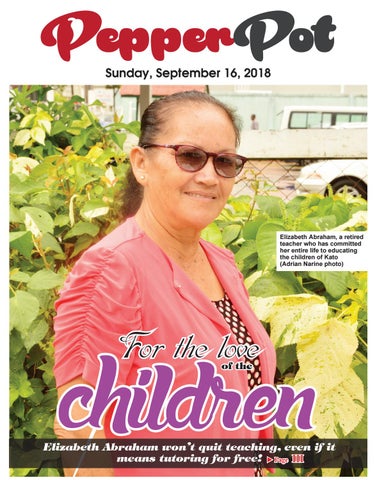
Sunday, September 16, 2018
Elizabeth Abraham, a retired teacher who has committed her entire life to educating the children of Kato (Adrian Narine photo)
children For the love of the
Elizabeth Abraham won’t quit teaching, even if it means tutoring for free! ► Page III
II
Chronicle Pepperpot September 16, 2018
Developing Caria Caria How investments in education are enhancing the lives of community residents GUYANA is more than its coastland. Our country possesses numerous diverse and culturally rich communities that lie beyond the coast. Caria Caria is one such community. Through community development efforts, particularly in the area of education, Caria Caria is building for the future. Located on the shore of the mighty Essequibo River, Caria Caria is roughly an hour’s journey via speedboat from Parika. Longtime resident and Caria Caria’s resident nurse, Everly Sampson, was able to offer insights into its history. She noted that the community that became Caria Caria was founded in the 18th century. Its original name was “Camoudie Caba”. “It got the name from the camoudie and caba seeds,” she said. “However, when the missionaries came, they changed it to Caria Caria.” The community is made up of approximately 56 households, with a current population of 254. The residents are primarily involved in the areas of farming, mining and logging.
Caria Caria is predominantly a mixed-race community, according to Sampson. The residents come from various ethnic backgrounds. “It’s a real Guyanese community because it’s mixed; everybody is just mixed,” related Sampson. The community’s primary school is overseen by two teachers while a single teacher oversees its nursery school. She noted that the total student population of the nursery and primary schools numbers approximately 40. Caria Caria’s 18 secondary-age students currently attend secondary schools outside of the community. Sampson noted that one of those students recently completed her CSEC examinations. The young lady attended Saint Stanislaus College and was able to obtain passes in all of her subjects. The remaining students attend secondary schools on the Essequibo Coast in Region Two and stay in the school dormitories during the school term. “Most people don’t have relatives outside that you can leave them there,” Sampson stated. She explained that the secondary schools in Region Three do not possess dormitories. One student, Sampson’s son, currently attends Anna Regina Secondary while the other students attend Aurora Secondary. Prominently located at the heart of the community is Caria Caria’s Community Centre. The building of the community centre was funded by Caria Caria’s partnership with Guyana Goldfields Inc./Aurora Gold Mines (AGM), as one of the company’s numerous sustainable development projects in engaged communities. Behind the well-cared-for centre is the community’s sports ground which
Caria Caria Community Centre
hosts the community’s sporting and cultural activities. Adjoining the Centre itself is a pavilion for spectators. INVESTING IN EDUCATION Caria Caria’s Community Centre has been the site of adult education classes for members of the community who did not complete their formal education. In another initiative funded by Guyana Goldfields Inc./ AGM, retired headteacher Mr Allan Barnes was able to help interested residents develop their Math and literacy skills. In fact, six persons expressed further interest in going further and writing the CSEC examinations. The company acceded and the residents sat the examinations this past June. Everly Sampson was among the students of the adult education class. She has worked and residesdin Caria Caria for the past 20 years. She explained that it was the young people of Caria Caria who motivated her to be a part of the initiative. She recalled that years ago when she first started working in the community, children would complete their primary education and go no further. “Since coming to the community we started encouraging parents to send their children to secondary [school],” she said. She noted, however, that lack of finances led to some students who had started secondary school to drop out. Sampson and her brother, Compton Patterson-Klass, decided to pursue the classes
always working towards education in the community,” he said. He was sure to note that education in a community determines whether it rises or falls. Taking a hands-on approach to improve education in the community, Patterson-Klass sometimes assists with teaching the community’s children. He is also a community leader and Vice-Chairman of Caria Caria’s Community Development Council (CDC). He noted that he has seen some results, relating that the CDC concluded a programme in collaboration with the Ministry of Indigenous Peoples’ Affairs where he taught 16 youths aged 14 to 35 in life skills, concentrated language experience, among other subject areas. “I see education as the only way forward for the development of individuals.”
SECOND CHANCES Ingrid Monroe, one of the participants, explained that she had only attended school up to the primary level. She related that she is thankful for the experience. As a mother of two, it was essential for her that her children go out and do their best. “I told myself if I came here I could help them Caria Caria’s sports ground and so I decided to get on board and come here to get my education and help my children,” she stated. The students who wrote the exams included two sisters. The girls’ father Flavio Gibson related that it meant a lot to him that his daughters were able to participate in the programme. He noted that
and persevere to encourage the young people of Caria Caria who had not completed their secondary education. “At the same time we could help even the children at primary [school],” she stated. She has already seen a difference, for as previously noted, 18 of the community’s youths are currently pursuing their secondary education. “I think it really impacted the children not only for the class but, since [Guyana Goldfields Inc./AGM] came, they would have been behind the primary school as well,” noted Sampson. “They would go in and do programmes whenever possible, they associate with the community.” Patterson-Klass related that he noticed that certain areas needed improvement when he first moved to Caria Caria, particularly in the area of education. Once he started having children of his own, he recalled that he told the leaders of the community at the time, that the educational standard of the community needed to be improved. He was the one who made the request to Guyana Goldfields Inc./ AGM to start the adult education classes in the community. “From then onward, I am
his daughter, Jelesia, had unfortunately dropped out of secondary school because of an ongoing heart condition. The adult education classes gave her the opportunity to return to education. One sister, Brittany Gibson, explained that she had wanted to re-write Mathematics. Her sister Jelesia Colinet wrote English Language in which she received a Grade One. She noted that the experience of attending the classes was a good one for her. “I dropped out of secondary school and I always wanted to finish it,” she said. “I know that it’s only one subject that I wrote but education has always been important to me and I’m happy that I got the chance to rewrite.”
Chronicle Pepperpot September 16, 2018
For the love
children of the
“Life is good. I’m at ease. I’m just relaxing and enjoying every day” – Elizabeth Abraham
Elizabeth Abraham won’t quit teaching, even if it means tutoring for free! Abraham spending some quality time with her grandchildren
After the death of her husband, Abraham did her best for her six children
Attending a religious programme with her daughter Lysbeth
By Telesha Ramnarine ELIZABETH Abraham, fondly called ‘Miss Liz’ of Kato Village in Region Eight , has essentially dedicated her entire life to the teaching profession in Guyana. Having retired after 40 years of teaching, she now uses her time to volunteer her services to the care and well-being of the children in the village. Abraham, 60, was born and raised in Kato by parents who were from the Arawak and Patamona Indigenous tribes. The Catholic Church had taken her dad, Francis Gomes, to Region Eight (Potaro/ Siparuni) to preach and teach; and that’s where he met her mom, Priscilla. At just 16-years-old, Abraham began teaching. Despite having to deal with challenges that made her think of quitting at times, she battled each one successfully and managed to help hundreds of children in the community over the years. Starting out as a young teacher, Abraham did not have access to training nor did she benefit from a lot of resources in the region. She taught for two years at Chiung Mouth Primary School, located about 15 miles from Kato, and spent the rest of her time at the primary school in Kato. Approximately 12 years after starting to teach, she was afforded the opportunity to be trained at the Cyril Potter College of Education (CPCE) in Georgetown and was officially appointed headteacher in 2004, although she had been carrying out these functions since during the 1980s. After retiring in 2013, Abraham continued teaching on contract with the government and was often recruited for specific projects that would be carried out. In one instance, she did some work in surrounding villages and spent over $300,000 of her own money but has not been refunded. “I submitted all my receipts to NCERD but I have not been refunded any money to date. That’s the bad part. But I enjoy working,” she said. Her last contract expired three months ago. Ever since then, she’s been keeping lessons for free on the weekends; Saturdays from 09:00hrs to 15:30hrs and half day on Sundays. “I volunteer my services because in Kato, we are all related in some way,” Abraham joked during an interview with the Pepperpot Magazine. “I want these children to do well; I want everybody to do well. And you see, the parents can’t afford to pay for it; it’s not like out there,” she added. DEVELOPMENT IN KATO Abraham still works on her farm, located not too far from her house on ‘Gomesy Bump’; this she does in order to rake in an income. And she’s ever so happy that the government has recently constructed a marketplace in Kato to aid villagers in getting their produce sold. “Whereas in the past people took their items from the farm to the church to get them sold, and had to look for people who were interested in buying their produce, people now carry their crops on Sunday to the marketplace. So it’s much easier now because people know where they have to go,” she said. Kato, home to roughly 400 people whose homes are scattered far apart, has never benefitted from much development, Abraham observed. But at the moment, things have slowly been improving. “We have development in Kato; things that we never see before we seeing. We never see development. But for the past three years, they’ve built a market, a multi-purpose hall and a workshop where vehicles are repaired. And people are hap-
III py because many more of them have been employed,” Abraham expressed. The secondary school, which was being built over many years, finally opened its doors last week. “We’re thankful for the secondary school. It has been built at the right time and at the right location because the population of the children is growing. More so, it is a unique school in the whole country because it is wellequipped,” she said. Abraham has been serving as one of the nine councillors on the Kato Village Council since last May and is also the secretary to the newly installed council. In 2016, she was awarded by the Ministry of Indigenous Peoples’ Affairs for her years of service. A RESPONSIBLE TEACHER Abraham is concerned about the issue of untrained teachers in the region and is continuing to hope that they will do well. “These teachers are badly in need of help; some of them just left school and are on their own, so to speak. We don’t have trained teachers in the region,” she expressed. The children, on the other hand, have young parents who are occupied trying to make a living. “So it’s very hard out there, but I am just hoping that the teachers do well because right now they are on some training. Even so, I encourage them not to neglect their classes because they are being paid to teach the children,” she said. Abraham also gives thought to the fact that even if some children perform well in school, they can hardly find a job afterwards. She is hoping that the government will consider providing transportation to those children who are attending the secondary school. “Workers, too, have to leave the village on foot; at times walking for 45 minutes.” Abraham’s daughter, Karen Abraham, one of her six children, has followed in her mom’s footsteps and is now the head teacher at the primary school in Kato. Speaking with the Pepperpot Magazine, Karen said of her mom: “Mom was always very supportive when it came to our education. I worked with her as a young teacher and she never treated me as a daughter when it came to work. She pressured me more than she did the other teachers. At times, I questioned why she dealt with me that way. She told me that she did not want me to feel I can slack off and get away with certain things because she is my mom and that I have a responsibility, not to her, but to the children and to the Ministry of Education. This has helped me to become a responsible teacher.” Karen said her mom has assisted her and the rest of her siblings in whatever way she could. “My siblings chose other paths, but I was motivated by her example and thus followed in her footsteps. Though she is retired, she provides the necessary guidance and assistance as it relates to headship responsibilities,” she said. ‘I’M FREE’ Today, Abraham said she is available should she be called upon to assist with any of the ministry’s projects. “I’m free,” she said, adding, “Life is good. I’m at ease. I’m just relaxing and enjoying every day, especially with my grandchildren,” she said. Asked if she would consider teaching again, especially with the completion of the Kato Secondary School, Abraham said she would not hesitate if she is asked.
IV
Chronicle Pepperpot September 16, 2018
Life in the country The village of Charity, Essequibo is teeming with energy of them work hard, very hard. They love the land; cultivate it with a high level of respect and sensibility. At the same time, they expect and get yields, which produce many benefits for families, communities and the country as a whole. Their morals are high. ‘THE BREADBASKET OF THE CARIBBEAN’ When one sees food in the abundance – variety and amount that can be seen within these areas, then it can hardly
By M Margaret Burke LOCATED on the Essequibo Coast is the village of Charity. It links the Upper and Lower Pomeroon River and provides a gateway to some parts of the interior within Guyana. Charity speaks to a sense of life and beauty. Its relatively quiet nature is overpowered by its residents’ businesslike approach to life and living in the country. There is that feeling of hope and expectancy around; a taking-it-easy style, while displaying a resolute course towards success. At the same time, the people of the Pomeroon are as gritty in their own ‘calm and collective’ manner to life. Most
be difficult to come to accept the saying that: ‘Guyana is the breadbasket of the Caribbean’. It might not be so as yet, but it can definitely be. Whether you are up or down the Pomeroon River, on the Charity township or even in the Mainstay areas, you see the existence of optimism. Maybe this is because most of the people believe in ‘putting their shoulders to the wheels’ and grinding with progressive work that is set before them. The Pomeroon is the name that was given to a former Dutch Plantation colony on that river after much struggles between the planters and slaves who resisted them. Reports are that the planters could have hardly resisted the temptation of planting the land, which until this day show tremendous potential for receptive farming and abundant harvest. Bountiful in fruits and vegetables, coconuts and coconut products, there is also plantain and banana farming, added to ground provision of every sort within the Pomeroon River environs, Charity, the Mainstay areas and beyond. The fruits not only come in the different types but also in the different species. Coconut is a big thing within this area and while many get great satisfaction from coconut water and coconut jelly, there is a whole lot being gained by the making of other coconut products. CASSAVA, THE ‘BIG MAN’ Cassava is another ‘big man’ within the community. If it is not bitter, then it is sweet. But both of them deliver a great amount of satisfaction to the people of the communities. The bitter cassava is especially famous for a number of treats that people enjoy in and out of season. Some of the by-products of the bitter cassava are bitter cassava bread, a crispy, biscuit-like product which traditionally goes along well with pepperpot, gravies, fried or stewed fish, or other meat products; bitter cassava cassareep is one of the most sought-after condiments in the making of the ‘pepperpot’ dish; kadaruka, an Indigenous word meaning Turn to page V ►►►
Chronicle Pepperpot September 16, 2018 ◄◄◄ From page IV
‘gravy’; cassava starch – the white sediment which settles at the bottom of the (toxic) juice extracted from the grated cas-
sava and used in laundering to keep otherwise soft and soggy materials stiff, and to make pronounced seams in cotton or denim garments; cassava flour; farine – an Indigenous cereal, as well as other beverages, which can make one intoxicated. The sweet cassava is, on the other hand, a good source in the making of many foods, other than just being boiled and used as a meal all by itself. THE MARKETPLACE Charity is the place where one of the main markets is located on the Essequibo Coast. There are days when the traffic to the market is heavy by both road and river. Farmers travel from far and near, by boat, car or van to make sure that their produce is sold to those who purchase wholesale, as well as retail. In fact, farmers use this strategic location in order to get them into other areas on the Essequibo such as Anna Regina and Parika. The produce also makes its way to as far as Vreed-en-Hoop and Georgetown. TRAVERSING THE POMEROON RIVER Though strange to many people who do not live in those parts of Guyana and are not accustomed to travelling by boat to move from one place to another within the Pomeroon River communities, there seem to be that sense of peace and relaxation at what is being seen as you go along, and also about what is in the air of expectancy. While Charity seems to have an obviously lively day and nightlife, it is not so easy to judge what takes place in the Pomeroon River areas – mainly because there is much more seclusion within the communities. Homes and businesses, for example, are not exactly right to the front of the river, and unless each place is visited it may be an ‘invention’ to say what is there. LIVING THE ‘GOOD LIFE’ On the other hand, many of the people who live in areas of the Pomeroon River work hard and thus live the ‘good life’. Both men and women see themselves as having an obligation to till the soil within their immediate surroundings, as well as farmlands, which they would have acquired over time. The women work as hard as the men. They farm the land, harvest and sell the produce, get involved in agro-processing to a large extent, and they have no difficulty rowing the boats – sometimes through long and menacing waters. But this is not a complaint from the women, who because of culture, may not even see any hardship in such activities. Nonetheless, as one resident stated, “We would not exchange here for any other part of Guyana right now. Here is where we are accustomed to living and we love here. Life here is good, only that you have to work hard sometimes; but that is quite alright because we see the rewards and can then relax and enjoy the best of life in the Pomeroon.” (mercilinburke2017@gmail.com)
V
VI
Chronicle Pepperpot September 16, 2018
Let’s go south of the
Kanuku Mountains By Francis Quamina Farrier
HERE in Guyana, September is observed as “Indigenous Heritage Month”. And September is also a special month for Native Americans - the North American cousins of Guyana’s Indigenous Peoples. That was told to me by a Native American elder when I interviewed him, while on one of my visits to the awesome Museum of the American Indian, located in Washington, D.C., in the United States of America. At this time in September 2018, I invite you to come with me south of the Kanuku Mountain range, which divides the North and South Rupununi Savannahs in Region Nine of the country. I know this area of our beautiful country reasonably well, having gone there on many occasions over a 50-year period and has decided to share a few of my own experiences with you. My very first trip south of the Kanuku Mountain range, the habitat of the gigantic Harpy Eagle, was with a tourist party organised by Marge Rockeliffe, a school teacher and Girls Guide leader, who was very active
in tourism, and who organised many tours to Guyana’s hinterland back in the pre-independence years. Her tour parties always had foreigners from America, Britain, Canada and the Caribbean. That first visit of mine to the South Rupununi was back in 1964. It was held over the Easter weekend and the cost of the entire trip was one hundred and twenty British Guiana dollars (BG$120.00), which included ground travel, air flights, also guest house accommodation and meals. Our travel from the coast to Lethem was by a Dakota aeroplane of the Guiana Airways Corporation (GAC). From Lethem, we travelled in an open truck to Sand Creek, via the Macushi Village and the sprawling Dadanawa Ranch. It was a memorable trip which I have documented in a short story entitled “You have left Something”. That was the parting statement by the priest; we had left “A good impression”. Sand Creek is located at the southern side
Dr. Denis Williams with Farrier at the centuries-old Indigenous Rock Carvings at Aishalton in the deep South Rupununi Savannah, 1978
Farrier about to make another visit to the Museum of the American Indian in Washington, DC., USA, 2017
of the majestic Kanuku Mountain range which towers thousands of feet above sea level and stretches across the Rupununi Savannahs from Suriname at the east, to Brazil at the west. That first trip of mine to the South Rupununi exposed me to the pristine Indigenous culture and what was Guyana’s ‘cattle county’. There were hundreds and thousands of cattle to be seen everywhere across the undulating savannahs. On my most recent visit to the South Rupununi a few years ago, I was shocked to see some of the shops selling corned beef from Argentina. Cattle were no longer to be seen by the thousands grazing in the savannah, but only by the hundreds. At that time of declining cattle population, Indigenous poet Sydney Allicock, now Vice President and Minister of Indigenous Peoples’ Affairs, wrote a poem entitled “The Changing Scene”, which he performed at GUYFESTA and won a Certificate of Excellence. Cattle rustling is the principal reason for the reduction of the cattle population in the South Rupununi. Rustlers (thieves) are stealing cattle by the dozens from the open savannahs on a regular basis and taking them over the border to Brazil, where they are sold. Beyond Sand Creek to the east, is the village of Shea. In that community is the impressive Shea Rock, which is about the size of Queenstown in Georgetown and a little higher than the Bank of Guyana. Shea Rock can be easily climbed by the average healthy person and encouraged by then schoolmaster, Basil Rodrigues, I made the exciting climb to the top of the rock along with him and a few of his students. For me, Shea Turn to page X ►►►
Chronicle Pepperpot September 16, 2018
VII
Preserving Indigenous languages, preserving culture By Gibron Rahim WE often speak of culture in abstract terms. In truth, a society’s culture, or cultures as is the case of a multicultural society like Guyana, is a very real and concrete part of the lives of its people. This is especially the case with language. As we celebrate Indigenous Heritage Month, it is essential that we realise the value of our languages and take steps to preserve them. On Friday, September 7, 2018, Professor Ian Robertson gave a lecture entitled “Indigenous Languages and Guyanese Identity” at the Indigenous Village at Sophia. This lecture was a part of the series of ongoing educational lectures to mark Indigenous Heritage Month. Speaking to the Pepperpot Magazine, Professor Robertson was sure to note that he has a slightly different take on what he considers to
Professor Ian Robertson (Photo courtesy of the Guyana Languages Unit)
be Indigenous languages. The languages are grouped into three broad categories. The first group comprises the languages of Guyana’s First Peoples who were here throughout our recorded history. The professor explained that their languages can be categorised into three further language groups. The Warrau language is the only member of its group. The Cariban language group includes Akawaio, Arecuna, Macushi, Patamo-
na and Wai-Wai while the Arawakan language group comprises Lokono (Arawak) and Wapishana. Professor Robertson also included languages that developed in Guyana in more recent history in his categorisation of Indigenous languages. One category includes the Creole languages that developed during the Dutch period of colonisation. “These are languages that developed here in Guyana,” said Professor Robertson, “They were developed by the slave experience in Guyana and became what we could call the vernacular language of the people of the colony.” He noted that there were at least two of these languages – Skepi Dutch in Essequibo and Berbice Dutch in Berbice. He related that Skepi Dutch has gone extinct while Berbice Dutch may still have a few speakers. Guyanese ‘Creolese’ is grouped into the third category. Caution must be exercised, according to Professor Robertson, in language classification of Creole languages. “Since many of the words come from European languages there’s a tendency to see them as being forms of the European language,” he related. “But no language is judged on the basis of where the words come from.” Rather, “Languages are assigned on the basis of their meanings, their semantics and their structures, especially their structures,” he said. He pointed out that all Creoles have structures and sets of rules that are very different from the rules of European languages but very similar across the various Creoles. The professor related too that groups of St. Lucians have been coming to Guyana since the turn of the last century, bringing their own Creole. This Creole, he said, is used in Mahdia and Kurupung and was used in Linden in the recent past. Tracing the history of the languages of Guyana’s Indigenous peoples is a complex matter. “They come from a long tradition that dates back hundreds, maybe thousands of years,” explained Professor Robertson. “And we have no study specific to those [Indigenous Peoples] in Guyana which tells us exactly how far back they go,” he said. “But
certainly they were here when the Europeans came.” In Guyana, English is not the first language of the majority of students. Young children most often first learn Guyanese Creole or the Indigenous language spoken in their community. Professor Robertson noted that the issue of whether students should be taught in their first language or not and the challenges of not doing so is a complex one and requires careful analysis and discussion. “It is a fact established by education research that people learn best through their first language,” he stated. He explained that the problem is that some of these first languages are assigned a low social status and low social visibility and are thus very often discriminated against. The dismissal of these languages has consequences, as Professor Robertson noted. Doing so leads people to believe that they are less valid as languages than the ones that are the official languages. “That does not mean that Turn to page IX ►►►
‘Linkin’ Up’ VIII
Chronicle Pepperpot September 16, 2018
Nulli Secundus pays it forward with Rupununi expedition By Vishani Ragobeer LOCAL youth group Nulli Secundus (which translates to ‘second to none’) recently trekked over four mountains and across the savannahs in the North Rupununi to create a positive impact in a number of indigenous communities and within their own selves. President of the group, Martin Massiah highlighted, “Eleven years ago, we formed Nulli Secundus with a simple purpose- to
build tomorrow’s leaders- and now after completing expedition ‘Linkin’ Up’ we’re still on track to doing that.” The expedition began on August 8 and came to an end 10 days later on August 18. The group took with them their skills and intentions to teach residents of the indigenous villages practical skills, so that they could use the resources they have. Massiah said, “We were on a campaign in the North Rupununi to teach as many communities as we could. We were able to teach
The entire Nulli Secundus group that ventured on Expedition ‘Linkin up’
The Nulli Secundus youth having fun in the water!
Annai, Wowetta, Rupertee and Surama.” Essentially, what the group found is that the communities might have had the requisite resources but lacked the relevant skills to exploit these resources and it was their mandate to transform persons. During the 10 days they spent in the area, they were able to interact with some 150 persons through sharing their skills in cake decorating, Information Technology and playing the Steelpan. Shevon Moses, a Nulli Secundus youth, led one of the cake decorating sessions and for her it was a pretty uplifting session knowing that she was able to give back to the communities at large. “I’m really happy doing that- giving back to the community,” Moses said. As said by Vice President of the group, Tiffany David, the communities really felt the love pouring out from the group. “A lot
of the feedback that we got from the villagers was that this [training] was just perfect for them,” she shared. “They are really intelligent people. The only thing is that they don’t have the access and the opportunity like us in Georgetown.” Added to that, she is just really proud that the group allows the young people to connect with others and effect some positive change. On the expedition, in addition to taking their skills with them, each participant had their own expectations, reservations and even queer habits. So it really wasn’t all fun and no play, but in fact, it was lots and lots of play! Martin stressed, “It wasn’t just about teaching the communities either, it was about training our leaders in an interesting and immersive environment.” The participants were able to climb four mountains, walk cross the Iwokrama canopy Turn to page IX ►►►
Chronicle Pepperpot September 16, 2018 ◄◄◄ From page VIII
and generally explore the pristine beauty of Guyana. And they were your average group of friends going on a trip- staying up late ‘gyaffing’, even when they needed to be up early the next day, pranking each other and making jokes about each other. One feeling shared by the entire group, however, was pride. They ascertained that they were able to see firsthand just how magnificent Guyana is and how amazing the lifestyles of the Indigenous peoples are. This expedition was the first for Daniel Baldeo-Thorne and he said it was “pretty unforgettable” and that he is excited for the next one. “Next year, it’s going to be even better with Expedition Kaieteur,” Martin said and affirmed: “Nulli Secundus is here to serve Guyana and its people and we’re here to push our young people to the next level.” ◄◄◄ From page VII
they are not capable of dealing with very complex ideas,” he noted. “But that requires conviction, people have got to know that and be able to accept that all languages have the capacity for conveying information and for helping people to understand what is going on.” LEARNING THE SECOND LANGUAGE While it is true that it is more difficult to learn in a second language, Professor Robertson was sure to note that it is not impossible. He pointed out that there are two downsides to doing so, however. The first is, that it may cause the learner to lose confidence in themselves and in people like them who also speak their first language. The other relates to the loss of culture as there are certain uses that are specific to an individual language, as well as activities that may be associated with that language. Professor Robertson related that the case may be that people will abandon their language and gravitate towards one that does not come naturally and easily to them. “It is not impossible to train somebody to learn through a second language, history is full of cases like that, but it is much more difficult than if they learned in the first language.” Transitioning to learning in a second language becomes easier when education systems recognise the first language of learners. “And that really is where most educators miss out – they don’t recognise that if you start in one language or if you use one language, it is easier to learn a second one,” pointed out Professor Robertson, “because you have already stimulated the language centres in your brain.” PRESERVING THE LANGUAGES The preservation of the Indigenous languages is essential. “You have to because languages contain what I would call the memory of the people, the history of the people,” explained Professor Robertson. “So much of [their history] is experienced and expressed through language that, if you downplay those languages, you will lose the impact and importance of some of them.” He emphasised that these languages contain much knowledge and information and dismissing them leaves that knowledge unshared. “That kind of knowledge is lost and that kind of knowledge is important for society and it’s also important for self-respect.” Our languages identify us as belonging to a particular group and also distinguish us as different he said. There are already languages in danger of extinction in Guyana. Professor Robertson noted that two languages – Lokono and Carib – currently have very few speakers on the coast. He said that there are a few places, such as in Wakapoa, where there are more speakers. “There are very few in places like Mashabo and they’re old,” he said. He related that, in general, the numbers are small and the language attitudes of the younger people are biased towards English. The process of preserving a language is complex. “First of all, you have to have a positive attitude toward the language,” said Professor Robertson. People must recognise that the language is important and has worth. “It helps if there is a regular practice, especially if older people attempt to pass it onto younger people and to give it some value,” he added. A writing system might help in some cases, though modern recording technology can and does play a role in preservation. “And then, of course, education – teaching people the language and looking to ensure that it is used over a wide range of activities,” he said.
Nulli Secundus youth pose with some participants of the cake decorating class
IX
X
Chronicle Pepperpot September 16, 2018
◄◄◄ From page VI
Rock should be promoted as one of Guyana’s tourist attractions in the South Rupununi; especially for those who love the open landscape and the challenge and thrill of climbing hills and mountains. From the village centre, it will take about half an hour’s walk to get to the summit of the Rock. There, one can view the beautiful sprawling savannah lands below, and gain a greater love for our “Beautiful Guyana”. Much further south of Shea is the more populous village of Aishalton. The people are also extremely hospitable that it would be difficult not to love them. At Aishalton there is a police station, a small hospital constructed with clay bricks, a church, a convent, schools and a number of shops among other institutions. Just outside the village are the famous rock carvings which archaeologist Dr. Denis Williams stated are many centuries old. These are also ideal tourist attractions. It should be mentioned that the Rupununi Savannah lands are way above sea level, but as it is known, there are serious floods from time to time in the South Rupununi, especially during the rainy season. So one might wonder how is it that such highlands suffer flooding? The reason is simple. Imagine spilling your coffee on your tabletop while having breakfast. That will result in a mini table top ‘flood’ until the spilt liquid is wiped away. That is an example of the floods in the high Rupununi Savannahs during the rainy season. The water from the rainfall is more than the Essequibo,
Farrier with Headmaster Basil Rodrigues at the summit of Shea Rock, 1976
Rupununi and Takutu rivers can cope with in a timely way, resulting with those rivers overflowing their banks and flooding the savannahs.
Last year, a cultural group from the South Rupununi was invited to New York as the special guest of the Guyana Cultural Association of New York, Inc., for their annual series of cultural events, and I have to say that they represented the Rupununi and Guyana with class and dignity. As a Guyanese, witnessing them performing and interacting in that large metropolis, having come from a small village without any paved streets or even a single car,
I was as proud of them as anyone else was who saw them. Some years ago, there was the “Visit Guyana Year”, organised by the Ministry of Tourism. What should be considered is another “Visit Guyana Year”, this time with the focus on the exotic South Rupununi. And may I add that there is GOLD in the Marudi Mountains in the South Rupununi.
Chronicle Pepperpot September 16, 2018
XI
XII
Chronicle Pepperpot September 16, 2018
Guyanese-born Richard David elected District Leader in New York Pledges to work and enhance the lives of Richmond Hill/Ozone Park residents` such, on September 13, he was elected as the leader since he was the only candidate. This position is an unpaid, volunteer position with a term of two years. He has received endorsements from various elected officials like Assembly members Michele Titus and Vivian Cook, City Council member Adrienne Adams, City Council member Donovan Richards and The Queens County Democratic Organisation. Having been elected as a Democrat leader he has intentions of getting his neighbours involved in politics and his first goal is to create a political club for the Richmond Hill/ Ozone Park area. “We have not had a visible club in this area; it’s long overdue. I personally believe it has contributed to the neglect of many resi-
By Indrawattie Natram THIRTY-TWO-YEAROLD Guyanese born Richard David has unanimously won as District Leader for the Richmond Hill and Ozone Park area in New York, USA. He is now in charge of the local Democratic Party in those areas and intends to serve his community with distinct honour. Born in Mahaicony, David left the shores of Guyana at the age of 10 years to take up residence and to further his studies in the United States of America. David is the youngest David meeting with his supporters of three brothers and he always had a mission in life to serve humanity and to bring about positive changes around him. dents. As a leader, I want to see the basic issues and the quality Interestingly, David is one of the most senior-ranking In- of life for the people improve; their concerns addressed; [that] do-Caribbean leaders to be in the New York City Government. persons get the attention they deserve. I want to bring our He is currently a Chief of Staff at the New York City Admin- elected officials closer to the people,” David passionately said. istration for Children’s Services. He has a Master’s Degree in Public Administration from the New York University and an HIS POLITICAL Undergraduate Degree from Hunter College. JOURNEY During his two years in that post, he had managed to legalDavid’s passion for leadership led him to run for the New ly represent children’s rights and welfare. Before his current York City Council last year. Unfortunately at that election he job, he was the Executive Director at the New York City did not win, however, he received overwhelming support and Department of Consumer Affairs and prior to that, he was the more votes for that position than any Guyanese, South Asian Vice President of the New York City Economic Development or Indo-Caribbean person in New York City history. The Corporation. leader explained that elections had encouraged him and had During an interview with the Pepperpot Magazine, David given him the push to remain engaged in helping to transform said he ran for the Democratic District Leader in the New the lives of those living in his community. For 10 years also, York State Assembly District 31 Part B. He, however, did he was an active member of the Queens Community Board. not go to the ballot because he had no opponent. He explained In addition to his political life, he co-founded the Indo-Caribthat no one else collected enough signatures to petition and as bean Alliance- a federally-registered non-profit organisation
Richard David (Photo courtesy of Will Deegan)
that provides youth services, civic engagement and cultural education to all residents. He boasted that today it’s one of the large Guyanese-run organisations in New York City. “I have always been involved in public services but I never thought I would run for office. I was afraid to be involved in politics at first, but I realised that I want more people to get involved in the most dynamic way as well as to improve communities,” David said. PROUD GUYANESE “I am proud to be of Guyanese origin. I think it is important to remain connected to what is happening in Guyana as well as what is happening here in my neighbourhood. I have fond memories of Guyana and I visit whenever I have the time to reconnect with my beautiful birth land. Guyana is dear to me,” David explained. David’s mother, who is his biggest supporter, said that her son has the experience and professionalism to transform the Queens community. She believes with his wide knowledge and understanding he will serve as the best District Leader. “Having been born on Diwali Day, my son is indeed the light of the Ozone community. He influenced the way people think about politics and he was also instrumental in getting thousands the Indo-Caribbean people to register and go out and vote. This is real change” David’s mother, Bibi Nesa said. She further explained that being an Indo- Caribbean Democrat means that one is frustrated. Frustrated with paying tickets, taxes, violations at every turn while still not getting the service one deserves; a matter that David intends to fix. In his new role, David will, among other responsibilities, participate in nominating judges and elected officials for open seats in the borough. He will serve as the bridge to connect the community with a fairer voice for the people and the district.
Chronicle Pepperpot September 16, 2018
XIII
Is abstinence better for you? LAST week we spoke about how to healthily drink alcohol and I’ve had so many responses. Some thanked me saying that moderation is key while others claimed they have a more serious problem and would like to stop drinking alcohol altogether. I’m happy to give some advice/ tips on how to do this as people who feel they have no control over their drinking should practice complete abstinence. A few weeks ago, we spoke about how to determine whether or not someone has a problem with alcohol so only you can know if you do. In case you missed it, I will ask you some brief questions. If you answer yes to four or more, you may have a problem with alcohol and should consult a professional. 1. Do you drink alcohol more than three times per week… Having more than three drinks each time? 2. Is it difficult to stop drinking when you have started in general? 3. Are you unable to carry out personal or familial duties because of your drinking? 4. Have you lost interest in activities that do not involve alcohol? 5. Has anyone around you ever expressed concern about your drinking? 6. Have you ever felt guilty about your drinking? These questions are basic guidelines to determine whether there is alcohol abuse. However, truthfully, you just have to ask yourself one question- is your drinking preventing you from living the life you want to live? I want to make it clear how difficult it is to come off of alcohol completely; it is actually one of the hardest drugs to stop using. This is for many reasons with accessibility, affordability, cultural acceptance, legal status and short-term pleasurable effects being just a few. Most people who try to come off take quite a bit of time and have many relapses – which means to start back drinking. It does not make you weak if you have been unsuccessful thus far, it just means that you aren’t trying what is best for you; drug treatment is very individualistic. However, everyone’s first step must be the same. In order to successfully quit, you must admit that you have a problem with alcohol. Once you have done this, figure out what best works for you. Is there a particular reason you want to quit? Are you motivated by short or long-term goals? The long-term benefits of not drinking alcohol are known by everyone. It will result
in a healthier mind and body, more success in our field of work and an overall stronger immune system which means we live a longer and healthier life. It means we get to see our children and grandchildren grow up. However, imagine something is so powerful and the thought of living longer still isn’t enough to quit! The long process can really take a toll on those who are more motivated by short-term goals; they require almost instant gratification and results. It’s not the best way to go but it’s not a deal breaker either. All you have to do is constantly remind yourself of the short-term benefits which won’t be hard as you will experience them every day. You will gain more time that was once spent on drinking or recovering from drinking; daily
you more likely to drink in the first place? Is it a certain place? Certain people? Certain emotions. Knowing this is how you get started so you can avoid as many as you can. Develop some new coping skills. Whether we want to believe it or not, many of us –possibly without knowing- use alcohol as a method of dealing with our struggles. Many of us feel we need a drink after a tough day but there are many others things that we can do to feel better- that unlike alcohol, will still allow us to feel better the next day. See for yourself with a benefits list. List out all the positives that come along with drinking alcohol on one side and all the negatives on the other. It will reinforce what you already know. Tell those around you that you want to
time that can now be used productively. You will have more money in your pocket every day. You will automatically experience improvements in your eating and sleeping patterns which means you’ll have more positive energy. You will lose weight quickly. Your relationships will improve with you seeing more trust being given to you every day. So, here are some tips on how to get started. Sobriety (quitting completely) is now your number one priority which means a few things including social life and relationships will suffer in the short term- but will definitely benefit in the long run. For example, you will miss some birthdays and celebrations but those around you will understand. This brings me to my next tip, know your triggers. This is so important. What makes
quit – the right people will support you and that way, you don’t have to completely give up your social support; you are just building better and healthier ones. Know your options – would you be better in inpatient or outpatient treatment? While not many, Guyana has both outpatient and inpatient treatment. For outpatient, you simply go to your nearest health centre and tell them your plan to quit drinking. There are two options for inpatient treatment, which do come with a cost. This means living in a rehabilitation centre with others who are also trying to come off of alcohol or other drugs. There is Phoenix Recovery Project, located in Mon Repos, where both men and women are treated. You can get more information at 220-6825. The second is the Salvation Army, locat-
ed in Kingston where only men are admitted. You can get more information at 227-2619. Another option is to attend Alcoholics Anonymous meetings which take place at a variety of locations and are free of charge. Here is where you build a sober network with people who know exactly what you are going through. Below are a few locations. Brickdam Presbytery Tuesdays – 19:30- 21:00hrs Fridays and Sundays- 18:30hrs -20:00hrs Phoenix Recovery Project Tuesdays 18:00hrs-19:30hrs – Tuesdays and Thursdays s at 15:00hrs. All you need to do for these meetings is show up. These are not all the meetings available but now that you know about them, ask around in your community if there is one closer to you. You need to know that it actually may be dangerous to your health to stop alcohol without the help of a doctor. This, of course, depends on the amount you drink. If you are at the stage where your body is so used to the alcohol that it experiences withdrawal, it is extremely dangerous and can even be fatal if you attempt to quit on your own. If you are at this stage, you may experience headaches, nausea, vomiting, shaking, fevers, cold sweats and trouble eating or sleeping. You may even experience mental health issues such as extreme anger, anxiety or depressive symptoms. If you are, please go into your nearest health centre so you can healthily and safely come off of alcohol. Withdrawal is the number one reason for relapse- you will need help with this. Finally, be realistic in your recovery. Know what you are capable of doing and what you aren’t. In recovery, there is strength in knowing your weaknesses. If you falter, you are one of many. Pick yourself back up and start again with more knowledge of what causes you to drink. Thanking you for reading. Please keep sending any topics you’d like to talk about to caitlinvieira@gmail.com Say Yes to Life and No to Drugs! Always! Suicide Prevention Helpline – 223-0001, 223-0009, 623-4444 or 600-7896 Do not be afraid to reach out!
XIV
Chronicle Pepperpot September 16, 2018
What you need to know about sweet potatoes Part Three
Diseases of the Sweet Potato (Ipomoea batatas) in Guyana 1. FUSARIUM WILT (FUSARIUM OXYSPORUM) SYMPTOM The disease is caused by fungi that persist in the soil for long periods of time. Symptom: Include a darkly tanned rot that extends into the root and usually has a sharp line separating the rot from the
healthy portion of the root. Stem infections appear as swollen areas at the base of the stem that have internal vascular discoloration. Cultural Control: • The disease can be avoided by practising two-year rotations out of sweet potatoes and by using clean planting material.
Chemical control: • Use Carbendazime, Cuprasan and Rizolex for effective control. 2. SOIL ROT (STREPTOMYCES IPOMOEA) Symptom: Roots develop black necrotic lesions which traverse its entire cross section (Figure 6). Usually, the necrotic portion of these roots breaks off when the roots are dug, leaving a small portion of the lesion at the broken end of the root. Vine growth may be severely stunted with lower leaves bronzed or yellow and the plants wilted. Lesions on roots are necrotic, black, roughly circular in outline, and often have cracks radiating from the centre. Cultural Control: • Phytosanitary measures are important to prevent the introduction of Streptomyces ipomoea into non-infested soils. • Cultivating equipment should not be moved from infested fields to non-infested fields and /or should be disinfested before movement into a new area. • Storage roots from affected fields should not be used for producing transplants. Chemical Control: • The use of Banrot, Rizolex, Captan or Mankocide is recommended for effective control. These can also be used as pre-plant drenches. 3. BLACK ROT (CERATOCYSTIS FIMBRIATUM) Symptom : Tubers with this disease show irregular sunken spots which are dark brown to black in colour. Very often black dots are scattered across the spots (Figure 7). These black dots contain the spores of the fungus causing the disease. Pink masses of the spores are sometimes seen oozing from the black dots. Cultural Control: • Use disease free sprouts or tubers for planting; • Practice crop rotation; • Use extra care in the storage of planting materials- ‘slips’ and tubers; and • Practice good farm sanitation. Chemical Control: • The use of fungicides such as Captan, Manzeb and Rizolex is recommended. 4. ROOT-KNOT NEMATODE BLACK ROT (MELOIDOGYNE SPP.) Symptom : Underground symptoms are primarily galls on roots, tubers, abnormal formation and function of the root system. Non-specific above-ground symptoms include patchy stunted growth, discolouration and leaf chlorosis, excessive wilting during dry, hot conditions, stunting of whole plants, reduced yield and quality, and sometimes premature death. Root-knot is generally more severe in sandy soils and under adverse environmental conditions. Cultural Control: • Practice good farm sanitation; • Practice crop rotation; and • Flood fallow Biological Control: • Plant marigold flowers, tulsi, neem in and around cultivated areas Chemical Control: • Use any approved nematicide 5. VIRAL DISEASES Symptom: Viral disease on sweet potato is caused by a synergistic combination of sweet potato feathery mottle virus (SPFMV) and sweet potato chlorotic stunt virus (SPCSV). Chlorotic dwarf virus is caused by the synergistic interaction of three viruses: two potyviruses, SPFMV and sweet potato mild speckling virus (SPMSV), and a crinivirus (SPCSV). SPVD is transmitted by grafting. The individual viruses are transmitted by their insect vectors. Symptoms vary with plant genotype but typically include severe stunting of plants, the production of small leaves which are often distorted, narrow and crinkled and with a chlorotic mosaic and/or vein clearing, giving affected plants an overall pale appearance. Cultural Control: • Use of disease-free planting material and crop rotation are the most reliable means of controlling these diseases and its insect pest’s vectors. • Use of resistant varieties. Chemical Control: • Spraying with insecticides such as Fastac, Decis or Karate on the undersides of the leaves to kill aphids. • Spraying insecticides such as Vydate L, Newmectin and Admire is an effective control measure for whiteflies.
Chronicle Pepperpot September 16, 2018
XV
Guyana Society for the Blind’s CSEC Initiative
Classes begin for sixth batch of students By Telesha Ramnarine TWENTY-FIVE-YEAROLD Sachi Harricharan can still remember his childhood days when he was strong enough to ride a bike. Although his physical disability has progressed to the point
Faith Greene
Classes for the CSEC examinations started earlier this month at the Guyana Society for the Blind
Caribbean Secondary Education Certificate (CSEC) examinations next year. What is more, SaSachi Harricharan chi has to cope with partial blindness. But even with the daunting road ahead, he said where it’s a struggle for he will do whatever he can to at him to walk each day, least secure fair grades. he has mustered up the “The work is hard. But once courage to register for I continue reading, studying, classes to be able to sit the doing whatever I can, I’m sure
I will do fairly well. I will accept a fair result,” he told the Pepperpot Magazine during an interview at the Guyana Society for the Blind on High Street, Georgetown. Sachi, a resident of Herstelling, East Bank Demerara (EBD), is one of 11 persons who registered with the Society to write the exams; some next year and some in 2020. He went up to Primary Three at a private school on the EBD and also took some classes at the Open Doors Centre. “I wasn’t able to pass Turn to page XXX ►►►
XVI
Chronicle Pepperpot September 16, 2018
Chronicle Pepperpot September 16, 2018
XVII
folklore CATCHING HELL XVIII
Chronicle Pepperpot September 16, 2018
By Neil Primus
THE sober community of Rocky Heights was quite the opposite of its name. It was a flat, fertile piece of land that yielded an abundance of fruits, vegetables and provision. There were three major problems in the village. Limited electricity supply, poor water supplied to those who could afford it- the others had to trek about a mile away to the community standpipe in order to get water- and very limited telephone access. Phones were limited to the Post Office, the Village Office and the only three rich families who made that community their home. Every day before dawn and dusk, people could be seen ferrying water to their homes. Whenever the supply went dry the villagers had to resort to a nearby canal.
Apart from these shortcomings, the village was a very nice place to reside. Two churches, a small temple, a mosque, three small shops, the Post Office, the Village Office and a cluster of about 35 houses was how the community was made up. Each house had about half an acre of land which the people put to good use with small scale farming. There was one other issue that made the village stand out. Many stories had been circulated about the sightings and encounters with all kinds of supernatural beings. Having a mixed population of Africans and East Indians, this was not surprising. Each culture was laced with supernatural deities. Rocky Heights became known as the “Jumbie village.” People came from all around to see or expe-
rience these strange happenings. Most of them left disappointed. A few got their wishes and left ruing their misfortune. The villagers took these things seriously. In every house could be found the following items: holy water, a crucifix and incense. It did not matter which religion they subscribed to, they all took precautions against unwanted visitors. The adults kept the spirits at bay while the children played their lives away. They were too small to appreciate the situation and were often not burdened with too many details of all the stories. Donald and Ted sat on the stairs with three empty buckets between them. They had just returned from the standpipe disappointed that water had stopped flowing. It was rumoured that there was a leak somewhere so the villagers would have to wait the day or days it would take to be repaired. They knew that the house was completely out of water and they would both suffer at the hands of their dad for not filling up water during the morning. All day they had played, putting off their chores for later thinking that they would have ample time to fill up before he got home. They had used this strategy regularly but unfortunately for them, this time it backfired, leaving them to face the music. “I have a brilliant idea!” Ted seemed thrilled. “What?” Donald asked. “Let’s steal water from Mrs. Gordon!” “Not me. Dat woman does wuk obeah!” Donald spoke with emphasis. “How you know she is wuk obeah?” Ted wanted to know. “You ain’t see how rich she is an she don’t wuk no place?” “Well is either thief water or licks like peas!” Ted quipped. Donald didn’t like the sound of the latter so he opted for water heist. “But leh we watch out. Rememba wa happen to Boyo. He went fo thief mango and somebody kick he out de tree. Up to now he don’t know who kick he,” Donald warned. “Boy dat is a load a doltishness !” Ted retorted. “Well you could say anything. Kevin went fo get paw paw an wen he crawl and meet halfway to de tree a paw paw land on he head. When he look round fo it, de thing disappear!” “Yo fetching water or talking stupidness?” Ted demanded. “Leh we go,” Donald said quickly looking around in a pensive manner. “Boy you is one frighten Freddie!” Ted laughed. Then Ted jumped over the fence and crept towards the yard pipe at the back of Mrs. Gordon’s yard while Donald waited on the other side for the signal to throw the bucket. It was past six and darkness had quickly set in. Donald, meanwhile, was looking around him
in apprehension. Seeing a dark figure heading for the backyard, he dropped the buckets and raced indoors leaving Ted to be discovered by the obeah woman. Ted was taking careful stock. It was dark and quiet. Nothing but shadows moved. He hissed to his waiting brother. “Throw a bucket!” Thud! The plastic bucket hit him in the shoulder and he felt the pain from the impact. He began to cuss. It was just like Donald to leave him to do the hard work and not even take his time to throw the bucket properly. He angrily threw it back and hissed louder. “Hey, you is a idiot or what? Boy throw de bucket properly!” The second time the bucket hit him harder. He landed on his rear with the bucket covering his head. Now he was really angry. Jumping to his feet in fury he grabbed the black bucket and hurled it violently at his brother. “Idiot!” He yelled forgetting about stealth. Come and fetch yo water yo self!” Crack! Bang! Two buckets hit him one after the other. The next thing he knew he was lying on the ground staring up at the stars; moving stars. Screaming in anger, pain and embarrassment he surged to his feet ready to beat the daylight out of Donald. He came face to face with Mrs. Gordon. “Wat you doing in me yard?” Her eyes seemed to flash in anger. “ A-a-a-am sarry Mrs. Gordon. Ah did jus borrowing some water!” “Without asking fuss?” she glared at him. “P-p-please fo some water Mrs. Gordon,” he said with a tremor in his voice. “Well alright! But yo mek so much noise is enough fo raise de dead!” she grinned when she said this. “Is Ted. He pelt me wid de bucket.” he explained. “Not Ted! Dat boy run inside and lock up as soon as you jump over de fence.” “W-w-what?” Donald’s eyes bulged with fright. If Ted didn’t throw the bucket then there were only two other possibilities, both of which he hated contemplating. The first was Mrs. Gordon but she seemed too old, slow and looked incapable of lifting the bucket. The second was quite terrifying to ponder. Something had pelted him with the bucket. Mrs. Gordon smiled in a knowing way and whispered softly. “Betta watch yo self whenever yo come in dis yard at night,” she said. She then winked mockingly at him. Only problem was he was not there. All the surprised woman heard was a loud howling scream and the crash of a closed door as Donald disappeared indoors leaving a hole in her nice fence.
Chronicle Pepperpot September 16, 2018
XIX
#SupportCreativity
By Subraj Singh
Guyana Needs a National Drama Festival in 2018 THE National Drama Festival (NDF) has, in recent years, emerged as one of the most important theatre events in the entire Caribbean. Plays from various genres step into the spotlight for all of Guyana to see, and while there are plays that do fail to make it into the finals of the Festival, those that make it frequently end up being of a staggeringly good A still from “The Perfect Man,” written by Ato Vaughn quality, highlight- and directed by Tristana Roberts at last year’s National ing the best in local Drama Festival (Photo by Godfrey Phil)
and regional theatre, while stretching and, sometimes, obfuscating the barriers that dictate how far theatre can reach in the modern world. Plays staged at the National Drama Festival run the full gamut of theatre in all its forms: from realism and ritual to the postcolonial and postmodernist, and melodrama and
musicals, among others. Furthermore, these plays often seek to address and comment on a variety of issues that haunt or continue to plague the Guyanese society. While suicide, race-relations, and domestic violence continue to be popular Turn to page XXVII ►►►
XX
Chronicle Pepperpot September 16, 2018
Addressing the maladies of public transportation
THE vast majority of consumers use public transport for both business and pleasure. Public transport is like a second self and remains with most people throughout their lives. Consumers and the public at large therefore inevitably have concerns about public transport. If one is to visi the bus parks in Georgetown at most times of the day, one is bound to see ‘touts’. These ‘touts’ try to fill up the buses for which they are employed and are usually paid $100 per load. The touts call out to commuters, taking their bags and depositing them in the buses for which they are working thus ensuring a passenger. Women commuters are often held by the arm, to their great annoyance and almost dragged into buses. Older women are called “Mother” or “Auntie” hoping that affectionate forms of address will win them a passenger. Often, at busy times, commuters are sometimes manhandled and dragged into buses. Worse still, there could be serious altercations
and even fights among the touts to protect their perceived territories. Commuters regard these touts as disgusting nuisances. It is generally felt that if there was a police presence the parks would be more orderly. Better still, if the buses on each route were to organise themselves to fill up on an orderly basis, there would be no touting. The UG park on Regent Street opposite the Bank of Baroda is an example of orderliness and the absence of touts and contrasts with the Plaisance park just across the road. Very often, especially during rush hours, the buses are thickly overcrowded. Such overcrowding is not only uncomfortable for the passengers but creates a traffic hazard. Several traffic accidents have been attributed to overcrowding. The windows of the buses are often not opened making them hot and uncomfortable and if a passenger has a cold or air-borne infectious disease, other commuters could easily be infected. The conductors should open the
windows and keep the buses ventilated and not expect the passengers to do this duty. If the police were at the parks, this would avoid overcrowding; this would avoid the police having to look for overcrowded buses on the road. Some attempt was made in the past to have the buses carry rubbish receptacles. This initiative failed because the buses were always crowded and there was no central place to put a rubbish receptacle. The bus floors, therefore, continued to be littered with rubbish. The buses should be swept during working hours and not await the end of the day when they are retired. Some bus parks are daily hotbeds of confusion and even violence among the buses vying for parking spaces. This is especially true in the Commerce Street area where the East Coast Demerara buses are parked. The reason for this daily confusion and tension between the owners and drivers is the inadequacy of the park to accommodate the number of buses. If there was a police presence, it would ensure that there was orderliness and eliminate the daily confusion. One of the greatest nuisances to which commuters are daily subjected is the loud recorded music which all buses play. The “music” usually includes raucous and vulgar songs, usually coming out of Jamaica. These songs are often disparaging of women and are sometimes racist. Some of these songs are full of indecent language and insinuations and children travelling on these buses are subjected to this level of corruption. Occasionally, parents travelling with children protest to the driver or conductor but they are invariably met with aggressive abuse and threats. Most commuters are afraid to ask the drivers or conductors to take off or lower the volume since they know they would be assailed with similar abuse. Commuters who wish to listen to music while on buses usually have their earphones and recorders. The loud noises on the buses are a great health hazard because on most occasions the noise is more than 120 decibels. Eighty decibels is what the ear could normally tolerate; 100 decibels or more could impair one’s hearing and could result in deafness. Being subjected to such noise for long periods has made many bus drivers and conductors hard-of-hearing. Many years ago, Parliament unanimously passed a law banning music on the buses and permitting the police to seize music equipment. The police effectuated the law and in a few months were able to control music on the buses. They thought the nuisance had been ended but it has since been resuscitated. With stern action, the police could eradicate the nuisance in a short time. Reckless driving and speeding are known characteristics of the minibuses and have resulted in many fatal accidents. Though the police have made some prosecutions, there is room for their greater activity. Orderliness, comfort and safety could be brought to the public transportation system, especially in respect of the minibuses, if there is a greater and more ubiquitous police presence at the bus parks and along the main bus routes known for speeding. More important, however, the bus drivers, owners and conductors should be compelled to attend sessions teaching road courtesy, noise pollution and its dangers, cleanliness of the buses, keeping the buses ventilated at all times, the use of bus parks and so on. Such training sessions could be linked to the licensing process and should be obligatory and regular.
FILES E S A C T COUR
Chronicle Pepperpot September 16, 2018
Appellate Court ordered new trial in the interest of justice IN 1981, the Guyana Court of Appeal presided over by Chancellor Victor Crane and included Justices of Appeal Kenneth George and J. A. Luckhoo, nullified a High Court judgment in the interest of justice and ordered a new trial. This happened in the case of the State vs- Chandica Persaud Sanichar, where the Appellant and two other persons charged with the offence of wounding with intent to cause grievous bodily harm raised the claim of self-defence and accident, as their defence. The trial judge failed to direct the jury that it was for the State to negative the defences. The resultant effect was that the appellant was sentenced to five years imprisonment and a flogging of 10 strokes. He appealed the conviction and sentence. The Court of Appeal held: Such a defect in a case where the defence of self defence and accident arose was fatal. Further, that it would be in the best interest of justice to order a new trial. Appeal allowed. R. H. McKay, S.C., R. Ramlall with him, for the Appellant. C. W. Weithers, Assistrant Director of Public Prosecutions, for the State. Luckhoo, J. A. (delivered the judgment of the Court): The Appellant (with two other persons who were acquitted ) was convicted on 19th June, 1979, the Berbice Criminal Sessions of the offence of wounding Baliram Jaimangal on June 14, 1977 with intent to cause him grievous bodily harm, or to maim , disfigure or disable him, Contrary to Section 57 (a) of the Criminal Law (Offences) Act , Cap. 8:01. He was sentenced to five years’ imprisonment and a flogging of 10 strokes. From this conviction and sentence he has appealed. The case for the state was simple and straightforward, Baliram Jaimangal gave evidence that on 14th of June, 1977, at 7.00 a.m. there was an exchange of words between him and Motilall Sanichar (the No. 2 accused) at Ankervillel, Port Mourant, Berbice over the throwing of rubbish opposite the yard of Jaimangal’s mother. This incident ended there. Baliram Jaimngal then went about his work, grazing his cows. At about 11.00 a.m. to 12 noon, he was returning home for breakfast when the Appellant, who also lived nearby questioned him about the earlier incident. The Appellant threatened to kill him, cuffed him in his face and pushed him in a drain. He got up and went home. The Appellant then stood by his gate and cursed Baliram Jaimangal, who replied in like manner. At this stage, the Appellant threatened him again and a minute or two later the Appellant and the two other accused came in
front of the gate. The Appellant had a lance in his hand. The other two accused carried a cutlass and a stick, respectively. Baliram Jaimangal continued that he went to his gate and spoke to the Appellant. The Appellant immediately rushed him with the lance and bored him in his belly. The lance stuck there. Both men held on to the lance and the Appellant pulled Baliram Jaimangal two to three rods on the street. Eventually the lance was pulled out by the Appellant. The other accused at this stage struck him with the cutlass and the stick. Under cross-examination Baliram Jaimangal denied that he had armed himself with an axe and a lance, or that he had gone opposite the Appellant’s house. A neighbour, Bissondai Karran, corroborated the injured person’s evidence. She claimed to be on good terms with all the parties. Her vision was basically the same as Baliram Jaimangal’s. Under cross-examination she likewise denied that Baliram Jaimangal came out with a lance. In the instant case it was in respect of the last direction above the summing-up was defective. In the leading case of R. v. Abraham [1973] 3 All ER. 694, Edmund Davies, L.J. suggested that after giving a clear, positive and unmistakable general directions as to onus and standard of proof a judge should, in dealing with the issue of self defence, tell the jury something on the following lines: “ Members of the jury, the general direction which I have just given to you in relation to the onus and standard of proof has a particularly important operation in the circumstances of the present case. Here, the accused has raised the issue that he acted in self defence. A person who acts reasonably in his self defence commits no unlawful act. By his plea of self defence the accused is raising in a special form the plea of not guilty. Since it is for the Crown to show that the general plea of not guilty is unacceptable, so the Crown must convince you beyond reasonable doubt that self-defence has no basis in the present case.” The Privy Council in Dennis Reid vsR.[1979] 2ALL ER .904; 2 WLR 221, set out the principles and guidelines to be considered in relation to a retrial’ I would fully endorse those guidelines which were considered in Ashraf Haniff’s case and referred to the above, with the full endorsement of the flexibility of approach to the enumeration of relevant factors. On an application of the principles to the facts of this appeal, I am satisfied that the offence is serious and prevalent, the trial was and the retrial can be short, the issues are not complex, the case for the prosecution on the record was strong, and as no witnesses were called for the defence there can be no
prejudice to the Appellant. Accordingly I would make the order which was made in Frank Sookram’s case, which was a similar case of wounding,
XXI
By George Barclay
that the conviction and sentence be set aside and a new trial ordered.
XXII
Chronicle Pepperpot September 16, 2018
Intraoral colours IN almost every case oral diseases may be classified scientifically by their colour and there are 50 diseases in which the lesion may be brownish, bluish or black. The colour generally originates from one of the two sources: (1) the accumulation of coloured material in abnormal
amount and/or locations in the superficial tissues, or (2) a pooled clear fluid just beneath the epithelium (uppermost layer of the skin). The amassed material that affects the colour changes may be either exogenous (external) or endogenous (internal) in
origin. The exogenous substances producing the brownish, bluish, black conditions usually include heavy metals not normally found in the body, commercial dyes, vegetable pigments and various other stains that have been either ingested or introduced directly into the tissues. The point of introduction may be at the site of or remote from the lesion in question. The endogenous chromatic materials producing coloured conditions usually results from increased melanin states or are derived from blood pigments and/or abnormal aggregations of metals normally found in the body. The colour imparted by such materials is a function of not only the amount of pigment but also the depth at which the pigments have been deposited in the tissues. For example, the superficial melanin deposits appear brown whereas the deeper deposits seem more bluish. Refraction phenomena cause abnormal colouration in superficial fluid-filled cavities such as some cysts and retention phenomena in the minor salivary glands. Although in these conditions the distinctive bluish colour might appear to be due to pigment in the area, it is actually the result of altered reflection and absorption of the light in the area. Everyone, except some albinos (who suffer from a congenital disease), has a discernable degree of melanin pigmentation distributed throughout the epidermis of the skin. So technically, it is impossible for a person to be white or black. In dark-skinned persons, it is common to see melanoplakia which are patches of pigmentation anywhere in the mouth. Varicosities are painless, bluish areas located mainly under the tongue and seen especially in older persons. They are distended veins due to either a structure exerting external pressure or from partial blockage existing in the vessel preventing proper circulation of blood. Amalgam tattoo is a frequently occurring dark bluish lesion usually seen on the gum in mouths in which teeth have been filled with silver amalgam. When gingivitis is present at the time of the procedure, fragments of silver can become embedded in the tissues. A black hairy tongue is a harmless entity which is the result of an elongation of the filiform papillae found in the upper surface, in some cases to such an extent that they resemble hair. Dark patches sometimes appear on the tongue (geographic tongue) and are also harmless. These often disappear before the person even is aware of its presence. Hemangioma, which is dark blue, is a benign tumour of patent blood vessels that may be congenital or traumatic in origin. Kaposi sarcoma which is similar is characteristic of HIV/AIDS.
Chronicle Pepperpot September 16, 2018
XXIII
Honing local sport talent WHETHER or not you’re a fan of cricket or you’ve been following the Caribbean Premier League (CPL) this year, the names Shimron Hetmyer and Sherfance Rutherford must have been heard by you at some point in time. Importantly, for me, the young men are 20 and 21 years old and are playing alongside some very seasoned, international T20 players. More than that, they have managed to play on par with these players. And in refining their talents, I think it is critical that they play with these players that have a wealth of knowledge and experience. I think it’s one thing to compete against these players but to play alongside them, in the way that the CPL allows, lets the guys boost their skills. I might not understand the underlying dynamics, but it has always bugged me that many of the top, young local athletes go abroad to study and develop their sport skills. Don’t get me wrong, I am happy that they have the opportunity to pursue their dreams but I also wish that there were ways that this could be done right in Guyana, at a high standard. But on the flip side, there are those sportspersons who go abroad, garner a wealth of knowledge and return to pay
it forward. There are some who, although they don’t return to Guyana immediately, remain committed to representing the country in their respective fields and keep the Golden Arrowhead flying high. Take Troy Doris for example! And remember Chantoba Bright? She left only recently for the University of Texas at El Paso (UTEP), after receiving a full scholarship from the NCAA Division One school, but has affirmed her drive to return and contribute to her country. The phenomenon of the brain drain is real, no doubt, but are we letting our sport talent also drain away? Are our athletes being lost in the pool of persons that migrate? With these questions in mind, I think now more than ever it is critical for the government to invest in developing sport facilities. I recall an interview I did with Jamaican artistes Duane Stephenson and Mackeehan Solomon recently. They spoke of how much emphasis Jamaica places on sports and developing their athletes and called for Guyana to pick up this mantle too. It’s not because Jamaica can boast of having the likes of Usain Bolt (though that is a huge plus), but because most people in the country generally believe that sports are a key
part of social development, especially for the youths. And I don’t think that’s a far-fetched theory. I, too, genuinely believe that sports have a fundamental role in the development of a nation and the nation’s youth. For one, as in the case of Hetmyer and Rutherford, it brings recognition to locals and provides the opportunity to hone their skills. Added to that, it provides an avenue for young people to even discover that they have these skills and talents in the first place and thereafter work on honing them. And then, this contributes to national development by letting young people be their true, productive selves. It keeps them engaged in meaningful activities. It’s a win-win-win situation. Right now, we have guys like Hetmyer and Rutherford making waves from right on the home soil. We also have the likes of Keemo Paul shaping up and Devindra Bishoo who has been around. Chantoba Bright just began her journey abroad. I think it’s time to invest more in developing sports and athletes right here. We might not get the elite institutions and stellar facilities right away, but it has to start before it can be developed. Right?
‘Just be hopeful’
Xavier Holmes
TIME and time again we allude to the unfortunate circumstances in our local music industry. The industry that is probably one of the least respected in Guyana, but interestingly, one that has an influx of young people who find comfort or has hopes and dreams in that particular area of skill. This week, the Pepperpot Magazine features a 24-year-old self-taught keyboardist who has aspirations of building a musical career right in his home country, Guyana. Xavier Holmes, a child of touring parents, shared that he has had the opportunity of living in several places in Guyana, but they (the family) are right now
settled in Bartica. However, due to Xavier’s commitment to the University of Guyana, he is currently residing in Georgetown. This young man describes himself as a cool down to earth guy from humble beginnings. He attributes his personality to the way he was brought up by his parents, who, though they travelled a lot, played their role effectively in the lives of their three children. Xavier grew up watching his father play the keyboard and guitar and found interest in learning how to play the former. “They say everyone has talent(s) that they are born to do and mine happens to be in the area of music. I started playing the keyboard when I was six
years old. I found interest in it by constantly seeing my father play that and the guitar. But I clung to the keyboard only,” he said. Adding that it became something he grew to love and because he loves what he does, he aspires to be better at it every day. In sharing his story, Xavier recalled when he realised that he loved what he does. “When I first realised this is what I love doing, was back in my primary school days. I can remember clearly playing at the school Christmas concert. I had to accompany every singer at that event. After that concert I realised how exceptional I was at it and how much I can achieve if I stuck to it, and that I did,” he said. The hopeful young musician says he always wanted to be a producer and will never let that go despite the challenges faced.
He shared that the music industry in Guyana does not pay well. “Most days just to get your name out for persons to know who you are, you would have to work for a box of cook-up rice and a juice.
But that’s okay” he said, adding that he is hopeful and patient. He encourages young people to work for what they want and to never give up on their dreams.
XXIV
Chronicle Pepperpot September 16, 2018
Bridging the gap between the Hinterland and the Coastland
A better life for the Indigenous Peoples of Guyana Equity in the delivery of public services and access to the country’s resources is a part of the process of achieving social cohesion. This continues to be a key focus of the current administration, with Government emphasising empowerment, equality, employment, access to social services and education as the key means of ensuring the good life for all Guyanese. From the revival of local democracy through local government elections, which allows citizens to take the lead in the decision-making process within their communities, to the introduction of several initiatives that encourage Flashback: President David Granger and Toshao education and entrepreneurship, to of Aishalton commissioning Radio Aishalton the completion of infrastructural projand as long as God gives me the strength, I will ensure ects aimed at equitably improving the lives of citizens across the country, regardless of ethnicity, that I deliver what you need. Every Guyanese must have geographic location, gender, political affiliation or sexual access to public services. I don’t believe in bush. I believe orientation, this administration continues to work to ensure in people and whether you are living in Akawini or Orealla that every Guyanese has an equal stake in the nation’s de- or Kwakwani, you deserve access to public services. As far as President Granger is concerned, I treat all citizens equal,” velopment. It was upon the longing of a nation to eschew divisions the President said. for once and for all and the need for national unity, harmony and a unified destiny that the coalition Government was INFRASTRUCTURAL DEVELOPMENT While resources are limited, the Government has comfounded. Since its assumption of office, a critical area of focus for the government has been building a socially cohesive mitted itself to improving the infrastructural landscape of the society where every Guyanese has a sense of belonging and country. Decisions on infrastructural development work are not based on perceived political affiliation in various communities but on Government policy aimed at linking the Hinterland to the Coastland and the development of a world-class road and bridge network to spur economic activity. In order for residents to function effectively in their communities, it is important that each community is equipped with basic services. These services include the required infrastructure to provide ease of access to and from the communities as well as access to health, education and other facilities that aid in improving one’s quality of living. In three years, the coalition government has spent hundreds of millions of dollars on infrastructural development in order to provide equal access, particularly in previously neglected areas. The President has said that ensuring that residents have access to these facilities Concrete blocks made by one of the participants of is part of ensuring that Guyanese enjoy the the Hinterland Employment Youth Service (HEYS) good life. “We do not believe that your roads should be inferior, [that] your transportation should be infemore so, an enhanced quality of life. rior, that your schools should be inferior. That is why we are spending millions of dollars on sea defence and improving BRIDGING THE GAP President Granger has said that his Government is serious transportation on this island so that you must be able to move about the development of all regions in Guyana, whether about so that you must be able to get your paddy from the Hinterland or Coastland and will ensure that all Guyanese farms. You must be able to sell your produce in other parts are able to benefit from projects, programmes and services, of the island, the Region and the country. And we will conwhich can improve their lives. At the commissioning of a tinue working for you because every Guyanese is entitled to new bridge in Ykinipa, Pomeroon-Supenaam on December equal access to education, equal access to employment, equal 17, 2017, the President said no village or resident, regard- access to good infrastructure,” he said. As the Government bolsters its effort to bridge the gap less of geographic location, would be left behind under this between the hinterland and the coastland, it announced in the administration. “I am President of all Guyana. I know what you need 2018 National Budget that the terms of reference for the de-
sign and feasibility of the Linden-Mabura road upgrade, the river crossing at Kurupukari, and the coastal river and infrastructure project have been granted approval. Also, $250 million has been set aside to improve airstrips and aerodromes across the country, of which, $140 million will be used to commence the rehabilitation of airstrips at Bemichi and Kamana. Another 12 airstrips across the hinterland regions will be rehabilitated at a cost of $110.3 million. Government is also in negotiation with a multilateral donor to secure a US$15 million loan, to finance a project for further aerodrome and airstrip development across the hinterland. Under that programme, the Lethem airstrip will be upgraded to a regional hub and international aerodrome, in order to receive flights originating from Brazil and other Latin American neighbours. At his Post Cabinet Press briefing held on June 5, 2018, Minister of State Joseph Harmon announced that the government, in keeping with its promise to promote hinterland development, will be rehabilitating and constructing a number of urban roads in Barima Waini (Region One). A total of $90.5 million has been awarded to this project. “$59.9M was awarded to International Imports and Supplies for the rehabilitation of the Barabina Swamp Road, also in Region One. The stretch of road from Wanaina to Yarakita Landing will also be rehabilitated, using some $46.3M. Meanwhile, in Region Seven (Cuyuni-Mazaruni), $75.8M was awarded to R&B Investment Incorporated for the rehabilitation of the Bartica/Potaro Roads. Mekdeci Machinery Construction Incorporated was awarded $52.2M for the rehabilitation of the Bartica/Potaro Road in the vicinity of the St. Mary’s Quarry. Mekdeci was also awarded another contract to the tune of $126.080M for the rehabilitation and construction of the Issano Road (Phase II) from White Hill to Issano Landing,” he said. Over in Region Nine (Upper Takutu-Upper Essequibo), H. Nauth and Sons Civil Engineering Contractors were awarded a contract to the tune of $76.6M for the rehabilitation of Lethem’s road network, particularly within the confines of the town. EDUCATION President Granger has vowed to make Guyana the ‘education nation’. The President’s Five B’s Initiative which provides boats, buses, bicycles, breakfast and books to schoolchildren, has made it easier for children to go to and remain in school. Riverine, hinterland and coastal communities have been able to benefit, as the President believes that education plays a critical role in eradicating poverty, reducing inequalities and providing opportunities to all of Guyana’s children. With this in mind, Minister within the Ministry of Indigenous Peoples’ Affairs (MoIPA), Ms. Valeria Garrido- Lowe said that the Ministry has been working assiduously over the past three years to ensure that every child in the hinterland is afforded similar opportunities as those on the coast. “We have a President who places much emphasis on education and the 2018 Budget reflects that. In order to develop our communities, we must educate our people, and this is what your Government has been doing for the past three years. To date, we have more Indigenous and hinterland persons attending University of Guyana, Georgetown Technical Institute, the Guyana School of Agriculture, Carnegie School of Home Economics and Burrowes School of
Chronicle Pepperpot September 16, 2018 Art, than ever before – and they are all being assisted by Government scholarships, thus, taking away some of the worry from the parents. Four reading books in Wapishana, Macushi, Patamona and Akawaio will be introduced in our Primary school reading time - for the first time ever. Through the MoIPA we have provided scholarships for 566 students in all, 73 tertiary students and 493 secondary students. We have a 90.1 % pass rate overall. We are now catering for more tertiary level students with the construction of a dormitory that will be able to accommodate 120 students. This dorm should be completed by September,” she said. Hinterland students have also been able to benefit under First Lady, Mrs. Sandra Granger’s ‘Shoes that grow’ programme. Under this programme, more than 3000 children were given shoes to attend school.
President David Granger listens as Minister within the Ministry of Indigenous Peoples’ Affairs reads out the inscription on the plaque, which he had just unveiled to officially commission the Paramakatoi Tomato Project Facility
EMPLOYMENT While training and vocational education will no doubt empower a generation of talented young people, this administration has demonstrated that it is interested in inculcating a culture of industry and entrepreneurship. In this regard, programmes have been developed to provide the necessary support for budding entrepreneurs, while others focus on skills training to aid in employment ability. One such initiative, which looks at vocational training is the Hinterland Employment Youth Service (HEYS), which was launched in October 2016. This is an exchange programme where persons teach, discuss, learn and exchange experiences and knowledge in order to improve their standard of living and contribute positively to the development of their communities. It targets 2000 youth in 106 communities across the hinterland regions and is in keeping with President Granger’s promise of improving lifestyles and standards of living for youth and young adults who reside in the hinterland. Minister Garrido-Lowe said that it has become a flagship programme for her Ministry. “HEYS can be termed a success, turning out to date, 1,302 successful small businesses and we have not added in Baramita yet. Yes, the Indigenous People of Baramita are beginning to feel what it means to be young entrepreneurs. As a matter of fact, almost 4,000 young Indigenous and hinterland persons, in 215 villages across Guyana, are looking at their future in a different way. They now realise that they have a future ahead of them and that they have to be a part in creating that wonderful future for themselves … and they have been given the tools to do so. No more handouts! In Santa Rosa, we are working together to resuscitate the coffee industry where 15 dedicated farmers will be planting 15 acres of coffee for which Government has invested the sum of $10M for 2018 and another $10M has been invested in the people of Kwebana, who are absolutely excited in producing and selling their cassava flour to the Guyanese nation,” she said. She also noted that residents of Smith Creek, Mabaruma will also be venturing into crab and fish processing in the coming months while the tomato processing facility in Paramakatoi continues to be a success. ACCESS TO PUBLIC INFORMATION President Granger has said that the Regional Public Broadcasting Services are intended to empower citizens at the grassroots level through the creation of a more informed populace, the removal of inequality, encouraging greater participation and inclusivity in decision making on important national matters and improving village economies by giving residents a conduit through which they can promote their product and services to attract wider markets. He has also made it clear that public information is the right of every Guyanese, regardless of their geographic location, to access public services, particularly public information, which will ensure that they are equipped to make informed choices and decisions and to have their voices heard. It is in this vein that the Government has embarked on a mission of establishing regional and community radio stations. Thus far, Radio Mabaruma, Radio Orealla, Radio Mahdia, Radio Bartica, Radio Lethem and Radio Aishalton and Radio Piwomak have been commissioned within the
XXV programmes. I feel that Deep South can be proud of this. Today I feel like we are not left behind but we are being uplifted,” Mr. George said. ACCESS TO PUBLIC SERVICES The Government has embarked on the process of decentralising critical services such as the issuance of birth certificates, passports and other related public services. The Ministry of Citizenship is expected to commence construction for passport offices in Lethem and Bartica. The Ministry of Communities through the Central Housing and Planning Authority has also commenced works aimed at creating a better standard of living for hinterland residents. To date, 93 houses are earmarked for the Barima-Waini (Region One), 224 houses are earmarked for the Upper Essequibo-Upper Takatu (Region Nine) and 22 houses are earmarked for the CuyuniMazaruni Region (Region Seven). The Ministry of Public Health has also undertaken works to improve access to health services in these regions. Currently, there are 74 doctors serving in Regions One, Seven, Eight and Nine with more expected to be added before the end of the year. The Ministry of Communities through the Guyana Water Incorporated (GWI) has already installed safe drinking water systems in 13 Indigenous communities, where they are most needed while the Ministry of Public Telecommunications has rolled out internet service to 19 Indigenous communities to date including Mabaruma, Santa Rosa, Paramakatoi, Masekenari, Karasabai, Matthew’s Ridge, Waramadong, Annai, Sand Creek, Aishalton, St. Ignatius, Port Kaituma, Bartica and Mainstay/ Whyaka. The Government, therefore, continues to work to ensure that the gaps between the Coastland and the hinterland are not only bridged but that a good life, boosted by high-quality health care, access to education, proper infrastructural developments and overall access to efficient public services are enjoyed by all Guyanese.
last two years. Before unveiling the plaque to officially mark the commissioning of Radio Aishalton on February 17, 2018, the Head of State said that the Constitution of Guyana mandates that every Guyanese should be given the freedom of expression and as President, he will ensure that every citizen has a voice. “Your Government is concerned that as far as the delivery of public information services is concerned, just like public health and public education, you should not be wanting for public information and this radio station is going to assist not just in education alone but in democracy in Government. When I speak of public information, I speak of a public good. A public good is something that everyone can take away but it will not diminish or deprive someone else and the radio station is a public good. Everyone can benefit and no one can lose. You have a right to public information,” he said. Village Toshao, Mr. Douglas Casimero, in his remarks, said that the community is pleased with the initiative and committed to working with the Government to ensure that the President’s plan to bridge the developmental gap between the hinterland and the coastland is achieved. “Today is a truly historical day for Aishalton and the other villages of South Rupununi. I thank you for Radio Aishalton. We would like to be treated as people with equal rights. I am really thankful and I am humbled. Today the seat of Government is at Aishalton. Thank you and indeed we are now going to bridge the gap between the coastland and the hinterland. Aishalton welcomes this. I would like to say that we are with you, Your Excellency, on the road to development that will help us to realise our potential,” he said. The residents too, expressed their elation with the set-up of the radio station, noting that they can now feel more connected to the events and news from the coastland. Ms. Rena LaRose said, “Having this radio is really exciting for me. Before you had been sitting and wondering what to do but this here has brought excitement and joy to my heart and our community where we can now have a way of learning. I think this would benefit the community a lot, the young people and the children.” Mr. Rudolph George, a resident of Aishalton, said that he is particularly pleased with the decision to involve youths from the villages in the work of the new radio station. He said that the initiative signals Government’s commitment to inclusivity. “We are very happy to get this radio station brought here because we can now listen to the news from around the country and know what is happening. This is a great improvement for us and we can listen to our radio from our homes. The persons who will be trained to work at the radio station is also great and we want to thank the Government for this. We feel very proud about this because now we Road construction ongoing in Mabaruma, Barima-Waini (Region One) can listen to news, educational and religious
XXVI By Nafeeza Yahya
Chronicle Pepperpot September 16, 2018
Orealla
ACCESSIBLE only by air or river and sitting some 50 miles from Skeldon, East Berbice on the Corentyne River is the picturesque Indigenous community of Orealla. With a population of just under 2,000 mainly from the Arawak, Wapishana, Macushi and a handful from the Carib and Warrau tribes, Orealla or ‘White Chalk’ from the Arawak translation, is a closely knit community nestled in the east of Guyana. Like most Amerindian communities across Guyana, the males are mainly into farming and logging, and so it comes as no surprise that they have some of the best chainsaw operators in the country. Most if not all the sawmills in Crabwood Creek are dependent on this community to supply them with various species of logs, to meet the needs of not only Berbice but neighbouring Suriname, as well as international export markets. Because of its hilly nature, another major source of income for the community is the supply of white sand and laterite for the construction industry. This has seen several males moving away from farming and becoming excavator and dragline
The beauty of
A view from the hill
Another reside, Anita Russel, who has been living in Orealla for the past 52 years has a house that sits on the hill overlooking the magnificent Corentyne River. With a big smile, she said that waking up
part of the formal education system in the community for its preservation. “Our culture is very important and we want to make sure it lives on, so we are hoping the government can help us by hosting workshops to help teach the language to everyone in the community or through the school system,” he said. As for the preparation of the traditional delicacies such as cassava bread, casareep, tuma, farine and crafts the community has ensured that mothers and fathers teach their young ones as soon as they start to move around, about the secrets of planting, caring, harvesting, extracting
A family relaxes as they take in the tranquality of Orealla
A view of the Corentyne River atop one of the hills
operators. With its availability of electricity for most of the day and into the night, a radio station which was recently commissioned, as well as the availability of internet service and most other modern amenities, life in Orealla is quite comfortable. According to Eric Sarius, 62, these amenities make Orealla the ideal destination for tourists since they get to enjoy nature in its pristine form while still being able to keep in touch with the outside world. “Long ago people use to depend mainly on logging and subsistence farming, we would hunt and fish and live mostly in thatched-roof houses and manicole walls. There were no doors and windows. People would hang their hammocks and sleep without thinking about anything or anyone. Now you can do the same but a lot of the houses are modern and comfortable, and we can compare with many communities on the coast,” the former educator stated. He continued that despite travelling across all the regions of Guyana due to his job as an educator, nothing can compare to life in Orealla. “We have some of the most fertile soil in the entire country. I love farming and I always planted wherever I went but they never come out as sweet or as big as they do here. People always talking about highway pine but you try an Orealla pine and tell me which one better. Nowhere else is like Orealla,” he beamed.
to witness the sunrise ev- and preparation. ery day is what gives her A very spiritual community, Orealla is home to nine strength and a feeling of Christian churches, a nursery and primary school, a doctor and inner peace. This, she said, two health care workers, a police station, a Guyana Forestry she wouldn’t trade for any Commission office, several small shops, two guest houses and amount of wealth. a launch for river transportation into town. “I am at peace. It makes Amongst the spots to visit are the resort by the savannah, me happy when the morn- Haiwabo Creek, Mora Point, White Hill, Waramuni Point, ing comes. You see this in Mango Land and Potoka Creek at the end of the village. front your eyes. This is just Recreation and sporting activities are not lacking in enough. This life we live anyway, as there is always the afternoon football match in here is the best life. In before sunset that culminates with everyone taking a dip Orealla, not everything is in the Corentyne river, or on the weekends when persons money. You can do something to help yourself be it fishing, can have a real ‘bush cook’ and picnics in the jungle or farming - there is always something to do to maintain your- just spend a day by the riverbanks. self and family. Only lazy people [are] punishing here. If you willing, you can make a living,” she said. However, despite this economic bustle, Orealla and its neighbouring community of Sipiruta have both still managed to maintain and preserve their cultural identity by ensuring their traditions and customs are passed on to the younger generation. According to the Toshao of the village, Captain Carl Paneux, the Arawaks were the main tribe that initially settled in Orealla with some Caribs and Warraus. But due to migration, some Wapishanas and Macushis have since settled as well. Most persons in the community speak fluent English, while the elders still speak in their native Arawak language and this is taught to their children at home. However, some persons like Eric A family makes their Sarius, is hoping that the Ministry of way home from church Education will hold workshops and look to see if they can make the language a
Chronicle Pepperpot September 16, 2018 ◄◄◄ From page XIX
themes on the local stage, in recent years there has also been a rise in plays that address singular, specific, significant themes, such as depression and loneliness, the environment, sexual desire, and religion. Despite the long history of theatre in Guyana and the importance of theatre as an art form that is necessary for the education and awakening of its audience members, there seems to be some hesitation from governmental officials when it comes to the Festival. I say this based on the fact that last year’s NDF (2017) started late, which seemed to have resulted in fewer play submissions than in previous years. More worrying is the fact that there has so far been no word regarding a Festival for this year (2018). Are we going to have a National Drama Festival this year, or are we not going to have one? The quandary that this question places actors, writers, directors and students in can only be resolved with some sort of confirmation towards the hosting of a Festival this year from the government. Without the confirmation, many people in Guyana’s theatre sector will end up in a sad situation because of either of the following options: i) There is a Festival this year, but because it will not be announced until it is very late, many people will not have enough time to rehearse and prepare and, therefore, they will be unable to compete, losing out on showcasing their skills and being unable to all the benefits and rewards offered by participating in the NDF. OR ii) There is no Festival this year, but because this will not be communicated to the people who work in theatre until it is too late, many people will lose resources and time that they invested in rehearsals, costumes, and set-building prior to the announcement (whenever it comes from the Department of Culture) that there is no NDF happening this year. In both of the hypothetical situations highlighted above, it is obvious that the only parties who suffer would be the artists – the people who actually contribute significantly to the shaping of what Guyanese culture actually is. Guyanese culture is not sitting in an office and signing papers. Guyanese culture is not something where someone can be plunged into artistic administration despite not knowing (or not try to know) what it is to be an artist. Guyanese culture is a not situation that allows you to be unaware of the plight of artists, that allows you to not be cognisant of their basic needs to the point where a simple announcement on whether one of the very rare artistic events in the country is actually taking place or not has not yet been decided upon. I will tell you what Guyanese culture is. Guyanese culture is working on that stage night after night after night, from five in the afternoon to 10 and 11 in the night, every single day, when you and 20 other young people indulge in your art, sweating it out, dancing till your feet burn, with bruises on your arms from rehearsing that fight scene too many times, with the weight of the expectations of every other person in the play crushing you down and testing the strength you didn’t know you had because you know in your heart that you cannot let anyone down, even though you have a nine to five job every day, and you have children to take care of, and a husband to love, and hundreds of Guyanese people who will come to see you perform on stage, and you know quitting is not an option, even though you know you might lose all the money you invest in the play; you know that your years of studying have prepared you, or that your years of performing hard have prepared you, and you know every line and groove in the wood on that stage, and you know exactly where that spotlight will fall before it falls, you know that when it’s done and the applause over and you go back to your home of poverty and abuse and depression and madness and nothingness that deep down you will know that you dance on that stage like you never danced before, that you toss your whole soul into that character, that literal tears went into making that script, even if no one, especially the ones who sit behind desks signing papers and making decisions that affect us all, even if they, especially, don’t recognise it. All that and more is Guyanese culture, and if you are not a part of anything like that, then you do not have the right to say you work in culture. You do not. If the NDF is not held this year or if the decision to hold the Festival comes too late, then it would be a shame and a terrible loss for Guyanese artists (writers, directors, actors, costume designers, musicians, dancers, etc.) who rely on the Festival for both exposure and funds. There should be no dilly-dallying around the fact that the NDF is one of the ONLY ways in which money is meted out from the government directly to local artists, and to deprive us of the chance to have even that would reflect terribly, more
than on anyone else, on those within the government who like to say that they work in “culture.” I have heard it put forward before that the National Drama Festival can become for Guyana what the Bocas Literature Festival has become for Trinidad. I seriously doubt that those within the offices, with the power to make that a reality, have the kind of good sense, imagination, and a dedication to culture to make that happen. So, for now, I will gladly and humbly settle for having them at least give
XXVII us a National Drama Festival in this year, when there is so much to stage, when there is so much to laugh and cry about, when there are so many students, studying Drama at CSEC, who need to see plays, when there are so many talented, talented people around, bursting with talent – combusting because not enough outlets are being provided for them. No scholarships. No publication opportunities. And now, no Drama Festival! I hope they give us a decision soon.
XXVIII
Chronicle Pepperpot September 16, 2018
Beyond the Runway with Dr. Sonia Noel
... Inspiring lives through fashion
Living with intention radio show launched I AM elated to announce the commencement of my radio show Living with Intention which will be aired every Sunday at 15:00hrs on 96.1 VOICE FM. The idea and name of the show were derived from my first book Living with Intention-Commit Contribute Celebrate. When Station Manager, Maria Benschop called and invited me to join the 96.1 VOICE family, I thought that I did have something positive to contribute to the airwaves. International living is simply giving the world the best
version of you. Change your thinking, change your life. We have to be determined to intentionally create a growth plan for our lives. Most people are afraid of changes but we have to venture out of our comfort zone if we want to experience significant change. We all can achieve everything we are desirous of achieving with a plan. Our plan needs to be clear, concise and compelling and we need to be committed and consistent. We will be discussing some of the chapters in the book that encourage you to be a better you. We will have local, Turn to page XXXI ►►►
Chronicle Pepperpot September 16, 2018
World Ozone Day and the importance of the Montreal Protocol: “Keep Cool and Carry On” ANNUALLY on September 16, we celebrate World Ozone Day. World Ozone Day is a direct result of the Montreal Protocol, which is one of the most significant environmental treaties. The Montreal Protocol successfully committed 197 of the world’s nations, including Guyana, to cooperate in phasing out the use of Ozone- depleting substances in 1987. In 1970, scientists discovered that there was a hole in the Ozone Layer above Antarctica. The main cause for depletion of the layer was chemicals such as Chlorofluorocarbons (CFCs) and other man-made chemicals found in spray cans, coolants in refrigerators and air-conditioning system. A lot of the ozone-depleting substances were also made in fire extinguishers and pesticides. CFCs were substituted with Hydrochlorofluorocarbons (HFCs) and the United Nations is working hard to phasing out HFCs for more ozone-friendly substances. WHAT IS THE OZONE LAYER? The Ozone layer is a thin invisible in the atmosphere which plays an important role in protecting life on Earth by absorbing the sun’s harmful Ultraviolet (UV) rays. High levels of UV can lead to reddening and burning of the skin and has a direct link to skin cancer. In addition, UV rays can affect our eyes causing Cataracts, which can lead to blindness. Without the Ozone Layer, radiation would affect plant growth and would threaten the growth of plankton, tiny organisms in the surface of the ocean that are the base of marine food chains. Excessive exposure to UVB rays can also lead to an overall weakened immune system. Scientists agree that without the ozone layer, life on Earth would cease to exist. HOW DOES IT RELATE TO CLIMATE CHANGE? Similar to the man-made substances that created the hole in the Ozone Layer, it is important to note that high levels of carbon dioxide created by fossil fuels lead to global warming and man-made climate change. World Ozone Day reminds us that it is possible for the international community to come together to solve global challenges. Just as the Montreal Protocol brought the world together to prevent the loss of our Ozone, we can come together to create policies to reduce greenhouse gases that cause climate change. Climate change is making the Earth warmer. As a result, citizens need to protect themselves against strong UV rays. One of the things they can do is avoid being outside during the hours of 10:00hrs to 16:00hrs; this is when the sun’s rays are the strongest. All citizens, young and old, should protect their eyes by using sunglasses with 100 percent UV protection. It is also encouraged that you wear protective clothing and a broadbrimmed sun hat. In addition, Guyana has taken action to retrofit refrigerators to convert to non-CFC emissions coolants. Under the National Ozone Action Unit, we successfully phased out CFCs in 2008. It is expected that Hydro- chlorofluorocarbons will be reduced by 97.5 percent from current consumption by 2030. The ozone layer has been restoring with the international community and scientists helping to lead this effort. As we move forward, we are hoping that these groups can use the Montreal Protocol as a guide on future environmental treaties, especially as it relates to man-made climate change. At the Environmental Protection Agency (EPA), we believe it is important to celebrate World Ozone Day because it brings educational awareness to the importance of the Ozone Layer. It is an important day to celebrate because countries around the globe signed the Montreal Protocol, and as a result, the Ozone Layer is healing itself. The treaty also led to the creation of the National Ozone Action Unit (NOAU) in Guyana which is a part of the Hydromet Office, Ministry of Agriculture. This year, the agency has partnered with the NOAU to execute a number of activities to raise awareness, these include workshops for children and teachers in Region Six. Please tune into your radio and televisions for public service announcements. Happy World Ozone Day! You can share your ideas and questions by sending letters to: “Our Earth, Our Environment”, C/O ECEA Programme, Environmental Protection Agency, Ganges Street, Sophia, Georgetown, or email us at eit.epaguyana@gmail. com or follow us on Facebook and Instagram.
XXIX
XXX
Chronicle Pepperpot September 16, 2018 ◄◄◄ From page XV
the classes because I wasn’t learning anything,” he recalled. Sachi can only remember one instance when he passed a test because he received one-on-one help from a teacher. Now that he has taken on the challenge of writing the CSEC exams, he often asks himself just how he will do. “I didn’t want to go back to school,” he said, “But my stability makes me unable to write fast; and sometimes, I can’t understand what I write.” But Sachi says though, that he will not be too hard on himself but will accept whatever results are obtained once he has put in his best. Seventeen-year-old Faith Greene, who was born with glaucoma and only sees a little these days, is another student who has signed up for classes. She told this publication that while she got the opportunity to attend mainstream schools (Head Start Nursery, Tucville
Theresa Pemberton
Primary and East Ruimveldt Secondary), school life was very hard for her. She went up to Form Five but hesitated when it the time came for writing exams. “I didn’t feel comfortable around the other class members to write CXC. I didn’t feel confident enough,” she said. Now though, she is planning to write five subjects. “I think I will do great if I work hard enough,” the young woman said. COPYING/TYPING TEXTBOOKS One of the teachers, Theresa Pemberton, works very hard to be able to help the students do well. She is very passionate about helping persons with disabilities and goes the extra mile to provide whatever they need to succeed. For instance, she is one of the persons who undertook the mountainous task of copying all of the needed textbooks so that the students can have access to them electronically. The students are able to study for and write the exams only with the help of the textbooks in electronic format. “I find it really satisfying,” she told the Pepperpot Magazine, adding, “My satisfaction comes when the children do well and become employed and live independent lives. It’s very, very challenging; very challenging. But if you love what you do the challenges are nothing.” She does all of the paperwork, printing and marking of the exams. “I always tell the students: ‘The most important thing is to keep reading. The more you read, the more you learn. You just have to keep reading. To get the valuable things in life, you have to dig deep; real deep because nothing is there in the shallow waters.’ It’s a challenge, but it’s a lovely challenge because you get rewards for it.” Executive Member of the Society, Ganesh Singh, who is one of the other teachers, said of the students who registered so far, five have visual impairments while the others are coping with different types of disabilities, including physical and learning. The classes are held on Mondays, Thursdays Fridays and Saturdays, free of cost, and seven subjects are being taught. They are Principles of Business, Office Administration, Social Studies, English A, Human and Social Biology, Caribbean History and Religious Studies. Singh said the Society is still open to anyone with a disability who would like to start the classes. “Get in touch with us quickly. We can facilitate persons via Skype, so they don’t have to necessarily be here.” Turn to page XXXI ►►►
Chronicle Pepperpot September 16, 2018 ◄◄◄ From page XXVIII
regional and international guests on the show as well. The public will be able to call in for a few minutes to share their life experiences. They will also be able to share their favourite quotes by emailing them to livingwithintention11@gmail. com. One morning I got up and posted on my social media: ‘ NO MATTER WHAT I will read the books until I master my skill set and mindset. I will attend the seminars until I get a handle on it. I will practice until I get it right.’ Don’t miss the opportunity to grow. Never give up. I receive many inbox messages from people saying it motivated them to just do it no matter what the circumstances are. There is a saying you are as good as the people you surround yourself with and we all need to reevaluate our inner and outer circles. What value are they adding to your life? We have to be aware of vision, dream and passion killers. Most of the people that have no dreams or goals will try to talk you out of it. Don’t take directions from people who are going nowhere. Take a look on social media and notice the things that people share are mostly in the negative and we need to change that. Halfway through writing this column, a friend and client of mine messaged me and I decided to call her because we have not chatted in a while. She told me she just came back from Korea from a course and was preparing for her trip to Italy for another course (Italy is on my bucket list). After talking about the next additions to her wardrobe from my collection, we started to talk about intentionally going to the next level. She is one sexy doctor with a body of a supermodel, and an amazing personality with a super growth mindset. Her trip to Italy is to do another technique that is only taught there. She is multi-talented and cosmetic surgery is one of her expertise. She was telling me how much my journey is inspiring her and many more. I told her the feeling is mutual because every time we have a conversation they are benefits on both sides. If we want to stay ahead in our respective fields we do the things others will not do. The investment is in ourselves and we are worth it. We never stop growing and this quote by Antonio Brown reminds us that: “The journey is never-ending. There’s always gonna be growth, improvement, adversity; you just gotta take it all in and do what’s right, continue to grow, continue to live in the moment.” We have to be HUNGRY and take RESPONSIBILITY for our ACTIONS My passion is to continue through all mediums to inspire lives and encourage transformation. Give yourself permission to press that reset button for that positive change Looking forward to having you join us every Sunday on 96.1 VOICE FM as we celebrate this beautiful journey called life BEYOND THE RUNWAY. ◄◄◄ From page XXX
Singh said the Society is especially thankful to the Government’s ‘E-Governance’ project and to Floyd Levi from the National Data Management Agency for providing “excellent technical support,” laptops and so forth. FROM STRENGTH TO STRENGTH The CSEC Initiative for persons with disabilities is Singh’s brainchild. He recalled that he was working with the then OLPF (One Laptop Per Family) initiative and was recruited to train blind and visually impaired persons who received laptops on how to use them. “When I worked with the young people, I saw their potential; that they were very, very intelligent and never had an opportunity. The idea came to me; I guess divine intervention. I thought you can use these same laptops, put all the learning materials in electronic format; and we basically teach them the same curriculum. “I sold the idea to a few persons and some were unwilling to jump on the bandwagon. I sold it to Evelyn Hamilton, Chief Planning Officer at Ministry of Education, and she said it is something she was sure the Ministry would support,” Singh recalled. There was no turning back once the ministry came on board. “We never knew that we could’ve come this far and we continue to grow from strength to strength. We continue to make a significant impact in the lives of people who are blind or visually impaired because we’ve seen the difference it can make,” Singh said. Approximately 40 persons have written the CSEC exams since the project got underway.
XXXI
XXXII
Chronicle Pepperpot September 16, 2018
Chronicle Pepperpot September 16, 2018
XXXIII
XXXIV
Chronicle Pepperpot September 16, 2018
Chronicle Pepperpot September 16, 2018
XXXV
XXXVI
Chronicle Pepperpot September 16, 2018
Chronicle Pepperpot September 16, 2018
XXXVII
XXXVIII
Chronicle Pepperpot September 16, 2018
Chronicle Pepperpot September 16, 2018
XXXIX
XL
Chronicle Pepperpot September 16, 2018
Chronicle Pepperpot September 16, 2018
XLI
XLII
Chronicle Pepperpot September 16, 2018
Chronicle Pepperpot September 16, 2018
XLIII
XLIV
Chronicle Pepperpot September 16, 2018
Chronicle Pepperpot September 16, 2018
XLV
XLVI
Chronicle Pepperpot September 16, 2018
English THOUGHT FOR THE DAY
STUDY SUCCESS Dear Students, Let’s look at Repetition in effective learning today; we’ve already covered Impression; and we’ll cover Association next. Repetition entails many things. Rotate study sessions between different subjects because variety and spacing maximise your retention power. Rest periodically. Recall your topic frequently to self-test information-learning. Stick to your review plan. Revise frequently for greater chances of knowing things for examination purposes. Learn important definitions by heart. Use your mind maps, summary mind maps, and cue cards with mnemonics to concentrate your mind on key issues. Be wise. Love you IMPROVING WRITING Careful description Good writing entails careful description of the thing, person, event, or whatever you are writing about. We’ll now examine the three texts below. The first one has three linked paragraphs; is short and simply; and is written for young children to experience the careful description of an animal. The second text is a mid-length paragraph, also descriptive, and written by a school child who seems to have used a formula taught at school. The last text was written by a famous poet and writer of English prose who was killed during the First World War. All three are grammatically correct. The last two, as you will perceive, deal with rural scenes. First Text The morocoy lives in a hard shell which is divided into thirteen large scales with a row of smaller ones around the edge. This shell protects it from its enemies. Whenever it senses danger it withdraws its head and legs into its shell and waits quietly until the danger is past. The morocoy moves slowly and feeds on fruits and grass as swell as any dead flesh which it might find. The female morocoy lays her eggs in a shallow hole which she digs in the soft earth. After six months the little morocoys crawl out of the soft earth. They can grow up to about 60 centimetres in length as adults; and live to a very old age. Although it has few natural enemies, the morocoy’s numbers have been greatly reduced in Trinidad as its flesh is regarded as a delicacy. For this reason, the morocoy
“Cannot come, lie follows” - One of those telegrams of which M. de Guermantes had wittily fixed that formula. MARCEL PROUST (1871-1922) Le temps Retrouvé vol.1, ch. 1.
is now a protected animal and it is an offence to kill one. Something to Do 1. Name five facts you gathered about the morocoy. 2. Write down a heading for each of the paragraphs. 3. Does the text describe more of what the animal looks like or more about what the animal does? 4. Find one of your latest descriptive efforts. Tell a study partner what your intention was and then examine your description. Discuss your effort. Second Text It was a beautiful morning, and so I decided to go for a walk. The sun was shining brightly as I walked along the country lanes. The trees and hedgerows were beautifully green, and the air was pleasantly warm. Birds sang in the trees, and in the fields the cows looked happy and contented. Soon I saw a little brook sparkling in the bright sunshine. The scent of many flowers was wafted to me on a gentle breeze which had just sprung up. I noticed a small farm nestling in a hollow surrounded by green fields. Away in the distance lay the hills. Something to Do State what you and your study partners think about the student’s rendering of this descriptive text. a) Does it portray a countryside? b) Which countryside specifics does it portray? c) Are the specifics a lot or too little? d) Does it state a place name to add authenticity? Third Text It was hot again as I climbed away from the valley and its gentle sloping green and rosy squares and elmy hedges, up between high, loose banks, of elder and briar. High as it was, the large coppice on the left far up had a chiff-chaff singing in it, like a clock rapidly ticking. A parallel, deep-worn, green track mounted the hill, close on my right, and there was a small square ruin covered with ivy above it among the pine trees. It was not the last building. A hundred feet up, in a slight dip, I came to a farmhouse, Tilbury Farm. Both sides of the road were lined by mossy banks and ash and beech trees, and deep below, southward on the right hand, I saw through the trees the grey mass of Cothelstone Manor House, beside its lake, and twelve miles off in the same direction the Wellington obelisk on the Black Down Hills. Something to Do Discuss with your study partners whether you think this writer was on the verge of being excessive; and defend your position. Was his vibrant prose too intense for your appreciation? Does his ‘picture frame’ contain too many features? Why? Why not? About the Three Texts 1. They each used the ‘window-frame’ technique which selects and limits the variety of objects and the extent of the view described. 2. The first and last authors used precise names to pinpoint their object of description, thus lending an authentic touch. In all three, details were used accordingly which tell of the respective author’s degree of command, and the feeling of ‘belonging’ to the described object. The second writer’s formula has somewhat robbed it of vibrancy and authenticity despite its grammatical soundness and clear rural scene. Finding Out See if you can find out and discuss with your study partners the following aspects from each text: points of interest; time and space; sensory appeal; mood and atmosphere. READING TECHNIQUES A Word about Inference Inferring means making use of syntactic (word order), logical (commonsense) and Cultural (social; connotation) clues to discover the meaning of unknown elements. If the elements are words, then word-formation and derivation will also play an important part. When you are dealing with a new text, do not go looking up the meaning of difficult words beforehand. This will make you reluctant to cope with a difficult passage on your own. Just make a guess at the meaning of the words you do not know, as you read through the text, rather than look them up in the dictionary. But if you do have to look up the dictionary to get a precise meaning (which is an important and necessary activity too) you should only do so after you have tried to work out a solution on your own. It is vital to develop the skill of inference which you can surely manage along different lines over time.
Chronicle Pepperpot September 16, 2018
Cassava Puffs Ingredients: 500g cassava 1 egg 25g margarine White pepper and salt to taste 5g baking power oil for frying
powder. Mix thoroughly. Form into small balls and coat with flour. Fry in hot oil until brown. Drain and serve.
N.B. The same method can Instructions: be used for eddoes and hard Boil cassava and while hot yam. crush until smooth. Chopped cooked meat,well Add lightly beaten egg,marga- seasoned,may be used for a rine,pepper and salt and baking stuffing before frying.
XLVII
Entertainment
Ariana Grande sorry she 'couldn't fix' Mac Miller's pain Singer Ariana Grande on Friday spoke publicly for the first time about the death of her former boyfriend Mac Miller, writing on social media that he was “the kindest, sweetest soul with demons he never deserved.” Miller was found unresponsive at his home in Studio City, California, and pronounced dead there at age 26, the Los Angeles County Coroner’s Office said in a statement on Sept. 7. In a message on her official Instagram account on Friday, the 25-year-old Grande said she “adored” Miller from the day she met him when she was 19. “You were my dearest friend. for so long,” Grande wrote alongside a video of Miller. “i’m so sorry i couldn’t fix or take your pain away. i really wanted to. the kindest, sweetest soul with demons he never deserved.” “i’m so mad, i’m so sad i don’t know what to do,” she added. Celebrity website TMZ reported that Miller died of an apparent drug overdose. Reuters could not confirm that. Miller, whose real name was Malcolm McCormick, had discussed his use of drugs, particularly the misuse of prescription cough syrup, in media interviews and rap lyrics.
The coroner’s office did not release the cause of death, saying an autopsy was pending. Miller first gained a following at age 18 with his mixtape “K.I.D.S.” in 2010, and early in his career was known for party-style songs with videos that went viral. After his 2011 debut “Blue Side Park” was released by an independent label and topped the charts, Miller turned to jazz and funk influences on later albums. Those releases often received praise from critics, but did not perform as well commercially as his first album.
Netflix reaches for Emmys milestone, but can it outpace HBO?
The next battle in the streaming TV wars will unfold on Monday’s Emmys stage, where Netflix Inc aims to end HBO’s 16-year streak as the night’s biggest winner and earn bragging rights for its marketing. For the first time, Netflix will head to the ceremony with more nominations than any other network, with 112. AT&T-owned HBO, however, will bring its formidable “Game of Thrones,” which scored 22 of the premium cable network’s 108 nods. The two will compete
for the television industry’s highest honors with basic cable network FX, broadcast channel NBC and online services Hulu and Amazon. com Inc’s Amazon Prime Video, just part of the crowd fighting to shine a light on their shows in a large sea of programming. “It means a lot to all of these players, all of whom are in hyper-competition right now to attract our attention,” said Peter Csathy, founder and chairman of consulting and business development firm Creatv Media. HBO and Netflix have fought for viewers since 2013 when the streaming service launched “House of Cards,” a political thriller that established it as a home for top-quality TV programming. HBO had long dominated that space with acclaimed series such as “The Sopranos” and “Sex and the City.” Netflix has since expanded into a wide range of genres, which helped boost its nominations count with shows such as reality series “Queer Eye.” HBO has argued that its focus on a smaller, curated slate of programming ensures quality. Randall Stephenson, chairman and chief executive of HBO owner AT&T Inc, on Wednesday called Netflix the WalMart of video subscription services, while
he likened HBO to luxury jeweler Tiffany & Co. “It’s a very premium, high-end brand for premium content,” Stephenson said at an investor conference. So far, the race is neck and neck after dozens of this year’s Emmys were handed out at events in Los Angeles earlier this month. HBO won 17 trophies, including best documentary for “The Zen Diaries of Garry Shandling.” Netflix collected 16. The major awards will be unveiled in a nationally televised show on Monday. According to awards experts, HBO’s “Game of Thrones” is the biggest competition to Hulu’s “The Handmaid’s Tale” for the prestigious best drama award. Netflix’s entries in the category are “Stranger Things” and “The Crown.” Another streaming service, Amazon Prime, has a shot at the best comedy trophy with “The Marvelous Mrs. Maisel,” as does basic cable channel FX with “Atlanta.” IndieWire executive editor Michael Schneider predicts Emmy voters will spread the awards among several streaming services and traditional networks, but that HBO will continue to reign as the most-honored outlet overall. “HBO has more front runners,” he said.