See inside: The journey to greater youth development
► Page
VIII
Loss becomes motivation
► Page
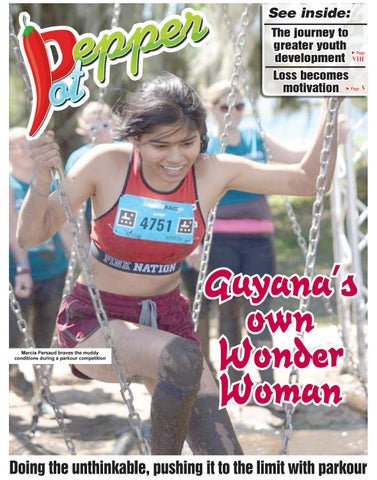
Marcia Persaud braves the muddy conditions during a parkour competition
V
Guyana’s own Wonder Woman
Doing the unthinkable, pushing it to the limit with parkour
II
e h t or
F
Wine lovers
How three friends’ travels produced Guyana’s first ‘Wine Vault’
By Telesha Ramnarine
Chronicle Pepperpot August 19, 2018
This entire rack was imported from Italy
“We laughed a few years over the idea but eventually came around and seriously THE idea of developing a wine culture in Guyana was considered it after realising we can offer always a topic for conversation when three good friends much improvement to the local wine indus– Marcelle Shewjattan, Ravi Mangar and Varsha Shartry, especially since Guyana is expecting a ma – took vacations together; travelling the world and cultural evolution in the near future with the never missing an opportunity to sample wines and even oil and gas boom,” Mangar further expressed. visit vineyards. Sharma told the Pepperpot Magazine that After toying with the idea for a number of years, the she and her friends always knew that one day friends finally decided to consider it seriously and make it they would embark on this business venture. into a reality with the opening of ‘The Wine Vault’, located “And I couldn’t be happier it’s happening at the Marriott Hotel last July 1. right now! Although we are all three wine The retail wine store – the first of its kind in Guyana with enthusiasts, we also bring different expertise its catchy advertising slogan “purveyor of fine wines” - seeks to the business model which is important for to introduce a vast array of wines from around the world inits success,” she said, adding, “After all it’s cluding from France, California, Argentina, Chile and Italy. not just about loving wines. But we are [exLocal wines are also on the shelves and a plan is in perienced] in business in Guyana for many place to begin importing from Australia and Spain before years and we know our customers well and The Wine Vault was opened inside the Marriott Hotel, Kingston this Christmas. how to satisfy their needs.” The original idea was simply to import wines to improve Sharma said she knows that improving the a wine business. the variety available in the country, but in just roughly six “The Wine Vault evolved food and beverage industry in Guyana will not happen overas a hobby. It is our passion. night; nor will the presence of their retail location do it. But she We just want to provide a is confident that success will be achieved with much focus on world-class service and put wine education and tasting and smelling events, among others. “So far, we have been getting tremendous support from the something different out there. We also thought of seizing the vineyards and distributors we deal with. So if you are interested opportunity at this time with in learning more about wines, follow us on social media or visit the influx of foreigners in Guy- our location to keep up-to-date on our exciting events coming soon,” Sharma said. ana since our oil Persons can visit the webfind,” Shewjattan site at www.thewinevault. expressed. gy and emails can be sent to Mangar also thewinevaultgy@yahoo.com. feels the same way, There is also a Facebook page adding, “Our love with the name ‘The Wine for wines moved Vault at Marriott.’ The store is from just drinking opened at 08:00hrs daily until it, to exploring the Marriott Hotel staff training in session with Mangar. 22:00hrs. many regions in the According to Shewjattan, world to find that weeks since its opening, the owners have already started dis- ‘perfect wine’. We are also big foodies so we love to the team is in the process of tributing to some restaurants and bars in the city, thanks to the have a culinary experience paired with our wines.” starting a wine club where positive response they have been receiving so far. customers can pay a monthly fee and have three to six new DOING THE RESEARCH wines, depending on the packThe friends visited Italy, Sonoma County and age they sign up for, delivered the Napa Valley wine region in California, among to them on a monthly basis. other places. “We visited vineyards and tried to The team is also trying figure out the winemaking process; the varietals, out new ideas at the Marriott the grapes, the history; what makes one better than Hotel. For instance, a ‘wine the other,” Shewjattan said, while adding that they flight’ has been added to the would often seize the opportunity to attend wine menu so that customers can seminars. have three small servings of With the knowledge and experience gained from different wines before deciding visiting vineyards and attending seminars, the trio is on their ultimate choice. better equipped to train and educate both staff and Customers can also place customers locally. Marcelle Shewjattan with her favou“Our business plan does not just include buying rite wine during the interview at the orders online and have their wines delivered for free. and selling but it comes along with the three of Marriott Hotel us who have the knowledge and experience to pair our wines with any delectable food menu,” Mangar expressed, adding, “Our goal is to continue exploring new wines and introducing the wonderful world of Marcelle Shewjattan, Varsha Sharma and Ravi Mangar at wine to all Guyanese one glass the opening of The Wine Vault last July 1 at a time.” He recalled how friends “Each time we travel, we would think, ‘If only we had played a pivotal role in urging these wine experiences home in Guyana. Why must we only him, Sharma and Shewjattan to have them when we’re travelling?’ We would always say it pursue the idea of a wine busiwould be nice if one day we can open a wine shop,” Shewjattan ness. “Our friends would think recalled in an interview with the Pepperpot Magazine at The we are crazy to be so obsessed Wine Vault. with smelling and tasting the The wine shop is not the main business for any of the wines, rather than just drinking three owners, as Shewjattan co-owns ‘Auto Fashion’ with her them only. With the passion husband Rupie; and Mangar and Sharma, who are husband they saw, they prompted and and wife, are the owners of Gizmos and Gadgets. Being the encouraged us to get into the The Wine Vault stocks wine from France, California, Argentina, Chile, and Italy. wine lovers they are, however, they were all bent on pursuing business.” Local wines are also on the shelves
Chronicle Pepperpot August 19, 2018
III
Guyana’s own
Wonder Woman
Doing the unthinkable, pushing it to the limit through parkour Marcia made jumping from a plane look easy, of course with the assistance of someone
By Navendra Seoraj MARCIA Persaud might not be indestructible and immortal like DC Universe’s famed superhero, Wonder Woman, but she certainly has similar traits which she continues to test through “parkour.” Parkour might not be a familiar sport to Guyanese but in the United States of America (USA) and other countries, it is a well-known sporting activity which attracts mainly “adrenaline junkies.” The sport is defined as an activity which involves moving rapidly through an area, typically in an urban environment, negotiating obstacles by running, jumping and climbing. Just imagining all that action would have someone at the edge of their seat but, while others may hesitate, Persaud is usually at the edge of a wall contemplating her next jump. While injuries are almost imminent, she pushes herself to the limit because she loves the sport since it challenges people physically and mentally. “Every day I’m doing things that scare me, breaking barriers, and showing myself I’m capable of more than I think. You learn so much about your body and you learn to trust yourself a lot more. Parkour is not about throwing yourself at obstacles and hoping you make it,” said an enthused Persaud. Although the risks are many, the sport is not impossible, it just requires technique and confidence, she explained adding that persons start from the ground and slowly move up. Of course, when it comes to parkour, ‘moving up’ comes literally since people who practice the sport on rooftops usually train for years before taking it to that level. While they might be experienced, Persaud said the professionals do not get careless but instead do jumps within their skill level. “Parkour is a highly mental sport. You have to trust yourself and know that you’re physically capable of doing the jump. The hardest part is to break through the irrational fears your brain makes up, but when you do, it’s the best feeling in the world,” said the young athlete, adding that she was motivated to do the sport after seeing YouTube videos of the athletes looking confident and free. Since she found her love for the sport, Persaud has not turned back. She instead continued her journey as an athlete, and even added rock climbing, Mixed Martial Arts (MMA) and Jiu-Jitsu to her list of activities. Her passion for sport, however, goes beyond the physical. She is pursuing studies in sports and exercise science at the University of Central Florida. The athlete was recently travelling around Asia and was expected to return to school after her summer vacation. Persaud chose that field of study because she’s an active person and would be able to apply the knowledge she
acquired to her life.
SOFT SPOT But being an adrenaline junkie and tough girl is not all there is to Marcia. The athlete also has a soft spot for animals. From a young age, Persaud would take care of stray puppies. “I’d bring them into my yard to bathe and feed them. My love extended to all animals as I grew up because I saw the same innocence and pureness in other animals that I did in dogs. As my learning continued, I found out information about the animal agriculture that I didn’t like,” she explained, adding that the treatment of animals is sometimes barbaric and immoral. The athlete and animal lover believes that no person or animal deserves to be treated inhumanely. In an effort to show her dedication to this cause, Persaud decided to stop eating all animal products and stop buying from companies which conduct tests on animals. After living abroad for a few years, she was able to join
the Humane Society of the United States (HSUS) and the People for the Ethical Treatment of Animals (PETA) which helped her to advocate for the prevention of torture and mistreatment of animals. As she grows, she hopes to continue her advocacy and at the same time make a career out of her love for sports. Persaud intends on working hard enough to ensure that she has enough money to give her mom all the luxuries she deserves. There are many other people who might have similar aspirations and for that reason, she urged those persons to always believe in themselves. “You should always follow your dream. It may seem hard sometimes but you only have one life, live it the way you want to, not how your family or society wants you to. It may sound clichéd, but the reason it’s been said so much is because it’s true. The universe is rooting for you,” she said, adding that persons must always try to improve themselves physically, mentally, spiritually, and emotionally.
Although jumping from wall to wall is her passion, she still takes time to relax
IV
A passion for
F
By Indrawattie Natram
tball
Aleia Moses when she made the squad.
Chronicle Pepperpot August 19, 2018
Queenstown Girl
proudly represents Guyana at CONCACAF in Florida
FROM the tender age of seven, Aliea Moses who hails from Queenstown Village in Region Two developed a love for the game of football, but little she did not know that she would one day represent Guyana at an international game. Moses, who is a student of the Johanna Cecelia Secondary School, vividly recalls sneaking out of her house to the Queenstown ballfield to play football with the boys in her village. She said that although her actions were very much against her parents’ wishes, she did not give up her dreams of wanting to master her skills in the game. Moses recently represented Guyana where she competed as a defender at the CONCACAF U 15 girls’ Championship at the IMG Academy, Florida. She described the experience gained from the game as truly “memorable”. “It was a dream come true for me, having been able to make the squad for the Guyana football team… when I heard I was selected I knew that I would have made my country proud,” the young athlete said. Moses along with her other squad members left Guyana on August 5 and returned August 12. She said the first match Guyana played was against St Lucia, followed by the Cayman Islands and the Bahamas. Although Guyana did not score in the finals of the games, the experience and memories she earned would be remembered throughout her lifetime. The Guyana team for the championship included goalkeeper- Lusdesha Reynolds; defenders - Hasha Holder, Anastacia Salvador and Alleia Alleyne; Midfielders -Samara Rodrigues, Amanda Mc Kenzie and Forwards - Jalade Trim, Kersti Thomas and Shamya Daniels. Moses started training for football when she was just 10 years old. She said that earlier in 2018 she heard about the tournament and spoke with her coach about her involvement.
Aleia Moses She added that she then started to practise at the Essequibo Technical Institute (ETI), then at the Leonora Track Field. Leading up to the selection, a camp was held at Leonora Fire Station where only those that were competent were selected. The teenager said that she felt lucky when she heard she was selected and thanked her coaches. She also thanked her family and relatives who supported her throughout the tournament. “This was indeed a [once in a] lifetime opportunity for me. When I arrived in Florida the scenery was so beautiful. I never imagined that my love for football could have landed me in such a beautiful place,” Moses said. During the games, Moses tried her best and supported the Guyana team. She said she also made many friends during her journey. This young athlete said that she will continue to pursue the game and hope she can represent Guyana again internationally.
Aleia (extreme left) with her other teammates.
Chronicle Pepperpot August 19, 2018
V
Loss becomes motivation One woman’s vow to help cancer patients in honour of her late grandfather
By Tracey Khan CARING for cancer patients is something that brings a sense of fulfilment to Dr. Latoya Gooding who lost her grandfather,James Gooding, to prostate cancer a few years ago. She was studying to be a doctor and now works in the Oncology Department of the Georgetown Hospital which is the only public institution that offers treatment and care for cancer patients in the country. She continues to be the light at the end of the tunnel for many of her sick patients and their families, going above and beyond to ensure they receive the best care as they battle this deadly disease. She told the Pepperpot Magazine that at the time of her grandfather’s diagnosis, she believed that there was no proper treatment and care for cancer patients and not much was done to save his life or even ease his pain, so she dedicated her life to ensuring other patients do not suffer the same fate. She feels so compelled to help prevent, treat and spread awareness of cancer that she is advancing her studies and knowledge in the field of Oncology. This is not without sacrifice because her ambitions separate her from her family most Dr. Gooding spreading awareness on cancer of the year as she pursues her Masters in Brazil. Gooding is even more motivated to further her studies, after seeing how many women die from this disease department. I prefer to be in that department and help other due to late diagnosis which is often times curable. “[This hap- departments as a way of seeing more patients and being usepens] especially with breast and cervical cancer, so I started ful. Today we have a very active Oncology Department with conducting free, monthly, cancer screening across Guyana,” us, with the doctors attending to over 50 patients per day. “ On her return, she continshe explained. ued working under the healthThis proud resident of Bartica, Region Seven, is the
Dr. Latoya Gooding is a mother and wife on a mission to help cancer patients fourth of seven siblings who credits her large family for her success. Her father, Franklyn Gooding, is her mentor and biggest supporter. “He was always there to support me. I can recall many nights studying for CXC, when I was up very late studying he was up just sitting there or sleeping in the chair as my company.” ACADEMIC DREAMS During her early years, she attended St. John the Baptist Primary School in Bartica, but left her hometown and her family to attend high school in the city. As a student of Central High School, she was unsure of her place in the world but had a fair idea of what she wanted to do in life. At age 17, she started working at the Georgetown Public Hospital Corporation (GPHC) but resigned after obtaining a scholarship to study medicine in Cuba. She recalls how challenging it was when she shared her vision of wanting to specialise in the field of Oncology. “I was told no, there is no Oncology Department and that I was going to waste my time and potential; that I will only be seeing five to six patients per day since they are no patients,” she said. “I stood firm and said that I am not going into another
care system but this time as a medical practitioner. Dr. Gooding also founded the Giving Hope Foundation, an organisation that helps to raise awareness and funds for treatment for persons living with cancer. She is also a medical director of Beacon Foundation and the assistant franchise director of the Miss Earth Guyana pageant. She is the perfect example of the quote, “be the change you want to see in the world.” Through her foundation, she has helped many families, including children who lost their parents to cancer to cope and adjust. Asked what her accom-
plishments are she said, “My son and achieving my degree in Human Medicine at the age of 24 and founding my NGO at the age of 27,” she said. She also co-authored the anthology Women Across Borders. Her hard work has been recognised by the Ministry of Public Health and she was awarded for her outstanding performance in the Visual Inspection with Acetic Acid (VIA) programme in 2017. Her advice to a young girl who wants to pursue a similar career is, “If the dream is big, the facts don’t matter. It doesn’t matter where you come from, with hard work and determination you can achieve your dream.” You may wonder what is next for such an ambitious and industrious young woman, she says, “To complete my masters in Oncology, followed by my PhD in Oncology and increasing the size of my family.”
VI
Chronicle Pepperpot August 19, 2018
The life of a teacher What parents can do to make it easier
Teacher Danielle Marshall
A nursery school teacher in front of the classroom, imparting knowledge
By M Margaret Burke YOUNG children just over the age of three years old will soon be entering nursery school to begin a pathway towards formal education in the classroom. Many of them are still babies in a sort of a way – weeping bitterly when they realise that they would be left with a ‘stranger’ (their teacher) and other strange children- some who do not look welcoming since they themselves are not happy. For the first few weeks, nursery school for some of the children is a place of trepidation and confusion. In a lot of cases, many of them were never orientated to get used to the idea that they were ‘going off to school’; that they were going to be away from their immediate family members for at least a few hours, five days a week; that they would have a ‘new mummy’ for that period of time; and that they were going to have some ‘new’ children around them that they were going to have to make friends with. SHOWING THEM LOVE Teacher Danielle Marshall, a young teacher who has been teaching in the nursery school for several years now, told the Pepperpot Magazine that the major reason why she is a nursery school teacher is that she loves and cares for the young children deeply. “I always feel that I can make a difference in the lives of these young ones. If they don’t get the best treatment at that tender age when they come into the school system, then I do not know what will ever happen to them,” she said. “These children need love and affection – the same way they would get it in the home and sometimes even more than they are able to get it there. As teachers, we are trained to detect problems and other situations that these young children may be faced with because even as young as they are, they sometimes face their own difficulties and so we need to care and show that we care.” Teacher Danielle went on to talk about the fact that there are times when children enter the classroom with a void, which only the teacher can fill. She said that in the absence of a parent, or in some cases both parents – because of migration, death or for some other reason, some children still reeling as a result of that absence, throw themselves to the ‘mercy’ of the teacher. “How could we ignore them – how could we not take them into our arms and show them love; show them that we care? While we have to demonstrate strength for the sake of all the other children and even for that child in his or her own ‘pain’, sometimes we have to hide and wipe the tears too. We love them, they are our children too – in a way; so we can’t help but feel for them and care,” Teacher Danielle offered. Turn to page XXVI ►►►
Chronicle Pepperpot August 19, 2018
VII
Pageantry TALK with Pamela Dillon
PART TWO
Is pageantry in Guyana losing its value? RECAP LAST week, the Pepperpot Magazine took you through the first part of an interview with local pageant director, Pamela Dillon better known as ‘Miss Pam’ as she addressed the issues that may have caused the deterioration of the industry in Guyana. This week we continue down the list, with the aim of realising our part in possibly revitalising this empowerment platform for women in our country. QUALIFICATIONS FOR OWNING A PAGEANT FRANCHISE The lingering question in the minds of many, after rumours of a pageant, hit the streets is “What really qualifies a person to own a franchise?” This mind-boggling question was addressed by Miss Dillon who shared that it really comes down to who makes the better bid. And that is very unfortunate at times she said, since now anyone with money who has a bit of interest in pageants, are just “owning franchises and putting on pageants.” She said that people underestimate the amount of work it takes to properly prepare a lineup and put on a good production. “A pageant is a scary thing. From the time you sign up and you see the lineup, you’re nervous. You’re nervous that you are not good enough. You’re nervous about your competition. Nervous about how the public will react to your participation. And directors have to understand all this and know how to work with these different issues that girls come with, work with their differing personalities and make the show happen,” Miss Pam said. She added that it takes a whole lot to properly prepared girls for a pageant. Following pageants for years and having a love for it is not enough. “When I came back to Guyana, cosmetology was my thing so I opened a salon and all the pageant girls found their way down to my salon. I saw how they were subject to a lot of criticism from the other patrons. Pretty soon I started realising I wanted to help these girls; teach them how to prepare before they go public because as soon as they go public, they are torn apart,” she said. Miss Pam explained that the show is the least of it all. She stated that the focus must be on working with the girls, seeing where they are psychologically and moulding them into positive forces who will, without doubt, put on a great competitive production. “It takes a lot of preparation and we are getting to the place where corporate Guyana will realise it’s importance and work together so we can get where we need to be,” she said. RIGGED PAGEANTS Referencing from past pageant posts and articles, fixed pageants seem to have become quite the topic in Guyana. It was even rumoured that that was the reason that led to Guyana’s ban from Miss Universe. In asking Miss Pam her point of view on the issue of rigged/fixed pageants, whether or not it deprives participants of a fair shot at winning, she said that she believes if a pageant is set for someone, it gives the other girls the opportunity to really prove their potential. “It gives them the opportunity to lose with a controversy; lose with a fuss; cause a ruckus by doing your best. Let them see you work and you should be satisfied that you have worked. I always tell my pageant girls that. ‘Lose with a controversy’, the world must see that you were deserving,” Miss Pam said. From a Director’s perspective, she shared that sometimes they are afraid to take the chance with their queen. “You want a queen that delivers; who looks the part, acts the part, can address a crowd and the list goes on. That’s where the pageant politics come in. Sometimes producers don’t take that chance. They’re all humans and they could easily compromise themselves with that. Some of them say, ‘well this is the lineup, may the best girl win.’ While some of them do their homework and investigate girls. It has to be about what you stand for, what you’re doing as a producer and the equation with money that has to be correct,” Dillon said.
She also shared an experience with one of her Talented Teen productions. “A talented teen had exotic shots that were being sold and I had to ask her to withdraw from the pageant. Now should she win and those pictures surface, what would that have done to the reputation of my pageant? Sometimes
Pamela Dillon in her salon applying makeup to a past Talented Teen Queen
things pop up that you cannot live with so you might see a strong person but she’s not a suitable person because of whatever reason,” Miss Pam said. “Sometimes it’s a double-edged sword and not everything you tell John Public. You don’t go out and say you know she slept with her sponsor. She slept
with a judge before the event. You can’t say that. So the public only sees what happens on stage but that is not the only determining factor in choosing a queen.” She also shared that it can easily be a human error misconstrued as “rigged”. “I recall training a girl for a pageant and she was so exceptional and she didn’t space. I couldn’t understand why. Three days later I was examining the scores and the chief judge missed an entire line of her scores, he didn’t add it in and knocked her clean out of the competition. So I called him in a panic and asked what is going to happen and he said they cannot do anything. Sometimes they add wrong, they forget, I don’t want to say they deliberately delete scores but all of that is possible because we’re dealing with human beings. We see what happened at Miss Universe that year when Steve Harvey announced the wrong person as queen. Whatever can go wrong, will go wrong,” Miss Pam said. She added that some pageants ask you to come with a full package, while some pageants train you to be the full package. “But all in all it’s a terrific experience for any young girl. It forces you to take a good look at yourself. It forces you to decide what it is you will offer to the world. Apart from the glamour, you are now a role model, you are known for this pageant,” she said. “So you have an opportunity and platform to work on social issues. You have an opportunity to work on yourself. I’ve seen girls who transformed from tomboys to glamour girls. It helps you realise who you really are.” Conversation wraps up next week…
VIII
Chronicle Pepperpot August 19, 2018
In our own Residents of Yarrowkabra looking backyard to become self-sufficient By Michel Outridge RESIDENTS of Yarrowkabra located on the Soesdyke/ Linden Highway have taken to farming in their yards to take advantage of the vast land space in their community. According to community leader Corrine Wilson, the village is ripe for development and they are practising self-sufficiency by farming in their yards so produce is not sourced outside of the community. Yarrowkabra has about 5,000 persons with a large number of children and young people with a lot of time on their hands. Wilson added that they are trying to engage this age group to utilise the lands for farming, adding that even the primary school has adopted the ‘green’ initiative. DIVERSIFYING Most residents work with the government while others are into wood cutting or work at sawmills. Wilson, who is retired, told the Pepperpot Magazine that Women Across Differences (WAD) came into the area and engaged the youths in several life skills classes in an effort to equip them with a skill to start their own small businesses. She explained that the problem is the money for transportation which is about $2,000 to get out of the village and most of the youths are not in a financial position to invest that amount of money to go seek employment, and as such, cannot
make use of any employment opportunities outside the village. Wilson related that they need more social activities for the youths in the area because, while there are groups that introduce t a few life skills programmes in the community, follow-ups are not done. “There is a need for more craft lessons for the youths to become self-sufficient because I am concerned about their welfare and what they will do for a living. With only a playfield, that cannot suffice because sometimes they play football since they managed to outfit the field with two street lights, and apart from the few churches in the village there is basically nothing else happening,” she said. HEALTH NEEDS Wilson stated that the churches in the community have classes for the school-aged children and they had a medical outreach by a visiting overseas team. She pointed out that the turn-out was tremendous but when some parents got prescriptions for their children they could not afford to buy the medicines they needed. However, through an initiative by the People’s National Congress/Reform (PNC/R) they had a recent team of 20 doctors in Yarrowkabra ,who treated many villagers and children alike and distributed much-needed medicines and supplies. Presently, whenever Wilson goes to the city she would assist villagers with their school vouchers by getting their
Community leader Corrine Wilson.
school uniforms to them. She pointed out that a lot of Guyanese are returning to the community and trying to beautify the environment. “Yarrowkabra is trying to become an NDC by November and then they will have more initiatives to enhance the community,” she said. On the other hand, she reported that land is plentiful but most of it is unoccupied and just sitting there because the owners have no interest to do anything with it. Wilson added that some people don’t have the lease for the lands they are occupying and are afraid to develop it.
The journey to greater youth development By Gibron Rahim GUYANA’S young people are arguably among the most brilliant and talented in the world. This was no more evident than at the National Youth Awards held on August 12 at the Pegasus Hotel. Devica Uditram was among the awardees. The 23-year-old native of Ogle on the East Coast of Demerara attended Stella Maris Primary School where her scores at the Grade Six Assessment gained her admission into the Bishop’s High School. Graduating with 10 subjects, eight Grade Ones and two Grade Twos, Devica then went on to the University of Guyana to pursue a diploma in Banking
and Finance. She will graduate this November with a 4.0 GPA. THE START OF SOMETHING NEW Devica’s interest in volunteerism was born during her days at Bishop’s. She told the Pepperpot Magazine that she was in First Form when one of her classmates introduced her to the National Library’s Children’s Reading Circle programme. “It’s a programme for children between the ages of five and 10,” she explained. The programme’s volunteers teach the children who attend to read and improve their reading skills. Devica noted that the volunteers are comprised of students from various secondary schools. “Through that friend,
I became involved in the Reading Circle and that was my starting point of volunteerism.” Devica spent all five years of her secondary school career volunteering in the Children’s Reading Circle. It became a cherished routine for her. Every week, on Tuesdays and Thursdays after school, Devica would go over to the library and interact with the children. “That experience was just great!” she enthused. “Over those five years, I interacted with about 200 students in total who showed tremendous improvement in their literacy skills.” Her volunteerism at such an early age also sparked a great deal of personal growth for Devica. At just 12 years old she was teaching children who were only a few years younger than her. “It shows that there is a little bit of a flaw in the education system and more needs to be done,” she said. “And I felt very passionate about that because I grew up in a household where you only read books.” Television simply did not play a significant role in her home life. Devica still feels very strongly that children and youths should have greater exposure to books and develop a love
Devica Uditram
of reading. Reading, she acknowledged, is her favourite pastime. Turn to page IX ►►►
Chronicle Pepperpot August 19, 2018 ◄◄◄ From page VIII
Devica had to leave the Reading Circle when she became employed in 2013. That was not the end of her volunteerism, however. She then became involved in voluntary activities through the Guyana Pandits’ Council, her mandir’s umbrella organisation. She explained that the Council, along with medical personnel and volunteers, visits various communities for outreaches. “We go and we administer help to persons who need it within the community,” she related. Devica was eventually selected to be the coordinator of the Council’s Youth Arm. The Youth Arm’s main objective is organising social projects. MENTAL HEALTH One of the main platforms of Devica’s work with the Youth Arm is mental health and suicide awareness. That focus is for two reasons. “Back in 2015, I myself went through some very difficult times which led me into depression,” she explained. “Fortunately for me, I had someone there to help me overcome that.” Devica used that experience with depression as a lesson to empower herself to in turn empower youths to start speaking out more about mental health and suicide, not being afraid to confide in others when they are battling problems in their lives. She has visited mandirs in the communities of Diamond and Wales where she has conducted mental health workshops targeting youth. Devica’s volunteerism has never been focused on receiving accolades. She told the Pepperpot Magazine that she has asked herself whether her 11 years of volunteering has had an impact on the lives of the people she sought to help. “You sacrifice your time, your effort and your energies to go out and do something for people,” noted Devica. “You have to love what you’re doing and this
IX
award is just a reminder that ‘you are doing something right, you are doing something good’,” she said, “and I should continue to do what I’m doing because I’m doing it for the benefit of the youths, communities and Guyana as a whole.” Seemingly small efforts can have a great impact, as Devica has discovered. “It didn’t seem significant but our actions, no matter how small they may be at first, collectively grow and create this huge impact,” she said. “So receiving [this award] was very humbling for me and it made me really reflect on my work over the years.” INSPIRATION Devica noted that her late father played a significant role in her life. He was the one who taught her to be compassionate and humble she said. “I started volunteering in September 2007 and he died a few months after in December,” she related. Devica’s godfather, Pandit Richard Sharma, has always been supportive. She noted that it was Pandit Sharma who encouraged her to take on the leadership of the youth group. Her mother has always checked in with her to ensure that she is able to balance her career and volunteer work. “My mom was a very big supporter, of course,” Devica said. “My sister is very supportive of me as well.” She also credited Ms. James, Head Librarian of the National Library’s juvenile section, with always supporting and encouraging her. YOUTH DEVELOPMENT Youth development has already started in Guyana, according to Devica. “I’ve seen that we as youths have already started to raise our voice,” she said. She referenced a quote by Meghan Markle who said, “Women don’t need to find a voice, they have a voice, they
Devica receiving her National Youth Award
need to feel empowered to use it and people need to be encouraged to listen”. Devica noted, “In order for youth development to happen and to prosper, you need to be encouraged to listen to the youths and to give them that platform to speak.” Devica added, “And youths are being vocal these days, they’re brilliant, they’re so brilliant and they bring fresh perspectives and insights to the table.” These include the areas of volunteerism, education, LGBTQ rights, entrepreneurship and environmental protection. “They bring so many new perspectives and these can help to build our country,” she related. “In order to foster youth development you need five Cs – competence,
confidence, connection, character and caring or compassion.” Possessing these traits, she said, enables a youth to carry out their duties as a youth leader or youth activist which will result in them contributing toward society. “Youth development is a very long road, it’s not going to be easy. There will be various obstacles along the way but with dedication, a little bit of motivation and, of course, support from our leaders, it can go a long way. And I would love to see Guyana prosper. We may be a small country but we have brilliant minds and we need to tap into those potentials and those abilities of those persons to ensure that we reap the full benefits of it.”
X
Chronicle Pepperpot August 19, 2018
Let the stories live on VOICE Youth Group reviving storytelling in Queenstown village
By Indrawattie Natram STORYTELLING is an ancient tradition that has been shared by many cultures over the centuries and serves as a means of passing on cultural practices, teaching lessons or just a mere form of entertainment. However, in modern times, this tradition has become lost. Having recognised that children of today are not aware of the significance of storytelling, the VOICE Youth group which was recently formed in Queenstown Village in Region Two, has been reviving storytelling in the community. The group recently held the “Elsie Marks Memorial Storytelling Competition” in the village which according to President/Co-Founder of VOICE, Deanna Walcott, attracted a large number of children in the village. “The Elsie Marks Memorial Storytelling Competition is
just the first of many public speaking opportunities open to not only the children of Queenstown, but to youths in the villages across our beautiful nation,” Walcott said. The competition was named the Elsie Marks in memory of Marks who was a teacher at the Queenstown Primary for over 40 years. She died on January 21, 2015. According to Walcott, the initiative aimed at becoming an annual competition to boost confidence
and promote public speaking amongst Grade Five and Six students.
two rounds. In the first round, the participants were required to present their original prepared piece. The second round tested the participants’ public-speaking skills and their cre-
Participants of the Elsie Marks Memorial Storytelling Competition and members of VOICE (Ahkeel Marks at the centre)
During the competition, which was held on August 11 at the Queenstown Primary School, 12-year-old Ahkeel Marks emerged as the winner. Marks shone among the other competitors and captivated the judges from the beginning with his confidence and sense of humour while telling his story. The other students who participated Dekeera Harinandan, Aatifah Hubbard, Chimalsi Vaughn, Emani Duncan and Rumelia Martinborough. Hubbard and Martinborough placed second and third, respectively. This year’s competition was held under the theme “School Days” and comprised
ativity through an impromptu topic that required the students to tell a story in two to three minutes, of a strange and scary new teacher they encountered on the first day of school. VOICE is made up of a group of youths who believe that everyone has a voice, and it is with this voice that they are able to communicate their ideas, thoughts and feelings. It is their mission as a non-profit organisation to hone and develop the communication skills of youth, and to inspire and empower them to become engaged citizens and influential leaders in the Guyanese society. In the future, the group will be opening its membership to interested persons as it seeks to continue to create meaningful change. VOICE’s main purpose is to assist schools, communities and other organisations in raising awareness about the life-changing benefits of speech and debate; to facilitate workshops, competitions and other activities designed to encourage continued exploration of approaches to speech and debating; to promote social awareness and interest in current affairs and to provide capacity building by teaching confidence, creating thinkers and moulding leaders.
Chronicle Pepperpot August 19, 2018
XI
The future is bright! WITH all this talk of the results of the CSEC and CAPE examinations released on Friday, I’m sure everybody is buzzing with the top students and their amazing performances- and rightly so, but let’s take some time to change the narrative just a bit. The talk of the Caribbean Examinations Council (CXC) examinations, inherently focusing on the top performances, does little to highlight the advances in youth development for the masses. And though, it’s good to celebrate accomplishments which may very well cause Guyana to top the Caribbean again this year, other strides should not be overlooked. Youth Parliament, for me, is one such stride. The Fourth Annual Youth Parliament was held over the past week. And as per the norm, secondary school students from each region were brought as representatives to participate in the event and for the few days, all the students benefited from training in public speaking and parliamentary practices. Drawing closer to the end, the secondary school students alongside students from the University of Guyana- a new addition to the initiative- debated on motions concerning them. One of the motions debated was amending the Representation of the People’s Act (Chapter 1:03) to include youth participation. This was one of the more skillful debates, especially given that half of the young people were debating to have youth involved in national decisions
while the other half of the house was arguing against this. Some of the other debates included revamping the education sector, implementing a healthy policy to prohibit the sales of carbonated beverages and oily foods and augmenting measures to combating climate change. What I like about Youth Parliament is that it gives youth a structured platform to voice their opinions on matters that affect them and their colleagues, and effectively contribute to the national discourse. What I am unsure of is if their views are taken into account and channelled towards creating solutions for all youth. But I do know that with the training received through the Youth Parliament, some young people have learned how to raise their voices and make an impact in their communities. And this year, some of those young persons, who were previous Youth Parliamentarians, came back to render their services through mentoring to this year’s cohort. So at the end of the day, the Parliament helps to mould young minds and give them the opportunity to use their voices to effect the change they want to see in their communities. It’s creating a chain of impact among young people. But more than Youth Parliament, what has made me most happy this week was the story of Chantoba Bright. Yeah, the results for the CSEC and CAPE examinations dropped this week and ultimately that’s given the most
attention right now (I would know) but I think this week, Chantoba’s story takes the cake for me. Eighteen-year-old Chantoba Bright received a full scholarship from the University of Texas at El Paso (UTEP), and The National Collegiate Athletic Association (NCAA) Division One School. This was because she has consistently performed well in the athletics arena. And more than that, she rose out of a “depressed” community in Linden- Victory Valley- to make her name. Added to that, she also excelled at her CXC examinations. It seems easy enough on paper, but being a student-athlete is tough; balancing the books and putting in the extra training every day. The Victory Valley resident, at the 2016 CARIFTA Games, won silver in the triple and the long jump. In 2017 she won gold in the long jump and bronze in the triple jump. In 2018, she won gold in the long jump, bronze in the triple jump and silver in the 4×400 relay. Chantoba is now the poster child for showing that your circumstances do not define you and that, perhaps, is something truly beautiful. Her hard work has paid off for her and she can now pursue her dreams and continue to represent Guyana. Development takes shape differently and it’s good to acknowledge it. Whether it’s excellent CXC results, Youth Parliament or great stories like Chantoba’s, the future is bright but it needs development now.
Inspiring young people through dancehall music
Gabriel Emanuel SOME may have a negative opinion about dancehall mus i c and the influence it has on young minds. But this 20-year-old local artiste, Gabriel Emanuel, vows to remain committed to his dancehall career and intends to use it to make a positive impact on young people like himself. Gabriel’s passion comes from his love for dancehall music and admits that his inspiration to take up this career path came from Caribbean artistes. “As a child growing up, I often admired and remarked on the work done by Caribbean artists such as Vybz Kartel and Movado. The rhythm and mood that persons often got listening to those artistes, engulfed my mind with the urge to follow in their footsteps because I want people to feel that way hearing my music,” the young man said. He shared that overtime, he was able to develop a lyrical talent and writing songs became a part of his everyday routine in addition to entertaining his friends and family. He added that one of his first hit songs was ‘Pree Me’ and this was done in collaboration with fellow artiste ‘Kush’ and recorded at
AJ studios. “With the outburst of Pree Me, although facing criticisms, I continued to push and thrive towards my goal. I aspire to be one of the greatest dancehall artistes of my time and hopefully my music lives on further because dancehall music is a genre that appeals to the youths all over the world. Media has become such a huge influence on everyday life that they listen and grasp what we sing about. My aim is not only to entertain but to send a message to the youths that there is a time for everything and not to live life by the guns and violence,” Gabriel said. He aspires to change lives with his life story and music. “One of my newest releases ‘In this world’ is an eye opener, as it touched on the impoverishment and crimes prevalent in our country. Growing up, I was faced with both good and bad times and finding the strength to overcome obstacles. I hope the messages I bring forth bring awareness to the challenges Guyana truly faces and not to give up hope and stay true and humble.” Gabriel encourages youths to aspire to be whatever they choose to be and be blind to the negativity in the world and be deaf to demotivation and deterrence. He believes that one should invest in their dream, trust themselves and always remember to live pure and humble.
Twenty-year old-Guyanese dancehall artiste, Gabriel Emanuel
XII
How to control Achousi Ants ACOUSHI drugger or leaf-cutting ants are major pests wherever they
occur. They can, therefore, be considered as general insect pests and are usually
rated as the most destructive insect in the Americas, the only region where they
occur. They are familiarly known in Guyana as leaf-cutting, fungus growing and mound-building ants. They are highly polyphagous i.e. destroying most crop species. The plant material that they cut is not utilised directly as food, rather, it is used as a substrate for a fungus which the ants cultivate and consume. The fact that the vegetation is used only as base material for the insect’s food, fungus; it allows them to exploit a wide range of plant species.
Chronicle Pepperpot August 19, 2018
plant should be disturbed and the bait placed close to, but not in the nests. Ant nests which are on the plant should be disturbed to agitate the ants and the crushed bait placed at the base of the plant. The ants will then take the bait back to their nests where control will occur. INSECTICIDAL SOLUTIONS The nests can also be sprayed with a 0.05 percent Basudin (Diazinon) solution. To mix this concentration add 4 ml (1 soft drink cork) of Basudin 60 EC to
pores of the applicator’s skin ADVANTAGES OF USING BAIT: 1. The active ingredient can be spread sparsely in the environment, leaving the pests’ food-seeking behaviour to concentrate the toxicant to lethal doses. 2. Baits require less critical placement than non-persistent insecticides. Nests also do not necessarily have to be located, thus, baits are cheaper to use than those methods which rely on locating the nest. 3. Baits can be so for-
CHARACTERISTICS The colony of acoushi ants is divided into many groups with each group being responsible for a specific activity. Some guard and protect the colony whilst others go out and forage for food. The most important member of the colony is the Queen. She is the only egg-laying member of the colony and is responsible for its continued existence. Only one Queen is found per nest. BAITING FOR ACOUSHI ANT CONTROL Baiting is the recommended method of control for acoushi ants. It exploits the insect’s feeding behaviour. Like the vegetation which is cut and carried back to the nests, bait picked up by the ants is taken back to the nest to be used as a substrate for the fungus which is the ants’ only food. Bait consists of a toxicant or poison and a carrier which is usually a material that the insects find attractive. The material must be attractive since this determines the degree of acceptance of the bait by the insects. The Acoushi ant bait is recommended to control the pineapple ants. This bait must be crushed in the bag to break the pellets into smaller pieces. Before the crushed bait is placed in the field, the area should be weeded so the nests present are exposed. During the rainy weather, the bait should be placed in a glass jar or aluminum foil packets to prevent wetting. Nests which are away from the
4.5 litres (I gallon) water. This spray solution can be applied to the plant where ant shelters are present and also in other parts of the field The planting material should be treated with a 0.05 percent solution of Basudin or Sevin or 0.1 percent malathion. To prepare the 0.05 percent sevin solution mix 8 g (or about 1/4 ounce) of Sevin 85 WP with 13.5 litres (3 gallons) of water. The container used to prepare the above solutions should NEVER be used for any other purpose. It is important that the container NEVER store human or animal food, or clothes be washed in it. WEAR GLOVES DURING THE ENTIRE OPERATION AND DO NOT USE THE CONTAINER FOR HUMAN OR ANIMAL FOOD STORAGE OR WASHING CLOTHES. It is also very important that gloves are used when dipping planting materials such as pineapple slips in the insecticidal solution. This prevents the chemical from entering the
mulated that their effective life is prolonged under field conditions. BAIT APPLICATION For most effective results and safety, the following bait application technique is recommended: a. Scatter bait along the working trail of nests and around feeding holes b. Do not handle bait with bare hands. c. Avoid bait becoming wet. Set bait late afternoon when the ants are most active or use bottles or bamboo troughs to protect the material. d. Do not use bait in the vicinity of livestock. PRECAUTIONS i. Do not store bait for more than three months after the production date (date is stamped on packet). ii. ii. Use all the bait once the packet has been opened. iii. iii. Store bait in a cool, dry place. iv. Store bait out of the reach of children.
Chronicle Pepperpot August 19, 2018
XIII
The truth about alcohol bars serve alcohol in pint and quart sizes. If a customer became disruptive, it used to be common for a bartender to tell that customer to mind their pints and quarts. I’m aware that a fair number of articles would also have information on the benefits of alcohol use. There are many studies resulting in data that suggests that moderate amounts of alcohol, particularly wine, is beneficial to the heart and therefore prevents cardiovascular disease. Keep in mind the keyword- moderate which means one or two. Also, just because there are benefits does not mean that it’s risk-free. However, I do feel the need to say that it isn’t just about the alcohol. Most people who drink will socialise at the same time
QUICK question: How many of you drank alcohol this weekend? I bet only a few of you can say no and stats collected throughout our country can back me up on that. Alcohol is the most widely used and abused substance around the world, with Guyana being no exception. The World Health Organisation (WHO) averages over 2.5 million alcohol deaths annually around the world. The Drug Information Network (DIN) has determined that the average Guyanese will start consuming alcohol at just nine years old. The earlier the age of onset, the more likely to become addicted, which means that simply growing up here is a potential risk factor of becoming addicted to alcohol. It is almost every day that I see people abusing alcohol with little care or knowledge about what is actually happening with consumption. Before you stop reading, I am definitely not trying to get you to stop drinking completely, I just want you all to have an idea of what alcohol is and what it does so you can make informed decisions. Many people do not consider alcohol a drug but I’m both sorry and happy to tell you that it is. Basically, a drug is anything that has an effect on our emotions, thoughts, mood and behaviour. Not only is alcohol a drug but many specialists will also call it a toxin or poison as it’s lethal in large quantities. It is important to mention that all drugs fall under a classification based on the effects they have on the body and mind. Alcohol is considered a depressant drug. You know that nice and calming feeling you get after one or two drinks? It’s hard to deny the pleasurable effects; there is a reason why we keep doing it after all. But do you know why you feel like that? Depressant drugs (like alcohol) slow down the functioning of your central nervous system – you are literally depressing the body. It feels good because when the drug enters the brain, it starts to release hormones such as serotonin and dopamine which are responsible for happiness, positivity and energy. Now the brain,
being the efficient organ that it is, will stop producing these hormones as it is already being produced by a foreign object (the drug). This means that natural production of happiness, positivity and energy will halt and people do not feel this way again unless the drug re-enters the brain. You may already feel like you know most of the harms that come with alcohol abuse and you may even be right. However, I wouldn’t be doing my job unless I reiterated this. It would take me this entire paper to list out all the harms of alcohol abuse so I will focus on the most common. Alcohol affects us physically, emotionally and socially. It also affects us differently both short and long-term. Many of us are aware of the short-term effects which typically happen during and a few days after intoxication. These include slurred speech, blurred vision, nausea, vomiting and diarrhoea. Our eating and sleeping patterns are interrupted. There is a loss of balance and coordination which often result in accidents and injuries. There are impaired judgement and thought processes which can lead to abuse, accidental pregnancies and development of sexually transmitted diseases. After heavy use, some even experience blackouts, loss of consciousness and severe dehydration. In extreme cases, there can be alcohol poisoning which can have fatal consequences. Extensive periods of alcohol abuse can result in long-term damages in liver and heart, various forms of cancer (mouth, throat, liver etc.), stroke, seizures and reduced fertility in both men and women. It can lead to permanent memory loss and nerve damage and can result in mental health issues such as anxiety, depression and suicidal thoughts. There are also many social issues that can come with alcohol abuse such as loss of productivity, unemployment as well as familial and friend issues. People tend to have many mood swings and behavioural problems when consuming alcohol. I actually read somewhere that the phrase ‘mind your p’s and q’s’ traces its roots back to alcohol. In England,
which typically comes with a reduction in stress and nurtured relationships – two things that also affect our mental and physical health. Multiple studies have concluded that people who abuse or are dependent on alcohol live an average of 10 years less than those who do not have problems with alcohol. Now that you know a bit more about alcohol, please read next week to see if you are consuming too much! Thanking you for reading. Please keep sending any topics you’d like to talk about to caitlinvieira@gmail.com Say Yes to Life and No to Drugs! Always! Suicide Prevention Helpline – 2230001, 223-0009, 623-4444 or 600-7896 Do not be afraid to reach out!
XIV
Chronicle Pepperpot August 19, 2018
RICE A FAVOURITE CONSUMER STAPLE ONE of the major and abiding consumer concerns worldwide is food. They wish to have an ample and continuous supply of good quality food at a reasonable price. One of the most important and staple foods worldwide is rice and in Guyana, it
is the most important food, even more so than wheaten flour but this has not been always so. Until the beginning of the second half of the 19th century, plantains and ground provisions were the staple food for the vast
majority of the coastal population. In the last quarter of the 18th century European plantation owners had attempted to introduce new foods to feed their slaves - the most important being ackee from West Africa, breadfruit from the Pacific Islands and rice from the colony of South Carolina in North America. Ackee caught on in Jamaica and ackee and saltfish is their national dish; and breadfruit, though it never became the staple food as in the Pacific Islands, came to be grown throughout the West Indies. The Carolina rice was also never adopted since rice-growing required intensive labour and the plantation owners would never deploy their slaves from the sugar-cane fields, since rice-growing would have been merely to feed the slaves and would have earned no profits. Some escaped slaves who had managed to secure some Carolina seed paddy tried planting it along the rivers but such cultivations betrayed where they were hiding and this led them to quickly discontinue all rice planting. Rice was never again grown in Guyana until Indian indentured workers began to plant it. They brought their seed paddy from India which happened to be the Indian long grain variety and very distinct from the Carolina short grain which had been tried and discontinued in the 18th century. Despite the many new strains of rice which had been introduced by agronomists in the 20th century, the Indian long grain still persists. Indian indentures began their rice-planting in the late 1850’s and early 1860’s. The cultivation was first in small patches of land outside the estates or along the rivers and creeks. The rice initially reaped was used by families and never sold commercially. The “milling” of the rice was done by pounding it and winnowing by hand; rice mills only made their appearance a few decades later. Rice cultivation gradually expanded and towards the end of the 19th century it came to be sold commercially and small to middle-sized mills began to make their appearance. This new source of demand for machines was welcomed by the British firms that supplied such equipment. Sprostons was the main such firm. At the beginning of the 20th century, rice came to be regularly exported and became a foreign exchange earner, and in both World
Wars I and II, Guyana’s rice fed the West Indian islands and averted serious food shortages there. The rice industry came to employ several thousand persons and in colonial times, the Guyana economy was always described as standing on a tripod of sugar, bauxite and rice. Rice was a very versatile food and was prepared in a large number of ways by menus adopted from foreign countries, as well as menus evolved locally. Indian indentures brought a large number of menus some of which had been adopted from Central and South-east Asia many centuries before. Most of these menus have been forgotten but a few have survived such as khir, a rich rice pudding made from white rice, sugar, milk and strengthened with various spices such as cardamom (elaichee), cloves, dried fruit such as dates and raisins, or popped rice which was used in various ways like popcorn or eaten as a morning cereal with honeyed milk. One rice confection which is nostalgically remembered and was widely sold everywhere a few decades ago was “ricecake”- very crisp rice sugar fudged and cut into oblong cakes. One locally evolved dish is “cook up rice” which contains as many ingredients as one wishes. The nearest Indian indentured equivalent is ‘khitchry’ but its ingredients are much less than cook up. Rice, though carbohydrate, is considered one of the world’s nutritious popular foods and has sustained hundreds of millions in Asia. In Guyana, the indentured workers who were the worst paid in the colony and considered the most poorly fed, survived because they ate rice (largely carbohydrate), dahl (highest vegetable protein) and tarkari (vegetables) like bhaji (spinach) and squash and many others which provided vitamins, iron and other necessary food requirements. This peasant and working-class diet which was regarded rather contemptuously in the past is now known to be healthy. Indeed, this diet turned out to be more balanced than plantains and ground provisions. Though the rice industry had been made the shuttlecock of political badminton and had been buffeted about for many years, it has managed to survive and feed the nation and give Guyana a large measure of food security.
Chronicle Pepperpot August 19, 2018
GNNL’s Administrative Manager, Donna Todd flanked by the General Manager Sherod Duncan, other managers and staffers, as she made the donation of a bicycle to Chronicle vendor, Tessa Waterton, on Monday at Yarrowkabra (Vishani Ragobeer photos)
By Michel Outridge THE Guyana National Newspapers Limited (GNNL) the publisher of the Daily and Sunday Chronicle is doing its part in being a good corporate citizen by giving back to the community and enhancing the lives of citizens. On Monday, a team visited the community of Yarrowkabra located on the Soesdyke/Linden Highway where they donated a bicycle to a female vendor of the Chronicle newspapers. The beneficiary, Tessa Waterton was elated by GNNL’s generosity, as the bicycle will aid her in traversing the community to vend newspapers. Waterton, who is a single parent of six girls, began selling the Guyana Chronicle newspapers earlier this year. She started out by selling 25 and currently sells 50 newspapers a day but had stated that because of the distance she has to walk she cannot reach more people to vend the newspapers and a bicycle would be able to assist her in covering more distance. This was taken into consideration by management and
GNNL’s Administrative Manager Donna Todd as she presented a cheque to Founder of the Back Circle Foundation, Troy Gardener (Michel Outridge photo)
with the General Manager’s approval a brand new bicycle was bought and presented to the vendor. Waterton told the Guyana Chronicle that the area is very large and walking gets a bit tiresome at times given the weather conditions. “This bicycle is a great start for me because I am aiming to acquire my own vehicle so I will be able to go to Georgetown to get my newspapers on time since at times the delivery vans would often arrive late,” she said. Waterton explained that by 07:00hrs people in the community are ready for their newspapers and are usually very eager to buy since, in the past, they had no access to newspapers in that village.
The woman added that many years ago she left West Ruimveldt and relocated to Yarrowkabra because of the constant flooding in the city and never regretted the move. Guyana Chronicle’s General Manager, Sherod Duncan; Administrative Manager Donna Todd, Circulation Officer Kim Halley; Circulation Consultant George Clarke and Marketing Coordinator Akash Persaud were all part of the
team who made the trip. Todd in brief remarks said that the newspaper company is always willing to assist its vendors in getting the papers out and in a timely manner, since the delivery of information is paramount for educating the nation. She added that she is optimistic that the bicycle will aid Waterton as a mode of transportation in delivering the Guyana Chronicle newspapers to its readers. THANKFUL In accepting the gift, Waterton said: “I am very pleased and thankful for the donation of which I will make use of and take care as I continue to sell Guyana Chronicle newspapers in my community.” She was pleasantly surprised when the team of GNNL staffers visited the community and could not stop smiling and expressing her gratitude. Meanwhile, GNNL on Tuesday made a monetary donation to the founder of the Back Circle Foundation Troy Gardener, to aid in his efforts to provide backpacks filled with school supplies to children of ‘Warlock’, East Ruimveldt. Administrative Manager Donna Todd, again, made the donation on behalf of the Guyana Chronicle. Todd said that GNNL’s utmost aim is promoting education especially for vulnerable children, and the company will continue to lend its support however possible. BACKPACKS After accepting the cheque, Gardener in brief remarks stated that he was born and raised in the community and every year, for the past six years, he would return to assist the school-aged children with backpacks containing school supplies for them to return to school in September. “I didn’t forget where I came from because when I was a child growing up in East Ruimveldt the folks used to look out for me and I want to help the children by being a role model,” he said. He related that his goal is to bring hope to the children
XV
Chronicle gives back
in that community and he feels so happy doing what he does best through his non-profit organisation, and the money he has received will be accounted for in the interest of the children. Gardener stated that next year he is planning a symposium for the children and he will invite persons from the private sector to give talks on varying subjects for five days. Following the five-day event, he said that the usual distribution of backpacks will follow. Being a stickler for transparency, Gardener said it is the very first time that he has reached out to a company for financial assistance and he will use the money for its intended purpose. The Back Circle Foundation is supported by Gardener, his aunt and her two children and is usually run on funds that are generated from among the four persons.
XVI
Chronicle Pepperpot August 19, 2018
Canal No. 2 Silver Reunion in New York By Francis Quamina Farrier HAVE you ever taken a drive along the Canal No.2 Public Road all the way to the very western end? And have you ever stood on the West Bank Demerara Public road, backing the koker at Stanleytown, at the eastern end of the Canal No. Two, and gazed westward as it stretches from where you stood into infinity? And have you ever wondered how those enslaved Africans were able to dig that lengthy canal, almost with their very bare hands? There are some Guyanese who have done so, and realise that it took very hard work in constructing and developing the massive drainage and irrigation infrastructure on Guyana’s coastlands during the era of slavery. Over the past century or so, all of the northern side of the Canal No. 2 has been developed into residential com-
munities. In more recent decades, a large number of those residents have migrated, a high percentage of which settled in New York. And during the past 25 years, they have met at reunions. After meeting many of you at the 2018 Canal No.2 Reunion, Flushing Meadows, New York, I must say this: Canal People Rock. That was the way New York-based George Nandan expressed himself to the large gathering at the 25th Annual
The Kawall Primary School, Canal No.2; clean, green and floral (Photo by FQ Farrier)
Reunion, by overseas-based Guyanese from Canal No.2, West Bank Demerara. This event, “Provided a great opportunity to reunite the village people, fam-
in the past were employed at the Wales Sugar Estate. Many others were professionals, employed with the Public Service or private establishments. A few weeks ago, I was at Canal No.2, where I visited with one of the oldest residents of the area 97-year-old Wilfred Duncan. A former canecutter at the Wales Sugar Estate, the nonagenarian expressed concern at the closing down of
Canal Polder No.2, West Bank Demerara, stretching from the east end, to ‘infinity’, dug by enslaved Africans (Photo by F.Q. Farrier)
ilies, friends and neighbours together for the day at the park,” a happy George Nandan related, adding, “It is also a great occasion for us to celebrate gratitude and reflection.” Over the more recent decades, Guyanese of African and Indian heritage, have been residing primarily on the northern bank of the canal which stretches east to west from the West Bank Demerara Public Road to the back lands. Many of the residents
the Wales Sugar Factory and spoke of the long-gone days when British Guiana supplied sugar to many foreign countries. Those were the days when the term, “Sugar is king”, was a popular saying. He also spoke of the unity between the Africans and Indians of Canal No.2. Like many other residents in the colonial era, Wilfred Duncan also cultivated the land as a farmer, planting crops such as ground provisions and citrus. He also reared livestock such as cows, pigs and goats. Like his fellow villagers, he was an early riser and was up and about before the sun rose to go about his daily activities. That was the life at No.2, and much hasn’t changed except that there are now many more beautiful and modern houses and potable water in homes. There is also a television set in almost every home. Turn to page XXIII►►►
Chronicle Pepperpot August 19, 2018
XVII
Facebook reportedly asked by US government to help wiretap Messenger
The US government has reportedly asked Facebook to help wiretap its Messenger chat app to listen to a suspect’s conversations in a criminal investigation, according to a report Friday by Reuters. That would involve breaking the encryption on the app, which is used by more than a billion people a month. The probe is related to the MS-13 gang in Fresno, California, according to Reuters, which cited unnamed sources. The case is under seal in a federal court in California, so no public filings are available. But Reuters said the US government
argued before a judge Tuesday to hold Facebook in contempt of court for refusing to cooperate. The case reportedly has to do with voice calls on Facebook Messenger, which the company says are encrypted end-to-end. That means the conversations are not decipherable to the company, and Facebook has argued that “it can only comply with the government’s request if it rewrites the code relied upon by all its users to remove encryption,” the Reuters report says. The Department of Justice didn’t immediately respond to a request for comment. Facebook declined to comment. The probe comes as Silicon Valley giants grapple with the bounds of data collection and surveillance. In 2016, Apple was embroiled in a high-profile battle with the FBI after refusing to break into the iPhone of a mass shooter in San Bernardino, California. More broadly, Facebook still faces distrust from users over its stewardship of the personal information of the 2 billion people who use the platform monthly. The company is reeling from a scandal involving Cambridge Analytica, a digital consultancy that misused the personal data of up to 87 million Facebook users.
folklore
XVIII
POLICE RESPONSE
TUG-A-SHEET
Chronicle Pepperpot August 19, 2018
By Neil Primus
THE wind howled and sang as it pushed and tugged at trees and bushes. Moonlight swept over the land like an efficient broom, clearing away the unwanted darkness. Owls, bats, other nocturnal creatures were out and about. The small wooden house stood firmly on a straight rise. Its galvanised roof flashed in the silvery glare from above. Creaks and groans were its response to the bothersome wind. Inside, the Kings slept soundly. This was the first home fully owned by the couple. Cedric and Aliya had pooled their savings and bought the small home cash. Both of them worked in the city and were happy that their new house was only a 20-minute drive from work. Their son Paul and daughter Karen were 10-year-old identical twins. There were two bedrooms, the master for mom and dad and the small one for the children. Each had their own bed. That night they were sound asleep, tucked warmly under the sheets. Sometime during the night Karen began to feel cold. She awoke to find the sheet on the other side of the bed. Thinking that she had tossed it off while sleeping, she tugged it back over her and went back to sleep. TUG! The sheet was back on the other side. She pulled it towards her once again and cuddled up for a nice sleep. TUG! The sheet was pulled roughly from over her. She sat up and glared around expecting to see her pesky brother pulling one of his lame pranks. He was fast asleep under his sheet. This time she covered herself and tucked the ends in under her body. The child went back to sleep smiling and woke up minutes later crying. She had been tossed from the bed and hit the ground on her butt. Paul was still asleep as she looked angrily around her. There, curled up in a fetal position was a little boy. What was quite annoying was that he was lying on her sheet. “Give me my sheet!” she yelled “Or else?” Was the taunting reply. “Or I gon hit you!” she burst out, tears streaming down her face. At the sound of her threat, the child vanished- sheet and all. Shocked and confused, she ran to the next room and woke her parents. “Daddy! Daddy! A boy took away me sheet!” She howled. Cedric ran for the cutlass thinking that there was an intruder in the house. He then charged into the children’s bedroom ready for the kill. Except for Paul who was snoring peacefully, the room was empty. He returned to his bedroom and spoke to his daughter who was whimpering as she snuggled closer to her protective mother. “There is nothing there dear. It must have been a bad dream.” “No daddy! I saw him!” “I checked the room and there is nobody there. Go back to your bed. The child clung tighter to her mother and refused to budge. When he realised that persuading her would be useless, he resigned himself to having her
tucked between himself and Aliya. The three were soon asleep. Back in the room the tug-of-war or should I say the tug-of-sheet continued. TUG! The sheet was pulled from a sleeping Paul. He sat up blinking and looked sleepily around. His sister’s bed was empty. He caught hold of the sheet and pulled it over himself. He drifted off to sleep. TUG! It was back on the other side of the bed. He got up and looked angrily around him. This time he yanked the sheet back. He tucked it under his body leaving his hand and head uncovered. He wanted to see where Karen was. He was sure she was trying to get back at him for all the times he had scared her with prank after prank. RIP! THUD! “AAAH!” Paul felt a sharp pain as his butt hit the greenheart floor. There, sitting at the foot of his bed was a smiling boy. In anger, Paul rushed over and tried to take back his sheet. SLAP! Paul’s face lit up. He blinked in amazement and looked for his attacker. He had disappeared. With a yell that woke everyone he raced for the safety of his parent’s room. He ran straight into his advancing father. The boy hit the floor hard for the second time. His dad picked him up and listened to his story. “See! I told you!” cried Karen who was by now wide awake. Cedric moved purposefully into the small bedroom. Everyone followed a safe distance. When he opened the door he saw the sheet lying at the foot of the bed. “You must have kicked off your sheet Paul. We’ll have to watch how much the two of you eat in the evening. Like the food rest on your chest and giving you both nightmares!” The father walked over to the bed and reached for the sheet. Aliya’s quivering voice stopped him in his tracks. “Wait! Look at the sheet Cedric!” She pointed a trembling finger at the white sheet. There on the smooth surface was the impression of a small body. “Paul! Karen! Is the boy still here?” the father asked. Both children pointed straight towards the foot of the bed. The family made a strategic withdrawal to the master bedroom for the rest of the night. Next day Cedric took a day off from the garage and paid courtesy calls on a few elders of the village. After those meetings, he understood everything that had taken place. When he returned home he discussed it with his wife. “A little boy died in that room a year ago. He had Chikungunya. It seems that his spirit remains there still trying to keep warm.” The Kings found a wonderful solution to the problem. There is now a double bunk bed for Karen and Paul and a single bed for their little guest. All the beds have adequate sheets. The children slept in peace after that.
Chronicle Pepperpot August 19, 2018
XIX
XX
Chronicle Pepperpot August 19, 2018
Total National Defence Strengthening our Military, Protecting our Frontier
THE Government of Guyana has a constitutional mandate to defend national independence, preserve the country’s sovereignty and integrity and guarantee normal functioning of institutions and security of citizens against any armed aggression. The Guyana Defence Force (GDF)is similarly mandated by the Constitution to defend the territorial integrity of Guyana, contribute to the economic development of the country and to assist the civil powers in the maintenance of law and order. The Constitution of the Cooperative Republic of Guyana, Article 197 A(1) stipulates “The State’s defence and security policy shall be to defend national independence, to preserve the country’s sovereignty and integrity, and to guarantee the normal functioning of institutions and the security of citizens against any armed aggression”. It is in this regard that President David Granger and Commander-in-Chief of the Armed Forces has proposed a strategy for ‘Total National Defence’ by the GDF. According to the Head of State, Total National Defence implies that all of the elements; all of the instruments of national power, need to constantly be employed, in order to protect Guyana, particularly as the threats to its sovereignty continue. In his address to Officers of the Force on October 15, 2015, President Granger said that “The principal purpose of the Guyana Defence Force is to provide the potential for the application of force to ensure the security
and economic policies.” TOTAL NATIONAL DEFENCE Guyana needs a well-commanded, welltrained, well-equipped defence force with the core capabilities of keeping citizens safe and secure and the GDF, in an effort to fulfil its mission, must be multi-role, flexible and fully integrated with sufficient support weapons. To ensure this, President Granger has noted that the Total National Defence must look at five main pillars, namely personnel, readiness, infrastructure, moral and equipment. With regard to personnel, the Commander-in-Chief has said that the Force must be brought up to the authorised strength to meet current and unforeseen challenges. The Force must also maintain its ‘esprit de corps’, he said, in order to enable troops to support its mission and to function as a unit in order to achieve its objective. On January 25, 2018 at the opening of the GDF Annual Officers’ Conference, the Head of State announced that the reinforcement of the Force’s high command, which started with the restoration of the appointments of Adjutant General, Inspector General, Quartermaster General (QMG) and Commandant of the Guyana People’s Militia, under his stewardship, have allowed dedicated superior officers to pay undivided attention to personnel and soldiers’ morale, the improvement of soldiers’ living conditions, a high state of operational readiness and interoperability with fraternal Caribbean defence forces and the mobilisation
President Granger commissions one of the Metal Sharks for the GDF Coast Guard
of the nation, the freedom of its people and the promotion of the national interest. Defence policy must determine the structure and capabilities of the defence force and guide the contribution it makes to the country’s defence and security goals in accordance with foreign
and training of reserve personnel. “The Force is being brought up to its authorised strength to allow it to be deployed to any part of the country, in any weather or terrain and at short notice. The ‘reserve force’ – the Guyana People’s Militia – is
Commander in Chief of the Armed Forces, President David Granger addressing Officers of the Guyana Defence Force in January 2018
being re-built in every administrative region. The Militia is an essential arm of the Regional system. Each regional capital town will have its own unit, eventually, to enable to respond more promptly to render assistance to residents in the event of emergencies. The Force is the premier agency charged with responsibility to protect our homeland against the new security threats such as environmental degradation, flooding and drought. The Force is being readied to support the Government’s law-enforcement efforts to combat trafficking in illegal weapons and narcotics and transnational terrorism,’ he said. READINESS To be prepared and ready, he noted that the Force must be prepared to deploy to any part of Guyana, at short notice in response to direction by the Guyana Defence Board. Readiness refers also to the resources needed to conduct training and to prepare units for operations. The President has also mandated regular military Exercises to ensure that the Force can fulfil its mission to protect Guyana’s territorial integrity and is in a state of preparedness for any security threat, which may arise. The Exercise is designed to assess the GDF troops in Close Country Warfare (CCW) and Open Country Warfare (OCW) simulations of battle. In this regard, this year’s ‘Exercise IRONWEED’ culminated on August 15, 2018, with the “Final Attack” in the savannahs of the Colonel John Clarke Military School at Tacama with the participation of over 1500 troops in the 10-day exercise. Congratulating the troops following the conclusion of IRONWEED, Chief-of-Staff Brigadier Patrick West announced that the activity will be done on an annual basis. “In this Exercise, we have tested and assessed
our coordination, synchronisation, and standardisation of (battle-ready) operational procedures. We have demonstrated our capacity for mobilisation, deployment, concentration of force, battle procedure, fire and assault support, among other things. I am proud to announce that this is the first time that we have had so many troops involved in this type of exercise. This was because of the embodiment of more than 200 reservists from the Guyana People’s Militia,” he said. The Chief-of-Staff also noted that as the exercise continued each year, various adjustments to format and operational procedure would be initiated as necessary. This, he said, would be in keeping with the need to ensure sharper and more precise focus in battle-readiness and operational efficiency. INFRASTRUCTURE As it relates to infrastructure, the Commander-in-Chief said that the condition of airstrips, the condition of barracks, the condition of hangers, wharves and other infrastructure, must be maintained in a serviceable condition in order to enable the force to conduct operations from them. “The Engineer Corps will once again be built up to the level that it can assist the Ministry of Public Infrastructure to complete these roads and bridges in the hinterland because this is what the government feels should be necessary to develop this country,” he said. Already, the Force has started to undergo a significant restructuring programme to allow for a greater level of efficiency in the execution of its mandate and to ensure maximum development within the Force. Changes are being made to the Engineering Corps, with greater emphasis being placed on public infrastructure, the Agriculture Corps, which will focus on food production for the Force
Chronicle Pepperpot August 19, 2018 and victims of natural disasters and the Signal Corps, which will be re-established as the main arm for the advancement of information and communications technologies and telecommunications within the Force. “Several Corps of the Force are being re-formed and re-capitalised. The Agriculture Corps will embark on agro-processing in order to produce foods, which can be preserved and packaged as compact rations for soldiers on long-range patrols and field operations and as emergency supplies to citizens affected by natural disasters such as floods. The Air Corps and Coast Guard will be upgraded to allow for continuous surveillance over our airspace, maritime space and land-space and to support search-and-rescue services to persons in distress. The Engineer Corps will be restructured and re-equipped to enable it to re-engage in the development of public infrastructure and assist in disaster relief efforts in other countries affected by natural disasters. The Corps will expand the Force’s capability to generate electrical energy from renewable sources in all military bases and camps,” the Head of State has said. RESOURCES In every job, equipment and resources are necessary to accomplish the task at hand. The Head of State recognises this and has noted that the Force must have the capability to maintain adequate, combat ready units with the correct mix of personnel and equipment. “Aircraft, road vehicles, maritime vessels inevitably will be degraded over time but they must be repaired or replaced if efficiency is to be ensured. And sometimes, I fly in highlanders owned by private operators; which I used to fly in thirty years ago, owned by the defence force and I wonder
why we couldn’t maintain them ourselves, why we couldn’t maintain our fleet. The Air Corps must be upgraded to provide continuous surveillance over Guyana’s air, territorial and maritime borders and approaches, and support search and rescue services to persons in distress. The Coast Guard unit must be upgraded to be permitted to provide continuous surveillance over Guyana’s sea space. It must be able also to provide search and rescue services to persons in distress. Maritime security is a serious matter,” the Head of State said during his address to Officers. On March 30, 2017, the Commander-in-Chief in direct demonstration of the Government’s support to the recapitalisation of the Coast Guard and to ensure the protection of marine assets, the prevention of transnational crime and the promotion of international and coastal trade, commissioned two new vessels at the Coast Guard Ship Hinds (GCGSH) at Ruimveldt. The two boats are Metal Shark 38V Defiant Class vessels, which were purchased by the Government of Guyana at a cost of $140 million each and are outfitted with three 300 horsepower engines and measure 38 feet in length. Further to this, Minister of State, Mr. Joseph Harmon, who also serves as the Secretary to the Defence Board, today, said that the Government of Guyana is committed to providing the necessary resources and equipment to the Guyana Defence Force (GDF) so that it can effectively fulfil its mandate as he commissioned two new Islander planes for the Force’s Air Corps on August 10, 2018. Speaking at a simple ceremony held at Air Station London, Timehri, the Secretary of the Defence Board said that the acquisition of the planes is part of Government’s plans for the recapitalisation of the Force as outlined by President David Granger in the ‘Total National Defence Policy.’ “The Total National Defense Policy is designed to give our regular and reserve forces the resources they need to
XXI
The two Islanders, which were purchased by the Government of Guyana for the GDF’s Air Corps
perform their mission. This policy is based on five pillars: option available to the GDF for the expansion of its Air personnel, readiness, infrastructure, morale and equipment. Corps. I must, however, urge you, beseech you to take good A policy is a course or principle action adopted or proposed care of this investment; to care these aircraft; to ensure their by a government. A policy is followed by a plan and a plan proper maintenance and use so that the GDF and the people of has to be implemented. All of this has to be driven by interest Guyana can have the maximum benefit of their investment,” and the will of the state for there to be concrete action and Minister Harmon urged. subsequent success. In consideration of what I have just stated, Chief of Staff of the Force, Brigadier Patrick West has said this ceremony is therefore strong evidence that the President that in addition to the Islanders, the Force expects to acquire of Guyana has outlined a policy, a plan is being pursued and two more Skyvans in the coming months to add to its fleet. is being implemented, part of which is the acquisition of these “Words cannot express our profound gratitude over the two aircraft. This ceremony speaks directly to the part of the continued support that produce results such as these. These air“Total National Defence Policy’ that specifically addresses craft, as you were told, will enhance our surveillance capabilthe issue of resources. The Guyana Defence force and the Air ities and provide increased support for our forward locations. Corps must be properly equipped to carry out its mandate,” It is also envisaged that they will provide much-needed assishe said. tance in administrative and other duties and contribute to the The Minister of State noted that the Government of continued support for our civil defence operations,” he said. Guyana will not hesitate to provide the support necessary to Commanding Officer of Air Corps, Commander Courtney ensure that the servicemen and women are fully equipped to Burns said that the Corps plays an integral role in the Force’s uphold the Constitution and functions and is therefore inspired that Government has seen protect Guyana. The aircraft, it fit to add to its resources. he said, represent an invest“The Air Corps is indeed inspired by this acquisition and ment that demonstrates the we know this is only the beginning but we are inspired. We Government’s commitment are re-energised as we continue to be driven by our motto of to ensuring that the GDF re- ‘Service’. No military can be effective without an effective ceives the necessary aviation Air Force. Our mission is to provide aviation support to the support required to execute its Guyana Defence Force. This support comes in the form of mandate. 16 tasks, namely search and rescue as required, airborne and “These aircraft being re- airmobile operations,, casualty evacuations, day and night ceived today will engage in medical evacuation, air transport for troops, platform for activities that include ensur- tactical operation, surveillance through the country including ing the security and integrity the Exclusive Economic Zone, disaster relief operations, reof our borders, the security plenishment plans for those deployed, provide support for govand integrity of our maritime ernment programmes, conduct trainings, conduct anti-piracy, space, especially with regard anti-illegal mining, logging and fishing activities, support civil to the activities related to the powers and the police, provide internal support operations, production of oil and gas and conduct counternarcotic operations and cross-border operaanti-piracy efforts, provide tions. These islanders will be directly employed in the conduct support to the resuscitated En- of those operations with the exception of one or two,” he said. gineering Corps of the GDF in its activities with regard to the DEFENCE COOPERATION infrastructural development Over the years, Guyana has received tangible support from in the hinterland, promote the its bilateral partners. This year, Guyana and Brazil are celepolicy of equal development brating 50 years of friendly diplomatic relations and the two and the delivery of public services and bridging the gap States have recommitted to strengthening ties and pursuing between our coastland and hinterland communities and sup- cooperation programmes particularly in the area of defence. porting the establishment of a ‘green economy’ and ‘green’ The two nations on February 10, 2018, during a State state by monitoring activities in our forest for the control and visit by Brazil’s Minister of Defence, Mr Raul Jungmann mitigation of carbon emissions that affect climate change,” Pinto, along with a high-level delegation, which included he said. Brazil’s Minister of Justice, Mr Torquato Lorena Jardim, held Minister Harmon noted too that it would also assist in the maintenance of the integrity of the country’s protected areas, improve the security and protection of citizens in the hinterland especially indigenous communities, improve relations and the delivery of resources and infrastructure to hinterland communities and facilitate medical evacuations from hinterland communities. “It will also ensure that our Members of the Guyana Defence Force (GDF) participating in the 10 days men and women in uniform ‘Exercise IRONWEED’, which concluded at the Colonel John Clarke Military have the necessary service School (CJCMS), Tacama, Upper Demerara-Upper Berbice (Region Ten). support. I remember days when I was an Officer and we had to wait days for an aircraft for replenishments in remote high-level talks to bolster defence cooperation. areas. We are doing better now so all of our men and women The bilateral engagement, which was hosted at State must understand that what we are doing as Government is House, saw a commitment by both countries to review the providing a reliable source of support for them. They must September 2012 Joint Communiqué, which followed the know that there is a chain behind them that is strong and that official visit to Guyana by Ambassador Celso Amorim, will provide support. I have been assured that the aircraft then Minister of Defence of Brazil. The review is intended are the best suited to our conditions and the objectives to be to update the agreements in that document and bring them achieved by the Air Corps in the execution of its functions. in line with present-day realities, as well as, to deepen I have also been advised that they are the most economical defence cooperation.
XXII
Chronicle Pepperpot August 19, 2018
Renewed hope for amputees By Shirley Thomas THE handing over of spanking new custom-made prostheses to 25 patients at the Ptolemy Reid Rehabilitation Centre last Friday, came on the final day of an intense two-week PAHO/WHO-funded training programme in Prosthesis and Orthosis, for technicians at the facility. It was with a deep sense of gratitude, renewed hope and unspeakable joy, that the
amputees, many of whom had lost both legs and were confined to wheel-chairs, received the prosthetics. Rehabilitation Officer Cynthia Massay said that the training initiated jointly between the Ptolemy Reid Rehabilitation Centre (PRRC) and the Pan American Health Organisation/World Health Organisation (PAHO/WHO), is a capacity building initiative which offered training in Prosthesis and Orthosis for five technicians at the centre.
Senior technicians doing a demonstration as juniors look on.
The objective was to equip them to master the art of producing prosthetic and orthotic appliances for persons who have lost both limbs by way of trauma brought on through accidents; amputations (notably diabetic); as
technologically advanced and within a cost range affordable to persons with such disabilities in Guyana, Massay outlined. The trainees on the programme were Marlon Andres of the Mazaruni Potaro Region: Keron Kyte of Plaisance, Region Four; Mark Flavius of Agricola, of East Bank Demerara also in Region Four, along with Senior Technicians – Colin Charles and Junior Whyte. The contract specified that the training be done over a period of two weeks, at the end of which 25 prostheses would be delivered to the patients through the administration free of charge. Massay said that even though the timeframe was short, the performance was phenomenal. “It’s amazing! All the prostheses were blasted and fabricated and all 25 were completed and delivered,” she said. For her, it was a ’shot-in-the-arm’, since, apart from funding the experts, PAHO also provided some very essential equipment which will replace those at the Rehab Centre, now very old and no longer relevant, Massay said.
This woman, now a double amputee, tells of being a diabetic for 20 years, and now she could hardly wait her turn to be fitted with her own custom-made prostheses which will allow for her to walk on her own once more.
well as congenital ones (persons who were born with limbs missing or malformation). Heading the team of persons conducting the training was Jon Batzdorff, CPO Director, of Prosthetika, a Not-for-Profit Corporation coming out of California. With him were Eddy Leopordo Fuentes, CPO from Diabetics Solutions and working in Guatemala and Puerto Rico and Laura Burgess, an expert Physiotherapist in Prosthetic Rehabilitation from Britain. Of the five persons trained, three were junior technicians employed at the workshop, while the other two had previous professional training overseas, but were included in this training in order to improve their experience and technologies, thus making them capable of producing prostheses which are more
“Walking on my own!” This young amputee born with both lower legs missing now has a renewed sense of hope in his ability to walk on his own. Turn to page XXVIII ►►►
Chronicle Pepperpot August 19, 2018 ◄◄◄ From page XVI
At the reunion, George Nandan spoke of a tragedy which took place back in 1979, when eight sugar workers from the Wales Estate were killed when a Tata bus crashed into the estate truck in which they were travelling. This was the focus of a song which was sung at the event paying tribute to the victims. Their death turned out to be the biggest funeral in Canal No. 2’s history, and was attended by hundreds of mourners, including Dr Cheddi Jagan. George Nandan had many other reminiscences for the crowd. “Canal had pretty much red brick and mud road at the time and small outboard engine passenger boats used to take passengers up to Matthews to the buses. Later Burnham had the road paved for the Clay Brick factory to be constructed.” Although I have, on previous occasions, written about the high regard I have for the teachers and students of the Kawall Primary School, I will take this opportunity to, once again, point out that the school has been clean, green and flowering for many years. On one occasion while covering a Christmas fete there for TV, I observed students taking
litter to the tiny clay brick incinerator at the west side of the school for burning. I further noticed that the students were doing that chore without any urging or supervision by the teachers. On another visit to the Canal in 2016, I did a poetry session for the students. While there, I observed the water level in the canal was extremely low. It was a different situation a few months ago when the community suffered flooding. Many of the homes at and around the community, like Wilfred Duncan’s, are partly constructed with clay bricks which were manufactured at a factory in the area some years ago. There is also an all-weather road which is a great improvement from the red-dirt road of the colonial era. Another development which has positively impacted the community was the construction of the Demerara Harbour Bridge. Prior to that, many residents travelled by launch from the Stanleytown koker to the Stabroek Market Stelling in Georgetown. The reunion was spon-
XXIII sored by the Canal No. 2 Polder Charity Group of the USA, which also sponsors the annual Canal Senior Citizens Christmas Party at the Kawall Primary School. Among the dozen rules regarding this reunion, which intrigued me the most, is the one which states: “Enjoy yourself and make new memories, especially with the seniors.” Nandan, who is an entertainer and who is at present, working on the production of a movie and is the events’ main organiser, is already asking members to plan early for the 2019 reunion. This event is usually kept on the second to last Sunday of July. The organising committee extends another invitation for all US-based residents to be there next year, 2019, whether they reside in Queens, or Brooklyn or beyond New York.
XXIV
Chronicle Pepperpot August 19, 2018
E FILES S A C T COUR
Judge’s misdirection of jury Led to Appellate Court freeing convicted robbery accused
THE Guyana Court of Appeal in 1967 allowed an appeal and quashed a conviction and sentence of accused Mintra Chand, because the trial
judge considered Chand’s silence to be indicative of guilt. At the jury trial, the jury acting on the misdirection of the judge found the accused
guilty resulting in him being sentenced to two years imprisonment. He appealed. Justice of Appeal Edward Luckhoo who along with Jus-
tices of Appeal Guya Persaud and P.A. Cummings, constituted the Appellate Court. Justice of Appeal Luckhoo delivered the judgment. The
other judges concurred to the judgment0 that allowed the appeal, and quashed the conviction and sentence. The trial judge had taken into account that when challenged by the police about the alleged robbery, the accused after being cautioned was told by the policeman that he was not obliged to say anything , unless he wished to do so. Acting accordingly, the accused said that he did not have anything to say, except that he did not know what the virtual complainant was talking about. The appellant for the first time gave a statement from the dock indicating that he and the virtual complainant had a fight that night, relative to an allegation about a stolen fowl. The trial judge, not taking into account that the caution, gave a prisoner the right to remain silent was critical about the accused’s statement from the dock and pointed out to the jury that if what he was saying from the dock was true, he would have related that in his statement to the police in the first instance. That was a misdirection which the jury accepted in coming to their conclusion of guilt, the Appellate Court found. The facts disclosed that the appellant was cautioned by a policeman in the presence of “B”, whom it was alleged himself and another man had robbed two days previously. After the appellant was cautioned he said “I don’t know anything about that” In his statement to the Police, the appellant alleged that at the relevant date and time he was at a nearby cinema with another man and denied robbing “B”. In his statement from the dock at his trial in the High Court, the appellant said that he and “B” had a fight in front of the cinema which his friend had parted.’ The trial judge failed to remind the jury that when a person is cautioned he is not obliged to say anything, and he told the jury that one would have expected that the appellant would have told the police about the fight which the jury were hearing for the first time, and that such an incident might have been a motive why “B” had made a false allegation against him. The Appellate Court held:(i) It is not always that “silence
By George Barclay
is golden”: a Judge may properly, in certain circumstances, invite a jury to consider an accused person’s silence as a relevant factor in determining what weight should be given to any defence which he may subsequently raise, but it would amount to a misdirection were he to invite them to treat the accused’s silence as evidence against him; (ii) To avoid the danger of depriving an accused person of the protection which he has a right to expect from the implication of the words, ‘that he is not obliged to say anything contained in the caution, it may well be that where an accused person makes no answer at all or makes some observation which in itself is not in the matter of an explanation, then the trial judge should make no observation on it; (iii) here, the trial judge’s directions clearly offended these principles and the result of his drastic and destructive comments made it difficult for the jury to resist coming to the conclusion, that because the story of the fight was not told at the first opportunity it could not be true, was not in fact true, ought not to be believed and should be discarded. Such comments could not be described as fair and proper and did not take cognisance of the paramount importance of not allowing the usual police caution to become a rap to the unwary. Appeal allowed- Convictions and sentence quashed, the Guyana Court of Appeal ruled. According tp President of the Appellate Court Edward Luckhoo, ”The appellant Chand and another man, Mahadeo Sukdeo, were convicted on the12th January 1967, for the offence of robbery with violence, Contrary to Section 222(a) of the Criminal Law (Offences) Ordinance, Chapter 10, for which they were sentenced to two years and eighteen months, respectively, and from which they both appealed, but the latter, somewhat unfortunately (in view of the conclusion at which we have arrived ) chose to abandon his appeal before hearing . No doubt his position will be reviewed by those charged with that responsibility to allow him to have, in justice, the benefit of what the appellant herein has derived from this decision.
Chronicle Pepperpot August 19, 2018
XXV
XXVI ◄◄◄ From page VI
THE TEACHERS’ TASK Studies have shown that in a general way the teacher is expected to enable children in the development of proper daily routines. Yet some parents may have never given thought to the fact that young children beginning to socialise with new friends can be pretty challenging, especially if the children were not very out-going and new to large surroundings and with a lot of strange faces. On top of all this, some of them may still be in that position where they can hardly tell when they want to use the bathroom and so have to be in pampers while in the classroom. This is notwithstanding the fact that they might also still be nursing from the bottle. None of this is all that bad, Teacher Danielle agreed, if those children can be helped to mingle, thus being able to blend into the new environment such as the school,where numerous diverse cultures meet. Children love to imitate and also to gain attention,
she said. In the nursery school, teachers are not just tasked to design, organise and implement activities based on the curriculum for these children; their role is to draw out the best of the children’s intellectual capacity. And not only that, they are also tasked with engaging the children’s emotional drive, as well as physical fitness in order to be able to bring out the fullest psychosocial substance within the children under their charge. Teacher Danielle said that it is important for persons to understand that teachers are there to stimulate learning and build self-confidence so that children may learn to speak, read and write well; bring out their creativity and strengthen their social skills. At the same time, she has to make note of and evaluate children’s performance, social development and behaviour, as well as physical health. In so doing, the teacher is duty-bound to seek dialogue with other members of the education system and also staff on matters
Chronicle Pepperpot August 19, 2018
relating to the development of children and problems (if detected). Furthermore, in cases of special needs of some children, the teacher is expected to take an even further step by engaging with other professionals (e.g. guidance officers, speech pathologists, psychologists) in an effort to help these children overcome their needs. “Through my own feeling and also from Introducing children to words and sounds is one of what I was taught the main aspects of teaching in the Nursery School during training, the nursery teacher is that extension of motherhood, where she physically and or psychologically hurt. She is expected to comfort children who are is also trained to give love and care to sick children,” she said. And the nursery teachers’ duty is not yet done, she said. She has to be the friend of the parents or guardians too – willing to consult with them on the progress and needs of their children and to suggest ways in which they can help to expand on their learning and developmental abilities. Studies have shown that these are the ‘foundation teachers’, the pre-primary teachers, without whom many children would hardly be able to make it very well as they advance into primary and secondary schools. BEING THANKFUL Teachers within nursery schools have been and continue to play a pivotal role within the lives of the little ones in a world that is replete with all sorts of challenges in and outside of the home – Guyana being no exception. “The teacher sometimes has to fill the emptiness that is left, even from within home- helping to instill good manners, honesty, stability, respect for property, peace and unity and many others,” said Teacher Danielle, adding that in many instances, teachers would discuss that there is no end to what they encounter on a daily basis in the classroom; some of the experiences parents are not always exposed to. There is obviously no ‘ifs’ and ‘buts’ about the importance of the job that the nursery teacher is exposed to – not that other teachers are not important too; there must be a continuum. However, building a foundation for any reason is always one of the more significant tasks and can be the deciding factor of how well the product can stand. In the case of the nursery school teacher, there is no doubt that they are helping to relieve society of many of the quandaries that arise where there are unruly, ill-manner and vexed people. (mercilinburke2017@ gmail.com)
Chronicle Pepperpot August 19, 2018
XXVII
XXVIII ◄◄◄ From page XXII
WORKING WITH THE TEAM Over the period, the consultants did demonstrations and lectured to the technicians and they, in turn, with the experts’ supervision, did actual modelling and manufacturing of the prosthetics. “So it has been two weeks of intense training and fabricating of prostheses and to my mind, they have exceeded our expectations,” Massay proudly declared, adding that PAHO has been ‘extremely generous’. “All the components have been free of charge because PAHO has been collaborating with us for that,” she gratefully acknowledged. Massay says the PRRC is hopeful that the training will continue over time, since the current focus is on the Prosthesis, whereas there should be a focus on Orthosis as well. At the PRRC, Prosthesis deals with the replacement of natural body parts with artificial ones, in an event of damage or loss, with a focus on the lower and upper limbs, while Orthosis deals with the fabrication of materials that protect, support, prevent and correct body deformities. These include braces, splints, corsets etc. TIMELY ARRIVAL Meanwhile, Massay credited Dr. Obiegbusi Samuel Chig-
Chronicle Pepperpot August 19, 2018
bo, a Nigerian doctor at the PRRC for his instrumentality in getting the Prosthetics and Orthosis training programme started at the facility in 2016. She recalled that on April 4, 2016, just as the centre was about to embark on training technicians on Prosthesis and Orthosis, there came Dr. Chigbo who already had a first Degree in Prosthesis and Orthosis. Excited, he came on board, took up the mantle and commenced the process of delivering the first-ever training of Prosthetic and Orthotic technicians locally at the facility, PRRC. He focused on Bio-mechanics which involves analysis of Gaiting, Prosthesis and Orthosis, while Dr. Andre Adams, a Guyanese doctor working at the centre, was responsible for the Anatomy and Physiology component. Working in consonance, they provided an incredible service/results-oriented team that has kept the doors of the P&O Workshop open until now. Apart from being Instructor, Dr. Chigbo was also instrumental in initiating the procurement of materials and human resources at the workshop. Pathetically, however, Dr. Chigbo who came on board in April 2016, after serving the institution faithfully for the last two years, will on August 20th be returning to his homeland, Nigeria. Expressing gratitude to the Ptolemy Reid Rehab Centre, Dr. Chigbo who also studied at the Texila American University in Georgetown, told the Pepperpot Magazine, “I am so
Mr. Jon Batzdorff, heading the team of consultants from Prosthetika, California.
delighted giving back to Guyana in my little way, as a form of appreciation towards her hospitality during my time of studies as a medical student in the country. During my two years of voluntary service at PRRC, I came in contact with a wonderful set of persons from the administrative department down to patients. Putting smiles on their faces has gained me lots of friends who are more like a family to me now. I will miss them all. I hope to come back someday to contribute more to building the human resources of this great nation. I
Senior Technician Colin Andrews working on putting together a prosthesis at the workshop.
believe that a country becomes rich and developed not by the enormous amount of natural resources deposited beneath her soil, but by the level of the human resources found within her borders. I am currently a Guyanese by naturalisation, and this means that I can come to my beautiful Guyana at any time to contribute my quota towards the building of her human resources.” Meanwhile, wrapping up the two-week PAHO/ WHO-funded training, Jon Batzdorff, CPO Director of Prosthetika, the Non-Profit Corporation who coached the five technicians, declared: “We are very happy to be doing this project in cooperation with the Ptolemy Reid Centre and to be able to do our part in improving the lives of disabled people in Guyana.“
Chronicle Pepperpot August 19, 2018
XXIX
#SupportCreativity
By Subraj Singh
The Man and the Artist WITH the death of the Trinidadian-born Nobel Prize in Literature winner, V.S. Naipaul, over the course of the past week, a familiar debate concerning art, ethics, morality, and the fine lines that both intersect with and divide all of these various elements came pushing out of the usual debris that floats around on social media. The argument, with opposing sides that are both quite strong emerged from Naipaul’s death and made the rounds on Facebook and Twitter, inciting opinions and interest as though it were a rare pearl floatV.S. Naipaul (Photo credit: Faizul Latif ing on the sea of Chowdhury, Source: Wikipedia) the internet that spans the entire globe. It had to do, of course, with Naipaul the man and Naipaul the artist. There is no doubt that Naipaul was a very talented writer who brought a lot of attention to the canon of Caribbean literature. However, people have also posited that despite his skills, Naipaul has also said or done some very controversial, hurtful, offensive and damning things to various groups of people, including individuals who knew him intimately. The central problem in the situation seemed to lie in how to reconcile the two sides: of what he has done in his professional life as an artist and what he has done in his personal life as a man. Naipaul aside, the main dilemma, if it is not clear enough by now, is: do we continue to allow ourselves to laud and indulge in books written by men who, by several accounts, have been accused of being an abuser and/or a proponent of ideals that are bigoted? The answer, if there is one, is tricky and sensitive – one that we may never be able to whittle down into a perfect canoe that is able to carry us safely over the seas of ignorance. Nevertheless, the situation is an interesting one to observe, and, as mentioned before, it is one that we have encountered in many artists, aside from Naipaul. The lives of directors, Roman Polanski and Woody Allen, for example, present a similar crisis of the mind and heart. I once polled a class of students about whether it is okay to support the work of writers who do bad things and a great majority of them indicated that such people should not be supported, regardless of how talented the person is. The young people were able to equate the situation to the singer, Chris Brown, who assaulted his then-girlfriend, the pop-star, Rihanna, back in 2009, as an example of someone who is talented but should not be supported on account of his actions. Of course, there are many, many other people who, like the students, share this point of view – and it is a perspective that does have merit and a keen amount of thought, as well as heart, put into it. I suppose that not appreciating someone who is regarded as a monster is society’s way of ensuring that a sort of punishment is meted out to the individual. In another way, this might also be society’s way of ensuring that the attention, awards, money, fame and adulations that might have gone to that individual can go to another equally talented artist who contributes to the society in a meaningful and healthy way, without character flaws that are so severe that they, as individual human beings, tear at the fabric of society in profoundly damaging ways. Of course, it is impossible to ignore the fact that this response is also justifiably built on one’s innate sense of morality and the difference between right and wrong. For these reasons, I do believe that boycotting artists who have committed misconducts is an understandable position to take. All of that being said, I am still not entirely sure that it is necessarily the position I will always stand behind. After all, isn’t art a separate entity from its creator? Doesn’t art have its own purpose in the world? Doesn’t it, in a sense, have a life and role of its own? Do we not stand to lose something vital, something important, something influential and life-changing, if we make the decision to discard good art because it was created by a bad person? The truth is that while I am cognizant of the reasons for rejecting the art of “monsters,” I also think good art can come from bad places, like water hyacinths blossoming in a lake of seaweeds and mud – to continue to the aquatic imagery I began this essay with – and if a good piece of art can have vital and long-reaching consequences, then it should be made available for public consumption. Of course, we all have a choice with regards to what we bring into our lives and what we put into, and help to promote, in the world.
So, perhaps the binaries in this situation – as with all other situations in which binaries are applied – can be removed completely and, for once, the fluidity of the middle ground can be embraced. There is no rule against liking a book, posting about the book on social media, sending it to all of your friends, and then later going on to bash the author about something atrocious he has done in his life. In fact, I would argue that this is the middle ground that would work best for me when it comes to the man vs. artist situation. The art is not lost nor discarded and it serves it purpose as art in the world. Meanwhile, the artist as “monster” is rejected, independently of his/her beautiful art. Regardless of whether people find this solution too idyllic or too weak or bound to fail, it really does not matter to me, in truth. It is the solution that I have found for myself and it is the one that I use to navigate the treacherous waters of the world, where multiple facets of people abound and threaten to drag you down unless you develop the solutions to save yourself and those elements important to you and the world (such as good art and those who benefit from it), while allowing everything else that is unworthy (such as an artist that is not a good human being) to flounder and flail and sink below the waves.
XXX
Chronicle Pepperpot August 19, 2018
Beyond the Runway with Dr. Sonia Noel
... Inspiring lives through fashion
CELEBRATING THE YOUTH
WE recently celebrated youth week and I was fortunate enough to be a part of some of the activities. CANI hosted a very impressive rally, Just Youth It. “Youth In Action” is this year’s theme for Youth Week and we certainly experienced that in the Botanical Gardens at Just Youth It. From new businesses to apps. being launched. This is the fifth year for CANI and I must give credit to Ryan Hoppie and his team for continuing to inspire the youth population. Shamar Spencer launched his SWOPP app which has to do with the ancient barter system. It’s great to see these young people being so creative and innovative because they are the future of this great land. We need to support these initiatives because we are depending on a productive society for real development. All of these young people have the potential for enormous success. That’s why mentorship is important in any society. Martin Luthor King Jr said, “Not everybody can be famous but everybody can be great because greatness is determined by service”. That quote reminds me of my favourite mentor and the number one leadership guru in the world, John Maxwell. He teaches servant leadership and he has moulded so many minds around the world. Mentorship can change the trajectory of our lives. I would always encourage young people to look at someone in the field they desire as a career path because success leaves clues. The difference between where we are and where we want to be is created by the changes we are willing to make in our lives. I commenced my first mastermind for the book Living With Intention, as my way of celebrating with the youths. The feedback has been tremendous. As a result of the content of this programme, people will be more intentional about their approach to life. They will learn to win from the inside out and be motivated to give the best version of themselves. They will be more confident, become more proactive, remove limiting beliefs, have more resilience and develop a growth mindset. I am so passionate about personal growth because our human resource is the most significant of all of our resources. I admire young entrepreneurs who have a teachable spirit and are hungry. Turn to page XXXII ►►►
Chronicle Pepperpot August 19, 2018
EPA’s Application and Permit Fees for Environmental Authorisation THE Environmental Protection Agency (EPA), through its environmental management and conservation efforts, continues to support socio-economic development. The wise use of natural resources while ensuring the health and wellbeing of all Guyanese is pivotal to the agency’s work. One of the many tools we use to achieve this is the authorisation of developmental activities. Our Environmental Authorisation process provides a robust framework to ensure that developmental activities do not cause adverse impacts to the natural environment and human health. This is achieved through the enforcement of the Environmental Protection Act, Chapter 20:05, Laws of Guyana (EP Act) and its associated regulations. Additionally, the agency is working assiduously to enhance this process through education, partnership, and collaboration. This week’s article will focus on the fees that are associated with obtaining Environmental Authorisation issued by the EPA. The authorisation process has an established fee structure which allows all developers/ operators an equal opportunity to adhere to the regulations enforced by the EPA. The agency also recovers its costs of processing and granting of Environmental Authorisation from the fees that are required. All applications coming to the agency MUST pay a non-refundable application fee before the application can be processed. These fees are stipulated by the EP Act. However, the final cost of the permit is determined based on the scale of the project (small, medium, large, extra-large) and the likely impacts to the environment (low to high) and the validity period for the Permit (between one to five years). All applications undergo a screening process to guide the final decision of the EPA. Further details on the various fees are provided below: FEE Small
1 (a) Application for New Environmental Authorisation 1 (b) Application for Environmental Authorisation Renewal 2 E n v i r o n m e n t a l C1* Authorsiation C2* (permit)@ C3* 3
4 5 6 7
50
FEES (US $) Large Extra Large 50
50
50
75
125
100
500
3100
175
800
300
1100
Medium
Application to vary F o r an Environmental Authorisation F o r substantive changes Application for written authorisation of changed conditions Application to transfer an environmental authorisation Surrender of environmental authorisation Application to operate a soundmaking device
100 100
125
150
175
100
200
300
400
50
50
50
50
50
50
50
50
20
*C1-C3 – indicates low to high significance in terms of environmental impact, based on EPA fee screening criteria for new projects. @ - fee stated is per year, permit can be issued for up to five years
Be reminded that projects related to infrastructure, service industries, processing plants, mining/ mineral processing, agriculture, wood processing, waste handling, and activities with the use of loudspeakers or other sound-making devices MUST be authorised by the EPA. Therefore, if you are operating in any of these sectors without an Environmental Authorisation, you are breaking the Law and can be persecuted. Further, under the EP Act, fines and penalties can be imposed for failure to comply with the conditions of any permit granted by the EPA. You can share your ideas and questions by sending letters to: “Our Earth, Our Environment”, C/O ECEA Programme, Environmental Protection Agency, Ganges Street, Sophia, Georgetown, or email us at eit.epaguyana@gmail.com or follow us on Facebook and Instagram.
XXXI
XXXII
Chronicle Pepperpot August 19, 2018
Give Another Chance Foundation readies children for school THE Give Another Chance Foundation on Wednesday held its third annual educational awards ceremony at St. Joseph High School, Woolford Avenue, Georgetown where 56 top performers of the National Grade Six Assessment (NGSA) received backpacks, laptops and stationery for school. According to Trustee/Development Director Troy Garraway, they garnered funds through several activities conducted by its 25 volunteers to give back to the community but this year they are awarding NGSA top students. He related that members/trustees were asked to select top students from six schools in their communities and they were presented a laptop each. Garraway added that their members also identified students who excelled from five schools in the villages in which they reside and they were gifted ‘Totto’ backpacks with stationery. In addition, he said that the five delegates from the recently held Miss Princess Pageant were given backpacks with school supplies as well and two others were gifted gift certificates as a contribution towards their education. The event had a packed programme which saw the appearance of Mayor of Georgetown Patricia Chase-Green, who served as the guest speaker and others invitees. One of the beneficiaries, Jennifer Singh from Providence Primary School, said she did very well and topped her school with 489 marks and she feels very good about her herself since her family is proud of her achievement. Singh, who wants to become a Paediatrician, added that she is thankful for being awarded and will continue to study hard to be successful in her academic journey. Meanwhile, another top performer Lavalla Sears said that she feels good about topping her school with 495 marks but was disappointed that she didn’t gain just a few more marks to reach 500. Sears will be going to Presidents’ College and aims to become a doctor. Acting President of Give Another Chance Foundation, Alechia Amos, stated that the aim of the organisation is to groom and develop the children at a young age and at the same time empower them since they see them as the future of Guyana. Amos added that they also want to build youths and also address the issue where children are not bold enough. She stated that the organisation would like them to know that the ‘sky is the limit’ and anything can be achieved through self-confidence. ◄◄◄ From page XXX
Ruth Wilson is one of those young people. She recently started her production company and the last time I saw her she was teaching her young brother the trade. I admire companies that acknowledge their corporate responsibilities. Ramps Logistics is an example. They sponsored a cricket summer camp for 10 days for kids from Bosco’s Home, Joshua’s House and the Georgetown Cricket Club. What I like about these camps is that these kids would have never gotten access to coaches like Reon King and others. They are sad that it is coming to an end because it was something meaningful that added to their lives. One of the other things that I admire about them is that they recently gave a young lady from out of town the experience to be in their booth for cricket. I must commend Mr. Zulfikar Ally and the recently launched American Chamber of Commerce who invited some dynamic young women on their team as directors. This is a good sign for the corporate world here. I need to also mention a kind gesture from Minister George Norton. He invited a few young people to ride with him to the stadium and experience the hospitality of being in the box with him. He was sharing with me how excited they were being escorted by the outriders on the way to the stadium. We need more people to give similar experiences to the youth population. There must be something that we can all do for our communities. One thing is for certain and that is there is no development without growth. Think about how you can be a mentor to one young person to take their life to the next level. Send us your emails at @beyondtherunway1@gmail. com and you can also visit our Facebook at @beyondtherunway as we continue to live life Beyond The Runway.
Chronicle Pepperpot August 19, 2018
‘DUTCHMAN HOLD SHE, GO FO DE JUKKA MAN’ By Abdool A. Aziz AT 18:00hrs a commotion took place in a house on the De Kinderen sugar plantation which was rumoured to be a burial site of the Dutch plantation owners of the 1800s. Evidence was common of the deceased patrolling the plantation and possessing the living. I hurried across the street to enquire what was wrong. I was kept at bay. The entire family stood outside, alarmed at the uncontrollable behaviour of their eldest daughter. She was a very quiet individual who hardly spoke, now she was letting out profanities at her religious parents. She tried to pull out her hair, cut herself and scatter all the wares. A few neighbours tried to restrain her but were tossed about like a rag doll. Her body got swollen and she developed a strength like Hercules. I was amazed and scared at the same time. Then it all came to an end and the victim asked “What all you staring at? Who tumbled my kitchen? What’s going on?” The spectators were aghast. She didn’t know about her mad behaviour or was she a good trickster? Anyway, we were glad normalcy returned. The next day at the same time there was a repeat. She began to vomit and spoke in tongues. No one could go close to her. The gag of men tried to calm her down by wrapping chains around her body. She broke them loose. She was like a bulldozer. I knew her well and tried to talk to her. I was hurled out the door. Now many curious neighbours came to see this weird display from a virtuous lady. An old lady, the high priestess of Obeah came one evening to assess the drama. She barked “Dutchman hold she. Go fo de Jukka man!” The possessed lady let out a scream. “Yeh,Yeh, go for De Jukka Man. Leh he come ah gon deal wid he go fo he!” She rushed at the woman in rage. “You want to tek me out?” The priestess fled and the strange antics continued night after night drawing onlookers. Her parents tried to exorcise the spirit by different means – no luck. They brought the Jukka man. He set up his ‘Laboratory’ during the day and waited. Promptly at 18:00hrs, the spirit took control. “So you tink you can shake me? Pack up and leave before I crush you!” Then she laughed and spat blood. She grabbed the ‘wuk man’. The guy was burly yet he stood in her arms like a matchstick. She dropped him like a stone. “Go your way before I choke you to death!” The fellow ran to the door and he began to speak in Dutch. The possessed spoke back in Dutch in anger. Later translations revealed that the victim had thrown urine on his grave just below the back step. This insulted and desecrated his clean tomb. He would only exit her if a promise was made to desist from this nasty act. The Jukka gave that promise and suddenly a gust of wind and the odour permeated the kitchen. The lady dropped like an empty sack. She was free of the spirit. It was astounding. The victim cleaned up her mess and lived healthily and happily for years, and she remembers nothing. But I saw it all and was scared. She is my sister- now 80- and she carries the name ‘Dutch Lady’ which she questions all the time. Keep clean the Dutch graves. Good people live there.
XXXIII
XXXIV
Chronicle Pepperpot August 19, 2018
Chronicle Pepperpot August 19, 2018
XXXV
XXXVI
Chronicle Pepperpot August 19, 2018
Diet and oral health
OF the 125 Medical Schools in the US, only 32 have a required course in nutrition for graduating physicians. This dismal situation is even worse in dental education programmes. There is a very strong perception that diet and nutrition are unrelated to the teeth – but this could not be farther from the truth. Many people now realise that they must be responsible for figuring out for themselves just what is a proper diet and by extension, nutrition. But, these days there are so many conflicting viewpoints that it is hard to decide what constitutes healthy eating. Every 10 years it seems the so-called experts flip-flop their position and tell us to eat exactly what they told us not to eat before. First butter is bad and
margarine is good; then butter is good and margarine is bad. What do you do? I have followed the field of nutrition closely for more than 30 years, and what I have discovered is that there are a few very good, very consistent individuals in the field whose work and advice has consistently held up under scrutiny over time. Dr. Weston Price was a giant in this field. In the book, Nutrition and Physical Degeneration, long considered the seminal text on nutrition; he documents the effect of dietary changes on bone structure, teeth and health in general. In his extensive travels to Alaska, the Amazon, Australia, Europe, the South Pacific and many other areas, Dr. Price consistently found that those people who remained on their native diets experienced almost no tooth decay or periodontal disease, and that degenerative disease, in general, was virtually non-existent. However, when the “white man’s “civilised diet, including refined sugar and flour, was introduced, tooth decay and other degenerative diseases began appearing with sudden and alarming frequency. Perhaps the most dramatic proof of the link between diet
and health was demonstrated by Dr. Price through these studies. Dr. Price also noted that the new diet brought about remarkable changes in physiognomy. Bodies actually became narrower and taller. The dental arches became narrower, causing tooth crowding. Women’s pelvises also became narrower, making childbirth more difficult. One photo essay of two brothers indisputably illustrated these changes. The first brother stayed on the family farm and continued to consume the traditional native diet. The second brother had moved to the city and switched to a typical modern diet. The brother on the farm had no tooth decay whatsoever, while the city brother had now developed rampant decay. What is truly remarkable, though, is that when the city brother moved back to the farm and resumed his native eating habits, all decay ceased. Based on Dr. Price’s research, following a genetically appropriate diet would lead to optimal health. This does not make for highly practical advice, however, as native genetic lines are for the most part completely blurred. Most of us do not live in isolated tribal communities, marrying into our own genetic pool. How then do we apply Dr. Price’s insights to our modern dietary needs? What we do is to adopt the general concept and proof of what are the main items to consume regularly for acceptable oral health, which are, milk, fresh fruits and vegetables and fish.
Chronicle Pepperpot August 19, 2018
XXXVII
XXXVIII
Chronicle Pepperpot August 19, 2018
English STUDY SUCCESS Dear Students, We are recommending what most psychologists presently think is the most effective form of note-making - mind maps. These resemble spider webs, ideograms or spray diagrams, structured with the main idea in the centre, followed by the next most important ideas, and the least important further out. On an A4 sheet of paper, use the hierarchy of ideas in combination with verbal and visual signposts to help you structure the mind map. Be wise. Love you, THE PASSAGE EFFECTIVE WRITING
THOUGHT FOR THE DAY
Thus conscience doth make cowards of us all; Using complex structures and thus the native hue of resolution is sickWhen you need to express lied o’er with the pale cast of thought. ideas of any complexity, a more WILLIAM SHAKESPEAR (1564-1616) HAMLET, complex sentence pattern is necACT 3, SCENE 1 essary. This should particularly be used to convey a main idea that is subject to qualification and/ or extension, such as to probe ideas and think out matters, detail thoughts, and illustrate and pin-point certain features. You use complex structures when you need to lead your reader from a position of some degree of unfamiliarity of a subject to a mind-frame of where he accepts a conclusion put forward. Note: Complex sentence structures are subtle ways in which sentences are structured to bring clarity, not confusion, to the mind of the reader. The following discursive passage is an example where the writer is arguing a point of view and advancing reasons to sustain his ideas. Mark how only complex sentence patterns could serve those purposes. I have already referred to scientific research, which is an integral part of the activities of our universities. However important may be the contributions made by full-time research institutes or from industry, the university must remain the centre of research activity of the country. There, after all, is the future research worker fashioned from undergraduate material. There is the fully-fledged research worker most likely to retain a breadth of outlook as the result of regular teaching activities, often on subjects unrelated to his own research, and also through intercourse with those engaged in other disciplines. There, above all, he has the fullest opportunity to inspire others with his own vision. And if he does not do this, however brilliant he may be, he has only partially fulfilled his purpose. Whatever lowers the standards of the universities as a whole, therefore, lowers the standards of scientific research, with all that this means for the country’s future. All of us are most concerned at the ever-mounting costs of the National Health Service, but it is largely by raising health standards by the fruits of research that it is likely to be kept within bounds and made more efficient. The conquest of tuberculosis alone is estimated to have saved the country £60 million a year in treatment costs and in the productive capacity of young lives. Economies that affect our standard of medical research are, therefore, short-sighted, if only from a financial point of view. About the Passage Employed in the passage are three consecutive simple sentences with conclusive effect which should be of particular interest to you at this time. Identify them if you can. Something to Do 1. a) Look at the three consecutive simple sentences spoken about above. Why do you think they all begin with the same word? Is it to stress the sequence of what the writer considers to be convincing ideas? State your view. 2. Pick out main clauses of sentences and note how the author completed each of them. 3. a) The author was varying his approach. To what extent do you think he has been successful? To what extent do you think he has been successful in controlling his ideas? b) Even if the actual topic does not excite you, has the writer maintained your level of interest? 4. As you decide on the point of interest levels, remember yourself. Other persons will make decisions about your style of writing. Grammar Use of Modifiers 1. Avoid the use of dangling modifiers; that is, modifiers not related logically to some other word in the sentence. a) The dangling participle: Listening closely, not even the slightest whisper was detected. (Who was listening?) Better: Listening closely, we detected not even the slightest whisper. b) The dangling gerund: By leaving when they did, the blockade could be avoided. (Who did the leaving?) Better: By leaving when they did, they avoided the blockade. c) The dangling infinitive: To make a better arrival time, another moving van was sent for. (Who wanted to make a better arrival time?) Better: To make a better arrival time, we sent for another moving van. d) The dangling elliptical expression: While spreading the table, the family bus was heard. (Was the family bus spreading the table?) Better: While we were spreading the table, the family bus was heard. 2. Place modifiers where they will keep meaning clear and sensible. Your reader should not have to puzzle out your meaning. Misleading: I have almost tasted all these foreign-made cookies. All are not Canadian. Clear: I have tasted almost all these foreign-made cookies. All are not Canadian. Misleading: I spent an hour completing the corsages with the designated helper. Clear: With the designated helper, I spent an hour completing the corsages. Misleading: I watched the circus pass by the plumbing establishment leaning out a side window. Clear: Leaning out of a side window, I watched the circus pass by the plumbing establishment. Misleading: I put the pears and genips into the bag that I had just bought. Clear: I put into my bag the pears and genips that I had just bought. Light Reading Runaway Calf Shot – German police said last week they used an automatic weapon to shoot a calf that fled from an abattoir in an escape bid that contrasts starkly with the happy ending of British boars Butch Cassidy and the Sundance Pig. The unnamed calf absconded on Thursday after being delivered to a slaughterhouse in the city of Fulda, in Germany. “It seized its opportunity to flee as it arrived at the abattoir,” a police spokesman said. Give your idea to a friend.
Chronicle Pepperpot August 19, 2018
Cassava Meat Pie Method
Ingredients 2 lb cassava 1 lb minced meat or chicken pinch of black pepper 1 small onion, chopped 2 cloves garlic, crushed 4 oz margarine 4 oz flour 1 pt milk 6 oz cheese, grated 1 medium carrot 1 tin corn parsley to garnish
1 Wash meat and marinate with salt to taste, the black pepper, onion and garlic. 2 Boil cassava with salt to taste and grind cassava. 3 Make a white sauce with the margarine, flour and milk, then add half the cheese. 4 Grease a pie dish and put aside. 5 Shred a quarter of the carrot, then cut the rest into julienne strips. 6 Saute meat with corn and shredded carrot. Put some cassava in pie dish then spread the meat over the cassava. Cover with remaining cheese, then the remainder of the cassava. Pour the cheese sauce over. 7 Arrange carrot strips on top. Bake in a moderate oven, 350 degrees, for 20 minutes. Garnish with parsley.
XXXIX
XL
Chronicle Pepperpot August 19, 2018
Entertainment
Rihanna & Donald Glover spotted together in Cuba - reportedly filming new movie
HOTNEWHIPHOP - IT looks like Rihanna & American actor, comedian, writer, director, rapper and DJ, Donald McKinley Glover Jr. who performs music under the stage name of Childish Gambino might have a secret movie in the works. On Wednesday, photos surfaced of the two superstars together down in Havana, Cuba, shooting a movie reportedly called Guava Island. It’s unclear at the moment what the movie is about as details are unknown, but according to Cuban magazine Vistar, the two are set to appear in it. Joining them in the film will also be actors Nonso Anozie and Letitia Wright as well. In addition to the filming, Rihanna was spotted at a local Meliá Habana store where she was buying some Cuban cigars as well. If this is indeed true about the movie, this will be just the latest acting role in Rihanna’s growing catalogue of films. Most recently, she starred in the movie Ocean’s 8 where she shared cast with big stars like Sandra Bullock, Cate Blanchett, Helena Bonham Carter and Anne Hathaway. Ironically, this photo of RiRi & Donald, who was born on Septem-
Rihanna and shirtless Donald Glover aka”Childish Gabino
ber 25, 1983, surfaces just days after Rihanna announced that Donald will also be performing at her Diamond Ball event next month, along with Issa Rae who’ll serve as the event’s host.