See inside:
A place to call ‘home’ ► Page I1
The secret of ‘superfoods’ VIII ► Page
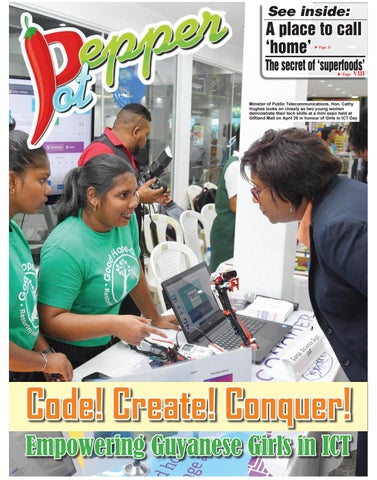
Minister of Public Telecommunications, Hon. Cathy Hughes looks on closely as two young women demonstrate their tech skills at a mini expo held at Giftland Mall on April 26 in honour of Girls in ICT Day
Code! Create! Conquer! Empowering Guyanese Girls in ICT
II
Chronicle Pepperpot April 29, 2018
A place to call ‘home’ Byderabo residents in search of a better place to stay
The dilapidated structure in Byderabo which houses several families, including an infant (Delano Williams photos)
By Ariana Gordon IF YOU take a trip to Bartica, Cuyuni-Mazaruni (Region Seven) and travel just beyond the hustle and bustle of this budding town, you will stumble across the quiet community of Byderabo. Like many other parts of Bartica, Byderabo has seen some improvements in the form of new roads and other facilities in the recent past. But, as is the case with many communities, as well, poverty lingers in the lives of some residents, who hope that one day their circumstances will change. This is the case of a group of residents who live in a dilapidated building lodged on an old pontoon along the Essequibo River in Byderabo. The structure, which is currently leaning into the Essequibo River, poses real dangers to those who occupy the premises and its inhabitants are calling on the authorities to assist them with finding proper housing as they
Julian Andrews stands with his family
Sereeta Tyman and her family
can ill afford to purchase lands or rent homes. The families that reside in this structure consist of children as young as one month old. “Me nah frighten you know…we ain’t get nowhere else to go, so we have to make do with this place,” one resident told the Pepperpot Magazine during a visit recently. LIMITED TIME While this may be the only place they can afford, however, the structure -which was built years ago -belongs to a nearby sawmill and the proprietors have since been reportedly threatening to destroy the property, which will leave these people homeless. “The people them keep coming to us because the building going down into the river. Soon it gonna fall with we inside but we have nowhere to go," said Patsy McDonald, another resident. McDonald told the Pepperpot Magazine that while she understands why her family of four - which occupies a tiny room in the building-has to relocate, it is Lloyd McDonald and his not as easy as it may seem. mother Patsy McDonald. “I have no money. I depend Also in photo (partially on my children. I don’t work hidden) is Juanita McDonald is the breadwinner. He exanywhere and me nah got plained that in the past, he had education,” she explained as secured a plot of land located she pointed to her eldest son, at '5 Miles'. Unfortunately, he Lloyd McDonald. has misplaced his birth certifThe young man, who is icate, his national identificaclearly frustrated by his cirtion card and the documents cumstances, told this publireceived from the Housing cation that the threats by the Authority. owners of the building are He is working to retrieve unfair. “The boss man [names his documents and then return given] them does call... He to the housing authority with can’t put people out like the hope of obtaining his land. this…we ain't got anywhere “I don’t need anywhere fancy. to go,” he said. Lloyd said the I just want my family to be building has been leaning into safe…we are not rich people the Essequibo River for all of and we just want somewhere the three years they have been to stay,” he pleaded. living there. The young man told the “We got to get a place to Pepperpot Magazine that he move soon because we really has had discussions with Barcan’t live here,” he said while tica Mayor, Gifford Marshall accepting the dangers associwho has promised to provide ated with his family occupying assistance the best way he can. the premises. He told the Pepperpot Magazine that his family “I had everything but everything loss in the bush,” he is afraid for their lives.“You know how much time the zinc said noting that the average cost to rent a house in Bartica is fly off? Anytime a harder breeze blow might be the whole $30,000 monthly. “Right now is me alone. My brother works place gone. That one side is pulling so anytime now the entire but not a full week. Foh rent a house out here, I can’t really thing will fall. The other side getting rotten and we can’t stay pay that money- me alone,” he stated. here,” he said. As he spoke to this newspaper about his circumstance, his younger sister, Juanita sat at the door gazing at passersSOMEWHERE TO STAY Things are currently rough for the family of four as Lloyd Turn to page VII ►►►
The Dubai Experience Chronicle Pepperpot April 29, 2018
III
Guyanese tourist encourages travel to the wider world
Jeckeim (fourth right) and some of the travellers of the 32-member group
By Lisa Hamilton
was different from the clothing worn in any other tourist destinations, save for when visiting a place of worship. “You’re allowed to wear anything that you want. The only place that’s restricted (dress code wise) is when you’re going to the mosque,” Jeckeim said. Meanwhile, Prince added, “The Dubians do dress different to the North Americans but they do not try to impose their dress code on the visitors.”
THIS year, 26-year-old Jeckeim Pitt scratches ‘Visit Dubai’ off her bucket list and following her experience, calls on Guyanese to visit more exotic countries, to be surprised by the similarities and to appreciate the differences. Just last month, what started off as a trip planned for three family members turned out to be a 32-person journey halfway across the world, as word spread that Jeckeim was going on a one-of-a-kind adventure. Afterwards, not only were there Guyanese getting ready for the trip but there were Mexicans, Sheikhs Zayed Mosque, Dubai Americans, Panamanians, Virgin Islanders and Canadians, all heading to see one of the world’s most advanced cities and economies No one truly knew what to expect but based on videos seen of the country with its Ferrari cars for basic transportation and cheetahs, lions and tigers for pets, the group knew disappointment was out of the picture. Being transported by the famous Emirates Airlines where there were unlimited food and champagne, even in economy class, was just a sneak-peak into the lavish lifestyle of what was to be seen ahead. From March 18-27, the group spent nine days eight nights at the five-star Park Regis Kris Kin Hotel and they were able to take part in one to two activities daily. They visited the man-made Palm Islands, the luxury Atlantis Hotel; the tallest building in the world, the Burj Khalifa; manned the Desert Safari on 4X4s, saw the ginormous Dubai Mall Aquarium and took pictures at the biggest picture frame on the planet, the Dubai Frame. MYTHS DEBUNKED Knowing of the stereotypes that exist about the Middle Eastern country due to what’s depicted on television, Edward Prince who refers to Jeckeim as his “unofficially adopted daughter” says many of these stereotypes have never been or are no longer the case. “If I spotted four Ferraris that would be a lot, they drive regular cars,” Jeckeim chuckled, adding: “I didn’t see any tigers and I was literally looking (out to see them)…these are things you see on TV, you hear about it and then when you get there, there are no big luxury cars to be seen constantly down the roads,” she explained. This is because since January 2014, private ownership of wild animals has been outlawed in the United Arab Emirates (UAE). When it comes to clothing, Jeckeim said that not much
HOME RULES However, there are still some rules which visitors are expected to adhere to in respect for Islam and Arabic culture and laws. For example, when using the train or metro transportation system, men and women do not ride in the same carrier and are separated by lines and can be fined 100 Dirham if crossed. The group was also warned that they shouldn’t take photos of certain government buildings and other restricted areas. The UAE is the region with the highest number of immigrants in the world with immigrants representing some 3.5
million of the population, while some 70 per cent of Dubai’s population are non-nationals. Immigrants largely influence the food of Dubai as it is home to an accumulation of cultures from over 200 nationalities. The group was told that the poorest Dubian owns three cars and most, if not all, nationals hold white-collar careers as doctors, lawyers and engineers while immigrants perform other blue-collar jobs. NEW WORLD Comparing cultures and lifestyles, the two Guyanese told the Pepperpot Magazine of some of the things they saw which they hope could one day be emulated in Guyana. Despite the high number of immigrants, the two said that they saw no beggars on the street, no garbage, very little obesity, and there was not an overwhelming presence of law enforcement nor did there seem to be a need for it. “I didn’t even notice the police cars like how we have police. You get a sense of security like you’re safe. You can literally walk any hour of the night and not be afraid,” Jeckeim said. Noticing similarities too, Prince said that the Old Dubai market operates much like several of Guyana’s local market who utilise bargaining to make purchases. “In the Old Dubai, they have a market just like Bourda Market where there is bargaining there. If somebody says $100 for the calaloo, you can say I’ll give you $80. They expect you to bargain they do not expect you to pay the full price,” Prince explained. Due to the high level of immigrants, the food is also as spicy as Guyana’s with a mixture of ethnic influences much like their home. Jeckeim says it costs each person less than US$2,000 including return airfare from New York, hotel stay and tours and she is willing to help other Guyanese arrange similar trips so they too can see the diversity of the world apart from the typical locations. “It’s a place that people should go and see. Everybody growing up in Guyana wishes and always wants to go to New York, they want to experience that, but I think they should go to places like Dubai. Go see something different, like China. To me, those are places worth going to see,” Jeckeim advised. Speaking of China, come 2019 the young woman intends to continue her exotic adventures by taking a larger group of persons, including interested Guyanese, to visit the East Asian nation while a second trip is planned for Dubai’s Universal Exposition in 2020.
IV
Chronicle Pepperpot April 29, 2018
Meet ‘Ms. Unbothered’
- From two CSEC subjects to two Bachelor’s Degrees By Telesha Ramnarine SHERRY Oneka Jerrick concedes that she did not excel academically earlier in her life when she left high school with two CXC subjects, but she wants the world to know today that with hard work, ambitions and the right attitude, anyone can pick up themselves up and continue where he left off. “Never give up on yourself. Ever.We all have greatness within us,” she said in an interview with the Pepperpot Magazine . Reflecting on her life, Sherry realised that she by no means had it easy. At the same time, though, she can see that the resilience she showed when she encountered challenges, helped to mould her into becoming a well-rounded individual. At age 40, Sherry is the single-parent mother of two daughters, ages 15 and nine. She faced a major challenge studying and working, while at the same time trying to raise her children well. “If one would ask, I will say that my life is a success story with many chapters either completed, untold or unwritten. Chapters that have pains, failures and disappointments,” she expressed. Being the only child in the home, Sherry recalled that she was a “spoilt brat” to the extent that she got whatever she wanted with little or no concern for discipline. “However, I commenced my journey of employment at age 17 and very soon thereafter, I learned that life is a long, winding road filled with potholes, hurdles, turns and people,” she said. ASSISTANT TOWN CLERK Born and raised in North Ruimveldt, Georgetown, Sherry attended Stella Maris Primary, Central High School and eventually pressed on to the University of Guyana. She wanted to become a nurse and did all she could to achieve this goal until she faced the unexpected circumstances. Sherry was afforded the opportunity to do work study at a popular city hospital. “I vomited, fainted and scorned everything
additional CXCs after I started working. The Council employed me with only the two CXCs. Every other qualification I gained on the job,” she recalled. Sherry is now in the process of commencing a ‘Masters’ in Public Administration and possibly after completion will add a ‘Doctorate’ to her name. “I have not decided whether I am going to complete the Legal Education Certificate and practice Law, as I am not financially equipped to so do. My professional career is admirable and outstanding and there is scope for upward mobility. I am still contemplating whether my tour of duty in Local Governance will continue to my retirement or maybe, just maybe, I may spread my wings and fly. After all, I am still a youthful asset within the labour market.”
forward, along with a backup plan as well.” Sherry says she could’ve been much further on the social ladder if in her formative years, she understood the power of education. “Notwithstanding, I am a strongwilled, confident and positive female. I
Sherry Oneka Jerrick
that was the embodiment of such a health care facility during my tenure. Just imagine this caring, loving, warmhearted person not being mentally able to fulfill her dreams. I was shattered but I am happy to state that it was bittersweet since I had an instant reality check,” she said. The medical field now aside, Sherry pursued studies in Information Technology, Accounting, Industrial Relations and Administrative Management, among others. And she also managed to garner skills in floral arrangements, interior decorating and graphic designing, which led to her even owning and managing an Internet Café and Document Centre at one point. Currently, Sherry is the Deputy Town Clerk (ag) at the Mayor and City Council (M&CC) although her substantive post is Assistant Town Clerk. She started working at City Hall in 1995 as an Area Warden (Field Officer) and over the past 23 years, was promoted from Level 3 to Level 13. “My life of work practically started from two CXC’s and grew to two Bachelor’s Degrees: Degree in Sociology (BSoc) and Degree in Law (LLB). All I wrote was Maths and English at CXC. But I did three
Sherry and her two daughters
With Mayor Patricia Chase-Green on an overseas trip recently
‘MS. UNBOTHERED’ Sherry believes that overcoming any challenge rests on faith in God. “I am not going to lie, pretend or portray any acts of hypocrisy because I am really not a frequent churchgoer, but in my own way, every day I pray, read the word and deeply, I truly believe in the God of the Bible,” she said. “For those who know me well, I am Ms. Unbothered. But in my quiet moments, I am a thinker. I analyse and evaluate every situation contextually and decide on the best way
am not easily angered or deterred from my goals. I believe in me and ‘ah like maself.’ I think I stand as a role model for what young women, in particularly low achievers and early school leavers can accomplish if they believe in themselves, work hard and never compromise,” she expressed. Her favourite quote is one by Martin Luther King Jr: “Not everybody can be famous but everybody can be great, because greatness is determined by service.” “I like that quote because I hate talk shops; I dislike policies without affirmative actions and I have total disdain for people talking about doing good and not really doing any good. The problem is that society is no longer closely knitted. The social fabric of life is tattered and torn, if it still exists,” she said. “We strive to be powerful and authoritative rather than to be selfless and humanitarian. Often humans dwell on mediocrity and hypocrisy as opposed to doing real good deeds. I believe that greatness is within all of us, but it is better advanced when we do well for others and allow them to also shine.”
Chronicle Pepperpot April 29, 2018
V
Another look at the most expensive postage stamp on the planet By Francis Quamina Farrier RECENTLY, I visited the Smithsonian American Postal Museum in Washington DC, USA, for the fifth time, to view the World Famous British Guiana Magenta Postage Stamp. It was printed on Church Street, Georgetown in 1856. Now some 162 years later, it is valued at close to US$10 million and is the most valuable and famous postage stamp on the planet. The printing press on Claire Murray about to press the little white button which it was printed is on to activate the dim light which will illuminate the dark container in which the Magenta is kept
many years when everything was done manually. Regarding the Magenta stamp which was printed well over a century before her time, she commented, "I feel proud that it came from my country and we're known in the postal world." Now based in New York, she plans to visit the American Postal Museum again before the exhibition of the Magenta stamp comes to an end at that venue. Francis Quamina Farrier in front of the American Postal It was my pleaMuseum in Washington, DC, USA sure, just a week ago, to have the oppordisplay at the Guyana National Museum tunity to be at the museum with anothin Georgetown, just a short block away er Guyanese; this time Guyana-based Shameer Ali, formally of NCN and now from where the printing was done. That recent visit of mine to that impos- Technical Manager at Radio Mix 90.1 FM. ing building in Washington, DC, USA., The gentleman was ecstatic as he viewed located next to the Union Station, was very the Magenta stamp over and over again. special, the reason being that for the very "After reading about this stamp as a little first time I was there with a fellow Guya- boy, I finally got the chance to see it in nese and that person, Claire Murray, is a person," he said with absolute pride and retired senior staffer of the Guyana Post satisfaction. On a previous visit to the United States Office Corporation. Postal Museum, I observed a young man Murray, in fact, commenced her workshowing his wheelchair-bound elderly ing career in the Philatelic Department of the Guyana Post Office Corporation in mother the Magenta stamp. The elderly 1967, where she dealt with postage stamps. lady was looking at it with such amazeShe worked under five Postmasters-Gen- ment and satisfaction that I asked them eral; Frank Giles, Julian Charles, Leyland to allow me to take a photograph of them Braithwaite, George Doris and Edward looking at it, to which they agreed. What Noble before her retirement in 1999. She was equally amazing, was their reaction was elated to know that the current Post- when I told them that I was from Guyana master-General is a female; Karen Brown. where the stamp was printed. From the information received, the It must be noted that although Karen exhibition of that world-famous stamp at Brown is a female, the title still remains "Postmaster". The same applies to the the American Postal Museum will conBandmaster of the Guyana Police Force clude in October this year, after which the Band. The current Bandmaster of the Guy- owner will take it to Europe where it will ana Police Band is a woman; she is Super- be on exhibition for an unspecified period. intendent, Charmaine Stewart. "I feel it's a Shameer Ali is hopeful that there will be nice change", Claire Murray said about the another opportunity for him to view the present Postmaster General being a female. stamp. President of the Guyana Philatelic AsDuring her most recent visit to Guyana sociation, Ann Wood, expressed the view in 2016, Claire Murray said that she was that, "Since the story of One-Cent Magenta impressed to see a computer on every desk in the department where she worked for was published, it became the most wanted
stamp in the world and wealthy collectors have paid fortunes to own it." She also says that "the value of the Magenta will continue to increase and so will all stamps in general since electronic communications have become prevalent." What is not widely known, is that one of the richest and most powerful women in the world, Queen Elizabeth ll, who is an avid stamp collector, had made unsuccessful attempts to purchase the British Guiana One-Cent Magenta stamp, but the American owner was in no way tempted to sell it to the British Monarch or anyone else. As is known, the image of Queen Elizabeth ll graces many British Guiana stamps. Head of the Roman Catholic Church, Pope Francis, is also an avid stamp collector. Information at the American Postal Museum is that, "Stamp Collecting ranks among the world's most popular hobbies,"
and that, "As many as 22 million people collect stamps in the United States alone." According to the Museum's records, "Stamp collectors represent all ages and walks of life." The number of Stamp Collectors in Guyana is not known at this time. With the plan to conclude the exhibition of the multi-million dollar British Guiana One-Cent Magenta stamp at the American Postal Museum in Washington, DC, and the owner taking it to Europe later this year, the opportunity of Guyanese viewing it, will then become much more difficult. As such, it is advisable for those living in Washington, DC, and nearby, or who plan to visit the Capital City of the USA, to use the shrinking window of opportunity to view the world's most famous and expensive postage stamp, which was printed right here in Georgetown, British Guiana (Guyana).
DigitalArt
VI
A new frontier
By Gibron Rahim
EVERY child is an artist. The problem is how to remain an artist once he grows up.” THE above quote by the great Pablo Picasso is a reminder of how much is lost when we grow up. Art, in all its forms, allows both artist and viewer to see the world through a different lens. Tricia Harris is among those artists who are using modern means to create artwork that remains firmly planted in this spirit. Tricia told the Pepperpot Magazine that
she thought she would have to leave art behind when she successfully graduated from St Joseph’s High School in 2015. “I never would have thought that a year after I would be working on developing it more than ever,” the now 19-year-old full-time digital artist said. Referring to the aforementioned quote by
Chronicle Pepperpot April 29, 2018
noting that in her year, sadly, only a single student from her school wrote Visual Arts at CSEC. For this reason, Tricia advocates for a strong Visual Arts curriculum. “It’s one of those subjects that you learn to use your imagination, think creatively and create something from a blank piece of medium.” After completing secondary school, Tricia found a nine-to-five job. After working at that first job for about three months she realised that it was suffocating her creative thoughts. She felt put in a box, one where it was wrong to be creative. “I found myself slowly forgetting what it was like to draw,” she said. She could not see herself continuing to perform the job’s repetitive tasks for the next few years of her life. Then, one evening, Tricia came across a digital artist on Facebook. Her interest was sparked and that very same week she bought a book on creating digital art online and read it from cover to cover. “After then I never had a second thought about doing digital art and developed a strong love for it, even if it meant having to sacrifice some things that were in the way in order to pursue it,” she stated emphatically. Tricia realised early on that acquiring the materials she Picasso, the artist related that, like every would need for her child, she would do a lot of drawing. She art were going to recalled taking school exercise books cost some money. As that she no longer used and filling up any a result, her journey blank pages that were left with drawings. truly began in June Though these early drawings might not 2016 when she aphave been the best, Tricia related that at plied for another job one point she was very proud of them where she worked as they brought her a lot of happiness. tirelessly for about Throughout her school life, Tricia six months, sacriwould always be excited about art class. ficing some of her It was, she noted, definitely her favourite wants and buying Tricia Harris class. “Even when the teacher didn’t herself the equip(All photos courtesy show up to class,” she said, “I didn’t of Tricia Harris) ment. Tricia also dishesitate one bit at taking out my pencils covered Instagram and sketch pad, just to create something, in 2016 but it was in January 2017 that she anything, just to get my imagination flowing.” began to post her work on the platform, gainShe recalled that from Third to Fifth Form, ing some recognition and seeing her following since she drew a lot, her teachers would always grow slowly but consistently. She received call on her to work on drawing or painting a lot of positive feedback and many persons projects for the school. Eventually, this led to asked her to digitally paint their photos. The her participating in multiple art competitions, evident joy her clients felt with her artwork winning several, and being part of teams that made her happy. “That kept me motivated to post and post as often as I could,” explained Tricia. “That’s when I knew I wanted to be a digital artist.” Proudly selftaught, most of Tricia’s knowledge about digital art and drawing comes from the many online articles, YouTube video tutorials, books and online learning websites she spent time watching. “But knowing all of these would be pointless unless I had taken the time to put in the hours of practice which came along with tons of trial and One of Tricia’s canvas prints error,” she made clear. She has also taught herself to create flyers and made banners and flyers for school sports and banners for her social media pages. Tricia noted other school events. “That brought me great that the main inspiration for creating artwork joy and made my self-confidence improve,” comes from observing the works of other artTricia stated. ists and photographers. “I’m always intrigued Unfortunately, Tricia decided not to pursue by the way they can take a blank canvas and a Visual Arts as a subject in Fifth Form. She surprisingly messy sketch and create something explained that it was close to exam time and beautiful,” she explained. “I think creating art at the time she was not confident that she was is the closest I’ve gotten to experiencing magic ready to write the subject at the CSEC level. firsthand.” She opined that the lack of attention paid to the visual arts department at her school contributed Turn to page VII ►►► to many students not wanting to take up art,
Chronicle Pepperpot April 29, 2018 ◄◄◄ From page VI
Feedback and collaboration from artists, creators and commenters play the most important role in the way Tricia’s art is produced. She said, “I was fortunate to meet some very kind people and organisations that shared my work and gave me some recognition on the art platform.” She receives many tips on how she can improve her work and in turn, she freely shares her knowledge and art experience with her followers. Digital art, Tricia noted, is a fairly new way of creating art pieces. A digital pen is used to draw on a tablet instead of a pencil or paintbrush. Tricia related that it does require getting comfortable working in front of a screen and using a mouse, pen or screen tablet, such as an iPad, and also knowing one’s way around a drawing application. “But once you get over the anxiety and get used to sketching on this medium,” said Tricia, “you’ll be far on your way to creating some breathtaking masterpieces.” The initial apprehension of digital drawing could be compared to being given paint, a paintbrush and a blank canvas and asked to make a Mona Lisa according to Tricia. She had never used painting software before. “The ‘undo’ button was my friend as I’m sure I would’ve ripped through the page of a sketchbook by the amount of erasing I did,” she recalled. Eventually, after some hours of practice, Tricia learnt to navigate and got used to working with the software. She acknowledged that the first few drawings were, in her words, “terrible”. “I got anxiety and wanted to quit many times and revert back to traditional sketching but I stuck to it and I’m happy I did.” After a few months, she saw herself improve. ◄◄◄ From page II
by. She said nothing but shook her head in dismay. Asked where the family lived before they moved to the structure on the pontoon, Patsy said over the years they were frequently moving because of their inability to pay rent. “We get put out and is how come we come here,” she said, noting that she is dependent on her children to find a way out of the situation. Meanwhile, Sereeta Tyman, a 27-year-old mother of two told the Pepperpot Magazine that she has been living there for seven years. She, like the McDonald family, was forced to move out of a house she had occupied. “After we move out from the scheme, we end up here. The people them what we did living by ask back for the house. We have been trying to find somewhere but place hard fuh get up here suh,” she said. She stood outside of her room with her young daughter. She noted that the living conditions are not favourable but she has no choice. At the time of the interview, Tyman had just taken home her 11-day old baby. “We actually ask people but they said them ain't got nowhere,” she said while calling on the authorities to assist in providing temporary housing for her family. SOLE BREADWINNER She said while she does not work, he husband takes care of the family. He is a carpenter who would, from time to time, venture into the hinterland in search of jobs. Tyman said she has never applied for land as she has no official documents. The situation was no different for the Andrews’ family. Eighteen-year-old Julian Andrews is the breadwinner for his family which consists of his mother, 14-year-old brother and a younger sibling. He works with a garbage company but while he does not earn much money, the young man vows to pay a rent once he could secure somewhere to live. His family has occupied the dilapidated structure for some two years. Prior to going there, they had lived in an old house which collapsed. Despite the dangers, Andrews
Tricia has been doing canvas prints of her artwork for about eight months now. In that she has already done over 50 prints and will be doing many more in the coming months. She related that the process is very simple. The most important part is creating an artwork with the appropriate size and correct colour proofing just so that the printed colours are similar to the onscreen ones. She then sends the artwork to the printer for further colour proofing and printing once no errors are found. She explained that she usually has the frame made beforehand to suit the size of the print. The print is stapled and has its hooks applied, then packaged and sent to the client. Tricia spends her typical days working on pieces. She also related that she loves replying to messages she receives and sharing tips and tutorials on her page for those who are new to digital art or are just curious. She emphasised that she is grateful to each member of her community of followers who support her and give her lots of feedback, suggestions and lots of encouragement. “I’m very excited for the future seeing that I am still very young,” she said. She hopes someday to have her own art gallery and start her own art charity programme. “And, of course, never stop drawing.” Tricia’s best advice for artists and upcoming artists is, “Draw every day, even if it’s just a tiny doodle, keep the energy flowing.” Tricia Harris can be contacted via Instagram @tricia.art where her artwork can also be viewed. said he was not afraid of living there. “Me ain't frighten but I want somewhere to go,” he said softly, as his mother who speaks only her native indigenous language, looked on. THE WAY FORWARD Bartica Mayor Gifford Marshall told the Pepperpot Magazine that the situation is a dire one and efforts are being made to assist the persons who occupy the dilapidated structure. He said meetings were held with the families and work is being done with the Ministry of Housing to see how best they can be housed. “They have been occupying there for decades,” said Marshall, who pointed out the dangers of living in the leaning structure. Similarly, Mark Ambrose, a board member of the Central Housing and Planning Authority (CH&PA) in Bartica described the situation as “serious.” He told the Pepperpot Magazine that efforts are first being made to have the occupants obtain the required documents to transact business. "Without that we cannot do anything else. In order for them to own a piece of land they have to ID cards,” he remarked. Ambrose said that representation has been made at the level of the CH&PA board for the affected persons but noted that initial steps have to be made by those affected. “We as a board are looking at how and what can be done to assist persons who have limited income. We are doing some roof replacement for hinterland areas- have been trying to get lands and have surveys done to release lands in Bartica,” he explained. Ambrose disclosed that in and around certain parts of the mining town, there are many houses which are just “camp frames” as lots of persons there do not own lands. “It is our intention to assist these persons…we are working to have a housing drive here but it should be noted that lands given out under the previous administration were not properly distributed. Some persons were given two and three lots,” he stated. He said should lands be made available, efforts can be made to partner with agencies like Food for the Poor to provide housing to those in need.
VII
VIII
Chronicle Pepperpot April 29, 2018
The secret of ‘superfoods’ Dr. Da Silva plans to flood the market with 101 varieties of dehydrated food By Navendra Seoraj IN this modern-age, people oftentimes find that a cure for weakness or boosting their strength is to grab an energy drink but Herbalist, Dr. Simpson Da Silva believes that he has a natural solution for those problems, one that contains fewer preservatives and chemicals. Some may say gone are the days when people used a leaf or “bush” to cure illnesses and even strengthen their immune system, however, the practice has advanced and evolved into what Dr. Da Silva called “dehydrated foods.” Although the term might not be familiar to many, food dehydration has been practiced for years- probably even centuries- but Dr. Da Silva was certain that Guyanese have not
Dr. Simpson Da Silva showcases some of his well-packaged products
Some of Dr. Da Silva’s herbal products that were on display at the recent Region Three Regional Agricultural and Commercial Exhibition (RACE)
fully utilised that method of preserving food. Dehydration in food processing is defined as ways in which many types of food can be preserved for indefinite periods by extracting the moisture, thereby inhibiting the growth of micro-organisms. Studies have shown that when food is dehydrated, the original vitamins, minerals and natural enzymes of food are retained, making it far better than other forms of food preservation or cooking. “I am dehydrating everything you could think of because I want to bring to the table, basic superfoods of Guyana,” said Dr. Da Silva during a recent interview with the Pepperpot Magazine. One of the super foods that he emphasised was Moringa Oleifera or as Guyanese know it “Saijan.” He was reminiscent of the days when there was a Saijan tree in every county but said the art of taking care of indigenous plants is lost. Persons were encouraged to replant those indigenous herbs because they have numerous health benefits. For instance, he said Saijan alone prevents and treats almost 301 different diseases, so with those herbs, persons could have their own pharmacy in their yard. But for those who might not be skilled in the art of farming/planting, Dr. Da Silva has his products that will soon be available on the local market.
Aside from Saijan, the herbalist produces 101 different types of dehydrated foods including popular herbs and foods like quinoa, thyme, amaranth and corilla. Many of his products are made from herbs and plants that are neglected, for instance, “Chori bajee,” a plant which Guyanese sometimes refer to as “Cow dung bajee.” In his eyes, those neglected herbs are superfoods that can be used to treat many illnesses and diseases. Dr. Da Silva’s passion for dehydrated foods is so deep that he has also conducted experiments on local delicacies like cook-up rice and eggplant (bolounger) stew which he managed to dehydrate. The herbalist has also created his own peanut butter which includes peanuts, moringa and coconut oil. Dr. Da Silva also assured persons that he is qualified to do his work. He is a Guyana School of Agriculture (GSA) graduate and also studied Food and Nutrition Security, and Veterinary Medicine in Cuba. In addition, he also worked with the Columbia University and studied the essence of food system and action on nutrition for 40 years. Dr. Da Silva as such wants to share his teachings with Guyanese across the country and by extension create a Zero Hunger programme which is in line with the Government’s Green Agenda.
The herbalist, Dr. Da Silva (second left) and some of his affiliates at the recent RACE expo (Adrian Narine photo)
Chronicle Pepperpot April 29, 2018
IX
Tapakuma Cassava Processing Facility empowering women to achieve Independence the area, approximately an hour’s drive from Anna Regina, Essequibo Coast, has given the women the opportunity to change their lives. With the use of solar energy, a group of women have formed themselves into a group, Rising Sun Products Enterprise, enabling other women to join thus providing them with a better life. The facility, which has been dormant for several years due to lack of funds, was resuscitated in 2017 and now is supplying cassava bread, flavoured cassava biscuits, as well as sweet cassava cakes, called “Quinches”. With the use of renewable energy, the women have managed to produced tasty products from cassava- a ground provision that is
Members (from left ) Venessa Young and Gwendolyn Chappelle of the Agro Processing Facility at the recent Essequibo Agro Processing Expo
By Indrawattie Natram LIVING in the Amerindian community of Tapakuma/St Denny’s, Pomeroon/Supenaam (Region Two) can be quite challenging for underqualified women to access jobs and to assist in contributing to their families financially, due to the lack of resources as well
as the limited availability of electricity and other infrastructure. In these communities, women are forced to either migrate or to seek jobs on the coastland. But women living in this area and determined to earn their independence, have tapped into value-added production using ground provision. The Cassava Processing Facility located in
President of the Agro-Processing facility, Gwendolyn Chappelle, displaying her peeled cassavas ready for grating
Some of the products that are made for sale by the women at the Rising Sun Processing facility
readily available in their community at a cheap cost. President of Rising Sun Product, Gwendolyn Chappelle, said Tapakuma cassava products are reaching many local supermarket shelves, with the latest supplier being N&S Mattai and Company. Chappelle, said the efforts of the women are being recognised because she is receiving positive feedback from customers. “We take pride in making our cassava products, when we get orders we get more motivation, we are glad that Tapakuma products are reaching far in the city,” Chappelle said. Turn to page X ►►►
X ◄◄◄ From page IX
The mother of five said that women would gather from around the community as early as seven in the morning, twice monthly, to make cassava bread and cassava biscuits. The process she said has become shorter since the facility has modern equipment. Previously they were forced to manufacture the
Chronicle Pepperpot April 29, 2018
products manually, however, with the help from the Rural Enterprise and Agriculture (READ) and the Inter-American Institute Co-operation on Agriculture (IICA), the factory was able to acquire the necessary finances as well as training opportunities to reach the demanding markets. PROVIDING EMPLOYMENT
Some other products that were being displayed by the women at the Agro Trade fair 2018 held at the Anna Regina Community Centre ground recently
The local provision is purchased in large quantities from farmers within the community and often times due to demand more women are hired to help in the process. The process of making the cassava bread takes approximately one hour to produce 300 cassava bread and commences with the washing, peeling, re-wash, grating, extracting the juice, heating, re-entering the graters and shifting them into the baking pan. The art of cassava bread baking was inherited by the women’s ancestors who taught them to make the stable Amerindian diet of cassava bread. On a daily basis, 1,000 bitter cassavas are purchased from farmers. The women said that the products are Tapakuma’s pride and the production has enabled them to earn the value of independence and determination for a better life. MARKETING Another woman who works with the group, Veneassa Wong, said that the products are available at the Guyana Marketing Co-Operation, Safeway Supermarket Essequibo and Mattai in Georgetown. Wong said, however, their aim is to tap into the international markets where they would be able to produce in large quantities. She also explained that much assistance is given to the facility by ICCA and a women’s group called the Agro Processor Development Network (APDN). She said the group would help in the marketing as well as sponsor exhi-
bitions where they can get the opportunity to showcase their products to the rest of Guyana. Wong said that at the moment, she uses her cell phone to take orders via calls and on the internet. She, however, wishes that the community of Tapakuma can acquire electricity so that they can get WIFI in order to access a better quality of internet, in an effort to market their product more. The women also desire to have their own Facebook page so that they can share their products as well as maximise on the overseas markets. The challenge, however, remains with the unavailability of electricity in the rural community and the lack of satellites. The Tapakuma Agro-Processing Facility is a one-of-a-kind facility in Region Two that enables Amerindian women to add value to the cassava product. Operation of the factory ceased in 2002 but in 2012, it returned to operation with the help of the Ministry of Agriculture. However, in 2016 it became dormant before once again going back into operation in 2017. The building was refurbished with the assistance of IICA and READ early in 2012. IICA had extended a partnership to the community in 1998 but in 2014 under the Rural Enterprise and Agriculture (READ) the project was allocated G$3.378M for the refurbishment of the Rising Sun Processing facility. The funds were disbursed through the partnership of IPED and the Village Council, with IICA providing technical oversight to assist in meeting factory compliance.
Chronicle Pepperpot April 29, 2018
DeHoop Mahaica T a k e
a
t r i p
XI
t o
Workers made good use of the sun to dry their paddy. They are now heaping it into bags to either take for milling or to use as seedlings to plant more rice
THE community of DeHoop Branch Road, Mahaica is a peaceful one; so peaceful, in fact, that residents leave their gates wide open while they are out working in the rice fields and back-dam. It is a community with little to no instances of crime; perhaps because there is only one way in which would make it difficult for potential perpetrators to escape when trying to pull something off. As a result, residents are free to leave all of their goods and other valuables on the parapets and below their houses without a care in the world. DeHoop is absolutely gorgeous with a beautiful nature scene almost everywhere you turn. If it’s not an attractive rice field, it’s the trees that hang over
the houses or that lead you to them. If it’s not a huge combine slowly making its way down the road with the birds leading the way, it’s the little duck ponds behind almost every house with the cute ducklings in them. The people are wonderful too and have a bright stroke of hospitality embedded in them. Although only meeting you minutes ago, they speak and deal with you as though they have known you for years. They are quick to bring out a piece of fruit, or some glasses with a mug of juice. The calm, laid-back lifestyle in DeHoop is the exact opposite of the fast-paced lifestyle people often complain about in Georgetown. Here are some scenic images of this quaint little community.
A common sight in DeHoop, only that the driver is male most times. (Photos by Telesha Ramnarine) Houses are located mostly far apart, often separated by a rice field or waterway
Trees can be seen lining the pathways to most houses in DeHoop A scarecrow ‘guards’ this bed of tomatoes
XII
Chronicle Pepperpot April 29, 2018
Chronicle Pepperpot April 29, 2018
XIII
Promoting a conversation and culture of love for animals
– linking animal cruelty to abuse and domestic violence By M Margaret Burke “Until one has loved an animal, a part of one’s soul remains unawakened.” Anatole France THE British Guiana Society for the Prevention of Cruelty to Animals was established in 1903 by a group of expatriate volunteers after witnessing the ill-treatment and suffering meted out to animals every day in the streets of Georgetown. This was told to the Guyana Chronicle Pepperpot Magazine by Oliver Insanally, Honorary President of the Association, who went on to explain that at that time the association had no building to operate from and so their work was carried out from their individual homes. He said that by 1953 the situation changed, mainly through the efforts of Jean Wilson and assisted by her husband who was the architect of the first building to house the GSPCA’s Animal Clinic was erected. After Independence in 1966, the Society’s name was changed to the Guyana Society for the Prevention of Cruelty to Animals (GSPCA). At this point, steadfast work to recruit volunteers by Mrs. Taylor, a stalwart member of the GSPCA paid off and in 1992 a group of individuals accepted the positions to serve as volunteers and eventually committee members. SPAY AND NEUTER PROGRAMME Insanally, in responding to the concerns about the continued cruelty to animals said, “There still remains much room for improvement in terms of how we treat our animals and this reflects on the kind of nation we are. All Guyanese would like to be part of a caring and compassionate society, so it is important that we demonstrate this in a very visible way when it comes to animal welfare. There are certainly still too many cases of animal abuse in our nation.” He added that the GSPCA has been making some inroads, mainly through its spay and neuter programme. These procedures prevent unwanted animal pregnancies. By preventing such pregnancies, he said, the GSPCA can curb and reduce the number of stray animals on our roads. He explained that for years the GSPCA has performed thousands of these procedures at no cost to the pets of owners who could not otherwise afford these. In this way, the GSPCA is making an impact in terms of reducing the number of stray animals on our roads. RELATIONSHIP WITH CHILDREN with looks Many young kittens Studies have t me” op ad se lea “P y, sa t tha shown that younger children can learn the art of kindness and compassion through caring for another creature and putting its needs first; that the attachment to a pet is also incredibly important for developing empathy in older children; and that the period of greatest attachment to pets appears to be amongst nine and 10 years old. Children under supervision handling dogs, cats and other pets can be a great way to teach children how to deal with nature’s little creatures without hurting them. A child who learns how to hold a pet and recognise when the pet wants to be put down is starting to learn how to consider the needs of another creature, studies have suggested. Several studies have also presented that the way pets are
treated in the family is incredibly important for teaching empathy. If pets are constantly caged, never walked and played with, children can actually learn to disregard the needs of others. By learning to understand how much pleasure the dog gets from playing fetch and that the cat doesn’t like to be chased, kids can start to understand that everyone has different needs, planting those first seeds of empathy in their learning brains. Further, in terms of GSPCA staff Amrita Singh tenderly holding a kitten
URGING CARE, IMPLEMENTING LEGISLATION In the meanwhile, Insanally said, “The Society is focusing more on promoting the compassionate treatment and care of our animals by creating more awareness of the issues of animal cruelty and the proper treatment of animals. The GSPCA is particularly interested in working with our young people as they are agents of change who can cause a shift in how we as a nation treat animals.” He said that the GSPCA also wants to see Guyana’s animal welfare legislation GSPCA staff Gale-Ann Richmond more actively enforced. fondly cuddling a dog Guyana has updated animal welfare legislation, and as w h e t h e r c h i l d r e n the GSPCA itself is not legally empowered to enforce these who mistreat animals laws, the Society needs the co-operation of Guyana Police are more likely to Force to do so. Insanally said that the GSPCA believes that these two become violent, authors of several stud- areas of focus (care and legislation) if properly operationies have found that alised, will make a significant impact on improving the there is a correlation welfare of animals in Guyana. However, the GSPCA needs between childhood foot soldiers in the fight to improve animal welfare and is
abuse of animals and other problematic behaviours. In addition, a literature review looked at several studies that examined the motivations of the young people when mistreating animals and it was clear that, although for some the behaviour was related
Some of the members of the spay and neuter team at GSPCA
looking for volunteers in its public awareness and education efforts. Young puppies with Animals of all kinds enrich the lives of many longing eyes for a people – whether they are dogs or cats, domesticated new home animals such as a horse, or even wild animals; they can be friendly creatures who inspire people’s imagination. By caring for pets and domesticated animals and respecting animals in the wild, it becomes even to curiosity or was the result easy for people to show kindness to their fellow of peer pressure, for others the human beings.= cruelty was an expression of Other members of the GSPCA’s executive past trauma. adoption too committee are Jennifer Falconer-Majeed, Vice Nevertheless, the authors Dogs are up for o Williams) Delan President; Secretary Shiromanie Isaacs; Dominique caution that it is difficult to (Photos by Ahmad – Treasurer; Stacey Gomes – Asst. Secrepredict which individual will progress from violence against animals to tary/Treasurer; Committee members: Dr. Steve Surujbally, violence against other people, so care should be taken as not Dr. Nardeo Bassoodeo and Robin Sivanand. Members of the public may express an interest in to loosely make this determination. becoming volunteers of the GSPCA by way of email.
XIV
Chronicle Pepperpot April 29, 2018
The effect of vermicompost and other fertilisers on the Growth and Productivity of Pepper Plants in Guyana
BY: Vasnie Ganeshnauth, Sirpaul Jaikishun, Abdullah A Ansari and Oudho Homenauth Extracted from: Automation in Agriculture, Securing Food Supplies for Future Generations Published by: Intech, 2018 Edited by: Stephen Hussmann
THIS week, NAREI in Focus will look at the effect of vermicompost and other fertilisers on the Growth and Productivity of Pepper Plants (Capsicum chinense) in Guyana. The research was conducted at NAREI during the year 2014- 2015. The investigation utilised five different treatments: Promix; vermipost; 189; 189+vermicompost; and control with no fertiliser. Peppers belong to the Solanaceae family. They were usually grown using conventional applications of inorganic fertilisers and pesticides. However, due to the rising awareness of the adverse economic and environmental impact of chemicals in crop productions, the utilisation of organic farming has been stimulated as the main farming method today. Organic manures for growing crops are a composition of waste materials. Due to the steady increase in population size
and improved living standards around the world, the build-up of waste materials is becoming a burgeoning problem since these waste materials emit harmful substances to the atmosphere when burnt. Burning also kills the microbial population of the soil, destroys the soil organic matter and affects the overall physical composition of the soil. Thus, proper waste management can be maintained by using these organic wastes as substrate in agriculture through organic farming. Composting of organic waste offers solution to large amounts of waste worldwide. It is a natural process of recycling decomposed organic materials into a rich soil known as compost. New methods of thermophilic composting have become much more common in organic waste treatment. One such composting technique is vermicomposting. Vermicomposting is a type of organic farming by which earthworms break down waste materials, stimulate microbial activity, and at the same time, increase the rate of mineralisation of the soil. These activities convert waste materials into humus-like substances called vermicompost. Vermitechnology is the use of surface and subsurface local varieties earthworms. Earthworms play a major role in breaking down waste materials to form vermicompost. Vermicompost is an organic fertiliser that is rich in nutrients, poor in readily
biodegradable carbon, and relatively free of any plant and human pathogens. The use of vermicompost for planting has been highlighted in agriculture as a beneficial medium for improving plant growth and yield and the maintenance of soil fertility and crop yield. It is one of the best organic media for planting. It is highly organic and contains no chemicals so it is environmentally friendly. Results obtained showed that chemical fertiliser has a significant effect on the growth of pepper plants producing plants with better plant height, number of leaves, number of branches, stem diameter higher fruit yield, fruit weight and fruit diameter. Mineral nutrients were highest in plants treated with inorganic fertilisers as compared to the organic fertiliser. The research also proved that maximum chlorophyll level was present in plants treated with vermicompost. There were relatively high levels of pest and diseases in plants treated with chemical fertilisers, delayed flowering and fruiting period and high levels of leaf and fruit abscission as compared to plants treated with organic fertiliser. Moreover, chemical fertiliser has proven to have a greater effect on the growth parameters of pepper plants but not the quality of plants produce.
Chronicle Pepperpot April 29, 2018
XV
‘Ready to Beat Malaria’ World Malaria Day 2018
By Shirley Thomas
“The fight against malaria is at the crossroads and without urgent action, the major gains achieved so far, are under threat.’’ THIS is the grim reality sounded by the World Health Organisation (WHO) in a message to mark World Malaria Day 2018, observed on Wednesday,April 25. Making a resounding call to action to member nations grappling with malaria, as well as other stakeholders, the WHO noted: “The global response to malaria is at the crossroads. After an unprecedented period of success in malaria control, progress has stalled. On this World Malaria Day, WHO continues to call for greater investment and expanded coverage of proven tools that prevent, diagnose and treat malaria,” the statement said. This year’s theme is ‘Ready to Beat Malaria’ and the WHO has joined partner organisations in promoting the World Malaria Day theme, noting that it underscores the collective energy and commitment of the global malaria community in uniting around the common goal of a world free of malaria. The theme also highlights the remarkable progress achieved in tackling what it describes as one of humanity’s oldest diseases, albeit, calling out worrying trends as captured in the 2017 World malaria report. It affirms that the current pace is insufficient to achieve the 2020 milestones of the WHO Global Technical Strategy for Malaria 2016–2030 – specifically, targets calling for a 40 per cent reduction in malaria case incidence and death rates. Meanwhile, in an analysis of the state of the disease, the WHO shows that countries with ongoing transmission are increasingly falling into one of two categories: those moving towards elimination and those with a high burden of the disease that have reported significant increases in malaria cases. Guyana achieves significant progress To this end, Guyana can be said to be among the countries moving towards elimination. This was highlighted in the recent World Malaria Day message to the nation, delivered by Guyana’s Minister of Public Health,Volda Lawrence. Stating that this year’s World Malaria Day theme highlights Guyana’s posture with regards to malaria control on its shores, Minister Lawrence declared: “Guyana has achieved significant progress in the fight against malaria and we believe that the medicines to treat malaria must be well known; managed by health personnel and other well-trained volunteers, and should be made available free of charge to all patients who need them.” Minister Lawrence pointed out that in the recent revision of the National Malaria Programme Strategic Plan, Guyana reassessed its position and opted to be even more aggressive to ensure that malaria is indeed dramatically decreased, alongside the process of strengthening its malaria surveillance system throughout the country. Moreover, she said, the Ministry of Public Health (MPH) has been guided by the common commitment to decrease by 40 per cent the overall malaria burden by 2020, relative to 2014, particularly in Regions One (Barima Waini), Seven- Cuyuni Mazaruni, Eight- Potaro Siparuni and Nine – the Upper Takutu/Upper Essequibo, where many of the key affected populations live, thereby facilitating the elimination of P. falciparum. Essentially, the Public Health Minister took the opportunity to remind fellow Guyanese that the medicines approved to treat Plasmodium falciparum malaria are COARTEM and PRIMAQUINE. On this note, the minister warned that ‘Artecom’ or ‘Artefan’ are not recommended medicines to treat malaria in Guyana. Plasmodium falciparum is a protozoan parasite, one of the species of Plasmodium that cause malaria in humans. It is transmitted through the bite by the female Anopheles mosquito. Malaria caused by this species (also called malignant or falciparum malaria) is the most dangerous form of malaria, with the highest rates of complications, and the deadliest species of Plasmodium that cause malaria in humans. responsible for roughly 50 percent of all malaria cases. It is therefore regarded as the deadliest parasite in humans and is estimated to cause one million deaths every year. It is also associated with the development of blood cancer (Burkitt’s lymphoma) and is classified as Group 2A carcinogen. A SERIOUS PUBLIC HEALTH THREAT Noting that malaria constitutes a serious public health problem worldwide, the Minister said it also remains a scourge to the poor and vulnerable, adding that it is an obstacle to the new global targets outlined in the Sustainable Development Goals (SDGs). World Malaria Day is an international observance commemorated every year on April 25, and recognises global efforts to control malaria. Globally 3.3 billion people in
106 countries are at risk for malaria. The day is observed by all member states of the World Health Organisation (WHO).
XVI
Chronicle Pepperpot April 29, 2018
PROTECTING WOMEN
VIOLENCE against women has now become one of the terrible ailments of Guyanese society and domestic violence is an area of such violence which seems to be the most common. Incidents of domestic violence are reported in the media with increasing frequency. For instance, over the last two weeks, there have been three particularly savage examples of domestic violence. The first one was the case of an abused wife, who after several years, could stand it no longer, desperately left her children and husband and went to seek refuge at her mother’s. It was agreed that the wife, Kalvina, would return and take away the children. When she arrived in a taxi, however, the husband immediately attacked her, stabbing her
to death and committing suicide afterwards. The other was a husband, seeing his reputed wife walking along D’Urban Street in Georgetown, attacked and stabbed her and threw her into a drain bleeding. Passers-by took her to the hospital. And the third example was an army captain who shot his girlfriend dead with his service revolver. With the growing frequency of such incidents, Guyana is beginning to earn a notorious reputation similar to those countries where it is unsafe to be a woman, countries such as Afghanistan and Iraq where the Taliban and ISIS operate and Nigeria where Bokoharam murder, kidnap and harass women with impunity. Unlike the countries of Asia and Africa, where violence against women has its roots in religion and patriarchal cul-
ture, in Guyana violence against women has no such deep roots and it is only in the last 20 or 30 years this crime has become prevalent. The United States 2017 Country Report on Guyana addresses domestic violence. “Domestic violence”, it says, “and violence against women, including spousal abuse, was widespread. The Law prohibits domestic violence and allows for victims to seek prompt protection, occupation or tenancy orders from a magistrate”... The Report also cites allegations of the Police accepting bribes from perpetrators and notes cases of magistrates applying inadequate sentences after conviction. President Granger’s Senior Security Adviser, Lieutenant Colonel (retd) Russel Combe who hails from Britain, recognised that domestic violence has to be dealt on the basis of both security reform and social reform. In a recent statement to the press, he focused on security reform: “Domestic Violence, I realise, is an issue. It’s a scourge in every society but it is making sure the Police are equipped with the tools to do their jobs in terms of being able to investigate, detect and solve any such crimes...the Police have identified that they do need better facilities at Police stations to be able to take statements and do the first responders’ aspect of investigating such complaints.” There is no doubt, therefore, that strengthening Police action is imperative in quelling the scourge of domestic violence and this includes training the Police to deal with domestic violence complaints, since it is well-known that in many cases the Police have claimed that they could not intervene in domestic disputes. Social reform would seem to be the more effective tool in dealing with domestic violence and such reform is many-faceted: Religion and religious people have an important part to play in the exorcising of the idea that there is something innately wicked or evil in the character of women. Religious
teachers should stress the importance of the constructive roles played by women in all religions and properly explain Biblical characters like Eve and Salome. The a-sexual nature of God must be explained and always kept to the fore, so that when the masculine “He” or “Him” is used to refer to God, listeners to religious discourses would not mistake God as being masculine. Unqualified usage of such terms could be an unconscious conditioning of thinking of God as male leading to male chauvinism. The syllabuses of the Teachers College, as well as the Literature texts prescribed for the Caribbean examinations, should be careful to exclude books or other reading material which could be regarded as inculcating anti-feminine attitudes. Indeed, it would be a positive step to prescribe books and reading matter which would present women in a fair manner giving the important civilising role they have played over the centuries. In the older Guyanese tradition, women were always treated with respect and given precedence and if one broke that tradition, he was regarded as a boor. This tradition still exists and though it is greatly weakened, it could be resuscitated. The media could greatly help in such resuscitation in their reporting of domestic violence incidents and other instances of violence against women. And politicians, owing to the prestige and role-model status they have among the population, could be exemplars of courteous and polite behaviour towards women. And lastly, the culture of looking askance at or even ostracising males who had been rude or violent to women should again become the norm. Guyanese society would be happier and more civilised if women were again treated respectfully, given precedence and permitted and encouraged to make their contribution in full measure. But both security and social reform must be effectuated simultaneously.
FILES E S A C COURT
Chronicle Pepperpot April 29, 2018
XVII
Husband obtained’ decree nisi’ by trick on wife
Wife loses action to set aside “decree nisi” IN 1968, husband Alexander Daniels, by means of a trick on his wife obtained a decree nisi in an undefended divorce suit. By this trick, the wife Babra Daniels did not defend or attend the divorce proceedings and continued cohabitation until October 18, when she learnt that the court had granted her husband a decree Nisi for the dissolution of their marriage. Accordingly, she instituted a summons to set aside the decree nisi. But, High Court judge Justice Victor Crane who heard the application dismissed the action on the ground that the applicant had taken the wrong course and ought to have taken her information to the Attorney General for action. More particularly, the wife stated that a few days before June 12, 1967, the date when the citation and petition were served, he had persuaded her to resume cohabitation, and after the petition had been served, he had instructed her to inform her lawyer that they had resolved their differences. She did so and about July 9, 1967, the conjugal state was resumed and sexual relations recommenced. It was not until October 18, that she learnt that decree nisi had been pronounced, and she accordingly took out a summons to set it aside. Justice Crane held (i) there is no distinction between the application to set aside a decree nisi and one calling upon a petitioner to show cause why the decree should not be made absolute. (ii) Under section 12 (1) of the Matrimonial Causes Ordinance, Chapter 166, the respondent was not a person entitled to apply to show cause, and, therefore, she could not apply to have the decree set aside; (iii) Her proper course was to give the information at her disposal to the Attorney General, as the Queen’s Proctor, for him to take such action as he considered appropriate. The summons to set aside the decree nisi was dismissed. Senior Counsel Mr. Rex H. Mc Kay, appeared for the appellant, while Mr. Bernard De Santos, S.C., represented the respondent. Delivering his judgment, Justice Crane said that on October 2, 1967, the husband obtained a decree nisi of dissolution against the wife in an undefended suit. The wife, though duly served with the citation and petition, did not appear to defend. According to the judge, “This is the wife’s application by way of summons for the following orders: that the decree nisi be
set aside; that she be at liberty to file an entry of appearance and an answer to the petition; that she be granted her costs and such further or other relief as may be just. “The main ground on which her application rests as revealed in her affidavit in support, is that there was condonation following on which there was a resumption of cohabitation. This was brought about, she says, by a ruse on her husband’s part in the following manner: she had been persuaded by him a few days before June 21, 1967, the date the citation and petition were served on her, to resume cohabitation with him at 147 Garnett Street, Kitty, and was instructed by him to inform her lawyer not to proceed any further and to discontinue proceedings as differences between them had been resolved. “ Accordingly, on or about July 9, 1967 the conjugal state was resumed and sexual relations recommenced. This state of affairs continued until October 18, 1967, when she left him having ‘heard that a decree nisi had been pronounced against her on October 2, 1967 in proceedings which he had led he to believe were abandoned. She is now desirous of entering an appearance and filing an answer and, in the circumstances, prays that the decree nisi be set aside. “The husband strongly denies there was a resumption of cohabitation as alleged, or that he ever instructed his wife not to proceed further in defence of the petition, although he admits that his wife did return to the matrimonial home, he however insists that she performed no matrimonial chores nor slept in the same room with him when she returned. He brands the allegations contained in the affidavit in support false and malicious and designed to embarrass and cause him unnecessary expense. In paras. 8 and 9 of the affidavit in reply he avers that this summons is misconceived both as to jurisdiction and for reasons of non-compliance with procedural requirements of Chapter 166 and the related rules, Justice Crane declared. He added, having given this matter some thought I must perforce agree that the objections raised by the husband are weighty and must prevail; and that I have no jurisdiction to entertain this application.` Justice Crane agreeing with the objection of counsel for the petitioner that the correct procedure had not been observed added, “What clearly ought to have been done by the applicant in this matter was for her to have given the information of what she
has sworn to in her affidavit to the Attorney General; he is the Queen’s Proctor in matrimonial cases, and it should have been left to him to take such proceedings under section 12 (4) of the Matrimonial Causes Ordinance, Chapter 166 as he thought fit , bearing in mind, as the extract from Halsbury’s Laws of England shows , that the real object of the interim period of six
By George Barclay
weeks is for the Attorney General to make enquiries into the petitioner’s case. Justice Crane declared that for the above reasons. ” I must rule that it is now too late for the wife to enter an appearance and file an answer. These proceedings are misconceived and the orders sought are consequently refused. Summons dismissed.
folklore
XVIII
ASK ALLIGATOR AN old lady told me this story. She heard it from her grandfather. He, in turn, heard it from his parents. It must have come from way, way back there, somewhere. There was a family living near to a small river. A mother and her four children lived there. The mother had favourite children and one she did not like at all. First, there was Mini Mini, second Salambu and third Selambutanya. They were very pretty girls. Smooth clear skin and soft hair. These girls got everything they wanted from a mother. The last and least was Qua Qua Tanya. Her skin was covered in sores due to neglect. Her
hair was uncombed and she did not have a lot of clothes. The mother and other children scorned and detested her. The mother would go to work every day leaving the children at home. The three kept to themselves. They would not play with their sister. When the mother returned home in the evening she would begin to sing from a distance. When the three heard her voice they would race to meet her. Poor Qua Qua Tanya would not dare to follow. The mother sang. “Mini Mini come ya, Selambu come ya,
Chronicle Pepperpot April 29, 2018
By Neil Primus
Selambutanya come ya, Le Qua Qua Tanya one stann deh.” She refused to let the fourth child come near to her. This went on for years. In the small river running close to their home lived a large alligator. Every day he would hear the mother sing and see the children run out to greet her. One day he was very, very, hungry and decided he would eat anything he could catch. Early that evening he swam to the bank of the river and waited. When he was ready he began to sing in a soft tone. “Mini Mini come ya, Selambu come ya, Selambutanya come ya, Le Qua Qua Tanya one stann deh!” Out through the gate ran the three favourite daughters. They looked down the dam but did not see their mother. The voice called again. They realised that it was coming from
the river. Full of excitement and anticipation of receiving something special they ran down to the river. One by one the hungry reptile grabbed them down. When the mother came home sometime later she called out as usual. “Mini Mini come ya, Selambu come ya, Selambutanya come ya, Le Qua Qua Tanya one stann deh.” No one came to meet her. She realised that the girls were not there and questioned Qua Qua Tanya who replied. “You came earlier and sang for them and they all went to meet you.” The unfortunate mother realised that it was the work of the clever alligator. She knew that her three favourites were gone forever. Now she had only Qua Qua Tanya. The woman was forced to take better care of her only child.
Chronicle Pepperpot April 29, 2018
XIX
Transforming the engineering landscape in Guyana
B&J Civil Works celebrates 25 years
neering from the University of Birmingham, U.K. and a BSc in Civil Engineering from the University of Guyana, as well as a Diploma in Project Management. TAKING UP THE RESPONSIBILITY But tragedy struck in 2007 with the passing of Mr. Tapp. His wife being a woman of strength was determined that the firm should not be interred with his bones and so she worked assiduously to move the firm Turn to page XXV ►►► Managing Director of J&B Civil Works, Mrs. Beverly Tapp ( centre) and employees of the company. Seated (at centre ) is her mother, Mrs. Allen
By Shirley Thomas B & J CIVIL WORKS, the road construction firm that recently constructed Guyana’s first batch of pedestrian overpasses at Houston, Eccles and Peter’s Hall, East Bank Demerara, is currently observing its 25th anniversary, as it continues to make a significant impact on the engineering landscape in Guyana. The celebration began with a Thanksgiving Service last Sunday at the Church of the Transfiguration, Mandela Avenue, followed by a Dedication and Unveiling Ceremony of a portrait of the late founder, Mr. Jochen M. Tapp on Monday. Officiating priest at both ceremonies was the Reverend Raymond Coxhall. The ceremonies were hosted by
Mr. Tapp, a German national, first visited Guyana in 1979, while en route to Brazil, but as fate would have it, he never reached Brazil, but had cause to stay in Guyana for an extended period, thereby getting the opportunity of travelling to hinterland locations and experiencing first-hand the glorious civil engineering possibilities that exist here. Brilliant mechanical engineer as he was, he spared no pains in exploring the possibilities of setting up a civil engineering business and brought his equipment, including a German truck and launched what was to become known as ‘J. Tapp Road Construction Firm’ in 1993. Using his favourite German truck, he launched out, providing a transportation service to mining communities in the interior before working with the Upper Mazaruni
B&J road construction employees preparing a road foundation
Managing Director of B & J Civil Works, Mrs. Beverly Tapp MSc Engineering and widow of the now deceased Mr. Tapp. In observance of 25 years in business, over the next four months, B&J will be embarking on a number of activities which includes: • Breakfast for 50 homeless persons • Afternoon time-out with seniors • Career Talk and distribution of scientific calculators to Fourth• Formers of Beterverwagting Secondary School • Building of a bridge for a special school • Donation of a boat • Fun day for children of staff • Cocktail Dinner and • Staff Retreat COMPANY HISTORY
Road Project (UMRP); Mabura and Rockstone, but with a focus on teaching his employees how to find new ways of doing things. In record time he was able to become well equipped with engineering tools and machinery, employing his engineering skills, his wife Beverly now recalls. In 1990 he met and later became married to Beverly Allen, a Construction Engineer at her job. That union gave birth to one child, Josephine Tapp, now a University of Guyana Law student. Together, the couple developed on what started as the J. Tapp Road Construction Firm, later renaming the business B&J Civil Works in 1998. Beverly was for him, the ideal bride and certainly proved to be a tremendous asset to the type of business in which he was involved, since apart from her business acumen, she has an MSc in Highway Engi-
XX
Chronicle Pepperpot April 29, 2018
#SupportCreativity
By Subraj Singh
The things “Drag Race” can teach us about art “RUPAUL’S Drag Race” has restored the art of “drag” – artistic performances revolving around men who dress as women – in a TV show to the forefront of popular culture and has helped to launch careers for modern drag superstars in the American drag scene. While the act of drag is not new (men have been dressing as women since the beginning of culture
and societies), the show has helped to educate the world about what drag truly is and what it consists of. Notably, one of the most enlightening facets to come out of experiencing the phenomenon that is “Drag Race” is that the challenges, acts, and performers in every episode of the show really drive home the fact that drag is much more than simply about gay men
Drag Queens from ‘Rupaul’s Drag Race, Season 10’ – Image via Billboard
who dress in women’s clothing. Drag is an art form – one that is simultaneously current and old, with an ancient history and one that imparts many lessons that artists who operate in other spheres, such as writing, theatre, and visual arts, can benefit from including in their own work. RuPaul – the notorious host of “Drag Race” and arguably the most famous drag personality in the world – along with other drag queens have spoken about how drag bends the rules within society. If there’s anything that artists should be aware of as they create their art is the notion of rebelling against establishments and rules. There are always dictatorships to be overthrown, the norms of patriarchy need to be addressed, and society always needs to be reprimanded for foisting some aspect of human life that has become an expectation for everyone. Rebellion is a part of the writer’s life and it is a theme that is recurring throughout drag performances. On one level, the act of a man wearing a woman’s clothes is, as pointed out by many others, a rebellious act that revolts against heteronormative ideals that haunt our contemporary society. Further, apart from that basic tenet of wearing female clothes that can be found in drag culture, there are actually many different streams of drag (ranging from goth to fantasy to ultra-feminine and even looks that embrace the masculine, etc.), each catering to a different strand of the many different types of personalities that can be found in the community, which brings us to a second way in which observing drag culture can benefit artists, particularly those that work in the make-up or fashion industries, such as makeup artists, fashion designers, and cosplayers. Various elements of drag – whether make-up or fashion choices or wigs – have found their way into mainstream culture in a number of ways. There are a number of resources online that can help women to achieve drag looks, which is a testament to the fact that drag is indeed now in vogue and, more importantly, inspiring creativity and extending the boundaries of creativity in the arts. Of course, it is always important to
acknowledge drag as the source of one’s inspiration, since drag has only managed to establish itself after many years of ridicule and hostility and the community deserves for its contributions to be celebrated. Thirdly, any observation of drag culture would be a lesson in the art of performance. Actors and theatre practitioners, in particular, have a lot to learn by observing drag performances which rely on a range of skills, including but not limited to: comedy, improvisation, dance, lip-syncs, live-singing, and acting. Drag itself is a performance and, therefore, it should be unsurprising that it lends so much of itself to the theatrical. Entertainment is part of a drag queen’s life. This is how he/she earns money for a living and years of training, practice and the development of concepts for their performances. Not only does a drag performance inspire in terms of creating artistic content, drag performances also always showcase that one element that can make or break all kinds of performance: confidence. With homophobia still a major problem in this part of the world, drag queens can teach us all a bit more about owning and being yourself unconditionally. Drag’s world is one that asks the viewer to accept the queen as him/herself while forcing you – the artist/audience – to be your true self in your work and in your daily life. You are forced to contemplate the scenario of a man dressing as a beautiful woman, entertaining audiences on a nightly basis, establish a following, set trends, and overall be successful in a world that can oftentimes be harsh to originality and those who depart from the norm. After being exposed to drag, even if it is online or through a TV show, it becomes impossible to not at least consider the idea of being who you really are, showing yourself to the world, and living from that point of your true self. With regards, to artists, it needs to be mentioned that no artist will ever reach his/her true potential unless they are able to work as who they really are on the inside, in much the same way that drag queens do.
Chronicle Pepperpot April 29, 2018
XXI
Wrapping up AUTISM month WORLD Autism Awareness Day is observed on April 2 each year and globally the entire month is designated to edify people everywhere about the challenging lives of persons living with Autism. Autism is a complex, neurobehavioural condition that includes impairments in social interaction and developmental language alongside hindrances to communication skills. The condition manifests in early childhood and lasts throughout one’s life and is combined with rigid, repetitive behaviours. It is also associated with a range of symptoms and now falls under the broad terminology of Autism Spectrum Disorder (ASD) You see, these children with autism are perhaps indistinguishable at a first glance. Physically, they seem normal but they have an ability to communicate, socialise and generally learn differently. A child that may be seen throwing tantrum in public may very well be a child who has autism- and is in an unfamiliar or uncomfortable place. Though the month is designated for Autism Awareness, many people may not have known. In fact, I did not know myself until a friend of mine posted online in observance of the international day (which, by the way, coincided with Easter Monday). I was curious about the degree of Autism Awareness in Guyana and while asking around, I stumbled upon the ‘Step
by Step Foundation’, a local charity organisation and school that deals specifically with children who have autism in Guyana. The Step by Step Foundation was registered in Guyana as a charity in August 2011 and a month later, the Foundation opened its school in Bagotstown with just five children and three tutors. From then to now, the foundation has grown from strength to strength with the mandate of providing quality educational opportunities to children with autism. Just recently, I had a chance to chat with the mother of a child who has autism and who is incidentally a senior tutor at the foundation. Her name is Anjalena and she has a 15-yearold son who has autism. Sharing her story with me, it was difficult for her to keep her emotions at bay. It was easy to understand how life with a child who has autism is not a bed of roses. With the children’s inability to communicate in ways that people are accustomed to, it’s no surprise that many are quick to stigmatise and discriminate. And while some people are empathetic and understanding there are those who simply are not. Many years ago, the mother made the decision to integrate her son into the public as best as possible instead of isolating him in fear of what people may think or say. Perhaps this was one of the better decisions she would have made because her
15-year-old has been able to grasp various communicative and social skills. However, that doesn’t mean that his development came without a price. Anjalena has faced tirades from people bashing her son. Some call him “retarded” and others mock him for his inability to communicate effectively and as a mother, these words cut deeper than any laceration could. Despite this, the most important part of her story, however, was that she is happy to be her son’s mother and she could not be prouder of who he is. Acceptance took a while, but when it did come, it was followed by empathy and maturity. Like Anjalena, parents of children who have autism are faced with the constant threat of their children being sidelined, bullied or just generally looked down upon. These children, unable to express themselves in ways that are easily understood can become isolated. And undoubtedly, by no means is this reflective of children or people with autism only, but all persons affected by a myriad of ailments or conditionsphysical or not- are confronted with this inherent stigma and discrimination. Awareness is a for-sure way to dispel this stigma and discrimination but opportunities like these must be capitalised upon. We must not and we cannot let any opportunity pass to educate ourselves and to educate others. Be it for autism or any condition, everyone has a right to a life free of stigma and discrimination.
‘Dancing is my life’ Ashmeeta ‘Sasha’ Rawof
B E I N G , as people would say, “big-boned” or “plus size” can sometimes subject you to bullying, body shaming and a number of criticisms but it’s up to you to love the skin you are in and appreciate yourself. “Being a plus size individual, persons tend to look down on you. Not because someone has size means they can’t be physically active, so I decided to make a difference by dancing,” said 23-year-old Ashmeeta Rawof, who has made dancing her life and has given plus-size girls the confidence to do what they love. She first recognised her love for dancing at the age of five when she performed a popular Bollywood song at her nursery school graduation. Although at that time she was uncertain about how the
crowd would respond, little Ashmeeta went on stage and danced like no one was watching and, to her surprise, the audience was cheering and even dancing along with her. After that day, her dancing skills were packed away for a while until she got older and discovered social media. “I started making little videos of me dancing and I posted it on Facebook…gradually the views grew to thousands and persons even started enquiring when the next video will be posted,” she said. It was not long after gaining popularity on social media that she got an opportunity to perform on a stage again. She was invited to perform at shows at the National Cultural Centre and Theatre Guild. Little did she know that those shows would make dancing her passion.
“It’s just that- a passion. Everyone is different with different passions. However, the underlining theme is that your passion allows you to let go of the world for a time,” she said. “You get to immerse yourself in what you are doing and everything else falls away, stress, problems and responsibilities... this won’t be true for everyone who dances but I believe it’s true for everyone who has a passion,” she said. Another reason why she’s passionate about the art is that it gives her freedom and enlightens her mind. Ashmeeta said she could not imagine a life without dancing because it releases stress and makes her happy. For persons who might want to dance or do anything that makes them happy, she encouraged them not to let persons put them down but instead lift their head and do what they want to do. “Roll those curves, show them off, don’t be ashamed to dance,”
A glimpse of one of her many performances on stage
the 23-year-old urged. Apart from dancing, Ashmeeta works for PKF Barcellos Narine and Company and is also engaged in charitable work as a director of the Young Pioneers and the tour manager of POTS Guyana.
She has become a role model for plus-size girls and evidence of that is seen in her email and social media pages which are filled with stories of how she helped persons to get over their fears and feel good about themselves.
XXII
Chronicle Pepperpot April 29, 2018
Transparency, accountability and rooting out corruption in public offices CORRUPTION, often referred to as fraudulent conduct carried out by those in power, typically involving bribery, abuse of state funds and resources, was a hallmark of the previous administration’s term in office. Since its assumption to office in 2015, the David Granger-led coalition Government has committed to ending corrupt practices and abuse of public office. While it will take years to roll back the abuses of the past, the Government continues on its path to creating a corruption-free public service, even as law enforcers have been independently gathering their own evidence even while building on what was gathered from investigations and forensic audits with the aim of prosecuting those who are suspected of malfeasance. But even as the law enforcers perform their duties in a highly professional manner, without any interference from the Government, the People’s Progressive Party (PPP) has been making a mockery of the legal system, filing private criminal charges, which have no merit, all part of a panicked response aimed at distracting Guyanese from the very serious charges its former ministers of Government are facing. Those charges have been discontinued by the Director of Public Prosecutions. FORENSIC AUDITS AND COIS Government since 2015 has ensured that the work of the Special Organised Crime Unit (SOCU), which was established in 2013 fulfils its mandate. SOCU was one of the recommendations outlined by the Financial Action Task Force’s (FATF) programme of activities to ensure Guyana’s compliance with international financial obligations. The Unit, an arm of the Guyana Police Force (GPF), is mandated to investigate suspected money laundering crimes, and to prosecute persons suspected of terrorism and financial offences. The current administration, upon assuming office, commissioned a number of forensic audits and Commissions of
Inquiries (COIs) into a number of state agencies including the National Industrial and Commercial Investments Limited (NICIL), the Guyana Marketing Corporation, Cricket World Cup, the Sparendaam Housing Project (Pradoville 2), the Guyana Rice Development Board (GRDB), the Marriott Hotel, Guyana Oil Company (GuyOil), the Guyana Gold Board, the One Laptop Per Family project and the E-Governance Project aimed at correcting systems, which increased the risk for corrupt practices and identifying recommendations to correct the grafts of the past. As a result of these forensic audits and COIs, some evidence was uncovered and provided to the GPF. Their role as law enforcers is to conduct further investigations and build cases where appropriate, for submission to the Director of Public Prosecutions (DPP) for charges to be recommended. Thus far, charges have been brought against former Minister of Finance, Dr. Ashni Singh and former Chairman of the National Industrial and Commercial Investments Limited (NICIL), Mr. Winston Brassington as a result of months of thorough investigations and evidence gathering by SOCU. BASED ON EVIDENCE In a recent interview with the Public Information and Press Services Unit, Minister of State, Mr. Joseph Harmon made it clear that the charges are not politically motivated or directed by the Government. Emphasising the value of the forensic audits, Minister Harmon said that while these were aimed at ensuring that corrective action is taken in state agencies to correct corrupt or potentially corrupt practices, where recommendations for police actions were made, that information was passed on to the GPF for further investigations and action. “The forensic audits that were ordered, the results of those audits came to the Cabinet, the Cabinet looked at it and there were recommendations for police action to be
The Special Organised Crime Unit, an arm of the Guyana Police Force, is mandated to investigate suspected money laundering crimes and to prosecute persons suspected of terrorism and financial offences
Attorney General and Minister of Legal Affairs, Mr. Basil Williams
taken and where there were those recommendations, there were sent to the Police for them to take action. Beyond that, as a Government, we do not interfere. It is important for people to understand that we do not direct the Police Force as to who should be charged. We do not direct the Director of Public Prosecutions as to who is to be charged, we do not direct the Police Legal Advisor as to who is to be charged. These are people who act within the ambit of their professional training and judgment on the matters that are before them,” he said. On February 28, 2017, Stabroek News reported that Head of the agency, Mr. Sydney James had said that it was looking at 18 forensic audit reports, which have resulted in over 100 smaller investigations. It reported that “James informed that none of the investigations stemming from the 18 audit reports referred to the Unit have yet been completed. He explained that although charges have been filed and legal advice sought in some of the cases, investigations into other aspects are still being conducted... In attempting to further explain the complexity of the audit investigations, James said that there are about 86 separate investigations arising out of the NICIL audit and 45 out of the GRDB audit.” Minister Harmon made it clear that the Government is committed to transparency and
Chronicle Pepperpot April 29, 2018 to ending corruption at all levels and will not stand in the way of ensuring that those who hold public posts and engage in malfeasance while in office are brought to justice. “We expect that the security forces will do their work but we will not, at the same time, allow Mr. Jagdeo and his cohorts to deny us the right to perform our functions as Ministers of the Government that the people of Guyana elected us to do,” he said. Referring to the trumped-up private charges brought against Ministers of the Government even as the Opposition has vowed to file more, Minister Harmon said, “This is all a strategy to tie us up in court action day after day so that we can take our eyes off the important thing, which is developing this country for the good of all of our people,” Minister Harmon said. In a complete game of ‘tit’ for ‘tat’, Members of Parliament (MPs) of the Parliamentary Opposition, Mr. Juan Edghill and Mr. Vickram Bharrat on April 20, 2018, brought private criminal charges against Minister of Public Health, Ms. Volda Lawrence and Minister of Social Cohesion, Dr. George Norton, whom they accused of misconduct and abuse of public trust. These charges were later Minister of State, Mr. Joseph Harmon thrown out by the DPP, who in a press release said that the charges were discontinued under Article turning Guyana to the status of a failed narco-state as it 187 (1) (c) of the Constitution of the Cooperative Republic was under Presidents Jagdeo and Ramotar. Fortunately, our of Guyana. Further to this, the PPP on April 23, filed pri- Constitution has established the Independent Office of the vate charges against Minister of Public Infrastructure, Mr. Director of Public Prosecutions by imbuing her with total David Patterson, Minister of Finance, Mr. Winston Jordan power over all prosecutions whether initiated or undertaken and former Minister of Education and current Minister with by her or some other authority. If charges are initiated by responsibility for Public Service, Dr. Rupert Roopnaraine, others, the DPP can discontinue them if she so desires, or which alleged misconduct and abuse of public trust. The take them over and continue them. In other words, the Office DPP on Thursday, April 26, discontinued these charges as of the DPP is invested with powers of quality control over all well. prosecutions in Guyana and has a proactive duty to patrol the The DPP, in throwing those charges out, said that they Corridors of Justice to ensure her domain is not polluted by concern a grave issue under the criminal law in relation to jaundiced interlopers,” the Attorney General said. two serving Ministers and in the interest of good governance The Attorney General said that there is no comparison in the State of Guyana and “such allegations ought first to between the cases where the DPP charged former Minister, have been reported to the Guyana Police Force for an inves- Dr. Singh and former NICIL CEO, Mr. Brassington, after tigation to be launched and the advice of the DPP sought”. due deliberation, and the private excursion by Mr. Edghill Minister Harmon said that the charges were a frivolous and Mr. Bharrat, uninformed by such examination. and clear attempt to taint the reputation of members of the Government. “The charges of corruption, it’s a very loose FIGHTING CORRUPTION statement that is made by the Opposition that tries to charAlong with SOCU, the State Assets Recovery Unit acterise the way in which Government conducts its business. (SARU) was established as a result of obligations under the These talks of corruption are without any proof and the United Nations (UN) Convention Against Corruption. The Opposition is now seeking to grab at straws… The security unit has been tasked with investigating claims of corruption agencies, the Police Force and so on have their work to do and malfeasance committed against the State. The Conand when they find as they have been doing, evidence of vention, to which Guyana is a signatory, aims to promote corruption, evidence of malfeasance and they will take the and strengthen measures to prevent and combat corruption necessary steps. We don’t have to tell them as a Government more efficiently and effectively; to promote, facilitate and do this or do that. They are professional people, we invest in support international cooperation and technical assistance their professional training and therefore they know exactly in the prevention of and fight against corruption, including what they have to do,” the State Minister said. in asset recovery; to promote integrity, accountability and During a press conference on April 20, 2018 at his proper management of public affairs and public property. Chambers, Attorney General and Minister of Legal Affairs, In this regard, the Attorney General pointed out that the Mr. Basil Williams said that the charges brought against the Government will endeavour to honour the commitments Ministers are an aberration to the Rule of Law, an insult to made under the Convention. He said, “We are not going good governance and an abuse of the process of the Court to sign on to treaties and not observe them. So we need to to allow such unsubstantiated recourse to the justice system introduce these treaties into our national law so that they based solely on malice, whim and caprice and no evidence of can apply in Guyana and that is what we are doing and as criminality on the part of the Ministers by the investigatory I said, there are persons who are afraid because they have and prosecutorial agencies of the State. obviously purloined state assets and they want to hold onto “To countenance partisan, political, private criminal their ill-gotten gains but society has to act in its interest.” charges coming out of Freedom House is a recipe for rePresident Granger, in 2015, immediately recognised the
XXIII glaring need to tackle corruption at all levels and his administration went on to put systems in place to undertake the gargantuan task of reversing the corrupt practices, abuse of public office and abuse of the country’s financial resources, which were the characteristics of the Opposition’s 23 years in office. The Head of State, speaking on May 29, 2016, during the launch of the book, “Governance, Transparency and Accountability,” said that crimes of tax evasion, narcotics trafficking, trafficking in persons and money laundering, all contribute to corruption and hinder development. “Corruption is corrosive as it weakens the enforcement of the law and democratic values. It weakens accountability and transparency and public trust in government and the institutions of government,” the Head of State said. While corruption is often described as the abuse of entrusted power for private gain, it manifests in practices such as bribery, contraband, smuggling, cronyism, fraud, and nepotism. The President has assured that all allegations of corruption must and will be investigated. Corruption removes resources from the Government or from agencies responsible for improving the quality of life of Guyanese and what should be a public good is directed to private gain. However, the practice of good governance, transparency and accountability are more than the antidote. The President said that while graft is prevalent in several sectors of society, the Government, together with the public must commit to excising it and to ensuring that transparency and accountability are the hallmarks of service. “The public must play its part. The international community must play its part to change public attitudes towards corruption and to allow for greater transparency and accountability. Efforts of Government in improving accountability and transparency will be frustrated unless these partners play their part. Corruption must, therefore, be confronted. This task will not be easy. Corruption is resilient and highly resistant to efforts of eradication. Its roots have penetrated deep into the sub-soil of national life. It must be uprooted if Guyanese are to have a chance at the ‘good life’,” he said. COMMITTED TO ACCOUNTABILITY Minister of State Joseph Harmon said that it is under this administration that significant steps were taken to improve accountability and transparency in the public sector and the world’s perception of Guyana. “I am convinced that we are on the right path. I am convinced that we are doing the right things, maybe not as fast as we need to do it, but sometimes when you have a heavy load, you have to fetch it and then at the same time, move forward, it slows you up a little bit and that heavy load and heavy burden is the years of corrupt practices, which we have to clean up that we inherited from the previous administration,” he said. The Minister of State noted that the Government remains committed to the tenets of accountability and transparency and stands by its record of management in public office. The Government of Guyana has pledged that it will continue to govern the country with integrity and respect for the rule of law and public officials will continue to be held to high standards to ensure that the Guyanese society does not return to the state of lawlessness that existed prior to May 2015. President Granger has also assured citizens that those found culpable of wrongdoings would face the full force of the law.
XXIV
Chronicle Pepperpot April 29, 2018
A man for all seasons
The inspiring life of Wilfred Hohenkirk By Anthony Layne
summer, he would hold bar-b-ques for his staff and clients and hire a steel band to entertain them. Consequently, pan music grew on him, so when the band leader, a national of Dominica, approached him with a proposal, he readily agreed. The Dominican proposed the merging of Kirk’s business acumen with his (the Dominican’s) virtuosity with the steel pan; together, they could “carve into the pan fraternity” in the UK and earn for the art form, some degree of respectability. ‘Kirk’ considered the idea and after concluding that it had some merit, sold his company and started to learn to play the steel pan under the tutelage of the Dominican; he also introduced his daughter, Miranda, to the instrument. About six months into his pan lessons, however, fate dealt him a cruel hand: his tutor was forced to return to his homeland because he had overstayed his time in the UK. How did he respond to that setback? He did not despair, because by then, he felt that he had already learnt enough to continue on his own – and continue he did, intensifying his practice. And he found that being self-taught eventually redounded to his benefit. “Because of that [teaching himself], my style of playing is unique…different from lots of pan players,” he asserted. ‘Kirk’ now has his own band called the Phase 5 Steel Band and so far they have done gigs in MonaThe resilient Wilfred Hohenkirk co, Switzerland and Germany.
WILFRED Hohenkirk is a Guyanese who has been residing in the United Kingdom (UK) since 1976 and has proven that he is truly a man for all seasons: printer, businessman, self-taught pan player/band leader/pan tutor and promoter. ‘Kirk’, as he is popularly known, chatted with the Pepperpot Magazine while on a recent vacation. ‘Kirk’ grew up in the Princes Street, Wortmanville, and Charlotte Street, Bourda, areas and entered the world of work in 1969 as an apprentice in the camera room at Guyana Lithographic. Guyana Lithographic was the precursor to what is now the Guyana National Printers Limited (GNPL). After completing his five-year apprentice‘Kirk’and his daughter Miranda (right) playing in the ship, he became a journeyman (a skilled worker Phase 5 steel band employed by another). In May 1976, ‘Kirk’ one pointed me in the right direction. It married his long-standing sweetheart, who was already resident in the UK and on December 6 the same year, wasn’t until about six months later when I discovered that the union I should he left Guyana to join his wife. On arrival in the former mother country, ‘Kirk’ found the have joined was the Society For Lithogoing tough, as he soon learned that it was not easy to get back graphic Artists, Designers and Engravers into the printing industry there. In the meantime, he took a (SLADE),” he said. “Once I joined the job in a meat-processing factory, which entailed working all union, I got a job straight away in 1977, day in a huge freezer, making and packaging beef burgers. through the union’s ‘white card system.’ “Having just come from a warm country, I found it tough, but With the union’s white card in my possession, no employer could refuse to hire I persevered,” he said. It was not until about six months later that he discovered me; a job in the printing industry was why he was unable to land a job in the printing industry. there to refuse, or to take.” At this point, ‘Kirk’ reflected on the Before his departure from Guyana, he was given an introductory letter by his local union, the Printing Industry and extraordinary coincidence of leaving Allied Workers Union (PIAWU), to its counterpart in the Guyana on December 6, 1976, and collecting the keys to his UK, the National Graphics Association. But this was not the own home two years later on the same date. Having landed the job he really wanted, ‘Kirk’ said that union to which he should have been directed. “Whereas in Guyana there was one printers’ union, the PIAWU, in the UK he enjoyed every moment of it. But by 1995, he felt he was there were two: one union for the pressmen and one for pre- sufficiently proficient, experienced and confident to venture press personnel; I was sent to the pressmen’s union, but no out on his own; so, in 1995, he established his own design and graphics company – making him one of the few blacks in that field. But he soon discovered that it was no walk in the park. “The particular field I was in, was between the designer and the printer and as time and technology moved ahead, the printer was doing some of what I was doing, the designer was doing some of what I was doing; so companies like mine were going into liquidation, left, right and centre, but I kept going for as long as I could,” he explained. He however finally decided to sell his company in 2002.
Members of the community steel band, The Emeralds
NEW DIRECTION Before parting with his company, he would make an acquaintance which led him into an entirely new and unexpected direction. Once a year in the
GIVING BACK In 2007, ‘Kirk’ was commissioned to do a series of steel pan workshops with teenagers in his area for a period of six months. At the end of the six-month period, the teens were so much into the music that they did not want to stop playing. However, there was no more funding available to make this to happen, so he funded the instruments himself, found a venue and continued teaching them free of cost. “I suppose you could say that I was giving back to the community,” he said. The band (Steel Ambition), had reached a high standard; so much so, that he even took them to play at the Nottinghill Carnival (the biggest street festival in Europe). But as the band members got older and took on greater responsibilities, the ensemble disbanded. However, about five years ago, he formed a community band for adults in the county of Kent, where he resides. The band, named The Emeralds, consists of 12 members, all of whom are mature English women, the oldest being a septuagenarian. They do a few performances per year, the highlight of which is their appearance on the bandstand in the local park. This event is usually attended by the local Mayor and a large, eager audience. About 14 years ago, ‘Kirk’ was asked to tutor some adults with learning difficulties, who had many a tutor show up once and never return. He took up the challenge and has been their tutor since then. They now have a band of their own and play, with help, at a few events in their community. Meanwhile, Miranda, his daughter, has surpassed him. As he jokingly acknowledged, “Because she was younger, and had a younger brain, she went on to pursue the art form Turn to page XXXI ►►►
Chronicle Pepperpot April 29, 2018 ◄◄◄ From page XIX
foundation built by him, from strength to strength. Not only is she the Managing Director of the Company, but Mrs. Tapp is also directly involved in project execution, functioning as the Project Manager and Project Engineer on most projects. Her firm resolve is that quality continues to be the hallmark of B&J Civil Works. Since acquiring the reins of the business subsequent to her husband’s passing in 2007, Beverly has successfully managed engineering projects in regions across Guyana. This wonder woman stands tall in providing quality service in her field. Her academic qualifications along with a wealth of handson experience from having co-managed the business with her husband until his passing, makes her a giant in her field. Today, B&J Civil Works is managed by an innovative team, headed by the dynamic Mrs. Tapp, one of few women with a Masters Degree in Highway Engineering in Guyana. Being a Civil Engineer with more than 30 years of experience in road construction, she possesses a unique blend of technical
expertise and ‘hands-on’ construction management experience- a combination generally absent in the local construction sector. Mrs. Tapp has as her management team, a competent staff with 20 years or more of road construction experience. Having retained the core management and field teams that were involved from the inception, the firm has as its Operations Manager, Mr. Tyrone Comacho and Mr. Anand Singh, as Construction Manager for Bridges and Major Structures. TRANSFORMING THE CONSTRUCTION SECTOR Well poised, the mission of B&J Civil Works is to transform the local road construction sector, by leading the way in introducing new engineering solutions and construction techniques; investing in training, investing in equipment and making quality their hallmark. Having started as a small business, the firm has grown and continues to transform the landscape of Guyana by investing in modern technology and qualified human resources. Recently, Mrs. Tapp and Mr.
Langevine, the Concrete Works Supervisor, completed a specialised training course in Panama on Thin Concrete Pavement Technology. B&J Civil Works constructed roads, bridges and culverts in communities such as Bartica, Charity Essequibo Coast, Wakenaam, Hydronie, Vive La Force, Sophia, Buxton Friendship, Bath-Woodley Park, Rosignol, Plantation Glasgow, East Bank Berbice, New Amsterdam, RoseHall, Corriverton, Moleson Creek, Laluni, Moblissa, Wismar, and Mahdia, to name a few, literally spanning the entire coastal road network. CONSTRUCTION PIONEERS Their most recent work has been the construction of Guyana’s first batch of pedestrian overpasses on the East Bank of Demerara at Houston, Eccles and Peter’s Hall. B&J Civil Works has also worked with geotextile fabric to enhance shear strength of weak subgrade soils and introduced the Thin Concrete Pavement Technology (a CEMEX concrete design) to road construction work in Guyana, the pilot project being the stretch of roadway
XXV at Princess and Water Streets, Georgetown. Humanitarian in nature, Mrs. Tapp continues to give support to organisations whenever possible. Habitat for Humanity Guyana was one such beneficiary. In its early stages, the organisation greatly benefitted from free technical, equipment and later cash support from B&J Civil Works. Mrs. Tapp continues to give support to a number of organisations including the East Coast Demerara Community Base Rehabilitation Programme. She credits the success achieved by herself and husband, to the support provided by her staff, friends, business colleagues, clients and family members who encouraged her along the way. Motivated by her faith in God and a desire to be a role model to her daughter and others, she aims to produce work that meets the highest engineering standards. Mrs. Tapp’s work in the youth and women’s ministry at the Church of the Transfiguration has honed her people skills, making her a compassionate and strong woman.
XXVI
‘Shake and Fry’ By Indrawattie Natram FIFTY- four-year-old Celine Webster of Soesdyke, East Bank Demerara and formerly of Queenstown Village on the Essequibo Coast has introduced tasty seasonings made of natural herbs and spices into the market. Webster, who desires for her business to blossom in the near future,
Chronicle Pepperpot April 29, 2018
Local entrepreneur seeks new market for home-made seasonings
said that her plan is to enhance her packaging and marketing for her seasonings and to find an adequate market from which she can earn a profit. Webster has been in the business for approximately five years and has been operating under the name “Food King”. At the moment, she grinds “Shake and Fry” seasonings making her own flavours for channa, fish, chicken Some of the products which are produced by Celine Webster
and vegetarian meals. Webster attended the Agro and Trade Fair held at the Anna Regina Community Centre Ground on April 20 and 21 and organised by the Essequibo Chambers of Commerce. During an interview at that event, she said that she gets joy merging the various herbs and creating high fragrance seasonings. She currently supplies to her regular customers and also those from overseas who support her business. Webster said all her local seasonings are gathered on the Essequibo Coast before she combines them into special flavours. The herbs are finely ground and blended into a powdered form, preservative free. “My seasonings are a must to have. It has everything that needs to be in the pot so all you have to do is wash and fry. My seasonings are special, everything is organic and specially ground,” Webster said. The local agro-processor said her only challenges are packaging and labelling and would welcome any help from any agency. “I have the ability to make and produce any amount but I need better packaging and labelling for my business [to] flourish, but everything takes time,” the optimistic Web-
Celine Webster holding her freshly made seasonings in her hand
ster said. She said that her seasonings consist of fresh thyme, basil leaves, pepper and other locally produced natural herbs from farmers. When asked her what inspired her to venture into such a business, she said she is a true believer of Jesus Christ and it was a natural calling from the Almighty for her to earn an honest living. To date, those who have used her products have commended her efforts especially her “Shake and Fry” Channa seasoning which is a tasty combination. Those desirous of accessing the seasonings can contact Webster at 669-5195.
Agoura International Bringing shopping to your home By Lisa Hamilton AIMING to boost the local economy, Agoura International presents itself as new online shopping site where Guyanese can purchase products from local companies and receive them at a much faster rate. The business was established in May 2017 by founders Delissa Pratt and Yonnick Pratt who wanted to bring a convenient, safe and reliable shopping experience to Guyanese. After realising the challenges that can arise when individuals try to juggle family, career and shopping responsibilities, the two came up with the idea to make the lives of citizens easier while driving local business. All of the products on the site are sourced from companies in Guyana that provide both local and internationally manufactured products which enables Agoura International to make deliveries within 1-2 business days. This is an advantage that many companies which ship goods from overseas can seldom boast. “The bigger picture for our company is to facilitate local shopping. We out-source so much…If you don’t have the time to walk down Regent Street and shop and compare prices…the idea behind the company is to create this accessibility and availability to consumers,” she explained. This also allows the site to be a multi-vendor platform through which several businesses can sign up to advertise and sell their
products while consumers will be better able to compare prices. So far, the company only advertises electronics but, in the future, the Pratt founders hope to expand beyond to clothing items and more with the inclusion of businesses which promote strictly locally-made products. “If we can do everything in-house, in Guyana, we’re looking at job creation and building our local economy. That’s why the picture is so much bigger than just selling products, it’s about changing the culture,” Delissa said. Agoura International only utilises electronic payment systems such as debit and credit cards and PayPal accounts. Realising that many Guyanese fear this means of payment, the founders ascertained that company’s website is SSL certified which guarantees that all data is secure and business transactions are authentic. In addition, businesses who sign up to promote their products with Agoura will go through a vetting process and only items of the highest quality will be accepted on to the site. For unfortunate cases, the founders indicate that the company is backed by a warranty and return policy which allows customers to return a product in its original condition within 30 days of purchase. Thus far, its service is being offered to regions Three, Four, Five and 10 and free deliveries are available around Georgetown for orders that cost US $45 or more.
Chronicle Pepperpot April 29, 2018
XXVII
Beyond Earth Day
“Of all the waste we generate, plastic bags are perhaps the greatest symbol of our throwaway society. They are used, then forgotten, and they leave a terrible legacy”- Zac Goldsmith. THE EPA kick-started Earth Day 2018 celebrations targeting this truth through a reusable bag initiative. Seven major supermarkets came on board with the EPA to minimise the amount of single-use plastic bags being used by customers.
Customers at Massy, Bounty, DSL, Budget, Survival, Real Value and Mattai’s supermarkets were able to get reusable shopping bags with their purchases. The first 20 customers who took their own reusable bag to each of those stores were also able to receive special prizes for their decision to join the campaign against plastic pollution. At the official Earth day opening ceremony conducted by the Department of Environment in collaboration with the EPA, we were reminded of the relevance of this campaign for our nation even from the voices of children. Government ministers and international leaders voiced their commitments to protecting our waters, land, biodiversity, and safeguarding human health. So why stop now? Can we envision a green state without thinking about plastic pollution? THE JOURNEY AHEAD The drive to choose reusable over disposable did not end on April 22 but will
continue until this problem is fully arrested. This goal which has seen success in both developed and developing nations is certainly attainable in our beautiful country. But how do we get to the pinnacle of success? This journey to end plastic pollution will require a strong political will under a global framework to regulate plastic pollution. ● Citizens must be educated and mobilised to take personal responsibility for the plastic pollution that each one of us generates by choosing to refuse, reduce, reuse, recycle and remove plastics.
● Be actively engaged in consultations for decision-making and we must work with universities, school teachers and, organisations and networks to build an effective platform to End Plastic Pollution by developing resources that others can use and build partnerships. ● We must promote the work that our city and local government are doing to tackle plastic pollution. Journalists must be empowered to report on the problem and its emerging solutions. HOW TO MAKE EARTH DAY EVERY DAY If you feel compelled to join the fight to drastically reduce plastic pollution, you will first need to know where you stand now. Do you know how many plastic items have you been buying and discarding? You can try to calculate your total yearly consumption of plastic products. That is the first step to make a plan to reduce your plastics pollu-
They will also bring you satisfaction. After all, you will not only be contributing to the solution of a serious planetary problem, but you will also be creating a better living environment for yourself and others. Once you adopt these practices into your life you will truly be a part of the campaign to end plastic pollution! Please remember your other earth-friendly actions; choose sustainable energy options such as renewable energy; conserve our water resources and do not discharge any dangerous substances into waterways; ensure that your waste is disposed of in the right way; buy local produce and
tion footprint. You can start thinking of items typically discarded after 30 days of the original purchase date. You may also want to evaluate your use and disposal of more long-term items made of plastic. These might include consumer electronics, vehicles, furniture, construction material, and clothing. After you know where you stand you can try a simple 5R plan to reach your goal. The first R would be to Reduce your consumption of plastics. This includes refusing plastic items you feel are not necessary. You can also reuse some of the plastic items you already have. Try some upcycling or repurposing to keep something out of the trash. Another option is to recycle the plastic you do use and making sure you are doing so properly. The final R is the removal of plastic that is already in the environment. As you put more and more of these actions into practice you will discover that they become habitual and second nature.
avoid unnecessary packaging; contribute to the upkeep of a green space; ditch your motor vehicle for short distances; and participate in community projects for environmental protection or join an environmental club. You can also share with us your plans to go plastic free. Earth Day, every day. You can share your ideas and questions by sending letters to: “Our Earth, Our Environment”, C/O ECEA Programme, Environmental Protection Agency, Ganges Street, Sophia, Georgetown, or email us at eit.epaguyana@gmail.com or follow us on Facebook and Instagram.
XXVIII
Chronicle Pepperpot April 29, 2018
Sexual Harassment and Mental Health IF YOU have been following the news, both locally and internationally, you would know that sexual harassment is a trending topic for many reasons. I think the main one is that people have different views, don’t know or maybe don’t want to accept what it really is. It’s an important topic, as both men and women experience it daily which means they subsequently experience the mental health harms which arise from it. Sexual harassment is not necessarily the same as sexual assault (which I will specifically talk about next week). Sexual harassment is an unwanted sexual advance. It does not have to include any physical touch but can just be obscene remarks that are unwelcomed and uncomfortable. They can take place absolutely anywhere but are widely popular at work, schools and even in some homes. Some are physical examples such as uninvited hugging, kissing or even basic touching while others can be verbal such as explicit
compliments, dirty jokes or spreading rumours. It can be behaviours such as repeated phone calls, texts, letters, visits etc. At other times, it is simply personal attention that we do not care for. While it happens to both gender, women are more often the victims - of any age, ethnicity or religion. The perpetrator can be anyone (male or female as well) such as a co-worker, boss, and friend or loved one. People may notice it or also experience it or you may be and feel alone in your struggle. The perpetrator may or may not be aware of the harassment and effects they are causing; this elevates the importance of speaking up. THERE ARE TWO MAJOR TYPES OF SEXUAL HARASSMENT. 1. Quid pro quo (“this for that”). This occurs when it is explicitly stated or implied that one will benefit from performing acts of a sexual nature. For example, a promotion or better grades for sexual favours. 2. Hostile Environment. This occurs when
the harassment is so severe but unspoken of which creates an uncomfortable, unsafe, intimidating or abusive environment. HOWEVER, THEY CAN DEFINITELY OCCUR TOGETHER. Sexual harassment can cause emotional, psychological and physical distress. It is known as a common stressor that increases the possibility of low self-esteem and self-confidence, anger, fear, shame as well feelings of helplessness and worthlessness. It brings about frustration, lack of concentration productivity and efficiency – especially in a work or school setting. It may cause selfblame, lack of trust in others, withdrawal, isolation and increased absenteeism to avoid the harassment. It will strain relationships with those around you, especially if they are within the environment where the harassment is taking place; sadly, this automatically decreases your support system. All the above can increase the possibility of developing mental illnesses such anxiety, depression, post-traumatic stress disorder or alcohol./substance abuse and suicidal thoughts and behaviours. Some cases can manifest physical issues such as high blood pressure, headaches, and issues sleeping etc. In many cases, people are publicly sexualised and objectified to a point where their character is put into question. In severe cases, this causes people to have to leave their jobs or drop out of school. This of course results in loss of opportunities, income, goals and dreams.
The major difficulty is understanding what it actually is and noticing whether or not you are doing it – being a perpetrator or victim. In a lot of cases, it’s not even something that can easily be explained, it can simply be a feeling that you are eliciting in someone or someone in you. As a woman, I can speak on the most common one that happens which is us being called off on the street. I want to make it clear, even on my most insecure days, I am not complimented or happy about comments that strange men make to me on the street. It makes me feel objectified, belittled, embarrassed and always uncomfortable and I do not believe I am alone in this. To the women who do it to men (as this does happen), I’m sorry to say that you are encouraging a behaviour that the majority of women find demeaning and have been fighting to stop for years. WHAT CAN WE DO? We already know that prevention is better than cure. Schools should have programmes with their students and businesses should have with their employees. Make it crystal clear on what it is as well as how serious and damaging it is. Until then, we speak up if people are making us uncomfortable. It does not necessarily have to be in a rude tone; politely ask the individual to stop as it is important that we stop it right as it happens. If it continues, it is beneficial for all to report acts of sexual harassment as perpetrators rarely ever stop on their own. We can all understand that it is Turn to page XXXI ►►►
Chronicle Pepperpot April 29, 2018
XXIX
False teeth
MANY expect to lose their teeth eventually because their parents ended up with dentures. Fortunately, that is not the case. My maternal grandmother died at age eighty-five and never had a tooth extracted. Among the big sales items in drugstores are denture adhesives and do-it-yourself re-liners, and better yet, the dental “quacks” have a field day providing dentures for these people under delusion. Although I do not have statistical data at hand I know that the number of edentulous (toothless) persons in Guyana is decreasing. Among the reasons are the reduction of tooth decay and consequent tooth loss and the increasing availability
of dental facilities and personnel provided by the government. For example, when I joined the government service as a dentist in 1987, there were only 22 registered dentists. Today that number is 76. The National Insurance Scheme’s (NIS) pensioner’s programme which this author was instrumental in introducing in 1991, mitigates the need for expensive restorative treatment rather than extractions. With proper dental care, few people should lose all their teeth. Nevertheless, by age 65, one of three people (33 percent, down from 46 percent 20 years ago) of the population is edentulous. When all the permanent teeth are lost in the same arch (upper or lower), a
full denture is necessary to restore function and appearance. Some patients ask for dentures as a deliverance from their fear of dental treatment. Good dentists should be able to assuage their irrational anxieties. They will persuade their patients to keep at least a few strategic teeth that can be clasped for support of a removable partial denture. They will not extract sound teeth. Extracting healthy teeth at the request of a patient is essentially mutilation by consensus. In any case, dentists were taught that for a tooth to be extracted it has to present at least one of five criteria. None has to do Turn to page XXX ►►►
XXX
Chronicle Pepperpot April 29, 2018
ESCAPING THE JAWS OF MONSTER POVERTY By Abdool A. Aziz IN 1967, the monster of poverty devoured his only chance at a secondary education. But he did not indulge in selfpity. Driven by a burning ambition of exploiting a powerful common-sense and guided by a humane heart, he plunged into business and realised he had a knack for it. There was a ‘dog eat dog’ scramble to make a buck on America Street. He sold items such as clothing, to toothbrushes to pins and needles, zips and watches. He sold out of a suitcase. His profit was small but his satisfaction emanated from within his breast. He tried to meet customers at every level, especially the poor. One businessman said that you are in business to make money and profit counts and that there is no honest businessman. This soft-spoken, jovial seller debunks that saying. Yes, he is there to make a profit but the markup was low because people came first. That is his guiding principle. The smile and contentment for a satisfied customer was his pride. Over time, his pennies rolled into dollars and
he advanced his business mostly from the praise of the buyers and blessings from above. Today he is a business icon. But it was not an easy road. He sits in his executive chair and luxury office and thinks back on the challenging and cruel years trading in a suitcase. He traded solo. He couldn’t afford to travel into the city of New York and book into a hotel, so he slept at the airport with his suitcase for a pillow and towel for a bed. He was constantly harassed by the airport security. He had sleepless hours and a fear of robbers. But that was the routine to keep his modest business afloat. As one of his teachers, I observed the human side of him when he was just a child. Always smiling, fun-loving and generous – he was my pet student. Today he is 64, mature and a highly religious person and the same Nazar that I knew way back when with the same raspy voice, cool temper, welcoming smile and a keen listener. I was once his mentor. Now I take life lessons from him. He is one of Guyana’s most affluent sons but his demeanour is a humble one. He has over 200
employees, yet many do not know him. He sits at his elegant desk, not to count his material wealth but to receive requests for charity, be it from individuals or groups, especially in the field of education, housing and sports. He, himself is a formidable sportsman, especially in cricket. He has gained lots of medals and trophies to his credit. This natural philanthropist is a role model for all. His heart beats with rhythms of giving and caring. The blessings keep flowing, from his creator and fellow man. The more he gets the more he gives. He still feels the pangs of poverty and he can identify with those who are victims. A gem of humanity. An asset to all Guyanese. ◄◄◄ From page XXIX
with a toothache or a request by the patient. If the anterior teeth cannot be saved, it is sometimes customary to have an immediate denture placed at the same time that these teeth are extracted. The back molars and bicuspids will have been removed at least a month earlier to allow healing and better control over the construction of the new denture. Since the underlying bone and gums continue to shrink following extractions, an immediate denture gradually loosens and may have to be relined. The permanent relining should be delayed for at least six months to allow complete ridge healing. During the interim, the denture can be tightened with a soft, gel-like lining material called tissue conditioner. Tissue conditioner can last several months and may also be used as a semi-permanent reliner by a denture wearer who otherwise never gets a satisfactory fit. Dentures have a way of breaking on Saturday night just before you are going out to dinner or when one is about to leave for work. Do-it-yourself emergency denture repair kits are available at my clinic, but if you can afford it, the immediate denture should be replaced by a new one and the immediate denture kept as a spare. A completely new denture allows improvement of the bite, of the overall fit of the denture base, and of the appearance of the artificial teeth. An immediate denture does not have to be replaced if the fit is satisfactory after the gums have healed and the base has been relined. In fact, the great majority of the patients whom I have made immediate dentures for never bother to replace them because the need for such is seldom evident. Often, a duplicate denture can be made by the dental laboratory at a fraction of the cost of a new denture. It can be worn for a short time while the regular denture is being repaired. When not in use, the duplicate denture should be stored in soapy water or a dilute denture cleaner to prevent the plastic base from drying out and losing its fit. When a tooth is extracted, the top part of the bone that surrounded the root is resorbed while the lower part of the tooth socket fills in with new bone. In other words, there is a levelling process that reduces the crest or height of the alveolar ridge. When many teeth are extracted because of advanced periodontal bone loss, the entire ridge flattens out, making denture retention and stability very difficult. This is more likely to occur in the lower jaw where the entire alveolar ridge is resorbed, leaving a thin horseshoe or U-shaped jawbone termed atrophied mandible. The only way to achieve any degree of stability on an atrophied mandible is to build up the ridge artificially with a graft or by inserting an implant with posts to support the denture base. Of course, the cheapest way to solve the problem is to use denture adhesive paste, powder or wafer. As long as roots are present, resorption of the alveolar bone is slowed if not completely prevented. Even where teeth are too weak to support a denture, it is sometimes possible to save a few roots, ideally of the cuspids. The top parts of the roots may be left above the gum for direct support of the denture – now called an overdenture – or they may be cut off to the level of the bone and covered over by the gum. Either way, the roots remain, giving support not only to the denture above but also to the alveolar ridge bone. Although this principle applies to both arches, it is particularly relevant to the lower arch, or mandible since that is the location of most denture problems. More positive retention is obtained by inserting special attachments (connectors) into these roots. The connectors stick out above the gum and snap into the overdenture base. The attachments should be designed to allow minor movement of the base caused by chewing without torquing and loosening the roots. Another concern is the decay of the exposed roots. All surfaces must be kept clean and free of plaque to prevent root decay.
Chronicle Pepperpot April 29, 2018 ◄◄◄ From page XXIV
the de-stigmatisation of steel band music is well advanced.”
at college and university levels; she now holds a Bachelor of Arts Degree from Middlesex University in steel pan music and plays in my band. I think she is now a better pan player than I could ever hope to be; while I play with feeling, she plays more clinically, every note is correct and clinical.” Dr. Lionel McCalman, writing in a UK-based online publication, When Steel Talks, paid tribute to Miranda in 2005: “Miranda Hohenkirk is a young lady who became interested in the steel pan, after being introduced to the instrument by her father. He is a pan musician with Nostalgia steel band and a steel band teacher in local schools in the London borough of Newham. Miranda became one of the youngest players in Nostalgia Steel Band, a ‘pan-around-neck’ steel band, playing the tenor pan and the double second in her father’s steel band combo. Her journey this far should be an inspiration to all of us involved in our community steel bands.” But Kirk has progressed too: as mentioned above, he now teaches the art form in schools. But, being self-taught, getting to this level was not easy for him: “It took me about three years of arduous practising, meeting and talking with experienced pannists like Aubrey Bryan of Guyana- now residing in the UK, and doing diligent research; diligent research, because I wanted to be sufficiently knowledgeable about the art form to be able to answer intelligently, questions asked by my students.”
‘DOUBLE BUBBLE’ Has he ever seriously considered re-migrating? “At one point, I didn’t think that I would ever seriously consider that. However, as I visit almost yearly, I have seen encouraging and gradual changes for the better, especially the cleanliness of the environment. Consequently, the idea of re-migrating has
PLEASANTLY SURPRISING What has been pleasantly surprising him as a steel pan teacher/trainer, he said, is that most of his students are white and they do well; he said that he has taught students pan music up to the level of the General Certificate of Secondary Education (GCSE). He also finds it very gratifying. “It makes me feel good to know that I’m playing a part in helping to bring some degree of respectability to steel pan music.” He recalled his boyhood days in Georgetown and the stigma that was associated with steel bands and by extension, steel pan players: “ When I was growing up, I was told…I couldn’t be seen near a steel pan…you know, those rogues and vagabonds and all that.” But in England, pan music is slowly but surely moving into the realm of respectability. “Now more and more English people are hiring steel bands to play at weddings, dinners and conferences,” he stated. Further, he said he often reflects on the irony of now having to earn his livelihood from an art form that he was taught to scorn during his formative years. There are many steel bands in the UK, he said, but some of them are found wanting - especially with regard to punctuality. Consequently, he does his best to make a difference in that regard and works with other bands to help them improve. Finally, Kirk gave his impressions on the state of the art form in Guyana: “I’ve been fortunate to hear several of the bands here and they sounded very good, but I’m most impressed with the Police Steel Band. What I’m highly pleased about, is the fact that there are now bands in some of the top secondary schools – in Queen’s College of all schools. This is a tremendous boost for the art form here and it shows that ◄◄◄ From page XXVIII
difficult for a victim to speak out so if you notice something, why not speak out for them. If you are a victim, I hope you know and understand that it is not your fault and it is okay to seek professional help if it is causing you psychological distress. Finally, why not start a support group? I guarantee you that if you are experiencing sexual harassment in your current environment, you are not the only one. If you choose not to join together to make a formal complaint, join together just to support each other. A specific study done on a popular company in the United States found that as many as 70% of women and 45% of men experience sexual harassment in the workplace. I imagine Guyana’s statistics would be the same or even higher. Why not encourage your superiors to do surveys in your workplace so we can know for sure? Then maybe, something finally is done about it. Thanking you for reading. Please keep sending any topics you’d like to talk about to caitlinvieira@gmail.com Or come in to see me at: Georgetown Public Hospital: Psychiatric Department: Monday- Friday – 08:00hrs-12:00hrs Suicide Prevention Helpline numbers: 223-0001, 2230009, 623-4444, 600-7896 Say Yes to Life and No to Drugs! Always
XXXI become increasingly appealing,” he stated. He is, however, concerned about the level of criminal activity, especially against visitors. So concerned is he, that he believes there should be “Double Bubble”; that is, the doubling of prison sentences for criminal attacks against expatriates and visiting nationals. “That might help to deter criminal acts against expatriates and visitors may be more inclined to come to Guyana – this beautiful land that has so much to show off,” he said.
XXXII
Chronicle Pepperpot April 29, 2018
Twelfth Night-One of the funniest Shakespeare productions I WAS invited to the annual Shakespeare movie night at the British High Commissioner’s residence, it was a very relaxing and humorous evening; comfortable seats, great wine, delicious finger foods, funny storyline from an iconic figure and great conversations from the people in attendance. “If music be the food of love, play on” one of the most famous Shakespeare quotes was featured in Twelfth Night. The acting from the entire cast was superb,
Beyond the Runway with Dr. Sonia Noel
... Inspiring lives through fashion here’s a synopsis of the story: In the kingdom of Illyria, a nobleman named Orsino lies around listening to music, pining away for the love of Lady Olivia. He cannot have her because she is in mourning for her dead brother and refuses to entertain any proposals of marriage. Meanwhile, off the coast, a storm has caused a terrible shipwreck. A young, aristocratic-born woman named Viola is swept onto the Illyrian shore. Finding herself alone in a strange land, she assumes that her twin brother, Sebastian, has been drowned in the wreck and tries to figure out what sort of work she can do. A friendly sea captain tells her about Orsino’s courtship of Olivia and Viola says that she wishes she could go to work in Olivia’s home. But since Lady Olivia refuses to talk with any strangers, Viola decides that she cannot look for work with her. Instead, she decides to disguise herself as a man, taking on the name of Cesario and goes to work in the household of Duke Orsino. Viola (disguised as Cesario) quickly becomes a favourite of Orsino, who makes Cesario his page. Viola finds herself falling in love with Orsino—a difficult love to pursue, as Orsino believes her to be a man. But when Orsino sends Cesario to deliver Orsino’s love messages to the disdainful Olivia, Olivia herself falls for the beautiful young Cesario, believing her to be a man. Okay, you have to see it for yourself to see what happens in the end. It was great to see that some schoolchildren were invited. The High Commissioner is so cool and it was evident how proud he was to host this movie night. I was sitting next to my good friend, Desmond Sears, and he made the point of how fortunate that the kids can see the visuals because in his day you had to read. William Shakespeare was born in April and died in April but his legacy will forever live. My entire week was inspiring actually; I went out of town, this time I went to Berbice and I spent a couple hours with a youth group from Berbice where I shared from the Living With Intention programme. They were very receptive and excited. It’s always great when males reach out after one of these sessions because it’s always hard for them to open up. Our young people are hungry to do better and they’re looking for mentors to believe in them, that is why the Living With Intention Motivational Mission is so dear to me. I also met with some phenomenal ladies for the Confidence Becomes You Workshop and from all the feedback, all the participants benefitted tremendously in their personal and professional lives. The next session is on May 3 and if you would like to join us you can call 6300550 or 6644851 or email us at livingwithintention11@gmail.com for more information. We never stop growing but we have to intentionally make an effort to grow in the way that can benefit us. Write down five things that will get you closer to your goals and write next to those five things how you plan to achieve them. Let’s continue to celebrate this journey called life BEYOND THE RUNWAY.
Chronicle Pepperpot April 29, 2018
XXXIII
XXXIV
Chronicle Pepperpot April 29, 2018
Chronicle Pepperpot April 29, 2018
XXXV
XXXVI
Chronicle Pepperpot April 29, 2018
Chronicle Pepperpot April 29, 2018
XXXVII
XXXVIII
Chronicle Pepperpot April 29, 2018
Chronicle Pepperpot April 29, 2018
XXXIX
XL
Chronicle Pepperpot April 29, 2018
Chronicle Pepperpot April 29, 2018
XLI
XLII
Chronicle Pepperpot April 29, 2018
English STUDY SUCCESS Dear Student, This is for you and my little friend, Wanda: When you are telling story events, you can shift from chronological order and relate the central event through a flashback. A flashback is often a sudden, brief ‘look back’ at an earlier event and then just as sudden, return to the present time. Good writers sometimes allow flashback to make up most of their story. You can also use good dialogue which can serve many purposes. Good writers use dialogue to create a sense of time and place, tell about characters, foreshadow possible trouble, and move the plot along. Be wise. Love you. FIGURATIVE EXPRESSION Simile and Metaphor A direct and simple statement is often the best way of saying what you have to say. But sometimes, you need to add some force to what you say using a figure of speech. The metaphor and simile are well used figures of speech. In a simile the comparison between two things is claimed by the introductory use of “like” or “as”. At midnight the red cane fires flicker like pointed tongues under the dark sky. In a metaphor the idea of comparison is still there but it is not advertised using “as” or “like”; it takes the form of a statement and is left to the reader to spot that in fact a figure of speech is used. At midnight the pointed tongues of the red cane fires flicker under the dark sky. Let’s hope that your bolder of uncertainty is now destroyed, and you are better equipped to recognise both simile and metaphor, what objects are being compared, and why. In both simile and metaphor above, the comparison is between the flames of the red cane fires and pointed tongues. Red cane flames flicker under the sky and resemble the movement of pointed tongues. Get into the habit of seeing and hearing these two figurative expressions, judge them and justify your conclusion. Something to Do A. Consider the following examples of similes and metaphors. Tell clearly in each case what things/ objects are compared; and then label each Simile or Metaphor. 1. So far as his business arrangements were concerned, he sowed the seeds of ruin on that bloodstained battlefield. 2. The big bird kite snapped in two like brittle sticks. 3. Perfectly controlled relaxation, like a bird in a nest. 4. Their plots crystalised. 5. The road we travelled was long but at the end was the goal of freedom. 6. The university campus has had its face lifted.
THOUGHT FOR THE DAY
B. In the following passages To lose one parent, Mr Worthing, may be point out examples of the use of regarded as a misfortune; to lose both Metaphor or Simile, state clearly looks like carelessness. what is compared, and give some OSCAR WILDE (1854-1900) The indication of why this comparison Importance of being Earnest (1895) is made. 1. Most of life is so dull that there is nothing to be said about it, and the books and talk that would describe it as uninteresting are obliged to exaggerate in the hope of justifying their own existence. Inside its cocoon of work or social obligation, the human spirit slumbers for the most part, registering the distinction between pleasure and pain, but not nearly as alert as we pretend. 2. Too long a sacrifice Can make a stone of the heart. 3. Sheldon’s eyes rested on the chair against the wall. In the usual course of things, it should have been occupied by the lieutenant, who had the habit of sitting there with hardly a movement, for hours, like a spider watching for the coming of a fly. 4. An ill-made street petered out towards the cliff - bungalows of every shape and like and kind, a vacant plot full of salt grass and wet thorn bushes like bedraggled fowls, no lights except in three windows. THE EXCERPT I now walked up and down the sand, revolving a dozen projects in my head. The canoe was at a considerable distance, and I ordered the people to bring it around to the place where we were. The mast was eight feet long and not much thicker than my wrist. I took it out of the canoe and wrapped the sail around the end of it. Now it appeared clear to me, that if I went down on one knee, and held the mast in the same position as the soldier holds his bayonet when rushing to the charge, I could force it down the cayman’s throat should he come open-mouthed at me. When this was told to the Indians, they brightened up, and said they would help me to pull him out of the river. “Brave squad!” said I to myself, “now that you have got me betwixt yourselves and danger.” I then mustered all hands for the last time before the battle. We were, four South American Indians, two Negroes from Africa, a Creole from Trinidad, and myself, a white man from Yorkshire. In fact, a little tower of Babel group, in dress, no dress, address and language. About the Excerpt 1. Read the excerpt again. Now that you have gotten the drift of it, what do you personally think about the description of the venture and party? Do you think the adventure resulted in success? Whatever are your responses, write a letter to a friend who was once your study partner, communicating your responses among other responses to snippets of reading you have done over the past two weeks. 2. Read again zooming on the writer’s attitude to the people he is writing about. What was the writer’s mission? 3. Choose a point in the adventure. Write a dialogue between the men: four South American Indians, two Negroes from Africa, a Creole from Trinidad, and myself, a white man from Yorkshire, a little tower of Babel group, in dress, no dress, address and language. Include anything you think is fittingly purposeful at the chosen time. four South American Indians, two Negroes from Africa, a Creole from Trinidad, and myself, a white man from Yorkshire. In fact, a little tower of Babel group, in dress, no dress, address and language.
Chronicle Pepperpot April 29, 2018
Entertainment
XLIII
'Avengers: Infinity War' sets Marvel record on opening night
“Avengers: Infinity War” took in $39 million on Thursday evening at U.S. and Canadian box offices, the biggest opening for a Marvel Studios film and the fourth-highest of all time, distributor Walt Disney Co said. By Sunday, the movie is expected to come close to or even break the weekend record set in 2015 by “Star Wars: The Force Awakens,” according to box office analysts. “Force Awakens” grossed $248 million over its initial weekend. “Infinity War” features more than 20 superheroes from Marvel’s ever-expanding cinematic universe, including Iron Man, Spider-Man, Black Panther and the Guardians of the Galaxy. Critics largely praised the movie for its ambition, scale and wit and for a jaw-dropping ending that seems designed to get audiences hooked for another installment next year. “Infinity War” opened Wednesday in some overseas markets, where it has sold $95 million worth of tickets in its first two days, Disney said.
Salara (red cake)
This red coconut bread, what Guyanese people call salara / red cake, is mainly a bread recipe that has been filled with red-colored coconut, rolled up, then baked off until brown. Ingredients Ingredients 1 tbsp dry yeast ¼ cup warm water ¼ cup sugar 1 cup milk ¼ cup shortening 1 tsp salt 3 cups flour 1 egg, beaten 1 tbsp butter 1 egg white Filling 1 cup shredded coconut (sweetened) but if grating your own coconut or using an unsweetened coconut increase sugar from 1/4 cup to 1/2 cup 1/4 cup sugar 1 tsp cinnamon 1 tsp vanilla essence 2 tbsp water 5 drops of red food coloring (or until it gets to the deep red that you want) Instructions Dissolve the yeast in warm water. Sprinkle with 1 teaspoon of sugar. Mix and let stand. Warm the milk then set aside. Combine the salt and sugar with the flour, cut shortening into the flour mixture then add the yeast, and egg. Pour the milk in and knead to make a moderately stiff dough. Shape into a ball. Place the dough in a greased bowl, cover with aluminum foil; let rise to double in size for about 1 hour. Combine all the filling ingredients and set aside. Punch down the dough and divide in half. Roll each half into an 12 inch x 8 inch rectangle, and brush with melted butter. Sprinkle half of the filling mixture on each rectangle of dough. Roll up lengthwise and seal the edges. Cover and let rise until double in size. Brush the rolls with beaten egg white. Bake at 350°F for 20 – 30 minutes. Until the tops are brown Cut into slices and serve. Yields 2 rolls. Adapted from Source: Guyana’s Wayne Outpost