Sunday, June 30, 2019
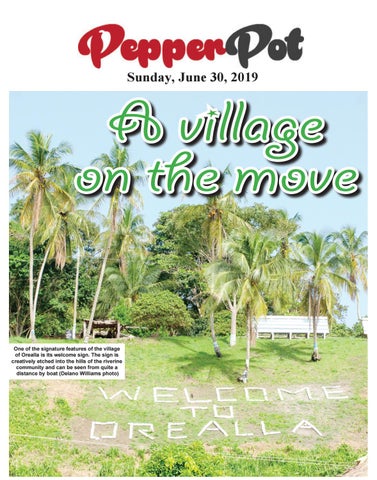
A village on the move One of the signature features of the village of Orealla is its welcome sign. The sign is creatively etched into the hills of the riverine community and can be seen from quite a distance by boat (Delano Williams photo)
Introducing
II
Chronicle Pepperpot June 30, 2019
EQUAL Guyana
Anil Persaud, Founder and Managing Director of EQUAL Guyana
By Gibron Rahim “OUR hopes for a more just, safe, and peaceful world can only be achieved when there is universal respect for the inherent dignity and equal rights of all members of the human family.” The above quote uttered by UN Women Executive Director Phumzile Mlambo-Ngcuka is a reminder that, in order for any among us to be equal, we must all be equal. Empowering Queers Using Artistic Learning (EQUAL Guyana), with its focus on engagement, education and empowerment of LGBTQ communities and allies in Guyana, has recently joined the host of human rights projects and organisations in Guyana. The Pepperpot Magazine spoke to Anil Persaud, Founder and Managing Director of EQUAL Guyana, to learn more about the project. He related that the idea for EQUAL Guyana was born quite a while ago. He recognised that, while there was a lot being done in the area of LGBTQ rights, there was very little attention being paid to the arts in general. He pointed out that this was not always the case. “If you reference back to persons like Andre Subryan and so on there were the arts involved but over time it faded out and so the arts were not being used sufficiently,” Persaud explained. THE BEGINNING OF SOMETHING GREAT Some funders, as Persaud noted, were very keen on using the arts to bring about change, a more progressive concept for human rights. While he was having the idea for a human rights project, a funder from the Netherlands reached out, asking about thoughts and ideas and expressing interest in supporting such an initiative. EQUAL Guyana was born from these initial stages. “And luckily the acronym made sense – Empowering Queers Using Artistic Learning,” Persaud quipped. EQUAL Guyana has numerous goals, according to Persaud. “The vision of EQUAL is to foster social change and really create a respectful, accepting and safe country altogether for all LGBT people, regardless of everybody’s different characteristics,” he affirmed. He noted that there are three prongs to the entire process. The first is engagement. It involves reaching out to people,
Members of the Diplomatic Corps pose with members of the EQUAL Guyana Team during the Guyana Pride Parade 2019
building networks and strong relationships. Education is the second prong of the process. Persaud pointed out that a good education can drive out the ignorance that fuels a lot of homophobia and transphobia. This, he said, is where artistic education comes in. EQUAL will use the arts to help build people’s personalities and lead them to self-actualise. The final prong is empowerment. Through engagement and education, the goal is to empower LGBTQ persons, especially youth, to become more confident and be able to contribute positively to a national sense of identity. EQUAL Guyana is currently being referred to as a project, rather than as an organisation. There is an important reason for that distinction, according to Persaud. “I’m keen to use the word ‘project’ because we have not yet formally registered,” he said. He explained that they have, however, initiated the process and have started gathering all the necessary documents and the like for that process. “I use the word ‘project’ because I don’t want people to run away with the wrong idea, but it will become an organisation.” ACTIVITIES In terms of engaging the Queer community, Persaud pointed out that different organisations have different target groups. He related that the EQUAL Guyana’s funder was very specific that they engage LGBTQ youth. From focus groups, EQUAL Guyana found that there are simple activities that people would like to engage in. These are, “Things that should be accessible to the average youth but is not for LGBTQ youth, as compared to their cisgender, heterosexual counterparts,” Persaud said. These activities include EQUAL Guy-
ana’s recently held ‘Games Night’, art classes and training sessions. “We’re going to reach out to youth leaders, we’re going to reach out to LGBTQ youth in the different areas in Guyana,” he stated. “Partnering with [the Guyana Rainbow Foundation] we do have intentions to go out of Georgetown, go as far as Bartica and so on, to do training sessions.” These will be gender and human sexuality training sessions to get people to better understand concepts, according to Persaud. He noted that even within the LGBTQ community there is still a lack of knowledge about concepts of gender and sexuality. EQUAL Guyana has willfully chosen social media as its key way of dispersing information. “That’s where our constituent is,” Persaud said simply. “We have driven some funds into LGBTQ campaigns online.” Besides participating in the recently concluded Guyana Pride Festival as part of its national campaign, Persaud explained that one of its upcoming campaigns will involve reaching out to influential persons in the Guyanese context and having them share an encouraging excerpt that says to youth that, regardless of their gender identity or sexual orientation, they are welcome to be part of their community or organisation. He related that LGBTQ people are still scared to apply for a job or access a service because they are unsure of the treatment they will receive. Additionally, because the project is focused on art, Persaud said that EQUAL would like to host an art exhibition at the end of the year. They hope to include pieces created in all of EQUAL Guyana’s art sessions in the exhibition. The aim is to have an event that is inclusive of all, not just one aimed at the LGBTQ community. Much of the groundwork for EQUAL
Guyana was laid by Persaud himself. The initial planning stages had to be put on the back burner because, as he noted, he did not want there to be a conflict of interest with his previous post of employment. “I sat down a lot on my own and worked on this.” As it currently stands, Persaud is functioning in the role of managing director. Raiza Khan is currently the consulting psychologist on the team. She and Persaud, who has experience in visual arts, will collaborate on projects that incorporate elements of art and psychology. Alistair Sonaram, who has a vast expanse of experience in project coordination, and Scott Singh are EQUAL Guyana’s project coordinators. Persaud noted that the entire team is currently voluntary. EQUAL aims to serve communities with honesty, trust and transparency. Persaud noted before the project even started he had reached out to individuals to seek their input. The three concepts were recurring themes from these interactions. He acknowledged that there are confidentiality clauses to contracts and a limit to the information can be shared because of the demands of funders. However, the aim is to have financial information available to stakeholders to the fullest extent possible. “All resources that are given to NGOs, because NGOs really survive on donor funds and donor resources, are given to be used for the community and it’s only fair that the community can hold us accountable for the money,” Persaud affirmed. “That for us is important because that’s the only way you can develop a sense of trust and develop a sense of integrity for yourselves.” He added, “It’s us serving the community really so that’s very important for us.” Turn to page IV►►►
Chronicle Pepperpot June 30, 2019
III
‘I love my job and I love serving my community’ -
Port Kaituma’s one and only ‘rehab’ assistant
Assisting one of her patients
didn’t know anything; I was a slow learner in my class, and now it is people’s lives you’re dealing with, so you have to be careful,” she recalled. Her job would take in occupational and speech therapy, along with physiotherapy. Most times, Marissa covers these subjects in the classroom, and would then go for practical training at the Georgetown Public Hospital and other medical institutions. “For me to understand certain things, they explained them in layman terms for me. It was a challenge,” she said, adding, “This was so new to me; I had to take my time and figure things out. At first, when I was told I had to stay back, I sat down with tears because I wanted to go home.” But eventually, Marissa got the hang of things and became so competent at the job to the point where she is now the only rehabilitation assistant in
By Telesha Ramnarine MARISSA Hutson had never really given thought to what career she should pursue and growing up in Port Kaituma, her options were rather limited. But today, she is living her best life ever having stumbled upon a path that she couldn’t be more thankful for. Marissa, 28, was born at Arakaka, but moved to Port Kaituma, both Region One communities, when she was just a child. It was at Port Kaituma that she completed her secondary education, and took up various jobs afterwards that were readily available there. While working at the hospital in Port Kaituma one day, the medic on duty drew Marissa’s attention to a vacancy for a rehabilitation assistant with the Ministry of Health. “She told me this would be a good thing for me, so without thinking, I just applied,” Marissa recalled during an interview with the Pepperpot Magazine a few days ago. Rehabilitation Assistants (RAs), Marissa helping this patient to do exercises also referred to as occupational that would help him use his legs again therapist assistants (OTAs) and physiotherapist assistants (PTAs), Port Kaituma. What is more, she has a plan to are members of the health care team who help patients in several communities outside work under the supervision of an occupational of Port Kaituma. therapist or a physiotherapist to improve a “I don’t look only in Port Kaituma, but patient’s quality of life. It involved nursing I would look to help people in lower Port someone back to good health through various Kaituma, and in the Matakai sub-region exercises and physical work. It can also mean which is made up of Baramita, Arakaka and helping someone with speech problems to be Matthew’s Ridge. So I have a plan that I am able to speak well again. working with where I would go on outreaches Imagine her surprise when she received a and then do up my reports,” she explained. call informing her that she had gotten through “Is nuff work, but I explain everything that with the job, and would be trained in the field. patients have to do in layman terms, just as At first, the thought of doing the job was others did for me.” scary to Marissa because she felt that it was Marissa started off with more than 30 a heavy responsibility to take on. “At first I patients and is now working with about 15.
“It depends on the distance the person is coming from and the financial support they are receiving and so forth. I don’t wait for patients to come to me, I go looking for my patients and give them the type of treatment they need,” she said. The hospital in Port Kaituma has vehicles and bikes that would greatly assist Marissa to reach patients who are in faraway places. “I love my job, I love helping people, and I love serving my area,” Marissa said about the reason she would go the extra mile to reach patients. Because of the training provided by the Ministry of Health, Marissa has to serve the government until 2021, after which she hopes to enroll at the University of Guyana to pursue studies in physical therapy. Marissa is grateful to all those who assisted her in becoming competent in her field of work.
Marissa Hutson
IV
Chronicle Pepperpot June 30, 2019
Selfless service in a foreign land ON November 16, 1948, Ruth Benjamin was born in Kingston, Jamaica. A mere 26 years later, she migrated to Guyana as a young bride. She brought with her the knowledge and compassion of a medical doctor that was needed to improve the local public health sector. Dr. Ruth Benjamin- Huntley was recently recognised for her 30-plus years of selfless service in Guyana’s health system. On the occasion of the 49th Republic Anniversary of the Cooperative Republic of Guyana, His Excellency President David Granger appointed her the Golden Arrow of Achievement. “I was humbled to be bestowed The Golden Arrowhead of Achievement. I felt honoured to know that I left my home many years ago to serve the Guyanese people and I have received this recognition and appreciation. “I am a proud Guyanese. I travel with a Guyanese passport,” she said.
Growing up in Jamaica, migrating had never crossed her mind. Dr. Ruth (as she is fondly called) grew up in a small nuclear family. Her mom was a housewife tasked with nurturing four children and her father was an Engineer. Young Ruth attended Queen’s High School- an all-girls school. She was successful at the GCE and ‘A’ Level examinations. By that time, the desire of a 12-year-old girl to become a doctor had grown. She pursued a Degree in Medicine at the University of the West Indies in Jamaica. “When I was around 12, I saw a movie in which there was a young doctor who showed such care and empathy for his patients, even in trying circumstances he displayed grit, tenacity and love and that moved me to become a doctor. I too wanted to help and make persons better,” Dr. Ruth recalled. As fate would have it Ruth caught the attention of a young Guyanese man named Rickford Huntley. While Huntley was in his final year at the United Theological College of the West Indies Dr. Ruth was interning. That very year, the duo got married. Following Huntley’s graduation in 1975, he brought a blessing to Guyana- his bride. Dr. Ruth transitioned smoothly in her new family and country. Guyana had quickly become her home. She had adjusted well to rural living on the West Coast Demerara, travelling to the Georgetown Public Hospital and even consuming delicious Guyanese cuisines, though she took some time warming up to pepperpot. “I did have a challenge with pepperpot. I was introduced to it while I was working at GPHC’s Pediatric Ward. I used to stay at the flat whenever I worked late. One time I was provided pepperpot I thought the meat was burnt. It was dark and bitter the housekeeper smiled and said it was the cassareep. I didn’t eat it then. I enjoy it now though. It is one of my favourite meals now. Also, roti and dhal puri were new to me,” Dr. Ruth said. Having served in the Paediatric Ward for almost three years Dr. Ruth had gotten tired
Dr. Ruth Benjamin- Huntley being conferred with the Golden Arrow of Achievement by President David Granger
of the night shifts but just before her contract period had ended Dr. Patricia Rose, head of the Leprosy Control and Dermatology Unit invited her to apply for a job within the Unit. This was exactly the break Dr. Ruth was praying for. Dr. Ruth recalled, “It was an attractive offer because it didn’t have night duty. They were expanding the unit to go into different communities. I joined in 1978. Leprosy affects the skin and had a stigma attached to it. So to have persons attend clinic or come for a checkup we ran it as a Dermatology Unit. Dr. Rose trained me in Dermatology.” Working with leprosy patients was a fascinating experience for Dr. Ruth. She did not view her patients as outcasts but treated them with a double dose of love and medication. There were times when Dr. Ruth and her team would go in search of patients who missed clinic dates. Her tenure there exposed her to different parts of the country including Linden, Essequibo, and Berbice. In 1992, Dr. Ruth made a decision for her family. She took 10 years off from practising so she could be with her family. In 2002, she reentered the world of work. She started a private practice. She also started lecturing at the University of Guyana and other offshore Medical Schools. And, while she is expecting to celebrate her 71st birthday in November 2019 Dr. Ruth is still at it. ◄◄◄ From page II
PARTNERS WELCOME! EQUAL is very open to collaboration. “We’re working very closely with GuyBow and we’ve collaborated already with GuyBow and we’ve only been properly established for about three weeks,” Persaud said. EQUAL collaborated with GuyBow on the Pride Symposium of the 2019 Guyana Pride Festival. “We’re willing to collaborate with anybody who wants to collaborate, once our ideals and our goals are similar,” said Persaud. “Also we’re not just open to collaborating with LGBTQ organisations or LGBTQ rights organisations.” Persaud noted that it was only after naming EQUAL that he realised that the word “queer” is very intersectional. “It was not just used in the past to refer to LGBTQ persons but it was also used to refer to racial minorities and religious minorities and ethnic minorities.” Thus EQUAL is open to collaborating with other forms of human rights organisations. “It’s important to collaborate, it’s not just about money,” said Persaud. “If we can share other resources I think it’s important to build organisations.”
“Take a minute to check it out,” are Persaud’s words to potential members. “It’s not something that we’re rushing,” he said. He made it clear that it is not about building numbers. “Check out what we’re all about,” he stated. “All the information is accessible on the Facebook page and on the website.” He encouraged persons to reach out if they have any questions or concerns. “Reach out, we’re willing to talk, willing to answer,” he said. “If it fits something that you’re interested in or if it starts to develop in your interest for you then register, become a member, get active and just start to contribute towards the community, and not just the LGBT community but our national identity at large because art and queer culture and education is really for everybody, and it helps to build our country and our communities and organisations at every level over time, so it’s not limited to one person or one group.” EQUAL Guyana can be contacted at equalguyana.wixsite.com/equal592 and on Facebook at www.facebook.com/EQUALguyana
Chronicle Pepperpot June 30, 2019
V
The All Saints Anglican Church is celebrating 180 Years By Francis Quamina Farrier THE All Saints Anglican Church in New Amsterdam, Berbice, has been celebrating its 180th anniversary this past week with a series of activities. They included a public parade around New Amsterdam, the ordination by Bishop Charles Davidson of Mr. Ezra Minty and Mr. Theodore De Monick as deacons of the church, at the St. George’s Cathedral in Georgetown. There was also the distribution of food hampers to a number of shut-in elders in New Amsterdam. The celebration concludes this afternoon with a High Mass at 15:00hrs at the church on Main Street, New Amsterdam. A few weeks ago, the building was given some needed repairs. It was not quite of the scope as that still being undertaken at the iconic St. George’s Cathedral in Georgetown. The Anglican Christian denomination has been functioning in Guyana for over 200 years and has had an impressive reputation for its contribution not only to the spiritual needs of its members but also to the education of youths of all denominations, for well over a century. Many Anglican schools were established all around the country. Part of my own early formal education was at the St. Ann’s Anglican School at Agricola, East Bank Demerara. Many of the clergies have been active in civil and business activities such as the scout movement, which itself is 110 years this year in Guyana. One of the Anglican priests, Fr. A.L. Luker, who was serving at All Saints at the time, wrote the words for Guyana’s National Anthem in 1966. There are other Christian churches in Guyana which have also been around for a very long time. The Mission Chapel, which is
The All Saints Anglican Church, New Amsterdam, now celebrating its 180th anniversary (Photo by Francis Q. Farrier)
old Smith Memorial Congregational Church. The Anglican Body has also established churches on the Corentyne Coast, all along the West Coast Berbice and the Demerara and Essequibo Coasts. There is the St. Johnthe-Baptist at Bartica in Region Seven, and also on the Pomeroon in Region Two, among other locations in Guyana. All that leads to ask how often do Guyanese reflect on those who went before us and what were the treasures they left to us for our own joy and development- or example, the hundreds of miles of streets, roadways and highways which we use on a daily basis and the thousands of bridges which we cross daily. The hundreds of miles of pavements, and the
Scaffolding at present around the 190-year-old St. Peter’s Anglican church at Leguan (Photo by Francis Q. Farrier)
also located in New Amsterdam, is now 205 years old. On the island of Leguan in the Essequibo River, Region Three is the 190-yearold St. Peter’s Anglican Church, which was built with bricks. At present, its tower is being repaired. That historic Anglican Church is also being promoted as a tourist attraction. On Brickdam in the city of Georgetown, is the 200-year-old St. Andrew’s Kirk, and further east, also on Brickdam, is the 175-year-
hundreds of miles of canals which were constructed in past centuries and which we use daily. When last have citizens of Georgetown reflected on the Century old Lighthouse which is located at the northern end of Water Street and thought of its important use in guiding ships into Port Georgetown with all the imported goods we purchase for our daily needs and comfort? With the above-mentioned, century-old
Christian Churches in Guyana, including the Bethel Chapel in Beterverwagting on the East Coast Demerara, there is proof enough that the Christians have been around for a very long time here in British Guiana/Guyana. During that time, they have been doing great work for the people of this country, including the task of education. Many citizens who now hold positions of influence and power in the country, including the President of Guyana, His Excellency Brigadier David Granger, have benefitted. A controversial spot of the history of the Anglicans in this country is the demolition of a great Anglican church, the St. Barnabas which was located on Regent Road at Orange Walk in Georgetown. However, the 180-year-old All Saints Anglican church is likely to be there on Main Street, New Amsterdam, Berbice, for many years to come. Those who went before us have laid the foundations on which we continue to build and develop, not only our religious faiths but also our entire ‘Dear Land of Guyana’.
VI
The play area for children visiting the Port Mourant Health
Chronicle Pepperpot June 30, 2019
(Samuel Maughn photos)
A look at the Port Mourant Health Centre By Michel Outridge THE Port Mourant Health Centre in Region Six (East Berbice/Corentyne) is a model facility as it offers modern services to the public. Focal Point Coordinator of the Ministry of Public Health, Alex Foster told the Pepperpot Magazine that the public facility was renovated as a result of private and public sector partnership and it is also outfitted with all necessary equipment and staff. He made this disclosure during a media tour of the facility recently. The health care centre is paperless and has received the full support of the business community in that Region and overseas to bring the necessary services to the community, Foster said. Family-friendly health centre The Port Mourant Health Centre promotes maternal and child health clinics and they even post photographs of the mothers who have delivered and babies that have been born there on its walls. Foster added that prior to posting those photos, the facility had American cartoon characters decorating its walls in an effort to make the place child-friendly but they have since pulled them down. “We [took those photos] down and made them practical and realistic to feature our own people, who visit the centre. We [are concerned] that we cannot reach the length and height we were destined for so we have up instead photos of our local people, that is, mothers and fathers with children who were born here, the corridors are lined with families that utilised this health centre,” said Foster. According to Foster, each health centre is required to have 26 different areas and the Port Mourant Health Centre is one which has been at the forefront of getting all those components organised and put in practice. He added that all departments were also able to meet the minimum standard required. “You notice this is a little different since we are encouraging male participation at the health centres and a lot of men are here on a monthly basis for clinic with their wives and children. Mothers can breastfeed their children at the clinic because an area has been set aside for that and back in the days, mothers alone
with children used to visit the centres but things have changed because we want it to be family-friendly as much as possible,” Foster said. He told the Pepperpot Magazine that while children are at the facility there is a designated play area for them, which is safe and a separate section for breastfeeding which is exclusive. He added that every year mothers are also presented with a hamper and a plaque. Foster stated that despite constraints, the Port Mourant Health Centre is up to standard with a full complement of six staff and their goal is to have a full-time doctor there but for now one is present two days per week. “We are pushing local imagery that is practical at this facility because this is a real model of how a health centre should be with a kitchen and a community profile of the catchment area, which is basically a map of Port Mourant. This is for the benefit of the staff, five of whom have gone out in the field to work along with social service providers. Each department is labelled for easy access, including the doctor’s office where examinations are done,” Foster said. Foster explained that on a weekly basis a social services worker visits the facility for counselling services and conducts blood tests on patients. The vaccine room is fully labelled as well for safe practices and for teaching staff to maintain the standard. The Port Mourant Health Centre is fully air-conditioned and is a digital facility which is opened to the public on Mondays to Fridays. Foster reported that there are 30 health centres in the region and the ministry’s plan is to bring all up to standard. “When and if you were to visit any of these health centres you will see how close they are to this facility because we have set aside a standard for the rest to pattern and it is a competitive environment for upgrading with each other,” Foster said. “Every year we try to upgrade these health centres but some of them were in such bad shape that it took a long time for them to get to this standard. Through training, we will ensure all the health centres in this region are up to standard through private and public sector partnership – we are leading the way in this direction.”
Chronicle Pepperpot June 30, 2019
VII
Essequibo Centenarian turns 102 years Encourages youths to be honest
102-year-old Lucretia Bradford
By Indrawattie Natram HONESTY for Lucretia Bradford is a quality that every individual should inculcate in their lives if they want to be happy. That was the advice given by Lucretia Bradford one of Essequibo eldest females. She believes that one can go a far way if they instill this quality in their everyday life. Born on May 25, 1917, Bradford - also known as ‘Sister Baby’ - celebrated her 102nd birthday this year.
Reminiscing, Elder Bradford, said that she remembers caring for her seven children even after her husband passed away. Of her seven children, only three are still alive. Reflecting on her younger life, ‘Sister Baby’ said that she spends most of her childhood in Cullen Village where she was born and married. She recalled assisting her mother and aunt practising midwifery. She also enjoyed working on the farms and fetching stones to build roads. “I was the eldest of my siblings, as such, I used to have [a lot] work to do. A lot of responsibilities were on me, especially when my parents would have to go to work, but I enjoyed taking care of my sisters and brothers,” she said, adding that she earned a living from selling, cutting cane and doing domestic work. “Long ago, people do anything, they fetch wood, cut cane, fetch stones and walk long distances to get the work done. I did a lot of work with my hands to provide for my family, I didn’t regret it, I am reaping the rewards now,” Bradford said. A staunch Christian, Aunty Baby said that she continues to worship the Almighty. She said that it is the strength of God that has her sailing through life. She said that although she doesn’t make it to Church regularly the church usually comes to her. Bradford said she believes in the Bible and is living according to the principle of the Christian religion. Throughout the interview, she constantly thanked God for his grace and guidance. Bradford celebrated her birthday recently with her family and friends. She said her family
Bradford and her children and grandchildren
When asked what her secret to a healthy life was, she told Pepperpot Magazine that she believed that serving God, eating healthy and living a life of celibacy brought her all this way. Apart from her dim vision, Bradford does not suffer from any ailment or affliction and still enjoys doing things for herself such as showering and walking around the house. Her daughter Patsy Bradford currently takes care of her and according to Patsy, it’s a blessing for her. She said she feeds her mother mostly soups and avoids giving her tablets/ medications. The woman said that she is very fortunate to be given the opportunity to still take care of her mother. She said she admired her mother’s zest and enthusiasm in life
usually throws her a thanksgiving celebration yearly. The centenarian is also happy to see her fourth generation. The woman said she earned respect from others from an early age when she was very helpful in her community. She said she helped a lot of young mothers bring forth children by “fixing” their womb when misplaced. “I saved a lot of marriages. I fixed the women abdomen and I used to boil bushes and give them to drink, some of them still remember my kindness,” the elder said. Aunty Bradford is, therefore, advising young people to value their lives and to not to judge or be jealous of anyone. She advised that God has a plan for everyone and that people just put their trust into him.
Bradford with her children Patsy and Randolph Bradford
VIII
FIRE WE are the land of many waters and our rivers do have their tales of mystery to tell, but of the elements, none can compete with fire in its activity among our humanity. Like most people, we do not relate to a discussed tragic event regardless of how popular its occurrence, only when it touches you personally. My début on the stage of fire was in 1977 when the Guyana Rice Marketing Board (GRMB) was burnt. The popular information was that this virile industry went up in flames as a result of political arson. From near and far we came and watched, speechless and angry- young
men with no place of employment the following day. After that, I paid attention to whispers and discourse about the burning of sugar cane as political sabotage and of attempts at other places. Fire in our Guyana is not new; I saw pictures of what happened during the 60s when this country was divided politically along straight ethnic lines for the first time. These were not beautiful scenes, and I would like to one day see a table of the estimate in dollars and jobs lost because of those acts, but the most macabre memory of fire was as a child eavesdropping on a conversation between my Godmother and Aunt Iris who lived at Leopold and George Streets, how she related the screams of the Abraham family who lived at George and Hadfield Streets as they were burnt alive in their home- victims of political arson. How the fire was constructed had left them no chance of escape, was the conclusion. But not all fires are political. Sometimes
Chronicle Pepperpot June 30, 2019
God of revenge, spite and profit in the kingdom of Guyana fate places us in locations of existence to learn. I once met a man called Aloo, by the Kingston koker next to the GRMB. After he left, my colleague who knew him informed me that he was a ‘bun-man’ for a prominent GT family. This family had- through self-inflicted arson on several of their properties - made a sweet killing of insurance payments. He was said to be a past joint service member among other embellishments but what was convincing when asking other characters about this man’s expertise, they all concluded that he was a professional arsonist. Then there is a famous case of bad business gone worse
measures to overlook problematic social areas like domestic tug-o-wars that emerge to ignite the consequences of houses burnt here and homes set afire there, because of situations where through trickery a relationship is torn apart and a building taken to one person’s benefit, and in retaliation the building is set afire by the apparent victim. These occurrences happen without recognition by lawmakers and have over the years merited no adjusted penalties generally for arson on one hand, and fixed institutional legal overseer mechanism for persons in a semi-literate position involved in property and home purchases on the other.
problems. Arson should be at the top of the category of serious crime. Arson and the threat of arson is one of the most prevalent methods of terror in this country. I can remember some years ago with a Regent Street fire, some Chinese were rescued by a friend of mine, from the building where it was alleged to have started. They were in a state of some form of ‘High’. Several nearby buildings went down. One store owner upon hearing that his store was burnt, took in and died of a heart attack. Our proverbs always guide us that fire is a good servant but never a good master. In our national space, fire has become a
where fire was applied, and eventually, a businessman was beheaded. There is also a mystical aspect to fire in our ‘Folk Culture’. The phenomenon of ‘Fire bunn’ is described by the magical term as send ‘Fire Bunn’ which science describes as Human Spontaneous Combustion, the phenomenal development of the body catching afire without any external evidence of ignition by fuel or substances. One such story is said to have happened on Laing Avenue and has multiplied every time it was retold. Scientists propose that alcohol usage could be a link, they really don’t know, nor do we of what mysteries our ancestors knew, that we like to describe as ‘High Science’. So far, that condition remains a scientific phenomenon, with far and rare cases reported worldwide, recorded since the 18th century. Most countries adjust the consequence of their laws in keeping with the frequency and severity of special criminal practices, and implement where necessary monitoring
Arson, without doubt, has become over the past 10-15 years an intense weapon of concluding domestic conflicts and court disputes. More than once, rage through arson has sacrificed children and mothers unconnected to the contention. I point to Charlestown and Robb Street to identify two glaring cases, to the smouldering altar of the fury of arson. I lost a young friend who was tempted by a drug dealer to set a disputed property to fire, without any knowledge of incendiaries he somehow lit himself afire. I was told of his condition by his brother. The drug dealer was more advised and proceeded to advise the young lady who my young friend lived with, not to take him to the hospital, gave her some much-needed cash and she applied wet towels as instructed and pressed it continuously against his body. He contracted pneumonia and died as was intended. Yes, there are demons walking among us, we must be aware of their suggestions and schemes to alleviate our financial and stress
Genii summoned with haste through different means. In closing some years ago, I sat in a friend’s home waiting for him to find a book he had borrowed and had forgotten to return, staring at nothing I was attracted by a flicker, now and again, at about every eight or ten minutes. I asked him about the contraption I was looking at from where the flicker was coming from. It was a Chinese switch on and off instrument used to steal electricity. I called an electrician friend and he advised that this cheap instrument was the source of many home fires, used by cash strapped families trying to save on unreasonably high electricity payments back then. That is self-inflicted arson, but minor to the quick alternative of enemies through home disputes, business competition, deals gone bad, political allegiances, and insurance recovery for indebted businesses. The Fire God Genii needs to be returned to the ornate goblet, through stricter laws.
ocus F Chronicle Pepperpot June 30, 2019
IX
on the Village
Orealla, a developing village on the move
By Michel Outridge
Orealla, an Indigenous Reservation located about 50 miles from Crabwood Creek, Corentyne, Berbice is located on the Corentyne River and is managed by a Toshao and a Village Council. On a trip to the village, the Pepperpot Magazine met Errol “Hector” Edwards, who is the owner of the Launch Service that goes to and from Orealla. The service has been in existence for about two years and it takes in passengers and cargo from the Skeldon Stelling, Corentyne, Berbice, to the remote village on certain days of the week. Edwards said that the Launch transports goods and passengers on Sundays from Orealla especially, in the night to Skeldon Stelling and would go to back to the village on Mondays. He added that they would come from the village on Thursdays and go back on Fridays and it is a four-hour journey by that Launch
He added that they are trying to introduce tourism as one of their main source of income but it needs the input of all its villagers. “We have a different approach to market and showcase our products - we have our own transportation means that happens on Mondays and Fridays, a big launch owned by a villager and the village can have six launches at the ready to facilitate tours but they also have private charter service,” he said.
Randy Herman, Deputy Toshao of Orealla Village Council
a father of one, who is a humble servant of the community. He related that Radio Orealla was launched on March 25, 2018, but in September they had their very first local broadcasting. “We highlight basic things like reviving
The new Orealla Stelling (Delano Williams photos)
Service at a cost of $1,000. Edwards, a resident of Orealla is involved in the logging business and it is only financially viable for him to bring out lumber from that far-fetched community. “This boat normally works with the tide, it leaves in the early morning hours because the waters are usually rough and it is easier to travel when the tide is better. This service only pays when I bring out lumber and other times I am operating at a loss,” he said. RADIO OREALLA The Pepperpot Magazine spoke to the Deputy Toshao, Randy Herman, who is also the Secretary of the Orealla Village Council. Herman is a broadcaster at Radio Orealla,
our language programme. The main broadcaster for that is Lloyd Peneaux, the brother of the Village Toshao, Carl Peneaux,” Herman said. He stated that they have other radio programmes that are of interest to the people including the Reducing Emissions from Deforestation and forest Degradation (REDD+) project, National Insurance Scheme (NIS) and Labour Laws as it relates to Forestry because their people are involved in logging. In addition, they have educational programmes for youths and programmes that also include residents’ participation, by way of a song or poem presentation. Herman pointed out that Orealla is a close-knit community of about 500 people and their main source of income is from logging, fishing and craft.
OREALLA STELLING In highlighting some of the development of the village, Herman said the Orealla Stelling was constructed about a month ago. He reported that his stelling was supposed to be built through funds from the Orealla Village Council (OVC) and a presidential grant that was given through the Ministry of Indigenous Peoples Affairs. However, when the project started they managed to source some materials and the Ministry of Public Infrastructure came on board and finished the project with added materials. The Orealla Stelling overlooks the Corentyne River and its surroundings including, the view of the neighbouring Suriname, which is close by. Herman said the Stelling is there but not utilised by residents since it is yet to be commissioned by the Ministry of Public Infrastructure and after that happens they will make full use of it. OREALLA ELECTRICITY SYSTEM Resident, Armaan Edwards told the Pepperpot Magazine that he was born and raised in the village and he operates a small grocery shop but is active in community development where he sits on the Orealla Village Council as a councillor. “My portfolio is electricity and I am a councillor as well as, Acting Logging Councillor and we have a committee running the electricity system that I oversee that to ensure everything is working well. The Orealla Electricity System (OES) is run by the OVC where a monthly report is issued. Residents pay a monthly bill for the service and from that money garnered we upkeep the electricity supply in this village with the government subsidy for fuel,” Edwards said. He added that residents get electricity supply from 17:30 hrs to 22:30 hrs daily and only about five persons in the village have solar powered system in their houses. LOGGING Edwards pointed out that villagers are engaged in logging and they supply local dealers, that is, sawmills operators along Corentyne, Berbice, with 25 species of wood. He stated that they supply lumber on a large scale every fortnight a shipment is required and the buyers take out the lumber at their own expense.
Edwards said last year from June to December, the Chinese company, Barama began doing business with villagers. He noted that they were supplying softwood pillars logs however, they were put on hold because the demand for that product was slow but they are hoping to resume business with that company. Edwards, who is also the Deputy Secretary for the Logging Committee told the Pepperpot Magazine that about 60 villagers are part of the logging business out of Orealla. He stated that it is their main source of income since folks there do not have office jobs and they prefer to be self-employed. Edwards related that after the lumber is cut by chain saws it is then extracted from the forested area and the sawmill operators would visit Orealla and make their purchases. HELPING OTHERS “At my shop, I help out residents on a credit system whereby, I give them goods and when they get money they would come and pay me. I just helping out not everybody doing it in Orealla,” he said. Edwards said he is also in the fish business where he would buy all the fish caught by villagers and take it to Springlands, Corentyne, Berbice and sell it to exporters. He noted that most men in Orealla are either fishermen or loggers while others are into small scale farming and hunting. “There is something for everybody in here to do – like a handful of residents are hunters, so we are self-sufficient and do not have to go out of this village to seek employment. About one-third of our people are doing small scale farming like pineapples, which is in season now and others plant ground provisions and vegetables,” he said. Turn to page X►►►
X
Chronicle Pepperpot June 30, 2019
◄◄◄ From page IX
ELECTRICITY EXPANSION PROJECT Edwards stated that they have proposed for an extension in the electricity supply within the village since about 120 households are yet to benefit. He explained that their request was accepted and materials were sourced and they are waiting for the technical people to visit to complete the project. Edwards said after connectivity of the 120 households the cost for electricity will be less because they are paying $150 per unit of electricity which is deemed to be the highest rate in Guyana
so the people have to ration it as is. He told the Pepperpot Magazine that presently 175 households are connected to the power company in Orealla but 120 more need to benefit. “We get all the hardware, we have to provide tools and the technical people have to come to assist and that will happen soon. It is a boost from the government and through the regional administration, we also get three barrels of diesel every month. One barrel goes to the nearby satellite village of Siparuta and we use two barrels,” Edwards said.
He related that it has been about 12 years now that the Orealla Electricity System was established and there is a need for the utility poles to be replaced since it is deteriorating rapidly. Edwards explained that the insides of the poles are hollow and have decayed extensively and will collapse. The Orealla Village Council will make a proposal for the replacement of the utility poles, he stated. All weather road to link Siparuta and Orealla Edwards said that Orealla is a village on the move and they are working to further develop the village as such, a project is in
the pipeline for an all-weather road to link Siparuta and Orealla. He stated that the contract was already awarded and the project started on June 27, 2019, from the Siparuta end in which a two-lane road will be constructed at a cost of $132M through the Ministry of Public Infrastructure. In addition, all internal roads within the village will be upgraded and hills will be paved to allow vehicles to have easy access around Orealla. Edwards added that street names and signboards will be erected.
Orealla has produced good results By Michel Outridge THE remote community of Orealla is a thriving village which has produced students, who have excelled at the national level. This disclosure was made by Head Teacher of the of Orealla Primary and Secondary Schools, Diane Lewis, who is a resident. She told the Pepperpot Magazine that so far, academically, their students have performed well at the national exams, especially, in the Grade Six and Caribbean Secondary Education Certificate (CSEC) Examinations where they attained good results. Lewis added that with some form of assistance they can do much better to enhance the stay of students at the school adding that there is also a need for computers in the secondary department. She manages 14 teachers with 93 pupils of the Primary School but noted that since their secondary department is not a fullfledged one they are not recognised as a secondary school, as such, they do not benefit from some things. “We have adequate teaching supplies for the primary students but more is needed for the secondary students to boost our resources,” she said. Lewis explained that the primary school building also houses the secondary department where they carry out the secondary programme which is up to Fifth Form. She related that they prepare students to write CSEC exams but they do not have a centre in Orealla for the students to sit the exam so they have to go to Corriverton for that to take place. Lewis told the Pepperpot Magazine that for this year, they had their first batch of pupils, who did their School Based-Assessments (SBAs) and for that, they are happy that the Ministry of Education granted permission
for them. However, if the students wish to further their education they would have to go out of the village to be enrolled in tertiary institutions of their choice. Although the school has an Information and Communication Technology (ICT) hub the Wi-Fi only works when the electricity is on from 17:30 hrs to 22:30hrs. “I only left this village when I went to Cyril Potter College of Education (CPCE), Turkeyen and after my graduation, I returned to Orealla. Before I went to CPCE I taught for three years at this same school and in 2015 I was appointed head teacher,” Lewis said.
ter is a qualified teacher at the school as well and she completed training at CPCE last year and one of her sons, was a teacher at the very school. SCHOOL CANTEEN Samantha Singh, also a resident of Orealla operates the canteen at Orealla Primary School and have been at the job for the past five years. Singh told the Pepperpot Magazine that she lives up the hill and makes affordable snacks for the children. “I made bara, potato bakes, potato wedges, chicken foot and drink mixture for the
Samantha Singh tending to students during the recess period at Orealla primary School
Diane Lewis, headteacher of Orealla Primary School
born and raised in the community and does not know any other life than living in Orealla where she is comfortable and life is easy. “I born and grow here and I would die here because I do not like ‘out there’ where there is so much going on, like crimes, so I prefer this peaceful life here. I done accustomed to here and we do many things here to make a living and there is no need to venture out of our village. We don’t have to spend a lot of many for transportation here because we walk to wherever we have to go and we do farming too,” Singh said.
The headteacher disclosed that her life in Orealla is good and she belongs to that place where her life is one of peace and quiet. The mother of three stated that her daugh-
Orealla Primary School
children so they can have something during the recess periods and it is just $20 per bag of any snack,” she said. The mother of two stated that she was
SIPARUTA, THE SATELLITE VILLAGE Laurence Vanderburg, who was once a teacher at Orealla Primary School left the noble teaching profession earlier this year to realise his potential of ‘working with his hands’. He told the Pepperpot Magazine that he is in the process of renovation the privately-owned school in Siparuta. Vanderburg explained that the school is run by the Gospel Ministry International (GMI), an organisation that has four such schools in Guyana but a lot more around the world. “Right now we are preparing the building for the school opening in September and we want everything to be ready so I am a volunteer,” he said. Vanderburg admitted that he likes teaching but his real passion is volunteer work and fixing things because he has the talent of building, construction and fixing engines etc. “I have freedom, I can do the things I want to, I like to do manual work, with my hands, I meet people and that helps to build my character and become a better person,” Vanderburg said. At 21 years old this young man can fix just about any machine, vehicle or build anything from scratch although he has no formal training.
Chronicle Pepperpot June 30, 2019
XI
The people of Orealla Their way of life
By Michel Outridge OREALLA is a place of interesting people, some are curious; some silent and observant and others warm and welcoming. The Pepperpot Magazine encountered Gloria Cruickshank, the co-owner of the only guesthouse in Orealla. “This guesthouse is my husband’s but I assist him with the daily management of the place and ensure everything is in place to accommodate guests,” she said. Cruickshank added that since their place is the only guest house in the village they
have a lot to do because I am always making things to sell,” Hendricks said. She explained that in that village the youths occupy their free time with cricket and football and their team would compete with others from time to time. Hendricks added that apart from sports activities the youths are also a part of the Hinterland Employment and Youth Service (HEYS) programme where they are taught life skills for their future endeavours and all training and activities are done at the village Benab. “Apart from my little shop, I have a
The Orealla Benab
try to accommodate all visitors with the seven rooms they have. The mother of five told the Pepperpot Magazine that the guesthouse was her husband’s idea and she is there to support him. “I am originally from Region Two but settled here about 30 years ago and now this is home for me. I find life here good. It’s a simple, peaceful life, if you like that, this is the place to be,” she said. In addition to running the guesthouse in her spare time, Cruickshank reported that she makes craft tokens, such as jewel boxes, hand fans among other things from tibisri and would sell it to visitors. The Pepperpot Magazine also met a pleasant and friendly young woman, who operates a shop in the community. This woman is Millie Hendricks, a resident who lives by the riverside and has her shop in front of her house. “I does rear my own chickens and do other things like making things like snacks to sell in my shop and it brings in an income,” she said. The mother of two stated that she was born and grew up in Orealla and it is the only place she knows and will spend the rest of her life there because it is the life she is comfortable with. Even though her two daughters are grown- one of whom is married and lives outside the village - she would make visits but prefers her life in Orealla, where it is good and quiet. “Living here is nice but you have to work or do something to maintain yourself because you cannot sit and do nothing and I
house which I rent to visitors to make their stay comfortable and the place is equipped with stove and all amenities so visitors can prepare their own meals or I can cook for them,” Hendricks said. This Orealla resident stated that in September annually, which is designated Indigenous Heritage Month, they usually have a lot of activities which attract a lot of visitors. In Orealla there is a two-storey concrete building which houses the primary and secondary department school, a river ambulance which caters for emergencies and patients are taken to the nearest hospital that is, Corriverton Public Hospital. There is a health centre manned by the in-house doctor, which changes every six months and a police station with ranks, who change every three months. Orealla has a dormitory which houses volunteers teachers and other officials, who visit the community. The place has four Information and Communications Technology (ICT) hubs which are located at the health centre, the school, the radio station and the police station. The village is run by a Toshao and a Village Council which comprises of residents and is home to about 1,000 people including children, the population is made of a mixture of East Indians, Africans and Amerindians. Orealla is 50 miles south of Crabwood Creek, Corentyne, Berbice in Region Six on the Corentyne River and overlooks neighbouring Suriname.
Millie Hendricks (Delano Williams photos)
Gloria Cruickshank, co-owner of the guesthouse
XII
Chronicle Pepperpot June 30, 2019
A budding tourist destination By Michel Outridge
DEPUTY Toshao, Randy Herman of Orealla told the Pepperpot Magazine that the village, which was established more than 100 years ago, is a budding tourism spot. He made the disclosure during n a guided tour around the village. The tour began from the guesthouse through the community where there was a hill called “Big mama’s Hill” named after an elderly resident, who used to walk up that hill every day despite her age. This is no ordinary hill, it is very steep and you will know how fit you are when you
have to get up there. Once you reach up “Big Mama’s Hill” you will be in awe at the scene before you: it is a steep drop down to the Corentyne River and there is a wooden bench where you can sit and enjoy the view. One of the attractions of that village is the “Welcome to Orealla” sign that was carved into the side of the highest point, that is, the Tower Hill. The signage was made out of white stone blocks and done by residents after they came up with the idea from Paramakatoi which has a similar sign. Herman explained that Tower Hill was
Children of Orealla on their way to school
previously called “Julius Hill”, named after a resident, who cut the tracks and created a path, a walkway up the steepest hill in Orealla. Orealla village overlooks the Corentyne River, it is a breath-taking view where the stillness of the water is magnetic and yet calming.
The people of Orealla can never go hungry considering the number of fruit trees and vegetables that grow there. It is a place of many animals as well, many friendly dogs and cats. Residents also rear their own poultry. Orealla has a benab which is referred to as the “The Meeting Place” in the village
“Big Mama’s Hill” (Delano Williams photos)
The place is like out of a storybook and you have to be there to believe how beautiful it is. “This place is the perfect tourist destination because look around you will see why and we have everything here and some residents are renting their houses to visitors and some are willing to prepare meals and so on,” Herman said. Orealla has a long stretch of beach and numerous landings and almost every household has a boat.
where all activities take place. There are many small wooden benabs for comfort and benches along the riverside in that village. Herman told the Pepperpot Magazine that Orealla has four Wi-Fi hotspots and an ICT Hub which were launched by Minister of Public Telecommunications, Cathy Hughes. The village has six broadcasters for Radio Orealla which consists of four trainees, who are all villagers.
Chronicle Pepperpot June 30, 2019
XIII
FILES E S A C T R U O C
Federal Supreme Court freed conspiracy convicts TWO appellants including a policeman, who in 1960 were unlawfully convicted for conspiracy to prosecute for unlawful possession of bush rum, were freed by the Federal Supreme Court because the evidence was not supportive of a conspiracy under the ordinance. The appellants, Ramsonahai and Police Constable Duke who had been convicted of a plot to incriminate Mohamed Ali in a bush rum offence, had their appeals allowed. Queen’s Counsel J.O. F. Haynes represented the appellants while Mr. E. A. Romao appeared for the Crown, at the hearing of the appeal, which lasted 4 days in 1961. The court was constituted by Chief Justice Gomes and Justices of Appeal Wylie and Lewis. The facts of the case disclosed that the appellants sent a bag containing two bottles of bush rum by a messenger to Mohamed Ali, the driver of a car, with instructions to the messenger to tell Mohamed Ali that he (the messenger) would return later to be taken up the coast. The messenger did what he was told and Mohamed Ali received the bag and kept it in his car. The second appellant, who was a police constable, then telephoned the Force Control Office and reported that Mohamed Ali had just received a bag containing bush rum. Mohamed Ali’s car was located by a police patrol car and the bag with the bush rum was found in it by the police. There was other evidence clearly establishing that the appellants had plotted to incriminate Mohamed Ali by false evidence. The indictment charged a conspiracy to prosecute Mohamed Ali, knowing him to be innocent, for the summary conviction offence of being in unlawful possession of bush rum and was laid under section 330 of the Criminal Law (Offences) Ordinance, Chapter 10 [B.G.]. That section reads as follows: “If anyone conspires with another to prosecute any person for an alleged offence knowing that person to be innocent thereof, the offender shall be guilty of a felony and on conviction thereof shall be liable(a) to penal servitude for life if the person prosecuted, or intended to be prosecuted, in pursuance of the conspiracy might, on conviction for the alleged offence, be sentenced to death or penal servitude for life; (b) to penal servitude for fourteen years if the person prosecuted, or intended to be prosecuted, in pursuance of the conspiracy might, on conviction for the alleged offence, be sentenced to penal servitude for any term less than life; and (c) to penal servitude for seven years if the person prosecuted, or intended to be prosecuted, in pursuance of the conspiracy might, on conviction for the alleged offence, either on indictment or before a magistrate’s court, be sentenced to imprisonment but not to penal servitude.” THE FEDERAL SUPREME COURT HELD: (i) the evidence did not support the con-
clusion that either of the appellants intended to institute a prosecution by personally laying a complaint or information; (ii) the words “to prosecute” in section 330 are to be construed in their strict sense and are not to be extended to include a conspiracy between two or more persons to cause another person to be prosecuted. Appeals allowed. The appeals were against conviction by the Supreme Court of British Guiana of conspiracy to prosecute for the offence of being in unlawful possession of bush rum. Chief Justice Gomes who delivered the judgment of the court noted that the two appellants, Samuel Ramsonahai and Roy Duke appealed against their convictions for conspiring together to prosecute one Mohamed Ali, knowing him to be innocent, for the summary conviction offence of being in unlawful possession of bush rum. According to the Chief Justice, the section under which the appellants were indicted is section 330 of the Criminal Law (Offences) Ordinance, Chapter 10 [B.G.]. Referring to the facts of the case, the Chief Justice disclosed that on the morning of October 24, 1959, the appellant Samuel Ramsonahai left his home on the East Coast and drove to Georgetown by car. By prearrangement, he picked up on the way, first the appellant Duke, who is a police constable, and then a man named Naraine Persaud. On arrival in town, Ramsonahai took a bag which was in the car between where the two appellants were sitting, gave it to Persaud and, in the hearing of the appellant Duke, told him to go to the gasoline station and enquire for Pundit’s car and deliver to the driver, and to say that he, Persaud, would return later to be taken up the coast. Naraine did what he was told to do and the driver of Pundit’s car, who was Mohamed Ali, received the bag and kept it in his car, the number of which was HD 444. Either before or about the time that Naraine delivered the bag the appellant Duke rang up the Force Control Office and reported that Mohamed Ali driving car HB 444 had just received a bag containing bush rum. The message was immediately relayed by a patrol car which located Ali’s car, in which was found the bag that Naraine had delivered to Ali. The bag contained two bottles of bush rum. The other evidence in the case clearly established the fact that the two appellants had acted jointly in causing the bush rum to be ‘planted’ on Ali. Continuing his judgment the Chief Justice declared that there are three grounds of appeal: the first is common to both appellants, the second relates to the case against the appellant Duke and the third to the appellant Ramsonahai only. He added, “The three submissions made by counsel, who appeared for both appellants, are (i) that the evidence did not establish the offence for which the appellants were indicted and convicted; (ii) that the judge misdirected the jury by failing to direct them that the onus of proving whether the statement alleged to have been made by Duke to the Police was made voluntarily or not was on the prosecu-
tion , and also that if they had any reasonable doubt on the question of whether or not the statement, if made was a voluntary one, they should reject it ; and (iii) that the case against Ramsonahai was unduly prejudiced by the failure of the judge to order a separate trial. Counsel also made submissions on other questions that could or might arise if those three submissions were not upheld or in the event of the second or third submission being sustained. “With regard to the final submission, counsel contended that, while the evidence may be sufficient to prove the commission of other statutory offences or of an indictable conspiracy at common law, it did not establish a contravention of the provisions of section 330 of Chapter 10, because it did not prove that the agreement was that either of the alleged conspirators would prosecute Ali, that is to say, that one or other of them would actually institute proceedings by laying a charge against him: In other words, counsel maintained that an offence is not committed if the evidence discloses an intention merely to cause a public prosecution to be instituted against him. “Counsel advanced three reasons in support of his argument. He stated that the ordinary and primary meaning of the words
By George Barclay
“to prosecute” is to commence proceedings by laying a complaint or information. Secondly, that the section is a highly penal one and on that account the words “to prosecute” should be strictly construed and not extended to include the phrase “to cause to be prosecuted”; and thirdly, that if the legislature intended such an extension of the words “to prosecute” it would have said so, as it did in several other sections of the same enactment. “While it is clear that any person may commence a prosecution against another person, we agree with counsel for the appellants that the evidence does not support the conclusion that either of the appellants (notwithstanding that the appellant Duke is a constable) intended to institute a prosecution by personally laying a complaint or information against Ali. We do not, therefore, consider that it would be profitable to examine and deal with the evidence that was put before the jury in regard to police regulation and procedure before a complaint is made by a member of the police force. “The point is a novel one, and research has not revealed any authority on it. We, therefore, deal with it according to the ordinary rules of construction”, the Federal Supreme Court disclosed as it allowed the appeals and set aside the convictions and sentences.
XIV
Chronicle Pepperpot June 30, 2019
Trees, improving the aesthetics of city of Georgetown A constant refrain which occurs in the media is the bitter complaints of the citizens of Georgetown as to the neglected drainage and flooding of the City at the first shower of rain, the poor state of the City’s roads and the general failure to maintain them and the heaps of rubbish which could be found everywhere, especially in the downtown areas. The lack of these basic services has left citizens little time to even turn their minds to the beautification, the aesthetics of their City. This involvement with the City’s necessary services contrasts with the 19th and the first half of the 29th centuries when citizens had a deep interest in the beautification of the City. In those years, Georgetown had the enviable reputation of being the “Garden City of the West Indies” and was widely so recognised.
The core of the City, the area between the River and Vlissingen Road and the Punt Trench (now filled up and known as Independence Boulevard) to Thomas Lands was indeed a well-kept and beautiful garden. All the main streets were planted with trees, some with flowering ones like flambouyants and some with cabbage palms or trees which were beautiful in their symmetry. Camp Street, for instance, was planted with flamboyants which were immortalised by Sharples’ watercolours. Broad Street, from the cemetery gate to Saffon Street, was planted on both sides with cabbage palms, Main Street had its stately Samaans along its avenue, some of which still survives and Hadfield Street, east of Camp Street was planted with mora trees. Brickdam had an interesting collection, some of them, rare trees.
The Town Council took a keen interest in tree-planting in the City because the city was a wooden one and the threat of disastrous fires were ever present. In fact, it was the disastrous fires of the 1860s which led to the founding of the Hand-n-Hand Fire Insurance Company. Trees were regarded as an excellent fire-break. Another reason why tree panting in the City was so important is that trees absorbed a large quantity of water in a town that was below sea level. The Samaan trees in Main Street are among the best examples of trees absorbing large quantities of water. The Town Councillors and citizens were proud of the aesthetic reputation their City had worldwide of being the “Garden City of the West Indies” and were determined to keep tree-planting and tree-grooming an important priority. On each tree in the main streets was placed an aluminium plaque giving the botanical and common names of the tree, its age and origin and sometimes other information. The trees thus gave the population, and particularly the school children, some botanical information. A few of these plaques still survive. This garden city of white wooden houses in spacious yards, often with front flowering gardens, with clean streets free of any kind of garbage and rubbish and with beautiful trees of uniform height lining the streets began to decline in the 1960s when there was widespread political disorder and discord in the city. Then came Independence from Britain and the democratisation of the Town Council quickly took place. The former Town Council whose members consisted of wealthy businessmen and professionals who served pro bono and without any pay were replaced by mostly working-class Councillors who were less educated and depended upon the stipend they received from the Council. The City Engineer’s Department which may have stemmed the tide of decline was also overcome with corruption and loss of qualified staff. Today, the City is in decline and is known, not as the “garden city” but as the “garbage city”. The City Council claims that it does not have the funds to address the City’s many problems and has to depend on the Central Government for bailouts. Most citizens seem to feel that the fundamental reason why the Council cannot be successful in executing its remit is simply because of poor management and wrong priorities in spending. Fortunately, the trees and addressing the aesthetics of the City does not entail any extra expenditure since the Council has staff and equipment which could be deployed in planting, cleaning and trimming trees and basic landscaping. This work of renewing the “Garden City” does not require any special expertise, or as pointed out above any extra funding. We would suggest that work be started immediately on “old Georgetown” or “core Georgetown”:Methodically choose one street at a time. Trees which need cleaning of vines or trimming or reducing in height to be uniform with the others should be done. Some trees need to be replanted to replace those which were dead or diseased. In some streets, the trees have to be shifted deeper into the parapets to accommodate the parking of vehicles. Brickdam and Main streets are among the special streets since they have a long historical provenance. The trees in both streets need to be cleaned, the dead trees removed and the heights have to be made uniform and the symmetry of the trees have to be preserved. In Brickdam, the rare trees which are remaining have to be preserved and propagated, one such example being the tree outside of St Stanislaus College which is over a century and a half old and is the only one of its kind in Georgetown. There are very few streets which were not planted with trees in old Georgetown, the main one being Lamaha Street. The street probably never was planted with trees because it ran in close parallel to the railway embankment where the railway trains ran. On the Lamaha Street parapet opposite Peter Rose Street, there is a magnificent peepal tree. Probably more peepal trees could be planted in line along the parapet or some other flowering trees like golden showers. Beautifying the city once again with its trees would be welcomed by citizens.
Chronicle Pepperpot June 30, 2019
XV
Intra-oral lesions
Leukoplakia occurs spontaneously or may be caused by irritation from heavy smoking, chewing tobacco, jagged teeth, ill-fitting dentures, and poor oral hygiene. The disease develops slowly and painlessly and most times is discovered by a dentist with the patient unaware of the condition.
IRRITATION fibromas are caused by lip, tongue, or cheek biting or sucking. Frequently the growth occurs opposite the small space between the teeth where the tissue can be sucked in. On the other hand, a papilloma is a benign growth that occurs on its own accord. The patient first becomes aware of the fibroma or papilloma by feeling or observing the irregularity or by frequent accidental biting of the overgrowth of tissue. Some people may observe a fleshy growth on either the gums or tongue or even a scaly lesion anywhere on the soft tissues of the mouth. Fortunately, most tumours of the gums and tongue are benign (non-cancerous). The most common growth is an irritation fibroma, which appears as a smooth-surfaced, pink mushroom suspended by a small stalk attached to the lip, tongue or inner cheek The papilloma is also mushroom-shaped but with an irregular, white surface. Treatment by excision (cutting out) is the usual cure. Since the diagnosis is obvious and the entire growth is removed without difficulty, a biopsy to check for cancer is not necessary. Avoidance of lip or tongue “doodling� usually prevents a recurrence. If recurrence is due to a space between the teeth, then closure of the space with a small fixed bridge may be indicated. However, once the growth is removed it seldom recurs, and no further treatment is necessary. Then there are bony growths, quite common in adults, in the middle of the palate or on the inside lateral or tongue side of the lower jaw. They are called tori and consist of a normal bone substance that in the palate appears as an irregular oval protuberance and in the mandible more or less as a small single or multiple marbles beneath the mucosa. The cause is unknown and is completely symptomless. Occasionally, they grow so large as to be traumatised by chewing or interfere with the wearing of dentures. Most people are unaware of their presence until a dentist or dentex points them out. Unless tori cause a problem, there is no reason to have them removed. If their size becomes annoying or interferes with the placement of a denture, they are removed by simple surgery. Once removed, tori does not recur. Hairy tongue is a harmless elongation of the hairlike filiform papillae on the top surface of the tongue. The surface usually appears white but may be stained brown or black by tobacco or pigments in food. The condition occurs only in adults. A white-coated tongue is common during a dehydration illness, but what causes hairy tongue in the absence of systemic illness is unknown. The condition is painless and noted only for its abnormal colour. Since food particles can collect in the hairy filaments, the tongue may emit an unpleasant smell. Both treatment and prevention consist of daily brushing or scraping of the tongue to keep its surface clean. Leukoplakia, meanwhile, should be considered more seriously. This is observed more frequently among older males, and in persons using tobacco. Although most lesions remain benign, the condition can be viewed as pre-cancerous. Lesions vary in size from a few millimetres to many centimetres ( an inch or more) across. It may be flat, fissured, or ulcerated with a somewhat rough and scaly surface, and whitish yellow, pearly white, or greyish white in colour. Leukoplakia is usually found behind and to the outside of the lower molars, on the inside of the cheeks, and on the floor of the mouth or the side of the tongue.
When leukoplakia appears on the tongue or floor of the mouth there is a very high risk of it developing into invasive cancer and so complete excision is recommended with mandatory biopsy. Constant monitoring by the dentist is required.
XVI
Chronicle Pepperpot June 30, 2019
Chronicle Pepperpot June 30, 2019
XVII
Help for domestic violence victims
DOMESTIC violence, particularly in women and children, has been a prevalent issue in Guyana and has been placed under the microscope in more recent times. Recently, it was made known that persons affected can approach the Magistrate’s Court directly to garner help. In an article written by the Guyana Chronicle on June 23, Principal Magistrate Sherdel Isaacs-Marcus shared with members of the media that persons affected by domestic violence or abuse can approach the court directly and a charge can be filed there against the perpetrator. This avenue can be pursued by persons who are not receiving professional services from members of the Guyana Police Force (GPF). The woman stated: “Persons can apply for protection orders by going to any of the Magistrates’ Court. The applicant provides the clerk of court with the information as it relates to the conduct or words of the abuser. Affected persons can also approach a Legal Aid office or an attorney-at-law who can file for a protection order with the court registry, with an affidavit in support,” she said. This protection order, or domestic violence protection order, as it is called, is a court order limiting the behaviour of the person who is being violent (the respondent). I had a recent experience with a woman who was abused by her husband. She was seeking help from the police after she and her young children were abused by her husband. As she sought this assistance, she decided to stay by her sister who resides nearby. However, a few times before she had made complaints to police officers at a police station on the East Bank of Demerara, c l o s e t o where she lives, but
to no avail. This time, when she went to the station, she was met with the same lacklustre behaviour from before, and resultantly, she decided to seek assistance from the Police Headquarters in Georgetown, which then directed that the same station closest to her investigate the matter. In the meantime, a colleague of mine also advised the woman to go to Help and Shelter,
a Non-Governmental Organisation (NGO) that provides assistance to persons affected by domestic violence. A few days later, however, I received a call from the woman’s sister. She told me that the woman was in the yard washing the wares when her husband stopped by the house and took the woman away with him. Later, the woman returned, collected her
children and her belongings from her sister’s house and went back home. Subsequent to that, the woman told her sister and I that she had managed to work things out amicably with her husband and she believed that all would be well. Her sister shared that she would reach out to me if anything happened. About two months have passed, and I haven’t heard from them since, but I can only hope that the police officers from that area would be more prompt should anything happen in the future to this woman, or to any person affected by domestic violence. I’d like to imagine that the option of heading straight to the courts is one which many would embrace, especially with the hesitancy to trust in some members of the police force. Whether verbal, emotional, physical, sexual or a combination of these- the scourge of domestic violence in Guyana has been worrisome in Guyana. During the past months, there have been grim reports capturing the attention of all of us. Spousal battering and brutal murders have been frequent and the ramifications of these incidents are unimaginable. The case of Zaila Sugrim who was brutally murdered by her ex-husband Ryan Sugrim was one that hit close to home, particularly because I knew the family. Zalia endured years of abuse before finally breaking free. It is just unfortunate that she met her demise under those circumstances. But this just shows that we cannot afford to only think about combatting domestic violence if we are only aware of its occurrence when it becomes deadly. I’m hoping that this new arrangement with the courts would open up avenues for greater assistance.
No quit in sight for aspiring entrepreneur A SELF-motivated and p a s sionate person a l w a y s achieves their goals despite the adversities, which they may encounter along the road. One such individual is young Naseran Wahab, an aspiring entrepreneur, who has no intention of giving up on her dreams. “My drive for success motivates me. I cannot imagine a life where I have failed to secure the basic amenities of life or be unable to look in the mirror and not see somebody worthwhile. I am hungry for success and I seek to find it here,” said the
passionate Wahab. Wahab is a hardworking, self-motivated individual. She is dedicated to performing nothing short of extraordinarily to reach her goals. The aspiring businesswoman is an avid learner and team player. “My aspiration is to be able to work diligently to secure a prominent future for myself. I aim to climb up the career ladder and pursue my goals,” she said. As she progresses, Wahab hopes to build her own company one day through hard work and dedication. She learnt to work hard for what she wants from a young
age and has used her independence as a strength to achieve her goals. Wahab said she has independence in abundance and she wants to have it until the day she dies. “I want to go as high and as far as I can reach. The sky is the limit. Success for me means never stop aiming higher. I will never stop trying to produce my best results no matter how simple or hard the task,” she said. Her advice to persons is to make smart choices although life might feel as if it’s running away. She believes that with “SMART” choices, their decisions will fall into the right place.
Naseran Wahab
XVIII
Chronicle Pepperpot June 30, 2019
Chronicle Pepperpot June 30, 2019
XIX
The weather and mental health mood? Can you think of anything else that may be affecting your mood on a daily basis? Thanking you for reading. Please keep sending any topics you’d like to talk about to
I RECEIVED an email from a guy who asked me why he becomes sad when it rains, so sad that he finds it extremely hard to get out of bed. Today I’m going to discuss why this is a problem that you and millions of other people face as the weather has been shown to greatly influence mental health. If you live on this planet, you’ve had some opinions about the weather. It’s actually a go-to topic of conversation when we are making uncomfortable small talk. But have we ever discuss its serious effects? Guyana does not fully experience the typical four seasons: winter, spring, summer and fall. To my knowledge, we have a rainy season and dry season. But even rain and sun (or lack thereof) have drastic effects on our mood and overall mental health. There is a common disorder called Seasonal Affective Disorder (SAD) which is a type of depression that comes and goes based on the weather and seasonal pattern. This is a serious health condition with symptoms such as persistent sadness, low moods, loss of pleasure in previously enjoyed activities, low self-esteem etc. It is most common in countries which experience the winter seasons. This and other illnesses present on a change of weather due to the subsequent changes in our body’s circadian rhythm –basically our wake and sleep cycle. This is mostly controlled by light and darkness and weeks of overcast skies (which can happen in our rainy season), can cause chemical imbalances which decrease the possibility of positive moods. When the daylight decreases, our bodies naturally produce melatonin – our sleep hormone and this can happen even on overcast days. During the high sunlight days, serotonin, our happy hormone which affects our mood, appetite and sleep- is produced on a higher scale. Therefore, this chemical will also decrease on overcast days, resulting in a lower mood. This means that certain weather, especially harsh types can increase mental health illnesses such as anxiety, depression, post-traumatic stress disorder (PTSD), phobias and even substance use. We have all experienced a time when weather greatly influenced our behaviour. We are more likely or more in the mood to do certain hobbies or activities based on the
weather. How many times have we stayed in, went out or just drank alcohol because of the certain weather conditions and the moods they bring? It is almost as if the weather decides whether we will socialise or be in isolation. The weather even decides what kind of sleep we have as studies show individuals get a better night’s sleep in a cooler environment. Some studies even show that people are more inventive and creative on sunny days. It can also have a negative effect as too much sun results in dehydration, sleeplessness and lethargy all of which leads to aggression and mood swings. Weather also creates chaos as in colder or rainy climates, individuals are less likely to be productive or even do routine, daily activities that are there to promote stability. Other studies show that weather brings out the worst in people. One study, in particular, showed that heat and extreme rain (both experienced in Guyana) increase aggression and conflict within and among individuals. This means that for those with an already existing mental illness, weather patterns can worsen currently experienced symptoms. Some studies even suggest that warmer weather results in a higher frequency of crime and suicide. However, it can also go the other way as some individuals have other wised claimed that rain eases their anxiety and produces calm. There is a range of treatments for people who experience Seasonal Affective Disorder or any mental health issues due to changes in weather patterns. There are lifestyle changes such as increased sleep and exercise, spending more time in the natural sunlight and effectively and healthily managing stress levels. There is light therapy which is a light box which produces artificial light to simulate exposure to sunlight (this may be a little drastic for Guyana). As always, there are talking therapies such as cognitive behavioural therapy (CBT) or there is doctor prescribed anti-anxiety or anti-depressant medication. It is always recommended to go to your doctor to decide which one may be right for you. If you are wondering why you may need help with this, please keep in mind that our circadian rhythms affect our immune systems, our mood, our self-esteem, our weight, energy and productivity levels and so much more. Does the weather affect you and your
caitlinvieira@gmail.com Suicide Prevention Helpline numbers: 223-0001, 223-0009, 623-4444, 600-7896. Say Yes to Life and No to Drugs! Always
XX
Chronicle Pepperpot June 30, 2019
THE LIVING SOIL: FUNGI FUNGI are microscopic cells that usually grow as long threads or strands called hyphae, which push their way between soil particles, roots, and rocks. Hyphae are usually only several thousandths of an inch (a few micrometres) in diameter. Single hyphae can span in length from a few cells to many yards. A few fungi, such as yeast, are single cells. Hyphae sometimes group into masses called mycelium or thick, cord-like “rhizomorphs” that look like roots. Fungal fruiting structures (mushrooms) are made of hyphal strands, spores, and some special structures like gills on which spores form. A single individual fungus can include many fruiting bodies scattered across an area as large as a baseball diamond. Fungi perform important services related to water dynamics, nutrient cycling, and disease suppression. Along with bacteria, fungi are important as decomposers in the soil food web. They convert hard-to-digest organic material into forms that other organisms can use. Fungal hyphae physically bind soil particles together, creating stable aggregates that help increase water infiltration and soil water holding capacity. Soil fungi can be grouped into three general functional groups based on how they get their energy. • Decomposers – saprophytic fungi – convert dead organic material into fungal biomass, carbon dioxide (CO2), and small molecules, such as organic acids. These fungi generally use complex substrates, such as the cellulose and lignin, in wood, and are essential in decomposing the carbon ring structures in some pollutants. A few fungi are called “sugar fungi” because they use the same simple substrates as do many bacteria. Like bacteria, fungi are important for immobilising, or retaining, nutrients in the soil. In addition, many of the secondary metabolites of fungi are organic acids, so they help increase the accumulation of humic-acid rich organic matter that is resistant to degradation and may stay in the soil for hundreds of years. • Mutualists – the mycorrhizal fungi – colonise plant roots. In exchange for carbon from the plant, mycorrhizal fungi help solubilise phosphorus and bring soil nutrients (phosphorus, nitrogen, micronutrients, and perhaps water) to the plant. One major group of mycorrhizae, the ectomycorrhizae (see third photo below), grow on the surface layers of the roots and are commonly associated with trees. The second major group of mycorrhizae are the endomycorrhizae that grow within the root cells and are commonly associated with grasses, row crops, vegetables, and shrubs. Arbuscular mycorrhizal (AM) fungi are a type of endomycorrhizal fungi. Ericoid mycorrhizal fungi can by either ecto- or endomycorrhizal. • The third group of fungi, pathogens or parasites, cause reduced production or death when they colonise roots and other organisms. Root-pathogenic fungi, such as Verticillium, Pythium, and Rhizoctonia, cause major economic losses in agriculture each year. Many fungi help control diseases. For example, nematode-trapping fungi that parasitise disease-causing nematodes, and fungi that feed on insects may be useful as biocontrol agents. Turn to page XXIII ►►►
Chronicle Pepperpot June 30, 2019
XXI
#SupportCreativity
By Subraj Singh
Theatre at the Georgetown International Academy production enhances or reinforces something that is being taught in a Science, History, or English class. GIA, for good reasons, engages its students in a lot of theatre, and a review of their major theatrical events over the past academic year shows that theatre is being kept alive through a range of diverse, multifaceted, and interesting performance-based events.
Playbill for “Anastasia” on Broadway – Image via: Playbill.com
MANY people of a certain age often reminisce with wonder of their days in high school where theatre was an important, well-respected, and deeply appreciated part of school life. The regulars like Shakespeare and George Bernard Shaw were performed, but many schools in the past also allowed students to write and stage their own, original plays. The education system has changed a lot over the years, but there are still a number of schools around the world and in Guyana that continue to emphasise the importance of Drama. A truth to be acknowledged regarding those schools that do not have Drama as part of their curriculum has to do with a lack of resources. If enough support and funding are provided, there is much that the theatre can be done for each student. One of several schools in Guyana that does pay special attention to Theatre Arts is the Georgetown International Academy (GIA, popularly referred to as the “American School,” even though it boasts a diverse population from all around the world, including many students and teachers from right here in Guyana). My obvious bias aside, it definitely should be regarded as a school that is constantly sowing and investing in theatre and then reaping the many benefits and rewards that come later. Sometimes, these rewards are the little things, like seeing the joy of the students who go on to the stage for the first time, or seeing a quiet student belt out a song in a musical number, or seeing an energetic student channel all of his/her concentration into choreography. At other times, the rewards are wide-ranging – in the way the plays being performed can teach the student body about themes like love and friendship, in the ways collaboration and cooperation bring students closer together, or when being a part of a theatrical
THE WINTER PLAY Every year, during the Christmas season, the students of GIA’s 9th Grade Drama class perform a play that is related to the season in some way. Turn to page XXIII►►►
XXII
Chronicle Pepperpot June 30, 2019
Guyanese woman launches pageant in Canada
THE Miss Glamorous Canada Pageant, which promotes noble causes, was recently launched in Edmonton, Alberta by a young vibrant Guyanese woman, Alicia Nankissoor. It is a visionary pageant geared at empowering girls and women through selfless giving. “The pageant is a charitable Foundation that gives back more than 50 percent of profits to nonprofit organisations. We are helping to develop associations for the less fortunate. We also bring awareness to different platforms of stigmas in and around the world,” Nankissoor said. These platforms would be highlighted in the coming months leading up to pageant night slated for October 2019. The pageant has four categories: Princess, Teen, Miss and Mistresses. The contestants are ages three to 45. Nankissoor, whose personal platform is domestic violence said, “We give people a voice by focusing on noble duties. We volunteer our time to teach young children to be empowered to stand for the right things in life. We volunteer also to bring awareness to associations that focus on teen pregnancies, abused women and autistic children. In short, we will live the slogan Beauty with a Heart,” she said. “There are many social issues that need to be seriously dealt with. Not enough resources are available to address them. Therefore, this pageant will help to fund much needed awareness. As the pageant grows we will be able to give in a greater way. I am thankful that each contestant, especially the Princess and Teens, has this opportunity to give.” The idea of this pageant was conceived while she was a participant of the Miss Noble Canada Pageant 2019. She currently holds the title of Miss Multimedia Canada 2019. And, models for RAW and Edmonton FashionFest 2019. She utilised the Miss Noble Canada Pageant 2019 to highlight her platform of domestic violence. “I focus on domestic violence and crises because I believe it is not given enough attention in our society and it happens more often than it should in anyone’s life.” Turn to page XXIII►►►
Chronicle Pepperpot June 30, 2019 ◄◄◄ From page XXI
This academic year, the students staged a vignette play which, filled with all the good feelings that come with Christmas, was a production that allowed the students to tell multiple tales as multiple characters. The stage was decorated with the usual holly trimmings, candy canes and a large Christmas tree. The costumes were loud and vibrant. Each actor played multiple roles, rotating from kings and queens to singers, to talking animals. Many of the younger students supplemented the performance with singing and it was indeed a wonderful and perfect way to lead us all into the holidays. The Winter Play is one of my favourite annual events at GIA – simply because of all the joy it brings! THE BROADWAY SUMMIT In March, many high school students chose to take part in the Broadway Summit trip. This was a field trip, chaperoned by the Drama and Music teachers, as well as parents, that took students from GIA for a series of workshops, led by Broadway performers – newcomers and veterans, in the heart of New York City. Not only did students learn from some of the best in the theatre-business on subjects such as acting and singing, but students also got performance opportunities and they were able to receive feedback on their performances. They also got to attend two of the best shows on Broadway (Dear Evan Hansen and Anastasia), where they even met some of the lead actors. Furthermore, there were plenty of sightseeing opportunities and occasions for students to bond with each other. The Spring Musical This is perhaps the biggest and most well-known annual event at GIA, and it was in preparation for the Spring Musical that the students went on the Broadway Summit in the first place. The Spring Musical is the school’s production of a popular piece of musical theatre. Past productions have included The Lion King, Peter Pan, Alice in Wonderland, The Wizard of Oz, and Shrek Jr. This year, the chosen play was Beauty and the Beast Jr., which was a great fit for the school because it offered so many opportunities for everyone to be involved. There were the lead roles (Beast, Belle, Gaston, etc.) for the actors, as well as smaller ensemble ◄◄◄ From page XX
WHERE ARE FUNGI? • Saprophytic fungi are commonly active around woody plant residue. Fungal hyphae have advantages over bacteria in some soil environments. Under dry conditions, fungi can bridge gaps between pockets of moisture and continue to survive and grow, even when soil moisture is too low for most bacteria to be active. Fungi are able to use nitrogen up from the soil, allowing them to decompose surface residue which is often low in nitrogen. • Fungi are aerobic organisms. Soil which becomes anaerobic for significant periods generally loses its fungal component. Anaerobic conditions often occur in waterlogged soil and in compacted soils. • Fungi are especially extensive in forested lands. Forests have been observed to increase in productivity as fungal biomass increases. ◄◄◄ From page XXII
She believes that the Miss Glamorous Canada Pageant offers her the opportunity to raise awareness of the challenges affecting the family. In fact, she values the family. “My family-parents and siblings- have to be credited for my success. Even though, my siblings and I left Guyana when we were young- I was 13 when we migrated- our parents imparted the Guyanese way. I am thankful we were exposed to both cultures and that helped to groom us well,” Nankissoor said. Alicia is the eldest daughter of Dr. Basdeo Nankissoor, former CEO of Prashad’s Hospital and now Clinical Professor at the University of Alberta in Canada, and Patricia Nankissoor, former hospital administrator. Like her dad, Nankissoor had ventured into the Sciences but soon realised her passion for creativity. “My passion was Laboratory Research Science but after university, I realised that I was more creative. So, I fulfilled my wishes and got a Degree in Human Resources Management and Marketing,” she said. She is a woman who is passionate about her individual independence and is determined to plan her own life as a single mother to five-year-old Aryan Veer Nankissoor. Because of this eager attitude, Alicia has furthered her education to attain her financial advisor license which allows her to assist Canadians with an important aspect of life, their finances.
roles (plates, forks, villagers, etc.) for the younger students to excel in. There were popular and challenging musical numbers for the singers, appealing choreography for the students who liked to dance, and sets that the artists and future architects helped to design. There was truly something for everyone, but the best parts were the little moments in the play that let us know that the job had been completed and done well: the friendly banter between Cogsworth and Lumiere, Belle descending the stairs in her yellow dress, the first appearance of Chip, the little teacup. The End of Year Play At the end of the school year, the GIA community worked on a final play for the 2018/2019 academic year. The play was not a musical, so there were no songs or choreography to learn, and in this way, it was simpler than the Spring Musical. This play is Almost, Maine, written by John Cariani. It tells nine stories, each with a different couple, and each focusing on relationships and the concept of love in some way. It is a sweet series of stories, some funny, some tragic, most with a little bit of absurdism or magical realism thrown in. It was the perfect choice for the school because it was entertaining, endearing, and simplis-
XXIII tic. It was perfect because it was different from the plays we have done before. It was perfect for our high-schoolers who will soon inevitably begin to navigate their own relationships and evaluate their own understandings of love. It was perfect because the characters, like the people in our lives, make us feel a range of emotions – joy, sorrow, anger – and it was fascinating to see the students bring all of that to the stage. The point of this overview is not to say that these are the only ways of expressing theatre. Each school is different and it is up to teachers to use what is available to them. It is up to teachers to understand what their goals will be with Drama. Is it to help the students celebrate holidays like Christmas? Is it to present a challenge in the form of more emotional roles for the students? Is it to get the students some firsthand training from real actors? Is it to have them experience a musical? Whatever the goal is, it can be accomplished. All that is needed is a dedicated team who knows and understands that theatre does not rely entirely on resources, but more on imagination, focus, cooperation, commitment, discipline, a sense of fun, and a desire to make art on the stage.
XXIV
Chronicle Pepperpot June 30, 2019
Sports and Education Part I WHEN I attended high school, to my knowledge only the ‘A Graded’ schools in Berbice offered Physical Education at the time. I am sure the numbers have increased
from then to now but I cannot stress enough on how important sports synthesising with academia is for children and young adults. I have been influenced by sports
all my life. I might not be the ‘fittest’ or the best athlete you know but I cannot imagine what or who I’d be without sports or being inspired by people and their stories who are true athletes. I must agree, my experience with sports was mostly influenced by my father. He leads the Rose Hall Town Youth and Sports Club, his aim is to use sports to help young people better their lives in any way possible. His role in the club opened me to the fact that sports can be a way of supporting persons financially. It also helps to keep you physically fit and active- but, what about the focal point of this column; Education? Firstly, sports opens up a door for scholarships. In Guyana, scholarships like these are offered but there’s more that can be done. Personally, there’s no such thing as too much education and I urge National Clubs and sports entities of Guyana to accentuate sporting scholarships even more in our country. Sports can also be used as a stress outlet for students. Studying, studying and more studying can lead to burn out and stress for students. Students can participate in sports to help with their stress from academics and even from life on a whole. Preya Singh is a student who enjoys sports and Physical Education. She shared her thoughts by saying, “I’ve been taught that physical activity increases the flow of blood to the brain which leads to increased concentration, body coordination, better memory and enhanced problem-solving skills. Each sport requires a lot of energy, time and commitment and persons often think that it’s a major distraction to students (athletes) from schoolwork. As an experienced Berbice U-19 cricketer (2017-2018), I disagree. Each sport requires communication, memorisation, repetition, teamwork and skill learning which closely relates to class work. This helps students to gain experience with peers and as such, it benefits them in class when they are assigned various tasks. I’ve been an A grade student throughout my school life; one who plays sports regularly and believes in the famous saying ‘All work and no play makes Jack a dull boy’ and vice versa. I’ve also had experience with several classmates who took part in sports and they were often very competitive in class as well as in their sport. This is because sports stimulate goal setting and determination as it motivates you to WIN. Nobody ever wants to lose, right? My advice for young people that play sports or want to play sports is that it DOES NOT cause you to lose focus from academics; unless you cannot balance, then you should focus on just one. Sometimes you’d find that you’ll have to make sacrifices for one or the other. Sports are very beneficial in the development of our body; especially our brain, so I’d 100 percent encourage you to partake in them and it will help you educationally. The key to enjoying your leisure time without feeling guilty is to give your books the equal amount of attention that you give to your favourite sports. The balance is everything.” While I took an entirely divergent path from sports in life, it was and still is a major influence on me. Similar to the arts, there is a major misconception that these extra-curricular activities such as sports will mislead you and your studies. My take on that is, without the arts and to an extent, sports—I would not have been as academically successful in both high school and primary school. From playing for my high school’s female cricket team to enjoying Physical Education classes and always representing the Eagle’s House at inter-house athletics championships; sports has always been useful for both my mental and physical health scales. Being physically and mentally healthy automatically make you more inclined to perform better in school. If used in the right way and for the right purpose, sports can be a useful tool for your education. If policymakers take sports out of the education curriculum, I wouldn’t be surprised if students’ grades decrease immensely.
Chronicle Pepperpot June 30, 2019
XXV
It’s in the Room
Beyond the Runway with Dr. Sonia Noel ... Inspiring lives through fashion
ONE of my favourite gospel songs is “It’s In The Room” by Shana Wilson and I will tell you later why it is the name of my column this week. Women Across Borders hosted an Evening of Inspiration, Fashion and Book Signing at the CUNY Hub in Harlem. We have had similar events over the years but this was different. The evening started with networking while sipping of a glass of wine compliments of Nostrand Wine and Liquors in a classy atmosphere enhanced by the beautiful artwork of
Nigerian painter Dobo Afolabi. A powerful prayer by Astrid Labadie set the tone for the meaningful programme. Co-Author Women Across Borders and founder of Alize Media shared part of her journey that made persons emotional. I facilitated the panel discussion with amazing influencers such as Dr Desiree De Florimonte who one of the co-authors and educator, Lorna Welshman Neblette, entrepreneur and former executive of the Thierry Mugler Parfums (now a division of Clairans Fragrance Group). Jo-Ann Jefferson PhD founder of Jefferson’s Foundation and owner Jefferson’s Cafe Montclair NJ for over 30 and J’s Southern Style Cafe NJ. Angelavette Williams-Hawkins is CEO and Founder of Sister 2 Sister of Divine Connections and Wives Empire, LLC. Bibi Ali, founder Culture of Blessings Foundation and author and the lone guy Peter Ivey from Jamaica. Described as a serial entrepreneur, Peter Ivey is the founder and president of the League of International Chefs Association (TLICA) whose mission is to support and mobilise a global network of food industry professionals to sustain communities by using food and culture to end hunger and poverty. A few days ago Forbes Magazine recognised him for the work he is doing. All of these people I mentioned are playing a major role in their respective areas to make a significant difference and were elated to part of this event. “From the second I walked in this space my pores open and I felt something I never felt before. I am happy to be in this room that is filled with so much wisdom and many testimonies,” Peter Ivey said. Desiree Defloriminte sent this message: “It was an honour to be part of this empowering session. The spirit of the Lord was in the place and I thank you for letting your light shine. “ Consul General Barbara Atherly was in attendance and expressed how impressed she was with the event and went on to share part of her journey. Her assistant Allisa and best-
selling author Claudia Vidal read excerpts from the women across Borders Books. Bibi Ali’s book “The Power of the Soil” was also available. My new collection was on show and persons were in awe of the new concept I added to the collection. After the fashion demonstration, every woman in the room had the desire to add that piece to their wardrobe. The synergy in the room was second to none and the testimonies after were endless. Everyone left with something including new business ventures, collaboration on future projects, speaking engagements, mentorship, how to publish your book or the beginning of new friendships. The temperature rose with the closing prayer of Sanola Shepherd and she sent this message after the event: “I was fortunate to be in the same room with generals of their craft. It was like sitting in the shadows of the UNGA as the Kingdom initiatives for socioeconomic development... A
single storyline connected all the speakers we care about the unfortunate souls within our world and we are the agents to change this story! I can’t wait see the results of the next forum In September.” What was “In This Room?”. That song I know by heart because it helped me through some of my darkest days. Grace, compassion, healing, mercy, power, faith, favour, miracles and the presence of God were in the room. Everything we needed at that point was in that room. “We have many events here of the years but none where the presence of God was so strong” Asrid - who manages the CUNY Hub- said. It was certainly a humbling feeling after the event when a movie producer who attended offered me my own show here in the USA. I will think about it as I continue to celebrate this beautiful journey called life BEYOND THE RUNWAY.
XXVI
Chronicle Pepperpot June 30, 2019
EPA completes final three workshops under the EU FLEGT Programme AS part of the EU FLEGT Programme, the Environmental Protection Agency conducted the final three workshops in Regions Three and Four. Seventy (70) participants from eleven (11) Community Forest Organisations benefited. These workshops were held at the Guyana Forestry Commission (GFC) training facility in Yarrowkabra, Region Four and the Caria Caria Community CentrE, Region Three. Through the FAO-EUFLEGT funded project “Providing Capacity Building Assistance to Community Forest Organisations(CFOs)on the Environmental Authorisation process in Guyana”, the Agency conducted 12 workshops over a 5month period in 8 of Guyana’s administrative regions. These workshops were attended by 319 persons including loggers, community members, women and youths from 48 Community Forestry Organisations (CFOs). This project utilised awareness and capacity building as a means of supporting Forest Operators on the process involved in obtaining an Environmental Authorisation in accordance with the Environmental Protection Act, Cap 20:05, Laws of Guyana and the EUFLEGT-VPA legality definition (Annex11). This initiative involved a series of exploratory meetings in all relevant administrative regions followed by workshops with the identified stakeholders. Throughout the workshops, participants were enlightened on the role and work of the EPA as well as the Environmental Authorisation process. CFO Representatives were also guided on how to properly complete the Environmental Authorisation application form. In addition, officers from EPA’s Waste Management and Air Quality programmes led practical exercises on noise, air quality and waste management. Officers engaged participants on the use of the noise meter and other equipment used in the fields; as well as, mitigation measures to protect human health and the environment. The Guyana Forestry Commission and Regional Offices were also represented at the workshops. WHAT IS AN ENVIRONMENTAL AUTHORISATION? An Environmental Authorisation means an “Environmental permit, a prescribed process licence, a construction permit or an operations permit.” Environmental Protection Act Cap. 20:05, laws of Guyana As is relates to forestry activities, it is a legally binding document to guide forest operators on best environmental practices before and during harvesting and utilisation of forest resources. The EPA is the only Agency in Guyana, with the Authority to grant Environmental Authorisation. Do I still need an Environmental Authorisation if I have a Licence for the GFC? Yes, although the Guyana Forestry Commission has jurisdiction for the forest, you still need an Environmental Authorisation to ensure all aspects of your operation protects human health and the environment. GET AUTHORISED!!! The Agency advises all persons involved in developmental activities to be proactive and apply to the Agency for Environmental Authorisation to safeguard your health, the environment and your investment. The Agency will be aggressively pursuing defaulters in 2019 and is advising all those persons who have expired permits to have them renewed promptly to avoid prosecution. You can share your ideas and questions by sending letters to: “Our Earth, Our Environment”, C/O ECEAPProgramme, Environmental Protection Agency, Ganges Street, Sophia, Georgetown, or email us at eit.epaguyana@gmail. com or follow us on Facebook and Instagram.
Chronicle Pepperpot June 30, 2019
XXVII
XXVIII
Chronicle Pepperpot June 30, 2019
Chronicle Pepperpot June 30, 2019
XXIX
XXX
Chronicle Pepperpot June 30, 2019
Chronicle Pepperpot June 30, 2019
XXXI
XXXII
Chronicle Pepperpot June 30, 2019
Chronicle Pepperpot June 30, 2019
XXXIII
XXXIV
Chronicle Pepperpot June 30, 2019
English
Dear Student, Self-testing is basic to examination success; and a student should test himself for various purposes. There are the brilliant and important key word revision cards used for lesson revision or independent homework task that you can try. Create pocket-sized revision cards to jog memory; tailor them to suit your study-style. Wherever possible, learn about topics in logical whole units, with natural beaks in between, or break units down into logical sub-topics. Do avoid stress and anxiety. Be wise. Love you.
THE PASSAGE The story “But some lady is very kind,” said one of the girls to her. “Them treat y’u well. I never work with them myself, but I know some who is very kind.” “True, my love,” agreed another, “but I wouldn’t like de work: it doan suit me. I prefer to be my own mistress.” This was the general sentiment, and had Jane been a judge of character she would have perceived that these young women were either of a more independent disposition or of a somewhat better class than those who remained domestic servants nearly all their
lives.
THOUGHT FOR THE DAY
If I am not for myself who is for me; and They were rebels; they being for my own self what am I? had no humility in them; in their If not now when? own ay they had aspirations; they HILLEL ‘THE ELDER’ (?70 B.C.-A.D. wanted to be free. Most of them (city born) had never been domes10?) Sayings of the Jewish Fathers, ed. tics. One or two others had early C. Taylor (1877), i. 15. emancipated themselves from that form of service. On the whole they knew very little about it, but that therefore difficult for the doctor to find the little was sufficient for them. As for Jane, edges of the wound. When she did, she pulled her experience had been a hard one, and so them back with a retractor and cleansed the she would cordially agree with the views of wound thoroughly. Then she bandaged the her new acquaintances. wound with a piece of gauze. At one o’clock they struggled back to What to Do: Twin each line with its work, and from that hour until five they past- representative word in boldface. ed labels and hummed hymns, only stopping a wispy curl of tread; a thick, lightnow and then to have their bottles inspected weight cloth; an instrument for holding and checked. Sometimes there was a sharp back the edges of a wound; carried away dispute between them and the man who ex- by strong feeling; fear of what may occur; amined their work. anxiety; dark or sun tanned; an indiTheir inveterate inclination was to think cation; the place at which two things are that he was cheating or that he wished to be joined; allow light to pass through but not unreasonable. Jane shared the sentiments of completely clear; thickened and hardened her colleagues, and once during the day she in spots; not possessing; lacking. even ventured upon a feeble protest against the man’s complaint. She was quite wrong, WRITING LETTERS OF OPINION but this effort at self-assertion pleased her. NOTES: Letter writing is one way in a She had already begun to feel herself ‘her democracy to make others know your personown woman’. al or professional views and wishes. It takes (H.G. DeLisser’s “Jane’s career”) the most effective letters to get the most attention. Know your kind of letter: A letter of Working with the Passage opinion intended for the editor of a magazine, 1. Is each of the character’s language disputing the content of an article is personal suited to the setting? in nature. Another letter can be professional 2. What hint is there that Jane’s quest for in nature and written by a professional. Exfreedom had already started? What obstacles ample of a letter personal in nature: do you think are in her way forward? Dear Mr. Johnson, 3. How does the writer make these characI recently read your column on the Basters come alive in your mind? List DeLisser’s tiani Champs. I am stating my displeasure techniques and discuss with a study partner. with the way you described their situation Has he used any that we have been attending this season. to these past weeks? It is obvious that they are not excelling, 4. Write a short story about the fate of a but they are in a tight season. Obvious too, young Caribbean woman. Try DeLisser’s the more enthusiastic Bedford supporters techniques, and do not overdo the colloquial. expect them to win the Bedford-Bishop Cup [Remember that dialogue helps make writing every year, but with the new faces during this more interesting. It builds up character, set- external examination season, right-thinking ting, and conflict in a story. Try not to see us- fans know the likely outcome. I feel that you ing dialogue as an insurmountable challenge.] should have been more sympathetic towards them. Their manager plainly said on televiGRAMMAR sion that they are trying their best; I support him. We Bedfordians should say more things Vocabulary – use of context clues to boost their morale for splendid wins ahead. The day dawned dark and gloomy, and Yours sincerely, the weather was a preview of things to come. Eliza Ferguson When Emil went out of the barn, he saw a Look at these following guides to writing tendril of smoke curl from under the door. letters of opinion. Racing inside, he found his father attempting 1. Keep the letter as brief as possible. to beat out a fire that had started with the 2. State your subject clearly from the outoverturned lantern. Only after the two had set. 3. Explain your stand on the question put out the flames did Emil see the blood on that you are discussing. 4. Advance in an his father’s hands. Apparently, the broken orderly fashion the arguments supporting lantern had cut the farmer badly. The loss of your opinion. 5. Avoid abusive terms or blood had made the hand devoid of feeling, violent language. Keep the general tone so that, in the excitement, the farmer had not good-tempered. 7. Be forceful but not even noticed the deep wound. Now he grew tactless. 6. Avoid writing from a prejsuddenly dizzy and collapsed on the floor. udiced viewpoint; do your best to be fair. Filled with apprehension, Emil rushed his 7. Be as ready to write letters of praise as father to the doctor. of criticism or condemnation. 8. Avoid The farmer was wounded at the junc- attacking the writer of the letter. 9. Hold ture between the thumb and forefinger. A a letter of criticism or disagreement a day translucent piece of skin covered the wound, or so before mailing it. Once you have so that the blood looked even darker than it “cooled off,” you may wish to destroy the normally did. The farmer’s hand was cal- letter or at least to change it. 10. Let your loused by years of arduous labour; the sun letter of opinion be professional if you want had made even his palms swarthy. It was to be taken seriously.
Chronicle Pepperpot June 30, 2019
Raisin Rice
INGREDIENTS 2 cups rice 1 cup raisins 1/2 onion 4 cloves garlic 2 stems scallions 1 stem celery 2 stem fine thyme 1/2 cup corn approx 3 sweet peppers different colours carrot chicken cube to taste paprika 1/2 tsp. mustard 2 tsp. margarine black pepper pepper to taste METHOD 1. Boil rice and let cool, you can prepare hours before 2. chop and prepare all seasonings 3. heat pan and add the margarine 4. add onion, sweet peppers and carrots and fry for 2 mins 5. add raisins, mustard and all the rest of seasonings, fry for a little bit, add salt to taste 6. add rice and fry for a bit
XXXV
XXXVI
Chronicle Pepperpot June 30, 2019