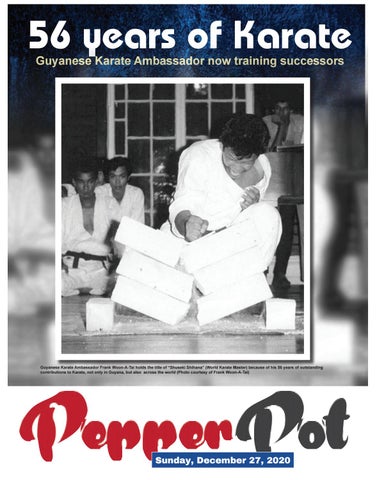
56 years of Karate Guyanese Karate Ambassador now training successors
Guyanese Karate Ambassador Frank Woon-A-Tai holds the title of “Shuseki Shihana� (World Karate Master) because of his 56 years of outstanding contributions to Karate, not only in Guyana, but also across the world (Photo courtesy of Frank Woon-A-Tai)
Sunday, December 27, 2020
II
By Francis Quamina Farrier Here we are at the end of one of the most challenging years of our lives. Some months ago I wrote an article which had the headline “Mohamed Rafiq sang that ‘The World is One’” Well, the on-going COVID-19 pandemic has certainly magnified the
CHRONICLE PEPPERPOT ― Sunday, December 27, 2020
sentiment which that great Indian singer so beautifully performed in the only song he ever recorded in English. So here we are together in a world being one coronavirus patient. Some countries such as Australia and New Zealand have done extremely well in protecting their citizens. Tanzania in East Africa is also a good exam-
ple. With a population of 58 million, the coronavirus has had only 21 deaths. Meanwhile, Brazil and the United States have some of the highest figures of coronavirus fatalities. At this time the United Kingdom is also in coronavirus turmoil. With a population of 68.5 million the death figure in the UK is now 67,500 and counting.
No doubt you have been assessing all the things which you were unable to do in 2020 because of the COVID-19 pandemic which arrived early March, turning lives up-side-down. While some of us felt overwhelmed, many of us rose to the harsh challenges which the COVID-19 pandemic placed before us. Being a resilient people, most Guyanese rose to the unexpected change in their daily living which was reduced to the curtailment of regular activities such as going to work, school and even to worship at our churches, mandirs and masjids. While the situation was under control in the early period, many Guyanese became complacent and began doing reckless things causing the death figure to spike to from 9 in April 159 and counting One can well imagine men who gather every evening at their favourite watering hole elbow-bending with their favourite brew, being robbed of that joy. What the suspended freedom of the athletes who are denied their regular afternoon jogging. And what about the night owls who are robbed from their nighttime adventures. When I think of it, I pity young lovers who are now robbed of
romantic meetings. Then there are the many good fathers who are unable to spend quality time outdoors with their children, are now doing so indoors. That evil COVID-19 which has taken the lives of so many Guyanese - both here in Guyana as well as abroad, has brought much sadness to our lives! Let us now take another look at some other countries and how they have coped with the coronavirus. Botswana in southern Africa has a population of 2.3 million and only 171 coronavirus deaths. Quite a number of Guyanese,
Francis Quamina Farrier obeying the COVID-19 protocols (December 2020)
mainly educators, migrated to Botswana in the 1980s after a visit to Guyana by the Botswana Head of State, President Sir Seretse Khama in the 1970s and a request for Professionals such as educators. From the island nation of Sri Lanka was a 1970s visit by that country’s Prime Minister Sirimavo Bandaranaike who established a warm relationship with Guyana. During the period of Sri Lanka’s social unrest See Page XX
III
CHRONICLE PEPPERPOT ― Sunday, December 27, 2020
56 years of Karate
F
Guyanese Karate Ambassador now training successors
R A N K Wo o n - A Ta i i s a p o p u l a r name in the Chinese culture; the man known for his power, technique, and knowledge of karate. Starting to train at just age 14, he has given some 56 years of his life to the world of karate not only here in Guyana, but across the world. Born in Georgetown in 1950, Woon-A-Tai began training as a boy in his friend’s garage on Fifth Street, Alberttown, and when he was 20 years old, he trained in London with Japanese master Keinosuke Enoeda. The following year, he travelled to Tokyo, Japan and trained at the Mecca of karate, the Japan Karate Association and at the end of his stay in 1971 he became the first Guyanese to earn an International first-degree black belt. Woon-A-Tai and his wife, Maureen (first Guyanese female black belt) took up a five-year appoint-
ment in 1976 to teach karate in Jamaica, and in 1980, they moved to Toronto, Canada. Shortly after, he became Chairman and Technical Director of the International Shotokan Karate Federation of Canada (ISKF Canada) and the Japan Karate Association WF of Canada, which he held for 26 years. “My most outstanding achievement was to unite all JKA groups in Canada in which there were five,” Woon-A-Tai told the Pepperpot Magazine in an interview. In 2011, he formed the International Karate Daigaku (IKD), and in nine years, it has grown to 76 regions in 56 countries. His karate title is ‘Shuseki Shihan’ (World Karate Master), he holds 9th dan, and is a Guyanese Karate Ambassador of the traditional karate world. Wo o n - A - Ta i i s t h e Founder and Chairman of the Guyana Karate College
The cover of Woon-A-Tai’s book published last September
Woon-A-Tail was awarded the Medal of Service, which was presented to him by then-President, Dr. Bharrat Jagdeo
(GKC), a non-profit organization, and he is building a state-ofart dojo at Liliendaal for Guyana’s children. The one-acre plot was awarded to him by then President Bharrat Jagdeo. It is now 50 percent completed, but due to the COVID-19 pandemic, work stopped for lack of funds. “The GKC, through membership fees and fund-raising, raised $30.1M to get us to the point thus far. In addition, the GKC funded teams abroad that brought honours to Guyana in International tournaments. I am lobbying for a grant from the government to complete the project,” he said.
Successors Woon-A-Tai, who became a Member of the Order of Service of Guyana and was awarded the Medal of Service by then President Jagdeo, has started a line-of-succession for others to take over when he and his present masters move on. They are all over 60 years old, he noted. The second tier consists of young instructors most of whom are in university and the third tier consists of junior instructors that are now being trained. Woon-A-Tai also published his book last September titled, “Shu-HaRi: My Life in Japanese Karate.” It documents his life from an impoverished childhood to a world karate leader, sheds light on the origin of his unique name, “Woon-A-Tai,” and traces
his maternal ancestors to slaves in Guyana. His DNA shows he is 86 percent Chinese from Canton, China and 14 percent black from Guyana. “I wrote the book because none of my students knew how karate began in Guyana, and it is to inspire young karate students that they can lead successful and productive lives no matter what. Furthermore, I aim to promote and guide youth in the right direction in life, to keep them off drugs and the street, and to break the cycle of crime and violence through the discipline of karate,” he said. Woon-A-Tai has observed that Guyana stands above other countries when it comes to government support of karate. “They are aware that our children are future leaders of the country. Karate
is not only physical, but mental as well. It is 50% physical and 50% mental. “My students are taught that they must come to class with an empty mind. By analogy, the essential aspect of a cup is not the handle, bottom or size, but the emptiness of the cup. In this regard, students can absorb knowledge. They are taught to stabilise their emotions.” W o o n - A - Ta i h a s brought several Japanese Karate Legends to Guyana including Masatoshi Nakayama, 10th dan, Teruyuki Okazaki, 10th dan, Takayuki Mikami, 9th dan, Yutaka Yaguchi, 9th dan, Shojiro Koyama, 9th dan, Shigeru Takashina, 8th dan and Yukichi Tabata, 7th dan. His karate lineage is direct to the founder of karate Gichin Funakoshi.
IV
Wearing two hats
CHRONICLE PEPPERPOT ― Sunday, December 27, 2020
GDF pilot Joel Browne still finds time to be a music producer
Joel flies all day sometimes to transport food and other supplies to soldiers in remote places
GDF Pilot Joel Browne
F
OR the people who believe that doing one thing in life, professionally speaking, makes the greater sense and achieves the greater good, Guyana Defense Force (GDF) Pilot Joel Browne has something different to say. A lieutenant in the GDF and commercial pilot, the 34-year-old who attended the prestigious Queen’s College, wanted to become a doctor and even pursued a career in the field to some extent, but he also found that he loved music since he was a child. “My sister and I sang gospel music; we did a song called ‘Guyana’s Children’ that played on Channel 11 for years. I grew up in church so I always loved singing,” Joel told the Pepperpot Magazine. So from about the age
of 14, Joel was already familiar with playing musical instruments and being into production. So as soon as he had the opportunity, he went to the United States of America (USA) to pursue a Degree in Media Arts which involved audio recording. It was during this time that he found his love for producing music. Joel has since been able to work with some of the best artistes available locally, and to produce songs for some of the biggest names in the Caribbean. Apart from collaborating with Kwasi ‘Ace’ Edmondson, Adrian Dutchin, Jumo Primo, Dexter Dax, Binnie Man and Taurus Riley. After returning to Guyana from the USA, Joel was going to Mabaruma to visit someone when he flew in a
With his wife Judy and their children
small aircraft and found that he enjoyed it. The experience got his attention to the point of making him want to learn how to fly himself. So he started training at
Air Services Limited Flight School, after which he went back to the USA to do further training. “I initially didn’t plan to be a pilot,” he recalls, and with his wife, Judy Browne, being a doctor here
in Guyana, he decided to stay here and look for a job in either the field of music or flying; he was qualified in both. Following his application, the GDF told Joel that they were looking for pilots who went through the Cadet Course and not random ones. So he did the Cadet training for two years, was promoted and began flying the sky van. The father of two, who is also very devoted to his family, says he couldn’t be doing so much professionally hadn’t it been for the support from his wife, parents and sisters. Through it all, they never complain, he said. But he noted that balancing everything can sometimes get challenging. “Having to do flights… due to military, we have a lot of responsibilities in terms of
going into the interior and providing medivac, taking in food and supplies for soldiers. Balancing the long hours of flying all day and then at night producing music can be challenging, but it’s very rewarding,” he said. Joel is hoping to have his own modern state-of-the-art studio that can run live recordings and do live broadcasts on social platforms to allow other youngsters who love arts to have a platform to broadcast and record their music. “Big dreams are attainable,” he says, adding, “People might think you can only do one thing in this life, choose one and stick with that. No, you can do as much as you like. You just have to stay focused and you’d be able to do it. Don’t let it be about what people tell you.”
Flying in a small aircraft to Mabaruma made Joel interested in learning to fly one himself
Even with a busy schedule, Joel finds the time to work on his music
V
CHRONICLE PEPPERPOT ― Sunday, December 27, 2020
Small Business Bureau moving forward in 2021 Aims to provide greater support to MSEs
By Dillon Goring Guyana ‘s Small Business Bureau is moving diligently forward in 2021 to ensure that small businesses in the country are technologically ready to transact business amidst the COVID19 pandemic. This assurance was given by Chief Executive Officer of the Small Business Bureau, Dr Lowell Porter during an interview with Pepperpot Magazine. Dr. Porter, in outlining the plans for the new year, noted that at the Small Business Bureau, the focus is only on Micro and Small Enterprises (MSEs) and not Small and Medium Enterprises (SMEs). “So what we have planned at the moment, is to ensure that businesses understand the environment in which they are functioning at the moment,
so we have a lot of precautionary measures that were implemented, and it is important that as small businesses, you start to look at how can [you] adapt to that new environment,” Dr .Porter told Pepperpot Magazine. He also assured that since a lot of businesses have diversified in the way they deliver services and products to their customers, he hopes that this effort of providing efficiency of services will continue in 2021. “Those are the things that we want to instill in small businesses, that they look for the opportunities in the pandemic,” Dr Porter reiterated. In the light of the pandemic, a number of small businesses in Guyana utilised the opportunity to migrate the use of social media platforms Dr Porter opined, while noting the importance
Chief Executive Officer of the Small Business Bureau, Dr Lowell Porter (Photo from sbb.gov.gy)
of the readiness of these businesses to adapt to the changes in their method of delivery of products and services to various customers and clients. “The Small Business Bureau has seen an increase in that regard, and thus that was the benefit of COVID for small businesses to think outside of the box, but the infrastructure in terms of providing services for clients residing outside of Georgetown needed strengthening,” Dr Porter said. He made it clear that the SBB will, in 2021, continue their awareness campaign, to create discussion between the Bureau and clients coming up with solutions to cushion the efforts of the pandemic, should it persist in the new year. Dr. Porter announced that manufacturing businesses and production businesses will continue to receive
grants and loans from the Bureau, to maintain and sustain their businesses during the COVID season and beyond. “We believe that is the main issue for small businesses here in this country, that need that access to finance, but not because they want money, we are going to give money. We want them to understand the value of that money,” Porter told Pepperpot Magazine. Small Businesses and the Tourism Sector will in 2021, benefit from more training programmes done by the Bureau, so that small businesses in the country can become viable to the general public. Dr. Porter recalled that during a visit to several small businesses around the country, the potential was realised for these businesses to become more viable during the COVID season and even afterwards.
Beauticians surviving the Pandemic
By Dillon Goring
The year 2020 has been a difficult year for many persons and businesses worldwide. This is according to J.P Morgan Chase and Company, which conducted a study during the initial stages of the pandemic back in March of this year. These difficulties spanned all industries worldwide and including the beauty industry. According to a survey carried out by the Economic Times in New Delhi India in May of 2020, beauty parlours underwent a seismic shift in the new normal. Like all other businesses, these entities had to adopt new ways of practising their craft, particularly given the personal nature of their operations. On the local scene, small beauty parlours that rented modest spaces in larger malls have been compelled to cease operations in response to national health directives with regard to the closure of businesses. While some of these have since resumed their operations in the wake of relaxed restrictions, many have been sufficiently affected by the loss of income
to find it difficult to get back on the feet. This is according to a Stabroek News Article dated July 31, 2020. However, the story of Kevin’s Reflection’s survival has been an amazing one. Since the pandemic began, Kevin’s Reflection has had to adjust and invest to meet the demands of its client and customers. During an interview with Pepperpot Magazine, co-owner Yolande John explained that the company has undergone major investments since the pandemic began. “When this all started, we were like everybody else
thinking how we would get through this? How do we continue and make our business viable? It called for a lot of brain storming and coming up with ways to make it safe for our customers,” she explained. Yolande outlined the various changes that the company would have gone through to make it safe for customers and business clients. She also made the point that what was previously taken for granted, became a focal point of consideration for not only the viability of the business but the safety of customers as well. It was noted that the im-
plementations that the company had to make incurred a huge cost, but the cost for the services weren’t in any way increased. “Yet now, we are sanitising after every client which is a cost, disposable capes are now being you to ensure the safety of customers. Our massage services are now using disposable sheets, to not only ensure safety but also to be hygienic,” she said. Yolande noted that at the end of the day, the company is looking for the light at the end of the tunnel and a hurdle to have to be crossed, but they are hopeful that it is going to get better. Kevin’s Reflection has been around for several years serving its customers’ hair and beauty needs. Yolande also noted that while sanitisation would have been taken for granted in years gone by, greater emphasis is now being placed on a hygienic environment and safety for customers. “Not to say that sanitisation has never been our top priority, but this time around, it is more imperative that sanitisation measures are practised after every client,” Yolande told Pepperpot
Magazine. During an interview with one of the other employees, it was revealed that the revenue that is normally garnered from persons has been significantly reduced. “We aren’t getting as
persons, rather than the ability for them to attend the salon to have their hair done. “Persons who now go to salons are now fully prepared with their masks, and other protective equipment and the salons now are fully san-
much as we used to, some days are bright, while some aren’t, some persons maintain their same hairstyle, and while some are going natural,” the employee told Pepperpot Magazine. Meanwhile, another hair salon owner Margaret Hermonstine told the Pepperpot Magazine that the issue is now about the impact the novel coronavirus has on
itised,” Hermonstine told the Pepperpot Magazine. With respect to financial acquirement, Hermonstine posited that it is now more difficult to garner revenue than pre-COVID. She also opined that there need to be other supplements to cushion the effects of financial incomes to offset normal expenses.
VI
CHRONICLE PEPPERPOT ― Sunday, December 27, 2020
#64 Babylon Village
A place of hard workers and hospitable people By Michel Outridge This week the Pepperpot Magazine visited the countryside village of #64 Babylon, Corentyne, Berbice, Region Six (East Corentyne-Berbice). This village is located between #65 New Market and #63 Benab and it is home to about 600 residents mostly of Indo-Guyanese descent and a handful of
ogist Dr. Vivekanand Brijmohan, Accountant Consultant Neville Budhan, retired enforcement officer of the Guyana Revenue Authority (GRA) Hanoman Nanram better known as ‘Uncle Joe’, a former school teacher turned canteen operator/caterer, Loosia Valentina Moti called ‘Aunty Val’ and a few others, who are of great asset to the community. It is home to a castle
Padmini and her mother, Sumintra Ramjit
Afro-Guyanese, some of whom are locals while, others moved to the village, many years ago. The village is somewhat self-sufficient and it is an agricultural-based community of cash crop farmers, rice farmers, livestock farmers, qualified professionals, some self-employed persons and some small business owners. The village is full of plants, trees, and plenty of fruits and vegetables and it is a breezy place where the people are very hospitable. Babylon #64 Village is home to government pathol-
which belongs to the Budhram family, home-grown rice millers. The village has a nursery, a primary school and the Tagore Memorial Secondary School is a short distance away. They have a health centre, a playfield, a post office located in nearby Benab #63 Village, a church, a lovely park with slides, benches, swings, tables for playing dominies and a well-stocked library. The village is divided into three sections and it is relatively large and has a
canal that runs through the community which has seven streets. The next village is #63 Benab where the #63 Beach is and it is home to watermelon farms and is a place that is frequented by both locals and visitors. The community has a few shops and at almost every shop they have fruits and vegetables freshly harvested from the kitchen garden for sale. There is an abundance of locally grown, organic vegetables and fruits grown in this village and it is a place where everything comes to your door including freshly caught fish. The village has good roads, electricity, potable water supply, landline and cell phone services and it is a place where people still listen to the radio. The people of this closeknit community are hardworking everyday folk, who toil daily to put food on their table. It is a beautiful community where some villagers have their houses well-painted and surrounded by a lot of plants and trees to beautify the environment. The community is like an oasis, a place where you can stop for some relaxation and much-needed peace and quiet and you can hear the birds chirp and see a few butterflies around. According to residents, the village got its name because back in the days the locals used to have a lot of buffaloes in the village and
Mukesh Ramdour in his garden (Carl Croker photos)
another recalled the place was named Babylon due to the number of babies born there in the early years. The prettiest place The team met a resident, Mukesh Ramdour, who made #64 Babylon his home
when his father-in-law collapsed and died as a cane cutter in the Backdam in 2011 he had to step up and oversee things at home to assist his mother-in-law, who made-do with the survivor’s benefit monthly allowance. “Life is by far better here
bees in 2013. It was after 16 years he had to quit the sugar industry as a cane cutter and started to cultivate his yard into a garden from which he sells his greens and vegetables to supplement the home. Ramdour explained that
than in Skeldon because there you have to buy everything and here in #64 you can plant and eat from that plus sell and do other things around the yard to earn,” he said.
Padmini Ramjit’s daughter with her homemade decorations
22 years ago when he got married and relocated. He resides with his mother-in-law, his wife and three children and they have a small shop. The 56-year-old told the Pepperpot Magazine that he is originally from Line Path,
The home of Mukesh Ramdour
Skeldon and after marriage, he went to live with his wife’s parents. He used to work at Skeldon Sugar Estate but had to quit when he was attacked by Africanised bees and later developed some ailments due to being stung by the
See Page XXIII
VII
CHRONICLE PEPPERPOT ― Sunday, December 27, 2020
The benevolent ‘Uncle Joe’ A respected village elder
By Michel Outridge From looking at this gentleman you could not know who he is because he is often dressed as a farmer and is always up at the crack of dawn gardening or doing chores. He is Hanoman Nanram called ‘Uncle Joe’ a retired enforcement officer of the Guyana Revenue Authority (GRA) who was responsible for hauling in more than 40 smuggled boats with contraband from Manchester village to Moleson Creek. Back in those days, he was regarded as passionate when it came to his work. Nanram was a high achiever as an officer at GRA and he was awarded for his work and retired after spending 21 years and was indeed a star employee. Farming He was a watermelon
Uncle Joe’s park
The library
Uncle Joe’s garden
farmer, who had a 10-acre plot at #63 Beach area, back in the days and from that he managed to build his house. Today, Nanram is 70 years old and is very active in his garden where he cultivates pak choy, calaloo, boulanger, married man pork, celery, peppers, shallot, fine leaf thyme among others vegetables. Nanram uses the old discarded fridges found around
the village to make nurseries for his garden and would also walk about and collect cow manure for his plant beds. He is a local of the community and a respected elder, who came from the grassroots and worked his way up. Nanram benefitted from a government scholarship in 1974 and went to study political science in Russia, then after nine months he returned and got married. He, however, started working at the Skeldon Estate in 1976 to 1988 and in 1985 he bought the land he currently resides and erected a house after he garnered some money from planting and selling watermelons. Joe’s park While Nanram was employed at GRA he established a park in front his
house where he outfitted with solar lights, swings, see-saw, slides, basketball hoops, a Benab for picnics, tables and chairs for villagers to have a place to relax. Nanram also installed a library with hundreds of books which were donated by his friends who reside overseas. The place is utilised by locals and visitors for picnics and it has a place where people can play dominoes and even cook with an outdoor fireside
Hanuman Nanram called Uncle Joe (Carl Croker photos)
and pots. The park even has a parking lot for those with vehicles and it is quite cosy and a good place to be and ev-
erything is free of cost here. The library is for everyone and you can borrow a book to read but must return See Page XV
VIII
CHRONICLE PEPPERPOT ― Sunday, December 27, 2020
The post office and the castle Useful facilities in Babylon and Benab Villages
By Michel Outridge
T
he Benab Post Office located at #63 Village Benab, next door to #64 Village Babylon, Corentyne, Berbice has an extended service offered to the general public which includes the payment of bills, payment of pensions, sell stamps and of course the postal services. This post office serves several communities along that corridor and it is managed by Post Master Elizabeth Moore and three staff. Although she is fairly new to the community she has been in the postal business for many years. She is from Skeldon and has been at the location since May this year and describes her experience as good since the people are cooperative and very understanding. Moore told the Pepperpot
people maintain their distance from each other and sanitise and wait their turn in a civilised manner. She stated that all COVID-19 protocols are observed and they are still offering services to the pub-
Benab Post Office
Post-Master Elizabeth Moore
lic five days per week. Outside there is a newly constructed shed with seating accommodation for
Haresh Budhram (Carl Croker photos)
Magazine that things are orderly around there and
Moore reported that since the pandemic things have become a bit worrisome for a lot of people but they have a crowd only when it is pension payment day. She disclosed that no one is allowed entry to the
those waiting their turn and it seems comfortable.
building without a face mask and they have to sanitise their hands, as well. On pension payment days, two policemen are there to ensure things are in order and the people are protected. Moore, who was at the counter dealing with customers said it was a slow day but a few persons were trickling in to do business and they do not waste time and ensure people get the service they came for in good time. “I commute daily from Skeldon to here but it is no bother and it is a nice community to work because the folk are good people,” she said.
The rice mill
Next door to the Post Office is the nursery school, down the road are other government buildings and nearby is the roundabout. The castle in Babylon Meanwhile, the Pepperpot Magazine met Haresh Budhram, a local miller who is from #64 Village Babylon, Corentyne, Berbice. Opposite the large mill, there is a castle his father built-in memory of his deceased mother, it is an interesting edifice unlike any other in its unique design but it is unoccupied. Budhram said his mother passed away 15 years ago and his broken-hearted his father wanted to do something to leave a lasting memory and he designed and built the castle brick by brick. Budhram added that his father is ailing and he had to take control of the family rice mill which was also designed and built by his father, Totaram Budhram. He disclosed that the castle represents the three religions in its design and it is a fantastic structure which goes way up and has become a sanctuary for birds and the children in the community would go and play. Budhram explained that the place where the castle is was once a pond and it was filled with sand
reefs because construction of the building started. He related that the rice mill was also a swamp area with a canal and it was developed by his father, 86, who designed and engineered everything from scratch. “This business has been in operation for the past 23 years and it is my father’s pride and joy and I am keeping it operational but with a reduced staff but villagers bring their paddy here and I mill it,” he said. Budhram revealed that
all his four siblings reside overseas and he returned to Guyana to work and live here after spending years abroad. The father of five stated that the castle was his father’s dream and vision he made a reality but is it unfortunate he didn’t get to complete it but maybe the building will be one day restored to its former glory. Budhram is also a resident of #64 Village Babylon and is working side by side with his wife to keep the doors of the rice mill open.
The castle in Babylon
CHRONICLE PEPPERPOT ― Sunday, December 27, 2020
IX
X
CHRONICLE PEPPERPOT ― Sunday, December 27, 2020
Aunty Val, the most hospitable resident of #64 Babylon Village By Michel Outridge For Loosia Valantina Moti called ‘Aunty Val’ being hospitable and downto-earth is part of who she is and being nice to people, even strangers, is not out of character for her. She is by far, one of the nicest person you will encounter and after that meeting, she will leave a lasting impression. She is a resident of #64 Village Babylon, Corentyne, Berbice and a mother of two, who was a former teacher at
Moti is also known as the “Mommy of Tagore” the school children are very fond of her and would ask her to make their favourite dishes. With school closed, Moti was at the canteen for two months for the fourth and fifth formers so she was quite occupied making pastries, foods and other snacks for the students. She is also a caterer and would make finger foods and other dishes for parties, social events and other functions. She enjoys cooking and
time of the year is very emotional for her family especially her mother, who was a parliamentarian and is a councillor. Her dad died in her mother’s arms, he was beaten some years ago at the Roundabout at #63 and he had developed brain injuries which they never knew about until it was too late, he had developed dementia and suffered memory loss and died of cardiac arrest. Moti’s dad was a farmer, who had acres of watermelons at #63 Beach, a place
Babylon is a very quiet and good place where it is very safe to live and nobody takes anything. She disclosed that they have everything little thing in the village and the people are doing something to earn and they have a lot of skilled folk, who doesn’t waste time to complain but work. A n n u a l l y, M o t i a n d some friends would get together to pool their resources at Christmas to host a party for children at Uncle Joe’s park, which is next door to her house but this year they
Loosia Valantina Moti called ‘Aunty Val’ (Carl Croker photos)
The many foods and dishes prepared by Loosia Valantina Moti
Tagore Memorial Secondary School, who turned the caterer of the school’s canteen. She had been a teacher at Tagore Memorial Secondary School for seven years and quit after she was overcome with the love of cooking and became the school’s canteen operator for the past 13 years. “Teaching was so routine but I liked it but after time it became evident I wanted to do something else and jumped at the opportunity to become the caterer since I enjoyed cooking and it was dream come true for me, to cook delicious and wholesome foods for the school children,” she said. When she was a teacher, they had a supermarket at their home and her husband wanted her to stop teaching and assist him in managing the supermarket.
does all the catering alone but at times her sons would assist in the kitchen. Moti is always trying new dishes and will never stop upgrading her culinary skills. Considering she spent more than half of her life at the school she is wellknown for her no-nonsense approach to life and is a disciplinarian. The late Mr Moti, her father was a director on the board for Tagore Memorial Secondary School, a councillor/Chairman for the NDC and she became involved in community work for the school at a young age. She was instrumental in the landscape of the school compound among other developmental works for the school. Sadly, her father passed away last Christmas so this
where Moti and her family spend a lot of time with their neighbour, Uncle Joe. She recalled back then the two families were close and they would harvest watermelons and save the biggest one for them to eat with their bare hands. “We were very poor but we didn’t stay poor, we upgraded after we empowered ourselves and we used our talent to earn and make a living. I remember my dad had one shirt and he used to wash it and wear it all the time but when he died we had so much shirts to give away so you cannot stay one way in life, hard work pays,” she said. The village Moti told the Pepperpot Magazine that #64 Village
will home deliver goodies and toys to the homes of 300 children because they cannot have any gatherings or barbeque. Moti has an adventurous side to her and would enjoy the outdoor very much especially fishing, hunting and nature tours with friends whenever the need arises to unwind and relax. “I am happy and I am living my life to the fullest so I am not missing out on anything and I have two boys, one of whom works at the bank and the other is school-aged so I have a lot going for me,” she said.
CHRONICLE PEPPERPOT ― Sunday, December 27, 2020
XI
‘There is no place like home’
XII
CHRONICLE PEPPERPOT ― Sunday, December 27, 2020
- says retired headteacher
By Michel Outridge
Having spent more than 33 years in the teaching profession, retired headteacher of Tagore Memorial Secondary School, Amelia Stephen-Newland is contented passing time doing community and church work. She is better known as ‘Aunty Millie’ in #64 Village Babylon, Corentyne, Berbice, a place that is her home. Even though she is originally from Leguan Island, Essequibo River, she left her hometown and relocated in #64 Village Babylon in 1986, she was visiting a brother and became a teacher. Stephens-Newland was attached to the Corriverton Primary School and was later transferred to Tagore Memorial Secondary School and worked her way up to headteacher and retired in 2005. She has been at home for the past 15 years but is well-respected in the community and the villagers still speak highly of her. These days, Stephens-Newland does some baking, sewing, cooking and would attend regular services at the New Testament Church at #63 Village Benab.
Tagore Memorial Secondary School (Carl Croker photos)
The village church
“I still find the time to do chores and keep a house and I am very comfortable here in this village, it is a nice place to live because the people are good and everybody knows each other and it is a very safe place to raise a family,” she said. Unlike other years gone by, the villager elder would not be hosting a Christmas party for children due to the pandemic but has bought some clothes to gift some children along the Corentyne. Stephens-Newland re-
ported that whatever she can afford she would give to the needy and the goodies will come later this year and she will collaborate with some friends to deliver home-cooked meals to the homes of the children, this year. She, along with some church members would have hampers for the people of the community and it has been happening for years, it is a tradition and she will have the same this year too. “From then to now the
village has changed a bit in terms of bigger buildings going up and the place has developed nicely but the people are the same as before, very nice and neighbourly,” she said. She, however, admitted that a lot of residents migrated from the village and are overseas but the people that
remain are noted for being hard workers and not lazy, idle folk. “The people are good, down-to-earth and you would get up early and see them doing things such as farming till night and that’s how they are, always working and we here look out for each other,” she said. Stephens-Newland told the Pepperpot Magazine that from to time she would return to her home village, Leguan since she has a sibling there with nieces and other relatives. She stated that one does not forget where they came
from but #64 Village Babylon is her home and it is the only place she wants to be to bask in her golden years. The retired headteacher added that the community has a lot of good people and they believe in hard work and that is commendable about them. Having been in the village for so long, she too is treated like a local and she doesn’t have to leave her house to get fruits and vegetables. She gets regular supplies of fresh, farm picked greens from neighbours and that is how the people live around there.
XIII XXV
CHRONICLE PEPPERPOT ― Sunday, October27, 4, 2020 CHRONICLE PEPPERPOT ― Sunday, December 2020
I
New year, New us!
NEXT week, a new day will equal a new year. Despite all its surprises and shortcomings, I hope 2020 allowed for Hello Everyone, ple can get physical if they good mental and physical health. To those who have had an extraordinarily find out theyunfortunate have been year, I hope you are positive that better will come in the new this week has other betrayed year. While hope COVID-19 and many things will not simply disappear, I treated hope weyou can well. learn healthier waysofofadealing withre- End marriage/ their consequences. I recently re- lationship In 2021, our/others mortality, fears, some opportunities and unfortunate events will still be but our ceived a request uncontrollable, - Broken relationships attitudes and behaviour towards ourselves and others, as discuss adulterycan and withhopefully children and well as our to own perceptions, willother be. Itfamis obvious why we celebrate the new year. Much like birthdays, and its effects on ily members we rejoice because we made it to another year in these hard times -- time to our raise our glasses and toast ourstress survival! mental well-being. - Financial My favourite thing about new years has always been A woman written - Medical resolutions and thehad hope and determination that consequences accompany them. I’m aware (based on my own actions as well aassexually those about her husband’s infideli- such as acquiring around me) that most resolutions only last until the end of ty andWe the tend anguish it brought transmitted disease (STD)-January. to give up on these for various reasons they may have been unrealistic, unimportant or pressured. To her. I think it is an important - Pregnancy (themselves solve this- the answer seems obvious. Choose resolutions that to discuss, it istosodo and youtopic can do, that youaswant importantly, or themost outside person) that improve your overall quality of life. For a tip, I researched prominent our on individuals who made some scientificthroughout studies conducted resolutions. planned in detail weredoes 22 persociety. IThose myselfwho know very theirs Now, what cent more likely to succeed. For example, aiming to lose 10 few inrelationships doresolution to the pounds two months that ratherare than justcheating having the
monogamous- which means to be married to or to be in a sexual relationship with just one partner. We’re going to talk about OVER the years it has been custominofgeneral this beingtheunfaithful column to wish consumers as all onlyreaders married“Apeople can and Happy and Prosperous Newbut Year” commit adultery, you and this was done in the do not have Lang to be Syne”. married spirit of “Auld This year, despite a worldby in order to be devastated radically changed by the that betrayal.the COVID19 onslaught of Pandemic, we persevere to For the religious, adulmaintain the traditions of New we have always teryYear is a sin; the word from known but at the same its being Latin cognizant heritage ‘adultertime of the different world created by are’ means to corrupt. It is the pandemic. one major causes At of thethe parties when danc-of ersbreakups/divorce dance the Old Yearworldinto the New and when the noisewide. and However, makers squibsitsgoeffects off at midnight to drive away onand both are evil the individuals evil spirits from thewidespread. New Year and when the strains of “Auld Lang Syne” Unfaithfulness/cheatand the clinking of wine glasses to toastmany the New Year ing causes problems reverberate in the night air, withmanifestations both the cheater and these of the New Year which involved the victim, ranging from the close gatherings of peoplepsychological, were precluded by theto physical
to ‘lose weight.’ The most common one I hear is “My resolution this there year is are to save money.” That’s perfectly fine and or not; people a good goal, but unless you make specific plans, it is almost impossible. it would be best to determine how who cheatFor andexample, people who you are going to save this money and how much per week doare not.planning It’s simply a peryou to save. What specifically are you going to cut back choice. on? Are you adding sonal There willon another form of income? Is it $5000 per week you’ll be able to save? More? Less? These alwaysarebevital other details forproblems success astothey make the goals seem more realistic those who told their ‘blame’and the achievable. cheating on,Additionally, but friends and families about these resolutions were 10 percenr despite we asthose who did not. more likelytemptation, to succeed than
- Be aware of my strengths and weaknesses - Celebrate my victories - Practise forgiveness I suggest that everyone keep a journal with their resolutions. Write one thing (every day) that you have done to fulfil each resolution. This will encourage you to keep going, as well as create self-confidence by being able to clearly see your progress. I urge you all to write in to my email below and tell me what your resolutions are. I can discuss them in the upcoming weeks. I hope this will benefit you as well as encourage others to choose and maintain their own resolutions. Take some time and reflect on what this year has brought forth -- the struggle and the gratitude. Upon reflection, keep your spirit and determination unshaken, maintain faith and courage and look forward to the brightness and new opportunities that 2021 will have to offer 2021 should be the year of active resilience, recovery and maintenance. Thank you for reading. Please keep sending any topics you’d like to talk about to caitlinvieira@gmail.com, If you’d like to book personal counselling sessions, please call or message +592 623 0433 Suicide Prevention Helpline numbers: 223-0001, 2230009, 623-4444, 600-7896
humans have the capability I have countless resolutions this year –- all of which I believe are possible to choose whetherwith we hard hurt work. They all focus on self-development and are critical in someoneand deeply or not. good mental and physical health. obtaining maintaining Like The mostmain others, this always year did not allow for me to be my reason best self. cited to melikeis toa lack at-new resolutions with the hope I would shareofmy that some of you may adopt tention. The partner has feltthe same ones. In 2021 I hope to: ignored by their significant - Get better sleep - Eat and exercise well other which lowered - Adopt only has healthy coping skills/strategies - Practise gratitude their self-esteem and self- Boost my self-confidence and self-esteem Say Yes to Life and No to Drugs! Always worth. Therefore, seek - Practise positivethey thinking victim? attention elsewhere. It causes extreme hurt, There are many ways low self-esteem and self- to give attention to your doubt. It ruins the trust for spouse. Some examples CHRONICLE PEPPERPOT ― Sunday, October 4, 2020 not only the current, but also are constant communicaCOVID19 regulations. Yet es and dinners did occur strengthened and extended to welcome were being and TV the point where international for futureefforts relationships. This and tiontheofprint the media problem—not made to keep the spirit of the carried advertisements with meetings are now being held is called New projecting, when the talking, ignoringNew and Year hold- by zoom and where commutraditional Year festivitraditional ties by videos and other such assolves the hands of nication between groups and thealive victims are more often motifs ing a grudge nothing. electronic devices. the Grandfather Clock mov- individuals between themthan afraid, insecure Other being selves is being done through Thenot public fireworks dis- ing fromexamples midnight are or Father plays which attracted thouTime with his scythe clearand untrusting in their new physically and mentally social media. This growing sands of spectators did not ing the remnants of the Old IT use has begun to affect relationships. ThisGDF can still lead Year present and affectionate, occur, though the making way for the life in multifarious ways: sent off their high and co- baby New Year. Online shopping has to high anxiety, depression compassionate, patient, emlourful fireworks into the People have successfully grown exponentially and for tea or a drink are becom- of New Year may take, they would always genless fashionable. the sexually spirit of the skies where they could be maintained and even suicide. pathetic and ac- housewives who once used ing Despite the apparent less- erate hope, joyousness, seen and enjoyed by peo- traditional New Year in 2020 to regard shopping in downwill alsoMany affect though tive. Human beings long for town stores a joy of life are ening of direct human con- fraternity, concern for our ple inCheating their homes. the pandemic regulachurches heldif virtual ser-is tions forbidden so many now turning to Amazon and tact which the pandemic has fellow man, and the cathe children the family thesehad types of connections. vices and churchgoers now of the physical activities as- other online suppliers. Med- brought to social life, people thartic feeling of entering split apart. Typically, trust sociated Basically, cheating is anand ex- ical treatment is beginning to have begun to show more the freshness of a new life, realized that they could worwith the festival ship in their homes. The trasome are still optimistic that use IT and education has concern for the health and since New Year is almost issues are also passed on to ternal reaction to an internal months ago,a this carried Ritecolumn of Passage, andanas their neighbours ditional New Year concerts coming New Years would be become very dependent on it welfare of OME mintitaswill a a article Rite oftreated Passage, food on aremint. given The them,byaffecting bothand theirPo-fu- celebrated problem. Participating the and less use is now made of and gifts ofarticle given the Militia traditionally in once always joyousness and peofolk medicine, but did makeretain someits reference to lice bands in the Botanic gar- the pandemic had subsided. the classroom; this is espe- to the less fortunate tureand friendships and intimate above have examples are internal and optimism. The metagenerally peppermint oil. dens at the seawalls were Others realistically un- cially true in tertiary educa- ple have become morphosis be noticed more helpful to each other, In this offering, we will bewill dealing with not physically attended but derstood that the pandemic tion. Books are increasingly relationships. solutions. in 2021 and will beoil further the less able. 20 uses were broadcast on radio and had changed the world for- being presented electron- especially to approximately of peppermint and knowofmany peopleshopwho ever and that New Year as we ically and bookstores are although unfolding the passing In thethepost-pandemic TV. IMuch holiday uses identified are different, thewith treatment tends the customs and of the years, but always reping it would after not be cutting back on their stocks world, to be similar. We would however not try to consolidate, but haveoccurred never beenonline cheatedandon now know What happens of New Year taining its present qualities New Year visits by friends celebrated in pre-Pandemic of hard copies. IT has been celebrations would deal with every use be and itsand treatment individually. may even be enriching know them will (tofamily their knowledge), butdidare style youin have out? infiltrating and changing as we and to each other future. found Peppermint is derived from a species of herb, mint, which those qualities in ways now transformed. Into whatnot occur since the Pandemic For one, the usage of social relations and customs terrified of it because one of Well, there is a big decihas over 20 varieties, but the two varieties most known are advisories discouraged such. Information Technology and having house parties or ever new guise the trans- unforeseen. peppermint and spearmint. The main component of these mint of the festivities Yet traditional lunch- (IT) been enormously their parents family were unfaithsionhas to make. Do you stay friends calling on each other formation species is menthol.
HAPPY NEW YEAR TO ALL AND MAY WE EASILY ADJUST TO THE POST-PANDEMIC ERA!
XXX
SOME USES OF PEPPERMINT OIL
S
XIV
CHRONICLE PEPPERPOT ― Sunday, December 27, 2020
No better time to deepen your roots -Sydney John, your local Horticulturist
By Naomi Parris Horticulture is considered to be the heart of humanity and for Sydney John; it is a love and passion that he turned into a business. The 68-year-old family man, who hails from Mocha Arcadia, has always had a love for plants and agriculture. John disclosed that he discovered his love for gardening at the very tender age of five years old but it was up until his teenage years he acted upon it. Fresh out of graduating from the Guyana School of Agriculture (GSA), John had begun his career with a small kitchen garden and would sell his produce to the locals in his community and
the teachers at his old primary school, the Mocha Arcadia Primary School. “Horticulturist that is what I am. I grow and sell plants, mainly ornamental and decorative plants. I started with this business on leaving the Guyana School of Agriculture. Planting was actually a hobby on leaving the agriculture school waiting for a job I decided to plant the back yard,” he said. He disclosed that he became well known in his community for his produce, which eventually landed him a job at his old primary school, teaching the youngsters of the community of the joys and benefits of gardening. “My younger brother who was still in school used to take the produce
and sell them to his teachers. Then, one teacher she came over to see where he is getting these greens from and then she saw me and she was impressed,” he said. John told the Pepperpot Magazine that the time he spent teaching was some of the best years of his life. He stated that he took much pride in the work he was able to do at the school and for the many children that he thought. “Whenever there was an exhibition or something with agriculture they always come to Mocha Arcadia Primary School for pictures because it will be seeds there it will be land preparation so they always come and get something to look at,” he said. John disclosed that it
Sydney John
was the stresses and restrictions of the pandemic that
Sydney John tending to some of his plants
got him back into gardening after a short hiatus while he was living abroad. He told the Pepperpot Magazine that he was set to return to the United States when travel restrictions were imposed which led to him staying in Guyana longer than he expected, and it somewhat brought him back to his roots John stated. “I migrated to the United States my family, because of family ties, [I] stayed there and I came back in January. I was planning to go back but I didn’t get a chance to go back because of the COVID. So that gave me the push and more time to take care of the plants and do business,” he explained. The man’s business, Floorage and Flowers has been creating waves and
to his surprise, he has been receiving tremendous support from other plant lovers during the pandemic. “Right now I get a lot of customers and I do business, I get like wholesale customers,” he said. While he has turned his love into a business, John’s love for more plants is more than just a means of earning and providing for his family. He says being around his plants creates a safe place for him. He explained that that tending to his plants provides him with a sense of comfort, especially in difficult times. Describing it has therapeutic, John said, “It’s like therapy. I enjoy doing it, I feel satisfied, I feel happy. It feels good to be among the plants.”
CHRONICLE PEPPERPOT ― Sunday, December 27, 2020
Uncle Joe at his park
The benevolent ‘Uncle ... From Page VII
it. Yesteryear Nanram told the Pepperpot Magazine that in the black and white days the place had a lot of rum shops to accommodate the farmers after a hard day of work they would indulge in drinks then go home. He reported that at #63 they had a large Benab on the roadside and weary travellers with donkey carts and horsedrawn carts used to spend the night before making their way to the Skeldon Market #79 Village. Nanram stated that #64 Babylon Village is a good place to live because it is safe and crime-free and the people know each other and live like a large extended family. “There are a few youths using drugs and misbehaving a bit but we don’t have any out of control happenings here,” he said. Nanram added that over time, a lot of people died and many others migrated leaving their houses and he would take care of some of the empty houses for the owners, who are overseas. He disclosed that within the village there are about 100 empty houses, whose owners are abroad. The father of one stated that his grandson, 24, resides with him and he would walk in the community selling the greens from his garden. Nanram’s wife passed away three years ago and although there is a void he would stay busy to keep his mind active. Christmas party for children Annually, Nanram would organise a party for the children in the community and would ensure there is enough to eat and drink after which the group would get a bag of goodies and toys to take home. The venture is a partnership with some friends both locally and overseas but this year the goodies and toys will be delivered to the homes of the children since, as a result of the pandemic, there will be no gathering. Nanram’s grandson, Mahadeo Mallay is a bird lover and he has more than 20 caged birds at their house. Even the strays would go to Uncle Joe’s yard to be rescued and he would never turn anyone away. His home is open to people even for a cool beverage or some water. Back in the days, Nanram was a political candidate for the People’s Progressive Party (PPP) and that was in 1992 and he enjoyed his political career then. He used to play cricket and volleyball but these days the elder would spend a lot of hours in his garden and he seems content that way.
XV
XVI
CHRONICLE PEPPERPOT ― Sunday, December 27, 2020
Improving access to education in the year ahead FOR a greater part of this year, millions of us were plunged into the internet school phenomenon featuring “Zoom school”, television graduations, and many more internet final examinations than we hoped for. In Guyana, across the Caribbean, and many developing countries, it is well ventilated that we really were not ready for this virtual shift. Tectonic shifts like these usually have a disproportionate impact on vulnerable and disadvantaged populations. This virtual education shift has had a significant impact on learners in rural and hinterland communities, and among families who were struggling to get by in the strange economic circumstances presented by the pandemic. In the year ahead, not only do we have to work on bridging these gaps that have been widened for our vulnerable and disadvantaged, but we also have to move apace to ensure that we find solutions to the disparities we are continuously faced with for the future. It cannot just be immediate efforts to remedy the impact of the pandemic alone. Since there were utterings that my second semester--starting at the end of January--would be online again, I’ve been saying that I may very well take a semester break. For me, internet school has been quite a difficult experience to navigate; blackouts are frequent, my internet connection is poor and I don’t have a space at home that is conducive for classes. Yet, I have electricity, I have an internet connection, I have electronic devices and I can attend classes. There is a teacher in Lethem with whom I have been in contact and she laments how difficult teaching has
become for her and her students. She had to snap photographs of worksheets and send those along with voice notes via Whatsapp, because who can sustain video classes using only data plans? For context, a basic monthly plan, containing two gigabytes of data, costs $2,000 on one network, and $2,699 on the other. There are 1,000 megabytes of data in one gigabyte and a 30-minute video call via WhatsApp (not Zoom, or Microsoft teams)
uses approximately 350 megabytes of data. Therefore, approximately three hours of a video call (or approximately six 30-minute sessions) would consume this entire month’s plan. Again, who can sustain video classes using only data plans? Last week, Deputy Chief Education Officer (DCEO) for Amerindian and Hinterland Development Marti DeSouza said that the Education Ministry would be reviewing these challenges in an attempt to provide some support in the new year and school term. He identified several key challenges, including lack of electronic devices (laptops, tablets, or even phones); a lack of stable electricity, if any at all; limited internet connectivity, if any at all. Digital literacy and internet bandwidth were also challenges. These disparities in education are not isolated to our neck of the woods. Secretary-General of the United Nations, António Guterres emphasised, “The
COVID-19 pandemic has led to the largest disruption of education ever.” It has been reported that this pandemic can reverse some of the gains made over the past few years in ensuring that there is greater access to education. Guterres highlighted that moving forward, education initiatives must seek to reach those at greatest risk of being left behind, including those in minority groups, emergencies and crises, displaced people, and those with disabilities. We h a v e to think about whether students have left school and opted to work instead, because of the financial challenges brought by the pandemic. We have to consider what mental toll these changes have had on them, which may dissuade them from completing school. Mr. DeSouza said that after reviewing existing data and studying the challenges that exist, the ministry will then look into what support can be provided in the period ahead. Beyond that, curriculum reviews and integrating digital technologies have been things that we have been talking about for a while now. I hope in the year ahead we can see progress in these areas. Finally, while we await the COVID-19 vaccines expected to arrive sometime early in the new year, we cannot assume that we will go back to the ‘old normal.’ We cannot only depend on the reopening of schools or the distribution of booklets. While these have been good short-term solutions, we have to think about implementing longer-term solutions for the years ahead. These should be geared at providing equitable opportunities and access.
XVII
CHRONICLE PEPPERPOT ― Sunday, December 27, 2020
Organic waste to build resilience in crop production
THE use of organic waste to build resilience in crop production and reduce emissions of greenhouse gases is an expanding feature of NAREI’s work. Food, paper, yard trimmings, pen-manure, paddy shell, and other organic waste is u t i l i s e d c re a t e amendments for improved soil health. These materials would have been burnt. Others would have been discarded in landfills, not decomposed owing to a lack of oxygen but degrade to produce methane which is a GHG with a Global warming potential 21 times more potent than carbon dioxide. NAREI’s contribution to soil health under this thematic area includes: Aerobic composting (Thermophilic) NAREI has partnered with several local and international institutions namely Partners of America Inter-American Institute for Cooperation on Agriculture (IICA) to promote the use of waste by the process of composting. In NAREI’s Thermophilic composting process
Brewers waste produced by beverage manufacturing companies and food scraps discarded by Guyana School of Agriculture are the principal sources of input material utilised for this process. Other in-
puts include chicken litter, cow manure, grass, coconut core and paddy hull. Thermophilic compost is a hygienic humus-rich product that is used as a soil conditioner and organic fertilizer. Its use improves soil texture, increase carbon sequestration in soils, and reduces the release of Green House Gasses (GHG) especially methane. Vermicomposting Vermicomposting is the practice of using worms to turn organic waste into nutri-
ent-rich soil enhancer. Using worms instead of a compost pile ensures faster composting. The organic material pass through the worm’s digestive system and the enzymes found makes for a nutrient-rich content which
the plants can easily access. The California red worm and pen-manure are the principal inputs for this process. NAREI has promoted vermicompost as an alternative method of waste management. The vermicompost produced at NAREI is used as a key component in the production of a seedling potting mixture developed and sold at NAREI. This product is sold under the brand name of SSOWMIX and is available in commercially quantities at the institute to farmers.
A BRIEF LOOK BACK AT 2020
LIKE every professional organisation around the world and the country, the Environmental Protection Agency has been affected by the COVID 19 pandemic. We began our year by highlighting our accomplishments in 2019 and plans for 2020; many of those plans however had to be modified. Nevertheless the Agency quickly adapted and implemented systems to continue its work effectively despite the challenges of the pandemic. * Temporary suspension of field operations e.g. site inspections, visits to investigate complaints etc. These activities resumed after approximately three months; * Suspended physical consultations for the ban on single-use plastics; virtual consultations were instead held; * Increased our social media presence and conducted competitions for various environmental observances; * Recent suspension of Short Term Noise Permits for social activities; and * Provision of masks for staff, increased hand sanitizing stations, temperature checks at the security hut, rotation of staff working days to reduce the incidence of contraction of the
virus, and no mask-no entry mandate. Despite these challenges, the Agency has developed a plan for 2021 which we allow us to get back into the field and interacting with the public. We would like to extend belated Christmas greetings from the management and staff at the EPA; our team is grateful for your partnership and support throughout 2020. As we reflect upon this year, we should celebrate and be grateful for our successes and learn from our shortcomings. Take nothing for granted and be thankful
that you have such great family and friends to spend this joyous season with. Our team would like to extend wishes to you for much success in the coming year. You can share your ideas and questions by sending letters to: “Our Earth, Our Environment”, C/O Communications Department, Environmental Protection Agency, Ganges Street, Sophia, GEORGETOWN, or email us at: eit. epaguyana@gmail.com, follow us on Facebook and Instagram, and subscribe to our YouTube channel.
XVIII
CHRONICLE PEPPERPOT ― Sunday, December 27, 2020
CHRONICLE PEPPERPOT ― Sunday, December 27, 2020
XIX
XX
What a Year! What.. From Page II
in the early 1980s, Guyana gave refuge to a number of professionals who were attached to government ministries and departments. With a population of 21.4 million, the coronavirus death figure in Sri Lanka is just 166. Controversy has now enveloped the nation as to whether dead bodies of the coronavirus should be buried or cremated.
In my earlier report on Coronavirus in Sri Lanka, mention was made of overcrowded prisons. Sadly, more recently, there was a prison riot in which eight prisoners were killed. Beyond that Sri Lanka is keeping a relative blockage on increasing deaths from the coronavirus. Another eastern country which I had previously reported on regards Coronavi-
CHRONICLE PEPPERPOT ― Sunday, December 27, 2020 The Georgetown Public Hospital has had many Coronavirus cases and deaths during the year (Photo by Francis Quamina Farrier)
rus, was Pakistan. The number of coronavirus deaths has now risen to 9,400. The population of Pakistan is 220 million. In my previous report, mention was made of Pakistani doctors living in the United States, who had returned to their homeland and joined in the fight against the pandemic. Guyana’s giant neighbour Brazil has a population of 211 million. Its coronavirus death figure is now 187,000. With a population of just more than 330.1 million, the United States had 130,200 deaths at the beginning of July. That country regarded as the richest and most powerful on the planet is being brought to its knees, so to speak, by the COVID-19 pandemic, now leading the rest of the world with 322,400 deaths as the Year of the COVID-19 pandemic draws to a close. America’s northern neighbour, Canada, with a population of 38 million, has 12,900 coronavirus deaths. South of the border of the USA, Mexico with a population of 128.8 million, has a coronavirus death total of 116,500. Guyana’s former socalled ‘Mother country’, the United Kingdon is not doing too well as the year comes to an end. With a population of 68.5 million, the death toll is now 67,500 and quickly increasing daily. The good news is that a vaccine has recently been released to counter the disease and is now being dispensed in the United States and the United Kingdom. At this time we reflect on our fellow Guyanese who have died abroad of the coronavirus including my long-time friends Jimmy Bacchus, Billy Braithwaite. Dr. Michael Gilkes, Gordon Case and Hewley Harris. At the time of writing this article, Guyana has a coronavirus death figure of 159. Will that figure increase by the end of 2020? Incidentally, sister commonwealth country, Ghana, with a population of 30 million, has suffered just 333 coronavirus fatalities. Guyana with a population of just 785,000 has recorded 159 deaths a week before the year ends. The hope is that with the vaccine now available in the USA and the UK, other countries, including Guyana, will have that lifeline as soon as possible. HAPPY NEW YEAR 2021.
XXI
CHRONICLE PEPPERPOT ― Sunday, December 27, 2020
Those who have set standards against overwhelming odds
In remembrance of Rudy Seymour
Based on information provided by his son Brian, Rudy Seymour died overseas on April 15 2020 from complications due to COVID-19. Like most things significant in Guyana, milestones are ignored and most importantly not contextualised, providing a chronicle of our evolution and the challenges faced in each capsule of time; providing an understanding of struggles private and mass, towards the archives of been better informed. Rudy Seymour is undoubtedly the father of the comic book genre in British Guiana/Guyana. His comic book ‘The Preacher’ came out sometime in the 1960s and immediately was popular among young grassroots comic book enthusiasts whose best reach to new books came from exchanging, upon strict examination, the Preacher was a novelty. So I didn’t hesitate to part with two Commando comics for a Preacher. I can’t tell how many books Seymour did, but we liked it as children,
Masquerade band, they both challenged me to be aware of the society I was living in, which up to then and still is, functioning at that level in guarded, subtle and occasionally blatant levels of rejection. To be aware of the mask of accommodation without embracing, accompanied by a network of sabotage hidden behind smiles. Big Mama was brought into life by dad as Aunt Iris, Uranie and other turbaned citizens that were familiar and friendly to me and were my mother’s friends, they quoted the bible called Lucifer the king of the evil spirits, and always saw dreams in symbolic terms, but was wise enough when I made up a dream about certain Christmas gifts to laugh it off and humour me about it. So why would this man attack them? Well it was uncle Moshe who in dispelling this information, told me first about the Jordonite Elder who predicted that the British empire would fall and was thrown into prison for those utterances in the late 1930s-early ’40s, and prison-
it was our own. The problem came from adults in my family particularly my father, who awoke me to the recognition that the Preacher was against Big Mama, okay, so...so? So my father elaborated with his friend Moshe, as I sat the only student of this lesson in his work-shop, uncle Moshe would later teach me the symbolisms of the
ers incited to cause him harm in different ways, so they concluded to my relief that if he had replaced Big Mama with a past Plantation owner that worshipped Satan as he had indicated Big Mama was doing, then I would not be reading the book, because no one would have published it. It was confusing to a pre-teen, because long after the conversation, there
were many “why, why, and whys??” which from my own experiences much later, Father Time would provide me with profound answers. The fact is, that ‘The Preacher’ existed, had inspired many of other illustrated storytellers, like me, Shanks and Tyrone Doris and many others who had talent but didn’t want to cross the rapids in search of getting published, which still is a tremendous task on its own. We also didn’t know Rudy Seymour personally, but we read his cartoon strips in the Chronicle and New Nation, and the Illustrated ‘Story of Burnham.’ However, in the 1980s, I met Seymour, or was in fact introduced to him by someone else, I did ask him about ‘Big Mama’ and without knowing my dad, my god-father or uncle Moshe, he explained the exact circumstances they had narrated to me many years ago. He had migrated by then. I could remember relating to him how members from a family of artists who contributed to the media had written letters condemning, (the letters were not published by either of the newspapers, though I was informed) my folklore character titled ‘The Elder’ accusing me of using occult philosophy in a story revolving around a Charlestown scenario, he told me that he was related to them, and those people practised that kind of stuff. By all means, Rudy Seymour stands apart; that he dared, that he did it, against overwhelming odds, that he was responsible for generating the conversation in my dad’s joiner shop, which awakened me much later to what is not, at all well, and enabled me to surmount many of the unpredictable obstacles I encountered, does make him extremely relevant towards the creative field, and the creation and importance of well-grounded Imagery in the national context that defines the Guyanese
identity. His son Brian informed me that the elder Seymour had won an award in the mid-1970s from the Ministry of health for doing a comic book for School Children on World Health Organization day and cryp-
tically he had spoken about a coming pandemic and the fight for a vaccine. “Ironically he died from Covid -19 about the same day in April that he received that award In the 70’s” Brian Seymour concluded. What is sad is that no research
facility houses the biographies of Cultural personalities for young minds and researchers so inclined, this has escaped administrators completely, like the proverbial ‘stone upon the water, its relevance had sunk beneath their minds’.
XXII
CHRONICLE PEPPERPOT ― Sunday, December 27, 2020
Women across 21 Rupununi villages getting gender-based training - Sessions will be taught in their native languages Women in Shea
By Telesha Ramnarine SHEA and Sawariwau were two of the first villages in South Rupununi to benefit from a training programme by the Wapichan’s Women’s Movement that seeks to educate and empower women and girls about issues that affect them and their rights in general.
The best part about the initiative is that the trainers can speak with the village women in their own languages. The movement is made up of a core group of about 10 indigenous women who were trained by different agencies to pass on their knowledge and skills to the various Region Nine (Upper
The first training session saw 53 women in attendance
Core group of women trainers
Takutu-Upper Essequibo) villages. The group is aiming to conduct the outreaches to all of the 21 villages that make up the South Rupununi District Council (SRDC), and opted to start in the villages of Shea, with 478 inhabitants and Sawariwau, with 549, because of geographical factors. “We want to come down from Shea which is located at the eastern part; we would
come down and go to all the villages from east to west and touch all of the villages, SRDC Communications Officer Immaculata Casimero explained. A resident of Aishalton Village, Casimero works with women and youths and is one of the women who make up the core group of trainers, having received her training both locally and overseas. What the group has done
is apply for a small Canadian grant last July called the Women Voices Leadership Equality Fund. It’s a threeyear project that will see the group reaching out to seven villages per year. The movement, since its formation, observed that the women in those remote communities are vulnerable and hesitant to speak up and hold leadership See Page XXV
CHRONICLE PEPPERPOT ― Sunday, December 27, 2020
#64 Babylon ... From Page VI
Ramdour related that he uses his time to plant and do things around the house and yard and you can tell from the way things look he is doing a good job. “My dad used to plant a lot of flowers and trees to make the place look nice and I did the same here to beautify the surrounding and make it welcoming for people,” he said. Their house is brightly painted in deep pink, blue, green and it looks good and outside the yard they have a lot of shady trees under which are wooden benches and tables for customers and others. “A lot of people would pass and stop and ask us if they can take photos here because the place is nice and we allow that kind of thing which is of no bother to us at all,” he said. Ramdour stated that people of #64 Babylon are very good and they would share whatever they have. He said it is a place where you don’t buy greens because you get from your neighbour and they live nice. The villager disclosed that the people of the village are very hardworking and they have a lot of labourers, who work on rice farms and some fishermen. Ramdour’s mother-in-law, Sumintra Ramjit had already prepared fish curry and rice and his wife, Padmini Ramjit was finishing off some household chores when the team visited. These are the friendliest people who will encounter
Babylon Village
Padmini Ramjit, wife of Mukesh Ramdour
XXIII
XXIV
CHRONICLE PEPPERPOT ― Sunday, December 27, 2020
There was The Renaissance after the ‘Black Death’, what will come after the COVID-19 pandemic? The Renaissance was the impassioned rebirth of European societies after the Middle Ages. It is considered to be one the most, if not the most exciting periods of European history. Many philosophers, authors, scientist and thinkers who we hold with high regards today thrived during this era. The Renaissance opened up a new way of thinking, new cultural identities alongside feelings of boldness and curiosity. This, of course, was influenced heavily due to the 14th-century pandemic. This pandemic originated from Asia and made its way to Europe through merchant ships. The disease was first carried by fleas on black rats but was then transmitted to human fleas which in return caused a pneumonic plague (which was airborne). The “Black Death” as it’s known reduced the world’s population from 450 million to 350 million. I shared that little insight on the Black Death because I wanted you to understand the negative impact and dark era the world was in during that time. In a time when technological advances were practically nonexistent and the society was theological-metaphysical in “rationality”—there was still The Renaissance. There light after the darkness. That era metamorphosed like Phoenix and was the beginning of the end for the Middle Ages and the birth of modern-day civilization. Can we overcome the ongoing pandemic the same way the Europeans did in the 14th century? Will there be a Renaissance after the COVID-19 pandemic? I can’t say for sure because I am merely a writer, not a fortune-teller. What I do know for sure is that if we take heed to the history of plagues, diseases, pandemics and even war; we can see the parallels for ourselves of what not to and what to do. Dante, Leonardo Da Vinci, Michelangelo and William Shakespeare are all famous and noteworthy Europeans from this era. Their work is still alive and relevant in the 21st century. Some scholars believe that without The Renaissance, the world and the very root of how our society functions would have been completely different. We would have probably been a theocracy, with many of our “rationality” equating to religious thoughts and work instead of science. I’d like to think that after the COVID-19 pandemic, we become motivated to live boldly and impassioned with positivity like never before. Many tasted death during the Black Death and they were eager to live after the 14th-century pandemic, not just survive. I wrote this piece with the hope of allowing my fellow Guyanese to still be motivated during these difficult days. We can overcome this and I am hopeful that we can create a new era of rebirth of new thinkers, philosophers, artists, writers, scientist and innovators. We can turn the negatives of this era into something phenomenal for the next. As I researched and read about the Black Death, “isolation” or as we call it; quarantine is what saved the world back then. That alongside sanitization, mask-wearing and other COVID-19 safety guidelines will be able to help us stop the spread of this virus until vaccination is accessible to everyone worldwide. As we welcome the New Year; 2021, keep The Renaissance in mind. The year 2020 might have one of the darkest periods of our era but there’s always light after darkness.
CHRONICLE PEPPERPOT ― Sunday, December 27, 2020
Women across 21 Rupununi villages getting ... From Page XXII
SRDC Communications Officer Immaculata Casimero
positions, and hence wanted to do something that might encourage them to be more involved in the decision making processes of their respective villages. The group wants to raise awareness of the various social ills that plague the communities and to train the women on topics such as gender development, women in development, leadership, public speaking, and self-confidence. “If you want to be in leadership positions, you have to have confidence and must be able to speak publicly. We also did something called identifying social issues in communities and other issues we think affect them. So they would identify the problems, the causes and brainstorm solutions to curb these issues in their communities,” Casimero said. The village women will also be trained on local laws, national and international laws, and on human rights laws. Information is also being shared with them about things that are happening in other countries, climate change, children rights, etc. The intention is to equip the women with the skills they may need to be able to speak about injustices affecting them personally and how they can help their village councils to find solutions. “Region Nine has the highest rate in teenage pregnancy. These are the things we talk about and how women can contribute to lessening these kinds of problems. If we can build that, they can hold moral talks to children in schools and so forth,” Casimero posited. What makes the initiative more appealing is the fact that the women can fully understand what they are being taught because the trainers are speaking to them in a language that they know. “It’s the first time they are learning about all of this in their own language. We saw 53 women from the two villages participating for the two days and they were very happy,” Casimero recalled, especially as it was all women and they hadn’t any fear to express themselves. One of the recommendations that came out of this meeting was for trained social workers from the communities to become available to be able to help with the issues of school dropouts, drug use, suicide, and so forth.
XXV
XXVI
CHRONICLE PEPPERPOT ― Sunday, December 27, 2020
CHRONICLE PEPPERPOT ― Sunday, December 27, 2020
XXVII
XXVIII
CHRONICLE PEPPERPOT ― Sunday, December 27, 2020
CHRONICLE PEPPERPOT ― Sunday, December 27, 2020
XXIX
XXX
CHRONICLE PEPPERPOT ― Sunday, December 27, 2020
CHRONICLE PEPPERPOT ― Sunday, December 27, 2020
XXXI
XXXII
CHRONICLE PEPPERPOT ― Sunday, December 27, 2020
CHRONICLE PEPPERPOT ― Sunday, December 27, 2020
XXXIII
XXXIV
CHRONICLE PEPPERPOT ― Sunday, December 27, 2020
THOUGHT FOR TO
DAY
Character cann ot be developed in ease an d quiet. Only through ex p er ie nce of trial and suff in g can the soul be strenger ened, ambition inspired, th and success achieved. HELEN KELLER
December 27, 2020 STUDY SUCCESS Dear Student, Welcome, dear friend. If you ever find your thoughts dry when it is time for composition writing, try looking into your commonplace
book. Now, this book is student-made. It is personally built-up and shaped all year round. If you have not yet made one, try starting one over the holidays. It is made up of quotations, song lyrics, jokes, menus, pictures, cloth and dress patterns – anything you find thought-provoking. Use interesting ways to push-start your writing. Love you. WRITING IMPROVEMENT Using figurative expressions It is a good thing to be able to appreciate and use figurative expressions which we fix into the language we use daily; but better is the ability to appreciate their literary differences. Reminder: Figurative expressions suggest their meanings by comparison, pictures, or surprise elements. Many words we use commonly are really figures of speech. Look at the most often used term, offspring, which means an issue from a family or person. Some other figures of speech are names of Greek origin. As a matter of fact, a careful look will reveal that the Bible, literature books, history, fables and our own Creolese are vividly explained or illustrated by figurative expressions. Let us see the THREE types of figurative expressions of comparison at work in simple poems – the simile, metaphor, and personification. 1) The Simile in action: The figure of speech found in the first line of the ensuing poem involves the comparison of something with another of a different kind. It is used to make description more emphatic and vivid and is often introduced by like or as. Cloud Cotton A cloud is like a roll of cotton Stretched out Dense and definite at first But soon spreading thinner As the great hand of the wind Pinches from the edges’ wispy bits
That float away and disappear. The Metaphor in action: The figure of speech or figurative expression seen in the first two lines of the ensuing poem is one in which a word, term or phrase literally denoting one kind of object, idea, or action is used in place of another to which it is not literally applicable. A metaphoric comparison is used to suggest a likeness or analogy between two entities and also to add dimension, understanding, and vividness to writing. Time Time’s a Stealthy thief that Reaches out with greedy Hands and snatches from golden Minutes. Personification in action: This figurative language of comparison denotes a person, thing or name typifying a certain quality or idea. It can be an embodiment or exemplification of the thing being spoken about. In his use of personification, the writer invites the reader to imagine that something, clearly inanimate and lacking a life force, is in fact alive. Common essays about objects, like an old shoe, are embodiments of personification. Note the use of personification in this ensuing poem. Wind Wind in winter fights with you, He pinches your ears and nose, He slaps your cheeks and roughs your hair And snatches at your clothes. Something to Do Point out whatever figurative expression(s) are found in this splendidly written paragraph. In a few days small white clouds started their winter parade, trooping across the sky, soft and chubby, long, and driving them before it, like an ill-sorted flock of sheep, would come the wind. This was warm at first, and came in gentle gusts, rubbing through the olive-groves so that the leaves trembled and turned silver with excitement, rocking the cypresses so that they un-
dulated gently, and stirring the dead leaves… Playfully it ruffled the feathers on the sparrows’ backs, so that they shuddered and fluffed themselves; and it leapt without warning at the gulls, so that they were stopped in mid-air and had to curve their white wings against it. Shutters started to bang, and doors chattered suddenly in their frames. Still the sun shone, the sea remained placid, and the mountains sat complacently, summer bronzed, wearing their splintered snow hats. READING Making predictions as you read When she knocked on the door of a farmhouse, a place where she and other runaways had always been welcome, always been given shelter and plenty to eat, there was no answer. She knocked again, softly. A voice from within said, “Who is it?” There was fear in the voice. She knew instantly from the sound of the voice that there was something wrong. She said, “A friend with friends,” the password on the Underground Railroad. (Harriet Tubman’s “Underground Railroad”) 1. Which of the following is the BEST support for the prediction that she would be welcomed? (A) She knocked softly. (B) The voice inside was fearful. (C) Runaways had always been welcomed there. (D) She said the password. 2. Which is most likely to happen next? (A) The slaves will be turned away. (B) The slaves will be welcomed. (C) The voice will contact the slave masters. (D) The person inside will become weepy. 3. All except this one is background knowledge to help you make a prediction. (A) The password the slaves used. (B) The functioning of the Underground Railroad. (C) Why she was not travelling much. (D) Where the farmhouse was located.
CHRONICLE PEPPERPOT ― Sunday, December 27, 2020
Your baby’s mouth
PARENTS have the responsibility of beginning the process of oral health care for their children which starts when the child is about four months old. This initial orientation is the most important and will be especially effective if sustained over the first 10 years of the child’s life.
Here are some Dos And Don’ts. 1. Try to rub the gums with gauze or a damp face cloth even before the teeth start to erupt. This will get your baby to understand from an early age that like bathing and hair washing, mouth washing is a part of the routine. It will also
desensitise the gums slightly and may ease the irritation of tooth eruption somewhat. 2. Don’t dip the pacifier (comforter) in syrup or honey or other sweet substance, because sweetness in the baby’s mouth for prolonged periods is guaranteed to cause tooth decay. Furthermore, it will only encourage a “sweet tooth” which facilitates future obesity. 3. Don’t put extra sugar in the drinks that your baby takes in the bottle. The child does not need extra sugar. There is enough energy for him/her in the normal foodstuffs taken in. 4. Fruit juices contain acids. Some of them –- especially citrus fruit-- are very high in acid content. This acid does the same job as the acid produced by the plaque. It demineralises the enamel. Therefore avoid fruit juice in the bottle or at least dilute it with water ( about 50/50). 5. Avoid carbonated (soft) drinks until the age of about three years. Never put these drinks in a bottle. 6. Try not to let your baby sleep with a bottle. This may lead to bottle mouth. If it is essential, make sure that the bottle contains only water. 7. Use an “orthodontic pacifier” to ensure that in the event of continued use, the pacifier does not lead to an enormous open space between the front teeth ( open-bite). Remember the sucking of a pacifier is normal up to age three years. 8. Do not give sweets or chocolates to an infant until at least 18 months of age. They don’t know that they are “missing” something nice and all it does is promote poor
diet habits. Resist relatives doing this even though it makes you unpopular with them. 9. Kissing a baby on the lips is one way that the bacterium streptococcus mutans (which causes tooth decay) is introduced into the mouth. Try to limit non-family members to kissing on the cheek only. 10. Cleaning your children’s teeth is essential. Many of the baby teeth have to last your child until he or she is almost 12 years old, so the idea of “they fall out anyway” is just not acceptable.
XXXV
Baby teeth are essential for maintaining the space for correct positioning of the permanent ones that will follow, so if your child loses teeth too early you may be looking at huge orthodontist bills later that might have avoided. Also when children are young it is difficult for a dentist to adequately restore cavities, so it may be required to do dental work under general anaesthetic. This should be avoided if possible and can be just by maintaining strict oral hygiene measures right from the beginning.
XXXVI
CHRONICLE PEPPERPOT ― Sunday, December 27, 2020