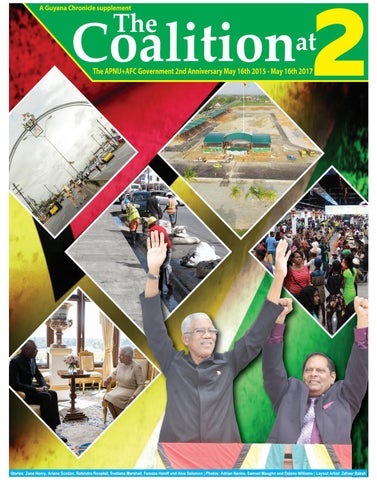
Stories: Zena Henry, Ariana Gordon, Rabindra Rooplall, Svetlana Marshall, Fareeza Haniff and Alva Solomon | Photos: Adrian Narine, Samuel Maughn and Delano Williams | Layout Artist: Zaheer Baksh
B
GUYANA CHRONICLE Tuesday, May 16, 2017
Address by
Brigadier David Granger President of the Cooperative Republic of Guyana, at the Swearing-in Ceremony, Georgetown, on 16th May 2015.
Guyanese, It is written: “This is the day which the Lord hath made; we will rejoice and be glad in it.” We have come together at the National Assembly of the Co-operative Republic of Guyana as a mark of respect for the Parliament, for our Constitution and for the People of this great country, Guyana. We have good reason to rejoice. We rejoice not only in the favourable results, but also in the enjoyment of our democracy. We went into the general and regional elections on 11thMay 205 as a grand Coalition, comprising six parties–the Alliance For Change; Guyana Action Party; Justice For All Party; National Front Alliance; People’s National Congress Reform and Working People’s Alliance – and won the support of the majority of people. We therefore record our gratitude, first, to the more than 408,000 citizens who participated in this important democratic process last Monday. We thank, also, the thousands of observers, officers, officials, agents and other workers – from overseas and from Guyana – and representatives of foreign missions who worked to ensure that the elections were conducted in a manner than satisfied international standards for efficiency and credibility. We congratulate the successful candidates of all parties who will soon be selected to become members of the 11th Parliament and encourage them to be faithful to their oath of office and to their constituents. Guyanese, The elections are over. The Guyanese people have chosen their representatives. The Constitution has been respected. Our democracy has been fortified. Let us now put past rivalries behind us and work in unity to banish poverty, ignorance, fear and hatred. We assemble here today to witness the swearing in, not of a party leader, but of the President of all the people. I shall be a good President for all the people.
We the Guyanese people have chosen to inaugurate a ‘government of national unity’ and to promote our multi-party, inclusionary partnership. We are convinced that this is the best way to overcome our historic divisions. We have witnessed the damage done to our beautiful country over the past twenty-three years. We have been mocked by the destruction of local democracy and the denial of local government elections. We have been treated with contempt by the dictatorial prorogation and dissolution of Parliament. We have had to bear the brunt of the high rate of crime including armed robberies, arson, inter-personal violence, murder, piracy, rapes, road fatalities and trafficking in persons. We have had to bear President David Granger
the cost of the squandering of state resources on exorbitant but misconceived mega-projects. We have suffered most from the high cost of living and the high level of unemployment. We have not been filled with hatred by these conditions. We are, indeed, more determined than ever to refashion society into one in which our womenfolk can look forward to working for ‘living wages’ to cope with the cost of living; one in which old folk can enjoy adequate pensions and social protection. Our young people will be able to attain higher educational standards and look forward to finding satisfactory jobs when they leave school. Our women and girl children can look forward to living in safety and to being protected from abuse and violent crime. We the Guyanese people have seized the opportunity to vote for human safety, national unity and inclusionary democracy. We now look to the future. We invite you to attend the formal, official “Inauguration Ceremony” to be held at the National Stadium on 26th May; Independence Day. We also wish to inform you that the outgoing and incoming administrations, respectively, have agreed to establish a ‘Transition Team’ to facilitate the transfer of assets and the transmission of information needed to ensure the continuity of government and to guarantee the stability and security of the state. Lt Col Joseph Harmon has been appointed the new administration’s team leader to manage this process. We announce also, that Mr Moses Nagamootoo will be appointed the next Prime Minister as soon as he is sworn in as a Member of Parliament in accordance with the Constitution. Guyanese, We declared on 1st January this year, that 2015 would be the “Year of Democratic Renewal.” We were right. Let us therefore rejoice in the people’s choice. Let us embrace each other – regardless of religion, race, class, occupation – as fellow Guyanese. Let us work together, to realise our inspiring national motto: “One People, One Nation, OneDestiny.” Let us be reminded of the famous national song: Let us co-operate for Guyana, Let us co-operate for our land, Let us resolve to fight together, See we do it right together Can we do it? Yes we can. May God bless Guyana!
C
GUYANA CHRONICLE Tuesday, May 16, 2017
A new democracy
…PM says coalition victory heralds ‘new paradigm’ By Ariana Gordon The election of the APNU+AFC coalition government to office in May 2015 marked the beginning of a “new democracy”, Prime Minister Moses Nagamootoo has said, referencing the separation of powers, a free press and the integrity of the judiciary. In an interview with the Guyana Chronicle, Nagamootoo said the two years in office have seen a very marked and significant definition of the political landscape. “We have begun to see the contours of new democracy emerging,” said the Prime Minister as he reflected on the coalition’s two year journey as a government. He pointed to what he termed several facets of life in Guyana as examples of the “new democracy” and made specific reference to the existence of parliamentary democracy, the doctrine of separation of powers, a free media and the integrity of the judiciary. Prime Minister Moses Nagamootoo “To have achieved definition of a new democracy in two years cannot be measured in financial value,” said Naga- ACTIVE CITIZENSHIP mootoo a former People’s Progressive Party This he explained represents the reactivaCivic (PPP-C) executive, who joined the Alli- tion of civic and citizen interest in community ance For Change in 2006 that later teamed up matters. As an example, the Prime Minister with APNU to oust the Donald Ramotar-led noted the recent protest by citizens against administration. the institution of paid parking in Georgetown which also called for the Georgetown Mayor FAILED STATE and City Council to scrap its contract with Moreover, the Prime Minister said mea- Smart City Solutions (SCS), the company sures by his administration to curb illicit contracted to run the project. activities here have been the bedrock of “You have the idea of new towns, Bartica, success. He said institutional as well as legal Lethem, Mahdia, Mabaruma…which saw the measures to combat what he described as an rejuvenation of interest in community devel“almost failed state” when the coalition took opment…this is the inclusion of the grassroots office have brought about a higher level of in governance; self-governance,” he added. accountability here. Also, Nagamootoo made it clear that He told this newspaper that several foren- consultations have been the “bedrock of the sic audits of state agencies have been done administration’s decision making” and noted since the government took office and have that policies implemented must be premised unearthed a plethora of instances of corrup- on the widest possible consultations. He said tion, although critics have lamented the sloth too that some changes would prove adverse in which charges have been brought against to the way of some persons. “Changes are those culpable. The Prime Minister, an attor- made in the interest of the country,” said the ney said, “The mechanism of forensic audits Prime Minister who referenced the resistance brought naked truths…we have seen charges by sugar workers to the changes that are curagainst those who held public office for theft, rently occurring in the sector. and misappropriation of public funds.” “We are trying to move the industry away “We feel that a large portion of public from its bankruptcy,” he added while calling assets have been privately appropriated by on citizens to fear not as his administration persons…those assets should not end up in is working in their best interest. “There is no the deep pockets of those who hold office,” reason to fear- the country is in safe hands said the Prime Minister. On that note, he and the coalition has both plans and vision to referenced the passage of the State Assets lead this country into a state of viability that Recovery Agency (SARA) Bill and the set up could protect and improve their (citizens) an agency to enforce it. conditions of life.” On the legal side, he referenced the passage into law legislation which brought into SLOW PACE being the Public Procurement Commission Meanwhile, notwithstanding the achieve(PPC) and saw its members being named ments, the Prime Minister expressed disapand the Anti-Money laundering initiatives pointment with the pace at which some of by the state. Nagamootoo noted that another the government’s plans are materialising. significant achievement by his government “We are not moving fast enough,” he said in the context of a “new democracy” was while stressing that the government is on the hosting of Local Government Elections the right trajectory. “We know we need to (LGE) in 2016. “The fact that this government build a law abiding nation…but it needs to dared to hold LGE after 21 years opened up a be done quicker to calm fears. The promise wide avenue for people’s participation from of jobs for young people, housing etc. but we the grassroots level to the level of munici- are fighting too many fires that were burning palities.” from a past regime,” the prime minister who
also has portfolio responsibilities for governance, parliamentary affairs and the state media said. Asked to respond criticisms of government not fulfilling some of its promises to citizens, the Prime Minister said in reflecting on how well the government has performed at its second anniversary has to be rooted not in unfulfilled promises but in the reality of what has been possible, and not what was expected. Prime Minister Nagamootoo believes that while all promises have not been fulfilled, his government has been able to increase wages by 38 per cent, something he described as a “magnificent achievement.” “VAT has been reduced from 16 per cent to 14 per cent… these constitute the reality…there is now more disposable income for the working poor,” the Prime Minister noted while adding that they are incremental achievements which show the consistency of the APNU+AFC government in the delivery of services. POCKETS OF DISUNITY Though by its very nature, the coalition government brought together a number of political parties, it seems to be struggling with bringing citizens together and according to the Prime Minister there continues to be “pockets of disunity.” But Nagamootoo made it clear that the opposition PPP would have “to develop its own strategy for survival, not on a basis of opposition for opposition sake but on making strident representations for systems that would ensure that they have not only a secured placed in the political system, but a possibility that they could return to office.” Nagamootoo who served as a Member of Parliament since 1992 said in the context of Constitutional Reform it is important to build a political environment that is based on competitive politics and allows each person a possibility to be elected. “Both the opposition and government and civil society recognize that there is more work to be done on the constitution and that you need to subject the constitution to another round of scrutiny and to go to the people to take from them what and how they should change or reform the constitution.” The Prime Minister who participated in the 1996, 2001 constitutional reform processes has since started consultations with the United Nations (UN) bodies to receive both financial and technical support. He maintains that the constitution is too important and precious to be tinkered with and said “while we ought to have started the process earlier, it is not a delay that had placed us in jeopardy. I had set up cautiously all the mechanisms that were necessary to move forward. I hope there would be a buy in from opposition that would permit this process to go forward on the basis of consensus.” The Prime Minister noted that in the Cummingsburg Accord, provision was made for the inclusion of opposition members in a government of national unity. The political coalition Nagamootoo said sees a role for wider participation in governance. “I believe that itself is a mandate for us to work together to expand the constitutional framework that would allow for us one day to achieve a gov-
ernment of national unity.” He stressed that the coalition has thus far provided and catered for the interest of all citizens and on its 2nd anniversary in office, has delivered lots though he believes much more could have been done. “We had massive intervention in the economy, infrastructure, repaired old ferries, provided roads where there was none, provided lamps and lights and electricity to areas that have never seen the light of day, repairs to aerodromes in the interior…the touch of renewal can be seen, felt in the lives of communities that have never seen any renovation. Mabaruma and Lethem have radio station,” said the Prime Minister. The Politician believes strongly in partnership and noted that in a country which is challenged by contiguous neighbours, Guyanese need more than ever to unite in partnership to defend the country’s sovereignty. “We don’t have any hidden agenda, political mission to keep Guyana fragmented, we have a determination to untie our people and that unity has to be across parties. We want to promote and I still want to extend the olive branch to the opposition,” he added while noting that Bi-partisan cooperation is necessary for the advancement of the country. STATE CONTROL OF THE PRESS Meanwhile, the Prime Minister who has direct responsibility for the state media has vehemently denied allegations of the state’s interference into the media, be it state or private. He described the allegations as absurd noting that his administration has guaranteed the plurality of the media and there is no evidence to suggest that the government has thus far been oppressive. He said, the private media has not been stifled by the government as was done in the past by the PPP which had refused to place advertisements in the private media. “In all democracies, all societies for that matter, it is the free, independent, privately owned press that would come forward and say that the government is trying to interfere with my freedom. Our government has not withheld any advertisement from the private media.” “I don’t know of a single case of a journalist being persecuted or prosecuted. I don’t know of a single case,” he continued while stressing that the allegations are disappointing and noted that though he is Prime Minister he remains a citizen of Guyana and like all other persons express concerns about things aired or published. The Guyana Press Association (GPA) in its Press Freedom Day message had called on the government to desist from interfering in the operation of the state media. However, the Prime Minister who has oversight of the state media said, “the complaints of interference is without merit, they’re unsupported by any evidence, they are vindictive, malicious and only intended to besmirch the good reputation of Guyana as a country that enjoys freedom of the press.” Meanwhile, he disclosed that he is in the process of releasing a white paper on public information and said the white paper, which is under review, will speak specifically to how his office thinks information should be disseminated to the citizenry.
D
GUYANA CHRONICLE Tuesday, May 16, 2017
Restoring the rule of law By Zena Henry
When, Senior Counsel Basil Williams, member of the A Partnership for National Unity (APNU) was named the country’s Attorney General and Minister of Legal Affairs following the country’s 2015 General Elections, it was a move that few could argue with, given that he is inarguably one of the country’s most dynamic and prominent legal minds. Known for his astute and forthright stance as a public figure, the veteran lawyer of 33 years has much to be commended for. Williams said he is extremely proud of his handling of the Anti-Money Laundering and Countering the Financing of Terrorism (AML/CFT) Act, the assistance rendered to law students and the upgrade of the registries among many other achievements. The new Attorney General was instrumental in getting Guyana off the Caribbean Financial Action Task Force (CFATF) blacklist after the previous administration had failed to adhere to international legislation to combat money laundering and the financing of terrorism. Moreover, Williams was, in 2016, further appointed as Deputy Chairman of the said institution. The country was also lauded by the American Regional Review Group (ARRG) for passing four pieces of legislation within a year. The AG said he was also happy to have been of some assistance to Guyanese law students studying at the Hugh Wooding Law School in Trinidad and Tobago where he was able to get Cabinet to contribute a percentage of tuition fees for 50 law students
…top priority for AG
Registrar and Deputy. Services at the Land Registry have also improved, compared to that which citizens previously experienced relating to administration. The system has also been computerised and currently, moves are being made to have a regional coordination where local services and information on these registries could be accessed anywhere in the region.
Attorney General, Basil Williams
up to 2018. Law students had faced some difficulty with automatic entry into the Law School, but this was quickly handled when President David Granger influenced Caribbean Community (CARICOM) leaders at one of their meetings to address the matter. The issue was quickly resolved when it was learnt that the previous administration had not been making their contribution to the entity, resulting in a grave disadvantage for students from Guyana. Since the Attorney General took office, he has been able to improve the Deeds and Commercial Registry to include new accommodation and securing the services of a
JOH Law School Minister Williams is vigorously exploring the possibility of having a law school here in Guyana. He explained that Guyana has already signed a Memorandum of Understanding(MoU) with Jamaican partners and a feasibility study on the viability of the school is on the way. “I am very optimistic about this,” the minister posited. The collaborative agreement between the region’s Council of Legal Education, the University of Guyana and the University of the West Indies (UWI) was also addressed after this was left undone by the last government. Within 100 days of taking office, the government was able to pass the Constitutional (Amendment) Bill and Financial Management and Accountability (Amendment) Act, Williams reminded. “Those things were to restore the independence of the Judiciary and constitutional commissions,” he said. Williams added that the judiciary was undermined when they were slated to be budget agencies. It meant that the constitutional body was not allowed to draw up its own
budget and allocate funds where it saw fit. Now, they determine their own priorities, and Williams charged that this is one of the areas where Government is fulfilling its promise on returning the ‘Rule of Law’.
Corruption endemic He said it was not until getting into office that he realised that corruption was “endemic”. “Even in my Ministry, there was no formal handing over.” The AG said that he spoke with his predecessor, but nothing that contributed to smoothly continuing the work of the office came about. The AG reminded that since taking office, he is still to locate relevant documents on major issues, stating that they are not in the Chambers. They include information on the collaborative agreement between UWI, UG and Legal Council, and information on large financial judgments made against the then government. The AG noted, however, that despite the office not being properly handed over, he was well abreast with current issues, while attending certain meetings such as those of CFATF and briefings with the Legal Council for example. These, he said, further enabled him to acquaint himself with issues, and afforded him the opportunity to handle them appropriately. Under the AG’s watch, some other prominent matters include the State Asset Recovery Agency, Cybercrime, Whistleblower legislation and witness protection. Sometime soon, Minister Williams said that work will also commence regarding the extra-judicial killings that took place in Guyana’s not so distant past.
Creating a modern, ICT-driven gov’t network …An insight into the work of Minister of Public Telecommunications, Cathy Hughes By Zena Henry If it’s one thing that stands out in the cabinet pool of government ministers, it is the charm and persistence of the esteemed Minister of Telecommunications, Catherine Andrea Hughes. Eager to serve in this new capacity after being transferred from the Ministry of Tourism, Hughes said that having to wait on the right people to help roll out her Ministry’s Minister of Public vision was the most frustratTelecommunications, ing thing since assuming her Catherine Hughes post. The Minister, who hails from the Alliance for Change (AFC) arm of the APNU/AFC Coalition Government, said that before her life took a political tone, she operated her own video production company, but following the 2015 general elections, she was called upon by President David Granger to serve as Minister of Tourism and was later asked to lead the telecommunications sector. These changes brought quite a bit of responsibility her way. As the new Minister of Public Telecommunications, she was entrusted with the task of creating a new ministry and organisational structure, establishing goals and objectives for the Ministry as well as the formation of national policy, among other critical tasks. These tasks would see the expansion of telecommunications and the Information and Communications Technology sector (ICT). “The biggest stumbling block was the slow pace of progress at the Public Service Ministry; the length of time it took to recruit the technical staff I needed to get the job done and the often uncompetitive salary scales vis-a-vis salaries in the private sector, [as well as finding the required] expertise in many unconventional areas,” the Minister disclosed.
Nonetheless, Hughes said that since taking up her post, the ministry has enjoyed some notable achievements, including the passage of the Telecommunications and Public Utilities Commission Bills in 2016, which, she said, will “create a liberalised Telecommunications environment when it comes into force later this year”. She said it will allow more competition in the sector and will also increase service providers while introducing better rates, services and products. “To date, we have provided free internet access to the computer rooms and administration offices of 101 educational institutions including most high schools, the campuses of the University of Guyana, Cyril Potter Training College, Guyana School of Agriculture and other vocational training institutions. This is done by connecting the institutions to our eGovernment fibre optic network which stretches from Crabwood Creek to Charity on the Essequibo Coast,” Hughes highlighted. She said that her ministry has provided secure and stable internet and broadband internet to most of the ministries that are also connected to the eGovernment network. Fifty -two ICT hubs have been created in communities to provide a safe and comfortable space for citizens who need to access the internet for education, research and entrepreneurial activities free of charge. A successful “Hackathon” was also hosted to identify a range of ICT professionals and a cadre of young technicians who will guide the development of the industry. “I see my ministry facilitating the creation of an efficient digital government. That means advising, encouraging and guiding other ministries and agencies to perform at a higher level which the use of ICT can provide,” Hughes said. This includes the way data and information are sorted and stored (a divergence from paper to digital documents) and encouraging Guyanese to use the internet more to apply for their passports, driver’s licenses, business registrations, and other services that could be provided online.”My vision also includes increasing internet access in interior and remote communities so that possibilities for citizens to participate more effectively in education through on-line learning opportunities are increased. In hinterland and rural communities where there
are shortages of teachers, online learning can transcend these barriers. The same possibilities exist in the area of health where improved telemedicine opportunities can greatly assist in the provision of quality health services,” Hughes said. It is the Minister’s hope that by year end, the Telecommunications Ministry will be operating under a new regulatory agency to allocate frequencies and manage spectrum. Indications of interest are also soon expected to come from companies wanting to operate in Guyana’s telecoms market. Improved Telecommunications services and internet access and providing ICT training is also a big ticket for hinterland communities, while moves are being made to link key agencies to provide online services. Through partnership with the United Nations Development Programme (UNDP), the Ministry of Public Telecommunications has also submitted to the Guyana REDD+ Investment Fund (GRIF) for funding for a transformational project that improves access and entrepreneurial opportunities in hinterland, rural, poor and remote communities. “We are also finalising ‘Smart Guyana’, a project which incorporates increasing internet access for use in education, health, the public sector in the provision of services and a safe city that embodies the use of cameras and technology in relation to security,” the minister highlighted. She said that work also continues on developing a national ICT strategy to entail a five-year strategic development plan to guide the way forward. Minister Hughes has adjusted well to ministerial life. “I came from a media background, so making speeches at events I am used to doing. The challenge is that you are working almost 18 hours in a day. Even when I go to the market or walk on the road you are informing of government policy, answering concerns and trying to reassure citizens, family and friends who worry, understandably, about a range of issues and how Guyana will move forward,” she said. Personal commitments become a little more difficult, but Hughes said she is grateful for the opportunity given.
E
GUYANA CHRONICLE Tuesday, May 16, 2017
‘Now we have ourselves in order’ …ministers on mission to unite, empower Indigenous peoples By Alva Solomon While it has been a challenging two years since assuming office, Minister of Indigenous Peoples Affairs, Sydney Allicock believes the task of uniting the people is foremost on his agenda, noting that despite the earlier setbacks he and his junior minister have gotten themselves in order. At the same time, Junior Minister Valerie Garrido-Lowe is working to ensure that her supporting role as subject minister is effective as she targets the grassroots issues facing the indigenous communities across the nation. On May 11 , the APNU+AFC government attained two years in office following the 2015 polls. During a recent interview with the two government officials at the ministry’s offices on Quamina Street , Minister Allicock told the Guyana Chronicle that he continues to be honoured having been selected by the government to serve the citizenry.He said the challenges have been “interesting”, “eye-opening “and “real”. “It is something I have ventured into and has caused me to be thinking all the time “, he said, as he spoke highly of the support he has been receiving from Garrido-Lowe in undertaking the mandate of the ministry. According to Allicock , the electorate in 2015 voted for a change and according to him, it is a process which includes “healing and rearranging “, one which entails creating a platform of readiness for the change to take effect. He said that the challenge for government is to impart knowledge and states its plans “so that the byin can come its way”. As regards the ministry, he noted that when the government assumed office, most communities in the Hinterland were divided politically. ”Our task is to try and get people back together,” he said. Minister Lowe noted that her portfolio sees her undertaking the mandate of the government in several ways. She said that there were in-house issues at the ministry which had to be addressed and these included staff-related matters such as becoming acquainted with the office environment. She said that she believed the ministry was the subject of “pure politics” in the past and according to her the difficulty was working along with some persons who would have been loyal to the previous government. However, she said that there was no form of bias noting that staff was told what was expected to them. She said the foremost interest was to ensure that the staff understood the importance
the May 2015 polls. He said the ministry had the arduous task of addressing the payments. “So there are many things, we are better off now, now I think we have ourselves in order”, Allicock said.
Minister of Indigenous Peoples Affairs, Sydney Allicock
of serving the indigenous people. When the work of the new administration commenced, the two ministers sat and discussed and divided their responsibilities. “So I took the easy ones, so to speak “, she said with smile. These include women and children issues, youth and sport and welfare matters which were placed as broad headings. One of the first issues which the ministry addressed was the issue of Community Social Officers (CSOs) whom Garrido-Lowe noted were being used for political purposes. “So that $30,000 would be an assistance for you to learn a skill”, she noted of moves the ministry made in creating a beneficial purpose for funds provided to indigenous communities. She said that 2016 have had some successes although there were administrative issues which had to be sorted. She spoke of the Hinterland Employment and Youth Service (HEYS) programme HEYS which she noted was implemented countrywide. She said that the subject of inclusivity was pushed as the programme was rolled-out. “So you have people from different political divide who are working along with their communities “, she noted. Garrido-Lowe noted that the programme has had its set-backs but there are more successes. She said since there 112 villages under the programme, there are monitors who would visit and assess the individual projects. She said that while the authorities concentrate
Junior Minister Valerie Garrido-Lowe
on having state of the art facilities, her concern “is very basic for the indigenous people” noting that it is the bread and butter issues which has to be addressed since a family will want to ensure that it has money in its hand to offset its living expenses. GET PLAY FIELD READY During the interview, Minister Allicock noted that the aim of the government is to address issues that are critical for the country to move forward. “To get the play field ready “, he noted. He spoke of issues which had to be ironed-out during his initial stages as a government minister. As an example, he said that following the 2015 elections the Opposition was vocal on claims that the government had dismissed 1000 CSO’s. However, according to him, weeks before the elections the then government had cancelled a cheque which was expected to be paid to the CSOs a month before
SUCCESSES According to Allicock, village councils within the South Rupununi has been calling on the authorities to establish a district council in the area. He said that a team of officials led by him, visited the areas and after 3-4 days of intense discussions it was recognised that steps had to be taken in forming the council. “So we eventually had the South Rupununi District Council which has been gazetted”. He said the aim of the council is being developed by the villages to ensure that they work together. Approximately 13 villages in the south and central savannahs are a part of the council. Allicock also spoke of the Amerindian Land Titling project, which has been extended by two years after it came to an end in October last year. He said a decision was made at the level of the government to request support from Norway and a four year extension was also sought. He said there are challenges which the ministry encounters in the project, such as villages in the upper Mazaruni which have not consented to being demarcated. The issue is before the courts for a number of years . He noted that the ministry has been unsuccessful in seeking a compromise from the villages and according to him, the Commission of Inquiry (COI) in land matters will assist in the project’s mandate. He said there are 215 communities which fall under the project and as such the task remains an arduous one. COMMENDED As regards returning to areas where the government did not receive support, he said that the ministry is following its mandate to serve all of Guyana. He listed as an example, a village close to Lethem where he was vociferously criticised prior to the 2015 elections. He noted that on a recent visit to the village he was commended by the village leader for his efforts and those of the ministry including projects such as the HEYS programme. As regards the Amerindian Development Fund, he noted that economically viable projects being implemented countrywide. He said there processing projects which will be undertaken in various communities across the country .He
said the value-added projects will see items processed in the Hinterland being marketed in the villages as well as on the Coastland and further afield. There is a medicine project at the Bina Hill institute in the North Rupununi which wills see eight students who will be trained in the capital city in marketing and processing among other areas. He said that there is an order of 25,000 vials of medicine by the end of 2017 and plans are in train to meet the target. UNITING THE PEOPLE Allicock said that the ministry is undertaking its programmes, such as the HEYS project , targeting young leaders as well as community development. He spoke of an Indigenous Ambassador’s programme in which nationally acclaimed persons will work along with the ministry. He said a Youth Director will be appointed to develop that venture. Allicock said that there are Community Development Officers (CDOs) who are proving themselves in their respective positions to undertake the mandate of the ministry. NATIONAL TOSHAOS COUNCIL Allicock said that when he assumed his current portfolio and “olive branch “was offered to the NTC, including its executive and members. He said the NTC was asked to produce plans and suggestions for the development of villages across the country. He said that the NTC has not made much of the offer by the ministry. As regards the COI, he said that the ministry expected the NTC to work along with the ministry as regards the commission but according to him, the hierarchy of the council appears not to be working in the best interest of its expected mandate. “I am saying that we have to come out of the Columbus era, but they (NTC executive ) seem to want to remain in this stagnated era, we are here , and we are poor and we can’t do anything,“ Allicock said. He continued “we have to move out of that era, you see we have been told so long that we are poor that we believe we are poor “, adding that richness is not necessarily money but a rich culture and history speaks of wealth. Allicock believes that unity is the only tool which can develop the nation as a whole. At the same time Garrido-Lowe believes education and preservation of the indigenous way of life remains key to the advancement of the nation’s first people.
F
GUYANA CHRONICLE Tuesday, May 16, 2017
The evolution of national identity and development in Guyana By Dr. Ken Danns After fifty years of political independence Guyana remains an underdeveloped country. Distinguished Guyanese economist Dr. Clive Thomas has dubbed this sustained underdevelopment a “permanent crisis”. I submit that we should look to the phases of the post-colonial national identity of Guyana as one approach to best understand its permanent crisis. The national identity refers to those elements of nationhood such as its flag, national anthem, constitution, system of government, geographic, economic, ethnic and cultural elements that combine to make its peoples have a sense of belonging and see themselves as Guyanese, and the world to identify their nation state as Guyana. The national identity of Guyana has emerged and been transformed over time through five distinct phases. Each identity phase is dominated by the government and a paramount leader and “norm entrepreneur”; and, distinguished by ethnic rivalry and class transformations. I will focus briefly on the features of the identity phases that occurred mainly after independence. The first phase is The Nationalism and Political Independence Phase–1964 – 1970. A significant development in this phase was the replacement of English Government officials with dark and brown skin native born Guyanese. The colonial state had withdrawn by administrative decree taking its officials with it and relinquishing its power to the colonized peoples. The dwindling minority of White population no longer commanded all power and privilege. The colour class stratification order based on whiteness and nearness to whiteness was irrevocably reversed. The post-colonial state and its new elites had emerged and were unrelenting in the pursuit of radical decolonization and the creation of a new national identity. The country’s motto emblazoned on its coat of arms is: “One People, One Nation, One Destiny” and highlighted a strategic vision to go forward as a united nation. Independence on May 26, 1966 was a highpoint in Guyana’s political development. Ethnicity and class were subordinated, however briefly, to the aspirations of the new nation and the identity of togetherness it was trying to forge. It was a coalition government comprising the People’s National Congress (PNC) led by Forbes Burnham and the United Force (UF) led by Peter D’aguiar that shepherded Guyana from it turbulent past of ethnic conflagration under the People’s Progressive Party (PPP) internal self-government led by Cheddi Jagan 1957 - 1964. The best moments in Guyana’s post-colonial history were the periods during which the government was under genuine broad based coalition party rule. PNC/UF Coalition Government 1964 – 1968; and, again the APNU/ AFC Government 2015 – present. These periods have been characterized by markedly reduced ethnic ferment. The lessening of ethnic insecurities is imperative for the development of Guyana. Rigged 1968 elections marked the beginning of undemocratic electoral rule in Guyana under the PNC for the next 24 years. These elections also deepened the ethnic divide with East Indians and other ethnic groups, leaving them feeling disenfranchised. Though making immense and significant contributions to Guyana’s political development, the PPP and PNC, on their own and in power, have proven to be enduring symbols of ethnic divide and ethnic rule. The second national identity phase is The Cooperative Socialist Republic Phase 1970 –
1985. The Cooperative Socialist Republic Phase is the phase in which the post-colonial national identity of Guyana was crystallized. The Burnham’s PNC as the new rulers of the post-colonial state apparatus were the purveyors and custodians of Guyana’s “collective memory”. They set about the task of defining the collective consciousness in order to build a new national identity. The government’s ownership and control of the media made this task less challenging. The common history of suffering under slavery, indentureship, plantation exploitation, and ethnic and cultural marginalization provided the emotional, motivational and symbolic grist to build the new nation’s identity. The new nation was going to build an El Dorado out of the country’s abundant, largely unexploited natural resources. This El Dorado was the Cooperative Republic. The new rulers were developing a new strategic culture out of past experiences. A key strategic policy initiative of Burnham’s PNC government was to give national recognition to and celebrate the multiethnic and multicultural nature of the Guyana society through national holidays and festivities. In colonial British Guiana, the national holidays were almost exclusively in recognition of Christian religious festivities. These were Good Friday, Easter Monday and Christmas. New Year’s Day, Boxing Day and the Queen’s Birthday were also celebrated. The new nation celebrated in addition Independence Day, Republic Day (Mashramani), Labour Day, Freedom Day, Caricom Day. Further, five new religious holidays were introduced. Three Muslim holidays: Yuman-Nabi (Birth of the Prophet Muhamad), Eid Al Fitr, and Eid Al Adha (Feast of the Sacrifice); two Hindu holidays Phagwah (Holi), Diwali (Hindu Festival of Lights) are all nationally celebrated. These ethnic, cultural and national holidays are embraced by all Guyanese and it is very normal to see the various ethnic groups participate in the cultural festivities of each other. The Christian holidays, Christmas in particular, remain the most popular among all ethnic groups. Enmore Martyrs Day is not a national holiday but is celebrated by sugar workers and the labor movement in recognition of the killing of East Indians workers who were on strike. The national recognition of ethnic and cultural diversity cultivated over time a sense of a national identity. Additionally, Indian Heritage Day was subsequently introduced by the PPP President Bharrat Jagdeo. The celebration of Mashramani on February 23 was in recognition of the nation’s status as a Republic. The concept Mashramani is associated with the indigenous Amerindians’ celebration after a harvest. Sixteen holidays are held in affirmation of the nation’s identity. At least one of these national commemorations is held during each month except the months of July and September. The national recognition of ethnic and cultural diversity cultivated over time a sense of a national identity. National recognition of freedom from slavery and indenture, the struggles of workers, the country’s independence, and the birth of the Cooperative Republic are symbolic and emotional markers in building the national identity. A second strategic policy initiative which fostered the national identity was in the sphere of education. The government took control of all schools and colleges removing ownership and control by the churches and other private enterprise. The educational system was seen as perpetuating colonial and anti-national values and learning. The resocialization of the Guyanese people as
Dr. Ken Danns
citizens of an independent nation was seen as the way forward. A policy of free education from kindergarten to university expanded considerably the Guyanese middle class and significantly narrowed the inequality gap between the classes. A third and major strategic policy initiative was the constitutional change of the country to a sovereign republic. PNC leader Forbes Burnham had stated: Seek ye first the political kingdom and all else shall be added. The Queen was removed as head of state and executive power rested almost exclusively with Prime Minister Burnham. A fourth strategic policy initiative was the nationalization of the commanding heights of the economy. This was seen as a logical step for the transition to socialism. Nationalization functioned to define Guyana’s identity indelibly in the eyes of the international community. The state nationalized and or controlled 80 percent of the economy culminating with the historical act of taking over the sugar industry from Bookers McConnell in 1976, and subsequently the bauxite industry and other businesses. The nationalization of sugar brought the external ownership of the sugar plantations to an end. The implications of socialism and nationalisation for Guyana’s national identity were the discouragement of foreign investment and the serious limiting of development aid from Western Countries. The government sought to overcome this by unsuccessfully championing a domestic policy of self-help and self-reliance; and, a foreign policy of non-alignment and noninterference in the affairs of other nations. Burnham’s PNC oriented Guyana to play a leading role in the International Non Aligned Movement and in the formation of CARICOM and CARIFIESTA. The promulgation of the 1980 Constitution was the fifth strategic policy initiative. It effectively encapsulated and underscored: the nation’s identity as being in transition from capitalism to socialism; state control of the economy; the organisation of people into cooperatives; and the creation of an executive presidency with dictatorial powers. The 1980 Constitution removed the last vestiges of colonial rule removing the British Monarch and the Governor General as titular heads of state. It also legally institutionalized authoritarian rule in the new nation. An important element of this socialist
transformation was “comrade politics” a symbolic usage that was engendered in the national culture. Everyone regardless of their status in the society was a comrade. There was “Comrade Leader”, “Comrade President” Comrade Minister”, “Comrade Ambassador”, Comrade PS”, Comrade Messenger”, or just plain “comrade” when there was no compulsion to recognize status. Comrade became a socially equilibrating construct that in the words of its purveyors made “the small man, a real man”. This was another symbolic departure from the status conscious colonial social structure. Comrade had no race, no color, and no creed. Everyone was a comrade. The gap between those in the ruling class and the other two classes was not wide. The third phase of Guyana’s national identity is The Phase of Pragmatic Liberalism 1985 – 1992. The death of President Burnham in 1985 marked a significant turning point in Guyana’s post-colonial history. As the new lead custodian of the nation’s identity, President Desmond Hoyte set about vigorously reintegrating Guyana back into the capitalist world economy and weaning it away from the failed cooperative socialism of which he himself had been one of its strongest ideological advocates. The implementation of austere structural adjustment policies to foster a market economy, as well as substantial cutbacks in the dispensation of welfare benefits by the state, led to a widening of the gap between haves and have nots. University education was no longer free. Pressured by IMF/World Bank requirements to cut spending, President Hoyte also abandoned many other social programs that defined the cooperative socialist phase. The anemic cooperative movement which was heavily subsidized by the Burnham government and touted as an engine of development disappeared. The era of anti-imperialism, chest thumping nationalism and comrade politics had unceremoniously ended. Nationalized industries were quickly put up for privatization in the new market economy and industrialization by invitation came to define the changed strategic culture. The Hoyte’s impact on Guyana’s national identity was transformative and included the repudiation of cooperative socialism, the reintroduction of a market economy, and the democratization of the society by paving the way for the first time for free elections and the peaceful transfer of power in a post-colonial Guyana. Hoyte believed and sought to promote a political culture where elections would be based not on race but competence and fairness in government. Notably, a free press was allowed under Hoyte’s PNC to reemerge and flourish in Guyana. The fourth phase of the development and transformation Guyana’s national identity is The Autocratic Democracy Phase 1992 – 2015. The Cold War had ended, the Soviet Union had collapsed, the Berlin wall had collapsed and Cheddi Jagan was no longer seen by President Clinton’s Administration as a threat to the national security of the United States. The Jagan platform had pledged to have a mixed economy and not to turn back the economic and other initiatives President Hoyte’s PNC government had negotiated with the foreign donor community. Foreign donors promised substantial development aid if free and fair democratic elections were held in Guyana. Ministers of Finance were appointed who kept the country faithfully in line with the prescriptions and proscriptions of the IMF/ World Bank structural adjustment programs. Pursuing socialism was not an option for the PPP if even it wanted to. East Indians who formed the party base were in no mood for such Turn to page K ►
G
GUYANA CHRONICLE Tuesday, May 16, 2017
Building stronger communities …Min. Patterson determined to transform housing landscape Somewhat of a ‘gold ticket’ to the housing sector, the proactive Minister Valerie Adams-Patterson is one of the more recently appointed government ministers who has set out on a path to transform the housing landscape here. Since taking up her post in January, the housing department has completed 2,830 allocations and distributed 8,451 Transports/Certificates of Titles, through the Land Administration Department. Through the Community Development Department 221 “squatters” received house lots; 192 Titles were processed and 406 “used-to-be” squatters became land-owners, having received their Titles. Currently, squatters in some Regions 2,6,4 and 6 areas, are already in receipt of letters to commence payment for house lots, the minister said. An “Action Plan for the Relocation and Resettlement” of Squatters, including the “Sophia Squatting area,” and East and West Ruimveldt is being formulated. The minister said that under the 50/50 Jubilee Payment Plan, 2,881 persons – low, middle and high income earners ben-
Minister Valerie Adams-Patterson
efitted from discounts on their outstanding balances, allowing many applicants to settle their accounts, while increasing the ministry’s cash flow by G$590M. In recognition of Guyana’s 50th Anniversary Year of Independence, the ministry said Home Improvement Subsidies where distributed to 257 households, offering beneficiaries across the country a maximum of $50,000 for home improvements. Prior to January 2017, a housing appli-
cant had to be 21 years of age to qualify for a housing solution. “That policy stood in contrast to the fact that that 18-year-old could have voted, served in the army, be licensed to drive a motor car and get married.” That was changed to allow housing qualification at age 18. Under the New Sustainable Housing for the Hinterland Programme, beneficiary identification process was completed across five communities in Regions 1 and 9, paving the way for implementation of already laid out construction projects. An upcoming Housing Expo will allow home owners to choose the type of structure they want built in the housing schemes the government will be creating. WOEFULLY LACKING Minister Patterson noted however that she was astounded to discover that the housing schemes created under the last government were woefully lacking. “There are 16 housing schemes; some are without water, others…no roads, no electricity.” She said there were instances where “house lots” were allocated, and even though applicants had completed payment and were ready to build, there were no access roads and other facilitates. Another worry was the “glaring disparity” in pricing policy across regions, but this is currently being addressed, the minister said. In making her department more efficient, Patterson said she immediately implemented a monetary staff incentive programme when she took up office, having experienced the benefits of rewarding high performers, as a means of motivation. In relation to fixing systems, Patterson said that the Land Management System (LMS), which provides all information on land allocation, was not being updated, and thus caused difficultly in effective decision making. Key managerial positions also had to be
filled. The former government’s “infamous” 1000 Homes Project at Perseverance was a real disappointment, Patterson opined, highlighting that the project, consumed large sums of taxpayers’ money, but was reeked with, “…defects, deficiencies, irregularities, skullduggery and corruption.” She said more money had to be spent to fix the homes, and also address vandalism since residents refused to occupy the defective structures. Minister Patterson said over 3000 house lots were sitting on the books when she took over the ministry, yet acknowledgement letters dated as far back as the early 1990s existed. By the first week, a rigorous allocation exercise immediately commenced at the ministry’s office. The minister charged that the housing programme implemented over the past two decades did not adequately address various housing needs, so after careful examination, a new five-pronged strategy will be implemented in the medium term to look at higher density schemes, relocation and resettlement of squatters, consolidation of existing housing areas, partnering with Housing Co-op Societies and the expansion of the Hinterland Housing Project. HOUSING SOLUTIONS ‘Under the programme “Housing Solutions 2017 and Beyond,” families can expect to see the construction of 758 housing units; 265 duplexes and 38 town houses in 10 locations across six regions, namely, Regions 2, 3, 4, 5, 6 and 10.” As the programme progresses, several other housing options, including condominiums, are to come onboard. The upcoming expo will provide and insight into government’s new housing concepts. Minister Valerie Adams-Patterson has worked in many senior managerial and supervisory capacities, and served many civil duties prior to taking on the responsibility of housing the nation. Among other things, Patterson was the first female Chairman of the Linden Utilities Services Cooperative Society Limited (LUSCSL), Treasurer of the Linden Chamber of Industry Commerce and Development and served as Chairman of the Linden Education and Business Forum. Patterson is a licensed Pastor, and was ordained an Apostle in 2001. She served as President of the Women’s Ministry of the Assembly of God in Guyana, Linden and served as Deacon and Treasurer on the Board of the Faith Assembly of God. As a devout Christian, Patterson said her world view is rooted in the belief that “With God all things are possible.”
H
GUYANA CHRONICLE Tuesday, May 16, 2017
President David Granger and Her Majesty Queen Elizabeth II, at Windsor Castle during his first official visit to the United Kingdom. (Getty Images) The Head of State, President David Granger being sworn in as the Guyana’s eighth Executive President at the Parliament Building
The Speaker of the National Assembly Dr. Barton Scotland taking his oath of office as Speaker. (Photo by Adrian Narine)
President David Granger inspects the Guard of Honour
The restored Independence Arch
A section of the stadium which was packed to capacity (Photo by Samuel Maughn) Member of the Guyana Fire Service cleaning around the outskirts of Stabroek Market Construction workers have been busy completing some of the model houses at the Perseverance, East Bank Demerara housing scheme in time for the Housing Solutions expo
Minister of Indigenous People's Affairs Sydney Allicock poses with Prince Harry at the famous Kaieteur Falls
I
GUYANA CHRONICLE Tuesday, May 16, 2017
Reforming the education sector …strong push to strengthen PTAs, special needs education By Fareeza Haniff Although faced with many obstacles in reforming the country’s education sector Dr Rupert Roopnaraine has refused to let it prevent him from accomplishing his goals. As a matter of fact, the Minister of Education is placing more emphasis on strengthening key areas in the sector, chief among them being the Parent Teachers Associations (PTAs) in schools across the country and Special Needs Education. Since assuming office two years ago, Dr Roopnaraine has been battling with resuscitating dormant PTAs and has even hired a National PTA Coordinator in the person of Nadia Hollingsworth, who is tasked with overseeing the effective functioning of these bodies. In an exclusive interview with Guyana Chronicle, it was explained that the coordinator visited schools across the country and distributed PTA toolkits, which state exactly how the PTA should function, how they need to operate and what is expected of them. “I would like to see the PTAs strengthened and parents being more engaged than they presently are. That’s a very important area for me. We really have to deal with the management of the schools, we have to deal with the Regional Education Officers (REOs), I think that’s very important; we have to get ICT going in schools across the country. I really would like the PTA’s to be a lot stronger, I want more focus; I see them as a very important part with what we’re trying to do with education. We want genuine partnerships with the parents,” the Education Minister told this newspaper. SPECIAL NEEDS As it relates to Special Needs Education, Dr Roopnaraine reiterated his commitment to ensuring that special needs children are not placed at an additional disadvantage. As such, the Education Ministry works closely with institutions such as Step By Step Foundation, Child Link and the National Disabilities Commission and others to ensure that special needs children are catered for. But the challenge with this is that the Ministry is at pains to find persons who are competent and specialised in areas to teach the children. Major accomplishments Asked to list some of his major accomplishments, Dr Roopnaraine pointed to the “Mathematics Intervention”, which he says has brought some quality changes in the education system. In December 2016, the Ministry of Education embarked on an Emergency Math Intervention Programme which was rolled out in three phases, commencing with pupils in Grades five and six. The first phase of the programme commenced with specific focus in Regions 1, 3, 8, 9 and 10. The Ministry is confident that this initiative would improve the Math performance at the Secondary School Entrance Examination (SSEE). “The learning channel which is more geared to meet the needs of the children with programmes addressing literacy and the four core areas. We have here at the Ministry of Education a conscientious team, people who work hard to get the programme going so I’m hopeful that by 2020, which is when we will be able to really gauge to what extent we succeeded in the work of transformation that we’re attempting to do; we’ll be able to see the results then. But right now we’re pressing forward in all the regions and I can’t stress enough the importance of the work in the primary schools because that’s where it begins,” the Education Minister said. Dr Roopnaraine is also proud of the work being done in the areas of sports and music introduction in schools. In this regard, Chief Education Officer (CEO), Marcel Hutson said that music has already been implemented in the primary level; as a matter of fact the Ministry has engaged the services of a Guyanese music instructor from Trinidad, who is teaching music to teachers in all 444 primary schools in Guyana. It is expected that the instructor will soon move on to the 110 secondary schools. According to the Education Minister, “[Music] is a work in progress, it won’t happen overnight. We need to develop a committed cadre of teachers and get parents much more involved in the education of their children. I think if we can do those two things, we can make a big difference.” “I’d like to see very active music programmes throughout the schools, like school choirs. There must be some music in the schools. I’m not very happy with the fact that we are not doing as well as we would like to see us doing in relation to both of these activities, I would like to see much more diversified education.”
Minister of Education, Dr Rupert Roopnaraine
REINTEGRATING TEENAGE MOTHERS Meanwhile, the Education Ministry has solicited the services of a consultant from UNICEF to draft a policy for the re-integration of teenage mothers in schools. It was noted that the consultant, Dr Morello Joseph, is based in St Lucia. As it stands, Guyana does not have a policy that caters for pregnant teenagers and according to the CEO the decision as to whether a pregnant teen can continue to attend school before and after pregnancy is left to the head of the institution or the regional authorities. This draft policy will now ensure that the affected students can be re-admitted to the same school or another learning institution. “That’s part of the social problem we’re facing. I am firmly of the view, and I’ve said this time and time again, we can’t afford to fail in education. Education is the one area where we have to succeed. Because if we fail in education, then everything else fails,” Dr Roopnaraine said. As it relates to the issue of placing counselors in schools, the Education Minister intends to strengthen this programme as he firmly believes that children should be counseled instead of them facing corporal punishment. It was noted that counselors are placed in “troubled schools” in Guyana and these schools are determined by reports received by the Welfare Office and the consistency of reports. Most reports emanate from schools in Georgetown and Regions 2, 6 and 10. BRIDGING THE GAP Meanwhile, the Education Ministry continues to battle the division between the coastland and hinterland in terms of distribution of resources and according to Minister Roop-
naraine, he recently visited some hinterland areas, where he received “genuine complaints” about issues facing schools there. Some issues include the quality staffing given the fact that there are no universities or colleges in those far-fetched regions. In this regard, the Ministry implemented a Teacher Upgrading Programme in some Hinterland areas such as regions 7 and 8. Adequate housing for teachers who are transferred to the hinterland from the coast is also being addressed the Education Minister said.
TEACHERS’ TRANING, INCREASE IN SALARIES On the tricky issue of teacher’s remuneration, the Education Minister said a teacher appraisal document is being fine-tuned by the administration to ensure commitment and accountability from teachers. Dr Roopnaraine has also asked for a complete curriculum review that is currently being taught in schools along with a review of the curriculum at the teachers’ training college to ensure that they are in harmony. “We have to get committed teachers,” he said. As it relates to the issue of salary for teachers, the Education Minister believes that teachers are not paid “sufficiently.” “You need teachers who are committed and whose own financial situation and personal commitments can be met. The one thing we don’t need is demoralised teachers and salary is an important part. I’d be very happy to lobby for an increase,” he said. He however alluded to the fact that education eats up a large part of the budget so “If we’re going to go looking for more money, then we’re going to have to really make serious arguments.” INCREASE IN SCHOOL FEES The issue of increased tuition fees at the University of Guyana (UG) and Value Added Tax (VAT) being charged on tuition at private schools are contentious issues facing the Ministry. In March, Vice Chancellor of UG, Ivelaw Griffith had announced a 35 percent increase in tuition fees, being applied incrementally; this was met with rejection from the students. In this regard, Dr Roopnaraine said he will soon meet with the VC to further discuss the issue since the increase is of “concern” to him. “I am a very old believer in free education and I don’t like the idea of fees. A review of the fees is in order. We don’t want to impose burdens on already burdened people and that is something I think that can be reviewed. I don’t think we are going to be able to dispose of the fees altogether but we are going to look at it and see whether or not it can be put on some kind of ‘means’ basis,” the Education Minister explained. As it relates to VAT on private tuition fees, Dr Roopnaraine reiterated that this will be reviewed in 2018 and areas will be looked at to ensure that private schools pay their taxes. He suggested if everyone pays their taxes then perhaps the VAT can be removed from the tuition fees. The Ministry of Education was allocated $43.1B or 17 percent of the 2017 national budget and Dr Roopnaraine hopes that most of his programmes and policies will bear fruit.
J
Fixing a broken system GUYANA CHRONICLE Tuesday, May 16, 2017
…Bulkan says repairing local govt system will take longer than expected …but vows renewal and functionality By Svetlana Marshall “The Herculean task of restoring the damaged Local Government System after years of neglect will take longer to achieve than expected,” Minister of Communities, Ronald Bulkan said while alluding to many of the challenges facing local organs in their quest to become self-sufficient and independent. “There has been progress but I will be the first to admit that there is much more work to be done that can be done, but I think we should not overlook the fact that this repair job, this restoration job, to bring about renewal and functionality within these organs, will take considerably longer than the two years or one year since those elections,” Minister Bulkan told Guyana Chronicle during an exclusive interview. He said at the time when Local Government Elections were held in March, 2016, Local Government Organs, particularly, Town Councils and Neighbourhood Democratic Councils (NDCs) had largely become dysfunctional due to years of suppression on the part of the former Government – the People’s Progressive Party/Civic (PPP/C). “They were literally ignored, their capacity and functionality were so damaged and degraded that they had actually largely become dysfunctional,” Minister Bulkan lamented. For the first time in 22 years, Local Government Elections were held on March 18, 2016. Prior to that, the elections were last held in 1994. But the Communities Minister said long before the March 18, 2016 elections, the A Partnership for National Unity (APNU) coalition had been laying the foundation for the restoration of Local Government System in the country while in Opposition. “It was the APNU in the 10th Parliament that had begun, in a significant way a national conversation as to the need, the necessity and relevance of Local Government,” he posited. The APNU, he recalled, would have moved from passing the Local Government (Amendment) Bill, the Municipal and District Councils (Amendment) Bill, the Local Government Commission Bill and the Fiscal Transfer Bill in June, 2014 with the backing of the Alliance for Change (AFC) to giving the then President Donald Ramotar an ultimatum for the holding of Local Government Elections. In his September, 2014 ultimatum to the then President, President David Granger, while in his capacity as Leader of the Opposition, had emphasised that Local Government Elections are a Constitutional obligation and a democratic entitlement of the Guyanese people. The ultimatum approximately one month after the AFC had submitted to the National
Assembly a No-Confidence Motion against the PPP government. “Even though President Granger was aware that he had a better than even chance of becoming sooner rather than later, the President of Guyana…to him the restoration of the system of Local Government was more important,” Minister Bulkan posited. He emphasized that the holding of the elections was in keeping with the APNU+AFC’s Manifesto and a fulfilment of its promise.
Regina and Corriverton. Significant work was also executed in the development of local areas economic profiles along with economic development and strategic planning in NDCs including those in Regions Two, Three, Four and Six. Training for these Local Democratic Organs will intensify with the launching of a handbook (manual) that will explain in detail their roles and responsibilities. “It has taken us quite a while but there were a number of grey areas in this transitional period…from a centralized approach of governance to where we are allowing Local Government Organs to exercise their legal and constitutional authority,” he explained.
OPERATIONAL LEVEL Minister Bulkan added that “at the operational level it took careful thought, to extract the relevant sections of the legislation, the two Acts, Municipal and District Councils Act Chapter 28:01 and Local Government Act Chapter 28:02… to create a manual a guide handbook so we have to give to each of the 1170 councilors as well as all of the administrative staff in our local government organs.” Before the end of 2017, Mahdia, the administrative centre of the Minister of Communities, Ronald Bulkan Potaro-Siparuni Region, is expected to be declared a RE-AWAKENING town, in addition to three other capital towns. Since those elections in 2016, Minister Zooming in on the Georgetown Mayor Bulkan said there has been a “reawakening” and City Council, Minister Bulkan recalled of the Local Democratic Organs which has that Central Government in 2015 had injected led to a “revitalization” of the roles of Coun- a “considerable” amount of funds into the cils in transforming their towns and villages. City Council for the execution of Restoration This is not only true for the common towns, Georgetown. He said while the project had Georgetown, Linden, New Amsterdam, Rose yielded tremendous success, the cash flows Hall, Corriverton and Anna Regina, but the problem, facing City Hall, like many other newest towns in the country – Bartica, Maba- municipalities, had hindered its ability to ruma and Lethem. maintain the project. “In all of the municipalities there are It was explained that the primary source various initiatives that are being undertaken of finance for Local Government Organs are in various areas such as Solid Waste Manage- rates and taxes, however, the rates are exment, Environmental Leadership, provision of tremely low. Additionally, many Guyanese services, and a general attitude to bring about are guilty of not paying their rates and taxes physical transformation via local leadership,” despite the fact that they are extremely low. the Communities Minister posited. Similarly, Councils’ inability to rake in sufficient funds he said a number of NDCs has been partner- cripple their ability to execute their functions ing with Government and Non-Governmental particularly in the area of waste disposal Organisations and members of the Private management. Sector to improve their communities. It was noted that the Ministry of Com- PARKING METERS munities in collaboration with the Caribbean Currently, the Finance Ministry is in Local Economic Development Project (CAR- the process of revitalising and restoring ILED) has been promoting sustainable com- the capacity of the Valuation Division. munities through strong local governance. Once fully operation, Minister Bulkan said Under this project, the nine municipalities Local Government Organs can expect an have participated in extensive training aimed enhanced provision of service which could at building their capacities to manage their possibly lead to increase funds. towns effectively while providing much The Communities Minister said it was needed services. City Hall’s intention to increase its revAdditionally, under the CARILED Proj- enue base while simultaneously bringing ect five municipal development plans were greater order to the streets of Georgetown crafted and approved for the municipalities had led to the initiation of the Parking of New Amsterdam, Rose Hall, Linden, Anna Meter Project. He said while the council’s
intention is good, there was clearly need for more consultation. “Unfortunately, I believe that there was not sufficient internal by in at the level of the council before the contract was enter into…I think as a result of that defect it led to certain features of that project attracting significant public resistance,” he posited. Persons, he pointed out, were concerned about the high rate attached to parking along with the harsh penalties. Central Government at the level of the Ministry of Finance and the Attorney General Chambers had reviewed the contract between City Hall and Smart City Solutions, and had offered their opinions and advice to the Council. It was found that a number of the clauses within the original contract were of no benefit to the council. “The advised was regrettably not taken on board,” the Communities Minister posited noting that it led to the withdrawal of Central Government’s support. Consultations are currently ongoing with the hope of having the contract modified to the satisfaction of Council, the Contractor and most importantly the citizenry, he said. Turning his attention to the Regional Democratic Councils (RDCs), Minister Bulkan said while the Government has been offering financial and institutional support, the opposition dominated councils have been putting up a resistance to many of its programmes and initiatives. Seven of the 10 RDCs are dominated by the Opposition. “Unfortunately, despite the agenda and the programme of central government to move in the direction of greater regional empowerment, regrettably, there has been considerable resistance on the part of those RDCs that are controlled by the opposition,” Minister Bulkan noted. The Ministry has proposed the renaming of the 10 Administrative Regions and the initiation of regional flags but some RDCs are still to buy into these initiatives. A plus, however, for the Ministry was its ability to correct the many problems that had plagued the Haags Bosch landfill facility. In 2016, the Ministry had signed $22.4M contract with Puran Brothers Disposal Inc to manage the Landfill site. Since then, the facility has been operating at an optimal. The company has displayed a compliance rate of 95 percent in accordance with clauses in the contract, as they relate to the equipment required. Notwithstanding the challenges, Minister Bulkan said his ministry will forge ahead with plans to build cohesive, empowered and sustainable communities. “I may say resolutely, even though the evidence may be taking a while before it becomes evident – this physical improvement - the direction and the trajectory is unbroken, and we are not deviating, we are not deterred and we are certainly not distracted. The progress is measureable but I think there is an appreciation and an understanding that given where we have started, it’s going to take time to restore this level of functionality that we can all be proud of,” Minister Bulkan said.
K
GUYANA CHRONICLE Tuesday, May 16, 2017
An analysis of the APNU+AFC Government’s performance By Lincoln Lewis On 11th May 2015 when citizens went to the polls, were attention paid to their voices over the years, it would be recognised their ballot was a loud expression they wanted a change, not merely in persons or group, but the manner in which governance is conducted. The APNU+AFC won the people’s confidence to fulfil this expectation. As a trade unionist, issues are examined and treated consistent with universal declarations, international conventions, charters and time-honoured principles. This government came to office riding on tremendous goodwill given the PPP/C’s pillage of the economy and contempt for citizens. The society became more divisive and fear stalked the land. Many felt it was safer to be silent or agree with the status quo to avoid risking the inevitable wrath that dissent or alternative view brought. This was a period of rampant corruption, death and phantom squads, a Minister of Home Affairs fingered and said if he had to do it all over again he would, hundreds of dead bodies were dumped around the country and the Coroner’s Act was not activated. GARBAGE CITY Georgetown, once proudly known as the Garden City became the garbage city. The City Council became pawn of an ugly politics that saw central government withholding its financial obligations for its buildings. Local Government Minister Kellawan Lall boldly announced that he would be glad if the city suffers a health crisis. There was no regard for the structures or management of government. Regional and neighbourhood democratic councils not controlled by the PPP/C saw discrimination in budgetary allocation and move to undermine, break up the councils,
GTUC General Secretary, Lincoln Lewis
or impose Interim Management Committee. Freedom of speech, including dissent and protest, and respect for the role of independent media were assaulted. Those who challenged or reported what was happening were targeted. For instance, the Guyana Trades Union Congress (GTUC) and its attendant arms suffered the withdrawal of its subventions, Stabroek News and Kaieteur News were deprived of state advertisements and government officials used their influence to call on non-state actors to do likewise. Libel suits and incarcerations were part of the programme to silence voices. Agreements were made and never implemented. Some such are the 1999 Armstrong Tribunal Award, 2001 Desmond Hoyte/ Bharrat Jagdeo Agreement, 8th March 2000 Agreement with the GTUC, and 21st August 2012 Agreement with Region 10. Though the Guyana Constitution (Article 13) mandates the nation’s political objective be one of “inclusionary democracy” such was observed in the breach, evident in complaints by the political opposition, trade unions, and other stakeholders. Rights and the Rule of Law were assailed. The trade union movement was at its worst ever, having suffered a politically engineered
split in 1999, collective bargaining and the right to freedom of association challenged. The nation’s development programme was directed by the policies of the international financial institutions. The formal economy was compromised by corruption, overwhelming presence of an underground economy, and cosy relationship between government and underworld operators. International pressure was brought to bear on the government to put systems in place to rid the economy of corruption and illegal money. Recalling the aforementioned is important in making assessment what citizens voted against, the challenges confronting the government, and how it has performed to date. The instituting of forensic audits early in the administration sent a message good governance would be its guiding principle, though this would only become meaningful when their recommendations are implemented and persons, past and present, are held to account. Stories like the D’Urban Park construction, Sussex Street bond, and controversial pharmaceutical contract do not help the people’s desire for good governance. The establishment of the long awaited constitutional Public Procurement Commission is a plus, but where other constitutionally required bodies are not established it takes away. Having campaigned on inclusionary democracy, where lip service continues to be given, it brings into question respect for citizens’ rights and the rule of law. Government shoulders greater responsibility to bring stakeholders to the table, political and non-political. Calls by the trade unions and private sector to have meaningful engagement consistent with their roles cannot be ignored. Extrajudicial murders have vanished, which would go a far way in building relationship between the police and communities.
The evolution of national identity... an ideology and strongly embraced private enterprise. The Black population, while unsettled by the change in government and the austerity measures of the economic recovery programs, were also largely fed up with the greater economic hardships and undemocratic rule socialism had brought. President Cheddi Jagan during his five years in office from 1992 - 1997 as Guyana’s President changed little of the basic structure of authoritarian governance left in place by the PNC. The most significant change was the removal of Blacks from top positions in the public service, state enterprises and government and their replacement by East Indians. Blacks were marginalized and victimized, their communities largely deprived of resources, and were equated with the PNC and seen as enemies of the PPP government. This reversal in the social order underlines the critical role ethnicity continued to play in defining the national identity of Guyana. The paramountcy of the PNC over the government was supplanted by the party paramountcy of the PPP. The PPP was able to sustain its autocratic rule through the electoral support of the majority East Indian population. Jagan died on March 6, 1997 by which time rampant corruption had taken hold of his government and narco-traffickers had begun to operate unchecked. Despite a record of
tepid economic growth, high poverty rates, high unemployment especially in the Black communities persisted. Public infrastructure and public utilities are very deficient. Some efforts have been successful in attracting some foreign direct investment but the more consistent source of investment appeared to have come from some nouveau riche whose wealth derived from sources largely unknown. Although private investment was encouraged, poor infrastructure, corruption, a declining population and a highly threatening security climate were disincentives to investment. The PPP government entered into many highly questionable public-private investment partnerships such as investing much of the monies from the National Insurance Scheme to build the Berbice River Bridge with a private enterprise. A rotation of PPP leaders President Janet Jagan, President Samuel Hinds, President Bharrat Jagdeo and President Donald Ramoutar followed their founder leader President Cheddi Jagan, all leaving the country in a state of permanent crisis and autocratic underdevelopment. The fifth, and current phase of Guyana’s national identity is The Liberal Democratic Phase 2015 to the present. The new APNU/ AFC governing coalition is comprised of A Partnership for a National Unity (APNU)— made up of the Guyana Action Party (GAP);
Continuing the PPP/C’s hard-line position of alienating those who express alternative or dissenting views would not be reflective of what the people voted against. Government has to be mindful of growing concern that it is discourteous, though some ministers make exception to this perception. There are many instances where correspondence and other forms of communication have reached them and are not being treated with deserving respect. Ours is a representative system of government and elected officials are servants not masters of the people. CREDIT FOR LGE Credit is in order for the return of Local Government Elections, environmental improvements (e.g. drainage and garbage collection), professionalising the Disciplined Forces, improved crime fighting, passage of Anti-Money Laundering and Countering the Financing of Terrorism Bill, expanding community broadcasting though Linden is five years in the waiting for theirs, partial return of subventions to GTUC and its arms, moving to professionalise the Foreign Service, and rekindling patriotism. These are major improvements in governance and stand to have Guyana seen as a credible and formidable member of the international community. Government still falls short of upholding rights and the rule of law. Collective bargaining is not restored in the public sector, which continues to set a bad tone for other employers. The absence of a sound indigenous economic programme will continue to see government floundering in handling the economy. Where in the two years there have been inactions and missteps should government sees its focus hinged to what the people voted for, not only the society will benefit. What the government has going for it is the people’s commitment to change.
From page F
National Front Alliance (NFA); Working People’s Alliance (WPA), the People’s National Congress Reform (PNCR)—and the Alliance For Change (AFC). The APNU/ AFC government is a partnership of rivals comprising political parties coalesced to democratically end the 23 years of autocratic yet, ostensibly democratic rule by the PPP. APNU/AFC government is led by President David Granger from the PNC and Prime Minister Moses Nagamotoo who originally came from the PPP. The Guyana Government is now in the hands of a seemingly capable and caring coalition administration. No government is perfect and missteps have been evident, but not unexpected. There are however, solid indications that this two year old APNU/AFC Coalition Government is undertaking programs and policies geared to restoring credible administrative rule, rebuilding trust, improving the nation’s security and in general promulgating initiatives to positively transform the country’s economic, social and political fortunes. While it is important to restore good governance and manage the country in an orderly way, the challenge is to transform and develop it at the same time. President David Granger has been promulgating an emergent vision of a “Green Economy” as the way forward for Guyana’s development.
In conclusion, the nation of Guyana is undergoing a paradox of identity. First, it is a democratic nation state that is seemingly locked in the throes of zero sum ethnic struggle. The nation’s identity is consequently metaphorically intertwined in the dysfunctional grip of ethnic politics historically fueled by the two major political parties. Secondly, it is a would be market economy which is dominated by state control and substantial ownership. Third, its Constitution proclaims the nation a parliamentary democracy, yet it enshrines an autocratic executive presidency that can operate above the law. Fourth, it is dominated by declaredly socialist political parties in power and in opposition while seeking to pursue a capitalist path of development. Fifth, it is geographically located in South America and is bordered by neighbors Brazil, Venezuela and Suriname with which it has limited contact. Yet, it is culturally and in other ways strongly connected with the English-speaking Caribbean. Finally, it is a country rich in natural resources, but poor and underdeveloped. The country’s identity has evolved from colony to an independent nation state, to cooperative socialist republic, and now a liberal democracy on a state dominated capitalist path of development.
L
GUYANA CHRONICLE Tuesday, May 16, 2017
Retooling the foreign service
By Ariana Gordon
…Greenidge urges alacrity in filling vacancies at MoFA …believes mission heads equipped, fit for duty
Efforts are continually being made to ensure that the country’s Foreign Service is operating at its maximum and Foreign Affairs Minister Carl Greenidge has assured that despite the limitations, he has a team of competent officials to get the job done. Speaking with Guyana Chronicle, Greenidge who is also the country’s first Vice-President said his ministry’s primary focus is to ensure the security of our borders. Guyana’s sovereignty has been threatened by two of our South American neighbours and according to the Foreign Affairs Minister it was critical that his Ministry be equipped with personnel, support in the form of equipment and other forms of support. “We’ve tried to recruit a range of skills, knowledgeable and experienced in the arena relevant to the issues of sovereignty. Analytical skills, diplomatic experience, language skills and the like …we’ve tried to recruit and to put in the units that deal with these areas, whether in GT or abroad,” said Greenidge. But despite the recruitment of specifically skilled persons, the Minister made it clear that it is not a one off attempt on his part. He said there inevitably has to be a continuing exercise of recruitment. “You don’t fix it once and it is cured,” he stated while expressing satisfaction with those hired since he took office as Foreign Affairs Minister in 2015. President, David Granger has made it clear that economic diplomacy is critical to the advancement of Guyana as a nation and in light of this Greenidge said Guyana has worked with a number of groups including CARICOM and the African Caribbean and Pacific (ACP) Group and the Commonwealth to strengthen relations. “In all the other aspects pertaining to security, we recruited skills looking at mapping, worked with technicians looking at the maritime space, the area above the land and sea for purposes of our protection,” he said while admitting that there is need for persons who are skilled in a multiplicity of areas. He reminded that Venezuela has sought to claim a significant part of Guyana for decades despite the arbitral ruling of 1899. That country has since recreated maps which show certain parts of Guyana as belonging to them and
have distributed same.
experience, [and] are trained.” He said the aim is to ensure that the younger people can get proper exposure so that they can take over in due course, effectively and smoothly. Thus far, the Minister said the feedback on the performance of the diplomats has been good. That aside, Greenidge expressed much frustration with the
OVERSEAS MISSIONS Additionally, Greenidge said there are also other mechanisms being employed to ensure that the other departments of his ministry are strengthened. He said priority has been given to the overseas missions and as such, officials that have served well locally for a number of years but never received postings have now been posted abroad. “We have tried to reassign them so that they can strengthen the missions we have abroad. We found in the existing missions abroad, new staff members many of whom have had experience working at home but without foreign experience they would have been given that opportunity.” The end result will see many of those who have been posted abroad elevating to Heads of Missions as they have developed a wide range of skills. On the note of the overseas missions, the Foreign Affairs Min- Foreign Affairs Minister Carl Greenidge ister said all of them have been staffed except the Consulate in Toronto, which is slothfulness to which vacancies are yet to have a consul general. That being filled. He explained that there vacancy is likely to be filled by year are a number of vacancies which he end as someone has already been hopes can be filled soon and those identified. range from the position of Foreign Asked to assess the work of Service Officers to higher level the diplomats thus far, Greenidge staff. The lack of sufficient staff stressed that they are not employed the Minister said places a strain on to sit at their desks and file docu- his ministry. ments but must be able to interface with other diplomats from different INFLATED EXPECTATIONS territories. “They must be roundMeanwhile, Greenidge, a fored; they must go into the fields,” mer Finance Minister in the DesGreenidge added. Moreover, the mond Hoyte PNC administration Minister said Guyana has selected believes it is important for citizens a range of professionally qualified to understand that the APNU + and experienced persons to serve AFC inherited a plethora of probas ambassadors. “The ambassadors lems and is attempting to fix situawho have been posted range from tions that have become undesirable. economists, academics, UN tech- He said the number of complaints nicians, people with experience in and concerns raised by the citizenry international agencies, language before the coalition government experts…the range is wide and took office in 2015 has resulted in whether it is in South Africa, NY, an inflation of expectations. Washington or Geneva, the persons He accepted though that the who have been appointed to head political parties while campaigning those places can stand proud in any did raise the nation’s expectations crowd, they do have competence, but quickly noted that there was no
deliberate attempt to mislead the public. The inexperience of those involved in the political campaign led to promises being made which cannot immediately be fulfilled. Additionally, he said promises were made on the assumption that the government would be one of a reasonable majority and can therefore effect legislative changes. The coalition government did promise Constitutional reform but according to Greenidge, in such a political landscape it is difficult to accomplish anything unless the opposition joins with the government. “…and we have seen a situation in which the current opposition when it had never been in government, promised people that they would do lots of things, and after a few months in office said this wasn’t the constitution that was at fault, it was the people that posed a threat to the rest of us. Now with proper people in place we will ensure that things are right.” According to Greenidge, the Opposition assisted in the damaging of the national psyche which he said has an implication on how people see democracy. “Expectations need to be tempered both by the government and by the people…those expectations would have to be tempered eventually. For me, I don’t worry too much about the expectations…we have put some mechanisms in place and added structures to them and within a year or two you would see them doing what they are supposed to do.” He noted that his government is working assiduously to fulfil all promises made though “we are going a lot more slowly than we anticipated. “Some of the things in place need further refinement, so maybe we have to be given a bit more time,” he said while stressing that it is up to the public to hold the government’s feet to the fire. “The public has to demand what it wants and not simply look at the government doing what the government wants. They must know what they
want and they must constantly keep the government’s feet to the fire; that is my view,” said the Vice President.
ECONOMY A trained economist, Greenidge also acknowledged the concerns of the citizens about the slowing down of the economy. “The concerns have been drawn to its (government) attention in a variety of fora…what we are trying to do is put mechanisms in place to treat with the expectations,” and noted that the plight of the young people. “We need to get assistance to help the small and medium sized enterprises…skills etc. we are in a business where competition is very sharp. We have to try to bring a sharper edge to the goods we produce and the goods we sell,” said Greenidge who noted that discussions have been had with Turkey and Chile in this regard. Bitter parliament On the Parliamentary front, the Vice President said the level of acrimony seen in the National Assembly leaves much to be desired. A former Minister of Finance, Greenidge is no stranger to Parliament, and noted that in his previous 10 years serving within government he has never seen such bitterness. He noted that as Minister of Finance many were not pleased with what he did but they never resorted to character assassination. “That reflects that the society has changed; it has become in a way…the street finding itself in the parliament. It is also a case where the politics has evolved in such a way that is not helpful.” He said too that the levels of acrimony is a representation of some political parties belief that it is acceptable to pursue both relentlessly and at other times, with only a little mask, the consolidation of racial support. The Vice President made it clear that the recent outcry by both the Amerindians and African groups over land is a perfect example. He said it is most blatantly and despicably seen where efforts are being made to drive a wedge between the two ethnic groups. “Everything that is examined by the opposition is examined in the way to suggest that all policies are directed to … to put down indigenous people and communities; it is really a despicable approach to politics,” he said.
M
Protecting the underprivileged GUYANA CHRONICLE Tuesday, May 16, 2017
…Min. Ally details work in delivery of social services The A Partnership for National Unity + Alliance for Change (APNU+AFC) Government has been making steady progress in addressing the needs of Guyanese, particularly the underprivileged and those who ever so often are faced with difficulties. This is according to the Minister of Social Protection, Amna Ally. Chronicling her work as a Minister of Government, Ally said the Ministry through the Childcare and Protection Agency (CCPA) has been initiating a number of projects and programmes to ensure abused, abandoned and neglected children receive the best possible care under her watch. As such, the Ministry has been boosting the capacity of agencies such as CCPA, through institutional strengthening. She said currently, the Social Protection Ministry is moving ahead with plans to construct a new Drop in Centre at Sophia to properly cater for vulnerable children. Through her intervention, the Ministry has managed to secure the two acres of land for the construction of the modern facility that will accommodate vulnerable children and three families. “I visited the Mahaica Children’s Centre and it looks really good. I would like to see a Drop in Centre where you have proper dining rooms, proper sleeping facilities, proper kitchen area, sport facilities; they must have opportunities of having this good life,” said an optimistic Ally. It was noted that once the funding is approved, the Dropin-Centre can be up and running by 2018. In July 2016, the Drop-in Centre at Hadfield Street, was destroyed by a fire which claimed the lives of brothers; six year old Joshua George and two year old Antonio George. The preliminary report on the fire found that the centre had systematic problems and bad policy arrangements for fire. The children from that centre were relocated to other facilities. SAFETY OF CENTRES According to Minister Ally, frequent checks are being conducted to ensure that Drop-in-Centres and children’s homes are safe and up to standard. Additionally, caregivers are constantly being trained to deliver the best quality of care. “We are taking corrective actions to ensure that those who are not in line get in line,” Minister Ally stated. Meanwhile, in the area of combating domestic violence, the Social Protection Ministry, under the stewardship of Minister Ally, has launched a Temporary Assistance Programme for Domestic and Sexual Violence Survivors. The programme falls under the remit of the Ministry’s Sexual Offences and Domestic Violence Policy Unit. The programme is designed to provide financial assistance and temporary accommodation to families affected by sexual and domestic violence. Additionally, Minister Ally pointed out that the Ministry
Minister of Social Protection Amna Ally
has resuscitated the National Task Force for the Prevention of Sexual Violence. “We have finalised the first set of protocols for medical practitioners,” she noted, while explaining that the protocol will act as a guide for medical practitioners when dealing with victims of domestic violence. In addition to executing training programmes, awareness campaigns and reinitiating much needed policies and programmes, the Social Protection Minister said more centres for victims of domestic violence will be constructed in Guyana. LARGE SCALE FARMING Across at the Hugo Chavez Centre, the Ministry is engaging in large scale crops and poultry farming with the aim of subsizing the centre, and other facilities such as the Drop-inCentres and Palms. “So we have been able to dig three fish ponds, and we going to get out fingerlings. We are presently constructing three pens, one for ducks, one for creole fowls, and one for sheep. We are also doing a chicken pen as well as a green house,” she disclosed. FIGHTING TIP In addition to those services, the Counter-Trafficking in Persons (C-TIP) Unit continues to rescue victims with the help of the Guyana Police Force while raising awareness on the issue. The Sustainable Livelihood Development or SLED initiative also falls within the purview of the Ministry, however, according to the Minister, appli-
cants for 2017 have not met the requirement. An applicant is required to have a project plan, must be registered with a coop, friendly society or Non-Governmental Organization and a bank account with authorized signatures. Old Age Pension Scheme and the Difficult Circumstances Unit are also integral parts of the Ministry. But outside of Social Protection, Minister Ally has made her mark at the Social Cohesion Department which falls under the Ministry of the Presidency. Ally was appointed as the first Minister of Social Cohesion when the APNU+AFC Government came into office. Before handing over that Ministry to Minister George Norton, Minister Ally said she had gone to the far reaches of Guyana, and even to urban communities to have a greater understanding of the racial issues facing the country. Those visits, she said confirmed that Guyanese have been divided along ethnic lines–a division she said driven by some politicians and evident during elections. “Many of the ordinary people who live down there, they live together, they work together but the influence of political leaders has caused this infraction in our community,” she posited. Minister Ally added that “in many bottom house meetings, people are taught to be divided and so when they are taught to be divided you find that it is reflected in various ways in the country.” Additionally, she said there was a great disparity in the way projects and programmes were executed across the country. “In the case of infrastructure work, you would find that only certain communities could have had such facilities, good roads, pitch roads, electrical lights and these things. You found that poverty took the better half of our people, particularly our children,” she explained. FIVE B’S To bridge the gap, Minister Ally said Government under her watch initiated the Five B’s Programme, providing Buses, Boats, Bicycles, Books and Breakfast to children across the country. To date, 19 buses, nine boats and hundreds of bicycles have been handed over to communities and children in nine of the 10 Administrative regions. Additionally, the Ministry has been working closely the Inter-Religious Organisation to break down the barriers. “We have been bringing the religious leaders together so that people can understand that those differences are not barriers,” she posited. Ally said she is pleased with the foundation she laid at the Social Cohesion Department and is confident that her successor will fulfill its objectives to make Guyana a cohesive and united country.
No more free-for-all Trotman says ministry carefully restoring order in Guyana’s extractive sector Even under the former government, the Ministry of Natural Resources was already a fairly new creation geared toward managing and protecting the country’s natural wealth. It was identified as needing a technically savvy character to go about articulating the arms of the sector. As a result, the new A Partnership for National Unity + Alliance for Change (APNU+AFC) government had to be prudent in selecting a calm, calculated, yet forceful mind to fit the bill. But when Minister Raphael Trotman accepted his position from Minister of Governance to Natural Resources, he said that the first thing he noticed was that there existed a sense of “free-for-all”, that persons were starting up mining operations without the requisite permission and many without the required safety and operational know-how. He said land management was an issue where it was found that some 10 or 12 miners owned or had access to large plots of land, and “… persons wanting to invest had to go to one of them.” Minister Trotman related
Ministry of Natural Resources, Raphael Trotman
that this caused disruption in moving the ministry’s work forward since miners were now demanding that the ministry address the situation. Another issue was the environmental disregard that was being shown by mining operators. Trotman said that the pollution of waterways and the disruption of lives in Hin-
terland communities saw those residents also complaining about prostitution, drugs and guns coming into their communities. Since the government’s restructured policy, the ministry now focuses on land management, safe, technology, survey and the environment. The Natural Resource minister opined that work is underway to assist miners since many of them go into gold operations without the requisite training. He said that they invest in particularly the gold industry, without assessing the cost to keep the operation safe and running. These include fuel, maintenance, tailing ponds to help protect the environment and the correct way to construct mining pits to ensure workers’ safety. This particular area had to be immediately addressed especially after a huge mining accident had occurred in Mahdia; one day after President David Granger was sworn in, leaving more than a dozen persons dead. In the last three to four years ago, when gold price was fairly high, many persons went into gold mining, producing an over-
whelming number of applicants at the Guyana Geology and Mines Commission (GGMC). This caused a lack in the provision of other services such as safety practices and environmental safety. The idea of syndicates thus became necessary one since it was found that it would be easier to address miners attached in this way. These syndicates would allow GGMC to deal with blocks of persons and help in relation to small and medium scale miners directly receiving land. POLLUTION Where Hinterland communities complained about pollution and other issues, the Natural Resource ministry plans to work with them since it was found that some villages would give miners permission to mine, but call in the government when it gets out of hand. Another area in the extractive industry that needed immediate attention was the logging sector where many complaints emanated over foreign Turn to page O ►
N
GUYANA CHRONICLE Tuesday, May 16, 2017
Jordan raising standards at Finance Ministry …but decries slow pace of project implementation Notwithstanding the challenges facing the Finance Ministry, critical steps have been taken to raise its standard of operation, according to the Finance Minister Winston Jordan. Having served in various senior capacities within the Ministry, Jordan said upon his return in 2015 as Minister of Finance, he was disappointed that little progress had been made. According to the Minister, since his return to head the Ministry of Finance, he has been trying to organise it to cater for, “the new and more dynamic environment, we are in. For example, reporters who have gone to our website would have seen a vastly different website than you would have had before. There is so much information now that some reporters are kind of worried on how to interpret some of them.” Additionally, he boasted that stakeholders can now get updated economic information on the country with just an internet connection. “Despite it (the information) may be used sometimes against the government, the administration does not mind.” He said too that there will be greater access to information with the decision by the Bureau of Statistics to conduct tow long overdue censuses. “One will result in us understanding, what is the unemployment rate, both nationally and regionally… It is important to understand what the employment and unemployment rate is by region, so that you could plan regionally. And of course, it is important to understand whether you are making a difference nationally, to the unemployment rate,” he posited. The second census will focus on the Consumer Price Index (CPI) Minister Jordan noted, which has focused on Georgetown and its environs. This will be expanded to cover the regions. As prices vary from region to region, this will also help to shape how money is allocated for various purchases,
Finance Minister Winston Jordan
for example. Additionally, Minister Jordan said Government has been putting the requisite systems in place to accelerate the process at with which Public Sector Investments are executed with the recruitment of a Chief Planning Officer and the creation of a National Planning Unit. SLOW RATE OF IMPLEMENTATION Currently, only 20 per cent of the country’s Public Sector Investment Programme (PSIP) has been implemented for 2017 – a situation which Minister Jordan said leaves much to be desired. The Finance Minister pointed out that the Agriculture, Health, Education, Infrastructure and the Communities Sectors account for the “bulk” of the $250B budget, however, the execution of projects and programmes in these sectors are stymied due to the lack of critical skills needed for implementation. It was noted the slow rate of implementation affects the economy and by extension the people of the country. “It affects economic growth because in
the economy that wants a stimulus it is government spending people look to. We have the monies voted. The issue is to get it out into the system so that dollar can continue making an extra dollar,” he posited. After two years of introducing early budgets, the Finance Minister said Government is faced with the sad reality that Government workers, particularly those critically involved in the execution of projects and programmes have still not gotten use to the new system. The national budget is now being presented in November and approved by December ahead of the Fiscal Year. “So you would think that the period between October and December, they would use for, let’s say pre-tendering, getting…. and stop short of awarding of contracts until the budget has been passed,” Minister Jordan posited. “The budget gets presented in November, pass in December and still by January you still cannot see the paper flooded with advertisements pertaining to contract works,” he said with sense of disappointment. Cognizant of the systematic problems, Minister Jordan Government is moving with haste to address them. He disclosed that Government will be hiring a Chief Planning Officer. That Officer has been identified and is expected to take up his post by July, 2017. Additionally, a National Planning Institution will be reestablished with assistance from the Caribbean Development Bank (CDB). “With this planning institution, we are hoping that , just like in Jamaica, we can have some kind of central projects body so that it doesn’t impose these undue demands when you go at these little unit levels,” he explained. Zooming in on projects funded by external sources, Minister Jordan said the Government of India has been very supportive. Since entering office, the A Partnership for National Unity + Alliance for Change (APNU+AFC) Government has secured
funding from India for a number of projects including the US$50M East Coast- East Bank Demerara road, US$4M for pumps, US$10M for a North West District ferry and US$17.5 million for the modernization of three health care facilities. “India has been very good with their approvals,” he posited while expressed Government’s appreciation. However, he said while Government is thankful for the assistance, the requirement that all projects funded by India must have Indian contractors and consultants, have been proven to be a stumbling block. We are experiencing grave problems in getting movement, traction in getting these contractors on board,” he emphasized. It was pointed out that more than a year after securing a US$50M line of credit for the East Coast/East Bank Road Linkage Project from the Exim Bank of India, Guyana is yet to see the project materialize. “…it is not our fault; we are trying desperately to find contractors,” he told reporters. It was explained that the Government has been experiencing serious challenges in soliciting the services of contractors from India, for the execution of projects such as the US$50M road project. It was posited that while US$50M may be a significant sum in Guyana, in it is rather small in India, as such little interest is being shown by the contractors there. Additionally, he said the situation has been compounded by a new Procurement and Tendering System which has been implemented in Indian. Based on his consultations with the Indian High Commissioner to Guyana, “persons are still getting familiar with.” The APNU+ AFC Government remains hopeful that solutions will be derived at soon to allow for full execution of the projects. “We will have to find creative ways to get around this.”
Big strides in reducing suicide, maternal deaths Fixing the loopholes in the procurement of drugs for the public health system remains problematic, but the Public Health Ministry said it has made notable achievements in the areas of reducing suicide, maternal and child mortality deaths. Delivering a two-year report for the ministry, Minister within the Ministry of Public Health, Dr Karen Cummings told the Guyana Chronicle that they have been making progress in reducing the number of suicide cases. “Since we have established our Mental Health Unit, we are on top of it.” According to her, the number of cases of suicide for 2017 is down. However, she said suicide cannot be tackled by the government alone- all must be involved. “We hope to build our health promotion unit, so we can have programmes on the air with focus on the careful and safe use of pesticides.”
…but drug procurement still a headache “Right now we are training our doctors, Guyana has about four psychiatrists, now we will be widening the base,” she added. The World Health Organisation latest report on suicide showed that Guyana was no longer the suicide capital of the world having fallen to fourth place. According to report there has been a notable decrease of suicide between 2012 and 2015. According to the crude data on the WHO’s website, which was last updated on April 4, this year, as at 2015 Sri Lanka had the highest suicide rate in the world at an estimated 35.3 per every 100,000 inhabitants; Lithuania was second with 32.7 per 100,000; the Democratic People’s Republic of Korea (DPRK) third with 32.0; and Guyana fourth with 29.0. HIV/AIDS
would have been a reduction of funding from donor agencies, as such, “Government will be taking up the slack in a phased approach.” There are approximately 7000 persons living with HIV/ AIDS in Guyana. Though there have been new cases, Minister Cumming said the country has moved from being 4th to 6th in the Region with a high prevalence of the disease. “We have identified more cares because we have been more proactive, going to places, training more persons, so what you would find is that the numbers would increase because we are going out and find more cases.”
Minister within the Ministry of Public Health, Dr. Karen Cummings
Turning her attention to HIV/AIDS, Minister Cum-
mings said the Public Health Ministry knew that there
PROCUREMENT OF DRUGS In the area of procurement of drugs and medical supplies, Minister Cummings said the Public Health Ministry has taken a decision to de-
centralise the process. Under the new procurement system, financial allocations are distributed across the regions as a first step at improving the programme budgeting of health costs at a regional level. Procedurally, the monies are warranted back to the Public Health Ministry from the regions to facilitate centralised procurement and the benefits of economies of scale and requisite quality controls, Minister Cummings explained. “We (at the Ministry) are more or less a quality control, oversight body but the delivery of services really occurs at the region and we would not want to micro manage, we want them to build their capacities,” she posited. However, the implementation of this new procurement system has brought with it a few challenges which have led to the perception that there is a drug shortage. According to Minister Cummings, due to a Turn to page O ►
O
GUYANA CHRONICLE Tuesday, May 16, 2017
Digitised birth certificate, visa registration in two years
– Citizens Minister
“
By Rabindra Rooplall The Department of Citizenship is forecasting that within the next two years Guyana’s visa and birth certification process will be fully digitised while work continues on the development of a national identity system where everyone will be recognised by a number, Minister of Citizenship Winston Felix said. Two years into the APNU/AFC coalition government’s five year term in office, Felix said there are many plans to further enhance and better the services being experienced by Guyanese. He said that there are plans to have foreigners apply for visas to enter Guyana online which will remove the stresses involved in the process. “The introduction of the online facility would further reduce waiting time, but lots of work has to be done that includes sourcing equipment, testing to see how the system would work before its implemented,” he said. In 2016, visas of various categories were issued to 1,163 nationals from 76 countries. Also, he said through the e-governance network, the Ministry is also seeking to have passports applications done online. Meanwhile, Minister Felix explained that the creation of the national identity system will seek to equip citizens with one unique identification number. “The same ID number you have at birth, which would be unique, would be the one at the time of registration. This number will be featured until death, this is useful to prevent fraud,” he said. The national identification system stems from pronouncements by the President David Granger on the proposed amendment of the National Registration Bill to include biomet-
No more...
Minister of Citizenship Winston Felix
rics of citizens to be recorded on their national registration cards. He said the creation of this database will follow upon the completion of the digitisation of the General Register’s Office (GRO). DATABASE OF RECORDS Minister Felix said that a project has commenced to build a database of records. The government has been working with UNICEF to ensure all children are registered at birth to achieve 100 percent birth registration. Through this collaboration, Felix said government will undertake outreaches in outlying regions with the exception of Regions Three and Four. “We are pushing for birth side registration to ensure all births are registered in the first place and where there is a slippage there will be outreaches,” he said. The Citizenship Minister said with the anticipation of a digitized birth certificate, there are also new security features on new birth certificates, one being if it is copied it will be printed with a watermark stating “copy”. He
From page M
companies dominating the industry. Some Chinese and Indian companies had come in for serious criticisms from the public since they had received land to log, while providing identified benefits to the country, that were never fulfilled. “I had to bring some order to the forestry sector which people had believed had become dominated by foreign companies taking our logs without much accountability,” the minister said. However, to address these many inefficiencies Minister breakdown in communication and poor delivery systems on the part of some regions there are cases in which drugs and medical supplies take longer to reach their destinations. In making her case, the Junior Public Health Minister alluded to a recent case in which the Suddie Regional Hospital had acquired drugs and medical supplies from the Materials Management Unit (MMU) for distribution to other secondary facilities such as the Charity Hospital but the process was delayed without any proper notification. In response to these and other challenges within the procurement system, the Public Health Ministry has been building the capacity of its medical personnel, particularly the pharmacists and assistant pharmacist to allow for better acquisition of drugs and medical supplies. Additionally, Minister Cummings said the Public Health Ministry is moving away From page N
said all the waiting time for birth certificates will Despite all the criticisms, the APNU/AFC be slashed. government has done very well in each On the issue of imdepartment to improve the quality of service proving the passport services, Felix said efforts offered to the public, by the end of five years at decentralisation will it will get much better and there will be many continue. The days of long lines at the Central Immi- things to shout about.” “We inherited no ordigration and Passport office nary set of circumstance which to operate and are over and today citizens I think we organised ourselves and worked have testified of the dra- through the challenges to create the successes matic shortened time they spend to transact busi- we have achieved and there are still more to ness there. Minister Felix come.” Minster Felix said allocations have been made and tenders will go CUBAN WELCOMED out for the construction of passport offices Meanwhile, noting that there has been in Linden and New Amsterdam. “Very soon an influx of Cubans to Guyana, Minister we are going to tender for an office in New Felix said he welcomes such since they visit Amsterdam, we have identified a plot of land to conduct business and are not problematic in Linden,” he said. although there are cases of some overstaying He said that Anna Regina and Bartica are their time, which is in the minority. Touchunder consideration for offices while there is ing on the topic of deportation to Guyana, the possibility for Regions Eight and Nine to Felix said there has been nothing extraordifacilitate mobile service. nary or out of the ordinary since it fluctuates. He explained that this process seeks to “Before all this big noise about deportees, improve the system the delivery of higher we are accustomed to receiving deportees, it quality service to citizens. is not a new phenomenon, and it’s not usuIn the 2017 National Budget, the sum of ally announced publically, but it happens,” $625M was allocated for Citizenship and he said. Minister Felix stated “despite all Immigration Services, including strategies to the criticisms, the APNU/AFC government cover births, deaths and marriages, issuance has done very well in each department to of work permits and granting of citizenship. improve the quality of service offered to the An additional $50M was budgeted for the es- public, by the end of five years it will get tablishment of two new passport offices. Felix much better and there will be many things added that by the end of 2017, persons in all to shout about.” the ten administrative regions will be able to He continued: “We inherited no ordiapply for birth, marriage and death certificates nary set of circumstances which to operate in their communities. He said persons are ap- and I think we have organised ourselves preciative of the services provided and have and worked through the challenges to been making full use of them. create the successes we have achieved and there are still more to come.”
Trotman said several changes had to be made, including the firing and reshuffling of persons holding senior positions in sectors, such as forestry and gold mining. The addition of Minister within the ministry, Simona Broomes was also a key contribution as she intensely focuses her attention on issues such as safety, labour and human rights, Trotman pointed out. He said since becoming minister, he is proud to have helped in banning Styrofoam containers. The large benefit of refusing the environmentally undesirable material is already being seen. The passage of the Wild Life Bill and the ongoing preparation for the oil and gas sector are areas Trotman said he is personally excited about.
from sole sourcing. The system being used for the procurement of drugs and medical supplies ultimately breaks the monopolistic arrangement which existed under the People’s Progressive Party/Civic (PPP/C) Administration. The new bidding document is designed in such a way that it allows companies of all sizes to participate in an open and competitive process. SHORTAGE OF NURSES Another issue engaging the attention of the Public Health Ministry is the shortage of nurses and specialised medical personnel. A recent visit by the Parliamentary Sectoral Committee on Social Services to the Georgetown Public Hospital (GPHC) revealed that there is an acute shortage of nurses. The problem, the committee was informed is the same for other public hospitals. To encourage more nurses to remain in Guyana, the Ministry had taken the decision
The minister said his ministry does not have all the answers, but has learnt enough so far to ensure a “better grasp and have a better sense of awareness.” Trotman, a former Speaker of the National Assembly, prior to being appointed a minister served as a Member of Parliament since the 1997 elections, and headed several committees. While the minister had provided his service in several civil areas, he engaged in private law. He studied fields such as national security, developmental economics among others. These two particular areas of study are expected to significantly contribute to helping him manage the extractive industry.
to reintroduce the payment for overtime for nurses. It was noted too that the ministry has modified the curriculum and is collaborating with the Pan American Health Organisation (PAHO), the University of Guyana and a Brazilian University to raise the calibre of nursing tutors. The partnership will allow for lecturers and nurses to be trained at the Master’s and Doctoral levels in the field of Nursing. Eight lecturers and nurses with first degrees will be selected for the Master’s Programme, while five persons, who have already acquired their Master’s, will be selected for the Doctoral Programme. A team from the University in Brazil will be here in Guyana by July, 2017 for the final selection. The Faculty of Health Sciences has already shortlisted the applicants. The first batch of nurses and lecturers will commence their studies in September, 2017. Major emphasis, she said will be placed on specializa-
tion as such nurses will be trained in neonatal care, accident and emergency, radiology and public health. Just recently, Government of India approved a line of credit which will enable the modernisation of three primary health care facilities in Guyana. About US$17.5 million will be provided for the improvement of Suddie Regional Hospital, the West Demerara Regional Hospital and the Bartica District Hospital. In addition, Minister Cummings pointed out that Government has secured a US$8M loan from the Inter-American Development Bank (IDB) for the execution of a programme that will reduce maternal deaths in Guyana. According to the Bank, this programme seeks to improve the quality of care at 140 health facilities and in 88 communities, benefitting at least 140,000 women and 9,000 newborns per year.
What Lindeners say about APNU+AFC
Denton Osbourne: Where Region 10 is concerned; I am not satisfied with the performance over the last two years. I would like to see intensified efforts to realise the vision of President David Granger to build the road from Linden to Ituni and Kwakwani. I want to see work beginning on the road to Brazil. I want to see greater efforts to facilitate small contractors supporting the Government. I want to see intensified efforts in getting Linden squatting communities such as Andy Ville regularised in addition to receiving electrification. I commend Dr. Richard Van-west Charles, CEO of GWI, for reaching out to the cries of the residents of AndyVille and playing an integral role in running water being accessible to the residents. I will only be pleased with the Government’s performance in Region 10
Shanteal Alleyne: I think the Government has performed fairly well in most areas. The first year in my opinion I would say was a clean-up campaign and the second year the focus was given on implementing a strategic plans so as to effectively move our country forward from 23 years of mess. However, I do believe that more need to be done in the interest of our youths, not only in Linden but country wide. Almost every year the University of Guyana produces hundreds of graduates in various fields who are equipped with theoretical knowledge but unfortunately they are home, unemployed. The Government should be cognisant that without the astounding votes of youths in the 2015 election, the victory would have been gone with the wind. These hopeless youths voted because of the promises for a better life, filled with better opportunities, but we are yet to see this materialised. I know it will not happen overnight and I do believe that the Government has the nation at heart, but more needs to be done. We are the voices of today tomorrow and the future
Leon Labastide: If there is one thing that history has taught us is that humanity are unstable creatures. We give praise and condemn in the same breath. As we look back at the two years on what has expired within our country, we have to take into account that nothing is done microwavable. Everything takes time in order for us to see a brighter future. Our old verbiage must change, our thinking process must change and we should stop regurgitating what the past has done for us. We tend to take our negative experiences from the past to block our hopes. When hope comes only to destroy the rhetoric, we should embrace hope. The Government has given hope for the future by changing the old standards. If the community does not believe in hope, we will build walls as a defence mechanism to eliminate any possibility of change. Many will disagree with Governmental changes, but we have to keep in mind that we are a democracy.
Denisha Jordan: I think the Government has the people’s best interest at heart and its performance over the past two years can attest to this. After 23 years of living in lawless, most of the citizens are not agreeing with the government’s tactics and strategies but if they sit down and contemplate, they will realise that in the long run we are all going to benefit but patience must be exercised. It’s not about waking up and everything is the way we want it but working together to achieve a better Linden and a better Guyana.
when I see tangible evidence of these things happening. Jermaine Author: “From 2015 to date it was definitely not a smooth sailing for the Government. I do not believe that they delivered on their 100 days promise in a timely manner. I also don’t believe that there is a wide influx of jobs available for graduates as promised. This does not mean that I believe that the Government has not done anything good since it entered office and it is obvious that a lot of time is spent cleaning up the mess left by the previous administration. But overall the performance thus far has been mediocre.”
Jacquey Bourne: “I think the government is trying but I am against the plethora of Commission of Inquiries. The government is concentrating too much into inquiring and investigating rather than to focus on its priorities. Linden, its stronghold, I believe should be given more attention, jobs need to be provided for the youths. The unemployment ratio remains high and this creates a nexus with crime and other unfortunate social phenomena. I believe that the Government has Lindeners at heart but should take a closer look at the regional authorities who may not being fulfilling its mandate.”
Paul McGregor: “I believe that this government over the past two years has done fairly well, there are a lot of loopholes but comparing how things are now are how things were then, we have to give them credit for trying. We have to remember that Rome was not built in a day and progress cannot emerge in two years from 23 years. I am hearing many persons talking about not voting back and in essence they will be voting for a party that has marginalised and neglected Linden for years. Do we really want to go back to those days? I think persons held a superficial belief that the Government would have dropped manna from heaven and we would live in paradise but it does not work like that. There are many things that need to be taken into context before hastily generalising. Our economy can only do so much, we should have faith in our leaders and stick with them as the opposition supporters stick with their party through all the corruption.”
Shonette Seaforth: “I believe that the Government is trying for Linden and we should remain positive for more to come. It cannot do everything one time and two years are not enough. They have reinstituted LEN so that the small man can access business loans and look how many persons have benefited and were able to open their businesses. They have appointed a Minister from Linden that is doing a very good job for Linden people, they have funded the work readiness programme at the RDC for over 4 youths, they have increased the subvention for the MTC and the RDC has received the biggest budget in history. We now have our own passport office, our own housing office. Roads were done, we will be having our own turnkey housing scheme. Hundreds of children in Linden are benefiting from the 5 B programme and can now go to school. The Linden arm for the Critchlow Labour College was reopened thanks to funding from the government , the Linden to Lethem road will soon be built and so much more. I think kudos needs to go the Government for a job well done.”
Reycia Nedd: “The Government in my view has not done anything for young people, nothing for Lindeners but empty promises, and nothing significant for public servants. Despite feelings of abandonment and disdain that it has accomplished somethings I am proud of. Most persons I have conversed with, especially young people, they all say that they will not vote again, because they feel that they were fooled and tricked into casting their ballot for change, we voted like bosses, but for what?”