Sunday, October 18, 2026
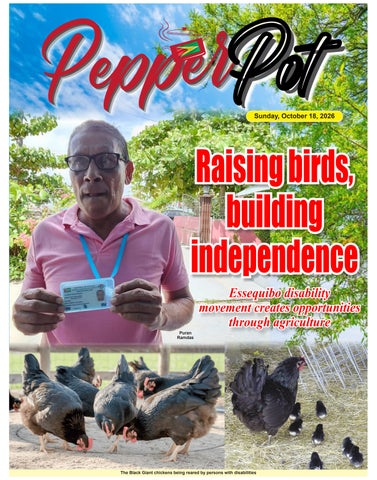
Raising birds, building independence Puran Ramdas
Essequibo disability movement creates opportunities through agriculture
The Black Giant chickens being reared by persons with disabilities
II
A Digital Marketplace
CHRONICLE PEPPERPOT ― Sunday, October 18, 2026
Local business launches website to bring fashion, essentials and suppliers closer to Guyanese shoppers
By Andrea Hendricks FOR Guyanese shoppers, finding fashion, household goods, party supplies, and everyday essentials online is set to become easier. The new option lets customers shop from home while exploring a range of products in one online store. Carib-Zoom Inc., a social commerce business operating since 2019, is preparing to bring its growing brands together in one consolidated e-commerce website. What began during the COVID-19 pandemic as a single business serving women with apparel such as clothes, bags and shoes has
developed into a multi-brand online operation. Speaking with this publication, Customer Service Manager Oniffia Daly said the business added several other brands as its social commerce activity grew extensively over the years. The planned website represents the next step in that progression, moving from separate social-media shopping conversations towards a more central shopping space. That shift does not replace the connection Carib-Zoom built through social platforms. Instead, it gives customers one place to find the brands, view featured products, ask questions and
place orders. The move is intended to make the range easier to navigate while retaining the customer-service approach that has supported the company’s growth. Carib-Zoom Inc. is developing a consolidated e-commerce website to host all of its brands in one place, with the launch set for October 30, 2026. The official website, carib-zoom.com, is already fully live and operational, allowing customers to browse the brands, view featured products and place orders directly as the company tests and troubleshoots issues before the formal launch. On October 30, 2026, customers will be able to
Customer Service Manager Oniffia Daly and her staff
find their favourite shopping store on one consolidated platform: Pieces and Plus Sized - Reloaded for fashion and plus-size apparel, D’Jango Gentleman’s Apparel for men’s clothing and fashion, Destiny’ Clothing Store for general and women’s clothing, Hope Jewellery for jewellery and accessories, Home Essentials for household items and décor, Party Hub / Blast Zone Party Rentals for party supplies and event rentals, and The Office Depot for office supplies and stationery. Together, these brands broaden the choices available to Guyanese customers without requiring them to search through separate online businesses. Fashion shoppers can shop at Pieces and Plus Sized - Reloaded, D’Jango Gentleman’s Apparel, and Destiny’ Clothing Store, while Hope Jewellery adds accessories. Home Essentials, Party Hub / Blast Zone Party Rentals and The Office Depot extend the platform into household, event, office and stationery needs. The website currently lists featured items and new arrivals across several categories connected to everyday shopping. Fashion & Accessories includes Coach Crossbody Bags, Guess 3-Piece Handbags, Mesh Panel Corset Tops and Lace-up Corset
Belts. Parent & Baby Essentials includes Baby Manual Rockers, Play Gym Mats and
Baby Feeding Chairs. Home & Kitchen Appliances TURN TO PAGE VII
Packages being organised for delivery
III
Raising birds, building independence
CHRONICLE PEPPERPOT ― Sunday, October 18, 2026
Essequibo disability movement creates opportunities through agriculture
By Michel Outridge FOR Puran Ramdas, earning a livelihood is essential to inclusion. The retired headmaster is putting this belief into practice on the Essequibo Coast, where members of the South Essequibo Coast Persons with Disability Movement (SECPDM) are raising Black Giant chickens to produce food, generate income, and take a more active role in their economic advancement. Supported by the Guyana Livestock Development Authority (GLDA), the initiative connects that ambition with practical assistance: birds to start poultry ventures, training to build skills, and regular extension visits to help growers sustain their efforts. For participants, it offers a tangible opportunity to turn daily care and commitment into something of value for their households. Ramdas’ determination to expand opportunities for people with disabilities drives the initiative. A visually impaired 66-year-old, he founded the movement in August 2023. The community-based, non-profit group promotes disability awareness, advocates for equal opportunities, and supports members through livelihood initiatives
and social activities. By bringing together people with disabilities, families, and volunteers, it strengthens economic independence and participation in community life. Originally from Wakenaam Island on the Essequibo River, Ramdas has carried his commitment to education into this community advocacy work. His efforts centre on helping others access the support they need to participate more fully in social and economic life. Agriculture has become one practical way of advancing that mission. The poultry project began taking shape in mid2024, when the movement approached GLDA for Black Giant chickens to support members interested in raising birds. The aim was to create manageable opportunities for production and income generation, supported by a fair process for selecting recipients. To advance that proposal, the group compiled a list of interested members, vetted their eligibility against predetermined criteria, and submitted the final list to GLDA. In October 2024, the first recipients received birds and began incorporating them into their poultry-rearing
operations. That initial distribution laid the foundation for an ongoing partnership. According to Ramdas, the movement has since received approximately 2,000 birds in three distributions, with eligible members receiving allocations of 25 birds. As members integrated those birds into their holdings, the project’s purpose became increasingly practical. Black Giant chickens are raised for both meat and
eggs, giving participants opportunities to meet household needs while earning income from sales. These two forms of production let growers use their flocks in ways that fit their circumstances and priorities. Within the group, this productive role is central to economic empowerment. Members care for their birds and develop their ventures, contributing to the broader goal of greater self-sufficiency. In Region Two, ample
Puran Ramdas
market opportunities for both meat and eggs support these efforts, giving members an outlet for their produce and an incentive to sustain their
An interactive session with members of the group
The Black Giant chickens being reared by persons with disabilities
ventures. The growers take pride in supplying high-quality meat and eggs to people in the TURN TO PAGE IX
A sweeter future
IV
CHRONICLE PEPPERPOT ― Sunday, October 18, 2026
The beekeeper behind Nature Life
Romel Rudder’s apiary
By Michel Outridge FROM four hive boxes to a growing enterprise, Berbice beekeeper Romel Rudder is turning his love for bees into a livelihood— and looking ahead to new opportunities for Guyana’s honey industry. Romel Rudder began with four hive boxes and a love for bees. Today, the Belle View, East Bank Berbice resident manages 34 hives, markets honey under his Nature Life brand, and hopes to expand a business that has become an important part of his family’s life. His journey began about 12 years ago with bee trapping. What started as an interest gradually grew until, in 2022, he decided to pursue beekeeping full-time. Speaking with the Pepperpot Magazine, the 34-year-old explained that he had previously earned his living by cultivating cash crops and ground provisions. Beekeeping offered a chance to build on his connection to the land while earning a living from work he enjoyed. He placed his first four boxes among the mangroves near the sea defence and in the backlands among citrus trees. As his experience grew, so did the operation.
He now maintains hives in two locations: near the coastal mangroves and on his farm, where Long John and citrus trees grow. Most of his hives have supers, while about six remain single-box hives. He also uses beeswax to prepare hive foundations for his Africanised bees, a practice he considers effective in supporting honey production. Rudder reported harvesting 128 gallons of honey from four super boxes across two honey-flow seasons. He is keen to keep harvest records as he develops the enterprise and works to increase production. For Nature Life, finding customers has not been a major challenge. According to Rudder, positive feedback and his honey’s reputation have helped build demand, giving him the confidence to plan further expansion. He maintains that his product is entirely authentic and regards customer trust as essential to the business’s success. Behind that business is a family partnership. Rudder, a father of one, credited his wife, Tanya, with helping him manage the demands of beekeeping. Her involvement helps him balance the enterprise with family life, and he ex-
Nature Life brand honey
presses gratitude for her continued support. The Guyana Livestock Development Authority (GLDA) has also supported his progress. The agency supplied him with 10 hive boxes, while extension personnel in his region offered visits, training and technical guidance. Rudder welcomed the
support and believed Guyana’s apiculture industry was developing rapidly with backing from the Government of Guyana, led by President Dr Irfaan Ali. However, as producers look to expand, he wants greater access to modern equipment for extracting, bottling, and packaging honey.
Sweet honeycomb produced by Romel Rudder
Beekeeper Romel Rudder in his apiary in the backlands
He explained that this assistance would simplify preparing honey for sale and help beekeepers increase production. Two developments attracting his attention are the Queen Bee Rearing Facility and the Honey Laboratory. Both facilities form part of the Government of Guyana’s strategic plan to ex-
pand the apiculture industry and will be operated by the GLDA. For Rudder, the facilities address two practical priorities: helping beekeepers build productive colonies and strengthening confidence in the quality of locally produced honey. He believes the Queen TURN TO PAGE XXIII
Honey extracted by beekeeper Romel Rudder
V
Encouragement for Women
CHRONICLE PEPPERPOT ― Sunday, October 18, 2026
One mother’s journey inspires a book for women seeking hope
By Andrea Hendricks WHEN Eartha Donnette Scott prepares to launch her book “When My Voice Has No Echo”, she is doing more than marking a personal milestone. She is turning years of motherhood, grief, faith, and perseverance into a message of encouragement, healing, and hope for women who may carry their struggles in silence. Scott, 36, is a single mother of four from Vergenoegen, East Bank Essequibo. Faith, responsibility, and a determination to build a better future for her family have shaped her journey. “As a mother, I have learned the value of resilience, responsibility and unconditional love,” she said. Her children remain her driving force as she balances motherhood with entrepreneurship and community leadership. She also credits Almighty God with giving her the courage to overcome challenges and remain grounded in her purpose. Scott attended Vergenoegen Nursery and Philadelphia Primary before continuing to Strobil and Zeebury secondary schools. Growing up in less fortunate circumstances taught her the value of perseverance, resilience and determination.
She found a professional outlet for her love of people in nursing, where she worked for four years. The experience deepened her empathy and compassion for people in need of care. “I have encountered a wide range of medical cases that have exercised my patience, inner strength and willingness to make a difference in the lives of others,” she recalled. Although she no longer practises nursing, the profession remains close to her heart, and she hopes to return one day. Leaving nursing was not a decision she made lightly; as a single mother, she had to dedicate more time to raising her children, each with different needs and requiring her guidance and support, particularly with education. Her passion for wellness and creativity later led her to entrepreneurship. As the founder of Yana Establishment, soon to be rebranded as Yana Natural Hair and Skincare, Scott has combined her interest in natural care with her desire to empower others and build something meaningful for herself and her community. She also serves as chairperson of the Vergenoegen Community Development Council, contributing to initiatives that strengthen the community and create
Author, entrepreneur and community leader, Eartha D. Scott
Book cover to be launched
opportunities for collective progress. The role has reinforced her belief that positive change begins when people work together with vision, compassion and purpose. One of the defining experiences of Scott’s life was losing her mother at 17, at a time when she was still discovering herself. She recalled
Yana locally made hair and skincare products on display
that it was difficult to cope with the loss of someone close while trying to determine the direction her life should take as a teenager. Her connection to writing also reaches back to childhood. Scott said she never imagined that she would one day become an author or write a book. Her mother
named her Eartha after Eartha Kitt, the actress and writer she admired. Her mother enjoyed watching Kitt’s movies, owned two of her books, and shared stories about going to the cinema to see her act, though Scott cannot remember the titles. It took Scott years to recognise her own writing ability and the story she had to tell. She believes that if she picked up a pen and notebook, her story had to serve a
purpose—to inspire hope and share lessons from her lived experiences. Her motivation became clearer after she watched a news report about a mother who had attempted to take her own life and that of her baby. The report led her to reflect on the struggles many women, particularly single mothers, face behind closed doors. “It made me realise that TURN TO PAGE VII
Yana Natural Hair and Skincare Products
VI
A story of hope, faith and resilience
CHRONICLE PEPPERPOT ― Sunday, October 18, 2026
Taking a leap in search of a brighter future
By Michel Outridge ROMONA Persaud’s journey into entrepreneurship is a story of faith, family, resilience, loss, opportunity and purpose. She is a country girl from Essequibo and the second of three siblings. She attended Anna Regina Multilateral Secondary School and, at CXC, was proud to be the best graduating student in Food and Nu-
She added that, at the time, she was still young, still searching and trying to figure out who she was and what she wanted her life to become. “Losing one of the most important people in my life while I was still finding my way was incredibly difficult,” she said. Persaud said she will always remember how hard her father worked to achieve
The Weekend Bites signage
trition, an achievement that, years later, became especially meaningful as she ventured into the food business. However, in 2010, Persaud left Essequibo and came to Georgetown in search of greater opportunities. Although she spent many years in the city, Essequibo remains very close to her heart. Persaud is proud of where she came from, and it brings her great joy to see the development taking place there, particularly within the food and service industry. “It is encouraging to see people from home creating businesses, opportunities and experiences of their own. My journey, however, has not always been easy,” she said. Persaud told the Pepperpot Magazine that, in 2012, she experienced one of the most difficult losses of her life—the passing of her father.
what he wanted and, more importantly, what he wanted to provide for his children. Even though he never completed secondary school himself, he made sure that they did. She said he did his best for them in the best way he knew how. His life taught her that your circumstances do not have to determine what you give to the people you love. Persaud noted that her father’s sacrifices and determination became part of the values she carries with her today. As life continued, she pursued further education and eventually began working, gaining experience in accounting, management, customer service, and administration. But she was still trying to figure out what she wanted for her future. Then she started Weekend Bites, a small
business she ran from home to earn income and showcase her culinary skills. Persaud told the Pepperpot Magazine that, while pursuing her tertiary education, she needed a way to generate additional income to help with her tuition. So, she decided to start a small food venture. Her plan was simple: earn extra income, help pay her university expenses, and keep moving forward. However, Weekend Bites began as a very small side hustle, operating only on the second and last Saturday of each month. But what happened next was something she could not have planned. Although she had made a plan to generate the money she needed for university, God provided opportunities for people to bless her financially. Persaud said people came into her life who supported her and helped in ways she hadn’t anticipated, and something beautiful happened. Weekend Bites continued. She added that the need that initially pushed her into entrepreneurship had been met, but the business had become something more. “It became a place where I could be creative, serve people and discover a different side of myself. Looking back, I believe God used what I thought was simply a temporary solution to introduce me to something that could become part of my purpose,” she said. Over time, her vision for Weekend Bites grew, and what started as a business that operated only on weekends is evolving into something much broader. Persaud said that, in June of this year, she made the necessary but difficult decision to leave her job and pursue her business full-time. Today, Weekend Bites operates from her home at 70 Hadfield Street, Lodge, and she is working to build a brand centred on food, creativity, service and experiences.
Romona Persaud, owner of Weekend Bites
T h e b u s i n e s s o ff e r s weekly lunches on Mondays, Wednesdays and Fridays, as well as doing small catering jobs. She said her phrase, “Global Flavours, Guyanese Soul,” reflects the direction she would like to take the business. Persaud stated that Guyanese food will always be part of her identity, but she also wants Weekend Bites to explore flavours and cuisines from around the world. She explained that “Service Beyond Business”, her desire to serve others, is also reflected in her involvement with the Rotaract Club of Georgetown Central, where she currently serves as Assistant Director of the Professional Development Committee. Persaud added that join-
ing Rotaract was a natural fit for her because of Rotary’s seven Areas of Focus: peacebuilding and conflict prevention; disease prevention and treatment; water, sanitation and hygiene; maternal and child health; basic education and literacy; community economic development; and the environment. She noted that, of those areas, community development and involvement resonate most strongly with her, and she believes that growth is most meaningful when it extends beyond ourselves and creates opportunities for other people. “My involvement with Rotaract has given me another avenue through which I can contribute, develop professionally and work alongside others who are passionate about making a
difference,” she said. Persaud said it also aligns with the kind of entrepreneur she wants to become. She doesn’t want Weekend Bites to be successful only because it sells good food. She said she would like the business to eventually have a positive impact on the community as well. Persaud wants to create opportunities, support community initiatives, and use what she has built to give back, and she is grateful she didn’t have to walk the journey alone. She credits her success to supportive family and wonderful friends who have encouraged her through different seasons of her life. Persaud said their support, prayers, encouragement and belief in her have meant TURN TO PAGE XIV
CHRONICLE PEPPERPOT ― Sunday, October 18, 2026
A Digital Marketplace
includes Sokany Coffee Makers and Sokany 3-in-1 Breakfast Makers, while School & Stationery Supplies includes Crayola 10-Pack Markers and Toddler Backpack Bags. These examples show how the consolidated shopping space can serve different moments in a household’s routine, from choosing clothing and accessories to preparing breakfast, caring for a baby or getting school supplies. Customers can browse featured items and new arrivals in one place, then place orders through the platform’s secure, easy-to-use shopping experience. For the formal website launch, Daly said, “For the website launch, there will be deals available, and long-time customers will enjoy special discounts.” The promotions are intended to welcome shoppers to the new platform while rewarding long-time customers. Recurring offers and package deals will also help make online shopping more affordable on a regular basis. Like many online businesses, Carib-Zoom has faced reluctance from some people to transact business online. The company has responded through professional customer service, reassurance that advertised items are available for purchase, secure payment, and delivery or pick-up options. These measures give
customers more information and flexibility as they decide how to complete an order. Daly said the new website will make online transactions easier and more secure. “We usually have sales; there will be deals every month with discounted prices, especially during the holidays, as we ensure affordability for customers.” Beyond special holiday offers, shoppers can also benefit from package deals, which make shopping easier and more affordable. The combination of regular discounts, seasonal promotions and grouped purchases supports the company’s stated aim of keeping its products accessible to customers. Carib-Zoom aims to build lasting customer relationships through service that sets it apart from other e-commerce businesses. Its focus on customer satisfaction is intended to develop the trust and confidence that encourage shoppers to return, especially as the company continues to guide customers who may be uncertain about online transactions. Team members are regularly trained to handle difficulties throughout the ordering process. The company representative told this publication, “Regular customer training has helped bridge gaps with shoppers and improve the overall shop-
Customer service representatives supporting customers through their ordering process
ping experience.” Customer service representatives respond to messages and queries about items and orders, helping customers from the moment they enquire until the order is complete. That service also supports the practical side of online shopping. By confirming that advertised items are available, explaining payment options, and assisting with delivery or pick-up, the company aims to make the process clearer for customers. The approach reflects Car-
ib-Zoom’s effort to combine the convenience of digital shopping with personal support. Carib-Zoom has also supported other entrepreneurs by partnering with them to utilise its courier and delivery services. Those partnerships help businesses reach customers beyond their immediate communities, extending the practical benefits of the company’s operations beyond the brands listed on the website. The services extend to Linden, New Am-
sterdam, Charity, and Parika, supporting product delivery to customers across several locations. Looking ahead, the company is considering a physical storefront location. Such a location would give customers another way to access its products and services, complementing the online website rather than replacing it. It would also reflect the company’s broader effort to stay accessible while developing new ways to serve shoppers and local businesses.
another woman feel seen, understood and less alone?” “After carefully considering the decision and consulting with others, I finally told myself, ‘You know what? Let me do it. Let me write,’” she further added. As she prepares to launch the book, Scott said she is grateful for the courage to take that step. “My hope is that readers will look beyond the pain in my story and see a woman of dignity, resilience, faith and determination—a woman who faced difficult circumstances but refused to give up.”
She wants the book to remind every woman that pain does not diminish her worth, struggles do not define her future, and her story can still inspire someone else. For Scott, becoming an author is more than a personal achievement; it is an opportunity to turn her experiences into encouragement, healing and hope for others. Balancing motherhood, entrepreneurship, and community leadership hasn’t always been easy. “Honestly, balancing all four responsibilities was exhausting, but by the grace of God, I managed to overcome those
challenges,” she said. Her faith continues to guide her. Each morning, she commits her plans to God and approaches the day one step at a time. She has learned that balance doesn’t mean doing everything perfectly; it means making the best decisions with the time and strength she has. “As long as there is life, there is hope,” she said. Scott’s ambitions extend beyond the book. Since her days as a cosmetologist, she has dreamed of opening a salon and spa. She is now working towards launching “Glona” Salon and Spa, with
the tagline “Sculpt, Glow and Renew.” Academically, she hopes to earn a bachelor’s degree in Business Administration while strengthening her entrepreneurial skills through professional development and business training. She is also working towards owning her own home and creating beautiful memories through travel and quality time with her children. Ultimately, Scott wants to build a legacy for her children, keep growing as a woman, and inspire others to believe their dreams remain possible, no mat-
FROM PAGE II
D a l y ’s a d v i c e t o like-minded entrepreneurs is simple: start small and grow as you work. “Social commerce is a rapidly evolving field,” Daly noted, “and staying connected with our customers through various platforms has been key to our success, but we’re happy to keep growing and expanding.” Carib-Zoom Inc. continues to innovate and expand its offerings, with convenience and variety at the centre of its model. Its commitment to community involvement and support for local businesses reflects the growing connection between local enterprise and digital commerce. Through its brands, customer service, and courier partnership, the company is building an operation that links shoppers, entrepreneurs, and communities. With the consolidated platform launch set for October 30, 2026, Carib-Zoom is keeping customers at the heart of its next chapter through promotions, user-friendly technology, and community partnerships designed to enhance the shopping experience for everyone. The website launch marks another step in the company’s evolution from a social-commerce business to a broader digital marketplace. Photo credits: Carib-Zoom Inc.
Encouragement for...
every woman has a story, and many are carrying pain that the world may never see. Nobody gives us a manual on how to be a mother, yet society often expects us to be strong, to keep going and to figure everything out, even when we are struggling ourselves,” she told this publication. The report brought Scott back to her own experiences. She began thinking about the lessons she learned, the challenges she overcame, and the emotions she carried throughout her journey. Then she asked herself: “What if sharing my story could help
VII
FROM PAGE V
ter where they begin. She considers raising her four children while navigating life’s challenges and pursuing her dreams her greatest achievement. Building her business, serving as a community leader, and preparing to become an author are milestones she is proud of. “To me, success is not just about what I accomplish, but the example I set for my children and the inspiration I can offer others,” she told Pepperpot Magazine. Photo credits: Eartha Scott
VIII
CHRONICLE PEPPERPOT ― Sunday, October 18, 2026
The Prospect of Sacrifices
WORLD leaders and ordinary people constantly worry that not everyone on our planet has access to the necessities of survival. Many lack access to food, water, or shelter. Many lack access to healthcare. For these people, the very diseases that are nothing more than a faint glimmer in
the corners of our minds are real monsters that they battle every day. For these people, going to school is a dream as distant as the stars or the moon. We try our best to include the struggles of these people in our discussions of how to change the world. We might even feel empathy or
sympathy for them. Yet we eventually forget them. The desire to make a difference in others’ lives does not always translate into an action. What if, however, you woke up one day and found you could make a difference? How much would you be willing to sacrifice to help another person?
Imagine an extraordinary scheme where every individual could put all their daily earnings into one place. Then, once the money was collected, it would be separated and distributed equally to everyone. If you chose to participate, you would effectively ensure that no one in the world would go hungry or be unable to afford medical care, including yourself. It would also mean that you would have to give up some of your own comforts. You would have enough money to meet your needs and most of your wants, but no matter how hard you worked, you would never be able to indulge in some of the more complex materialistic pleasures, as you would not be able to afford them. Depending on how you view it, such an opportunity could become a nightmare, or it could be your dream. The factor that decides this is whether you would immediately benefit from such a scheme or whether you would stand to lose from it.
Every human life is closely intertwined with others. No matter how far apart we are, our actions and beliefs can shape what the world looks like for someone else. Whether it is a policymaker changing what a human being’s rights should include, or a vocal idealist choosing to speak up for someone else, a simple decision or quiet belief can change whether someone lives or dies. It can change whether they are housed, fed, or educated, and what the rest of their life will look like. Yet, strangely, the “power” of making these decisions and shaping the world often falls into the hands of those who are already powerful, that is, those who have very little to lose if those decisions are made poorly. How can we trust people who have never gone a single day without food to solve world hunger? How can we trust people who have the best doctors at their disposal to allocate medical resources to communities where neces-
sities are scarce? How can we really hold these people accountable if the truth is that they are more powerful than we are? We may never find answers to these questions. However, there is a way to ensure that the generation that comes after us never has a need to ask them. A time will come when members of today’s younger generation step into roles where they must make seemingly impossible choices. When this occurs, they will have to battle two giants: indifference and the discomfort of sacrifice. In the future, as we become policymakers and leaders, or do any job we choose, we must ask ourselves whether our choices will truly have a positive effect on those around us. We must ask ourselves whether our discomfort with making sacrifices or our indifference to others is an obstacle to making our world a better place. If so, we must act quickly to remedy it.
CHRONICLE PEPPERPOT ― Sunday, October 18, 2026
Raising birds, building...
region, recognising that their work supports local food supplies as well as their own households. Sustaining that work, however, requires more than an initial allocation of birds. Some growers face physical challenges in carrying out poultry-rearing tasks, so ongoing guidance and practical support are especially valuable. GLDA’s Region Two livestock extension team, led by Ms Lashon Thomas, provides that continuity through regular visits and training. Its engagement helps members build knowledge, address challenges, and maintain focus on flock care as the project progresses. This ongoing support builds on the work of former GLDA Region Two extension officer, Ms Paula Daniels, who worked with the movement during its first phase. Ramdas recalled that she visited recipients to assess their progress and commended their dedication to their poultry ventures. “We are grateful for the support we receive from the Guyana Livestock Development Authority, especially Dr Walrond, the CEO, and the Region 2 GLDA Extension team headed by Ms Thomas, Region 2 Regional Coordinator,” he said. That gratitude reflects a relationship that extends beyond distributing agricultural inputs. Throughout the project, members have had access to technical personnel who have guided their efforts and supported their development as poultry growers. With this assistance, the initiative remains vibrant despite the physical challenges some participants face. Their continued involvement underscores why agricultural support must be paired with opportunities to learn, seek advice, and build confidence through experience. That participation also benefits more than individual
households. Ramdas said members contribute birds to the movement’s monthly luncheon, allowing the products of their work to sustain a shared community activity. In this way, poultry production has become part of a broader network of mutual support. Members raise birds to meet their own economic needs while also contributing to gatherings that bring the group together and strengthen its connections. Those gatherings include members aged 16 to 71, with women comprising the majority. Held at Ramdas’ residence on the last Saturday of each month, the meetings provide a regular space for participation, companionship, and the movement’s ongoing work. Maintaining that network is a collective effort. Ramdas’ wife, Ms Angela Singh, and his sons, Mr Juste Ramdas and Mr Vasquez Ramdas, support him. Neighbours, friends, and members of the Vilvoorden Women’s Group also volunteer their time, especially during the monthly meetings. Their contributions help connect the movement’s advocacy to the everyday support that makes participation possible. Alongside GLDA’s extension services, this community involvement gives members a foundation to keep developing their poultry activities. For Ramdas, the project gives practical meaning to the cause he champions. Members care for their flocks, produce meat and eggs, earn income, and contribute food to their monthly gatherings. Each activity affirms the movement’s purpose: creating opportunities for people with disabilities to use their abilities and shape their futures. On the Essequibo Coast, that work takes root in agriculture, supported by a partnership that places members’ participation at its centre.
IX FROM PAGE III
X
CHRONICLE PEPPERPOT ― Sunday, October 18, 2026
HOW MANY OF US COULD NOT ESCAPE THE WEBS AND MAGICAL FALLOUTS OF THE ADULT WORLD OF YESTERYEAR...
HOW many of us could not escape the webs and magical fallouts of the adult world of yesteryear, where pretentions and broken creeds evolved to replace a forbidden marketplace, where the early years of references and faith,
where prayers and doctrines of principles were abandoned or exchanged for a new altar of spirits, of god and spirits, only to learn that they were illusions, except for a few. From where I stood for many years, schoolmates
and relatives were thrown into adulthood, possibly from trained future careers. Based on a suitor’s gift, whom we, without a voice, merely watched, at that senior regular, with gifts of furnishings the home had none of that sort; thus, it was a trade.
And many a nice girl of our age whom we admired fell into such, or so we believed. Many of the then street bad boys were sent into the Hades of our time to battle the laws, by desperate mamas, past the catch ah-thing display time, and
by a racist age. I could remember visiting an elder school friend. His mom came to the door, looked at me and, in recognition, turned to him, pointing to the pair of Clarks shoes I wore, and told him, “look at Barry, duh’s a new Clarks,
stop talking, talking and go pon Water Street and see what yuh get …” This was the gone days of pre-Independence Georgetown, of other times and numerous hardships and biases. Welcome to our eras of talking culture.
CHRONICLE PEPPERPOT ― Sunday, October 18, 2026
XI
XII
CHRONICLE PEPPERPOT ― Sunday, October 18, 2026
WILD FLOWERS ON AN OCTOBER MORNING
CHRIS parked the Range Rover at the side of the main road on the East Coast and stepped out, pulling his cap low so no one would recognise him. He stood there for a little while, looking at the place he had come to visit. It was quiet and secluded, and after a
deep breath, he walked a little way to a narrow lane the villagers called Old Road. It led through a small village where he had lived as a little boy. “This road I can never forget,” he said to himself. “My footprints are probably embedded in the dirt.”
He had walked it as a little boy, going to school in worn boots and wrinkled uniforms, and he had held his drunken father’s hand to guide him home. “The suffering of those days,” he said, a wry smile on his face. He walked farther and
saw the old house he had lived in still standing, but neglected. Nothing much had changed in the little village, nestled between silk cotton, tamarind and genip trees, a place time seemed to have forgotten. He left at fourteen to join a cricket academy in the city, sponsored by an overseas sports organisation. He had been spotted at school competitions for his batting talent, and that opportunity reshaped his life. He visited home only briefly until his first call-up at the national level, and from then on, he never looked back. But he had promised one person to return one day after becoming successful and established, and he never forgot that promise. It was a kind old villager, Aunty Sheila. She had a small fireside under the tamarind tree, not far from her house, and every
morning she cooked delicious local food for customers in and out of the village. Chris passed her every morning on his way to school, and because his home always had too little food, his stomach would rumble at the aroma of Aunty Sheila’s cooking. A few times he had paused, wanting something to eat, but didn’t ask. Then, one morning, she called him and asked, “Yuh hungry, beta?” He had nodded. “Yuh doan get enough food at home?” He had shaken his head, and the old lady had clicked her tongue sympathetically. “Yuh need good food tuh grow and become a big bai.” She told him to sit on one of the tree stumps, wrapped fried bora with shrimps, potato, and tomatoes in a roti, and gave it to him with a tin cup of lime tea. Food, for Chris, had never tasted as good as it did that
morning. It stayed etched in his memory, and even more so because, that morning, wildflowers bloomed riotously all around, making it a good day. From that day on, she gave him food regularly, and his strength and agility improved enough for him to be selected for cricket matches and not be ignored for poor performances. It was the kind act of an old lady that helped him to perfect his game, and that talent opened doors of opportunity for him. Today, that poor boy had become rich and popular, but the one person he wanted to thank was not there. The fireside under the tamarind tree was gone, and her house had grown old and desperately needed repairs. “What happened here?” He was puzzled because he had been sending money regularly to care for her TURN TO PAGE XXIV
CHRONICLE PEPPERPOT ― Sunday, October 18, 2026
XIII
XIV
A story of hope...
CHRONICLE PEPPERPOT ― Sunday, October 18, 2026
FROM PAGE VI
Some of the dishes available at Weekend Bites
more than they may realise. She pointed out that earlier this year, one particular Bible verse came to her when she needed it: “Now unto him that is able to do exceedingly abundantly above all that we ask or think, according to the power that worketh in us” (Ephesians 3:20, KJV). She added that verse has become deeply personal to her because, looking back on her life, she sees that exceeding abundance in so many places. She sees it in her personal life and her education. “I have seen it through the people God has placed around me. And I have seen it through Weekend Bites,” she said. Persaud noted that she is still learning, still growing,
and still figuring out exactly what Weekend Bites will become, but that may be part of the journey, and she believes the best is still ahead. Most importantly, she hopes her journey encourages someone else who may be sitting on an idea, waiting for the “perfect” time, or wondering if they have what it takes. Persaud encouraged people to start anyway, even if they don’t have all the resources, don’t have all the answers, and may even be afraid. She said sometimes the small thing you begin today can become the foundation for something much bigger tomorrow.
XV
CHRONICLE PEPPERPOT ― Sunday, October 18, 2026
It Hurts: The Disappearers by Marlon James
AT nearly 600 pages, Marlon James’s new novel, The Disappearers (Riverhead, $27.99), matches the ambition of its project. Comparable in scale to his Booker Prize–winning A Brief History of Seven Killings, it is another maximalist novel, crowded with characters and animated by a genuine feat of imaginative astonishment. James’s novels sprawl, but their sprawl is purposeful, their expansiveness grounded in an emotional resonance closely tied to lived experience. The Disappearers casts aside conventional proprieties in favour of plain talk and in-your-face truths, presenting a reality so pungent it feels almost tactile. James is a fiercely brave writer, akin to Junot Díaz in certain salient respects. In both writers, one rarely senses an author-editor standing over the prose, warning, “I shouldn’t say that,” or “This might be too vulgar, too honest, too whatever.” What we get instead is something closer to an unexpurgated reality, making James’s novels surprising not merely for what they depict but for the dexterity with which they depict it. His storytelling has a rawness, but it is controlled, one that continually tests the limits of what literary fiction can accommodate. The story goes on and on, and the accumulation of words gradually brings a world into being in the fullness of its then and now. The Disappearers also has a peculiar prescience, an encompassing vision of past and present that feels uncannily alive. The signposts of its period are everywhere: music, television, novels, fashions, philosophies—the cultural signatures that identify a particular time. In his recent novels, James seems
to be arguing for an everything-in-it kind of fiction, a novel in which everything really is included because his gaze is so varied and his attention so fine-grained. James does not write slice-oflife novels; he writes wholelife novels. The Disappearers belongs to a larger undertaking: James’s Dark Star trilogy, planned to comprise three nearly 500-page novels, two of which are complete, telling the same story from different perspectives. A Brief History of Seven Killings, despite its title, is anything but brief, unfolding across years and through multiple points of view. The Disappearers employs a similar technique to achieve a comparable sense of grandeur. Its maximalism takes the form of journals, letters, interviews, gossip, recollections, and other forms of testimony. The result can be uproariously funny and profoundly sad, sometimes within the same stretch of prose. Its pathos is persistent; the reader’s emotions are continually implicated. There is a great deal of suffering here. James’s most astonishing feats often arise through literary surprise—not the gimmicky surprise of a conventional whodunit but the deeper kind associated with poetry, when meaning suddenly rearranges itself in the mind. In The Disappearers, such moments emerge from colliding perspectives, the exposure of ugly assumptions, and the sudden recognition of how much a seemingly ordinary life can contain. Set in Jamaica in 1988, the novel centres on a brutal attack: a group of homophobes violently interrupts eight gay men rehearsing a play, leaving several maimed and one dead. In a master-
stroke, James enters the attackers’ minds, exposing their repulsive rationalisations. He gives their bigotry an explanation without confusing explanation with justification, revealing a
worldview in which violence has become an almost automatic expression of hatred. Their cruelty stands in sharp, tragic contrast to the warmth, humor, and ordinary intimacy of the gay men’s creative
collaboration. James renders the villains’ words in Jamaican patois, whose verbal immediacy situates the speakers firmly within their social and cultural milieu. The passages, from
the novel’s second section, Blackjacks, are horrifying not simply because of their explicit calls for murder but because of the casualness with which hatred becomes a TURN TO PAGE XVIII
XVI
CHRONICLE PEPPERPOT ― Sunday, October 18, 2026
Meno’s Paradox: How Can We Search for What We Do Not Know?
IMAGINE walking into a library to find a book whose title you have forgotten, whose author you cannot remember, and whose subject you cannot quite describe. You wander between the shelves, pick up a few books, reject several others, and eventually recognise the one you came for. Now imagine someone stopping you halfway through and asking a rather irritating question: how will you recognise the book if you have absolutely no idea what you are looking for? Welcome to Meno’s Paradox, one of philosophy’s oldest intellectual headaches, courtesy of Plato and his famously inquisitive conversational partner, Socrates. The problem is deceptively simple, which is precisely what makes it so troublesome. If you already know what you are looking for, your search
seems unnecessary. If you have absolutely no knowledge of it, how can you identify the answer when it appears? Either way, inquiry seems to have hit a wall. Yet humanity has spent centuries searching for answers, conducting experiments, developing theories, and asking questions whose answers were previously unknown. Clearly, something is happening here. Either we have all been engaged in a magnificent exercise in futility, or Meno’s argument contains a flaw worth examining. The discussion appears in Plato’s Meno, a philosophical dialogue rather than a conventional play, although its characters and dramatic exchanges certainly give it theatrical appeal. Meno asks Socrates whether virtue can be taught, whether it comes naturally, or whether it arrives through some other
means. Socrates insists they must first establish what virtue is before determining how to acquire it. Meno, who initially seems confident discussing virtue, struggles to provide a satisfactory definition. Socrates’ questioning gradually exposes the weakness beneath that confidence. Meno compares him to a torpedo fish that numbs anyone who touches it, because Socrates has left him feeling intellectually paralysed. Imagine arriving at a conversation convinced of your expertise and leaving unable to explain the subject you came to discuss. Socrates had a gift for making intellectual confidence look rather poorly dressed. Then Meno introduces his challenge. How, he asks, can anyone search for something they do not know? If the person already knows
it, searching serves no purpose. If the person does not know it, they cannot identify the object of the search or recognise the correct answer when they find it. Socrates restates the dilemma, and the problem becomes known as Meno’s Paradox. The argument has considerable bite because it challenges something we ordinarily take for granted. We assume that questions lead to answers and that learning moves us from ignorance towards understanding. Meno asks how that movement is possible in the first place. The first response is to question Meno’s assumption that knowledge operates in two convenient categories: complete knowledge and complete ignorance. But human understanding rarely behaves so tidily. A person learning a language may understand its
grammar without knowing every word. A medical student may recognise symptoms without knowing their cause. An astronomer may observe an unusual pattern without knowing what produced it. In each case, the investigator possesses enough information to begin searching while lacking the knowledge needed to finish. This is one of the strongest objections to Meno’s argument. Inquiry does not require complete ignorance or complete knowledge. It requires a starting point, however modest, from which further understanding becomes possible. Philosophers discussing the paradox have explored precisely the difference between knowing enough to begin an investigation and knowing enough to answer the question conclusively. Consider a detective investigating a theft. The detective may know that a valuable object has disappeared, that a particular door was locked, and that someone entered the building shortly before the disappearance. Those facts provide a framework for investigation. The detective does not yet know who took the object, but that missing answer does not erase everything already known. Meno’s dilemma becomes less convincing once we recognise that partial knowledge can guide a search. We can identify possibilities, eliminate contradictions, compare evidence and revise our expectations. Learning is often a gradual narrowing of uncertainty rather than a miraculous leap from complete ignorance to perfect understanding. However, Meno deserves more credit than a simple dismissal would allow. His challenge raises a second question: even if we can search, how do we know that our conclusion is correct? A detective can develop a
persuasive theory and still accuse the wrong person. A scientist can construct an elegant explanation that later evidence overturns. It means, then, that recognition itself requires examination. Socrates responds by introducing the theory of recollection, or anamnesis. According to his account, what we call learning is, in an important sense, recovering knowledge the soul already possessed. He argues that the soul is immortal and has en countered truths beyond its present earthly existence. Through questioning, those truths can be brought back into awareness. Socrates then offers a demonstration involving one of Meno’s enslaved attendants, whom he questions about geometry. He draws a square and asks the boy questions about its dimensions. The task is to determine how to construct a square with twice the area of the original square. The boy initially assumes that doubling the side length will double the area. Through further questions, Socrates exposes the mistake. The boy then becomes perplexed, recognising that his first answer was wrong. Eventually, guided through the geometric relationships, he arrives at the correct solution involving the original square’s diagonal. Socrates interprets this exchange as evidence that questioning can awaken understanding without simply transferring information from one mind to another. The boy progresses from confident error to acknowledged ignorance, then towards a correct answer. This progression is interesting because intellectual growth often begins when we discover that our existing explanation cannot survive scrutiny. Yet the demonstration leaves room for disagreement. Does it establish that TURN TO PAGE XVII
CHRONICLE PEPPERPOT ― Sunday, October 18, 2026
Meno’s Paradox: How Can We...
the boy possessed mathematical knowledge before birth, or does it show that a person can reason towards an answer through carefully structured questions? These are different claims, and the geometry alone cannot establish the more extraordinary one. A modern reader can appreciate Socrates’ teaching method without accepting his metaphysical explanation. The demonstration illustrates the power of guided reasoning, but it does not independently prove that knowledge survives from a previous existence. Socrates gives us an intriguing account of learning; whether we accept his theory of recollection remains another matter entirely. Modern psychology offers useful ways to examine the problem without requiring us to settle the question of an immortal soul. Learning depends partly on prior knowledge, attention, memory, reasoning and the ability to recognise relationships between pieces of information. A learner can make progress when new evidence connects with existing concepts, even when those concepts are incomplete. This resembles the practical strength of Socrates’ questioning: the learner is guided toward previously overlooked relationships. Research also complicates the assumption that prior knowledge always improves learning. A 2025 review of sixteen mechanisms through which prior knowledge affects learning found that its influence can be positive or negative, depending on the learner, the subject and the instructional conditions. Existing knowledge can help people organise information and understand new material, but it can also interfere when familiar assumptions are incorrect or poorly suited to the task. This is where the paradox becomes particularly relevant to everyday thinking. Sometimes we struggle because we lack information. At other times, we struggle because we already believe we have the answer. The second difficulty can be more stubborn. An empty glass has room for water; a glass that someone insists is already full presents a different problem. Psychologists also study metacognition, which concerns our ability to monitor and evaluate our own thinking. When learners recognise uncertainty, identify gaps in their understanding and assess whether their conclusions are justified, they can adjust their strategies. Socrates’ interrogation of the
geometry student illustrates a related process: the boy becomes more capable of inquiry after recognising the limits of his initial answer. Still, we should distinguish resemblance from proof. Modern research on learning and metacognition does not establish Plato’s theory of recollection. It helps explain how people can make progress from incomplete understanding through reasoning, feedback and revision. That provides a psychological response to the paradox without requiring us to accept its ancient metaphysical solution. Science, of course, offers another powerful challenge to Meno’s dilemma. Scientific investigation frequently begins with an observation that researchers cannot yet explain. They formulate hypotheses, design tests, gather evidence and revise their conclusions. The answer is unknown at the beginning, but the question is often precise enough to guide the investigation. A researcher studying an unfamiliar disease may know its symptoms, its pattern of transmission or the conditions under which it appears. Those observations create boundaries around the problem. Experiments can then eliminate some explanations and strengthen others. Scientific inquiry also demonstrates why recognition cannot depend entirely on knowing the final answer in advance. Researchers use independent measurements, replication, statistical analysis and competing hypotheses to evaluate whether an explanation fits the evidence. Their confidence rests on the quality of the investigation rather than on a mysterious feeling that they have finally found what they were seeking. Nevertheless, Meno’s concern about recognition remains important. Evidence can be ambiguous, instruments can malfunction, and investigators can favour results that support their preferred theories. Scientists therefore need methods that expose conclusions to criticism. A convincing explanation must survive serious attempts to disprove it. Another complication: sometimes we do not even know which question deserves to be asked. Discoveries can change how a problem is framed, revealing possibilities researchers had previously overlooked. Inquiry may therefore involve discovering both the answer and the more useful question. Meno’s paradox does not prevent this process. Instead, it reminds us to
examine how we move from uncertainty to justified belief. Now, does this mean that the paradox finally collapses? Well, not entirely. Philosophers disagree about how best to interpret the problem and whether Socrates’ responses fully resolve it. Some argue that the paradox relies on an overly restrictive account of knowledge and inquiry. Others argue the difficulty runs greater: finding a plausible answer is different from knowing it is correct. One influential response is that inquiry can begin with true beliefs or partial understanding that fall short of knowledge. Socrates’ geometric demonstration can be read this way: questioning guides the student toward a correct conclusion by exposing mistakes and developing the reasoning needed to support the answer. Critics of the recollection account can therefore accept the value of Socratic questioning while rejecting the claim that the boy’s mathematical understanding must have existed in a previous life. A teaching method may be effective even when its philosophical explanation remains unproven. Other scholars argue that the paradox should be understood within the dialogue’s wider investigation into virtue and the difficulty of defining it. Meno is not merely asking how anyone can discover a missing fact. He is challenging Socrates’ demanding standards for genuine knowledge: if we cannot define virtue adequately, how can we claim to understand it? This interpretation makes the exchange even more interesting because the problem is not simply whether we can discover answers. It is whether we can distinguish genuine understanding from the confident repetition of familiar opinions. The most defensible conclusion is that Meno identifies a real difficulty but draws too sweeping a conclusion from it. Ignorance does not make inquiry impossible. It makes inquiry necessary. Yet the ability to investigate does not guarantee that every question will receive a definitive answer, or that every apparent discovery will withstand scrutiny. Meno’s Paradox remains relevant even today because it exposes a tension at the heart of intellectual life. We need some understanding to begin a search, but we also need the humility to recognise how much remains unknown. We need hypotheses to guide investigation, but we must allow evidence to change them. We need confidence enough to ask questions and scepticism enough to examine
the answers. Socrates’ greatest contribution may lie in his willingness to make ignorance visible. The geometric student makes progress when he stops mistaking an untested assumption for knowledge. This is a valuable lesson for classrooms, laboratories, public debate and the private arguments we conduct with ourselves. The paradox also warns us against confusing familiarity with comprehension. We can repeat a definition, quote a philosopher or recite a scientific explanation without fully understanding what it means. Sometimes the most productive question reveals the weakness in an answer we have carried around for years. Meno’s Paradox - The Search for Truth “Meno, tell me, can virtue be taught? Is goodness inherited, prac-
ticed, or sought? Does wisdom awaken through lessons we learn, Or dwell in the soul till we make it return?” “But how can I seek what I cannot define? How know what is missing before it is mine? If truth is unknown, how shall I recognize The thing I pursue when it stands before my eyes?”
Socrates smiled at the trap in the quest, Where knowing and seeking put reason to test; For how can the mind find its way through the night When it cannot distinguish the wrong from the right? He questioned a boy till the answers appeared, And errors dissolved as new insight drew near; For sometimes a question unlocks what we know,
XVII FROM PAGE XVI
And learning reveals what our minds can outgrow. Yet knowing the good and doing it well Are two different stories that time has to tell; For virtue demands more than facts we recite, It asks us to practice what we know to be right. Perhaps wisdom begins when we question our ground, When pride loses certainty, truth can be found; For minds that admit they have more to explore Can open themselves to a world beyond the door. So Meno’s old puzzle still calls us to see That seeking is part of who we’re meant to be; For how can we grow if we claim to know all, Or rise into wisdom without doubt’s first call? Romella Dasratt
XVIII
It Hurts: The Disappearers...
CHRONICLE PEPPERPOT ― Sunday, October 18, 2026 FROM PAGE XV
moral imperative. James allows us to inhabit the attackers’ rationalisations without granting those rationalisations any moral legitimacy. Their reasoning is disturbing, irrational, and ultimately empty: violence reduced to gay bashing, enmity without meaningful justification. The language itself becomes a weapon, its relentless repetition mimicking the machinery of persecution. The brutality of the attack is all the more devastating because of what precedes it: the disagreements, humorous banter, vulgarity, profanity, and ordinary intimacy of men working together on a theatrical production. James renders these
interactions wonderfully, capturing the recognisable pleasures and frictions of creative collaboration. For the most part, the gatherings are joyous. Then, with startling suddenness and casual brutality, everything is destroyed. One man is killed; others are maimed; all are changed. The conceit that gives the novel its title operates on several levels. Some characters disappear from the scene; some disappear into the dust. Others disappear into new versions of themselves, shedding their former identities “like a snake,” as one character puts it. They disappear into performative manhood, into obscurity, and into the roles
demanded by a world violently antagonistic to their existence. Disappearance becomes not merely an event but a strategy for survival, a means of escaping persecution even as it exacts a terrible psychological cost. One of the dominant perspectives in the opening chapters belongs to Porteus, a middle-class, mixed-race gay Jamaican man. His journal entries provide an intimate record of Jamaican life in the 1980s, rendered with poignant specificity. Young and privileged in certain respects, Porteus is perhaps naïve, especially in comparison with the older, more experienced men around him. His position establishes a tension be-
tween innocence and knowledge, between the world he imagines himself to inhabit and the world he is gradually forced to understand. His journal is both a record of personal discovery and a window onto a society whose violent and irrational antagonism towards gays is epithelial. A n o t h e r m a j o r p e rspective belongs to Jordan Brown, one of the novel’s most disturbing characters: a vengeful, volatile survivor of the attack whose story is conveyed through interviews. His sections supply some of the book’s thriller-like momentum, while also complicating any simple distinction between victimhood and the capacity
for violence. The mature voice of Havelock Titus, another survivor, offers a more somber and seasoned perspective. A learned man and Oxford alumnus who lived in England for many years, Havelock is compassionate, empathetic, and almost weary of the realities he has endured. His brushes with death lend his character a poignant authenticity. Through him, the novel acquires a historical consciousness that extends beyond the immediate violence of its plot. The Disappearers is not an easy read. It is a brutal book, full of violence that would be easier to tolerate if it possessed the exaggerated unreality of an action movie, where a hero can kill a hundred men without our registering their suffering. Here, suffering is impossible to dismiss. James brings it close, refusing the reader the comfort of distance. This is violence in close-up, violence that discomforts and disturbs. There is also graphic sex, rendered without much interest in shielding the reader from discomfort. The novel is challenging not only because of its subject matter but also because of its fragmentary structure. James moves among survivors’ perspectives and shifts continually among forms: interviews, letters, journal entries, recollections, gossip, and other modes of testimony. These shifts can be disorienting, but they are central to the book’s method. Its extravagance is also its aesthetic principle: a refusal to limit itself and a determination to engage with as much of a life, and a historical moment, as possible. No single perspective can contain the whole, and no single narrative form can do justice to the multiplicity of experience. The novel’s structure conforms to this prime directive. That richness suggests both profundity and the sort of literariness often associated with postmodern fiction. Yet richness has its costs. The accumulation can be difficult to digest; at times, it seems designed to overwhelm. The novel can haunt and even terrorise its reader. James’s book does precisely this: it unsettles you, so that the pleasure of reading comes inseparably bound up
with a sense of disturbance. The novel sticks with you, not always comfortably. It belongs in the company of works such as Samuel R. Delany’s The Mad Man, Cormac McCarthy’s Blood Meridian, Toni Morrison’s Beloved, and Gabriel García Márquez’s The Autumn of the Patriarch: novels that make us think while also disturbing us, whose effects do not end when the reading does.Ultimately, though, the characters matter most. Jordan Brown, the bold and vengeful survivor, remains consistently compelling. His actions give the novel much of its thriller-like momentum, but Havelock Titus provides its deepest wisdom. A patient dancer and theatre director who has survived some of the world’s worst, Havelock embodies memory, endurance, and the knowledge that comes from living through history rather than encountering it secondhand. Through him, James moves beyond the immediate drama of violence to a broader meditation on what it means to survive, remember, and keep living in the aftermath of catastrophe. As he did in A Brief History of Seven Killings, James writes about Caribbean history with an uncompromising directness, dispensing with the protective distance of euphemism. With the exception of his debut, John Crow’s Devil, he has largely been a writer of historical fiction, as The Book of Night Women makes especially clear. He is exceptionally good at it. His historical fiction never settles for merely reconstructing the past; it insists on showing how the past remains alive in the present, embedded in the language people speak, the prejudices they inherit, and the violence they come to accept as ordinary. The Disappearers is a formidable historical novel, but it is also an exhausting and troubling one. It rattles around in the mind long after the last page. It is not the kind of novel that leaves a reader unchanged or indifferent. It disturbs you. It hurts you. It upsets you. And that may be precisely the point. You may not want to read this novel again. But it is a novel difficult to forget.
CHRONICLE PEPPERPOT ― Sunday, October 18, 2026
XIX
XX
CHRONICLE PEPPERPOT ― Sunday, October 18, 2026
CHRONICLE PEPPERPOT ― Sunday, October 18, 2026
XXI
XXII
CHRONICLE PEPPERPOT ― Sunday, October 18, 2026
CHRONICLE PEPPERPOT ― Sunday, October 18, 2026
A sweeter future
Bee Rearing Facility will support colony development and improve productivity. He also hopes beekeepers will receive practical training in breeding their own queen bees so they can apply those skills in their operations. He is particularly eager to commission and operate the Honey Laboratory, which he expects will help assess the quality of local honey and support efforts to identify adulterated products. For a beekeeper whose reputation depends on the authenticity of
his product, this matters greatly. Rudder believes consumers should be confident that what they buy as honey is genuine, and that producers who uphold that standard should have their work protected. “I feel it should be mandatory for all honey produced to be tested to get rid of all fake honey on the market because it is dishonest to sell sugar instead of honey to people since most use it for health purposes,” he said. He advocates testing locally produced honey through the GLDA and hopes the laboratory will
strengthen efforts to address what he described as adulterated honey entering the local market. Beyond production and testing, Rudder sees value in opportunities that bring beekeepers and consumers together. His participation in Honey Fest 2025 showed him how valuable such an event can be for a growing business. He described it as an interesting experience that increased Nature Life’s visibility and provided valuable networking opportunities. The chance to showcase his
products and build connections deepened his appreciation for the event. Rudder commended the GLDA and the Ministry of Agriculture for the initiative, recognising its contribution to promoting local honey and highlighting the work of Guyanese beekeepers. He is now preparing for Honey Fest 2026, where he hopes to earn recognition for the variety of honey he produces. Drawing on last year’s experience, he is encouraging consumers to attend, meet local producers, and
XXIII FROM PAGE IV
discover their products. Honey Fest 2026 will be held on October 30, 2026, on the lawns of the Ministry of Agriculture compound at Vlissengen Road and Regent Street. For Rudder, the event marks another step in a journey that began with four boxes. With his wife’s support, an established customer base, and plans to scale production, he looks ahead to the next stage of Nature Life while staying closely connected to the bees that first captured his interest.
XXIV
CHRONICLE PEPPERPOT ― Sunday, October 18, 2026
WILD FLOWERS ON AN OCTOBER MORNING
FROM PAGE XII
health and her house, and he had told her she was always in his thoughts. He stood there, trying to figure out what might have gone wrong, when a lady passed by pushing a fish cart. He stopped her. “Excuse me, aunty. Do you know the old lady that used to sell food under the tamarind tree?” “Oh yeah,” she answered without hesitation. “She gone.” “Gone where?” “Don’t know, she jus gone.” “Damn,” Chris muttered under his breath, and called his mother. “There’s something I need to know.” “What is it?” “I am at our old home in the village.” “Wah yuh doing there?” “I came to see the old lady who used to give me food when I was literally starving, but she’s not here.” His mother was silent for a while. Then she said, “Ah don’t know wah happen to she.” “Oh yes, you do,” Chris said, a stern tone in his voice. “You did not give her the
money I sent, nor did you visit to see how she was doing. You lied to me!” “Chris, please, listen—” “H ow could you do something like that?” He cut off the call and sat under the tamarind tree, a distressed feeling in his heart. The wildflowers blooming all around gave him a little lift, and as he got up to go, he said quietly but firmly, “I will talk to the relevant authorities to get some work done to uplift the village, and I’ll do my part as well.” As he walked down the old road, he spotted a lady coming from church whom he recognised as Aunty Sheila’s neighbour, and he spoke to her. She told him Aunty Sheila had become sick and, because no relative wanted to care for her, she was taken to a home. “Which home?” “Ah don’t know, son.” Chris checked all the homes in the city, but she was nowhere to be found, and the next morning he drove to Berbice, to the Dharamshala, but she was not there either, nor in the Corentyne. “Where are you?” he whispered, growing desperate. He would soon have to leave for a tour of Australia, and his heart’s desire was to see her and spend some time with her before he left again. He sent messages to friends for information on elderly homes and received three addresses, but found no luck until he reached the third. A long bridge across a canal took him to a white colonial-type house in a sprawling garden. “This seems like a nice place. I hope she’s here.” He spoke to the supervisor, who summoned the young doctor who had opened that home just a year ago. “Do you have a Sheila Singh here? I’ve been searching for her.” The doctor smiled and said, “I’m happy you’re here. She has been hoping to see you too.” Chris breathed a deep
sigh of relief, finally having found her. He was taken to a section of the living room that overlooked the garden, and he saw her lying on a recliner. The distress in his heart dissipated, and happiness surged through him as he knelt and took her hand. “I’m sorry I took so long to return, and sorry my mother did not take care of you as I asked her to.” Happiness shone in the old lady’s eyes, and she touched his hand, her arms now frail and feeble. “Is okay, son, yuh follow yuh dream and ah suh happy fuh yuh.” “She watched the CPL final,” the doctor told Chris, “and cheered every boundary you hit.” “What?” Chris looked at her, surprised. “You did great, son,” she said, touching his head and giving him her blessing. He embraced her, tears in his eyes, and stayed, talking with her until she fell asleep. “How did she get here?” Chris asked the doctor. “And who’s paying for her stay?” “I was at a mandir in Strasphey, and a colleague’s friend told me of her story. That same friend created a fund for people to pay for her treatment and comfort.” “She had helped many, and that good has come back to her. I will be making payments from now on for her.” He visited her every day until it was time for him to leave on the tour, and he said, “When I come back, we’ll go visit your old village and rebuild your house.” She watched him go and whispered weakly, “Goodbye, son.” Two weeks later, the doctor called Chris. “I’m sorry, sir, she passed away.” He brought her ashes to her old home, walked with them under the tamarind tree and among the wildflowers, then scattered them in the sea, because he had promised to bring her home to visit her old village. She had helped a poor boy to follow his dreams, and his bat would now always speak her name.
CHRONICLE PEPPERPOT ― Sunday, October 18, 2026
XXV
XXVI
CHRONICLE PEPPERPOT ― Sunday, October 18, 2026
CHRONICLE PEPPERPOT ― Sunday, October 18, 2026
XXVII
XXVIII
CHRONICLE PEPPERPOT ― Sunday, October 18, 2026
CHRONICLE PEPPERPOT ― Sunday, October 18, 2026
XXIX
XXX
CHRONICLE PEPPERPOT ― Sunday, October 18, 2026
CHRONICLE PEPPERPOT ― Sunday, October 18, 2026
XXXI
XXXII
CHRONICLE PEPPERPOT ― Sunday, October 18, 2026
CHRONICLE PEPPERPOT ― Sunday, October 18, 2026
XXXIII
XXXIV
CHRONICLE PEPPERPOT ― Sunday, October 18, 2026
CHRONICLE PEPPERPOT ― Sunday, October 18, 2026
XXXV
XXXVI
CHRONICLE PEPPERPOT ― Sunday, October 18, 2026
CHRONICLE PEPPERPOT ― Sunday, October 18, 2026
XXXVII
XXXVIII
CHRONICLE PEPPERPOT ― Sunday, October 18, 2026
October 18th, 2026 STUDY SUCCESS Welcome, dear friend. Effective note-taking promotes active learning. Yes, make your notes clear because they strengthen memory and understanding in real time when paired with attentive reading and listening. Use your note cards well. Organise your ideas with labels such as “first,” “second,” “another important consideration,” “on the other hand,” and “in summary.” Record important questions; use brackets, underlining, arrows, and indentation to highlight connections. Review your notes shortly after
each session to strengthen your recall of key ideas. Be wise. With love. THE PASSAGE Polishing your writing It is time you become a polished writer with mastery over the following skills: (1) to select and place words carefully, and (2) to arrange ideas so they flow smoothly. A good example is to pay attention to good quality advertisements. See how they first appeal to your interest. Then watch how they take you smoothly from one idea to the next. Notice how each
idea is building upon and growing out of the previous one. This technique is called continuity which provides the polish for easier to understand and accepted writing. There are principles that you must have mastery of to become a polished writer. Some of it is revision because you have learned it already. Others are now formally being brought to your attention for more practice. Look at the term “bridging.” You need more practice in using transitional, or bridging, words and phrases. You bridge sentences with conjunctive adverbs and introductory expressions. You
know about these already but be reminded still. Look at some examples to clarify your understanding: accordingly, after all, at the same time, consequently, meanwhile, yet. An example of how to make sentences flow smoothly: The BVD meat merchants have five strategically located meat shops; delivery delays are a problem. Use the transitional word “nevertheless”: The BVD meat merchants have strategically located meat shops; nevertheless, delivery delays are common. We see that the word “nevertheless” bridges the meaning of the second clause to the meaning of the first clause. Do not forget to add a comma which usually follows an introductory transitional, or bridging, expression that contains more than one syllable. “Nevertheless” introduces the second clause. Another principle to master is to desist from using the conjunction “and” too often in your writing. Do not write sentence after sentence containing two or more clauses joined by “and”. A good writer uses these sparkling strategies: (1) using synonyms, and (2) varying sentence structure. Let us consider this sentence: “The wise families will control their careless expenses, and bank savings will improve greatly.” Now look at the following polished sentences. GOOD: After the wise families control their careless expenses, their bank savings will improve greatly. BETTER: The control of the wise families’ careless expenses will allow them to improve bank savings greatly. BEST: Bank savings will improve greatly when the wise families’ careless expenses are controlled. Note: The “and” construction has a good place in
Stand not upon the order of your going, But go at once. WILLIAM SHAKESPEARE (1564-1616) “Macbeth” writing, but its constant use in sentences makes a paragraph result in monotony. (Will discuss more areas in the next issue.) Some Practice Look at the upcoming paragraph. It is part of a report. Note its many uses of “and”. Rewrite it, using synonyms and varying sentence structures. Last month our ten new service technicians completed their training, and they began working on July 31. Customer response to these added people has been tremendous, and the better service should lead to more sales. Current sales are already much ahead of budget, and we had better think about adding more service personnel. We are developing a fine product reputation, and we cannot afford to damage it through poor service. GRAMMAR Understanding the relationship between different parts of a text In the passage below, a link-word has been taken out, and you are required to choose between four possibilities to fill the blank space. A colour consultant from Toronto explained to the Inger-Society Colour Council in New York an ingenious scheme which a client company had received for increasing the sale of potato peelers. He began by pointing out a puzzling fact ……. Potato peelers “never
wear out,” enough are sold in two years in his country to put one in every home. What happens to them? He gave this answer: “Investigation reveals that they get thrown away with the potato peelings.” One of his colleagues, he added, had come up with a dazzling plan for helping along the throw-away process. He proposed that their company paint their peelers “as much like a potato peeling as possible”. Make one choice to fill the blank space from the four listed options: (A) because (B) although (C) for example (D) since. GRAMMAR Sentence and sentence fragments Revision: (1) A complete sentence contains a subject and a predicate. (2) A sentence fragment is not a standalone thought. It misses one or more of the essentials of a sentence. It starts with a capital letter and ends with a period. It can have both subject and verb but starts with a connecting word that leaves the thought hanging, for example: “Because she was not properly briefed”. Which of the following three groups of words are sentences or fragments? 1. Pelting bullfrogs from the edge of the dam. 2. Once they bathe, they can have dinner. 3. Though they were never trained in that skill.
CHRONICLE PEPPERPOT ― Sunday, October 18, 2026
XXXIX
Excessive bleeding after an extraction BASED on when it occurs, haemorrhage (bleeding) can be classified as primary, intermediate, or secondary. Primary haemorrhage occurs during the time of surgery and is attributable to cutting the blood vessels. Under normal conditions, applying pressure, along with retraction and contraction of blood vessels, is sufficient to arrest bleeding. Frequently, when infiltration anaesthesia is used, the vasoconstrictor (blood-vessel-contracting) agent also helps promote the arrest of bleeding. Many factors, both extrinsic and intrinsic, can promote coagulation. There can be no doubt that haemorrhage is frequently associated with the profession of dentistry. Also, no one can deny that bleeding after an extraction is a perennial worry for many patients. No other profession has been so involved in this process, except when medicine was preoccupied with using “leeches to bloodlet” as a form of treatment. Intermediate haemorrhage refers to bleeding which occurs within 24 hours of surgery (extraction). This likelihood depends on many factors, e.g., removal of pressure, dissipation of vasoconstrictors, and relaxation of blood vessels. Secondary haemorrhage occurs 24 hours after surgery and is frequently attributable to many factors, e.g. intrinsic trauma (loose bone chips), infection, chronic alcoholism, smoking, etc. For discussion, the post-extraction wound consists of two tissue types: hard and soft. The hard tissue component, bone, makes up most of the wound, whereas the soft tissue makes up the smallest part. Haemorrhage can occur from either component. Bleeding from bone can be difficult to control because, unlike a soft tissue wound, the walls cannot collapse and provide the relaxation needed to promote ves-
sel retraction and contraction. The most common cause of haemorrhage is infection, periodontal (gum) or periapical (root tip). When infection is present, it often causes inflammatory proliferation (granular tissue) and inflammatory hyperaemia (increased blood flow). Therefore, the number of blood vessels increases, along with hyperaemia. The treatment for haemorrhage can be arbitrarily grouped as follows: prevention, pressure, cold, haemostatic agents, and vasoconstriction (local anaesthetic). Methods to minimise, if not prevent, haemorrhage should be restored. Atraumatic surgery, removing chronic bleeding granulation tissue, removing fractured bone splinters, and excising old necrotic clots (if that is the cause) are measures well worth taking. Preventive therapy is undoubtedly one of the most important forms of therapy available to control haemorrhage. Applying direct pressure to the wound is the most effective way to stop bleeding. Compressing the wound margins to relieve tension allows the vessels to retract and contract. The patient should bite on cotton or gauze for an hour to help collapse blood vessels and encourage clotting. Suturing, filling the wound with gauze soaked in benzoin, applying ice packs, and injecting local anaesthetic around the site are all ways to arrest bleeding. Premarin and vitamin K administered systemically can also be used.
XL
CHRONICLE PEPPERPOT ― Sunday, October 18, 2026