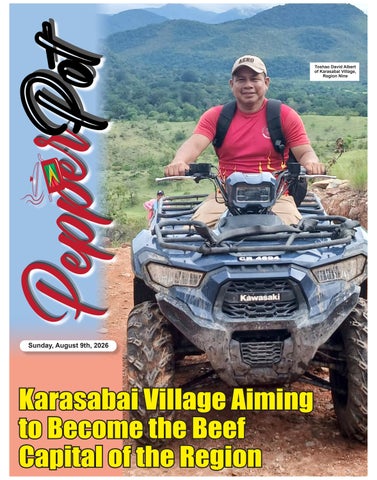
Toshao David Albert of Karasabai Village, Region Nine
Sunday, August 9th, 2026
Karasabai Village Aiming to Become the Beef Capital of the Region
II
CHRONICLE PEPPERPOT ― Sunday, August 9, 2026
A story of perseverance, hope, faith and raw determination One entrepreneur’s mission to never give up
By Michel Outridge
DELLON Kirton may be many things, but one thing is certain: when he had little to nothing, he never gave up. His desire to fulfil his goals and make something of himself galvanised his determination to become successful. The 39-year-old told Pepperpot Magazine that his journey to becoming an entrepreneur has not been easy, but it has been filled with perseverance, hope, faith and raw determination. “I was raised in a very poor family by my mother, who courageously took on the responsibility of raising me as a single parent. She worked tirelessly and made countless sacrifices to ensure I had what I needed. Watching her strength and resilience taught me one of life’s greatest lessons: no matter where you come from, hard
work and faith can lead you to a better future,” he said. Kirton reported that, as a child growing up and seeing his mother struggle to raise him, he always knew he wanted to become self-employed. Over time, he developed a deep passion for trucks, excavators and heavy-duty machinery. He stated that while others saw machines, he saw opportunity. Kirton dreamed of one day owning a business that would allow him to work with the equipment he loved while, at the same time, creating a better life for himself and his family. The businessman told Pepperpot Magazine that this dream became the foundation of his trucking and heavy-duty equipment business. “Every challenge I have faced has made me stronger and more determined to succeed. I believe that success is
not measured only by money but by the lives we improve, the opportunities we create, and the legacy we leave behind,” he said. However, the greatest motivation in his life is his family, and as a family-oriented man, everything he does is for them. Kirton described his family as his reason for getting up every day, working long hours and continuing to push forward, even when circumstances beyond his control make life challenging. Meanwhile, he added that his family gives him encouragement, moral support, purpose, strength and the determination never to quit, and to withstand any hurdles he encounters as a small-business owner. “My life is proof that your circumstances do not have to define your future. I came from humble beginnings, but I refused to let
poverty determine the rest of my story. Instead, I choose to let hard work, integrity, and perseverance shape my future,” he said. Kirton pointed out that, as he continues to grow his business and pursue his dreams, he hopes that his journey inspires others to believe in themselves. “No matter how difficult life may seem, never stop dreaming, never stop working, and never lose sight of the people you love. With determination, faith, and commitment, any dream can become reality,” Kirton said. He said his business venture is only the beginning of his story, and he looks forward to building a future that makes his mother proud, provides for his family, and inspires others to believe that success is possible, regardless of where they start or TURN TO PAGE XI
Businessman Dellon Kirton
Vehicles and equipment for rent
Buckingham Trucking logo
Creating something lasting and inspiring
CHRONICLE PEPPERPOT ― Sunday, August 9, 2026
III
• Building a Business from Handcrafted, Eco-friendly Materials in Kuru Kururu
By Andrea Hendricks FORTY-SEVEN-YEAROLD Hollis David of Kuru Kururu, along the Soesdyke-Linden Highway, has turned a love for handmade creations into a growing business. Through Excellent Touch Beauty Line and Excellent Touch Creation, she makes handmade soaps, body-care products, crafts and everyday essentials such as bamboo toothbrush travel kits, ninwah body scrubs, bath sponges, wooden utensils, leather sandals, bags, earrings and other handmade accessories. Her work is shaped by a simple idea: beauty products should be useful, gentle and better for both people and the environment. Hollis said her story began with a lifelong passion for creating things by hand and helping other people. As she watched more families look for cleaner, safer choices, she saw a growing need for natural products that could fit into everyday life. That need gave her a clear direction and helped her see that her hobby could become something bigger. “I realised there was a growing need for natural,
eco-friendly products, and I wanted to turn that passion into a business that could make a positive impact, ” Hollis told the Pepperpot Magazine.. For Hollis, natural soap and body-care products matter because they are made to care for the skin in a kinder way. She believes they are gentler on the skin, especially for people who want to avoid products full of harsh chemicals. Natural products can also be better for sensitive skin and safer for families who want simple ingredients they can trust. Many of her products use environmentally friendly ingredients that break down more easily and help reduce harm to the planet. She also sees value in biodegradable products and choices that cut down on plastic waste. In her view, this kind of business supports healthier lifestyle choices while giving customers options that feel safe, natural and responsible. She has found that more Guyanese are becoming interested in natural and eco-friendly products as they learn about the benefits of using them. She noted that while some people are enthusiastic about handmade,
Owner of Excellent Touch Beauty Line and Excellent Touch Creation, Hollis David Natural soap and beauty products (All photo credits: Hollis David)
natural body-care products, others are still becoming familiar with them and often have questions about how they compare with commercial brands. “I see this as an opportunity to educate customers about the value of natural ingredients and sustainable living,” Hollis said. Like many small-business
owners, Hollis had to build her business from scratch with limited resources. She also had to earn customers’ trust, which took time, patience and consistent quality. At the start, she wore many hats at once, moving between sourcing and importing raw materials, making products, marketing and managing finances. Those pressures
Wooden utensils
were not easy, but they taught her discipline and helped her grow stronger and more knowledgeable. Each challenge, she said, became part of the lesson that shaped the business she is building today. What keeps Hollis moving forward is her love for her work. She said, “My passion for what I do and the goal I want to achieve for my business is what keeps me going.”
Positive customer reviews also give her strength, especially when people return for more or recommend her products to others. “When clients give a positive review, return or even recommend others, the opportunity reminds me why I started this journey,” she added. For Hollis, every kind word from a customer is proof that her work matters. One of Hollis’s proudest TURN TO PAGE VII
IV
CHRONICLE PEPPERPOT ― Sunday, August 9, 2026
Karasabai Village Aiming to Become the Beef Capital of the Region
By Michel Outridge
AS the first rays of sunlight spill across the vast Rupununi savannahs, the silence of the morning is broken by the unmistakable calls of the endangered sun-kissed parakeets. Their brilliant yellow, orange and green plumage glistens against the blue sky as flocks rise above the grasslands, creating one of Guyana’s most breathtaking natural spectacles. It is this remarkable display that has earned the indigenous Macushi village of Karasabai, in Region Nine, its well-deserved reputation as the “land of the sun-kissed parakeets”. For generations, the community has protected the habitat of one of South America’s rarest birds, making Karasabai one of the country’s most important conservation success stories. Long before biodiversity conservation became a global priority, the people of Karasabai understood that safeguarding their natural environment was inseparable from preserving their culture, livelihoods and future. That philosophy of stewardship extends well beyond wildlife conservation. Beneath the skies where the parakeets soar lies an expansive landscape of rolling savannahs that has sustained generations of
cattle ranchers and helped shape Karasabai into one of Guyana’s most respected livestock-producing communities. Here, agriculture and conservation exist in harmony, demonstrating that protecting biodiversity and producing food can complement rather than compete with one another. This balance has positioned Karasabai as a model of sustainable rural development in Guyana’s hinterland. At the heart of this transformation is Toshao Albert, whose lifelong commitment to farming reflects the resilience and determination of the community he leads. A farmer by profession, Albert has spent decades cultivating crops and raising livestock through honest labour while managing a herd of approximately 140 cattle. Like many families in Karasabai, agriculture has provided not only a livelihood but a way of life, connecting generations through hard work, self-reliance and a deep respect for the land. For Albert, livestock production represents far more than economic activity. “We see livestock not only as providing food security, but also employment opportunities for people who are willing to invest,” he said. “Agriculture has always been the backbone of this community, and as we continue to improve our livestock and farming practices, we
are creating opportunities for our young people to remain in the village and build prosperous futures.” His optimism reflects the broader agricultural landscape of Karasabai, home to about 1,485 residents, the majority of whom depend directly or indirectly on farming. While crop cultivation continues to expand, cattle ranching remains the dominant agricultural enterprise, complemented by sheep and pig production. Collectively, farmers within the village now own an estimated 4,000 head of cattle, making Karasabai one of the largest beef-producing communities in Region Nine and reinforcing its long-standing contribution to Guyana’s livestock industry. Supporting privately owned herds is the Karasabai Village Ranch, which currently maintains approximately 340 head of cattle. The ranch employs residents while serving as a practical demonstration site for improved livestock management and community-based agricultural development. Historically, Karasabai was among the largest suppliers of beef to Guyana’s coastal regions when Region Nine played a vital role in national beef production. Although markets have evolved over the years, the village has never lost its identity as a cattle-producing community. Instead, its farmers are embracing modern technologies and
Toshao David Albert of Karasabai Village, Region Nine
The bora harvest in the village
improved production practices to build upon that proud legacy. Central to this transformation is the community’s close collaboration with the Guyana Livestock Development Authority (GLDA) and the Ministry of Agriculture. Working alongside the GLDA Region Nine team, headed by Dr Darren Halley, farmers continue to receive veterinary services, technical guidance and extension support designed to improve herd productivity, animal health and sustainable livestock management. According to Toshao Albert, one of the community’s principal objectives is to improve the genetic quality of its cattle through the wider adoption of artificial insemination (AI), a breeding technology introduced by the GLDA in Region Nine that has already demonstrated encouraging results in improving cattle genetics.
Although reproduction within Karasabai currently relies primarily on natural service by pasture bulls, the community intends to invest in superior breeding bulls while progressively incorporating artificial insemination into its breeding programme. Albert believes this integrated approach will accelerate genetic improvement, producing animals with better growth rates, enhanced carcass quality, greater reproductive efficiency and increased profitability for livestock farmers. While improving genetics remains a priority, Albert stressed that safeguarding animal health is equally important. As one of Guyana’s frontier livestock-producing communities located near the Brazilian border, Karasabai fully supports the Ministry of Agriculture’s stringent animal-health protocols governing the
V
CHRONICLE PEPPERPOT ― Sunday, August 9, 2026 importation of livestock. Every imported animal, he explained, must undergo comprehensive veterinary inspections, disease testing, health certification and mandatory quarantine before entering local herds. These measures are essential in preventing the introduction of transboundary animal diseases that could threaten not only Karasabai’s cattle but Guyana’s entire livestock industry. For communities situated along the border, maintaining strict biosecurity standards is critical to protecting livelihoods and preserving the country’s favourable animal-health status. The village currently raises a variety of beef breeds, including Brahman, Zebu, Santa Gertrudis, Red Angus, Charolais and Beefmaster cattle. Drawing upon years of practical experience, Albert noted that the Brahman, Zebu and Santa Gertrudis breeds have consistently performed exceptionally well under Rupununi conditions because of their adaptability, resilience and ability to thrive in the savannah environment. Looking ahead, farmers are eager to introduce additional Charolais and Beefmaster genetics further to improve beef quality, growth performance and commercial productivity. While improved genetics provide the foundation for increased productivity, Albert explained that their full potential can only be realised through proper nutrition and sound livestock management. Like many cattle-producing communities across the Rupununi, Karasabai operates an extensive production system in which cattle graze freely across vast expanses of natural savannah. This production system allows farmers to utilise the region’s abundant grazing lands while raising cattle under natural conditions. Recognising that quality forage is fundamental to improving animal performance, the community has invested heavily in pasture development to complement the natural grasslands. Albert explained that the village’s improved pasture programme was initially established under the Hinterland Environmentally Sustainable Agricultural Development
(HESAD) Project, which laid the foundation for more sustainable livestock production. The initiative proved highly successful in improving forage availability, animal nutrition and overall herd productivity. Encouraged by these results, the community has continued expanding its pasture programme independently, recognising the longterm benefits to both animal health and farm profitability. Today, farmers cultivate Brachiaria brizantha (Brachiaria grass) and elephant grass, two highly nutritious forage species that are well suited to the Rupununi environment. These improved pastures provide reliable feed throughout the year, particularly during the dry season when natural grazing becomes limited, contributing to better weight gain, improved reproductive performance and healthier cattle. The community’s investment in pasture development has become even more significant as farmers prepare for the anticipated impacts of El Niño. Understanding that prolonged dry conditions can reduce both pasture availability and water supplies, Karasabai has adopted a proactive approach to climate resilience. Black water-storage tanks have been installed at the village ranch, while support from the National Drainage and Irrigation Authority
(NDIA) is facilitating the establishment of a water-catchment system capable of serving both the community ranch and surrounding livestock farmers. Together with improved pasture management, these measures are strengthening the resilience of the livestock sector against increasingly unpredictable climatic conditions. Karasabai’s commitment to agricultural development extends beyond cattle production. Through financing provided under Guyana’s Low Carbon Development Strategy (LCDS), the village has expanded investment in livestock production at the community ranch while preparing to introduce commercial broiler production to diversify income and create additional employment opportunities. Plans are also underway to construct a sports pavilion, recreational park and modern hot-meal kitchen to support the national school-feeding programme. In addition, preparations are progressing for a major community exposition on October 16, 2026, showcasing the village’s agricultural achievements, cultural heritage and entrepreneurial potential. According to Albert, these local initiatives have been made possible through the broader agricultural transformation taking place under the Dr Irfaan Ali-led PPP/C Government. He believes sustained govern-
Cattle rearing in Karasabai Village on open pasture
ment investments in agriculture, rural infrastructure, livestock development and hinterland communities have enabled villages like Karasabai to become increasingly food-secure while stimulating socio-economic development. Improved roads, schools, air-transport infrastructure and agricultural support services have created new opportunities for farmers to expand production, improve livelihoods and invest confidently in their future. As Guyana’s economy continues to grow, Albert believes Karasabai is well positioned to benefit from that national expansion. Improved transportation links between Guyana and Brazil are expected to strengthen cross-border trade in agricultural goods and services, opening new commercial opportunities for livestock producers. While the village already enjoys a strong local market for beef and milk, Albert envisions a future in which Karasabai becomes an even more significant contributor to regional food production, supporting both national food security and Guyana’s broader agricultural ambitions. Despite these economic aspirations, Albert remains convinced that development must always be guided by environmental responsibility. Alongside expanding agriculture, Karasabai intends to strengthen its ecotourism industry by show-
casing its internationally recognised conservation efforts, pristine savannahs and unique biodiversity. The village’s identity as the “land of the sun-kissed parakeets” offers visitors the opportunity to experience one of Guyana’s most remarkable natural landscapes while learning about indigenous conservation practices. For Albert, protecting the environment is not simply a moral obligation but a practical investment in the village’s long-term prosperity. “Our environment is critically important at every level,” he said. “We will continue to expand our agriculture, but we will also continue protecting the natural resources that make Karasabai special. Conservation, farming and tourism can all grow together, and that is the future we want for our community.” Today, the average dressed carcass weight of cattle produced in Karasabai is approximately 280 pounds, reflecting improvements in nutrition, pasture management and livestock husbandry. Yet Albert believes the community’s greatest achievements still lie ahead. Through continued investment in improved genetics, artificial insemination, superior breeding stock, sustainable pasture development and strong partnerships with the Ministry of Agriculture (MOA) and the GLDA, Karasabai is steadily building a livestock industry that is both productive and resilient. As the sun sets across the Rupununi and the last flocks of sun parakeets return to their roosts, Karasabai stands as a powerful symbol of what sustainable development can achieve. It is a community where indigenous knowledge, environmental stewardship and agricultural innovation work hand in hand; where protecting one of South America’s rarest birds complements the production of some of Guyana’s finest beef; and where the promise of economic growth is rooted firmly in respect for the land. In Karasabai, the future is being written not only in the flight of the parakeets across the savannah sky but also in the determination of a people committed to nourishing both their environment and their nation.
A story of Innovation
VI
CHRONICLE PEPPERPOT ― Sunday, August 9, 2026
A Thriving Custom Design Brand Birthed from Family Tradition
By Andrea Hendricks IN Diamond Housing Scheme, the workday can begin long before the rest of the neighbourhood is fully awake. Fabric is measured, thread is matched, and a name is
sewing through lessons from her grandmother, who made the Sunflower bucket hats. “My grandmother-in-law taught me the craft skills,” Sukhdeo told this publication, recalling early hours spent watching, practising and
Hand-knitted craft pieces on dolls (All photo credits: Meera Sukhdeo)
difficult tasks. Her three children, she added, are daily motivation as she works to support her household with additional income. The pace is not always gentle. Sukhdeo speaks candidly about balancing long hours with family responsibilities and the pressure that comes with project deadlines. There are nights when sleep is cut short and mornings that arrive too
quickly. Beyond the physical work of sewing and assembling pieces, she has also taken on an entirely different kind of learning: mastering graphic-design software and other technical demands—skills that require patience, practice and plenty of trial and error. Still, what keeps her going is not only ambition, but the moment the work leaves her hands and meets a
Owner of Stitches and Sash Mee, Meera Sukhdeo, at the We Lift Expo
checked again before it is stitched into a sash that will be worn once and remembered for years. For 35-year-old Meera Sukhdeo, those careful details are the heartbeat of Stitches and Sash Mee, the homebased business she founded and still leads as its creative force. The brand has grown around life’s big moments. Custom apparel and hand-knitted craft souvenirs, such as personalised graduation attire, pageant sashes and keepsakes, are among her signature pieces. Each order carries a deadline and a story. Sometimes a proud family celebrating a graduate, sometimes a customer searching for a gift that feels personal rather than mass-produced. Sukhdeo traces her love for making things back to her home, where she learned textile work and
trying again until her hands learned what her eyes already admired. That passion became more permanent with family support: her aunt bought her first embroidery machine, and her grandfather bought her first sewing machine. It was the kind of encouragement, Sukhdeo recalled in an interview, that can change a person’s confidence, an investment that quietly says, this is real, and you can do it. Today, she is building the business while raising a family, and she is quick to acknowledge the team behind her. When work piles up, especially during the rush of graduation and pageantry season, her husband steps in to help and, just as importantly, to keep things moving. She says he assists when there is an overload of work and encourages her to find the simplest way through
Graduation set
customer’s eyes. She says she often fully appreciates a piece only when it is finished and the client expresses gratitude. On graduation day, for example, or when someone receives a personalised gift for a milestone anniversary, those reactions are proof that the time and precision mattered. Sukhdeo also makes a bold claim about her niche: “As one of TURN TO PAGE XVIII
VII
CHRONICLE PEPPERPOT ― Sunday, August 9, 2026
Creating something lasting and inspiring
accomplishments is seeing people genuinely appreciate and trust the products she creates. That trust gives her a deep sense of satisfaction because it shows that customers value local, handmade work. She also sees her business as part of a wider community effort, offering eco-friendly products that reduce waste and encourage healthier living. “I also support the local economy by providing handmade products while inspiring others to value creativity, craftsmanship and environmentally responsible choices,” she said.
Hollis encourages other women to start where they are and use what they have. Her advice is to believe in themselves, stay committed and not be afraid to make mistakes because learning is part of the process. She believes growth comes from trying, adjusting and refusing to give up when things become difficult. Faith in God, along with the support of family members, friends and loyal customers, has helped her stay focused and keep moving forward. That support network, she said, has been vital during difficult times. Hollis is not stopping here. Her
Handmade earrings
For her, the business is not only about sales; it is also about making a positive mark in the community.
business goals include expanding her product line, reaching more customers locally and internationally,
and developing more innovative, eco-friendly products. She also hopes to collaborate with other local businesses and continue building Excellent Touch Beauty Line as a trusted name in natural body care and sustainable living. For her, the future is about steady growth without losing the values that shaped the brand from the start. “Your ideas have value, and your passion can become something meaningful,” she said in her final message to other women who dream of becoming entrepreneurs. “Believe in yourself, work hard, be patient with the process and don’t be afraid to start small.” In Hollis David’s story, determination, consistency and faith stand out as the forces that can turn a small beginning into something lasting and inspiring. Whether it is a simple handcrafted soap or a thoughtfully designed accessory, Hollis David’s journey is a testament to the power of passion combined with purpose. Her commitment to creating products that are both beautiful and environmentally conscious has not only set her apart in the natural beauty industry but has also inspired others to consider the impact of their choices. As she continues to expand her business, she remains dedicated to the principles that have guided her from the beginning: authenticity, quality and a deep respect for nature. Hollis’ story reminds us that entrepreneurship is more than just a business venture; it is an opportunity to make a difference. Her dedication to sustainable living and community support serves as a beacon for those who wish to create meaningful change through their work. As Hollis looks to the future, her vision remains clear: to continue innovating while staying true to her
FROM PAGE III
Bamboo toothbrushes
roots, proving that small steps can lead to a significant impact. Her journey is an inspiration for anyone looking to turn their own passions into a fulfilling career. By embracing challenges and celebrating victories, Hollis David has crafted not just products, but
a legacy that encourages others to pursue their dreams with confidence and courage. For more information, follow Excellent Touch Beauty Line and Excellent Touch Creation on Facebook or contact them on (592) 660-9398.
VIII
CHRONICLE PEPPERPOT ― Sunday, August 9, 2026
Too Close to the Sun
WHEN standing at the edges of their extraordinarily improbable dreams, even the most timid spirits are filled with courage. They may dare to look up at the sky and imagine their bodies molten against the sun in a moment of victorious achievement. The land beneath their feet fades away, and they imagine themselves taking flight. The darkness and weight of their lives become
waves crawling feebly beneath them. Man may never be able to take flight. However, sometimes, the ability to imagine that he can is all that it takes for him to survive. In the distant future, even if the world were to become a place where people could not afford the price of a single breath, their hearts would still beat as long as they could dream. There are no shackles powerful enough to confine a dreamer, and hu-
man beings, fundamentally, are fuelled by dreams. When we are born, we fall into an intricate web of forces. Each force shapes how we think and behave and, ultimately, designs the goals we aim to achieve. At some point in our lives, we are called to make a sacrifice for the sake of our goals. This is the act of intentionally taking a specific path when facing crossroads. Once we make this choice,
our life metamorphoses into a new shape to accommodate the magnitude of the change we have accepted. Once we cross this point, the only thing we can do is either continue persevering toward the goal we initially intended to achieve or allow ourselves to stagnate in the spot where we find ourselves at the present moment. Unfortunately, fate does not participate in the resolve we hold in our hearts when
we make a major decision. Making a choice does not mean we will receive the outcome we desire. It takes every ounce of energy, work and strength to take us to the place where we desire to be. This means that when the entire world seems to be against us and our choice, we must not begin to question ourselves but, rather, solidify our will. We must remember that the ease with which we travel a path is not a determinant of whether it is the right one. So, we are brought faceto-face with a rather daunting question. What if we make the right choice, select the right path and set the right goal, but are too weak to achieve it? This question often limits our natural tendency to dream. The fear of failing is what prevents us from embarking on many journeys that can change our lives entirely. It is an important question, but it fails to allow us to consider another important one: What if we go our entire lives achieving the bare minimum and never meet our fullest potential? We are all familiar with the adage, “Do not fly too close to the sun.” It comes from the Greek myth of Icarus, who was given a pair
of wax wings by his father. Before Icarus took flight using his new pair of wings, his father, Daedalus, asked him to refrain from flying too high, as being close to the sun would melt the wings. Icarus failed to heed this warning and eventually met his demise when he flew higher and higher, causing the heat to melt his wings. The story is used as a warning to encourage people to refrain from being overly ambitious, but it often fails to highlight the second warning that Daedalus gave his son. Icarus was also warned not to fly too low, as this would cause the waves from the ocean to wet his wings and also cause his demise. Though Icarus met his end by flying too high, it would have been no less dangerous for him to fly too low, fearing the sun. We are often afraid of failure and its implications for our lives, so we choose to fly low. What we do not realise is that flying low and keeping our heads down may save us from failing at anything, but it also stops us from truly living. As we continue to dream, let us not limit ourselves with fear but, rather, remember that we are meant to soar with courage.
IX
CHRONICLE PEPPERPOT ― Sunday, August 9, 2026
LEADING AN ORGANISATION TO SUCCESS
LIFE and death are certain on this earth. Success and failure are also certain for humans and organisations. Many organisations experience successes and, likewise, failures. There are various reasons organisations fail, but failure may not be the final destination. Some people settle for this uncomfortable position of failure, while others see it as a temporary state that allows for re-evaluation and, ultimately, a course change that leads to success.
CORPORATE LEVEL Success is possible for all organisations. However, each organisation must plan for success. An organisation can plan for success by establishing its vision and mission. Small organisations often do not develop vision and mission statements, but medium- and large-sized organisations ought to establish these statements. Vision and mission statements should allow for flexibility and encompass the entire organisation. Strategically placing these statements in areas visible to employees will help them become familiar with the organisation’s direction. On some occasions, it will be advisable to discuss the direction and intentions of the organisation with employees or educate them about these matters. When an organisation establishes its vision and mission statements, it must disaggregate its functional policies, structures and product output into workable guidelines for employees that may aid in accomplishing
definable goals. The organisation must establish goals and make provisions to guide its employees. These goals should be further disaggregated into objectives that provide measurable indicators so that employees know what they are working towards. When employees are cognisant of an entity’s objectives, they can align their efforts with the organisation’s definition of success. The management of the organisation must develop plans that are best suited to meeting the established goals and objectives. When management ensures that its key success factors are known and readily available, it has another resource that will help the organisation become a winner. Threats and opportunities must be carefully analysed, and opportunities must be capitalised on; they must not be ignored. An organisation must also know whether it is making the best financial decisions. This information should be made available through its internal financial reports and management accounts, which should also comply with its policies and strategies. TACTICAL-LEVEL INVOLVEMENT Employees at the tactical level often play a significant role within any organisation. They can take direction from their senior officers and work with their junior colleagues to deliver the desired results. Often, when junior employees face challenges, they pass this information to their
supervisors, who occupy the tactical level. Officers at the tactical level must be good communicators and coordinators. When junior employees do not understand the organisation’s vision and choose to do what they personally think is right, tactical-level officers are the ones who need to steer them in the right direction. Each organisation working towards success must establish goals, objectives, strategies and other guiding measures. However, simply establishing these policies will not yield the success that the organisation wants. The performance of people and machinery must be monitored. When performance is measured, there must be a feedback system in place, and efforts must be made to correct areas that are not delivering the best results. While managing machinery and computers may be straightforward, managing employees may require greater attention. When dealing with people, supervisors must understand each individual. People like to feel appreciated and rewarded for good work. Treat employees well, and your organisation will become successful. Every employee wants a chance to prove that they are worthy of the position they hold and the positions to which they aspire. You may never know what some employees can do until you give them a chance. Each person is made differently, and when allowed to exercise their skills, they may outperform the person who
previously held the position and contribute great value to your organisation. Managers are unable to do everything by themselves. Therefore, we may need to
choose a winning team. When a winning team has been identified, established and given the right resources, it will allow the organisation to achieve success after suc-
cess. In addition, a winning team may reduce operational costs and the time required to complete tasks. OPERATIONS AND OUTPUT When an organisation has finished developing a plan, it is time to execute that plan. Some organisations are good at planning but poor at executing. Organisations that fail can often trace their failure back to poor execution. Every organisation will face many opportunities and risks, but successful organisations will often try to find ways of working around some of the challenges that affect them. Organisations that want to be successful must always look for ways to improve. They can either use the continuous improvement approach or take the more TURN TO PAGE XII
X
CHRONICLE PEPPERPOT ― Sunday, August 9, 2026
The Habit of Reading in a Changing World
SOMETIMES, when we examine the not-so-distant past, we hear echoes of thoughts that have remained unchanged. This familiarity encourages us to look more closely at what was said and done, drawing upon our memories of the past and our understanding of what we know today. I often return to the habit of reading and questioning, which was instilled in me by my rela-
tives, the godparents who raised me and my teachers. Reading and spelling were important parts of the school timetable, and they empowered those of us from that generation to read and write about memories of the past, the events of the present and even the occasional Valentine’s letter to a convenient little class miss. One of my teachers once told me that every idea that awakens within us is an ancestral whisper
offered in our own interest. It may be a warning or a call to awareness, telling us to pay attention. It may also caution us to withhold our words until we have considered whether the time is right, whether our reasoning is sound or whether the unease we feel is a sign that we need to explore the matter further. It is better to reflect before regret passes judgement.
Over the years, I have concluded that the need for learning at home differs from one household to another. Families face different circumstances, and sometimes there are more obstacles than willpower. This is why the traditional practices of reading and storytelling remain effective tools, although they appear to be fading from many schools and homes. They should not be ignored
or diluted. If we fail to preserve these practices, we will eventually pay other, more dismal dues. We live in a changing world whose values have seeped into our homes and communities. Some people no longer seem to care, while others are simply too burdened or stressed to do so. Whether or not we fully understand what is happening, we are all affected.
CHRONICLE PEPPERPOT ― Sunday, August 9, 2026
A story of perseverance, hope, faith and raw... FROM PAGE II
where they come from. Kirton grew up in a depressed community, but he never let that aspect of his early life define him and set about creating a better future. As a ghetto youth, Kirton
Bobcats for rental
did not forget where he came from, and even today, he is actively involved in community-based development, through which he gives back to society in many ways. He is originally from Lodge, Georgetown, where
he grew up to become a role model for youths and others in the community. He presently resides in East Ruimveldt, also in the city. Kirton’s story is one of resilience, hard work, sacrifice and dedication. Even
when he felt like giving up, he pressed forward and gave his best so that others could have jobs and stable salaries. As a growing businessman, his story is one of those that depict the journey “from nothing to something”.
It highlights his struggle to become self-employed and empowered so that he can help others through his business, Buckingham Trucking. The company’s motto is “offering quality equipment,
XI
reliable service, building a better future for tomorrow”. It offers equipment rental in the form of belt-driven mixers, excavators, Bobcats and rollers, as well as a 24-hour towtruck service.
XII
CHRONICLE PEPPERPOT ― Sunday, August 9, 2026
LEADING AN ORGANISATION TO SUCCESS
FROM PAGE IX
radical approach of business process re-engineering. Some organisations have retained the traditional approach of using manual systems for record-keeping and reporting, which may contribute to their failure. On the other hand, many organisations that have invested in information systems have achieved great success. Once properly integrated, information systems can help an organisation manage many aspects of its business with greater ease. Through data mining, information systems can also allow organisations to identify new opportunities. These systems may also help the organisation reduce the time spent on production. Hardly any institution can operate without cash. Cash is important for both people and organisations. Managing an institution’s finances is paramount, since money can easily leave the organisation, but it may take a very long time to return, if it ever does. When an organisation has money and wants to become successful, it must also invest some of its funds. Each investment can yield either great results or failure. Some organisations fail because they have too much
money held in reserve or are overstocked with inventory. When there is too much inventory but sales are slow, the organisation has assets on hand that do not yield the desired results in a timely manner. Some organisations will choose to borrow, but when it is time for repayment, they may have difficulty honouring their obligations. Organisations that fail to repay the principal and interest on time may eventually be taken to court and may lose their businesses. Some people and organisations may want to acquire items on credit. At the initial stage, they may be able to make their regular instalments, but as time progresses, they may not be able to continue making such payments. In cases like these, the lending organisation will take action to recover its funds. For more information about Geary Reid and his books, please use the following contact information: Amazon: http://www.amazon.com/author/gearyreid; website: www.reidnlearn. com; Facebook: Reid n Learn; email: info@reidnlearn.com; mobile: 592645-2240.
XIII
CHRONICLE PEPPERPOT ― Sunday, August 9, 2026
WHEN I FOUND YOU II
I WENT back to the hotel, not feeling too confident that she would show up that evening, but I dressed and went down to the restaurant, waiting with hope. My flight was early the next morning, and I didn’t want to leave without seeing her again. Since talking
little nervously. After being seated, I said in a low, casual tone, “I was a little fearful that you might not show up.” She sighed. “I’m here, but I’m still not sure about this.” “This is a good start,” I said with an encouraging smile, “to hopefully better
to her at the gift shop, I had felt a new and unique feeling within me, but also a niggling fear that the age difference might deter her from wanting to have a relationship with me. I went to the bar for a drink to calm the anxiety in my mind, and on my second drink, ten minutes after eight, she walked in. She looked quite stunning, though in a simple way, in a little blue dress. I left the bar to meet her and said, “Simply beautiful.” “Thanks.” She smiled a
things.” Dinner was a nice affair, and we got to know each other a little more. She owned the little gift shop, worked closely with a charitable organisation, and lived a quiet life with her young adult son studying overseas and her teenage daughter living with her. She said nothing of her divorce, for it would most likely bring back painful memories. I did not have much to say about myself, except that I was from a loving family, travelled regularly because of my job, played
badminton, enjoyed car racing and lived in a condo in New York. She summed it up in three words: “An eligible bach-
elor.” “Something like that.” I laughed a little. I loved her simplicity, her smile and melodic laughter,
and I asked her, after we had finished dinner and were at the bar for a few drinks, “So, can we continue to see each other?”
She didn’t answer for a moment, sipping her cocktail, then said, “Maybe.” “Well,” I said, finishing my scotch, TURN TO PAGE XX
XIV
CHRONICLE PEPPERPOT ― Sunday, August 9, 2026
XV
CHRONICLE PEPPERPOT ― Sunday, August 9, 2026
The Classics Can Console: Some Thoughts on Homer’s Odyssey
ONE of the memorable lines in Derek Walcott’s poem “Seagrapes” is “the classic can console, but not enough.” It is an admission that there are limits to the balm literature can offer. Walcott is speaking, in part, of Homer’s Odyssey, and I have long wondered what consolation a reader is meant to take from an epic ostensibly about war, as so many epics are. Walcott’s own Omeros is a rare exception, for war does not function as its principal engine. Instead, it explores the quieter tumult of personal anguish, memory, displacement and the lingering consequences of history—the same human costs that war invariably leaves in its wake: death, exile, familial disintegration, the making of widows and orphans, and waste. What, then, is it in The Odyssey that consoles? Is it merely the awe of the epic, the pleasure of the sublime, the sheer imaginative force of Homer’s storytelling? Perhaps this is the limit Walcott refers to in “Seagrapes”: the consolation remains on the page. It is profound, but it is not curative. It cannot repair our private griefs or the devastations of history. It is, as Walcott says, “not enough.” But perhaps we ask too much of literature when we
expect it to heal us. Few readers open an epic—or even the Bible—as though it were medicine for the soul. Most of us read to be entertained, instructed or astonished. For many students, Homer arrives only because a syllabus requires it. Yet the obligation of reading often gives way to genuine pleasure. I first encountered The Odyssey in the eleventh grade through George Chapman’s translation (1614–1616). We read only excerpts—the episode of the Cyclops and Odysseus’ captivity with Calypso—but I remember going home to read beyond the assigned pages. There is a kind of consolation in that memory. What mattered was not simply that I understood the poem, but that I delighted in it, as much as I delighted in reading Dumas’s The Three Musketeers or Stevenson’s Treasure Island. Outside the demands of the classroom, Homer became a genuine pleasure, a magnificent collection of wildly various tales whose vitality had survived nearly three millennia. More importantly, Homer illuminated other books I had already read, and many I would later encounter. The Odyssey revealed unexpected affinities between texts separated by centuries. It made
visible the migration of stories across civilisations, from oral tradition to written literature, from myth to history, from Greece to the modern novel. As a rip-roaring yarn, the epic enlarged not merely the reader’s imagination but the reader’s capacity to recognise connections. It taught one to see. Since then, I have read several translations, including those by Robert Fitzgerald (1961) and Robert Fagles (1996). Chapman’s Homer remains comparatively dense, rich with Jacobean eloquence, whereas Fagles’s seems more attuned to contemporary speech without sacrificing poetic force. The stories remain unchanged, yet each translation alters the experience of reading. Appreciation of Homer depends, to a remarkable degree, upon the translator’s ear. Fagles, in particular, seemed to harmonise with my own sensibility, making the ancient world feel startlingly present, especially in its reflections on politics, love, duty and filial obligation. As an undergraduate, I once wrote a paper arguing that Odysseus was little more than a warmonger. It now strikes me as an overly absolute reading. Still, the impulse behind that argu-
ment remains understandable. There is remarkably little diplomacy in Homer to counter the constant resort to violence. The Iliad is founded upon war, but The Odyssey, despite its reputation as the poem of homecoming, never fully escapes that inheritance. Odysseus returns from Troy only to discover that conflict continues to define nearly every encounter. On sea and land alike, strangers threaten his life, and violence becomes almost instinctive, a condition of survival rather than choice. War has become a habit of existence, shaping not only action but expectation. This moral disorder is reflected in the repeated violation of xenia, the sacred code of hospitality. Telemachus’ gracious reception of Mentes at Ithaca exemplifies the ideal. This is mirrored by Nausicaa when she discovers a ragged Odysseus washed up on her shore. Elsewhere, however, the code collapses. Polyphemus welcomes guests only to devour them. Circe transforms them into swine. Calypso detains Odysseus against his will, however lovingly. The Laestrygonians, with their unnatural appetites, greet strangers with stones and boulders. They violate the very spirit of xenia. The suit-
ors consume another man’s household with shameless entitlement, violating every obligation owed to a host. Even Odysseus’ own men succumb to this corruption when they slaughter the cattle of Helios, an act of theft whose punishment is swift and proportionate. Xenia is honoured in the breach more than in the observance. These violations of hospitality signify more than bad manners. They represent the breakdown of reason itself, the erosion of those customs that make peaceful coexistence possible. Homer suggests that where hospitality disappears, war inevitably follows. Etiquette, in the epic, is not superficial civility but the first defence against violence. It is this literary depth that has made Homer inexhaustible. Alongside the Bible, no work has exerted a greater influence upon the Western literary imagination. The Odyssey is maximalist in every sense. It contains adventure and domesticity, politics and theology, longing and revenge, comedy and terror. One returns to it repeatedly because it continues to disclose meanings previously overlooked. The wars with Polyphemus, Circe, the Laestrygonians, Scylla, Charybdis
and, finally, the suitors are not isolated episodes but expressions of a world in which violence has become ordinary. Odysseus fights those who seek to destroy him, yet the cycle never truly ends. The slaughter of the suitors, and even of several household servants, illustrates an unsettling excess that recalls the sack of Troy itself. Homecoming does not abolish war; it merely relocates it. If The Iliad is the poem of war, The Odyssey is the poem of what follows. Yet what follows in the wake of war is not peace. It is memory, vengeance, trauma and the persistence of violence. In that sense, Walcott’s observation acquires its deepest resonance—the classic consoles—but not enough. Homer himself seems to anticipate this conclusion. “The blade itself,” he writes, “incites to deeds of violence.” Throughout The Odyssey, blades are everywhere, and so are the men compelled to wield them. The war may be over, but its logic survives. That is perhaps Homer’s greatest insight and the source of the epic’s enduring power. It reminds us that the true aftermath of war is not tranquillity but the long and difficult struggle to recover the ideal of peace.
XVI
CHRONICLE PEPPERPOT ― Sunday, August 9, 2026
CHRONICLE PEPPERPOT ― Sunday, August 9, 2026
XVII
When Everything Turns to Gold, What Remains Alive?
THERE is something almost comical about King Midas. Here was a man who had wealth, power, influence, a kingdom and every reason to believe that life had already treated him generously. Yet, when the gods offered him a wish, he looked at everything he possessed and decided that it was still not enough. He wanted more gold. He did not ask for wisdom. He did not ask for peace. He did not ask for the ability to understand people, to govern fairly, to love deeply or to live without fear. He asked for the power to turn everything he touched into gold. And, like many human beings who finally receive the very thing they spent years chasing, Midas discovered that desire rarely explains the consequences of its own fulfilment. At first, the gift must have felt magnificent. Imagine him walking through his palace, touching a chair and watching it gleam. Imagine him placing his hand upon a bench and seeing ordinary wood become something brilliant and precious. Every touch appeared to confirm his greatness. Every object became proof that he possessed something extraordinary. Then he became hungry. He reached for food, and the food turned to gold. He reached for water, and the water turned to gold. Suddenly, the power that had made him feel rich began to separate him from the simple things that kept him alive. This is where the story becomes philosophical. The tragedy of Midas never lived inside the gold; the tragedy lived inside his understanding of value. He believed that something became meaningful when it became expensive. He be-
lieved that abundance could be measured by how much he possessed, and he mistook ownership for fulfilment and accumulation for a life well lived. Human beings continue to make that mistake. We spend years reaching for the next promotion, the larger house, the better car, the higher salary, the greater audience, public recognition or the kind of success that causes people to look at us differently. Achievement carries value; ambition creates movement; money provides security, opportunity, education, comfort and the ability to help others. Wealth itself carries no moral stain. The question lies within our relationship with it. What happens when the pursuit of more becomes so consuming that we lose the ability to enjoy what already exists? What happens when we work so hard to create a beautiful life that we remain too busy to live inside it? What happens when every conversation becomes a networking opportunity, every talent becomes a product, every moment becomes content, and every relationship becomes useful only when it opens a door? Perhaps that is the modern Midas touch. We may never turn a glass of water into gold, but we often turn ordinary experiences into transactions. We measure people by influence; we measure success by visibility; we measure worth by income; and we measure happiness by possessions. Then we wonder why life begins to feel polished, impressive and strangely empty. The ancient Greek philosopher Epicurus understood the endless appetite created by unnecessary desire. He wrote, “The wealth required by nature is limited and TURN TO PAGE XXII
XVIII
A story of Innovation
Guyana’s top sash designers, I enjoy supplying these items during graduation and pageantry season,” she told this publication. That demand has helped shape the business into a local, personalised alternative to mass-produced items—pieces that carry names, dates, school colours and cultural touches that feel unmistakably one-of-a-kind. Her work has moved beyond the home studio and
CHRONICLE PEPPERPOT ― Sunday, August 9, 2026
into public view. Stitches and Sash Mee has been exhibited at commercial showcases such as the We Lift Expo, and Sukhdeo has launched patriotic cultural collections that include handcrafted embroidered dolls, handbags, sandals and other statement pieces for major exhibitions. The response, she said, has been especially meaningful in a space where art and craft can sometimes feel over-
looked. Seeing the brand recognised on a broader stage, she added, has been deeply rewarding. Looking ahead, Sukhdeo sees room to grow, particularly in the diaspora and pageantry markets, where nostalgia for home can be strong and where custom souvenirs and culturally rooted designs are in demand. With international collaborations and cultural exhibitions offering
new pathways, she believes these opportunities could help streamline production and elevate her designs over the long term. And she is not finished experimenting. Sukhdeo says she is considering expanding into fashion design in the future, adding a new dimension to a business that already bridges tradition and modernity. If there is a theme she
returns to, it is the idea that creativity deserves to be taken seriously—especially by the person who possesses it. She encourages other female entrepreneurs not to minimise the value of their hands-on skills and to pair passion with practical knowledge. Own the craft, she advises, learn the business side, and keep building with discipline and pride—because what begins as a small project at home can grow into something that carries a community’s celebrations, one stitch at a time. For other women entrepreneurs, Sukhdeo’s story reads like a blueprint for what can be built from a spare room, a reliable machine and a willingness to learn as you go. In a country where many small businesses are started between school drop-offs and latenight chores, her work illustrates how cottage industries can become serious income streams—particularly for women whose skills have traditionally been treated as “hobbies” rather than trades. In quiet ways, the visibility of Stitches and Sash Mee pushes back against that idea, showing that precision handwork, pricing, deadlines and customer service can sit comfortably alongside parenting and community life without either being diminished. It also underscores the role that customised, homegrown pieces play in how Guyanese mark what mat-
FROM PAGE VI
ters. A sash with a name and school colour, or a pageant accessory stitched to match a costume made for an anniversary, is not simply an item to be worn or displayed; it is a small record of belonging. For families, those details become part of the story that is told and retold—who graduated, who competed, who returned home for a celebration, and which village or school they represented. In a world of quick online purchases and generic templates, the appeal of her work is that it refuses to be anonymous, rooting each milestone in something recognisably local and personal, shaped by hands that understand the culture behind the request. That same insistence on specificity is what Sukhdeo hopes will carry her into the next stage. She is already thinking about how to build systems that protect quality while making growth possible—more efficient production, new collaborations and designs that can travel without losing their Guyanese character. The diaspora, she believes, will remain a strong market precisely because distance can sharpen the desire for objects that feel like home. For now, the home studio in Diamond Housing Scheme continues to hum—one order at a time, one carefully stitched name after another—while Sukhdeo plans for a bigger future, but still unmistakably hers.
CHRONICLE PEPPERPOT ― Sunday, August 9, 2026
XIX
XX
CHRONICLE PEPPERPOT ― Sunday, August 9, 2026
WHEN I FOUND YOU II
“that sounds promising.” There was silence for a moment as she seemed to be contemplating something. Then she asked in a slightly serious tone, “Tell me, how does a handsome young man like yourself, with your lifestyle and who I’m sure has dated pretty girls, find interest in an older woman?” I signalled the bartender
for another drink, took a deep breath and answered her. “I don’t know how to describe it, but what I do know in my heart is that I wanted a beautiful love story that was uniquely different.” She looked at me with a little spark of interest in her eyes that had not been there before, and I continued, “Everywhere I went, I looked for
her, but nowhere did I find her until I saw you.” She didn’t say anything for a long moment, trying to understand, maybe, how something like this could happen. Then she voiced, “It’s so incredible. I don’t know what to say.” “Just follow your heart.” We sat there for a long time, she not saying much
and I sipping my scotch, just relaxing in each other’s company until she said she had to go. I walked with her to the lobby and said, “Thanks for showing up. The time spent was special.” She smiled and nodded. “It was nice.” The valet brought her car around, and though I felt like I didn’t want her to go, I said,
“I will see you again soon.” She didn’t answer, but her smile gave me hope. On the flight home, I reflected upon the time between seeing her at the traffic light and saying ‘goodnight’ in the hotel lobby. I knew she would have voiced doubts about having a relationship with me because of our age difference, but I had found her after such a long time, and I was not going to lose her. I returned to work, staying connected to her by sharing pictures and videos of places I visited and people I met. She was somewhat thrilled about it all, and through the internet, a new friendship began to develop. Three months passed, and on a five-day break, I flew back to Guyana. I did not tell her, wanting to surprise her, and when I walked into the gift shop, her eyes lit up. “Hey, you’re back.” “Yep, on a short break.” I wanted to ask her if she was happy to see me, but I didn’t, just wanting to give her time to express her feelings. She had a business meeting with the charitable organisation, and I had two business meetings during the day that I had postponed the last time I was there. But dinner was reserved for her, as she was the reason I came back. As we sat down to dinner, I said to her, “Those three months seemed like three years while I waited for a few days’ break to come back and see you.” She smiled but said nothing, and I waited for the few words I wanted to hear her say. The menu came, we ordered, the wine was poured and, lifting her glass just a little, she said, “It’s nice seeing you again.” I lifted my glass and said, with a pleased feeling in my heart, “Those words mean so much to me.” I felt quite happy that she was slowly beginning to accept me, but that didn’t last for long. An older guy walked up to our table and greeted her, “Hey, honey.” She looked surprised, then upset, as the man stood there with a smirk. “What are you doing?”
FROM PAGE XIII
she asked quietly. “Greeting my wife,” he stated, with a quick, daring glance at me. “Ex-wife,” she corrected him. He turned to look at me and said, “He looks quite young.” He left before she could respond. She was so upset that I had to touch her hand and say to her, “Hey, it’s okay. I’m here. Stay calm.” It was a good while before she relaxed, and I asked, “Does he do that all the time?” She shook her head. “No. Since the divorce, I have not dated anyone until now.” I did not realise then how good that sounded for me because I was concerned for her. “I guess he still thinks he has a hold over you.” She sighed. “It’s because I’ve been patient and tolerant of his behaviour because of my daughter’s close bond with him.” I noticed the glint of helplessness in her eyes, and I knew she needed strength to stand against his narcissistic attitude. I touched her hand again and said, “You need to be strong and stand your ground against that control he’s unjustly wielding over you.” She shook her head a little. “I’m not sure how…” “I can be your strength,” I interrupted her, “if you want me to.” She looked at me for a long moment, uncertainty in her eyes. Then she said, a little deflated, “He already remarked that you’re young, which I’m sure will be held against me, and added to that will be the burden of a divorced, older woman, two young adult children and an obsessive ex-husband. Won’t that be too heavy for you?” “No,” I answered confidently. “Just give me the chance to help you regain control of your life so you can be happy.” The warm smile that I loved to see returned, and she expressed, “I never thought I would meet someone like you.” And so began a close relationship, uniquely different.
CHRONICLE PEPPERPOT ― Sunday, August 9, 2026
XXI
XXII
CHRONICLE PEPPERPOT ― Sunday, August 9, 2026
When Everything Turns to...
is easy to procure; but the wealth required by vain ideals extends to infinity.” This sentence could have been written for Midas himself. Nature asks for food, shelter, safety, companionship, rest and a meaningful place within the world. Human imagination creates a much longer list. We begin to believe that happiness waits behind one more achievement. Then the achievement arrives, and desire quickly changes its address. The mind says, “Now that you have this, you need something greater.” The goalpost moves, the house becomes ordinary, the salary becomes familiar, the applause becomes expected, the dream becomes a responsibility, and then we begin chasing again. Midas wanted gold because gold represented security, power, admiration and possibility. Yet his gift removed his ability to enjoy the very life that wealth was supposed to improve. He gained unlimited value and lost access to the things that carried meaning. This exact contradiction appears throughout human life. A person may become financially successful and lose time with the people who made the struggle worthwhile. Someone may build a respected career while becoming a stranger to their own joy. A parent may work tirelessly to provide every material opportunity for a child while longing for more unhurried moments with that child. A person may spend years seeking recognition and discover that public approval cannot answer private questions. Success, therefore, can fill a room while leaving the soul hungry. The Roman Stoic philosopher Seneca wrote, “The greatest blessings of mankind are within us and within our reach.”
His words invite a difficult question: How often do we overlook what already sits within our reach because we remain focused upon what sits beyond it? A shared meal may carry more nourishment than an expensive possession. A sincere conversation may become more valuable than public admiration. A quiet morning may restore something that achievement cannot reach. The hand we hold, the laughter that surprises us, the person who remembers our story, the home that welcomes us and the peace that arrives when we stop performing all belong to forms of wealth that have no price tag. Midas learned this through loss. Human beings possess the privilege of learning it through reflection. Aristotle approached happiness as something deeper than pleasure or possession. His idea of ‘eudaimonia’, often understood as human flourishing, connected a good life with virtue, purpose, character and meaningful action. Wealth served as a tool within life rather than the final purpose of life. The distinction matters because money can build a home, while love creates belonging within it. Money can purchase medicine, while compassion gives care its human meaning. Money can provide education, while wisdom teaches us how to use knowledge. Money can create comfort, while inner peace allows us to enjoy it. Gold can decorate a crown, while character determines the person who wears it. Midas believed that gold would enlarge his life. Instead, it reduced his world. Every touch removed warmth, usefulness and connection. His power became a wall between himself and everything living. Maybe, in reality, every desire has this possibility. A desire,
though, becomes dangerous when it begins demanding the sacrifice of everything that gives life its depth. Ambition becomes destructive when achievement requires us to abandon our health, integrity, relationships or capacity for joy. Wealth becomes a burden when we spend our entire lives protecting it. Recognition becomes a prison when we forget who we are without an audience. The problem never begins with wanting more. The problem begins when “more” becomes the only language through which we understand enough. The Midas story also asks us to examine the wishes we make without examining the lives they will create. We often pray for opportunities while avoiding the responsibility that accompanies them. We ask for influence without considering the weight of being heard. We ask for wealth without asking whether we possess the wisdom to use it. We ask for success without considering what success may require us to change. Remember, every blessing arrives with a responsibility; every door opens into a new room; and every dream carries a life beyond the moment of achievement. Perhaps wisdom begins when we stop asking only, “How can I receive this?” and begin asking, “Who will I become when I receive it?” Midas wanted the power to transform everything around him. He never considered how the gift would transform him. This is the hidden lesson beneath the gold. Life continuously places power in our hands. Our words affect people; our choices shape families; our attention gives value; our habits create futures; and our presence can bring comfort or distance. Every day, we touch the world in ways that leave something behind. So, the question remains: What
do our hands create? Do we turn moments into memories? Do we turn hardship into wisdom? Do we turn knowledge into service? Do we turn love into something people can feel? Or do we touch everything with the restless belief that its value depends upon what we can gain from it? King Midas eventually understood that gold could never replace life. He learned that a warm embrace held more value than a golden statue. He learned that bread had greater importance when hunger arrived. He learned that water possessed a beauty no treasure could imitate. He discovered the sacredness of ordinary things after losing access to them. Perhaps gratitude allows us to recognise their sacredness while they remain in our hands. The greatest wealth may live inside the ability to enjoy what money cannot manufacture. It may live in health, friendship, laughter, purpose, love, peace, time and the freedom to sit beside someone without calculating what the moment will produce. Midas wanted everything he touched to become gold. A wiser wish would have been this: May everything I touch become more alive; may my words bring courage; may my presence bring peace; may my work create value; may my success create opportunities for others; and may my hands build without forgetting how to hold. A life filled with gold may still feel empty, but a life filled with meaning has wealth that no loss can easily take away. And the greatest miracle never involves turning ordinary things into gold. The greatest miracle involves seeing that the ordinary things were precious all along. Here is a poetic piece from Midas for you. Enjoy. The Gold That Could Not Hold Him
FROM PAGE XVII
He begged for gold with hungry hands, And dreamed of wealth in distant lands; He thought that riches made life whole, And never asked the price of gold. The morning came; his wish was near, He touched a rose; it disappeared; Its petals hardened, bright and cold, A living flower turned to gold. He laughed and filled his halls with shine, Each chair and cup became divine; Yet hunger rose, and thirst grew bold, For bread and water turned to gold. Then someone he loved came running near, With open arms and heart sincere; One touch replaced warm flesh and soul With silent beauty, hard as gold. The palace gleamed, the kingdom stared, Yet no one saw the grief he bore; For every treasure filled his room, While something living met its doom. At last, he learned what longing hides; The brightest wealth may live inside; A hand that holds, a heart made whole, Can never be replaced by gold. So guard the wishes that you make, For every gift demands a stake; Some dreams arrive with crowns of gold, Then teach the heart what wealth can hold. Romella Dasratt
CHRONICLE PEPPERPOT ― Sunday, August 9, 2026
XXIII
XXIV
CHRONICLE PEPPERPOT ― Sunday, August 9, 2026
CHRONICLE PEPPERPOT ― Sunday, August 9, 2026
XXV
XXVI
CHRONICLE PEPPERPOT ― Sunday, August 9, 2026
CHRONICLE PEPPERPOT ― Sunday, August 9, 2026
XXVII
XXVIII
CHRONICLE PEPPERPOT ― Sunday, August 9, 2026
CHRONICLE PEPPERPOT ― Sunday, August 9, 2026
XXIX
XXX
CHRONICLE PEPPERPOT ― Sunday, August 9, 2026
CHRONICLE PEPPERPOT ― Sunday, August 9, 2026
XXXI
XXXII
CHRONICLE PEPPERPOT ― Sunday, August 9, 2026
CHRONICLE PEPPERPOT ― Sunday, August 9, 2026
XXXIII
XXXIV
CHRONICLE PEPPERPOT ― Sunday, August 9, 2026
CHRONICLE PEPPERPOT ― Sunday, August 9, 2026
XXXV
XXXVI
CHRONICLE PEPPERPOT ― Sunday, August 9, 2026
CHRONICLE PEPPERPOT ― Sunday, August 9, 2026
XXXVII
XXXVIII
CHRONICLE PEPPERPOT ― Sunday, August 9, 2026
CHRONICLE PEPPERPOT ― Sunday, August 9, 2026
XXXIX
XL
CHRONICLE PEPPERPOT ― Sunday, August 9, 2026
CHRONICLE PEPPERPOT ― Sunday, August 9, 2026
XLI
XLII
CHRONICLE PEPPERPOT ― Sunday, August 9, 2026
CHRONICLE PEPPERPOT ― Sunday, August 9, 2026
XLIII
XLIV
CHRONICLE PEPPERPOT ― Sunday, August 9, 2026
CHRONICLE PEPPERPOT ― Sunday, August 9, 2026
XLV
XLVI
CHRONICLE PEPPERPOT ― Sunday, August 9, 2026
August 09th, 2026 STUDY SUCCESS Dear student, Welcome, dear friend. Revision benefits every student in two important ways. First, it reinforces the facts, topics, skills, and methodologies that you have already learned and found useful. Second, it helps build self-confidence and eases the anxiety some students experience before an examination.
When approached correctly, revision strengthens and makes changes to learning, and aligns it more in keeping with examination requirements. The examination itself greatly encourages study and later verifies learning. Be wise. With love. THE PASSAGE Strengthening your reading comprehension
Note: In your preparation for reading comprehension texts in the examination, it is not a great point to continue reading at too many words per minute (w.p.m.), if you find that you do not understand what you are reading. If you have lost the thread of the story, or you cannot remember clearly the details of what was said, re-read the section. Now read the following
paragraphs carefully and then answer items 1-4 on the basis of what is most accurate to the information given in the passage. Hints for Reading Practice Set aside time each day. Most of us can find 15 minutes or half an hour for some specific regular activity. It may be a free period or a regular wait, say in the queue for the bus or meal – even while eating breakfast. One famous surgeon always made it a rule to spend at least 15 minutes on general reading before he went to sleep each night. Whether he went to bed at 10 P.M. or 2:30 A.M. made no difference. Even if you cannot keep to this kind of discipline, it is a good idea to make sure you always have a general interest book in your pocket. Stop reading the book at regular intervals. Ask yourself a few questions about what you have been reading. If you find that you have lost the thread of the story, or you cannot remember clearly the details of what was said, reread the section or chapter. Items 1-4 1. The passage recommends setting aside for reading practice, a) two hours a day. b) three times a day before meals. c) 15 minutes or half an hour a day. d) one hour a day. 2. One famous surgeon always made it a rule to read a) for 15 minutes at 10 P.M. each night. b) at least 15 minutes at either 10 P.M. or 2:30 A.M. c) at least 15 minutes at either 10 P.M. or 2:30 A.M. d) whenever he had a spare moment. 3. It is always good to carry in your pocket, a) a book you will never forget. b) a book of general interest. c) several books of various kinds. d) an easy story or a textbook. 4. The purpose of pausing
There are only two families in the world, as a grandmother of mine used to say: the Haves and the Have-nots. MIGUEL DE CERVANTES (1547-1616) “Don Quixote” (Part II, Chapter 20). for thought every so often is to a) rest the eyes. b) prevent brain fatigue. c) make sure you have not missed any sentences. d) make sure you really understand what you have read. GRAMMAR Spotting errors to improve sentences Note: Always proofread your effort as you write and thereafter, which is very good writer’s advice. Exercise Correct any grammatical errors in the following sentences. They present several grammar faults that have already been dealt with on this programme. Recognise them quickly and accurately. The key word here is ‘quickly’. Write O.K. for any sentence that has no error. Work along with your study partners. 1. Our district sent two account executives. Wayne and she, to the Hilton convention. 2. Our advertising agency pays higher wages than any agency in the area. 3. Deidre always presents us with first-class designs and most unique drawings. 4. In comparing Kathy and Georgianna, I decided that Kathy is fastest but Georgianna is more accurate. 5. Lansford is considered better than anyone in his department. 6. Either James or Franklyn, two of our wellknown chemists, are accept-
ing the award in behalf of the entire research team. 7. There’s several reasons for delaying the meeting with Mrs. Saddlestone. 8. Ask Mr. Browne’s assistant whether he has the file. 9. Who did Ms. Nors want to talk with? 10. Give these brochures to Mr. Mangar; I’m sure he needs them more than I. 11. Until this morning, these cartons had laid there untouched for nearly six months. 12. Perhaps Brandon and myself could help you finish these invoices before closing. GRAMMAR: Vocabulary and spelling A. These words are often confused: intense, intents; insoluble, insolvable. Find out about them. Then explain the differences to a group of study partners. B. Use each of the following nouns in the sentence that it best completes: discretion, involvement, motive, bias, empathy, retention. 1. The firm was criticised for its active …… in a political campaign. 2. My supervisor has a …… for people who work hard. 3. The …… of workers allows a company to avoid expensive training programmes. 4. I had great …... for the heroine suffering from a neurodegenerative disorder in that film. 5. The judge questioned the suspect’s …… in operating the family-based black pudding business.
XLVII
CHRONICLE PEPPERPOT ― Sunday, August 9, 2026
Oral Fungus
INFECTIONS caused by Candida species of fungus comprise some of the most common oral disease conditions encountered in the practice of dentistry. In most cases, the disease may clinically present itself in several different forms. It is mainly observed as white, soft plaques overlying areas of redness on the mucosa (lining), which are removed easily, possibly revealing pinpoint areas of ulceration or sores. In infants, it is commonly referred to as thrush. When clinical candidiasis, which is a typical yeast infection (also known as thrush), emerges, it can result from a variety of predisposing or associated fac-
tors. These factors include, but are not limited to, age extremes, malnourishment, metabolic disease (e.g. diabetes), concurrent infection with other harmful germs, antibiotic treatment, HIV infection and radiotherapy. Candida can be found in the mouths and anal regions of newborns at a rate of approximately 40%, which correlates well with vaginal carriage by the mother at the time of birth. However, the disease affects 4% to 10%. These infections appear as milkywhite, curd-like plaques which are easily removed by digital rubbing and are generally evident three to seven days after birth. With increasing age and a corresponding increase in
the diversity of the germs that naturally inhabit the mouth, there appears to be a corresponding reduction in the incidence of the signs and symptoms of candidosis. This may be the result of increasing environmental competition in the oral cavity, as well as the child’s developing competence to fight off infections. Women suffer from Candida infections four times as much as men because of hormonal factors and the greater incidence of iron deficiency among women. Notwithstanding this, the disease is also a common sign of uncontrolled diabetes. In the elderly, a major predisposing factor is the wearing of dentures.
Chronic atrophic candidosis (generally known as denture sore mouth) may result from poor denture hygiene and from the denture being worn 24 hours a day. The infection appears as redness with swelling of the gums, which is generally confined to the outline of the denture. When the white patches of candidosis present in adults cannot be scraped off easily, the situation may be quite serious. The condition can be candidal leukoplakia, which is accepted as precancerous. Frequently, dentists detect such a scenario in inveterate smokers of tobacco. Several easily recognised clinical entities have been identified in which Candida is at least
circumstantially involved. One of them is angular cheilitis, which we Guyanese call “white corner”. The victim usually complains of dryness and a burning sensation at the corners of the mouth. Vitamin B deficiency may often play a role in initiating such lesions. Another case is median rhomboid glossitis. These big words describe the painless, smooth areas we sometimes accidentally
discover on our tongues. The palate opposite the lesion may also be affected. Treatment for candidiasis must be undertaken by someone who can assess the significance of the condition as it relates to the patient. A competent professional must make the diagnosis and provide treatment. Drugs available for therapy include fluconazole, clotrimazole and nystatin.
XLVIII
CHRONICLE PEPPERPOT ― Sunday, August 9, 2026