Sunday, November 1st, 2026
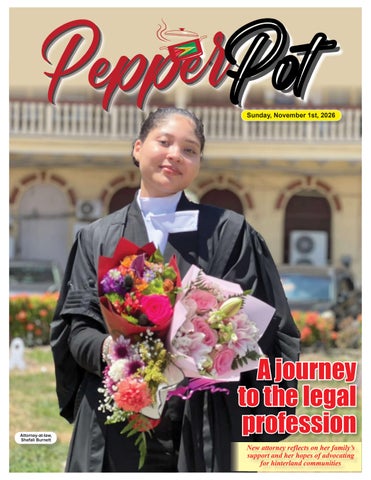
Attorney-at-law, Shefali Burnett
A journey to the legal profession New attorney reflects on her family’s support and her hopes of advocating for hinterland communities
II
By Andrea Hendricks ZIPPY’S Courier began operations in May 2020, during the COVID-19 pandemic, when Guyana’s restrictions curtailed social life and Companies increasingly used online spaces to transact business. As online activity became part of daily life, entrepreneurs stepped in to meet new needs—including getting favourite foods to homes and offices. Zippy’s Courier quickly identified this demand and positioned itself as a reliable delivery solution during this challenging time. By leveraging technology and forging strong partnerships, the company bridged the gap between businesses and consumers, ensuring essential goods and
CHRONICLE PEPPERPOT
services reached their destinations safely and efficiently. The company’s commitment to customer satisfaction and its ability to adapt to the rapidly changing landscape were key factors in its success. As more people relied on delivery services, Zippy’s Courier expanded its operations, initially focusing on food delivery before gradually diversifying into other services supporting small businesses. This adaptability not only helped them survive the early days of the pandemic but also laid the foundation for future growth. Now operating as Zippy’s Inc, the company continues to evolve, embracing new opportunities and technologies to serve its clients better. With a focus on innovation
Zippy’s Inc, CEO & Co Founder, Dennis Mayers, delivers to a valued customer in Berbice, reinforcing the company’s commitment to reliable, safe and customer-focused service across Guyana
and an unwavering dedication to quality service, Zippy’s is set to play a signifi-
cant role in shaping Guyana’s logistics future. Sherwin Bart, adminis-
Sunday, November 1, 2026
Serving customers in Georgetown. One of our delivery drivers in Georgetown ensures packages reach their customer destination safely and efficiently
trator and founder of Zippy’s Inc., formerly Zippy Courier, took delivery calls from homes and offices in and
around Georgetown, helping customers access food while movement and social activity TURN TO PAGE XVII
CHRONICLE PEPPERPOT
III
Sunday, November 1, 2026
Veteran educator anticipates retiring to become a full-time farmer, fulfilling a passion By Michel Outridge LUCILLE Ramona Bhajan Chetram is a teacher and a farmer. With her family, she makes time for both her professional career and her love of a family tradition: farming. She was born in St. Lawrence, East Bank Essequibo, and grew up on her father’s inheritance from his parents, mostly his mother, whom she called Ajee in Hindi. Chetram attended St. Lawrence Primary School, after which she wrote the Common Entrance and gained admission to Zeeburg Government Secondary School, West Coast Demerara. After secondary school, she became a teacher (Acting Teacher) and later graduated from Cyril Potter College of Education (CPCE) in 2000. She completed her bachelor ’s degree in Primary Education in 2012 at the University of Guyana (UG) and taught at schools which include St. Lawrence Primary and Blake Primary, where she first met her husband-to-be in 1998.
They got married in 1999, and their marriage produced two sons, after which she worked at Vreed-en-Hoop Primary School for two years. Chetram told Pepperpot Magazine that after graduating from CPCE, she was placed at Wales Community High School, where she worked until 2020. She reported that her promotion came in 2020, during
the COVID lockdown, and at that time, they decided to work together on a farming project to bring income into the home. The educator pointed out that the farmland is an inheritance from her husband’s mother. Chetram added that after committing to the education system, she is looking forward to her retirement next
year, on May 1, after serving as a teacher for 34 years. She said the family and the farm are a big part of her life, and that for two years she served as headteacher at her current school, Crane Primary, where she is the graduate deputy headteacher. Chetram explained that she will continue to work with the government if given the chance, since teaching is deeply ingrained in her life and it is meaningful to give back to society. She started with cash crops and later moved to permanent crops, which her brother-in-law, sister, and father gave her. Chetram told Pepperpot
Veteran educator, Lucille Chetram
Magazine that she grew up in a strong family with much love from her father, and that stayed with her as one of life’s positives. The family’s farm is located at Good Intent, West Bank Demerara, and the land was once used to plant sugar
cane before the sugar estate at Wales closed. In addition, the family also picks water coconuts, limes, lemons and cherries to sell, among other things. Chetram said working on the farm brings her immense TURN TO PAGE VIII
The farm at Good Intent, West Bank Demerara
IV
A journey to the legal profession
CHRONICLE PEPPERPOT
Sunday, November 1, 2026
New attorney reflects on her family’s support and her hopes of advocating for hinterland communities
By Michel Outridge SHEFALI Alexandra Burnett hails from the village of Karasabai, Region Nine, Guyana, where she spent her formative years. She spent much of her childhood growing up in the village, where she developed cherished memories of the community, its people, and, most importantly, her family. Even after leaving to pursue her education, she made it a priority to return during school holidays to spend time with her grandparents and other relatives. She said those experi-
ences instilled in her a deep appreciation for her roots and the sense of belonging that comes with growing up in a close-knit community. For Burnett, growing up in Karasabai has taught her the importance of community, togetherness, and looking out for one another. “I would describe my family as an extended family, one in which love, support, and sacrifice have always been shared,” she said. Burnett added that her mother, who is also from Karasabai, migrated in pursuit of employment opportunities but continued to sup-
port and guide them, and they made every effort to visit each other whenever circumstances permitted. She reported that while her mother was away, she and her brother remained in their father’s care. Although she had left the village, she found another home in Georgetown through her extended family of aunts, uncles, and cousins, who embraced her and played an important role in shaping the person she is today. Burnett’s father, who is from Georgetown, also ensured that she had a connection to another community Attorney-at-law, Shefali Burnett
Shefali Burnett with Justice Hessaun Sharifa Yasin following her admission to the local Bar
where she felt equally at home. The new attorney’s educational journey began in Karasabai before she travelled to Georgetown, with her family’s assistance and encouragement, to pursue further opportunities. Burnett told Pepperpot Magazine that she attended Success Elementary School and subsequently Marian Academy, from which she graduated in 2019. She then attended The Bishops’ High School for Sixth Form, where she earned an associate degree in law and graduated in 2021. Burnett said her time there was particularly meaningful, as it not only strengthened her interest in the legal profession but also introduced her to lifelong friends who encouraged and motivated her to pursue her ambitions. “I am especially pleased that we were all able to complete our respective journeys,” she said. Burnett pointed out that throughout her years in school, she was fortunate to be exposed to various experiences, subjects, and
influences that helped shape her decision to pursue law as a career. She said that in 2021, she enrolled at the University of the West Indies, Mona Campus, Jamaica, where she completed the three-year Bachelor of Laws programme and graduated in 2024. Burnett said her time at the university was enriched by the friendships she formed, particularly with fellow students who became her study partners and support system. She reiterated that together, they navigated the demands of law school, encouraging one another through each examination period and celebrating their successes along the way. Burnett added that during her studies, she developed a particular interest in international law, especially international humanitarian law and international environmental law. She explained that these areas broadened her understanding of the role legal institutions can play in addressing global challenges, protecting vulnerable communities, and safeguarding
the interests of people whose livelihoods depend on their environment. She noted that her interest in these fields is also influenced by her connection to Guyana and its unique communities, natural resources, and cultural heritage. “I believe that understanding and applying these areas of law can play an important role in protecting people and communities while supporting sustainable development,” she said. Burnett said that after graduating in 2024, she attended the Norman Manley Law School in Jamaica, where she completed the two-year professional legal education programme and obtained the Legal Education Certificate required for admission to the Bar in Guyana. This, she said, marked the end of an important chapter in her educational journey and brought her one step closer to fulfilling a goal she had worked toward for several years. However, returning home to Guyana to take this next step in her professional journey is particularly meaningful to her. She stated TURN TO PAGE XIX
CHRONICLE PEPPERPOT
V
Sunday, November 1, 2026
Diana Alli D’Souza Celebrates Platinum Jubilee Year with Three Prestigious Honours By Frederick Halley RENOWNED Canadian humanitarian, philanthropist and educator, Diana Alli D’Souza, O.Ont., whose enduring connections with Guyana and its diaspora span more than five decades, is celebrating her 75th platinum jubilee year with three prestigious honours recognising her six decades of humanitarian service. On October 17, 2026, Diana received the coveted Nelson Mandela Humanitarian Award at the Afroglobal Excellence Awards, held at Toronto’s Meridian Arts Centre. She was also honoured with the 2026 Outstanding Canadian Award on October 24 and has been named a recipient of the Reconnect Royal Award for Community Philanthropy, to be presented on November 22 at the Niagara Falls (Ontario) African
Festival. These distinctions follow her receipt of the Martin Luther King Jr. Leadership and Community Award in January 2026, making this an especially memorable year of recognition. For Diana, receivin g honours bearing the names of two legendary champions of justice and humanity, Martin Luther King Jr. and Nelson Mandela, during the same year carries profound significance. Remarkably, she learned of her Mandela recognition in late September, on her Platinum Jubilee (75th birthday). A LIFETIME OF HUMANITARIAN SERVICE In announcing her selection, Afroglobal Television, Silvertrust Media and the Transformation Institute commended Diana’s outstanding servant leadership,
Diana shows off her 2026 Outstanding Canadian Award
her pioneering health-science mentorship programmes for Black and Indigenous youth, her contributions to interfaith harmony and her philanthropic work uplifting marginalised children in India and globally. During her distinguished 38-year career at the University of Toronto’s Faculty of Medicine, Diana founded or co-founded more than 21 community outreach initiatives, including the Summer Mentorship Programme, established in 1994, which has produced over 1,700 graduates, many pursuing careers in medicine, health sciences and research. The Saturday Tutoring Programme, launched in 1995, further expanded educational opportunities for racialised and disadvantaged youth. In a meaningful full-circle moment, a former Summer Mentorship Programme participant she mentored nominated her for the Nelson Mandela Humanitarian Award. Her humanitarian journey extends to the Indian Himalayas, where she has spent more than a decade teaching English and supporting educational opportunities for marginalised children. Through her longstanding involvement with the Khushi Charitable Society, she has helped empower Indigenous children as a philanthropic and English teacher. Diana also serves as a Board Director, Elder, and Mentor with the Women in Canada Empowerment Initiative. Through this organisation, she continues to champion women’s empowerment, leadership, intergenerational mentorship and community development. Her humanitarian efforts also extend across Canada, Nepal, Guyana, and beyond, encompassing youth empowerment, women’s advancement, interfaith collaboration, and support for vulnerable communities. T h r o u g h th e A c c e s s Empowerment Council she founded, and through her involvement with numerous women’s empowerment, civic, and interfaith organisations, Diana continues to advocate for refugees, newcomers, isolated seniors, and
Diana Alli D’Souza poses with the Nelson Mandela Humanitarian Award at the Afroglobal Excellence Awards
underrepresented youth. Her numerous distinctions and awards include the Order of Ontario, the Queen Elizabeth II Diamond Jubilee Medal, Canada’s Harry Jerome Award for Diversity, the Nation Builder’s Award, the Desi Achiever’s Award (one of the top South Asians), and the Top 25 Canadian Immigrants, among a lengthy list of accolades. GUYANA — AN ENDURING LEGACY Born in Mumbai, India, Diana’s journey took her from London to Georgetown, Guyana, where she gave birth to her youngest child, before settling in Canada more than five decades ago. Guyana remains an integral part of her family history, humanitarian commitments and continuing involvement with the Guyanese Canadian diaspora. Mark M. Persaud, Founding President of the Canadian Guyanese Congress, paid tribute: “Diana is a humanitarian who continues to selflessly dedicate herself to the com-
munity. She is a wonderful role model, especially for our next generation of leaders. We congratulate Diana and celebrate the recognition she has received for her important community work.” Nadira Somwaru, President, Guyanese for Canadian Unity (GCU): “I deeply admire Diana Alli D’Souza for her compassion, generous spirit, and genuine commitment to making a difference in the lives of others. Her passion for empowering youth, uplifting communities, and serving humanity reflects the kind of heart our world needs more of. As a member of Guyanese Canadian for Unity, Diana represents the importance of coming together, supporting one another, and creating positive change. It is truly a pleasure to recognise a woman whose dedication to helping others makes such a meaningful difference.” According to Adaora Igboo, Founder & Chief Executive Officer, Women in Canada Empowerment Initiative (WICEI), “Diana Alli D’Souza exemplifies a life-
time of extraordinary humanitarian service, compassion and transformative leadership. Her journey of breaking barriers, empowering marginalised youth, championing inclusion and uplifting communities has inspired generations. At Women in Canada, we cherish her as our Elder, Advisor and Board Member, whose wisdom and unwavering commitment enrich our mission. Her numerous honours celebrate more than achievements; they reflect decades of sacrifice, lives transformed and a powerful legacy of hope, humanity and empowerment for generations to come.” For Diana, these honours transcend personal achievement, reflecting the collective contributions of generations of students, volunteers, colleagues and communities who have shaped her remarkable journey. At 75 years young, this indefatigable humanitarian continues to inspire through education, compassion, philanthropy and an unwavering commitment to empowering others.
VI
CHRONICLE PEPPERPOT
Sunday, November 1, 2026
Blueprint Foundation Inc. Returns with Fourth Annual Mission to Give Back to Communities Brings CPR training, digital access and wellness activities from November 2 to 8
By Andrea Hendricks FOR Roxanne Hermanstyne-Johnson, the impulse to give back was nurtured in childhood. Now, the Guyana-born founder of Blueprint Foundation Inc. is preparing for another week of outreach, bringing CPR
however, came from a family tradition. Every Christmas, her father brought children with special needs to their home for a Christmas party. That early experience of caring for others left an indelible mark on Johnson and helped shape her commitment to serving underprivileged peo-
report. Johnson urged her to seek treatment and care in the United States, at the hospital where Hermanstyne-Johnson worked at the time, rather than in Guyana. “It felt like I was fortunate enough to have access to medical care and resources and the support of the family
cially those out of the city where help and support might be more challenging,” she told this publication. “I believe that I have a gift of influencing people positively.” Hermanstyne-Johnson also brought together a team of friends who donated several computers as birthday
Kwakwani Health Centre left a lasting impression on Hermanstyne-Johnson. A beneficiary told her that, had she been trained in CPR, she might have been able to save her brother’s life two weeks earlier. Johnson and her team hope to build on that impact through future mission work.
during the November 2–8 outreach mission. The collaborative effort also supports healthcare professionals and patients by teaching them to monitor chronic illnesses, including diabetes and hypertension, to improve patient care at medical institutions that are
Roxanne Hermanstyne-Johnson, founder and executive director of Blueprint Foundation Inc., is leading the organisation’s fourth mission to bring CPR training, digital access and wellness activities to communities across Guyana
training, digital literacy, including computers, health education and a community wellness event to communities across Guyana from November 2 to 8. Born and raised in Guyana, Johnson later migrated to the United States to reunite with her parents, who hailed from Victoria on the East Coast. She attended Stella Maris and Mae’s Under-12 for primary school and spent one year at St. Rose’s High before leaving the country. Her strongest influence,
ple in her home country. “I grew up in a home where my mom was always giving, although we might not have had a lot. She always found a way to share what she had, even if it was a little,” Hermanstyne-Johnson recalled. Those memories, she said, continued to guide her throughout her life and encouraged her to extend the same generosity to others. Johnson’s call to action came when her aunt was diagnosed with breast cancer and shared her doctor’s
that many of the families in Guyana didn’t have,” Johnson said. Her aunt is now an eight-year cancer survivor. As a birthday gift to herself, Johnson established her non-profit organisation in November 2018. Blueprint Foundation Inc., formerly known as the Benin Foundation, focuses on improving access to healthcare, education and resources for underprivileged communities in Guyana. “It became my goal to bring the resources to the people most in need, espe-
gifts. She later transported and donated the computers as part of the foundation’s educational work, an effort she regards as a God-given extension of her vision to serve selflessly. The foundation’s work includes continuing education in the medical field, particularly CPR training and refresher courses for local polyclinics in remote areas. Its team includes Red Crosstrained CPR certificate holders who provide the training free of charge. One encounter at the
The Oscar Joseph Regional Hospital in Charity also benefitted from similar training during the 2025 outreach mission. The Blueprint Foundation also runs a digital literacy programme, donating desktop computers to schools that need equipment for computer laboratories. In 2025, Beterverwagting (BV) Secondary would have received twelve computers for its lab. With a software engineer on the team, the foundation hopes to distribute another set of computers
usually overwhelmed on clinic days. On Monday, November 2, an educational institution is expected to receive several brand-new computers as the foundation begins its donation drive. The visit will also include a CPR introduction for students. Three health facilities are scheduled to receive support during the mission. On November 3, the team will visit Clonebrooke Clinic on the East Coast of Demerara. On November 4, it will visit West Demerara Regional Hospital
CHRONICLE PEPPERPOT
VII
Sunday, November 1, 2026
Photos of the Blueprint Foundation’s mission impact in underprivileged communities. Photo credit: Blueprint Foundation Inc.
on the West Coast, followed by Victoria Clinic and Market Square on November 5. The on-site programme will include health education on chronic-condition care and support, nutrition and healthy living, women’s health and wellness, as well as health screenings and wellness checks. The mission will close on November 8 with a 5K walk and family-oriented fun day designed to encourage movement and promote the health benefits of an active lifestyle. “It is our fourth year of
missions in Guyana, and every year it gets bigger,” Johnson said. The event will feature a health booth with information for participants. Participants are encouraged to register online, with the 5K race expected to begin at 6 a.m. A live DJ and special musical guest artist, ‘Misstic’, will perform; face painting and a bouncy castle will add to the programme. Nostalgic games, including tug-of-war and lime-andspoon, will also be played as the wellness fair continues
into the evening. “The goal of the day’s activities is to raise awareness about what wellness looks like and create movement for a healthy lifestyle,” Johnson added. “Wellness is medicine,” she said. In time, the Blueprint Foundation hopes to establish a physical wellness centre with an educational digital lab for people who need access to information. The vision also includes clinical services, physical therapy, mental health sup-
port, occupational therapy and a doula service for home maternity deliveries, including water births. Johnson and her team are encouraging people with a vision for a better world and a willingness to give back to join the organisation. “‘Be the change that we would like to see’ is the mission of our organisation,” Johnson said. Hermanstyne-Johnson thanked her team, her supportive husband and all sponsors for their willingness to stand by the foundation’s
work. Team members are coming together from South Korea, Hawaii and various states across the United States, united by a shared commitment to serving communities in Guyana. The team includes Mrs Andrea Petrovanie-Green, Ms Corlene Dixon, Ms Dacia Dixon, Dr Robyn White, Mrs Tyneesha Owens, Ms Carla Thorson, Mrs Camille Hermanstyne and Mr Clyde Skeete. “The team’s support behind the vision for the Blueprint Foundation is invalu-
able. Bringing that vision to life takes people who are equally committed to the work,” Johnson added. “I’m incredibly grateful for the individuals who give their time, share their talents and travel from different parts of the world to help us make a meaningful difference in the lives of others. This mission has always been bigger than me, and I’m proud of what we continue to build together,” the founder and executive director told this publication.
VIII
SOMETIMES, the cracks etched into tar roads or yellowing walls hold stories. Daisies bloom there, or tender weeds. As the years progress and the globe spins, the daisies and weeds become just as much a part of these structures as the rocks and sand that make them up. They become its skeleton, holding it up and giving it its very shape. An observant passerby may stop, press his ear to these buildings, and hear those daisies and weeds growing slowly within. He may notice that the sound of their existence is quiet but steady, like a heartbeat or the blink of learning eyes. Knowledge, especially that gained in the silence of
CHRONICLE PEPPERPOT
a private moment, tends to spread warmly like light from a rising sun. Knowledge, unlike information or facts, is wisdom that cannot be planted or fed. Inquisitive minds and compassionate hearts earn it. It is a puzzle that falls into place under the hands of determined people. The curious thing about knowledge is that it is available to everyone, but not everyone has been taught how to recognise it and absorb it when they encounter it. That is what we must learn. We must learn to recognise the parts of our world that are hidden in plain sight, begging for the grace of being observed. We must learn to hear the voices that are
dissolved and flowing in the wind. We must learn to feel the warmth and coldness that people hide at the tips of their fingers as they extend them towards you. When we see vines and weeds wrapped around old buildings, seemingly seeping into the very structure, it is easy to imagine they are giving the building its strength. They are giving it as much support as the building gave them when they were tender seedlings seeking an anchor to keep them upright. Once they are grown, the vines no longer need the building to survive. They could be cut or redirected and continue growing with the same vigour that they initially had.
Sunday, November 1, 2026
Nevertheless, they remain firmly attached to the building. They have no incentive to find a new path now. When we are young, we adopt the values that we observe in our immediate surroundings. We have no anchor to base our identity around, so we build it around the conversations in our home, the movies we are allowed to watch and the lessons we are taught in school. Although we might encounter new ideas now and again, we primarily remain loyal to the morals and beliefs that we encounter steadily in our developing years. The belief system we depend on, whether “good” or “bad”,
shapes the kind of person we become. Like vines that take the shape of the structures that supported them as seedlings, we too are moulded by the belief systems we depended on during our development. Then, like vines that eventually support the building, we become agents and instruments of the system that once helped us build our identities. We may no longer need to be confined by the belief system, but we continue to depend on it and, in the process, keep it alive, since we have no incentive to seek a new path. When we become vines fixed and cemented in a specific form, we stop truly seeing the world. Our perception
of the world is no longer an active process where every new piece of knowledge changes the shape of our growth. Instead, seeing the world becomes an act of picking out information to affirm beliefs that we have already developed. Now and then, we must challenge the most fundamental beliefs we have about ourselves and our world. We mu st re ach deep within ourselves to find the views we believe are completely unshakeable and give them a good shake. Without occasionally questioning our beliefs, no matter how primal, we risk becoming sustainers of systems that have long outlived their positive impact.
FROM PAGE III
a family can do more than one thing together for a better life,” she said. She related that her son, Shane Chetram, completed a bachelor’s degree in Economics at UG and is currently working at the Ministry of Tourism, while her youngest son, Adrian Chetram, is presently pursuing a bachelor’s degree in Civil Engineering at UG. “Working like I do as an individual allows me to get that heartwarming experience when I see what my children are doing to elevate themselves,” she said. Chetram added that they serve at the Church of Jesus Christ and attend Stream of Living Water Church, located at Cornelia Ida, West Coast Demerara. She is active in the Sisters/Good Intent Farmers Group and often takes on responsibilities at the Ministry of Agriculture (MoA) for the group.
Chetram disclosed that they would benefit from fertiliser, plants and equipment which are much needed on their farms, and they are pleased with the support from the administration so far. The Sisters/Good Intent Farmers Group has 20 members, and most small farmers face challenges such as implementing better farming practices, climate change, and flooding with salt water during heavy rains, which can destroy entire crops. Even though these challenges can heavily impact farmers, they remain resilient to natural disasters such as climate change and never give up, continuing to farm even when they want to put down their tools. In addition, she has an open-door policy at her home, where she assists others with paperwork and job recommendations, among other things.
Another Path
peace and relaxation, reminding her of her childhood days with her father, who passed away in May this year, and the community she grew up in. She stated that her husband also has a full-time job as a driver for the Department of Education (DoE) school bus in Region Three (Essequibo Islands-West Demerara). The teacher said that it is sometimes challenging to balance chores, work, and farming because of their tight schedule. Timing is essential because they prepare meals in advance for the next day, especially on weekdays. Chetram noted that on weekdays they do their fulltime jobs, and on weekends they work on the farm. “Balance comes for me in the way of doing something else and setting an example for others to follow, whereby
CHRONICLE PEPPERPOT
IX
Sunday, November 1, 2026
When Executives Meet, What Happens? EXECUTIVES face difficult situations in business, both strategically and interpersonally. Learn from an experienced executive how to navigate the professional landscape. For new and aspiring executives alike, When Executives Meet, What Happens? is a treasure trove of advice on succeeding in the world of business. Formal Activities (Meetings) Meetings are valuable because they let people share ideas and views and make decisions. Conversely, meetings may also be viewed as boring, depending on who chairs the session and the topics discussed. People sometimes dread meetings because they
feel these sessions are long and yield no positive outcomes. These meetings may be classified as another way to “talk shop”. Executives must therefore design and run meetings to achieve quality results. The items to be discussed and their frequency must be considered when allocating time for meetings. Weekly meetings should be brief, unlike meetings that occur only once per quarter. At the executive level, meetings must allow executives to meet and plan the organisation’s strategies. The organisation will not become independently successful without some planning, especially at the executive level. Planning must consider the organisation’s vision, mis-
sion, and goals, among others. From these main areas, the organisation will develop other important factors. Executives will need to plan beyond tomorrow! The industry in which the organisation operates may be competitive, so a plan spanning several periods is important. As noted in the preceding section, the long-range plan will give executives something to work towards for some years, and they will need to review it and make necessary adjustments as needed. Planning without decision-making will not allow the organisation to accomplish anything. Therefore, executives must make decisions based on the information available to them, and those
decisions must serve the organisation rather than the executive. Where sufficient information is not available, the executives must also be aware and forward-thinking in requesting additional information to make an informed decision. The organisation must carefully coordinate all resources to accomplish its goal. Some organisations may have many resources, while others may have few. Regardless of quantity, once the organisation organises resources properly and makes them available as needed, executive direction enables it to accomplish many things. Executives who communicate well can expect some success, and their ability to motivate people brings ad-
ditional success. Both verbal and non-verbal communication are crucial to an organisation’s success, and executives must use both with senior and junior employees. Sometimes non-verbal communication can be misunderstood. Use it carefully, and consider the timing. While silence can be good, it may give the impression that an executive agrees with a matter at a meeting, which may not be the case. Executing plans will contribute to success or failure. Often, executives depend on junior employees to execute. Executives must document plans so that, when executing them, all employees do the right thing from the start, minimising errors.
Performance reviews inform executives whether they executed their plans properly or where plans need adjustment. Performance reviews must cover all employee levels and many aspects of the organisation. Designing Key Performance Indicators (KPIs) and other measurement tools helps executives decide the organisation’s current and future direction without getting into too much detail. The literature provides additional information about KPIs. Ethics must be at the centre of all executives’ thinking and actions as they manage the organisation. Informal Activities (Meetings) Many executives hold TURN TO PAGE XVI
X
CHRONICLE PEPPERPOT
Sunday, November 1, 2026
LEARNING REQUIRES HUMILITY, AND THE DESIRE TO UNDERSTAND… THE ego is a presence that must be understood on the same platform as learning. I was fortunate that the separation of my parents did not anchor me on platforms of rejection; thus, I grew within the realm of my godfather and godmother, within a world that found no space to judge
the origins of their conflict, which dwindled away as I expanded into a world of my explorations and an environment of learning rather than of sadness. One character who held my interest was an artist named Mr Fullington, whose studio was the cottage he lived in. I concealed my elev-
en-year-old self and observed partially undressed females in a motionless state, except for Mr Fullington’s hints and directions. Then, on weekends, a car would visit Mr Fullington’s cottage and, as I would later call it, his studio. A nearby character, addressed as ‘Doctor Paul’, interpreted most of what I learnt for me;
despite the swagger of his alcohol tics, he had an intellect that showed no person should be defined by swift assessments based on quick social assertions of type. Doctor Paul was perceived as an alcoholic, and he did drink to his life of better times, but he had a quick mind and was aware of
many things. He was no charlatan; in any conversation, if unsure, he would postpone. People saw that he drank, yes, but it didn’t define his intellect or his archive of memories, which were sharp and playful. As he would say, “At all times, knowledge is our friend, and every person
has an understanding, even the fool in the man who dances with the invisible Darlin in the rum shop that reminds him that he too was once a man of some means, and prays for its redemption.” To share something as he did with a young artist who was thankful so many decades ago…
CHRONICLE PEPPERPOT
Sunday, November 1, 2026
XI
XII
CHRONICLE PEPPERPOT
Sunday, November 1, 2026
CHRONICLE PEPPERPOT
(Continued from October 25th Edition) BRATHWAITE’S erotic and romantic poems are complemented by a broader interest in the forms of love that bind people together. “Sister, Can I Call You,” for instance, has a resonant autobiographical quality. It offers consolation to a sister suffering the loss of love, and its tenderness arises from the speaker’s willingness to acknowledge another person’s pain without pretending to resolve it. The poem’s emotional generosity is characteristic of the collection: it recognises suffering, gives it language, and makes room for a response that is neither sentimental nor prescriptive. Formally, the poems do not conform to conventional patterns of rhyme and metre. They are predominantly written in free verse, though the freedom is not without discipline. Braithwaite frequently dispenses with capitalisation, as in “walter,” her reference to Walter Rodney, and employs relaxed grammatical structures that reinforce the intimacy and immediacy of her poetic voice. These choices recall aspects of E. E. Cummings’s experiments with typography, syntax, and capitalisation, not unlike Kamau Braithwaite, Sycorax lexicon, although such devices have long since become part of the wider repertoire of modern and contemporary poetry. The absence of conventional punctuation and capitalisation does not, in itself, diminish the poems’ musicality. Syntax, repetition, line breaks, shifts in register, and the cadence of spoken language shape their rhythms. Some passages possess a distinctly metrical quality, while others approach the prose poem, with their sentences unfolding across the page in extended movements of thought. Braithwaite is essentially a narrative poet. Nevertheless, the formal
Sunday, November 1, 2026
arrangements sometimes invite scrutiny. Braithwaite occasionally employs stanza patterns that suggest conventional structures without consistently developing them. Her use of quatrains, for example, appears in some poems but not others, and the reasons for particular stanza breaks or shifts in visual arrangement are not always immediately apparent. In “Is Wah Nonsense They Doing Now,” two unrhymed quatrains precede a return to free verse. Similar combinations occur in “The Sea of Black,” “Love’s Diatribe: 2 AM Message in the Middle of June,” and “Reaping: Love’s Diatribe,” three meditative poems from the collection’s first section. These works explore different forms of love: sexual love, seduction, separation, loss, difficult attachment, and familial affection, while moving between regularised stanzas and freer arrangements. Such variations may be understood as expressions of an individual aesthetic rather than as attempts to establish a consistent formal system. The distinction matters: a poem’s visual arrangement can intensify its meaning, establish a rhythm of expectation and interruption, or direct the reader’s attention in particular ways. Where the relationship between stanza and subject is not readily discernible, the arrangement risks appearing arbitrary. This is not a weakness in the collection, but an area where a more formal discipline might have yielded greater expressive force. “Is Wah Nonsense They Doing Now,” is a political poem that engages the familiar histories of colonial dispossession, the appropriation of Indigenous land, and the destruction of traditional ways of life. Braithwaite’s approach is subtle, almost cunning in its refusal to announce its argument. She understands that a TURN TO PAGE XVIII
XIII
XIV
CHRONICLE PEPPERPOT
Sunday, November 1, 2026
FALLING IN LOVE WITH YOU II ON my way to the hospital that night, I prayed, “Please, God, help her to recover.” The scene at the hospital’s ICU was chaotic, with deeply worried family and friends all wanting to know the status of the accident victims. Hospital security took a long time to bring the situation under control. Doctors came out to speak to the tearful relatives, assuring them that they were doing their best to save the accident victims.
Two hours later, there were screams from relatives whose loved ones had just succumbed. I felt a knot in my stomach that made it hard to breathe. I went outside, walked a little, and took deep breaths until I could breathe normally again. I went back inside. No one knew me, and I did not know her family, so I stood quietly in a corner, hoping to hear an update on her condition. What I knew so far was that she had suffered severe injuries and was in a coma.
I continued to pray for her recovery, feeling a pain I had never experienced before. I hadn’t known her for long, but she had won my interest with her warm smile, beautiful laughter and cheerful personality. I left the hospital close to midnight after one of the attending doctors suggested to her mother, “Please go home and get some rest. She is still in a coma, but she will pull through.” “I want to be here when she wakes up,” she sobbed quietly.
“You have to be strong for her.” The mother nodded and wiped her tears. “I will try. Thank you, doctor.” Ahana’s sister took her mother’s hand and led her slowly down the stairs. I felt so sorry for the family, their pain and worry, and as I walked home, my concern for Ahana grew deeper. She was so full of life, so vibrant, with a pleasant and selfless nature, and I asked, “Why did this have to happen to her?” The universe, of course, gave no answer, and I knew the only thing to do now was keep her in my prayers. I went back to the hospital the next day, but there was no news. She was still in a coma, and three nights later, as I sat alone outside the ICU, a female intern passing by stopped and called my name. “Satesh, sir?” I looked up with a little start, not recognising her, and before I could ask who she was, she said, “I’m Navita. My father Amit, works on
your farm, and when he needed assistance for me to further my studies, you funded my university studies.” It took me a short moment to recollect; then I said, “Oh yes, I remember, and you’re now an intern.” “Thanks to you.” “You’ve done great.” She smiled with appreciation, then asked, “So what are you doing here so late?” I told her about Ahana’s accident, the coma she was still in and that I was waiting for a word on her condition. “Okay, let me check with the nurses.” She went into the ICU and came out ten minutes later with news that did not ease the deep worry in my mind. “Her injuries are severe, and the doctor can discuss them only with her family. She is still in a coma but stable.” The worry must have reflected on my face, and Navita said as a way of comfort, “I’m sorry, but don’t give up. Just hold onto hope and faith;
they can work miracles.” She took my number and said, “I will check on her status during my shift and send you an update.” “Thank you.” Four days later, a message came on my phone: “She’s awake.” “Oh, thank God,” I said. That was the best news I had heard, and it filled my heart with pure joy. I didn’t go to the hospital, though, for two nights, knowing family and friends would be visiting her. I had to wait a little more and visited when Navita was on duty. She had already spoken to the doctor on my behalf, and I was allowed to see Ahana for a few minutes. My heart was racing as I neared her bed, and I inhaled deeply to control my emotions as I looked at her, hooked up to so many machines. The nurse in attendance quietly called her name, and she opened her eyes. It took her a moment to register I was standing TURN TO PAGE XVI
CHRONICLE PEPPERPOT
XV
Sunday, November 1, 2026
— The Patient Who Became the Teacher IT started with a con versation with a Turkish film critic who regularly reads some of my poetry on LinkedIn. We discussed historical figures whose lives and ideas might inspire some of my writing when he suggested Carl Jung, Sigmund Freud, and Sabina Spielrein. He even sent me a link to A Dangerous Method, the film about their intertwined lives. But before sending me off to watch it, he warned me that after seeing the film, my opinion of Jung and Freud might change completely. Now, you cannot tell a curious writer something like that and expect her to go about her business as though nothing had happened. What did he know that I didn’t? What could possibly change my perception of two men whose names have become practically inseparable from the study of the human mind? Naturally, I watched the film. Then I downloaded a biography of Jung and began reading about all three. One thing led to another, and I found myself looking beyond the theories to the people who developed them. Somewhere along the way, I began asking a question that had very little to do with whether I agreed with their psychology: does understanding the human mind necessarily mean understanding ourselves? Sabina Spielrein particularly caught my attention. She entered Jung’s life as a patient at the Burghölzli psychiatric hospital in Zurich in 1904, but she later became a physician and psychoanalyst in her own right. Her 1912 paper, Destruction as the Cause of Coming into Being, explored the complicated relationship between destruction and creation,
including the possibility that something new can emerge when an existing state breaks down. I found myself wondering how often a woman with a mind of her own becomes a supporting character in the stories of more celebrated men. Spielrein’s contributions deserve attention beyond the details of her relationship with Jung. Giving her that recognition does not require taking anything away from Jung or Freud. It just requires admitting that intellectual history is rarely as tidy as the names in our textbooks suggest. And then there was Jung himself, whose work on dreams, symbols, the unconscious and the shadow encourages us to examine the parts of ourselves we would rather leave undisturbed. We all have a talent for spotting other people’s contradictions. We can identify their vanity, dishonesty, and need for attention with precision, yet become strangely philosophical when someone points out our own. Which brought me to another question: if you understand the human psyche well enough to explain its hidden corners, does that necessarily mean you have explored your own? Jung’s relationship with Spielrein crossed professional boundaries, raising serious questions about the responsibility of someone entrusted with a patient’s vulnerability. The historical details deserve careful examination, rather than assumptions based entirely on a dramatic film. But the ethical question remains. When someone comes to you seeking help, your knowledge gives you influence. It does not give you permission to forget the
responsibility that comes with it. Freud, meanwhile, challenged the comfortable idea that we always know why we do what we do. Our motives can be complicated, our explanations self-serving, and our conscious understanding of ourselves incomplete. Yet even if we discover precisely why we behave in a particular way, we still have to decide what to do about it. Knowing the roots of our anger does not give us permission to hurt someone. Understanding our insecurities
does not make manipulation acceptable. I could almost hear the conversation taking shape in my head. I wanted Sabina to explain how a patient becomes a teacher, Jung to answer for the distance between examining the shadow and confronting one’s own, and Freud to tell me whether understanding our desires makes us any better at managing them. And, naturally, I wanted to ask all three the question that had been following me through my reading: if we
spend our lives examining the human mind, who examines the examiner? But the more I read, the more I realised I had started with one expectation and ended somewhere else entirely. I had gone looking for insight into three influential figures, expecting to learn about psychology, intellectual rivalry and the complicated history of psychoanalysis. What stayed with me was ordinary but sensible: just because somebody is knowledgeable about something doesn’t mean they embody it,
and we should stop expecting them to. Think about it: we expect the relationship expert to have the perfect relationship, the psychologist to have mastered every corner of their own mind, and the person who teaches integrity to be incapable of compromising theirs. We assume that because somebody can explain a principle, they must also be living proof of it. But knowing the language of love does not automatically make someone TURN TO PAGE XVI
XVI
Jung, Freud and Sabina
FROM PAGE XV
loving. Studying human behaviour does not guarantee that we understand our own. A person can speak brilliantly about morality and still struggle to make the right choice when doing so becomes inconvenient. We keep turning knowledgeable people into ideals, then act surprised when they turn out to be human. Maybe the problem isn’t that they failed to become the people we imagined; maybe we confused their expertise with a promise of personal perfection they never had the capacity to fulfil. The Patient Who Became the Teacher Romella: “Sabina, you came seeking help, a patient in distress; How did you find a voice beyond the walls of that address? You studied how destruction might give birth to something new; Did those who taught the mind learn what their own minds put them through?” Sabina: “I found that pain can
raise the questions comfort leaves unseen, And that the things we break apart may change what might have been. But suffering alone is not a lesson, nor a cure; We must decide what we will make of what we have endured.” Jung: “The shadow holds the parts of us we struggle to embrace; To know the mind, one must be brave enough to look within its space.” Romella: “Then tell me, Jung, if shadows are the things we hide from view, Does mapping them in others mean you’ve faced the ones in you? When someone trusts you with their wounds, does knowledge not demand That you protect that trust with care, and understand its weight firsthand?” Freud: “The mind has hidden motives that our conscious thoughts may miss; But knowing why we do
a thing does not make right of this. We may explain desire and trace the paths by which we came, Yet understanding our behavior does not cancel out the blame.” Romella: “And Sabina, when your ideas helped shape what others taught, Did history give you all the credit that your work had brought? Or must a woman watch her thinking travel under someone else’s name, While those who stand beside her take the larger share of fame?” Sabina: “Let every mind receive its due; let no one’s worth be blurred. But do not judge a life by knowledge, nor by every spoken word. For those who study human nature are still human, as we see; They may know more about the mind than how to live what ought to be.” Romella Dasratt
CHRONICLE PEPPERPOT
Sunday, November 1, 2026
FALLING IN LOVE WITH YOU II
FROM PAGE XIV
there; then she smiled weakly. “Hey, you’re here.” I smiled and said, “I’ve been here from the first night.” “That’s good to know you care.” She closed her eyes, then reopened them and said, trying to sound cheerful, “I still want to do that tour.” “Yes, of course. Whenever you’re ready.” She smiled weakly again and said to me, “Come closer.” I looked at the nurse, who nodded, and moved closer to her bed. She reached and touched my hand, whispering softly, “Pray for me.” The re que st really touched my heart, and I responded, my voice shaking a little, “I’ve been doing that, and I will continue to pray for you.” She smiled, tears glinting in her eyes. “Thank you.” I did not know how se-
vere her injuries were, but it was clear she had a battle on her hands to recover, and as the days went by, she improved slowly but steadily. I got to see her a few more times, and my heart rejoiced at the progress she was making and the warmer smile on her face. The doctors declared she was out of danger, and she was moved to a private room with fewer restrictions on visitors. We got to talk a little more, and she said, “Thank you for keeping me in your prayers.” “It’s all I could have done for you.” “And you came every night?” “Yep.” “It’s nice to have someone like you as a friend.” I looked at her and knew then what my heart had been trying to tell me: from the first time I met her, I had fallen in love with her.
For the next few days, I got caught up in the farm’s business and preparations at home for Diwali. Our family always celebrated the festival of lights with splendour, but this year, my friend was still in the hospital, and it took away a little of that enthusiasm from me. One week before Diwali, I visited her, but I was stunned by an unexpected change. She looked distraught, and her warm smile was gone. “How are you doing?” She shook her head a little, and I could see the deep pain in her eyes. I touched her hand gently and asked, “Ah ana, what’s wrong? You’ve been recovering so well.” She nodded, tried to talk but choked; then, after a long moment, she said, a tremor in her voice, “The doctors said I may not walk again.” To be continued…
When Executives Meet, What Happens? FROM PAGE IX
formal meetings; however, they also hold informal ones and sometimes engage in activities that are not best for the organisation. In this section, you will see some unprofessional actions executives take that are not designed to benefit the organisation. If an executive has hurt you, then you might identify some areas in this section. When executives deviate from their professional training, they plan and engage in activities that often harm their employees and the organisation. People may be aware of politics at the national level but fail to recognise politics within an organisation, which executives can initiate. Many decisions approved by an organisation’s executive may reflect favouritism. Employees in an organisation may not be the most qualified but may receive support through political manoeuvring by executives.
Contractors may be eligible but unable to receive a contract because of executive politics. Victimisation may be familiar to many persons. Employees may complain about victimisation to executives, not knowing that these same executives have established systems to victimise specific employees, especially if those employees do not carry out unprofessional requests. An employee may have the skills and knowledge to perform a particular task, but because the executive wants to victimise the employee, the executive may withhold work from that individual or place them in an area that is inappropriate or less conducive to work. If power is not used correctly, then it can hurt many people rather than help them. Executives may use their power and influence to inflict certain wounds on some employees. Because of the level of influence some executives have, they may choose actions that provide direct benefits to themselves. Novice executives may use power and influence in ways that adversely affect the organisation, since they may operate more out of zeal than
wisdom. Some employees may be requested to work longer hours, not because those employees have not done their work properly but because the executive wants to impose power and influence on or subdue those employees, especially if they share ideas that are different from those of the executive and if many employees support those ideas more than the executive’s. Ex ecuti ves ca n h old meetings within the organisation if space is available. However, if executives have to rent a place for the meeting, they may choose expensive places or venues that benefit them personally. The executive may order lavish menu items, as they may see the meeting as a chance to feast. This happens because limited procedures guide executives on meal expenses and location. For more information about Geary Reid and his books, please use this contact information: Amazon: http://www.amazon.com/ author/gearyreid, Website: www.reidnlearn.com, Facebook: Reid n Learn, Email: info@reidnlearn.com, Mobile #: 592-645-2240.
CHRONICLE PEPPERPOT
Sunday, November 1, 2026
Spreading its Wings
were restricted. Zippy’s partnered with other small businesses and popular fast-food franchises, offering delivery services during what Bart described as a “competitive” period for the industry. Just two years later, in 2022, the brand incorporated and added services for the Guyanese public—growth that reflected its expanding role beyond food delivery. Demand for food delivery across the country laid the groundwork for that expansion. Speaking with this publication, Bart said, “When started operations, we had two clients, then it increased to several small businesses providing clothing, among other items that needed to reach their customers, including fast food restaurants, expanding our reach out of Georgetown, along the west bank corridor, west side and East Coast.” The expansion came with challenges. As the company hired and trained staff, some employees later left. Communication problems also arose when a client or business partner arranged a delivery—for example, by giving an estimated delivery time—without consulting the delivery team. The transition from a courier service to a logistics company was challenging, but management treated it as a growth opportunity. “The transition was slow and somewhat difficult, but using it as a bench mark to grow into what we intended for the business,” Bart told this publication. “By honing in on business-to-business services, Zippy’s has been able to cultivate stronger relationships with local enterprises, thereby creating a more robust network of partnerships,” Bart explained. “This shift allows
On the road delivering with care! Behind every delivery is a dedicated team committed to getting your packages safely to their destination
us to streamline our operations and focus on what we do best—providing seamless logistics solutions tailored to the evolving needs of our business clients.” The company has also recognised the importance of clear communication and customer feedback in refining its services. “We actively seek input from our partners and clients to ensure that we are meeting their expectations and addressing any concerns promptly,” Bart added. “This open dialogue is key to our continuous improvement and success.” Zippy’s focus is now more heavily centred on business-to-business deliveries than on food delivery or business-to-customer services. Bart acknowledged that no business is completely efficient and that a few hiccups
occurred along the way, but said the transition gave the company an opportunity to redirect its path and clarify customer expectations before moving forward. “Correcting the steps as we go and putting provision in place to have certain issues never to repeat it,” he said. “Under Zippy’s Inc., we would have expanded our list of services to full logistics,” Bart said. The company’s services include shuttle transportation; airport and seaport pickups; tours; and business-to-business cargo deliveries. Its delivery options include sameday, next-day, scheduled, and bulk-order deliveries, as well as cash-on-delivery and outof-town deliveries. Payment options are Mobile Money Guyana (MMG), bank transfers and cash.
XVII
FROM PAGE II
Zippy 4: FB cover photo. Photo credits: Zippy’s Inc
To support timely deliveries, Zippy’s uses a scheduling system by area and offers pre-arranged deliveries. The company describes its services as transparent, fair and flexible throughout the process. “We go above and beyond to make things happen for our customers in a realistic way and according to our service policies,” Bart said. He added that “same day and next day delivery options are scheduled based on the situation.” For example, Zippy will not facilitate a delivery request to the East Coast the same day unless the delivery agent is already en route in that direction. Customers can also use move-in or moveout services when relocating residential or commercial properties.
Zippy’s Inc. has dedicated delivery days for Bartica and Essequibo on Tuesdays, Thursdays, and Saturdays; Berbice every Thursday up to Moleson Creek; and Linden every Wednesday. Daily deliveries are available in and around Georgetown and the city’s outskirts. The company prides itself on being adaptable and responsive to clients’ needs, tailoring its services to support customer satisfaction. With a growing reputation for reliability and efficiency, Zippy’s Inc. has become a trusted name in Guyana’s logistics sector. As Zippy’s Inc continues to expand, it remains committed to high service standards. The team is exploring new opportunities to enhance its offerings and streamline operations, aiming to stay at
the forefront of the logistics industry. The planned innovation is intended to enhance the customer experience and strengthen the company’s position in the field. T hr o u gh d e di c at i on , strategic partnerships, and a focus on customer-centred solutions, Zippy’s Inc. is working to become a cornerstone of Guyana’s logistics sector and beyond. Whether the need is a simple package delivery or a complex logistical challenge, the company says it is ready to serve clients with professionalism and care. For more information about Zippy’s Inc. and its services, customers can contact the company online or directly at (592)6596644/ (592)638-9808, or on Facebook, Instagram, and TikTok.
XVIII
CHRONICLE PEPPERPOT
Sunday, November 1, 2026
FROM PAGE XIII
poem need not function as a sermon or deliver a moral lesson to the reader. Instead, she directs our attention to those who suffer the consequences of exploitation, allowing the injustice to emerge through the poem’s images and the conditions it renders visible. This emphasis on the victim is both an ethical and an artistic choice. It makes the consequences of unjust actions visible by attending to those whose lives have been diminished or disrupted. Its point of departure draws the
reader in through poignant and startling images, which clarify the poem’s concerns without reducing them to a proposition: The walls of the papyrus house Are thin, the breeze of the cooling Fan, glides through the aisle of Discontent. Those men have rendered the forest dust The fires have taken the canopy trees,
The jaguar’s paws grow too heavy to trot The otter’s path, parched. The arapaima stiff. This is fine and beautiful writing; the destruction of nature is terrible, above and below, fires, drought, affect all: human profligacy at work. This is a tricky balance in the poem, between the images and the ideas; the beauty of the words and the lyricism of the poem might distract from the essential idea, aided by the almost an-
apestic flow of the first lines. The poem’s achievement lies in the intricate relationship between what it shows and what it leaves unsaid. Its silences are not evasions but invitations to recognise the larger structures that inform the scene. This characterises Braithwaite’s method throughout Go Fish: Go In de Pack. She does not generally write epigrammatic verse, nor would the compressed economy of haiku necessarily accommodate her particular
gifts. Her verbal expansiveness is not simply abundance for its own sake. Rather, she allows a poem the space required to develop its subject, accumulate detail, and establish the relationship between an image and the ideas it gradually discloses. These are poems with heft and weight, poems that spread and sprawl when their subjects demand it. More often than not, more lies beneath the surface than the immediate statement reveals. Braithwaite’s poems possess a strong sense of their own organising consciousness. They often begin with an image or observed circumstance, then develop through association, reflection, and enlargement. Their endings do not invariably provide resolution, nor do they necessarily deliver the satisfying closure of a completed narrative. Instead, they often conclude enigmatically, unexpectedly, or abruptly, leaving metaphorical ellipses through which the reader can continue the poem’s work of interpretation. This refusal of easy closure suits poems concerned with historical injustice, political indifference, and the uncertainties of love, all of which resist simple conclusions. Some of these poems uncoil slowly like a cobra, culminating in a satisfying sting in the tail. Several exemplify this mode, including “Seawall 1AM” and the haunting “Spectre,” whose emotional precision rings true to lived experience, raw and naked. “Journey,” too, seems almost devoid of obvious poetic intent, yet its subtlety is sweet and submarine, its depths filled with cymbal crashes of emotion, like the heart’s tumult. The sea, rivers, and creeks recur in Braithwaite’s writing, with lovers perpetually splashing about in their “tea-stained” limpidity—a lovely adjective for Guyana’s tannin-dark waterways. However, the collection shows limited formal variety overall. Most poems remain close to free verse, which, despite its apparent freedom, has its own conventions. Braithwaite generally observes these conventions, using line breaks, rhythmic variations, and syntactical movement to shape her poems. Some works might more accurately be described as mixed-form, combining rec-
ognisable stanza patterns with freer passages. Her preference for quatrains is intermittent, as is her use of upper and lowercase letters. These choices contribute to the collection’s individual character, although their effects are not always sufficiently differentiated to establish a consistent formal logic. The question, then, is not whether Braithwaite should write in conventional forms, but whether the forms she chooses most fully realise the possibilities of her subjects. Her strongest poems suggest a keen instinct for the relationship between the particular and the expansive, between the image that arrests attention and the history or emotion that unfolds around it. When this instinct guides the poem’s movement, her work is persuasive and memorable. When formal choices feel less fully integrated into the poem’s meaning, the writing occasionally misses an opportunity for greater precision. Still, the collection’s strengths are considerable. Braithwaite writes with an alertness to the ordinary world that lets her uncover the extraordinary hidden within it. A child photographed in the aftermath of deprivation becomes the point of entry into a history of exploitation. A complaint about spoiled greens opens onto the frustrations of communal life. A dance becomes a language of desire, while an uncertain encounter between lovers reveals the vulnerability that accompanies intimacy. In each instance, the poem begins with something particular and works outward, letting the immediate experience reveal a larger reality without losing its own integrity. Go Fish: Go In de Pack is therefore a collection attentive to how personal experience and public history continually intersect. Braithwaite’s achievement lies in her ability to look closely without becoming narrow, to write politically without becoming didactic, and to explore intimacy without retreating into the merely private. The result is a debut collection of considerable promise, distinguished by its frankness, cultural rootedness, and ability to make the familiar new and newly visible.
CHRONICLE PEPPERPOT
XIX
Sunday, November 1, 2026
A journey to the legal profession FROM PAGE IV
that although her education took her beyond the borders of her country, she never lost sight of where she came from. Every opportunity she received represented not only
her own aspirations but also the sacrifices of the family and community that supported her along the way. Burnett said that looking towards the future, she hopes to use her legal education and
professional opportunities to contribute meaningfully to the development of Karasabai and other hinterland communities. “I particularly wish to advocate on behalf of my
village, helping to ensure that the voices, concerns, and perspectives of its people are heard and considered in matters affecting their future. I hope to play a role in safeguarding the rights, interests, and livelihoods of communities such as my own, particularly where development, land, environmental protection, and the preservation of cultural heritage are concerned,” she said. Burnett said she also aspires to advance her studies in international law, with a particular focus on the areas that have shaped her academic interests. Ultimately, she hopes to acquire the knowledge and experience necessary to make a meaningful contribution to Guyana, whether through legal practice, advocacy, or involvement in matters of national and international importance. Burnett also hopes her journey can encourage other young people, particularly those from hinterland communities, who may feel that their circumstances or geographical location limit the opportunities available to them. “If I could offer any advice to my younger self growing up in Karasabai, it
would be that there is no limit to what one can achieve, regardless of where one begins. Our backgrounds should not be viewed as limitations but as part of the foundation upon which we build our futures. I hope other young people recognise that they can pursue opportunities beyond their communities without ever having to lose their connection to home,” she said. Burnett recognised that this journey would not have been possible without the sacrifices, encouragement, and unwavering support of the many people who have stood beside her. She said she is especially grateful to her parents, Stefan and Fiona Burnett, and her brother, Stefan Burnett, for their continued love and support. She also extended her deepest appreciation to her grandparents, Jaunita Alberto, Errol Segura, and Phyllis Burnett, whose love, guidance, and encouragement have been invaluable throughout her life. Burnett is equally thankful to her extended family, particularly her aunts, uncles, and cousins, including Moya Williams and Roger Nurse, as well as the many others who
have contributed to her journey in big and small ways. She also thanked her teachers, lecturers, professors, and friends for encouraging, guiding, and supporting her throughout her education. She said each person played a part in helping her reach this milestone, and she will always appreciate the role they have played in her life. Above all, she said Karasabai will always be home, and she carries the lessons, values, and memories of her upbringing with her wherever she goes. Burnett said her journey has taken her from a small village in the Rupununi to the legal profession, but she hopes that the opportunities ahead will allow her to give something meaningful back to the community that helped shape her. “I believe that we can leave our villages to pursue our dreams without ever leaving our villages behind,” she said. She was born on January 20, 2002 in Karasabai Village, and she is the granddaughter of the late nurse Juanita Alberto and rancher Errol Segura.
XX
CHRONICLE PEPPERPOT
Sunday, November 1, 2026
CHRONICLE PEPPERPOT
Sunday, November 1, 2026
XXI
XXII
CHRONICLE PEPPERPOT
Sunday, November 1, 2026
CHRONICLE PEPPERPOT
Sunday, November 1, 2026
XXIII
XXIV
CHRONICLE PEPPERPOT
Sunday, November 1, 2026
CHRONICLE PEPPERPOT
Sunday, November 1, 2026
XXV
XXVI
CHRONICLE PEPPERPOT
Sunday, November 1, 2026
CHRONICLE PEPPERPOT
Sunday, November 1, 2026
XXVII
XXVIII
CHRONICLE PEPPERPOT
Sunday, November 1, 2026
CHRONICLE PEPPERPOT
Sunday, November 1, 2026
XXIX
XXX
CHRONICLE PEPPERPOT
Sunday, November 1, 2026
CHRONICLE PEPPERPOT
Sunday, November 1, 2026
XXXI
XXXII
CHRONICLE PEPPERPOT
Sunday, November 1, 2026
CHRONICLE PEPPERPOT
Sunday, November 1, 2026
XXXIII
XXXIV
CHRONICLE PEPPERPOT
Sunday, November 1, 2026
CHRONICLE PEPPERPOT
Sunday, November 1, 2026
XXXV
XXXVI
CHRONICLE PEPPERPOT
Sunday, November 1, 2026
CHRONICLE PEPPERPOT
Sunday, November 1, 2026
XXXVII
XXXVIII
CHRONICLE PEPPERPOT
Sunday, November 1, 2026
CHRONICLE PEPPERPOT
Sunday, November 1, 2026
XXXIX
XL
CHRONICLE PEPPERPOT
Sunday, November 1, 2026
CHRONICLE PEPPERPOT
Sunday, November 1, 2026
XLI
XLII
CHRONICLE PEPPERPOT
Sunday, November 1, 2026
CHRONICLE PEPPERPOT
Sunday, November 1, 2026
XLIII
XLIV
CHRONICLE PEPPERPOT
Sunday, November 1, 2026
CHRONICLE PEPPERPOT
Sunday, November 1, 2026
XLV
XLVI
STUDY SUCCESS Welcome. Today, we focus on learning through smallgroup discussion. This activity involves serious study partnering for optimum benefits. Its structured way of learning becomes a successful activity depending upon individual subscriptions and meaningful participation. The process combines several functions includ-
CHRONICLE PEPPERPOT
ing testing knowledge and understanding, circulating new knowledge and insights, and facilitating individual inputs active notetaking. Some groups end with a collaborative group report and suggestions after their exploration of a topic. Small-group discussion is an interesting way to focus on a topic. With love.
THE PASSAGE Careful reading Read the following extract carefully and then answer all the questions that follow. Will I Ever Get Over Losing My Friend? The news that one of my close friends committed suicide came as a shock. Jack was a social guy who was liked by everyone. His girlfriend recently broke up
with him, but he seemed to be taking it all right. He talked to you about the situation - seemed disappointed but not despairing. He mentioned that he was still in touch with his former girlfriend and seemed glad about that. That was why his suicide is so hard to comprehend. Were there warning signs you missed? If you had done more to support him during the breakup, would he still be here? Did you talk to him enough? Did you really listen to him? How could you be a good friend and not know that he had been despondent? You feel guilty every time you think of Jack. It is hard to come to terms with death – even one that is expected, such as when the person is sick or old. But Jack was healthy and young, just about your age. That makes it harder to accept his death. Still, you need to come to terms with it – let yourself feel sad about it, reflect on your friendship with him, and, ultimately, get on with your own life. What can you do to cope? Questions 1a) Why should you not blame yourself for Jack’s suicidal death? 1b) What networks close to him, do you think, also missed Jack’s signals for help if he were sending any out? 1c) Whose decision was it for Jack to take his own life? What prompted your response? 2. What in paragraph one could you now call a warning signal for help? 3a) Within your small group of friends, what can you share about the way forward to deal with Jack’s death? 3b) Listen to what individuals say. Record all that is said in this discourse and, with their help, produce a summary of what thoughts were expressed. Let each person have a copy. 4. Do you think that your religious or spiritual beliefs can help with what you are going through here? Why or why not?
Sunday, November 1, 2026
How sharper than a serpent’s tooth it is, To have a thankless child. WILLIAM SHAKESPEARE (1564-1616) “King Lear” 5. Do you think that you are now able to help keep someone else from making that fatal choice? How do you hope to do so? 6. Jack’s death could be a turning point for you. Examine your own life. Write about how you are living now, and say what you hope to accomplish in the future. THE PASSAGE Reading comprehension In the sixteenth-century Italy and eighteenth-century France, waning prosperity and increasing social unrest led the ruling families to try to preserve their superiority by withdrawing from the lower or middle classes behind barriers of etiquette. In a prosperous community, on the other hand, polite society soon absorbed the newly rich, and in England there has never been any shortage of books on etiquette for teaching them the manners appropriate to their new way of life. Every code of etiquette has always contained three elements: basic moral duties; practical rules which promote efficiency; and artificial compliments to, say, women on their beauty or superiors on their generosity and importance. In the first category are considerations for the weak and respect for the aged. Among the ancient Egyptians the young always stood in the presence of older people. Among the Mponguwe of Tanzania, the young men bow as they pass the huts of the elders. In England, until about a century ago, young children did not sit in their parents’
presence without asking permission. Questions Select the answer which is most accurate to the information given in the passage. 1. In sixteenth-century Italy and eighteenth-century France, the ruling families (A) tried to destroy the lower and middle classes using etiquette. (B) discriminated against the lower classes using etiquette. (C) tried to teach etiquette to the lower and middle classes. (D) put the middle and working classes into fenced enclosures. 2. In England, the upper classes (A) have always followed the French attitude to the lower classes. (B) accept the newly rich in spite of their lower-class manners. (C) published books on etiquette for the newly rich. (D) seem to accept a newly rich person provided he makes some attempt to adjust to upper-class life. 3. Every code of etiquette has always contained three elements: (A) practical rules, optimal moral duties and formal compliments. (B) formal compliments, basic moral duties and practical rules. (C) optimal moral duties, optimal practical rules and artificial graces. (D) rules, regulations, and requirements. 4.The custom of young men bowing to show respect when passing the dwellings of their elders was cited as a characteristic of (A) the ancient Egyptians. (B) parts of Tanzania. (C) England, about a century ago. (D) all societies.
CHRONICLE PEPPERPOT
FROM personal experience, I know how it feels to be a parent when your child injures a tooth. The consequences and prognosis for the injured tooth vary depending on the type of injury. These range from survival (of the injured tooth) to tooth ankylosis (fusion to the bone), pulp decay and calcification, and ultimately to tooth extraction. Most traumatic injuries to the teeth and supporting tissues of children constitute a true dental emergency and require immediate assessment and management. Injuries to the primary dentition can result in physical and emotional complications which may persist for many years. But the good news is that children can self-repair remarkably well, unlike adults. An acute impact can easily transmit energy to the developing tooth germ because of anatomical relationships. Periapical (root tip) complications can also occur after a primary tooth injury and may adversely affect the developing permanent tooth. The objective in the management of a child with a history of recent trauma to the primary dentition is to ascertain the health of the succedaneous (permanent) tooth and immediately treat the injured tooth as indicated by the extent and severity of the injury. Treatment may range from “nothing” to extraction. Successful management depends on several factors, notably the child’s age at the time of injury, the type and severity of the injury, and the time elapsed since the injury. The interval between injury and treatment affects the likelihood of a successful outcome and the risk of side effects and pulp exposure. Dentists who treat children for mouth injuries generally observe a consistent pattern. Most of the victims are boys between the ages of four and six years. Nine out of every 10 patients are injured because of a fall. Nearly all the teeth involved
Sunday, November 1, 2026
in falls are not broken. However, the supporting structures are highly likely to be damaged. There are usually almost 10 times as many injuries to the upper teeth as to the lower teeth. For the upper incisors (anterior), the most common injury is intrusion, in which the blow forces the teeth partially back into the bone, like a nail hammered into wood. Most parents or guardians have the injured child examined and treated about 24 hours after the accident. By the time the traumatised teeth are presented for treatment, most have developed complications, of which dental abscesses are generally predominant. Other complications include non-vitality, discolouration, gum infection and excessive mobility. It is interesting to note that approximately 25 per cent of the children with trauma to the teeth who were seen at the GPHC last year had sustained their injuries more than four weeks before initial attendance at the hospital. Becau se youn g teeth (three-year-olds) have immature roots and root resorption, they are less firmly held in their sockets, and a significant blow can easily dislodge them in any direction. The soft, resilient bone surrounding the teeth also contributes to this relative weakness. The most crucial aspect of injury to children’s teeth is to recognise it and seek and obtain adequate intervention within 12 hours after the trauma. In the initial stage, apply ice packs to prevent or delay the acute inflammatory stage (pain, swelling, bleeding, etc.) before professional help is received. Finally, it is important to remember that children are more susceptible to emotional and psychological trauma along with physical trauma. Reassure the child and tell them that everything will be all right. Also, have the child checked for any other injuries besides the mouth.
XLVII
XLVIII
CHRONICLE PEPPERPOT
Sunday, November 1, 2026