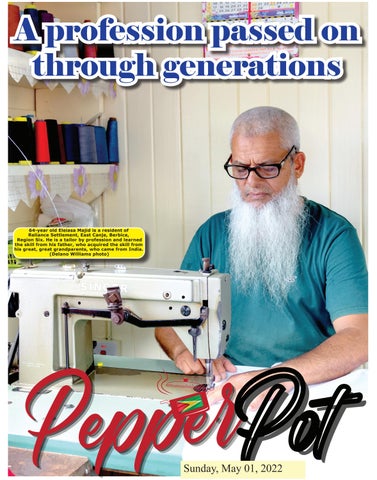
A profession passed on through generations
64-year old Eleiasa Majid is a resident of Reliance Settlement, East Canje, Berbice, Region Six. He is a tailor by profession and learned the skill from his father, who acquired the skill from his great, great grandparents, who came from India. (Delano Williams photo)
Sunday, May 01, 2022
II
CHRONICLE PEPPERPOT ― Sunday, May 01, 2022
A second chance at life Beating the odds and moving on after losing a loved one
SHE was just a regular girl who loved life and could bring a smile to anyone’s face. A teacher at School of the Nations at the time, she knew all too well how to get along with others and had a knack for putting those around her at ease with her bubbly personality, charm and wit. But life would soon change for Latoya Henry (known as Latoya Towler). It was as if she had stopped living for a time, withdrawn and suddenly became embroiled in an emotional rollercoaster, not knowing what to do with her life. It was the early morning of January 26, 2014, when she and her boyfriend, popular fashion designer Trevor Rose, were heading to her Eccles, East Bank Demerara home. The driver of their taxi would’ve never made a stop at the traffic lights had he known what was in store for them over the next few minutes. Police had said at the
“My advice? Accept the reality that the world doesn’t stop spinning when we lose someone so close to us.” – Latoya Henry
time that it appeared as if Rose was gunned down execution-style in the car by someone who rode in a darkly tinted vehicle. A hail of bullets not only killed the designer but injured Latoya and the taxi driver. “I’ve had my fair share of terrible situations, but the one
Thanks to her resilient spirit and positive attitude, Latoya now has a new family. In this picture, she is with her husband Kevin and son, Keanan.
that I wake up to every day is hearing the father of my son take his last breath near me,” Latoya shared during an interview with Pepperpot
Magazine. It is the first time after eight years that she has agreed to share her story, even though doing so was just as hard as talking about
it on day one. Losing a loved one in death can never fully be understood by someone who has never experienced it. It is said to be one of the worst things that can ever happen to you, with the effects of the loss remaining forever for some people. So we asked Latoya to share what the experience was like, what someone in a similar situation could expect, and what are some effective ways of coping. For one thing, the physical ordeal of Latoya’s experience was nothing compared to the damage, emotionally and mentally. She and Trevor had just about a year and a half before the incident become parents to Keanan, whom Latoya is grateful was not in the ill-fated car that night. “For a very long time, I wasn’t the same person; it was really a complete change for me. My life had stopped at that point; I was confused,
and emotionally and mentally, I was in a state of panic,” Latoya reflects. Of course, with her mind and emotions in that state, she could hardly be productive in anything that she was doing. Continuing to care for little Keanan brought its own challenges. Even as he was just a baby when everything happened, he’d still remember certain things and question his mother about them. “Caring for his material and physical needs was the easiest thing. The more impossible was caring for his emotional needs because mine weren’t being properly cared for. Being able to respond to his questions about where is dad…he and his father shared a really close bond; Keanan was always hooked to his SEE PAGE XXXV
CHRONICLE PEPPERPOT ― Sunday, May 01, 2022
The challenging path to success
III
Having to drop out of school did not stop one businessman from achieving great things in life By Telesha Ramnarine SOMAT Ali can still remember the days he went to school without any shoes. It certainly was not a problem to him as he continued gaining high scores at the BV Government School, year after year. But when it was time to go to high school in Georgetown, his family could not afford to send him, and so he had to drop out of school, much to his dismay. Ali’s company was the first to recently receive Ali has never allowed any the ‘Made in Guyana Mark’ by GNBS of life’s challenges to get in the way, but he used whatev- political turmoil at the time. Getting good people to er opportunity was available Once things settled down, work every day is one of the to him to continue to make though, he was determined hardest things. So often you something of his life. Now to come right back and open would see people across the the proud owner of Fibre up his own business in his country having a difficult Tech Industrial Plastics, the Triumph, Agriculture Road, time to find good labour.” Apart from having a regcompany which pioneered East Coast Demerara home ular programme in place the country’s kitchen cup- village. His wife and children to teach his staff important board business in fibreglass, he couldn’t be happier that he helped him to start up the skills, such as how to read allowed no challenge to bring business. Eventually, losing and write, Ali would ensure his wife and a son in death, that he teaches them how to him down. At age 12, when he however, was yet another do the job efficiently. “There stopped attending school, Ali’s parents allowed him to work with their relatives, the owner of Eddie-Ham-Plastics in Kitty, who taught him many things in the fibreglass business. But even as he worked, he’d use the time travelling on the train back then to do lots of reading and studying and would also take night classes in accounting. “Those little things propelled me in life,” the 63-year-old told the Pepperpot Magazine recently at an occasion to mark his company’s receiving the ‘Made in Guyana Certification Mark’ issued by the Guyana National Ali with some of his staff who have become Bureau of Standards like family to him. (GNBS). “I have been in this business since I was 12 hurdle that Ali had to en- isn’t anything that anyone years old. I couldn’t afford dure. But he told himself has learned on the job that I to go to high school, but that he still had his other two didn’t teach them. We train travelling in the train gave children to care for, hence everyone in fibreglass. As an example, we used to import me a lot of time to read and continued pressing on. Even though his busi- moulds, but now I am teachstudy. So I would encourage any school dropout never ness started as a family ing them how to make it right to stop studying. Children operation, Ali was able to here,” he shared. As manufacturers of should be taught a trade so hire workers who would they can make something become just like family to fibreglass products, which of themselves, otherwise, him. To this day, he still can reportedly last a lifethey can fall into the wrong has some of the workers time owing to their superior company and practices,” he who started with him back quality, Ali and his team in 1994. “My staff is like started with kitchen and observed. Ali would eventually family to me. They’re very bathroom sinks and toilet leave the country due to its dedicated; they’re the best. bowl covers and tanks and
Taking his audience down memory lane during an occasion to mark his company’s receiving the ‘Made in Guyana Certification Mark.’
then later introduced bathtubs. When his house was gutted by fire – yet another challenge he had to contend with – he remembered ordering some lumber to build
back his kitchen and other items destroyed in the fire. “When I looked at the cost using my materials, I said there is a niche market here; I can compete with this in fibreglass. That’s when
we decided to experiment with a fibreglass kitchen. We would have been a lot bigger, but we were burnt down. We gradually were building back, but we still cannot afford to buy some of that equipment that we lost; they would be 20 times the cost now. But we are still getting there; we never stopped trying to improve our quality,” Ali shared. Ali has always placed special emphasis on improving the quality of his products, and even though it took his company years and lots of hard work to achieve the Bureau of Standards certification, he kept pushing for it. “The Bureau of Standards certification boosted our sales by over 20 percent. It took us years of work to achieve it, and now we have the ‘Made in Guyana Certification Mark.’ We are planning to work through them and to go for our ISO certification. While we’re at it, we might as well keep going. People want to see a certification mark, and we’re one of the few companies that give a full year’s warranty,” he offered.
Minister of Tourism, Industry and Commerce Oneidge Walrond sharing a special moment with Ali
IV
CHRONICLE PEPPERPOT ― Sunday, May 01, 2022
Let us Celebrate Vaccination Week in Guyana and the Americas
FROM April 23 to 30, 2022, the Pan American Health Organization (PAHO), together with Guyana and territories of the Region of the Americas and its partners, observed the 20th annual Vaccination Week in the Americas (VWA) under the call to action “Are you fully vaccinated? #GetAllYourShots.” Vaccination Week in the Americas aims to highlight the collective action needed and to promote the use of vaccines to protect people of all ages against Vaccine- Preventable Diseases. The Pepperpot Magazine spoke with Medex Carleen Howard Mohabir, Senior Health Visitor (Ag) Region Four, Georgetown Regional Health Services, Ministry of Health. Mohabir explained the difference between Vaccination and Immunisation during her interview with the Pepperpot Magazine. “Vaccination is the drug (weak pathogen/ inactivated viruses) that is administered to a person to prevent the onset of a disease, whereas immunisation is the body’s ability to generate an immune response naturally or through vaccines. These methods build immunity or resistance towards a particular disease. The major difference between vaccination and immunisation is that a vaccine is administered to people to create immunity from that disease. For example, before the polio vaccine is administered, the infant does not have immunity to the disease and has a high risk of contracting that disease. Therefore, a vaccination builds up resistance (immunity) to a disease,” she explained. “In essence, vaccination and immunisation go hand in hand. Immunity to disease can occur naturally or be induced by artificial means. For instance, once you contract Chicken Pox, it is very rare for the same person to contract the disease again because they build up immunity to the disease.” Mohabir further explained that vaccination is critical since it saves lives. According to Mohabir, the World Health Organization (WHO, 2020), vaccination has prevented approximately 2 to 3 million deaths annually. Bacillus Calmette-Guerin (BCG), Per-
tussis (whooping cough), Haemophilus Influenzae type B (Hib), Measles, Mumps, Rubella, Poliomyelitis, Hepatitis A, Hepatitis B, Yellow Fever are examples of some vaccines that are available in our Public Health system. The practice of vaccination has brought about the decline and the eradication of some diseases such as smallpox, measles, yellow fever, where the complications of these diseases have devastating sequels and have led to death (Casey, 2016; Vanderslott and Dadonaite, 2013). Mohabir further revealed in her interview that from the existence of vaccination, it is evident that the under-fiveyears children continue to have good health and along with the survival rate being increased. It was noted that among the benefits of vaccination is the cost-saving as the chances of the children getting sick from vaccine-preventable diseases will be lowered and hospital visits will be less frequent. She added that it allows for maximum productivity and development of children and parents, as lost time from work and educational facilities will be avoided. In examining further the importance of vaccinations, Mohabir made mention of the fact that vaccinations can provide protection not just for the vaccinated person, but for the population as a whole as well. This phenomenon, called community immunity or herd immunity, occurs when a large portion of the population is vaccinated, usually over 85 percent, depending on the disease. But one must wonder about the importance of vaccination and why it is so important to us as human beings, since it is a point of discussion on so many fronts. Why is vaccination so important to us as humans? Mohabir contended during her interview that they are several key factors regarding the reasons for immunisation; 1. Immunisation saves lives: more than 3 million lives worldwide each year, and it saves millions more from suffering illness and life-long disability 2. Vaccine-preventable
diseases still pose a risk to members; 3. Diseases can be controlled and eliminated; 4. Immunisation is cost-effective as compared to treating 5. Children depend on health systems to provide safe, effective and inexpensive immunisation; 6. Every child needs to be vaccinated Mohabir made mention of the fact that they are benefits for individuals, the community and the world at large regarding vaccination. Firstly, Vaccines will help keep you healthy The Centres for Disease Control and Prevention (CDCP) recommends vaccinations throughout your life to protect against many infections. “When you skip vaccines, you leave yourself vulnerable to illnesses such as shingles, pneumococcal disease, flu, and HPV and hepatitis B, both leading causes of cancer. Secondly, vaccines are as important to your overall health as diet and exercise. Vaccines are one of the most convenient and safest preventive care measures available. Like eating healthy foods, exercising, and getting regular check-ups, vaccines play a vital role in keeping you healthy,” she said. Vaccination can mean
the difference between life and death Vaccine-preventable infections can be deadly. Every year in the US, before the COVID-19 pandemic, approximately 50,000 adults died from vaccine-preventable diseases. Infants and older adults are at increased risk for serious infections and complications, but vaccine-preventable diseases can strike anyone. If you are young and healthy, getting vaccinated can help you stay that way. Adults are the most common source of pertussis (whooping cough) infection in infants which can be deadly for babies. When you get vaccinated you are protecting yourself and your family, as well as those in your community who may not be able to be vaccinated. Your family and co-workers need you. Each year, in the US, millions of adults get sick from vaccine-preventable diseases, causing them to miss work and leaving them unable to care for those who depend on them, including their children and/or aging parents,” Mohabir mentioned in her interview with the magazine. Disadvantages and the Risks involved in not being Vaccinated Mohabir discussed the
risks and disadvantages involved in not being vaccinated. “Anyone that [sic] chooses not to be vaccinated puts themselves, family members, community members and the entire country at risk of developing vaccine-preventable diseases. This means that they are susceptible to get the disease easier. This can cause morbidity and or mortality. Most importantly, financial implications on the health system,” Mohabir told the Pepperpot Magazine. Erasing the Skepticism and Fears being Vaccination The Regional Health Visitor ( Ag) noted during her interview that as once-common diseases become less frequent, fear of the diseases themselves tend to become overshadowed by vaccine-safety concerns, sometimes fuelled by misinformation about vaccination, says the WHO. She added that according to the CDCP, most side effects of vaccines are minor and temporary, and the relative rate of serious side effects or deaths is extremely low. One thing to keep in mind, is that the risk of getting diseases such as diphtheria or tetanus is much greater (one out of five cases of tetanus is fatal, for instance) than any risk of side effects from vaccines. A c c o r d i n g t o h e r, CDC highlighted some misconceptions about vaccination: “Diseases were already disappearing before vaccines because of better hygiene and sanitation.” This misconception is often cited as an argument against vaccination. Survival rates had been getting better before the introduction of vaccines, but dramatic decreases in the number of cases were seen only after the introduction of vaccines. “The majority of people who get diseases have been vaccinated.” In fact, no vaccine is 100% effective, and indeed some vaccinated people will not develop immunity (vaccine effectiveness is usually 85 to 95%). When there is an outbreak of a disease, the people who are affected will be those who have not been vaccinated, and those who were, but did not develop immunity. In populations where the vast
majority of people have been vaccinated, there are people who are vaccinated but not immune, than people who are not vaccinated. “The diseases that are preventable with vaccines have been virtually eliminated, and so there is no need for children to be vaccinated anymore.” Vaccination protects not only the person who is getting vaccinated, but also the people around him, more specifically, those people who are the most vulnerable. If vaccination stops, then any outbreak could become devastating. “Multiple vaccinations at an early age is taxing for a young child’s immune system and can be harmful.” Children are exposed to germs every day, and the immune system handles them without getting overloaded. Available scientific data show that there is no harm for the immune system of young children. According to the Health Visitor,the Guyana Expanded Programme on Immunisation over the last decade has had tremendous achievements in the inclusion of seventeen (17) antigens in the programme. The goal of this initiative is zero cases of vaccinepreventable diseases. Guyana EPI is a success story with over 90% immunisation coverage at the national level for the last five (5) years. In July 2014, an Effective Vaccine Management (EVM) Assessment was conducted and Guyana ranked third out of Global Alliance for Vaccines and Immunisation (GAVI) eligible countries. (EPI Manual, 2016) Determining the Authenticity of Vaccines It was noted that vaccines go through a series of testing that has different phases before being given to the people, after which it is approved by international regulatory bodies. Thus, the response from members of the public has been welcoming toward our vaccination outreaches/drives, by the Ministry of Health Vaccination Outreach Programme, as we make all vaccines available at extended hours to accommodate the working public.
V
CHRONICLE PEPPERPOT ― Sunday, May 01, 2022
Life in Reliance Settlement Reliance Settlement Village signage by the roadside (Delano Williams photos)
The school
THIS week the Pepperpot Magazine visited the sleepy, traditional village of Reliance Settlement, East Canje, Berbice, Region Six (East Berbice-Corentyne) to highlight the way of life of the locals. It is one of those places where it is still set in the olden days in terms of the architecture with the shingle walls buildings and colonial-style houses that are well-preserved and maintained. The locals of Reliance Settlement depend heavily on the sugar industry for their daily bread. As such, most of the villagers are either employed at the sugar estates, but there is a handful of small business folk, some rear livestock, chickens and cattle. There are a few shops in the village, a nursery and a primary school, a mandir and a mosque. The people are friendly and welcoming, but most are camera-shy and do not want to be photographed or videotaped. Reliance Settlement is sandwiched between Rose Hall and Adelphi villages and it is a small village with just a few internal streets.
It is a quiet, breezy homes as entrepreneurs. place where things seem to The people are somewhat be moving in slow-motion, self-reliant and crave develpeople are not in a rush opment to boost their lives in as in the city, and they do a meaningful way. things at their own pace without any fuss and in Eleiasa Majid relative calm. The village comes unThe Pepperpot Magader the Canefield/Enterprise zine met a spritely elder/ Neighbourhood Democratic councillor, Eleiasa Majid, Council (NDC) and it has who took some time out potable water supply, elec- of his busy day to interact tricity, internet and the ba- with the team, sic facilities are accessed in Majid is a tailor in the vilneighbouring villages. lage, an acquired skill handed Reliance Settlement has a down to him through generapopulation of 150 adults and tions, a family tradition he is just about 95 schoolchildren. keeping alive today. mandir in the village It has four crossThe streets, it The 64-year-old related is divided into two sections that although he is a resident and it has 58 house lots. of Reliance Abandon, East It was made known that Canje, Berbice and he has Reliance Settlement and the the interest of the community village next door, Reliance at heart. Abandon, are two separate He is a leader and volunvillages, divided by a canal teers his time in communiand a bridge. ty-based projects to enhance Reliance Settlement was the lives of the people. an estate bought by sugar Majid told the Pepperpot workers from the then Book- Magazine that in his village, er Tate owners and it was he is seeking to upgrade the converted into a village and internal streets which are in today, it still has a few mud deplorable condition and has dams. engaged the central governAlso in this village, there ment through the Neighbourare a few drivers of buses and hood Democratic Council cars and self-starter persons (NDC), as a councillor. who work right out of their And it is not only for his
Some of the internal streets in the village
village but the neighbouring community of Reliance Settlement, as well. He was instrumental in getting 11 wooden boxes for the drainage in his village replaced with concrete ones
after they approached SIMAP for a $500,000 loan and embarked on other projects for the benefit of the people. Majid added that when the current administration took office in 1992, the Cane-
field/Enterprise NDC was made into a village from under its former state as Community Development SEE PAGE XI
VI
CHRONICLE PEPPERPOT ― Sunday, May 01, 2022
The people of Reliance Settlement enjoy a simple, quiet life
By Michel Outridge DHANDAI Bridgenarine doesn’t believe in sitting idly at home. As such, she has a garden of celery that she sells to make a living and is a lover of all plants and flowers. After her husband passed away, she decided to do something to earn and started to plant celery in the yard space she had, and when she has a harvest, she would sell it. She is a resident of Reliance Settlement, East Canje, Berbice, and is the mother of five. Bridgenarine has a lovely, well-kept home and an equally nice flower garden, which adds a variety of colours to the surroundings. The 51-year-old told the Pepperpot Magazine that life there is simple, providing you earn to upkeep a home and family. She stated that the com-
munity is dependent on the sugar industry, but some people do other things to bring in a dollar to the home. Bridgenarine is originally from Vryheid, but relocated to Reliance Settlement after marriage and has been residing in the village for the past 35 years. She explained that of her five children, one died, and her husband passed away a few months ago and she is still trying to cope with the loss. Bridgenarine is the grandmother of two and that day, one of them was visiting her after school. She is a go-getter and doesn’t sit idly by but do things around the house and yard, such as, buying and planting flowers or tending to her crop of celery. “I love flowers, it plant as a hobby and I would buy a plant if I like it and put it in my yard. Tending to plants brings me peace and joy,”
she said. Bridgenarine also has a kitchen garden of vegetables which is exclusively for home use. One of her children is married while three others are still living with her. A son who works at the sugar estate is rearing 120 meat birds. Kamo Baksh, wife of the wood moulding maker Also in the same village, is the home of Kamo Baksh, a housewife and a mother of two, who is a local of Reliance Settlement, East Canje, Berbice. The 57-year-old is a homemaker who came from a family of six siblings. Her father was a sugar worker and her mother was a housewife. Both parents have since passed away. Her father was a parttime gutter smith. Baksh recalled that life as a child was challenging, they walked to school and it was
Dhandai Bridgenarine harvesting home-grown celery from her garden Home of Kamo Baksh
through a lot of mud and they had to fetch water from a standpipe in the village to their house every day. She added that they were all tasked with household duties before and after school and their parents were strict. Baksh remembered that back then, the estate tractor used to come into the village with a tank and they used to fill up water from it. She is quite happy
that they benefitted from potable water supply, electricity and internet service, but there is a need for her walkway, which is a mud dam, to be upgraded into an all-weather road. Her husband, Raheem Baksh, is a wood mould maker and he is well versed at his job. The 62-year-old doesn’t get steady work since mouldings are machine-made and not by hand. Years ago, when he was much younger, he used to make furniture and supplied it to big companies.
Baksh added that he has been a wood moulding maker for more than 20 years and would get a few jobs at times. The pensioner reported that he quit making furniture when prices for the materials became even more expensive and he could no longer garner a profit. “I am taking things one day at a time; things are a bit slow at this end and I make do with the work I get sometimes. At times, months would go by without getting any orders for wood moulding but I can’t fight it,” he said.
Dhandai Bridgenarine among her lady slippers flower garden at her home (Delano Williams photos) Signage placed by Raheem Baksh to advertise his small business in his village
CHRONICLE PEPPERPOT ― Sunday, May 01, 2022
VII
Making a living as entrepreneurs
By Michel Outridge
FOR some, being at home as housewives in itself is a tall task, but the women of Reliance Settlement, East Canje, Berbice, are not having it that way. They were determined to earn right out of their homes and started small businesses to bring in incomes. Meet Seema Persaud, an enterprising young woman who is set on having her own small business as a pastry and cake maker who work on the basis of orders from the comfort of her own home. The 34-year-old told the Pepperpot Magazine that being at home during the pandemic was taking a toll on her, and it got even worse when her husband was laid off from the sugar estate three years ago. She decided to utilise her skills in cake-making and baking and established her own small business catering for events. Persaud makes cupcakes to match the icing cake, as well as pastries based on orders. She is the mother of a 14-year-old who attends Berbice High School and has been residing at Reliance Settlement for the past 11 years. Persaud stated that she has been married for 15 years and was not working, but wanted to assist her husband in earning. She added that she received formal training at the Welfare Centre in Canefield Village and is certified in sewing, cake-making and baking. Persaud maximised the use of opportunities by participating in all the courses offered and even took the cooking classes.
Karuna Budhram as she draws a henna design on the hand of a client at her home (Delano Williams photo)
Seema Persaud (Delano Williams photo)
She is originally from Adelphi Village, a neighbouring community, but enjoys the quiet country life
is just fine, because it is just peaceful and nice here; no real issues, and the people mind their own business,”
Seema Persaud’s work
in Reliance Settlement. “As you can see, the door is always closed, I am indoors, doing whatever needs to be done, and that
she said. Persaud does her pastry-making on Saturdays and SEE PAGE XIII
VIII
CHRONICLE PEPPERPOT ― Sunday, May 01, 2022
Giving up is not an option for this Reliance Settlement resident By Michel Outridge SHAL Mangal would like to get up and do things around the house and yard, but his movements are curtailed by a mysterious ailment which has prevented him from walking, due to intense swelling of both feet. The 64-year-old was at the time of the visit by the team to his home in Reliance Settlement, East Canje, Berbice, reclining on a rocking chair and his feet were propped up by a wooden stool, under which a pillow was placed for that cushioning effect. Mangal is not pleased with his current health condition because he would like to be active, mostly to assist his wife in gardening. “Our son came to visit over the weekend so he made a big pot of cook-up rice; so we don’t have to cook today, it has a lot leftover and we will ensure it doesn’t go to waste,” he said. Mangal is a stickler for cleanliness and his yard and house is always well-kept;
Shal Mangal (Delano Williams photos)
with flowers and plants. Mangal is the father of three, all of whom are leading their own lives, but would visit from time to time and telephone every day to check on them. He told the Pepperpot Magazine that life was hard growing up because they had no roads or potable water supply. Mangal stated that he had to wade through knee-deep
at their home which he managed, being the eldest child. “I had to do things the right way or no way because if things weren’t as they should it was ‘licks’ and back then you couldn’t give no back answer or answer your parents like nowadays,” he said. Mangal stated that he is the eldest of six siblings and he was given a lot of responsibilities, even for his age
bout of drinking ‘bush rum’ with a friend down the dam; after work it was his routine to imbibe. He would return home and pick quarrels and it would end very badly for his mother, who was on the receiving end of many blows to the body. “My father was a big man, a strapping fella, who worked as a cane cutter and he was not afraid of anybody or anything, but he drank every day after which he would tend to the garden, then things would go haywire in the home,” he said. Despite the abuse meted out to his mother at the hands of his father, he remembered that they never wanted for food, clothing and a good ‘licking.’ Mangal recalled his parents did not hesitate to discipline them and instilled good values in them as children and he is thankful for that good upbringing which led him through life as a gentleman. He had his first job at the Blairmont Sugar Estate and
Kamlawattie Mangal displaying her home-made plantain chips and chicken foot for sale.
Mangal told the pepperpot Magazine that he got a job at the Psychiatric Hospital as a security guard for some time and also worked at Ansa McAl and Toolsie Persaud. It became difficult for him to work and he was discharged as medically unfit for work and had to stay at home.
would make chicken foot and plantain chips and sell at the roadside in the afternoons. This couple also plant their own vegetables and they would at times utilise the outdoor fireside to cook meals. “The best part about living in Reliance Settlement is the peace and quiet it brings, with no nosy
Home and surrounding of Shal and Kamlawattie Mangal at their Reliance Settlement home
so in the event that they have visitors, the place must be clean at all times. A lot can be said for his discipline and the way the home is kept. He was taught at an early age to be tidy and knows how to keep a home, since he came from humble beginnings. Mangal is originally from Goed Bananen Land, also East Canje, Berbice, and his wife Kamlawattie Mangal, is from Bath Settlement, West Coast Berbice. The pair is renting a house in Reliance Settlement which has very clean surroundings and is outfitted
mud to fetch water to fill a tank before going to school every morning. He recalled it was from his home in the back street he had to walk to get to the standpipe in the village some distance away. Mangal added that he used to be tasked with “jabbing” the bottom house with mud and cow manure with his bare hands and had to accomplish that on his knees once weekly before his mother came home from work. He was the product of hard-working parents. His mother bought and sold greens at the market and would later open a small shop
he had to learn to do many things and he had to very quickly. He noted that his parents were good people, but their downfall was his hard-working but alcoholic father, who eventually caused his mother’s death when she was 48 years old as a direct result of a severe beating. At age 14, his mother depended on him to assist in the chores, he did everything else except the cooking but he knew how to cook. She would return home from the market to cook and they would wait until his dad returns home from a
by that time he was married and was a cane cutter for 15 years. He and his wife relocated to Suriname for five years and it was then he became ill and they had to return to Guyana.
Today, Mangal can no longer engage in any strenuous work due to his condition and relies on his wife to assist him. To bring in an income his wife Kamlawattie Mangal,
neighbours peeping into our affairs and the people pretty much mind their own business. Having no neighbours is a good thing here for us,” he said.
IX
CHRONICLE PEPPERPOT ― Sunday, May 01, 2022
The women of Reliance Settlement lead simple, everyday lives By Michel Outridge HALIMA Ali better known as “Aunty Halima” in Reliance Settlement, East Canje, Berbice, is a home-maker and a grandmother, who enjoys cooking for the family. The 69-year-old is originally from Adelphi Village, also East Canje, Berbice but grew up in Canefield Village, also East Canje, Berbice and after marriage, relocated to Reliance Settlement Village.
Ali began living in the village since 1984 and hasn’t regretted it, because it is a quiet, peaceful community which is breezy and it allows the locals a lot of freedom to do whatever they have to. That day, when the team visited, it was rather rainy and Ali was about to make some roti and bora for breakfast, but nevertheless took the time out to chat a bit about her life. “I never worked, but I
and makes sure everything in and around the house is in order with everything to its place. Her husband is Hazrat Ali, 71, he is retired after working for many years as a cane harvester and is at home basking in retirement. The homemaker A few houses away is the home of homemaker, Lakerani Mangru, a religious woman whose life is centred on her religion, home, chil-
Halima Khan and her two grandsons at their home in Reliance Settlement (Delano Williams photos)
She related that they bought the current house in which they live and it was not an easy task, saving up, during that time when things were not very good economically But her husband made sure they had a roof over their heads, since paying rent was not a viable option for them at that time.
did the chores and tend to the children and now they are all grown and I get to spoil the grandchildren and to enjoy my old age,” she said. She is the mother of two, but one passed away and is the grandmother of two active boys. Ali is a quiet kind of person who goes about her daily routine in a similar manner
dren and grandchildren. The 54-year-old told the Pepperpot Magazine that she grew up in Canefield Village, also east Canje, Berbice and also resided in Sisters Village, but settled in Reliance Settlement. She is the mother of two and when she was 16 years old she used to work in the city as a domestic worker, but stopped working after marriage. “Life here is very simple, I do the chores and pray, chant and take my granddaughter to school and I would go to
Lakerani Mangru in her prayer room at home
pick her up and do some more chores,” she said. Her husband, Ramnarine Basdeo, is a carpenter and they do not go out much, but are involved in the mandir and other religious activities. Mangru has a prayer room in her yard, and a small mandir and she would spend a lot of time there worshipping. She would visit the Gay Park Mandir for worship services and would be engaged in their feeding programme. Mangru is a vegetarian and annually she would cook vegetarian dishes and sweet-
meats and share them within the community, on her birth anniversary. Preparing sweetmeats is also a regular feature in her home. She would share with neighbours and other devotees of the mandir. She would also assist in cleaning the mandir and participate in the cooking when they have functions or religious activities. “At first when I moved here, I didn’t like it here, but I am used to this place now and it is quite alright,” she said. She has been residing in
Reliance Settlement Village for the past four years. Mangru said the people are neighbourly and it is a nice, quiet place to settle. “I would help with the cooking at the mandir. At times for religious events we would prepare 108 vegetarian dishes to share,” she said. Mangru admitted that they while they do not go out much or aren’t very social, they spend a lot of time at the mandir, praying, and at home, but get along well with their neighbours and others.
X
CHRONICLE PEPPERPOT ― Sunday, May 01, 2022
THE MOST COMPLEX FACULTY OF THE HUMAN SPECIES IS THE INCREDIBLE GIFT OF ART MOST of our ancient art has now, over the past three centuries, moved from the realm of suspicion and hauntings to the inspiring and enlightening archives of our human memory, defining, in some cases, the world those ancestors lived in, tens of thousands of years ago. To those ancient artists, we owe the archives of recognising that the Sahara was not always a desert. The rock paintings of the ‘Sahara Desert’ cast a human presence on a world where huge animals grazed amidst grass and trees, some time before 7,000 BC. The expression of ancient graphic art and sculpture exists wherever humans settled and have materialised, some in greater abundance than others. But the oldest published, recorded sculpted artworks and art-related items to date were found in North and South Africa, in areas currently known as Israel, Morocco and South Africa, dating as far back as 265.000 to 75,000 years ago. A most interesting find lies in France, called ‘the Ice Age Lascaux Cave’ dated as 17,000 years ago, and then there is surprisingly the figure from Germany’s Hohlenstein-Stadel Cave of a part man and Lion, that is dated as 40,000 years old. See National Geographic’s- August 1987, October 1988 and January 2015. What is incredible is when we can attach a name to a dispensation of art and architecture, when a man’s contributions compel his countrymen to attribute symbolic godhood to him. Such a man is the enigmatic ‘Imhotep’ from some 2,950 years BC of the land of Khemet [Egypt] known to his countrymen as physician, Artist-Architect, mystic and Philosopher, credited as a humble man of incredible talents. It would have been such a mind that conceived of the merge of nature in architecture, producing the columns that incorporated the symbolic imagery of deities, lotus and other plant motifs, possibly the first to design individual panels for ceilings, that today we know as ceramic tiles. Not all the designers of ancient temples and palaces are handed down to us by name. We know of the incredible custodians of that ancient tradition who kept it alive in Greece through Khemet and later in 16th-century European manuscript illustrations and the work of Michelangelo in the Sistine Chapel in the Vatican. The anatomy explorations and drawings of Leonardo da Vinci took the concept of rendering the human figure to a different and direct realistic level. Leonardo must also be credited as a designer of military machines, architecture and defence fortifications. Statues that were created to depict gods and great leaders were always coveted hostages and trophies of war in the ancient world and symbolically destroyed even in our current era. In the conflict between Kush and Rome, it was the matter of stolen sacred statues between the two forces that led to the table of negotiations. The greatest pillage of art and creative items can be attributed to the modern age of European colonisation. What so far can be understood, is the value that is placed on creative talents and skills, by the nations who aspire to excellence and perceive themselves as owing their countrymen the best through museums and redefinitions of the ‘national being’ as the custodians of man’s foremost gift, through a stream of published volumes and commercial décor, and as the instructors of ‘Taste’. But then, why not? Because it is based on choice and the unfair conditions created by invasion and its warfare, but subsequently, it is the breakdown and manipulation of values that allow mediocrity to rise, whether from city nation, village nation, or even industrialised nation; the onus rests upon the maturity in that area, with each nation to either unravel and redefine or seek comfort in passing heightened pedestrian comforts. Jamaica and then Guyana were the first CARICOM nations to establish Art schools. Jamaica has excelled, while Guyana struggles; no, we are not left behind. We have the talent, the vision, and the ‘will,’ but in the modern world we lack the structures. We do not have our own compatible intellectual fortress. Define the modern world in the context of the arts? Trade and its arsenal of finished products, from vehicles to videos, the larger percentage rests with Creative design and Iconography, which identify and advertise the product. With entertainment, and edutainment, enticing realms in science are always open for the development of the tools and software required for the competitive expression of creative products. Where do we in Guyana, either way, stand?
CHRONICLE PEPPERPOT ― Sunday, May 01, 2022
Life in Reliance ...
FROM PAGE V
Council-led.
Tailoring He is a tailor by profession and learned the skill from his father, who acquired the skill from his great, great grandparents, who came from India. “My dad taught me well, I was encouraged to become a tailor and I love it because it is a job that brings in an income to the home and I am well-known, he said. Majid reported that he sews for all ages and just about anyone, does clothing on made to order too and he is talented in his own league making suits, well-tailored clothing that is of high quality and reasonably priced. The village elder is the father of two, who is married to Rashida Majid, who assists him by ironing and putting on the buttons. They have been married for 40 years and it has become routine for her to be by his side when she completes the household chores. Majid is a member of the Canefield Masjid and is involved in its expansion project, which started five months ago. “My father bought this plot of land for $150 in the 1950s and I am still maintaining it because it was handed down to me,” he said. Recalling his childhood days, Masjid told the Pepperpot Magazine that after his father purchased the plot of land he built a modest house and they lived in it with three children. Majid reported that his siblings, a brother and two sisters, all reside abroad but he choose to remain in his home country because it is home and it is where he wants to be, to contribute to society. He is involved in a feeding programme at the mosque and it is his duty to help others by doing good deeds. Majid was a Field Supervisor at the Rose Hall Sugar Estate for nine years and he was a daytime labourer, at times, working for a mere $500 per day at the ferry stelling when he was younger. Delano Williams photos saved in a folder in
Eleiasa Majid at his sewing machine, a typical day in his life as a tailor
XI Scenes of Reliance Settlement Village
XII
CHRONICLE PEPPERPOT ― Sunday, May 01, 2022
How loss can give us perspective
I RECENTLY experienced a death that hit very close to home. While there was love, there were bumps along the way, and we hadn’t spoken in months. I spent the last week thinking about death and the life lessons and perspective it can give us. Considering that loss and grief are universal experiences, I thought it would be best to share it here and hope to bring some peace to those who are also grieving or experiencing any regret. This one is for you, KK. Much like life, death is the greatest teacher, and I first wondered why it takes death to put things into perspective. There are everyday things – spending time with the people you love or the simple fact that there is so much death and suffering already around us, so why do we have to personally experience it? Can we not wake up every day and know what is important and what is just meaningless white noise in the grand scheme? Unfortunately, it seems that only death can teach us about life. After this kind of loss, don’t deny or shy away from its immediate effects. People will offer condolences and tell you that the pain will ease over time, and it does to an extent, but acknowledge and accept that you will never be the person you
were before. Your world has been altered, and you now have to learn how to live in this new world, one without your loved one. However, this does not mean that nothing significant comes from this. Death does a lot of obvious things. It makes us thankful to be alive, see what’s really important, brings forgiveness in our hearts and also instills gratitude for those we have left. However, this is not the only perspective death brings. Experiencing the five stages of grief: denial, bargaining, anger, depression and then finally, acceptance is difficult and flows without a timeline. Grief is as unique as your fingerprint, and everyone feels it differently. Remember that this is a process and not a permanent state. An important thing to acknowledge, one which helps with grief, is your secondary losses. When someone you love dies, you are dealing with more than one human love loss. The roles they played in your life- your companion, your shoulder to cry on, mentor and all the hopes and dreams you had for and with them are your secondary losses and need to be grieved as well. However, as sad as these losses are, they truly do bring new purpose and direction in your life as they inspire you to follow in great footsteps, to open yourself up to new relationships that can offer similar comfort or and, best of all, the personal responsibility to do them yourself will have a profound influence where the best version of yourself is SEE PAGE XXV yet to come.
CHRONICLE PEPPERPOT ― Sunday, May 01, 2022
Making a living as... FROM PAGE VII
She related that she always wanted her own small business and she is working on getting a shop in New Amsterdam, a central location which will attract customers and walk-ins.
makes cakes and cupcakes whenever she
gets orders. After her husband was re-hired as a Field Foreman but on contract at the nearby Rose Hall Sugar Estate, two years ago, she continued with her small business. “I am a fast learner, basically garnered a lot from YouTube in terms of cake-making and designs. I try to master the art, and I give the customers what they ask for because people want modern cake designs for your children, especially cartoon characters and other things; so being able to make those cakes is a plus in this line of business for me,” she said. Persaud makes pine tarts, cheese rolls, chicken patties, vegetarian and non-vegetarian icing cakes and cupcakes. “I would make the cake and the customer would come and pick it up when it is ready and I don’t have a name for my small business just yet; it is a small, right-from- home, kind of thing. So maybe, when I opened[sic] my cake shop in the near future, I will find a fitting name to attach,’ she said.
Karuna Budhram and her small business
Karuna Budhram’s work
Meanwhile, Karuna Budhram, who is a resident of Canefield, East Canje, Berbice, has her own small business, doing make-ups, nails and henna. The 35-year-old told the Pepperpot Magazine that she never liked working with people and decided to start something of her own to earn. The mother of one related that she went to do several courses and became qualified; as such, she was armed with the ‘know how’ and to do hen-
XIII
na, nails and full-face make-ups and began her journey as a small-business owner. Budhram started her small business right from her home two years ago and has not regretted it because she has become well-known among her peers and has built her clientele. Today, she works on the basis of appointments and would even visit homes or any location to do nails, henna and makeups. Whenever a client does her nails and henna, it is a special package and they get a discount. As for the henna aspect, Budhram is self-taught and has mastered the skill so much, so she doesn’t use any stencils like others, but can draw almost any pattern. She does henna for weddings, especially for Muslims and Hindus. The henna lasts one week. Budhram does both poly gel and acrylic for nails and for make-up, she uses high-end products in the brand name of Morphe; she uses her own products and can do manicures and pedicures, all at pocket-friendly prices.
XIV
CHRONICLE PEPPERPOT ― Sunday, May 01, 2022
‘If music be the food of love, play on’
APRIL posse ssed many meaningful highlights that energised me to do inspiring things. Joining the celebration for the 101-year celebration of the Dharm Shala (Home of Benevolence for all Races) was one such moment. The idea came about one day when I called Kella to tell her that the Bread Basket Mission would be making another contribution to the Dharm Shala.
We always chat about many things and during our conversation, I mentioned that my foundation would like do something special for Easter and she suggested the Anniversary, which is close to Easter. I thought about something that would lift the residents’ spirits. I invited well-known Guyanese Musicians to entertain the residents with music that would take them down memory lane. I admire this
veteran musician because he has a heart to give; he always dresses well, and that day was no exception. He was sharp as a stepping razor and he has the talent to match it. Herbie gave the residents an option to select the music they wanted to hear on the 101st year of existence. A wide selection crossed many genres, which the veteran musician masterfully executed. The residents were en-
thusiastically singing along to all the songs, ranging from well-known hymns such as ‘Old Rugged Cross’ to songs from Brooke Benton, Nat King Cole, Ray Charles, Elvis Presley, and others. I believe the residents were thinking about the Shakespare quote, “If music be the food of love, play on”. Herbie had just completed his session and one of the guys said, “Play
a Ray Charles” and he complied with Hit the Road Jack. Natasha and Naomi, who assisted me, were enjoying the music as much as the residents. I think we all did, including staff Kella and Pamela Ramsaroop.The sister expressed much gratitude and was happy to see how much the residents appreciated this celebration. Marshall, also shared childhood stories of when he would visit his uncle, James Clarke, in the 50s at this home. Back then, it was a wooden building. Succulent snacks and fruit juice were served to the excited audience. I even made my delicious chunks cakes and many thought it was meat. Thank you to Manuella Bell from my hometown, who contributed sponge and chocolate cakes. Mr Hendricks, who now lives in the US, was excited to contribute because of his
childhood memory of the Dharm Shala. He lived in Albouystown, where the organisation is located and he went down memory lane telling me about the Christmas party the Dharm Shala had hosted. He said a lot of poor kids benefited from the Christmas gifts and he will never forget those years. Those are impressionable years for kids. That reminds me that I did promise last week that I would share a story about my brilliant and kind-hearted grandson Jaidyn. He was with his dad Yanic and was discussing a topic he is passionate about. He always feels sad when he is looking at homeless people, so he suggested to his dad that he would like to do something about it and his dad suggested he call his grandmother because she is familiar with charity work. Even before the Sonia Noel Foundation, I was actively involved in fashion philanthropy, so his mother, SEE PAGE XVII
CHRONICLE PEPPERPOT ― Sunday, May 01, 2022
SEVERAL days ago, there were unfortunate reports that two young Guyanese men tragically lost their lives. Investigations into their deaths have raised some serious concerns, but I have been bewildered at how social media has seemingly run amok with aspersions cast on these men’s characters. Though it really isn’t anyone’s business, social media was rife with comments about the men’s sexual orientation. Because of the close friendship they seemed to share, the narrative shifted from two men who tragically lost their lives (for reasons still unknown to any of us), to an apparently sordid tale of two male lovers. And for reasons entirely beyond my comprehension, many began rampantly policing the lives of the two men. Let’s establish a few key things here. First, these two men died and that alone must be a truly tragic and traumatising ordeal for their loved ones. Second, again, their sexual orientation really is of no concern to any one of us (unless, of course, investigations conclude that their deaths were linked to some hate crime- in which case, I would hope that we are all truly enraged). Third, an individual’s sexual orientation-be it actual or perceived,especially outside of the bounds of seemingly heteronormative society-is never a reason or justification to cast aspersions. And finally, by policing the lives of these two men and adopting this insensitive and unacceptable posture, we might actually cause harm to many more people. Permit me to expand on that final point, because it was something I myself was not mindful of. Though I was annoyed at the comments and the insensitivity towards the lives of these two men, I was able to exit Facebook and detach from the vitriol that had been emanating from that space. But that wasn’t the case for everyone.
Just after reports of the unfortunate incident emerged, I spent the day with a friend who is part of the LGBTQ+ community. And after scrolling through Facebook for just a few minutes and unavoidably witnessing the aspersions cast on these two men, my friend burst into tears. It was painfully obvious how
searchers from the Georgetown Law Human Rights Institute found that LGBTQ+ people in Guyana faced much violence and discrimination in their day-to-day lives. I think the reactions to the death of these two men and the faux-sleuthing on social media are really microcosmic of our society’s
people’s reactions to the men’s deaths and their perceptions of the relationship they shared made my friend feel uncomfortable. He explained that every single comment that vilified these two men made him feel unsafe as a bisexual man living in Guyana. Each comment, he said, made him fearful of ‘coming out’ to more of his family members and friends- because it seemed as though anything outside of the bounds of heteronormativity was some sort of cardinal sin. That was truly sad to hear. I don’t believe that Guyana is an entirely intolerant place. Yet, pervasive conservative ideals have made living in this space feel unsafe for many people who identify as lesbian, gay, bisexual or trans +. With these dominant ideals, it is undoubted that people who belong to a sexual or gender identity face enormous amounts of fear, stigma and discrimination. Beyond just what I’m saying here, in 2018, re-
enduring intolerance for people who belong to this community. Almost instantaneously, we discarded our sympathy for the two men and their loved ones and instead judged them and the private lives they lived (or that we believed they lived). And what’s worse is that it appears as though the general perception of their sexual orientation has made us lose sight of the truly unfortunate ordeal and seek justice for them both. Beyond that, when we begin to cast aspersions on these two men and align their characters for no seemingly sensible or logical reason, it makes me think about how these actions contribute to the sustenance of an unsafe environment for an entire community of people. And I wonder- are we making matters worse? If you would like to discuss this column or any of my previous writings, please feel free to contact me via email: vish14ragobeer@gmail.com
XV
XVI
CHRONICLE PEPPERPOT ― Sunday, May 01, 2022
GUYANA COMMEMORATES INDIAN ARRIVAL DAY ON THURSDAY, MAY 5
ON May 5, Indian Arrival Day is commemorated as one of the most important socio-historical anniversaries in Guyana. The final Emancipation of the slaves who manned the sugar plantations of the colony came about in 1838 with the end of the Apprenticeship System and this resulted in the freedmen leaving the sugar estates and settling in villages which they established - “the Village Movement.” This exodus from the sugar estates resulted in a severe labour shortage, and except new workers were found, the sugar industry would die and the economy of the colony would collapse. The planters knew from at least 1830 that Emancipation was coming and realised that their workforce would leave the plantations. They therefore frantically began exploring for new sources of labour and tried Madeira,the West Indian islands, China and India. These new workers were to be recruited
under the Indenture System of labour contracts. Madeiran Portuguese, Chinese, West Indians and Indians were tried, but the Madeirans, Chinese and West Indians left the estates as soon as their labour contracts had expired to settle in the towns and villages. The Indians remained, thus the planters settled upon India as their labour pool. Between 1838 and 1917, when Indentured Immigration was discontinued, 249,000 Indians were brought to Guyana. They derived mostly from the Bhojpuri-speaking belt of Bihar and Uttar Pradesh and after the 1870s from Madras with a sprinkling from other states, in particular Punjab. The Indenture System was a labour contract between the planter and the worker. The main clauses of the contract were that the worker would have to serve his master for five years, though occasionally for longer or shorter periods. Housing and wages were to be provided as well as medical attention, and at the end
of the period of Indenture, the worker could re-indenture or opt to return to India. The workers were kept in a depot at Calcutta or Madras where they awaited the small wooden sailing ship on which they would be embarked for a journey of many months over two oceans. The journey was reminiscent of the Middle Passage, which the slaves had to suffer on their way from Africa to the West Indies. When they embarked on the ship, the indentures had their first bitter taste of the Indentureship System. These workers were recruited by Arkathis, who were paid based on the number of heads they recruited. They deceived the prospective recruits with stories of how easy it was to earn vast sums of money and that the distance between Guyana and India was a short one and one could return to India in a few days. The rosy pictures of the Arkathis were soon exploded when the indentures arrived in Guyana and the term ‘arkathi’ came to be used for a trickster and criminal and is still so used even today. The conditions of life and work the indentures encountered were very reminiscent of slavery and this caused many historians to term Indentureship ‘the new slavery.’ The immigrants were made to occupy the old slave barracks which had mud floors, no furniture, no ventilation and no toilet facilities. The environment was unhealthy and disease breeding. Wages were very low and were oftentimes not paid and they never had enough food. They were all malnourished and many suffered perpetually from malaria, diarrhoea and other tropical diseases. The hospital had no trained medical personnel and no medicines except rum which was regarded as a cure-all. In the earlier years of indentureship, very few women came, so there was no possibility for family life. Later in the century, approximately 30 percent of the immigrants were women. The death rate was very high and this was one of the reasons the indentured population had to be continuously replenished. When Indentured Immigration was discontinued in 1917, 249,000 immigrants had been imported. About one-third were able to return to India, more than one-third died in the colony and the rest remained in Guyana. A good proportion of this remainder feared the rigours of the long sea voyage and had no savings with which to return home. Until the 1920s, Indians were regarded as being on the lowest rung of the social ladder. Gradually, Indians began to move into market gardening, milk production, rice and other agricultural production, thus ensuring the food security of the country. Some moved into commerce, selling mainly groceries and haberdashery and later consumer durables such as cars and agricultural machines and since they had to be very competitive to survive, the consumers benefited. Acquiring education was a challenge: primary schools were never established in areas such as the sugar estates where Indians lived and parents who could afford it, sent their children to attend schools in the villages or in the city. By the end of the 1920s Indian lawyers and doctors began to strengthen the professional class and several Indian doctors became legends. The Civil Service and other state employers tended to keep to the policy of not employing Indians and also persuading big businesses to maintain that policy since it was feared that if Indians left agriculture or the countryside, the British-owned sugar estates would suffer labour shortages. This colonial policy was seen when the recruitment of workers for the bauxite industry was done: the recruitment was never done in any of the Indian villages or settlements. Hinduism and Islam were strengthened and their places of worship were renewed and Indian culture began to contribute to mainstream national culture. One positive fact of the great Indian presence in Essequibo, which is rarely noticed, is that this presence negated the Venezuelan territorial claim that Guyanese were not to be found in Essequibo and exposed the fraudulence on which the Venezuelan aggression is based. Indian Arrival Day commemorates the introduction of a valuable and creative force into Guyanese life which was of the utmost importance in the creation and shaping of the Guyanese nation.
CHRONICLE PEPPERPOT ― Sunday, May 01, 2022
‘If music be ... FROM PAGE XIV
Marisca and my younger daughter Shonta grew up seeing that. I was curious to know why, so I asked him and he said, “ Granma I believe we all should want to make this world a better place. The people who are in need of our help to feel loved and wanted and if we can provide food, clothing it will help the homeless.” I could hear the conviction in his voice and knew I had to assist him in doing something. I explained starting with the food and then clothing is our best option and the shelter is not impossible but will take longer. He was super excited, and we started making plans and was fun having discussions with him regarding our plans because this project
was his idea and not the work my foundation does. I requested that he assist in the preparation, and he was happy to do that. He peeled the onions and garlic and wrapped the spoons in the serviettes. He was asking why onions have so many layers and why they burnt his eyes. Jaidyn also said a powerful prayer before distributing the meals. I saw some familiar faces and I told them this treat was from my grandson and they thanked him. I looked at his face as we were travelling back home and I wish I had taken a pic to capture the expression on his face for his parents. It was another priceless moment and I am happy I have it stored in my memory bank. He shared his thoughts when we got home and he requested we do it every week. I told him
XVII
I have a weekly programme for the homeless but I will assist him with his programme. The environment kids grow in influences the way they think and the decisions they make. I believe he will take the Sonia Noel Foundation to the next level because, at his age, he understands why we should display compassion and love to each other no matter who they are. This gesture that he initiated inspired to give even more. I will be displaying at UNCAPPED this weekend at the Stadium and I will be giving away a few of my Personal Development Courses and an item from the I AM Collection. Maybe you can be one blessed winner as we celebrate this journey called Life BEYOND THE RUNWAY.
XVIII
CHRONICLE PEPPERPOT ― Sunday, May 01, 2022
CHRONICLE PEPPERPOT ― Sunday, May 01, 2022
XIX
XX
CHRONICLE PEPPERPOT ― Sunday, May 01, 2022
MAHARANI’S LOCKET SARAH put down the Anne Rice novel she was reading and looked out the plane’s window. The white, shifting clouds were not much of a view and leaning back in her seat, with a little sigh, she closed her eyes. In her mind, like a restless sea, anxiety rose and fell, for she was journeying to a place unknown, a place she had no memories of but a place her mother said had been home. An Asian ancestral home nestled in the South American continent, where age-old tradition and culture, like a fortress, history unmoved awaited the new generation. Sarah toyed with the locket that hung around her neck, a locket that was a family heirloom her mother had presented to her on her 16th birthday. The locket came down from generations, across the seas from Mother India, to be worn by the first-born daughter of the family. It was an honour she had to uphold from birth to death, for she is the light and the blessing. A legacy that was never meant to be broken, but it broke and shattered a family when Sarah’s grandmother left the traditional home and went away with a missionary’s son. Her betrayal left darkness and pain that, over the decades, stayed unchanged, for only a daughter had to return home to relight the flame and resurrect the legacy. Sarah’s mother had not the desire to do so, for she found no interest in her ancestral family’s culture and the chain remained broken until Sarah came of age. The intricacy and complexity of a culture she did not grow up in, left Sarah lost, but from the moment the locket was passed onto her, she felt intrigued by its
history. Inset was the picture of a Maharani, a woman of class and character whose life defined the true nature of Indian womanhood. In the depths of her hazel eyes Sarah saw the life and drama of a rich culture from the beginning. The locket brought a change in her life that opened her eyes to a new world and as the years went by, she felt a magnetic pull that drew her closer and closer to recognising her true identity. The dreams of a mansion and the estate grounds, portraits of an old family, beautiful ceremonies, mesmerizing dances and six numbers written in the Hindi language in a small room were like scripts of a new life. The maharani was calling her home, a daughter had to return. The air hostess’ voice over the intercom jolted her out of her deep thoughts as the plane started its descent to land.
She was home! The turbulent waves of anxiety that had been crashing all over her mind became calm as she stepped out into the warm sunshine and her feet touched the land. A sensation like a blooming flower, its blossoms, its petals, filled her mind and tears, the jewel of emotions, wet her cheeks. The long drive to the country estate was a journey, in her mind’s eye to cherish forever, a beautiful and green land. The fresh air, the fresh fruits by the roadside and smiling brown-skinned people, like butterflies in paradise, made her wonder if it was one of those dreams that took her back in time, but when the car swung into a gravel roadway, bordered by thick, green vegetation and stopped by a huge wrought-iron gate, she knew it was real. Sarah took a deep breath and stepped out before the SEE PAGE XXIII
CHRONICLE PEPPERPOT ― Sunday, May 01, 2022
XXI
ENDEMIC SPECIES IN GUYANA
GUYANA is one of the world’s most important countries for biodiversity conservation with the second-highest percentage of forest cover on earth, high levels of biological diversity and species that are found nowhere else. If you are a frequent reader of our column, you would know by now that the EPA in Guyana has a coordinating role in the protection and conservation of its biodiversity – the variety of plants and animals found here. Numerous studies have revealed that Guyana’s ecosystems are rich in not only variety, but also in an abundance of species, and contain a high number of those that can only be found here – endemic species. Endemic species are plants and animals that exist only in one geographic region. Species can be endemic to large or small areas of the earth: some are endemic to a particular
continent, some to part of a continent, and others to a single island. Usually an area that contains endemic species is isolated in some way, so that species have difficulty spreading to other areas, or it has unusual environmental characteristics to which endemic species are uniquely adapted. Endemism, or the occurrence of endemic animals and plants is more
common in some regions than in others. In isolated environments such as the Hawaiian Islands, Australia, and the southern tip of Africa, as many as 90 percentage of naturally occurring species are endemic. In less isolated regions, including Europe and much of North America, the percentage of endemic species can be very small. A 2017 survey report of SEE PAGE XXII the Kaieteur National Park
XXII
CHRONICLE PEPPERPOT ― Sunday, May 01, 2022
ENDEMIC SPECIES IN...
(KNP) and the Upper Potaro Region revealed that: * More than 30 species, including six species of fish, three plants, 15 aquatic beetles and five odonates (insects) are more than likely new to science. Many species were also recorded for the first time in Guyana. * The Kaieteur Plateau – Upper Potaro provides an important habitat for many charismatic and threatened species such as Tepui swifts, jaguar, Guianan cock of the rock, whitelipped peccary and the golden rocket frog, an icon of KNP. As we start the celebration of Biodiversity Month, let’s take a closer look at some of those plants and animals that call Guyana and Guyana alone, home. Anomaloglossus beebei (common names: Beebe’s rocket frog, golden rocket frog) A species of frog in the family Aromobatidae. It is endem-
ic to Guyana and only found on the Kaieteur Plateau, in the eastern edge of the Pacaraima Mountains. Recently, it has also been found on Mount Ayanganna. This frog inhabits the tank of the giant bromeliad Brocchinia micrantha. Tadpoles live in small amounts of water trapped in the leaf axils. It is an opportunistic sit-and-wait predator whose diet includes small arthropods, mosquitoes, and midges. Anomaloglossus beebei has been assessed as being an endangered species because its range is small (<20 km2) and its habitat is slowly being lost by expanding forests. Allobates amissibilis (no common name) A new species of poison-dart frog discovered by scientists during a study to determine the impact of tourism on biodiversity in a tract of the Iwokrama Rainforest. The
FROM PAGE XXI scientists named the frog Allobates amissibilis— in Latin, “that may be lost” — in recognition of its home. The frog was discovered near Turu Falls, a waterfall at the foot of the Iwokrama Mountains in Central Guyana. Allobates amissibilis is now the third Allobates species known from Guyana. Like other poison-dart frogs, it derives its toxicity from the ants, mites, and other invertebrates on which it feeds. The species is thought to be a “micro-endemic” — found in only a small area of habitat. Spider of the Subfamily: Ischnocolinae Not much is known or written about the mesmerizing blue tarantula, except that “This tarantula was just one of the many incredible finds during the Biodiversity Assessment Team expedition to the Potaro Plateau in Guyana.” – Dr. Andrew Snyder Carapa akuri The new species, Carapa akuri, had long been mistaken for Carapa guianensis, a tree widely dispersed across the Amazon and commonly logged for the furniture industry. “It is significant because it is an important source of natural oil for Makushi Amerindians and the cosmetic market,” according to Pierre-Michel Forget. Oil from Carapa’s large seeds is used for a variety of purposes, including treatment for dandruff and rashes, insect repellent, and as a moisturizer. When produced from Carapa guianensis the oil is known as Crabwood oil or Andiroba. Carapa akuri is named after the red-rumped agouti (Dasyprocta leporina), which is likely the main seed disperser of Carapa in Guyana. The indigenous Makushi named for the agouti is “akuri”. There are many more hidden treasures within our rainforests, and in our oceans and mangroves and other ecosystems. With such a generous storehouse of living treasures, Guyana’s natural resources need to be protected more than ever. Policies such as the Low Carbon Development Strategy provides such a pathway. As the theme for Biodiversity Day celebrations this year implores, let us work on building a shared future for all – a future that is as rich in biodiversity as the present. You can share your ideas and questions by sending letters to: “Our Earth, Our Environment”, C/O Communications, Environmental Protection Agency, Ganges Street, Sophia, GEORGETOWN, or email us at: eit.epaguyana@gmail.com. Follow us on Facebook and Instagram and subscribe to our YouTube channel.
CHRONICLE PEPPERPOT ― Sunday, May 01, 2022
MAHARANI’S... FROM PAGE XX
car drove through the gates and stared at the mansion. It stood there, dark and lonely, in the quiet estate land, where shadows like unlit lanterns seemed to hang everywhere – a legacy unblood by betrayal, to bring to life again. The old gardener at the gate looked at her, surprised more than his age and in a low voice, broken by time, he said, “Missus?” She smiled warmly and nodded her head, acknowledging his recognition and he clasped his hands and bowed his head. “Is been ah long wait.” He said in creole, “Finally, ah daughta ‘as return.” She walked along the pathway to the mansion in the footprints of those who had walked there throughout the decades, up the worn,winding stairway. A sense of belonging, deep as the seas, the dynasty of this family, flowed through her heart and so overwhelmed was she, the precious tears flowed. The teak door opened and the two servants were no less surprised than the gardener. “Missus?” She nodded and they broke into tears. “Yuh look suh much like she.” The portrait on the wall of her great-grandmother spoke more than words could, from the golden old to the modern, sacred family ties. Sarah slept that night in her grandmother’s room, tired after her long journey, so she was unaware of the silent figures that stood at her bedside, looking at her beautiful sleeping face. Their young princess had come home. So long they had to wait now they could leave on the waiting chariot to God’s Kingdom. The morning dawned, the miracle of a new day in the house and the grounds, where there were light and cheeriness. The cook was humming an old tune, the maid brought in fresh flowers from the garden, the dull antique furnishings were gleaming and even the portraits on the wall seemed to have a smile on their faces. Sarah stepped out on the balcony and raised her hand, as the gardener shouted a greeting. She breathed deeply, the fresh scented air of jasmine and magnolia as she looked across the sprawling lawns. The family cemetery lay in the shade of huge flambouyant trees, the dynasty from across the seas, her inheritance, her legacy. She stood at the vault where laid the Maharani, Queen of the family and she said, “It’s good to be home, I will continue our tradition, keeping the legacy alive, that was broken. You can now rest in peace.” That night, she sat in the private sitting room reading one of the old texts when she saw scrawled over one of the pages the six-digit number she had been seeing in her dreams. She walked over to her great grandmother’s portrait and said, “Is there something more, I need to know?” The deep look in the hazel eyes, shone always as if she wanted to say something and as Sarah stared at it she saw something like a glint, beyond the eyes in the portrait. Sarah stood on a chair and peered closer. There was something behind the portrait. She passed her hands slowly, but found nothing that could automatically move the heavy portrait. She stood there puzzled for a little while and lifting the locket that was around her neck she said to the Maharani, “I don’t know what you’re trying to tell me.” At that moment something opened with a click and the portrait slide aside, exposing a secret door, with the numbers written on it. Sarah looked at the locket, amazed. It was the magical key. She opened the door and stepped into a room where the Queen’s jewels were stored in glass cubicles on the wall, an astounding collection of the most precious jewels she had ever seen. One small box stood on a round glass table in the middle of the room. Sarah opened the box gingerly, and resting on silk cushions was a note with the words, “For my daughter on her wedding day.” Tears filled Sarah’s eyes, for she understood more than ever now, how deep was the pain, her grandmother’s betrayal has caused the family. She smiled through her tears and closed the door, a secret to keep, a family secret. Only when her time was ready to wear those jewels, then would she reopen the door. That day her great grandmother’s desire would be fulfilled and the legacy of the Maharani will continue from generation to generation.
XXIII
XXIV
CHRONICLE PEPPERPOT ― Sunday, May 01, 2022
Stop comparing yourself with unrealistic, photoshopped pictures on social media
IF you’re an active user of social media, then I’m sure you’ve heard about the term, “photoshop.” Now, Adobe Photoshop is actually a software application that is used by photographers or graphic designers to edit pictures or content with. However, the term “photoshop” is loosely used to describe retouching, editing or modifications done on images. It doesn’t necessarily mean that you used the Adobe software because, over the years, many other applications are now easily accessible and available to use to “enhance” the looks of images. Photoshop is often used on Instagram to edit and retouch pictures before they are posted. All of your wrinkles, textures, fine lines, tummy rolls and even the hue of blue in the sky—can all be edited or “photoshopped” to one’s liking. In essence, you get to create your idea of reality on social media by using these photo-editing applications and tools. These apps allow one to have creative expression, but at the same time, they can also be detrimental to our sense of reality and our understanding of the real world. As someone who is a part of the beauty industry, I understand this all too well. I am also very guilty as it relates to editing one’s pictures. Hence, I’m writing this article to enlighten you on what I’ve learned thus far by doing so. At first, I’ve always wondered why my makeup doesn’t look as flawless as the work portrayed by other popular artists. I’ve always wondered why no matter what skincare routine I follow, I can’t seem to get a face without pores or textures. Eventually, I discovered that many, if not all the pictures posted online had some form of editing before they were posted. Likewise, photographers may feel that their pictures aren’t the best in the game no matter how hard they try. Women may constantly be judging their body image and looks due to brands constantly portraying edited versions of women. Products, brands, ideas and even places are edited before they are sold and promoted on social media, whether it be a simple filter or an entire photoshopped session. People also try to keep up with the aesthetics and looks because it is what the algorithm constantly promotes on certain platforms. We constantly compare ourselves to other people online without realising that those people aren’t real. People edit their pictures because they unconsciously make their social media page a “reality” of their own. We can’t necessarily edit our everyday lives or who we are, but on social media, we supposedly can. For some, it’s a space that they use to become the person they’ve always wanted to be. Ever met an online friend for the first SEE PAGE XXV time and realised that they are
CHRONICLE PEPPERPOT ― Sunday, May 01, 2022
How loss can give...
Grief allows us time to re-evaluate our values, responsibilities and goals; to take a deep self-inventory and only self-improvement can come from that. It allows us to simplify our lives. Unhealthy emotions change to healthy ones. It teaches patience as there isn’t any choice but to go through the motions, to be respectful and have conversations you do not want to have, to understand and show empathy that others handle the pain differently from your own methods. Grief teaches us the importance of memories. Death leaves you with only one important thing to hang on to- memories. This is what allows our loved ones to stay in our minds and hearts, and it teaches us that joy and sadness can co-exist. We all look back on fond memories of those we have lost. What memories will people find comforting when its your time to leave this world? Luckily, we are in control, taking the time to create new and lasting memories with our loved ones. Grief teaches us to treasure moments of happiness that we often take for granted because they may actually happen often but for how long? It teaches you to stay in the present moment. How many times have you been on a nice day out with your family or friends, but you have work on the brain? Some other issue you are currently facing? Always take time to appreciate present good moments. Just like everything else, it’s the quality of our lives that matter, not the quantity. Grief teaches us confidence as you are now, very clearly aware, that you can cope with the worst that life has to offer. One of your worst fears has come true and look at you, doing everything you are supposed to, finding your true strength. Remember that when you feel lost, you can still have healthy connections with your lost loved one in a variety of ways. You can openly talk to others about good memories, act on their beliefs and values and consider his/her feelings and perspectives on matters when actions are necessary. This way, you will always feel connected. Lastly, find solace in your special relationship with your deceased loved one. No two people can have the exact relationship with another individual. Always treasure yours as it only belonged to you two. Sooner than you think, their names will be mentioned with a laugh and not a heavy heart and in the meantime, in between all that pain, there can be an inspiration, an example to follow to keep moving forward. While it is not always the case, in mine, it was a life touched and changed so many lives, one that achieved so much, one that lived. It’s hard to not see the beauty in that. Sleep in Eternal Peace Thank you for reading and please continue to send column topic suggestions to caitlinvieira@gmail.com FROM PAGE XII
Stop comparing yourself ...
the complete opposite of FROM PAGE XXIV who they are online? They, we, create a space for ourselves to be whom we wish or want to be. Again, it’s great to have creative expression, but you should know when to draw the line when it comes to what determines your actual reality. As with everything else in life, you should use social media with caution and at your own risk. While people portray these falsehoods of who they are, you should take everything you see or hear with a grain of salt. Focus on who you are and how you can become the best version of yourself, instead of trying to compare yourself to others in an alternate reality. Be sure to curate your feed and organise the people and things you’d like to see or hear from. You should also continually work on your self-awareness and esteem. You’ll be able to better stay true to who you are and not allow yourself to be phased by what other people post. You’re only seeing the highlights or parts of people’s lives that they want you to see. The minute you become aware of who you are and how to define reality vs social media—it’s the minute you’ll become more critically conscious of what you should and should not take seriously every time you decide to scroll online.
XXV
XXVI
CHRONICLE PEPPERPOT ― Sunday, May 01, 2022
CHRONICLE PEPPERPOT ― Sunday, May 01, 2022
XXVII
XXVIII
CHRONICLE PEPPERPOT ― Sunday, May 01, 2022
CHRONICLE PEPPERPOT ― Sunday, May 01, 2022
XXIX
XXX
CHRONICLE PEPPERPOT ― Sunday, May 01, 2022
CHRONICLE PEPPERPOT ― Sunday, May 01, 2022
XXXI
XXXII
CHRONICLE PEPPERPOT ― Sunday, May 01, 2022
CHRONICLE PEPPERPOT ― Sunday, May 01, 2022
XXXIII
XXXIV
CHRONICLE PEPPERPOT ― Sunday, May 01, 2022
THOUGHT FOR TODAY
At whatever time the deed took place – MACAVITY WAS N’T THERE! T.S. ELIOT (1889Macavity: The Mys 1965) tery Cat
May 01, 2022 STUDY SUCCESS Dear Student, Welcome dear friend. Here is a timely reminder to enhance participation in group discussion. Have someone to keep the dis-
cussion on topic and allow everyone a chance to speak. Also have someone take notes to report back and help check what was covered so far. But to really learn from group study, you need to follow guidelines: Listen to contributors and have a mind change at times. Use politeness with everyone. Disagree with an explanation. Be wise. Love you. THE PASSAGE Read the following extract carefully and then answer all the questions set on it. A huge wave snatched up the oar that we had decided to cling to instead of joining the ship’s crowded boat, and ... I came to on the shore to find young Peterkin trying to staunch the flow of blood from my badly cut brow, and learned from Jack, that we appeared to be the only survivors, alone on an uninhabited island. We had no food. Jack pin-pointed the branched head of a coconut palm. “Look!” he said, “Nuts at all stages.” Jack was our natural leader, and no-one objected. Peterkin monkeyed up and tossed down three nuts about as big as a football. He then used a younger one. We both burst into uncontrollable laughter as his face showed instant changes - eyes opened to twice as ordinary and throat swallowed vigorously. Then, instant delight spread over his face. At length he stopped drinking, drew a long breath, and exclaimed, “Nectar! Perfect nectar!” 1. What happened between paragraph one and paragraph two? 2. How are we expected to know this? 3. Why is “staunch” a better word than “stop”? 4. What do the words “monkeyed” and “hop” suggest? 5. How did Jack show he is a good leader? 6. Is “objecting” different from “refusing”? 7. What feelings can make persons wide-eyed? 8. What message was pinpointed by the exclamation “Nectar!”?
THE PASSAGE Read the following extract carefully and then answer all the questions set on it. Dearest Gwenda, [Miss Danby had written] I owe you this bit of history and apology, dear. You had actually resided for a short while in England as a young child. Your mother, my sister Megan, met your father, Major Halliday, when she was on a visit to some friends of ours at that time stationed in India. They were married and you were born there. About two years after your birth your mother died. It was a great shock to us, and we wrote to your father, begging him to entrust you to our care. Your father, however, refused, and told us he was resigning from the Army and taking you back with him to England. I understand that on the voyage home, your father met a young woman, became engaged to her, and married her as soon as he got to England. The marriage lasted about a year. He later asked us if we were still willing to give you a home and then settled the bulk of his estate upon you. About a year later your father died in a nursing home. I hope it is all cleared up now. Your loving Aunt, Alison Danby 1. Why, do you think, that Gwenda did not realise that she resided in England for a time? Give TWO points on it. 2. Give TWO points that you suppose Mayor Halliday finally decided to let the Danby’s family care for his child after all. About what age was his child then? 3. Explain the family relations between Miss Danby .... Megan .... Major Halliday .... young woman .... Gwenda. You can also use a diagram. 4. Write a letter to a close friend telling him/ her how you viewed the contents of Miss Danby’s letter. GRAMMAR 1. These sentences are for your quick revision. (a). I have never (went, gone) by train. (b). None of the Chief Examiner’s green pens (is, are) missing. I. Henry Gilbert is much older than (I, me).
(d). We were (learned, taught) how to speak English correctly. (e). The very slim boy could neither read (or, nor) write. (f). (Who, Whom) do you wish to meet first? (g). How (quick, quickly) the time of year has passed! (h). We waited (upon, for) her mother at the school entrance. (i). Between you and (I, me), someone must have taken it. (j). He divided the soursop (between, among) his six sisters. 2. Give one word which might be used in place of the words in (brackets). (a). The boy (purposely kept out of the way of) his stepfather. (b). The flowers on the cake were (not real, but made of cloth, wax, and paper). (c). The huge lorry (slipped sideways across the road) while making the turn. (d). During the fire at the zoo, the birds had died from (want of air to breathe.) (e). They managed to fix it with a (sticky substance obtained from the hoofs of animals). THE PASSAGE Read the following advertisement carefully. Then answer the single question on it. Like every woman, every great perfume has both an outer expression and a deeper, inner mood. How many bold smiles reveal an inner shyness? How many accidental touches are meant as an inner embrace, warm and loving? Outwardly, SHALIMAR expresses elegance, calm – a serene femininity. But stay with the magnificent scent long enough and you will discover its inner mood – a clipper ship slicing through the seas, the power of a storm about to break, a deep sensuality waiting to be released. You don’t just daub on perfume like SHALIMAR. You wear it body and soul. Paraphrase what the poem is all about.
XXXV
CHRONICLE PEPPERPOT ― Sunday, May 01, 2022
A second chance... FROM PAGE II
going to be around anymore.”
hips. The most difficult part was explaining to him that he wasn’t
Accept the Reality Latoya recalled that she developed quite a few unhealthy ways of dealing with the life-changing situation. In a place of anger for a long time, she now feels that she was angry at people she shouldn’t have been angry with and even with herself for a reason that she hadn’t even known. She didn’t allow herself to seek the help that she needed, and even when she tried, it didn’t work out because she simply was not ready to deal with the reality of her new circumstances. “I got worse over a period of time. I started to see a therapist and that didn’t last for too long because it involved work on my part; work that I wasn’t willing to put in at the time.” Latoya, like many others in her situation, had never considered the possibility of living without someone so dear to her, so when it sprang upon her out of nowhere, there were all these new emotions and situations that she had to deal with. “It’s never easy living without someone that you’ve already set your mind and heart on having this person in your life always; it really crushes you and sometimes we want the world to stop; we want our very lives to stop moving and that doesn’t happen because life continues. We’ve just got to figure out how we are going to move forward with our lives, while holding on to beautiful memories. My advice? Accept the reality that the world doesn’t stop spinning when we lose someone so close to us.” Thankful for Little Things With the loving help of her supportive family and friends, Latoya has been able to move on and is now very happy again. “I am thankful for my family and friends who stuck with me and were so encouraging, even though my life at the time was a mess. My son was also a reminder to me that I needed to pull my life together. One of the main reasons I am in a position where I can talk about this and have a grip [on] my emotions is because of my son. Kids really bring out the best and the strength in us.” Latoya’s resilience and positive spirit have done much to help her find success in moving on. Looking back on all of the ugly situations she’s had to face, she couldn’t be happier with her lot in life at the moment. “Every day, I feel very grateful for life. My situation has reminded me of the need to be grateful for the little things and the people around me. And even though I still have struggles, I am going to keep trying.” Latoya now has a beautiful, new family with her caring husband Kevin; together with Keanan, they are now based in Virginia,in the United States. “Life is a gift, and I plan to use it as such. I am definitely happy at this point in my life, and that’s
Latoya Henry
something I was afraid to say for a long time because I would feel like [sic] I wasn’t supposed to be happy because of what happened; like being happy would be like a betrayal. It’s hard to explain, but at this point, I am not afraid to say that I am happy and that’s a big accomplishment for me.” Even though anxious thoughts still do come up, Latoya shares what helps her cope: “I pray a whole lot, and I ask God for peace of mind and for a calm heart so that I can go through the day. I also work out. I found that staying active physically helps my mind, so I try to work out often.” Latoya has an activewear brand of gym clothing that she produces online (Full Effect Shop), and this also takes up a lot of her time. “My husband just retired, so we are trying to do things together like an old retired couple,” she joked, adding, “We plan to do a lot of travelling. This will help me to focus on enjoying the moment.”
Photos: LH 1: LH 2: LH 3: LH 4: Caring for Keanan as a baby on her own was difficult LH 5: Fashion designer Trevor Rose (deceased) with Keanan LH 6: Latoya and her eight-year-old son Keanan
XXXVI
CHRONICLE PEPPERPOT ― Sunday, May 01, 2022