SEE INSIDE
Erasing forestry’s
bad reputation ‒ Can the battle be won?
► Page 17
No. 104748
Mr Rahamat Ali points to an FSC certified stack of lumber for export. (Samuel Maughn photo)
SUNDAY NOVEMBER 27, 2016
Price: $140
(VAT Inclusive)
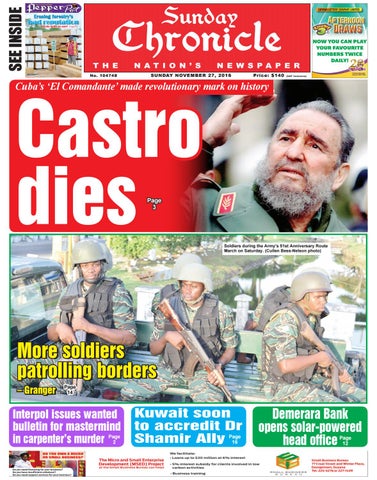
Cuba’s ‘El Comandante’ made revolutionary mark on history
Castro dies Page 3
Soldiers during the Army’s 51st Anniversary Route March on Saturday. (Cullen Bess-Nelson photo)
More soldiers patrolling borders –– Granger Granger
Page 14
Interpol issues wanted bulletin for mastermind in carpenter’s murder Page 2
Kuwait soon to accredit Dr Shamir Ally Page 16
Demerara Bank opens solar-powered head office Page 12
2
SUNDAY CHRONICLE November 27, 2016
Interpol issues wanted bulletin for mastermind in carpenter’s murder THE International Criminal Police Organization (Interpol) has issued a wanted bulletin for overseas-based Guyanese Marcus Brian Bisram, who is wanted in Guyana for the murder of 27-year-old Faiyaz Narinedatt of No. 70 Village, Corentyne, who was allegedly beaten unconscious and run over by a car on the village public road on November 1st. Bisram is alleged to be the mastermind of the murder, and was charged with the offence in his absence on Thursday last. Earlier in the week, four men were charged with the murder and were remanded to prison, while Bisram’s mother and another female were also remanded
KILLED: Faiyaz Narinedatt
to prison after they allegedly attempted to bribe investigators with $4M to release the accused men. Anyone with information
that may lead to the arrest of Marcus Brian Bisram is asked to contact the police on telephone numbers 3332191, 333-2151-3, 225-2227, 225-0575, 911; or the nearest police station. All information will be treated with the strictest confidentiality. Bisram’s last known address in Guyana is Lot 115 Section ‘A’ Number 70 Village Corentyne, East Berbice, and the United States of America. It is alleged that the murder stemmed from a sexual advance Bisram had made towards Nariendatt. This publication understands that Narinedatt was urinating when the Guyanese USbased businessman ap proached him and tried to touch his private parts. Narinedatt became upset and rebuked the businessman by slapping him twice. The businessman then reportedly ordered one of his bodyguards to “get rid of him,” telling the bodyguard
WANTED: Marcus Bisram
that he (Bisram) “will deal with it.” Police had initially labelled the case a ‘hit and run’ accident, but Narinedatt’s relatives have always been
adamant that his death was staged by persons known to them. Reports indicated that after beating the man, the four men placed Narien-
datt’s lifeless body into the trunk of a car and dumped it on the public road before attempting to run it over to make it appear to be an accident.
3
SUNDAY CHRONICLE November 27, 2016
‘El Comandante’ dies aged 90 ‒ Cuba’s Fidel Castro made revolutionary mark on history (Reuters) Fidel Castro, the Cuban revolutionary who built a communist state on the doorstep of the United States and for five decades defied U.S. efforts to topple him, died on Friday. He was 90. A towering figure of the 20th century and Cold War icon, Castro stuck to his ideology beyond the collapse of Soviet communism and remained widely respected in parts of the world that struggled against colonial rule. Castro had been in poor health since an intestinal ailment nearly killed him in 2006. He formally ceded power to his younger brother, Raul, two years later. Wearing a green military uniform, a somber Raul Castro, 85, appeared on state television on Friday night to announce Fidel’s death, 60 years to the day since the two brothers and dozens of supporters left Mexico on a boat to take revolution to Cuba. “At 10:29 at night, the chief commander of the Cuban revolution, Fidel Castro Ruz, died,” he said, without giving a cause of death. “Ever onward, to victory,” he said, using the slogan of the Cuban revolution. A mix of tributes and condemnation poured in from around the world. “History will record and judge the enormous impact of this singular figure on the people and world around him,” U.S. President Barack Obama said, extending “a hand of friendship” to Cuba. Obama’s elected successor, Donald Trump, said he would work to ensure the Cuban people “can begin their journey toward prosperity and liberty,” even though “the tragedies, deaths and
pain caused by Fidel Castro cannot be erased.” Trump’s Vice President-elect, Mike Pence, was more blunt about the late leader: “The tyrant Castro is dead. New hope dawns. ... Viva Cuba Libre!” he said on Twitter. Venezuela’s socialist president, Nicolas Maduro, urged revolutionaries to follow Castro’s legacy, while Pope Francis said he was grieving and praying for the repose of the professed atheist, whom he met in Cuba last year. China’s president, Xi Jinping, said “the Chinese people have lost a close comrade and a sincere friend.” DECADES OF HOSTILITY Raul Castro, who glorified his older brother, has nonetheless changed Cuba since taking over by introducing market-style economic reforms and agreeing with the United States in December 2014 to re-establish diplomatic ties and end decades of hostility. It is unclear whether Trump, who takes office on Jan. 20, will continue those efforts to normalize relations with Cuba or fulfill a campaign promise to close the U.S. embassy in Havana once again. Fidel Castro himself offered only lukewarm support for the 2014 deal with Washington, raising questions about whether he approved of ending hostilities with his longtime enemy, a conflict that took the world to the brink of nuclear war during the Cuban Missile Crisis in 1962. He did not meet Barack Obama when he visited Ha-
Then Cuban Prime Minister Fidel Castro attends manoeuvres during the 19th anniversary of his and his fellow revolutionaries arrival on the yacht Granma, in Havana in this November 1976 file photo. (REUTERS/Prensa Latina/File Photo)
vana earlier this year, the first time an American president had stepped foot on Cuban soil since 1928. Days later, Castro wrote a scathing newspaper column condemning Obama’s “honey-coated” words and reminding Cubans of the U.S. efforts to overthrow and weaken the Communist government. Cuba declared nine days of mourning, during which time his ashes will be taken to different parts of the country. A burial ceremony will be held on Dec. 4. Hundreds of students gathered in Havana on Saturday to honor Castro, and mass rallies are planned for the coming days. “(We’re here) for everything Fidel has done since the triumph of the revolution,” said one student, Raul Alejandro Palmeros. “Fidel put Cuba on the map, and
made Cuba a paradigm for the people of the world, especially the poor and the marginalized.” But in Miami, where many exiles from Castro’s government live, a large crowd waving Cuban flags cheered, danced and banged on pots and pans. MILITARY FATIGUES, CIGARS The bearded Fidel took power in a 1959 revolution and ruled Cuba for 49 years with a mix of charisma and iron will, creating a one-party state and becoming a central figure in the Cold War. He was demonized by the United States and its allies but admired by many leftists around the world, especially socialist revolutionaries in Latin America and Africa. Nelson Mandela, once freed from prison in 1990, repeatedly thanked Castro
for his efforts in helping to weaken apartheid. In April, in a rare public appearance at the Communist Party conference, Fidel Castro shocked party apparatchiks by referring to his own imminent mortality. “Soon I will be like all the rest. Our turn comes to all of us, but the ideas of the Cuban communists will remain,” he said. Transforming Cuba from a playground for rich Americans into a symbol of resistance to Washington, Castro crossed swords with 10 U.S. presidents while in power, and outlasted nine of them. He fended off a CIAbacked invasion at the Bay of Pigs in 1961 as well as countless assassination attempts. Wearing green military fatigues and chomping on cigars for many of his years in power, Castro was famous for long, fist-pounding speeches filled with blistering rhetoric, often aimed at the United States. At home, he swept away capitalism and won support for bringing schools and hospitals to the poor. But he also created legions of enemies and critics, concentrated among the exiles in Miami who saw him as a ruthless tyrant. “With Castro’s passing, some of the heat may go out of the antagonism between Cuba and the United States, and between Cuba and Miami, which would be good for everyone,” said William M. LeoGrande, co-author of a book on U.S.-Cuba relations. Castro’s death - which would once have thrown a question mark over Cuba’s future - seems unlikely to trigger a crisis as Raul Castro is firmly ensconced in power. Fidel Castro no longer
held leadership posts in the last years of his life. He wrote newspaper commentaries on world affairs and occasionally met foreign leaders, but lived in semi-seclusion. Still, the passing of the man known to most Cubans as “El Comandante” - the commander - or simply “Fidel” leaves a huge void in the country he dominated for so long. It also underlines the generational change in Cuba’s communist leadership. Raul Castro has vowed to step down when his term ends in 2018, and the Communist Party has elevated younger leaders to its Politburo, including 56-year-old Miguel Diaz-Canel, who is first vice president and the heir apparent.
REVOLUTIONARY ICON A Jesuit-educated lawyer, Fidel Castro led the revolution that ousted U.S.-backed dictator Fulgencio Batista on Jan 1, 1959. Aged 32, he quickly took control of Cuba and sought to transform it into an egalitarian society. His government improved the living conditions of the very poor, achieved health and literacy levels on a par with rich countries and rid Cuba of a powerful Mafia presence. But he also tolerated little dissent, jailed opponents, seized private businesses and homes, and monopolized the media. Hundreds of thousands of Castro’s opponents fled the island. “The dictator Fidel Castro has died, the cause of many deaths in Cuba, Latin American and Africa,” Jose Daniel Ferrer, leader of the island’s largest dissident group, the Patriotic Union of Cuba, said on Twitter. Turn to page 13 ►
4
SUNDAY CHRONICLE November 27, 2016
Tributes to Fidel Castro
He transformed He was an politics in the outstanding friend Western Hemisphere and genuine partner ‒ President Granger As Cubans and the rest of the world mourn the death of former Cuban President Fidel Castro, President David Granger has hailed him as a significant leader in the Western Hemisphere. Speaking with reporters on Saturday morning, President Granger expressed condolences to the people of Cuba, noting that Castro was perhaps one of the best known Latin Americans globally. “We are deeply saddened by the passing of President Castro. His life was of significance not only to Guyana and the friendship he had with Guyanese leaders, but also to the entire Western Hemisphere,” the President said. Guyana, he said, sees Cuba as part of the Caribbean Bloc, and he noted that 44 years ago, Guyana, along with Barbados, Trinidad and Tobago and Jamaica, established diplomatic relations with Cuba. “Since then, we have [had] a very cordial,
close relationship with Cuba. Right now we have many Guyanese who are being trained as doctors in Cuba. We have Cuban doctors working here, and there have been lots of engagements at different levels: educational levels, technical levels… So we are deeply saddened by the passing of President Castro,” President Granger noted. He said, too, that the people of the Republic of Cuba have lost the longest serving president of the 20th century, after he had gained power in 1959 by overthrowing Fulgencio Batista. For 47 years, Castro held on to power; until an intestinal illness which required multiple surgeries forced him to temporarily give up leadership to his younger brother, Raul, in 2006. Two years later, he resigned as president and Raul became the de facto president of Cuba. “He certainly transformed politics in the Western Hemisphere, and we would like to express our solidarity with the Cuban people in that regard,” the President said. Castro died on Friday evening at age 90.
‒ Government of Guyana THE Government and people of Guyana mourn the death of Dr. Fidel Alejandro Castro Ruz, the late former President of the Republic of Cuba. Dr. Castro was President of Cuba from 1976 to 2008, and previously Prime Minister from 1959 to 1976, leading Cuba for a total of almost 50 years. Guyana hails Dr. Castro, globally renowned as ‘El Commandanté’ or simply ‘Fidel’, as an outstanding friend and a genuine partner, even before our country at-
tained independence. It was under his leadership that Guyana-Cuba friendly and fraternal relationship had been placed on a solid and unbreakable footing. When an unjust embargo had been imposed against Cuba to isolate the Castro government, Guyana, in 1972, joined three other countries in our region to establish diplomatic relations with a fellow Caribbean state. Castro has since embraced our countries as partners, and responded to our critical needs, especially in the health and education sectors. To this day, Guyana benefits from scholarship and training opportunities afforded to our young people in
becoming doctors, engineers and other specialists. We continue to benefit, too, from Cuban doctors and medical experts serving our people in our health care system. Fidel was an exemplar of unparalleled generosity, revolutionary commitment, national dignity, and unyielding patriotism. Though he was ailing for many years, and had prepared his people for the inevitable, the passing of this colossus, whose greatness is indelibly written in the history of the world across both the 20th and 21st centuries, will evoke an immeasurable pain and loss in Cuba and beyond. Guyana mourns the death of a dear friend, a revolutionary icon, and a giant of international humanitarianism. The Government of the Cooperative Republic of Guyana conveys to the Government and people of Cuba sincere condolences, and assures that at this time of collective global grief, the people of Cuba are not alone.
DATE: 26/11/2016 26/11/2016
N 11 12 14 18 19 26 02
06
13
14
21
24
26/11/2016
04
07
03
26/11/2016
05
04
01
26/11/2016 02
09
10
11 13 14
18
5
SUNDAY CHRONICLE November 27, 2016
Tributes to Fidel Castro
Death of a comrade
May his image remain larger than life
‒ Opposition Leader Bharrat Jagdeo than life, and continue to be an inspiration and a guiding light to all peoples of the Caribbean. Long Live the Revolution.
‒ Prime Minister Moses Nagamootoo
IF EVER I needed the ple. Their guitar, as was words of our national noted by national poet poet Martin Carter as Nicolas Guillien when soft, self-assuring conChe died, “is draped in solation, it is now. mourning major”. “Too soon too soon Fidel has seen his our banner is draped country safely through in mourning…. Death the perilous harbour of must not find us thinkisolation and sabotage. ing that we die.” From Moncada to For years I have Grandma; from Viettried to mentally prepare nam through Grenada myself for the sad news Cuban leader Fidel Castro seemed to South Africa; from that Fidel Castro is no to be so impressed with Diamond blockade to the breakmore. But when I heard Sugar Estate that he left his car and through, Fidel has towit from President David with Prime Minister Forbes Burnham ered like a colossal. Granger this morning, stood by the Diamond bridge for a Alongside Cheddi talk about sugar- of which Cuba was words failed me and one of the world’s foremost produc- Jagan, Fidel was the I was momentarily in ers. During the brief discussion Dr. single greatest inspiCastro offered Mr. Burnham one of ration in my political disbelief. his Cuban cigars. The Guyanese It was a repeat of the life. I should now feel Prime Minister reciprocated. “Have paralyzing anguish that comforted, until my one of mine,” he said, offering his I had felt over the news own day comes, that I Cuban guest one of his own of the death of Cheddi had known them both Cuban people for this day Jagan, and then Nelson and could live in the when he told them that he shadow of their examples. Mandela. But the inevitable has would soon die. So, as was come. The sturdiest and expected of an exemplary most dignified palm tree revolutionary, death did not that once, in the contem- find Fidel thinking that he plation of Jose Marti, stood died. He knew it was comup heroically against the ing for sure. It was the reverberation raging, savage winds from the north, has finally suc- of the battle cry of Che: cumbed. Fidel, a sincere “Wherever death may surman from the Land of the prise us, it is welcomed.” Though inevitable, FiPalm Tree, at 90, died on del’s passing hurts. I cannot November 25, 2016. Fidel had prepared the imagine the grief of the song-loving Cuban peo-
Then presidents Bharrat Jagdeo and Fidel Castro finalising agreements of enhanced cooperation in 2006
FAREWELL Cde. Fidel. Thank you for showing us the path to self-reliance and dignity. Thank You for leading by example and standing up for your beliefs. Thank you for showing the world that small states matter, and have much to offer. On behalf of the Guyanese people, our condolences (go out) to the People of Cuba on the passing of Cde. Fidel, may he rest in peace. May his image remain larger
6
Editor-In-Chief
Nigel Williams Sunday Editor
Neil Marks
Editorial: 227-5216; 227-5204 guyanachronicle.com wnigel10@hotmail.com gnnleditorial@gmail.com
Editorial
Fidel Castro Ruz
FIDEL Castro Ruz, who led the Cuban revolution that on 1st January 1959 overthrew Fulgencio Batista and later ruled for 50 years, has died. Fidel was a complex figure, whose leadership will continue to be reviewed, but doing so through simplistic lens will be a disservice to history. Though Batista was considered a dictator by the Cuban masses, he was called friend of the United States (U.S.), who rejected his ousting. It should be said that violations of fundamental rights and freedoms have dogged the society, even unto today. Under communist ideology, where the society is considered closed, freedoms such as speech, access to information and religion taken for granted in other societies, are not prevalent there. Similarly, it has to be acknowledged that Fidel inherited a society where the masses were oppressed and made some advancement in areas of universal rights. When he rose on the world scene, the Cold War was at its peak, the colonised around the world were fighting for their independence, and the African-American community was waging struggles for equality. Fidel’s success in toppling what was seen as one of the world’s status quo made him a hero and ally of the oppressed and newly independent societies seeking to find their footing. Cuba forged partnerships with the developing world, lent support to those fighting various systems of political oppression, even as Fidel escaped assassination attempts, and presented a real threat to the U.S., being in what that country considers its backyard. He inherited a country where the chasm between the haves and have-nots was vast. At age 32, he had the vision to move Cuba to a society where education, healthcare, agriculture, sports and culture were embraced and pursued in structured and vigilant manner, and were accessible to all. The Caribbean and other developing societies have had the benefits of these systems. Cuba’s advancement in healthcare has not only been positively recognised by the World Health Organisation, but also within the U. S. Last year, New York (NY) Governor Andrew Cuomo led a trade mission to Cuba. During this mission the Roswell Park Cancer Institute in Buffalo signed an agreement with Cuba’s Centre for Molecular Immunology (CIM) to develop a unique lung cancer vaccine with a clinical trial in the U.S. This vaccine, developed by CIM, has been in use to treat lung cancer in Cuba. It is fair to say that under Fidel’s leadership, Cuba advanced its human potential to a level where it shared its expertise with other countries, of which Guyana remains a major beneficiary, since establishing diplomatic ties on 8th December, 1972. The liberation struggles in Southern Africa got
SUNDAY CHRONICLE November 27, 2016
Tributes to Fidel Castro One of the greatest revolutionaries of all time –– Peoples Progressive Party
THE People’s Progressive Party (PPP) is deeply saddened over the passing of Dr. Fidel Castro. This is indeed a great loss, not only to the Cuban people, but for freedom-loving peoples throughout the world. The late Dr. Castro was undoubtedly one of the greatest revolutionaries of all times, who during his lifetime had demonstrated that no sacrifices can be considered too great when it comes to defending the rights and dignity of the Cuban people. He survived several threats and assassination plots by the CIA and other opposition elements, which only served to strengthen his resolve to intensify the struggle to defend the dignity and interests of the Cuban people. The embarrassing failure of the United States to topple his government in the now infamous Bay of Pigs invasion will forever remain a monument
of the extent to which he was loved and respected by the Cuban people, who still, until this day, regard him as their hero in the national liberation struggle and as the Father of the Cuban nation. He stood as a beacon of hope for oppressed peoples throughout the developing world, in particular Africa, Asia, Latin America and the Caribbean. His role in the national liberation struggles in several countries of the world, in particular Africa, is testimony to his unflinching solidarity with the poor and the oppressed. The People’s Progressive Party remains eternally grateful to Dr. Castro, who came to the rescue of the PPP Government during the early 1960s when attempts were made by hostile and reactionary elements to destabilize the Jagan-led PPP Administration. During the previous PPP/C Administration, Dr. Castro again extended
a hand of friendship to the Guyanese people when he granted hundreds of scholarships to Guyanese students to pursue studies in medicine and in other technical fields, in addition to technical assistance rendered to the Government in a variety of areas. The PPP wishes to extend its deepest condolences to President Raul Castro, the Communist Party of Cuba, and the whole of Cuba, on his passing. He has, however, left a rich legacy of revolutionary struggle for a better future, not only for the Cuban people, but for humanity as a whole. During one of his trials during the Batista dictatorship, he famously remarked: “Condemn me, history will absolve me”. Dr. Castro has not only been absolved, but even in death will be immortalized in the hearts of millions way down the corridors of time. May his soul rest in peace!
His leadership survived and made impressive achievements ––Former President Donald Ramotar
I HEREBY extend deepest sympathy to the people, the Communist Party and the Government of Cuba on the passing of Fidel Castro, the leader of the most significant revolution in our hemisphere. Fidel Castro led Cuba towards profound changes in conditions of great hostility. His country faced economic sabotage, the blockade being the greatest example of the economic war against Cuba. He had to contend with overt and covert military attacks and numerous assassination attempts, but survived them all. Cuba under his leadership not only survived, but made impressive achievements. Cuban people are among the most literate in the world. The universal
health care that the people enjoy is an achievement longed for by many. Today the Cuban people have one of the highest life expectancy rates in the world. But Fidel was more than just a leader of the Cuban people. He was undoubtedly one of the greatest leaders of the 20th century. His internationalism was profound. Even through the Cuban people had to make many sacrifices, Castro’s Cuba gave generously to the poor and oppressed the world over. Cuban doctors and educators have done tremendous humanitarian work in Asia, Africa, Latin America and the Caribbean. Cuban soldiers spilled their blood for the freedom in Southern Africa. It is that solidarity and support, and at the invitation of the Angolan Government,
significant fillip from Cuba’s contribution. Fidel provided financial and military assistance, a process in which Guyana played a collaborative role. Cuban planes en-route to and from Southern Africa stopped over to refuel at Timehri airport. When internationally revered Nelson Mandela was questioned in the U.S. for calling Fidel a friend and comrade, his response was, in the time of need Cuba stood by the oppressed South Africans. Though Fidel came to office through the barrel of the gun, he was not oblivious to the double standards that existed in world politics. Whereas his rise to power is questioned by the West, the West is not absolved from putting systems in place to brutalise and kill people, or remove governments around the world that they dislike, through violent and non-violent means. Similarly, the West has supported and retained brutish governments that served their interests through said means. Fidel was also conscious that the U.S. trade embargo (1962) was motivated not only by how he came to office, or the Bay of Pigs (1961) incident, but also by who it thinks should lead Cuba and the ideology the
that Cuban soldiers contributed to the end of apartheid in South Africa and led to freedom in Namibia, Angola and Mozambique. Fidel Castro was also a profound thinker and champion of the oppressed. He led by the clarity of his views on important world issues, including the huge debt that the Third World was saddled with. Those efforts contributed to a change in policies that led to debt write–offs and debt forgiveness. This giant, this larger-than-life figure, is now no more. However, he will be mourned by working people and the oppressed the world over. Once more, my deepest sympathy to all Cubans, who loved and revered him. His name and work will endure throughout the ages.
people must embrace. When Barack Obama contested the presidency, it was Fidel’s view that it presented the possibility of normalising relations between the two countries, not that he has spared criticism of Obama’s presidency. In July 2015, the U.S. restored diplomatic relations which was severed in 1961. Since then, some restrictions on travel and trade have been removed, though it requires the U.S. Congress lifting the embargo. It remains speculation what Cuba could have been were it not for the embargo. According to Foreign Minister Bruno Rodriguez, sanctions between April 2015 and March 2016 amounted to US $4.6 billion and US $125.9 billion (Reuters 26th October 2016) since its inception. In 2006, Fidel was stricken by ill health and in 2008 ceded the presidency to his brother, Raul Castro Ruz and went into a quiet life, though he kept in touch with the public through his writings. In April he addressed his communist party, told them he would die soon, but his revolutionary ideals would live on. He passed away on 25th November at age 90.
SUNDAY CHRONICLE November 27, 2016
Guyana/Cuba relations under Fidel Castro
FORMER Cuban President Fidel Castro passed away on Friday evening after several years of illness. He was diagnosed with an intestinal ailment in 2006 and two years later, he formally handed over power to his brother Raul Castro. This year, Cuba and Guyana celebrated 43 years of diplomatic relations. The following is a chronological timeline of the relations the Spanish-speaking country shares with Guyana. December 8, 1972 – Agreement between the government of the Cooperative Republic of Guyana and the Revolutionary Government of the Republic of Cuba on the establishment of diplomatic relations. July 26, 1973 –Agreement between the government of the Cooperative Republic of Guyana and the Revolutionary Government of the Republic of Cuba for air services between and beyond their respective territories. September 1973 – On the weekend of Saturday September 1 that year, Cuba’s President Dr Fidel Castro arrived in Guyana to hundreds of well-wishers who lined the streets, waving flags of both countries as they welcomed the revolutionary leader. Castro, who was received by Prime Minister Forbes Burnham at the Timehri airport was so excited on his arrival that on the way from the airport , the two leaders stopped at Diamond on the East Bank of Demerara and engaged in animated conversations on the
sugar industry . September 15, 1973-Instrument of Ratification – Establishment of Air Services between Guyana and Cuba under the July 1973 agreement. April 13, 1975 – As relations between the two countries strengthened, Prime Minister Burnham reciprocated a visit to Cuba. He was decorated with the José Martí National Order, Cuba’s highest honour. November 10, 1975 –Work Programme for 1976 agreed at the first session of the Guyana-Cuba Mixed Commission on Education and Cultural Cooperation. May 30, 1982-Memorandum of Cooperation between the Ministry of Foreign Affairs of the Cooperative Republic of Guyana and the Ministry of Foreign Affairs of the Republic of Cuba. May 20, 1986-Memorandum of Cooperation between the Government of the Cooperative Republic of Guyana and the Republic of Cuba extended. November 10, 1993-Joint official statement issued at the conclusion of the official State visit of the Cooperative Republic of Guyana by His Excellency Roberto Rabina Gonzalez, Minister of Foreign Affairs of the Republic of Cuba . November 11, 1993-Agreement between the Cooperative Republic of Guyana and the Republic of Cuba in the struggle against international trafficking in Narcotic Drugs and Psychotropic Substances.
Sunday November 27th, 14:30 - 3:30 hrs Monday November 28th, 14:30 - 4:00 hrs
August 3, 1995-Final Act completed of the 18th session of the Mixed Cuba-Guyana Commission November 21, 1998-Agreement of collaboration between the Guyana Export Promotion Council and the Center for Export Promotion of Cuba. On that day also, the Aide Memoire of the Review of the Guyana –Cuba Joint Commission was completed in Georgetown. October 2001- Former President Bharrat Jagdeo during a state visit to Cuba , secured scholarships for 350 students under the Cuban Scholarship programme to pursue degrees in Medicine, Mechanical Engineering, Computer Engineering, Electrical Engineering, Culture, Sport, Agriculture, Architecture and other areas of study under the joint auspices of the Guyana and Cuban Governments. February 1-3, 2006 - A state-of-the-art ophthalmology centre, diagnostic centres, 965 scholarships for Guyanese, more doctors, specialists for the sugar industry, and instructors for local medical programmes were some of the benefits to be derived from President Bharrat Jagdeo’s visit to Cuba October 18,2012 –Sports Cooperation agreement between the Ministry of Culture, Youth and Sport of the Cooperative Republic of Guyana and the National Institute of Sports , Physical Education and Recreation of the Republic of Cuba. October 19, 2012 - Agreement of Co-
operation between the Ministry of Health of the Cooperative Republic of Guyana and the Ministry of Public Health of the Republic of Cuba. October 15, 2015-Abolition of the visa requirement for nationals of Cuba travelling to Guyana on Diplomatic or Official passports for the purposes of business or tourism. March 9, 2016 - Halim Majeed who was appointed to head Guyana’s Diplomatic Mission in Cuba , departed for the Caribbean island . In a brief comment, Majeed said that upon his arrival in Cuba, one of his first tasks will be to conduct a thorough evaluation of the work of Guyana’s embassy there, as well as the current status of relations between the two countries, specifically examining the various development programmes currently in operation. April 6, 2016 – President David Granger and Cuba’s Ambassador to Guyana, Julio César González Marchante met at the Ministry of the Presidency, where they discussed the way forward on a tripartite agreement for a project designed to enhance the quality of life for children and youths with disabilities. Through the regional project, Cuba will provide technical assistance, Guyana will be the host country/home of the centre and CARICOM will be the link, through which other regional jurisdictions will benefit. The programme is nearing fruition.
7
8
SUNDAY CHRONICLE November 27, 2016
What Guyana would look like pursuing a green economy This week’s article concludes the conversation on the green economy. This economy is built on a macro policy where the pillars are Sustainable Development, Labour Policies, and Environment. These pillars are interwoven, and cannot function separate and distinct from each other. THE green economy has its genesis in progressive thinking that recognises the Gross Domestic Product (GDP) does not necessarily redound to the masses’ benefit, prudent exploitation of society’s resources, and protection of the environment. It was also recognised that the failure to adhere to these values not only ensures the inequities that lead to poverty, but also contributes to depletion of resources, environmental problems, instability, absence of quality
life, and provides a threat to longevity. This economy expects Government -- through policies, programmes and laws -- to create the enabling environment wherein the people, through the various sectors of the economy, would be allowed to realise their true potential. For instance: the farmer in a green economy would be assured of the protection of his/her economic pursuits and compliance, with practices as in instance of using organic fertiliser in lieu of chemicals, which is proven to be harmful to the user, ecosystem and consumer (i.e. environment), preparing the earth for replanting and rejuvenation (i.e. sustainable development), and the use of protective gears and appropriate work practices (i.e. labour policies).
Worker in this economy would be assured of ‘Protection of Fundamental Rights and Freedoms of the Individual” (Title I of the Guyana Constitution). This includes the right to join a trade union of choice, and have that union engage in collective bargaining on their behalf. Through Collective Labour Agreement, which binds both employer and union to engage in good-faith negotiation consistent with Section 23 (1) of the Trade Union Recognition Act, the welfare of both groups can be assured. For stakeholders under the Tripartite Committee -i.e. Government, Employers and Workers’ organisations -- the social partners are required to collaborate in ensuring the welfare and wellbeing of the people, be they employed, employer,
self-employed, retired or unemployed. It is instructive to note that Article 13 (Guyana Constitution) allows for involvement of groups and individuals in the management and decision-making processes of the state on issues that impact their well-being. The green economy, particularly in societies like ours -- which have risen from historical experiences of marginalisation and oppression, wherein our resources were plundered without regard for sustainable development of the indigenous population -stands to forge camaraderie among the disparate groups. Where the Labour Policies in this economy recognise the equality of all, it breathes the opportunity for social cohesion and national unity. Social cohesion,
which is grounded in the principles of equality and justice, focuses on social inclusion, social capital and social mobility. The protection of these will create fertile ground for all to benefit. Guyana, in addition to being a signatory to the United Nations Climate Change Agreement (2015), can move to strengthen and deepen our Environmental Protection laws and agencies, which in this economy would focus on protecting the environment, ecosystem, and improving the health and longevity of the people. It is forward-thinking of the APNU+AFC administration to embrace this economy as a developmental thrust. Making it possible, however, requires structured and meaningful actions consistent with its pillars. The green economy is not about planting trees and painting the place green; it is about policies, laws and programmes aimed at reducing poverty, protecting the people, ensuring their resources are properly managed and their environment healthy. It requires a plan that factors in short-, medium- and longterm goals. Some areas that can be addressed immediately are: i) Organic farming: this requires Government giving leadership to developmental projects such as solid and liquid waste disposal, converting solid and liquid waste into organic fertiliser. The projects identified by Cevons Waste Management in liquid and solid waste can make real organic farming, and are deserving of Government’s support. Another
area could see government providing incentives to farmers by making land and technical resources available. There needs to be a national initiative in seeking markets for organic products ii) Landscaping - this should see new legislation that would address the environment in areas such as roads and highways, tree and flower planting, pollution, waterways, etc iii) Labour policies:- establishment of a Ministry of Labour, respect for and enforcement of the International Labour Organisation’s Decent Work Agenda Programme. iv) Recycling: through supporting legislation and the developing of an industry; v) August 2012 Agreement between Central Government and the Region 10 Democratic Council:- This agreement has within the potential to make this region a model project consistent with this economy and social cohesion; vi) Alternative energy:trapping our wind, water and solar potential through legislation and incentives and usage. Central Housing and Planning Authority can focus on having new developments take on board appropriate factors such as sewage management, new energy, etc. The green economy offers this nation opportunities for development wherein citizens can be involved and benefit, but it requires strong and incisive leadership at various levels in society, starting from the political directorate.
9
SUNDAY CHRONICLE November 27, 2016
Towards a Good Life in a Green Economy Key ingredients in determining Climate Change Adaptation Finance For Small Developing States: (Part 2: Section 2)
The International Climate Change Financing Regime
By Rear Admiral (Rtd.) Gary A. R. Best Presidential Advisor on the Environment LAST week, in Part 2: Section 1, we looked at quantifying climate change adaptation funding (CCAF), sufficiency of climate adaptation funding and generating options, new and additional funding and the adaptation-funding mechanism. In Part 2: Section 2, we will examine coordination and integration, high transaction costs, and determining adaptation costs. In order to maintain cognitive consonance, we repeat the problematic. THE PROBLEMATIC Notwithstanding decades of conferences and summits, embedded financial provisions in conventions and pledges, SDS, as a whole, have been unable to access sufficient CCAF to meet their CCA needs. In the result, their nation states and economies have become more susceptible to sea-level rise and vulnerabilities exacerbating their economic, social and environmental development. The International Climate Change Financing Regime, cont’d COORDINATION AND INTEGRATION After COP 18, developing countries remained disappointed in funding flows. They anticipated funding for the period 2013-2020, but no agreement was reached on this issue. They are stuck with a promise of USD 100 billion by 2020 and according to Saleemul Huq, Senior Fellow with International Institute for Environment and Development’s (IIED) Climate Change Group, this is another vague prom-
Mr. Gary A. R. Best is a retired Rear Admiral and former Chief of Staff of the Guyana Defence Force. He is an Attorney at Law and is the Presidential Advisor on the Environment. He is a PhD. candidate at the University of the West Indies. He holds a BSc in Nautical Science (Brazil) and Masters Degrees from the University of the West Indies and the University of London. He is also an alumnus of the National Defence University and the Harvard Kennedy School. His research areas include climate change governance, climate change finance, international relations and environmental law.
ise of maintaining current levels of climate finance which approximates to USD 10 billion per year (IIED 2012). Further, Oxfam (2009) in a briefing paper, Beyond Aid, stated that adaptation finance is channelled through a spaghetti bowl with multilateral and bilateral mechanisms. It argued that this has led to a current ad hoc approach built on inappropriate infrastructure, which in turn leads to underfunding and opaque complex results. The Oxfam paper also pointed out that adaptation funding is not demand-driven, but influenced heavily by donor countries. Consequently, adaptation plans are underfunded and there are too many empty pledges by the international donor community. The paper further posited that there must be predictability and reliability of pledged funds for climate adaptation Smith et al (2011), argues for coordination and integration of development and adaptation funding. In their view, several ODA-funded projects that relate to climate-sensitive issues and development-oriented, privately funded projects that
take climate risks into consideration contribute to the cost of adaptation. Therefore, coordination of development and adaptation funding could avoid duplication of efforts and cost savings. Already, the need for coordination has been recognised in current climate negotiations. In a Policy Brief on the Adaptation Fund, Elsie Remling et al (SEI 2013) observed that a key purpose of the Fund under the Kyoto Protocol (UN 1998: Art 12) was to use a share of the proceeds of the clean development mechanism (CDM), now at 2%, to assist developing countries that were particularly vulnerable to climate change in meeting their costs of adaptation. The writers found that parties to the UNFCCC are yet to define the term ‘particularly vulnerable’. Instead, the project proponents define vulnerability, which in turn leads to difficulties in achieving efficiency and equity in the allocation of funds for adaptation. HIGH TRANSACTION COSTS Developing nations have also expressed concerns over high transaction costs, burdensome rules and reporting, co-financing and unclear guidance when dealing with GEF-managed funds for adaptation. However, the situation is slightly better with the AF, which has an independent GEF Board. Horstmann (2011, 1086) while pointing out the process of direct access and
independence of the GEF and ODA of the AF as positives, nonetheless stressed the need for the Adaptation Fund Board (AFB) to define terms such as ‘level of vulnerability’ and ‘adaptive capacity’ which, in turn, will enable a vulnerability- oriented approach to allocation of funds for adaptation projects. Horstmann also adds that the country- oriented driven process of the AF might itself hinder the AFB agreeing and accepting a scientific definition of vulnerability and instead should seek a political approach to find an acceptable definition. DETERMINING ADAPTATION COSTS Haites (2011, 963) submits that determining costs of adaptation is difficult because adaptation measures are yet to be defined. This lack of definition precludes any reasonable estimation of the associated capital and operating costs. As a result, scenario- based sectoral costing is done, which compares the cost under a scenario based on the current climate with the cost under a scenario based on the projected future climate, which in itself is unpredictable. Sectors include, ecosystems, coastal zones, forests, extreme weather, infrastructure, fisheries, water supply and agriculture. According to Haites, costs are usually estimated for the ‘hard’ adaptation measures and rarely include ‘soft’ adaptation measures such as
capacity-building and information systems. In spite of measures used, there will be ‘residual damage’ from adaptation measures. Whether such damage is an adaptation cost is yet to be determined. Further, determining whether ‘increased resilience’, achieved through development funding, is an adaptation cost is also uncertain. The close association between development assistance and adaptation funding compounds this uncertainty. Adaptation may well result in meeting development needs and development may assist in adaptation. Smith et al, points to two approaches used to estimate adaptation costs. The first is a World Bank (WB) initiative, which estimates the costs of reducing vulnerabilities of climate-sensitive investments (such as foreign direct investment and development assistance) in developing countries through a ‘mark up’ factor. The second approach uses costs for projects identified for adaptation funding under the National Adaptation Programmes of Action (NAPAs) for a limited number of developing states and scales up the amount to cover all developing countries. Notwithstanding this initiative, Smith et al, identifies that the current approaches exclude the inability of present societies from fully adapting to climate change. This shortfall is called ‘adaptation deficit’, which is excluded from the estimate baseline and costs estimates. All these factors result in uncertainty and unpredictability in estimating costs of adaptation. In the next article, I will examine Theories and paradigms that influence climate adaptation finance for Small Developing States. Comments can be sent to towardsagoodlife@gmail.com
10
SUNDAY CHRONICLE November 27, 2016
Thank you, Fidel FIDEL Castro is dead. The West Indies lost to Zimbabwe, and are on their way home. Donald Trump continues to break all political rules in America. A majority of Grenadians just voted to remain in the Privy Council rather than join the CCJ. In Guyana, the PPP continues to behave as if it is holier than the Vatican as it nails the Government every morning, noon and night. Yet again, the Government was on the backfoot, fending off bouncers from the PPP on a matter that could have been made public at the time it was initiated. How can a government with so much going for it make such elementary political mistakes? I come back to Fidel.
We knew his time on earth was drawing to a close; he was 90 years old. When he attended Michael Manley’s funeral in 1997, many Jamaicans referred to him as the last “Don” standing, the last governmental leader to fearlessly stand up to the high and mighty. Now that last Don is dead. When Fidel and his revolutionaries, in 1959, restored Cuba to its Cuban self, he clearly vexed those who believed Cuba and the Caribbean belonged not to themselves, but to those who saw the world as their manifest possession. For almost six decades, Fidel Castro defied that logic and defeated it. In the coming days, much will be written about him and the Cuban revolution. Much of it would be uncomplimentary, even nasty; but
for us in the Caribbean, we would be dishonest if we were not to acknowledge Fidel’s worth as a symbol of resistance and freedom. It was he who led the social revolution in Cuba, transforming that country into an oasis of knowledge that has outlived him. It was he who exported both revolution and health care workers, even though the latter is seldom acknowledged as virtuous. It was he who stood between apartheid South Africa and its campaign to recolonize Southern Africa. It was he who defended the modicum of sovereignty we in the Caribbean gained at Independence. Yes, the authoritarian state and the welfare state co-existed in Fidel’s Cuba. It is a Caribbean imperfection
that has to be constantly engaged and corrected. But today I want to celebrate Castro the hero who, more that all his peers in government, used the state to sincerely tackle social inequality. You see, Fidel taught the Caribbean and the world that an island does not have to live as an island. The revolutionary love he inspired Cubans to share with the rest of humanity is priceless. Fidel is dead, but the revolution he inspired in three generations of political workers still motivates some of us, who have not given up on seeing and doing politics as humanism. After all, our struggle in the Caribbean is about humanity: what is it to be human? I continue to wrestle with the complexity of Caribbean
political praxis and the kind of leadership it throws up, but today I just want to love up Fidel Castro and thank him and the Cuba that birthed him. I am in no way avoiding the not-so-kind side of the Cuban regime. I am trying to reach for the kinder side of our Caribbean, and to locate Fidel Castro there, so that our younger generations can move beyond shallow and limited characterizations of Castro and revolutionary Cuba. Thank you, Fidel, for inspiring us beyond hope. We can today talk with confidence about a Caribbean civilization because you helped us to imagine it, and turn that imagination into a living praxis. I hope our politicians on both side of the aisle reflect on Fidel’s
example, and muster the strength to expand his praxis in Guyana. Surely, Structural Adjustment economics was not the Castro way, and cannot be the Guyana way. Surely workers’ wages cannot be dependent on IMF economic reasoning. There has to be another way. Wages is about humanity. Brother David and Brother Winston and Brother Clive, please be a Fidel as you construct your economic strategy. Start with the sufferers. More of Dr. Hinds ‘writings and commentaries can be found on his YouTube Channel Hinds’ Sight: Dr. David Hinds’ Guyana-Caribbean Politics and on his website www.guyanacaribbeanpolitics.com. Send comments to dhinds6106@ aol.com
PPP wants disclosure of Amaila Falls study THE Opposition People’s Progressive Party (PPP) is calling on the APNU+AFC Administration to reveal the findings of the Amaila Falls Hydropower Study. In a statement to the media on Saturday, the PPP reminded that Minister of Natural Resources, Raphael Trotman, had indicated that the assessment of the hydropower project would be made available in May this year. However, in July, Minister of State, Joseph Harmon, said the report would be ready by September 1, but when that did not materialise, Government announced that it would not be released until January 2017. “What is the Government
hiding? Why will they not release the study? The PPP call for its immediate release.” Back in March, Minister of Natural Resources Raphael Trotman had announced that Norwegian company Norconsult was selected to conduct a financial model review of the high-profile Amaila Falls Project in Guyana. Last year, Guyana Chronicle had reported that Norway has withheld US$80 million of funding from its forest-saving deal with Guyana for the Amaila Falls Hydro Project, but the funds could be diverted to other clean energy initiatives if the project is deemed impractical. According to the PPP, the
assessment of the project is aimed at helping Guyanese and businesses access independent merit of the Amaila Falls. “They should get the chance to do so,” declared the Opposition. “The PPP continues to believe that the Amaila Falls Hydropower Project could transform the quality of life for almost all Guyanese, by liberating them from expensive, unreliable electricity bills. We will support the Government once it makes sincere efforts to help the people of this country,” the statement added, while calling on Government to “stop using Amaila Falls for partisan politics, and instead put the people
and businesses of the country first.” The Opposition party argues that the Amaila Falls project should be operational by now, and as such citizens should have been benefiting from reliable, affordable, clean energy. The party has accused the APNU+AFC Administration of “economic vandalism”, while noting that the project has been prolonged. “In 2015, the Leader of Opposition offered to help the Government and called for a fact-based study to let the people of Guyana assess for themselves how Amaila Falls can improve their lives. The Amaila Falls Hydropower
Project should be almost operational by now, and about to provide most Guyanese citizens and businesses with reliable, affordable, clean energy.” According to the PPPC, Guyana should be one of the top ten users of clean energy in the world, once the project advances. “Our country would already be benefiting from the biggest foreign direct investment in our history. Our economy would have been re-integrated with the global capital markets for the first time in over 40 years. This in turn would have led to cheaper finance for Guyanese citizens and businesses.”
However, the party noted that Guyanese continue to face years of unreliable electricity supply and “excessively high bills.” “The blame for this situation lies entirely with the APNU+AFC coalition,” the statement added, while arguing that the APNU+AFC coalition has had access to exactly the same information available to the PPPC. The Amaila Falls Hydro Project was designed as a 165-megawatt facility which would have delivered its power to consumers via power lines running through the jungle and onto various distribution points along the coast and other areas.
11
SUNDAY CHRONICLE November 27, 2016
Bust unveiled in memory of Claude Alphonso Merriman A BUST depicting the late Claude Alphonso Merriman C.C.H. J.P., positioned at the north-eastern end of the iconic Merriman Mall, was unveiled in his memory on Saturday during a moving ceremony at the junction of Church and Irving Streets. Mr. Merriman was born on November 29, 1912 at Werk-en-Rust, Georgetown and died in 1995.The bust was constructed by Sculptor Ivor Thom. Among those gathered to join in the celebration were President David Granger; former Mayor of Georgetown, Mr. Hamilton Green; Hon. Justice Courtney A. Abel (son); former Mayor Mavis Benn, Chairperson – all of whom addressed the gathering. President Granger and Ms. Averil Merriman Henry (daughter of the late Mr. Merriman) did the honours of unveiling the bust, while Justice Oslen Small, Pastor of Smith Congregational Church rendered the opening prayer, followed by the singing of hymns. Amidst grandeur, the Guyana Police Force Band rendered rich symphony, entertaining the appreciative audience. Following the unveiling of the bust, a slew of floral tributes were laid at the foot of the monument. “We are assembled here to pay tribute to the life and neighbours of former Minister of Social Security, Mayor
President David Granger (left) and Ms. Vanessa Merriman-Harding, daughter of the late Claude Merriman and his son, Hon. Justice Courtney A. Abel, shortly after unveiling the bust. [Delano Williams photo]
of Georgetown and popular mortician. We are unveiling the bust of a man, so that the present and future generations can remember him and remember the times in which he lived and the objectives he set himself in public life,” President Granger said. Seeking to put the story of the life Claude Merriman lived, President Granger reflected on what Georgetown was like in 1912, the period in which Merriman was born and the hardships he endured, though not of his own making. He looked critically at the reality of growing up under
conditions bereft of luxuries, or even the basic necessities of life because the system did not provide for it. But through it all, Claude Merriman was an overcomer. Around the mid-1930s Merriman dedicated his life to working in the field of public health, ensuring the lives of the population were looked after. “I would invite you to see the life of Claude Alphonso Merriman in the context of the times in which he was growing up,” said President Granger, who noted he would sometimes wish that there
were still people like Claude Merriman around; people who would not stand for untidiness and insanitary conditions; people who would scrupulously make sure that the lives of the people they’re responsible for and their constituencies were improved. President Granger commended the family members of Mr. Claude Merriman for taking this initiative to remind the citizens of Georgetown about the lives and neighbours of Claude Alphonso. He spoke of the conditions in Guyana in the early 1900s, when housing and san-
itation were major problems and when people could not afford a ‘decent meal’ because of poor wages and salaries. He said that it is for these reasons that Mr. Merriman, who was a member of the People’s National Congress (PNC), committed to working in service of Guyanese. “This is why our party paid so much attention in the mid-1960s to humanising the lives and the circumstances under which poor people lived… Claude Merriman did live in a city with tarmac roads, lights and good housing and this is what propelled
him to give people a better life. This is what propelled the party, which he joined 59 years ago, the PNC, to improve the quality of life not only of the citizens of Georgetown, but also [those] places where people live in worse conditions in rural Guyana,” the Head of State said. Similar sentiments were expressed by former Mayor of Georgetown, Mr. Hamilton Green, who said that it does not bode well for a nation’s youth to be unacquainted with important historical facts about the struggles of the country’s earliest heroes and heroines. He added that the bust must be seen as just the beginning of a wider campaign to inform and educate the citizenry. Mr. Merriman’s son, Justice Courtney Abel, in his tribute, described his father as a rare breed of public servant, who had an outstanding and dignified career as a community activist and counsellor. He said that his father was responsible for the introduction of major innovations in the offices he held. Claude Alphonso Merriman was appointed as Minister of Labour and Social Security in 1964. He also served in the capacity as Mayor and Deputy Mayor of Georgetown. He was also a popular mortician and operated the famous Merriman’s Funeral Home.
Carpenter’s murder
Family cries for justice …Minister Ramjattan vows to rid Police Force of rogue cops By Nafeeza Yahya PUBLIC Security Minister Khemraj Ramjattan has met with relatives of murdered father of two, 27-year-old Faiyaz Narinedatt, who on November 01 was beaten unconscious and then run over by a car on the No. 70 Village, Corentyne public road. The minister has assured them that justice will be served; and receiving this assurance from the minister yesterday, relatives disclosed that they were allegedly of-
Bibi Azeez (pink top), mother of the victim, is seen seated next to Pooja Pitam, wife of the deceased, along with other relatives and friends during the meeting with Minister of Public Security, Khemraj Ramjattan
fered Gy$50M not to pursue the matter further, but they have rejected the offer. Four men have since been charged with Narinedatt’s murder, while the alleged mastermind, US-based Guyanese Marcus Brian Bisram, is still at large, although he also has been charged in absentia with the murder. “Interpol has issued a red alert for Bisram, and the state departments will now have to look for him and arrest him based on that alert. “Once arrested, we will then have to provide evi-
dence that he is indeed wanted for murder in order to start the extradition process to have him (returned) here,” Minister Ramjattan assured the family. He also disclosed that the operations at the Springlands Police Station will be investigated even as two officers remain under close arrest pending investigations. It is alleged that the two officers accepted a bribe from the US businessman to conclude Narinedatt’s death as a hitand-run accident. However, Turn to page 12 ►
12
SUNDAY CHRONICLE November 27, 2016
Demerara Bank opens solar-powered head office ALMOST one year after being challenged by President David Granger to pursue a renewable energy plan, Demerara Bank Limited on Saturday unveiled its fully solar- powered head office on Camp Street as part of the company’s pursuit of green initiatives. The building, which is not connected to the national grid and which is said to be one of two large commercial entities in the country which are fully powered by solar energy, is equipped with hundreds of solar panels, batteries and dozens of inverters, all of which push the full capacity required to satisfy the building’s energy requirements. President David Granger, who toured the building following a brief ceremo-
President Granger engages officials of the bank during a tour of the building
ny at the facility, said that the country’s clean- energy revolution is gaining momentum as he expressed
happiness that the bank is serving a beacon’s role in its adoption of renewable energy. “Renewable energy
Three remain in custody over 2012 pool death The son of the owner of the Double Day International Hotel at Tuschen, East Bank Essequibo and two of his friends remain in police custody as investigators try to solve the 2012 death of Sadeek Juman. The businessman’s son is the manager of the hotel, and he, along with the two other suspects, was taken into custody on Thursday last, following information that on November 18, 2012, they beat Juman, 20, into a state of unconsciousness, concealed him in a room, and later in the night dumped him, while he was still alive, in the hotel’s pool. According to information reaching this newspaper, a heated argument had ensued at the hotel after Juman arrived there with the girlfriend of the businessman’s son. Reports indicate that detectives who first handled the case botched the investigation, and Juman’s death was ruled as a drowning.
This investigation is now in the hands of the police Major Crimes Unit, and according to information received, efforts are being made to pin the blame on the friends of the hotel manager. Juman had left his parent’s Blankenburg, West Coast Demerara home on November 18, 2012 to visit his grandmother at Ruby, East Bank Essequibo. He later headed to the Double Day Hotel at Tuschen. Clad in swimming trunks, Juman’s body was found on November 19, 2012. His cell phone and other belongings could not be located. Juman’s relatives alleged that they were told that the pool was checked at around 01:00 hrs on November 19, and there was no sign of a body in the pool. One relative also stated that the pool was in close proximity to the bar, and a security camera had been pointed towards the pool. According to the victim’s mother, Farida Ju-
is the way of the future”, he told a gathering of private sector managers , diplomats and public officials who were gathered at the official ceremony. He said that the government is working hard towards its aim of making Guyana a green state. He said that corporations around the world and even other countries within the Caribbean are moving
forward with developing efficient energy sources , noting that some are ahead of Guyana in that regard. However, according to the President, Guyana has many advantages in the energy sector, in terms of its potential capacity of generating solar power on an industrial scale. “So we have the potential and we can become a leader in the Caribbean, in our sub-region in terms of generating renewable energy,” the President said, noting that the creation of the Department of Environment is geared at developing the holistic approach to a green state. Chairman of the Board of Directors of the bank, Yesu Persaud, noted that the bank has decided to donate LED lights to institutions in need, such as orphanages. He said that it is part of its plan of sharing its surplus. He said that the company is also available to sell its initiative to corporations at an “unbeatable” rate of interest of eight percent. Accord-
Family cries...
Dead: Sadeek Juman
man, her son could not swim, and was in a shallow section of the pool, which enabled him to stand. An employee of the hotel had claimed that Juman’s body had sunk to the bottom of the pool, and the presence of other swimmers had caused the water to become ‘cloudy,’ thereby obscuring the body. He stated that the corpse floated to the surface the following day.
relatives remained adamant that the carpenter’s death was not an accident, and have forced the Major Crime Unit in Georgetown to further investigate the matter. “The whole police station, because the institution should not fall apart like that! You may have a few cops doing mischief, but not the whole institution. That warrants the bringing in of another institution to investigate it. That means the institution is rotten,” the Public Security Minister said. Minister Ramjattan said Government has a zero tolerance policy for rogue cops, since the actions of a few tarnish the reputation of the entire Force. “If these cops are found guilty of covering up and thwarting the course of justice, because they made a
deal with the devil, they will be dismissed. One rotten cop spoils the image of the entire Force, and we will not tolerate it,” Minister Ramjattan declared. He commended the family for pursuing the matter, as well as traffic rank Downer, who in his report did not close the case, but left room for investigation. As it relates to allegations that members of the Community Policing Group (GPG) has been aiding to thwart the investigation by threatening the family on behalf of Bisram, Minister Ramjattan disclosed that he has ordered a thorough investigation; and if found guilty, those ranks will be dismissed and charged. Meanwhile, Narinedatt’s mother, Bibi Azeez, remains in distress as she is still try-
ing to Persaud, businesses that wish to improve their potential and by extension contribute to the country going green can benefit from the offer. CEO of Demerara Bank Limited, Pravinchandra Dave, said that the solar off-grid system , as it is referred to has the capacity of 125KW . He said that the system supports the 25,000 square feet building and carries 52 inverter- based air condition units and 200 LED lights powered by 360 solar panels. In addition, he said that 416 batteries power the building as part of the set-up of the system. According to Dave , the entire system was erected at a cost of $28M , a figure which sees the company saving significantly than if it were connected to the national grid. In addition , Dave said that a United States –based company has been working with the bank on the installation of the system at the bank’s head office , which went fully solar on October 21.
From page 11
ing to cope with the fact that her only child is dead. She said she is “losing her mind”, and people seem to think that she is insane, since she still “talks” to her son whenever in his bedroom. Aziz stated that, even if her son had done something wrong, he should have been arrested, and not murdered. She has vowed to ensure that justice is served. Narinedatt was murdered after he refused the sexual advances of the businessman, who then ordered his bodyguards to “get rid of him.” Reports indicated that after beating the man, the four men placed Narinedatt’s lifeless body into the trunk of a car and dumped it on the public road, before attempting to run it over to make it appear to be an accident.
13
SUNDAY CHRONICLE November 27, 2016
‘El Comandante’ dies...
Former Cuban leader Fidel Castro (L) holds up the arm of his brother, Cuba’s President Raul Castro, during the closing ceremony of the sixth Cuban Communist Party (PCC) congress in Havana in this April 19, 2011 file photo. (REUTERS/Desmond Boylan/File Photo)
Many dissidents settled in Florida, influencing U.S. policy toward Cuba and plotting Castro’s demise. Some even trained in the Florida swamps for the disastrous Bay of Pigs invasion. But they could never dislodge him. Castro claimed he survived or evaded hundreds of assassination attempts, including some conjured up by the CIA. In 1962, the United States imposed a damaging trade embargo that Castro blamed for most of Cuba’s ills, using it to his advantage to rally patriotic fury. Over the years, he expanded his influence by sending Cuban troops into faraway wars, including 350,000 to fight in Africa. They provided critical support to a left-wing government in Angola and con-
tributed to the independence of Namibia in a war that helped end apartheid in South Africa. Castro also won friends by sending tens of thousands of Cuban doctors abroad to treat the poor and bringing young people from developing countries to train them as physicians. ‘HISTORY WILL ABSOLVE ME’ Born on Aug. 13, 1926, in Biran in eastern Cuba, Castro was the son of a Spanish immigrant who became a wealthy landowner. Angry at social conditions and Batista’s dictatorship, Castro launched his revolution on July 26, 1953, with a failed assault on the Moncada barracks in the eastern city of Santiago. “History will absolve me,” he declared during his
trial. He was sentenced to 15 years in prison but was released in 1955 after a pardon that would come back to haunt Batista. Castro went into exile in Mexico and prepared a small rebel army to fight Batista. It included Argentine revolutionary Ernesto “Che” Guevara, who became his comrade in arms. On Nov. 25, 1956, Castro and a ragtag band of 81 followers set sail from the Mexican port of Tuxpan aboard an overloaded yacht called “Granma,” reaching Cuba in early December. Only 12, including Fidel, Raul and Guevara, escaped a government ambush when they landed in eastern Cuba. Taking refuge in the rugged Sierra Maestra mountains, they built a guerrilla force of several thousand
People celebrate after the announcement of the death of Cuban revolutionary leader Fidel Castro, in the Little Havana district of Miami, Florida, U.S. November 26, 2016. (REUTERS/Javier Galeano)
From page 3
Venezuela’s President Hugo Chavez (L) and his Cuban counterpart Fidel Castro joke after joining their medallions, given by medical graduates, at Havana’s Karl Marx theatre, in this August 20, 2005 file photo. (REUTERS/Claudia Daut/File Photo)
Then Cuban President Fidel Castro (R) and then Soviet leader Mikhail Gorbachev (L) exchange documents during a treaty signing ceremony in Havana in this April 4, 1989 file photo. REUTERS/Gary Hershorn/File Photo
fighters who, along with urban rebel groups, defeated Batista’s military in just over two years. Early on, at the height of the Cold War, Castro allied Cuba to the Soviet Union, which protected the Caribbean island and was its principal benefactor for three decades. The alliance brought in $4 billion worth of aid annually, including everything from oil to guns, but also provoked the 1962 Cuban Missile Crisis when the United States discovered Soviet missiles on the island. Convinced that the United States was about to invade Cuba, Castro urged the Soviets to launch a nuclear attack. Cooler heads prevailed. Soviet leader Nikita Khrushchev and U.S. President John F. Kennedy agreed the Soviets would withdraw the missiles in return for a U.S. promise never to invade
Cuba. The United States also secretly agreed to remove its nuclear missiles from Turkey. ‘SPECIAL PERIOD’ When the Soviet Union collapsed in 1991, an isolated Cuba fell into an economic crisis that lasted for years known as the “special period.” Food, transport and basics such as soap were scarce and energy shortages led to frequent and long blackouts. Castro undertook a series of tentative economic reforms to get through the crisis, including opening up to foreign tourism. The economy improved when Venezuela’s late socialist leader, Hugo Chavez, who looked up to Castro as a hero, came to the rescue with cheap oil. Aid from communist-run China also helped, but Venezuelan support has eased since Chavez’s death in 2013.
Plagued by chronic economic problems, Cuba’s population of 11 million has endured decades of hardship, although not the deep poverty, violent crime and government neglect of many other developing countries. Cuban state workers earn on average the equivalent of $25 a month and struggle to make ends meet even in an economy where education and healthcare are free and many basic goods and services are heavily subsidized. Still, for most Cubans, Castro has been the ubiquitous figure of their lives. Many love him and share his faith in communism, and even some who abandoned their political belief still respect him. “For everyone in Cuba and outside his death is very sad,” said Havana resident Luis Martinez. “It is very painful news.”
14
SUNDAY CHRONICLE November 27, 2016
More soldiers patrolling borders – Granger Story by Ariana Gordon Photos by Delano Williams THE Guyana Defence Force (GDF) has increased the number of its soldiers protecting the country’s borders, even as President David Granger underscores the importance of the Force’s role. “There has been an increase two-fold of bordering patrols; we have also increased our surveillance of the EEZ (Exclusive Economic Zone), with patrols every two weeks. Those patrols would have contributed very significantly to reducing criminal activities both at sea and on land,” said GDF Chief-of-Staff Brigadier George Lewis as he addressed soldiers of the Force on Saturday morning at D’Urban Park, following the end of the GDF’s 51st Anniversary Route March. The Head of State has made it clear that the role of the Guyana Defence Force (GDF) in protecting the country’s territorial sovereignty and integrity must not be underestimated. “It is the GDF which, over the last five decades, protected the territorial integrity and sovereignty of our nation. The Defence Force,
President David Granger (centre); Prime Minister Moses Nagamootoo (left); and Chief-of-Staff of the GDF, Brigadier George Lewis (right), stand at attention as the National Anthem is being played (Office of the Prime Minister’s photo)
and two, development. The Defence Force is deployed to the four corners of this country. You have a responsibility to protect our country by day or by night; in sunshine or in rainfall; in the swamps, jungles, savannahs, (or) on the beaches,” said the Head of State, who was accompanied by members of the Defence Board, including Prime Minister Moses Nagamootoo; Minister of Public Security, Khemraj Ramjattan; Minister of State, Joseph Harmon; Attorney General Basil Williams; and
Minister of Foreign Affairs, Carl Greenidge. He noted that the Defence Board has been pleased with the performance of the Force, and pointed to Exercise Greenheart, a Force tactical exercise which took place in the Bartica/Potaro area in October 2015, and field tactical exercise (FTX) Homeguard, which was held in August this year in the jungles and savannahs of Ituni and Tacama, Regions 10 and 6 respectively. The President reminded the soldiers of Guyana’s vast
borders, which span more than 3000 kilometres; and its coastline, which spans 450 kilometres; and their responsibility to protect same. “We cannot give that responsibility to anyone else; we have to rely on you. And we are proud in our ability to rely on you year in year out to discharge that responsibility. In another month’s time the whole country would be celebrating Christmas, but you would be protecting our frontiers. Many Guyanese would be with their families, but you would be keep-
President David Granger
together with our diplomats, form the bulwark, shield, to ensure the country we inherited is passed on to posterity,” President Granger said. Expressing gratitude for the work done by the GDF over the years, President Granger encouraged the ranks to “keep on forging”, to ensure Guyana remains a safe country. Describing the 51 years of the Force as that of “struggle, sacrifice and of service”, the Guyanese leader said Defence Force Day was aimed at reminding Guyanese of the Force’s dedication, discipline, and commitment to protecting Guyana. “You always had two objectives: one, defence;
Soldiers saluting at the end of the GDF’s 51st Anniversary Route March on Saturday at D’Urban Park, Georgetown
ing an eye on our frontiers, to ensure (people) are safe and secure in their homes. This is your duty, and this is why you joined the Defence Force; and we are grateful,” said the Commander of the armed forces. President Granger also bade farewell to former Chief-of-Staff of the GDF, Brigadier (Ret’d) Mark Phillips, who demitted office last month. He expressed gratitude for Phillips’s more than three decades of service Turn to page 15 ►
15
SUNDAY CHRONICLE November 27, 2016
More soldiers...
From page 14
President David Granger being escorted to the D’Urban Park tarmac on Saturday morning by Chief-of-Staff of the Guyana Defence Force, Brigadier George Lewis; Prime Minister Moses Nagamootoo and Minister of Public Security, Khemraj Ramjattan
in the Force. “The Defence Force is happy to have worked with him (Phillips), and we thank him for his service,” he said while welcoming Chief-of– Staff of the Force, Brigadier George Lewis. “He (Lewis) is an officer with decades of service, and [we are] happy to have him on board in position of Chief-of-Staff,” the President said. He continued: “You are well commanded, and the Board is confident in the ability of the officers to discharge their responsibilities to the members of the Defence Force and Guyana.” Chief-of-Staff Lewis disclosed that the Force has increased its operational posture, as efforts are continuously being made to achieve its mandate of territorial security. Ranks of the Force have
been involved in several training courses both locally and abroad, and according to the Chief-of-Staff, more ranks have been trained this year than in previous years. “Logistically, we continue to work towards improving our accountability and towards bringing ourselves in line with governmental regulations,” the Chief-ofStaff added, while informing that December 1 has been declared Militia Day. On that day, ranks would be seen marching through the streets across the country. “We will remain committed to our mission, and ensure that we provide public safety and security to this country,” Lewis assured. Saturday’s march brings to an end a month of planned activities in observance of the GDF’s 51st Anniversary.
Troops of the Guyana Defence Force march through the streets of Georgetown during the Force’s 51st Anniversary Route March on Saturday
16
SUNDAY CHRONICLE November 27, 2016
Kuwait soon to accredit Dr Shamir Ally ‒ Foreign Affairs Minister Greenidge confirms DR Shamir Ally, selected by Guyana as Ambassador to Kuwait, will soon be accredited by the Kuwaiti government following an investigation into reports of him being convicted under the U.S. Securities Act in 2003 for fraud. On Saturday, Minister of Foreign Affairs Carl Greenidge said the probe into Dr Ally’s legal past has been completed and noted that discussions were held at the level of Cabinet on the matter. However, he made it clear that those discussions with his Cabinet colleagues are not complete. “It should be done soon,” The Foreign Affairs Minister told reporters. Asked whether the Ambassador would be accredited, Greenidge responded, “Yes, unless something untoward occurs.”
In September, it was discovered that a civil case was filed against Dr Ally along with Ronald Lanchoney and Robert Mancuso by the U.S. Securities and Exchange Commission (SEC). The trio was allegedly involved in the distribution of false financial information by Acrodyne Communications Inc. in in 1998, 1999 and 2000 and according to court documents Mancuso, the Chief Executive Officer (CEO) of the company, Dr. Ally, the company’s former controller and Lanchoney were aware of many problems associated with the company’s accounting controls, but failed to assure that its financial transactions were accurately recorded. Mancuso was fined US$50,000 and Ally and Lanchoney fined US$10,000 each. It was
reported that the offenders consented to the entry of the orders without admitting or denying the Commission’s allegation in the action. Notwithstanding the discovery of Dr Ally’s legal battle, the Foreign Affairs Minister had assured the media that “due diligence was exercised” in the lead-up to Dr. Ally’s appointment. He noted too that due to the size of the United States, where the ambassador resided, it was difficult to obtain information. When news of Dr Ally’s legal woes spread, there was some concern about the screening process employed by the APNU+AFC coalition government. Dr Ally, though never criminally charged or convicted, failed to disclose his past legal troubles in the United States
Guyana’s Ambassador to Kuwait, Dr Shamir Ally
to the government and the subsequent revelation of that information came as a surprise to many, including the Alliance For Change (AFC), the political party to which he is aligned. AFC’s party leader Khemraj Ramjattan has said that while Dr. Ally would have had legal issues, it does not take away from his qualifications and
experience for the post he has been identified for. Dr. Ally is the Chief Executive Officer (CEO) and President of Inter national Consulting Services. He has 20 years of experience in the field of business in Guyana (1960-1979). In the U.S., he has acquired 27 years of experience in the field of business, operating
as Corporate Controller, Chief Accounting Officer, Vice-President of Finance, and Chief Financial Officer at AMEX, NYSE, and NASDAQ — Listed Public Corporations in New York and Pennsylvania, USA. Additionally, he has global experience in 15 industries and services: electronics, apparel, printing & packaging, insurance, financing, lotteries, pharmaceuticals, sugar, rice, spices, gold, diamonds, accounting, auditing & consulting services, and universities. On May 11, 1994, he received the Republican Senatorial Inner Circle Medal of Freedom from then U.S. President George Bush for ”Dedication, Unwavering Support, and as a Prominent Leader in the Republican Party.” This is the highest honour the Republican members of the U.S. Senate can bestow.
17
SUNDAY CHRONICLE November 27, 2016
Guyana to tap US$25.6M fund to fight climate change THE Caribbean Com munity Climate Change Centre (CCCCC) and the United States Agency for International Development for the Eastern and Southern Caribbean (USAID)/ ESC launched the Climate Change Adaptation Programme (CCAP) last week at the CCCCC’s headquarters in Belmopan, Belize. The CCAP, which will be implemented by the CCCCC, commits US$25.6 million over four years to boost climate-resilient development and reduce climate change-induced risks to human and natural assets in 10 countries. According to a release by the centre, the beneficiary countries are Antigua and Barbuda, Dominica, Grenada, Guyana, St. Kitts and Nevis, Saint Lucia, St. Vincent and the Grenadines, Barbados, Trinidad and Tobago, and Suriname. USAID’s Chief of Mission, Christopher Cushing, the wide array of stakeholders in attendance at the programme launch stated that, “this partnership seeks to reduce the risks to human and natural assets resulting from climate variability in the Eastern and
Southern Caribbean. We will work together with the 5Cs to create an integrated system to sustainably adapt to climate change in the ECS. The climate-resilient development initiative contributes to a coherent regional effort to tackle climate change-induced challenges in the Caribbean. It builds upon both USAID’s Eastern and Southern Caribbean Regional Development Cooperative Strategy, which is addressing development challenges in the Eastern and Southern Caribbean, and the CCCCC’s Regional Framework for Achieving Development Resilient to a Changing Climate and its associated Implementation Plan that were unanimously endorsed by Caribbean Community (CARICOM) Heads. “Our helping communities and government manage their water sources or sometimes, the lack thereof, is encouraging the private sector and others to adopt renewable energy approaches, while working with governments so they can develop the right frameworks and policies to encourage the uptake of renewable,” states Cushing.
The Executive Director of the Caribbean Community Climate Change Centre, Dr. Kenrick Leslie, added that the programme shows the value of partnership for capacity-building and realising tangible outcomes. He noted that “donor countries stand with us side by side because they recognised the need for an institution that would help lead the way to address the issues of climate change and sea-level rise. “While CCAP is a programme to help the Eastern and Southern Caribbean countries, it is helping the Centre to have the skills that will help us to propel the needs of our region in developing programmes to meet our obligations.” The Caribbean Community Climate Change Centre coordinates the region’s response to climate change. Officially opened in August 2005, the Centre is the key node for information on climate change issues and the region’s response to managing and adapting to climate change. We maintain the Caribbean’s most extensive repository of information and data
on climate change specific to the region, which in part enables us to provide climate change-related policy advice and guidelines to CARICOM member states through the CARICOM Secretariat.
In this role, the Centre is recognised by the United Nations Framework Convention on Climate Change, the United Nations Environment Programme, and other international agencies as the
focal point for climate change issues in the Caribbean. The Centre is also a United Nations Institute for Training and Research recognised Centre of Excellence, one of an elite few.
18
SUNDAY CHRONICLE November 27, 2016
Public security budget inadequate ‒ President wants police to have own aircraft
By Fareeza Haniff
THE issues of inter-personal violence and gang-related crimes remain high on the agenda of the APNU+AFC government, however, Commander-in-Chief David Granger believes that funds budgeted for the Ministry of Public Security to fight crime is inadequate. The Head of State has
always contended that the Guyana Police Force (GPF) needs more resources in order to effectively tackle the country’s crime situation. As such, he noted that the $21B which was allocated to the ministry in the last two budgets was well spent, but is still very much insufficient. The ministry received a total of $14.534 billion in the 2016 budget. “I think the amount of
money is inadequate, I would certainly would have liked to give the police force in particular, more…the police force needs assets, it needs all-terrain vehicles, it needs more horses to patrol those wide areas, particularly the Rupununi…we need to put horses there because that is where some of the narcotrafficking is taking place and we need aircraft. We need
fixed-wing aircraft which could patrol our borders,” the President said during his weekly televised programme ‘The Public Interest.’ President Granger was quick to admit that the force also needs to be brought up to strength, given the fact that some policemen were dismissed for misbehaviour to the extent that they were removed from their day-to-
day duties. He alluded to the Security Sector Reform which will be done by the British government, noting that a team will soon be in Guyana to reform the police force.
TACKLING CRIME ROBUSTLY Meanwhile, while pointing out that inter-personal violence has been a continuing problem, President Granger said that government has been tackling it “robustly” by strengthening the community and neighbourhood policing units of the police force in various communities. “We’re also, as you know, putting in mounted police on the Corentyne…country wide, we are putting more policemen on the streets, not only for Christmas but also generally because we feel most of these crimes occur at the community level. These are not big transnational crimes, but at [the] community level we know that the inflow of illegal weapons has been a contributory factor.” He acknowledged that the illegal import of drugs and firearms have led to most
murders being execution-type in the country, but still believes that government is responding in a “robust” manner. “So I would say we have a robust response at three levels: at the community level… at the level of street crime, where there is apparently some banditry; they may be some small groups of people who are equipped with illegal firearms; and at the higher level, I would say there is still the inflow of drugs – transnational – coming from other countries and the drug trade has been fuelling execution murders particularly. We also have problems in the hinterland, where small gangs, two or three people rob gold miners.” While statistics show that there is a decrease in crime, the President said that the perception of crime remains high within society, but his administration is working to reassure the population that the security forces are in control. President Granger remains hopeful that 2017 will see improvements in the general crime picture.
President urges Jagdeo to bargaining table ‒ says ‘boycotting is not the answer’
Opposition Leader Bharrat Jagdeo
By Fareeza Haniff PRESIDENT David Granger has once again sounded a call to Opposition Leader Bharrat Jagdeo to meet the coalition government halfway as it relates to dialogue in moving the country forward. The Head of State reiterated his position that he is committed to inclusionary democracy, but that can
President David Granger
only be achieved if the Opposition ceases its boycott of the National Assembly. “As potential partners, we have to work with them [the PPP]; they represent 49% of the electorate and we have to work with them,” the President said during his weekly televised programme ‘The Public Interest.’ Since the APNU+AFC Turn to page 19 ►
19
SUNDAY CHRONICLE November 27, 2016
Gaskin wants larger investments …Gerry Gouveia cops Entrepreneur in tourism sector of the Year Award By Navendra Seoraj
DESPITE the growth in local tourism over the past years, Minister of Business, Dominic Gaskin, has outlined the need for more large-scale investments in order to make the sector a priority industry. Speaking at the Annual Tourism Awareness Awards Ceremony at the Marriott Hotel on Friday evening, the minister said that persons continuously talk about the growth of tourism and the ways in which the industry could develop, but action is seldom taken. “We are not where we ought to be… Guyana has remained, in some areas, at one level over the past 50
economy, and start investing in tourism. In moving forward, the minister stressed, tourism’s true potential can be exploited like other commodities such as mining, but only if it remains a permanent item on the Government’s agenda. In an effort to ensure that this remains important, the Ministry intends to approach the councils in the 10 administrative regions to make the right decisions that would result in the economy thriving. The minister’s message was heard by distinguished individuals such as the Minister of Public Telecommunications, Catherine Hughes; Director of the GTA, Indranauth Harals-
copped by Waldyke Prince. Rewa Village, North Rupununi, Region Nine, won the Most Outstanding Community Tourism Project. O u t s t a n d i n g C o n t r ibution to Tourism by a non-governmental organisation (NGO) or volunteer group was awarded to South Rupununi Conservation Society (SRCS), while Cara Lodge received the Service in Tourism Accommodation Establishment Award. For Service in Tourism (transportation), Obama Boat Service copped the award, while the Investment in Tourism prize was won by Palm Spring Hotel. In congratulating the awardees, Inter-American Development Bank (IDB)
The awardees of the Ninth Annual Tourism Awards
The awardees are in front row. Also in photograph are Minister of Business with responsibility for Tourism, Dominic Gaskin (fourth from left); Minister of Public Telecommunications, Catherine Hughes (fifth from left); President of THAG, Andrea de Caires (third from left); and Director of Guyana Tourism Authority, Indranauth Haralsingh
up 3.2 per cent of the Gross Domestic Product (GDP), which can be boosted tremendously. Makonnen noted that
Captain Jerry Gouveia receives from Minister of Business with responsibility for Tourism, Dominic Gaskin, the award for Tourism Entrepreneur of the Year
years. The country is still at square one, and in order to make the jump to scale two, we need more large-scale investments,” the Business Minister said. According to Minister Gaskin, the sector has faced many challenges, and other sectors have not developed. He pointed out that Guyanese are losing interest in the country due to the high rate of unemployment among youths and the low scope of innovation. As such, he noted that they need to stop relying on the “small handful” of industries, which fuel the
ingh; President of the Tourism and Hospitality Association of Guyana (THAG), Andera de Caires; members of the diplomatic corps, and other tourism sector stakeholders. Awards were presented in eight categories. Taking away the Tourism Entrepreneur of the Year Award was Chief Executive Officer of the Roraima Group of Companies, Captain Gerald Gouveia. The People’s Choice Award for Responsible Tourism was awarded to Iwokrama, while Tour Guide of the Year was
Country Representative Sophie Makonnen said that Guyana has the potential to grow, but stakeholders needs to put much effort into their methods of selling the country as a tourism destination, given that Guyana is known as a commodity economy. Makonnen outlined that statistics show tourism raking in some US$7.6 trillion in 2014 and creating 277 billion jobs. Taking Guyana’s figures into consideration, the IDB representative indicated that Guyana has provided 8,300 jobs, with the industry making
public/private partnerships are important for the industry to become sustainably viable. The IDB representative added
that tourism stakeholders must decide what is it that they want for the sector, and then begin to work towards achieving that goal.
President urges Jagdeo...
From page 18
assumed office and took the table and…think about but essentially it’s no different control of the Parliament, the future of the country, to what we’ve been saying, the Opposition People’s even though we continue to so I wish he would bring his Progressive Party (PPP) have different views,” Pres- ideas on board. He has [sic] has become infamous for ident Granger said. been Minister of Finance boycotting sessions of the The President explained for a long time, he has [sic] National Assembly, includ- that he and the Opposition been President for 12 years. ing the President’s most Leader share similar views as I think he can bring his ideas recent address to on board and let us the Parliament. “As potential partners, we have to work together, but “The practice boycotting is not of boycotting… work with them (the PPP); they the answer,” Presiit’s almost as if represent 49% of the electorate and dent Granger said. y o u ’ r e t a l k i n g we have to work with them.” At the last to empty chairs. General and ReT h e y m u s t b e – President Granger gional Elections, present and they the governing comust show a willingness to it relates to Guyana becoming alition of APNU+AFC separticipate. The coalition a green environment and as cured some 51% of the votes government wants to par- such, Jagdeo should bring his cast, and President Granger ticipate more fully in the ideas on board. has always maintained that type of democracy…and I “The Leader of the Op- it would not be prudent for believe it will be good for position has spoken about the the government to lock out Guyana for us to sit down at need for a green environment the PPP’s base.
20
SUNDAY CHRONICLE November 27, 2016
SUNDAY CHRONICLE November 27, 2016
21
22
SUNDAY CHRONICLE November 27, 2016
Geochemical exploration project near completion By Svetlana Marshall
A M U LT I M I L LION-dollar geochemical exploration project in the Cuyuni/Mazaruni District is near completion and according to Minister within the Ministry of Natural Resources, Simona Broomes, the information being garnered will be of tremendous benefit to the extractive industry. Covering approximately 1,800 square kilometres between the Cuyuni and Mazaruni Rivers with Itaballi and Takutu to the east and
the Natural Resources Minister and her team met with the geologists, geo-technicians and the casuals attached to the eight-week project, which is being led by Senior Geologist Dr. Kantharaja Danavadi Chandrappa – an Indian national who has been working in Guyana since 2006. Addressing the Minister under one of the many makeshift tents erected at the camp, Trevor Hicks, one of the geologists, explained that the project commenced on October 13, 2016 and is set to wrap up on December 8. More than 90 per cent
ister Broomes, who is no stranger to the area and to this type of landscape, having worked as a miner for more than 28 years, arrived with the team to the proposed stream, more than 15 minutes after leaving the Base Camp. Using a colander or a sifter, the casuals, while equipped with their safety gear, sieved the sand to acquire the required sediments. A “batel” was also used. Well packaged and well labelled, the samples were taken back to the camp where they were placed on the sample rock Minister Simona Broomes and the team attached to the Mazaralli Regional Geochemical Exploration Project
Minister within the Ministry of Natural Resources, Simona Broomes, addresses the project team in the presence of the Chief Geologist Gordon Nestor and Senior Geologists Lawrence Simon and Unatha DeFreitas west, and Piari and Oku to the North and South, the Mazaralli Regional Geochemical Exploration Project valued at $40M entails the collection of 410 sediment samples, and the simultaneous mapping of the area. The samples will be analyzed for their mineral resource potential. Some of the samples will be sent to Actlabs in Canada for analysis. Accompanied by Manager (ag) of the Geological Services Division of Guyana Geology and Mines Commission (GGMC) Gordon Nestor and Marissa Foster – a young female geologist, Minister Broomes on Thursday journeyed from the capital city –Georgetown – to the Cuyuni/ Mazaruni District to gain greater understanding of the project. After travelling more than seven miles from Bartica to the Teperu Crossing and then another 20 miles from Itaballi to GGMC’s Base Camp,
of the proposed stream sediments sample locations have been covered, he said, noting that the samples received thus far appear promising. Hicks is part of a dynamic team of 12 of geologists and geo-technicians who are working on the project with the support of more than 30 casuals or workers from various regions of the country. On a daily basis, the team would be divided into smaller units and would be given proposed sample points to locate for the extraction of the required samples and Thursday was no different. One of the units, which included more than three female geologists, led Minister Broomes and the Manager (ag) of the Geological Services Division to a sample point some 500 metres away from Base Camp. After trekking through the partially mountainous and heavily vegetated terrain laden with swamps, Min-
to dry before being transported to GGMC headquarters. Braving the rainy weather and the treacherous waves, another group comprising the Project Leader Dr. Chandrappa and Geologist Lawrence Simon, then took the Natural Resources Minister 14 miles up the Mazaruni River for the collection of rock samples. In her address to the geologists, geo-technicians and casuals, Minister Broomes said it was very important for her as a minister to visit the team in the field given the importance of the extractive industry. “I want to manage based on facts,” she told those present, pointing out that it is based on advice out of the Geo Service Division that programmes and policies would be implemented. Singling out the Manager (ag) of the Geo Services Division, Minister Broomes said she is impressed with his passion
for the profession and his outstanding leadership, noting too that she is also enthralled by the high quality of work being done by the young crop of geologists. “I am really satisfied to come and see the magnitude of work that has been going on. I think that we have a competent team, and I know that they have greater plans in store,” she said. However, Minister Broomes implored that greater systems be put in place to make the information accessible to per-
small miners to know that this information can really help them. And I want to encourage them to go into the Geo Services Division and access the information.” However, despite its importance, Minister said the Geo Services Division was neglected in past but that neglect will remain in the past. “It was an area well neglected in the past, and I want to say that an end must come to that, and that an end has come to that,” she lamented. While she was pleased with the project, the Nat-
team. In this modern age, she contended that the GGMC workers should have access to portable toilets. “A portable toilet is not a luxury, it is a necessity in this case,” she added. Nestor for his part said the Geo Services Division is hoping to map the entire country in the next three to four years. “We want to map the entire country so we have an understanding of the minerals here. This country is not only about gold and diamonds, there are
Minister Simona Broomes returns to basics as she sifts the sand with a batel at the sample point sons within the extractive industry, particularly for the small miners. The information, she said, will be able to help miners determine the mineral content of areas of their choice. “I want especially the
ural Resources Minister bemoaned some of the conditions under which the team has to work. “The squatting should be a business of the past,” she said, while alluding to the makeshift latrine used by members of the
other minerals just as important to the economy of this country like coltan, the minister spoke about lithium, the search for rare earths and we are using See page 23
23
SUNDAY CHRONICLE November 27, 2016
Geochemical exploration project ...
From page 22
geochemistry because the technology has improved…In the past people use to analyze only for gold, but now they are analyzing for 40-plus elements,” the Chief Geologist explained. He also explained that the information not only informs geologists of the mineral content of the identified area, but also about the chemical elements found in the water. “People go and live at places and they don’t even know that some of those places can be radioactive, it can damage you, it can have a lot of arsenic, you can be drinking arsenic inside and you can be poisoned, so it is important for us to get an
understanding of the geochemistry of the area,” he explained. Senior Geologist
Unatha DeFreitas explained that when the See page 24
The team heads to the sample location 500 metres from Base Camp
Three casual workers sift out the sediments with a colander and a batel.
24
Geochemical exploration project ...
SUNDAY CHRONICLE November 27, 2016
From page 23
samples are analyzed, the information is placed into a database and forms part of the geochemical atlas of the country. As of recent, she noted that the division has been offering advice to miners based on the information received from the exploration. However, it was also noted that companies would be required to pay a fee to the commission in order to access the information.
The Mazaralli Regional Geochemical Exploration Project is one of three projects executed this year by the division. The Guyana Chronicle was told that the division had submitted 12 project proposals, but only three were approved for this year. It was noted that Thursday was the first time a Minister of Government had visited one of the project areas of the division.
The geologists collect rock samples up the Mazaruni River
The samples collected thus far
SUNDAY CHRONICLE November 27, 2016
25
Minister Allicock makes donation toward Arapaimas’ rescue
SOUTH America’s largest freshwater fish, the arapaima, is rare and is protected by law in Guyana. Minister of Indigenous Peoples Affairs’, Sydney Allicock, recently made a donation towards efforts to save the fish that are at risk of dying due to the drying up of the Yupukari River and other waterways. This situation was brought to the Minister’s attention during a meeting with the North Rupununi District Development Board (NRDDB). The money donated will go towards
the purchasing of fuel for boats to go on rescue missions. Also, Conservation International (CI) will be contributing to the effort. The commitment was made by Technical Director of CI, Rene Edwards to provide the use of their vehicles. The donation was received by treasurer of the NRDDB, Lakeram Haynes. Members of the NRDDB thanked Minister Allicock for his support to protect the fish, and committed to acting as quickly as possible to rescue those affected. (GINA)
Minister of Indigenous Peoples’ Affairs, Sydney Allicock, handing over the money to Treasurer of NRDDB, Lakeram Haynes
26
SUNDAY CHRONICLE November 27, 2016
Women blazing their own trail in mining sector
THE Guyana Geology and Mines Commission’s (GGMC) Geological Survey Unit is undertaking a geological mineral survey in the Itaballi area as part of
an effort to map the mineral deposits. Among those conducting field tests and studies for the project in the Region Seven area are several women.
Some $40 million have been budgeted for the eight-week Regional Geological Sampling project. The project is being conducted by 42 GGMC officers, including eight fe-
Minister within the Ministry of Natural Resources Simona Broomes (centre) with female mining officers from the Guyana Geology and Mines Commission’s Geological Survey Unit at a geological mineral survey in the Itaballi Area, Region Seven (GINA Photo) males and auxiliary staff. It started on October 13 and is due to be completed by December 8, 2016. A University of Guyana (UG) scholar now Chemical Geologist, Nkechi McPherson, started at the GGMC in 2011. According to her, the field experience has been good. “It’s a lot of hard work, so you should be active before you get in the field, or else you’ll really feel the pressure,” she advises. McPherson added that this is the first trip on which she led her own team of GGMC staffers. “You have to be confident in yourself, and you have to understand that not everything you see on the map is what will be on the ground, so you have to cater for all of those uncertainties.” GGMC Geologist Tiace Fraser, who started her stint in 2009, views her career as a challenge, but one that she likes. “You know, it challenges
your mind and your body at the same time. When you’re out there, you have to think about the dangers, but at the same time you have to keep pushing yourself,” she said. For Tricia Tulluck, this is her first trip into the fields. The Geological Technician noted: “It is quite interesting, I like it a lot. I didn’t expect to like it, but I do. I really do. You get to experience new things and realise that you’re not fit, sometimes you need to exercise. You learn a lot about your country,” she said. Senior Geologist Unata DeFreitas has already served more than 19 years with the GGMC. The veteran pointed out that more females are finding the career and the environment suitable. There is a lot of experience to be gained, De Frietas added. “Moreso what is given back to our country: We have a passion for the natural patrimony and
we understand that the more information we get, the better position our country will be in,” she declared. Getting a firsthand look at the project was Minister within the Ministry of Natural Resources, Simona Broomes, who described herself as living evidence of what women can achieve in the sector. “ P e o p l e s a y, ‘ o h she’s a miner, she’s a pork-knocker’; but look at me now, I’m a minister. The sky is the limit. I would want to encourage women to get involved. We are tidier. We can make a difference in these areas,” she said. The minister, once a successful mining operator, said she really admired the female geologists “who spoke about their passion; so when we come to do things, we do it in a particular way, looking for that result. The vision, the opportunity is real.” (GINA)
SUNDAY CHRONICLE November 27, 2016
Onderneeing housing project to be inaugurated on Tuesday
THE New Hope Community Development Housing Project at Onderneeming, West Coast Berbice will be inaugurated on Tuesday 29th November, 2016. Forty-three (43) houses, each with sanitation facilities and water components, and a community centre were constructed as part of this project. FFP’s Housing Projects are funded by overseas donors, mainly in the USA, who sponsor the construction of the houses. These homes are constructed free of cost to underprivileged families, and are two-bedroom structures measuring 20ft.x 16ft. More
than thirty-three hundred such housing units (3300) have been built for families across Guyana. According to an Inter-American Development Bank (IDB)-sponsored study, “Guyana faces a housing crisis and has a housing deficit of 20,000 units for low income families.” FFP is desperately trying to reduce that deficit. The New Hope Development Project was financed by Joseph Roetheli, a citizen of the USA. Great relief has been brought to the residents of the New Hope community, who previously lived in
trying conditions. Food for the Poor (Guyana) Inc. provides
medicines, educational materials, homes, support for orphans and
the aged, skills training and much more. More than 96 percent of all
27
donations go directly to programs that help the poor.
28
World AIDS Day events begin By Shirley Thomas WORLD AIDS Day is
Thursday, December 1, and as Guyana seeks to bring the number of new
SUNDAY CHRONICLE November 27, 2016
HIV infections under control, local observances to usher in the momenFrom left in front row: NAPS Programme Director Dr. Rhonda Moore; Minister of Public Health Dr. George Norton; U.S. Embassy Representative Mr. Albert Razick; and UNAIDS Country Representative (Guyana and Suriname) Dr. Martin Odiit at the World AIDS Day Rally at Durban Park
tous milestone kicked off in Georgetown Saturday with a spirited march around the capital, Georgetown, culminating in an Inter-Faith Service and Rally at the Square of the Revolution. Hundreds of enthusiastic youth led by key stakeholders participated in the march which moved off from Durban Square shortly after 06:00 hrs, purposefully wending their way through the streets of Georgetown, with a firm resolve to do whatever it takes to break the stranglehold of HIV and AIDS in Guyana. Leading the march were Minister of Public Health Dr. George Norton; Head of UNAIDS (Guyana and Suriname) Dr. Martin Odiit; Assistant Public Affairs Officer Albert Razick,of the United States Embassy; and National AIDS Programme Secretariat (NAPS) Manager Dr. Rhonda Moore. They all addressed the rally following prayers by religious leaders and a few cultural items. The keynote presentation was the World AIDS Day message delivered by Executive Director of UNAIDS, Michel Sidibe, and read to the forum by Dr. Martin Odiit. WINNING THE WAR AGAINST AIDS The statement began thus: “…we stand in solidarity with the 78 million people who have become infected with HIV, and remember the 35 million who have died from AIDS-related illnesses since the first cases of HIV were reported.” Noting that the world has committed to end the AIDS Epidemic by 2030 as part of the Sustainable Development Goals, the UN-
AIDS Executive Director said: “We are seeing that countries are getting on the fast track – more than 18 million people are now on life-saving HIV treatment and many countries are on track to virtually eliminate HIV transmission from mother-to-child.” He added: “We are winning against the AIDS epidemic.” However, he expressed concern that progress is not being seen everywhere. Two areas of concern he cited are, “the number of new HIV infections is not declining among adults” and “young women being particularly at risk of becoming infected with HIV.” He pointed to the transition to adulthood, as being a particularly dangerous time for many young women facing the challenges of HIV, exemplified by the young women in Sub-Saharan Africa. “They face a triple threat: a high risk of HIV infection, low rates of HIV testing and poor adherence to HIV treatment.” DANGERS OF HIV CO-INFECTION The UNAIDS Executive Director also highlighted the dangers of co-infections of People Living with HIV (PLHIV), which he said are at risk of putting the 2020 target of fewer than 500,000 AIDS-related deaths out of reach. Examples of such infections are tuberculosis (TB), cervical cancer and hepatitis B and C. In 2015, TB caused about a third of AIDS-related deaths, while women living with HIV are at four to five times greater risk of developing cervical cancer. To this end, he said that “taking AIDS out of isolation remains an imperative if the world is to reach the Continued on page 29 ►
29
SUNDAY CHRONICLE November 27, 2016 A contingent which formed part of the rally through the streets of Georgetown
From page 28
2020 target.” OVER-50 DANGER The UNAIDS Executive Director pointed out that with access to treatment, People Living with HIV are living longer, hence investing in treatment is paying off. He however cautioned that people older than 50 who are living with HIV (including people who are on treatment), are at an increased risk of developing age-associated HIV non-communicable diseases, affecting HIV disease progression. “Whatever our individual situation may be, we all need access to the information and tools to protect us from HIV and to access antiretroviral medicines, should we need them. A life-cycle approach to HIV that finds solutions for everyone at every stage of life can address the complexities of HIV. Risks and challenges change as people go through life, highlighting the need to adapt HIV prevention and treatment strategies from birth to old age,” the Executive Director concluded. SOLID U.S. SUPPORT Representative of the U.S. Embassy, Mr. Albert Razick, alluding to the U.S.-Guyana collaboration in the fight against HIV/ AIDS, said that the President’s Emergency Fund for AIDS Relief (PEPFAR) has been working with Guyana since 2004 to facilitate Access, Prevention, Care and Treatment Programmes, noting that American tax dollars have been able to make it highly possible to maximise these initiatives. Mr. Razick assured that PEPFAR stands firmly by those who are affected by HIV-AIDS. He said when persons within a community are stigmatised or unable to access services due to discrimination, their human
dignity, and indeed that of the entire community is threatened. Mr. Razick assured that the U.S. Embassy will continue to work with the government and people of Guyana to achieve an AIDS-free generation in Guyana. The NAPS Director, Dr. Moore, noted that this year marks 29 years for Guyana in the fight against HIV/ AIDS and said that it is a moment to reflect on our achievements, remember the 35 million people worldwide who have died as a result of AIDS, and the 36.1 million who are currently living with HIV/AIDS. Dr. Moore said that Guyana had committed some three years ago to the UNAIDS 90-90-90 goal, which includes 90% of persons living with HIV receiving therapy by 2020. OVER 7,000 GUYANESE LIVING WITH HIV The NAPS Programme Manager said to date, it is estimated that over 7,000 Guyanese are living with HIV/AIDS and over 5,600 have been linked to a care and treatment facility, with more than 85 per cent receiving antiretroviral treatment (ART). Additionally, it is estimated that more than 200 people die annually from AIDS- related illnesses. She said that the trends are revealing that there has been a gradual decline in the number of new AIDS cases over the past five years and that men are more affected than women. Also, that persons between the ages of 25 to 49 continue to account for most of the new infections. But more startling, the programme manager admitted that Guyana is also seeing an increase in the number of youths affected. GRAVE CONCERN Minister of Public Health, Dr. George Norton, said that in Guyana, whilst adult HIV prevalence at the
end of 2015 stood at 1.5 per cent, statistics for the period January to June, 2016 revealed that 1.9 per cent of young people aged 15-24 are living with HIV. “This is a matter of grave concern for the government of Guyana, and we will be examining the possibility of introducing HIV/ AIDS Counselling and testing services in secondary schools,” Dr. Norton said. Minister Norton said
that while HIV continues to be a major global public health issue, with some 36.7 million people globally living with HIV at the end of 2015, Guyana has achieved remarkable progress in the fight against HIV and AIDS. “The country has demonstrated a steady decrease in the number of AIDS cases and the number of AIDS-related deaths” Dr. Norton concluded.
30
SUNDAY CHRONICLE November 27, 2016
SUNDAY CHRONICLE November 27, 2016
31
32
SUNDAY CHRONICLE November 27, 2016
33
SUNDAY CHRONICLE November 27, 2016
English Racing Tips Carlisle 08:20 hrs Green Light 08:50 hrs Lake View Lad 09:25 hrs Derintoher Yank 09:55 hrs Kalane 10:30 hrs Big Thunder 11:00 hrs Theatre Act 11:30 hrs Onwiththeparty Leicester 09:00 hrs Caulfields Venture 09:35 hrs El Massivo 10:05 hrs One Forty Seven 10:40 hrs Catchthemoonlight 11:10 hrs Bally Lagan 11:40 hrs Rocklander Irish Racing Tips Navan 08:10 hrs Battleford 08:40 hrs Stretchingthetruth 09:15 hrs Bull Ride 09:45 hrs Min 10:20 hrs Sambermont 10:50 hrs Fire In His Eyes 11:20 hrs Glens Harmony South Africa Racing Tips Greyville 08:30 hrs Lobelia 09:00 hrs Thaler Point 09:35 hrs Sovereign Reign 10:10 hrs Miss Minver 10:45 hrs Calabash 11:20 hrs Matresse
34
SUNDAY CHRONICLE November 27, 2016
India claim honours on day one despite Bairstow’s defiance ENGLAND struggled to capitalise on winning the toss on day one of the third Test against India in Mohali, despite the best efforts of Jonny Bairstow. A succession of touring batsmen were the architects of their own downfall on Saturday, but Bairstow’s defiant 89 at least enabled his side to recover in part from 87-4 to reach stumps on 268-8. India - 1-0 up in the fiveTest series following their victory in Visakhapatnam last week - will surely be the happier team, though, particularly after ousting Bairstow and Chris Woakes (25) in the closing overs. Three of England’s top four departed to loose shots in the morning session, while
Jonny Bairstow produced another impressive innings for England. Ben Stokes (29) and the recalled Jos Buttler (43) each shared in restorative partnerships but also gave their wickets away. Bairstow was able to
demonstrate greater sticking power, Test cricket’s leading run-scorer in 2016 again exhibiting his much-improved technique against the turning ball. Yet after seeing two edges, on 54 and 89, put down by opposite number Parthiv Patel, Bairstow fell lbw to Jayant Yadav (2-49) with 6.2 overs remaining in the day, ending his hopes of becoming the first English keeper to make a century on Asian soil. Buttler, Woakes and Gareth Batty returned to England’s team at the expense of Ben Duckett, the injured Stuart Broad and Zafar Ansari, while Karun Nair was handed a Test debut by India with KL Rahul unavailable and Parthiv replaced Wriddhiman Saha
(thigh) behind the stumps. Although many of his team-mates got themselves out, Haseeb Hameed (9) could hardly be blamed when an Umesh Yadav (258) delivery reared up off a length to take the glove, giving Ajinkya Rahane a simple catch at gully. Joe Root played horribly across the line to fall lbw to Jayant for 15, while Alastair Cook - dropped twice on his way to 27 - was caught behind looking to cut Ravichandran Ashwin’s (1-43) first ball. Poor shot selection was again in evidence when Moeen Ali (16), promoted to four in Duckett’s absence, top-edged a hook off Mohammed Shami (1-52) to fine-leg. And although Stokes and Buttler each contributed to valuable partnerships, they too were guilty of soft dismissals that ensured India remained on top.(Omnisport.com) Stokes was stumped by Parthiv after dancing down the track to Ravindra Jadeja (2-56) and an encouraging innings from Buttler came to an end at the hands of the same bowler when he chipped tamely to mid-off. There looked to be no shifting Bairstow as Parthiv failed to take a second edge from the otherwise untroubled Yorkshireman. However, the very next delivery had Bairstow plumb lbw and India struck another blow in the penultimate over of the day when the impressive Umesh bowled Woakes.(Omnisport. com)
SCOREBOARD ENGLAND 1st innings A. Cook c P. Patel b R. Ashwin 27 H. Hameed c Rahane b U. Yadav 9 J. Root lbw b Yadav 15 M. Ali c Vijay b Shami 16 J. Bairstow lbw b Yadav 89 B. Stokes st P. Patel b Jadeja 29 J. Buttler c Kohli b Jadeja 43 C. Woakes b U. Yadav 25 A. Rashid not out 4 G. Batty not out 0 Extras (b-8 lb-2 nb-1) 11 Total(for 8 wickets, 90 overs) 268 Fall of wickets: 1-32 H. Hameed,2-51 J. Root,3-51 A. Cook,4-87 M. Ali,5-144 B. Stokes,6-213 J. Buttler,7-258 J. Bairstow,8-266 C. Woakes Did not bat: J. Anderson Bowling: M. Shami 20 - 5 - 52 – 1,U. Yadav 16 - 4 - 58 – 2, J. Yadav 15 - 5 - 49 – 2, R. Ashwin 18 - 1 - 43 – 1, R. Jadeja 21 - 3 - 56 - 2(nb-1).
Smalta Girls Schools Tournament…
Sixteen goals scored on opening day
SIXTEEN goals were scored on the opening day of the 2016 Smalta Girls Schools Pee Wee football Tournament as action kicked off yesterday at the Ministry of Education ground. In game one between St. Agnes and St. Pius, the former registered a 2-0 win thanks to Amanda McPherson (5th) and Shequeena Smith (9th) while South Ruimveldt won via walkover from St. Gabriel’s in game two Game three was an interesting encounter with Enterprise beating Stella Maris 3-1 thanks to strikes from Kemeora Warren in the 14th, Tanya Mohabir in the16th and Emmaria Mercier 20th while Stella Maris score came from an own goal in the . Game four ended in a 1-1 draw between F. E. Pollard and St. Angela’s. Carletta Ross’ 13th minute strike for St Angela’s was cancelled out by Cedranessa Benn in the 23rd while St. Margaret’s won via walkover over Tucville in game five. North Georgetown demolished Smith Memorial 4-0 in game six with Alicia James registering this year’s first hat trick with goals in the 5th, 17th and 20th. the fourth goal was an own Goal in the15th. Game seven saw West Ruimveldt beat Winfer Gardens 2-1 thanks to Gabriella McGarrel’s double (3rd and 10th). Winfer’s score came off an own goal while game eight had St Stephens needling Redeemer through Odelli Straughn (7th) Matches continue next weekend. (Stephan Sookram)
Prince Harry’s batting skills gets thumbs up from Windies legends
AS three legends of world cricket – Sir Viv Richards, Sir Curtly Ambrose and Sir Andy Roberts – looked on, Prince Harry joined a group of youngsters playing a match and impressed with his display of strokes. The event was staged at the Antigua stadium on November 20 named after Sir Viv – famed for his explosive and aggressive batting – where different activities were showcased to highlight the benefits of sport to young people. As Harry walked around the grounds he was mobbed by schoolgirls who asked for selfies and one netball player Harmony Edwards, 14, hugged the Royal visitor. At the start of the visit Harry quipped he should be kneeling at the feet of Sir Viv and he later tried to emulate him when he picked up a bat to play with the group of youngsters. Sir Viv said later: “It was fantastic that the prince has come to Antigua. We are very grateful to him – he was so down to earth.” Prince Harry is due to vist Guyana from Decemer 2nd to 4th. (-shropshirestar.com)
Buxton wins ‘eastern derby’, Kings ... From back page Dowden with the goalkeeper out of position in the 72nd minute and three minutes later they were reduced to ten. Ritch who was having a solid game received his second Yellow Card in the 75th minute and with it came the first expulsion from a game in the new season. Although they looked tired towards the end the Sampson Gilbert-coached side withstood all the Kings had to offer and in the end the points were shared. It was a solid rebound for the Kings who were dubbed 7-1 in their first game by the GDF while Conquerors will be disappointed at dropping their first two points after a comfortable 3-0 opening win against Top XX.
35
SUNDAY CHRONICLE November 27, 2016
Australia reduce South Africa to 194 for six
(REUTERS)-Australia took firm control of the daynight third Test yesterday when they reduced South Africa to 194 for six at the close on day three, only 70 runs ahead of their hosts. Desperate for a consolation victory to avoid a first 3-0 series sweep on home soil, Australia’s tail boosted their first- innings tally to 383 before the bowlers took over. Dean Elgar and Hashim Amla departed before tea and JP Duminy, captain Faf du Plessis, Temba Bavuma and Kyle Abbott followed under the lights in the night session. Opener Stephen Cook was the one top-order batsman left standing after hitting 81 off 199 balls and will return to the crease on day four with Quinton de Kock, who had yet to score. Paceman Mitchell Starc, who earlier completed his seventh Test half century, removed Elgar for a duck with the fifth ball of the innings before taking the key wicket of Du Plessis for 12 courtesy of a brilliant catch by Peter Handscomb. The home side celebrated with the debutant as if they had won the match, an indication of the importance they placed on the
wicket of Du Plessis, who contributed an unbeaten 118 to South Africa’s first innings 259-9 declared. Amla has been a less influential figure on this tour
for 53 to trigger the end of the innings. After the string of batting collapses that contributed to humiliating defeats
Off-spinner Nathan Lyon is pleased with the wicket of Temba Bavuma just before stumps on day three. and, having been dropped on 13, lost his wicket to Josh Hazlewood for the fifth time in the series when he nicked behind for 45. Australia had resumed on 307-6 after enjoying their best day of batting in the series on Friday. U s m a n K h a w a j a ’s match-changing innings ended when he was trapped lbw by Vernon Philander for 145 while Starc was caught and bowled by Kagiso Rabada
in Perth and Hobart, however, the hosts will have been pleased that their last four wickets were worth 100 runs. Following Elgar’s early departure off an outside edge, which Australia skipper Steve Smith took with a fine low catch in the cordon, Cook was even more circumspect as partners came and went at the other end. The 33-year-old took 117 balls to reach his second test
Southee, Wagner leave Pakistan reeling on 76 for five (REUTERS)-New Zealand’s Tim Southee and Neil Wagner ripped the heart out of Pakistan’s batting lineup to leave the visitors struggling on 76 for five at the close of the second day’s play in the second Test yesterday.. Babar Azam was on 34 at stumps at Seddon Park in Hamilton, while Sarfraz Ahmed was on nine with their side still 195 runs behind New Zealand’s first innings total of 271. Southee blasted through the top of the Pakistani batting order with a beautiful off stump line, the ball doing just enough from the pitch to coax three edges that were held by players behind the wicket. Southee had Sami Aslam caught for five by Jeet Raval off the first ball of the fifth over, then removed Pakistan’s stand-in captain Azhar Ali on the final delivery when wicketkeeper BJ Watling took a simple catch. He then had Younus Khan caught by Watling for two in the ninth over to reduce Pakistan to a desperate 12-3.
Babar and Asad Shafiq set about rebuilding the innings but Wagner wrestled back the initiative with two wickets in two balls. Shafiq (23) was the first to fall when he chased a
wide delivery and dragged on, before debutant Mohammad Rizwan hooked his first ball in Test cricket straight to Matt Henry at deep fine leg to leave his side on 51-5.
SCOREBOARD NEW ZEALAND 1st innings (Overnight: 77-2) J. Raval c Rizwan b I. Khan 55 T. Latham c Aslam b Amir 0 K. Williamson c S. Ahmed b So. Khan 13 R. Taylor c S. Ahmed b So. Khan 37 H. Nicholls c S. Ahmed b Riaz 13 C. de Grandhomme c S. Ahmed b I. Khan 37 B. Watling not out 49 M. Santner c Y. Khan b So. Khan 16 T. Southee b So. Khan 29 M. Henry c So. Khan b Amir 15 N. Wagner c Y. Khan b I. Khan 1 Extras (nb-1 w-5) 6 Total (all out, 83.4 overs) 271 F a l l o f w i c k e t s : 1 - 5 T. Latham,2-39 K. Williamson,3-90 R. Taylor,4-113 J. Raval,5-119 H. Nicholls,6-170 C. de Grandhomme,7-203 M. Santner,8-239 T. Southee,9-270
M. Henry,10-271 N. Wagner Bowling: M. Amir 19 - 2 - 59 – 2, So. Khan 25 - 6 - 99 – 4, I. Khan 20.4 - 5 - 52 - 3(nb-1),W. Riaz 18 - 4 - 57 - 1(w-1) Az. Ali 1 - 0 - 4 - 0 PAKISTAN 1st innings S. Aslam c Raval b Southee 5 Az. Ali c Watling b Southee 1 B. Azam not out 34 Y. Khan c Watling b Southee 2 A. Shafiq b Wagner 23 M. Rizwan c Henry b Wagner 0 S. Ahmed not out 9 Extras (lb-1 nb-1) 2 Total (for 5 wickets, 29 overs) 76 Fall of wickets: 1-7 S. Aslam,2-8 Az. Ali,3-12 Y. Khan,4-51 A. Shafiq,5-51 M. Rizwan To bat: W. Riaz, M. Amir, S. Khan, I. Khan Bowling: T. Southee 11 - 3 - 26 – 3, M. Henry 9 - 2 - 13 - 0(nb-1), C. de Grandhomme 4 - 2 - 21 – 0, N. Wagner 5 - 1 - 15 – 2.
half century and was 19 runs away from his second Test hundred at the close of play. Duminy (26) took the tourists past Australia’s tally with two runs to third man but lost patience at the pace of scoring and tried to play across a Nathan Lyon delivery only to miss the ball completely and watch it take out his off-stump. Bavuma made 21 before giving Lyon his second wicket shortly before stumps, the batsman attempting a sweep but getting an edge which looped off his arm for Smith to catch. Lyon was getting serious turn by now and still had time to remove nightwatchman Abbott lbw for a duck to give the off-spinner figures of 3-48 and pin the South Africans firmly to the ropes.
SCOREBOARD SOUTH AFRICA 1st innings 259 for 9 decl (F. du Plessis 118no; J. Hazlewood 4-68) Australia 1st innings (Overnight: 307-6) U. Khawaja lbw b Philander 145 M. Renshaw c Elgar b Abbott 10 D. Warner c Elgar b Abbott 11 S. Smith run out (Philander, de Kock) 59 P. Handscomb b Abbott 54 N. Maddinson b Rabada 0 M. Wade c de Kock b Philander 4 M. Starc c&b Rabada 53 J. Hazlewood not out 11 N. Lyon c Amla b Shamsi 13 J. Bird c du Plessis b Rabada 6 Extras (b-3 lb-9 nb-3 w-2) 17 Total (all out, 121.1 overs) 383 Fall of wickets: 1-19 M. Renshaw,2-37 D. Warner,3-174 S. Smith,4-273 P. Handscomb,5-277 N. Maddinson,6-283 M. Wade,7327 U. Khawaja,8-357 M. Starc,9-370 N. Lyon,10-383 J. Bird Bowling: V. Philander 29 - 5 - 100 -
2(nb-3), K. Abbott 29 - 11 - 49 – 3, K. Rabada 25.1 - 4 - 84 - 3(w-2),T. Shamsi 29 - 4 - 101 – 1, J. Duminy 6 - 0 - 25 – 0, D. Elgar 2 - 0 - 11 – 0, T. Bavuma 1 - 0 - 1 – 0. SOUTH AFRICA 2nd innings S. Cook not out 81 D. Elgar c Smith b Starc 0 H. Amla c Wade b Hazlewood 45 J. Duminy b Lyon 26 F. du Plessis c Handscomb b Starc 12 T. Bavuma c Smith b Lyon 21 K. Abbott lbw b Lyon 0 Q. de Kock not out 0 Extras (lb-6 nb-3) 9 Total (for 6 wickets, 69 overs) 194 Fall of wickets: 1-1 D. Elgar,2-82 H. Amla,3-131 J. Duminy,4-154 F. du Plessis,5-190 T. Bavuma,6-194 K. Abbott To bat: V. Philander, K. Rabada, T. Shamsi Bowling: M. Starc 19 - 4 - 71 2(nb-1),J. Hazlewood 16 - 8 - 22 - 1 J. Bird 16 - 3 - 42 - 0(nb-2), N. Lyon 17 - 4 - 48 – 3, D. Warner 1 - 0 - 5 – 0.
36
SUNDAY CHRONICLE November 27, 2016
Football regaining momentum in Essequibo By Elroy Stephney
FOOTBALL fans are still passionate and devoted to the sport on the Essequibo coast. Despite this however, placing the ball within the nets has been quite a herculean task for the administrators. Previously, very little was done to sustain the devel-
President of the Essequibo Football Association,Compton Haynes opment of the sport either through school competitions, systematic coaching or having adequate infrastructural facilities,so as to create a stimulating environment. I vividly recalled the golden moments during the
mid-80s and 90s when the game reigned supreme in the Region. Quite a number of clubs became popular and captivated the imagination of the public. Too close to call were the strength and charisma of Scramblers and Queenstown United Football clubs,since they both were skillful teams. I even remember witnessing the wizardry of Joseph Livan, Dexter Stephney, Compton Haynes, Ken Hercules and Albert Belfield among others who had Ronaldo- like status when they were on top of their game. The clubs then were also continuously engaged in games and functioned efficiently. It was during the 2000s and beyond though that the sport began to wane as the Essequibo Football Association (EBA) became dormant, if not decimated beyond recognition. It was only in 2014 that there was an attempt to resuscitate the Association with the installation of an Interim Management Committee (IMC) under the stewardship of Mr. Walter Joseph. Former President of the Guyana Football Federation (GFF) Mr. Christopher Matthias was instrumental in this regard and there was some interest shown once again. Subsequently,a fully constituted body was formed
in 2016 and elected former Scramblers’ left wing defender and Coach Mr. Compton Haynes as President. The Association once again became a constituted member of the GFF, a position they had relinquished due to their inactivity. Upon his elevation to the post and given his commitment and technical expertise, Mr.
ues,either the Anna Regina Community Centre Ground or along the Coast line leading to Charity in the North or Queenstown to the South, one would be captivated by the enthusiasm and skills on display. This is indeed quite an encouraging prospect since I am convinced of the talent which exists in Essequibo
Players preparing for a coaching session Haynes has been a tower of strength in having the sport resurrected beyond the sidelines. Competitive football is now ongoing through competitions at various levels as the ball weavers now enjoy some degree of hope and satisfaction while playing. A visit to any of the ven-
given my observation and even intimate interaction with a wide cross section of the community based clubs I have also noted that coaching is being done at these venues in the afternoons and this is a welcome development. Commendations must therefore be extended to
December 18 is closing date for Kennard’s Memorial Boxing Day Race Meet ORGANISERS of the Kennard’s Memorial Turf Club’s annual Boxing Day horse race meet is reminding horse owners/trainers that December 18 is the closing date for registering their animals for the club’s annual meet which will be staged at the club’s facility, Bush Lot farm, Corentyne, Berbice on December 26,starting at 13:00hrs. According to a release, eight races are carded for the day’s programme with the feature event being a nine-furlong race for horses classified `B and Lower’ and will carry a total prize package of $2.258M. The winner of the event will carry home $1.2M, while the other top three finishers will receive $600,000, $300,000 and $150,000 respectively. Two seven-furlong races are also slated to be contested, with the first being for horses that are West Indian bred maidens and Guyana bred H and Lower horses. The winner will earn $250,000, while the other top three finishers will take home $125,000,
the Essequibo Football Association for their proactive approach since there was an element of despair that previously stymied the sport within the Region. In fact,teams from the interior are now being integrated; a distant thought which seemed beyond the comprehension of previous Administrators.
$63,000 and $32,000 respectively. The other seven-furlong race is opened to horses classified `G and lower’ and the winner will earn $280,000, while the second, third and fourth place finishers will receive $140,000, $70,000 and $35,000 respectively. An `L class’ six-furlong race for non-winners will also be contested and the winner will receive $130,000, while the other top three finishers will earn $65,000, $32,000 and $16,000 respectively. There will also be a Five-furlong race for another set of `L rated horses, but this will be in the open category and the same prize structure as the first five-furlong race will be in effect. A six-furlong race for horses classified `E and Lower’ is on the cards and the winner of this event will trot home with $500,000, while the second, third and fourth place finishers will earn $250,000, $125,000 and $63,000 respectively.
Two-year-old Guyana bred maiden will compete in a six-furlong event as well and the winner will earn $220,000 while the other top three finishers will receive $110,000, $55,000 and $28,000 respectively. The final race on the day’s card is opened to horses classified `J and Lower and Two-Year-Old Guyana bred horses. The distance is six furlongs and the winner will receive $180,000, while the second place horse will earn $90,000. The third and fourth place finishers will receive $45,000 and $22,000 respectively. The races are being conducted under the rules of the Guyana Horse Racing Authority and entries will be closed on December 18. Interested trainers and owners can contact the following persons for more information; Roopnarine Matadial (325-3192), Ivan Dipnarine (331-0316), Justice Kennard (623-7609, 225-4818 or 226-1399) or Fazal Habibula (657-7010).
Such vision is responsible for the renewed interest in football and this is due mainly to the astuteness of Mr. Haynes’ leadership and his keen focus on capacity building within the clubs. His approach has been quite resolute in trying to encourage various stakeholders including the business com-
munity and schools to remain active in the sport. Only recently, a quantity of equipment was donated by the GFF through its President Mr. Wayne Forde during his visit to the Region. Indeed,I can only view this as a positive correlation between the two bodies and for football in Essequibo as I envisage the outcome to produce national players and even Coaches and Referees. I am proud to mention Mr. Sherwin Moore who is now a national and international Referee and who has his roots in Essequibo. Those in the Region have been impressive as well during local matches and from all indication they are keen to perform at the next level too. I was also informed that four Under- 17 players were called to trials in a bid for national selection. The signals therefore are encouraging. Notwithstanding the continued challenges though and while not many goals have been scored thus far, the net is becoming increasingly vulnerable for the Essequibo Football Association to score in a big way as I am optimistic they will and endure beyond ninety minutes of success.
FFP Family Fun Day set for today in Berbice CRICKET, football, volleyball and basketball will be some of the games that will be contested today when the Food For Poor Guy. Inc conducts a Family Fun Day at the Area H Ground, Rose Hall Town, Berbice, starting at 09:00hrs. According to a release, most of the top cricket and football teams in the area have been registered to participate and the format of the two competitions will depend on the number of entries. The Berbice Volleyball Association will also be in attendance with a number of teams expected to take part. There will also be individual competitions among the different sports disciplines. Apart from the games there will also be take-away lunch and a live concert. A number of games and health booths will be set up and patrons will have an opportunity to compete for over 600 prizes. Music will be supplied by the Mighty Crown Vibes Sounds. The entire Food For The Poor family will be in attendance and proceeds from the activity will go towards charity.
37
SUNDAY CHRONICLE November 27, 2016
6th Colours/Guinness Greatest of the Streets
Georgetown zone launched By Stephan Sookram STREET football fans are in for a treat with the Georgetown leg of the Guinness Greatest of Streets football tournament starting tomorrow at the National Park tarmac. Into its sixth year, the tournament which will run until December 16 has seen 53 entries, only 32 of which will move forward to the main tournament. Once again the support of Colours Boutique will see teams being uniformed from the start. “Even though it is street football, in some instances it has filled the gap left by the absence of conventional football,” Guinness brand manager Lee Baptiste said, during yesterday’s launch, adding, “Banks DIH under the Guinness brand is com-
Guinness representatives stand with various team officials and the organising committee at the launch of the 6th Colours/Guinness Greatest of the Streets football tournament. mitted to bringing constructive social activities to the community.” He said that this is the first of seven regional finals,
with legs in West Coast Demerara, West and East Coast Berbice, Linden and Bartica. He also noted that Linden will be a host venue
for one night of action in the National Finals with another night at the National Park tarmac. “We are proud co-spon-
sors of the Guinness Greatest of the Streets football tournament, ‘Colours representative Prianna Damon said. The first round of the
tournament will be straight knockout while the round of 16 will be round-robin as in this leg winners will cart off $500 000, second-placers $200 000, third-placers $150 000 and fourth-placers $75 000. According to organiser Troy Mendonca, the change in the tournament was at the request of the sponsors. He added, “When you look at teams putting together a management team and dealing with registration and such, I think that it has created some level of character-building among our people. Meanwhile, special provisions have been made to include those persons who are incarcerated, with Mendonca confirming that they will be in the Georgetown Zone.
Former SA captain Trevor Goddard dies aged 85 FORMER South Africa allrounder Trevor Goddard died aged 85 on Friday night. He had been in poor health for some time. Goddard’s career spanned 41 Tests between 1955 and 1970; he scored 2516 runs and took 123 wickets. His only century came against England in 1965, while his economy rate of 1.64 remains the third best of all time. Goddard captained South Africa on their tour to Australia in 1963-64, a series they drew. He also played in the 1969-70 series, won by South Africa at home, but his career came
to an abrupt end after the third Test. By then, Goddard had announced his unavailability for the upcoming tour of England and with the series won, he was left out. In all, Goddard played 179 firstclass matches, largely for Natal, and scored 11289 runs at an average of 40.60 and took 534 wickets at 21.65 apiece. After his cricket career, Goddard became an evangelist priest. He was severely injured in a car crash in 1985 but recovered and continued his religious work.(ESPN Cricinfo)
Trevor Goddard is congratulated by England captain Mike Smith for reaching his maiden Test century, in Johannesburg in 1965 © Getty Imag
T20 final set for Fairfield today
AFTER weeks of intense battle, the East Coast Cricket Committee’s T20 tournament will conclude today with the final game b e t w e e n E n m o re a n d Strathaven from 13:00hrs at the Fairfield Community Centre ground. Both teams boost a number of experienced players, with national middle-order batsman, Chanderpaul Hemraj expected to play a key role for the Strathaven unit. He will also depend on Gobin Hemraj and Sylus
Chanderpaul Hemraj
Amir Khan
Tyndall for much needed support. On the other hand, Enmore will depend on Chris Surat, Amir Khan, Imran Hassan and Gavin Moriah. At the conclusion of the game, the winning team will take home a trophy and $100,000, while the losing finalists will receive half of that amount. All proceeds from the bar and bar-b-que will go towards the development of the Fairfield Community Centre ground.
BEACON FC meeting today THE Beacon FC will today hold a very important general members meeting to discuss the way forward for the club. One of the decisions to be made today will be to set a date in February next year for the club’s AGM. Today’s meeting will be held at the Ministry of Health’s Boardroom, 71 Brickdam beginning at 10:00hrs.
38
SUNDAY CHRONICLE November 27, 2016
2016 Diamond Mineral Water Indoor Hockey Festival …
Toronto Lions fires stern warning to competitors
THE Toronto Lions fired warning shots to all opponents on Friday evening with their comfortable win over local top side Old Fort as the Diamond Mineral Water Indoor Hockey Festival continued at the National Gymnasium on Mandela Avenue. The Lions put together strings of passes in a disciplined approach to picking apart their opposition and were devastating when the eventual scoring opportunities appeared. Tony Cole was his usual outstanding self in goal for the Fort and kept the game scoreless at the half, but the Lions would make their breakthrough in the opening minute of the second half through a Jonathan Roberts deflection goal. After being foiled by Cole on several occasions, the Lions seemed to opt for hard passes across the goal for deflections to achieve success. This tactic worked as Shane Rajaraman scored two goals similar to Roberts and a third field goal to give Lions a 4-0 lead by the 36th minute. Satnam Dosanjh put the exclamation mark on the performance with a final minute goal to take his team’s tally to 5. Queen’s Park men opened the day’s matches with an 11-2 drubbing of the Bal-Wash-ers as Trinidadian nationals Akim Toussant and Jordan Vieira proved too much for the Washers,hammering home four and three goals respectively. Darren Cowie scored a double with Dominic Young and Jerazeno Bell completing the Queen’s Park scorers. Rishi Bhagava and Jesse Larson each managed singles for the Bal-Wash-ers. The Toronto Lions only needed three minutes to get on the scoresheet against
Sonia Jardine uses her skill against Old Fort Carib HC as match top-scorer Jonathan Roberts pierced the air with a penalty corner strike that was too fast for the Carib goalkeeper. Roberts would score four more for the match en route to a convincing 10-1 victory for the Lions. Shane Rajaran had two goals while brothers Micah and Devohn Texeira along with Satnam Dosanjh scored one each to complete the Lions scoring. Jael St. Louis was the lone marksman for Carib. The Bal-Wash-ers returned later in the evening to chalk up their first win of the division against the Avengers with a 4-1 final score. The goals for the winners were shared among Dean Schiller, Rishi Bhargava, Yannick van Bavel and Jugwinder Mahal while Meshach Sargeant scored for the Avengers. In the ladies fixtures, the
Toronto Toros managed their second win of the competition setting up an interesting Saturday clash with local champs Pizza Hut GCC. After a bit of a slow start, the Toros seized control of the match and were up 3-0 by the 32nd minute as Kaelen Watson scored a double and Danica Jayme added a single. The match then took a strange turn as the Hikers clawed themselves back into contention with a pair of goals from Nicole Eastman and Krizia Layne. The boisterous Hikers supporters seemed to provide just the catalyst needed for the Hikers to craft their comeback but Jayme carved a chunk out of their enthusiasm with a 37th minute field goal to take the score to 4-2. Alana Lewis managed a final goal for Hikers in the last minute of the match but with all the spectators on edge, the final horn would see
the score remaining at 4-3 in favour of the Canadians. Striker Sonia Jardine of Pizza Hut GCC took 15 minutes to get on the scoresheet but then rattled off three more goals for the 4-0 win over Old Fort. Jardine would be the lone scorer of the match and showed her class as she produced a goal each time she was on the court for the second half of the game. In Pool A of the veterans competition, Old Old Fort made a strong bid for a place in the final with a 5-3 victory over Malvern HC of Trinidad. After a 1-1 halftime score, Old Old Fort fell behind in the 29th minute by 2-3 before storming back with three unanswered goals for the win. Veterans pool B saw Antonio’s Hickers edge Carib HC by 3-2 while the Queens Park vets managed a 6-2 victory over Bal-wash-ers and a 7-3 win against Carib HC.
Hope, Rajah hit half-centuries PORT OF SPAIN, Trinidad, (CMC) – Isaiah Rajah stroked a half-century on debut while opening partner Kyle Hope extended his rich vein of form, but a clatter of wickets towards the close undermined Trinidad and Tobago Red Force’s superiority on the second day of their Regional Four-Day clash with Leeward Islands Hurricanes here yesterday. Sent in at Queen’s Park Oval, the hosts battled showers on another rain-affected day in the third round encounter to finish on 173 for four, Barbadian Hope, already with two half-centuries in four innings, banged a third with a top score of 86 while 23-year-old left-hander Rajah carved out 69. The pair put on 162 for the first wicket but once they were separated, four wickets tumbled for just 10 runs as part-time slow bowler Kieran Powell (2-16) and off-spinner Rahkeem Cornwall (2-29) hurt the innings with two wickets apiece. Hope, who also scored heavily on the West Indies A tour of Sri Lanka last month, hit 10 fours in an innings requiring only 120 deliveries and lasting just under three hours. Rajah, meanwhile, faced 161 balls in a shade over three hours at the crease and counted 11 fours. The pair seemed set to carry Red Force to the close when the collapse set in suddenly. Hope was lbw to Cornwall and three overs later, Rajah followed when he was caught at the wicket off Powell, with two runs added. Captain Yannick Ottley (1) and nightwatchman Marlon Richards (0) then perished in the space of four deliveries as Hurricanes earned some of the honours.
SCOREBOARD RED FORCE 1st Innings K Hope lbw b Cornwall I Rajah c wkp Hamilton b Powell Y Cariah not out Y Ottley c Louis b Powell M Richards c Powell b Cornwall J Goolie not out Extras (w1, nb8)
86 69 7 1 0 1 9
TOTAL (4 wkts, 57 overs) 173 To bat: +S Katwaroo, Imran Khan, K Pierre, R Primus, S Cottrell. Fall of wickets: 1-162, 2-164, 3-170, 4-172. B o w l i n g : To n g e 7 - 0 - 3 1 - 0 , Boatswain 6-2-20-0, Cornwall 18-6-39-2, Louis 7-0-29-0, Walsh 8-0-38-0, Powell 11-6-16-2.
CRICKET QUIZ CORNER (Sunday November 27, 2016) COMPLIMENTS OF THE TROPHY STALL-Bourda Market & The City Mall (Tel: 225-9230) & AUDREY’S TASTY SNACKETTE-176 Charlotte Street, Georgetown (Tel: 226-4512)
Answers to yesterday’s quiz:
(1) Evin Lewis-202 runs (2) Jason Holder-9 wickets
Today’s Quiz:
(1) How many points Sri Lanka acquired at the end of the preliminary round of the Tri-Nations ODI series? (2) How many points the West Indies accumulated?
Answers in tomorrow’s issue
Scorpions wobbling on 157 for eight KINGSTON, Jamaica, (CMC) – Opener John Campbell’s half-century averted disaster for Jamaica Scorpions but they remained in trouble against a fired-up Barbados Pride on a rain-affected second day of their third round game in the Regional Four-Day Championship here yesterday. When rain – which forced the abandonment
of Friday’s opening day – ended play just after tea, the hosts were still wobbling on 157 for eight but it represented a huge turnaround from a precarious position of 52 for five in the morning session. The left-handed Campbell led the recovery, stroking a top score of 60 while tail-ender Damion Jacobs weighed in with a valuable 30 and Andre McCarthy,
22.
All told, the West Indies A player struck five boundaries off 142 balls in a knock spanning 3-1/4 hours. Off-spinner Kenroy Williams picked up two for 16 and was joined by seamers Kemar Roach (2-24) and Justin Greaves (2-40) who also finished with two wickets apiece. Sent in at Sabina Park, Scorpions made a horrific
start when they found themselves four down inside the first hour with just 28 runs on the board. In the day’s first over, Shacaya Thomas fell for two, edging Roach to Shamarh Brooks at second slip at four for one and in the following over, Test batsman Jermaine Blackwood was snared at third slip by Roston Chase off Greaves, without scoring.
SCOREBOARD SCORPIONS 1st Innings J Campbell c Phillips b Williams S Thomas c Brooks b Roach J Blackwood c Chase b Greaves D Thomas lbw b Greaves C Walton c wkp Rampersad b Roach A McCarthy c Brooks b Warrican F Allen c Roach b Williams
60 2 0 3 5 22 19
D Jacobs c Brooks b Chase 30 N Miller not out 5 R Leveridge not out 0 Extras (b6, lb5) 11 TOTAL (8 wkts, 64.5 overs) 157 To bat: D Green. Fall of wickets: 1-3, 2-4, 3-16, 4-21, 5-52, 6-90, 7-129, 8-156. Bowling: Roach 13-4-22-2, Greaves 12.2-5-40-2, Stoute 4-26-0, Warrican 12-2-38-1, Charles 12-4-22-0, Williams 10-3-16-2, Chase 1-1-0-1.
39
SUNDAY CHRONICLE November 27, 2016
Jamaica knocks off Guyana despite Rose, Welch combined 34 points By Daniel Haynes IN the inaugural Mega Mart / SDF JamRockerz basketbal Classics held in Jamaica on Friday night, it was the Jamaican national side that emerged victorious in their matchup against the youthful Guyana side 83-77. The matchup proved to be a tough one for the Jamaican national side, who managed to hold on in the final minute of the game for a 6 point win.Had it not been for crucial turnovers and missed free throws in the game’s waning moments, the Guyanese would have held on to win the game. In the first half, both teams got off to quick starts, getting their offense
going. For Guyana it was young guns Terron Welch and Nikkolio Smith getting off to good starts with accurate shots to the basket. On the Jamaican side it was John Brandt who got off to a hot start to help the Jamaican’s lead 41-38 at the end of the half. In the second-half sixteen-year old Stanton Rose would come alive to help the Guyanese cause. Yet again Brandt showed up for Jamaica to help the home side finish the third quarter ,leading 61-54. In the final quarter it was a trading of baskets with the lead never falling below 2 points. For Jamaica, Brandt was supported by Kwame Lawrence who would finish on 14.
Part of the action on the opening night For Guyana it was the main trio of Rose, Welch and Smith who helped narrow the lead to 2 points with a little over a minute to go.As fate would have it,
crucial Guyanese turnovers and missed free throws left the door open for Jamaica to close out the win. In Jamaica’s winning effort Brandt turned in 22
points. For Guyana both Rose and Welch finished on 17 with Nikkoloi Smith finishing with 13 points and 9 rebounds. According to assistant
coach Junior Hercules, “The youngsters in the team showed a lot of maturity and a lot of fight, had it not been for the missed free throws and key turnovers we would have won the game.” Hercules also commended the side on the effort put forward in the opening game with specific reference to the young team staying in the match and ultimately making the game a close one. In the other game of the night the Liberty-ville Vipers of the USA opened their account with a 8074 win over the Jamaican under 21 team. Guyana’s second game was scheduled for last night; up to press time no score was available.
Jaguars’ preparation for Regional Guyana struggling at Super50 begins on December 22 42 for four in reply to
WITH the West Indies Cricket Board’s Regional Super50 set to bowl off in January 2017, the local franchise will begin their preparation on December 22 when the second annual Jaguars Franchise League 50-over tournament gets underway. Seven preliminary matches are scheduled to be played between the eight franchises, with the first three rounds set for December 22, 23 and 30. The other four games will be played on January 4, 7, 8 and 11. At the end
of the preliminary matches, the top franchise team with the most points will automatically qualify for the final, which is billed for January 15. The other finalist will be determined after a playoff between the second and third placed teams. That game is scheduled for January 13. It is understood that the Guyana Cricket Board (GCB) will confirm the venues for the matches shortly. Meanwhile, in the opening round, defending champions Lower Corentyne will
take on East Bank Demerara/Upper Demerara; West Berbice will play East Coast Demerara; Essequibo will take on Georgetown; and Upper Corentyne will trade skills with West Demerara. The Jaguars Franchise League 50-over tournament will be used as a benchmark for the national selectors in order to have the best combination representing the Guyana Jaguars in the January 24 to February 18 championship. The Jaguars are in Group B alongside last year’s losing finalists Bar-
bados Pride, Combined Campuses and Colleges Marooners, Jamaica Scorpions and ICC Americas. Further, seven-time County champions, known as the Spitfires, have been installed in Group A alongside Leeward Islands Hurricanes, Trinidad & Tobago Red Force, West Indies Under-19s and Windward Islands Volcanoes. The Regional Super50 is the Caribbean’s premier one-day competition and is played mid-way during the Regional Four-Day Championship.
Volcanoes 192 for 8
GUYANA Jaguars replying to Windwards Volcanoes 192 for 8 declared were struggling at 42 for four 1 up to press time in their Digicel Regional 4-day/night match being played at the Darren Sammy Stadium last night Windwards batting first lost wickets at regular intervals and at one stage were 106 for 6. They were indebted to Kyle Mayers who made 51 and Liam Sebastien 44. The Jaguars best bowlers were Raymon Reifer with six for 82 and Keon , Joseph 2 for 53.
Good performances on Day 2 of GASA Nationals FIFTY races were swam on day 2 of the Guyana Amateur Swimming Association (GASA) short course Nationals, and the same form shown by swimmers on Day 1, continued on day 2 yesterday at the National Aquatic Centre. In the 800 SC metre freestyles, Jadyn George 10:46.00, Leon Seaton 10:26.37, Alex Winter 10:13.56 and veteran Soroya Simmons 10:28.92, won their respective age groups. Up next was the 100 SC metre butterfly races with Aleka Persaud 1:20.79, Ethan Gonsalves 1:23.94, Lian Winter 1:19.03, Leon Seaton 1:12.27. Also finishing first in the 100 SC meter butterfly were Dorado
swimmers Daniel Scott 1:05.35 and Hannibal Gaskin with 57.75. The top performers on the day were Daniel Scott of Dorado Swim club who hit the wall first in the 15-17 male 100 sc metre butterfly, and the 15-17 200 and the 13-14 200 SC individual medley. Also having good performances were Kenita Mahaica of Dolphin Swim Club, Aleka Persaud of Orca Swim Club and Leon Seaton of Silver Sharks who all won three races. Also finishing first in their events were Raekwon Noel, Lian and Alex Winter, Phillip DeNobrega and Jeron Sookram. The Nationals continue today at the same venue from 9:30hrs.
Kenita Mahaica during the 200 SC breaststroke.
Guyana struggling at 42 for four in reply to Volcanoes 192 for 8 See story on page 39
Buxton wins ‘eastern derby’, Kings hold up Conquerors … another Elite double-header on today
By Ras Wadada BUXTON United, aided by poor goalkeeping, carved out a 3-2 win over Monedderlust FC, while a resilient Victoria Kings held Fruta Conquerors to the first score-less tie of season two when Game Day two was played at the Tucville ground last Friday. After over an hour delay the first encounter was played before several dozen spectators who did not have to wait long to see the first goal of the ‘eastern derby’. Speedy left midfielder Teron McDonald broke the deadlock in the 17th minute when he fired a powerful right-booter from inside the area that rocked the net at the far post to give the number five village side the early initiative. The celebrations had barely ended when the Buxtonians equalized after the first of three costly errors by the Monedderlust’s goalkeeper, Elvis Rutherford.
His failed grasp from in the box was quickly pounced on by Dillon Wright who scored in an open goal after stealing the rebound. Inspired by the equalizer and led by a dominant Captain Devor Dennis in the midfield,the Buxtonians took the lead in the 32nd minute when Wright, in what appeared to be an attempted cross, scored again. His instep left booter, after eluding his marker, from close to the left corner pole sailed over the head of Rutherford at the near post and into the ‘V’ of the far post much to the disbelief of the custodian. Wright should have made it a treble ten minutes later but his effort, from close up, on an unguarded goal went wide of the upright. Kenston Lindley then gleefully accepted a loose ball in the area after a poor clearance by the Buxton’s defense to level the score in the first of three minutes of
Part of the action in the match between Buxton United and Monedderlust FC on Friday night. (Delano Williams photo) to dominate the proceedings time added on for the first after the interval as Monedsegment. derlust’s coach, Floyd CadoThe Herbert McPhergan made substitutions in an son-coached side continued effort to regain the lead, but it was Buxton, who always looked in control that took
Smalta Girls Schools Tournament …
Sixteen goals scored on opening day
See story on page 34
the lead. The 45-metres direct freekick by Captain Dennis, in the 65 th minute, somehow grazed through the hands of Rutherford much to the surprise of all since it came straight to him and inches above his height. If the first or second goal did not take the fight and spirit from the Monedderlust team, the third one certainly did as it turned out to be the winner and no points from the opening game for the Berbicians. Both sides will be in action again today when competition switches to Camp Ayangana where there will be another double-header. In the opening game set for 16:00hrs, Top XX oppose Monederlust and in the feature game to follow, the Army tackle Buxton United. Meanwhile,the nigh cap for last Friday produced the first score-less stalemate and Red Card of season two when a very determined effort by Victoria Kings dashed all hopes Fruta Conquerors had
of securing three more maximum points. The Kings looked a different unit with the League’s oldest player at 42, Winston Pompey in the line-up and in control of the midfield. The game which was fiercely contested produced very little creativity in the final third at both ends of the pitch. The youthful home side did make inroads down the flanks but more than often their crosses were well cut out by stalwart defending in the middle by former national player Sherlock Dowden in tandem with Shawn Samuels. After the break the game continued in the same physical vein causing referee Sherwin Johnson to caution 16 year-old Raushan Ritch the left back for Conquerors in the 56th minute for a rough tackle on the 40year-old Aubrey Gibson. Conquerors were denied the lead by a headed clearance off the line by See page 34
Prince Harry’s batting skills gets thumbs up from Windies legends See story on page 34
A player uses her skill to evade defenders in yesterday’s opening round of the Smalta Girls Schools football Tournament (Delano Williams Photo) Printed and Published by Guyana National Newspapers Limi ted, Lama Avenue, Bel Air Park, Georgetown. Telephone: 2 2 7- 5204, 2 2 7- 5216.
SATURDAY, NOVEMBER 26, 2016