Judge wants AG to apologise Page 8
–– Chancellor says judiciary will issue statement shortly
Major find No. 104867
WEDNESDAY MARCH 29, 2017
Price: $80
(VAT Inclusive)
–– ExxonMobil plans to make significant announcement in two weeks –– Presidential Advisor on Petroleum briefs Cabinet on oil and gas sector
Page 3
Drugs, medical supplies missing from Suddie Hospital Page 15
––– three arrested, prime suspect at large
East Bank man dies in horrific accident
Page 8
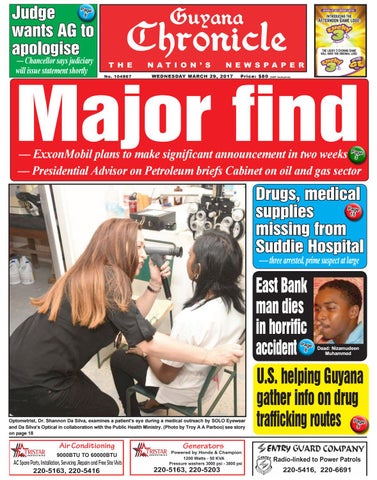
Optometrist, Dr. Shannon Da Silva, examines a patient’s eye during a medical outreach by SOLO Eyewear and Da Silva’s Optical in collaboration with the Public Health Ministry. (Photo by Troy A A Parboo) see story on page 18
Dead: Nizamudeen Muhammed
U.S. helping Guyana gather info on drug trafficking routes
Page 9
2
GUYANA CHRONICLE Wednesday March 29, 2017
Way cleared for appointment of Court of Appeal Judges –– Acting Chancellor, Chief Justice sworn in By Svetlana Marshall PRESIDENT David Granger has noted that as soon as the Judicial Service Commission (JSC) makes its recommendation on the appointment of Judges to the Court of Appeal, he will move ahead with the process. The President made this disclosure on the sideline of the swearing in ceremony at State House for Acting Chancellor of the Judiciary, Justice Yonette Cummings-Edwards and Acting Chief Justice, Roxanne George-Wiltshire. He said once the JSC meets and a recommendation is made, he will respond appropriately with the aim of filling the vacancies as quickly as possible. Currently, the Court of Appeal is short of at least two Judges. “I am confident that the new Chancellor is aware of the shortages and…as quickly as the JSC can meet and the names are submitted to me, I intend to move ahead,” the President told reporters. President Granger made it clear that he has “no interest in perpetuating a situation in which there are insufficient Judges,” noting that the swearing in of the acting Chancellor and Chief Justice is a step in the right direction. “The crisis will resolve itself in a few days or weeks. It’s up to the JSC now,” he said. However, the President acknowledged that he had withheld his approval from prior recommendations made by the JSC for the appointment of Judges to the High Court. The Opposition People’s Progressive Party (PPP) had said that the shortage of Judges was affecting the Administration of Justice to the detri-
Newly sworn in Acting Chancellor, Ms. Yonette Cummings-Edwards recites her Oath of Office during the swearing in ceremony
ment of citizens. Opposition Leader, Bharrat Jagdeo had also contended that the President had refused to act on the recommendations of the JSC. “We are aware that there are dire shortages of Judges in the judicial system. We are also aware, that the Judicial Service Commission has made recommendations to the President for the appointment of several judges to the High Court and the Court of Appeal several months ago. But to date no such appointment has been made. A reasonable inference that one can draw is that the nominees of the JSC do not meet the approval of the Executive. This is quite unfortunate because the approval of the Executive of the nominees for the JSC is not a Constitutional requirement,” the PPP had stated. However, President Granger said he had withheld See page 3
President David Granger hands over the Instrument of Commission to newly sworn in Acting Chief Justice, Ms. Roxanne George-Wiltshire
Major find
3
GUYANA CHRONICLE Wednesday march 29, 2017
–– ExxonMobil plans to make significant announcement in two weeks
–– Presidential Advisor on Petroleum briefs Cabinet on oil and gas sector AMERICAN oil giant ExxonMobil could soon make another significant announcement on its oil exploration works in Guyana’s Exclusive Economic Zone (EEZ), Minister of Natural Resources, Raphael Trotman, noted on Tuesday. Trotman made the statement after Cabinet was briefed by newly appointed Presidential Advisor on Petroleum, Dr Jan Mangal, who informed the government about the future of the oil and gas sector as well as outlined how he sees his role and the action that must be taken to prepare Guyana to manage the sector. According to a release from the Ministry of the Presidency (MOTP), Minister Trotman deemed Dr. Mangal’s presentation a timely one, since ExxonMobil has been aggressively carrying out seismic and exploratory work. He said an announcement is expected from the company in
another week or two. He said Dr Mangal’s work will help Cabinet to act more definitively on matters in relation to the petroleum sector. “The presentation was about the technical aspects, where we would spend out monies and the kind of vision we would like to have for Guyana. So it was a good presentation; very timely and now I believe that Cabinet will examine it some more and look at the considerations, some of which are political, some technical, some financial and we will ultimately come up with the blueprint, if I can put it that way, for the development of the oil and gas sector,” Trotman said. Minister Trotman noted that Government is working round the clock to put all systems in place to prepare Guyana for the ‘first oil.’ “We are preparing every day at the ministry and Dr Mangal is joining the Govern-
ment to prepare for the ‘first oil,’ and so there is something happening every day. We are looking at contracts, identifying persons to do things, assessing requests for permits. The Environmental Protection Agency (EPA), the Guyana Geology and Mines Commission (GGMC), they are all working,” he said. According to the release, while citing the importance of his new position, Dr Mangal noted that it was important for him to outline his plans in the context of President Granger’s vision for development of the sector. “It is to give Cabinet some comfort around the role itself, my experience and then also the vision of the President and the high-level vision, which we will have to work on and Guyanese will have to work on. But it was really to give Cabinet a view of where we are starting for Guyana,” he said.
Members of the Cabinet listen attentively as Dr Jan Mangal makes his presentation on the oil and gas sector and the Government’s vision.
Dr Mangal explained that as the Advisor to the President on Petroleum, he will be tasked with being the ‘middle ground’ between the Government and stakeholders to ensure that the necessary plans and policies are put in place. “It is around bringing oiland-gas expertise, someone from the industry like myself, in the position in the Ministry of the Presidency, who can speak to all stakeholders in Government and outside of Government. It is a position in the ministry that can look at things holistically in terms of Guyana’s energy sector; how oil and gas will affect Guyana as a whole. It is about how it will touch all areas of Guyana, business and all social issues. The role will touch on all areas and will try to stimulate the stakeholders’ input and I expect that it will grow over time,” he said. Dr Mangal’s appointment is being funded through the Inter-American Development Bank (IDB). He said that while his initial role is intended to last for a six-month period, there is an intention to seek funding for the appointment to be extended and expanded to include other experts from the technical, legal and commercial areas of the oil and gas sector. “I envision a small team in the ministry, about five or less and this is a team of experts from the industry and they will be there to assist the Ministry of Natural Resources and the Ministry of Finance and to also work with the Ministry of Foreign Affairs and the Ministry of Public Infrastructure. So under that five, there will
Petroleum Advisor to the President, Dr Jan Mangal making his presentation to Cabinet Members be a commercial oil-and-gas giant announced positive reexpert, an oil and gas lawyer, sults from its Payara-1 well an analyst and possibly a offshore Guyana. Payara technical person, but these is ExxonMobil’s second will be persons who have been oil discovery on the Stain the industry for a very long broek Block. The well was time, who know the industry drilled by ExxonMobil afvery well and who are pre- filiate Esso Exploration and pared to come and advise the Production Guyana LimitGovernment of Guyana,” the ed, and encountered more presidential advisor said. than 95 feet (29 meters) of A Guyanese by birth, Dr high-quality, oil-bearing Mangal is an expert in off- sandstone reservoirs. It was shore and civil engineering. safely drilled to 18,080 feet He is the holder of a Doctorate (5,512 metres) in 6,660 feet in Offshore Geotechnical En- (2,030 metres) of water. gineering from the University The Payara field discovery of Oxford and a Bachelor’s is about 10 miles (16 km) Degree in Civil Engineering north-west of the 2015 Liza from the University of Edin- discovery. burgh. He has worked in the According to ExxonMomarine and oil and gas indus- bil, in addition to the Payara tries for the past 18 years. discovery, appraisal drillGuyana’s oil and gas sec- ing at Liza-3 has identified tor is increasingly gaining an additional high-quality, international attention, fol- deeper reservoir, directly lowing significant oil finds below the Liza field, which by ExxonMobil over the past is estimated to contain be20 months. tween 100-150 million oil In January 2017, the oil equivalent barrels.
Way cleared for appointment of Court of Appeal ... From page 2
his approval based on information received and as such sought further advice from the present Chancellor. “I withheld approval because I sent the recommendations to the present Chancellor who has agreed to look at them and resubmit the list to me,” he explained. President Granger said he is awaiting Justice Cummings-Edwards’ response. HIT THE GROUND RUNNING Commenting on the appointment of Judges to the Court of Appeal, Justice
Cummings-Edwards said she will hit the ground running. “A meeting of the members of the JSC will be convened shortly and we will address that matter,” she posited. The Acting Chancellor noted that the complement of Judges required at the Court of Appeal is five, however currently there are three Judges but one is on pre-retirement leave. “Right now with the swearing in today with Justice George we have two…Justice Roy is the third Judge but he is on pre-retirement leave so in effect there are only two
Judges,” she explained. The Acting Chancellor noted that it takes three or more Judges to hear an appeal while an application could be heard by a single Judge in Chambers. Meanwhile, during the swearing-in ceremony, President Granger congratulated Justice Cummings-Edwards and Justice George-Wiltshire and noted that they have satisfied the requirements of the Constitution. Pointing out that the offices are the most senior in Guyana’s Judiciary, President Granger called on the Judicial Officers to uphold the high traditions and standards of the Offices.
From left: Attorney General and Minister of Legal Affairs, Mr. Basil Williams, S.C.; Acting Chief Justice, Ms. Roxanne George-Wiltshire; President David Granger; Acting Chancellor, Ms. Yonette Cummings-Edwards; Prime Minister, Moses Nagamootoo and Minister of State, Mr. Joseph Harmon, following the swearing-in ceremony
4
GUYANA CHRONICLE Wednesday, March 29, 2017
Trump signs order dismantling UN experts Obama-era climate policies ‘found dead’
[Reuters] - President Donald Trump on Tuesday signed an order to undo Obama-era climate change regulations, keeping a campaign promise to support the coal industry and calling into question U.S. support for an international deal to fight global warming. Flanked by coal miners and coal company executives, Trump proclaimed his “Energy Independence” executive order at the headquarters of the Environmental Protection Agency. The move drew swift backlash from a coalition of 23 states and local governments, as well as environmental groups, which called the decree a threat to public health and vowed to fight it in court. The order’s main target is former President Barack Obama’s Clean Power Plan,
which required states to slash carbon emissions from power plants - a key factor in the United States’ ability to meet its commitments under a climate change accord reached by nearly 200 countries in Paris in 2015. Trump’s decree also reverses a ban on coal leasing on federal lands, undoes rules to curb methane emissions from oil and gas production and reduces the weight of climate change and carbon emissions in policy and infrastructure permitting decisions. Carbon dioxide and methane are two of the main greenhouse gases blamed by scientists for heating the earth. “I am taking historic steps to lift restrictions on American energy, to reverse government intrusion and to cancel job-killing regulations,” Trump said at the EPA.
The room was filled with miners, coal company executives and staff from industry groups, who applauded loudly as Trump spoke. Shares in U.S. coal companies edged higher in response. The wide-ranging order is the boldest yet in Trump’s broader push to cut environmental regulation to revive the drilling and mining industries, a promise he made repeatedly during the 2016 presidential campaign. Energy analysts and executives have questioned whether the moves will have a big effect on their industries, and environmentalists have called them reckless. “I cannot tell you how many jobs the executive order is going to create, but I can tell you that it provides confidence in this administration’s commitment to the coal industry,” Kentucky Coal Association president Tyler White told
Reuters. Environmental groups heaped scorn on Trump’s order, arguing it was dangerous and went against the broader global trend toward cleaner energy technologies. A coalition of mostly Democrat-led states and local governments issued a statement saying they would oppose the order in court. “We won’t hesitate to protect those we serve — including by aggressively opposing in court President Trump’s actions that ignore both the law and the critical importance of confronting the very real threat of climate change,” the coalition, led by New York Attorney General Eric Schneiderman, said in a statement. The coalition includes states such as California, Massachusetts and Virginia, as well as cities including Chicago, Philadelphia and Boulder, Colorado.
in DR Congo [BBC] - Two UN experts who were missing in the Democratic Republic of Congo have been found dead, officials say. The bodies of US citizen Michael Sharp and Swedish national Zaida Catalan were discovered in the central Kasai region, a government spokesman said. They were abducted two weeks ago after going to Kasai to investigate reports of abuses after local rebels took up arms. Some 40 police officers were found beheaded in the region at the weekend. Congolese government spokesman Lambert Mende confirmed reports of the discovery to the BBC. “Two bodies of Caucasian or European type have been discovered on the road linking Bukonde to Tshimbulu in Central Kasai,” Mr Mende said. “As far as I know, no other white individuals are missing here.” He later told
reporters that a police commissioner had returned from Kasai with confirmation of their identities. Mr Sharp and Ms Catalan were taken, along with four Congolese support staff, into the forest near the village of Ngombe in Kasai. The Congolese government is fighting a rebel group which operates in the area and is believed to have kidnapped the experts. The violence in Kasai was sparked by the killing of traditional leader Kamuina Nsapu, who was leading an uprising against President Joseph Kabila. Before Mr Mende announced the bodies had been identified, John Sharp, Michael’s father, expressed his heartbreak on Facebook. “This is a message I hoped never to write... Dental records and DNA samples will be used to confirm the identities,” Mr Sharp wrote. “All other words fail me.”
Wednesday March 29th, 2017 - 05:00 hrs Thursday March 30th, 2017 - 05:00 hrs Friday March 31st, 2017 -05:00 hrs
There have been months of unrest in Kasai, after a local chief started a rebellion
DATE: DATE: 26/11/2016 25/03/2017 26/11/2016 28/03/2017
10 14 19 19 26 28 02 01 12 15 18 20 21 N O 11
06 06 13 16
14 18
21 21
24 24
26/11/2016 28/03/2017
04 01
07 04
03 03
26/11/2016 28/03/2017
05 00
04 04
01 05
26/11/2016 28/03/2017 02 03
09 05
10 08
11 09 13 11 14 15
18 20
5
GUYANA CHRONICLE Wednesday, March 29, 2017
Setting the record straight on Linden television
ON July 18, 2012 three men died in Linden as part of a struggle. Ron Sommerset, Shemroy Bouyea and Allan Lewis were ruthlessly gunned down as they protested peacefully against a move by the former PPP government to cause an increase in electricity rates in the mining town. In the face of the highly mobilized and unrelenting five-week resistance, the then PPP government was forced into submission and to sign an agreement with the people of the town to restore order, equity and deliver justice. One of the key features of this agreement is the return of the television operation in Linden to the community. The people of Linden, in 1980 were gifted a television station by Green Construction Company; it remained in their possession and under their management until 1993. After the PPP government came to power, the people of Linden considered that the television station was seized and remained under state control. In the 10 years prior to 2015 the people of Linden grew disenchanted by the patently biased programming they were fed by what had been, by this time, operating as NCN Channel 13. There was a steady diet of rabid pro-government propaganda while the views of the opposition and the community itself were minimized and shut out. During the 2015 election campaign, the Coalition Government made a commitment to the people of Linden that it will deliver on the agreement and ensure that the television station is returned to the community for their full ownership, management and control. In good faith this process
had been initiated by Prime Minister Moses Nagamootoo in 2015 with the Region 10 Broadcasting Inc (RTBI), a company which was set up by former Region 10 Regional Chairman Mr. Sharma Solomon. However, following the 2015 national and regional elections, Mr. Solomon ceased to be Regional Chairman and he was replaced by Mr. Renis Morian. The other directors of the RTBI were Ms. Sandra Van Tull, Mr. Morris McKinnon, Ms. Gloria Britton and the now deceased Mr. Haslyn Parris. While discussions were being had with Mr. Solomon, Prime Minister Nagamootoo received a letter from the Region 10 RDC stating the Council’s concerns about the handing over of the television station to RTBI and the representation on RTBI’s board. The RDC was ostensibly concerned that, (i) it as the duly elected regional governing body had no representation on the RTBI board and (ii) the RBTI board lacked wide representation from the various stakeholders and representative bodies in Linden. On March 15, 2016, Prime Minister Nagamootoo convened a meeting at Watooka House in Linden with all the stakeholders in an effort to find consensus on the issue. The meeting was reported as a “packed stakeholder consultation” which indeed it was and there was a frank expression of views on the concerns by the RDC, the Region 10 Members of Parliament, the then Interim Management Committee of the Mayor and Town Council, labour union and chamber of commerce representatives and other stakeholders.
It was agreed at that meeting that the stakeholders would hold a follow up meeting and further deliberate on the points of contention, find agreement and report to the Prime Minister. No follow up meeting was ever held. Growing impatient after several months of inaction by the stakeholders and their seeming intransigence, Prime Minister Nagamootoo then convened a second meeting at the Ministry of the Presidency on June 22nd, 2016. At this meeting Prime Minister Nagamootoo reiterated government and his own personal commitment to the stakeholders to bring the issue to a conclusion and to hand over the television station to the community. He outlined his and the government’s anxiety to conclude the issue. It was agreed at this second meeting that the Board of Directors of RTBI would be expanded from the original four (Mr. Solomon, Ms. Van Tull, Mr. McKinnon and Ms. Britton) to 15 with representation from the RDC, the Mayor and Town Council, the Kwakwani Neighbourhood Democratic Council, the trade unions and the chamber of commerce among other stakeholders. Mr. Solomon duly committed to arranging for a board meeting of RTBI to be held and for the agreed actions to be taken and for the company’s attorney to be instructed accordingly and the expansion effected. Nine months elapsed. At a third meeting convened by Prime Minister Nagamootoo on Monday of this week, March 27th, 2017, again at the Ministry of the Presidency, Mr. Solomon verbally reported to the meeting that the RBTI board had been expanded to 15 as agreed at
the June meeting. Significant gains were made on Monday as the newly appointed RBTI directors present agreed to hold the first meeting of the expanded RBTI Board at 5pm on Friday March 31st at Watooka House at which the Board will appoint the Chairperson and company secretary. Following this process it is anticipated that an urgent date will be set for the formal handing over of the television station to Linden. Prime Minister Nagamootoo has been exceedingly patient in this entire process. At no point was there any hesitation, rethink or reluctance to deliver on the commitment of the Coalition Government to return Linden television to its rightful owners. It was the RDC, the duly elected and rightful regional governing body of the region which expressed concerns to the Prime Minister about the process. For the Prime Minister to have ignored the RDC and other stakeholders’ concerns, including the Mayor and Town Council, the region’s Members of Parliament and others and organize for the handing over to Linden television to RTBI would have opened him and the Coalition Government to justifiable accusations of irresponsibility, ignoring the concerns of elected officials and the representatives of the people and acting in haste and with impertinence. I am witness to the fact that Prime Minister Nagamootoo does not take lightly that three men died, and a difficult struggle of blood and tears was undertaken, in part, for the return of Linden television to the people of the town. Prime Minister Naga-
mootoo has been charged by the Coalition Government with overseeing the process of returning the television station to the people of Linden. It is his and the government’s desire to conclude this, long overdue process soonest. Since March 2016, to date, it has been the stakeholders of Linden who have caused the process to be intractably stalled as a result of being unable to find common ground.
It is hoped, that come Friday, March 31st this problematic hurdle will be overcome and the process will move forward and be concluded. Despite propaganda and misinformation, the ball has always been and remains in the court of the Linden stakeholders. People died for this, the stakeholders of Linden must not betray the legacy of the Linden martyrs by being intransigent.
6
Editorial
GUYANA CHRONICLE Wednesday, March 29, 2017
Justice delivery THE judiciary is one of the three branches of government, with equal responsibility and importance in our political system of checks and balances. The discharge of its duty requires human and physical resources. This branch not only has constitutional responsibility for adjudicating the law, but also providing the surety of its capacity to protect the rights and freedoms of every citizen. Guyana experiences an overload and somewhat archaic judicial system. The consequences of these have seen backlogs of cases that beg attention in keeping with the principle that justice delayed is justice denied. The magistracy (lower court) continues to operate without its full complement of magistrates that could only compromise the delivery of the service. It is not unusual in this environment to have a magistrate running more than one court and having to work in excess of normal hours required of the job. This over demand could not only increase workplace stress/depression, but also could creates situations where decisions are flawed, and the inability to conclude cases within reasonable time. The lower court feeds the High Court and where flawed decisions exist, they contribute to further overloading this court, which too is without its full complement of judges. A similar burden would exist for the Appeal Court, which is not only presently under-staffed, but also facing handicap to sit. The situation has created reactions that are not to the system or nation’s benefit. And it matters not when the problem started and where blame can be laid. Dwelling on these in the absence of putting systems in place to correct the situation would not solve the problem. The complement of members of the judiciary has been arrived at based on the evaluated needs of the society and it helps when the quota is honoured. Therefore, President David Granger’s statement on
Tuesday in bringing clarity to claims that he had refused to appoint persons who were recommended to be judge was timely. President Granger said that he withheld approval of some recommendations until the new Chancellor could have an opportunity to review those recommendations. “I withheld approval because I sent the recommendations to the present Chancellor, who has agreed to look at them and resubmit a list to me. As soon as I get that list I will be able to act. So I did decline; I saw the list and I received some information and on the [basis] of that information I sent it to the present Chancellor and I am awaiting her advice,” the President said. Effective discharge of the judiciary’s responsibility aids in citizens receiving justice in the shortest possible time. This could also realise reduction in the backlog of cases and the prison population, many of whom are on remand for considerable periods. Incarceration carries a financial cost to the State which is borne by taxpayers and could otherwise be diverted to other use. Overcrowding impinges on prisoners’ rights as outlined by international standards which puts at risk the country’s image in the international community. The human element to those who await trial and those who have accused also cannot be ignored given the inherent cost-psychological, social and financial. The public health situation that arises with overcrowding, such as internecine conflicts, put at risk not only inmates but also the security of the prison staff. There were instances where inmates managed to get onto the prison roof calling for their cases to be heard. It is not unusual to hear an accused being remanded for as much as 10 years waiting for their case to be heard. The financial cost borne in hiring and sustaining legal counsel by the accused and that to the State, in preparing and deliberating on the matter, expeditious dispatch reduces
the burden to both sides. In our common-law system, the presumption of innocence until proven guilty exists. Treating all from this premise would require not only being charged and placed before the court, but having a trial that is just and fair, and heard by a member of the judiciary with alacrity. An important element of the judiciary often overlooked or taken for granted is the people’s confidence in the system. Where it is believed-real or perceived-- that the judiciary is there to protect, will guarantee a fair trial, examine the circumstances and content of the case within an acceptable time, such can reduce temptation for corruption and vigilante justice. When there is a strong judiciary the corrupt, from all sections of society, is inclined to think twice and so too it is for those who want to take the law into their hands. A strong judiciary is linked to the respect for law and order. When a judiciary is not functioning at its full capacity, the system of government is undermined. It is in the nation’s interest that no effort is spared in ensuring its full complement of presiding officers-- magistrates and judges-- supporting personnel, and other requisite resources.
Comprehensive sex education needed
Dear Editor
EDUCATIONAL campaigns aimed at youths by public, professional and religious organisations must emphasise the effectiveness of pre-marital abstinence as the only foolproof way of reducing sexually transmitted diseases, teenage pregnancies, abortions and emotional trauma. The Guyana Responsible Parenthood Association recently conducted a survey titled “Sexual trends among Youths in Guyana.” It recommended the implementation of a “Comprehen-
sive sexual and reproductive health rights education in all public schools.” Other stakeholders and consultants have been pressuring the Ministry of Education to implement the Comprehensive Sex Education curriculum in our public schools. According to the United Nations Education, Scientific and Cultural Organisation, Comprehensive Sex Education is an “Age-appropriate, culturally relevant approach to teaching about sexuality and relationships by providing scientifically accurate, realistic, non-judgmental information.”
In the International Technical Guidance on Sexuality Education Volume 1, produced by UNESCO, and the “Standards for Sexuality Education in Europe” prepared by the World Health Organization, homosexuality, abortion and masturbation are heavily promoted, while abstinence is given miniscule attention. The documents state that ‘’children ages 4-6 should be informed about the enjoyment and pleasure when touching one’s own body, children ages 9-12 have the right to explore gender identities and youths ages 15-18 should be informed
that both men and women can give and receive sexual pleasure with a partner of the same or opposite sex.’’ Such piffle and balderdash should not be indoctrinated into innocent minds of children. The Centre for Disease Control in the United States of America reported that homosexual men account for 83% of men infected with syphilis and also 60% of new HIV infections. Why would you want to promote and celebrate a scientifically unhealthy lifestyle to impressionable young minds? Comprehensive Sex Education is expertly dis-
guised abortion rights, LGBT rights and sexual pleasure education masquerading as human rights and gender and sexual reproductive health. The Ministry of Education should reject all proposals to have contraceptive services provided to school- children. If sex educators truly care about the well-being of youths in Guyana, they would teach them about the efficacy of condoms, the vulnerability of the immature cervix, hazards of anal intercourse and the horrific physical, spiritual and psychological effects
of pre-marital sex. If our dysfunctional culture in Guyana continues to ignore God’s clearly defined boundaries for sexual activity, we will continue to experience tragic consequences. Ignorance of spiritual and biological truths will continue to have devastating effects in Guyana. We must protect our children from immoral, illogical and pseudo-scientific philosophies promoted in Comprehensive Sex Education. Regards Matthew Gaul
7
GUYANA CHRONICLE Wednesday, March 29, 2017
Is FIFA flattering Oh what a tangled web we weave to deceive? Dear Editor THE disclosure by FIFA Director of Member Associations & Development for Africa and the Caribbean, Mr. Veron Mosengo Omba that: “FIFA pleased with work of Forde and GFF.” It remains rather unfortunate on behalf of FIFA, that an assessment after a two-day visit, can make such a pronouncement. Exactly what is pleasing, office procedures, secretarial duties, acquiring a Technical Director, Development Officers and establishing a Youth Academy? In erstwhile, proper playing/training facilities for clubs, in the respective Associations over years have gotten worse. Is strategic emphasis being placed on this by the GFF? Whereby, within Georgetown as an exam-
ple perceivably the largest Association, with the two oldest clubs nationally, GFC and Santos. The former over a decade or more upgraded its playing surface, to a lesser extent the floodlights and dressing rooms. But what is sadly lacking until now is seating accommodation. In relation to the latter, a worst-case scenario exists, pertaining to: the lack of a proper training venue. GFC, GDF, Tucville, Police and Camptown are the only venues, which are suitable to host senior competition matches domestically, reflective of less than 50% of the citybased clubs. So, what of the others, are training venues listed on the affiliation forms? How many clubs still have the National Park ground as a training venue? The most active As-
sociation, EBFA, plays all of its competitions at the Grove ground, while the Bartica Community Centre ground, is virtually unplayable. Is this the hallmark of development that is likely to see football surpassing cricket to become the #1 national sport? By relevant comparison, cricket receives far less annual subventions from its parent body and is more properly structured developmentally. Over the years, I always advocated that development and progress can’t be measured by an increased number of clubs. Rather, it must be less clubs that are more properly structured, efficient and professionally run. “Since the days for carrying dead weight are over”. Regards Lester Sealey
Dear Editor, THE quote “Oh! What a tangled web we weave, when first we practice to deceive,” refers to how complicated life becomes when people start lying. It originally referred to a love triangle in the play “Marmion” by Sir Walter Scott. The quote is often used to talk about the complex, destructive effect that lying tends to have on life. When people start lying, they have to remember all the details of the lie rather than their true memory in order to keep the lie going when others ask about it. The quote also refers to the fact that lying often has unforeseen consequences. The quote is so characteristic of the notorious Georgetown Parking Meter contract, which is just riddled with
inconsistencies, deception and concealment. First of all the town clerk is yet to verify his claim that the previous Council had approved the project and thus the reason why there is no reason for the present Council to do so. Where is the report of the committee that examined the proposal and recommended it? Where is the agenda of the statutory meeting that it was tabled at? And where are the signed minutes of the approving statutory meeting? The second question to be asked if indeed there was such an approval, is why it was not acted upon during the life of the last Council? Can the purported decision of the last Council be brought forward and implemented during the life of the new Council without the review and ratification
of the new Council? Third, how could a contract signed by the town clerk on behalf of the City Council and the City of Georgetown be made into a classified document? This is not a private arrangement, but must be a public document for the citizens to examine. And fourth, how could the town clerk and City Council even think it is possible to defy an order given by the Minister of Communities to suspend the contract, given the fact that it is the very Minister of Communities who allowed the commencement of the parking meter arrangement when he signed and gazzetted the requisite by-laws into effect? Regards Shanta Singh
8
Judge wants AG to apologise
GUYANA CHRONICLE Wednesday March 29, 2017
–– Chancellor says judiciary will issue statement shortly
NEWLY appointed Acting Chancellor of the Judiciary, Justice Yonette Cummings-Edwards, has acknowledged receipt of a letter of complaint by Justice Franklin Holder regarding an incident in the High Court last week involving Attorney General, Basil Williams. Speaking to reporters following her swearing-in at State House on Tuesday, Justice Cummings-Edwards said the judiciary will soon issue a statement on the issue. She declined to comment further on the matter. “An official report will be given to the media shortly as soon as everything is completed,” the Chancellor (ag) said. The issue had come to the fore when Attorney-at-law, Anil Nandlall alleged that Williams had threatened to kill Justice Holder, causing the judge to walk off the bench last week Thursday during a court case involving Carvil Duncan. The Attorney General, who is also the country’s Legal Affairs Minister, had denied the allegation. In a letter to Justice Cummings-Edwards, Justice Holder said he left the bench last week Thursday because of an alleged statement made by Williams, which is: “I could say what I want to say and however I want to say it, I have always been like that.” The judge said he found the statement to be egregious. “Immediately after hear-
Attorney General and Minister of Legal Affairs, Basil Williams, SC ing these words, I rose from ney-at-law in any matter the bench and went into my whatsoever. chambers. I did not adjourn JUSTICE HOLDER’S the matter, nor did I give any ACCOUNT instructions to the parties,” Meanwhile, in his letter Justice Holder mentioned in dated March 24, 2017 to his letter of complaint. His letter made no men- Justice Cummings-Edwards, tion of any “threat”, and Justice Holder said during although he referenced Wil- the cross-examination of the liams’ statement about a witness on March 23, Wildead magistrate, Justice liams had asked a question, Holder did not describe it which he initially recorded as a threat. He is however as “yes.” “However, because of contending that he felt disrespected and that the Attor- what the witness said immeney General is in contempt diately after and Mr Williams’ of his court. He called for desire to cross-examine her a genuine and meaningful on a document which she apology by Williams in open had prepared and for which court, saying that if this is he was making application to not forthcoming he will not have admitted into evidence, I sit to hear him as an Attor- crossed out the answer ‘yes,’” the Judge said. According to the Judge, as the Attorney General went further into his cross- examination, he (Williams) made “certain statements which suggested that it was his belief, that the witness had said “yes” and that this was the record of the court.” However, the Judge said
on recognising “Mr Williams’ misconception of this part of the evidence, I then read aloud the record of the court in this regard. I further offered that he (Williams), may ask the witness the question again if he so desired, since the record showed that there was no answer to the questions. Mr Williams did not do so,” the Judge wrote. Justice Holder continued that Williams proceeded to ask other questions of the witness, in answer to one of which, the witness said “no.” According to Justice Holder, upon the witness saying this, Williams said, “I the judge must record “no.” I then said to him that a record is being made that the witness did say “no.” Justice Holder said Williams followed up with words to the effect that previously the witness had said ‘yes’ and the court chose not to make a record of this. “I then told Mr Williams that I took umbrage to his tone and what he was insinuating, which was in effect, that the court was being selective in recording the evidence.” The Judge said Williams responded by saying that the last person who told him what he should not say was a Magistrate and he is now dead. “He further said all morning Mr Nandlall disrespecting you and you have not done anything about it,” Holder wrote, adding that he told Williams that this was not a true statement of what had occurred. “This was followed by a most egregious statement by Mr Williams, which is: “I could say what I want to say and when I want to say it, I have always been like that.” It was at this point that the judge decided to leave the bench.
“Immediately after hearing these words, I rose from the bench and went into my chambers. I did not adjourn the matter, nor did I give any instructions to the parties,” Justice Holder clarified. NO THREAT During a news conference last Friday, Williams in detailing what had transpired, said that he was cross-examining Duncan, who is being represented by Nandlall, and the latter kept interrupting the court. Williams, SC, said that when the Judge announced that he was about to adjourn the matter, he (Williams) made a request to ask a final question, which he was permitted to do. The AG said that after he had asked his final question of the confidential secretary of Duncan, since she was the one being cross-examined, he thanked her and proceeded to his seat. He then stated that: “When I was about to sit, I saw the Judge was about to leave and I said ex abundanti cautela; out of excessive caution could I enquire [if] the answer ‘no’ was recorded. The Judge, to my surprise said, Mr. Williams you’re not in charge of my court.” The AG related that the Judge then said that he interpreted what Williams said to mean that he [the Judge] did not record a previous answer given by the witness, and that he (the Judge) took great umbrage at that. Williams, SC, said he then shared an experience which had happened years ago, when a magistrate presiding over a matter in which he was involved, had interpreted something he said, differently. He said that since then he has been “particular” about what he says in court and “incidentally,
Justice Franklin Holder that magistrate is dead now.” He noted that after this, he continued his conversation with Justice Holder, after which Nandlall “jumped in as though he was under the influence of something” and the Judge left the bench. The AG said that his view is that the Judge had intended to leave, but he (Williams) had detained him by asking another question. He said that no date was given by the Judge for a continuation of the hearing, as he has the option of sending notices to counsel about new dates. Judy Stuart-Adonis, Senior Legal Advisor, who was in court during the incident in a statement seen by this newspaper said the AG was insistent in the inconsistencies of the witness being recorded after which he subsequently referenced a former Magistrate who also misconstrued him and that Magistrate is now deceased, meaning he/she is no longer a sitting Magistrate. Esther Sam, Principal Legal Adviser at the AG chambers, also gave a similar account.
East Bank man dies in horrific accident AN accident on the Land of Canaan Public Road, East Bank Demerara (EBD) has resulted in the death of 27-year-old Nizamudeen Muhammed known as ‘Dwayne’ of Lot 616 Section ‘A’, Golden Grove, EBD. The accident occurred at approximately 00:10hrs on Tuesday and according to a police report, Muhammed was proceeding north along the western side of the road in motor car PRR 4768 when
he reportedly collided with the metal rail of a culvert. He lost control of the car, causing the vehicle to topple several times before he crashed into a lamp pole, on the same side of the road. As a result, he was flung out of the vehicle. He was the lone occupant of the car at the time of the accident. This newspaper understands that Muhammed was picked up in an unconscious state and rushed to the Diamond Diagnostic Centre
where he was pronounced dead on arrival. His vehicle received extensive damage. The body is at the Lyken’s Funeral Parlour awaiting a post-mortem examination. Muhammed was employed at New Timehri Handling Services Inc. at the Cheddi Jagan International Airport (CJIA). Neighbours described him as an easy going person who does not have many friends. His parents reside in the United States of America.
Dead: Nizamudeen Muhammed
9
GUYANA CHRONICLE Wednesday march 29, 2017
Mapping drug routes
U.S. helping Guyana gather info on drug-trafficking routes – seeks ‘tangible’ progress on probes, extraditions
THE United States is seeking to strengthen Guyana’s counter-narcotics capabilities by enhancing interagency coordination and help gather better information on drug trafficking routes. This was the position tak-
of corruption in the country. The report noted that the APNU+AFC administration has expressed a strong willingness to cooperate with the United States on drug control, extradition, and mutual legal assistance, and other international crime issues.
Ranks of the Customs Anti-Narcotics Unit prepare cocaine for destruction recently en in that country’s 2017 International Narcotics Control Strategy Report on this country. The 2017 International Narcotics Control Strategy Report (INCSR) is an annual report by the Department of State to Congress prepared in accordance with the Foreign Assistance Act. It describes the efforts of key countries to attack all aspects of the international drug trade in Calendar Year 2016. The report said that that the United States would welcome increased levels of cooperation with the Government of Guyana to advance mutual interests against the threat of international drug trafficking. “Guyana has shown strong interest in furthering collaboration under CBSI. The United States looks forward to tangible progress on investigations, prosecutions, extraditions, security sector capacity enhancement, the engagement of at-risk communities, and enforcement of laws against money laundering and financial crimes.” The US said the Guyana Government cooperates closely with Washington but is limited by resource constraints and high levels
According to the report, Guyana is a transit country for cocaine destined for the United States, Canada, the Caribbean, Europe, and West Africa. Cocaine originating in Colombia is smuggled to Venezuela and onward to Guyana by sea or air. Smugglers also transit land borders with Brazil, Venezuela, and Suriname. Cocaine is often concealed in legitimate commodities and smuggled via commercial maritime vessels, air transport, human couriers, “go-fast” boats or various postal methods. The influence of narcotics trafficking is evident in the country’s criminal justice systems and other sectors. Traffickers are attracted by the country’s poorly monitored ports, remote airstrips, intricate river networks, porous land borders, and weak security sector capacity. According to the report, Guyana has legislation in place that could enable a more-effective response to the threat of drug trafficking, noting that the Anti-Money Laundering and Countering the Financing of Terrorism Act of 2009, Interception of Communications Act of 2008, Criminal Law
Procedure Act (revised in 1998), and Narcotic Drug and Psychotropic Substances (Control) Act of 1988 were designed to enhance the investigative capabilities of law enforcement authorities and prosecutors in obtaining convictions of drug traffickers. In September 2016, using the 1988 Narcotic Act, the Guyanese government convicted one person for trafficking cocaine. In 2016, the Government of Guyana launched a new National Drug Strategy Masterplan (2016-2020) and created a National Anti-Narcotics Agency (NANA). “The government also amended its anti-money laundering law and drafted whistleblower and witness protection legislation. The Financial Intelligence Unit (FIU) has the mandate to detect, prevent, and deter money laundering and financing of terrorist activities in Guyana,” the report stated. It added that the FIU is charged with preparing suspicious transactions reports for the Special Organized Crime Unit (SOCU) to investigate, but is severely understaffed and ineffective. The report noted that in the month of June, government appointed a new director of the FIU, and the functional capacity of the unit is progressing. The Special Or-
ganized Crime Unit became operational in 2015. The report noted that despite its limited staffing capacity, in February 2016, the SOCU seized roughly $80,000 in cash from suspected drug proceeds and arrested two persons suspected of money laundering. This was the first seizure under Guyana’s updated anti-money laundering legislation. SUPPLY REDUCTION Meanwhile, the report acknowledged that Guyana has a drug enforcement presence at its international airports, post offices, and to a lesser extent, at port and land-border entry points. “The five major agencies involved in anti-drug efforts are the Guyana Police Force (GPF), Guyana Revenue Authority (GRA), the Customs Anti-Narcotics Unit (CANU), the Serious Organised Crimes Unit (SOCU), and the Guyana Defense Force (GDF). The GDF supports law enforcement agencies with boats, aircraft, and personnel but has limited capacity and lacks law enforcement authority.” The Guyana Coast Guard (GCG), a GDF sub-component and U.S. partner in maritime interdiction, patrols Guyana’s territorial waters and conducts humanitarian search
and rescue missions. In 2012, with U.S. funding through the Caribbean Basin Security Initiative (CBSI), the UN Office on Drugs and Crime’s (UNODC) Container Control Program (CCP) established a multi-agency CCP Port Control Unit at the John Fernandes Wharf, Guyana’s most active port. In April 2016, the CCP Unit detected and seized 48 kilograms (kg) of cocaine and in June, 579 kg of marijuana. Through the first six months of 2016, the GPF reported seizing 16 kg of cocaine, a significant decrease from the 134.2 kg of cocaine that was seized over the same period in 2015. CANU reported seizing 60 kg of cocaine over this period (down from 568.3 kg in 2015), and the GRA did not report any seizures. Guyanese authorities convicted 46 persons on drug related charges during 2016. DEMAND REDUCTION However, the US report stated that Guyana lacks a comprehensive demand reduction strategy that adequately addresses drug rehabilitation. The report states that the United States supports a wide range of efforts designed to address crime and
violence affecting Guyanese citizens, primarily through Caribbean Basin Security Initiative (CBSI). CBSI is a security partnership between the United States and Caribbean nations that seek to substantially reduce illicit trafficking, advance public safety and citizen security, and promote justice. Efforts to increase law enforcement capabilities, protect borders and ports, strengthen workforce development, and promote anti-money laundering effectiveness directly address priority concerns shared by Guyana and the United States. According to the report the Government of Guyana cooperates closely with the United States but is limited by resource constraints and high levels of corruption in the country. CBSI-funded programs support Guyana’s maritime operations by providing interdiction assets, and relevant command and control systems, as well as associated logistical support and training. In 2016, the United States provided port and maritime training to Guyana’s Coast Guard. U.S. assistance programmes also promote law enforcement professionalization and more effective narcotics investigations.
10
GUYANA CHRONICLE Wednesday March 29, 2017
Truancy more prevalent in interior regions – study finds
STUDENTS residing in rural areas are at a greater disadvantage as it relates to staying in school and receiving a sound education, according to an Out of School Children (OOSC) Survey which was initiated by the Ministry of Education in partnership with United Nations Children Fund (UNICEF).
According to a release from the Ministry of Indigenous People’s Affairs, the findings were disclosed on Monday during a oneday seminar conducted at the National Centre for Educational Resource Development (NCERD) by a National Consultant and representative of UNICEF. Vice-President and Minister of Indigenous People’s
Affairs, Sydney Allicock, Minister of Education Dr Rupert Roopnaraine and other stakeholders attended the event. According to the survey, schools in Regions one, seven & eight are at a greater disadvantage as compared to the other administrative regions. National Consultant, Clement Henry, also pointed out that “Regions Two, Three, Four & 10 stand out with above national average OOSC prevalence.” It was noted too that
there is a higher OOSC rate among boys as well as higher rates among indigenous persons living in riverain and remote communities. In addition, higher OOSC rates were recorded in regions involved in farming, forestry and mining. A parent taking a decision to wait until the child is older to start school and the distance the child has to travel to get to and from school were among the reasons cited for the OOSC. The survey indicated that girls have a higher attendance percentage than boys, due to the fact that they remain in school much longer. At the national level, the findings indicate that Region Nine recorded a rate of 74.8% in achieving satisfactory attendance, while Region Two with 37.6% recorded the lowest rate. The attendance rates for the remaining regions were Region Five (64.3%), Region One (58.5%), Re-
gion Seven (55.8%), Region Three (50%) and Region Eight (56%). Region 10 recorded a 47% satisfactory attendance rate followed by Region Four (46.4%) and Region Six (43.3%). It was also noted that the conditions in poor families significantly contributed to children leaving the school system. UNICEF’s representative, Dr Ingrid Sanchez, in presenting an overview of the project said, “The most important thing of this initiative is this [is] not only data driven, but that data is then linked to very careful policy analysis to better understanding what are the barriers that are keeping some of the children out of the school and how can governments and societies support them, so they can exercise their right to education.” The Minister of Education in his remarks emphasised the importance of education to the nation, not-
ing that the issue of school drop-outs has been an issue of concern for the ministry. Minister Allicock noted that the country must be cognizant of the imminent development and nurturing the nation’s young minds is critical to answering that call. Speaking directly to initiatives that positively impact youth 14 years and older, Minister Allicock pointed to the Bina Hill Institute in the Rupununi, which is geared at providing youth in the hinterland, opportunities for higher education. He said in 2003 the institution started with 43 students on its roster and to date that number has risen to approximately 600. The OOSC initiative is geared at analyzing information gathered and scrutinizes factors that lead to exclusion from schooling and the existing policies that can significantly reduce the national out-of-school rate.
11
GUYANA CHRONICLE Wednesday march 29, 2017
14% tax on fees for private schools By Akola Thompson
ABOUT two months ago, Minister of Finance, Winston Jordan, announced that a 14% tax would be added onto the school fees of private schools. As someone who spent the latter years of my education in private institutions and who currently sends my child to one, I was livid that the government was taxing something as essential as education. My reasons for attending private schools were different, but I send my child to private school only because she receives better teaching there. She spent a year in the public education system, learning nothing other than what we taught her at home, so we decided to try a change and now she comes home with new knowledge almost every day. This inability to successfully teach students is not shared by all public schools of course, most times it comes down to the individual child and the help they receive from home, but there
is no denying that the public school system is extremely flawed. Some of our best teachers enter the private sector because they are paid more, have more resources in school available to them and often they have smaller classes to deal with. But then again, with the absence of regularisation, our private institutions are also extremely flawed. Knowing of the advantages and disadvantages of both private and public education and my biases concerning both, I decided to take some time before addressing this issue. There have been fierce calls to repeal the tax but despite the call of the people, the Government is still moving ahead with it. I have been asking myself for a while now whether I am for the tax or not and in a nutshell I am not. No one likes taxes, but it is understood we need them as they help to offset the cost of services provided to the people by the government. But we should tax industries, which place the most pres-
sure on the government, rather than the poor scrimping and saving, and taxes should not be doled out willy-nilly. Particularly when it is being applied on something as important as education, proper consultations must be had, and it must be ensured that the burden does not fall on the students and their parents. When faced with calls for removal of the tax and a petition of more than 14, 000 signatures against it, Minister Jordan explained that out of 57 private schools, eight are “tax compliant,” suggesting this was the reason for the tax. Later however, he went on to say that he did not “want a link [to be] seen between the imposition of the 14% on private tuition and the recalcitrance of schools, as it relates to paying or filing the income tax.” While it might not have started out that way, the fact that the government is the one repeatedly raising this shows that it might have been a determining factor in keeping the tax. President David Granger was quoted as saying that
while the government was not looking to put pressure on private entities as it related to non-compliance with VAT, there was need to ensure that “all Guyanese pay their fair share.” The fact that the Government chose to implement a new tax that would fall on the shoulders of the students rather than the ‘rogue” private schools they keep bringing attention to shows their continuous disconnect with the working class. Why
should the poor have to pay for the non-compliance of the rich? A mere suggestion of the private schools to absorb the cost will not cut it. If I am in a business to make profits, why should I then lower my profits because of your mere suggestion? While it certainly is right to want private schools to absorb the 14% tax as they make ridiculous profits off the backs of both the rich and poor struggling
students, it is a misguided one, particularly since it seems as if this was never the intention. What the government should be doing is not suggesting that private schools absorb these taxes, but reworking their language so that there are no loopholes through which the poor and working-class students struggling to gain an education in private institutions are further exploited.
12
CH&PA more than allocation of house lots – says Minister
GUYANA CHRONICLE Wednesday March 29, 2017
–– current state of planning not at desired level
THE CENTRAL Housing and Planning Authority (CH&PA) is now placing major emphasis on its planning functions with the aim of addressing critical landuse planning issues in the areas of infrastructural development, public services and transport and communication. “CH&PA is more than
the allocation of house lots and turnkey homes,” Minister within the Ministry of Communities with responsibility for Housing, Valerie Adams-Patterson said as she delivered the keynote address during the first National Planning Forum at the Regency Suites on Monday. As part of its legal and institutional mandate, CH&PA
under the Town and Country Planning Act is required to prepare development schemes to guide all future development, including housing and land regulation. However, this planning function was overshadowed by the Authority’s housing function. Planning is critical, Minister Adams-Patterson underscored, noting that it allowed
A wide cross-section of stakeholders at the National Planning Forum on Monday at Regency Suites
for a structured and coordinated approach to be taken in the decision-making process at all levels of local government. “This may include structuring land use through zoning, addressing issues of traffic and transport, and providing an objective basis to resolve land use conflicts, among other issues,” she pointed out. Minister Adams-Patterson added that the needs of the people must be met while positing that through land-use planning those needs within a spatial or environmental framework would be addressed. “People have needs that must be satisfied and a sound approach to meeting such needs imply the need for planning. For instance, they need housing, jobs, education, opportunities for recreation, transport and basic services like water, electricity and health care. Social planning and policies attempt to take care of the basic social needs of the country’s population,” she further explained. Under the Town and Coun-
Minister within the Ministry of Communities Valerie Adams-Patterson addressing the first National Planning Forum at Regency Suites try Planning Act, CH&PA is mandated to address land-use planning issues ranging from the design and construction of new roads to the provision of public services including electricity, water supply, drainage and refuse disposal. However, the Minister said she was cognizant of the fact that the current state of planning in Guyana was not at the desired level as compared to other developed nations due to the lack of capacity at the local level to meaningfully address planning issues. Lack of awareness and the overlapping functions of the regulatory institutions are also factors contributing to the current state of affairs. “The effects of these challenges are manifested in breaches of planning regulations and building by-laws, encumbrance and nuisances in neighbourhoods, squatting, desecration of the environment, etc,” she posited. Expounding on CH&PA state of affairs, the Chief Development Planner Germene Stewart said for many years, the planning remit of the authority was clouded due to lack of awareness and limited understanding of the roles and functions of the authority. She said many were of the opinion that the CH&PA primary mandate was to “cater for the provision for housing.” “Considering the priority given to the housing function, the planning function was confined primarily to the design and implementation stage of housing development programme with respect to the preparation of site layout designs for the sub-division of land and land use control activities, although under the Town and Country Planning Act, the CHPA is required to prepare spatial development plans (described as planning schemes under the Act) to guide and regulate development,” Stewart explained. As such, the National Planning Forum being held under the theme “Consolidating stakeholders collaboration in supporting the mandate of the Central Housing and Planning
Authority,” is intended to foster better understanding of the work of the Authority and more particular its planning functions. It is expected that out of this forum, an agreed Action Plan for an improved planning system will be developed to strengthen coordination and collaboration among stakeholders, the Chief Development Planner said. “It is also expected that consensus on immediate actions that can be taken to start the process of alleviating some of the issues that plague the planning system,” she added. Fayola Azore, a Development Planner, said already CH&PA is well on its way to establishing a National Capital Planning Commission, noting that the Terms of Reference (TOR) was currently being finalized. This move is expected to enhance the authority’s capacity to plan effectively at the local level starting with the Georgetown Mayor and City Council. “Until this process is completed planning in this context therefore still remains a highly centralized government activity with the CH&PA being one of the key agencies in the process. As a consequence, the question of adequate human, technical and other resources to support the work of the CH&PA is always a critical factor for consideration, Azore posited. However, she said that it must be noted that in the execution of its function, CH&PA in the past has prepared several land use plans for areas such as Georgetown, Lethem, Anna Regina, Charity, New Amsterdam, Linden and Corriverton. Between 2009 and 2012, the authority with the help of the Canadian Institute of Planners, designed several Community Development Plans for a number of local communities. Minister within the Ministry of Communities, Dawn Hastings-Williams, CH&PA CEO Lelon Saul and the Chairman of CH&PA’s Board Apostle Elsworth Williams were among the officials present. The two-day forum will conclude today.
13
GUYANA CHRONICLE Wednesday march 29, 2017
Police renew focus on tinted vehicles
THE Guyana Police Force is warning owners of heavily tinted vehicles to remove them or face immediate prosecution. On Tuesday, the police were observed in campaign mode as traffic ranks pulled in several motorists, especially those in Georgetown and its outskirts. Drivers were stopped and ordered to remove the dark tints from their vehi-
cles. Back in the early 2000s, Guyana introduced the law against tinted vehicles after the Queen’s College Old Students’ Association petitioned then President Janet Jagan, complaining about the heavily-tinted minibuses which were hiding wrongdoing. At first the prohibition was to target public transportation, but was subsequently changed
to include all privately owned vehicles. As it is now, only certain vehicles are permitted to have tints without the expressed permission of the Minister of Public Security, including diplomatic vehicles, and those belonging to senior government and high-ranking military officials. As of recent, motorists have wantonly violated the law and many persons have
Traffic ranks in the vicinity of Golden Grove, East Bank Demerara Police Station on Tuesday. (Rabindra Rooplall photo).
reported seeing heavily tinted vehicles beings used to commit crimes. Traffic Chief, Dion Moore, said police launched a “general campaign” against illegalities on the roadways and vehicles with unauthorized tint will be
stripped. He said minibus operators will now come under the radar for illegal tinting and violating their road service licences. The road service licence for public transportation stipulates, among other
things, that “there should be no marking, writings, etc.” on vehicles. Minibuses oftentimes are decorated with advertisements, slogans, artwork and pictures that can be considered lewd and or offensive.
14
GUYANA CHRONICLE Wednesday March 29, 2017
PAHO consultant visits Guyana
CONSULTANT of the Pan American Health Organisation/World Health Organisation (PAHO/ WHO), Dr Beverley Barnett, is in Guyana conducting a qualitative analysis of the country’s Non-Communicable Diseases (NCDs) Strategic Plan. The visit is part of a wider initiative to undertake
“a qualitative analysis” of the NCD strategies of four CARICOM states. Guyana is the first country to be visited under the regional plan. She is also scheduled to hold similar discussions with Barbados, Jamaica and St Kitts/Nevis. On Monday, Dr Barnett met with the Minister within the Ministry of Public Health, Dr Karen Cum-
mings. During the meeting, the country’s NCD multi-sectoral plan was discussed. The plan notes that Guyana will pursue a Health-in-AllPolicies (HiAP) approach which envisions “strong leadership and political will.” The four main types of chronic diseases are cardiovascular diseases (such
PAHO/WHO Consultant, Dr Beverley Barnett; Minister within the Ministry of Public Health, Dr Karen Cummings; and Karen Roberts, Specialist, NCDs and Family Health, PAHO Guyana as heart attacks and stroke), cancers, chronic respiratory diseases (such as chronic obstructed pulmonary disease [COPD] and asthma) and diabetes. Ageing, unplanned urbanisation and the popularisation of unhealthy lifestyles help to fuel NCDs. Use of tobacco, lack of physical activities, unhealthy diet and abusing alcohol increase the risk of NCDs, which disproportionately affect low and middle-income countries. Global statistics show that some 75 percent of all deaths from NCDs occur in low and middle-income countries. Here in Guyana, the country’s seven-year, Non-Communicable Diseases (NCDs) strategic plan needs a judicious mixture of partnerships, prioritisation and sound implementation. The 2013-2020 national NCD blueprint for the health sector, called the ‘Integrated Prevention and Control of Non-Communicable Diseases in Guyana’ is modelled after existing best practices from regional, hemispheric and global approaches. That is why Barnett’s visit is so timely, since Guyana has reached the half-
way point in its programme implementation. Prioritising their efforts in the sector “will be the key to implementing the NCDs strategy successfully. This will help individual countries better allocate human and financial resources and determine the best courses of action” to support their vision, she said. Establishing priority will also “greatly assist individual territories [to] make timely interventions” to benefit their populations, the consultant to PAHO/ WHO posited. Additionally, Dr Barnett suggested that the Ministry of Public Health establish partnerships with individual local sectors, its development partners and civil society for the success of the NCD strategy. In his foreword, former Health Minister, Dr Bheri Ramsarran, noted that NCDs have “emerged as a new frontier in the fight to improve health globally. The increase in such diseases means that they are now responsible for more deaths globally than all other causes combined. “The new Guyana NCD Strategic Plan will position our nation to mount an effective, sustainable
response,” he added. The country’s NCD strategy is built on five planks: Risk-factor reduction and Health Promotion; Integrated Disease Management and Patient self-management Education; Programme Management; Surveillance, Monitoring and Evaluation and Public Policy, Advocacy and Communication, according to the Ministry of Public Health Director of Chronic Disease, Dr Kavita Singh. Dr Singh described the seven-year plan as “very comprehensive [and] if implemented accordingly, will provide optimum health care and risk-factor reduction” for its beneficiaries. Dr Cummings likes the strategy and like Singh also emphasised the issue of implementation which she indicated will most likely include a redirection of human and financial resources “without losses where gains are made.” Probing questions by Dr Barnett should assist Guyana with identifying its strategy’s strengths and weaknesses, spotting any existing gap and helping to generate recommendations to improve the ministry’s seven-year NCD guide.
15
GUYANA CHRONICLE Wednesday March 29, 2017
Drugs, medical supplies missing from Suddie Hospital ––– three arrested, prime suspect at large
THREE persons were arrested on Tuesday after a large quantity of drugs and medical supplies vanished from the Suddie Public Hospital, Essequibo Coast, but the prime suspect is still at large. The Guyana Police Force was called in to investigate a case of fraud at the Suddie Public Hospital after drugs and medical supplies went missing one week after arriving. After conducting their initial investigation, the police released the trio on $20, 000 bail each. In a statement on Tuesday, the Public Health Ministry explained that when a Ministerial Task Force visited the Suddie Public Hospital on Monday, authorities there could not account for several items sent just last week Tuesday by
the Materials Management Unit (MMU). But this was just the tip of the iceberg, as the Task Force also unearthed several other irregularities at the district hospital in the Pomeroon/Supenaam region. “In one instance, the pharmacist at the hospital could not have given account for several ampules of pethidine, codine and morphine,” the Health Ministry pointed out. Additionally, the Register for Dangerous Drugs had not been updated since 2015. “The team also found instances where the stock of narcotic drugs either could not be accounted for and the pharmacist had extra drugs that were still not recorded as prescribed under the law,” the minis-
try further disclosed. A MMU staffer confirmed Tuesday that 10 items on the list of drugs destined for the Suddie Hospital “either never arrived,” or significantly fewer were received than was sent. “For example, all 100 boxes of the drugs Simvastatin disappeared before arriving at the hospital. Each box contained 100 of the drugs,” the Public Health Ministry explained. Additionally, all of the 108 bottles of the Paracetamol suspension have reportedly vanished, in addition to 20 of the 1,000 Ampicillin 500Mg. Twenty thousand disposable gloves sent for the hospital were also stolen. A police investigation into this fraud case is still ongoing.
Food for the Poor donates to schools in Rupununi FOOD for the Poor, (Guyana) recently donated seven computer training kits to seven primary schools in the Rupununi, Region Nine. The training kits have already been installed at Karasabai, Macusht and St Ignatius Primary Schools, while kits
to the Sawariuau, Aranaputa, Aishalton and Achiwib Primary Schools are expected to be installed shortly. Information Technology Manager Orin Matthews and Field Officer Compton Giddings, were tasked with the responsibility of installing the
computer training sets. In addition to the computer training kits, the Karasabai and Macusht Primary Schools were equipped with solar- powered energy. Located in Lethem, St Ignatius primary receives power from the region.
Some of the students and teachers with their new computers
The Suddie Public Hospital
16
GUYANA CHRONICLE Wednesday March 29, 2017
Mayor calls out City Engineer –– over attitude of those in his charge
By Telesha Ramnarine CITY Mayor Patricia Chase-Green has cautioned City Engineer Colvern Venture to rein in the people in his department, lest the Council take action. “The attitude of those in
the Engineer’s Department stinks; their attitude towards citizens is unacceptable,” the mayor lamented at Monday’s statutory meeting at City Hall. She said it is high time that some officers from that department go home, because
they are at work doing absolutely nothing. “You have officers in the yard liming whole day,” she charged. Chase-Green pointed out that when these officers are picked up and taken into the fields, they produce the reports months after; and worse
yet, give the excuse that they have to revisit the location before submitting the reports. “These officers are not doing what they’re expected to do,” she said. “I’m tired of hearing the same names over and over again. You have senior officers sitting down
City Engineer, Colvern Venture doing nothing.” The mayor also lamented the fact that despite their behaviour, the municipality has to find money to pay their hefty salaries every month. “It is time the nonsense stops,” she said. “If the Engineer cannot take control of the department, we will have to take control of him; he needs to stop sorrying for people.” Addressing the engineer in person, Mayor ChaseGreen said, “You need to take control of your department, and the Council will stand by you.” With respect to allegations in the past of rampant corruption in the City Engineer’s Department, ChaseGreen once famously said: “The only time you hear about the City Engineer’s Department, is when they are taking bribes all over the place.” She had also complained once during a statutory meet-
ing about the abysmal treatment being meted out to the public by the City Engineer’s and City Treasurer’s Departments. “Go and come, go and come, go and come” is what customers are subjected to, without any consideration being paid to the time and cost that citizens have to expend, the mayor had said. “You come to the Treasurer’s Department,” she had said, “and you’re told to come back tomorrow; come back the next day; oh, we ain’t get it yet; come back the next day. “Nobody takes the time to ask if you have the passage to come back, or if you are going to be allowed time off to come back. Sometimes you come for your salary and you hear, ‘Oh come back.’ They don’t know if you’ve got to take your sick child to the doctor with that money, and I am disturbed about that.”
17
GUYANA CHRONICLE Wednesday March 29, 2017
President, National Toshaos Council differ on CoI into land issues WHILE President David Granger is adamant that there were consultations on the establishment of a Commission of Inquiry (CoI) into land issues, the National Toshaos Council (NTC) has objected to the move citing it as a “blatant attempt” in trying to “dis-
who are on the Commission, have been drawn from a wide section of the community.” He said that the Commission performs two functions; one for indigenous people’s rights and for the rights of Afro-Guyanese. However, the NTC in a release issued
claim of lands for reparatory justice and social cohesion in Guyana. He had noted that there are three historical reasons why this claim has legal validity. According to the NTC, while the body supports reparations and repatriation of African lands and for the is-
President David Granger, Prime Minister Moses Nagamootoo and Vice President and Minister of Indigenous People’s Affairs, Sydney Allicock, with elected officials of the National Toshaos Council and other members of the Cabinet. [File Photo] possess” the Indigenous peoples of their lands. Earlier this month the government announced that the Commission will be tasked with examining and making recommendations to resolve all the issues and uncertainties surrounding the individual, joint or combinable ownership of lands acquired by freed Africans, and claims of Amerindian land titling and other matters relative to land titling. On Tuesday, the President in response to a statement issued by the NTC on the issue, noted that government had received recommendations. “I am not sure that that statement is an accurate statement. The proposal to announce a body was announced by me at the National Toshaos Council, I think in August last year”, he said, citing that legal advisor attached to the Ministry of Indigenous People’s Affairs, David James sits on the CoI. The President said that there “had to be some consultation and the persons
on Tuesday, noted that it was never consulted in the formation of the Commission and that it cannot, “with any degree of sanity nor confidence, respect such a body, and will refuse to cooperate with such a body.” The council viewed the move as an “aberration that needs to be recalled” and has established two separate entities to deal with the issues currently placed under such a blanket. The body expressed concern at what it termed a lack of consultations on the move and one which did not include FPIC (free prior and informed consent). “This is clearly viewed as a blatant attempt in trying to dispossess the Indigenous Peoples of our lands and we cannot condone such an attempt”, the NTC said. In a report published earlier in March in this newspaper, Chairman of the Guyana Reparations Committee, Eric Phillips, noted that the committee would provide information to the Government of Guyana (including the Opposition) for their
sue to be addressed urgently, the Indigenous lands issue “cannot and should not” be viewed in the same light. It said it cannot be addressed under the same framework. The NTC explained that the Indigenous Peoples, by Law, are entitled to their Traditional Lands, while the Africans are entitled to lands that were sold to their ancestors. “It is this very separation that needs to be clearly identified and defined,” the body said, noting that this should be realised by the authorities. The NTC said that there are legal grounds in the Amerindian Act of 2006 which speak to a process as regards Amerindian lands. In addition, it noted that under the Amerindian Land Titling Programme, informed at great lengths by the Amerindian Act, Guyana’s Constitution, and International Law, there is a robust framework with reference to the subject of Amerindian lands, which was developed by all key stakeholders.
18
GUYANA CHRONICLE Wednesday March 29, 2017
Mabaruma, Leguan residents Primary sources benefit from medical outreach of laundered funds are
APPROXIMATELY 170 residents from Regions One and Three benefited from a medical outreach organised by SOLO Eyewear, Da Silva’s Optical in collaboration with the Public Health Ministry. During the outreach last weekend, the medical team screened patients at the Mabaruma Regional Hospital (Region One) and Leguan Cottage Hospital (Region Three) for refractive errors and eye diseases such as presbyopia, photophobia, pterygia, cataract and glaucoma. These eye ailments affect vision, making it difficult to read, recognise faces and perform routine daily tasks. Residents received refraction and pathology screenings at the Mabaruma Regional Hospital and Leguan Cottage Hospital, Essequibo Islands. Residents as young as 10 and as old as 85, took advantage of the medical services in their respective areas. The medical outreach was funded by SOLO Eyewear and the Young Leaders of Americas Initiative (YLAI). SOLO Eyewear donated 300 pairs of reading glasses and sunglasses while Da Silva’s Optical provided clinical and administrative support. Residents experiencing photophobia and presbyopia were given reading glasses and sunglasses. “Photophobia is discomfort or pain to the eyes due to sunlight, while presbyopia is a condition associated with
the aging eye that results in progressively worsening ability to focus clearly on close objects”, said Dr Shannon Da Silva, Co-Owner & Optometrist at Da Silva’s Optical, South Road.
wear assisted in dispensing the eyewear to participants at the outreach, alongside Dana Holliday Kraus, Co-Founder/ Creative Director, SOLO Eyewear and Dason Anthony, Owner, 592Dresses and mem-
Guyanese Innovation! A pair of spectacles being worn by a resident of Mabaruma (Ministry of Public Health photo) Da Silva noted that “through missions like these, we strive to encourage persons to learn more about their eyes. We encourage early and regular screening, since this helps to catch any form of eye diseases and disorder in its early stages, hence making treatment more successful and in some cases, inexpensive.” Jenny Amaraneni, CEO & Co- Founder, SOLO Eye-
ber of YLAI. Also present at the outreach were administrative and laboratory support staff from Da Silva’s Optical. Amaraneni explained that the eye care mission to Guyana came about through a reserve exchange project between herself and Anthony through the YLAI. She pointed out that SOLO Eyewear was able to improve some 13,000 vision
of people in need, in 32 countries. “They were laughing and smiling as soon as they put their glasses on. With their newly restored vision, these individuals are much better able to live fuller, more productive lives”, Amaraneni said on the final day of the outreach. Zalene Fernandes, a mother of nine and a resident of Mabaruma Hill was ecstatic after undergoing tests and having her vision improved. “I am a cleaner at the Nursery School and my husband is a pensioner. I have been trying to save some money to go to town to do my spectacle since last year but I wasn’t getting the finances,” a grateful Fernandes said. Meanwhile, District Community Developmental Officer of Leguan, Amjad Ali Shaw, said that initiatives like these are always welcomed by Leguan residents. “From time to time, such services bring tremendous relief to the residents,” Shaw said. The Regional Health Officers from both Regions praised the team for volunteering their time, helping the Public Health Sector and preventing deteriorating vision of the beneficiaries. SOLO Eyewear is a USbased company that creates environmental friendly sunglasses where funding from sales is used to help underwrite initiatives like those done in Leguan and Mabaruma.
First Lady discusses self-confidence, discipline with young models FIRST Lady, Mrs. Sandra Granger on Tuesday met with Abena Fung, Director of Image Model and Promotions Management and 15 of her models. During the meeting, which was held at State House, they discussed topics such as professional deportment, self-confidence, body confidence, ed-
ucation and the importance of cultivating the habit of discipline in the pursuance of their goals, a release from the Ministry of the Presidency noted. “It is very interesting to me to hear your different stories and to see the blend, the variety of talents that you have,” Mrs. Granger was quoted as saying in the release. Meanwhile, several of the
models revealed plans to establish their own businesses and pursue careers in computer programming and medicine and sought the First Lady’s advice. “I think a lot of people don’t understand the discipline that it takes to be a model and I think it is true of everything in this world… It’s just a question of finding your passion and having
the drive to move forward… You have to discipline yourself and do your work to reach your goals,” the First Lady said. According to the release, the group expressed gratitude to the First Lady for meeting with them, with several noting that they admired her tireless work to improve the lives of the nation’s youth.
First Lady, Mrs. Sandra Granger (centre) and some of the models at State House. Ms. Abena Fung is also pictured, first, right.
narco-trafficking, corruption
THE primary sources for laundered funds in Guyana are believed to be narcotics-trafficking and corruption, a United States (U.S.) report on Guyana has found. The report with these findings is the 2017 International Narcotics Control Strategy Report (INCSR) on Guyana. INCSR is an annual report by the Department of State to Congress, prepared in accordance with the Foreign Assistance Act. It describes the efforts of key countries to attack all aspects of the international drug trade in the calendar year 2016. The report highlights that although narco-trafficking and corruption were found to be the primary sources for laundered funds, the laundering of proceeds from other illicit activities, such as human- trafficking, contraband, illegal natural resource extraction and tax evasion, is substantial. It was revealed that common money-laundering typologies include the use of fictitious agreements of sale for non-existing precious minerals to support large cash deposits at financial institutions; cross-border transport of small volumes of precious metals declared as scrap or broken jewellery to avoid scrutiny by the relevant officials and the payment of relevant taxes and duties; Trade Base Money Laundering (TBML) using gold; and the use of middle and senior-aged cash couriers for the cross-border transport of large sums of U.S. dollars. The INCSR report explained that there is a culture of using “informal networks” to move money between Guyana and the diaspora, and that Guyana has a large cash-based economy. “Many criminals use cash couriers or familial networks to move large sums of money between Guyana and the United States,” the report states, adding that unregulated currency exchange houses also pose a risk, as they are used both for the exchange of currency and to transfer funds to and from the diaspora. Guyana has legislation in place that could enable a more effective response to the threat of money- laundering. In June 2015, this country passed and began to enforce the Anti-Money Laundering and Countering the Financing of Terrorism (AMLCFT) Amendment Act, seeking to address remaining deficiencies in its AML regime, such as the availability of proportionate and dissuasive sanctions. Guyana has comprehensive Customer Due Diligence (CDD) and Suspicious Transaction Reporting (STR) regulations. There is also a records-exchange mechanism in place with the U.S. The country is also a member of the Caribbean Financial Action Task Force CFATF, a FATFstyled regional body. Though created in 2003, the Financial Intelligence Unit (FIU) was severely understaffed and ineffective. In June 2016, a new director of the FIU was appointed, and the functional capacity of the unit has been enhanced. Guyana subsequently submitted a letter of interest to join the Egmont Group of FIUs in 2011, which is still being considered. However, the report found that although the AML legislation gives the Financial Intelligence Unit (FIU) authority to investigate alleged money laundering, the FIU does not have the capacity to conduct such investigations. The Special OrganisedCrime Unit (SOCU) investigates those cases referred to it by the FIU. “The effectiveness of these agencies at investigating money-laundering is limited, as they lack adequate human resources, training to ensure successful prosecutions, and a strong interagency network. Additionally, lack of cooperation by the business community also hinders Guyana’s AML efforts,” the INCSR report states. It was highlighted though, that even with its limited staffing capacity, in February, SOCU seized roughly $80,000 worth of local and foreign currencies and arrested two persons suspected of money laundering. This was the first seizure under Guyana’s updated AML legislation. The report also recommended that Guyana raise awareness and understanding of AML laws and implementation procedures, through training and the publication of guidelines, within the judicial system and in agencies with the authority to investigate financial crimes. It pointed too that STR requirements, wire transfers, and customer due diligence regulations should be strengthened and additional resources extended to the FIU and SOCU.
Safe water for all
GUYANA CHRONICLE Wednesday, March 29, 2017
19
-the challenge and solutions in the land of many waters By Ravin Singh IT is hot. A nearby confectionery store offers shade for 16-year-old Damien. “Dis place neva suh hot,” he says, using a Guyanese Creole refrain to explain that the heat is unbearable these days. There is wisdom in Damien’s reasoning. The place is getting hotter. Research by the U.S. National Aeronautics and Space Administration shows the earth’s global temperature has increased by about 0.8° Celsius (1.4° Fahrenheit) since 1880. Two-thirds of the warming has occurred since 1975, at a rate of roughly 0.15-0.20°C per decade. Damien, though, is not tuned to all of that science of climate change or global warming. That the place is hotter is as far as his complaint goes. Damien reasons that the hotter temperatures will bring in more money for him. Damian is one of many water vendors around central Georgetown keeping thousands hydrated in Guyana, a country that bears the reputation of being the “land of many waters.” The irony in his story is that while he is providing water for many of Guyanese, he himself does not have access to safe drinking water at his home in Riverview, Ruimveldt, a community lapped by the Demerara, one of Guyana’s three main rivers. “We does full water from we neighbour cause we ain’t got a pipe where we does live. But di water is grumzy [polluted] sometimes” he says, explaining that there is no access to safe drinking water where he lives, so he fetches from the neighbours. The situation in Riverview is the same in other communities, or rather squatter settlements along the coast, such as at Parika along the Essequibo River, which has as its headwaters the Amazon basin, and serves as one of the most significant sources of freshwater in Guyana. ACCESS TO WATER But reports show that most of Guyana has access to safe drinking water. The 2016 Situation Analysis of the United Nations International Children’s Emergency Fund (UNICEF) reveals that 94 per cent of Guyana’s 747,000 population use an “improved source of drinking water.” But what of Damien and others like him, who strug-
Managing-Director of GWI, Dr Richard Van-West Charles
gle to eke out a living? The UNICEF statistics show that “around 21 per cent of the poor population in Guyana does not have access to any source of improved water.” The country’s water utility -- Guyana Water Incorporated (GWI) – is looking to address the problem of inaccessibility to potable water. It has announced that as part of a general infrastructural development programme, 43 communities will get water for the first time. That adds up to 45,300 residents who are expected to benefit from this. New wells were recently drilled in GWI’s shelterbelt compound and in the sprawling communities of Sophia and Diamond, on the island of Wakenaam and in the town of Bartica. According to Dr Richard Van-West Charles, Managing-Director of GWI, the agency’s priority at this time is ensuring all schools and health institutions have access to potable water. Both of these institutions target children and women – two of the most vulnerable groups in Guyana, according to the situation analysis. “GWI is committed to ensuring schools and health institutions across the country have access to potable water,” he says, adding that the agency has begun with schools in the hinterland regions, using nano technology and the distribution of filters. HINTERLAND ACCESS The situation analysis by UNICEF reveals that only 71 per cent of the hinterland population in Guyana use improved sources of drinking water. The situation in Region Nine (Upper Takutu – Upper Essequibo) was considered to be the worst of the country’s 10 administration regions, since only 42 per cent of the residents have access to an improved
source. “The quality of the water in some regions of the country is a problem that affects the health of children,” the UNICEF report states. Dr Van-West Charles notes that after the utility company completes its exercise to ensure all health and educational institutions have access to potable water, GWI will be conducting regular testing to ensure water quality matches the standards of the World Health Organisation (WHO). Late last year, some sections of the expansive community of Sophia, long labelled a depressed community because of poverty and lack of access to safe water,
growth stunted, or otherwise suffer from a lack of water. Titled “Thirsting for a future: Water and children in a changing climate,” the report highlights that 36 countries in the world already face “extremely high levels of water stress,” while more than 800 children under five die every day from diarrhoea linked to a lack of clean water and poor sanitation. INCREASED DEMAND “The changing climate is one of many forces contributing to an unfolding water crisis. In the coming years, demand for water will increase as populations grow and move, industries develop and consumption increases,” the UNICEF report explains. The UN estimates that the
Sixteen-year-old Damien pushes his water cart along Robb Street in central Georgetown (Ravin Singh Photo)
began receiving water for the first time, with over 20,000 residents thankful for having water flow through their taps. Said local Councillor for the area, Lyndon Hilliman: “We waited a long time, but it was worth the wait. The service is great in terms of the pressure and quality is better than before….it is also less time-consuming because now we are getting easy access from our taps.” He added: “Parents no longer have to worry about the safety of their children who used to go the blacka (blackwater canal)…now they can go to the tap and get water right away.” While this effort continues to provide water for all, the challenge of climate change that Damien is oblivious to – at least, for now – is having a bearing on water for the world to drink. By 2040, UNICEF warns that one in four children on the planet will die, have their
world population will reach 9.7 billion by 2050. Of course, Guyana is aware of unusual spells of dry weather, which can crip-
ple agriculture, the lifeblood of the local economy. Exactly six years ago, Muslims in Guyana lead prayers for rain when a drought battered key agricultural crops of rice and sugar (with sugar production halted at four of eight estates); food shortages were also reported in indigenous communities. But just last year, the socalled El Nino phenomenon caused farmlands to dry up and parched the Rupununi, sending residents to fetch water from considerable distances after wells in communities dried up. The government had to send food supplies to that region. On the international front, Guyana is regarded as a leader in the fight against climate change. In June 2009, the then government launched its Low Carbon Development Strategy (LCDS), which aims to transform Guyana’s economy to a low carbon, sustainable development trajectory, while simultaneously combating climate change. Despite overwhelming evidence of climate change and its devastating effects, Presidential Advisor on the Environment, Rear Admiral (Rtd.) Gary Best, believes that the attitude of some countries towards this issue remain, in the main, the same. He contends that “…the rich [states] are called upon by the not–so-rich to reduce greenhouse gas emissions, while at the same time suspicions abound among the developing states that the rich intend to thwart their economic growth and so they resist signing protocols.” In the foreword of UNICEF’s “Thirsting for a future: Water and Children
Head of the Child Care and Protection Agency (CCPA), Ann Greene
in a changing climate” quoted above, Professor Anthony Lake, Executive Director of UNICEF, wrote: “Water is elemental. Without it, nothing can grow. Thirst itself kills children and jeopardizes their future.” Head of the Child Care and Protection Agency (CCPA), Ann Greene agrees with Professor Lake. She contends that children are the most at-risk group, since they are dependent on adults to provide for them. Greene notes that while efforts are ongoing to protect children from social and environmental ills, they can never be enough. She explains that while many use the phrase “children are the future,” many of them fail to realise that the needs of children should be prioritised if the future of mankind is to be protected. “Every attention should be paid to protect children, both at a domestic and international level, at the level of government and in homes, to ensure our future is secured, because children are the future,” she says.
A pupil of Dora Primary School on the Soesdyke-Linden Highway drinks water from a broken pipe (Samuel Maughn Photo)
20
GUYANA CHRONICLE Wednesday March 29, 2017
Businesses, citizens not authorised to erect ‘no-parking’ signs By Telesha Ramnarine CITY businesses have no authority to erect ‘no-parking signs’ in front or surrounding their operations and must first ask for permission from the Mayor and City Council (M&CC), Georgetown Mayor Patricia Chase-Green has noted. At Monday’s statutory meeting, the mayor noted that some of the commercial banks are also guilty of the practice of taking it upon themselves to
place signs. “Our streets must remain clear,” Chase-Green stated, as she asked the City Engineer and the City Constabulary Department to look into the issue. When businesses take this approach, other citizens are blocked from parking on spaces that really belong to the Council, the mayor noted. The M&CC had made it clear in the past that businesses and private citizens must first obtain permission -- in writing -- if they propose to
erect signs on the City Council’s roads, pavements, parapets and other thoroughfares. An issue arose last year when the People’s Progressive Party (PPP) had its signs seized from in front of its Freedom House headquarters on Robb Street, Georgetown. The party had complained that the signs were removed by M&CC workers without consent and had considered the act offensive, calling for the return of its property. But the City Council responded
that it would be unlawful to erect any sign or place anything on council’s thoroughfares without the requisite permission in writing and noted that businesses and individuals have been evading this process. Before any sign is erected on council’s thoroughfares, the inspectors of the City Engineer’s Department are required to conduct the appropriate inspections to determine the suitability of the area. The Municipal and District Councils
Act, Chapter 28:01, relating to streets and other places, states: “No person shall leave, place or store, or cause to be left placed or stored, any vehicle, cart, dray, barrel, box, dust-bin, tree trunk, branch, limb, or any other thing upon any street, parapet or pavement, with any vehicle, cart, dray, barrel, box, dust bin, or other thing.” The M&CC noted that the City Engineer has the power to remove any such vehicle, cart, dray, barrel, box, dustbin, tree trunk, branch, limb or other thing left, placed or stored; and the cost of removing any such items may be recovered by the town clerk in a court of jurisdiction. Persons who are desirous of erecting signs in the
Mayor of Georgetown, Patricia Chase-Green city should seek permission in writing from the Office of the Town Clerk.
All not lost
Informant asking police to re-open Orin Joseph murder case ALL is not lost in the matter involving the murder of dominoes fanatic Orin Joseph at his South Ruimveldt Park home and businessplace on April 14, 2013. A man who claims to have given the police information pertaining to the matter weeks after the murder is now calling on the authorities to re-open the case. The informant, Hector Massiah, told the Guyana Chronicle on Monday that years after the murder, he provided the police with additional information and insight pertaining to a suspect who may have been responsible for the murder. The man in question, he said, is presently in the Camp Street Prison awaiting trial for
had ended. One of the bullets reportedly hit him in his abdomen, but there were no eyewitnesses to the crime. Moreover, the jewellery he was wearing at the
The informant, Hector Massiah
Dead: Orin Joseph another murder, and as such is calling on Acting Commissioner of Police, David Ramnarine to re-open the Orin Joseph case. Joseph, 52, then president of the Blue Bird Dominoes Club, was gunned down in a hail of bullets outside his home, just after a dominoes competition
time was taken by two men on a motorcycle. Joseph had briefly exited his yard and was about to park his car under his house when he was attacked by the men, who escaped under cover of darkness, as there was a ‘blackout’ in the community. A suspect, who had been in custody, was released. Police officials have also continuously said that with no one around, because the shooting occurred during a ‘blackout,’ it has been difficult for investigators to pick up any leads. Despite the apparent standstill, the man’s widow, Faye, who is the president of the Georgetown Dominoes Federation, still has hope that the police will bring the perpetrator to justice.
21
GUYANA CHRONICLE Wednesday March 29, 2017
MPI study finds ...
Women gravely affected by poor transport system A STUDY commissioned by the Ministry of Public Infrastructure (MPI) on the future of urban transportation has found that women are amongst the most negatively affected users of public transportation. Based on that finding, the
way some male drivers use the roadways; the lack of regulations for minibus operations; the lack of a designated space for pedestrians and cyclists; and the absence of street lighting, particularly where they’re most needed. According to the prelim-
“Transport has been seen as ‘gender-neutral’ for many years, with the assumption that its benefits are the same for everybody,” the agency has said, adding: “However, even though women account for the majority of the systems ridership,
Guyana Chronicle has learnt, the MPI’s Central Transport and Planning Unit (CTPU) on March 9 hosted a group discussion on women and their use of public transportation. That group meeting, which was facilitated by a Brazilian and a Colombian firm, featured 10 Guyanese women from different walks of life, who spent approximately three hours sharing their perspectives on public transportation, their concerns about it, and suggestions for areas of improvement. It was during that meeting that it was revealed that among issues women have with public transportation is their constantly being subjected to sexual harassment, and the prevalent use of abusive language and playing of lewd music in their presence. They also voiced their concern about the reckless
inary findings of the MPI study, which was done by the Inter-American Development Bank (IDB), deficient road maintenance and lack of toilets along the main roads are among important issues in relation to infrastructure and amenities.
most of Latin American and Caribbean transport systems are designed, without taking explicitly the needs of women and the differences of users into account.” Bearing the foregoing in mind, no doubt, the MPI says that the survey, which has been simply but aptly titled a Sustainable Urban Transport Study (SUTS), is based on four sets of major action points. For Georgetown, actions could include: Developing plans for minibus terminals, including the identification of preferred locations; recommending and specifying the facilities to be incorporated at bus terminals; and outlining how the terminals are to be operated; determining locations for minibus stops; preparing a geo-referenced map of minibus stops; and a cost implementation plan to
FUTURE MEETINGS The MPI has since noted that the perspectives from the March 9 meeting and future focus-group discussions, along with interviews conducted with female transport users, will assist in the design of a transport system for Georgetown that incorporates gender-specific needs. The IDB has noted in its preliminary report that in the Caribbean and Latin America, women make up more than 50 per cent of the users of public transportation.
Bandits rob Leonora businesswoman POLICE in ‘D’ Division are investigating an armed robbery committed on a business establishment at ‘C’ Field, Leonora, West Coast Demerara, on Tuesday afternoon. Police Commander Leslie James told the Guyana Chronicle that the robbery took place at about 13:00hrs
at the businessplace of Rafeena Baksh who is a cooking gas and kerosene vendor. He disclosed that two men, one of whom was armed with a handgun, went to the residence which houses the business and robbed Baksh of $300,000 in cash, silver jewels amounting to $80,000 and a digital video recorder (DVR) worth
$60,000 and escaped. James related that the two men, who were described as ‘youths’, showed up on foot and escaped in a similar manner, but it is believed that they had a vehicle waiting close by. The Commander added that no arrests have yet been made as investigations are ongoing.
include signage and markings. The development of a comprehensive parking management plan for central Georgetown is also on the cards. According to the MPI, “This project component will require the development of a Parking Policy and Management Plan for central Georgetown; the Plan will include zoning, charges, regulation,
inter alia.” The project will also involve the review of existing road traffic and road safety improvement projects recommended in recent transport studies. Any additional improvements deemed necessary in reducing traffic congestion, improving road safety and optimising road network capacity will be assessed. SUTS for Georgetown is expected “to develop a spe-
cific diagnostic of the urban transport situation, problems and trends, and provide recommendations on matters of public transport infrastructure, operations, financing and institutional organisation. The study will support the design of a public transport system, to provide users with a safe, efficient, clean, and affordable service,” the MPI said.
22
GUYANA CHRONICLE Wednesday March 29, 2017
GUYANA CHRONICLE Wednesday March 29, 2017
23
24
GUYANA CHRONICLE Wednesday March 29, 2017
GUYANA CHRONICLE Wednesday March 29, 2017
25
26
GUYANA CHRONICLE Wednesday March 29, 2017
GUYANA CHRONICLE Wednesday March 29, 2017
27
28
GUYANA CHRONICLE Wednesday March 29, 2017
GUYANA CHRONICLE Wednesday March 29, 2017
29
30
GUYANA CHRONICLE Wednesday, March 29, 2017
Kohli says India must focus on winning abroad By Amlan Chakraborty DHARAMSALA, India (Reuters) - India must not rest on their laurels after a highly successful home season and must focus on winning abroad, captain Virat Kohli said after their 2-1 series win over Australia yesterday. The Indian team retained the ICC Test Championship mace and pocketed a $1 million cash award after cementing their top ranking with a seventh series victory in a row. India’s eight-wicket win at Dharamsala marked the end of their 13-Test home season, which included 10 wins, two draws and a solitary loss to Australia. When it was suggested that he could afford a bigger smile, Kohli said; “It’s a classic case of understanding that this is not the end of anything. No need to get
over-excited with whatever we have done. “We are very happy with number one ranking in the world but our main challenge begins now. If we can conquer the overseas season, that’s when you will see a broader smile on my face when I sit down for the press conference.” Kohli believes he finally has the necessary fast bowling resources for the team to rectify their reputation as poor travellers, beginning with a tour of South Africa later this year. “Few of the guys have told me that the kind of fast bowling bunch that we have now gives us a good chance to go outside India and put in good performances,” Kohli, who missed the final Test against Australia due to a shoulder injury, said. “I’m certainly very sure and positive about the fact that these guys can deliver away from home. “The fitness levels have gone up and relentlessness of their bowling and the consistency have improved,” he added. “I’m sure they will be able to sustain this for longer periods when we go overseas, and not let the game drift away. Pretty excited about what lies ahead for us as a team.” Often accused of not taking Test cricket seriously enough, India announced a bumper home season last year and its importance was not lost on Kohli. “It’s a very proud moment - playing good cricket all season, especially in the home season, and we dominated all of it,” Kohli said. “It was very important for a young side to do so and build a team for the future, so that we can give such performances consistently.” Kohli gave a rather lukewarm response when India briefly topped the rankings after their success in West Indies last year but the India captain is relishing the tag now. “I wasn’t too excited about it (then) because it was a short-term thing,” the 28-year-old said. “But now I can sit down and be proud of what the guys have been able to achieve since then. “Not just one or two guys, but everyone has contributed throughout the season. If you don’t have a team performance, you can’t be the number one team in the world. As simple as that.” (Editing by Ed Osmond)
31
GUYANA CHRONICLE Wednesday, March 29, 2017
India beat Australia to end home season in style By Amlan Chakraborty DHARAMSALA, India (Reuters) - India opener Lokesh Rahul’s elegant fifty and stand-in skipper Ajinkya Rahane’s quickfire 38 not out secured a series-clinching eight-wicket romp in the fourth and final Test against Australia yesterday.
singles and was run-out without scoring when Glenn Maxwell, from point, threw down the middle stump at the non-striker’s end. Australia did not get another chance to celebrate as Rahul and Rahane combined to complete India’s comprehensive victory with more than five sessions to spare.
The victory also brought a successful end to India’s 13-Test home season, in which they won 10, drew two and had the lone loss to Australia in the opener in Pune. Kohli, who missed the final match with a shoulder injury, has already set his sight on rectifying India’s image as poor travellers.
Members of the Indian team gather for a photo with the Border-Gavaskar trophy after their victory, in Dharamsala on the fourth day. Wrapping up the win appeared a formality for India when their openers walked out at the picturesque venue nestled in the shadows of the Himalayas needing just 87 runs to seal the series 2-1 with all 10 second innings wickets intact. While the miracle that Australia desperately needed did not materialise, paceman Pat Cummins injected brief excitement into the contest in his second over of the morning. Murali Vijay, survivor of back-to-back lbw appeals from Josh Hazlewood, had looked a walking wicket all morning and the opener edged the first ball of that Cummins over to be caught behind for eight. Five balls later, Cheteshwar Pujara belied his reputation as a good judge of
South Africa Racing Tips Kenilworth 08:20 hrs Emerald Gal 08:55 hrs Commander Bond 09:35 hrs Geographie Bay 10:10 hrs Prince Alfred 10:40 hrs Silvan Star 11:15 hrs Beau English Racing Tips Southwell 09:00 hrs Viva Verglas 09:30 hrs Comprise 10:00 hrs Hammer Gun 10:30 hrs Seaview 11:00 hrs Excellent Aim
Rahul made 51 not out, completing his sixth 50 in seven innings when he scored the winning runs at the Himachal Pradesh Cricket Association Stadium marking its debut as a Test arena. Leading the side in the absence of injured skipper Virat Kohli, Rahane smashed a rapid unbeaten 38 off 27 balls, an innings of uncharacteristic aggression that included back-to-back sixes off Cummins. India all-rounder Ravindra Jadeja, who claimed 25 wickets to go with his couple of fifties, won the manof-the-match and man-ofthe-series awards. SEVENTH HEAVEN The victory sealed India’s seventh series win in a row, dating back to their triumph in Sri Lanka in August 2015.
11:35 hrs Rainbow Lad Sedgefield 09:10 hrs Down Time 09:40 hrs Little Miss Poet 10:10 hrs Inchcolm 10:40 hrs Mr Clarkson 11:10 hrs Whitsundays 12:20 hrs Turtle Cask Lingfield 09:20 hrs Bishops Cannings 09:50 hrs The Special One 10:20 hrs Hajjam 10:50 hrs Athletic 11:20 hrs Topmeup
“ We a re v e r y h a p py with the number one ranking in the world but our main challenge begins now,” the 28-year-old said. “If we can conquer the overseas season, that’s when
SCOREBOARD
AUSTRALIA 1st innings 300 (S. Smith 111, M. Wade 57, D. Warner 56; K. Yadav 4-68) INDIA 1st innings 332 (R. Jadeja 63, L. Rahul 60, C. Pujara 57; N. Lyon 5-92) AUSTRALIA 2nd innings 137 INDIA 2nd innings (overnight 19-0; target: 106 runs) L. Rahul not out 51 M. Vijay c Wade b Cummins 8 C. Pujara run-out (Maxwell) 0 A. Rahane not out 38 Extras: (b-4, lb-5) 9 Total: (for 2 wickets, 23.5 overs) 106 Fall of wickets: 1-46, 2-46. Bowling: P. Cummins 8-2-42-1, J. Hazlewood 6-2-14-0, S. O’Keefe 4.5-1-22-0, N. Lyon 5-0-19-0.
11:55 hrs Temple Road 12:25 hrs Moayadd American Racing Tips Gulfstream Park Race 1 Grace Appeal Race 2 Champagne Party Race 3 Bling Express Race 4 One Tough Angel Race 5 Seeking Treasure Race 6 Irish Star Race 7 Bourbon City Race 8 Mischief Mass Race 9 Bristro Moncur Race10 Riviere Du Loup
you will see a broader smile on my face when I sit down for the press conference.” Australia captain Steve Smith said his team gave a good account of themselves even if they could not win the series. “I’m proud of the way we’ve been able to turn things around and really compete in these conditions. I know coming over here,
I said it a few times, we’re being written off, we’d lose 4-0 and all that kind of stuff,” Smith said. “But the way we’ve been out here competing in each and every Test match, it’s been great to be part of a fantastic series.” The series is likely to be remembered equally for the top quality cricket it served and the acrimony that sur-
rounded it. Kohli took the post-match news conference by surprise when he announced that his off-the-field friendship with the Australian cricketers was over. Smith, on the other hand, apologised for mouthing abuse after India’s Murali Vijay failed to catch Josh Hazlewood cleanly but still appealed.
32
GUYANA CHRONICLE Wednesday, March 29, 2017
Messi banned for four international matches By Brian Homewood | ZURICH, Switzerland (Reuters) - Argentina forward Lionel Messi has been banned from their next four competitive internationals, starting with Tuesday’s World Cup qualifier in Bolivia, for swearing at a match official, FIFA said yesterday. The decision was announced less than six hours before kickoff of the match in La Paz and means the
Argentina forward Lionel Messi five-time world player-ofthe-year will play in only
one of Argentina’s remaining five World Cup quali-
fiers. His absence will be a severe blow to the two-time world champions who are struggling in the marathon South American campaign, where results have included home defeats by Ecuador and Paraguay and a 3-0 mauling by arch-rivals Brazil. FIFA said Messi had “directed insulting words at an assistant referee” during the 1-0 win over Chile on Friday, in which he scored the only goal from a penalty. Te l e v i s i o n p i c t u r e s showed him swearing at Brazilian linesman Emerson Augusto do Carvalho at the end of the match after being harried and fouled by Chile’s Jean Beausejour. The official patted him on the head and tried to calm him down but Messi kept ranting. FIFA said in a letter to the Argentine Football Association (AFA), published by Argentine media, that the
incident was not detailed in the referee’s report at the time and was brought to its attention by the media. Carvalho said he did not understand at the time what Messi was saying. “I only realised he was swearing afterwards on reading the press,” he said. Messi, 29, will also miss games away to Uruguay and home to Venezuela and Peru. The Barcelona forward will be eligible again when Argentina visit Ecuador on October 10. Argentina are third in the 10-team South American group with 22 points from 13 games but have only a two-point cushion over sixth-placed Chile, with Colombia (21) and Ecuador (20) sandwiched in-between. The top four qualify directly for the tournament in Russia next year and the fifth-placed side go into a playoff against a team from Oceania for another place in the global showpiece event.
“This decision is in line with the FIFA Disciplinary Committee’s previous rulings in similar cases,” FIFA said. The AFA said it would appeal against the decision. “Messi is sad, today we lost an important player,” said AFA national team’s secretary Jorge Miadosqui. Messi has not enjoyed the same success with Argentina as he has with Barcelona and announced his international retirement last year before back-tracking on his decision. He also led a player media silence in protest at perceived mistreatment of the team. Messi was frustrated when Argentina lost 1-0 after extra-time to Germany in the 2014 World Cup final, then on penalties to Chile in the 2015 Copa America final and again on spot-kicks to Chile in last year’s Copa Centenario final.
Ramdahin, bowlers star in Essequibo six-run victory over West Demerara
… Winners through to National Secondary Schools final COMBINED Essequibo pulled off a stunning sixrun win over Upper Demerara-West Demerara Combined and booked a place in the final of the Combined Phase of the National Secondary Schools cricket tournament last Saturday at the Imam Bacchus cricket ground. Bomesh Ramdahin’s compact 61 helped the hosts post a challenging 135-5 in a match reduced to 18 overs a side due to overnight and early morning rain. Set 136 for victory, Jerimiah Scott made a fighting 58, but the visitors
failed to overhaul the winning target. They eventually ended on 129-6. Asked to bat first, Combined Essequibo total was largely indebted to Ramdahin, who hit seven fours and two sixes. Sheldon Charles (19), Lance Roberts (16), Orlando Jailall (14) and Devendra Mohan (10) were the other batsmen to have reached double figures. Reyaz Khan (2-34) was the best bowler for the visiting side, while Scott, Ajita Persaud and Lindo Griffith had a wicket each. In reply Scott, who
hit three boundaries and similar number of sixes, received excellent support from Kevin Christian, who contributed 49 to the total. Bomesh Parstian claimed 3-31, while Charles (1-27), Ramdahin (1-18) and Sheldon Anthony (1-19) were the other successful bowlers. Essequibo Combined await the winners in today’s other semifinal game between Georgetown-Mahaicony Combined and Berbice Combined. The game is scheduled for the Georgetown Cricket Club ground from 09:30hrs.
33
GUYANA CHRONICLE Wednesday, March 29, 2017
NZ take charge after Proteas crash to 80 for five (REUTERS) - New Zealand moved within reach of a series-levelling win in the third and final Test in Hamilton yesterday after South Africa’s batsmen crashed to 80 for five in their second innings at the close of day four. Proteas captain Faf du Plessis and wicketkeeper Quinton de Kock were each 15 not out and tasked with the rescue job, their side still 95 runs behind New Zealand’s first innings of 489 at Seddon Park. South Africa lead the series 1-0 after an eight-wicket victory in the second match in Wellington. The Proteas’ middlea n d l o w e r- o r d e r h a v e
and was bowled before Temba Bavuma completed the misery for the top six when he played a loose stroke to a Matt Henry delivery and was caught by Watling to leave the visitors 59 for five. The hosts were dismissed for 489 before tea, giving them a 175-run lead. de Grandhomme was the last man out for 57 - his maiden Test half-century. de Grandhomme had joined Watling after lunch
following Mitchell Santner’s dismissal for 41 in the final over before the break. The situation was tailor-made for the fast-scoring right-hander, with New Zealand having struggled against a tight South Africa attack in the first session. Watling and Henry both fell while trying to attack left-arm spinner Keshav Maharaj before Patel was bounced out by Kagiso Rabada with the third new ball.
SCOREBOARD
Kane Williamson walks off after being dismissed for 176 on the 4th day. proved difficult to dislodge Theunis de Bruyn was throughout the series but run-out in comical cirtheir top order again failed cumstances when he and to provide a foundation. Hashim Amla collided atA f t e r D e a n E l g a r tempting a single, while chased a swinging deliv- Amla attempted to cut a ery from Colin de Grand- Jeetan Patel delivery only homme and was caught by for the ball to rebound wicketkeeper BJ Watling, off Watling’s gloves to de it was a steady stream of Grandhomme at first slip. specialist batsmen back to JP Duminy then failed the pavilion. to play at a Patel arm ball
Brazil close in on qualification for Russia 2018
(REUTERS) - Brazil could become the first side to guarantee qualification for the 2018 World Cup on Tuesday if they beat Paraguay at home and both Ecuador and Chile drop points. Group leaders Brazil face Paraguay in Sao Paulo and will move on to 33 points if they win what would be their eighth consecutive qualifier. Ecuador and Chile are tied in fifth place with 20 points, behind Uruguay on 23, Argentina 22 and Colombia 21. If Ecuador do not beat Colombia and Chile fail to take maximum points from Venezuela then they would not both be able to overtake Brazil. The top four teams in the South America region qualify automatically for Russia 2018 and the fifth-placed side go into a playoff against a side from Oceania. There will be four more rounds of games after yesterday’s matches. Brazil are the only team to play in every World Cup but they were humiliated on home soil in 2014 when eventual winners Germany hammered them 7-1 in the semi-finals. Coach Tite has got them back on track after Dunga’s unhappy spell in charge and their recent form - a South American record seven qualifying wins in a row - has established them as one of the favourites to win the World Cup for a record-extending sixth time. They are strongly fancied to beat seventh-placed Paraguay, even though the visitors have won or drawn their last four competitive fixtures in Brazil. Thirty-two teams will take part in next year’s tournament, with hosts Russia already assured of a place.
SOUTH Africa 1st innings 314 (Q. de Kock 90, F. du Plessis 53, H. Amla 50; M. Henry 4-93) NEW ZEALAND 1st innings (0vernight 321-4) T. Latham c de Kock b M. Morkel 50 J. Raval c de Kock b M. Morkel 88 K. Williamson c Philander b M. Morkel 176 N. Broom lbw b Rabada 12 H. Nicholls c de Kock b Rabada 0 M. Santner c Duminy b Rabada 41 B. Watling b Maharaj 24 C. de Grandhomme c de Kock b M. Morkel 57 M. Henry c Elgar b Maharaj 12 J. Patel c de Kock b Rabada 5 N. Wagner not out 0 Extras: (lb-12, nb-7, w-5) 24 Total: (all out, 162.1 overs) 489 Fall of wickets: 1-83, 2-273, 3-293, 4-293, 5-381, 6-397, 7-443, 8-477, 9-489.
Bowling: V. Philander 33-7-79-0 (nb-2), M. Morkel 36.1-7-100-4, K. Rabada 34-3-122-4 (nb-1, w-1), K. Maharaj 50-8-118-2, J. Duminy 6-0-38-0, D. Elgar 1-013-0, T. Bavuma 2-0-7-0. SOUTH AFRICA 2nd innings D. ElgarcWatling b de Grandhomme 5 T. de Bruyn run-out 12 H.Amla c de Grandhomme b Patel 19 J. Duminy b Patel 13 F. du Plessis not out 15 T. Bavuma c Watling b Henry 1 Q. de Kock not out 15 Extras: 0 Total: (for 5 wickets, 39 overs) 80 Fall of wickets: 1-13, 2-25, 3-49, 4-50, 5-59. Bowling: M. Henry 11-4-20-1, C. de Grandhomme 8-5-15-1, N. Wagner 5-0-16-0, J. Patel 12-222-2, M. Santner 3-0-7-0.
Surujpaul, Narine star in 2nd round of Digicel/GFSCA 10/10 tournament A BRILLIANT unbeaten half-century from former national youth batsman Vijay Surujpaul and six wickets from former National T20 all-rounder Ramesh Narine highlighted the second round of the Digicel/Guyana Floodlight Softball Cricket Association’s 10/10 knockout cricket competition, played at the Perseverance Beach last Sunday in Essequibo. Die Hard fought gallantly to earn a 22-run victory against Golden Fleece after Surujpaul’s 66 not out (3x6, 7x4) and Patrick Ruplall’s 33 (2x6, 3x4s) piloted them to 128-4 from 10 overs. In reply, Gewan Singh’s robust 42 (4x4) was in vain as Golden Fleece ended on 106-8 after their overs expired. Meanwhile, Narine’s 6-4 runs off 2 overs ensured
Ramesh Narine that Invaders Masters are through to the next round after defeating El Dorado by 17 runs in a low-scoring encounter. Invaders Masters batting first posted 93-7 with Narine hitting 20. In response
El Dorado were all out for 76 from 9 overs as Narine struck regularly including 4 wickets in one over to mesmerise his opponents. In the other matches, Richmond Youths gained an exciting 8-wicket win overt Affiance Storm. Affiance Storm batting first made 101-5 from 10 overs with last week’s Centurion Ganesh Mangal top-scoring with 33 (4x4). A brisk unbeaten 50 (3x6, 4x4) from Sugrim Ahiram however took Richmond Youths to 103-2 in 9.3 overs to achieve a thrilling victory. There were also wins for Adventure against Airy Hall. Adventure 107-7 with Govindra Sharma 50 (6x4). Airy Hall were then all-out for 75 in 9 overs to lose by 32 runs. United Brothers overcame Golden Fleece War-
riors by 13 runs after scoring 111-4 from their 10 overs to which Golden Fleece Warriors replied with 98-6 when their overs were completed. Georgetown Warriors went down to United Warriors after posting 114-6 and which was achieved by United Warriors who ended on 115-3 in 8 overs to win by 7 wickets. Devonshire Castle easily dimmed the flames of Anna Regina Fire Station, winning by 63 runs. Devonshire Castle produced 168-4 with an unbeaten 52 from Essequibo inter-county batsman Vishwanauth Lall. Anna Regina Fire Station managed 105-7 in their 10 overs. Seven teams now remain in the tournament with the finals scheduled for the Anna Regina Community Centre ground at a date to be announced. (Elroy Stephney)
34
GUYANA CHRONICLE Wednesday, March 29, 2017
Surinamese Drifters expected to thrill crowds on April 2
Argill Wreed’s Toyota Verossa By Stephan Sookram GUYANESE will be treated to their first bit of professional Drifting exhibition during the first National Race of Champions on April 2 at the South Dakota Circuit. Two cars out of Suriname, A Honda S2000 and a Toyota Verossa, both sponsored by KGM Security Services will thrill the fans with a drift-
ing exhibition between races during the circuit race day, an official close to the racing club has confirmed. “The two guys will arrive here at the weekend and go up to the track to see the layout. One is no stranger to Guyana. He is a former champion here and is known as Oliver from Suriname,” GMR&SC committee member Paul Jiwanram said.
He continued, “What we want to do is to bring something different to racing this season and our aim is to keep the hype all through race day come April 2. What we’ve noted in the past is that during races, the crowd hype tends to die down and we want to change that.” The two drifters, Oliver Tjin Liep Shie who will pilot the Honda and Argill Wreed
Weightlifter Assing picks up bronze in Cuba
Matthew Assing (athlete) and Mr Sean Cozier (coach) upon arrival at Cheddi Jagan International Airport on Sunday evening MATTHEW Assing picked up bronze last weekend at the just concluded Manuel Suarez weightlifting championship in Havana, Cuba. Assing, Guyana’s lone representative, participating in the 69kg class, was able to capture three bronze medals with a total of 170kg, snatching 80kg and jerking 90kg, with Cuba’s Felix Ugarte in first place and Panama’s Abdiel Batista
in second place. Assing was one of three lifters who were selected by the Guyana Amateur Weightlifting Association to attend the championship. However, due to the lack of funds the other two athletes Jonathan Ford and Krystal Chandraban were unable to attend. The association is very happy to have had the opportunity to participate
and score a bit of success. The GAWA would like to thank the Friendship Oxygen Co. and the Guyana Olympic Association (GOA) for their financial assistance, which contributed to the process. Next on the Association’s agenda is the World Masters Games scheduled for Auckland, New Zealand from April 20 to 30, 2017.
Oliver Tjin Liep Shie will pilot this Honda Civic. who will be at the helm of the Verossa ,have both indicated their readiness for the event, adding that they are excited to participate in the event.
The event’s sponsors include Ansa McAl, through the STAG Beer brand, ExxonMobil, Fly Jamaica, Seaboard Marine, Tony’s Auto
Spares, Japarts, Choke Gas Station, CARICOM Auto Sales, E Networks, S. Jagmohan Hardware Supplies, Truck Masters and Jialing.
Frustrated Logie to consider future as Red Force form declines PORT OF SPAIN, Trinidad, (CMC) — Trinidad and Tobago Red Force’s dismal form in the ongoing Regional four-day championship has forced head coach Gus Logie to the brink of quitting of his post. The former West Indies player and head coach told the Express newspaper here he planned to review his position at the end of the season, hinting that maybe the time had come for a change. “You are going to see me but I don’t know where you are going to see me. You always have to consider your future,” Logie said. “As a coach, as much as you want to motivate people you have to be motivated as well. You can give as much as you can [but] if you are not getting anything back … at the end of the day you’ve got to look at your future [and ask] is it necessary. Is it worth it at the end of the day?” He added: “Of course I always consider my future in anything that I do. I think if it is not going well I’ll tell myself this is basically the last season for me and at the end of the day I hope that whoever comes on board, they do a better job.” Logie is an an experienced coach who oversaw West Indies’ capture of the 2004 Champions Trophy in England and also led Bermuda to their historic qualification for the 2007 Cricket World Cup in the Caribbean. He assumed his current post when the West Indies Cricket Board introduced the Professional Cricket League three seasons ago, and has been met by mixed success during his tenure. Red Force won just twice en route to finishing one from bottom of the six-team standings in the
2014/15 season and improved only marginally last season, picking up three victories as they finished fourth. Last weekend here, they lost for the fifth time in eight outings this season to crash to the bottom of the standings with two rounds remaining. Though not identifying names, Logie lamented the absence of players who he said would improve the side. “Maybe after this the players who sit in the pavilion will start playing for Trinidad and Tobago again instead of staying where they are,” he said. “Many times the national team is playing and some of the better players are playing elsewhere. As much as you can do, at the end of the day you can only work with what you have.” Very few Red Force players have enjoyed success this season with newly installed captain, Kyle Hope, perhaps the only stand-out with 649 runs at an average of nearly 50. Yannic Cariah has been the next best batsman with 456 runs while in the bowling, seasoned leg-spinning all-rounder Imran Khan has claimed 32 scalps. No
Red Force Head Coach Gus Logie other bowler has passed 20 wickets. In a frank assessment of his role, Logie conceded that maybe his methods were not being effective. “If the players are not able to respond the way you want them to respond, if the philosophy you have is not taking root as a coach you have to re-assess,” he pointed out. “At the end of the day everybody wants to see the players and if they are not performing, coaches are a dime a dozen and if you’ve got to go, you’ve got to go. “So yes I will make a decision [on my future], there is no two ways about it, at the end of the day if you’ve got to move on, you’ve got to move on, that’s life.” Red Force travel to Bridgetown to face the powerful Barbados Pride in the ninth round beginning April 7.
CRICKET QUIZ CORNER (Wednesday March 29, 2017) COMPLIMENTS OF THE TROPHY STALL-Bourda Market & The City Mall (Tel: 225-9230) & CUMMINGS ELECTRICAL COMPANY LTD-83 Garnett Street, Georgetown (Tel: 225-6158) Answers to yesterday’s quiz: (1) Umar Gul-5/6 (vs NZ, The Oval, 2009) (2) Marlon Samuels Today’s Quiz: (1) Who was declared Man of the Match at the end of the first T20 game of the current WI/PAK series? (2) Who had the highest individual score in the first game of the ongoing WI/PAK T20 series? ANSWERS IN TOMORROW’S ISSUE
35
GUYANA CHRONICLE Wednesday, March 29, 2017
Guyana confirmed for South American Juniors
By Tamica Garnett
PRESIDENT of the Athletics Association of Guyana (AAG), Aubrey Hutson, has confirmed that Guyana will be hosting this year’s South American Junior Championships, after the event was pushed back from May and will now be held in early June. Hutson yesterday confirmed that Guyana was successful in the proposal submitted at the South American Athletics Confederation (CONSUDATLE) congress which ended yesterday in Sao Paulo, Brazil. It was earlier this month that Chronicle Sport reported that Guyana was approached to host the event after original host of the event, Bolivia, had pulled out of the hosting due to reasons beyond their control. With the event confirmed the next step is for
AAG president Aubrey Hutson at the (CONSUDATLE) congress, sitting next to him (from left) are CONSUDATLE president Roberto Gesta de Melo and vice-president Wilfredys Leon. the AAG to hunt down funding to cover the expected US$58 000 (Approx. G$11,600,000) price tag that the event is expected to carry. Over half of the cost will be covered by the International Association of Athletics Federation, which
will be pumping US$30 000 into the event. The AAG has already reached out to the government, through the National Sports Commission, as well as the Guyana Olympic Association (GOA). Following a meeting with NSC earlier this
month, Director of Sport Christopher Jones did advise that the Commission would be in a better position to help if the event was pushed back. “Of course the government will have to come on board. We started discussions with them and we did
indicate to them that ideally we would appreciate it if we had more time. The time, it’s cutting it very close. If the time is pushed back it will give the AAG time to get corporate Guyana on board, (but) the NSC will lend support in whatever way we can to
ensure the successful hosting,” Jones told Chronicle Sport. Jones also hoped that the AAG could perhaps even seek a little more funding from the IAAF given that Guyana has so little time to garner sponsorship for the event. With athletes from over 10 countries expected to take part in the Championships, this will be the first time that an international event of such magnitude would be held in Guyana something Guyana has been talking about ever since the completion of the National Track and Field Centre, Guyana’s first and only synthetic track facility. The South American Junior Championships is a biennial event at which junior athletes (Under-20) from all across South America participate in athletic events. The last Championships, held in Ecuador involved 245 athletes from 11 nations.
Argentina lose 2-0 to Bolivia hours after Messi given four-match ban
ARGENTINA lost 2-0 to Bolivia in World Cup qualifying, five and a half hours after captain Lionel Messi was given a four-match ban for abusing an official. Messi was punished for using “insulting words” to-
wards an assistant referee during Thursday’s 1-0 win over Chile. Juan Carlos Arce and Marcelo Martins scored for Bolivia, while Everton defender Ramiro Funes Mori was taken off on a stretcher for Argentina.
The result left Argentina fourth in their South America group. With four games remaining of World Cup qualifying, Colombia climbed above Argentina and Uruguay into second as they beat Ecuador 2-0
with goals from James Rodriguez and Juan Cuadrado. And Argentina could drop out of the top four automatic qualifying spots for Russia 2018 if Chile beat Venezuela last night, with Uruguay also in ac-
tion against Peru and leaders Brazil facing Paraguay. The team that finish fifth will advance to an inter-confederation playoff featuring one side each from Asia, CONCACAF and Oceania. Funes Mori was taken
off with a knee injury just four days after Everton team-mate Seamus Coleman broke his leg playing for the Republic of Ireland. Messi, meanwhile, will miss games against Brazil, Uruguay and Venezuela later this year.
Star Party Rentals on board with Petra Futsal
STAR Party Rentals has signed on to the ongoing Petra-organised Fustal championship, being played at the National Gymnasium on Mandela Avenue. During a presentation yesterday at its Campbellville office, Representative Pheona Jones handed over a cheque to cover the prizes for the Most Valuable Player, Highest Goalscorer and Best Goalkeeper. Co-director of the Petra organisation, Troy Mendonca, contended that the gesture comes at an opportune time for the tournament as they get ready to continue round-robin style play. “We would like to take this opportunity to applaud Mr Lennox Cush and his company Star Party Rentals for his continued support to
All smiles! Petra co-Director Troy Mendonca is all smiles as executive Mark Alleyne collects the cheque from the Star Party Rentals representative Pheona Jones.
the sporting fraternity and again his social responsibility. We know for sure that this contribution will go a long way,” the Petra co-Director added. Mendonca said, “We also want to take this opportunity to applaud the communities for organising themselves in such a good manner and displaying the kind of discipline that any sporting organisation would demonstrate.” He noted that the tournament has brought out the grassroots people in the communities including some of the youths, who are engaging in competition, and that’s what the organisation is about. In the Group A, Back Circle and Tiger Bay lead the table on four points each, both having played two games, winning one
and drawing one with five goals for and four against, leaving them both with a +1 goal difference. Sparta Boss sit next on three points having chalked up one win and one loss with three points while Agricola are yet to score a point. Group B has West Front Road leading the charge with six points from two games while Tucville and North East have three points each. The former with a positive 1 goal difference to the latter’s 0; West Back Road are yet to score a point. Group C has Sophia on top with six points while Bent Street have four, Broad Street one and Albouystown 0 Matches resume tomorrow at the same venue.
Guyana confirmed for South American Juniors n tory o See S 35 e Pag
Basketball stakeholders to be briefed on ‘One FIBA’ initiative
FOLLOWING up on the changes made to the structure of the game of basketball from their 2014 Extraordinary Congress, International Basketball Association (FIBA) has embarked on a global drive to ensure that their member federations are all on the same page. Victor Mansure, FIBA’s Assistant Executive Director (for the Americas), is on a three-day visit to Guyana, where he will meet with key stakeholders of the game, spreading the word of inclusiveness under the ‘One FIBA’ initiative. Mansure, at a press conference yesterday, said that his visit is in keeping with changes that FIBA underwent since their 2014 Congress in Istanbul, Turkey. “I’m here so we could get a complete understanding of what’s going on in each country, so we’ll know exactly what’s going on and how to approach it; that’s what I’m here,” Mansure told the gathering of media and other officials yesterday. He added that “this is the 10th country I’ve visited in
a year and a half, Guyana will be the last country in the continent (of South America), so we’ve wrapped up all 43 (countries) in the Americas. “We just want to know what we have, what we don’t have, what’s important, and we’ll put that in a report. At the FIBA in May, we’ll start establishing workshops, individual plan for each country, so expect FIBA, to submit to Guyana in the next couple of months a developmental plan based on the priorities of this visit.” In 2014, a strategic FIBA development programme was established, one of the most strategic of them being the ‘National Federation Development and Support’. It is FIBA’s belief, according to Mansure, that the International body is only as strong as their National Federations. Mansure said that 2017 marks the beginning of a new era for basketball all over the world as FIBA’s showpiece, the FIBA Basketball World Cup, will now be held in 2019 (in China), with the International Federation shifting away from hosting their major event in the same calendar
year as FIFA and other major sporting events. The move, he said, is to ensure major support is given to National teams during the six windows of qualification which will take place over a 15-month period. However, special consideration was given to the countries falling under the umbrella of the Caribbean Basketball Confederation (CBC). Mansure met with officials of the government, the referees and the GABF on his first day. He will travel to Linden today for a meeting with the Linden Amateur Basketball Association (LABA) and would further continue his assessment before departing on Friday. Vice-president of the GABF, Michael Singh, said that FIBA’s visit is timely, keeping in contrast with what his Federation has been trying to accomplish, especially over the last two years. Singh said the GABF will be looking forward to the next few days with Mansure and is anxious about the new approach taken by FIBA to better enhance the game of basketball in Guyana.
Victor Mansure, FIBA’s Assistant Executive Director (C), flanked by vice-president of the GABF, Michael Singh (first from left), and GABA president Junior Hercules. (Rawle Toney photo)
Kohli says India must focus on Jaguars remain at top of Regional four-day standings winning abroad See story on page 30
India’s Virat Kohli receives the ICC Test Mace from former Indian cricket player Sunil Gavaskar (R) after India won the Test series against Australia. (REUTERS/ Adnan Abidi)
BRIDGETOWN, Barbados (CMC) - Guyana Jaguars’ great escape against Barbados Pride at Kensington Oval on Monday ensured they remained at the top of the Regional four-day championship and are firm favourites to win a third straight title. Outplayed from the start of the eighth round fixture, Jaguars somehow held on on the final day to earn a draw and come away from the contest with 6.6 points. The two teams also drew their fourth round fixture in Georgetown. Jaguars sit on 109.8 points and will now fancy
Printed and Published by Guyana National Newspapers Limi ted, Lama Avenue, Bel Air Park, Georgetown. Telephone 2 2 6- 3243-9 (General); Editorial: 2 2 7- 5204, 2 2 7- 5216. Fax:2 2 7- 5208
their chances of getting outright results in their final two fixtures, which are against Leeward Islands Hurricanes and Windward Islands Volcanoes, and going on to register a hat-trick of titles. Pride trail in second by just over 10 points and will feel they have missed their chance to take pole position in the race for the title. They take on Trinidad and Tobago Red Force in the next round with a tricky final round game against Jamaica Scorpions also beckoning. Scorpions, who halted their two-game losing skid
with a convincing victory over Red Force inside three days last weekend, are just four points behind Pride in third on 95.2. Volcanoes, meanwhile, beat Hurricanes in the eighth round to also halt a worrying trend of bad results, and are fourth on 74.2 points with Hurricanes one from bottom on 66.4. Red Force lie dead bottom on 63.8 points after registering their fifth loss of the season. The season will break for a week before resuming with the ninth round on April 7.
WEDNESDAY, MARCH 29, 2017