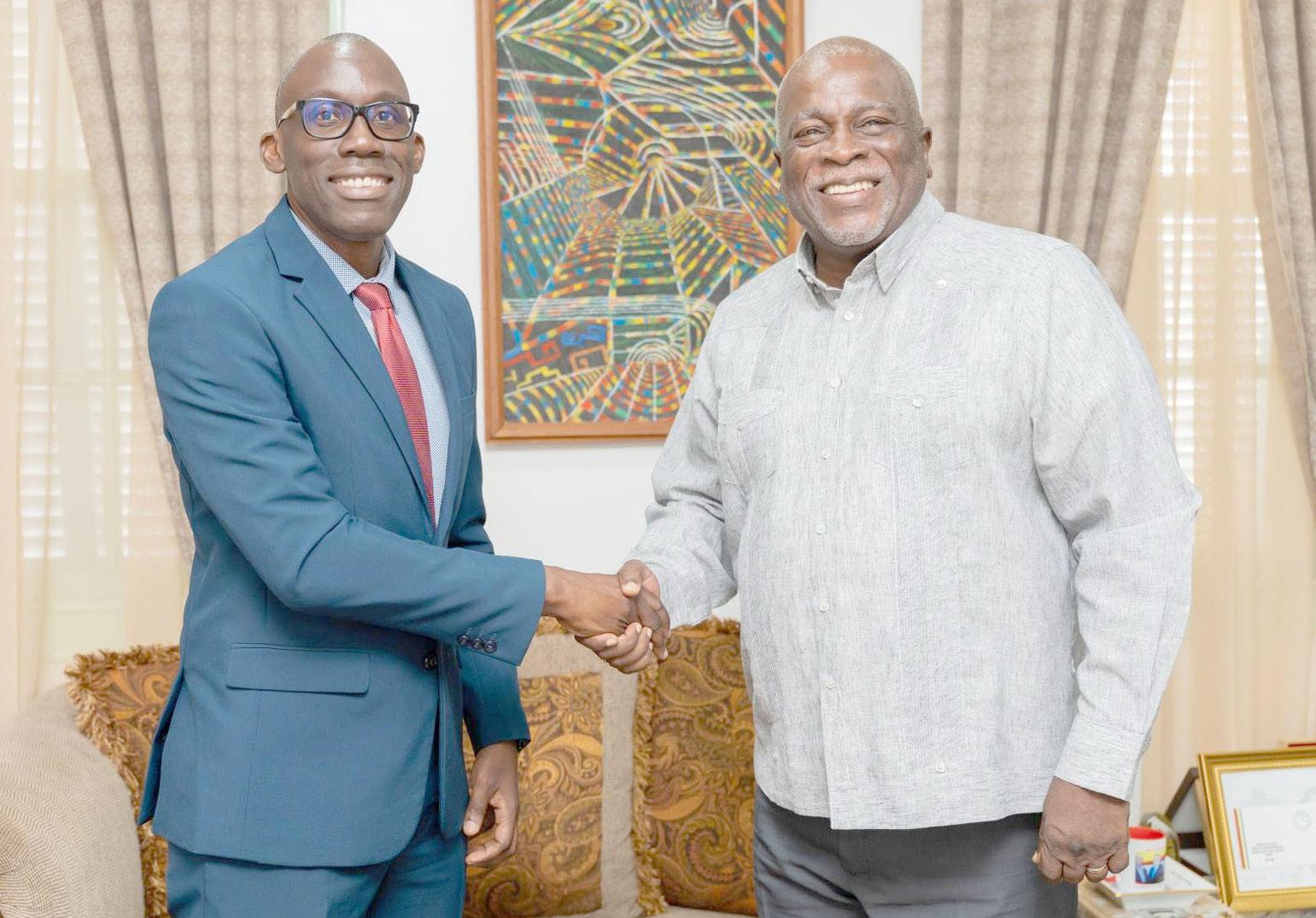
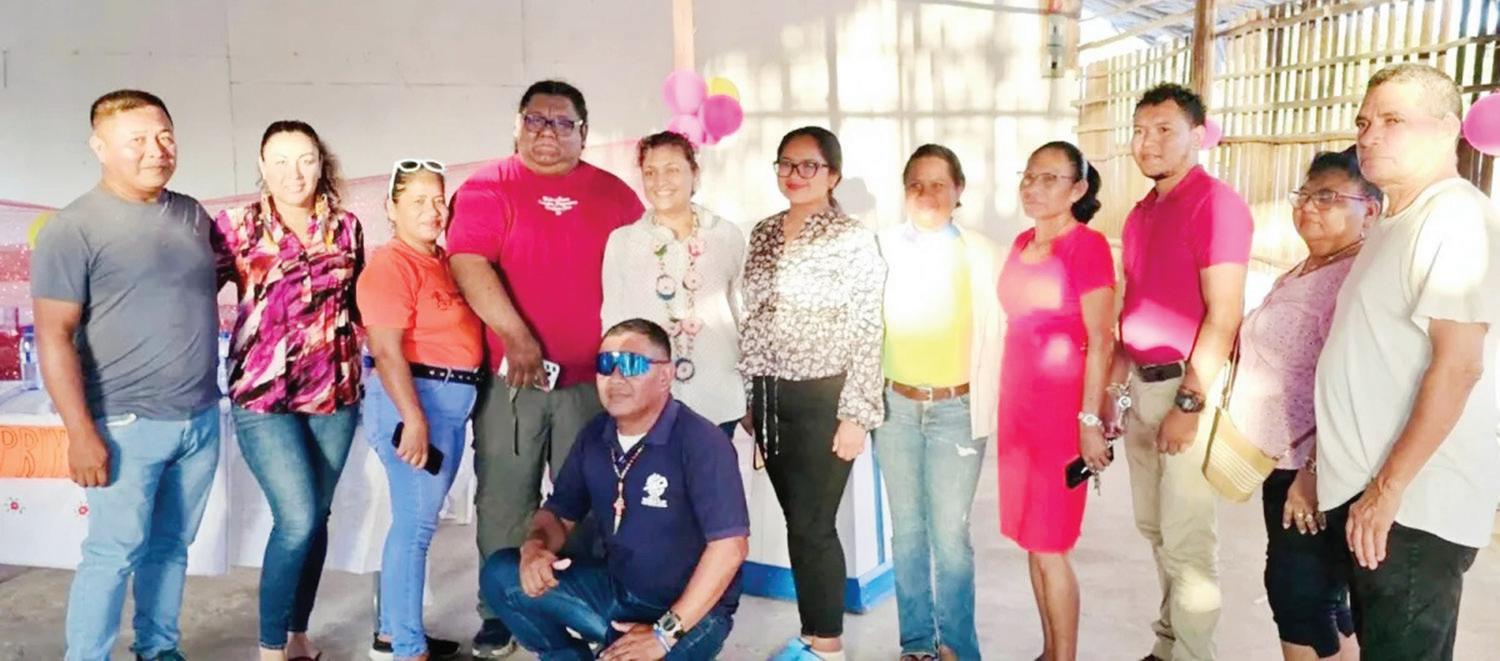
by the Prime Minister. The meeting was held at the Office of the Prime Minister on Camp Street (OPM photo)
Prime Minister, Brigadier (Ret’d), Mark Phillips and the Managing Director of Republic Bank, Mr Toussant Boyce recently discussed how the bank can align its goals with the government’s transformation through public-private collaboration. The Managing Director made several proposals which were warmly received
‘You have a government that is planning for resilience’
President Ali says, highlights Guyana’s move to become regional energy, trade hub amid global crises
PRESIDENT, Dr Irfaan Ali has outlined an ambitious strategy to turn Guyana into a regional anchor of energy and fertiliser security, as the world grapples with severe disruptions to oil, gas and agricultural input supplies triggered by the closure of the Strait of Hormuz.
Recently addressing the global fallout from the conflict, President Ali stressed that Guyana is not immune to the shock waves, but is acting early to shield its people and its neighbours.
“This is the reality. This is what farmers, the food ecosystem and gov ernments will be faced with because of demand supply, just because of what is happening on the supply side, as a result of the challenges on the Hormuz trade,” he said.
The President con trasted Guyana’s domes tic measures with steep increases at fuel pumps worldwide.
He noted that global fuel prices have risen sharply in every region as
crude prices spiked from a pre‑conflict baseline of US$55–60 per barrel to peaks of US$119–120, now holding at around US$115 despite a cease fire.
Against this backdrop, he emphasised that Guy ana has taken an unusual step for a developing country.
“Here in Guyana, we are one of the few coun tries less than one per cent and maybe the only country in this region that has completely removed excise tax, taxes on fuel import refined products, “President Ali reminded. This he noted was a deliberate move to cush ion households and busi nesses from imported price shocks, while lon ger‑term projects come on stream.
Central to Guyana’s strategy is the rapid de velopment of its own gas‑based energy system.
President Ali said in vestments now under way in a domestic gas plant and gas bottling facility are designed to fundamentally change
the cost structure of the economy.
“In Guyana, the long term investments that we are making in our own gas plant, and gas bot tling plant will see us building up internal capacity to withstand certain shocks, because we’ll have our own nat ural gas,” the President said.
He added that by con trolling inputs to power generation, Guyana aims to sharply reduce elec tricity prices.
“We’ll control the price of energy by man aging through our own natural gas, the cost bringing down the cost of energy by half, so that it we will have stable fertiliser, stable gas, sta ble industrial and man ufacturing opportunities, because we manage and we’ll be able to manage the cost of our own pow er,” President Ali said.
The President framed this as both an economic and security imperative, positioning domestic gas infrastructure as a buffer against external volatil ity.
Looking beyond national borders, President Ali said Guyana is working to become a reliable supplier of liquified natural gas (LNG) and fer tiliser to its neighbours.
He pointed to the
Gas‑to‑Energy (GTE) project as a cornerstone of this regional role.
“You have a responsible government, a government that is ahead of the planning cycle, and one that is ready and will-
ing to make the necessary adjustment and to take the steps that will secure our economy, not only for today, but in the long term, ensuring resilience, sustainability and prosperity,” he stressed.
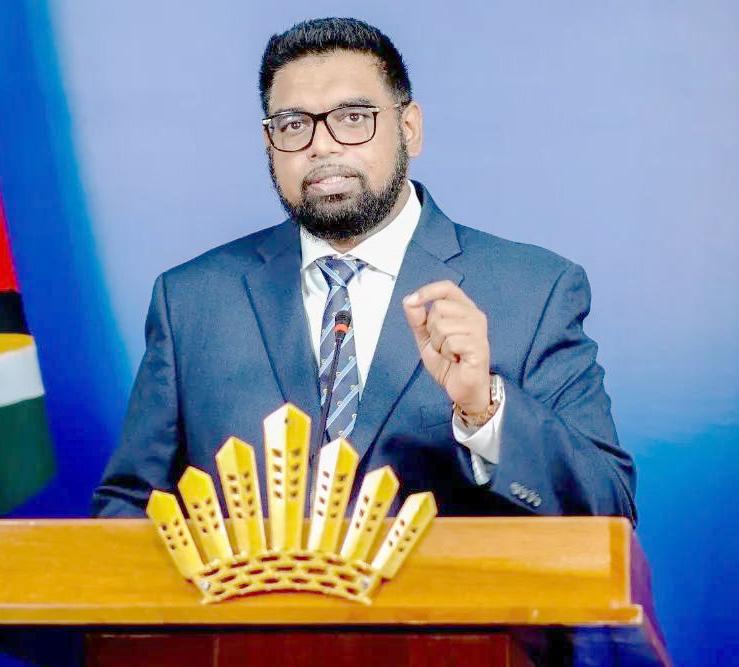
President, Dr Irfaan Ali
‘Riddled with deficiencies’
Nandlall blasts ‘defective’ elections challenge after court strikes out petition
THE Attorney General and Minister of Legal Affairs, Anil Nandlall, has strongly criticised the legal team representing the Forward Guyana Movement (FGM) party after yet another failed bid to challenge the September 1, 2025, General and Regional Elections.
Speaking in detail about the matter during a recent airing of the ‘Issue in the News’ programme, Nandlall explained that what was presented to the High Court as an election petition filed on October 14, 2025, by Randolph Critchlow was fundamentally defective and in breach of the statutory framework governing elections challenges.
He recalled that the party had previously attempted to halt the electoral process before polling day through a separate action brought in
the name of Krystal Fisher against the Guyana Elections Commission (GECOM) and the Attorney General.
That claim, filed on August 20, 2025, was dismissed by the Chief Justice and later by the Court of Appeal.
The matter is now pending before the Caribbean Court of Justice (CCJ), where an appeal has been lodged and is awaiting a hearing date.
In the Fisher appeal, the Court of Appeal awarded $1 million in costs to each respondent, the Attorney General, the Chief Elections Officer, and GECOM. According to Nandlall, those costs remain unpaid and steps will be taken to recover them.
One of the central findings of the Court of Appeal was that the wrong procedure had been used to challenge the elections, he said, adding that the court held that any
challenge to the validity of elections must be brought strictly by way of an elections petition, not through ordinary court proceedings.
“Now, one of the grounds upon which the case was dismissed by the Guyana Court of Appeal, based upon an objection I took, was that he had invoked the law the wrong procedure in attempting to challenge the elections.”
Despite appealing that very decision in the CCJ, counsel for FGM then returned to the High Court and filed what was purported to be an election petition. Nandlall described this as “complete and utter incompetence from top to bottom,” arguing that the legal team was simultaneously appealing the Court of Appeal’s guidance, while seeking to rely on it by filing a petition in the manner the court had outlined.
Once the new petition was filed, Nandlall said he immediately moved to strike it out on multiple procedural and substantive grounds. He stressed that election petitions are governed by a “specialised jurisdiction”
under a strict statutory code, in particular the National Assembly (Validity of Elections) Act.
This code, he noted, sets out in detail how and when an election may be challenged, on what grounds, against whom, and following which procedural steps. Jurisprudence spanning more than two centuries, he added, makes clear that any breach of these rules is “fatal” and will result in dismissal of the petition.
According to the Attorney General, the petition filed on behalf of Critchlow was “riddled with deficiencies.”
He drew parallels with the PNC’s challenges to the 2020 elections, reminding viewers that both of those petitions had been dismissed within weeks, and that the dismissals had been upheld all the way to the Caribbean Court of Justice. Those outcomes, he said, demonstrated that the courts in the Region have been consistent in insisting on strict adherence to the procedural code for election petitions.
When the Critchlow petition returned to court, counsel for the petitioner reportedly attempted to withdraw the matter. However, Nandlall said that even the application to withdraw was itself procedurally defective. He told the court that the document filed to effect the withdrawal, did not comply with the technical requirements of the law, and
he proceeded to outline what he described as “various deficiencies” in that application as well.
As a result, the Attorney General argued that the petitioner had failed at every stage: failing to seek the court’s permission correctly, filing the wrong type of document, naming the wrong parties, and then attempting to withdraw the petition in an improper manner.
Guyana’s Chief Justice, Justice Navindra Singh, upheld Nandlall’s application, struck out the petition and ordered costs of $350,000 in favour of each of the three respondents: GECOM, the Chief Elections Officer and the Attorney General. Meanwhile, the earlier appeal in the Fisher matter remains pending before the CCJ.
Nandlall expressed confidence that the regional court would also dismiss that case, calling the appeal “hopeless.”
Attorney General and Minister of Legal Affairs Anil Nandlall
Gov’t is actively building an inclusive society
– MP Hussain says, encourages residents to embrace digitalisation
By Bebi Shafeah Oosman
PEOPLE’S Progressive Party/Civic Member of Parliament Zamal Hussain emphasised the government’s ongoing commitment to building an inclusive society while speaking at the launch of a groundbreaking ICT Inclusive Skills Training Programme in Region Six where he strongly encouraged all citizens to embrace the digitalisation.
The initiative was introduced by the Office of the Prime Minister’s Industry and Innovation Unit in collaboration with the Guyana Council of Organisations for Persons with Disabilities and Empower Guyana. Thirtysix persons registered to be a part of the programme, which will run for 48 hours, on average, over a two to three-month period and will be delivered to three batches of up to 12 participants each.
One batch will focus on training persons who are visually impaired, while the other two batches will provide basic computer skills training for persons with
other disabilities, and the training will take place at the Business Centre for Equity, Opportunities and Innovations in Berbice, targeting participants from Regions Five and Six.
“For the first time, this programme is being delivered as a two-fold initiative, that is significant. It recognises that inclusion is intentional and it must be designed and it must be accessible to all.”
He then pointed out how important the ICT skills are in today’s developing world.
“It is a necessity. So, we have to ensure…how the world is changing, we as a people have to adapt and change as well. Irrespective of our challenges, we must be able to keep up with the pace … we are changing not only in Guyana but in the world at large.”
“So, these are things we have to learn in the world of the technology that is happening now. We should recognise also that His Excellency, the President is placing so much of emphasis on digital transformation. We have right here (Palmyra) a digital school that is run-
ning. We have to make sure now that we tap into that; we have the GOAL scholarship. We have to ensure that we upgrade ourselves and tap into the GOAL scholarships and better ourselves.”
Additionally, he spoke about the digitalisation of the health system “and it is important that when you go to the hospital you can get your records digitally, you can see what is happening…”
He stressed that “there is so much that is happening across Guyana,” and applauded the Industry and
Innovation Unit within the Office of the Prime Minister for reaching out to communities.
The unit would have done training throughout the region for persons of all ages including pensioners.
“We are trying to educate persons. People as old as 60 and 70 years, we trained now in this process, so you have to understand what His Excellency is trying to do, and you know there’s a lot of people that don’t appreciate what this government does.
Sometimes, they go and they
try to turn the people’s mind away from what the government is doing, the real agenda of what the government is doing for the people, and we have to be very careful as citizens and residents of Region Six,” he said.
Further, he said: “You can be a testimony to the development that is happening right across Region Six. When you walk out there’s development all around.
There’s a new stadium, and the stadium is being built
to accommodate 100 persons with disability, you can go with your wheelchair, and you can go and enjoy cricket. So, it’s not that we are leaving out anyone; we are trying to get everyone included.”
Hussain used the opportunity to encourage persons to utilise the various apps available which include the Citizens Connect and the Agriculture App where “you can go and give your complaints…online.”
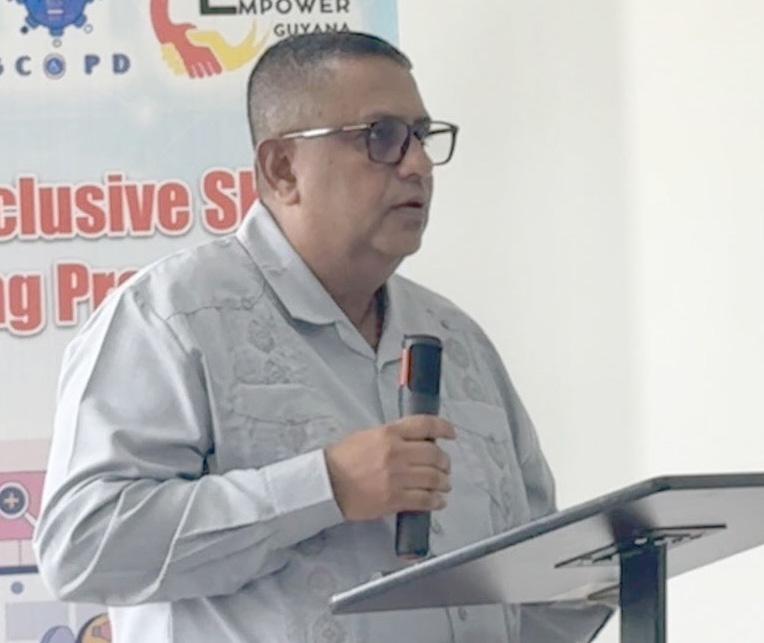
Zamal Hussain
Confronting global realities
GUYANA’S government is correct to view the current situation as one requiring critical thinking and analysis, rather than relying on slogans from social media.
President Irfaan Ali’s warning is clear: the war in the Middle East and the virtual blockage of the Strait of Hormuz have led to the largest single supply disruption in the history of the global oil market.
This situation has significant effects on the prices of fuel, food, and fertiliser around the world. In light of this, the government’s choice to keep the excise tax on fuel at zero is not a political stunt; it serves as a protective measure for a fragile economy facing global dangers.
The statistics illustrate the urgency. About one-fifth of the world’s seaborne
oil and gas trade is currently at risk in a narrow waterway where insurance costs, freight charges, and risk margins have all increased sharply.
This chokepoint also transports a significant portion of the world’s LNG, LPG, and fertiliser, with urea and other materials already seeing significant price hikes. These increased costs won’t just stay at sea; they will appear on supermarket shelves, in electricity bills, and in the price of fertiliser that farmers need.
Global organisations are raising the alarm. The World Food Programme estimates that if the conflict continues, an additional 45 million people could face acute hunger this year. This would bring the total at risk worldwide in 2026 to around 363 million. For countries in Africa, Asia, the Carib-
bean, and Latin America that rely on imports, this risk is not hypothetical. It poses a real threat to foreign currency, food stability, and social order. In such circumstances, governments that delay or hesitate will cause the poorest to suffer the most.
Guyana has taken a more proactive approach. Since 2022, the state has kept the excise tax on gasoline and diesel at zero, giving up about $100 billion each year to maintain lower fuel prices at the pump than what global markets would dictate. By extending this policy into 2026, the government is cushioning the economy from external shocks, so that sectors like transport, agriculture, manufacturing, and everyday commuters do not have to bear the full impact of a conflict they did not initiate and cannot control. This is how oil revenues and
fiscal space should be responsibly managed in a developing petro-economy.
Critics might say that more needs to be done or that different strategies are required, and it is beneficial to debate the best policy options. However, it is misleading to suggest that Guyana operates in isolation or that global disruptions in freight, insurance, and energy can be ignored with catchy phrases.
The government’s approach— constantly engaging, adjusting taxes, monitoring prices, and being ready with additional measures—is not perfect, but it is based on the realities of a connected world.
In an era when a blockade across the globe can affect the price of bread in Guyana, the real failure would be to overlook these truths and refuse to act.
Oil refinery in Guyana
Dear Editor,
I WRITE to underscore, with renewed urgency, the strategic imperative for the establishment of a domestic oil refinery in Guyana.
Recent developments, both globally and within our own energy sector, have laid bare a structural vulnerability that can no longer be managed through temporary measures or external arrangements.
Guyana today stands at a paradoxical crossroad, we are a rapidly emerging oil-producing nation, yet we remain dependent on external refining capacity to meet our domestic fuel needs. This disconnect between
production and processing is not merely an economic inefficiency, it is a national vulnerability.
As recent geopolitical tensions have demonstrated, exogenous shocks—particularly those emanating from instability in the Middle East in which can swiftly disrupt global supply chains, inflate prices, and threaten the reliability of refined fuel imports.
The government’s swift response to the recent gasoline supply concerns was commendable and necessary. However, such interventions, while effective in the short term, do not address the underlying structural gap. Reliance on imported refined
products leaves Guyana exposed to volatility in international markets, limits our ability to stabilise domestic prices, and constrains longterm planning across key sectors of the economy.
It is within this context that President Irfaan Ali’s renewed engagement with regional and international partners including the Dominican Republic must be viewed with a sense of urgency. While refining partnerships may offer interim relief, they should not substitute for a clear and deliberate national policy aimed at establishing domestic refining capacity.
The case for a Guyana-based refinery rests on three pillars:
First, energy security. A domestic refinery would insulate Guyana from external supply disruptions and reduce exposure to geopolitical shocks. It would ensure continuity of fuel supply for transportation, industry, and essential services, even in times of global uncertainty.
Second, economic transformation. Refining adds value to our crude oil, creating downstream industries, generating employment, and expanding the industrial base. It allows Guyana to capture a greater share of the energy value chain rather than exporting raw resources and importing finished products at a premium.
Third, regional leader -
ship. With careful planning, Guyana can position itself as a refining hub within the Caribbean and northern South America, supplying not only domestic demand but also contributing to regional energy resilience. This aligns with broader CARICOM objectives and strengthens Guyana’s role as a driver of regional integration.
To be clear, the question is no longer whether Guyana should pursue a refinery, but how and when. The government must now move beyond exploratory discussions and signal a firm commitment through feasibility studies, investor engagement, and policy frameworks to advance this project. Strategic
partnerships, including those with the Dominican Republic and Trinidad and Tobago, should be structured to complement, not replace this national objective.
Guyana’s oil wealth presents a rare and historic opportunity. To fully realise its benefits, we must ensure that our energy architecture is not externally dependent, but internally resilient. A domestic oil refinery is central to that vision.
I respectfully urge that this matter be advanced as a priority within the government’s energy strategy.
Yours Respectfully, Dr. Tilokie Depoo, Economist
Who are the real oligarchs in Guyana?
IN my publication on this page yesterday (Thursday), I used the term oligarchy which is a political concept that was applied to the man on horseback in Latin American economies (particularly Central America) in the 50s and 60s.
In oligarchic Latin America, the plantation owner controlled the government.
We do not have an oligarchic system in Guyana. We never did and never will. I will stretch the concept by taking it out of economics and applying it to social activism in Guyana. By oligarchy in this country, I mean people who use status and influence to pressure and weaken the government. Some of those people have cultural contempt and some have political disdain for the PPP.
With the death of Stabroek News, one of the things I will miss is the comments on the online edition of the newspaper. There is no other compartment of present day Guyana that has showed me the deep and dangerous ignorance of this country than those online comments. I have learnt a lot about Homo Sapiens from the ignorance of these people.
You read these comments and no matter how educated you are, you cannot believe humans could embody such mental nothingness. These people saw the government as the only source of wrongdoing in Guyana. How in modern society can someone reduce a society only to what government does?
The real oligarchs in this country have never commented yet their presence is so destructive. Who are the real oligarchs in Guyana outside of the opposition parties? The obvious name is Glen Lall, the owner of Kaieteur News. The PPP hasn’t got and will
never get someone with the oligarchic mentality of Glen Lall.
I wonder all the time if the Guyanese people at home and in the diaspora know who the people are that criticise the Ali presidency, and if Guyana will survive if they ever get into power. I wonder if the Guyanese people know the incredible level of intolerance of people who criticise the Ali Government and how dangerous that intolerance will become if they have state power.
I offer readers two examples that I never put in print before. They belong to my activist memory bank that is about 59 years of age. I was fairly friendly with WPA executive Wazir Mohamed. I was the first person he told that he was getting married. At the time, I was a Stabroek News columnist. I ran a column critical of the WPA and Wazir was livid with me and distanced himself from me from thereon. He got married shortly after, and I wasn’t invited.
I taught AFC executive, Trevor Williams at UG. Because of his politics, we became close. He would visit my home to discuss his politics. I was the first person he told that he was getting married. Trevor became a parliamentarian and sat on the sub-committee of parliament that dealt with education.
The committee held a session on UG. Obviously, my expectation was that he would bring up my UG contract termination. He didn’t. I remember my telephone conversation with him very well. I was at the Rubis gas station on the main highway at Bel Air. I protested his lack of political principles. Shortly after he got married and I was not invited. Those two examples will always stay with me. They remind me of how psychologically
nasty this country is.
I never saw a comment from those online people who gave their opinions below the letters in the Stabroek News about Glen Lall. Mr. Lall is absolutely unqualified to criticise any government in Guyana whether, PNC or PPP. Mr. Lall gives no recognition to natural laws and man-made laws. Mr. Lall gives no recognition to the existence of humans.
This man runs a newspaper exactly the way the oligarch ran things in Latin America. His newspaper is simply a toy in his hands. He has no respect for any human on Planet Earth. I am not a perfect person, far from it, but I should never have stayed for 29 years as a columnist with the Kaieteur News. It is one of my flaws that I regret having.
I have said enough about the Stabroek News in my 38 years in the media so in
passing I would say that paper was another oligarch; so were and are so many organisations and individuals in this land. The Guyana Human Rights Association is oligarchic in its mentality. Transparency International – Guyana Chapter is an oligarchic actor.
There are individuals who compromise The Usual Suspects that exhibit undiluted oligarchic behaviour.
The Guyanese people watch and listen to them on a daily basis as they tell the nation that the Government of Guyana is insensitive and unresponsive to criticism. Beware the Greeks bearing gifts!
DISCLAIMER: The views and opinions expressed in this column are solely those of the author and do not necessarily reflect the official policy or position of the Guyana National Newspapers Limited.
Gov’t rallies Region Three youths to seize opportunities ahead of Development Bank launch
YOUNG people in Region
Three are being urged to position themselves for unprecedented economic opportunities as the government moves closer to establishing the Guyana Development Bank, which will offer zero-interest loans and no collateral financing for entrepreneurs.
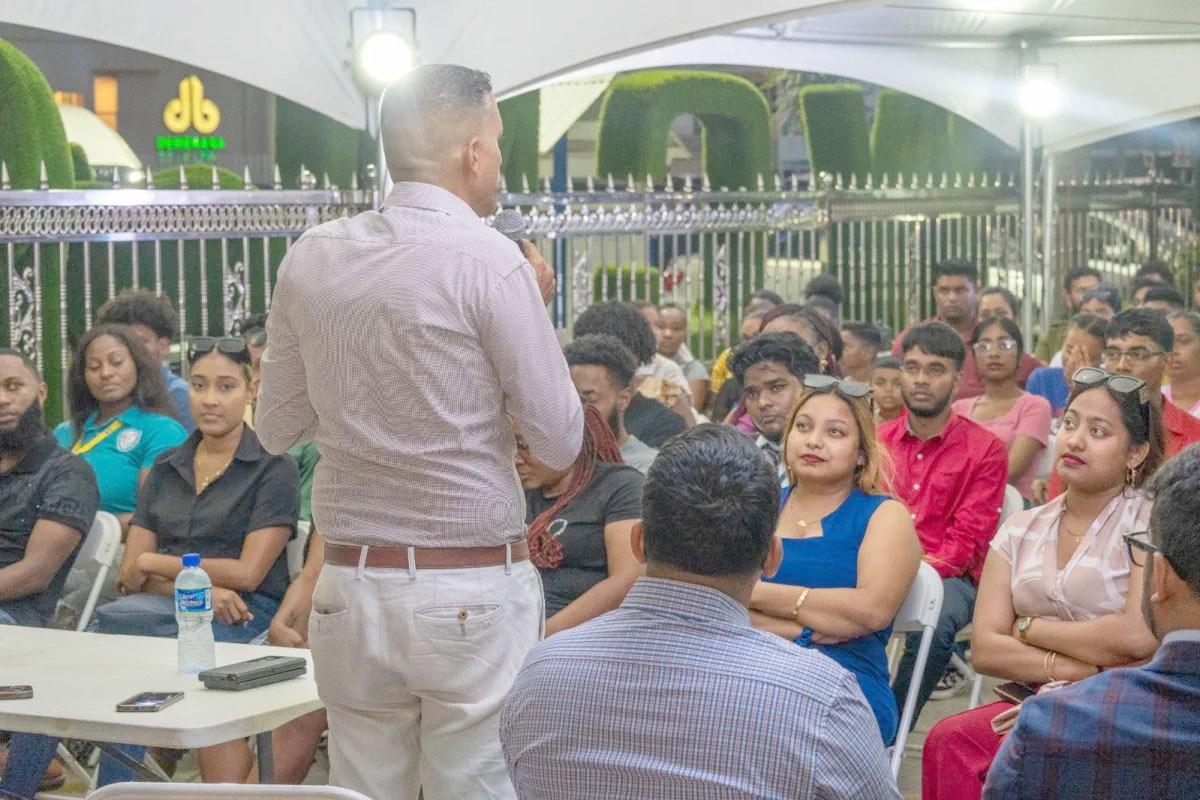
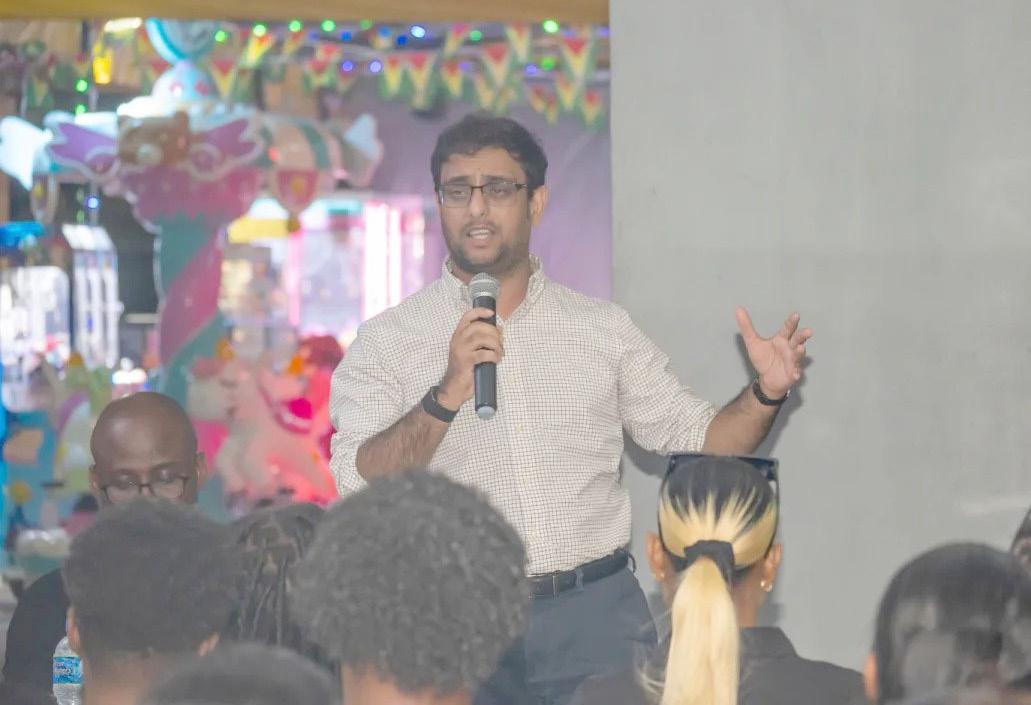
Minister of Public Service, Government Efficiency and Implementation, Zulfikar Ally, alongside Minister within the Ministry of Agriculture, Vickash Ramkissoon, met with youths at West Central Mall in Leonora on Wednesday to sensitise them about the initiative and broader development opportunities.
Minister of Public Service, Government Efficiency and Implementation, Zulfikar Ally addresses the youths
The development bank is part of a wider transformation agenda aimed at ensuring young Guyanese are prepared for the country’s rapid growth.
Minister Ally explained that the proposed financial institution will be a life changer for many and will address longstanding challenges faced by loan seekers.
He said the government has already moved to elimi-
nate these barriers, ensuring young people with sound business ideas can access financing without placing personal assets at risk.
Youths were also encouraged to take advantage of other government initiatives, including free tertiary edu -
Minister within the Ministry of Agriculture, Vickash Ramkissoon
cation, the GOAL scholarship programme, and skills training opportunities, all of which are designed to prepare citizens for emerging opportunities.
Meanwhile, Minister Ramkissoon explained that the initiative will provide liquidity for business ventures
while removing the burden of high interest rates and collateral requirements that traditionally prevent young entrepreneurs from accessing funding.
“We stand here today before the youths of Region Three to tell you that one of the major commitments we
made to you is to ensure that the development bank comes into being…so that you can do business, prosper and do great things for yourselves,” he stated.
Both ministers stressed the need for residents to collaborate, think beyond local markets, and tap into regional and international opportunities.
Persons in attendance were also reminded of Guyana’s rapid development across sectors, including agriculture, construction, services, and manufacturing.
The outreach forms part of a nationwide sensitisation campaign as the government prepares to operationalise the Guyana Development Bank to empower entrepreneurs, expand economic participation, and support inclusive national development. (DPI)
$196M road transforms access, boosts agriculture and tourism in St Cuthbert’s Mission
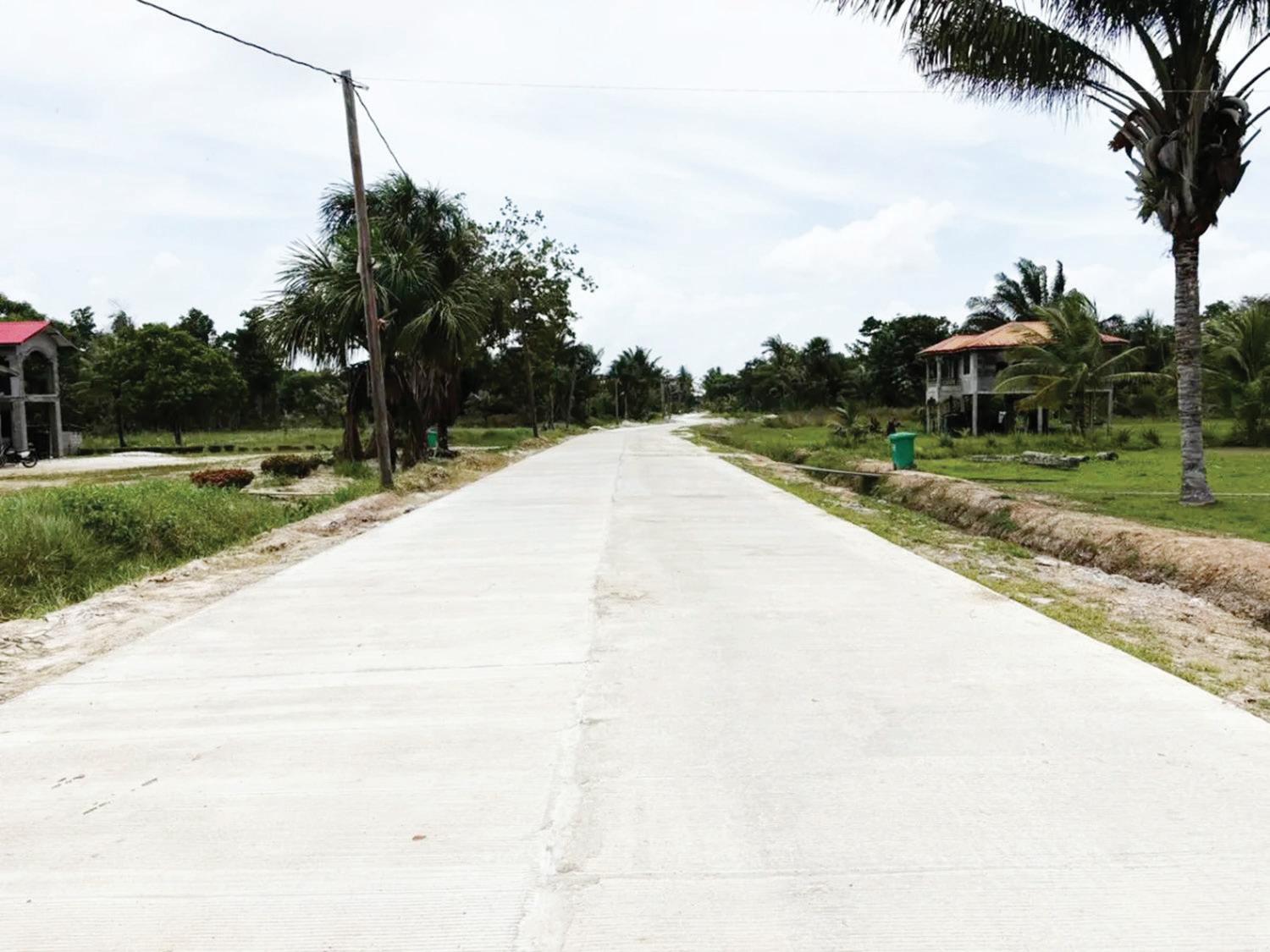
RESIDENTS of St Cuthbert’s Mission along the Soesdyke-Linden Highway are already seeing major improvements in their daily life following the completion of a $196 million road project, a development that is expected to significantly enhance transportation, agriculture, and tourism in the Region Four Amerindian community.
The newly completed
road now allows farmers to transport cassava and other agricultural produce more efficiently from riverine areas into the village centre and onward to Georgetown. According to Toshao Alvoro Simon, the project has strengthened economic activities and reduced longstanding transportation challenges.
During an interview with the Department of Public Information (DPI) on
Thursday, Simon described the project as long overdue and transformative for residents.
The Toshao noted that the project had been in the pipeline for years but gained momentum after direct engagement with President Dr Mohamed Irfaan Ali.
“This project has been in discussion for a long time. However, it was only after we had the opportunity to engage the president and
emphasise its importance to our community last year that we saw real progress. The road was completed within eight months,” he said.
This project was funded through the National Drainage and Irrigation Authority (NDIA) under the Ministry of Agriculture and included strong community involvement, with residents employed during its execution.
Toshao Simon praised the contractor for fostering a positive relationship with villagers and contributing meaningfully to the project’s success.
“Now that the road is
completed, it represents a major step forward for our tourism sector. Mission Landing is one of our main attractions, where visitors come to swim and relax. With improved access, all types of vehicles can now reach the area, which will significantly increase visitor numbers,” the Toshao said.
Previously, poor road conditions, especially during the rainy season, limited access to the area and required the use of offroad vehicles. With the new concrete surface, residents can now travel more easily to access essential services
such as schools, the health centre and the village office.
The improved accessibility is also opening new economic opportunities for residents, who can now sell fresh produce, crafts, and traditional foods directly to visitors. With additional plans in place for drainage upgrades and further road development, St Cuthbert’s Mission is poised for continued growth, marking a significant step forward in infrastructure development for Guyana’s only Amerindian community in Region Four. (DPI)
The $196 million road project St Cuthbert’s Mission Toshao Alvoro Simon and councillors during a public engagement with Minister of Local Government & Regional Development Priya Manickchand
EU Ambassador pledges stronger cultural ties with Guyana
–– recognises Dr. Alista Bishop as first Euro-Guyana Poetry Competition winner
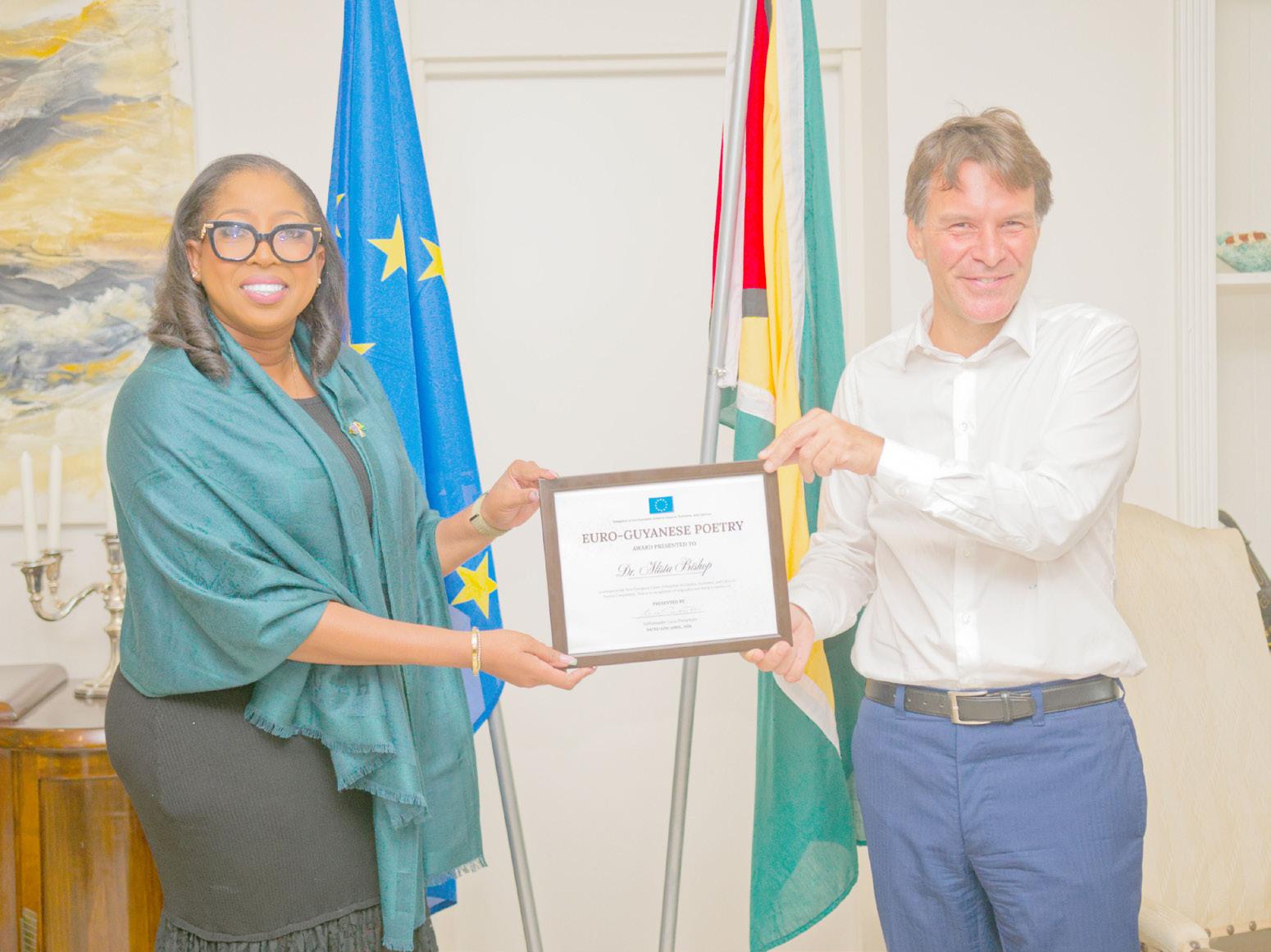
CELEBRATING the literary work of young Guyanese, Ambassador of the European Union to Guyana, Luca Pierantoni, on Wednesday evening presented the first-ever Euro-Guyana Poetry Competition Award to Alista Bishop at his residence.
It was there that Ambassador Pierantoni spoke of advancing cultural cooperation in Guyana.
The Ambassador said the
continued to say, “So what we are trying to do now this year is to create some activities to help share Europe with Guyana and Guyana with Europe, to build bridges, which is cultural bridges.”
According to the Ambassador, they have decided to select a number of areas for this, including an arts exhibition on gender and violence; gastronomy in the form of a pizza competition;
Festival.
Johnson explained that while the time frame for entries has closed, creatives can prepare entries for next year’s Guyana Prize.
This first poetry competition focused on the theme of friendship, a concept that is no stranger to the European Union.
The poems were submitted anonymously by a small group of poets, who wrote from their
European Union (EU) has been in Guyana for many years. However, there is very little that Guyanese know about Europe, and just the same, very little that Europe knows about Guyana.
The EU has over the years supported Guyana in key initiatives such as the Forest Law Enforcement, Governance and Trade (FLEGT) Voluntary Partnership Agreement (VPA), health resilience and manufacturing of health products, as well as water and sanitation, among other areas.
The longstanding friendship between Guyana and the EU stretches back to the signature of the forest convention and subsequently the Georgetown Agreement in 1975 which established the African, Caribbean and Pacific (ACP) Group of States.
From then to now, the evolving relationship between the EU and Guyana has grown across many sectors.
Ambassador Pierantoni
and activities touching both music and sports.
“We are going to have our first classical concert music event here in the house on the 25th of April. And then at the St George’s Cathedral, most likely it’s going to be the 8th of June, we are going to have a concert, and then there is going to be a very important opera singer that comes from Argentina. It’s one of the most important, most famous in the world to do some opera singing,” he announced.
Ambassador Pierantoni stated that the EU is trying to be more visible in Guyana and is opened to receiving shared suggestions or ideas for partnership and opportunities to be involved.
Meanwhile, Advisor on the One Guyana Commission, Ruel Johnson added that in the coming months, persons will see an increased focus on the creative arts, with poetry being part of the activities leading to the Guyana Prize for Literature
hearts about the theme of friendship. Each poem was judged by Ruel Johnson, with Dr. Alista Bishop emerging as the overall winner.
Dr. Alista Bishop receives her award from EU Ambassador to Guyana Lucas Pierantoni (Delano Williams photo)
China’s acrobatic troupe to perform in Guyana as cultural gift for 60th Independence Anniversary
THE Government of Guyana, in collaboration with the Embassy of the People’s Republic of China, will host a series of cultural performances by a visiting Chinese acrobatic troupe as part of activities to commemorate Guyana’s 60th Independence Anniversary.
Director of National Events, Andrew Tyndall, announced that the visit forms part of ongoing cultural diplomacy between Guyana and China, which established diplomatic relations on June 27, 1972.
Tyndall explained that the performances represent a cultural gift from China to Guyana, strengthening the longstanding partnership between the two nations.
“This year, as part of China’s gift to Guyana for our 60th Independence Anniversary, they have brought an acrobatic troupe which
will be doing five performances across several regions,” Tyndall stated.
The free performances will begin on April 19 at the National Track and Field Centre, Leonora, followed by two shows on April 20 at the National Cultural Centre: one at 13:00hrs (1 pm ) and another at 19:00hrs (7pm) for the general public.
Additional performances are scheduled for Berbice, Linden, and Anna Regina.
Director of the visiting troupe, Li Ming, said the group is honoured to be in Guyana and strengthening cultural ties through artistic exchange.
“We are invited to return to the beautiful Guyana again, which is not only a sincere continuation of the traditional China-Guyana friendship, but also a vivid practice of enhancing people-to-people bonds and deepening mutual learning
between civilisations,” the director noted.
Deputy Chief of Mission at the Chinese Embassy, Huang Rui, said the visit underscores the importance of cultural exchange in strengthening bilateral relations.
He also noted that the performances coincide with Guyana’s 60th Independence Anniversary and
continued collaboration between the two countries across infrastructure, health, education and cultural development.
The Hebei Acrobatic Troupe, founded in 1976, has performed in over 80 countries and won more than 50 international awards.
The performances in Guyana will feature
award-winning acts, including lion dance, group contortion, chair balancing, umbrella juggling, and traditional Chinese acrobatic displays.
The tour is expected to bring world-class entertainment to thousands of Guyanese while further deepening cultural ties between the two nations.
(DPI)
From left to right: Andrew Tyndall, Director of National Events; Deputy Chief of Mission at the Chinese Embassy, Huang Rui; Director of the Hebei Acrobatic Group, Li Ming
Chinese acrobats in action
$94.5M revetment, timber landing for Hubu
THE government is forging ahead with plans to construct a revetment and timber landing at Hubu, East Bank Essequibo, in Region Three, to strengthen riverbank protection along the Essequibo River and improve access for transportation, agriculture and other economic activities.
The massive project will be undertaken by the Ministry of Agriculture’s National Drainage and Irrigation Authority (NDIA) for $94.5 million.
Interested contractors are invited to submit bids for the infrastructural works, which form part of continued development initiatives across Region Three.
Hubu, located along the eastern bank of the Essequibo River, has been targeted for major development in recent years, particularly in agriculture and river-transport infrastructure.
The revetment and timber landing project will complement broader investments across Region Three, including the Parika international port facility.
All bids should be submitted on or before Thursday, April 23, 2026, to the National Procurement and Tender Administration Board’s chairman at the Ministry of Finance, Main and Urquhart Streets in Georgetown.
In 2022, the government announced plans to construct a wharf to improve access for farmers transporting produce from riverine communities.
proving market access for communities such as Bonasika, Saxacalli, Lanaballi and Hogg Island.
The facility was deemed critical to im-
The rehabilitation of the Hubu main access road, which included timber revetment works, was part of a wider infrastructural push to improve transportation and access for residents and farmers.
The government also outlined plans to transform Hubu into a major agricultural hub, including crab-farming initiatives, agro-processing facilities, drainage and irrigation improvements and farm-to-market road upgrades
These initiatives will boost productivity and create new economic opportunities for residents. (DPI)
Over the last five years, Hubu and the surrounding communities have seen significant development, including the rehabilitation of the Hubu main access road, the construction of timber revetment works and the expansion of agricultural infrastructure.
The wharf at Hubu
‘Nothing of substance’
- contractor dismisses Mohamed’s ‘inaccurate’ claims on Golden Grove pump station project
A CONTRACTOR for Platinum Investments has firmly rejected allegations made by Azruddin Mohamed regarding delays, cost inflation and improper practices at the Jimbo pump station project at Golden Grove, East Bank Demerara (EBD).
The pump station contract, awarded in mid‑2023 to Raj Golyn of Platinum Investments,
carried an 18‑month time line, suggesting comple tion in 2025. The United States sanctioned parlia mentarian has claimed the project is significantly overdue and beset by mis management.
While acknowledg ing setbacks due to ma terial sourcing issues and adverse weather, Golyn maintained that all delays were properly managed through approved exten
sions, and insisted the works remain on track under a revised schedule.
Golyn also challenged widely circulated figures about the project cost. A figure of $989 billion, lat er referenced as $9 billion, was described as “clearly inaccurate”. He stated that the actual contract sum is $795,308,480, and that higher figures being aired in public are misleading.
Responding to con
Azruddin Mohamed and party officials at the Jimbo pump station project at Golden Grove, East Bank Demerara
cerns over health and safe ty, particularly the han dling of tombs found on site, Golyn said all proto cols had been followed “to the T” in consultation with the Ministry of Health, the Public Health Department and local residents.
He stressed there had been “not a single defec tion” in compliance and that no remedial works were required, as the proj ect has adhered strictly to
the ministry’s pump sta tion design under constant oversight by consultants and ministry officials.
“I've seen this as a per sonal attack on me and my company, because there's nothing of substance that Mr. Mohammed has said concerning this project, because everything has been followed,” the con tractor said.
Golyn characterised Mohamed’s criticisms
as a personal attack on him and his company, arguing that “there’s nothing of substance” in the allegations. He maintained that workers and equipment have been consistently present on site and guaranteed that the Golden Grove pump station will be completed within the approved timeline under the revised schedule.
Mohameds continue attempts to undermine judicial process with hollow claims against US envoy
US-SANCTIONED businessmen, Azruddin and Nazar Mohamed, through a US-based attorney, have again tried to undermine the ongoing extradition proceedings against them by now accusing US Ambassador to Guyana Nicole D. Theriot of overstepping diplomatic boundaries.
The letter comes as the Mohamed family and their representatives face growing scrutiny over an ongoing campaign aimed at undermining the integrity of local and international officials.
Recently, Ambassador Theriot made it clear that the case against the US-indicted businessmen
is grounded in what she described as strong, prosecutable evidence, not politics.
She had pushed back against any suggestion that the charges were politically motivated, asserting that the United States only pursues cases it is confident it can prove in court.
The April 15, 2026, correspondence from the attorney for the Mohameds, claims the Ambassador’s recent remarks were inappropriate given the ongoing court proceedings. Those remarks followed months of public attacks directed at her office.
The Mohameds and
their legal team have repeatedly levelled serious allegations including suggestions of fraudulent extradition documents against the Ambassador and the United States Government, claims that were not included in formal court submissions.
“So, the United States does not pursue criminal charges for political reasons. We do it because we have hard, unequivocal evidence against a person… Why would we take on a case we don’t think we’re going to win? That’s just a waste of US taxpayers’ money,” Theriot had said.
The Ambassador had
TURN TO PAGE 14
Nazar and Azruddin Mohamed pictured with their attorneys, Siand Dhurjon and Damien Da Silva (Delano Williams photo)
Mohameds continue attempts to undermine judicial process with hollow...
stressed that the matter is now firmly within the jurisdiction of the Guyanese judicial system, noting that the US has already completed its part in bringing forward the indictment.
“It’s in the Guyanese Judiciary’s hands at this point… It is our indictment, right? It’s the US government’s indictment. The Government of Guy-
ana did not indict the Mohameds, and I can assure you that there’s nothing political about it from the USA,” she stated.
LONG-RUNNING PROBE
Nazar, 72, and his 39-year-old son Azruddin are the subjects of an 11-count indictment filed in the United States District Court for the Southern District of Florida. They face charges
including conspiracy to commit wire fraud, mail fraud, money laundering, and customs-related offences. Prosecutors allege the offences stem from a large-scale gold export and tax evasion scheme valued at approximately US$50 million.
According to court filings, the pair allegedly exported more than 10,000 kilogrammes of gold between 2017 and
2024 using falsified customs declarations and reused export seals, enabling them to avoid taxes and duties owed to the Guyanese state.
Investigators further claim that a shipment of gold valued at US$5.3 million was intercepted at Miami International Airport during the probe.
The case has also drawn scrutiny from US financial regulators. In June 2024, the Office of Foreign Assets Control sanctioned the Mohameds and their associated companies over allegations tied to gold smuggling and corruption.
US authorities are believed to have been investigating the businessmen since the mid-2010s, with agencies including the Drug Enforcement Ad -
ministration, Federal Bureau of Investigation, and Department of Homeland Security involved.
Following the indictment by a grand jury in October 2025, the United States formally requested the extradition of the two men, leading to their arrest in Georgetown on October 31, 2025.
The Caribbean Court of Justice (CCJ) has set April 21 as the date for the hearing of an application for special leave to appeal a Guyana Court of Appeal decision that was filed by the U.S. indicted businessmen.
The matter arises from an extradition request made by the United States Government on October 30, 2025, seeking the surrender of the two men to face criminal indictment.
Following the request, Guyana’s Minister of Home Affairs issued an Authority to Proceed under the Fugitive Offenders Act.
The following day, Magistrate Judy Latchman issued arrest warrants, initiating extradition proceedings, which are still ongoing.
The applicants later moved to the High Court in December 2025, challenging the legality of the Authority to Proceed and seeking to halt the extradition process. However, their claim was dismissed on February 4, 2026.
A subsequent appeal was also dismissed by the Court of Appeal on March 17, 2026, with both courts declining to grant a stay of proceedings.
New food alert platform helps humanitarians combat hunger
THE UN World Food Programme (WFP) released its next-generation platform on Thursday known as HungerMap Live, a digital monitoring and intelligence site that integrates food security data with predictive modelling to help fight hunger in more than 50 countries.
Bringing together data from more than 300 analysts and dozens of trusted partners – including government-validated statistics, hunger classification index the IPC, agricultural and economic data – the map provides the most complete and up-to-date picture of hunger facing the world’s most vulnerable.
“It allows you, journalists, but also policymakers, students here in the room,
to have your finger on the pulse of global food insecurity,” the WFP’s Director of Food Security and Nutrition Analysis, Jean Martin Bauer, told journalists at the UN Headquarters in New York.
The release of the platform comes at a critical time with limited funding for humanitarian action and the number of people facing the most severe form of hunger has increased 15-fold from 85,000 in 2019, to 1.4 million in 2025, according to the internationally-recognised hunger index, the IPC – which issues famine alerts.
COST SAVING POTENTIAL
Through predictive modelling, the map answers three critical questions: What is the current state
A
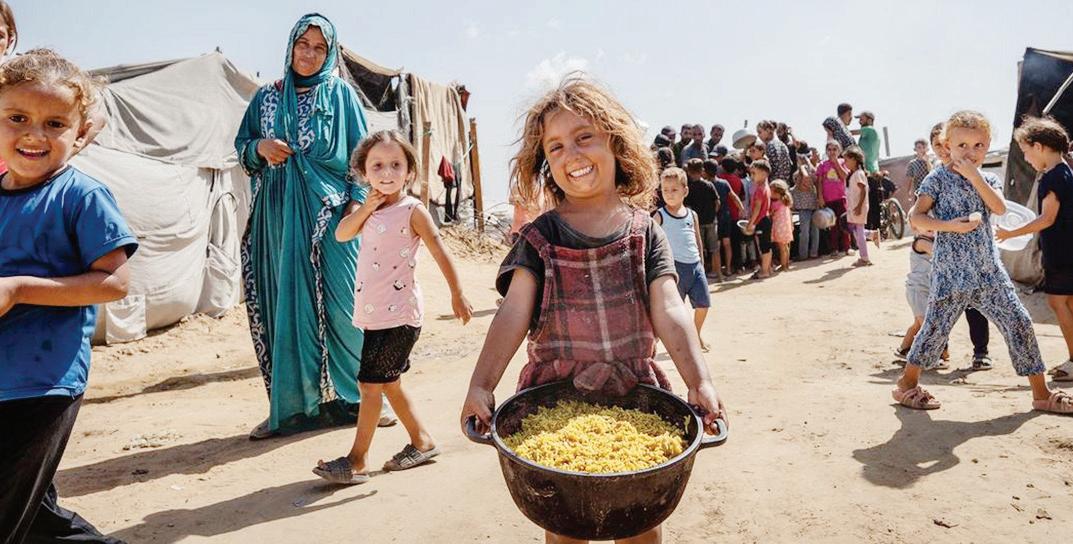
young girl carries a pot of cooked food in Al-Mawasi, Gaza (WFP/Maxime Le Lijour)
of food security across the world? Which countries and regions require urgent attention? And what are the underlying factors contributing to food security needs?
Studies have shown that early warning of emerging food security issues can lead to tremendous cost savings and operational efficiencies.
For every dollar invested in WFP’s anticipatory action programs, a minimum of seven dollars is procured in savings.
“Without data, the fight against hunger is fought in the dark,” WFP Executive Director, Cindy McCain, said, “this platform changes that...we’re able to track and
predict where, how and why hunger is growing, which means that we don’t just respond to hunger – we get ahead of it.”
AI-ASSISTED FORECASTING
The map offers AI-assisted forecasting capabilities for projected food needs in WFP-designated Hunger Hotspots, 16 countries with populations already struggling with catastrophic hunger.
Another novel feature is the inclusion of “micronutrient intake adequacy,” which links food-security conditions with the nutritional quality of diets.
This nutrition analysis, developed with support from the Gates Foundation, helps identify populations at risk of hidden hunger
caused by inadequate intake of essential vitamins and minerals.
STOPPING HUNGER IN ITS TRACKS
Funding for global food security monitoring and analysis has been on an alarming decline with WFP's data footprint shrinking 25 per cent in the past year.
“You can’t stop hunger if you can’t see it coming,” Mr. Bauer added.
“That’s why it’s crucial that we keep funding the collection of this data, so that society has a trusted, evidence-based early warning system that can alert the world about emerging and alarming conditions, and the risk of human suffering, before it’s too late.” (UN)
Guyana’s haematology care in capable hands of Dr Kamela Bemaul-Sukhu
IN the halls of Georgetown Public Hospital Corporation, where long hours and critical decisions define daily life, one physician’s journey reflects dedication, resilience, and the steady transformation of healthcare in Guyana.
For Dr Kamela Bemaul-Sukhu, medicine became the realisation of a family dream. With no prior medical professionals in her family, her mother’s aspiration to become a doctor evolved into her own life’s mission.
After graduating in 2003, Dr. Bemaul-Sukhu entered the medical field during a period of national crisis. Severe flooding led to an overwhelming influx of critically ill patients at Georgetown Public Hospital Corporation, pushing the healthcare system to its limits.
Her work extended beyond the hospital, as she joined outreach efforts that required travelling by boat into flood-affected communities. There, she encountered patients who were isolated, ill, and unable to access necessities, deepening her understanding of the realities many Guyanese faced.
These early experiences shaped her approach to medicine and reinforced her commitment to patient-centred care.
At a time when structured postgraduate training was limited, Dr Bemaul-Sukhu became part of the first group of doctors to enter the internal medicine residency programme at Georgetown Public Hospital Corporation.
Without the multi-lay-
ered supervision systems available today, she and her colleagues often worked with minimal guidance, taking on significant responsibility early in their careers. This environment demanded both clinical skill and decisive leadership.
Balancing these professional demands with family life proved challenging. As a young mother during her residency, she navigated long hospital shifts, academic pressures, and the responsibilities of raising children. Careful planning and strong family support became essential in managing both roles.
Her decision to specialise in haematology was influenced by the limitations she witnessed in treating patients with serious illnesses, particularly cancer. Early in her career, the lack
of available treatments meant that many patients received only supportive care. Experiences in both paediatric and adult medicine highlighted the ur-
severity. Continuous monitoring and follow-up care have also become central components of treatment.
The impact of these changes has been evi -
gent need for improved services in blood-related conditions.
Although she initially considered oncology, the length of overseas training required led her to focus on haematology, particularly non-cancerous blood disorders. At the time, there was no dedicated hematology specialist in Guyana.
Upon com pleting her training, Dr Bemaul-Sukhu returned to Guyana and established the country’s first hematology clinic at Georgetown Public Hospital Corporation. The clinic introduced a structured approach to diagnosing and managing blood disorders, significantly improving patient care.
Conditions such as sickle cell disease, which were previously managed with limited interventions, began receiving comprehensive attention. Patients now benefit from detailed diagnostic evaluations, screening for complications affecting major organs, and access to medications that reduce disease
in patient care. Her daily responsibilities include managing both inpatient and outpatient cases, often requiring her to balance clinical duties across different departments. The demands of the profession extend beyond standard working hours, with continuous monitoring and follow-up forming a routine part of her work.
Patient outcomes continue to serve as a primary source of motivation. Improvements in patients’ health, energy, and overall well-being reflect the progress made in haematology care and reinforce the importance of sustained effort in the field.
dent across the healthcare system, with fewer emergency cases related to severe complications and improved quality of life for patients.
The clinic has also advanced care for individuals with bleeding disorders, including haemophilia.
Through collaboration with the World Federation of Haemophilia, patients now have access to specialised treatments that were previously unavailable in the country.
Additional partnerships with international institutions have strengthened local capacity, enabling healthcare professionals across multiple disciplines to manage complex cases more effectively.
These developments have made it possible to safely perform procedures that were once considered too risky, including surgeries for patients with bleeding disorders.
Despite her leadership role, Dr Bemaul-Sukhu remains actively involved
Over the years, Guyana’s healthcare system has undergone significant development. The expansion of medical training programmes, increased availability of specialists, and improved diagnostic and treatment capabilities have contributed to a higher standard of care. Services that were once unavailable are now accessible, and collaboration with international partners continues to enhance local expertise.
Today, the level of care provided in haematology and internal medicine is comparable to international standards in many areas, reflecting the progress achieved through years of dedicated work.
Dr Bemaul-Sukhu continues to emphasise the importance of early diagnosis and patient education. Understanding medical conditions and adhering to treatment plans remain key factors in improving health outcomes.
Her journey, from navigating floodwaters as a young doctor to establishing a critical medical specialty, highlights the impact of perseverance and vision. Through her work, haematology care in Guyana has been transformed, offering patients not only treatment, but a renewed sense of hope. (GPHC)
Dr Kamela Bemaul-Sukhu
THAG endorses President Ali’s call for a review of Guyana’s littering laws
PRESIDENT Dr. Irfaan Ali’s recent call for a review of Guyana’s littering laws to reflect the evolving landscape of public safety and accountability has attracted the support of the Tourism and Hospitality Association of Guyana (THAG).
THAG in a press release issued on Thursday underscored the importance of the
President’s remarks. “If our society is to be disciplined and if we want to create a Guyana that would be a leader in tourism, technology, food, and energy, we must be a leader with conscience, with humanity, and with a sense of environmental stewardship and a quality of life that is second to none.”
THAG therefore encour-
ages a balanced approach that combines enforcement with education, ensuring that citizens understand not only the penalties for littering, but the broader national importance of environmental responsibility.
According to the association, “We believe that maintaining a clean and environmentally responsible nation is essential to strengthening
Guyana’s tourism product and enhancing the overall quality of life for all citizens.”
THAG is the national private-sector body representing tourism and hospitality stakeholders, and is actively working to advance policy reform, industry standards, and the sustainable development of Guyana’s tourism economy.
PTAs vital to Guyana’s education system
-Minister Parag says
MINISTER of Education
Sonia Parag in emphasising the importance of Parent-Teachers Associations
(PTAs), recently reminded a group of parents that these help to build stronger schools, advance the edu-
cation system and produce better learners.
She said that by engaging in this forum, parents can
speak with teachers about challenges, and teachers can share insights with parents. This allows them to address certain issues and gives parents the responsibility of collaborating with the school in areas such as infrastructure and academics.
“The children’s performance is going to empower them somewhat. It’s going to empower them because I went to several schools that I’ve been and the issues that were raised with us in that gathering was never raised with the CEO, was never raised with ACEO on a oneon-one by a teacher or by the HM or by a parent alone,” she revealed.
The minister added that through this forum, there are many things that can be addressed, which she said is a “really good thing,” and will be continued.
She told the gathering that for her, heading to just under a 1,000 schools to engage PTAs is an ambitious task. However, she is hoping to accomplish this within the next few years.
According to her, she will be visiting schools by region. She committed to visiting the schools, and promised that if she is not there, the Chief Education Officer would represent her.
In January this year, the education minister announced the plan to commence direct engagements with PTAs at schools across Guyana, an initiative that she said is intended to strengthen partnerships within the education system and improve outcomes for learners.
The discussions at these engagements are expected to focus on several issues affecting the education sector, including student attendance, reducing dropout rates; identifying gaps in academic delivery; addressing infrastructural challenges and examining school-management concerns.
This allows for direct information sharing between the Ministry of Education and the PTAs to achieve the goals set for the ministry.
Minister of Education
Sonia Parag
Regional project implemented by IICA strengthens sweet-potato cultivation in Caribbean countries
EFFORTS to strengthen sweet-potato production and preserve vital genetic resources across the Caribbean are gaining momentum under the Next Generation Sweet Potato Production in the Caribbean Project, now actively engaging stakeholders through a Community of Practice with technical specialists in Antigua and Barbuda, Barbados, Saint Lucia, Jamaica, and Trinidad and Tobago.
The project was implemented by the Inter-American Institute for Cooperation on Agriculture (IICA) in collaboration with national Ministries of Agriculture of Antigua and Barbuda, Jamaica, and St. Lucia, along with the Caribbean Agricultural Research and Development Institute (CARDI).
F
Recent online theoretical and practical training activities brought together 73 agricultural professionals from academia, technical missions, public and private sectors for the identification, morphological characterisation, and cataloguing of sweet-potato varieties.
These sessions, conducted in collaboration with the International Potato Center (CIP), form part of a broader regional initiative aimed at improving crop genetic diversity, strengthening seed systems and enhancing climate resilience in sweet-potato production
across the Caribbean.
Participants first engaged in five virtual sessions focused on the 30 internationally recognised descriptors used to identify key traits such as leaf shape, vine characteristics, and root features for sweet-potato genetic resources before
applying their knowledge in practical field exercises in four of the participating countries.
In Antigua and Barbuda, officials noted that approximately 73 sweet-potato accessions are currently documented, with an additional 19 varieties expect-
ed to be introduced under the Next Generation Sweet Potato Production in the Caribbean project, through collaboration with CIP, further expanding the country’s genetic base. The project is equipping agricultural professionals
TURN TO PAGE 21
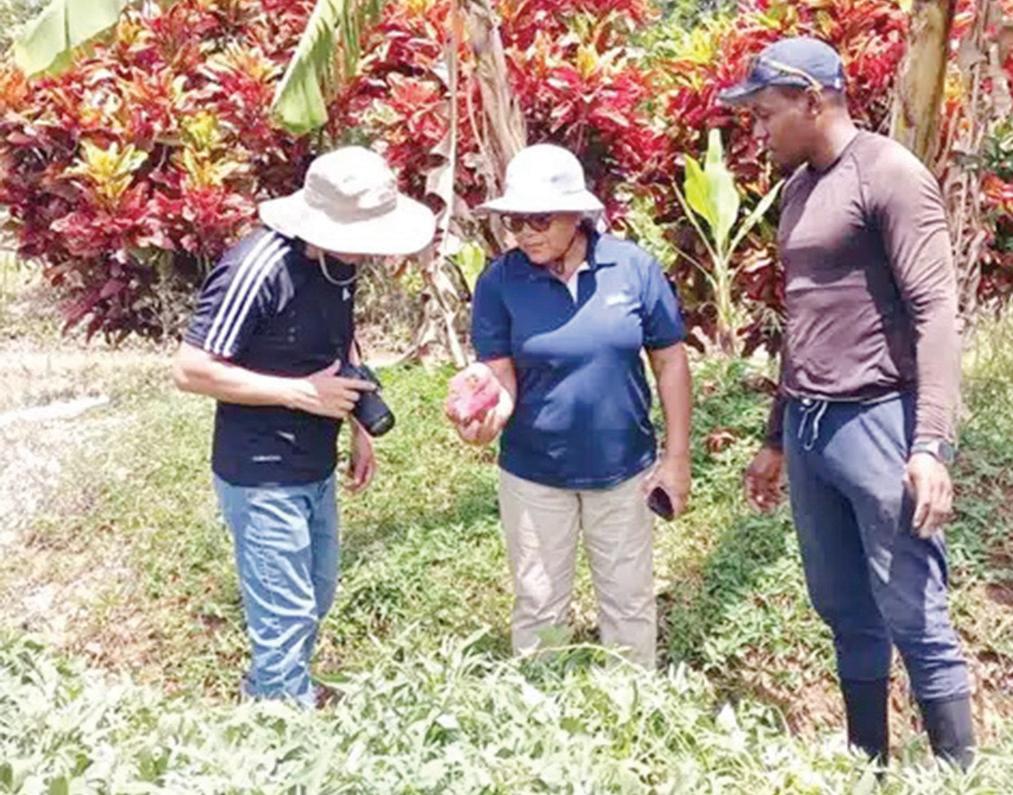
Research Assistant, Ronald
Robles Martinez; International Specialist, Elizabeth Johnson and farmer, Joseph Baptiste, inspect sweet potatoes in the Field in Saint Lucia
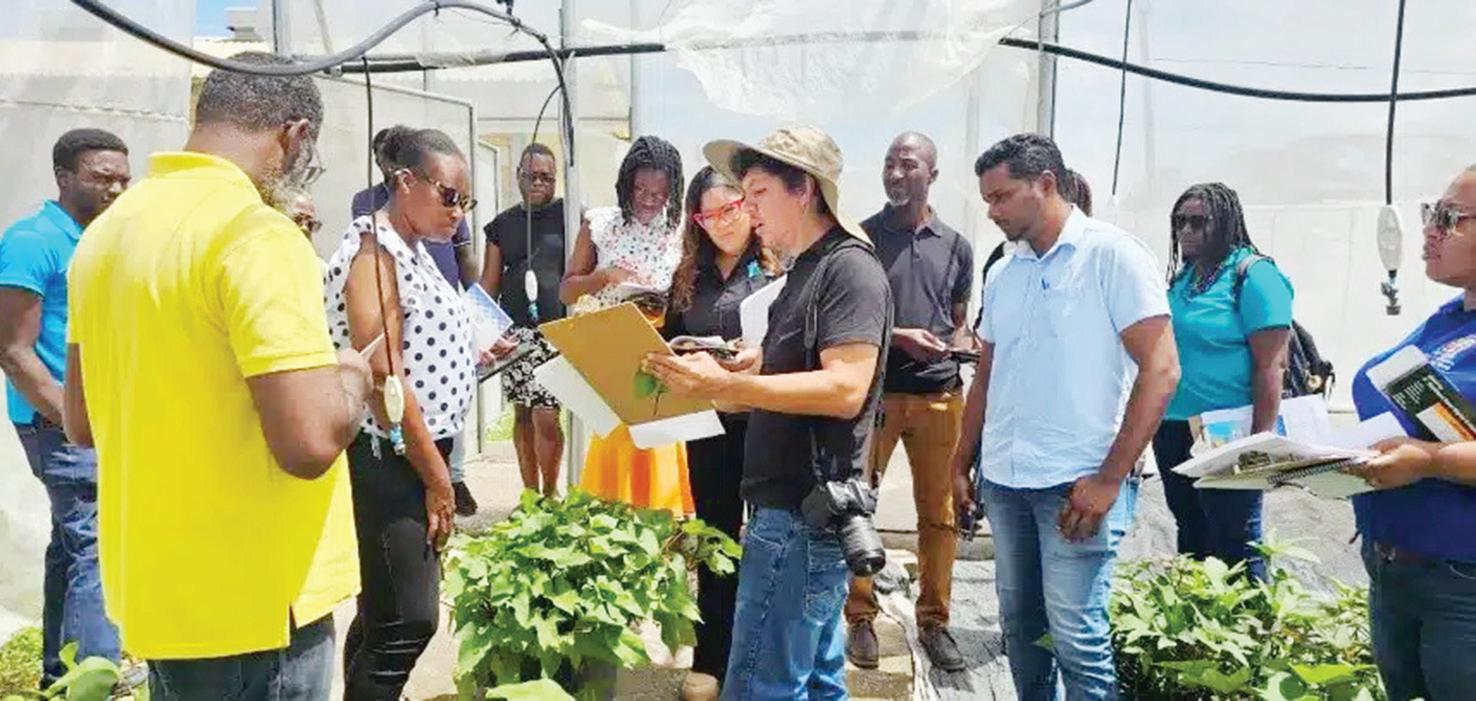
Participants from Jamaica Assess Production with Dr Robles
Businessman pledges support after fatal Atlantic Gardens collapse
- expresses willingness to compensate
DISCUSSIONS are underway to provide financial compensation to the daughter of a construction worker who died in Wednesday night’s building collapse at Atlantic Gardens, East Coast Demerara, as investi -
gations into the incident intensify.
Dead is Radish Domingo, 46, a carpenter of Mon Repos, who was
killed when the structure under construction collapsed, leaving seven other workers injured.
Businessman Omprakash Shivraj, under whose supervision the project was being undertaken, confirmed that dialogue has already begun with the family of the deceased.
He told the Guyana Chronicle that while workers were pouring concrete on the upper section of the building, it suddenly gave way.
Shivraj said the incident happened suddenly, adding that Domingo was pinned beneath the debris while others were injured and rushed to the hospital.
The businessman disclosed that Domingo, who was divorced and the father of one child, had been living alone on the East Coast of Demerara and was working on the project as a migrant labourer.
He further indicated that he is fully cooperating with investigators, including the Guyana Police Force and officials from the Ministry of Labour, who have since visited the site.
While initial police reports described the
structure as a two-storey building, residents told this publication that the edifice appeared to be a four-storey structure that was being rapidly erected over a two-month period.
A nearby resident, Daniel Williams, said he heard a loud rumbling sound on Wednesday evening before learning that the building had collapsed.
When the Guyana Chronicle visited the scene on Thursday, trucks were observed removing debris, including concrete blocks and steel, while several workers were transported away from the site.
Police have since confirmed that a full investigation is underway into the collapse, which occurred around 19:10 hrs. Domingo was later pronounced dead at the Georgetown Public Hospital Corporation after being pulled from the rubble.
His body is currently at the Memorial Gardens Funeral Home awaiting a post-mortem examination.
CCTV footage from the area has been identified and is expected to form part of the ongoing probe.
Insurance Association backs Fire Service advisory on safe fuel storage
THE Insurance Association of Guyana has emphasised its support of the Guyana Fire Service’s recent advisory regarding the safe storage of fuel.
According to a press release, the Association is urging members of the public to avoid the use of non-approved containers, including drink bottles and other unsuitable vessels, as these pose a significant fire and explosion risk and may result in serious damage, injury, or loss of life.
“Policyholders are reminded that adherence to established safety standards, including those of the Guyana Fire Service is essential and may have a bearing on insurance coverage in the event of a claim.
“The Association encourages all households and businesses to comply fully with the recommended guidelines as part of prudent risk management and the protection of lives and property,” the press
Regional project...
FROM PAGE 19
with the skills needed to identify and preserve valuable genetic resources for better utilisation, while supporting farmers in adopting high-performing, climate-resilient varieties. These efforts are expected to contribute to improved food and nutrition security across participating countries.
Funding is provided through the Benefit-sharing Fund of the International Treaty on Plant Ge-
netic Resources for Food and Agriculture, facilitated by the Food and Agriculture Organization of the United Nations (FAO), with co-financing from the European Union.
The four-year initiative continues to foster regional collaboration and knowledge sharing, building a strong community of practice to support sustainable sweet-potato production across the Caribbean. (IICA)
release said. It underscored that protection begins with prevention. “Responsible
actions today can prevent catastrophic losses tomorrow,” the release added.
An approved fuel storage container
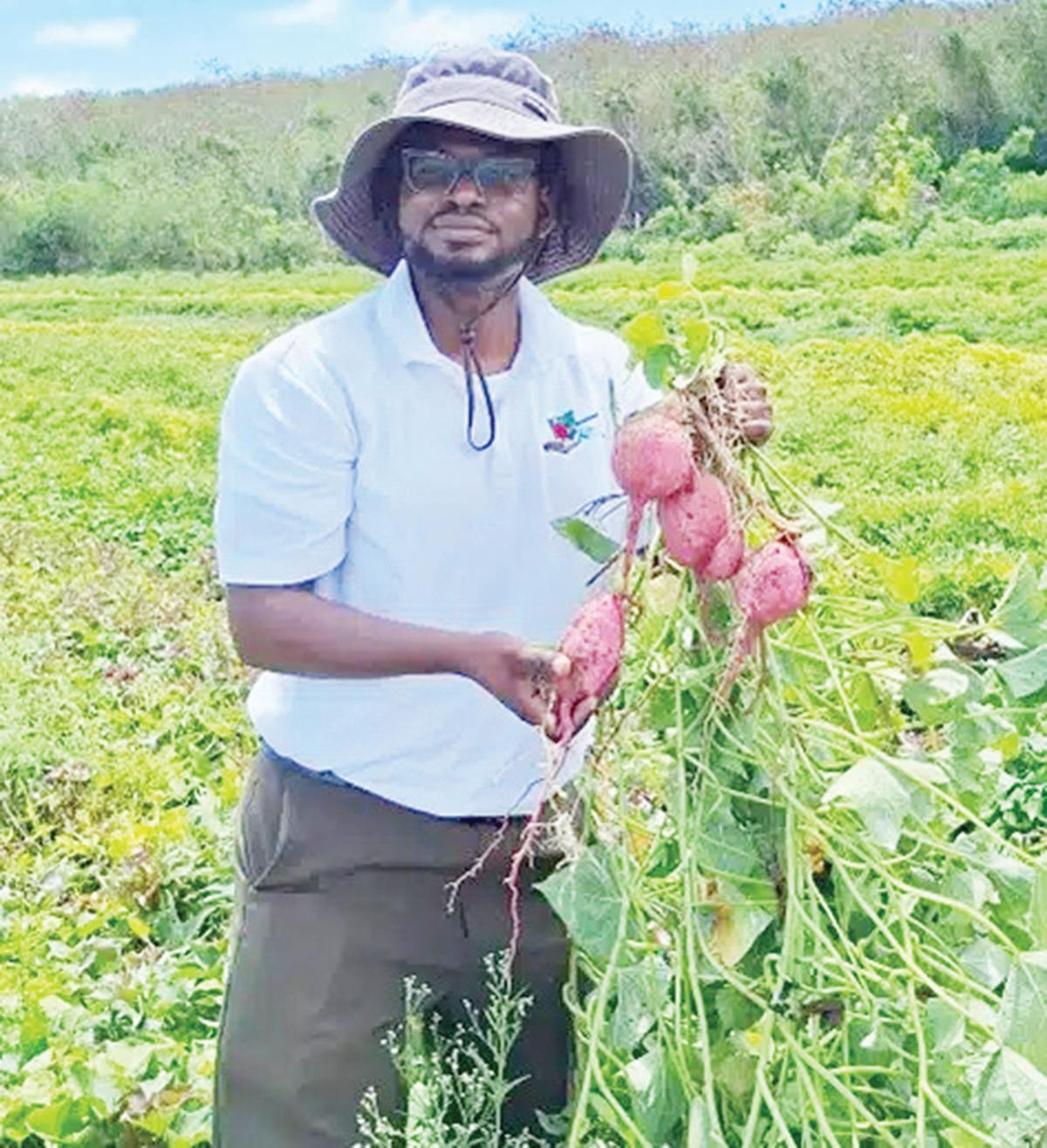
Antigua and Barbuda participant inspects sweet potatoes in the field
Dr Alista Bishop chronicles her journey in new book
By Faith Greene
DR Alista Bishop wears several hats: mother, daughter, entrepreneur, financial executive, and most recently author and poet, and was earlier this week announced as one of the Suriname Guyana Chamber of Commerce’s (SGCC) Directors.
Describing herself as resilient, Dr Bishop, in an interview on Thursday, told this publication that she has always found a way to rise, rebuild and move forward
with purpose. Alista grew up in Tiger Bay, Georgetown, a community persons often said nothing good can come out of.
Later, she and her family moved to Kitty, and then to Diamond on the East Bank of Demerara before she migrated to Trinidad at the age of 16 to pursue better academic opportunities. After graduating from the University of the West Indies (UWI), she returned to Guyana ten years ago.
Dr Bishop stated that her
journey is one that is more rooted in those transitions, with each phase shaping her perception and drive.
“What keeps me going every day is purpose. A lot of people are still trying to find their purpose. And I've seen what struggle looks like up close and personal, and I've lived it as well. So, for me, it's not just about being successful. It's about the impact you make even when you're successful. It's about creating opportunities and building something meaningful and
ensuring that my story becomes proof that where you start does not define where you finish. There’re good people that come from the ghetto, and we can see that,” Dr. Bishop told this publication.
The entrepreneur said that wearing several hats and being a woman, require lots of discipline, as well as structure, and the clarity of purpose. Additionally, Dr Bishop shared that she also prioritises, and delegates where necessary, remaining
intentional about how she spends her time.
According to her, “I’m intentional about some of the events that I'm going to attend. It has to have a meaning. It has to support some kind of cause, but more importantly I've learned that balance isn't about doing everything at once. It's about knowing what needs your attention in each moment. I often lean on faith as well. I'm a Christian (Catholic), and without that grounding, managing multiple responsibilities while navigating those personal challenges would be overwhelming. It's not easy.”
Dr Bishop revealed that she is someone who loves numbers. Her genuine love for mathematics is what allowed her to stay in the field of accounting.
“The structure, the logic, the technical side of it. And I've always had this strong connection to it as well, and accounting gave me a way to apply that in a meaningful, practical way. I love the idea of playing with numbers. Like I said, I like to take small numbers and make it big numbers,” she said.
Balancing this out, Dr Bishop said she also loves writing, stating that she journals daily about her struggles/ challenges, health, and every other thing happening in her life at that point.
Her book, ‘The Journey of Alista Bishop’, was written to share her story, her truth with the world.
She said that in the book, she opened up about her struggles growing up in poverty, her migration journey, failed relationships, moth -
erhood, and the many setbacks that she would have experienced. With a firm belief in the power of honesty, Dr Bishop said she wanted young women to see that experiencing challenges does not disqualify you, instead they shape you.
Dr Bishop said she never saw Tiger Bay as a final destination for herself and always believed that one day, she and her family would leave that environment.
“If I could tell my younger self anything, I would say that you know what, you've made it, you've changed the odds against you,” Dr Bishop expressed.
The book is already a major success, with different parts of it resonating with different people.
It was published in Europe, and is available for purchase on Amazon, Europe Books, and locally at The Book Barn at Massy Stores, New Era Bookshop in the Courtyard Mall, and the Cheddi Jagan International Airport, Timehri. It is also available in stores in the United States and London in the United Kingdom.
Speaking on her new position as a SGCC Director, Dr Bishop said she is interested in strengthening regional collaboration in her new role, as well as creating opportunities for cross-border engagement, especially between Guyana and Suriname.
“I also want to contribute to creating more inclusive opportunities, especially for women and young professionals, so that they can access a platform that allows them to grow and to lead as well,” she said.
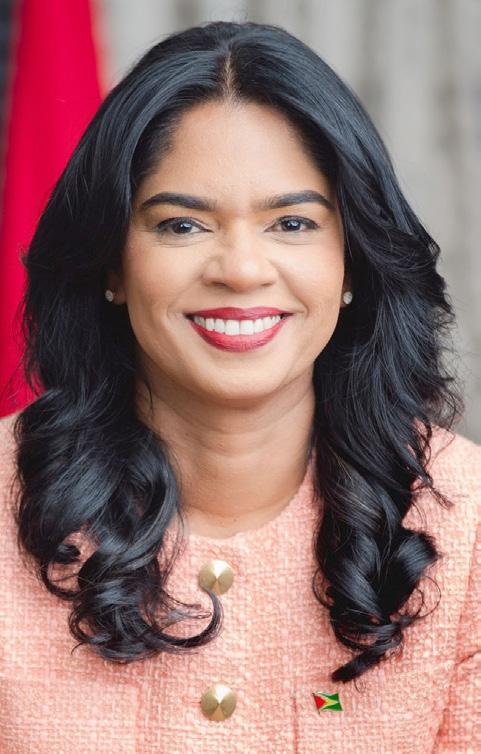
Dr Alista Bishop
Guyana’s electricity sector
‘maintained its steady progression along a path of modernisation and expansion’
- PUC says in annual report
GUYANA’S electricity sector “maintained its steady progression along a path of modernisation and expansion,” according to the Public Utilities Commission’s (PUC) 35th Annual Report.
The report highlighted continued growth in demand, infrastructural development, and renewable energy expansion.
The Guyana Power and Light Inc. (GPL) recorded a four per cent increase in its customer base over the previous year, reflecting sustained population growth as well as ongoing expansion in residential housing and commercial development across the country.
Net electricity sales also rose by six per cent, “underscoring a strong and broad-based demand from consumers.”
In response to rising demand, GPL and the Government of Guyana undertook measures to strengthen generation capacity, including the procurement and deployment of two electric barges.
These additions, the report noted, have played “a critical role in supporting grid stability and ensured continuity of supply as the sector adapts to increased consumption needs.”
In keeping with its statutory mandate, the Commission conducted its annual review of the Operating Standards and Performance Targets (OSPT) for GPL for 2024 on March 13, 2025.
The review was held by way of a public hearing attended by key stakeholders and members of the media.
While it was concluded that GPL did not attain the majority of its performance targets, the Commission, after careful consideration, determined that no penalties would be imposed.
The report stated that factors influencing this decision included recurring damage to infrastructure caused by vehicular and equipment incidents, global software system updates, and electricity theft, all of which impacted perfor -
mance during the year. Notwithstanding these challenges, the PUC emphasised that improved compliance “remained an expectation and GPL was required to continue to strengthen its operational performance.”
2025.
Additional installations in Regions Two and Six, as well as on Leguan Island, further improved grid stability, reduced reliance on diesel generation, and supported national efforts
The report further highlighted GPL’s ongoing “transformative agenda to modernise its infrastructure and improve service reliability for consumers.”
This includes the construction of new substations, upgrades to existing infrastructure, clean energy initiatives, and the implementation of advanced technology solutions.
For 2025, planned initiatives included the construction of 155 km of 230 kV transmission lines and 209 km of 69 kV transmission lines, development of eight substations, construction of a 230 kV transmission line crossing the Demerara River, and the expansion of 343 km of distribution feeds.
The continued rollout of Advanced Metering Infrastructure also remains a key component of the modernisation programme.
The energy sector also recorded significant progress in renewable energy development. Several utility-scale and community-based solar projects were commissioned across multiple regions, adding approximately 15.6 MWp of solar capacity to the national grid.
According to the report, the most notable project was the 4 MWp Trafalgar Solar Farm in Region Five, commissioned in December
to reduce carbon emissions.
The report noted that ongoing renewable energy initiatives “represented a practical and measured shift towards a more diversified, resilient and sustainable energy mix,” reflecting Guyana’s gradual transition toward cleaner power generation.
However, it also acknowledged delays in the Gas-to-Energy (GTE) Project, although the Commission maintained confidence in its long-term impact.
Once operational, it is expected to reduce electricity tariffs by approximately 50 percent, significantly expand generating capacity, and improve affordability and quality of life for citizens alongside continued grid expansion and modernisation.
The PUC is an independent statutory body responsible for regulating public utility services such as electricity, water, and telecommunications.
Its primary role is to balance the interests of consumers and service providers, specifically, monitoring the quality of service provided to consumers, maintaining fair and reasonable pricing for services while safeguarding the financial sustainability of operators.
Region One gets seven boats to boost riverine healthcare access
AS government continues its efforts to ensure healthcare is accessible in every part of the country, Minister of Health Dr Frank Anthony recently handed over seven boats to the Regional Health Department in Region One.
Present at the simple yet significant event was Regional Chairman, Brentnol Ashley and regional health officials.
In a Facebook post, the ministry said each of the boats comes with a 40-horsepower engine. The vessels will support outreach services in key areas including Red Hill, Blackwater, Savannah, the Waini River, and communities within the Barama and Moruca sub-regions, where access to healthcare has long been a challenge due to distance and transportation limitations.
“The boats will facilitate a wide range of essential services, including mobile vaccination outreaches for children, school health programmes, chronic disease monitoring, and home visits for bedridden and vulnerable patients.
In his remarks, Minister Anthony emphasised that Region One’s geography makes river transportation essential for healthcare delivery. He noted that the provision of the boats will strengthen emergency response capabilities and allow for more consistent delivery of comprehensive primary healthcare services.
“This is about bringing healthcare closer to the people,” the Minister stated, adding that the investment supports the government’s vision of accessible, affordable and efficient healthcare for all Guyanese.
Meanwhile, Ashley noted that the initiative was driven by concerns raised by residents, particularly the high cost and difficulty of travelling long distances, sometimes over 90 miles to access healthcare services.
The introduction of these boats is expected to significantly reduce that burden, while also ensuring timely medical attention, the post said adding that the handover represents another step in advancing healthcare delivery in hinterland and riverine communities, ensuring no one is left behind due to geographical barriers.
“Additionally, they will support maternal health services by enabling expectant mothers to access the Maternal Waiting Home in Mabaruma, also in Region One, where they can receive care from trained midwives, obstetricians and other healthcare professionals in a safe environment ahead of delivery,” the post said.
Riverine healthcare access in Region One has been given a big boost following the handing over of seven boats (Photo: Ministry of Health/Facebook)
Zion Hickerson captures U12 & 14 tennis titles
Zion Hickerson
ST Gabriel’s Primary school student Zion Hickerson won U12 & U 14 Boys Titles at the recently concluded IJT Cup hosted by BCR Tennis Club during the Easter weekend.
In the U14 final he overcame Rafeek Prince of Rebel Tennis Club 6-4 in an entertaining battle. Prior, he championed his way past Joshua Culpepper 6-1 in the semifinal.
In the group stage, he won 6-1 versus Christian Pompey, Davante Lovel 6-0 and Virat Peter 6-0. In U 12 he won his two matches against Davion Fergusson(6-0), Juan Diego Perdomo (6-0).
In the previous week, he suited up for Camptown FC and earned second place at the Exchange Cup U12 boys football competition hosted by the Vurlon Mills Football Academy. This week he is preparing to compete in the U13 category at the Moo Junior National Squash Championships.
Zion is endorsed by ENet, BK, Acado Guyana, Beacon Cafe, Jai Signs, Guyoil, Tristone Auto Sales, MVP Sports, Fireside Grill, Smalta, Modern Optical, Corum Restaurant Group, Toucan Industries, BBS Coating, Ramchand Autospares and Slingerz Fam/Shi-Oil.
Minhas, Conway and Islamabad United bowlers crush Karachi Kings
(ESPNCRICINFO) - These two sides are moving in opposite directions. Islamabad United nudged up to second in the table with a fourth win in five matches, crushing the hosts Karachi Kings, inflicting a third consecutive defeat on Moeen Ali’s team.
It came thanks to a clinical all-round performance that saw the United bowlers keep the Kings’ pep bottled up, never allowing the batting side to enjoy a purple patch. They were restricted to 150, the sort of total that has historically proved meat and drink for United’s bellicose style of play.
A 93-run opening stand between half-centurions Sameer Minhas and Devon Conway broke the back of the chase, while a whirlwind cameo from captain Shadab Khan helped his side finish with a flourish with four overs in reserve.
Inserted in to bat, Kings had Jason Roy to call upon atop the order, and for a while, he rolled back the years. While Reeza Hendricks at the other end struggled through a tortured innings that produced an unbeaten 51 off 44, Roy overcame a slow start to turn his innings around. It began with
walloping inflicted on Imad Wasim, before he took turns directing his ire at Richard Gleeson, Faheem Ashraf and Mohammad Hasnain - a flat six over cover off Hasnain’s bowling perhaps the shot of the game.
But Shadab, clad in flamingo pink as part of a breast cancer awareness drive, has seen his leg-spin blossom into life this tournament. In his second over, it would bring about Roy’s downfall as he drew him into holing out. Soon after, Salman Agha was beaten in the air, and the Kings began to be dragged back.
A partnership between Hendricks and Azam Khan tried to reignite the innings, with limited success. United’s bowlers kept their discipline, and their fielders backed them up, highlighted by a wonderful relay catch between Minhas and Mark Chapman. The last five overs yielded just 30 runs, and United’s job was half done.
Conway and Minhas made short work of the other half. Mir Hamza and Hasan Ali were put to the sword in the first two overs, while Minhas smashed Pakistan’s T20 captain Agha out of the attack after one boundary-laden over. He went on
ENET signs on as GSL Partner
local talent and deepening fan engagement.
These initiatives will include contributions to national competitions and grassroots programmes, ensuring that young and emerging cricketers benefit from increased opportunities and exposure. The partnership further underscores ENet’s long-term vision of fostering sustainable growth in cricket while enhancing the overall fan experience.
Sir Clive Lloyd, Chairman of the Global Super League, welcomed the partnership, stating: “We are delighted to have ENet come on board as a partner. Their commitment to cricket development and community
FROM PAGE 31
engagement aligns perfectly with the vision of the Global Super League.
Partnerships like this are critical to elevating the game in Guyana and ensuring that our players and fans benefit from world-class opportunities.”
The ExxonMobil Guyana Global Super League is quickly emerging as a premier cricketing event, bringing international attention to Guyana and providing a platform for elite competition and local talent development.
With ENet’s support, the league is poised to deliver an even more connected, engaging, and impactful experience for players and fans alike.
to do much of the same to Khushdil Shah, smashing him for four fours before he disappeared from the attack.
It meant 67 came off the powerplay, which allowed them the luxury of affording Adam Zampa and Moeen Ali a bit of respect. The Kings’ captain finally did send Minhas back, but not before he had powered his way to 58 off 36, leaving his captain Shadab the chance to finish in style.
Brimming with confidence, Shadab did just that. A statement six over cover off Zampa indicated he would target just about anyone, including his good friend Hasan Ali, whose third over went for another 15. At the very end of the cakewalk, Conway jabbed one to midwicket to bring up his half-century as the winning runs.
United are beginning to get that glint in their eye that is so lethal at the backend of PSL tournaments against a Kings side that, as happens so often in this league, are fading gently away.
SOUTH AFRICA RACING TIPS
GREYVILLE
10:25hrs Donmagoo
11:00hrs Surely Niy
11:35hrs Fire Force
12:10hrs Psyche
12:45hrs Professor Lupin
13:20hrs Indecent Proposal
13:55hrs Freedom Fighter
14:30hrs Dawn Surprise
ENGLISH RACING TIPS
NEWBURY
08:57hrs Blessed Joyager
09:32hrs Synchronicity
10:07hrs Allaire
10:42hrs Maltese Cross
11:20hrs Pole Star
11:56hrs Caballo Grande
12:25hrs Cindy Lou Who
WOLVERHAMPTON
09:08hrs Travel Agent
09:43hrs Schefflee
10:18hrs Solar Passm
10:53hrs Gold Star Hero
11:25hrs Slight Of Foot
12:05hrs Politely
12:35hrs Balqaa
13:05hrs RB Yas Sir
08:45hrs Secret Force 09:20hrs Marty Mcfly 09:55hrs Lirion
10:30hrs Twinjets
11:05hrs Sanilam
11:43hrs Alentejo
12:15hrs Kap Boy
IRISH RACING TIPS BALLINROBE
12:00hrs Poetic Twist
12:30hrs Master Haku
13:00hrs Becasse
13:30hrs Carry On Heidi
14:00hrs Yoursimplythebest
14:30hrs It’s Never Simple
15:00hrs
Sameer Minhas made 58 in the chase • PSL
GOA announces route for Kings Baton Relay
THE Guyana Olympic Association as a participating nation of the Commonwealth Games will host the King’s Baton Relay (KBR) during the period April 14–19, 2026.
In keeping with its coordination mandate and the themes of the 2026 edition of the games – sustainability, community connection, unity, and celebration of cultural diversity as a commonwealth family – the GOA has planned several activities for Guyana’s leg.
Apart from the actual King’s Baton Relay which takes place on Sunday, April 19 from 6:00 hrs. – 8:30hrs, there is the Ocean Clean-Up Initiative set for the Seawall from 09:00hrs to 10:00hrs between Marriott Hotel, Camp Road & Vlissengen Road as well as a 5K race on the Main Street circuit which will be started by H.E Dr Mohamed Irfaan Ali.
The President will also participate in the KBR, committing to walking the full distance to underscore his strong support for sport and national unity.
The King’s Baton Relay, which traverses all 74 Commonwealth nations and territories, symbolises unity and shared purpose across the Commonwealth. It is part of the traditional lead-up to the 2026 Commonwealth Games, scheduled for July 23 to August 2, 2026, in Glasgow, Scotland.
The new edition of the KBR represents a reimagined relay for a new era, embracing a new Games model and a new Monarch, with a strong emphasis on environmental and financial sustainability, promotion of cultural diversity, community connection, and a shared sustainable future for the people of the commonwealth.
Notably, for the first time, each participating nation will receive and uniquely decorate its own Baton to reflect its cultural identity. Compton Babb is currently designing Guyana’s Baton.
This edition of the Glasgow 2026 Games will be a streamlined 11-day event, featuring approximately 3,000 athletes competing in 10 sports at four venues.
Guyana will be represented in five sporting disciplines at the Games, namely in the disciplines of: Athletics, Boxing, Men’s 3x3 Basketball (historic first appearance) Swimming, and Cycling as a Para-sport participation comprising a twenty-seven (27) member delegation.
Sunday’s relay begins at the iconic Umana Yana, where a march party of athletes and officials will assemble before proceeding south along High Street.
Their first major stop will be the Canadian High Commission, where the Canadian High Commissioner, will formally receive the baton.
CRICKET QUIZ CORNER
(Friday April 17, 2026)
From there, the procession continues along High Street and onto Main Street, heading toward the Prime Minister’s residence.
At the residence, the Prime Minister, joined by the British High Commissioner, will accept the baton and lead the procession further south to State House.
It is here that President Ali will officially receive the baton at the Main Street entrance, marking a significant moment in the relay.
The President will then continue south along Main Street, joined shortly after by the Director of Sport at the
junction of Main and Middle Streets.
As the procession advances, additional dignitaries will join at the Ministry of Culture Youth and Sport, reflecting the event’s national importance and unity across leadership.
The route then shifts eastward as the march turns left onto Church Street, passing a number of notable landmarks including the St. George’s Cathedral and continuing through key intersections such as Camp Street, Alexander Street, and Cummings Street.
This stretch of the jour-
West Indies Championship…
ney will showcase some of Guyana’s most prominent athletes, who will walk alongside the President holding a ceremonial banner between Camp Street and Oronoque Street.
The display is expected to highlight the country’s sporting excellence and inspire onlookers gathered along the route.
As the relay progresses from Oronoque Street toward Peter Rose Street, President Ali will take a leading role before presenting the banner to representatives of the Indian High Commission.
The procession will then
turn at Church and Irving Streets, moving onto Vlissengen Road and continuing south toward its final destination.
The final leg brings participants into the serene surroundings of the Georgetown Botanical Gardens, where the march will proceed to the Seven Ponds (Sir David Rose Memorial).
There, the relay will conclude at the resting place of one of Guyana’s most revered leaders, providing a fitting and symbolic end to a journey that celebrates unity, heritage, and national pride.
Imlach cites experience for Harpy Eagles win
THE West Indies Championship returned with an enthralling opening round, with matches played in Antigua and at Chedwin Park in Jamaica.
The round produced seven centuries, three five-wicket hauls, and a remarkable ten-wicket match haul, all setting the tone for an exciting regional tournament.
In Antigua, defending champions Guyana Harpy Eagles overcame a first-innings deficit to secure victory against the Windward Islands Volcanoes at Sir Vivian Richards Stadium.
Player of the match Gudakesh Motie delivered a match-winning performance with the ball, claiming figures of 10 for 119 to spin his team into a commanding position and set up a comfortable four-wicket win shortly after tea.
Sunil Ambris kept the Volcanoes in contention with an unbeaten 107, his 10th first-class century, before being bowled out for 209 in their second innings, setting the Harpy Eagles a target of 233.
Captain Tevin Imlach led the chase with a characteris-
tically gritty 82, bringing his side within touching distance of victory. Matthew Nandu provided solid support with 58, before Motie fittingly sealed the win with a flurry of boundaries, guiding his team to 233 for 6.
“We were good for most parts, well at the back end because they won most of the sessions in the first innings. I thought they bowled better than us in the first innings, but I think a bit of experience came into play in the end,” Imlach expressed. “We had some good performances from some of the batters and Motie was brilliant, to see him get ten wickets for us was great.”
Barbadian Kevin Wickham etched his name into regional folklore with scintillating centuries in both innings for Barbados Pride against the Jamaica Scorpions. However, his efforts were rivalled by magnificent hundreds from openers John Campbell and Kirk McKenzie.
Wickham excelled in both innings, becoming just the third Barbadian this century to score twin hundreds in a regional match, joining
Kraigg Brathwaite (102 & 122 vs Guyana, 2015) and Ryan Hinds (168 & 150 vs Leeward Islands, 2006).
The elegant right-hander struck six fours and 12 towering sixes in a dominant first-innings score of 153, before following up with a sparkling unbeaten 108.
However, not to be outdone, Jamaica Scorpions captain John Campbell and his left-handed opening partner Kirk McKenzie launched a superb counterattack in the final innings, putting on a commanding 242-run opening stand in the chase. Their efforts propelled the Scorpions to a convincing seven-wicket victory as they successfully hunted down a challenging target of 324.
Campbell struck 126, laced with 11 fours and six sixes, to register his 11th century at this level. Meanwhile, McKenzie compiled a composed and well-crafted unbeaten 135, his third firstclass hundred, to calmly steer the hosts to victory and secure maximum points.
In the round’s other clash, Trinidad & Tobago Red Force recorded an emphatic innings and 271 run triumph
over the Leeward Islands Hurricanes at the Coolidge Cricket Ground in Antigua.
The Red Force, after blowing away the Hurricanes for a paltry 138 on the opening day, watched as Amir Jangoo sparkled with a flawless double century to engineer the statement win.
The left-hander stroked 16 fours and five sixes in his unbeaten knock of 203 to record his second first class ton. Interestingly, his first was also a double century.
Jangoo reflected on his batting marathon which was fifteen minutes shy of eight hours at the crease.
Faced with an imposing first innings deficit of 369, the hosts found themselves reeling at 46 for 5 and despite a fighting 56 not out from captain Justin Greaves, the Hurricanes folded for 98.
Khary Pierre was the pick of the bowlers with 4 for 37, while Captain Joshua Da Silva heaped praises on his team for what he described as a perfect performance to begin their hunt for a first title in over 20 years.
The second round of matches bowl off on Sunday April 19.
Nitro Kart Klash…
Briggs Senior Light winner to pocket $1M
WITH the clock winding down rapidly to the highly anticipated Nitro Kart Klash 2026, organisers have released the prize-money structure per class, with over $10 million in cash and prizes up for grabs.
The April 18 and 19 event, set for the National Stadium Providence parking lot, will see not only the winners of the final pocketing cash, but also the top three finishers across the two heats securing cash prizes.
The biggest winners on the night are the Briggs and Stratton Senior Light class, where the winner of each
of the two heats will pocket $500,000 each, representing the largest payout in local karting history.
Second and third place in the heat will take $100,000 and $50,000, respectively.
For the final, $1M dollars will be awarded to the winner, with $200,000 and $100,000 for second and third.
“This [Briggs and Stratton senior lights] class is one of the classes where we saw a large field of competitors with close racing action, and now, we are offering that attractive cash payday, which we think will make the racing even more competitive.”
Archery Guyana’s
Hing officiates...
Deputy Chair before the start of the days’ events to delegate the various tasks to the team.
On Thursday evening all visiting and local teams and officials were invited to dinner and a cultural show hosted by the state of Puebla, and on Friday evening, the teams and officials were invited to the grand opening ceremony resplendent with a laser-light show, fireworks, a contortionist archer who shot with her feet, and speeches by officials including the Governor of Puebla, President of World Archery and President of World Archery Mexico.
The final matches culminated in historic downtown Puebla on Saturday 11 and Sunday 12, with its 450-year-old Cathedral De Puebla as the backdrop. The judges were divided into two teams. One team for the medal matches, where the international judges along
FROM PAGE 31
with some of the continental judges were based at the shooting line and target area, and the second team of continental judges at the practice field. Judge Hing’s team, consisting of several Mexican continental judges, oversaw the coordination of the archers on the practice field before and after each medal match.
World Archery President, Mr Greg Easton, personally thanked each judge for a job well done at this first stage of the Hyundai Archery World Cup.
“Since becoming a continental judge, I have had the good fortune of working with many wonderful judges from around the world, and this was no different, except this Archery World Cup Qualifier will be one of my most memorable experiences, especially working directly under Mr Sergio Font.” Hing said.
“We decided to pay out cash prizes for the heat because we understand the nature of the sport. A competitor can genuinely have a good heat and then have kart troubles moving forward, and we want to encourage competitors to still make an effort to continue the weekend of activity.”
“Overall, this is the largest possible payout for karting in Guyana and maybe in the Caribbean, because we want to set the tone not only for Guyana, but [also] for the Caribbean moving forward. It is our vision in time to come to have competitors from all across the Region coming here, which will, in turn, lift the standard of the sport here.”
For the Honda GX200 class, heat one and two will see the winner pocket $150,000 each, with $50,000 for second and $30,000 for third, while the top three in
- Prize structure revealed
the final will earn $300,00, $100,000 and $65,000 respectively.
This will be the same for the structure Briggs and Stratton Senior Heavy class, as well as the Supermoto Senior 250cc bike class and the Time Attack open class.
For the Super-moto JNR class, the two heats will attract a prize structure in kind equal to $50,000, $25,000 and $20,000, respectively, with the final top three getting $100,000, $50,000 and $25,000, respectively.
The IAME X30 class will see $100,000, $40,000 and $25,000 being distributed for each of the two heats, with $200,000 going to the winner and second and third-place finishers getting $80,000 and $50,000.
The Briggs Cadet, Briggs Female and Briggs Junior will see the winner of each of the two heats getting 200,000 dollars, with second and
third place getting $75,000 and $50,000, respectively, while in the final, the split of $400,000, $150,000 and $100,000 for first to third.
The Briggs Over 35 Rookies will see $125,00 being awarded to the winners of the first two heats, with the second- and third-place finishers getting $30,000 and $20,000, respectively, with the final having a $250,000, $65,000 and $35,000 split across the top three.
The race for electric scooters will see the winner of both heats pocketing $50,000 each, while second and third- place finishers will get $25,000 and $20,000 each. In the final, $100,000 is up for grabs with $50,000 for second and $25,000 for third.
Meanwhile, organisers have confirmed that the event is a family-friendly setting with several other attractions planned.
“We have a kids zone
planned for the weekend as well. So it isn’t just about the karting and the super moto; we are considering the Nitro Kart Clash, a family affair. We are going to have the bouncy castle, trampoline and an entire village dedicated to the kids.
“So we encourage all the competitors and even those just coming to spectate to bring their families out because it is geared towards good, clean fun.”
The event has the support of Banks DIH, AJM Enterprise, KP Jagdeo General Contractors, J’s Supermarket, SCI (Sawh’s Construction Inc.), Precision Service Centre, and Ramchand’s Autobody.
Gates open at 08:00hrs with racing action set to begin at 10:00hrs on Sunday. Children under 12 are free, with admission pegged at $3000 for adults. There are also VIP options for fans.
Arshdeep and Prabhsimran star as PBKS hammer MI
(ESPNCRICINFO) - Quinton de Kock’s hundred on his comeback to the Mumbai Indians XI was overshadowed by Prabhsimran Singh and Shreyas Iyer’s demolition of the chase of 196 with 21 balls to spare to keep Punjab Kings unbeaten five games into the season. Arshdeep Singh swung the new ball, reversed the old one, and bowled a quiet over in the middle to lead PBKS’ strangle job on MI, who suffered their fourth successive defeat.
An injury to Rohit Sharma opened the door for de Kock to play his first match of this season and become only the third batter to score a century for three different IPL teams. He scored 112 off 60 balls, Naman Dhir was promoted to No. 4 and scored 50 off 31, but the rest of the MI innings never got going.
Allah Ghazanfar briefly threatened to scupper a typically boisterous PBKS chase with two wickets in the powerplay, but Prabhsimran and Iyer never let MI back in. Like Dhir and de Kock before him, Prabhsimran enjoyed a reprieve on 11, and finished unbeaten 80 off 39 to take his sensational IPL 2026 tally to 211 runs in 122 balls. It was the first time he stayed unbeaten in a successful chase in the IPL.
Iyer scored an equally important 66 off 35, his third consecutive half-century, starting with a four first ball when MI had taken two quick wickets.
Arshdeep sets the tone Arshdeep came into the match with two wickets and an economy rate of 10.6 in four games this season. Two left-hand openers were the
ideal setting for him to improve his performance.
The new ball swung in the air and moved off the surface, and Arshdeep kept taking it away from Ryan Rickelton. He beat the bat three times in the first over. In his second, he bowled a wobble-seam ball that ended up on the pads, but Rickelton found deep square leg to perfection.
Arshdeep backed Suryakumar Yadav to walk out expecting movement from left to right, but he angled the seam away, drew a thick edge and doubled his season’s wickets tally in two balls, and went past 100 IPL wickets.
De Kock, Dhir rescue MI
Even before those two wickets, de Kock signalled dangerous intent with a silken, aerial extra-cover drive
ball off fellow South African Marco Jansen. In Jansen’s next over, Yuzvendra Chahal lost the ball in the lights and missed a sitter from Naman Dhir. In the last over of the powerplay, de Kock gave up on making his ground, but Iyer missed the stumps from mid-off. That drop wasn’t the last error Chahal made. He started his spell by searching and frequently over-pitching and ended up conceding five sixes in his three overs for 45. Dhir hit two of those, the one over extra cover the highlight of his innings. By the time de Kock got to fifty, MI looked set for a total in excess of 200. From 97 for 2 in 10 overs, de Kock went up a gear even as Dhir caught up with him. At 125 for 2 in 12 overs, PBKS were looking at a challenging target.
first
20th Hyundai Archery World Cup 2026, Puebla, Mexico...
Archery Guyana’s
Hing officiates at Archery World Cup
ARCHERY Guyana Continental Judge, Nicholas Hing joined 16 other World Archery International Judges and World Archery Americas Continental Judges for the First Stage of the Hyundai Archery World Cup in the city of Puebla, Mexico, which ran from April 7 to 12.
The others will be held in Shanghai, China in May; Antalya, Turkiye in June; Madrid, Spain in July and finally in Saltillo, Mexico in September.
This year also marks the 20th anniversary of the Hyundai Archery World Cup, which featured archers from over 30 countries.
Mr Hing was the first
The Archery World Cup is an Olympic qualifier which will be held in five stages, with the first one being completed in Puebla, Mexico.
Guyanese to have judged at a World Cup Qualifier event, along with a few other judges, under the leader -
Archery Guyana advances to elimination rounds amid challenging conditions
spite these harsh conditions and reports of multiple cases of heat-related distress across the field, Guyana’s archers remained composed and delivered commendable performances. The team now advances to the highly anticipated elimination rounds scheduled for tomorrow (Friday) morning.
In the compound division, Guyana’s Ravish Singh will face a strong opponent from Colombia in what promises to be a competitive matchup. Meanwhile, in the recurve category, Brandon Cummings will represent Guyana against Paraguay as he looks to secure progression to the next stage. Accompanying the archers is Guyana’s Head Coach Mr Ryan McKinnon.
Nicholas Hing in action
ship of International Judge and WAA Secretary General Sergio Font Milian, and his Deputy Chair Shannon Russel-Cowan.
Official practice started on Tuesday 7, which kept all the judges busy with field, equipment and uniform inspection. Wednesday, Thurs-
day and Friday were ranking and elimination rounds. Judges’ meetings were held every morning by the Chair and TURN TO PAGE 30
ENET signs on as GSL Partner
The Global Super League returns for another season from 23 July – 1 August 2026
ARCHERY Guyana continues to demonstrate resilience and steady progress on the international stage, following a demanding day of qualification rounds held under intense heat conditions on April 15, 2026, in Panama City, Panama, at the South American Youth Games.
Archery Guyana extends sincere appreciation to President Munroe and the Executive Committee of the Guyana Olympic Association for their continued leadership, support, and commitment to the development of the sport.
Competing on a sweltering range, athletes faced extreme temperatures that tested both physical endurance and mental focus. De-
As Archery Guyana continues its upward trajectory, these performances underscore the nation’s growing competitiveness and determination on the global stage.
ENET has officially signed on as a Premier Partner of the ExxonMobil Guyana Global Super League (GSL), reinforcing its commitment to the continued development of cricket in Guyana and across the region.
Under a multi-year agreement, ENet will serve as the exclusive telecommunications and broadband partner of the GSL for the next three seasons. This landmark partnership highlights ENet’s
growing role in supporting major sporting initiatives while strengthening national connectivity and community engagement.
“ENet is proud to partner with the Global Super League and support the continued growth of cricket in Guyana,” said Robert Hiscock, Enet’s Head of Mobile Networks. “This partnership forms part of our commitment to investing holistically in local cricket, supporting the development of young
and emerging players, connecting communities, and showcasing Guyana on a global stage.”
As Guyana’s only locally owned and operated telecommunications company, ENet continues to play a pivotal role in advancing both digital infrastructure and national development through sport. Beyond its presence in the GSL, ENet will also support a range of peripheral initiatives aimed at nurturing TURN TO PAGE 28
From left to right Brandon Cummings, Ryan McKinnon and Ravish Singh
Arshdeep Singh dismissed Suryakumar Yadav for a golden duck • BCCI