16th JANUARY, 2022
See Inside
'
No.106606
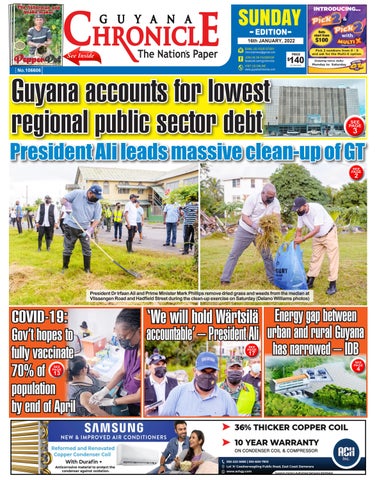
Guyana accounts for lowest regional public sector debt
SEE PAGE
3
President Ali leads massive clean-up of GT SEE PAGE
2
President Dr Irfaan Ali and Prime Minister Mark Phillips remove dried grass and weeds from the median at Vlissengen Road and Hadfield Street during the clean-up exercise on Saturday (Delano Williams photos)
COVID-19: Gov’t hopes to fully vaccinate 70% of population by end of April SEE PAGE
13
‘We will hold Wärtsilä Energy gap between accountable’ – President Ali urban and rural Guyana SEE PAGE
17
has narrowed – IDB
SEE PAGE
4
2
SUNDAY CHRONICLE, January 16, 2022
More cameras, cops to tackle illegal dumping of garbage
- President Ali announces as he leads massive clean up of city - clean-up to be done monthly By Jared Liddell
Volunteers from the Guyana Defence Force playing their part to remove garbage dumped at the Parliament Square at High and Hadfield Streets, Georgetown (Delano Williams photo)
IN an effort to restore Georgetown to its former glory, President Dr Irfaan Ali, on Saturday, led a massive clean-up exercise during which he an-
nounced plans to install security cameras coupled with increased police presence at several known unauthorised dump sites across the city to prevent the illegal disposal of garbage. The two-day city-wide clean-up exercise will target some 25 unauthorized dumpsites in 13 communities around Georgetown. The government has been rolling out strategic plans to restore and improve the appearance of Georgetown, which was previously known as the “Garden City,” a description of its beauty. Several pieces of architecture, preserving the history of the past, including the St. George’s Cathedral, the 1763 monument, and The National Gallery of Art, Castellani House, complimented by the kaleidoscope of local flora, make the Garden City a beauty to behold. Throughout the years, the dumping of garbage has been, and continues to be, a major issue across the capital city, shrouding the beauty of the country’s history and development, even as the government continues to invent ingenious ways to mitigate the issue. President Ali, speaking
on Saturday, stated that the act of dumping garbage in undesignated dumping sites across the capital city is unpatriotic and anti-national. The Head of State was adamant that it shows blatant disregard for the people of Guyana and the country at large. He noted that, with the implementation of the new security systems, the government will take the necessary actions to address persons who have shown a blatant disregard for the laws of the land. “They have no regard for the environment. They have no regard for you, for each one of us that lives in this country because it becomes a public health issue. And it’s time we start calling people out. “So, whilst police will be out here, the government is working on the cameras to be installed at specific locations. It’s because some of it is deliberate action also. So, we’ll be working on cameras to get these persons who continue to deface our country,” President Ali stated. According to the President, the exercise on Saturday was more than just cosmetic. He noted that the government is cognizant of the many health issues as well as the potential TURN TO PAGE 3
3
SUNDAY CHRONICLE, January 16, 2022
Guyana accounts for lowest regional public sector debt
- according to ECLAC report By Navendra Seoraj
AS was the case in countries the world over, Guyana’s economy was significantly impacted by the direct and indirect effects of the COVID-19 pandemic, prompting local authorities to increase spending in order to satisfy new and existing welfare needs while also sustaining the routine operations of the nation. To offset a fiscal deficit, it is natural for governments to take loans in various forms, and it was no different in Guyana, where, within just a year, there were two budgets, Budget 2020, deemed to be an emergency provision, and Budget 2021, which amounted to $329.5 billion and $383.1 billion, respectively. Even so, Guyana was able to maintain a positive standing in the area of debt management, recording the lowest gross public sector debt in the Caribbean. Public sector debt is defined as the total amount of debt owed by a government to its lenders.
According to the United Nations Economic Commission for Latin America and the Caribbean (ECLAC), in its latest report titled, “Preliminary Overview of the Economies of Latin America and the Caribbean 2021,” Guyana’s gross public sector debt represents 36.6 per cent of the country’s Gross Domestic Product (GDP). This, the commission reported, is 11 percentage points lower than what was recorded at the end of 2020. With this, Guyana stood out among its Caribbean counterparts, given that the regional average debt level was 90.3 per cent of GDP. Based on information from ECLAC, Barbados recorded the highest level of debt, at 145.6 per cent of GDP, followed by Suriname at 121.8 per cent, Belize at 120.3 per cent and Dominica, 100.4 per cent of GDP. Guyana, at the end of the first half of 2021, had reported that the financial system reflected monetary and financial stability, with moderate level of credit growth as well as a
FROM PAGE 2 environmental risks that could arise from same. “What you’re seeing here is just the tip of the iceberg. In our assessment, we have 25 sites like this, some of them in far worse conditions that we have to clear this weekend. We have hundreds of trucks, that were volunteered, heavy equipment that was lent, and this is not just going to be a oneoff exercise,” the President stated. NOT ONE-OFF The plan, according to President Ali, is to have similar exercises conducted monthly throughout the year as part of the government’s plan to beautify Georgetown. He stated that he intends to, at the level of cabinet, carve out two-hour slots once a month with the assistance of government ministers and officials to undertake similar exercises. “I’m hoping that from the level of cabinet, we can lead an effort once every month, and all of us can set
aside two hours. Once every month nationally we all set aside two hours of our time and we come out and clean.” NDC, M&CC INVOLVEMENT The President noted that even as the government continues to engage with its private sector partners, he expects to see the initiative grow with the involvement of the Mayor and City Council (M&CC) and the Neighbourhood Democratic Councils (NDCs); both bodies have direct responsibility for the upkeep and beautification of the capital city. “We want to build a mechanism into the structure, so that’s why I’m proposing that the initiative be once per month. And we also have the mayor and city council and the NCDs who have a responsibility and will continue to play their part. This is a demonstration that we can do it and were going to put infrastructure in place to ensure that,” said President Ali. Meanwhile, Prime Min-
The Caribbean’s central government gross public debt well-capitalised and profitable banking, insurance and pension industry. The country, according to the Ministry of Finance’s website, is being guided by the Public Debt Policy 2021-2024. According to the policy, the graduation of Guyana’s economy from lower middleincome to upper middle-income status has occasioned a decline in access to the concessional financing. “This has necessitated a heightened focus on effective
debt management in order to ensure the financing of Guyana’s development initiatives in a manner which simultaneously ensures long term sustainability. The policy covers all external and domestic public and publicly guaranteed debt, from 2021-2024,” the document stated. Guyana’s primary debt management objective, based on the policy, is to ensure that the country’s financing needs, and its payment obligations are met at the lowest possible
cost over the medium and long terms, consistent with a prudent degree of risk. “Prudent risk management is integral to the cultivation of a stable macroeconomic outlook, as well as the avoidance of sharp increases in funding costs and dangerous debt structures and strategies (including monetary financing of the government’s debt). “Furthermore, Guyana’s debt objectives shall be aligned with the need to cover its funding gap and the goal of
long-term debt sustainability,” the document related. RESILIENT ECONOMY Owing to prudent management of the economy by the government, the country remained resilient against internal and external shocks in 2021, recording GDP growth of 18.5 per cent, according to ECLAC. According to the report, the Latin America and Caribbean Region will see its pace of growth decelerate in 2022 TURN TO PAGE 4
More cameras, cops to tackle illegal dumping of... ister Brigadier (Ret’d) Mark Phillips described the over 1,000 volunteers as ‘patriots’, stating that their dedication to taking on the early morning challenge shows their love for the country. The volunteers included members of the joint services, private sector business owners, members of the Diplomatic Corps, and representatives from civil society. The Prime Minister stated that the joint services in particular are going beyond the call of duty to have the exercise conducted efficiently and effectively. “The joint services are
expected to contribute to the development of Guyana, what you call it economic development, any aspect of development and keeping the environment clean and helping the municipality and the central government clean up the environment is part of development,” the Prime Minister said. The initiative, Prime Minister Phillips said, comes as Guyana continues to implement systems to control the spread of the COVID-19 virus. He noted that the government is paying a keen focus on health not just to guard against COVID-19
but also with a greater focus on environmental health and the safe and sanitary disposal of waste in Georgetown. “Georgetown needs this now, some may argue that we needed it earlier but better late than never; this is an activity that will not only clean up Georgetown and make the place better but it is more linked to environmental health especially at a time when we are battling with COVID, and this is a
necessary operation.” According to the Prime Minister, the initiative will not just seek to improve the physical appearance of the capital city but will also aid significantly with drainage and irrigation in Georgetown. He explained that, in addition to removing debris from the dumpsites, the drains will also be cleaned and weeded to facilitate maximum drainage capabilities.
4
SUNDAY CHRONICLE, January 16, 2022
Energy gap between urban and rural Guyana has narrowed - IDB
OVER the past couple of years, the gap relating to energy coverage between the urban and rural areas of Guyana has notably narrowed, according to the latest Caribbean Quarterly Economic Bulletin prepared by the InterAmerican Development Bank (IDB). The report, which focused on Digital Infrastructure and Development in the Caribbean, indicates that improved access to energy across Guyana has increased to as much as 92 per cent, and although the institution has duly recognised these
developments, it went further to point out some areas that require further attention. One such concern for the IDB is “the widespread use of generators to supplement transmission, and reliance on heavy fuels for power generation represents a significant cost to the economy.” Fortunately, the IDB’s recommendations fall perfectly in line with plans already instituted by the People’s Progressive Party/ Civic (PPP/C) government, more significantly, the intention of the Dr. Irfaan Ali-led administration to implement
January 12, 2022
B
9 10 14 18 23 28 19 January 15, 2022
L 6
7
11 15 22 26 21
a comprehensive energy mix, using solar, wind, hydropower and natural gas in order to achieve the ambitious 70 per cent use of renewable energy by 2030. The cornerstone of this initiative requires the construction and full operation of the Amaila Falls Hydropower (AFHP) Station in Region Eight (Potaro-Siparuni). China Railway Group
Limited has already been greenlighted to undertake the project, based on a BuildO w n - O p e r a t e - Tr a n s f e r (BOOT) model. The iconic project is expected to cost just under US$1 billion, and, once operational, will have the capacity to generate 165 megawatts of stable and reliable electricity for 11 solid months of the year, with the 12th month during the dry
season being earmarked for scheduled maintenance. Currently, the Guyana Power and Light Corporation (GPL) sells electricity to the nation at about US$0.33 per kilowatt per hour, and this is expected to be reduced by 25 per cent within the first year of the project; by 50 per cent after five years, and by a further 80 per cent by the end of its 20 years in operation.
As it aims to satisfy the power demands of the entire country by 2026, the government is also looking to establish a second hydropower plant, similar to that which is being constructed at the Amaila Falls. As outlined in the updated and expanded Low-Carbon Development Strategy (LCDS), the second facility, TURN TO PAGE 18
Guyana accounts for lowest... FROM PAGE 3
to 2.1 per cent after reaching 6.2 per cent, on average, last year. This slowdown, according to ECLAC, takes place in a context of significant asymmetries between developed, emerging and developing countries, with regard to the capacity to implement fiscal, social, monetary, and health and vaccination policies for a sustainable recovery from the crisis unleashed by the COVID-19 pandemic. The report shows that the region is facing a very complex 2022: uncertainty regarding the
pandemic’s ongoing evolution, a sharp deceleration in growth, continued low investment and productivity, and a slow recovery in employment. The region is also facing the persistence of the social effects prompted by the crisis, reduced fiscal space, increased inflationary pressures and financial imbalances. Guyana, however, is projected to withstand the impending challenges as a result of its burgeoning oil and gas sector and other lucrative productive sectors. The country, according to ECLAC, stands
to record GDP growth of 46 per cent by the end of this year. Responding to this latest projection, Senior Minister in the Office of the President with responsibility for Finance, Dr. Ashni Singh, said that this is a result of the work that the government has put into creating an investor friendly environment. “We are pleased to see the positive revision in the World Bank’s outlook for Guyana. This is good news, but we are not surprised. This is in fact to be expected given our government’s strong policy stance as it relates to economic growth, to investment, to job creation and income generation for the benefit of all Guyanese,” Dr. Singh said. He was reported as saying that the projection also reflects the continuous optimism in the Guyanese economy, not just by those of who are here in Guyana, but also by all those persons who
are following economic developments in Guyana, including the international investment community and international agencies involved in the task of monitoring economic developments. He recalled that when the People’s Progressive Party/Civic (PPP/C) was elected to office in August 2020, a lot of work had to be done to bring back investor confidence. This was done, firstly, by keeping the population safe while containing the adverse consequences of the COVID-19 pandemic on economic activity, and which was combined with the political situation at the time. He said there were several interventions aimed at stimulating economic activity, including injecting liquidity in the economy through the COVID-19 cash grant, reduction of taxes, and increased public expenditure in critical infrastructure projects.
12/01/22 - 1 6 8 16 23
12/01/22 -
1
3
1
12/01/22 -
3 9 9
12/01/22 - 1 2 3 5 11 14 15
13/01/22 - 5 11 15 20 23
13/01/22 -
3
2 4
13/01/22 -
8 1 7
13/01/22 - 2 3 9 10 11 12 15
14/01/22 - 5 8 11 25 26
14/01/22 -
3
5 5
14/01/22 -
6 0 0
14/01/22 - 2 4 6 12 13 15 19
15/01/22 - 4 13 17 18 22
15/01/22 -
7
1 3
15/01/22 -
7 1 2
15/01/22 - 1 3 5 6 11 12 20
5
SUNDAY CHRONICLE, January 16, 2022
The Hopetown Experiment: Expectations, Disappointments and Decline (Part II)
By Tota C. Mangar CHINESE missionary, O’ Tye Kim began his project of an exclusive Chinese settlement with a party of 25 Chinese immigrants. He commenced land clearing and the construction of huts. By the end of March 1865, the area had 70 settlers, and this was increased to 150, including 21 Chinese women, five months later. Governor Hincks was impressed with the progress, and he described the venture, “A most interesting experiment; I have formed very great expectations of a satisfactory result.” In October 1865, Sir James Hope, Vice-Admiral of the British Navy visited the colony, and, while here, he accompanied Governor Hincks to the settlement. It was in honour of such a distinguished visitor that the settlement was named Hopetown. By the end of December 1865, Hopetown had attracted 170 immigrants. O’ Tye Kim encouraged occupations of different kinds, including charcoal production, shingle manufacture, and poultry and pig rearing. A store was also opened to cater for village supplies. Over fifty acres of heavily timbered forest were cleared, and rice and cash crops were introduced. The settlers had to initially overcome difficulties, including excessive rainfall and a flooded creek. By the end of the year, Governor Hincks was describing Hopetown as an “acknowledged success”. Charcoal production quickly emerged as the most significant aspect of the settlement’s economy. By early 1866, Hopetown was averaging 1,700 barrels of charcoal
monthly. Instead of pit digging, as was traditionally employed by Portuguese and Creoles, the Chinese built clay ovens, with walls three to five feet in thickness. As a consequence, a better quality of charcoal was produced. Of added significance was the breaking of the Portuguese monopoly of the trade, especially in the populated towns of Georgetown and New Amsterdam, and the reduction of the charcoal price by about thirty per cent. It was this real threat that caused the Portuguese producers and traders to complain about the effects of Chinese competition. Within two years of its establishment, Hopetown had 40 charcoal ovens. O’ Tye Kim’s original plan of establishing a settlement to primarily spread Christianity was overshadowed by the pursuit of economic prosperity. While the population continued to increase, less than half were Christians. Even so, O’ Tye Kim’s missionary role received official recognition from the local clergy. In August 1866, the Court of Policy approved a salary of 200 pounds per annum, in addition to 100 pounds as travelling expenses for him. This was seemingly a clear testimony of the high esteem in which the missionary was held. In any event, he had laid the foundation for the subsequent large-scale conversion of Chinese immigrants in the colony. When everything at Hopetown seemed to be progressing satisfactorily, the missionary and architect of Hopetown was involved in a scandal that shocked his acquaintances, including the Governor and other leading officials in the colony. The first hint of controversy surfaced in February 1866, when
Historian, Tota Mangar Revenue Officer, T.G. Wright reported that complaints were made by Chinese settlers that O’ Tye Kim was demanding a quarter of all charcoal production from them, and he was surcharging settlers four cents per barrel for transportation of the charcoal. Official Tubman also revealed that based on his investigation, no proper accounts were being kept in relation to charcoal production and its corresponding sale to Chinese shops in Georgetown and other areas. Further, it was disclosed that the missionary was renting out lands on the banks of the Kamuni Creek, and he was not issuing receipts for the rents collected. Wright, for his part, recommended an investigation into the operation of the entire settlement, and O’ Tye Kim’s role in its fiscal management. The investigation was very slow in getting off the ground, since Governor Hincks was by this time embroiled in a bitter controversy with both his Chief Justice, Charles Beumont, and his Immigration Agent-General, James Crosby. As if there was no end to O’ Tye Kim’s problems, charges of immorality were also leveled against him. He was accused of having an intimate relationship with a coloured woman, who was by then pregnant. The latter charge shocked church of-
ficials. Publicly disgraced, O’ Tye Kim was so embarrassed, that he made a secret departure from the very settlement he previously founded. With the help of three settlers, he left, by boat, for the Essequibo Coast and Moruka, and then through the Orinoco to Trinidad. Police were sent on his trail, but found no trace of him. A public inquiry was subsequently ordered into the alleged financial mismanagement of Hopetown under O’ Tye Kim. The investigation was hampered by the lack of tangible evidence, due to nonexistent records keeping, and the non-issuance of receipts. Moreover, settlers themselves were reluctant to come forward with evidence. The public scandal along with the sudden departure of O’ Tye Kim placed a damper on the experiment of an exclusive Chinese settlement. As so often happens in history, other problems increasingly surfaced. There was the exhaustion of wood supplies for charcoal production in the immediate environment. Settlers were frustrated at not receiving titles to land despite numerous assurances. The settlement continued to suffer from periodic flooding due to excessive
rainfall, and the overflow of creek water. Birds and wild animals created havoc among cash crops. Rice suffered from a lack of drying facilities, and transportation and communication networks were poor. Governor Hincks, who was initially impressed with O’ Tye Kim’s missionary zeal and ability, ended up being a very disappointed administrator. The Board of Trustees was grossly incompetent and ineffective. It neglected the settlement, and it left administrative matters solely in the hands of the missionary. Following the end of Hincks’ tenure in office, Hopetown went into a slow and continuous decline. CONCLUSION The founding of the settlement of Hopetown could be regarded as an important landmark in the history of the Chinese in Guyana. It was born out of the missionary zeal and concern for the moral and spiritual upliftment of Chinese immigrants by O’ Tye Kim, with full support from Governor Hincks. As a surveyor himself, O’ Tye Kim ought to have recognised the likely difficulties to be posed by such a site development. The Board of Trustees, for its part, shirked its responsibilities, and, in-
stead, allowed the missionary the luxury of administrative and fiscal management; expertise that was sadly lacking in this individual. In the end, scandal and controversy engulfed the settlement and O’ Tye Kim. Hopetown, which initially flourished, could no longer answer to its name, and settlers were forced to leave for urban and coastal centres where they pursued other business avenues. Despite its eventual failure, the Hopetown Experiment aided succeeding administrators in formulating policies relating to immigrant village development. A mere decade-and-a-half later, an innovative village development scheme on the Essequibo Coast was promoted in the form of the Huist D’ieren Experiment, which paved the way for the emergence of several predominately East Indian coastal villages before the turn of the century. Hopetown could also be seen as a pioneering attempt at establishing riverine or interior settlements in the face of a dominant coastal sugar industry, monoculture and considerable planter-class economic, social and political power.
6
SUNDAY CHRONICLE, January 16, 2022
Operation Clean-Up THERE is nothing more pleasing to the eye than a clean and well-organised environment. Georgetown, once described as the ‘Garden City,’ was allowed to deteriorate under the PNC-dominated City Council over the several decades to a point where the city became a ‘garbage city.’ For much of the post-independence period, the city wore a depressing look: clogged drains filled with litter and garbage; buildings in need of rehabilitation and re-painting; flooded streets and piles of garbage all over the place. The stench emanating from garbage build-up and stagnant drains was unbearable especially when it rains. Not even the iconic City Hall was spared the neglect. Yet, the beauty and magnificence of the city were never in doubt. Georgetown still remains one of the most beautiful cities in the Caribbean with its varied mix of colonial architecture, indicative of its former colonial status and heritage. The influence of European architecture is still very much in
evidence, which gives the city its unique and distinctive character. It is a lasting shame on the City Council and the PNC administration that the capital city of Georgetown and its beautiful architecture were allowed to run down to the state that it has currently found itself in. The blame rests squarely on the PNC-dominated Mayor and City Council, which, over the decades had mismanaged the affairs of the council to a point where it was unable to pay its wages and other bills, not to mention its ability to effect the barest minimum of rehabilitation works to the city’s infrastructure. It was not until the return of the PPP/C to office on October 5, 1992, that an effort was made to reverse the decline of the city by way of financial subventions and several other interventions in terms of road repairs, drainage and garbage disposal among others. The impact of these interventions were, however, not fully optimised due to an entrenched culture of mismanagement and extravagance by the council, which sadly continues until
this day. With the election to office of the PPP/C in March 2020, a renewed effort was made to bring back the city to its former glory. President Dr Mohamed Irfaan Ali, in his New Year message, announced that his administration intends to lead a national resurgence of sustained public cleanliness that promotes environmental health across the country and the restoration of national pride. In keeping with that commitment, several interventions were made to clean up and beautify the City of Georgetown, including the current ‘Operation Clean-up’ which commenced over the Christmas holidays and is now picking up momentum. The exercise is a collaborative effort between the Joint Services and the private sector with support from the Ministry of Works and the Ministry of Local Government and Regional Development. The campaign will result in heightened activities involving senior government officials across the wards of Georgetown. Technical and manpower support are being provided by the Guyana
Defence Force, the Guyana Police Force and other government agencies. The inter-agency collaboration with strong inputs from the private sector is exactly what the city needs at this time, given the advanced state of decay and neglect by the City Council. One would have thought that such an intervention would be embraced by the mayor with open arms, but from all indications there appears to be a sense of resentment by Mayor Ubraj Narine who reportedly called on citizens of Georgetown not to cooperate with the clean-up operation. In fact, the mayor has called for a ‘boycott’ of the city clean-up during a recent press conference hosted by PNC Leader Aubrey Norton. This is indeed mind-boggling. Why would the cashstrapped City Council object to such an exercise? Is it because of the stance taken by the Private Sector Commission (PSC) in the protection of the democratic rights of the Guyanese electorate in the last General and Regional Elections when attempts were made by the APNU+AFC Coalition to de-
rail the democratic process? Whatever the reason, it does send out some disturbing signals to the wider populace regarding the seriousness and commitment of the current Mayor and City Council to improve the image of the city and its environs. President Ali and his PPP/C administration must be given full credit for coming to the rescue of the city. The current restoration works on the City Hall, coupled with the several attempts to beautify the city, are manifestations of a President who cares for the aesthetics, health and well-being of the citizens of Georgetown. This is expected to be replicated in several other parts of the country and as the country becomes more financially consolidated, Guyanese can expect a much cleaner and environmentally friendly environment. In the case of Georgetown, even though the President has given full commitment to restoration works, the city and the welfare of its citizens, he made it clear that the PPP/C administration will not allow itself to be used as a ‘scapegoat’
for the failure of the City Council to do its work and to live up to its responsibility and mandate. ‘Let me be very clear, this government cares tremendously about our city, but we will not allow ourselves to be used as a scapegoat in the city not fulfilling its responsibility and mandate or in the city converting everything into political opportunism or a political football,’ the President said. President Ali had reiterated earlier that whilst the city is not fulfilling its responsibilities in maintenance of the environment and its infrastructure and the cleaning of drainage, central government has embarked on a massive programme to clean the city, to clean and maintain the roadways, establish roundabouts and maintain drainage systems. Citizens, it must be emphasised, also have a role to play in this regard. The call by President Ali for everyone throughout the length and breadth of the country to come on board cannot be more timely and relevant.
Guyana remains a leader in the ‘Green’ world Dear Editor, GUYANA has listed its Carbon Credits on the Architecture for REDD+ Transactions (ART) platform and stands to earn over USD300M and yet a ‘group’ calling itself Policy Forum Guyana (PFG) asserts that Guyana has “tattered credibility on climate issues.” A cursory examination of the release from this ‘group’ poses serious questions of its credibility, motives, and its very existence. The release dated 15th January, 2022, begins: “The Guyana Human Rights Association (GHRA) believes” but is on a PFG letterhead, but
the address is the same as the GHRA’s (56B Austin Place & Hadfield Sts). There is no signature on the PFG release to add to the confusion. We already know that the GHRA is the exclusive domain of Mike McCormack and Merle Mendonca and the fact that the GHRA and PFG also share the same phone number (227-4911) adds to the perception that the PFG is a shell for McCormack’s shill; who knows, maybe Merle answers the phone for PFG and Mike for the GHRA … To refute the arguments made by McCormack in the PFG/GHRA release is not a difficult task; Guy-
ana has listed 5.31 Gigatons (5,310,000,000,000 kg) of Carbon on ART, which is a voluntary international initiative that, among other things, serves as a global quality benchmark for forest emission reductions that can enter fungible carbon offset markets. Guyana’s recent listing of carbon credits was subject to rigorous scientific examination before listing; PFG/GHRA simply spout baseless assertions and seem to be grasping for relevance in a post-Granger world. Guyana remains a leader in the ‘Green’ world, our Low Carbon Development Strate-
gy (LCDS) is the ‘gold standard for global development and a read of the Das Gupta Review (2021) reveals how much Guyana has influenced the world’s thinking on the environment Guyana remains a leader in the global environmental arena despite its entry into the small group of oil-producing nations. The small group of naysayers in our midst who claim to be ‘environmentalists’ and would rather us not produce oil, sit in Georgetown with an abundance of electricity powered by diesel generators (GPL and private) and have no plan or clue on how
to improve the lives of the majority of Guyanese. There must be a special circle in hell for people who have theirs and want to pull up the ladder. The GHRA/PFG/McCormack’s views on the domestic policies of Brazilian President Bolsonaro are best addressed to the Brazilian people who enjoy the democratic right to choose their government without five-month delays and attempts to steal the elections as the Granger administration did in 2020. McCormack/PFG/GHRA was noticeably silent during that testing and
defining period in Guyana’s history. GHRA/PFG or whatever they choose to call themselves need to work on earning some credibility and on arriving at logical positions based on fact, not mere conjecture. Guyana’s status as an oil-producing nation does not automatically translate into her becoming an environmental rogue. The (updated) LCDS 2030 document is a worthy read for anyone wanting to make a meaningful contribution to Guyana’s environmental policies. Yours sincerely Robin Singh
7
SUNDAY CHRONICLE, January 16, 2022
Chronicles of a Chronic Guyana Chronicler Flying to Guyana on a Red Carpet, in a wheelchair Earl Bousquet
By Earl Bousquet WHEN I boarded the InterCaribbean Airline flight at Saint Lucia’s George F.L. Charles Airport for Guyana on December 17, I knew my stay would be different this time around – and looked forward to my umpteenth trip to my other Caribbean homeland. Flying in a wheelchair with red-carpets between aircraft and airports, my movements were limited, but I’d again been moved by my chronic attraction to the edifying theatre of Guyana politics, with its real-life partisan performances defiant of any written script or planned screenplay. It was my first visit since the oil boom transformed it from the ‘Mud Land’ that The
Mighty Chalkdust warned Caribbean leaders against referring to Guyana as in 1986, warning those poking fun at the value of its currency and lack of foreign exchange that “All you have is sea water and sand…’ His words came to pass -and those still alive are eating their words. Guyana dollars, still backed by gold, diamond , bauxite, sugar, rice and rum, is now backed by limitless oil, national earnings and expenses no longer calculated in millions, but billions… Guyana news today is also no longer only about political, cultural and social wars driven by race, religion and culture. Instead, headlines are about drilling and extraction,
reserves and revenues, new jobs and pay hikes, new Free Zones and IT hubs, 48 new investments approved and billions worth of new contracts signed in 2021, unprecedented infrastructural development, new construction projects, equitable opportunities in economic sectors, women’s empowerment, expanding commercial activity, housing for the homeless, land for to the landless, investments in social needs, poverty reduction and tax-free bonuses for Joint Services and frontline health workers. After two years in the extraction business, Guyana is now the fastest-growing economy in Latin America and the Caribbean, with the World Bank predicting a 43 per cent growth rate in
2022, the only country to score double-digit figures in CARICOM. By October 2021, Guyana had already earned US$400 million from oil exports and royalties – and with estimates earnings would triple in 2022. By the end of 2021, North American, Chinese and European oil interests, led by majors like Exxon, Hess and China’s CNOC, were digging-in deeper into and extracting more wealth from Guyana’s seemingly fathomless oil waters. The international companies have made discoveries worth 10 billion barrels of oil and gas, GDP growth is almost doubling expectations and the country is preparing to manage revenues projected at US $130 billion over the
next two decades. But Guyana’s changes haven’t yet dawned on the average Caribbean citizen, thanks still to geography and history over time and the artificial separations created by politics of race, religion and culture through centuries of colonial and decades of post-colonial manipulation, imperial influence and external intervention. Landing at the Cheddi Jagan International Airport (CJIA) was nothing like my first arrivals at the Timehri Airport of yesteryear. The inaugural InterCaribbean flight from Barbados that day [was] welcomed by Guyanese tourism, government and airline officials. As a chronic chronicler of Caribbean events
with permanent interest(s) in Guyana, I’ve always tried to show the world just how much it is (at the very same time) ‘very much the same as’ and ‘very different from’ CARICOM’s island-nations. My week there (December 17-23), between wheelchair and walking stick, didn’t disallow me from following the major political and economic, cultural and social developments in the new national dispensation -and how Guyanese are again looking up and thinking positively about the future. I learned much in those seven last days before Christmas 2021 that I’ll chronicle and share here, about what I saw and heard, there and everywhere.
A THREE-YEAR-OLD is among the five more persons who have died after contracting COVID-19, taking Guyana’s overall death toll to 1,086, the Ministry of Health has reported. The ministry said that the latest fatalities are a 61-yearold man from Region Three (Essequibo Islands – West Demerara) whose vaccination status is unknown and who died on January 15; a partially vaccinated 48-year-old man from Region Two (Pomeroon-Supenaam) who died on January 14; a 58-year-old man from Region Four (Demerara Mahaica) who died on January 09; a
fully vaccinated 74-year-old woman of Region Two who died on January 13 and the three-year-old from Region Four (Demerara Mahaica) who died on January 9. A d d i t i o n a l l y, t h e r e are currently 9,738 active COVID-19 cases in Guyana following the addition of 1,062 new cases within a 24-hour period. These newly confirmed cases were recorded in all 10 administrative regions. Region Four accounted for 619 of the new cases; Region One recorded 24 new cases; Region Two recorded 49 new cases; Region Three recorded 115 new cases; Region Five recorded 20 new
cases; Region Six recorded 49 new cases; Region Seven recorded 77 new cases; Region Eight recorded 17 new cases: Regions Nine and 10 recorded 74 and 21 cases, respectively. The country has now recorded a total of 50,121 confirmed cases since the first COVID-19 case was reported in March 2020. Of the active cases, 15 persons are at the COVID-19 Intensive Care Unit (ICU) at the National Infectious Diseases Hospital, Liliendaal; 170 are in institutional isolation; 9,548 are in home isolation, and five are in institutional quarantine. The updated COVID–19
Emergency Measures are in force until January 31, 2021. They may be extended or amended by notice of the Minister of Health, after an assessment of the prevailing public health conditions of the pandemic. As per the current measures, all persons are required to wear face masks when leaving their homes and physical distancing and adequate sanitisation are recommended. The current curfew is 12:00 hours to 04:00 hours. Persons with symptoms of COVID-19 are asked to call the COVID-19 hotline numbers: 231-1166; 226-7480; or 180/181 for assistance.
Three-year-old boy among five more ‘COVID’ deaths -over 1,000 new cases in 24 hours
8
SUNDAY CHRONICLE, January 16, 2022
Scenes of massive clean-up exercise in Georgetown A collaborative effort among the government, the private sector and the Joint Services, saw several communities in Georgetown being cleared of debris and garbage. The two-day exercise was led by Head of State President Dr Irfaan Ali. (Photos: Delano Williams)
9
SUNDAY CHRONICLE, January 16, 2022
SOME thought that David Granger was done with political and State power in Guyana. After all, the former military commander suffered a humiliating defeat at the 2020 polls when he lost the Presidency of Guyana. Before that, his government fell by the first no-confidence motion successfully passed in the National Assembly in December 2018. That aside, then suddenly came the shock-attack of the PNC leadership race. Granger would put this off out of fear surrounding COVID-19 until last year when his Executive could not wait any longer. He lost the leadership of PNC to Aubrey Norton. Granger, being fair, went missing in action since the polls and was on leave when the party Con-
gress was being planned and executed. He did not even contest the leadership but went off to Cuba, making him the first leader not to compete for re-election. Others believed the writing was written on the wall, and Granger graciously bowed out quietly and quickly. Now home, Granger had rest and time to think about his future. Granger is not finished with politics or power, it would appear. He is devising a plan at Pearl with his most trusted emissaries and confidants. The elderly Historian turned politician never indicated that he is out of the race for the Presidency. He just disappeared to reassess the political climate and handle some business. A n d t h a t ’s w h y h e would not give up his stranglehold on the PNCR/ APNU+AFC Opposition
Granger’s Rebound Plan
Leader post and the leader of the list that declares who sits in the opposition benches in the National Assembly. Make no mistake about it, Joseph Harmon was just a placeholder and a pond in this military game that Granger is playing. Harmon was placed as the fall guy, and to allegedly do and say all the things Granger would not say in public but meant. Harmon tightly is locked within a battle for the Opposition Leader post that inevitably leads to Presidential Candidacy in the opposition. He does not have what it takes to lead! He will give way to the return of David Granger because he wants to be the candidate regardless in 2025. Not Norton, not Harmon but Granger! This is why Granger chose the representatives of the opposition AP-
NU+AFC Coalition so secretly and without much involvement of PNC. This political move explains why no senior member of the PNC was returned to the Parliament. Also, the sudden pullback of Volda Lawrence and Basil Williams from the PNC leadership contest is suspect at this point. Maybe they are in on the military plot to cause the coup d’etat of opposition in Parliament and cause an upset to Norton at the next leadership elections that are due before the general polls. The move by Granger, additionally, to cause the APNU+AFC Coalition to remain steadfast with their appeal of the elections ruling to the results is now making sense. This makes more sense now that Granger’s indirect actions caused the Working People Alliance Party and Justice For All party to go their separate ways and newer parties to be formed, such as the one by former Public Service Minister and parliamentarian, Tabitha Sarobo-Halley.
Granger is exercising control with his paper Coalition of the PNC, parliamentarians, and the Opposition Leader. He wants to become President again without doing the work except for strategising the assault on government while it is distracted by the opposition leadership contest. History is replete with examples of ex-military commanders who have been strategists and rose again to claim power in countries like Guyana with similar characteristics, demographics, and now the lure of oil and gas wealth. How else can you make sense of Granger’s posture throughout this election and post-2020? How else can you rationalise his fractured relationship with the PNC and the older men and women of the party? Why was Harmon placed to embarrass himself before all of Guyana as Opposition Leader? Something is amiss and does not seem right about the duel of the APNU+AFC Coalition and the PNC. Something about Norton’s leadership race
and Geeta Chand-Edmond is not making total sense. This elections petition case is not making any sense, yet it is moving fast in the court system. Before next week is out, we will hear from Harmon again about his resignation. But, we are still not going to hear from Granger. Why? Are his silence and secrecy a trap for the PPP to not focus their propaganda machine and the media at his direction? His losing the Presidency and the party leader post has not phased him; Granger may be on the rebound the next time. But the PPP is ready if Granger slides his way back to the centre of politics. The PPP is not taking any chances and is looking on curiously as the game plays out. The party is certain it has the people on its side, and this time it understands the mood of the people that is why it is delivering at lightning speed on its promises made to the electorate. Let the twists and turns begin…
10
SUNDAY CHRONICLE, January 16, 2022
Brazil and Guyana to discuss growing partnership
LAST week, President Irfaan Ali and his Brazilian counterpart, President Jair Bolsonaro announced that they would hold a meeting later this month to discuss bilateral relations. While the two countries
enjoy a partial-scope agreement already, the leaders hope to widen this arrangement with further negotiations. Naturally, oil and gas will be at the top of the agenda at the upcoming meeting, but both coun-
tries have much to gain from this opportunity. The two heads of state will meet in person at the end of January as part of a larger regional summit that President Ali said would serve as “an excellent platform
to develop an integrated project” that will benefit both countries in the long-term. The timing is excellent for Guyana. Two new offshore oil discoveries in December added to more than 20
others that have already made Guyana into South America’s hottest energy frontier. Production is predicted to reach one million barrels of oil equivalent (BOE) per day by the end of the decade, with reserves at 10 billion barrels and growing. But despite this quick growth and many positive indicators for a successful future, Guyana still has much to plan for and learn. Better integration with more seasoned neighbours like Brazil could go a long way towards helping Guyana increase its own capacity. Brazil is the largest oil producer in South America, boasting the second largest reserves after Venezuela, with commercial production beginning on a large scale in the late 1960s. Over the last few decades, Brazil has started to focus more on deepwater production like Guyana’s. Since the country opened up its oil sector to private investment in the late 1990s, Brazil has become a global leader in deepwater offshore production, and the largest market for FPSOs (floating production, storage and offloading vessels) by far. The country has more than 16 billion barrels of oil reserves, largely offshore in areas like the prolific Santos Basin. The size of Brazil’s offshore resources continues to grow, and national oil company, Petrobras, plans to install at least 13 more FPSOs by the end of 2025. While a strategic partnership with Brazil could prove vital to future energy development, paying attention to lessons learned will also be important for Guyana as it continues to develop and grow its own sector. Brazil has been hugely successful with its energy sector, but the country has also faced setbacks
due to corruption, and has struggled with overly strict local-content rules, despite the country’s size and industrial power. In fact, the country had to revise its own local-content policy twice, due to delayed development issues; something Guyana will want to avoid as its sector expands. Guyana is already faring well in these two areas, but is rightly working to avoid any issues in the future. The government has already finalised its own local-content policy, smartly incorporating input from the public and international experts to help avoid the mistakes that other countries have made with overly strict targets that derailed development at a crucial time. Brazil may also have lessons to offer about the risks and benefits of a national oil company, and the corruption issues that can sometimes come with it. Many of the regulatory measures that have been put in place since the Car Wash scandal in 2014 that focused on Petrobras may prove valuable for Guyana as it explores its own options. Collaboration between Brazil and Guyana could be highly valuable, both in opportunities for the future, as well as lessons learned from the past. President Ali is actively promoting regional partnerships like this as a priority, now that Guyana is a rising regional oil power. It will be crucial that the government continues to build connections and create more robust regional networks for energy trade and development. The government is already doing well to ensure that possible pitfalls to development are avoided, but continued efforts to learn from more experienced neighbours will be helpful long-term.
11
SUNDAY CHRONICLE, January 16, 2022
By hook or crook
THE attempt by Opposition APNU+AFC Members of Parliament to steal the Speaker’s Mace to derail the passage of the Natural Resource Fund (NRF) Bill some three weeks ago has not only raised questions, but answered them regarding the true intention of the Opposition, moving forward. Contrary to what the
Opposition would like us to believe, in that its actions were against PPP unilateralism, the attempt to steal the Mace revealed a sordid spectacle of shame, and an attack on the sanctity of parliamentary procedures by individuals from whom we expect better. Unfortunately, we have been misled again.
One would have expected that the painful drama the nation endured in 2020 in the failed attempts of electoral rigging would have liberated the Opposition, paving the way for it to desist from vapid sloganeering and embrace the restructuring of its polity in tandem with integrity and responsibility. A missed opportunity. Without a commitment
to sound leadership supported by actions, the Opposition will find itself trapped in self-inflicted injustice and marginalisation impregnated with feelings of explosion. This is exactly what happened in Parliament. A lack of confidence, coupled with an absence of sound arguments regarding the Bill beclouded the Opposition, leading it to settle and cite “the thieving” of Guyana’s natural resources. Concomitantly, the Opposition should have unbridled opportunities to
challenge whatever Bill is brought to fore, but the approach and execution of doing so should not be anchored on the tidings of self-ambitions, the shocking disposition of theft, and the odious expectation of nolle prosequie. In such an environment, the dividend of democracy is denied. Why should such folly continue? Our future leaders are paying attention. The intransigence of the Opposition in one of the most respected places in politics has revealed insensitivity, incapabil-
ity, and, above all, the gradual departure from vexatious ramblings to the application of unsavory physical actions, suggesting that the street politics of intimidation, which the Opposition has failed to mobilise, is now in Parliament to roost. Equally disturbing is that many individuals, home and abroad, have openly identified with the aforesaid, calling for the destabilisation of Guyana. SEE PAGE 12
By hook or ...
12
FROM PAGE 11
This is not progressive thinking, and while the majority is not in line with such warped thinking, destabilisation is always damaging and dangerous to the health of a nation. We do hope we do not decline and degenerate into a state of chaos, especially when the country is poised to be the richest in the region, because of revenues emerging from the oil-andgas industry. This would be the height of madness, amid multinational corporations laughing and waltzing to the bank. Have you seen these individuals in the multinational corporations fighting among
themselves as we do? We are like crabs in the same barrel. When one tries to get out, the other pulls him back in. We are good at recycling our problems, and, for this reason, we have remained at the starting blocks. Speaking of issues, the Opposition has been trapped in the same political consciousnesses, and while some elements of this have been progressive, it should be reminded that it cannot continue to do the same thing as done before, and expect a different result. A school child is aware of this basic principle of life. The Coalition was in power for five years,
and it continues to do the same thing in the opposition, and the explanation for this behaviour is that leadership is not grounded in self-sacrificing but self-wanting desires. The Rule of Law is consistently violated, and fundamental values and principles in which a progressive, peaceful, and prosperous party, and by extension, a nation is built and functioned is minuscule, rendering its supporters to their own devices. They have been abandoned, while the Opposition has been trending a gang of tired and recycled politicians. The outcome is a lot of motions, but no movements of progression,
SUNDAY CHRONICLE, January 16, 2022
facetiously referred to as Christmas blow-blow. One sure sign of weakness is when political parties disregard the basic principles of leadership, especially when challenged. The sustenance of good governance is premised on the obligation of politicians to behave in a responsible and professional manner. The playing of ostrich is not an option. In the case of the Opposition, the sequence
seems to be that every month, someone comes out swinging in the most bizarre ways, evoking unnecessary tensions, and torpedoing gains of political and social unity. This is political rascality; there cannot be respect without responsibility. The concern is if politicians cannot be bound by respect, responsibility, and professionalism, on what basis do they have the right to compel the citizenry to
be law abiding? It is not sufficient for a party to claim being wronged by a Bill, and act according to its own perceived agenda. This would be an affront to, and a violation of, parliamentary procedures and principles in which the violators can potentially be brought to book. A political party alive with the duty of responsibility will not descend into hooliganism. (lomarsh. roopnarine@jsums.edu).
13
SUNDAY CHRONICLE, January 16, 2022
COVID-19: Gov’t hopes to fully vaccinate 70% of population by end of April - Dr Ramsammy
By Richard Bhainie AS the Government of Guyana continues to push for citizens to be vaccinated against the deadly COVID-19 virus, they have set a target for 70 per cent of the country to be fully inoculated by the end of April 2022. This was disclosed by adviser to the Minister of Health Dr Leslie Ramsammy, during a vaccination event organised by the Attorney General and Minister of Legal Affairs, Anil Nandlall, S.C., on Saturday, at Annandale, East Coast Demerara. “I am hoping that by the end of March that 60 per cent of the Guyanese population are fully vaccinated. Our target is that 70 per cent of our population by the end of April are fully vaccinated,” Dr Ramsammy said. Dr Ramsammy, who served as Guyana’s Health
Adviser to the Minister of Health Dr Leslie Ramsammy (left) and Attorney General Anil Nandlall with a resident who took a COVID-19 “jab” Minister for many years, was adamant that the government intends for Guyana to be one of the first countries to achieve the World Health Organization’s (WHO) target to fully vaccinate 40 per cent of the population by the end of 2021 and 70 per cent by mid-2022. “Some people say that’s an impossible target; I don’t think impossible should be in
the lexicon of our thinking. I think it is for our benefit that we can save lives, it is the option of everyone whether they want it or not, but I think it would be a reckless decision not to take it [the vaccine],” the former Health Minister said. According to the latest COVID-19 statistics as provided by the Minister of Health Dr Frank Anthony
during his COVID-19 update on Friday last, at the end of Thursday last 59.1 per cent of the adult population and 30.9 per cent of the adolescent population have been fully inoculated against the disease. This represents 303,373 adults and 22,309 adolescents who have received both doses of a COVID-19 vaccine. A person is only fully vaccinated if they receive both doses of a vaccine. On the other hand, the Health Minister disclosed that 416,994 adults and 31,525 adolescents have received their first doses of one of the COVID-19 vaccines available in Guyana. This means 81.3 per cent of the country’s adult population and 43.2 per cent of its adolescent population have received their first shots of a COVID-19 “jab.” As Guyana continues to see a spike in the number of recorded COVID-19 cases, which is suspected to be due to the highly conta-
gious Omicron variant, the government has also been pushing for persons to take their ‘booster jab’ – the latest statistics show that 24,509 persons have done so. “We see the surge in COVID cases and I believe that surge has catalysed the new surge in vaccination and I’m glad that people are looking at the news, seeing the surge in COVID cases and have decided we can’t hesitate no more let’s go and take the vaccine,” Dr Ramsammy added. The Guyana Government has made available the AstraZeneca, Sputnik V, Sinopharm, Johnson & Johnson and Pfizer-BioNTech vaccines available for its citizens. With the exception of the Johnson and Johnson vaccine, for persons to be considered fully vaccinated with the available vaccines, namely, AstraZeneca, Sinopharm, Sputnik V and Pfizer, they must get both doses. Dr Ramsammy highlight-
ed that Guyana has enough vaccines for first doses, second doses and booster shots for children between the ages of five to 11, adolescents between the ages of 12 to 17 and all adults over the age of 18. “This is one of the handful of developing countries that actually have enough vaccines for all of the eligible population groups; which means from five years old to the oldest citizen in this country, we have enough vaccines,” he said. Nandlall, who represents the East Coast of Demerara in Parliament, collaborated with the Ministry of Health to host the vaccination drive at Annandale, due to the spike of COVID-19 infections after the Christmas season. “It is important that we continue these public engagements and we continue to encourage our citizens to take the vaccines and to take the booster shots and to make it as convenient as possible for them to have access to this type of medical care and medical facilities,” Nandlall said.
14
SUNDAY CHRONICLE, January 16, 2022
SUNDAY CHRONICLE, January 16, 2022
15
16
SUNDAY CHRONICLE, January 16, 2022
17
SUNDAY CHRONICLE, January 16, 2022
‘We will hold Wartsila accountable’ – President Ali says - AG reviewing contract following shutdown of power plant
By Jared Liddell FOLLOWING a massive disruption at the Guyana Power and Light’s (GPL) Garden of Eden Power Plant Friday night on the East Bank of Demerara, President, Dr. Irfaan Ali, on Saturday said that the government is reviewing the contract between the supplier of the plant’s generators, the Wartsila Corporation, to determine its liability for damages and repairs. The President reiterated the government’s mission of holding companies and contractors hired by the State
accountable for substandard work. “We are going to hold Wartsila accountable. Whether you’re an international contractor or regional contractor, or even a local contractor, I have made very clear, you will be held accountable for the work you do for this country. So, they [Wartsila] have to fix it and they have to get it up and running,” President Ali said. In November 2020, the government received its five new dual-fuel generating sets from Wartsila which cost a whopping US$41 million and boosted the power supply of the Demerara-Berbice Inter-
connected System (DBIS) by 46.5 Megawatts (MW). Late Friday afternoon, the Prime Minister, Brigadier (Ret’d) Mark Phillips, visited the power station and announced that operations at the facility will be temporarily halted as a result of technical challenges being experienced with the generators. On the advice of the technical officials, a decision was taken to shut down the generators over fears of a massive explosion after it was discovered that fuel made its way into the exhaust system. President Ali, on Saturday, announced that GPL and the Attorney-General,
Anil Nandlall, are both in the process of reviewing the terms of the contract with the company to determine the level of liability. “There must be a clause for damages. And I’ve asked him [the Attorney General) to examine this contract and to see whether there are penalties, penalties when you have shut down because you have an OEM [original equipment manufacturer] contract and there must be performance in-
President Dr. Irfaan Ali dicators,” President Ali said. An original equipment manufacturer agreement is used by a company that takes
components of products from one or more companies in order to build one product TURN TO PAGE 19
18
SUNDAY CHRONICLE, January 16, 2022
Energy gap between urban and rural Guyana...
FROM PAGE 4 which is still to be identified, is expected to be built over the next 20 years. The LCDS 2030 has indicated that of the 33 potential sites, many were assessed in the 70s and 80s, when environmental and social standards were lower. As a result, those assessments have to be updated, in keeping with the environmental and other commitments of today. It is anticipated that once the assessments are finalised, the new site will be identified, at least by 2025.
Once up and running, the second hydropower plant is projected to provide some 370 megawatts of electric capacity by 2035, and a further 150 megawatts of capacity by 2040. The average lifespan of a hydropower system, according to the LCDS, is 100 years. Over this period, replacement of the mechanical and electrical parts would be required, but those account for less than 30 per cent of the initial cost. In addition to the two giant hydropower plants, the government has already begun efforts to imple-
ment three smaller-scale plants: The construction of a 150-kilowatt initiative in Kato; the rehabilitation of the Moco-Moco hydropower site, which would increase capacity by up to 0.7 megawatts; and a new 1.5-megawatt hydropower plant in Kumu. “The Moco-Moco and Kumu hydropower projects will provide energy to [the] Lethem grid. It is expected that those two projects, in combination with an ongoing solar PV project, will provide the Lethem grid with 100 per cent renewable
energy in 2023,” the LCDS 2030 predicts. To further bridge the energy gap between rural and urban Guyana, the establishment of at least 33 smaller hydropower plants are being considered. There is also an extended agenda to establish a number of solar farms. As a matter of fact, the PPP/C government has already secured US$75 million in funding to establish solar farms in eight grids, with the intention of producing some 27.8 megawatts-peak (MWp) of solar power to the Demerara-
Berbice Interconnected System (DBIS). The farms are expected to be up and running by 2023, thereby paving the way for solar-generated power to replace 30 per cent of the electricity being supplied to areas along the Essequibo Coast, Linden, Bartica, Lethem, Mabaruma, Mahdia, Leguan and Wakenaam. F u r t h e r, a s G u y a n a continues to balance its oil wealth with its global climate change commitments, the government is engaging its partners on the establishment of a US$900 mil-
lion gas-to-shore project within the Wales Development Zone in Region Three (Essequibo Islands-West Demerara). This will see natural gases offshore Guyana being transported to an onshore plant, using massive stateof-the-art pipelines; said gases will then be treated and converted to power, and fed to a nearby power plant for consumption by the national grid. Plans are also afoot to construct additional wind turbines across the country.
19
SUNDAY CHRONICLE, January 16, 2022
‘We will hold Wartsila accountable...
FROM PAGE 17 which it then sells under its own brand and company name. The Head of State explained that clauses are expected to be included in the contract that would provide for continuous managing and maintenance operations, and to recognise any defect
with the devices. President Ali disclosed that one particular area of concern the AG will be looking into is the prescribed number of Wartsila human resource persons that should be present at the facility and for what period. He noted that on Friday, Wartsila agreed to imme-
diately dispatch a team of engineers to Guyana to correct the technical challenges. “They (Wartsila) have an Operation & Maintenance Agreements contract also to see whether you’re supposed to have X number of human resources capability on the ground. Because I saw they said they have to bring an
engineer. So, they have to inquire whether the contract would have provided for that engineer to be on the ground here and if it did why those persons were not here,” said President Ali. STILL UNDER WARRANTY According to a release from Prime Minster Phillips
on Friday, GPL’s Garden of Eden Power Station facility is still under warranty, and as a result, the contracted Finnish company would be liable for any expenses. The Prime Minister noted that at a meeting with the company, he expressed the government’s disappointment that the new plant
developed such significant problems at such an early stage after its commissioning in 2021. “As a government, we will ensure that this project is fixed and that Wartsila covers the cost since there is a warranty in place,” the Prime Minister said.
20
SUNDAY CHRONICLE, January 16, 2022
SUNDAY CHRONICLE, January 16, 2022
21
22
SUNDAY CHRONICLE, January 16, 2022
SUNDAY CHRONICLE, January 16, 2022
23
24
SUNDAY CHRONICLE January 16, 2022
Nigeria cruise to victory over Sudan (BBC) - Nigeria cruised to a 3-1 victory over Sudan at the Africa Cup of Nations and booked their spot in the last 16. Samuel Chukwueze set the ball rolling for the Super Eagles in the third minute from a Moses Simon pull-back. Nigeria doubled their lead on the stroke of half-time when the ball went in off Taiwo Awoniyi and Simon rolled in a third straight after the restart. Walieldin Khedr pulled a goal back for Sudan from the penalty spot after Ola Aina was penalised for a challenge. The Nigeria right-back was adjudged to have fouled Secretary Birds defender Mustafa Karshoum, pulling his shirt as a corner was swung in, following a video assistant referee review. Nigeria had won their Group D opener against Egypt 1-0, and the result against a side ranked 125th in the world was never in doubt after Villarreal forward Chukwueze slotted into the bottom left-hand corner from the centre of the box. The Nigeria Football Federation's decision to replace long-serving coach Gernot Rohr just four weeks before the tournament looks
Nigeria have won the Nations Cup three times, with their most recent triumph coming in 2013
to have paid off, as interim boss Augustine Eguavoen once again saw his side put in a largely dominant performance in Garoua. The second was a somewhat
freak goal, as a clearing header from Salaheldin Nemer cannoned in off Awoniyi, but the West Africans could have had further first-half goals as William Troost-Ekong had
an effort blocked and Joe Aribo hit the post. The Super Eagles, who are chasing a fourth Nations Cup triumph, know they will face a
third-placed side in the last 16 if they can top Group D, and they round off their group campaign against Guinea-Bissau on Wednesday (19:00 GMT).
Kohli steps down as Test captain (BBC) - Virat Kohli has stepped down as captain of India men's Test team.
The 33-year-old, who stopped leading India's limited-overs side last year, had
CRICKET QUIZ CORNER (Sunday January 16, 2022)
COMPLIMENTS OF CUMMINGS ELECTRICAL COMPANY LTD 83 Garnett Street, Campbellville, Georgetown (Tel: 225-6158)
led the Test side since 2015. He captained India in a record-breaking 68 Tests, winning 40 matches - the fourth-best record of any Test captain in history. "It's been seven years of hard work, toil and relent-
Answers to yesterday’s quiz: (1) Romario Shepherd (2) 9-0-50-3 Today’s Quiz: (1) Who was IRE most successful bowler in the recent first ODI versus the WI? (2) What were his bowling figures? Answers in tomorrow’s issue
South Africa Racing Tips Scottsville 08:10 hrs Vivid Jet 08:45 hrs All The Time 09:20 hrs Lucky Miss 09:55 hrs Tristful 10:35 hrs Mvulazana Irish Racing Tips Punchestown
less perseverance every day to take the team in the right direction," Kohli said on social media. "I've done the job with absolute honesty and left nothing out there. Everything has to come to a halt 08:15 hrs Dysart Dynamo 08:45 hrs Goven 09:15 hrs Supreme Jet 09:45 hrs Family Business 10:20 hrs Bob Olinger 10:50 hrs My Uncas 11:20 hrs Stealthy Tom English Racing Tips Kelso 09:05 hrs Pitempton Power 09:35 hrs FourtH Of July
at some stage and for me as Test captain of India, it's now." Kohli's announcement came a day after India's seven-wicket loss to South Africa in Cape Town, consigning the visitors to a 2-1 10:10 hrs Soft Risk 10:40 hrs Stainsby Girl 11:40 hrs Eveque Southwell 08:25 hrs La Hulotte 08:55 hrs Eternal Light 09:25 hrs Ducal Crown 10:00 hrs Social Contact 10:30 hrs Thaayer 11:00 hrs Devasboy 11:30 hrs Kiritimati Island 12:00 hrs Asadjumeirah
series defeat. He has played in 99 Tests in total, averaging 50.39 in the longer format, with 27 centuries. In 2021 Kohli led India to the final of the inaugural World Test Championship, losing to New Zealand in Southampton. "There have been many ups and also some downs along the journey, but never has there been a lack of effort or lack of belief," he added on Twitter. "I have always believed in giving my 120% in everything I do, and if I can't do that, I know it's not the right thing to do. "I have absolute clarity in my heart and I cannot be dishonest to my team."
25
SUNDAY CHRONICLE January 16, 2022
Cummins leads Aussie seamers as England crumble once more (ESPNCRICINFO) - Australia's seamers, led by Pat Cummins, ran rampant over England's flat-lining batting order to bundle the tourists out for just 188 on an eventful second day of the fifth and final Ashes Test. By the close, the hosts had extended their lead which was 115 runs after England's first innings - to 152, but Stuart Broad, Chris Woakes and Mark Wood had given the tourists some reason to hope, after claiming cheap top-order wickets as Australia finished on 3 for 37 in their second innings with Steve Smith unbeaten on 17 and nightwatchman Scott Boland on 3. Australia’s quicks managed to keep the pink ball talking for an extended period under the lights on a day when 17 wickets fell in Hobart. Cummins took 4 for 45 and Mitchell Starc 3 for 53 with No. 8 Woakes England's top-scorer with 36, followed by Joe Root's 34 and Sam Billings, whose 29 on debut was solid. Broad and Woakes took advantage of the conditions to reduce Australia to 2 for 5 in the fourth over, with David Warner making a pair after falling to his nemesis Broad for the 14th time in Tests thanks to a brilliant diving catch by Ollie Pope at point and Marnus Labuschagne strangled down the leg side off Woakes to give Billings his first Test catch. At the start of the day, Australia added 62 runs for the loss of four wickets with Alex Carey unable to convert his start of 24 and Nathan Lyon making a bright cameo worth 31 off just 27 balls, including three sixes off Wood, before he was last man out with the hosts first-innings total on 303. England's reply started in calamitous style when Rory Burns was run-out for a duck, called through by opening partner Zak Crawley for a single that was very risky at best and found short of his ground by a direct hit from Labuschagne in the covers. Debate raged over whether the run was on and whether Burns had done
Pat Cummins claimed a four-wicket haul as England subsided (Getty Images)
enough to make it home after a slight hesitation twothirds of the way down the pitch and failing to dive, but the outcome was beyond question. Crawley followed for 18 when he provided Cummins' first wicket, well caught by Travis Head leaping high at short leg, and England were two wickets down by the dinner break. From there it became an all-too-familiar tale for England's batters as they fell woefully short of the 300mark needed to challenge Australia and which has eluded them all series. Each time a partnership looked like forming, it was prised apart by Australia's bowlers. Joe Root and Dawid Malan put on 49 runs before both fell in quick succession during a passage of play which also claimed Ben Stokes, as England lost three wickets for seven runs in the space of 21 deliveries. Malan was fortunate, on 13, when Australia shunned a review after having a caught-behind appeal turned down off the bowling of Cameron Green, with replays suggesting an edge. But Malan was eventually out to a leg-side strangle off Cummins, who then trapped Root lbw, before Mitchell Starc had Stokes superbly caught by Lyon at point.
Pope fell, fishing unnecessarily outside off stump at a Boland delivery, to send an edge through to wick-
etkeeper Carey, leaving it to Billings and Woakes to construct England's second-highest stand of 42 for
the seventh wicket. Green accounted for Billings, caught by Boland at long leg, and Woakes finally fell to Starc, having survived two dropped catches in the slip cordon and initially being given not out when the Australian fielders believed he'd been caught down the leg side. The hosts reviewed and the DRS revealed the tiniest hot spot as the ball passed the bat and Woakes was gone after a valuable knock in the context of England's innings, as they quickly subsided to 188 all out. But England needed more from someone, anyone. It came from their seamers, with Broad and Woakes making early inroads before Wood snared the wicket of Usman Khawaja with a spicy bouncer which caught the glove as Khawaja took evasive action and sailed through to Billings. Ollie Robinson had
come in further down England's batting order than usual at No. 11, indicating that the back spasms which restricted him to bowling a solitary over across the last two sessions on Friday would keep him out of the attack during Australia's second innings. But he did come on late in the evening session to relieve Woakes and bowled four overs. Billings said after play that the ball had become soft and the seam had flattened out early in Australia's first innings, where Head starred with a century, by way of explaining England's struggles to get much from it after the first 20 overs or so on the opening day. While the contrasting bowling performances yesterday gave England something to aim for, their inability to make enough runs could well come back to bite them once more.
26
SUNDAY CHRONICLE January 16, 2022
CWI Selection Panel names squad to tour South Africa CRICKET West Indies (CWI) Women’s Selection Panel on Friday named an 18-member squad for the One Day International (ODI) series against South Africa Women at the Imperial Wanderers Stadium in Johannesburg from January 25 to February 7. The touring squad sees a return for Afy Fletcher, the experienced leg-spinner and right-handed batter, who returns from maternity leave. The squad also includes three uncapped players: Kaysia Schultz, a left-arm orthodox bowler; Mandy Mangru, a right-handed batter; and Jannillea Glasgow, a right-arm medium pacer. The three newcomers
were members of the West Indies Women’s A team which played against Pakistan Women’s A Team last year. Ann Browne-John, CWI’s Lead Selector for Women’s cricket, said: “The South Africa series comes at an opportune time as the team prepares for the upcoming World Cup. The squad has been preparing and building during the past year, even with the limitations caused by the pandemic and hopefully they can put it all together. The return of the experienced Afy Fletcher brings added variety to the bowling particularly with the absence of Qiana Joseph who has been ruled out due
to injury.” Browne-John added: “In our drive to continue the expansion of our player pool, the panel has included three young, uncapped players. They are K, Schultz, M, Mangru as well as teenager J, Glasgow. Exposure to international cricket at this time will most certainly give them the experience and match time needed to develop and improve their individual talents. The panel believes that this blend of youth and experience will work well as we continue our preparations for the World Cup.” West Indies Women are due to arrive in South Africa on January
16, where they will have a training camp ahead of the warm-up and four-match ODI series against Proteas Women. FULL SQUAD Stafanie Taylor (captain), Anisa Mohammed (Vice Captain), Aaliyah Alleyne, Shemaine Campbelle, Shamilia Connell, Deandra Dottin, Afy Fletcher, Cherry Ann Fraser, Jannillea Glasgow, Chinelle Henry, Kycia Knight, Mandy Mangru, Hayley Matthews, Chedean Nation, Karishma Ramharack, Kaysia Schultz, Shakera Selman, Rashada Williams, MATCH SCHEDULE (all
Hope hoping West Indies can find right formula today (CMC) – West Indies vice-captain Shai Hope says the team needs to find the right formula to cope with the double challenge of unfavourable wicket conditions and a penetrating Irish bowling attack, in today’s decider in the One-Day International (ODI) series against Ireland. West Indies won the first game of the three-match series by 24 runs but lost the second by five wickets, after losing the toss in both games and being sent in to bat. Hope, speaking at a press conference yesterday ahead of the match at Sabina Park, defended the batters’ performances, saying they were forced to play on a pitch that was not conducive to stroke play. “We all know that in the morning time (there) is a lot of moisture in the pitch…. It’s not easy for batters to flow in those types of surfaces,” he said. “…. I’m not saying that cricket has to be easy all the time, but it’s not a free-flowing wicket, especially in the morning at Sabina, so it’s just important for us as batters to adapt to that as fast as we can.” The wicketkeeper-batter said the conditions, coupled with the bowling from a team that he acknowledges is “not a walkover”, require the West Indies to find the right plan to come out on top. “Whether or not we win the toss we have to do whatever we do first, to the best of our ability, and the key is to make sure we do it even better
next game because we know it’s a series-decider and we have to get those 10 points,” he said. “… Whether it’s putting the bowlers under more pressure, whether it’s trying to run more singles in the middle period when we get out there and I think it’s important for us to maintain more wickets, especially in the middle so we can launch at the backend. “By the end of the innings, the wickets start to get a lot better so we probably just need to keep more wickets in hand and launch at the backend.” Hope did give kudos to some of the newcomers to the team – Romario Shepherd who hit his maiden ODI half-century in the second match, Shamarh Brooks and Odean Smith – saying they were delivering with the bat and he hoped to see them “continue in this stead and move from strength to strength”. The vice-captain declined to disclose whether there would be a change in the batting order for today’s match, saying it was very important for every batter to be prepared for whatever may be required of him. Asked specifically about whether consideration had been given to either moving Roston Chase or Brooks up the order to number three and Nicholas Pooran down at least one spot, he said: “Again, that’s something that I can’t necessarily disclose but obviously it’s an option. I think that as batters we all have to have an open mind and make sure that we’re always in a position to deliver whatever the team requires. “In a cricket game, especially in
a limited-overs game, you will need certain personnel to play a certain role for you in different situations, so I think it’s important for everyone to have a clear and open mind so that if the opportunity arises that someone has to shift up the order or take a few steps down then he is ready to do the task,” he added. Although today is a series-decider, Hope said both players and management had been approaching all the games seriously, with 10 points up for grabs in each match going towards the World Cup. “We have to play every single game hard because if you want to win there’s no trying and trying to see what’s gonna work. You have to make sure you have the formula for each game so that when we go out there the aim is to win every single game to get those points,” he insisted. On a personal note, the Barbadian said he was embracing the challenge of managing the roles of vice-captain-wicketkeeper and batter. “I still think the same things apply because I always share my input when it comes to seeing things or noticing anything on the field or even off the field. So it’s just important that I continue to do what I’m doing and not let too many outside interferences come into what we know as a team as well. “It’s important for me to continue learning on the job and making sure I can do my best for the team,” he said. Today’s match starts at 09:30hrs. local time (10:30hrs Eastern Caribbean).
matches at Imperial Wanderers Stadium, Johannesburg) Day matches start 10:00hrs local time (04:00hrs Eastern Caribbean/03:00hrs Jamaica) Day/night matches start 14:00hrs local time (08:00hrs Eastern Caribbean/07:00hrs Jamaica) Tuesday, January 25: warm-up match vs South Africa XI (day) Friday, January 28: 1st ODI (day/night) Monday, January 31: 2nd ODI (day) Thursday, February 3: 3rd ODI (day/night) Sunday, February 6: 4th ODI (day)
DCC congratulates Sir Clive Lloyd
Former cricketer Sir Clive Lloyd after he received a Knighthood in an Investiture Ceremony at Windsor Castle on January 12, 2022 in England (Photo Julian Simmonds - WPA Pool/Getty Images)
THE greatest cricketing legend to emerge from the Demerara Cricket Club (DCC) and the best captain West Indies ever had, Clive Hubert Lloyd, was knighted earlier this week. As a cricketer who fashioned his skills on the small Queenstown cricket ground and later as a batter to set many grounds alight, he has done the DCC proud. He is one of the legends in this Home of Legends His photographs adorn the walls of the club as do his records. Because of his exploits the club caused a section of the East Coast Demerara Highway to be named after Sir Clive. A huge billboard bearing the image of Sir Clive stands at the side of the roadway. DCC is extending congratulations to Sir Clive. The club feels justified in basking in this glorious moment thus sharing the occasion and the award with Sir Clive.
27
SUNDAY CHRONICLE January 16, 2022
Ostwal, Dhull destroy South Africa
INDIA battled to a hard-fought heavyweight triumph over South Africa as the ICC Under-19 Men’s Cricket World Cup entered full swing yesterday. The four-time champions edged a gripping clash against the 2014 winners as Yash Dhull and Vicky Ostwal starred to get their Caribbean campaign off to the perfect start. Yesterday’s standout fixture did not disappoint as Dhull and Ostwal outlined their ICC U19 Men’s CWC precocity with eye-catching displays at Providence. After South African left-arm seamer Aphiwe Mnyanda had caused mayhem with the new ball to reduce India to 11 for two, captain Dhull strode to the crease and showcased all the fighting spirit that has seen India crowned champions on four occasions since the turn of the century. Dynamic Dhull struck a measured 82 to steer his side towards a competitive total as Kaushal Tambe (35), Shaik Ra-
sheed (31) and Nishant Sindhu (27) also made important contributions. Mnyanda’s early menace was supplemented by fellow opening bowler Matthew Boast’s three for 40 as South Africa, ICC U19 Men’s CWC champions in 2014, dismissed India for 232 to leave the clash on a knife-edge at the interval. Rajvardhan Hangargekar set the tone in the second innings by dismissing Ethan-John Cunningham in the very first over but Dewald Brevis (65) and Valentine Kitime’s (25) half-century partnership kept the game in the balance. South African captain George Van Heerden made 36 in the middle order but fabulous figures of five for 28 from skilful left-arm spinner Ostwal ensured India continued to suffocate their opponents. Wickets tumbled at regular intervals as South Africa left themselves with too much to do, and India, the only nation to win the ICC U19 Men’s CWC four times, got their latest campaign off to a flyer in the Caribbean.
ICC Under-19 World Cup 2022
Cox punishes Uganda with classy century … Ireland cruise to 39-run win
JOSHUA Cox stroked a masterful century as the Irish made light work of Uganda, who suffered a 39-run loss when the ICC U19 World Cup continued yesterday. Everest for the second successive day was filled with all-round action thanks mainly to the wicketkeeper Cox who crafted 111 not out off 118 deliveries, with 8 fours and a six, highlighting the day's play. Ireland chalked up 239 for 9 when their 50 allotted overs had expired. David Vincent (24), Phillipus Le Roux (32) and Scott Macbeth (22) played good supporting roles to the centurion. Pascal Murungi, the Ugandan skipper played a captain's knock but in vain. He scored 63 with 4 fours and 2 maximums. Juma Miyaji launched a late lower-order assault, smashing 4 sixes in his 38 off 21-ball cameo but it was all in vain as the African side were kept to 197 all out in 48.1 overs. Left-arm spinner Mathew Humphreys
bagged 4 for 25 from his 10 overs with two of his teammates chipping in with 2 wickets apiece in what was a clinical bowling effort by Ireland. After the openers Vincent and Liam Doherty - the latter was removed for a duck - departed early; it was Cox who anchored the ship with calmness mixed with a bit of aggression. The right-hander picked off anything loose from the Ugandans who bowled decently with four of their bowlers returning 2 wickets each. However, the class of Cox proved too difficult for the bowlers and after racing to his fifty, the young keeper maintained his poise to much effect, eventually reaching his milestone and setting the tone for his teammates, while putting the competition on notice. The Irish gained 2 points for their win as the tournament continues tomorrow across the Caribbean. (Clifton Ross)
Vicky Ostwal of India leads his side off after taking five wickets following the ICC U19 Men's Cricket World Cup match between India and South Africa at Guyana National Stadium yesterday, in Guyana. (Photo by Ashley Allen-ICC/ICC via Getty Images)
28
P A2022 GE SUNDAY CHRONICLE January 16,
26
Hope hoping West Indies can find right formula today West Indies vice-captain Shai Hope
Ostwal, Dhull destroy 27 South Africa PAGE
Vicky Ostwal of India leads his side off after taking five wickets following the ICC U19 Men's Cricket World Cup match between India and South Africa at Guyana National Stadium yesterday, in Guyana. (Photo by Ashley Allen-ICC/ICC via Getty Images) Printed and Published by Guyana National Newspapers Limi ted, Lama Avenue, Bel Air Park, Georgetown. Telephone 2 2 6- 3243-9 (General); Editorial: 2 2 7- 5204, 2 2 7- 5216. Fax:2 2 7- 5208
ICC Under-19 World Cup 2022
Cox punishes Uganda with classy century … Ireland cruise to 39-run win
PAGE
27 Ireland's Joshua Cox celebrates his century at Everest yesterday SUNDAY, JANUARY 16, 2022