13
GUYANA CHRONICLE Monday, January 23, 2017
Bethanians turning more to farming there are not many issues affecting the settlement, since most young people are disciplined and do not waste away their lives.
Toshao Harold Manslow
WITH a slowdown in logging activities, some Bethany residents are beginning to shift their attention more to farming as a means to secure their livelihoods. This is according to toshao of the settlement, Harold Manslow, who said that the decline in logging is due to more villagers nowadays opting to go into the mining industry, where employment opportunities are more lucrative. He pointed out that with time, certain traditions change and young people today who remain in the village seem more interested in farming than logging. The village has an area of about 200 acres of land open for cultivation, but only about 30 per cent of it is cultivated. Toshao Manslow wants to widen the acreage of lands cultivated, but said a proper drainage and irrigation system will have to be
put in place. The Guyana Chronicle was told that in order to open up the land east of the settlement to more cultivation, a canal about a mile long will have to be dug. Some years ago, a canal of about a mile in length was excavated to open up the land to farming, but phase two of the project was never completed. Toshao Manslow told this publication that he would be grateful if the Government steps in and completes phase two of the project, which was abandoned for reasons unknown to him. He said the Village Council wants to extend plantain cultivation, since there is a ready market for the produce in some areas on the Essequibo Coast, Parika and Georgetown. And by virtue of the expansion, some young villagers will gain employment. According to Manslow,
WOMEN’S GROUP Next to him was a young single mother named Petra Brock-Richard, a member of the Bethany Women’s Group. Brock-Richard said the group, founded in the 1990s, currently has 20 members who engage mainly in sewing. They sew pillow cases and towels and when they have a certain quantity, they would organise a village sale. The young mother said the response has always been overwhelming. Unlike most of the other women, Brock-Richard also does
tailoring and sees it as a means of financial empowerment. Recently, villagers through self-help built a centre from money given through Government’s Presidential Grant to accommodate more women interested in sewing, but the centre is yet to open its doors. When it becomes operational, it will become a training ground for women of the village interested in learning the art of sewing. Brock-Richard said the goal is to get the centre up to capacity, so that it will be able to produce uniforms for every schoolchild in Bethany, bringing an end to their annual trip on the Essequibo Coast to get same. With a building at their
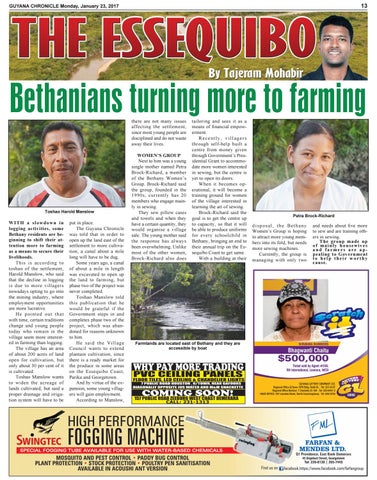
Farmlands are located east of Bethany and they are accessible by boat
Petra Brock-Richard
disposal, the Bethany Women’s Group is hoping to attract more young members into its fold, but needs more sewing machines. Currently, the group is managing with only two
and needs about five more to sew and are training others in sewing. The group made up of mainly housewives and farmers are appealing to Government to help their worthy cause.
Scenic Bethany
14
A modern community centre at Bethany, Essequibo Coast, Region Two
An area in the forest was cleared to create the Bethany Recreational Park
BETHANY is an Indigenous settlement, about 17 square kilometres in size and located approximately five miles up the Supenaam Creek from the Supenaam Stelling, Essequibo Coast, Region Two. A peaceful forested community, Bethany is home to some 462 residents, some 30 per cent of whom are below age 18. Residents depend on logging and farming to earn a living, and because of limited employment opportunities, many young people over the years have migrated from the village in search of greener pastures on the coastland. The date of establishment of the village is not clear, but it is believed that the village was born sometime in the 1880s,
when bands of nomadic Indigenous peoples from Mashabo, Tapacuma, and the Pomeroon began to settle there. The early villagers, village elders told the Guyana Chronicle, were looking for an area to carry on their forestry activities, hunt and plant when they stumbled upon Bethany. The settlement provided all that they were looking for: it was in the forest, part of it had fertile land, it was near the creek and as such provided them with an abundant supply of fish, and not too far in the creek was a Dutch sawmill. The early villagers played a part in providing the hydro-operated mill with logs and were rewarded through a system of barter. Today, the sawmill is
no longer in operation, but remnants of its existence in the form of dykes remain. From the inception, the sparsely populated settlement was a logging community, and it remains so even to this day. Elderly residents told the Guyana Chronicle that they are fond of the peaceful, scenic and simple life of the village as they invite others to visit the settlement. Bethany can be accessed from the speedboat stelling, located at the mouth of the Essequibo River. The journey to the settlement is about 15 minutes by speed- boat, and is one that includes traversing through narrow, meandering areas of the vast black fresh-water creek. At several points in the
GUYANA CHRONICLE Monday, January 23, 2017
The Bethany Primary and Nursery schools are housed in one building
The area in the creek where residents bathe
creek, there are springs gushing out cool water. There are also other areas that are so clear, that one can see at the bottom of the creek at a depth of six feet. This publication was taken to an area where residents bathe. The sandy area was surrounded by huge hardwood trees and the water from the creek was fresh as water right out of an artesian well. The bathing area of the creek looked like an ideal place for relaxation, and according to residents, it is a really nice place to “throwback,� never mind the anacondas that pass through, some of which are about 20 feet in length. For the elderly residents, the sight of big snakes seem to be a normal sight, but the story
was enough to cause this publication to hurry out of the area. Out of the creek, the vast area of land is dotted with beautiful small houses and trees ranging from coconut, to awara, to plantain. Bethany has a primary and nursery school, a modern community centre, a recreational park, a health centre, an airstrip, a medical missionary college and a Seventh-Day Adventist Church. Bethanians are friendly people and the majority appear to be staunch Seventh- day Adventists. They all live in peace and harmony among themselves. Those who are not into logging, cultivate bora, pak choi, eddo, yam, plantain and pumpkin, among other greens and vegetables. A portion of the pro-
duce is sold in the settlement, while the remainder is sold at markets at Suddie, Anna Regina and Charity. The settlement seems to have no major problem with the exception of a few cases of suicide, teenage pregnancy and drug and alcohol abuse. These aside, Bethanians are a happy people and have a very good sense of humour. When the Guyana Chronicle completed the tour of the settlement and interviews with residents, it was time for a group photograph and a group shot was requested. Within seconds, bottles of Banko wine, El Dorado rum and Ivanov Vodka with glasses and ice appeared. Residents there are a people of very cheerful spirit.
15
GUYANA CHRONICLE Monday, January 23, 2017
A remote college of healing SITTING on an area of about 60 acres, the Bethany Medical Missionary College is a regional evangelical school unknown to many. The school was established in 2015 and it teaches ways on how to use natural medicine and therapy to heal ailments, be it stroke, diabetes, hypertension or heart diseases. According to the school’s principal, Calvin Bollers, the institution founded less
than two years ago, provides healing through the use of natural medicine while propagating the gospel. Since the college began operations, it has opened its doors to students throughout Guyana, the Caribbean and South America, and according to Bollers, in the near future it will be seeking out students from the U.S., Europe, Asia and Africa. The campus, located in a hilly garden setting has dormitories for male and female
students, living quarters for visitors and tutors, a home for the principal, a cafeteria, a machine shop and a wellness centre. The wellness centre is not yet open, but is expected to be operational before year-end, Bollers told the Guyana Chronicle. The school is part of the Guyana Adventists Missionary and Services, Guyana Chapter, which is under the supervision of the Gospel
A dormitory on campus at the Bethany Medical Missionary College
Ministries International, Tennessee, USA. Currently, it has seven students, five of whom are from Guyana with the other two being from Trinidad and Tobago and St Vincent and the Grenadines. The students are instructed in a six-month programme which includes Bible studies and Bible doctrines; and First Aid, hydro-therapy, basic nursing, anatomy and physiology. Tuition at the college is provided free of cost, but students are required to fund their boarding and lodging. The Guyana Chronicle attempted to speak with students on the remote campus, but was unable to do so as they were in the classroom,in the middle of a lesson. Bollers said infrastructural work on the college is almost complete and it will be moving to become more self-sufficient in the coming years. The campus is using water harnessed from the springs in the creek, and has to use a pump to get water into the dormitories and oth-
Bethany Medical Missionary College Principal, Calvin Bollers
er buildings. The principal is looking to build a well and windmill to adequately serve the water and electricity needs of the campus and would be extending the auditorium of the instructional centre to cater for large functions. This aside, it will also be paying keener attention
to agricultural expansion to better serve the needs of residents on campus. The school, according to Bollers, is supported by the community and through gifts and donations from generous individuals and organisations. Just behind the campus is a small airstrip.
A masjid built by an African tribe By Mohamed Khan
THE Queenstown masjid was built in 1780 by several Fulani tribes of African descent who came from Senegambia. The Fulani families on arrival on a slave ship at Queenstown built a small masjid with thatched roof and walls made of wattle and mud. The floor was the earth. In those days, the Muslims and Christian slaves were prevented from practising their religions. Quite a few slaves were Muslims, while many others had their own tribal beliefs. Later, the Imaams were permitted in the masjid and were allowed to preach to the slaves on Fridays (Jummah naamaz). The Muslim slaves were brought by the British and Dutch to labour on the coffee, cotton and sugar plantations. Among them were the Fulani-Hausa tribe, traditionally the pastoral and nomadic cattle herders from West Africa, many of whom had settled on the three cotton and coffee plantations at Dageraad, West Tuid and Mocha. They were called “fullah man” because of their religion and their common language which they brought from West Africa
The Queenstown masjid, Essequibo Coast
and particularly those who came from the fula-speaking areas of Senegambia. By the time slavery was abolished in 1834, any presence of Islam among the slaves had long diminished. Nonetheless, up until the 21st century, a number of Africans from Queenstown Village still bore their Islamic names and have reverted to their original religion, Islam.
No doubt, they would have developed Islam as their religion, much coming to terms with the fate from West Africa and from their forefathers and overcome by a sense of frustration and futility from continuously testing the chains of slavery. They would have known of the life of responsibility for wife and children; knowing when it
was time to pray five times a day, time to sow and time to reap and when and how to hunt and fish and needing no master to so direct them. This masjid, which was built by the Fulani tribe is the oldest among four others which is Lima, Aurora, Maria’s Delight and Jacklow. Today, there are 17 mosques across the Esse-
quibo Coast and Pomeroon and each has its own Imam, Muezzin and reciters of the Koran. The Imaam of the Queenstown Masjid is brother Semple and he has a congregation of 50 brothers and sisters, who worship five times a day and every Friday at Jummah. The mosque is located next to the first African Christian slave tem-
ple on the last street of Queenstown near the burial ground. The name Queenstown is derived from Queen Elizabeth of England. This very masjid was rebuilt three times and the brothers and sisters of the Muslim community as well as other Imaams have kept the spirit of Islam alive.
16
Personality Profile
RONALD Ragoobeer, called “Sir Danny”, 42, is headmaster of Bethany Primary School, a post he has
been holding for the past two years. Ragoobeer, whose strength is teaching method-
ology, said on taking over the leadership of the school, two things became noticeable to him very early.
One, was that pupils there had great potential and two, the method used by teachers to deliver content was weak. The latter he quickly set about to change and was able achieve noteworthy success, as students’ pass rates in almost every class improved by at least 50 per cent. “Key in learning is the teacher’s method of delivery. The teacher must be engaging and must be able to stimulate students to think and guide them in problem-solving problems. Only then learning will be an enriching exercise,” he told the Guyana Chronicle. Ragoobeer, who holds a Bachelor’s Degree in Education from the University of Guyana and has been a teacher for some 26 years, said Bethany Primary School is moving forward, and he has urged teachers there to keep up the trend. A father of five children, the headmaster said he loves children and loves teaching, pointing out that while money is important, the profession is about molding minds.
GUYANA CHRONICLE Monday, January 23, 2017 Ragoobeer has taught ing, Headmaster Ragoobeer at many primary schools, spends time with his family including Mashabo and Ca- and writes drama, poetry and poey on the Essequibo Coast short stories. He is working on a novand St John’s and Marlborough in the Pomeroon River. el called “The Good Old When he is not teach- Days” and a Math book for Grade Five pupils.
Headmaster Ronald Ragoobeer
Always thinking ahead
-- Bethany Health Centre a model worthy of emulation
THE Bethany Health Centre is a model worthy of emulation by all health centres throughout Guyana, but especially in the hinterland regions, when it comes to ordering and storage of medicine. Even though the deep riverine centre is about 20 miles from the Suddie Hospital, it is perhaps the only health centre which is never out of drugs. Romona Thomas, a midwife who mans the centre, told the Guyana Chronicle that she has been a health worker in the settlement for the past 14 years and is familiar with the health symptoms of the village. “At certain times of the year, the place is very hot and at other times it is rainy. These conditions bring with them health issues, whether it may be a cold or fever. During these times, I order medicine to treat these illnesses and the excess amount, I store them, and I make sure they are never out of stock.
Only emergency cases I refer to the Suddie Hospital, which is the main hospital on the Essequibo Coast,” she told the Guyana Chronicle, pointing out that the simple remedy to deal with a shortage is to “think ahead.” This simple strategy has kept the villagers of Bethany in good health, and they have come to know Midwife Thomas as someone they can count on. Some of the common illnesses of the settlement include respiratory infections and diarrhoea, with very few cases of typhoid, hypertension and diabetes. “On occasion, I also treat injuries due to accidents, where someone falls off a tractor or was hit by a tractor or persons suffer injuries in a fight,” she said. This publication understands that fights among villagers seldom occur and when they do, the majority of the times they are fist fights fuelled by alcohol
abuse. The residents sang high praises for Thomas whom, they contend, work above and beyond the call of duty and can be reached at any time, in any day of the week. But all is not well for Midwife Thomas. She related to this newspaper that the health centre does not have a cleaner and in an effort to ensure its , so that she can dedicate more of her time to practise and to her family. The absence of a cleaner apart, the centre does not have lights and this makes work at nights a challenge, said Thomas, who noted that on many occasions she had to use a torchlight to work. The Guyana Chronicle was told that regional officials have promised to fix this situation sooner rather later and to also give the settlement a boat, especially for cases of medical emergencies.
The Bethany Health Centre, Essequibo Coast, Region Two