Sunday, September 1, 2019
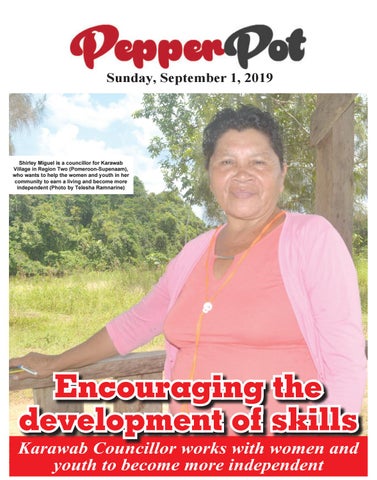
Shirley Miguel is a councillor for Karawab Village in Region Two (Pomeroon-Supenaam), who wants to help the women and youth in her community to earn a living and become more independent (Photo by Telesha Ramnarine)
Encouraging the development of skills
Karawab Councillor works with women and youth to become more independent
II
Chronicle Pepperpot September 1, 2019
A week of fun-filled activities for children
The Dreaming Butterflies Arts Summer Camp The children hard at work painting a mural
By Gibron Rahim ENGAGEMENT with the creative arts is important for children. In addition to utilising and strengthening their creativi-
ty and imagination, involvement with the creative arts teaches them additional skills that they can use in their adult life. It is for this reason that programmes that allow children to express themselves through the
creative arts are so vital. The recently concluded Dreaming Butterflies Arts Summer Camp is an example of such a programme. The Dreaming Butterflies Arts Summer Camp was held from August 19 to August 23 by Empowering to Lead with Confidence (ELC). ELC, which is composed of a group of persons who volunteer their Nadia Thomas Winter, Founder of ELC time and passion for the arts, is also the (All photos courtesy of Nadia Thomas Winter) non-profit organisation behind the Spring Fashion and Empowerment Tea Party that Participation in the Dreaming Butterflies was held this past April. Arts Summer Camp taught the children nuELC Founder Nadia Thomas Winter told merous skills. For example, the children were the Pepperpot Magazine that one of the or- divided into groups for the mural painting. ganisation’s aims is to give back to children, Thomas Winter observed that participation in especially in the area of the arts. As a trained groups led to team building. She related that visual arts educator and fashion designer, it the children learnt to appreciate each other’s was important to Thomas Winter that such an work and to listen to achieve one goal. “They activity be undertaken by ELC. It was decid- were able to figure out how to get something ed that, since children would be at home for done together as a group,” she said. Thomas the August holidays and their parents would Winter also noted that the children were be seeking activities to keep them occupied, grouped so that the older children would be
August was the perfect time to hold the free one week camp that would incorporate visual arts, dance, storytelling, drama and other art forms. There was, unfortunately, a delay in the start of the camp due to issues with locating a suitable venue. Nevertheless, despite the delay, the camp was eventually able to proceed. The Environmental Protection Agency (EPA Guyana) was one of the camp’s major sponsors. The camp ran daily from 9:30hrs to 15:00hrs with different activities being scheduled on different days. The camp would not have been possible without volunteers Janelle Thomas, Stacy Winter and Natasha Alert and volunteer dance teacher Mikhail McLennan. The children participated in many activities involving creating recycled art pieces, such as piggy banks, from plastic bottles. They were also involved in painting two different murals and participated in freestyle dance and also witnessed classical dance, in addition to storytelling and role-playing. Thomas Winter noted that more activities had been planned for the camp but, unfortunately, time ran out.
able to guide and help the younger children. “There was no fussing or anything of the sort, everybody was able to work together as one.” The 25 children who participated in the camp were also very friendly and protective of each other. Thomas Winter also observed that they were very appreciative of and excited for the camp. Based on the children’s reactions, she said of the camp, “That was something I was really happy to be a part of to help them with that.” The children’s responses to the camp ending contrasted with their reactions at the beginning. Thomas Winter related that they were initially unsure of what to expect. However, as the days progressed they became increasingly enthusiastic. “They all love to do art, I realised.” Unfortunately, space limited the number of children that could be accommodated at the camp. Thomas Winter explained, “I wanted to do it in an open-air environment but it rained so much so we definitely had to get somewhere enclosed.” That limited the number of children who were able to attend the camp. Turn to page IX►►►
Chronicle Pepperpot September 1, 2019
III
Indigenous Heritage Month Celebrations Maintaining traditional practices while promoting a green economy
Scenes from Indigenous Month celebrations 2018 (Adrian Narine photos)
By Michel Outridge THE month of September is recognized nationally as Indigenous Heritage Month where a series of activities hosted by the Ministry of Indigenous Peoples’ Affairs have been planned to honour the work, culture and contributions of Guyana’s Indigenous peoples. The very first indigenous Heritage month was observed on September 10, 1995, and was launched by the then President Cheddi Jagan. This year, the month is being celebrated under the theme “Maintaining traditional practices while promoting a green economy”. The launch took place on August 9, 2019, at the Amerindian Village at Sophia Exhibition Site, Sophia. August 9 was also observed as International Day of Indigenous Peoples. Heritage Month officially began with a religious ceremony yesterday at the Umana Yana. Today, the Heritage exhibition and activities will be ushered in with a ceremonial launch at the Indigenous Village in Sophia, Greater Georgetown. This activity will showcase cultural dances, songs and Indigenous delicacies. A host of other activities have been planned for this event. Across the country, many Indigenous communities and settlements also have their own celebrations in commemoration of the
month’s activities. Senior Councillor of the Santa Rosa Village Council, Sharon Atkinson told the Pepperpot Magazine that a customary ‘big’ get together has been planned for September 29, 2019 at Kumaka Recreational Ground, where 11 communities will meet for one celebration. She added that they will have a lecture on the protection of the environment as well as, storytelling, folk songs, dances and of course, the traditional foods and drinks will be on sale for the festivity. Atkinson related that folks are welcome in their village of Santa Rosa but permission must be granted by the Village Council and there is a guesthouse with air-conditioned rooms etc. to cater for visitors. She pointed out that year-round they have pots of wild meat Pepperpot on the stove as well as, their cassava bread making and other traditional foods. Atkinson stated that each of the 11 satellite communities will also have their own heritage celebrations where they will showcase their rich culture, customs and foods. She told the Pepperpot Magazine that in Santa Rosa residents pride themselves in the making of quality craft in the form of handbags, hammocks, and jewels from tibisri which is sourced from the Ite plant and mucuru which comes from the swampy areas.
IV
Chronicle Pepperpot September 1, 2019
The beach is just the beginning Antigua & Barbuda has so much to offer St. Barnabas Anglican Church
Raynel Carroll, Marketing Officer at ABTA.
Tour Guide Keron Francis
Heritage Quay Shopping Area
By Michel Outridge THE twin-island nation of Antigua and Barbuda lies right in the heart of the Caribbean. The island has a lot more to offer than just the sun-kissed sands and crystal clear waters that comprise the 365 beaches located there. It is a place of award-winning hotels, world-class sailing, duty-free shopping and fascinating history. English is Antigua’s official language, although the locals often speak a dialect that can sometimes be a challenge to understand. The capital St. John’s is a vibrant city well worth a visit. Its two waterfront shopping areas offer easy access to cruise ship visitors. Heritage Quay is a modern boulevard of duty-free shops, and neighbouring Redcliffe Quay is a charming contrast with its restored 18th Century buildings forming a cosy complex of boutiques and restaurants. The museum in Long Street and grounds of the twin-towered cathedral both offer areas of tranquillity amidst the hustle and bustle of town.
You can stroll among the restored 18th century buildings of Nelson’s Dockyard surrounded by fleets of beautiful yachts, or you can visit the ruined fortress of Shirley Heights and enjoy the panoramic views from the terrace with a rum punch in hand. Minister of Tourism and Investment and Energy, Charles Fernandez in his welcome remarks during a recent press trip said Antigua and Barbuda is the “gem of the Caribbean”. He deemed the island as “a home away from home” experience where you can snorkel, kayak, kitesurf, swim with the stingrays or zip through the air amidst their lush rainforest. “Let your imagination run free, as the sky is truly the limit here,” he said. The Minister said another unforgettable pleasure is dining in Antigua and Barbuda where the cuisine ranges from spiny lobster and succulent snapper to a few slices of their naturally-sweet Antigua black pineapple. He added that a trip to their beautiful sister isle of Barbuda is a relaxing experience of 17 miles of unbroken beach and pink sand and is simply an escape paradise. Turn to page VII ►►►
Museum Dockyard
Chronicle Pepperpot September 1, 2019
V
Supporting the educational needs of less fortunate children of West Coast Demerara started- perhaps as merely a flicker- over the last 12 years, has grown from strength to strength, developing into a powerful “Green Light” within Guyana as the name suggests. HOW IT STARTED Sharing information with the Pepperpot Magazine on the genesis of the programme, Osborne who hails from Bagotville recalls that she was home on vacation during the summer of
Salome Osborne, Chief Executive Officer of Greenlight Guyana Educational Inc. (Samuel Maughn photo)
By Shirley Thomas THROUGH her inspiration and motivation, coupled with a life-long commitment to the youths of her Guyanese hometown, Chief Executive Officer (CEO) of Greenlight Guyana Educational Inc., Salome Osborne, has been successfully championing a cause that seeks to respond to the education and welfare needs of less fortunate children of communities in her hometown, Guyana. Osborne, a tax consultant who resides in the USA, spends much of her time back and forth between New York and Guyana giving back by way of attending to the educational and welfare needs of the targeted communities. A past student of Cambridge Academy in Georgetown, Guyana, in acknowledgement of her distinguished works, the New York-based Cambridge Academy Alumni Association International (CAAAI) in 2010 conferred on Osborne, the prestigious Robert A. Pinkerton Award for Outstanding Community Service. GreenLight Guyana Educational Inc. for more than 12 years has been responding to the needs of children of three Primary Schools in West Coast Demerara- Bagotville; Nismes and Patentia. Growing from strength to strength, the organisation having
2006, just at the re-opening of school when she saw a schoolaged child out on the road and enquired why was he not in school. The child’s response to her was that he could not go to school since his mother did not have money to buy school clothes for him to turn out for the start of the term. She said she was devastated and moved to compassion on hearing the child’s sad story. Turn to page VI ►►►
VI
friends and colleagues in New York with a view to getting a Not-for-Profit started. This would address the education and welfare needs of vulnerable children of three schools identified in the neighbourhood. The response was good and in record time the organisation was set up and things were set on stream.
◄◄◄ From page V
Sure enough, Osborne quickly took it up with the child’s parent and gave him a package that enabled him to get out to school as quickly as possible. Thereafter, she vowed to work assiduously towards ensuring children’s education is
Chronicle Pepperpot September 1, 2019
not threatened simply because they cannot afford school clothes. That, for her, should be a thing of the past. With a huge heart of love, Osborne almost immediately sought to mobilise and galvanise like-minded relatives,
WHAT A BLESSING The initiative started with the annual distribution of backpacks and school supplies, and so, providing tangible support for academic endeavours for more than 1500 young children of the students of the three schools, Osborne’s focus for a number of years was centred primarily on the distribution of backpacks and school supplies including books, magazines, geometry sets uniforms – complete with custom-made shirts and skirts/trousers, as well as shoes, socks and other necessities. Another initiative on which the organisation initially embarked was the distribution of hot meals on three days per week, which guaranteed the children a hot meal at school for three days per week. ADDITIONAL SUPPORT Meanwhile, in the spirit of partnering, another US-based group known as ‘Community Uprising’, which partnered with Greenlight Guyana Inc. in 2018, will, for the first time this year take on the distribution of back-packs. That distribution was slated for August 23 at the respective schools and Ms Osborne has been invited to officiate. But Osborne, who is also in Guyana to celebrate their achievements with the children, has been asked to participate at the evening’s programmes and will also be making voluntary presentations to students in recognition of stellar performance. GOOD NEWS And there’s more good news for Greenlight Guyana Educational Inc. Osborne told the Pepperpot Magazine that the organisation has also scored some hi-achievers at this year’s sitting of Caribbean Secondary Education Certificate (CSEC) Examinations. “ I’d like to admonish [children] to ‘Stay in School’, and those who are going on to further studies, I wish them every success. She said some will be going on to write CAPE, while others – CSEC, and urged them to apply themselves diligently. “I’d just like to encourage them to stay focused and to come to school! and to stay in school! – no dropping out and those who are going on to further studies, I wish them every success,” she said. MORE GOOD NEWS And there’s, more good news for Greenlight, Osborne disclosed that the students who did well at CSEC and are moving on to write the Caribbean Advanced Proficiency Examinations (CAPE) at the next sitting, were all members of her Book Club and even helped run the Book Club where the children met on Saturday mornings and read for two hours. Placing a high premium on education and reading as a tool, Osborne continues to exhort the children to stay in school and to make reading a habit. Towards this end, she has established a Book Centre in her home at Bagotsville where the children are allowed to read. The Book Club started in 2007 with a Summer Reading Programme held on her premises in Bagotville. Every Saturday morning compete to see who would read the most books. The highest record scored was by a child who’d read 78 books during the period of completion. Looking back with pride and admiration on what the reading programme had achieved, Osborne recalled: “It started with them coming to read on Saturday mornings. I challenged them to see how many books they could read, and one youngster read over 78 books.” To motivate the children as well as teachers, Osborne brought in more books, as well as teaching aids for the teachers at the schools and that certainly motivated them to move on with the programme. And now, 12 years on, her advice to children and teachers is: “ I would also like to say to the teachers that, in keeping with the Ministry of Education’s thrust, they too, have to step up their game, because they too have some work to do. “ Each year, Greenlight would host a graduation and awards ceremony for top performers, as an incentive for stellar performance. The bursaries come in the form of cash incentives, laptops, backed with other gifts from the CEO and other supporters such as past teachers and headteachers drawn from the community. Other initiatives Osborne organised and successfully implemented for the children include the distribution of clothing and annual toy distribution for the children, among other things.
Chronicle Pepperpot September 1, 2019 ◄◄◄ From page IV
Meanwhile, CEO, of the Antigua & Barbuda Tourism Authority (ABTA), Colin James said in his welcome remarks that Antigua and Barbuda is brimming with Caribbean charm, rich history, culture, picturesque settings and, of course, 365 fabulous pink and sandy beaches. He stated that Antigua is home to a fascinating UNESCO World Heritage Site, Nelson’s Dockyard, the only working Georgian naval dockyard in the world. This historic dockyard is a hype of activities daily with yachts and the busy museum, bakeries, restaurants and gift shops. This reporter was on a three-day trip to the twin-island nation where the ABTA provided daily tours of the place. Some of the places visited included lunch at Big Banana in St. John’s and shopping at Heritage Quay, and dinner at Beach Limerz. The tour also saw visits to scenic South Side Mount Obama, Dark Wood Beach, Antigua Pineapple Farm, Antigua Rainforests, drive through Nelson Dockyard, lunch at Shirley Heights Blockhouse and Shirley Heights sunset BBQ party. Keron Francis, a local and also a Tour Guide/Driver attached to the ABTA told the Pepperpot Magazine that he has been at the job for the past 12 years and it entails promoting the island and educate visitors about the country. “There is most good in Antigua where the population is just about 100,000 people and tourism brings in about 75 percent of our Gross Domestic Product (GDP) and the place is a tourist haven for visitors who like our sun, sand, beaches and our way of life here,” he said. Francis, an upbeat and jovial guy, said
VII Raynel Carroll, Marketing Officer of ABTA told the Pepperpot Magazine that her job is to market destination Antigua and she would travel to talk about her island to boost their tourism drive. “We were in Guyana this year to promote our island and our Carnival. I do most of the Caribbean markets because I work along closely with our Marketing Consultant, Charmaine Spencer. We are known for our beaches and for being one of the friendliest people and we are open and welcoming to all… We are a ‘melting pot’ for immigrants and visitors alike because we have a lot of Guyanese here,” she said. Carroll related that Antigua and Barbuda is a comfortable place where accommodation is readily available ranging from island properties to villas, to apartments, resorts and hotels, all at an affordable price and some with five-star ratings. She added that the locals are warm and courteous people, who take care of the environment and enjoy going out to the beaches, eating out and there is a general relaxed feeling that is contagious. The press trip was made possible compliments of LIAT and the ABTA
Steelpan at Shirley Heights Lookout
for him Antigua is home but he has some Guyanese roots and the people of Antigua are most welcoming and hospitable folks, who are very religious and spiritual and like to see others smile. “We put ourselves out to make everything go right. We are proud of our history and who we are…we love our island and people, we are a warm people full of love. The folks here either work on their own or work in the tourism industry at hotels, bars, resorts, gift shops etc. Some make and sell their own craft products while some are fishermen and others work in offices. We love our belly and prefer seafood and everything that either comes from the ground or sea and we believe in eating what we grow,” Francis said. He told the Pepperpot Magazine that Antigua is an untouched island where the people are everything and it is a place to be since many celebrities visit for their vacation and there are no cameras here or paparazzi to intrude on their privacy. “This is a place to relax and unwind and definitely a place for families and couples to
be themselves and enjoy the beautiful island. I love to meet people and tell them about my island, to also advertise my island and since I am a social butterfly, that’s no problem,” Francis said. Antigua and Barbuda is a flora and fauna paradise in which more than 1,500 types of plants can be found which also includes their national plant the “Dagger Log” which is used mainly to make tequila overseas. Francis said, “A picture cannot tell you about Antigua and Barbuda you simply have to come and see it for yourself.”
VIII
Chronicle Pepperpot September 1, 2019
Region Two youth benefit from MOPT Code Camp
Kamaria and Kimantha Tyrell
The children that graduated in Region Two from the Code Camp
Anuradha Rebai
Shavez Banwarie
By Indrawattie Natram GONE are the days when only a small number of persons could afford to attend computer classes and training. With the recent introduction of Code Camps by the Ministry of Public Telecommunications (MOPT) throughout the country, scores of youth are being allowed to tap into the Information and Communications Technology (ICT) field. Thirty- one young people from the Pomeroon-Supenaam Region graduated from a recently held Code Camp which was held at the Essequibo Technical Institute (ETI). It was the second such event held in the Region. Youths were taught in-depth sessions on Micro Bit Technology, Coding, Graphics and Website design in 25 sessions. The classes were done every Saturday and were taught by Lecturers Keshav Chowbay and Indrawattie Hirai. LIFE-CHANGING Those who attended the course expressed profound gratitude towards the Minister of Public Telecommunications Cathy Hughes for the courses. Top student for the morning course, Anuradha Rebai, told the Pepperpot Magazine that she believes every child should be exposed to such a golden opportunity. The Anna Regina Multilateral Secondary School Student said that the project was very exciting and it brings out the creative side of participants. She said she was very
stunned at what she was taught using ICT. Rebai said that the course has definitely paved her career path and she now has a vested interest in furthering her studies in ICT. Like Rebai, Shavez Banwarie, is also grateful for the course. The 15-year-old said that he was happy to be selected for the camp. He said the course has exposed him to HTML and has widened his knowledge on the development of Apps and database development. Banwarie said that with Region Two being an agriculture region he thinks he will be looking at the possibilities of creating an App that will help farmers. Fifteen-year-old Jadeon Persaud said he is very excited about the training he received and thanked the instructors for the time spent and patience shown to them during
Jadeon Persaud
The instructors for the course Keshav Chowbay and Indrawattie Hirai
the course. Persaud said that it also built comradery and team-building among the participants. Twelve-year-old Karmaria Tyrell and 14-year-old Kimantha Tyrell both expressed similar sentiments. Karmaria was named the top student for the evening classes. She said that she did not regret joining the course and the friends she has gained have truly taught her a lot of life-changing lessons. She expressed gratitude to the Government of Guyana for the opportunity. Principal of Essequibo Technical Institute (ETI) Rawl Pearson said that the ETI is happy to partner with the Ministry of Public Telecommunications in bringing the Code Camps to the youth. He also said the opportunity that was provided is golden and in-depth and urged the youth to continue their career in ICTs. The institute is also offering a Diploma in Computer Science and other related courses.
Chronicle Pepperpot September 1, 2019 ◄◄◄ From page II
The children pay rapt attention during a storytelling session
The parents of the children who participated in the camp were amazed at the enthusiasm of their offspring, according to Thomas Winter. She related that one mother sent her a message to express appreciation, explaining that her son danced, an activity that he does not usually enjoy participating in. “She was so excited about that,” Thomas Winter said. “From the kids’ experience when they go to meet their parents, their parents were excited for them.” She added, “It was something that we really appreciated – the fact that they could have gone home and told their parents, ‘We were really engaged’.” The importance of education in the arts cannot be underscored enough. Speaking as an educator and fashion designer, Thomas Winter said, “What I find, dealing with kids, is that the arts help development and I can’t help stressing that.” She went on to add, “Creativity is one of the things that we need to stress on in these times, the 21st century because we’re competing with machines.” She emphasised that every child has the right to be a part of a programme, such as
the Dreaming Butterflies Camp. Moreover, she said that programmes in the arts can help people of all ages to stay in their communities. Thomas Winter pointed out that programmes in the arts can be developed locally. “You can build your own stuff right in your own community, right in your country and appreciate your local talent,” she said. She also noted that the arts can allow individuals to become self-sufficient by allowing them the opportunity to be self-employed. She indicated the need for greater government-based involvement in developing the arts. There are plans in the future to expand the camp both in the Georgetown area and into other communities. “Next year we’re going to definitely plan it bigger for Georgetown,” Thomas Winter said. She related that they are also looking into the possibility of taking the camp to Lethem. “We expect to branch off but we can only run it for one week at a time at different locations,” she stated. Additionally, “It’s a non-profit so sponsorship is very key.”
A dance lesson with volunteer Mikhail McLennan
IX
X
Chronicle Pepperpot September 1, 2019
THE PRESERVATION OF INDIGENOUS LANGUAGES A FACET OF NATIONAL PLURAL CULTURAL POLICY
SEPTEMBER each year has been set aside for the commemoration of Indigenous Heritage Month. This year, the commemoration had been launched on August 9 to coincide with the UNESCO International Day of the World’s Indigenous Peoples. The theme for the International Day was “Indigenous Languages” where focus was made on the preservation of the
world’s indigenous languages which are fast disappearing. The theme of our Indigenous Heritage Month is “Maintaining our traditional practices while promoting a green economy” and much stress would be given to the preservation of the Indigenous Languages. Indeed, Hon. Valerie Garrido-Lowe, Minister within the Ministry of Indigenous Affairs, who appears to be spearheading the various programmes which are
being organised for the Month has indicated that she would be giving much emphasis to the preservation and use of the Indigenous languages. The celebratory aspects of the Month would include Indigenous performing arts to which all sections of society would be invited. These shows would be along the lines of the successfully held Beyuka Erikida (‘Musical gathering’ in Arawak) which was organised by the Secretariat of the Ministry and people were given the opportunity of singing, dancing, storytelling and presenting poems in the nine Indigenous languages. The stories consisted of the traditional myths and legends, Indigenous ways and Hinterland life, and the protection of the Environment. After speaking about the performing arts at the Media Launch at the Sophia Exhibition Centre, Minister Garrido-Lowe elaborated on the language preservation activities of the Month. “The Ministry”, she said, “will continue other initiatives that will ensure the Indigenous Languages are preserved. There would be the launching of a Patomona dictionary and the compilation of an Arecuna alphabet. There would also be a composition of the teachings of modules for the Arawak, Carib and Warrau languages, storytelling and musical festival, tourist handbooks and academic debates on the institutionalisation of Indigenous languages”. Reinforcing J Minister Garrido-Lowe’s efforts at language preservation Minister of State Dawn Hastings - Williams declared: “Applications for employment and contracts were recently published in the Indigenous languages. Radio Aishalton carried broadcasts in the various Indigenous languages. Though English is the second language to many Indigenous children, it is the language in which national examinations are articulated. The Education Ministry is now seeking to introduce native languages in the schools across the Indigenous Regions”. The Minister then went on to point that it would be an advantage for public servants and policemen who would wish to work in the Indigenous Regions to learn some of the Amerindian languages. Whatever efforts are being made so far are laudable but they are of an ad hoc nature and language preservation requires a great deal more expert and professional planning. Such would include Government adumbrating a National Language Policy which would be a facet of a National Plural Cultural Policy. A language policy would focus not only on Amerindian Languages but other languages which other groups, in particular, the African groups who are demanding Swahili be taught in schools and be offered at the CSEC examinations and Indian groups who are equally demanding Hindi - Urdu be officially recognized. Other than English, Hindi -Urdu is the most spoken language in Guyana in that it is heard in the hundreds of mosques and temples over the country, there are regular radio and television broadcasts and Bollywood films and live performances in that language are often staged. Studying the Language Policy of Suriname would help in formulating a Guyana language policy. More immediately, in ensuring the preservation and continuum of the Indigenous languages, several activities will have to be addressed: Grammars and dictionaries of all nine Amerindian languages must be compiled. The words should be phonetically written and tapes should be made of speakers so that the pronunciations and accentuations could be preserved. Needless to point out, one alphabet should be used for all nine languages. Most importantly, the language which is most widespread and is spoken by most should be chosen as the Lingua Franca since this will ensure the continuum of an Amerindian language. The Lingua Franca would be learnt by all and non-Amerindians would be able to learn it. The Lingua Franca would borrow words from the various other Amerindian languages and in particular from English so that it could become a modern language. Encouragement should be given for the speakers of the other Amerindian languages to use their particular tribal language as their “home language”. In this task of preservation of the Indigenous languages, interested philologists from the major universities should be invited to participate.
Chronicle Pepperpot September 1, 2019
ocus F
XI
on the Village
Come see the stars at Karawab Village By Telesha Ramnarine LIFE is certainly not a bed of roses for the people living in Karawab Village, located in the Pomeroon River, some 40 kilometres off Charity. However, not a single resident that the Pepperpot Magazine spoke with recently would choose to live in another place! Perhaps this is because of the breathtaking scenes that people up there can take in everywhere they look; the gorgeous sunsets, or the clean, clear, flowing water in the black and wintry Pomeroon River. Or, it could be the simplicity of things there and the people’s ability to enjoy a good quality of life that requires very little from them. For instance, they plant what they eat and they simply go out to the river for their meat! Such meat couldn’t include caimans though because there are very few up there, owing to the noise from the speedboats that would daily traverse the easily navigable river. Karawab, an Indigenous settlement measuring 85.459 square miles, according to a document from the Ministry of Communities, can be reached by travelling about 26 miles from Charity on a speedboat. Charity can be described as the gateway to this part of Guyana’s interior, just the same as many people would need to pass through Parika before heading out to various river and land destinations. To get to Karawab, you would need to first travel to Parika. By public transportation, the cost is $360 from Georgetown although the drivers and conductors would not hear of it. They take you for a full $500, whether you like it or not! Or, unless you protest and have a newspaper clipping or something handy to show them the correct fares decided by the authorities. The next step would be to purchase a ticket for $380 for a 1 ½ hour sail to the Supenaam Stelling. Wishing to get there sooner though, a passenger may opt for a speedboat ride, which would cost $1,300, and take about 45 minutes. A taxi from Supenaam would charge another $1,000 to take you to Charity, and the drive would take about an hour. Speedboats
A section of Karawab Village where the schools, health post and pavilion are located
the Ulele Nursery; there are 30 males and 32 females. The children of St. Monica are led by two trained teachers, and two untrained ones, while the students at Ulele Nursery are taught by one trained teacher and three TQMs (Temporary Qualified Master/Mistress) and one TUM (Temporary Untrained Master/ Mistress). The St. Monica’s Primary School has 35 male students and 39 females. The students here benefit from the assistance of four trained teachers. The Ulele Primary has 70 males and 63 female students, with one ‘Graduate’ teacher, one trained and seven untrained teachers. Karawab and surrounding villages benefit from two health posts, a satellite dish, and a sports pavilion. In fact, the residents would sometimes invite the youths in other communities to visit and play football, cricket and volleyball. Residents though would be happy for the formation of other groups, such as a women’s group, youth group, farmers group, sewing group, loggers group and craft group. There Lionel John of Bat Creek, which is located An 88-year-old resident of are also five church groups in the area. a few more miles from Karawab Karawab making her way home heading to Karawab from Charity would cost BAT CREEK THE ‘DAVID G’ SCHOOL BOAT about $3,000 to $3,500 (one way). Bat Creek is another three miles from Shirley Miguel, a 56-year-old councillor Karawab on speedboat, and Lionel John, a Karawab Village is bordered by other villages like Kabakaburi, St. Monica, and who has been living in this area all her life resident there, would have to take the children Akawini, and is led by Toshao Thomas said that the village has a population of 800; from the village who are attending school to Charles and nine councillors who would meet 420 males and 380 females. There are 121 Karawab, so that they too can join the govhouses there, with 151 households. on the last Thursday of every month. ernment boat. Most of the residents do farming and Speaking with the Pepperpot Magazine, lumbering, and the main language is Carib, John, who makes lantern posts and the like, followed by English. The means of communi- is not sure from where the tiny village got its cation are mainly verbal and satellite phones. name. “It’s the old-time people who give it There is no electricity there, except by that name, our ancestors,” he related. means of personal generators and solar panThe village has about eight houses and els. Such pitch darkness provides for a mag- residents would have to climb a certain tree nificent view of the stars at night. to use their phones. Otherwise, there is no Because transportation is only by boat, signal, electricity and potable water in the almost every house has its own. The children village. Nevertheless, John loves where he travelling to school would be picked up by is living. “Life is easy here. We do farming. the ‘David G’ boat in the morning and then This is farm ground; I like it here.” One of dropped home after school. This is a provision the challenges here though is the cost for gasfrom the government to ensure that children oline. John uses about eight gallons a week, can attend school. Otherwise, many would having to take the kids to school and run other not be able to afford the cost to travel daily errands, and would often run short. in the river. The village is managed by the same At the St. Monica Nursery School, there Toshao as Karawab and St. Monica. The thatch roof houses are usually without windows and furniture are 12 male students and 16 females, while at
XII
Chronicle Pepperpot September 1, 2019
‘I love the peace and quiet’
Resident revels in serenity of his village government can arrange for training for them such as in computer, tailoring, carpentry, sewing; this would contribute to development.” As a carpenter, Smith said it is quite costly to build a concrete house in Karawab and surrounding villages. “We load sand and other materials in bags and bring them on big boats. It’s very costly to bring in materials and the labour costs are very expensive. Building a concrete building in the river is like two times the cost what you would
Concrete houses are very expensive to build in Karawab
Smith loves the tranquility of the Pomeroon villages
By Telesha Ramnarine MATTHIAS Adam Smith works in Karawab and loves his life in Kabakaburi, another nearby village. Even though he’s thinking of relocating for the benefit of his children’s education, he says the move will be temporary as the plan is to move right back there! Smith, 44, was born and raised at Kabakaburi and is a father of seven, who works in the area as a carpenter. “Life here is an easy-going life. Most people farm, hunt and fish, and some young men do mining,” he said, adding, “The community is very peaceful. The first thing I like about the village is the quiet. And I like to work in this area because the people are very friendly.” Smith said the government is doing a lot to develop the villages along the Pomeroon River. However, he noted that many young men and women do not have jobs. “If the
Former Toshao of Karawab and St. Monica Village, James Miguel
pay on the road.” ADULT EDUCATION Meanwhile, former Toshao of Karawab and St. Monica Village, James Miguel, is
calling on the authorities to implement some form of adult education in the villages to help residents manage their households efficiently and become better parents. “I am suggesting that adult education be introduced for young parents so they can know how to control their livelihood,” Miguel told the Pepperpot Magazine during an interview. Miguel lamented the fact that even though education was introduced there more than 30 years ago, a trained teacher is still to come out of Karawab Village. “We have to always import teachers. They come in, and soon after, they’re called to college. The only thing that can change this village is education,” he expressed. At the moment, the health post has a midwife and community health centre. In the event of an emergency, the affected person would need to be rushed to the Charity Hos-
pital. In the past, a doctor and medic were housed at Kabakuburi, a close-by village. “I think that should be reintroduced so that you may not always have to go all the way to Charity,” he said. He referred to a recent case where a child was stung by a scorpion and died because no treatment was available for him. “They had no treatment at Kabakuburi, Charity, Suddie, and even Georgetown. The child was just given an injection for the pain and eventually died. This is the interior so you have snakes, centipedes and scorpions.” Miguel is also calling for the establishment of a police outpost there. Even though crime is at a minimal in the area, there are instances where persons imbibe alcohol and may get out of hand. Miguel said that though he loves the community, he hopes that these improvements can be made for the betterment of the residents.
Encouraging the development of skills Councillor works with women and youth to become more independent By Telesha Ramnarine SHIRLEY Miguel, a councillor for Karawab Village in Region Two (Pomeroon-Supenaam), wants to help the women and youths in her community to earn a living and become more independent. Miguel, a 56-year-old mother of nine, was born and raised at Saint Monica Village, but now lives at Karawab. She does cassava farming mainly and would meet with the rest of councillors on the last Thursday of every month. A councillor for the past nine years, she said that life in the village has its challenges at times, especially for the women. “They don’t have a job in Karawab, so they depend on their husbands for everything. They’re just at home
all day,” she expressed during an interview with the Pepperpot Magazine. As such, Miguel wants to establish a women’s group with at least 20 members. “I am planning to organise a women’s group to assist women and youths to do sewing and other things so that they can get some income for themselves,” she said. According to her, the village has a football team that would invite other teams from different villages to visit for a fun day. “My plans include working along with young people,” she said. She pointed out that the ‘David G’ boat would leave Karawab each day at 06:30hrs to pick up 22 children from the village, and eight from St. Monica for school. The boat would return at 16:00hrs each day with the children.
Karawab Councillor Shirley Miguel
The government has also installed a dish in the village so that children access the internet for their SBA’s and other work. “In Karawab, you get everything that you need. You farm, you go out to get your fish. But out there [in town], you have to purchase everything, which means you have to work to buy these things,” she expressed. Miguel said the people in Karawab are cooperative and kind. According to her, some of the major plans of the council include constructing a community shop and making a stelling and walkway to access the huge building that was donated to the community by the Barama Company. The intention is to turn this building into a cottage hospital and guesthouse. Turn to page XIII ►►►
Chronicle Pepperpot September 1, 2019
XIII
◄◄◄ From page XII
The future plans of this building include turning it into a cottage hospital and guesthouse
The authorities have installed a dish in the village making it possible for residents to access the internet
Monday is Charity’s biggest market And the farmers’ holiday
By Telesha Ramnarine According to him, plans are on stream to fix streets in the scheme and market areas, and to install CHARITY’s market day and the farmers’ ‘holiday’ on some street lighting around the market area. every Monday is a tradition that has been passed down Markets Clerk Tracy DaSilva told this publication over the decades, and very much kept alive to this day! that vendors are charged $300 for environmental fees. Whereas the big days for market in other communities These are the vendors who would come out mainly are more often than not on Saturdays and Sundays, Charity on Monday and set up their business on the roadside. comes alive on Mondays. It is the only day of the week that Inside the Amazon Market, though, which refers to the farmers, who are busy all week in the back-dams, come out the registered market, vendors pay $500 a week. from their farms to sell their produce and celebrate afterwards. “We have about 120 stalls on the reserve and the “It’s an old saying from our ancestors that Monday is a Amazon Market with about 136 stalls and 100 tables. holiday for the farmers. It’s our culture and tradition. It’s a day We usually have about 260 sellers on market day. Markets Clerk Tracy DaSilva Acting Overseer of the Charity/ for everyone to meet together and people would share their Many come from Moruca, Wakapow, Kabakaburi. Urasara NDC Rameez Baksh fruits and other produce with one another,” Acting Overseer Peop.le come from as far as Georgetown, from Siriki, on Mondays [on their of the Charity/Urasara Neighbourhood Democratic Council Jacklow, Kabakaburi, Parika, and the Essequibo Coast,” Da farms]. They come do (NDC) Rameez Baksh told the Pepperpot Magazine a few Silva informed. their shopping; partying. It’s a recreation day for them. The days ago. She said she came and met the market day on Monday young people, the workers and labourers would come and Speaking at his office, he said this region is saturated with which she knows as the farmers holiday. “They don’t work work on market day and party afterwards.” farmers, fishermen, those who do lumbering According to her, though, vendors have been comand mining. His role is to keep records of the plaining of low sales lately. While many people pass accounts and about the revenue coming into through the area on Monday, it does not necessarily the NDC. mean that they are making purchases. They may just be Although the Charity Market is opened there for the lime. daily, Monday represents the biggest day for The market, which starts at 06:00hrs and finishes at business, and logically brings in the most about 17:30hrs, has lights and water. As for the regisrevenue. On average, the NDC is able to tered market, this one has guards and hence a very low rake in about $100,000 in revenue for just crime rate. Rarely, there are reports of the breaking and one Monday. entering of stalls. One vendor, Azad Alli called ‘Cow “Market day on Monday is like a holiday Boy,’ has been coming for the Monday and Friday marfor farmers to meet together to sell their kets each week for the past 40 years. Originally from produce. Some of them export to Parika and Wakenaam, an island in the Essequibo River, he said he different areas. It’s a business day for everyis a butcher from birth. body and a holiday for the farmers. This is “At four years old, I walked ringing the bell and the only day that they would come out to do selling the beef for like 36 cents a pound,” he fondly their selling.” recalled. He is doing the business that was first started The market day attracts vendors from as by his grandfather and then carried on by his father. He far as Georgetown and from far away villages feels though, that after him, that will be the end of the in the Pomeroon. Furthermore, it has also beef business. “After me, it’s off because my son didn’t been attracting tourists. “People who come in take it, neither my nephews. After me, it’s over.” from overseas would usually visit. We have At the moment, business is very slow, Alli said, the marine life, the rainforest just across the but he makes it a point to turn up each week for river. So a lot of people come in and they like his loyal customers with whom he has a very good Azad Alli called ‘Cow Boy,’ has been a beef vendor the place,” said Baksh. relationship. at the Charity market for the past 40 years.
Farmers from several villages in the Pomeroon come out to Charity on Mondays to sell their produce.
A scene from last Monday’s market day at Charity.
XIV
Chronicle Pepperpot September 1, 2019
‘Teachers, love your children!’ - Says retired Abram’s Creek teacher
By Telesha Ramnarine NOW a retired teacher with about 30 years under her belt, Genevieve Howard, the first youngster to become a trained teacher from Abram’s Creek, in the Pomeroon River, enjoyed each passing year. She did lots of voluntary work in the health field but can recall telling her mom that whichever field she gets through with first; that’s the one she’s going to pursue. Howard, 56, was born and raised at Abram’s Creek and simply loves it there! “I am living here all my life. I was born here, I married here, I went to school here, I went to training college, came back and was teaching here, and now I’m retired,” she told the Pepperpot Magazine
during an interview at her home. Continuing to teach even after retirement, Howard holds lessons for students in Grades 2, 4 and 6 every day. During her years, she taught at Abram’s Creek, Anna Regina, F.E. Pollard, and Lilydale Primary Schools. Howard qualified herself at the Cyril Potter College of Education (CPCE) for two years before returning to teach at Abram’s Creek Primary, the very school she attended as a child. She climbed the steps, so to speak, in that she became a senior assistant mistress after five years, then senior mistress, and headteacher.
Howard is married to Maxwell Howard and has no children. “But I love children!” she was quick to point out. “I was kind of disappointed that I didn’t have children. When I got married, I told my husband I might be getting pregnant, but on to today, that never happened. Because I am a Christian, I told my husband I might be like Sarah one day [a Bible character who got pregnant during her elderly years],” she joked. Her husband, 24 years her senior, has two children from a previous marriage, one of whom served in the US Army as a pilot. Asked to explain her love for chil-
dren, Howard said: “I love children and I feel I can be a role model to them, I can train them, I could teach them good morals. You don’t have to have a child to love children.” She said a good teacher must first of all love children and must be dedicated, understanding, and respectful of themselves and of the smallest child coming up. “You must also teach children the truth; live the truth and teach them the truth,” she advised. Life for her in Abram’s Creek is very enjoyable for her at the moment. “We have our own little farm, we live self-sufficient. We have our own boat, engine, little home. It can be a bit slow compared to Georgetown, but we love Pomeroon.”
Chronicle Pepperpot September 1, 2019
XV
A tooth’s worst enemy THE tooth equation is pretty simple: germs plus sugar equals acid production. These acids can dissolve enamel as well as the tooth-root structure and result in a cavity (technically, a carious lesion.) Although tooth decay is a fact of life (no record that exists ever shows that any adult human has never suffered from tooth decay), there is evidence that some persons are more resistant than others.
work does not usually get restored properly with a patchwork approach. Once the dentist has done his or her best to restore a tooth, this work needs to be well maintained by the patient. Brushing and flossing are critical in controlling the plaque that can lead to decay, but the further reduction of microorganisms (germs) is necessary for a healthy mouth. This can be achieved by tongue scraping (the
Since effective brushing and flossing are critical in controlling dental decay in susceptible individuals, I want to detour for a brief discussion about the cause and prevention of tooth decay. Of course, everyone who reads this column should realise by now that the secret to oral health is the effective control of dental plaque. Now, three elements need to be in place before tooth decay can happen: the microorganism responsible for decay (Streptococcus mutans) must be present, a sugar or carbohydrate for S. mutans to metabolise must be available, and the tooth or teeth must be susceptible to, or capable of decay. Additionally, there are three cavity-preventing measures those of us susceptible to tooth decay must take to combat this decay: we must control plaque, reduce carbohydrates (sugars) in our diet, and make out teeth more resistant to decay. Eliminating or at least drastically reducing, tooth decay is certainly relatively easy although it takes a little effort. Proper brushing and flossing are of paramount importance in eliminating tooth decay in the caries-susceptible individual, because, without excellent control of plaque (the sticky stuff containing cavity-causing microorganisms, including S. mutans), cavities can develop in the grooves ( pits and fissures) of teeth, in between the teeth, on the sides of the teeth at the gum margins (edges) of fillings, crowns, or bridges distresses dentists and patients alike, since much of this restorative work was done to repair damage caused by previous decay, and new decay around existing dental
top of most peoples’ tongue carry untold trillions of microorganisms and much odorous material), and irrigation to reduce the number of microorganisms under the gum margins. An obvious way to cut down on dental decay is to reduce or even eliminate sugary drinks from the diet. Great plaque control is an excellent way to keep cavity-causing organisms at lower levels in the mouth, but even great plaque control is no match for the acids produced when six to twelve sugar-containing soft drinks are consumed every day; this much sugar coating the teeth supports the astronomically fast growth of the cavity-causing organism and its acids. Coffee or tea sweetened with sugar will create never-ending cavities in anyone prone to decay. The use of nonsugar sweeteners is recommended for those susceptible to tooth decay. Another excellent way to deal with dental decay is to drink several cups of green tea a day. Why is green tea so great for reducing dental decay? One study showed that green tea inhibits the growth of plaque caused by the S. mutans bacteria, while another study showed that green tea catechins destroyed these bacteria at concentrations lower than those found in one cup of tea. Other studies report that green tea strongly inhibits bacteria after only five to ten minutes of exposure to the tea. And yet another study reported that green tea extract was more effective than fluoride compounds in preventing dental caries. To summarise, consuming three or four cups of green tea daily for dental reasons is a great idea because it inhibits the growth
of plaque caused by S. mutans, destroys the biofilm that coats teeth and the rest of the mouth (thus helping to clean the mouth), and, because of the fluoride content in green tea, actually makes the teeth more resistant to acids produced by S. mutans. Fluoride in its many dental formulations is the third method that has been utilised to reduce susceptibility to tooth decay (caries) in cavity-prone individuals. I am in my fifties and have only lost 4 teeth which occurred when I was a teenager. I ascribe much protection from green tea and recommend the same to my patients. Please note that when consuming green tea for its cavity reducing benefits, it is best to swish each mouthful of green tea vigorously to cleanse the mouth before swallowing the tea. In other words, don’t drink the tea as you
normally would, since the cleansing action and the S. mutans inhibition are improved by having tea in contact with the mouth and teeth for longer periods. Finally, my advice on the use of green tea is to find one you like, and have it readily available at work and home so you can drink it regularly. Green tea has benefits that go well beyond cavities, and you can take advantage of them all if you will incorporate drinking several cups into your normal daily routine. A final note on the dental decay issue: make certain that you have regular dental checkups. Your dentist is there to help you be healthy. And regular dental visits afford the greatest possibility of keeping problems at a minimum.
XVI
Chronicle Pepperpot September 1, 2019
We must address the dismal stereotypes or they will grow into even bigger monsters
AN instructor directed a group of Guyanese, of which I was a part of that, “If you don’t speak about the pretentions in your society, the more dismal depths of those pretentions and beliefs will grow out of control and will explode.” I sat in that audience and congratulated him but pondered on where the courage would come from to address those deficiencies, from among most of my countrymen and women, because pretence is a safe zone, the confrontation of truth is a stressful and combative effort. With the advent and now wide access to social media, on the other hand, we find that technology has birthed the Wiz of OZ, and the obvious is evident. With the saturation of cowards who need a shroud to hide behind, to become the undead and then expound false courage to say the vilest things along racist and public slander, they even adopt other people’s identities so they can spite venom, that they would be too timid and terrified to express publicly, and when caught, they claim that they were hacked. That’s the most plausible modern escape, not denying that it doesn’t happen. The other fact is, that if we define ourselves as a Democracy, and lack laws that arrest the vocabulary of incitement in its ‘theme form’ rather than its expanded epistle, this will continue to occur. Recently a former official made some harsh stereotypical declarations. One such is that ‘Afro-Guyanese are lazy’ amidst a barrage of other racist vomit. How this could be said about a people who were brought against their will into slavery; still laboured and saved money against all odds to buy former plantations; shaped them into villages; built over 10,000houses across the colony of British Guiana- their labour built every township; defied every scheme and plot to reverse their emancipation; enter the ‘Gold Bush’ as labour; wrestled with the rapids; paid the price in ancestral lives lost and triumphed as proprietors. How could such a thing be said of young Hubert Nathaniel Critchlow whose father died when he was 13. He became a man then, was integral at 21 in the largest protest for social change between 1838 to 1950- that of the 1905 riots, which launched the modern political era with the entrance of Critchlow and the British Guiana Labour Union (BGLU) in 1917. What folly of racist laziness is he talking about? Neither can it be said that all ‘East Indians’ are racists, because I experienced racism in my creative life when the same Jaguar character that was rejected as a Black superhero. When the book was published before it entered the Newspapers, I benefitted from meaningful support from Indo Guyanese business persons. Politics manipulate religion and culture that employ doctrines of sacred discrimination where it conveniently exists to generate fears and hysteria of economic space hate, real and unreal, and a false and irrational surge of entitlement, which generate mindless votes forged by bigotry for the political puppeteer.
Culture is a dividing force, not all cultural beliefs are rooted in positive tenets. In some parts of Asia, young girls are married off as children, while in parts of Africa the low almost bald hair cuts on young girls symbolise not ready for marriage, with extremely harsh penalties for violators. Matriarchal and Patriarchal cultures differ and have shaped a virtual chasm with parameters not consciously understood in the Guyanese context. But culture is not stagnant, but every though and dark effort is made to protect and to retain that which is proven as “the easily controllable and beneficial to the hierarchy” so arguments of logic, obvious and scientific fact are isolated. It’s like defining a village because a certain crude and connected official drinks his rum then dances on a tabletop expressing the most vulgar drunk man talk. The reality with “Drunk man talk” that is expressed with “rum courage” which without that spirit, consequences would have prohibited him uttering, yet it’s his
true self, that creole ting: “He ent know is wuh he seying” is another barren comfort zone to be aware of and ignore, but he may be a loud and forced imposition on his audience but does not define “the all”. As an artist, I understand the discussions provided by insinuations, body language, the specific dishonest edits of social and historical events to make loud false pronunciations, serious calculated humour and appealing statements by soft tone, that need not pass without interception, are all necessary life skills to be understood in this world of great deceptions, at times to the detriment of all that you hold secularly sacred. Through art and literature, we experience that two prototypes of men exist, one who is confrontational and will engage you in battle, and should you in defeat seek mercy, may spare your life; then there is the other who will woo you with bribes and make promises that only your delusional ego can justify, then poison you in many ways
with a smile. Adolf Hitler did not invent the world he presided over; he merely adopted and reshaped the macabre. But since he is the historical poster boy of hyper racism, mass murder and inhuman practices, I will explore a long-personal confusing aspect of his reality. I saw an article some years ago, with Eva Braun Hitler’s poster wife privately modelled as an Afro American Jazz musician, her face darkened and in the photograph as if singing a song. I never read her published diaries so I will for now go with the theory that she was modelling as the Jazz singer in the 1927 movie of the same name, which ironically was based on a white Jewish boy who wanted to become a Jazz singer, a scenario that is based on an inner transference into the despised but secretly admired soul order. Did Hitler like Jazz which he called inferior music, was he in his imagination transferred into a Berlin Jazz club which his thralls had closed down, with the Black-faced Eva as his muse? Then in the same project, I later discovered something else, an extract from his May Day speech in 1933-“ Germans, you are not second-rate, even if the world wishes to have it so a thousand times. You are not second-class and inferior. Awake to the realisation of your own importance.” And in was invited the occultists with their master race Aryanism, to stimulate the imagination and rejuvenate the post-1918 defeat loss of self-esteem, race and religion spiralled Hitler to power... the rest you know enough off. In the same way, young Afro and Indo Guyanese working with GECOM in the house to house registration were subject to abuses and racial insults, to whip up the old Gorgon of fossilised racist thinking, inspired by blunt statements carrying subliminal messages by political leaders. We have precedents of how dangerous incitement vocabulary can be. I can remember a steel pan genius in the burial ground and the young girl holding her tummy with streaks of blood running down her leg, and the sensational woman coming through the ground screaming rape. The man was beaten, placed on the front page of the papers, his life destroyed. Afterwards, silently and in shame, everyone kept the secret, that the child was actually having her first menstrual periodthere was no rape. We have got to follow the evidence on this national problem, described according to a much balanced Freddie Kissoon on January 22, 2015: “ The PPP has never won an election using ideas”- an interesting article; interesting details. There are no illusions about where in the political houses of Guyana that the cauldron of racial strife boils hottest, from 1961 to date. The point is, this has to be a national ideal, with all Guyana involved towards a surge of cleansing, of intense self-questioning, and it has to begin now, especially with foreign dabbling no longer a speculation.
Chronicle Pepperpot September 1, 2019
XVII
FILES E S A C COURT Convicted cop appeals and loses
By George Barclay
Shoots man to death, gets three years for manslaughter
ON the night of August 1, 1976, Policeman Guy Simmons walked into a gas station and claimed that if he was not sold two cold beers he would blow out the brains of the barman with his .38 revolver. Bystander Jerome Calder who questioned the cop’ s ability to commit any such offence with a toy gun, was shown the live bullets of the revolver and like doubting Thomas of biblical fame, was still doubting when his head was blasted from a revolver bullet. Following police investigations, P.C. Simmons was charged with murder but a mixed jury at the Demerara Assizes found him guilty of manslaughter and he was sentenced to three years imprisonment by the trial judge. Dissatisfied with the sentence, Simmons appealed the conviction and sentence, but the Court of Criminal Appeal, constituted by Chancellor Victor Crane and Justices of Appeal R. H. Luckhoo and Dhan Jhappan, dismissed the appeal and affirmed the conviction and sentence. The accused was charged with the murder of the man but he was convicted of manslaughter, the jury having rejected his defence of accident, viz, that he took out his revolver to get some money to pay for the beers and as he was putting it back, the gun accidentally went off. At the trial, the jury were correctly directed on the degree of negligence which the prosecution had to discharge to bring home a conviction of manslaughter but were not told that when dealing with the issue of the accident that the onus was on the prosecution to negative the defence accident. The Court of Appeal held (I) that notwithstanding there was a lapse on the judge’s part, the circumstances recounted by the prosecution witnesses were compatible and reconcilable with the evidence of a ballistic expert as to the pressure needed to cock and discharge the gun, and also with the pathologist evidence as to the position of the bullet wound on the deceased. (ii) that the proviso will be applied because the post mortem evidence negative the defence of the accident and was so overwhelming as inevitably to lead a reasonable jury properly directed, to the same conclusion of guilt. The Appeal was dismissed and the conviction and sentence affirmed. Representing the appellant at the appeal was Attorney-at-law, Mr. J. A. Patterson. Mr.. Loris Ganpatsingh, Assistant Director of Public Prosecutions, Acting, represented the State. Delivering the judgment of the Court of Appeal, Justice of Appeal R. H. Luckhoo said that on the appellant’s behalf a number of grounds were argued, but the only one which qualified for, and merited consideration was ground 3 (a) of his amended grounds of appeal in which he complained that the learned trial judge “failed to tell the
jury that the onus of disproving the defence of accident rests on the prosecution”. That the trial judge did not in any part of his summing-up use the words, ”The onus of disproving the defence of accident rests on the prosecution “ cannot be disputed. Let us therefore examine, examine the setting of the facts of the case and relate, as we must, the directions given to that setting. Only in this way can we determine whether or not this ground is to succeed. In doing so we gave recognition to the fact that no two judges have the same style, manner and arrangement of a summing-up before a jury. Indeed very often the same judge must, by virtue of the way in which particular cases are presented, vary the style and arrangement of the summing-up in those cases in order effectively to assist the jury in appreciating the issues set before them. What was the State’s case against the appellant? It rested on the evidence of persons present at the scene of the discharge of a .38 police service revolver. On the evidence of Eustace Kendall an expert in the use and functioning of firearms, including the type of revolver in question, and on the evidence of Edward Simon, a senior Government Bacteriologist and Pathologist. Undisputed were the following facts, that the discharge at the gas station, Vlissengen Road, Georgetown, at a bar, where beer and other drinks were sold, and to which the public had access, that at the bar and within close proximity were several persons including the deceased Calder and the appellant. There was also no dispute that the appellant had the revolver in his possession at the time of its discharge and that Calder died from a bullet wound through the right temple inflicted by a bullet discharged from the same revolver. Winston Oudkirk’s version of how the incident took place was in substance this: he said that the accused came up to the bar and in a normal tone of voice said to the barman: “Bring two beers or I blow your f….. brains out. “ With that, he took out a small gun from his pocket. Calder said to him that it was a toy gun, whereupon the accused took out a bullet from the magazine of the gun and said to Calder that, “ This is a real f… bullet. “ The accused then replaced the bullet into the magazine and back into the gun. Calder insisted it was a toy gun. The witness then heard a loud explosion. Calder slumped forward, spun around and fell on his back. Before the explosion, Calder was bending forward at the back of two men and he was facing the accused. He did not see Calder leaning against or touching the accused. Calder, he said, was a tall man, and was bending slightly forward. He could not say whether Calder was looking into the barrel of the gun. There was no hostility in the conversation between the deceased and the accused. The deceased was tipsy and was swaying as he stood up having his beer. After the explosion, the accused put the gun back into his pocket, and in a normal tone of
voice said to the witness, “You must leave, you ‘ent see anything.” Lennox Nestor’s version was that the accused came up to the bar and requested two cold beers, and on the barman saying there were no cold beers, he said, “Well, if I can’t get a cold beer I’ll shoot one of you.” Calder asked, “What you gon shoot with, your mouth?” The accused then took a revolver from his pocket and showed it around and said “With this,” as he held it up. He placed the revolver back into his pocket Calder then said “It is a toy pistol,” whereupon the accused took out the revolver again, opened it, took out a bullet held it up in the air and said, “Is this still a
toy pistol”. The accused then put the bullet back into the revolver and replaced it into his pocket. Calder insisted it was a toy pistol. The witness then saw the revolver in the hand of the accused for a third time and this was followed by an explosion. He did not see Calder bending down before the explosion. After the explosion, he saw Calder lying on the ground. The accused asked the witness Nestor what he was doing at the gas station and on being told that he was waiting for change, accused told him, “Collect lt fast and split the joint”. The Court of Appeal dismissed the appeal and affirmed the conviction and sentence.
XVIII
Chronicle Pepperpot September 1, 2019
Chronicle Pepperpot September 1, 2019
XIX
The Journey of 1000 miles THE Chinese proverb says, “The journey of 1000 miles begins with a single step.” Speaking from my lived experiences over the past two weeks, I can say without a degree of uncertainty that the most difficult or nerve-wracking part of any new endeavour is finding the courage to just get the ball rolling. Tomorrow, like many of you in my target audience, I’ll be starting back my formal academic pursuits. On my part, I’ll be doing so after a year of working exclusively and more importantly, I’ll be pursuing tertiary education away from home. The journey to get to this point has been (and continues to be) long and trying. I do have a great deal of hesitancy and uncertainty about my future, but at least- as the Chinese have said- I’ve made the single step of starting. Being away from home is an anxiety-inducing experience. I’ve been in Trinidad for
just over two weeks and by now, as you can imagine, I’m longing for the comfort of my bed, home-cooked meals and the comfort of my circle. During the time I’ve been here, however, I’ve also had the opportunity to repudiate this anxiety and step outside of my comfort zone, even though I was not initially enthused about this. The initial 10 days of being on my own, for the most part, during CARIFESTA, enabled me to find a mental fortitude I didn’t believe I possessed. I never would have imagined that at 19 years old, I would able to navigate my way through the myriad of cultural activities throughout the country as a Journalist and Photographer, while taking care of myself. One of the defining experiences for me so far was at the Oui Papa Yo fashion show during CARIFESTA XIV. This was the highlight fashion event for the festival and it was a
big deal. I stepped into the packed room at the Hyatt Regency, looked around and before heading to the walkway to position myself to take photographs, I told a dear friend and member of the Guyanese contingent that I didn’t think I was equipped enough to cover this event. The thoughts running through my head were that I only had an entry-level DSLR camera, I did not have an external flash and I was probably way out of my league being the ‘youngin’ among these professional photographers from across the region. I’ll be the first to admit that I made myself small; that was all me. At the same time, however, I’ll highlight that I found the courage within myself and I took a step forward, deciding that I’ll give it my best shot. As photographers here, we had to contend with terrible lighting control (an overwhelming backlight and an annoying spotlight that shone
on half of the models’ bodies). While quite a few of the photographers left to take up positions elsewhere, I stayed there because I found a creative way of using the lighting to my advantage- based on an earlier experience during CARIFESTA. I don’t say this to hype myself (I am cognizant that my photographs may not be the best of the lot), but to emphasise the need to just take the first step. If there’s one thing I would encourage all of us to do as we travel along our individual journeys, it would be that we find it within ourselves to start. While we’re starting these journeys as well, I think it is important to remember that we don’t exist in
vacuums. In all the experiences I have had so far, it would be remiss of me if I didn’t acknowledge the kindness shown to me by so many people. I could not take a single step forward if it were not for all of the persons who continue to guide me or keep me in their thoughts and prayers. My Chinese proverb might be a banal one, but banal as it may be, I hold firm to it. And in all that I’ve said, I hope the experience continues to show me the merit of my beliefs instead of causing me to reevaluate these sentiments as sheer conjecture. Here’s to more steps forward for all of us- whether academically, professionally or otherwise.
A true all- rounder IT takes hard work and dedication to complete multiple tasks, but then there are some people who get things done without seemingly breaking a sweat because they are passionate about everything they do. To be able to model, dance, write, perform spoken word poetry and play hockey and basketball may seem tedious, but 17-year-old Latoya Williams makes them seem easy. Williams, who is a Caribbean Advanced Proficiency Examination (CAPE) student at The Bishop’s High School, is a multitalented individual who strives to be exceptional in everything she does. The young all-rounder recently started her journey in pageantry as Delegate number eight in the Miss Guyana Teen Scholarship Pageant which was organised by the Imperial House. “I am passionate about everything I do, but for the passion project
for the pageant I chose to make a venture combining my love for sports and my passion for youth development,” said Williams. Youth development through sports is something she has experienced and it made her stronger, authentic, confident, well-rounded and disciplined. Over the past two months, she has been sharing her experience by engaging youth from all across Guyana at different forums and reaching out to them in their communities. Visiting those communities has confirmed to her that sporting facilities in Guyana need lots more work. “After the pageant, I will continue to engage every possible organisation willing to put funding and time into developing sporting facilities across Guyana. Every school and community should have adequate sporting facilities so that every child can have the opportunity I had,” she said.
Though her short term goal right now is to be successful in the pageant, the young optimist sees herself as a graduate law student with an LLB. Part of that goal is to also become a lawyer and politician. With a large task ahead, Williams said she draws her motivation from god and is also motivated by her drive to be the best version of herself. “While growing up, I was taught to be the best that I can be and that I can do all things through Christ who gives me strength and that’s exactly what I live by,” she said. For young people who share similar aspirations, she encouraged them to be versatile and focused. She believes that excelling academically is great, but it is necessary in life to find that balance and the best way to do that is to play a sport. “We live a multifaceted life and we must live accordingly. Starve your distractions and feed your passion,” said the young optimist.
Latoya Williams
XX
Chronicle Pepperpot September 1, 2019
The road to first oil:
Our Liza, Our Destiny
Dr. Mark Bynoe, Director of the Department of Energy, Ministry of the Presidency.
THE Liza Destiny is finally here! Guyana is closer than ever to first oil 2020. The Floating, Production, Storage and Offloading (FPSO) vessel journeyed for 42 days and nearly 11 thousand miles from the Keppel Shipyard in Singapore to reach Guyana’s waters on Thursday morning. The vessel took off on its journey after First Lady, Mrs. Sandra Granger commissioned and was named the ‘godmother’ of the vessel, at a ceremony hosted in June 2019 in Singapore. Her arrival should engender a new spirit of nationalism, pride and expectation. THE ARRIVAL OF THE LIZA DESTINY The first quarter of 2020 will mark five years between discovery and first oil. By that time, Guyana will have shaved years off of the industry average, which is about seven to eight years. Since the Liza Destiny is Guyana’s first FPSO, Director of the Department of Energy, Dr. Mark Bynoe said that infrastructure like this will soon be a norm for Guyana. “The arrival of the Liza Destiny will definitely become a big occasion for Guyana because now, it’s no more just talking about first oil. First oil will now be on the horizon… The vessel is powered by 160 megawatts of power which is more than what Guyana currently consumes. Now that in itself tells you the volume of energy because… it’s not only
a vessel, it’s also a processing plant… As the oil comes in, it’s separating the gas from the oil and re-injecting that gas into the well to enhance recovery. So it’s a huge facility floating on the water. The important thing is, the second vessel that should be coming, Liza Two, is almost double the size of this one,” Dr. Bynoe said. The arrival of the Liza Destiny, he said, also brings to the forefront the finalisation of key policies that will govern activities on the vessel. Right now, the Department is making progress on Guyana’s Crude Lifting Agreement and a policy for Crude Marketing. “The Crude Lifting Agreement basically speaks to the fact that each investor will be allocated a certain portion of the oil. We have to, therefore, have an arrangement as to who will lift when. In other words, whose portion it is and how will they arrange to take that portion because the FPSO, or the vessel, the Liza Destiny, for each lift we say, we are estimating it at about a million barrels per lift. Our estimation, therefore, means that every eight to ten days there should be a lift. Therefore, would Exxon get the first lift? If not Exxon, would it be Hess? If not Hess would it be CNOOC then [perhaps] Government of Guyana,” he said. Dr. Bynoe also explained that until the Government of Guyana is fully prepared to branch out into other parts of the oil industry, like refining, Guyana must be prepared to properly market her crude oil. “Government has been on record as saying they are not keen, at this point in time, to establish refineries… onshore. So, much of the crude will be marketed from the Government’s side at a spot price free on board… We would be getting a percentage for every barrel of crude that is sold. That agreement is also soon to be in place. That will mean that we could go out to a tender for potential bidders for our crude and we seek to extract optimum value from our lift, or our proportion of crude. So, Guyanese can be assured that Guyana is taking control in terms of marketing its own crude at a fairly reduced risk but also at an optimum premium, but these are some of the key steps that we are taking,” he said. Guyanese must understand that the Liza Destiny does not belong to any foreign company. The FPSO, the Director of Energy said, is a Guyanese vessel coming to extract Guyana’s oil. “We should be proud because as I have been on record as saying. the cost of these vessels, whether they’re leasing or whether the second one we are likely to be purchas-
Ms. Claudette Rogers, Director General of the Maritime Administration Department (MARAD)
ing, these are the costs we as Guyanese have to pay. So I know we have been ceding a lot and saying Exxon’s vessel and ExxonMobil’s first FPSO, but as Guyanese, we should start recognising these are our monies and so it is a Guyanese vessel pumping Guyanese fuel which will be bringing in Guyanese revenue to help Guyanese ultimately advance and develop,” he said. Dr. Bynoe also explained that Guyanese can look forward to the realisation of President David Granger’s vision for the oil and gas revenues. “His Excellency has already indicated that he would like to see us moving back to free education from nursery right on to university, education that will help to sustain the development trajectory of the country. Guyana has need of significant infrastructural development. The University of Guyana, for example, had need for a useful and functional medical hospital so that our students can ultimately be trained. The average Guyanese will be looking to see how his or her material conditions will change in terms of improvement in [their] disposable income and the securing of an energy supply that is not only greater than we currently have but is stable, and also reliable, to allow us to move towards more value additions in terms of what it is we produce. So there are a multiplicity of areas that Guyanese can look forward to,” he said. REGULATING THE SEAS The Maritime Administration Department (MARAD) are the gatekeepers of Guyana’s waters. The Government of Guyana has prioritised safety with the emergence of this
new sector. Director General of MARAD, Ms. Claudette Rogers explained how her Department, throughout this process, has prioritised safety and security to protect Guyana and to protect Guyanese. “The Maritime Administration Department was established in 2003. It is a regulatory agency. We have three main divisions, namely the Port and Harbour, the Safety Division and the Admin and Finance Division… [MARAD] is required to carry out its national and international obligations… Guyana is a member of the [International Maritime Organisation (IMO)] and the mandate of the IMO is safe… secure and clean seas. So, safety is paramount, as well as security, as well as protection of the environment. So, we have to ensure that vessels that are going to be calling our port… that those vessels operate in a very safe manner. We have to ensure that our waters, that they’re definitely going to be using to call to our harbours… we ensure we give them necessary guidance and proceed without any hindrances as best as possible,” she said. The Director General said consultation and capacity building has been key to ensuring the Department’s preparedness. “We have to ensure that our crew [is] well trained… It’s important that we… do capacity building because… it is a specialised function and, therefore, it requires specialised personnel… Capacity-building is of critical importance… It is still a work in progress. Right now, at this juncture, we have been meeting with various stakeholders. There has been quite an increase in the number of agencies, companies that are perhaps coming to Guyana in preparation for first oil, and …
Chronicle Pepperpot September 1, 2019 they want to offer various services. They have been in contact with the Administration seeking our [guidance] in a number of areas… They want us to give them the necessary guidance… We have to be looking outside so that we can give them the proper guidance going forward, but we are [confident] in how we’re taking all of the necessary steps to have our personnel well trained, well qualified… It’s a work in progress… I can’t say that we are fully prepared for this first oil but we are taking all the steps moving forward,” she said. Guyanese Marine Officer and Inspector in training, Mr. Alex Hinds, was afforded the opportunity to travel to Singapore, before the Liza Destiny’s commissioning, to help inspect the vessel for her voyage to and arrival in Guyana. “The reason for the visit was just to ensure that the vessel is up and ready with all its documentation, its safety requirements, [and to ensure] that the vessel’s security and everything was okay to leave Singapore and head down to Guyana. So, our stay was just to ensure we go through… the documentation that the vessel was [up to date] with all international standards, regulations, conventions, to ensure safe passage to Guyana. Also, when it [arrived] here to ensure that those standards, conventions, procedures are also being carried out and [upheld],” he said. Mr. Hinds said being on a vessel of that size and with that power was an experience he will never forget. “I don’t think I could sum up words to explain that. It was something really new, wonderful. I learned a lot from it. [It was] really good exposure, really good eye-opener for me. It goes to show that if you could set your mind to something, you can achieve it. I was one of the persons fortunate enough to experience something like that… It’s really nice, kind of nerve-wracking and my heart is pounding because to know that I travelled so far to check on this vessel and within a matter of days it’s going to be right offshore. So, it’s really
XXI
Director General of MARAD, Ms. Claudette Rogers flanked by, from left to right, Superintendent of Surveys, Mr. Troy Clarke, Director of Ports, Ms. Louise Williams, and Marine Officer, Mr. Alex Hinds.
nice. I would really like an opportunity to go back again and see how things have improved from the time I was there to the time of [its arrival] and also to get an understanding of the production and so on when first oil comes,” he said. Where the oil and gas industry is concerned, Guyana is launching into unchartered territory. Guyanese, how-
ever, can rest assured that every decision made by the Government of Guyana and the Department of Energy is carefully calculated and planned to bring about the greatest success for this industry. The arrival of the Liza Destiny means so much for Guyana. This is a moment in history that the nation will not soon forget.
The Liza Destiny is escorted through Guyana’s waters.
XXII
Chronicle Pepperpot September 1, 2019
NAREI’s Bartica Plant Nursery
Aaron Ramroop, Hinterland Coordinator looking at a plant in the Orchard
IN this week’s NAREI in Focus we will begin a series on our Plant Nurseries, which provides farmers with quality planting materials for long term crops such as citrus, avocado, and soursop at a subsided cost. NAREI currently operates nine Plant Nurseries. Farmers could obtain budded and grafted seedlings at the following locations: · Mabaruma, Region One · Charity, Region Two · Pouderoyen, Region Three · Mon Repos and Timehri, Region Four · Fort Wellington, Region Five · Benab, Region Six · Bartica, Region Seven · Lethem, Region Nine BARTICA PLANT NURSERY Cuyuni-Mazaruni is known for gold and diamond mining activities. But, as Guyana adapts measures to become a green state, Bartica, its main economic hub is being transformed as a green town. Neighbouring communities are also tapping into green-initiatives being implemented. For example, farmers operating in the district are responding positively to the call for investing in agriculture. Production of permanent and cash crops have increased in the district. Consequently, NAREI has been enhancing its facility as well as increasing the production of quality planting materials. According to Aaron Ramroop, Hinterland Coordinator, “There is a growing demand in Region Seven, particularly Bartica for budded plants by farmers and so NAREI took the initiative to establish an orchard there.” The benefits of the works carried out last year are now being reaped. NAREI established a mix Orchard comprising tangerine, orange, rough lemons, seedless limes, avocado and breadfruit. Clean and certified planting materials were obtained from NAREI’s main Nursery at Mon Repos. To date, most of the crops planted have already begun fruiting. The two main objectives for expanding the Bartica Plant Nursery to include the orchard are to have a ready supply of seeds and budding materials. NAREI wants to ensure farmers operating in Bartica and neighbouring communities have access to pest and disease-free planting materials. Ramroop related that NAREI also executed infrastructure works at its Bartica location last year. He noted that whilst works were done to the shade house floor and trestle, the Institute also renovated the living quarters for staff. The boat is currently being repaired.
Chronicle Pepperpot September 1, 2019
Combining Art and Reading
XXIII
Melanie Damishana Art and Reading Programme
Children reading a story at the art and reading programme
“Painting is poetry that is seen rather than felt, and poetry is painting that is felt rather than seen.” ? Leonardo da Vinci IN a previous column, I explained the difference between recreational art and educational art. The focus of that column was to prepare tween students and their parents for the transition from primary to secondary in the new academic year. This week, my focus will be on the recreational aspect of art. On January 6, 2018, a colleague of mine started an art and ready programme in Melanie Damishana. This programme focuses on the recreational aspect of art. It involves the use of creative techniques such as drawing, painting, collage, colouring, or sculpting to help children express themselves artistically. Lori-Ann Jacobs is the Education Officer Visual Arts within the Ministry of Education. The Melanie Damishana Art and Reading Programme started as a means of her giving back to her childhood community. This programme coincides with the academic terms of the school year. Held on Saturdays at the Vigalstra Housing Coop Building from 10:00hrs to 12:00hrs, it combines literacy with art. Children ranging from 6 to 14 years from within Melanie and neighbouring communities attend this programme. I was fortunate the visit the programme just before the previous academic term ended. There I was able to speak to both parents and students about the impact the programme was having on them. Admittingly, to my surprise, it had a far greater impact than I had anticipated. What struck me was the testimony of young Akia Adams who had just passed Common Entrance and secured
a place at President College. Akia had started the programme from the inception but had taken a break to prepare for her examination. However, she continued to draw for the love of art. “When I’m studying and I get a little bored, I would go and do some art and when I feel more energetic, I would go back to studying. It made it easier for me,” she said. In other words, art helped her study. It was also admirable to hear parents express their feelings towards art being taught as a subject. They see it as an avenue of release and also they can appreciate the joy it brings to their children. In addition to this, children also learn how to work in groups. Ms Jacobs noted that the older children are sometimes frustrated with the younger ones because, as mentioned in the recreational art vs. educational art column, at their age art has meaning to them. So, they want purpose. They want perfection, while the younger children just want to move lines. According to Ms Jacobs, the programme helps her to understand the level of the children, the way
Children creating a collage at the art and reading programme
they are thinking. “And if we understand the way they are thinking, we will know how to communicate with them to move them to another level,” she said. The art and reading programme is dependent on sponsorship and volunteers for its sustainability. If you are interested in volunteering, donating or registering your child you can contact Ms Jacobs on 658-8980 or her Facebook page @ Lori-Ann Jacobs. The Melanie Damishana Art and Reading Programme commences on September 7, 2019. So, as you prepare your children for the new academic term you may want to consider combining art and reading for it has proven to help open a child’s mind for content retention.
XXIV
Chronicle Pepperpot September 1, 2019
#SupportCreativity
By Subraj Singh
Some highlights from the opening of CARFIESTA XIV ONE would expect that there’s much for the common man to see and enjoy at the Caribbean Festival of Arts (CARIFESTA) and in the case of CARIFESTA XIV, which was recently held in Trinidad and Tobago, that expectation definitely held true. There was much for the purveyors, enthusiasts, and audience members to enjoy, but for the artist, for those of us who create, the won-
ders were truly something quite spectacular. There were several events, personas, displays, and cultural accomplishments that were quite impressive. Outlined below, are a few such items from the very first day of CARIFESTA XIV. The first highlight, without a doubt, would have to be the Opening Ceremony, which was held at the Queen’s Park Savannah. It
“Members of the National Dance Company of Guyana at the Parade of Nations, CARIFESTA XIV” – Photo Credit: Vishani Ragobeer
was a spectacular theatre production that fused both contemporary and ancient ideas of theatre. The central concept dealt with the birth of the Caribbean and it highlighted all of the various groups of people who make up the Caribbean. The use of lights and sound were staggeringly good, imbuing the whole thing with the necessary elements that were required to bring the show to each audience member who was in attendance. The lights, in particular, were extremely good, fluctuating, and managing to enhance everything from the cosmos of creation to the sweeping grandeur of the islands. The second part of the show paid homage to each country that takes part in CARIFESTA by tailoring specific choreography to a song that has emerged from the country being represented – and this segment was particularly fun because everyone could appreciate elements (music, dance, costume, natural wonders, icons, and other cultural elements) from the various countries while waiting with bated breath for their own nation to be represented on stage. The third part of the opening ceremony was a concert that highlighted many talented performers from Trinidad and Tobago, including the amazing, Nailah Blackman. Finally, each contingent paraded across the stage in front of the sea of spectators. Each country’s representatives danced and twirled and did their very best in showcasing their enthusiasm and patriotism, although everyone had engaged in the Parade of Nations earlier in the day. The parade was a spectacle in its own right. Countries highlighted national costumes and other cultural and folk forms. For example, the ‘Massacuraman’ from Guyanese folklore was highlighted and classical Indian dance, indigenous dance, and ring games were performed on the road as the Guyanese contingent marched around Trinidad’s Queen’s Park Savannah. It was one of the rare moments that truly captured the elusive idea of unity that many people constantly claim to pursue in this country. Of course, most of the Guyanese costumes paled in comparison to those from other countries, such as Trinidad and Tobago, for example. This was a sore point because Guyana has had better costuming in past CARIFESTAs, and to have most of the Guyanese contingent march down the streets in a white top with the colours of the flag emblazoned on it came across as not
only cheap but uninspired. It meant that while other costumes were ballooning in folk-costumes, rippling with the opulence of their ancestral outfits, and truly dazzling with the amount of attention to detail and hard work that went into the costumes, most of the Guyanese were left looking rather plain. To be quite honest, this disheartened many people in the Guyanese contingent. It is not an easy thing to remain in good spirits after turning up to an event where you are among the most poorly dressed. Luckily, the members of the National Drama Company, the musicians, the National Dance Company, and the classical Indian dancers realised that despite the lacklustre costuming, there was still a show to put on and we still had to go out there and do our best. The performers mobilised and motivated everyone to dance, to celebrate, and to have a good time – basically, to show the performative talent of the Guyanese people, which, if one looks at the pictures of the Parade of Nations, definitely comes across not only through the dance moves or smiles of those in the contingents, but of the audience members, the people who came out to see the parade as we all marched on the road. Generally speaking, I think both the Opening Ceremony and the Parade of Nations are important and essential events that should continue to mark the beginning of future CARIFESTAs. They represent some of the only opportunities that people from the Caribbean get to interact and experience the cultures of their neighbours. Without the Parade of Nations, for example, I would not have gotten the chance to meet Vladimir Lucien, a St. Lucian writer I admire, nor would I have become cognizant of the similarity in purpose between the ‘Massacuraman’ and Papa Bois, which was pointed out to me by a lady from one of the islands. I would never have gotten the chance to see how talented the light and sound technicians in Trinidadian theatre are, had I not gone to the Opening Ceremony. I would not have seen the intricate beadwork on the costumes of the people from Suriname. I would not have been able to enjoy the various types of drumming that emerged from all corners of the Caribbean on that day. It was truly an enjoyable experience and one that I hope I get to experience again in the future.
Chronicle Pepperpot September 1, 2019
XXV
The importance of National Unity
MY Guyanese people, today I am hoping for a change, its citizens? a change in our view of each other and our community. Thank you for reading and please continue to write Abraham Lincoln gracefully said, “A house divided in to caitlinvieira@gmail.com and let me know what you against itself cannot stand.” There are billions of people in this world, hundreds of thousands within our nation, each with uniqueness and opposing view on fundamental aspects of life. Normally, dissimilarities create division and occasional conflict. However, we tend to forget that we all have one common goal - the betterment of our country and its people. This is what brings forth unity. Opposing views are okay, it is quite easy to agree with others but it takes real strength and courage to respectfully disagree. We truly gain more from unity among opposing views as there as twice as many opinions, three times as many skills, four times as much information, five times as many opportunities and so one. We learn about extended experiences, values and traditions. This means that the most uniting forces are not laws, constitutions, organisations, roads or buildings but people and their willingness to unify. One People, One Nation, One Destiny means that Guyana is an independent nation but we are not independent of each other. It takes unity despite opposing views to run your household, to make your businesses function, to create programs to teach in schools so why would you expect any less from a country and its people? Successful entities hire people with different specialities, different backgrounds, different kinds and levels of education and with all that diversity, it thrives. It builds tolerance towards the different and even the difficult. Without unity, there is no growth, integrity, freedom and definitely no patriotism. Education, something that doesn’t always happen in a classroom, is always the answer. Many times, basic interaction generates massive education. Allowing differences of opinions/clearing of misconceptions to be respectfully expressed while ridding discomfort, judgement and stigma removes inequality and other social issues like racial discriminations and gender disparity while promoting unity. Guyana, we are internationally admired for our racial and cultural diversity yet these are just a few of the factors which divide us. No team has ever won a game without team spirit with a united front. We want our cricket and football teams to excel yet we don’t independently practice what it takes for a country to win. Right now, sadly, I do not think we are Guyanese, we are people living in Guyana broken into fragments of what could be. We are denying ourselves safety, cooperation, identity, and the sense of cohesion which effectively help to achieve common goals. How good would it be if Guyana was actually self-reliant? Don’t just appreciate everyone’s ideas and opinions, validate them. Unless they are directly causing harm, not doing this will result in underachievement on both ends as it closes the possibility to open and honest communication – essential in unity. This creates a solid foundation which can actually rid crises, economic deficiencies, illiteracy, poverty and a wide range of other social ills. It also promotes not only the social but also the country’s economic and political development. Remember that helping one another ensures that no one is ever left alone in adversity. Unity equals good guidance, proper growth and true development. It provides a constant source of positive motivation and greater accomplishment. While many factors contribute to the overall development of a country, national unity is the most vital. Let’s stay together and help support one another in times of adversities and privileges’. “Unity is Strength” and “United we stand, divided we fall”, are common phrases and are true to their every word. Can you really love a nation without loving all
would like to talk about. Suicide Helpline numbers – 2230001, 223-0009, 623-4444 or 600-7896. Say Yes to Life and No to Drugs! Always
XXVI
Chronicle Pepperpot September 1, 2019
Paying debts off by forgiving IN our eventful lifetimes, there are persons who either have or will hurt us in unimaginable ways. Perhaps, this might not be one of my most popular column pieces and that’s okay because forgiveness is not an easy task for many if not all of us. It is understandable as to why many people aren’t the biggest fans of forgiveness. You have to accept and acknowledge the wrongs that were done to you and find it within yourself to forgive the other person— even I am also not the biggest fan of doing so. I must admit that I am not yet a grandmaster on this life virtue but I am writing about it hoping that we can all learn together. It is quite painful to think about the many, many— did I say many? - times, someone has hurt or disappoint me. Whenever this happens, I can hear my mother’s voice in my head telling me to “let it go” or “be the bigger person”, all of which equates to forgiveness. There have been countless times where I had to “be the bigger person” in my life—when I had to: forgive friends for betraying me, forgive my very own parents and family for their mistakes, forgive a teacher that humiliated me when I was already feeling anxious in school and there were also those times that are too painful to mention. The most difficult person for me to forgive after all these years was myself. I had to find it within myself to forgive ME for allowing myself to be a part of uncalled situations as well as the many mistakes I have made. How did I do it? How did I forgive those who have hurt me? I first acknowledged and recognised that people hurt most of the times because they are hurt—it’s a cycle. Behind that mask of horror and disgust; there is always someone hurt behind it. I had to look past my own pain to figure out what was theirs. Perhaps, it was a breakup with a partner or a long day at work or sometimes their pain has been more long-existing than we can imagine—childhood trauma, family issues and so forth. The common mistake we often make when we think about forgiving someone is that we always ask; “Well, what’s in it for me?”. Even I made that mistake many times before and will make it many times more. As I was reading on the art of forgiveness, I came across a powerful message in the form of a metaphor. A woman by the name of Crystal Ellefsen described how she views forgiveness. She said, “I wrote a song called “You Owe No Debt to Me.” It’s based on the concept that when you forgive, it’s like paying a debt that someone owes you.” She continued by saying, “They wronged you, and in a certain sense, they owe you. But you can choose to forgive and pay that debt for them, even if they don’t deserve it or haven’t asked for it.” That is the best explanation I have heard on the selflessness of forgiving someone. It is about relieving your burdens by paying their debts, by forgiving them. In some ways, we may mirror those who hurt us. Not by repeating their acts of hurt or by miming their characteristics, no—some of us choose to do better with the pain we carry. Rather, we mirror them through the fact that we are flawed and have pain alike. We should choose to forgive others because one day, we in return will ask someone else for their forgiveness. Forgiveness does not happen overnight and it’s not just by saying the words, “I forgive you” while having the other person say, “I’m sorry” in return—NO. Every person is different, hence we will all process pain differently. To forgive basically means to accept the nature of events that happened while finding a resolution and means to live through what happened. The feeling of revenge and feeling superior might get in the way of your forgiveness but the key thing to remember is that you should do it out of a place of willingness. “To forgive is to set a prisoner free and discovering that prisoner was actually you”—forgive and do it to free yourself.
Chronicle Pepperpot September 1, 2019
XXVII
NGO launches Juvenile Diabetes Foundation Plans to prevent, manage and reverse diabetes
By Elvin Carl Croker THE JE Williams Elite International Foundation (JEWEIF) in affiliation with New Creation Community Health Empowerment Inc. (NCCHEI) held a ribbon cutting dinner launch of the Juvenile Diabetes Foundation. The event, which marks the foundation’s first annual dinner for children living with diabetes, was held at the Cara Lodge Hotel in Quamina Street, Georgetown last Saturday evening. The main aim of the foundation is to help fight the battle against Juvenile Diabetes and Defeat It.
against Juvenile Diabetes and defeat it,” she related. The foundation hopes to do so by initiating the objective to educate the public on signs and symptoms of diabetes with action plans, to create the spiritual, physical and emotional environment for nurturing children with Juvenile Diabetes and other illnesses. The foundation will also establish collaborative efforts with Government and NGOs, religious institutions, school systems, medical institutions and business sectors to raise awareness and sponsoring seminars, workshops, health expos and symposia to motivate and empower people to fight and
Founder of the foundation June Williams and Public Health Specialist and Founder of the NCCHEI John Williams at the event
Founder of the foundation June Williams on reflecting on how she came up with the initiative, related that it was while visiting the Georgetown Public Hospital Corporation (GPHC), that she visited the pediatric ward and observed a number of children who were amputees. “A few of the children said hellos to me with sadness in their eyes which brought sadness and tears to my heart. I later found out that the loss of their limbs was as a result of diabetic complications,” she said. This she said inspired her to form the foundation since after she left the hospital, the images of the children’s faces stuck with her. “So on my return to the USA the foundation was established to help fight the battle
win the battle on diabetes. Public Health Specialist and founder of the NCCHEI John Williams in his keynote address said diabetes can be reversed. Having been a diabetic himself and having a son who was diagnosed with Type 1 Diabetes at age 11, and also having both his grandmother and mother die of Diabetes, Williams said he is now back to a none diabetic level of haemoglobin A1 C, a feat he felt all others with diabetes can achieve. “Not because one is pre genetically disposed to a condition one has to suffer from it. My remedy was to reverse the path that it took me to get there and within a few months, I was able to come off all medications, he said. Turn to page XXX►►►
XXVIII
Chronicle Pepperpot September 1, 2019
Littering is illegal I TOOK a walk downtown Georgetown last Sunday and was very disturbed by the large amount of garbage seen in front of the stores as well as, in the drains. With the holidays almost over and the new school term about to begin, there seems to be an upsurge in business activities, especially for school supplies. However, as your rip open those boxes and bags to display or sell your products, more attention should be given to how you treat your waste. The issue is not only in the business area because later, I took a walk to the Kingston seawall. My heart sank as I observe how this beautiful public space was marred with garbage. However, what was even more poignant was;
vendors continued to ply their trade and patrons seems not to be bothered. This article is a reminder, that littering is illegal and proper waste disposal is everyone’s responsibility. While the authorities have their role, we all have to take pride in our environment. Therefore, we will be reminding you during the month of September of Litter Enforcement Regulations. It is an offence to litter a public place Persons can be charged for littering in a public place. It should be noted that the absence of a waste receptacle is not an excuse. It is an offence to: ? Deposit litter in a public place; ? Deposit litter from a moving vehicle unto a public place; and ? Cause or permit persons to commit offences 1 and 2 above. Any person/persons found guilty of any of these offences shall be fined a sum of between $50,000 - $100,000 or face imprisonment for three months. It is an offence to litter on the premises of another person Depositing litter on the premises of another person is an offence and persons found guilty shall be fined $30,000 or six months’ imprisonment. Persons who litter a public place will have to clean it up Persons who litter a public place will be required to remove their litter upon being given notice to do so. Further, Offenders will have to comply within three days of such notice. Any person who fails to obey a notice given to remove litter from a public place will be fined $20,000 and an additional $5,000 for each day that their litter is left in the public area. Look out for more on the Litter Enforcement Regulations and waste management during the month of September. Do your part to make Guyana beautiful. Share your ideas and questions by sending letters to: “Our Earth, Our Environment”, C/o EIT Division, Environmental Protection Agency, Ganges Street, Sophia, Georgetown; or email us at eit.epaguyana@gmail.com.
Chronicle Pepperpot September 1, 2019
XXIX
National Drama Company using CARIFESTA experience to hone talent -Asserts itself as a regional giant in threatre production at 10-day festival about what it would be like with a group of people well in touch with their creative side like the NDC. According to the NDC President Tashandra Inniss, the delegates “did all things theatre at CARIFESTA XIV”. She highlighted that they put on their own performances (one was a one-act play, called ‘Laugh of the Marble Queen’, while they did folklore dramatisations); they were the main ‘crew’ in the ‘Guyana night’ performance and they participated in related workshops and symposia. Playwright of ‘Laugh of the Marble Queen’, Subraj Singh even highlighted that some of the NDC members even stepped into
President of the NDC Tashandra Inniss, Artistic Director, Al Creighton and Playwright, Subraj Singh (Vishani Ragobeer photos)
By Vishani Ragobeer The National Drama Company (NDC) of Guyana recently sent a contingent to the Caribbean Festival of Arts (CARIFESTA) XIV from where the company hopes to
use the garnered experiences to refine its talent. If you know anything about Guyanese when they go abroad to represent, it’s that they “rep hard” and love to be in the “thick of things”. You don’t have to think too deeply
The cast of the NDC at their ‘Laugh of the Marble Queen’ production
Members of the NDC at a Folklore performance during CARIFESTA XIV
the Face and Body Paint arena, when a showcase was put on by Guyana’s Bravo Arts. And, true to their Guyanese nature, they attended many other events outside of their genre. “We also sought out a lot of opportunities to educate ourselves,” Subraj related. He gave the example of the ‘Decades of Dance’ (the highlight Dance event at the festival) event the group attended and explained that even though it wasn’t directly related to drama, dance is an integral part of what is done at the drama company. Turn to page XXXII ►►►
XXX ◄◄◄ From page XXVII
The health specialist said apart from Type 1 and Type 2, there is also Types 3 and 4 Diabetes. He said type four is known as the ‘flat bush diabetes’ otherwise known as ketosis type two diabetes. “Diabetes is preventable, manageable and reversible and could be beaten and with this initiative, we are going to bring down this crisis with our children and stop diabetes,” he emphasised.
He warned children who don’t know that they are diabetic and have high levels of sugar are the ones who are caught up in the trap of getting amputated when they are injured. Meanwhile, Dr. Charles Persaud of the Paediatric ward of the GPHC said Juvenile Diabetes is one of the saddest childhood chronic diseases because of the life-changing effect it has on the children and their families. He noted that at the Paediatric and Chronology clinic, patients are managed and follow up by a chronologist, a
Chronicle Pepperpot September 1, 2019 John Williams making his presentation
June Williams making her presentation
Dr. Charles Persaud making his presentation
dietitian, an ophthalmologist and a general paediatrician. Additionally, he said the Ministry of Public Health Chronic Disease Annual Diabetic Youth Camp help to share information along with support from the Guyana diabetic association which would assist with materials to the patients. He related that many times Type 1 A DM or childhood diabetes would be discovered in a child only after they would have visited the hospital for various complaints. “Almost all the patients seen at the ward would come with a high level of icons in the body which involves multiple system changes and if not treated can lead to death. This is one of the hardest things we would have to tell the children and their parents,” he said. He said that the diagnosis presentation is bimodal, that is, it peeks mostly between the ages of four and six or early puberty between the ages 10 to 14 and overall, 45 percent of the children present before the age of 10. Children would present with headaches diarrhoea, vomiting, back pains or their parents would endure them waking up in the night drinking water, going to the washroom regularly, eating a lot but losing weight. He related that because of a genetic predisposition, only 0.4 percent of the children admitted never had a family member with diabetes. However, offspring of an affected mother are usually one to four percent and offspring of an affected father three to eight percent and offspring of both parents affected with diabetes are more than 30 percent likely of becoming diabetic. The main goal of treatment of the Paediatric Department after diagnosing the patients, he related, is balancing the goal of a strict lifestyle control; setting realistic goals for each child and their family and their economic status; training the patient and family with appropriate daily diabetic care in order to obtain post control within the normal range of predetermined goals that are realistic to the family and their economic status; and maintaining normal growth and development and emotional maturation with increased in independent and self-care of their complications. “However, the fundamental element of treatment that we try to instill is the education of the child and family and their importance of diet and of using their medication. In children, it is very hard for the parents to look at their child getting an injection two times a day and checking for blood sugar three times a day. Because of this, most parents discard the treatment because of the sadness and the pain of their child and you wouldn’t see them back after two weeks, months or years, so with the foundation being on board we congratulate them for taking up this noble challenge in helping the hospital prevent the procurement of diabetes and its complications in Guyana and helping to make our future generation happy,” he said.
Chronicle Pepperpot September 1, 2019 Angeline Christie
By Leson Jones ANGELINE Christie is a living example of the famous age-old adage, “One, one dutty, build dam.” Every day, Monday to Sunday, clothed in her traditional Rastafarian outfit, replete with her head wrap and her handmade leather slippers, she journeys her way through the routes of Albouystown, Charlestown and Brickdam selling snacks and fruits. Her variety ranges from plantain chips, mangoes, pineapple, chicken foot and coconut biscuit, among other eatables. These delicacies are savoured by her loyal customers at the Central Housing and Planning Authority, the Prison Service, the Ministry of Education and local radio station, Hot 100.1 FM. Christie was raised in humble beginnings in a small town called Vreed-en-Hoop on the West Bank of Demerara. The one-flat, three-bedroom house, was also the home to 17 other relatives, and as she would tell anyone who cares to listen, her grandmother didn’t have an easy life; she struggled to build that house. And while to some, being an itinerant vendor is an insignificant job, the little profits she earns she uses to give her children the best education and healthcare she can afford, so that they can grow and develop well. She first started out as a school girl plying her trade, selling slides and bubblies to her little school friends, constructively utilising her profits to pay for extra lessons. Pretty soon, she would come to realise she had what it takes to be a saleswoman. From the age of 15, sill in her school uniform, she started doing what she loves most: selling Bubblies Slides pens and pencils to her school mates. “My grandmother use to take me along with her selling newspapers for 25 cents to residents in Vreed en Hoop very early in the mornings and I learn a lot during that process. In fact, it was like work study for me,” Angeline said. A proud and hardworking mother, she raised all six of her children with little resources available to her. To this day, she smiles and compliments her children for listening to her wise advice. “I always preached to my children to take in their education because that is the key to survival. I always want to see them move from one level to the other as they grow,” she stated. When asked about some of the challenges she had encountered after 20 years being a vendor, she detailed: “Having to waking up early in the morning to purchase fruits, plantain and ingredients to make chicken foot, can be very dangerous because I’m afraid of being robbed when traveling long before sun rise to the market.” However, due to her determination, love for her job, passion to go the extra mile and to meet her customers’ needs, she soldiers on. With a laugh, she made no hesitation to outline what she loves the most about her job which is the excitement of providing a product which her customers enjoy and always contact her to bring daily. Her hobbies include listening to cultural musicians such as Chronixx, Dennis Brown and Queen Ifrica. Her major ambition in the near future is to one day acquire her own home and live to see all her grandchildren grow up. Now enjoying some level of success, Christie is urging all prospective self-employed persons to keep trying, love what they do, always go fourth in faith and be consistent in providing a quality service or product.
XXXI
A passionate vendor for 20 years
XXXII
Chronicle Pepperpot September 1, 2019 ◄◄◄ From page XXIX
“We know that even though we have a lot going on as the national drama company of Guyana, there is so much the other genres can teach us,” he said. Subraj’s experience in CARIFESTA XIV, held in Trinidad and Tobago, was actually the first time he had been at the event- though his work was there before. His presence there this year, according to him, was able to help him ‘gauge’ how well Guyana’s drama crew fares when compared with the other territories. And in his opinion, Guyana’s National Drama Company is definitely “on par” with the rest of the Caribbean in terms of raw talent, acting, directing and writing. The only issue, however, according to the playwright, is that there are fewer resources allocated to Guyana’s creative sector when compared with the other countries. This is what sets Guyana at a disadvantage, he said. Inniss highlighted generally that the support for drama at all CARIFESTA events was a bit lacking. She was backed by Guyana’s Artistic Director who was also integral in Guyana’s participation at CARIFESTA, Al Creighton. He contended that the interest in and support for drama has waned over the years. And so, the Drama Company had quite a few things to navigate to make their journey smoother. But many advantages were indeed garnered from CARIFESTA, according to Creighton. “If you can see things in CARIFESTA, it is a value, and you just being there to see CARIFESTA as an experience has a value attached to it,” he affirmed. “It is an experience that can enrich you as an artist.” For him, learning can come from performing, from observing or from attending the few developmental sessions. And, in a space where countries brought their best creative minds, it would be remiss if Guyana did not capitalise on even initialising partnerships. This occurred on two fronts. The first is that the company went to the festival with the intention of forging partnerships with some key groups. Though these did not materialise as planned, the process was initialised and there is now some leeway for cross-country communication. On the other hand, Subraj pointed out that the Drama Company would have been able to forge partnerships with the other sections of delegates from right in Guyana. What the company would have gathered from Trinidad too is that trained professionals are working within the theatre. This is not necessarily the case in Guyana, where there are persons who are not “theatre people” working as technical and support personnel at the National Cultural Centre. Even so, Creighton affirmed, “Guyana has come a far way,” and posited, “Guyana is at the top of CARIFESTA performance quality.” Now back home, the company will be striving to continue fostering the development of its members so that the output of the company is improved overall. In so doing, those very same CARIFESTA experiences will play an integral role, particularly since it would have allowed the NDC to identify what gaps exist so that they may be able to fill those. Reflecting on the CARIFESTA experience, Inniss said: “We will have stories to tell for years to come and whatever and wherever we can, we look forward to representing Guyana.”
Chronicle Pepperpot September 1, 2019
XXXIII
XXXIV
Chronicle Pepperpot September 1, 2019
Chronicle Pepperpot September 1, 2019
XXXV
XXXVI
Chronicle Pepperpot September 1, 2019
Chronicle Pepperpot September 1, 2019
XXXVII
English
XXXVIII
Dear Student,
being tested. Keep focused.
You cannot exactly reproduce in an examination room an essay or short story you wrote on the same question as part of your course work. The time constraints in an examination are different, and a more direct precise style is more appropriate for most examinations. One principal guideline here is to lay out your answer so that it looks attractive, particularly where your comprehension of the English Language is
Love you. THE PASSAGE About the year 1727, just at the time earthquakes were prevalent in New England, and shook many tall sinners down upon their knees, there lived near a certain place a meager miserly fellow…., of the name of Tom Walker. He had a wife as miserly as himself: they were so miserly that they even conspired
Chronicle Pepperpot September 1, 2019
THOUGHT FOR THE DAY
to cheat each other. Whatever the woman could lay hands on, she hid away; a hen could not cackle but she was on the alert to secure the new- A king is always a king – and a woman always a woman: his authority and her sex ever stand laid egg. Her husband was continubetween them and rational converse. ally prying about to detect the secret MARY WOLLSTONECRAFT (1759-1797) A hoards, and many and fierce were the conflicts that took place about Vindication of the Rights of Woman (1792), ch.4 what ought to have been common property. 2. Read the three paragraphs once more, They lived in a forlorn-looking house that and then write what characteristics the narrastood alone; and had an air of starvation. A tor wrote directly about the couple. Exchange few straggling savin trees, emblems of steril- your notes with a study partner. ity, grew near it; smoke ever curled from its 3. Write a short story about a horrible couchimney; no traveler stopped at its door. A ple in your neighbourhood. In some places, miserable horse, whose ribs were as articulate tell your reader directly what the characters as the bars of a gridiron stalked about a field, are like. Also, bring out their neighbours’ where a thin carpet of moss, scarcely covering thoughts about your couple as the short story the ragged beds of puddingstone, tantalized develops. and balked his hunger; and sometimes he would lean his head over the fence, look pitVOCABULARY and SPELLING eously at the passer-by, and seem to petition A]. The following words are often condeliverance from this land of famine. fused: pursue, peruse; populous, populace; The house and its inmates had altogether a lessen, lesson; incite, insight. bad name. Tom’s wife was a tall termagant, Explain the differences to a group of study fierce of temper, loud of tongue, and strong partners. of arm. Her voice was often heard in wordy B]. Which one of the words that follow warfare with her husband; and his face some- each of the sentences is nearest in meaning to times showed signs that their conflicts were the italicised word in the sentence? not conflicts of words. No one ventured, 1. They partitioned their organisation however, to interfere between them. The to give each worker time to mull over the lonely wayfarer shrunk within himself at the incident. (a) restored; (b) divided; (c) exhorrid clamour and clappclawing; eyed the amined; (d) scattered den of discord askance: and hurried on his 2. We developed a calculating plan for way, rejoicing, if a bachelor, in his celiba- expanding our share of the coconut canning cy…. factory. (a) secret; (b) unusual; (c) reckless; (Washington Irving’s “The Devil and (d) deliberate Tom Walker”) 3. I remained impassive as the neighbour enumerated how ugly the incident was. (a) ABOUT THE PASSAGE distressed; (b) intense; (c) composed; (d) This story, “The Devil and Tom Walker,” defiant uses the third-person omniscient point of view 4. If we consolidate our efforts, our labour in which an all-knowing narrator relates the will become less intense. (a) integrate; (b) events of the story. Stories using this perspec- separate; (c) organise; (d) abolish tive have the following characteristics: 5. Miss Browne is the most methodical a) A narrator who stands outside of all the teacher here in Level Eight Mathematics. (a) characters; pretty; (b) indifferent; (c) prosperous; (d) b) Details about the thoughts and feelings orderly of all the characters; and 6. They rattled on with their bilge for c) The narrator’s commentary about the about a full half-hour lacking care for their events of the story. audience. (a) talked; (b) laughed; (c) batAs you read the story told so far, notice tled; (d) sounded how Irving’s use of the omniscient narrator 7. The manager insisted that the young allows you to see the conflicts on the story entrepreneurs be given one day’s pay for their from several angles. astonishing performance. (a) frightful; (b) Let’s recognise the literary elements in the deliberate; (c) recent; (d) surprising story. Writer, Washington Irving, reveals the Last Week’s Clues to IMPROVING personality traits of his characters by using WRITING: (2B). 1) Under the pink azalea characterisation methods which he achieved bloom blue wildflowers. 2) Here, in the in the two primary ways: flowers, is a real science lesson. 3) Within a) Direct characterisation where the narra- each tiny flower is a pistil with (not and but tor tells the reader what the character is like. with) stamens. 4) There are also petals b) Indirect characterisation where the per- and sepals in each flower. 5) Behind the sonality traits are revealed trough the words, emerald hills, in the distance, loom the hazy thoughts, and actions of the characters. shapes of a snow-capped mountain range. 6) There are adventures to be found in WHAT TO DO those mountains. 7) Here come two back1. In your own words, give the meaning of packers. 8) Look! There go another two the following words and phrases: backpackers in the distance. 9) On the a) “shook many tall sinners down to their mountains, live deer and bears. 10) Near knees” my house are two national parks. (2C). 1) b) “detect the secret hoards” The fertile soils of the valley support severc) “a forlorn-looking house” al kinds of trees. 2) The mountains near d) “an air of starvation” the building sites are quite barren. 3) The e) “as articulate as the bars of a gridiron” ravines on the mountain side create many f) “a tall termagant” shadows. 4) The red of the rooftops shines g) “horrid clamor and clappclawing” brightly. 5) The view in other directions h) “the lonely wayfarer” includes only mountains.
Chronicle Pepperpot September 1, 2019
Raisin Rice
INGREDIENTS 2 cups rice 1 cup raisins 1/2 onion 4 cloves garlic 2 stems scallions 1 stem celery 2 stem fine thyme 1/2 cup corn approx 3 sweet peppers different colours carrot chicken cube to taste paprika 1/2 tsp. mustard 2 tsp. margarine black pepper pepper to taste METHOD 1. Boil rice and let cool, you can prepare hours before 2. chop and prepare all seasonings 3. heat pan and add the margarine 4. add onion, sweet peppers and carrots and fry for 2 mins 5. add raisins, mustard and all the rest of seasonings, fry for a little bit, add salt to taste 6. add rice and fry for a bit . 7. make adjustments realniceguyana.com
XXXIX
XL
Chronicle Pepperpot September 1, 2019